Shiraz - the Melanesian shuffle
pp. 54-55 · Read in the full issue
Yachting
Stories and Pictures by Sally Andrew
Imagine emptying kitty litter at sea when it’s blowing 40 knots on the nose, it’s raining and “home” is leaping from one 20 foot crest to the next. No thank you! But BJ Skane and partner Colin Green don’t seem to mind.
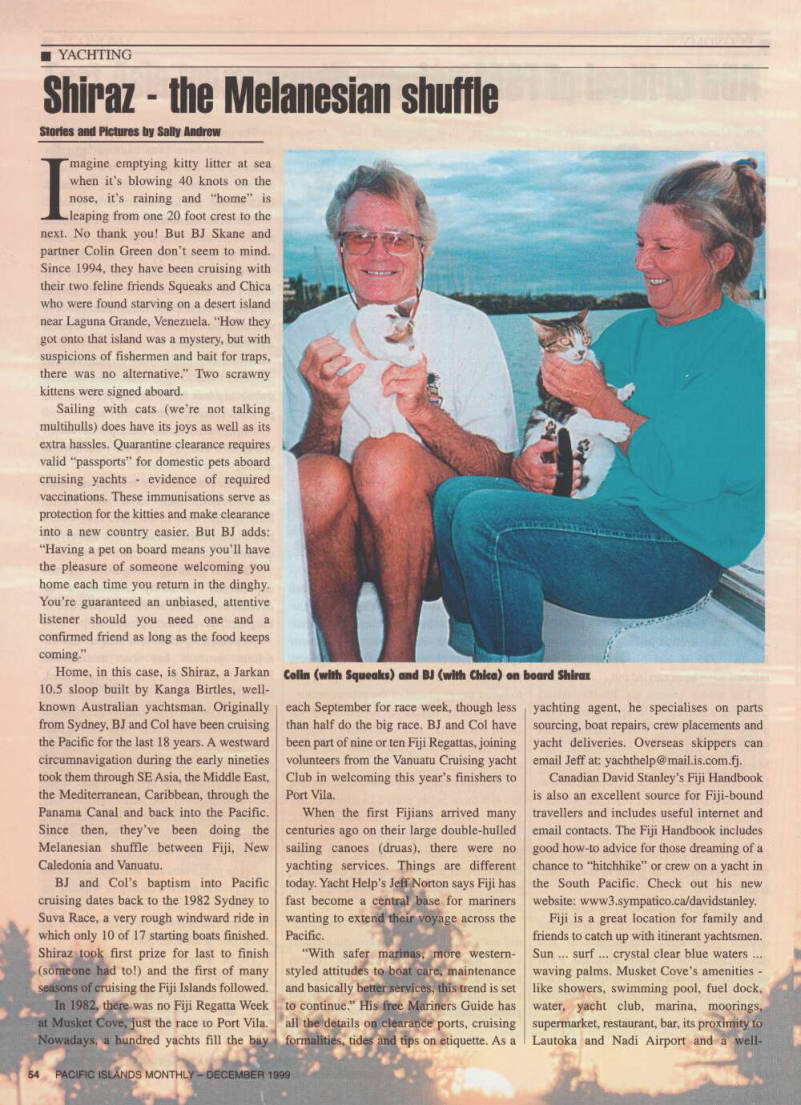
Since 1994, they have been cruising with their two feline friends Squeaks and Chica who were found starving on a desert island near Laguna Grande, Venezuela. “How they got onto that island was a mystery, but with suspicions of fishermen and bait for traps, there was no alternative.” Two scrawny kittens were signed aboard.
Sailing with cats (we’re not talking multihulls) does have its joys as well as its extra hassles. Quarantine clearance requires valid “passports” for domestic pets aboard cruising yachts - evidence of required vaccinations. These immunisations serve as protection for the kitties and make clearance into a new country easier. But BJ adds: “Having a pet on board means you’ll have the pleasure of someone welcoming you home each time you return in the dinghy.
You’re guaranteed an unbiased, attentive listener should you need one and a confirmed friend as long as the food keeps coming.”
Home, in this case, is Shiraz, a Jarkan 10.5 sloop built by Kanga Birtles, well known Australian yachtsman. Originally from Sydney, BJ and Col have been cruising the Pacific for the last 18 years. A westward circumnavigation during the early nineties took them through SE Asia, the Middle East, the Mediterranean, Caribbean, through the Panama Canal and back into the Pacific.
Since then, they’ve been doing the Melanesian shuffle between Fiji, New Caledonia and Vanuatu.
BJ and Col’s baptism into Pacific cruising dates back to the 1982 Sydney to Suva Race, a very rough windward ride in which only 10 of 17 starting boats finished.
Shiraz took first prize for last to finish * (someone had to!) and the first of many seasons of cruising the Fiji Islands followed.
In 1982, there was no Fiji Regatta Week at Musket Cove, just the race to Port Vila.
Nowadays, a hundred yachts fill the bay
each September for race week, though less than half do the big race. BJ and Col have been part of nine or ten Fiji Regattas, joining volunteers from the Vanuatu Cruising yacht Club in welcoming this year’s finishers to Port Vila.
When the first Fijians arrived many centuries ago on their large double-hulled sailing canoes (druas), there were no yachting services. Things are different today. Yacht Help’s Jeff Norton says Fiji has fast become a central base for mariners wanting to extend their voyage across the Pacific.
“With safer marinas, more western styled attitudes to boat care, maintenance and basically better services, this trend is set to continue.” His free Mariners Guide has all the details on clearance ports, cruising formalities, tides and tips on etiquette. As a
yachting agent, he specialises on parts sourcing, boat repairs, crew placements and yacht deliveries. Overseas skippers can email Jeff at: [email protected].
Canadian David Stanley’s Fiji Handbook is also an excellent source for Fiji-bound travellers and includes useful internet and email contacts. The Fiji Handbook includes good how-to advice for those dreaming of a chance to “hitchhike” or crew on a yacht in the South Pacific. Check out his new
website: www3. sympatico.ca/davidstanley.
Fiji is a great location for family and friends to catch up with itinerant yachtsmen.
Sun ... surf ... crystal clear blue waters ... waving palms. Musket Cove’s amenities like showers, swimming pool, fuel dock, water, yacht club, marina, moorings, supermarket, restaurant, bar, its proximity to Lautoka and Nadi Airport and a well-
Colin (with Squeaks) and BJ (with Chico) on board Shiraz
protected anchorage with good holdings in about 15 metres - these are the ingredients for a successful yacht regatta.
Two more marinas have recently popped up on the west coast of Viti Levu. Port Denarau, Fiji’s newest - with ten mega-yacht berths and 100 small craft berths - hosts the annual Denarau Race Week. Vuda Point Marina, north of Nadi and popular with trans-Pacific cruisers, touts itself as cyclone proof with space for about 50 yachts plus travel lift and repair facilities.
When a low develops during cyclone season, Shiraz heads upriver near Lautoka.
“Mangroves it is ... We’re on a first name basis with 14,467 soldier crabs, a dozen or so Indian fishing people, 853 mynah birds, three grey herons and a couple of sandpipers. At high tide, it’s positively pretty with views of mountains and canefields.”
BJ and Col love Lautoka - “a great big country town, laid back, quiet and friendly: the market is good, transport is cheap and taxi drivers (especially Dan’s family!) friendly. And during cyclone season, the Northern Club helps keep the sanity!”
Once the ex-colonial club, it is still a cool oasis in mid-summer with its swimming pool, squash and tennis courts, restaurant and bar. Best of all, staying over cyclone season in Fiji is relatively easy - the boat can stay in Fiji waters for up to 18 months and immigration allows a full six months.
Shuffling with the seasons between Fiji, Vanuatu and New Caledonia, BJ heeds all indigenous forecasting indices like 1. If the mangoes are early, cyclone season will be
early; 2.
If there’s a glut of mangoes, it’s a sure sign there’ll be a glut of cyclones.
Speculating, BJ wonders whether the equation is nature’s way of providing food in times of cyclone - if it’s hot with no cooling rain, because cyclones are in the offing, the mango trees blossom profusely.
Island weather watchers also watch the wasps and the banana stalks. If the wasps
build their nests low down, watch out.
There will be bad weather. But if they build their nests high in the trees, no worries - the wasps aren’t anticipating big winds. As for banana stalks, if the stalk sticks straight up with no bend, it indicates no early cyclones. If the new leaves bend - watch out!
This year, mango flowers in Tahiti foretell lots of cyclones in the eastern Pacific. But scientists say all signs point to “La Nina” conditions with cyclones concentrated in the western Pacific. Let’s hope they’re both wrong! ■
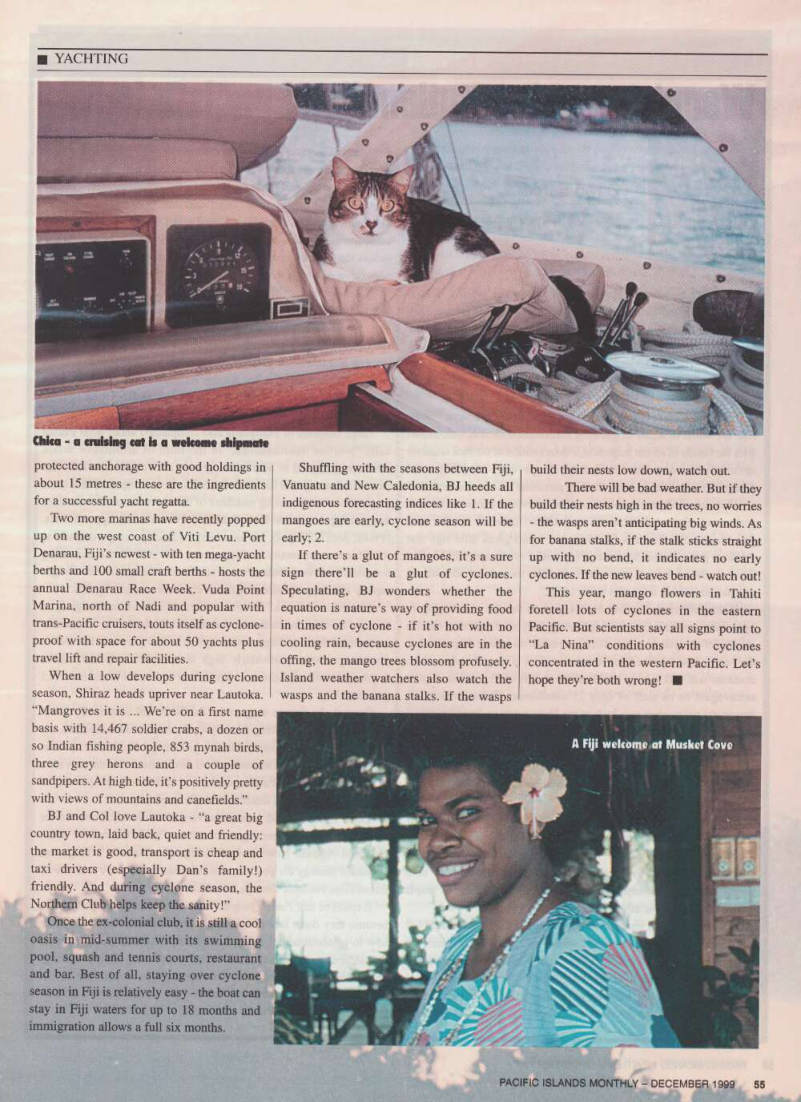
Chica - a cruising cat is a welcome shipmate
A Fiji welcome at Musket Cove