Tabai still fighting far Kiribati
p. 10 · Read in the full issue
By Michael Held
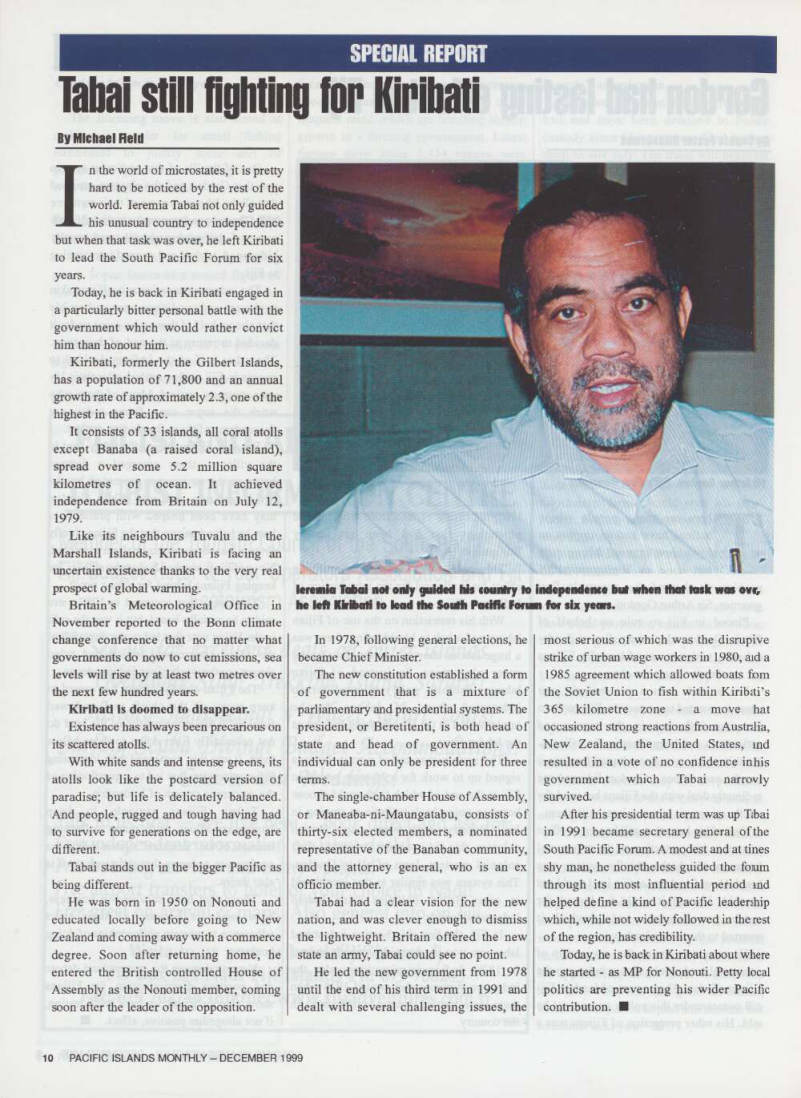
In the world of microstates, it is pretty hard to be noticed by the rest of the world. leremia Tabai not only guided his unusual country to independence but when that task was over, he left Kiribati to lead the South Pacific Forum for six years.
Today, he is back in Kiribati engaged in a particularly bitter personal battle with the government which would rather convict him than honour him.
Kiribati, formerly the Gilbert Islands, has a population of 71,800 and an annual growth rate of approximately 2.3, one of the highest in the Pacific.
It consists of 33 islands, all coral atolls except Banaba (a raised coral island), spread over some 5.2 million square kilometres of ocean. It achieved independence from Britain on July 12, 1979.
Like its neighbours Tuvalu and the Marshall Islands, Kiribati is facing an uncertain existence thanks to the very real prospect of global warming.
Britain’s Meteorological Office in November reported to the Bonn climate change conference that no matter what governments do now to cut emissions, sea levels will rise by at least two metres over the next few hundred years.
Kiribati Is doomed to disappear.
Existence has always been precarious on its scattered atolls.
With white sands and intense greens, its atolls look like the postcard version of paradise; but life is delicately balanced.
And people, rugged and tough having had to survive for generations on the edge, are different.
Tabai stands out in the bigger Pacific as
being different.
He was born in 1950 on Nonouti and educated locally before going to New Zealand and coming away with a commerce degree. Soon after returning home, he entered the British controlled House of Assembly as the Nonouti member, coming soon after the leader of the opposition.
In 1978, following general elections, he became Chief Minister.
The new constitution established a form of government that is a mixture of parliamentary and presidential systems. The president, or Beretitenti, is both head of state and head of government. An individual can only be president for three terms.
The single-chamber House of Assembly, or Maneaba-ni-Maungatabu, consists of thirty-six elected members, a nominated representative of the Banaban community, and the attorney general, who is an ex officio member.
Tabai had a clear vision for the new nation, and was clever enough to dismiss the lightweight. Britain offered the new state an army, Tabai could see no point.
He led the new government from 1978 until the end of his third term in 1991 and dealt with several challenging issues, the
most serious of which was the disrupive strike of urban wage workers in 1980, aid a 1985 agreement which allowed boats fom the Soviet Union to fish within Kiribdi’s 365 kilometre zone - a move hat occasioned strong reactions from Australia, New Zealand, the United States, md resulted in a vote of no confidence inhis government which Tabai narrovly survived.
After his presidential term was up T;bai in 1991 became secretary general of the South Pacific Forum. A modest and at tines shy man, he nonetheless guided the fount through its most influential period md helped define a kind of Pacific leadership which, while not widely followed in the rest of the region, has credibility.
Today, he is back in Kiribati about where he started - as MP for Nonouti. Petty local politics are preventing his wider Pacific contribution. ■
Lere[?]ia Tabai not only guided his country to independence but when that task was ovr, he left Ki[?]ba[?]i to lead the South Pacific Forum for six years.