Tamasese made ultimate sacrifice for Samoa
pp. 11-15 · Read in the full issue

By Michael Held
It is politically expedient in Samoa
nowadays to forget the people of the Mau. And lost in the unseemly political squabble is the one man who died for Samoa’s freedom, the high chief Tupua Tamasese Lealofi 111.
He was not to know that decades later one of his nephews would take the Tamasese title and become a controversial
political figure.
Samoan politicians do not forget - nor do
they forgive, generations on.
Samoa had become a German colony in 1900 and, in 1914, New Zealand invaded, at Britain’s beckoning. After the war, it became a League of Nations mandate but already the new masters were making blunders.
The worst was in 1918 to allow influenza into Western Samoa (it never entered American Samoa) and in the space of a month, well over a quarter of the population was dead.
This created a discontent in Samoa over the quality of New Zealand leadership that was dominated by military men who wanted the islands run on orderly lines.
In March 1924, a Samoan London
Missionary Society pastor protested to
Native Affairs Secretary Harry Griffin over a hibiscus hedge planted by the young Tupua Tamasese.
Griffin ordered the hedge removed but he refused.
This bought Administrator General George Richardson into the scene who ordered the high chief out of Vaimoso and into the village of Leulumoega.
The chief ignored the order and was bought to court and charged with disobeying the government. He was given one week’s goal and then banished for an indefinite period to Savai’i while Richardson stripped him of his title. He called that a “bold step”.
Later in the year, Tupua Tamasese paddled a paopao to Upolu to inquire when his title would be restored. He was arrested and imprisoned for three months.
One of Apia’s leading businessmen, OF Nelson, meanwhile found New Zealand’s administration increasingly burdensome and, along with others, he called two public meetings in 1926. Tupua Tamasese attended. This was the birth of the Mau.
Later, when New Zealand held an inquiry into what was happened, Tupua Tamasese was called as a witness and asked what the aims of the movement were.
“It is the wish of the Mau that Samoa should be controlled by the Samoans.”
The movement grew and, in 1928, Richardson called in the Royal Navy and armed police from New Zealand. A prison camp was built at Mulinu’u.
Flundreds of Samoans, including Tupua Tamasese, flocked to it to surrender to the authorities - thus making a mockery of the soldiers.
They took their revenge though for when Tupua Tamasese was released, along with the others, armed police staged a raid before dawn the next day.
They pushed his spouse, Ala Tamasese, a Tokelauan, to the ground and gave chase to Tupua Tamasese who stopped suddenly and turned around.
“Go on, shoot me, shoot me,” he said.
The policeman fired his rifle twice, knowing it had blanks in it.
The police were showered with stones as Tupua Tamasese was taken away.
He raised his hands and called for peace.
On December 6, 1928, he appeared in court on a charge of contempt of court and was found guilty, sentenced to six weeks goal. Then he was charged with resisting arrest and given another six months.
The new administrator, Colonel Stephen Allen had him sent to jail in New Zealand.
“He is not a criminal, but a spoilt child, and if subject to real discipline for a few months, I am not without hope that he will change his views and opinions.”
Nelson, who had been banished from Samoa, saw Tamasese arrive in Auckland.
“I went on board and saw Tamasese brought from the steamer direct to the
police van ... and taken to Mount Eden Goal. We nodded to one another as he passed but were not allowed to speak. He looked somewhat distressed but bore himself with dignity as becomes the scion and head of a Samoan royal house.”
In jail, one of the country’s leading Maori leaders, Sir Maui Pomare, visited him.
“I came but to see your face, and so I looked into the countenance of a tama au Ariki - a prince indeed - lineal descendent of kings where genealogical lines reach back into the twilight of fable - deprived of hereditary titles, degraded, deported and
imprisoned.”
The New Zealand government tried to get him to abandon the Mau by offering him a key post in the colonial administration.
“I am a prisoner and am not able to do any of these things,” he replied. “When my sentence expires and I am released from prison, then I shall please myself what I do.
I do not with to ask the Government for anything I want, and I do not accept anything from the Government. I shall remain steadfast in the Mau of Samoa.”
Although Allen wanted him held in goal, Tamasese arrived back in Samoa on June 27, 1929.
On December 29,1929, one of the white men who had supported the Mau was due back in Apia after government ordered banishment. With him was a lawyer, acting for Nelson, who was collecting evidence for a libel case that Nelson had bought against the New Zealand Herald.
The Mau, unarmed and complete with a band, planned a big welcome parade down Beach Road.
In what became known as “Black Saturday,” armed New Zealand Police began executing arrest warrants on tax charges. Outside the main administration
building, shooting broke out.
A policeman was killed after a number of Samoans had been gunned down.
Tupua Tamasese called out “filemu Samoa, peace Samoa” and “uma, uma.
Continued next page
Continued from previous page
onosa’i, onosa’i” (finish, finish be patient).
He was standing on a key intersection the police station with its machine gun behind him.
Over the noise, his strong, clear voice could be heard by both the police and the Mau as he called for peace. With his arms high in the air, his actions were anything but aggressive. As he made his desperate appeal, a policeman aimed a Lee Enfield rifle at his back and pulled the trigger.
The 0.303 bullet struck him in the upper right thigh, chewed its way through the muscle and shattered the femur and pelvis.
Tupua Tamasese collapsed to the ground in great pain.
Su’a remembered events clearly: “He called out - to the west and to the east - ‘keep the peace’ He was walking; he was
calling out and raised his hands, saying ‘stop - keep the peace.’ One shot was fired before the machine-gun fired; that was the shot that hit Tamasese.”
Su’a. Faualo and Tufuga were standing nearby when he fell, and they ran to his aid, despite the continuing rifle and machine gun fire.
Tufuga was the first to reach him. “I tried to lift up Tamasese’s head, and as I was doing that I was hit in both legs.”
Other men who tried to help were also gunned down.
Fearful of the authorities, many of the wounded would not go to the hospital, until the only missionary who would visit Vaimoso that day, Father Deihl, and a government doctor, Herbert Hutson, went to the village and persuaded them to go to
the hospital.
A friend of Tamasese, barrister Isi Kronfeld, met him.
“He greeted me with his usual boyish smile, his face beaming with courage.”
In the arms of Father Deihl, at 8.45am the next day, he died.
He sent a message to his people, to his country.
“My blood has been spilt for Samoa. I am proud to give it. Do not dream of avenging it, as it was spilt in maintaining peace. If I die, peace must be maintained at
any price.”
It was an ultimate sacrifice, and one which deserves to live into the new millennium. ■ * Extracts from Man: Samoa’s Struggle for Freedom by Michael JField, Polynesian Press 1991 Continued next page
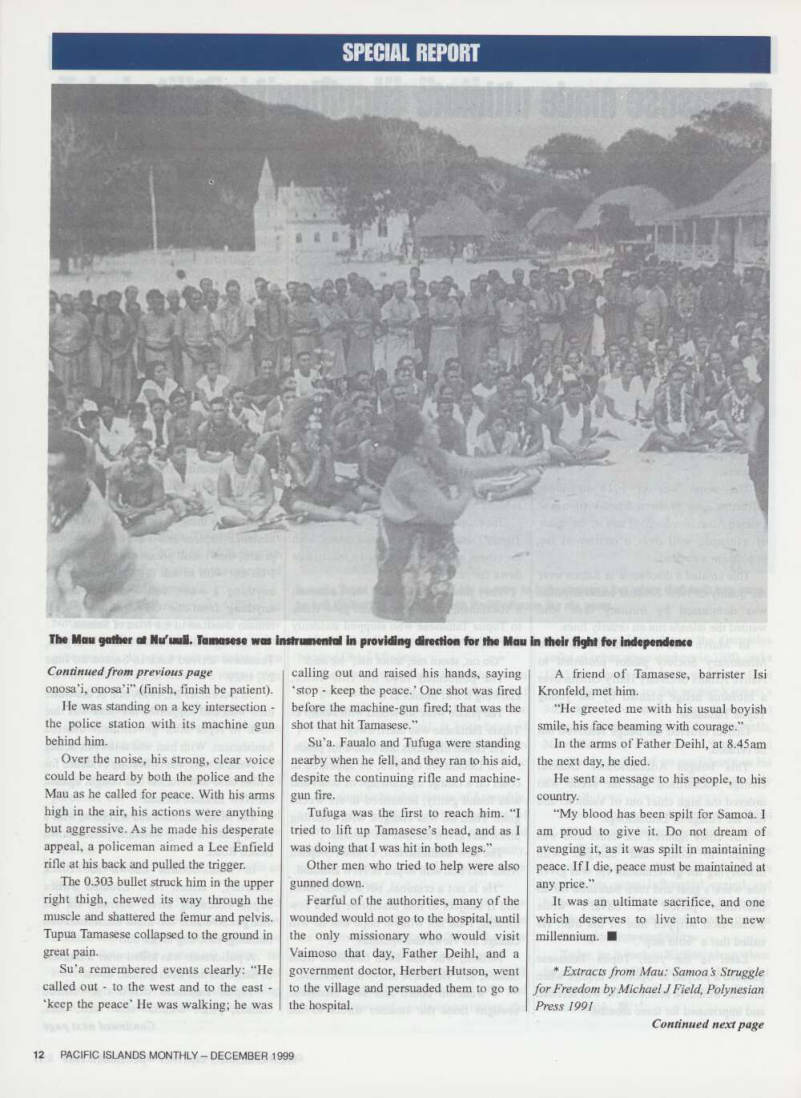
The Mau gather at Nu'uuli. Tamasese was instrumental in providing direction for the Mau in their fight for independence
Continued from previous page
Methodist based sect the monarch was nominally head of. The church was corrupt and power had slipped to a man, one Jabez Watkin.
Salote’s long legal and political battle eventually saw her win, the bulk of the church rejoined to the Free Wesleyan Church.
She was head of it and given the role of religion in Tongan life it gave her inordinate, near absolute power over Tongans. This has continued to her son and the Church, along with the Royals, continues to oppose change and any increased level of democracy.
Her reign was not repressive; rather it was mostly inert and conservative. Most of the world failed to notice and Salote’s one appearance on the global stage came at the coronation of Britain’s Elizabeth 11, she rode in a carriage in pouring rain with the roof down so people could see her winning the hearts of Londoners in the process. “I told the policeman to leave the
hood of our carriage down,” the Queen is quoted as saying. “I did not think to ask the chief (the Sultan of Kelantan), and he maintained silence with good grace.”
Salote died in Auckland in 1965, ending a reign of 47 years that saw the country change very little.
“Since the death of Queen Salote in 1965,” writes Wood-Ellem, “Tonga has
been struggling with the forces of modern economics; so much so that change seems to be spinning out of control, and Tonga survives only because about 40 percent of its people live overseas.”
Salote had clear goals; simply to secure her own future and that of her dynasty.
Tonga itself, and its people, came a distant third. ■
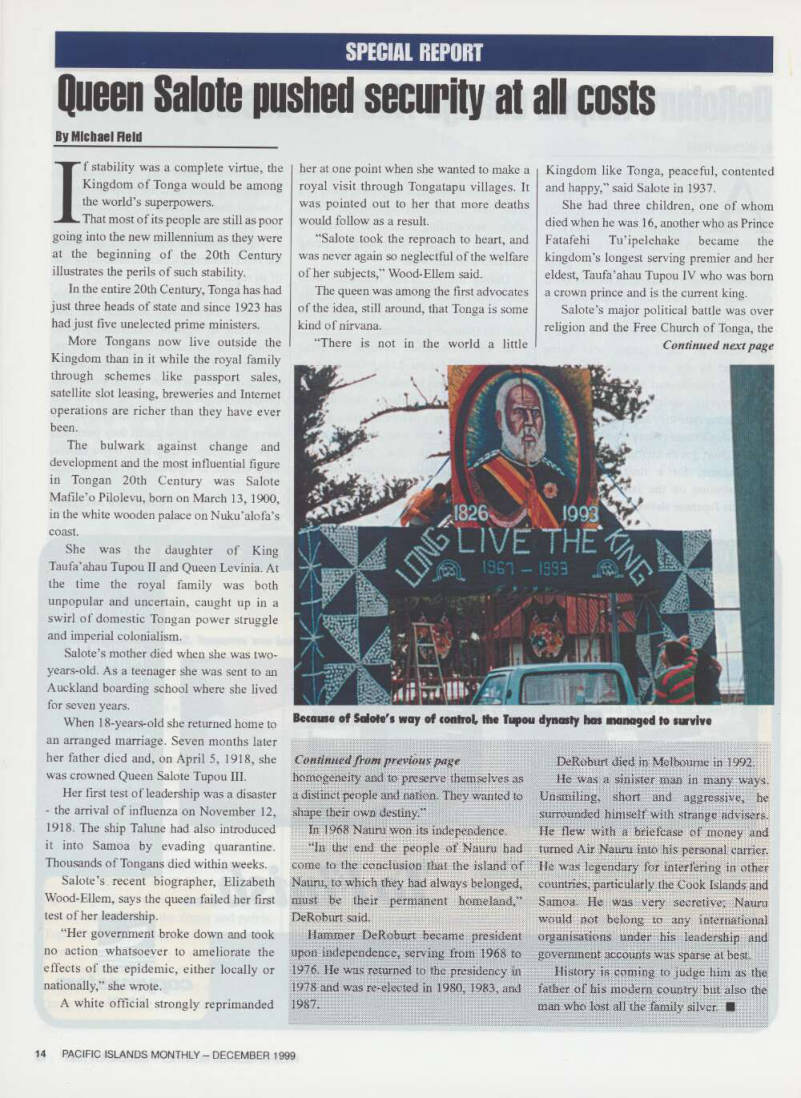
Tongan school children prepare to celebrate their monarch's reign