Gordon had lasting effect In Fig
Special Report
By Sophie Foster Hildebrand
There are many people whose actions have had an impact on
Fiji’s development this century
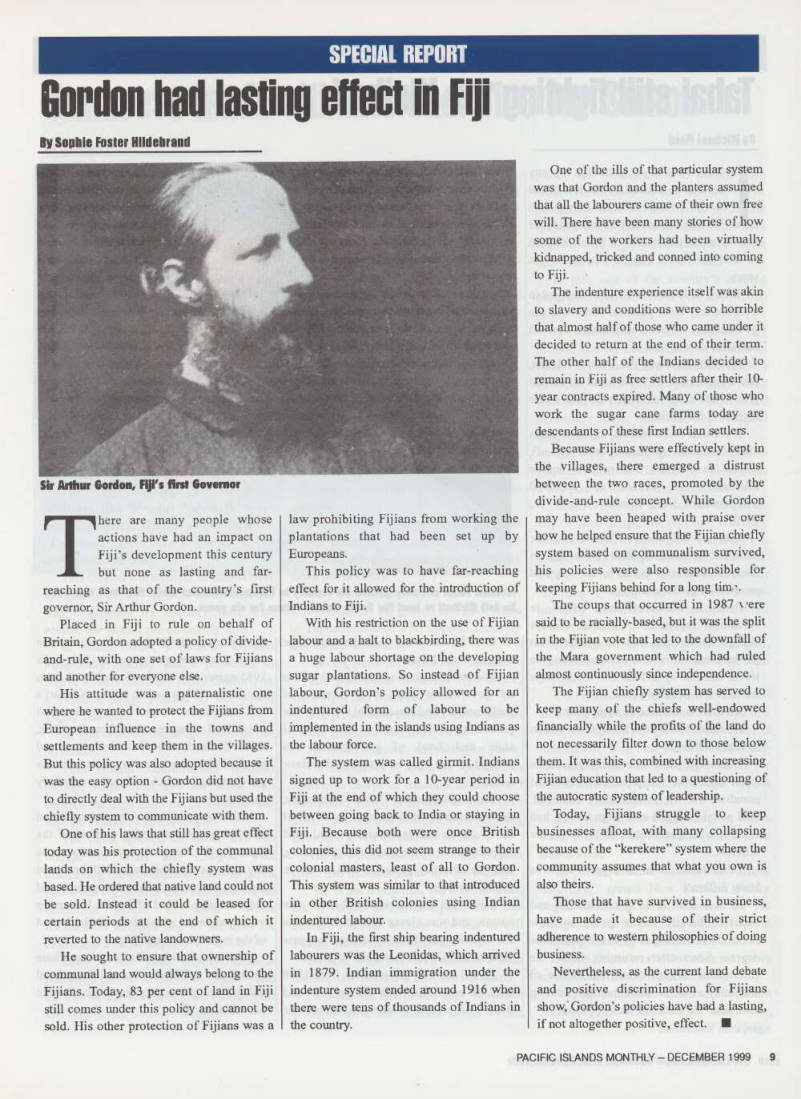
but none as lasting and far reaching as that of the country’s first governor, Sir Arthur Gordon.
Placed in Fiji to rule on behalf of Britain, Gordon adopted a policy of divide and-rule, with one set of laws for Fijians and another for everyone else.
His attitude was a paternalistic one where he wanted to protect the Fijians from European influence in the towns and settlements and keep them in the villages.
But this policy was also adopted because it was the easy option - Gordon did not have to directly deal with the Fijians but used the chiefly system to communicate with them.
One of his laws that still has great effect today was his protection of the communal lands on which the chiefly system was based. He ordered that native land could not be sold. Instead it could be leased for certain periods at the end of which it reverted to the native landowners.
He sought to ensure that ownership of communal land would always belong to the Fijians. Today, 83 per cent of land in Fiji still comes under this policy and cannot be sold. His other protection of Fijians was a
law prohibiting Fijians from working the plantations that had been set up by Europeans.
This policy was to have far-reaching effect for it allowed for the introduction of Indians to Fiji.
With his restriction on the use of Fijian labour and a halt to blackbirding, there was a huge labour shortage on the developing sugar plantations. So instead of Fijian labour, Gordon’s policy allowed for an indentured form of labour to be implemented in the islands using Indians as the labour force.
The system was called girmit. Indians signed up to work for a 10-year period in Fiji at the end of which they could choose between going back to India or staying in Fiji. Because both were once British colonies, this did not seem strange to their colonial masters, least of all to Gordon.
This system was similar to that introduced in other British colonies using Indian indentured labour.
In Fiji, the first ship bearing indentured labourers was the Leonidas, which arrived in 1879. Indian immigration under the indenture system ended around 1916 when there were tens of thousands of Indians in the country.
One of the ills of that particular system was that Gordon and the planters assumed that all the labourers came of their own free will. There have been many stories of how some of the workers had been virtually kidnapped, tricked and conned into coming
to Fiji.
The indenture experience itself was akin to slavery and conditions were so horrible that almost half of those who came under it decided to return at the end of their term.
The other half of the Indians decided to remain in Fiji as free settlers after their 10year contracts expired. Many of those who work the sugar cane farms today are descendants of these first Indian settlers.
Because Fijians were effectively kept in the villages, there emerged a distrust between the two races, promoted by the divide-and-rule concept. While Gordon may have been heaped with praise over how he helped ensure that the Fijian chiefly system based on communalism survived, his policies were also responsible for keeping Fijians behind for a long time.
The coups that occurred in 1987 were said to be racially-based, but it was the split in the Fijian vote that led to the downfall of the Mara government which had ruled
almost continuously since independence.
The Fijian chiefly system has served to keep many of the chiefs well-endowed financially while the profits of the land do not necessarily filter down to those below them. It was this, combined with increasing Fijian education that led to a questioning of the autocratic system of leadership.
Today, Fijians struggle to keep businesses afloat, with many collapsing because of the “kerekere” system where the community assumes that what you own is also theirs.
Those that have survived in business, have made it because of their strict adherence to western philosophies of doing business.
Nevertheless, as the current land debate and positive discrimination for Fijians show, Gordon’s policies have had a lasting, if not altogether positive, effect. ■
Sir Arthur Gordon, Fiji's first Governor