Malaitans flee homes
p. 27 · Read in the full issue
“If anyone found this Bible please bring it to the owner of this 8ib1e...”
That was written in the front of a small New Testament, found lying on the floor of an abandoned house on Guadalcanal.
Nearby another house was burnt to its foundations. All the other 12 buildings were trashed. Dozens of family photos scattered across the floors.
A small ginger kitten meows for food outside.
Vilu was a piece of trashed paradise, a Pacific version of ethnic cleansing.
The Bible gave the clue to why the place was empty its owner was Maenu Tuita whose address was Malaita Province.
It was Vilu village, out west of Honiara, and just days before we’d arrived it had been a thriving community. They had a museum of World War II relics which tourists and veterans had once visited. It was empty now. The gardens were still growing but stagnant water was leaking into the buildings.
An old Guadalcanal man told us the Malaitans had gone. He seemed pleased.
The Guadalcanal people had gone too now they were afraid of the Malaitan pay back.
And so this lush land was empty of peo
ple.
Another house we step over a sign into
the devastation.
“Please don’t Enter in this house with out permission from the owner.
Try to respect.”
They’d been completely ransacked.
A goat was abandoned in a bare pen; no one caring any longer for it.
We find, at different places, three peo ple. All were Guadalcanal people; none, they said, knew about any Liberation Army. “I am happy the Malaitans have gone,” said Francis Siloivario, standing on one of the finest beaches in the world overlooking Iron Bottom Sound.
“They caused problems and they were always stealing and fighting...” ■
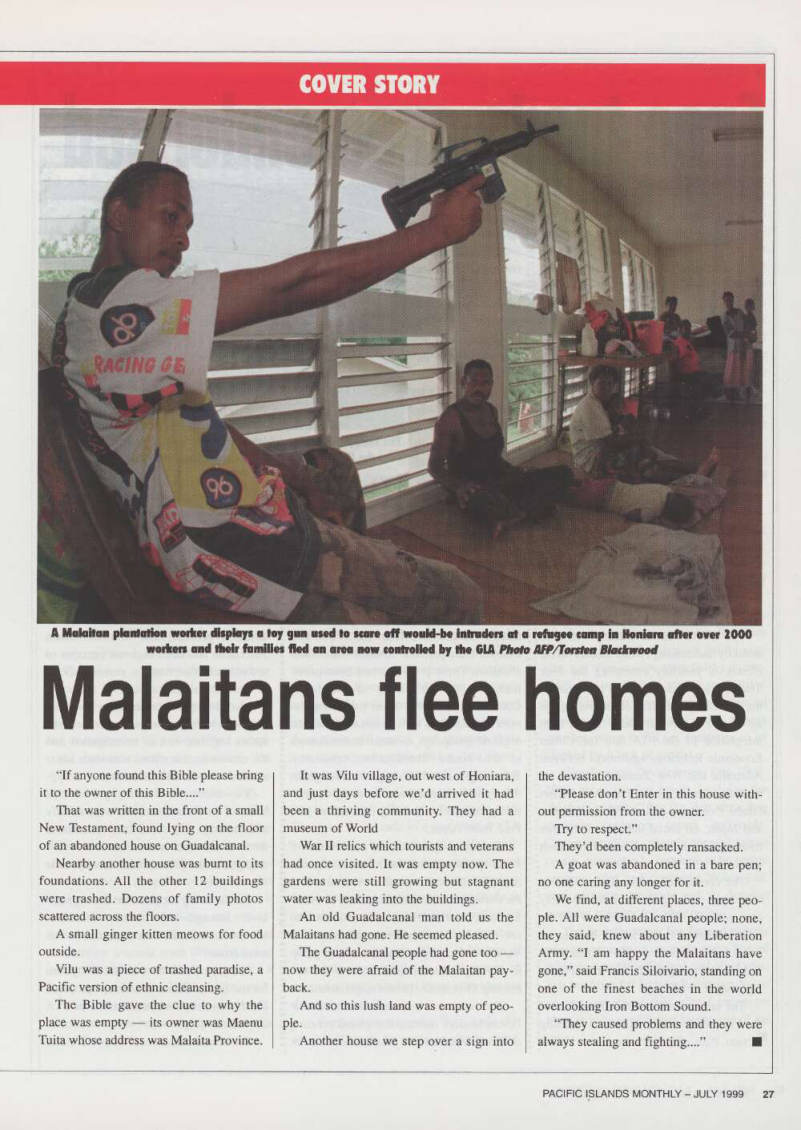
A Malaitan plantation worker displays a toy gun used to scare off would-be intruders at a refugee camp in Honiara after over 2000 workers and their families fled an area now controlled by the GLA Photo AFP/Torsten Blackwood