Free trade area endorsed
pp. 28-29 · Read in the full issue
Focus
By Bernadette Hussain
TRADE Ministers from the 16-member South Pacific Forum endorsed a Free Trade Area between Forum Island Countries dur ing a regional trade ministers meeting in Fiji early last month.
This ministerial endorsement will be considered by Forum leaders when they meet in Palau in October for the South Pacific Forum.
The ministers have also given the green light for further negotiations over the details of a draft framework agreement.
Forum trade officials have also been asked to negotiate the details of the draft agree ment, including negative lists and mea sures to provide for application of the agreement to Australia and New Zealand.
Official implementation of the Free Trade Agreement is expected to start in 2001 with tariffs between Pacific Island Countries being eliminated over a number of years.
The South Pacific Forum will also assist by undertaking further studies on the effects of possibly extending the Free Trade Area to French and US territories in the Pacific; the effects of extending the agreement to services trade; longer term integration of the FTA into the Closer Economic Relations agreement between Australia and New Zealand; studies on market access issues between Forum Island Countries and the United States, and Japan; on social impacts of the free trade agreement; and on trade facilitation measures.
The concept of a Free Trade Area or economic union goes back to the early days when the Forum was formed and the establishment of the South Bureau of Economic Cooperation (SPEC) in 1973 and was recognised in the Forum Agreement in 1991.
The mpst recent mandate arose out of the Forum Economic Ministers Meeting Action Plan of 1998 where the Forum
Secretariat was
requested to further j
develop a frame- , work for achieving a free trade agreement among Forum mem bers which gives due regard to benefits to be attained by pref erential and non preferential
approaches. This
also takes into account the need for ' the World Trade Organisation consis tency, and the differ
ing speeds at which Forum Island Countries may be able to proceed with preferential and non-preferential liberalisation.
Ministers also acknowledged the fact that there had been rapid and fundamental changes in the global aid and trade regimes.
These were reflected in the decline in real value of aid, the loss of trade preferences, and in the pressure from the WTO, and external trade partners towards trade liber alisation. These pressures had been mani fested in the weakening of the Lome Convention at the WTO and in the require ment for States, in various international and regional groupings, to make commitments to time-bound liberalisation schedules.
Some regions and sub-regions throughout the world have responded to the globalisa tion pressures by forming themselves into Free Trade Areas.
To help prepare for the next round of WTO-sponsored multilateral trade negotia tions, the ministers agreed to recommend to the Forum that a Forum delegation be estab lished in Geneva. Forum trade officials who are members or observers of the WTO would serve as a permanent working group to develop common positions on the up coming Millennium Round negotiations.
The ministers also recommended that Forum leaders endorse the global meeting of Trade Ministers of Small States on the
margins of the WTO Ministerial Conference; work towards rules and regu lation to protect intellectual property rights of indigenous peoples; develop a programme to facilitate environmentally friendly products from Forum Island Countries; consider trade and environ ment linkages throughout the trade liber alisation process; and for the Forum Secretariat and other regional agencies to undertake further work on various aspects of trade liberalisation.
The Ministers endorsed a review of all measures having an impact on trade facil itation together with an investigation into the constraints associated with trade liber alisation and facilitation issues.
The ministers also recognised that many of the Forum members were already undertaking major reforms to address these challenges and several are now engaged in the process of voluntary trade liberalisation.
This is being supported at the regional level through the Forum Economic Ministers Action Plan on trade and invest ment issues.
In a paper titled “Forum Trade Options for the Forum Island Countries” prepared for the meeting looked the issue of FTA for FICs in detail.
On benefits and costs of preferential
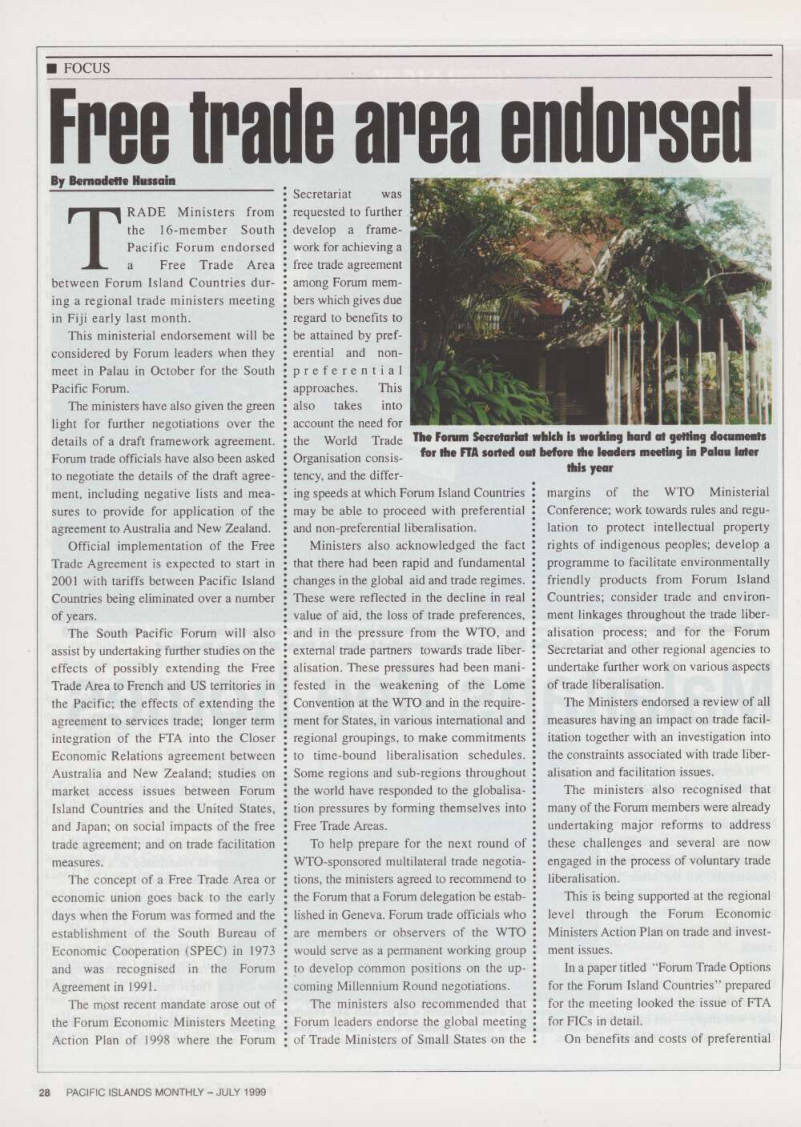
The Forum Secretariat which is working hard at getting documents for the FTA sorted out before the leaders meeting in Palau later this year
free trade among the FICs, the paper said the quantifiable economic benefits of the FICs of a preferential free trade arrange ment will be relatively small. A key poten tial benefit of such an arrangement, how ever, is that it can act as a stepping stone to more complete liberalisation. “It can also promote greater economic cohesion among the FICs in their dealings with the outside world. The FICs will also derive substan tial economic benefits from the implemen tation of a supporting programme of trade and investment facilitation measures.
The size of the market covered by a FIC preferential free trade arrangement can be more than doubled by the inclusion of the French and the US Pacific territories,” said the report. These conclusions are consis tent with the results of a computable gener al equilibrium (CGE) analysis of the effects of forming a FIC preferential trade arrangement, using trade and economic data from each FIC. On the form of a pref erential FTA, the report said that in design ing a preferential free arrangement cover ing trade in goods, two key choices are: - Free trade area (FTA) or customs union. In a FTA, members retain their sep arate barriers against non-members, where as in a customs union they agree to adopt a common external tariff (CET) to be applied to imports from non-members.
The other is a negative list approach or
a positive list approach.
Under a negative lists approach, barri ers are removed on all products except a list (the negative list) of specified excep tions, whereas with the positive list approach, barriers are removed only on an agreed list of products (the positive list).
The report said on the first choice, FTA is recommended, principally because of the difficulties anticipated in reaching agree ment on a common tariff to be applied to non-members, it said. “A negative list approach is strongly recommended, as it will involve lower negotiating and admin istration costs, is more likely to ensure that momentum towards trade liberalisation is sustained, and is more likely to produce a result compatible with WTO obligations.”
The following additional recommenda tions were made regarding the format of a
Fic Fta:
- Tariffs (including all taxes levied at the border which are applicable only to imports) should be reduced to zero by a
series of clearly-defined, explicitly
timetabled, automatic steps. - No quantative restrictions should apply to trade between FICs. - Rules of Origin should be based wher ever possible on the “change-of-tariff-head ing” approach, and should be designed as far as possible to facilitate efficient trade and production among the FICs rather than to restrict trade. Derogations should be available where possible to further this objective. The safeguard and balance of payments provisions contained in the WTO Agreement should be available to members, with notification to the Forum Secretariat in cases where the FICs involved are not WTO members. - Derogations from the agreement should be available for “infant industries”, but only for short and finite periods. - It should be understood that disputes are to be settled informally where possible.
However, a recommendation is also made for a formal dispute settlement procedure to be available in cases where informal proce dures fail to resolve a dispute.
The report also looks at advantages and disadvantages of preferential trade liberali sation According to the report, preferential trade arrangements also allow countries to enjoy gains from trade. Members of a pref erential FTA will increase imports of good and services which their partners can pro duce more efficiently, and increase their own exports of goods which they them selves can produce more efficiently that their partners. This increase in trade is the “trade creation” effect of a free trade area.
The gains from trade in a preferential FTA will generally be less than the gains avail able from a corresponding reduction of trade barriers on a non-discriminatory basis, since free trade areas are unlikely to include the most competitive suppliers of all goods and services within their member ship. This is especially likely to be true of free trade areas involving small groups of countries, particularly if those countries are themselves small. - Furthermore the gains from trade cre ation in FTA can be partly or wholly negat
ed by an effect called trade diversion, which does not rise in the case of non-dis criminatory trade liberalisation. - Trade diversion occurs when the pref erences created under the free trade agree ment cause imports to be switched from non-partner to partner countries, even though they are available from the non partner countries aLa lower cost. This can happen of course because the higher cost goods from the partner country enter free of duty and other restrictions under the free trade agreement, which may allow them to be sold to customers at a lower price than the lower-cost imports from the non-partner, to which duties and other restrictions continue to be applied.
Although consumers may benefit from lower prices, the resource cost to the importing countryas measured by the for eign exchange outlay needed to pay for them, has increased. ■