Advertisements & other items, pp. 1-2 (2 items)
Soloing $
PACIFIC ISLANDS MONTHLY
INSIDE: Fall of the kina
▼ 'ra
Soloing $ Ethik Mm
Moloitams E®
a
The Best Gets Better!
INTRODUCING THE NEW
E4OX YAMAHA
vTT
% *r':V -'ife **r^sa^
POWERFUL
AND RELIABLE
NEW MODEL
YAMAHA E4OX
Asco Motors
ENDURO
OUTBOARD
MOTOR
YAMAHA
Fiji's most popular Outboard Moto gets even better! Now with eve greater power and much improve performance the new, upgrade E4OX will give you more reliability lower noise, and much easie operation than ever before. Ful technical specifications are nov available from Asco Motors.
Improved performance for carrying heavy loads New simple fuel system for easier maintenance Improved anti-corrosion system uses 5 stage multiple coating Large capacity chrome plated waterpump for longer life Heavy duty gearbox is easier to operate and maintain Front mounted controls improve operation TECHNICAL INFORMATION: BARRY LEE • MANASA BALL! • PH 384888 • FAX 370309 • GPO BOX 355 SUVA FIJI ISLANDS BRANCHES : NABUA PH 384888 • WALU BAY PH 307808 • SIGATOKA PH 500577 • NADI PH 721777 • LAUTOKA PH 662855 BA PH 674406 • TAVUA PH 680152 • VATUKOULA PH 681377 • LABASA PH 811688
Pacific Islands Monthly
Vol 69 No. I
The News Magazine
July 1999
Alan Robinson Sophie Foster Hildebrand Michael Field. Gift' Johnson.
Sally Andrew. Monica Miller.
Ed Rampell. Alan Ah Mu.
Sam Vulum.
Florence Syme-Buchanan. Brian Tobia.
David Barber (Wellington).
Jemima Garrett (Sydney) Shekhar Rattan. Reuben Pickering. Faizal Khan Senior Regional Sales (South Pacific) Reginald Sami Shayne Farah Hussein Tel (679) 304111. 303244.
Fax (679) 303809.
Sydney, Canberra: Bob Hill Media Representation. Tel (61-2) 4164245.
Fax (61-2)4165064.
Brisbane: Jane Fewings Media and Advertising Associates Tel (61-7) 3378 4522.
Fax (61-7) 3878 1071.
Adelaide: Hastwell Williamsons Representatives, Tel (61-8) 3799522.
Fax (61-8) 3799735.
Melbourne: Brown Orr Fletcher Burrows (Aust) Pty Ltd.
Tel (61-3) 98265188.
Fax (61-3) 98265644- Auckland: McKay & Bowman. International Media Representatives Limited.
Tel (64-9) 4190561.
Fax (64-9) 4192243.
Japan: Universal Media Corporation. Tokyo, Tel (3) 3266626741.
Cable: UNI-MEDIA Tokyo, Fax (3) 32626742.
Pacific Islands Monthly was founded in 1930
(Usps 9522480).
A Fiji Times Limited production.
Cover prices are recommended retail only. Registered by Australia Post.
Publication No. NBPI2IO. © Copyright Fiji Times Limited. 177 Victoria Parade. Suva. Fiji.
Tel (679) 304111. fax (679) 303809.
Email: [email protected]
PIM Website: http://www.pim.com.fj Pacific Islands Monthly is published monthly by Fiji Times Limited, a division ot Nationwide New ; s, 2 Holt Street. Surry Hills.
Sydney. NSW 2010.
Pacific Islands Monthly PO Box 1167. Suva, Fiji.
Printed by Quality Print Limited. 16 Amra Street, Walu Bay. Suva. Fiji, Cover design/Layout by Shekhar Rattan Cover Photo: AFP/Torsten Blackwood
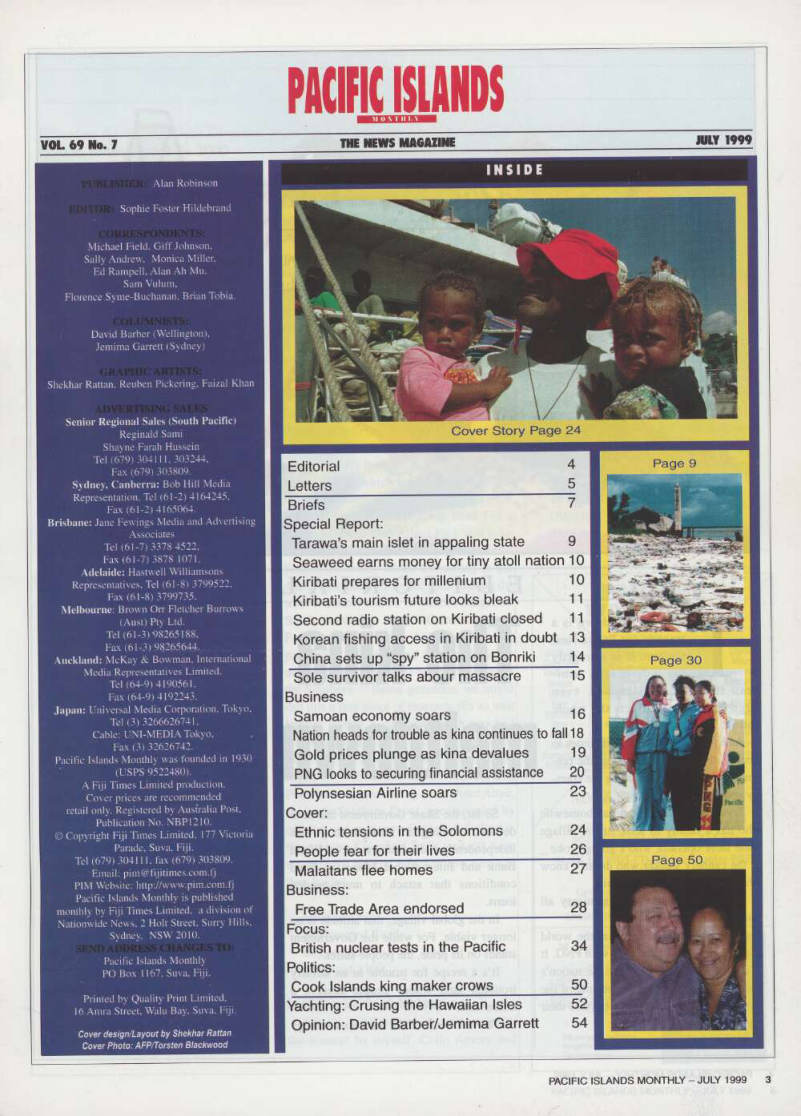
Inside
Cover Story Page 24
Editorial 4 Letters 5 Briefs 7 Special Report: Tarawa’s main islet in appaling state 9 Seaweed earns money for tiny atoll nation 10 Kiribati prepares for millenium 10 Kiribati’s tourism future looks bleak 11 Second radio station on Kiribati closed 11 Korean fishing access in Kiribati in doubt 13 China sets up “spy” station on Bonriki 14 Sole survivor talks abour massacre 15 Business Samoan economy soars 16 Nation heads for trouble as kina continues to fall 18 Gold prices plunge as kina devalues 19 PNG looks to securing financial assistance 20 Polynsesian Airline soars 23 Cover: Ethnic tensions in the Solomons 24 People fear for their lives 26 Malaitans flee homes 27 Business: Free Trade Area endorsed 28 Focus: British nuclear tests in the Pacific 34 Politics: Cook Islands king maker crows 50 Yachting: Crusing the Hawaiian Isles 52 Opinion: David Barber/Jemima Garrett 54
Page 9
Page 30
Page 50
The kina
Editorial
The kina meltdown
The kina meltdown is a tragedy for Papua New Guinea. It is a tragedy for individuals, fami lies, small businesses and even large concerns. It affects the whole nation.
And yet as the currency continues to freefall, the Government offers the pre posterous view that it’s doing the coun try good.
Try telling that to the urban housewife who has a family to feed, or the village trade store operator who’s going broke or the cannery worker who doesn’t know when he or she will work again.
The kina collapse brings misery all round.
And it is a clear sign that the world community has lost patience with PNG. It is no longer prepared to fund the nation’s budget deficit while certain sectors of the community continue to live beyond their means.
So far, the Skate Government has been defiant, standing on its right to govern independently and refusing to accept World Bank and International Monetary Fund conditions that attach to much-needed loans.
In the global village, that attitude is no longer viable. For while the Government stands on its pride, the people suffer.
It’s a recipe for trouble in an already troubled land whose people deserve a kinder fate.
The architects of the hard kina strategy
of the early and mid-80s must be shaking their heads in sorrow. They predicted then that any abandonment of the policy that protected the currency from the vicissi tudes of the world market would end in disaster.
It now seems they were right.
If nothing is done, PNG is heading for deeper trouble. Its problems can only worsen under the burden of an economy crippled by a collapsing currency. If this is allowed to continue unchecked, soon even the basics for survival will be beyond the means of many.
Then the trouble will really begin.
The Skate Government should climb down from its high horse and meet the terms offered by the World Bank and the
Imf.
Granted, it’s not the total solution to the nation’s problems, but it might buy some time so that those problems can be addressed.
To do nothing is no solution at all. ■
Letters
Johnston Atoll Chemical Disposal System to be Closed by 2000
Some of the content of your May 1999 story “Johnston Atoll Chemical Disposal System to be Closed by 2000” is open to question. The writer of the story includes quotes from an unidentified web site spon sored by an unknown and apparently dis gruntled worker. The Internet has dozens of such web sites carrying information on Johnston Atoll and, while many of them are legitimate, others may offer information that is open to question. There is an inherent dan ger with taking information off of the Internet because it is possible for anyone having the entry fee of about US$lOO to establish his own World Wide Web site and publish his own opinions on it without reser vation, right or wrong. The reader of any site has to question the legitimacy of the site sponsor as well as the authenticity of the subject matter before using it, especially when quoting it. In fact, many sites carry copyright restrictions on quoting which are every bit as valid as those for a hard copy publication such as PIM. The writer of the Johnston Atoll story apparently took the unidentified web site at its face value leav ing in question whether this person did, indeed, have a sound basis for his negative comments. Poor journalism, at best and potentially misleading at worst.
Earl Hinz, Henderson, Nevada, USA
Clearing all doubt
David Shakes made reference to lan Mackersey’s recent book, Smithy (PI M March 99), doubting his assertion that Kingsford Smith took off in the Southern Cross from Albert Park in Suva for Naselai Beach, believing instead that the aircraft was barged to the beach.
I also doubted Mackersey’s research until I read the relevant articles in the Fiji Times Centennial Issue 1869-1969. In a piece enti tled “Police turned them away’, reproduced from the Fiji Times of June 5, 1965, R C Farquhar, who was in charge of Suva Radio in June 1928, wrote: “At 7am on June 7 the Government vessel Pioneer, with Captain J Mullins in charge, left for Naselai with avia
tion spirit, oil and other materials, including a few article off-loaded from the Southern Cross to lighten it. “About 10.30 am the Southern Cross with “Smithy’ and Ulm left Albert Park. The other two men went to Naselai Beach by sea in the Government vessel Adi Beti.”
Kim Gravelle, in his book, Fiji Times, A History of Fiji, confirms that everything was taken out of the plane to lighten it, “and with only a few gallon of fuel in the tanks, the empty aircraft was flown to the sand beach”.
R A Derrick, in his authoritative geography of Fiji, The Fiji Islands, wrote: “The Southern Cross landed at Albert Park, Suva ... The plane could not, when fully loaded, take off from so restricted an area; so it was flown empty to Naselai Beach ...”
Perhaps confusion has arisen in some people’s minds from the Fiji Times article of June 6, 1928, which dramatically claimed that: “Southern Cross cannot leave from where it landed. To get away from Fiji a longer runaway than Albert Park will have to be found ...” A little bit of journalistic licence obviously added something to the drama unfolding. However, embellishing the truth is another matter. In Charles Kingsford Smith: Smith, The World’s Greatest Aviator, Pedr Davis claims that, “Almost the entire population of the island (presumably the author means Viti Levu) turned out to greet the Southern .” Being generous, we might call this a lazy piece of research. No so well known is that Kingsford Smith touched down again on Albert Park in October 1934 as part of the first eastbound Trans-Pacific
flight (Brisbane-Suva-Honolulu-San
Francisco). He was flying a Lockheed Altair, the Lady Southern Cross, accompanied by co-pilot and navigator Captain P G Taylor.
Once again, Kingsford Smih took off from the park for Naselai Beach where fuel was then loaded.
Michael Smith
44 Norwood Road, Bayswater, Auckland 1309.
Looking bock at history
July 22, 1999 is the 13th anniversary of the attempt by myself, Colin Amery and
Yvonne de Gatton to prevent the release of the two French saboteurs Alan Mafart and Dominique Prieur from leaving New Zealand. Mafart and Prieur were prema turely released. At the 11th hour, I mad at France and determined to stop their release, drew Colin Amery to my cause and this Sagittarian with his bow battled hard to strike the target low. But alas, though judge Wallace declared, “Let them (the prisoners) appear at 10am the following morning”.
Solicitor General Paul Neazor aborted the proceedings. The pair flew out that night under cover of darkness, fled and New Zealand’s honour and integrity bled. Where is justice when sheepbrains are at stake?
Where is honour when politicians make deals renege and like the plague spread their vile disgusting spew upon the popu lace anew?
Martin Leo,
10 Papaku Road, Otahuhu, Auckland
Advertisements & other items, p. 5 (1 item)
Iengihei
BMW
Bedford Cummins Daihatsu Detroit Deutz Ford Gardner Hmo Isuzu Iveco Komatsu Kubota
WAREHOUSE
PHONE
643-6938122
FAX
643-6938120 mm
New Zealand
email: blainQclear.net.N2
NEW & NEAR NEW ENGINES
Arriving Shortly
MAZDA RF Supercharger TOYOTA
3CT 3CT-T EFI 2C-1L 2L-11T-EFI
3L IB 1W lIIDT-FTI-EFI Intercooler 6881
4BDI-T
Generator Sets 7.5 2.5 35KVA
NEW ARRIVAL DETROIT 6V92 Silver
Dismantling MACK FR797 RST 6x4 NZ Distributors for All purpose vehicle Amphibious Go anywhere For Information or brochure ARGO Division Phone: 643-6938122 Fax: 643-6938120 PO Box 14 Geraldine
Lead, kindly light!

Archives-July 1945
THE usual tranquillity of night in Rarotonga was disturbed by agonised cries coming from the summit of a steep bush-clad hill at the back of the settle ment. A nervous crowd gathered as near as they dared to the foot of the hill.
They listened. “Aue! Help! Save me! a ghost brought me up the hill and now I cannot get down!” The crowd retreated a few paces. “A ghost!” they whispered .Footsteps approached from the rear. Ah! Thank heaven! The inevitable policeman has arrived.
“A ghost!” they tell him. “A ghost has taken someone up the hill and now he cannot get down! Again the agonised cries floated down from the high dark ness. A Rarotongan policeman is a brave and stalwart man - but a ghost! There is nothing in the regulations on what to do
about a ghost on top of a hill at midnight.
This was a matter for the sergeant. Some time elapsed while the sergeant was located and brought to the scene. The pleas from the hill were more terrified but weaker. There were graves at the foot of the hill. First one must run the gauntlet through the graves.
Then the climb up the steep track through the dark, crowding bush - and somewhere up there ... Shoulder to shoulder the police men started the ascent. “We must stick together. Whatever happens WE MUST STICK TOGETHER!” So they came upon poor Tamate prostrate with exhaustion and
fright. With difficulty they got him down the hill and bit by bit the awed crowd heard his story. He had spent the evening chat ting with friends and eventually started out to make his way home. But when he neared the fatal hill he noticed a light before him and a Voice bade him follow the light and it would lead him home. The denouement? Well, cold, scientific research reveals that during their long evening chatting together, Tamate and his friends frequently moistened their throats with that golden nectar commonly known as bush-beer, the night was very dark and the departing guest took with him the oil lamp from the table. Bush-beer being what it is, he failed to notice that The Light was held in his own outstretched hand.
But the people will not believe it. If Tamate says a ghost led him up the hill, then a ghost led him up the hill. Ghosts have ears and an annoyed ghost can be a nasty customer to meet on a dark night.
Advertisements & other items, p. 6 (1 item)
ToFinish...
SCHOOLS • CHURCHES
( t s*m e*m Copymasters Hawaii can help you with all of your duplicating needs from start to finish. Featuring Duplo® Digital Duplicators, Copiers, Shredders, Laminators, Poster Printers, Collators, & Folding Equipment. We also sell Stencil & Duplicator Supplies, Paper Supply, and all brands of Copier Supplies, & Computers.
Copymasters Hawaii
96-1173 Waihona Street, Suite B-2 • Pearl City HI 96782 Phone (808) 678-2263 • Fax (808) 456-5678
E-Mail: [email protected]
GOVERNMENT
COMMERCIAL
Serving:
STATE OF HAWAII
ENTIRE
SOUTH PACIFIC,
INCLUDING:
FIJI
SAMOA
TAHITI
TONGA
COOK ISLANDS
MICRONESIA:
FEDERATED STATES
OF MICRONESIA
GUAM
MARIANAS
MARSHALL
ISLANDS
ToFinish...
copymasters
hawaii
Briefs
Work expected to start soon on disputed hotel site The Cook Islands High Court has ruled in favor of Max Holdings and Castle Group, the developer at the former Sheraton site, and has given the company two months to start construction on the long-planned hotel and resort project.
Chief Justice Sir Peter Quilliam said that Max Holdings was in breach of its lease with the landowners of Pa Ariki.
Justice Quilliam agreed, however, to an injunction stopping Pa Ariki landowners from forfeiting the lease before July 31.
The injunction is conditional on back rent being paid and brought up to date.
Both parties have agreed that a two month period is a reasonable time for work to commence on the Rarotonga island site.
France to partly finance rural telecom munications project in Solomon Islands Agence Francaise de Development (The French Development Agency - AFD) has signed an agreed with the Solomon Islands Government to finance part of a SUSS mil lion rural telecommunication project in the country. Under the agreement, signed by Solomon Islands Finance Minister Alpha Kimata and AFDis representative in the Pacific Islands region Odile des Deserts, AFD will provide a grant of SUS 2 million.
Solomon Telekom, which is owned by the Solomon Islands Government and British company Cable and Wireless, will
implement the project.
Under the project the company will pro vide telecommunication services to rural areas in the Western and Choiseul Provinces. Solomon Telekom will provide the remaining SUS 3 million for the project.
The project will not only benefit police stations, health, education, and administra tive centres, but also 150,000 people in the two provinces, a statement from AFD said.
Solomon Telekom is also planning to provide up to 45 public phones in the two provinces. The project is part of the
Government’s global rural development
programme which aims to provide public services in rural areas.
PNG company to list on the Australian
Stock Exchange
A major Papua New Guinea company is
poised to list on the Australian Stock Exchange, the first time in almost three years.
The investing public in Australia, PNG, and institutions worldwide are being offered 80 per cent of New Britain Palm Oil Limited. The holding is being put up for sale by Kulim Malaysia as part of an Asian cri sis-inspired restructuring and is expected to fetch around million SUSISO million.
Managing Director of New Britain Palm Oil, Nick Thompson, said the company accounted for 55 per cent of palm oil pro duction in PNG.
“It is a PNG based company but it’s one that earns US dollars so we’re naturally hedged in terms of currency,” he said.
“If you start looking at the industry that we’re in, we’re in a growth industry which is Palm Oil, and which is growing at about eight per cent per year.”
Expert says micro-credit schemes could help rural dwellers in Pacific Islands A regional Credit Union meeting in Suva, Fiji said people who live in rural parts of the Pacific Islands region can benefit from micro-credit schemes if the schemes are properly managed.
Director of the Hans Seidel Foundation, Jurgen Rein said as a donor for micro credit schemes around the region, the Foundation has found many Pacific Island countries lack financial services and ability to provide advice, even on small-scale businesses.
Jurgen said most Pacific Island Governments however acknowledge the credit union movement is an instrument for
rural development.
Credit unions are perfect tools to encour age self help, especially in rural areas.
Missing infrastructure and services in many areas contribute to a lack of interest in these areas. Essential for a development is among others, the presence of financial services, he said. He said the assistance the Foundation has given Fiji and other island countries were mainly focussed on the Credit Union League, as the umbrella organisation of the movement.
The League has to sell its services. The more precious and valuable the services are, the higher the price and cost of provision for
these services, he said.
Fiji Government to license broadcasters The Fiji Government is silent over plans to introduce a new Broadcasting Bill to license broadcasters.
The Assistant Minister responsible for Information, Lekh Ram Vayeshnoi said ministry officials have begun consultations and discussions to license broadcasters in the country.
He said Government would make sure there is wide consultation before the Bill is taken to Parliament.
It will take some time to bring in the new measure but I assure you the Government will hear all submissions and opinions on the new Broadcasting Bill, Vayeshnoi said. Media organisations have reserved their comments until they see the content of the Bill. “We need to look at the context on which Government proposes to license broadcasters before we can make any comment,” Island Networks Public Broadcast General Manager, Francis Herman said.
Chief Executive of Communications Fiji Limited, William Parkinson, who is also President of the Pacific Islands Media Association, said there was discussion on the legislation with the previous Government.
However we will need to sit down with the new Government and discuss the licensing of broadcasters because the only license we have now is the technical license and not the broadcasting licenses given in other countries, Parkinson said.
Proposed regional free trade area to need high level of cooperation-operation
from customs, police
Secretary General of the South Pacific Forum Secretariat, Noel Levi, says the pro posed Free Trade Area will demand a very high level of cooperation-operation in the areas of customs, quarantine, immigration and police. Speaking at the opening of the 1999 meeting of the Forum Regional Security Committee (FRSC) in Suva, Fiji, Levi said the proposed FTA would have direct implications on the Committee and regional law enforcement agencies.
“Every study of the impact of an FTA on the region indicates trade within the
region and between the region and the world will increase under an FTA,” he said.
“The benefits of this increased trade and the minimisation of risks due to intro duced pests and diseases will depend very much on the vigilance of the agencies rep resented here and the extent of coopera tion-operation you (Pacific Islands law enforcement agencies) offer each other.”
Levi emphasised that since its incep tion, the FRSC had become the most important forum for officials from the Forum member countries and law enforce ment agencies, to share and exchange information on law enforcement issues in
the region.
He welcomed the enhanced level of cooperation-operation among the law enforcement agencies, especially between Customs and Police, over the past three to four years. In the past 12 or 18 months great strides have been made in exploring ways to strengthen regional cooperation operation in combating international crim inal activities, including drugs and arms trafficking, serious economic crimes and evasion of national taxes, Levi said.
New kava Council in Tonga to protect
kava industry
Kava growers and exporters in Tonga have formed the Kingdom’s first Kava Council to promote the development of the industry locally and overseas.
The Tonga Kava Council was formed during a meeting of Kava growers, exporters, and officials of Tongatrade and Ministry of Agriculture.
The Council is in the process of draft ing a quality standards guideline to help preserve the organic method of planting Kava. It believes the guideline will also help protect the industry from irresponsi
ble propagation practices.
It is also planning to boost promotional activities to secure more overseas markets and to seek a better price for Tongan Kava, which currently attracts prices between SUS2O to SUS2S a kilogram in the United States.
Toiimoana Takataka, owner of Lita
Trading Exporting Company, has been
elected Chairman of the Council.
Sione Tupouniua, who is Chairman of the recently formed Pacific Kava Council, is Deputy Chairman.
The Kava industry is one of the fastest growing industries in the Kingdom earning about US$l.3B million.
Fiji's first private hospital planned
Colonial Insurance and Financial Services Company has announced plans to build Fiji’s first private hospital in partner ship with Mayne Nickless, an international healthcare company operating throughout Australia and Indonesia.
The two companies have launched Healthcare Pacific, which will build the new US$ 3.61 million hospital.
Healthcare Pacific Chief Executive John Gibbs said the company would begin opera tions over the next 12 to 18 months.
“In July, Healthcare Pacific Pathology will begin to offer a rapid, accurate and sophisticated private pathology service,” he said.
“In September, construction of Suva Private Hospital will commence and, approximately one year later, it plans to offi cially open both Suva Private Hospital and Healthcare Pacific Radiology Center.”
“The hospital will comprise 40 beds in single and multiple ward configurations, two operating theaters and an endoscopy suite, two labour delivery rooms, on-site patholo gy, radiology, pharmacy and physiotherapy, an accident and medical center and specialist consulting rooms.”
“The major benefits offered by Healthcare Pacific extend beyond improved patient care to macroeconomic benefits for Fiji in the form of fewer medical evacua tions, preserved foreign reserves, increased employment opportunities, greater access to technical training for medical staff, and fewer overseas migrations by medical pro fessionals,” he said. “By complementing and supplementing the public sector health facilities, Healthcare Pacific will have a positive impact on healthcare delivery and service throughout Fiji.”
Two Tongan cities undergo major facelifts
Tonga’s capital, Nuku’alofa, and Neiafu, the capital of the Vava’u island group, will soon undergo major facelifts.
Tourism Minister and Chairman of the National Beautification Committee, Dr.
Masaso Paunga, officially announced details of the Tonga Tourism Development Project master plan, drawn up by an Australian funded team.
Implementation of the plan will involve improving many features of both Nuku’alofa and Neiafu. Government agen cies, businesses and community groups will participate cooperatively in both pro jects. Major activities include construc tion of playgrounds for children and more parks and gathering places. Shoreline recreational facilities also will be expand ed, to include additional picnic areas, rub bish bins, public telephones and refresh ment stalls.
According to Dr. Paunga, the goal is to create more opportunities for people to enjoy friendly surroundings and, at the same, stimulate business activities.
In a related development, Bank of Tonga General Manager Don Tinworth announced bank support, in the amount of US$ 9600 for improvements to the public square between the Nuku’alofa branch of the bank and the Post Office. The financial contribution coincides with the bank’s 25th anniversary.
Tahiti radio ban 'lined' but restrictions remain French Polynesia President Gaston Flosse recently “lifted” a ban on the pro independence Radio Tefana, but News Director Vito Maamaatua says it still is under a partial gag.
He said the ban had not really been lift ed because President Flosse still chooses the journalists who attend his press confer ences and tells them what to cover and what not to cover. “President Flosse makes the choices of my journalists. He says, T want this journalist at my press conference - not this one,”’ Mr.
Maamaatua said. Radio Te Reo o Tefana was supposedly allowed by President Flosse - for the first time since 1996 - to be represented at all press conferences held by him and his cabinet ministers.
But, in practice, the ban was lifted only to allow Radio Tefana to attend all govern ment press conferences. ■
Were American
Special Report
Tarawa's main islet in appalling state
Stories and Pictures
By Michael Field
Were American
Marines to storm across the beaches of Tarawa these days they’d risk serious injury - from the thousands of rusting cans, the car wrecks and any of a number of major diseases that can come from having great piles of human excrement every where.
Betio, the heavily populated main islet on Tarawa, capital of Kiribati, is a cesspit of disease - a public health disaster waiting to happen.
“I’m pleased you use the word filthy,” says former president leremia Tabai.
“People here do not realise just how dirty this place is and they need the i matang (whites) to remind them.”
Kiribati has a population of around 80,000 with the bulk of them living in crowded south Tarawa - and 28,000 of them on Betio’s 116 hectares, smaller than most big city parks. They have no sewage, limited running water and most of them live straight on the hard packed dirt.
Families live right on each other; ailing children roam crying among the shanties and mothers sit around smoking a foul smelling local concoction. Some of the world’s saddest looking dogs mooch through the garbage while fowls scratch,
and deposit their litter, where ever they please.
What is also bizarre, and poten tially a source of a major catastro phe, is the way in which Betio people seeming willing to go to the toilet where ever they please.
The beach is the preferred option but just about anywhere does.
Almost nobody has a job and as each day wears on the men pass their time in a haze induced by the thousands of cans of VB beer con sumed, mainly in spartan drinking pits.
Diarrhoea is already common in children. Cholera seems but a
step away. And Acquired Immune Deficiency Syndrome - AIDS - is already a major menace on Tarawa.
When it rains the power station - an envi ronmental disaster all on its own - sends its great ponds of spilled fuel oil through the island. It soaks into the soil and the ground
water, compounding the problem.
The islet reeks of the smell of decaying sewage and, after rains, fuel oil.
Betio was completely flattened in 1943 when the US Marines staged a bloody land ing their which left around 6000 Japanese and American bodies on the tiny island.
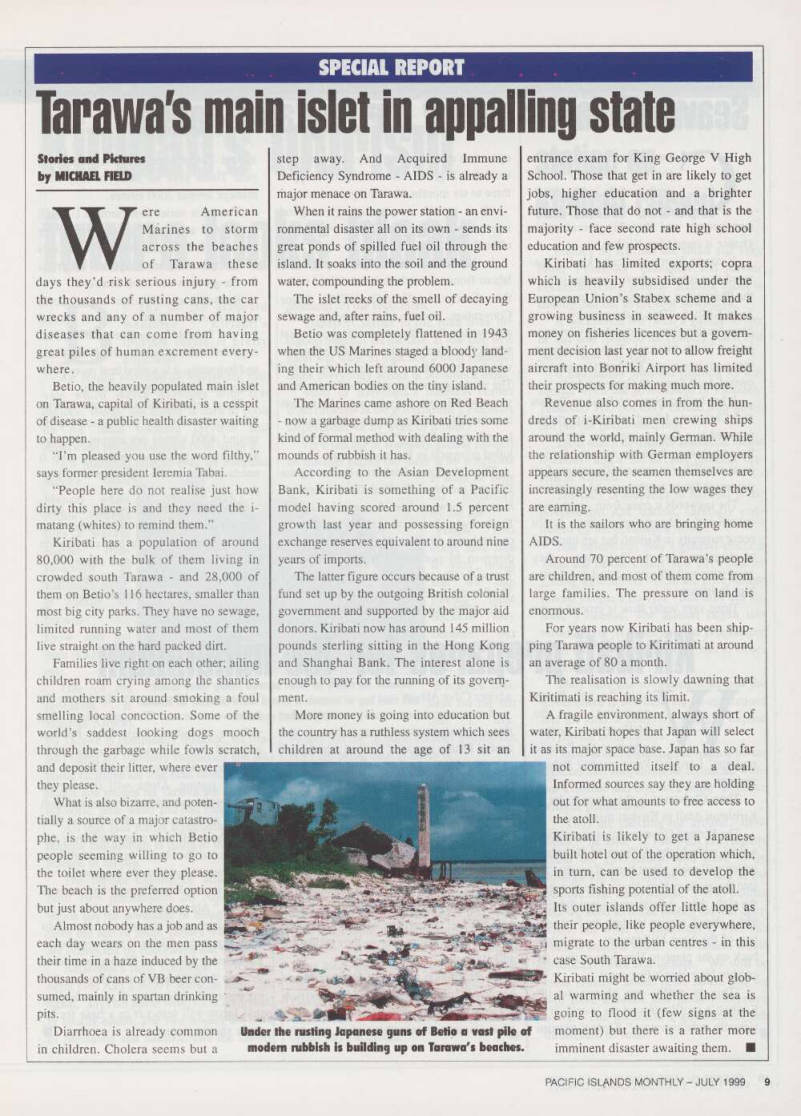
The Marines came ashore on Red Beach - now a garbage dump as Kiribati tries some kind of formal method with dealing with the mounds of rubbish it has.
According to the Asian Development Bank, Kiribati is something of a Pacific model having scored around 1.5 percent growth last year and possessing foreign exchange reserves equivalent to around nine years of imports.
The latter figure occurs because of a trust fund set up by the outgoing British colonial government and supported by the major aid donors. Kiribati now has around 145 million pounds sterling sitting in the Hong Kong and Shanghai Bank. The interest alone is enough to pay for the running of its govern ment.
More money is going into education but the country has a ruthless system which sees children at around the age of 13 sit an
entrance exam for King George V High School. Those that get in are likely to get jobs, higher education and a brighter future. Those that do not - and that is the majority - face second rate high school education and few prospects.
Kiribati has limited exports; copra which is heavily subsidised under the European Union’s Stabex scheme and a growing business in seaweed. It makes money on fisheries licences but a govern ment decision last year not to allow freight aircraft into Bonriki Airport has limited their prospects for making much more.
Revenue also comes in from the hun dreds of i-Kiribati men crewing ships around the world, mainly German. While the relationship with German employers appears secure, the seamen themselves are
increasingly resenting the low wages they
are earning.
It is the sailors who are bringing home
Aids.
Around 70 percent of Tarawa’s people are children, and most of them come from large families. The pressure on land is enormous.
For years now Kiribati has been ship ping Tarawa people to Kiritimati at around an average of 80 a month.
The realisation is slowly dawning that Kiritimati is reaching its limit.
A fragile environment, always short of water, Kiribati hopes that Japan will select it as its major space base. Japan has so far
not committed itself to a deal.
Informed sources say they are holding out for what amounts to free access to the atoll.
Kiribati is likely to get a Japanese built hotel out of the operation which, in turn, can be used to develop the sports fishing potential of the atoll.
Its outer islands offer little hope as their people, like people everywhere, migrate to the urban centres - in this case South Tarawa.
Kiribati might be worried about glob al warming and whether the sea is going to flood it (few signs at the moment) but there is a rather more imminent disaster awaiting them. ■
Under the rusting Japanese guns of Betio a vast pile of modem rubbish is building up on Tarawa's beaches.
Seaweed earns money for liny atoll nation
Chances are sometime in the last couple of weeks most people in the devel oped world chewed into carrageenan and there is a reasonable chance it came from Kiribati.
It comes from a particular kind of sea weed that is being grown commercially in the Philippines, Indonesia and, increasing ly, in Kiribati. “This is the great economic hope for this place, particularly Christmas Island,” says Michael Tinne, a manage ment adviser to the Kiribati Government owned Atoll Seaweed Company Ltd.
It has bailing plants on Betio in Tarawa and Christmas Island which exports the seaweed to a Danish company. It extracts the carrageenan from the seaweed for use as an emulsifier in around 60 percent of all processed foods, toothpaste and cosmetics.
The seaweeds it come from - eucheuma cotonii and eucheuma spinosum - do not occur naturally in Kiribati but are imported as clippings from the Philippines - they grow very well off ropes staked down knee high in lagoons.
Tinne says water flow is crucial to the
operation and ensuring they are kept cov ered. But it grows fast and can be cropped three to six months after being put down.
“It is a cash crop which gives good returns for farmers provided they make the effort.”
In Kiribati it currently competes for labour from copra which is subsidised under the European Union’s (EU) Lome Convention. Because of the need for a reli able water flow the seaweed grows best within five degrees either side of the Equator which is the typhoon free area of the globe.
The world spot market price for the seaweed varies widely precisely because the market is vulnerable to the typhoons which routine ly roll through the Philippines. Cyclones killed prospects in Fiji several years back.
The operation in Kiribati is backed by the EU and the New Zealand Government. It buys the seaweed from farmers throughout Kiribati who, before they sell it, must dry it on the beach first, taking the moisture level down to 35 percent. It is then bought to Tarawa or Christmas where it is pressed into 50 kilogram bales and exported.
In 1996 Kiribati managed to export
around 1246 tonnes of seaweed and next year Tinne says he believes they may manage around 2000 tonnes.
The price varies from around US$55O to US$675 a tonne. The attraction of the operation is that once over the fixed costs of the operation, any surplus is all profit for the growers and Atoll Seaweed.
Kiribati’s contribution to the world trade of around 70,000 tonnes is modest but the Danish buyer likes the Kiribati supplier because, unlike the Philippines and Indonesia, it is a good deal more polit ically and environmentally stable.
Tinne believes there is no reason why Kiribati cannot lift production up to around 4000 tonnes per annum although as a relatively labour intensive crop it needs people in the right places to pro duce.
Seaweed’s future could, in part, depend on whether the EU’s stabex fund will continue to pay a big subsidy on copra. Currently there is an incentive to landowners to concentrate on copra, despite failing markets, rather than on sea weed. ■
Kiribati prepares for the millennium
Where do you fancy spending the Millennium, some where in the Pacific perhaps? London? Paris maybe? Poland perhaps...
Then Christmas is the place to be ...
Kiritimati Atoll in Kiribati that is.
The Kiribati Government is negotiating a deal with Aloha Airlines of Honolulu which will see a select band of tourists fly into the atoll on New Year’s Eve to spend the night there. A feast, traditional dancing and a church service to mark the first sun rise of the New Millennium ... and then back on the plane to Honolulu in time for another New Year’s Eve party.
“This is really our chance to lift Kiribati’s profile around the world, it is virtually unknown now,” Kiribati tourism
adviser Clive Abbott.
Arrangements are nearly complete for this unusual event to happen, here in the central Pacific nation of Kiribati which used to be divided by the International Dateline.
Back in 1994 “before anybody even thought millennium” said Abbott Kiribati moved the dateline so the nation could have one day. As a result Kiritimati atoll and an uninhabited Caroline Island are 14 hours ahead of Greenwich.
Caroline has now been changed to “Millennium Island”. As a matter of policy now Kiribati is reverting back to tourist use of the word Christmas too they realise the
sales potential.
In preparation a group of European news agencies, photographers and television crews will in June travel to Millennium in what amounts to something of an epic trip.
The actual celebrations on December 31 will revolve around Christmas Island. The villages, London, Paris and Poland, acquired their names back in the 1950 s when the atoll was used by the British for nuclear testing. Aloha will fly tourists down for the event which will see a church service as the new sun rises for the first time. They will then cross back over the dateline to be back in Honolulu on December 31, ready to do it again.
“Christmas Island is very important to Kiribati,” Abbott said.
Already cruise ships out of Honolulu
were regularly visiting it and neighbour
ing Fanning Island and Kiribati wanted to develop the fishing,bird watching and div ing potential of the place. It is also hoping that Japan will select it as a base for its space shuttle project. Wt
future looks bleak
Kiriba ti's touriam future looks bleak
By any of the standard measures Kiribati’s tourism future is pretty hopeless.
Air Nauru provides an infrequent ser vice which leaves travellers with few options. Worse, the airline is hard to book on the main booking services and Americans are discouraged from using it.
Air Marshall Islands flies an irregular
service from
Majuro while
Aloha Airlines flies a weekly charter from Honolulu to Kiritimati Atoll.
It cannot be booked on; show and get your ticket is the rule.
One of the
problems is
Bonriki Airport
on Tarawa is completely insecure, its run way lights are routinely vandalised and ter minal facilities are less than basic. And the hotels and motels on Tarawa are infamous for noise, little water and bad food.
All that said Raion Bataroma is pretty hopeful that tourism is going to make a dif ference in his life.
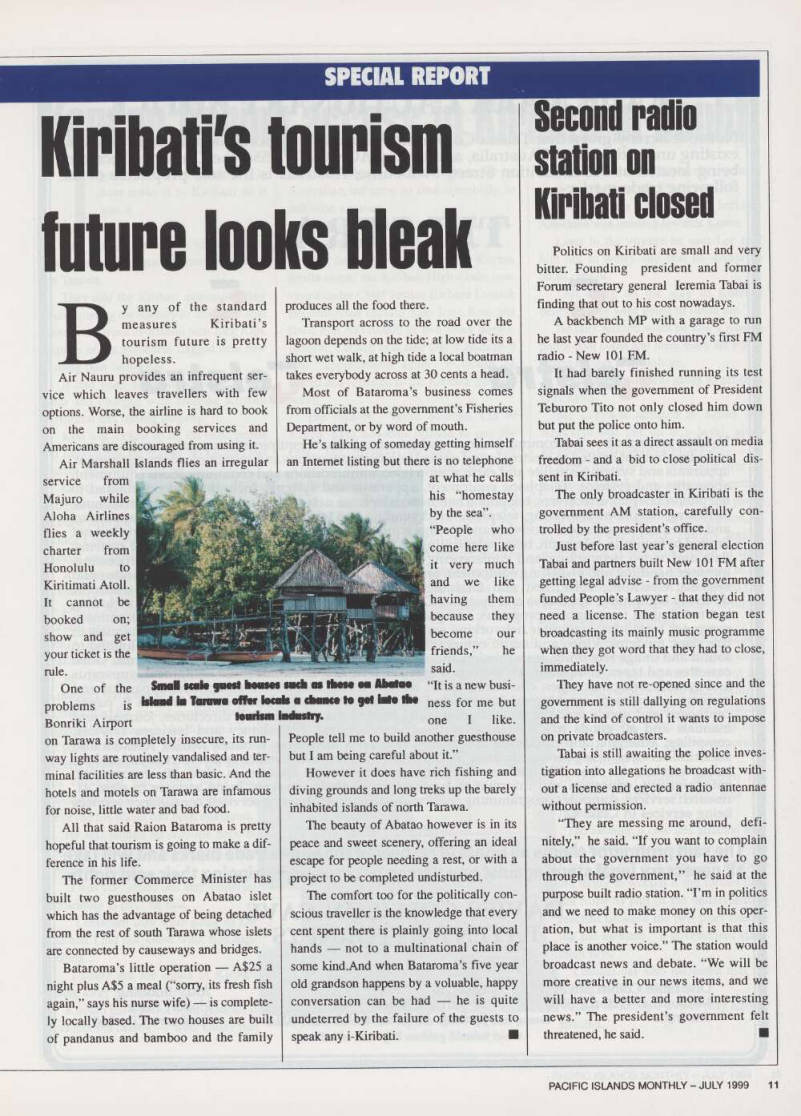
The former Commerce Minister has built two guesthouses on Abatao islet which has the advantage of being detached from the rest of south Tarawa whose islets are connected by causeways and bridges.
Bataroma’s little operation As2s a night plus Ass a meal (“sorry, its fresh fish again,” says his nurse wife) is complete ly locally based. The two houses are built of pandanus and bamboo and the family
produces all the food there.
Transport across to the road over the lagoon depends on the tide; at low tide its a short wet walk, at high tide a local boatman takes everybody across at 30 cents a head.
Most of Bataroma’s business comes from officials at the government’s Fisheries Department, or by word of mouth.
He’s talking of someday getting himself an Internet listing but there is no telephone
at what he calls his “homestay by the sea”.
“People who
come here like it very much and we like having them because they become our ' friends,” he said.
“It is a new busi ness for me but one I like.
People tell me to build another guesthouse but I am being careful about it.”
However it does have rich fishing and diving grounds and long treks up the barely inhabited islands of north Tarawa.
The beauty of Abatao however is in its peace and sweet scenery, offering an ideal escape for people needing a rest, or with a project to be completed undisturbed.
The comfort too for the politically con scious traveller is the knowledge that every cent spent there is plainly going into local hands not to a multinational chain of some kind. And when Bataroma’s five year old grandson happens by a voluable, happy conversation can be had he is quite undeterred by the failure of the guests to speak any i-Kiribati. ■
Small seale guest houses such as these on Abatao island in Tarawa offer locaks a chance to get Into the tourism industry.
Second radii
station on Kiribati closed
Politics on Kiribati are small and very bitter. Founding president and former Forum secretary general leremia Tabai is finding that out to his cost nowadays.
A backbench MP with a garage to run he last year founded the country’s first FM radio - New 101 FM.
It had barely finished running its test signals when the government of President Teburoro Tito not only closed him down but put the police onto him.
Tabai sees it as a direct assault on media freedom - and a bid to close political dis sent in Kiribati.
The only broadcaster in Kiribati is the government AM station, carefully con trolled by the president’s office.
Just before last year’s general election Tabai and partners built New 101 FM after getting legal advise - from the government funded People’s Lawyer - that they did not need a license. The station began test broadcasting its mainly music programme when they got word that they had to close, immediately.
They have not re-opened since and the government is still dallying on regulations and the kind of control it wants to impose on private broadcasters.
Tabai is still awaiting the police inves tigation into allegations he broadcast with out a license and erected a radio antennae
without permission.
“They are messing me around, defi nitely,” he said. “If you want to complain about the government you have to go through the government,” he said at the purpose built radio station. “I’m in politics and we need to make money on this oper ation, but what is important is that this place is another voice.” The station would broadcast news and debate. “We will be more creative in our news items, and we will have a better and more interesting news.” The president’s government felt threatened, he said. ■
Advertisements & other items, p. 12 (1 item)
%elstra
TRADE MARK CAUTIONARY NOTICE
Notice is hereby given that Telstra Corporation Limited, a corporation duly organised and existing under the laws of Australia, and having ACN 051 775 556, the Corporate Secretary being located at 242 Exhibition Street, Melbourne, Australia is the sole proprietor of the following trade marks:-
TELSTRA
%elstra
Used in respect of:— Telecommunications and communications equipment, apparatus and systems, including but not limited to electronic and optical telecommunications and communications equipment, apparatus and systems; satellite and earth station telecommunications and communications equipment, apparatus and systems; Telephone equipment, apparatus and systems, including but not limited to telephone; telephone receivers; telephone handsets; telephone network, telephone exchanges, telephone switching, telephone answering, telephone card vending and telephone dialling equipment, apparatus and systems; Transmission, receiving and storage equipment, apparatus and systems, including but not limited to facsimile, telegraph, telex, teleprinting, cable and paging equipment, apparatus and systems; data and video networking and conferencing equipment, apparatus and systems; data processing, message handling and switching equipment, apparatus and systems; digital equipment, apparatus and systems; electronic, voice, text and facsimile mail equipment, apparatus and systems; electronic directory equipment, apparatus and systems; Computer equipment, apparatus and systems, including but not limited to computer programs; computer software; computer hardware; computer terminals; computer memories; computer networking equipment, apparatus and systems; computer manuals in this class; modems; Video and audio equipment, apparatus and systems, including but not limited to sound and image recording, transmission and reproduction equipment, apparatus and systems; video cassettes and tapes; compact discs; records; digital, electric and electronic radio equipment, apparatus and systems; magnetic tapes; cinematographic, television and amusement equipment, apparatus and systems; amusement machines; All associated parts and accessories being goods in class 9, paper, cardboard and goods made from these materials; printed matter including directories, journals and manuals and all goods in class 16; advertising, promotional, consultancy and business services; compiling, arranging and publishing directories; telephone answering services; market research and statisticalservices; being services in class 35, repair installation, maintenance and construction services; being services in class 37, telecommunication services being services in class 38, amusement, entertainment, education and information services; multi-media services; being services in class 41, research services; computer programming services; retail and wholesaling services; consultancy services being services in Class 42'.
The said proprietor claims all rights in respect of the above trade marks and will take all necessary legal steps against any person or company infringing their said rights.
DAVIES COLLISON CAVE
PATENT ATTORNEYS
One Little Collins Street Level 10 Melbourne, Victoria, 3000 10 Barrack Street Australia Sydney, New South Wales, 2000 AMP Building Hobart Place Canberra City 2601
Korean fishing access In Kiribati in doubt
Journalists of any kind sel dom make it to Kiribati so it was a little strange when early in January an entire crew of Korean reporters showed up on Tarawa.
They told the Kiribati authorities they were entering the country to cover the trial later in the week of Korean Sam Jong Kim, captain of the Honduras flagged near new fishing boat Jasmine 9.
It had been arrested on June 22 last year and charged with entering Kiribati territorial and fishing illegally.
Kim was locked up on the basic prison on Betio while the mainly Sri Lankan and Indian crew were bunking down ashore.
On the evening of February 18 the Korean journalists, led by a “Mr Lee” went aboard Jasmine 9, then under guard by Police Constable Kauriri Arawatau and a special constable.
A meal was cooked up and Mr Lee invited Arawatau and the constable below to join in. At about the stage coffee was served, three of the men in the room sud denly locked the door and Arawatau realised the ship was underway.
In the struggle that followed Arawatau was handcuffed with his own cuffs while the special constable man aged to break through the door and, out of sight of the others, leapt overboard to safety. Arawatau said he did not know his colleague had gotten away and throughout the entire voyage he believed his friend had been murdered. „ He was hauled up onto the deck asj the ship headed out of the lagoon and! chained to the rail.
“I was very afraid that they would do* something to me,” he said “I believed they were going to kill me and I did not know what was hap
pening...
“I could see the lights of Kiribati! going away and was very sad.”
Kiribati has a patrol boat, Teanoai. It| was moored nearby with empty fuel
tanks. It took most of the evening for its Australian led crew to find somebody to authorise a top-up.
By that time Jasmine 9, a new ship capa ble of over 20 knots, was well away.
Next day, without the attendant Korean media corps, the Kiribati High Court con vened under Chief Justice Richard Lussick He convicted captain Sam Jong Kim and fined him A$ 120,000 or two years impris onment. Lussick said also that if Jasmine 9 was “apprehended again” it would be seized and forfeited to the Kiribati govern ment.
The owners, Venus Marines Ltd of Korea, have however refused to pay the fine. The mystery Mr Lee even told Arawatau they would never pay it as it was all the captain’s fault.
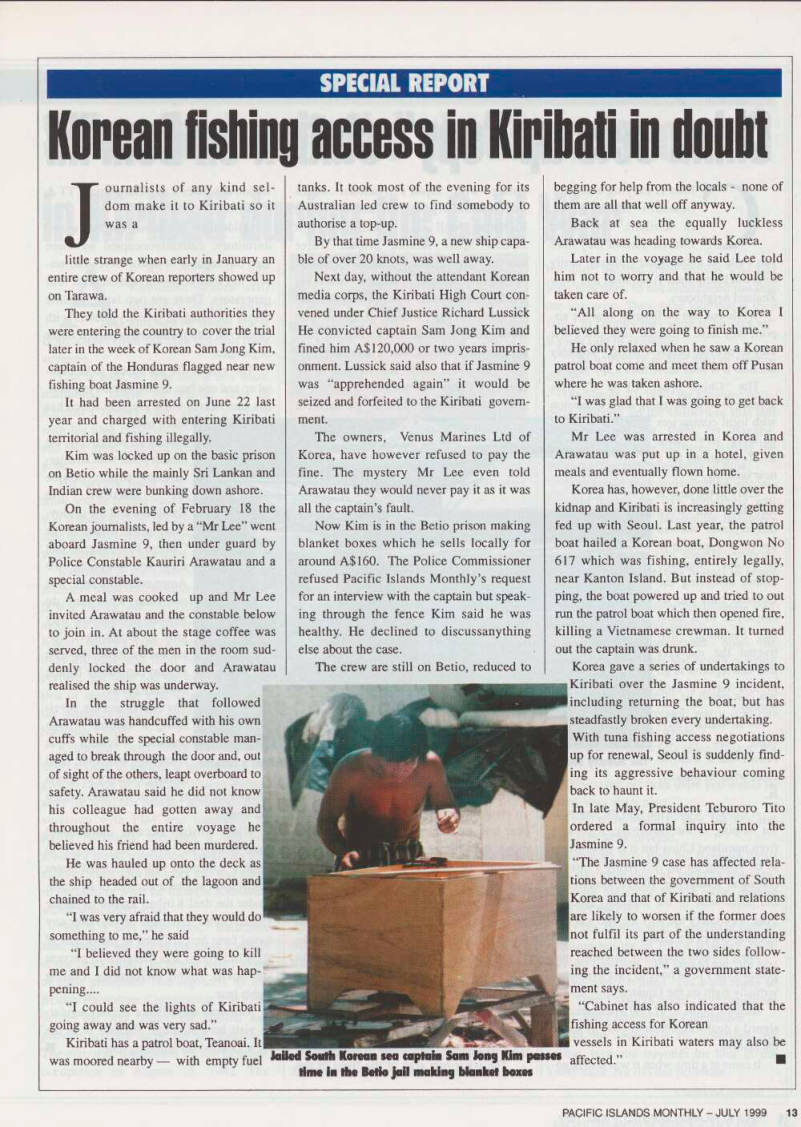
Now Kim is in the Betio prison making blanket boxes which he sells locally for around Asl6o. The Police Commissioner refused Pacific Islands Monthly’s request for an interview with the captain but speak ing through the fence Kim said he was healthy. He declined to discussanything else about the case.
The crew are still on Betio, reduced to
begging for help from the locals - none of them are all that well off anyway.
Back at sea the equally luckless Arawatau was heading towards Korea.
Later in the voyage he said Lee told him not to worry and that he would be taken care of.
“All along on the way to Korea I believed they were going to finish me.”
He only relaxed when he saw a Korean patrol boat come and meet them off Pusan where he was taken ashore.
“I was glad that I was going to get back to Kiribati.”
Mr Lee was arrested in Korea and Arawatau was put up in a hotel, given meals and eventually flown home.
Korea has, however, done little over the
kidnap and Kiribati is increasingly getting
fed up with Seoul. Last year, the patrol boat hailed a Korean boat, Dongwon No
617 which was fishing, entirely legally,
near Kanton Island. But instead of stop ping, the boat powered up and tried to out run the patrol boat which then opened fire, killing a Vietnamese crewman. It turned out the captain was drunk.
Korea gave a series of undertakings to Kiribati over the Jasmine 9 incident, including returning the boat, but has steadfastly broken every undertaking.
With tuna fishing access negotiations up for renewal, Seoul is suddenly find ing its aggressive behaviour coming back to haunt it.
In late May, President Teburoro Tito ordered a formal inquiry into the Jasmine 9.
“The Jasmine 9 case has affected rela tions between the government of South Korea and that of Kiribati and relations are likely to worsen if the former does not fulfil its part of the understanding reached between the two sides follow ing the incident,” a government state ment says.
“Cabinet has also indicated that the fishing access for Korean i vessels in Kiribati waters may also be affected.” ■
Jailed South Korean sea captain Sam Jong Kim posses lime in the Betio jail making blanket boxes
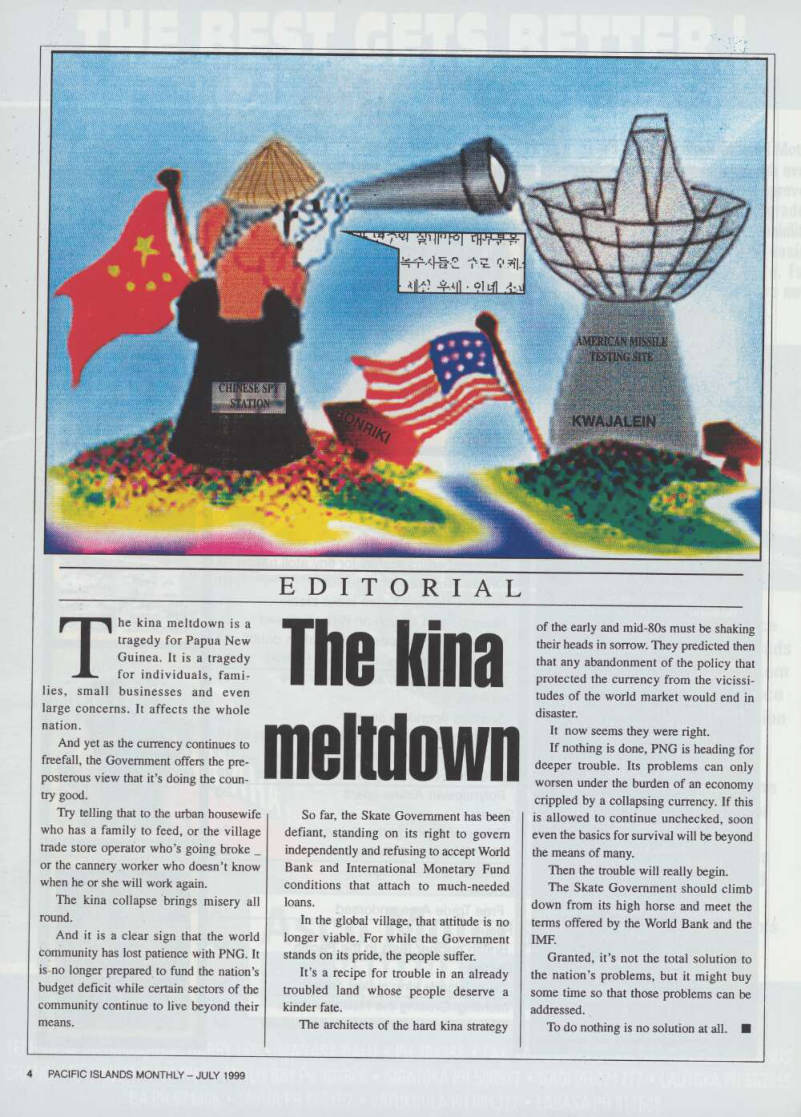
China sets up "spy" station on Bonriki
China is playing a sophis ticated, if strange game, in Kiribati. On Bairiki Islet on Tarawa they have just build an extravagant embassy, easily overwhelming their Australian and New
Zealand neighbours.
While out east on Bonriki, near the air port, they have a discrete little place that they do not like people visiting - probably because it is little more than a spy station.
The “China Space TT & C” base appears to be under-going some expansion
with local contractors
building new paths
and foundations for a
new building.
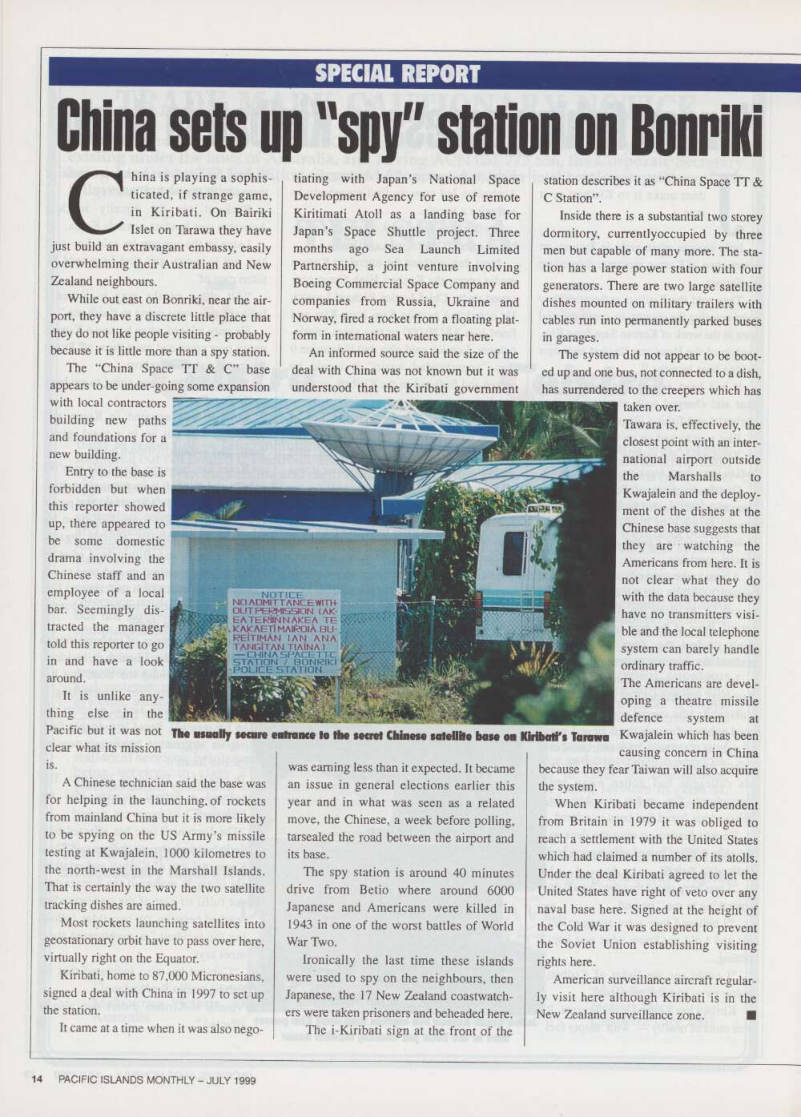
Entry to the base is forbidden but when this reporter showed up, there appeared to be some domestic drama involving the Chinese staff and an employee of a local bar. Seemingly dis tracted the manager told this reporter to go in and have a look around.
It is unlike any thing else in the Pacific but it was not clear what its mission is.
A Chinese technician said the base was for helping in the launching, of rockets from mainland China but it is more likely to be spying on the US Army’s missile testing at Kwajalein, 1000 kilometres to the north-west in the Marshall Islands.
That is certainly the way the two satellite tracking dishes are aimed.
Most rockets launching satellites into geostationary orbit have to pass over here,
virtually right on the Equator.
Kiribati, home to 87,000 Micronesians, signed a deal with China in 1997 to set up the station.
It came at a time when it was also nego
dating with Japan’s National Space Development Agency for use of remote Kiritimati Atoll as a landing base for Japan’s Space Shuttle project. Three months ago Sea Launch Limited Partnership, a joint venture involving Boeing Commercial Space Company and companies from Russia, Ukraine and Norway, fired a rocket from a floating plat form in international waters near here.
An informed source said the size of the deal with China was not known but it was understood that the Kiribati government
was earning less than it expected. It became an issue in general elections earlier this year and in what was seen as a related move, the Chinese, a week before polling, tarsealed the road between the airport and its base.
The spy station is around 40 minutes drive from Betio where around 6000 Japanese and Americans were killed in 1943 in one of the worst battles of World War Two.
Ironically the last time these islands were used to spy on the neighbours, then Japanese, the 17 New Zealand coastwatch ers were taken prisoners and beheaded here.
The i-Kiribati sign at the front of the
station describes it as “China Space TT & C Station”.
Inside there is a substantial two storey
dormitory, currentlyoccupied by three
men but capable of many more. The sta tion has a large power station with four generators. There are two large satellite dishes mounted on military trailers with cables run into permanently parked buses in garages.
The system did not appear to be boot ed up and one bus, not connected to a dish, has surrendered to the creepers which has
taken over.
Tawara is, effectively, the closest point with an inter national airport outside the Marshalls to
Kwajalein and the deploy
ment of the dishes at the Chinese base suggests that
they are watching the
Americans from here. It is not clear what they do with the data because they have no transmitters visi ble and the local telephone system can barely handle
ordinary traffic.
The Americans are devel oping a theatre missile defence system at Kwajalein which has been causing concern in China
because they fear Taiwan will also acquire the system.
When Kiribati became independent from Britain in 1979 it was obliged to reach a settlement with the United States which had claimed a number of its atolls.
Under the deal Kiribati agreed to let the United States have right of veto over any naval base here. Signed at the height of the Cold War it was designed to prevent the Soviet Union establishing visiting
rights here.
American surveillance aircraft regular ly visit here although Kiribati is in the New Zealand surveillance zone. ■
The usually secure entrance la the secret Chinese satellite base on Kiribati's Tarawa
Sole survivor talks about massacre
in Kiribati during the Cold War
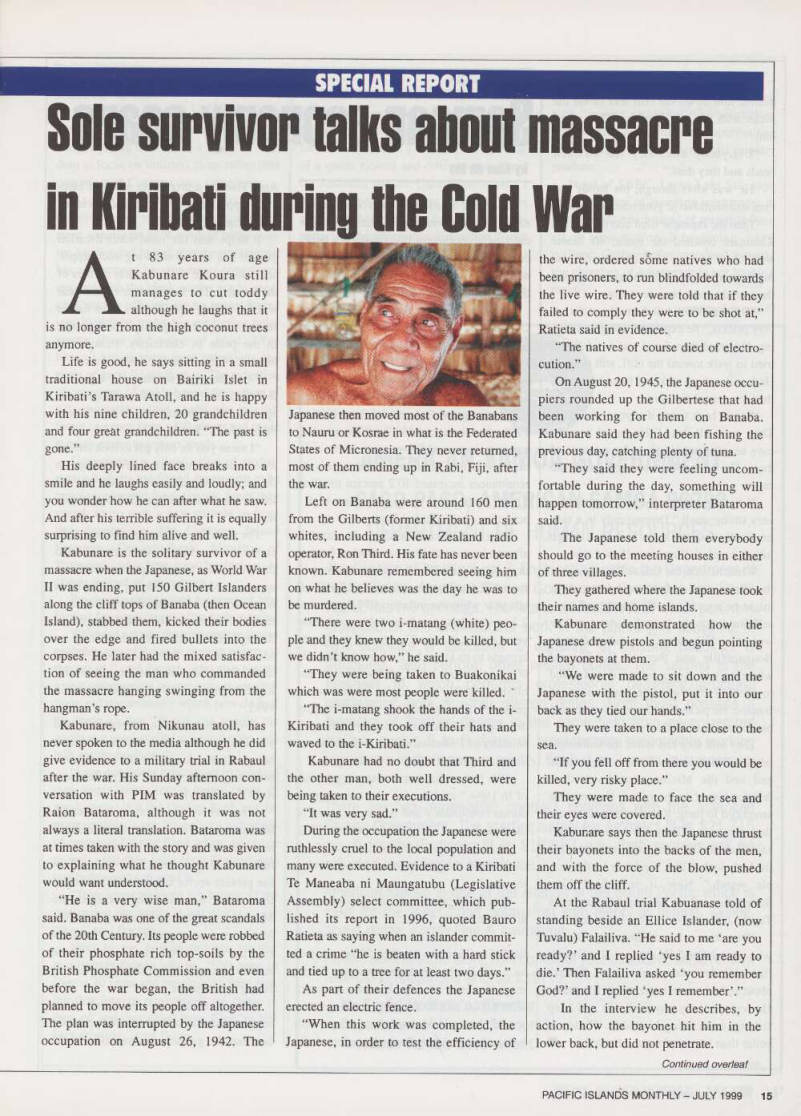
At 83 years of age Kabunare Koura still manages to cut toddy although he laughs that it is no longer from the high coconut trees anymore.
Life is good, he says sitting in a small traditional house on Bairiki Islet in Kiribati’s Tarawa Atoll, and he is happy with his nine children, 20 grandchildren and four great grandchildren. “The past is
gone.”
His deeply lined face breaks into a smile and he laughs easily and loudly; and you wonder how he can after what he saw.
And after his terrible suffering it is equally surprising to find him alive and well.
Kabunare is the solitary survivor of a massacre when the Japanese, as World War II was ending, put 150 Gilbert Islanders along the cliff tops of Banaba (then Ocean Island), stabbed them, kicked their bodies over the edge and fired bullets into the corpses. He later had the mixed satisfac tion of seeing the man who commanded the massacre hanging swinging from the
hangman’s rope.
Kabunare, from Nikunau atoll, has never spoken to the media although he did give evidence to a military trial in Rabaul after the war. His Sunday afternoon con versation with PIM was translated by Raion Bataroma, although it was not always a literal translation. Bataroma was at times taken with the story and was given to explaining what he thought Kabunare would want understood.
“He is a very wise man,” Bataroma said. Banaba was one of the great scandals of the 20th Century. Its people were robbed of their phosphate rich top-soils by the British Phosphate Commission and even before the war began, the British had planned to move its people off altogether.
The plan was interrupted by the Japanese occupation on August 26, 1942. The
Japanese then moved most of the Banabans to Nauru or Kosrae in what is the Federated States of Micronesia. They never returned, most of them ending up in Rabi, Fiji, after the war.
Left on Banaba were around 160 men from the Gilberts (former Kiribati) and six whites, including a New Zealand radio operator, Ron Third. His fate has never been known. Kabunare remembered seeing him on what he believes was the day he was to be murdered.
“There were two i-matang (white) peo ple and they knew they would be killed, but we didn’t know how,” he said.
“They were being taken to Buakonikai which was were most people were killed.
“The i-matang shook the hands of the i- Kiribati and they took off their hats and waved to the i-Kiribati.”
Kabunare had no doubt that Third and the other man, both well dressed, were being taken to their executions.
“It was very sad.”
During the occupation the Japanese were ruthlessly cruel to the local population and many were executed. Evidence to a Kiribati Te Maneaba ni Maungatubu (Legislative Assembly) select committee, which pub lished its report in 1996, quoted Bauro Ratieta as saying when an islander commit ted a crime “he is beaten with a hard stick and tied up to a tree for at least two days.”
As part of their defences the Japanese erected an electric fence.
“When this work was completed, the Japanese, in order to test the efficiency of
the wire, ordered sSme natives who had been prisoners, to run blindfolded towards the live wire. They were told that if they failed to comply they were to be shot at,”
Ratieta said in evidence.
“The natives of course died of electro cution.”
On August 20, 1945, the Japanese occu piers rounded up the Gilbertese that had been working for them on Banaba.
Kabunare said they had been fishing the previous day, catching plenty of tuna.
“They said they were feeling uncom fortable during the day, something will
happen tomorrow,” interpreter Bataroma
said.
The Japanese told them everybody should go to the meeting houses in either of three villages.
They gathered where the Japanese took their names and home islands.
Kabunare demonstrated how the Japanese drew pistols and begun pointing the bayonets at them.
“We were made to sit down and the Japanese with the pistol, put it into our back as they tied our hands.”
They were taken to a place close to the sea.
“If you fell off from there you would be killed, very risky place.”
They were made to face the sea and their eyes were covered.
Kabunare says then the Japanese thrust their bayonets into the backs of the men, and with the force of the blow, pushed them off the cliff.
At the Rabaul trial Kabuanase told of standing beside an Ellice Islander, (now Tuvalu) Falailiva. “He said to me ‘are you ready?’ and I replied ‘yes I am ready to die.’ Then Falailiva asked ‘you remember God?’ and I replied ‘yes I remember’.”
In the interview he describes, by action, how the bayonet hit him in the lower back, but did not penetrate.
Continued overleaf
It did leave him with a gash and it pushed him down the cliff and he hit the rocks with his left shoulder. That saved him.
“Everybody else, they fell on their heads and they died.”
He was alive though, his hands and eyes still bound so he pretended to be dead.
Then the Japanese fired into the bodies.
Kabunare counted the shots; 40. Some were close to him. He understood some Japanese and could hear the guards saying they would come back next day.
“The waves will kill them, the rocks are very prickly,” he explained one guard say ing. He heard them leave and carefully he tried to walk toward the cliff, still tied up.
He found a sharp rock and freed his hands, then uncovered his eyes.
“I went back to see if anyone was alive.
They were all dead.” He found a small cave near by and hid there for a couple of days. The bodies kept sweeping into the cave.
“I try to push them off and there was a very strong smell.” Dressed only in a sulu he finally left the cave and tried to go inland, nearly killing himself on a mine.
When he saw the Union Jack flying on the administration building he thought it might be a trick to make him reveal him self. But it was the Australian Army and he was safe. Kabuanase was taken first to Bougainville and then to Guadalcanal where he was shown prisoners and asked to identify the Japanese commander of Banaba. He picked out Suzuki Naoomi and his deputy Nara Yoshio.
They said they had killed the Gilbertese because Tokyo had told them to fight to the end and the Micronesians knew their defence layout on the island. Naoomi was sentenced to hang. Kabuanase said he saw the execution. “They left him to hang,” said Kabuanase who demonstrated what the body looked like, “and they let the peo ple watch.” Now it is behind him.
Sometimes when he sees Japanese in Tarawa he remembers what happened.
“Sometimes I remember my friends who were killed.” He stresses now though that while he is happy to talk to i-Kiribati about it, he is more interested in life today.
He wants, to stay physically fit and keep fishing, and cutting his toddy. “Toddy is better than imported sugar,” he said. ■
Samoan economy soars
Business
by Alan Ah Mu
In the last decade growth in Samoa’s key earners have never been higher than now creating an optimism that prosperity beck ons in the new century especially as eco nomic reforms has formed an environment liked by entrepreneurs.
Secretary of the Samoa Chamber of Commerce, John Boyle, said government figures indicate that the economy has grown by between three and four percent per annum for the last two years in real terms using gross domestic product as a measure.
Exports grew 43.4 percent from 1996 to 1998 when it reached $50.9 million, tourism earnings increased 9.3 percent with a new high of $114.6 million last year, private remittances increased 10.2 percent totalling $109.9 million last year - also a new high according to the Central Bank.
With such rises in earnings, the shortfall after an import bill (that has climbed for that three-year period by 8.2 percent) dropped from $32.6 million in 1996 to $10.3 million last year while the inflation-CPI dropped to 2.2 percent last year from 5.4 percent three years earlier, it says. The revival in exports, brought to its knees by cyclones in the early 90s then almost killed off by the taro leaf blight in 1993, goes to the sudden emer gence of fishing industry - and “amazing development” Akauola, secretary of Tonga’s Ministry of Fisheries, called it. Tongans are in Apia to study fishing methods.
“We had no fish exports export to speak of in 1994,” said Boyle, who runs an eco nomic consultancy and is also secretary of the Apia Export Fish Packers Ltd (AEFPL).
“As we speak fishing is almost half our total merchandise exports. And continuing ( to grow.”
It is up 81 per cent on the previous year, at $22 million in 1998.
“I would predict that in 1999 there will be $36 million, up another 50 per cent or so,” said Boyle. “Perhaps a younger fisher man who is in his 20s, 30s now comes in with $2OOO or $3OOO to buy ... things they would never had money to buy with before,” said Mark Puckey, owner of the
Apia Traders, a prominent seller of elec trical appliances, television sets, videos
and refrigerators mostly.
It helps that the rural electrification project has ended allowing such appli ances to operate in the furthest comers of the country. The first quarter of this year was the busiest Apia Traders have had in seven years of trading, despite a sharp rise in the price of electricity, though not because of the “fishing” dollar alone.
“And there just seems to be a general feeling of confidence and a willingness to spend in the economy which hasn’t been there before,” Puckey said.
“I mean you’ve only got to look around town to see the number of new pickups on the road,” he said. “New cars are no longer the domain of the (Cabinet) minis ters.”
For years Toyota was the only car deal ership in town. Two Nissan outlets opened this year. Two major supermarkets have appeared. Most encouraging for business is government’s freeing of the private sec tor to be the engine of economic growth through recent reforms, some based on advice that came from the private sector in the first place - and as a result of dia logue begun formally by government in 1995.
“Now where else in the region would you find an honest exchange of views being initiated jointly by the two organi sations (government and the private sec tor)? *’ said Boyle.
“One where government asks early, business to advise ... and demonstrably hears the advise - in which you can see the influence of it in the actions taken. Now the private sector couldn’t ask for more than that,” he said. Boyle credits the Minister of Finance, Tuilaepa Sailele Malielegaoi, who presided over bold tax reforms even before he became prime minister as well November last year for taking the initiative.
“The private sector can assist, it can support and take advantage of opportuni ties, but the government has to have the
initiative,” he said.
Government slashed tariffs on goods down to 20 percent maximum in last year’s budget giving businesses a sense of free dom to focus on business alone rather than quarrels with Customs over valuations.
As well as more investment in the dis tributive trades which is creating employ ment, a wider range of goods of better qual ity, has flooded in and government revenue has not dropped because better compliance resulted with the black market not so need ed. Customs officials are no longer forced into having to make big subjective judg ments about the value of good. “You haven’t got disputes over valuations and types of good,” said Puckey. The reduction of categories of goods has rid the system of silly anomalies where a radio was in a dif ferent category from a CD player and made it much easier to import goods.
Government’s introduction of perfor mance budgets has forced department to be more accountable for the public funds they spend, to go with a new attitude in front line departments like Customs, Inland Revenue, Central Bank, Ministry of Transport, who now treat businesses as clients instead of annoyances.
Previously getting paid for services per formed for government often took months.
“Without a doubt the government is now probably one of the most prompt payers on the island,” said Puckey, who also praises a new transparency in government corpora tions and department - which provide half his trade so that “If you can supply the goods at a good quality at a good price, you will get the business.”
“I am confident now about expanding into better plant, into a better range of good, (now) that the Central Bank is a far more realistic ... you haven’t got a shortage of money at Central Bank where you have to wait until they have New Zealand dol lars before you can send it.”
“Telecommunications are better, all the things that one needs in a business ... are there,” said Puckey.
Vital to the buying process are the remittances Samoa rely on. “I’ve been in Samoa 20 years and people have been say ing that foreign remittances are going to drop off and they never have. They’ve just
kept growing,” said Boyle.
Whilst loyalties to relatives in Samoa lessens as some families overseas enter their third, fourth generation locals leave for New Zealand at a rate of 1 100 because of a quota system and other avenues, and for Australia and the United States too. “I think we’re still exporting people at a rate each year that must go a long way towards replacing the generation dissipation,” said Boyle. Set up under New Zealand aid to fill the gap in business skills, the Small Business Enterprise Centre (SEED) is
advising villages to view beach fales along with “marine activities” like snorkeling and nature walk as income opportunities to supplement income from their primary
produce.
Head of SBEC, Leota Laki Sio, says the importance of investing remittances in business projects instead of spending them all on consumption, is beginning to be realised. Certainly «for sustained growth, the chamber of commerce is not looking much
continued on page 29
from page 17
beyond agriculture and tourism. “It’s an industry for which we have some excellent resources (in beaches and the environment generally),” said Boyle of tourism.
Though tourism earnings have grown they’re mostly from overseas Samoans popping over for holidays or family mat ters, not true tourists attracted by a com petitively priced and attractive destina tion. Putting up more accommodation on which growth depends and which airlines can then move to fill up, continues to be blocked by a lack of capital. \The Tourism Development Plan 1992- 2001 gives quality resort facilities the
“highest priority” but for that attracting
overseas investors seems inevitable.
Coconut products - mainly copra, coconut cream, coconut oil - continue to be erratic earners, with one company. Wilex Ltd, now making chocolate and to develop overseas markets for other crops.
The fruit fly threat has banned exports of pawpaw, mango, avocado and a host of other fruit to New Zealand and other mar kets but hope for farmers has arisen due to an announcement that a heat treatment plant is to be established by the end of the year. ■
Advertisements & other items, p. 17 (2 items)
■ Business
American Samoa Government
PAGO PAGO, AMERICAN SAMOA 96799
DEPARTMENT OF HUMAN RESOURCES
The Division of Architectural & Engineering within the Department of Public Works, American Samoa Government, located in the South Pacific has two openings. The first is an Architect ill which performs professional and architectural work in the planning & designing of new buildings & alteration & repairing of existing buildings & structures; also perform other related duties. The second is the Engineer Hi which performs professional designing/structural engineering work & other related duties. Both must possess a Bachelor of Science degree in the same field from an accredited institution plus 5 to 6 years of progressively responsible working experience in the same or related field; 2 or 3 years in supervisory capacity.
There are two (renewable) contract positions with the American Samoa Government. The starting salary for Architect 111 is $21,715 p.a & for the Engineer 111 is $18,657 p.a. Both salaries will be adjusted according to experience.
American Samoa is one of the islands in the South Pacific which is ideal for the water sport enthusiast with plenty of fishing, sailing, scuba diving, snorkelling & swimming.
Please send resume along with copies of your academic achievement records, certifications and so forth to: Mr Sapini U. Siatu’u, Director Department of Human Resources American Samoa Government 130897V1
as kina continues to fall
Nation heads fan trouble as kina continues to fall
By Brian Tobia
Papua New Guinea’s local currency, the kina, has plunged to its lowest level since it was floated and thrown into a basket of currencies in 1994 by the then government of for mer Prime Minister Sir Julius Chan.
Just five months ago, the kina was worth US 48 cents but it now worth just US 33 cents. Much of PNG’s imports come from Australia and in January it was worth 80 Australian cents yet currently it is worth just 50 cents and “we are in the real worst times than in 1994 when the kina was float ed”, says Institute of National Affairs director, Mike Manning.
The decline in the value of the kina against other major currencies is due to “less foreign currency inflows” he said.
There is inadequate inflow of foreign capital to support the weakening kina.
Economic experts say there were three factors which were drive down the value of the kina.
Firstly, there is not enough inflow of foreign capital from both agricul tural and mineral exports - gold and! oil prices are down from what was pro jected in the 1999 budget and export receipts are not coming in on time.
But the export earning situation is ' not bad, consider
ing the fact that the coffee season is coming up and commodity exports are steady.
Secondly, the decline inflow of private capital into the country and invisible export (of capital) is a very serious concern.
The unsteady political climate coupled with the declining value of the kina is deter ring the investor confidence.
The Investment Promotion Authority recently sounded a warning that the number of business registrations had dropped which may imply that investor confidence has declined and foreign investment drying up while other investors (including Papua New Guineans) are taking their money out from
Png.
The third most serious factor is the absence of foreign borrowings to fund the k 2.054 billion 1999 Budget.
The revenue for this year includes an amount of K 383.2 million as a consession ary income that would come from the World Bank and International Monetary Fund.
The government must agree to the terms these institutions have been asking for to have access to funds - but it has not been able to satisfy the institutions so far and negotiations are continuing.
The US$25O million loan expected from the Kredit Bank of Canada to fund the bond issue is still to come.
But exports say this bond issue may not be successful because “it costs more to gain less”.
This means finance needed by the gov ernment to fund the budget it is not forth coming and places PNG in a very desper ate situation.
According to Mr Manning, the fall in the kina has also resulted in the increase of consumer good by about 17 percent.
And this is expected to continue as long as the kina continues to drop against
major currencies.
The diminishing kina is imposing more hardship on the average families,
small businesses, [ home buyers and j the transport sec tor.
Home buyers will have to deal with ' high interest rates, S families will have 1 to tackle high cost ;of consumable I items and high transport costs, I and small time [entrepreneurs j have to handle I increasing cost of doing business.
Average urban families in the low income earning bracket are suffer
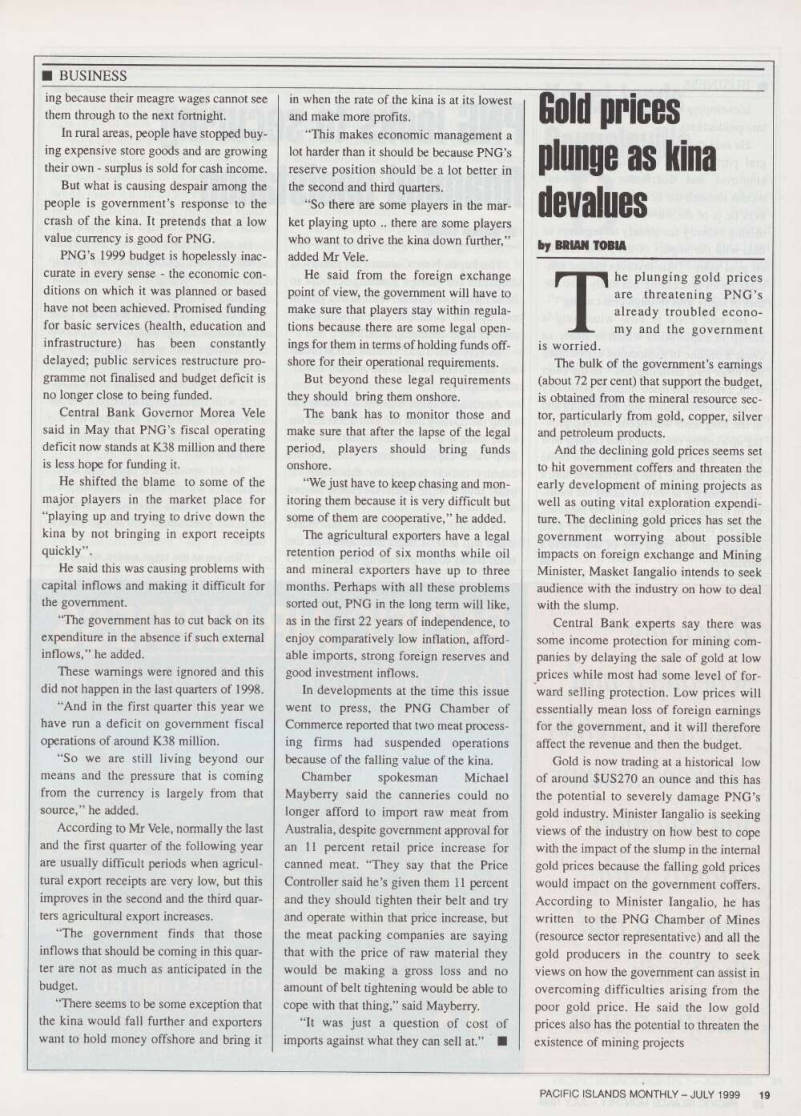
it is the people in rural areas who are suffering the most.
ing because their meagre wages cannot see them through to the next fortnight.
In rural areas, people have stopped buy ing expensive store goods and are growing their own - surplus is sold for cash income.
But what is causing despair among the people is government’s response to the crash of the kina. It pretends that a low value currency is good for PNG.
PNG’s 1999 budget is hopelessly inac curate in every sense - the economic con ditions on which it was planned or based have not been achieved. Promised funding for basic services (health, education and infrastructure) has been constantly delayed; public services restructure pro gramme not finalised and budget deficit is no longer close to being funded.
Central Bank Governor Morea Vele said in May that PNG’s fiscal operating deficit now stands at K3B million and there is less hope for funding it.
He shifted the blame to some of the major players in the market place for “playing up and trying to drive down the kina by not bringing in export receipts quickly”.
He said this was causing problems with capital inflows and making it difficult for the government.
“The government has to cut back on its expenditure in the absence if such external inflows,” he added.
These warnings were ignored and this did not happen in the last quarters of 1998.
“And in the first quarter this year we have run a deficit on government fiscal operations of around K3B million.
“So we are still living beyond our means and the pressure that is coming from the currency is largely from that source,” he added.
According to Mr Vele, normally the last and the first quarter of the following year are usually difficult periods when agricul tural export receipts are very low, but this improves in the second and the third quar ters agricultural export increases.
“The government finds that those inflows that should be coming in this quar ter are not as much as anticipated in the budget.
“There seems to be some exception that the kina would fall further and exporters want to hold money offshore and bring it
in when the rate of the kina is at its lowest and make more profits.
“This makes economic management a lot harder than it should be because PNG’s reserve position should be a lot better in the second and third quarters.
“So there are some players in the mar ket playing upto .. there are some players who want to drive the kina down further,” added Mr Vele.
He said from the foreign exchange point of view, the government will have to make sure that players stay within regula tions because there are some legal open ings for them in terms of holding funds off shore for their operational requirements.
But beyond these legal requirements they should bring them onshore.
The bank has to monitor those and make sure that after the lapse of the legal period, players should bring funds onshore.
“We just have to keep chasing and mon itoring them because it is very difficult but some of them are cooperative,” he added.
The agricultural exporters have a legal retention period of six months while oil and mineral exporters have up to three months. Perhaps with all these problems sorted out, PNG in the long term will like, as in the first 22 years of independence, to enjoy comparatively low inflation, afford able imports, strong foreign reserves and good investment inflows.
In developments at the time this issue went to press, the PNG Chamber of Commerce reported that two meat process ing firms had suspended operations because of the falling value of the kina.
Chamber spokesman Michael Mayberry said the canneries could no longer afford to import raw meat from Australia, despite government approval for an 11 percent retail price increase for canned meat. “They say that the Price Controller said he’s given them 11 percent and they should tighten their belt and try and operate within that price increase, but
the meat packing companies are saying
that with the price of raw material they would be making a gross loss and no amount of belt tightening would be able to cope with that thing,” said Mayberry.
“It was just a question of cost of imports against what they can sell at.” ■
Gold prices
plunge as kina devalues
By Brian Tobia
The plunging gold prices are threatening PNG’s already troubled econo my and the government is worried.
The bulk of the government’s earnings (about 72 per cent) that support the budget, is obtained from the mineral resource sec tor, particularly from gold, copper, silver and petroleum products.
And the declining gold prices seems set to hit government coffers and threaten the early development of mining projects as well as outing vital exploration expendi ture. The declining gold prices has set the government worrying about possible impacts on foreign exchange and Mining Minister, Masket langalio intends to seek audience with the industry on how to deal with the slump.
Central Bank experts say there was some income protection for mining com panies by delaying the sale of gold at low prices while most had some level of for ward selling protection. Low prices will essentially mean loss of foreign earnings for the government, and it will therefore affect the revenue and then the budget.
Gold is now trading at a historical low of around SUS27O an ounce and this has the potential to severely damage PNG’s gold industry. Minister langalio is seeking views of the industry on how best to cope with the impact of the slump in the internal gold prices because the falling gold prices would impact on the government coffers.
According to Minister langalio, he has written to the PNG Chamber of Mines (resource sector representative) and all the gold producers in the country to seek views on how the government can assist in overcoming difficulties arising from the poor gold price. He said the low gold prices also has the potential to threaten the existence of mining projects
(developing or developed and already
into production).
He said the mining industry is an inte gral part of PNG’s economy, a major employer and distributor of national wealth through the economy. Mr langalio says he is of the view that players in the mining industry are already taking steps to deal with the impact of the lower returns on gold sales - “this involves greater effi ciencies in processing but sadly also the loss of many jobs through cost cutting”.
He said PNG is now witnessing a slump in exploration which is likely to cause a decline in exploration expenditure and other long term impacts. “In the short
term, exploration often impacts positively
on employment and village economies and in the long term web needs to keep prov ing up existing ore bodies and finding new projects as existing mines all have finite lives,” he added. The government has a role in looking at ways to assist the indus try in lifting efficiency,” said Mr langalio.
PNG produces over 70 tonnes of gold annually and is rated one of the world’s producers. ■
PNG looks to securing
financial assistance
By Brian Tobia
The Papua New Guinea government is desperate for foreign exchange capital to build up its foreign reserves and will grab at any options available else it will never recover from operating in deficit.
Its very vital SUS2SO million bond issue has been delayed until the market condi
tions improve.
Adequate foreign reserves are needed to bring the country into the Year 2000 and the bond issue is an important facility that can help raise capital necessary to fund the country deficit budget for this financial year, says Central Bank Governor Morea Vele.
A budget support loan from the World Bank will still be negotiated although the bond issues looks promising because PNG
needs to boost its foreign reserve position.
He said the bond issue will be pursued as well as other options which are open to PNG like the World Bank/Intemational Monetary Fund loan.
In January, the World Bank had done an economic survey and is in the process of finalising a draft report fater which dis cussions with PNG will commence again.
“Even if we were to reach some agree ment with these two institutions, we are looking at the end of the year for any drawdown of the financial assistance,” said Mr Vele.
“So all options are open and it is a question of which one can be drawn down.
“If one becomes successful, it does not mean the government will not go back to others.
“We are at the stage where we need to
build up our reserves ... so if one comes earlier and some come late, we will take care of all of them,” he added.
With the decline in the value of the kina, drop in gold, silver, copper, oil and agricul ture commodity prices on the world market which make it difficult for PNG to be com petitive internationally, the bond issue is really vital.
PNG with the rest of the Asia/Pacific region has gone through some difficult financial crisis together with drought affecting commodity exports. Other coun tries have quite large IMF assistance but PNG has yet to get some assistance and has managed quite well in 1997/98 fiscal years.
But things are very tough and “I think our efforts have to go into securing some form of financial assistance.”
Mr Vele said PNG needed more than “adequate foreign reserves” to take the country into Year 2000 - there is sufficient reserves though.
The roadshow for the SUS2SO million bond issue has been a tremendous success but its launch has been delayed until mar ket conditions improve,” says Mr Vele.
The roadshow was very successful and “we now have investors who know about PNG as far as the bond issue goes because it is the first ever by the government to sell bonds on international financial markets”.
“But what has happened quite unfortu nately was that the timing was completely out of our control ... at the last day of our roadshow (May 14) the United States rates came out and it was higher than what the market had.
“So the market has been a bit nervous in the last expected two weeks and in fact the US Treasury Board rates have gone up by about a percentage point,” he added.
This is why the timing of the launch of the bond issue is on hold until the market settles down.
An assessment will then be made of the market conditions and the government will make a decision on when to launch the bonds and prices at which they will be sold.
“Unfortunately it is outside anyone’s control in PNG that the market has turned nervous ... he added.
The kina does not have to return to the values achieved during the “hard kina poli cy” era, but it must be restored to levels
which made it a strong and respected curren cy. Any improvement in the export prices for crops is offsetted by higher costs for fuel, fertiliser, transport, food and the burden of high interest rates and high inflation. There is need for a commitment to restore credibil ity to the management of the economy and value to the national currency.
However, PNG must reject completely any suggestions that a collapsing currency is good for the nation and work together to rebuild the currency’s value and its interna tional credibility. Bank of South Pacific managing director Noel Smith believes there is real hope for improved economic condi tions in the second half of 1999. “Despite concerns about the devaluation of the kina and the high domestic interest rate regime, there are real prospects for the turn-around in the second half of the year ... my view is that the exchange rate will strengthen but by how much, I do not know,” said Mr Smith.
He said the public have to come to term with the fact that PNG is an import depen dent economy and the days of a strong kina against major currencies are gone.
It is important to understand that a lower currency value has improved the competi tiveness of the PNG economy - the rural sec tor for example has benefited significantly from increased commodity revenue. A lower kina would encourage foreign investment and in the long term would be of benefit to the PNG economy. The challenge for PNG now is to achieve private sector growth, development of the manufacturing industry, creation of non-mining sector employment, maximisation of rural sector productivity and reduction to PNG’s dependence on
imported goods. With sentiment now posi
tive regarding the budget funding support which was made available in late June, (after this issue went to press) the country may see a relaxation of the current tight monetary policy and a reduction in real domestic inter est rates. However, it is absolutely crucial to finalise the offshore funding at the cheapest possible rate as soon as possible. Mr Smith added that there is ample liquidity in the banking system to comfortably meet demands on the kina and with bolstered for
eign currency reserves, the positive impact
of the stock exchange establishment and sea sonal coffee revenue flows, improved eco nomic prospects are realistic. ■
Advertisements & other items, p. 20 (1 item)
Pacific Air Express
Providing scheduled and charter freighter services linking the Solomon Islands with Australia and the South Pacific region.
The South Pacific’s Cargo Airline * r :; The National Cargo Airline of the Solomon Islands HONIARA - Tel: +677-39248. Fax: +677-39343. Brisbane - Tel: +5l-7-3267-1133. Fax; +6l-7-3267-1200.
Bougainville
Kabul leads Bougainville
Revolutionary Army
strongman, Joseph
Kabui, who was sacked by rebel leader Ona last year, was elected president of the newly established Bougainville Peoples Congress during elections in May.
Kabui was elected with an overwhelm ing majority of 77 of the 87 possible votes.
Kabui and BRA commander Sam Kavona were sacked by Ona for signing a peace treaty with the PNG government.
After the election, Kabui appointed 29 members to the Congressional executive council. He and his members will sit with the PNG government to discuss peace for the trouble tom island of Boungainville.
“Independence is not a new debate between Bougainville and PNG. Its cause, however, was colonialism, not the people of PNG. It has now been written in blood and we must address it directly and hon estly. It is still a long road ahead,” said Kabui. “This is only the beginning but a comer stone and foundation for a new Bougainville has already been planted,” he said.
“However, I think we have all had a chance to stand back and look at the situa tion over these past two years of peace. I believe that PNG can see there is no turn ing back from the aspirations of the Bougainville people and I am confident we will reach an early understanding on the way forward to lasting peace.”
It is understood that options are still open to five of Ona’s executives to become members of the congress.
The Bougainville elections were held following political controversy and debate surrounding the calling for elections because unknown to Port Moresby, the island’s administration, in cohort with
pro-secessionist leaders organised the
elections which they said would elect lead ers who would sit with the national gov ernment and thrash out future political direction for the island. ■
Advertisements & other items, p. 22 (1 item)
SDorts
Supporting Fiji's
0 s ‘V. 1 '
rrmn
mcf x Fiji international Telecommunications Limited provides services equal to the world’s best. And white the digital technology used here everyday is the finest in the world, we’re already looking to the technology of tomorrow.
So, don’t be surprised if you find it in use in Fiji first.
TALK TO THE WORLD
Fiji International Telecommunications Limited, Mercury House, 158 Victoria Parade, PO Box 59, Suva, Fiji Islands.
Telephone (679) 312 933, Fax (679) 301 025, Email [email protected] • Website http://www.fintel.com.fj
Polynesian Airline soars
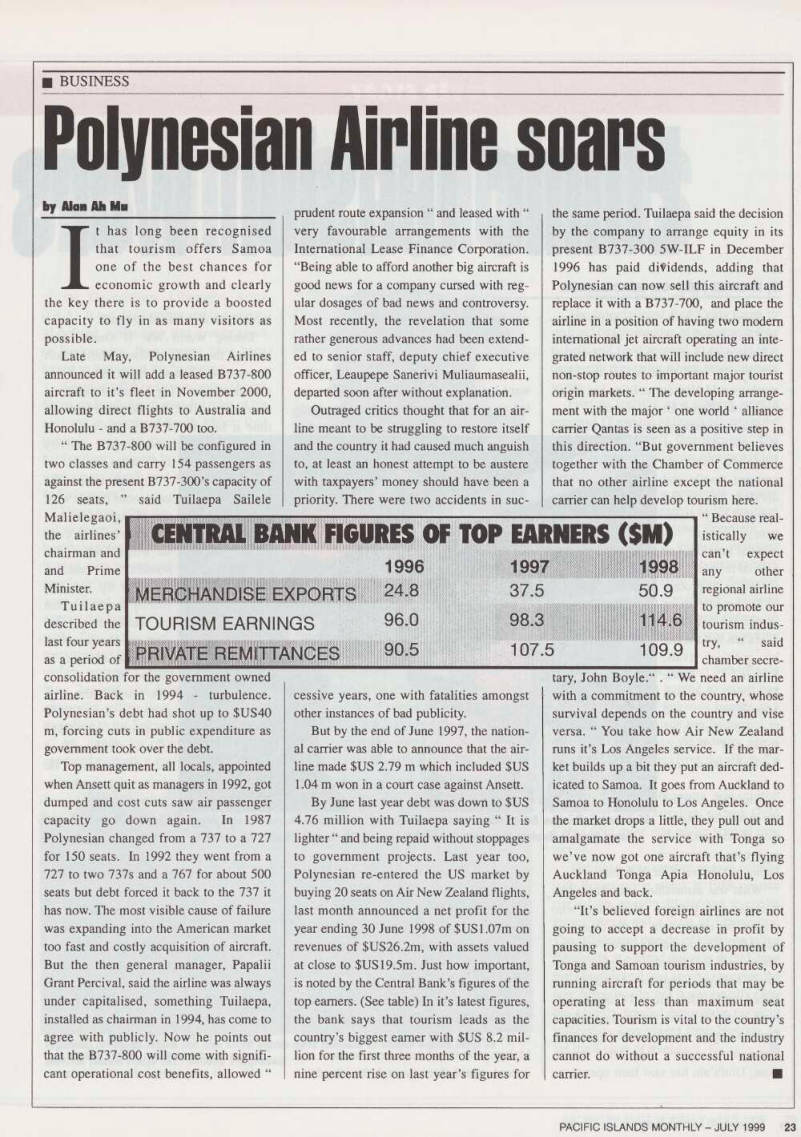
by Alan Ah Mu
It has long been recognised
that tourism offers Samoa one of the best chances for economic growth and clearly the key there is to provide a boosted capacity to fly in as many visitors as
possible.
Late May, Polynesian Airlines announced it will add a leased 8737-800 aircraft to it’s fleet in November 2000, allowing direct flights to Australia and Honolulu - and a 8737-700 too.
“ The 8737-800 will be configured in two classes and carry 154 passengers as against the present 8737-300’s capacity of 126 seats, ” said Tuilaepa Sailele
Malielegaoi, the airlines’ chairman and and Prime Minister.
Tuilaepa described the last four years as a period of
consolidation for the government owned airline. Back in 1994 - turbulence.
Polynesian’s debt had shot up to SUS4O m, forcing cuts in public expenditure as government took over the debt.
Top management, all locals, appointed when Ansett quit as managers in 1992, got dumped and cost cuts saw air passenger capacity go down again. In 1987 Polynesian changed from a 737 to a 727 for 150 seats. In 1992 they went from a 727 to two 737 s and a 767 for about 500 seats but debt forced it back to the 737 it has now. The most visible cause of failure was expanding into the American market too fast and costly acquisition of aircraft.
But the then general manager, Papalii Grant Percival, said the airline was always
under capitalised, something Tuilaepa,
installed as chairman in 1994, has come to agree with publicly. Now he points out that the 8737-800 will come with signifi cant operational cost benefits, allowed “
prudent route expansion “ and leased with “ very favourable arrangements with the International Lease Finance Corporation.
“Being able to afford another big aircraft is good news for a company cursed with reg ular dosages of bad news and controversy.
Most recently, the revelation that some rather generous advances had been extend ed to senior staff, deputy chief executive officer, Leaupepe Sanerivi Muliaumasealii, departed soon after without explanation.
Outraged critics thought that for an air line meant to be struggling to restore itself and the country it had caused much anguish to, at least an honest attempt to be austere with taxpayers’ money should have been a priority. There were two accidents in suc
cessive years, one with fatalities amongst other instances of bad publicity.
But by the end of June 1997, the nation al carrier was able to announce that the air line made SUS 2.79 m which included SUS 1.04 m won in a court case against Ansett.
By June last year debt was down to SUS 4.76 million with Tuilaepa saying “ It is lighter “ and being repaid without stoppages to government projects. Last year too, Polynesian re-entered the US market by buying 20 seats on Air New Zealand flights, last month announced a net profit for the year ending 30 June 1998 of SUS 1.07 m on revenues of SUS26.2m, with assets valued at close to SUS 19.5 m. Just how important, is noted by the Central Bank’s figures of the top earners. (See table) In it’s latest figures, the bank says that tourism leads as the country’s biggest earner with SUS 8.2 mil lion for the first three months of the year, a nine percent rise on last year’s figures for
the same period. Tuilaepa said the decision by the company to arrange equity in its present 8737-300 SW-ILF in December 1996 has paid ditidends, adding that Polynesian can now sell this aircraft and replace it with a 8737-700, and place the airline in a position of having two modem international jet aircraft operating an inte grated network that will include new direct non-stop routes to important major tourist origin markets. “ The developing arrange ment with the major ‘ one world ‘ alliance carrier Qantas is seen as a positive step in this direction. “But government believes together with the Chamber of Commerce that no other airline except the national carrier can help develop tourism here.
“ Because real istically we can’t expect any other regional airline to promote our tourism indus try, “ said chamber secre
tary, John Boyle.“ . “ We need an airline with a commitment to the country, whose survival depends on the country and vise versa. “ You take how Air New Zealand runs it’s Los Angeles service. If the mar ket builds up a bit they put an aircraft ded icated to Samoa. It goes from Auckland to Samoa to Honolulu to Los Angeles. Once the market drops a little, they pull out and amalgamate the service with Tonga so we’ve now got one aircraft that’s flying Auckland Tonga Apia Honolulu, Los Angeles and back.
“It’s believed foreign airlines are not going to accept a decrease in profit by pausing to support the development of Tonga and Samoan tourism industries, by running aircraft for periods that may be operating at less than maximum seat capacities. Tourism is vital to the country’s finances for development and the industry cannot do without a successful national carrier. ■
Centra! Bank Figures Of Top
Earners ($M)
1996 1997 1998
Merchandise Exports
24.8 37.5 50.9
Tourism Earnings
96.0 98.3 114.6
Private Remittances
90.5 107.5 109.9
Ethnic tension wors[?]en in the Solomons
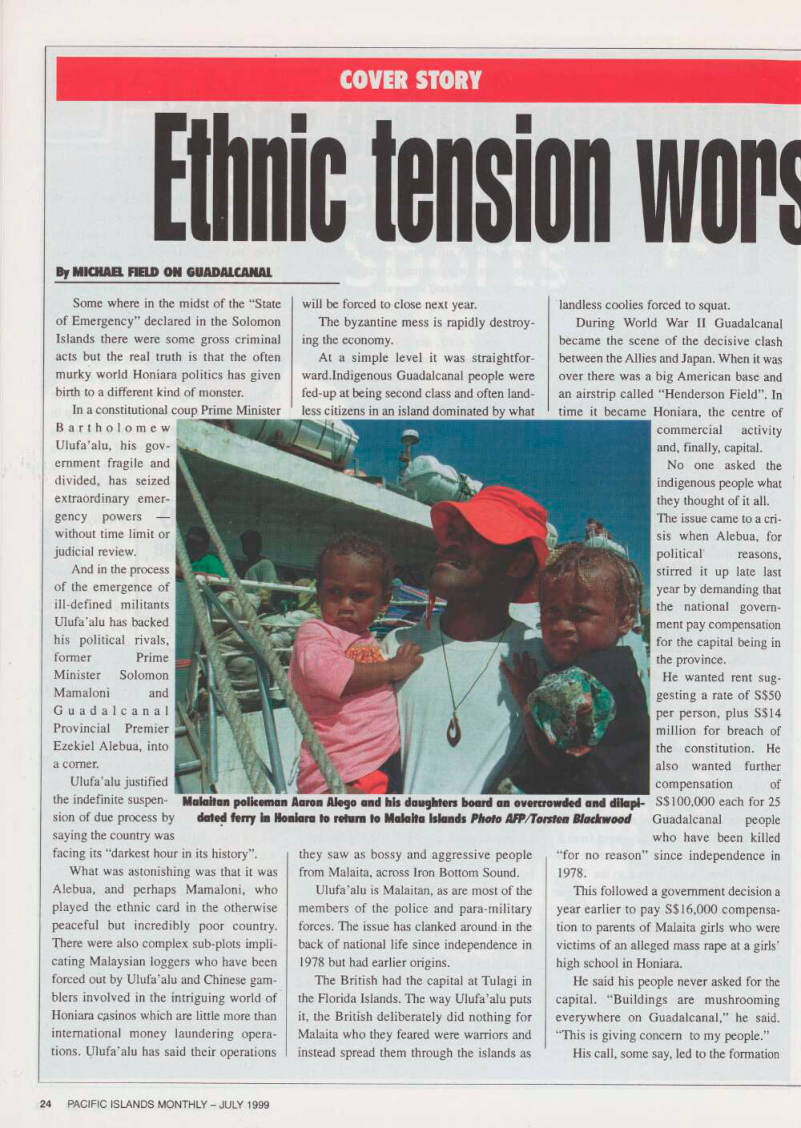
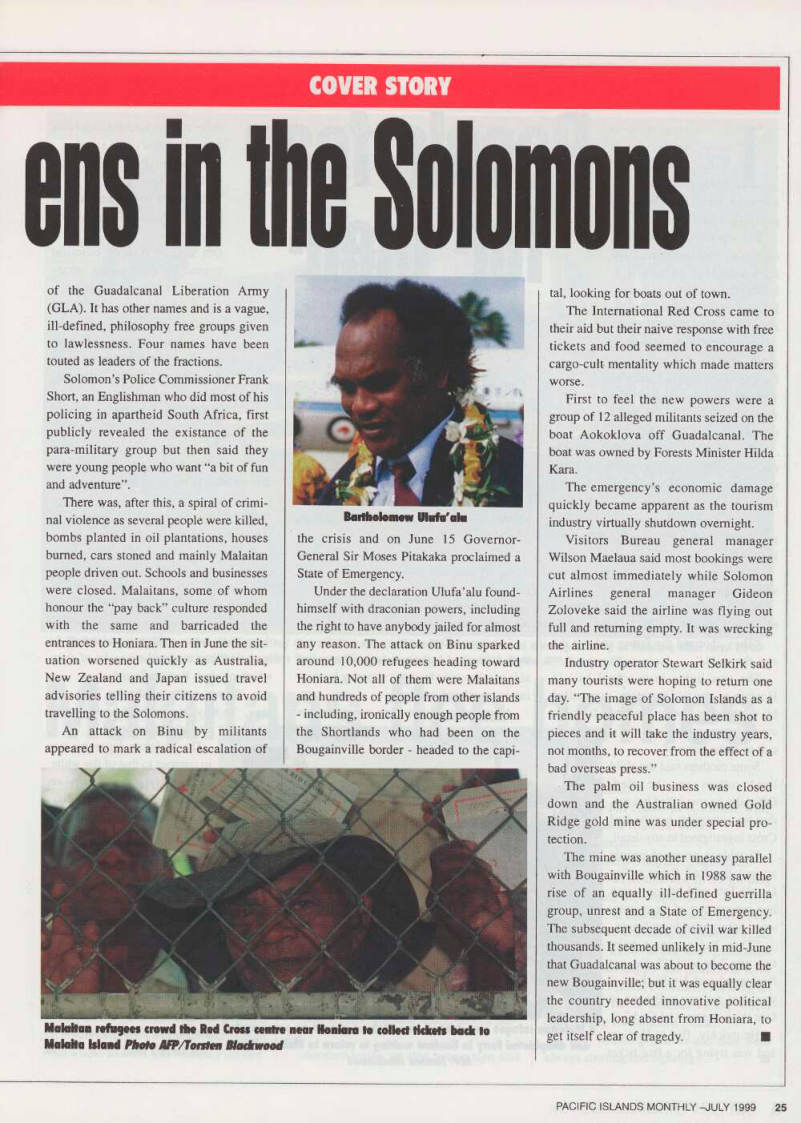
Cover Story
By Michael Held On Guadalcanal
Some where in the midst of the “State of Emergency” declared in the Solomon Islands there were some gross criminal acts but the real truth is that the often
murky world Honiara politics has given
birth to a different kind of monster.
In a constitutional coup Prime Minister
Bartholomew Ulufa’alu, his gov ernment fragile and divided, has seized extraordinary emer gency powers without time limit or judicial review.
And in the process of the emergence of ill-defined militants Ulufa’alu has backed his political rivals, former Prime Minister Solomon Mamaloni and Guadalcanal Provincial Premier Ezekiel Alebua, into a comer.
Ulufa’alu justified
the indefinite suspen sion of due process by saying the country was
facing its “darkest hour in its history”.
What was astonishing was that it was Alebua, and perhaps Mamaloni, who played the ethnic card in the otherwise peaceful but incredibly poor country.
There were also complex sub-plots impli cating Malaysian loggers who have been forced out by Ulufa’alu and Chinese gam blers involved in the intriguing world of Honiara casinos which are little more than international money laundering opera tions. Ulufa’alu has said their operations
will be forced to close next year.
The byzantine mess is rapidly destroy ing the economy.
At a simple level it was straightfor ward.lndigenous Guadalcanal people were fed-up at being second class and often land less citizens in an island dominated by what
they saw as bossy and aggressive people from Malaita, across Iron Bottom Sound.
Ulufa’alu is Malaitan, as are most of the members of the police and para-military forces. The issue has clanked around in the back of national life since independence in 1978 but had earlier origins.
The British had the capital at Tulagi in the Florida Islands. The way Ulufa’alu puts it, the British deliberately did nothing for Malaita who they feared were warriors and instead spread them through the islands as
landless coolies forced to squat.
During World War II Guadalcanal became the scene of the decisive clash between the Allies and Japan. When it was over there was a big American base and an airstrip called “Henderson Field”. In time it became Honiara, the centre of
commercial activity
and, finally, capital.
No one asked the indigenous people what they thought of it all.
The issue came to a cri sis when Alebua, for
I political' reasons,
stirred it up late last ! year by demanding that i the national govern ment pay compensation for the capital being in the province.
He wanted rent sug gesting a rate of Ssso per person, plus S$ 14 million for breach of the constitution. He also wanted further
compensation of
S$ 100,000 each for 25
Guadalcanal people
who have been killed
“for no reason” since independence in 1978.
This followed a government decision a year earlier to pay S$ 16,000 compensa tion to parents of Malaita girls who were victims of an alleged mass rape at a girls’ high school in Honiara.
He said his people never asked for the
capital. “Buildings are mushrooming
everywhere on Guadalcanal,” he said.
“This is giving concern to my people.”
His call, some say, led to the formation
Malaian policeman Aaron Alego and his daughters board an overcrowded and dilapi dated ferry in Honiara to return to Malaita Islands Photo AFP/Tonten Blackwood
of the Guadalcanal Liberation Army (GLA). It has other names and is a vague, ill-defined, philosophy free groups given to lawlessness. Four names have been touted as leaders of the fractions.
Solomon’s Police Commissioner Frank Short, an Englishman who did most of his policing in apartheid South Africa, first publicly revealed the existance of the para-military group but then said they were young people who want “a bit of fun and adventure”.
There was, after this, a spiral of crimi nal violence as several people were killed, bombs planted in oil plantations, houses burned, cars stoned and mainly Malaitan people driven out. Schools and businesses were closed. Malaitans, some of whom honour the “pay back” culture responded with the same and barricaded the entrances to Honiara. Then in June the sit uation worsened quickly as Australia, New Zealand and Japan issued travel advisories telling their citizens to avoid travelling to the Solomons.
An attack on Binu by militants appeared to mark a radical escalation of
the crisis and on June 15 Governor- General Sir Moses Pitakaka proclaimed a State of Emergency.
Under the declaration Ulufa’alu found himself with draconian powers, including the right to have anybody jailed for almost any reason. The attack on Binu sparked around 10,000 refugees heading toward Honiara. Not all of them were Malaitans and hundreds of people from other islands
- including, ironically enough people from
the Shortlands who had been on the Bougainville border - headed to the capi-
tal, looking for boats out of town.
The International Red Cross came to their aid but their naive response with free tickets and food seemed to encourage a cargo-cult mentality which made matters worse.
First to feel the new powers were a group of 12 alleged militants seized on the boat Aokoklova off Guadalcanal. The boat was owned by Forests Minister Hilda Kara.
The emergency’s economic damage quickly became apparent as the tourism industry virtually shutdown overnight.
Visitors Bureau general manager Wilson Maelaua said most bookings were cut almost immediately while Solomon Airlines general manager Gideon Zoloveke said the airline was flying out full and returning empty. It was wrecking the airline.
Industry operator Stewart Selkirk said many tourists were hoping to return one day. “The image of Solomon Islands as a friendly peaceful place has been shot to pieces and it will take the industry years, not months, to recover from the effect of a bad overseas press.”
The palm oil business was closed down and the Australian owned Gold Ridge gold mine was under special pro tection.
The mine was another uneasy parallel with Bougainville which in 1988 saw the rise of an equally ill-defined guerrilla group, unrest and a State of Emergency.
The subsequent decade of civil war killed thousands. It seemed unlikely in mid-June that Guadalcanal was about to become the new Bougainville; but it was equally clear the country needed innovative political leadership, long absent from Honiara, to get itself clear of tragedy. ■
Malaitan refugees crowd Ike Red Cross centre near Honiara to collect tickets back to Malabo Island Photo AFP/Tonteu Blackwood
Bartholomew Ulufa'alu
People fear
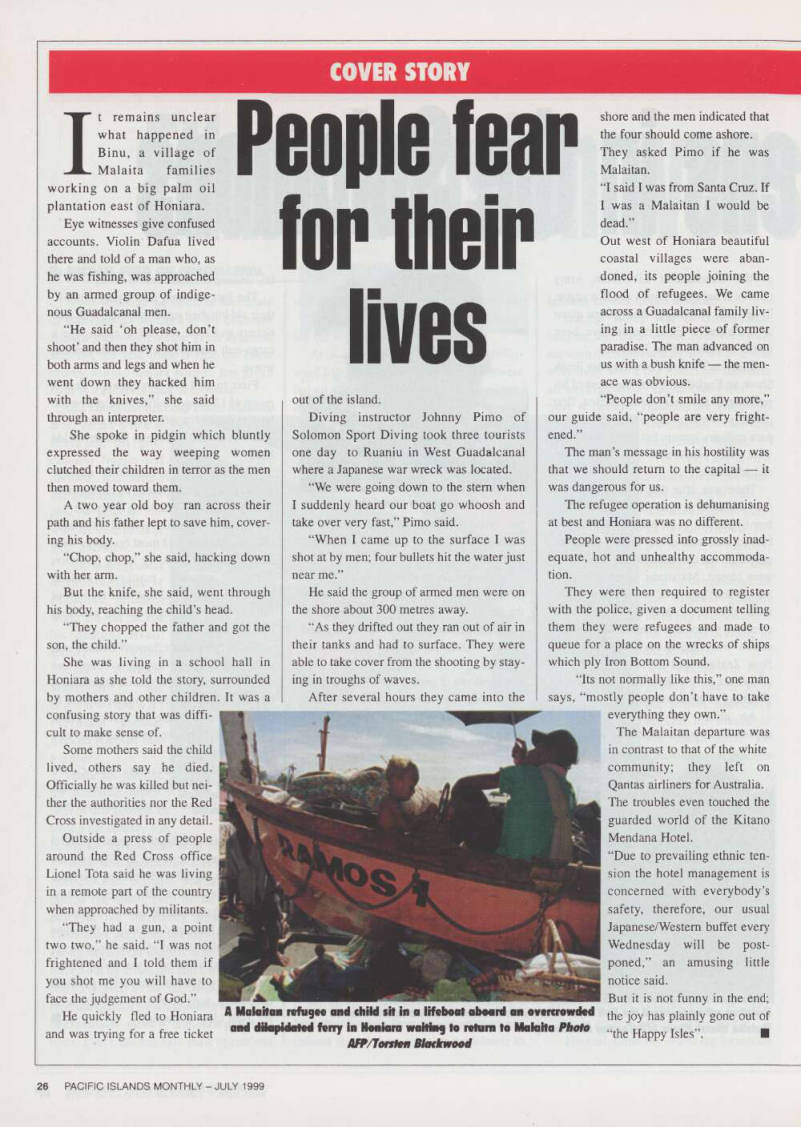
for their lives
It remains unclear what happened in Binu, a village of Malaita families
working on a big palm oil
plantation east of Honiara.
Eye witnesses give confused accounts. Violin Dafua lived there and told of a man who, as he was fishing, was approached by an armed group of indige nous Guadalcanal men.
“He said ‘oh please, don’t shoot’ and then they shot him in both arms and legs and when he went down they hacked him with the knives,” she said through an interpreter.
She spoke in pidgin which bluntly expressed the way weeping women clutched their children in terror as the men then moved toward them.
A two year old boy ran across their path and his father lept to save him, cover ing his body.
“Chop, chop,” she said, hacking down with her arm.
But the knife, she said, went through his body, reaching the child’s head.
“They chopped the father and got the son, the child.”
She was living in a school hall in Honiara as she told the story, surrounded by mothers and other children. It was a
confusing story that was diffi cult to make sense of.
Some mothers said the child lived, others say he died.
Officially he was killed but nei ther the authorities nor the Red Cross investigated in any detail.
Outside a press of people around the Red Cross office Lionel Tota said he was living in a remote part of the country
when approached by militants.
“They had a gun, a point two two,” he said. “I was not frightened and I told them if you shot me you will have to face the judgement of God.”
He quickly fled to Honiara and was trying for a free ticket
out of the island.
Diving instructor Johnny Pimo of Solomon Sport Diving took three tourists one day to Ruaniu in West Guadalcanal where a Japanese war wreck was located.
“We were going down to the stem when I suddenly heard our boat go whoosh and take over very fast,” Pimo said.
“When I came up to the surface I was shot at by men; four bullets hit the water just near me.”
He said the group of armed men were on the shore about 300 metres away.
“As they drifted out they ran out of air in their tanks and had to surface. They were able to take cover from the shooting by stay ing in troughs of waves.
After several hours they came into the
shore and the men indicated that the four should come ashore.
They asked Pimo if he was Malaitan.
“I said I was from Santa Cruz. If I was a Malaitan I would be dead.”
Out west of Honiara beautiful coastal villages were aban doned, its people joining the flood of refugees. We came across a Guadalcanal family liv ing in a little piece of former paradise. The man advanced on us with a bush knife the men ace was obvious.
“People don’t smile any more,”
our guide said, “people are very fright ened.”
The man’s message in his hostility was that we should return to the capital it was dangerous for us.
The refugee operation is dehumanising at best and Honiara was no different.
People were pressed into grossly inad equate, hot and unhealthy accommoda tion.
They were then required to register with the police, given a document telling them they were refugees and made to queue for a place on the wrecks of ships which ply Iron Bottom Sound.
“Its not normally like this,” one man says, “mostly people don’t have to take
everything they own.”
The Malaitan departure was in contrast to that of the white community; they left on Qantas airliners for Australia.
The troubles even touched the guarded world of the Kitano Mendana Hotel.
“Due to prevailing ethnic ten sion the hotel management is concerned with everybody’s safety, therefore, our usual Japanese/Western buffet every Wednesday will be post
poned,” an amusing little
notice said.
But it is not funny in the end; the joy has plainly gone out of “the Happy Isles”. ■
A Malaitan refugee and child sh in a lifeboat aboard an overcrowded and dilapidated ferry in Honiara waiting to return to Mala Ha Photo AFP/Torsten Blackwood
Malaitans flee homes
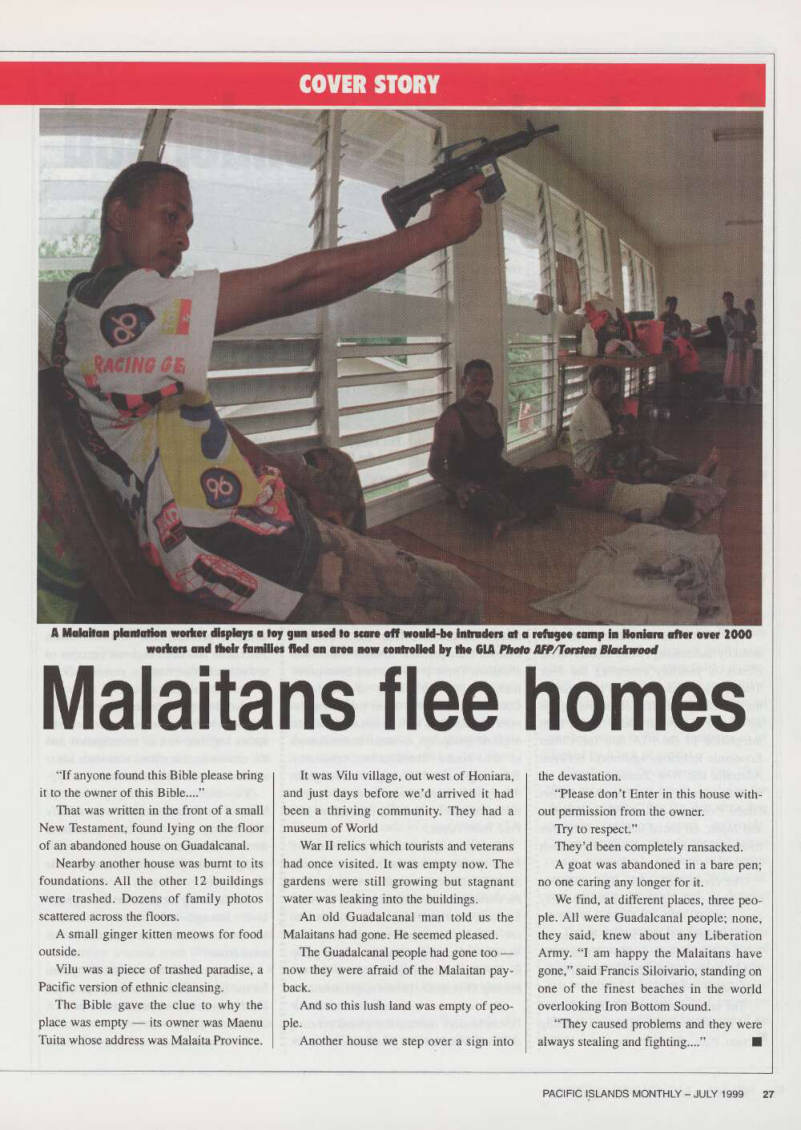
“If anyone found this Bible please bring it to the owner of this 8ib1e...”
That was written in the front of a small New Testament, found lying on the floor of an abandoned house on Guadalcanal.
Nearby another house was burnt to its foundations. All the other 12 buildings were trashed. Dozens of family photos scattered across the floors.
A small ginger kitten meows for food outside.
Vilu was a piece of trashed paradise, a Pacific version of ethnic cleansing.
The Bible gave the clue to why the place was empty its owner was Maenu Tuita whose address was Malaita Province.
It was Vilu village, out west of Honiara, and just days before we’d arrived it had been a thriving community. They had a museum of World War II relics which tourists and veterans had once visited. It was empty now. The gardens were still growing but stagnant water was leaking into the buildings.
An old Guadalcanal man told us the Malaitans had gone. He seemed pleased.
The Guadalcanal people had gone too now they were afraid of the Malaitan pay back.
And so this lush land was empty of peo
ple.
Another house we step over a sign into
the devastation.
“Please don’t Enter in this house with out permission from the owner.
Try to respect.”
They’d been completely ransacked.
A goat was abandoned in a bare pen; no one caring any longer for it.
We find, at different places, three peo ple. All were Guadalcanal people; none, they said, knew about any Liberation Army. “I am happy the Malaitans have gone,” said Francis Siloivario, standing on one of the finest beaches in the world overlooking Iron Bottom Sound.
“They caused problems and they were always stealing and fighting...” ■
A Malaitan plantation worker displays a toy gun used to scare off would-be intruders at a refugee camp in Honiara after over 2000 workers and their families fled an area now controlled by the GLA Photo AFP/Torsten Blackwood
Free trade area endorsed
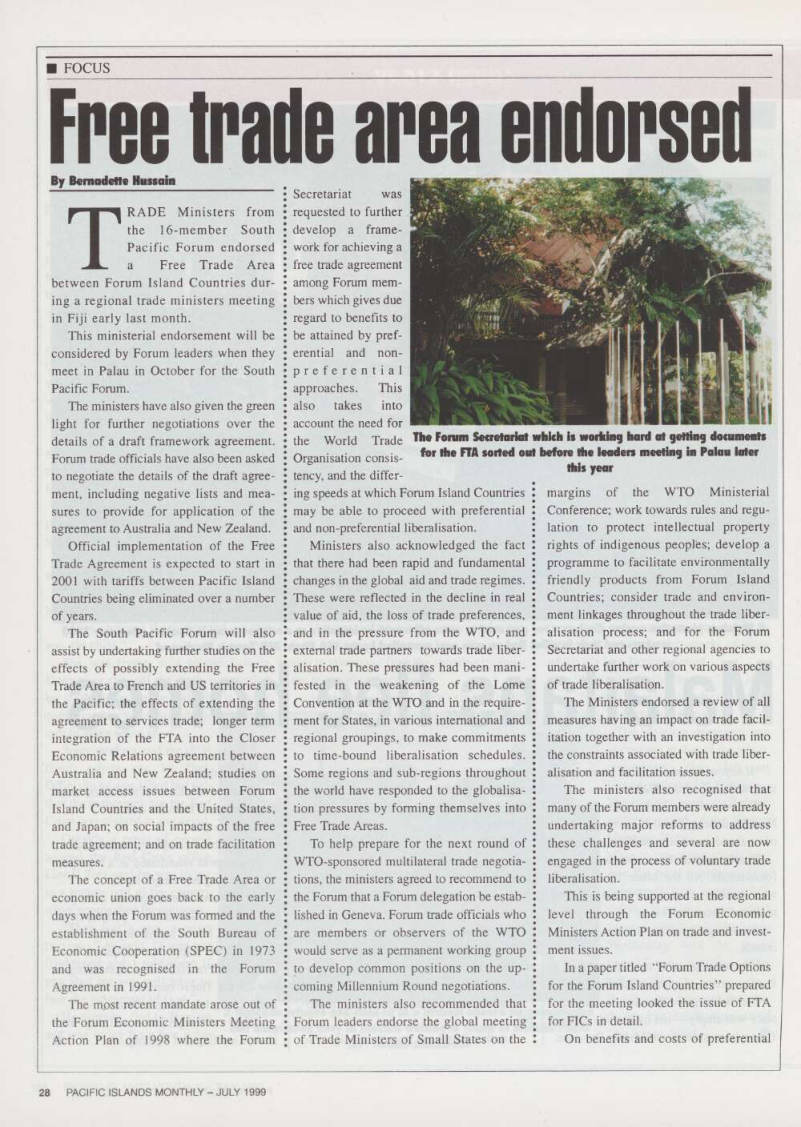
Focus
By Bernadette Hussain
TRADE Ministers from the 16-member South Pacific Forum endorsed a Free Trade Area between Forum Island Countries dur ing a regional trade ministers meeting in Fiji early last month.
This ministerial endorsement will be considered by Forum leaders when they meet in Palau in October for the South Pacific Forum.
The ministers have also given the green light for further negotiations over the details of a draft framework agreement.
Forum trade officials have also been asked to negotiate the details of the draft agree ment, including negative lists and mea sures to provide for application of the agreement to Australia and New Zealand.
Official implementation of the Free Trade Agreement is expected to start in 2001 with tariffs between Pacific Island Countries being eliminated over a number of years.
The South Pacific Forum will also assist by undertaking further studies on the effects of possibly extending the Free Trade Area to French and US territories in the Pacific; the effects of extending the agreement to services trade; longer term integration of the FTA into the Closer Economic Relations agreement between Australia and New Zealand; studies on market access issues between Forum Island Countries and the United States, and Japan; on social impacts of the free trade agreement; and on trade facilitation measures.
The concept of a Free Trade Area or economic union goes back to the early days when the Forum was formed and the establishment of the South Bureau of Economic Cooperation (SPEC) in 1973 and was recognised in the Forum Agreement in 1991.
The mpst recent mandate arose out of the Forum Economic Ministers Meeting Action Plan of 1998 where the Forum
Secretariat was
requested to further j
develop a frame- , work for achieving a free trade agreement among Forum mem bers which gives due regard to benefits to be attained by pref erential and non preferential
approaches. This
also takes into account the need for ' the World Trade Organisation consis tency, and the differ
ing speeds at which Forum Island Countries may be able to proceed with preferential and non-preferential liberalisation.
Ministers also acknowledged the fact that there had been rapid and fundamental changes in the global aid and trade regimes.
These were reflected in the decline in real value of aid, the loss of trade preferences, and in the pressure from the WTO, and external trade partners towards trade liber alisation. These pressures had been mani fested in the weakening of the Lome Convention at the WTO and in the require ment for States, in various international and regional groupings, to make commitments to time-bound liberalisation schedules.
Some regions and sub-regions throughout the world have responded to the globalisa tion pressures by forming themselves into Free Trade Areas.
To help prepare for the next round of WTO-sponsored multilateral trade negotia tions, the ministers agreed to recommend to the Forum that a Forum delegation be estab lished in Geneva. Forum trade officials who are members or observers of the WTO would serve as a permanent working group to develop common positions on the up coming Millennium Round negotiations.
The ministers also recommended that Forum leaders endorse the global meeting of Trade Ministers of Small States on the
margins of the WTO Ministerial Conference; work towards rules and regu lation to protect intellectual property rights of indigenous peoples; develop a programme to facilitate environmentally friendly products from Forum Island Countries; consider trade and environ ment linkages throughout the trade liber alisation process; and for the Forum Secretariat and other regional agencies to undertake further work on various aspects of trade liberalisation.
The Ministers endorsed a review of all measures having an impact on trade facil itation together with an investigation into the constraints associated with trade liber alisation and facilitation issues.
The ministers also recognised that many of the Forum members were already undertaking major reforms to address these challenges and several are now engaged in the process of voluntary trade liberalisation.
This is being supported at the regional level through the Forum Economic Ministers Action Plan on trade and invest ment issues.
In a paper titled “Forum Trade Options for the Forum Island Countries” prepared for the meeting looked the issue of FTA for FICs in detail.
On benefits and costs of preferential
The Forum Secretariat which is working hard at getting documents for the FTA sorted out before the leaders meeting in Palau later this year
free trade among the FICs, the paper said the quantifiable economic benefits of the FICs of a preferential free trade arrange ment will be relatively small. A key poten tial benefit of such an arrangement, how ever, is that it can act as a stepping stone to more complete liberalisation. “It can also promote greater economic cohesion among the FICs in their dealings with the outside world. The FICs will also derive substan tial economic benefits from the implemen tation of a supporting programme of trade and investment facilitation measures.
The size of the market covered by a FIC preferential free trade arrangement can be more than doubled by the inclusion of the French and the US Pacific territories,” said the report. These conclusions are consis tent with the results of a computable gener al equilibrium (CGE) analysis of the effects of forming a FIC preferential trade arrangement, using trade and economic data from each FIC. On the form of a pref erential FTA, the report said that in design ing a preferential free arrangement cover ing trade in goods, two key choices are: - Free trade area (FTA) or customs union. In a FTA, members retain their sep arate barriers against non-members, where as in a customs union they agree to adopt a common external tariff (CET) to be applied to imports from non-members.
The other is a negative list approach or
a positive list approach.
Under a negative lists approach, barri ers are removed on all products except a list (the negative list) of specified excep tions, whereas with the positive list approach, barriers are removed only on an agreed list of products (the positive list).
The report said on the first choice, FTA is recommended, principally because of the difficulties anticipated in reaching agree ment on a common tariff to be applied to non-members, it said. “A negative list approach is strongly recommended, as it will involve lower negotiating and admin istration costs, is more likely to ensure that momentum towards trade liberalisation is sustained, and is more likely to produce a result compatible with WTO obligations.”
The following additional recommenda tions were made regarding the format of a
Fic Fta:
- Tariffs (including all taxes levied at the border which are applicable only to imports) should be reduced to zero by a
series of clearly-defined, explicitly
timetabled, automatic steps. - No quantative restrictions should apply to trade between FICs. - Rules of Origin should be based wher ever possible on the “change-of-tariff-head ing” approach, and should be designed as far as possible to facilitate efficient trade and production among the FICs rather than to restrict trade. Derogations should be available where possible to further this objective. The safeguard and balance of payments provisions contained in the WTO Agreement should be available to members, with notification to the Forum Secretariat in cases where the FICs involved are not WTO members. - Derogations from the agreement should be available for “infant industries”, but only for short and finite periods. - It should be understood that disputes are to be settled informally where possible.
However, a recommendation is also made for a formal dispute settlement procedure to be available in cases where informal proce dures fail to resolve a dispute.
The report also looks at advantages and disadvantages of preferential trade liberali sation According to the report, preferential trade arrangements also allow countries to enjoy gains from trade. Members of a pref erential FTA will increase imports of good and services which their partners can pro duce more efficiently, and increase their own exports of goods which they them selves can produce more efficiently that their partners. This increase in trade is the “trade creation” effect of a free trade area.
The gains from trade in a preferential FTA will generally be less than the gains avail able from a corresponding reduction of trade barriers on a non-discriminatory basis, since free trade areas are unlikely to include the most competitive suppliers of all goods and services within their member ship. This is especially likely to be true of free trade areas involving small groups of countries, particularly if those countries are themselves small. - Furthermore the gains from trade cre ation in FTA can be partly or wholly negat
ed by an effect called trade diversion, which does not rise in the case of non-dis criminatory trade liberalisation. - Trade diversion occurs when the pref erences created under the free trade agree ment cause imports to be switched from non-partner to partner countries, even though they are available from the non partner countries aLa lower cost. This can happen of course because the higher cost goods from the partner country enter free of duty and other restrictions under the free trade agreement, which may allow them to be sold to customers at a lower price than the lower-cost imports from the non-partner, to which duties and other restrictions continue to be applied.
Although consumers may benefit from lower prices, the resource cost to the importing countryas measured by the for eign exchange outlay needed to pay for them, has increased. ■
South Pacific Games
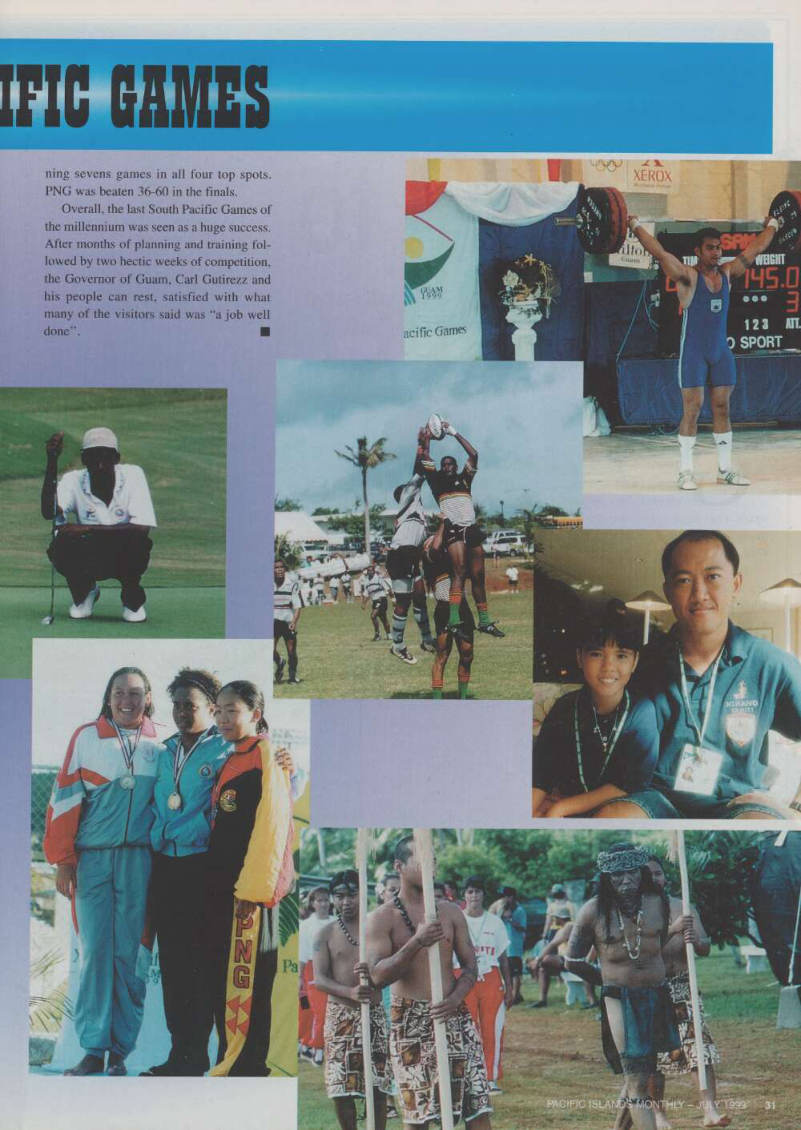
Caledonie tops games
By Manoj Kumar
Caledonie, Caledonie ... was the famous chant around each of the venues at the 11th South Pacific Games in Guam last month.
There was doubting the impact New Caledonia had on the Games having regis tered a comprehensive victory on the over all medals chart.
Rain or shine, they proved far superior leaving in their wake 19 other island coun tries and taking over from where fellow French Territory Tahiti, left off in 1995.
Swimmer Oliver Saminadin rewrote the history books with a haul of 12 gold having settled for only one silver in the pool.
After 14 days of fun and joy, victory and heartbreak, New Caledonia basked in glory taking to the winners podium with a total hail of 72 gold, 54 silver and 44 bronze medals.
Fiji, crippled by lack of competitors in medal offering sports, weightlifting, karate and taekwondo were well placed by the leaders though satisfied with their collec tion of 102 medals - 33 gold, 32 silver and 102 bronze.
The Fijians were the ones to start and end the medal count with their beach vol leyball women’s team collecting the first gold on offer and the men’s 4x400 metres relay team taking out top spot in the last event on the final day at the Southern High School tracks in Mangilao.
Fiji’s Caroline Pickering was the pick of the pack taking out six gold medals and with it two games records.
Nauru, sitting with naught to its names after three days of competition, shot out of the barrel in style and at one stage were second on the medal tally courtesy of their dominance in weightlifting.
Fielding a tiny contingent, the Nauru ans did themselves and their country proud
returning with 27 gold, eight silver and seven bronze.
Paul Coffer and Marcus Stephens were an inspiration to the Nauru lifters weightlifting being their number one sport.
Tahiti, overall winners at home four years ago, were left off the table somewhat and only managed 25, 18 and 34 gold, silver and bronze respectively.
The Tahitians stood tall in outdoor sports - basketball and volleyball with a show of
discipline and professionalism.
Samoa surprised many with their perfor mance grabbing 32 medals including 19 gold. Papua New Guinea, aided by two relay gold medals, won on technicality over Fiji, matched PNG’s gold haul but fell back on the silver recount.
Vaciseva Tavaga’s inclusion in the 4xloo metres Fiji women team steered them to vic tory only to be stripped off gold upon a protest.
Tavaga, the organisers said, was initially listed for the 200 metres thus she was ineli gible to run in the relay.
Karolina Tanono let loose Fiji’s other gold when in her jubilation, tossed the relay baton in the air when crossing the finish line.
PNG’s most significant victory would have to be their softball slow pitch victory over homeside Guan in the grand final on the eve of the closing ceremony.
Samoa had its magic moment when the men’s team edged favourites Guam in the basketball decider weightlifter Ofisa Ofisa, a member of the ASP 2000 programme, shocked Fiji’s Rupeni Varea in the 85 kg class dominating the snatch, clean jerk and total.
He did it with ease in the snatch bettering Varea’s Games best lift by 10 kilograms with a new mark of 145 kg.
Boxing attracted the most crowd at the Dededo Gymnasium, New Caledonia, Samoa and Fiji shared the limelight - Fiji being the surprise package picking up its
first boxing gold in 16 years to Mohammed Arif.
The highlight of the games was champion sprinter Jone Delai’s fall from grace at the hands of fellow Fijian Moave Vu.
Fiji made a clean sweep of the blue ribbon even taking gold, silver and bronze. Delai fell further back in the 200 metres and was placed fourth in the race won by Fijian Aminiasi Babitu.
Ten-year-old Cyrine Sam was the youngest competitor around. The daugh ter of Tahitian table tennis president Ronald Sam, Syrine awed fans with her on-table antics.
A little over the height of the tennis table, young Cyrine proved a handful for the opposition. She won a couple of her games with the women’s team adding to her silver collection from last year’s Micronesian Games.
The Tahitians had a field day in canoe
racing notching 10 gold.
Their volleyball counterparts rocked the Fijians at the Southern High School Gymnasium. Confusion surrounded the outcome of the men’s teams gold title which eventually went New Caledonia’s way.
In golf, Fiji’s Daven Gopal, collected his prize - a hard earned singles gold.
Pacific ladies number one Tagifano So’onalole helped Samoa keep pace with New Caledonia and Tahiti in tennis.
Fiji was the target of all opposition in rugby. The world champions were tested in al facets of play and came through with ease winning all their game.
They won gold beating Papua New Guinea 40-12 in a six-men a side final
after two players were given marching
orders.
New Caledonia topped in table tennis winning the singles and teams event rather easily. Fiji showed the way in net ball in the absence of Cook Islands win
ning sevens games in all four top spots.
PNG was beaten 36-60 in the finals.
Overall, the last South Pacific Games of the millennium was seen as a huge success.
After months of planning and training fol lowed by two hectic weeks of competition, the Governor of Guam, Carl Gutirezz and his people can rest, satisfied with what many of the visitors said was “a job well done”. ■
Advertisements & other items, p. 31 (1 item)
iric 6ms
31
dfg
remember
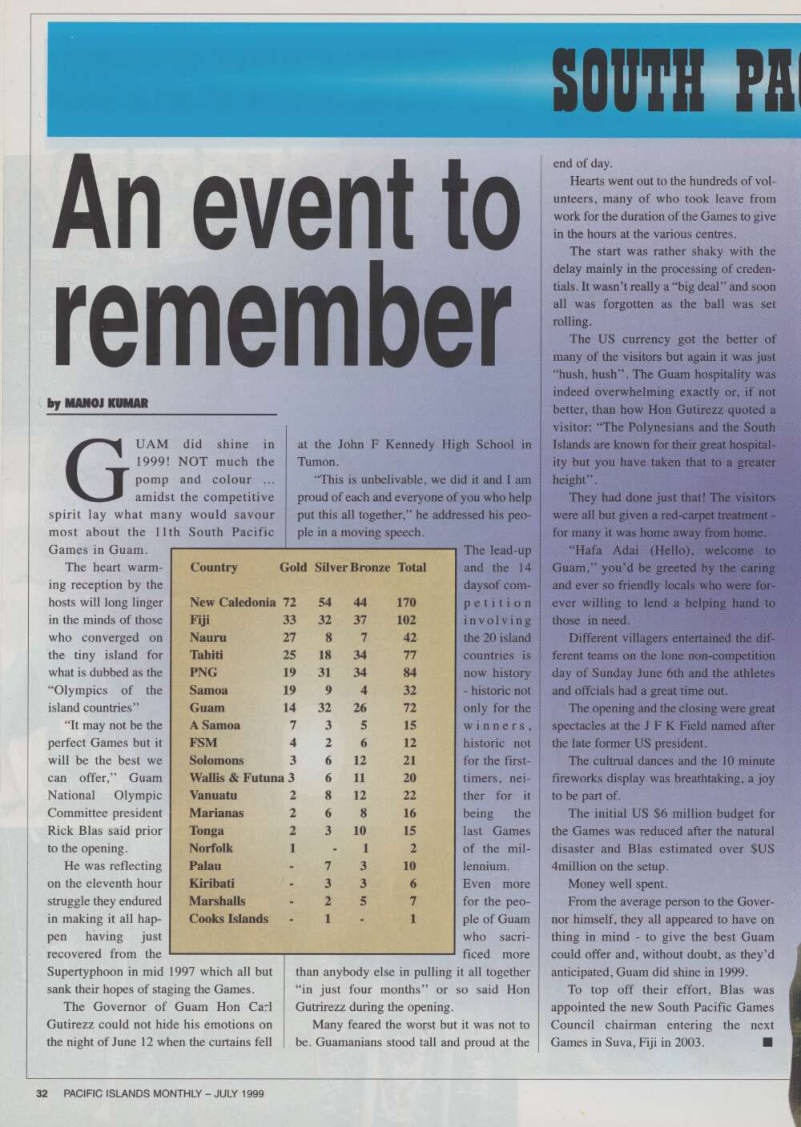
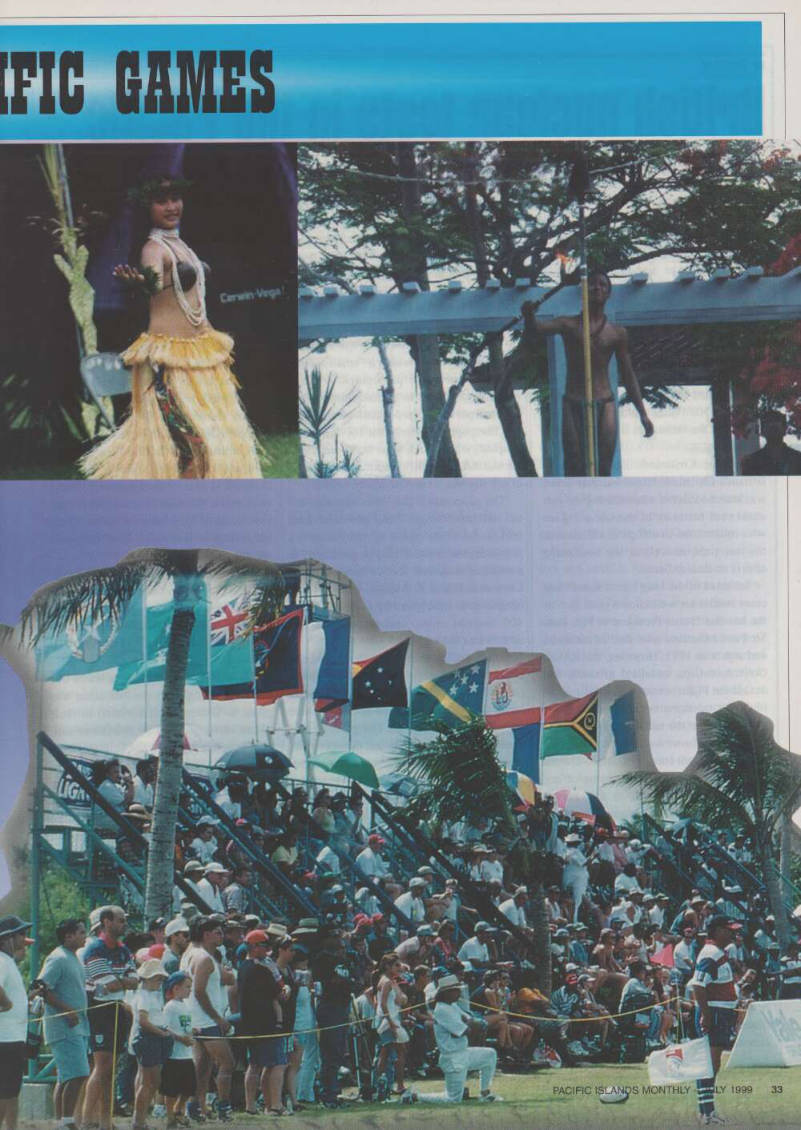
An event to remember
By Hanoi Kumar
GUAM did shine in 1999! NOT much the pomp and colour ... amidst the competitive spirit lay what many would savour most about the 11th South Pacific
Games in Guam.
The heart warm
ing reception by the
hosts will long linger in the minds of those who converged on the tiny island for what is dubbed as the “Olympics of the island countries”
“It may not be the perfect Games but it will be the best we can offer,” Guam
National Olympic
Committee president Rick Bias said prior to the opening.
He was reflecting on the eleventh hour
struggle they endured
in making it all hap pen having just recovered from the
Supertyphoon in mid 1997 which all but sank their hopes of staging the Games.
The Governor of Guam Hon Carl Gutirezz could not hide his emotions on the night of June 12 when the curtains fell
at the John F Kennedy High School in Turnon.
“This is unbelivable, we did it and I am proud of each and everyone of you who help put this all together,” he addressed his peo ple in a moving speech.
The lead-up
and the 14
daysof com
petition involving the 20 island countries is
now history
- historic not only for the winners, historic not for the first timers, nei ther for it
being the
last Games of the mil lennium.
Even more for the peo ple of Guam who sacri ficed more
than anybody else in pulling it all together “in just four months” or so said Hon Gutrirezz during the opening.
Many feared the worst but it was not to be. Guamanians stood tall and proud at the
end of day.
Hearts went out to the hundreds of vol unteers, many of who took leave from work for the duration of the Games to give in the hours at the various centres.
The start was rather shaky with the delay mainly in the processing of creden tials. It wasn’t really a “big deal” and soon all was forgotten as the ball was set
rolling.
The US currency got the better of many of the visitors but again it was just “hush, hush”. The Guam hospitality was indeed overwhelming exactly or, if not better, than how Hon Gutirezz quoted a visitor: “The Polynesians and the South Islands are known for their great hospital ity but you have taken that to a greater
height”.
They had done just that! The visitors were all but given a red-carpet treatment for many it was home away from home.
“Hafa Adai (Hello), welcome to Guam,” you’d be greeted by the caring and ever so friendly locals who were for ever willing to lend a helping hand to those in need.
Different villagers entertained the dif ferent teams on the lone non-competition day of Sunday June 6th and the athletes and offcials had a great time out.
The opening and the closing were great spectacles at the J F K Field named after the late former US president.
The cultrual dances and the 10 minute fireworks display was breathtaking, a joy to be part of.
The initial US $6 million budget for the Games was reduced after the natural disaster and Bias estimated over SUS 4million on the setup.
Money well spent.
From the average person to the Gover nor himself, they all appeared to have on thing in mind - to give the best Guam could offer and, without doubt, as they’d anticipated, Guam did shine in 1999.
To top off their effort, Bias was appointed the new South Pacific Games Council chairman entering the next Games in Suva, Fiji in 2003. ■
Country
Gold Silver Bronze Total New Caledonia 72 54 44 170
Fiji
33 32 37 102 Nauru 27 8 7 42 Tahiti 25 18 34 77
Png
19 31 34 84 Samoa 19 9 4 32 Guam 14 32 26 72 A Samoa 7 3 5 15
Fsm
4 2 6 12 Solomons 3 6 12 21 Wallis & Futuna 3 6 11 20 Vanuatu 2 8 12 22 Marianas 2 6 8 16 Tonga 2 3 10 15 Norfolk 1 - 1 2 Palau - 7 3 10 Kiribati - 3 3 6 Marshalls - 2 5 7 Cooks Islands . 1 . 1
British nuclear tests in the Pacific
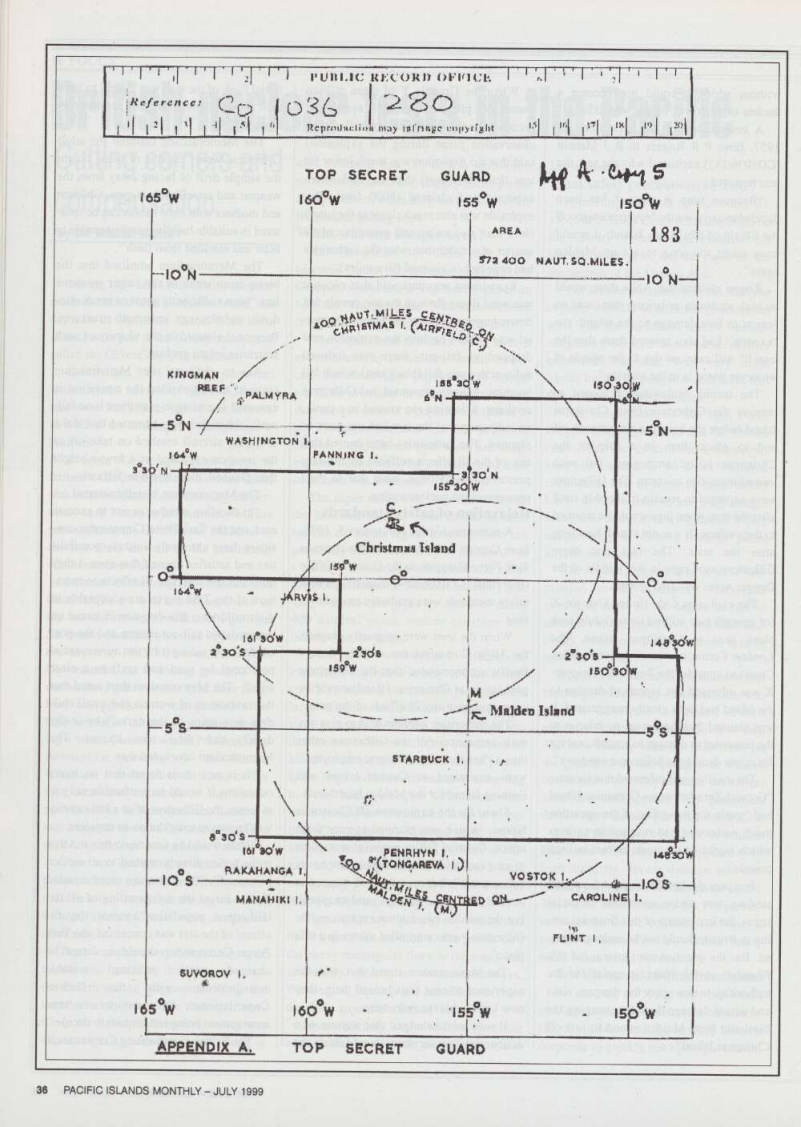
Focus
Cutting corners and compensation
By Dr Wadah Harsey
During 1957 and 1958, British conduct ed three nuclear tests at Malden Island, and six tests at Christmas Island. Both these islands were part of the British colony then called the Gilbert and Ellice Islands.
British and New Zealand personnel were exposed to risks of radiation. But so also were 300 Fijians sailors and seamen, as well as the thousands of indigenous I- Kiribati.
A book, Kirisimasi: Fijian troops at Britain’s Christmas Island Nuclear Tests, was launched last month outlining the per sonal case histories of the many Fijians who suffered the ill-effects of radiation at the test sites, as well as the continuing effects on their children.
Included in the long list of names and cases studies are well known ones such as the late and former President of Fiji, Ratu Sir Penaia Ganilau, who died of leukemia and sepsis in 1993. However, the British Government, on technical grounds, has denied the Fijian veterans (and their fami lies) any pensions or compensation for their service at the test sites. After attend ing a recent Commonwealth Parliamentary Association meeting in the United Kingdom, I managed to fit some of my own academic research at the Public records Office in Kew gardens, London. I also managed to read a few interesting files on British nuclear testing in the Pacific.
There was interesting evidence of com promises being made by the British author ities, in safety standards during and after testing. “Danger Zones” were designated
arbitrarily.
There was also a very risky changing of testing site, forced by time constraints on the British testing programme. While the latter certainly resulted in financial bene fits to the British Government, safety was almost certainly compromised. There is
also evidence that the British authorities
promised pensions and compensation for the
Fijian soldiers, when they were being sent to the nuclear testing sites.
What was the danger area?
On November 19, 1956, Air Vice- Marshall Oulton (Commander of Task Force Grapple) circulated a Top Secret paper on how the “Danger Area” was to be defined (Public Records Office file CO 1036/280).
The paper stated that there was a level B of radio-activity as which a “small tempo rary but observable physiological effects would be produced in a small fraction (less than one per cent) of a population exposed to it”. The paper declared that for “primitive peoples’, who did not wear boots and cloth ing and did not wash, the corresponding level of activity was somewhat lower, at B’.
The paper stated that “it is desirable that the declared Danger Area should at least enclose the whole region in which there is a possibility that level B’ may be produced” as a result of accidental surface bursts at either Christmas Island or Malden Island. These danger areas were given by circles of radius 400 nautical miles, centres on these two islands (see the map).
These circles were given in reference to explosions equivalent to only 150 kilotonnes (of TNT). Most of the actual explosions were larger than this, and one was of close to three million tonnes. When the Danger Area was demarcated by the two circles, the authorities blandly claimed that “such an area is patent ly too large and has been reduced” according to some “basic principles”. And what were these principles? Populated islands (other than Christmas and Malden) must not be included; boundaries should be lines of lati tude and longitude; and the total area should not greatly exceed that of the US Danger Area (in their tests at Bikini).
These arbitrary “principles” meant that the Danger Area advised to the public (see the heavy rectangular lines in the map) was artificially drawn to exclude Palmyra, Washington, Fanning and Jarvis Islands from the circle around Christmas Island.
Also artificially excluded from the circle around Malden Islands were Penrhyn and
Jarvis Islands.
What safety precautions to Take?
A meeting was held on November 27, 1956, at St Giles Court (C01036/280), on the Safety Precautions planned for Operation Grapple, and the paper on the declaration of the Danger Area.
The minutes recorded that the Minister of Supply should be informed (through the text) that the radiation levels “recom mended by the ICRP would be necessarily exceeded” but that “only very slight health hazard to people would arise and that only to primitive peoples”.
The Commander of the Task Force Grapple (Oulton) claimed that “all known craft in that part of the Pacific were pow ered and capable of 10 knots”. Oulton declared, in case of accident, craft “would have sufficient time to leave the danger area ahead of the advancing fallout if they act promptly on warning from the patrol aircraft as planned”.
The meeting agreed that in their sub mission to the ministers, “reference should be made to the degree of risk to members of the Task Force, and to its nec essary acceptance if the operation is to be mounted”.
There is no record in the notes of this meeting whether any consideration was given to Gilbertese (I-Kiribati) in their native craft, powered by paddles or sail.
And how exactly were the Gilbertese, on the ground or at sea, going to be warned by the patrol aircraft, to leave the danger
area? By loud-speaker? By pamphlets
thrown from the air? For what destination.
Three tests were conducted at Malden Island and while they were supposed to be high airbursts, severe damage was sus tained by animal and birdlife on the island.
The PCRC book indicates that Fiji person nel went on to the contaminated island, including Ratu Penaia without safety boots (none could fit him).
Test site moved to Christmas Island At the end of 1957, with the world moving towards a moratorium on atmos pheric nuclear testing, Britain became desperate to quickly test hydrogen bombs,
without which it could not become a nuclear super-power, on par with US.
A communication of September 20 1957, from P R Rogers to R J Minnitt (CO 1036/283) explained why the test site was removed: “Because time is short it has been decided to carry out the November tests off the SE tip of Christmas Island; it would have taken too long to set up Malden
again”.
Rogers claimed that while there would be high air bursts as before, there was no reason to fear damage to the island: the “experts” had also assured them that the tests will carry no risk to the people of whatever island is in the vicinity”.
The testing authorities proposed to remove the Gilbertese from Christmas Island before the bombing aircraft took off and to place them in a ship in the Christmas Island anchorage, but with immediate notice to steam. The Gilbertese were expected to remain in the ship until after the test, when they would be returned to their village. It was not stated, how long after the tests. The fact that these Gilbertese were right in the middle of the Danger Areas was also ignored.
The explosion code-named Grapple-X
(of strength two million tonnes) duly took place next to Christmas Island. The London Committee meeting (at St Giles Court) to consider the Report on Grapple- X was informed that reports of damage to the island had been greatly exaggerated. It was claimed that there were no injuries to the personnel or damage to aircraft “except for minor damage to helicopter windows”.
The meeting was informed that locating “Ground Zero” close to Christmas Island had “made the mounting of the operation much easier and had resulted in savings which might be as much as two million
pounds”.
In a period when Britain and the pound sterling was under enormous financial stress, the importance of this financial sav ing to Britain should not be under-estimat ed. But the question also arises, did this financial saving make it easier for the authorities to downplay the dangers, risks and actual damage done by changing the blast site from Malden island to just off Christmas Island?
When the Grapple Y of three million tonnes took place in April 1958, eyewitness accounts (including that of a pilot flying an
observation plane during the explosion)
said that the explosion was much lower (at less than 1000 feet) than the authorities expected and claimed (8000 feet). The explosion was also much closer to the island (less than two miles and possible only a quarter of a mile) than what the authorities had expected or claimed (five miles).
Eyewitness accounts said that coconut tree went flying through the air; people fell down; huge amounts of sea and land mater ial was sucked up into the explosion and dropped as fall-out; there was induced radio-active rain-fall (black rain), which fell on ships, military personnel and Gilbertese civilians. Scientists ran around in a panic, an indication that the test had not gone as planned. The authorities have denied that any of the ill effects suffered by military personnel or civilians, were due to their presence at the nuclear testing.
Relaxation of safety standards A memorandum of November 5, 1958, from Captain J G T Western (Headquarters Task Force Grapple) to the Colonial Office (H P Hall) (CO 1036/284) makes clear how safety standards were gradually eroded over time.
When the tests were originally planned, the High Commissioner of the Western Pacific recommended that the Gilbertese population at Christmas Island should be evacuated from any ill-effects of the tests.
The authorities were not able to give any such assurance. All the Gilbertese other than a “handful of government employees” were evacuated to Canton Island and Fanning Island for the Malden Island tests.
Then, for the explosions off Christmas Island, “which was planned at very short notice, Colonial Office approval was given to an evacuation into a ship a few hours before a test”. But even this was stopped in general (except for the high yield weapons).
For the smaller two kiloton explosions, the Gilbertese “were martialled ashore in a safe
place”.
The Memorandum stated that, with the experience of nine tests behind them, they now knew what the risks were.
It was acknowledged that anyone who deliberately or accidentally observed the
initial flash of the test, was “likely to have
their eyesight temporarily or permanently
impaired”.
The Memorandum claimed the adult Gilbertese were “capable of being taught the simple drill of facing away from the weapon and covering their eyes. Children and mothers with their babies can be mus tered in suitable buildings unsusceptible to blast and shielded from flash”.
The Memorandum admitted that the blasts from some of the larger weapons had “been sufficiently great to break win dows and damage unvented structures.
Personnel situated in the vicinity of such structures might get hurt”.
As to fallout, the Memorandum claimed that “provided the operation is executed according to plan there is no fall out”, although it was admitted that if the dropping aircraft crashed on take-off or the weapon exploded at a lower height than planned, there might be fall out.
The Memorandum blandly asserted: “In deciding whether or not to execute each test the Task Force Commander con
siders these extremely unlikely possibili
ties and satisfies himself that even if they do occur the resultant ill effects to mem bers of the Task Force are acceptable in their mildness. His decision is based on the predicted fall-out pattern and the pos sibility of avoiding it by the movement of personnel by road and craft to a clear area”. The Memorandum then noted that the evacuation of women and small chil dren into ships in the dark (why in the dark?) had their own hazard. The Memorandum concluded that: “it is now considered that on many occasions it would be preferable only to evacuate the Gilbertese after a fall-out risk was known to exist due to an accident.
There would be time to do this and this is the policy already applied to all service personnel”. The committee recommended that as far as the safeguarding of all the Gilbertese population against the ill effects of the test was concerned, the Task Force Commander should in future be charged with making suitable arrangements with the District Commissioner, “the nature of these arrangement being left for him to decide”.
The British Coordinating Committee in
London, thereby passed on all safety responsibilities to the Task Force Commander. It is doubtful if the safety of Gilbertese was particularly high on his pri orities. How exactly the Task Force Commander could satisfy himself before the accidents that the ill-effects of fall-out would be “acceptable in their mildness” boggles the mind. And neither was it explained how seriously limited number and length of roads on Christmas Island were to be used to evade fallout (by both Servicemen and Gilbertese). There is now record of any consideration being given to the likely problems or organising the sud den movement of Gilbertese civilians (who knew little English, also included old peo ple, women and children). The military officers themselves were aware that even their disciplined military personnel (of whom there were thousands on the island) would have difficulty in being evacuated in a hurry. The actual experiences of ser vicemen and Gilbertese indicate that sub stantial exposure to radiation did take place. Ships could not steam away on time.
Black rain fell on populated islands.
Personnel went back to “hot” test sites within days of the testing. Servicemen han dled barrels (some leaking of nuclear waste with little protection. And people became ill.
Issues of compensation The British Government has denied the claims for pensions by the Fiji Nuclear Test veterans, on the grounds that Christmas Island was not a site of “active military operation”. However, what was the under standing between the British Government and the Fiji authorities when the Fiji per sonnel were first sent to Christmas Island for Operation Grapple? A communication (dated January 6, 1958) from the Secretary of State for Colonies ( in London) to the Fiji Governor stated very clearly; “It is confirmed that employment would be for the three months in the first instance
and that costs, including indemnity against
claims for disability, pensions, etc., arising
from any injuries, will be a charge on United Kingdom funds”. (Public Record Office file CO10361283).
But the British authorities are denying that there is any link between the illness of the Fiji veterans, and their service at test sites. ■
Book documents experiences
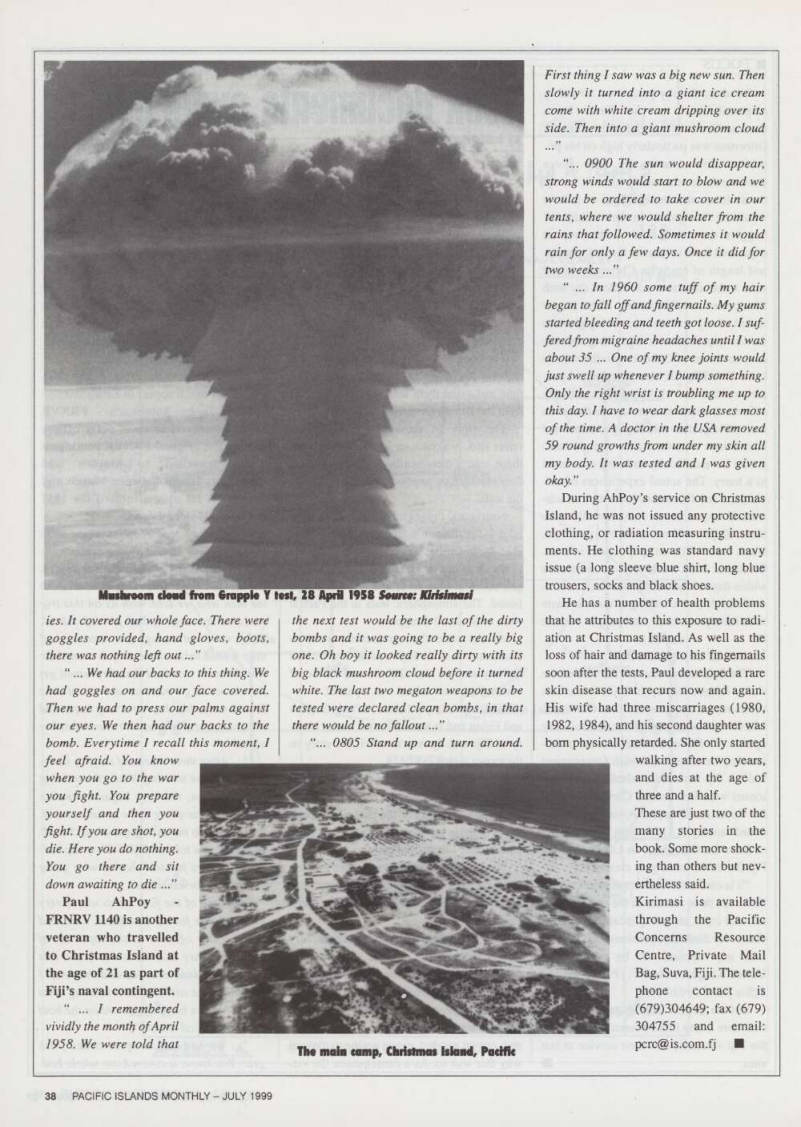
By Bernadette Hussain
Abook looking at Fiji
troops at Britain’s Christmas Island nuclear tests was released in Suva, Fiji, by the Pacific Concerns Resource Centre late last month.
The book is based on information pro vided by over 150 former Fijian military personnel who served under British com mand at Christmas Island in the 19505.
The book is an effort by the PCRC to put forward the plight of the servicemen at the time and assist them seeking compensation from the British Government.
The story of these servicemen were never told. No one ever knew the plight of these men - their health problems which they attribute to exposure to radiation from the tests.
Nearly 300 Fijians travelled to Christmas Island for Britain’s nuclear testing pro gramme in the Pacific. They were witnesses to the development of the Britain’s hydro gen bomb at Malden Island and Christmas Island. The atmospheric tests in the Pacific were codenamed Grapple.
At the time the servicemen went to Christmas Island, Fiji was still a British Colony and so was Gilbert and Ellice of which Christmas Island was a part of.
Kirisimasi is published in both English and Fijian and is a contribution to the histo ry of Fiji and the veterans tell the story in their own words.
Chapter two and three of Kirimasi look at these stories.
Kirisimasi looks at the real life experi ences of these servicemen - their time on the island, their life and suffering.
Never before had anyone spoken to these veterans so it was obvious that they were more than happy to talk about the experi ences.
The one thing that comes across very clearly is that some of these veterans were never really given all the information they wanted about the tests.
It is also obvious that the British soldiers had in some cases told them what not to do and not to eat but never really explained why this was so. As a consequence the vet
erans did just this and no attempt was never made on the part of the soldiers to stop them.
In these times if someone was asked to go on such trip than he would have so much access to information because of development but in those days it wasn’t so.
Another thing which comes across clearly is that these veterans are very bitter with the way in which they were treated and they want the British authorities to compensate them for all the pain and suf fering they say they have endured.
Following are excerpts from some interviews which appear in Kirisimasi: Ratu Inoke Bainimara - FRNVR 1104. He served as chief petty officer leading the original FRNVR contingent which travelled to Malden and Christmas Island between March and July 1957. He also witnessed the 1957 tests near Malden Island.
“... When I was recalled there were rumours going around among senior mili tary personnel about the tests on Christmas Island. One thing to note about the men who we took with us on this trip was that the majority had just leji school.
There were not enough jobs around, and they would take whatever job cam their way. When it was said that they would get the chance to go overseas and travel on a British navy ship they were very eager and excited to go. They had no idea what lay ahead...” ”... After three weeks of staying there, we finally had training. While the training was going on, the boys began to realise that there was going to be a nuclear test.
Some came to me asking questions. I said: “Weren’t you told in Fiji?” They replied: “No! We were just told that we were going on the ship for exercises”.
The time of the first bomb was a very difficult time for us. You know, we asked those senior officers at the top a lot of questions. They said not to worry and that it would be done this way and that way. I had asked the assistant commanding what would happen but his assistant on the boat said “Only God knows.” ”... We had this thing on called flash gear. You know, it covered our whole bod-
ies. It covered our whole face. There were goggles provided, hand gloves, boots, there was nothing left 0ut...”
“ ... We had our backs to this thing. We had goggles on and our face covered.
Then we had to press our palms against our eyes. We then had our backs to the bomb. Everytime I recall this moment, I
feel afraid. You know when you go to the war you fight. You prepare yourself and then you fight. If you are shot, you die. Here you do nothing.
You go there and sit down awaiting to die ...”
Paul AhPoy
FRNRV 1140 is another veteran who travelled to Christmas Island at the age of 21 as part of
Fiji’s naval contingent.
“ ... I remembered
vividly the month of April
1958. We were told that
the next test would be the last of the dirty bombs and it was going to be a really big one. Oh boy it looked really dirty with its big black mushroom cloud before it turned white. The last two megaton weapons to be tested were declared clean bombs, in that there would be no fallout...”
"... 0805 Stand up and turn around.
First thing I saw was a big new sun. Then slowly it turned into a giant ice cream come with white cream dripping over its side. Then into a giant mushroom cloud "... 0900 The sun would disappear, strong winds would start to blow and we would be ordered to take cover in our tents, where we would shelter from the rains that followed. Sometimes it would rain for only a few days. Once it did for two weeks ...”
“ ... In 1960 some tuff of my hair began to fall off and fingernails. My gums started bleeding and teeth got loose. I suf fered from migraine headaches until I was about 35 ... One of my knee joints would just swell up whenever I bump something.
Only the right wrist is troubling me up to this day. I have to wear dark glasses most of the time. A doctor in the USA removed 59 round growths from under my skin all my body. It was tested and I was given okay. ”
During AhPoy’s service on Christmas Island, he was not issued any protective clothing, or radiation measuring instru ments. He clothing was standard navy issue (a long sleeve blue shirt, long blue trousers, socks and black shoes.
He has a number of health problems that he attributes to this exposure to radi ation at Christmas Island. As well as the loss of hair and damage to his fingernails soon after the tests, Paul developed a rare skin disease that recurs now and again.
His wife had three miscarriages (1980, 1982, 1984), and his second daughter was bom physically retarded. She only started
walking after two years, and dies at the age of three and a half.
These are just two of the many stories in the book. Some more shock ing than others but nev ertheless said.
Kirimasi is available through the Pacific Concerns Resource Centre, Private Mail Bag, Suva, Fiji. The tele phone contact is (679)304649; fax (679) 304755 and email:
Mas broom eland from Grapple Y lest, 28 April 1958 Source: Kirisimasi
The main camp, Christmas island. Pacific
PNG's health woes
Health
A hospital in Aitape in the West Sepik Province of Papua New Guinea was forced to close down in early 1997 after the then government said there was no funds to maintain it. There was no medicine available and people died, yet at the same time it was negotiating with Sandline International Inc and a few months later managed to find SUSIB million to engage Sandline International.
This was revealed by the director gen eral of the World Health Organisation, Dr Gro Harlem Brundtland in the 1999 World Health Report.
In his forward message to the report Dr Brundtland said in January or February of 1997, the Catholic Church made known the drastic financial crisis it was facing in maintaining the hospital in Aitape, West Sepik Province.
“The Archsbishop of the West Sepik archdiocses then, was none other than the current Archsbishop of Port Moresby. Sick people were being turned out of the hospi tal because there were no medicine and the hospital had to be closed down. The excuse given by the government was that there were no funds. But the then Government of Sir Julius Chan under the able leader ship and guidance of his deputy Christopher Haiveta managed to find SUSIB million from the government cof fers to send to Hong Kong to engage Sandline International Inc,” he said.
“What sort of politician would allow his own people to die and to add insult to injury by hiring mercanaries to kill his own people? Dr Brundtland was reacting to revealations in the report that PNG has one of the worst health situations in the Western Pacific region This stems from statistics which show that over the past 20 years there hasn’t been much improvement to the dependen
cy ratio, fertility rate, infant mortality rate, child immunisation and life expectancy.
He added that the true situation in PNG has been a retrograde step over the last 20 years because the real wage has not increased - the minimum wage was reduced several years ago; export prices for agricul tural commodities have failed; the Kina has not only been devalued but also got a terri ble beating when floated; internal food pro duction has not increased; over dependency on imported Australian rice and other food stuffs and so on.
The report indicates that over a billion people will enter the 21st Century without having benefitted from the health revolution and their lives will remain short and scarreds by disease.
The report says first and furthermost there is a need to greatly reduce the burden of excess mortality and mobiditry suffered by the poor. Secondly, there is the need to counter potential threats to health resulting from economic crisis, unhealthy environ ments or risky behaviour. Thirdly, there is a need to develop more effective health sys tems. In many parts of the world, health sys tems are ill-equipped to cope with present demands, let alone those they will face in the future.
In PNG, the dependency ration shows that in 1978, for every 100 productive indi vidual, there were 81 dependents - people who were beneficiaries of the productive effort of those 100 persons. Some 20 years later, 1998, there appears to be only an 11 per cent improvement.
“These figures are interesting because life expectancy in PNG does not exceed 57 for males and 59 for females,” said Dr Brundtland. On fertility rate, which is calcu lated as the average number of children bom to a woman of productive, PNG still main tains a high rate - even after 20 years.
The report says there was no concerted government action to reduce the number of children per household.
“Second, that there was lack of or mini mal education prodvided to women of pro ductive age. Third, the cultural influence may have far more importance than the value of health, education and improved,” said Dr Brundtland.
Third is the infant mortality rate. In fact all the Pacific Island countries succeeded in attaining over 45 per cent with Samoa being the highest at 70 per cent over the 20-year period. This should reflect directly on the government’s ability or contempt for its people by not prividing better education and health care facilities to its people.
The WHO Report talks about pre ventable diseases caused by tobacco, alco hol addiction and the challenge of malaria.
Whatever the cause, the figures stand out so much that the government must take action to implement a programme for the reduction of the death rates in those specif ic categories to bring it to a comparative level with other countries listed in the table.
The percentage of children in PNG are are immunised against measles shows a shocking truth, says the report.
While there has been a substantial increase in the percentage for most coun tries PNG managed a measly increase of three percent over 10 years between 1987 and 1997 from 37 percent to 40 percent.
“This reflects badly on the government’s health extensions programmes (if any),” Dr Brundtland added.
According to Dr Brundtland, the table on life expectancy showed that there was no priority in government expenditure in the field of increases quality of life, thereby leading to longer life.He added that the challenge for Mr Haiveta, as the new deputy prime minister in the current gov ernment, should be to dedicate his efforts towards proving to the people of PNG that the 1997 Sandline decision was a terrible mistake and he indeed does have a con science, by improving on the 1998 WHO indicators for PNG. ■
Remittances, assault and
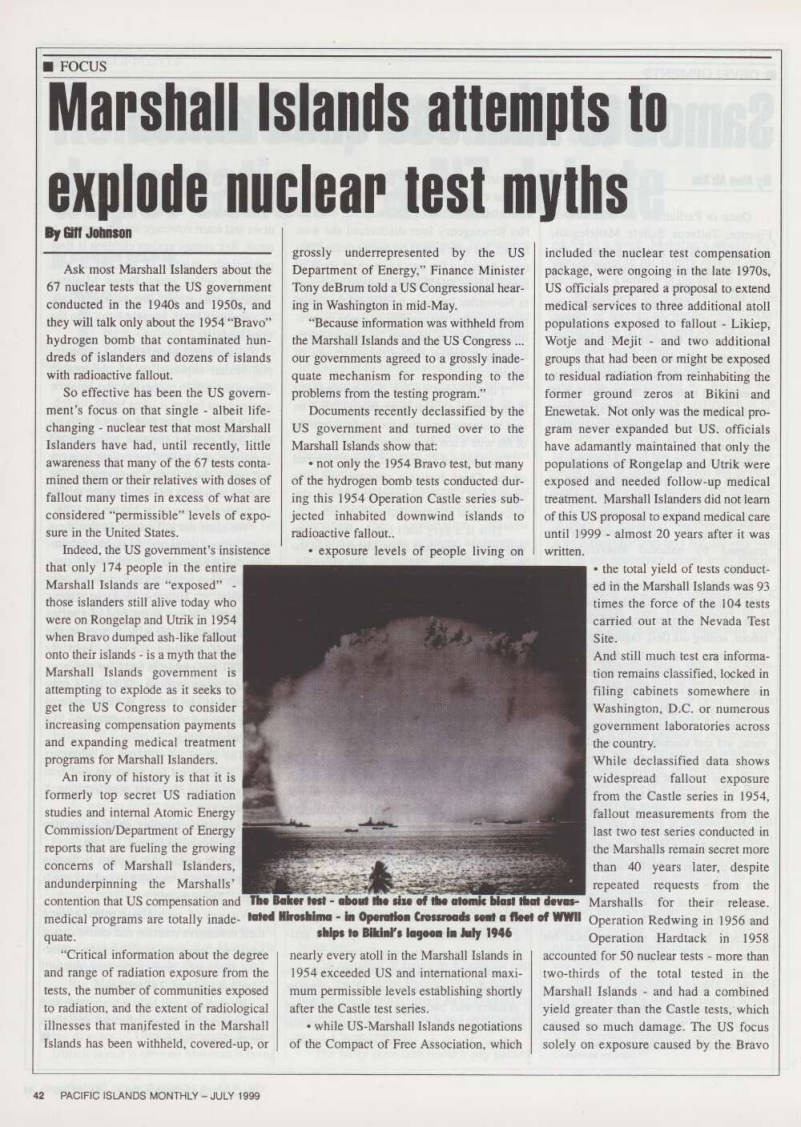
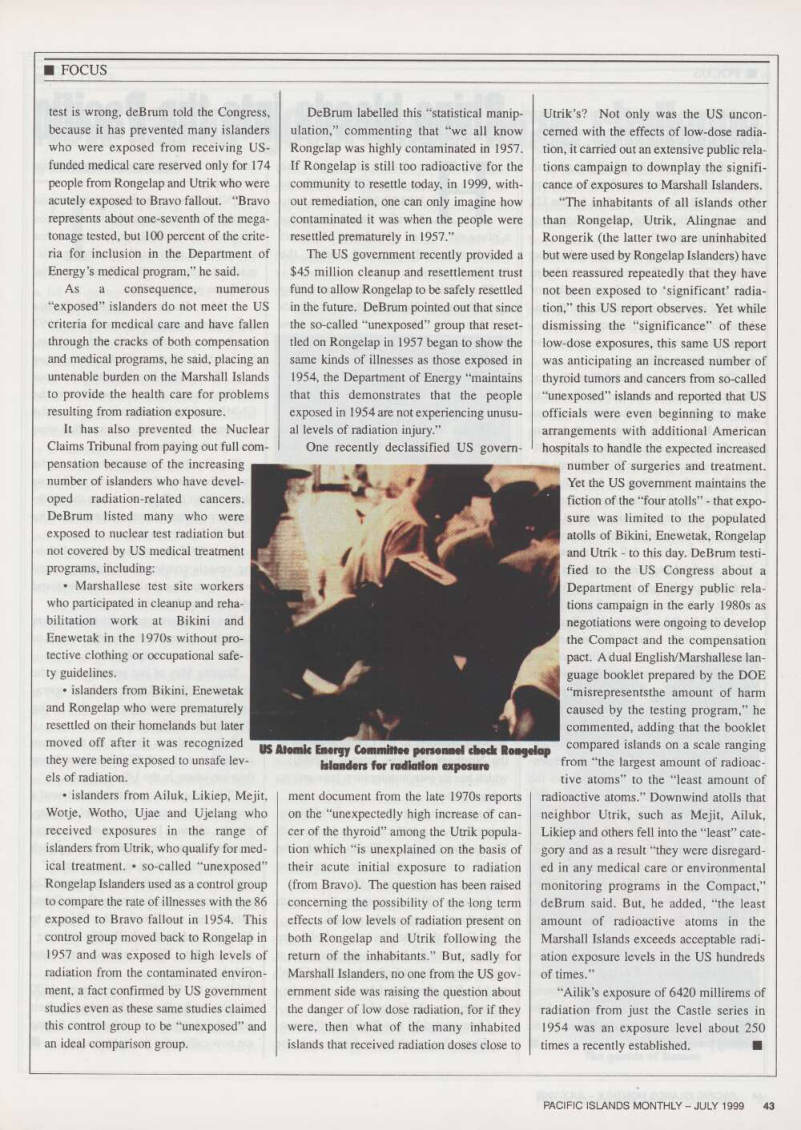
Developments
Remittances, assault and deportation -a NZ debate
By Barbara Dreaver
IT is not often that Kiribati even rates a mention in the New Zealand media, but one Kiribati man branded a wife beater has been the centre of contro versial headlines, television and debate here.
Ben Kwong Makeran, 31, came to New Zealand five years ago. During that time he was made a permanent resident but his future here is now is in doubt because of his continued assault upon his now ex wife.
He appeared in court four times for assault before he was finally sentenced to prison and deportation upon his release.
But the Deportation Review Tribunal, an independent three person committee, has allowed Makeran to stay in New Zealand because of $lOO a month he sends to his family in Kiribati who count on getting it.
Debate raged after he reportedly told the Deportation Review Tribunal that it was his cultural right to hit his wife.
Makeran is reserved, a characteristic typical of Kiribati men and he hates the spotlight he has been placed under.
“It’s not really fair (of the attention his case has received),” says Makeran.
As well as facing deportation again, he has also been virtually ostracised from much of the New Zealand Kiribati com munity most of whom live in Auckland.
They are embarrassed his actions have brought negative attention to their commu nity of around 2000.
“He should not have been allowed to stay,” says Kiribati consul Ray Mann, “He should have been on the first plane out”.
But Makeran is not without his sup porters.
Well known businessman and manag ing director of Ullrich Aluminum Gilbert Ullrich says it is obvious Makeran is being
used as a political scapegoat in election year.
“It’s political posturing, immigration is
always a big issue”.
Ullrich, a former Kiribati consul who was responsible for setting up the Kiribati work scheme in New Zealand, says if Makeran is to be deported for beating his wife then every other immigrant who has committed the same crime should be as well.
If Minister of Immigration Tuariki Delamere gets his way, that’s exactly what will happen.
And it’s not only Makeran who will get his marching orders. Delamere, who describes the Deportation Review Tribunal’s decision to allow Makeran to stay here as “mindless”, wants to see its three members dismissed and replaced.
Furious at the two lawyers and one JP who make up the tribunal, Delamere says he can’t say much at the moment but “with a bit of luck” a new committee will be put in place soon.
“As a betting man I would put more than five cents on it,” he says.
Delamere has a problem on his hands in that Makeran’s case has set a precedent that will be used in future cases.
“I am confident that it is only a matter of time before some lawyer turns up in my office and says I have a client in jail for rape or murder but he sends a couple of dollars home. The precedent has been set”.
It is a precedent that Ben Makeran knows or cares little about. He says, after being here for five years, that he sees New Zealand as “home”. “I can support my fam ily from here, there’s better money and a better life”.
The standard of living in Kiribati is one of the lowest in the Pacific. With a popula tion of over 82,000, many have flocked to the main island of Tarawa and overcrowd
ing is a huge problem.
The lucky ones take home a pay packet
of As4o a week. Makeran’s weekly $25 contribution to his family may be paltry here but is a fortune in the islands.
Remittances from sailors are the main source of foreign exchange - the 2-3000 Kiribati men on ships send As 6-$8 million per annum back home.
Like Makeran, they know their fami lies count on receiving it. But the low standard of living is not a reflection of the islands’ management of its finances.
New Zealanders may not have heard of Kiribati but in the 1960 s it was phos phate from Kiribati that kept the price of daily products down here in New Zealand.
Canterbury University’s head of Pacific Studies Dr Uentabo Neemia McKenzie who is from Kiribati says NZ did very well out of the phosphate mined from Banaba Island.
The New Zealand, Australian and UK governments were shareholders in the company that mined the phosphate used for fertiliser.
The “shareholders” sold it to them selves at less than half of the world price the idea being that the low price would be passed on to the New Zealand consumer.
When Kiribati gained its independence in 1979 it was in the enviable position of having $6O million in reserve funds albeit half of what it should have been from phosphate sales.
Today that figure is around $5OO mil lion due to wise investments in Europe. It sits there gathering interest and dust with only the odd million withdrawn to make up a budget shortfall.
The Kiribati people are a proud self sufficient culture with an almost commu nist attitude towards individuals owning too much.
“It’s a dysfunctional society if you ask me,” says Ullrich who, during his time as consul, had several head to head battles with former President leremia Tabai.
Continued on page 57
Continued from page 40
According to Ullrich, Tabai was reluc tant to send anyone overseas to any one country and he felt anyone who did should return home after their work experience.
Ullrich felt they should be given the opportunity to make something of them selves here if they were able.
There are private concerns that Makeran’s case may affect the current work scheme, which every year allows 20 I-Kiribati to come and work here for three years.
The New Zealand government pays for a liaison officer to ensure the work scheme runs well and to secure jobs for the partic-'
ipants.
In the 80s, the Kiribati population in New Zealand was mainly made up of women who had married New Zealand men. Now, that number is boosted by scholarship students and many on the work scheme who have been granted per manent residence.
While Makeran did not enter the coun try ort the scheme the worry of Kiribati liv ing here is that the distinction wont be made.
They are also quite rightly concerned that their voice wont be heard. Tuariki Delamere is in the unique position of being both the Minister of Immigration and the Minister of Pacific Islands Affairs taking on this portfolio from Don McKinnon.
Widely respected amongst Pacific groups, McKinnon often called upon his board of advisors, representatives of the different Pacific communities. The repre sentative for the Solomon Islands Tekeran Van Ashe also unofficially represented Kiribati. But since taking over the Pacific Affairs portfolio, Delamere has had no such board in place. “Ah no, we are just going through approving a new board now,” says Delamere. The hold-up, he says, has been getting appropriate cabinet
papers approved.
Then there is the matter of violence being excused on grounds of culture.
The Deportation Review Tribunal stat ed that Makeran regarded it as his right to assault his wife when she “got smart” to him. “Yes, I made a crime but it was an argument between me and my wife, it was not a crime against the public, it was a pri
vate thing,” Makeran says.
Dr McKenzie says using culture as an excuse is misleading. He says culture is continually evolving and while “there was a time way back” when Kiribati men had that right, it is less acceptable now.
“It is a contradiction - it is also (Kiribati) culture that only cowards beat up women”.
A Literature Review done last year by Lanuola Asiasiga and Alison Gray, found that while a certain level of violence was considered acceptable and normal in many Pacific cultures, there was a point at which that level of violence became unacceptable.
“The cultural heritage of Pacific soci eties goes some way to explaining why there is a lot of domestic violence in some societies and none in others”.
During the Public Health Commission community consultations with Pacific peo ple in 1994, participants spoke of the high level of domestic violence in the Pacific communities living in New Zealand and attributed it to social isolation of families, the stress of high unemployment, poor housing and low incomes.
Census figures show that 36 per cent of convicted criminal cases involving Pacific men in 1996 related to violent offences.
Pacific men convicted of a violent offence were over-represented compared with their proportion living in the adult New Zealand population. But whatever the figures, vio lence amongst the New Zealand Kiribati community is rare. It is also rare for Kiribati people living here to be in trouble with the law. It is this reason which makes Kiribati people a popular choice for some employ ers.
Ullrich has taken around 30 Kiribati employees to work in his business over the years because he says they are hard work ers. Despite what has happened, Ullrich says he has faith in Makeran who has done previous weekend work for him.
He added that if Makeran ever needed another job, he’d find one for him. “I would leave him with my children and family”.
Makeran says he hopes he will be allowed to stay in New Zealand. He feels that he has already paid for his crime. While not totally unsympathetic towards him, the.
Kiribati community are keen that they not pay for it too. ■
Samoa to address child abuse
By Alan Ah Mu
Once in Parliament the Minister of
Finance, Tuilaepa Sailele Malielegaoi,
defended children selling goods in the streets of Apia saying he himself did the same as a youngster.
It gives children an early lesson on how to handle money, he said, to counter voices from the Opposition benches ask ing something be done.
Now he is Prime Minister and Tuilaepa has endorsed setting limits on that sort of business lessons as leaders of all sectors of the community have started attacking child abuse in all it’s ugly forms.
Roman Catholic deacon, loane losefa, attacked parents using their children as “money making machines “by sending them to sell goods on the streets, in a ser mon during the usual church service screened by national television on Sundays.
Late May the Samoa Observer said, “We look forward to the day when chil dren are no longer engaged in child labour, selling ula (lei), fagusea (sea slug) and tauaga in town, but are attending school instead. “Even government, nor mally sensitive to publicity that casts less than a bright, happy picture of the coun try, which is hungry for overseas invest ment, aid and tourists, acknowledges that the growing number of school age street vendors is “a major problem”.
In it’s Statement of Economic Strategy 1998 - 1999, it said that “Demand for cash and other material contributions from vil lage councils and church give rise to eco nomic pressures which lead many fami lies to give priority to these community requirements at the expense of family health and education. “ Early May a 36 year man beat his
seven-year-old daughter so badly she
died.
“And the court asks why was the defendant so cruel to his daughter?” said Chief Justice, Tiavaasue Falefatu Sapolu.
“ Why did he strike her twice with an iofi
(Samoan tong)? “ The court believed the girl to have been the defendant’s biological daughter, but Tala Nei Newsagency later discovered she was, in fact, his wife’s child by another man. This type of beating fits into a pattern of abuse of step children. His Honour Tiavaasue himself in November last year mentioned the brutal pattern saying the number of cases involv ing the abuse of adopted or step children starting to appear before the court was of concern.
“I don’t know why (it is happening) but there must be a social cause behind this, “ he said in sentencing a man for the fatal beating of his wife’s son by another man.
The National Council of Women learned of the Chief Justice’s concern and was inspired to launch seminars to address vio lence against children that very month.
“This is a very hard topic. But it is so important,” president Mele Mataafa told the Samoa Observer. “When we talk about hit ting children first, the members kept saying ‘this is the Samoan way. I hit them because I love them,’ “ Mataafa said.
“We are hoping that people will think before they hit. We are hoping too that moth ers will help teach husbands and sons not to hit and so on. We have to see what training is needed, “ she said.
Yet the public’s knowledge of the reali ties heard in courts is fragile because it’s not a popular area for journalists. Only three
cover Supreme Court sentencing partially,
because in a small society reporters do not want to be describing to their families and fellow-villagers cases of incest, molestation, rape and unlawful carnal knowledge - let alone be known to be hearing detailed sexu
ally activity often.
Two of the three are young, unmarried females, one of whom endured hearing how a relative made love so loudly to his girl friend, a minor, they were discovered.
Talk about sex is taboo in most situations, certainly between relatives of the opposite genders and bad news in that area is not always welcomed as an issue of open public debate. Nor is the area of crimes generally.
The late and former Prime Minister, Tofilau Eti Alesana, called a private radio station to say criminal activity was not news and court coverage was stopped as a result. Sex crimes against children is thus particularly painful to air and it was almost a relief when Prime Minister Tuilaepa, a leader and thus suitable to talk of a sensitive topic, brought it out into the open inMarch.
Tuilaepa said hopefully the commer cial sexual exploitation of children in Samoa is small in proportion and must be stamped out before it takes hold.
It’s believed that that sort of activity can only expand through uncontrolled expansion of tourism, a growing industry and one of the country’s top earners. The country is thought too small for the selling of children for sex to be hidden for long.
“We must not lull ourselves that there is no serious problem of sexual exploita tion out there, and that stories of pae dophilia rings activities in Samoa are only anecdotal, “ Tuilaepa said, in giving thekeynote address in the first of a series of workshops to identify factors in the selling of children for sex, held by SUNGO, the umbrella body for non-gov ernment organisations. SUNGO is con cerned that the Pacific is vulnerable to being targeted by criminal networks - like paedophilia rings.
“The abuse of children, in whatever form, is abhorrent but sexual exploitation in my view, is it’s worst manifestation, “
Tuilaepa said.
As in other countries, children are also sexually abused in Samoa, he said.
“That it should also happen in Samoa is not easy for us to admit to and acknowl
edge, “ Tuilaepa said.
Victims of such abuse make silence their instinctive reaction and unless caring adults act decisively in alerting the author ities, those who prey on the innocent will continue to do so, Tuilaepa said.
Workshops will help government and the community make informed decisions on the issue, he said. ■
explode nuclear test myths
Marshall Islands attempts to explode nuclear test myths
By Gift Johnson
Ask most Marshall Islanders about the 67 nuclear tests that the US government conducted in the 1940 s and 19505, and they will talk only about the 1954 “Bravo” hydrogen bomb that contaminated hun dreds of islanders and dozens of islands with radioactive fallout.
So effective has been the US govern ment’s focus on that single - albeit life changing - nuclear test that most Marshall Islanders have had, until recently, little awareness that many of the 67 tests conta mined them or their relatives with doses of fallout many times in excess of what are considered “permissible” levels of expo sure in the United States.
Indeed, the US government’s insistence
that only 174 people in the entire Marshall Islands are “exposed” those islanders still alive today who were on Rongelap and Utrik in 1954 when Bravo dumped ash-like fallout onto their islands - is a myth that the Marshall Islands government is attempting to explode as it seeks to get the US Congress to consider
increasing compensation payments
and expanding medical treatment programs for Marshall Islanders.
An irony of history is that it is formerly top secret US radiation studies and internal Atomic Energy
Commission/Department of Energy
reports that are fueling the growing concerns of Marshall Islanders, andunderpinning the Marshalls’ contention that US compensation and medical programs are totally inade quate.
“Critical information about the degree and range of radiation exposure from the tests, the number of communities exposed to radiation, and the extent of radiological illnesses that manifested in the Marshall Islands has been withheld, covered-up, or
grossly underrepresented by the US Department of Energy,” Finance Minister Tony deßrum told a US Congressional hear ing in Washington in mid-May.
“Because information was withheld from the Marshall Islands and the US Congress ... our governments agreed to a grossly inade quate mechanism for responding to the problems from the testing program.”
Documents recently declassified by the US government and turned over to the Marshall Islands show that: • not only the 1954 Bravo test, but many of the hydrogen bomb tests conducted dur ing this 1954 Operation Castle series sub jected inhabited downwind islands to radioactive fallout.. • exposure levels of people living on
nearly every atoll in the Marshall Islands in 1954 exceeded US and international maxi mum permissible levels establishing shortly after the Castle test series. • while US-Marshall Islands negotiations of the Compact of Free Association, which
included the nuclear test compensation package, were ongoing in the late 19705, US officials prepared a proposal to extend medical services to three additional atoll
populations exposed to fallout - Likiep,
Wotje and Mejit - and two additional groups that had been or might be exposed to residual radiation from reinhabiting the former ground zeros at Bikini and Enewetak. Not only was the medical pro gram never expanded but US. officials have adamantly maintained that only the populations of Rongelap and Utrik were exposed and needed follow-up medical treatment. Marshall Islanders did not learn of this US proposal to expand medical care until 1999 - almost 20 years after it was written.
• the total yield of tests conduct ed in the Marshall Islands was 93 times the force of the 104 tests carried out at the Nevada Test Site.
And still much test era informa tion remains classified, locked in filing cabinets somewhere in Washington, D.C. or numerous government laboratories across the country.
While declassified data shows widespread fallout exposure from the Castle series in 1954, fallout measurements from the last two test series conducted in the Marshalls remain secret more than 40 years later, despite repeated requests from the Marshalls for their release.
Operation Redwing in 1956 and Operation Hardtack in 1958
accounted for 50 nuclear tests - more than two-thirds of the total tested in the Marshall Islands - and had a combined yield greater than the Castle tests, which caused so much damage. The US focus solely on exposure caused by the Bravo
The Baker test - about the site of the atomic Mast that devas tated Hiroshima - in Operation Crossroads sent a fleet of WWII ships to Bikini's lagoon in July 1946
test is wrong, deßrum told the Congress, because it has prevented many islanders who were exposed from receiving US funded medical care reserved only for 174 people from Rongelap and Utrik who were acutely exposed to Bravo fallout. “Bravo represents about one-seventh of the mega tonage tested, but 100 percent of the crite ria for inclusion in the Department of Energy’s medical program,” he said.
As a consequence, numerous “exposed” islanders do not meet the US criteria for medical care and have fallen through the cracks of both compensation and medical programs, he said, placing an untenable burden on the Marshall Islands to provide the health care for problems resulting from radiation exposure.
It has also prevented the Nuclear Claims Tribunal from paying out full com
pensation because of the increasing number of islanders who have devel oped radiation-related cancers.
Deßrum listed many who were exposed to nuclear test radiation but not covered by US medical treatment
programs, including:
• Marshallese test site workers who participated in cleanup and reha bilitation work at Bikini and Enewetak in the 1970 s without pro tective clothing or occupational safe ty guidelines. • islanders from Bikini, Enewetak and Rongelap who were prematurely resettled on their homelands but later moved off after it was recognized they were being exposed to unsafe lev els of radiation.
• islanders from Ailuk, Likiep, Mejit, Wotje, Wotho, Ujae and UJelang who received exposures in the range of islanders from Utrik, who qualify for med ical treatment. • so-called “unexposed”
Rongelap Islanders used as a control group to compare the rate of illnesses with the 86 exposed to Bravo fallout in 1954. This control group moved back to Rongelap in 1957 and was exposed to high levels of radiation from the contaminated environ ment, a fact confirmed by US government studies even as these same studies claimed this control group to be “unexposed” and an ideal comparison group.
Deßrum labelled this “statistical manip ulation,” commenting that “we all know Rongelap was highly contaminated in 1957.
If Rongelap is still too radioactive for the community to resettle today, in 1999, with out remediation, one can only imagine how contaminated it was when the people were resettled prematurely in 1957.”
The US government recently provided a $45 million cleanup and resettlement trust fund to allow Rongelap to be safely resettled in the future. Deßrum pointed out that since the so-called “unexposed” group that reset tled on Rongelap in 1957 began to show the same kinds of illnesses as those exposed in 1954, the Department of Energy “maintains that this demonstrates that the people exposed in 1954 are not experiencing unusu al levels of radiation injury.”
One recently declassified US govem-
ment document from the late 1970 s reports on the “unexpectedly high increase of can cer of the thyroid” among the Utrik popula tion which “is unexplained on the basis of their acute initial exposure to radiation (from Bravo). The question has been raised concerning the possibility of the long term effects of low levels of radiation present on both Rongelap and Utrik following the return of the inhabitants.” But, sadly for Marshall Islanders, no one from the US gov ernment side was raising the question about the danger of low dose radiation, for if they were, then what of the many inhabited islands that received radiation doses close to
Utrik’s? Not only was the US uncon cerned with the effects of low-dose radia tion, it carried out an extensive public rela tions campaign to downplay the signifi cance of exposures to Marshall Islanders.
“The inhabitants of all islands other than Rongelap, Utrik, Alingnae and Rongerik (the latter two are uninhabited but were used by Rongelap Islanders) have been reassured repeatedly that they have not been exposed to ‘significant’ radia tion,” this US report observes. Yet while dismissing the “significance” of these low-dose exposures, this same US report was anticipating an increased number of thyroid tumors and cancers from so-called “unexposed” islands and reported that US officials were even beginning to make arrangements with additional American hospitals to handle the expected increased
i number of surgeries and treatment. . Yet the US government maintains the fiction of the “four atolls” - that expo sure was limited to the populated I atolls of Bikini, Enewetak, Rongelap i and Utrik - to this day. Deßrum testi- I fied to the US Congress about a Department of Energy public rela tions campaign in the early 1980 s as I negotiations were ongoing to develop the Compact and the compensation pact. A dual English/Marshallese lan- I guage booklet prepared by the DOE 1 “misrepresentsthe amount of harm caused by the testing program,” he commented, adding that the booklet compared islands on a scale ranging from “the largest amount of radioac
tive atoms” to the “least amount of radioactive atoms.” Downwind atolls that neighbor Utrik, such as Mejit, Ailuk, Likiep and others fell into the “least” cate gory and as a result “they were disregard ed in any medical care or environmental monitoring programs in the Compact,” deßrum said. But, he added, “the least amount of radioactive atoms in the Marshall Islands exceeds acceptable radi ation exposure levels in the US hundreds of times.”
“Ailik’s exposure of 6420 millirems of radiation from just the Castle series in 1954 was an exposure level about 250 times a recently established. ■
US Atomic Energy Committee personnel check Rongelap islanders for radiation exposure
US Environmental Protection Agency standard for exposures to manmade radia tion. “I fail to understand how DOS’s sur vey of atolls in the Marshall Islands can categorize atolls with radiation exposure level of 250 times the standard for the US general public as the ‘least amount of radioactive atoms.”
On the compensation front. Nuclear Claims Tribunal Chairman Oscar deßrum told the congress that a large number of personal injury claims have forced the tri bunal to pay less that 100 percent of com pensation to claimants in order to reserve funds for future claims.
The Tribunal received $45 million of the nuclear test settlement for the US to pay for both personal injuries and damages to land. But, so far it has awarded more than $67 million to 1,613 people who suf fer from one or more the 35 conditions that the Tribunal considers to be radiation caused and eligible for compensation.
More troubling, he noted, is that about one-third of all the claimants have died without receiving full compensation.
While the fund has been virtually exhaust ed for personal injury claims, the Tribunal has yet to decide on claims for land dam ages filed by Bikini, Enewetak, Rongelap and other atolls - claims that are seeking hundreds of millions of dollars to fund nuclear cleanups and rehabilitation pro grams. Later this year, the Marshall Islands is expected to submit a formal petition to the US Congress seeking to get the Congress to invoke the “changed circum stances” clause of the Compact’s compen sation pact. This provision allows the Marshalls to ask the Congress for more compensation if it can prove that the com pensation already provided is manifestly inadequate based on information that has surfaced since the Compact was negotiated in the early 1980 s. In mid-May, Tony deßrum appealed to the US Congress to address the lingering problems from the nuclear testing period.
The failure Compact’s compensation
pact to recognise the extent of radiation exposure to the Marshall Islands govern ment were not, and have not been told the full truth about the consequences of the testing p rogramme. ■
China bleeds into the Pacific
Hundreds of people are
paying US$2O,OOO to US$3O,OOO a head to “Snake head” gangs for a place on dozens of battered old boats which hopefully set sail across the Pacific for America.
Those that are known about are ending up in Guam, the Northern Mariana Islands and Australia. Others have aimed for New Caledonia and New Zealand.
What is not known is how many people are either making it unnoticed into these countries - or are disappearing into the Pacific’s depths as the boats sink.
The US Immigration and Naturalization Service suspect that as many as 4000 ille
gal migrants might
this northern summer head towards Guam.
“Snakehead gangs” are triads who spe cialise in illegal migrants while captains of the boats involved term their cargoes “walk
ing fish”.
Several hundred Chinese have been picked up in Guam or on boats nearby by the US Coast Guard.
In Guam US law applies and the migrants have been allowed to claim polit ical refugee status - sparking protracted
hearings.
In the last couple of months Washington has adopted a new tactic of picking up the growing numbers to the Commonwealth of the Northern Mariana Islands (CNMI) which has its own immigration laws and no
refugee status.
Last month there were over 500 Chinese being held in a tent city on a former US World War II base on Tinian Island - the island which saw the nuclear attacks on Japan launched from in 1945.
Just over 100 were repatriated last month while the others sit out the process.
In Guam the first of a series of trials are underway into the human smuggling and at one, a witness identified only as “Mr Chen” said he felt threatened by one of the key organisers, one Xi Dong Li.
Chen quoted Xi as telling him, “No mat ter where you go either on Guam or in the
States we will find you; you or your fami ly will pay.”
CNMI House committee on labour and immigration chairman Herman Palacios has warned that until the syndicates that smuggle the migrants to Guam are dis mantled, the so-called flood into the Marianas would continue.
In May, Guam Senator Mark Forbes says alien smuggling back in 1997 involved only individuals and not boat loads which Mariana islands are seeing now. “From what I’ve been told, because the Snakeheads were in operation in the CNMI, they had the chance to witness the evacuation of Kurdish refugees that went through Guam,” he said.
The Kurdish operation had given the gangs the idea of transporting Chinese illegal aliens to Guam to escape the crack down on illegal aliens initiated then by the CNMI government.
Since 1997, the senator said small fish
ing vessels coming from Saipan started
bringing in illegal aliens into coves and other points of entry to Guam.
The smugglers sometimes stopped over Rota either to transfer to another vessel or to pick up some more aliens.
Starting May of last year, however, the smugglers changed their mode of opera tion by operating larger vessels coming directly from Fujian Province.
Forbes said it is cheaper for the human smugglers to sneak Chinese into Guam than anywhere in the US west coast.
“It’s cheaper because they won’t need a larger and more seaworthy vessel to smug gle the aliens. It’s also more practical because enforcement on Guam is so much less than enforcement in the mainland.”
It is suspected that the increased US enforcement, including more Coast Guard patrols, are now forcing the Chinese to divert toward the South Pacific - aiming at Australia, New Zealand and New Caledonia.
Adding to CNMI’s woes over 1500 Filipinos who lived and worked in their
once thriving garment industry on Saipan
are now calling for the right to stay. ■
New Labour government faces challenge
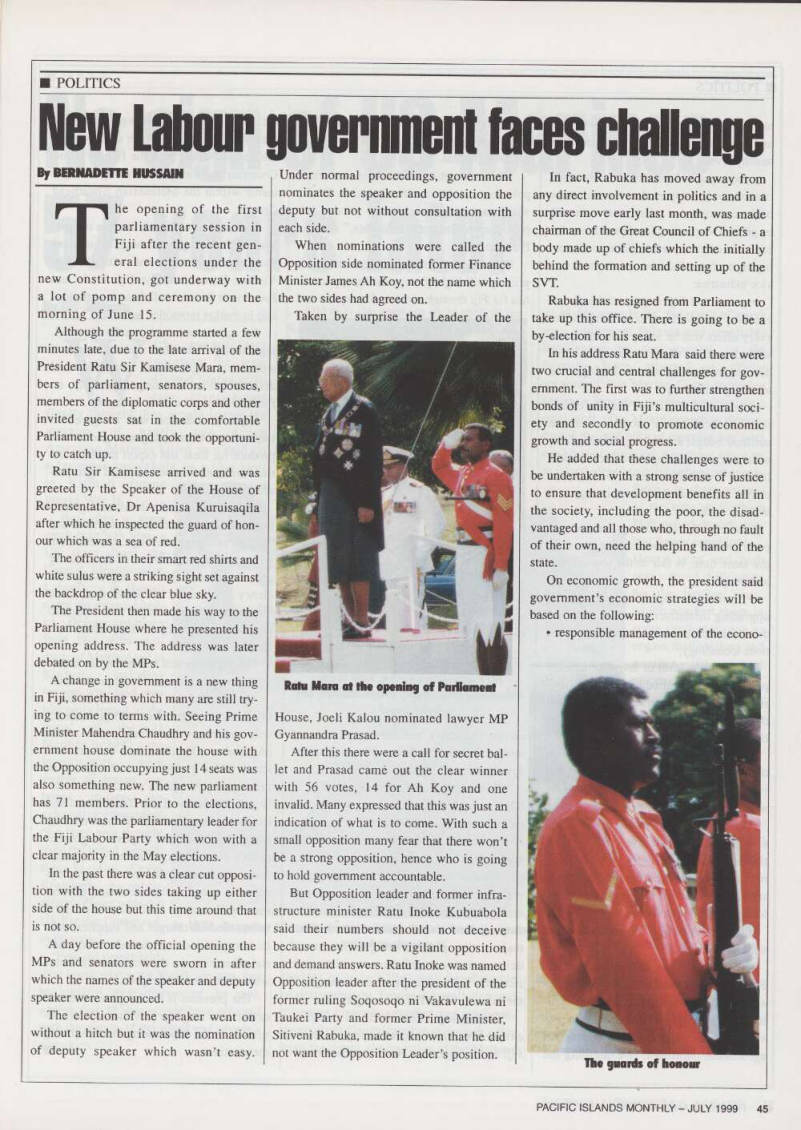
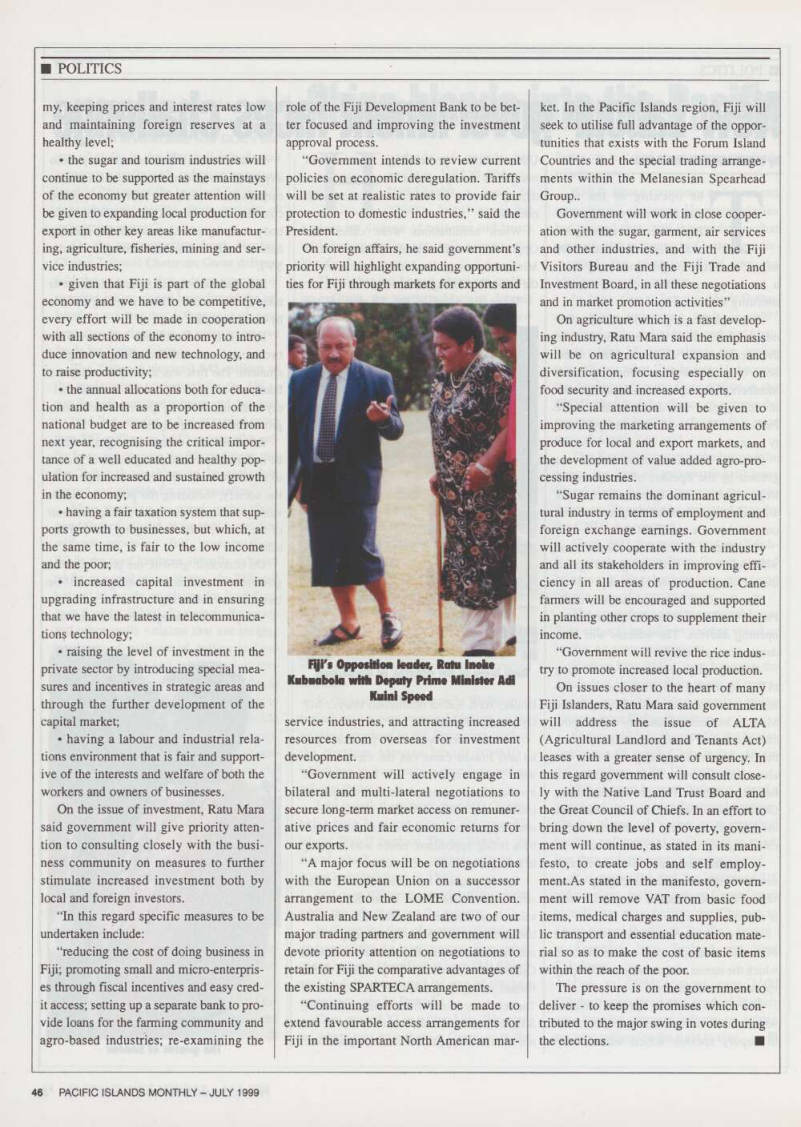
Politics
By Bernadette Hussain
The opening of the first parliamentary session in Fiji after the recent gen eral elections under the new Constitution, got underway with a lot of pomp and ceremony on the morning of June 15.
Although the programme started a few minutes late, due to the late arrival of the President Ratu Sir Kamisese Mara, mem bers of parliament, senators, spouses, members of the diplomatic corps and other invited guests sat in the comfortable Parliament House and took the opportuni ty to catch up.
Ratu Sir Kamisese arrived and was greeted by the Speaker of the House of Representative, Dr Apenisa Kuruisaqila after which he inspected the guard of hon our which was a sea of red.
The officers in their smart red shirts and white sulus were a striking sight set against the backdrop of the clear blue sky.
The President then made his way to the Parliament House where he presented his opening address. The address was later debated on by the MPs.
A change in government is a new thing in Fiji, something which many are still try ing to come to terms with. Seeing Prime Minister Mahendra Chaudhry and his gov ernment house dominate the house with the Opposition occupying just 14 seats was also something new. The new parliament has 71 members. Prior to the elections, Chaudhry was the parliamentary leader for the Fiji Labour Party which won with a clear majority in the May elections.
In the past there was a clear cut opposi tion with the two sides taking up either side of the house but this time around that is not so.
A day before the official opening the MPs and senators were sworn in after which the names of the speaker and deputy speaker were announced.
The election of the speaker went on without a hitch but it was the nomination of deputy speaker which wasn’t easy.
Under normal proceedings, government nominates the speaker and opposition the deputy but not without consultation with each side.
When nominations were called the Opposition side nominated former Finance Minister James Ah Koy, not the name which the two sides had agreed on.
Taken by surprise the Leader of the
House, Joeli Kalou nominated lawyer MP Gyannandra Prasad.
After this there were a cal! for secret bal let and Prasad came out the clear winner with 56 votes, 14 for Ah Koy and one invalid. Many expressed that this was just an indication of what is to come. With such a small opposition many fear that there won’t be a strong opposition, hence who is going to hold government accountable.
But Opposition leader and former infra structure minister Ratu Inoke Kubuabola said their numbers should not deceive because they will be a vigilant opposition and demand answers. Ratu Inoke was named Opposition leader after the president of the former ruling Soqosoqo ni Vakavulewa ni Taukei Party and former Prime Minister, Sitiveni Rabuka, made it known that he did not want the Opposition Leader’s position.
In fact, Rabuka has moved away from any direct involvement in politics and in a surprise move early last month, was made chairman of the Great Council of Chiefs - a body made up of chiefs which the initially behind the formation and setting up of the
Svt.
Rabuka has resigned from Parliament to take up this office. There is going to be a by-election for his seat.
In his address Ratu Mara said there were two crucial and central challenges for gov ernment. The first was to further strengthen bonds of unity in Fiji’s multicultural soci ety and secondly to promote economic growth and social progress.
He added that these challenges were to be undertaken with a strong sense of justice to ensure that development benefits all in the society, including the poor, the disad vantaged and all those who, through no fault of their own, need the helping hand of the state.
On economic growth, the president said government’s economic strategies will be based on the following: • responsible management of the econo-
Rotu Mora at the opening of Parliament
The guards of honour
my, keeping prices and interest rates low and maintaining foreign reserves at a healthy level; • the sugar and tourism industries will continue to be supported as the mainstays of the economy but greater attention will be given to expanding local production for export in other key areas like manufactur ing, agriculture, fisheries, mining and ser vice industries; • given that Fiji is part of the global economy and we have to be competitive, every effort will be made in cooperation with all sections of the economy to intro duce innovation and new technology, and to raise productivity; • the annual allocations both for educa tion and health as a proportion of the national budget are to be increased from next year, recognising the critical impor tance of a well educated and healthy pop ulation for increased and sustained growth in the economy; • having a fair taxation system that sup ports growth to businesses, but which, at the same time, is fair to the low income and the poor; • increased capital investment in upgrading infrastructure and in ensuring that we have the latest in telecommunica tions technology; • raising the level of investment in the private sector by introducing special mea sures and incentives in strategic areas and through the further development of the capital market; • having a labour and industrial rela tions environment that is fair and support ive of the interests and welfare of both the workers and owners of businesses.
On the issue of investment, Ratu Mara said government will give priority atten tion to consulting closely with the busi ness community on measures to further stimulate increased investment both by local and foreign investors.
“In this regard specific measures to be undertaken include: “reducing the cost of doing business in Fiji; promoting small and micro-enterpris es through fiscal incentives and easy cred it access; setting up a separate bank to pro vide loans for the farming community and agro-based industries; re-examining the
role of the Fiji Development Bank to be bet ter focused and improving the investment approval process.
“Government intends to review current policies on economic deregulation. Tariffs will be set at realistic rates to provide fair protection to domestic industries,” said the President.
On foreign affairs, he said government’s priority will highlight expanding opportuni ties for Fiji through markets for exports and
service industries, and attracting increased resources from overseas for investment
development.
“Government will actively engage in bilateral and multi-lateral negotiations to secure long-term market access on remuner ative prices and fair economic returns for our exports.
“A major focus will be on negotiations with the European Union on a successor arrangement to the LOME Convention.
Australia and New Zealand are two of our major trading partners and government will devote priority attention on negotiations to retain for Fiji the comparative advantages of the existing SPARTECA arrangements.
“Continuing efforts will be made to extend favourable access arrangements for Fiji in the important North American mar
ket. In the Pacific Islands region, Fiji will seek to utilise full advantage of the oppor tunities that exists with the Forum Island Countries and the special trading arrange ments within the Melanesian Spearhead Group..
Government will work in close cooper ation with the sugar, garment, air services and other industries, and with the Fiji Visitors Bureau and the Fiji Trade and Investment Board, in all these negotiations and in market promotion activities”
On agriculture which is a fast develop ing industry, Ratu Mara said the emphasis will be on agricultural expansion and
diversification, focusing especially on
food security and increased exports.
“Special attention will be given to improving the marketing arrangements of produce for local and export markets, and the development of value added agro-pro
cessing industries.
“Sugar remains the dominant agricul tural industry in terms of employment and foreign exchange earnings. Government will actively cooperate with the industry and all its stakeholders in improving effi ciency in all areas of production. Cane farmers will be encouraged and supported in planting other crops to supplement their income.
“Government will revive the rice indus try to promote increased local production.
On issues closer to the heart of many Fiji Islanders, Ratu Mara said government will address the issue of ALTA (Agricultural Landlord and Tenants Act) leases with a greater sense of urgency. In this regard government will consult close ly with the Native Land Trust Board and the Great Council of Chiefs. In an effort to bring down the level of poverty, govern ment will continue, as stated in its mani festo, to create jobs and self employ ment.As stated in the manifesto, govern ment will remove VAT from basic food
items, medical charges and supplies, pub
lic transport and essential education mate rial so as to make the cost of basic items within the reach of the poor.
The pressure is on the government to deliver - to keep the promises which con tributed to the major swing in votes during the elections. ■
Fiji's Opposition leader. Rata Inoke Kubuabola with Deputy Prime Minister Adi Kuini Speed
No sign of US Marines
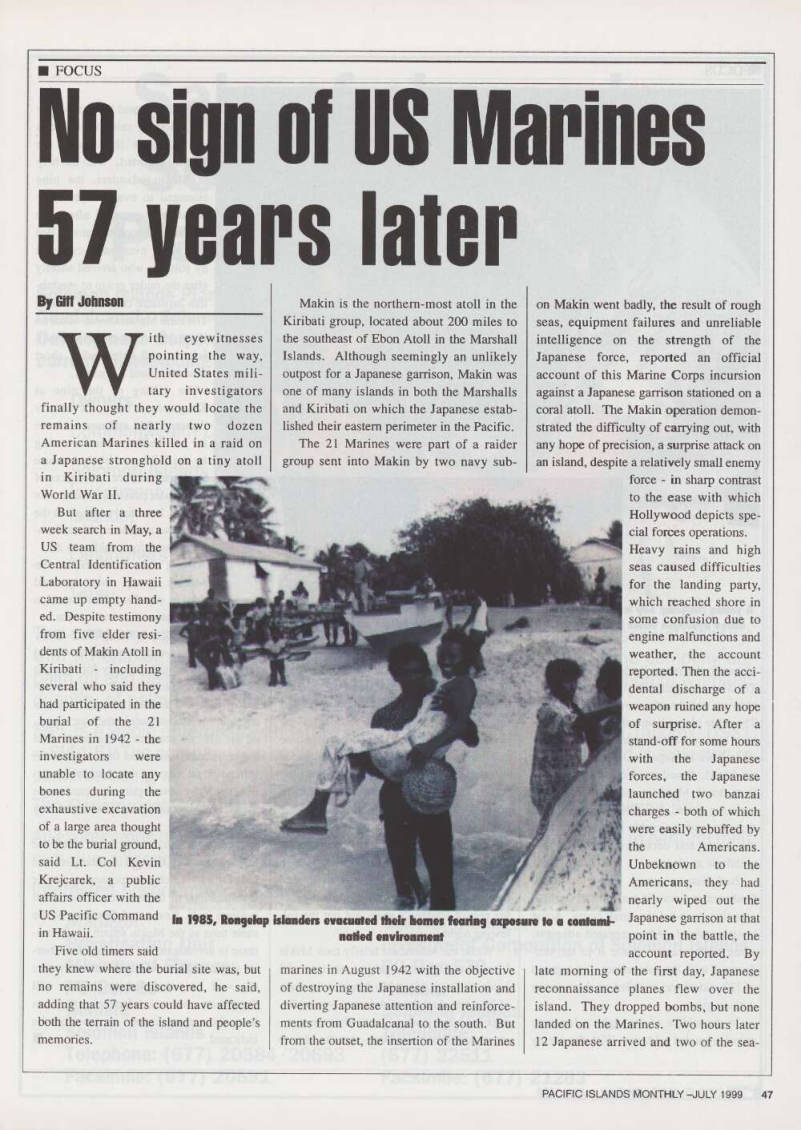
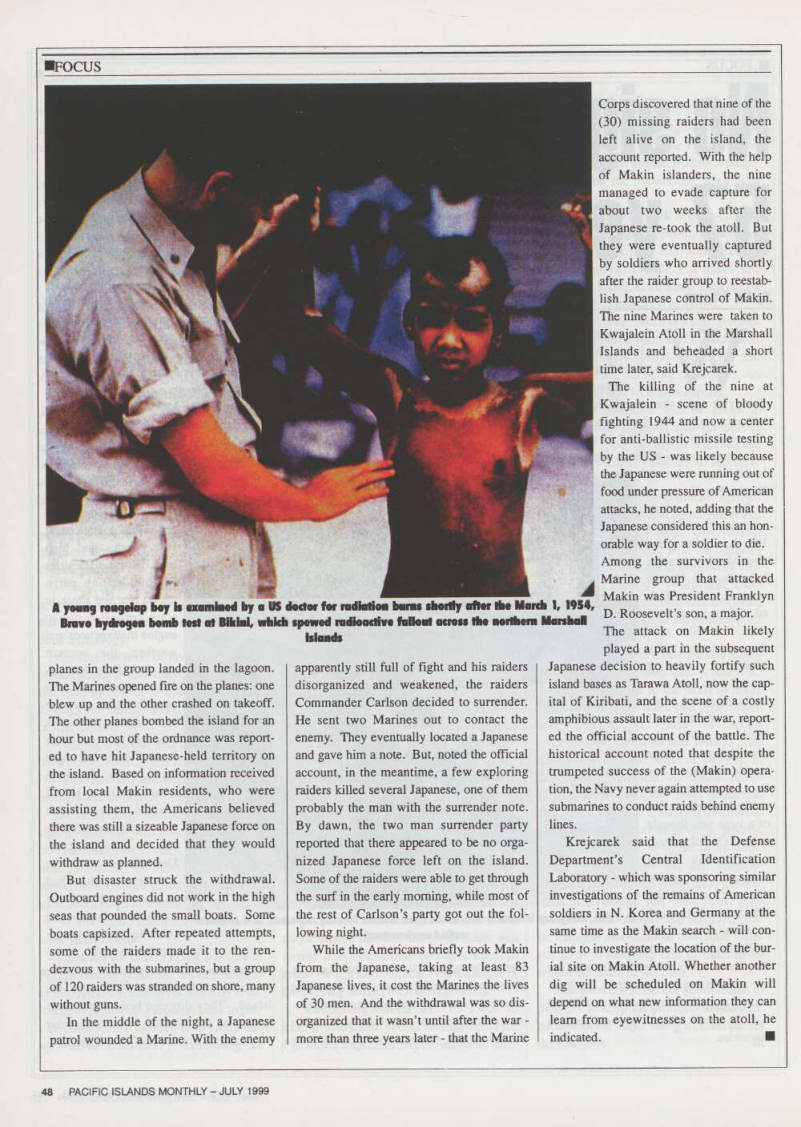
57 years later
By Gift Johnson
With eyewitnesses
pointing the way, United States mili
tary investigators
finally thought they would locate the remains of nearly two dozen American Marines killed in a raid on a Japanese stronghold on a tiny atoll
in Kiribati during World War 11.
But after a three week search in May, a US team from the Central Identification Laboratory in Hawaii came up empty hand ed. Despite testimony from five elder resi dents of Makin Atoll in Kiribati - including several who said they had participated in the burial of the 21 Marines in 1942 - the
investigators were
unable to locate any bones during the exhaustive excavation of a large area thought to be the burial ground, said Lt. Col Kevin Krejcarek, a public affairs officer with the US Pacific Command in Hawaii.
Five old timers said
they knew where the burial site was, but no remains were discovered, he said, adding that 57 years could have affected both the terrain of the island and people’s memories.
Makin is the northern-most atoll in the Kiribati group, located about 200 miles to the southeast of Ebon Atoll in the Marshall Islands. Although seemingly an unlikely outpost for a Japanese garrison, Makin was one of many islands in both the Marshalls and Kiribati on which the Japanese estab lished their eastern perimeter in the Pacific.
The 21 Marines were part of a raider group sent into Makin by two navy sub-
marines in August 1942 with the objective of destroying the Japanese installation and diverting Japanese attention and reinforce ments from Guadalcanal to the south. But from the outset, the insertion of the Marines
on Makin went badly, the result of rough seas, equipment failures and unreliable intelligence on the strength of the Japanese force, reported an official account of this Marine Corps incursion against a Japanese garrison stationed on a coral atoll. The Makin operation demon strated the difficulty of carrying out, with any hope of precision, a surprise attack on an island, despite a relatively small enemy
force - in sharp contrast to the ease with which Hollywood depicts spe cial forces operations.
Heavy rains and high
seas caused difficulties for the landing party, which reached shore in some confusion due to engine malfunctions and weather, the account reported. Then the acci dental discharge of a weapon ruined any hope of surprise. After a stand-off for some hours with the Japanese forces, the Japanese launched two banzai charges - both of which were easily rebuffed by the Americans.
Unbeknown to the Americans, they had
nearly wiped out the
Japanese garrison at that point in the battle, the account reported. By
late morning of the first day, Japanese reconnaissance planes flew over the island. They dropped bombs, but none landed on the Marines. Two hours later 12 Japanese arrived and two of the sea-
In 1985, Rongelap islanders evacuated their homes fearing exposure to a conlami natied environment
planes in the group landed in the lagoon.
The Marines opened fire on the planes: one blew up and the other crashed on takeoff.
The other planes bombed the island for an hour but most of the ordnance was report ed to have hit Japanese-held territory on the island. Based on information received from local Makin residents, who were assisting them, the Americans believed there was still a sizeable Japanese force on the island and decided that they would withdraw as planned.
But disaster struck the withdrawal.
Outboard engines did not work in the high seas that pounded the small boats. Some boats capsized. After repeated attempts, some of the raiders made it to the ren dezvous with the submarines, but a group of 120 raiders was stranded on shore, many without guns.
In the middle of the night, a Japanese patrol wounded a Marine. With the enemy
apparently still full of fight and his raiders disorganized and weakened, the raiders Commander Carlson decided to surrender.
He sent two Marines out to contact the enemy. They eventually located a Japanese and gave him a note. But, noted the official account, in the meantime, a few exploring raiders killed several Japanese, one of them probably the man with the surrender note.
By dawn, the two man surrender party reported that there appeared to be no orga nized Japanese force left on the island.
Some of the raiders were able to get through the surf in the early morning, while most of the rest of Carlson’s party got out the fol
lowing night.
While the Americans briefly took Makin from the Japanese, taking at least 83 Japanese lives, it cost the Marines the lives of 30 men. And the withdrawal was so dis organized that it wasn’t until after the war more than three years later - that the Marine
Corps discovered that nine of the (30) missing raiders had been left alive on the island, the account reported. With the help of Makin islanders, the nine managed to evade capture for about two weeks after the Japanese re-took the atoll. But they were eventually captured by soldiers who arrived shortly after the raider group to reestab lish Japanese control of Makin.
The nine Marines were taken to Kwajalein Atoll in the Marshall Islands and beheaded a short time later, said Krejcarek.
The killing of the nine at Kwajalein - scene of bloody fighting 1944 and now a center for anti-ballistic missile testing by the US - was likely because the Japanese were running out of food under pressure of American attacks, he noted, adding that the Japanese considered this an hon orable way for a soldier to die.
Among the survivors in the Marine group that attacked Makin was President Franklyn D. Roosevelt’s son, a major.
The attack on Makin likely played a part in the subsequent
Japanese decision to heavily fortify such island bases as Tarawa Atoll, now the cap ital of Kiribati, and the scene of a costly amphibious assault later in the war, report ed the official account of the battle. The historical account noted that despite the trumpeted success of the (Makin) opera tion, the Navy never again attempted to use submarines to conduct raids behind enemy lines.
Krejcarek said that the Defense Department’s Central Identification Laboratory - which was sponsoring similar investigations of the remains of American soldiers in N. Korea and Germany at the same time as the Makin search - will con tinue to investigate the location of the bur ial site on Makin Atoll. Whether another dig will be scheduled on Makin will depend on what new information they can leam from eyewitnesses on the atoll, he indicated. ■
A young rongeap boy b examined by a US doctor for radiation bums shortly after the March 1, 1954, Bravo hydrogen bomb test at Bikini, which spewed radioactive foliout across Hie northern Marshall Islands
Advertisements & other items, pp. 48-49 (2 items)
■Focus
Plantation Limited
Sale of shares in
Solomon Islands
The company operates an oil palm plantation on 6,300 hectares (leasehold property) with an employment of 1,800 employees. The principal products of the company are palm oil and palm kernels, marketed primarily to Europe with the exception of a limited quantity of palm kernels sold to Singapore.
SIPL is a viable enterprise with total sales of about Sls9B million (1998). [approx. US$l = Sls4.B]. The company has declared dividends annually since 1995 and is expected to continue doing so in the future.
The Government is offering to sell 25% of the total equity in SIPL (retaining 5%).
Ail expressions of interest are expected to sign a confidential undertaking to perform their own due diligence.
Interested buyers may contact either of the following: Manager Privatisation Unit Ministry of Finance PO Box 26 Honiara Solomon Islands Telephone: (677) 20584/20693 Facsimile: (677) 20591 General Manager Investment Corporation of Solomon Islands PO Box 570 Honiara Solomon Islands Telephone: (677) 22511 Facsimile: (677) 21263
Cook Islands king maker crows
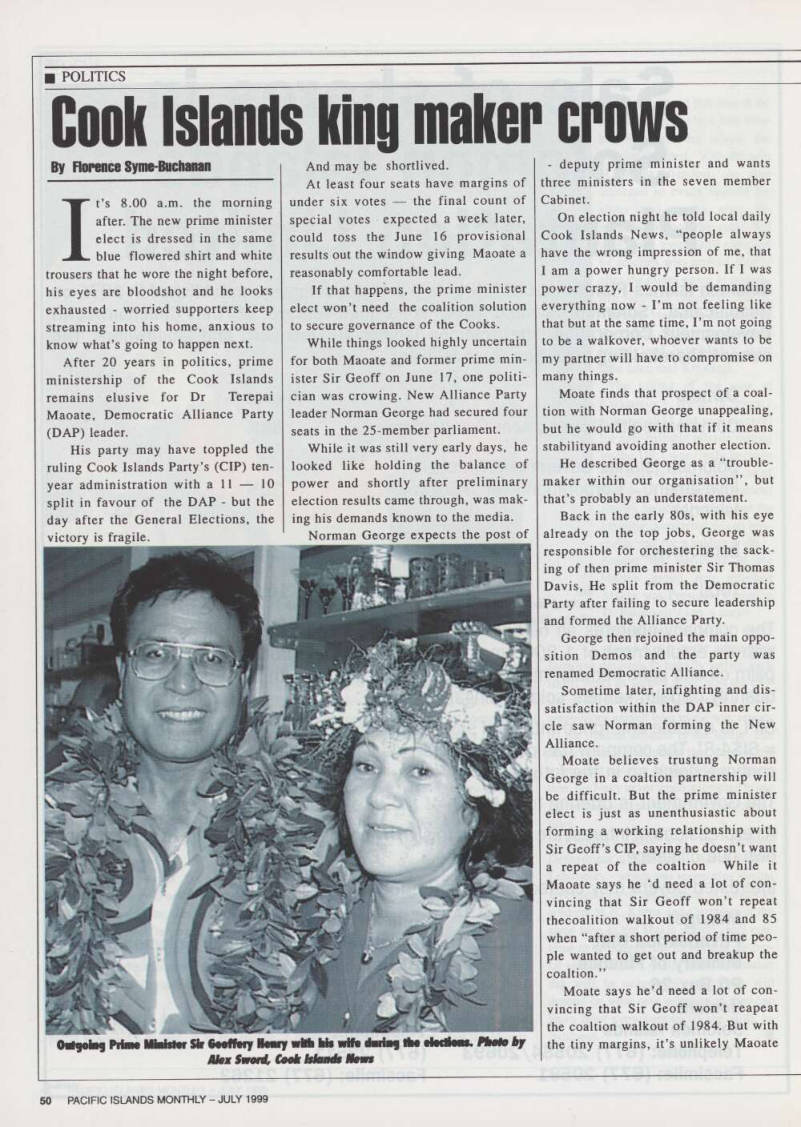
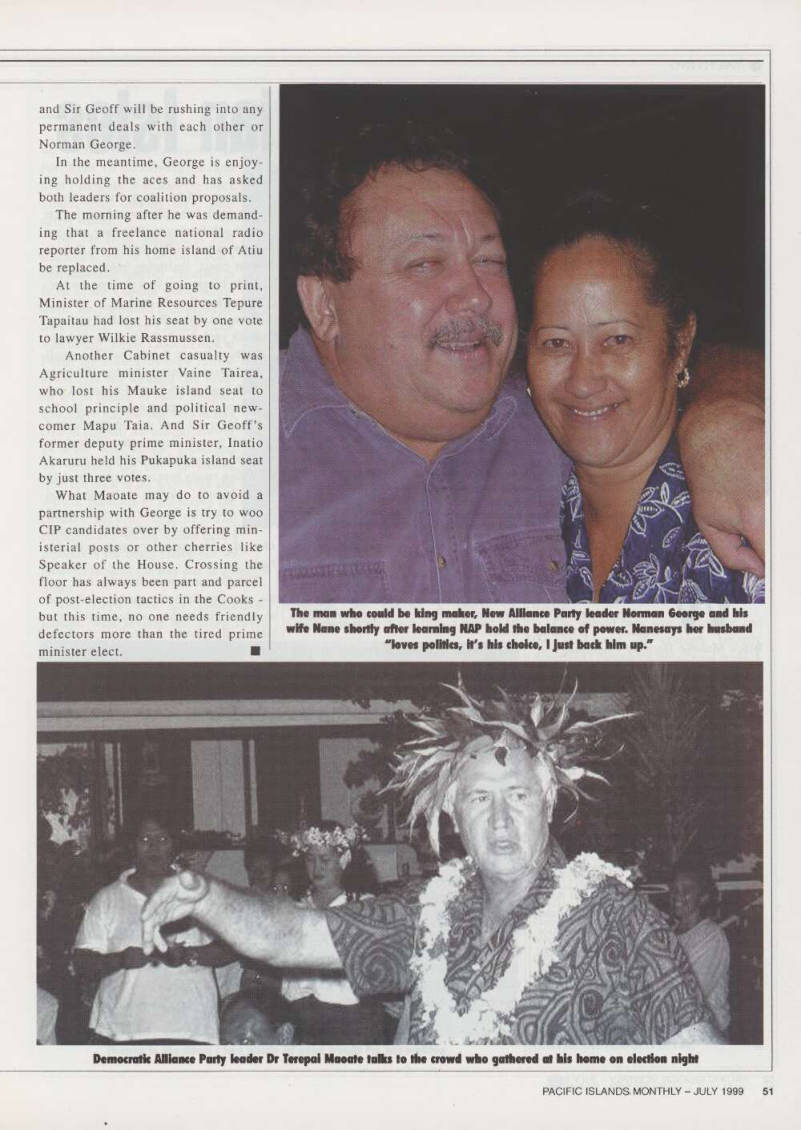
By Florence Syme-Buchanan
It’s 8.00 a.m. the morning after. The new prime minister elect is dressed in the same blue flowered shirt and white trousers that he wore the night before, his eyes are bloodshot and he looks exhausted - worried supporters keep streaming into his home, anxious to know what’s going to happen next.
After 20 years in politics, prime ministership of the Cook Islands remains elusive for Dr Terepai Maoate, Democratic Alliance Party (DAP) leader.
His party may have toppled the ruling Cook Islands Party’s (CIP) ten year administration with all 10 split in favour of the DAP - but the day after the General Elections, the victory is fragile.
And may be shortlived.
At least four seats have margins of under six votes the final count of special votes expected a week later, could toss the June 16 provisional results out the window giving Maoate a reasonably comfortable lead.
If that happens, the prime minister elect won’t need the coalition solution to secure governance of the Cooks.
While things looked highly uncertain for both Maoate and former prime min ister Sir Geoff on June 17, one politi cian was crowing. New Alliance Party leader Norman George had secured four seats in the 25-member parliament.
While it was still very early days, he looked like holding the balance of power and shortly after preliminary election results came through, was mak ing his demands known to the media.
Norman George expects the post of
- deputy prime minister and wants three ministers in the seven member Cabinet.
On election night he told local daily Cook Islands News, “people always have the wrong impression of me, that I am a power hungry person. If I was power crazy, I would be demanding everything now - I’m not feeling like that but at the same time. I’m not going to be a walkover, whoever wants to be my partner will have to compromise on many things.
Moate finds that prospect of a coal tion with Norman George unappealing, but he would go with that if it means stabilityand avoiding another election.
He described George as a “trouble maker within our organisation”, but that’s probably an understatement.
Back in the early 80s, with his eye already on the top jobs, George was responsible for orchestering the sack ing of then prime minister Sir Thomas Davis, He split from the Democratic Party after failing to secure leadership and formed the Alliance Party.
George then rejoined the main oppo sition Demos and the party was renamed Democratic Alliance.
Sometime later, infighting and dis satisfaction within the DAP inner cir cle saw Norman forming the New Alliance.
Moate believes trustung Norman George in a coaltion partnership will be difficult. But the prime minister elect is just as unenthusiastic about forming a working relationship with Sir Geoff’s CIP, saying he doesn’t want a repeat of the coaltion While it Maoate says he ‘d need a lot of con vincing that Sir Geoff won’t repeat thecoalition walkout of 1984 and 85 when “after a short period of time peo ple wanted to get out and breakup the coaltion.”
Moate says he’d need a lot of con vincing that Sir Geoff won’t reapeat the coaltion walkout of 1984. But with the tiny margins, it’s unlikely Maoate
Outgoing Prime Minister Sir Geoffory Henry with his wife during the etections. Photo by Alex Sword, Cook bloods New
and Sir Geoff will be rushing into any permanent deals with each other or Norman George.
In the meantime, George is enjoy ing holding the aces and has asked both leaders for coalition proposals.
The morning after he was demand ing that a freelance national radio reporter from his home island of Atiu
be replaced.
At the time of going to print, Minister of Marine Resources Tepure Tapaitau had lost his seat by one vote to lawyer Wilkie Rassmussen.
Another Cabinet casualty was Agriculture minister Vaine Tairea, who lost his Mauke island seat to school principle and political new comer Mapu Taia. And Sir Geoff’s former deputy prime minister, Inatio Akaruru held his Pukapuka island seat by just three votes.
What Maoate may do to avoid a partnership with George is try to woo CIP candidates over by offering min isterial posts or other cherries like Speaker of the House. Crossing the floor has always been part and parcel of post-election tactics in the Cooks but this time, no one needs friendly defectors more than the tired prime minister elect. ■
The man who could be king maker. New Alliance Party leader Norman George and his wife None shortly after learning NAP hold the balance of power. Nanesays her husband "loves politics, it's his choice, I just back him up."
Democratic Alliance Party leader Dr Terepai Maoate talks to the crowd who gathered at his home on election night
Cruising the Hawaiian Isles
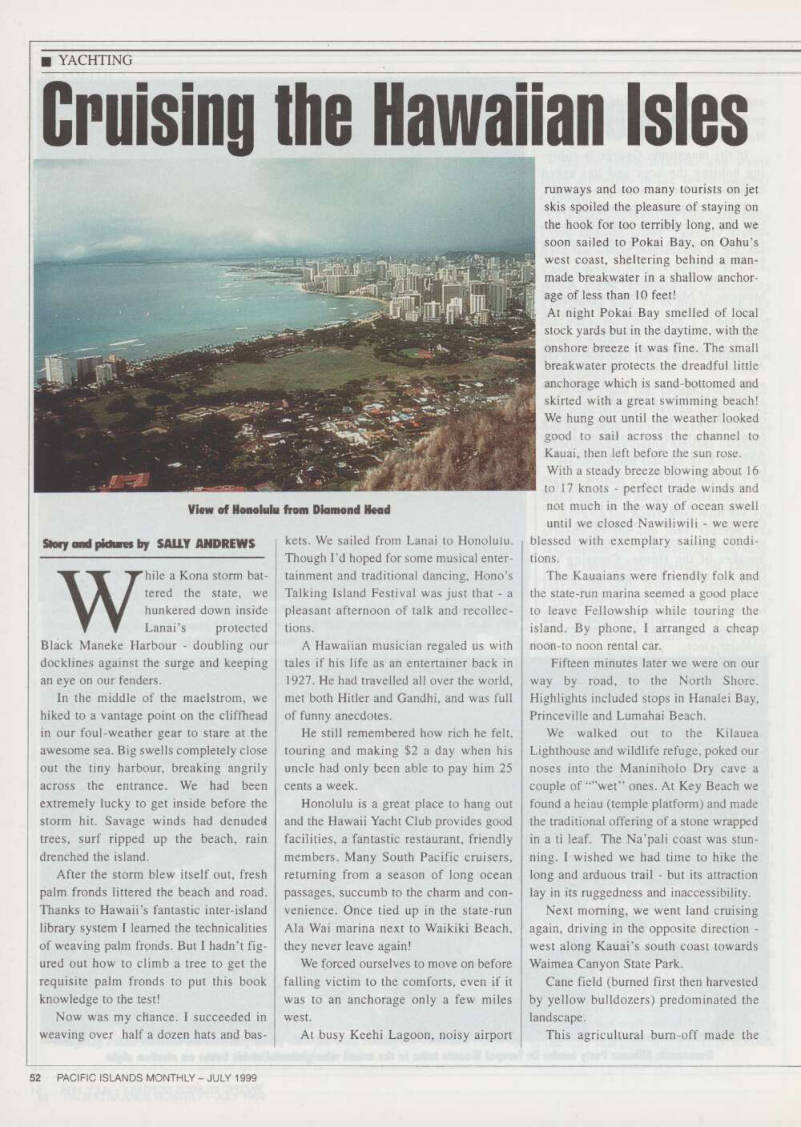
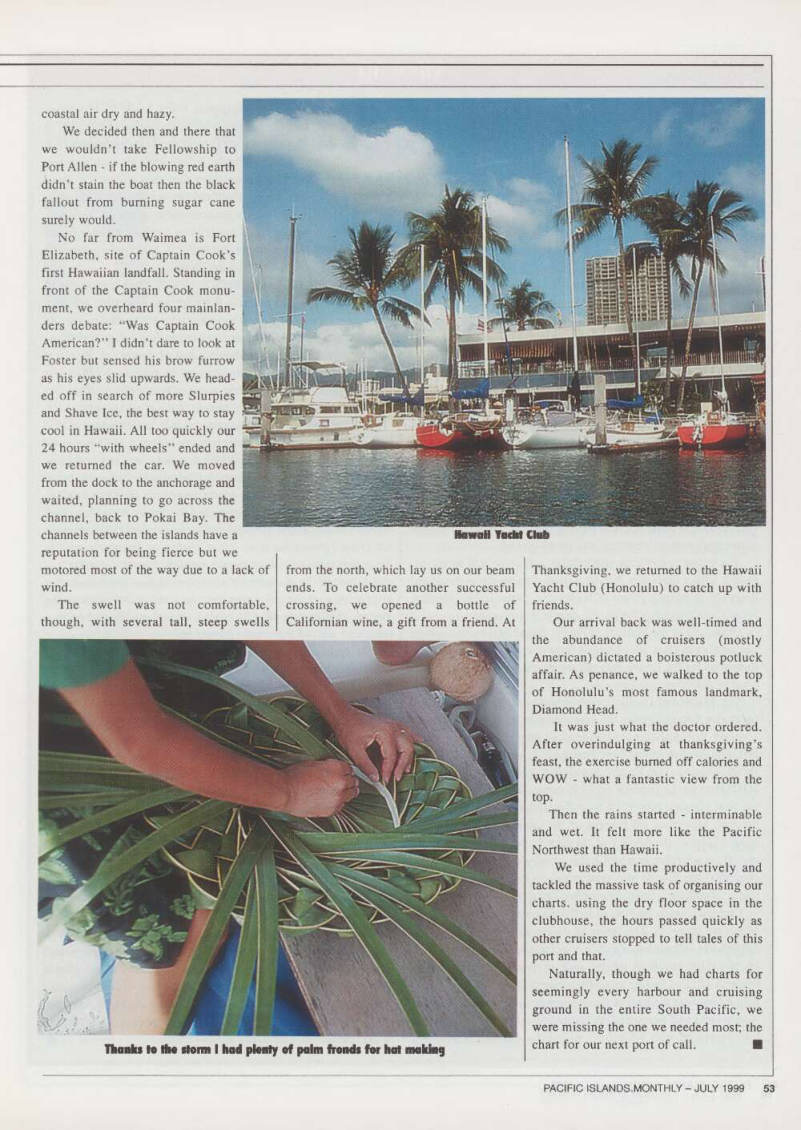
Yachting
Story and pidwes by SALLY ANDREWS
While a Kona storm bat tered the state, we hunkered down inside
Lanai’s protected
Black Maneke Harbour - doubling our docklines against the surge and keeping an eye on our fenders.
In the middle of the maelstrom, we hiked to a vantage point on the cliffhead in our foul-weather gear to stare at the awesome sea. Big swells completely close out the tiny harbour, breaking angrily across the entrance. We had been extremely lucky to get inside before the storm hit. Savage winds had denuded trees, surf ripped up the beach, rain drenched the island.
After the storm blew itself out, fresh palm fronds littered the beach and road.
Thanks to Hawaii’s fantastic inter-island library system I learned the technicalities of weaving palm fronds. But I hadn’t fig ured out how to climb a tree to get the requisite palm fronds to put this book knowledge to the test!
Now was my chance. I succeeded in weaving over half a dozen hats and bas
kets. We sailed from Lanai to Honolulu.
Though I’d hoped for some musical enter tainment and traditional dancing, Hono’s Talking Island Festival was just that - a pleasant afternoon of talk and recollec tions.
A Hawaiian musician regaled us with tales if his life as an entertainer back in 1927. He had travelled all over the world, met both Hitler and Gandhi, and was full of funny anecdotes.
He still remembered how rich he felt, touring and making $2 a day when his uncle had only been able to pay him 25 cents a week.
Honolulu is a great place to hang out and the Hawaii Yacht Club provides good facilities, a fantastic restaurant, friendly members. Many South Pacific cruisers, returning from a season of long ocean passages, succumb to the charm and con venience. Once tied up in the state-run Ala Wai marina next to Waikiki Beach, they never leave again!
We forced ourselves to move on before falling victim to the comforts, even if it was to an anchorage only a few miles west.
At busy Keehi Lagoon, noisy airport
runways and too many tourists on jet skis spoiled the pleasure of staying on the hook for too terribly long, and we soon sailed to Pokai Bay, on Oahu’s west coast, sheltering behind a man made breakwater in a shallow anchor age of less than 10 feet!
At night Pokai Bay smelled of local stock yards but in the daytime, with the onshore breeze it was fine. The small breakwater protects the dreadful little anchorage which is sand-bottomed and skirted with a great swimming beach!
We hung out until the weather looked good to sail across the channel to Kauai, then left before the sun rose.
With a steady breeze blowing about 16 to 17 knots - perfect trade winds and not much in the way of ocean swell
until we closed Nawiliwili - we were blessed with exemplary sailing condi tions.
The Kauaians were friendly folk and the state-run marina seemed a good place to leave Fellowship while touring the island. By phone, I arranged a cheap noon-to noon rental car.
Fifteen minutes later we were on our way by road, to the North Shore.
Highlights included stops in Hanalei Bay, Princeville and Lumahai Beach.
We walked out to the Kilauea Lighthouse and wildlife refuge, poked our noses into the Maniniholo Dry cave a couple of '"’wet” ones. At Key Beach we found a heiau (temple platform) and made the traditional offering of a stone wrapped in a ti leaf. The Na’paii coast was stun ning. I wished we had time to hike the long and arduous trail - but its attraction lay in its ruggedness and inaccessibility.
Next morning, we went land cruising again, driving in the opposite direction west along Kauai’s south coast towards Waimea Canyon State Park.
Cane field (burned first then harvested
by yellow bulldozers) predominated the
landscape.
This agricultural burn-off made the
View of Honolulu from Diamond Head
coastal air dry and hazy.
We decided then and there that we wouldn’t take Fellowship to Port Allen - if the blowing red earth didn’t stain the boat then the black fallout from burning sugar cane
surely would.
No far from Waimea is Fort Elizabeth, site of Captain Cook’s first Hawaiian landfall. Standing in front of the Captain Cook monu ment, we overheard four mainlan ders debate: “Was Captain Cook American?” I didn’t dare to look at Foster but sensed his brow furrow as his eyes slid upwards. We head ed off in search of more Slurpies and Shave Ice, the best way to stay cool in Hawaii. All too quickly our 24 hours “with wheels” ended and we returned the car. We moved from the dock to the anchorage and waited, planning to go across the channel, back to Pokai Bay. The channels between the islands have a reputation for being fierce but we
motored most of the way due to a lack of wind.
The swell was not comfortable, though, with several tall, steep swells
from the north, which lay us on our beam ends. To celebrate another successful crossing, we opened a bottle of Californian wine, a gift from a friend. At
Thanksgiving, we returned to the Hawaii Yacht Club (Honolulu) to catch up with friends.
Our arrival back was well-timed and the abundance of cruisers (mostly American) dictated a boisterous potluck affair. As penance, we walked to the top of Honolulu’s most famous landmark.
Diamond Head.
It was just what the doctor ordered.
After overindulging at thanksgiving’s feast, the exercise burned off calories and WOW - what a fantastic view from the top.
Then the rains started - interminable and wet. It felt more like the Pacific Northwest than Hawaii.
We used the time productively and tackled the massive task of organising our charts, using the dry floor space in the clubhouse, the hours passed quickly as other cruisers stopped to tell tales of this port and that.
Naturally, though we had charts for seemingly every harbour and cruising ground in the entire South Pacific, we were missing the one we needed most; the chart for our next port of call. ■
Thanks to the storm I had plenty of palm fronds for hat making
Hawaii Yacht Club
community in NZ increases
Opinion
Focus on Pacific Island community in NZ increases
Cynics might say it is due to this being elec tion year, but there does appear to have been a bit of a drive by the government to do something for the Pacific Island and Maori communities in New Zealand in recent months.
Or at least to “talk” about doing something - to produce some more reports, announce some new targets and so on. Whether all this succeeds in improving the lots of the nation’s most under privileged and disadvantaged people, only time will tell, but the increasing focus on them can only be welcomed.
The island community particularly will come into focus this month with a three-day Pacific Vision conference in Auckland designed to address issues of leadership, partnership, identity, society and prosperity for Pacific people in this country.
Organised by the Ministry of Pacific Island Affairs, it could be just another talkfest, but optimists hope it will point to some new directions for the future. It is not, of course, only the short-term issue of politicians wooing votes.
The Maori and Pacific Island populations are growing at a faster rate than Europeans and everyone acknowledges that if they continue to live with poor housing and education, low incomes and high unemployment New Zealand is heading for a social and racial disaster. The Pacific population doubled to more than 200,000 in the 15 years to the 1996 census and by the middle of the next century, one in 10 New Zealanders will be of Pacific descent. More than 20 percent of the total population will be Maori. Most of them will live, as they do now, in the Auckland region - a worrying prospect if the country’s biggest urban con centration has to rely on a predominantly Polynesian workforce that is ill-educated, badly-housed and unhappy.
Currently, nearly four out of 10 Pacific people and one-in- three Maori are under 15. The future of their communities in the 21st century lies in their hands and in a restructured economy that has no place for unskilled labour, lack of education means little prospect of them finding jobs. Their parents have already learned that. As we near the start of the next century, 19 percent of Maori workers and 14.5 percent of the ethnic island labour force are job less, compared with 5.6 percent of pakeha. Figures in the 1996
census showed some progress was being made in education.
Between 1990 and 1996 the number of Pacific Island university graduates increased 200 percent. Maori numbers quadrupled.
But still fewer than 500 Pacific people graduate each year and while Maori numbers are three times that, they still tend to leave university with lower level qualifications than their pakeha coun terparts. Sensible then for the government to start with education.
One initiative announced recently is to increase the number of Pacific Island teachers - at present only 350 when, on a proportion of population, it should be at least 1300.
With the 75,000 Pacific pupils in New Zealand schools due to rise to 120,000 in 30 years, it is recognised that more teachers responsive to their needs and learning styles are needed to provide positive role models. The need to improve education was high lighted in the 1996 census showing that 41 percent of all Maori children under 15 lived in families with an annual income of less than $20,000. At that time, one in every two Maori women over 15 had received a government benefit in the previous year.
Housing and health are associated issues, both destined to fea ture strongly in this year’s election campaign. A 1997 report on Pacific people said they faced high housing costs, overcrowding and with more people than most other households unsuitable home designs. Rents in Auckland, where two-thirds of island families live, are the highest in the country and have risen faster than other areas in recent years. Statistics show the average rental for state and council homes has risen 102 percent in the last seven years as the government moved previously subsidised rents to market lev els. Although the government’s accommodation supplement has gone a long way to offsetting rent rises, the statistics show the average family now pays 31 percent of its total income on rent compared with 18.5 percent 12 years ago.
The opposition Labour Party, which has pledged to cut state house rents to no more than 25 percent of household income, says 1000 Maori families in Northland and 350 on the East Cape are currently living in “seriously sub-standard” housing.
The government acknowledged the need to improve health ser vices for the Pacific Island and Maori communities in a recent medium-term strategy report giving them priority. It noted the dis parity in their health and that of the pakeha population was linked to socio-economic status and access to services.
An innovative idea to improve Maori health began on national television in May with the debut of “Maraerobics” - a Maori lan guage get-fit exercise programme taught by a troupe of teenagers.
Aimed at youngsters, the aerobic programme is interspersed with a range of health and safety messages, including “Never smoke”, “brush your teeth twice a day”, “wear a seatbelt” and “wear a helmet”. Programmer creator Tahuna Minhinnick, noted that traditional government funding for Maori health had always focused “on the misery of Maori, the treatment of sickness and disease”. “What this taps into are the aspirations of Maori people and improving attitudes to health,” he said.
If it works, it will be half a million dollars of taxpayer money well spent and a small but positive step towards improving the lot of the Polynesian community in New Zealand. ■
David Barber
Wellington
Clearing up Ok Tedi-its worse than we thought!
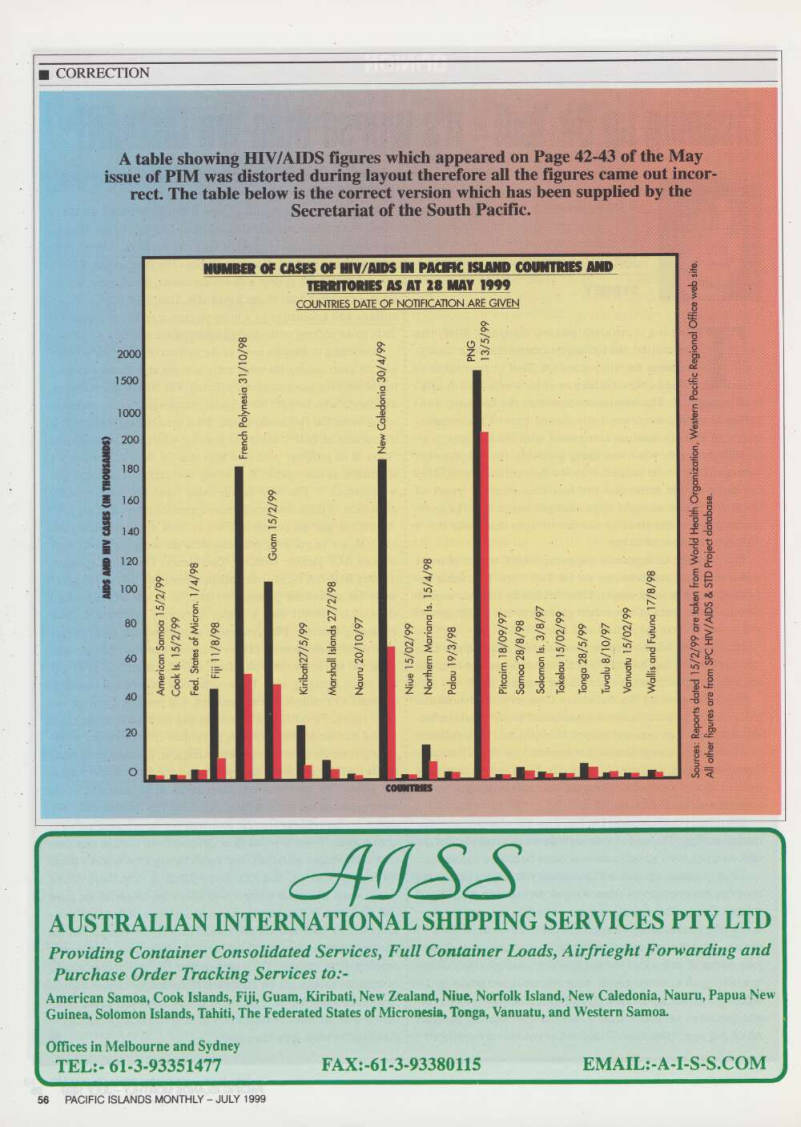
The big Australian mining company, BHP, has admitted that environmental damage down stream from its giant Ok Tedi copper mine in Papua New Guinea, will be worse than it orig inally expected. The admission comes as the company con siders scientific evidence collected as part of the require ments of a compensation settlement with landowners, who in 1994 brought, what was then, probably the biggest ever damages case to be lodged with the Australian courts. It is the scale of the mine and the fact that after 15 years of operation it has wrought huge changes not just in the envi ronment but in the lives of nearby villages that make this a difficult problem to solve.
Each day, the mine pours a staggering 80,000 tonnes of waste water, rocks and sediment into the Ok Tedi river. That waste has polluted people’s water supply, killed off marine life they used to eat and forced them to move their gardens to less fertile ground where they will not get choked with silt.
Die-back has killed off the vegetation along many square kilo metres of the Ok Tedi’s formerly rich flood-plain and the river bed has risen by up to 5 metres since mining began in 1984.
Scientific work by the Australian Conservation Foundation (ACF) found sediment in the river contained heavy metals includ ing cadmium, lead, zinc and copper. Its report said high sediment loads and metal contamination had rendered the first 70 kilome tres of the Ok Tedi ‘almost biologically dead’ and ‘dramatically reduced species biodiversity over the next 130 kilometres’(to the junction with the Fly River).
But there is much more to Ok Tedi than this appalling environ mental damage. The mine has brought services to people that the cash-strapped PNG government will never be able to deliver.
Since the mine opened, infant mortality in the region around the mine has gone down from 300 per thousand to just 15, the average lifespan has increased from 30 to 50 years and the inci dence of malaria among village children is down from 70 to 15 percent. Royalties and compensation payments have seen villagers gain access to cash, often for the first time, and provided village amenities such as meeting halls, solar electricity and school build ings. Ok Tedi Mining Limited (OTML), the company which oper ates the mine, has established a business development program which has seen more than 80 landowner businesses established -
in 1998 OTML says they earned 80.6 million Kina and employed 1,050 local people.
In announcing the results of new scientific work by a team ol world class scientists, OTML Managing Director Roger Higgins said the environmental impact of the mine would be ‘significantly greater’ than expected in earlier studies. The four options OTML is now considering to deal with environmental damage are; to con tinue a dredging trial in the Lower Ok Tedi, to dredge and pipe tailings 130 kilometres to a huge storage area in the Lower Ok Tedi, to do nothing or the early closure of the mine.
According to Higgins none of the options offer a clear solutior and the even closing the mine early will not stop dieback extend ing beyond the areas currently affected. For Nick Styant-Browne the lawyer who brought the original compensation case on behall of the lower Ok Tedi landowners, ‘lt’s a breathtaking admission ir the context of BHP’s historical position which has been initially “there is no problem” and then after that “if there is a problem i is small it is managable, it is being overstated, it is nothing tc worry about’”. The ACF on the other hand has welcomed the admission. T think that provides an opportunity for all of us; BHP Australians and the people of PNG to think about the future and say "OK we’ve got a big problem, what are we going to do aboui it” said ACF Deputy Director, Don Henry. The public relations disaster BHP has faced over pollution from Ok Tedi in the past 5 years has shaken the company to its core. It was a catalyst for a shareholder revolt and a major corporate restructure. New Managing Director, Paul Anderson, appears willing to work gen uinely with landowners, conservationists and the PNG govern ment and tackle the difficult issues. OTML has spent Asloo mil lion on its dredging trial. The results show that even it continues to spend $3O million a year, dredging will not stop the river bed from rising. Flooding will continue and dieback is expected to extend into the Middle Fly area, more than 200 kilometres down stream from the mine. According to Higgins, the storage of piped tailings will create social and environmental problems because of the amount of land required (approx 20 sq kilometres) would occupy almost the entire area of one clan. The full scientific evi dence on the options for Ok Tedi will not be released publicly until August. When it is, all those involved will need to hire their own independent scientists, and comb through the report’s detail for its implications, and then be prepared to raise their voices.
Landowners along the entire 1,000 kilometre course of the mine and Fly rivers will need to be consulted. Options other than those proposed by BHP and OTML should also be considered and the various stakeholders provided with the resources to properly develop these options. The experience at Ok Tedi shows mining companies should not be exempted from environmental legisla tion. Such exemptions, inflict unecessary suffering on the inno cent and do not absolve companies of their moral responsibility to clean up the mess they have made. ■
Jemima Garrett
Sydney
Advertisements & other items, p. 56 (1 item)
Australian International Shipping Services Pty Ltd
Providing Container Consolidated Services, Full Container Loads, Airfrieght Forwarding and Purchase Order Tracking Services to American Samoa, Cook Islands, Fiji, Guam, Kiribati, New Zealand, Niue, Norfolk Island, New Caledonia, Nauru, Papua New Guinea, Solomon Islands, Tahiti, The Federated States of Micronesia, Tonga, Vanuatu, and Western Samoa.
Offices in Melbourne and Sydney
TEL:-61-3-93351477 FAX:-61-3-93380115 EMAIL;-A-I-S-S.COM
I - -
economy growing
French Polynesia economy growing
Bank of Hawaii econo mist and researcher Dr.
Wali Osman, who has just completed an eco nomic study of French Polynesia, has found that the territory is gradually and successfully moving toward greater politi cal autonomy and economic self-sufficien cy.
In a recently-released report, Osman pointed out that France’s 10-year Contract for Development project, initiated in 1996, has been critical to French Polynesia’s cur rent growth, as it permits the building of indigenous private sector enterprises.
These include tourist facilities pearl farms, fisheries, aquaculture and agricultural endeavors.
Osman said the most visible signs of new economic development generated by the contract include the construction of new hotels on Tahiti, Bora Bora and Moorea. A new airline, Air Tahiti Nui, which is partially owned by the French Polynesia government, was funded through payments from Paris.
Economist Osman said French Polynesia’s special ties to France have given the islands a standard of living that is much higher than most of its Polynesian neighbors.
During the 1996-98 period, real Gross Domestic Product gain averaged 2.9 per cent. Employment also grew, increasing from 53,317 workers in 1995 to 55,516 in 1997.
While data for 1998 are not yet avail able, Osman said indications are that employment has continued to grow.
Tourism in French Polynesia also is expanding. With a visitor rise of 4.7 per cent in 1998, Osman said it made French Polynesia one of the few Pacific destina tions that saw an increase, primarily as a result of increased American tourists.
In the long term, 20 to 30 years, Osman said undersea mining is likely to become a major new source of income. ■
Advertisements & other items, pp. 58-60 (1 item)
Trading Post
4 f* ■mm II ■ 1508 00913803 8 wmmm
TRADING POST CAN WORK
WONDERS FOR YOU...
Promote your business, or service, sell your household items, cars or heavy machinery etc.
ONLY AUSS2 (OR EQUIVALENT) PER WORD.
NO COMPANY LOGO. NO DISPLAY.
NO BOLD TYPE.
Just forward your Advertisement together with payment to:
PACIFIC ISLANDS MONTHLY "Trading Post",
PO Box 1167, Suva, Fiji.
Conditions: 1. All Advertisements are subject to acceptance and approval of publisher. 2. Advertisements are published as space permits; we cannot guarantee date of insertion. 3. All advertisements must be prepaid and should be typed or printed clearly 4. Deadline for receipt of advertisements is the 15th of the month prior to issue. 5. PACIFIC ISLANDS MONTHLY assumes no responsibility for any service other than publishing paid advertisements in this section.
A
BMM
•v* va S % Photos : Mant - Pantz - Trompas y 4 X./ \ v N ■m*, - irv'i *
©ZiILB
nn A ' Jv_ is mm New Caledonia is a developped, sophisticated island business base that offers outstanding opportunities for investors : stunning sites for new hotel developments, suitable climate for counterseason fruits, vegetables and tropical flowers, superb locations for fish and prawn aquaculture, and more. Authorities in New Caledonia are very supportive to business.
ADECAL, the Economic Development Agency of New Caledonia, is the one-stop shop where investors can get specific advice on doing business in New Caledonia.
As your free-of-charge partner, we shall assist you in identifying opportunities and putting together your project successfully.
Should you like to receive further information, please do not hesitate to contact either Vann PITOLLET or Benoit RENGADE.
E-mail: [email protected] a r r* a i I V L/ I— V. I V New Caledonia Economic Development Bureau 15, rue Guynemer - PO Box 2384 - 98846 Noumea Cedex - New Caledonia - Phone: (687) 249 077 - Fax: (687) 249 087 - E-mail: [email protected] J9S S« U 991 : 8661 XdagJJl
3. shelves K 1 9iq T :■. J - ’“ i^i !*l li ■; P** 1 r tsi
No challengers -
Toyota Land Cruiser stays on top
Toyota Land Cruiser 100 dominates the world of 4x4s. None other can match its robust power, provided by superior engine technology.
It gives breathtaking performance, backed by an amazingly rugged suspension that can take you anywhere you want to go, on road or off.
Nevertheless, riding in a Toyota Land Cruiser 100 is like travelling in a luxurious sedan. Its more than ample room inside contains all the comforts and conveniences you'd expect of a winner.
Remember this. Only Toyota's advanced technology can create the symphony of power, performance, and lavish comfort you find in Land Cruiser 100. No wonder it's the champion. Again.
STATION WAGON
<Sg> TOYOTA
DISTRIBUTORS/DEALERS
NORFOLK ISLAND BORRY’S PTY LTD. PH 22114
SOLOMON ISLANDS ELA MOTORS PH 30314
VANUATU ASCO MOTORS PH 22341
COOK ISLANDS PACIFIC MOTORS LTD. PH 20700
KIRIBATI TARAWA MOTORS PH 21090
PAPUA NEW GUINEA ELA MOTORS PH 3229400
TAHITI NIPPON AUTOMOTO PH 429819
SAMOA ASCO MOTORS PH 20800
FIJI ASCO MOTORS PH 384888
NEW CALEDONIA S.I.A.P. PH 275562
TONGA ASCO MOTORS PH 23500
AMERICAN SAMOA ASCO MOTORS PH 633-4281