Pacific Islands

Monthly
INSIDE:ADB rates countries In the region
June 1999
iff I \ I v' /sjcjsjJ djyjd^-.
i [l
American Samoa USS2.SO; Australia A 53.50; Cook Islands NZS3: Fiji F 52.50 Vat incl; FS Micronesia USS 3: Kiribati A 52.50; Nauru A 52.50: Niue NZS3; Norfolk As 3; New Caledonia cpf2so: New Zealand NZ53.45 incl GST: Northern Marianas USS 3; Papua New Guinea K 3; Palau USS 3: Marshall Islands USS 3: Solomon Islands AS3; French Polynesia cpt3oo; Tonga P 3: USA USS 3: Vanuatu VT22O: Western Samoa T 5.50. These are recommended prices only.
Advertisements & other items, pp. 2-3 (2 items)
for the Right Job
The Right ttuck
Nobody beats Isuzu when it comes
to medium duty trucks.
As the number one manufacturer in the world of commercial vehicles in the 6-16 ton GVM range, the new F-Series will further enhance our reputation for providing the right truck for the right job.
FIJI'S NUMBER ONE
grfc Jajj ■ ■■■ m -i. ** m ■ ? ■“ ff ‘ M 'h. -., t
NEW ISUZU FVR
ISUZU
FRn
NEW ISUZU ERR
COMFORT
The newly designed F-Series cab offers better access, superb seating support and more headroom.
TOP PERFORMANCE
New diesel engines have been designed resulting in a significant boost in horsepower and torque, while the overhead camshaft and advances in the direct-injection system give greater fuel economy and low emissions. f
SAFETY
Improved brakes give unsurpassed stopping power v even when fully loaded. Halogen headlamps, larger windscreens and expanded wiper coverage give the driver excellent visibility.
isuzu Asco Motors
BPT ( SOUTH SEA ) COMPANY LIMITED SUVA PH 384888 • SIGATOKA 500577 • NADI 721777 • LAUTOKA 662855 BA 674406 • TAVUA 680152 • LABASA 811688
fgf ƒg
PACIFIC ISLANDS
MONTHLY
VOL 69 No. 6
THE NEWS MAGAZINE
JUNE 1999
fgf ƒg
Inside
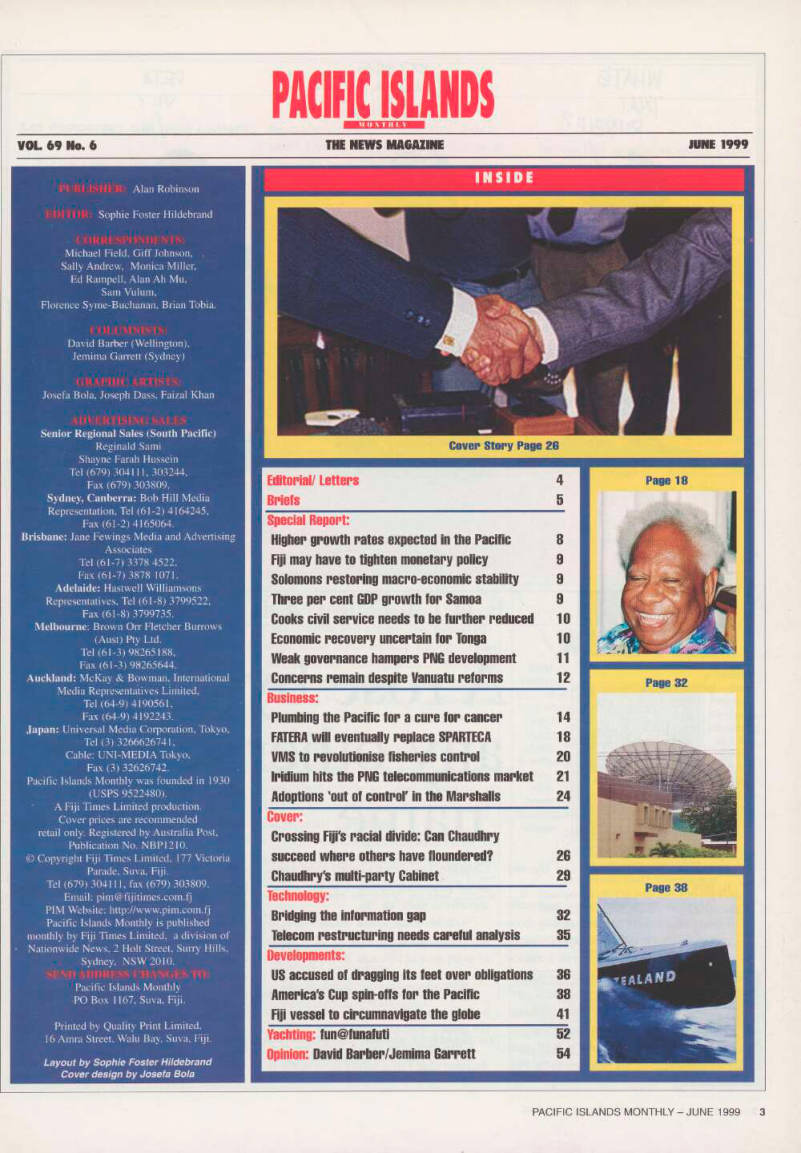
Cover Story Page 26
Editorial/ Letters 4 Briefs 5 Special Report: Higher growth rates expected in the Pacific 8 Fiji may have to tighten monetary policy 9 Solomons restoring macro-economic stability 9 Three per cent GDP growth for Samoa 9 Cooks civil service needs to be further reduced ID Economic recovery uncertain for Tonga 10 Weak governance hampers PNG development T 1 Concerns remain despite Vanuatu reforms 12 Business: Plumbing the Pacific for a cure for cancer 14 FATERA will eventually replace SPARTECA 18 VMS to revolutionise fisheries control 20 Iridium hits the PNG telecommunications market 21 Adoptions 'out of control' in the Marshalls 24 Cover: Crossing Fiji's racial divide: Can Chaudhry succeed where others have floundered? 26 Chaudhry's multi-party Cabinet 29 Technology: Bridging the information gap 32 Telecom restructuring needs careful analysis 35 Developments: US accused of dragging its feet over obligations 36 America's Cup spin-offs for the Pacific 38 Fiji vessel to circumnavigate the giobe 41 Yachting: fun@funafuti 52 Opinion: David Barber/Jemima Garrett 54
Page 18
Page 32
rage 38
THE biggest

Editorial
A rose by any other name ...
fear, after the Fiji Labour Party won an outright majority in last month’s elections, was that the aggressive minority, may cause trouble. The overhwleming concern was a repeat of the 1987 coup
de tat, when the FLP was last elected to power.
Although there were some outspoken Fijians who did not want Chaudhry to be prime minister, the majority of people just wanted Labour to be given a chance to get on with the business to governing.
As it stood, Chaudhry not only sur prised everyone by appointing a Fijian dominated cabinet, but he has managed to get the President on side, as well quell initial distrust of his motives to be PM.
Chaudhry has shown himself to be a sea soned politician, sensitive to the under currents to make up Fiji.
With his trade union background, he has commanded the support of workers of every race in Fiji, and, he says, it is the workers who are his interest now.
This can only be good for Fiji, where a small minority of people are rich, and the greater majority, poor.
Chaudhry may prove to be the best decision that Fiji’s voters have made in
recent years. In a time of
rapidly increasing globalisa
tion, any worker would want a unionist as the prime minis ter.
Fiji, it seems, is no different to Australia, New Zealand, Britain and even Israel in this respect, for in those countries too Labour governments com
mand a big majority. As many workers have found in the past, it does not matter what race or colour their union leader is, as long as he or she fights for worker’s rights. Even Chaudhry (an avid rose gar dener) knows that by any other name, his plants would smell as sweet. So too, the people of Fiji may find that, Indian or Fijian, a person who has their best inter ests at heart is their best representative. ■
Letters
Let democracy suit local content
Fiji has a new indian prime minister. As a result tension is said to be building up.
Whose fault really was it? Perhaps the SVT and NFP merger was a well designed ploy to topple indigenous supremacy. Politics was at play. The SVT and NFP alliance was misled.
The grassroots of Fiji have spoken. The result though unacceptable to the outspo ken minority is indispensable.
Solomon Islands must leam from Fiji experience. In the local context, unfortu nate is the fact that minority groups have progressed through the political system. In retrospect foreign elements continuously intrude Solomons territorial sovereignity through the presence of naturalised citizens in the highest political level.
Another caution is the danger coerced by a rapid increase of recently introduced ethnic groups. The descendants of Kiribati have populated the entire island of Wagina.
Spots of other settlements also exist in the wider province of Western Solomons.
Worse still is the fact that attempts were made by sons of the recent settlers to con test for national seats.
The indigenous people of Solomon Islands must wake up. I hate to repeat the Fiji experience. Let democracy be refined to suit the local context.
Raso Tekupala
Socialism has never been tried
As human beings we live in a world in which we exist amongst dire poverty and strife. But this is not a natural phenomenon, it is the result of human social problems and we as the human race have the ability to solve these problems.
We live in a world which is on the verge of environmental catastrophe and in which crime is rising, wars are commonplace and racism and nationalism are virulent.
We live in a world where 800 million people are malnourished, 600 million peo ple are homeless, one billion people have no access to clean water, and one billion
people have no work. We live in a world in which food mountains are destroyed amid starvation, where half a million scientists are meployed to develop weapons when developments in other areas could benefit the world’s population directly, and where homeless people preside amid vacant buildins and unemployed construction workers. We do not, however, have to live like this, the people of the world have an opportunity like none before in history to live in peace amidst plenty. Capitalism pre vents this with its ethos of “can’t pay, can’t have” which retards real human develop ment and leads to the relative impoversih ment of the many for the benefit of the few who monopolise the world’s resources courtesy of ownership.
A society of common ownership of the means of productive wealth by and in the interests of all. A world of voluntary co operation where each gives according to ability and each receives according to their self-defined needs.
World socialists believe this will come about by the majority organising for it, not by being led by a vanguardist minority. The World Socialist Organisation is a leaderless organisation and always has been, deci sions being made equally amongst equal members, the World Socialist Movement has companion parties in several countries all united by the vision of a moneyless world of real democracy and the potential for plenty.
Socialism has never been tried, the World Socialist Movement has always maintained that the so called “socialism” of Russia, China and their cronies was noth ing but state capitalism.
The World Socialist Movement does not offer to lead you - a socialist revolution will be work of the working class itself. If we want to change the world we have to do it ourselves.
C B Shelly
Overses Department The Socialist Party (Great Britain) World Socialist Movement
Are newborn babies strategic or military targets
military targets for NATO?
Just one hour ago (before writing), three patients were killed in “Dragisa Misovic” hospital placed near gas station that was bombed in residential part of downtown Belgrade.
At least one missile has directly hit the hospital. Four deliveries were taking place in the very moment of explosion. Babies and mothers are being evacuated. A large number of mothers were injured, also large number of other patients, doctors and nurs es were injured. Rescue teams were still searching the hospital wreckage for sur vivors.
Newborn babies were once again target of NATO bombers. Are newborn babies ‘strategic’ or ‘military’ targets? Or is it once again a ‘mistake’ or ‘collateral damage’?
Are NATO pilots blind, or, what’s more likely, are NATO leaders war criminals?
Vanja Miljanic
Advertisements & other items, p. 5 (1 item)
free Pax
0800 274 061 0800 252 477
CALL FREE
0508 BLAIRS
252 477
NEW ZEALAND
email: [email protected] Subaru Leyland Mazda Mercedes Mitsubishi
MAN.
Nissan Perkins Suzuki Toyota Volvo Yanmar
NEW ARRIVALS
i Com Volvo TD 120 F, Fiat V/S TT Scania D5B 81/82, Leyland Till Cummins 6 CT. LlO 290/325, 320 Big ' Perkins 540 Turbo, Phaser 4 Cyl, Lister HR2 Allison Mt 653 Auto, Scania GRB7I, Volvo Rl4OO (TD 102), R 52 85p (F 7) 11R22-5 Tubeless Rim
Air Services

Archives-June 1945
Trans-Pacific Air Services PAA promises an early start
THERE are signs that steps are being taken to resume a Trans-Pacif ic mail and passenger air service between North America and the South Pacific; and already there are indications of keen competition between British and American air lines.
The report was current in Sydney, in May, that Qantas, Ltd., the well-
known Australian company, was about to send a survey plane from Sydney to Suva.
Evidently, this report reached Pan- American Airways, which pioneered the service between Hawaii and Auckland, and was operating regular ly, Honolulu-Canton Island-Suva- Noumea-Auckland, when war caused the suspension of all civil flying at the end of 1941. On June 3, the Syd ney 'Telegraph's' New York corre spondent reported that PAA would
resume the service on a weekly basis in June, and would run a twice-week ly service as soon as planes were available.
This was welcome news to Aus tralians. Air-mails from USA come regularly to Australia, but there is no return air-mail - only slow surface mail - and for this Australians blame their blundering and inefficient gov ernment.
Passenger traffic between Aus tralia and USA, and Pacific ports in between, is a matter of sheer luck and wild adventure.
Any airline which can get in quickly and remedy this state of affairs will be called blessed by the business community. ■
Advertisements & other items, p. 6 (1 item)
/masters
SCHOO LS
CHURCHES
• •• mm : Sfcliiliß r Copymasters Hawaii can help you with all of your duplicating needs from start to finish. Featuring Duplo® Digital Duplicators, Copiers, Shredders, Laminators, Poster Printers, Collators, & Folding Equipment. We also sell Stencil & Duplicator Supplies, Paper Supply, and all brands of Copier Supplies, & Computers.
Copymasters Hawaii
96-1173 Waihona Street, Suite B-2 • Pearl City, HI 96782 Phone (808) 678-2265 • Fax (808) '4%-5678
E-Mail: [email protected]
GOVERNMENT
COMMERCIAL
Serving:
STATE OF HAWAII
ENTIRE
SOUTH PACIFIC,
INCLUDING:
Fiji
SAMOA
TAHITI
TONGA
COOK ISLANDS
MICRONESIA:
FEDERATED STATES
OF MICRONESIA
Gl AM
MARIANAS
MARSHALL
ISLANDS
/masters
hawaii
Briefs
Gun found on a high school student PAGOPAGO - The discovery of a gun on a student at one of Samoa’s high schools caused concern that local campuses will become just as dangerous as those in the United States.
The Samoa News reported that a teacher at Tafuna High School found a .357 luger pistol in the possession of a ninth grader.
The student allegedly brought the gun to school to shoot another student he did not like. The student who was not identified is said to have recently moved here from the United States.
Director of Education Doctor Sili Sataua says his department is not taking the situa tion lightly, even though the weapon involved was described as “a rustic gun that does not work”.
Doctor Sataua plans to introduce a feder al policy which calls for the expulsion of any student found with a gun on campus for one year.
The Education Director wants to expand the policy to include staff.
“Any staff member in possession of a weapon on campus would be immediately terminated,” he said.
Legislation, banning weapons from class rooms and school campuses is pending in the House of Representatives.
One of its sponsors, Representative Malaetasi Togafau says he will push for the bill’s passage when the next Legislative ses sion begins in July.
Tafuna High School, with close to 1,500 students is the largest high school in the ter
ritory.
This is not the first time a gun has been found in the possession of a student. The first such incident occurred in 1992 when a student threatened to shoot a teacher with a gun.
While students talked candidly about the incident, school administrators tried to cover it up.
The student involved was a United States bom Samoan who was sent home to be “rehabilitated” by his grandparents.
Many countries have begun to crack down on guns in high schools in the wake of a spate of shootings in the US.
Former PNG provincial Governor dies amidst fears of retribution attacks PORT MORESBY - There are fears of retribution attacks in the Papua New Guinea Southern Highlands, following the death of the former provincial governor in a road accident.
Police reinforcements were called to the town of Mendi, the provincial capital, to maintain order following the accident.
Dick Mune was travelling in a four wheel-drive vehicle near Mendi. It went out of control and Mune died from injuries sus tained as he leapt from the vehicle.
He was on his way to the national capi tal, Port Moresby to continue legal action to regain the parliamentary seat he lost in the last election. Police are investigating, though some people who believe it was no accident.
Mune’s election dispute was due to be heard in the Papua New Guinea Supreme Court at the end of May. The case will now probably be closed.
Reports from Mendi say the situation remains tense, and there are claims one man has been killed in retaliation for Mune’s death.
Australia pays 96 per cent of cost of the new Vanuatu defence headquarters PORT VILA - A new headquarters for the Vanuatu security forces has been opened in the capital Port-Vila.The Defence Force headquarters is funded by the Australian Government.
Brigadier Paul Teiss, representing the chief of the Australian Defence Force, Admiral Chris Barrie told dignitaries at the opening ceremony Australia’s decision to fund the new headquarters follows a review conducted by Australian defence authori ties.
Australian defence paid 96 per cent of the multi-million-dollar building in Port Vila. The balance came from the Vanuatu Government. Brigadier Teiss said Vanuatu plays an important role in Australia’s defence strategy.
“Australia takes its security interests very, very seriously, and Vanuatu gets a spe
cial mention because we regard Vanuatu as a Tier 1 country in the South Pacific.”
“Vanuatu is, of course, only two hours flying time from Brisbane so clearly events that take place in Vanuatu will impact upon the security of Australia, so it’s very, very much in our region,” Brigadier Tiess said.
PCRC Director leaves after 12 years SUVA - The out-going Director of the Suva-based Pacific Concerns Resource Centre (PCRC), Lopeti Senituli says the Centre has been instrumental in lobbying for a number of regional issues.
One of the most successful was the re listing of New Caledonia into the United Nations (UN) Decolonisation Committee in 1986. PCRC was part of the lobbying group that eventually convinced the UN to re-list New Caledonia. This happened after 16 years of lobbying and negotiations.
Senituli, Director of the Centre for 12 years since it moved to Fiji from Auckland ,said PCRC is mandated to speak out on issues of human rights violation, decoloni sation and environment for the people of the South Pacific. PCRC was at the forefront of the campaign against the French nuclear testing in French Polynesia.
He said his greatest achievement was the fact that regional governments had accepted the role PCRC plays as a legitimate voice of non-govemment organisations in the region.
“We are now able to be represented at some regional and national government level meetings ... even at discussions at United Nations level. This shows that PCRC is a legitimate voice for regional non-govemment organisation,” Senituli said.
PCRC is currently is working on a case where Fiji soldiers are believed to have been exposed to nuclear radiation in the 1950’5. The Centre has lodged a case with the European Court of Human Rights that Britain should be held responsible.
Senituli leaves the Centre in July. He told Pacnews he had been offered a number of positions including a lucrative job in Europe, a position with a regional organisa tion in Suva and one in Tonga. ■
Higher growth rates expected
Special Report
Higher growth rates expected in the Pacific this year: ADB
Reports By Sophie Foster Hilobrand
GROWTH in Pacific
Islands developing
member countries should be higher this year, according to the Asian Development Bank.
In its Asian Development outlook 1999, the Bank said that Fiji, Kiribati, Papua New Guinea and Samoa are likely to achieve positive growth this year.
But it said in no case was it expected to exceed three per cent.
The regional representative of the South Pacific Regional Mission of the Asian Development Bank, Jeffry Stubbs, launched the report.
He said that the Asian crisis was not the major factor in explaining the poor growth rates of most of the Pacific Island DMCs as their direct exposure to the rest of Asia was
generally limited. But he said, that the Solomon Islands was hit hard by the crisis because of its heavy dependence on forestry and the collapse of log export mar kets in Japan and Korea. Vanuatu and Nauru also experienced significant adverse impacts, he said.
Drought affected several countries, as did the decline in the price of exports such as sugar and copra.
“Many Pacific Island DMCs suffered from the impact of fiscal adjustment fol lowing periods of unsustainable fiscal expansion or from the impact of weak gov ernance arrangements. In many cases, busi ness confidence deteriorated and this was reflected in weak investment,” he said.
Stubbs said to accelerate their growth, it would be extremely important for Pacific Island DMCs to continue their reform pro grammes comprising both macro and micro-economic reform policies.
“Sound fiscal and monetary policies aimed at providing economic and social services, keeping inflation low, and keeping currencies in bal ance are essential.
Key micro-economic reform policies encompass reforms to free up labour and land markets, open markets to competition, and strengthen financial markets to facili tate private sector activity,” he said.
ADB’s operations in the Pacific islands cover 12 DMCs: the Cook Islands, Fiji, Kiribati, Marshall Islands, Micronesia, Nauru, Papua New Guinea, Samoa, Solomon Islands, Tonga, Tuvalu and Vanuatu.
Since operations started in the Pacific, ADB has provided 130 loans totalling US$965 million and 430 technical assis tance grants amounting to $132 million to Pacific Island DMCs. In 1998, ADB pro vided eight loans worth $B3 million to Kiribati, Nauru, PNG, Samoa, Solomon Islands, and Vanuatu. Thirteen per cent ($16.6 million) of the total amount of tech nical assistance grants given out by ADB were for the Pacific. ■
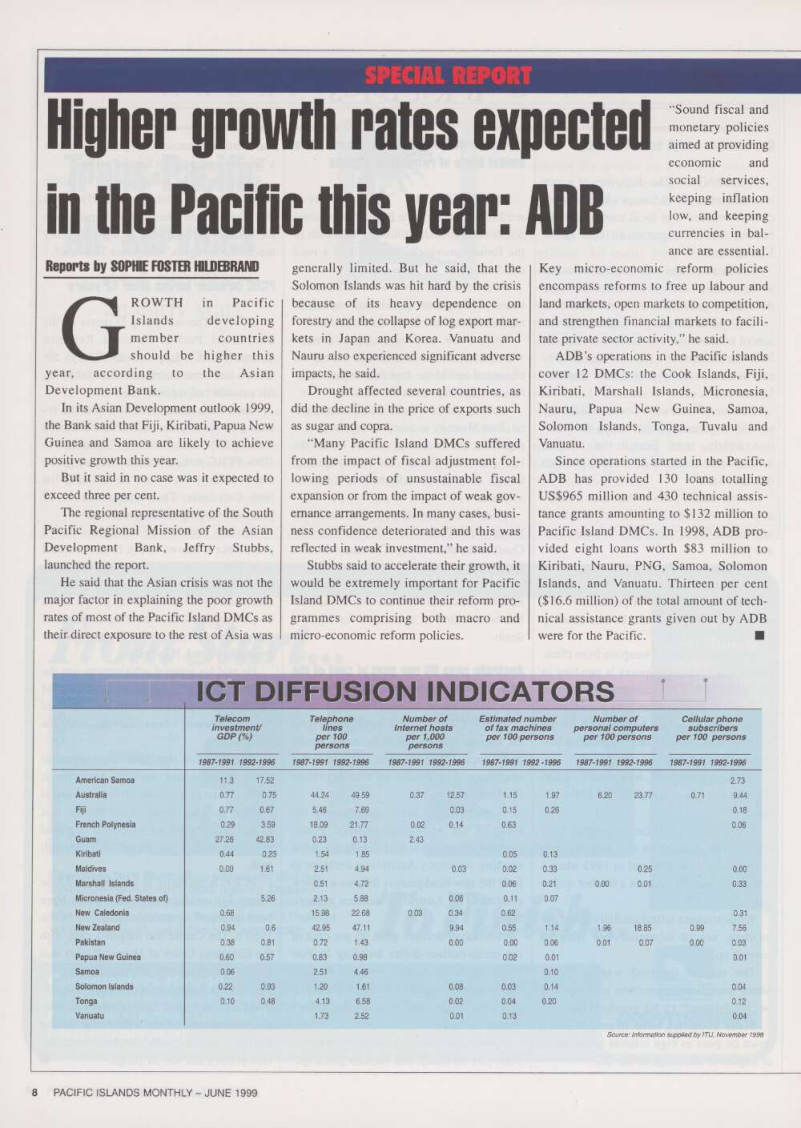
Ict Diffusion Indicators
Telecom investment/
Gdp(%)
Telephone lines per 100 persons Number of Internet hosts per 1,000 persons Estimated number of fax machines per 100 persons Number of personal computers per 100 persons Cellular phone subscribers per 100 persons 1987-1991 1992-1996 1987-1991 1992-1996 1987-1991 1992-1996 1987-1991 1992-1996 1987-1991 1992-1996 1987-1991 1992-1996 American Samoa 11.3 17.52 2.73 Australia 0.77 0.75 44.24 49.59 0.37 12.57 1.15 1.97 6.20 23.77 0.71 9.44 Fiji 0.77 0.67 5.46 7.69 0.03 0.15 0.26 0.18
French Polynesia
0.29 3.59 18.09 21.77 0.02 0.14 0.63 0.06 Guam 27,26 42.83 0.23 0.13 2.43 Kiribati 0.44 0.23 1.54 1.85 0.05 0.13 Maldives 0.00 1.61 2.51 4.94 0.03 0.02 0.33 0.25 0.00 Marshall Islands 0.51 4.72 0.06 0.21 0.00 0.01 0.33 Micronesia (Fed. States of) 5.26 2.13 5.88 0.06 0.11 0.07 New Caledonia 0.68 15,98 22.68 0.03 0,34 0.62 0.31 New Zealand 0.94 0.6 42.95 47.11 9.94 0.55 1.14 1.96 18.85 0.99 7.56 Pakistan 0.38 0.81 0.72 1.43 0.00 0.00 0.06 0.01 0.07 0.00 0.03 Papua New Guinea 0.60 0.57 0.83 0.98 0.02 0.01 0.01 Samoa 0.06 2.51 4.46 0.10 Solomon Islands 0.22 0.93 1.20 1.61 0.08 0.03 0.14 0.04 Tonga 0.10 0.48 4.13 6.58 0.02 0.04 0.20 0.12 Vanuatu 1.73 2.52 0.01 0.13 0.04 Source: Information supplied by ITU, November 1998
Fiji may have to tighten monetary policy
A TIGHTENING of mone tary policy may be
required in Fiji this
year, with inflation run ning at 10 per cent at the end of 1998, according to the Asian Development Bank.
Its 1999 Outlook says that in the short term the government faced two major tasks - one of which was to ensure that the stimu lus to the traded goods sector from the cur rency devaluation was not further eroded by wage and price rises.
The Bank says that the second task was to reverse the deterioration of the country’s fiscal position that occurred in 1996-1998.
ADB says that if Fiji is to achieve eco nomic growth at a reasonable and sustain able rate, restoring investor confidence was essential. “This, in turn, requires political stability and a government that delivers a coherent, credible, and predictable policy framework,” it says.
It says that if Fijian landowners do not renew Indo-Fijian farmers’ expiring land leases, the sugar industry will effectively be undermined during 1999-2001.
“This will occur precisely at the time when the sugar industry must face the prospect of losing its preferential access to
European markets,” ADB says.
Other issues to be addressed to restore investor confidence include clear and enforceable property rights as a basic neces sity to encourage foreign investment in the tourism sector.
Burdensome regulations and restrictions on the repatriation of profits also discour aged investment, ADB says.
Despite this, Fiji’s Gross Domestic Product is forecast to grow by 2.7 per cent in 1999. “This prediction of an economic recovery is based on the assumptions of a five per cent increase in visitor arrivals, a five per cent expansion in the construction sector from hotel investments and public infrastructure projects, a 10 per cent growth in garment production, and a 25 per cent growth in mining output,” ADB says.
“The economy was in recession for the second year in succession in 1998, with out put falling by nearly four per. cent, largely because of the effects of a drought on sugar
production and reduced gold production.
Growth will resume in 1999, provided that tourism picks up and investment increases.
A coherent, credible, and predictable eco nomic policy framework is needed, particu larly with respect to sugar land leases,”
ADB says. ■
economic stability
Solomons progresses in restoring macro economic stability
THE Solomon Island gov ernment, which took office in August 1997, has made progress in restor ing macro-economic stability, says the Asian Development Bank.
It says that this has been done by servic ing domestic debt and paying arrears, which the government plans to clear by the end of this year.
“Debt and non debt arrears were reduced by a total of $lB million, primarily through external concessional borrowing from the Asian Development Bank and securitisation of arrears to the National Provident Fund.
As a result, the overall level of public debt decreased slightly from $l9B million at the end of 1997 to $195 million at the end of 1998,” the Bank says.
Of that figure, domestic debt was $B3 million, external debt $lO5 million, and trade creditor and other arrears $7 million.
ADB says GDP fell an estimated 10 per Continued overleaf
From previous page
cent last year “as the collapse of log export markets in Asia compounded the adjustments forced by years of economic
mismanagement”.
The inflation rate accelerated from 8.1 per cent in 1997 to 12.3 per cent in 1998 as a result of the 20 per cent devaluation in December 1997 and increases in indi rect taxes.
It said the value of log exports, in the first three quarters last year, was about 60 per cent below the 1997 level. But, pro duction was still a third higher than the estimated sustainable level of harvesting.
It says, the most important concern was that the policy framework and man agement regime, essential for ensuring sustainable development of natural forest resources, was yet to be put in place.
Last year, fish became a major export earner, and palm oil and palm kernel exports grew because of price and produc tion increases. The Bank says that the Solomons government needs to accelerate the progress on privatisation. ■
Three per cent GDP growth for Samoa
THE Asian Development Bank says Samoa’s Real Gross Domestic Product is expected to grow by three to four per cent this year.
In its Asian Development Outlook 1999, the ADB said provided the economy was not subject to severe external shocks and the government was committed to effective, continuing economic reform, Samoa could achieve a three per cent sustainable growth rate each year.
It said such a growth rate “will permit an increase in average income of around two per cent annually, and will generate jobs for the 500 new entrants to the labour force each year.”
The outcome, however, depends on durable improvements in the agriculture sector, continued expansion in fisheries, and realising the potential for further manu
facturing and tourism development.
ADB says Samoa must enhance its attractiveness to foreign investors because the rate of investment was a crucial deter minant of the actual growth rate.
“Political and economic stability, tax and tariff reform, improved transport and com munications infrastructure, and the devel opment of the offshore financial services industry are all positive features,” it says.
The Bank added that while the relative strength of the tala may have a deterrent effect, the current complexities and delays
in the investment approval process were more important. It says it was encouraging that the simple and transparent Foreign Investment Act was in the pipeline.
“Together with arrangements for secure access to land, this will provide a legislative framework conducive to greater foreign investment flows. The latter would provide not only capital, but also management skills, technology, and training that would increase the productivity of the workforce,” it says.
A potential added benefit of tourism, it says, was that the related job creation and investment could be in rural areas, helping stem urban drift and attendant social prob lems. ■
Cooks' civil service needs
to be Men reduced
THE Asian Development
Bank says that the official economic outlook for the Cook Islands is gloomy.
In its Asian Development Outlook 1999, the Bank said that forecasts indicated that GDP would fall by one per cent this year before gradually recovering to reach growth of three per cent per year by 2003.
But the Bank said that to achieve the growth, it was assumed that there would be sustained growth in the tourism, agriculture, and marine resources sectors.
The ADB said that the principal policy issue for the Cook Islands was the comple tion of its Economic Reform Programme.
But it said that there was cause for concern about the effectiveness and durability of
some of the changes. “Despite attempts to balance the operating budget in 1997 and 1998, deficits were recorded, and the gov ernment was unable to service fully an external debt of NZ5143.9 million, equiva lent to nearly the whole of GDP,” it said.
The ADB said that the country’s 1999 budget was not in compliance with the
requirement that the operating budget be
balanced, and relied on asset sales to fund expenditure.
“One major asset sale has not been fully transparent, and the privatisation of the government-owned telecommunications monopoly paid insufficient attention to reg ulatory arrangements,” it said.
The bank said that effective efforts to realise fiscal surpluses were needed and would have to include a planned comple tion of public service reform.
Even though, between 1996 and 1998, the number of civil servants was reduced from about 3,350 to 1,340, the ADB says it is still far too high for such a small popula tion. It added that the failure to reduce the size and cost of a Parliament of 25 mem bers and concerns about the commitment to improved governance needed to be addressed. ■
Economic recovery uncertain for Tonga
TONGA’S short term economic out look is gloomy, and medium term prospects are that economic recovery will be uncertain, and at best modest, says the Asian Development Bank.
Last year was Tonga’s third successive year of recession, with GDP declining 1.5 per cent in 1996, 6.6 per cent in 1997, and 0.3 per cent last year. The Bank says that the economic downturn largely reflected the performance of the agriculture sector,
which contracted in each of the three years.
Squash production declined because of drought, disease and lower world market prices. It says that while private remittances held up, the balance of payments was under considerable pressure.
The current account deficit grew to 7.3 per cent of GDP, with gross foreign reserves falling to an equivalent of two months of merchandise imports, compared with five months in 1997.
The fundamental challenge for Tonga is
generating jobs and exports through private
sector development. “The government, aware of the economy’s structural deficien cies, will need to rationalise the public sec tor to allow the private sector to grow. The government needs to reduce the civil ser vice wage bill,” ADB says.
Major fiscal savings can be achieved, it says, by converting the noncontributory pension scheme for public servants to a pen
sion system that depends on contributions.
Distortions in the current tax and tariff structures
need to be removed to provide a more reli able revenue flow and stimulate private sec tor growth, the Bank says.
The government also needs to introduce a simple company registration system to replace the cumbersome system of granting business, trade and development licences.
Tourism and fisheries could benefit from increased foreign investment flows if a non
discriminatory policy towards foreign
investment was established. ■
Advertisements & other items, p. 10 (1 item)
right
r ■; u ' mMMi fe 1 " 5
ills
■ Hi I ' •vi-; I 3 i :-r- ■ , ~«e mNo>' I f
right
1 S /* ,
www.airfiji.net
PNG development: ADB
Weak governance and decentralisation hamper PNG development: ADB
PAPUA New Guinea’s fun damental development problem is that social development has not kept pace with economic growth, according to the Asian Development Bank.
“Expansion of the formal economy has generated only about one sixth of the jobs required to keep up with the growth of the workforce,” the ADB’s Asian Development Outlook 1999 states.
“The bulk of the population lives in rural areas fragmented by rugged terrain and inadequate physical infrastructure, and relies heavily on subsistence and smallhold er agriculture.”
The ADB said that PNG’s 1999 budget addressed the problem but the issue was now one of effective implementation.
“Unfortunately, this is hampered by weak governance that has been complicated by government decentralisation under the Organic Law 1995,” it said.
The ADB report said that while increas ing participation in decision making and raising the accountability of provincial and local government was laudable, however there were other basic problems that had not been addressed. “Delays in fund trans fers; confusion about the respective roles of
departments at the district, provincial, and national levels; and severe human resource constraints continue to be basic problems,” it said.
The ADB said that the 1999 budget esti mated a slight reduction in the overall deficit and an increase in total revenue and grants. The budget was also committed to the stalled medium-term structural reform programme that was started in 1994 with the IMF and the World Bank.
“A value-added tax and tariff reform will become effective on 1 July, 1999, while a public sector restructuring and contraction will be the primary source of a 19 per cent drop in non-interest recurrent spending,” it said.
ADB says that this would permit a 50 per cent expansion in development expen diture. The Bank warned that any large increase in the budget deficit would exert pressure on the currency, and on monetary policy. It said that the 1998 budget had turned out to be overoptimistic because of an unanticipated shortfall in revenues from taxes from mining companies and log export duties.
The overall budget deficit was 1.6 per cent of GDP with most of the growth in expenditure attributed to transfer payments
to provinces, districts, and statutory institu tions, increased expenditure at the national level and debt servicing.
It said that the cost of relief efforts for the victims of the Aitape tidal wave were an added, unexpected burden.
The ADB said that the stock of public debt at the end of 1998 approached 70 per cent of GDP, and imposed a servicing bur den that was projected to absorb 17 per cent of total revenue and grants in 1999.
Amongst other areas that need to be addressed, the ADB warned that “a failure to bring interest rates down from their cur
rently high levels would have potentially
serious consequences for private sector investment”.
The Bank said that PNG’s GDP growth rate of 2.5 per cent last year was due entire ly to a 60 per cent increase in output from the mining sector and strong growth in the petroleum sector It said that non-mining GDP fell by 3.7 per cent.
Output in the agriculture, forestry and fisheries sector was highlighted because, while accounting for 30 per cent of GDP, it provides a living for 80 per cent of the pop ulation. GDP in this sector fell by 6.4 per cent last year because of severe drought and a fall in commodity prices. ■
Advertisements & other items, p. 11 (1 item)
recovery uncertain for Tonga
11
g
PACIFIC ISLANDS MONTHLY - JUNE 1999
recovery uncertain for Tonga
despite substantial
Concerns remain despite substantial reform in Vanuatu
THE Asian Development Bank says although Vanuatu has made sub stantial achievements under the Comprehensive Reform Programme (CRP), some problems and concerns remain.
Amongst these was the new Foreign Investment Act that included schedules that were contrary to the letter and spirit of the CRP.
It says that by reserving a wide range of areas for the indigenous population, the act
will discourage foreign investors.
“A planned government review of the (schedules needs to be completed quickly,”
ADB says.
Weaknesses in law enforcement contin ued to impose high transaction costs on business and the community as a whole, it says, and reform of the public sector would need to be consolidated.
Approximately 87 per cent of the pro jected 1998 budget deficit was a one-off expenditure arising from compensation payments to public servants dismissed fol lowing the 1994 strike, the Vanuatu National fund payout, and payments relat ed to the CRP funded by the ADB, the Bank says.
Achievements under the CRP include reducing the number of ministries from 34 to nine and a seven per cent cut in civil ser
vice employment.
Value-added tax has also been intro duced with the simplification and reduc tion of import duties and business licence fees.
Vanuatu has also established a legisla tive framework for improved governance, and begun a process to prepare a public investment programme including aid financed projects.
Progress in financial reform has been made by the restructuring of the National Bank and the Development Bank and the amendment of the Vanuatu National Provident Fund Act. ■
Kiribati has big challenge ahead
THE Kiribati gov
ernment must!
translate policy j commitments into effective policy implementa-| tion, according to the Asian
Development Bank.
It says that the medium-term strategy, adopted in 1997, identi fied three macro-economic issues: I lack of almost any growth in perl capita GDP since independence in * 1979, the need to find employment for the 60 per cent increase in the
workforce that will occur over the next 15 years, and the government’s ability to sus tain the growth in public services.
ADB says strategies to address those issues were reducing the size of the central
government, reforming public enterprises,
and facilitating private sector development.
It says that a number of Pacific countries had adopted such a strategic framework but in the past Kiribati authorities had been slow to follow their example.
Kiribati has a small population of around 80,000, but they remain amongst the poor est in Pacific countries, with a per capita GDP of $670 at the end of 1997.
That same year per capita gross national product (GNP) was higher at $B9O because of revenues from fishing licence fees, remit tances from overseas workers, and invest ment income from the assets of the Revenue Stabilisation Reserve Fund.
The Fund was originally built up from phosphate mining royalties, and now con sists of equities and bonds invested in sev eral different international capital markets.
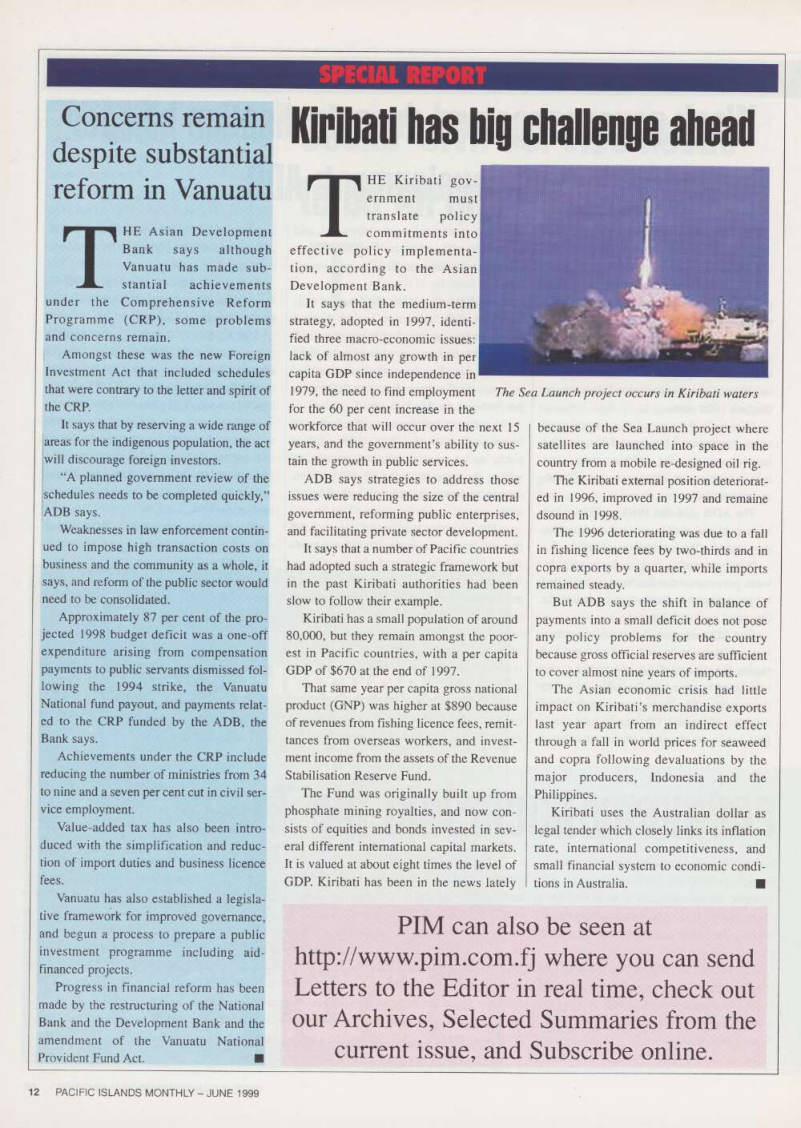
It is valued at about eight times the level of GDP. Kiribati has been in the news lately
because of the Sea Launch project where satellites are launched into space in the country from a mobile re-designed oil rig.
The Kiribati external position deteriorat ed in 1996, improved in 1997 and remaine dsound in 1998.
The 1996 deteriorating was due to a fall in fishing licence fees by two-thirds and in copra exports by a quarter, while imports remained steady.
But ADB says the shift in balance of payments into a small deficit does not pose any policy problems for the country because gross official reserves are sufficient to cover almost nine years of imports.
The Asian economic crisis had little impact on Kiribati’s merchandise exports last year apart from an indirect effect through a fall in world prices for seaweed and copra following devaluations by the major producers, Indonesia and the Philippines.
Kiribati uses the Australian dollar as legal tender which closely links its inflation rate, international competitiveness, and small financial system to economic condi tions in Australia. ■
The Sea Launch project occurs in Kiribati waters
Advertisements & other items, p. 12 (1 item)
PIM can also be seen at
http://www.pim.com.fj where you can send Letters to the Editor in real time, check out our Archives, Selected Summaries from the current issue, and Subscribe online.
International Dateline still
Business
International Dateline still puzzles those living around It
THANKS to an obscure conference 114 years ago, every time that travellers cross the Pacific, they lose or gain a day depending on the direction they are going.
It perplexes the people who do it all the time - Samoans, Niueans and Cook Islanders who cross the International Dateline to see friends and family in New Zealand. Stories of two Christmas Days, a missed birthday or a wrecked watch in the
rewinding are commonplace.
Going east across the dateline a traveller goes back a day, while going west across the line leads to skipping a day.
The international Meridian Conference on October 13, 1884, was called by President Chester Arthur for the Diplomatic Hall of the State Department, Washington.
It was attended by 41 delegates from 25
nations. Among them Austria-Hungary
which no longer exists as such; Hawaii,
which was an independent Polynesian king dom until the US invaded and San Domingo which is now the Dominican Republic.
Principles established by the conference included the creation of a single world meridian to replace several that existed then.
That meridian passed through Greenwich, near London, with all longi tudes calculated both east and west from Greenwich up to 180 degrees.
Establishing the prime meridian at Greenwich passed 22-1 with a delegate from San Domingo, for reasons now lost in time, against and France and Brazil abstain ing. France wanted the prime meridian in Paris, not London.
Agreeing to go 180 degrees in each direction from Greenwich passed but with Italy, Sweden, the Netherlands, Switzerland and Spain against while France, while still in a huff, abstained in the company of
Austria-hungary, Germany, Brazil, San
Domingo and Turkey.
The prime meridian led to the 180
degree longitude becoming the
International Dateline. The conference set an interesting precedent for Kiribati by agreeing to various kinks: around Siberia, avoiding Fiji and between Samoa and Tonga and keeping New Zealand in one
day.
Kiribati, and its predecessor the Gilbert and Ellice Island Colony did not exist then, but its 80,000 Micronesians were left affected by it as the Christian state found itself with two Sundays every week.
In 1995 the government in Tarawa (west of the dateline) declared everybody was in the same day - and consequently Kiritimiti (Christmas) and Caroline islands found themselves 14 hours ahead of Greenwich.
Uninhabited Caroline then became the first place to see each new day and has been renamed Millennium Island.
With Imperial haughtiness that startled Tarawa, the Greenwich Observatory blasted the Micronesians for hijacking the dateline.
A sensitive people, the i-Kiribati (as they are known) were undeterred noted a deci sion made in Washington a century ago which said the line could be moved to accommodate local difficulties. (AFP) ■
trade conference
American embassy in Fiji to host international trade conference
THE United States Embassy in Suva, Fiji is planning a major trade conference this month to further enhance trade and investment between Fiji and the United States.
American Commercial Attache in Suva, Mr. Ted Pierce, says the idea behind this important conference is to enable American busi ness people and their counterparts in Fiji to explore trade opportu nities and discuss issues of mutual interest like shipping, customs, quarantine regulations, freight consolidation and ways to enhance trade. Opportunities afforded by the U.S./Pacific Island States Joint Commercial Commission will also be discussed.
The Conference theme will be “Face to Face with American Business.” It will be held over a three-day period starting June 9, 1999. Mr. Pierce emphasized that an important part of the con ference package will be free “Gold Key” service to participating
American companies on June 10 and 11 to enable them to meet with Fiji private sector leaders, government officials, and other commercial organizations with whom they share a common commercial interest. On the Fiji side there is immense interest in the conference among leading firms, government departments and statutory bodies, including the Fiji Trade and Investment Board. A large turnout of leading local business representatives is expected.
American goods, services and investment have increasingly entered Fiji’s markets in recent years as more and more Fiji busi nesses look to the US as a source of goods and services. Mr. Pierce believes this conference will provide an unprecedented opportuni ty for American and Fiji businesses to develop new links and build further momentum. Full details of the conference is available from Fiji’s Trade Commission in Los Angeles and the American Embassy in Suva, Fiji. ■
Plumbing the Pacific
for a cure far cancer
By Darrell Nicholson
IN a two-story waterfront lab in the Micronesian island nation of Palau, marine biologist Dr. Patrick Colin is undertaking what he describes as the “most important job I’ll ever do.”
Under a contract with the United States National Cancer Institute, Colin and his coworkers at the Coral Reef Research Foundation explore reefs in the Indian and
Pacific Oceans looking for slimy, spineless
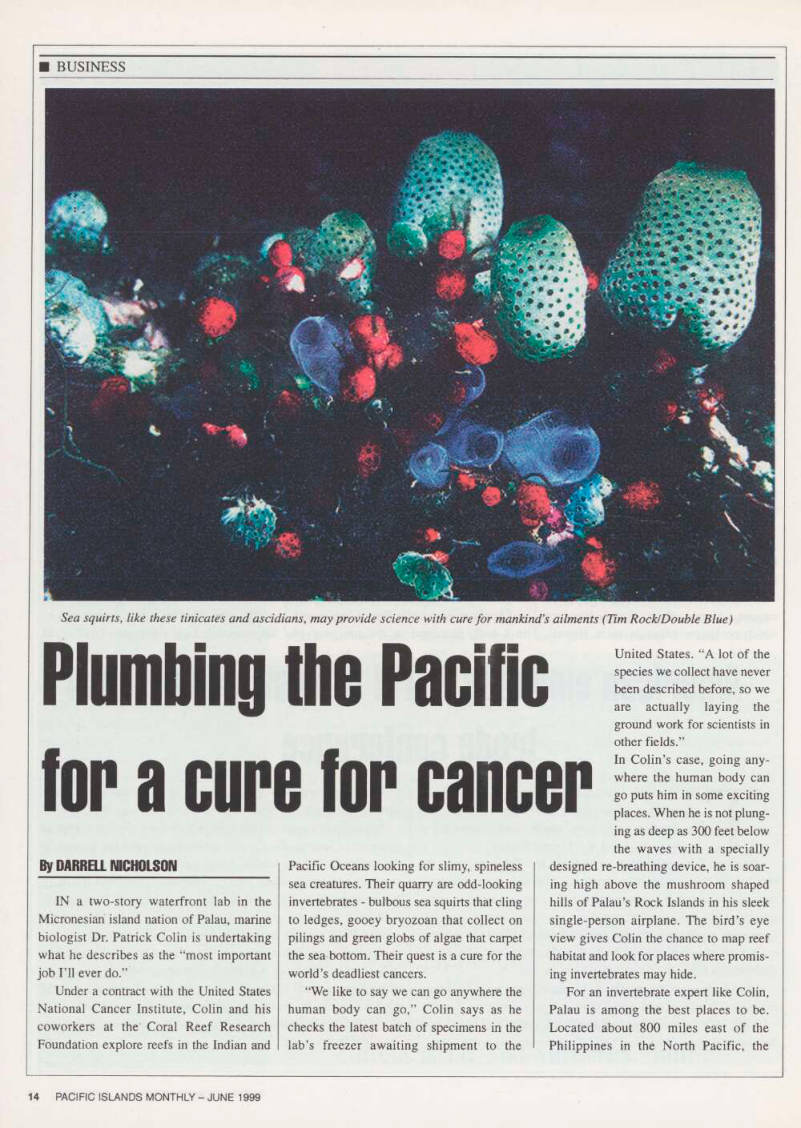
sea creatures. Their quarry are odd-looking invertebrates - bulbous sea squirts that cling to ledges, gooey bryozoan that collect on pilings and green globs of algae that carpet the sea bottom. Their quest is a cure for the world’s deadliest cancers.
“We like to say we can go anywhere the human body can go,” Colin says as he checks the latest batch of specimens in the lab’s freezer awaiting shipment to the
United States. “A lot of the species we collect have never been described before, so we are actually laying the ground work for scientists in other fields.”
In Colin’s case, going any where the human body can go puts him in some exciting places. When he is not plung ing as deep as 300 feet below the waves with a specially
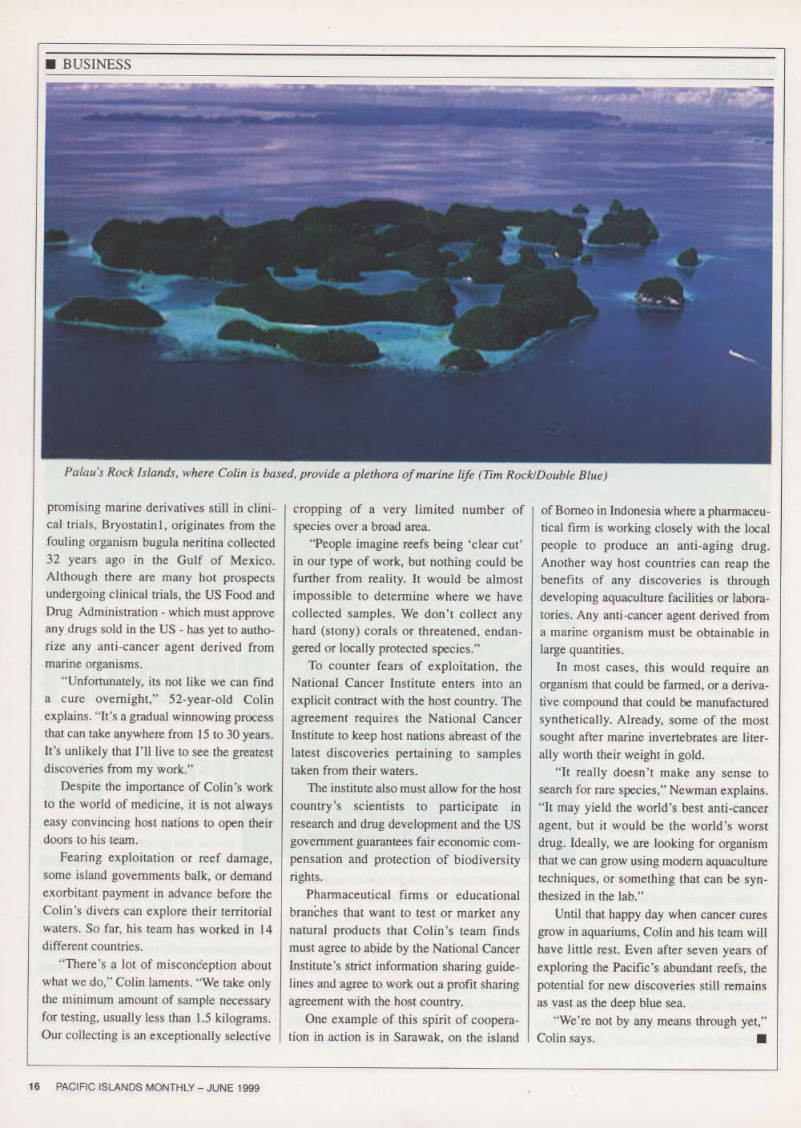
designed re-breathing device, he is soar ing high above the mushroom shaped hills of Palau’s Rock Islands in his sleek single-person airplane. The bird’s eye view gives Colin the chance to map reef habitat and look for places where promis ing invertebrates may hide.
For an invertebrate expert like Colin, Palau is among the best places to be.
Located about 800 miles east of the Philippines in the North Pacific, the
Sea squirts, like these tinicates and ascidians, may provide science with cure for mankind’s ailments (Tim Rock/Double Blue)
Republic of Palau is the westernmost island group in Micronesia. The main archipelago, centered at about 7 degrees 30 minutes north and 134 degrees 30 minutes east, is a string of more than 350 islands stretching 125 miles north and south. Lying about 300 miles to the Southwest are seven other small islands that are part of Palau, the Sonsorol Islands, Merir, Pulo Anna, Tobi and Helen’s Reef.
Just seven of Palau’s larger islands are inhabited. Population in this former US Trust Territory is about 18,000 people, most of whom live on the main island of Koror where the capital lies. Rated among the world’s greatest diving destination, Palau is
also famous for its fabled Rock Islands, more than 200 limestone islets that sprout like nearly identi cal mushrooms from a sapphire
lagoon.
For three years, the Coral Reef Research Foundation was based several hundred miles east of Palau in Chuuk, an island state in the Federated States of Micronesia.
Although the group’s work there yielded many new discoveries, the move to Palau in 1995 has opened a whole new world of discoveries.
Palau lies not far from the world’s center for marine biodiversity, a tri angle of ocean including parts of the Philippines, Indonesia and Papua New Guinea that is home to more different marine species than any spot on earth.
“We wanted to be somewhere where we could collect very thor oughly in one area and then go out and collect in other areas,” Colin says. “The biodiversity in this part of the Pacific is unlike anywhere.
We discover new organisms on almost a daily basis.”
The impetus behind Colin’s search is simple; the world needs
new drugs. With each passing year bacteri um evolve ways to fight science’s best weapons. Doctors are anxious for new com pounds that can attack cancer, AIDS and a long list of other diseases that have no cure.
The search for nature’s remedies has exploded since that historic day in 1928
when mold blown through an open window stopped staphylococcus bacteria from growing in a petri dish - an accident that led to Alexander Fleming’s discovery of peni cillin. In the latest wave of land-bound exploration, desperate researchers are combing landfills, septic tanks, and swamps for sources of new cures.
In the Pacific, long before Fleming’s dis covery, native plants were - and still are - an important source of traditional medicine.
Some familiar plants like kava are being used in prescription medications and herbal remedies in the US and Europe.
In the field of cancer research, the yew tree - found in the North America’s Pacific
Northwest - is the source of the biggest suecess story so far. Taxol, a synthetic drug based on chemical structures found in the bark of the yew tree, is now routinely prescribed to treat breast cancer. But as the potential for new discoveries in the world’s terrestrial realm gradually diminishes, sci-
enlists are turning their sights on the earth’s greatest wellspring of species - its oceans.
And what better place to look than the Pacific Ocean, the world’s oldest and largest ocean, a submarine world with a wealth of species that stretches beyond imagination?
Some scientists now believe that as much as 90 percent of the species found in the world’s reefs have yet to be described.
That would raise the relatively small sum of 93,000 known reef species to as many as 9 million. The question for cure-seekers like Colin then becomes: “Where do you start?”
For Dr. David Newman, Colin’s project supervisor at the National Cancer Institute,
the answer is simple. If it is fat, col orful and vulnerable, Newman wants its secret to survival. In the case of many invertebrates, that secret to survival means toxins.
“Competition on the coral reef is chemical warfare at its highest level,” Newman explains. “Basically all these organisms are fighting for a toehold on the reef. So if we see something like a solitary, brightly colored sponge or sea squirt, this organism probably has some form of chemical defense to knock off their
competitors.”
The trick is finding a toxin that is potent enough to wipe out cancer cells, but not so lethal that it destroys the healthy cells around it. The sam ples Colin sends to the National Cancer Institute’s Natural Products Branch in Frederick, Maryland are rigorously tested against 60 of the world’s deadliest forms of cancer and leukemia.
Other labs around the world - both private and government sponsored launch marine-based compounds
against everything from harmless
sun blisters to deadly diseases like AIDS. “Though we find anti-cancer
activity in new plants, the chemical struc tures are very similar to those we’ve already found,” Newman explains. “We don’t need another Taxol. We want something that works like Taxol.” But the path from sea bottom to pharmacy shelves can take decades. For example, one of the most
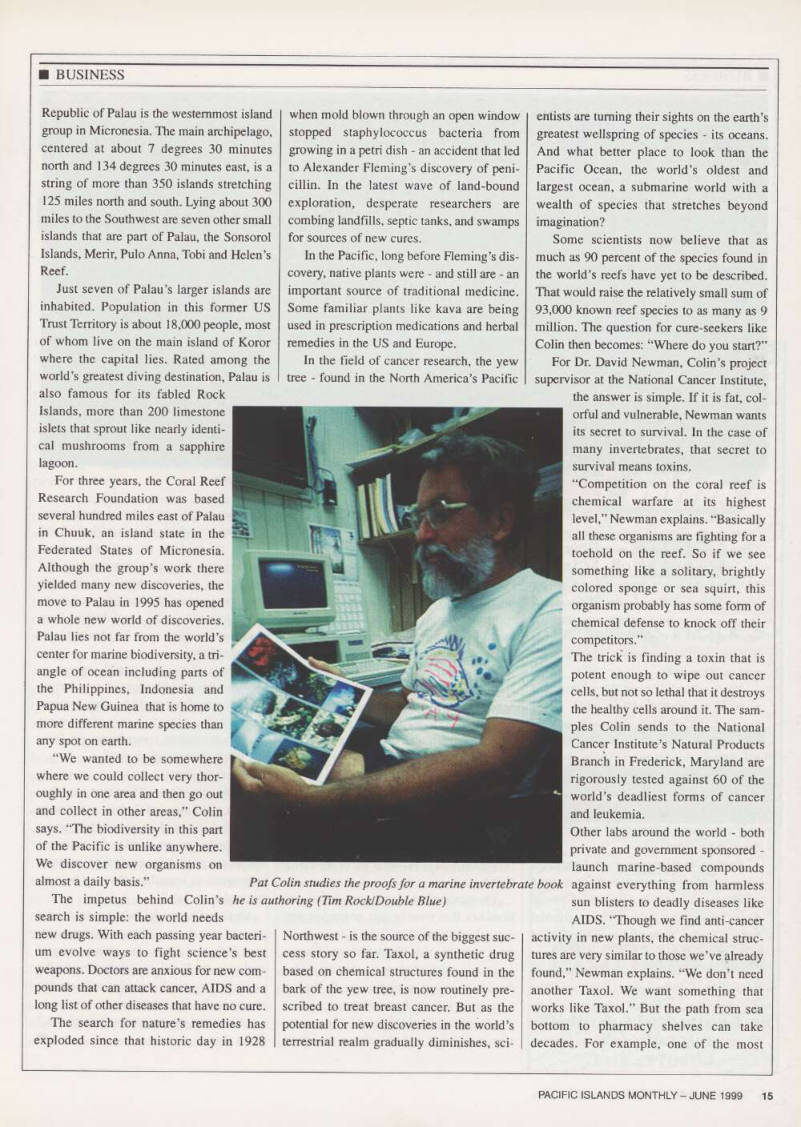
Pat Colin studies the proofs for a marine invertebrate book he is authoring (Tim Rock/Double Blue)
promising marine derivatives still in clini cal trials, Bryostatinl, originates from the fouling organism bugula neritina collected 32 years ago in the Gulf of Mexico.
Although there are many hot prospects undergoing clinical trials, the US Food and Drug Administration - which must approve any drugs sold in the US - has yet to autho rize any anti-cancer agent derived from marine organisms.
“Unfortunately, its not like we can find a cure overnight,” 52-year-old Colin explains. “It’s a gradual winnowing process that can take anywhere from 15 to 30 years.
It’s unlikely that I’ll live to see the greatest discoveries from my work.”
Despite the importance of Colin’s work to the world of medicine, it is not always easy convincing host nations to open their doors to his team.
Fearing exploitation or reef damage,
some island governments balk, or demand exorbitant payment in advance before the Colin’s divers can explore their territorial waters. So far, his team has worked in 14 different countries.
“There’s a lot of misconception about what we do,” Colin laments. “We take only the minimum amount of sample necessary for testing, usually less than 1.5 kilograms.
Our collecting is an exceptionally selective
cropping of a very limited number of species over a broad area.
“People imagine reefs being ‘clear cut’
in our type of work, but nothing could be further from reality. It would be almost impossible to determine where we have collected samples. We don’t collect any hard (stony) corals or threatened, endan gered or locally protected species.”
To counter fears of exploitation, the National Cancer Institute enters into an explicit contract with the host country. The agreement requires the National Cancer Institute to keep host nations abreast of the latest discoveries pertaining to samples taken from their waters.
The institute also must allow for the host country’s scientists to participate in research and drug development and the US government guarantees fair economic com
pensation and protection of biodiversity
rights.
Pharmaceutical firms or educational branches that want to test or market any natural products that Colin’s team finds must agree to abide by the National Cancer Institute’s strict information sharing guide lines and agree to work out a profit sharing agreement with the host country.
One example of this spirit of coopera tion in action is in Sarawak, on the island
of Borneo in Indonesia where a pharmaceu tical firm is working closely with the local
people to produce an anti-aging drug.
Another way host countries can reap the benefits of any discoveries is through developing aquaculture facilities or labora tories. Any anti-cancer agent derived from a marine organism must be obtainable in large quantities.
In most cases, this would require an organism that could be farmed, or a deriva tive compound that could be manufactured synthetically. Already, some of the most sought after marine invertebrates are liter ally worth their weight in gold.
“It really doesn’t make any sense to search for rare species,” Newman explains.
“It may yield the world’s best anti-cancer agent, but it would be the world’s worst drug. Ideally, we are looking for organism that we can grow using modem aquaculture techniques, or something that can be syn thesized in the lab.”
Until that happy day when cancer cures grow in aquariums, Colin and his team will have little rest. Even after seven years of exploring the Pacific’s abundant reefs, the potential for new discoveries still remains as vast as the deep blue sea.
“We’re not by any means through yet,”
Colin says. ■
Palau’s Rock Islands, where Colin is based, provide a plethora of marine life (Tim Rock/Double Blue)
Innovative businessmen to start

cane toad venom exports to Asia
Brisbane - The coal industry may be taking a hammering from falling prices, but another industry may be breeding in the wet lands of Queensland’s far north.
Golfers, drivers and scientists have tried for years to wipe out the cane toad, but now two Melbourne busi nessmen have hatched a scheme they reckon will make a big dent in the ranks of one of Australia’s worst pests.
The population boom started with the introduction of a mere 101 toads as an experiment to eradicate cane beetles in 1935.
The bane of environmentalists and wilderness groups for several years, toads are now threatening to engulf the world heritage-listed Kakadu National Park in the Northern Territory. But Melbourne businessmen Alan Day and John Ratcliffe are gath ering the toads in Far North Queensland to export their venom to Asia for use in traditional medicine.
The first exports of venom, taken from two large glands in the back of the toad’s head, were to have left a production plant at Machans Beach, north of Cairns, in May and may open up a multi-million dollar industry.
The Melbourne-based business con sortium behind the $250,000 venture pay residents of the seaside township to trap the toads and are expanding their operation to the Northern Territory later this year.
The toads are held at a “processing farm” in the township, where they are kept under lights and then cooled before the venom is extracted by nee dles. Venture partner and a practition er of Chinese medicine, Ratcliffe said
plans were also being made to produce
toad byproducts, including chicken
and fish pellets and fertiliser.
He said a telephone hotline with details of toad “drop-off” points was also being set up for collectors in Queensland and the Northern
Territory.
“The skin, eyes, liver, heart and other organs can be freeze-dried and put in containers and exported,”
Ratcliffe said.
“Personally, my idea is to blast them (the dead toads) out of a wood chipper and in to a vat of citric acid to render the remains liquid and for use as a liquid fertiliser”.
Dried toad skin and potions made from toad venom have been used for thousands of years in Chinese medi cine, and are still dispensed to treat congestive heart failure.
Ratcliffe said he hoped the toxins in the toad’s skin, which is a high source of protein, would become inert once mixed with meal and baked, not harming the animals eating the
byproducts.
Ratcliffe said the venture, which had received backing from a Melbourne financier, would extend to a farm in Mackay if the Cairns trial was a success.
“Once the trial is completed at the end of May, we will set up a full-scale collection of the toads in the Northern Territory in August before the wet sea son begins,” he said.
“We would like to keep the prod ucts here in Australia because at least we could use them in a positive way
for the agricultural industry.
“But if the returns are too little and it becomes too expensive we know we can put them in freezers and send
them to China. “It could be big, it’s really just the tip of the iceberg.”
(Aap) ■
Advertisements & other items, p. 17 (1 item)
©Utilux
> V t^A
-At -MMM ■■_■■
THE LEADING BRANDS
, t# .* k :v^ vV *%&
COOPER Tools
>’V^ kv^;;> <vpfe cN v c v^' s 4 \ ,J^
.CR6L6S
nVI
Mffrox* EB3£3BBOm
k V .V&&v 4J^; rtfe >i
OTKNAri<)NAL TRADERS & CONSULTANTS
x- v, "SV* x >iva^ v \>& :v^ v xX^ .a^^ v x..c’ \r ys^
©UTILUX
.«^>* v .;> r>^ %<& V -<x W ■' feV, ■■ V^ xV r
yFax ;3701f
:*** x:
hsS^S
FATERA will eventually
By Sophie Foster Hildbrand
ANEW Fiji/Australia
Trade and Economic Relations Agreement (PATERA) will eventu ally replace SPARTECA’s (South Pacific Regional Trade and Economic Cooperation Agreement) role in trade between the two countries.
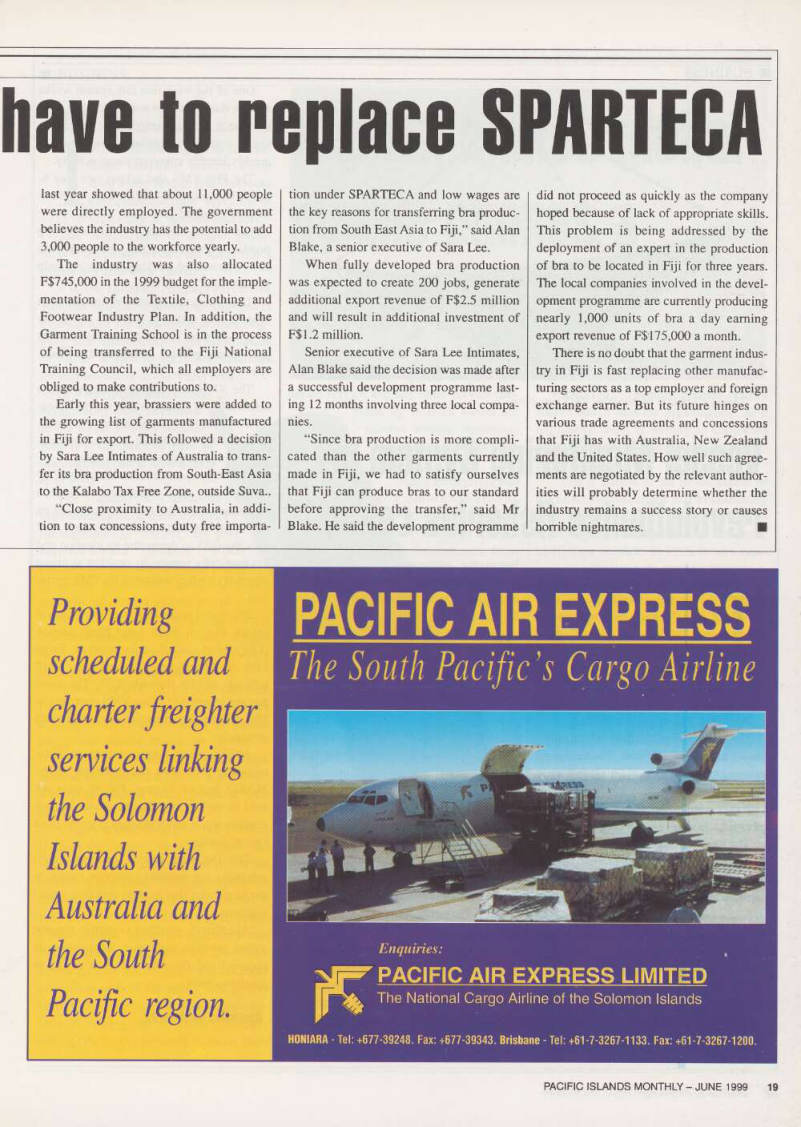
Fiji’s outgoing foreign affairs minister,
Berenado Vunibobo, said that the new trade and economic co-operation agreement would “complement and supplement SPARTECA, but will eventually become the main instrument of economic co-opera tion between Fiji and Australia”. Fiji’s out going cabinet accepted the text of the agree ment but it is unclear when implementation will begin.
Fiji and Australia negotiated the succes sor Agreement as the comparative advan tage and trade benefits to Fiji of the region al SPARTECA arrangement were declining.
A cabinet statement said the agreement would enhance both trade and economic co operation between the two countries in an international environment that was fast moving towards a deregulated market.
“The Agreement is a Framework Agreement which is very general in nature to allow for industry-specifics to be later negotiated and appended to the Agreement.
An example of this is the draft Memorandum of Understanding now being finalised between the TCF Councils of Fiji and Australia,” cabinet said.
Commodity trade with Australia contin ued to be in Australia’s favour with trade deficits increasing from A$ 161,314 million in 1993/94 to A 5259,596 million in 1996/97, falling slightly to A 5219,629 mil lion in 1997/98.
However, Fiji garment exports to Australia continued to increase and in 1996 approximately 54 per cent of the TCF prod ucts made in Fiji were sold in the Australian market. Fiji’s exports to Australia increased from $163,434 million in 1993/94 to
$306,555 million in 1997/98. Cabinet said
that when Fiji’s foreign exchange earnings
from Australian tourist visitors to Fiji were added, the trade gap between the two coun tries would be quite close, though still in Australia’s favour.
The statement said Australia would con tinue to be an important market for Fiji due to its proximity. It was, therefore, envisaged that the new Agreement (PATERA) would allow for the development of more trade between the two countries increasingly in Fiji’s favour.
Meanwhile, Australia granted Fiji’s gar ment exports a three-month extension of concessions under SPARTECA. The Fiji government officially requested the conces-
sions from Australia in March.
Fiji-made garments need at least 50 per cent local content to enter duty free into Australia under SPARTECA. However, it became difficult to achieve that standard when the Fiji dollar was devalued by 20 percent last year.
The Australian Government gave a six percent derogation for temporary relief last year, but that expired at the end of April.
The Fiji Government says that the three
month extension would allow Australian authorities to consider Fiji’s requests for further concessions.
New Zealand agreed to extend the dero gation period for garment imports from Fiji to the year 2006, but rejected Fiji’s requests to remove the 25 percent local content rule on its garments.
In its 1999 budget, the Fiji government the clothing and footwear industry to expand by around eight per cent this year.
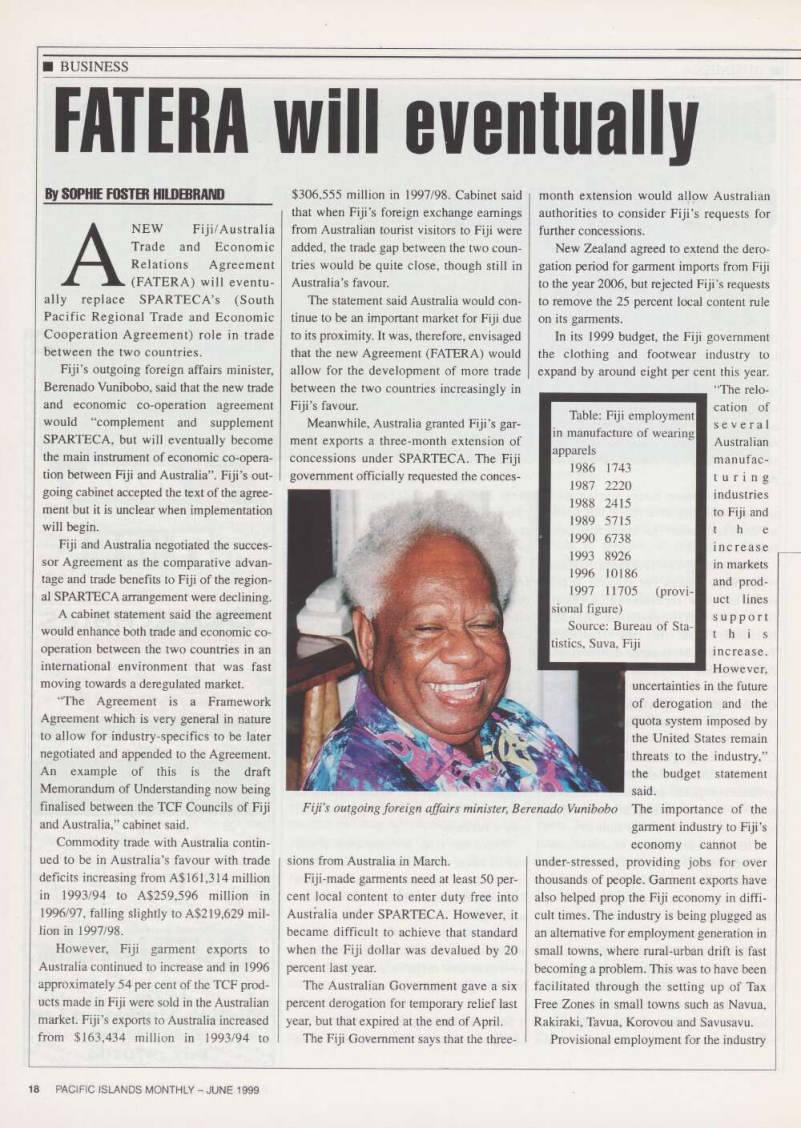
Table: Fiji employment in manufacture of wearing apparels 1986 1743 1987 2220 1988 2415 1989 5715 1990 6738 1993 8926 1996 10186 1997 11705 (provi sional figure) Source; Bureau of Sta tistics, Suva, Fiji
“The relo cation of several Australian manufac tur i n g industries to Fiji and t h e increase in markets and prod uct lines support this increase.
However,
uncertainties in the future of derogation and the quota system imposed by the United States remain threats to the industry,” the budget statement said.
The importance of the garment industry to Fiji’s economy cannot be
under-stressed, providing jobs for over thousands of people. Garment exports have also helped prop the Fiji economy in diffi cult times. The industry is being plugged as an alternative for employment generation in small towns, where rural-urban drift is fast becoming a problem. This was to have been facilitated through the setting up of Tax Free Zones in small towns such as Navua, Rakiraki, Tavua, Korovou and Savusavu.
Provisional employment for the industry
Fiji’s outgoing foreign affairs minister, Berenado Vunibobo
last year showed that about 11,000 people were directly employed. The government believes the industry has the potential to add 3,000 people to the workforce yearly.
The industry was also allocated F 5745,000 in the 1999 budget for the imple mentation of the Textile, Clothing and Footwear Industry Plan. In addition, the Garment Training School is in the process of being transferred to the Fiji National Training Council, which all employers are obliged to make contributions to.
Early this year, brassiers were added to the growing list of garments manufactured in Fiji for export. This followed a decision by Sara Lee Intimates of Australia to trans fer its bra production from South-East Asia to the Kalabo Tax Free Zone, outside Suva..
“Close proximity to Australia, in addi tion to tax concessions, duty free importa
tion under SPARTECA and low wages are the key reasons for transferring bra produc tion from South East Asia to Fiji,” said Alan Blake, a senior executive of Sara Lee.
When fully developed bra production was expected to create 200 jobs, generate additional export revenue of F 52.5 million and will result in additional investment of Fsl.2 million.
Senior executive of Sara Lee Intimates, Alan Blake said the decision was made after a successful development programme last ing 12 months involving three local compa nies.
“Since bra production is more compli cated than the other garments currently made in Fiji, we had to satisfy ourselves that Fiji can produce bras to our standard before approving the transfer,” said Mr Blake. He said the development programme
did not proceed as quickly as the company hoped because of lack of appropriate skills.
This problem is being addressed by the deployment of an expert in the production of bra to be located in Fiji for three years.
The local companies involved in the devel opment programme are currently producing nearly 1,000 units of bra a day earning export revenue of F$ 175,000 a month.
There is no doubt that the garment indus try in Fiji is fast replacing other manufac turing sectors as a top employer and foreign exchange earner. But its future hinges on various trade agreements and concessions that Fiji has with Australia, New Zealand and the United States. How well such agree ments are negotiated by the relevant author ities will probably determine whether the industry remains a success story or causes horrible nightmares. ■
Advertisements & other items, p. 19 (2 items)
have to replace SPARTECA
19
PACIFIC ISLANDS MONTHLY - JUNE 1999
Pacific Air Express
Providing scheduled and charter freighter services linking the Solomon Islands with Australia and the South Pacific region.
2 --- Enquiries:
PACIFIC AIR EXPRESS LIMITED
The National Cargo Airline of the Solomon Islands HONIARA - Tel: +677-39248. Fax: +677-39343. Brisbane - Tel: +6l-7-3267-1133. Fax: +6l-7-3267-1200.
Vessel Monitoring System to revolutionise fisheries control

revolutionise fisheries control
By Sophie Foster Hildebrand
IF anyone had said, a little over a decade ago, that before the year 2000, South Pacific coun tries would be able to track (in near-real-time) the activities of vessels fishing in their waters, they might have been met with laughter.
But today, this vision is a reality.
Through the Forum Fisheries Agency’s Vessel Monitoring System, Pacific Island nations can keep stock of who is fishing in their waters, where they are fishing, how long they stay for and if they meet up with other vessels at sea.
The Regional Vessel Monitoring System,
first proposed in 1993, was primarily aimed at sustaining Pacific tuna stocks but also came about out of pure necessity.
Some of the problems that the industry and authorities had come across included the inability to monitor illegal fishing activ ities, under-reporting and mis-reporting by fishing vessels, and the need to improve
compliance.
The FFA VMS is not only aimed at improving fisheries management, but also
improving awareness of fishing vessel movements, and enhancing communication capability and information exchange between the FFA and member countries.
The VMS automatically monitors the location of vessels, then analyses and pre sents this information to FFA and its mem bers.
The FFA VMS is capable of handling position reports of up to 2000 vessels, pro viding near-real-time monitoring.
It helps countries to detect vessels as they enter or leave Exclusive Economic Zones (EEZ); those which are travelling slowly in an EEZ for which the vessel is not licenced to fish; and vessels travelling slowly in a closed area.
It also allows operators to check on ves sels that fail to return a scheduled position report, and identify those that are dead in the water (which usually means that they are fishing or collecting their lines).
The system also allows authorities to cross-check their data against that of a ves sel’s log of claimed catch location. It pro vides an indication of fishing activity and targetted species through analysis of the ves sel’s track pattern, location and speed.
One of the ways that this system works against those who are not licenced, is that, because it provides information on known vessel activity, surveillance missions can quickly identify unknown vessel activity.
The FFA VMS also allows two-way e mail communication between FFA, its mem bers and licenced vessels.
But the applications are not merely big brother, because as some operators have said, a monitored tracking system can help in search and rescue efforts.
The system can be used to find and alert vessels near a ship-in-distress, and if the ship-in-distress is part of the network, its last reported position may be used to identi fy the search area.
The VMS works by providing position information of vessels, which are then trans ferred to the FFA Headquarters, processed, analysed and distributed to member coun tries. It is presented as a map display.
The vessel position data is collected by means of an Automatic Location Communicator (ALC) which is installed on all vessels licenced to fish in the area. ALC uses the GPS to determine its location and automatically reports its position at preset intervals or when requested by VMS opera tors.
The vessel position data is sent from the vessel ALC to Perth Land Earth Station (LES) by the satellite Inmarsat-C. From LES, the information is beamed to the VMS hub site at FFA through X. 25. The same process is reversed when VMS operators at FFA and member countries send commands to vessels.
At FFA, vessel position reports are auto matically processed and analysed by the MAKO Support system. Pre-set rules are used by the Decision Engine to analyse each position report and VMS data is stored in an Oracle database.
The Decision Engine generates alert messages for member countries based on decision rules that analyse reported vessel
positions.
Alternately, member countries request vessel position and other information as required and the information is stored in local databases.
Continued on page 22
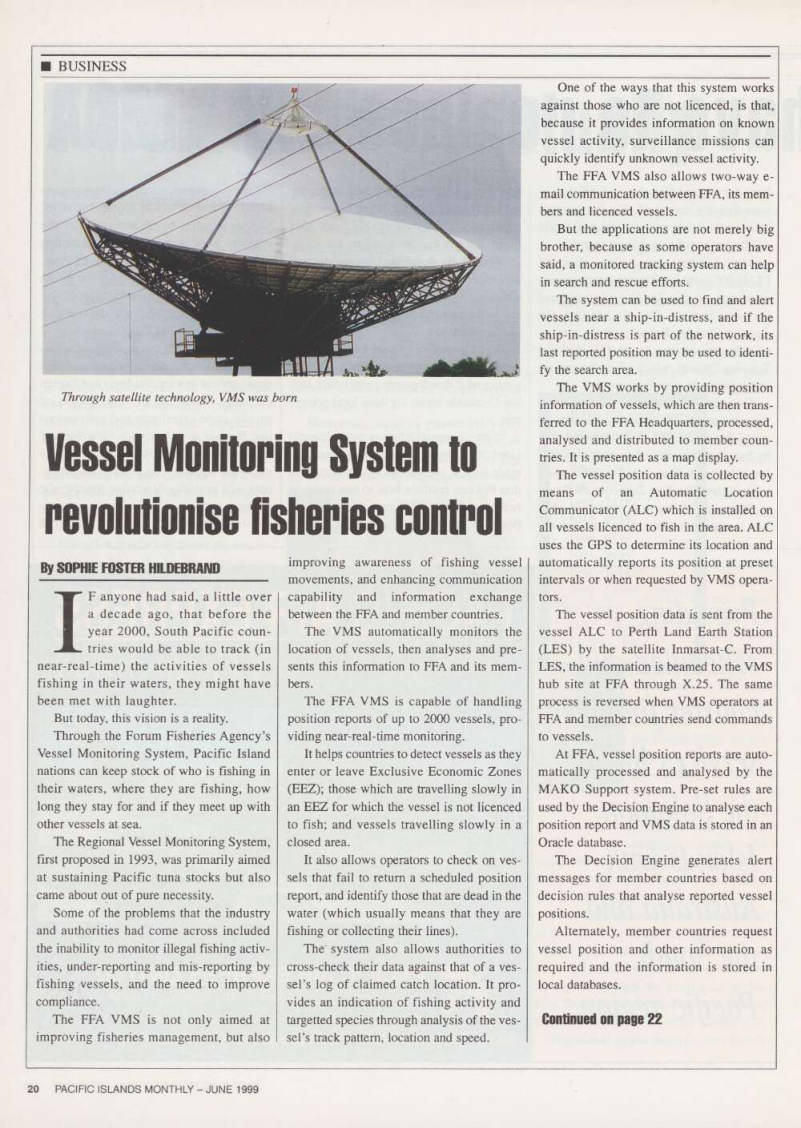
Through satellite technology, VMS was born
From page 20
To transfer the data from the FFA to its members, several methods can be used.
Chief amongst these, and considered more reliable than the rest if the use of the Internet.
In countries where no Internet service exists, IDD (international direct dial) can be used.
The FFA VMS is also geared to allow downloads through Satcom-C (ALC comms, telex, fax, GMDSS, access to Fleet Net) but it is currently not configured.
To ensure security, which is a prime concern for fishing fleets in such a compet itive industry, an encryption system called Smart Crypt - which encodes and decodes data (based on public key algorithm) - is
used. Each FFA member can tailor aspects of the FFA VMS to reflect their require ments through the VMS system. For exam ple, individual countries can decide how frequently and which vessels it wishes to monitor.
The system is also designed to be inte grated with other fisheries management systems such as the Vessel Licencing
System, People and Organisations
Database System, and the Regional
Registrar of Foreign Fishing Vessels.
To sustain the system, FFA member countries set up a VMS Register process, incorporating a VMS levy that sets an annual fee level aimed at fully recovering the cost of operating the system.
It also approved that the VMS levy be
collected from all foreign fishing vessels as a condition before obtaining a licence to fish in the EEZs of FFA member countries.
The current fee level is set at US$B45 per vessel per annum, based on the assump tion that 1,000 vessels will operate the VMS. Simple mathematics places the operating figure at U 55845,000.
FFA forecasts that, in future, its VMS can be used to collect and process catch reports (and other reports) from vessels, tracking non-fisheries related vessels such as hazardous chemical and oil tankers and detect likely transshipment of catch at sea
by analysis of possible rendezvous with
other vessels.
Suddenly, the Pacific ocean does not seem so huge after all. ■
reality in PNG
Iridium makes global mobile phones a reality in PNG
By Brian Tobia
IMAGINE dialling up an interna tional telephone number direct from a very remote area that lacks telecommunication services or links through cable or repeater stations.
The introduction of a new global mobile telephone service has made this a reality in Papua New Guinea.
It is now easier for company executives with international connections (engaged in explorations for mineral resources, log ging, and agriculture) to get information
of value across to their organisations located anywhere in the world faster.
Or vice-versa, direct com munications from anywhere in the world to PNG without ’|k jj/k rushing to the office to make an international call is now a reali- J ty in PNG. ) The country's advanced BB| telecommunication network under the monopoly of 100 per cent gov- V ernment-owned Telikom (PNG) % Limited has introduced a new product 18 to further boost communication links between the country and the world.
Telikom launched the global mobile satellite telephones - which can be used to reach the rest of the world from anywhere in the country - last month.
Telikom (PNG) in conjunction with Pacific Iridium Telecommunication Company of Taiwan launched the premi um global mobile telephone service in PNG. The new global mobile telephone service has immediately attracted over whelming interest from potential cus tomers.
Already a total 1000 customers (main ly from the mineral resource sector and other industries) have applied to get the new mobile phones. Telikom executives anticipate more expressions of interest in the new product. Managing director, Thomas Tulin, expressed optimism that the potential market base for these new global mobile telephones includes chief executives of both the public and private sectors and resource companies (particu
larly in mining and petroleum, forestry
and agriculture) operating in most rural
settings.
He said the new global mobile tele phone service and any other service pro vided by Telikom would not survive without customers HI from these important sec tors.
Public Enterprises and
9k Communications
Jk Minister, Dr. Fabian Pok, also urged ■A. consumers from these important ft sectors to use the new ■k service for
Ba develop-
Hk ing pro- Hk jec t s mk t h e i*s!k rural areas ot Papua New Guinea. He said was amazing that a customer can B make a phone call using the same tele- B phone and same " number anywhere in the world.
Telecommunication is a key component of any development programme and govern ments and businesses cannot operate with out instant communications in both the urban and rural sectors, he added. Telikom (PNG) now has one of the world's most advanced telecommunication systems fol-
lowing the introduction of this new ser vice into the country.
PANGTEL director general Philip Aeava added that his organisation, as a regulatory body, is willing to cooperate with the industry for the benefit and inter est of everyone.
"This is critical to the development of the telecommunications and broadcasting industry and realisation of national devel
opment goals and objectives ... launching
of Iridium services in PNG is an exam ple," he added.
The Iridium Global Mobile Personal Communication Satellite Service (GMPCS) will have the advantage of using only one number and one phone bill thus enabling customers from PNG to ring anywhere in the world.
Iridium, an American company, has about 67 satellites circling the world.
Sources in the know said initially one thousand subscribers will be connected to the service.
Unlike the cellular system, users do not have to be near a repeater station or an exchange.
The handsets for the GMPCS would be I supplied by licenced dealers, Boina Investments and Pacom Communications for about K 14,000 and each customer will be allocated a 12-digit number - the two companies are distributors of the Kyocera and Motorola handsets (see picture) respectively. Other charges include: an activation charge of K 155 and an advanced six-month rental of K 1,200.
Telikom paid about U 55275,000 in May last year to be part of the Iridium sys tem. ■
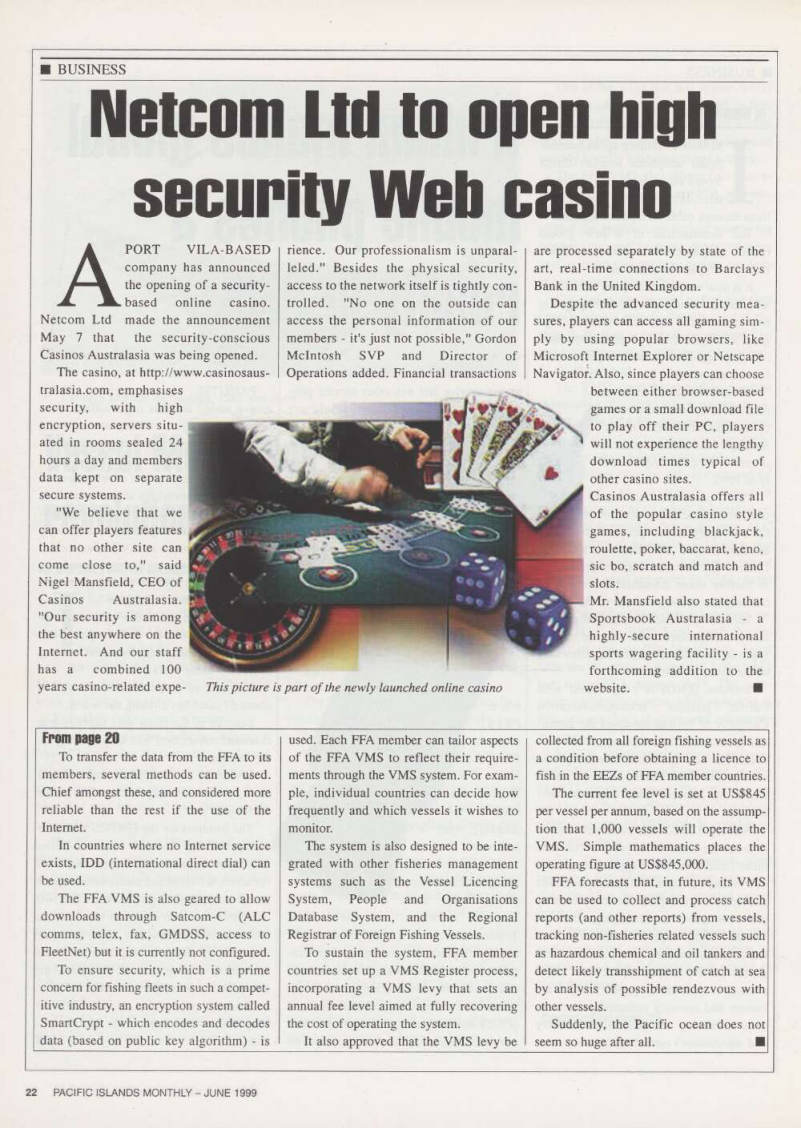
Aport Vila-Based
Netcom Ltd to open high security Web casino
company has announced the opening of a security based online casino.
Netcom Ltd made the announcement May 7 that the security-conscious Casinos Australasia was being opened.
The casino, at http://www.casinosaus
tralasia.com, emphasises
security, with high encryption, servers situ ated in rooms sealed 24 hours a day and members data kept on separate secure systems.
"We believe that we can offer players features that no other site can come close to," said Nigel Mansfield, CEO of Casinos Australasia.
"Our security is among the best anywhere on the Internet. And our staff has a combined 100 years casino-related expe
rience. Our professionalism is unparal leled." Besides the physical security, access to the network itself is tightly con trolled. "No one on the outside can access the personal information of our members - it's just not possible," Gordon Mclntosh SVP and Director of Operations added. Financial transactions
are processed separately by state of the art, real-time connections to Barclays Bank in the United Kingdom.
Despite the advanced security mea sures, players can access all gaming sim
ply by using popular browsers, like
Microsoft Internet Explorer or Netscape Navigator. Also, since players can choose
between either browser-based games or a small download file to play off their PC, players 1 will not experience the lengthy download times typical of other casino sites.
Casinos Australasia offers all of the popular casino style games, including blackjack, roulette, poker, baccarat, keno, sic bo, scratch and match and slots. ■ Mr. Mansfield also stated that Sportsbook Australasia - a
highly-secure international
sports wagering facility - is a forthcoming addition to the website. ■
This picture is part of the newly launched online casino
warriors',
'Once were warriors', and now a sequel
HER name is Nancy Brunning and you last saw her in the dreadful soap “Shortland Street” playing a nurse.
Now she’s set for international star dom on the back of her latest role in the New Zealand Maori drama “What Becomes of the Broken Hearted?”
A sequel to the depressing and vio lent “Once Were Warriors” (and still New Zealand’s most profitable movie if you don’t count the French- Australian “The Piano”) the new movie premiered in Auckland last month to an audience weary of the hard right-wing politics of the author of the books the movies are based on, Alan Duff.
He is the darling of the free market here for the seemingly brutal ease with which he exposes a harsh “reality” of Maori people in New Zealand; down and out, losers, heavy drinkers and so very much into the ultimate mindless violence.
It is all built around the character created by Temuera Morrison - “Jake the Muss”.
On the strength of “Once Were Warriors” Morrison went off to Hollywood and ended up in a couple of lightweight flicks, at one point
sharing the screen with one of the big-breasted “Baywatch” babes. Now he is back in New Zealand and with Duff is rebuilding Jake the Muss, but this time as somebody becoming increas ingly troubled over his life and its violence.
The resulting film is grim to say the least and frankly is something of a puzzle to see how it is acceptable to dish up cliches, silly lines and plain nonsense, just so long as it is dressed up in Maoridom and Polynesian culture.
The attempted redemption of Jake turns not so much on his rejection of violence, but
the triumph of violence over, well, other violence. It is all a tad sickening.
That said, the effort by Nancy Brunning is outstanding.
She played Tania, girlfriend of one of Jake’s sons who gets killed right at the beginning of the movie. She joins up with another brother (played by strong new star Clint Eruera) to seek revenge.
The role is grubby and tragic but
Brunning, strongly and beautifully
Polynesian, brings to it dignity and strength that gives one hope that some day somebody will give her a decent role.
She told the Listener magazine that in the original scrip her character, Tania, was too passive, hiding behind wrap-around dark sunglasses.
“Tania’s spent years in the gang and I don’t think she knows who she really is any more, just who she is as a gang m 011... But I wanted to find a balance, to show her strength - that survival
thing.
Even though she’s a victim. I didn’t want people to write her off the moment they first saw her.” ■
Advertisements & other items, p. 23 (1 item)
Tourist Information Centre
FM ISLAND AOVENTDBES S
Sec etc fan excellent eic tut Gv&utiylt Stay! r 7nc&6t*ty ScqAt&eeittq-l 4 'Zdlccl Safavti r 7<Mnc!
Sttnfaety Sett&z Dieting! ‘Suyci /teecetuttcdeitoMc! @nettcec tutd Ti/eddittyc!
Talk to us first -we live here... book direct and ask for: Free independent information on latest deals!
Free booking services and many options!
Free airport transfers to hotel of your choice in Nadi!
Free greet on arrival & maps. Also general info on Fiji Write to us now or [email protected] PO Box 251 Nadi Fiji Islands Ph: 679 700243 Fax: 679 702746 lnternet:www.fijiadventures.com.fj
Adoptions are
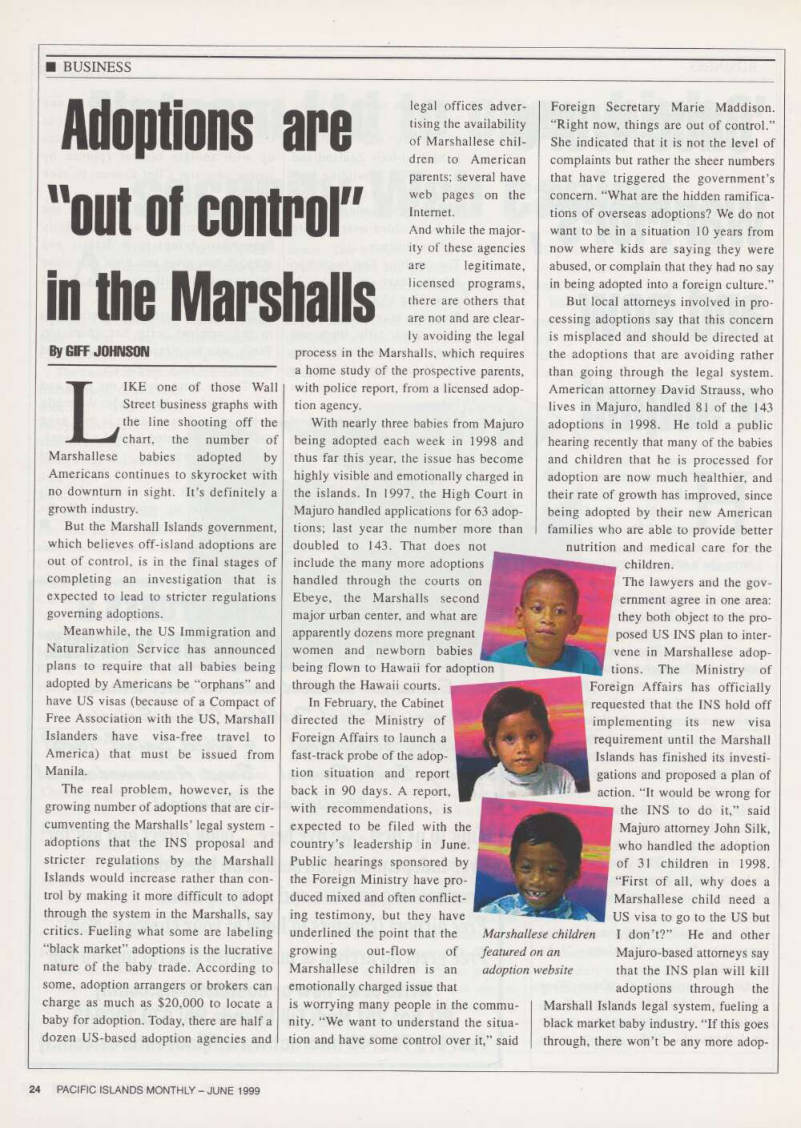
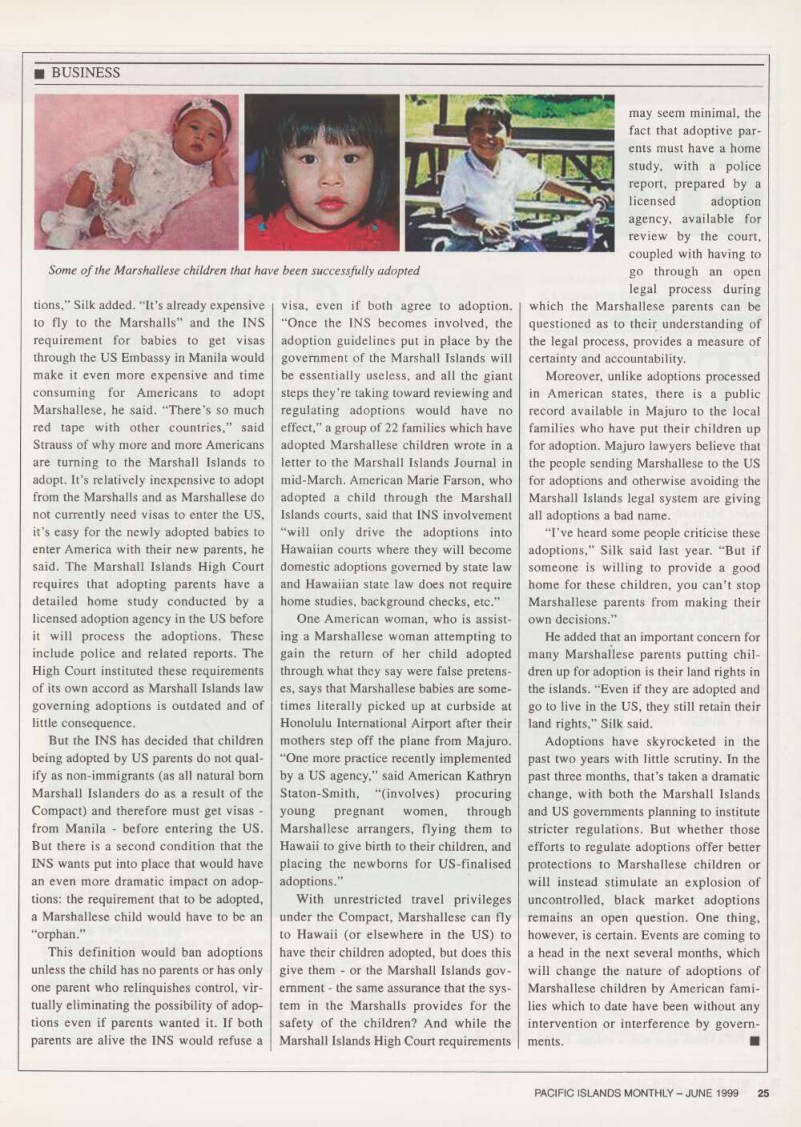
"out of control" in the Marshalls
By Giff Johnson
LIKE one of those Wall Street business graphs with the line shooting off the chart, the number of Marshallese babies adopted by Americans continues to skyrocket with no downturn in sight. It’s definitely a
growth industry.
But the Marshall Islands government, which believes off-island adoptions are out of control, is in the final stages of completing an investigation that is expected to lead to stricter regulations
governing adoptions.
Meanwhile, the US Immigration and Naturalization Service has announced plans to require that all babies being adopted by Americans be “orphans” and have US visas (because of a Compact of Free Association with the US, Marshall Islanders have visa-free travel to America) that must be issued from Manila.
The real problem, however, is the growing number of adoptions that are cir cumventing the Marshalls’ legal system adoptions that the INS proposal and stricter regulations by the Marshall Islands would increase rather than con trol by making it more difficult to adopt through the system in the Marshalls, say critics. Fueling what some are labeling “black market” adoptions is the lucrative nature of the baby trade. According to some, adoption arrangers or brokers can charge as much as $20,000 to locate a baby for adoption. Today, there are half a
dozen US-based adoption agencies and I
legal offices adver tising the availability of Marshallese chil dren to American parents; several have web pages on the Internet.
And while the major ity of these agencies are legitimate, licensed programs, there are others that are not and are clear ly avoiding the legal
process in the Marshalls, which requires a home study of the prospective parents, with police report, from a licensed adop tion agency.
With nearly three babies from Majuro being adopted each week in 1998 and thus far this year, the issue has become highly visible and emotionally charged in the islands. In 1997, the High Court in Majuro handled applications for 63 adop tions; last year the number more than
doubled to 143. That does not include the many more adoptions I handled through the courts on I Ebeye, the Marshalls second fl major urban center, and what are J| apparently dozens more pregnant ga women and newborn babies JH being flown to Hawaii for adoption through the Hawaii courts. mggggKt In February, the Cabinet directed the Ministry of - fl Foreign Affairs to launch a M fast-track probe of the adop- B|hK tion situation and report back in 90 days. A report, V with recommendations, is expected to be filed with the mk country’s leadership in June, * Public hearings sponsored by H the Foreign Ministry have pro- H duced mixed and often conflict- H ing testimony, but they have ** underlined the point that the Me growing out-flow of fee Marshallese children is an ad emotionally charged issue that
is worrying many people in the commu nity. “We want to understand the situa tion and have some control over it,” said
Foreign Secretary Marie Maddison.
“Right now, things are out of control.”
She indicated that it is not the level of complaints but rather the sheer numbers that have triggered the government’s concern. “What are the hidden ramifica tions of overseas adoptions? We do not want to be in a situation 10 years from now where kids are saying they were abused, or complain that they had no say in being adopted into a foreign culture.”
But local attorneys involved in pro cessing adoptions say that this concern is misplaced and should be directed at the adoptions that are avoiding rather than going through the legal system.
American attorney David Strauss, who lives in Majuro, handled 81 of the 143 adoptions in 1998. He told a public hearing recently that many of the babies and children that he is processed for adoption are now much healthier, and their rate of growth has improved, since being adopted by their new American families who are able to provide better
nutrition and medical care for the children.
'% ■ The lawyers and the gov ■ ernment agree in one area: IP they both object to the pro ill posed US INS plan to inter- Hf vene in Marshallese adop *f.i tions. The Ministry of
■ Foreign Affairs has officially
requested that the INS hold off t implementing its new visa requirement until the Marshall Islands has finished its investi gations and proposed a plan of action. “It would be wrong for the INS to do it,” said Ik W Majuro attorney John Silk, who handled the adoption ■n of 31 children in 1998. ■ “First of all, why does a *. H Marshallese child need a BIRiB US visa to go to the US but ildren I don’t?” He and other Majuro-based attorneys say te that the INS plan will kill
adoptions through the
Marshall Islands legal system, fueling a black market baby industry. “If this goes through, there won’t be any more adop-
Marshallese children featured on an adoption website
tions,” Silk added. “It’s already expensive to fly to the Marshalls” and the INS requirement for babies to get visas through the US Embassy in Manila would make it even more expensive and time consuming for Americans to adopt Marshallese, he said. “There’s so much red tape with other countries,” said Strauss of why more and more Americans are turning to the Marshall Islands to
adopt. It’s relatively inexpensive to adopt
from the Marshalls and as Marshallese do not currently need visas to enter the US, it’s easy for the newly adopted babies to enter America with their new parents, he said. The Marshall Islands High Court requires that adopting parents have a detailed home study conducted by a licensed adoption agency in the US before it will process the adoptions. These include police and related reports. The High Court instituted these requirements of its own accord as Marshall Islands law governing adoptions is outdated and of little consequence.
But the INS has decided that children being adopted by US parents do not qual ify as non-immigrants (as all natural bom Marshall Islanders do as a result of the Compact) and therefore must get visas from Manila - before entering the US.
But there is a second condition that the INS wants put into place that would have an even more dramatic impact on adop tions: the requirement that to be adopted, a Marshallese child would have to be an “orphan.”
This definition would ban adoptions unless the child has no parents or has only one parent who relinquishes control, vir
tually eliminating the possibility of adop
tions even if parents wanted it. If both parents are alive the INS would refuse a
visa, even if both agree to adoption.
“Once the INS becomes involved, the adoption guidelines put in place by the government of the Marshall Islands will be essentially useless, and all the giant steps they’re taking toward reviewing and regulating adoptions would have no effect,” a group of 22 families which have adopted Marshallese children wrote in a letter to the Marshall Islands Journal in mid-March. American Marie Parson, who adopted a child through the Marshall Islands courts, said that INS involvement “will only drive the adoptions into Hawaiian courts where they will become domestic adoptions governed by state law and Hawaiian state law does not require home studies, background checks, etc.”
One American woman, who is assist ing a Marshallese woman attempting to gain the return of her child adopted through what they say were false pretens es, says that Marshallese babies are some times literally picked up at curbside at Honolulu International Airport after their mothers step off the plane from Majuro.
“One more practice recently implemented by a US agency,” said American Kathryn Staton-Smith, “(involves) procuring young pregnant women, through Marshallese arrangers, flying them to Hawaii to give birth to their children, and placing the newborns for US-finalised
adoptions.”
With unrestricted travel privileges under the Compact, Marshallese can fly to Hawaii (or elsewhere in the US) to have their children adopted, but does this give them - or the Marshall Islands gov ernment - the same assurance that the sys tem in the Marshalls provides for the safety of the children? And while the Marshall Islands High Court requirements
may seem minimal, the fact that adoptive par ents must have a home study, with a police report, prepared by a licensed adoption agency, available for review by the court, coupled with having to go through an open legal process during
which the Marshallese parents can be questioned as to their understanding of the legal process, provides a measure of certainty and accountability.
Moreover, unlike adoptions processed in American states, there is a public record available in Majuro to the local families who have put their children up for adoption. Majuro lawyers believe that the people sending Marshallese to the US for adoptions and otherwise avoiding the Marshall Islands legal system are giving all adoptions a bad name.
“I’ve heard some people criticise these adoptions,” Silk said last year. “But if someone is willing to provide a good home for these children, you can’t stop Marshallese parents from making their own decisions.”
He added that an important concern for many Marshallese parents putting chil dren up for adoption is their land rights in the islands. “Even if they are adopted and go to live in the US, they still retain their land rights,” Silk said.
Adoptions have skyrocketed in the past two years with little scrutiny. In the past three months, that’s taken a dramatic change, with both the Marshall Islands and US governments planning to institute stricter regulations. But whether those efforts to regulate adoptions offer better protections to Marshallese children or will instead stimulate an explosion of uncontrolled, black market adoptions remains an open question. One thing, however, is certain. Events are coming to a head in the next several months, which will change the nature of adoptions of Marshallese children by American fami lies which to date have been without any intervention or interference by govern ments. ■
Some of the Marshallese children that have been successfully adopted
Crossing Fiji's
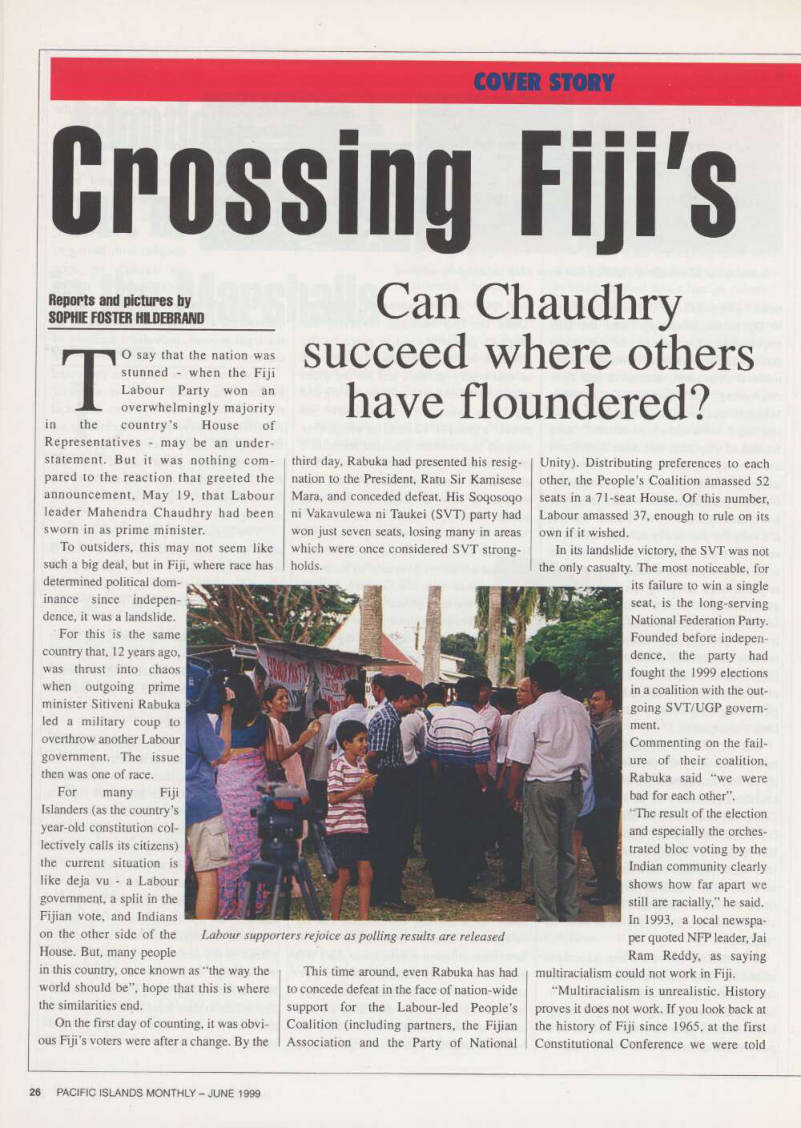
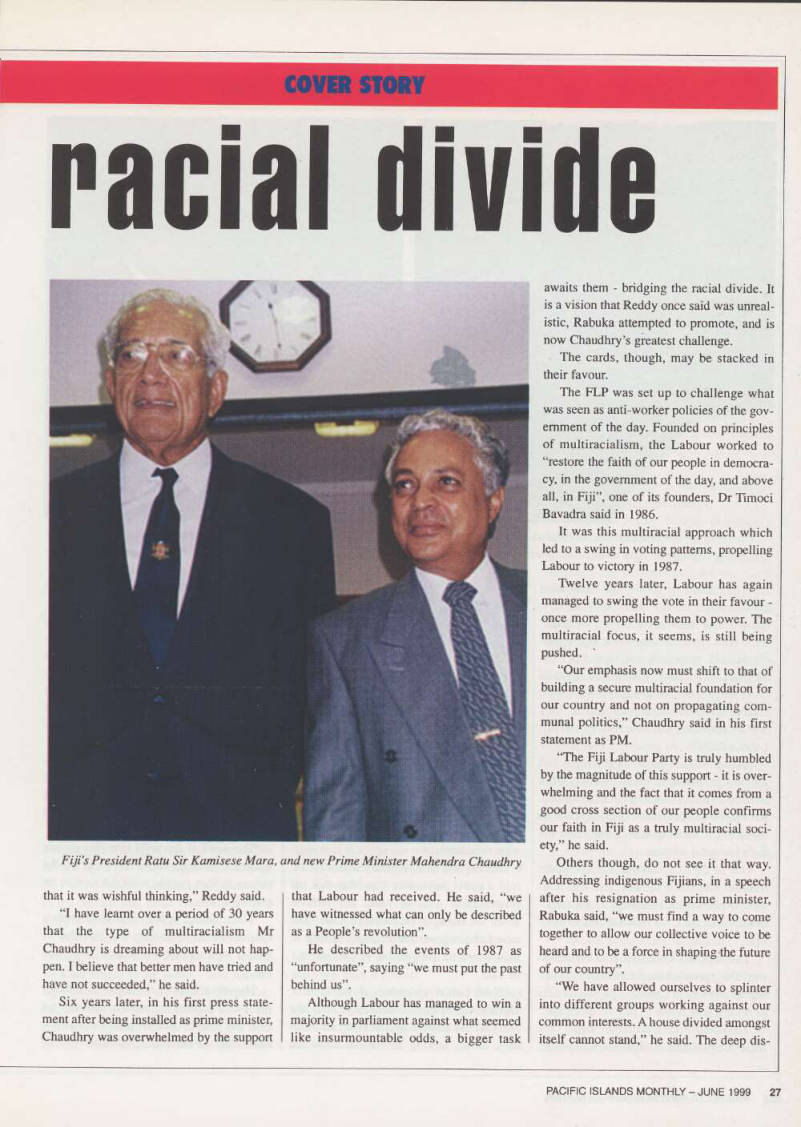
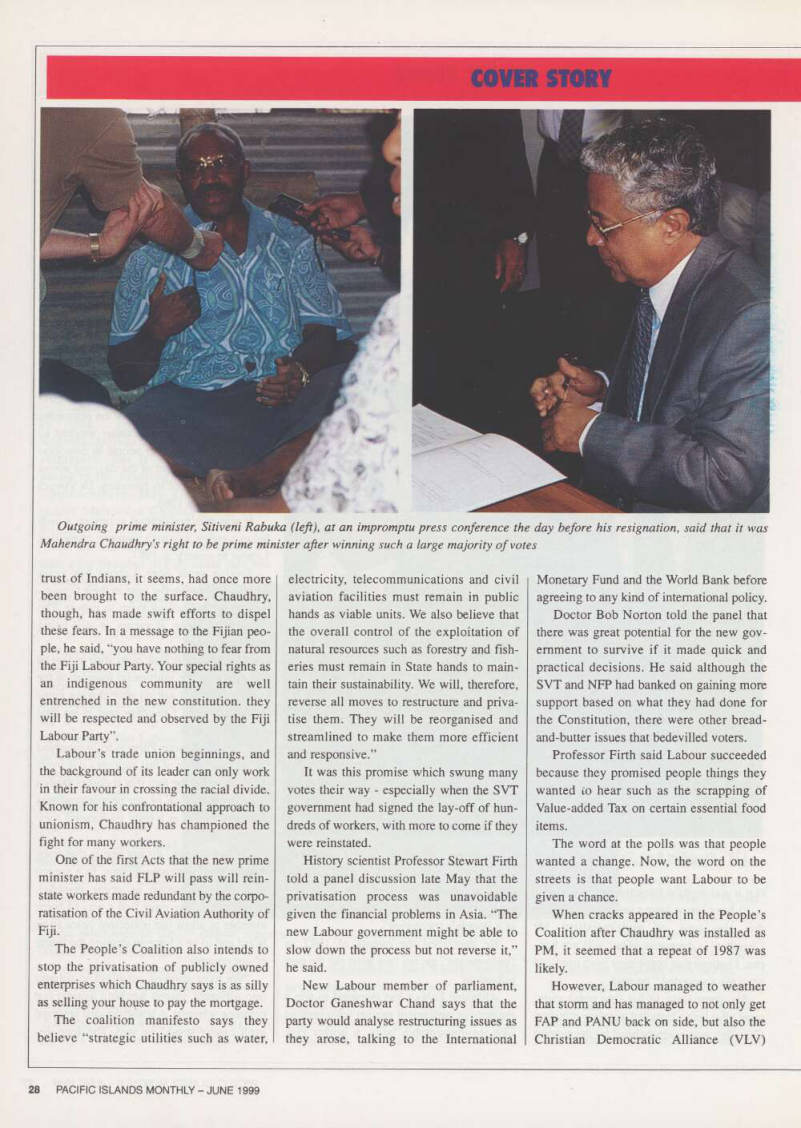
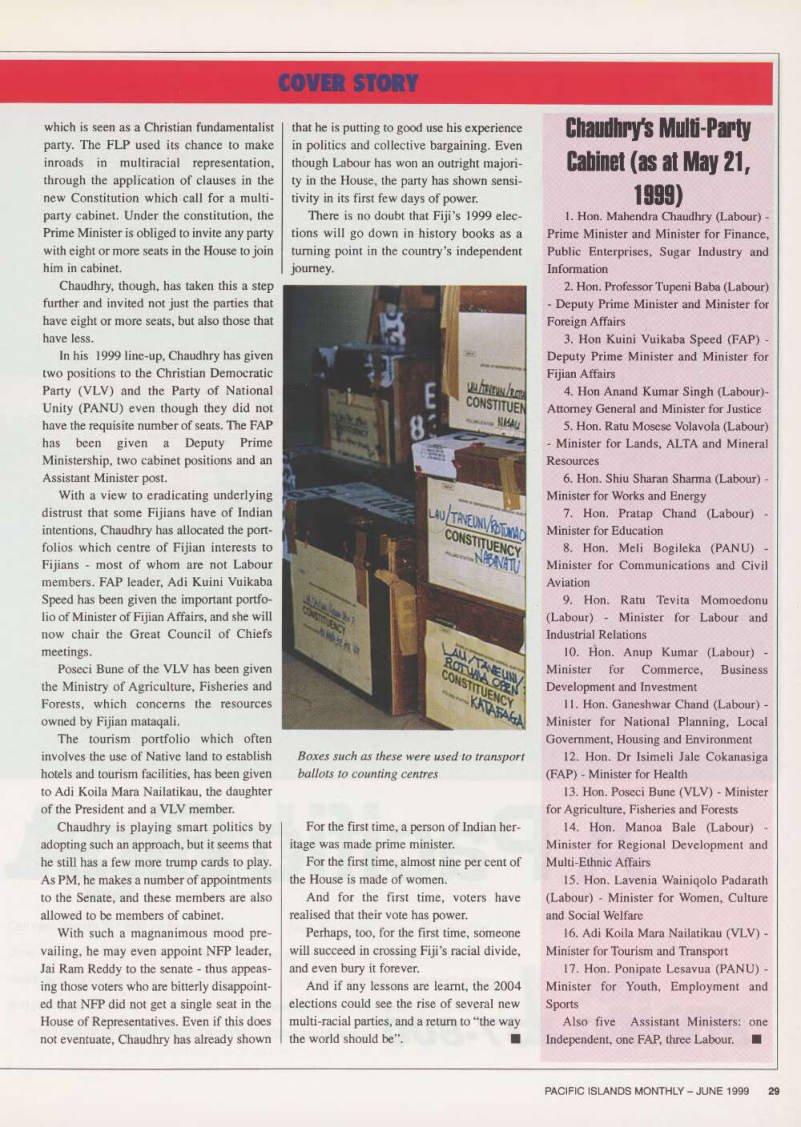
Cover Story
Can Chaudhry succeed where others have floundered?
Reports and pictures by
Sophie Foster Hildebrand
TO say that the nation was stunned - when the Fiji Labour Party won an
overwhelmingly majority
in the country’s House of Representatives - may be an under statement. But it was nothing com pared to the reaction that greeted the announcement, May 19, that Labour leader Mahendra Chaudhry had been sworn in as prime minister.
To outsiders, this may not seem like such a big deal, but in Fiji, where race has
determined political dom inance since indepen dence, it was a landslide.
For this is the same country that, 12 years ago, was thrust into chaos when outgoing prime minister Sitiveni Rabuka led a military coup to overthrow another Labour government. The issue then was one of race.
For many Fiji Islanders (as the country’s year-old constitution col lectively calls its citizens) the current situation is like deja vu - a Labour government, a split in the Fijian vote, and Indians on the other side of the House. But, many people
in this country, once known as “the way the world should be”, hope that this is where the similarities end.
On the first day of counting, it was obvi ous Fiji’s voters were after a change. By the
third day, Rabuka had presented his resig nation to the President, Ratu Sir Kamisese Mara, and conceded defeat. His Soqosoqo ni Vakavulewa ni Taukei (SVT) party had won just seven seats, losing many in areas which were once considered SVT strong holds.
This time around, even Rabuka has had to concede defeat in the face of nation-wide support for the Labour-led People’s Coalition (including partners, the Fijian Association and the Party of National
Unity). Distributing preferences to each other, the People’s Coalition amassed 52 seats in a 71-seat House. Of this number, Labour amassed 37, enough to rule on its own if it wished.
In its landslide victory, the SVT was not the only casualty. The most noticeable, for
its failure to win a single seat, is the long-serving National Federation Party.
Founded before indepen dence, the party had fought the 1999 elections in a coalition with the out going SVT/UGP govern ment.
Commenting on the fail ure of their coalition, Rabuka said “we were bad for each other”.
“The result of the election and especially the orches trated bloc voting by the
Indian community clearly
shows how far apart we still are racially,” he said.
In 1993, a local newspa per quoted NFP leader, Jai
Ram Reddy, as saying
multiracialism could not work in Fiji.
“Multiracialism is unrealistic. History proves it does not work. If you look back at the history of Fiji since 1965, at the first Constitutional Conference we were told
Labour supporters rejoice as polling results are released
that it was wishful thinking,” Reddy said.
“I have learnt over a period of 30 years that the type of multiracialism Mr Chaudhry is dreaming about will not hap pen. I believe that better men have tried and have not succeeded,” he said.
Six years later, in his first press state ment after being installed as prime minister, Chaudhry was overwhelmed by the support
that Labour had received. He said, “we have witnessed what can only be described as a People’s revolution”.
He described the events of 1987 as “unfortunate”, saying “we must put the past behind us”.
Although Labour has managed to win a majority in parliament against what seemed like insurmountable odds, a bigger task
awaits them - bridging the racial divide. It is a vision that Reddy once said was unreal istic, Rabuka attempted to promote, and is
now Chaudhry’s greatest challenge.
The cards, though, may be stacked in their favour.
The FLP was set up to challenge what was seen as anti-worker policies of the gov ernment of the day. Founded on principles of multiracialism, the Labour worked to “restore the faith of our people in democra cy, in the government of the day, and above all, in Fiji”, one of its founders. Dr Timoci Bavadra said in 1986.
It was this multiracial approach which led to a swing in voting patterns, propelling Labour to victory in 1987.
Twelve years later, Labour has again managed to swing the vote in their favour once more propelling them to power. The multiracial focus, it seems, is still being
pushed.
“Our emphasis now must shift to that of building a secure multiracial foundation for our country and not on propagating com munal politics,” Chaudhry said in his first statement as PM.
“The Fiji Labour Party is truly humbled by the magnitude of this support - it is over whelming and the fact that it comes from a good cross section of our people confirms our faith in Fiji as a truly multiracial soci ety,” he said.
Others though, do not see it that way.
Addressing indigenous Fijians, in a speech
after his resignation as prime minister, Rabuka said, “we must find a way to come together to allow our collective voice to be heard and to be a force in shaping the future of our country”.
“We have allowed ourselves to splinter into different groups working against our common interests. A house divided amongst itself cannot stand,” he said. The deep dis-
Fiji’s President Ratu Sir Kamisese Mara, and new Prime Minister Mahendra Chaudhry
trust of Indians, it seems, had once more been brought to the surface. Chaudhry, though, has made swift efforts to dispel these fears. In a message to the Fijian peo ple, he said, “you have nothing to fear from the Fiji Labour Party. Your special rights as an indigenous community are well entrenched in the new constitution, they will be respected and observed by the Fiji
Labour Party”.
Labour’s trade union beginnings, and the background of its leader can only work in their favour in crossing the racial divide.
Known for his confrontational approach to unionism, Chaudhry has championed the fight for many workers.
One of the first Acts that the new prime minister has said FLP will pass will rein state workers made redundant by the corpo ratisation of the Civil Aviation Authority of
Fiji.
The People’s Coalition also intends to stop the privatisation of publicly owned enterprises which Chaudhry says is as silly as selling your house to pay the mortgage.
The coalition manifesto says they believe “strategic utilities such as water,
electricity, telecommunications and civil aviation facilities must remain in public hands as viable units. We also believe that the overall control of the exploitation of natural resources such as forestry and fish eries must remain in State hands to main tain their sustainability. We will, therefore, reverse all moves to restructure and priva tise them. They will be reorganised and streamlined to make them more efficient and responsive.”
It was this promise which swung many votes their way - especially when the SVT government had signed the lay-off of hun dreds of workers, with more to come if they were reinstated.
History scientist Professor Stewart Firth told a panel discussion late May that the privatisation process was unavoidable given the financial problems in Asia. “The new Labour government might be able to slow down the process but not reverse it,” he said.
New Labour member of parliament, Doctor Ganeshwar Chand says that the party would analyse restructuring issues as they arose, talking to the International
Monetary Fund and the World Bank before agreeing to any kind of international policy.
Doctor Bob Norton told the panel that there was great potential for the new gov ernment to survive if it made quick and practical decisions. He said although the SVT and NFP had banked on gaining more support based on what they had done for the Constitution, there were other bread and-butter issues that bedevilled voters.
Professor Firth said Labour succeeded
because they promised people things they
wanted to hear such as the scrapping of Value-added Tax on certain essential food items.
The word at the polls was that people wanted a change. Now, the word on the streets is that people want Labour to be given a chance.
When cracks appeared in the People’s Coalition after Chaudhry was installed as PM, it seemed that a repeat of 1987 was
likely.
However, Labour managed to weather that storm and has managed to not only get FAP and PANU back on side, but also the Christian Democratic Alliance (VLV)
Outgoing prime minister, Sitiveni Rabuka (left), at an impromptu press conference the day before his resignation, said that it was Mahendra Chaudhry’s right to be prime minister after winning such a large majority of votes
which is seen as a Christian fundamentalist party. The FLP used its chance to make inroads in multiracial representation, through the application of clauses in the new Constitution which call for a multi party cabinet. Under the constitution, the Prime Minister is obliged to invite any party with eight or more seats in the House to join him in cabinet.
Chaudhry, though, has taken this a step further and invited not just the parties that have eight or more seats, but also those that have less.
In his 1999 line-up, Chaudhry has given two positions to the Christian Democratic Party (VLV) and the Party of National Unity (PANU) even though they did not have the requisite number of seats. The FAP has been given a Deputy Prime Ministership, two cabinet positions and an Assistant Minister post.
With a view to eradicating underlying distrust that some Fijians have of Indian intentions, Chaudhry has allocated the port folios which centre of Fijian interests to Fijians - most of whom are not Labour members. FAP leader, Adi Kuini Vuikaba Speed has been given the important portfo lio of Minister of Fijian Affairs, and she will now chair the Great Council of Chiefs
meetings.
Poseci Bune of the VLV has been given the Ministry of Agriculture, Fisheries and Forests, which concerns the resources
owned by Fijian mataqali.
The tourism portfolio which often involves the use of Native land to establish hotels and tourism facilities, has been given to Adi Koila Mara Nailatikau, the daughter of the President and a VLV member.
Chaudhry is playing smart politics by
adopting such an approach, but it seems that he still has a few more trump cards to play.
As PM, he makes a number of appointments to the Senate, and these members are also allowed to be members of cabinet.
With such a magnanimous mood pre vailing, he may even appoint NFP leader, Jai Ram Reddy to the senate - thus appeas ing those voters who are bitterly disappoint ed that NFP did not get a single seat in the House of Representatives. Even if this does not eventuate, Chaudhry has already shown
that he is putting to good use his experience in politics and collective bargaining. Even though Labour has won an outright majori ty in the House, the party has shown sensi tivity in its first few days of power.
There is no doubt that Fiji’s 1999 elec tions will go down in history books as a
turning point in the country’s independent
journey.
For the first time, a person of Indian her itage was made prime minister.
For the first time, almost nine per cent of the House is made of women.
And for the first time, voters have realised that their vote has power.
Perhaps, too, for the first time, someone will succeed in crossing Fiji’s racial divide, and even bury it forever.
And if any lessons are leamt, the 2004 elections could see the rise of several new multi-racial parties, and a return to “the way the world should be”. ■
Boxes such as these were used to transport ballots to counting centres
Advertisements & other items, p. 27 (1 item)
racial divide
27
COVER STORY
PACIFIC ISLANDS MONTHLY - JUNE 1999
racial divide
Chaudhry's Multi-Party
Cabinet (as at May 21, 1999)
1. Hon. Mahendra Chaudhry (Labour) - Prime Minister and Minister for Finance, Public Enterprises, Sugar Industry and Information 2. Hon. Professor Tupeni Baba (Labour) - Deputy Prime Minister and Minister for
Foreign Affairs
3. Hon Kuini Vuikaba Speed (FAP) - Deputy Prime Minister and Minister for
Fijian Affairs
4. Hon Anand Kumar Singh (Labour)- Attomey General and Minister for Justice 5. Hon. Ratu Mosese Volavola (Labour) - Minister for Lands, ALTA and Mineral Resources 6. Hon. Shiu Sharan Sharma (Labour) - Minister for Works and Energy 7. Hon. Pratap Chand (Labour) - Minister for Education 8. Hon. Meli Bogileka (PANU) - Minister for Communications and Civil Aviation 9. Hon. Ratu Tevita Momoedonu (Labour) - Minister for Labour and Industrial Relations 10. Hon. Anup Kumar (Labour) - Minister for Commerce, Business Development and Investment 11. Hon. Ganeshwar Chand (Labour) - Minister for National Planning, Local Government, Housing and Environment 12. Hon. Dr Isimeli Jale Cokanasiga (FAP) - Minister for Health 13. Hon. Posed Bune (VLV) - Minister for Agriculture, Fisheries and Forests 14. Hon. Manoa Bale (Labour) - Minister for Regional Development and Multi-Ethnic Affairs 15. Hon. Lavenia Wainiqolo Padarath (Labour) - Minister for Women, Culture and Social Welfare 16. Adi Koila Mara Nailatikau (VLV) - Minister for Tourism and Transport 17. Hon. Ponipate Lesavua (PANU) - Minister for Youth, Employment and
Sports
Also five Assistant Ministers: one Independent, one FAP, three Labour. ■
Advertisements & other items, pp. 30-31 (1 item)
A Pacific First
• IMSlllllliai ■ Mil » - “ ': ...
BOEING 737-800
msm »
Fill
UPPP" U Q -F J G
II 08MIIIII
Again!
Our new Boeing 737-800 starts operating June Ist. It’s the first in the whole Pacific region and brings the latest in technology and passenger comfort.
Now, the whole region will be looking up to the Air Pacific Boeing 737-800.
To be one of the first to fly this exciting new aircraft, call Air Pacific or your lATA And it puts us up with the best in the world, travel agent now.
AIR
PACIFIC
FIJI’S INTERNATIONAL AIRLINE
Bridging the
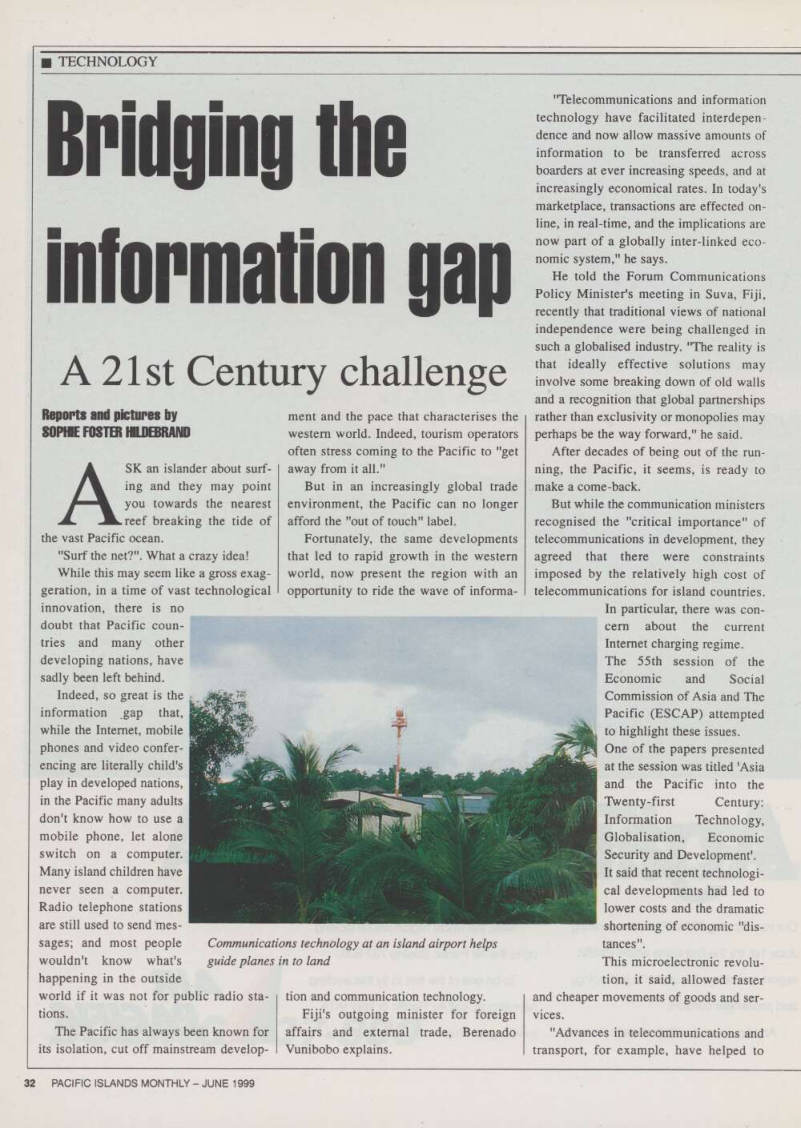
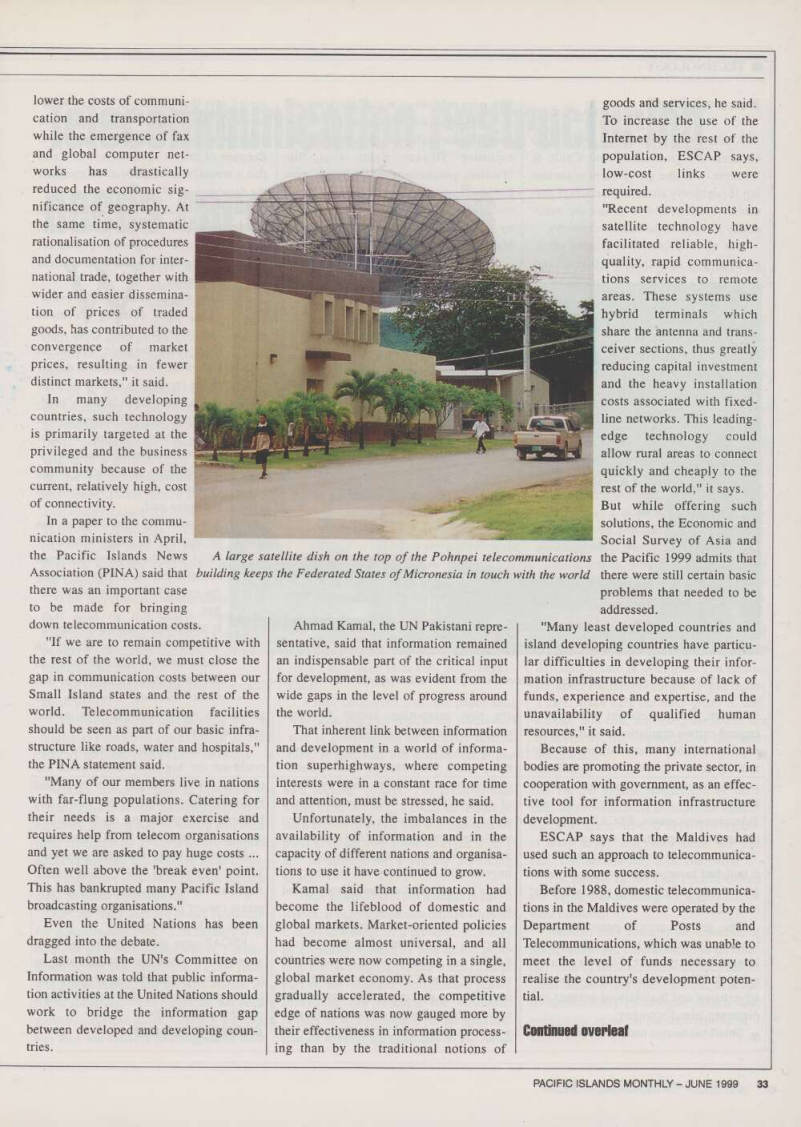
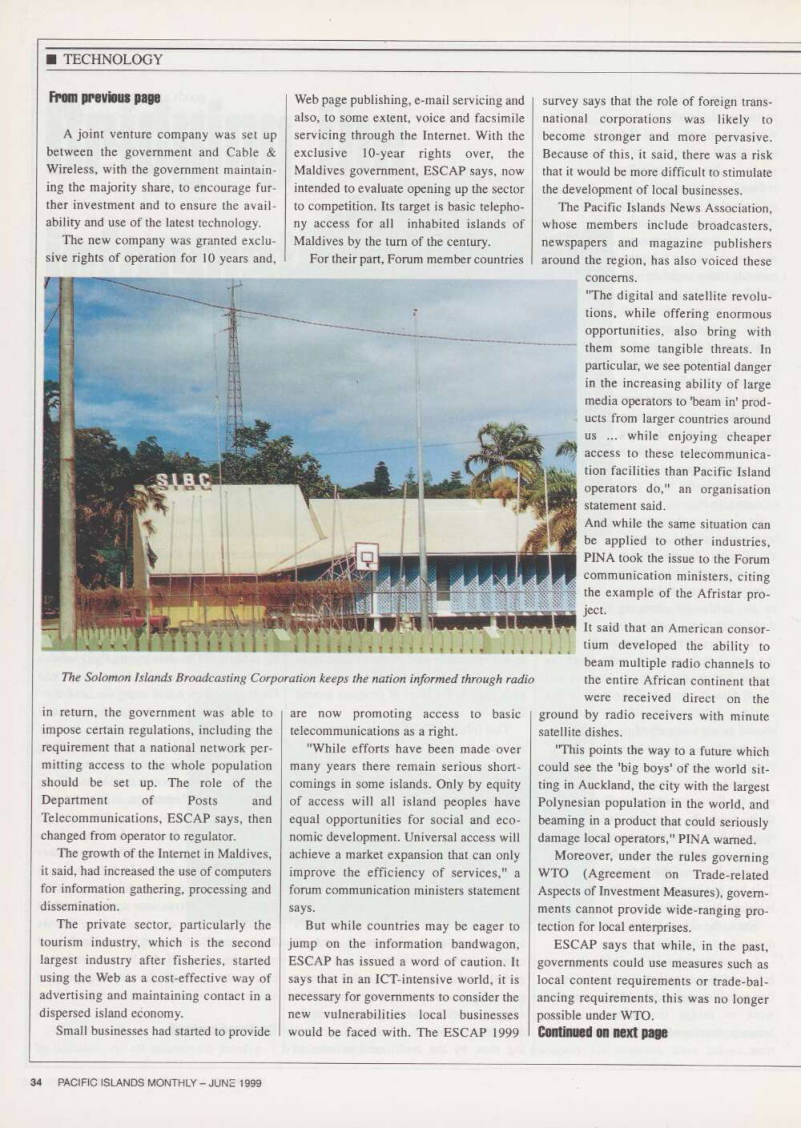
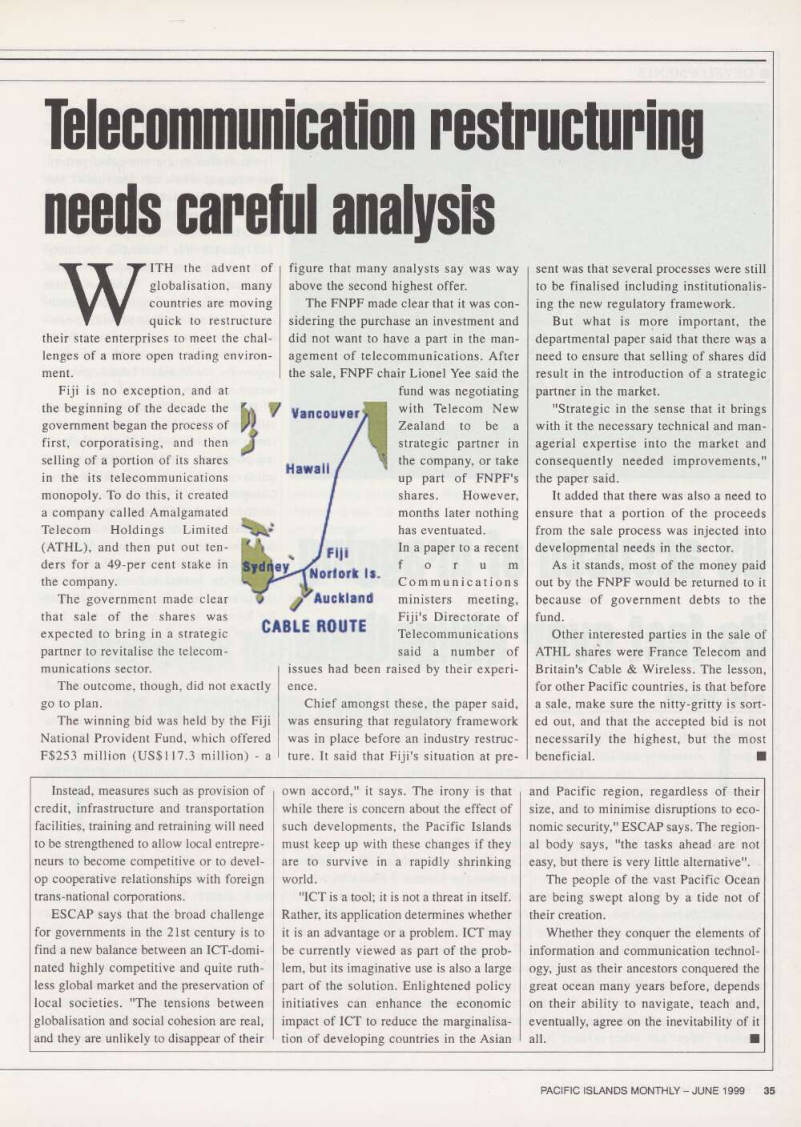
Technology
Bridging the information gap A21st Century challenge
Reports and pictures by
Sophie Foster Hildebrand
ASK an islander about surf ing and they may point you towards the nearest reef breaking the tide of the vast Pacific ocean.
"Surf the net?". What a crazy idea!
While this may seem like a gross exag geration, in a time of vast technological
innovation, there is no doubt that Pacific coun tries and many other developing nations, have sadly been left behind.
Indeed, so great is the information gap that, while the Internet, mobile phones and video confer encing are literally child's play in developed nations, in the Pacific many adults don't know how to use a mobile phone, let alone switch on a computer.
Many island children have never seen a computer.
Radio telephone stations are still used to send mes sages; and most people wouldn't know what's happening in the outside
world if it was not for public radio sta tions.
The Pacific has always been known for its isolation, cut off mainstream develop
ment and the pace that characterises the western world. Indeed, tourism operators often stress coming to the Pacific to "get away from it all."
But in an increasingly global trade environment, the Pacific can no longer afford the "out of touch" label.
Fortunately, the same developments that led to rapid growth in the western world, now present the region with an opportunity to ride the wave of informa-
tion and communication technology.
Fiji's outgoing minister for foreign affairs and external trade, Berenado Vunibobo explains.
"Telecommunications and information technology have facilitated interdepen dence and now allow massive amounts of information to be transferred across boarders at ever increasing speeds, and at increasingly economical rates. In today's marketplace, transactions are effected on line, in real-time, and the implications are now part of a globally inter-linked eco nomic system," he says.
He told the Forum Communications Policy Minister's meeting in Suva, Fiji, recently that traditional views of national independence were being challenged in such a globalised industry. "Hie reality is that ideally effective solutions may involve some breaking down of old walls and a recognition that global partnerships rather than exclusivity or monopolies may perhaps be the way forward," he said.
After decades of being out of the run ning, the Pacific, it seems, is ready to make a come-back.
But while the communication ministers recognised the "critical importance" of telecommunications in development, they agreed that there were constraints imposed by the relatively high cost of telecommunications for island countries.
In particular, there was con cern about the current Internet charging regime.
The 55th session of the Economic and Social Commission of Asia and The Pacific (ESCAP) attempted to highlight these issues.
One of the papers presented at the session was titled 'Asia and the Pacific into the
Twenty-first Century:
Information Technology,
Globalisation, Economic Security and Development'.
It said that recent technologi cal developments had led to lower costs and the dramatic shortening of economic "dis tances".
This microelectronic revolu tion, it said, allowed faster
and cheaper movements of goods and ser vices.
"Advances in telecommunications and transport, for example, have helped to
Communications technology at an island airport helps guide planes in to land
lower the costs of communi cation and transportation while the emergence of fax and global computer net works has drastically reduced the economic sig nificance of geography. At the same time, systematic rationalisation of procedures and documentation for inter national trade, together with wider and easier dissemina tion of prices of traded goods, has contributed to the convergence of market prices, resulting in fewer distinct markets," it said.
In many developing countries, such technology is primarily targeted at the privileged and the business community because of the current, relatively high, cost of connectivity.
In a paper to the commu nication ministers in April, the Pacific Islands News Association (PINA) said that there was an important case to be made for bringing
down telecommunication costs.
"If we are to remain competitive with the rest of the world, we must close the gap in communication costs between our Small Island states and the rest of the world. Telecommunication facilities should be seen as part of our basic infra structure like roads, water and hospitals," the PINA statement said.
"Many of our members live in nations
with far-flung populations. Catering for
their needs is a major exercise and requires help from telecom organisations and yet we are asked to pay huge costs ...
Often well above the 'break even' point.
This has bankrupted many Pacific Island
broadcasting organisations."
Even the United Nations has been dragged into the debate.
Last month the UN's Committee on Information was told that public informa tion activities at the United Nations should work to bridge the information gap between developed and developing coun tries.
Ahmad Kamal, the UN Pakistani repre sentative, said that information remained an indispensable part of the critical input for development, as was evident from the wide gaps in the level of progress around the world.
That inherent link between information and development in a world of informa tion superhighways, where competing interests were in a constant race for time and attention, must be stressed, he said.
Unfortunately, the imbalances in the availability of information and in the capacity of different nations and organisa tions to use it have continued to grow.
Kamal said that information had become the lifeblood of domestic and global markets. Market-oriented policies had become almost universal, and all countries were now competing in a single, global market economy. As that process gradually accelerated, the competitive edge of nations was now gauged more by their effectiveness in information process ing than by the traditional notions of
goods and services, he said.
To increase the use of the Internet by the rest of the population, ESCAP says, low-cost links were
required.
"Recent developments in satellite technology have facilitated reliable, high
quality, rapid communica
tions services to remote areas. These systems use hybrid terminals which share the antenna and trans ceiver sections, thus greatly reducing capital investment and the heavy installation costs associated with fixed line networks. This leading
edge technology could
allow rural areas to connect quickly and cheaply to the rest of the world," it says.
But while offering such solutions, the Economic and Social Survey of Asia and the Pacific 1999 admits that there were still certain basic problems that needed to be addressed.
"Many least developed countries and island developing countries have particu lar difficulties in developing their infor mation infrastructure because of lack of funds, experience and expertise, and the unavailability of qualified human resources," it said.
Because of this, many international bodies are promoting the private sector, in cooperation with government, as an effec tive tool for information infrastructure
development.
ESCAP says that the Maldives had used such an approach to telecommunica tions with some success.
Before 1988, domestic telecommunica tions in the Maldives were operated by the Department of Posts and Telecommunications, which was unab’e to meet the level of funds necessary to realise the country's development poten tial.
Continued overleaf
A large satellite dish on the top of the Pohnpei telecommunications building keeps the Federated States of Micronesia in touch with the world
From previous page
A joint venture company was set up between the government and Cable & Wireless, with the government maintain ing the majority share, to encourage fur ther investment and to ensure the avail ability and use of the latest technology.
The new company was granted exclu sive rights of operation for 10 years and,
in return, the government was able to
impose certain regulations, including the
requirement that a national network per mitting access to the whole population should be set up. The role of the Department of Posts and Telecommunications, ESCAP says, then changed from operator to regulator.
The growth of the Internet in Maldives, it said, had increased the use of computers for information gathering, processing and dissemination.
The private sector, particularly the tourism industry, which is the second largest industry after fisheries, started using the Web as a cost-effective way of advertising and maintaining contact in a dispersed island economy.
Small businesses had started to provide
Web page publishing, e-mail servicing and also, to some extent, voice and facsimile servicing through the Internet. With the exclusive 10-year rights over, the Maldives government, ESCAP says, now intended to evaluate opening up the sector to competition. Its target is basic telepho ny access for all inhabited islands of Maldives by the turn of the century.
For their part, Forum member countries
are now promoting access to basic telecommunications as a right.
"While efforts have been made over many years there remain serious short comings in some islands. Only by equity of access will all island peoples have equal opportunities for social and eco nomic development. Universal access will achieve a market expansion that can only improve the efficiency of services," a forum communication ministers statement says.
But while countries may be eager to jump on the information bandwagon, ESCAP has issued a word of caution. It says that in an ICT-intensive world, it is necessary for governments to consider the new vulnerabilities local businesses would be faced with. The ESCAP 1999
survey says that the role of foreign trans national corporations was likely to become stronger and more pervasive.
Because of this, it said, there was a risk that it would be more difficult to stimulate the development of local businesses.
The Pacific Islands News Association, whose members include broadcasters, newspapers and magazine publishers around the region, has also voiced these
concerns.
"The digital and satellite revolu tions, while offering enormous opportunities, also bring with them some tangible threats. In particular, we see potential danger
in the increasing ability of large
media operators to 'beam in' prod ucts from larger countries around us ... while enjoying cheaper access to these telecommunica tion facilities than Pacific Island operators do," an organisation statement said.
And while the same situation can be applied to other industries, PINA took the issue to the Forum communication ministers, citing the example of the Afristar pro ject.
It said that an American consor tium developed the ability to beam multiple radio channels to the entire African continent that were received direct on the
ground by radio receivers with minute satellite dishes.
"This points the way to a future which could see the 'big boys' of the world sit ting in Auckland, the city with the largest Polynesian population in the world, and beaming in a product that could seriously damage local operators," PINA warned.
Moreover, under the rules governing WTO (Agreement on Trade-related Aspects of Investment Measures), govern ments cannot provide wide-ranging pro tection for local enterprises.
ESCAP says that while, in the past, governments could use measures such as local content requirements or trade-bal ancing requirements, this was no longer possible under WTO.
Continued on next page
The Solomon Islands Broadcasting Corporation keeps the nation informed through radio
Instead, measures such as provision of credit, infrastructure and transportation facilities, training and retraining will need to be strengthened to allow local entrepre neurs to become competitive or to devel op cooperative relationships with foreign
trans-national corporations.
ESCAP says that the broad challenge for governments in the 21st century is to find a new balance between an ICT-domi
nated highly competitive and quite ruth
less global market and the preservation of local societies. "The tensions between globalisation and social cohesion are real, and they are unlikely to disappear of their
own accord," it says. The irony is that while there is concern about the effect of such developments, the Pacific Islands must keep up with these changes if they are to survive in a rapidly shrinking world.
"ICT is a tool; it is not a threat in itself.
Rather, its application determines whether it is an advantage or a problem. ICT may be currently viewed as part of the prob lem, but its imaginative use is also a large part of the solution. Enlightened policy initiatives can enhance the economic impact of ICT to reduce the marginalisa tion of developing countries in the Asian
and Pacific region, regardless of their size, and to minimise disruptions to eco nomic security," ESCAP says. The region al body says, "the tasks ahead are not easy, but there is very little alternative".
The people of the vast Pacific Ocean are being swept along by a tide not of their creation.
Whether they conquer the elements of information and communication technol ogy, just as their ancestors conquered the great ocean many years before, depends on their ability to navigate, teach and, eventually, agree on the inevitability of it all. ■
Telecommunication restructuring
needs careful analysis
WITH the advent of
globalisation, many
countries are moving quick to restructure their state enterprises to meet the chal lenges of a more open trading environ ment.
Fiji is no exception, and at the beginning of the decade the government began the process of first, corporatising, and then selling of a portion of its shares in the its telecommunications monopoly. To do this, it created a company called Amalgamated Telecom Holdings Limited (ATHL), and then put out ten ders for a 49-per cent stake in the company.
The government made clear that sale of the shares was expected to bring in a strategic partner to revitalise the telecom munications sector.
The outcome, though, did not exactly go to plan.
The winning bid was held by the Fiji National Provident Fund, which offered F 5253 million (U 55117.3 million) - a
figure that many analysts say was way above the second highest offer.
The FNPF made clear that it was con sidering the purchase an investment and did not want to have a part in the man agement of telecommunications. After the sale, FNPF chair Lionel Yee said the
fund was negotiating with Telecom New Zealand to be a strategic partner in the company, or take up part of FNPF's shares. However, months later nothing has eventuated.
In a paper to a recent forum Communications
ministers meeting,
Fiji's Directorate of Telecommunications said a number of
issues had been raised by their experi ence.
Chief amongst these, the paper said, was ensuring that regulatory framework was in place before an industry restruc ture. It said that Fiji's situation at pre
sent was that several processes were still to be finalised including institutionalis ing the new regulatory framework.
But what is more important, the departmental paper said that there was a need to ensure that selling of shares did result in the introduction of a strategic partner in the market.
"Strategic in the sense that it brings with it the necessary technical and man agerial expertise into the market and
consequently needed improvements,"
the paper said.
It added that there was also a need to ensure that a portion of the proceeds from the sale process was injected into developmental needs in the sector.
As it stands, most of the money paid out by the FNPF would be returned to it because of government debts to the fund.
Other interested parties in the sale of ATHL shares were France Telecom and Britain's Cable & Wireless. The lesson, for other Pacific countries, is that before a sale, make sure the nitty-gritty is sort ed out, and that the accepted bid is not necessarily the highest, but the most beneficial. ■
Cable Route
US accused of dragging
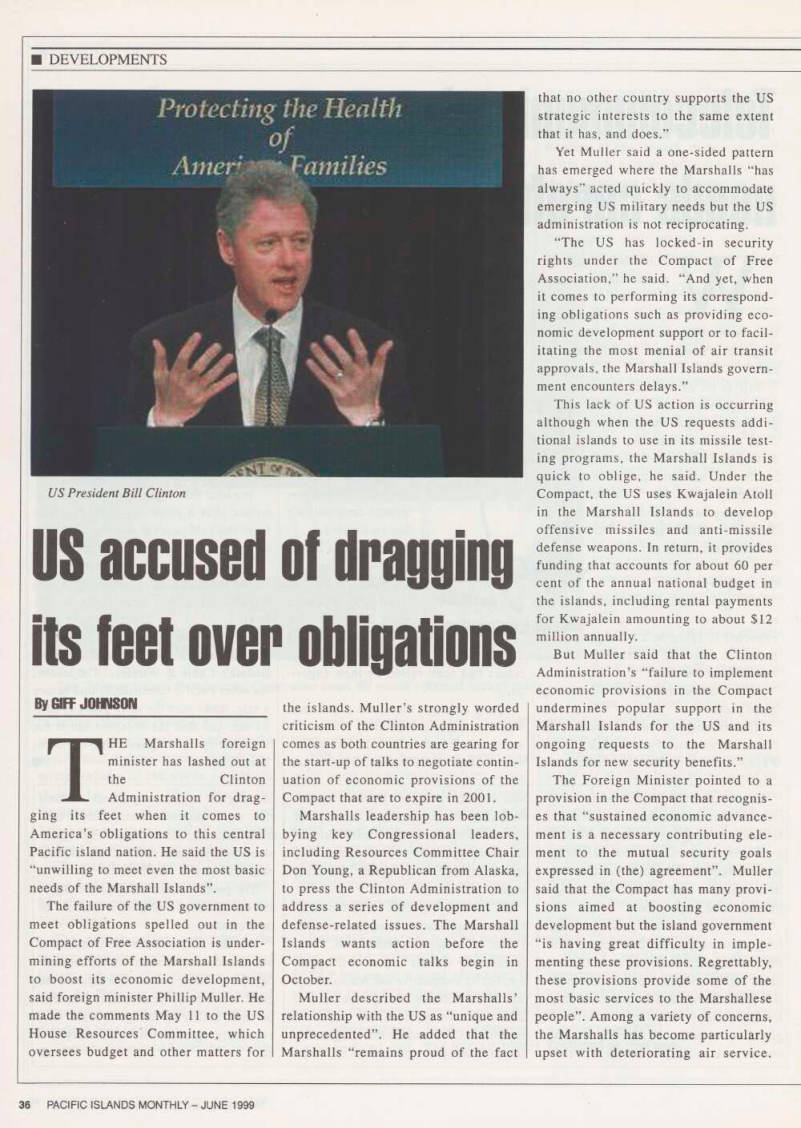
Developments
US accused of dragging its feet over obligations
By Giff Johnson
THE Marshalls foreign
minister has lashed out at the Clinton Administration for drag ging its feet when it comes to America’s obligations to this central Pacific island nation. He said the US is “unwilling to meet even the most basic needs of the Marshall Islands”.
The failure of the US government to meet obligations spelled out in the Compact of Free Association is under mining efforts of the Marshall Islands to boost its economic development, said foreign minister Phillip Muller. He made the comments May 11 to the US House Resources Committee, which oversees budget and other matters for
the islands. Muller’s strongly worded criticism of the Clinton Administration comes as both countries are gearing for the start-up of talks to negotiate contin uation of economic provisions of the Compact that are to expire in 2001.
Marshalls leadership has been lob bying key Congressional leaders, including Resources Committee Chair Don Young, a Republican from Alaska, to press the Clinton Administration to address a series of development and defense-related issues. The Marshall Islands wants action before the Compact economic talks begin in October.
Muller described the Marshalls’ relationship with the US as “unique and unprecedented”. He added that the Marshalls “remains proud of the fact
that no other country supports the US strategic interests to the same extent that it has, and does.”
Yet Muller said a one-sided pattern has emerged where the Marshalls “has always” acted quickly to accommodate emerging US military needs but the US administration is not reciprocating.
“The US has locked-in security rights under the Compact of Free Association,” he said. “And yet, when it comes to performing its correspond ing obligations such as providing eco nomic development support or to facil itating the most menial of air transit approvals, the Marshall Islands govern ment encounters delays.”
This lack of US action is occurring although when the US requests addi tional islands to use in its missile test ing programs, the Marshall Islands is quick to oblige, he said. Under the Compact, the US uses Kwajalein Atoll in the Marshall Islands to develop offensive missiles and anti-missile defense weapons. In return, it provides funding that accounts for about 60 per cent of the annual national budget in the islands, including rental payments for Kwajalein amounting to about $l2 million annually.
But Muller said that the Clinton Administration’s “failure to implement economic provisions in the Compact undermines popular support in the Marshall Islands for the US and its ongoing requests to the Marshall Islands for new security benefits.”
The Foreign Minister pointed to a provision in the Compact that recognis es that “sustained economic advance ment is a necessary contributing ele ment to the mutual security goals expressed in (the) agreement”. Muller said that the Compact has many provi sions aimed at boosting economic development but the island government
“is having great difficulty in imple
menting these provisions. Regrettably,
these provisions provide some of the most basic services to the Marshallese
people”. Among a variety of concerns,
the Marshalls has become particularly upset with deteriorating air service.
US President Bill Clinton
Protecting the Health of American Families
Continental Micronesia reduced the number of flights to just two each week. Moreover, despite approval from the assistant secretary of defense level last February - for landing rights at Johnston Island - Aloha Airlines has been hindered in its operation there. Its new air service to the Marshalls and Federated States of Micronesia has been delayed months past its May tar get. The blame is being placed on bureaucracy at the Defense Department that has prevented the order from being
implemented.
Muller cited a number of concerns, including what he said was: - A US failure to deliver on a promised development fund of $2O mil lion intended to compensate the Marshalls for key economic provisions that were removed from the Compact by the US after Marshall Islands voters had approved it in 1983. The Marshalls has received only $2 million of this promised fund. “It is clear that the Marshall Islands’ economic growth is stifled by the unilateral removal from the Compact of essential economic benefits,” he said.
- Squalor and “horrific” water, san itation, health and education facilities for islanders who were removed by the US military to make way for missile tests at the Kwajalein missile range.
The original population of 256 islanders has swelled to 2,500 people “forced to share the same, confined liv ing area,” he said. When American officials moved the people from their islands in 1965, “they were promised that their housing, power and water would be taken care of,” Muller said.
The Clinton Administration wants the Marshalls to produce “written proof of these promises before any action can be taken,” he said. But, said Muller, “it is unfair to demand such a strictness in producing records when the US Trust Territory documents are not in our pos session. It is not fair that a population should experience acute poverty because they relinquished their lands in support of the US missile defense test
ing programs.”
- Serious impediments to employ ment in the US, a privilege guaranteed by the Compact. Since the Compact went into effect in 1986, Marshall
Islanders have enjoyed visa-free entry privileges to live, work and study in the United States. But a recently passed US law now requires Marshall Islanders to get work-authorisation approvals. It is a lengthy process often resulting in islanders losing job offers or being ter minated by employers unwilling to wait for a drawn-out, bureaucratic process, Muller said, adding that this problem needs action.
Muller said that he looked to House Resources Committee Chair Young and members of the Congress for action on these problems.
He said there was “a growing gap between the burdens assumed by the Marshall Islands and its people under the Compact and the associated bene fits enjoyed by the US. All of the issues I raised today are in both of our nations’ best interests to resolve”.
During Young’s visit to the Marshalls in February, he indicated his committee’s intention to play an active role in the upcoming negotiations and in pressing the Clinton Administration for action on a variety of defense-relat ed concerns. ■
Marshalls questions US role
in promoting ADB loans
THE Clinton Administration is undermining the economic security of the Marshall Islands by pushing Asian Development Bank loans in the island nation, according to Foreign Minister Phillip Muller.
His criticism of the US role in the large ADB loan pro gram for the Marshalls is the latest move by the Marshall Islands to take control of economic decision making. This comes in the face of the heavy influence exerted by ADB policies and consultants since an ADB-funded government reform scheme was launched in 1995.
The economic health of the Marshall Islands is essential to US military interests in the islands, a point confirmed by provisions of the Compact of Free Association.
In it, the US recognises the need for economic advance ment to support the security interests of both countries,
Muller told a US Congressional committee in May. But the ADB, a lending institution that the Clinton Administration supports in the Marshall Islands, is a “major fac tor that undermines the economic security of the Marshall Islands that US military security depends
upon,” he said. “The large scale of the loans, the enormous debt burden the Marshall Islands is accruing, and the rec ommendations to rapidly reduce our public sector desta bilises the Marshall Islands’ economic security.”
He asked the Clinton Administration to stop “promoting a lending program that undercuts the bilateral US-Marshall Islands relationship” and to allow the Marshalls to take the lead in its financial dealings with the ADB.
Two ADB loans, Muller said, worth close to $2O million, “have proven totally useless” strapping the country with loan payments for failed projects.
“If economic development is a prerequisite and integral component of military security, then the Marshall Islands government is at a loss to understand why the US govern ment pushes ADB loans in the Marshall Islands,” Muller said. ■
America's Cup spin
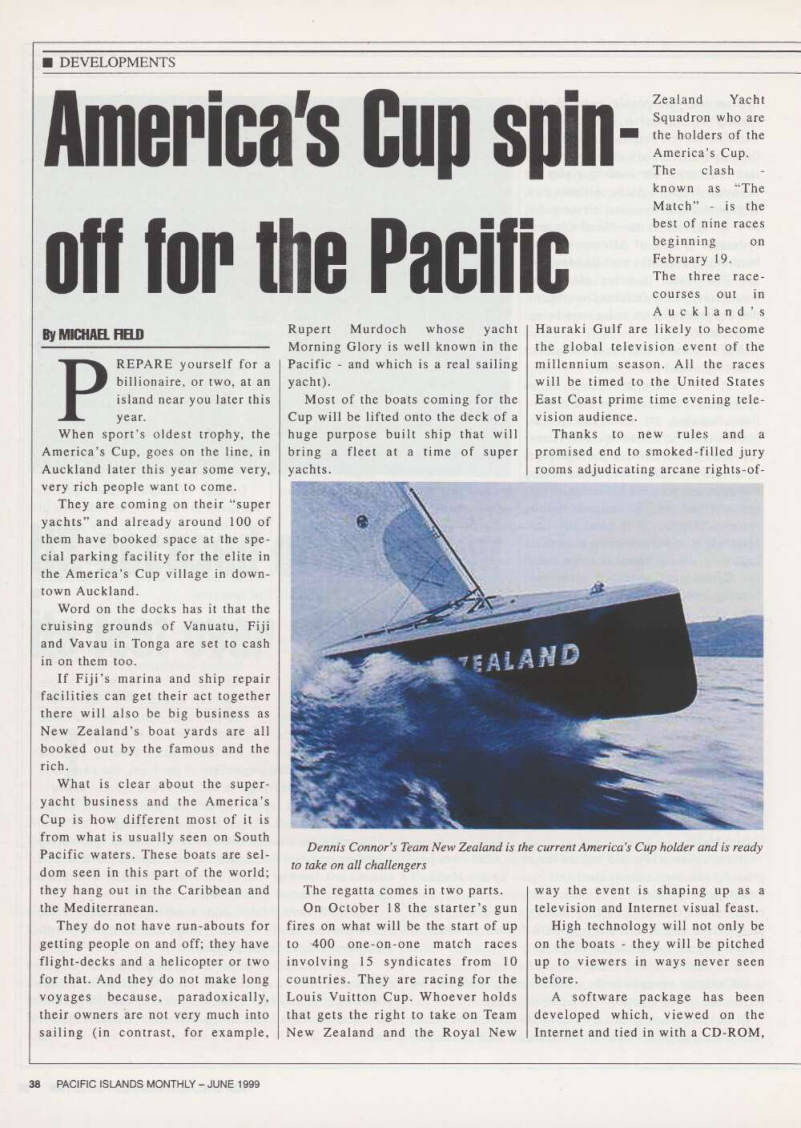
off for the Pacific
By Michael Held
PREPARE yourself for a billionaire, or two, at an island near you later this year.
When sport’s oldest trophy, the America’s Cup, goes on the line, in Auckland later this year some very, very rich people want to come.
They are coming on their “super
yachts” and already around 100 of them have booked space at the spe cial parking facility for the elite in the America’s Cup village in down town Auckland.
Word on the docks has it that the cruising grounds of Vanuatu, Fiji and Vavau in Tonga are set to cash in on them too.
If Fiji’s marina and ship repair facilities can get their act together there will also be big business as New Zealand’s boat yards are all booked out by the famous and the rich.
What is clear about the super yacht business and the America’s Cup is how different most of it is from what is usually seen on South Pacific waters. These boats are sel dom seen in this part of the world; they hang out in the Caribbean and the Mediterranean.
They do not have run-abouts for getting people on and off; they have flight-decks and a helicopter or two for that. And they do not make long voyages because, paradoxically, their owners are not very much into sailing (in contrast, for example.
Rupert Murdoch whose yacht Morning Glory is well known in the Pacific - and which is a real sailing yacht).
Most of the boats coming for the Cup will be lifted onto the deck of a huge purpose built ship that will bring a fleet at a time of super yachts.
The regatta comes in two parts.
On October 18 the starter’s gun fires on what will be the start of up to 400 one-on-one match races involving 15 syndicates from 10 countries. They are racing for the Louis Vuitton Cup. Whoever holds that gets the right to take on Team New Zealand and the Royal New
Zealand Yacht Squadron who are the holders of the
America’s Cup.
The clash known as “The Match” - is the best of nine races
beginning on
February 19.
The three race courses out in Auckland’s
Hauraki Gulf are likely to become the global television event of the millennium season. All the races will be timed to the United States East Coast prime time evening tele vision audience.
Thanks to new rules and a promised end to smoked-filled jury rooms adjudicating arcane rights-of
way the event is shaping up as a television and Internet visual feast.
High technology will not only be
on the boats - they will be pitched up to viewers in ways never seen before.
A software package has been developed which, viewed on the Internet and tied in with a CD-ROM,
Dennis Connor’s Team New Zealand is the current America’s Cup holder and is ready to take on all challengers
allows life “virtual stadium” cover age of the races on the Internet.
“Their is more to the America’s Cup than just a yacht race,” Tony Thomas said.
“Winning the America’s Cup is a symbol of success, it is why, for example, the Italians are going to such a big effort. You cannot get this event by bidding for it, we got it here by winning it.”
The super-yachts, boats longer
than 27 metres (90 feet), are too have their own leisurely regatta but mostly they will be for the pleasure of their owners.
Their presence in New Zealand offers Pacific countries a remarkable marketing opportunity - although there is no sign they have done any thing about it. For a country like Fiji it could do for industry what it is doing for New Zealand.
The people buying super-yachts
have made billions on the informa tion technology in the US.
“These guys have made their money and they are now spending on items like these super yachts,” says Sam Conner of Sensation Yachts Ltd.
Although super-yacht exports amount to around NZ$2OO million a year and employ hundreds of skilled tradesman and artisans, boat-build ing is a discreet operation, little known to most New Zealanders.
Sensation, for example, is up a mangrove lined creek, just off Auckland’s north-western motorway and is barely noticeable. Its neigh bour, Alloy Yachts International, is equally under-stated, but no cameras are allowed inside.
The anonymous American owner of Georgia does not want the rest of the world to know the secrets of what is the world’s largest cruising sloop, 48 metres, currently under construction.
New Zealanders have been into boat building as long as there have been people here. The Polynesian Maori found the timber here ideal for voyaging canoes and one of the
reasons the Royal Navy’s Captain James Cook came here in the 18th Century was to assess the huge kauri trees. New Zealand spars became favoured by most ship-builders.
At Marten Marine they’ve taken the tradition to the high-tech level and are building carbon-fibre masts and a revolutionary new furling boom.
Steve Marten says they have stolen most of the market in furling booms.
“We sell a furling boom to meet the needs of the super yachts and are now leading the world,” he says.
“We consider it pretty nice - it is sig nificantly lighter than anything else and it performs pretty well.”
The basic boom comes at around $200,000 and to date they have sold 500, not bad for a company that started out in 1972 making sailing
dinghies.
His factory has just finished a 52metre (171 foot) mast costing “around’ $1.3 million for a Boston man.
“We quote in New Zealand dol lars, we figure that our customers are more used to exchange rate com plications and know how to handle that,” Marten says.
The low value of the New Zealand dollar against the US was among the early reasons for the launching of the super-yacht business here but Marten says that while it remains a factor, owners are being attracted by the skilled workmanship and word of mouth.
One of the glamour projects was at the McMullen and Wing boat yard where they refurbished Shenandoah, a marvellous 51 metre (168 feet) boat first built in New York in 1902 for the Royal Monaco Yacht Club.
When it arrived here a couple of years ago it was on the verge of sinking, such was its decay.
McMullen and Wing do not say what they charged to rebuild it - but last year it was there in its restored
glory. ■
Lui loses his seat
ONE of the Pacific politics friendlier characters, Niue Premier Frank Lui, has lost his seat and his job. Sani Lakatani, one-time controversial finance minister with a colourful past, has become prime minister of the self-proclaimed “Rock of Polynesia”.
It is facing a doubtful future with a con tinuing declining population, now down to just 1750 people with more than 12,000 Niueans living in New Zealand.
In the general elections in April Lui lost his Alofi North seat to Va’ainga Tukuitonga in what amounted to a family dispute, opening the way for Lakatani who has long been a critic of Lui who won majority support of the 20 seat Legislative Assembly. Lakatani quickly named his cabinet as Robert Matua Rex (a son of the founding premier Sir Robert Rex), Young Vivian and Dion Taufitu to join him as Cabinet members. He also created a new position as Adviser to Cabinet with former Secretary to Government Terry Chapman getting the post.
“The position of Adviser is one of the key elements in Government’s overall objective to deliver, among other goals, what the Niue People’s Party promised leading up to the recent elections,”
Lakatani said.
“Also it is worthy Adviser in fact replaces the Personal Assistant to the Premier. What’s new is the Adviser’s
Principal Functions.
“The adviser will have a more impor tant role than that of Personal Assistant, but will actually cost less.
His take-over was not easily handled and one MP, OTove Jacobsen, refused to leave her seat. The Speaker ordered her out but she would not go. Police Chief Andrew Lovelock was called but he sought advise from the Attorney General and declined to take any action. In the end the Niue Public Service Commission suspended Lovelock from his post for two weeks.
This caused a new problem because Deputy Police Chief Maria Tongatule had gone to New Zealand where she is to give birth to twins. Fortunately there has been no crime wave recently in Niue. ■
The big stink: Unisyn bites the dust
By Ed Rampell
AFTER years of controversy and bitter divisiveness, on March 31 Hawaiian compa ny, Unisyn, announced it was halting recycling operations at its Waimanalo facility, which caused an odor nuisance and alleged health hazards. But victorious taro root activists of that south east Oahu indigenous enclave are not exact ly dancing the Carmagnole or an Irish jig on Unisyn’s grave yet.
“The stench is even greater now than before,” lamented anti-Unisyn crusader Joe Ryan on Earth Day. “It will take at least as long as 90 days to process the muck they received March 30 through the digestion system... The generator is not running, and the plant has no incentive to not create an odor since they are no longer even attempt ing to comply with permits.”
Ryan, whose ranch is next door to Unisyn, is the retired HPD detective tumed-eco-warrior who spearheaded the apparently successful campaign to drive the industrial activity out of the district zoned
for agriculture.
Ryan went on to say; “There are four million gallons of polluted effluent in the Wing King reservoir and another million in the digesters. Clean up is the focus. Looks like the taxpayer is going to pay for it.”
The Unisyn saga is long and complex, one that HW took the lead in exposing start ing in 1997. In a nutshell: Unisyn Biowaste Technology subleased 21 state-owned acres in Waimanalo from and next to Meadow Gold dairies to process manure and other organic wastes from dairies and farms.
Apparently, this did not prove to be prof itable, and by the 19905, it expanded into a
full-fledged assembly line-style recycler of
about 35 tons per day of wet waste (food scraps, manure), green waste (cuttings from gardens, lawns, yards), grease-trap sludges, and other organic disposables. This new anaerobic digestion system recycles the biowaste into a compost used as a lawn
enricher, soil amendment, or fertilizer. The methane produced by this industrial-type method provides power for the plant.
Clients included hotels, restaurants, and supermarkets such as Hilton Hawaiian Village, Planet Hollywood, and Foodland.
The good news was that the recycling prevented the spread of landfills.
The bad news was that, according to eco-activists, Unisyn turned Waimanalo into a sort of “airfill,” to coin a phrase, pol luting the atmosphere with a stench described as “nauseating,” which allegedly adversely affected the health of residents especially those with respiratory problems.
Waimanaloans opposed to Unisyn charged the installation was an industrial operation improperly operating in a district zoned for agriculture. As Hawaiian Homelands are concentrated there, “envi ronmental racism” - the polluting of disem powered minority communities by busi nesses - was alleged, with Waikiki busi nesses turning Waimanalo into its dumping ground. Waimanalo’s Neighborhood Board asked Unisyn to relocate outside the com munity.
Compounding this was the checkered past of Unisyn’s dubious then-owners, mainlander Barry Silverton and local busi nessman Clyde Kaneshiro (still believed to be a part-owner), who had repeatedly run afoul of the law, leading Ryan and company to charge backdoor political deals allowing
Unisyn to blatantly defy zoning ordinances
and laws.
This led, for several years, to a series of waste management and building permit imbroglios, plus law suits (mainly filed by
Ryan against the private and governmental
parties responsible for Unisyn) too complex
to enumerate here.
With some justification, Unisyn com plained of being caught up in the maw of the byzantine bureaucracy of the state, county, and city governments, even as Ryan sought to sic the feds on them via the Environmental Protection Agency.
New owners (attorney Terry Lee and
developer Greg Kemp, who did not return calls for this story) claimed to be trying to fulfill an October 15, 1997 Department of Health mandate to mitigate Unisyn’s smells. But finally, on March 31, Unisyn’s able and much put upon PR man, Ray Sweeney, performed his last official act for the company, issuing a press release announcing the cessation of Unisyn’s recy cling. It applauded “the value of Unisyn’s patented technology” that “provided a vital environmental service,” which Unisyn pre sumably wants to sell elsewhere.
The announcement went on to say: “we have been in the process of construction to upgrade the facility and until very recently were prepared to invest significant funds...
Unfortunately, the estimated cost to com
plete improvements required by the govern
ment in addition to uncertainty about future requirements no longer make the business economically viable.” To the end, Unisyn blamed the regulatory system for its demise - not itself, for making Waimanalo “pretty stinky,” as DOH spokesman Patrick Johnston put it last January.
The straw that broke this Joe Camel’s back may have been the Feb. 17, 1999 let ter from the state’s Deputy Director for Environmental Health, Gary Gill, which threatened a $lO,OOO per day penalty for Unisyn’s violations.
In the meantime, Unisyn’s employees are out of work and luck, Ryan’s suit lan guishes in the court system and according to him, EPA is reviewing his petition for Washington to cut off federal funding for state environmental activities due to the state’s previous alleged inaction vis-a-vis Unisyn (which could cost Hawaii millions), while the smell and muck linger. And Unisyn’s current owners will presumably seek to sell its recycling technology abroad.
Hopefully, next time, to an appropriately zoned area, where a good neighbor policy of not intruding onto one’s neighbors will be observed, along with the golden rule: “Do unto others - or else others will do you in.” ■
Fiji vessel to circum
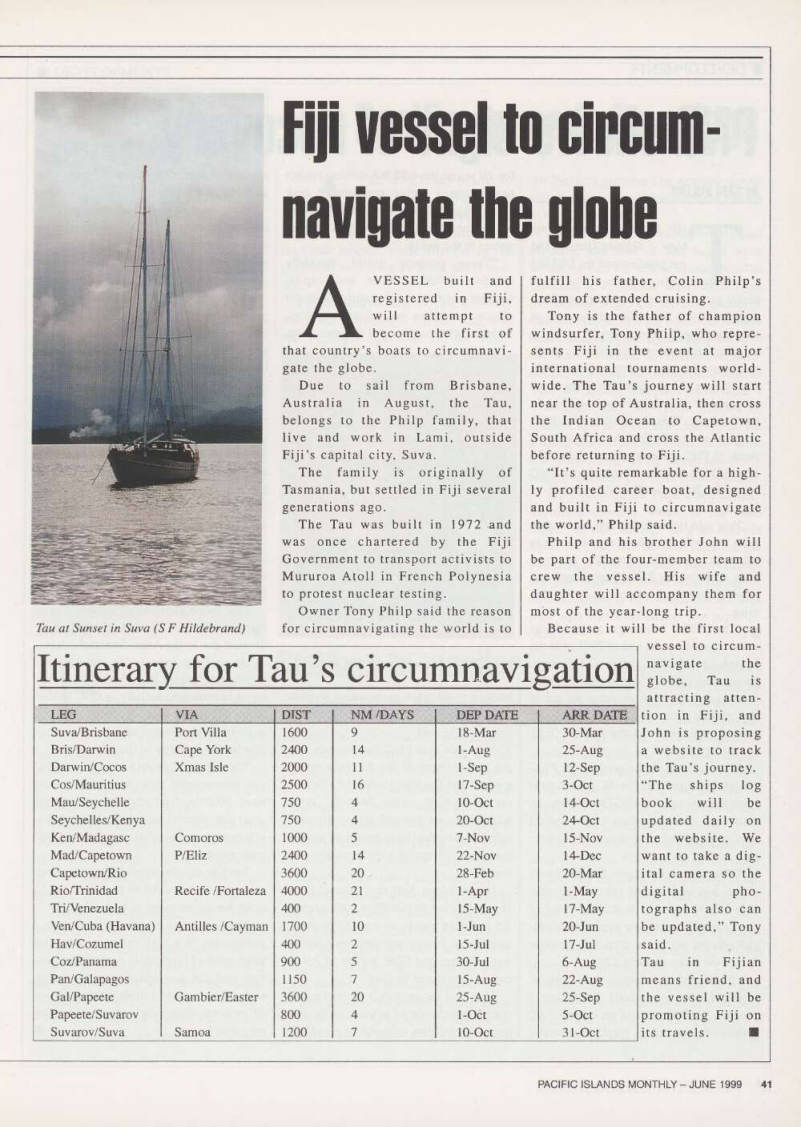
navigate the globe
A VESSEL built and registered in Fiji, will attempt to become the first of that country’s boats to circumnavi gate the globe.
Due to sail from Brisbane, Australia in August, the Tau, belongs to the Philp family, that live and work in Lami, outside Fiji’s capital city, Suva.
The family is originally of Tasmania, but settled in Fiji several
generations ago.
The Tau was built in 1972 and was once chartered by the Fiji Government to transport activists to Mururoa Atoll in French Polynesia to protest nuclear testing.
Owner Tony Philp said the reason for circumnavigating the world is to
fulfill his father, Colin Philp’s dream of extended cruising.
Tony is the father of champion windsurfer, Tony Philp, who repre sents Fiji in the event at major international tournaments world wide. The Tau’s journey will start near the top of Australia, then cross the Indian Ocean to Capetown, South Africa and cross the Atlantic before returning to Fiji.
“It’s quite remarkable for a high ly profiled career boat, designed and built in Fiji to circumnavigate the world,” Philp said.
Philp and his brother John will be part of the four-member team to crew the vessel. His wife and daughter will accompany them for most of the year-long trip.
Because it will be the first local
vessel to circum
navigate the
globe, Tau is attracting atten tion in Fiji, and John is proposing a website to track the Tau’s journey.
“The ships log book will be
updated daily on
the website. We want to take a dig ital camera so the
digital pho
tographs also can
be updated,” Tony
said.
Tau in Fijian means friend, and the vessel will be promoting Fiji on its travels. ■
Tau at Sunset in Suva (S F Hildebrand)
Itinerary for Tail’s circumnavigation
Leg
Via
Dtst
Nm /Days
Dep Date
Arr Date
Suva/Brisbane Port Villa 1600 9 18-Mar 30-Mar Bris/Darwin Cape York 2400 14 1-Aug 25-Aug Darwin/Cocos Xmas Isle 2000 11 1-Sep 12-Sep Cos/Mauritius 2500 16 17-Sep 3-Oct Mau/Seychelle 750 4 10-Oct 14-Oct Seychelles/Kenya 750 4 20-Oct 24-Oct Ken/Madagasc Comoros 1000 5 7-Nov 15-Nov Mad/Capetown P/Eliz 2400 14 22-Nov 14-Dec Capetown/Rio 3600 20 28-Feb 20-Mar Rio/Trinidad Recife /Fortaleza 4000 21 1-Apr 1-May Tri/Venezuela 400 2
15-May
17-May Ven/Cuba (Havana) Antilles /Cayman 1700 10 1-Jun 20-Jun Hav/Cozumel 400 2 15-Jul 17-Jul Coz/Panama 900 5 30-Jul
6-Aug
Pan/Galapagos 1150 7 15-Aug 22-Aug
Gal/Papeete
Gambier/Easter 3600 20
25-Aug
25-Sep
Papeete/Suvarov
800 4 1-Oct 5-Oct Suvarov/Suva Samoa 1200 7 10-Oct 31-Oct
PNG shows signs of recovery
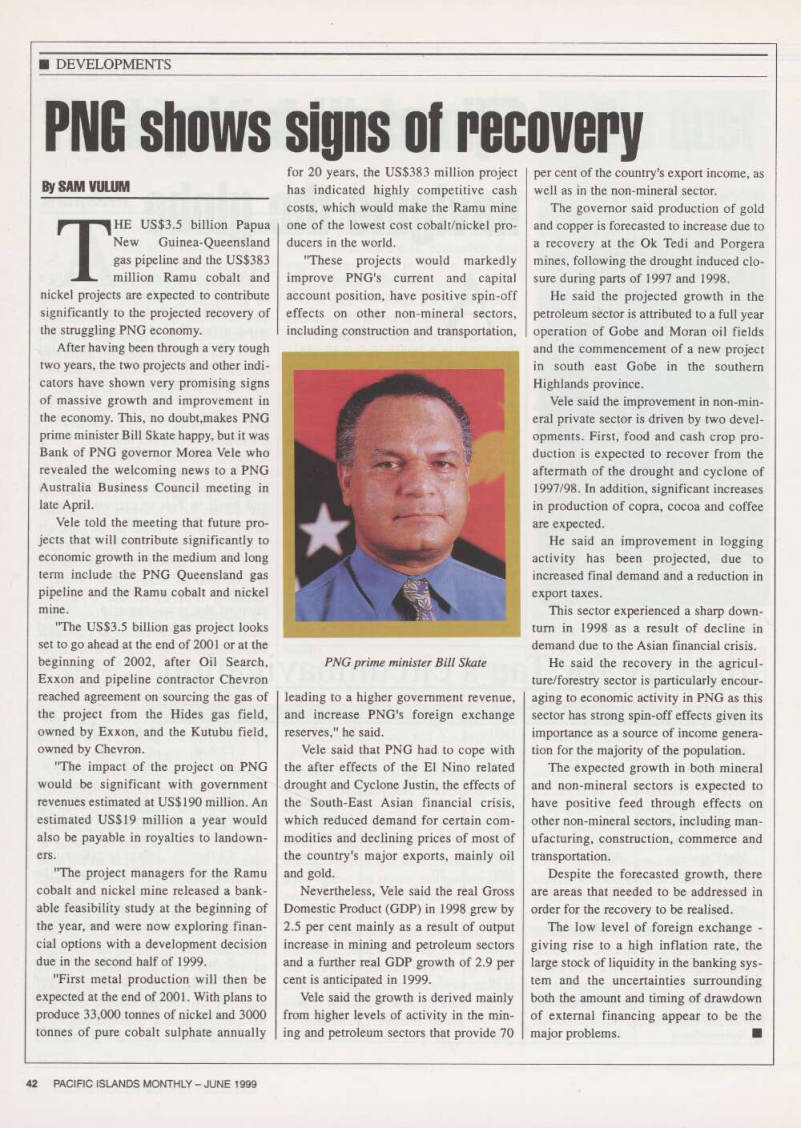
By Sam Vulum
THE US$3.5 billion Papua
New Guinea-Queensland gas pipeline and the US$3B3 million Ramu cobalt and nickel projects are expected to contribute significantly to the projected recovery of the struggling PNG economy.
After having been through a very tough two years, the two projects and other indi cators have shown very promising signs of massive growth and improvement in the economy. This, no doubt,makes PNG prime minister Bill Skate happy, but it was Bank of PNG governor Morea Vele who revealed the welcoming news to a PNG Australia Business Council meeting in
late April.
Vele told the meeting that future pro jects that will contribute significantly to economic growth in the medium and long term include the PNG Queensland gas pipeline and the Ramu cobalt and nickel mine.
"The US$3.5 billion gas project looks set to go ahead at the end of 2001 or at the beginning of 2002, after Oil Search, Exxon and pipeline contractor Chevron reached agreement on sourcing the gas of the project from the Hides gas field, owned by Exxon, and the Kutubu field, owned by Chevron.
"The impact of the project on PNG would be significant with government revenues estimated at US$l9O million. An estimated US$l9 million a year would also be payable in royalties to landown ers.
"The project managers for the Ramu cobalt and nickel mine released a bank able feasibility study at the beginning of the year, and were now exploring finan cial options with a development decision due in the second half of 1999.
"First metal production will then be expected at the end of 2001. With plans to produce 33,000 tonnes of nickel and 3000 tonnes of pure cobalt sulphate annually
for 20 years, the US$3B3 million project has indicated highly competitive cash costs, which would make the Ramu mine one of the lowest cost cobalt/nickel pro ducers in the world.
"These projects would markedly improve PNG's current and capital account position, have positive spin-off effects on other non-mineral sectors, including construction and transportation,
leading to a higher government revenue, and increase PNG's foreign exchange reserves," he said.
Vele said that PNG had to cope with the after effects of the El Nino related drought and Cyclone Justin, the effects of the South-East Asian financial crisis, which reduced demand for certain com modities and declining prices of most of the country's major exports, mainly oil and gold.
Nevertheless, Vele said the real Gross Domestic Product (GDP) in 1998 grew by 2.5 per cent mainly as a result of output increase in mining and petroleum sectors and a further real GDP growth of 2.9 per cent is anticipated in 1999.
Vele said the growth is derived mainly from higher levels of activity in the min ing and petroleum sectors that provide 70
per cent of the country's export income, as well as in the non-mineral sector.
The governor said production of gold and copper is forecasted to increase due to a recovery at the Ok Tedi and Porgera mines, following the drought induced clo sure during parts of 1997 and 1998.
He said the projected growth in the petroleum sector is attributed to a full year operation of Gobe and Moran oil fields and the commencement of a new project in south east Gobe in the southern
Highlands province.
Vele said the improvement in non-min eral private sector is driven by two devel opments. First, food and cash crop pro duction is expected to recover from the aftermath of the drought and cyclone of 1997/98. In addition, significant increases in production of copra, cocoa and coffee are expected.
He said an improvement in logging activity has been projected, due to increased final demand and a reduction in export taxes.
This sector experienced a sharp down turn in 1998 as a result of decline in demand due to the Asian financial crisis.
He said the recovery in the agricul ture/forestry sector is particularly encour aging to economic activity in PNG as this sector has strong spin-off effects given its importance as a source of income genera tion for the majority of the population.
The expected growth in both mineral and non-mineral sectors is expected to have positive feed through effects on other non-mineral sectors, including man ufacturing, construction, commerce and transportation.
Despite the forecasted growth, there are areas that needed to be addressed in order for the recovery to be realised.
The low level of foreign exchange giving rise to a high inflation rate, the large stock of liquidity in the banking sys tem and the uncertainties surrounding both the amount and timing of drawdown of external financing appear to be the major problems. ■
PNG prime minister Bill Skate
Pacific
mustard gas free now
THE Pacific is officially
mustard gas free now that the last of a vast stock
pile of blister-agent
weapons have been destroyed on Johnston Atoll.
The Johnston Atoll Chemical Agent Disposal System (J AC ADS) is preparing to close next year and in a statement last month they said they had completed the destruction of the 43,660 4.2” blister-agent filled mortars and the 46 105 mm blister agent filled projectiles.
This pile of weapons included 109 rounds of mustard gas originally left on Guadalcanal at the end of World War 11. The JACADS facility has been operating since June 1990.
In addition to Johnston Island, there are eight continental U.S. chemical stockpile locations: Utah, Oregon, Indiana, Maryland, Alabama, Arkansas, Kentucky, and Colorado. ■
flip Pacific spreads its wings
AIR PACIFIC plans to spread it swings with new services to Adelaide, Cairns, and the Cook Islands, while also giving the go-ahead to a long-awaited hotel pro
ject.
The company’s new Boeing 737-800, which was delivered to Fiji late May, was due to begin operating on the Nadi- Melboume route on the second of this month, and will also e used on Brisbane ser vices and on planned twice-weekly direct flights to and from Adelaide.
Air Pacific has been discussing the pro posed Adelaide route with Australian avia tion authorities, according to general man ager for strategic planning, Dinesh Chandra, who went to Seattle to supervise the han dover of the new 737-800 from the Boeing company.
Adelaide tourists bound for Fiji now have to change at Melbourne or Sydney.
The airline is also looking at new routes next year to the Cook Islands, linking Nadi Auckland, and Rarotonga, and to Cairns in north Queensland - which would connect to
Air Pacific’s growing Los Angeles service and eliminate the need for American tourists to fly to Sydney first.
Air Pacific’s chief executive Michael McQuay, told AAP it was hoped work would start on the airline’s resort hotel at Denarau, a 15-minute drive from Nadi International Airport, in the third quarter of this year. Originally, the hotel was to have been managed by the Hyatt Group but after the Asian economic downturn, considera tion of tenders and the management contract were re-evaluated, and plans put on hold.
McQuay said Air Pacific needed an operator able to inject more equity into the project, which Hyatt was unable to do while also considering taking advantage of the bargain-basement prices for hotels in Asia.
Talks between Air Pacific and another interested operator were “in the final stages”, he said, adding: “they are ready to sign”. McQuay said the new hotel and the $2O million Outrigger Reef Resort expan sion now underway would boost the supply of hotel rooms in Fiji which had not kept pace with increased airline seat capacity.
(Aap) ■
nuclear fallout
Stations to monitor nuclear fallout
FEARS that the South Pacific might be used for illegal nuclear testing have led to the establish ment of a region wide scientific system to monitor for fallout. Using United Nations money New Zealand is to set up three monitoring systems while Australia will establish two.
New Zealand said last month their three stations would be in Kaitaia at the top end of the country, at the Chatham Islands east of New Zealand and in Rarotonga, Cook Islands.
Deputy New Zealand Prime Minister Wyatt Creech said the state of the art radio nuclide monitoring stations, which will be running by November, were key in policing the South Pacific for signs of illegal nuclear weapons.
Radionuclides are small radioactive par ticles present in the atmosphere after a
nuclear test. Mr Creech said New Zealand had signed a contract with the United Nations to run the monitoring stations as part of a South Pacific network monitoring compliance with the test ban treaty.
Two other stations would be located in Australia and they would all be linked eventually to a world-wide network of 80 radionuclide monitoring facilities.
The Chathams would also eventually house an infrasound station to detect very long wavelength sound waves detectable over considerable distances, and a Noble Gas monitoring facility looking for artifi cially created changes in such gases.
New Zealand will own the stations but costs will be largely met by the United Nations through its Provisional Technical
Secretariat. The stations will operate 24 hours a day, taking air samples every 10 minutes and relaying the results every two hours by satellite to an international data centre in Vienna. "Monitoring in the southern hemisphere is particularly impor tant because the South Pacific and Southern Oceans provide a large area where nuclear testing in breach of the treaty could be car ried out," Mr Creech said.
The New Zealand and Australian sta tions will be the first stations in the world to come on line. Extra monitoring in the Chathams will be operational within three years.
The Comprehensive Nuclear Test Ban Treaty has 150 signatories and has been rat ified by 21 countries.
It bans all nuclear testing and places an
obligation on signatories to prohibit and
prevent nuclear explosions at any place under their jurisdiction or control. ■
Much ado about nothing?
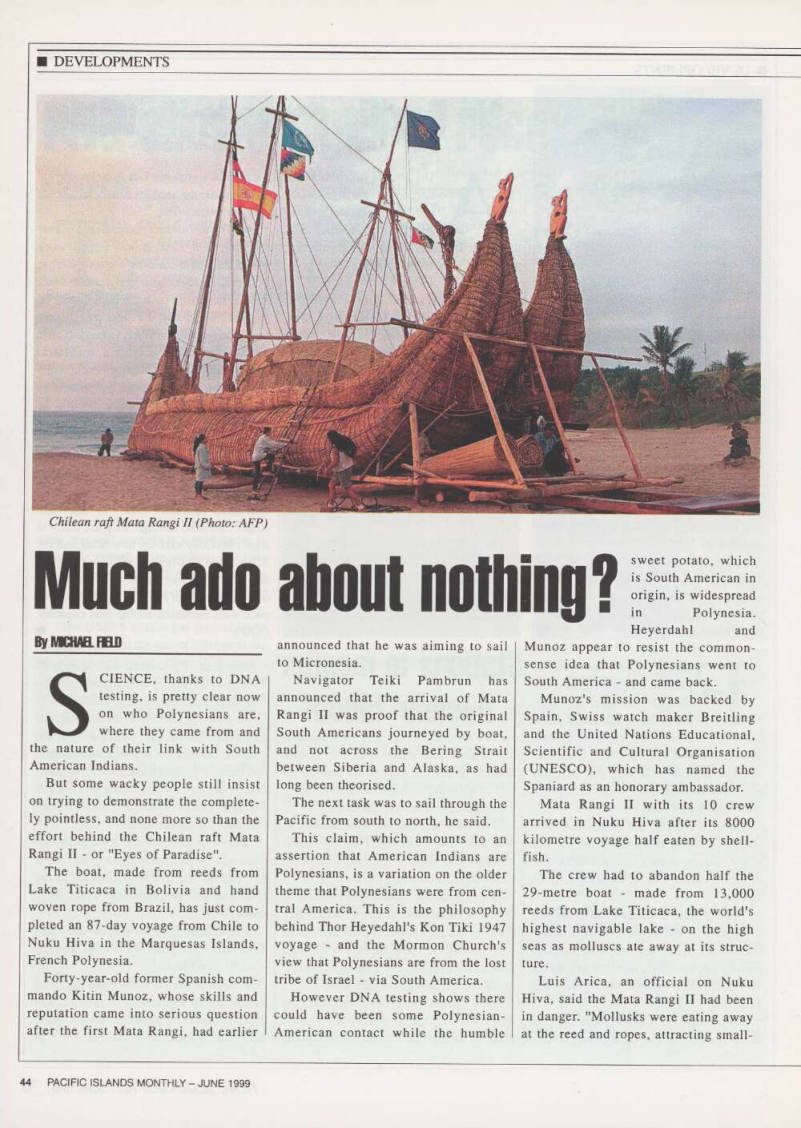
By Michael Held
SCIENCE, thanks to DNA testing, is pretty clear now on who Polynesians are, where they came from and the nature of their link with South American Indians.
But some wacky people still insist on trying to demonstrate the complete ly pointless, and none more so than the effort behind the Chilean raft Mata Rangi II - or "Eyes of Paradise".
The boat, made from reeds from Lake Titicaca in Bolivia and hand woven rope from Brazil, has just com pleted an 87-day voyage from Chile to Nuku Hiva in the Marquesas Islands, French Polynesia.
Forty-year-old former Spanish com mando Kitin Munoz, whose skills and reputation came into serious question after the first Mata Rangi, had earlier
announced that he was aiming to sail to Micronesia.
Navigator Teiki Pambrun has announced that the arrival of Mata Rangi II was proof that the original South Americans journeyed by boat, and not across the Bering Strait between Siberia and Alaska, as had long been theorised.
The next task was to sail through the Pacific from south to north, he said.
This claim, which amounts to an assertion that American Indians are Polynesians, is a variation on the older theme that Polynesians were from cen tral America. This is the philosophy behind Thor Heyedahl's Kon Tiki 1947 voyage -- and the Mormon Church's view that Polynesians are from the lost tribe of Israel - via South America.
However DNA testing shows there could have been some Polynesian- American contact while the humble
sweet potato, which is South American in origin, is widespread in Polynesia.
Heyerdahl and
Munoz appear to resist the common sense idea that Polynesians went to South America - and came back.
Munoz's mission was backed by Spain, Swiss watch maker Breitling and the United Nations Educational, Scientific and Cultural Organisation (UNESCO), which has named the Spaniard as an honorary ambassador.
Mata Rangi II with its 10 crew arrived in Nuku Hiva after its 8000 kilometre voyage half eaten by shell fish.
The crew had to abandon half the 29-metre boat - made from 13,000 reeds from Lake Titicaca, the world's highest navigable lake - on the high seas as molluscs ate away at its struc ture.
Luis Arica, an official on Nuku Hiva, said the Mata Rangi II had been in danger. "Mollusks were eating away at the reed and ropes, attracting small
Chilean raft Mata Rangi II (Photo: AFP)
er fishes and consequently sharks, adding to the danger".
Munoz decided to cut loose half the boat on the high seas because they were in danger of losing everything.
Because the boat was a solid piece constructed from bundles of reeds bound together, it floated even after part was cut away.
"There will be a review of what is left of the boat to decide whether the Mata Rangi II can continue with the aim of reaching Asia," Mendoza said.
In 1997 Munoz went to Rapa Nui or Easter Island and built a similar craft, Mata Rangi, from reeds there.
Ironically it got so heavy while being built that modern technology was needed to launch it.
It sailed for Pitcairn on May 4 but four days later the 11 man crew found they had two stowaways, including a man wanted for rape and robbery.
On May 12 radio contact with the raft was lost. Twenty days after depar ture, and just 340 kilometres out from Rapa Nui, the boat broke up.
The Chilean Armada training ship Esmeralda found her, lying submerged with water coming in the hole where the mast had been.
Esmeralda's crew noted the 13 on board the raft had been "prisoners of fear".
Now Munoz has proven again it is possible to drift from one point to another in the South Pacific - some thing that everybody knew anyway.
Its puzzling that nobody takes much interest in the other great migration across the same waters. That was the enslaving, by South Americans, of hundreds of Polynesians. They robbed atolls in what is now Tokelau, the Cook Islands, Tuvalu and Kiribati, and took them last century to South America where they disappeared, for ever.
UNESCO and the Spanish
Government might find establishing
the fate of those people much more useful than Mata Rangi style stunts which show nothing. ■
NZ's immigration balancing act
ONE of the virtues of a New Zealand passport is the way it gets its hold ers into most countries on earth visa free.
Practically no one - not even Australians seem to object to Kiwis and consequent ly tens of thousands of New Zealanders are scattered around the world.
Now people are beginning to worry that too many New Zealanders are leaving and the country is under populated.
This has co-incided with a series of monumental government policy blunders which stopped the flow of migrants enter ing the country at a time of a thriving ecno my and, ominiously, is giving the country a reputation for official racism.
The policy failures have seen the mainly Asian market of the past dry up, although India, Pakistan and Bangladesh have become new sources of migrants.
Unannounced, and unofficial, it has now become much easier for Fiji Indians to get work permits to New Zealand and immigra tion overstayers from the Pacific Islands are much less likely to be put on planes back home. New Zealand has not only taken on Kosovo refugees - it is positively encourag ing a number to stay.
New Zealand needs people.
Former Prime Minister David Lange has turned his hand to television documentary making and recently slammed the way New Zealand was dealing with immigration.
He unveiled government policy which lets in people from Asia who have high uni versity qualifications but refuses to allow them to then practice their professions.
He spoke with Taiwanese women in tears, he referred to them as “immigration widows”, whose husbands have been refused the right or practice crafts here and who have gone back to Taiwan leaving their families here.
He revealed Somalian refugee men who had more than one wife being forced to select a single wife to bring here.
He also hammered the refugee policy
which was brining in dozens of people and then putting them on unemployment queues.
“During the programme I will tell you about the chaos that is New Zealand’s immigration policy,” he said.
He said he wondered how dumb New Zealand was.
“Why do we bring people here and expect them to integrate here without giv ing them the means to communicate, to speak English, to be understood. Its worse than dumb, its down right inhumane.”
Lange said New Zealand was undergo ing “its most dramatic ethnic reworkings”.
“I believe if we don’t create a sensible immigration strategy we could well create a racial powder keg which could blow up in our faces.”
“We don’t just welcome refugees, we court the best and the brightest from throughtout the world. People come here, highly qualified, reasonably expecting to get a job. And the run flat against this extra ordinary, self-seving racially sensitive, old boys elite of the professional classes that deny them that chance.”
The programme focused on a Bangladeshi gynaecologist, Fatami Ashrafi, qualified in Britain, the United States, Ireland and Austria but reduced to deliver ing advertising fliers here for the last three years. The Medical Council of New Zealand refuses to recognise here qualifica tions.
Lange asked her whether the treatment she was receiving had anything to do with her race.
“The fact that doctors from Third World countries are treated differently, I cant answer why they do it, I would say it is discrimination,” she said.
“I feel too embarrassed to say that in this modem age, that somebody would discrim inate on the basis of colour.”
She said the Medical Council was an old boys club, “so primative, and so frightened, Continued overleaf
From previous page they are so insecure they want to keep peo ple out.” Lange said Fatami’s “crime” was that her first degree was from a Third World country although she had better qualifica tions than white people who practicised here from England.
He referred to doctors here “as the med ical mafia”.
Lange said the diversity of people was creating a melting pot that could provide a terrific feast “but if we are not prepared the pot could boil over.”
Interestingly a migrant from Fiji might offer hope that the country can steer clear of racial problems.
Dr Rajen Prasad is Race Relations Conciliator and has begun touring New Zealand to talk with as many communities
as possible about a vision on race relations.
He said the time was right for New Zealand to start discussions on race rela tions because of the country’s rapidly
changing ethnic composition.
Census figures reveal that in 1996 European New Zealanders made up 72 per cent of the 3.5 million population, with indigenous Maori at 14 per cent, Pacific Islanders at five per cent, Asians at four per cent and other ethnic groups making up five per cent. By 2026, Statistics New Zealand estimates Europeans will drop to 58 per cent of the population, while Maori increase to 18 per cent, Pacific Island to nine per cent and Asians to 10 per cent.
By 2046, Europeans will represent only half of New Zealand’s population, while other groups continue to increase - Maori to one fifth, and Pacific Islanders and
Asians to 12 per cent each.
“There is a real concern that people won’t know how to cope with this increas
ing diversity,” he says.
Like Lange, he worries about the way immigration is becoming a problem and the way politicians turn the “tap on from time to time. There’s no long term plan.”
Last year Immigration Minister Tuariki Delamere said New Zealand needed an extra 12,000 immigrants. The policy, to balance for comings and goings, required a target of 38,000 migrant approvals this year but it is unlikely this will be met.
Delamere, who came into Parliament with the anti-immigration party New Zealand First and is now an aimless inde pendent likely to lose his seat at the next election, appears to have lost grip of his
portfolio. ■
trigger discriminatory sentiments
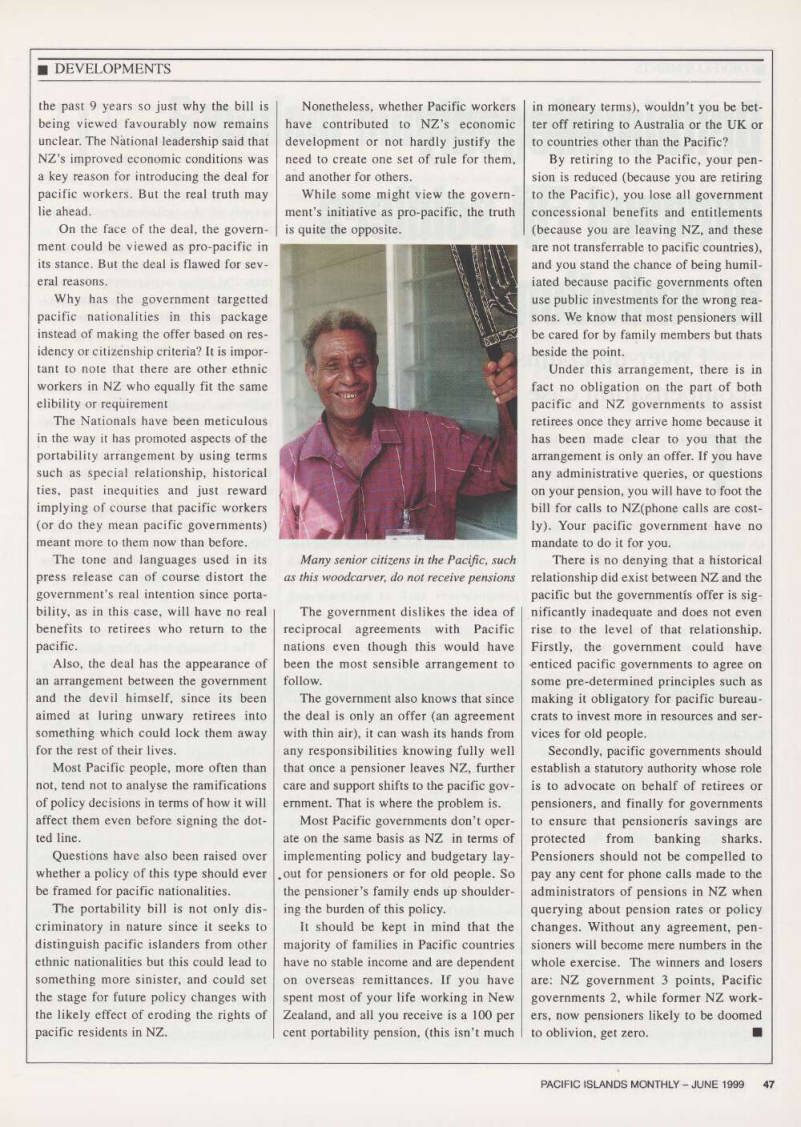
New Zealand's portability bill could trigger discriminatory sentiments
By John Uri
NEW Zealand’s decision to enhance superannuation portability by extending it to other pacific islander nationalities have been warmly received particularly by pacific governments as the bill was announced earlier in the year The proposed arrangement allows pacific workers to retire to the pacific with full pension.
Previously, partial portability (25 per cent gross) were only available to NZ cit izens including nationals of Niue, Tokelau and the Cook Islands by virtue of these countries colonial relationship with New Zealand.
Not only will superannuation portabil ity be increased to 100 per cent, but eli gibility will be extended to cover over 12 other pacific nationalities including Tonga, Samoa, PNG, Fiji, provided they meet residency requirements.
In announcing the deal. New Zealand’s Social Services Minister, the Hon Roger Sowry, said the arrangement is New Zealand’s way of recognising its “special relationship” with pacific work ers and those who contributed to NZ’s economy over the years.
The government defined the package as a “just reward” although it is seeming ly a political reward for pacific govern ments since pensioners have little to gain by retiring to the Pacific.
In the absence of a cost-benefit analy sis, the New Zealand government, like its pacific counterpart, stands to rake in enormous savings in terms of what it will save from the deal.
The government announced that the scheme will add over $0.5 million per annum to NZ’s current $6 billion although this may depend on the number of retirees signing up under the deal.
Nonetheless, the benefit for NZ is signif icant.
For pacific governments, this will depend on how many of it’s former nationals will return home. Amendments to the Portability Bill is still being stud ied by a parliamentary Select Committee whose report is expected to finish later this month.
While the scheme’s viability is yet to be ratified, an analysis of the deal reveal that individuals taking up the offer will be disadvantaged rather immensely.
The government has been mostly care ful in the way it has worded its press release when it described NZ’s “special relationship” with pacific nations, echo ing its historical ties with the pacific and the workers who contributed to NZ’s economy.
This is arguably an important politi cal initiative by the National government but a very weak and suspicious deal indeed. The decision or indecision whether to introduce portability has been the subject of heated political debate over
the past 9 years so just why the bill is being viewed favourably now remains unclear. The National leadership said that NZ’s improved economic conditions was a key reason for introducing the deal for pacific workers. But the real truth may lie ahead.
On the face of the deal, the govern ment could be viewed as pro-pacific in its stance. But the deal is flawed for sev eral reasons.
Why has the government targetted pacific nationalities in this package instead of making the offer based on res idency or citizenship criteria? It is impor tant to note that there are other ethnic workers in NZ who equally fit the same elibility or requirement The Nationals have been meticulous in the way it has promoted aspects of the portability arrangement by using terms such as special relationship, historical ties, past inequities and just reward implying of course that pacific workers (or do they mean pacific governments) meant more to them now than before.
The tone and languages used in its press release can of course distort the government’s real intention since porta bility, as in this case, will have no real benefits to retirees who return to the pacific.
Also, the deal has the appearance of an arrangement between the government and the devil himself, since its been aimed at luring unwary retirees into something which could lock them away for the rest of their lives.
Most Pacific people, more often than not, tend not to analyse the ramifications of policy decisions in terms of how it will affect them even before signing the dot ted line.
Questions have also been raised over whether a policy of this type should ever be framed for pacific nationalities.
The portability bill is not only dis criminatory in nature since it seeks to distinguish pacific islanders from other ethnic nationalities but this could lead to something more sinister, and could set the stage for future policy changes with the likely effect of eroding the rights of pacific residents in NZ.
Nonetheless, whether Pacific workers have contributed to NZ’s economic development or not hardly justify the need to create one set of rule for them, and another for others.
While some might view the govern ment’s initiative as pro-pacific, the truth is quite the opposite.
The government dislikes the idea of reciprocal agreements with Pacific nations even though this would have been the most sensible arrangement to follow.
The government also knows that since the deal is only an offer (an agreement with thin air), it can wash its hands from any responsibilities knowing fully well that once a pensioner leaves NZ, further care and support shifts to the pacific gov ernment. That is where the problem is.
Most Pacific governments don’t oper ate on the same basis as NZ in terms of
implementing policy and budgetary lay
.out for pensioners or for old people. So the pensioner’s family ends up shoulder ing the burden of this policy.
It should be kept in mind that the majority of families in Pacific countries have no stable income and are dependent on overseas remittances. If you have spent most of your life working in New Zealand, and all you receive is a 100 per cent portability pension, (this isn’t much
in moneary terms), wouldn’t you be bet ter off retiring to Australia or the UK or to countries other than the Pacific?
By retiring to the Pacific, your pen sion is reduced (because you are retiring to the Pacific), you lose all government concessional benefits and entitlements (because you are leaving NZ, and these are not transferrable to pacific countries), and you stand the chance of being humil iated because pacific governments often use public investments for the wrong rea sons. We know that most pensioners will be cared for by family members but thats beside the point.
Under this arrangement, there is in fact no obligation on the part of both pacific and NZ governments to assist retirees once they arrive home because it has been made clear to you that the arrangement is only an offer. If you have any administrative queries, or questions on your pension, you will have to foot the bill for calls to NZ(phone calls are cost ly). Your pacific government have no mandate to do it for you.
There is no denying that a historical relationship did exist between NZ and the pacific but the govemmentis offer is sig nificantly inadequate and does not even rise to the level of that relationship.
Firstly, the government could have enticed pacific governments to agree on some pre-determined principles such as making it obligatory for pacific bureau crats to invest more in resources and ser vices for old people.
Secondly, pacific governments should establish a statutory authority whose role is to advocate on behalf of retirees or pensioners, and finally for governments to ensure that pensioneris savings are
protected from banking sharks.
Pensioners should not be compelled to pay any cent for phone calls made to the administrators of pensions in NZ when
querying about pension rates or policy
changes. Without any agreement, pen sioners will become mere numbers in the whole exercise. The winners and losers are: NZ government 3 points. Pacific governments 2, while former NZ work ers, now pensioners likely to be doomed to oblivion, get zero. ■
Many senior citizens in the Pacific, such as this woodcarver, do not receive pensions
Britain allegedly
exposed Fiji soldiers to radiation Cover-up claims as PCRC files compensation case in European Court
THE Pacific Concerns Resource Centre (PCRC) has filed a case with the European Court of Human Rights to establish British responsibili
ty for allegedly exposing Fijian soldiers
to radioactive material on Kiritimati (Christmas) Island in the 19505.
Outgoing Centre Director Lopeti Senituli says the organisation wants the court to compel the British Government to carry out a full-scale investigation into the alleged exposure that involves secret memos and cover-ups.
Senituli said they will present the case of an affected Fijian soldier before the European court this summer.
“We have conducted preliminary medical tests on the Fijian soldier which proved that he was exposed to radioactive material, but we will need a full-scale epidemiological test on oth ers that were exposed,” he said.
The Centre has hired New York based lawyer lan Anderson to fight its case. Anderson represented British sol diers in a similar case before the
European Court.
Senituli said the British allegedly covered up the exposure of soldiers to radioactive material and the Fiji Times reports there could be more concealed information.
Senituli said that once British responsibility on these exposures is
established, compensation costs will be discussed.
“We have looked at the compensa tion scheme the United States has set up for the Marshall Islands and hope to establish something similar,” he said.
Senituli said the planned compensa tion claim would range between US$ 39, 000 and US$ 117, 000 for serious complications such as leukemia and cancer.
In another case, a British magazine has reported that Britain’s Royal Air Force exposed Fijians to dangerous radioactive material during the 1950 s but deliberately concealed the informa tion from the Fijian authorities.
A military memo found in the Public Records Office and passed on to New Scientist magazine showed RAF bombers were ordered not to tell Fijians that the engines of the bombers they landed at airports on Fiji for refueling and maintenance in 1957 were radioac tive.
“There appear to be no regulations in force governing the transit of radioac tive aircraft through international civil airports such as Nandi and Canton,” Air Commodore W.P. Sutcliffe wrote in the memo dated October 13, 1957.
“The fact that an engine may be ‘hot’ should be concealed from the Nandi authorities unless they ask,” he added.
New Scientist said five aircraft from
the 76 Squadron were contaminated while flying through mushroom clouds in Australia collecting samples.
The outside of the engines had been cleaned but the interior was coated with radioactive material. There are no records of the radiation levels of the engines.
“The revelation has angered Fijian environmentalists and comes as more than 200 Fijian servicemen who took part in the nuclear testing program pre pare to take the British government to the European Court of Human Rights in Strasbourg later this year,” the maga zine said.
The Fijian veterans claim they are suffering from skin diseases, anemia and leukemia because of their exposure to radiation.
No one from Britain’s Ministry of Defense was immediately available to comment.
Meanwhile, the acting head of the Marshall Islands Nuclear Claims Tribunal, Greg Danz, says he is confi dent the Tribunal’s members will be able to persuade the US Congress to increase compensation for victims of nuclear testing in the Micronesian country.
The US tests took place during the late 1940 s and early 19505, following World War 11.
The Tribunal is seeking an extra $22 million, in addition to the original US$45 million already received.
Danz says the “changed circum stances” provision of the Marshall Islands Compact of Free Association with the United States will be used to argue the Tribunal’s case.
“We’re hopeful that funding can be made available so that the Tribunal can pay off awards that it makes in a timely manner,” he said.
“We’re willing to stand on our record as to how we’ve made our . . . funding for the older people and people who have very serious conditions”. The Pacific currently operates under a South Pacific Nuclear Free Zone Treaty.(PAC NEWS/Reuters/Radio Australia) ■
Freedom muzzle broken
til M Cook
Islanders have been upheld, after the government failed in it’s bid to restrict the general election campaign period to just five weeks.
This follows a judgement by Chief Justice Sir Peter Quilliam who struck out a controversial Electoral Amendment intro duced into Parliament by the government shortly before the dissolution of Parliament.
Sir Peter declared it invalid, inconsistent and unenforceable. He said the Electoral Amendment was clearly unconstitutional and he was unable to accept government’s argument that the amendment was to the benefit of the public.
About 10,000 Cook Islanders go to the polls on the 16 of this month to vote in a government to run the country for the next five years.
Campaigning has been relatively quiet in comparison to other years, thanks that Electoral Amendment that saw election activity stopped for over a month.
Except for the brief five week period, any election activity including the forma tion of new political parties and the announcement of any prospective candi dates for election were outlawed.
A conviction for breaking the law car ried a maximum fine of up $lO,OOO or five
years imprisonment.
Democratic-Alliance and New Alliance opposition parties were outraged by the Electoral Amendment saying it contradict ed fundamental human rights and freedoms of Cook Islanders.
Lawyers acting for the Democratic- Alliance filed an application with the High Court in April seeking a declaratory judge ment on the five week campaign period.
Democratic- Alliance leader Dr Terepai Maoate says “the Act was brought into force without any consultation.”
The Chief Justice’s judgement was a victory for the Democratic Alliance Party and embarrassing for the ruling Cook Islands Party government.
The Cook Islands Party government did a similar thing just before the 1993 general elections when it introduced an Electoral Amendment requiring public servants to resign if they became candidates for the general election.
That was also struck down by the Court of Appeal after it was challenged by a Democratic candidate and the Public
Service Association.
“This is a victory this is what we’ve been anticipating,”
says DAP leader Dr Terepai Maoate. He says the Electoral Amendment was a clear ly a move by the government “to gag the Opposition.”
“It was designed to give us too little time to tell people about their mismanagement, now that it is thrown out, we can go ahead and launch our campaign.”
Dr Maoate says the Chief Justice’s judgement reaffirms their belief that the government’s Electoral Act violated the rights and freedoms of Cook Islands peo ple.
Of note was filing of an affidavit by Political Review Commission chair laveta Short in the Court saying that what the gov ernment had done in the Electoral Amendment was not what the Commission had recommended.
The Electoral Amendment was passed in Parliament about a month ago after one of the fieriest debates in the House. At the time, New Alliance Party leader Norman George expressed outrage that under the Electoral Amendment, politicians could be sent to prison for five years for doing what they had done as a matter of course for the past 30 years. ■
France admission on Moruroa cracks highlight need for an independent study
Suva, Fiji: The admission by French authorities that there are fractures in the coral cone at Moruroa and Fangataufa Atolls throws doubt on many of its other claims about the effects of nuclear testing in French Polynesia.
“After years of secrecy and denials about the environmental impacts of testing, the French Government has had to concede there has been damage to coral” says Greenpeace Pacific commu nications officer Samantha Magick.
The new director of France’s Atomic Energy Commission, Rene Pellet admitted that there are fractures in the atolls after carrying out an inspection of the two sites.
But he has also been reported as saying that no long-term dam age has been done by three decades of nuclear tests.
Greenpeace rejects this. “ (The) admissions lend strength to our argument that there should be a truly independent study done of the test sites. This study should be based on the full release of medical data to the workers concerned in the testing programme and com prehensive geological testing,” says Magick.
“Moruroa is leaking radioactivity now despite assurances from the French Government that no contamination from underground testing would occur for hundreds or thousands of years, if at all.
The oceans will disperse the plutonium and other materials, and Pacific people who depend on the ocean for their economy, identi ty, diet and culture will suffer” says Magick.
Greenpeace is not isolated in its concerns over the testing pro gramme and its legacy. Last year South Pacific Forum leaders expressed concern about the lack of geological detail in an International Atomic Energy Agency study of the test sites.
“The French government appears to be trying to manage the way information is released, in order to play down what they have really done. We need independent studies that will give the full story about the impacts on the environment at Moruroa and Fangataufa. The former workers there deserve to know exactly what risks they now face and what sort of compensation they should be entitled to.”
France conducted 193 'nuclear experiments’ above and under neath Mururoa and Fangataufa between 1966 and 1996. ■
NZPTC: a better approach to training
THE New Zealand HI/PTf!
Pacific training Centre gives you the chance to be your personal best. Are you
ready to accept the challenge?
New Zealand Pacific Training Centre’s
premises have been designed taking the
needs of clients into account. Air-conditioned rooms and spacious classrooms ensure the comfort of students. We are also located very centrally in Lautoka with access to parking space and public transport. All the teaching material used in the Centre are brought either from Australia or New Zealand. Clients can be assured of quality learning, as the materi als are the same as those used by TAPE and POLYTEC schools there.the Centre has been fitted with modem computer labs with 83 Pentium computers, one laptop computer, four printers, two modems, one overhead projector, one video, one television and one computer data projector.
NZPTC has taken over the entire top floor of Sarju Prasad building, which is much more
spacious. Five classrooms are fully air-condi tioned and students each have access to a computer, making the Centre one of the few with such a learning oriented environment.
As we enter a new age of learning, it is becoming clear that the Computer Industry is moving towards the Microsoft World. We do cater for the Microsoft products but at the same time are aware that the Fiji market is still a very heavy user of Lotus and Word Perfect. To cater for these users, we still teach these applications along with the
Microsoft products.
Besides the FNTC, we are currently regis tered with the Ministry of Education, the Commercial Education Society of Australia and Micro Teach Institute of Australia. The Ministry of Education recognises our certifi cates, entitling our students to become grant in-aid teachers locally.
We have a technical expert in computer repairs in our organisation, and if the need
arises to repair a computer, it is dealt with immediately, as we
do not need to wait for a third party to attend
the problem.
The establishment of the New Zealand Pacific Training Centre five years ago her alded a new age of learning in the Western division of Fiji. Our modem learning envi ronment with quality training was designed to meet the changing needs of organisations and employees. NZPTC is the only Centre in the Western Division which is fully accredit ed by the Fiji National training council for grant claimable purpose and the only training institute in Fiji which is ISO 9002 Certified.
We offer an extensive range of computer and business related courses. From 1999, NZPTC has brought another incredible offer for the people of Fiji. For the first time in Fiji, the people of Fiji will be able to study the New Zealand Diploma in Business which is a NZQA Qualification and the Australian TAPE Diploma in Computer Programming which is also the National Qualification of
Australia. The Diploma courses are taught by fully qualified instructors at the Lautoka centre.
The services and programmes offered by NZPTC are tailor-made to address the unique needs of the clients. An organisation and its employees can obtain the maximum benefit this way. Our educational policy is to provide quality learning with the aid of inter national standard teaching material and
qualified staff.
Clients can be assured of an environment very conducive to learning with helpful tutors and personal attention. Some of the courses taught include advanced courses on Novell Networking, Small Business Management, Marketing, Business Accounting, Business Mathematics, Public relations and Front Office Receptionist train
ing.
NZPTC was established in Lautoka by Mr Subhas Chandra five years ago at a time when other business and computer schools were offering little in terms of quality train
ing. He was the ideal person to start the insti tute, having graduated with a Commerce degree from Auckland University. Today the Centre is one of the most reputable in the western division. Among its clients are: the Public Works Department, Carlton Brewery (Fiji) Ltd, Westpac Banking Corporation, Fiji Development Bank, the Regent of Fiji, Forum
Apparel Limited, Williams and Goslings, Carpenters Shipping, Punja and Sons Limited, world Wide fund for Nature and the Fiji National Training Council to name a few.
We welcome new organisations, employ ees and individuals looking for a friendly learning environment committed to helping students achieve the vest results. ■
FIJI'S reputa
New tourism association to help small business
tion as an enjoyable tourism desti nation is world renowned, but often the
small local operators are overshad owed by big international corpora tions.
Because of this, 58 small tourism opera tors got together in February to set up the Fiji Budget Hotel and Tour Operators Association.
"Over the years, major tourist operators in Fiji have ignored small local tourist oper ators who were trying to fight for their own survival in the tourist industry. They have regarded local tourist operators as illegal operations and they have made it difficult for small local operators to survive in busi ness," says association chief executive, A L Kabu.
Kabu told PIM that there were many complaints by small operators that unfair tactics were used by travel agents to guide business away from the local operators.
"Budget travellers have lodged many complaints whereby a major tourist opera tor in Sydney had told them not to book small hotels since they are infested with rats
and cockroaches. Some other operators have issue circulars to their members say ing not to provide information to inquiries about certain local operators because they are illegal and do not have a licence to oper ate.“ This is imparted to tourists in hotels to dissuade tourists from booking products recommended to them by other travellers.
The budget hotels have not only been ignored but they have been slighted as 'not up to standard',” he says.
The formation of the Fiji Budget Hotel and Tour Operators Association was an effort for small operators to work towards developing themselves to be marketed overseas as viable alternatives to expensive choices existing within the industry.
Kabu says there has been tremendous growth and development in the budget sec tor, with much ongoing improvements in quality.
"Much more growth in now developing in eco-fnnrism waves of development in
smaller islands with more
village involvement.
Backpackers in the Yasawa group, the main land, Kadavu, Taveuni, and other areas of Fiji.
Eco-tourism is mushrooming everywhere as locals find out the potential of the tourism industry," he said. But the growth in small tourism operators is not just in the area of accommodation.
There are several small operators who run businesses concerned with activities such as diving, surfing, trekking, sightsee ing, cruising, bamboo rafting, four-wheel driving, mountain biking, white water raft ing, camping, and inland touring.
Kabu says the growth in this particular sector has been spurred by a growing awareness of local culture and a desire to visit other areas of the world but at a 'value -
for-money' price.
Mostly, though, he says it's a fad for the young to travel and 'see the world' before venturing into the world of paid employ ment.
But, Kabu says, because of the growth in this sector, many illegal operators are being attracted to Fiji. He says some of them come to Fiji on Visitors Visas, see the
potential here, and set themselves up in rented homes. But these also extend to div ing activities, surfing, tours, rental cars and private home hostels.
The major challenge for the industry, Kabu says, is to stop the illegal operators who are ruining the reputations and busi nesses of those who are operating legally.
The association aims to shed the image created within the industry of low stan dards in budget hotels.
He says government measures to help local operators could include small loan schemes to help local set up and operate budget hotels and other tourism products, develop into quality operations and attract more tourists to the country.
With increasing unemployment in rural areas, eco-tourism ventures could be the answer.
He says the association was not set up to compete with the Fiji Hotel Association, whose members are bigger hotels.
Their major objective is to give trav ellers a greater range of choices. He says the future for the association looks bright and members were motivated. With a bit more training and education, small opera tors may soon see increasing success in a
rapidly developing industry. ■
Advertisements & other items, p. 51 (1 item)
Why in Fiji?
NZPTC
ISO 9002 Certified Institution
Studyfor Internationally Recognised Dilomas
OTAGO POLYTECHINC
12V,2 diploma in business ** Accounting
**Management
**Banking **Travel & Tourism Certificate in Management.
Boxhili Institute of TAPE
AUSTRALIA
Diploma in Information
Technology
(Software Development)
Why in Fiji?
• Recognised all over the world (National Qualifications of Australia and New Zealand) •Same cost as other locally reconised diplomas offered by competitors •Same diploma cost 5 times less • Part of the Australian TAPE system • I years credit towards a university degree from Ausf/NZ • Practical training gets you ready for the work environment-no further training needed ... ri *Computer Courses * Microsoft □ MS Word □ MS Access □MS Excel □ MS DOS & Window MYOB Accounting Package These courses are now heing taught at New Zealand Pacific Training Centre 2nd Floor Snrjn I’rnsnd IlnHding. Vnknhnle Street, l.nntoka IMionr; 662352 Fnxt 667976 e-mnil: itT-pSv^’ls.t-otii.rj
fun@ funafuti
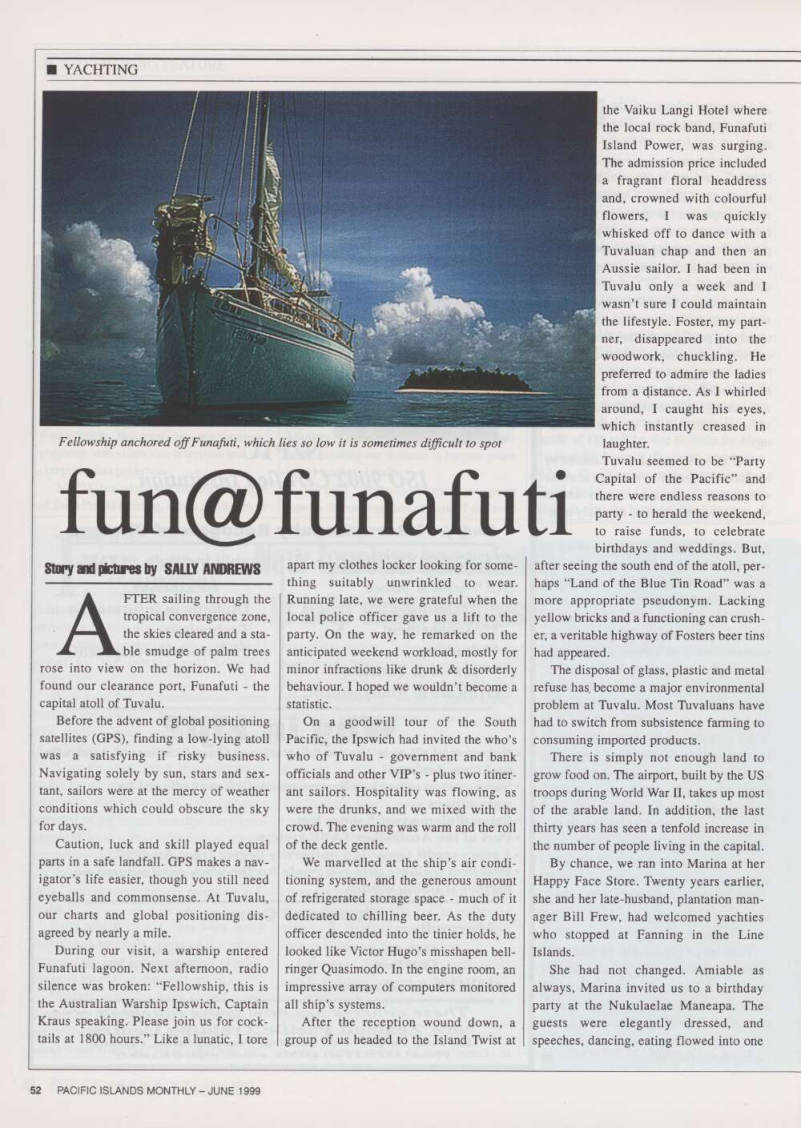
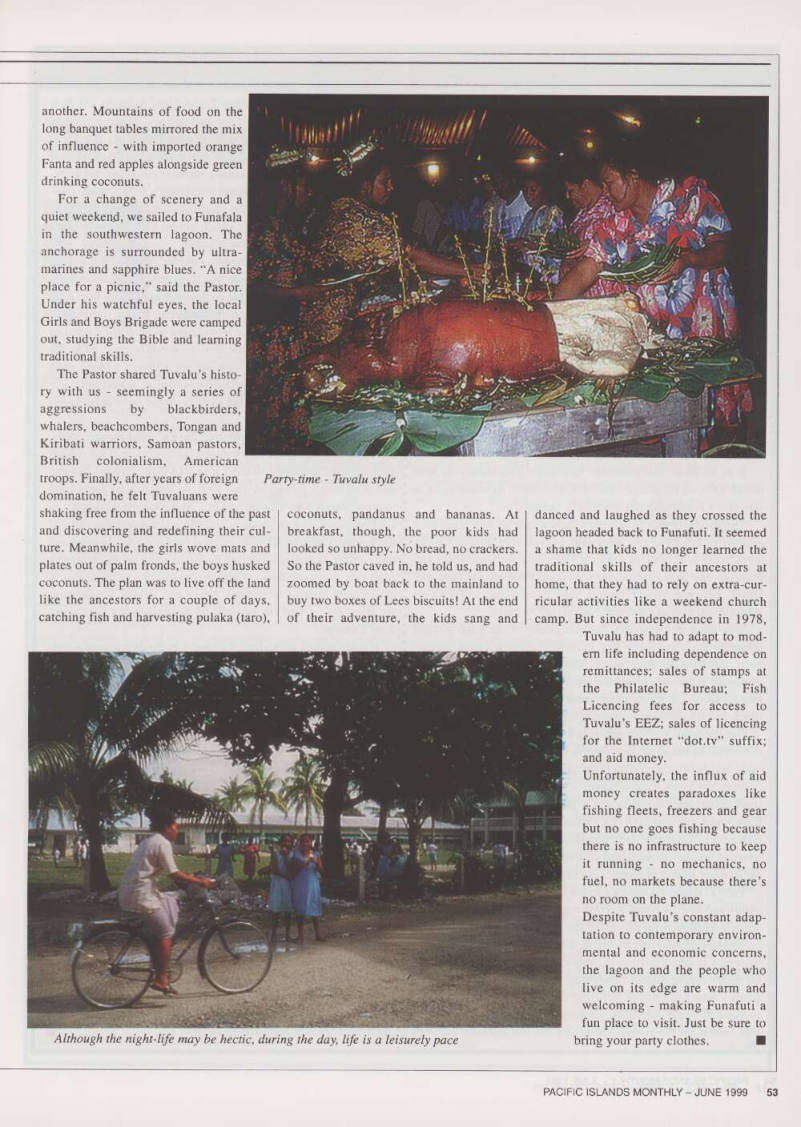
Yachting
Story and pictures by SALLY ANDREWS
AFTER sailing through the tropical convergence zone, the skies cleared and a sta ble smudge of palm trees rose into view on the horizon. We had found our clearance port, Funafuti - the capital atoll of Tuvalu.
Before the advent of global positioning satellites (GPS), finding a low-lying atoll was a satisfying if risky business.
Navigating solely by sun, stars and sex tant, sailors were at the mercy of weather conditions which could obscure the sky for days.
Caution, luck and skill played equal parts in a safe landfall. GPS makes a nav igator’s life easier, though you still need eyeballs and commonsense. At Tuvalu, our charts and global positioning dis agreed by nearly a mile.
During our visit, a warship entered Funafuti lagoon. Next afternoon, radio silence was broken: “Fellowship, this is the Australian Warship Ipswich, Captain Kraus speaking. Please join us for cock tails at 1800 hours.” Like a lunatic, I tore
apart my clothes locker looking for some thing suitably unwrinkled to wear.
Running late, we were grateful when the local police officer gave us a lift to the party. On the way, he remarked on the anticipated weekend workload, mostly for minor infractions like drunk & disorderly behaviour. I hoped we wouldn’t become a statistic.
On a goodwill tour of the South Pacific, the Ipswich had invited the who’s who of Tuvalu - government and bank officials and other VlP’s - plus two itiner ant sailors. Hospitality was flowing, as were the drunks, and we mixed with the crowd. The evening was warm and the roll of the deck gentle.
We marvelled at the ship’s air condi tioning system, and the generous amount of refrigerated storage space - much of it dedicated to chilling beer. As the duty officer descended into the tinier holds, he looked like Victor Hugo’s misshapen bell ringer Quasimodo. In the engine room, an impressive array of computers monitored all ship’s systems.
After the reception wound down, a group of us headed to the Island Twist at
I the Vaiku Langi Hotel where I the local rock band, Funafuti I Island Power, was surging.
I The admission price included I a fragrant floral headdress I and, crowned with colourful I flowers, I was quickly I whisked off to dance with a I Tuvaluan chap and then an I Aussie sailor. I had been in I Tuvalu only a week and I wasn’t sure I could maintain the lifestyle. Foster, my part ner, disappeared into the
I woodwork, chuckling. He
I preferred to admire the ladies I from a distance. As I whirled I around, I caught his eyes, ' which instantly creased in laughter.
Tuvalu seemed to be “Party Capital of the Pacific” and there were endless reasons to party - to herald the weekend, to raise funds, to celebrate birthdays and weddings. But,
after seeing the south end of the atoll, per haps “Land of the Blue Tin Road” was a more appropriate pseudonym. Lacking yellow bricks and a functioning can crush er, a veritable highway of Fosters beer tins had appeared.
The disposal of glass, plastic and metal refuse has become a major environmental problem at Tuvalu. Most Tuvaluans have had to switch from subsistence farming to consuming imported products.
There is simply not enough land to grow food on. The airport, built by the US troops during World War 11, takes up most of the arable land. In addition, the last thirty years has seen a tenfold increase in the number of people living in the capital.
By chance, we ran into Marina at her Happy Face Store. Twenty years earlier, she and her late-husband, plantation man ager Bill Frew, had welcomed yachties who stopped at Fanning in the Line Islands.
She had not changed. Amiable as always, Marina invited us to a birthday party at the Nukulaelae Maneapa. The guests were elegantly dressed, and
speeches, dancing, eating flowed into one
Fellowship anchored off Funafuti, which lies so low it is sometimes difficult to spot
another. Mountains of food on the long banquet tables mirrored the mix of influence - with imported orange Fanta and red apples alongside green
drinking coconuts.
For a change of scenery and a quiet weekend, we sailed to Funafala in the southwestern lagoon. The anchorage is surrounded by ultra marines and sapphire blues. “A nice place for a picnic,” said the Pastor.
Under his watchful eyes, the local Girls and Boys Brigade were camped out, studying the Bible and learning traditional skills.
The Pastor shared Tuvalu’s histo ry with us - seemingly a series of aggressions by blackbirders, whalers, beachcombers, Tongan and Kiribati warriors, Samoan pastors, British colonialism, American troops. Finally, after years of foreign domination, he felt Tuvaluans were
shaking free from the influence of the past and discovering and redefining their cul ture. Meanwhile, the girls wove mats and plates out of palm fronds, the boys husked coconuts. The plan was to live off the land like the ancestors for a couple of days, catching fish and harvesting pulaka (taro).
coconuts, pandanus and bananas. At breakfast, though, the poor kids had looked so unhappy. No bread, no crackers.
So the Pastor caved in, he told us, and had zoomed by boat back to the mainland to buy two boxes of Lees biscuits! At the end of their adventure, the kids sang and
danced and laughed as they crossed the lagoon headed back to Funafuti. It seemed a shame that kids no longer learned the traditional skills of their ancestors at home, that they had to rely on extra-cur ricular activities like a weekend church camp. But since independence in 1978,
Tuvalu has had to adapt to mod em life including dependence on remittances; sales of stamps at the Philatelic Bureau; Fish Licencing fees for access to Tuvalu’s FEZ; sales of licencing for the Internet “dot.tv” suffix; and aid money.
Unfortunately, the influx of aid money creates paradoxes like fishing fleets, freezers and gear but no one goes fishing because there is no infrastructure to keep it running - no mechanics, no fuel, no markets because there’s no room on the plane.
Despite Tuvalu’s constant adap
tation to contemporary environ mental and economic concerns, the lagoon and the people who live on its edge are warm and welcoming - making Funafuti a fun place to visit. Just be sure to bring your party clothes. ■
Although the night-life may be hectic, during the day, life is a leisurely pace
Party-time - Tuvalu style
regional trade?
Opinion
Will FlAs fire up regional trade?
THE possibility of a free trade arrangement (FTA) among Pacific island countries, which has been talked about since 1987, comes to the fore again this month when Forum trade ministers meet in Suva.
It is an issue that promises to feature importantly at next month’s Forum Economic Ministers’ Meeting in Apia and again at this year’s Forum summit in Palau in October.
The ministers will have before them a number of studies on a number of proposals. At last count, at least five different FTAs were being talked about - among FICs only, between FICs and Australia and New Zealand, between some FICs and the European Union, between some FICs and the United States and with all countries on a Most Favoured Nation (MFN) basis.
This alone demonstrates the complexity of the issue and the difficulty the island states face in coming up with a final pact, or pacts, that best suit their needs. Throw in the fact that free trade means the states, whose economies are fragile to say the least, will lose significant amounts of tax revenue if import duties are abol ished, and it’s obvious no one can expect any quick decisions.
But decisions will nevertheless have to be made and they are critical to the island nations’ futures in a fast-moving world seem ingly hell-bent on global trade liberalisation.
In recent years, there has been a proliferation of regional free trade arrangements and bilateral agreements. The Asia-Pacific Economic Cooperation (APEC) grouping, which has embarked on a process of voluntary trade liberalisation, is heading for a make or-break summit in Auckland and we could be on the verge of a Millennium Round of world trade negotiations.
Pacific island countries can no longer stand apart from the trends and an FTA offers a prime opportunity to consolidate their voice in dealings with the rest of the world. As other nations seek economic cohesion in trade pacts, fragmentation in the Pacific is no longer viable. The issue is irrevocably bound up with the need for wide-ranging reform - embraced at least in principle by most states - which is critical to lifting the states’ economic perfor mance and living standards. Looking at new trade arrangements was forced on the island nations by the diminishing value of
SPARTECA preferences as New Zealand and Australia cut their tariffs to other countries and the looming end of the European Union’s Lome IV arrangements in February next year.
Two years ago, the Forum secretariat commissioned a report on a possible preferential ETA among member countries. Its archi tect, Robert Scollay, of Auckland University’s APEC Study Cen tre, reported a year ago that the quantifiable economic benefits to the FICs would be relatively small, but an ETA would act as a stepping stone to complete liberalisation.
He noted “substantial economic benefits” would flow from a supporting programme of trade and investment facilitation mea sures and the size of the market covered could be more than dou bled by inclusion of the French and American Pacific territories.
And Scollay said all FICs would gain more if they reduced their MEN tariffs at the same time as a preferential ETA. He warned the benefits of freer trade are not achieved without costs and particularly noted that alternative sources of government rev enue - that is, a value added tax (VAT) - would have to be devel oped.
There is very little trade between the FICs and another study, by Australia’s Centre for International Economics, said the overall gain would be increased 40 times if an ETA included New Zealand and Australia - countries that provide nearly half their total imports. Papua New Guinea and Fiji, as the largest economies in the Forum, would gain most, it said, while as a proportion of GDP the Solomon Islands, Kiribati, Fiji and the Cooks would come out best. Again, this report referred to the revenue losses stemming from cuts in import duties. These account for up to two-thirds of government revenue in Kiribati, Tonga and Tuvalu, according to the latest draft report on the issue by Australians R.J.Filmer and Tony Lawson.
It noted moves throughout the region in the direction of a con sumption tax regime, regardless of the ETA debate. By now five FICs (the Cook Island, Fiji, Papua New Guinea, Samoa and Van uatu) should have a VAT in place, while the Solomons, Tonga and Tuvalu have a sales tax system. The report advocated a New Zealand-style goods and services tax, broad-based with a single tax rate and minimal exemptions. So-called “sin” goods like alco hol and tobacco products should also have an excise tax.
The report concluded that loss of tax revenues should not be a significant barrier to any regional FTA, saying they could readily be replaced by shifting some or all the tax base from imports to consumption.
It noted, however, a continuing lack of real interest in new regional trade arrangements in most FICs, reflecting a belief that they have few export opportunities and SPARTECA and Lome have not fired economic activity.
The argument really comes back to whether the Pacific nations, now moving towards economic reform, including cutting back the public sector and encouraging private enterprise, want to continue that process and embrace the principles of globalisation. As Filmer and Lawson said: “A vitalised private sector is more likely to be in a position to take advantage of any trading opportunities eventuat ing from a regional trade arrangement.” ■
David Barber
Wellington
The fight against corruption gets high-tech
Opinion
A NEW anti-bribery treaty, negotiated on the other side of the planet, is about to make its mark on the way business is done in the South Pacific. It’s just one of a number of developments since the Asian economic crisis, which are putting paid to the idea that a little bit of corruption in developing countries is good for greas ing the wheels of business.
In fact, in many Asian countries, which before the crisis were seen as good examples of this philosophy, it was corruption and lack of accountability that led to the huge scale of the crash.
“at the core of our dark experience lies the ugly truth that there was an absence of transparency, accountability, public interest and public responsibility,” former Thai prime minister, Anand Pan yarachun, told an audience in Bangkok recently.
Tonku Adbul Aziz, a former Malaysian central bank official now working for the world-wide anti-corruption group Trans parency International, put it more bluntly, saying that the philoso phy of turning a blind eye to corruption “proved to be nothing more than an elaborate prop for what was basically a morally inde fensible and decadent heritage”.
Transparency International (TI) has documented numerous cases of corruption, especially in the letting of government con tracts and the privatisation of government corporations, which have cost the taxpayers hundreds of millions of dollars.
It is just these problems that the new anti-bribery treaty, spon sored by the Paris-based Organisation for Economic Co-operation and Development (OECD), is designed to tackle. the treaty makes it a crime for business-people from OECD or other signatory nations, to bribe a foreign public official.
By the end of 1999, all 34 nations that have expressed interest in the treaty, are expected to have made its provision binding by ratifying the document.
Those countries account for 70 per cent of world trade and even more of foreign direct investment. They include most the Pacific’s main trading partners, for example, Australia, New Zealand, Japan, the United States and Britain.
At the same time there is growing grass-roots movement against corruption in the Pacific.
In Papua New Guinea, the Business Council was the driving force behind the establishment of a local chapter of Transparency International. Transparency International itself is just five years
old but, such has been the enthusiasm for its approach of putting together community coalitions to fight corruption, that it now has chapters in 70 countries.
The Papua New Guinea chapter has leading lawyer and chair of the Port Moresby Stock Exchange, Sir Anthony Siagaru, as its president. It has held meetings across the country and worked with the ministry of education to develop ethics and values courses that are now in use in secondary schools and in induction courses for new students at the University of Papua New Guinea.
TIPNG’s key parliamentary initiative, a proposal for an Inde pendent Anti-corruption Commission, has not been able to win support from enough politicians to see it approved.
As yet it has not drawn up its action plan but it has won the support of key figures such as the Police Commissioner and the Director of Public Prosecutions. This high profile support will be important if corruption is going to be dealt a telling blow.
Corruption is a difficult area in which to obtain convictions and more so when the offence is committed away from the offenders home country. The success of the OECD treaty will rely on author ities receiving good tip-offs either from the competitors of a sus pect company or from whistleblowers within the company or affected government agency.
Whistleblowers, in particular, need good support if they are to come forward. While Transparency International focuses on bring ing together local non-govemment organisations to fight corrup tion and support whistleblowers, international aid donors and many governments in the region are working on prevention.
Last year, the Asian Development Bank (ADB) brought in a new anti-corruption policy that has implications for every aspect of the bank’s operations. The ADB has committed itself to ‘zero tolerance’ and will do everything it can to stamp out practices such as the selection of uneconomic aid projects because of opportuni ties they provide for kickbacks or patronage.
Procurement fraud, facilitation payments to government offi cials, misappropriation of confidential information for personal gain, theft and embezzlement, nepotism in promotions or the use of threats of tax audits to extract personal favours are all on the ADB’s hit list. But accordirig to the ADB’s Director of Pacific Operations, Basudev Dahal, the most effective way of dealing with corruption is through providing competitive markets and the legal framework for open and accountable government. Corrup tion thrives on secrecy. Without that secrecy it will either disap pear or become obvious, giving police or other agencies a better chance of taking action against it.
Only last month, the World Bank blacklisted three companies that had failed to meet its standards of accountability.
In privatisations and the letting of government contracts, such open procedures can save the government 20 to 30 per cent of the project costs.
Jemima Garrett
Sydney
Regional Economic. A partnership
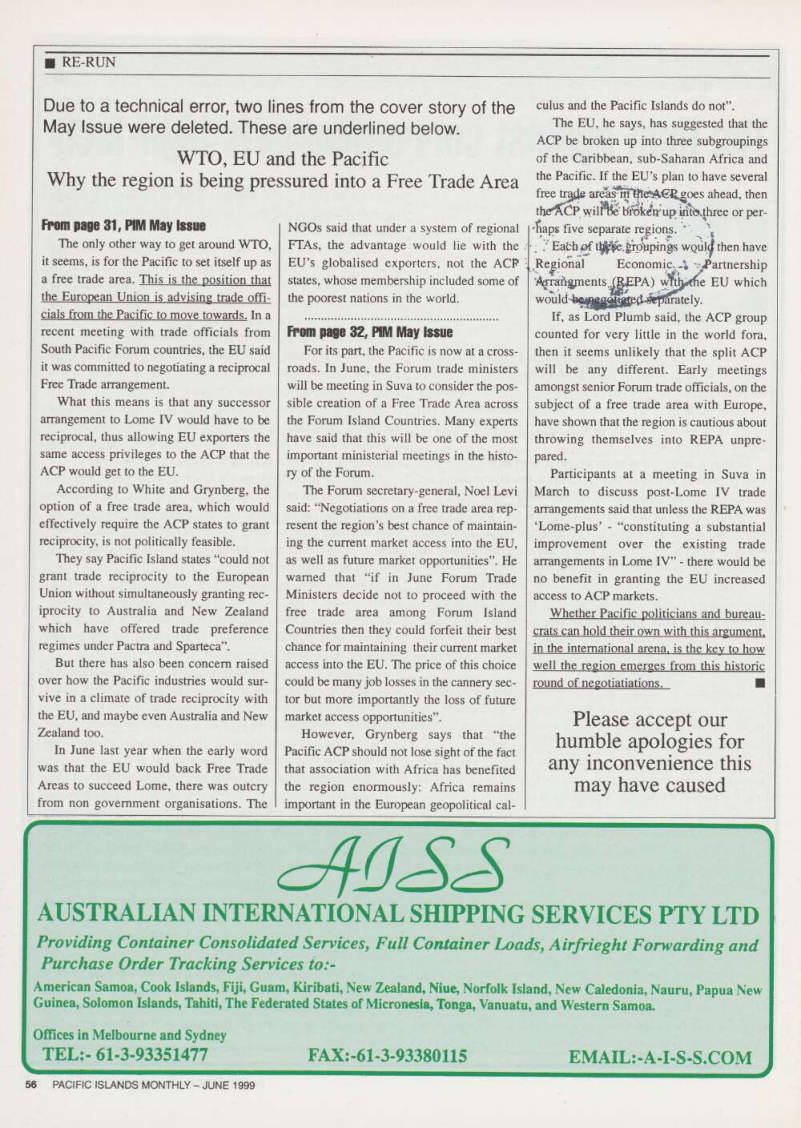
Re-Run
Due to a technical error, two lines from the cover story of the May Issue were deleted. These are underlined below.
WTO, EU and the Pacific Why the region is being pressured into a Free Trade Area
From page 31, PIM May Issue The only other way to get around WTO, it seems, is for the Pacific to set itself up as a free trade area. This is the position that the European Union is advising trade offi cials from the Pacific to move towards. In a recent meeting with trade officials from South Pacific Forum countries, the EU said it was committed to negotiating a reciprocal Free Trade arrangement.
What this means is that any successor arrangement to Lome IV would have to be reciprocal, thus allowing EU exporters the same access privileges to the ACP that the ACP would get to the EU.
According to White and Grynberg, the option of a free trade area, which would effectively require the ACP states to grant reciprocity, is not politically feasible.
They say Pacific Island states “could not grant trade reciprocity to the European Union without simultaneously granting rec iprocity to Australia and New Zealand which have offered trade preference regimes under Pactra and Sparteca”.
But there has also been concern raised over how the Pacific industries would sur vive in a climate of trade reciprocity with the EU, and maybe even Australia and New Zealand too.
In June last year when the early word was that the EU would back Free Trade Areas to succeed Lome, there was outcry from non government organisations. The
NGOs said that under a system of regional FTAs, the advantage would lie with the EU’s globalised exporters, not the ACP states, whose membership included some of the poorest nations in the world.
From page 32, PIM May Issue For its part, the Pacific is now at a cross roads. In June, the Forum trade ministers will be meeting in Suva to consider the pos sible creation of a Free Trade Area across the Forum Island Countries. Many experts have said that this will be one of the most important ministerial meetings in the histo ry of the Forum.
The Forum secretary-general, Noel Levi said: “Negotiations on a free trade area rep resent the region’s best chance of maintain ing the current market access into the EU, as well as future market opportunities”. He warned that “if in June Forum Trade Ministers decide not to proceed with the free trade area among Forum Island Countries then they could forfeit their best chance for maintaining their current market access into the EU. The price of this choice could be many job losses in the cannery sec tor but more importantly the loss of future market access opportunities”.
However, Grynberg says that “the Pacific ACP should not lose sight of the fact that association with Africa has benefited the region enormously: Africa remains important in the European geopolitical cal
cuius and the Pacific Islands do not”.
The EU, he says, has suggested that the ACP be broken up into three subgroupings of the Caribbean, sub-Saharan Africa and the Pacific. If the EU’s plan to have several free areapnlftc*A6li«c)es ahead, then
wilFbe - broketrup intKthree or per
haps five separate regions. ‘ \ .' Each of groupings wqulq then have
Regional Economic. A partnership
vs\ytne EU which If, as Lord Plumb said, the ACP group counted for very little in the world fora, then it seems unlikely that the split ACP will be any different. Early meetings amongst senior Forum trade officials, on the subject of a free trade area with Europe, have shown that the region is cautious about throwing themselves into REPA unpre pared.
Participants at a meeting in Suva in March to discuss post-Lome IV trade arrangements said that unless the REPA was ‘Lome-plus’ - “constituting a substantial improvement over the existing trade arrangements in Lome IV” - there would be no benefit in granting the EU increased access to ACP markets.
Whether Pacific politicians and bureau crats can hold their own with this argument, in the international arena, is the kev to how well the region emerges from this historic round of negotiatiations. ■
Please accept our
humble apologies for
any inconvenience this
may have caused
Advertisements & other items, pp. 56-60 (1 item)
Cskjss
AUSTRALIAN INTERNATIONAL SHIPPING SERVICES PTY LTD
Providing Container Consolidated Services, Full Container Loads, Airfrieght Forwarding and Purchase Order Tracking Services to:- American Samoa, Cook Islands, Fiji, Guam, Kiribati, New Zealand, Niue, Norfolk Island, New Caledonia, Nauru, Papua New Guinea, Solomon Islands, Tahiti, The Federated States of Micronesia, Tonga, Vanuatu, and Western Samoa.
Offices in Melbourne and Sydney
TEL:-61-3-93351477 FAX;-61-3-93380115 EMAIL:-A-I-S-S.COM
TRADE MARK CAUTIONARY NOTICE
Notice is hereby given that Telstra Corporation Limited, a corporation duly organised and existing under the laws of Australia, and having ACN 051 775 556, the Corporate Secretary being located at 242 Exhibition Street, Melbourne, Australia is the sole proprietor of the following trade marks:- Used in respect of:— Telecommunications and communications equipment, apparatus and systems, including but not limited to electronic and optical telecommunications and communications equipment, apparatus and systems; satellite and earth station telecommunications and communications equipment, apparatus and systems; Telephone equipment, apparatus and systems, including but not limited to telephone; telephone receivers; telephone handsets; telephone network, telephone exchanges, telephone switching, telephone answering, telephone card vending and telephone dialling equipment, apparatus and systems; Transmission, receiving and storage equipment, apparatus and systems, including but not limited to facsimile, telegraph, telex, teleprinting, cable and paging equipment, apparatus and systems; data and video networking and conferencing equipment, apparatus and systems; data processing, message handling and switching equipment, apparatus and systems; digital equipment, apparatus and systems; electronic, voice, text and facsimile mail equipment, apparatus and systems; electronic directory equipment, apparatus and systems; Computer equipment, apparatus and systems, including but not limited to computer programs; computer software; computer hardware; computer terminals; computer memories; computer networking equipment, apparatus and systems; computer manuals in this class; modems; Video and audio equipment, apparatus and systems, including but not limited to sound and image recording, transmission and reproduction equipment, apparatus and systems; video cassettes and tapes; compact discs; records; digital, electric and electronic radio equipment, apparatus and systems; magnetic tapes; cinematographic, television and amusement equipment, apparatus and systems; amusement machines; All associated parts and accessories being goods in class 9, paper, cardboard and goods made from these materials; printed matter including directories, journals and manuals and all goods in class 16; advertising, promotional, consultancy and business services; compiling, arranging and publishing directories; telephone answering services; market research and statisticalservices; being services in class 35, repair installation, maintenance and construction services; being services in class 37, telecommunication services being services in class 38, amusement, entertainment, education and information services; multi-media services; being services in class 41, research services; computer programming services; retail and wholesaling services; consultancy services being services in Class 42', The said proprietor claims all rights in respect of the above trade marks and will take all necessary legal steps against any person or company infringing their said rights.
~elstra
"~elstra
DAVIES COLLISON CAVE
PATENT ATTORNEYS
One Little Collins Street Melbourne, Victoria, 3000 Australia Level 10 10 Barrack Street Sydney, New South Wales, 2000 AMP Building Hobart Place Canberra City 2601
TRADING POST
TRADING POST CAN WORK WONDERS FOR YOU ...
Promote your business, or service, sell your household items, cars or
heavy machinery etc.
ONLY AUSS2 EOR EQUIVALENT) PER WORD. NO COMPANY LOGO. NO DISPLAY.
NO BOLD TYPE.
Just forward your Advertisement together with payment to: PACIFIC ISLANDS MONTHLY "Trading Post", PO Box 1167, Suva, Fiji.
Conditions: 1. All Advertisements are subject to acceptance and approval of publisher. 2. Advertisements are published as space permits; we cannot guarantee date of insertion. 3. All advertisements must be prepaid and should be typed or printed clearly 4. Deadline for receipt of advertisements is the 15th of the month prior to issue. 5. PACIFIC ISLANDS MONTHLY assumes no responsibility for any service other than publishing paid advertisements in this section.
Add
Graphic Systems Limited
18 Disraeli Rd, P.0.80x 16149, Suva, Fiji.
Phone: (697) 306100 Fax: (679) 306111
HIGH RESOLUTION SCANS
HIGH QUALITY FILM
vv
SCREEN RULING
CHEMICAL PROOFS
IMAGE MANIPULATION
Pre-Press Production on time
At the RIGHT QUALITY
®ime toaits for no one.
%MgMm !
las
' l y *
f j T
s < e last mi y. Sound familiar? De line and if you have a really urgent job we’ll keep multi colour printing, special le-cutting. Call us or visit our intshop for a free quote. , cy t j »
COMMERCIAL PRINTING & PACKAGING
TELEPHONE (679) 313 311 FAX (679) 301 133 EMAIL Q([email protected] WEBSITE WWW.INTERNETFfJI.COM/QUALiTY
N q\q PfVc,
ZL. PpTTRtoK
o'sjeuj-
-3 v f :
Supporting Fiji's
Sports
X x X Fiji International Telecommunications Limited provides services equal to the world’s best. And while the digital technology used here everyday is the finest in the world, we’re already looking to the technology of tomorrow.
So, don’t be surprised if you find it in use in Fiji first. * It m *
TALK TO THE WORLD
Fiji International Telecommunications Limited, Mercury House, 158 Victoria-Parade, PO Box 59, Suva, Fiji Islands.
Telephone (679) 312 933, Fax (679) 301 025, Email [email protected] • Website http://www.fintel.com.fj