People fear
p. 26 · Read in the full issue
for their lives
It remains unclear what happened in Binu, a village of Malaita families
working on a big palm oil
plantation east of Honiara.
Eye witnesses give confused accounts. Violin Dafua lived there and told of a man who, as he was fishing, was approached by an armed group of indige nous Guadalcanal men.
“He said ‘oh please, don’t shoot’ and then they shot him in both arms and legs and when he went down they hacked him with the knives,” she said through an interpreter.
She spoke in pidgin which bluntly expressed the way weeping women clutched their children in terror as the men then moved toward them.
A two year old boy ran across their path and his father lept to save him, cover ing his body.
“Chop, chop,” she said, hacking down with her arm.
But the knife, she said, went through his body, reaching the child’s head.
“They chopped the father and got the son, the child.”
She was living in a school hall in Honiara as she told the story, surrounded by mothers and other children. It was a
confusing story that was diffi cult to make sense of.
Some mothers said the child lived, others say he died.
Officially he was killed but nei ther the authorities nor the Red Cross investigated in any detail.
Outside a press of people around the Red Cross office Lionel Tota said he was living in a remote part of the country
when approached by militants.
“They had a gun, a point two two,” he said. “I was not frightened and I told them if you shot me you will have to face the judgement of God.”
He quickly fled to Honiara and was trying for a free ticket
out of the island.
Diving instructor Johnny Pimo of Solomon Sport Diving took three tourists one day to Ruaniu in West Guadalcanal where a Japanese war wreck was located.
“We were going down to the stem when I suddenly heard our boat go whoosh and take over very fast,” Pimo said.
“When I came up to the surface I was shot at by men; four bullets hit the water just near me.”
He said the group of armed men were on the shore about 300 metres away.
“As they drifted out they ran out of air in their tanks and had to surface. They were able to take cover from the shooting by stay ing in troughs of waves.
After several hours they came into the
shore and the men indicated that the four should come ashore.
They asked Pimo if he was Malaitan.
“I said I was from Santa Cruz. If I was a Malaitan I would be dead.”
Out west of Honiara beautiful coastal villages were aban doned, its people joining the flood of refugees. We came across a Guadalcanal family liv ing in a little piece of former paradise. The man advanced on us with a bush knife the men ace was obvious.
“People don’t smile any more,”
our guide said, “people are very fright ened.”
The man’s message in his hostility was that we should return to the capital it was dangerous for us.
The refugee operation is dehumanising at best and Honiara was no different.
People were pressed into grossly inad equate, hot and unhealthy accommoda tion.
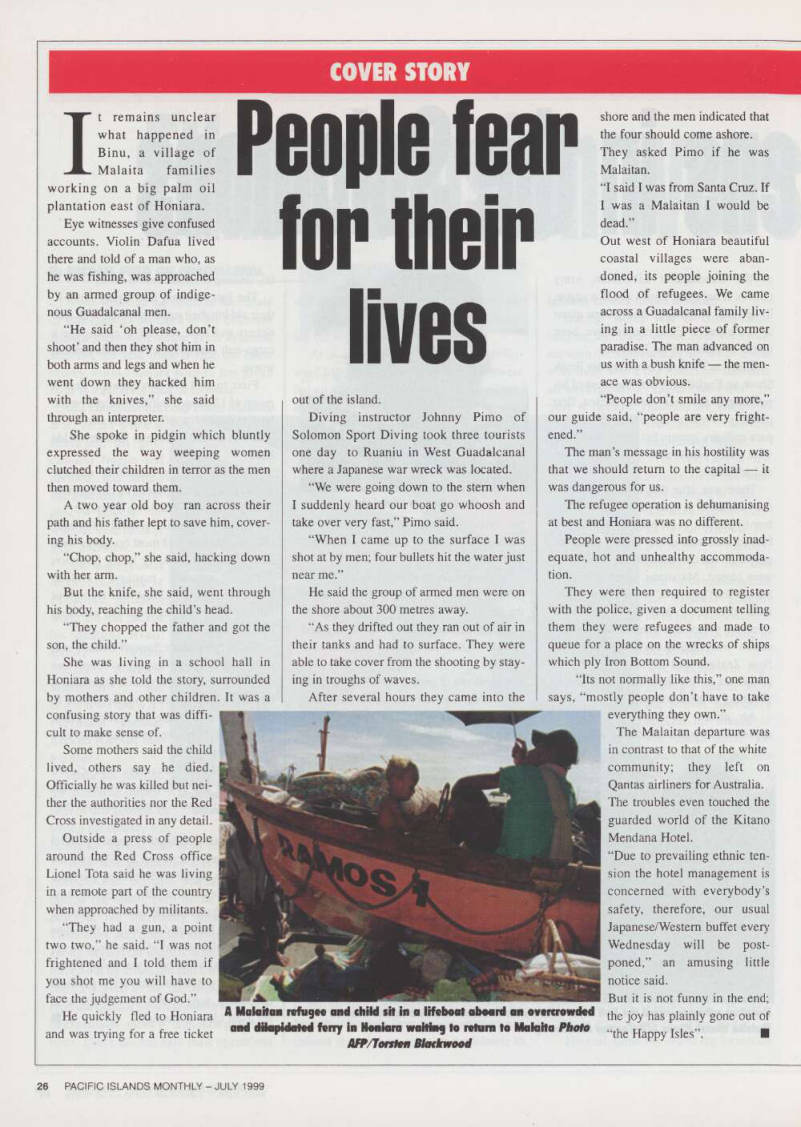
They were then required to register with the police, given a document telling them they were refugees and made to queue for a place on the wrecks of ships which ply Iron Bottom Sound.
“Its not normally like this,” one man says, “mostly people don’t have to take
everything they own.”
The Malaitan departure was in contrast to that of the white community; they left on Qantas airliners for Australia.
The troubles even touched the guarded world of the Kitano Mendana Hotel.
“Due to prevailing ethnic ten sion the hotel management is concerned with everybody’s safety, therefore, our usual Japanese/Western buffet every Wednesday will be post
poned,” an amusing little
notice said.
But it is not funny in the end; the joy has plainly gone out of “the Happy Isles”. ■
A Malaitan refugee and child sh in a lifeboat aboard an overcrowded and dilapidated ferry in Honiara waiting to return to Mala Ha Photo AFP/Torsten Blackwood