Ethnic tension wors[?]en in the Solomons
pp. 24-25 · Read in the full issue
Cover Story
By Michael Held On Guadalcanal
Some where in the midst of the “State of Emergency” declared in the Solomon Islands there were some gross criminal acts but the real truth is that the often
murky world Honiara politics has given
birth to a different kind of monster.
In a constitutional coup Prime Minister
Bartholomew Ulufa’alu, his gov ernment fragile and divided, has seized extraordinary emer gency powers without time limit or judicial review.
And in the process of the emergence of ill-defined militants Ulufa’alu has backed his political rivals, former Prime Minister Solomon Mamaloni and Guadalcanal Provincial Premier Ezekiel Alebua, into a comer.
Ulufa’alu justified
the indefinite suspen sion of due process by saying the country was
facing its “darkest hour in its history”.
What was astonishing was that it was Alebua, and perhaps Mamaloni, who played the ethnic card in the otherwise peaceful but incredibly poor country.
There were also complex sub-plots impli cating Malaysian loggers who have been forced out by Ulufa’alu and Chinese gam blers involved in the intriguing world of Honiara casinos which are little more than international money laundering opera tions. Ulufa’alu has said their operations
will be forced to close next year.
The byzantine mess is rapidly destroy ing the economy.
At a simple level it was straightfor ward.lndigenous Guadalcanal people were fed-up at being second class and often land less citizens in an island dominated by what
they saw as bossy and aggressive people from Malaita, across Iron Bottom Sound.
Ulufa’alu is Malaitan, as are most of the members of the police and para-military forces. The issue has clanked around in the back of national life since independence in 1978 but had earlier origins.
The British had the capital at Tulagi in the Florida Islands. The way Ulufa’alu puts it, the British deliberately did nothing for Malaita who they feared were warriors and instead spread them through the islands as
landless coolies forced to squat.
During World War II Guadalcanal became the scene of the decisive clash between the Allies and Japan. When it was over there was a big American base and an airstrip called “Henderson Field”. In time it became Honiara, the centre of
commercial activity
and, finally, capital.
No one asked the indigenous people what they thought of it all.
The issue came to a cri sis when Alebua, for
I political' reasons,
stirred it up late last ! year by demanding that i the national govern ment pay compensation for the capital being in the province.
He wanted rent sug gesting a rate of Ssso per person, plus S$ 14 million for breach of the constitution. He also wanted further
compensation of
S$ 100,000 each for 25
Guadalcanal people
who have been killed
“for no reason” since independence in 1978.
This followed a government decision a year earlier to pay S$ 16,000 compensa tion to parents of Malaita girls who were victims of an alleged mass rape at a girls’ high school in Honiara.
He said his people never asked for the
capital. “Buildings are mushrooming
everywhere on Guadalcanal,” he said.
“This is giving concern to my people.”
His call, some say, led to the formation
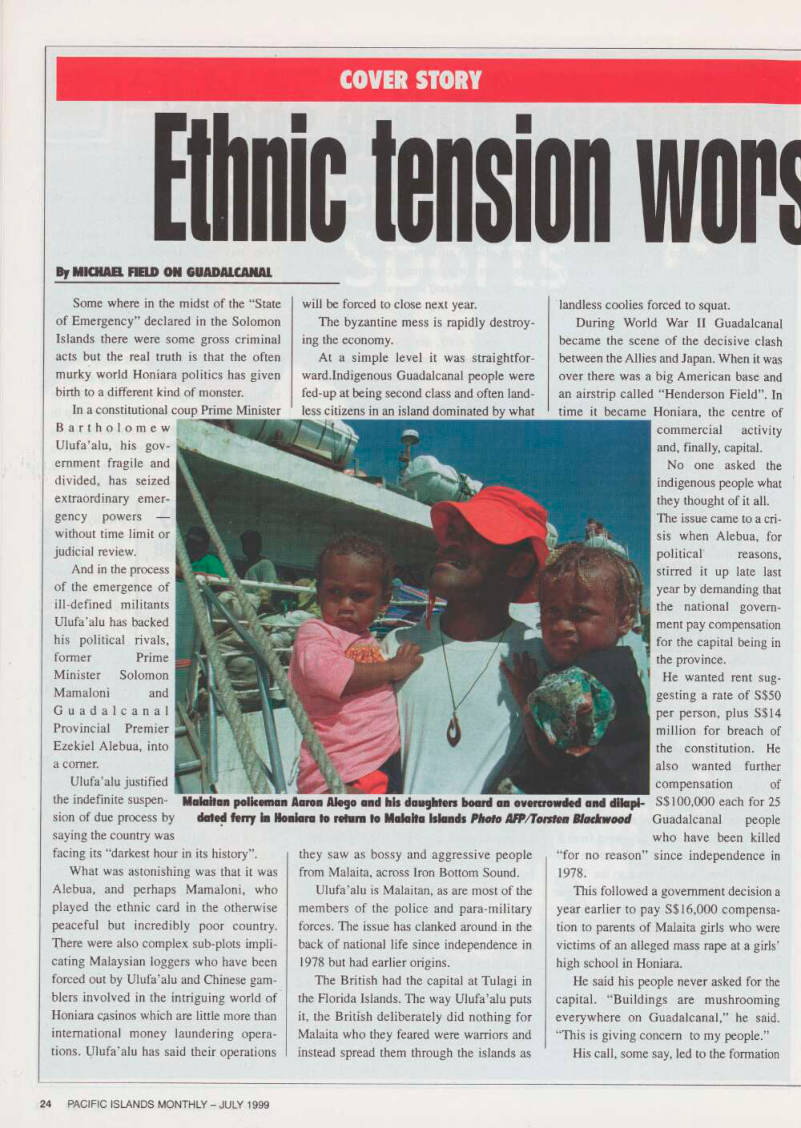
Malaian policeman Aaron Alego and his daughters board an overcrowded and dilapi dated ferry in Honiara to return to Malaita Islands Photo AFP/Tonten Blackwood
of the Guadalcanal Liberation Army (GLA). It has other names and is a vague, ill-defined, philosophy free groups given to lawlessness. Four names have been touted as leaders of the fractions.
Solomon’s Police Commissioner Frank Short, an Englishman who did most of his policing in apartheid South Africa, first publicly revealed the existance of the para-military group but then said they were young people who want “a bit of fun and adventure”.
There was, after this, a spiral of crimi nal violence as several people were killed, bombs planted in oil plantations, houses burned, cars stoned and mainly Malaitan people driven out. Schools and businesses were closed. Malaitans, some of whom honour the “pay back” culture responded with the same and barricaded the entrances to Honiara. Then in June the sit uation worsened quickly as Australia, New Zealand and Japan issued travel advisories telling their citizens to avoid travelling to the Solomons.
An attack on Binu by militants appeared to mark a radical escalation of
the crisis and on June 15 Governor- General Sir Moses Pitakaka proclaimed a State of Emergency.
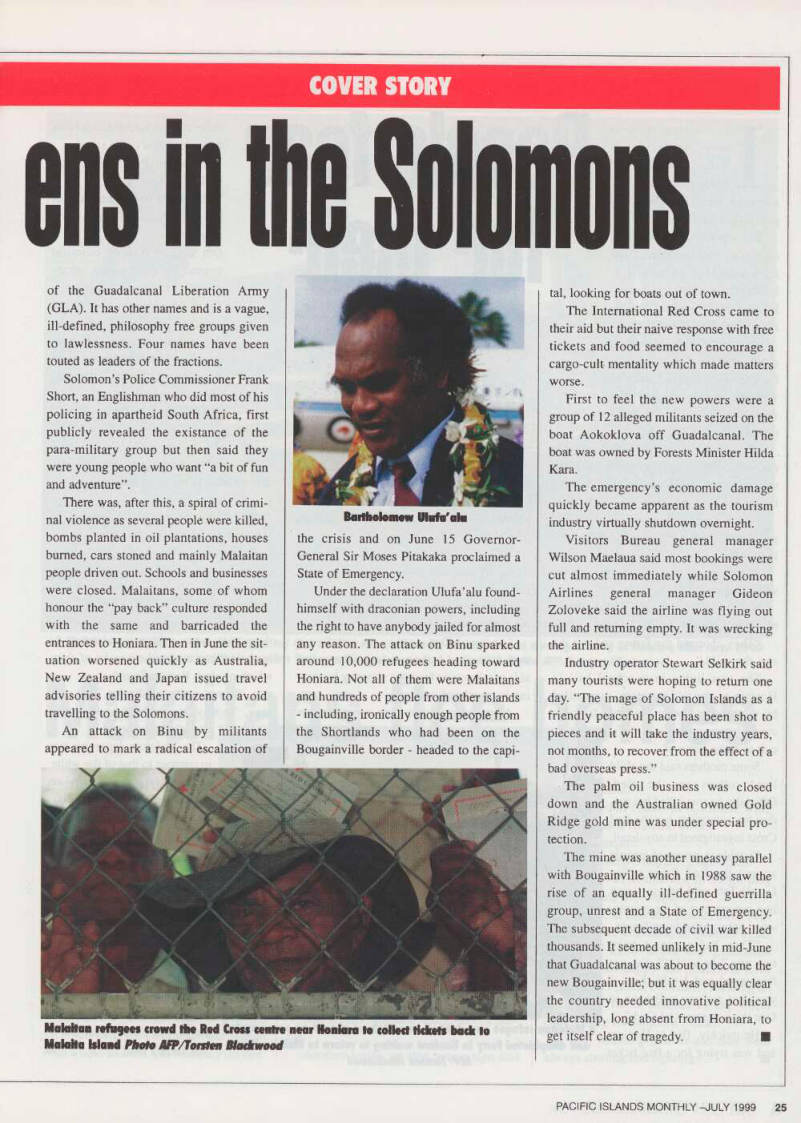
Under the declaration Ulufa’alu found himself with draconian powers, including the right to have anybody jailed for almost any reason. The attack on Binu sparked around 10,000 refugees heading toward Honiara. Not all of them were Malaitans and hundreds of people from other islands
- including, ironically enough people from
the Shortlands who had been on the Bougainville border - headed to the capi-
tal, looking for boats out of town.
The International Red Cross came to their aid but their naive response with free tickets and food seemed to encourage a cargo-cult mentality which made matters worse.
First to feel the new powers were a group of 12 alleged militants seized on the boat Aokoklova off Guadalcanal. The boat was owned by Forests Minister Hilda Kara.
The emergency’s economic damage quickly became apparent as the tourism industry virtually shutdown overnight.
Visitors Bureau general manager Wilson Maelaua said most bookings were cut almost immediately while Solomon Airlines general manager Gideon Zoloveke said the airline was flying out full and returning empty. It was wrecking the airline.
Industry operator Stewart Selkirk said many tourists were hoping to return one day. “The image of Solomon Islands as a friendly peaceful place has been shot to pieces and it will take the industry years, not months, to recover from the effect of a bad overseas press.”
The palm oil business was closed down and the Australian owned Gold Ridge gold mine was under special pro tection.
The mine was another uneasy parallel with Bougainville which in 1988 saw the rise of an equally ill-defined guerrilla group, unrest and a State of Emergency.
The subsequent decade of civil war killed thousands. It seemed unlikely in mid-June that Guadalcanal was about to become the new Bougainville; but it was equally clear the country needed innovative political leadership, long absent from Honiara, to get itself clear of tragedy. ■
Malaitan refugees crowd Ike Red Cross centre near Honiara to collect tickets back to Malabo Island Photo AFP/Tonteu Blackwood
Bartholomew Ulufa'alu