keeps Hawaiian
pp. 50-51 · Read in the full issue
Mains keen eye keeps Hawaiian canoe on track
By Giff Johnson
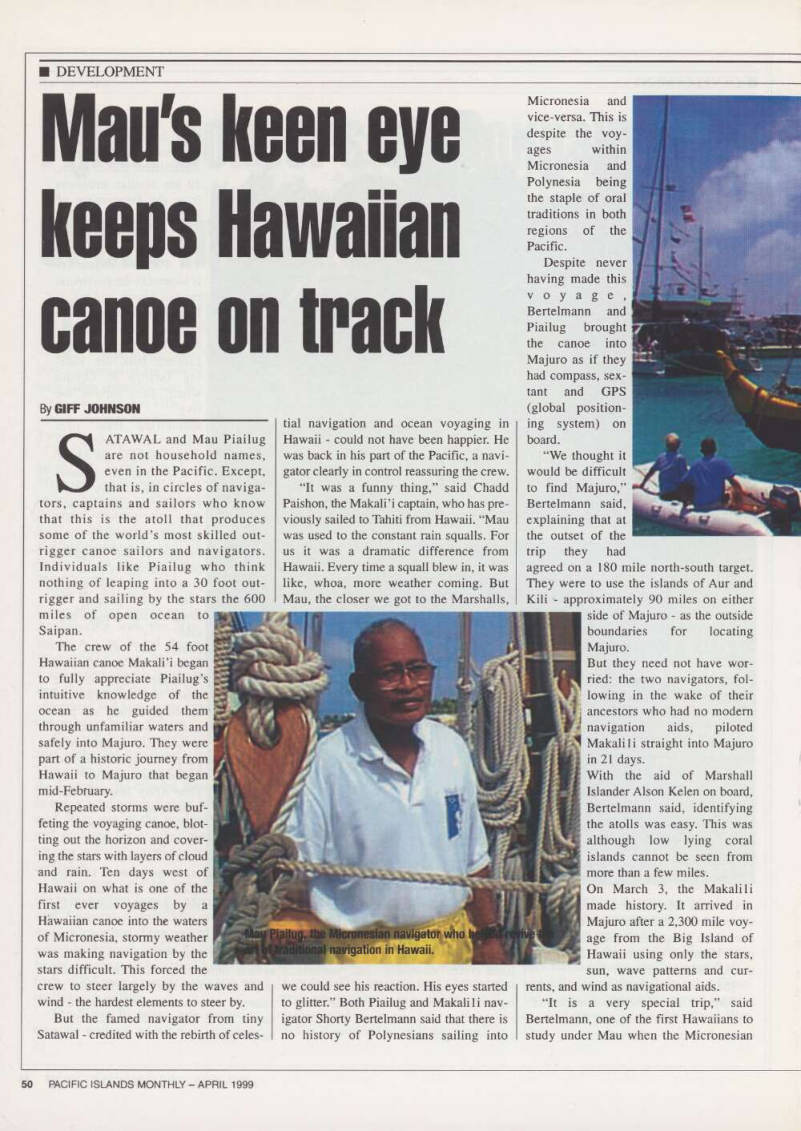
SATAWAL and Mau Piailug are not household names, even in the Pacific. Except, that is, in circles of naviga tors, captains and sailors who know that this is the atoll that produces some of the world’s most skilled out rigger canoe sailors and navigators.
Individuals like Piailug who think nothing of leaping into a 30 foot out rigger and sailing by the stars the 600
miles of open ocean to Saipan.
The crew of the 54 foot Hawaiian canoe Makali’i began to fully appreciate Piailug’s intuitive knowledge of the ocean as he guided them through unfamiliar waters and safely into Majuro. They were part of a historic journey from Hawaii to Majuro that began mid-February.
Repeated storms were buf feting the voyaging canoe, blot ting out the horizon and cover ing the stars with layers of cloud and rain. Ten days west of Hawaii on what is one of the first ever voyages by a Hawaiian canoe into the waters of Micronesia, stormy weather was making navigation by the stars difficult. This forced the
crew to steer largely by the waves and wind - the hardest elements to steer by.
But the famed navigator from tiny Satawal - credited with the rebirth of celes
tial navigation and ocean voyaging in Hawaii - could not have been happier. He was back in his part of the Pacific, a navi gator clearly in control reassuring the crew.
“It was a funny thing,” said Chadd Paishon, the Makali’i captain, who has pre viously sailed to Tahiti from Hawaii. “Mau was used to the constant rain squalls. For us it was a dramatic difference from Hawaii. Every time a squall blew in, it was like, whoa, more weather coming. But Mau, the closer we got to the Marshalls,
we could see his reaction. His eyes started to glitter.” Both Piailug and Makalili nav igator Shorty Bertelmann said that there is no history of Polynesians sailing into
Micronesia and vice-versa. This is despite the voy ages within Micronesia and
Polynesia being
the staple of oral traditions in both regions of the Pacific.
Despite never having made this voyage, Bertelmann and Piailug brought the canoe into Majuro as if they had compass, sex tant and GPS (global position ing system) on board.
“We thought it would be difficult to find Majuro,”
Bertelmann said, explaining that at the outset of the trip they had
agreed on a 180 mile north-south target.
They were to use the islands of Aur and Kili - approximately 90 miles on either
side of Majuro - as the outside boundaries for locating Majuro.
But they need not have wor ried: the two navigators, fol lowing in the wake of their ancestors who had no modern navigation aids, piloted Makalili straight into Majuro in 21 days.
With the aid of Marshall Islander Alson Kelen on board, Bertelmann said, identifying the atolls was easy. This was
although low lying coral
islands cannot be seen from more than a few miles.
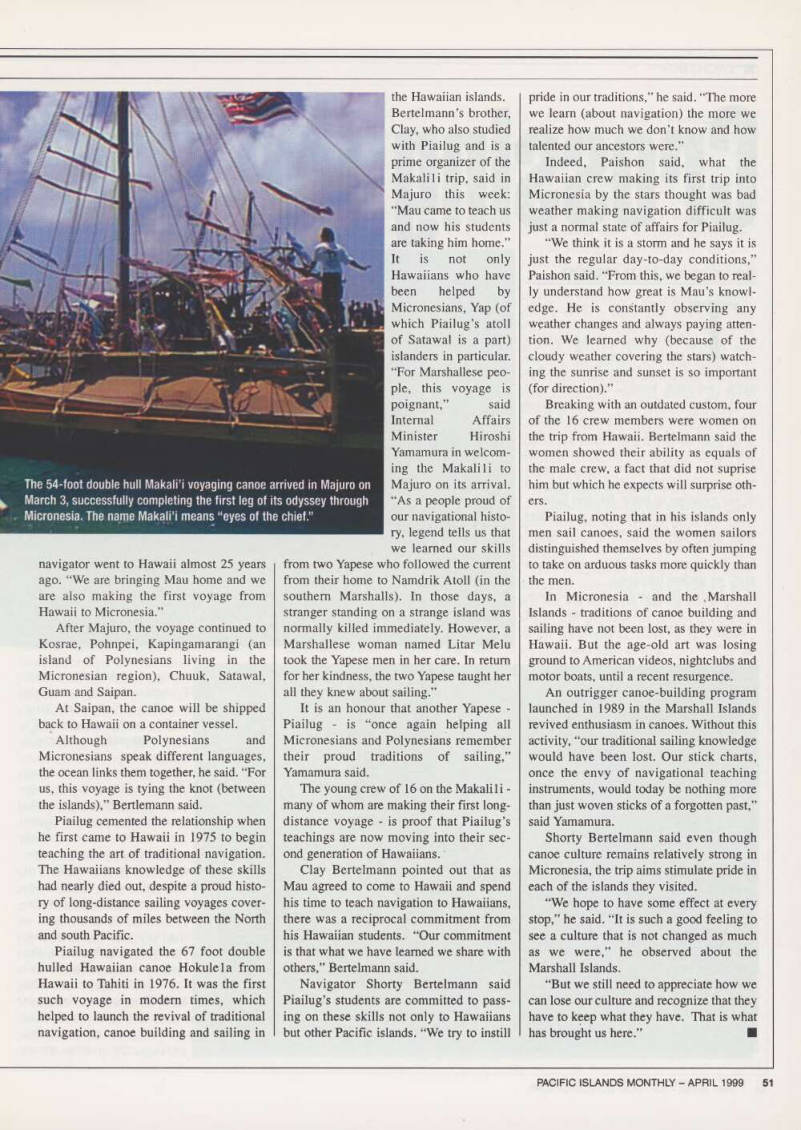
On March 3, the Makalili made history. It arrived in Majuro after a 2,300 mile voy age from the Big Island of Hawaii using only the stars, sun, wave patterns and cur
rents, and wind as navigational aids.
“It is a very special trip,” said Bertelmann, one of the first Hawaiians to study under Mau when the Micronesian
navigator went to Hawaii almost 25 years ago. “We are bringing Mau home and we are also making the first voyage from Hawaii to Micronesia.”
After Majuro, the voyage continued to Kosrae, Pohnpei, Kapingamarangi (an island of Polynesians living in the Micronesian region), Chuuk, Satawal, Guam and Saipan.
At Saipan, the canoe will be shipped back to Hawaii on a container vessel.
Although Polynesians and Micronesians speak different languages, the ocean links them together, he said. “For us, this voyage is tying the knot (between the islands),” Bertlemann said.
Piailug cemented the relationship when he first came to Hawaii in 1975 to begin teaching the art of traditional navigation.
The Hawaiians knowledge of these skills had nearly died out, despite a proud histo ry of long-distance sailing voyages cover ing thousands of miles between the North and south Pacific.
Piailug navigated the 67 foot double hulled Hawaiian canoe Hokulela from Hawaii to Tahiti in 1976. It was the first such voyage in modern times, which helped to launch the revival of traditional navigation, canoe building and sailing in
the Hawaiian islands.
Bertelmann’s brother.
Clay, who also studied with Piailug and is a prime organizer of the Makalili trip, said in Majuro this week: “Mau came to teach us and now his students are taking him home.”
It is not only Hawaiians who have been helped by Micronesians, Yap (of which Piailug’s atoll of Satawal is a part) islanders in particular.
“For Marshallese peo ple, this voyage is
poignant,” said
Internal Affairs Minister Hiroshi Yamamura in welcom ing the Makalili to Majuro on its arrival.
“As a people proud of our navigational histo ry, legend tells us that we learned our skills
from two Yapese who followed the current from their home to Namdrik Atoll (in the southern Marshalls). In those days, a stranger standing on a strange island was normally killed immediately. However, a Marshallese woman named Litar Melu took the Yapese men in her care. In return for her kindness, the two Yapese taught her all they knew about sailing.”
It is an honour that another Yapese - Piailug - is “once again helping all Micronesians and Polynesians remember their proud traditions of sailing,”
Yamamura said.
The young crew of 16 on the Makalili many of whom are making their first long distance voyage - is proof that Piailug’s teachings are now moving into their sec ond generation of Hawaiians.
Clay Bertelmann pointed out that as Mau agreed to come to Hawaii and spend his time to teach navigation to Hawaiians, there was a reciprocal commitment from his Hawaiian students. “Our commitment is that what we have learned we share with others,” Bertelmann said.
Navigator Shorty Bertelmann said Piailug’s students are committed to pass ing on these skills not only to Hawaiians but other Pacific islands. “We try to instill
pride in our traditions,” he said. “The more we learn (about navigation) the more we realize how much we don’t know and how talented our ancestors were.”
Indeed, Paishon said, what the Hawaiian crew making its first trip into Micronesia by the stars thought was bad weather making navigation difficult was just a normal state of affairs for Piailug.
“We think it is a storm and he says it is just the regular day-to-day conditions,”
Paishon said. “From this, we began to real ly understand how great is Mau’s knowl edge. He is constantly observing any weather changes and always paying atten tion. We learned why (because of the cloudy weather covering the stars) watch ing the sunrise and sunset is so important (for direction).”
Breaking with an outdated custom, four of the 16 crew members were women on the trip from Hawaii. Bertelmann said the women showed their ability as equals of the male crew, a fact that did not suprise him but which he expects will surprise oth ers.
Piailug, noting that in his islands only men sail canoes, said the women sailors distinguished themselves by often jumping to take on arduous tasks more quickly than the men.
In Micronesia - and the , Marshall Islands - traditions of canoe building and sailing have not been lost, as they were in Hawaii. But the age-old art was losing ground to American videos, nightclubs and motor boats, until a recent resurgence.
An outrigger canoe-building program
launched in 1989 in the Marshall Islands revived enthusiasm in canoes. Without this activity, “our traditional sailing knowledge would have been lost. Our stick charts, once the envy of navigational teaching instruments, would today be nothing more than just woven sticks of a forgotten past,” said Yamamura.
Shorty Bertelmann said even though canoe culture remains relatively strong in Micronesia, the trip aims stimulate pride in each of the islands they visited.
“We hope to have some effect at every stop,” he said. “It is such a good feeling to see a culture that is not changed as much as we were,” he observed about the Marshall Islands.
“But we still need to appreciate how we can lose our culture and recognize that they have to keep what they have. That is what has brought us here.” ■
The 54-foot double hull Makali’i voyaging canoe arrived in Majuro on March 3, successfully completing the first leg of its odyssey through Micronesia. The name Makali’i means “eyes of the chief.”