Pacific Islands

Monthly
INSIDE; Region to rethink maritime safety
1
American Samoa US$2.5O; Australia A 53.50; Cook Islands NZ$3; Fiji F 52.50 Vat incl; FS Micronesia US$3; Kiribati A 52.50; Naum A 52.50; Niue NZ$3; Norfolk ASS: New Caledonia cpf2so; New Zealand NZ53.45 incl GST; Northern Marianas US$3; Papua New Guinea K 3; Palau US$3; Marshall Islands US$3: Solomon Islands As 3; French Polynesia cpf3oo; Tonga P 3; USA US$3; Vanuatu VT22O; Western Samoa T 5.50. These are recommended prices only.
Advertisements & other items, pp. 2-4 (1 item)
The Best Gets Better!
INTRODUCING THE NEW
E4OX YAMAHA
Fiji's most popular Outboard Mote gets even better! Now with eve greater power and much improve performance the new, upgrade E4OX will give you more reliability lower noise, and much easie operation than ever before. Fu technical specifications are nov available from Asco Motors.
L £ Improved performance for carrying heavy loads New simple fuel system for easier maintenance Improved anti-corrosion system uses 5 stage multiple coating Large capacity chrome plated waterpump for longer life Heavy duty gearbox is easier to operate and maintain Front mounted controls improve operation - - 'v ■ 3K
Asco Motors
* POWERFUL
AND RELIABLE
NEW MODEL
YAMAHA E4OX
ENDURO
OUTBOARD
'. MOTOR
TECHNICAL INFORMATION : BARRY LEE • MANASA BALU • PH 384888 • FAX 370309 • GPO BOX 355 SUVA FIJI ISLANDS BRANCHES: NABUA PH 384888 • WALU BAY PH 307808 • SIGATOKA PH 500577 • NADI PH 721777 • LAUTOKA PH 662855 BA PH 674406 • TAVUA PH 680152 • VATUKOULA PH 681377 • LABASA PH 811688
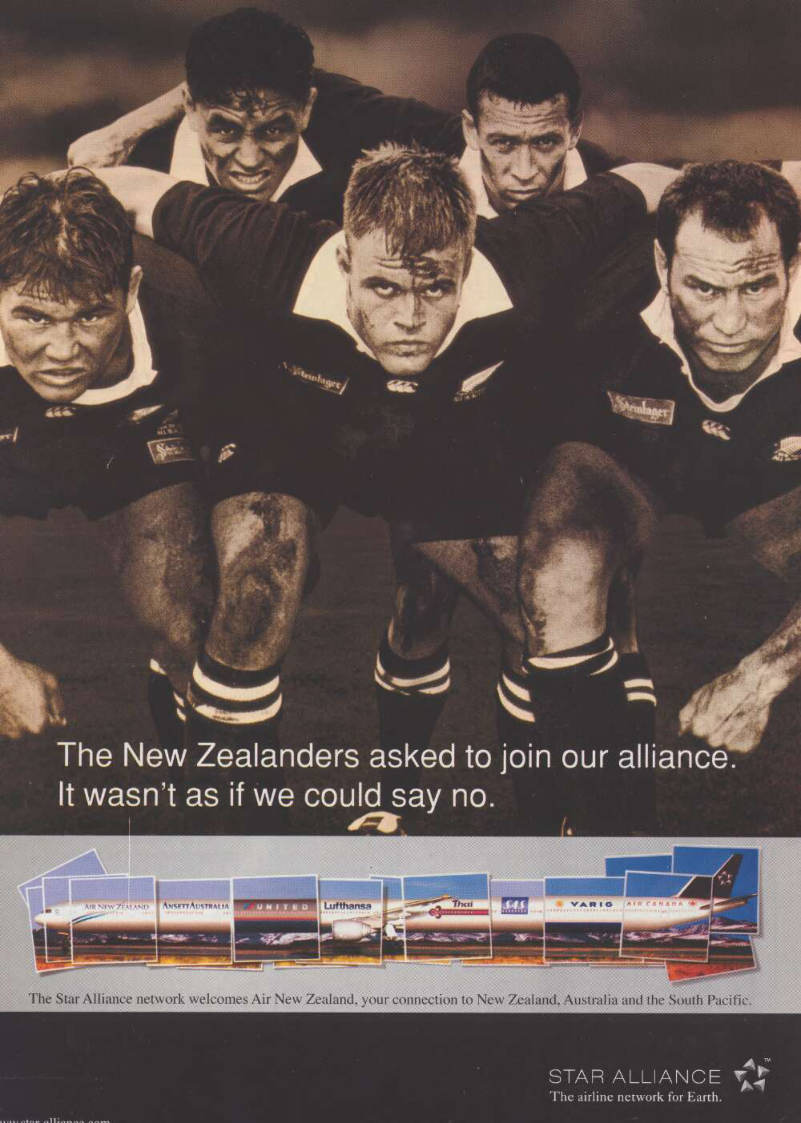
*«* m . , I 1 ■ f •1 i Igl I N » r H The New Zealanders asked to join our alliance It wasn’t as if we could say no. m ■jri i*: w- The Star Alliance network welcomes Air New Zealand, your connection to New Zealand, Australia and the South Pacifi A ™
STAR ALLIANCE T f JT
The airline network for Earth.
* c.
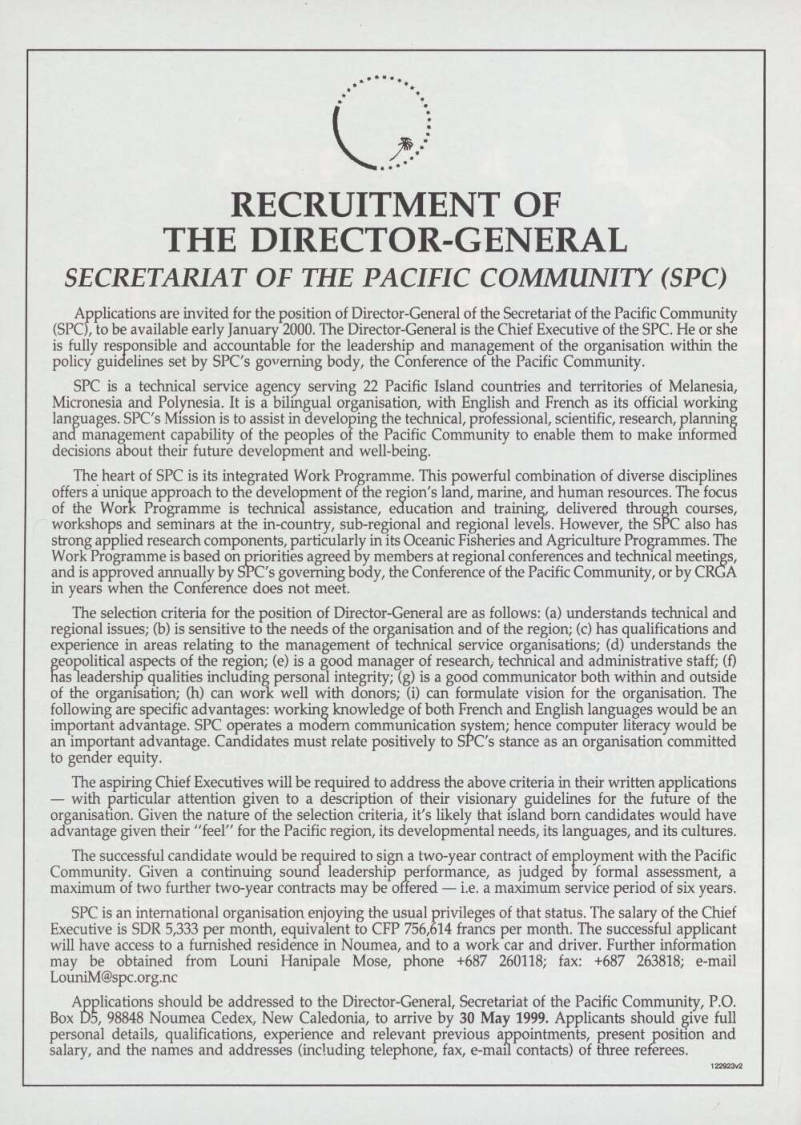
RECRUITMENT OF
THE DIRECTOR-GENERAL
SECRETARIAT OF THE PACIFIC COMMUNITY (SPC)
Applications are invited for the position of Director-General of the Secretariat of the Pacific Community (SPC), to be available early January 2000. The Director-General is the Chief Executive of the SPC. He or she is fully responsible and accountable for the leadership and management of the organisation within the policy guidelines set by SPC's governing body, the Conference of the Pacific Community.
SPC is a technical service agency serving 22 Pacific Island countries and territories of Melanesia, Micronesia and Polynesia. It is a bilingual organisation, with English and French as its official working languages. SPC's Mission is to assist in developing the technical, professional, scientific, research, planning and management capability of the peoples of the Pacific Community to enable them to make informed decisions about their future development and well-being.
The heart of SPC is its integrated Work Programme. This powerful combination of diverse disciplines offers a unique approach to the development of the region's land, marine, and human resources. The focus of the Work Programme is technical assistance, education and training, delivered through courses, workshops and seminars at the in-country, sub-regional and regional levels. However, the SPC also has strong applied research components, particularly in its Oceanic Fisheries and Agriculture Programmes. The Work Programme is based on priorities agreed by members at regional conferences and technical meetings, and is approved annually by SPC's governing body, the Conference of the Pacific Community, or by CRGA in years when the Conference does not meet.
The selection criteria for the position of Director-General are as follows: (a) understands technical and regional issues; (b) is sensitive to the needs of the organisation and of the region; (c) has qualifications and experience in areas relating to the management of technical service organisations; (d) understands the feopolitical aspects of the region; (e) is a good manager of research, technical and administrative staff; (f) as leadership qualities including personal integrity; (g) is a good communicator both within and outside of the organisation; (h) can work well with donors; (i) can formulate vision for the organisation. The following are specific advantages: working knowledge of both French and English languages would be an important advantage. SPC operates a modern communication system; hence computer literacy would be an important advantage. Candidates must relate positively to SrC's stance as an organisation committed
to gender equity.
The aspiring Chief Executives will be required to address the above criteria in their written applications with particular attention given to a description of their visionary guidelines for the future of the organisation. Given the nature of the selection criteria, it's likely that island born candidates would have advantage given their "feel” for the Pacific region, its developmental needs, its languages, and its cultures.
The successful candidate would be required to sign a two-year contract of employment with the Pacific Community. Given a continuing sound leadership performance, as judged by formal assessment, a maximum of two further two-year contracts may be offered i.e. a maximum service period of six years.
SPC is an international organisation enjoying the usual privileges of that status. The salary of the Chief Executive is SDR 5,333 per month, equivalent to CEP 756,614 francs per month. The successful applicant will have access to a furnished residence in Noumea, and to a work car and driver. Further information may be obtained from Louni Hanipale Mose, phone +687 260118; fax: +687 263818; e-mail
Applications should be addressed to the Director-General, Secretariat of the Pacific Community, P.O.
Box D 5, 98848 Noumea Cedex, New Caledonia, to arrive by 30 May 1999. Applicants should give full personal details, qualifications, experience and relevant previous appointments, present position and salary, and the names and addresses (including telephone, fax, e-mail contacts) of three referees. 122923v2
Pacific Islands

Monthly
april 1989
Vol 69 No. 4
The News Magazine
April 1999
PUBLISHER: Alan Robinson EDITOR: Sophie Foster Hildebrand
Correspondents:
Sally Andrew, Monica Miller, Giff Johnson, Chris Peteru, Atama Raganivatu, Michael Field, Marc Neil-Jones, Alan Ah Mu, Sam Vulum, Lisa Williams, Ofani Eremae Florence Syme-Buchanan, Brian Tobia.
Columnists:
David Barber (Wellington), Jemima Garrett (Sydney),
Graphic Artists:
Josefa Bola, Joseph Dass, Faizal Khan
Advertising Sales
Senior Regional Sales (South Pacific) Shayne Farah Hussein Tel (679) 304111,303244, Fax (679) 303809.
Sydney, Canberra: Bob Hill Media Representation, Tel (61-2) 4164245, Fax (61-2)4165064.
Brisbane: Jane Fewings Media and Advertising Associates Tel (61-7) 3378 4522, Fax (61-7) 3878 1071.
Adelaide: Hastwell Williamsons Representatives, Tel (61-8) 3799522, Fax (61-8) 3799735.
Melbourne: Brown Orr Fletcher Burrows (Aust) Pty Ltd.
Tel (61-3) 98265188, Fax (61-3) 98265644.
Auckland: McKay & Bowman, International Media Representatives Limited, Tel (64-9) 4190561, Fax (64-9) 4192243.
Japan: Universal Media Corporation, Tokyo, Tel (3) 3266626741.
Cable: UNI-MEDIA Tokyo, Fax (3) 32626742.
Pacific Islands Monthly was founded in 1930
(Usps 9522480).
A Fiji Times Limited production.
Cover prices are recommended retail only. Registered by Australia Post, Publication No. NBPI2IO. © Copyright Fiji Times Limited, 177 Victoria Parade, Suva, Fiji.
Tel (679) 304111, fax (679) 303809.
Email; [email protected] PIM Website: http://www.pim.com.fj Pacific Islands Monthly is published monthly by Fiji Times Limited, a division of Nationwide News, 2 Holt Street, Surry Hills, Sydney, NSW 2010.
Send Address Changes To:
Pacific Islands Monthly POBox 1167, Suva, Fiji.
Printed by Quality Print Limited, 16 Amra Street, Walu Bay, Suva, Fiji.
Layout by Josefa Bola and Sophie Foster Hildebrand
Inside
Cover Story Page 30
Editorial/ Letters 6 Briefs 10 Special Report: Region must rethink maritime safety 12 EPIRBs save lives but not widespread in Pacific 14 Business: IMF/PNG talks at another standstill 15 Marshalls sees pot of gold in Taiwan 16 Samoa drawn into lOC corruption debate 17 Pacific leaders want Clinton at Hawaii summit 18 Controversial CNMI bill will limit residency 20 DRD still after Emperor Mines Limited 21 Kiribati countdown hack on track 22 Aviation: Air Marshalls moving to acquire new planes 26 Air Nauru sponsors Micronesian airline study 27 Aloha set for first north Pacific flight 27 Cover: The end of an era 30 A new alternative for Fiji's voters 33 Industry: Privatisation elecrifies PNG 20 Highlands Pacific wants to dump tailings in bay 34 Pacific cashes in on Hollywood 36 Samoan film director makes her mark in the US 38 Work begins on Port Moresby waterfront complex 40 Cooks' multi-million dollar nightmare 42 Gorbachev spokesman goes 'tropo' in Hawaii 44 Yachtir Crossing the line 52 Opr David Barber/Jemima Garrett 54
Page 12
Page 18
Page 38
History may

Editorial
History may repeat itself
ALTHOUGH it is a general assumption of national elec tions that the party with the support of the majority of peo ple gets into power, as Fiji and other places such as Venezuela have shown, this does not
always follow through. If the vocal pub lic does not go along with the result, there could be hell to pay.
It is a sad fact, but, in Fiji’s case any way, it is true.
If there is one lesson to be learnt from the heady days of Fijian nationalism just after the 1987 military coups, it is that the power of the vocal masses could never be under-estimated.
However, since that fateful day, 12 years ago - when democracy was rudely awakened - Fijians have learnt a very important lesson. They have found that if
they apply their collective approach to
life to protests, they get better results than
following the system. Today, landowners in Fiji are using this very same tactic in order to further their own ends.
If and when they do not appreciate the way the Native Land Trust Board is han dling their rental payments, they protest.
Usually their demands are met in part if not full. So they have continued to taste the sweet success of protest.
The Fijian culture of protest, thus far, has mostly involved putting up road blocks by laying a plank of wood across a road. While this may not seem like it would stop traffic, it literally does. And considering the fact that, in many areas, there is only one road in and out of some
where, it is very effective.
What this should signify to political candidates is that Fijians - who now make up the majority of people in the country - are no longer satis fied with their lot in life. They
want more. With a national general elec tion coming up next month, the people of Fiji have been given a chance to have their say.
In fact, according to the new constitu tion, they must have their say, or face a fine. Now is the time to voice concerns.
Now is the time for the vocal masses to make a stand. Not after the fact.
One can only hope that the build-up to next elections does not involve false promises of riches at the end of the rain bow, and that politicians will be able to fulfil their manifestoes. Perhaps this way, history may get out this habit of repeating itself. ■
Letters

A plea for the future of fishing
Since 1991 I have been been working as a helicopter pilot in US and Korean pur seiners or tuna boats as a fish splatter. My observation after seven years is that the quality of yellowfin tuna and skipjack has gone down tremendously.
The SPC must unite and have a scheme strong enough to preserve the fishing industry in the ocean. 1. To ban or stop the deep sea fishing for at least two years. 2. Increase the SPC observers assigned in every kind of fishing boat. 3. Limit the issuance of fishing permits to all kinds of fishing boats. 4. Request the US, Australia, NZ Navy boats patrol the Pacific especially the 12 mile coast lines and boundary limits.
When tuna started in the mid-1980s, it took three weeks to catch 1,000 tons. Now it take 30-60 days. Most purseiner boats are registered in the US, South Korea, Japan, Taiwan, China, Philippines, and the Solomons. A yellowfin tuna can weigh 80- 100 kilogrammes for a length of five years.
The catch, sizes, location of the tuna can
be monitored by the South Pacific Commission. In the past, the unloading was done at high seas for six months before a boat sailed to shore. Now, every boat has to unload in the nearest island in the Pacific.
Nets are used to catch the tuna. Tuna shows up on the surface of the water if small baits/fish are around. At night, lights are submerged under the water to attract the fish then the tuna. We make a set at four in the morning before sunrise. Normally, the fish stay together at night and swim a short distance. Sunlight tends to make the tuna spread out and stay down deep. It takes three hours to roll a net and we make two to three sets a day.
Maltreatment, food, medicines are com mon problems on boats. Crew come from Korea, Indonesia, Philippines, Samoa, Peru, Fiji, Tuvalu, PNG, Japan, Taiwan and the US. Communication can be a problem at sea. Sometimes the crew swims to shore to avoid the maltreatment on the boat.
The time will come where fishing boats will be fighting at sea just to catch tons of tuna. It is happening now in the 90s, but
wait five more years when there is no more tuna in the ocean. Some boats have guns on board to scare people in other boats.
SPC should not give licence permits to boats with maltreatment of crew so that the seamen can be protected.
Helicopters are used to locate the school of fish and logs generally register in the US. Around 100 helicopters fly, made of single engine bell 47 and Huddles 500 C/D models.
It is common in tuna fishing to catch dolphins, whales, sharks, sting-ray, marlin and small milkfish. Anything below three kg is considered a reject and thrown back into the sea. Who among the islanders has the capacity to check the boats are 200 nautical miles away from shore? Mostly fishing boats sneak in at four in the morn ing, make a set on a log inside the 12 mile limit then sail as fast as possible before sunrise. Please include my observations to enlighten the minds of the next generation of Pacific people.
Jordan Javier
Santa Cruz, Philippines
Advertisements & other items, p. 7 (1 item)
ToFinish...
SCHOOLS • CHURCHES • GOVERNMENT • COMMERCIAL
Serving.
From S
STATE OF HAWAII
ENTIRE
SOUTH PACIFIC,
INCLUDING:
FIJI
SAMOA
TAHITI
TONGA
COOK ISLANDS
II
MICRONESIA:
FEDERATED STATES
OF MICRONESIA
GUAM
MARIANAS
MARSHALL
ISLANDS
PALAU
~,,, ,u Copymasters Hawaii can help you with all of your duplicating needs from start to finish. Featuring Duplo Digital Duplicators, Copiers, Shredders, Laminators, Poster Printers, Collators, & Folding Equipment. We also sell Stencil & Duplicator Supplies, Paper Supply, and all brands of Copier Supplies, & Computers.
Copymasters Hawaii
96-1173 Waihona Street, Suite B-2 • Pearl City, HI 96782 Phone (808) 678-2263 • Fax (808) 456-5678
E-Mail: [email protected]
ToFinish...
copymasters
hawaii
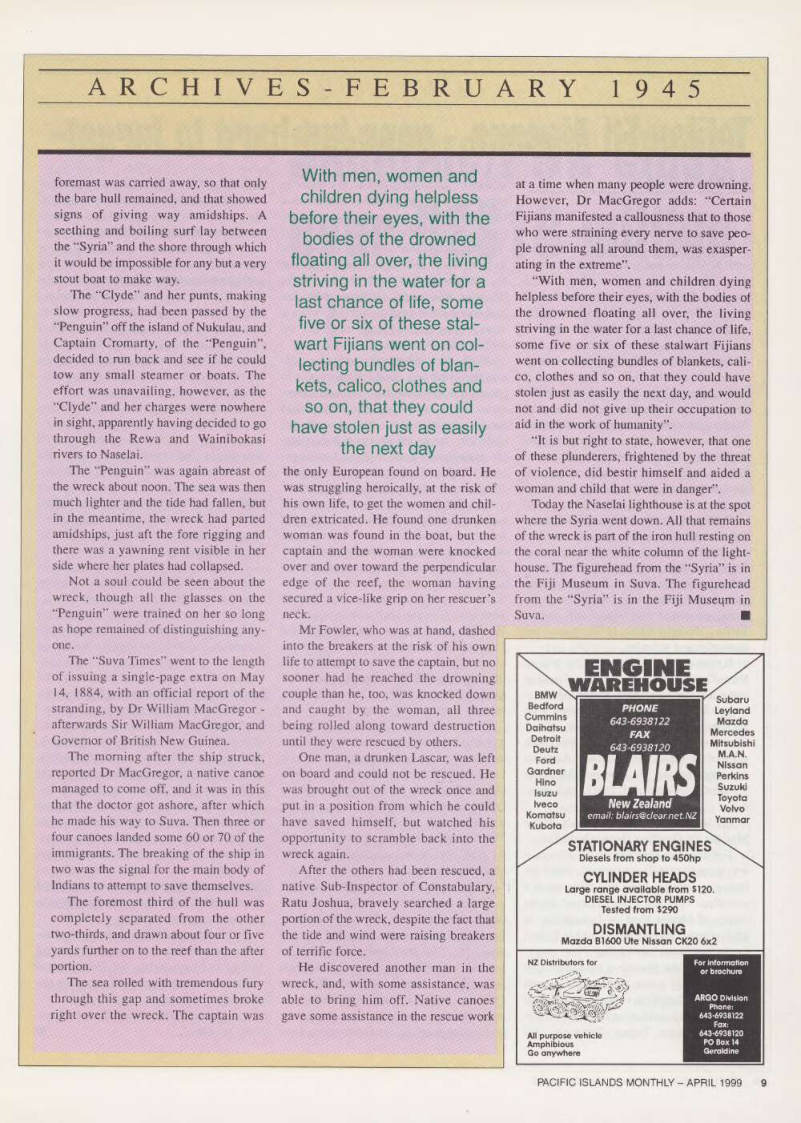
Ship “Syria”
Archives-February 1945
The loss of the Coolie Ship “Syria”
By R C Macpherson
In the early 80’s (1880 s), Indian immigrants first came into Fiji to work on the sugar plantations of the Colony, and, from the commencement of this coolie trade between Calcutta and the Islands, the ships which carried them from the swarming bazaars of old India to the new land of promise in the south went through many vicissitudes. Some of them had tragic voyages, with out breaks of cholera on board - in one such instance only rough and ready, but effec tive, quarantine measures saved Fiji from the disease.
But there was one coolie ship whose tragedy was not that of pestilence, but of shipwreck almost within sight of her des tination, and after what her master described as “a most prosperous voyage, experiencing nothing but fine weather and light winds and having no serious sickness”.
That vessel was the iron, full-rigged ship “Syria”, of 1,010 tons, built at Sunderland in 1869, and owned by Mr James Nourse, of 50 Lime Street, London. (Incidentally, James Nourse Line vessels were still in the immigrant trade between Calcutta and Fiji up to the outbreak of W.W.11). She sailed from Calcutta on March 13, 1884 - surely an ominous date to any superstitious sailor with a crew of 43 and 493 Indian immi grants.
The ship arrived off Kadavu, the southerly landfall for the port of Suva, on the morning of May 11; by spm the same day, she was head-reaching off the Astrolabe reef, about 10 miles to the north-east. Then at 8.30 pm came the cry of; “Breakers to loo’ard”.
Swift orders saw the hands making all sail in an endeavour to ’bout ship and claw off to get sea-room to windward, but it was too late, and the “Syria” went broadside on to the extreme point of Naselai reef, amid a flurry of broken water.
When the ship struck things happened
quickly. The shock of striking drove the weather-quarter board out of its davits and smashed it to matchwood. In frantic attempts to launch the remaining boats, all except one were similarly smashed.
The one boat saved was later sent off in charge of the chief officer in search of assistance, and eventually reached Levuka. And no sooner was it clear of the ship’s side than the mainmast went by the board. With great difficulty, those in the boat got about five miles from the wreck through the shoal on a falling tide, and then had to anchor for the night.
They arrived at Levuka about noon the next day.
The ship arrived off Kadavu, the southerly landfall for the port of Suva, on the morning of May 11; by spm the same day, she was head-reach ing off the Astrolabe reef, about 10 miles to the north-east. Then at 8.30 pm came the cry of: “Breakers to loo’ard”.
In the meantime, calm had been main tained on board, a matter of no little cred it to those in charge, in view of the type of passenger the “Syria” was carrying.
The immigrants retired below in good order and the ship’s position was exam ined.
When the ship struck, a very heavy sea had been running and the vessel was carried up over the edge of the reef, the breakers crashing over her and smashing loose gear. When the carpenter sounded the well soon after, there was four feet of water in the hold, and it was obvious that the case of the vessel was hopeless.
The arrival of the “Syria’s” boat in Levuka caused no little excitement in that then-important port. The “Fiji Times,” then published twice weekly at Levuka, reported that “Considerable commotion was caused in the town on Monday, shortly after noon, when it was known that a boat had arrived from the coolie ship “Syria,” then lying stranded in the neighbourhood of Naselai Point”.
The “Times” then goes on to tell the story of the trip of the ship’s boat to Levuka with the mate, the engineer, the carpenter, another European and three Lascars on board.
Levuka took no risks with regard to health, and as the “Times” naively puts it: “Inquiries were made of the men in the boat of the health state of the ship they had quitted* This was most satisfac tory, There was no sickness on board, nor had there been any of serious character since the sailing of the vessel from her port of departure, except in the case of two infants who died during the voyage.
That afternoon, the Union Steam Ship Company’s steamer, “Penguin”, left for the scene of the wreck and arrived some where in the locality in darkness.
Nothing could be seen of the “Syria”, and though rockets were fired and flares lit there was no answering signal. The master of the “Penguin” continued on to Suva, but on arrival he found that he had been forestalled by the steamer “Thistle”, which had left Levuka early that morning and had sighted the “Syria”. A Dr Shaw from the “Syria” had managed to get ashore and had also made his way to Suva overland - no small task in those days.
The government despatched the “Clyde” with several punts in tow, to try to rescue passengers and crew; the “Penguin” also left again for Naselai.
The wreck was found on the extreme point of the Naselai reef, 20 miles from Suva - had she been two cables out she would have cleared the coral. The wreck was sighted at 6.30 in the morning; she lay on the edge of the reef with the sea breaking over her mast head.
As the “Penguin” passed her, her
foremast was carried away, so that only the bare hull remained, and that showed
signs of giving way amidships. A
seething and boiling surf lay between the “Syria” and the shore through which it would be impossible for any but a very stout boat to make way.
The “Clyde” and her punts, making slow progress, had been passed by the “Penguin” off the island of Nukulau, and Captain Cromarty, of the “Penguin”, decided to run back and see if he could tow any small steamer or boats. The effort was unavailing, however, as the “Clyde” and her charges were nowhere in sight, apparently having decided to go through the Rewa and Wainibokasi rivers to Naselai.
The “Penguin” was again abreast of the wreck about noon. The sea was then much lighter and the tide had fallen, but in the meantime, the wreck had parted amidships, just aft the fore rigging and there was a yawning rent visible in her side where her plates had collapsed.
Not a soul could be seen about the wreck, though all the glasses on the “Penguin” were trained on her so long as hope remained of distinguishing any one.
The “Suva Times” went to the length of issuing a single-page extra on May 14, 1884, with an official report of the stranding, by Dr William MacGregor afterwards Sir William MacGregor, and Governor of British New Guinea.
The morning after the ship struck, reported Dr MacGregor, a native canoe managed to come off, and it was in this that the doctor got ashore, after which he made his way to Suva. Then three or four canoes landed some 60 or 70 of the immigrants. The breaking of the ship in two was the signal for the main body of Indians to attempt to save themselves.
The foremost third of the hull was completely separated from the other two-thirds, and drawn about four or five yards further on to the reef than the after portion.
The sea rolled with tremendous fury through this gap and sometimes broke right over the wreck. The captain was
With men, women and children dying helpless before their eyes, with the bodies of the drowned floating all over, the living striving in the water for a last chance of life, some five or six of these stal wart Fijians went on col lecting bundles of blan kets, calico, clothes and so on, that they could have stolen just as easily the next day
the only European found on board. He was struggling heroically, at the risk of his own life, to get the women and chil dren extricated. He found one drunken woman was found in the boat, but the captain and the woman were knocked over and over toward the perpendicular edge of the reef, the woman having secured a vice-like grip on her rescuer’s neck.
Mr Fowler, who was at hand, dashed into the breakers at the risk of his own life to attempt to save the captain, but no sooner had he reached the drowning couple than he, too, was knocked down and caught by the woman, all three being rolled along toward destruction until they were rescued by others.
One man. a drunken Lascar, was left on board and could not be rescued. He was brought out of the wreck once and put in a position from which he could have saved himself, but watched his opportunity to scramble back into the wreck again.
After the others had been rescued, a
native Sub-Inspector of Constabulary,
Ratu Joshua, bravely searched a large portion of the wreck, despite the fact that the tide and wind were raising breakers of terrific force.
He discovered another man in the wreck, and, with some assistance, was able to bring him off. Native canoes gave some assistance in the rescue work
at a time when many people were drowning.
However, Dr MacGregor adds: “Certain Fijians manifested a callousness that to those who were straining every nerve to save peo ple drowning all around them, was exasper ating in the extreme”.
“With men, women and children dying helpless before their eyes, with the bodies of the drowned floating all over, the living striving in the water for a last chance of life, some five or six of these stalwart Fijians went on collecting bundles of blankets, cali co, clothes and so on, that they could have stolen just as easily the next day, and would not and did not give up their occupation to aid in the work of humanity”.
“It is but right to state, however, that one of these plunderers, frightened by the threat of violence, did bestir himself and aided a woman and child that were in danger”.
Today the Naselai lighthouse is at the spot where the Syria went down. All that remains of the wreck is part of the iron hull resting on the coral near the white column of the light house. The figurehead from the “Syria” is in the Fiji Museum in Suva. The figurehead from the “Syria” is in the Fiji Museum in Suva. ■
Advertisements & other items, p. 9 (1 item)
Blairs
BMW
Bedford Cummins Daihatsu Detroit Deutz Ford Gardner Hmo Isuzu iveco Komatsu Kubota
WAREHOUSE
PHONE
643-6938122 643-6938120
BLAIRS
New Zealand
email: [email protected]. NZ
STATIONARY ENGINES
Diesels from shop fo 450 hp
CYLINDER HEADS
Large range available from $l2O.
DIESEL INJECTOR PUMPS
Tested from $290
DISMANTLING
Mazda 81600 Ute Nissan CK2O 6x2 Subaru Leyland Mazda Mercedes Mitsubishi
MAN.
Nissan Perkins Suzuki Toyota Volvo Yanmar NZ Distributors for All purpose vehicle Amphibious Go anywhere For information or brochure ARGO Division Phone: 643-6938122 Fax; 643-6938120 PO Box 14 Geraldine
Tofilau Eti Alesa na- gone but hard to forget
Brieps
By Michael Field
POLITICS ruled the last rites of Tofilau Eti Alesana, just as it dominated his life.
Prime Minister of Samoa from 1982 until November last year, he was the coun try’s longest serving premier and one of the senior leaders of the South Pacific Forum.
The bewildering range of ailments finally caught up with him on March 20 when he died, aged 74. As such he became the first of Samoa’s non-princely or tama-a-aiga prime ministers to die.
His home village had dug his grave last year, such was his illness, but when he finally died it seemed to surprise the coun try. It was left to American Samoa Governor Tauese Sunia, a nephew to Tofilau, to announce the death, adding that the family wants to “make the funeral as low key as possible.”
Tofilau, he said, had said he did not want to spend a night in the morgue. But they took him to the Pale Fono or Legislative Assembly at Mulinu’u, putting him in an open casket on the floor of par liament. Mulinu’u was traditionally the burial ground of the princes but just as Tofilau changed things in Samoa, so his death changed the rules.
It was clear it was an election year in New Zealand when its large delegation came to lay wreathes; Prime Minister Jenny Shipley, Foreign Minisster Don McKinnon, Opposition Leader Helen Clark and a slew of politicians from both sides of the New Zealand House. Australia was represented by Foreign Miinister Alexander Downer and, thanks to a pass
ing
air force Orion, Cook Islands Prime Minister Sir Geoffrey Henry showed up.
For the elder stateman of the Forum, it was a pretty mediocre turnout. After the laying in state his body was taken up to a so-called “National Prayer House” on the slopes of Mount Vaea famous for its peak where Treasure Island author Robert Louis Stevenson is entombed.
Tofilau, who became a fundamentalist Christian, two years ago had the church built for $1.5 million without tendering or
parliamentary authorisation. Opposition
leader Tuiatua Tupua Tamasese Efi
attacked it prompting Tofilau to declare in parliament that the opposition leader was a homosexual. “I know he is trying to make my heart die,” Tofilau said.
The service was attended by the last Samoan leader alive who helped negotiate the independence of 1962, Head of State, Malietoa Tanumafili 11. Prime Minister Tuileapa Sailele told the service “even a week” of speeches would not sum up Tofilau’s achievements.
Tofilau’s political philosophy, he said, was that what was good for the people in the capital was good for everybody, even those in the most distant part. This had meant people in the outlying areas got electricity, water, telephones and shipping.
He maintained good financial manage ment. “Tofilau believed in the concept of small but beautiful, poor but respectable.”
Mrs Shipley said Tofilau was a friend and a “man of great mana whose affection for New Zealand was unquestioned throughout his long political life... New Zealand prime ministers...always knew where Tofilau was coming from when he walked in our door. The needs of Samoa were always in his heart and on his mind.
He was from Samoa, and always for Samoa. As a consummate politician he knew how to engage us politically ■ on meeting the needs of his people, particular ly in education... Tofilau, I have to tell you, was not an easy man to say no to.”
Bom in American Samoa in 1924 and named Aualamalefalelima Alesana, he was the son of missionaries who had served the London Missionary Society in New Guinea. He wrote he was brought up in a “religious environment”. When he was six, his father was transferred to the Malua Theological College, headquarters of what is now the Congregational Christian Church of Samoa.
In James Sutter’s book “The Samoans; A Global Family” he wrote that he needed the counsel of a wife. He looked for one, found Pitolua To’omata. They had 14 chil dren. In 1957 as Luamanuvae Eti he entered the Legislative Council and a year later became Health Minister. Between 1958 and 1960 he was a member of the constitutional committee and signed the convention to set up the Independent State
of Western Samoa. In 1966 police arrested “one Va’aelua Eti “ on two charges of theft.
He was fined two pounds and two shillings in what had been a minor affair, more to do with village politics over straying cattle than any personal gain. Years later he was to deny that it was him but in a mark of the bitterness that afflicts Samoa’s politics his police record disappeared from police files and re-emerged in the pages of the Samoa Observer and tabled in parliament by Tuiatua. “I have never stolen anything in my life because I am a son of a church min ister,” Tofilau told Parliament.
In 1979 when he joined Va’ai Kolone to form HRPP. Its sole aim aim was to over throw Prime Minister Tupuola Efi, now Tuiatua. In 1982 HRPP won power with Va’ai as prime minister. Claims of bribery
and corruption against Va’ai were proved
in court and Tupuola returned as leader until December 1982 when HRPP man aged to defeat the budget and Tofilau became prime minister.
“My political philosophy is based on democratic principles,” he wrote. “It is my wish that this philosophy will work hand in-hand harmoniously with the customs and traditions of the Samoan people. Our dream is to live in liberty, based on Christian principles without prejudice, oppression or anything that could curb the progress which is envisioned by free peo ple everywhere.”
As leader he launched a period “nation al sacrifice” to restructure the economy, followed by infrastructure development.
Two cyclones and a crippling blight of the major taro crop frustrated his efforts, events that nearly crippled the Samoan economy. He imposed a goods and services tax that led to protest marches. His govern ment was frequently accused of corruption with government contracts often going to HRPP ministers and supporters. “I regard Western Samoa as the most stable nation in the Pacific region,” he said.
In his later years Tofilau became a fun damentalist and once told a prayer meeting that he had been to heaven. He said once there he saw green mountains, a blue sea and children singing.
“And then I said ‘ Please God, take me.
Take me there’.” ■
Sandline/PNG clash

over US$1B million
PNG leaders summit Papua New Guinea leaders will meet this month to address economic, social and development issues that have affected the nation during the past two years.
The summit, titled “Development Dialogue: PNG 2000 and Beyond,” will be held in Manus Province, April 4-7.
Kiribati marketing millennium celebra tions The Kiribati parliament has approved the Government’s plan to allocate US$ 220,000 towards attracting more tourists to the island nation for its new millenni um celebrations.
Kiribati will use the money to upgrade tourist facilities on Kiritimati (Christmas) Island, in the Northern Line Islands Group south of Hawaii, and promote it as a tourist destination for millennium cele brations.
Special JAL fare cut to boost CNMI's tourism Japan Airlines has reduced airfares by 50 to 75 percent for three special occa sions, May - July, in a move to lure more Japanese travelers to Saipan, according to JAL General Manager Kaishun Nishigaya. The cut in airfare is part of JAL’s promotional campaign to help the Northern Marianas get back its lost mar ket share in Japan.
Police suspect sabotage in food stamp
programme investigations
Police in American Samoa suspect sabotage in their investigations into alle gations of fraud in the territory’s multi million dollar Food Stamp Programme.
Police believe that a computer contain ing data for the programme has been sab otaged. As a result, nine employees of the programme have been placed on leave indefinitely.
President refutes claims of special treatment of ministers The President of Kiribati, Teburoro Tiito, has denied that the country’s Public Utilities Board has given Government ministers special treatment over the repayment of their electricity bills.
President Tiito was reacting to allega tions by an opposition parliamentarian.■
THE legal battle between
the Papua New Guinea government and merce nary organisation Sandline International is heating up.
At centre stage is US$lB million which an international tribunal has ruled that PNG has to pay.
However, the PNG government has refused to make the payout.
As a result. Sandline registered the debt owed to it by PNG in the United Kingdom, Belgium, Germany and the United States and has identified PNG assets from which the debt could be set tled.
A Sandline representative told PIM that the company was not making a gen eral statement, but that they had clarified a number of points through AAP.
Sandline’s commercial advisor Michael Grunberg told AAP that the com pany was “very familiar” with PNG assets in Australia.
However, he would not disclose what the company’s next move there would be.
Senior PNG foreign affairs officials and diplomats have said they had asked various governments, including Australia, to invoke diplomatic immunity to protect PNG diplomatic assets from seizure.
Grunberg said PNG’s claim that the Belgian government had intervened to lift a freeze on the bank account of the PNG mission in Brussels was “untrue”.
"The account was never frozen in the first place and it’s very misleading for these statements to be made by the state,” he told AAP.
Grunberg said diplomatic accounts were inviolate, contained only small amounts of money, so there was no point in Sandline going after them.
“We’re interested in more substantial commercial accounts,” he said.
Diplomatic immunity did not apply to those assets, and, for example, most of
PNG’s assets in Australia were therefore vulnerable.
The Sandline advisor said Skate’s accusation that Sandline was holding PNG to ransom was also “unfair and mis
leading again”.
“All we are doing is seeking to collect a debt. Any ethical country that works to principles would meet those obligations,”
Grunberg said.
Sandline was hired by the former gov ernment under Sir Julius Chan to assist the PNG Defence Force in ending the Bougainville secessionist crisis, but the contract was aborted in March 1997.
Last year an international tribunal ruled that PNG pay Sandline SUSIB mil lion (5A29.22 million) still owed under the contract, but PNG was set to seek leave to appeal against the decision in the Queensland Supreme Court in Brisbane on March 11.
The PNG government has indicated that it will also seek to recover SUSIB million already paid to Sandline by the former Chan government, in new legal proceedings in Port Moresby.
Grunberg said PNG’s action of run ning “a parallel piece of litigation in their own country” was “disrespectful” to the Australian courts and to the international tribunal.
Sandline accused the Papua New Guinea government of making mislead ing statements about Sandline’s attempts to secure SUSIB million still owed to it by PNG under an aborted SUS 36 million contract for men and equipment, accord ing to AAP.
Grunberg, said from London that com ments made by PNG prime minister Bill Skate that Sandline had been engaged by the former Chan government to “murder Papua New Guineans on Bougainville” for “blood money” were potentially libel lous. Sandline has previously been paid to help quell distrubances in Africa. ■
safety
Special Report
Region needs to rethink marine safety
By Michael Held
TWO scenes in the same port the same day. A six year old girl waits to see her dad returning from the dead after being swept into the sea. The media watches her and the nightly news features pictures of the three French yachties back on land - and the little girl waiting.
Later a container ship slips into Auckland and three ...
Samoan fishermen step ashore having had the remark- A able luck of m surviving at IH sea when nobody knew y 1 they were Jbi even lost. W
Contrast both with the world-wide front pages in February when Frenchwoman Isabelle Autissier overturned her yacht in the remotest part of the Pacific. She was rescued rapidly thanks to astonishing tech nology which is taking many of the risks out of ocean voyaging.
Central to that was the 406 MHz
Emergency Position Indicating Radio
Beacon (EPIRB) which sell for around $2200 - not a bad price for the lives they save.
Death rates among Pacific
Island fishers are climbing sharply as gov ernments in the region let locals, rather
than foreign fishing companies, go after
valuable tuna.
But the individuals are going out in uncertain boats and like the Samoans, without any safety equipment at all.
Not only that, but they leave only the vaguest of instructions about when they might be back. Any search, if anybody decides they are lost, is going to be given a near impossible task.
South Pacific Community marine adviser Peter Heathcote, based in Suva, believes a machismo culture is afflicting Pacific sea-farers. They too believe their legends of great voyages across the ocean
before the Europeans arrived.
“We only know of the ones who made it in those epic voyages, we can be certain many others did not make it,” he says.
EPIRBs are ideal, he believes, but he wonders at the way in which many people so casually put to sea, particularly in Fiji am Samoa.
“People could do an awful lot better with passage planning.
People should tell others where they are going and when they will be back. People do not look after themselves very well in the Pacific sometimes,” he says. - “People need to be better educated, a little bit more legislation is needed and a lot more enforcement is needed from in Marine Departments.”
Safety gear of any kind - includ ing fresh water supplies - is an unknown and men, in particular, resent wearing life-jackets.
Fishers the world over hate being t regulated says Heathcote, a * Canadian, but through good policing they can be made to jjk be sensible for their own iZA good. Local fishers often say they cannot afford safety gear. Heathcote has a ;, blunt reply: “If you are such a marginal
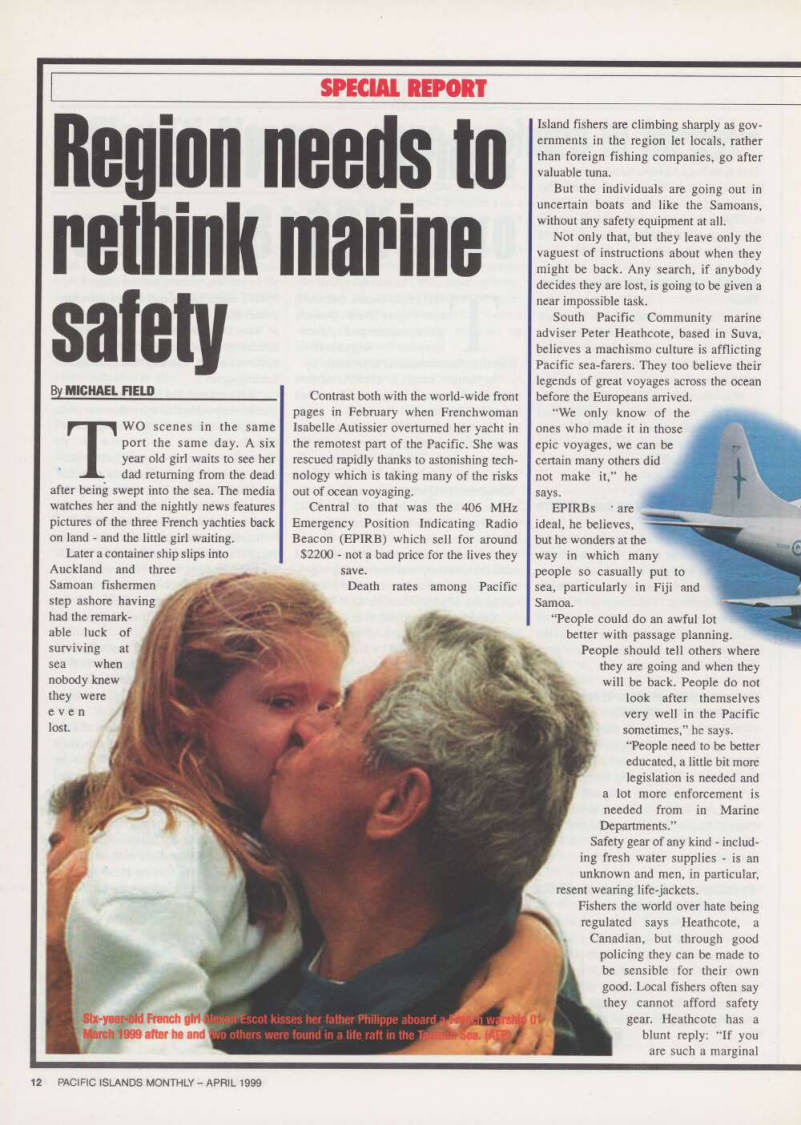
Six-year-old French giral Alexan Escot kisses her father Philippe aborard a French warship 01 March 1999 after he and two others were found in life raft in the Tasman Sea. ( AFP )
operation you should go out and grow dalo.” The tuna boom in Samoa has seen people using the locally built aluminium
catamarans, originally designed for
inshore fishing. They are being locally re built, made longer and bigger and, evi dence shows, vulnerable to cracking down the middle.
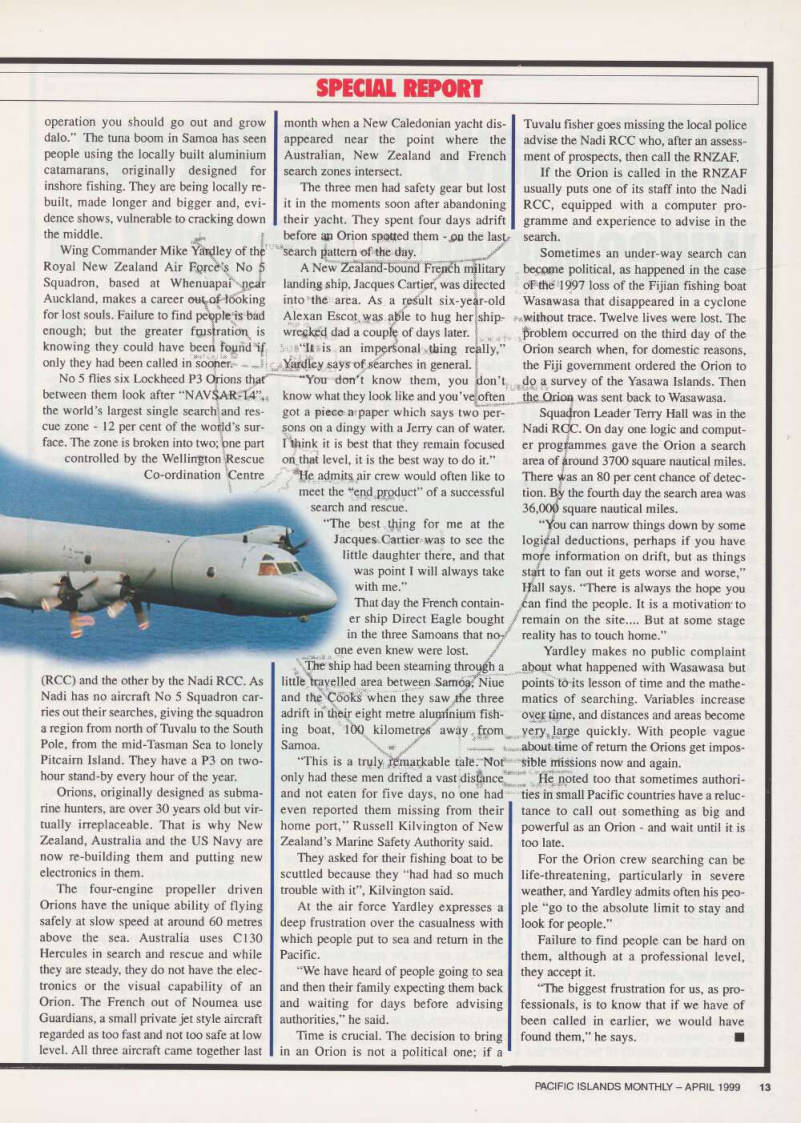
Wing Commander Mike Yardley of the Royal New Zealand Air Fprcd’s No Squadron, based at Whenuapai pear Auckland, makes a career looking for lost souls. Failure to find people is bad enough; but the greater frustration is knowing they could have been found if only they had been called in sooner. ~1 No 5 flies six Lockheed P 3 Orions that between them look after “NAVSAR-14”,:: the world’s largest single search;and res cue zone - 12 per cent of the world’s sur face. The zone is broken into two; one part controlled by the Wellington Rescue Co-ordination Centre
(RCC) and the other by the Nadi RCC. As Nadi has no aircraft No 5 Squadron car ries out their searches, giving the squadron 3 region from north of Tuvalu to the South Pole, from the mid-Tasman Sea to lonely Pitcairn Island. They have a P 3 on two hour stand-by every hour of the year.
Orions, originally designed as subma rine hunters, are over 30 years old but vir tually irreplaceable. That is why New Zealand, Australia and the US Navy are now re-building them and putting new electronics in them.
The four-engine propeller driven Orions have the unique ability of flying safely at slow speed at around 60 metres above the sea. Australia uses Cl3o Hercules in search and rescue and while they are steady, they do not have the elec tronics or the visual capability of an Orion. The French out of Noumea use Guardians, a small private jet style aircraft regarded as too fast and not too safe at low level. All three aircraft came together last
month when a New Caledonian yacht dis appeared near the point where the Australian, New Zealand and French search zones intersect.
The three men had safety gear but lost it in the moments soon after abandoning their yacht. They spent four days adrift before an Orion spotted them - ,pn the last
search pattern of the day. /
A New Zealand-bound French military landing ship, Jacques Cartier) was directed into the area. As a result six-yeir-old Alexan Escot was able to hug heriship wrecked dad a couple of days later. I “It is an impersonal thing really,”
Yardley says of searches in general. \ "“You don’t know them, you don’t know what they look like and you’vc often got a piece a paper which says two per sons on a dingy with a Jerry can of water.
I think it is best that they remain focused on that level, it is the best way to do it.” *He admits air crew would often like to meet the “end product” of a successful
search and rescue.
“The best thing for me at the Jacques Cartier was to see the little daughter there, and that lili| was point I will always take with me.”
That day the French contain er ship Direct Eagle bought in the three Samoans that no-' one even knew were lost.
The ship had been steaming through a little travelled area between Samoa, Niue and the Cooks when they saw the three adrift in their eight metre aluminium fish ing boat. 100 kilometres away from
Samoa. \ - *
“This is a truly remarkable tale. Not only had these men drifted a vast distance and not eaten for five days, no one had even reported them missing from their home port,” Russell Kilvington of New Zealand’s Marine Safety Authority said.
They asked for their fishing boat to be scuttled because they “had had so much trouble with it”, Kilvington said.
At the air force Yardley expresses a deep frustration over the casualness with which people put to sea and return in the Pacific.
“We have heard of people going to sea and then their family expecting them back and waiting for days before advising authorities,” he said.
Time is crucial. The decision to bring in an Orion is not a political one; if a
Tuvalu fisher goes missing the local police advise the Nadi RCC who, after an assess ment of prospects, then call the RNZAF.
If the Orion is called in the RNZAF usually puts one of its staff into the Nadi RCC, equipped with a computer pro gramme and experience to advise in the search.
Sometimes an under-way search can become political, as happened in the case of the 1997 loss of the Fijian fishing boat Wasawasa that disappeared in a cyclone without trace. Twelve lives were lost. The problem occurred on the third day of the Orion search when, for domestic reasons, the Fiji government ordered the Orion to do a survey of the Yasawa Islands. Then the Orion was sent back to Wasawasa.
Squadron Leader Terry Hall was in the Nadi RCC. On day one logic and comput er programmes gave the Orion a search area of around 3700 square nautical miles.
There was an 80 per cent chance of detec tion. By the fourth day the search area was 36,000 square nautical miles.
“You can narrow things down by some logical deductions, perhaps if you have mofe information on drift, but as things start to fan out it gets worse and worse,”
Hall says. “There is always the hope you can find the people. It is a motivation to remain on the site... But at some stage reality has to touch home.”
Yardley makes no public complaint about what happened with Wasawasa but points tb its lesson of time and the mathe matics of searching. Variables increase over time, and distances and areas become very large quickly. With people vague about time of return the Orions get impos sible missions now and again.
Ile noted too that sometimes authori ties in small Pacific countries have a reluc tance to call out something as big and powerful as an Orion - and wait until it is too late.
For the Orion crew searching can be
life-threatening, particularly in severe
weather, and Yardley admits often his peo ple “go to the absolute limit to stay and look for people.”
Failure to find people can be hard on them, although at a professional level, they accept it.
“The biggest frustration for us, as pro fessionals, is to know that if we have of been called in earlier, we would have found them,” he says. ■
widespread In Pacific
EPIRBs save lives but not widespread In Pacific
By Michael Field
FRENCH yachtswoman
Isabelle Autissier is alive today thanks to a tele phone book sized piece of technology that takes the “search” out of “search and rescue”.
Emergency Position Indicating Radio Beacons (EPIRBs) have saved 8000 lives
at sea - but very few of them have been Pacific Islanders because mariners from there do not carry them.
There are two models the earlier version sends a distress signal automatically to any passing ship or plane and the 406 MHz does that as well as communicating with the French led COSPAS SARSAT maritime rescue satellites. It also sends details of the distressed vessel and details of next-of-kin.
Last month Madame Autissier was leading the Around Alone yacht race.
Suddenly her yacht capsized near the world’s most distant point from land - and an area of ocean five million square kilometres larger than
Russia. Only fellow competitors were near enough to help.
She had a 406 MHz and its signal was immediately picked up by satellite and routed to the Wellington and Nadi Rescue Co-ordination Centres. On the first pass the satellite gave her position with a 97 percent accuracy. On the second pass, 20 minutes later, her position was known pre
cisely.
Once the position was known it was fed by satellite to the on-board computer of fellow competitor Giovanni Soldini who was able to sail directly to her yacht and
rescue her. As it turned out, he was able to see her. But if he had got there and could not see, Autissier had a Search and Rescue Radar Transponder which is a middle dis tance distress signal.
Royal New Zealand Air Force No 5 Squadron Wing Commander Mike Yardley says EPIRBs are “the living or dying” of modem searching. “The EPIRB, especially if it is a 406 beacon, to have it captured,
the information given to us; we arrive on the scene, do our brief search and find them within half an hour, usually.”
Time is spent monitoring the ship wrecked until a ship arrives. “Everyone else takes their chances.”
In New Zealand an EPIRB costs around $2200. In the Pacific people tend not to have them, or if they have them they risk having them stolen. It was never clear if Wasawasa, which sank in Fijian waters with 12 aboard, had an EPIRB. There were suggestions it did, but it was stolen.
The squadron’s awesome Orions have a
big array of electronics aboard and if peo ple cannot carry EPIRBs Yardley says the next alternative is a radar reflector, a home made triangular piece of metal.
“Radar is our best bet after the electron ic direction finding, it is better than dyes in the water even. It would be pretty much parallel with flares.”
Orions can also hunt with infra-red.
However, as with the case of the three
Frenchmen last month, the longer people are on the water in non-radar reflecting fabric life-rafts, the closer their temperature come to the sea temperature. Then infra red cannot pick up a differ ential.
Often in the Pacific life and death ends up being down to the human eye-ball.
An Orion has four viewing domes, plus the pilot, co pilot and flight engineer looking forward; seven pairs of eyes.
In a search the crew will first drop a smoke flare on the water and then fly half a mile out from it and get the watchers to calibrate their watching with that. And then they fly in a pattern, all 11
crew rotating through the searching posi tions.
People can only look out at most for an hour at a time before needing a break. A disciplined search requires great concen tration. Often they are in bad weather and just 60 metres (200 feet) off the water.
“I think we have a very good airframe we go out and practice operations at 200 feet so that we can do the job when we are called,” Yardley says. “It is unpleasant being thrown around at 200 feet, but that does not make it dangerous. I have a great deal of faith in the air frame.” ■
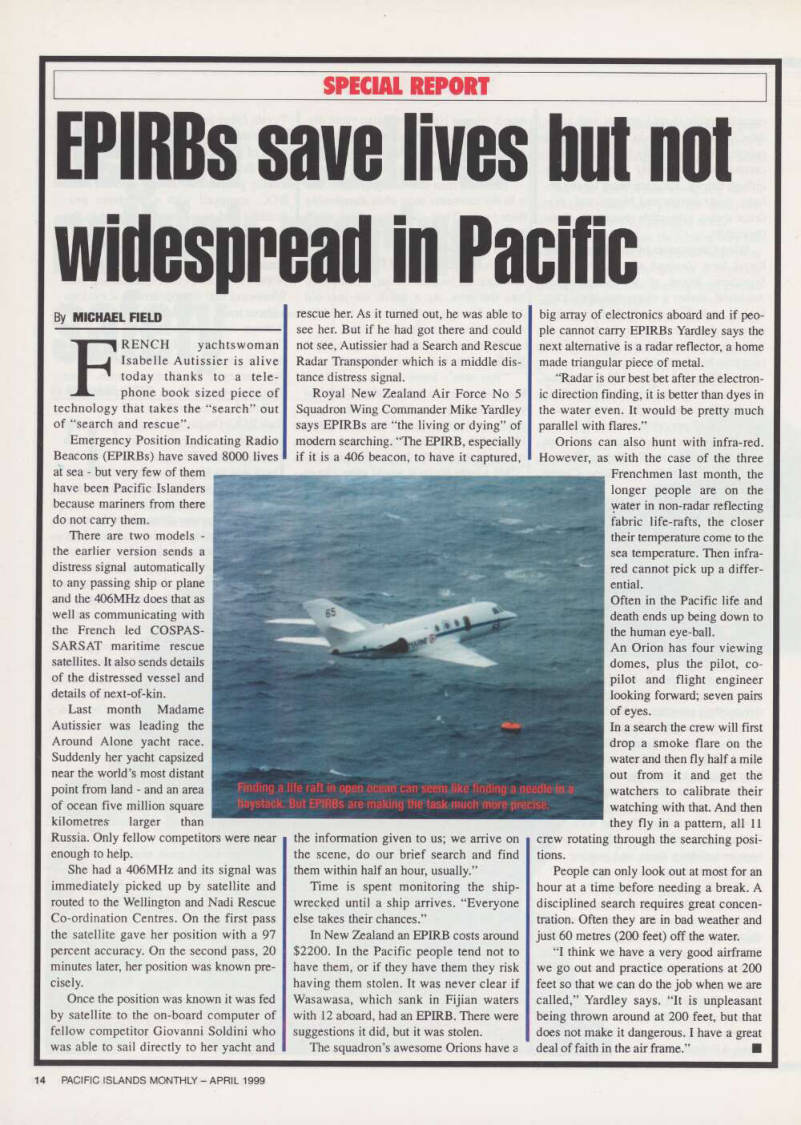
Finding a life in open Ocean can seem like finding a needle in a haystack, But EPIRB are making the task much more precise.
Imf/Png
Business
talks at another standstill
THE International
Monetary Fund (IMF) will only resume talks with Papua New Guinea if there is a satisfactory performance by the government under a staff mon itored program (SMP).
The SMP would have to run for at least six months before a possible stand-by arrangement (SBA) is dis cussed.
The IMF says the government would also have to provide evidence that it is committed to adopting an adjustment program worthy of moni toring by the staff.
This would include: • * parliamentary approval of a revised budget for 1999; * announce a credible plan to bring the Bank of Papua New Guinea credit to government to within the current legal limit and eliminate government arrears by the end of 1999; and * improve cooperation with the IMF staff, including provision of up to-date economic and financial statis tics and of all requested information relating to the finances of the govern ment; public enterprises and the Bank of Papua New Guinea.
These conditions are in the final report of the International Monetary Fund released recently after its talks with the PNG government in January this year.
The report also expressed grave
concern about the recent course of financial poli cies taken by the government. It warned that if this course con tinues, it will lead to a full
fledged fiscal
crisis, with very
damaging effects
for the economy.
The discussions during this year’s consultation were very unsat isfactory due to unavailable vital information from the PNG govern
ment. The IMF mission was unable to get update estimates on the national accounts; Bank of PNG’s balance sheet and the 1998 fiscal perfor mance.
The IMF mission was also unable to get an update on official macroeco nomic projections for 1999. The unavailability of staff from the Department of Personnel Management made it difficult to assess the outlook for the 1999 budget.
The report said the government was aware in November 1998 of the impending visit of the IMF thus, the lack of adequate information indicat ed that the PNG government was reluctant to release sensitive data.
During the first visit by IMF offi cials to PNG last June, they proposed a package of policies to help the economy recover from outside shocks.
The mission emphasised the need for action to avert an easing of the fiscal stance during the second half of 1998.
Contrary to these recommenda tions, the IMF mission reported that the fiscal policy expanded sharply in the last quarter of 1998, while gover nance took a turn for the worse.
The follow-up discussions in Washington in October 1998 ended without any agreement.
This year’s consultation provided the IMF mission with an opportunity
to take stock of recent developments.
It also enabled them to review the
policy challenges for the period ahead
and reassess prospects for PNG’s relationship with the Fund.
In the 1999 Article IV Consultation with PNG, the IMF outlined its advice.
It said had advised the government to take action to avoid the easing of the fiscal stance during the second half of 1998.
Government was also advised to complement this by addressing the weaKnesses in economic governance.
These include: * restoring investor confidence by adopting policies conducive to a sta ble and friendly business environ ment; * introduce macroeconomic poli cies aimed at reducing inflation to a low single digit range, and * replenish the stock of reserves to at least $3OO million.
The IMF report stressed that deci sive action to contain the worsening fiscal imbalance will be the key to achieving these objectives. PNG is looking at its options. (The Independent) ■
Advertisements & other items, p. 15 (1 item)
Need Parts?
WE HAVE THE LOT
YOUR 1 STOP FOR VEHICLE PARTS
GENERAL PARTS LIMITED
(DELIVERY WITHIN 48 HRS)
Ph: (05) 278 9599 1A Treagon Place Fax: (05) 277 6452 Papatoetoe, Auckland
pat of geld la
Marshalls sees pat of geld la Taiwan
By Giff Johnson
THE Marshall Islands gov ernment is seeing dollar signs - with nine figure numbers - when it comes
to its new relationship with Taiwan.
The diplomatic links estab lished with the Republic of China in late November 1998 are being hailed by private sector leaders as “one of the most significant mile stones in the economic develop ment of the Republic of the Marshall Islands”.
Marshall Islands Foreign Minister Phillip Muller said in a nationally broadcast address to the parliament in mid-February -
immediately following President
Imata Kabua’s state visit to Taiwan - that agreements signed with Taiwan could bring a wind fall of as much as $lOO million to the Marshall Islands in the first year of relations with the Republic of China.
Muller told the Nitijela (parlia ment) that agreements were signed during Kabua’s state visit that will inject large amounts of funding for infrastructure and related economic development needs of the Marshalls. This includes $5O million to launch an
intergenerational trust fund that is pat terned on the successful Kiribati and Tuvalu funds.
In early May, Taiwan Foreign Minister Jason Hu and a large delegation is expect ed to make a reciprocal visit to Majuro to discuss specific aid and development pro
jects directly.
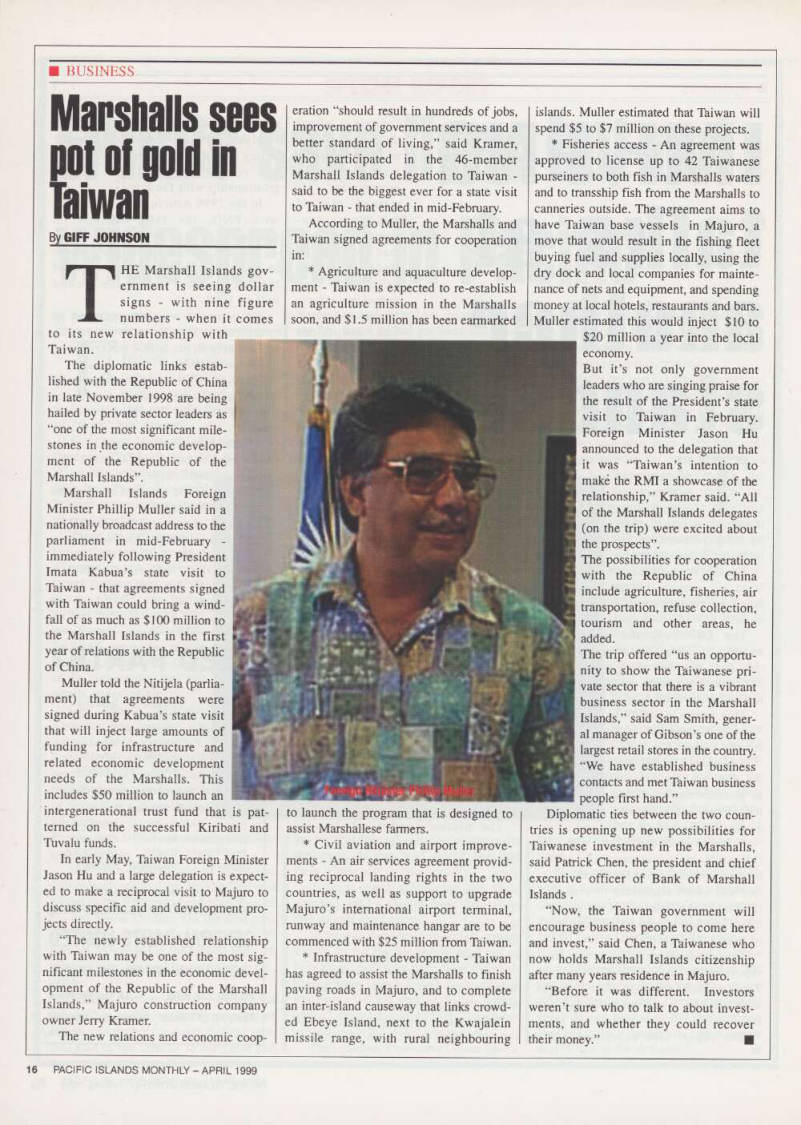
“The newly established relationship with Taiwan may be one of the most sig nificant milestones in the economic devel opment of the Republic of the Marshall Islands,” Majuro construction company owner Jerry Kramer.
The new relations and economic coop
eration “should result in hundreds of jobs, improvement of government services and a better standard of living,” said Kramer, who participated in the 46-member Marshall Islands delegation to Taiwan said to be the biggest ever for a state visit to Taiwan - that ended in mid-February.
According to Muller, the Marshalls and Taiwan signed agreements for cooperation in: * Agriculture and aquaculture develop ment - Taiwan is expected to re-establish an agriculture mission in the Marshalls soon, and $ 1.5 million has been earmarked
to launch the program that is designed to assist Marshallese farmers. * Civil aviation and airport improve ments - An air services agreement provid ing reciprocal landing rights in the two countries, as well as support to upgrade
Majuro’s international airport terminal,
runway and maintenance hangar are to be commenced with $25 million from Taiwan. * Infrastructure development - Taiwan has agreed to assist the Marshalls to finish paving roads in Majuro, and to complete an inter-island causeway that links crowd ed Ebeye Island, next to the Kwajalein missile range, with rural neighbouring
islands. Muller estimated that Taiwan will spend $5 to $7 million on these projects. * Fisheries access - An agreement was approved to license up to 42 Taiwanese purseiners to both fish in Marshalls waters and to transship fish from the Marshalls to canneries outside. The agreement aims to have Taiwan base vessels in Majuro, a move that would result in the fishing fleet buying fuel and supplies locally, using the dry dock and local companies for mainte nance of nets and equipment, and spending money at local hotels, restaurants and bars.
Muller estimated this would inject $lO to
$2O million a year into the local economy.
But it’s not only government leaders who are singing praise for the result of the President’s state visit to Taiwan in February.
Foreign Minister Jason Hu announced to the delegation that it was “Taiwan’s intention to make the RMI a showcase of the relationship,” Kramer said. “All of the Marshall Islands delegates (on the trip) were excited about the prospects”.
The possibilities for cooperation with the Republic of China include agriculture, fisheries, air transportation, refuse collection, tourism and other areas, he added.
The trip offered “us an opportu nity to show the Taiwanese pri vate sector that there is a vibrant business sector in the Marshall Islands,” said Sam Smith, gener al manager of Gibson’s one of the largest retail stores in the country.
“We have established business contacts and met Taiwan business people first hand.”
Diplomatic ties between the two coun tries is opening up new possibilities for Taiwanese investment in the Marshalls, said Patrick Chen, the president and chief executive officer of Bank of Marshall Islands .
“Now, the Taiwan government will encourage business people to come here and invest,” said Chen, a Taiwanese who now holds Marshall Islands citizenship after many years residence in Majuro.
“Before it was different. Investors weren’t sure who to talk to about invest ments, and whether they could recover their money.” ■
corruption debate
Samoa drawn into the IOC corruption debate
By Alan Ah Mu
UTAH, Stockholm,
Berlin. Hardly everyday
names to sports fans in Apia - until this year especially when the spreading stain of a bribery scandal rocking the Olympic movement reached their shores.
Seiuli Paul Wallwork is a rarity. He is the only Samoan to hold a Commonwealth Games medal and until recently the only Islander to do so in the region - a South Seas islander in the International Olympic Committee (IOC), whose members decide where Olympic Games are held.
Seiuli went before the lOC’s session on March 17 to try and clear himself of alle gations of corruption relating to a loan, an airline ticket and medical treatment for his daughter while on Olympic business for which an investigation has last month rec ommended that he be removed from the lOC for. , “I want to defend myself and clear my name,” said Seiuli before leaving for the session, “and then resign.”
Six weeks of being hassled and talked about to the detriment of his family was proving too much for the former weightlifting champion, an lOC member since 1987.
“The truth is I have had enough of the thing,” he said. “I do not think it is fair on my family.”
Seiuli predicted that even if he escaped negative judgment by the lOC session, where removal requires a two-thirds majority, some other charge might crop up next year.
His defence before the session might well resemble that he gave in a media con ference in February as news that he was in trouble reached Apia.
While in Stockholm, Sweden, to judge that city’s bid for the Olympic Games,
Seiuli accepted a gift over the SUSISO limit allowed in the form of a doctor’s bill for his daughter which the bidders paid for.
“To me it is incredible,” he told reporters. “Even just to think about it.”
“We did not call a doctor because it was just a head cold,” Seiuli said. “But they (bidders) insisted that the doctor come to see her, check her out. I think they were trying to impress us.”
Seiuli said it was within the rules for organisers of bids to pay expenses of their guests.
He would never ask guests to pay for a doctor if they fell ill and had he been required to pay for his daughter’s treatment he would easily have done so.
The doctor saw his daughter for 15 min utes and was so quick he did not even sit down during the visit, said Seiuli.
“He gave us some tablets,” he said.
“But we already had our own tablets - I always travel with them.”
The loan from Salt Lake City Organising Committee (SLOC) vice presi dent Tom Welch to Seiuli was made in November 1991 when there was no bid ding for any games on.
“Our families are very, very good friends,” he said. “We knew them well before then.”
The loan was an issue between two peo ple and it has been repaid, said Seiuli, who added that he did not know of the “transac tion” until years after it had been made.
“It had nothing to do with Salt Lake City (it’s bid). It was a personal loan from Tom Welch for an issue that I am not going to go into. It is in fact outside of the lOC jurisdiction, it is outside of anybody else’s jurisdiction, so it is outside of the press jurisdiction as well. And we have already explained it to the lOC - it is very clear.”
Scurrilous accusations regarding air plane tickets the Berlin Bid Committee (for
the 2000 Olympic games) sent for him and his brother to travel to Berlin, surfaced first in 1995, said Seiuli.
“I could not believe when I read it the first time in 1995. Unfortunately now we are reading it again - in 1999.”
He tried to fight accusations in the German press, Berlin House of Representatives and State Auditor General’s office, that his brother did not go to Berlin and his ticket not returned by sending photos of them at venues they both visited in the city - “everywhere in Berlin”.
“But of course that does not satisfy these journalists. They have got to obvi ously destroy you.”
Seiuli said the lOC arranged the tickets which were paid through them - from Samoa to Los Angeles, “and from Los Angeles to Berlin they hand-carried the tickets to us to Los Angeles”.
“I just cannot understand how such a story can come about when the facts are those.”
Seiuli said he has often wondered why the press in west focuses on “any little thing” about developing countries, includ ing the hurtful things they have written about he and his family.
That was his defence to the media in Samoa before he left to offer it to his peers in Switzerland.
A newspaper editorial in Samoa recent ly recommended that Seiuli resign as head of the Ministry of Sports, Youth and Culture, as president of the Samoa Olympic Committee and as president of the Samoa Sports Federation. “He should surrender these posts willingly to avoid causing more damage,” the editorial said.
Meanwhile an independent investiga
tion into Sydney officials has recently con cluded with a. result that will please the Australians. None of their officials are likely to be discharged from lOC. ■
Pacific leaders
want Clinton at Hawaii summit
By Ed Rampell
Government chiefs of
Polynesia, Melanesia,
and Micronesia have invited US president Bill Clinton to a summit at Honolulu.
This follows the US-Pacific Joint Commercial Commission meeting to which the States sent junior level
bureaucrats.
The Pacific Island Conference of Leaders approved an official summit with Clinton at the East-West Center during the full PICL meeting that takes place once every three years.
Clinton will fly to New Zealand in September for the annual Asia Pacific Economic Cooperation meeting. The Pacific pow-wow between Clinton and his
Oceanic counterparts could take place either before or after the president’s trip to New Zealand.
Details as to who-invited-whom to Honolulu for the proposed summit are unclear, but according to Brenda Lei Foster, governor Ben Cayetano’s Executive Assistant for National and International Affairs, the White House is giving “serious attention” to the pro posal.
The most dramatic moment in the oth erwise dry, diplomatic proceedings came during a reception for the US- Pacific JCC and PICL at the Ala Moana Hotel.
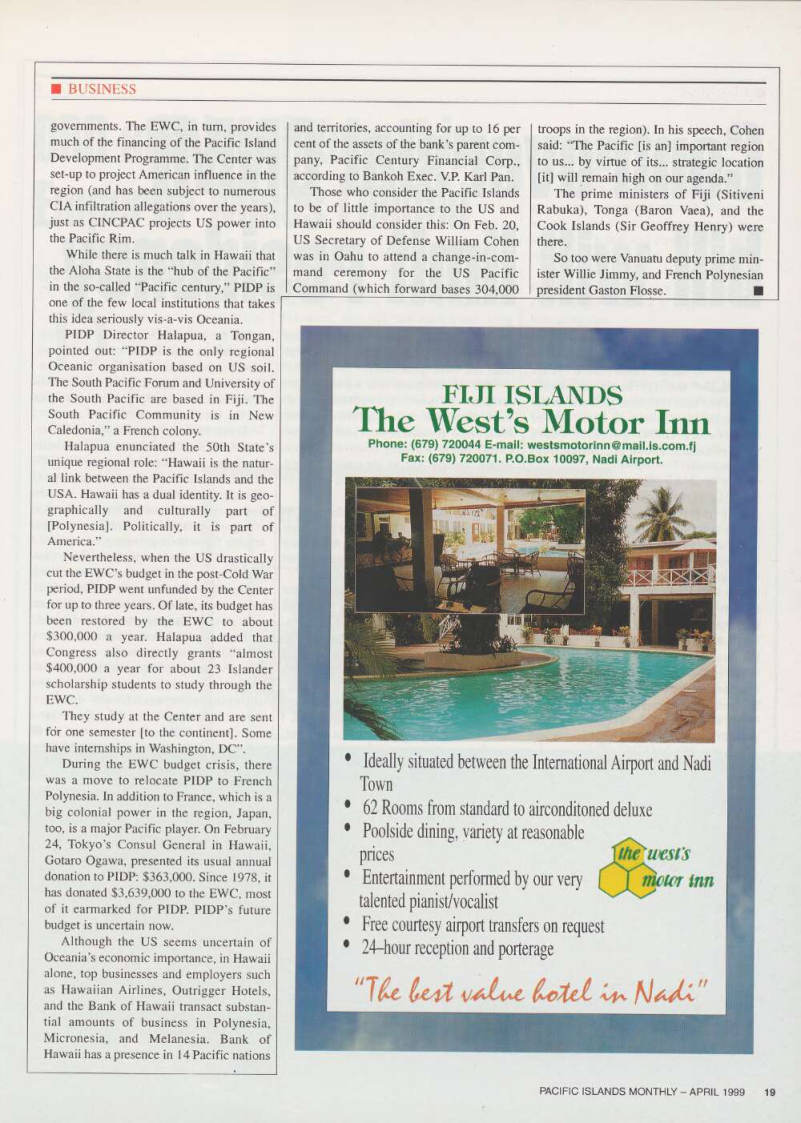
As the PICL standing committee’s chair and co-host of the reception, Fiji prime minister Sitiveni Rabuka was asked to say a few words, and the guests - espe cially the Yankees - may have gotten more than they bargained for.
The colourful major general, who over threw two governments at gunpoint in 1987 in the name of “Melanesian power,” did more than merely exchange pleasantries as he took center stage.
Rabuka went on to make substantive, and perhaps provocative, remarks regarding relations between Oceania and Washington. “Cold war! Cold War!
Cold war!” Rabuka declared. Referring to the daylong JCC talks between the Islanders and Americans - led by JC C co-chair Ralph Boyce, Deputy Assistant Secretary for East Asian and Pacific
Affairs in the US State Department - Fiji’s prime minister asked whether, now that the East-West ideological battle is over, “has the US lost interest in the Pacific Islands?
We’ll see at the end of the discussions.”
Rabuka indicated that because of lack of interest from Washington, the summit could go into overtime. “I hope [the con ferences] wrap up before Thursday after noon. Or else they will eat up our golf time - right, Sir Geoffrey?” Rabuka said, jocu larly referring to Cooks Prime Minister Henry.
In Boyce’s comments prior to Rabuka’s, the State Department appa ratchik admitted that while he had Asian experience, he was new to Oceania.
He then undiplomatically said that at the ICC meeting, he learned something about Pacific Island culture: “When you say a meeting starts at a certain time, it doesn’t necessarily mean that the meeting will begin then.”
In tone and substance, the feisty prime minister’s remarks seemed to be a reaction against disinterested, if not “ugly”
Americanism. Major General Rabuka also rather pointedly said: “At the last recep tion, there were complaints that for Pacific Islanders, there was only one fish. I see that today, there is only one fish again,” an apparent reference to metropolitan stingi ness vis-a-vis the isles.
Rabuka was allegorically referring to his theme that Washington has lost interest in Oceania, now that it has won its East- West realpolitik competition with Moscow.
Gone are the heady days of the 1980 s, when Reaganism vied for geopolitical hegemony with “the evil empire” in the Pacific Islands.
The “good old days,” when in addition to Moscow, Libyans and Cubans reported ly sought Island beachheads, from Kiribati to Vanuatu, while indigenous Islanders struggled against US, French, and British colonialism, for a nuclear free and inde
pendent Pacific.
This lack of competition means that Washington has a superpower monopoly in the region, and as with other monopolies, seems to take its clients for granted.
Rabuka was also apparently reacting to the funding crisis at the East-West Center, founded by Congress in 1960 to foster mutual relations in the Pacific Rim.
Main funding comes from the US Congress, with additional financial support from private sector sources and regional
Fiji’s prime minister Sitiveni Rabuka addresses delegates at the Hawaii meeting (Ed Rampell)
governments. The EWC, in turn, provides much of the financing of the Pacific Island Development Programme. The Center was set-up to project American influence in the region (and has been subject to numerous CIA infiltration allegations over the years), just as CINCPAC projects US power into the Pacific Rim.
While there is much talk in Hawaii that the Aloha State is the “hub of the Pacific” in the so-called “Pacific century,” PIDP is one of the few local institutions that takes this idea seriously vis-a-vis Oceania.
PIDP Director Halapua, a Tongan, pointed out: “PIDP is the only regional Oceanic organisation based on US soil.
The South Pacific Forum and University of the South Pacific are based in Fiji. The South Pacific Community is in New Caledonia,” a French colony.
Halapua enunciated the 50th State’s unique regional role: “Hawaii is the natur al link between the Pacific Islands and the USA. Hawaii has a dual identity. It is geo graphically and culturally part of [Polynesia]. Politically, it is part of America.”
Nevertheless, when the US drastically cut the EWC’s budget in the post-Cold War period, PIDP went unfunded by the Center for up to three years. Of late, its budget has been restored by the EWC to about $300,000 a year. Halapua added that Congress also directly grants “almost $400,000 a year for about 23 Islander scholarship students to study through the
Ewc.
They study at the Center and are sent for one semester [to the continent]. Some have internships in Washington, DC”.
During the EWC budget crisis, there was a move to relocate PIDP to French Polynesia. In addition to France, which is a big colonial power in the region, Japan, too, is a major Pacific player. On February 24, Tokyo’s Consul General in Hawaii, Gotaro Ogawa, presented its usual annual donation to PIDP: $363,000. Since 1978, it has donated $3,639,000 to the EWC, most of it earmarked for PIDP. PIDP’s future budget is uncertain now.
Although the US seems uncertain of Oceania’s economic importance, in Hawaii alone, top businesses and employers such as Hawaiian Airlines, Outrigger Hotels, and the Bank of Hawaii transact substan tial amounts of business in Polynesia, Micronesia, and Melanesia. Bank of Hawaii has a presence in 14 Pacific nations
and territories, accounting for up to 16 per cent of the assets of the bank’s parent com pany, Pacific Century Financial Corp., according to Bankoh Exec. V.P. Karl Pan.
Those who consider the Pacific Islands to be of little importance to the US and Hawaii should consider this: On Feb. 20, US Secretary of Defense William Cohen was in Oahu to attend a change-in-com mand ceremony for the US Pacific Command (which forward bases 304,000
troops in the region). In his speech, Cohen said: “The Pacific [is an] important region to us... by virtue of its... strategic location [it] will remain high on our agenda.”
The prime ministers of Fiji (Sitiveni Rabuka), Tonga (Baron Vaea), and the Cook Islands (Sir Geoffrey Henry) were there.
So too were Vanuatu deputy prime min ister Willie Jimmy, and French Polynesian president Gaston Flosse. ■
Advertisements & other items, p. 19 (2 items)
■ Business
\jaL{az (Lotci
-v '^ -
FIJI ISLANDS
The West’s Motor Imi
Phone: (679) 720044 E-mail; [email protected] Fax: (679) 720071. P.0.80x 10097, Nadi Airport. m M sm Ideally situated between the International Airport and Nadi Town 62 Rooms from standard to airconditoned deluxe Poolside dining, variety at reasonable prices Entertainment performed by our very talented pianist/vocalist Free courtesy airport transfers on request 24-hour reception and porterage
\jaL{az (Lotci
urn’s meter Inn
Controversial CNMI
bill will limit residency
CONTROVERSIAL legisla
tion seeking to limit to three consecutive years the maximum allowable period for non-residents to work in the Northern Marianas has been signed into law by CNMI governor Pedro Tenorio despite strong opposition from businessmen.
The new measure is designed to curb the influx of alien workers and reduce the island economy’s depen dence on foreign labor. It mandates that all guest workers exit the Commonwealth periodically before they are allowed to seek re-employ ment - a provision that employers described as impractical, costly and a detriment to business.
Under Public Law 11-69, nonresi dent employees must leave the islands at the end of three years of employment and stay outside CNMI for a period of not less than six months.
However, foreign workers holding
professional or executive positions and
whose annual salaries are at least $30,000 or $14.42 per hour are exempt from the three-year limit.
“We all recognize that we need non resident workers to supplement our work force. But it is imperative to our social and economic survival that the CNMI begin working toward a future where we are not as dependent upon nonresident workers,” Tenorio wrote to legislators in early March.
The implementation of the law is expected to draw sharp criticism from executives who already are burdened by restrictions against bringing in alien workers.
The Saipan Chamber of Commerce and the Hotel Association of Northern Mariana Islands have opposed the mea sure. It fears it would result in addi tional expenses while profits are declining, and disrupt their business operations.
“I sympathize with and understand the positions of all parties. However, I believe the advantages of this bill out
weigh the negatives. . . In the long run, such action will serve to benefit our island community,” the Governor said.
He promised to explore financial incentives to encourage employers to tap the local labour pool.
There are approximately 28,000 to 30,000 foreign workers in the Northern Marianas, holding more than 90 per cent of the jobs in the private sector.
Their growth in numbers on the islands has worried federal officials due to a string of social and economic problems arising from their presence.
Local employers prefer to hire for eigners, mostly from impoverished Asian countries, because of the lack of available skilled workers locally, as well as the relatively low salaries paid.
High pay and better benefits attract the indigenous population to work in the government, but with the adminis tration’s streamlining policy, due to shrinking revenues, locals now are forced to seek jobs in the private sec tor. (Saipan Tribune) ■
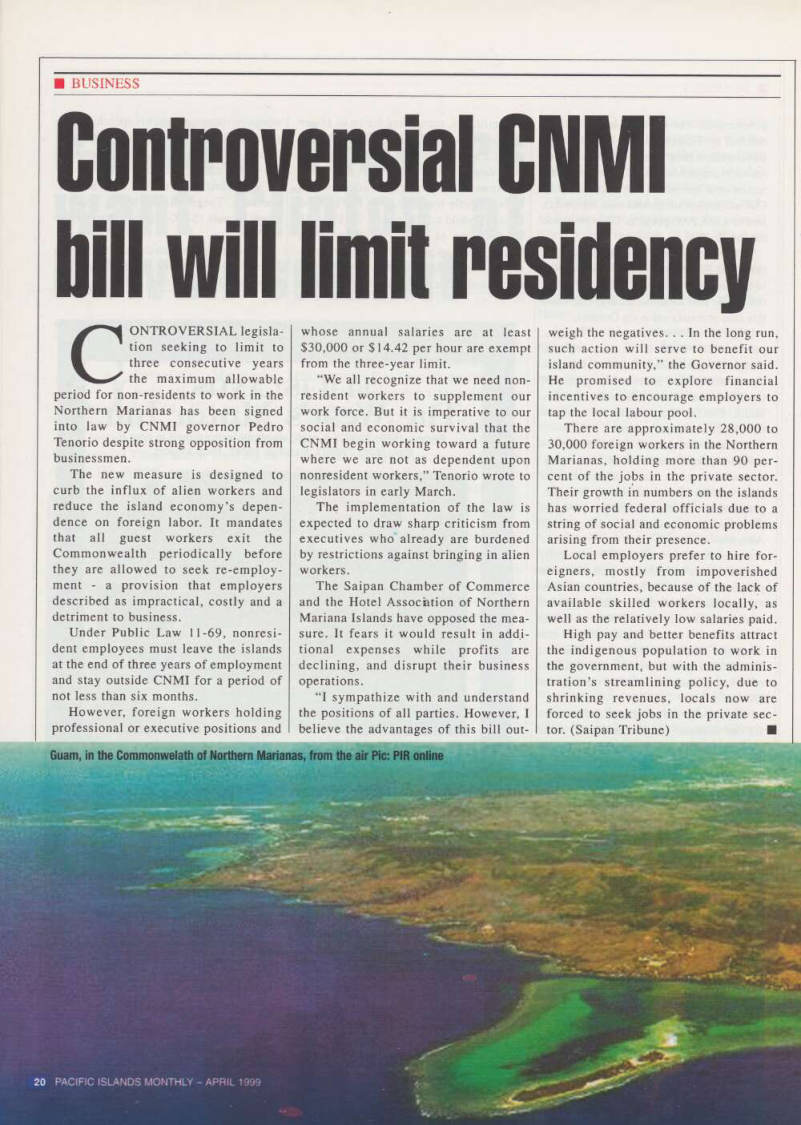
Guam, in the Commonwelath of Northern Marianas, from the air Pic: PIR online
Emperor Mines Limited
DRD still has interest in Emperor Mines Limited
By Sophie Foster Hildebrand
Despite its recent with drawal of a bid to buy a controlling stake in Emperor Gold Mines Limited, South African mining compa ny, Durban Roodeport Deep, may still consider buying shares in future.
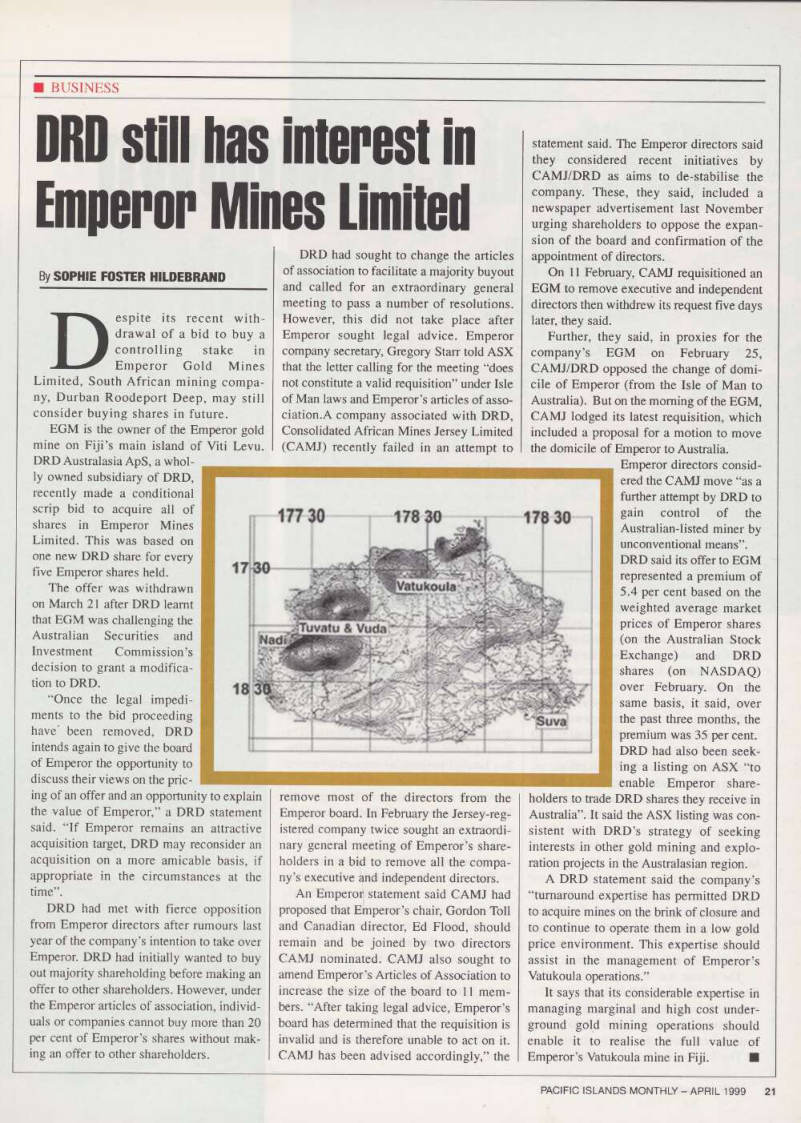
EGM is the owner of the Emperor gold mine on Fiji’s main island of Viti Levu.
DRD Australasia ApS, a whol ly owned subsidiary of DRD, recently made a conditional scrip bid to acquire all of shares in Emperor Mines Limited. This was based on one new DRD share for every five Emperor shares held.
The offer was withdrawn on March 21 after DRD learnt that EGM was challenging the Australian Securities and Investment Commission’s decision to grant a modifica tion to DRD.
“Once the legal impedi ments to the bid proceeding have been removed, DRD intends again to give the board of Emperor the opportunity to discuss their views on the pric
ing of an offer and an opportunity to explain the value of Emperor,” a DRD statement said. “If Emperor remains an attractive acquisition target, DRD may reconsider an acquisition on a more amicable basis, if appropriate in the circumstances at the time”.
DRD had met with fierce opposition from Emperor directors after rumours last year of the company’s intention to take over Emperor. DRD had initially wanted to buy
out majority shareholding before making an
offer to other shareholders. However, under the Emperor articles of association, individ uals or companies cannot buy more than 20 per cent of Emperor’s shares without mak ing an offer to other shareholders.
DRD had sought to change the articles of association to facilitate a majority buyout and called for an extraordinary general meeting to pass a number of resolutions.
However, this did not take place after Emperor sought legal advice. Emperor company secretary, Gregory Starr told ASX that the letter calling for the meeting “does not constitute a valid requisition” under Isle of Man laws and Emperor’s articles of asso ciation.A company associated with DRD, Consolidated African Mines Jersey Limited (CAMJ) recently failed in an attempt to
remove most of the directors from the Emperor board. In February the Jersey-reg istered company twice sought an extraordi nary general meeting of Emperor’s share holders in a bid to remove all the compa ny’s executive and independent directors.
An Emperor statement said CAMJ had proposed that Emperor’s chair, Gordon Toll and Canadian director, Ed Flood, should remain and be joined by two directors CAMJ nominated. CAMJ also sought to amend Emperor’s Articles of Association to increase the size of the board to 11 mem
bers. “After taking legal advice. Emperor’s
board has determined that the requisition is invalid and is therefore unable to act on it.
CAMJ has been advised accordingly,” the
statement said. The Emperor directors said they considered recent initiatives by CAMJ/DRD as aims to de-stabilise the company. These, they said, included a newspaper advertisement last November urging shareholders to oppose the expan sion of the board and confirmation of the appointment of directors.
On 11 February, CAMJ requisitioned an EGM to remove executive and independent directors then withdrew its request five days later, they said.
Further, they said, in proxies for the company’s EGM on February 25, CAMJ/DRD opposed the change of domi cile of Emperor (from the Isle of Man to Australia). But on the morning of the EGM, CAMJ lodged its latest requisition, which included a proposal for a motion to move the domicile of Emperor to Australia.
Emperor directors consid ered the CAMJ move “as a further attempt by DRD to gain control of the Australian-listed miner by unconventional means”.
DRD said its offer to EGM represented a premium of 5.4 per cent based on the weighted average market prices of Emperor shares (on the Australian Stock Exchange) and DRD shares (on NASDAQ) over February. On the same basis, it said, over the past three months, the premium was 35 per cent.
DRD had also been seek ing a listing on ASX “to enable Emperor share -
holders to trade DRD shares they receive in Australia”. It said the ASX listing was con sistent with DRD’s strategy of seeking interests in other gold mining and explo ration projects in the Australasian region.
A DRD statement said the company’s “turnaround expertise has permitted DRD to acquire mines on the brink of closure and to continue to operate them in a low gold price environment. This expertise should assist in the management of Emperor’s Vatukoula operations.”
It says that its considerable expertise in managing marginal and high cost under ground gold mining operations should enable it to realise the full value of Emperor’s Vatukoula mine in Fiji. ■
Kiribati countdown
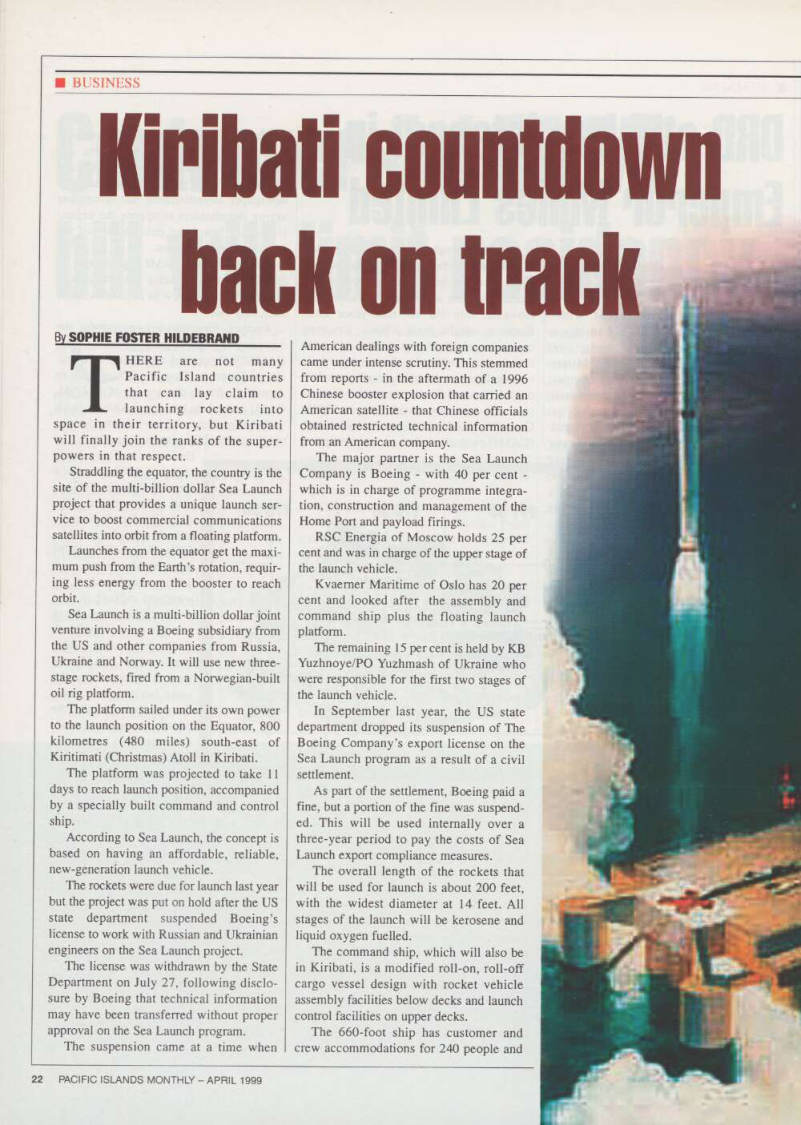
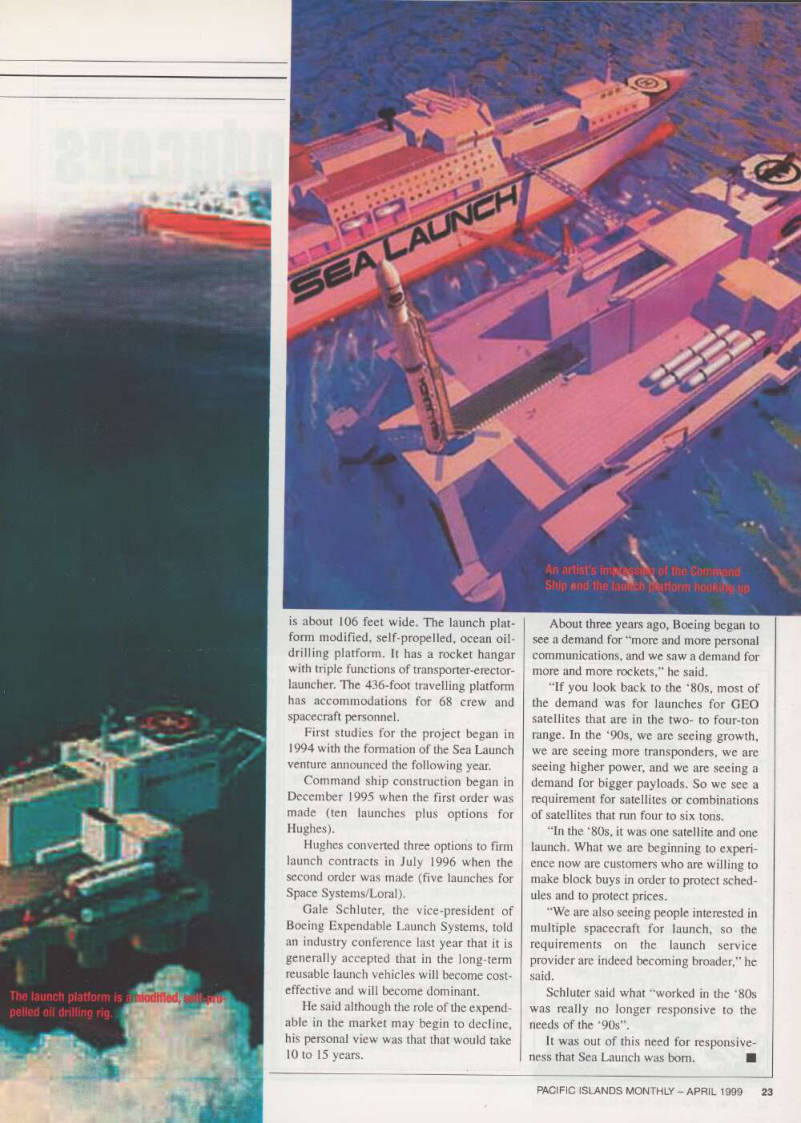
back on track
By Sophie Foster Hildebrand
There are not many Pacific Island countries that can lay claim to launching rockets into space in their territory, but Kiribati will finally join the ranks of the super powers in that respect.
Straddling the equator, the country is the site of the multi-billion dollar Sea Launch project that provides a unique launch ser vice to boost commercial communications satellites into orbit from a floating platform.
Launches from the equator get the maxi mum push from the Earth’s rotation, requir ing less energy from the booster to reach orbit.
Sea Launch is a multi-billion dollar joint venture involving a Boeing subsidiary from the US and other companies from Russia, Ukraine and Norway. It will use new three stage rockets, fired from a Norwegian-built oil rig platform.
The platform sailed under its own power to the launch position on the Equator, 800 kilometres (480 miles) south-east of Kiritimati (Christmas) Atoll in Kiribati.
The platform was projected to take 11
days to reach launch position, accompanied
by a specially built command and control
ship.
According to Sea Launch, the concept is based on having an affordable, reliable, new-generation launch vehicle.
The rockets were due for launch last year but the project was put on hold after the US
state department suspended Boeing’s
license to work with Russian and Ukrainian engineers on the Sea Launch project.
The license was withdrawn by the State Department on July 27, following disclo sure by Boeing that technical information may have been transferred without proper approval on the Sea Launch program.
The suspension came at a time when
American dealings with foreign companies came under intense scrutiny. This stemmed from reports - in the aftermath of a 1996 Chinese booster explosion that carried an American satellite - that Chinese officials obtained restricted technical information from an American company.
The major partner is the Sea Launch Company is Boeing - with 40 per cent which is in charge of programme integra tion, construction and management of the Home Port and payload firings.
RSC Energia of Moscow holds 25 per cent and was in charge of the upper stage of the launch vehicle.
Kvaemer Maritime of Oslo has 20 per cent and looked after the assembly and command ship plus the floating launch platform.
The remaining 15 percent is held by KB Yuzhnoye/PO Yuzhmash of Ukraine who were responsible for the first two stages of the launch vehicle.
In September last year, the US state department dropped its suspension of The Boeing Company’s export license on the Sea Launch program as a result of a civil settlement.
As part of the settlement, Boeing paid a fine, but a portion of the fine was suspend ed. This will be used internally over a three-year period to pay the costs of Sea Launch export compliance measures.
The overall length of the rockets that will be used for launch is about 200 feet, with the widest diameter at 14 feet. All stages of the launch will be kerosene and liquid oxygen fuelled.
The command ship, which will also be in Kiribati, is a modified roll-on, roll-off cargo vessel design with rocket vehicle assembly facilities below decks and launch control facilities on upper decks.
The 660-foot ship has customer and crew accommodations for 240 people and
is about 106 feet wide. The launch plat form modified, self-propelled, ocean oil drilling platform. It has a rocket hangar with triple functions of transporter-erector launcher. The 436-foot travelling platform has accommodations for 68 crew and spacecraft personnel.
First studies for the project began in 1994 with the formation of the Sea Launch venture announced the following year.
Command ship construction began in December 1995 when the first order was made (ten launches plus options for Hughes).
Hughes converted three options to firm launch contracts in July 1996 when the second order was made (five launches for
Space Systems/Loral).
Gale Schluter, the vice-president of Boeing Expendable Launch Systems, told an industry conference last year that it is generally accepted that in the long-term reusable launch vehicles will become cost effective and will become dominant.
He said although the role of the expend able in the market may begin to decline, his personal view was that that would take 10 to 15 years.
About three years ago, Boeing began to see a demand for “more and more personal communications, and we saw a demand for more and more rockets,” he said.
“If you look back to the ‘Bos, most of the demand was for launches for GEO satellites that are in the two- to four-ton range. In the ‘9os, we are seeing growth, we are seeing more transponders, we are seeing higher power, and we are seeing a demand for bigger payloads. So we see a requirement for satellites or combinations of satellites that run four to six tons.
“In the ‘Bos, it was one satellite and one launch. What we are beginning to experi ence now are customers who are willing to make block buys in order to protect sched ules and to protect prices.
“We are also seeing people interested in multiple spacecraft for launch, so the requirements on the launch service provider are indeed becoming broader,” he said.
Schluter said what “worked in the ‘Bos was really no longer responsive to the needs of the ‘9os”.
It was out of this need for responsive ness that Sea Launch was bom. ■
An artis impression of the Command Ship and the lauch platform hooking up
The launch platfor is a modified, self-pro- Pelled oil drilling rig
Pacific Ocean Producers
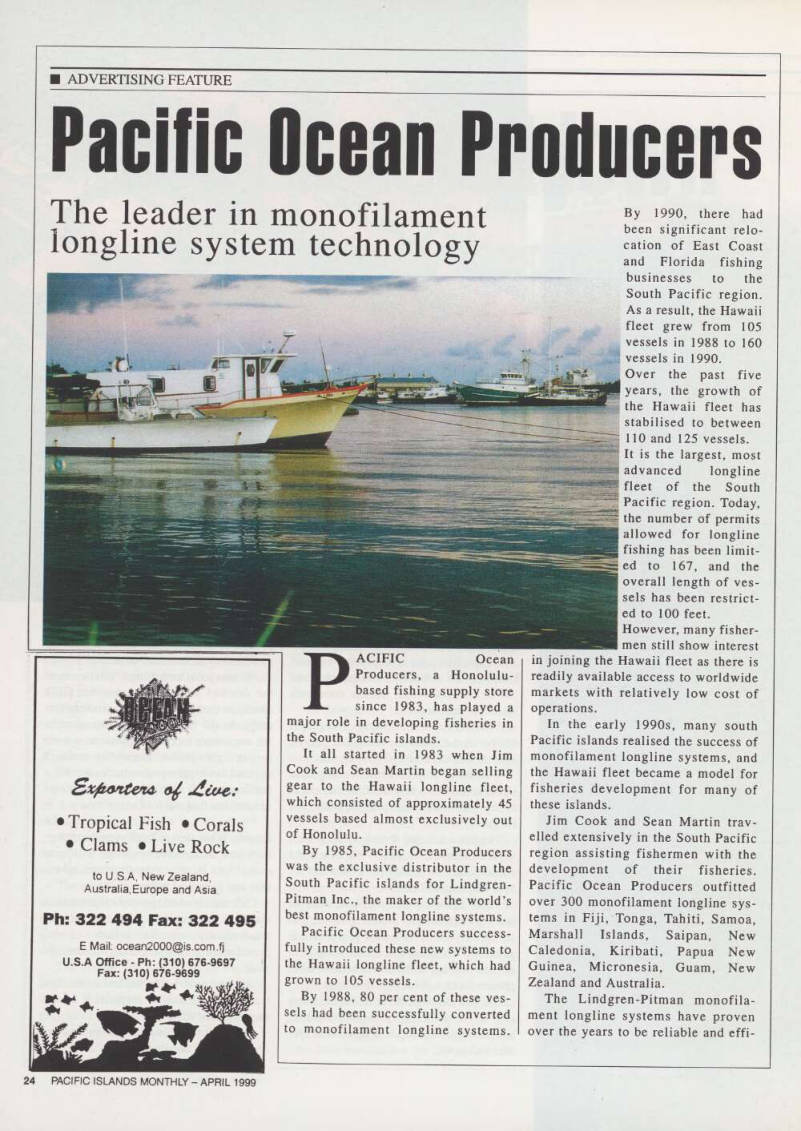
Advertising Feature
The leader in monofilament longline system technology
PACIFIC Ocean
Producers, a Honolulu based fishing supply store since 1983, has played a major role in developing fisheries in the South Pacific islands.
It all started in 1983 when Jim Cook and Sean Martin began selling gear to the Hawaii longline fleet, which consisted of approximately 45 vessels based almost exclusively out of Honolulu.
By 1985, Pacific Ocean Producers was the exclusive distributor in the South Pacific islands for Lindgren- Pitman Inc., the maker of the world’s best monofilament longline systems.
Pacific Ocean Producers success fully introduced these new systems to the Hawaii longline fleet, which had grown to 105 vessels.
By 1988, 80 per cent of these ves sels had been successfully converted to monofilament longline systems.
By 1990, there had been significant relo cation of East Coast and Florida fishing businesses to the South Pacific region.
As a result, the Hawaii fleet grew from 105 vessels in 1988 to 160 vessels in 1990.
Over the past five years, the growth of the Hawaii fleet has stabilised to between 110 and 125 vessels.
It is the largest, most
advanced longline
fleet of the South Pacific region. Today, the number of permits allowed for longline fishing has been limit ed to 167, and the overall length of ves sels has been restrict ed to 100 feet.
However, many fisher men still show interest
in joining the Hawaii fleet as there is readily available access to worldwide markets with relatively low cost of operations.
In the early 19905, many south Pacific islands realised the success of monofilament longline systems, and the Hawaii fleet became a model for fisheries development for many of these islands.
Jim Cook and Sean Martin trav elled extensively in the South Pacific region assisting fishermen with the development of their fisheries.
Pacific Ocean Producers outfitted over 300 monofilament longline sys tems in Fiji, Tonga, Tahiti, Samoa, Marshall Islands, Saipan, New Caledonia, Kiribati, Papua New Guinea, Micronesia, Guam, New Zealand and Australia.
The Lindgren-Pitman monofila ment longline systems have proven over the years to be reliable and effi
cient fishing tools for many South Pacific islands. Pacific Ocean Producers now carries the latest monofilament longline system - the Super Spool 11.
Sean Martin believes this new reel to be more efficient and easier to haul than previous systems.
The Super Spool II has been suc cessfully tested for three years before it was finally marketed in October 1998.
This new system drew a lot of attention during the Fish Expo Seattle 98. As a result of this show, several Super Spool II have been sold and installed onto vessels from different parts of the world.
Three operators from the Hawaii fleet chose to outfit their vessels with the Super Spool 11. F/V Icy Point originally a San Francisco-based ves sel fishing for Albacore, is no fishing around the Hawaiian Islands.
In November 1998, the owner of F/V Icy Point bought a Super Spool II as he wanted to get the best and latest in longline gear. Jim Cook, Sean Martin and their staff installed the new reel onto the vessel in less than three days!
Jon Johnson, the captain of the vessel was very pleased with the cus tomer service that Pacific Ocean Producers provided. Jim Cook and Sean Martin also provided operation training to the captain and crew of F/V,lcy Point as they had no previous
experience with longline fishing.
On January 8, 1999, the F/V Icy Point left Honolulu for a ten-day fishing trip around the Hawaiian Islands.
It came back with 15,000 pounds of high quality tuna and swordfish.
Jim Cook and Sean Martin were pleased to hear that this vessel had a successful trip considering the lack of experience.
On February 2, 1999 the F/V Icy Point returned from its second ten day fishing trip and unloaded 22,000 pounds of high quality tuna and swordfish.
On February 17, 1999, the F/V Icy Point came back from a thirteen-day fishing trip with 25,000 pounds of tuna and swordfish. The captain
hopes to keep on making successful
trips. Jon gives credit to the owners and staff and Pacific Ocean Producers as they did an excellent job installing the Super Spool II and pro viding operation training, which con tributed to the successful fishing trips of F/V Icy Point.
The increased hauling speed and improved performances as well as increased catches can be accredited to the Super Spool 11.
Jim and Sean are expecting to sell many more Super Spool II to the Hawaii fleet as well as vessels from the South Pacific islands.
Pacific Ocean Producers has received numerous orders for the new Super Spool 11.
Tahiti, being the second largest fleet in the South Pacific, followed by Fiji, keeps on growing at a very fast pace.
A large order of 12 reels has been placed and will be delivered to Tahiti sometime this year.
The Fijian fleet is also rapidly expanding as six new vessels will be
outfitted with four Twin reels and two Super Spool 11. Pacific Ocean Producers expected to have these reels delivered by the end of this month.
Jim Cook and Sean Martin have always adopted a “hands-on” approach to their business, which explains the high quality of customer service.
Operating out of a 40,000 square foot warehouse in Honolulu, Pacific Ocean Producers has been able to efficiently respond to its customers’ needs for many years.
It would be a costly mistake to venture yourself into a longline pro ject or fishery development without first consulting with the experienced staff at Pacific Ocean Producers.
Pacific Ocean Producers is consid ered a leader in monofilament long line systems.
One should take advantage of the combined experience and dedication that the owners of Pacific Ocean Producers have gained over the years! ■
Advertisements & other items, pp. 24-25 (2 items)
ZxjuvttenA £iuc:
•Tropical Fish • Corals
• Clams • Live Rock
to U S A, New Zealand, Australia,Europe and Asia,
Ph: 322 494 Fax: 322 495
E Mail: [email protected] U.S.A Office - Ph: (310) 676-9697 Fax: (310) 676-9699
Hook Up With The Leader!
Pacific Ocean
URALUMES®
cks technology, extended light output, often used ' moisture, easy-to- handle shipping carton. All pc white, violet and ultra-violet for best fishing resu
is the leader in
monofilament longline
system technology. * %
We offer special service a to the South Pacific Islands, *■ Australia and New Zealand. • Lindgren-Pitman gear, complete hydraulic systems, design and installation of monofilament * V y&kUU/ longline systems including operations training. • Extensive Tuna and Swordfish supplies, bottom iWftURALUMES * fishing gear, fish handling supplies and bait. U i • Duralumes Lightstick - the latest in lightsticks technology, extended light output, often used ’ \eL two nights, 5-year shelf life, not affected by moisture, easy-to- handle shipping carton. All popular x colors available - green, blue, pink, yellow, white, violet and ultra-violet tor best fishing results. • Wide selection of trolling equipment: over 180 different colors of trolling skirts and a large selection of lure heads. • Weekly shipments to the South Pacific Islands, Australia and New Zealand.
Visit our new catalog on-line at: pop-hawaii.com Toll Free Number 1-800-144-488
•FREE
Pacific
Ocean
Producers
• FREE CATALOG AVAILABLE ON REQUEST
Please direct all inquiries to the Export Department: 965-B North Nimitz Highway Honolulu, HI 96817, USA.
Telephone: (808) 537-2905 Facsimile; (808) 536-3225
■ Advertising Feature
acquire new German planes
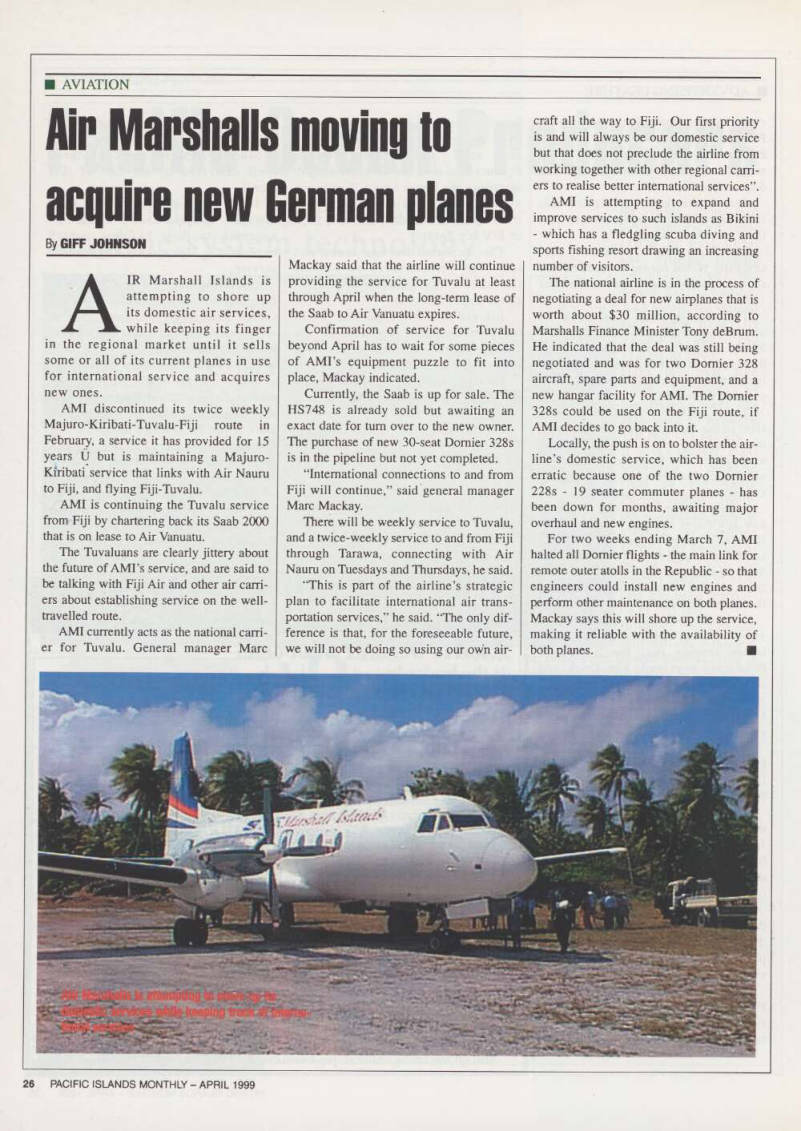
Aviation
Air Marshalls moving to acquire new German planes
By Giff Johnson
AIR Marshall Islands is attempting to shore up its domestic air services,
while keeping its finger
in the regional market until it sells some or all of its current planes in use for international service and acquires new ones.
AMI discontinued its twice weekly Majuro-Kiribati-Tuvalu-Fiji route in February, a service it has provided for 15 years U but is maintaining a Majuro- Kiribati service that links with Air Naum to Fiji, and flying Fiji-Tuvalu.
AMI is continuing the Tuvalu service from Fiji by chartering back its Saab 2000 that is on lease to Air Vanuatu.
The Tuvaluans are clearly jittery about the future of AMl’s service, and are said to be talking with Fiji Air and other air carri ers about establishing service on the well travelled route.
AMI currently acts as the national carri er for Tuvalu. General manager Marc
Mackay said that the airline will continue providing the service for Tuvalu at least through April when the long-term lease of the Saab to Air Vanuatu expires.
Confirmation of service for Tuvalu beyond April has to wait for some pieces of AMDs equipment puzzle to fit into place, Mackay indicated.
Currently, the Saab is up for sale. The HS74B is already sold but awaiting an exact date for turn over to the new owner.
The purchase of new 30-seat Domier 328 s is in the pipeline but not yet completed.
“International connections to and from Fiji will continue,” said general manager Marc Mackay.
There will be weekly service to Tuvalu, and a twice-weekly service to and from Fiji through Tarawa, connecting with Air Naum on Tuesdays and Thursdays, he said.
“This is part of the airline’s strategic plan to facilitate international air trans portation services,” he said. “The only dif ference is that, for the foreseeable future, we will not be doing so using our own air
craft all the way to Fiji. Our first priority is and will always be our domestic service but that does not preclude the airline from working together with other regional carri ers to realise better international services”.
AMI is attempting to expand and improve services to such islands as Bikini - which has a fledgling scuba diving and sports fishing resort drawing an increasing number of visitors.
The national airline is in the process of negotiating a deal for new airplanes that is worth about $3O million, according to Marshalls Finance Minister Tony deßrum.
He indicated that the deal was still being negotiated and was for two Domier 328 aircraft, spare parts and equipment, and a new hangar facility for AMI. The Domier 328 s could be used on the Fiji route, if AMI decides to go back into it.
Locally, the push is on to bolster the air line’s domestic service, which has been erratic because one of the two Domier 228 s - 19 seater commuter planes - has been down for months, awaiting major overhaul and new engines.
For two weeks ending March 7, AMI halted all Domier flights - the main link for remote outer atolls in the Republic - so that engineers could install new engines and perform other maintenance on both planes.
Mackay says this will shore up the service, making it reliable with the availability of both planes. ■
Aiir Marshals is attempting to shore up its domestic serves while keeping track of inrerna-tional services
airline study
Air Nauru sponsors Micronesian airline study
By Giff Johnson
AIR Nauru has taken action that could help change the central Pacific’s reputation as the sub-region with the worst air ser vice. Nauru President Bernard Dowiyogo announced in early February at the close of a transporta tion ministerial meeting in Nauru that Air Nauru was launching a survey of air service needs in the Micronesian region in an effort to support estab lishment of a sub-regional airline.
The initial survey - carried out by ANA COM Management Corporation of Manila - was clearly out of the ordinary as it was started within three days of Dowiyogo’s announcement and finished by the end of
February. “There has been so much talk and previous studies about a sub-regional airline,” said Air Marshall Islands general manager, Marc Mackay, in Majuro after the announcement. He added that this sur vey has a different focus, since all the countries agree on the critical need to improve air service in the Micronesian area.
The new survey will focus on what Air Nauru and other islands can do to improve the service by meeting specific needs of each country in the Micronesian area, he said. “The meeting agreed that this sub region has the worst air service of any area within the South Pacific Forum,” Mackay said. “This study is looking for solutions to the problem, (including) a sub-regional air line.”
“We are studying the opportunities for establishing a sub-regional air service to fill gaps in the current service,” said Antonio P. Soriano. He is a senior vice president with ANACOM who led a study group on a 10-day island hopping mission through Majuro, Pohnpei, Chuuk, Nauru, Kiribati, Tuvalu, Guam and Saipan during February. He termed the study a “market assessment” that will lay the basis for a decision to move ahead with a more detailed feasibility study for a sub-regional air service. The two-day transportation ministerial meeting in Nauru in early February produced a high degree of coop
eration among transportation and airline representatives from the Federated States of Micronesia, Kiribati, Nauru and the Marshall Islands, Mackay said. The men tality that each island nation must have its own flag carrier is evolving to a feeling that “we just need to get the air service established,” he said.
Dowiyogo said that the first phase of Air Nauru’s survey will be to identify the “enhancements required for each state’s tourism programs to enable a base volume of tourist and trade passenger traffic to flow to and from each of the destinations.”
“The survey is being undertaken initial ly because of our obligation to consider additional services in the Federated States of Micronesia, but it clearly may assist the deliberations of the (sub-regional govern mental) task force regarding a sub-regional airline,” said Dowiyogo.
Mackay said that in contrast to many of the larger South Pacific islands, the Micronesian area suffers from the lack of a tourist base that would bring increased air service.
Soriano said that his group is studying the possibility of tours that include stops in several of these central Pacific islands as a way to increase the appeal of the Micronesian area to tourists, since these islands - with the exception of Guam, Saipan and Palau - do not have a high degree of tourist infrastructure. ■
north Pacific flight
Aloha set for first north Pacific flight
ALOHA Airlines plans to start its first flights to the Marshall Islands and Federated States of Micronesia in May, following US
Defense Department approval in late February of refu elling stops at Johnston Island, a top Aloha executive said.
The Defense Department removed an obstacle to the new service, agreeing to increase the number of commercial flights that can land at the Johnston atoll military facility from five to seven each week. Kurt Campbell, the deputy assistance secre tary for Asian and Pacific Affairs at the Pentagon informed President Imata Kabua of this in a letter dated February 19.
“We have undertaken this action because the United States government is committed to assisting the Republic of the Marshall Islands and Micronesia in obtaining economic self-suf ficiency and economic growth,” Campbell said. Adequate com mercial air service is “a necessity” for development, he said, adding that “flights through Johnston would provide a vital link in such air service.” Jim King, Aloha’s vice president for plan ning and marketing, said that access to refuelling at Johnston
was essential to the service because Aloha uses Boeing 737 aircraft on the route that cannot carry adequate fuel for a non-stop trip. Johnston is a military facility being used to destroy World War
II nerve gas and chemical agents and is close to the mid-point of the 2,300 miles separating Honolulu from Majuro.
When Aloha launches its air service, it will be the first American air carrier in more than 10 years to compete against Continental Micronesia, which currently operates a monopoly service on this north Pacific route. Since Continental cut back its service from three to two weekly flights last September, com plaints from the Marshall Islands government and local resi dents have been escalating as passengers, cargo and mail have suffered numerous delays from the lack of space on Continental.
"If the Department of Defense moves quickly and there are no unexpected internal issues, we could be flying as soon as May,” said King.
Marshalls’ Foreign Minister Phillip Muller confirmed the Defense Department approval for two extra stop-overs at Johnston, saying that the Marshalls “has some very good friends in the Defense Department” who helped make this possible. ■
Privatisation electrifies PNG
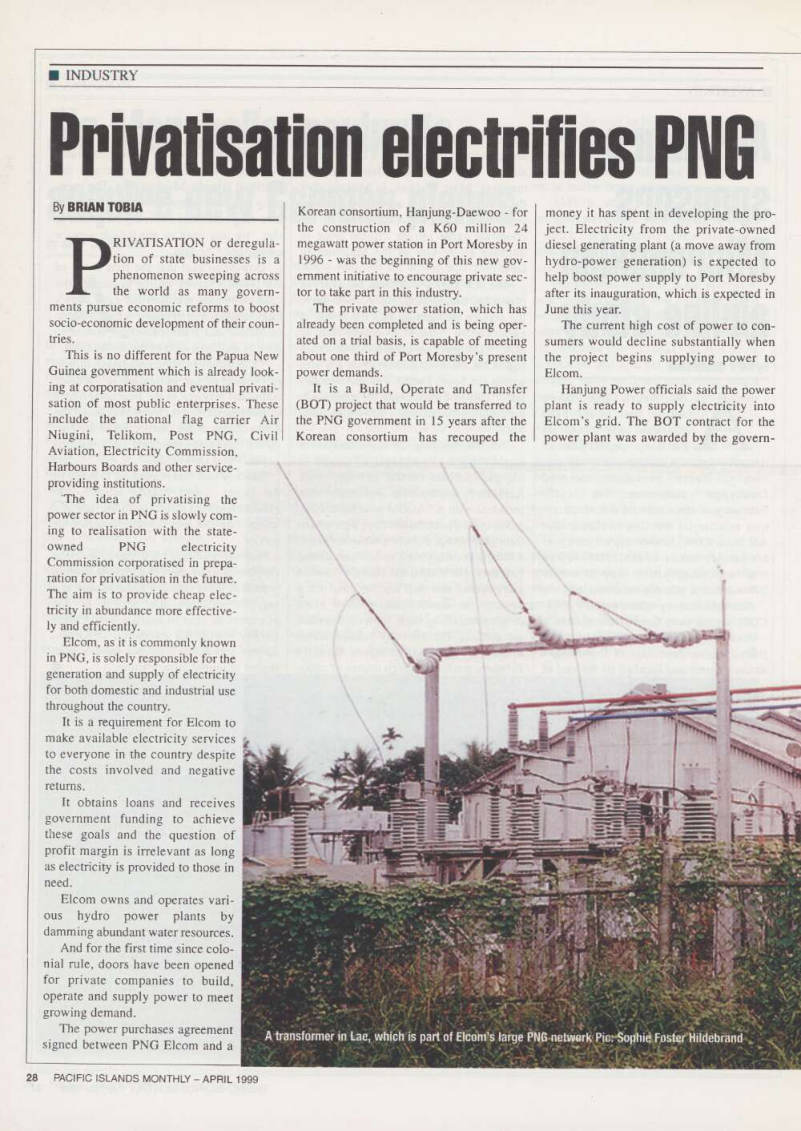
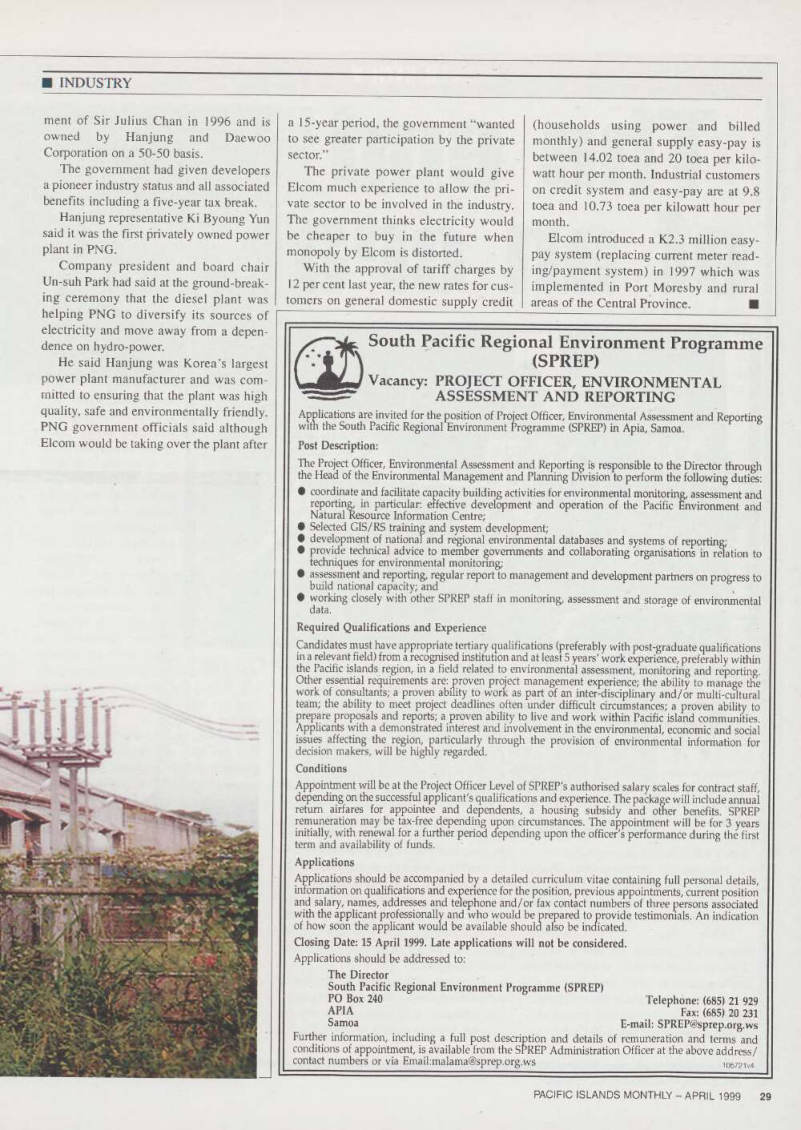
Industry
By Brian Tobia
PRIVATISATION or deregula tion of state businesses is a phenomenon sweeping across the world as many govern ments pursue economic reforms to boost socio-economic development of their coun tries.
This is no different for the Papua New Guinea government which is already look ing at corporatisation and eventual privati sation of most public enterprises. These include the national flag carrier Air Niugini, Telikom, Post PNG, Civil
Aviation, Electricity Commission, Harbours Boards and other service providing institutions.
The idea of privatising the power sector in PNG is slowly com ing to realisation with the state owned PNG electricity Commission corporatised in prepa ration for privatisation in the future.
The aim is to provide cheap elec tricity in abundance more effective ly and efficiently.
Elcom, as it is commonly known in PNG, is solely responsible for the generation and supply of electricity for both domestic and industrial use throughout the country.
It is a requirement for Elcom to make available electricity services to everyone in the country despite the costs involved and negative returns.
It obtains loans and receives government funding to achieve these goals and the question of profit margin is irrelevant as long as electricity is provided to those in need.
Elcom owns and operates vari ous hydro power plants by damming abundant water resources.
And for the first time since colo nial rule, doors have been opened for private companies to build, operate and supply power to meet I growing demand.
The power purchases agreement signed between PNG Elcom and a
Korean consortium, Hanjung-Daewoo - for the construction of a K6O million 24 megawatt power station in Port Moresby in 1996 - was the beginning of this new gov ernment initiative to encourage private sec tor to take part in this industry.
The private power station, which has already been completed and is being oper ated on a trial basis, is capable of meeting about one third of Port Moresby’s present power demands.
It is a Build, Operate and Transfer (EOT) project that would be transferred to the PNG government in 15 years after the Korean consortium has recouped the
money it has spent in developing the pro ject. Electricity from the private-owned diesel generating plant (a move away from hydro-power generation) is expected to help boost power supply to Port Moresby after its inauguration, which is expected in June this year.
The current high cost of power to con sumers would decline substantially when the project begins supplying power to Elcom.
Hanjung Power officials said the power plant is ready to supply electricity into Elcom’s grid. The EOT contract for the power plant was awarded by the govern-
A transformer in Lae, which is part of Elcom’s large PNG network Pic: Sophie Foster Hildebrand
ment of Sir Julius Chan in 1996 and is owned by Hanjung and Daewoo Corporation on a 50-50 basis.
The government had given developers a pioneer industry status and all associated benefits including a five-year tax break.
Hanjung representative Ki Byoung Yun said it was the first privately owned power plant in PNG.
Company president and board chair Un-suh Park had said at the ground-break ing ceremony that the diesel plant was helping PNG to diversify its sources of electricity and move away from a depen dence on hydro-power.
He said Hanjung was Korea’s largest power plant manufacturer and was com mitted to ensuring that the plant was high quality, safe and environmentally friendly.
PNG government officials said although Elcom would be taking over the plant after
a 15-year period, the government “wanted to see greater participation by the private sector.”
The private power plant would give Elcom much experience to allow the pri vate sector to be involved in the industry.
The government thinks electricity would be cheaper to buy in the future when monopoly by Elcom is distorted.
With the approval of tariff charges by 12 per cent last year, the new rates for cus tomers on general domestic supply credit
(households using power and billed monthly) and general supply easy-pay is between 14.02 toea and 20 toea per kilo watt hour per month. Industrial customers on credit system and easy-pay are at 9.8 toea and 10.73 toea per kilowatt hour per month.
Elcom introduced a K 2.3 million easy pay system (replacing current meter read ing/payment system) in 1997 which was implemented in Port Moresby and rural areas of the Central Province. ■
Advertisements & other items, p. 29 (1 item)
(Sprep)
South Pacific Regional Environment Programme
Vacancy: PROJECT OFFICER, ENVIRONMENTAL
ASSESSMENT AND REPORTING
Applications are invited for the position of Project Officer, Environmental Assessment and Reporting with the South Pacific Regional Environment Programme (SPREP) in Apia, Samoa.
Post Description:
The Project Officer, Environmental Assessment and Reporting is responsible to the Director through the Head of the Environmental Management and Planning Division to perform the following duties: • coordinate and facilitate capacity building activities for environmental monitoring, assessment and reporting, in particular: effective development and operation of the Pacific Environment and Natural Resource Information Centre; • Selected GIS/RS training and system development; • development of national and regional environmental databases and systems of reporting; • provide technical advice to member governments and collaborating organisations in relation to techniques for environmental monitoring; • assessment and reporting, regular report to management and development partners on progress to build national capacity; and • working closely with other SPREP staff in monitoring, assessment and storage of environmental data.
Required Qualifications and Experience Candidates must have appropriate tertiary qualifications (preferably with post-graduate qualifications in a relevant field) from a recognised institution and at least 5 years' work experience, preferably within the Pacific islands region, in a field related to environmental assessment, monitoring and reporting.
Other essential requirements are: proven project management experience; the ability to manage the work of consultants; a proven ability to work as part of an inter-disciplinary and/or multi-cultural team; the ability to meet project deadlines often under difficult circumstances; a proven ability to prepare proposals and reports; a proven ability to live and work within Pacific island communities.
Applicants with a demonstrated interest and involvement in the environmental, economic and social issues affecting the region, particularly through the provision of environmental information for decision makers, will be highly regarded.
Conditions Appointment will be at the Project Officer Level of SPREP's authorised salary scales for contract staff, depending on the successful applicant's qualifications and experience. The package will include annual return airfares for appointee and dependents, a housing subsidy and other benefits. SPREP remuneration may be tax-free depending upon circumstances. The appointment will be for 3 years initially, with renewal for a further period depending upon the officer's performance during the first term and availability of funds.
Applications Applications should be accompanied by a detailed curriculum vitae containing full personal details, information on qualifications and experience for the position, previous appointments, current position and salary, names, addresses and telephone and/or fax contact numbers of three persons associated with the applicant professionally and who would be prepared to provide testimonials. An indication of how soon the applicant would be available should also be indicated.
Closing Date: 15 April 1999. Late applications will not be considered.
Applications should be addressed to: The Director South Pacific Regional Environment Programme (SPREP) PO Box 240 Telephone: (685) 21 929
APIA Fax: (685) 20 231
Samoa E-mail: [email protected] Further information, including a full post description and details of remuneration and terms and conditions of appointment, is available from the SPREP Administration Officer at the above address / contact numbers or via Email:[email protected] 105721v4
The end
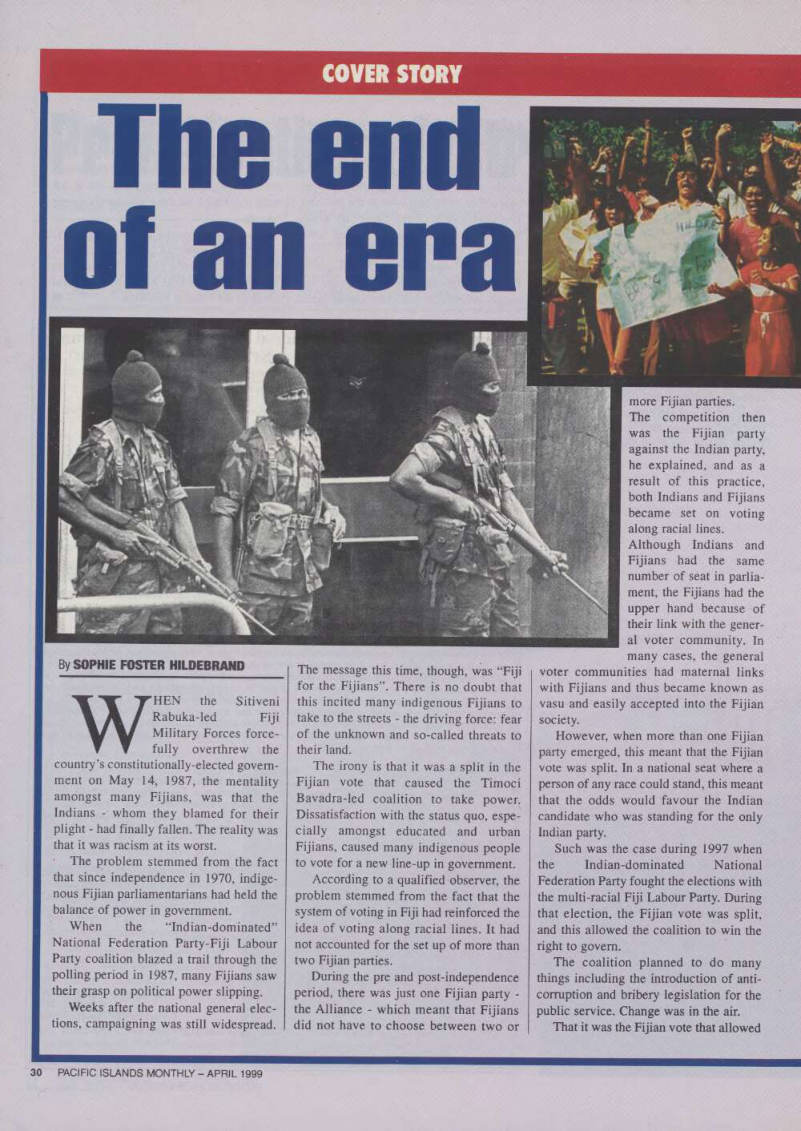
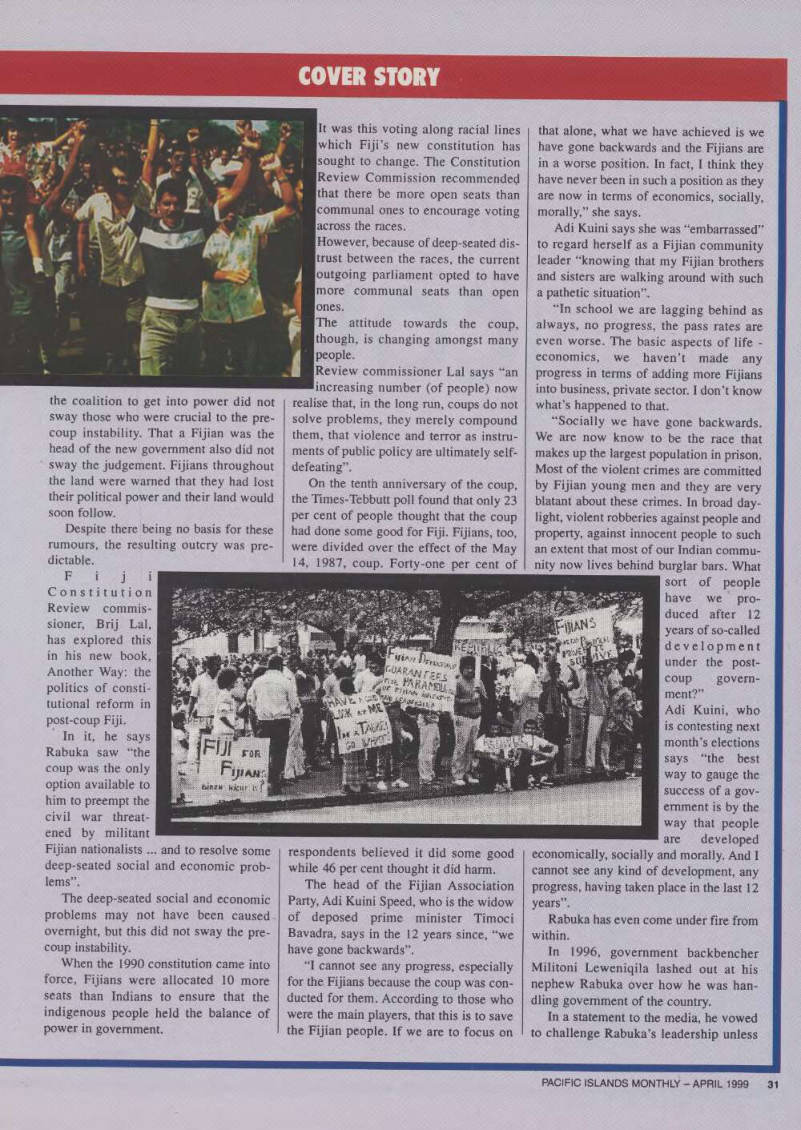
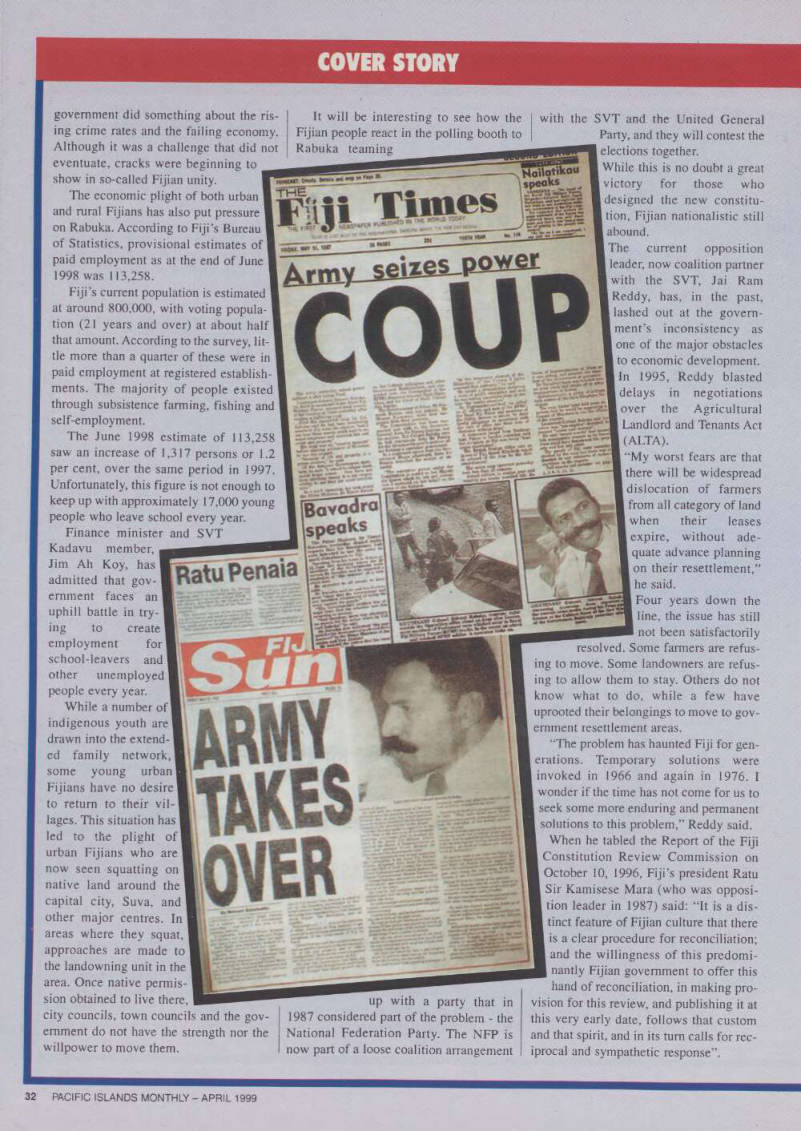
Cover Story
The end of an era
By Sophie Foster Hildebrand
WHEN the Sitiveni Rabuka-led Fiji Military Forces force fully overthrew the country’s constitutionally-elected govern ment on May 14, 1987, the mentality amongst many Fijians, was that the Indians - whom they blamed for their plight - had finally fallen. The reality was that it was racism at its worst.
The problem stemmed from the fact that since independence in 1970, indige nous Fijian parliamentarians had held the balance of power in government.
When the “Indian-dominated”
National Federation Party-Fiji Labour Party coalition blazed a trail through the polling period in 1987, many Fijians saw their grasp on political power slipping.
Weeks after the national general elec tions, campaigning was still widespread.
The message this time, though, was “Fiji for the Fijians”. There is no doubt that this incited many indigenous Fijians to take to the streets - the driving force: fear of the unknown and so-called threats to their land.
The irony is that it was a split in the Fijian vote that caused the Timoci Bavadra-led coalition to take power.
Dissatisfaction with the status quo, espe cially amongst educated and urban Fijians, caused many indigenous people to vote for a new line-up in government.
According to a qualified observer, the problem stemmed from the fact that the system of voting in Fiji had reinforced the idea of voting along racial lines. It had not accounted for the set up of more than two Fijian parties.
During the pre and post-independence period, there was just one Fijian party the Alliance - which meant that Fijians did not have to choose between two or
more Fijian parties.
The competition then was the Fijian party against the Indian party, he explained, and as a result of this practice, both Indians and Fijians became set on voting along racial lines.
Although Indians and Fijians had the same number of seat in parlia ment, the Fijians had the upper hand because of their link with the gener al voter community. In many cases, the general
voter communities had maternal links with Fijians and thus became known as vasu and easily accepted into the Fijian society.
However, when more than one Fijian party emerged, this meant that the Fijian vote was split. In a national seat where a person of any race could stand, this meant that the odds would favour the Indian candidate who was standing for the only Indian party.
Such was the case during 1997 when the Indian-dominated National Federation Party fought the elections with the multi-racial Fiji Labour Party. During that election, the Fijian vote was split, and this allowed the coalition to win the right to govern.
The coalition planned to do many things including the introduction of anti corruption and bribery legislation for the public service. Change was in the air.
That it was the Fijian vote that allowed
the coalition to get into power did not sway those who were crucial to the pre coup instability. That a Fijian was the head of the new government also did not
sway the judgement. Fijians throughout
the land were warned that they had lost their political power and their land would soon follow.
Despite there being no basis for these rumours, the resulting outcry was pre dictable.
Fiji Constitution Review commis sioner, Brij Lai, has explored this in his new book, Another Way; the politics of consti tutional reform in post-coup Fiji.
In it, he says Rabuka saw “the coup was the only option available to him to preempt the civil war threat ened by militant
Fijian nationalists ... and to resolve some deep-seated social and economic prob lems”.
The deep-seated social and economic problems may not have been caused overnight, but this did not sway the pre
coup instability.
When the 1990 constitution came into force, Fijians were allocated 10 more seats than Indians to ensure that the indigenous people held the balance of power in government.
jit was this voting along racial lines jwhich Fiji’s new constitution has [sought to change. The Constitution [Review Commission recommended [that there be more open seats than [communal ones to encourage voting [across the races.
However, because of deep-seated dis trust between the races, the current outgoing parliament opted to have more communal seats than open ones.
The attitude towards the coup, though, is changing amongst many people. [Review commissioner Lai says “an increasing number (of people) now
realise that, in the long run, coups do not solve problems, they merely compound them, that violence and terror as instru ments of public policy are ultimately self
defeating”.
On the tenth anniversary of the coup, the Times-Tebbutt poll found that only 23 per cent of people thought that the coup had done some good for Fiji. Fijians, too, were divided over the effect of the May 14, 1987, coup. Forty-one per cent of
respondents believed it did some good while 46 per cent thought it did harm.
The head of the Fijian Association Party, Adi Kuini Speed, who is the widow of deposed prime minister Timoci Bavadra, says in the 12 years since, “we have gone backwards”.
“I cannot see any progress, especially for the Fijians because the coup was con ducted for them. According to those who were the main players, that this is to save the Fijian people. If we are to focus on
that alone, what we have achieved is we have gone backwards and the Fijians are in a worse position. In fact, I think they have never been in such a position as they are now in terms of economics, socially, morally,” she says.
Adi Kuini says she was “embarrassed” to regard herself as a Fijian community leader “knowing that my Fijian brothers and sisters are walking around with such a pathetic situation”.
“In school we are lagging behind as always, no progress, the pass rates are even worse. The basic aspects of life economics, we haven’t made any progress in terms of adding more Fijians into business, private sector. I don’t know what’s happened to that.
“Socially we have gone backwards.
We are now know to be the race that makes up the largest population in prison.
Most of the violent crimes are committed by Fijian young men and they are very blatant about these crimes. In broad day light, violent robberies against people and property, against innocent people to such an extent that most of our Indian commu nity now lives behind burglar bars. What
sort of people have we pro duced after 12 years of so-called
development
under the post coup govern ment?”
Adi Kuini, who is contesting next month’s elections says “the best way to gauge the success of a gov ernment is by the way that people are developed
economically, socially and morally. And I cannot see any kind of development, any progress, having taken place in the last 12 years”.
Rabuka has even come under fire from within.
In 1996, government backbencher Militoni Leweniqila lashed out at his nephew Rabuka over how he was han dling government of the country.
In a statement to the media, he vowed to challenge Rabuka’s leadership unless
government did something about the ris ing crime rates and the failing economy.
Although it was a challenge that did not
eventuate, cracks were beginning to show in so-called Fijian unity.
The economic plight of both urban I ' and rural Fijians has also put pressure B on Rabuka. According to Fiji’s Bureau B " of Statistics, provisional estimates of B paid employment as at the end of June B 1998 was 113,258. I
Fiji’s current population is estimated B
at around 800,000, with voting popula-1 tion (21 years and over) at about half I that amount. According to the survey, lit-1 tie more than a quarter of these were in I
paid employment at registered establish-1
ments. The majority of people existed through subsistence farming, fishing and
self-employment.
The June 1998 estimate of 113,258 saw an increase of 1,317 persons or 1.2 per cent, over the same period in 1997.
Unfortunately, this figure is not enough to keep up with approximately 17,000 young people who leave school every year.
Finance minister and SVT
Kadavu member, Jim Ah Koy, has B . admitted that gov-Bfi ernment faces an ■ uphill battle in try- * ing to create * employment for* school-leavers and ■IS other unemployed B people every year. ■ While a number of* indigenous youth are* drawn into the extend-■ ed family network,*! some young urban* Fijians have no desire* to return to their vil-J lages. This situation has ■ led to the plight of* urban Fijians who are I now seen squatting on B native land around the I capital city, Suva, and I other major centres. In I areas where they squat, I approaches are made to the landowning unit in the area. Once native permis sion obtained to live there,
city councils, town councils and the gov ernment do not have the strength nor the willpower to move them.
It will be interesting to see how the Fijian people react in the polling booth to Rabuka teaming
up with a party that in 1987 considered part of the problem - the National Federation Party. The NFP is now part of a loose coalition arrangement
with the SVT and the United General
Party, and they will contest the I elections together.
I While this is no doubt a great B victory for those who ■ designed the new constitu ■ tion, Fijian nationalistic still ■ abound.
The current opposition leader, now coalition partner Iwith the SVT, Jai Ram I Reddy, has, in the past, I lashed out at the govern-
Iment’s inconsistency as
I one of the major obstacles
I to economic development.
■ln 1995, Reddy blasted ■ delays in negotiations ■ over the Agricultural '■ Landlord and Tenants Act
:■ (Alta).
'■ “My worst fears are that "■ there will be widespread ■ dislocation of farmers from all category of land pßwhen their leases U expire, without ade- I quate advance planning ■ on their resettlement,”
B he said. 3SB Four years down the CS B line, the issue has still not been satisfactorily
resolved. Some farmers are refus ing to move. Some landowners are refus ing to allow them to stay. Others do not know what to do, while a few have uprooted their belongings to move to gov ernment resettlement areas. 1 “The problem has haunted Fiji for gen- I erations. Temporary solutions were I invoked in 1966 and again in 1976. I I wonder if the time has not come for us to I seek some more enduring and permanent I solutions to this problem,” Reddy said.
B When he tabled the Report of the Fiji I Constitution Review Commission on I October 10, 1996, Fiji's president Ratu ■ Sir Kamisese Mara (who was opposi ■ tion leader in 1987) said; “It is a dis- I tinct feature of Fijian culture that there ■ is a clear procedure for reconciliation; II and the willingness of this predominantly Fijian government to offer this hand of reconciliation, in making pro vision for this review, and publishing it at this very early date, follows that custom and that spirit, and in its turn calls for rec iprocal and sympathetic response”.
But while reconciliation may apply to some areas, when it comes to land, Fijians will accept no compromise.
Even now, Fijian landowning units are demanding that tracts of land be returned to them, including that on which the country’s international airport sits. Indeed, the Fijian connection with the land is so strong that they would do anything to get it and keep it.
Even the government has to now bow to the landowners wishes. One recent state decision will see the return of twelve and a half acres of land to north ern division landowners at Nabauto. The mataqali (landholding unit) approached government for a return of a portion of the site because their members had increased rapidly over the past ten years.
They were in urgent need of land for their maintenance and subsistence.
But there have been other cases where landowners have not been so easily appeased.
The landowner roadblocks that were erected to Fiji’s only hydro-electric dam in the hills of the main island are one such example. Landowners last year demanded compensation for the land on which the dam has sat for the past two decades. The government seemed pow erless to quell the protest, and even the police officers who went to the hills to make arrests were forced out of their vehicles by persons armed with sticks and spears.
More recently, a school in the North of Fiji could not open for the new school year because the landowners closed it until certain demands were met. The school eventually compromised and agreed to hire a Fijian teacher from the landowning unit in the predominantly Indian school.
The coup d’etat of 1987 has promoted the idea that Fijians have power by sim ple disturbance of the peace, and even Rabuka seems powerless to stop such uprisings.
Next month’s election of a new gov ernment under the 1997 constitution will bring the end of an era for military-dom inated rule.
Just like in 1987, Fiji is at a cross roads. Again, though, it is the reaction of indigenous Fijians, and their leaders, to such change that will determine the future of a country once known as “the way the world should be”. ■
for Fiji's voters

A new alternative for Fiji's voters
By Sophie Foster Hildebrand
WHEN Fiji hits the polls between May 8-15 this year, it will have been 12 years since the military coup stopped democracy in its tracks. During those dozen years since, Fiji has gone through a turbulent and emotionally draining period attempting to claw its way back to the post-coup racial har mony.
On the tenth anniversary of that fateful day, coup leader and current prime minis ter Sitiveni Rabuka said: “I do not expect human beings to forgive me and my sol diers who were with me during the coups.
It is not easy to forget but let us learn from what happened and why it happened”.
He said “the situation that led to the events of 1987 could have been avoided and I am satisfied and convinced that a government of a country has a clear responsibility to ensure that harmonious co-existence exists in the country and open conflict does not arise. And that harmo nious co-existence will survive any politi cal change, any leadership change”.
A dozen years since the coups - the army long since pardoned - Fiji looks to have come of age and seems set to take a new tack.
On the verge of another General Election, Fiji is this time armed with a new constitution and several major multi-ethnic political alliances.
While the transition from 1987 to 1999 has been a long and rocky one, fraught with difficulties, the result seems astound
ing.
In a move that would have been unthinkable just after the coup, political parties are now aligning themselves with parties of other ethnic backgrounds in a bid to get into the country’s highest governing
body.
All of this is because of the alternative voting system that will be implemented for the first time during the country’s general elections next month.
The biggest alliance, in terms of current members of parliament, is that of the Soqosoqo Vakavulewa ni Taukei (SVT),
NFP and the United General Party (UGP).
These three parties are led by the out going prime minister Sitiveni Rabuka, out going opposition leader Jai Ram Reddy, and UGP’s David Pickering.
After signing the coalition agreement between the parties in mid-March, Pickering said: “The coalition is going into this election to win a decisive mandate and form the Fiji Islands first truly multi racial government”.
The other big alliance is that of the Fijian Association Party, the Fiji Labour Party (FLP) and the Party of National Unity (PANU). This alliance is led by Adi Kuini Speed, who is a member of the Great Council of Chiefs, Mahendra Chaudhry (FLP) who is also head of the Fiji Public Service Association, and Apisai Tora
(Panu).
Rabuka has called the new system of elections “truly democratic”.
Under the alternative system, an elec toral candidate has to gain 50 per cent plus one to win a seat.
“Clearly,” says Rabuka, this “would be in the national interest”.
The person in the hot seat at the moment, Fiji’s Supervisor of Elections, Walter Rigamoto, says the preferential vot ing system works well where parties col laborate in the lead-up to the elections.
“The idea is that the different political parties work with parties of other ethnic groups and it is trying to break the barrier of race. For example, in the open seats unless you are voting with the other group ings, if you are a Fijian party and unless you are working with an Indian as well as a general voter group, your chances are not particularly healthy because you need everybody’s vote,” he says.
However, coalitions do not need to be formal to succeed.
“A coalition would work just as well as any other party that is not coalescing with any other party formally but working closely with other parties in trading prefer ences for example. I suppose the answer is that you do not really need to have a for mal coalition to succeed but you would probably do better by having one. But other parties that work closely with other ethnic parties would also do just as well if they do their homework,” he says.
In the last Australian elections, it seemed that Pauline Hanson would cer-
Continued on page 56
tainly get into parliament. However, although she won more votes on first pref erence than other candidates, she lost on the second preference counts. Rigamoto says that case is a lesson for Fiji. “You should, for example in an open seat, appeal to everyone across the board. It also stresses the fact that every preference counts. You are not only looking at the first, you are looking at the second, the third, all the pref erences in that particular constituency,” he says. Under the new system, which is simi
lar to that of Australia, voters mark their preferences for each candidate. If no candi date has attained 50 per cent plus one upon the counting of the first preferences, then the individual (Person X) with the least number of first preferences is dropped. The second preferences that have been listed on Person X’s supporters’ ballots are added to other candidates that have won them.
Rigamoto says a person’s vote now “goes further than just one, if you like, your vote now has greater value”. But while the can didates are busy on last-minute campaign
ing, the Elections Office has an even bigger task - with compulsory registration of vot ers, compulsory voting, new boundaries and additional open seats. Rigamoto says there are no particular trends for Fiji to follow and as such each step has to be analysed carefully “to make sure we do not get caught during the polling period”. In the past, voters had one designated polling sta tion depending on which area they lived in.
Under the new national regime, however, you could go to two or more polling sta tions. Some voters, he says, can go to twen ty polling stations. Under the previous sys tem, Fiji used to have about 570 polling sta tions. This number has increased 32 per cent to slightly over 750. The reason for this, says Rigamoto, is compulsory voting - “I think it is unfair for us to try to prosecute someone for not voting if we have not made it accessible to that person”. He says it would only take 15 per cent of voters not turning up and it would mean his office would have to pursue about 60,000 people.
The Elections Office has given itself four days to count votes from 71 constituencies.
To do that, there will be three eight-hour shifts of staff operating over 750 polling stations to get in the votes. Another histori cal aspect of the upcoming election is that, for the first time, how-to-vote cards will be allowed into the polling booths. In the past, no campaigning was allowed past a line 50 metres from the booths. According to Australian statistics have found that 90 per cent of people followed the how-to-vote cards issued by their political parties.
Because of this, and the fact that Fiji’s vot ers are used to one tick in the past, Fiji has adopted a similar set-up. In their education al campaigns, the Elections Office is telling Fiji’s voting public the general rule: tick once above the line or mark all below the line. ■
dump tailings in Astrolabe Bay
Industry
Highlaids Pacific wants ta dump tailings in Astrolabe Bay
By Sam Vulum
THE environmental plan for a major US$B3B mil lion nickel and cobalt mine project in Papua New Guinea has come under close scrutiny.
A Port Moresby-based non-govern ment organisation, the Individual and Community Rights Advocacy Forum (ICRAF), has raised some serious fears of environmental pollution fol lowing the decision by the mine’s developer Highlands Pacific Limited to dump treated tailings into the sea.
This practice is known as Submarine Tailings Discharge (STD) and is now increasingly presented as a safe and viable option by mining com panies.
A discussion paper, commissioned by the Mineral Policy Institute of Sydney, Australia in February 1999 in consultation with ICRAF - high lighted several environmental risks associated with STD in Astrolabe Bay, in the Madang Province where the tailings are expected to be deposited.
MPI commissioned the scientific report in response to concerns raised by community groups, including the
Icraf, In Png.
It examines the environmental risks which arise from the proposed STD into the Astrolabe bay.
The government is yet to decide on the environmental plan, although its initial reactions were favourable.
The report is a pre-requisite of a special mining lease for the project.
Highlands Pacific Limited said in the environmental plan - now before the PNG government for consideration - that a total of 100 million tonnes of treated tailings will be released over a I
20-year project life of the mine, via a pipeline into the sea.
The company’s managing director, lan Holzberger said the project would be a unique mine in PNG because it will not leave a hole in the ground, no tailings dam will be required and mined areas will be re-vegetated
immediately.
Holzberger said the rehabilitation plan will be put into action as the mine goes into operation.
He said ore will be mined in cells of one to four hectares by excavators, and hauled by trucks to a “benefica tion” plant.
Rehabilitation will start as soon as a cell is mined.
Top soil, or overburden, which was earlier moved along with the vegeta tion, will be returned to previously mined surfaces for revegetation.
After the ore becomes slurry at the benefication plant, it will be piped into a refinery. The material will be processed into one metre by one metre sheets of nickel and cobalt, ready for export to stainless steel manufactur ers.
Holzberger said this makes the Ramu project the first minerals project to set up a processing plant in PNG.
According to the environmental plan, the tailings will be treated, acid contents neutralised and soluble metal contents extracted before disposal.
The outlet of the pipeline is planned for 150 metres below the deepest measured zone of sunlight (euphotic zone), 50 metres below the zone where upwelling can occur and 30 metres below the deepest measured surface mixed layer of the ocean (where wind and wave action mix and
circulate freely).
The location of the outlet will be in
a steep-sided submarine canyon that will direct the flow of tailings into a deep ocean basin.
The tailings’ material will consist of treated alkaline slurry from which nickel and cobalt have been removed.
The tailings will flow by gravity pipeline from the refinery which will be located on the coastline and into a tailings’ disposal tank for a neutralisa tion process before it travels by sub marine pipeline to the 150-metre depth of release.
The MPI report acknowledges that the direct disposal of mine tailings into the ocean has been practiced in parts of the northern hemisphere for more than 50 years.
It says that it is only in the last 25 years with the increase in environmen tal awareness and closer regulation that mining companies have attempted to place tailings at depths below the well-mixed surface zone to mitigate adverse environmental effects.
Recently new mines in the region have tended to discharge tailings at a
depth of around 80-100 m although
some mines in the Indonesia/PNG region discharge below this level.
It also acknowledges that STD has recently come into favour in PNG where on-land disposal options are
problematic.
Two mines, Misima and Lihir, use
this technique.
According to the report, STD is an attractive option for PNG for several reasons. In comparison with on-land tailings retention, it is arguably safer both to local people and the environ ment.
It accepted that much of PNG is unsuited to the construction of tailings dams due to rugged topography, seis mic activity and rainfall.
These factors increase the likeli hood of a disastrous dam failure. As tailings require continuous monitor ing and post-mine remediation, STD is also cheaper in the long term.
However, the MPI report says that in practice, it is inevitable that STD operations will have adverse effects in the receiving environment.
All STD operations around the world cause increases in suspended sediment, trace metals and residual milling reagent concentrations in the receiving waters.
These components of the tailings can detrimentally affect or alter ben thic invertebrates and fish, pelagic zooplankton and fish, and the phyto plankton and microbiota on which these animals rely.
The repo.rt also attempts to show that the Misima and Lihir mines, which also use the STD technique, should not be compared with the Ramu nickel and cobalt project.
The report says both mines have receiving slopes that are far steeper than those in Astrolabe Bay.
According to the report, submarine tailings discharge generally form a coherent density current on the seabed which transports the solids under the influence of gravity at greater depths.
It says deposition from these den sity currents generally occur on seabed slopes less than 12 degrees.
In Astrolabe Bay, these low slopes are reached at a depth of about 250 m, and by 300 m depth the slope is on average only 3 degrees.
It is therefore highly likely that substantial quantities of tailings’ material will be deposited in the vicinity of 300 m depth, and will not be transported as a coherent flow of abyssal zones.
Further, the report said the are within the 100-300 metre zone is sub ject to the permanent movement of the New Guinean Coastal Undercurrent (NGCU) that carries water along the New Guinean coast.
The report says it is highly likely that this current will carry with it tail ings’ material and transport it to the West.
While it is expected that tailings material will be rapidly diluted after
its entrainment in the NGCU, on the basis of other STD case histories, one could expect high concentrations of tailings to be found in these waters for a considerable distance to the north west of the site.
During the NW monsoon, this water body, through its interaction with opposing surface currents, upwells along the coast.
Consequently it is probable that tailings will be brought to the surface of the Astrolabe Bay coastline during the monsoon period.
It this occurs, it will have a signif icant impact on the productivity and ecology of Astrolabe Bay and the Madang coastline.
MPI was established in 1995 to address the rapidly increasing impact of minerals development world-wide, and specifically, the impacts of Australian minerals companies in the Asia Pacific region.
It is a research and advocacy organisation based in Sydney, Australia. The history of the project goes back to the 19605.
A lateritic nickel deposit was dis covered at Kurumbakari, a site of the Ramu river, in the early 19605.
It was owned by a succession of interests before it was taken up by Highlands gold in 1993.
In 1997, the Highlands Pacific Limited group, through its wholly owned subsidiary Ramu Nikel Limited, acquired Highlands Gold’s 65 per cent interest in the project and became manager of the Ramu Joint Venture.
A feasibility study indicating the technical and commercial viability has been completed and Highlands Pacific are currently seeking financial backing to allow the project to start in mid this year.
Natural Systems Research of Hawthorn, Australia was commis sioned by Highlands Pacific to pre pare the environmental report.
It has been projected that the Ramu mine will generate between US$26O million to US$27O million in revenue annually. The mine is expected to employ 2500 people at peak construc tion period and maintain a workforce of 1045 during operations. ■
Cooks religious leaders
oppose gay and lesbian tour
WHEN religious leaders publicly responded like an angry tsunami to a planned tour for gay and lesbian couples from Australia to Rarotonga, it proved intolerance and hypocrisy are alive and well.
As one woman put it. “We pride our selves on being Christians, then behave in a very un-Christian way to people who want to holiday here.”
The Religious Advisory Council, made up of church leaders, unanimously opposed the November tour, expressing their opposition to minister of Justice, Tiki Matapo in a formal letter.
But that same Religious Advisory Council (RAC) remained completely silent when minister of the Crown, Papamama Pokino had a drunken public sex romp and committed adultery. There was no condemnation of Pokino’s behav iour that embarrassed an entire nation then Council President Kevin Geelan saying it was “a political issue, not a moral one and the politi cians should be addressing it.”
Current RAC President David Akanoa said they believe a gay and les bian week would affect moral standards of Cook Islands people, especially the younger generation. Akanoa later told a Radio NZ International reporter that he supposed the tour would be okay, as long as they didn’t come to Rarotonga and promote homosexuality.
Rev Temaire Vaiau of the Cook Islands Christian Church stated homo sexuals are influenced by evil spirits and that he would not “tolerate the spirits that drives individuals to do things that are morally evil.”
And condemnation also from Assembly of God Pastor Tutai Pere. He described the planned tour on Radio NZ as an “abomination.”
The tour is being advertised by Silkes Travel for gay and lesbian couples and their children. The travel company offered family activities like mountain treks, kayaking and snorkelling in Rarotonga. Daily Cook Islands News reported that there was to be a parade by the group through the main town of Avarua, but Silkes has said this was never part of the holiday itinerary. ■
Pacific cashes in on Hollywood
By Micheal Held
Hollywood has been making money out of the Second World War even before the Japanese surrendered in Tokyo bay isn’t it time that the South Pacific cashed in too?
While the “Saving of Private Ryan” probably did nothing for French tourism, the other Oscar nominated film, “The Thin Red Line” could do a lot for the Solomon Islands.
The undoubted star of movie was the stunning scenery. While the action sequences were all filmed in Queensland, the dream like stuff was all filmed in Guadalcanal. There is plenty of precedent for tourist authorities to cash in movies. In Samoa they even have a “Return to Paradise” Beach in honour of a B-grade ‘sos movie no one these days has ever seen.
More usefully is the experience of Karekare Beach in West Auckland.
There the multiple-Oscar winning New Zealand film “The Piano” was filmed.
Although the scenery in the movie was forever wet and muddy, queues of peo ple have been visiting ever since. And they make a lot of movies there.
And who knows what j Tom Hanks will do for
Fijian tourism - certain Brooke Shields cre ated an interesting lead in that department.
“The Thin Red Line” is based on the remarkable James Jones novel (he also wrote “Here to Eternity” which became a movie classic for the kissing-in-the-surf scene) which tells of the life of a US Army rifle company. They are sent into
Guadalcanal to relieve the US Marines who have managed to wrest themselves a foothold around what is now modem day Honiara and Henderson Field.
For movie buffs the other attraction of the movie was director Terrance Malick who also wrote the screenplay. He has a cult standing and “The Thin Red Line” was
his first movie since 1978 - Leonardo DiCaprio was still in kindergarten then.
The film has had mixed reviews for while “Private Ryan” was about the blood and guts, Malick’s screenplay is about the mind and the physical and anthropological environment in which this clash was
fought.
The film presents a juxtaposition of a vicious mechanised battle taking place in a pristine wilderness, where the forces of destruction collide with a people living in quiet harmony with their natural surround
ings.
In this respect it is almost unique in Hollywood war movies - a film which
acknowledges there were real people living there before all the heroics.
The Solomon Islanders come out of the movie look ing to be remarkable people, beautiful and peaceful.
The wider battle for Guadalcanal is barely men tioned in the movie and it takes great liberties with Jones’ novel. In the movie version people die who managed to survive the hell in the book.
While the Solomon Islanders are an integral part of the movie, the Japanese are mostly the standard par odies of Japanese. Not men tioned are the Fijians and New Zealanders who also fought and died in the Solomons.
The big winner in the movie is Guadalcanal and its peo ple. An unexpected tourism
blessing.
There was one odd mistake in the movie - and obvious to anybody in the South Pacific.
One of stars, Private Witt (Jim Caviezel) is AWOL early in the film, swimming with Solomon Islanders and
taking in the peaceful scene he stumbles across.
Unfortunately an “American” patrol boat shows up and picks them up - but locals will recognise the vessel as the very modem looking “Auki” - it is the Pacific class patrol boat and pride of the modem Solomon Navy. ■
Island films make San
Francisco film festival
A DOUBLE-BILL of Hawaii films was screened March 15 at the 17th annual San Francisco International Asian-American Film Festival.
“Wayfinders: A Pacific Odyssey” is a documentary about traditional Oceanic
voyaging, featuring Hokule’a navigators
Mau Piailug, of Satawal, Federated States of Micronesia, and Nainoa Thompson, of Hawaii.
“Hawaiian Sting,” written by Big Island
student Anthony Kahawai’i, is a short comedy with a Sovereignty message. Both films received underwriting from Pacific Islanders in Communications. This Honolulu-based, government-funded enti ty - dedicated to promoting Polynesian, Micronesian, and Melanesian films and videos - is the sister minority consortium
of the presenters df the SF filmfest, the National Asian-American Telecommunications Association.
PIC Programming Director Ann Moriyasu told PIM that while she believed some Oceanic pictures have previously been screened at the Frisco festival, “few Pacific titles get there.”
Asked if it was a good thing for Hawaii related films to be presented at the Bay Area venue, “Wayfinders” director Gail Evenari said: “Of course. It’s wonderful.
It’s hard to find a niche that focuses on Polynesian culture. It is a really good thing.”
Evenari, who lives near San Francisco and presented her documentary at the film fete there, said “Wayfinders,” which airs in Hawaii on PBS May 6, already has distrib utors. But as for exposure at the festival.
the director asked: “How can it not help?”
Regarding the fact that most festival films will be Asian, and not Pacific Islander, Evenari said she is “really pleased [her film] is included.”
But Ray Bumatai, star of Hawaiian Sting, told PIM: “Nobody knows what to do with Hawaiians. What do you lump them into? Caucasians put them into the Asian category. I’m not surprised. It’s the same thing in prisons,” declared Bumatai, one of the best Hawaiian actors ever.
Nevertheless, Bumatai stated that inclu sion of Hawaii films in the Frisco film fete “can be good, although some people may be upset by Hawaiian Sting’s [Sovereignty] message”.
“Some may see it as innovative. Hawaii is usually portrayed as schmaltzy, Hawaiians have subservient roles,” said Bumatai, who recently played a chef in the Lauren Bacall Doris Duke TV mini-series and appeared in “Martial Law” on televi sion. Bumatai plays a lead in Lani Loa, a still unreleased Francis Ford Coppola- Wayne Wang co-production with a
Sovereignty theme.
He is off to Tahiti soon for a BBC sit com, and is appearing in the new Disney surfer flick “Johnny Tsunami.” ■
New book on imperial expansion welcomed
Imperial Benevolence By Jane Samson University of Hawaii Press $35 SUBTITLED Making British Authority in the Pacific Islands, this welcome addi tion to the sum of knowledge of the region al empire draws on previously unpublished British Admiralty archives to offer a view of the British mission in the islands.
Dr Samson identifies that mission as “Christianisation and Civilisation” while revealing the stresses, contradictions and conflicts that lie behind this central theme of empire. The naval captains who roamed those vast expanses of ocean, displayed the benevolent power of Queen Victoria to the savages they looked upon (on the whole) with condescending kindness. They largely detested and distrusted the traders they encountered, tending to dismiss their advice and knowledge even though they had been in place far longer than any naval man o’ war ever could be. Yet those same captains were from time to time called
upon to convey Her Majesty’s displeasure to the natives in the form of punitive expe ditions which usually involved shelling vil lages from the sea before disappearing over the horizon. Fortunately, as Dr Samson finds, very little permanent damage was inflicted. It was a near-schizoid Britain that looked out upon the world in the dawn of Queen Victoria’s reign. Slavery was the major enemy of civilisation while empire was the means by which savages could be raised from their ignorance and brought under her Brittanic Majesty’s protection.
Unfortunately for the proponents of empire, however, the notion of small islands joining the red portions of the world map was not always welcomed in Whitehall. Indeed, Tonga and later Fiji found themselves with royal families where none had existed before reluctant civil ser vants could countenance their entrance to empire. At least with rulers of their own, they could be left to get on with it - unless
of course those rulers developed as a chal lenge to the existing order. So one of the warring leaders of Tonga was declared king. “He is the king because Her Majesty Queen Victoria says he is king” as one naval offer put it. Similarly, Cakobau was declared supreme ruler of Fiji although it was argued that his power was in decline and his writ extended barely beyond a small comer of Viti Levu. When the British insisted that “king” Cakobau right a wrong in Naitisiri, for example, Cakobau showed a willingness to act - but no more. In fact, he was powerless in the highlands.
Dr Samson’s study offers some fascinat ing insights into the naval lore of the time and points to the ambivalent attitude of many ship’s captain’s and officers toward their mission. We also learn something but still not enough due, no doubt, to the shortage of sources - of the reactions and attitudes among the islanders to the arrival of British naval power. (Russell Hunter) ■
Samoan film director
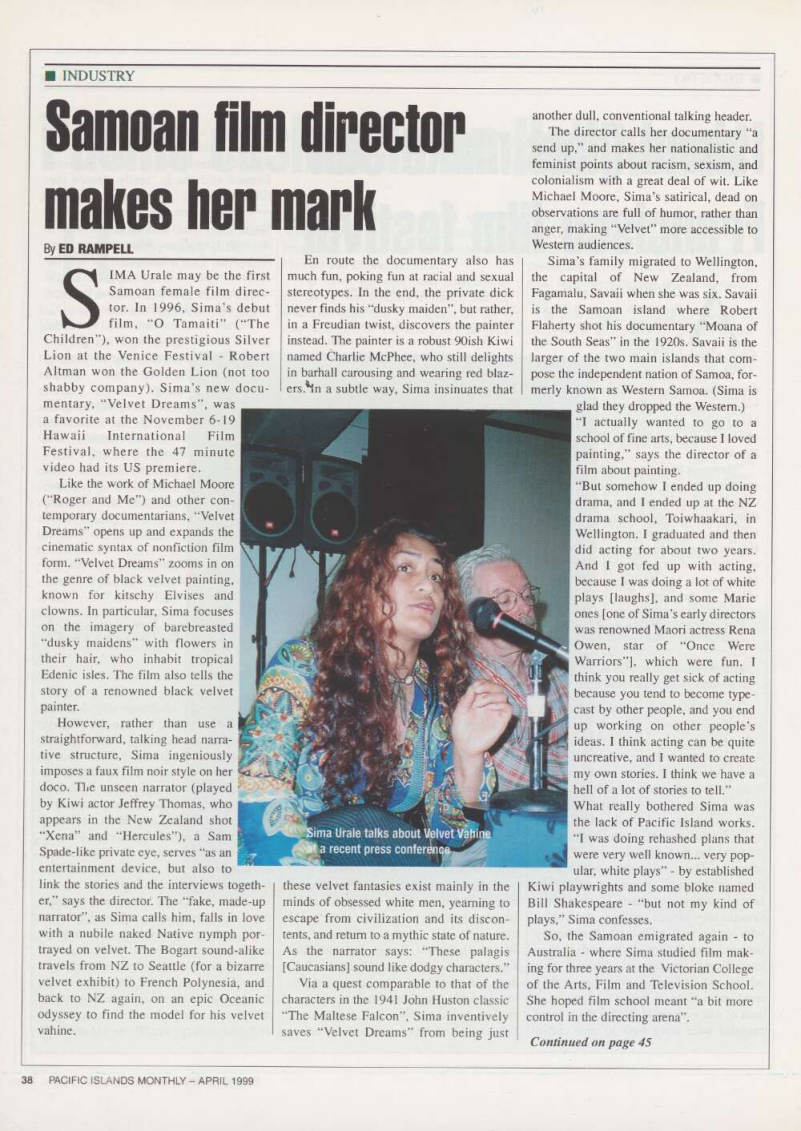
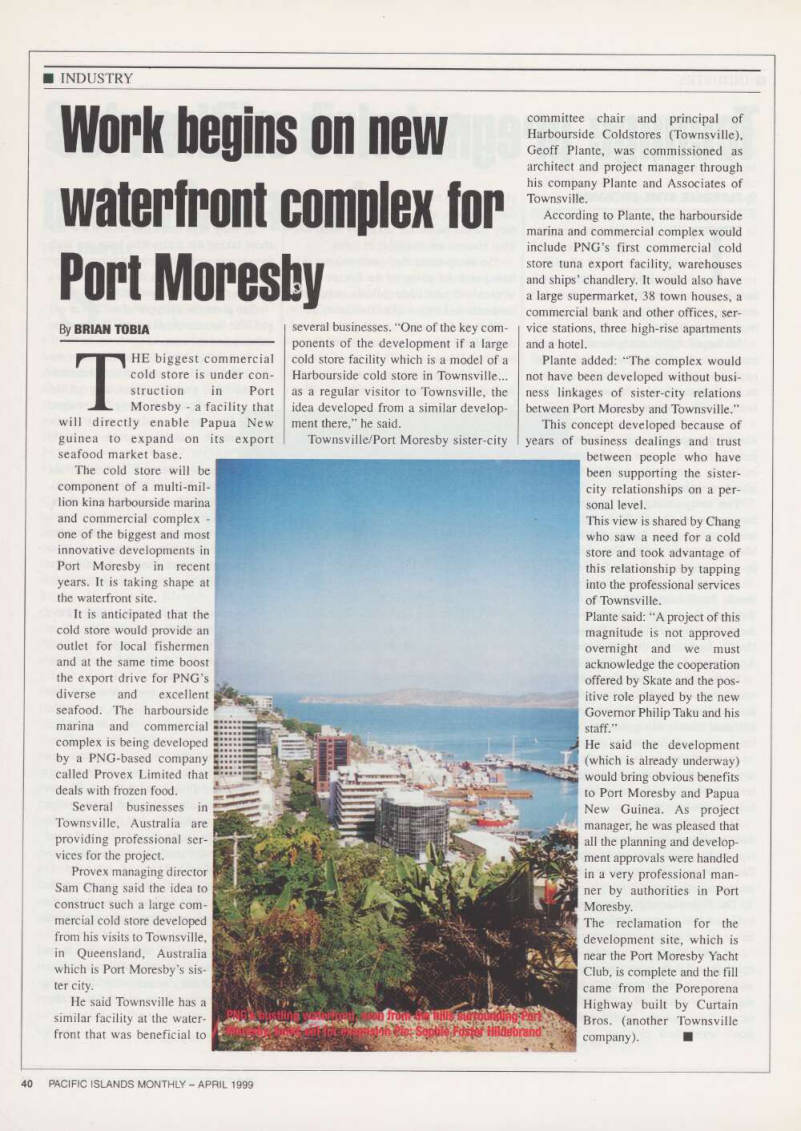
makes hep mark
By Ed Rampell
SIMA Urale may be the first Samoan female film direc tor. In 1996, Sima’s debut film, “O Tamaiti” (“The Children”), won the prestigious Silver Lion at the Venice Festival - Robert Altman won the Golden Lion (not too shabby company). Sima’s new docu
mentary, “Velvet Dreams”, was a favorite at the November 6-19 Hawaii International Film Festival, where the 47 minute video had its US premiere.
Like the work of Michael Moore (“Roger and Me”) and other con temporary documentarians, “Velvet Dreams” opens up and expands the cinematic syntax of nonfiction film form. “Velvet Dreams” zooms in on the genre of black velvet painting, known for kitschy Elvises and clowns. In particular, Sima focuses on the imagery of barebreasted “dusky maidens” with flowers in their hair, who inhabit tropical Edenic isles. The film also tells the story of a renowned black velvet painter.
However, rather than use a
straightforward, talking head narra
tive structure, Sima ingeniously imposes a faux film noir style on her doco. The unseen narrator (played by Kiwi actor Jeffrey Thomas, who appears in the New Zealand shot “Xena” and “Hercules”), a Sam Spade-like private eye, serves “as an entertainment device, but also to
link the stories and the interviews togeth er,” says the director. The “fake, made-up narrator”, as Sima calls him, falls in love with a nubile naked Native nymph por trayed on velvet. The Bogart sound-alike travels from NZ to Seattle (for a bizarre velvet exhibit) to French Polynesia, and back to NZ again, on an epic Oceanic odyssey to find the model for his velvet vahine.
En route the documentary also has much fun, poking fun at racial and sexual stereotypes. In the end, the private dick never finds his “dusky maiden”, but rather, in a Freudian twist, discovers the painter instead. The painter is a robust 90ish Kiwi named Charlie McPhee, who still delights in barhall carousing and wearing red blaza subtle way, Sima insinuates that
these velvet fantasies exist mainly in the minds of obsessed white men, yearning to escape from civilization and its discon tents, and return to a mythic state of nature.
As the narrator says; “These palagis [Caucasians] sound like dodgy characters.”
Via a quest comparable to that of the characters in the 1941 John Huston classic “The Maltese Falcon”, Sima inventively saves “Velvet Dreams” from being just
another dull, conventional talking header.
The director calls her documentary “a send up,” and makes her nationalistic and feminist points about racism, sexism, and colonialism with a great deal of wit. Like Michael Moore, Sima’s satirical, dead on observations are full of humor, rather than anger, making “Velvet” more accessible to Western audiences.
Sima’s family migrated to Wellington, the capital of New Zealand, from Fagamalu, Savaii when she was six. Savaii is the Samoan island where Robert Flaherty shot his documentary “Moana of the South Seas” in the 19205. Savaii is the larger of the two main islands that com pose the independent nation of Samoa, for merly known as Western Samoa. (Sima is
glad they dropped the Western.) “I actually wanted to go to a school of fine arts, because I loved painting,” says the director of a film about painting.
“But somehow I ended up doing drama, and I ended up at the NZ drama school, Toiwhaakari, in Wellington. I graduated and then did acting for about two years.
And I got fed up with acting, because I was doing a lot of white plays [laughs], and some Marie ones [one of Sima’s early directors was renowned Maori actress Rena Owen, star of “Once Were Warriors”], which were fun. I think you really get sick of acting because you tend to become type cast by other people, and you end up working on other people’s ideas. I think acting can be quite uncreative, and I wanted to create my own stories. I think we have a hell of a lot of stories to tell.”
What really bothered Sima was the lack of Pacific Island works.
“I was doing rehashed plans that were very well known... very pop ular, white plays” - by established
Kiwi playwrights and some bloke named Bill Shakespeare - “but not my kind of plays,” Sima confesses.
So, the Samoan emigrated again - to Australia - where Sima studied film mak ing for three years at the Victorian College of the Arts, Film and Television School.
She hoped film school meant “a bit more control in the directing arena”.
Continued on page 45
Sima Urale talks about Velvet Vahine at a recent press conference
Continued from page 38
“After graduating from the film school, I returned to NZ and I started working on a film called O Tamaiti, which screened at the Hawaii Festival two years ago,” says Sima.
“The film is all in Samoan and was funded by the NZ Film Commission [a governmental entity], it’s subtitled [in English]. It’s to do with integrity. It would not have been believable if I made a Samoan family speak English... Because this family was... immigrants [in Wellington], they had to speak Samoan.
It’s all about integrity, when you are mak ing films, whether you are true to your characters.”
O Tamaiti was shot on 35 mm film, and is “only 15 minutes long,” says the Oceanic auteur. “It’s quite an art house lit tle piece, and it was shot in black and white. And it’s an unconventional story telling for a Polynesian story or content.
It’s very stylized, very visual and sound orientated. It did very well overseas, it was screened in Sundance and Telluride, and has won eight awards internationally.
“I won the Silver Lion award for Best Short Film [at the Venice Film Festival].
And Robert Altman won the Golden Lion Award, so our films were screened togeth er. That was really cool, it was like the old and the new filmmaker, coming up,” says the 30 year old.
To pay the bills, Sima has shot corpo rate videos. Velvet Dreams was made for television in NZ.
Besides introducing “Velvet Dreams”, Sima participated in the “Interpreting History & Culture: Film making in New Zealand” panel, saying: “As a Pacific Islander in NZ, there have been films like Sons for the Return Home, The Silent One, Flying Fox in a Freedom Tree. I still see it as a Western country, even though it is part of the Pacific”.
Sima added “one of the biggest prob lems with Pacific Island films not hap pening is because there aren’t enough of us interested in filmmaking and writing.
I’m still waiting for others to appear around me. At the moment I can feel quite lonely at times [laughter]”.
What does the film future hold for this Islander auteur? Sima says she has a development deal in the works to direct a feature, but wants to take her time. ■
Teenage pregnancies on the rise
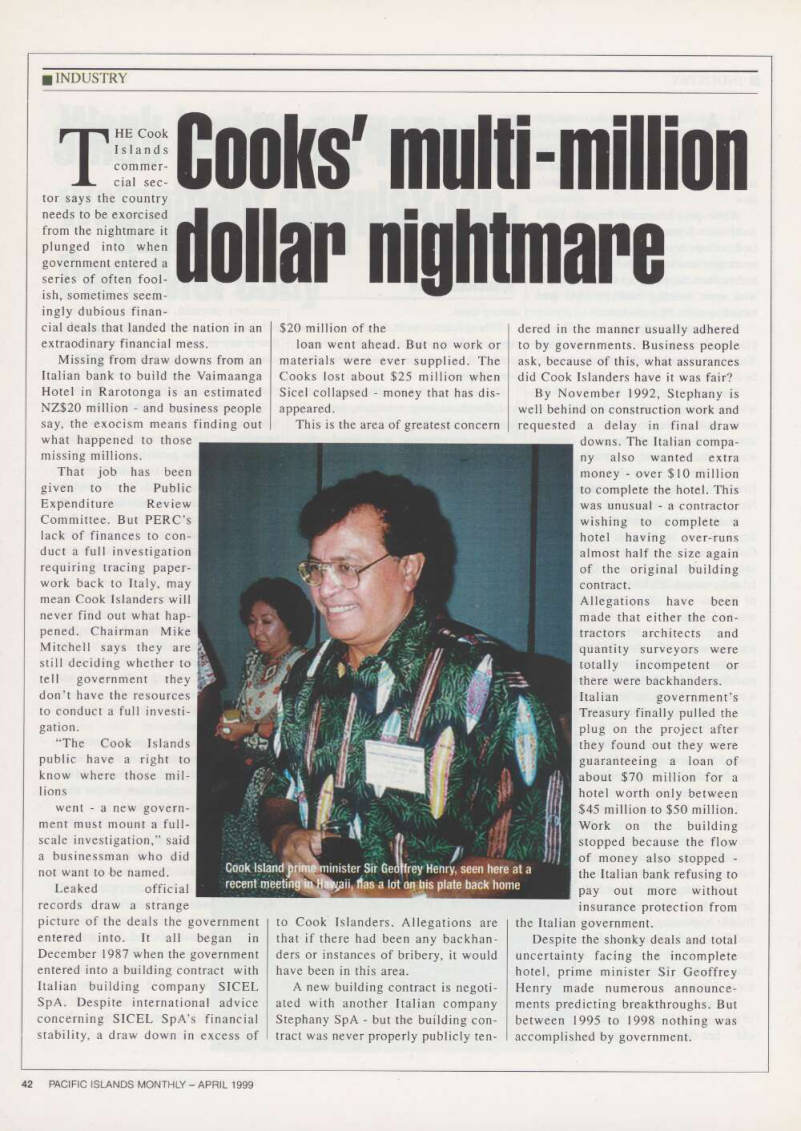
By Florence Syme-Buchanan
THE findings of two major studies on the sexual behaviour of Pacific islanders and their atti tudes towards sex may identify why teenage pregnancy is such a big regional problem.
It’s hoped that island governments will use reports from the first time studies to upgrade reproductive health services and tackle reproductive health awareness, the latter often a sensitive issue in the Pacific.
In many Pacific staunchly Christian islands, the open discussion of sexual sub jects is frowned upon by churches who indirectly control many of the freedoms island communities have.
The two sub-regional projects have been sponsored by UNFPA with surveys being carried out in Samoa, Cook Islands, Marshall Islands and the Solomon Islands by demographer Dr Kesaia Seniloli.
Executed by the University of the South Pacific, research will focus on Women’s Reproductive Health Needs and their Perceptions of the Reproductive Health Service - the other project is Adolescents Sexuality and Fertility.
So far, Samoa and the Cooks have been completed. Dr Seniloli and research assis tant Maleafono Fa’afeu are now in the Marshall Islands where the growing popu lation rate is raising serious concerns.
In the Solomon Islands, Dr Seniloli says, it will be difficult to gather data because of isolated communities and diffi culty in reaching them.
Dr Seniloli says what is emerging from their studies is the big need for informa tion to be given to young people in the Pacific on sexuality issues and to women
on reproductive morbidity.
The Fijian demographer says there is evidence that young people are engaging in sexual activity at a much younger age.
As such “there is a need to note their opinions and their experiences to come up with policies and programmes for them,” she says. “Attitudes of people are still the same, there are the traditionalists who don’t want their children to be inter
viewed.” She said Pacific islanders, espe cially women, are not as well informed as they should be on the sexuality issue and what choices are available to them.
“So many cases they (women) are suf fering and not going to the doctor at all, women will take their children, take their husbands and they will be the last to go.”
She said many women interviewed complained of ailments and asked if she could cure them.
“Health departments need to smarten up, but the problem has been there is been no data on this.”
‘There is evidence that young people are engaging in sexual activity at a much younger age’
Three surveys target teenagers between 15 and 19, women between 15 and 49 and men aged between 20 to 54. Each module asks 90 questions ranging from how much respondents know about STD’s, and HIV/AIDS, perceptions about their roles and attitudes towards sexual behaviour.
The Pacific studies made headlines in the Cooks the same day a long-term expa triate doctor in the outer island of Aitutaki confirmed what the country’s Health min istry already knows but hasn’t made pub lic.
Teenage pregnancy is a real problem in Aitutaki where about 1,800 people live.
The island’s obstetrician Dr Yin Yin May says girls as young as 13 are having babies and she worries about “children having children” and the uncertain futures of these teenage mums.
She says like the rest of Pacific island states, young people become sexually active at a very young age in Aitutaki.
Numerous workshops and seminars on contraception and safe sex have not really helped bring down teenage birth rates.
The largest number of teenage pregnan cies in five years occurred last year - 11 of
the 51 women who gave birth were single teenagers, four aged 15.
Dr May says there has been a lot talk about taking the males who have sex with female minors to court, but this never hap pens, despite Aitutaki health authorities
reporting instances to police.
She gives the example of a 12-year old girl who became pregnant and Police were informed of the case.
“But the grandmother looking after the girl told them it was none of their business and said her granddaughter was not the first to fall pregnant so young.” Now aged 15, Dr May says the young mother can be seen “on the road playing, she is a child herself’.
Most girls who fall pregnant are expelled from Araura College where fami ly planning is discouraged by teachers, says Dr May.
Only two girls returned to college after giving birth. One is now studying at a New Zealand polytechnic, the other is said to be having difficulties coping, according to Dr May.
Boys who have fathered children have also been expelled. A number have been sent to main island Rarotonga to continue their education, “so where is the punish ment there,” she asks.
“It’s very sad because they are all chil dren, children having children, what is the future of this country - who is going to teach them what are right and wrong?”
“Most of the religious groups are against it (family planning/sex education) because they think it makes the young peo ple more sexually active. Religious groups attend the workshops, but their views do not change, so sometimes I wonder if these workshops are really benefiting the peo ple,” says Yin Yin May.
She says sexually active young people in Aitutaki need more awareness of what can be the consequences of unprotected sex.
And “guardians need to be more accepting that if a young person is sexual ly active, if they cannot stop the young person, then they have to help in another way.”
Continued on page 43
Continued from page 39
“Family planning is not encouraging young people to be more sexually active, but is there to help them prevent unwant ed pregnancies”.
She talks sadly about the large number of teenage girls who visit her surgery cry ing and asking for abortions, which are illegal in the Cooks.
All she says she can do is to “console them and ask them to look after them selves and help them to be healthy”.
Dr May believes many teenagers are too shy to approach health authorities for contraceptives or family planning advice.
In 1994, of the 59 births in Aitutaki, ten were teenage girls.
A year later, that figure crept up to 12 teenage births out of 77. In 1996 and 1997, there were only five teenage births for each year out the 57 and 40 births on Aitutaki.
The obstetrician says it’s difficult to explain why teenage births jumped to 22 per cent last year. ■
Port Moresby
Work begins on new waterfront complex for Port Moresby
By Brian Tobia
THE biggest commercial cold store is under con struction in Port Moresby - a facility that will directly enable Papua New guinea to expand on its export seafood market base.
The cold store will be component of a multi-mil lion kina harbourside marina and commercial complex one of the biggest and most innovative developments in Port Moresby in recent years. It is taking shape at the waterfront site.
It is anticipated that the cold store would provide an outlet for local fishermen and at the same time boost the export drive for PNG’s diverse and excellent seafood. The harbourside marina and commercial complex is being developed by a PNG-based company : called Provex Limited that 1 deals with frozen food.
Several businesses in J Townsville, Australia are I providing professional ser vices for the project.
Provex managing director Sam Chang said the idea to construct such a large com mercial cold store developed from his visits to Townsville, in Queensland, Australia which is Port Moresby’s sis ter city.
He said Townsville has a I similar facility at the water- I front that was beneficial to I
several businesses. “One of the key com ponents of the development if a large cold store facility which is a model of a Harbourside cold store in Townsville... as a regular visitor to Townsville, the idea developed from a similar develop ment there,” he said.
Townsville/Port Moresby sister-city
committee chair and principal of Harbourside Coldstores (Townsville), Geoff Plante, was commissioned as architect and project manager through his company Plante and Associates of Townsville.
According to Plante, the harbourside marina and commercial complex would include PNG’s first commercial cold store tuna export facility, warehouses and ships’ chandlery. It would also have a large supermarket, 38 town houses, a commercial bank and other offices, ser vice stations, three high-rise apartments and a hotel.
Plante added: “The complex would not have been developed without busi ness linkages of sister-city relations between Port Moresby and Townsville.”
This concept developed because of years of business dealings and trust
between people who have been supporting the sister city relationships on a per sonal level.
This view is shared by Chang who saw a need for a cold store and took advantage of this relationship by tapping into the professional services of Townsville.
Plante said: “A project of this magnitude is not approved overnight and we must acknowledge the cooperation offered by Skate and the pos itive role played by the new Governor Philip Taku and his staff.”
He said the development (which is already underway) would bring obvious benefits to Port Moresby and Papua New Guinea. As project manager, he was pleased that all the planning and develop ment approvals were handled in a very professional man ner by authorities in Port Moresby.
The reclamation for the development site, which is near the Port Moresby Yacht Club, is complete and the fill came from the Poreporena Highway built by Curtain Bros, (another Townsville company). ■
Mystery sailors come
back to haunt Palau
By Michael Field
AMELIA Earhart might be the sexy lost story of the Pacific, but on Palau they have got a stranger tale than a long missing avi ator.
While people search through Fiji’s dusty ware-houses for Earhart’s remains (and perhaps her alcoholic navigator who never gets mentioned), in Palau they have had to face the prospect that 22 people who went missing back in 1941 had turned up alive 58 years later.
But now a story straight out of The X- Files and complete with a weird New York woman could just have turned out to be a scam.
The story began on May 23, 1941, when a group of 22 people boarded a small boat sailing to Peleliu and were never seen again. It was, of course, wartime and no search was made.
Then the story saw the arrival of an Israeli, Noga Garrison, who claims to be a New York art consultant and curator.
In 1976 she claimed she was on the Sepik River in Wewak, Papua New Guinea, looking for artwork to sell. She said that she also went to the Mermit Islands, around 260 kilometres north-east of Wewak - and about 1600 kilometres south of Palau.
There, she said in a rather vague fash ion, she met people who told her that they had come from Palau years before. An old man had told her they had been caught in a storm and driven out to sea, ending up on an unknown island. And there they lived, in 1976.
Although Garrison claimed to have passed the story onto authorities in what was then the US Trust Territories nothing more was done about it.
Garrison though continued to press her claim with a variety of people but only really got attention when, in January, the Palau Horizon magazine came out with an extensive report on her claims. . “After long years of painfully remem bering these lost relatives and close friends originating in the states of Angaur and Peleliu, the thought of finding them has gone almost to oblivion,” the maga zine reported. “But the heart still yearns for their return.”
The magazine noted that by now most of the party of 22 would be over 100 years old - but there was a pregnant woman
among them.
“There is also a perturbing thought that they could have been enslaved or mal treated in a strange island where they were shipwrecked.
The story created a sensation in Koror and Garrison, long unknown, suddenly found celebrity status.
The government announced they would bring Garrison to Palau and a through investigation would be launched.
Garrison quibbled over what she should be paid, agreeing only to come after she was paid $2500 plus a return first class air fare from New York.
‘ln Palau they have had to
face the prospect that 22
people who went missing
back in 1941 had turned
up alive 58 years later’
Tia Belau newspaper said the report that the 22 had survived raised high hopes among family and relatives.
Last month another magazine, Palau Horizon, reported on the case, saying that the 22 people from Peleliu and Angaur states left Peleliu on May 23, 1941 and were never seen again.
It said the thought of finding them again “has gone almost to oblivion. But the heart still yearns for their return”.
A self-described art consultant and curator in New York, Noga Garrison, then entered the scene. Her story was that back in October 1976 she had gone to the Mermit Islands, 260 kilometres (160 miles) north-east of Wewak and found the Palauans.
She said she spoke to the oldest man in the group who told her they had been caught by a storm. This drove them far out into the sea and they were apparently shipwrecked on an unknown island.
Since then the “discovery” has remained untested, until Palau Horizon published its account last month, noting that if any of them were still alive, they would mostly be over 100 years old.
With publication the Palau Government flew Garrison out to Palau.
Reporter Jerome Temengil of the newspaper Tia Belau said Garrison became an “instant sensation” although he reported on the growing doubts.
A host of leaders including President Kuniwo Nakamura and Vice President Tommy Remengesau all talked with Garrison. But, the newspaper said, “all shook their heads after a few minutes of meeting her because her information was so scant and flimsy that it requires further inquiry.”
Tia Belau was unimpressed over the affair, asking how the entire leadership and public of Palau “who have experi enced encounters with so many foreign con artists, fortune hunters, swindlers, fake investors... can get all excited and spent so much money and effort without checking the reliability of the source of such information.”
Officials tried to persuade Garrison to take them to the same place she reported meeting the lost people but she would not go, saying she needed time for her anti malarial medicine to work.
So officials were despatched to PNG with Tia Belau saying it was a hoax that was going to bring great trauma to the people of Palau. “Who will bear the responsibility? At least one person made money and had a first class visit to Palau.”
Sure enough, in February the whole thing was formally buried. The govern ment had sent Ngatpang Chief Rekemesik and official Surangel Whipps to Wewak to have a look around. There were no missing survivors, no mystery people on the Hermit Island group. Was it all a scam? That’s a mystery. ■
dollar nightmare
Cooks' multi-million dollar nightmare
THE Cook
Islands commer cial sec tor says the country needs to be exorcised from the nightmare it plunged into when government entered a series of often fool ish, sometimes seem ingly dubious finan
cial deals that landed the nation in an extraodinary financial mess.
Missing from draw downs from an Italian bank to build the Vaimaanga Hotel in Rarotonga is an estimated NZ$2O million - and business people say, the exocism means finding out
what happened to those missing millions.
That job has been given to the Public Expenditure Review Committee. But PERC’s lack of finances to con duct a full investigation requiring tracing paper work back to Italy, may mean Cook Islanders will never find out what hap pened. Chairman Mike Mitchell says they are still deciding whether to tell government they don’t have the resources to conduct a full investi gation.
“The Cook Islands public have a right to know where those mil lions went - a new govern ment must mount a full scale investigation,” said a businessman who did not want to be named.
Leaked official records draw a strange
picture of the deals the government entered into. It all began in December 1987 when the government entered into a building contract with Italian building company SICEL SpA. Despite international advice concerning SICEL SpA’s financial stability, a draw down in excess of
$2O million of the loan went ahead. But no work or materials were ever supplied. The Cooks lost about $25 million when Sicel collapsed - money that has dis appeared.
This is the area of greatest concern
to Cook Islanders. Allegations are that if there had been any backhan ders or instances of bribery, it would have been in this area.
A new building contract is negoti ated with another Italian company Stephany SpA - but the building con tract was never properly publicly ten
dered in the manner usually adhered to by governments. Business people ask, because of this, what assurances did Cook Islanders have it was fair?
By November 1992, Stephany is well behind on construction work and requested a delay in final draw
downs. The Italian compa ny also wanted extra money - over $lO million to complete the hotel. This was unusual - a contractor wishing to complete a hotel having over-runs almost half the size again of the original building contract.
Allegations have been made that either the con tractors architects and quantity surveyors were totally incompetent or there were backhanders.
Italian government’s Treasury finally pulled the plug on the project after they found out they were guaranteeing a loan of about $7O million for a hotel worth only between $45 million to $5O million.
Work on the building stopped because the flow of money also stopped the Italian bank refusing to pay out more without
insurance protection from the Italian government.
Despite the shonky deals and total uncertainty facing the incomplete hotel, prime minister Sir Geoffrey Henry made numerous announce ments predicting breakthroughs. But between 1995 to 1998 nothing was accomplished by government.
Cook Island Sir Geoffrey Henry, seen here at a recent meeting in Hawaii, has a lot on his plate back home
Meanwhile interest and penalty rates were mounting - the building was rotting away and equipment rusting in the end the Cooks was faced with a $126 million dollar debt that would be a burden for every Cook Islander to carry.
Because of unpaid land rentals, landowner Pa Ariki took over owner ship of the Vaimaanga Hotel. The para mount chief negotiated a sale to two overseas entities which has seen work recommence on the incomplete hotel.
Calls on the prime minister and his main negotiator Vincent Ingram to clarify what happened to the missing millions have brought forth no satis factory explanations over the years.
A political observer says for the rul ing Cook Islands Party it’s much more than winning the next general elec tions - “they need to stay in to perpet uate the cover-up.”
Widely known is that without prior Cabinet approval, Vincent Ingram was
given free rein to spend funds held by ECIL —the company government set up to oversee the hotel’s construction.
Ingram reported only to the prime min ister. Also known is on that basis Ingram bought a Mercedes which he kept in Auckland for his own use.
Records of the extravagant spend ing in Europe and elsewhere by Ingram and Sir Geoffrey is contained in the Book of Shame produced by New Alliance Party leader Norman George .
Ingram’s work was rewarded by gov ernment - he got the post of Cook Islands High Commissioner to Australia.
Some business people say with another general election due, govern ment needs to “come clean and tell people what happened to those mil lions.”
And if government won’t or can’t, then a full scale inquiry by qualified fraud investigators must happen, they say. ■
Advertisements & other items, pp. 42-43 (2 items)
42
RACIFIC ISLANDS MONTHLY - APRIL 1999
■ INDUSTRY
We utilise leading edge technology to give
you total versatility, uncompromising quality, high production speed in scanning, colour separation, image retouching, page assembly and design.
Gorbachev spokesman goes
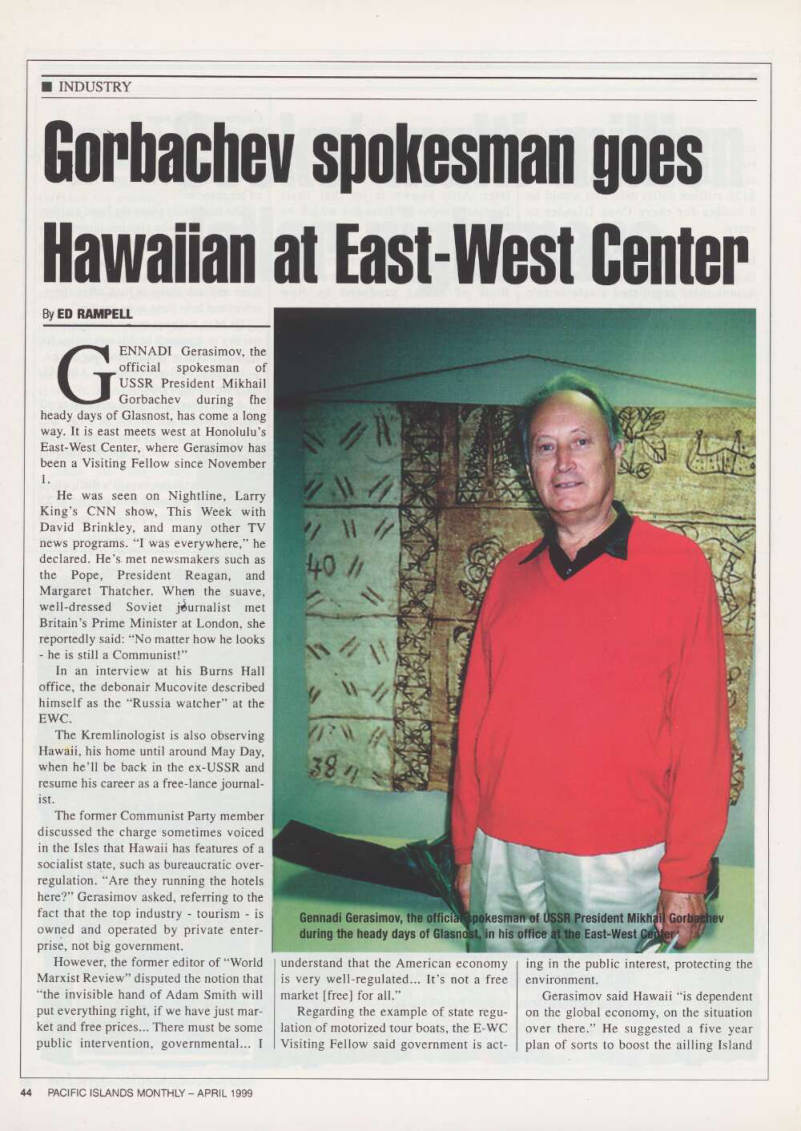
Hawaiian at East-West Center
By Ed Rampell
GENNADI Gerasimov, the official spokesman of USSR President Mikhail Gorbachev during fhe heady days of Glasnost, has come a long way. It is east meets west at Honolulu’s East-West Center, where Gerasimov has been a Visiting Fellow since November 1.
He was seen on Nightline, Larry King’s CNN show, This Week with David Brinkley, and many other TV news programs. “I was everywhere,” he declared. He’s, met newsmakers such as the Pope, President Reagan, and Margaret Thatcher. When the suave, well-dressed Soviet journalist met Britain’s Prime Minister at London, she reportedly said: “No matter how he looks - he is still a Communist!”
In an interview at his Burns Hall office, the debonair Mucovite described himself as the “Russia watcher” at the
Ewc.
The Kremlinologist is also observing Hawaii, his home until around May Day, when he’ll be back in the ex-USSR and resume his career as a free-lance journal ist.
The former Communist Party member discussed the charge sometimes voiced in the Isles that Hawaii has features of a socialist state, such as bureaucratic over
regulation. “Are they running the hotels
here?” Gerasimov asked, referring to the fact that the top industry - tourism - is
owned and operated by private enter
prise, not big government.
However, the former editor of “World Marxist Review” disputed the notion that “the invisible hand of Adam Smith will put everything right, if we have just mar ket and free prices... There must be some public intervention, governmental... I
understand that the American economy is very well-regulated... It’s not a free market [free] for all.”
Regarding the example of state regu lation of motorized tour boats, the E-WC Visiting Fellow said government is act
ing in the public interest, protecting the environment.
Gerasimov said Hawaii “is dependent on the global economy, on the situation over there.” He suggested a five year plan of sorts to boost the aiding Island
Gennadi Gerasimov, the officiant spokesman of USSR President Mikhai Gorbathev during the heady days of Glasnost in his office at the East-West Center
economy. Hawaii “needs to develop elec tronics, all this computer stuff... You have a very good establishment at Maui.
I visited it... Another answer to Hawaii’s economic problems is to organize sani tariums, according to the Russian-type.”
These health retreats that, Gerasimov said, “combine relaxation with medical treatment,” tie into the much-touted “health tourism” spoken of in Hawaii.
Gerasimov, a world traveler himself, said: “I want to see advertisements for Hawaii in Moscow, St. Petersburg,” and other Russian cities, to lure the nouveau riche of the former “workers paradise” to a Polynesian paradise.
Gerasimov pointed out that many rich Russians already travel to tropical desti nations such as Thailand, and that Russian can already be heard being spo ken on Waikiki Beach - but by Russian emigres to the US West Coast.
Although Gerasimov said he is inde pendent, and not affiliated with any polit ical party now, the ex-Red is still appar ently trying to promote Russia’s interests.
Gerasimov said he is “trying to persuade people in the Center that Russia also belongs to the Pacific Rim.”
Regarding the Russian Far East, the 68-year old said “look at the map” to see how places in the 89-member Russian Federation - such as the Maritime Province, Vladivostok, Siberia, and Sakhalin Island - are part of the Pacific Rim.
“Russia has two faces, actually - one faces Europe, another faces the Pacific.
Maybe that’s one of the reasons why we have double-headed eagle as our national bird,” the ex-diplomat said.
He pointed out that 19th century Russia was a Pacific power, from Alaska (Russian territory until the 1860 s) to a fort at Kauai.
The developing Russian Far East is rich in potential, with vodka, fish, timber, coal, oil, nickel, gold, and half of the world’s diamonds, Gerasimov told PBN.
The South African diamond company Deßeers does business in the region.
Japan and Russia are jointly developing the Kirile Islands, which stretch from the Kamchatka Peninsula to Hokkaido, and may become a tax free zone, Gerasimov said. Despite this (and other) embarrass ment of riches, Gerasimov admitted,
“Russia now is in a deep crisis,” which he fears may get worse.
“Unfortunately, it is not on the priori ty list of this country. Russia needs help, and it is in the American interest, too, because a destabilized Russia is very dangerous. We still have nuclear weapons, right?” said Gerasimov, who warned against a return to the bad “old days of the Cold War” and of the Communists to power.
The former Gorby mouthpiece pointed
out that after World War I, the victors did not assist the vanquished, which led to the rise of fascism.
But, Gerasimov said, the historical lesson was learned, and after the Second World War, triumphant America assisted the losers with the Marshall Plan and more. “The victors must help the van quished,” he asserted.
Is the average Ivan better off today than he was under socialism? “No,”
Gerasimov confessed. But he qualified his answer: politically, things have improved, with a multi-party democracy, and freedom of the press and to travel abroad.
Economically, he said, about “five percent” of Russians “are very rich,” and benefit from capitalism. But up to “two thirds of the people live be[low] the poverty level.”
And the masses no longer fully enjoy the “cradle to grave” security of the “socialist achievements” of jobs, free medical care, and free education through university for all, Gerasimov said.
Does socialism have any relevancy to the post-Soviet world? “Ideas are here to stay. If you look close enough, Marxism is very close to Christianity, in many ways... But not many people follow [these ideas] to the letter. I think Karl Marx underestimated human nature.”
Gerasimov said his former chief Gorbachev “will be one of the most important historic figures of this centu ry.”
The onetime spokesman is still in touch with his old tovarisch Gorby, who is now visiting that neon lit symbol of Western decadence. Las Vegas. The for mer Soviet leader is in sin city to speak at a conference - “not to gamble. He has already lost,” Gerasimov said, with his trademark wry smile. ■
heals up in Australia

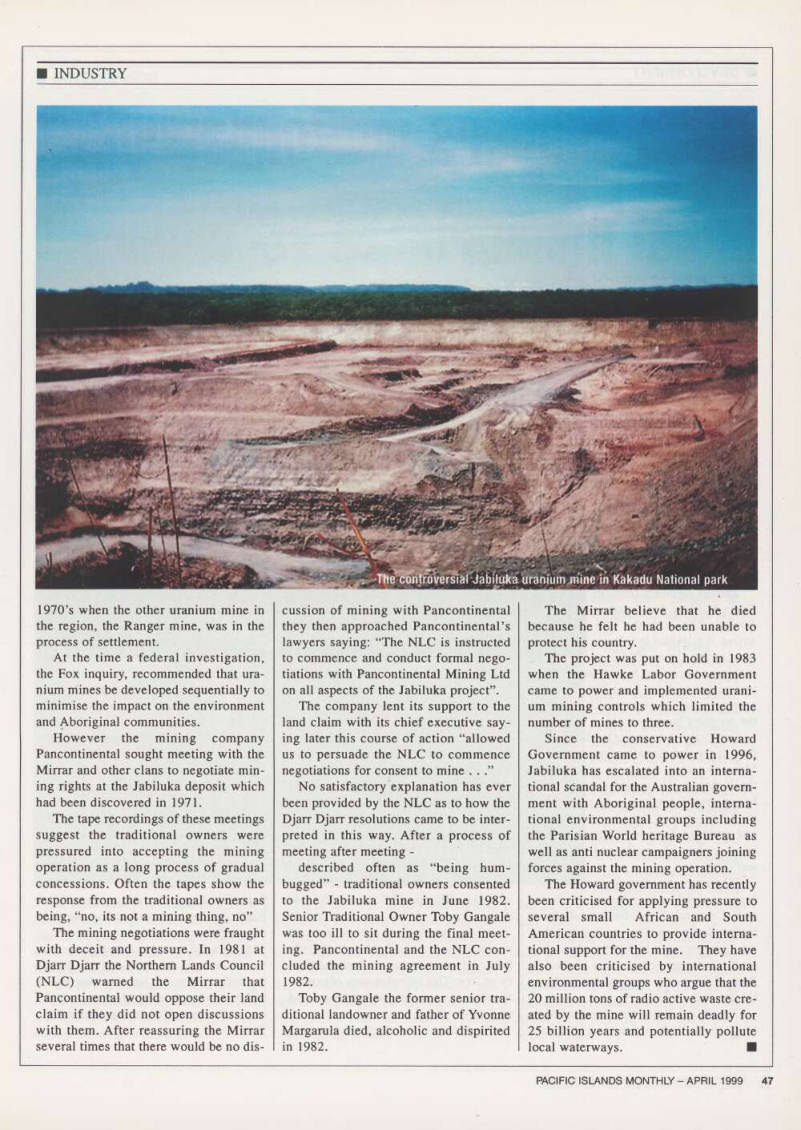
Aboriginal land issue heals up in Australia
By Andrew Kilvert
TWO Australian Aboriginal women have gone to prison for trespassing on Aboriginal land despite the fact the were there at the invitation of the traditional owner and another Aboriginal woman from the Mirrar peo
ple. Yvonne Margarula, is appealing a fine for tres passing on her own tradi tional land following a decision by Magistrate Lowndes in September last year.
She is a member of the Mirrar people and the tra ditional owner of the land which contains the contro versial Jabiluka uranium mine in Kakadu National park.
Yvonne Margarula, Christine Kristofferson and Jaquie Katona, who is a traditional owner of land adjacent to the mine, were arrested and charged with trespass last year in the vicinity of the mine in an area in which mining com pany ERA claimed was ‘restricted’ under a 1982 agreement with the then land owner Toby Gangale.
Whilst the magistrate conceded that ERA had illegally established the restricted area in which the three were arrested, he argued that because the three were carrying a satellite telephone and making press releases, they were not there for tra ditional purposes and
therefore were trespassing. In her state ment to the court, Ms Margarula said she had been protecting her country at the mine site at the time of the alleged offenses.
Ms Margarula said that as a tradition al land owner she had a responsibility to look after her country, visit her country and make sure it was safe.
She argued that
protesting against the
Jabiluka uranium mine was “Traditional action taking on a modern form.”
According to Jaquie
Katona who is the Executive Officer of
the Gundjehmi
Aboriginal Corporation “any rul
ing which prohibits traditional owners from using contemporary means to pro tect their country will undermine the foundations of (Aboriginal) land rights in the Northern Territory”.
Both Jaquie Katona and Christine Kristofferson spent two weeks in the Berrimah prison in Darwin after handing themselves into police at Jabiru police
stations on Friday the 26th of February.
The statement by the magistrate regarding tra ditional and non-tradi tional activities effective ly relegates Aboriginal people to behave as museum pieces if they wish to access their tradi tional lands.
This decision has very serious implications for Aboriginal people living on Aboriginal land all over Australia’s Northern Territory because it denies them the right to access and/or inhabit their traditional land using modern technology such as 4 wheel drive vehicles or solar panels for electricity.
Under this legal defini tion of ‘traditional’ use, the functioning of schools, community health clinics and
Aboriginal housing pro
jects are all thrown into question on the grounds that they are non ‘tradi tional’.
The struggle between mining giant ERA and the Mirrar people has been ongoing since the early
Anti-nuclear protestors on land belonging to the Mirrar people
1970’s when the other uranium mine in the region, the Ranger mine, was in the process of settlement.
At the time a federal investigation, the Fox inquiry, recommended that ura nium mines be developed sequentially to minimise the impact on the environment and Aboriginal communities.
However the mining company Pancontinental sought meeting with the Mirrar and other clans to negotiate min ing rights at the Jabiluka deposit which had been discovered in 1971.
The tape recordings of these meetings suggest the traditional owners were pressured into accepting the mining operation as a long process of gradual concessions. Often the tapes show the response from the traditional owners as being, “no, its not a mining thing, no”
The mining negotiations were fraught with deceit and pressure. In 1981 at Djarr Djarr the Northern Lands Council (NLC) warned the Mirrar that Panqontinental would oppose their land claim if they did not open discussions with them. After reassuring the Mirrar several times that there would be no dis
cussion of mining with Pancontinental they then approached Pancontinental’s lawyers saying: “The NLC is instructed to commence and conduct formal nego tiations with Pancontinental Mining Ltd on all aspects of the Jabiluka project”.
The company lent its support to the land claim with its chief executive say ing later this course of action “allowed us to persuade the NLC to commence negotiations for consent to mine . . .”
No satisfactory explanation has ever been provided by the NLC as to how the Djarr Djarr resolutions came to be inter preted in this way. After a process of
meeting after meeting -
described often as “being hum bugged” - traditional owners consented to the Jabiluka mine in June 1982.
Senior Traditional Owner Toby Gangale was too ill to sit during the final meet ing. Pancontinental and the NLC con cluded the mining agreement in July 1982.
Toby Gangale the former senior tra ditional landowner and father of Yvonne Margarula died, alcoholic and dispirited in 1982.
The Mirrar believe that he died because he felt he had been unable to protect his country.
The project was put on hold in 1983 when the Hawke Labor Government came to power and implemented urani um mining controls which limited the number of mines to three.
Since the conservative Howard Government came to power in 1996, Jabiluka has escalated into an interna tional scandal for the Australian govern ment with Aboriginal people, interna tional environmental groups including the Parisian World heritage Bureau as well as anti nuclear campaigners joining forces against the mining operation.
The Howard government has recently been criticised for applying pressure to several small African and South American countries to provide interna tional support for the mine. They have also been criticised by international environmental groups who argue that the 20 million tons of radio active waste cre ated by the mine will remain deadly for 25 billion years and potentially pollute local waterways. ■
The controversial Jabiluka uranium mine in Kakadu National park
Fijian soldiers on Bougainville
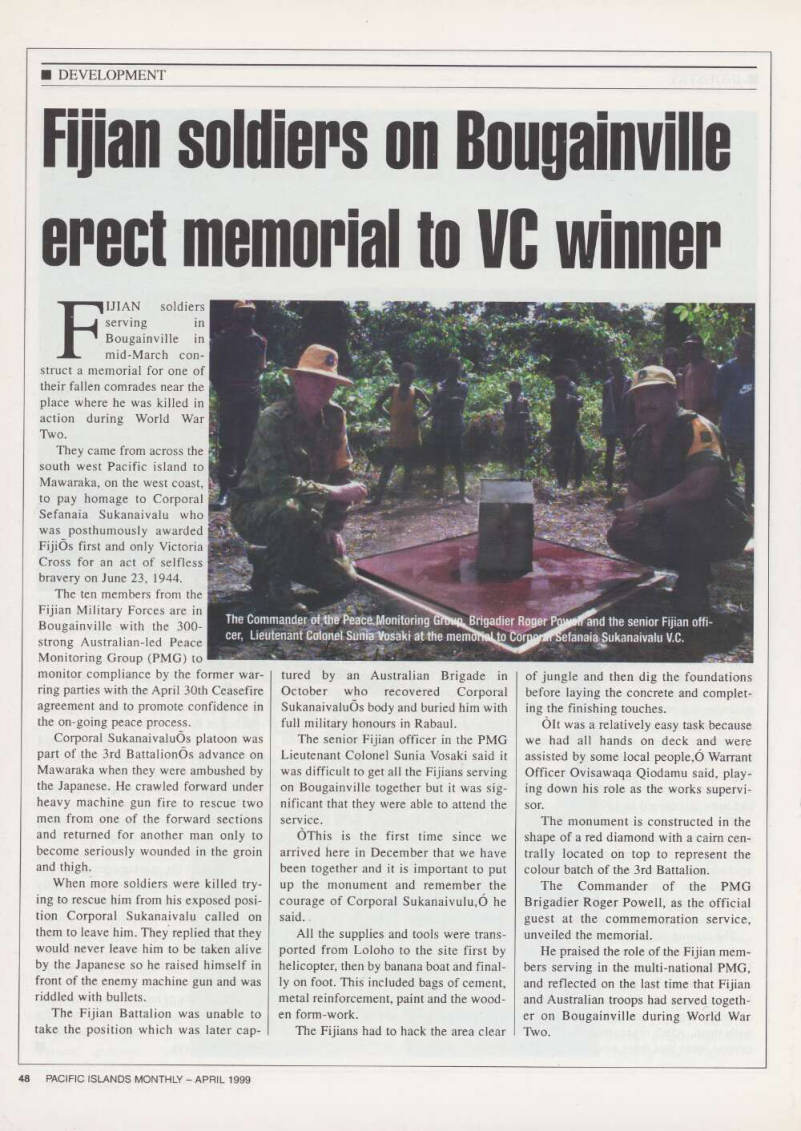
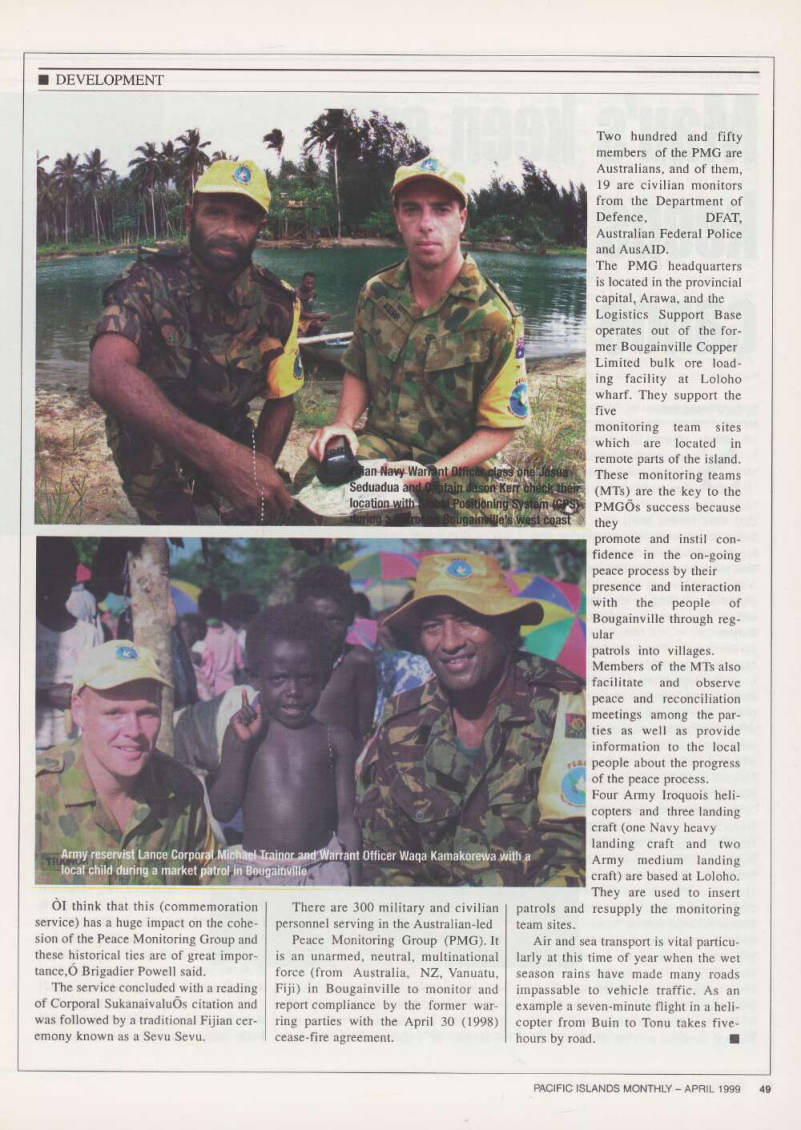
Development
Fijian soldiers on Bougainville erect memorial to VC winner
FIJIAN soldiers
serving in Bougainville in mid-March con struct a memorial for one of their fallen comrades near the place where he was killed in action during World War Two.
They came from across the south west Pacific island to Mawaraka, on the west coast, to pay homage to Corporal Sefanaia Sukanaivalu who was posthumously awarded FijiOs first and only Victoria Cross for an act of selfless bravery on June 23, 1944.
The ten members from the Fijian Military Forces are in Bougainville with the 300strong Australian-led Peace Monitoring Group (PMG) to
monitor compliance by the former war ring parties with the April 30th Ceasefire agreement and to promote confidence in the on-going peace process.
Corporal SukanaivaluOs platoon was part of the 3rd BattalionOs advance on Mawaraka when they were ambushed by the Japanese. He crawled forward under heavy machine gun fire to rescue two men from one of the forward sections and returned for another man only to become seriously wounded in the groin
and thigh.
When more soldiers were killed try ing to rescue him from his exposed posi tion Corporal Sukanaivalu called on them to leave him. They replied that they would never leave him to be taken alive by the Japanese so he raised himself in front of the enemy machine gun and was riddled with bullets.
The Fijian Battalion was unable to take the position which was later cap-
tured by an Australian Brigade in October who recovered Corporal SukanaivaluOs body and buried him with full military honours in Rabaul.
The senior Fijian officer in the PMG Lieutenant Colonel Sunia Vosaki said it was difficult to get all the Fijians serving on Bougainville together but it was sig nificant that they were able to attend the service.
OThis is the first time since we arrived here in December that we have been together and it is important to put up the monument and remember the courage of Corporal Sukanaivulu,6 he said.
All the supplies and tools were trans ported from Loloho to the site first by helicopter, then by banana boat and final ly on foot. This included bags of cement, metal reinforcement, paint and the wood en form-work.
The Fijians had to hack the area clear
of jungle and then dig the foundations before laying the concrete and complet ing the finishing touches.
Olt was a relatively easy task because we had all hands on deck and were assisted by some local people,© Warrant Officer Ovisawaqa Qiodamu said, play ing down his role as the works supervi sor.
The monument is constructed in the shape of a red diamond with a cairn cen trally located on top to represent the colour batch of the 3rd Battalion.
The Commander of the PMG Brigadier Roger Powell, as the official guest at the commemoration service, unveiled the memorial.
He praised the role of the Fijian mem bers serving in the multi-national PMG, and reflected on the last time that Fijian and Australian troops had served togeth er on Bougainville during World War Two.
The Commander of the Peace, Monitoring Roger the senior Fijian offi cer, Lieutenant Colonel Sunia Vosaki at the memorial to CorSukanaivalu V.C.
01 think that this (commemoration service) has a huge impact on the cohe sion of the Peace Monitoring Group and these historical ties are of great impor tance,© Brigadier Powell said.
The service concluded with a reading of Corporal SukanaivaluOs citation and was followed by a traditional Fijian cer emony known as a Sevu Sevu.
There are 300 military and civilian personnel serving in the Australian-led Peace Monitoring Group (PMG). It is an unarmed, neutral, multinational force (from Australia, NZ, Vanuatu, Fiji) in Bougainville to monitor and report compliance by the former war ring parties with the April 30 (1998) cease-fire agreement.
Two hundred and fifty members of the PMG are Australians, and of them, 19 are civilian monitors from the Department of Defence, DFAT, Australian Federal Police and AusAID.
The PMG headquarters is located in the provincial capital, Arawa, and the Logistics Support Base operates out of the for mer Bougainville Copper Limited bulk ore load
ing facility at Loloho
wharf. They support the five monitoring team sites which are located in remote parts of the island.
These monitoring teams (MTs) are the key to the PMGOs success because they promote and instil con fidence in the on-going peace process by their presence and interaction with the people of Bougainville through reg ular patrols into villages.
Members of the MTs also facilitate and observe peace and reconciliation meetings among the par ties as well as provide information to the local people about the progress of the peace process.
Four Army Iroquois heli copters and three landing craft (one Navy heavy landing craft and two Army medium landing craft) are based at Loloho.
They are used to insert
patrols and resupply the monitoring team sites.
Air and sea transport is vital particu larly at this time of year when the wet season rains have made many roads impassable to vehicle traffic. As an example a seven-minute flight in a heli copter from Buin to Tonu takes five hours by road. ■
Fijian Navy Warrant Officer class one Josua Seduadua and Captain Jason kerr Check their location with Global Positioning System ( GPS ) during [?] Bougainville's West coat
Army reservist Lance Corporal Michael Trainor and Warrant Officer Waqa Kamakorewa with a local child during a market patrol in Bougainville
keeps Hawaiian
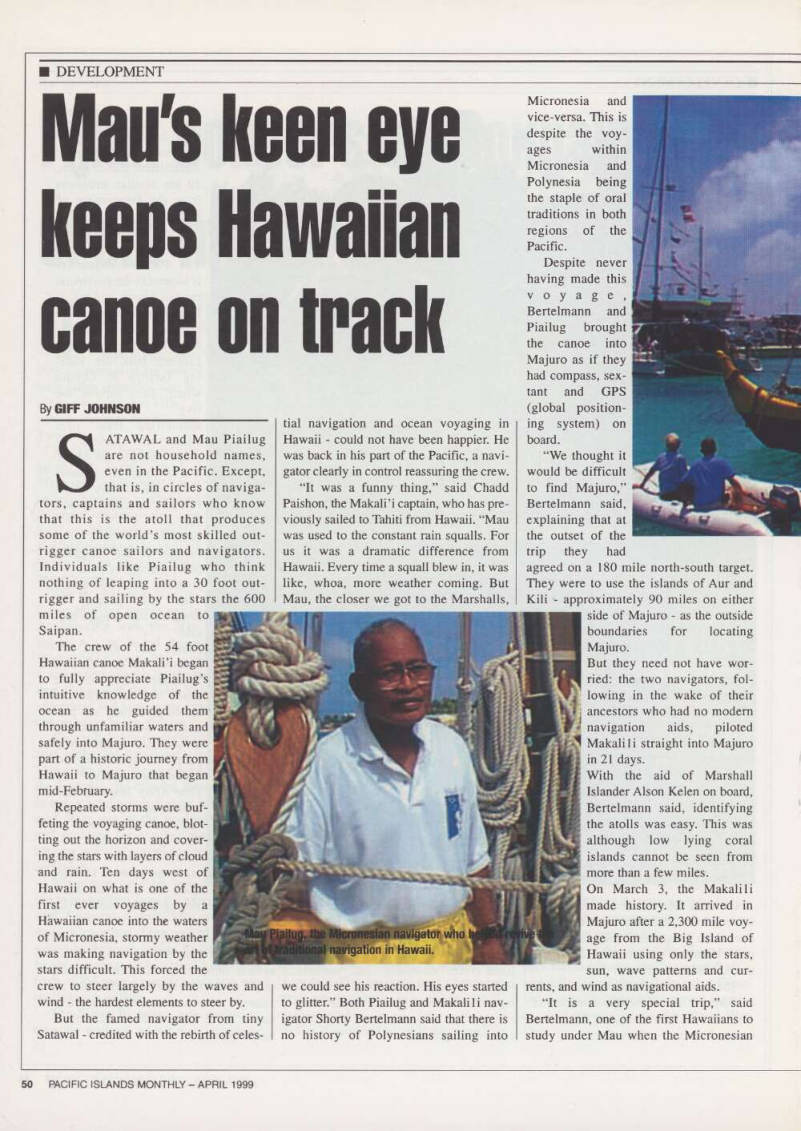
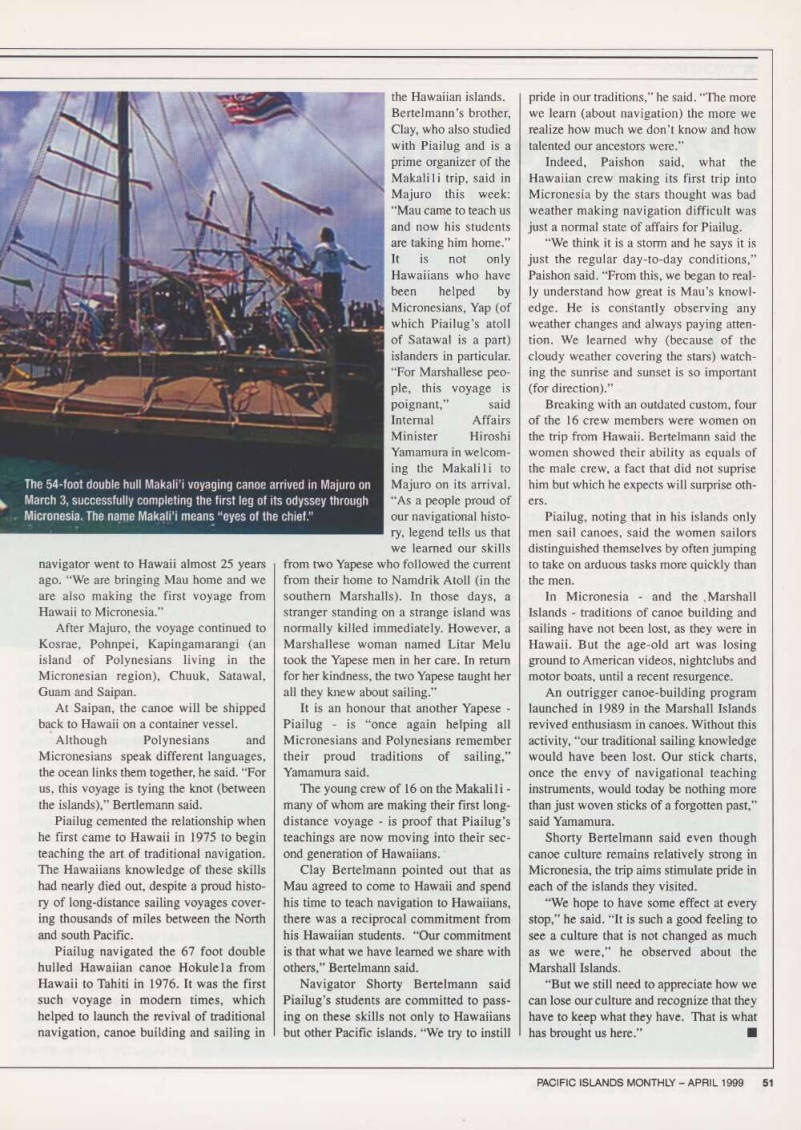
Mains keen eye keeps Hawaiian canoe on track
By Giff Johnson
SATAWAL and Mau Piailug are not household names, even in the Pacific. Except, that is, in circles of naviga tors, captains and sailors who know that this is the atoll that produces some of the world’s most skilled out rigger canoe sailors and navigators.
Individuals like Piailug who think nothing of leaping into a 30 foot out rigger and sailing by the stars the 600
miles of open ocean to Saipan.
The crew of the 54 foot Hawaiian canoe Makali’i began to fully appreciate Piailug’s intuitive knowledge of the ocean as he guided them through unfamiliar waters and safely into Majuro. They were part of a historic journey from Hawaii to Majuro that began mid-February.
Repeated storms were buf feting the voyaging canoe, blot ting out the horizon and cover ing the stars with layers of cloud and rain. Ten days west of Hawaii on what is one of the first ever voyages by a Hawaiian canoe into the waters of Micronesia, stormy weather was making navigation by the stars difficult. This forced the
crew to steer largely by the waves and wind - the hardest elements to steer by.
But the famed navigator from tiny Satawal - credited with the rebirth of celes
tial navigation and ocean voyaging in Hawaii - could not have been happier. He was back in his part of the Pacific, a navi gator clearly in control reassuring the crew.
“It was a funny thing,” said Chadd Paishon, the Makali’i captain, who has pre viously sailed to Tahiti from Hawaii. “Mau was used to the constant rain squalls. For us it was a dramatic difference from Hawaii. Every time a squall blew in, it was like, whoa, more weather coming. But Mau, the closer we got to the Marshalls,
we could see his reaction. His eyes started to glitter.” Both Piailug and Makalili nav igator Shorty Bertelmann said that there is no history of Polynesians sailing into
Micronesia and vice-versa. This is despite the voy ages within Micronesia and
Polynesia being
the staple of oral traditions in both regions of the Pacific.
Despite never having made this voyage, Bertelmann and Piailug brought the canoe into Majuro as if they had compass, sex tant and GPS (global position ing system) on board.
“We thought it would be difficult to find Majuro,”
Bertelmann said, explaining that at the outset of the trip they had
agreed on a 180 mile north-south target.
They were to use the islands of Aur and Kili - approximately 90 miles on either
side of Majuro - as the outside boundaries for locating Majuro.
But they need not have wor ried: the two navigators, fol lowing in the wake of their ancestors who had no modern navigation aids, piloted Makalili straight into Majuro in 21 days.
With the aid of Marshall Islander Alson Kelen on board, Bertelmann said, identifying the atolls was easy. This was
although low lying coral
islands cannot be seen from more than a few miles.
On March 3, the Makalili made history. It arrived in Majuro after a 2,300 mile voy age from the Big Island of Hawaii using only the stars, sun, wave patterns and cur
rents, and wind as navigational aids.
“It is a very special trip,” said Bertelmann, one of the first Hawaiians to study under Mau when the Micronesian
navigator went to Hawaii almost 25 years ago. “We are bringing Mau home and we are also making the first voyage from Hawaii to Micronesia.”
After Majuro, the voyage continued to Kosrae, Pohnpei, Kapingamarangi (an island of Polynesians living in the Micronesian region), Chuuk, Satawal, Guam and Saipan.
At Saipan, the canoe will be shipped back to Hawaii on a container vessel.
Although Polynesians and Micronesians speak different languages, the ocean links them together, he said. “For us, this voyage is tying the knot (between the islands),” Bertlemann said.
Piailug cemented the relationship when he first came to Hawaii in 1975 to begin teaching the art of traditional navigation.
The Hawaiians knowledge of these skills had nearly died out, despite a proud histo ry of long-distance sailing voyages cover ing thousands of miles between the North and south Pacific.
Piailug navigated the 67 foot double hulled Hawaiian canoe Hokulela from Hawaii to Tahiti in 1976. It was the first such voyage in modern times, which helped to launch the revival of traditional navigation, canoe building and sailing in
the Hawaiian islands.
Bertelmann’s brother.
Clay, who also studied with Piailug and is a prime organizer of the Makalili trip, said in Majuro this week: “Mau came to teach us and now his students are taking him home.”
It is not only Hawaiians who have been helped by Micronesians, Yap (of which Piailug’s atoll of Satawal is a part) islanders in particular.
“For Marshallese peo ple, this voyage is
poignant,” said
Internal Affairs Minister Hiroshi Yamamura in welcom ing the Makalili to Majuro on its arrival.
“As a people proud of our navigational histo ry, legend tells us that we learned our skills
from two Yapese who followed the current from their home to Namdrik Atoll (in the southern Marshalls). In those days, a stranger standing on a strange island was normally killed immediately. However, a Marshallese woman named Litar Melu took the Yapese men in her care. In return for her kindness, the two Yapese taught her all they knew about sailing.”
It is an honour that another Yapese - Piailug - is “once again helping all Micronesians and Polynesians remember their proud traditions of sailing,”
Yamamura said.
The young crew of 16 on the Makalili many of whom are making their first long distance voyage - is proof that Piailug’s teachings are now moving into their sec ond generation of Hawaiians.
Clay Bertelmann pointed out that as Mau agreed to come to Hawaii and spend his time to teach navigation to Hawaiians, there was a reciprocal commitment from his Hawaiian students. “Our commitment is that what we have learned we share with others,” Bertelmann said.
Navigator Shorty Bertelmann said Piailug’s students are committed to pass ing on these skills not only to Hawaiians but other Pacific islands. “We try to instill
pride in our traditions,” he said. “The more we learn (about navigation) the more we realize how much we don’t know and how talented our ancestors were.”
Indeed, Paishon said, what the Hawaiian crew making its first trip into Micronesia by the stars thought was bad weather making navigation difficult was just a normal state of affairs for Piailug.
“We think it is a storm and he says it is just the regular day-to-day conditions,”
Paishon said. “From this, we began to real ly understand how great is Mau’s knowl edge. He is constantly observing any weather changes and always paying atten tion. We learned why (because of the cloudy weather covering the stars) watch ing the sunrise and sunset is so important (for direction).”
Breaking with an outdated custom, four of the 16 crew members were women on the trip from Hawaii. Bertelmann said the women showed their ability as equals of the male crew, a fact that did not suprise him but which he expects will surprise oth ers.
Piailug, noting that in his islands only men sail canoes, said the women sailors distinguished themselves by often jumping to take on arduous tasks more quickly than the men.
In Micronesia - and the , Marshall Islands - traditions of canoe building and sailing have not been lost, as they were in Hawaii. But the age-old art was losing ground to American videos, nightclubs and motor boats, until a recent resurgence.
An outrigger canoe-building program
launched in 1989 in the Marshall Islands revived enthusiasm in canoes. Without this activity, “our traditional sailing knowledge would have been lost. Our stick charts, once the envy of navigational teaching instruments, would today be nothing more than just woven sticks of a forgotten past,” said Yamamura.
Shorty Bertelmann said even though canoe culture remains relatively strong in Micronesia, the trip aims stimulate pride in each of the islands they visited.
“We hope to have some effect at every stop,” he said. “It is such a good feeling to see a culture that is not changed as much as we were,” he observed about the Marshall Islands.
“But we still need to appreciate how we can lose our culture and recognize that they have to keep what they have. That is what has brought us here.” ■
The 54-foot double hull Makali’i voyaging canoe arrived in Majuro on March 3, successfully completing the first leg of its odyssey through Micronesia. The name Makali’i means “eyes of the chief.”
Crustal he line
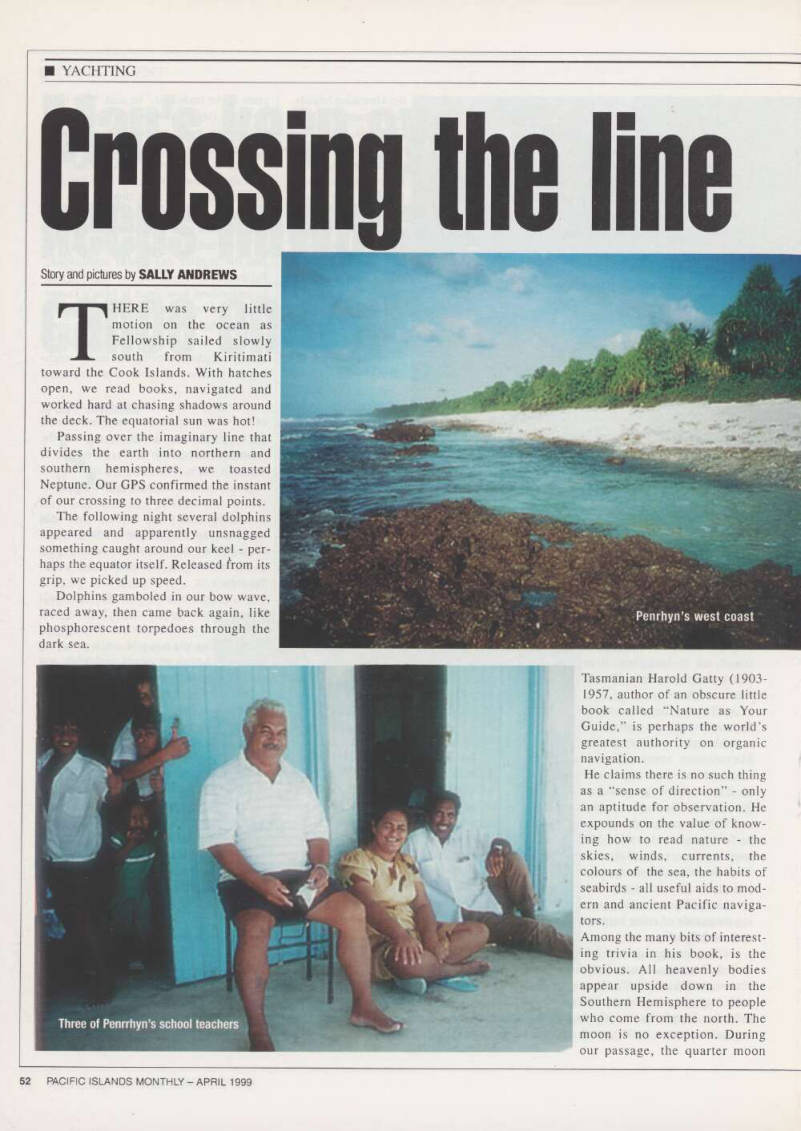
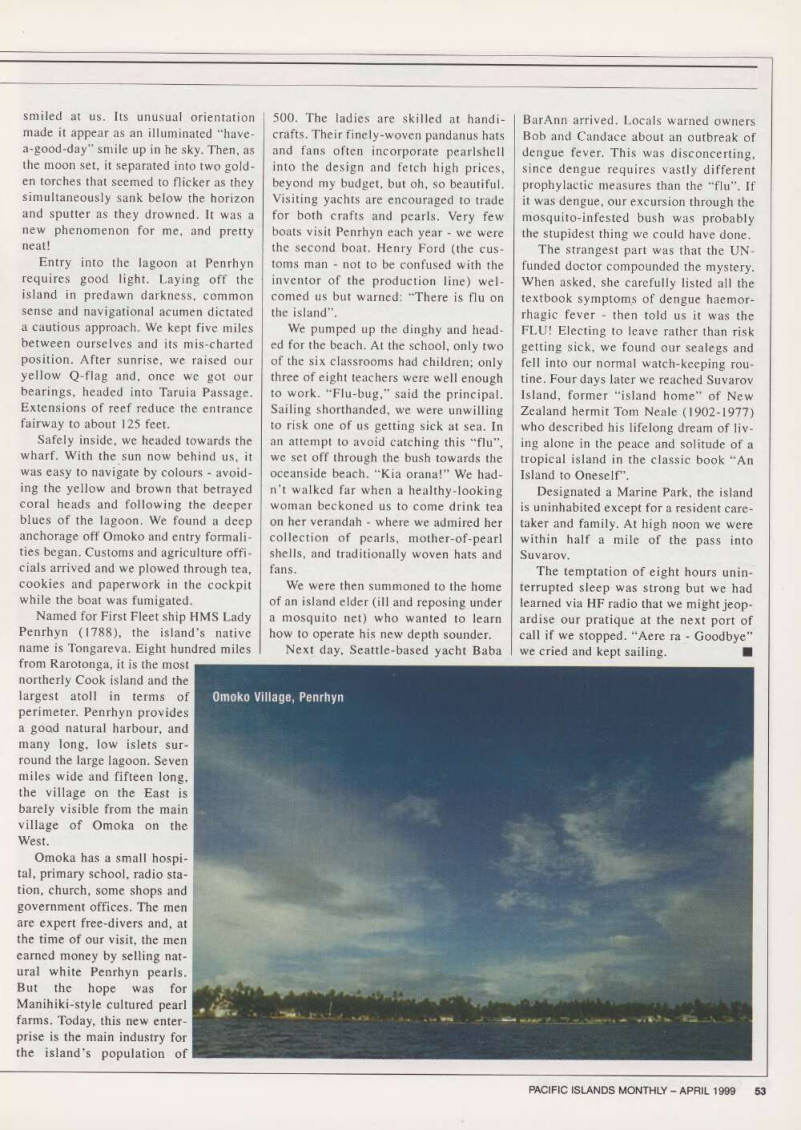
Yachting
Story and pictures by SALLY ANDREWS
THERE was very little motion on the ocean as Fellowship sailed slowly south from Kiritimati toward the Cook Islands. With hatches open, we read books, navigated and worked hard at chasing shadows around the deck. The equatorial sun was hot!
Passing over the imaginary line that divides the earth into northern and southern hemispheres, we toasted Neptune. Our GPS confirmed the instant of our crossing to three decimal points.
The following night several dolphins appeared and apparently unsnagged something caught around our keel - per haps the equator itself. Released from its grip, we picked up speed.
Dolphins gamboled in our bow wave, raced away, then came back again, like phosphorescent torpedoes through the dark sea.
Tasmanian Harold Gatty (1903- 1957, author of an obscure little book called “Nature as Your Guide,” is perhaps the world’s greatest authority on organic
navigation.
He claims there is no such thing as a “sense of direction” - only an aptitude for observation. He expounds on the value of know ing how to read nature - the skies, winds, currents, the colours of the sea, the habits of seabirds - all useful aids to mod ern and ancient Pacific naviga tors.
Among the many bits of interest ing trivia in his book, is the obvious. All heavenly bodies appear upside down in the
Southern Hemisphere to people
who come from the north. The moon is no exception. During our passage, the quarter moon
Three of Penrrhyn’s school teachers
Penrhyn’s west coast
smiled at us. Its unusual orientation made it appear as an illuminated “have a-good-day” smile up in he sky. Then, as the moon set, it separated into two gold en torches that seemed to flicker as they simultaneously sank below the horizon and sputter as they drowned. It was a new phenomenon for me, and pretty neat!
Entry into the lagoon at Penrhyn requires good light. Laying off the island in predawn darkness, common sense and navigational acumen dictated a cautious approach. We kept five miles between ourselves and its mis-charted position. After sunrise, we raised our yellow Q-flag and, once we got our bearings, headed into Taruia Passage.
Extensions of reef reduce the entrance fairway to about 125 feet.
Safely inside, we headed towards the wharf. With the sun now behind us, it was easy to navigate by colours - avoid ing the yellow and brown that betrayed coral heads and following the deeper blues of the lagoon. We found a deep anchorage off Omoko and entry formali ties began. Customs and agriculture offi cials arrived and we plowed through tea, cookies and paperwork in the cockpit while the boat was fumigated.
Named for First Fleet ship HMS Lady Penrhyn (1788), the island’s native name is Tongareva. Eight hundred miles
from Rarotonga, it is the most northerly Cook island and the largest atoll in terms of perimeter. Penrhyn provides a good natural harbour, and many long, low islets sur round the large lagoon. Seven miles wide and fifteen long, the village on the East is barely visible from the main village of Omoka on the West.
Omoka has a small hospi tal, primary school, radio sta tion, church, some shops and government offices. The men are expert free-divers and, at the time of our visit, the men earned money by selling nat ural white Penrhyn pearls.
But the hope was for
Manihiki-style cultured pearl
farms. Today, this new enter prise is the main industry for the island’s population of
500. The ladies are skilled at handi crafts. Their finely-woven pandanus hats and fans often incorporate pearlshell into the design and fetch high prices, beyond my budget, but oh, so beautiful.
Visiting yachts are encouraged to trade for both crafts and pearls. Very few boats visit Penrhyn each year - we were the second boat. Henry Ford (the cus toms man - not to be confused with the inventor of the production line) wel comed us but warned: “There is flu on the island”.
We pumped up the dinghy and head ed for the beach. At the school, only two of the six classrooms had children; only three of eight teachers were well enough to work. “Flu-bug,” said the principal.
Sailing shorthanded, we were unwilling to risk one of us getting sick at sea. In an attempt to avoid catching this “flu”, we set off through the bush towards the oceanside beach. “Kia orana!” We had n’t walked far when a healthy-looking woman beckoned us to come drink tea on her verandah - where we admired her collection of pearls, mother-of-pearl shells, and traditionally woven hats and fans.
We were then summoned to the home of an island elder (ill and reposing under a mosquito net) who wanted to learn how to operate his new depth sounder.
Next day, Seattle-based yacht Baba
Bar Ann arrived. Locals warned owners Bob and Candace about an outbreak of dengue fever. This was disconcerting, since dengue requires vastly different prophylactic measures than the “flu”. If it was dengue, our excursion through the mosquito-infested bush was probably the stupidest thing we could have done.
The strangest part was that the UN funded doctor compounded the mystery.
When asked, she carefully listed all the textbook symptoms of dengue haemor rhagic fever - then told us it was the FLU! Electing to leave rather than risk getting sick, we found our sealegs and fell into our normal watch-keeping rou tine. Four days later we reached Suvarov Island, former “island home” of New Zealand hermit Tom Neale (1902-1977) who described his lifelong dream of liv ing alone in the peace and solitude of a tropical island in the classic book “An Island to Oneself”.
Designated a Marine Park, the island is uninhabited except for a resident care taker and family. At high noon we were within half a mile of the pass into Suvarov.
The temptation of eight hours unin terrupted sleep was strong but we had learned via HF radio that we might jeop ardise our pratique at the next port of call if we stopped. “Aere ra - Goodbye” we cried and kept sailing. ■
Omoko Village, Penrhyn
The cutting edge
Opinion
The cutting edge of NZ politics
NEW Zealanders - who do not have a very high opinion of their politicians - will get a rare chance to say exactly what they think of them this year when they vote in a referendum on cut ting the number of MPs from 120 to 99.
Such is the distaste for politicians of all parties there is not much doubt about the outcome - the fewer MPs the better is probably the prevailing thinking.
That’s not to say MP numbers will automatically be cut. The referendum, forced by a petition signed by 292,000 voters - well over the lOper cent of the electorate required under the Citizens’
Initiated Referenda Act - is indicative only.
That means the government can ignore it, although Prime Minister Jenny Shipley has said her National Party would heed voters’ wishes if there was an overwhelming verdict.
But the poll, which will almost certainly be held at the same time as the general election due by November, does look likely to be another nail in the coffin of the Mixed Member Proportional (MMP) voting system used for the first time in 1996.
After less than one three-year electoral cycle, MMP has already been given a solid thumbs down by disenchanted voters who have not found it the answer to their general dissatisfaction with politics and politicians.
Monthly surveys by the research firm UMR Insight have found a clear majority of voters in favour of returning to the old Westminster-style first-past-the-post (FPP) system ever since November 1996 - only one month after its debut.
By the end of 1998, 57per cent of New Zealanders were expressing a preference for FPP, with only 32per cent wanting to hang on to MMP.
At the same time, polling showed voters were reverting to traditional preferences for the National and Labour parties who had monopolised the political scene for more than half a centu ry. The polls showed that minor parties, who gained most from MMP - as voters intended when they chose it in referendums in 1992 and 1993 - were struggling to get the sper cent of support needed to put them back in Parliament.
And a return to two-party politics seemed inevitable with news that the National Party and the free-market ACT NZ were considering a no-contest pact in several electorates this year to
increase the odds of the centre-right hold ing on to power.
This could force the Labour Party and NZ Alliance, who were already talking about a “loose coalition”, into similar arrange ments to try to ensure a centre-left victory, making this year’s election yet again a two horse race.
The MMP system is not about to be sum marily ditched. It will be used in this year’s
election and probably again in 2002. Under the Electoral Act, Parliament is required to set up a select committee in April next year to review it and decide whether another referendum on the voting system should be held. But the main concern about the mounting challenge to MMP is the threat that all the benefits it produced in 1996 in terms of a more representative Parliament will be lost.
MMP was singularly successful in delivering representation of ethnic minorities and more women in Parliament in propor tion to their numbers in the total population.
Maori MPs, for instance, represent 12.5 per cent of the total members and Pacific Islanders 2.sper cent while 30per cent of MPs are women - still short of their 50per cent of the population but a considerable improvement on their previous representa tion.
Analysis of the party list MPs - as distinct from those elected to represent constituencies - shows the prospect of a radical change to the make-up of Parliament.
If the 20 lowest-ranking list MPs were removed, Parliament would lose 11 women, including New Zealand’s first and only Asian MP, National’s Pansy Wong.
The Pacific Island community would lose its National Party representative Arthur Anae, and Maori would lose three Labour MPs as well as Alamein Kopu who was elected on the NZ Alliance list but now sits as an independent and supports the government.
The entire character of the Parliament would change and even the majority of voters who now oppose MMP would concede that a regressive move.
The backlash against MMP came as soon as the New Zealand First party (whose 17 MPs held the balance of power after the 1996 poll) chose to go into coalition with the National Party gov ernment it had campaigned vigorously against and promised to oust. This provoked immediate second thoughts about a system that could give a party with only 13per cent of the vote the power to hold a self-serving auction of its services and determine the shape of the government.
The collapse of the coalition 18 months later with NZ First going on the opposition benches and the defections of a total of 10 MPs from the parties they were elected to represent, left vot ers at first bemused and then angry.
A handful of resignations, with MPs replaced by others on their party’s list, including Gilbert Myles who in his time has belonged to just about every party in Parliament, did nothing to restore public confidence in the political system.
With every sign of a long and unedifying election campaign to come, there will be widespread sympathy for the view of a wag who warned: “It doesn’t matter who you vote for, you’ll still get a politician.” ■
David Barber
Wellington
Island nation?
East Timor - a new Forum Island nation?
WHEN Jose Ramos Horta, the most senior East Timorese pro independence leader not currently in detention, arrived in Suva recently he did so with little fanfare. Ostensibly his visit was to give a lecture at the University of the South Pacific but in other meetings, during his time there, he began a process that might ulti mately result in a new Forum Island identity for his country, as well as a broader new identity for the forum itself.
Since the Indonesian invasion of East Timor 23 years ago, its people have suffered brutal suppression. Opponents of integration with Indonesia have suffered murder, torture and rape - the Dili massacre is just one of the more infamous and recent incidents in a long strip of Indonesian atrocities that have left a staggering total of around 200,000 East Timorese dead.
While Australia and the Pacific Islands turned a blind eye to east Timor’s plight, international pressure to stop the human rights abuses and deal properly with the persistent demands of pro-inde pendence forces has grown enormously.
Now, with former president Suharto gone and Indonesia’s economy crumbling, Jakarta has done what only a few years ago would have been unthinkable and agreed to a United Nations bal lot on autonomy. Indonesia’s foreign minister, Ali Alatas, has made it plain that if the East Timorese want independence that is what they will get. Developments are now moving with breakneck speed. At the time of writing, Indonesians, many of them doctors, business people or skilled workers, are fleeing the East Timorese capital, Dili, fearing reprisals or civil war, the price of rice is soar ing and people are dying from lack of health services and medi cines that have been blocked in Jakarta.
The autonomy package Indonesia offers to the people of East Timor is due to be finalised by the end of this month and the bal lot is due to take place in July or August. There are many uncer tainties, not the least the national election in Indonesia that is due to take place on June 7, but Ramos Horta is confidently working towards the vote on independence. If the result favours indepen dence, Horta (who is vice-president of the pro-independence umbrella group the Timorese National council) says the new Transitional Authority would immediately send a request to the forum to be considered for official observer status. Horta sees links with the Forum as a matter of priority. “As far as ASEAN is
concerned, it can wait (until the new country is on a solid footing ... in perhaps five years)” he said. The East Timorese decision to turn to the Forum is based on what it sees as its cultural and eth nic affinities. In fact, as Horta points out. East Timor is more Melanesian than Asian and, unlike most of the rest of Indonesia, is Christian not Muslim. In size too, it has much more in common with Forum Island countries, having a population of 800,000 and land area just a little bigger than Fiji.
“We have a lot in common in terms of development of small island states, in terms of being surrounded by larger powers that tend to bully or dominate almost every aspect of the lives of the small island states,” Horta said. In terms of geography, the inclu sion of East Timor would extend the Forum another 1500 kilome tres west of Papua New Guinea, leap-frogging the Indonesian province of Irian Jaya, which is also predominantly Melanesian.
According to Noel Levi, secretary-general of the South Pacific Forum Secretariat, it is possible that a request for observer status for East Timor could come forward as early as this year’s South Pacific Forum, which is due to be held in Palau in late September or early October. Levi told Horta at a meeting in Suva that, if and when East Timor became self-governing, he had no doubt a mem ber country would sponsor a motion for observer status.
In the past, despite the Forum’s pivotal role in supporting the pro-independence movement in New Caledonia, it has not dis cussed East Timor. “If the situation in East Timor is brought to the Forum’s attention, I have no doubt the Forum will give it the same sort of enthusiasm that they had done to the French territories,”
Levi told PIM. Levi said he hoped Australia, which has been play ing a central role in international efforts to see a peaceful resolu tion in East Timor, would provide a briefing on the situation at the next Forum. Leaders, still coming to terms with the inclusion of the former US territories into the Forum, would also need to look at the implications of further enlarging the Forum, Levi said.
In the past it has been the fear of antagonising Indonesia, par ticularly on the part of its closest neighbours, Australia and Papua New Guinea, that has been the cause of the Pacific’s blindness on East Timor.
Observer status for a soon-to-be independent East Timor would inevitably put the spotlight on Irian Jaya where Melanesians have also been struggling for independence from Indonesian rule in the face of Pacific neglect.
While Ramos Horta brands Indonesia’s policies in Irian Jaya “a disgrace verging on genocide”, he points out the position of East Timor under international law is very different to that of Irian Jaya. Unlike in Irian Jaya, the United nations never accepted Indonesian sovereignty over East Timor.
Now is the time for the Pacific to look again at what it can do to help East Timor. Horta is keen to see Pacific Island nations involved in transition to independence. He has met with Fiji’s for eign minister, Berenado Vunibobo, and has asked the UN secre tary-general, Kofi Annan, to spread his net wide in the developing world when he puts together the UN team to conduct the ballot.
“If Samoa, Vanuatu, Tonga and others feel ‘yes’ they can offer assistance in the framework of the UN transitional administration then we would welcome it,” Horta told PIM.
“A police officer from Samoa or an agricultural expert from Tonga or the Solomon Islands would be much more sensitive to the needs, the feelings and cultural reality of the East Timorese than others, from Europe,” he said. ■
Jemima Garrett
Sydney
Advertisements & other items, pp. 56-60 (2 items)
56
■ COVER STORY
Continued from page 33
PACIFIC ISLANDS MONTHLY - APRIL 1999
pacific BUNDS
TRADING POST
TRADING POST CAN WORK WONDERS FOR YOU...
Promote your business, or service, sell your household items, cars or heavy machinery ect.
FOR SALE
10 Metre ocean going diesel motor launch carvel construction five litres perhour range forty hours 8 knots, in excellent condition in NSW survey 1C 14+2 moored at Coffs Harbour NSW Australia asking
S4S,OOO(AUS)
Telephone: 0266584379 Fax: 0266514612
AUSTRALIAN INTERNATIONAL SHIPPING SERVICES PTY LTD
Providing Container Consolidated Services, Full Container Loads, Airfrieght Forwarding and Purchase Order Tracking Services to:- American Samoa, Cook Islands, Fiji, Guam, Kiribati, New Zealand, Niue, Norfolk Island, New Caledonia, Nauru, Papua New Guinea, Solomon Islands, Tahiti, The Federated States of Micronesia, Tonga, Vanuatu, and Western Samoa.
Offices in Melbourne and Sydney
TEL:-61-3-93351477 FAX;-61-3-93380115 EMAIL:-A-I-S-S.COM
Carpenters Shipping
ISO 0002 CERTIFIED
MB-F
AGENCY VESSELS MOVEMENTS
m
►HEW6OINIA MClftC UNt-^i
HWOOmA PACIFIC UNE ■ HONG KOM/TAIWAN/FIJI OIIIBCT SCRVIM
PORT MOW* CORAL MOW*
CATTLEYA V 22 ISLANDER V 56 HIBISCUS V 35
HONGKONG T/S 25-25/03 T/S 20-20/04
KAOSHIUNG SAILED 27-27/03 T/S 21-21/04
KEELUNG VIA KAOSHIUNG VIA KAOSHIUNG VIA KAOSHIUNG VIA KAOSHIUNG
LAUTOKA 01-01/04 14-14/04 03-03/05 13-13/05
SUVA 02-02/04 15-15/04 04-04/05 14-14/05
PACIFIC mow* coral mow*
ISLANDER VlO7 CATTLEYA V 23 ISLANDER VST HIBISCUS V 36
T/S 20-20/05 T/S
04-04/05 21-21/05 T/S
VIA KAOSHIUNG VIA KAOSHIUNG VIA KAOSHIUNG
31-31/05 15-15/06 01-01/07 01-01/06 16-16/06 02-02/07
PACIFIC
ISLANDER VIOB
19- 20-
VIA KAOSHIUNG
13- 14-
KOREA/JAPAN/FUI DIRECT SERVICE
CORAL
(SUNDER VST
24-25/05 27- 28- 29- 09-10/06 15- 16- 18-18/06 19-19/06 23-23/06 29-29/06 01-02/07 04-05/07 06-06/07 09-09/07
MOW* PACIFIC
HIBISCUS V 36 ISLANDER VlOB
04-04/06 D/D 14- 15- 16- 25-25/06 01- 02- 05-05/07 04-04/07 09-09/07 19-20/07 27-28/06 23-24/06 26-27/06 28-28/06 29-30/06 08-10/07 13- 14- 16- 17- 21-21/07 26-26/07 29-30/07 01-01/08 02-02/08 05-05/08
idfic Forum Line
iCk n 4 requJ2ar^
CART TASMAN
FUA KAVENGA
CART TASMAN
VOY BRISBANE SYDNEY MELBOURNE LAUTOKA SUVA
V371K93TV351 KVITm
19
APIA PAGO PAGO NUKUALOFA LAUTOKA SUVA
16/3 238 20/3 27/3 28/3 30/3 17/3 31/3 20/3 03/4 06/4 23/3 20 239 28/3 1/4 04/4 12/4 13/4 16/4 17/4 20/4
FUA KAVENGA
12/4 15/4 18/4 19/4 20/4 23/4 24/4 27/4 30/4 Fl.il/BABOTOWGA AND VAVA'U THAWS HI PM EWT SERVICE
FUA KAVENGA
FORUM SAMOA
VOY SUVA CONNECTS TO VOY NUKUALOFA
238 28/3
NEPLINE TERATAI
03/4
APIA RAROTONGA
04/4 06/4 10/4 10/4 316 20 31/3
NEPLINE TERATAI
03/4 04/4 06/4
CART TASMAN
FUA KAVENGA
13/4 20/4
NEPLINE TERATAI
03/4 04/4 06/4 239
NEPLINE TERATAI
25/4 26/4 28/4 03/5
Fl.il/PAPUA MEW GUINEA TBAHSHIPMEWT SERVICE
CART TASMAN
FUA KAVENGA
19 22/3 LAUTOKA BRISBANE CONNECTS TO VOY BRISBANE P.MORESBY LAE MADANG RABAUL 23/3 28/3
KOKOPO CHIEF
43 01/4 05/4 08/4 10/4 12/4 238 20 06/4 12/4
AOTEAROA CHIEF
10 19/4 23/4
CART TASMAN
FUA KAVENGA
23/4 28/4
CORAL CHIEF
118 30/4 04/5 07/5 09/5 12/5 239 25/5 30/5
CORAL CHIEF
119 02/6 08/6 11/6 13/6 16/6
FUII/WEW ZEALAND DIRECT SERVICE
Forum Shipping
Agendas International
187 Rodwellßd, Suva -Ph0ne:315444
117 Queens Wharf, Lautoka - Ph :660577
mm
REEF SHIPPING UNITE
Your "One Stop" for the South Pacifi
AUSTRALIA - FIJI APCL- NORTHBOUND
OyC*
r 'I O o
APR
iT 1999 » .4 *0 *
FIJI - SAMOA/TONGA'S APCL
FIJI TO COOK ISLANDS
. VESSEL SOY SUVA AUCKLAND VESSEL AUCKLAND AITUTAKI RAROTONGA CAPT WALLIS 1 28S. ... 23-24/03 30-30/03 I S.CROSS V 277 I 12-13/04 I 27/04 J 28/04 J CAPT WALLIS 29S 13-13/04 19-19/04 S.CROSS ¥277 04-05/05 17/05 18/05
TRANSHIPPED AT AUCKLAND
NEW ZEALAND • FIJI NZPCL/FS NZPCL
FAR - EAST ASIA @ FIJI SERVICE
TASMAN ASIA SHIPPING
EAST ASIA - FIJI SERVICE
1508 00913549
’A .EXPLORER
911'Q 07/5 08/5 11/5 12/5 14/5 29/5 (Vessels and dates are subject to change and applies to F.C.L ONLY)
VESSEL VOYAGE NO.
CAPT WALLIS
_2S_
CAPT WALLIS
CAPT WALLIS
3Q
CAPT WALLIS
T.B.A
T.BA
SUVA
23/3 13/4 04/5 04/5
T.B.A
T.B.A
LAUTOKA
22/3 12/4 03/5 03/5
T.B.A
T.B.A
Please Contact: Forum Shipping Agencies International JJgjj; JJJ}} ]\] SwSfulutoka
Talk to the Pacific
with the voice of the Pacific
Phere is one magazine that decision-matters in the Pacific
must read each month.
( Ihat magazine is the voice of the ...
Pacific Islands Monthly has been a cornerstone of communications in the region for 68 years.
It has built an unequalled reputation for providing the best available news analyses and insight on events in the region.
That reputation spans the islands, the region and more than 71 countries.
That reputation puts Pacific Islands Monthly on the desks of Government figures, public servants, business leaders and other decision-makers throughout the region.
That reputation gives Pacific Islands Monthly the things advertisers need most... credibility and selling power.
Talk to your market with the voice of your market. mi ft
Pacific Islands Monthly
Call (679) 303244 Fax (679) 303809
Pacific Islands Monthly is the only regional news magazine with an independently audited circulation.
y: y ,y~ -
V
©ytß®®
m
LKJ
Photos : Marit - Pantz - Trompas New Caledonia is a developped, sophisticated island business base that offers outstanding opportunities for investors : stunning sites for new hotel developments, suitable climate for counterseason fruits, vegetables and tropical flowers, superb locations for fish and prawn aquaculture, and more. Authorities in New Caledonia are very supportive to business.
ADECAL, the Economic Development Agency of New Caledonia, is the one-stop shop where investors can get specific advice on doing business in New Caledonia.
As your free-of-charge partner, we shall assist you in identifying opportunities and putting together your project successfully.
Should you like to receive further Information, please do not hesitate to contact either Yann PITOLLET or Benoit RENGADE.
E-mail: [email protected] a r r* a i 1 V I—' 1— I V U New Caledonia Economic Development Bureau 15, rue Guynemer - PO Box 2384 - 98846 Noumea Cedex - New Caledonia - Phone: 1687) 249 077 - Fax: (687) 249 087 - E-mail: [email protected]
COjEf PT 1998 ; (687)