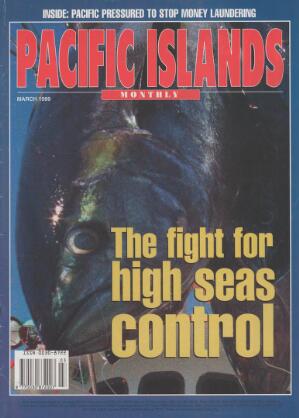
high seas



Advertisements & other items, pp. 2-4 (1 item)
Asco Motors
a
tc If VC t
TOYOTA
With a choice of Window Van or Panel Van, this exciting new vehicle is a great people and cargo mover. Functional and versatile, it combines all the benefits of passenger car comfort with the space and accessibility of a well-designed van.
Features include ® Diesel or Petrol engine O Easy access sliding door o Full width rear door O Tight turning circle O Large, open cargo space o High mounted rear lights O Rear door pull straps O 3 Seater Panel Van o 6 Seater People Mover SUVA PH 384888 • SIGATOKA PH 500577 NADI PH 721777 • LAUTOKA PH 662855 BA PH 674406 • TAVUA PH 680152
LABASA PH 811688
CCr m. m, ye m ■ The new Liteace makes driving so mud easier. It has a relatively tight turnim radius of just over five metres, whicl makes it easy to manoeuvre and ver easy to park. Convenient walk-througl access from the driver's seat and; low side step all helps to make cargi handling and passenger movement si much easier for you. Ask about our specie Toyota Extended Warranty whicl is now available with the new Liteace
Asco Motors
BPT ( SOUTH SEA ) COMPANY LIMITED
To Win an
IBM Pentium
Notebook,
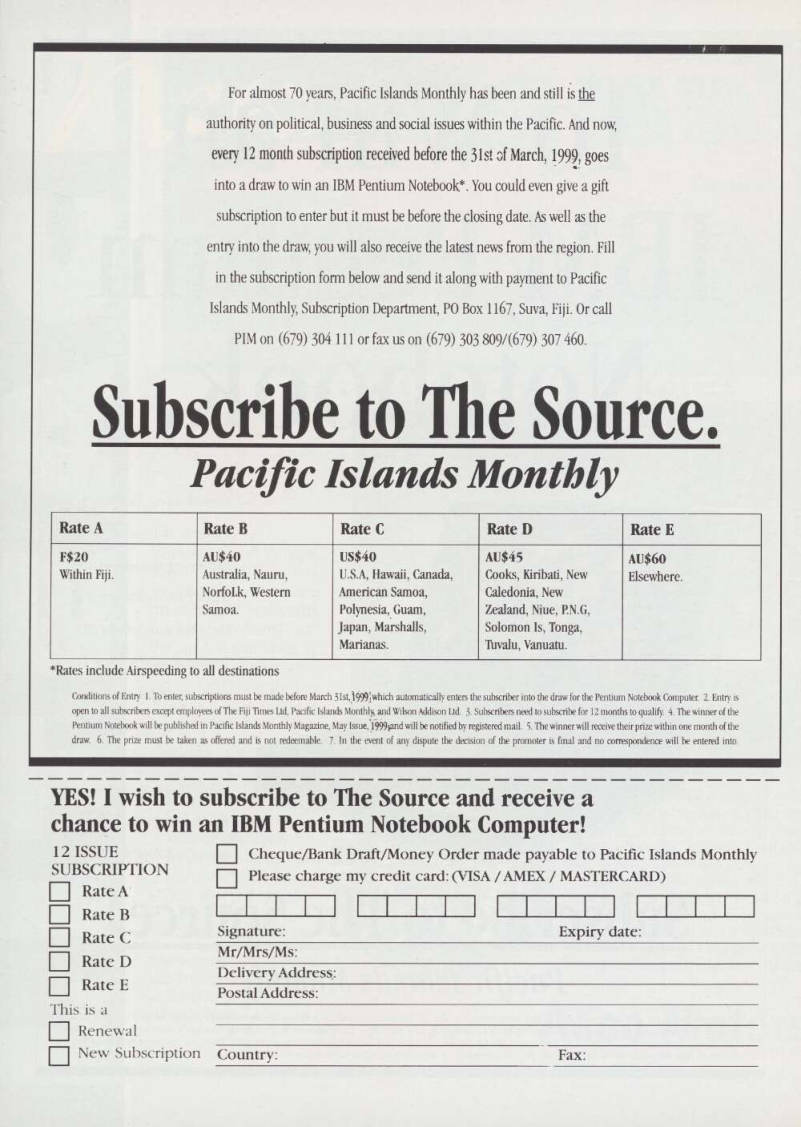
Get the latest on political, \ business and social issues happening throughout the region every month, as well as the chance to win an IBM Pentium Notebook! Every 12issue subscription received before March 31st, 1999 will go into the draw. Subscribe to Pacific Islands Monthly today by calling (679) 304 111 or fax (679) 303 809/(679) 307 460.
Subscribe to The Source.
Pacific Islands Monthly
Conditions of Entry I.To enter, subscription must he made before March 31st, 1999 which automatically enters the subscriber into the draw for the Pentium Notcbixik Computer. 2.Entry is open to all subscribers except employees of The Fiji Times Ltd, Pacific Islands Monthly and Wilson Addison Ltd. 3 Subscribcrs need to subscribe for at least 12 months to qualify. f.The winner of the Pentium Notebook will be published in the Pacific Islands Monthly Magazine, May Issue, 1999 and will be notified by registered mail. 3.Thc winner will receive their prize within one month of the draw. 6,The prize must be taken as offered and is not redeemable. 7.1 n the event of any dispute the decision of the promoter is final and no correspondence will be entered into.
For almost 70 years, Pacific Islands Monthly has been and still is the authority on political, business and social issues within the Pacific. And now, every 12 month subscription received before the 31st of March, 1999, goes into a draw to win an IBM Pentium Notebook*. You could even give a gift subscription to enter but it must be before the closing date. As well as the entry into the draw, you will also receive the latest news from the region. Fill in the subscription form below and send it along with payment to Pacific Islands Monthly, Subscription Department, PO Box 1167, Suva, Fiji. Or call PIM on (679) 304 111 or fax us on (679) 303 809/(679) 307 460.
Subscribe to The Source.
Pacific Islands Monthly
*Rates include Airspeeding to all destinations Conditions of Entry 1. To enter, subscriptions must be made before March 31st, 1999] which automatically enters the subscriber into the draw for the Pentium Notebook Computer. 2. Entry is open to all subscribers except employees of The Fiji Times Ltd, Pacific Islands Monthly and Wilson Addison Ltd. 3- Subscribers need to subscribe for 12 months to qualify. 4. The winner of the Pentium Notebook will be published in Pacific Islands Monthly Magazine, May Issue, 1999}and will be notified by registered mail. 5. The winner will receive their prize within one month of the draw. 6. The prize must be taken as offered and is not redeemable. 7. In the event of any dispute the decision of the promoter is final and no correspondence will be entered into.
YES! I wish to subscribe to The Source and receive a chance to win an IBM Pentium Notebook Computer! □ Cheque/Bank Draft/Money Order made payable to Pacific Islands Monthly ] Please charge my credit card; (VISA / AMEX / MASTERCARD)
12 ISSUE
SUBSCRIPTION
Rate A Rate B Rate C
Rate D
Rate E □ □ Postal Address: This is a
□ Renewal
n New Subscription Country: Fax;
Pacific Islands
Monthly
Vol 69 No. 3
The News Magazine
March 1999
PUBLISHER: Alan Robinson EDITOR: Sophie Foster Hildebrand
Correspondents:
Sally Andrew, Monica Miller, Giff Johnson, Chris Peteru, Atama Raganivatu, Michael Field, Marc Neil-Jones Sam Vulum, Lisa Williams, Ofani Eremae Florence Syme-Buchanan.
Columnists:
David Barber (Wellington), Jemima Garrett (Sydney),
Graphic Artists:
James Ranuku, Josefa Bola, Joseph Dass, Faizal Khan
Advertising Sales
Senior Regional Sales (South Pacific) Kailesh Kumar Tel (679) 304111,303244, Fax (679) 303809.
Sydney, Canberra: Bob Hill Media Representation, Tel (61-2) 4164245, Fax (61-2)4165064.
Brisbane: Jane Fewings Media and Advertising Associates Tel (61-7) 3378 4522, Fax (61-7) 3878 1071.
Adelaide: Hastwell Williamsons Representatives, Tel (61-8) 3799522, Fax (61-8) 3799735.
Melbourne: Brown Orr Fletcher Burrows (Aust) Pty Ltd.
Tel (61-3) 98265188, Fax (61-3) 98265644.
Auckland: McKay & Bowman, International Media Representatives Limited, Tel (64-9)4190561, Fax (64-9) 4192243.
Japan: Universal Media Corporation, Tokyo, Tel (3) 3266626741, Cable: UNI-MEDIA Tokyo, Fax (3) 32626742.
Pacific Islands Monthly was founded in 1930
(Usps 9522480).
A Fiji Times Limited production.
Cover prices are recommended retail only. Registered by Australia Post, Publication No. NBPI2IO. © Copyright Fiji Times Limited, 177 Victoria Parade, Suva, Fiji.
Tel (679) 304111, fax (679) 303809.
Email: [email protected]
PIM Website: http://www.pim.com.fj Pacific Islands Monthly is published monthly by Fiji Times Limited, a division of Nationwide News, 2 Holt Street, Surry Hills, Sydney, NSW 2010.
Send Address Changes To:
Pacific Islands Monthly PO Box 1167, Suva, Fiji.
Printed by Quality Print Limited, 16 Amra Street, Walu Bay, Suva, Fiji.
Advertisements & other items, p. 5 (1 item)
Sdfdf
INSIDE
Editorial 6 Letters 7
Archives 8^
Briefs 9 Special Report: Antarctic meltdown has Pacific implications to Business: "Wheel of Fortune" goes Hawaiian 12 No contingency plan (or oil spills yet 14 Oil Search under fire for Hides sale 16 "Get rich quick" schemes thrive in PNG 18 Pacific under pressure to stop money laundering 20 PNG still searching for multi-million dollar lender 22 Green light fi ir reconstruction of Vaimaanga hotel 26 Politics: Bougainville a counts for two-thirds of SI debt 28 Waitangi anniversary sees hope for racial harmony 29 Cover: The fight for high seas control 30 Law of the Sea article 33 PNG gets tough on tuna 35 Developments: Hawaiians to step up action over land 44 Bikinians resettled on wrong island: US official 46 Hacker menace grows with internet use 48 Yachting: No worries, mate 52 Opinion: David Barber/Jemima Garrett 54
Page 10
Page 12
Page 46
the Atlantic

Editorial
Go and fish in
CONSULT whoever you like, but the fact is that the Pacific is today considered the most produc tive tuna fishery in the world. These fish thrive in over 30,000,000 square km of seas in the region and face little threat of extinction from people who live on only 550,000 square km of land (less than 2 per cent of the total area of the Pacific).
Unlike almost every other region in the world where overfishing has forced countries to reduce fishing fleets, the Pacific appears capable of sustaining increased catches and increased fleets.
But what is not wanted, judging by the mass disapproval of driftnet fishing (wall of death) not so many years ago, is that these huge fleets flock en masse to the Pacific region.
The only way to maximise the poten tial of the fisheries resource is for people in the region to participate in the industry, and in doing so, ensure that sufficient dol
lars (or Euros or pounds) earned through the industry remain in the Pacific. There does not have to be a single approach to the industry, but it will depend on the cir cumstances of the country involved - for Fiji, with its relatively extensive air freight and shipping capacity, the US and European markets would be lucrative.
For somewhere like Kiribati, where lack of extensive water supply may rule out value-adding factories and lack of capital restrains locals from owning fleets, the idea would be to have more control over licences with conditions such as the provision of jobs for locals on boats and a higher percentage return for the country.
What the Pacific cannot afford to do is allow foreign vessels to sweep through
the region, taking the fisheries resources without any significant return to the people in the region.
The Pacific fisheries stocks are healthy and if they are to stay that way, then stringent controls need to be enforced.
The Forum Fisheries Agency states, “as other tuna stocks continue to decline, or are brought under more restrictive fish eries management controls, and with world demand for wild-caught fish steadily increasing, fishing pressure on the tuna resources of the central and west ern Pacific will inevitably intensify”.
To meet this demand, the Pacific should not think of making a quick buck, but of managing the resource and getting the most they can out of it - sustainably.
If foreign fleets do not like the conditions imposed on them, then governments should say “tough, go and fish in the Atlantic.” ■
Letters
Democracy in Pacific
I am political scientist from Germany, writing my Ph. D. thesis about democracy in the South Pacific covering the democra tic process in Samoa, Kiribati, and PNG.
I am looking for detailed information on the development of political parties as well as the latest political events in Kiribati. Since I have not found any arti cles in the current PIM issues (maybe I did not note any), I am now contacting you
directly.
I should be very pleased if anyone can provide me with information on the above mentioned themes with the sources includ ed. Thanks for your efforts you might have, and best wishes from Germany.
Coerw Krueger
[email protected] or: Coerw Krueger Buchholzstrasse 22 47055 Duisburg!Germany
Family roots
I am doing some research into my fam ily background and understand that the Pacific Islands Monthly published a story in connection with my great grandmother in the 19605. I would like to obtain the arti cle but am not sure which edition the arti cle was in.
My great grandmother’s name was Caroline Schwartz of Matupi, in the Madang Province of Papua New Guinea.
She was of part German origin. She may have also used her former name of Caroline Schmidt.
Jonathan Seeto
Pilau Island Area
I’m looking for any information I can get on the Pilau Islands...geography, cli
mate, accommodations, transportation to and from, restaurants, hotels, etc. Can you direct me to any web site or send me any assistance? Thank you.
C. Jacques
[email protected]
Suicide statistics wanted
I hope you do not mind me e-mailing but I am after some information and strug gling to find out who to contact. I am a Doctor training in psychiatry and currently undertaking some research into suicide and its causes.
As part of this, I was aware of a high suicide rate in some of the Pacific Islands, especially the young men, which is similar to here in the UK.
I would really like to obtain some fur ther data on this but the World Health Organisation cannot put me touch with anyone. I was therefore wondering if you had any idea who collects this data, such as coroners, police or a Department of Health.
If so would you be able to able to give me a contact person or address, preferably e mail if possible so that I could advance my search for the data.
I thank you in advance for your assis tance.
Dr. Keith Linsley
University of Newcastle upon Tyne, England [email protected]
The fire brigade
The minister of infernal, er internal affairs, Mr Jack Elder, has called for a report on the national fleet after a fire engine lost a wheel as it entered a busy roundabout at Te Atatu.
In the incident a rear outside wheel came off the engine without warning as
firefighters returned from a call in the 14year-old vehicle.
Mr Elder said he would seek informa tion from national commanders.
The president of the Professional Firefighters Union, Mike McEnaney, said breakdowns were not surprising, “it’s all part of the general run-down and lack of maintenance”.
After due deliberation, Mr elder decid ed that bringing back horse-drawn fire engines was the only sensible thing to do.
“My poverty stricken government can no longer afford to maintain a modem fire service and the solution is to use the time honoured methods of the past.
“Horses are cheap to maintain and besides, the manure that the horses drop can be collected and used on the vegetable gardens that should be grown around all our fire stations. This will give our fire fighters valuable exercise until our carrier pigeon post informs them where the fires are raging. Eminently sensible!”
Martin Leo,
Otahuhu, Auckland, New Zealand
Kingsford Smith
I am an ex RNZAF pilot and an ama teur aviation historian, I also worked in Fiji for 3 and a half years 30 years ago with BNZ and lived in Loftus St.
I was always fascinated by the story of Kingsford Smith landing the Southern Cross in Albert Park in the first Pacific crossing in 1928 and the recent book “Smithy” by NZ author lan Mackersey has triggered this enquiry.
Mackersey says Smithy “took off’ for Naselai beach about 3rd June 1928 to fly the last leg to Brisbane. I don’t think this is correct as I think the tri motored a/c was barged to the beach at Naselai.
David Shakes
DAVE.ZLlß[email protected]>
Letters To The Editor should be addressed to; The Editor, Pacific Islands Monthly, P O Box 1167, Suva, Fiji. E-mail: [email protected] or [email protected]
Phosphate Islands

Archives-March 1945
By-passed Phosphate Islands
Produce of Naum Now Wanted in South WINSTON TURNER, one of the few war correspondents who, travelling through the Pacific Islands, really under stood the Pacific’s political and econom ic set-up, published recently a long arti cle in Sydney “Sun” - “Return of Islands Would be a Boon to Our Fanners”.
He pointed out that the richest gift which the Allies could make to Australian farmers would be the restora tion of the phosphate industry of Nauru and Ocean Island.
Australia normally used 1,000,000 tons per annum of this non-organic fer tiliser; and most of the needs of Australia and New Zealand were supplied from the two islands. Now, the two countries are
being severely rationed on super phos phate, and the reaction upon food pro duction is serious.
The Japs occupied both Ocean Island and Naum in the early part of 1942.
In the past year, they have been dri ven so far north of the equator that there seems no serious obstacle in the way of the re-occupation of both islands (which .'e close together, right on the equator).
But re-occupation does not appear to be part of the strategic plan agreed upon by Washington and London.
The urgent needs of the farmers upon the food front seem to have been over
looked. The huge installations on both phosphate islands were demolished when we withdrew; and the Japs, who urgently need phosphate, have made no attempt to work the deposits.
They do not seem to have done any thing on Ocean Island; but it is known that they have used Nauru as a staging base, have constructed an airfield and barracks there; and mounted guns on the coast.
Japan had nursed a grievance over Nauru for 27 years (says Winston Turner). She missed getting the island by only three days during the last war.
On November 9, 1914, three days after HMAS “Melbourne” had landed an Australian detachment which took over from the Germans without firing a shot, a Japanese warship and transport appeared, but sheered off when the Australian flag was sighted. ■
Advertisements & other items, p. 8 (1 item)
ToFinish...
SCHOOLS
CHURCHES
From Start...
Copymasters Hawaii can help you with all of your duplicating needs from start to finish. Featuring Duplo® Digital Duplicators, Copiers, Shredders, Laminators, Poster Printers, Collators, & Folding Equipment. We also sell Stencil & Duplicator Supphes, Paper Supply, and all brands of Copier Supplies, & Computers.
Copymasters Hawaii
96-1173 Waihona Street, Suite B-2 • Pearl City. HI 96782 Phone (808) 678-2265 • Fax (808) 456-5678
E-Mail: [email protected]
GOVERNMENT
COMMERCIAL
Serving:
STATE OF HAWAII
ENTIRE
SOUTH PACIFIC
INCLUDING;
FIJI
SAMOA
TAHITI
TONGA
COOK ISLANDS
MICRONESIA:
FEDERATED STATES
OF MICRONESIA
GLAM
MARIANAS
MARSHALL
ISLANDS
ToFinish...
copymasters
ha wait
Briefs
Vanuatu
Vanuatu's founding father dies VANUATU lost its founding father and first prime minister when one time Anglican priest Father Walter Lini, 57, died February 21. The cause of death was not known but he had been ill for a long time. He was to have been buried the next day on his home island of Pentecost, but such is his mana that the republic’s Council of Chiefs instead ordered his body lay in state at Parliament.
A national day of mourning was pro claimed. His death is a poignant moment in Pacific history - one of the last of the leaders who had to actually fight for the independence of his people.
Without him it is hard to imagine Vanuatu existing, even today. Partly edu cated in Auckland Fr Lini grew up in the world’s only Anglo-French condominium of the New Hebrides, a bizarre arrange ment which saw the British and French posture constantly in front of each other while ignoring the indigenous Melanesians.
In the 19705, as much of the rest of the Pacific was becoming independent, Fr Lini and others formed the New Hebrides National Party which became the Vanuaaku Pati. Anglo-French hostility saw the group come close to guerrilla war but Fr Lini, a soft-spoken intelligent man, instead resorted to seeking international support. Among the first to help him out was Samoa’s Prime Minister Tupuola Efi who ensured the issue made it to the United Nations.
Independence in 1980 was marred by a rebellion led by Jimmy Stevens who want ed his own state on Espiritu Santo. While French and British military twiddled their thumbs in Port Vila, Papua New Guinean forces finally put down the revolt.
Fr Lini, who first became chief minister in 1979 and retained the leadership until 1991, but only after elements within his own group formed a breakaway faction.
In 1987 he was hit by a stroke which left him something of a shadow of the live ly character he was. He remained in poli tics and until his death was Opposition Leader, heading the National Unity Party.
Although Vanuatu has become almost a by-word for political corruption, Fr Lini’s character was seldom sullied. He was a
gentle character who left an abiding mem ory in a small Samoan village once when, instead of handing back a kava cup, threw it. Only later did he discover that was not the custom, but he was not embarrassed at it, instead laughing at the joke he had made of himself.
He is survived by his wife Mary and six children.
Fiji
Opposition party leaders welcome
consumer bill in Fiji The leaders of two opposition parties in Fiji have welcomed a bill designed to give consumers greater protection in hire pur chase arrangements.
Opposition and National Federation Party leader, Jai Ram Reddy and Labour Party leader Mahendra Chaudhry spoke on the Consumer Protection Bill before it was unanimously passed by Parliament mid- February.
Reddy says the bill is long overdue. He says Fiji consumers who have been buying items under hire purchase contracts have been victims for a long time. He says because people cannot be stopped from financially over committing themselves through the power of advertising, Fiji has to have some kind of law on its statute books to protect its consumers.
Labour leader Chaudhry says the two major credit providers. Courts (Fiji) Limited and Bums Philp, lure unsuspect ing customers by providing prizes worth tens of thousands of dollars. He says con sumers are paying for the huge prizes offered by both companies.
A parliamentary committee receiving submissions on the bill when it came to the House last month, concluded that con sumers were in danger of being exploited under current hire purchase contracts and need to be educated. The committee also said hire purchase interest charges are exorbitant. PNS
Nauru
beyond 2000 summit The Government of Nauru has arranged a national economic and development summit with the theme “Taking Nauru Beyond 2000”, in preparation for the new millennium. Keynote speakers were invit ed to propose a vision for Nauru into the
new millennium. Speakers were to outline a vision, beyond the year 2000, for the island’s development in education, health,
housing, employment, industry, finance,
rehabilitation, land use and other important sectors.
Solomons
Mining conspiracy case heard in Solomon Islands The Solomon Islands High Court in Honiara has begun hearings in a case between the country’s newest mining oper ators and two Australian entities.
Australian mining company, Ross Mining, claims that Melbourne-based law firm, Slater and Gordon, and an Australian busi nessman, Dennis Reinhardt, have con spired to stop the company’s Gold Ridge mining venture in the Solomons.
The case is the latest twist in the on going battle between the mining company and the law firm. Leaving the claim aside in High Court hearing, both sides applied for separate judgements on certain legal technicalities.
Ross Mining lawyers argued that because the defendants didn’t file a defence, judgement must be made. But Slater and Gordon lawyers argued that Ross Mining must obtain the court’s per mission on whether or not it can hear the case, which they say is out of the court’s jurisdiction, because Slater and Gordon is overseas-based.
Ross Mining’s original writ of sum mons and statement of claim filed against Slater and Gordon and Reinhardt during Christmas last year, alleges that their con spiracy caused significant damage to Ross Mining and its subsidiary, Gold Ridge Mining. It also claims abuse of process.
The court has reserved its judgement on the hearing. PNS
Clarification
In last month’s report on the Burns Philp and Courts merger, we stated: “This merger went ahead despite the fact that of all the mergers that Fiji has seen, this par ticular one seems to have contravened the Fair Trading Act.”
PIM wishes to clarify that we did not seek to give any impression that any illegal act had taken place. PIM accepts that the merger was, in fact, legal. ■
implications
Special Report
Antarctic meltdown could have Pacific implications
By Michael Field
STANDING on the Ross Ice Shelf, chips of ice blasting into the face, it is almost ridiculous to imagine that the tropical Pacific might have any kind of role in Antarctica.
Yet as environment and foreign min isters met at New Zealand’s Scott Base the linkages with the Pacific were so strong that it seems inept that the South Pacific Forum, at the very least, has no even observer role in the Antarctic Treaty System (ATS).
Suddenly Northern Hemisphere nations, their own fishing grounds exhausted, are sending their big fishing boats into the Southern Ocean on a new plundering mission - their target is a
lucrative species called toothfish.
The very same nations, Norway and Spain in particular, are known to be looking too at the South Pacific’s tuna.
Madrid has sounded out the prospect of becoming a Forum dialogue partner as a way of getting access to tuna.
New Zealand’s strong actions over Antarctica - including sending a frigate into the Ross Sea - might drive the Spanish into the Pacific.
At the meeting, known as ”Ministers-on-Ice”, delegates also got a message that should terrify most Pacific states.
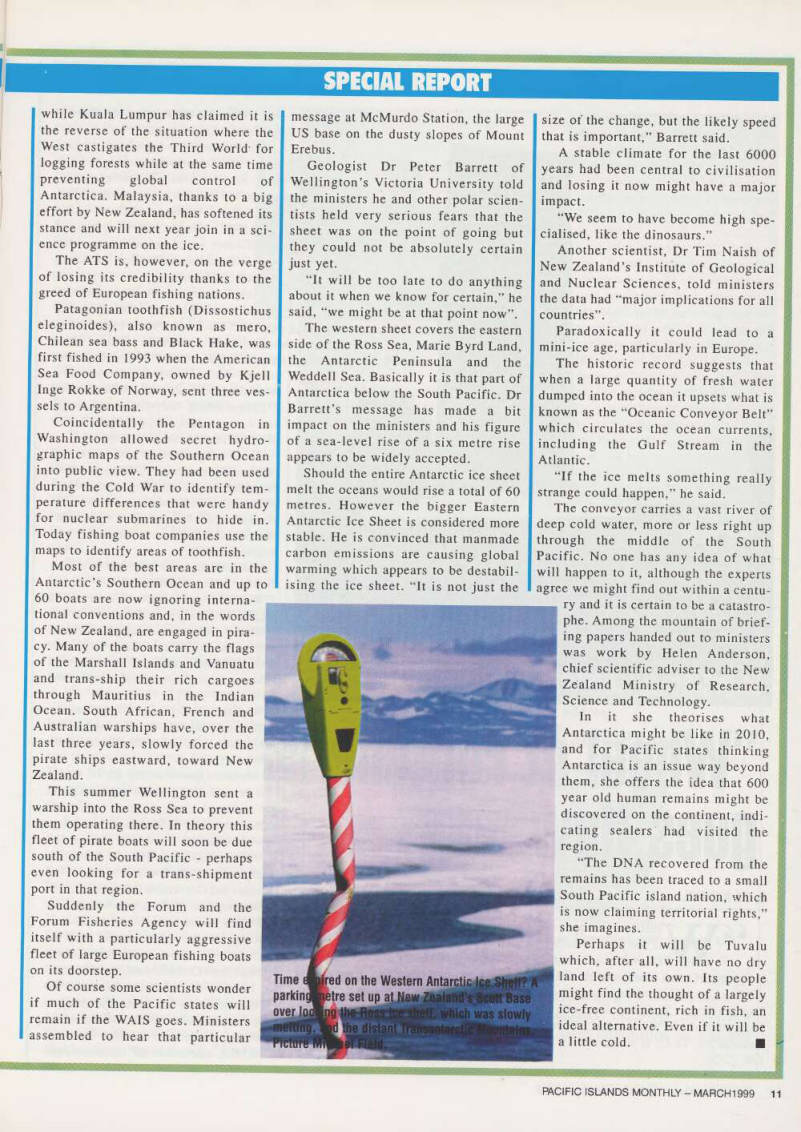
Scientists briefing the ministers told them that the West Antarctica Ice Shelf (WAIS) was poised to slip into the sea and when it begins to happen it will happen rapidly. Within most people’s
lifetimes the ocean will rise six metres once WAIS goes; that means good bye to all of Kiribati, Marshall Islands, Tokelau and Tuvalu while very large parts of the Cook Islands, Federated States of Micronesia, Fiji, French Polynesia, Solomon Islands and Tonga will disappear, almost overnight.
Although Antarctica dominates the climate and environment of the Pacific, no Pacific state other than Australia or New Zealand has any say in its future.
It is controlled by the 40 year old Antarctic Treaty that is outside of the United Nations.
A total of 43 nations have signed it but within ATS only 26 nations have full voting rights - they are the original seven nations that claimed the conti nent plus nations with active science programmes on the ice.
The treaty suspends all territorial claims, demilitarises everything below 60 degrees south and declares it open to science.
In the past India and Malaysia have claimed the ATS is a rich country’s device to hold key assets to themselves
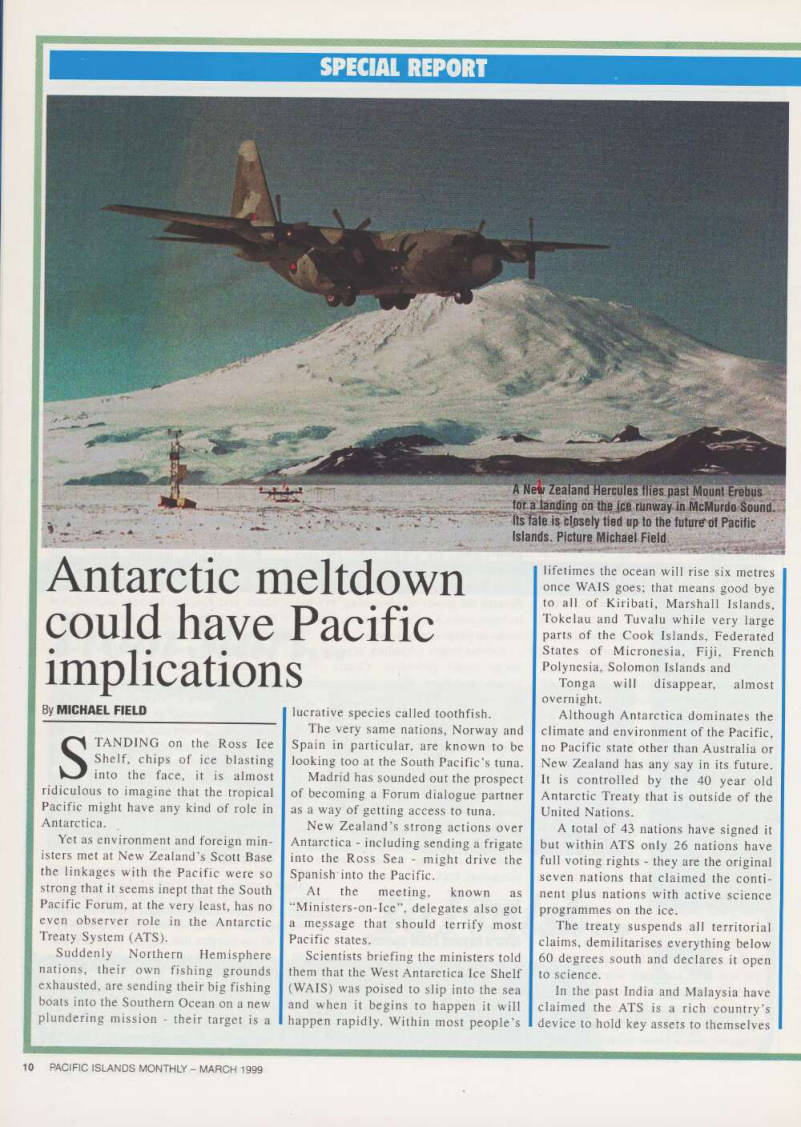
A New Zealand Hercules flies past Mount Erebus for a landing on the Joe runway in McMurdo Sound.
Its fate is clpsely tied up to the future of Pacific islands. Picture Michael Field
while Kuala Lumpur has claimed it is the reverse of the situation where the West castigates the Third World' for logging forests while at the same time preventing global control of Antarctica. Malaysia, thanks to a big effort by New Zealand, has softened its stance and will next year join in a sci ence programme on the ice.
The ATS is, however, on the verge of losing its credibility thanks to the greed of European fishing nations.
Patagonian toothfish (Dissostichus eleginoides), also known as mero, Chilean sea bass and Black Hake, was i first fished in 1993 when the American Sea Food Company, owned by Kjell Inge Rokke of Norway, sent three ves sels to Argentina.
Coincidentally the Pentagon in Washington allowed secret hydro graphic maps of the Southern Ocean into public view. They had been used during the Cold War to identify tem perature differences that were handy for nuclear submarines to hide in.
Today fishing boat companies use the maps to identify areas of toothfish.
Most of the best areas are in the Antarctic’s Southern Ocean and up to
60 boats are now ignoring interna tional conventions and, in the words of New Zealand, are engaged in pira cy. Many of the boats carry the flags of the Marshall Islands and Vanuatu and trans-ship their rich cargoes through Mauritius in the Indian Ocean. South African, French and Australian warships have, over the last three years, slowly forced the pirate ships eastward, toward New Zealand.
This summer Wellington sent a warship into the Ross Sea to prevent them operating there. In theory this fleet of pirate boats will soon be due south of the South Pacific - perhaps even looking for a trans-shipment port in that region.
Suddenly the Forum and the Forum Fisheries Agency will find itself with a particularly aggressive
fleet of large European fishing boats
on its doorstep.
Of course some scientists wonder if much of the Pacific states will remain if the WAIS goes. Ministers assembled to hear that particular
message at McMurdo Station, the large US base on the dusty slopes of Mount Erebus.
Geologist Dr Peter Barrett of
Wellington’s Victoria University told
the ministers he and other polar scien tists held very serious fears that the sheet was on the point of going but they could not be absolutely certain
just yet.
“It will be too late to do anything about it when we know for certain,” he said, “we might be at that point now”.
The western sheet covers the eastern side of the Ross Sea, Marie Byrd Land, the Antarctic Peninsula and the Weddell Sea. Basically it is that part of Antarctica below the South Pacific. Dr Barrett’s message has made a bit impact on the ministers and his figure of a sea-level rise of a six metre rise appears to be widely accepted.
Should the entire Antarctic ice sheet melt the oceans would rise a total of 60 metres. However the bigger Eastern Antarctic Ice Sheet is considered more stable. He is convinced that manmade carbon emissions are causing global warming which appears to be destabil ising the ice sheet. “It is not just the
size of the change, but the likely speed that is important,” Barrett said.
A stable climate for the last 6000 years had been central to civilisation and losing it now might have a major
impact.
“We seem to have become high spe cialised, like the dinosaurs.”
Another scientist. Dr Tim Naish of New Zealand’s Institute of Geological and Nuclear Sciences, told ministers the data had “major implications for all countries”.
Paradoxically it could lead to a mini-ice age, particularly in Europe.
The historic record suggests that when a large quantity of fresh water dumped into the ocean it upsets what is known as the “Oceanic Conveyor Belt” which circulates the ocean currents, including the Gulf Stream in the Atlantic.
“If the ice melts something really strange could happen,” he said.
The conveyor carries a vast river of deep cold water, more or less right up through the middle of the South Pacific. No one has any idea of what will happen to it, although the experts agree we might find out within a centu
ry and it is certain to be a catastro phe. Among the mountain of brief ing papers handed out to ministers was work by Helen Anderson, chief scientific adviser to the New Zealand Ministry of Research, Science and Technology.
In it she theorises what Antarctica might be like in 2010, and for Pacific states thinking Antarctica is an issue way beyond them, she offers the idea that 600 year old human remains might be discovered on the continent, indi cating sealers had visited the region.
“The DNA recovered from the remains has been traced to a small South Pacific island nation, which is now claiming territorial rights,”
she imagines.
Perhaps it will be Tuvalu which, after all, will have no dry land left of its own. Its people might find the thought of a largely ice-free continent, rich in fish, an ideal alternative. Even if it will be a little cold. ■
Time e[?]ired on the Western Antarctic Ice Shetf? A parkin[?]etre set up at New Zealand's Sco[?] Base over loo[?]ing the distant [?]śn[?] [?]ains.
Picture M[?] Field.
"Wheel of Fortune"
Business
"Wheel of Fortune" goes Hawaiian
By Ed Rampell
£ X XHEEL of Fortune”, one %/%/ of the most financially
T T successful television
programs ever, has rolled into Waikiki, on the beach near Hilton Hawaiian Village’s Rainbow Tower. The game show with Pat Sajak and Vanna White taped 10 Oahu episodes Jan. 11-13, to air Feb. 15-19 and Feb. 22-26.
“Wheel”, which premiered in 1975, is seen in one version or another in 55 domestic and overseas markets by 100 mil lion viewers, and is expected to give Hawaii wide visibility at a time when the state’s tourism fortunes are sagging.
According to Executive Producer Harry Friedman, “Sony Corp. owns both 'Wheel of Fortune’ and 'Jeopardy’, and since they went into syndication in 1983, the two shows have earned an estimated $2.3 bil
lion. 'Wheel’ is the number one show in the history of syndication.”
Friedman explained syndication means “rather than the network owning the pro gram, Kingworld sells 'Wheel’ market by market. In Hawaii, it is on the Fox affiliate [KHON]; in LA, it is on ABC, and in San Diego, NBC. If it was a network show, all the affiliates would be on the same net work.” Friedman said “The format is licensed by 54 countries.”
Many licensees use their own personal ities and contestants to spin a large wheel for letters to fill in a mystery phrase.
Those who brought 'Wheel’ here believe it will benefit the fiscally belea guered Aloha State in many ways.
According to Friedman, 'Wheel’ hired “120 local labour - carpenters, crew, stage hands, electricians, etc., putting $1.5 mil lion back into the local economy.
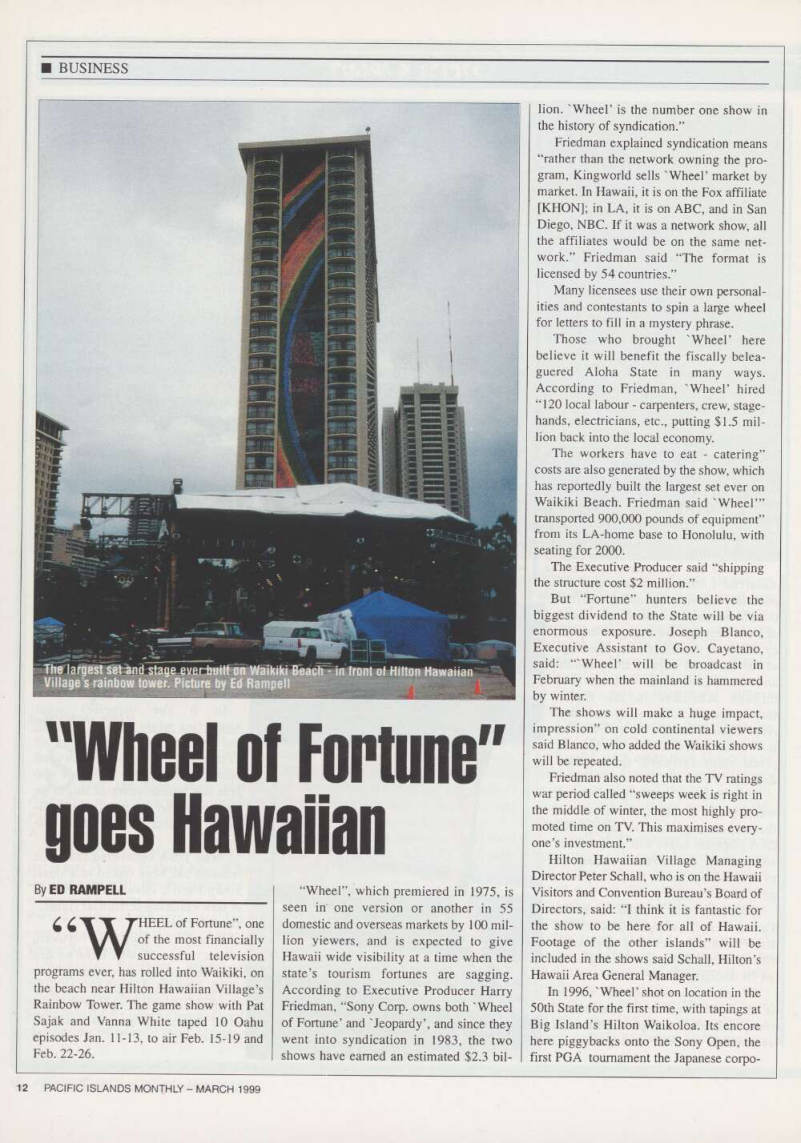
The workers have to eat - catering” costs are also generated by the show, which has reportedly built the largest set ever on Waikiki Beach. Friedman said 'Wheel’” transported 900,000 pounds of equipment” from its LA-home base to Honolulu, with seating for 2000.
The Executive Producer said “shipping the structure cost $2 million.”
But “Fortune” hunters believe the biggest dividend to the State will be via enormous exposure. Joseph Blanco, Executive Assistant to Gov. Cayetano, said: “'Wheel’ will be broadcast in February when the mainland is hammered
by winter.
The shows will make a huge impact, impression” on cold continental viewers said Blanco, who added the Waikiki shows will be repeated.
Friedman also noted that the TV ratings war period called “sweeps week is right in the middle of winter, the most highly pro moted time on TV. This maximises every one’s investment.”
Hilton Hawaiian Village Managing
Director Peter Schall, who is on the Hawaii Visitors and Convention Bureau’s Board of Directors, said: “I think it is fantastic for the show to be here for all of Hawaii.
Footage of the other islands” will be included in the shows said Schall, Hilton’s Hawaii Area General Manager.
In 1996, 'Wheel’ shot on location in the 50th State for the first time, with tapings at Big Island’s Hilton Waikoloa. Its encore here piggybacks onto the Sony Open, the first PGA tournament the Japanese corpo
The largest set and stage ever built on Waikiki Beach - in front of Hilton Hawaiian Village 's rainbow tower. Picture by Ed Rampell
rate giant has ever sponsored. The event at the Waialae Country Club “will be seen for the next four years in up to 170 countries on ESPN.
Jupiter Satellite TV and NHk of Japan” are also airing the golf tour ney, according to Ray Stosik, Executive Director of the Sony Open.
What did Hawaii’s public and private sector give to get 'Wheel’ to return to paradise? Friedman said “the State and City & County cut through the red tape of the permit process. Their cooperation was just magnificent.” Authorities allowed 'Wheel’ to invade a portion of the
public beach in front of HHV’s Rainbow Tower and nearby free parking, and to close them to the public.
The visitor industry and government also provided cash-rich 'Wheel’ with financial incentives to shoot here.
Friedman said “Hawaiian Airlines and HHV gave corporate discounts for rooms, food,” and airfare. “The State gave us financial assistance - $300,000 in cash,” he
added.
Friedman denied this is corporate wel fare (government economic support of cor porations - often profitable - with taxpayer money). “No, Hawaii is getting a return on its investment,” said Friedman, who stat ed: “Much bigger incentives have been presented to us to tape in less desirable locations.
It’s not a question of the money offered - Bahamas offered us a free ride, and Puerto Rico... But we love Hawaii,” where the shows shot at the Waikoloa won Sajak and director Dick Carson Emmy awards.
Vanna White called Waikiki “the most beautiful backdrop we ever had for the show.”
Schall said “I don’t think this is corpo rate welfare. How much does Coke spend in brand marketing? You’ve got to brand market. Other destinations would love to have this opportunity.”
Blanco disputed criticism that the mil lions spent by the State on the globally televised Miss Universe Pageant - which could not be shot at a taxpayer-financed convention centre - was a waste of public dollars at a time of economic hardship.
But do Waikiki retailers believe a spin of the 'Wheel’ will bring them fortune?
Warren Cho, Planet Hollywood’s Assistant
Merchandising Manager, said: “Anything
with national TV exposure makes a differ ence for our State.” But in terms of snag ging foot traffic (from the set’s 2000 fans and crew) for his Kalakaua Ave restaurant, Cho said; “it’ll be hard to access... although celebs might stop by” the movie theme eatery.
Hazel Li of Avanti, which sells Aloha Shirts at Kalakaua, said, “I guess any advertising does help.” But a man disburs
ing handbills for Paradise City Music & Collectibles on Kalakaua, who wouldn’t give his name, said most events-generated visitors “are not interested in spending money... they’re just interested in the sun...
When the fleet’s in, they’re good shoppers.”
A saleswoman for Tahiti Perles at the Royal Hawaiian Shopping Centre who would not give her name said specialised, high ticket items like black pearls are not affected by tourists lured here by attractions and publicity. Mark Yamasaki, Assistant Manager of Kyotaru, a Japanese eatery on Waikiki’s main strip, said:
“Events, like parades on Kalakaua, help us.” But as for 'Wheel’, Yamasaki said, “It’ll be good for the economy of the State.
I don’t know if it’ll specifically help my restaurant.” A man named “Mark” at the Pearl Factory in the International Market Place agreed with that idea. But he added: “It’s a quantity game.
The more customers that are generated, the more chance for us.” ■
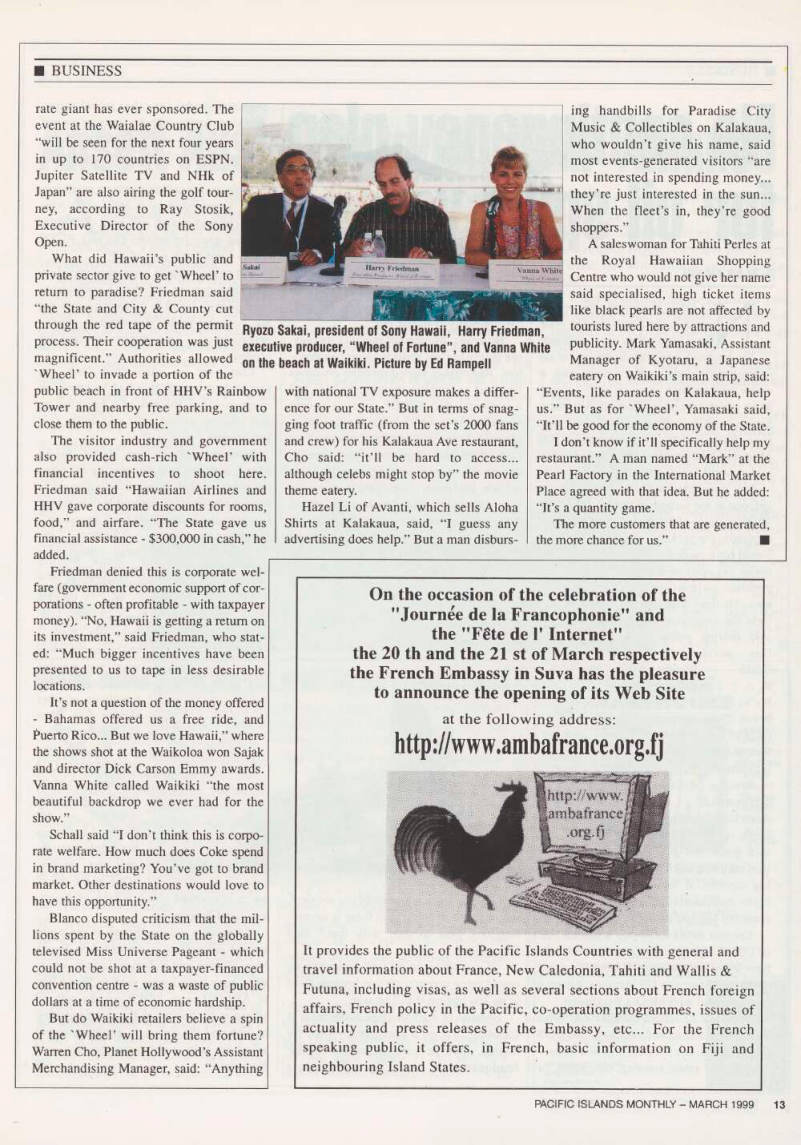
Ryozo Sakai, president of Sony Hawaii, Harry Friedman, executive producer, “Wheel of Fortune”, and Vanna White on the beach at Waikiki. Picture by Ed Rampell
Advertisements & other items, p. 13 (1 item)
http://ww.ambafrance.org.fj
On the occasion of the celebration of the "Journee de la Francophonie” and the ”F£te de 1' Internet” the 20 th and the 21 st of March respectively the French Embassy in Suva has the pleasure to announce the opening of its Web Site at the following address:
://www. otgdj I fel It provides the public of the Pacific Islands Countries with general and travel information about France, New Caledonia, Tahiti and Wallis & Futuna, including visas, as well as several sections about French foreign affairs, French policy in the Pacific, co-operation programmes, issues of actuality and press releases of the Embassy, etc... For the French speaking public, it offers, in French, basic information on Fiji and neighbouring Island States.
No contingency plan
for oil soils yet
By Alan Ah Mu
NO-ONE doubts the beauty of reefs in the South Pacific - nor how fragile they are if polluted.
Yet for many countries in the region no contingency plans exist to cope with a major disaster such as an oil spill - some thing which several incidents in American Samoa recently indicate could strike at any time. Early in January an estimated 300 gallons of oil dumped in Pago Pago Harbor took a whole day to clean.
Just days later, a Belize longliner ran aground at the harbour entrance with about 30,000 gallons of oil aboard. Had the tanks
ruptured, the tanker would have caused a major oil spill in a popular swimming area. “It does high light the concerns,” said marine pollu tion adviser for South Pacific Regional Environmental Programme (SPREP), Steve Raaymaker, of the incidents.
Frank McCoy, contracted by American Samoa to clean up oil spills, said while 300 gal lons may seem like a big amount, it was
minor compared to previous spills that his company has had to clean up in the harbor.
Culprits in oil spills pay a federal fine of US$25 000. The US Coast Guard would have closed Pago Pago Harbour had not American Samoa, a US territory, signed a clean-up deal with McCoy’s company.
SPREP’s 22 island member countries do not have a strict enforcer such as the US Coast Guard, nor - except Fiji and Palau contingency plans, training, equipment, or
laws in case of a spill, said Raaymaker.
Nor do they have reporting systems so SPREP is informed of spills fast, he said.
“We’re really at square one”.
However, movement towards increas ing ability to fight spills is gaining momen tum. Raaymaker visited member countries last year to establish their capabilities and a well-attended SPREP training course began last year, which is due to be an annu al event. “Yeah, we’re up and running,” he said. SPREP has approved programmes to ensure that every member country has a marine pollution contingency plan this year. Meanwhile island nations are almost defenseless against oil spills. “For example
in Samoa if there was a shipping accident, that resulted in an oil spill there is no con tingency plan to deal with that,” said Raaymaker.
“If you cause an oil spill tomorrow no one is going to prosecute you because there is no law against that,” he said.
Because of staff shortage Raaymaker is focusing first on a contingency plan for Samoa, where he is closest because SPREP headquarters is here - and offer it as a
potential model for other island states.
Working closely with the harbour master, Police, Fire and many other departments and fuel supplier Mobil, was involved, he said.
Raaymaker said that being a small har bour, surrounded by a coral reef, Apia Harbour was a high risk area, with little turning space for tankers carrying 30 000 tons - “and that’s a lot of oil”.
But so far no spills because of good har bour management including a compulsory local pilot on board to guide ships in and a tug boat, he said. “But there is always human error”. So contingency plans are needed.
Last year an inter-island ferry ran aground on a reef. If it had happened in rough weather, the risk of it breaking up and causing an oil spill was high, said Raaymaker.
Last year too at Asau wharf, Savaii island, a tanker was discharging oil when
the pipeline leaked requiring villagers to
form a barrier with coconut leaves woven together, stopping the oil from spreading.
“Lucky the local village was quick to respond, “ said Raaymaker.
But Sprep
learned of the inci dent late, from a radio report when what was needed is an emergency telephone number similar to that available to Police and the fire ser vice, he said. That problem too of no
timely “reporting
systems” is not confined to Samoa but exists through out the region.
“One of the things
we’re concerned about is lack of report ing,” said Raaymaker.
Somewhat unique though is the prob lem of oil pollution presented in Papua New Guinea and Solomon Islands where ships carrying oil were sunk in World War 11. After 50 years, WWII wrecks with oil sitting at the bottom of the sea are starting to leak and the Solomon government has asked for help to solve the problem, said Raaymaker. - ■
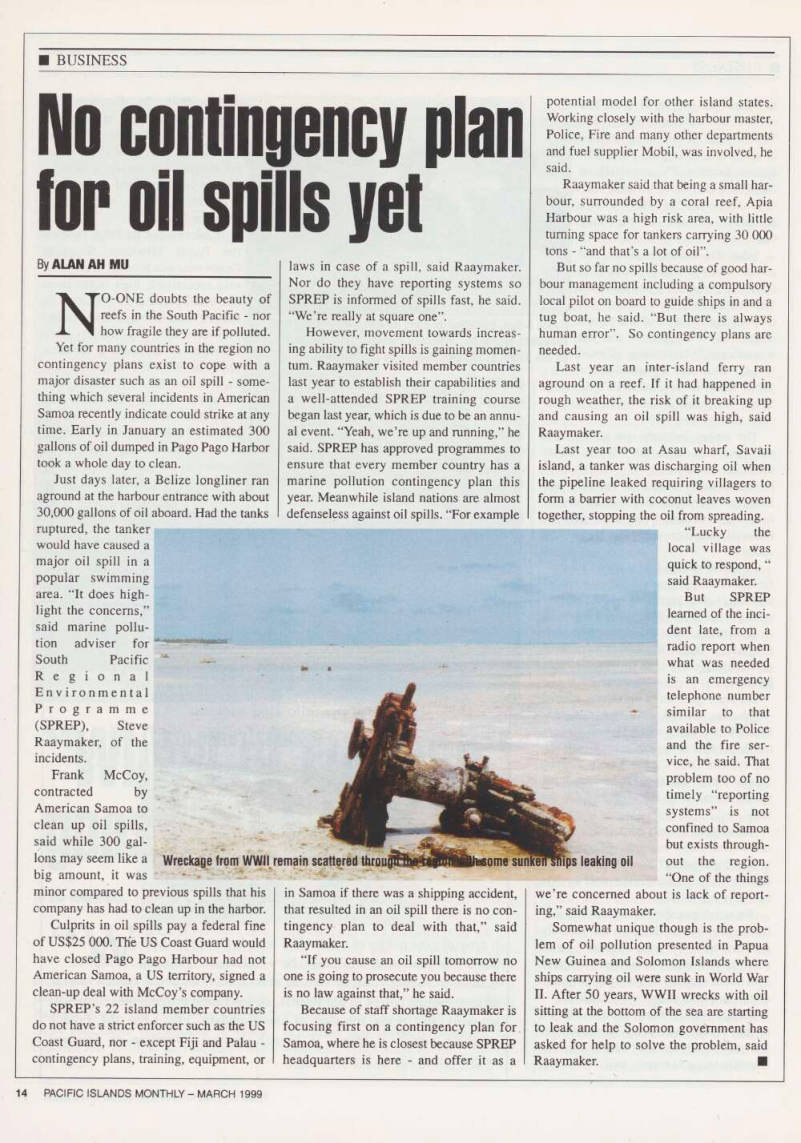
Wreckage from WWII remain scattered sunken ships leaking oil
Ansett Australia to join Star Alliance
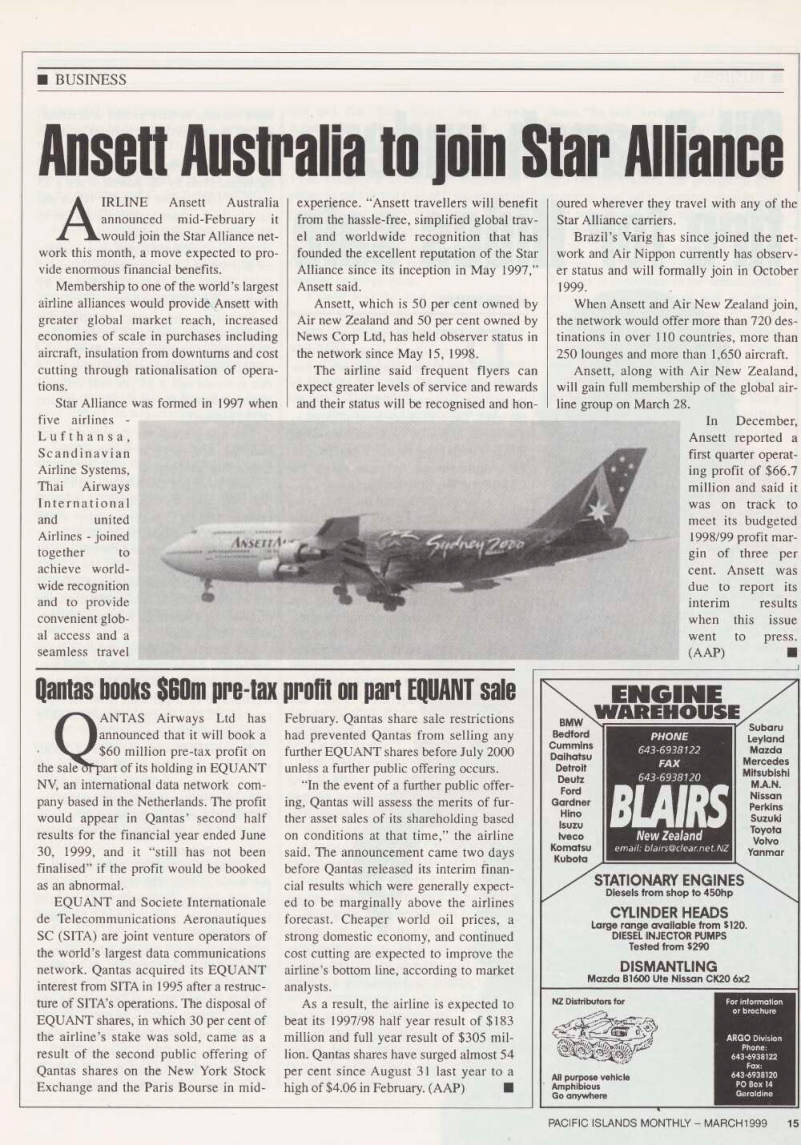
AIRLINE Ansett Australia announced mid-February it would join the Star Alliance net work this month, a move expected to pro vide enormous financial benefits.
Membership to one of the world’s largest airline alliances would provide Ansett with greater global market reach, increased economies of scale in purchases including aircraft, insulation from downturns and cost cutting through rationalisation of opera tions.
Star Alliance was formed in 1997 when
five airlines - Lufthansa, Scandinavian Airline Systems,
Thai Airways
International and united Airlines - joined together to achieve world
wide recognition
and to provide convenient glob al access and a seamless travel
experience. “Ansett travellers will benefit from the hassle-free, simplified global trav el and worldwide recognition that has founded the excellent reputation of the Star Alliance since its inception in May 1997,”
Ansett said.
Ansett, which is 50 per cent owned by Air new Zealand and 50 per cent owned by News Corp Ltd, has held observer status in the network since May 15, 1998.
The airline said frequent flyers can expect greater levels of service and rewards and their status will be recognised and hon-
cured wherever they travel with any of the Star Alliance carriers.
Brazil’s Varig has since joined the net work and Air Nippon currently has observ er status and will formally join in October 1999.
When Ansett and Air New Zealand join, the network would offer more than 720 des tinations in over 110 countries, more than 250 lounges and more than 1,650 aircraft.
Ansett, along with Air New Zealand, will gain full membership of the global air line group on March 28.
In December, Ansett reported a first quarter operat ing profit of $66.7 million and said it was on track to meet its budgeted 1998/99 profit mar gin of three per cent. Ansett was due to report its interim results when this issue went to press.
(Aap) ■
Qantas books $60m pre-tax profit on part EQUANT sale
Airways Ltd has ■ I announced that it will book a $6O million pre-tax profit on the of its holding in EQUANT NV, an international data network com pany based in the Netherlands. The profit would appear in Qantas’ second half results for the financial year ended June 30, 1999, and it “still has not been finalised” if the profit would be booked as an abnormal.
EQUANT and Societe Internationale de Telecommunications Aeronautiques SC (SITA) are joint venture operators of the world’s largest data communications network. Qantas acquired its EQUANT interest from SITA in 1995 after a restruc ture of SITA’s operations. The disposal of EQUANT shares, in which 30 per cent of the airline’s stake was sold, came as a result of the second public offering of Qantas shares on the New York Stock Exchange and the Paris Bourse in mid-
February. Qantas share sale restrictions had prevented Qantas from selling any further EQUANT shares before July 2000 unless a further public offering occurs.
“In the event of a further public offer ing, Qantas will assess the merits of fur ther asset sales of its shareholding based on conditions at that time,” the airline said. The announcement came two days before Qantas released its interim finan cial results which were generally expect ed to be marginally above the airlines forecast. Cheaper world oil prices, a strong domestic economy, and continued cost cutting are expected to improve the airline’s bottom line, according to market analysts.
As a result, the airline is expected to beat its 1997/98 half year result of $lB3 million and full year result of $305 mil lion. Qantas shares have surged almost 54 per cent since August 31 last year to a high of $4.06 in February. (AAP) ■
Advertisements & other items, p. 15 (1 item)
Blairs
BMW
Bedford Cummins Daihatsu Detroit Deutz Ford Gardner Hino Isuzu iveco Komatsu Kubota
WAREHOUSE
PHONE
643-6938122 643-6938120
BLAIRS
New Zealand
email: [email protected]
STATIONARY ENGINES
Diesels from shop to 450 hp Subaru Leyland Mazda Mercedes Mitsubishi
MAN.
Nissan Perkins Suzuki Toyota Volvo Yanmar
CYLINDER HEADS
Large range available from $l2O.
DIESEL INJECTOR PUMPS
Tested from $290
DISMANTLING
Mazda 81600 Ute Nissan CK2O 6x2
Oil Search under
lire for Hides sale
By Sam Vulum
DESPITE the ongoing political
instability, the stagnating econ omy, and the chronic crime problem, Papua New Guinea was able to maintain its investor confidence at a credi ble level. The confidence level slumped to a worrying degree in 1998, mainly evident in April during Oil Search’s purchase of HP’s upstream oil and gas assets for US$400 million (K900 million).
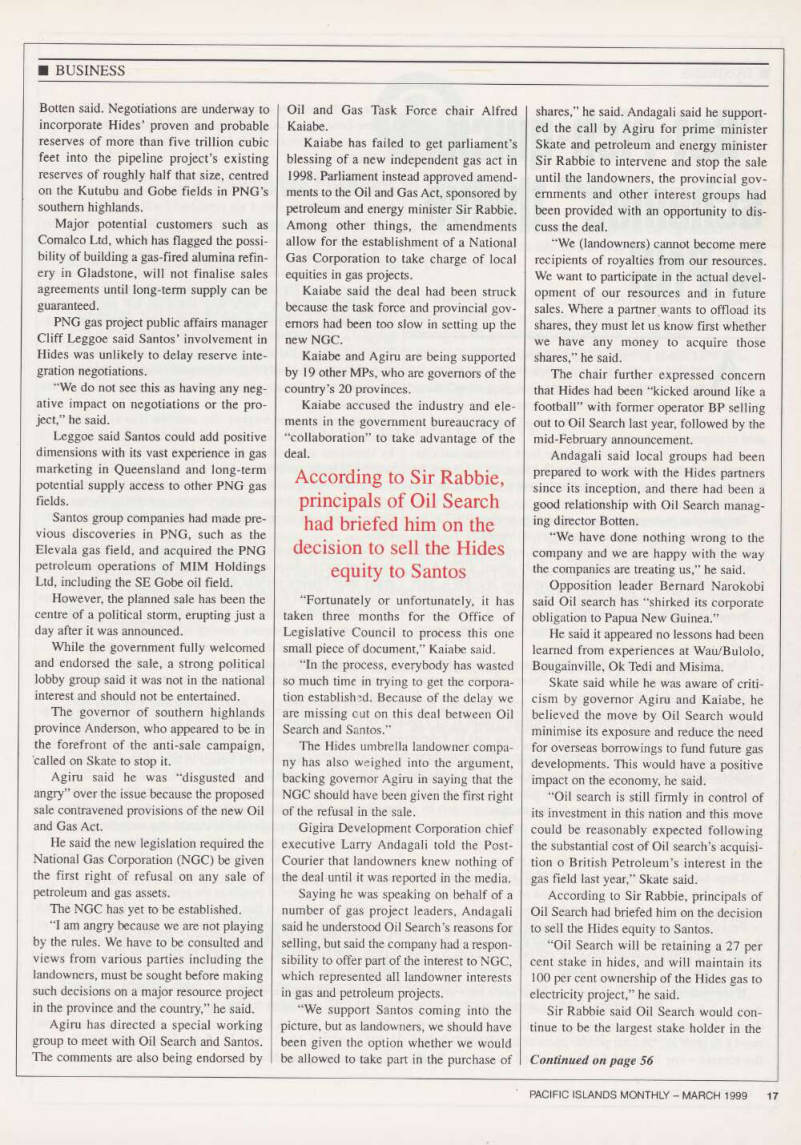
Although BP and the PNG gov- Wp|K emment argued that it was a com mercial decision, many critics ' have seen it as loss of confi (|||4# dence in the country’s invest- SgjBpi|k ment climate. However, recent developments indicate an IjpPF encouraging improvement.
In a report released WWk January 25 by two inter national highly respect
a ''d independent rating
f ilfagencies, PNG has & \m[ r . "■ been assigned a long term foreign curren cy rating of B-plus a long'terrn local currency mJm. rating of BB Jgj: )e B).
T h e ■MByp ratings, by
Moody’s,
based New York, r;/,) rar and London ▼based w Standard and Poor’s, puts PNG on the world map for international investors and will increase capital.
The PNG government engaged the agencies to pre- IPi ' pare the report to allow for eign capital markets, partic ularly the US and Euro
bond markets, to have greater understand ing of the government policies and the PNG economy.
This improvement is further evident in the recent plans by Oil Search to sell a 25 per cent stake in the lucrative Hides gas field in the Southern highlands province to Santos Limited of Australia.
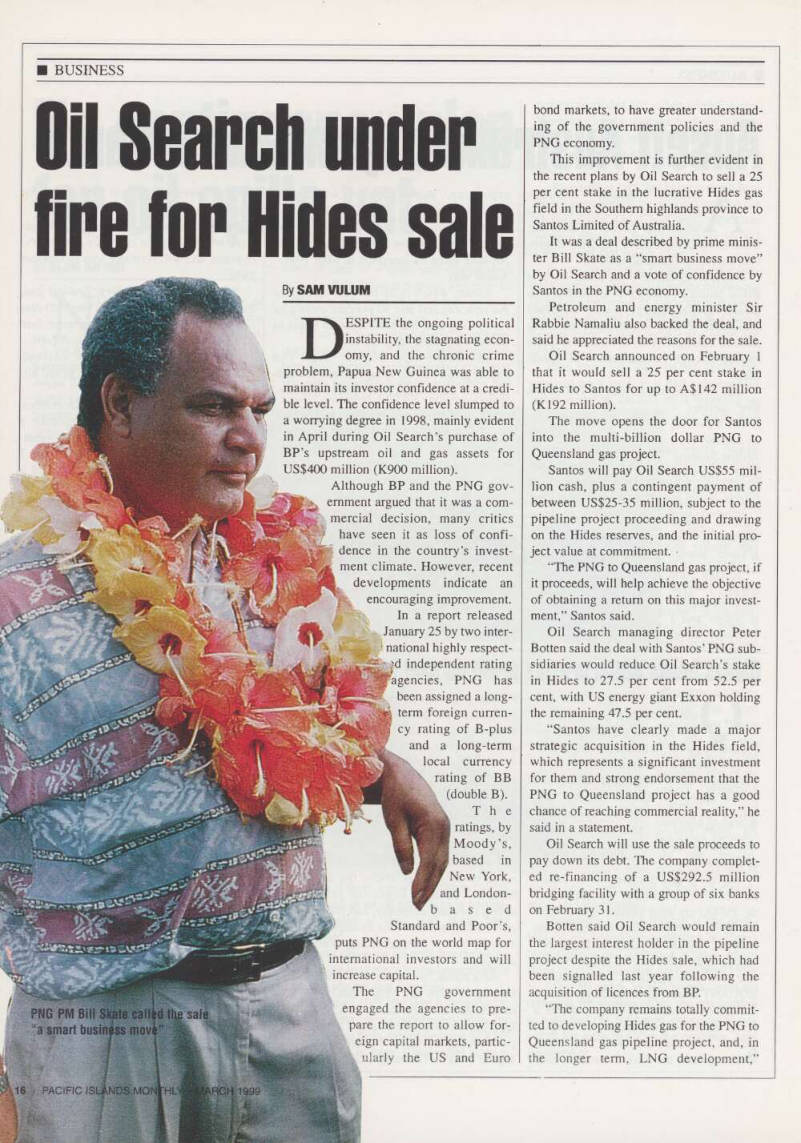
It was a deal described by prime minis ter Bill Skate as a “smart business move” by Oil Search and a vote of confidence by Santos in the PNG economy.
Petroleum and energy minister Sir Rabbie Namaliu also backed the deal, and said he appreciated the reasons for the sale.
Oil Search announced on February 1 that it would sell a 25 per cent stake in Hides to Santos for up to Asl42 million (K 192 million).
The move opens the door for Santos into the multi-billion dollar PNG to Queensland gas project.
Santos will pay Oil Search US$55 mil lion cash, plus a contingent payment of between US$25-35 million, subject to the pipeline project proceeding and drawing on the Hides reserves, and the initial pro ject value at commitment. ■ “The PNG to Queensland gas project, if it proceeds, will help achieve the objective of obtaining a return on this major invest ment,” Santos said.
Oil Search managing director Peter Botten said the deal with Santos’ PNG sub sidiaries would reduce Oil Search’s stake in Hides to 27.5 per cent from 52.5 per cent, with US energy giant Exxon holding the remaining 47.5 per cent.
“Santos have clearly made a major strategic acquisition in the Hides field, which represents a significant investment for them and strong endorsement that the PNG to Queensland project has a good chance of reaching commercial reality,” he said in a statement.
Oil Search will use the sale proceeds to pay down its debt. The company complet ed re-financing of a U 55292.5 million bridging facility with a group of six banks on February 31.
Botten said Oil Search would remain the largest interest holder in the pipeline project despite the Hides sale, which had been signalled last year following the acquisition of licences from BP.
“The company remains totally commit ted to developing Hides gas for the PNG to Queensland gas pipeline project, and, in the longer term, LNG development,”
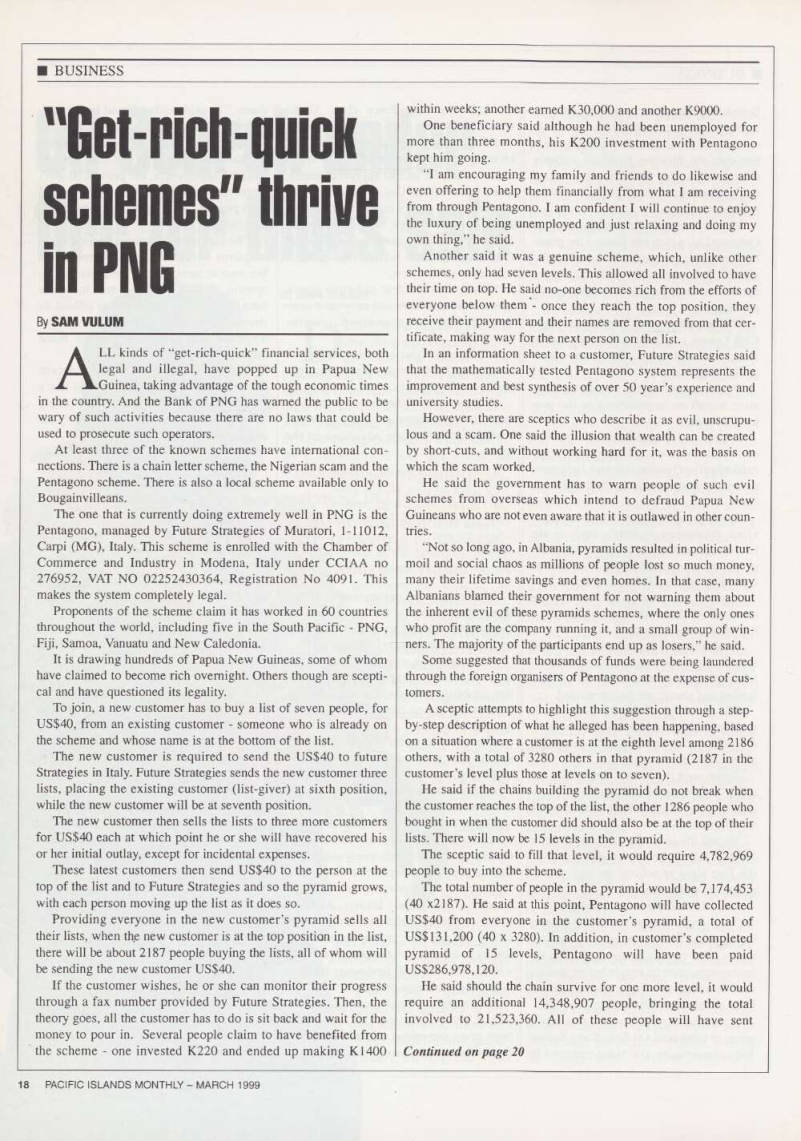
PNG PM Bill Skate called tip sale "a smart business move”
Botten said. Negotiations are underway to incorporate Hides’ proven and probable reserves of more than five trillion cubic
feet into the pipeline project’s existing
reserves of roughly half that size, centred on the Kutubu and Gobe fields in PNG’s
southern highlands.
Major potential customers such as Comalco Ltd, which has flagged the possi bility of building a gas-fired alumina refin ery in Gladstone, will not finalise sales agreements until long-term supply can be guaranteed.
PNG gas project public affairs manager Cliff Leggoe said Santos’ involvement in Hides was unlikely to delay reserve inte
gration negotiations.
“We do not see this as having any neg ative impact on negotiations or the pro ject,” he said.
Leggoe said Santos could add positive dimensions with its vast experience in gas marketing in Queensland and long-term potential supply access to other PNG gas fields.
Santos group companies had made pre vious discoveries in PNG, such as the Elevala gas field, and acquired the PNG petroleum operations of MIM Holdings Ltd, including the SE Gobe oil field.
However, the planned sale has been the centre of a political storm, erupting just a day after it was announced.
While the government fully welcomed and endorsed the sale, a strong political lobby group said it was not in the national interest and should not be entertained.
The governor of southern highlands province Anderson, who appeared to be in the forefront of the anti-sale campaign, called on Skate to stop it.
Agiru said he was “disgusted and angry” over the issue because the proposed sale contravened provisions of the new Oil and Gas Act.
He said the new legislation required the National Gas Corporation (NGC) be given the first right of refusal on any sale of petroleum and gas assets.
The NGC has yet to be established.
“I am angry because we are not playing by the rules. We have to be consulted and views from various parties including the landowners, must be sought before making such decisions on a major resource project in the province and the country,” he said.
Agiru has directed a special working group to meet with Oil Search and Santos.
The comments are also being endorsed by
Oil and Gas Task Force chair Alfred Kaiabe.
Kaiabe has failed to get parliament’s blessing of a new independent gas act in 1998. Parliament instead approved amend ments to the Oil and Gas Act, sponsored by petroleum and energy minister Sir Rabbie.
Among other things, the amendments allow for the establishment of a National Gas Corporation to take charge of local equities in gas projects.
Kaiabe said the deal had been struck because the task force and provincial gov ernors had been too slow in setting up the new NGC.
Kaiabe and Agiru are being supported by 19 other MPs, who are governors of the country’s 20 provinces.
Kaiabe accused the industry and ele ments in the government bureaucracy of “collaboration” to take advantage of the deal.
According to Sir Rabbie,
principals of Oil Search
had briefed him on the
decision to sell the Hides
equity to Santos
“Fortunately or unfortunately, it has taken three months for the Office of Legislative Council to process this one small piece of document,” Kaiabe said.
“In the process, everybody has wasted so much time in trying to get the corpora tion established. Because of the delay we are missing cut on this deal between Oil Search and Santos.”
The Hides umbrella landowner compa ny has also weighed into the argument, backing governor Agiru in saying that the NGC should have been given the first right of the refusal in the sale.
Gigira Development Corporation chief executive Larry Andagali told the Post- Courier that landowners knew nothing of the deal until it was reported in the media.
Saying he was speaking on behalf of a number of gas project leaders, Andagali said he understood Oil Search’s reasons for selling, but said the company had a respon sibility to offer part of the interest to NGC, which represented all landowner interests in gas and petroleum projects.
“We support Santos coming into the picture, but as landowners, we should have been given the option whether we would be allowed to take part in the purchase of
shares,” he said. Andagali said he support ed the call by Agiru for prime minister Skate and petroleum and energy minister Sir Rabbie to intervene and stop the sale until the landowners, the provincial gov ernments and other interest groups had been provided with an opportunity to dis cuss the deal.
“We (landowners) cannot become mere recipients of royalties from our resources.
We want to participate in the actual devel opment of our resources and in future sales. Where a partner wants to offload its shares, they must let us know first whether we have any money to acquire those shares,” he said.
The chair further expressed concern that Hides had been “kicked around like a football” with former operator BP selling out to Oil Search last year, followed by the
mid-February announcement.
Andagali said local groups had been prepared to work with the Hides partners since its inception, and there had been a good relationship with Oil Search manag ing director Botten.
“We have done nothing wrong to the company and we are happy with the way the companies are treating us,” he said.
Opposition leader Bernard Narokobi said Oil search has “shirked its corporate obligation to Papua New Guinea.”
He said it appeared no lessons had been learned from experiences at Wau/Bulolo, Bougainville, Ok Tedi and Misima.
Skate said while he was aware of criti cism by governor Agiru and Kaiabe, he believed the move by Oil Search would minimise its exposure and reduce the need for overseas borrowings to fund future gas developments. This would have a positive impact on the economy, he said.
“Oil search is still firmly in control of its investment in this nation and this move could be reasonably expected following the substantial cost of Oil search’s acquisi tion o British Petroleum’s interest in the gas field last year,” Skate said.
According to Sir Rabbie, principals of Oil Search had briefed him on the decision to sell the Hides equity to Santos.
“Oil Search will be retaining a 27 per cent stake in hides, and will maintain its 100 per cent ownership of the Hides gas to
electricity project,” he said.
Sir Rabbie said Oil Search would con tinue to be the largest stake holder in the
Continued on page 56
PNG to Queensland pipeline project, and Santos’ acquisition had given the gas pipeline project the strongest possible endorsement.
Santos is already a major operator in the oil and gas industry in Australia and its involvement in the pipeline project through its equi ty in hides Gas certainly confirms that another leading Australian resource company has confidence in the pipeline project and the oil gas industries in Papua New Guinea,” Sir Rabbie said.
I remain totally confident that the pipeline project - the largest and most significant infrastructure project in our history - will pro ceed and these developments only strengthen my confidence.”
Oil Search is also very positive about the sale. The company’s managing director Botten said he was confident the sale to Santos Ltd would proceed, despite any political opposition.
“We are very confident (it will go through),” Botten told AAP.
“We have the full support from the prime minister and the minis ter for petroleum and energy. They have both said publicly that they are in favour of the transaction.”
In a separate statement, Oil search said it was “disturbed and dis appointed by the press reports about political reactions to the deal - a transaction which is unequivocally in the best interest of Papua New Guinea and Oil Search shareholders.”
The statement, jointly attributed to chair Trevor Kennedy and Botten, highlighted the company’s record in PNG since 1929. It described last April’s purchase of BP’s upstream oil and gas assets for US$4OO million (K9OO million) as “the boldest and riskiest move of its corporate life.”
"This was done to facilitate the development of the PNG to Queensland gas project and the Moran oil project, which were both in danger of stalling due to lack of commitment by various parties,” the Oil search executives said.
“Oil search convinced a number of banks and its shareholders to invest this money, the largest single investment ever made by a Papua New guinea company in the country. This shows our commitment to PNG, hardly an act of disloyalty or betrayal to the country, as quoted recently in the press.”
Chief among the claims of those opposed to the deal was that it had been made against provisions of PNG’s new Oil and Gas act.
They claimed the Act, which was passed late last year, provided for
the newly created National Gas corporation to be given the first option on any sale. But Botten said there were no grounds for the politicians’ claims as the National Gas Corporation did not have first right of refusal and the transaction was done to the letter and spirit of the law. “It’s not unusual that various voices in the political arena may not be supportive - that’s always the case in various parts of the world, including Australia,” he said.
In the statement, Oil search said as a relatively small company it would have been unable to fund its obligations to the pipeline project - between US$2.5 billion to US$3 billion (K 5.5-6.5 billion) without selling part of Hides.
“This was communicated in both discussion and in writing to the minister for petroleum and energy and the southern highlands provin cial government oil and gas taskforce, of which Kaiabe, governor Agiru and Larry Andagali are members,” Oil Search said. The com pany also distributed a copy of a letter, dated September 3, 1998, describing its intentions.
“In this letter, we told the committee that we may sell (an) interest in Hides on commercial terms and that we would be happy to discuss any offer they might make.
It is unfortunate that inaccurate and unwarranted assertions, polit ically motivated, have clouded the facts in recent times. Having received no reply from the Committee, we proceeded with our sale process and closed our deal, some five months after our letter to the committee.”
The Hides gas field’s estimated five trillion cubic feet of gas reserves are considered crucial for the pipeline project. Negotiations to incorporate the reserves into the pipeline project are underway.
Botten said Oil Search’s purchase of PNG licences from BP last year took three months to complete. “We hope this can be achieved in a shorter time than that.”
Oil Search said that NGC had the right to acquire, by agreement on commercial terms, an interest in Hides.
“This is the same right as any other company or organisation.
Whether or not NGC is formed and who runs or controls it, it is not our business. We have been open with our sale process and did what was reasonable to involve landowner and political representatives.
This can hardly be described as a slap in the face to landowners.
On the contrary we did what we could to involve them,” Oil search said.
Advertisements & other items, p. 16 (1 item)
16
PACIFIC ISLANDS I9S
■ BUSINESS
"Get-rich-quick
schemes" thrive in PNG
By Sam Vulum
ALL kinds of “get-rich-quick” financial services, both legal and illegal, have popped up in Papua New Guinea, taking advantage of the tough economic times in the country. And the Bank of PNG has warned the public to be wary of such activities because there are no laws that could be used to prosecute such operators.
At least three of the known schemes have international con nections. There is a chain letter scheme, the Nigerian scam and the Pentagono scheme. There is also a local scheme available only to Bougainvilleans.
The one that is currently doing extremely well in PNG is the Pentagono, managed by Future Strategies of Muratori, 1-11012, Carpi (MG), Italy. This scheme is enrolled with the Chamber of Commerce and Industry in Modena, Italy under CCIAA no 276952, VAT NO 02252430364, Registration No 4091. This makes the system completely legal.
Proponents of the scheme claim it has worked in 60 countries throughout the world, including five in the South Pacific - PNG, Fiji, Samoa, Vanuatu and New Caledonia.
It is drawing hundreds of Papua New Guineas, some of whom have claimed to become rich overnight. Others though are scepti cal and have questioned its legality.
To join, a new customer has to buy a list of seven people, for US$4O, from an existing customer - someone who is already on the scheme and whose name is at the bottom of the list.
The new customer is required to send the US$4O to future Strategies in Italy. Future Strategies sends the new customer three lists, placing the existing customer (list-giver) at sixth position, while the new customer will be at seventh position.
The new customer then sells the lists to three more customers for US$4O each at which point he or she will have recovered his or her initial outlay, except for incidental expenses.
These latest customers then send US$4O to the person at the top of the list and to Future Strategies and so the pyramid grows, with each person moving up the list as it does so.
Providing everyone in the new customer’s pyramid sells all their lists, when the new customer is at the top position in the list, there will be about 2187 people buying the lists, all of whom will be sending the new customer US$4O.
If the customer wishes, he or she can monitor their progress through a fax number provided by Future Strategies. Then, the theory goes, all the customer has to do is sit back and wait for the money to pour in. Several people claim to have benefited from the scheme - one invested K 220 and ended up making Kl4OO
within weeks; another earned K 30,000 and another K9OOO.
One beneficiary said although he had been unemployed for more than three months, his K2OO investment with Pentagono kept him going.
"I am encouraging my family and friends to do likewise and even offering to help them financially from what I am receiving from through Pentagono. I am confident I will continue to enjoy the luxury of being unemployed and just relaxing and doing my own thing,” he said.
Another said it was a genuine scheme, which, unlike other schemes, only had seven levels. This allowed all involved to have their time on top. He said no-one becomes rich from the efforts of everyone below them - once they reach the top position, they receive their payment and their names are removed from that cer tificate, making way for the next person on the list.
In an information sheet to a customer, Future Strategies said that the mathematically tested Pentagono system represents the improvement and best synthesis of over 50 year’s experience and university studies.
However, there are sceptics who describe it as evil, unscrupu lous and a scam. One said the illusion that wealth can be created by short-cuts, and without working hard for it, was the basis on which the scam worked.
He said the government has to warn people of such evil schemes from overseas which intend to defraud Papua New Guineans who are not even aware that it is outlawed in other coun tries.
“Not so long ago, in Albania, pyramids resulted in political tur moil and social chaos as millions of people lost so much money, many their lifetime savings and even homes. In that case, many Albanians blamed their government for not warning them about the inherent evil of these pyramids schemes, where the only ones who profit are the company running it, and a small group of win ners. The majority of the participants end up as losers,” he said.
Some suggested that thousands of funds were being laundered through the foreign organisers of Pentagono at the expense of cus tomers.
A sceptic attempts to highlight this suggestion through a step by-step description of what he alleged has been happening, based on a situation where a customer is at the eighth level among 2186 others, with a total of 3280 others in that pyramid (2187 in the customer’s level plus those at levels on to seven).
He said if the chains building the pyramid do not break when the customer reaches the top of the list, the other 1286 people who bought in when the customer did should also be at the top of their lists. There will now be 15 levels in the pyramid.
The sceptic said to fill that level, it would require 4,782,969 people to buy into the scheme.
The total number of people in the pyramid would be 7,174,453 (40 x 2187). He said at this point, Pentagono will have collected US$4O from everyone in the customer’s pyramid, a total of U 55131,200 (40 x 3280). In addition, in customer’s completed pyramid of 15 levels, Pentagono will have been paid U 55286,978,120.
He said should the chain survive for one more level, it would require an additional 14,348,907 people, bringing the total involved to 21,523,360. All of these people will have sent
Continued on page 20
Continued from page 18
Pentagono US$4O, a total of U 55860,934,400. Meanwhile, the Bank of PNG, which warned the pub lic against such schemes, has reported
ly enlisted police help to investigate
another finance company that is oper ating “illegally” in the country.
The bank took out advertisements in newspapers, in both English and Tok Pisin in January, warning the public against depositing money with the company.
Bank governor Morea Vele said the company - U-Vistract Finance Corporation Limited - has been hold ing itself out as a finance company.
Vele said the company is asking the public to deposit money with the com pany with a promise of paying 100 per cent interest on the deposits.
“We would like to inform the public that under the Banks and Financial Institutions Act, only licensed institu tions are allowed to accept deposits from the public,” Vele warned.
“U-Vistract Finance Corporation Limited is not a registered or licensed financial institution and as such, the company is carrying out an illegal business of accepting deposits from the public”.
He also warned members of the public against depositing money with the company because “your deposits would not be protected or you would not earn interest on your deposits as promised by the company”.
Vele said the Central Bank believes the company is operating out of Lae, Port Moresby and recently in Buka but may have also expanded its operations to other parts of the country.
He said the Bank will be requesting the Criminal Investigations Division of the Police Department to look into the matter. Wilson told a seminar in Port Moresby that the Central bank could not use existing laws to deter such activities, instead, it was only able to issue warnings through public notices in the media.
“If a scam operator starts a finance business in Papua New guinea, the Bank is unable to deter such activities (except) through public notices,”
Kamit said. Kamit warned that those behind such schemes may use the method of “up front fees” for promises of financial services that never materialise. ■
Advertisements & other items, p. 19 (1 item)
Challenging Positions in International Tourism
The Tourism Council of the South Pacific (TCSP) was established to strengthen regional co-operation among its 13 member countries in tourism development. Its prime roles are in the key areas of international marketing and promotions, and human resource development.
In order to meet the challenges of the global markets in the third millennium, TCSP is being reorganised to develop and incorporate a greater private sector involvement in its activities, as well as to initiate new and exciting developments. Consequently, TCSP is looking to fill a number of new key positions.
Candidates, should be a national of a TCSP member country and should possess tertiary qualifications, and have experience appropriate to the posts. A sound record of achievement in tourism or related sectors is essential. Fluency in English is essential and the ability to speak French is an added advantage.
DEPUTY CHIEF EXECUTIVE
This new position is a key appointment which has been created to assist the Chief Executive deliver the range of business objectives which TCSP is now tasked to achieve. The appointee will be involved in formulating the strategic direction of the commercial, marketing and development activities of the organization, and the operating divisions. Leading a team of divisional managers, he/she will be tasked with delivering the most benefits to the organisation and to the region, in what is a constantly changing and demanding market environment. The appointee will need at least eight years experience in the travel or tourism industry, and is currently a senior manager with a proven history in management and has a record of achievements. An appreciation of managing relationships with donor agencies will be an advantage. He/she must display an affinity with the region, and ideally Lived and working in more than one TCSP member country.
Manager Human Resource Development/Advisory Services This role encompasses both the HRD and Research and Development responsibilities. The appointee will be tasked with the identification, evaluation and delivery of a board range of training initiatives in TCSP member team and external resources. An important aspect of the work is to act as “matchmaker” between members’ R&D requirements, donors assistance and resourcing advisory services. Involvement and responsibility for the production of regional statistics and the TCSP website are also important responsibilities. The appointee will need strategic and analytical human resource development skill, in combination with excellent communication abilities. An appreciation of the management of relationships with donor agencies is essential. An affinity with the region is essential and proven track record in working in more than one member country is essential.
An attractive remuneration package will be offered to the right candidate.
If you feel that you might fit one of the above positions, please send your application immediately to The Chief Executive, Tourism Council of the South Pacific, 343-359 Victoria Parade, P. O. Box 1319, Suva, Fiji Islands or by fax to (979) 301995 with a full CV, and the names and addresses (including fax and telephone contacts) of three referees with whom you have been associated with in a professional capacity. Please mark the envelope clearly as ‘’Professional Staff Application”. If you need more information , please write to the above address. The closing date for applications is 31 March, 1999. * Member States of the TCSP: American Samoa, Cook Is, Fiji, French Polynesia, Kiribati, New Caledonia, Niue, , Papua New Guinea, Samoa, Solomon Islands, Tonga, Tuvalu.
Pacific under p[?]ssure stop money laundering
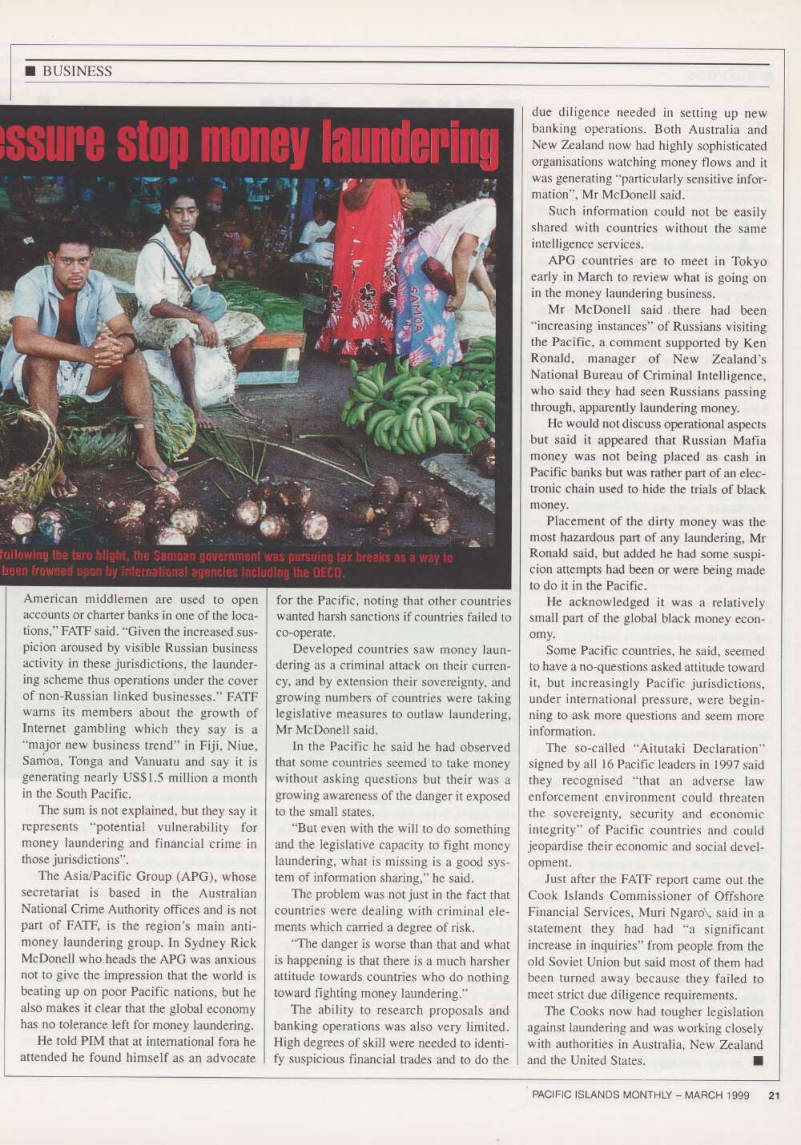
By Michael Field
THIS is not a fairy story and, as the Russian Mafia begin to arrive in the South Pacific, it is something of
a warning.
There was a magically beautiful tropical island that wanted to attract a lot of money from overseas. So they passed a law which said any foreign investor could come and park their money there. No questions asked no matter what form it came in. Even cash.
And no questions how the money was raised. Even from crime.
This considerably irritated the Group of Seven most powerful nations in the world and the Organisation for Cooperation and Development (OECD). Word went out from the treasuries and central banks of all those countries that unless the law changed rapid ’y, this tropical nation was going to find itself effectively cut out completely from the world’s financial system.
It was a heavy but deadly threat and quickly the Seychelles buckled under and decided dealing in dirty money was not worth it.
This month an influential group, part of the OECD, issued a similar warning which, while not nearly so explicit, might well add up to the same thing. “In the Pacific region, a heavy concentration of financial activity related to Russian organised crime has been observed, specifically in Western Samoa, Nauru, Vanuatu and the Cook Islands,” the Financial Action Task Force (FATF) on money laundering said in their report, “Money Laundering Typologies”, published in Paris.
Other countries named as areas of con cern were Fiji, Niue and Tonga. FATF says the offshore financial centres of “non-coop erative countries”, such as the Pacific ones named, showed an unwillingness or outright refusal to cooperate in dealing with money
laundering.
Experts had noted the abuse of offshore financial centres and the “increasing pres ence of solicitors, accountants and other professionals both to set up business entities and facilitate the administration of accounts used in money laundering”.
Informed sources told Pacific Islands Monthly that Russian Mafia money is becoming visible in Pacific tax havens and the major economic powers are becoming increasingly concerned. Sources say Nauru in particular, with a steadfast non-coopera-
tion approach, is risking becoming a global financial pariah with its no-questions asked attitude towards off-shore banking. As that country’s phosphate resources run out, and it becomes dependent on aid and soft-loans from organisations like the Asian Development Bank, Nauru is playing a
risky strategy.
Not many countries are actually named in the FATF report so the naming this time is a signal the heat is about to hit the South Pacific in a way it has not before. Some of the brightest names in world banking and economic development are sending the mes sage and getting one about Pacific moral ity and values that might not be so popular among South Pacific Forum leaders.
FATF’s report followed a meeting last year in London under the chairmanship of Simon Goddard of Britain’s National Criminal Intelligence Service with 21 nations and the European Union represent ed.
Their report, noting the rise in Russian organised crime showing up in the Pacific, made the point that it is not necessarily Russians doing it.
“One delegation mentioned an increas ingly common scheme whereby apparently
After numerous attempls to revie its ec[?] bring invesment into Samao. This howe[?]
American middlemen are used to open accounts or charter banks in one of the loca tions,” FATF said. “Given the increased sus picion aroused by visible Russian business activity in these jurisdictions, the launder ing scheme thus operations under the cover of non-Russian linked businesses.” FATF warns its members about the growth of Internet gambling which they say is a “major new business trend” in Fiji, Niue, Samoa, Tonga and Vanuatu and say it is generating nearly US$l.5 million a month in the South Pacific.
The sum is not explained, but they say it represents “potential vulnerability for money laundering and financial crime in those jurisdictions”.
The Asia/Pacific Group (APG), whose secretariat is based in the Australian National Crime Authority offices and is not part of FATF, is the region’s main anti money laundering group. In Sydney Rick McDonell who heads the APG was anxious not to give the impression that the world is beating up on poor Pacific nations, but he also makes it clear that the global economy has no tolerance left for money laundering.
He told PIM that at international fora he attended he found himself as an advocate
for the Pacific, noting that other countries wanted harsh sanctions if countries failed to co-operate.
Developed countries saw money laun dering as a criminal attack on their curren cy, and by extension their sovereignty, and growing numbers of countries were taking legislative measures to outlaw laundering, Mr McDonell said.
In the Pacific he said he had observed that some countries seemed to take money without asking questions but their was a growing awareness of the danger it exposed to the small states.
“But even with the will to do something and the legislative capacity to fight money laundering, what is missing is a good sys tem of information sharing,” he said.
The problem was not just in the fact that countries were dealing with criminal ele ments which carried a degree of risk.
“The danger is worse than that and what is happening is that there is a much harsher attitude towards countries who do nothing
toward fighting money laundering.”
The ability to research proposals and banking operations was also very limited.
High degrees of skill were needed to identi fy suspicious financial trades and to do the
due diligence needed in setting up new banking operations. Both Australia and New Zealand now had highly sophisticated organisations watching money flows and it was generating "particularly sensitive infor mation”, Mr McDonell said.
Such information could not be easily shared with countries without the same intelligence services.
APG countries are to meet in Tokyo early in March to review what is going on in the money laundering business.
Mr McDonell said . there had been "increasing instances” of Russians visiting the Pacific, a comment supported by Ken Ronald, manager of New Zealand’s National Bureau of Criminal Intelligence, who said they had seen Russians passing through, apparently laundering money.
He would not discuss operational aspects but said it appeared that Russian Mafia money was not being placed as cash in Pacific banks but was rather part of an elec tronic chain used to hide the trials of black money.
Placement of the dirty money was the most hazardous part of any laundering, Mr Ronald said, but added he had some suspi cion attempts had been or were being made to do it in the Pacific.
He acknowledged it was a relatively small part of the global black money econ omy.
Some Pacific countries, he said, seemed to have a no-questions asked attitude toward it, but increasingly Pacific jurisdictions, under international pressure, were begin ning to ask more questions and seem more information.
The so-called "Aitutaki Declaration” signed by all 16 Pacific leaders in 1997 said they recognised “that an adverse law enforcement environment could threaten the sovereignty, security and economic integrity” of Pacific countries and could jeopardise their economic and social devel opment.
Just after the FATF report came out the Cook Islands Commissioner of Offshore Financial Services, Muri Ngaro\ said in a statement they had had “a significant increase in inquiries” from people from the old Soviet Union but said most of them had been turned away because they failed to meet strict due diligence requirements.
The Cooks now had tougher legislation against laundering and was working closely with authorities in Australia, New Zealand and the United States. ■
[?]follwing the taro blight, the Samoan government was pursuing tax breaks as way to [?]been frowned upon by international agencies including the OECD.
Advertisements & other items, p. 21 (1 item)
OTtfiTuiiTl T IfiTITP i^WiMui
PACIFIC ISLANDS MONTHLY - MARCH 1999
■ BUSINESS
PNG still searching for multi-million dollar lender
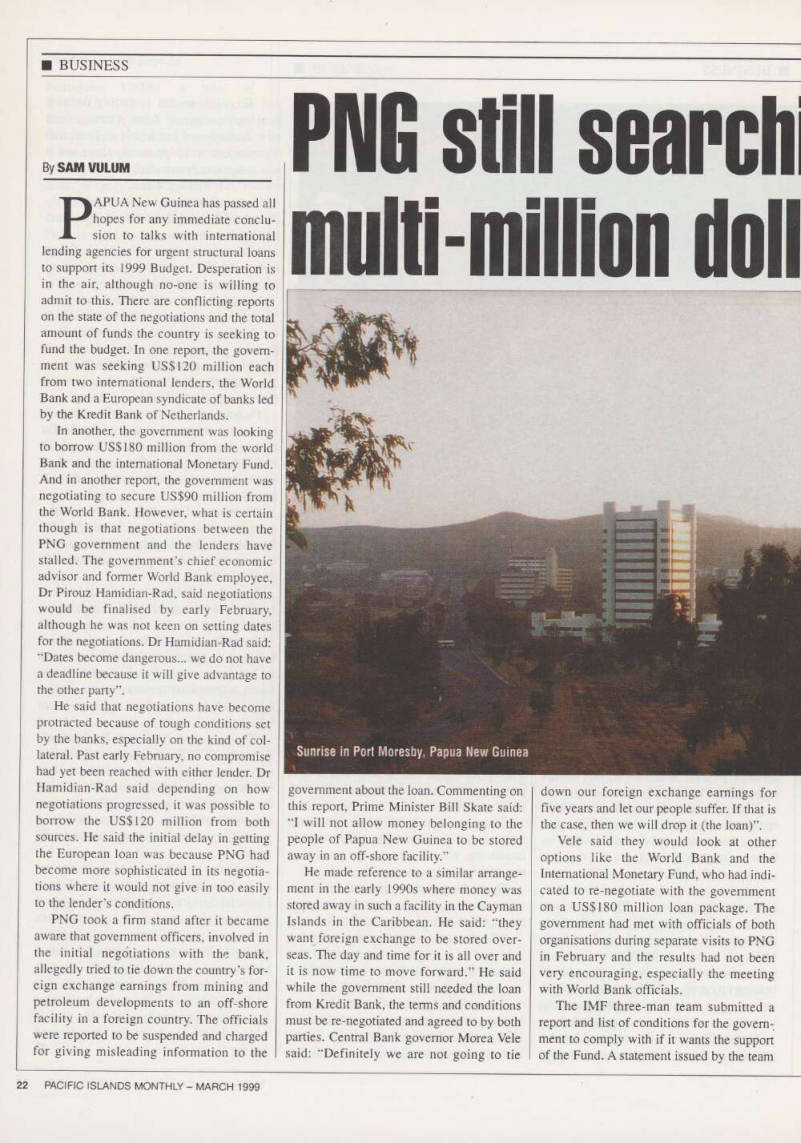
multi-million dollar lender
By Sam Vulum
PAPUA New Guinea has passed all hopes for any immediate conclu sion to talks with international lending agencies for urgent structural loans to support its 1999 Budget. Desperation is in the air, although no-one is willing to admit to this. There are conflicting reports on the state of the negotiations and the total amount of funds the country is seeking to fund the budget. In one report, the govern ment was seeking US$l2O million each from two international lenders, the World Bank and a European syndicate of banks led by the Kredit Bank of Netherlands.
In another, the government was looking to borrow US$lBO million from the world Bank and the international Monetary Fund.
And in another report, the government was negotiating to secure US$9O million from the World Bank. However, what is certain though is that negotiations between the PNG government and the lenders have stalled. The government’s chief economic advisor and former World Bank employee, Dr Pirouz Hamidian-Rad, said negotiations would be finalised by early February, although he was not keen on setting dates for the negotiations. Dr Hamidian-Rad said: “Dates become dangerous... we do not have a deadline because it will give advantage to the other party”.
He said that negotiations have become protracted because of tough conditions set by the banks, especially on the kind of col lateral. Past early February, no compromise had yet been reached with either lender. Dr Hamidian-Rad said depending on how negotiations progressed, it was possible to borrow the US$l2O million from both sources. He said the initial delay in getting the European loan was because PNG had become more sophisticated in its negotia tions where it would not give in too easily to the lender’s conditions.
PNG took a firm stand after it became aware that government officers, involved in the initial negotiations with the bank, allegedly tried to tie down the country’s for eign exchange earnings from mining and petroleum developments to an off-shore facility in a foreign country. The officials were reported to be suspended and charged for giving misleading information to the
government about the loan. Commenting on this report, Prime Minister Bill Skate said: "I will not allow money belonging to the people of Papua New Guinea to be stored away in an off-shore facility.”
He made reference to a similar arrange ment in the early 1990 s where money was stored away in such a facility in the Cayman Islands in the Caribbean. He said: “they want foreign exchange to be stored over seas. The day and time for it is all over and it is now time to move forward.” He said while the government still needed the loan from Kredit Bank, the terms and conditions must be re-negotiated and agreed to by both parties. Central Bank governor Morea Vele said: “Definitely we are not going to tie
down our foreign exchange earnings for five years and let our people suffer. If that is the case, then we will drop it (the loan)”.
Vele said they would look at other options like the World Bank and the International Monetary Fund, who had indi cated to re-negotiate with the government on a US$lBO million loan package. The government had met with officials of both organisations during separate visits to PNG in February and the results had not been very encouraging, especially the meeting with World Bank officials.
The IMF three-man team submitted a report and list of conditions for the govern ment to comply with if it wants the support of the Fund. A statement issued by the team
Sunrise in Port Moresby, Papua New Guinea
said: “The findings of the mission, includ ing recommendations of how best to adapt policies to achieve the government’s objec tive of sustainable, private sector-led investment and growth, were offered in the mission’s concluding statement, which was provided to the PNG authorities. While the mission had limited objective if conduct ing routine consultation discussions, its concluding statements also laid out a road map specifying the procedures, time frame, and policy actions that would be necessary to pave the way for a possible resumption of discussions on an adjustment pro gramme that could be supported by the IMF.” The team leader Lazaros Molho, who is deputy head of the IMF’s Asia and
Pacific department, said before departure that the 1999 Budget’s major public sector reform was an area of concern for his team.
He said there was some doubt and uncertainty about the exact details of the retrenchment exercise, especially cost fac tor. “We provided the government ideas on possible ways to offset possible costs under different scenarios,” Molho said. He said the team was concerned especially that there could be inadequate funding in the budget to pay for retrenchments.
More information was requested from the government, he said. Molho said his team was happy that the government had established dialogue with the World Bank.
“We are very positive... we hope that this will be sustained because we work closely with the world bank,” he said.
Molho said the IMF was happy to con tinue dialogue and discussions from the inconclusive stage it was left at last October. He said the IMF stressed its wish for PNG to adopt good governance and sound macroeconomic policies that would be conducive to growth and investor confi dence. The World Bank, which had finally resolved the issue of the engagement of Dr Hamidian-Rad as the government’s chief economic adviser, had re-opened negotia tions. However, despite being described as fruitful by PNG authorities, the talks ended on a distant note. The World Bank team, which visited in February, adopted a cautious and guarded approach in their negotiations. Team leader Julian Schweitzer, the bank’s director of strategy and operations for far east Asia and Pacific, was noncommittal on a number of issues.
The team gave immediate notice of a complicated, long and tough process before any loan financing could be decided on. This included assessment, discussions, preparations and appraisals before any serious negotiations could take place on PNG’s loan requirements. They said that even though negotiations were almost suc cessfully concluded when aborted last year, a new start would have to be made for discussions of any loan this year.
“We are not here to impose any condi tions, we are here to agree to conditions, that’s a great difference,” Schweitzer said, dispelling rumours of 44 conditions that were believed to have been set last year.
Schweitzer said, however, the bank would be keen to see specific conditions that were geared towards economic growth and the onus was on the PNG government to provide it. He said the government would have to be comfortable with its pol icy. The officials also expressed concern about the implementation record of PNG’s bank loan portfolios.'“Generally, Papua New Guinea’s performance in one area is something we can focus on a lot, and that is the area of social development. In com parison with other countries of similar income, PNG has some way to go yet,”
Schweitzer said.
“That’s something we want to work closely on which the loan will also support.
And that is also to do with how the devel opment expenditure is getting spent, how the recurrent expenditure is getting spent... making sure the money goes to where it needs to and efficiency and the quality of the investments. Budget implementation is important. It’s not just how you allocate resources but the capacity of that particular agency to spend it.”
Schweitzer said the government has also informed the team that is controver sial economic consultant Dr Hamidian- Rad would not take part in any discussions wit the team. However, it was reported later, at the end of the team’s visit, that the bank will have to strike a new deal before any structural adjustment funds will be released. It was reported also that the team had made a preliminary assessment that indicated that economic conditions had deteriorated in the two years since a simi lar assessment was carried out.
The team is expected to compile a report on PNG based on its assessment.
The report is expected to be ready in two months. Following the release of the report, a new round of talks will be held with the PNG government for any possible structural loans for PNG. It would be an
entirely new package, separate from previ
ous negotiations for the aborted US$9O million. The PNG government’s inability to establish quick compromise with lenders raises doubts on its capability to negotiate.
Many people are wondering if the world’s perception of PNG’s economic manage ment ability and its moral credibility has anything to do with the delays. ■
Advertisements & other items, p. 23 (1 item)
igfor
p lendep
Authority
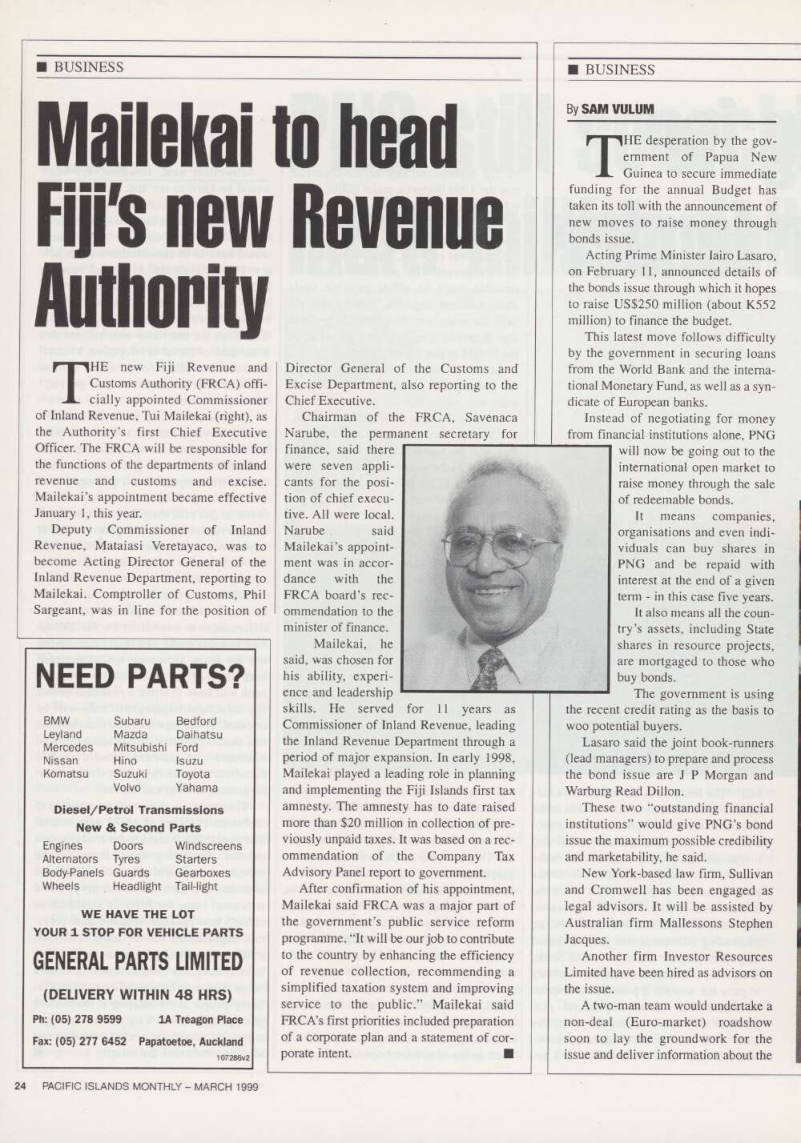
Mailekai to head new Revenue Authority
THE new Fiji Revenue and Customs Authority (FRCA) offi cially appointed Commissioner of Inland Revenue, Tui Mailekai (right), as the Authority’s first Chief Executive Officer. The FRCA will be responsible for the functions of the departments of inland revenue and customs and excise.
Mailekai’s appointment became effective January 1, this year.
Deputy Commissioner of Inland Revenue, Mataiasi Veretayaco, was to become Acting Director General of the Inland Revenue Department, reporting to Mailekai. Comptroller of Customs, Phil Sargeant, was in line for the position of
Director General of the Customs and Excise Department, also reporting to the Chief Executive.
Chairman of the FRCA, Savenaca Narube, the permanent secretary for
finance, said there were seven appli cants for the posi tion of chief execu tive. All were local.
Narube said Mailekai’s appoint ment was in accor dance with the FRCA board’s rec ommendation to the minister of finance.
Mailekai, he said, was chosen for his ability, experi ence and leadership
skills. He served for 11 years as Commissioner of Inland Revenue, leading the Inland Revenue Department through a period of major expansion. In early 1998, Mailekai played a leading role in planning and implementing the Fiji Islands first tax amnesty. The amnesty has to date raised more than $2O million in collection of pre viously unpaid taxes. It was based on a rec ommendation of the Company Tax Advisory Panel report to government.
After confirmation of his appointment, Mailekai said FRCA was a major part of the government’s public service reform programme. “It will be our job to contribute to the country by enhancing the efficiency of revenue collection, recommending a simplified taxation system and improving service to the public.” Mailekai said FRCA’s first priorities included preparation of a corporate plan and a statement of cor porate intent. ■
By Sam Vulum
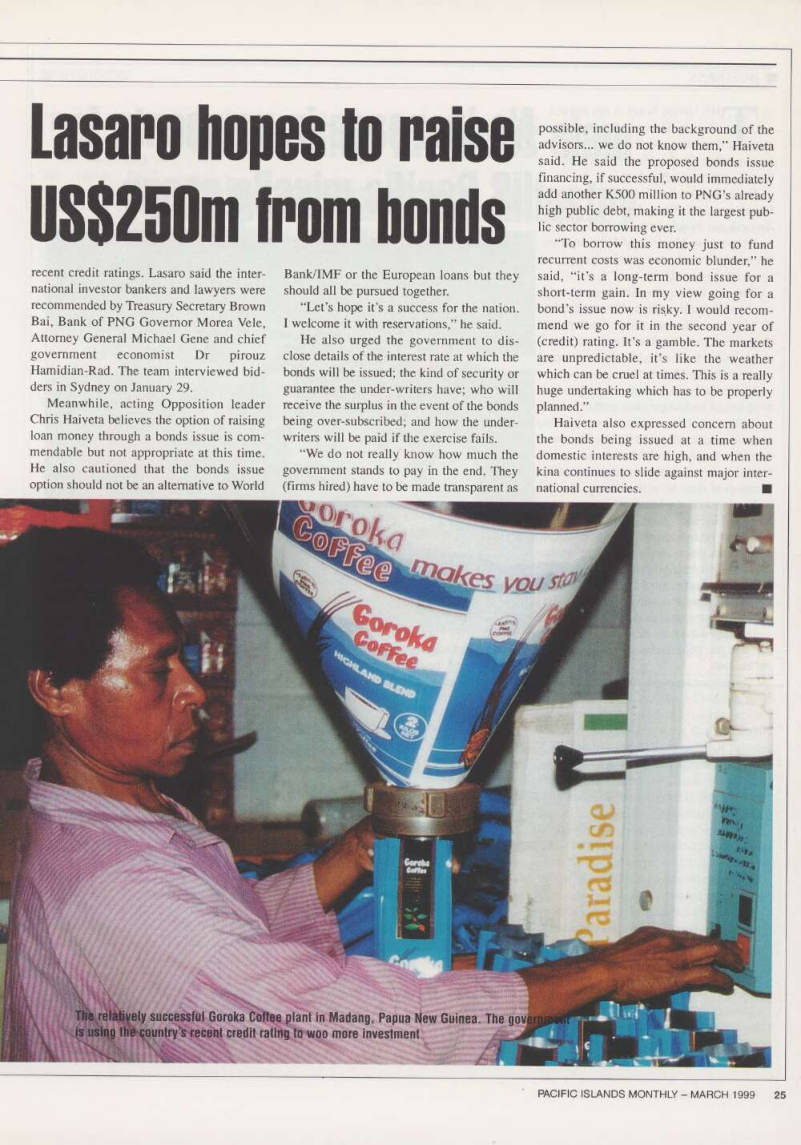
THE desperation by the gov ernment of Papua New Guinea to secure immediate funding for the annual Budget has taken its toll with the announcement of new moves to raise money through bonds issue.
Acting Prime Minister lairo Lasaro, on February 11, announced details of the bonds issue through which it hopes to raise US$25O million (about K 552 million) to finance the budget.
This latest move follows difficulty by the government in securing loans from the World Bank and the interna tional Monetary Fund, as well as a syn dicate of European banks.
Instead of negotiating for money from financial institutions alone, PNG
will now be going out to the international open market to raise money through the sale of redeemable bonds.
It means companies, organisations and even indi viduals can buy shares in PNG and be repaid with interest at the end of a given term - in this case five years.
It also means all the coun try’s assets, including State shares in resource projects, are mortgaged to those who buy bonds.
The government is using
the recent credit rating as the basis to woo potential buyers.
Lasaro said the joint book-runners (lead managers) to prepare and process the bond issue are J P Morgan and Warburg Read Dillon.
These two “outstanding financial institutions” would give PNG’s bond issue the maximum possible credibility and marketability, he said.
New York-based law firm, Sullivan and Cromwell has been engaged as legal advisors. It will be assisted by Australian firm Mallessons Stephen Jacques.
Another firm Investor Resources Limited have been hired as advisors on the issue.
A two-man team would undertake a non-deal (Euro-market) roadshow soon to lay the groundwork for the issue and deliver information about the
Lasaro hopes to raise US$250m front bonds
recent credit ratings. Lasaro said the international investor bankers and lawyers were recommended by Treasury Secretary Brown Bai, Bank of PNG Governor Morea Vele, Attorney General Michael Gene and chief government economist Dr pirouz Hamidian-Rad. The team interviewed bidders in Sydney on January 29.
Meanwhile, acting Opposition leader Chris Haiveta believes the option of raising loan money through a bonds issue is commendable but not appropriate at this time.
He also cautioned that the bonds issue option should not be an alternative to World
Bank/IMF or the European loans but they should all be pursued together.
“Let’s hope it’s a success for the nation, I welcome it with reservations,” he said.
He also urged the government to dis close details of the interest rate at which the bonds will be issued; the kind of security or guarantee the under-writers have; who will receive the surplus in the event of the bonds being over-subscribed; and how the under writers will be paid if the exercise fails.
“We do not really know how much the government stands to pay in the end. They (firms hired) have to be made transparent as
possible, including the background of the advisors... we do not know them,” Haiveta said. He said the proposed bonds issue financing, if successful, would immediately add another K5OO million to PNG’s already high public debt, making it the largest pub lic sector borrowing ever.
“To borrow this money just to fund recurrent costs was economic blunder,” he said, “it’s a long-term bond issue for a short-term gain. In my view going for a bond’s issue now is risky. I would recom mend we go for it in the second year of (credit) rating. It’s a gamble. The markets are unpredictable, it’s like the weather which can be cruel at times. This is a really huge undertaking which has to be properly planned.”
Haiveta also expressed concern about the bonds being issued at a time when domestic interests are high, and when the kina continues to slide against major inter national currencies. ■
The relatively successful Goroka Coffee plant in Madang, Papua New Guinea. The govern[?] is using the country’s recent credit rating to woo more investment
Advertisements & other items, p. 24 (2 items)
24
■ BUSINESS
PACIFIC ISLANDS MONTHLY - MARCH 1999
■ BUSINESS
Need Parts?
Diesel/Petrol Transmissions New & Second Parts Engines Doors Windscreens Alternators Tyres Starters Body-Panels Guards Gearboxes Wheels Headlight Tail-light
WE HAVE THE LOT
YOUR 1 STOP FOR VEHICLE PARTS
GENERAL PARTS LIMITED
(DELIVERY WITHIN 48 HRS)
Ph: (05) 278 9599 1A Treagon Place Fax: (05) 277 6452 Papatoetoe, Auckland 107286V2
No increase in payments for US Pacific missile range
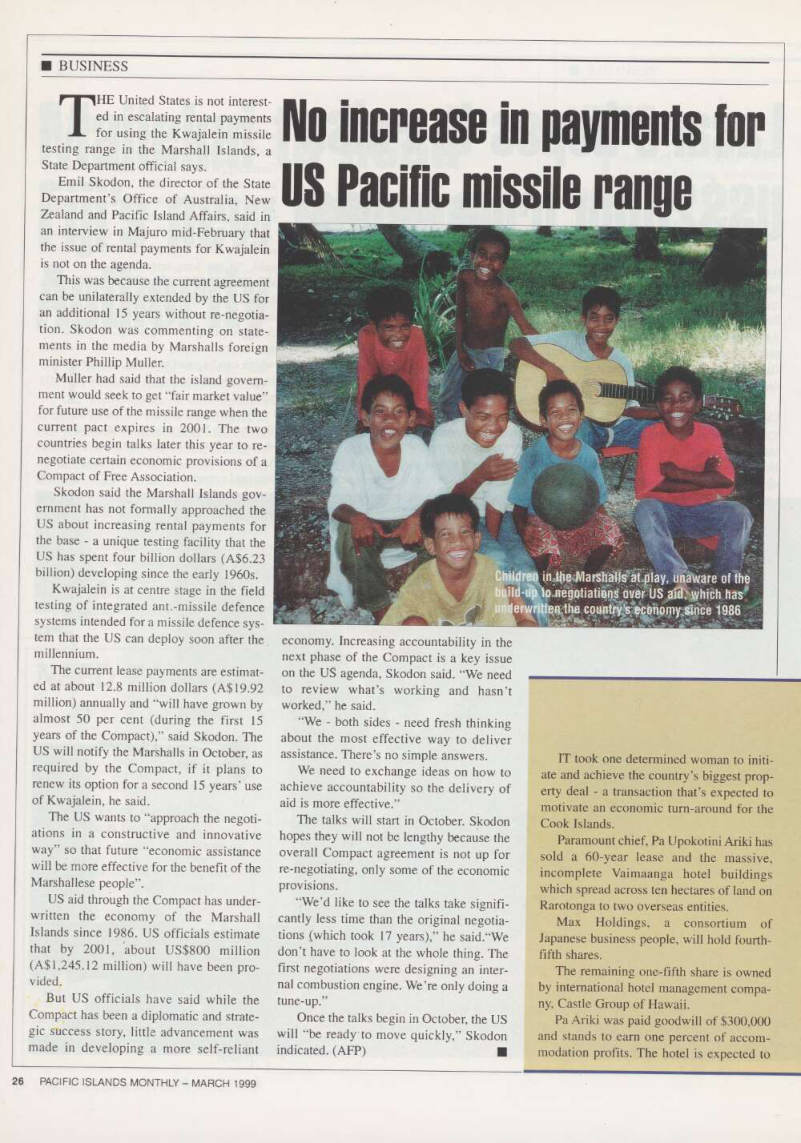
US Pacific missile range
THE United States is not interest ed in escalating rental payments for using the Kwajalein missile testing range in the Marshall Islands, a State Department official says.
Emil Skodon, the director of the State Department’s Office of Australia, New Zealand and Pacific Island Affairs, said in an interview in Majuro mid-February that the issue of rental payments for Kwajalein is not on the agenda.
This was because the current agreement can be unilaterally extended by the US for an additional 15 years without re-negotia tion. Skodon was commenting on state ments in the media by Marshalls foreign minister Phillip Muller.
Muller had said that the island govern ment would seek to get “fair market value” for future use of the missile range when the current pact expires in 2001. The two countries begin talks later this year to re negotiate certain economic provisions of a Compact of Free Association.
Skodon said the Marshall Islands gov ernment has not formally approached the US about increasing rental payments for the base - a unique testing facility that the US has spent four billion dollars (A 56.23 billion) developing since the early 19605.
Kwajalein is at centre stage in the field testing of integrated ant.-missile defence systems intended for a missile defence sys- I tern that the US can deploy soon after the millennium.
The current lease payments are estimat ed at about 12.8 million dollars (A$ 19.92 million) annually and “will have grown by almost 50 per cent (during the first 15 years of the Compact),” said Skodon. The US will notify the Marshalls in October, as required by the Compact, if it plans to renew its option for a second 15 years’ use of Kwajalein, he said.
The US wants to “approach the negoti ations in a constructive and innovative way” so that future “economic assistance will be more effective for the benefit of the Marshallese people”.
US aid through the Compact has under written the economy of the Marshall Islands since 1986. US officials estimate that by 2001, about US$BOO million (A$ 1,245.12 million) will have been pro vided.
But US officials have said while the Compact has been a diplomatic and strate gic success story, little advancement was made in developing a more self-reliant
economy. Increasing accountability in the next phase of the Compact is a key issue on the US agenda, Skodon said. “We need to review what’s working and hasn’t worked,” he said.
“We - both sides - need fresh thinking about the most effective way to deliver assistance. There’s no simple answers.
We need to exchange ideas on how to achieve accountability so the delivery of aid is more effective.”
The talks will start in October. Skodon hopes they will not be lengthy because the overall Compact agreement is not up for re-negotiating, only some of the economic provisions.
“We’d like to see the talks take signifi cantly less time than the original negotia tions (which took 17 years),” he said.“We don’t have to look at the whole thing. The first negotiations were designing an inter nal combustion engine. We’re only doing a tune-up.”
Once the talks begin in October, the US will “be ready to move quickly,” Skodon indicated. (AFP) ■
Children in the Marshalls at play, unaware of the build-up to negotiations over US aid, which has underwritten the country’s economy since 1986
IT took one determined woman to initi
ate and achieve the country’s biggest prop erty deal - a transaction that’s expected to motivate an economic turn-around for the Cook Islands.
Paramount chief, Pa Upokotini Ariki has sold a 60-year lease and the massive,
incomplete Vaimaanga hotel buildings
which spread across ten hectares of land on Rarotonga to two overseas entities.
Max Holdings, a consortium of Japanese business people, will hold fourth fifth shares.
The remaining one-fifth share is owned by international hotel management compa ny, Castle Group of Hawaii.
Pa Ariki was paid goodwill of $300,000 and stands to earn one percent of accom modation profits. The hotel is expected to
Reconstruction of Vaimaanga hotel expected to turn Cooks around
By Florence Syme-Buchanan
be completed June 2000, but may start oper ating before then.
The former state-owned Vaimaanga hotel was like an albatross around the Cook Islands government’s neck.
The government’s original contract with landowner Pa Ariki was that the hotel would be completed within three years - but that time limit dragged on.
Over the past five years there had been much official talk of sale negotiations, but things went little went further than secret meetings and the occasional announce
ments of yet another interested buyer.
At one time, the government owed at least $126,000 million for the partially com plete hotel - a sum representing the bulk of the country’s national debt. Debt restructur ing with Italian creditors late last year sig
nificantly reduced that figure.
Maybe it was with a certain amount of relief that the government lost the Hotel last year after failing to pay Pa Ariki ground rental worth tens of thousands. The para mount chief re-entered the property and for feited the lease.
“This effectively removed the Italian creditors from any sort of claim to the
Vaimaanga land and buildings, so not sur prisingly, the forfeiture of the old lease and the offer of a new one brought renewed interest from a variety of parties,” said Pa Ariki.
And selling it she says is a “win-win sit uation for everyone.”
Pa Ariki said she’s recovered her losses of the past five years and won back part of the land.
“Best of all, the Cook Islands people can look forward to the economy getting a huge boost as the work is pushed to completion and this new, high profile hotel takes its place in the market.”
Re-construction by Fletcher Pacific is scheduled to start this month and will cost between NZ$25 million to NZ$3O million. ■
Saipan's garment industry
Sweatshop lawsuits slam Saipan's garment industry
AN alleged
sweatshop industry on the North Pacific island of Saipan has been hit by a 25 per cent drop in orders since human rights
lawsuits were launched in California against buyers and retailers, it was report
ed late-February.
The Saipan Tribune daily newspaper also quoted a Filipino diplomat as saying Filipinos involved in the work, and now out of work because of the fall in orders, should go home.
Around 40,000 mainly Filipino and Chinese workers work on Saipan which is part of the US territory of the Commonwealth of Northern Mariana Islands (CNMI). Its garments have a “Made in USA” label and enter America without tariff control.
They earn US$l.2 billion (Asl.B bil lion) annually which, since the collapse of CNMFs tourism industry in the wake of the Asian crisis, has been virtually its only income.
Many major brand name clothes are made there.
Human rights groups in San Francisco, Los Angeles and Saipan have filed a US$l billion (A 51.55 billion) class action law
suit alleging clothes were being made under labour conditions that violated US laws. Claims were made of workers being locked into factories, beaten and of forced abortions.
Many major brand name
clothes are made there.
It is claimed many of the workers are indentured which is against US law.
The Tribune said garment manufactur ers had warned the Commonwealth of a 25 per cent plunge in user fees as a result of reduced orders from apparel buyers.
The decline is expected to bring down to US$3B million (A 558.9 million) the total user fee collection anticipated in the current fiscal year which is US$5.l million lower than original projections.
Michael Sablan, special advisor to Governor Pedro Tenorio, said he did not know what the fall would do to the budget.
“The recent filing of the lawsuit... was not part of the variables that were taken
into consideration when the FY 1999 projections were pre pared,” Sablan said in an interview.
“We’re concerned about its impact on our revenue codec -
tions going forward”.
User fees is the amount equivalent to 3.7 per cent of the total gross value of fin ished garment products shipped to the United States by local apparel makers.
In 1998, the combined gross income of garment manufacturers in the Northern Marianas topped US$l billion (A 51.55 bil lion) making the industry the single biggest provider of revenues to the financially troubled government.
Meanwhile, Philippine Consul Julia Heidemann said Filipino contract workers whose contracts were not renewed should explore opportunities in their homeland instead of staying as illegal residents on the Marianas.
She made this appeal in the wake of reports that some Filipinos who are due for renewals were told that their contracts were disapproved by the Department of Labour and Immigration because local res idents qualify for their jobs.
“Let’s try to explore the job market in the Philippines,” she said. (AFP) ■
Bougainville accounts for two-thirds of SI debt problem
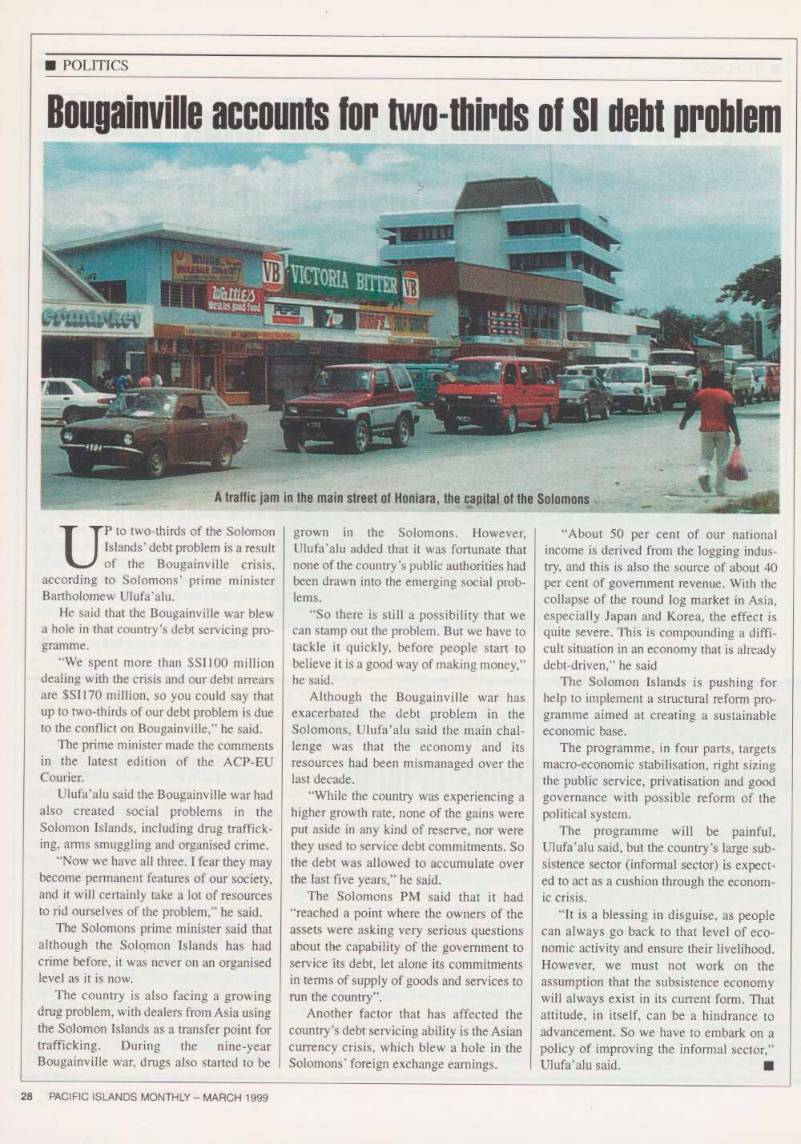
Politics
UP to two-thirds of the Solomon Islands’ debt problem is a result of the Bougainville crisis, according to Solomons’ prime minister Bartholomew Ulufa’alu.
He said that the Bougainville war blew a hole in that country’s debt servicing pro gramme.
“We spent more than SSIIOO million dealing with the crisis and our debt arrears are SSI 170 million, so you could say that up to two-thirds of our debt problem is due to the conflict on Bougainville,” he said.
The prime minister made the comments in the latest edition of the ACP-EU Courier.
Ulufa’alu said the Bougainville war had also created social problems in the Solomon Islands, including drug traffick ing, arms smuggling and organised crime.
“Now we have all three. I fear they may become permanent features of our society, and it will certainly take a lot of resources to rid ourselves of the problem,” he said.
The Solomons prime minister said that although the Solomon Islands has had crime before, it was never on an organised level as it is now.
The country is also facing a growing drug problem, with dealers from Asia using the Solomon Islands as a transfer point for
trafficking. During the nine-year
Bougainville war, drugs also started to be
grown in the Solomons. However, Ulufa’alu added that it was fortunate that none of the country’s public authorities had been drawn into the emerging social prob lems.
“So there is still a possibility that we can stamp out the problem. But we have to tackle it quickly, before people start to believe it is a good way of making money,” he said.
Although the Bougainville war has exacerbated the debt problem in the Solomons, Ulufa’alu said the main chal lenge was that the economy and its resources had been mismanaged over the last decade.
“While the country was experiencing a higher growth rate, none of the gains were put aside in any kind of reserve, nor were they used to service debt commitments. So the debt was allowed to accumulate over the last five years,” he said.
The Solomons PM said that it had “reached a point where the owners of the assets were asking very serious questions about the capability of the government to service its debt, let alone its commitments in terms of supply of goods and services to run the country”.
Another factor that has affected the country’s debt servicing ability is the Asian currency crisis, which blew a hole in the
Solomons’ foreign exchange earnings.
“About 50 per cent of our national income is derived from the logging indus try, and this is also the source of about 40 per cent of government revenue. With the collapse of the round log market in Asia, especially Japan and Korea, the effect is quite severe. This is compounding a diffi cult situation in an economy that is already debt-driven,” he said The Solomon Islands is pushing for help to implement a structural reform pro gramme aimed at creating a sustainable economic base.
The programme, in four parts, targets macro-economic stabilisation, right sizing the public service, privatisation and good governance with possible reform of the political system.
The programme will be painful, Ulufa’alu said, but the country’s large sub sistence sector (informal sector) is expect ed to act as a cushion through the econom ic crisis.
“It is a blessing in disguise, as people can always go back to that level of eco nomic activity and ensure their livelihood.
However, we must not work on the assumption that the subsistence economy will always exist in its current form. That attitude, in itself, can be a hindrance to advancement. So we have to embark on a policy of improving the informal sector,”
Ulufa’alu said. ■
A traffic jam in the main street of Honiara, the capital of the Solomons
Waitangi anniversary
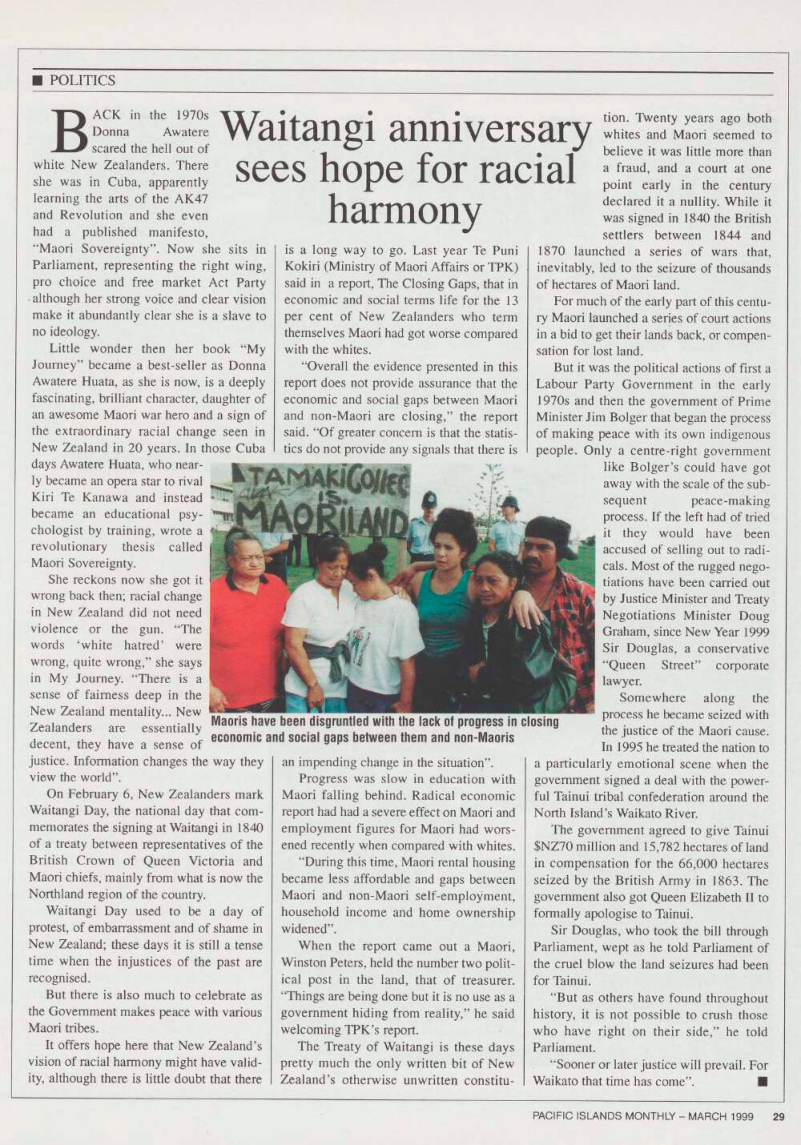
sees hope for racial harmony
BACK in the 1970 s Donna Awatere scared the hell out of white New Zealanders. There she was in Cuba, apparently learning the arts of the AK47 and Revolution and she even had a published manifesto,
“Maori Sovereignty”. Now she sits in Parliament, representing the right wing, pro choice and free market Act Party although her strong voice and clear vision make it abundantly clear she is a slave to
no ideology.
Little wonder then her book “My Journey” became a best-seller as Donna Awatere Huata, as she is now, is a deeply fascinating, brilliant character, daughter of an awesome Maori war hero and a sign of the extraordinary racial change seen in New Zealand in 20 years. In those Cuba
days Awatere Huata, who near ly became an opera star to rival Kiri Te Kanawa and instead became an educational psy chologist by training, wrote a revolutionary thesis called
Maori Sovereignty.
She reckons now she got it wrong back then; racial change in New Zealand did not need violence or the gun. “The words ‘white hatred’ were wrong, quite wrong,” she says in My Journey. “There is a sense of fairness deep in the New Zealand mentality... New Zealanders are essentially decent, they have a sense of
justice. Information changes the way they view the world”.
On February 6, New Zealanders mark Waitangi Day, the national day that com memorates the signing at Waitangi in 1840 of a treaty between representatives of the British Crown of Queen Victoria and Maori chiefs, mainly from what is now the Northland region of the country.
Waitangi Day used to be a day of protest, of embarrassment and of shame in New Zealand; these days it is still a tense time when the injustices of the past are recognised.
But there is also much to celebrate as the Government makes peace with various Maori tribes.
It offers hope here that New Zealand’s vision of racial harmony might have valid ity, although there is little doubt that there
is a long way to go. Last year Te Puni Kokiri (Ministry of Maori Affairs or TPK) said in a report, The Closing Gaps, that in economic and social terms life for the 13 per cent of New Zealanders who term themselves Maori had got worse compared with the whites.
“Overall the evidence presented in this report does not provide assurance that the economic and social gaps between Maori and non-Maori are closing,” the report said. “Of greater concern is that the statis tics do not provide any signals that there is
an impending change in the situation”.
Progress was slow in education with Maori falling behind. Radical economic report had had a severe effect on Maori and employment figures for Maori had wors ened recently when compared with whites.
“During this time, Maori rental housing became less affordable and gaps between Maori and non-Maori self-employment, household income and home ownership widened”.
When the report came out a Maori, Winston Peters, held the number two polit ical post in the land, that of treasurer.
“Things are being done but it is no use as a government hiding from reality,” he said welcoming TPK’s report.
The Treaty of Waitangi is these days pretty much the only written bit of New Zealand’s otherwise unwritten constitu
tion. Twenty years ago both whites and Maori seemed to believe it was little more than a fraud, and a court at one point early in the century declared it a nullity. While it was signed in 1840 the British settlers between 1844 and
1870 launched a series of wars that, inevitably, led to the seizure of thousands of hectares of Maori land.
For much of the early part of this centu ry Maori launched a series of court actions in a bid to get their lands back, or compen sation for lost land.
But it was the political actions of first a Labour Party Government in the early 1970 s and then the government of Prime Minister Jim Bolger that began the process of making peace with its own indigenous people. Only a centre-right government
like Bolger’s could have got away with the scale of the sub sequent peace-making process. If the left had of tried it they would have been accused of selling out to radi cals. Most of the rugged nego tiations have been carried out by Justice Minister and Treaty Negotiations Minister Doug Graham, since New Year 1999 Sir Douglas, a conservative “Queen Street” corporate lawyer.
Somewhere along the process he became seized with the justice of the Maori cause.
In 1995 he treated the nation to
a particularly emotional scene when the government signed a deal with the power ful Tainui tribal confederation around the North Island’s Waikato River.
The government agreed to give Tainui SNZ7O million and 15,782 hectares of land in compensation for the 66,000 hectares seized by the British Army in 1863. The government also got Queen Elizabeth II to
formally apologise to Tainui.
Sir Douglas, who took the bill through Parliament, wept as he told Parliament of the cruel blow the land seizures had been for Tainui.
“But as others have found throughout history, it is not possible to crush those who have right on their side,” he told Parliament.
“Sooner or later justice will prevail. For Waikato that time has come”. ■
Maoris have been disgruntled with the lack of progress in closing economic and social gaps between them and non-Maoris
The fight for high
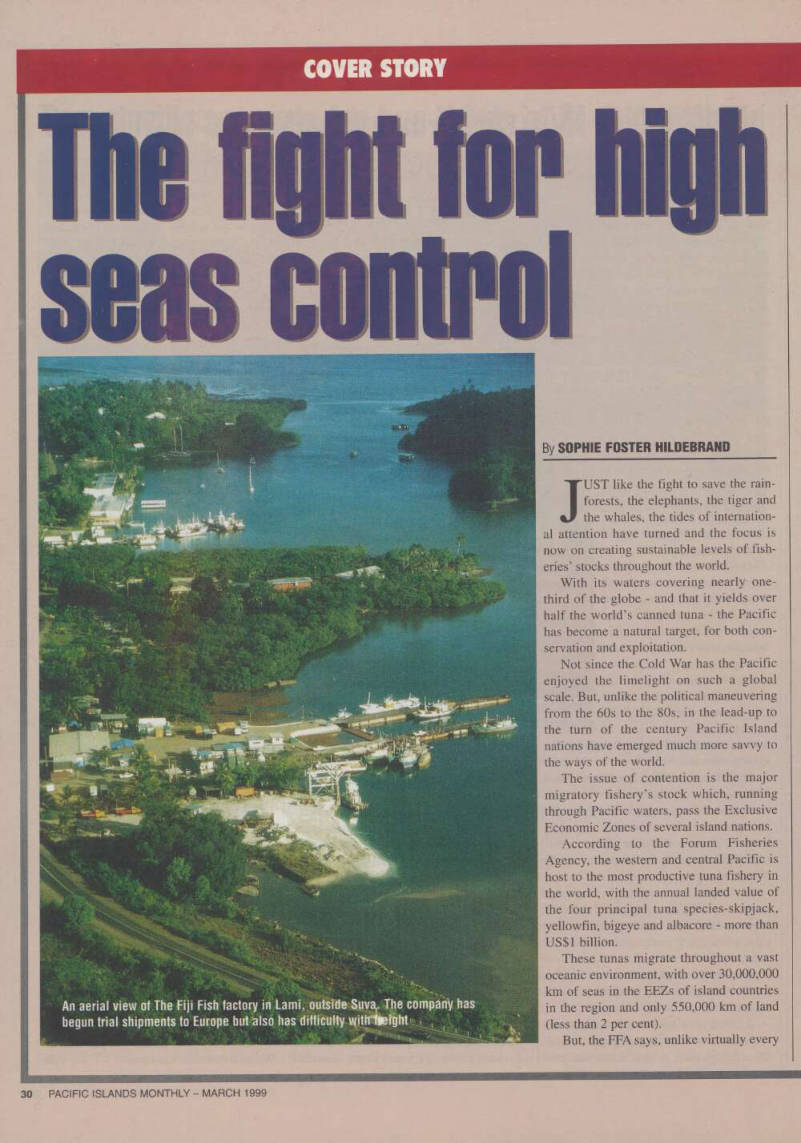
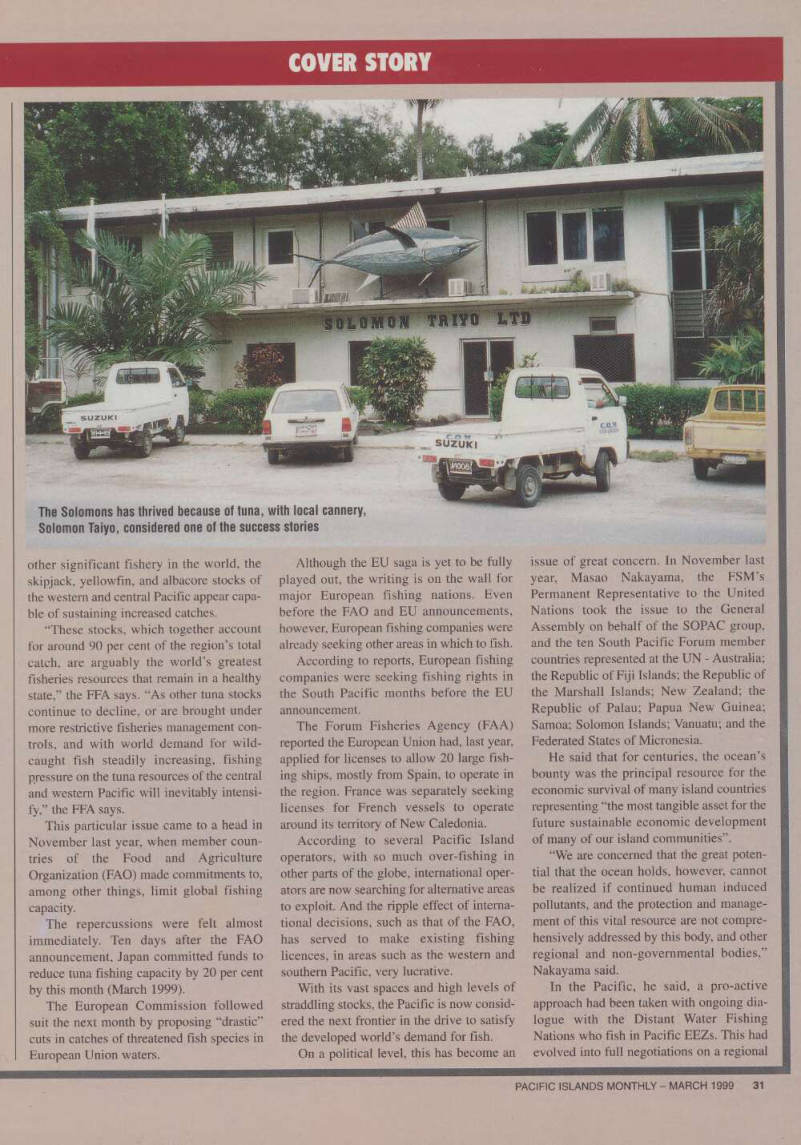
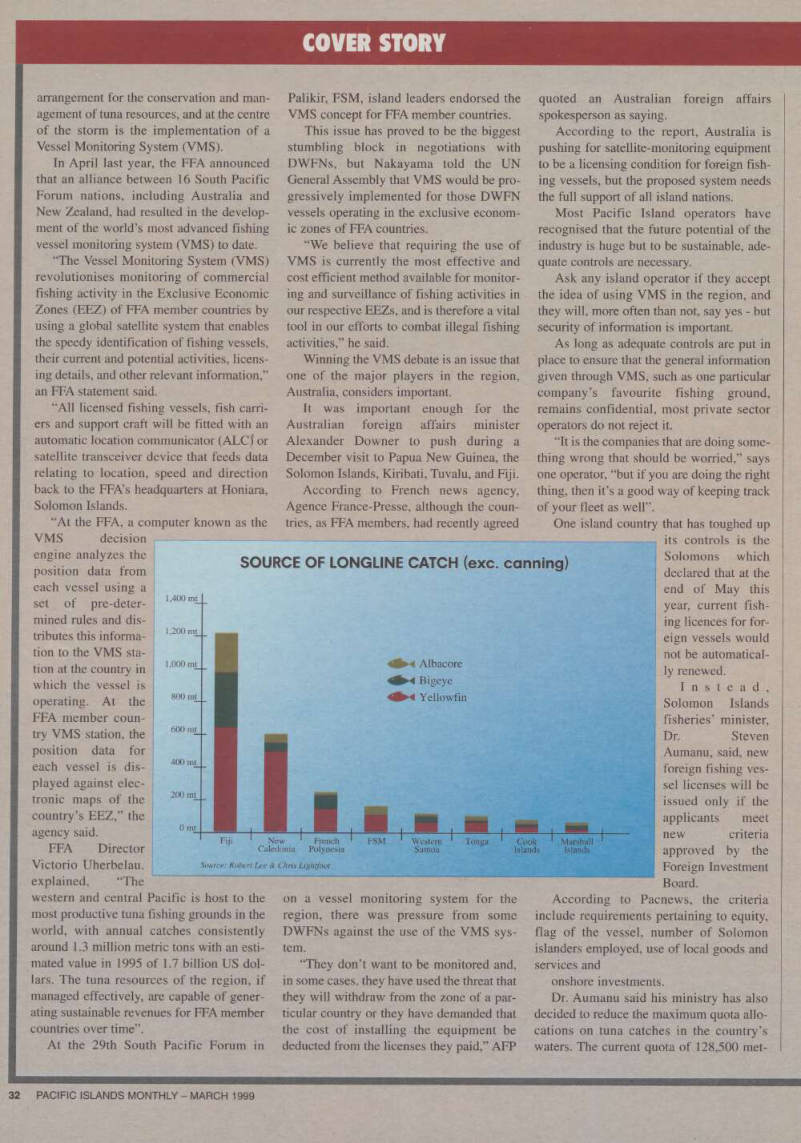
Cover Story
The fight for high seas control
By Sophie Foster Hildebrand
JUST like the fight to save the rain forests, the elephants, the tiger and the whales, the tides of internation al attention have turned and the focus is now on creating sustainable levels of fish eries’ stocks throughout the world.
With its waters covering nearly one third of the globe - and that it yields over half the world’s canned tuna - the Pacific has become a natural target, for both con servation and exploitation.
Not since the Cold War has the Pacific enjoyed the limelight on such a global scale. But, unlike the political maneuvering from the 60s to the 80s, in the lead-up to the turn of the century Pacific Island nations have emerged much more savvy to the ways of the world.
The issue of contention is the major migratory fishery’s stock which, running through Pacific waters, pass the Exclusive Economic Zones of several island nations.
According to the Forum Fisheries Agency, the western and central Pacific is host to the most productive tuna fishery in the world, with the annual landed value of the four principal tuna species-skipjack, yellowfin, bigeye and albacore - more than US$l billion.
These tunas migrate throughout a vast oceanic environment, with over 30,000,000 km of seas in the EEZs of island countries in the region and only 550,000 km of land (less than 2 per cent).
But, the FFA says, unlike virtually every
An aerial view of The Fiji Fish factory in Lami, outside Suva. The company has begun trial shipments to Europe but also has difficulty with [?]elght
other significant fishery in the world, the skipjack, yellowfin, and albacore stocks of the western and central Pacific appear capable of sustaining increased catches.
“These stocks, which together account for around 90 per cent of the region’s total catch, are arguably the world’s greatest fisheries resources that remain in a healthy state,” the PEA says. “As other tuna stocks continue to decline, or are brought under more restrictive fisheries management controls, and with world demand for wildcaught fish steadily increasing, fishing pressure on the tuna resources of the central and western Pacific will inevitably intensify,” the PEA says.
This particular issue came to a head in November last year, when member countries of the Food and Agriculture Organization (FAO) made commitments to, among other things, limit global fishing capacity.
The repercussions were felt almost immediately. Ten days after the FAO announcement, Japan committed funds to reduce tuna fishing capacity by 20 per cent by this month (March 1999).
The European Commission followed suit the next month by proposing “drastic” cuts in catches of threatened fish species in European Union waters.
Although the EU saga is yet to be fully played out, the writing is on the wall for major European fishing nations. Even before the FAO and EU announcements, however, European fishing companies were already seeking other areas in which to fish.
According to reports, European fishing companies were seeking fishing rights in the South Pacific months before the EU announcement.
The Forum Fisheries Agency (FAA) reported the European Union had, last year. applied for licenses to allow 20 large fishing ships, mostly from Spain, to operate in the region. France was separately seeking licenses for French vessels to operate around its territory of New Caledonia.
According to several Pacific Island operators, with so much over-fishing in other parts of the globe, international operators are now searching for alternative areas to exploit. And the ripple effect of international decisions, such as that of the FAO, has served to make existing fishing licences, in areas such as the western and southern Pacific, very lucrative.
With its vast spaces and high levels of straddling stocks, the Pacific is now considered the next frontier in the drive to satisfy the developed world's demand for fish.
On a political level, this has become an
issue of great concern. In November last year, Masao Nakayama, the FSM’s Permanent Representative to the United Nations took the issue to the General Assembly on behalf of the SOPAC group, and the ten South Pacific Forum member countries represented at the UN - Australia; the Republic of Fiji Islands; the Republic of the Marshall Islands; New Zealand; the Republic of Palau; Papua New Guinea; Samoa; Solomon Islands; Vanuatu; and the Federated States of Micronesia, He said that for centuries, the ocean s bounty was the principal resource for the economic survival of many island countries representing “the most tangible asset for the future sustainable economic development of many of our island communities .
“We are concerned that the great poten tial that the ocean holds, however, cannot be realized if continued human induced pollutants, and the protection and manage ment of this vital resource are not compre hensively addressed by this body, and other
regional and non-governmental bodies,
Nakayama said.
In the Pacific, he said, a pro-active approach had been taken with ongoing dia logue with the Distant Water Fishing Nations who fish in Pacific EEZs. This had evolved into full negotiations on a regional
The Solomons has thrived because of tuna, with local cannery, Solomon Taiyo, considered one of the success stories
arrangement for the conservation and man agement of tuna resources, and at the centre of the storm is the implementation of a
Vessel Monitoring System (VMS).
In April last year, the FFA announced that an alliance between 16 South Pacific Forum nations, including Australia and New Zealand, had resulted in the develop ment of the world’s most advanced fishing vessel monitoring system (VMS) to date.
“The Vessel Monitoring System (VMS) revolutionises monitoring of commercial fishing activity in the Exclusive Economic Zones (EEZ) of FFA member countries by using a global satellite system that enables the speedy identification of fishing vessels, their current and potential activities, licens ing details, and other relevant information,” an FFA statement said.
“All licensed fishing vessels, fish carri ers and support craft will be fitted with an automatic location communicator (ALCj or satellite transceiver device that feeds data relating to location, speed and direction back to the FEA’s headquarters at Honiara, Solomon Islands.
“At the FFA, a computer known as the
VMS decision engine analyzes the position data from each vessel using a set of pre-deter mined rules and dis tributes this informa tion to the VMS sta tion at the country in which the vessel is operating. At the FFA member coun try VMS station, the position data for each vessel is dis played against elec tronic maps of the country’s FEZ,” the agency said.
FFA Director Victorio Uherbelau.
explained, “The
western and central Pacific is host to the most productive tuna fishing grounds in the world, with annual catches consistently around 1.3 million metric tons with an esti mated value in 1995 of 1.7 billion US dol lars. The tuna resources of the region, if managed effectively, are capable of gener ating sustainable revenues for FEA member countries over time”.
At the 29th South Pacific Forum in
Palikir, FSM, island leaders endorsed the VMS concept for FFA member countries.
This issue has proved to be the biggest stumbling block in negotiations with DWFNs, but Nakayama told the UN General Assembly that VMS would be pro gressively implemented for those DWFN vessels operating in the exclusive econom ic zones of FFA countries.
“We believe that requiring the use of VMS is currently the most effective and cost efficient method available for monitor ing and surveillance of fishing activities in our respective EEZs, and is therefore a vital tool in our efforts to combat illegal fishing activities,” he said.
Winning the VMS debate is an issue that one of the major players in the region, Australia, considers important.
It was important enough for the Australian foreign affairs minister Alexander Downer to push during a December visit to Papua New Guinea, the Solomon Islands, Kiribati, Tuvalu, and Fiji.
According to French news agency, Agence France-Presse, although the coun tries, as FFA members, had recently agreed
on a vessel monitoring system for the region, there was pressure from some DWFNs against the use of the VMS sys tem.
“They don’t want to be monitored and, in some cases, they have used the threat that they will withdraw from the zone of a par ticular country or they have demanded that the cost of installing the equipment be deducted from the licenses they paid,” AFP
quoted an Australian foreign affairs
spokesperson as saying.
According to the report, Australia is
pushing for satellite-monitoring equipment
to be a licensing condition for foreign fish ing vessels, but the proposed system needs the full support of all island nations.
Most Pacific Island operators have recognised that the future potential of the industry is huge but to be sustainable, ade quate controls are necessary.
Ask any island operator if they accept the idea of using VMS in the region, and they will, more often than not, say yes - but security of information is important.
As long as adequate controls are put in place to ensure that the general information given through VMS, such as one particular
company’s favourite fishing ground,
remains confidential, most private sector operators do not reject it.
“It is the companies that are doing some thing wrong that should be worried,” says one operator, “but if you are doing the right thing, then it’s a good way of keeping track of your fleet as well”.
One island country that has toughed up
its controls is the Solomons which declared that at the end of May this year, current fish ing licences for for eign vessels would not be automatical ly renewed.
Instead, Solomon Islands fisheries’ minister, Dr. Steven Aumanu, said, new foreign fishing ves sel licenses will be issued only if the applicants meet new criteria approved by the Foreign Investment Board.
According to Pacnews, the criteria
include requirements pertaining to equity,
flag of the vessel, number of Solomon islanders employed, use of local goods and services and onshore investments.
Dr. Aumanu said his ministry has also decided to reduce the maximum quota allo cations on tuna catches in the country’s waters. The current quota of 128,500 met
ric tons is viewed by the government as
“exceedingly unsustainable”.
The issue of sustainability is one that greatly concerns Pacific Island govern ments and operators, for many of whom fisheries may be the only lifeline for eco nomic survival.
The South Pacific Forum continually highlights the need for sustainable catch levels for all fisheries and to exploit oppor tunities for value-added processing thus maximising the benefit to Forum members.
But as Fiji’s deputy minister for fish eries, Lagisoa Delana, told a recent AGP
EU Industrial Partnership meeting in Nadi, “this is not easy to achieve because our efforts have been constrained by the lack of capital, technology and expertise, and the absence of suitable markets. It has meant that someone else has to do the fishing' (mostly foreigners) while we gradually develop our capacity, in all aspects of the tuna industry”.
According to the FFA, a number of con straints remain in many FFA island coun tries that actively discourage potential fish eries’ investors.
Chief amongst these was the “general
shortage of Pacific islanders with the skills required to manage and develop the fish eries industry, ranging from the skills required by the private sector to maintain an operation (such as welding, refrigera tion, mechanics, crewing, and on-shore management), to the skills needed in the public sector (such as fisheries manage ment, economic and legal skills),” the FFA says.
In Samoa, the industry has grown from being virtually non-existent in 1994, to a situation where it is the country’s number one export earner. According to John Luff,
the managing director of APIA Export Fish Packers Limited, fresh tuna volumes out of Samoa last year totaled more than 400 tonnes.
He said though, that the industry had only three 24 and 18 metre vessels with the majority of the catch being brought in by about 300 small boats.
This has presented some very serious constraints for the industry because the range of such small boats means that it is
unable to operate in more than 10 per cent of the country’s FEZ.
However, Luff says operators have gone a
long way to improving
the capacity to hold products and there has been enormous capital growth in on-shore facilities.
In other Pacific island countries, howev er, lack of capital has
restricted development.
In Tonga, where local investors are in
direct competition with the government, there has been minimal growth in the indus try. According to Leonhard Niit, the man aging director of Maritime Projects CO (Tonga) Limited, there are four companies doing tuna longlining at the moment, but access to capital is a problem. Most of the operators started small and gradually built up resources.
Fresh fish, because it fetches a higher price on the market, is the target, he says.
However, a substantial part of the catch is large albacore tuna that is sent overseas to canneries.
For future developments, Niit suggests that the government invest in a medium scale processing plant, which will cater for the needs of the island operators who would not be able to find the capital for such a pro ject. The industry in Tonga is restricted from further development because of the economic climate in the country at the moment, he says, but this has been com
pounded by infrastructural problems.
“Over the last six months, there have been enormous freight problems. The infra structure cannot support further growth,”
Niit says.
But this problem is not restricted to Tonga, and is an issue that has to be addressed in all Pacific Island countries.
The FFA says that the infrastructure needs in several countries are limited and blames it on a lack of focus by governments.
“The lack of a focus in terms of future fisheries development needs within govern ment results in inadequate planning for the industry’s future infrastructure require ments,” the FFA said.
In Papua New Guinea, for example, freight capacity both internally and exter nally are limiting development.
Maurice Brownjohn, the managing director of Latitude 8 Pty Limited, says there is still no in-country freight capacity although there is a major need for it.
The one quick way to get goods to the international airport or major shipping areas is by airfreight but this, he says, is expensive and limited to negligible amounts on Air Niugini flights within the country.
As well, he says, of the majority of flights out of the country, only two have connections to get into Europe, which holds major potential as a new market for the country’s fish.
On these flights, fish products have to compete with other major export goods for airfreight space.
Grahame Southwick, manager of The Fiji Fish Marketing Group, who has already sent trial shipments of tuna into Europe, says that the freight problem is one that even Fiji operators have difficulty with.
Because of its developed tourism indus try, Fiji has the benefit of many internation al flights through the country. In fact, of all the countries in the region, Fiji is consid ered to have the best transport links to export markets.
According to a paper by consultants Robert Lee and Chris Lightfoot, New
Caledonia has an established industry, sup plying Japan and its local market. French Polynesia, they say, is established, fishing mainly albacore for fresh sales and canning, while Micronesia has a large fishery export
ing mainly to Japan.
In Samoa, they see fisheries as an emerging industry, focused mainly on in shore fishery with limited infrastructure and transportation. Tonga is established with small, fair infrastructure and trans
portation. Of all the countries that they rated, Fiji’s established fishing industry seemed to have the better deal, with the best transport links in the region and reasonable infrastructure.
But Fiji’s chilled fish exports have to compete with all the other exports that leave Fiji’s shores such as garments, processed agricultural products and even canned fish. The situa tion is one that irks many
exporters, whose sashimi grade tuna some times misses the plane because of lack of
air-cargo space.
These problems are an everyday reality to people who work in the fishing industry in the Pacific.
The fact of the matter is that without any significant change in the availability of air freight space for refrigerated containers, the Pacific fresh tuna export industry may not develop much more than it has now.
For the frozen fish market, including canneries in the United States, Australia, Europe and Asia, the potential for develop ment is substantial - but this too may depend on changes to shipping routes and more frequent schedules throughout the region. With its relatively small population size compared to the expanse of ocean that the Pacific occupies, it does not seem pos sible that island nations will deplete their valuable fisheries resources.
The area for concern, for many officials, is when island countries give up this right to outsiders, without adequate controls and with minimal returns.
It is this situation that Pacific Island countries, operators and international legis lation have teamed up to fight. With unwa vering commitment to this end, the winner can only be the Pacific. ■
Smoked tuna from a factory in Fiji, before being packed for export
Agreement For The Implementation Of The Provisions Of The United Nations Convention
ON THE LAW OF THE SEA OF 10 DECEMBER 1982 RELATING TO THE CONSERVATION AND MANAGEMENT OF STRADDLING FISH STOCKS AND HIGHLY MIGRATORY FISH STOCKS
Part 111
Mechanisms For International Cooperation
Concerning Straddling Fish Stocks And High
Ly Migratory Fish Stocks
Article 8 Cooperation for conservation and management 1. Coastal States and States fishing on the high seas shall, in accordance with the Convention, pursue cooperation in relation to straddling fish stocks and highly migratory fish stocks either directly or through appropriate subregional or regional fisheries management organizations or arrangements, taking into account the specific characteristics of the subregion or region, to ensure effective conservation and management of such stocks. 2. States shall enter into consultations in good faith and with out delay, particularly where there is evidence that the strad . dling fish stocks and highly migratory fish stocks concerned may be under threat of over-exploitation or where a new fishery is being developed for such stocks. To this end, consultations may be initiated at the request of any interested State with a view to establishing appropriate arrangements to ensure conser vation and management of the stocks. Pending agreement on such arrangements, States shall observe the provisions of this Agreement and shall act in good faith and with due regard to the rights, interests and duties of other States. 3. Where a subregional or regional fisheries management organization or arrangement has the competence to establish conservation and management measures for particular strad dling fish stocks or highly migratory fish stocks, States fishing for the stocks on the high seas and relevant coastal States shall give effect to their duty to cooperate by becoming members of such organization or participants in such arrangement, or by
agreeing to apply the conservation and management measures established by such organization or arrangement. States having a real interest in the fisheries concerned may become members of such organization or participants in such arrangement. The terms of participation in such organization or arrangement shall not preclude such States from membership or participation; nor shall they be applied in a manner which discriminates against any State or group of States having a real interest in the fisheries concerned. 4. Only those States which are members of such an organi zation or participants in such an arrangement, or which agree to apply the conservation and management measures established by such organization or arrangement, shall have access to the fishery resources to which those measures apply. 5. Where there is no subregional or regional fisheries man agement organization or arrangement to establish conservation and management measures for a particular straddling fish stock or highly migratory fish stock, relevant coastal States and States fishing on the high seas for such stock in the subregion or region shall cooperate to establish such an organization or enter into other appropriate arrangements to ensure conservation and man agement of such stock and shall participate in the work of the organization or arrangement. 6. Any State intending to propose that action be taken by an
intergovernmental organization having competence with respect
to living resources should, where such action would have a sig nificant effect on conservation and management measures already established by a competent subregional or regional fish eries management organization or arrangement, consult through that organization or arrangement with its members or partici pants. To the extent practicable, such consultation should take place prior to the submission of the proposal to the intergovern mental organization.
PNG gets tough on tuna
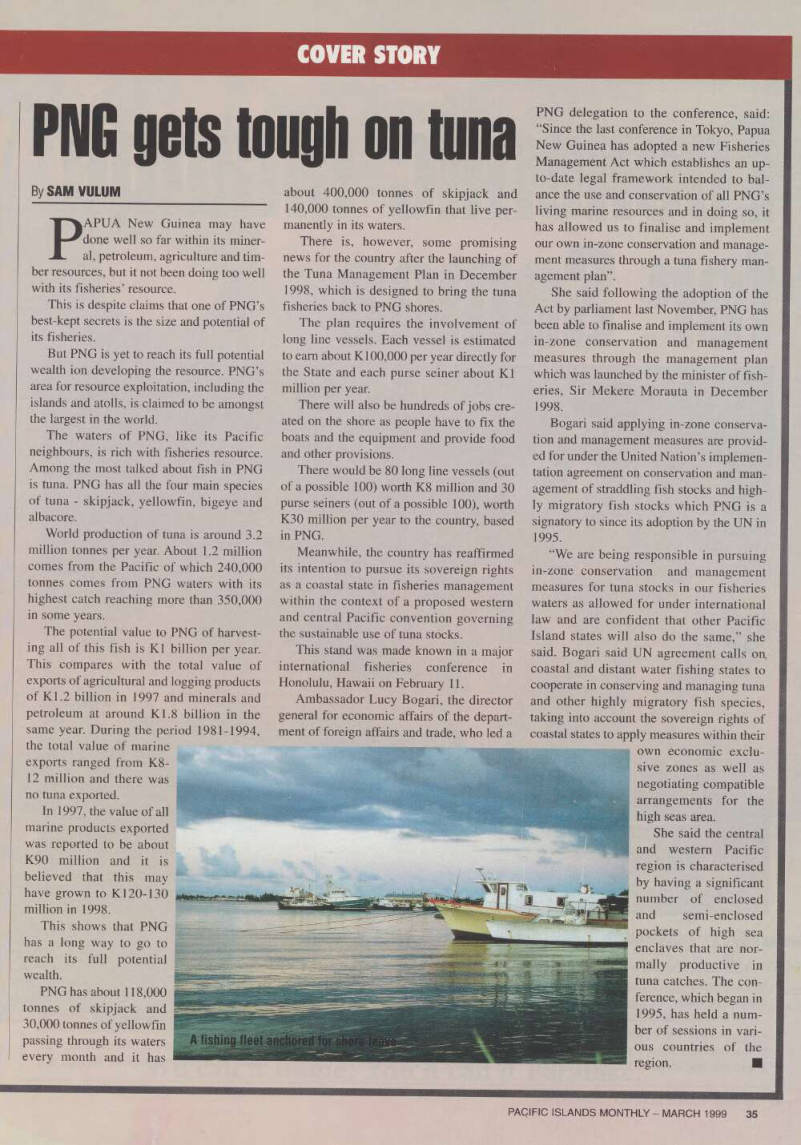
By Sam Vulum
PAPUA New Guinea may have done well so far within its miner al, petroleum, agriculture and tim ber resources, but it not been doing too well with its fisheries’ resource.
This is despite claims that one of PNG’s best-kept secrets is the size and potential of its fisheries.
But PNG is yet to reach its full potential wealth ion developing the resource. PNG’s area for resource exploitation, including the islands and atolls, is claimed to be amongst the largest in the world.
The waters of PNG, like its Pacific neighbours, is rich with fisheries resource.
Among the most talked about fish in PNG is tuna. PNG has all the four main species of tuna - skipjack, yellowfin, bigeye and albacore.
World production of tuna is around 3.2 million tonnes per year. About 1.2 million comes from the Pacific of which 240,000 tonnes comes from PNG waters with its highest catch reaching more than 350,000 in some years.
The potential value to PNG of harvest ing all of this fish is K 1 billion per year.
This compares with the total value of exports of agricultural and logging products of K 1.2 billion in 1997 and minerals and petroleum at around Kl.B billion in the same year. During the period 1981-1994,
the total value of marine exports ranged from KB - million and there was no tuna exported.
In 1997, the value of all marine products exported was reported to be about K9O million and it is believed that this may have grown to Kl2O-130 million in 1998.
This shows that PNG has a long way to go to reach its full potential wealth.
PNG has about 118,000 tonnes of skipjack and 30,000 tonnes of yellowfin
passing through its waters
every month and it has
about 400,000 tonnes of skipjack and 140,000 tonnes of yellowfin that live per manently in its waters.
There is, however, some promising news for the country after the launching of the Tuna Management Plan in December 1998, which is designed to bring the tuna fisheries back to PNG shores.
The plan requires the involvement of long line vessels. Each vessel is estimated to earn about K 100,000 per year directly for the State and each purse seiner about K 1 million per year.
There will also be hundreds of jobs cre ated on the shore as people have to fix the boats and the equipment and provide food and other provisions.
There would be 80 long line vessels (out of a possible 100) worth K 8 million and 30 purse seiners (out of a possible 100), worth K3O million per year to the country, based in PNG.
Meanwhile, the country has reaffirmed its intention to pursue its sovereign rights as a coastal state in fisheries management within the context of a proposed western and central Pacific convention governing the sustainable use of tuna stocks.
This stand was made known in a major international fisheries conference in Honolulu, Hawaii on February 11.
Ambassador Lucy Bogari, the director general for economic affairs of the depart ment of foreign affairs and trade, who led a
PNG delegation to the conference, said: “Since the last conference in Tokyo, Papua New Guinea has adopted a new Fisheries Management Act which establishes an up to-date legal framework intended to bal ance the use and conservation of all PNG’s living marine resources and in doing so, it has allowed us to finalise and implement our own in-zone conservation and manage ment measures through a tuna fishery man agement plan”.
She said following the adoption of the Act by parliament last November, PNG has been able to finalise and implement its own in-zone conservation and management measures through the management plan which was launched by the minister of fish eries, Sir Mekere Morauta in December 1998.
Bogari said applying in-zone conserva tion and management measures are provid ed for under the United Nation’s implemen tation agreement on conservation and man agement of straddling fish stocks and high ly migratory fish stocks which PNG is a signatory to since its adoption by the UN in 1995.
“We are being responsible in pursuing in-zone conservation and management measures for tuna stocks in our fisheries waters as allowed for under international law and are confident that other Pacific Island states will also do the same,” she said. Bogari said UN agreement calls on, coastal and distant water fishing states to cooperate in conserving and managing tuna
and other highly migratory fish species,
taking into account the sovereign rights of coastal states to apply measures within their
own economic exclu sive zones as well as
negotiating compatible
arrangements for the high seas area.
She said the central and western Pacific region is characterised by having a significant number of enclosed and semi-enclosed pockets of high sea enclaves that are nor mally productive in tuna catches. The con ference, which began in 1995, has held a num ber of sessions in vari ous countries of the region. ■
A fishing fleet anchored for shore leave
Economic change
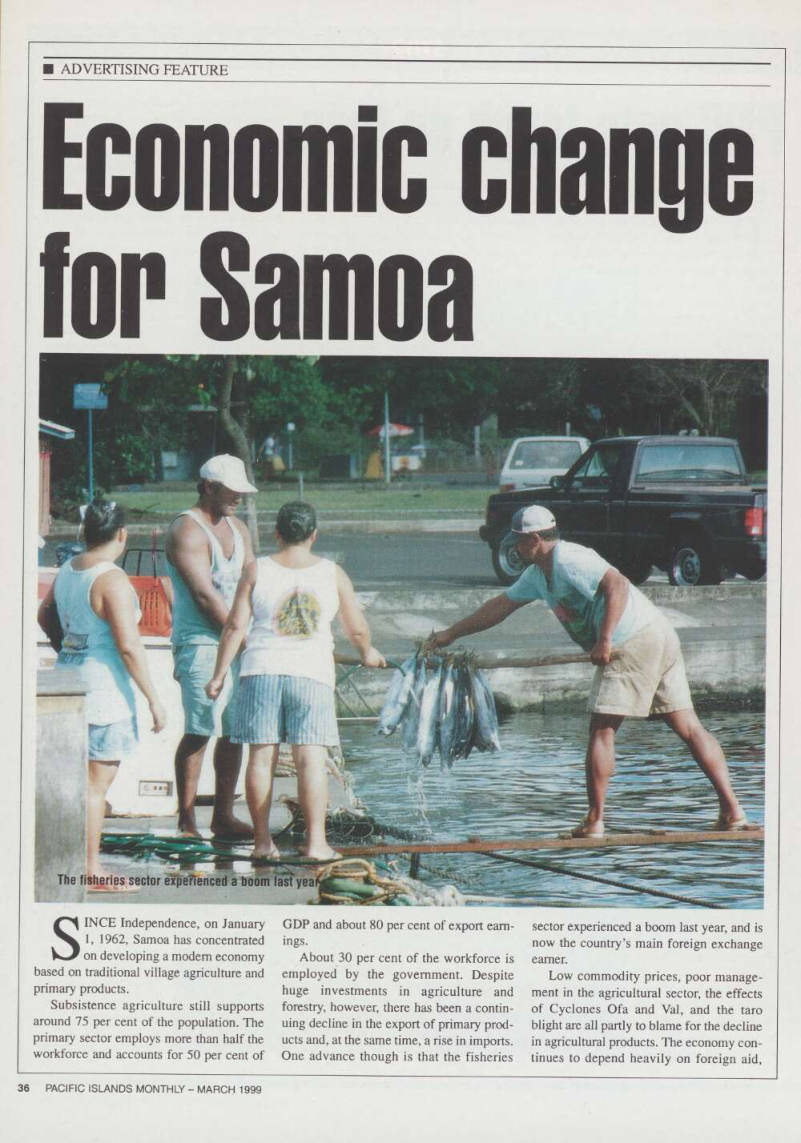


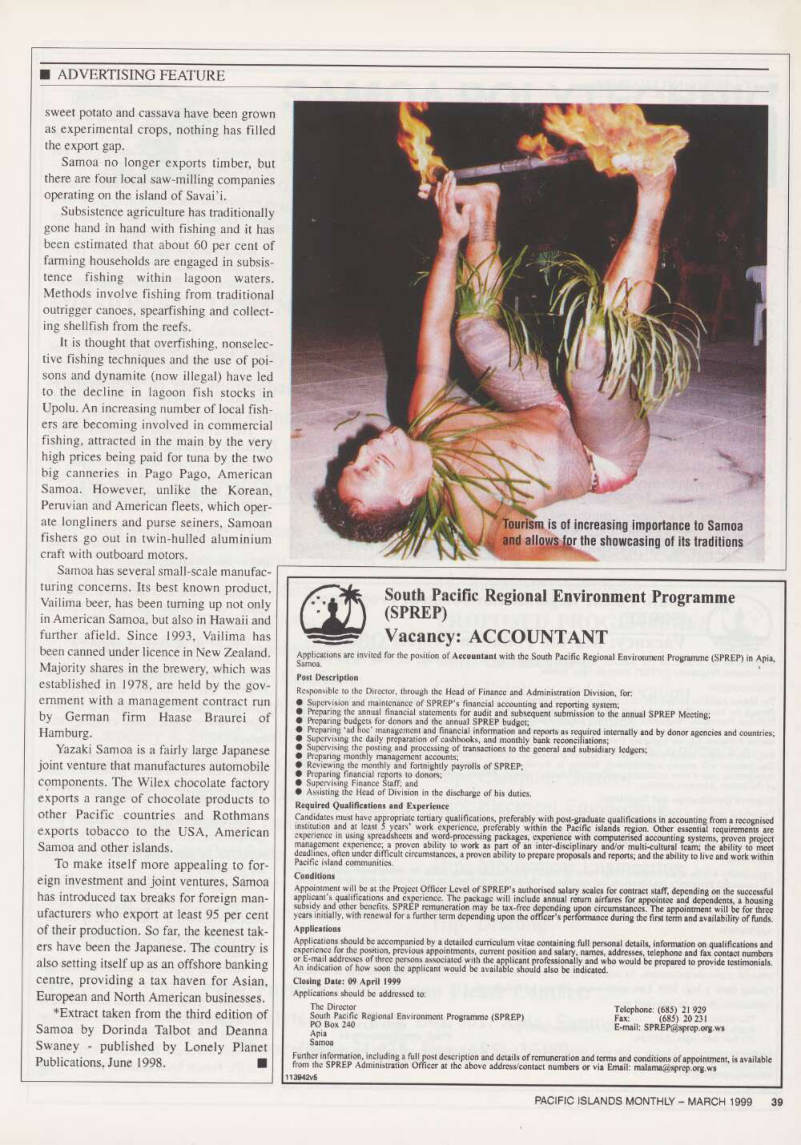
Advertising Feature
Economic change for Samoa
SINCE Independence, on January
1, 1962, Samoa has concentrated on developing a modem economy based on traditional village agriculture and
primary products.
Subsistence agriculture still supports around 75 per cent of the population. The primary sector employs more than half the workforce and accounts for 50 per cent of
GDP and about 80 per cent of export earn ings.
About 30 per cent of the workforce is employed by the government. Despite huge investments in agriculture and forestry, however, there has been a contin uing decline in the export of primary prod ucts and, at the same time, a rise in imports.
One advance though is that the fisheries
sector experienced a boom last year, and is now the country’s main foreign exchange earner.
Low commodity prices, poor manage ment in the agricultural sector, the effects of Cyclones Ofa and Val, and the taro blight are all partly to blame for the decline in agricultural products. The economy con tinues to depend heavily on foreign aid,
provided by New Zealand, Australia, the European Economic Community, Japan and China. Remittance from Samoans working overseas is another important source of foreign exchange.
Emigration to Australasia and North America remains high, and though this pro vides much-needed foreign exchange, it also results in a loss of skilled workers.
Those who leave often find it difficult to adjust to the stress of living in a fast-paced, materialistic society.
Wages in Independent Samoa are extremely low relative to local living costs; the minimum legal wage for employees of private companies is STS2.SO per hour. It is understandable then that many Samoan workers find it difficult to resist trading their professional jobs for drudgery work at the tuna canneries in American Samoa or an unsettling life in the fast lanes of New Zealand, Australia or the USA.
Tourism is of increasing importance to the economy of Samoa and in recent years
the government has promoted the devel opment of light manufacturing industries.
Coffee, bananas and copra have histor ically been the most important export crops and for a while, cocoa was the star on Samoa’s economic horizon. In 1980, US$5 million worth of cocoa was pro duced and throughout the 1980 s, the export amount increased steadily every year.
In the 19905, cyclone damage, coupled with a waning enthusiasm for this crop, caused exports to plummet. Plantations still cover parts of Savai’i but most of the cocoa (which is said to be the best in the world) is for domestic consumption.
Samoa’s banana export business, which was decimated in the late 1950 s by disease, cyclone damage, mismanage ment and competition from Latin America, was revived somewhat in mid -1993 when the 12-hectare plantation of the Agricultural Store Corporations began exporting four container loads to New Zealand each month. Bananas are still exported to New Zealand but growers cannot produce enough to satisfy demand.
Currently, the African tree snail, first noticed in Apia three or four years ago, poses a threat to banana plantations.
Coconuts and small quantities of coconut oil are exported to Australia and elsewhere. Until recently, the largest coconut plantation in the southern hemi sphere was at Mulifanua, 40km west of Apia. The government-controlled Samoa Land Corporation has since bought much of the land and is in the process of selling and leasing it as private land.
Samoa has traditionally been one of the world’s largest producers of taro niue (a tasty and easily stored strain of taro), exporting ST$6.9 million worth of the root crop annually, mainly to expatriate populations in New Zealand, Australia and the USA.
In July 1993, however, a virulent fun gal blight, Phytophthora colocasiae, was discovered in the Samoas. (This infesta tion is a close cousin of the infamous potato blight that destroyed Ireland’s potato crops in the 19405, leading to the starvation of almost one-third of the coun
try’s population.)
By the end of 1994, it had wiped out crops throughout Upolu and Savai’i. Taro crops have still not recovered and taro must now be imported. Though ta’amu, or ‘big taro’, is grown in place of taro, and
sweet potato and cassava have been grown as experimental crops, nothing has filled the export gap.
Samoa no longer exports timber, but there are four local saw-milling companies operating on the island of Savai’i.
Subsistence agriculture has traditionally gone hand in hand with fishing and it has been estimated that about 60 per cent of farming households are engaged in subsis tence fishing within lagoon waters.
Methods involve fishing from traditional outrigger canoes, spearfishing and collect ing shellfish from the reefs.
It is thought that overfishing, nonselec tive fishing techniques and the use of poi sons and dynamite (now illegal) have led to the decline in lagoon fish stocks in Upolu. An increasing number of local fish ers are becoming involved in commercial fishing, attracted in the main by the very high prices being paid for tuna by the two big canneries in Pago Pago, American Samoa. However, unlike the Korean, Peruvian and American fleets, which oper ate longliners and purse seiners, Samoan fishers go out in twin-hulled aluminium craft with outboard motors.
Samoa has several small-scale manufac turing concerns. Its best known product, Vailima beer, has been turning up not only in American Samoa, but also in Hawaii and further afield. Since 1993, Vailima has been canned under licence in New Zealand.
Majority shares in the brewery, which was established in 1978, are held by the gov ernment with a management contract run by German firm Haase Braurei of Hamburg.
Yazaki Samoa is a fairly large Japanese joint venture that manufactures automobile components. The Wilex chocolate factory exports a range of chocolate products to other Pacific countries and Rothmans exports tobacco to the USA, American Samoa and other islands.
To make itself more appealing to for eign investment and joint ventures, Samoa has introduced tax breaks for foreign man ufacturers who export at least 95 per cent of their production. So far, the keenest tak ers have been the Japanese. The country is also setting itself up as an offshore banking centre, providing a tax haven for Asian, European and North American businesses. taken from the third edition of Samoa by Dorinda Talbot and Deanna
Swaney - published by Lonely Planet
Publications, June 1998. ■
Tourism is of increasing importance to Samoa and allows for the showcasing of its traditions
Advertisements & other items, pp. 37-39 (1 item)
Polynesian Airlines
m* S .. ~r . - ! ■ : , : . ::. :a/;v;a ■■ - ... , ■ ; , , ' ...' : '■ .
HHraK» a -.' 2» * **
Airline of Samoa
website: http://www.Polynesianairlines.co.ri:
email: [email protected]
We call it home. You’ll call it Paradise.
(2B
South Pacific Regional Environment Programme (SPREP)
Vacancy: HEAD OF DIVISION, CONSERVATION OF
NATURAL RESOURCES
Applications are invited for the position of Head of Division, Conservation of Natural Resources with the South Pacific Regional Environment Programme (SPREP) in Apia, Samoa.
Post Descriptions The Conservation of Natural Resources Division is required to ensure the protection of the high level of biological diversity and species endemism that currently exists within the region and to promote the ecologically sustainable utilisation of the region’s biological resources. Successful applicant will be responsible to the Director for the following; • coordination of project development and implementation, including annual work programmes, budgets and evaluation of projects; • management of Divisional activities, including personnel and financial matters; • ensuring effective collaboration with other regional organisations and relevant non-governmental organisations in the implementation of divisional work programmes; • development of funding proposals consistent with the SPREP Action Plan; • monitor and advise on international and regional policy related to developments in conservation of natural resources relevant to the region; and • representing SPREP and reporting on Divisional activities as required.
Desired Qualifications and Experience Candidates should preferably have postgraduate qualifications related to environmental management, policy or planning. Candidates should also have at least 10 years’ work experience in environment and development issues, including some years in the Pacific islands region. Essential requirements are: proven management experience, extensive experience in the provision of high level advice at an intergovernmental level, full understanding of environmental issues relevant to conservation of natural resources, excellent written and verbal communication skills, the ability to manage the work of staff from a range of disciplines and cultures, the ability to coordinate the work of consultants and activities of inter-disciplinary and multi-cultural teams, to prepare reports and proposals to deadlines often under difficult circumstances, fluency in spoken and written English. The role suits a team player who is able to motivate and lead staff. Applicants must be nationals of SPREP member countries.
Conditions Appointments will be at the Senior Adviser Level of SPREP’s authorised salary scales for contract staff, depending on the successful applicants’ qualifications and experience. The package will include annual return airfares for appointee and dependant(s), a housing subsidy and other benefits. SPREP remuneration may be tax-free depending upon circumstances. The appointment will be for 3 years initially, commencing April/May 1999, with renewal fora further 3 years depending upon performance during the first term and availability of funds.
Applications Applications should be accompanied by curriculum vitae containing full personal details, information on qualifications and experience for the position, previous appointments, current position and salary, names, addresses including Email if available, telephone and fax contact numbers of three persons associated with the applicant professionally and who would be prepared to provide testimonials.
Closing Date: 09 April 1999.
Applications should be addressed to: The Director Telephone: (685) 21929 South Pacific Regional Environment Programme (SPREP) Fax: (685) 20231 PO Box 240 E-mail: [email protected]
APIA
Samoa Further information, including a full post description and details of remuneration and terms and conditions of appointment is available from the SPREP Administration Officer at the above address/ contact numbers or via Email: [email protected] 127822v5
(25
South Pacific Regional Environment Programme
(SPREP)
Vacancy: ACCOUNTANT
Applications arc invited for the position of Accountant with the South Pacific Regional Environment Programme (SPREP) in Apia, Post Description Responsible to the Director, through the Head of Finance and Administration Division, for: • Supervision and maintenance of SPREP’s financial accounting and reporting system; • Preparing the annual financial statements for audit and subsequent submission to the annual SPREP Meeting; • Preparing budgets for donors and the annual SPREP budget; • Preparing ad hoc management and financial information and reports as required internally and by donor agencies and countries* • Supervising the daily preparation of cashbooks, and monthly bank reconciliations; • Supervising the posting and processing of transactions to the general and subsidiary ledgers; • Preparing monthly management accounts; • Reviewing the monthly and fortnightly payrolls of SPREP; • Preparing financial reports to donors; • Supervising Finance Staff; and • Assisting the Head of Division in the discharge of his duties.
Required Qualifications and Experience Candidates must have appropriate tertiary qualifications, preferably with post-graduate qualifications in accounting from a recognised institution and at least 5 years’ work experience, preferably within the Pacific islands region. Other essential requirements are experience in using spreadsheets and word-processing packages, experience with computerised accounting systems, proven project management experience; a proven ability to work as part of an inter-disciplinary and/or multi-cultural team; the ability to meet deadlines, often under difficult circumstances, a proven ability to prepare proposals and reports; and the ability to live and work within Pacific island communities.
Conditions Appointment will be at the Project Officer Level of SPREP’s authorised salary scales for contract staff, depending on the successful applicant s qualifications and experience. The package will include annual return airfares for appointee and dependents, a housing subsidy and other benefits. SPREP remuneration may be tax-free depending upon circumstances. The appointment will be for three years initially, with renewal for a further term depending upon the officer’s performance during the first term and availability of funds.
Applications Applications should be accompanied by a detailed curriculum vitae containing full personal details, information on qualifications and experience for the position, previous appointments, current position and salary, names, addresses, telephone and fax contact numbers or E-mail addresses of three persons associated with the applicant professionally and who would be prepared to provide testimonials.
An indication of how soon the applicant would be available should also be indicated.
Closing Date: 09 April 1999 Applications should be addressed to: The Director South Pacific Regional Environment Programme (SPREP) PO Box 240 Apia Samoa Telephone: (685) 21 929 Fax: (685) 20 231
E-mail: SPREP@sprep,org.ws
Further infonnation, including a full post description and details of remuneration and terms and conditions of appointment, is available from the SPREP Administration Officer at the above addrcss/contact numbers or via Email: malamaCdjsprcp.org.ws 113942v5
Profile of Samoa
SAMOA comprises two main islands , (Savaii and Upolu, in addition to four smaller
islands. The capital, Apia,
is located on Upolu. Samoa is an inde pendent state with its own system of government made up of a Head of State, Prime Minister and a Legislative Assembly, or Fono. Samoa is a mem ber of the British Commonwealth.
Samoa is frequently referred to as “the cradle of Polynesia”. The large island of Savaii is said to be Hawaiki, the ancestral home of all Polynesians.
In 1899, Samoa became a German colony. In 1914, at the outbreak of World War 1, an expeditionary force from New Zealand took Samoa in the name of the allied powers. New Zealand control contin ued for 48 years. In January 1962, Western Samoa became the first independent nation
in the South Pacific. In 1997, the name was changed to Samoa.
The country is located between latitude 13 to 15 degrees south and longitude 168 to 173 east. The total land area is 2,934 square kilometres (with Savaii accounting for 1,820 square kilometres) and the exclusive economic zone cover 120,000 square kilo metres of ocean.
Samoa’s climate is generally wetter and warmer than its neighbours, Tonga and Fiji.
Although the southeast trade winds have a pleasant influence, the months from May to October are somewhat drier.
From December to April, heavy rains and tropical cyclones may occur. The annu al rainfall averages between 5,000 to 7,000 milimetres. The temperatures range from 23 to 30 degrees Celsius.
The indigenous people are of Polynesian descent. The 1998 estimates
forecast a population of 174,800 with an average density of 60 persons per square kilometre and a growth rate of 0.5 per cent per annum.
The National Department of Education is responsible for administering the edu cation system as the church schools work closely with the government.
Education is in three divisions; prima ry, intermediate and secondary.
Instruction is in English and the Samoan
language.
Tertiary institutions include a techni cal institute (which offers vocational training), the National University of Samoa and the University of the South Pacific (which has its second campus in Alafua). The adult literacy rate is estimat ed at 98 per cent.
The nation’s health is satisfactory and health services are generally adequate.
There is a national hospital in Apia, 16 district hospitals (nine in rural Upolu and seven in Savaii), in addition to 20 sub centres.
The health services also include mater nal and child health, family planning and immunisation programmes.
The three commercial banks operating in Samoa are the ANZ Bank, the National Bank of Samoa and the Pacific Commercial Bank.
The banks provide a full range of banking services to businesses and the public. The Development Bank of Samoa finances loans to industry and agriculture (usually for acquiring fixed assets for new
enterprises or modernising existing busi
nesses).
Samoa also benefits from its member ship of the World Bank (IBRD), Asian Development Bank and the International
Monetary Fund.
Labour is regarded as literate and inexpensive. Urban drift has increased the supply of labour in the capital and wages are generally low.
The government has in its reform pro
gramme, deliberately improved infra
structure facilities while offering attrac tive incentives for manufacturing and tourism industries.
These are important sectors for foreign investment. Access to the EU is through the Lome Convention and SPARTECA allows preferential trade access into New Zealand and Australia. * South Pacific Trade Directory, South Pacific Forum Secretariat, 1998 ■
Advertisements & other items, pp. 40-42 (1 item)
(Sprep)
(25
South Pacific Regional Environment Programme
Vacancy: Marine Pollution Project Officer
Applications are invited for the position of Marine Pollution Project Officer with the South Pacific Regional Environment Programme (SPREP) based in Apia, Samoa. 6 Post Description: The Marine Pollution Project Officer is responsible to the Head of the Environmental Management and Planning Division through the Marine Pollution Adviser, for the coordination and delivery of selected projects under the Pacific Ocean Pollution Prevention Programme (PACPOL), for providing or arranging advice and assistance in marine pollution management to SPREP island member countries, for generally assisting the Marine Pollution Adviser, for acting in the Marine Pollution Adviser’s position from time-to-time and other duties as may be required.
PACPOL is a new initiative by SPREP to address ship-sourced marine pollution in SPREP island member countries Itns position will receive supplementary training in marine pollution prevention and response and in programme management, with a view to assuming the role of Marine Pollution Adviser, subject to performance, upon completion of the current Adviser s contract. y F Required Qualifications and Experience Candidates must be a national of a Pacific island country and have tertiary qualifications in marine science and/or environmental management. They must have a minimum of five years work experience in marine science, environmental management and/or marine pollution management and in project management. Excellent written and oral communication and liaison skills and Pacific islands experience are also required.
Conditions Appointment will be at the Project Officer Level of SPREP’s authorised salary scales for contract staff depending on the successful applicant’s qualifications and experience. The package will include annual return airfares to and from the home country for appointee and dependents, a housing subsidy and other benefits. SPREP remuneration may be tax-free depending upon circumstances. Subject to funding approval, the appointment will be for 3 years initially, with renewal up to a maximum of six years depending upon the officer’s performance and on the availability of finds.
Applications Applications should be accompanied by a detailed curriculum vitae containing full personal details, information on qualifications and experience for the position, previous appointments, current position and salary, names, addresses and telephone and/or fax contact numbers of three persons associated with the applicant professionally who would be prepared to provide testimonials. An indication of how soon the applicant would be available should also be included.
Closing Date: 3 May 1999. Late applications will not be considered.- Applications should be addressed to; The Director South Pacific Regional Environment Programme (SPREP) PO Box 240, Apia, SAMOA Telephone (685) 21 929 Fax (685) 20 231 Email; [email protected] Further information, including a full post description and details of remuneration and terms and conditions of appointment, is available from the SPREP Administration Officer at the above address/contact numbers or via Email* malama@sprep. org. ws 116439V6
*a*h*o*s <T d \nsot
SAMOA POLYTECHNIC
Associate Member of the Association of Polytechnics in New Zealand (APNZ) P.O. Box 861 Apia Samoa Phone: (0685) 21 428 Fascimile: (0685) 25 489 Email: [email protected]
MISSION STATEMENT
“To provide a wide diversity of continuing education, including vocational training, that contributes to the maintenance, advancement and dissemination of knowledge and expertise and promotes community learning, and by research, particularly applied and technological research, that aids development in Samoa”.
CURRENT PROGRAMMES:
1. Secretarial Studies: Diploma 2. Business Studies & Tourism: Diploma 3. Computer Studies: Certificates 4. Radio & Electronics: Diploma 5. Refrigeration & Airconditioning: Diploma 6. Automotive Engineering: Certificates 7. Fitting & Machining: Certificates 8. Carpentry & Joinery: Certificates 9. Plumbing & Sheetmetal: Certificates 10. Welding & Fabrication: Certificates 11. Electrical Engineering: Certificates 12. Tutor Training: Certificate 13. Blacksmithing: Certificate 14. Building Construction: Certificate 15. Horticulture: Certificate 16. Hospitality & Catering: Certificate 17. Maritime Courses: Certificates 18. Sewing Machine Repair: Certificate 19. Blocklaying: Certificate
PROPOSED PROGRAMMES
Cert: Landscaping Cert: Painting and Decoration Cert: Motor Rewinding Cert: Heavy Equipment Maintenance Dip: Computer Studies Dip: Electrical Engineering Dip: Civil Engineering
Dip: Mechanical Engineering
Dip: Surveying
Dip: Drafting
103611 v 5 For Further Information Please Contact: Samoa Polytechnic, P.O. Box 861, Apia, Samoa.
Phone (685) 21 428, Fax (685) 25489
PACIFIC ISLANDS
WT'lT'lflll
TRADING POST
TRADING POST CAN WORK
WONDERS FOR YOU...
Promote your business, or service, sell your household items, cars or heavy machinery etc.
ONLY AUSS2 (OR EQUIVALENT) PER WORD.
NO COMPANY LOGO. NO DISPLAY.
NO BOLD TYPE.
Just forward your Advertisement together with payment to:
PACIFIC ISLANDS MONTHLY "Trading Post",
PO Box 1167, Suva, Fiji.
Conditions: 1. All Advertisements are subject to acceptance and approval of publisher. 2. Advertisements are published as space permits; we cannot guarantee date of insertion. 3. All advertisements must be prepaid and should be typed or printed clearly 4. Deadline for receipt of advertisements is the 15th of the month prior to issue. 5. PACIFIC ISLANDS MONTHLY assumes no responsibility for any service other than publishing paid advertisements in this section.
specialising in longline fishing gear
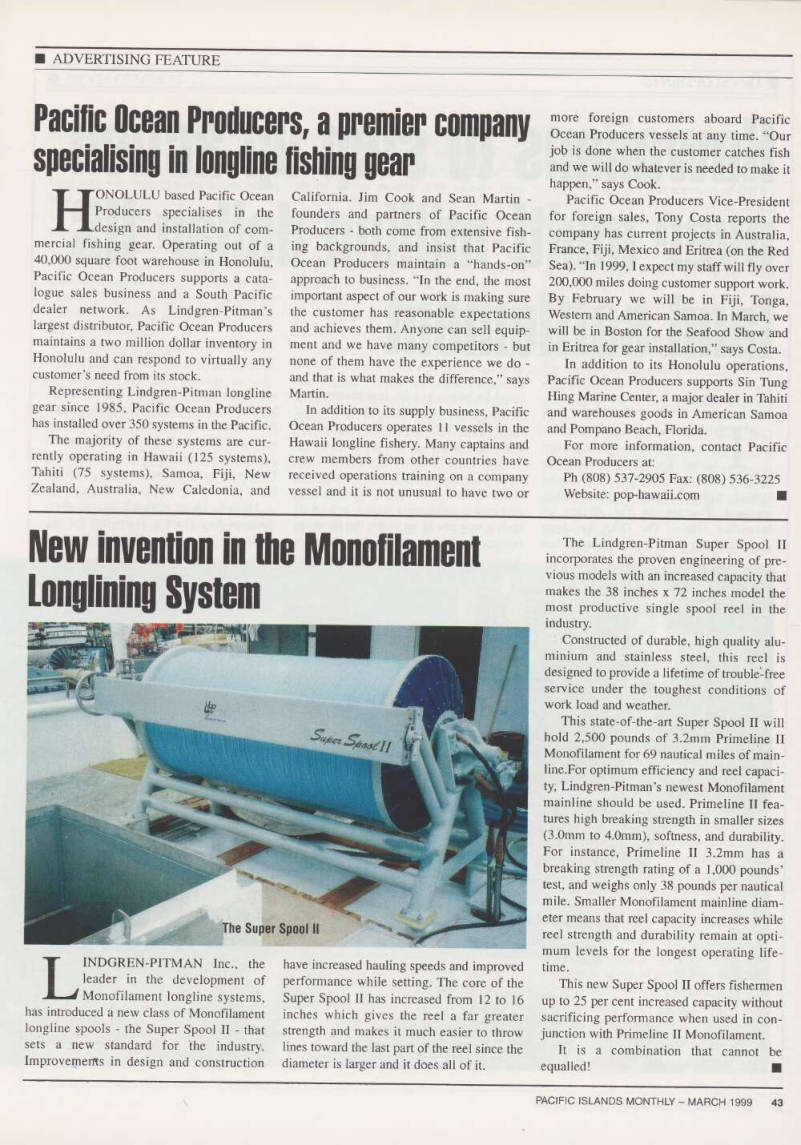
Pacific Ocean Producers, a premier company specialising in longline fishing gear
HONOLULU based Pacific Ocean Producers specialises in the design and installation of com mercial fishing gear. Operating out of a 40,000 square foot warehouse in Honolulu, Pacific Ocean Producers supports a cata logue sales business and a South Pacific dealer network. As Lindgren-Pitman’s largest distributor, Pacific Ocean Producers maintains a two million dollar inventory in Honolulu and can respond to virtually any customer’s need from its stock.
Representing Lindgren-Pitman longline gear since 1985, Pacific Ocean Producers has installed over 350 systems in the Pacific.
The majority of these systems are cur rently operating in Hawaii (125 systems), Tahiti (75 systems), Samoa, Fiji, New Zealand, Australia, New Caledonia, and
California. Jim Cook and Sean Martin founders and partners of Pacific Ocean Producers - both come from extensive fish ing backgrounds, and insist that Pacific Ocean Producers maintain a “hands-on” approach to business. “In the end, the most important aspect of our work is making sure the customer has reasonable expectations and achieves them. Anyone can sell equip ment and we have many competitors - but none of them have the experience we do and that is what makes the difference,” says Martin.
In addition to its supply business, Pacific Ocean Producers operates 11 vessels in the Hawaii longline fishery. Many captains and crew members from other countries have received operations training on a company vessel and it is not unusual to have two or
more foreign customers aboard Pacific Ocean Producers vessels at any time. “Our job is done when the customer catches fish and we will do whatever is needed to make it happen,” says Cook.
Pacific Ocean Producers Vice-President for foreign sales, Tony Costa reports the company has current projects in Australia, France, Fiji, Mexico and Eritrea (on the Red Sea). “In 1999,1 expect my staff will fly over 200,000 miles doing customer support work.
By February we will be in Fiji, Tonga, Western and American Samoa. In March, we will be in Boston for the Seafood Show and in Eritrea for gear installation,” says Costa.
In addition to its Honolulu operations, Pacific Ocean Producers supports Sin Tung Hing Marine Center, a major dealer in Tahiti and warehouses goods in American Samoa and Pompano Beach, Florida.
For more information, contact Pacific Ocean Producers at: Ph (808) 537-2905 Fax; (808) 536-3225 Website: pop-hawaii.com ■
Longlinlng System
New invention in the Monofilament Longlinlng System
Lindgren-Pitman Inc., The
leader in the development of Monofilament longline systems, has introduced a new class of Monofilament longline spools - the Super Spool II - that sets a new standard for the industry.
Improvements in design and construction
have increased hauling speeds and improved performance while setting. The core of the Super Spool II has increased from 12 to 16 inches which gives the reel a far greater strength and makes it much easier to throw lines toward the last part of the reel since the diameter is larger and it does all of it.
The Lindgren-Pitman Super Spool I] incorporates the proven engineering of pre vious models with an increased capacity that makes the 38 inches x 72 inches model the most productive single spool reel in the
industry.
Constructed of durable, high quality alu minium and stainless steel, this reel is designed to provide a lifetime of trouble-free service under the toughest conditions of work load and weather.
This state-of-the-art Super Spool II will hold 2,500 pounds of 3.2 mm Primeline II Monofilament for 69 nautical miles of main line. For optimum efficiency and reel capaci ty, Lindgren-Pitman’s newest Monofilament mainline should be used. Primeline II fea tures high breaking strength in smaller sizes (3.omm to 4.omm), softness, and durability.
For instance, Primeline II 3.2 mm has a breaking strength rating of a 1,000 pounds’ test, and weighs only 38 pounds per nautical mile. Smaller Monofilament mainline diam eter means that reel capacity increases while reel strength and durability remain at opti mum levels for the longest operating life time.
This new Super Spool II offers fishermen up to 25 per cent increased capacity without sacrificing performance when used in con junction with Primeline II Monofilament.
It is a combination that cannot be equalled! ■
The Super Spool II
Hawaiians to step up action
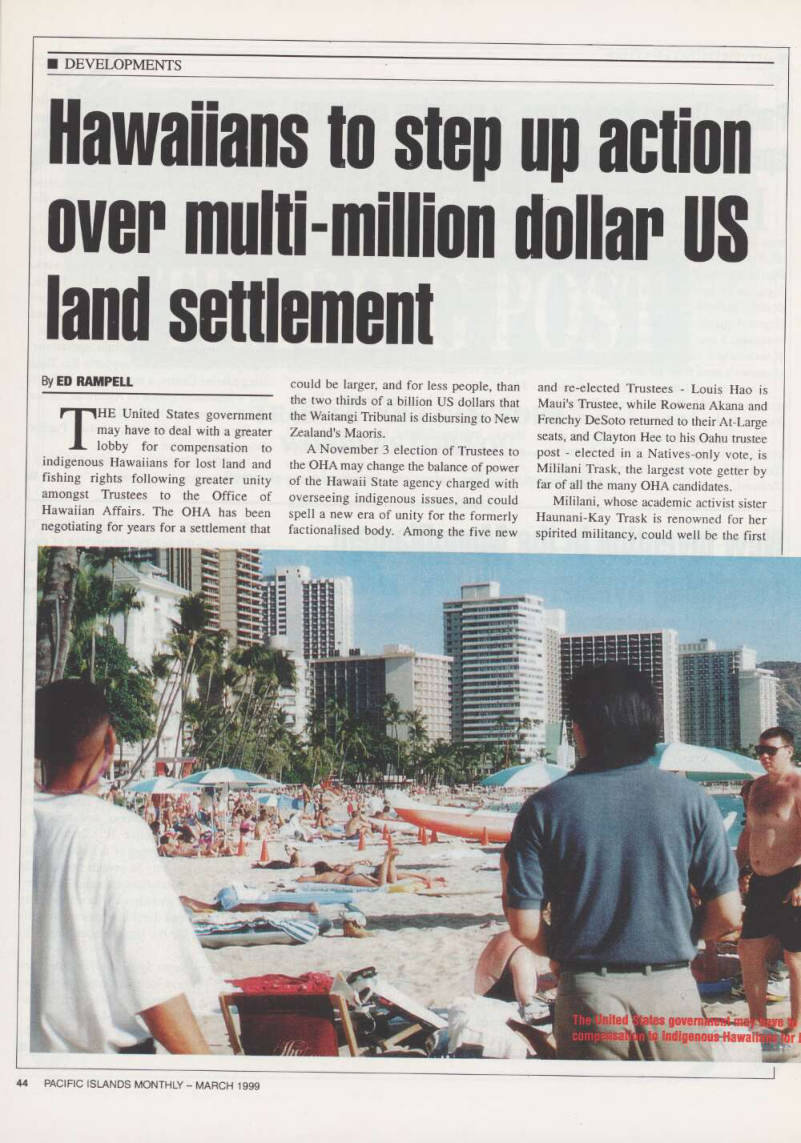
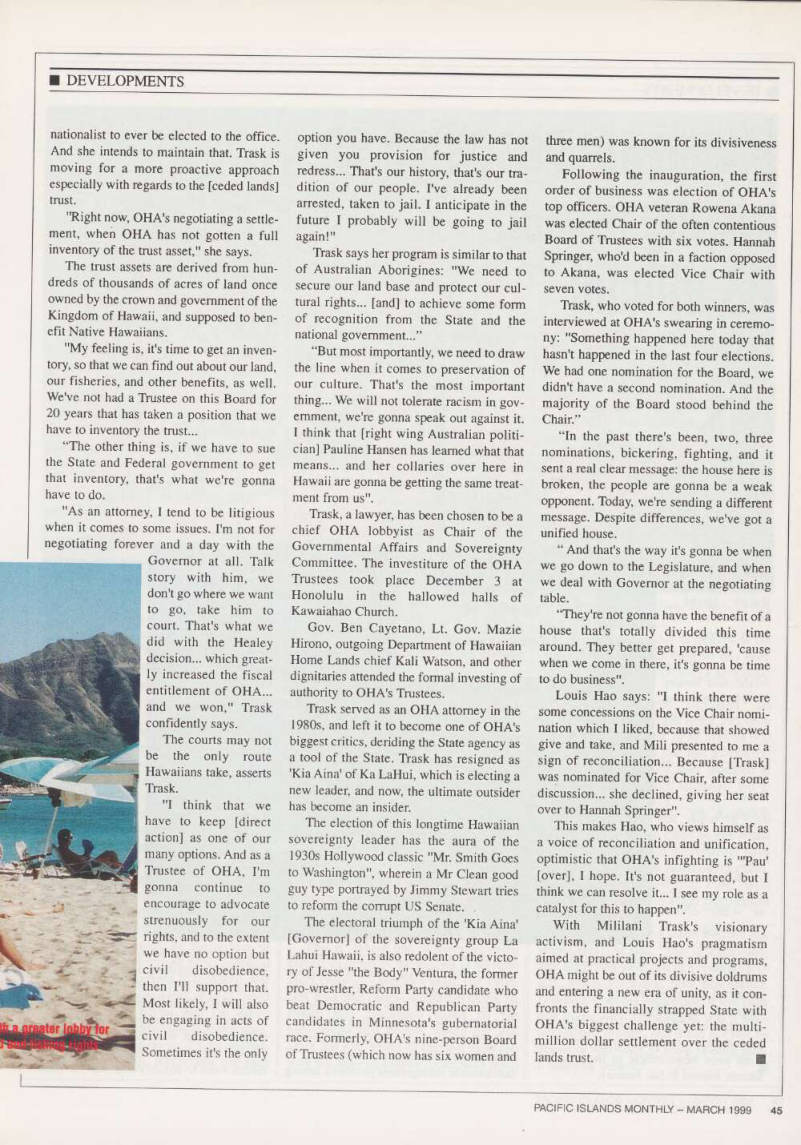
Developments
Hawaiians to step up action over multi-million dollar lIS land settement
By Ed Rampell
THE United States government may have to deal with a greater lobby for compensation to indigenous Hawaiians for lost land and fishing rights following greater unity amongst Trustees to the Office of Hawaiian Affairs. The OHA has been negotiating for years for a settlement that
could be larger, and for less people, than the two thirds of a billion US dollars that the Waitangi Tribunal is disbursing to New Zealand's Maoris.
A November 3 election of Trustees to the OHA may change the balance of power of the Hawaii State agency charged with overseeing indigenous issues, and could spell a new era of unity for the formerly factionalised body. Among the five new
and re-elected Trustees - Louis Hao is Maui's Trustee, while Rowena Akana and Frenchy DeSoto returned to their At-Large seats, and Clayton Hee to his Oahu trustee post - elected in a Natives-only vote, is Mililani Trask, the largest vote getter by far of all the many OHA candidates.
Mililani, whose academic activist sister Haunani-Kay Trask is renowned for her spirited militancy, could well be the first
The United States government may have to compensation to indigenous Hawaiians for [?]
nationalist to ever be elected to the office.
And she intends to maintain that. Trask is moving for a more proactive approach especially with regards to the [ceded lands] trust.
"Right now, OHA's negotiating a settle ment, when OHA has not gotten a full inventory of the trust asset," she says.
The trust assets are derived from hun dreds of thousands of acres of land once owned by the crown and government of the Kingdom of Hawaii, and supposed to ben efit Native Hawaiians.
"My feeling is, it's time to get an inven tory, so that we can find out about our land, our fisheries, and other benefits, as well.
We've not had a Trustee on this Board for 20 years that has taken a position that we have to inventory the trust...
“The other thing is, if we have to sue the State and Federal government to get that inventory, that's what we're gonna have to do.
"As an attorney, I tend to be litigious when it comes to some issues. I'm not for negotiating forever and a day with the
Governor at all. Talk story with him, we don't go where we want to go, take him to court. That's what we did with the Healey decision... which great ly increased the fiscal entitlement of OHA... and we won," Trask
confidently says.
The courts may not be the only route Hawaiians take, asserts Trask.
"I think that we have to keep [direct action] as one of our many options. And as a Trustee of OHA, I'm gonna continue to encourage to advocate strenuously for our rights, and to the extent we have no option but
civil disobedience,
then I'll support that.
Most likely, I will also be engaging in acts of civil disobedience.
Sometimes it's the only
option you have. Because the law has not given you provision for justice and redress... That's our history, that's our tra dition of our people. I've already been arrested, taken to jail. I anticipate in the future I probably will be going to jail again!"
Trask says her program is similar to that of Australian Aborigines; "We need to secure our land base and protect our cul tural rights... [and] to achieve some form of recognition from the State and the national government...”
“But most importantly, we need to draw the line when it comes to preservation of our culture. That's the most important thing... We will not tolerate racism in gov ernment, we're gonna speak out against it.
I think that [right wing Australian politi cian] Pauline Hansen has learned what that means... and her collaries over here in Hawaii are gonna be getting the same treat ment from us".
Trask, a lawyer, has been chosen to be a chief OHA lobbyist as Chair of the Governmental Affairs and Sovereignty Committee. The investiture of the OHA Trustees took place December 3 at Honolulu in the hallowed halls of Kawaiahao Church.
Gov. Ben Cayetano, Lt. Gov. Mazie Hirono, outgoing Department of Hawaiian Home Lands chief Kali Watson, and other dignitaries attended the formal investing of authority to OHA's Trustees.
Trask served as an OHA attorney in the 1980 s, and left it to become one of OHA's biggest critics, deriding the State agency as a tool of the State. Trask has resigned as 'Kia Aina' of Ka LaHui, which is electing a new leader, and now, the ultimate outsider has become an insider.
The election of this longtime Hawaiian sovereignty leader has the aura of the 1930 s Hollywood classic "Mr. Smith Goes to Washington", wherein a Mr Clean good guy type portrayed by Jimmy Stewart tries to reform the corrupt US Senate. , The electoral triumph of the 'Kia Aina' [Governor] of the sovereignty group La Lahui Hawaii, is also redolent of the victo ry of Jesse "the Body" Ventura, the former pro-wrestler, Reform Party candidate who beat Democratic and Republican Party candidates in Minnesota's gubernatorial race. Formerly, OHA's nine-person Board of Trustees (which now has six women and
three men) was known for its divisiveness and quarrels.
Following the inauguration, the first order of business was election of OHA's top officers. OHA veteran Rowena Akana was elected Chair of the often contentious Board of Trustees with six votes. Hannah Springer, who'd been in a faction opposed to Akana, was elected Vice Chair with seven votes.
Trask, who voted for both winners, was interviewed at OHA's swearing in ceremo ny: "Something happened here today that hasn't happened in the last four elections.
We had one nomination for the Board, we didn't have a second nomination. And the majority of the Board stood behind the Chair.”
“In the past there's been, two, three nominations, bickering, fighting, and it sent a real clear message: the house here is broken, the people are gonna be a weak opponent. Today, we're sending a different message. Despite differences, we've got a unified house.
“ And that's the way it's gonna be when we go down to the Legislature, and when we deal with Governor at the negotiating table.
“They’re not gonna have the benefit of a house that's totally divided this time around. They better get prepared, 'cause when we come in there, it's gonna be time to do business".
Louis Hao says; "I think there were some concessions on the Vice Chair nomi nation which I liked, because that showed give and take, and Mili presented to me a sign of reconciliation... Because [Trask] was nominated for Vice Chair, after some discussion... she declined, giving her seat over to Hannah Springer".
This makes Hao, who views himself as a voice of reconciliation and unification, optimistic that OHA's infighting is "'Pau' [over], I hope. It's not guaranteed, but I think we can resolve it... I see my role as a catalyst for this to happen".
With Mililani Trask's visionary activism, and Louis Hao's pragmatism aimed at practical projects and programs, OHA might be out of its divisive doldrums and entering a new era of unity, as it con fronts the financially strapped State with OHA's biggest challenge yet; the multi million dollar settlement over the ceded lands trust. H
[?]th a greater lobby for [?]ad fishing rights
Resettlement Of
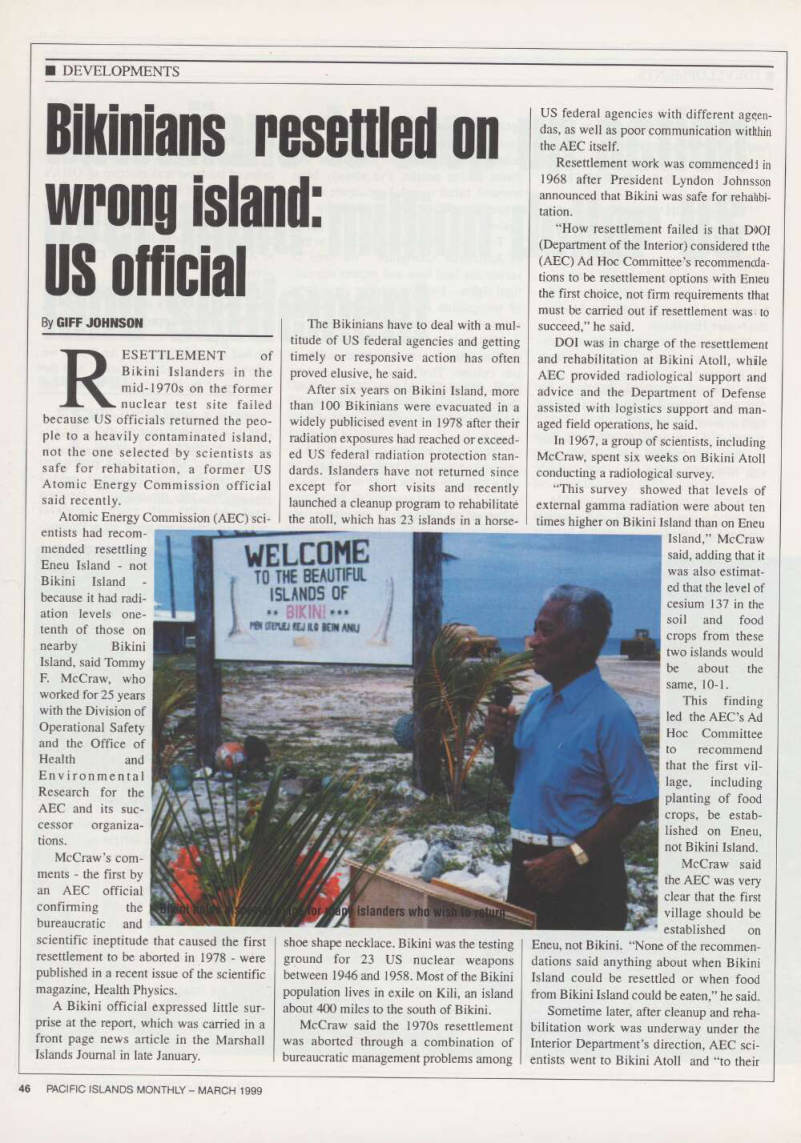
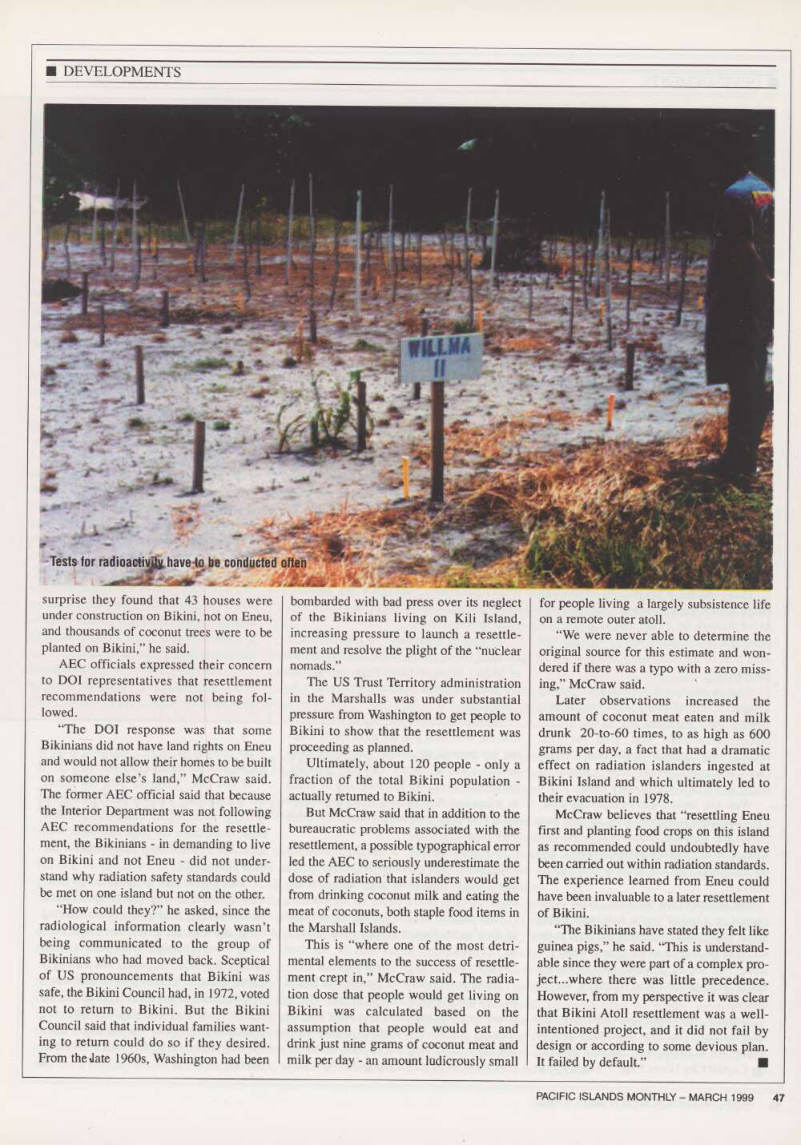
Bikinians resettled on wrong island: US official
By Giff Johnson
Bikini Islanders in the mid-1970s on the former nuclear test site failed because US officials returned the peo ple to a heavily contaminated island, not the one selected by scientists as safe for rehabitation, a former US Atomic Energy Commission official said recently.
Atomic Energy Commission (AEC) sci
enlists had recom mended resettling Eneu Island - not Bikini Island because it had radi ation levels one tenth of those on nearby Bikini Island, said Tommy F. McCraw, who worked for 25 years with the Division of
Operational Safety
and the Office of Health and Environmental Research for the AEC and its suc cessor organiza tions.
McCraw’s com ments - the first by an AEC official
confirming the
bureaucratic and
scientific ineptitude that caused the first resettlement to be aborted in 1978 - were published in a recent issue of the scientific magazine, Health Physics.
A Bikini official expressed little sur prise at the report, which was carried in a front page news article in the Marshall Islands Journal in late January.
The Bikinians have to deal with a mul titude of US federal agencies and getting timely or responsive action has often proved elusive, he said.
After six years on Bikini Island, more than 100 Bikinians were evacuated in a widely publicised event in 1978 after their radiation exposures had reached or exceed ed US federal radiation protection stan dards. Islanders have not returned since except for short visits and recently launched a cleanup program to rehabilitate the atoll, which has 23 islands in a horse-
shoe shape necklace. Bikini was the testing ground for 23 US nuclear weapons between 1946 and 1958. Most of the Bikini population lives in exile on Kili, an island about 400 miles to the south of Bikini.
McCraw said the 1970 s resettlement was aborted through a combination of bureaucratic management problems among
US federal agencies with different agen das, as well as poor communication witlthin the AEC itself.
Resettlement work was commenced 1 in 1968 after President Lyndon Johnsson announced that Bikini was safe for rehabili tation.
“How resettlement failed is that DOOI (Department of the Interior) considered tthe (AEC) Ad Hoc Committee’s recommencda tions to be resettlement options with Emeu the first choice, not firm requirements tlhat must be carried out if resettlement was to succeed,” he said.
DOI was in charge of the resettlement and rehabilitation at Bikini Atoll, whiile AEC provided radiological support and advice and the Department of Defense assisted with logistics support and man aged field operations, he said.
In 1967, a group of scientists, including McCraw, spent six weeks on Bikini Atoll conducting a radiological survey.
“This survey showed that levels of external gamma radiation were about ten times higher on Bikini Island than on Eneu
Island,” McCraw said, adding that it was also estimat ed that the level of cesium 137 in the soil and food crops from these two islands would be about the same, 10-1.
This finding
led theAEC’sAd Hoc Committee to recommend that the first vil
lage, including
planting of food crops, be estab lished on Eneu, not Bikini Island.
McCraw said the AEC was very clear that the first village should be established on
Eneu, not Bikini. “None of the recommen dations said anything about when Bikini Island could be resettled or when food from Bikini Island could be eaten,” he said.
Sometime later, after cleanup and reha bilitation work was underway under the Interior Department’s direction, AEG sci entists went to Bikini Atoll and “to their
Bikini holds[?] for many islanders who wish to return
surprise they found that 43 houses were under construction on Bikini, hot on Eneu, and thousands of coconut trees were to be planted on Bikini,” he said.
AEC officials expressed their concern to DOI representatives that resettlement recommendations were not being fol lowed.
“The DOI response was that some Bikinians did not have land rights on Eneu and would not allow their homes to be built on someone else’s land,” McCraw said.
The former AEC official said that because the Interior Department was not following AEC recommendations for the resettle ment, the Bikinians - in demanding to live on Bikini and not Eneu - did not under stand why radiation safety standards could be met on one island but not on the other.
“How could they?” he asked, since the radiological information clearly wasn’t being communicated to the group of Bikinians who had moved back. Sceptical of US pronouncements that Bikini was safe, the Bikini Council had, in 1972, voted not to return to Bikini. But the Bikini Council said that individual families want ing to return could do so if they desired.
From theJate 19605, Washington had been
bombarded with bad press over its neglect of the Bikinians living on Kili Island, increasing pressure to launch a resettle ment and resolve the plight of the “nuclear nomads.”
The US Trust Territory administration in the Marshalls was under substantial pressure from Washington to get people to Bikini to show that the resettlement was proceeding as planned.
Ultimately, about 120 people - only a fraction of the total Bikini population actually returned to Bikini.
But McCraw said that in addition to the bureaucratic problems associated with the resettlement, a possible typographical error led the AEC to seriously underestimate the dose of radiation that islanders would get from drinking coconut milk and eating the meat of coconuts, both staple food items in the Marshall Islands.
This is “where one of the most detri mental elements to the success of resettle ment crept in,” McCraw said. The radia tion dose that people would get living on Bikini was calculated based on the assumption that people would eat and drink just nine grams of coconut meat and milk per day - an amount ludicrously small
for people living a largely subsistence life on a remote outer atoll.
“We were never able to determine the original source for this estimate and won dered if there was a typo with a zero miss ing,” McCraw said.
Later observations increased the amount of coconut meat eaten and milk drunk 20-to-60 times, to as high as 600 grams per day, a fact that had a dramatic effect on radiation islanders ingested at Bikini Island and which ultimately led to their evacuation in 1978.
McCraw believes that “resettling Eneu first and planting food crops on this island as recommended could undoubtedly have been carried out within radiation standards.
The experience learned from Eneu could have been invaluable to a later resettlement of Bikini.
“The Bikinians have stated they felt like guinea pigs,” he said. “This is understand able since they were part of a complex pro ject...where there was little precedence.
However, from my perspective it was clear that Bikini Atoll resettlement was a well intentioned project, and it did not fail by design or according to some devious plan.
It failed by default.” ■
Tests for radioactivity have to be conducted often
information overload
New search engines tackle information overload
YOU need some informa tion. You need it fast.
You know it must be on the World Wide Web.
But to find it, you’ll probably waste a lot of time struggling with an Internet search engine - and therein lies the problem.
As most Internet users know, tradition al, run-of-the-mill search engines such as Alta Vista (www.altavista.com) Lycos (www.lycos.com) and Yahoo! (www.yahoo.com) often offer up too much information, too many links, and are down right frustrating in their thoroughness.
What’s more, most of the original search engines are transforming themselves into so-called “portals” where the emphasis is as much on offering news, stock quotes, free email and other attractions as it is on
improving search efficiency.
That’s where a handful of new Web based search tools comes in. They attempt to cut through the clutter and help you pin point the information you’re looking for.
And best of all, they quite often work as advertised.
Case in point: Ask Jeeves. Recognising that part of the difficulty users have in nar rowing their searches lies in the arcane command-switches that give the best results, the search tool Ask Jeeves (www.ask.com) breaks new ground by doing much of the dirty work itself.
With Ask Jeeves, users simply ask a nat ural-language question. Ask Jeeves then parses the question, submits it in the best format to the leading search engines, and returns links that are usually remarkably relevant.
For instance, the question “What is the capital of Alaska?” took Ask Jeeves only about 30 seconds to analyse and send to the six most popular search engines, when fin ished, Ask Jeeves provides the links to the search engines that found “matches” for the query.
Usually, the links provided relevant information. The first link provided by Excite, for example, was “Juneau, Alaska the Capital City Home Page” - exactly what
the question asked for. The first link that Ask Jeeves found from the search engine Alta Vista was equally on target: “The Capital City Profile - Juneau, Alaska”.
Ask Jeeves provides a simple drop down list box from which you can choose the matches found by each search engine it queries, so that you can visit a Web Site directly from Ask Jeeves without ever going to the search engine that found the link.
Ask Jeeves’ natural language query function and its reliance on already well established search engines makes it a per fect tool for everyone from busy executives to school children overwhelmed by old style search tools.
One downside: currently, Ask Jeeves is an English-only search tool, but Ask Jeeves will spell-check your query before submit ting it. And don’t expect to find everything with Ask Jeeves. Searches for specific information rather than general queries will yield the best results.
Almost as impressive as Ask Jeeves is
Google! (www.google.com), the brainchild
of Sergey Brin and Larry Page, two gradu ate students from Stanford University in California.
Google! attempts to bring to your atten tion the Web sites you are most likely look ing for through its unique Pageßank tech nology. Three years in the making, Pageßank works by firs indexing as much as it can and then ranking Web sites based upon how often they are pointed to by other Web pages.
So, for example, a simple search for “Microsoft” will quickly yield Microsoft’s home page, since it is often across refer enced by other home pages on the Internet.
The creators of Google! are so confident of their technology that they even provide an “I Feel Lucky” rather than the standard “Search” button to go directly to that site.
Similar in theory to Google! is Direct Hit (www.directhit.com). Direct Hit is based on the assumption that what you are looking for on the Internet others have already found. This search tool, therefore, concentrates on ranking popular Web sites,
while relying on today’s standard search engines for the queries themselves.
If you type “Compaq” into the Direct Hit search field, the first links presented will be to Compaq computer’s home page, since that’s the page that most Web users have visited after searching for the term “Compaq”.
Search tools such as these can go some way toward allowing you to spend more time absorbing information than looking for it, and they are a welcome relief from today’s overcrowded Web portals, with
search features becoming increasingly
subordinated to glitz and advertisement.
Of course, these relatively little-known search tools may one day resemble big portals. But for now, we can enjoy them for their sheer simplicity and usefulness.
(Dpa) ■
Attention computer
administrators and everyone with a credit card: you are not safe on the Internet, your information is getting easier to find, and hackers computer cowboys who break into systems for thrills, sheer artistry, money or revenge - are everywhere.
Those in the know agree there is no network, Web site or system secure enough to keep out determined hackers, who have been breaking into computers over phone lines since the late 1970 s and now use the Internet.
“There’s no such thing as a perfectly safe computer so someone will always get into it,” said Brian O’Higgins, chief tech nology officer at Texas-based Entrust Technologies Inc., which converts data into code for safer transmission.
Experts say that with the exploding growth of the Internet and sales in cyber space, there are more opportunities to worm into a company’s system and abuse the information found there, such as cred it card numbers.
The number of hacker incidents is dif ficult to track, but in a poll last year the San Francisco-based Computer Security Institute found a dramatic rise in comput er crime, ranging from stolen laptops to Internet heists, from a year earlier.
It said 64 per cent of corporations and other organisations reported security breaches, up from 16 per cent in 1997.
Hacker menace grows with Internet use
Most organisations fear a violator from without: a lone young male sitting in his basement, a stereotypical social misfit with the high-powered brain and computer and loads of curiosity to boot.
“It’s an instance of mischievous behav iour that’s probably age-old in human nature,” said analyst David Breiner at investment bank Volpe Brown Whelan & Co. “But the core of it is the dark side if human nature in the information age.”
One highly publicised incident was the defiling last year of The New York Times Web site.
A Group calling itself “Hacking for Girlies” replaced the Times’ home page with pictures of nudes and discussion about legendary hacker Kevin Mitnick, who faces trial in California on computer related fraud charges.
Hacker motives range from the excite ment of a challenge - be it technical or intellectual - to financial gain and industri al espionage. But the most dangerous motive is revenge by a disgruntled employ ee, Breiner said.
Professional hacker consultants - who are hired to test corporate computer securi ty by mounting attacks on them - agree.
Accounting firm Ernst & Young security consultant Matunda Nyanchama, whose company just set up its first Canadian com puter attack and penetration lab, says the
greatest danger comes from your own col leagues.
“About 80 per cent of risks associated with an (information technology) environ ment come from within, but what we find is that the clients tend to - I think, partly because of the press - look at these hackers out there on the Internet”.
In one case, a sour senior staff member was secretly leaking confidential informa tion to a rival firm, Nyanchama said.
The staff member’s employer was con founded by the competitor, who constantly beat them at their own game.
Robert Clyde, general manager of secu rity management at Rockville, Maryland based information security company Axent Technologies Inc., has been on the scene for 20 years and has seen a shift in hacker
inspiration.
The hacker mentality, which used to be “look but don’t touch” and included help from “white hat” good-guy hackers who point out a company’s weak points, has expanded, Clyde said, it now also includes the desire for cold hard cash or even “cyber-terrorism”, such as crashing a sys tem.
Now there are indications organised crime has filtered in through some nations that ignore the electronic transfer of US funds, he said. For example, an “inside/outside” job means a company
hires a computer expert to build a network.
For a small fee from a criminal group the expert will deliberately make a dumb mis take, leaving an electronic hole through which others can siphon money to private bank accounts.
Some hacking cases are well known such as the assault on Pentagon computers by an Israeli teenager known as “Analyzer” and a friend, who were caught last year, but companies often are penetrat ed and do not tell the public. Or they may not have realised it themselves.
Many banks have already been hit to some extent, Entrust’s O’Higgins said.
One way to ensure safety, he said: is encryption; coding information to make sure it cannot be read without an electron ic key.
One financial institution came to Entrust in a panic after losing some 350,000 potential credit card numbers fol lowing the theft of a computer.
Clyde attends some of the hacker con ventions whose participants range from “white hats” and government agents to people with their teeth filed into points to
resemble vampires.
But he said “the scary ones are the ones who aren’t like that”.
“They’re pretty professional and do it for money. These guys don’t get caught”.
(Reuters) ■
Fiji inquiry condemns
local banking practices
TWO dominant banks in Fiji maximise their profits in a mar ket that lacks sufficient competition, a Fiji inquiry into banking practices has found. It says the big two - ANZ and Westpac - make far greater profit margins in Fiji than they do worldwide.
“There is scope for banks to reduce their interest rates, spreads and margins as well as fees and charges, yet still enjoy adequate returns,” the inquiry report says.
The inquiry stops just short of suggesting a cartel but says in its report there is evidence of “price leadership” where banks dupli cate charges and fees. The report also highlights declining quality of service by banks in recent years and their apparent insensitivi ty and indifference. “There are grave reservations concerning the quality of services. This is particularly evident in the long queues that are a regular feature at the major banks, as well as excessive
waiting time for services and indifferent attitudes by staff to con sumer concerns,” the report said. The inquiry committee recom mends the establishment of a Banks Commission to address cus tomer complaints.
It says that if there is no immediate improvement, the govern ment may have to implement controls. The report says it is diffi cult for smaller banks to be aggressive towards the larger banks as they do not have the market power to take a strong stance to change existing practices.
“The committee considers the banks’ high level of profitability also reflects the high interest rate spreads and margins and high levels of fee charges,” it says. The banks did not provide the com mittee with any basis for costing to support new fees and charges and to prove they were not arbitrarily determined.
The banks also deny there is any cross-subsidisation in their charges, but the committee notes from the banks’ promotional packages that the practice exists. The committee concludes that the move to a user-pays regime harms low-income earners as they are faced with charges for bank services that represent a relative ly high proportion of their income. ■
Advertisements & other items, p. 50 (1 item)
Talk to the Pacific
with the voice of the Pacific
‘There is one magazine that decision-matters in the ‘Pacific
must read each month.
4 That magazine is the voice of the Pacific ... m m B:: m ii* J sgl : mm &
•HM&M
.. *' wm I -mmm Pacific Islands Monthly has been a cornerstone of communications in the region for 68 years.
It has built an unequalled reputation for providing the best available news, analyses and insight on events in the region.
That reputation spans the islands, the region and more than 71 countries.
That reputation puts Pacific Islands Monthly on the desks of Government figures, public servants, business leaders and other decision-makers throughout the region.
That reputation gives Pacific Islands Monthly the things advertisers need most... credibility and selling power.
Talk to your market with the voice of your market.
Pacific Islands Monthly
Call (679) 303244 Fax (679) 303809
Pacific Islands Monthly is the only regional news magazine with an independently audited circulation.
The World’s Worst
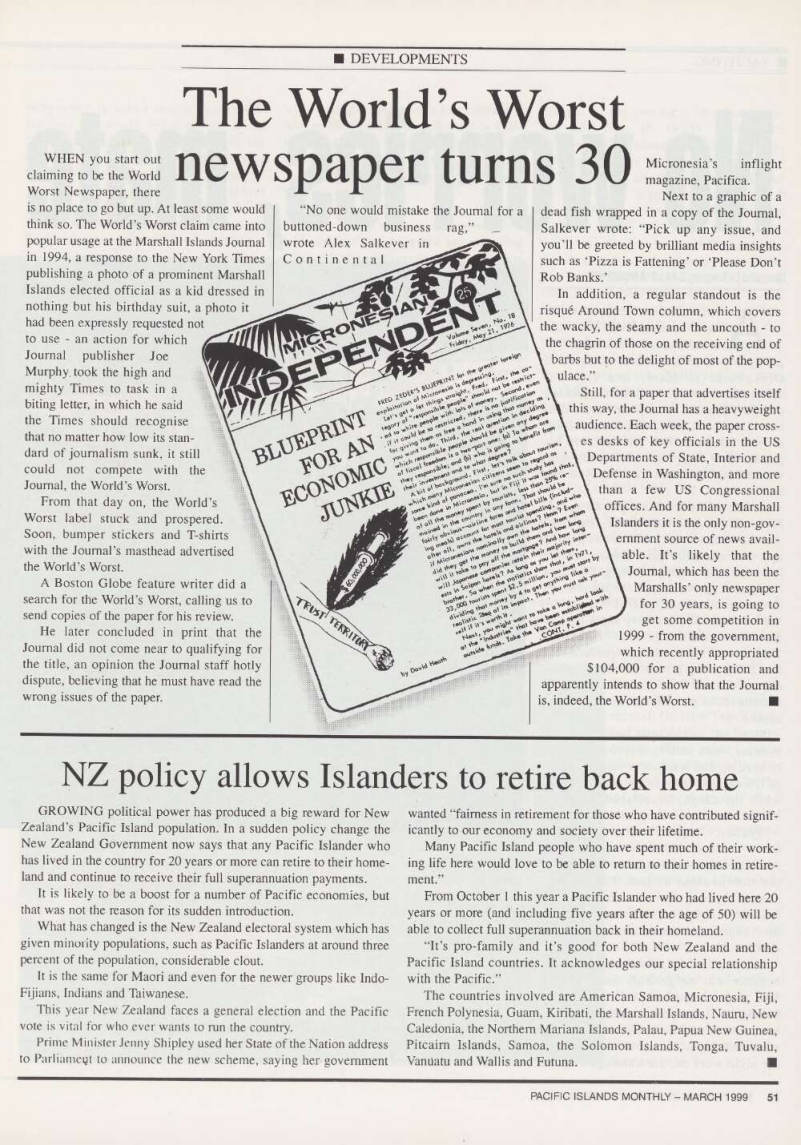
newspaper turns 30
WHEN you start out claiming to be the World Worst Newspaper, there
is no place to go but up. At least some would think so. The World’s Worst claim came into popular usage at the Marshall Islands Journal in 1994, a response to the New York Times publishing a photo of a prominent Marshall Islands elected official as a kid dressed in nothing but his birthday suit, a photo it had been expressly requested not to use - an action for which Journal publisher Joe Murphy, took the high and mighty Times to task in a biting letter, in which he said I the Times should recognise that no matter how low its stan- \ dard of journalism sunk, it still \ V could not compete with the \ Journal, the World’s Worst. \ From that day on, the World’s \ Worst label stuck and prospered. \ Soon, bumper stickers and T-shirts \ with the Journal’s masthead advertised the World’s Worst.
A Boston Globe feature writer did a search for the World’s Worst, calling us to send copies of the paper for his review.
He later concluded in print that the Journal did not come near to qualifying for the title, an opinion the Journal staff hotly dispute, believing that he must have read the wrong issues of the paper.
“No one would mistake the Journal for a buttoned-down business rag,” wrote Alex Salkever in Continental
Micronesia’s inflight magazine, Pacifica.
Next to a graphic of a
dead fish wrapped in a copy of the Journal, Salkever wrote: “Pick up any issue, and you’ll be greeted by brilliant media insights such as ‘Pizza is Fattening’ or ‘Please Don’t Rob Banks.’
In addition, a regular standout is the risque Around Town column, which covers the wacky, the seamy and the uncouth - to , the chagrin of those on the receiving end of \ barbs but to the delight of most of the pop-
V ulace.”
tO I V Still, for a paper that advertises itself \ way, the Journal has a heavyweight audience. Each week, the paper cross \ es desks of key officials in the US ' \ Departments of State, Interior and y Defense in Washington, and more \ than a few US Congressional \ offices. And for many Marshall y Islanders it is the only non-gov \ eminent source of news avail \ a ble. It’s likely that the y Journal, which has been the
\ Marshalls’only newspaper
) for 30 years, is going to get some competition in 1999 - from the government, which recently appropriated $104,000 for a publication and apparently intends to show that the Journal is, indeed, the World’s Worst. ■
NZ policy allows Islanders to retire back home
GROWING political power has produced a big reward for New Zealand’s Pacific Island population. In a sudden policy change the New Zealand Government now says that any Pacific Islander who has lived in the country for 20 years or more can retire to their home land and continue to receive their full superannuation payments.
It is likely to be a boost for a number of Pacific economies, but that was not the reason for its sudden introduction.
What has changed is the New Zealand electoral system which has given minority populations, such as Pacific Islanders at around three percent of the population, considerable clout.
It is the same for Maori and even for the newer groups like Indo- Fijians, Indians and Taiwanese.
This year New Zealand faces a general election and the Pacific vote is vital for who ever wants to run the country.
Prime Minister Jenny Shipley used her State of the Nation address to Parliament to announce the new scheme, saying her government
wanted “fairness in retirement for those who have contributed signif icantly to our economy and society over their lifetime.
Many Pacific Island people who have spent much of their work ing life here would love to be able to return to their homes in retire ment.”
From October 1 this year a Pacific Islander who had lived here 20 years or more (and including five years after the age of 50) will be able to collect full superannuation back in their homeland.
“It’s pro-family and it’s good for both New Zealand and the Pacific Island countries. It acknowledges our special relationship with the Pacific.”
The countries involved are American Samoa, Micronesia, Fiji, French Polynesia, Guam, Kiribati, the Marshall Islands, Nauru, New Caledonia, the Northern Mariana Islands, Palau, Papua New Guinea, Pitcairn Islands, Samoa, the Solomon Islands, Tonga, Tuvalu, Vanuatu and Wallis and Futuna. ■
No worries, mate
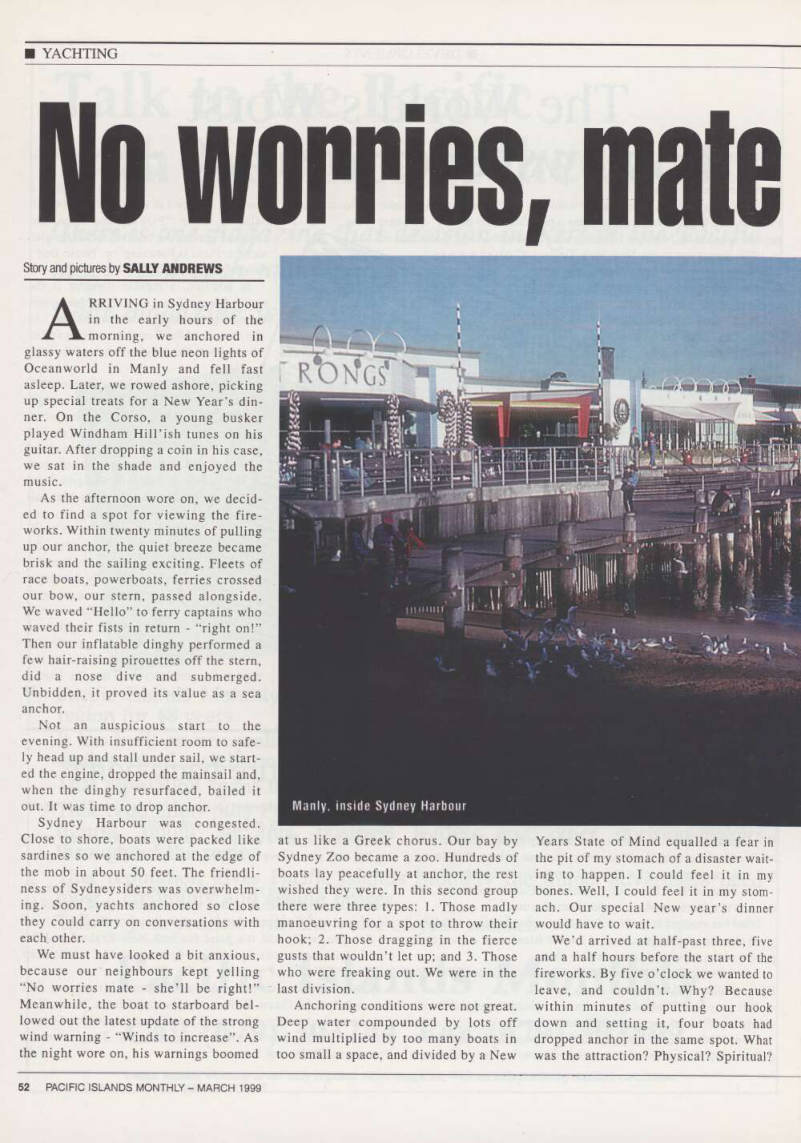
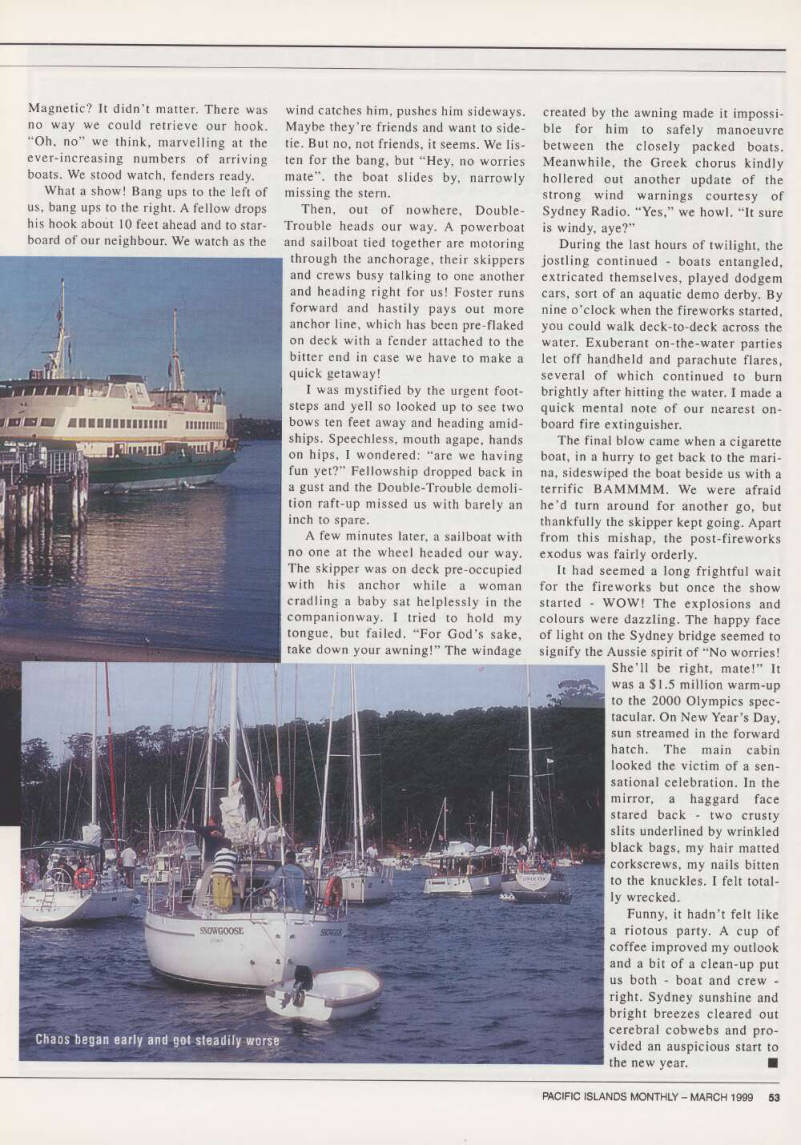
Yachting
Story and pictures by SALLY ANDREWS
ARRIVING in Sydney Harbour in the early hours of the morning, we anchored in glassy waters off the blue neon lights of Oceanworld in Manly and fell fast asleep. Later, we rowed ashore, picking up special treats for a New Year’s din ner. On the Corso, a young busker played Windham Hill’ish tunes on his guitar. After dropping a coin in his case, we sat in the shade and enjoyed the music.
As the afternoon wore on, we decid ed to find a spot for viewing the fire works. Within twenty minutes of pulling up our anchor, the quiet breeze became brisk and the sailing exciting. Fleets of race boats, powerboats, ferries crossed our bow, our stern, passed alongside.
We waved “Hello” to ferry captains who waved their fists in return - “right on!”
Then our inflatable dinghy performed a few hair-raising pirouettes off the stern, did a nose dive and submerged.
Unbidden, it proved its value as a sea anchor.
Not an auspicious start to the evening. With insufficient room to safe ly head up and stall under sail, we start ed the engine, dropped the mainsail and, when the dinghy resurfaced, bailed it out. It was time to drop anchor.
Sydney Harbour was congested.
Close to shore, boats were packed like sardines so we anchored at the edge of the mob in about 50 feet. The friendli ness of Sydneysiders was overwhelm ing. Soon, yachts anchored so close they could carry on conversations with each other.
We must have looked a bit anxious,
because our neighbours kept yelling
“No worries mate - she’ll be right!”
Meanwhile, the boat to starboard bel lowed out the latest update of the strong wind warning - “Winds to increase”. As the night wore on, his warnings boomed
at us like a Greek chorus. Our bay by Sydney Zoo became a zoo. Hundreds of boats lay peacefully at anchor, the rest wished they were. In this second group there were three types: 1. Those madly manoeuvring for a spot to throw their hook; 2. Those dragging in the fierce gusts that wouldn’t let up; and 3. Those who were freaking out. We were in the last division.
Anchoring conditions were not great.
Deep water compounded by lots off wind multiplied by too many boats in too small a space, and divided by a New
Years State of Mind equalled a fear in the pit of my stomach of a disaster wait ing to happen. I could feel it in my bones. Well, I could feel it in my stom ach. Our special New year’s dinner would have to wait.
We’d arrived at half-past three, five and a half hours before the start of the fireworks. By five o’clock we wanted to leave, and couldn’t. Why? Because within minutes of putting our hook down and setting it, four boats had dropped anchor in the same spot. What was the attraction? Physical? Spiritual?
Manly, inside Sydney Harbour
Magnetic? It didn t matter. There was no way we could retrieve our hook.
“Oh, no” we think, marvelling at the
ever-increasing numbers of arriving
boats. We stood watch, fenders ready.
What a show! Bang ups to the left of us, bang ups to the right. A fellow drops his hook about 10 feet ahead and to starboard of our neighbour. We watch as the
wind catches him, pushes him sideways.
Maybe they’re friends and want to side tie. But no, not friends, it seems. We lis ten for the bang, but “Hey, no worries mate”, the boat slides by, narrowly missing the stern.
Then, out of nowhere, Double- Trouble heads our way. A powerboat and sailboat tied together are motoring
i through the anchorage, their skippers
j and crews busy talking to one another and heading right for us! Foster runs : forward and hastily pays out more anchor line, which has been pre-flaked on deck with a fender attached to the bitter end in case we have to make a
quick getaway!
I was mystified by the urgent foot steps and yell so looked up to see two bows ten feet away and heading amid ships. Speechless, mouth agape, hands on hips, I wondered: “are we having fun yet?” Fellowship dropped back in a gust and the Double-Trouble demoli tion raft-up missed us with barely an inch to spare.
A few minutes later, a sailboat with no one at the wheel headed our way.
The skipper was on deck pre-occupied with his anchor while a woman cradling a baby sat helplessly in the companionway. I tried to hold my tongue, but failed. “For God’s sake, take down your awning!” The windage
created by the awning made it impossi ble for him to safely manoeuvre between the closely packed boats.
Meanwhile, the Greek chorus kindly hollered out another update of the strong wind warnings courtesy of Sydney Radio. “Yes,” we howl. “It sure is windy, aye?”
During the last hours of twilight, the jostling continued - boats entangled,
extricated themselves, played dodgem
cars, sort of an aquatic demo derby. By nine o’clock when the fireworks started, you could walk deck-to-deck across the water. Exuberant on-the-water parties let off handheld and parachute flares, several of which continued to burn brightly after hitting the water. I made a quick mental note of our nearest on board fire extinguisher.
The final blow came when a cigarette boat, in a hurry to get back to the mari na, sideswiped the boat beside us with a terrific BAMMMM. We were afraid he’d turn around for another go, but thankfully the skipper kept going. Apart from this mishap, the post-fireworks exodus was fairly orderly.
It had seemed a long frightful wait for the fireworks but once the show started - WOW! The explosions and colours were dazzling. The happy face of light on the Sydney bridge seemed to signify the Aussie spirit of “No worries!
She’ll be right, mate!” It was a $1.5 million warm-up to the 2000 Olympics spec tacular. On New Year’s Day, sun streamed in the forward hatch. The main cabin looked the victim of a sen sational celebration. In the mirror, a haggard face stared back - two crusty slits underlined by wrinkled black bags, my hair matted corkscrews, my nails bitten to the knuckles. I felt total ly wrecked.
Funny, it hadn’t felt like a riotous party. A cup of coffee improved my outlook and a bit of a clean-up put us both - boat and crew right. Sydney sunshine and bright breezes cleared out cerebral cobwebs and pro vided an auspicious start to the new year. ■
Chaos began early and got steadily worse
Race relations is
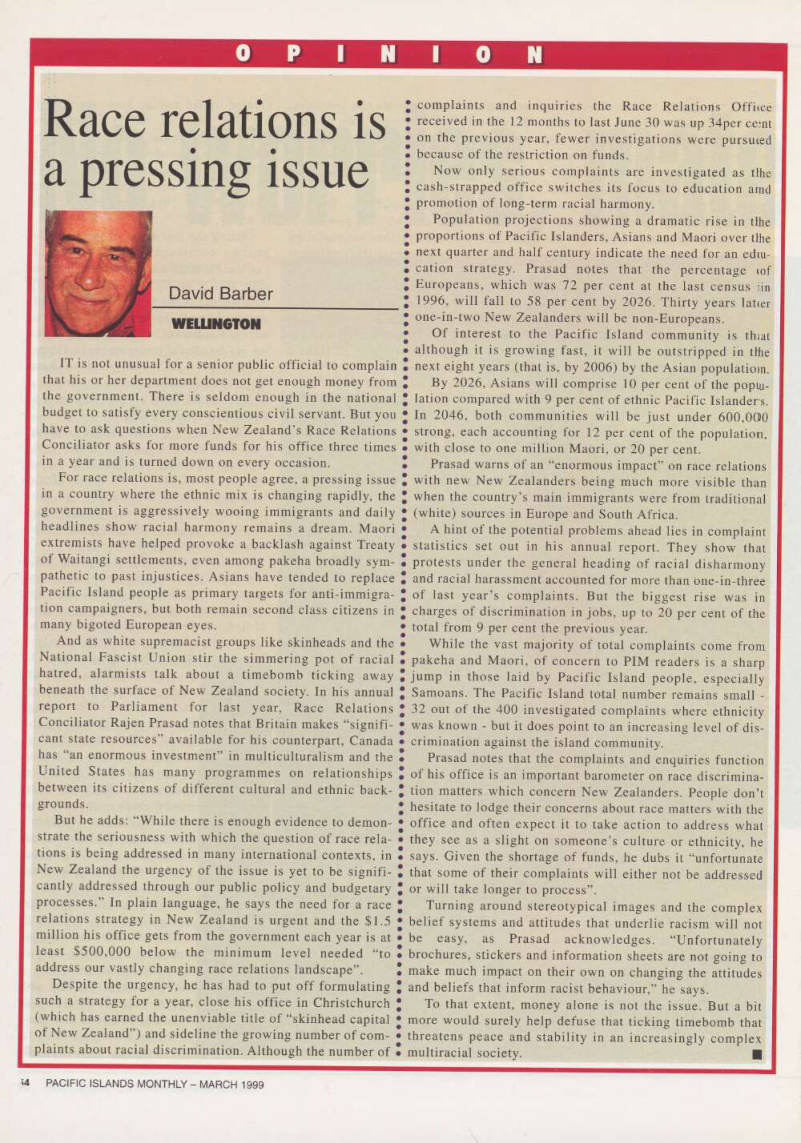
Opinion
Race relations is a pressing issue
IT is not unusual for a senior public official to complain that his or her department does not get enough money from the government. There is seldom enough in the national budget to satisfy every conscientious civil servant. But you have to ask questions when New Zealand’s Race Relations Conciliator asks for more funds for his office three times in a year and is turned down on every occasion.
For race relations is, most people agree, a pressing issue in a country where the ethnic mix is changing rapidly, the government is aggressively wooing immigrants and daily headlines show racial harmony remains a dream. Maori extremists have helped provoke a backlash against Treaty of Waitangi settlements, even among pakeha broadly sym pathetic to past injustices. Asians have tended to replace Pacific Island people as primary targets for anti-immigra tion campaigners, but both remain second class citizens in
many bigoted European eyes.
And as white supremacist groups like skinheads and the National Fascist Union stir the simmering pot of racial hatred, alarmists talk about a timebomb ticking away beneath the surface of New Zealand society. In his annual report to Parliament for last year, Race Relations Conciliator Rajen Prasad notes that Britain makes “signifi cant state resources” available for his counterpart, Canada has “an enormous investment” in multiculturalism and the United States has many programmes on relationships between its citizens of different cultural and ethnic back grounds.
But he adds: “While there is enough evidence to demon strate the seriousness with which the question of race rela tions is being addressed in many international contexts, in New Zealand the urgency of the issue is yet to be signifi cantly addressed through our public policy and budgetary processes.” In plain language, he says the need for a race relations strategy in New Zealand is urgent and the $1.5 million his office gets from the government each year is at least $500,000 below the minimum level needed “to address our vastly changing race relations landscape”.
Despite the urgency, he has had to put off formulating such a strategy for a year, close his office in Christchurch (which has earned the unenviable title of “skinhead capital of New Zealand”) and sideline the growing number of com plaints about racial discrimination. Although the number of
complaints and inquiries the Race Relations Offhce received in the 12 months to last June 30 was up 34per ce;nt on the previous year, fewer investigations were pursmed because of the restriction on funds.
Now only serious complaints are investigated as tlhe cash-strapped office switches its focus to education arnd promotion of long-term racial harmony.
Population projections showing a dramatic rise in tlhe proportions of Pacific Islanders, Asians and Maori over tlhe next quarter and half century indicate the need for an ediu cation strategy. Prasad notes that the percentage mf Europeans, which was 72 per cent at the last census iin 1996, will fall to 58 per cent by 2026. Thirty years latcer one-in-two New Zealanders will be non-Europeans.
Of interest to the Pacific Island community is thiat although it is growing fast, it will be outstripped in tlhe next eight years (that is, by 2006) by the Asian population.
By 2026, Asians will comprise 10 per cent of the popu lation compared with 9 per cent of ethnic Pacific Islanders.
In 2046, both communities will be just under 600,00)0 strong, each accounting for 12 per cent of the population, with close to one million Maori, or 20 per cent.
Prasad warns of an “enormous impact” on race relations with new New Zealanders being much more visible than when the country’s main immigrants were from traditional (white) sources in Europe and South Africa.
A hint of the potential problems ahead lies in complaint statistics set out in his annual report. They show that protests under the general heading of racial disharmony and racial harassment accounted for more than one-in-three of last year’s complaints. But the biggest rise was in charges of discrimination in jobs, up to 20 per cent of the total from 9 per cent the previous year.
While the vast majority of total complaints come from pakeha and Maori, of concern to PIM readers is a sharp jump in those laid by Pacific Island people, especially Samoans. The Pacific Island total number remains small - 32 out of the 400 investigated complaints where ethnicity was known - but it does point to an increasing level of dis crimination against the island community.
Prasad notes that the complaints and enquiries function of his office is an important barometer on race discrimina tion matters which concern New Zealanders. People don’t hesitate to lodge their concerns about race matters with the office and often expect it to take action to address what they see as a slight on someone’s culture or ethnicity, he says. Given the shortage of funds, he dubs it “unfortunate that some of their complaints will either not be addressed or will take longer to process”.
Turning around stereotypical images and the complex relief systems and attitudes that underlie racism will not be easy, as Prasad acknowledges. “Unfortunately brochures, stickers and information sheets are not going to make much impact on their own on changing the attitudes and beliefs that inform racist behaviour,” he says.
To that extent, money alone is not the issue. But a bit more would surely help defuse that ticking timebomb that hreatens peace and stability in an increasingly complex multiracial society. ■
David Barber
Wellington
question
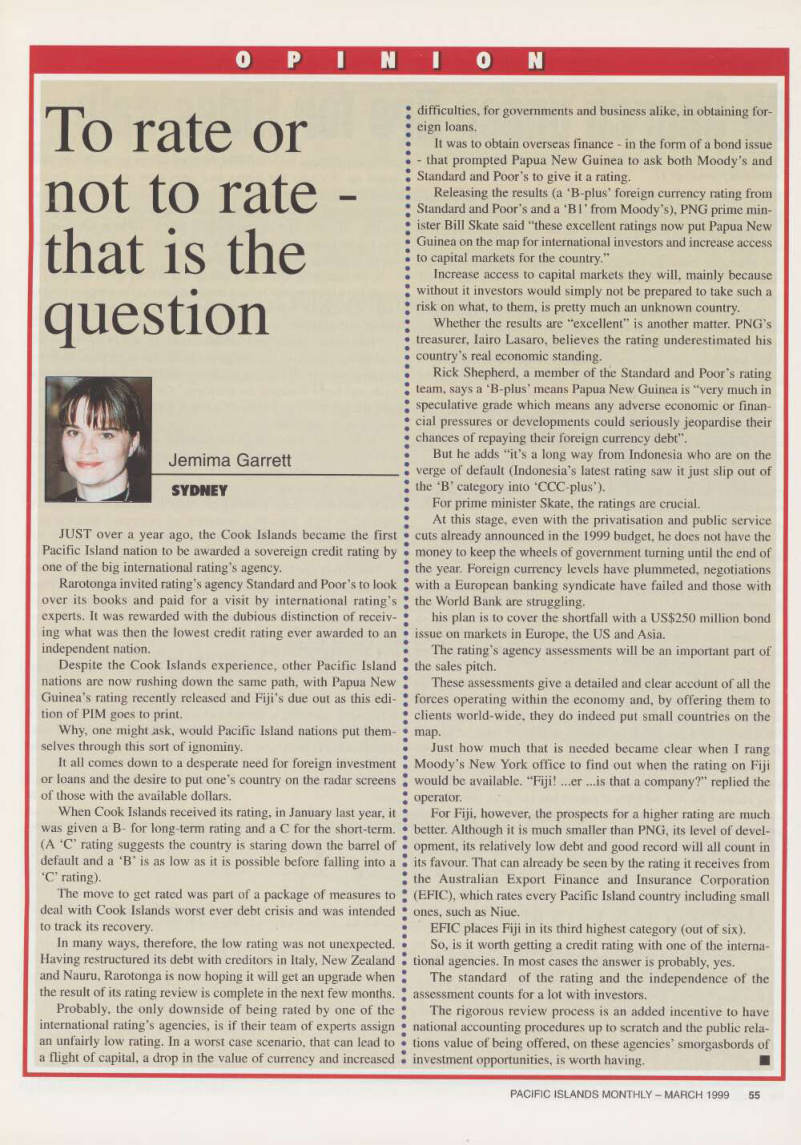
To rate or not to rate that is the question
JUST over a year ago, the Cook Islands became the first Pacific Island nation to be awarded a sovereign credit rating by one of the big international rating’s agency.
Rarotonga invited rating’s agency Standard and Poor’s to look over its books and paid for a visit by international rating’s experts. It was rewarded with the dubious distinction of receiv ing what was then the lowest credit rating ever awarded to an
independent nation.
Despite the Cook Islands experience, other Pacific Island nations are now rushing down the same path, with Papua New Guinea’s rating recently released and Fiji’s due out as this edi tion of PIM goes to print.
Why, one might .ask, would Pacific Island nations put them selves through this sort of ignominy.
It all comes down to a desperate need for foreign investment or loans and the desire to put one’s country on the radar screens of those with the available dollars.
When Cook Islands received its rating, in January last year, it was given a B- for long-term rating and a C for the short-term. (A ‘C’ rating suggests the country is staring down the barrel of default and a ‘B’ is as low as it is possible before falling into a
‘C’ rating).
The move to get rated was part of a package of measures to deal with Cook Islands worst ever debt crisis and was intended to track its recovery.
In many ways, therefore, the low rating was not unexpected.
Having restructured its debt with creditors in Italy, New Zealand and Nauru, Rarotonga is now hoping it will get an upgrade when the result of its rating review is complete in the next few months.
Probably, the only downside of being rated by one of the international rating’s agencies, is if their team of experts assign an unfairly low rating. In a worst case scenario, that can lead to a flight of capital, a drop in the value of currency and increased
difficulties, for governments and business alike, in obtaining for
eign loans.
It was to obtain overseas finance - in the form of a bond issue - that prompted Papua New Guinea to ask both Moody’s and Standard and Poor’s to give it a rating.
Releasing the results (a ‘B-plus’ foreign currency rating from Standard and Poor’s and a ‘Bl’ from Moody’s), PNG prime min ister Bill Skate said “these excellent ratings now put Papua New Guinea on the map for international investors and increase access to capital markets for the country.”
Increase access to capital markets they will, mainly because without it investors would simply not be prepared to take such a risk on what, to them, is pretty much an unknown country.
Whether the results are “excellent” is another matter. PNG’s treasurer, lairo Lasaro, believes the rating underestimated his country’s real economic standing.
Rick Shepherd, a member of the Standard and Poor’s rating team, says a ‘B-plus’ means Papua New Guinea is “very much in speculative grade which means any adverse economic or finan cial pressures or developments could seriously jeopardise their chances of repaying their foreign currency debt”.
But he adds “it’s a long way from Indonesia who are on the verge of default (Indonesia’s latest rating saw it just slip out of the ‘B’ category into ‘CCC-plus’).
For prime minister Skate, the ratings are crucial.
At this stage, even with the privatisation and public service cuts already announced in the 1999 budget, he does not have the money to keep the wheels of government turning until the end of the year. Foreign currency levels have plummeted, negotiations with a European banking syndicate have failed and those with the World Bank are struggling. his plan is to cover the shortfall with a US$25O million bond issue on markets in Europe, the US and Asia.
The rating’s agency assessments will be an important part of the sales pitch.
These assessments give a detailed and clear accdunt of all the forces operating within the economy and, by offering them to clients world-wide, they do indeed put small countries on the map.
Just how much that is needed became clear when I rang Moody’s New York office to find out when the rating on Fiji would be available. “Fiji! ...er ...is that a company?” replied the operator.
For Fiji, however, the prospects for a higher rating are much better. Although it is much smaller than PNG, its level of devel opment, its relatively low debt and good record will all count in its favour. That can already be seen by the rating it receives from the Australian Export Finance and Insurance Corporation (EFIC), which rates every Pacific Island country including small ones, such as Niue.
EFIC places Fiji in its third highest category (out of six).
So, is it worth getting a credit rating with one of the interna tional agencies. In most cases the answer is probably, yes.
The standard of the rating and the independence of the assessment counts for a lot with investors.
The rigorous review process is an added incentive to have national accounting procedures up to scratch and the public rela tions value of being offered, on these agencies’ smorgasbords of investment opportunities, is worth having. ■
Jemima Garrett
Sydney
Advertisements & other items, p. 56 (2 items)
Oil Search under fire for Hides sale
56
PACIFIC ISLANDS MONTHLY - MARCH 1999
Continued from page 17
Oil Search under fire for Hides sale
■ BUSINESS
Australian International Shipping Services Pty Ltd
Providing Container Consolidated Services , Full Container Loads , Airfrieght Forwarding and Purchase Order Tracking Services to:- American Samoa, Cook Islands, Fiji, Guam, Kiribati, New Zealand, Niue, Norfolk Island, New Caledonia, Nauru, Papua New Guinea, Solomon Islands, Tahiti, The Federated States of Micronesia, Tonga, Vanuatu, and Western Samoa.
Offices in Melbourne and Sydney
TEL:-61-3-93351477
FAX:-61-3-93380115
EMAIL:-A-I-S-S.COM
Reef Shipping Fiji Limited
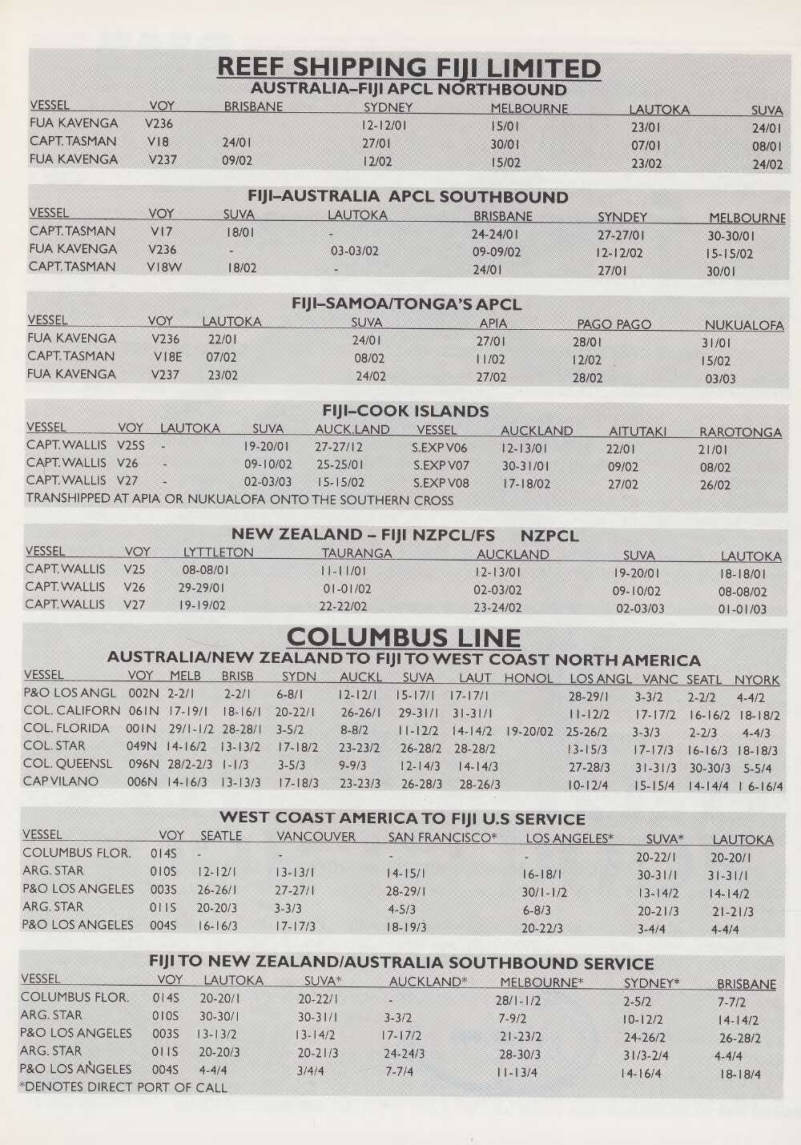
Vessel
Voy
Austral!A-Fiji Apcl Northbound
Brisbane Sydney Melbourne
Lautoka
Suva
Fua Kavenga
V236 12-12/01 15/01 23/01 24/01
Cart. Tasman
VI8 24/01 27/01 30/01 07/01 08/01
Fua Kavenga
V237 09/02 12/02 15/02 23/02 24/02
Vessel
Voy
Fljl-Australia Apcl Southbound
Suva Lautoka Brisbane
Syndey
Melbourne
Capt Tasman
VI7 18/01 - 24-24/01 27-27/01 30-30/0!
Fua Kavenga
V236 - 03-03/02 09-09/02 12-12/02 15-15/02
Capt. Tasman
Vi8W
18/02 - 24/0! 27/01 30/01
Vessel
Voy
Lautoka
F1J l-S A M O A/TO N G A’S APCL
Suva Apia
Pago Pago
Nukualofa
Fua Kavenga
V236 22/01 24/01 27/01 28/01 31/01
Capt. Tasman
Vise
07/02 08/02 1 1/02 12/02 15/02
Fua Kavenga
V237 23/02 24/02 27/02 28/02 03/03
Vessel
Voy Lautoka
Suva
Fiji-Cook Islands
Auck.Land Vessel
Auckland
Aitutaki
Rarotonga
Cart. Wallis
V25S - 19-20/01 27-27/12
S.Expv06
12-13/01 22/01 21/01
Cart Wallis
V26 09-10/02 25-25/01
S.Expv07
30-31/01 09/02 08/02 CART WALLIS V27 - 02-03/03 15-15/02 S.EXPV08 TRANSHIPPED AT APIA OR NUKUALOFA ONTO THE SOUTHERN CROSS 17-18/02 27/02 26/02
Vessel
Voy
New Zealand - Fiji Nzpcl/Fs Nzpcl
Lyttleton Tauranga Auckland
Suva
Lautoka
Cart. Wallis
V25 08-08/01 I 1-1 t/01 12-13/01 19-20/01 18-18/01
Cart. Wallis
V26 29-29/01 01-01/02 02-03/02 09-10/02 08-08/02
Cart Wallis
V27 19-19/02 22-22/02 23-24/02 02-03/03 01-01/03
Columbus Line
AUSTRALIA/NEW ZEALAND TO FIJI TO WEST COAST NORTH AMERICA VESSEL VOY MELB BRISB SYDN AUCKL SUVA LAUT HONOL LOSANGL VANC SFAT1
Nyork
P&O Losangl
002N 2-2/1 2-2/1 6-8/1 12-12/1 15-17/1 17-17/1 28-29/1 3-3/2 2-2/2 4-4/2
Col Californ
061N 17-19/1 18-16/1 20-22/1 26-26/1 29-31/1 31-31/1 1 1-12/2 17-1 7/2 16-16/2 18-18/2
Col Florida
001N 29/1-1/2 28-28/1 3-5/2 8-8/2 11-12/2 14-14/2 19-20/02 25-26/2 3-3/3 2-2/3 4-4/3
Col Star
049N 14-16/2 13-13/2 17-18/2 23-23/2 26-28/2 28-28/2 13-15/3 17-17/3 16-16/3 18-18/3
Col. Queensl
096N 28/2-2/3 1-1/3 3-5/3 9-9/3 1 2-14/3 14-14/3 27-28/3 31-31/3 30-30/3 5-5/4
Cap Vilano
006N 14-16/3 13-13/3 17-18/3 23-23/3 26-28/3 28-26/3 10-12/4 15-15/4 14-14/4 1 6-16/4
Vessel
Voy
WEST COAST AMERICA TO FIJI U.S SERVICE SEATLE . VANCOUVER SAN FRANCISCO* LOS ANGELES*
Suva*
Lautoka
Columbus Flor.
Ohs
- - - - 20-22/1 20-20/1
Arc. Star
Oios
12-12/1 13-13/1 14-15/1 16-18/1 30-31/1 31-31/1
P&O Los Angeles
003S 26-26/1 27-27/1 28-29/1 30/1-1/2 13-14/2 14-14/2
Arg. Star
01 IS 20-20/3 3-3/3 4-5/3 6-8/3 20-21/3 21-21/3
P&O Los Angeles
004S 16-16/3 17-17/3 18-19/3 20-22/3 3-4/4 4-4/4
Vessel
Fiji To New Zealand/Australia Southbound Service
Voy Lautoka Suva* Auckland* Melbourne* Sydney*
Brisbane
Columbus Flor.
0145 20-20/1 20-22/1 - 28/1-1/2 2-5/2 7-7/2
Arc. Star
Oios
30-30/1 30-31/1 3-3/2 7-9/2 10-12/2 14-14/2
P&O Los Angeles
003S 1 3-1 3/2 13-14/2 1 7-17/2 21-23/2 24-26/2 26-28/2
Arg. Star
01 IS 20-20/3 20-21/3 24-24/3 28-30/3 31/3-2/4 4-4/4
P&O Los Angeles
004S 4-4/4 3/4/4 7-7/4 1 1-13/4 1 4-16/4 18-18/4
♦Denotes Direct
Port Of
Call
Neptune Shipping Line
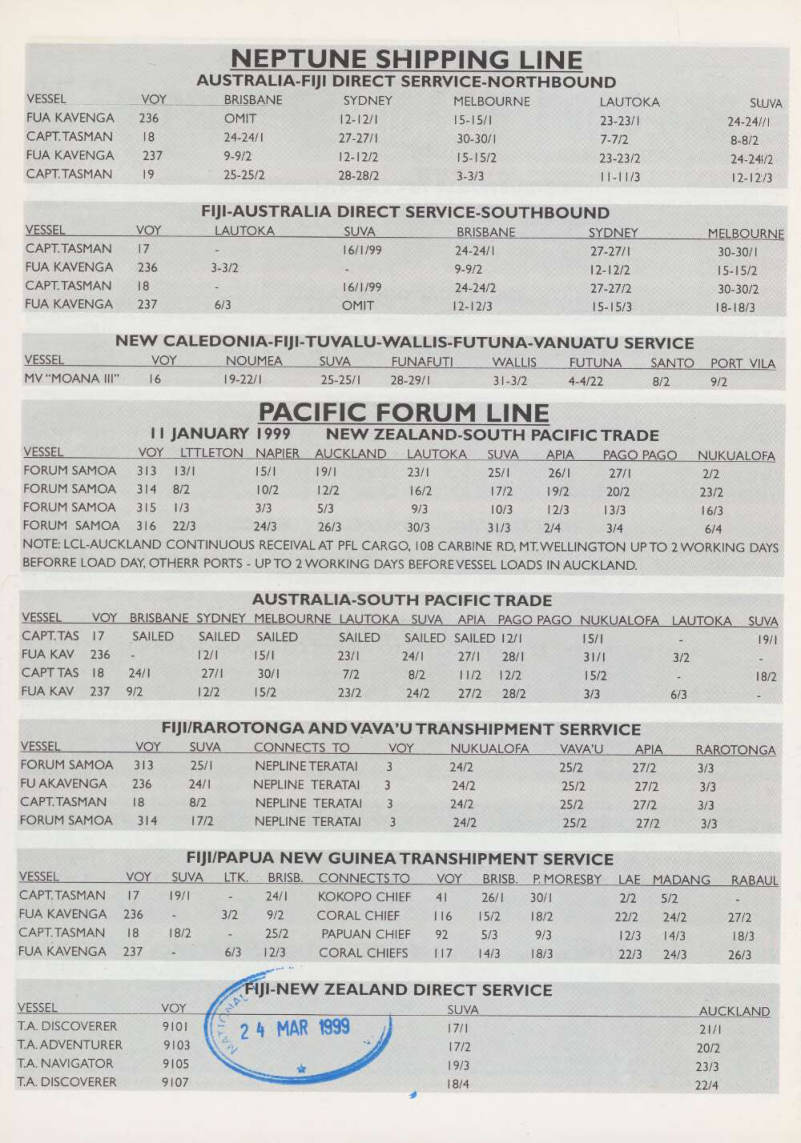
Vessel
Voy
Australia-Fiji Direct Serrvice-Northbound
Brisbane Sydney Melbourne Lautoka
Sluva
Fua Kavenga
236
Omit
12-12/1 15-15/1 23-23/1 24-24//1
C Apt. Tasman
18 24-24/1 27-27/1 30-30/1 7-7/2 8-8/2
Fua Kavenga
237 9-9/2 12-12/2 15-15/2 23-23/2 24-241/2
Cart Tasman
19 25-25/2 28-28/2 3-3/3 1l-l 1/3 12-12/3
Vessel
Voy
Fiji-Australia Direct Service-Southbound
Lautoka Suva Brisbane Sydney
Melbourne
C Apt. Tasman
17 - 16/1/99 24-24/1 27-27/1 30-30/i
Fua Kavenga
236 3-3/2 - 9-9/2 12-12/2 15-15/2
Cart Tasman
18 - 16/1/99 24-24/2 27-27/2 30-30/2
Fua Kavenga
237 6/3
Omit
12-12/3 15-15/3 18-18/3
New Caledonia-Fiji-Tuvalu-Wallis-Futuna-Vanuatu Service
Vessel Voy Noumea
Suva
Funafuti Wallis Futuna
Santo Port Vila
Mv “Moana 111” 16 19-22/1
25-25/1 28-29/1 31-3/2 4-4/22 8/2 9/2
Pacific Forum Line
Vessel
11 January 1999
Voy Lttleton Napier
New Zealand-South Pacific Trade
Auckland Lautoka Suva Apia Pago Pago
Nukualofa
Forum Samoa
313 13/1 15/1 19/1 23/1 25/1 26/1 27/1 2/2
Forum Samoa
314 8/2 10/2 12/2 16/2 17/2 19/2 20/2 23/2
Forum Samoa
315 1/3 3/3 5/3 9/3 10/3 12/3 13/3 16/3
Forum Samoa
316 22/3 24/3 26/3 30/3 31/3 2/4 3/4 6/4 NOTE: LCL-AUCKLAND CONTINUOUS RECEIVAL AT PFL CARGO, 108 CARBINE RD, MT WELLINGTON UP TO 2 WORKING DAYS
Beforre Load Day, Otherr Ports -
UP TO 2 WORKING DAYS BEFORE VESSEL LOADS IN AUCKLAND.
Vessel
Voy
Brisbane
Sydney
Australia-South Pacific Trade
Melbourne Lautoka Suva Apia Pagio Paoo
Nukualofa
Lautoka
Suva
Capt.Tas
17
Sailed
Sailed
Sailed
Sailed
Sailed
Sailed
12/1 15/1 19/1
Fua Kav
236 - 12/1 15/1 23/1 24/1 27/1 28/1 31/1 3/2 £
Capttas
18 24/1 27/1 30/1 7/2 8/2 1 1/2 12/2 15/2 18/2
Fua Kav
237 9/2 12/2 15/2 23/2 24/2 27/2 28/2 3/3 6/3
Vessel
Fiji/Rarotonga And Vava’U Transhipment Serrvice
VOY SUVA CONNECTS TO VOY NUKUALOFA VAVA’U APIA
Rarotonga
Forum Samoa
313 25/1
Neplineteratai
3 24/2 25/2 27/2 3/3
Fu Akavenga
236 24/1
Nepline Teratai
3 24/2 25/2 27/2 3/3
C Apt. Tasman
18 8/2
Nepline Teratai
3 24/2 25/2 27/2 3/3
Forum Samoa
314 17/2
Nepline Teratai
3 24/2 25/2 27/2 3/3
Vessel
Voy
Fljl/Papua New Guinea Transhipment Service
SUVA LTK. BRISB. CONNECTSTO VOY RRISR P MORF^RY 1 AF
Madang
Rabaul
Cart Tasman
17 19/1 - 24/1
Kokopo Chief
41 26/1 30/1 2/2 5/2
Fua Kavenga
236 - 3/2 9/2
Coral Chief
1 16 15/2 18/2 22/2 24/2 27/2
Cart Tasman
18 18/2 - 25/2
Papuan Chief
92 5/3 9/3 12/3 14/3 18/3
Fua Kavenga
237 - 6/3 12/3
Coral Chiefs
1 17 14/3 18/3 22/3 24/3 26/3
Vessel
Voy
Zealand Direct Service
r r v ' Suva
Auckland
T.A. Discoverer
9101
((- 2 I, Mar 1999
17/1 21/1
T.A. Adventurer
9103 V\. / 17/2 ion
T.A. Navigator
9105 19/3 23/3
T.A. Discoverer
9107 4 18/4 22/4
Advertisements & other items, pp. 59-60 (1 item)
Door
International & Local Courier
Fiji’s own courier company goes further than Fiji o'* I#® m m ■ * «*s« t* iSiffiv,
Bpg
5■ . % v i* LD ■ . > y
DOOR
For all your:
Courier needs 1 Heavyweights
if domestic messenger courier needs - / IHour / 3 Hour / Same day 1508 00911436 9
International & Local Courier
34 or TOLL FREE 0800 307 304 NADI AIRPORT: 724 434 NADI: 700 001 LAUTOKA: 665 161 IU: 850 001 SIGATOKA: 500 321 or simply call your nearest post office and ask for EMS Servici
3 e^> New Caledonia is a developped, sophisticated island business base that offers outstanding opportunities for investors : stunning sites for new hotel developments, suitable climate for counterseason fruits, vegetables and tropical flowers, superb locations for fish and prawn aquaculture, and more. Authorities in New Caledonia are very supportive to business. •v* •M v; -X mm. s Photos : Mant - Pantz - Trompas s V ©At nr D O _K_ wmmmm ADECAL, the Economic Development Agency of New Caledonia, is the one-stop shop where investors can get specific advice on doing business in New Caledonia.
As your free-of-charge partner, we shall assist you in identifying opportunities and putting together your project successfully.
Should you like to receive further information, please do not hesitate to contact either Yann PITOLLET or Benoit RENGADE.
E-mail: [email protected] a r r* a i
A A V L-'
New Caledonia Economic Development Bureau 15, rue Guynemer - PO Box 2384 - 98846 Noumea Cedex - New Caledonia - Phone: (687) 249 077 ■ Fax: (687) 249 087 - E-mail: [email protected]