Pacific Islands
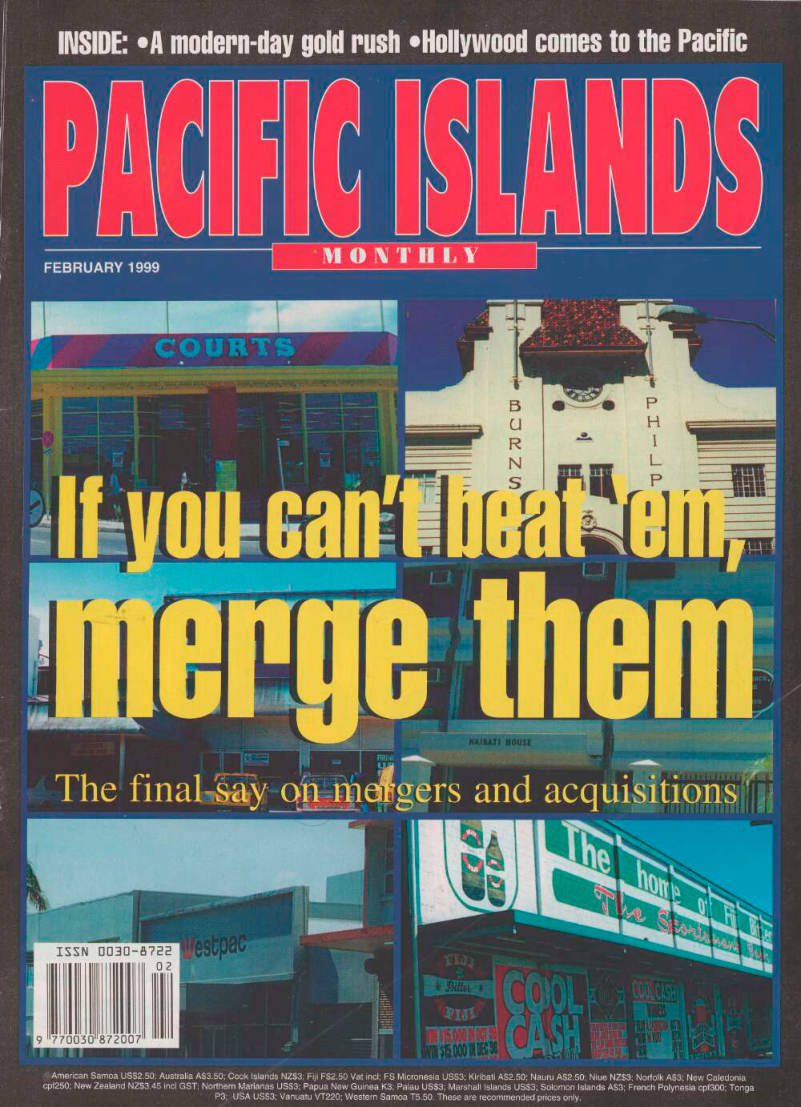
Monthly
INSIDE: *A modern-day gold rush •Hollywood comes to the Pacific
ƒgffgf
House
American Samoa US$2.5O; Australia A 53.50; Cook Islands NZ$3; Fiji F 52.50 Vat incl; FS Micronesia US$3; Kiribati A 52.50; Nauru A 52.50; Niue N2S3; Norfolk As 3; New Caledonia cpf2so; New Zealand NZ53,45 incl GST; Northern Marianas US$3; Papua New Guinea K 3; Palau US$3; Marshall Islands US$3; Solomon Islands As 3; French Polynesia cpfSOO; Tonga P 3; USA US$3; Vanuatu VT22O; Western Samoa T 5.50. These are recommended prices only.
Advertisements & other items, pp. 2-4 (1 item)
Hotooind
mu D 9t iitlliaiilllllSi fclV**m ■ m ■CI % m 4 k
i{Vi
W J FI Ft/ /=
mol
0 0 n now at oh oko moiooi loowooom hooo m Anti Skid Brakes (ABS) Distinctive European Styling 1600 cc Multi-Valve Engine Hi-Mount Rear Stop Lamp Intermittent Windscreen Wipers Fantastic new colours available including Electric Blue, Apricot Pearl Metallic Lavender Metallic, Peppermint Green Coral Reef Mica Metallic, and more!
HOTOOINd
Manual or Automatic Transmission Powerful Halogen Headlamps Fully Air Conditioned Luxurious Fabric Trim Dynamic AM/FM Cassette Stereo
Asco Motors
®) TOYOTA
CORO
Speed Sensitive Power Steering Fully Adjustable Driver's Seat 60/40 Split, Fold Down Rear Seats Convenient Centre Console The Smartest Looking Sedan in Town
* PHOTO DEPICTS OPTIONAL EXTRAS ;
SPOILER & ALLOY WHEELS
SUVA PH 384888 • SIGATOKA PH 500577 NADI PH 721777 • LAUTOKA PH 662855 BA PH 674406 • TAVUA PH 680152
LABASA PH 811688
AM 1224
M H f rA r - £ n i i s tt ¥ ■ m tm MW P 1 I * 4 T •*f 5f U ■ :: i We accept
MBA
Just quote your card number and expiry date and we will forward your requirements.
For further information piease contact Telikom Phone Card Sales Pay Phone Business Unit PO Box 351 Waigani. NCD Papua New Guinea Telephone: (675) 300 5093 Facsimile: (675) 3005060
TELIKOM PNG
J 5 AAo&j) izxJts&rtq /
PACIFIC ISLANDS
MacmrnM
TRADING POST
TRADING POST CAN WORK
WONDERS FOR YOU...
Promote your business, or service, sell your household items, cars or heavy machinery etc.
ONLY AUSS2 (OR EQUIVALENT) PER WORD.
NO COMPANY LOGO. NO DISPLAY.
NO BOLD TYPE.
Just forward your Advertisement together with payment to:
PACIFIC ISLANDS MONTHLY "Trading Post",
PO Box 1167, Suva, Fiji.
Conditions: 1. All Advertisements are subject to acceptance and approval of publisher. 2. Advertisements are published as space permits; we cannot guarantee date of insertion. 3. All advertisements must be prepaid and should be typed or printed clearly 4. Deadline for receipt of advertisements is the 15th of the month prior to issue. 5. PACIFIC ISLANDS MONTHLY assumes no responsibility for any service other than publishing paid advertisements in this section.
Pacific Islands
Monthly
Vol 68 No. 14
The News Magazine
February 1999
PUBLISHER: Alan Robinson EDITOR: Sophie Foster Hildebrand
Correspondents:
Sally Andrew, Monica Miller, Giff Johnson, Chris Peteru, Atama Raganivatu, Michael Field, Marc Neil-Jones Sam Vulum, Lisa Williams, Ofani Eremae Florence Syme-Buchanan.
Columnists:
David Barber (Wellington), Jemima Garrett (Sydney),
Graphic Artists:
James Ranuku, Josefa Bola
Advertising Sales
Senior Regional Sales (South Pacific) Shabana Naaz Tel (679) 304111,303244, Fax (679) 303809.
Sydney, Canberra: Bob Hill Media Representation, Tel (61-2) 4164245, Fax (61-2) 4165064.
Brisbane: Jane Fewings Media and Advertising Associates Tel (61-7) 3378 4522, Fax (61-7)3878 1071.
Adelaide: Hastwell Williamsons Representatives, Tel (61-8) 3799522, Fax (61-8) 3799735.
Melbourne: Brown Orr Fletcher Burrows (Aust) Pty Ltd.
Tel (61-3) 98265188, Fax (61-3) 98265644.
Auckland: McKay & Bowman, International Media Representatives Limited, Tel (64-9)4190561, Fax (64-9) 4192243.
Japan: Universal Media Corporation, Tokyo, Tel (3) 3266626741, Cable: UNI-MEDIA Tokyo, Fax (3) 32626742.
Pacific Islands Monthly was founded in 1930
(Usps 9522480).
A Fiji Times Limited production.
Cover prices are recommended retail only. Registered by Australia Post, Publication No. NBPI2IO. © Copyright Fiji Times Limited, 177 Victoria Parade, Suva, Fiji.
Tel (679) 304111, fax (679) 303809.
Email: [email protected] PIM Website: http://www.pim.com.fj Pacific Islands Monthly is published monthly by Fiji Times Limited, a division of Nationwide News, 2 Holt Street, Surry Hills, Sydney, NSW 2010.
Send Address Changes To;
Pacific Islands Monthly PO Box 1167 Suva, Fiji.
Printed by Quality Print Limited, 16 Amra Street, Walu Bay, Suva, Fiji.
Layout by Sophie Foster Hildebrand and James Ranuku Cover design and pictures by Sophie Foster Hildebrand
Letters 1_
Inside
Coven Stony Page 30
Editorial 6
Letters 1_
Special Report: A modern-day Gold Rush 10 Rusiness: Hollywood comes to Fiji 13 "The Thin Red Line" A flawed visionary film 14 Tuvalu's Internet dreams turning into problems 16 Pentagon approval for Aloha air service 18 Tonga, China, missionaries and satellites 20 Festival or farce? Rritain's Millennium debate 22 PNG bankers face withholding tax dilemma 24 Kai kokorako (Eat chicken) 26 A radical unified Pacific airspace soon a reality 28 Cover: If you can't beat 'em, merge them!
The final say on mergers and acquisitions 32 Fair Trading Act Section 49: Mergers 33 Rothmans and Wills poised to control industry 34 Aust companies could be takeover targets in H2/99 34 industry: QBE set for solid HI profit, say funds, analysts 37 Cooks govt proposes major pearl farm in sanctuary 38 FFA supports PNG's tuna management plan 40 PNG govt/environmentalists at loggerheads 42 Report hits out at CNMI's 'inadequate reforms' 44 Volcanoes stiil active in Fiji 47 Sport: Safety paramount in Coffs Harbour/Fiji race 51 Yachting: Smoky's Pacific odyssey 52 Opinion: David Rarber/Jemima Garrett 54
Page 10
Page 14
Page 38
Friendly

Editorial
Friendly competition is a cut-throat business
WHOEVER said business was easier in the Pacific must have had their head screwed on backwards.
What with dealing with monopo lies, trying to stay on top of ever increasing utility costs, limited mar kets, and the high freight and distrib ution costs, life can be a total night mare. In Fiji, the catch phrase at the moment is competition. You hear it everywhere, and out of almost every
politician’s mouth.
Competition, the government says, will help keep businesses in line, and keep prices down.
This from a government which for ever-after has run several monopolies like telecommunications, electricity, water - but has failed to keep prices down.
Now it has found that monopolies are not the way to go, but rather, an open market with several competitors will
decide which company or companies can best do the job.
But several companies, targeting a limited market, do not friendly competi tion make.
In fact, competition has meant that in some cases there is over-supply in the market with limited supply in other areas.
Companies are finding that they put so much energy into competing to stay afloat, that they simply cannot afford to service areas where the profits may not
be marginal. In fact, many people are finding that the market cannot support such competition, and that perhaps the only way to increase efficiency is a merger, or an acqui sition.
Because of high set-up costs for businesses in Fiji, it makes sense to buy out the competition.
With new amendments to the fair trading legislation due to come into
force this month or March, businesses could successfully argue their way through laws pushing anti-dominance of markets.
Indeed, in some cases, it may be preferable to have a monopoly that ser vices the entire community than two or three businesses that target the lucrative sections and leave out the rest.
If friendly competition is a cut-throat business, full-on competition may soon be a living nightmare. ■
Letters
Sea level change
I would like to make one correction to your excellent article on climate and sea level changes being observed now in the Pacific. A mistake in transcription meant our original report stated that both Samoa and Fiji had malaria.
Fortunately, this is not so. Fiji and Samoa remain free of malaria and we apol ogise to the people of Fiji and Samoa for this unforgivable error.
The reality is that the risks of climate and sea level changes increase with each year of delay in cutting greenhouse gas emissions.
Although the international community agreed six years ago that climate change posed a real threat and that they should cut their emissions, virtually no country has yet done so.
Science tells us that the longer we delay making substantial emission reductions, the worse the resulting climate change and sea level rise will be. For low-lying Pacific Islands, we sincerely hope that the world will pay attention to the information in arti cles such as yours, and begin reducing the greenhouse gas emissions.
Tamari’i Tutangata
Director South Pacific Regional Environment Programme (SPREP)
James W Feger
Rising concern for Rocball
I’m writing to you in hopes that we out here on the Pacific rim of the small island community in Saipan, Commonwealth of the Northern Mariana Islands (CNMI)
might be heard internationally concerning
the development of our own team net sport, Rocball, over what is now taking place between the Federation de Volleyball in Laussane (FIVA), Suisse and the World Organised Rocball, Inc. (WOR), Saipan,
Cnmi.
Rocball is the indigenous sport of the CNMI. Rocball has been developing out here since 1981. Rocball started out as a
lunch time activity for our junior high and high school students. Over the past 17 years, rocball has developed into the unique team net sport that it is today because of the students and children of the
Cnmi.
We have, on several occasions, over the past 17 years, written to FIVA to include them in on the creation and development of rocball. We had hoped to actively involve them in this new approach to this type of team net sport. We have not once received a response from FIVA.
In March and April 1993-94 Rocball was exposed internationally on CNN’s World Report. Right after this and in November of 1994, we received news that FIVA was beginning to add new rules to
volleyball.
We investigated and discovered that they were unjudiciously adopting our rules of play to try to restructure and enhance volleyball.
In December 1994, we faxed and regis tered mailed FIVA of their encroachments on Rocball’s copyrights rules of play and reminded them of the many times we had solicited their interest in the past.
We requested them to immediately stop incorporating Rocball’s rules of play into volleyball.
Once again, we just recently learned from our former students and avid Rocball players coming back from colleges in the US, that FIVA did in fact incorporate one of Rocball’s unique systems of play.
Rocball is the first sport in the world to incorporate the combination of hitting/kicking as part of its style of team net play action. And, it seems that there are other areas of play action now being used in volleyball that Rocball has had an influ encing factor upon.
Rocball wasn’t created with the help of two generations of CNMI students as raw material source for FIVA to restructure and draw more interest to volleyball.
Rocball is a game derivative of volley ball, and we have always credited it as such but it is as different from volleyball as baseball is from cricket or American foot ball is from rugby.
Rocball has also been copyrighted on numerous occasions since 1981 through
the Library'of Congress, Washington DC.
And FIVA has been notified about this more than once.
We, obviously, are hoping to expose Rocball as the successful team net sport it is, on a more global basis. Please keep us in mind: WOR intends to continue to be a positive force in this type of team net sport.
James W Feger
President/founder, World Organised Rocball, Inc.
Saipan, CNMI
A collector from Hellas
Hello! I am from Greece, I m 32 years old and I am a collector of TELEPHONE CARDS from everywhere in the world. I would like to ask anyone if they could send me a phone card (of course I don’t mind if it is used or empty) from your country.
My address is: Matsas Minos Nikolaou Athanasiadou 16 - P.Penteli TK 152 36 Athens, Greece.
Matsas Minos.
Where are they now?
I wish to locate two ladies who did their midwifery training with me at St Helen’s Christchurch in 1963.
Both married about 1965 but I don’t know their married names.
Their maiden names were Peniana Ravea and Sai Banivalu. Peniana’s father was a Methodist minister.
I plan to visit Fiji in October and would dearly love to meet them again.
Meryle Isaac (nee Shaw)
58 Clyma Street, Upper Hutt New Zealand
Letters To The Editor should be addressed to: The Editor, Pacific Islands Monthly, P O Box 1167, Suva, Fiji. E-mail: fijitimes® is.com.fj or [email protected]
Archive S-February 1945

Landing-craft, Groceries
The London “Daily Telegraph”
recently suggested an interesting post war conversion of a wartime invention -
landing-craft. Landing-craft which put
down men, guns and heavy equipment on open beaches will, it believes, revolu tionise transport in areas (particularly the Pacific) which lack port facilities.
One Australian shipping firm is reported to have already offered to buy from the British Admiralty, as soon as the war is over, a number of tank-landing ships and small craft.
It intends to use them for its Pacific Islands service. Cargoes can be picked up or set down with equal facility on hitherto unapproachable beaches.
Stripped of their military gear a craft capable of carrying several hundred tons of cargo could be run for about l/-per mile.
Mount Kasi Mines
Some interest has been created by the fact that Mount Kasi Mines, Ltd., have recommenced operations on their mining area at Yanawai, Vanua Levu.
The company was forced to cease mining and milling operations towards the end of 1943, owing to their inability to obtain essential plant and materials.
Actually the company has not recom menced mining operations, but is engaged on a churn drilling exploratory
programme, recently approved by a spe
cial meeting of shareholders.
Amendments To
Regulations Covering New
Guinea
Australian National Security Regulations, as they apply to the New Guinea Territories, were amended on January 10.
They provide: - For the transfer of the powers for merly conferred by the Regulations upon the General Officer Commanding, New Guinea Force, to the General Officer of the Australian Military Forces. - That companies whose articles of association require that meetings of shareholders or directors shall be held in Papua or New Guinea, may now hold such meetings in Australia. - That owners of properties as well as lessees, are brought within the provisions of Part IV of the Regulations relating to the wartime control of industries. ■
Advertisements & other items, p. 8 (1 item)
ToFinish...
From Start...
Copymasters Hawaii can help you with all of your duplicating needs from start to finish. Featuring Duplo® Digital Duplicators, Copiers, Shredders, Laminators, Poster Printers, Collators, & Folding Equipment. We also sell Stencil & Duplicator Supplies, Paper Supply, and all brands of Copier Supplies, & Computers.
Copymasters Hawaii
94-515 Ukee Street, Suite 201 • Waipahu, HI 96"97 Phone (808) 678-2263 • Fax (808) 678-2013
E-Mail: [email protected]
ToFinish...
Serving:
STATE OF HAWAII
ENTIRE
SOUTH PACIFIC,
INCLUDING:
• FIJI
• SAMOA
• TAHITI
• TONGA
• COOK ISLANDS
MICRONESIA;
• FEDERATED STATES
OF MICRONESIA
• GUAM
• MARIANAS
• MARSHALL
ISLANDS
• PALAL
Q
copymasters
hawaii
Briefs
Nauru signs loan agreement with ADB The Nauruan president, Bernard Dowiyogo, mid-January announced the signing of the first loan agreement between the Republic of Nauru and the Asian Development Bank (ADB).
The ADB has reviewed the Nauruan economy and an agreement on a major economic and financial adjustment pro gramme has been reached between the
bank and the government.
Subsequently, the ADB has agreed to provide Nauru with loan assistance and technical assistance grants. The agreed programme takes into account the likely exhaustion of Nauru’s phosphate reserves over the next 8-12 years.
Economic and financial structures will be put in place to allow orderly adjustment at the time when phosphate incomes and foreign exchange earnings come to an end. In preparation for this inevitable event, the government of Nauru has decided to adopt a number of measures aimed at reducing both government
spending and the fiscal deficit to sustain able levels.
Region needs to be ready for
globalisation
The South Pacific Forum Secretariat will have to help its member countries pre pare to cope with globalisation, one of the many economic issues the region will have to deal with this year. New Zealand’s high commissioner to Fiji, Tia Barrett, made the comments at the Forum Secretariat, while handing over 2.2 million New Zealand dol lars (SUSI.I million) to forum Secretary General Noel Levi.
Barrett says 1999 will be a very impor tant year as economic issues assume greater importance in the global sphere and the region needs to be ready. He says part of the Forum Secretariat’s role will be to help develop the readiness of the Forum member countries to cope with globalisa tion - a tide that will not stop.
The funds represent NZ’s annual mem bership and extra-budgetary contribution to the Forum. The NZ 2.2 million includes a regular budget contribution of SNZI.2 million, equivalent to about one-third of
the total regular budget which is mainly for the operation of the Forum Secretariat. It also includes $NZ489,000 for the opera tion of the New Zealand Trade Office in Auckland which promotes trade and investment in the Pacific Islands, and $NZ525,000 towards the extra budget to fund a number of positions directly con tributing to the delivery of the Forum Secretariat’s 1999 work programme.
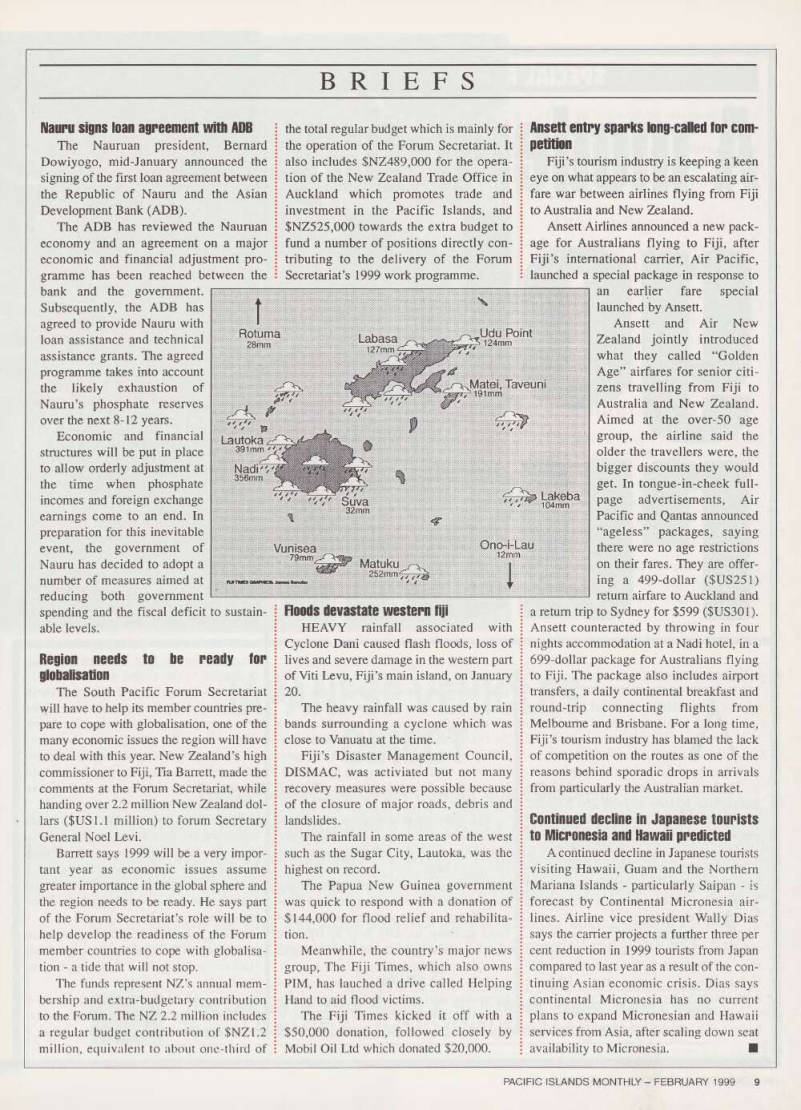
Hoods devastate western fiji HEAVY rainfall associated with Cyclone Dani caused flash floods, loss of lives and severe damage in the western part of Viti Levu, Fiji’s main island, on January 20.
The heavy rainfall was caused by rain bands surrounding a cyclone which was close to Vanuatu at the time.
Fiji’s Disaster Management Council, DISMAC, was activiated but not many recovery measures were possible because of the closure of major roads, debris and landslides.
The rainfall in some areas of the west such as the Sugar City, Lautoka, was the highest on record.
The Papua New Guinea government was quick to respond with a donation of $144,000 for flood relief and rehabilita tion.
Meanwhile, the country’s major news group, The Fiji Times, which also owns PIM, has lauched a drive called Helping Hand to aid flood victims.
The Fiji Times kicked it off with a $50,000 donation, followed closely by Mobil Oil Ltd which donated $20,000.
Ansett entry sparks long-called for com
petition
Fiji’s tourism industry is keeping a keen eye on what appears to be an escalating air fare war between airlines flying from Fiji to Australia and New Zealand.
Ansett Airlines announced a new pack age for Australians flying to Fiji, after Fiji’s international carrier. Air Pacific, launched a special package in response to
an earlier fare special launched by Ansett.
Ansett and Air New Zealand jointly introduced what they called “Golden Age” airfares for senior citi zens travelling from Fiji to Australia and New Zealand.
Aimed at the over-50 age group, the airline said the older the travellers were, the bigger discounts they would get. In tongue-in-cheek full page advertisements, Air Pacific and Qantas announced “ageless” packages, saying there were no age restrictions on their fares. They are offer ing a 499-dollar (SUS2SI) return airfare to Auckland and
a return trip to Sydney for $599 (SUS3OI).
Ansett counteracted by throwing in four nights accommodation at a Nadi hotel, in a 699-dollar package for Australians flying to Fiji. The package also includes airport transfers, a daily continental breakfast and
round-trip connecting flights from
Melbourne and Brisbane. For a long time, Fiji’s tourism industry has blamed the lack of competition on the routes as one of the reasons behind sporadic drops in arrivals from particularly the Australian market.
Continued decline in Japanese tourists to Micronesia and Hawaii predicted A continued decline in Japanese tourists visiting Hawaii, Guam and the Northern Mariana Islands - particularly Saipan - is forecast by Continental Micronesia air lines. Airline vice president Wally Dias says the carrier projects a further three per cent reduction in 1999 tourists from Japan compared to last year as a result of the con tinuing Asian economic crisis. Dias says continental Micronesia has no current plans to expand Micronesian and Hawaii services from Asia, after scaling down seat availability to Micronesia. ■
gold

Special Report
A moder-day gold rush
By Andrew Kilvert
ANEW wave of economic migrants in Irian Jaya, pouring in to search for gold, has sparked con cern for the rights of local people.
Thousands of migrants from the Indonesian Islands of Java and Bali are flooding into the contested Indonesian province of Irian Jaya in search of gold.
This is creating further tensions between the Papuan population and the Indonesian authorities in this already
troubled province.
Many Irianese or West Papuans see this latest wave of migration as a fur ther setback to their aspirations for independence from the 30-year Indonesian military rule.
As with previous waves of Indonesian migration there is also con
cern that it will result in further dis possession of local peoples from their traditional lands.
The military authorities in Irian Jaya do not recognise traditional land own ership and continue to evict local peo ple from land that is wanted by the mil itary for settling migrants or resource extraction.
The flow of migrants in search of gold has been increasing steadily since the collapse of the Indonesian Rupiah in April 1998.
There are two weekly passenger ships from Java that bring thousands of people in search of fortune or relief from poverty, usually only to find the squalor of the gold fields is even worse than the conditions they left in Java.
This mass migration has resulted from the collapse of the Indonesian currency that has reduced to almost a seventh of its original value. In local
terms the value of gold appears to have increased seven-fold because its value is pegged to the global market.
In the capital city of Jayapura there are red slips down the mountain sides where bags of gold bearing earth are slid down to the gold panners below.
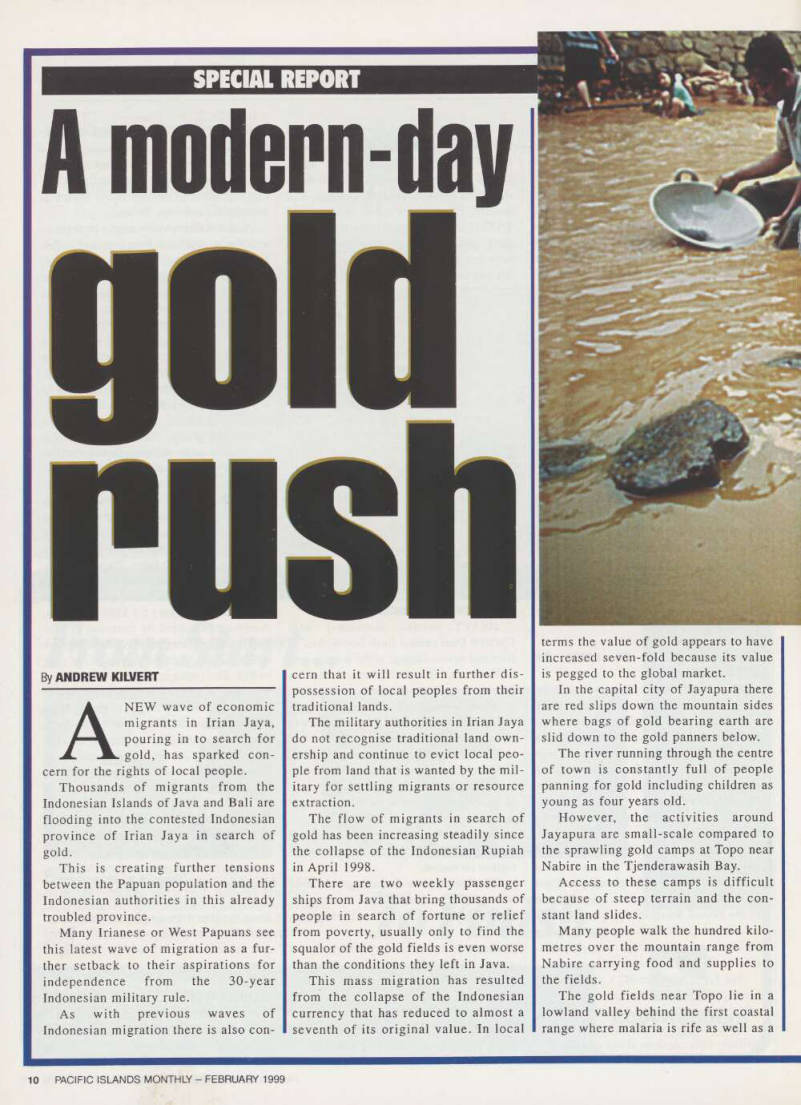
The river running through the centre of town is constantly full of people panning for gold including children as young as four years old.
However, the activities around Jayapura are small-scale compared to the sprawling gold camps at Topo near Nabire in the Tjenderawasih Bay.
Access to these camps is difficult because of steep terrain and the con stant land slides.
Many people walk the hundred kilo metres over the mountain range from Nabire carrying food and supplies to the fields.
The gold fields near Topo lie in a lowland valley behind the first coastal range where malaria is rife as well as a
number of waterborne diseases. They consist of rough tarpaulin shanties that spread off through the jungle. These camps are surrounded by the fine red mud that covers everybody and clouds the rivers.
Transmigration is
also used as a method
to bring Indonesian
labourers to remote
areas to work on
extraction industries
such as logging,
mining or oil palm
plantations.
The gold fields are controlled by the military who provide road access and then sell leases to the gold miners.
As well as profiteering from the selling of licenses the military also profit from the provision of other ser vices to the fields, such as prostitution and alcohol.
This has angered the traditional land owners who receive nothing as their traditional lands are mined and their rivers polluted.
Indonesians pan in the hope of finding gold in the contested provinge of Irian Jaya.
In response to this situation some of the traditional owners have set up road blocks where they collect a toll from all vehicles (except the military) which are going to the fields.
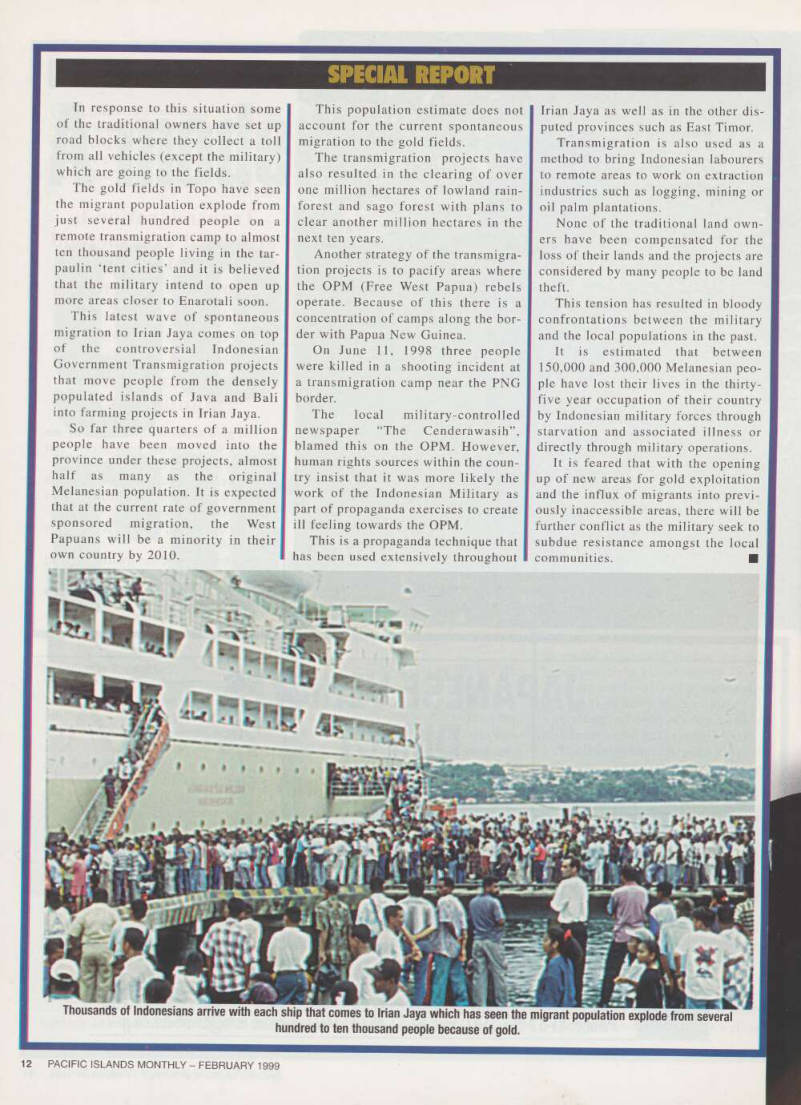
The gold fields in Topo have seen the migrant population explode from just several hundred people on a remote transmigration camp to almost ten thousand people living in the tar paulin ‘tent cities’ and it is believed that the military intend to open up more areas closer to Enarotali soon.
This latest wave of spontaneous migration to Irian Jaya comes on top of the controversial Indonesian Government Transmigration projects that move people from the densely populated islands of Java and Bali into farming projects in Irian Jaya.
So far three quarters of a million people have been moved into the province under these projects, almost half as many as the original Melanesian population. It is expected that at the current rate of government sponsored migration, the West Papuans will be a minority in their own country by 2010.
This population estimate does not account for the current spontaneous migration to the gold fields.
The transmigration projects have also resulted in the clearing of over one million hectares of lowland rain forest and sago forest with plans to clear another million hectares in the next ten years.
Another strategy of the transmigra tion projects is to pacify areas where the OPM (Free West Papua) rebels operate. Because of this there is a concentration of camps along the bor der with Papua New Guinea.
On June 11, 1998 three people were killed in a shooting incident at a transmigration camp near the PNG border.
The local military-controlled newspaper “The Cenderawasih”, blamed this on the OPM. However, human rights sources within the coun try insist that it was more likely the work of the Indonesian Military as part of propaganda exercises to create ill feeling towards the OPM.
This is a propaganda technique that has been used extensively throughout
Irian Jaya as well as in the other dis puted provinces such as East Timor.
Transmigration is also used as a method to bring Indonesian labourers to remote areas to work on extraction industries such as logging, mining or oil palm plantations.
None of the traditional land own ers have been compensated for the loss of their lands and the projects are considered by many people to be land theft.
This tension has resulted in bloody confrontations between the military and the local populations in the past.
It is estimated that between 150,000 and 300,000 Melanesian peo ple have lost their lives in the thirty five year occupation of their country by Indonesian military forces through starvation and associated illness or
directly through military operations.
It is feared that with the opening up of new areas for gold exploitation and the influx of migrants into previ ously inaccessible areas, there will be further conflict as the military seek to subdue resistance amongst the local communities. ■
Thousands of Indonesians arrive with each ship that conies to Irian Jaya which has seen the migrant population explode from several hundred to ten thousand people because of gold.
Advertisements & other items, p. 11 (1 item)
Japanese Vehicles
DIRECT
Trucks/Buses/Cars. Order now for quick shipment. • Trucks, I ton Pickups up to J ton Trucks - Dyn Titans, etc. • Buses, 8 seaters up to 29 seoters - Hiaces, Coasters, etc. • Cars, 4WD,Sports and Vans - All Types - Corollas, Sunnys, Hilux, etc.
Phone or fax now for your free Stock Lists I Order Form. Experienced, helpful service.
Quick shipment. Buy your own vehicle direct from Trust Company and SAVE sss. Ask for James at: Trust Company Ltd, Kobac Building, 3f, 3-2-26 Nishiki, Naka-ku, Nagoya, Japan.
Phone: 81-52-953-5502, Fax: 81-52-953-5534/31, E-mail: [email protected]
Hollywood
comes to Fiji
Fiji’s international
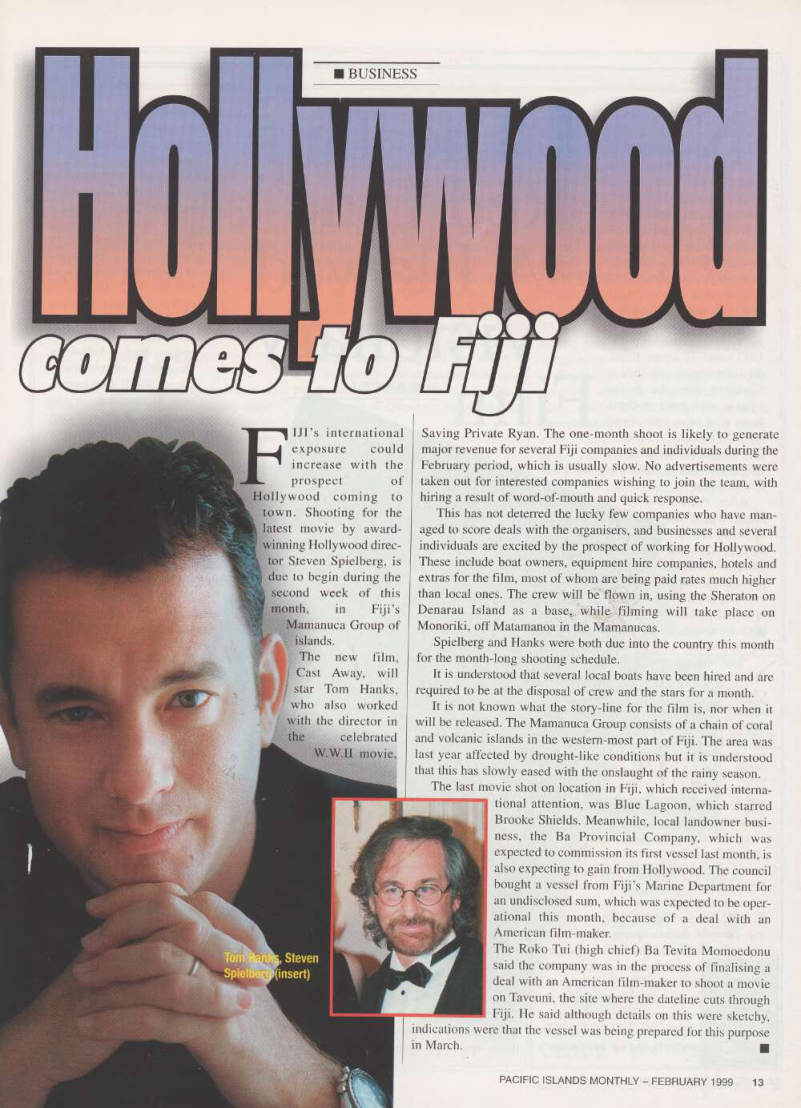
exposure could increase with the prospect of k, Hollywood coming to town. Shooting for the latest movie by award ■B winning Hollywood direc jra tor Steven Spielberg, is Km due to begin during the mtm. second week of this f month, in Fiji’s Mamanuca Group of
*j3| islands.
The new film, *|; Cast Away, will 1/ star Tom Hanks. m f who also worked with the director in the celebrated W.W.11 movie.
Saving Private Ryan. The one-month shoot is likely to generate major revenue for several Fiji companies and individuals during the February period, which is usually slow. No advertisements were taken out for interested companies wishing to join the team, with hiring a result of word-of-mouth and quick response.
This has not deterred the lucky few companies who have man aged to score deals with the organisers, and businesses and several individuals are excited by the prospect of working for Hollywood.
These include boat owners, equipment hire companies, hotels and extras for the film, most of whom are being paid rates much higher than local ones. The crew will be flown in, using the Sheraton on Denarau Island as a base, while filming will take place on Monoriki, off Matamanoa in the Mamanucas.
Spielberg and Hanks were both due into the country this month for the month-long shooting schedule.
It is understood that several local boats have been hired and are required to be at the disposal of crew and the stars for a month.
It is not known what the story-line for the film is, nor when it will be released. The Mamanuca Group consists of a chain of coral and volcanic islands in the western-most part of Fiji. The area was last year affected by drought-like conditions but it is understood that this has slowly eased with the onslaught of the rainy season.
The last movie shot on location in Fiji, which received international attention, was Blue Lagoon, which starred ; Brooke Shields. Meanwhile, local landowner busi- PPHHHU ness, the Ba Provincial Company, which was WkA ex P ectc <J to commission its first vessel last month, is lEhß’ also expecting to gain from Hollywood. The council bought a vessel from Fiji’s Marine Department for El an undisclosed sum. which was expected to be oper jjQK alional this month, because of a deal with an ||R|| American film-maker.
The Roko Tui (high chief) Ba Tevila Momoedonu said the company was in the process of finalising a deal with an American film-maker to shoot a movie on Taveuni, the site where the dateline cuts through »Fiji. He said although details on this were sketchy, indications were that the vessel was being prepared for this purpose in March. g
Tom Hanks, Steven Spielberg (insert)
Visionary

“The Thin Red Line”, A Flawed Visionary
Film
Nick Noite
calls The Thin Red Line “a gigantic anti-war film,” and whether it is coinci dence or fate, the $55 mil lion 20th Century Fox epic with John Travolta, George Clooney, Woody Harrelson, Sean Penn, and John Savage was released shortly after America again went to war.
“Red” is based on the 1962 novel by James Jones, the infantryman stationed at Schofield Barracks during Japan’s sneak attack on Oahu.
Jones went on to write “From Here To Eternity”; the 1953 film adaptation became the
only movie shot in Hawaii to win the Best Picture Oscar.
After Pearl Harboun^^^ Jones shipped to Guadalcanal in 1942. and "Red" is based on his combat ex peri ences at the first isle of WWll's island hop- IB ping campaign in the IS Pacific Theatre.
"Red" follows the har rowing exploits of C-for- Charlie Company, as the Army Rifle Company invades the Japanese stronghold in the Solomon Islands, where JFK’s PT 109 incident took place.
What differentiates Jones from most WWII writers is his psycho logical emphasis on war’s impact on human beings.
In the recent Merchant-Ivory film “A Soldier’s Daughter Never Cries”, V based on the novel by Jones’ daughter 1 Kaylie, Kris Kristofferson as James Jones ' argues with a movie producer, who objects to a scene portraying an infantryman mess ing himself before going into battle.
Kristofferson/Jones argues this is what war is really like - not glorious heroics.
Terrence Malick’s directorial comeback after 20 years is notable for depicting the effect warfare has on not only combatants (American and Japanese soldiers are por trayed in the novel), but on the Solomon
By Ed Rampell
Islanders, as well.
Usually, movie Melanesians are shown as Haole-wood head-hunters, hea thens, and black cannibals, as in Buster
Keaton’s 1924 “The Navigator”, 1933’s “King Kong”, and 1980’s “Blue Lagoon”.
America’s racist attitudes towards blacks (think of the would-be “buck” rapists of 1915’s “Birth of a Nation” and 1939’s “Gone With the Wind”) permeated
Hollywood’s depiction of
Melanesians, the black Pacific Islanders of Papua New Guinea, New Caledonia, Vanuatu, Fiji, and the Solomons, Oceania’s largest racial group. WWII flicks repre sent Melanesians in two ways: in 1958’s “South Pacific”, set in the New Hebrides (now Vanuatu),
Idlers; in 1964’s ican-American ders aiding US fWII works set ives are, to use rm, “invisible in their own ;n in Richard lalcanal Diary” film version id in the 1964 ed”. ook, Solomon >pear as “native on page 407 of
►ell paperback
Not so in the 5 of “Red”: lick’s mesians are minent.
xording to
mstralian pro ducer Grant Hill, a second unit spent ur weeks, and main unit shot on location in Guadalcanal, where $2.5 million was spent. Faux villages were constructed and Native non-actors were cast in neo-realist style. Some Solomon Islanders were also flown to Queensland, Australia, site of principal photography. Dash Mihok (PFC Doll) says: “The terrain is just rough, but absolutely spectacularly beautiful. I loved
it there.” Regarding the Solomon Islanders, Mihok adds, “I was just blown away by the people. They’re just so warm and so really much more enlightened than we are, in a lot of ways... They speak pidgin, which is like broken English... It was amazing.
Those kids are so beautiful. I have home video footage of these children with blonde hair and dark skin and who were singing and purest of souls.”
Readers with a jones for
Jones may also be
troubled by undeveloped
plot points
Mihok has a recurring dream about Jack, seen in the film and coming attrac tions as the first person the Gls encounter after their unopposed landing in a curious moment of culture clash.
Jim Caviezel, who plays Private Witt, describes Melanesians as “godly people, they’re actually far in advance of most Americans, as far as their spiritual side.
They may not have a college degree, but they understand their land... the value of family, the community of church...”
Phoenix Pictures’ Mike Medavoy says “this picture starts in paradise... kids play ing and people happy... and it descends into hell”. In “Red’s” idyllic prelude, Kentuckyian Witt (an extension of Montgomery Clift’s bugler/boxer Prewitt in “Eternity”) goes AWOL in a Melanesian village. Witt (racist in the novel) frolics with the indigenous people, depicted as innocent children of nature living an Edenic existence - until after the battle.
“The next time you see ‘em, they’ve been totally decimated, they’re fighting with each other, they’re arguing, the kid doesn’t say 'hello’,” Medavoy says about this paradise, lost due to WWII.
Nolte says the Solomons became “a culture that fascinated” the director.
Producer Hill states the Melanesians “were one of the elements that attracted Terry... He felt that... the war takes place in an environment that most of us would view, to some extent, as pristine, with a people who obviously had their own dis putes, but certainly were not subject to this mass carnage... Probably, Terry felt that their role, and the role of people like them, had been somewhat undervalued in the past.” To some extent, Malick appropriates another South Seas celluloid stereotype,
usually reserved for Polynesians - brown Pacific Islanders often portrayed as “noble savages”, who have inhabited natural Native nirvanas since pseudo-documentar ian Robert Flaherty’s Samoa in 1926’s “Moana of the South Seas” and Bora Bora in 1931 ’s “Tabu”.
Malick’s trite tropical trope neglects that before Japan invaded, the Solomons was an English colony, and near Guadal, a British High Commissioner was assassi nated. As Solomon shields and war canoe prows in the recent Hawaii Pacific University “War in the Pacific” exhibit indicate, warfare occurred in pre-contact Solomons. And throughout the 19905, a PNG secessionist war at Bougainville, near the Solomons (independent since 1978), has been one of Oceania’s bloodiest con flicts.
The director of the 1970 s cult classics “Badlands” and “Days of Heaven” has adapted a work of prose into the movie medium - using a poetic style.
For Jones purists, something may be lost in Malick’s translation. According to Kaylie Jones, the novel’s gays in the mili tary theme was never in Malick’s script, which Stevens, Jr. says is due to time con siderations. Army anti-semitism is also AWOL: Waspy Lt. Col. Tall (Nolte’s ambi tious officer) clashes with mutinous Capt.
Staros - Stein in the novel. Executive pro ducer George Stevens, Jr. says Malick’s reason for switching the captain’s ethnicity is because he was played by Elias Koteas, an actor of Greek heritage, and the director sought greater realism.
Malick’s trite tropical
trope neglects that before
Japan invaded, the
Solomons was an English
colony, and near Guadal,
a British High
Commissioner was
assassinated.
Readers with a Jones for Jones may also
be troubled by undeveloped plot points,
such as the novel’s tense opening, with C- Company sitting ducks aboard a ship dur ing an air raid. In this sequence, PFC Doll (Mihok) steals a pistol - Jones’ expression of class struggle (officers had pistols, enlisted men didn’t), an important element of his writing influenced by 1930 s “prole
tarian literature”. Both events are merely alluded to in Malick’s nearly three hour movie. But the 1998 version of “Red” is most successful in conveying the spirit, if not the letter, of Jones’ novel. “A movie can never be the book,” says Kaylie Jones, a writer in her own right who thinks “Red” is her father’s masterpiece.
“It’s very different from the book. [To make a film] you’ve got to get rid of the b00k... So, it’s not what you expect. Terry Malick is trying to be true to my father’s notion - that there is no true war film.
They’re phoney - really ugly,” Kaylie asserts, referring to John Wayne-type com
bat pictures.
Kaylie says “I was so deeply moved by the film,” which she describes as “spectac ular... poetic, lyrical.” And of reclusive Terrence Malick, who came out of retire ment to direct “The Thin Red Line”, she says: “I love him, absolutely adore him.
Terry’s modest, humble, kind, well-read, one of the most brilliant people I ever met.”
It was “Ryan” versus “Line” for the New York Film Critics Circle awards - “Saving Private Ryan” won for best pic ture, while “The Thin Red Line” won for best director and best cinematography (by “Braveheart’”s John Toll). As a new mil lennium looms and combat endures, both movies remind us: war is hell. ■
Advertisements & other items, p. 15 (1 item)
Blairs
w
BMW
Bedford Cummins Daihatsu Detroit Deutz Ford Gardner Hino Isuzu Iveco Komatsu Kubota
AREHOUSE
PHONE
643-6938122 643-6938120
BLAIRS
New Zealand
email: [email protected] Subaru
Leyland
Mazda Mercedes Mitsubishi
MAN.
Nissan Perkins Suzuki Toyota Volvo Yanmar Diesel & Petrol Transmissions New & Second Hand Parts
TOYOTA ENGINES SPECIALS
Horizontal Ups
In WOO in Turbos9so IC/2C*950 IC/2C IC/2C Turbo *l2OO 2L Turbo *2200
IB*2ooo IPZScyI *4200 IKZ*S6OO
Hino Cab FF 1986 hydraulic excellent condition All prices plus GST. All *NZ NZ Distributors for Do you have an access problem?
Challenge it with ARGO!
Designed to carry up to 6 people or 454kgs In class of its own For information or b roc fibre ARGO Division Phone; 643-6938122 Fax: 643-6938120 PO Box 14 Geraldine
turning into problems
Tuvalu's Internet dreams turning into problems
By Michael Field
It was the ultimate rags-to-rich es’ story; the world-wide head line grabbing story of the way the Internet was going to make the people of Tuvalu the world’s richest
people per capita.
Prime Minister Bikenibeu Paeniu in August last year announced that the first payment of US$5O million would arrive in Funafuti just before Christmas, most of it going on the country’s schools.
The money did not arrive and if it ever does it will be a lot less.
Tuvalu, as it happens, is not the first to find the promised riches of the Internet sel
dom turn into real money in the bank. The story began with the realisation that Tuvalu had a potentially useful suffix granted it by the Internet Assigned Numbers Authority, “.tv”.
Other Pacific countries had several years earlier been down the same track, notably Tonga with its “.to” and Niue with “.ni’.
Tonga’s Crown Prince Tupuoto’a man aged, in a way only Tongan royalty can, to cream off that potentially lucrative market to his own company - although in the Internet world, word has it the riches did not match
the expectations.
Tuvalu set about to investigate the poten tial with the help of the United Nations Development Programme in Suva and the
International Telecommunications Union.
Together they came up with a partner, Information.ca Corp of Toronto, Canada.
They were selected ahead of the two big names in Internet domain names, Ixtel of Britain and Netnames of the US.
The CEO of Information.ca is a 28-year old Jason Chapnik, also president of a com pany called Home Select Canada. For the Tuvalu operation a new company was formed, The .TV Corporation.
In August 1998 Tuvalu, which had made millions from leasing its international tele phone numbers to sex line operators, announced the joint venture, saying they expected to earn up to US$65 million a year from the operation.
That would be remarkable money for a country of just 9500 people. “We are delight ed this agreement will improve not only the Tuvaluan standard of living but permit us to help other South Pacific nations,” Mr Paeniu said. “Our people are already dreaming about what to do with the money.” With an Internet registration page Mr Chapnik found
he was getting massive, uncritical publicity around the world. “We launched a week ago and it has been an absolute whirlwind of interest.. Registrations are pouring in from around the world, because world-wide it makes sense to people what Dot TV means,” he told one interview.
“We expect all of the major corporations to sign up,” Mr Chapnik said, including tele vision, media, magazine, newspaper and film companies. “We are absolutely over whelmed by the interest. It’s just been stag
gering, world-wide.”
He was a coy about the financial arrange ments, simply saying the US$65 million fig ure was “a bit over the top”. With the inte gration of the Internet into television he was confident of success. “We think this one is the pearl of the Internet marketing world.”
The registration process is on the web at “Internet.tv” where it says .TV will be a powerful brand; “Ask a child which Internet site they would rather visit, KIDS.COM or KIDS.TV?” It costs US$lOOO to register a domain name and US$5OO every year to renew.
Under the deal a first payment of US$5O million was due in Funafuti before Christmas, but Communications Minister Otinielu Tausi said it had not shown up.
He said 200 companies had registered and paid, giving a total revenue of just US$2OO,OOO. He confirmed that they had expected US$5O million and might still one day get that amount.
“The deal is still on, we have just made some modifications to it,” he said. “Things didn’t work out as intended, so what we did was make some modifications to the deal, but it is still on. There are still feelings and belief that we will pull through”.
“We believe, now, looking back, four months is a very short period of time to have a new thing and get a proper response. So we are giving more time for people to come in. We have a strong belief that it will mate rialise.”
The new schedule of payments would be more realistic. “We are phasing out the 50 million,” Mr Tausi said. “We’re still looking at millions but the time span is different. It will bring a lot of money.”
The .TV Corporation will make its first payment in two months.
Asked how much, the minister would only say: “We can leave that until later on.”
Mr Chapnik, the minister said, was “doing a great job”. “If we give this thing the chance to work, it will do that.” ■
supplying
Boeing leads in supplying world’s jets
SEATTLE - Boeing continued to increase its presence in the world-wide fleet in 1998, delivering more than two of every three commercial airliners of 100 seats or more.
Boeing delivered 563 commercial aircraft in 1998 - a 50 per cent increase over 1997. Those deliveries included the first 737- 600, 737-800, 777-300 and the Boeing Business Jet.
“In aerospace, we consider deliveries and a healthy backlog as important measures of success in the marketplace,” said Mr Alan Mulally, president - Commercial Airplanes. “Yet a major challenge awaits us - delivering even more jets in 1999 while improving pro ductivity and efficiency. We must keep our focus on that challenge in order to achieve the financial health that will be key to aerospace leadership in the 21st Century,” he said.
With Boeing heading once more into record territory in 1999 deliveries are expected to be in the range of 620 - the company appears likely to deliver two-thirds of all new commercial aircraft in 1999 as well. Among those deliveries will be the first 717-200 and the first 757-300. Boeing has delivered nearly 12,500 commer cial jets, with Boeing accounting for about three of every four jets in service.
The past year also was a stellar year for firm orders, with 656 spanning the product line. This brings the total to more than 14,000 orders for The Boeing Company since the beginning of the Jet Age.
Orders for the Boeing 737 - the world’s best-selling commercial jetliner - soared beyond 4,000 in 1998. Total orders for the Next- Generation 737 - which entered service last year - grew by nearly 50 per cent in 1998 to more than 1,100, making it the fastest selling jet in history. The healthy stream of orders increased the total of unfilled announced orders at year’s end to 1,786 - 43 more than a year earlier. ®
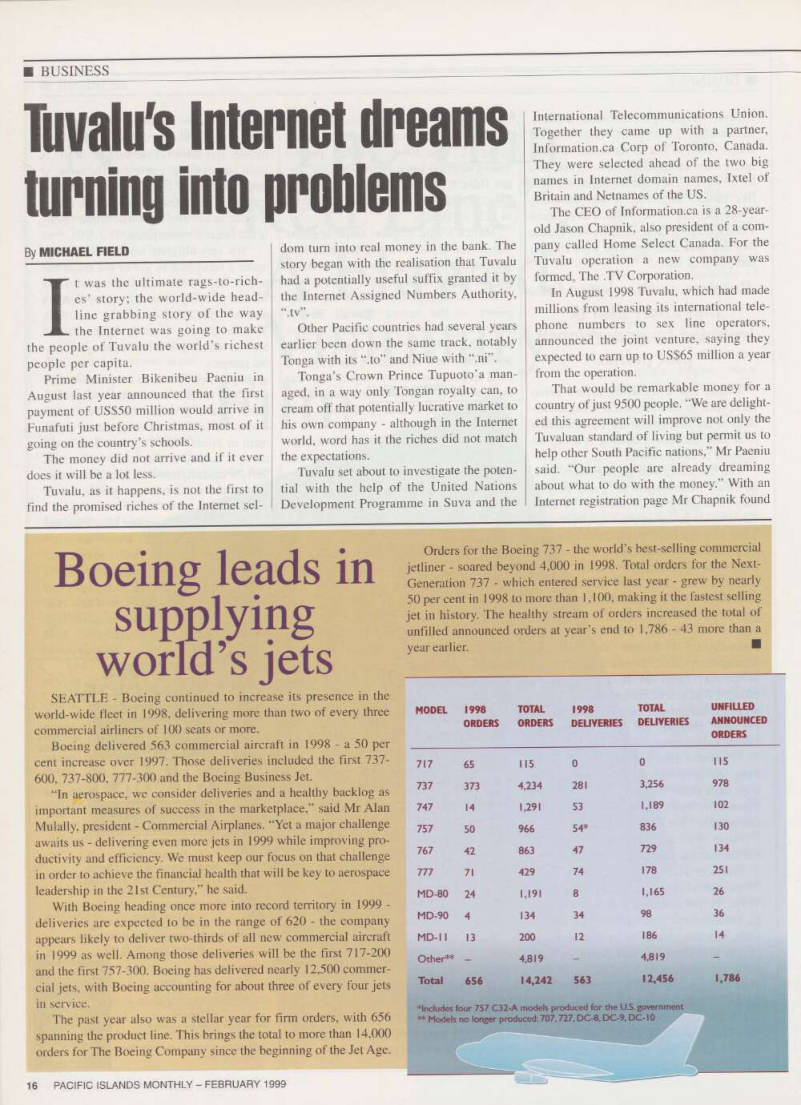
Model
1998
Orders
Total
Orders
1998
Deliveries
Total
Deliveries
Unfilled
Announced
Orders
717 65 115 0 0 115 737 373 4,234 281 3,256 978 747 14 1,291 53 1,189 102 757 50 966 54* 836 130 767 42 863 47 729 134 111 71 429 74 178 251 MD-80 24 1,191 8 1,165 26 MD-90 4 134 34 98 36
Md-I 1
13 200 12 186 14 Other** - 4,819 - 4,819 - Total 656 14,242 563 12,456 1,786 ♦Includes four 757 C32-A models produced for the U.S. government ** Models no longer produced: 707,727, DC-8, DC-9, DC-1 0 m
Marshalls benefits
from cyber medicine
By Giff Johnson
ACCESS to an Internet-based medical consulting program is saving the Marshall Islands tens of thousands of dollars in costly off-island referrals and improving the quality of treatment for patients at Majuro Hospital, according to doctors in Majuro.
The "tele-medicine” program links the Marshalls through the Internet with the Pacific Islands Healthcare Project at the US Army Tripler Hospital in Honolulu.
The north Pacific islands of Palau, Yap, Chuuk and Pohnpei are also participat ing in the physician network. Besides the considerable cost savings, the tele med system has given a tremendous boost to once-isolated physicians working in the islands.
"It allows us to consult with many medical specialists (in the Tripler system),” said Dr. Kama! Gunawardane, Majuro Hospital’s surgeon. "We’ve received very helpful advice and recommendations for managing patients”.
During 1998, Majuro Hospital doctors went "on-line” through the tele-med program to get consultations on more than 40 local patients, according to Gunawardane.
The tele-med program was launched more than a year ago by the Pacific Basin Medical Officers Association, which gained donations of equipment for the islands, in co-operation with Tripler Hospital, which operates a web site to serve hospitals in the US-affiliated islands.
Non-emergency cases that have graduate medical education value for Tripler have been sent to the Honolulu hospital at no cost to the Marshalls.
About 17 patients have received free treatment through these referrals to date.
Gunawardane said that on one patient alone, the hospital saved about $30,000 in treatment costs.
In one particularly difficult surgery case, involving a complicated skin graft, Gunawardane was able to get advice of plastic surgeons and other specialist surgeons - specialists who are not available locally - in the Tripler system that helped him to decide the best way to handle the unusual procedure.
But it isn’t just the Marshalls that is gaining benefits from the tele-med pro gram. It helps the Marshalls to get good medical advice and a number of med ical referrals for no cost, while Tripler gets the benefit of treating health prob lems that its doctors would not ordinarily see, he said. "The program benefits both sides,” Gunwardane said.
Direct medical benefits aside, use of the Internet to communicate with Tripler doctors is saving Majuro Hospital thousands of dollars each month in long dis tance phone calls, Gunawardane said. One reason that Marshalls’ doctors have been able to get such good advice is that they have the equipment - a scanner, digital camera, and a machine that can take pictures of the inner ear and eye - to transmit high quality photographs and x-rays through the Internet, so that doctors at Tripler can see the problems the Majuro doctors are describing in their notes. 'We’re not professionally isolated anymore,” Gunawardane said. "It gives us a tremendous boost to get these comments and observations from outside doctors”. ■
Pentagon approval
Aloha awaits Pentagon approval for Marshalls ’ air service
By Giff Johnson
DESPITE Continental Micronesia’s reduction in flights to the Marshall Islands and Federated States of Micronesia, and claims that the route is a money-loser, Aloha Airlines is planning to launch air service in competition with Continental. Approval of landing and refuelling rights at Johnston Island is the “only real obstacle” to Aloha starting ser vice to the Marshall Islands and FSM, according to the Honolulu based airline’s vice president for planning and development.
If Aloha enters the market, it would be the first US-based air carrier in more than 10 years to compete with Continental on this north Pacific route. Aloha vice president for planning and devel opment, Jim King, said in an interview that he expects a decision
from the US Department of Defence by the end of January on the airline’s request for
landing and refuelling rights
at Johnston - an island used by the military for destroying World War II vintage nerve gas. It is located roughly mid way between Honolulu and Majuro, and stopover privi leges are necessary for Aloha’s fleet of Boeing 737 aircraft, which cannot make the 2,200 mile haul from
Honolulu to Majuro non-stop. The Marshall Islands government has gone to bat to assist Aloha to get Defence Department approval for landing at Johnston - no easy accomplishment and something that has frustrated Continental Micronesia over the years because its service was limited to four stopovers weekly at Johnston when previously it had six flights (three east and three west-bound).
If Aloha is successful, Continental would “be surprised and very disappointed,” said Continental vice president for promo tions and sales Wally Dias.
Continental Micronesia has “unsuccessfully negotiated with the Department of Defence for years to increase the amount of authorised landings we could make on Johnston,” he added. The US military is doing the bare minimum for Continental as it is. In early January, a Continental island hopper was 24 hours delayed leaving Honolulu because of mechanical troubles.
When Continental requested refuelling, Johnston Island offi cials refused, forcing Continental to cancel the flight until the reg ularly scheduled service three days later. “The Marshall Islands
government has kindly used their contacts within the US Department of Defence in Washington to get Aloha’s request for Johnston fuel stops reviewed,” King said. “This review if current ly going on, and we have high hopes that it will result in Aloha’s receiving permission to stop at Johnston”. If Aloha can get land ing rights at Johnston, its planned route is Honolulu-Johnston-
Majuro-Kwajalein-Pohnpei round-trip, said King.
“Our planning time line is 45 to 60 days following receipt of landing rights at Johnston,” he said.
Opening of service to the islands would also involve modifica tions to the planes, crew training and marketing of the new ser vice, he said. King said that Aloha has been interested in serving the Marshall Islands and Micronesia for some time “and we have been holding increasingly serious talks with government offi cials”. Aloha is currently operating a weekly air service connect ing Honolulu with Christmas Island in Kiribati, and is considering increasing that to twice weekly depending on the Japanese gov ernment increasing its presence at Christmas.
It is also discussing extension of the service through to Tarawa, a development that King says the Kiribati government is very keen to see happen, but one that would require “a heavy econom ic subsidy”.
The reduction in service by Continental from three to two weekly flights last September has caused repeated pileups of mail and cargo in Honolulu, forcing the US Postal ’Service to charter flights to get mailed delivered to the Marshall Islands.
Despite the frequent back log of mail and cargo, Continental says that two flights weekly - with an added third flight during peak summer and Christmas periods - provides adequate seating capacity for passen gers. “The current market demand does not appear to support additional capacity,”
Dias said in explaining Continental’s decision to stick with the two flight
schedule in 1999. Continental officials have also frequently said that they do not make money on this “island hopper” route, despite now having a high per-mile ticket cost. The discounted fare for the 2,200 mile Majuro-Honolulu route is $837, compared to fares less than half that for routes of a similar distance"between Honolulu and the US west coast.
Aloha’s King said that his airline “would not be interested in starting this service (to the Marshalls and FSM) unless we believed it was going to be economically viable for us. The fact that our main base of operations is already in the Pacific and our choice of the thrifty twin-engine, two-pilot Boeing 737 may be two reasons that our financial projections look better than Continental’s”. But Continental is gearing for a switch to the Boeing 737 as part of a massive aircraft re-fleeting program start ed last year. By the end of 1999, Continental will have received 115 new Boeings and a portion of the new 737-800 series jets will go into service on the Micronesia route by mid-2000.
Dias said the new generation of jets will likely allow Continental to bypass Johnston Island. ■
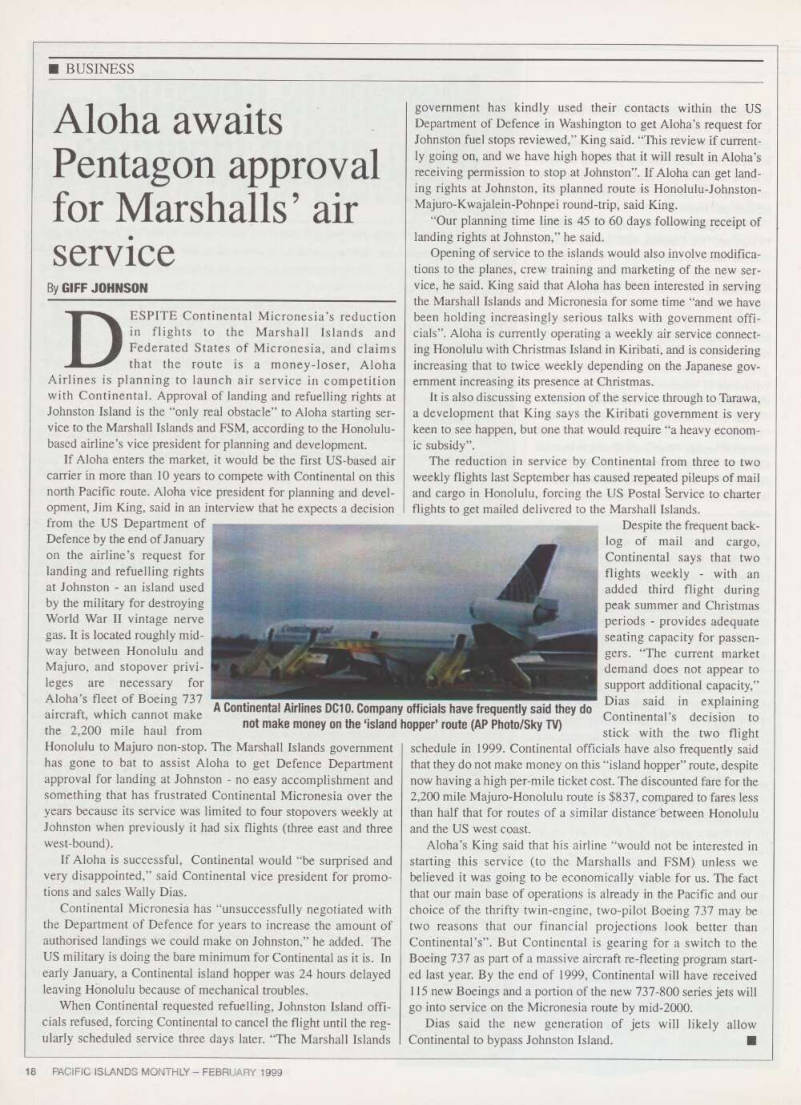
A Continental Airlines DC10. Company officials have frequently said they do not make money on the ‘island hopper’ route (AP Photo/Sky TV)
Advertisements & other items, p. 19 (1 item)
Challenging Positions in International Tourism
The Tourism Council of the South Pacific (TCSP) was established to strengthen regional co-operation among its 13 member countries in tourism development. Its prime roles are in the key areas of international marketing and promotions, and human resource development.
In order to meet the challenges of the global markets in the third millennium, TCSP is being reorganised to develop and incorporate a greater private sector involvement in its activities, as well as to initiate new and exciting developments. Consequently, TCSP is looking to fill a number of new key positions.
Candidates, should be a national of a TCSP member country and should possess tertiary qualifications, and have experience appropriate to the posts. A sound record of achievement in tourism or related sectors is essential. Fluency in English is essential and the ability to speak French is an added advantage.
DEPUTY CHIEF EXECUTIVE
This new position is a key appointment which has been created to assist the Chief Executive deliver the range of business objectives which TCSP is now tasked to achieve. The appointee will be involved in formulating the strategic direction of the commercial, marketing and development activities of the organization, and the operating divisions. Leading a team of divisional managers, he/she will be tasked with delivering the most benefits to the organisation and to the region, in what is a constantly changing and demanding market environment. The appointee will need at least eight years experience in the travel or tourism industry, and is currently a senior manager with a proven history in management and has a record of achievements. An appreciation of managing relationships with donor agencies will be an advantage. He/she must display an affinity with the region, and ideally Lived and working in more than one TCSP member country.
Manager Human Resource Development/Advisory Services This role encompasses both the HRD and Research and Development responsibilities. The appointee will be tasked with the identification, evaluation and delivery of a board range of training initiatives in TCSP member team and external resources. An important aspect of the work is to act as “matchmaker” between members’ R&D requirements, donors assistance and resourcing advisory services. Involvement and responsibility for the production of regional statistics and the TCSP website are also important responsibilities. The appointee will need strategic and analytical human resource development skill, in combination with excellent communication abilities. An appreciation of the management of relationships with donor agencies is essential. An affinity with the region is essential and proven track record in working in more than one member country is essential.
An attractive remuneration package will be offered to the right candidate.
If you feel that you might fit one of the above positions, please send your application immediately to The Chief Executive, Tourism Council of the South Pacific, 343-359 Victoria Parade, P. O. Box 1319, Suva, Fiji Islands or by fax to (979) 301995 with a full CV, and the names and addresses (including fax and telephone contacts) of three referees with whom you have been associated with in a professional capacity. Please mark the envelope clearly as ‘’Professional Staff Application”. If you need more information , please write to the above address. The closing date for applications is 31 March, 1999. * Mcml)cr States of th e TCS P : A nurican Samoa. Cook Is. Fiji, French Polynesia, Kiribati. Ne w Calecl o n i a , Niue, 1* ap n a New Guinea, Samoa, Solomon Islands, Tonga, Tuvalu.
Tonga, China, missionaries and satellites -
satellites - a lucrative combination
By Michael Field
SOME might call it cynical and others admire the prag matism, but when Tonga dumped Taiwan and recog nised China multi-millionaire Princess Pilolevu Tuita told her people it was all in the name of God.
Interestingly the major financial benefi ciary out of the move is the princess her self whose 60 per cent ownership of the satellite company Tonga Sat has, according to US business magazine Forbes, given her a personal worth of US$25 million.
She pushed for the change to enhance the business prospects of the Hong Kong arm of the company that was struggling because her kingdom, out of what proved shifting loyalty and dedicated anti-commu nism, preferred Taiwan.
Tonga dumped Taipei on November 2, doing it in an unusual fashion when King Taufa’ahau Tupou IV unveiled a Made in China bronze larger-than-life replica of himself in the grounds of the palace with China’s Vice Minister of Foreign Affairs, Jiechi Yang, looking on.
Directing proceedings was Pilolevu, who is now the effective political power in Tonga now that Baron Vaea has submitted his resignation as prime minister. The deci sion was announced by the new Foreign Minister, Prince ‘Ulukalala Lavaka Ata, who at the age of 39 has just got around to finishing university and is being tipped as Vaea’s replacement.
A couple of weeks later the zero-sum diplomatic game continued apace when the Marshall Islands switched from China to Taiwan. Tonga’s behaviour is strange given its background as Taiwan’s oldest ally in the Pacific.
In February last year the king opened Taiwan’s lavish new T 52.5 million embassy built on Crown Prince Tupouto’a’s land. The Crown Prince, who was the foreign minister then, came up with the design concept and said it should be “something that should last for at least 100 years”. Taiwan’s Prime Minister Vincent Siew showed up for the king’s
birthday in July, seemingly unaware that the princess was already working in Beijing to have the relationship severed.
In 1992 Taiwan Foreign Minister Frederick Chien visited Tonga - at the same time a pro-democracy convention was going on and presented US$l.5 million to build a hall in memory of Queen Salote. “We will never forget the enormous assistance of the government of the Republic of China,” the king replied.
‘Business - fine,
normalising relationships
- true, but this is what I
have been looking at,
because His Majesty’s
vision is for Tongans to
be evangelists’
Quiet now is the Speaker, Noble Fusitu’a, who was a high ranking member of the Taiwan funded World Anti- Communist League. They convinced him that the democracy movement in Tonga was made up of “crypto-communists”. He was strongly anti-Communist.
“The exact definition of communist nobody has ever tried to explain. A com munist to you is different to a communist to me. Anybody who tries to move the peo ple against the established order, causing chaos, anarchy, that’s the first degree of communism”.
The princess explained her position in the bimonthly Matangi Tonga magazine.
She said her father had given her a man date to negotiate the switch, saying “it is one of the most courageous decisions that his majesty has made”.
It was “the first step for Tonga to become a full member of the United Nations”, an odd statement to make given recognition of China was never a pre-req uisite to UN membership.
The princess has now set up in Hong Kong with a Chinese business partner, Fred Wang, trying to sell Tonga Sat’s satel lite slots to China. “I believe that God invented us to do this work otherwise we
could have become just another foreigner knocking on doors in Beijing for years without having a chance to meet the lead ers of China,” she told the magazine.
“We are honoured that we became part of his majesty’s vision for Tonga’s future”.
The princess said China would become a destination for Tongan missionaries.
“I look upon this new relationship with China as a means of spreading the Lord’s words to China. When China opens its doors to Christian evangelists, Tonga should be right there by the door”.
Then came something of a recognition that money was Involved. “Business - fine, normalising relationships - true, but this is what I have been looking at, because his majesty’s vision is for Tongans to be evan gelists, for Tonga to be an evangelist coun try to spread the word, I truly see this as an opportunity for all good Christians in Tonga”.
She claimed evidence existed that his was already happening with the Chinese saying Grace before meals she was involved in. She first visited Beijing in 1996, discovering to her apparent surprise that “almost everything in China is either owned and run by the government, or that government is the major shareholder”.
It was through her business contacts with the “China Association for International Friendly Contact” that the big bronze statue of the king was made.
Tonga Sat was formed after Tonga star tled the international satellite market by claiming seven key equatorial satellite slots. Although it did not need the slots itself it has, in partnership with other com panies, used Russian satellites to fill the slots.
These days Tonga Sat has four orbital slots that cover the Asia-Pacific region and China has become a key to the strategy to sell a service. “We are looking at how we are going to make a trans-Pacific link between Asia and the USA a reality,” she says. “And that is what we are working on right now, and China is supporting us, because they want to play a role in com municating to the millions of Chinese peo ple in the United States”. ■
Happy birthday,
Oceania Centre
Story and picture by PAULINE WALKER
ONE of the University of the South Pacific’s great successes, the Oceania Centre for Arts and Culture, celebrates its second anniver sary this month.
In its short life span, the Oceania Centre has already proved itself a place of serious creativity, attracting and developing young
local talents and pro ducing art in great
variety.
Artists at the Oceania Centre, numbering between thirty and forty indi viduals, have made finely woven pan danus mats, imagina tive metal sculptures and monumental woodcarvings.
They have created a wide range of paintings and draw ings and produced new forms of music and dance.
The centre’s fre quent exhibitions and occasional concerts have introduced these creations to an appreciative audi ence that increases with every event.
The Oceania Centre officially came into being on February 1, 1997, when the University Council appointed Professor Epeli Hau’ofa as director.
Professor Hau’ofa (he prefers ‘Epeli’) had long felt the need for intellectual and artis tic stimulus on the USP campus. He once described it as a “beautiful cemetery - love ly but dead”. So it was “a dream come true”, he recalls, to have the opportunity to devel op a centre of creativity, “not just for the arts but to rekindle original and independent
thinking in this university”.
Installed in nondescript old army bar racks near the bure on USP’s Suva campus, Epeli set out first to establish "the right kind
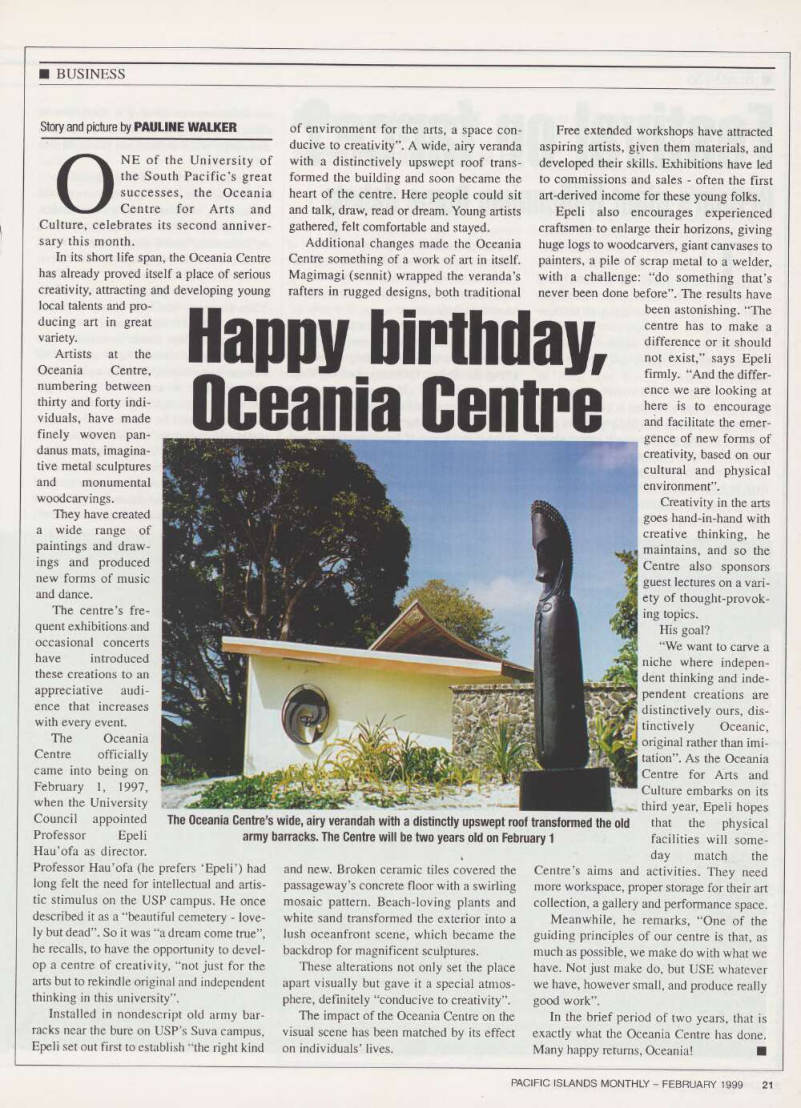
of environment for the arts, a space con ducive to creativity”. A wide, airy veranda with a distinctively upswept roof trans formed the building and soon became the heart of the centre. Here people could sit and talk, draw, read or dream. Young artists gathered, felt comfortable and stayed.
Additional changes made the Oceania Centre something of a work of art in itself.
Magimagi (sennit) wrapped the veranda’s rafters in rugged designs, both traditional
and new. Broken ceramic tiles covered the passageway’s concrete floor with a swirling mosaic pattern. Beach-loving plants and white sand transformed the exterior into a lush oceanfront scene, which became the
backdrop for magnificent sculptures.
These alterations not only set the place apart visually but gave it a special atmos phere, definitely “conducive to creativity”.
The impact of the Oceania Centre on the visual scene has been matched by its effect on individuals’ lives.
Free extended workshops have attracted aspiring artists, given them materials, and developed their skills. Exhibitions have led to commissions and sales - often the first art-derived income for these young folks.
Epeli also encourages experienced craftsmen to enlarge their horizons, giving huge logs to woodcarvers, giant canvases to painters, a pile of scrap metal to a welder, with a challenge: “do something that’s never been done before”. The results have
been astonishing. “The centre has to make a difference or it should not exist,” says Epeli firmly. “And the differ ence we are looking at here is to encourage and facilitate the emer gence of new forms of creativity, based on our cultural and physical environment”.
Creativity in the arts goes hand-in-hand with creative thinking, he maintains, and so the Centre also sponsors guest lectures on a vari ety of thought-provok
ing topics.
His goal?
“We want to carve a niche where indepen dent thinking and inde pendent creations are distinctively ours, dis
tinctively Oceanic,
original rather than imi tation”. As the Oceania Centre for Arts and Culture embarks on its third year, Epeli hopes that the physical facilities will some day match the
Centre’s aims and activities. They need more workspace, proper storage for their art collection, a gallery and performance space.
Meanwhile, he remarks, “One of the guiding principles of our centre is that, as much as possible, we make do with what we have. Not just make do, but USE whatever we have, however small, and produce really good work”.
In the brief period of two years, that is exactly what the Oceania Centre has done.
Many happy returns, Oceania! ■
The Oceania Centre’s wide, airy verandah with a distinctly upswept roof transformed the old army barracks. The Centre will be two years old on February 1
Festival op farce?
Britain's giant Millennium Dome debate
TAKE one polluted, old gasworks site, Stg74B million ($A1,933.80 million) and one country’s desire to open the biggest, baddest entertainment complex on December 31, 1999.
The result is a steel-and-fabric, white mushroom so massive it’s already being photographed from space.
Brits call it the Millennium Dome, and while critics complain that it’s no more than an overpriced party tent in Greenwich, officials are betting the dome will attract about 12 million British and overseas visitors by the time it closes on January 1, 2001 (the date, to be precise, that the new millennium actually begins). Besides being an opportunity for entrepreneurs to sell mega amounts
of champagne and fireworks, the advent of 2000 also has challenged Britain and other countries to find ways to publicly and taste fully celebrate the occasion while enticing tourists to their shores.
Top millennium observation contenders so far include France, reopening the Pompidou Centre and building a walkway along the Seine; Germany, hosting Expo 2000 in Hanover; Italy, opening a new Catholic Church of the Year 2000; the Holy Land, building a peace centre in Bethlehem at the historic site of Jesus’ birth and host ing a series of religious concerts; and Fiji, constructing a hollow brick “millennium wall” and filling it with time-capsule mes sages. (Fijians are capitalising on the fact that their country will be one of the first to
see the sun rise on January 1, 2000). But no other country equals Britain in the breadth and scope of its millennium plans, British officials say.
“I don’t know anywhere in the world where so much is being done to mark the millennium or indeed such a major under taking as the Millennium Experience Dome at Greenwich,” said Culture Secretary Chris Smith, one of the project’s overseers.
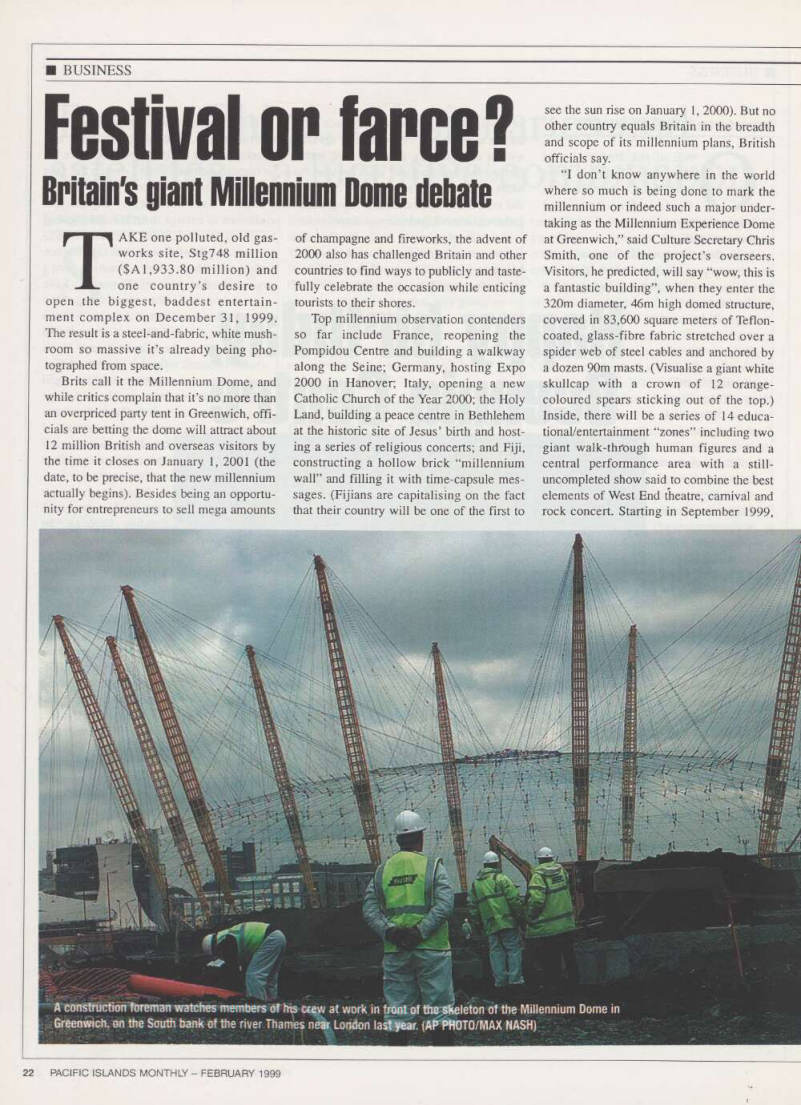
Visitors, he predicted, will say “wow, this is a fantastic building”, when they enter the 320 m diameter, 46m high domed structure, covered in 83,600 square meters of Teflon coated, glass-fibre fabric stretched over a spider web of steel cables and anchored by a dozen 90m masts. (Visualise a giant white skullcap with a crown of 12 orange coloured spears sticking out of the top.) Inside, there will be a series of 14 educa tional/entertainment “zones” including two giant walk-through human figures and a central performance area with a still uncompleted show said to combine the best elements of West End theatre, carnival and rock concert. Starting in September 1999,
A construction foreman watches members of his crew at work in front of the skeleton of the Millennium Dome in Greenwich, on the South bank of the river Thames near London last year. (AP PHOTO/MAX NASH)
travel agents will be able to include Dome tickets, costing an estimated SAS2 for adults and SA2S for children, in British tour pack ages.
Although Millennium Dome is using only lottery money and no tax funds, and although construction is ahead of schedule, the project has been continually plagued by controversy and speculation, often unfriend ly, over what the thing will actually “con tain”.
The very location for the project, started under the previous Conservative govern ment, was in contention at first. Several other cities wanted the dome, but Greenwich, the south-east London borough that is home to the Royal Observatory, since 1884 the site of Greenwich Mean Time, the prime meridian of O-degree longitude, won out.
After all, this is the place that will tell the world precisely when 2000 kicks off.
After the site was chosen and work began, other problems loomed. Workers extending a subway line to the dome’s entrance began demanding more money and threatening to delay the opening; religious leaders complained that the project’s over sanitised depiction of Christianity left “no room for Jesus at the dome”.
Recently, dome officials were alarmed over reports, apparently false, that several rare birds called redstarts had taken up resi dence in the dome and might force construc tion to halt. British press cynicism over the project continues to run deep. “The dome is a national joke; a party tent stuck out on a toxic little peninsula of estuary London, waiting to be filled by an assortment of wow-factors that has all the appeal of an early-leaming centre,” a writer in the Times of London said. Project officials respond that people laughed at the Sydney Opera House, they laughed at Britain’s Crystal Palace exhibition in 1851. “But when they opened, they were all seen as great successes,” said Michael O’Connor, director of Britain’s Millennium commission, the body that is distributing billions of lottery-fund pounds to the dome and hundreds of other millenni um projects.
Certainly, the dome will have a royal send-off. Queen Elizabeth II will attend the opening on December 31, along with 2,000 other invited guests. After that, the dome will open seven days a week for the next year; tickets must be pre-purchased, and no more than 35,000 visitors will be allowed in at any one time. (KRT) ■
Advertisements & other items, p. 22 (1 item)
■ Business
Private sector arm of World Bank
World Bank to set up in Fiji
THE South Pacific Project
Facility managed by the International Finance Corporation, is to set up an agency in Fiji in the near future.
The facility will sign a formal agree ment later this month with a local compa ny that will act as agent and initial point of contact for enquiries.
“With improved access locally it is hoped that this will lead to increased use of SPPF’s resources by businesses in Fiji and hence new viable investment in the economy,” said Peter Bennett, the Sydney based representative of the SPPF.
The International Finance Corporation is the private sector development arm of the World Bank.
Meanwhile, the SPPF is reviewing the establishment and expansion of private sector business in the Pacific.
But currently, the SPPF prefers to lend assistance to projects with values ranging
from $lOO,OOO to $10,000,000. “We are now lookirtg at ways in which we can more effectively reach smaller entrepre neurs,” said Mr Bennett.
The facility works with business peo ple who need assistance to evaluate or develop proposals for business ventures and then obtain the necessary finance from lenders or investors.
The SPPF concentrates on projects that focus on the development of export markets, the production of goods to replace imports or which generate new
jobs.
For a recent beneficiary. Modern Furniture, a Fiji company with factories in Nadi and Suva, a local chartered accounting firm - Crosbie & Underhill was engaged to assist in the preparation of a funding proposal that was later sub mitted to a commercial bank for approval.
Modem Furniture has now moved into a new factory in Laucala Beach Estate in Suva and installed some new equipment.
While SPPF will assist in most areas, the only ones where SPPF’s services are not available are gambling and specula tive real estate projects. ■
Advertisements & other items, p. 23 (1 item)
Hook Up With The Leader!
J
Pacific Ocean Producers
is the leader in
monofilament longline
system technology.
We offer special service to the South Pacific Islands, Australia and New Zealand. • Lindgren-Pitman gear, complete hydraulic systems, design and installation of monofilament longline systems including operations training. • Extensive Tuna and Swordfish supplies, bottom fishing gear, fish handling supplies and bait. • Duralumes Lightstick - the latest in lightsticks technology, extended light output, often used two nights, 5-year shelf life, not affected by moisture, easy-to- handle shipping carton. All popular colors available - green, blue, pink, yellow, white, violet and ultra-violet for best fishing results. • Wide selection of trolling equipment: over 180 different colors of trolling skirts and a large selection of lure head? • Weekly shipments to the South Pacific Islands, Australia and New Zealand.
FREE CATALOG AVAILABLE ON REQUEST
Please direct all inquiries to la the Export Department: M7LCIFIC 965-B North Nimitz Highway OCEA.JV Honolulu, HI 96817, USA.
Telephone: (808) 537-2905 Facsimile: (808) 536-3225 Visit our new catalog on-line at: pop-hawaii.com Toll Free Number 1-800-144-488
)URALUMES
face withholding

PNG bankers face withholding tax dilemma
By Brian Tobia
Commercial bankers in Papua New Guinea are in a dilemma on how to implement a new govern ment tax measure to withhold or deduct 15 per cent per annum from gross interest paid to customers from deposits.
This was one of the revenue raising measures introduced by the government of prime minister Bill Skate and his deputy lairo Lasaro in the 1999 budget.
Under the measure, commercial banks were required to hold back 15 per cent of all the interests paid to their clients from deposits (savings accounts or Interest Bearing Deposits) and transfer it to the government consolidated revenue fund.
But deputy opposition leader Chris Haiveta said at a press conference after the budget was passed last year that this was going to discourage small citizens wanting to save money in banks or to get better interest on their deposits.
Haiveta has warned that commercial banks would lose many of their clients.
Bankers were concerned about the implementation of the measure.
All the different banks have their own computer system and there was no mecha nism in place. Banks were also waiting for advice from the Internal Revenue Commission.
This was highlighted in a letter from the Commercial Bankers’ Association (PNG) to the IRC in December regarding the new measure.
Association chairman Noel Smith expressed fears that the banking industry’s
ability to write and implement necessary computer programmes to cope with the government’s needs was affected by com puter systems upgrades, computer conver sions and systems testing for Y2K compli ance.
Smith said the computer systems for each bank were unique and there would be a varying capacity to cope with imposing the new tax measure.
He said the banking industry was aware that there would be severe penalties for non-compliance but they were still waiting for instructions from the IRC on how to implement the measure.
“...it appears that the
banking industry was
being directed to be the
vehicle to collect taxes
on behalf of the IRC”
Smith said: “Because it appears that the banking industry was being directed to be the vehicle to collect taxes on behalf of the IRC”. The banking industry wants the gov ernment’s advice on: - timing of implementation - how the tax was to be collected and remitted - number of cheques (one or more) cov ering the total tax collected per year on a monthly basis - and computer generated details like names, rates and amounts and to which accounts would these monies be credited to. Given the short period of time, the banks would be in no position to imple ment the tax measure.
Haiveta said: “Who’s interest is the
government looking after... they said it was the grass roots budget but they are no longer interested in the people who they are meant to serve.
“This is incredible and the govern ment’s credibility should be seriously questioned,” said the former finance min ister, who has also served some time as deputy to prime minister Skate.
Under the measure,
commercial banks were
required to hold back 15
per cent of all the interest
paid to their clients from
deposits (savings accounts
or Interest Bearing
Deposits) and transfer it to
the government
consolidated revenue fund
Haiveta said the tax measure of deduct ing 15 per cent a year from gross interest paid to clients (both residents and non-res idents) is only applicable to commercial banks. This means that the Westpac Banking Corporation, Australian & New Zealand Banking Group (ANZ), the Papua New Guinea Banking Corporation, the Bank of South Pacific and the Bank of Hawaii will be affected. This however, excludes the Central Bank - Bank of Papua New Guinea (BPNG).
He alleged that this may be plot by the government to discourage people from saving their money in commercial banks “so that they can invest in government treasury bills in the central bank to build up the government consolidated revenue”.
Haiveta claimed that the government was always looking at ways to build up its revenue base.
He said the tax measure, which was supposed to be implemented last month, would indirectly create havoc for the bankers and deny the rights of the small people to save their earnings.
He said people would now resort to keeping their money at home, fearing that the government would take away a portion of it that was rightly theirs.
Meanwhile, reliable sources from with in the BPNG confirmed that there was more demand for the government treasury bills than ever before. ■
Marshalls says
no to N-waste
By Giff Johnson
MAJURO - Bringing Taiwanese nuclear reactor waste to the Marshall Islands is not part of newly established diplomatic relations between the two nations, the Marshalls Foreign Minister told the country in a national ly broadcast interview in early December.
His comments were backed up by a Cabinet declaration on December 4 that the Marshall Islands will not import low or high level nuclear waste into the country.
Foreign Minister Phillip Muller, in a telephone interview from Honolulu with the government radio station, said unequivocally that nuclear waste is not part of the deal with Taiwan and is not on the government’s agenda.
“I don’t know where that kind of an idea came from,” Muller said.
Officials in Taipei have also denied that nuclear waste exports to the Marshalls are under renewed consid eration.
In the mid-19905, officials from the Marshalls and Taipower - Taiwan’s state-run nuclear power agency - held repeated discussions about nuclear waste storage in the islands.
The plan was shelved when Marshall Islands President Imata Kabua declared a freeze on the nuclear waste plan in mid-1997 in response to growing opposition at home and abroad.
However, Cabinet approval in March 1998 of a feasibility study appeared to have renewed the govern ment’s interest in the plan.
But then in December the Cabinet declared a total ban on importing waste. Instead of nuclear waste, Marshalls and Taiwan officials focused their discussions on economic development and investment ventures, Muller said in nationally broadcast remarks. ■
Advertisements & other items, p. 25 (1 item)
South Pacific Regional Environment Programme (SPREP)
Vacancy: EXECUTIVE OFFICER MANAGEMENT
Applications are invited for the above position with the SPREP Secretariat in Apia, Samoa.
SPREP is an intergovernmental organisation responsible for advising on and assisting with environmental issues in the South Pacific region on behalf of the governments and administrations of 22 Pacific Islands countries plus 4 developed countries. A total staff of 60 work under the overall supervision of a Director, who is assisted by four Heads of Divisions.
Responsibilities
The Executive Officer Management will be responsible to the Director and will work closely with the Heads of Divisions to perform the following duties; Devise, implement and maintain a system for the on-going management and monitoring of extra-budgetary sources of support incorporating reporting requirements, review and re-negotiations, etc.; Ensure on-going support for SPREP activities either form donor agencies or through other means such as sponsorship or similar support from private, commercial interests; Recommend methodologies for the sound allocation of extra-budgetary sources amongst SPREP’s activities; Oversee the monitoring and evaluation process identifying any gaps and recommend changes to improve the process; Provide support to member countries who will provide feedback and evaluation on SPREP activities carried out in the countries; Undertake a comprehensive review of the organisation and management structure, with the primary objective of enabling the Secretariat to maximise efficiency, resource utilisation and accountability using the information obtained from the monitoring and evaluation process; ■ Represent SPREP at appropriate events both locally and overseas as approved by the Director; ® Assist in monitoring relations and obligations with other regional and international agencies including the SPOCC arrangements; and ■ Other related activities as directed from time to time by the Director.
Qualifications and Experience Candidates should preferably have postgraduate qualifications related to administration or related fields from a recognised institution. Candidates should have at least 10 years of work experience in middle to senior level administrative/accounting positions. Essential requirements are: proven management experience, as well as knowledge of and practice in performance based output budget systems, extensive experience in the provision of high level advice at an inter-govemmental level and in managing international projects and staff, excellent written and verbal communication skills, ability to manage the work of staff and consultants form a range of disciplines and cultures, ability to work with inter-disciplinary and multi-cultural teams and to prepare project proposals and reports to deadlines often under difficult circumstances, fluency in spoken and written English, familiarity and sound experience in working with and designing performance based output budgets and work programme. Working experience in the Pacific Islands would also be advantageous. The role suits a dynamic team player who is able to motivate and lead staff. Applicants must°be nationals of SPREP member countries.
Conditions This is a senior position and the appointment will be made at the Adviser level with salary depending upon qualifications and experience. The package will include annual return airfares for appointee and dependants, a housing subsidy and other benefits. SPREP remuneration may be taxfree depending upon circumstances. The appointment will be for a period of 3 years.
Applications Applications must be accompanied by detailed curricula vitae including information on relevant qualifications and experience, previous appointments, current position and salary and names and phone and fax numbers of 3 persons associated with the applicant professionally who would be prepared to provide testimonials. Please also indicate how soon you would be available.
Applications are to be addressed to: The Director South Pacific Regional Environment Programme (SRPEP)
PO BOX 240
Apia, Samoa fax: (685)20231 lelephone: (685) 21929 E-mail: [email protected] Further information, including a full job description and a schedule of terms and conditions of appointment, can be obtained from SPREPs Administration Officer.
Closing Date: 15 March 1999.
(Eat chicken)
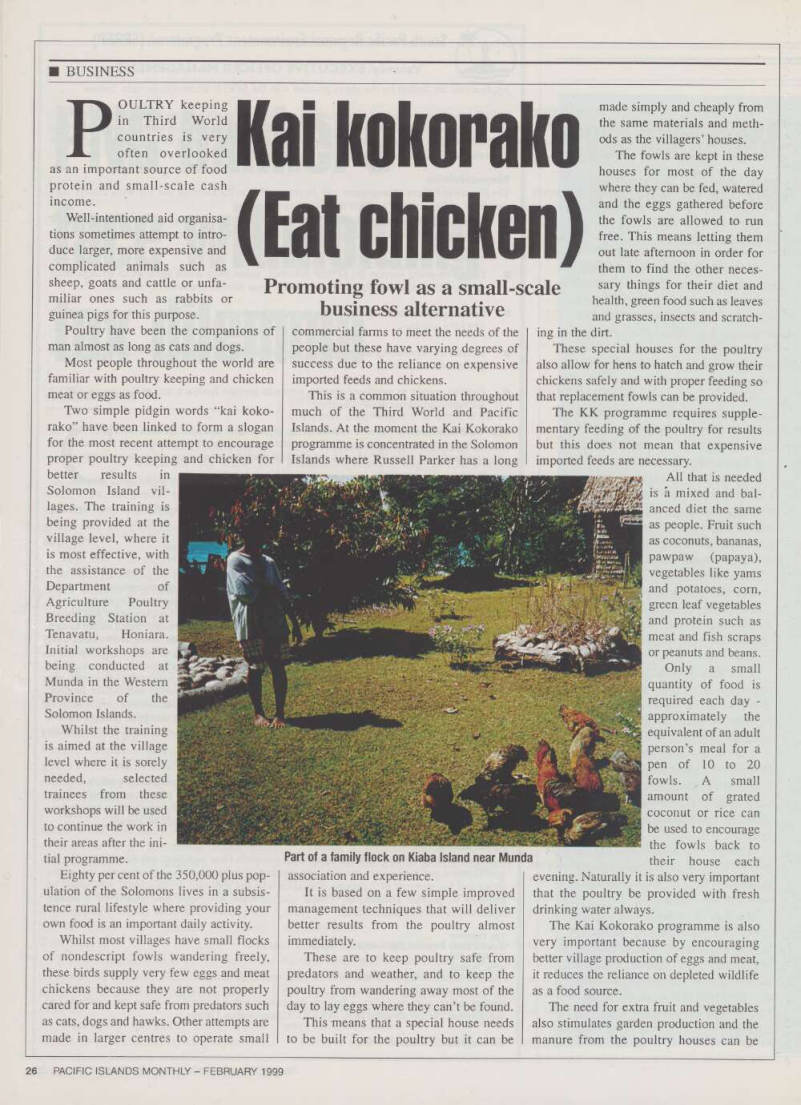
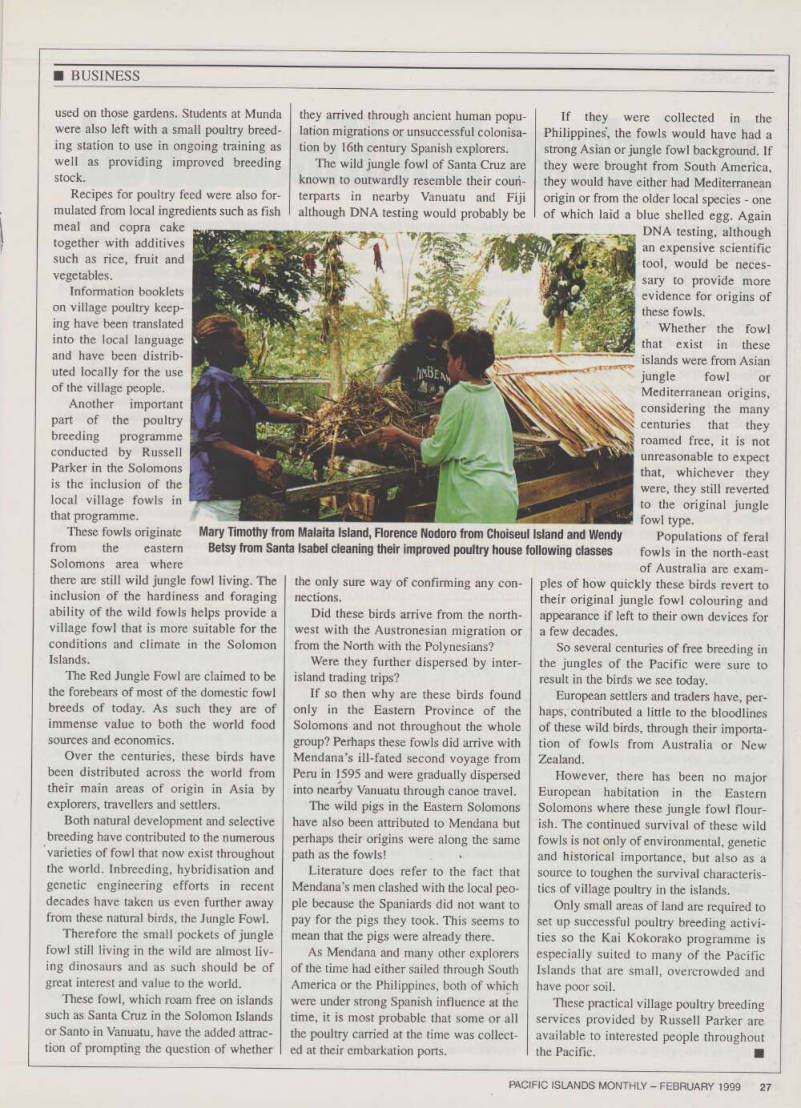
Kai kokorako (Eat chicken) Promoting fowl as a small-scale business alternative
POULTRY keeping
in Third World countries is very often overlooked as an important source of food protein and small-scale cash income.
Well-intentioned aid organisa tions sometimes attempt to intro duce larger, more expensive and complicated animals such as sheep, goats and cattle or unfa miliar ones such as rabbits or guinea pigs for this purpose.
Poultry have been the companions of man almost as long as cats and dogs.
Most people throughout the world are familiar with poultry keeping and chicken meat or eggs as food.
Two simple pidgin words “kai koko rako” have been linked to form a slogan for the most recent attempt to encourage proper poultry keeping and chicken for
better results in Solomon Island vil lages. The training is being provided at the village level, where it is most effective, with the assistance of the Department of Agriculture Poultry Breeding Station at Tenavatu, Honiara.
Initial workshops are being conducted at Munda in the Western Province of the Solomon Islands.
Whilst the training is aimed at the village level where it is sorely needed, selected trainees from these workshops will be used to continue the work in their areas after the ini tial programme.
Eighty per cent of the 350,000 plus pop ulation of the Solomons lives in a subsis tence rural lifestyle where providing your own food is an important daily activity.
Whilst most villages have small flocks of nondescript fowls wandering freely, these birds supply very few eggs and meat chickens because they are not properly cared for and kept safe from predators such as cats, dogs and hawks. Other attempts are made in larger centres to operate small
commercial farms to meet the needs of the people but these have varying degrees of success due to the reliance on expensive imported feeds and chickens.
This is a common situation throughout much of the Third World and Pacific Islands. At the moment the Kai Kokorako programme is concentrated in the Solomon Islands where Russell Parker has a long
association and experience.
It is based on a few simple improved management techniques that will deliver better results from the poultry almost
immediately.
These are to keep poultry safe from predators and weather, and to keep the poultry from wandering away most of the day to lay eggs where they can’t be found.
This means that a special house needs to be built for the poultry but it can be
made simply and cheaply from the same materials and meth ods as the villagers’ houses.
The fowls are kept in these houses for most of the day where they can be fed, watered and the eggs gathered before the fowls are allowed to run free. This means letting them out late afternoon in order for them to find the other neces sary things for their diet and health, green food such as leaves and grasses, insects and scratch
ing in the dirt.
These special houses for the poultry also allow for hens to hatch and grow their chickens safely and with proper feeding so that replacement fowls can be provided.
The KK programme requires supple mentary feeding of the poultry for results but this does not mean that expensive imported feeds are necessary.
All that is needed is a mixed and bal anced diet the same as people. Fruit such as coconuts, bananas,
pawpaw (papaya),
vegetables like yams and potatoes, com, green leaf vegetables and protein such as meat and fish scraps or peanuts and beans.
Only a small quantity of food is required each day -
approximately the
equivalent of an adult person’s meal for a pen of 10 to 20 fowls. A small amount of grated coconut or rice can be used to encourage the fowls back to their house each
evening. Naturally it is also very important that the poultry be provided with fresh drinking water always.
The Kai Kokorako programme is also
very important because by encouraging
better village production of eggs and meat, it reduces the reliance on depleted wildlife as a food source.
The need for extra fruit and vegetables also stimulates garden production and the manure from the poultry houses can be
Part of a family flock on Kiaba Island near Munda
used on those gardens. Students at Munda were also left with a small poultry breed ing station to use in ongoing training as well as providing improved breeding stock.
Recipes for poultry feed were also for mulated from local ingredients such as fish
meal and copra cake together with additives such as rice, fruit and vegetables.
Information booklets on village poultry keep ing have been translated into the local language and have been distrib uted locally for the use of the village people.
Another important
part of the poultry
breeding programme
conducted by Russell Parker in the Solomons is the inclusion of the local village fowls in that programme.
These fowls originate from the eastern Solomons area where
there are still wild jungle fowl living. The inclusion of the hardiness and foraging ability of the wild fowls helps provide a village fowl that is more suitable for the conditions and climate in the Solomon Islands.
The Red Jungle Fowl are claimed to be the forebears of most of the domestic fowl breeds of today. As such they are of immense value to both the world food sources and economics.
Over the centuries, these birds have been distributed across the world from their main areas of origin in Asia by explorers, travellers and settlers.
Both natural development and selective breeding have contributed to the numerous varieties of fowl that now exist throughout the world. Inbreeding, hybridisation and genetic engineering efforts in recent decades have taken us even further away from these natural birds, the Jungle Fowl.
Therefore the small pockets of jungle fowl still living in the wild are almost liv ing dinosaurs and as such should be of great interest and value to the world.
These fowl, which roam free on islands such as Santa Cruz in the Solomon Islands or Santo in Vanuatu, have the added attrac tion of prompting the question of whether
they arrived through ancient human popu lation migrations or unsuccessful colonisa tion by 16th century Spanish explorers.
The wild jungle fowl of Santa Cruz are known to outwardly resemble their coun terparts in nearby Vanuatu and Fiji although DNA testing would probably be
the only sure way of confirming any con nections.
Did these birds arrive from the north west with the Austronesian migration or from the North with the Polynesians?
Were they further dispersed by inter
island trading trips?
If so then why are these birds found only in the Eastern Province of the Solomons and not throughout the whole group? Perhaps these fowls did arrive with Mendana’s ill-fated second voyage from Peru in 1595 and were gradually dispersed into nearby Vanuatu through canoe travel.
The wild pigs in the Eastern Solomons have also been attributed to Mendana but perhaps their origins were along the same path as the fowls!
Literature does refer to the fact that Mendana’s men clashed with the local peo ple because the Spaniards did not want to pay for the pigs they took. This seems to mean that the pigs were already there.
As Mendana and many other explorers of the time had either sailed through South America or the Philippines, both of which were under strong Spanish influence at the time, it is most probable that some or all the poultry carried at the time was collect ed at their embarkation ports.
If they were collected in the Philippines', the fowls would have had a strong Asian or jungle fowl background. If they were brought from South America, they would have either had Mediterranean origin or from the older local species - one of which laid a blue shelled egg. Again
DNA testing, although an expensive scientific tool, would be neces sary to provide more evidence for origins of these fowls.
Whether the fowl that exist in these islands were from Asian jungle fowl or Mediterranean origins, considering the many centuries that they roamed free, it is not unreasonable to expect that, whichever they were, they still reverted to the original jungle fowl type.
Populations of feral fowls in the north-east of Australia are exam
ples of how quickly these birds revert to their original jungle fowl colouring and appearance if left to their own devices for a few decades.
So several centuries of free breeding in the jungles of the Pacific were sure to result in the birds we see today.
European settlers and traders have, per haps, contributed a little to the bloodlines of these wild birds, through their importa tion of fowls from Australia or New Zealand.
However, there has been no major European habitation in the Eastern Solomons where these jungle fowl flour ish. The continued survival of these wild fowls is not only of environmental, genetic and historical importance, but also as a source to toughen the survival characteris tics of village poultry in the islands.
Only small areas of land are required to set up successful poultry breeding activi ties so the Kai Kokorako programme is especially suited to many of the Pacific Islands that are small, overcrowded and have poor soil.
These practical village poultry breeding
services provided by Russell Parker are available to interested people throughout the Pacific. ■
Mary Timothy from Malaita Island, Florence Nodoro from Choiseul Island and Wendy Betsy from Santa Isabel cleaning their improved poultry house following classes
A radical Pacific unified

By Michael Field
PACIFIC nations are on the verge of taking a radical aviation decision and one
that is exciting industry
attention around the world.
If clearance for take-off is given all Pacific airspace over millions of square kilometres will be controlled from just one site - probably Nadi in Fiji - creating the world’s biggest seamless air traffic control system.
The International Air Transport Association (lATA) will, this month, pre sent a draft concept plan to the South Pacific Forum officials with the final report to follow a month later. Then in May Pacific Forum civil aviation ministers will discuss the proposal and, if accepted, will adopt what one lATA official told PIM would be “the ultimate air traffic control dream- the template for the rest of the world”.
If the Pacific bites the bullet, Africa and Central Asia could follow the lead. Success at this could also restore faith in the South Pacific Forum, an organisation currently given to pressing world economy agendas on hard-pressed states. A Forum unified airspace would be a proposition equal to the Forum Shipping Line or the Forum Fisheries Agency.
Airlines welcome the proposition as bringing air traffic control to the level of sophistication that their planes already have. “We are reasonably optimistic that it will happen, the decision has already real ly been taken,” Association of South Pacific Airlines (ASPA) secretary general George Faktaufon told PIM.
The alternatives were unacceptable with each Pacific state claiming the right to charge individually for its upper airspace.
Both the Cook Islands and Nauru have pre viously considered this and Faktaufon said it would have been a major problem for airlines.
At the centre of the proposal is the upper air space, defined as anything above 7431 metres (24,500 feet) which used to be as high as turbo prop aircraft could reach.
Movement through the Flight Information Regions (FIR) are controlled in the Pacific by centres in Oakland, California, Australia, New Zealand, Fiji and French Polynesia.
Already there is some cross-fertilisa tion; the upper airspace over New Caledonia and American Samoa is the responsibility of Nadi while the Solomon Islands has just signed a temporary con tract for control of its upper air space with Airservices Australia using their powerful new The Australian Advanced Air Traffic
For airlines flying the
Pacific or to Asia,
the multiple FIRs create
inefficiencies and greater
costs. They also tend to
reflect the lowest
common denominator in
technology - paradoxical
ly, that is in Oakland
where controllers still
control flights of the
Oceanic region by writing
on bits of paper and
passing them around.
System (TAAATS). Pacific states are fac ing the prospect of major new investments in Communications, Navigation, Surveillance/Air Traffic Management (CNS/ATM) as old fashioned ground sys tems try to catch up with sophisticated air lines that are plugged into satellites.
For airlines flying the Pacific or to Asia, the multiple FIRs create inefficiencies and greater costs. They also tend to reflect the lowest common denominator in technolo gy - paradoxically, that is in Oakland where controllers still control flights of the Oceanic region by writing on bits of paper and passing them around.
In May last year forum aviation offi cials adopted an action plan that recog nised new technologies which presented “opportunities for considerable efficiencies I
in airplane operations, with potential flow on benefits to Forum member economies”.
They called for Pacific airspace to be man
aged “co-operatively, efficiently and safely
as a unified airspace” and called on lATA to report on the concept.
In the meantime the ministers agreed to a moratorium on the acquisition of further CNS/ATM facilities. Orient Aviation, pro duced by the Association of Asia-Pacific Airlines, in its December issue paints the proposal as a watershed decision with Pacific Island nations reclaiming control of their airspace.
They focused on the way the proposal, if carried out, would slash into the authori ty of the US Oceanic Centre at Oakland that, due to cost cutting', is using almost ancient technology to run its operation.
The US Federal Aviation Agency (FAA) is known to be unhappy with the proposal, not only for the loss of Pacific influence but because it will lose jobs and revenue.
An FAA official is serving on the lATA review. The Pacific operation would take Micronesia, including Guam, out of Oakland and into the new regional opera tion.
Unclear at this point is the attitude of France that has a FIR centre in French Polynesia. The director of the French Polynesian FIR, Guy Yeung, told PIM that they were not in the process of integrating their operation into a new Pacific service.
“We have not made an decision on the future of the FIR,” he said. However the French decision is more political than tech nical and will be made in Paris, rather than in Papeete.
For airlines the gains would be in uni form charging, improved operational effi ciency and profitability. Because of the problems with Oakland, for example, air craft flying from the US to Australia, New Zealand or Fiji needs to have 10 minutes minimum separation between them. But with satellite geostationary position sys tems aircraft accurately know where they are and can have tighter separation. Last year the US tried to get airlines to pay for going through their Oceanic Airspace, even though the airlines were not even fly
ing to the US. This affected airlines flying between China and Japan and Australia, New Zealand and Fiji. Under the new pro posal airlines would still have to pay user fees, but the money would go into the region, rather than the US.
If the forum meeting in Palau later this year adopts the plan the battle would be on between likely suppliers. New Zealand’s Airways Corporation is believed to be active in touting its system, although through the summer their key officials went to the beach.
State owned Airservices Australia is, however, touting its TAAATS operation that by the end of the year will run Australia’s air traffic control from one cen tre. Both Australia and New Zealand sys tems are built around French hardware. In
theory, Airservices spokesman Richard
Dudley agreed, TAAATS could easily han dle the entire South Pacific too. But they needed to be sensitive to the needs of
Pacific states that would want to be involved in some way in the operation, although the proposal does not effect the lower airspace which is still controlled by individual states. While Airservices has not put up a formal proposition to the Forum, they did make a submission to last year’s
Airlines welcome the
proposition as bringing
air traffic control to the
level of sophistication
their planes already have
Civil Aviation Minister’s meeting. From this it appears likely that should a unified system be set up, it would go into Nadi. In January, in an unrelated move but with implications to any new system, Nadi and Airservices successfully tested a new com puter data air traffic control exchange trial that showed it was possible to safely send
information in real time via computer.
Dudley said they had a high degree of confidence in TAAATS and believed it would be ideal for a Pacific ATM.
What will attract Pacific states too is that any new system would be relatively cheap to install, although lATA is believed to be very concerned at the high cost of state controlled monopoly telecommunica tions in the Pacific. This radically affects the economics of any unified system that is dependent on telecoms. ASPA’s Faktaufon said they would want some kind of politi cal and commercial instrument to avoid monopoly control over flight information Pacific wide. A unified system would be cheaper for the airlines and would produce surplus revenue in the region to enhance air travel and communications. The deci sion by aviation ministers was the signal the unified system was going to happen , with the only uncertainty whether the indi vidual states will have to ratify it. ■
According to
New Caledonia’s retail prices rose just 0.3 per cent in 1998
ITSEE (the ter ritorial depart ment of statis tics of New Caledonia), the Consumer Price Index (CPI) rose by 0.3 per cent in the
year 1998. This rise follows an increase of 2.0 per cent in 1997 and 1.7 per cent in 1996.
During the last 10 years (1989-1998), the CPI rose by 25.5 per cent, that is, at an average annual rate of 2.3 per cent.
The 1998 result is the best obtained in New Caledonia since 1986 when the CPI decreased by 0.6 per cent, and one must go back to 1961 to observe an annual inflation rate inferior to 1.0 per cent. The main explanations of the 1998 good result have to be sought in several converging factors.
New Caledonia is importing mainly from Europe, and espe cially from the European Union to which she has a statute of OCT (overseas country and territory).
New Caledonia is benefiting from the low inflation rate observed in France and in the European Union (less than 1.0 per cent). Since 1949, New Caledonia’s currency (French Pacific Franc) has been linked to the French Franc by a fixed parity. In 1998, this link guaranteed stability for the exchange rate against the other European currencies. The depreciation against the French Franc (and therefore against the French Pacific Franc) in
1998 of several major curren cies has reduced the cost of imports from some countries.
This is the case for the Australian dollar and the New Zealand dollar, these countries being third and fourth suppliers
of New Caledonia. The decrease of several major commodities in 1998, especially the oil products, has also played a part in the stability of the retail prices.
Some economic sectors are now experiencing a deep compe tition in the marketplace. This concurrence has a favourable impact on the level of retail prices.
Food prices were up 0.3 per cent in 1998 and the cost of ser vices increased by 0.7 per cent while the manufactured goods (mainly imported) decreased by 0.2 per cent.
The components of the consumer price index have been reviewed in 1992 (the CPI is base 100 in December 1992).
More than 11,000 prices are observed monthly in the urban area of Noumea.
The introduction of the Euro in 1999 will not change any thing to the French Pacific Franc that will be exchanged to the Euro at a fixed rate (8.38 Euros for 1,000 French Pacific Francs).
The inflation rate is expected to be contained again under 2.0 per cent this year. g
Advertisements & other items, p. 29 (1 item)
airspace soon a reality
29
PACIFIC ISLANDS MONTHLY - FEBRUARY 1999
merge thcni

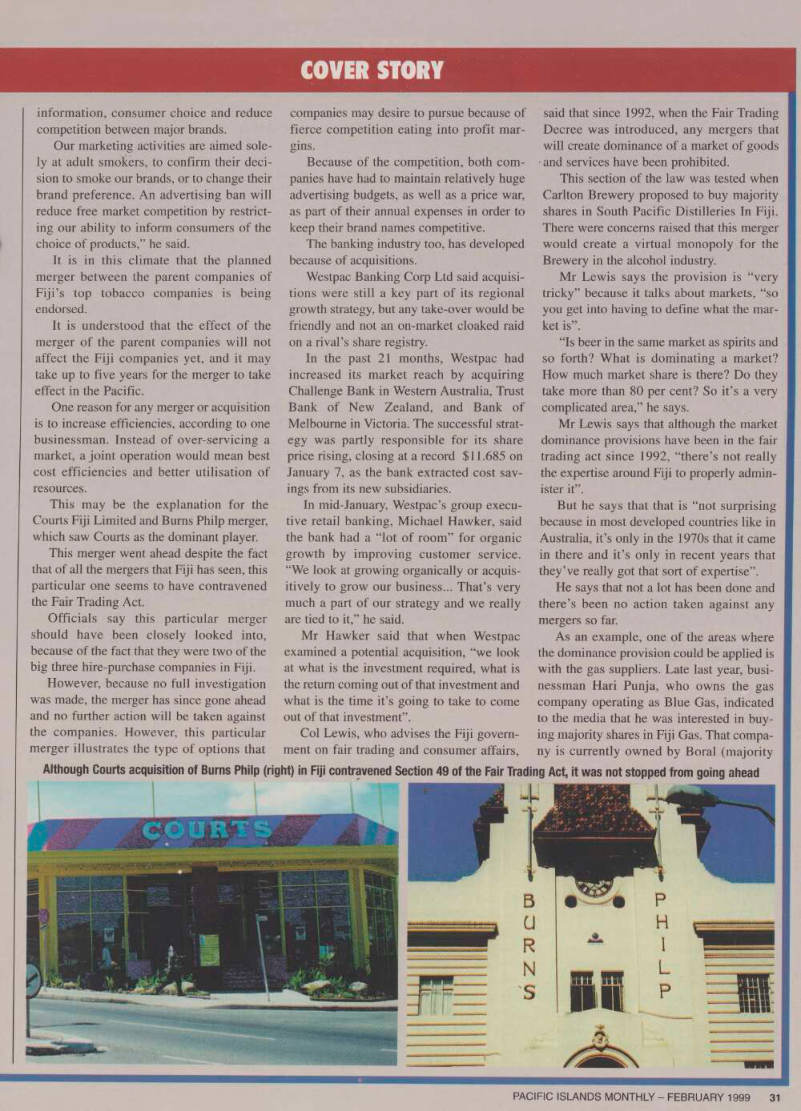
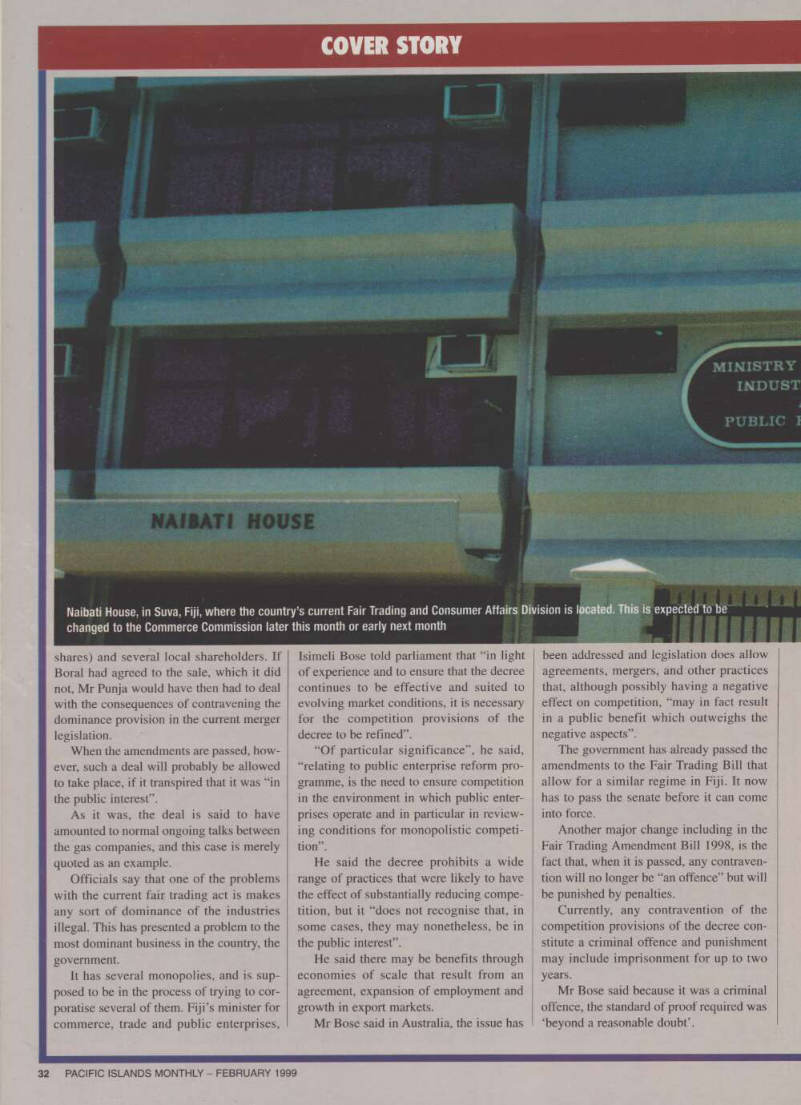

Cover Story
If you can't beat 'em...
The final say on mergers and acquisitions
Story and Pictures by Sophie Foster Hildebrand
IN the 21st Century, there is no doubt that the key words for business and industry will be mergers and acquisitions.
For some businesses, declining margins are leading towards secret and not-so-secret negotiations, to not so much give in to the opposition, as to pool resources.
So far, in the Pacific, local mergers have been the result of parent companies over seas joining, and filtering the decision down to their level.
The Price Waterhouse/Coopers & Lybrant merger had the effect of joining these accounting firms, previously in fierce
competition with each other, in offices throughout the Pacific.
The merger was seen as necessary because of similar mergers by other com petitors in the United States, which severe ly disadvantaged the two companies.
In places such as Fiji however, the merger has effectively given the joint ven ture a major chunk of the market.
The planned Rothmans Holdings and WD & HO Wills merger, which will effec tively form a group that would capture 16 per cent of the world tobacco market, may also have some repercussions in the islands.
Rothmans, with the Winfield, Holiday and
Dunhill under their sleeves, has been in fierce competition with Wills, which holds the Benson & Hedges, Horizon, Stradbroke and Export brand cigarettes.
The issue is one that Fiji’s Fair Trading and Consumer Affairs section will have to address over the next few months.
Colin Fewis of the FTCA says since the issue will be dealt with by Australian author ities, under Australian competition laws sim ilar to that of Fiji, the ministry will adopt a wait-and-see approach.
“The ministry of commerce and industry would be guided by the reaction to the pro posed Rothmans/Wills merger by competi tion authorities in other countries before considering whether any action is desirable or possible under the Fair Trading Decree,” he said.
It is likely that the Australians will not allow the merger to go ahead under their rules for competition.
As it is, the atmosphere for tobacco com panies is not too friendly world-wide, with bans on advertising and other restrictions
being enforced.
In Fiji, an advertising ban is in force for cigarette advertising.
John Nelson, the general manager of the
Central Manufacturing Company, which
produces cigarettes for both Rothmans and Wills, says the ban is restricting competition.
“Advertising bans directly restrict consumer
Westpac Banking Corp (Fiji’s Walu Bay branch, left), and Carlton Brewery Fiji Limited (right) have expanded their bases through acquisitions
information, consumer choice and reduce
competition between major brands.
Our marketing activities are aimed sole ly at adult smokers, to confirm their deci sion to smoke our brands, or to change their brand preference. An advertising ban will reduce free market competition by restrict ing our ability to inform consumers of the choice of products,” he said.
It is in this climate that the planned merger between the parent companies of Fiji’s top tobacco companies is being endorsed.
It is understood that the effect of the merger of the parent companies will not affect the Fiji companies yet, and it may take up to five years for the merger to take effect in the Pacific.
One reason for any merger or acquisition is to increase efficiencies, according to one businessman. Instead of over-servicing a market, a joint operation would mean best cost efficiencies and better utilisation of resources.
This may be the explanation for the Courts Fiji Limited and Bums Philp merger, which saw Courts as the dominant player.
This merger went ahead despite the fact that of all the mergers that Fiji has seen, this particular one seems to have contravened the Fair Trading Act.
Officials say this particular merger should have been closely looked into, because of the fact that they were two of the big three hire-purchase companies in Fiji.
However, because no full investigation was made, the merger has since gone ahead and no further action will be taken against the companies. However, this particular merger illustrates the type of options that
companies may desire to pursue because of
fierce competition eating into profit mar
gins.
Because of the competition, both com panies have had to maintain relatively huge advertising budgets, as well as a price war, as part of their annual expenses in order to keep their brand names competitive.
The banking industry too, has developed because of acquisitions.
Westpac Banking Corp Ltd said acquisi tions were still a key part of its regional growth strategy, but any take-over would be friendly and not an on-market cloaked raid on a rival’s share registry.
In the past 21 months, Westpac had increased its market reach by acquiring Challenge Bank in Western Australia, Trust Bank of New Zealand, and Bank of Melbourne in Victoria. The successful strat egy was partly responsible for its share price rising, closing at a record $11.685 on January 7, as the bank extracted cost sav ings from its new subsidiaries.
In mid-January, Westpac’s group execu tive retail banking, Michael Hawker, said the bank had a “lot of room” for organic growth by improving customer service.
“We look at growing organically or acquis itively to grow our business... That’s very much a part of our strategy and we really are tied to it,” he said.
Mr Hawker said that when Westpac examined a potential acquisition, “we look at what is the investment required, what is the return coming out of that investment and what is the time it’s going to take to come out of that investment”.
Col Lewis, who advises the Fiji govern ment on fair trading and consumer affairs,
said that since 1992, when the Fair Trading Decree was introduced, any mergers that will create dominance of a market of goods ■ and services have been prohibited.
This section of the law was tested when Carlton Brewery proposed to buy majority shares in South Pacific Distilleries In Fiji.
There were concerns raised that this merger would create a virtual monopoly for the Brewery in the alcohol industry.
Mr Lewis says the provision is “very tricky” because it talks about markets, “so you get into having to define what the mar ket is”.
“Is beer in the same market as spirits and so forth? What is dominating a market?
How much market share is there? Do they take more than 80 per cent? So it’s a very complicated area,” he says.
Mr Lewis says that although the market dominance provisions have been in the fair trading act since 1992, “there’s not really the expertise around Fiji to properly admin ister it”.
But he says that that is “not surprising because in most developed countries like in Australia, it’s only in the 1970 s that it came in there and it’s only in recent years that they’ve really got that sort of expertise”.
He says that not a lot has been done and there’s been no action taken against any mergers so far.
As an example, one of the areas where the dominance provision could be applied is with the gas suppliers. Late last year, busi nessman Hari Punja, who owns the gas company operating as Blue Gas, indicated to the media that he was interested in buy ing majority shares in Fiji Gas. That compa ny is currently owned by Boral (majority
Although Courts acquisition of Burns Philp (right) in Fiji contravened Section 49 of the Fair Trading Act, it was not stopped from going ahead
shares) and several local shareholders. If Boral had agreed to the sale, which it did not, Mr Punja would have then had to deal with the consequences of contravening the dominance provision in the current merger legislation.
When the amendments are passed, how ever, such a deal will probably be allowed to take place, if it transpired that it was “in the public interest”.
As it was, the deal is said to have amounted to normal ongoing talks between the gas companies, and this case is merely quoted as an example.
Officials say that one of the problems with the current fair trading act is makes any sort of dominance of the industries illegal. This has presented a problem to the most dominant business in the country, the government.
It has several monopolies, and is sup posed to be in the process of trying to cor poratise several of them. Fiji’s minister for commerce, trade and public enterprises,
Isimeli Bose told parliament that “in light of experience and to ensure that the decree continues to be effective and suited to evolving market conditions, it is necessary for the competition provisions of the decree to be refined”.
“Of particular significance”, he said, “relating to public enterprise reform pro gramme, is the need to ensure competition in the environment in which public enter prises operate and in particular in review ing conditions for monopolistic competi tion”.
He said the decree prohibits a wide range of practices that were likely to have the effect of substantially reducing compe tition, but it “does not recognise that, in some cases, they may nonetheless, be in the public interest”.
He said there may be benefits through economies of scale that result from an agreement, expansion of employment and growth in export markets.
Mr Bose said in Australia, the issue has
been addressed and legislation does allow agreements, mergers, and other practices that, although possibly having a negative effect on competition, “may in fact result in a public benefit which outweighs the
negative aspects”.
The government has already passed the amendments to the Fair Trading Bill that allow for a similar regime in Fiji. It now has to pass the senate before it can come into force.
Another major change including in the Fair Trading Amendment Bill 1998, is the fact that, when it is passed, any contraven tion will no longer be “an offence” but will
be punished by penalties.
Currently, any contravention of the competition provisions of the decree con stitute a criminal offence and punishment may include imprisonment for up to two years.
Mr Bose said because it was a criminal offence, the standard of proof required was ‘beyond a reasonable doubt’.
Naibati House, in Suva, Fiji, where the country’s current Fair Trading and Consumer Affairs Division is located. This is expected to be changed to the Commerce Commission later this month or early next month
“In practice, it is an extremely onerous burden to prove a contravention ‘beyond a reasonable doubt’ where the elements of a contravention may include such matters as ‘substantially lessening competition’,” he said.
However, corporations will not get away scot-free. With the passage of the amend ments, a penalty of up to one million dollars may be imposed against a corporation for each contravention of the competition provi sions. Along with the amendments, another bill for the setting of a Commerce Commission, is likely to go ahead.
This Commission will take the place of the current Fair Trading and Consumer Affairs Section of the ministry of commerce, acting independently with the powers of the Bill.
This is likely to be set up at the end of this month or early March and may help pave the way for more mergers and better price controls in both Fiji’s private and pub lic sectors. ■
Advertisements & other items, p. 31 (1 item)
Cover Story
Fair Trading Act
Section 49: Mergers
1. A person shall be guilty of an offence who acquires, directly or indirectly, any shares in the capital, or any assets, of a body corporate if a. as a result of the acquisition, the per son would be, or be likely to be, in a posi tion to dominate a market for goods or ser vices; or b. in a case where the person is in a position to dominate a market for goods or services - 1. the body corporate or another body corporate that is related to that body corpo rate is, or is likely to be, a competitor of the person or of a body corporate that is related to the person; and 11. the acquisition would, or would be likely to, substantially strengthen the power of the person to dominate that market. 2. A person shall not acquire, directly or indirectly, any shares in the capital, or any assets, of a corporation if a. as a result of the acquisition, the per son would be, or be likely to be, in a posi tion to dominate a market for goods or ser vices; or b. in a case where the person is in a position to dominate a market for goods or services - I. the corporation or body corporate that is related to the corporation is, or is likely to be, a competitor of the person; and 11. the acquisition would, or would be likely to, substantially strengthen the power of the person to dominate that market. 3. If a. a body corporate that is related to or associated with a person is, or two or more bodies corporate each of which is related to or associated with the one person together are, in a position to dominate a market for goods or services; or b. a person, and a body corporate that is, or two or more bodies corporate each of which is, related to or associated with that
person, together are in a position to domi nate a market for goods or services, the person shall be deemed for the pur poses of this section to be in a position to dominate that market. 4. For the purpose of this section, a body corporate shall be taken to be associ ated with another body corporate (not being another body corporate that is related to the first-mentioned body corporate) if one of those bodies corporate) in this sub-section referred to as the “dominant body corpo rate”) is, either alone or together with another body corporate that is, or other bodies cor porate each of which is, related to the dom inant body corporate, or associated with the dominate body corporate by another appli cation or other applications of this sub-sec tion, in a position to exert, whether directly or indirectly, a substantial degree of influ ence over the activities of the other body corporate. 5. For the purpose of sub-section (4), the fact that a body corporate is in a posi tion to exert a substantial degree of influ ence over the activities of another body corporate by reason only that a. those bodies corporate are in compe tition in the same market; or b. one of those bodies corporate sup plies goods or services to the other, shall be disregarded. 6. In this section a. a reference to a market for goods or services shall be construed as a reference to a substantial market for goods or services in Fiji; and b. a reference to dominating a market for goods or services shall be construed as a reference to dominating such a market either as a supplier or as an acquirer of goods or services in that market. ■
Rothmans Holdings

Rothmans and Wills poised to control tobacco market
Ltd and WD & HO Wills were poised to take con trol of the Australian tobacco market following the planned merger of their parent companies in a Stg 13 billion ($A34.2 billion) deal.
British American Tobacco (BAT), the world’s second largest tobacco firm, and Rothmans International, the world’s fourth largest tobacco firm, announced they would join forces to form a group that would capture 16 per cent of the world tobacco market.
Australian listed Rothmans Holdings with the Winfield, Holiday and Dunhill cigarette brands - is 50 per cent owned by Rothmans International and commands a 34 per cent share of the Australian market.
While, WD & HO Wills - which manu factures Benson & Hedges, Horizon, Stradbroke and Export cigarettes - is 67 per cent owned by BAT, and has a market share of about 27 per cent.
The move by their parent companies prompted speculation the Australian sub sidiaries would soon follow suit.
The unlisted Philip Morris brand, the largest player in the Australian market with a 38.4 per cent share, would be pushed into second place if the Australian grouping
gets the go-ahead by Australian authorities.
Speculation that the Australian sub sidiaries would merge sent their share
prices soaring mid-January, with
Rothmans closing at an all-time high, gain ing 80.7 cents, or 6.93 per cent to $12.46.
Shares in WD & HO Wills jumped 41 cents, or 10.93 per cent, to $4.16 after hit ting a high of $4.20.
A combined Rothmans and WD & HO Wills would control about 62 per cent of the Australian market share and about 95 per cent of the New Zealand market, according to analysts.
However, the proposal must get approval from the Australian Competition and Consumer Commission (ACCC) which will be looking at a possible reduc tion in competition with just two players in the Australian market.
“We will be examining it because they are major players in the Australian ciga rette market,” an ACCC spokeswoman said.
“We will be looking at it under the merger or acquisition part of the act which deals with substantial lessening in compe tition”.
The ACCC had found such mergers unacceptable in the past and have not allowed them, but the companies could
argue that “Australia is not big enough to have three major players in the tobacco
industry with declining margins,” one ana
lyst said.
“The merger in Australia would present an opportunity for the two companies to develop a more competitive brand portfo lio, provide cost efficiencies and put the companies in a better position to respond
to the government’s major excise changes
to tobacco,” said Laura Knight, Wills’ head of consumer and regulatory affairs.
Rothmans chief executive Gary Krelle said that the board was currently looking at the deal and could not make any predic tions on what the outcome would be.
But he agreed that one “likely outcome” would be for further consolidation in the future.
A Philip Morris spokeswoman declined to comment on the merger.
Overnight, BAT said it may need to make a full off for the outstanding shares of Rothmans Australian-listed operations following its merger with Rothmans International. However, there were no details of what form this would offer.
A Sydney based analyst said that there would almost certainly be some consolida tion in the Australian subsidiaries and some of the brands that overlap could dis appear.
The analyst added that it was unlikely the companies would remain separately listed and the most probably outcome would be with Wills retaining the company name. (AAP) ■
Australian companies could be take-over targets in H2/99
THE second half of 1999 could see a wave of international buyers looking for good value Australian companies as the Asian region starts to emerge from its recession, the KPMG Corporate Finance survey found.
Continued weakness in the Australian dollar, the bottoming of the commodity cycle and the global business view that Australia is a key commodity supplier could bring investors to Australian shores looking for take-over opportunity, KPMG Corporate Finance Australia national chairman John Anderson said.
The emerging markets were currently out of favour with inter national companies that were concentrating on safer investments in North America and Western Europe. “However, we expect the picture to shift somewhat in the coming year. Economic recovery in most Asian markets - no matter how muted - should revive con fidence in the Asian region and in Australia in particular which is seen as a commodities supplier to Asia,” he said. “The second half
of 1999 may see a wave of corporate bargain hunting by western buyers looking at ‘good value’ Australian companies”.
While the regional economic crisis had affected some countries more than others, it had the effect of discouraging western com panies from investing in the whole region, KPMG said. “There is little sign of cross-border acquisition in Asia turning up and it may be some time before international businesses regain their confi dence in the region,” Mr Anderson said.
The survey data was compiled from more than 5000 cross bor der mergers, acquisitions and take-overs in 1998.
Despite the aversion to the Asia-Pacific region, global cross border mergers accelerated in 1998 but did experience a lull from August to October due to the emerging markets crisis, in Latin America and Russia as well as Asia. The aggregate value of the international deals rose to a record $544.31 billion from $341.02 billion in 1997. (AAP) ■
Advertisements & other items, pp. 35-36 (1 item)
Notebook,
To Win an
IBM Pentium
Get the latest on political, business and social issues happening throughout the region every month, as well as the chance to win an IBM Pentium Notebook! Every 12issue subscription received before March 31st, 1999 will go into the draw. Subscribe to Pacific Islands Monthly today by calling (679) 304 111 or fax (679) 303 809/(679) 307 460.
Subscribe to The Source.
Pacific Islands Monthly
Conditions of Entry I.To enter, subscription must he made before March 31st, 1999 which automatically enters the subscriber into the draw for the Pentium Notebook Computer > Entry is open to all subscribers except employees of The Fiji Times Ltd, Pacific Islands Monthly and Wilson Addison Ltd. Subscribers need to subscribe for at least 12 months to qualify- 4 The winner of the Pentium Notebook will be published in the Pacific Islands Monthly Magazine, May Issue, 1999 and will be notified by registered mail. S.The winner will receive their prize within one month of the draw. 6,The prize must be taken as offered and is not redeemable. 7.1 n the event of any dispute the decision of the promoter is final and no correspondence will be entered into.
For almost 70 years, Pacific Islands Monthly has been and still is the authority on political, business and social issues within the Pacific. And now, every 12 month subscription received before the 31st of March, 1999, goes into a draw to win an IBM Pentium Notebook*. You could even give a gift subscription to enter but it must be before the closing date. As well as the entry into the draw, you will also receive the latest news from the region. Fill in the subscription form below and send it along with payment to Pacific Islands Monthly, Subscription Department, PO Box 1167, Suva, Fiji. Or call PIM on (679) 304 111 or fax us on (679) 303 809/(679) 307 460.
Subscribe to The Source.
Pacific Islands Monthly
*Rates include Airspeeding to all destinations Conditions of Entry 1. To enter, subscriptions must be made before March 31st, 1999 which automatically enters the subscriber into the draw for the Pentium Notebook Computer. 2. Entry is open to all subscribers except employees of The Fiji Times Ltd, Pacific Islands Monthly, and Wilson Addison Ltd. 3- Subscribers need to subscribe for 12 months to qualify. 4. The winner of the Pentium Notebook will be published in Pacific Islands Monthly Magazine, May Issue, 1999 and will be notified by registered mail. 5. The winner will receive their prize within one month of the draw. 6. The prize must be taken as offered and is not redeemable. 7. In the event of any dispute the decision of the promoter is final and no correspondence will be entered into.
YES! I wish to subscribe to The Source and receive a chance to win an IBM Pentium Notebook Computer! □ Cheque/Bank Draft/Money Order made payable to Pacific Islands Monthly ] Please charge my credit card; (VISA / AMEX / MASTERCARD)
12 ISSUE
SUBSCRIPTION
Rate A Rate B Rate C Rate D Rate E This is a
□ Renewal
□ □ □ □ Signature: Expiry date: Mr/Mrs/Ms; Delivery Address: Postal Address: n New Subscription Country: Fax:
QBE set for solid H1 profit, say funds, analysts

Industry
QBE Insurance Group Ltd was expected to post a solid interim net profit after re-weight ing its resources portfo lio, improved equities markets and earnings on its acquisitions, analysts said mid-January.
The insurance major, which has a poli cy of making friendly acquisitions of smaller insurance companies, reports its
results for the six months to December 31, on February 22.
Paul Xiradis, equities director at funds manager Ausbil Partners, said that the mar ket expected QBE, targeting 15 per cent growth in net earned premium, to post a “good six months” after
an improvement
in its market investments.
“I’m led to believe that they’ve had a good six months and things have
improved signif
icantly on the
investment front as well,” Mr Xiradis told Australian Associated Press (AAP).
A European investment bank analyst, who requested anonymity, said that QBE had “generally weighted down” its invest ment in resources sector after those stocks were pummelled in 1998 due to a plunge in commodity prices.
QBE had an 8.1 per cent rise in annual net profit to $166 million for the year ended June 30, 1998, using the directors’ preferred overseas accounting standards, which spreads returns from its more than $3 billion funds book over seven years.
But under Australian accounting stan dards, QBE had a 49.9 per cent fall in annual net profit to $95.3 million, com pared to $190.1 million in the previous year, after financial markets world-wide,
particularly resource stocks, were effected by the Asian economic crisis.
QBE managing director Frank O’Halloran, who has imposed a “black out” on discussing the company’s profits until they are released to the market this month, has said that two-thirds of the net earned premium growth will come from acquisitions.
Mr O’Halloran also has said that depending on the performance of invest-
ment markets, QBE will post an improved operating profit in fiscal 1998/1999, com pared to 1997/1998.
Mr Xiradis and analysts said that QBE has a track record of acquiring smaller insurers, which did not require large good will payments nor distract management from its core business, that were earnings per share (EPS) positive in the first year.
A US investment bank analyst, who also requested anonymity, told AAP: “They don’t want anything that will take up core management time.
When they do take over a smaller com pany, there’s no management distraction from their main business”.
In October, Mr O’Halloran told a Merrill Lynch investment conference in New York that the company was wading
through “enormous” acquisition opportu nities in Asia and several opportunities in Australia.
Consolidation has gathered pace, with AMP Ltd acquiring 57.2 per cent of GIO Australia Holdings Ltd, German-based Allianz AG acquiring MMI Ltd, HIH Insurance Ltd and NRMA Ltd acquiring SGIO Insurance Ltd.
Mr O’Halloran said the Australian insurance companies that QBE was
assessing were unlisted. He said the company could spend more than the oft-quoted $lOO million on acquisitions if the potential tar gets added “sig nificant value” to shareholders’ wealth.
The $lOO million figure had been mis quoted because the company could raise addi tional capital by either share placements or rights issues or convertible notes or borrow ing. “There are
many ways to raise capital,” he told AAP.
Mr O’Halloran said that QBE wanted to expand its established Asian operations, though it did not rule out acquisitions in China, India, Korea, the Philippines or Taiwan.
“Some close, some not so close, some that have fallen by the wayside, but we’ve got a lot on our plate,” he said. Analysts said that QBE itself was not a take-over target.
An analyst from a US investment bank said a predator would have to pay 3.5 times QBE’s book value to be successful, “and that would be silly”.
“I would have thought that wherever their share price is, somebody would have to pay a significant premium over that,” another analyst told AAP. ■
Part of the QBE Group, Queensland Insurance Limited, in the heart of Suva’s CBD (Pic: SFH)
Cooks' govt proposes major pearl
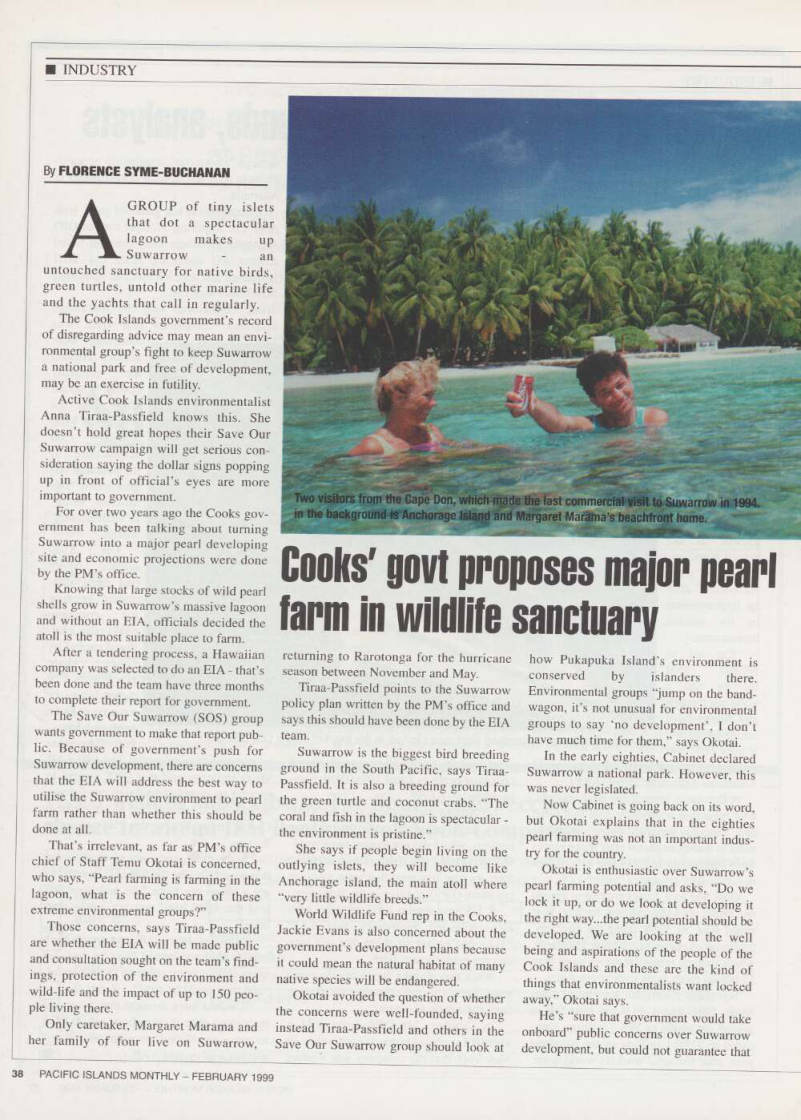
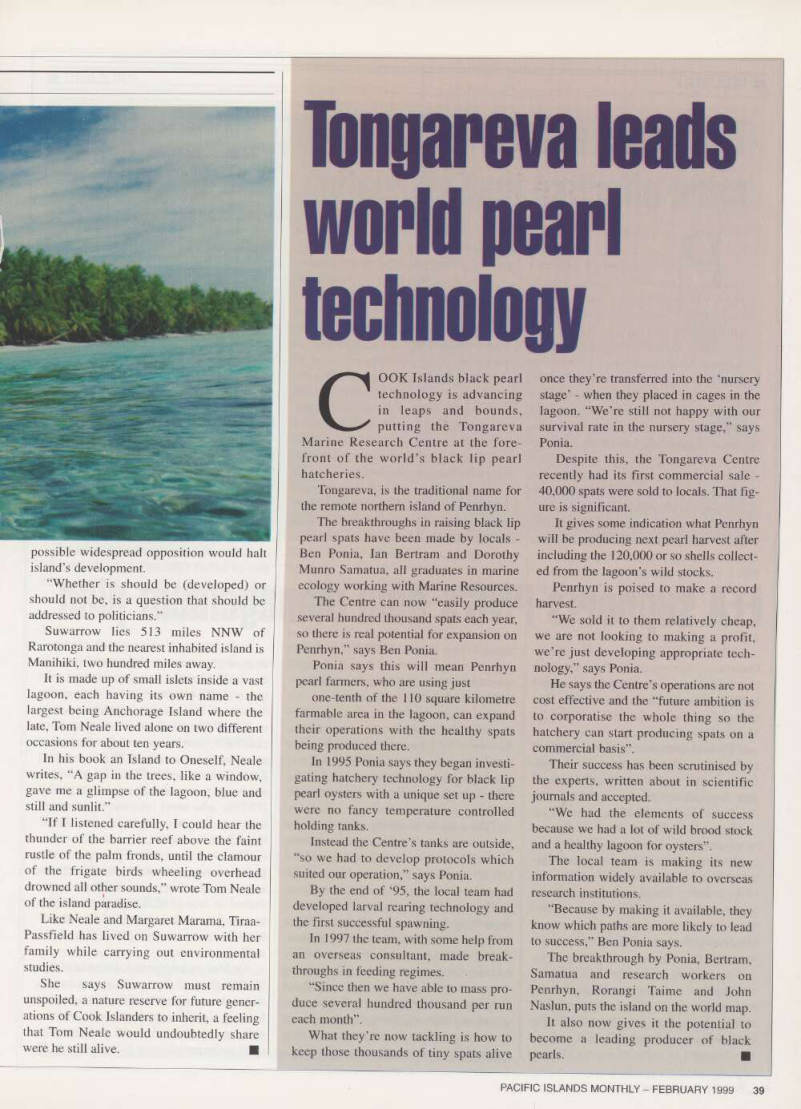
farm in wildlife sanctuary
By Florence Syme-Buchanan
A GROUP of tiny islets that dot a spectacular lagoon makes up Suwarrow - an untouched sanctuary for native birds, green turtles, untold other marine life and the yachts that call in regularly.
The Cook Islands government’s record of disregarding advice may mean an envi ronmental group’s fight to keep Suwarrow a national park and free of development, may be an exercise in futility.
Active Cook Islands environmentalist Anna Tiraa-Passfield knows this. She doesn’t hold great hopes their Save Our Suwarrow campaign will get serious con
sideration saying the dollar signs popping
up in front of official’s eyes are more important to government.
For over two years ago the Cooks gov ernment has been talking about turning Suwarrow into a major pearl developing site and economic projections were done by the PM’s office.
Knowing that large stocks of wild pearl shells grow in Suwarrow’s massive lagoon and without an EIA, officials decided the atoll is the most suitable place to farm.
After a tendering process, a Hawaiian company was selected to do an EIA - that’s been done and the team have three months to complete their report for government.
The Save Our Suwarrow (SOS) group wants government to make that report pub lic. Because of government’s push for Suwarrow development, there are concerns that the EIA will address the best way to utilise the Suwarrow environment to pearl farm rather than whether this should be done at all.
That’s irrelevant, as far as PM’s office chief of Staff Temu Okotai is concerned, who says, “Pearl farming is farming in the lagoon, what is the concern of these extreme environmental groups?”
Those concerns, says Tiraa-Passfield are whether the EIA will be made public and consultation sought on the team’s find ings, protection of the environment and wild-life and the impact of up to 150 peo ple living there.
Only caretaker, Margaret Marama and her family of four live on Suwarrow,
returning to Rarotonga for the hurricane season between November and May.
Tiraa-Passfield points to the Suwarrow policy plan written by the PM’s office and says this should have been done by the EIA team.
Suwarrow is the biggest bird breeding ground in the South Pacific, says Tiraa- Passfield. It is also a breeding ground for the green turtle and coconut crabs. “The coral and fish in the lagoon is spectacular the environment is pristine.”
She says if people begin living on the outlying islets, they will become like Anchorage island, the main atoll where “very little wildlife breeds.”
World Wildlife Fund rep in the Cooks, Jackie Evans is also concerned about the government’s development plans because it could mean the natural habitat of many native species will be endangered.
Okotai avoided the question of whether the concerns were well-founded, saying instead Tiraa-Passfield and others in the Save Our Suwarrow group should look at
how Pukapuka Island’s environment is conserved by islanders there.
Environmental groups “jump on the band wagon, it’s not unusual for environmental groups to say ‘no development’, I don’t have much time for them,” says Okotai.
In the early eighties, Cabinet declared Suwarrow a national park. However, this was never legislated.
Now Cabinet is going back on its word, but Okotai explains that in the eighties pearl farming was not an important indus try for the country.
Okotai is enthusiastic over Suwarrow’s pearl farming potential and asks, “Do we lock it up, or do we look at developing it the right way...the pearl potential should be developed. We are looking at the well being and aspirations of the people of the Cook Islands and these are the kind of things that environmentalists want locked away,” Okotai says.
He’s “sure that government would take onboard” public concerns over Suwarrow development, but could not guarantee that
Two visitors from the Cape Don, which made the last commercial visit to Suwarrow in 1994 in the bakground is Anchorage Island and margaret Marama's beachfront home.
possible widespread opposition would halt island’s development.
“Whether is should be (developed) or should not be, is a question that should be addressed to politicians.”
Suwarrow lies 513 miles NNW of Rarotonga and the nearest inhabited island is Manihiki, two hundred miles away.
It is made up of small islets inside a vast lagoon, each having its own name - the largest being Anchorage Island where the late, Tom Neale lived alone on two different occasions for about ten years.
In his book an Island to Oneself, Neale writes, “A gap in the trees, like a window, gave me a glimpse of the lagoon, blue and still and sunlit.”
“If I listened carefully, I could hear the thunder of the barrier reef above the faint rustle of the palm fronds, until the clamour of the frigate birds wheeling overhead drowned all other sounds,” wrote Tom Neale of the island paradise.
Like Neale and Margaret Marama, Tiraa- Passfield has lived on Suwarrow with her family while carrying out environmental studies.
She says Suwarrow must remain unspoiled, a nature reserve for future gener ations of Cook Islanders to inherit, a feeling that Tom Neale would undoubtedly share were he still alive. ■
world pearl
Tongareva leads world pearl technology
COOK Islands black pearl technology is advancing in leaps and bounds, putting the Tongareva Marine Research Centre at the fore front of the world’s black lip pearl hatcheries.
Tongareva, is the traditional name for the remote northern island of Penrhyn.
The breakthroughs in raising black lip pearl spats have been made by locals - Ben Ponia, lan Bertram and Dorothy Munro Samatua, all graduates in marine ecology working with Marine Resources.
The Centre can now “easily produce several hundred thousand spats each year, so there is real potential for expansion on Penrhyn,” says Ben Ponia.
Ponia says this will mean Penrhyn pearl farmers, who are using just one-tenth of the 110 square kilometre farmable area in the lagoon, can expand their operations with the healthy spats being produced there.
In 1995 Ponia says they began investi gating hatchery technology for black lip pearl oysters with a unique set up - there were no fancy temperature controlled holding tanks.
Instead the Centre’s tanks are outside, “so we had to develop protocols which suited our operation,” says Ponia.
By the end of ‘95, the local team had developed larval rearing technology and the first successful spawning.
In 1997 the team, with some help from an overseas consultant, made break
throughs in feeding regimes.
“Since then we have able to mass pro duce several hundred thousand per run each month”.
What they’re now tackling is how to keep those thousands of tiny spats alive
once they’re transferred into the ‘nursery stage’ - when they placed in cages in the lagoon. “We’re still not happy with our survival rate in the nursery stage,” says Ponia.
Despite this, the Tongareva Centre recently had its first commercial sale - 40,000 spats were sold to locals. That fig ure is significant.
It gives some indication what Penrhyn will be producing next pearl harvest after including the 120,000 or so shells collect ed from the lagoon’s wild stocks.
Penrhyn is poised to make a record harvest.
“We sold it to them relatively cheap, we are not looking to making a profit, we’re just developing appropriate tech nology,” says Ponia.
He says the Centre’s operations are not cost effective and the “future ambition is to corporatise the whole thing so the hatchery can start producing spats on a commercial basis”.
Their success has been scrutinised by the experts, written about in scientific journals and accepted.
“We had the elements of success because we had a lot of wild brood stock and a healthy lagoon for oysters”.
The local team is making its new information widely available to overseas research institutions.
“Because by making it available, they
know which paths are more likely to lead to success,” Ben Ponia says.
The breakthrough by Ponia, Bertram, Samatua and research workers on Penrhyn, Rorangi Taime and John Naslun, puts the island on the world map.
It also now gives it the potential to become a leading producer of black pearls. ■
POFYNESIAN forefathers
Traditional ban on fishing much more effective than legislation
were always conscious of the need to preserve their resources, and in the Cook Islands they practised the raui, when a ban was imposed on the gathering of food either in the sea or on land. Now Rarotonga has again resorted to this traditional conservation system to replenish the island’s lagoons that have become depleted by over fish ing and indiscriminate gathering of shell fish. And although the “raui” or tradi tional ban has only been in place for just over six months in four lagoon areas here, there’s been a noticeable resur gence of fish and shell fish, says Te Tika Mataiapo Dorice Reid. Te Tika, a chief tain from the village of Titikaveka, was
instrumental in getting the raui practised again, with the backing of the Koutu Nui, a body of chiefs that she is president of.
“It was obvious to us the marine life in our lagoons was fast disappearing, we hardly saw any fish, the Koutu Nui became very concerned and decided we would take the bull by the horns and set up the raui,” says Te Tika.
The raui is in place for two years and totally bans any type of fishing in the four lagoon areas. Even gathering sea sonal seafood delicacies, such as the roe of a particular sea cucumber that is ready during December and January has been banned. The raui system was used by Cook Islands forefathers to conserve resources, particularly when they were expecting a visit from big tere or tour
from friendly neighbouring islands. The voyages from island to island were made in huge ocean going canoes, some of 180 feet in length that carried nobles, per formers and relatives for traditional fes tivities and ceremonies. The raui is still practised in the remote northern islands of the group from time to time. Te Tika says the Rarotonga raui has been very successful and most people have respect ed it. “There’ve been one or two offend ers, but they were Cook Islanders visit ing from abroad and weren’t aware”.
She says educating people about the need for the raui and conserving marine life is far more important that any legis lation that may be introduced.
“What is particularly important is that we have to have community co-opera tion”.Te Tika Mataiapo believes it’s time some Rarotonga lagoon areas are made permanent marine reserves. An attempt to do this at a fish breeding ground failed after traditional chiefs argued that it would prevent netting of fish that enter the passages at certain seasons. ■
FFA supports PNG's tuna management plan
THE Deputy Director of the Forum Fisheries Agency (FFA), Mr lan Cartwright, has given the agency’s support to PNG’s Tuna Fisheries Management Plan recently launched by fisheries’ minister, Sir Mekere Morauta.
“Through the development of plans such as this, island countries are demon strating a clear commitment to the sustain able development of their valuable tuna resources,” Cartwright said.
“Papua New Guinea is one of the first of our member countries to develop and implement in-zone management arrange ments that will yield benefit to all sectors of the industry. The recently launched plan represents a clear policy direction, based on conservation and management princi ples, rather than unsustainable short term economic gains”.
This initiative taken by the PNG gov ernment has wider implications than for tuna management within the country’s 200mile Exclusive Economic Zone (EEZ). The whole western and central Pacific region is now engaged in negotiations with distant
water fishing nations (DWFNs) including Japan, Korea, Taiwan and the US, that will see development of management arrange ments covering the entire region.
Cartwright considers that “such a region-wide management arrangement is essential if the future of highly mobile tuna is to be assured - a tuna in PNG today may be on the high seas tomorrow and in the EEZ of another Pacific island country next week”.
“The success of efforts at co-operation and harmonisation amongst the members of the FFA, other coastal states, and the DWFNs hold the key to the future of the region’s tuna fishery”.
He noted that “by laying firm national fisheries management foundations, PNG is well placed to enter into the regional nego tiating arena. A number of other Pacific Island countries are putting similar in-zone arrangements in place, and we are hopeful that such demonstrations will place the island countries of the region in a strong position to influence the successful out come of the regional negotiations”.
Included in the region-wide manage ment arrangements is the compulsory use by all DWFNs of a vessel monitoring sys tem or VMS by vessels when they are in the zone of FFA member countries.
The VMS will allow real time tracking of DWFN vessels using satellite technolo gy, wherever they are in PNG’s massive 2.4 million square km FEZ. This system is not being accepted without a struggle by DWFNs, who seem reluctant to submit to this requirement now being introduced throughout the region.
The tuna fishery of the FFA region is the greatest tuna fishery in the world with an annual catch of over one million tonnes, valued at around SUSI. 7 billion. PNG’s annual share of this catch is of the order of 300,000 tonnes, worth SUS3OO to $4OO million.
Sir Mekere said he was determined that “PNG will stand firm on its regional com mitment to implement VMS. It is a modest but very significant investment in our valu able tuna resource, that will yield benefits to all states participating in the fishery”. ■
negotiations, more members

WTO contender urges new negotiations, more members
NEW Zealand’s candidate for head of the World Trade Organisation, Michael Moore, suggest ed mid-January a new full round of global negotiations would be the best way to advance the cause of free trade.
In an interview with Reuters, he also said the WTO could not be a real world body unless it had China and Russia as members and that he would work for their admission, but voiced doubts about creat ing special conditions to get them in.
“Why a round is good is that there are trade-offs, there can be something for everybody,” said Moore, who is running close to Thailand’s First Deputy prime min ister Supachai Panitchpakdi in the contest to become WTO director-general.
Developing countries and former com munist transition economies had to be sure there would be something for them if they were to be convinced that they should take part in fresh liberalisation talks, he declared.
Ministers from the now 133 WTO mem ber countries are due to meet in November for a conference at which they are expected to launch new efforts to lower barriers to global commerce.
Some powers - including the European Union and Japan - want a traditional round format in which deals in several areas are combined into a single undertaking. The United States prefers a sector-by-sector approach.
Many developing countries are not keen to start up new talks in the near future apart from in agriculture and services that are already on the WTO agenda - while they are still trying to digest accords in the 1986-93 Uruguay Round.
Moore, a social democrat and former trade unionist, who has served as his coun try’s prime minister, foreign and trade min ister, said the sectoral approach, which has already produced global accords in the WTO, could be effective.
“But in the end, I think we can advance on all fronts as we 11... I can see the need for
movement in a number of areas,” he added.
Developing countries might “dig in their toes” unless they saw the prospect of bene fits to them also.
The new WTO chief, who should take over from outgoing Director-General Renato Ruggiero of Italy at the start of May, will have to steer the body through months of probably fraught negotiation on the agenda for the ministerial gathering.
Soundings taken to mid-January by two WTO ambassadors charged with establish ing which of the four candidates for the job could win a consensus, reported in December that Supachai was leading, fol lowed by Moore.
Behind them came Morocco’s former trade minister Hassan Abouyoub, and then Canada’s ex-trade minister and present High Commissioner in London, Roy Mclaren.
WTO envoys agreed to aim at a decision by the end of January with the formal appointment coming on February 16. But mid-January, the United States and the European Union had still not decided whom to back.
Moore, who travelled to nearly 50 coun tries to promote his candidature, said he felt he was “competitive”.
“We in New Zealand are little guys, we have to work harder,” he said.
Moore said it would be one of his ambi tions as director-general to bring in China, whose decade-old bid to join is faltering, and Russia, in negotiation for four years but hog-tied by the problems of its post-com munist economy.
“In the end, unless we have China and other major countries in, we don’t have a world trade organisation,” Moore added.
But if the rules were bent to admit them, as some officials have suggested, “there could be problems down the line”.
Moore said that it would also be “unfair to other countries that have not had favourable terms.
We want to engage, we want them in, but I’m cautious because we know that short cuts can end up taking longer”. ■
April to
ITC will take until April to rule on lamb exports
THE International Trade Commission would take until April to rule on whether Australian and New Zealand lamb exports were jeopardising the united States lamb industry, New Zealand’s ambassador to Washington, Jim Bolger said.
Bolger appeared before the US-based commission mid-January, arguing the American lamb industry was more threat ened by competing meats than by New Zealand and Australian lamb.
“I thought we had a good hearing. I thought the commission gave us a fair hearing and asked important questions,”
Bolger told National Radio.
“Now they will go away to deliberate.
It’s not until April we will know the final determination. I think the commission will have the last word”.
American sheep farmers filed a peti tion with the commission claiming Australian and New Zealand imports were seriously injuring them.
They say they are threatened by the rapid increase in Australian and New Zealand lamb imports and want a four year quantitative restriction imposed, and an increase in tariffs to protect the local market.
Bolger said he believed the answer was to expand the lamb market in the United States, which had the capacity to take all available supplies.
“The number of sheep in all countries has dropped by tens of millions so we’re not talking about an expanding product, we’re talking about a reduced volume of product and I think this market can be grown to accommodate it all,” he said.
There was “a lot of heat and emotion” from the American farmers but about two thirds of Americans had never tasted lamb. (NZPA) ■
PNG govt/environmentalists
at loggerheads over forests
By Sam Vulum
THE Papua New Guinea government has again been caught in the fray, this time over its efforts to rescue the forest industry after months of struggle against the severe impact of the Asian economic crisis.
With Asia being the country’s largest log market, PNG exporters found them selves scratching to survive since buyers started refusing their logs in July 1998.
Many have been forced to shut down while others reduced their operations.
There were also reports of companies leav ing PNG for other countries.
However, with the implementation of new tax breaks and improved prices on the Asian market, things are beginning to pick up. The tax breaks require logging compa nies to be exempted from paying tax on any logs exported at a price of under K 125 per cubic free on board (FOB). This enables companies to save K 25 per cubic metre in taxes.
The Forest Industries Association, which represents 85 per cent of logging companies in PNG, said the introduction of the export tax breaks saved many opera tions from permanent closure.
The FlA’s executive officer Robert Tate told PIM that the current export markets for both logs and sawn timber were improving slowly as the worst of the Asian crisis eases.
Tate said that they were expecting the current average 30 per cent tax to' be reduced to between 10 and 15 per cent. He said average prices for logs have improved from the low SUSSO per cubic metre to the high SUS6O per cubic metre over the past five months.
He said buyer demands remained fairly weak due to uncertainty in the Japanese economy, the US dollar/Yen exchange rate and a reluctance by all buyers to get caught with large forward stock holdings.
Tate said, in the current climate, the FIA was only forecasting log exports of between two and 2.5 million cubic metres
in 1999. “This is a reduction of about 20 per cent on 1997 exports and is only about half the annual log harvest volume for PNG,” he said. But, in its haste to further improve the industry, the government has been accused of going too far by imposing the tax breaks. The move has re-ignited debate over what appears to be the most controversial industry in PNG.
Environmentalists, in particular, have joined forces in condemning the govern ment’s actions, mainly regarding the taxes.
Greenpeace forest’s specialist Brian Brunton says there are already signs that the forest minister was taking short cuts with the legal process.
“Project options studies are not being done properly,” Brunton said, “there is great danger that the government will
Government under fire
again for “interfering” in
legally required
processes in the forestry
industry, but forestry
minister says he wanted
to push Forest Authority
staff whom, he said,
have been sitting on
projects which are ready
for development
avoid the competitive tendering process, mandated by the Forestry Act, and give concessions to political mates”.
Brunton also questioned the SUS3S million said to be allocated to a trust account for the protection of trees and the environment.
“This money will not address the ques tion of export logging, which is the main cause of forest loss in PNG. The increase in export logging is a result of tax breaks granted by the government”.
While Brunton welcomes conservation aid, he says it is too late.
“It’s like pouring funds for conservation into a bath, while export logging allows
taxes, revenue and trees to rush out the
plug hole”.
Greenpeace also rejects the FlA’s claim that tax concessions have saved the indus try. “Whose industry are they talking about? The Asian loggers? The reduction in the export log tax concessions is only saving loggers’ profits,” he said.
Another environmental group, the Pacific Heritage Foundation, also expressed similar sentiments about the government activities.
Foundation spokesman, Benedict Killian, said no government or authority or person could assume to exercise any power that they do not have in the pretence of securing 50,000 odd jobs, which, ultimate ly, would be exported with the next export of round-logs or “downstream processed” kwila slabs.
“The directive of the prime minister is a far cry from the general intent of the forestry laws and environmental regula tions which seek to ensure that, while there is a need for economic prosperity, environ mental accountability and full landholder participation is maximised. It is simply not government policy to fast-track projects to the detriment of the nation’s other constitu tional directives,” he said.
Killian said there are clear constitution al directives seeking environmental sus tainability. What was more important, he said, was that PNG’s laws, including the Forestry Act, sought to ensure that landowners were properly consulted and informed in a manner whereby they were able to make free and independent deci sions.
He said the PFMCs should not be deterred by threats that were not supported by law nor politically sustainable.
The activists were reacting to reports that prime minister Skate and forest minis ter Peter Arul were trying to fast-track multi-million kina timber projects in the country.
Industry sources were reported as say ing that it was practically impossible to get developers into the 14 major timber areas in a hurry without following proper legal procedures and forestry guidelines.
They were referring to a letter by Arul dated December 9, 1998, titled “Prime Minister’s Directives”, addressed to the chairman of Provincial Forest Management Committee (PFMC) and copied to Skate, the National Forest Board chairman Gabriel Smol and PNG Forestry
Authority managing director Thomas Nen.
In the letter, Arul threatens to have the National Executive Council approve the timber projects if the PFMC couldn’t find a developer by that week.
The Forest Minister issued the warning while reminding them of Skate’s concern about the continuous delay in getting some of the major timber projects off the ground.
Forestry sources said the directives cannot be met with out passing set guidelines and laws, which involved the con sultation and approval of landowners.
A PNG Forestry Authority source confirmed that the task was impossible but meetings had been held with PFMCs.
In an attempt at damage control, Arul assured the pub lic that government plans to encourage investment in the forestry sector would not be done outside the prescribed legal procedures and set forestry guidelines.
“The National Forest Board and the National Forest -Service are required by law to ensure that timber resources are allocated, managed and developed on a sustainable basis and in compliance with the allocation and develop ment procedures under the Forestry Act 1991 (as amend ed),” he said.
The minister’s office said the deadline to find develop ers, which expired in the first week of January, had “natu rally” been extended. He did not give any new dates.
Arul said the intention of
the letter was to push Forest Authority staff - who were sitting on projects ready for development - into action. He said the let ter followed a meeting between the com mittee, Skate and himself, and was a clear indication that the government was serious about getting all the projects off the ground by adhering to set forestry laws.
“I am pressured by various landowner groups in most of the timber project areas to speed up their projects as the Forest Authority was unnecessarily delaying their timber projects. The resource owners too want to benefit and take part in developing
their resources,” he said.
“My follow-up letter is the right step taken in the right direction to get partici pants of timber resources, the landowners, PFMCs, the Forest Authority and the developers to seriously look at where the set-back is and encourage timber resource owners to participate in their respective timber projects”. Arul said it was impor-
Part of a letter from PNG’s forest minister to the Provincial Forest Management Committee
“The Prime Minister has emphasised the importance of getting these projects moving at this crucial economic situation in the country.
“He {Skate} has emphasised the fact that downstream processing and export of logs will create 50,000 Jobs and boost infrastructure and other development taking momentum in the rural areas. “ The kick-off of the projects will also bring in much-needed foreign currency to further boost the weak Papua New Guinea currency.
“As per the Prime Minister’s direction, you are directed to immediately facilitate PFMC meetings to select a developer and recommend to me, through the National Forest Board, a developer of your choice who will fulfil all Timber Permit Requirements before December 20, 1998, so that the developer will start operating in the first week of January 1999.
“I must warn you all that failure to comply with this instruction will make me have no choice but to have all these projects approved by the National Executive Council”.
tant that ordinary villagers were not lured by developers with tinned fish and rice.
“They have to be encouraged at the initial stages to fully participate on a 50-50 per cent or 60-40 per cent equity basis in favour of the landowners with the develop ers,” he said.
He claimed that critics, including envi ronment and conservation groups, did not offer any alternatives or proposals, but continuously wanted to discourage and
deprive village people from advancing
economically, politically and spiritually in their natural environment. FIA executive
officer, Tate, said the forest industries had greatest potential for long-term sustainable rural development in PNG. This develop ment, he said, would not be achieved if the viability of the industry was put at risk by excessive levels of taxation.
A recent World Bank funded study of July 1998 stated that the existing log export tax runs the risk of distorting returns
from log export because it failed to recognise the differ ences in costs of logging in various regions around PNG.
“The log export tax was introduced at a time of very high export prices and has been effective in capturing a significant share of the eco nomic returns from log exports. However, the com bined effects of falling world market prices for logs and setting the log export tax based on the kina value of logs, at a time which has seen significant devaluation of the kina, has had adverse impacts on the viability of loggers,” the report said.
The World Bank-funded study recommended that the export tax be reassessed to make it “more attuned to pre vailing conditions” in PNG.
Tate questioned whether “some environmental organi sations” were concerned for the rural population or “only serving the interest of their
foreign-based organisations”.
He said the FIA saw no evidence of unnecessary min isterial interference in the functions of the national for est board.
PNG’s forestry industry is aiming at a log harvest of within the 4.9 million cubic metre range. Rapid resource appraisals, carried out several years ago, indicated that PNG could fell 4.9 million cubic metres a year.
The industry says it is part of a shift rec ommended by consultants who prepared the World Bank report. Tate said the export of processed forest products was now PNG’s largest manufactured export. Its value in 1994 was K 11.4 million, increas ing to Kl 3 million in 1995, K 15.5 million in 1996 and K 24.3 million in 1997. ■
THE underly
Report hits out at CNMI's "inadequate" reforms
ing immigra
tion, labour, and trade problems of the Commonwealth of the Northern Mariana Islands (CNMI) remain as trou
blesome as ever, despite a year’s worth of reforms set in motion by the recently elected Governor of the islands, according to a US federal report.
According to the report, the US Administration “continues to be concerned about the CNMI’s heavy and unhealthy dependence upon an indentured alien worker program and on trade loopholes to expand its economy”.
It said that as a result of this reliance, the labour, immigration and law enforce ment problems in the CNMI continue.
“Of continuing concern is the emer gence of serious secondary problems such as worker exploitation and ineffective bor der control, which are symptomatic of the CNMFs labour and immigration policies,” it stated.
The document is the Fourth Annual Report of the Federal-CNMI Initiative on Labour, Immigration, and Law- Enforcement that was issued by the Clinton Administration December 30 last year.
The Initiative was set in motion by Congress four years ago to address prob lems within the CNMI, a group of islands just north of Guam in the Western Pacific.
The CNMI is a US territory, but has, at the moment, control of its own immigra tion and minimum wage policies.
However the US is concerned that under these policies, CNMI has experi enced a major migrant population explo sion.
The CNMI has experienced a self
imposed explosive population growth of
about 250 percent in the decade and a half from 1980 to 1995 with the total popula tion growth from 17,000 to 60,000.
“A startling 91 per cent of the jobs in the private sector are held by temporary alien workers and more are arriving daily,” the report said. This is even though unem ployment and poverty rates among locally bom US citizens are very high, 14.2 per cent and 35 per cent respectively.
While the Federal Government acknowledged the reform efforts of
Governor Pedro P. Tenorio, elected in the fall of 1997, “these efforts have done noth ing about the three basic problems in the CNMI,” according to Allen P Stayman, Director of the Office of Insular Affairs of the US Department of the Interior.
He said reforms had failed to reduce the local economy’s dependency on temporary foreign workers.
They had also failed to reduce the local economy’s dependency on transitory trade
Marianas heavy reliance
on an indentured alien
worker programme and
trade loopholes criticised
in recently released US
federal report
loopholes which, Stayman said, were based on local control of immigration and minimum wage laws.
He said these allowed the transplanted Asian garment industry to ship a billion dollars worth of garments to the United States duty-free, quota-free and to unfairly use the “Made in the USA” label”.
He said the CNMI government had failed to agree to the full implementation of the Covenant - the document that estab lished the ground rules for the relationship between the CNMI and the Federal gov ernment.
The Covenant envisioned the eventual application of the normal immigration and minimum wage laws to the islands, but Stayman said “the CNMI has refused to move ahead, or even to discuss a transition period”.
As a result of the minimal potential Federal involvement in the local labour market, there have been numerous media reports (Reader’s Digest, Time,
Philadelphia Inquirer, ABC-TV’s “20/20”,
etc.) regarding sweatshop working and liv ing conditions, discrimination against pregnant workers (including some reports of coerced abortions and deportations back to the Peoples Republic of China), as well
as wide-spread statements than alien workers must pay middlemen from $3,000 to $7,000 to secure jobs that, at best, pay $3.15 an hour.
As four Cabinet offi cers (the Attomey-
General, and the Secretaries of Commerce, Labour and Interior) wrote to the Vice President in October “for close to 15 years - through the Reagan and Bush Administration and now during the Clinton Administration - federal officials have expressed deep concern about the CNMFs growing dependence on indentured alien labour paid at unfairly low minimum wages to build its economy. In the past five years we have found that conditions have deteriorated . . . including failure to pay wages, poor living, poor living and work ing conditions, even incidence of ‘hidden’ contracts forbidding the exercise of politi cal and religious rights”.
The report re-affirmed the Administration’s determination to support legislation that would apply the normal immigration and minimum wage laws to the islands, after a substantial transition period.
The legislation would also require that goods made in the Marianas would be eli gible for duty-and quota-free entry into the United States only if 50 per cent of the work was done by US citizen labour.
The departing Congress did not pass such legislation, although a bill dealing with these issues was reported out of the Senate Committee on Energy and Natural Resources in the summer of 1998.
As to the work of the local government, the report states: “Immediately before and after the Senate hearing in March 1998 the CNMI began to enforce local immigration and labour laws through aggressive raids and inspections of garment factories, night clubs and construction projects and to step up deportations and prosecutions of over staying non-resident workers”.
The report concluded, however, that: “While the new Governor’s promises are well-intentioned, there continue to be seri ous concerns about the depth, efficacy and longevity of local reform efforts”.
In the recent past, local laws designed to increase the minimum wage or reduce the number of alien workers have been repealed, or otherwise vitiated, months or years later. ■
Drz DBSI deer
DBSI deepens micro-credit involvement
desire to promote increased commercial activities in the rural areas of Solomon Islands and encouraged by the govern ment’s fervent support for its pro grammes, the Development Bank of the Solomon Islands has deepened its involvement in micro-credit financing by introducing a Women’s Micro-Credit Programme in addition to formalising a general micro-credit programme, to be called the Rural Communities Development Fund (RCDF). the Women’s scheme is now in pilot stage and would be reviewed this month while the RCDF is close to becoming operational.
Both schemes hope to provide for Solomon Islanders, with less likelihood
of obtaining formal credit, access to obtain finance for prospective business ideas of their own conception. Although some con cessions in terms of easing some of he lending requirements of the bank are possi ble, both schemes will try as much as pos sible to offer normal lending conditions to prospective clients.
The Bank believes that while it should be readily involved in national strategies for poverty alleviation, its intervention should never be seen to be poor. Rather the provision of credit under these programmes should, while providing access, also spawn a mindset that credit is possible when one is prepared to accept and meet the neces sary requirements.
Indications from the pilot women Micro-Credit scheme are positive. Demand for micro-loans is very high among women, the average loan size is $5,000 and mainly the kind of activities involved include sewing, vegetable farming, small retail shops, fish-marketing, poultry, and professional secretarial services. It is possi ble that with the RCDF, a similar kind of
demand will prevail as there is a general inclination to small loans
that can be repaid quickly. This is not the first time that DBSI has become involved in micro-credit. It has had experiences in the past although the results have been less than satisfactory.
The notable problem plaguing micro credit schemes in the past has been the emphasis on credit alone. Lacking any appreciable knowledge of small business management, many clients assisted under the schemes failed to manage their projects successfully. The projects generally failed and ultimately the schemes dissolved with poor credit performances. Now the Bank is placing greater emphasis on credit-plus with client training and other non-credit outlined as part of the support available to clients.
DBSI will continue to provide innova tive products and services to assist active participation in the economic development process of Solomon Islands, thus improv ing livelihoods.
This will be an integrated approach which will reflect client needs and also the corporate objectives of the Bank. ■
US companies use 'slave'
labour on Pacific isle - claim
FAMOUS manufacturers and retail ers are selling clothing made by Asian women who live as indentured slaves in the American commonwealth of Saipan, a lawyer for about 50,000 workers said. The workers and human rights groups were to file lawsuits in California and Saipan, an island north of Guam in the South Pacific, over the sale of these goods, many marked Made in the USA, said attorney A 1 Meyerhoff.
The Limited, Wal-Mart, Sears, The Gap, Tommy Hilfiger, JC Penney, and the May Company, which are among 18 companies named in the lawsuits, either had no comment or did not immediate ly return calls. The lawsuits accuse the companies of violating federal law by engaging in a racketeering conspiracy with the foreign-owned subcontractors in Saipan in the past decade.
The subcontractors allegedly force people to work up to 12 hours a day, seven days a week, and pay them below the minimum wage of SUS3.OS ($A4.81). In addition to workers from China and the Philippines, the labour force on Saipan also comes from Bangladesh and Thailand. The factories in which they work are owned mostly by Chinese, Japanese and Korean sub contractors to the US companies. ■
Advertisements & other items, p. 45 (1 item)
network in Solomon Islands covering 8 provinces altogether. Apart from operating locally,
DEVELOPMENT BANK OF SOLOMON ISLANDS
The Development Bank of Solomon Islands is a reliable and promising financial body with 20 years experience in development financing. The bank is known to have the largest banking network in Solomon Islands covering 8 provinces altogether. Apart from operating locally, DBSI had also established international connections with Asia, Europe and the region. Such international links reflect the continuous growth nature of the bank in the industry, DBSI functions mainly as an institution that supports ecocomic and social development plans and strategies through providing a variety of products and services like business loans, clients training, term deposits, term savings etc. As such, the bank is more than willing to assist you in any way possible to ensure that your future is well invested.
For more information about our services, we can be contacted through: Development Bank of Solomon Islands
AUKI
Malaita Province
BUALA
Isabel Province LA f wince r :/
LATA
MUNDA
KIRAKIRA
Makira Province Guadalcanal Province HEAD OFFICE: HONIARA P.O Box 911, Honiara, Solomon Islands. Phone: (677) 21595. Fax: (677) 23715.
E-Mail: [email protected]
SUPPORTING OUR NATIONS ENDEAVOURS
Tsunami advance warning
Developments
Tsunami advance warning and preparation is very necessary
By Arthur Mccutchan
IF a tsunami were to hit Fiji, people would have as much as 18 hours or as little as five minutes.
If it was caused by an earthquake in Chile, the people of Fiji would be lucky, but if it was caused by an earthquake 30 kilometres away, they’d most likely be run down by a wall of unhardened con crete-like slush within five minutes.
“We have those two extremes,” South Pacific Applied Geoscience Commission programme director Russell Howarth said. “We know we will have enough warning if the tsunami is generated in South America and we know we may not, if it is generated just off our coast line. But imagine if one were to be gen erated two hours away, near Tonga, Vanuatu, or New Caledonia. How would we respond to that?”
The tsunami monitoring centre in Hawaii already keeps an eye out for those really big events that cause tsunamis that travel right around the world. And it wouldn’t be practical for Fiji to set up a system to monitor local tsunamis because the damage would be done even before people were warned.
Discussion then has focused on a
regional early warning system, for those
tsunamis that would take two hours to swamp a country’s coast-line.
“The question we need to ask our selves is whether such a system would work,” Mr Howarth said.
Within that two-hour window, Vanuatu would have to recognise there has been an earthquake, then it would have to notify Fiji that a tsunami is on its way. Authorities in Fiji would have to get on the horn and tell people living in coastal areas to clear off.
“We’d be pushing it if we were to do all that within two hours. The other real worry, of course, is how people will respond. Such is our nature, that we do
not seem to respect what a tsunami can do. They are not like cyclones”.
Cyclones happen all the time so peo ple are constantly reminded year-in, year-out of the destruction they can cause.
Tsunamis don’t happen as often. So people, with their short memories, tend not to remember tsunami destruction even though the damage that a single col umn of water is capable of, in terms of human lives, is thousands of times greater than that from a mass of moving air.
Tsunamis don’t
happen as often. So
people, with their
short memories, tend
not to remember
tsunami destruction
even though the
damage that a single
column of water is
capable of, in terms of
human lives, is
thousands of times
greater than that
from a mass of
moving air.
Honestly speaking, how many of us still think about the Aitape disaster in Papua New Guinea?
There is also the “cry wolf’ syn drome. If authorities give out tsunami warnings and each time no visible tsuna mi hits, people will get sick of running inland. The next time they probably won’t bother. These factors limit the capability of a warning system even if everything else ran well.
“To me, the best solution is to con stantly remind people’s conscience. It’s a
social community problem because geo logically we know what can happen. But we can’t predict what people will do,”
Mr Howarth says.
Since early warning systems probably won’t work very well for locally generat ed tsunamis, the only option would be to prepare people ahead of time.
SOPAC has a database that can pro vide all sorts of information on disaster risk. In the Aitape disaster area for exam ple, the commission’s database can tell you that the three villages there were low lying, that the sea bed slopes away too much to allow reefs to grow, that this slope is prone to landslides and that the whole area lies near a fault in the earth’s crust and is very unstable.
Translated, it means the villages are easily flooded, they lack the buffer that reefs would have provided, and they are at a higher tsunami risk.
Indeed, since records began, nearly every generation along that northern part of Papua New guinea has had at least one bad memory of tsunami devastation, SOPAC coastal Engineering Geologist Graham Shorten said.
There is similar information available for the major financial centres of the region. For Fiji’s capital, Suva, you can , get information about the structure of 'Jt the soil beneath the Reserve Bank, how the building would behave in an earthquake and how much it would cost if the whole thing collapsed into a heap of rubble.
The exact location of all buildings in Suva have been mapped out using 1 global positioning E satellites (GPS).
“It is a lot of work SBBSBBBBI and very expensive but the idea is to get everything on to this database which can then be used by city planners. Since it’s not really practical to have warning systems for local tsunamis, this database will help you plan in the event that one occurs.
For cities there’s so much there in terms of infrastructure, buildings, telecommunications. You can query how each will be affected in any disaster,” Mr Shorten said. Using this information, Fiji can build itself out of the reach of most tsunamis. ■
Advertisements & other items, pp. 46-47 (1 item)
Page 46
Volcanoes still active in Fiji
blew volcanic ash up to 10km into the atmosphere. Over the past year Dr Cronin has made two trips to Taveuni, 240 km northeast of the capital Suva , taking sam ples from volcanic deposits for radiocarbon
dating.
He found that although the entire 42km length of Taveuni was dotted with more than 150 volcano craters, each time an erup tion occurred it brolp out in a new place along a line of volcanic activity, then sealed over again. His research also found people had been living on the island, which is 11 km wide, for at least 2200 years and there had been a minimum of 20 eruptions during this time. Dr Cronin has been asked to pro duce an interactive geographic information system (GIS) - hazard and risk assessment of the island, which could later be extended to include tsunami and cyclone disasters.
This system is to be used by planning jk organisations and disaster managers in & Fiji, external agencies funding devel opment in the country, emergency management groups locals and HEHBk public bodies. Dr Cronin, in partnership with the National
Disaster Management
Office of Fiji, is devel oping an operational support plan for volcanic emer gencies. The final part of his work will be a
public
edu-
NZPA - Volcanoes on Fiji’s third-largest island, Taveuni, were not extinct, Massey University geologist Shane Cronin has warned. Dr Cronin, from the university’s institute of natural resources, said he had found some activity was relatively recent, with the last eruption occurring only about 340 years ago.
Until his research it was thought volca noes on the island were extinct, but he said the gap since the last eruption was definite
ly too short to indicate volcanic activity had stopped. It was "almost certain” the vol cano would erupt again in the south of the island. Dr Cronin said even a small eruption posed a great risk to the 14,500 people who lived very close to potential vent areas on the island. From measurements of earlier volcanic deposits, Dr Cronin is trying to predict the size and type of future eruptions.
He said in the university newsletter, Massey News, that past eruptions had been relative ly small - either quiet eruptions of basaltic lava flows, or more explosive eruptions that
cation campaign, working alongside United Nations and national disaster management projects on other Pacific islands.
Dr Cronin said New Zealand could learn lessons from aspects of the integrated approach being taken in Fiji, with govern ment agencies working together to put dis aster prevention and management in place to minimise the impact of potential erup tions.
New Zealand had a far greater number of active, but currently quiet, volcanoes, he said. ■
Jordan

Sport
Nike plan to market Jordan as an icon
NIKE has been preparing
for years for the day when the man who helped sell SUS 2.6 bil lion ($A4.14 billion) in shoes would finally hang up his own.
Now that Michael Jordan has made his retirement official, the world’s largest ath letic shoe company is banking he still can fly, positioning his Aimess as an icon like Babe Ruth or Muhammed Ali, whose attraction goes beyond the game.
“It’s really time to stop marketing the basketball player and start marketing the
person,” Nike spokeswoman Vizhier
Mooney said after Jordan announced his retirement.
Plans are in the works to keep expand ing Jordan’s signature line of athletic shoes and clothing with the high-flying silhou ette logo rather than the swoosh by playing off Jordan’s charisma rather than his jumper.
“Jordan has become a bona fide brand and not just an endorsement,” said Nike chairman Phil Knight.
“I don’t think you’re going to see any thing like this for quite a while. This is something very, very special”.
Knight acknowledged he had mixed feelings about seeing Jordan retire, but denied an ESPN report that he visited Jordan in an attempt to talk him out of it.
“First of all, I know it wouldn’t do any good if I did try,” Knight said.
“Secondly, there is part of me, probably more than half, that is really kind of pleased that for him to go out the way he went out. It really befits the grace and dig nity with which he played”.
Knight said Jordan will be personally involved in product development, just as he’s been involved every step of the way since Nike signed him for a mere
Sussoo,Ooo ($A796,000) As An Nba
rookie in 1984.
It was a bargain, considering sales of Air Jordan shoes were SUSI3O million (SA2O7 million) in the first year.
They reached SUS3SO million ($A557 million) last year.
“If you took the Jordan brand out of Nike, it would still be number two basket ball company in the world next to Nike,”
Mooney said.
Overseas, Jordan has been compared to
such American exports as Coca-cola and Mickey Mouse, and is a huge star in places where basketball is barely even followed.
“The notion is that Jordan is obviously one of the few athletes who transcends sport,” said Josie Esquivel, an analyst with
Morgan Stanley in New York.
“He has this appeal that makes him a great ambassador for sports of any kind.
“The corporate executives certain ly believe that mantra, but I think you have a large number of people who Mmu believe that too”. y j|| The Jordan has taken a big jf hit / I 1993, when he quit basket- \ 1 ball nearly two seasons to try his hand at a / baseball career. f Basketball shoe \ sales slumped 30 per for Nike, but for the entire athletic shoe industry.
At the time, Jordan was even more valuable to Nike /
because his line represented a bigger slice of the revenue pie.
His shoes and apparel accounted for about SUS2BO million ($A445.8 million) in sales. This made up eight per cent of Nike’s revenue.
The SUS3SO mil lion ($A557 mil lion) in Air Jordan sales last year were less than four per cent of Nike’s overall revenue, which has more than doubled in five years to SUS 9.2 billion
($A14.6 billion).
Losing Jordan as an 82-game-a-year billboard couldn’t have come at a worse time for Nike.
The multi-million dollar company began the year with hopes of an Asian economic recov ery.
Nike had tightened its corporate belt
for the better part of last
year with falling profits,
layoffs and budget cuts across the board. ■
Record money up

for grabs in 1999 PGA season
The 1999
PGA Tour season will be by far the most lucrative ever, but that does not mean all the world’s top players are flocking to play in the United States.
Fear that the PGA Tour’s
huge purses would cripple
the European tour appear to have been unwarranted as Europe’s “big three” - Colin Montgomerie, Lee Westwood and Darren Clarke - have decided to stay loyal to their home tour.
So much money is on the table world-wide this year that the top players can make a fortune while playing only a sparse schedule.
There will be 47 official tour events in 1999, offering a total purse of $U5131.7 million ($A212.52 million), according to PGA Tour offi cials.
That includes three new
World Championships
events, all of which will offer purses of SUSS million ($A8.07 million) with a whopping SUS I million ($A1.61 million) for the win ner. It’s no wonder that Westwood, who won seven
times world-wide last year - four in Europe, twice in Japan and once in the United States - would rather pick his spots than grind it out in places like Milwaukee and Moline. “A lot of people ask me why I don’t play far more (in the US) when they’re playing for SUS 3 million ($A4.84 million) a week, but money’s not a driving force to me,” Westwood said after winning the Dunlop Phoenix in Japan last November.
“I don’t particularly like playing there.
Why do something you don’t like when you can avoid it? When I play in America it feels like I’m going to work. When I play in a European event it feels like a way of life,” he continued.
"In Italy we eat pasta, in Spain we drink Rioja and when we’re in Germany the beer is great,” added Westwood. “I do like the courses, the players and the way they run
the tournaments in America, but to me quality of life counts very highly and I don’t have the quality of life on the US Tour”.
Westwood plans to restrict his US schedule to probably less than 10 events this year - the majors, the World Championships tournaments, the Players Championship and one or two others.
Montgomerie and Clarke are expected to do likewise.
There should be one other trip across the Atlantic for the trio, when the fierce Ryder Cup competition with the top Americans resumes in September. The Europeans will travel to the Countryclub in Brookline, Massachusetts, to defend the Cup they won in Spain in 1997.
The season opened early January on the Hawaiian island of Maui with the Mercedes Championship, a 30-man event
i restricted to winners on tour last year. While most big names were ready to kick off the 1999 campaign, four
notable eligible players are
absent - Ernie Els, who was recently married in South Africa, Nick Price, who is home in Zimbabwe, Olin Browne, sidelined by wrist surgery, and Hal Sutton, whose wife is expecting twins.
The new season kicked off less than four weeks since many of the players completed their 1998 cam paigns at the Presidents Cup at Royal Melbourne, where the American team was hum bled by the International side.
“After Christmas, I couldn’t believe that six days later I was getting on a plane,” said Fred Couples of the very short off season.
American David Duvall clinched a nine-stroke victo ry at the SUS 2.6 million ($A4.13 million) Mercedes Championship. He shot a
closing five-under-par 68 on
the Kapalua course to record the biggest margin of vicotry on the US PGA Tour in near ly two years, since Tiger Woods won the 1997
Masters by 12 shots. The season opener rarely offers a good indication of how the year will unfold with much of the field rusty after the Christmas break. Still, there is plenty of interest in how Tiger Woods starts the year following a relatively disap pointing 1998 during which he won just once on the PGA Tour and once overseas after taking the golf world by storm the previous year. Woods should have felt at home on Kapalua’s Plantation course, where the fairways are so wide that long hitters can swing away without fear of finding trouble off the tee, even in a howl ing ocean gale. “It’s different to almost any course we play all year,” said Jim Furyk.
“It’s a place you have to get used to. The long holes tend to play downwind, down hill and down grain, and the shorter holes are the opposite, so you play by feel and instinct”. (Reuters/AAP) ■
Tiger Woods
Vijay Singh
81 -year-old sailor
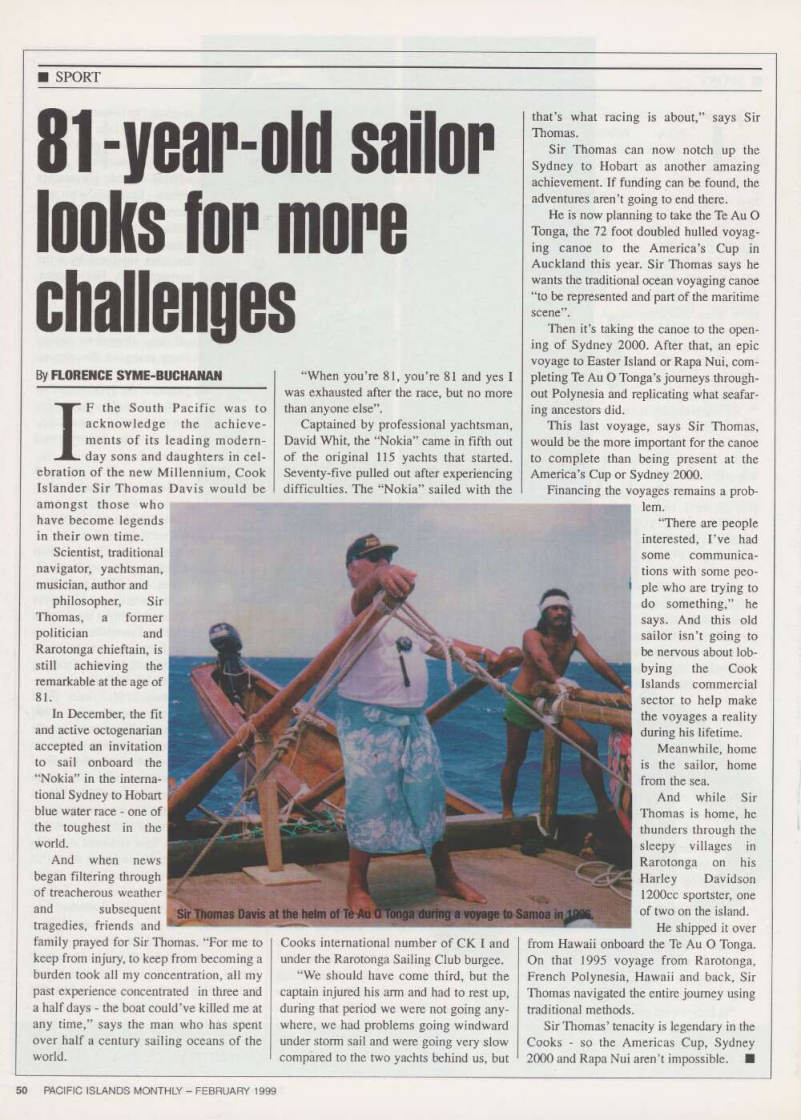
looks for more challenges
By Florence Syme-Buchanan
IF the South Pacific was to acknowledge the achieve ments of its leading modern day sons and daughters in cel ebration of the new Millennium, Cook Islander Sir Thomas Davis would be
amongst those who have become legends in their own time.
Scientist, traditional
navigator, yachtsman,
musician, author and
philosopher, Sir
Thomas, a former politician and Rarotonga chieftain, is still achieving the remarkable at the age of 81.
In December, the fit and active octogenarian accepted an invitation to sail onboard the “Nokia” in the interna tional Sydney to Hobart blue water race - one of the toughest in the world.
And when news
began filtering through
of treacherous weather
and subsequent
tragedies, friends and
family prayed for Sir Thomas. “For me to keep from injury, to keep from becoming a burden took all my concentration, all my past experience concentrated in three and a half days - the boat could’ve killed me at any time,” says the man who has spent over half a century sailing oceans of the world.
“When you’re 81, you’re 81 and yes I was exhausted after the race, but no more than anyone else”.
Captained by professional yachtsman, David Whit, the “Nokia” came in fifth out of the original 115 yachts that started.
Seventy-five pulled out after experiencing difficulties. The “Nokia” sailed with the
Cooks international number of CK I and under the Rarotonga Sailing Club burgee.
“We should have come third, but the captain injured his arm and had to rest up, during that period we were not going any where, we had problems going windward under storm sail and were going very slow compared to the two yachts behind us, but
that’s what racing is about,” says Sir Thomas.
Sir Thomas can now notch up the Sydney to Hobart as another amazing achievement. If funding can be found, the adventures aren’t going to end there.
He is now planning to take the Te Au O Tonga, the 72 foot doubled hulled voyag ing canoe to the America’s Cup in Auckland this year. Sir Thomas says he wants the traditional ocean voyaging canoe “to be represented and part of the maritime scene”.
Then it’s taking the canoe to the open ing of Sydney 2000. After that, an epic voyage to Easter Island or Rapa Nui, com pleting Te Au O Tonga’s journeys through out Polynesia and replicating what seafar ing ancestors did.
This last voyage, says Sir Thomas, would be the more important for the canoe to complete than being present at the America’s Cup or Sydney 2000.
Financing the voyages remains a prob
lem.
“There are people interested. I’ve had some communica tions with some peo ple who are trying to do something,” he says. And this old sailor isn’t going to be nervous about lob bying the Cook Islands commercial sector to help make the voyages a reality during his lifetime.
Meanwhile, home is the sailor, home from the sea.
And while Sir Thomas is home, he thunders through the sleepy villages in Rarotonga on his Harley Davidson 1200 cc sportster, one of two on the island.
He shipped it over
from Hawaii onboard the Te Au O Tonga.
On that 1995 voyage from Rarotonga, French Polynesia, Hawaii and back, Sir Thomas navigated the entire journey using traditional methods.
Sir Thomas’ tenacity is legendary in the Cooks - so the Americas Cup, Sydney 2000 and Rapa Nui aren’t impossible. ■
Sir Thomas Davis at the helm of Te Au 0 Tonga during a voyage to Samoa in 1996
Harbour-Fiji yacht race
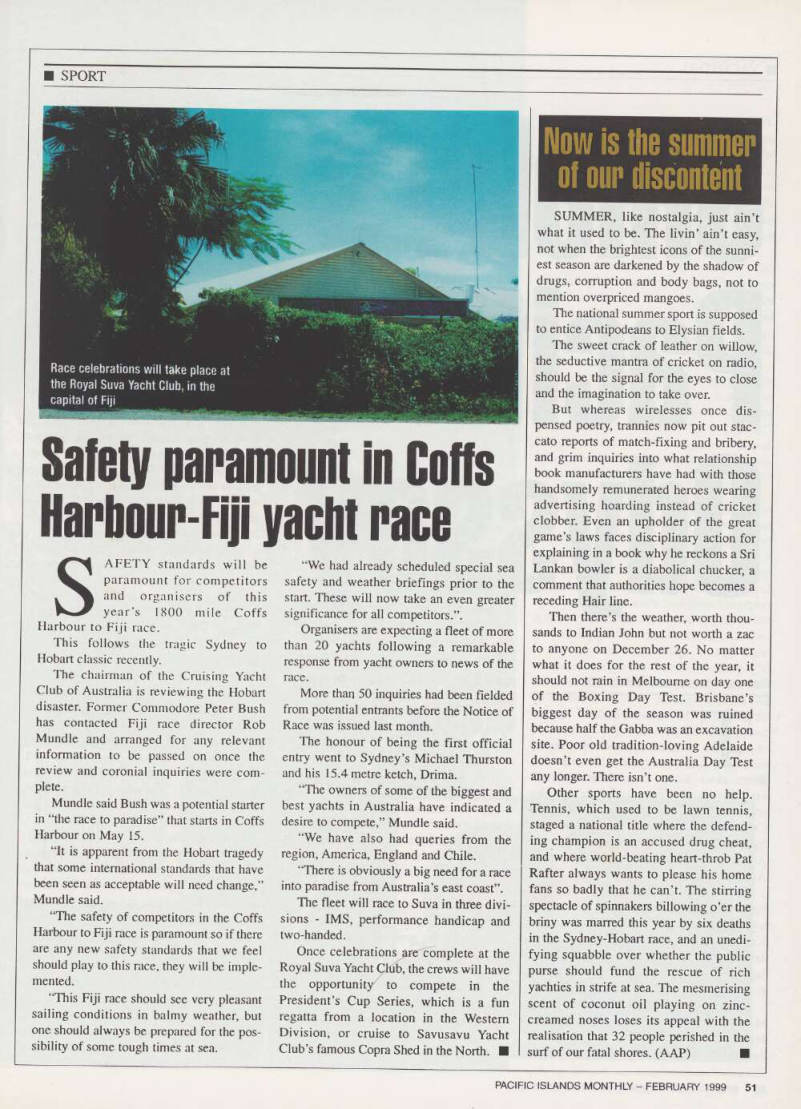
Safety paramount in Goffs Harbour-Fiji yacht race
SAFETY standards will be paramount for competitors and organisers of this year’s 1800 mile Coffs Harbour to Fiji race.
This follows the tragic Sydney to Hobart classic recently.
The chairman of the Cruising Yacht Club of Australia is reviewing the Hobart disaster. Former Commodore Peter Bush has contacted Fiji race director Rob Mundle and arranged for any relevant information to be passed on once the review and coronial inquiries were com plete.
Mundle said Bush was a potential starter in “the race to paradise” that starts in Coffs Harbour on May 15.
“It is apparent from the Hobart tragedy that some international standards that have been seen as acceptable will need change,”
Mundle said.
“The safety of competitors in the Coffs Harbour to Fiji race is paramount so if there are any new safety standards that we feel should play to this race, they will be imple mented.
“This Fiji race should see very pleasant sailing conditions in balmy weather, but one should always be prepared for the pos sibility of some tough times at sea.
“We had already scheduled special sea safety and weather briefings prior to the start. These will now take an even greater significance for all competitors.”.
Organisers are expecting a fleet of more than 20 yachts following a remarkable response from yacht owners to news of the race.
More than 50 inquiries had been fielded from potential entrants before the Notice of Race was issued last month.
The honour of being the first official entry went to Sydney’s Michael Thurston and his 15.4 metre ketch, Drima.
“The owners of some of the biggest and best yachts in Australia have indicated a desire to compete,” Mundle said.
“We have also had queries from the region, America, England and Chile.
“There is obviously a big need for a race into paradise from Australia’s east coast”.
The fleet will race to Suva in three divi sions - IMS, performance handicap and two-handed.
Once complete at the Royal Suva Yacht Club, the crews will have the to compete in the President’s Cup Series, which is a fun regatta from a location in the Western Division, or cruise to Savusavu Yacht Club’s famous Copra Shed in the North. ■
Race celebrations will take place at the Royal Suva Yacht Club, in the capital of Fiji
Now is the summer
of our discontent
SUMMER, like nostalgia, just ain’t what it used to be. The livin’ ain’t easy, not when the brightest icons of the sunni est season are darkened by the shadow of drugs, corruption and body bags, not to mention overpriced mangoes.
The national summer sport is supposed to entice Antipodeans to Elysian fields.
The sweet crack of leather on willow, the seductive mantra of cricket on radio, should be the signal for the eyes to close and the imagination to take over.
But whereas wirelesses once dis pensed poetry, trannies now pit out stac cato reports of match-fixing and bribery, and grim inquiries into what relationship book manufacturers have had with those
handsomely remunerated heroes wearing
advertising hoarding instead of cricket clobber. Even an upholder of the great game’s laws faces disciplinary action for explaining in a book why he reckons a Sri Lankan bowler is a diabolical chucker, a comment that authorities hope becomes a receding Hair line.
Then there’s the weather, worth thou sands to Indian John but not worth a zac to anyone on December 26. No matter what it does for the rest of the year, it should not rain in Melbourne on day one of the Boxing Day Test. Brisbane’s biggest day of the season was ruined because half the Gabba was an excavation site. Poor old tradition-loving Adelaide doesn’t even get the Australia Day Test any longer. There isn’t one.
Other sports have been no help.
Tennis, which used to be lawn tennis, staged a national title where the defend ing champion is an accused drug cheat, and where world-beating heart-throb Pat Rafter always wants to please his home fans so badly that he can’t. The stirring spectacle of spinnakers billowing o’er the briny was marred this year by six deaths in the Sydney-Hobart race, and an unedi fying squabble over whether the public purse should fund the rescue of rich yachties in strife at sea. The mesmerising scent of coconut oil playing on zinc creamed noses loses its appeal with the realisation that 32 people perished in the surf of our fatal shores. (AAP) ■
Smoky's
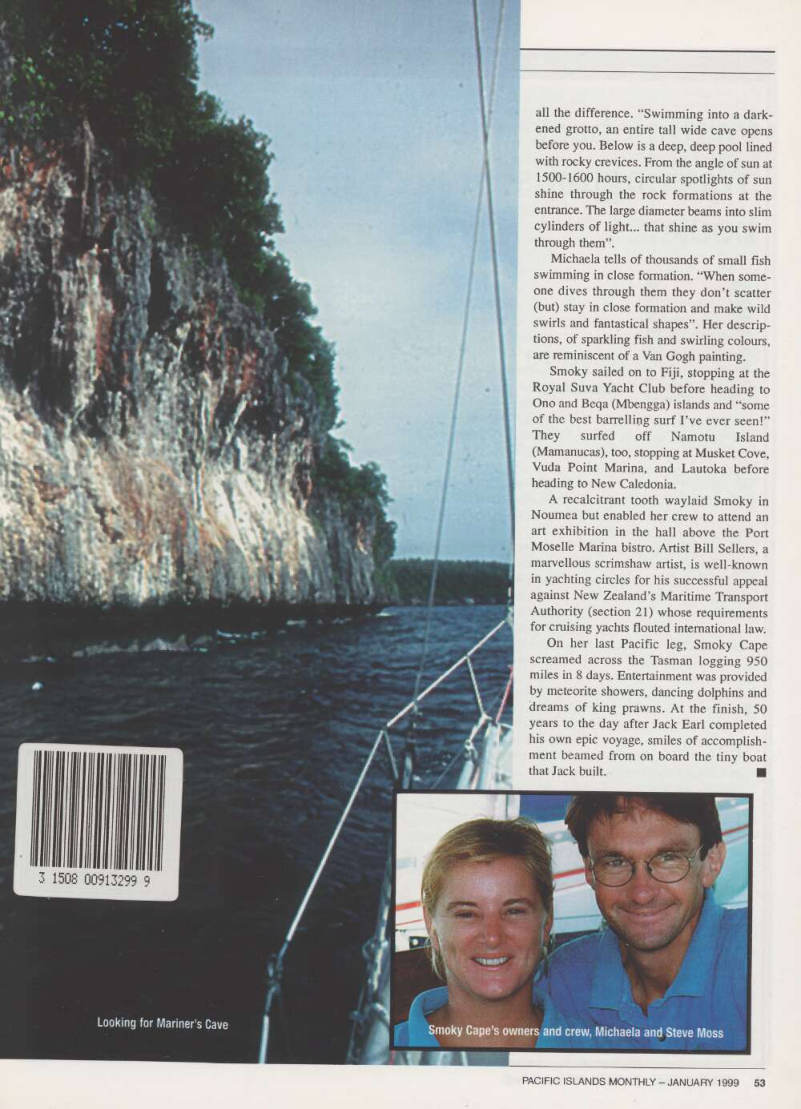
Yachting
Smoky's Pacific Odyssey
Story and pictures by SALLY ANDREWS
THE safe arrival of Smoky Cape, on December 6, marked the end of a 4,000 mile odyssey for the 7.3 metre yawl. Sailed from Tahiti by own ers Steve and Michaela Moss, Smoky was met by a flotilla of yachts from the Cruising Yacht Club of Australia, the Sydney Heritage Fleet, the Sydney Amateur Sailing Club, the Wooden Boat Association and other supporters.
Why all the fuss? Smoky Cape was built by one of Australia’s great sailors, Jack Earl, who circumnavigated in 1947-48 aboard Kathleen Gillett, a 13.4 metre gaff rigged ketch named for his lovely wife. Ten years later he built another traditional wooden boat, Maris, and in 1973 Smoky Cape.
Jack dreamed of taking his wife to Tahiti, his favourite cruising ground, but Kathleen fell ill and the dream was never realised.
Jack Earl’s love of the Pacific is reflected in
the images of islands, palms and people that fill his magnificent “Log of the Kathleen Gillett”. His logbook, now housed in Sydney’s Maritime Museum, is a lavishly illustrated account of his ocean voyage around the world.
Jack Earl loved the sea and ships. He instigated the now-famous Sydney-Hobart ocean race and was a great maritime artist and adventurer. “Sailing small boats was a liberation. It gave me independence and taught me self-reliance and gave me more self-confidence than anything else I ever did... People talk about Mother Earth. Well, the sea mothered me. It still does. Mind you, it’s very nearly killed me on occasions”.
In the rolling seas between Moorea and Huahine, Smoky’s boom snapped aft of the preventor when the main tried to gibe.
Michaela and Steve diverted to Fareve, entering the pass at noon. From Smoky’s log: “Just as I put the anchor down... a whale sur faced in the channel, showing its beautiful tail in a gentle dive”.
Next day, Michaela and Steve motored round to the village at the far end of Maroe Bay where an old man invited them to tie up
by inserting a piece of linseed-treated
Oregon pine and fastened it with four large thru-bolts.
Meanwhile, ten local children and teenagers came aboard, then twenty, finally thirty! A mere twenty-six feet from bow to stem. Smoky Cape’s waterline disappeared under the load of her human cargo!
“The children were friendly, polite, quiet, except for lots and lots of laughter. They asked many questions about us, the boat, where we slept, how we lived and what hap pens when we’re sailing. They were clever questions amidst a mesh of three languages and three phrase books - English, French and Tahitian”.
Steve and Michaela encountered the worst of their voyage on the leg between Tahiti and the Cooks when they were struck with gale force winds and waves 20-30 feet high. A sea-anchor off the bow helped them ride out the blow, but hand steering for five days was tiring. One thing they learned - Smoky was well-made and strong.
From Rarotonga, Smoky sailed to Vava’u.
Beach barbecues in the company of two big catamarans Susquehanna (US) and Endless Summer (AUS), and with yachts Masina (AUS) and Ishi (US), were interspersed with Tongan feasts and breakfasts at Joe’s Lighthouse Cafe on Vaka’eitu. Along Neiafu’s busy shoreline, colourful carafes of dinghies rafted up to docks while cruising couples enjoyed dinners and drinks at Ana’s, the Sunset Cafe, the Bounty Bar and the Paradise Hotel. One thing’s for sure, you don’t starve in Tonga!
Michaela’s nickname “the Fish” is well deserved. Her account of Mariners Cave (Vava’u) reads: “The cave is large and dark and forty feet deep. There are nooks and crannies lining the walls where fish hide. At the bottom of the cave there is a second entry site and only a few among us had breath to use it. Watching friends exit the cave was spectacular - their hair flowed as they swam into the light. After ten entries and exits escorting people, I was tired but delighted.
“Each entry into the cave is scary and requires swimming through an underwater rock tunnel. Inside, the cave mists up as ocean swells hit the rocks at the entrance and pressure forces the air within the cave to con dense.
Another favourite Tongan swimming hole is Swallows Cave where the lighting makes
all the difference. “Swimming into a dark ened grotto, an entire tall wide cave opens before you. Below is a deep, deep pool lined with rocky crevices. From the angle of sun at 1500-1600 hours, circular spotlights of sun shine through the rock formations at the entrance. The large diameter beams into slim cylinders of light... that shine as you swim through them”.
Michaela tells of thousands of small fish swimming in close formation. “When some one dives through them they don’t scatter (but) stay in close formation and make wild swirls and fantastical shapes”. Her descrip tions, of sparkling fish and swirling colours, are reminiscent of a Van Gogh painting.
Smoky sailed on to Fiji, stopping at the Royal Suva Yacht Club before heading to Ono and Beqa (Mbengga) islands and “some of the best barrelling surf I’ve ever seen!”
They surfed off Namotu Island (Mamanucas), too, stopping at Musket Cove, Vuda Point Marina, and Lautoka before heading to New Caledonia.
A recalcitrant tooth waylaid Smoky in Noumea but enabled her crew to attend an art exhibition in the hall above the Port Moselle Marina bistro. Artist Bill Sellers, a marvellous scrimshaw artist, is well-known in yachting circles for his successful appeal against New Zealand’s Maritime Transport Authority (section 21) whose requirements for cruising yachts flouted international law.
On her last Pacific leg. Smoky Cape screamed across the Tasman logging 950 miles in 8 days. Entertainment was provided by meteorite showers, dancing dolphins and dreams of king prawns. At the finish, 50 years to the day after Jack Earl completed his own epic voyage, smiles of accomplish ment beamed from on board the tiny boat that Jack built. ■
Looking for Mariner’s Cave
Smoky Cape’s owners and crew, Michaela and Steve Moss
Washington’s good
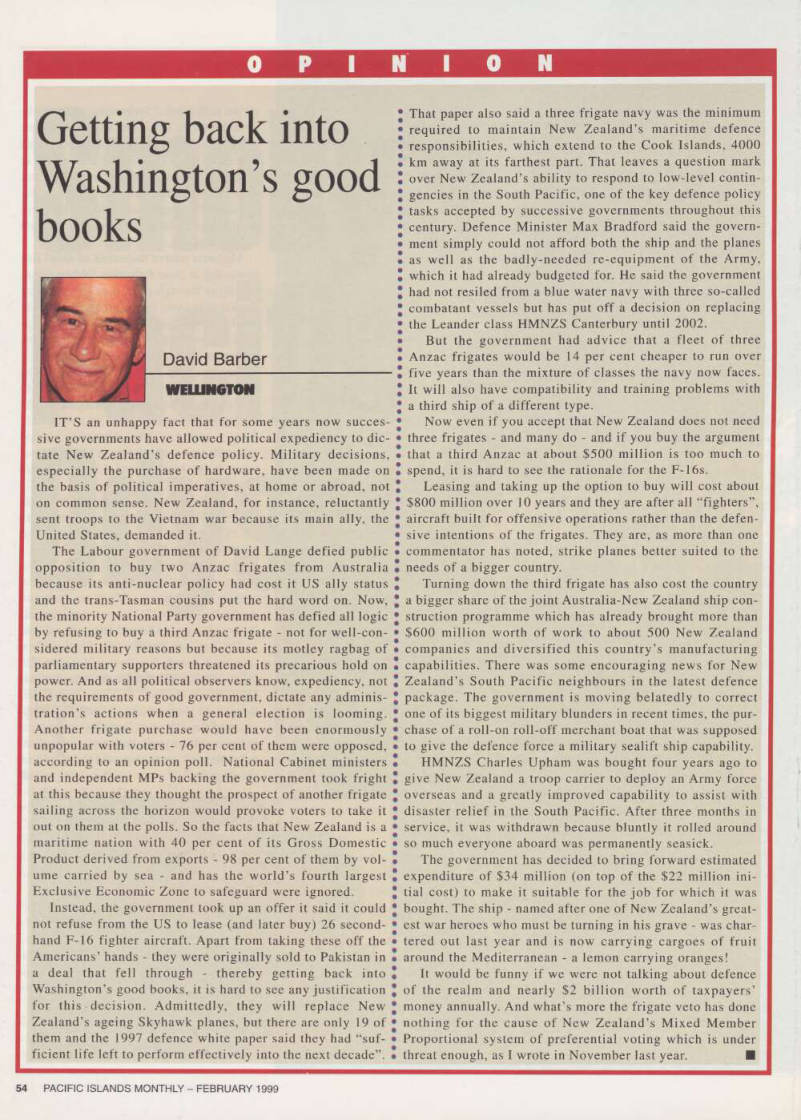
Opinion
Getting back into Washington’s good books
IT’S an unhappy fact that for some years now succes sive governments have allowed political expediency to dic tate New Zealand’s defence policy. Military decisions, especially the purchase of hardware, have been made on the basis of political imperatives, at home or abroad, not on common sense. New Zealand, for instance, reluctantly sent troops to the Vietnam war because its main ally, the United States, demanded it.
The Labour government of David Lange defied public opposition to buy two Anzac frigates from Australia because its anti-nuclear policy had cost it US ally status and the trans-Tasman cousins put the hard word on. Now, the minority National Party government has defied all logic by refusing to buy a third Anzac frigate - not for well-con sidered military reasons but because its motley ragbag of parliamentary supporters threatened its precarious hold on power. And as all political observers know, expediency, not the requirements of good government, dictate any adminis tration’s actions when a general election is looming.
Another frigate purchase would have been enormously unpopular with voters - 76 per cent of them were opposed, according to an opinion poll. National Cabinet ministers and independent MPs backing the government took fright at this because they thought the prospect of another frigate sailing across the horizon would provoke voters to take it out on them at the polls. So the facts that New Zealand is a maritime nation with 40 per cent of its Gross Domestic Product derived from exports - 98 per cent of them by vol ume carried by sea - and has the world’s fourth largest Exclusive Economic Zone to safeguard were ignored.
Instead, the government took up an offer it said it could not refuse from the US to lease (and later buy) 26 second hand F-16 fighter aircraft. Apart from taking these off the Americans’ hands - they were originally sold to Pakistan in a deal that fell through - thereby getting back into Washington’s good books, it is hard to see any justification for this decision. Admittedly, they will replace New Zealand’s ageing Skyhawk planes, but there are only 19 of them and the 1997 defence white paper said they had “suf ficient life left to perform effectively into the next decade”.
That paper also said a three frigate navy was the minimum required to maintain New Zealand’s maritime defence responsibilities, which extend to the Cook Islands, 4000 km away at its farthest part. That leaves a question mark over New Zealand’s ability to respond to low-level contin gencies in the South Pacific, one of the key defence policy tasks accepted by successive governments throughout this century. Defence Minister Max Bradford said the govern ment simply could not afford both the ship and the planes as well as the badly-needed re-equipment of the Army, which it had already budgeted for. He said the government had not resiled from a blue water navy with three so-called combatant vessels but has put off a decision on replacing the Leander class HMNZS Canterbury until 2002.
But the government had advice that a fleet of three Anzac frigates would be 14 per cent cheaper to run over five years than the mixture of classes the navy now faces.
It will also have compatibility and training problems with a third ship of a different type.
Now even if you accept that New Zealand does not need three frigates - and many do - and if you buy the argument that a third Anzac at about $5OO million is too much to spend, it is hard to see the rationale for the F-16s.
Leasing and taking up the option to buy will cost about $BOO million over 10 years and they are after all “fighters”, aircraft built for offensive operations rather than the defen sive intentions of the frigates. They are, as more than one commentator has noted, strike planes better suited to the needs of a bigger country.
Turning down the third frigate has also cost the country a bigger share of the joint Australia-New Zealand ship con struction programme which has already brought more than $6OO million worth of work to about 500 New Zealand companies and diversified this country’s manufacturing capabilities. There was some encouraging news for New Zealand’s South Pacific neighbours in the latest defence package. The government is moving belatedly to correct one of its biggest military blunders in recent times, the pur chase of a roll-on roll-off merchant boat that was supposed to give the defence force a military sealift ship capability.
HMNZS Charles Upham was bought four years ago to give New Zealand a troop carrier to deploy an Army force overseas and a greatly improved capability to assist with disaster relief in the South Pacific. After three months in service, it was withdrawn because bluntly it rolled around so much everyone aboard was permanently seasick.
The government has decided to bring forward estimated expenditure of $34 million (on top of the $22 million ini tial cost) to make it suitable for the job for which it was bought. The ship - named after one of New Zealand’s great est war heroes who must be turning in his grave - was char tered out last year and is now carrying cargoes of fruit around the Mediterranean - a lemon carrying oranges!
It would be funny if we were not talking about defence of the realm and nearly $2 billion worth of taxpayers’ money annually. And what’s more the frigate veto has done nothing for the cause of New Zealand’s Mixed Member Proportional system of preferential voting which is under threat enough, as I wrote in November last year. ■
David Barber
Wellington
needs tracking
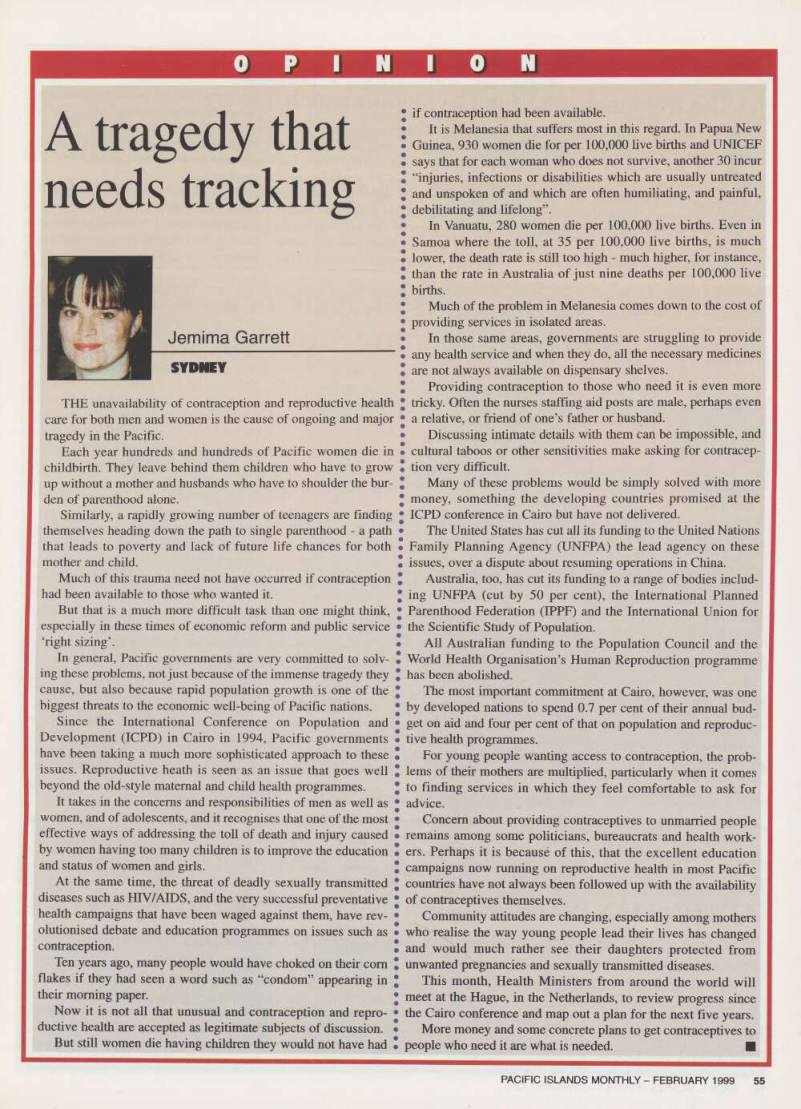
A tragedy that needs tracking
THE unavailability of contraception and reproductive health care for both men and women is the cause of ongoing and major tragedy in the Pacific.
Each year hundreds and hundreds of Pacific women die in childbirth. They leave behind them children who have to grow up without a mother and husbands who have to shoulder the bur den of parenthood alone.
Similarly, a rapidly growing number of teenagers are finding themselves heading down the path to single parenthood - a path that leads to poverty and lack of future life chances for both mother and child.
Much of this trauma need not have occurred if contraception had been available to those who wanted it.
But that is a much more difficult task than one might think, especially in these times of economic reform and public service
‘right sizing’.
In general. Pacific governments are very committed to solv ing these problems, not just because of the immense tragedy they cause, but also because rapid population growth is one of the biggest threats to the economic well-being of Pacific nations.
Since the International Conference on Population and Development (ICPD) in Cairo in 1994, Pacific governments have been taking a much more sophisticated approach to these issues. Reproductive heath is seen as an issue that goes well beyond the old-style maternal and child health programmes.
It takes in the concerns and responsibilities of men as well as women, and of adolescents, and it recognises that one of the most effective ways of addressing the toll of death and injury caused by women having too many children is to improve the education and status of women and girls.
At the same time, the threat of deadly sexually transmitted diseases such as HIV7AIDS, and the very successful preventative health campaigns that have been waged against them, have rev olutionised debate and education programmes on issues such as
contraception.
Ten years ago, many people would have choked on their com flakes if they had seen a word such as “condom” appearing in their morning paper.
Now it is not all that unusual and contraception and repro ductive health are accepted as legitimate subjects of discussion.
But still women die having children they would not have had
* if contraception had been available. » It is Melanesia that suffers most in this regard. In Papua New * Guinea, 930 women die for per 100,000 live births and UNICEF » says that for each woman who does not survive, another 30 incur * “injuries, infections or disabilities which are usually untreated J and unspoken of and which are often humiliating, and painful, * debilitating and lifelong”. » In Vanuatu, 280 women die per 100,000 live births. Even in * Samoa where the toll, at 35 per 100,000 live births, is much I lower, the death rate is still too high - much higher, for instance, \ than the rate in Australia of just nine deaths per 100,000 live
I births.
* Much of the problem in Melanesia comes down to the cost of * providing services in isolated areas. * In those same areas, governments are struggling to provide » any health service and when they do, all the necessary medicines I are not always available on dispensary shelves. Providing contraception to those who need it is even more \ tricky. Often the nurses staffing aid posts are male, perhaps even * a relative, or friend of one’s father or husband. * Discussing intimate details with them can be impossible, and * cultural taboos or other sensitivities make asking for contracep ’ tion very difficult.
I Many of these problems would be simply solved with more money, something the developing countries promised at the 1 ICPD conference in Cairo but have not delivered. » 1 The United States has cut all its funding to the United Nations Family Planning Agency (UNFPA) the lead agency on these issues, over a dispute about resuming operations in China.
Australia, too, has cut its funding to a range of bodies includ ing UNFPA (cut by 50 per cent), the International Planned Parenthood Federation (IPPF) and the International Union for the Scientific Study of Population.
All Australian funding to the Population Council and the World Health Organisation’s Human Reproduction programme has been abolished.
The most important commitment at Cairo, however, was one by developed nations to spend 0.7 per cent of their annual bud get on aid and four per cent of that on population and reproduc tive health programmes.
For young people wanting access to contraception, the prob lems of their mothers are multiplied, particularly when it comes to finding services in which they feel comfortable to ask for advice.
Concern about providing contraceptives to unmarried people remains among some politicians, bureaucrats and health work ers. Perhaps it is because of this, that the excellent education campaigns now running on reproductive health in most Pacific countries have not always been followed up with the availability of contraceptives themselves.
Community attitudes are changing, especially among mothers who realise the way young people lead their lives has changed and would much rather see their daughters protected from unwanted pregnancies and sexually transmitted diseases.
This month, Health Ministers from around the world will meet at the Hague, in the Netherlands, to review progress since the Cairo conference and map out a plan for the next five years.
More money and some concrete plans to get contraceptives to people who need it are what is needed. ■
Jemima Garrett
Sydney
CASIO to launch satellite navigation watch

Innovation
JAPANESE watch-maker Casio has come up with a new gadget for the outdoors enthusiast who has everything but a sense of direction - a wristwatch that pin points your position by satellite.
Casio early January said it had developed the wristwatch, equipped with a Global Positioning System (GPS) function, as a use
ful navigation aid for people who pursue a variety of outdoor activities, including mountaineering, skiing, boating, fishing, and cycling. The built-in GPS works by using information from 27 satellites around the globe to pinpoint the wearer’s current position. “If you wear this wristwatch, you will never get lost when you go moun taineering,” a Casio spokesman said. “The
new gadget has a function to guide you if you set the destination beforehand”. The pro totype GPS wrist watch also has 60 per cent less in weight and cubic volume than con ventional hand-held navigation systems, the company said.
Casio expects the watch to retail at around Y 55,000 ($A797) when it goes on sale world-wide in June and is aiming at sales of 30,000 units in the first year, the spokesman said. (Reuters) ■
implant to correct eyesight
FDA advisors back new implant to correct eyesight
TINY, transparent rings implanted onto the cornea may help correct mild to moderate
nearsightedness without glass-
es or contact lenses, offering
an alternative to popular but irreversible laser surgery and costing about the same. The US government is considering whether to let Kera Vision Inc.’s Intacs sell as an alternative to highly popular eye surgery. The key difference is while eye surgery is permanent, the implants’ effects seem reversible in most cases because they don’t destroy eye tissue.
“There’s no eraser at the end of a laser,” Dr Marian Macsai, an ophthalmologist at West Virginia university said. “This is removable - take it out if there’s a problem”. Macsai and fellow advisors to the Food and Drug Administration (FDA) voted unanimously to allow Intacs - transparent crescents about as thick as contact lenses that form a ring around the edge of the cornea - to be sold. But they stressed that patients must be warned that removing the implants usually - but not always - helps if patients suffer side effects or are dissatisfied with their resulting vision. “It’s largely reversible,” Dr James McCulley, panel chairman of the University of Texas South western Medical Centre said.
“But it’s not an absolute certainty”. The FDA is not bound by its advisors’ recommendations but typically follows them. If approved, Intacs would cost about the same as laser surgery for nearsighted ness, $U52,200 ($A3,476.66) per eye. Made of the same materials as lenses implanted during cataract surgery, Intacs would come in three thicknesses, for different degrees of mild to moderate near sightedness. Nearsightedness - poor distance vision - occurs when a person’s cornea is too steeply curved. Flattening the cornea, the membrane that covers the front of the eye, helps correct nearsight edness. In radial keratotomy, surgeons slice the cornea with a knife.
or laser surgery, which shaves the cornea to flatten it. But those surgeries can be risky,
sometimes causing problems
with night vision, glare, see
ing halos or blurry vision. Patients occasionally cannot see as well after surgery as before. Most patients who choose these operations do so because they are severely nearsighted. With Intacs, the implant’s slight weight flattens the cornea. KeraVision will be mar keted to some 20 million mildly to moderately near-sighted Americans - whose vision ranges from 20/40, where it’s OK to drive but a movie is blurry without glasses, to 20/200, where patients can barely see the big “E” at the top of eye charts.
In a year-long study of 449 pairs of eyes, 97 per cent had 20/40 vision or better without glasses or contact lenses after the implant.
About 74 per cent had 20/20 or better vision without glasses, and 53 per cent could see 20/16 - the sharper vision that chief investiga tor Dr David Schanzlin of the University of California, San Diego, said is required of combat pilots. Most patients achieved good vision a day after surgery. Some seven per cent to 17 per cent of patients suffered side effects similar to laser surgery, including glare, halos and problems with night vision.
About five per cent of patients had their implants removed. That included 14 patients dissatisfied with their vision correction and 16 who had visual side effects; some were in both categories. Removing the implant corrected more than 80 per cent of those side effects, the company said. Patients get anaesthetic eye drops to numb the eye, but remain awake during the procedure. The doctor clamps the eye lid open, cuts a tiny pocket into the cornea and uses a special device to slip the crescents onto the cornea. A single stitch closes the wound.
It takes about 15 minutes. About 15 per cent of patients report some pain and as with any surgery, infection is also a risk. (AP) ■
Advertisements & other items, p. 56 (1 item)
C7 Wss
AUSTRALIAN INTERNATIONAL SHIPPING SERVICES PTY LTD
Providing Container Consolidated Services, Full Container Loads r, Airfrieght Forwarding and Purchase Order Tracking Services to:- American Samoa, Cook Islands, Fiji, Guam, Kiribati, New Zealand, Niue, Norfolk Island, New Caledonia, Nauru, Papua New Guinea, Solomon Islands, Tahiti, The Federated States of Micronesia, Tonga, Vanuatu, and Western Samoa.
Offices in Melbourne and Sydney
TEL:- 61-3-93351477 FAX:-61-3-93380115 EMAIL:-A-I-S-S.COM
Reef Shipping Fill Limited
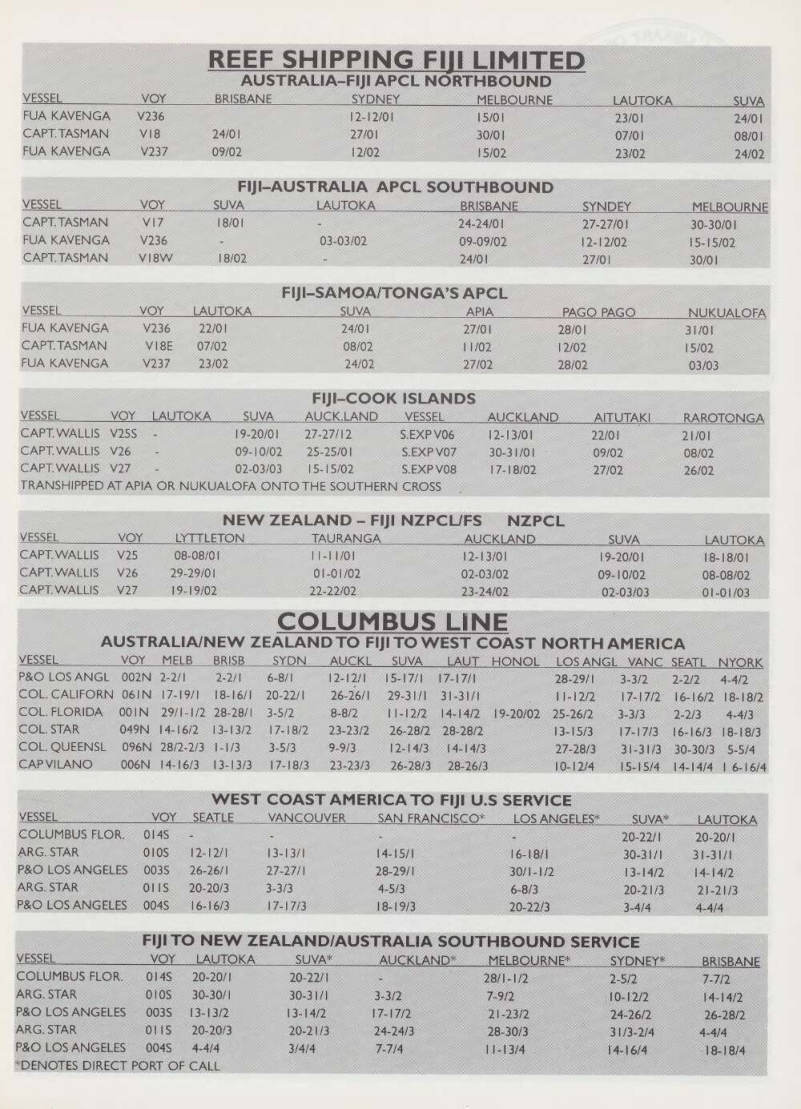
Vessel
Voy
Australia-Fijl Apcl Northbound
Brisbane Sydney Mf1 Rournf
Lautoka
Suva
Fua Kavenga
V236 12-12/01 15/01 23/01 24/01
Capt.Tasman
Vis
24/01 27/01 30/01 07/01 08/01
Fua Kavenga
V237 09/02 12/02 15/02 23/02 24/02
Vessel
Voy
Fiji-Australia Apcl Southbound
Suva Lautoka Brisbane
Syndey
Melbourne
Capt. Tasman
V! 7 18/01 - 24-24/01 27-27/01 30-30/01
Fua Kavenga
V236 - 03-03/02 09-09/02 12-12/02 15-15/02
Capt. Tasman
Vi8W
18/02 - 24/01 27/01 30/01
Vessel
Voy
Lautoka
Fiji-Samoa/Tonga’S Apcl
Suva Apia
Pago Pago
Nukualofa
Fua Kavenga
V236 22/01 24/01 27/01 28/01 31/01
Cart. Tasman
Vise
07/02 08/02 1 1/02 12/02 15/02
Fua Kavenga
V237 23/02 24/02 27/02 28/02 03/03
Vessel
Voy Lautoka
Suva
Fiji-Cook Islands
Auck.Land Vessel
Auckland
Aitutaki
Rarotonga
Cart. Wallis
V25S - 19-20/01 27-27/12
S.Expv06
12-13/01 22/01 21/01
Cart. Wallis
V26 09-10/02 25-25/01
S.Expv07
30-31/01 09/02 08/02
Cart. Wallis
V27 02-03/03 15-15/02
S.Expv08
17-18/02 27/02 26/02 TRANSHIPPED AT APIA OR NUKUALOFA ONTO THE SOUTHERN CROSS
Vessel
Voy
New Zealand - Fiji Nzpcl/Fs Nzpcl
Lyttleton Tauranga Auckland
Suva
Lautoka
Cart. Wallis
V25 08-08/01 Il-l i/01 12-13/01 19-20/01 18-18/01
Cart. Wallis
V26 29-29/01 01-01/02 02-03/02 09-10/02 08-08/02
Cart. Wallis
V27 19-19/02 22-22/02 23-24/02 02-03/03 01-01/03
Columbus Line
AUSTRALIA/NEW ZEALAND TO FIJI TO WEST COAST NORTH AMERICA VESSEL VOY MELB BRISB SYDN AUCKL SUVA LAUT HONOl IOSANGI VAN C 9FATI
Nyork
P&O Losangl
002N 2-2/1 2-2/1 6-8/1 12-12/1 15-17/1 17-17/1 28-29/1 3-3/2 2-2/2 4-4/2
Col. Californ
06 IN 17-19/1 18-16/1 20-22/1 26-26/1 29-31/1 31-31/1 1 1-12/2 17-17/2 16-16/2 18-18/2
Col Florida
001 N 29/1-1/2 28-28/1 3-5/2 8-8/2 11-12/2 14-14/2 19-20/02 25-26/2 3-3/3 2-2/3 4-4/3
Col Star
049N 14-16/2 13-13/2 17-18/2 23-23/2 26-28/2 28-28/2 13-15/3 17-17/3 16-16/3 18-18/3
Col Queensl
096N 28/2-2/3 1-1/3 3-5/3 9-9/3 12-14/3 14-14/3 27-28/3 31-31/3 30-30/3 5-5/4
Cap Vilano
006N 14-16/3 13-13/3 17-18/3 23-23/3 26-28/3 28-26/3 10-12/4 15-15/4 14-14/4 1 6-16/4
Vessel
Voy
WEST COAST AMERICA TO FIJI U.S SERVICE
Seatle Vancouver San Francisco* Losangf1Fs*
Suva*
Lautoka
Columbus Flor.
Ohs
- - - - 20-22/1 20-20/1
Arc. Star
Oios
12-12/1 13-13/1 14-15/1 16-18/1 30-31/1 31-31/1
P&O Los Angeles
003S 26-26/1 27-27/1 28-29/1 30/1-1/2 13-14/2 14-14/2
Arg. Star
01 IS 20-20/3 3-3/3 4-5/3 6-8/3 20-21/3 21-21/3
P&O Los Angeles
004S 16-16/3 17-17/3 18-19/3 20-22/3 3-4/4 4-4/4
Vessel
Fiji To New Zealand/Australia Southbound Service
VOY LAUTOKA SUVA* AUCKLAND* MF1 BOURNE* SYDNEY*
Brisbane
Columbus Flor.
0! 4S 20-20/1 20-22/1 - 28/1-1/2 2-5/2 7-7/2
Arc. Star
Oios
30-30/1 30-31/1 3-3/2 7-9/2 10-12/2 14-14/2
P&O Los Angeles
003 S 13-13/2 13-14/2 17-17/2 21-23/2 24-26/2 26-28/2
Arg. Star
01 IS 20-20/3 20-21/3 24-24/3 28-30/3 31/3-2/4 4-4/4
P&O Los Angeles
Direct
004S 4-4/4
Port Of Call
3/4/4 7-7/4 1 1-13/4 14-16/4 18-18/4
Advertisements & other items, p. 58 (1 item)
vesselV^3\#
NEPTUNE SHIPPING LINE
red
VOY
DIRECT SERRVICE-NORTHBOUND
. R&ANE SYDNEY MELBOURNE LAUTOKA
SUVA
FUA
12-12/1 15-15/1 23-23/1 24-24/1
CART TASMAN
24-24/! 27-27/1 30-30/1 7-7/2 8-8/2
FUA KAVENGA
237 9-9/2 12-12/2 15-15/2 23-23/2 24-24/2
CART. TASMAN
19 25-25/2 28-28/2 3-3/3 1 l-l 1/3 12-12/3
VESSEL
VOY
Fljl-AUSTRALIA DIRECT SERVICE-SOUTHBOUND
LAUTOKA SUVA BRISBANE SYDNEY
MELBOURNE
CAPT.TASMAN
17 - 16/1/99 24-24/1 27-27/1 30-30/1
FUA KAVENGA
236 3-3/2 - 9-9/2 12-12/2 15-15/2
CAPT.TASMAN
18 - 16/1/99 24-24/2 27-27/2 30-30/2
FUA KAVENGA
237 6/3
OMIT
12-12/3 15-15/3 18-18/3
NEW CALEDONIA-FIJI-TUVALU-WALLIS-FUTUN A-VANUATU SERVICE
VESSEL VOY NOUMEA
SUVA
FUNAFUTI WALLIS FUTUNA
SANTO PORT VILA
MV“MOANA III” 16 19-22/1
25-25/1 28-29/1 31-3/2 4-4/22 8/2 9/2
Pacific Forum Line
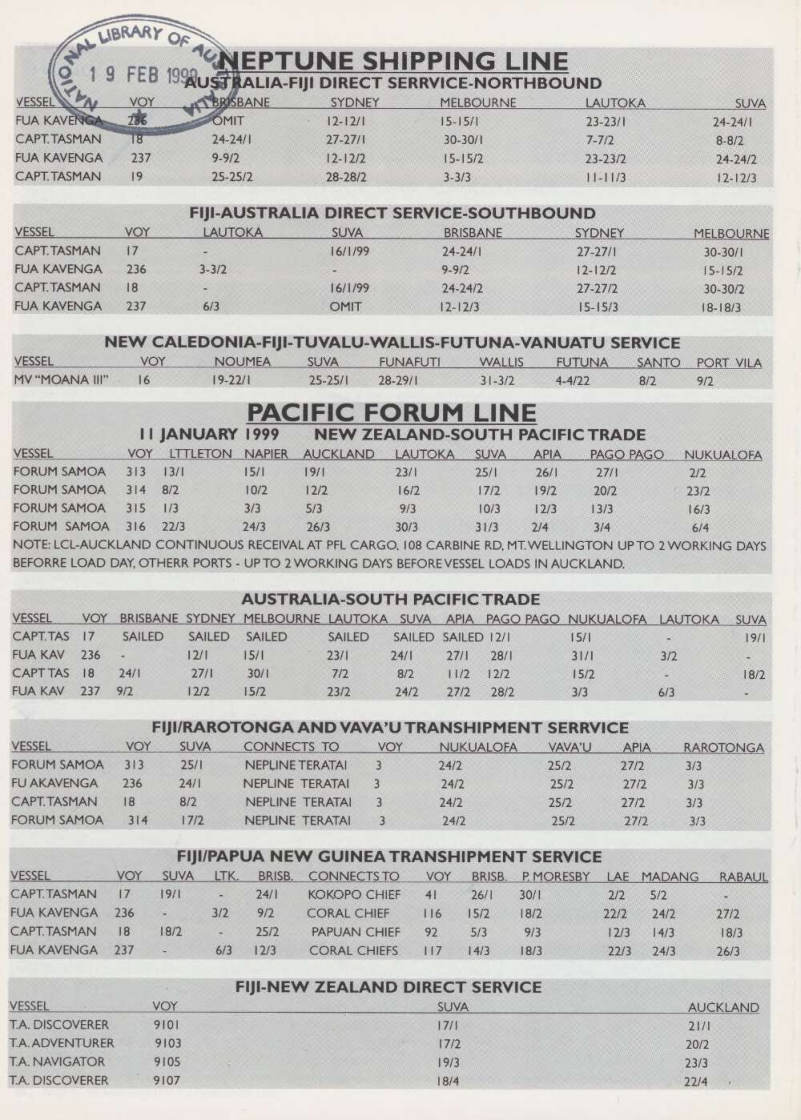
Vessel
11 January 1999
Voy Lttleton Napier
New Zealand-South Pacific Trade
Auckland Lautoka Suva Apia Pago Pago
Nukualofa
Forum Samoa
313 13/1 15/1 19/1 23/1 25/1 26/1 27/1 2/2
Forum Samoa
314 8/2 10/2 12/2 16/2 17/2 19/2 20/2 23/2
Forum Samoa
315 1/3 3/3 5/3 9/3 10/3 12/3 13/3 16/3
Forum Samoa
316 22/3 24/3 26/3 30/3 31/3 2/4 3/4 6/4 NOTE: LCL-AUCKLAND CONTINUOUS RECEIVAL AT PFL CARGO, 108 CARBINE RD, MT.WELLINGTON UPTO 2 WORKING DAYS
Beforre Load Day, Otherr Ports -
UPTO 2 WORKING DAYS BEFORE VESSEL LOADS IN AUCKLAND.
Vessel
Voy
Brisbane
Sydney
Australia-South Pacific Trade
Melbourne Lautoka Suva Apia Pago Pago
Nukualofa
Lautoka
Suva
Capt.Tas
17
Sailed
Sailed
Sailed
Sailed
Sailed
Sailed 12/1
15/1 - 19/1
Fua Kav
236 - 12/1 15/1 23/1 24/1 27/1 28/1 31/1 3/2 -
Capttas
18 24/1 27/1 30/1 7/2 8/2 1 1/2 12/2 15/2 - 18/2
Fua Kav
237 9/2 12/2 15/2 23/2 24/2 27/2 28/2 3/3 6/3 -
Vessel
Fljl/Rarotonga And Vava’U Transhipment Serrvice
VOY SUVA CONNECTS TO VOY NUKUALOFA VAVA’U APIA
Rarotonga
Forum Samoa
313 25/1
Nepuneteratai
3 24/2 25/2 27/2 3/3
Fu Akavenga
236 24/1
Nepline Teratai
3 24/2 25/2 27/2 3/3
Capt.Tasman
18 8/2
Nepline Teratai
3 24/2 25/2 27/2 3/3
Forum Samoa
314 17/2
Nepline Teratai
3 24/2 25/2 27/2 3/3
Fiji/Papua New Guinea Transhipment Service
Vessel
Voy
Suva Ltk.
Bfusb.
Connects To
Voy
Brisb.
P. Moresby
Lae
Madang
Rabaul
Cart Tasman
17 19/1 24/1
Kokopo Chief
41 26/1 30/1 2/2 5/2 -
Fua Kavenga
236 3/2 9/2
Coral Chief
I 16 15/2 18/2 22/2 24/2 27/2
Cart Tasman
18 18/2 25/2
Papuan Chief
92 5/3 9/3 12/3 14/3 18/3
Fua Kavenga
237 6/3 12/3
Coral Chiefs
1 17 14/3 18/3 22/3 24/3 26/3
Vessel
Voy
Fiji-New Zealand Direct Service
Suva
Auckland
T.A. Discoverer
9101 17/1 21/1
T A. Adventurer
9103 17/2 20/2
T.A. Navigator
9105 19/3 23/3
T.A. Discoverer
9107 18/4 22/4 ,
Advertisements & other items, pp. 59-60 (1 item)
m ml ■ Wm.
Photos : IVlarit - Pantz - Trompas HH| -, 7 3 v«* V"* i-wm o)C3 mm WM -\ * ■ jmmmtmmf *"*■
geom
New Caledonia is a developped, sophisticated island business base that offers outstanding opportunities for investors : stunning sites for new hotel developments, suitable climate for counterseason fruits, vegetables and tropical flowers, superb locations for fish and prawn aquaculture, and more. Authorities in New Caledonia are very supportive to business.
ADECAL, the Economic Development Agency of New Caledonia, is the one-stop shop where investors can get specific advice on doing business in New Caledonia.
As your free-of-charge partner, we shall assist you in identifying opportunities and putting together your project successfully.
Should you like to receive further information, please do not hesitate to contact either Vann PITOLLET or Benoit RENGADE.
E-mail: [email protected] a f r* a i 1 V Ly JL- V-* l V I—r New Caledonia Economic Development Bureau 15, rue Guynemer • PO Box 2384 - 98846 Noumea Cedex - New Caledonia ■ Phone; (687} 249 077 - Fax: (687) 249 087 - E-mail: [email protected]
N
RIS
PR<^ to ai t s for no one. £ s ! !•< , e last mi nute dradeadline is bought forward and every thing is required tly. Sound familiar? Deadlines have always been part of the print industry and at Quality Print we know that you sometimes need your printing “yesterday”. We rarely miss a realistic deadline and if you have a really urgent job we’ll keep the presses running all night if necessary.
It is this kind of service that makes us one of the best printers in the Pacific. And we now have three full colour printing presses which also makes us the largest in the region. three full colour printing presses which also makes us the largest in the region.
We offer an extensive range of printing services from multi colour printing, special packaging and binding to UV gloss finishing, laminating and die-cutting. Call us or visit our “Pride in Print’ printshop for a free quote.
! Ssi
M »
COMMERCIAL PRINTING & PACKAGING
9) 313 311 FAX (679) 301 133 EMAIL [email protected] WEBSITE WWW.INTERNETFIIi.COM/QUALITY