Fijian soldiers on Bougainville
pp. 48-49 · Read in the full issue
Development
Fijian soldiers on Bougainville erect memorial to VC winner
FIJIAN soldiers
serving in Bougainville in mid-March con struct a memorial for one of their fallen comrades near the place where he was killed in action during World War Two.
They came from across the south west Pacific island to Mawaraka, on the west coast, to pay homage to Corporal Sefanaia Sukanaivalu who was posthumously awarded FijiOs first and only Victoria Cross for an act of selfless bravery on June 23, 1944.
The ten members from the Fijian Military Forces are in Bougainville with the 300strong Australian-led Peace Monitoring Group (PMG) to
monitor compliance by the former war ring parties with the April 30th Ceasefire agreement and to promote confidence in the on-going peace process.
Corporal SukanaivaluOs platoon was part of the 3rd BattalionOs advance on Mawaraka when they were ambushed by the Japanese. He crawled forward under heavy machine gun fire to rescue two men from one of the forward sections and returned for another man only to become seriously wounded in the groin
and thigh.
When more soldiers were killed try ing to rescue him from his exposed posi tion Corporal Sukanaivalu called on them to leave him. They replied that they would never leave him to be taken alive by the Japanese so he raised himself in front of the enemy machine gun and was riddled with bullets.
The Fijian Battalion was unable to take the position which was later cap-
tured by an Australian Brigade in October who recovered Corporal SukanaivaluOs body and buried him with full military honours in Rabaul.
The senior Fijian officer in the PMG Lieutenant Colonel Sunia Vosaki said it was difficult to get all the Fijians serving on Bougainville together but it was sig nificant that they were able to attend the service.
OThis is the first time since we arrived here in December that we have been together and it is important to put up the monument and remember the courage of Corporal Sukanaivulu,6 he said.
All the supplies and tools were trans ported from Loloho to the site first by helicopter, then by banana boat and final ly on foot. This included bags of cement, metal reinforcement, paint and the wood en form-work.
The Fijians had to hack the area clear
of jungle and then dig the foundations before laying the concrete and complet ing the finishing touches.
Olt was a relatively easy task because we had all hands on deck and were assisted by some local people,© Warrant Officer Ovisawaqa Qiodamu said, play ing down his role as the works supervi sor.
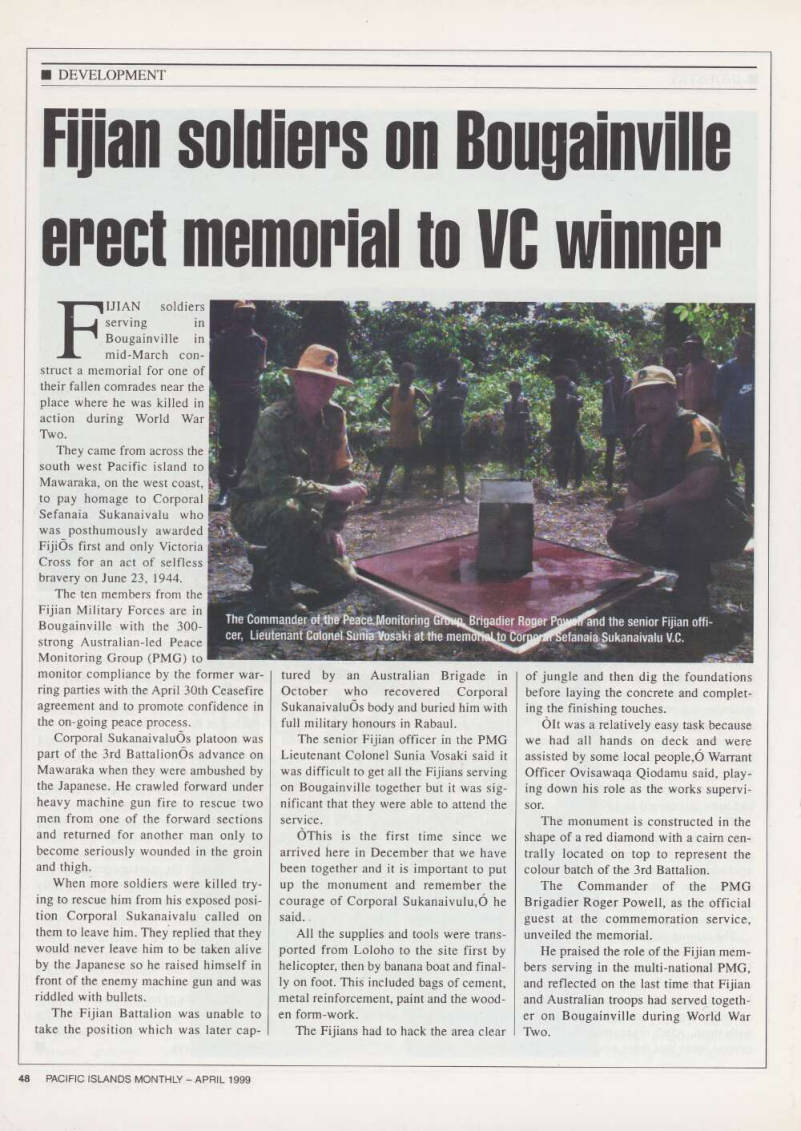
The monument is constructed in the shape of a red diamond with a cairn cen trally located on top to represent the colour batch of the 3rd Battalion.
The Commander of the PMG Brigadier Roger Powell, as the official guest at the commemoration service, unveiled the memorial.
He praised the role of the Fijian mem bers serving in the multi-national PMG, and reflected on the last time that Fijian and Australian troops had served togeth er on Bougainville during World War Two.
The Commander of the Peace, Monitoring Roger the senior Fijian offi cer, Lieutenant Colonel Sunia Vosaki at the memorial to CorSukanaivalu V.C.
01 think that this (commemoration service) has a huge impact on the cohe sion of the Peace Monitoring Group and these historical ties are of great impor tance,© Brigadier Powell said.
The service concluded with a reading of Corporal SukanaivaluOs citation and was followed by a traditional Fijian cer emony known as a Sevu Sevu.
There are 300 military and civilian personnel serving in the Australian-led Peace Monitoring Group (PMG). It is an unarmed, neutral, multinational force (from Australia, NZ, Vanuatu, Fiji) in Bougainville to monitor and report compliance by the former war ring parties with the April 30 (1998) cease-fire agreement.
Two hundred and fifty members of the PMG are Australians, and of them, 19 are civilian monitors from the Department of Defence, DFAT, Australian Federal Police and AusAID.
The PMG headquarters is located in the provincial capital, Arawa, and the Logistics Support Base operates out of the for mer Bougainville Copper Limited bulk ore load
ing facility at Loloho
wharf. They support the five monitoring team sites which are located in remote parts of the island.
These monitoring teams (MTs) are the key to the PMGOs success because they promote and instil con fidence in the on-going peace process by their presence and interaction with the people of Bougainville through reg ular patrols into villages.
Members of the MTs also facilitate and observe peace and reconciliation meetings among the par ties as well as provide information to the local people about the progress of the peace process.
Four Army Iroquois heli copters and three landing craft (one Navy heavy landing craft and two Army medium landing craft) are based at Loloho.
They are used to insert
patrols and resupply the monitoring team sites.
Air and sea transport is vital particu larly at this time of year when the wet season rains have made many roads impassable to vehicle traffic. As an example a seven-minute flight in a heli copter from Buin to Tonu takes five hours by road. ■
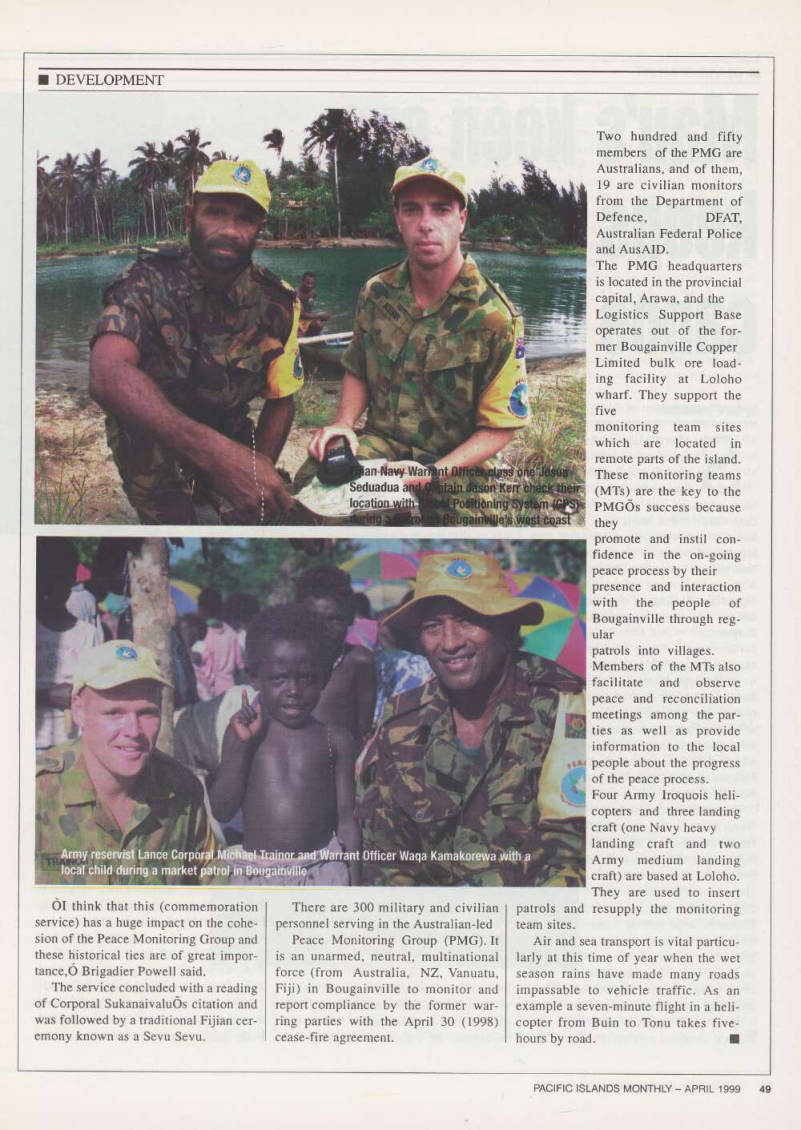
Fijian Navy Warrant Officer class one Josua Seduadua and Captain Jason kerr Check their location with Global Positioning System ( GPS ) during [?] Bougainville's West coat
Army reservist Lance Corporal Michael Trainor and Warrant Officer Waqa Kamakorewa with a local child during a market patrol in Bougainville