heals up in Australia
pp. 46-47 · Read in the full issue
Aboriginal land issue heals up in Australia
By Andrew Kilvert
TWO Australian Aboriginal women have gone to prison for trespassing on Aboriginal land despite the fact the were there at the invitation of the traditional owner and another Aboriginal woman from the Mirrar peo
ple. Yvonne Margarula, is appealing a fine for tres passing on her own tradi tional land following a decision by Magistrate Lowndes in September last year.
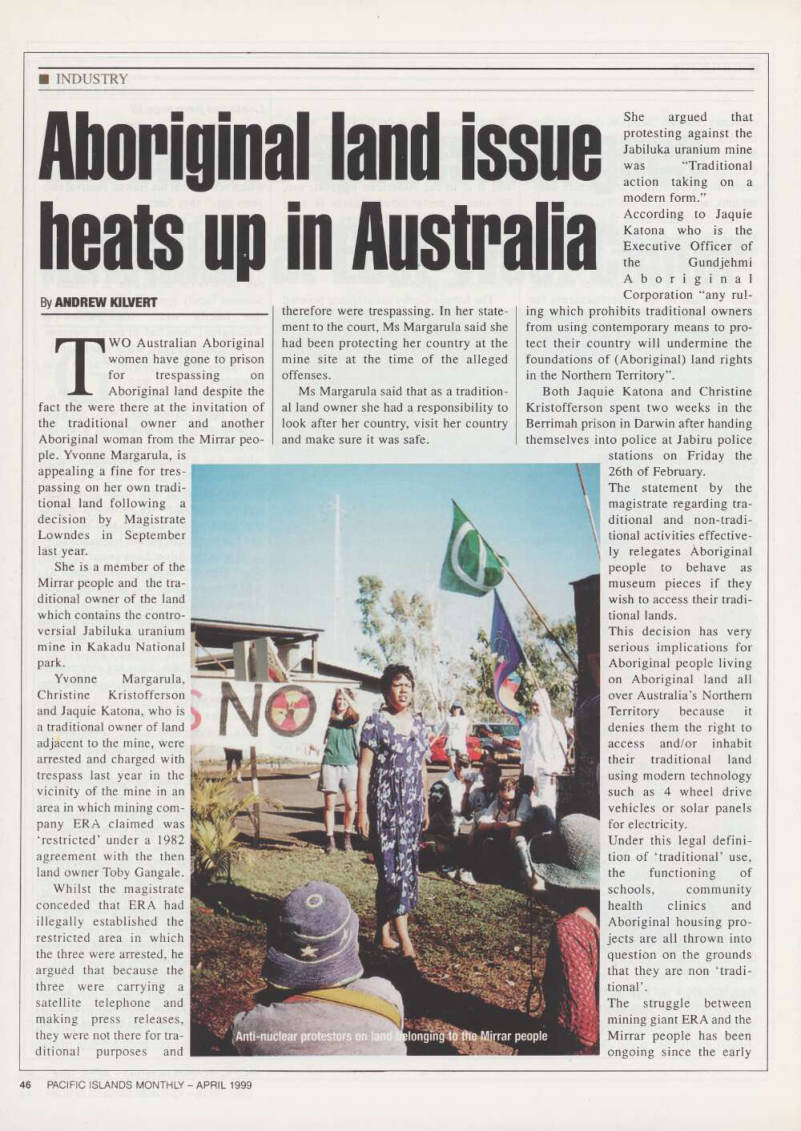
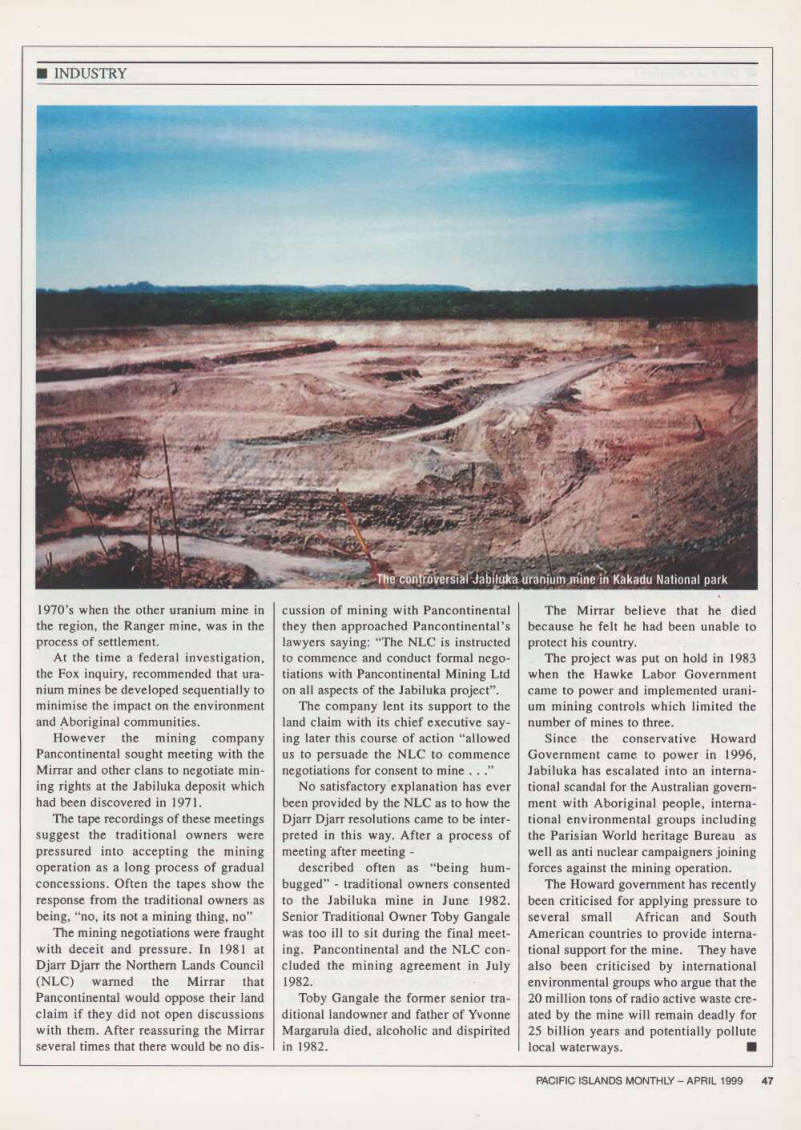
She is a member of the Mirrar people and the tra ditional owner of the land which contains the contro versial Jabiluka uranium mine in Kakadu National park.
Yvonne Margarula, Christine Kristofferson and Jaquie Katona, who is a traditional owner of land adjacent to the mine, were arrested and charged with trespass last year in the vicinity of the mine in an area in which mining com pany ERA claimed was ‘restricted’ under a 1982 agreement with the then land owner Toby Gangale.
Whilst the magistrate conceded that ERA had illegally established the restricted area in which the three were arrested, he argued that because the three were carrying a satellite telephone and making press releases, they were not there for tra ditional purposes and
therefore were trespassing. In her state ment to the court, Ms Margarula said she had been protecting her country at the mine site at the time of the alleged offenses.
Ms Margarula said that as a tradition al land owner she had a responsibility to look after her country, visit her country and make sure it was safe.
She argued that
protesting against the
Jabiluka uranium mine was “Traditional action taking on a modern form.”
According to Jaquie
Katona who is the Executive Officer of
the Gundjehmi
Aboriginal Corporation “any rul
ing which prohibits traditional owners from using contemporary means to pro tect their country will undermine the foundations of (Aboriginal) land rights in the Northern Territory”.
Both Jaquie Katona and Christine Kristofferson spent two weeks in the Berrimah prison in Darwin after handing themselves into police at Jabiru police
stations on Friday the 26th of February.
The statement by the magistrate regarding tra ditional and non-tradi tional activities effective ly relegates Aboriginal people to behave as museum pieces if they wish to access their tradi tional lands.
This decision has very serious implications for Aboriginal people living on Aboriginal land all over Australia’s Northern Territory because it denies them the right to access and/or inhabit their traditional land using modern technology such as 4 wheel drive vehicles or solar panels for electricity.
Under this legal defini tion of ‘traditional’ use, the functioning of schools, community health clinics and
Aboriginal housing pro
jects are all thrown into question on the grounds that they are non ‘tradi tional’.
The struggle between mining giant ERA and the Mirrar people has been ongoing since the early
Anti-nuclear protestors on land belonging to the Mirrar people
1970’s when the other uranium mine in the region, the Ranger mine, was in the process of settlement.
At the time a federal investigation, the Fox inquiry, recommended that ura nium mines be developed sequentially to minimise the impact on the environment and Aboriginal communities.
However the mining company Pancontinental sought meeting with the Mirrar and other clans to negotiate min ing rights at the Jabiluka deposit which had been discovered in 1971.
The tape recordings of these meetings suggest the traditional owners were pressured into accepting the mining operation as a long process of gradual concessions. Often the tapes show the response from the traditional owners as being, “no, its not a mining thing, no”
The mining negotiations were fraught with deceit and pressure. In 1981 at Djarr Djarr the Northern Lands Council (NLC) warned the Mirrar that Panqontinental would oppose their land claim if they did not open discussions with them. After reassuring the Mirrar several times that there would be no dis
cussion of mining with Pancontinental they then approached Pancontinental’s lawyers saying: “The NLC is instructed to commence and conduct formal nego tiations with Pancontinental Mining Ltd on all aspects of the Jabiluka project”.
The company lent its support to the land claim with its chief executive say ing later this course of action “allowed us to persuade the NLC to commence negotiations for consent to mine . . .”
No satisfactory explanation has ever been provided by the NLC as to how the Djarr Djarr resolutions came to be inter preted in this way. After a process of
meeting after meeting -
described often as “being hum bugged” - traditional owners consented to the Jabiluka mine in June 1982.
Senior Traditional Owner Toby Gangale was too ill to sit during the final meet ing. Pancontinental and the NLC con cluded the mining agreement in July 1982.
Toby Gangale the former senior tra ditional landowner and father of Yvonne Margarula died, alcoholic and dispirited in 1982.
The Mirrar believe that he died because he felt he had been unable to protect his country.
The project was put on hold in 1983 when the Hawke Labor Government came to power and implemented urani um mining controls which limited the number of mines to three.
Since the conservative Howard Government came to power in 1996, Jabiluka has escalated into an interna tional scandal for the Australian govern ment with Aboriginal people, interna tional environmental groups including the Parisian World heritage Bureau as well as anti nuclear campaigners joining forces against the mining operation.
The Howard government has recently been criticised for applying pressure to several small African and South American countries to provide interna tional support for the mine. They have also been criticised by international environmental groups who argue that the 20 million tons of radio active waste cre ated by the mine will remain deadly for 25 billion years and potentially pollute local waterways. ■
The controversial Jabiluka uranium mine in Kakadu National park