Crustal he line
pp. 52-53 · Read in the full issue
Yachting
Story and pictures by SALLY ANDREWS
THERE was very little motion on the ocean as Fellowship sailed slowly south from Kiritimati toward the Cook Islands. With hatches open, we read books, navigated and worked hard at chasing shadows around the deck. The equatorial sun was hot!
Passing over the imaginary line that divides the earth into northern and southern hemispheres, we toasted Neptune. Our GPS confirmed the instant of our crossing to three decimal points.
The following night several dolphins appeared and apparently unsnagged something caught around our keel - per haps the equator itself. Released from its grip, we picked up speed.
Dolphins gamboled in our bow wave, raced away, then came back again, like phosphorescent torpedoes through the dark sea.
Tasmanian Harold Gatty (1903- 1957, author of an obscure little book called “Nature as Your Guide,” is perhaps the world’s greatest authority on organic
navigation.
He claims there is no such thing as a “sense of direction” - only an aptitude for observation. He expounds on the value of know ing how to read nature - the skies, winds, currents, the colours of the sea, the habits of seabirds - all useful aids to mod ern and ancient Pacific naviga tors.
Among the many bits of interest ing trivia in his book, is the obvious. All heavenly bodies appear upside down in the
Southern Hemisphere to people
who come from the north. The moon is no exception. During our passage, the quarter moon
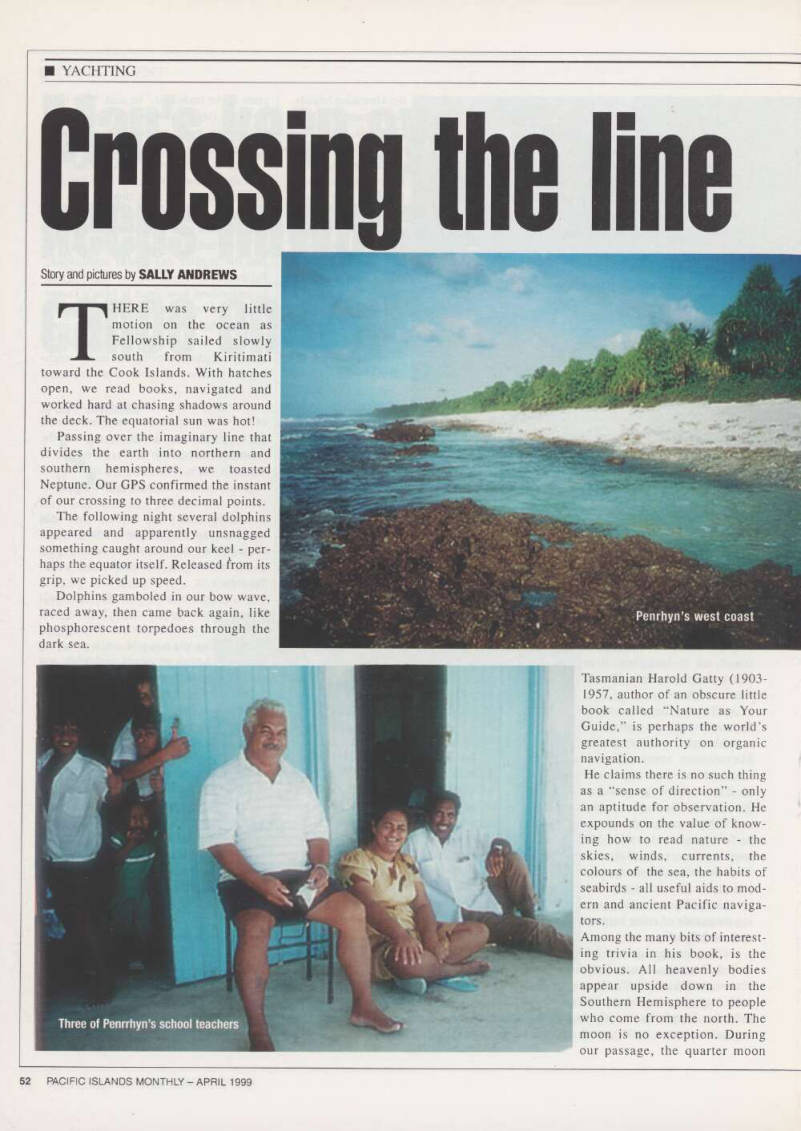
Three of Penrrhyn’s school teachers
Penrhyn’s west coast
smiled at us. Its unusual orientation made it appear as an illuminated “have a-good-day” smile up in he sky. Then, as the moon set, it separated into two gold en torches that seemed to flicker as they simultaneously sank below the horizon and sputter as they drowned. It was a new phenomenon for me, and pretty neat!
Entry into the lagoon at Penrhyn requires good light. Laying off the island in predawn darkness, common sense and navigational acumen dictated a cautious approach. We kept five miles between ourselves and its mis-charted position. After sunrise, we raised our yellow Q-flag and, once we got our bearings, headed into Taruia Passage.
Extensions of reef reduce the entrance fairway to about 125 feet.
Safely inside, we headed towards the wharf. With the sun now behind us, it was easy to navigate by colours - avoid ing the yellow and brown that betrayed coral heads and following the deeper blues of the lagoon. We found a deep anchorage off Omoko and entry formali ties began. Customs and agriculture offi cials arrived and we plowed through tea, cookies and paperwork in the cockpit while the boat was fumigated.
Named for First Fleet ship HMS Lady Penrhyn (1788), the island’s native name is Tongareva. Eight hundred miles
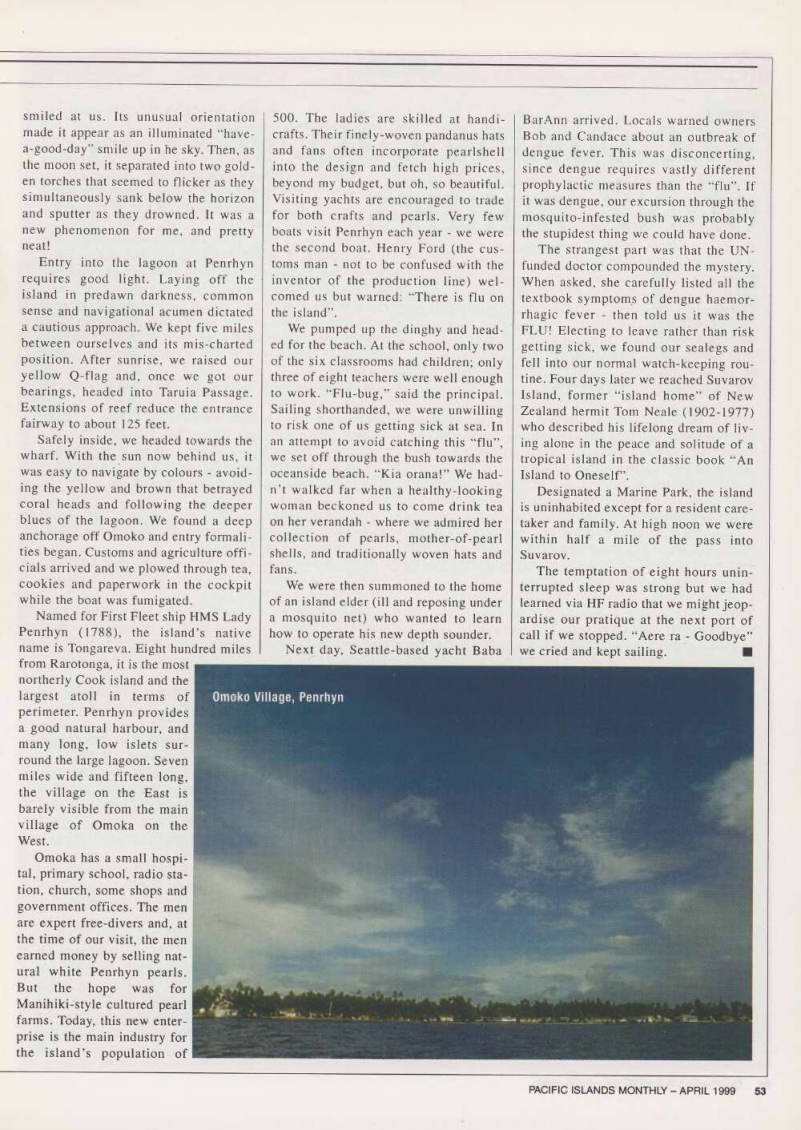
from Rarotonga, it is the most northerly Cook island and the largest atoll in terms of perimeter. Penrhyn provides a good natural harbour, and many long, low islets sur round the large lagoon. Seven miles wide and fifteen long, the village on the East is barely visible from the main village of Omoka on the West.
Omoka has a small hospi tal, primary school, radio sta tion, church, some shops and government offices. The men are expert free-divers and, at the time of our visit, the men earned money by selling nat ural white Penrhyn pearls.
But the hope was for
Manihiki-style cultured pearl
farms. Today, this new enter prise is the main industry for the island’s population of
500. The ladies are skilled at handi crafts. Their finely-woven pandanus hats and fans often incorporate pearlshell into the design and fetch high prices, beyond my budget, but oh, so beautiful.
Visiting yachts are encouraged to trade for both crafts and pearls. Very few boats visit Penrhyn each year - we were the second boat. Henry Ford (the cus toms man - not to be confused with the inventor of the production line) wel comed us but warned: “There is flu on the island”.
We pumped up the dinghy and head ed for the beach. At the school, only two of the six classrooms had children; only three of eight teachers were well enough to work. “Flu-bug,” said the principal.
Sailing shorthanded, we were unwilling to risk one of us getting sick at sea. In an attempt to avoid catching this “flu”, we set off through the bush towards the oceanside beach. “Kia orana!” We had n’t walked far when a healthy-looking woman beckoned us to come drink tea on her verandah - where we admired her collection of pearls, mother-of-pearl shells, and traditionally woven hats and fans.
We were then summoned to the home of an island elder (ill and reposing under a mosquito net) who wanted to learn how to operate his new depth sounder.
Next day, Seattle-based yacht Baba
Bar Ann arrived. Locals warned owners Bob and Candace about an outbreak of dengue fever. This was disconcerting, since dengue requires vastly different prophylactic measures than the “flu”. If it was dengue, our excursion through the mosquito-infested bush was probably the stupidest thing we could have done.
The strangest part was that the UN funded doctor compounded the mystery.
When asked, she carefully listed all the textbook symptoms of dengue haemor rhagic fever - then told us it was the FLU! Electing to leave rather than risk getting sick, we found our sealegs and fell into our normal watch-keeping rou tine. Four days later we reached Suvarov Island, former “island home” of New Zealand hermit Tom Neale (1902-1977) who described his lifelong dream of liv ing alone in the peace and solitude of a tropical island in the classic book “An Island to Oneself”.
Designated a Marine Park, the island is uninhabited except for a resident care taker and family. At high noon we were within half a mile of the pass into Suvarov.
The temptation of eight hours unin terrupted sleep was strong but we had learned via HF radio that we might jeop ardise our pratique at the next port of call if we stopped. “Aere ra - Goodbye” we cried and kept sailing. ■
Omoko Village, Penrhyn