"Wheel of Fortune"
pp. 12-13 · Read in the full issue
Business
"Wheel of Fortune" goes Hawaiian
By Ed Rampell
£ X XHEEL of Fortune”, one %/%/ of the most financially
T T successful television
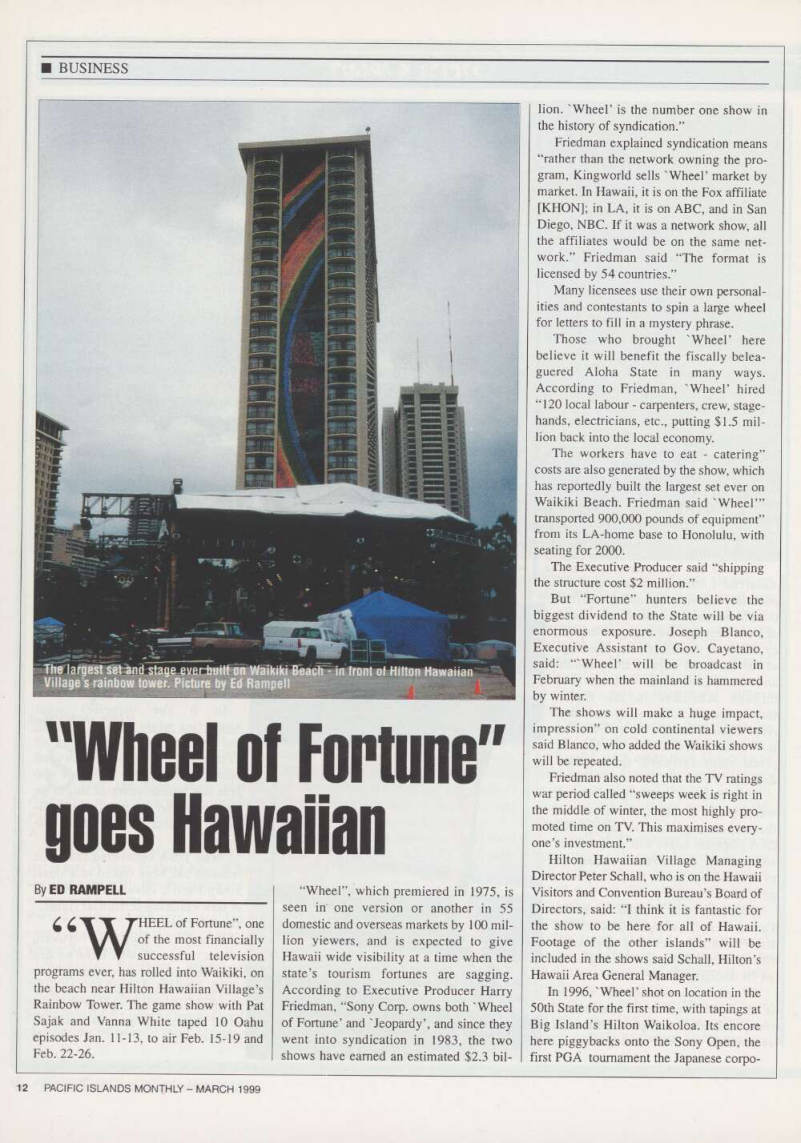
programs ever, has rolled into Waikiki, on the beach near Hilton Hawaiian Village’s Rainbow Tower. The game show with Pat Sajak and Vanna White taped 10 Oahu episodes Jan. 11-13, to air Feb. 15-19 and Feb. 22-26.
“Wheel”, which premiered in 1975, is seen in one version or another in 55 domestic and overseas markets by 100 mil lion viewers, and is expected to give Hawaii wide visibility at a time when the state’s tourism fortunes are sagging.
According to Executive Producer Harry Friedman, “Sony Corp. owns both 'Wheel of Fortune’ and 'Jeopardy’, and since they went into syndication in 1983, the two shows have earned an estimated $2.3 bil
lion. 'Wheel’ is the number one show in the history of syndication.”
Friedman explained syndication means “rather than the network owning the pro gram, Kingworld sells 'Wheel’ market by market. In Hawaii, it is on the Fox affiliate [KHON]; in LA, it is on ABC, and in San Diego, NBC. If it was a network show, all the affiliates would be on the same net work.” Friedman said “The format is licensed by 54 countries.”
Many licensees use their own personal ities and contestants to spin a large wheel for letters to fill in a mystery phrase.
Those who brought 'Wheel’ here believe it will benefit the fiscally belea guered Aloha State in many ways.
According to Friedman, 'Wheel’ hired “120 local labour - carpenters, crew, stage hands, electricians, etc., putting $1.5 mil lion back into the local economy.
The workers have to eat - catering” costs are also generated by the show, which has reportedly built the largest set ever on Waikiki Beach. Friedman said 'Wheel’” transported 900,000 pounds of equipment” from its LA-home base to Honolulu, with seating for 2000.
The Executive Producer said “shipping the structure cost $2 million.”
But “Fortune” hunters believe the biggest dividend to the State will be via enormous exposure. Joseph Blanco, Executive Assistant to Gov. Cayetano, said: “'Wheel’ will be broadcast in February when the mainland is hammered
by winter.
The shows will make a huge impact, impression” on cold continental viewers said Blanco, who added the Waikiki shows will be repeated.
Friedman also noted that the TV ratings war period called “sweeps week is right in the middle of winter, the most highly pro moted time on TV. This maximises every one’s investment.”
Hilton Hawaiian Village Managing
Director Peter Schall, who is on the Hawaii Visitors and Convention Bureau’s Board of Directors, said: “I think it is fantastic for the show to be here for all of Hawaii.
Footage of the other islands” will be included in the shows said Schall, Hilton’s Hawaii Area General Manager.
In 1996, 'Wheel’ shot on location in the 50th State for the first time, with tapings at Big Island’s Hilton Waikoloa. Its encore here piggybacks onto the Sony Open, the first PGA tournament the Japanese corpo
The largest set and stage ever built on Waikiki Beach - in front of Hilton Hawaiian Village 's rainbow tower. Picture by Ed Rampell
rate giant has ever sponsored. The event at the Waialae Country Club “will be seen for the next four years in up to 170 countries on ESPN.
Jupiter Satellite TV and NHk of Japan” are also airing the golf tour ney, according to Ray Stosik, Executive Director of the Sony Open.
What did Hawaii’s public and private sector give to get 'Wheel’ to return to paradise? Friedman said “the State and City & County cut through the red tape of the permit process. Their cooperation was just magnificent.” Authorities allowed 'Wheel’ to invade a portion of the
public beach in front of HHV’s Rainbow Tower and nearby free parking, and to close them to the public.
The visitor industry and government also provided cash-rich 'Wheel’ with financial incentives to shoot here.
Friedman said “Hawaiian Airlines and HHV gave corporate discounts for rooms, food,” and airfare. “The State gave us financial assistance - $300,000 in cash,” he
added.
Friedman denied this is corporate wel fare (government economic support of cor porations - often profitable - with taxpayer money). “No, Hawaii is getting a return on its investment,” said Friedman, who stat ed: “Much bigger incentives have been presented to us to tape in less desirable locations.
It’s not a question of the money offered - Bahamas offered us a free ride, and Puerto Rico... But we love Hawaii,” where the shows shot at the Waikoloa won Sajak and director Dick Carson Emmy awards.
Vanna White called Waikiki “the most beautiful backdrop we ever had for the show.”
Schall said “I don’t think this is corpo rate welfare. How much does Coke spend in brand marketing? You’ve got to brand market. Other destinations would love to have this opportunity.”
Blanco disputed criticism that the mil lions spent by the State on the globally televised Miss Universe Pageant - which could not be shot at a taxpayer-financed convention centre - was a waste of public dollars at a time of economic hardship.
But do Waikiki retailers believe a spin of the 'Wheel’ will bring them fortune?
Warren Cho, Planet Hollywood’s Assistant
Merchandising Manager, said: “Anything
with national TV exposure makes a differ ence for our State.” But in terms of snag ging foot traffic (from the set’s 2000 fans and crew) for his Kalakaua Ave restaurant, Cho said; “it’ll be hard to access... although celebs might stop by” the movie theme eatery.
Hazel Li of Avanti, which sells Aloha Shirts at Kalakaua, said, “I guess any advertising does help.” But a man disburs
ing handbills for Paradise City Music & Collectibles on Kalakaua, who wouldn’t give his name, said most events-generated visitors “are not interested in spending money... they’re just interested in the sun...
When the fleet’s in, they’re good shoppers.”
A saleswoman for Tahiti Perles at the Royal Hawaiian Shopping Centre who would not give her name said specialised, high ticket items like black pearls are not affected by tourists lured here by attractions and publicity. Mark Yamasaki, Assistant Manager of Kyotaru, a Japanese eatery on Waikiki’s main strip, said:
“Events, like parades on Kalakaua, help us.” But as for 'Wheel’, Yamasaki said, “It’ll be good for the economy of the State.
I don’t know if it’ll specifically help my restaurant.” A man named “Mark” at the Pearl Factory in the International Market Place agreed with that idea. But he added: “It’s a quantity game.
The more customers that are generated, the more chance for us.” ■
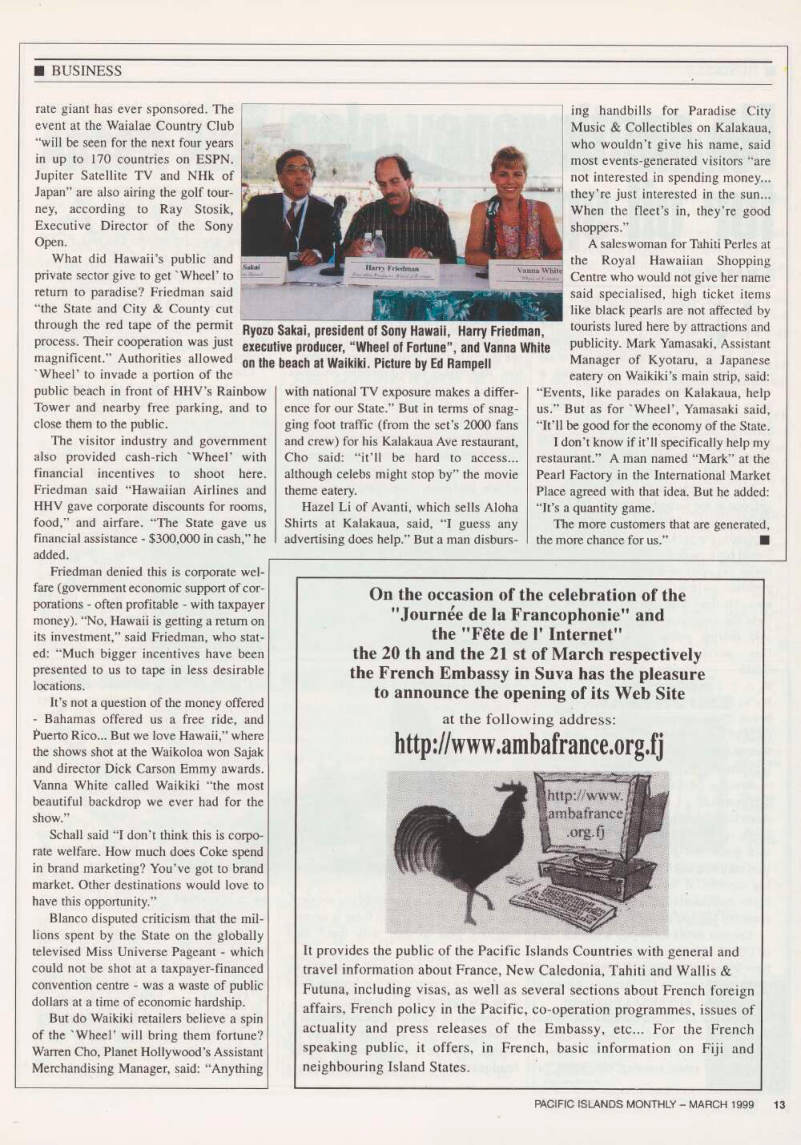
Ryozo Sakai, president of Sony Hawaii, Harry Friedman, executive producer, “Wheel of Fortune”, and Vanna White on the beach at Waikiki. Picture by Ed Rampell