implications
pp. 10-11 · Read in the full issue
Special Report
Antarctic meltdown could have Pacific implications
By Michael Field
STANDING on the Ross Ice Shelf, chips of ice blasting into the face, it is almost ridiculous to imagine that the tropical Pacific might have any kind of role in Antarctica.
Yet as environment and foreign min isters met at New Zealand’s Scott Base the linkages with the Pacific were so strong that it seems inept that the South Pacific Forum, at the very least, has no even observer role in the Antarctic Treaty System (ATS).
Suddenly Northern Hemisphere nations, their own fishing grounds exhausted, are sending their big fishing boats into the Southern Ocean on a new plundering mission - their target is a
lucrative species called toothfish.
The very same nations, Norway and Spain in particular, are known to be looking too at the South Pacific’s tuna.
Madrid has sounded out the prospect of becoming a Forum dialogue partner as a way of getting access to tuna.
New Zealand’s strong actions over Antarctica - including sending a frigate into the Ross Sea - might drive the Spanish into the Pacific.
At the meeting, known as ”Ministers-on-Ice”, delegates also got a message that should terrify most Pacific states.
Scientists briefing the ministers told them that the West Antarctica Ice Shelf (WAIS) was poised to slip into the sea and when it begins to happen it will happen rapidly. Within most people’s
lifetimes the ocean will rise six metres once WAIS goes; that means good bye to all of Kiribati, Marshall Islands, Tokelau and Tuvalu while very large parts of the Cook Islands, Federated States of Micronesia, Fiji, French Polynesia, Solomon Islands and Tonga will disappear, almost overnight.
Although Antarctica dominates the climate and environment of the Pacific, no Pacific state other than Australia or New Zealand has any say in its future.
It is controlled by the 40 year old Antarctic Treaty that is outside of the United Nations.
A total of 43 nations have signed it but within ATS only 26 nations have full voting rights - they are the original seven nations that claimed the conti nent plus nations with active science programmes on the ice.
The treaty suspends all territorial claims, demilitarises everything below 60 degrees south and declares it open to science.
In the past India and Malaysia have claimed the ATS is a rich country’s device to hold key assets to themselves
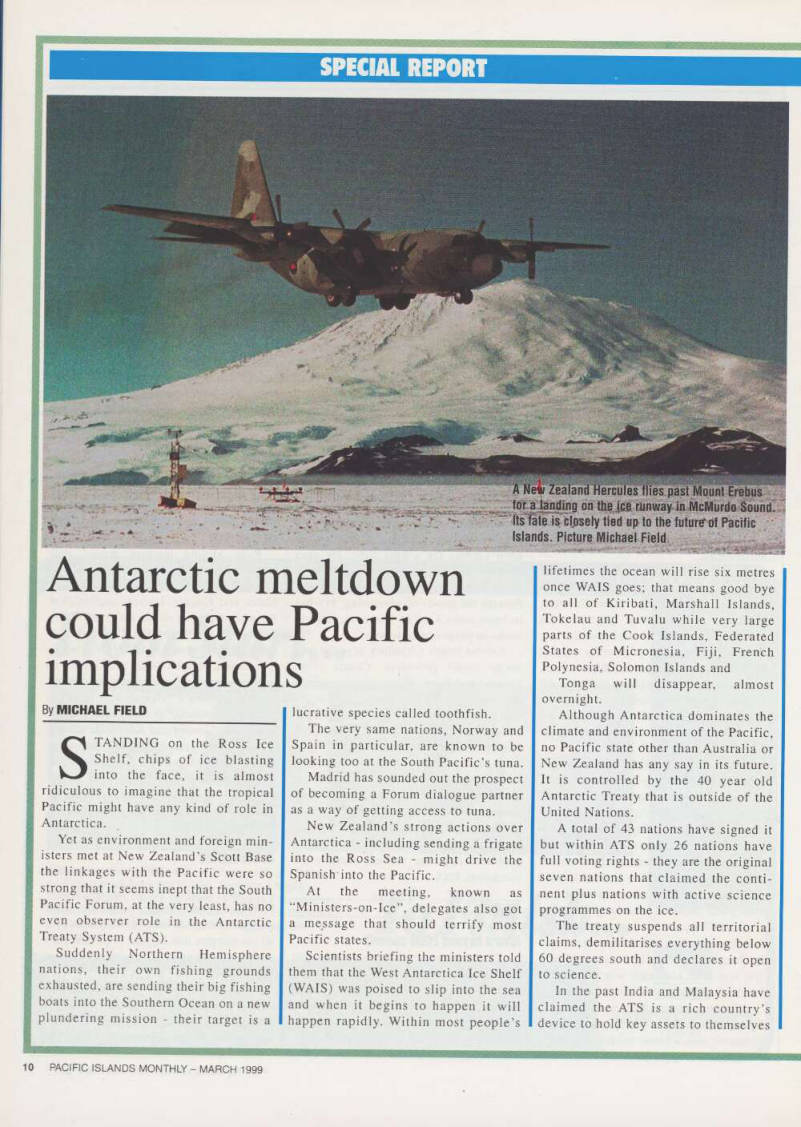
A New Zealand Hercules flies past Mount Erebus for a landing on the Joe runway in McMurdo Sound.
Its fate is clpsely tied up to the future of Pacific islands. Picture Michael Field
while Kuala Lumpur has claimed it is the reverse of the situation where the West castigates the Third World' for logging forests while at the same time preventing global control of Antarctica. Malaysia, thanks to a big effort by New Zealand, has softened its stance and will next year join in a sci ence programme on the ice.
The ATS is, however, on the verge of losing its credibility thanks to the greed of European fishing nations.
Patagonian toothfish (Dissostichus eleginoides), also known as mero, Chilean sea bass and Black Hake, was i first fished in 1993 when the American Sea Food Company, owned by Kjell Inge Rokke of Norway, sent three ves sels to Argentina.
Coincidentally the Pentagon in Washington allowed secret hydro graphic maps of the Southern Ocean into public view. They had been used during the Cold War to identify tem perature differences that were handy for nuclear submarines to hide in.
Today fishing boat companies use the maps to identify areas of toothfish.
Most of the best areas are in the Antarctic’s Southern Ocean and up to
60 boats are now ignoring interna tional conventions and, in the words of New Zealand, are engaged in pira cy. Many of the boats carry the flags of the Marshall Islands and Vanuatu and trans-ship their rich cargoes through Mauritius in the Indian Ocean. South African, French and Australian warships have, over the last three years, slowly forced the pirate ships eastward, toward New Zealand.
This summer Wellington sent a warship into the Ross Sea to prevent them operating there. In theory this fleet of pirate boats will soon be due south of the South Pacific - perhaps even looking for a trans-shipment port in that region.
Suddenly the Forum and the Forum Fisheries Agency will find itself with a particularly aggressive
fleet of large European fishing boats
on its doorstep.
Of course some scientists wonder if much of the Pacific states will remain if the WAIS goes. Ministers assembled to hear that particular
message at McMurdo Station, the large US base on the dusty slopes of Mount Erebus.
Geologist Dr Peter Barrett of
Wellington’s Victoria University told
the ministers he and other polar scien tists held very serious fears that the sheet was on the point of going but they could not be absolutely certain
just yet.
“It will be too late to do anything about it when we know for certain,” he said, “we might be at that point now”.
The western sheet covers the eastern side of the Ross Sea, Marie Byrd Land, the Antarctic Peninsula and the Weddell Sea. Basically it is that part of Antarctica below the South Pacific. Dr Barrett’s message has made a bit impact on the ministers and his figure of a sea-level rise of a six metre rise appears to be widely accepted.
Should the entire Antarctic ice sheet melt the oceans would rise a total of 60 metres. However the bigger Eastern Antarctic Ice Sheet is considered more stable. He is convinced that manmade carbon emissions are causing global warming which appears to be destabil ising the ice sheet. “It is not just the
size of the change, but the likely speed that is important,” Barrett said.
A stable climate for the last 6000 years had been central to civilisation and losing it now might have a major
impact.
“We seem to have become high spe cialised, like the dinosaurs.”
Another scientist. Dr Tim Naish of New Zealand’s Institute of Geological and Nuclear Sciences, told ministers the data had “major implications for all countries”.
Paradoxically it could lead to a mini-ice age, particularly in Europe.
The historic record suggests that when a large quantity of fresh water dumped into the ocean it upsets what is known as the “Oceanic Conveyor Belt” which circulates the ocean currents, including the Gulf Stream in the Atlantic.
“If the ice melts something really strange could happen,” he said.
The conveyor carries a vast river of deep cold water, more or less right up through the middle of the South Pacific. No one has any idea of what will happen to it, although the experts agree we might find out within a centu
ry and it is certain to be a catastro phe. Among the mountain of brief ing papers handed out to ministers was work by Helen Anderson, chief scientific adviser to the New Zealand Ministry of Research, Science and Technology.
In it she theorises what Antarctica might be like in 2010, and for Pacific states thinking Antarctica is an issue way beyond them, she offers the idea that 600 year old human remains might be discovered on the continent, indi cating sealers had visited the region.
“The DNA recovered from the remains has been traced to a small South Pacific island nation, which is now claiming territorial rights,”
she imagines.
Perhaps it will be Tuvalu which, after all, will have no dry land left of its own. Its people might find the thought of a largely ice-free continent, rich in fish, an ideal alternative. Even if it will be a little cold. ■
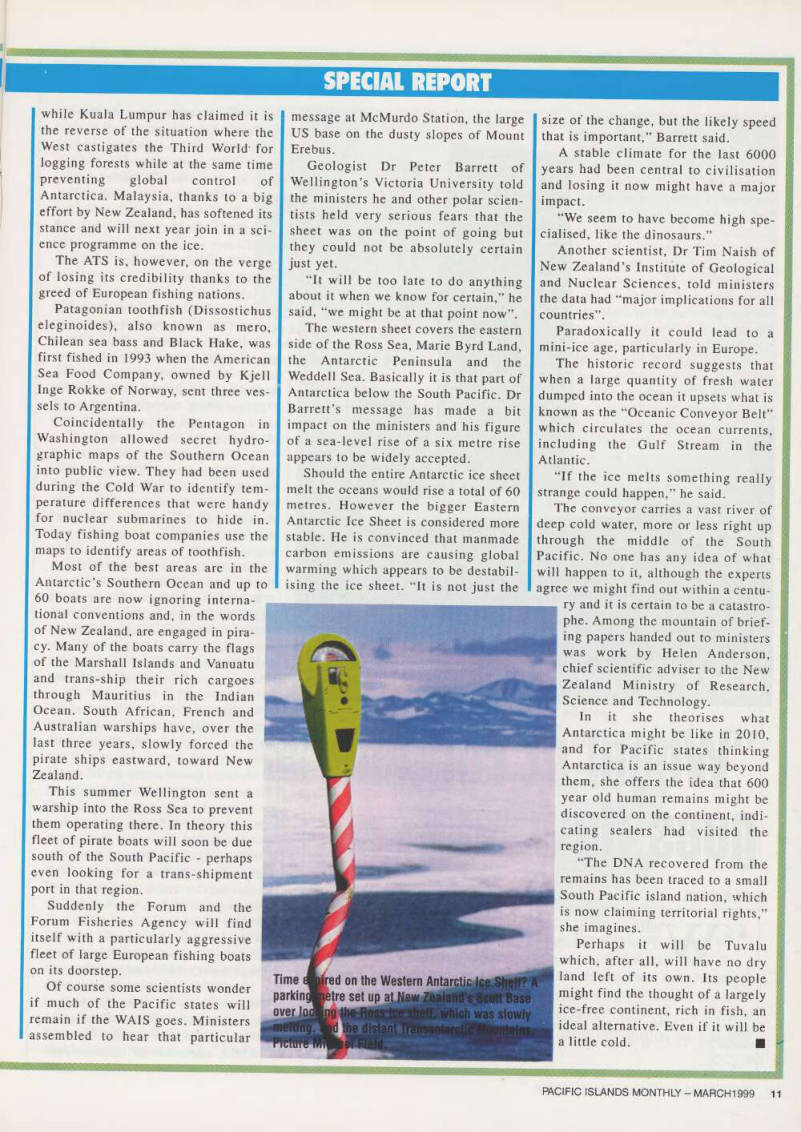
Time e[?]ired on the Western Antarctic Ice Shetf? A parkin[?]etre set up at New Zealand's Sco[?] Base over loo[?]ing the distant [?]śn[?] [?]ains.
Picture M[?] Field.