No contingency plan
p. 14 · Read in the full issue
for oil soils yet
By Alan Ah Mu
NO-ONE doubts the beauty of reefs in the South Pacific - nor how fragile they are if polluted.
Yet for many countries in the region no contingency plans exist to cope with a major disaster such as an oil spill - some thing which several incidents in American Samoa recently indicate could strike at any time. Early in January an estimated 300 gallons of oil dumped in Pago Pago Harbor took a whole day to clean.
Just days later, a Belize longliner ran aground at the harbour entrance with about 30,000 gallons of oil aboard. Had the tanks
ruptured, the tanker would have caused a major oil spill in a popular swimming area. “It does high light the concerns,” said marine pollu tion adviser for South Pacific Regional Environmental Programme (SPREP), Steve Raaymaker, of the incidents.
Frank McCoy, contracted by American Samoa to clean up oil spills, said while 300 gal lons may seem like a big amount, it was
minor compared to previous spills that his company has had to clean up in the harbor.
Culprits in oil spills pay a federal fine of US$25 000. The US Coast Guard would have closed Pago Pago Harbour had not American Samoa, a US territory, signed a clean-up deal with McCoy’s company.
SPREP’s 22 island member countries do not have a strict enforcer such as the US Coast Guard, nor - except Fiji and Palau contingency plans, training, equipment, or
laws in case of a spill, said Raaymaker.
Nor do they have reporting systems so SPREP is informed of spills fast, he said.
“We’re really at square one”.
However, movement towards increas ing ability to fight spills is gaining momen tum. Raaymaker visited member countries last year to establish their capabilities and a well-attended SPREP training course began last year, which is due to be an annu al event. “Yeah, we’re up and running,” he said. SPREP has approved programmes to ensure that every member country has a marine pollution contingency plan this year. Meanwhile island nations are almost defenseless against oil spills. “For example
in Samoa if there was a shipping accident, that resulted in an oil spill there is no con tingency plan to deal with that,” said Raaymaker.
“If you cause an oil spill tomorrow no one is going to prosecute you because there is no law against that,” he said.
Because of staff shortage Raaymaker is focusing first on a contingency plan for Samoa, where he is closest because SPREP headquarters is here - and offer it as a
potential model for other island states.
Working closely with the harbour master, Police, Fire and many other departments and fuel supplier Mobil, was involved, he said.
Raaymaker said that being a small har bour, surrounded by a coral reef, Apia Harbour was a high risk area, with little turning space for tankers carrying 30 000 tons - “and that’s a lot of oil”.
But so far no spills because of good har bour management including a compulsory local pilot on board to guide ships in and a tug boat, he said. “But there is always human error”. So contingency plans are needed.
Last year an inter-island ferry ran aground on a reef. If it had happened in rough weather, the risk of it breaking up and causing an oil spill was high, said Raaymaker.
Last year too at Asau wharf, Savaii island, a tanker was discharging oil when
the pipeline leaked requiring villagers to
form a barrier with coconut leaves woven together, stopping the oil from spreading.
“Lucky the local village was quick to respond, “ said Raaymaker.
But Sprep
learned of the inci dent late, from a radio report when what was needed is an emergency telephone number similar to that available to Police and the fire ser vice, he said. That problem too of no
timely “reporting
systems” is not confined to Samoa but exists through out the region.
“One of the things
we’re concerned about is lack of report ing,” said Raaymaker.
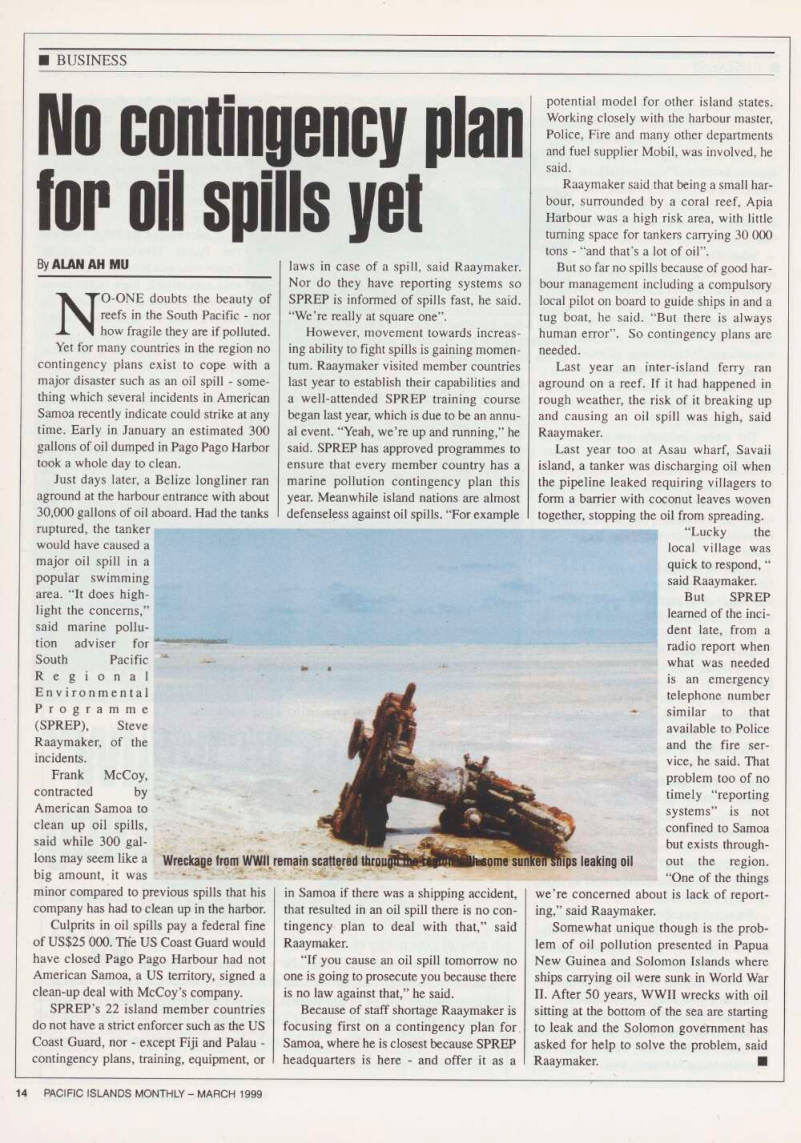
Somewhat unique though is the prob lem of oil pollution presented in Papua New Guinea and Solomon Islands where ships carrying oil were sunk in World War 11. After 50 years, WWII wrecks with oil sitting at the bottom of the sea are starting to leak and the Solomon government has asked for help to solve the problem, said Raaymaker. - ■
Wreckage from WWII remain scattered sunken ships leaking oil