optimistic about Bougainville
pp. 13-48 · Read in the full issue
Politics
Face to Face PMG outgoing commander optimistic about Bougainville
Maintaining peace on Bougainville has been one of the key issues in getting Papua New Guinea and the island back on the road to development.
That task fell into the hands of outgoing commander of the Peace Monitoring Group in Bougainville, Brigadier Bruce Osbom, for six months this year. Sophie Foster Hildebrand spoke to him about his experiences on Bougainville.
PIM: How long were you in Bougainville for?
Brigadier Osborn: I was in Bougainville from the end of April, when the cease fire came into being from April 3 until the end of October - so that’s just over six months.
PIM: What was your initial impression?
Brigadier Osborn: My initial impressions were that the Truce Monitoring Group the New Zealand that had been there before the PMG was there - had done a good job.
But I always thought that the process would become more difficult as we move forward, and indeed that is my view now and I think in the future it’s going to be more difficult. Because what you are trying to do is build bridges over a number of different areas which are difficult. Nine years of war is hard to erase over a short period of time.
So I was anxious in the sense of moving forward, but I must say once I got to know the Bougainvillean people, I start ed to gain a great deal of confidence that they themselves were not going to let it go back, deteriorate to what it was before.
I think it’s important to recognise now that it’s been 13 months since the truce and cease-fire has been in place. As every day passes there’s growing strength in confidence at the grassroots level.
I am a firm believer that people power is the real issue, and they provide the strength for the whole process, and it’s not politicians but they themselves who are going to drive the future direction of this process. So I was anxious but I must admit I’m far more optimistic now after six months. I think there’s real reason for optimism.
The only problem we had was not so much with the combatants or the ex combatants, I mean there’s a criminal element in every country and to some extent there were those. In Bougainville
they were our greatest problem but over" a period of time the law and order situa tion has improved markedly to the point where I think the law and order situation in Bougainville would be described by most as better than in other provinces in PNG. They were certainly there but they’re less evident now and I think things have improved markedly.
There’s certainly been some marginal improvement but there’s a long way to go in my view, to my way of thinking and certainly to the Bougainville people themselves.
They’ve identified several priorities in the restoration of essential services/aid area. One of those is communications infrastructure. We need to sort out the roads, telephones, radio and those sorts of things. People need to be able to com municate with each other and move material in and out for the economy to start turning over. Health and education are the other two key issues, and law and order. They’re the priorities but there’s a gradual increase. But until the law and order situation did improve, until the infrastructure does improve, aid organisations and others find it very difficult to send people and also materi al around the islands. Until that sort of improves, it’s going to be a catch 22 sit uation to some extent.
PIM: How do you deal with people like that? I mean you have people who are born into war, teenagers who were thrust into war, and also veteran soldiers who basically have no skills, no train ing, no education. The only skill they have is war. How would you handle that?
Brigadier Osborn: Your question is very valid and it’s always been an issue for the Bougainville leaders and the PNG government. What you’ve got is com batants now who basically don’t neces sarily have a future - who don’t have an education, their prospects are very poor, and some people estimate that number's as high as 30 or 40,000. So it’s a signif icant number.
PIM: There’s no way of knowing. There’s no census.
Brigadier Osborn: I think what’s encour aging here is that people firstly identify and recognise the problem. Secondly one of the solutions which is being applied is to re-establish the traditional
Continued on page 48
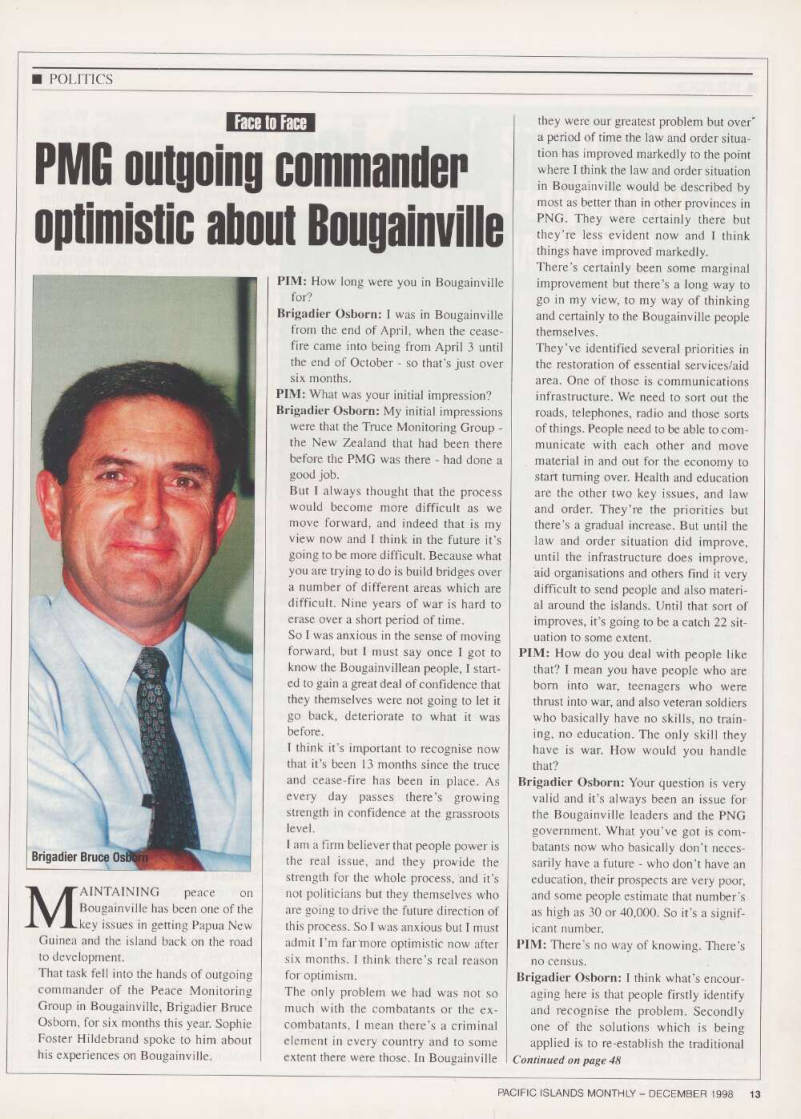
Brigadier Bruce Osborn
Continued from page 13
village system, same as you have in Fiji and you’re very familiar with. And I think that that’s where the real potential for sorting this, resolving the problem lies.
Gradually we’re seeing the village elders and the traditional leaders - the council of chiefs, the council of elders re-establishing authority. It’s interesting to see a lot of these 20 to 30-year-old ex-combatants going back to school with little children.
So in many areas, that’s starting to hap pen, but it’s not happening everywhere at all, the problem still exists. I think we need to look into some vocational train ing programmes, we need to get projects up and running which are employing these younger people or these unem
ployed people.
The real problem exists in the urban areas where you have the urban drift where you’ve got a lot of people, younger people, ex-combatants, who don’t have a family anymore.
You’ve got all these families with one parent or something, so it’s very hard for them to re-establish themselves back into the traditional environment. The solution to th-is has got to be a Bougainville solution.
Various countries in the region might be able to assist and it’s very much a Bougainville solution with the PNG government and other countries helping.
But it’s a real challenge.
PIM: There are lots of Bougainvilleans who have managed to move their way up the PNG administration - several that are willing to go back to Bougainville.
Could that be one of the solutions - get ting Bougainvilleans to talk
Bougainvilleans through the peace
process?
Brigadier Osborn: I think that there’s no doubt that’s an important aspect of future development. I mean it’s one thing to establish a Bougainville recon ciliation government but what you’re going to need under that is a bureaucra cy that is capable of supporting it, and that needs to be put in place now or to start putting it in place now.
By the time the Bougainville Reconciliation Government is estab lished perhaps as early as early next year, then you have this bureaucracy,
you have people who understand Bougainville and I think in all govern ment functional areas, the more Bougainvilleans you have initially who understand the problems of Bougainville perhaps the easier it will be to find solutions for the PNG govern ment.
PIM: When you were there, was there much talk of independence?
Brigadier Osborn: The issue of indepen dence has always been on the table.
Through the eyes of the peace monitors, which is some 300 strong over a period of six months, I think it’s important to recognise that independence is spoken about but it’s not supported by the vast majority of Bougainvilleans. It’s sup ported by a minority of hard-liners.
I think it’s important to recognise that regardless of what the aspirations are of the Bougainvilleans, that in the short term there is a consensus that there is a need to establish a single provincial government as the first step.
If you ask 10 Bougainvilleans what independence means, you’ll get 10 dif ferent answers. I mean if you say inde pendence will provide better health care, education, law and order then of course people are going to endorse that’s what they want. But that is what they want - they don’t actually want independence, they want an improved standard of living and a chance or an opportunity for their kids.
I think people need to be careful about associating their comments for indepen dence as you and I might think about it.
But there is still a group, a small group, who have very much seen independence as the long-term objective.
PIM: What about the mines? Was there much activity or talk of restarting that?
That was basically what the fight started over, wasn’t it?
Brigadier Osborn: Certainly the mine was the focal point of the initial prob lem, and of course it then became a suc cession issue. I’m not an economist, I’m not a mining expert but the feeling amongst most Bougainvilleans is that the mines should stay closed.
PIM: Where do you see Bougainville after 2000?
Brigadier Osborn: Well, that’s a very good question. I want to be guarded about giving an opinion based on six months.
PIM: Where do you hope to see it?
Brigadier Osborn: I’m extremely opti mistic. I think it’s important to recog nise that a great deal has been achieved in such a short period of time.
After 13 months we now still see peace existing. We see strong movement of the peace process at the grassroots level. We now see, I think, greater flexibility at the higher political levels, in particular on the part of the PNG government.
The Bougainville parties themselves have yet to find consensus on the way ahead, but I think that’s gradually occur ring.
I’m optimistic that once a reconciliation government speaking for all Bougainvilleans, involving and incorpo rating all Bougainville parties, is put in place, then there’s real hope that a last ing solution will be found, and that gradually through political stability, improved law and order and hard work, that gradually we will see a marked improvement in the standard of living and the economy of the island. Once that happens, I think you are going to find that there will be great optimism about the future of the island. So I’m very optimistic.
I hadn’t been there before. It’s got to be one of the most beautiful places in the world, it’s a paradise, the people are warm and generous and very friendly and I think it really must be a potential for eco-tourism and other industries like that and the future must be enormous.
But it’s for the Bougainvilleans and the PNG government to decide their future but I think there should be reason for great optimism.
PIM: What do you think was the reason peace worked now and not say five years ago?
Brigadier Osborn: I think there’s a whole range of reasons. I think in the past there wasn’t necessarily the strong commit ment by all parties to a cease-fire.
In this case, I think simply people have got sick of war, they’re sick of it - the deaths and the suffering. The estimates of deaths directly from the war is as much as 20,000 but in my view it might be indirectly much higher, given people dying from diseases which were curable like malaria, polio, tuberculosis, and I think after nine years people just got sick of it. I think they were sick of it after five years. ■