Skate on thin ice
pp. 14-15 · Read in the full issue
By Sam Vulum
PAPUA New Guinea prime minis ter Bill Skate was unstable and on the verge of cracking.
Recent government decisions and polit ical changes in his camp have appeared to have hit him hard. He knows well that his survival after January 22 hinges on how well he maintains his reduced numerical strength of about 61 MPs.
An insider said recently that mounting pressure was taking its toll on him - evi dent in his sudden change of behaviour towards his personal and departmental staff. The insider said Skate was taking his anger and frustrations on his staff. He said once the PM was swearing throughout a day in every uttered sentence.
The pressures on him were exacerbated by widespread speculation of a take-over of the government by members of the dis cipline forces, mainly the defence and police forces. A public opinion poll has also shown widespread dissatisfaction with Skate remaining in power.
After sacking his deputy, Peoples Progress Party leader, Michael Nali in October, he also found that the leadership of his biggest coalition partner in govern ment, the Peoples Democratic Movement, was also shaky.
The party appears to hold the balance of power in the government’s survival and its legislative agenda - the biggest being the 1999 budget. The Opposition, desperate to wrestle power from him, can move a vote of no confidence against Skate when an 18 month grace period, required by law for a challenge on any government, expires on January 22, 1999.
Skate, whose governance has been rid dled with widespread allegations of cor ruption, bribery, sexual and criminal impli cations, incompetency and nepotism, is experiencing his toughest moment ever after 14 months in office.
The brick wall solidarity put together in what was referred to as the Tufi Camp when the government was formed in July in the northern Province, has fallen to pieces. The mandate to govern given by the Camp is no longer in the government.
Today, the government is a different set altogether.
Serious dents are evident in the govern ment’s powerbase after Skate sacked Nali.
He accused Nali and his party of collab orating with former party leader and prime minister Sir Julius Chan to destabilise the government.
Sir Julius lost his Namatanai seat in New Ireland province in the 1997 elec tions. Skate and Sir Julius have become bitter rivals since the Sandline Crisis. Sir Julius, who partly blamed his defeat on the crisis, finds it hard to live with the fact that Skate set the course for his downfall when he sought the parliament’s discretion to remove him during the heat of the crisis.
The motion by Skate, seeking Sir Julius’ resignation was defeated but he later stood aside to end a stand-off at the Parliament House led by soldiers.
Skate, who was among those who met and talked to the rowdy soldiers at Parliament, also provided rations for those guarding the instigator of the crisis, the currently re-appointed PNGDF Commander Jerry Singirok. Singirok blew the whistle on Sir Julius’ government’s
secret plan to engage Sandline International mercenaries to put down the Bougainville secessionist rebellion.
Sir Julius has taken every opportunity to attack the government after being cleared by the second Sandline Commission of Inquiry. The Commission was ordered by Skate upon his election as prime minister, in an attempt to uncover and nail Sir Julius and two of his senior ministers - Gulf MP and Pangu Party leader Chris Haiveta and former Goroka MP Mathias Ijape.
This bitter rivalry became evident recently during a PNG Pukpuk versus a multi-national PNG Barbarians rugby union tussle in Port Moresby. Skate and Sir Julius, who try to avoid each other at every public gathering, accidentally found them selves sitting side-by-side during the game.
Observers said that although they shook hands in a rare show of friendship, they hardly shared a word during the entire duration of the match.
Skate’s re-appointment of Singirok is seen not only as a consolation for his own misery in losing a major coalition partner, but also a further indirect attack on Sir Julius. Dressing it as a move to reward the man for saving many lives and to rescue the disenfranchising defence force, Skate had done himself more damage than good, considering the widespread attention it has been attracting.
He made the appointment knowing too well that Singirok has yet to be cleared of bribery allegations and sedition charges.
The Ombudsman Commission has pub licly announced its probe into the activities of Singirok over bribery allegations while police have re-opened the sedition charges.
Commander Singirok appeared briefly in court on November 5, charged with sedi tion. He is charged with one count of pub lishing seditious words in writing - name ly, an address to the nation on March 17 that contravened section 54 of the PNG Criminal Code.
When Nali departed, he took with him most of his party members, leaving behind a splinter group in the government of only four MPs. Skate’s own party, the PNG First Party, has only four members with PDM making up most of the numbers. However, the party’s leadership is set to change with leader and deputy prime minister lairo Lasaro set to lose his post.
Sources said the party is on the verge of breaking up because Lasaro would not
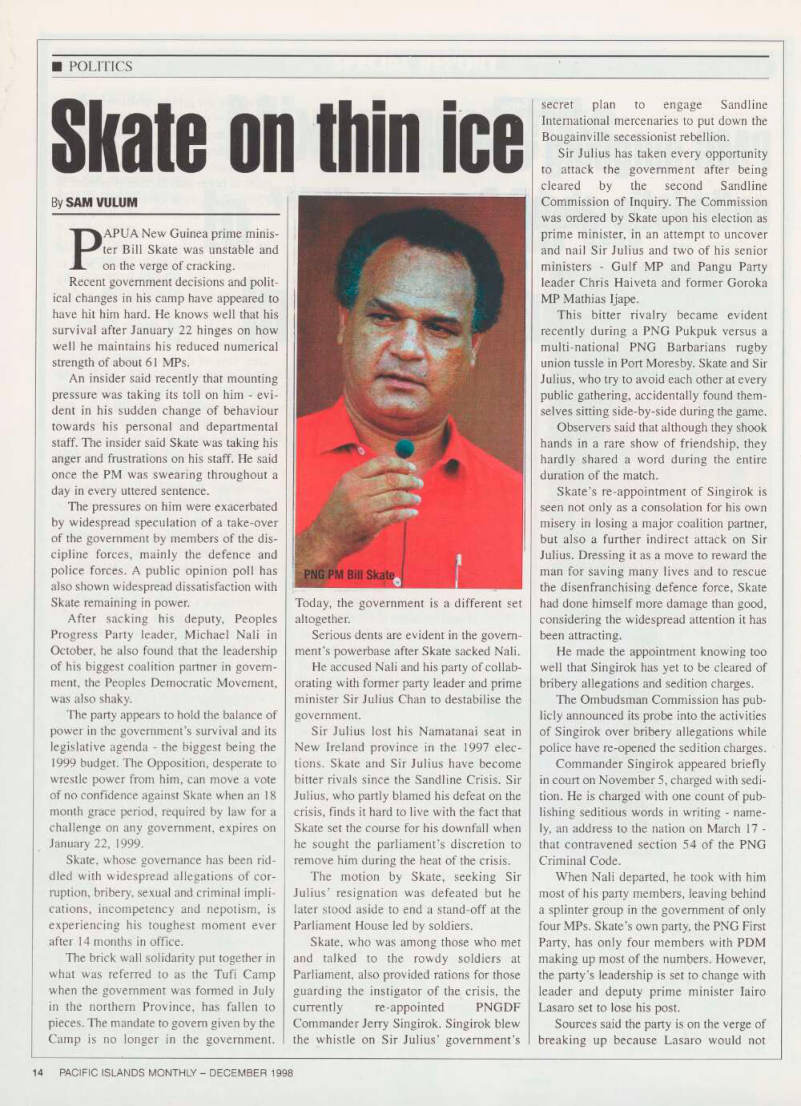
PNG PM Bill Skate
stand up and represent the party on major policies and issues affecting the country.
The private opinion poll, conducted by Meli Research and Marketing Consultants, says that the Government is not very pop ular among the citizens in the rural or village based sector.
The poll indicated that this may have resulted from less infor mation on the government and its activities getting through to the rural communities.
But the majority of the urban population interviewed do not appreciate the current government’s performance since its forma tion in July 1997. The majority of women and the rural sector pre fer Opposition Leader Bernard Narokobi as their choice for prime minister.
Former prime minister Sir Michael Somare was the men’s choice and ranked first as most preferred prime minister overall.
A cross-section of the population, totalling 20,000 persons, was interviewed - 14,000 men (representing 60 per cent) and 6000 families (representing 40 per cent) were interviewed between July, August and September this year.
About 60 per cent of these were from the formal sector or peo ple in urban centres, while the balance was from the rural areas.
A sample population of 9130 (representing 45.65 per cent) feels that the Skate government should be replaced after the 18month grace period is up, while 22.9 per cent prefers it remain in power.
The second highest sample of 32.45 per cent refused to make any comments because they did not know enough about the cur rent government and the opposition.
Most of the respondents who refused to comment are from the rural sector and do not have access to information.
While launching the study results, Meli Research principal Michael Meli said the opinion poll reflected the rural population lacked government information. It is felt that any government in PNG must have an effective network of communication between the government and its people in rural areas.
Misleading information results in opinions that really do not reflect the government’s performance, Mr Meli said. People blame the current government for economic chaos in the country, which resulted from past government’s mishandling.
“We therefore recommend that the Office of Information estab lished by the Somare Government be re-established to effectively disseminate government information to the people more effective ly,” Mr Meli said.
About 29 per cent of the people interviewed (both formal and informal sectors) appreciate the government’s performance, 36.5 per cent does not agree, while 34.5 per cent refused to comment.
The Skate government’s approach to solve the 10-year crisis on Bougainville is considered “very practical and effective”.
Other reasons why the Skate government is appreciated include it is “grassroots based” - displayed through its support to health and education programmes, the introduction of free educa tion policy (despite delays in school fee deliveries)- and Skate is perceived as a simple man who mixes with people, is involved in sports and breaks all protocol procedures to meet people.
Others do not appreciate the current government because of the worsening economic situation coupled with the hire of an eco nomic advisor at a cost of K 7 million, the appointment of vice ministers and a super secretary and confusion created by splitting ministries. ■