Pacific Islands

Monthly
Inside: Cold Response To Climate Change
December 1998
9H|b
American Samoa US$2.5O; Australia A 53.50; Cook Islands N2s3; Fiji F 52.50 Vat incl; FS Micronesia US$3; Kiribati A 52.50; Nauru A 52.50; Niue NZ$3; Norfolk As 3; New Caledonia cpf2so; New Zealand NZ53.45 incl GST; Northern Marianas US$3; Papua New Guinea K 3; Palau US$3; Marshall Islands US$3; Solomon Islands As 3; French Polynesia cpf3oo; Tonga P 3; USA US$3; Vanuatu VT22O; Western Samoa T 5.50. These are recommended prices only.
Advertisements & other items, pp. 2-4 (1 item)
NOW OT ON 01(0 moiooi IOOWOOOID NOOO vou
HOMING
Anti Skid Brakes (ABS) Distinctive European Styling 1600 cc Multi-Valve Engine Hi-Mount Rear Stop Lamp Intermittent Windscreen Wipers Manual or Automatic Transmission Powerful Halogen Headlamps Fully Air Conditioned Luxurious Fabric Trim Dynamic AM/FM Cassette Stereo Speed Sensitive Power Steering Fully Adjustable Driver's Seat 60/40 Split, Fold Down Rear Seats Convenient Centre Console The Smartest Looking Sedan in Town Fantastic new colours available including Electric Blue, Apricot Pearl Metallic Lavender Metallic, Peppermint Green Coral Reef Mica Metallic, and more !
Asco Motors
® TOYOTA
* PHOTO DEPICTS OPTIONAL EXTRA? :
SPOILER & ALLOY WHEELS
SUVA PH 384888 • SIGATOKA PH 500577 NADI PH 721777 • LAUTOKA PH 662855 BA PH 674406 • TAVUA PH 680152
LABASA PH 811688
4* m. m y Sr m i m m M m m m & w I A JSmsSk m ’ T i <sW >r.: s. e Mt ' vj i We accept further inform please contact:
VISA
Just quote your card number and expiry date and we will forward your requirements.
Teiikom Phone Card Sales Pay Phone Business Unit PO Box. 351 Waigani, NCD Papua New Guinea Telephone: (675) 300 5093 Facsimile: (675) 3005060 i
TELIKOM PNG
AM*J> oo&'m, yUSksnUf teUtsu*<q J
Now, the call for c 123.1 y co mber to service, isier.
Vodafone Customer Care operates 24 hours a day and Seven days a week.
Call 123 from your Vodafone or 902 123 from any Telecom Fiji phone.
O vodafone
Calls to 123 (Customer Care) are charged at the standard Vodafone rate.
Sansom desi
Pacific Islands

Monthly
Vol 68 No. Ii
The News Magazine
December 1998
PUBLISHER: Alan Robinson EDITOR: Sophie Foster Hildebrand
Correspondents:
Sally Andrew, Patrick Decloitre, Giff Johnson, Chris Peteru, Atama Raganivatu, Michael Field, Sam Vulum, Lisa Williams.
Columnists:
David Barber (Wellington), Jemima Garrett (Sydney), GRAPHIC ARTISTS: James Ranuku, Josefa Bola, Andrew Williams
Advertising Sales
Senior Regional Sales (South Pacific) Shabana Naaz Tel (679) 304111, 303244, Fax (679) 303809.
Sydney, Canberra: Bob Hill Media Representation, Tel (61-2) 4164245, Fax (61-2) 4165064.
Brisbane: Jane Fewings Media and Advertising Associates Tel (61-7) 3378 4522, Fax (61-7) 3878 1071.
Adelaide: Hastwell Williamsons Representatives, Tel (61-8) 3799522, Fax (61-8) 3799735.
Melbourne: Brown Orr Fletcher Burrows (Aust) Pty Ltd.
Tel (61-3) 98265188, Fax (61-3) 98265644.
Auckland: McKay & Bowman, International Media Representatives Limited, Tel (64-9)4190561, Fax (64-9) 4192243.
Japan: Universal Media Corporation, Tokyo, Tel (3) 3266626741, Cable; UNI-MEDIA Tokyo, Fax (3) 32626742.
Pacific Islands Monthly was founded in 1930
(Usps 9522480).
A Fiji Times Limited production.
Cover prices are recommended retail only. Registered by Australia Post, Publication No. NBPI2IO. © Copyright Fiji Times Limited, 177 Victoria Parade, Suva, Fiji.
Tel (679) 304111, fax (679) 303809.
Email; [email protected] PIM Website: http://www.pim.com.fj Pacific Islands Monthly is published monthly by Fiji Times Limited, a division of Nationwide News, 2 Holt Street, Surry Hills, Sydney, NSW 2010.
Send Address Changes To:
Pacific Islands Monthly PO Box 1167 Suva, Fiji.
Printed by Quality Print Limited, 16 Amra Street, Walu Bay, Suva, Fiji.
Layout and cover design by James Ranuku Cover picture by Sophie Foster Hildebrand
Inside
Editorial 6 Letters/What's Happening 7_ Special Report: Global warming Changing climate and sea levels affect Pacific now 10 Mixed reviews to "Buenos Aires Inaction Plan” 12 Politics: Meet Bougainville's outgoing PMG commander 13 Skate on thin ice 14 Turning point in Australia/PNG relationship 15 A symbol for the re-opening of whaling 15 Sir Geoffrey supports Pokino amidst scandal 18 New Caledonia prepares to turn accord into law 20 Regional programmes suffering under competition 28 Cover: Unlawful Disorder: Fiji's growing security problem 30 Recommendations for business security 32 Business: 106 promise to help re-build a nation 35 Fiji milk goes regional 36 Hilton to run new $Bl m resort In Fgi 37 Majuro's port booms 38 PNG's new gas legislation up in the air 40 Samoan publisher wins top award 42 BP - the end of an era 43 Study confirms Ramu's iow-cost status 44 Island band hits the Mg time 43 Yachting: Navigating the Internet 50 Opinion: David Barber/Jemima Garrett 54
Page 12
Page 14
Page 20
Cover Story: Armed and Dangerous
paradise
Editorial
Crime in paradise
WHEN people picture the South Pacific, it is generally an image of palm trees swaying in the breeze, gentle, friendly people and a certain amount of freedom.
To a certain extent, this is certain ly the case, but of late, in Fiji, as well as some other South Pacific coun
tries, this peace has been shattered. Crime has become an increasing problem and authorities have seemed powerless to tackle it. In Fiji, banks, supermarkets, ser vice stations, payrolls, and armoured vehicles have been victims of a highly organised crime spree.
No-one denies the intensity of the problem. Even Fiji’s finance minister, prime minister and other high-level offi cials have admitted to the problem.
Lawlessness shatters investor confidence and creates instability within island com munities, and it is for this reason that the growing security problem has to be tack led now. When people do not feel safe to
walk the streets or conduct their daily business, the mood quickly turns sour.
Various organisations have called for stiffer penalties as a deterrent - but this is hard to enforce and judges have tended not to give the highest penalty when lay ing sentences.
The latest option to tackle crime has been to recruit soldiers into the police force to make up for the lack in manpow er. However, this has led to dissatisfac tion within the police force - especially at middle-management level. There have been complaints that current members of the force are overlooked for promotions and vacancies in favour of soldiers. It is
only time before law-abiding citizens decide that enough is enough and take the law into their own hands.
This should concern lawyers, judges, politicians and every other person associated with upholding law in Fiji.
Some observers say that Fiji looks much like Papua New Guinea used to
many years ago - before the rascals start ed dominating Port Moresby. If that’s the case, then it would be wise for Fijian offi cials to seriously contemplate if they wish to see Fiji’s security situation in the same status as that of Port Moresby in a few years. Especially considering the fact that tourism has now become Fiji’s biggest foreign exchange earner. Crime is bad for business. It is bad for tourism. And it could also be bad for re-election.
This factor, most of all, should be
impetus enough for Fiji’s politicians to
take immediate action to stunt, if not wipe out, the country’s escalating securi ty problem. ■
What’S Happening?
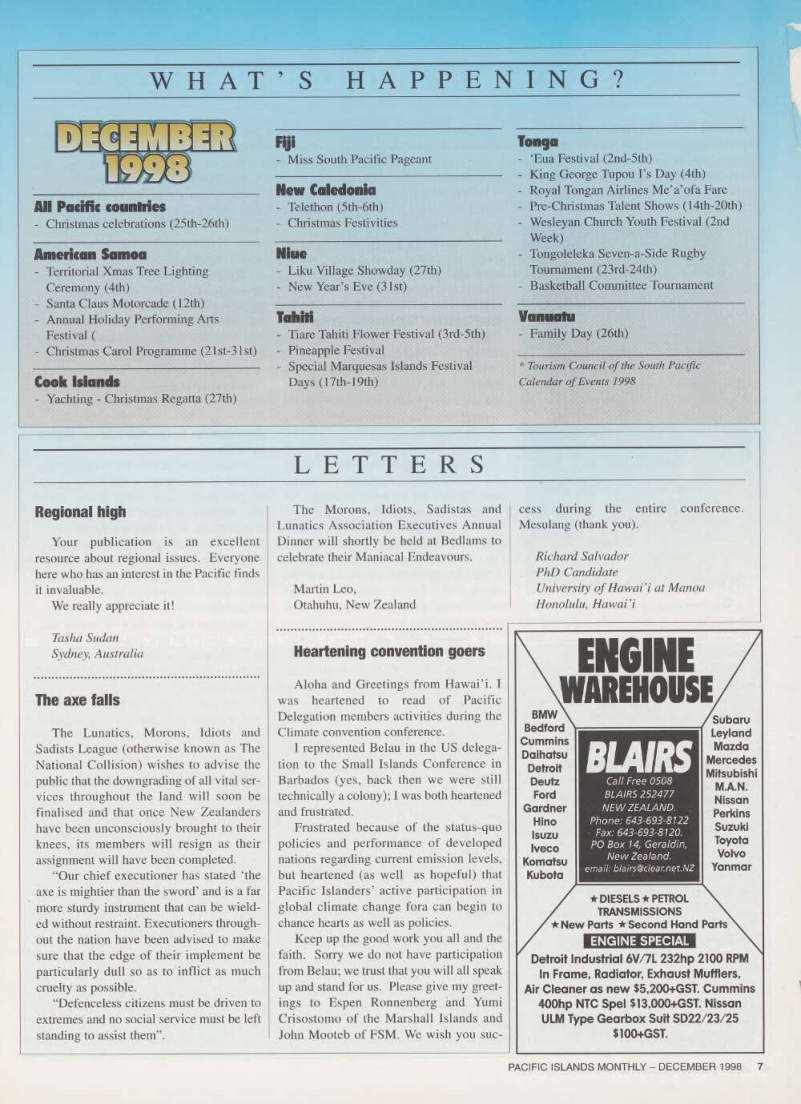
All Pacific countries - Christmas celebrations (25th-26th) American Samoa - Territorial Xmas Tree Lighting Ceremony (4th) - Santa Claus Motorcade (12th) - Annual Holiday Performing Arts Festival ( - Christmas Carol Programme (21st-31st) Cook Islands - Yachting - Christmas Regatta (27th)
FQi
- Miss South Pacific Pageant
New Caledonia
- Telethon (sth-6th) - Christmas Festivities
Niue
- Liku Village Showday (27th) - New Year’s Eve (31st)
Tahiti
- Tiare Tahiti Flower Festival (3rd-sth) - Pineapple Festival - Special Marquesas Islands Festival Days (17th-19th)
Tonga
- ‘Eua Festival (2nd-sth) - King George Tupou Fs Day (4th) - Royal Tongan Airlines Me’a’ofa Fare - Pre-Christmas Talent Shows (14th-20th) - Wesleyan Church Youth Festival (2nd Week) - Tongoleleka Seven-a-Side Rugby Tournament (23rd-24th) - Basketball Committee Tournament Vanuatu - Family Day (26th) * Tourism Council of the South Pacific Calendar of Events 1998
Letters
Regional high
Your publication is an excellent resource about regional issues. Everyone here who has an interest in the Pacific finds it invaluable.
We really appreciate it!
Tasha Sudan Sydney, Australia
The axe falls
The Lunatics, Morons, Idiots and Sadists League (otherwise known as The National Collision) wishes to advise the public that the downgrading of all vital ser vices throughout the land will soon be finalised and that once New Zealanders have been unconsciously brought to their knees, its members will resign as their assignment will have been completed.
“Our chief executioner has stated ‘the axe is mightier than the sword’ and is a far more sturdy instrument that can be wield ed without restraint. Executioners through out the nation have been advised to make sure that the edge of their implement be particularly dull so as to inflict as much cruelty as possible.
“Defenceless citizens must be driven to extremes and no social service must be left standing to assist them”.
The Morons, Idiots, Sadistas and Lunatics Association Executives Annual Dinner will shortly be held at Bedlams to celebrate their Maniacal Endeavours.
Martin Leo,
Otahuhu, New Zealand
Heartening convention goers
Aloha and Greetings from Hawai’i. I was heartened to read of Pacific Delegation members activities during the Climate convention conference.
I represented Belau in the US delega tion to the Small Islands Conference in Barbados (yes, back then we were still technically a colony); I was both heartened and frustrated.
Frustrated because of the status-quo policies and performance of developed nations regarding current emission levels, but heartened (as well as hopeful) that Pacific Islanders’ active participation in global climate change fora can begin to chance hearts as well as policies.
Keep up the good work you all and the faith. Sorry we do not have participation from Belau; we trust that you will all speak up and stand for us. Please give my greet ings to Espen Ronnenberg and Yumi Crisostomo of the Marshall Islands and John Mooteb of FSM. We wish you suc
cess during the entire conference.
Mesulang (thank you).
Richard Salvador PhD Candidate
University ofHawai’i at Manoa Honolulu, Hawai’i
Advertisements & other items, p. 7 (1 item)
Blairs
BMW
Bedford Cummins Daihatsu Detroit Deutz Ford Gardner Hino Isuzu Iveco Komatsu Kubota
Call Free 0508
BLAIRS 252477
NEW ZEALAND.
Phone: 643-693-8122 Fax: 643-693-8120.
PO Box 14, Geraldin, New Zealand, email: [email protected] Subaru Leyland Mazda Mercedes Mitsubishi
MAN.
Nissan Perkins Suzuki Toyota Volvo Yanmar
★ DIESELS ★PETROL
TRANSMISSIONS
★ New Parts ★Second Hand Parts
ENGINE SPECIAL
Detroit Industrial 6V/7L 232 hp 2100 RPM In Frame, Radiator, Exhaust Mufflers, Air Cleaner as new SS,2OO+GST. Cummins 400 hp NTC Spel SI3,OOO+GST. Nissan ULM Type Gearbox Suit SD22/23/25
SIOO+GST.
Briefs
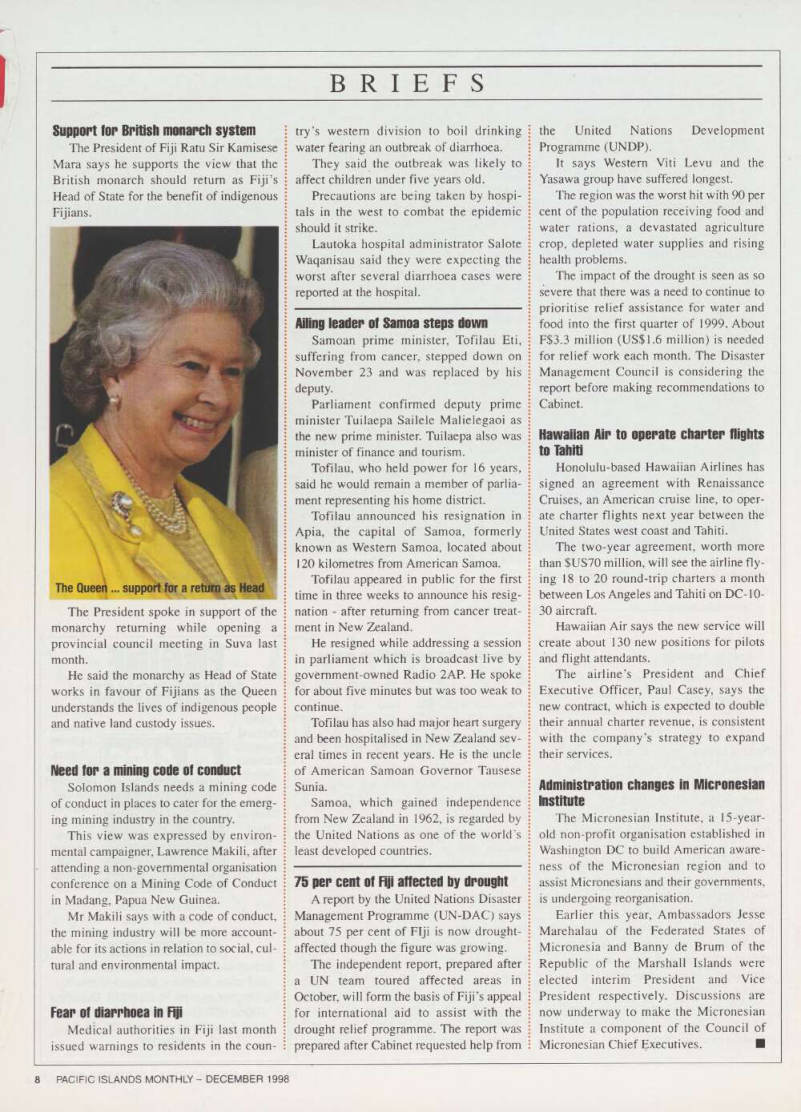
Support for British monarch system The President of Fiji Ratu Sir Kamisese Mara says he supports the view that the British monarch should return as Fiji’s Head of State for the benefit of indigenous
Fijians.
The President spoke in support of the monarchy returning while opening a provincial council meeting in Suva last month.
He said the monarchy as Head of State works in favour of Fijians as the Queen understands the lives of indigenous people and native land custody issues.
Need for a mining code of conduct Solomon Islands needs a mining code of conduct in places to cater for the emerg ing mining industry in the country.
This view was expressed by environ mental campaigner, Lawrence Makili, after
attending a non-govemmental organisation
conference on a Mining Code of Conduct in Madang, Papua New Guinea.
Mr Makili says with a code of conduct, the mining industry will be more account able for its actions in relation to social, cul tural and environmental impact.
Fear of diarrhoea in Fiji Medical authorities in Fiji last month issued warnings to residents in the coun
try’s western division to boil drinking water fearing an outbreak of diarrhoea.
They said the outbreak was likely to affect children under five years old.
Precautions are being taken by hospi tals in the west to combat the epidemic should it strike.
Lautoka hospital administrator Salote Waqanisau said they were expecting the worst after several diarrhoea cases were reported at the hospital.
Ailing leader of Samoa steps down Samoan prime minister, Tofilau Eti, suffering from cancer, stepped down on November 23 and was replaced by his
deputy.
Parliament confirmed deputy prime minister Tuilaepa Sailele Malielegaoi as the new prime minister. Tuilaepa also was minister of finance and tourism.
Tofilau, who held power for 16 years, said he would remain a member of parlia ment representing his home district.
Tofilau announced his resignation in Apia, the capital of Samoa, formerly known as Western Samoa, located about 120 kilometres from American Samoa.
Tofilau appeared in public for the first time in three weeks to announce his resig nation - after returning from cancer treat ment in New Zealand.
He resigned while addressing a session in parliament which is broadcast live by government-owned Radio 2AP. He spoke for about five minutes but was too weak to continue.
Tofilau has also had major heart surgery and been hospitalised in New Zealand sev eral times in recent years. He is the uncle of American Samoan Governor Tausese Sunia.
Samoa, which gained independence from New Zealand in 1962, is regarded by the United Nations as one of the world’s least developed countries.
75 per cent of Fiji affected hy drought A report by the United Nations Disaster Management Programme (UN-DAC) says about 75 per cent of Fiji is now drought affected though the figure was growing.
The independent report, prepared after a UN team toured affected areas in October, will form the basis of Fiji’s appeal for international aid to assist with the drought relief programme. The report was prepared after Cabinet requested help from
the United Nations Development Programme (UNDP).
It says Western Viti Levu and the Yasawa group have suffered longest.
The region was the worst hit with 90 per cent of the population receiving food and water rations, a devastated agriculture crop, depleted water supplies and rising health problems.
The impact of the drought is seen as so severe that there was a need to continue to prioritise relief assistance for water and food into the first quarter of 1999. About F 53.3 million (US$l.6 million) is needed for relief work each month. The Disaster Management Council is considering the report before making recommendations to Cabinet.
Hawaiian Air to operate charter flights to Tahiti Honolulu-based Hawaiian Airlines has signed an agreement with Renaissance Cruises, an American cruise line, to oper ate charter flights next year between the United States west coast and Tahiti.
The two-year agreement, worth more than SUS7O million, will see the airline fly ing 18 to 20 round-trip charters a month between Los Angeles and Tahiti on DC-10- 30 aircraft.
Hawaiian Air says the new service will create about 130 new positions for pilots and flight attendants.
The airline’s President and Chief Executive Officer, Paul Casey, says the new contract, which is expected to double their annual charter revenue, is consistent with the company’s strategy to expand their services.
Administration changes in Micronesian Institute The Micronesian Institute, a 15-year old non-profit organisation established in Washington DC to build American aware ness of the Micronesian region and to assist Micronesians and their governments, is undergoing reorganisation.
Earlier this year, Ambassadors Jesse Marehalau of the Federated States of Micronesia and Banny de Brum of the Republic of the Marshall Islands were elected interim President and Vice President respectively. Discussions are now underway to make the Micronesian Institute a component of the Council of Micronesian Chief Executives. ■
The Queen ... support for a return as Head
New Zealand

Archives-December 1944
New Zealand wants bananas!
Prices defended by government
NEW Zealanders appear to have become acutely banana-conscious in the last three years. One mention of this fruit is sufficient to send Dominion newspa pers into a heated campaign on banana
supplies and banana prices.
Recent mention by a Fiji resident at a Rotary luncheon in Nelson, NZ, that there were abundant supplies of bananas in Fiji only waiting shipping space to the Dominion, reopened the subject and sent everyone into wild argument.
A message from Fiji, on November 16, should settle the Fijian end of the problem: “A recent shipment to Auckland was said to the smallest ever sent, the reason being that no more bananas were available, as in New Zealand and elsewhere, the calling up of manpower to serve in the armed forces and to work on military construction, had
Pacific Islands
its inevitable effect on production.
Overseas troops also spent money freely on native mats and curios, and in many native villages life for those left at home suddenly became much more comfort able and convenient. No longer was there the same incentive to cultivate the land, and the result is to be seen today in a considerable decrease in native food pro duction.
“In Suva, where bananas grow in almost any backyard the retail price is 12 for sixpence. This does not indicate any great abundance. The situation will improve as men are released from the Army and the general demand for labour declines”.
New Zealand consumers and Island growers who have been howling about the disparity in prices paid by the one
and to the other should be reassured by the following statement by the New Zealand minister of marketing (Mr Roberts) on November 13: “In the first place,” he said, “it has been stated that the Marketing Division pays 5/- a case for bananas in the Islands, the facts are that the Division pays the following prices f.o.b. Island ports: Samoa, 12/9 a case; Fiji 12/4.5 (New Zealand currency); and Tonga, 12/1.
These are the prices which are deter mined between the Division and the sell ing authorities in the various islands.
“It is quite well known that, with the Pacific war, the availability of shipping for bananas and oranges is at a mini mum, but the Division does import into New Zealand every case of bananas that it is possible to procure from the Islands.
“ It is also a fact that the only ship ping point of import for bananas is Auckland, and if other parts of New Zealand are to have a share of the now reduced supplies, the Division has to incur heavy costs in distributing the fruit on a per capita basis, as far south as
Invercargill”. ■
Established 1930
Advertisements & other items, p. 9 (1 item)
Japanese Vehicles
am
Kill®
T I Bil Sip ii : m&m L.
'if 3iSaO«( jilifil
JAPANESE VEHICLES
DIRECT”
Cut out the middlemen
Where to buy, how to import, photos, specifications, prices, get the book that reveals all. For free information contact - Trust Company Ltd, Tel: 81-52-953- 5602, Fax: 81-52-953-5634/31, E-Mail: [email protected].
Homepage: http://trust-ltd.co.jp/ Address: Kobac Bid 3-2-26 Nishiki Nakaku Nagoya 460-0003 Japan
sea levels affect Pacific

Special Report
Changing climate and sea levels affect Pacific countries now
ON low-lying atolls in the Pacific, people have had to rad
ically change the way they
grow crops, because rising sea levels are seeping into the soil, making it too salty to grow staple crops such as taro, pulaka and yams.
In Tuvalu, farmers used to dig pits in the sandy soil, fill them with compost and plant their root crops. Now, however, increasingly brackish water is poisoning taro planted in pits in low-lying areas.
Some farmers have relocated their planta tions to somewhat higher land, but there is only limited land available in this nation of atolls. Instead, many people now grow their taro in tin containers, which they fill with compost and soil before planting the taro. Throughout the Pacific, culturally and
spiritually important sites are being eroded
by the rising seas. In the Marshall Islands, Tuvalu and Kiribati, burial grounds near the coast - sacred places where people do not go except to pray - are crumbling into the ocean. Second World War graves on Majuro atoll in the Marshall Islands are slowly being eroded by wind and surf, which breaches the sea walls and strews debris over the headstones. In Niue and Palau, where the dead lie in caves near the ocean, people are now discussing moving their ancestors further inland because of the threat from the rising ocean.
As well as slowly rising sea levels which are eroding coastal roads and other infrastructure, countries like Kiribati, Tuvalu and the Marshall Islands also suf fered unusual storm surges in February 1997 and again this year, where the tide just kept on coming in. destroying sea walls, bridges and roads and flooding houses and plantations. In Kiribati, the bridges linking Tarawa and Betio were destroyed. Kiribati has now established a task force to oversee management of a $U5253,000 fund for
reconstruction of causeways, roads and other infrastructure destroyed by coastal erosion.
On Majuro atoll in the Marshall Islands, the airport has been flooded on several occasions recently, despite an eight-foot sea wall. Throughout the Marshall Islands, coastal erosion is evident everywhere.
While some erosion in more populated parts can be blamed on inappropriate land use practices, the coasts of outer islands that have had no development are also crumbling into the sea. Like virtually all Pacific island countries, the Marshall Islands are ill-equipped to deal with sea level rise. An extensive sea wall protec tion system would cost more than SUSIOO million for Majuro atoll alone, disregarding the protection needs of the other 28 atolls in the Marshall Islands.
The Marshall Islands’ total gross domes tic product is just SUSBO million, more than half of which comes from grants from the United States which could terminate as early as 2001. Even if it were economic to build a sea-wall to protect Majuro, it would not be feasible; a sea wall around the atoll would kill the inner lagoon ecosystem.
This would have flow-on effects on the tuna fishery, which depends in part on fish which spend their juvenile period in the lagoon. Rising sea levels have already swamped some motu (small islets) in the Pacific. In Kiribati, the motu of Tebua Tarawa used to be a landmark for fisher men. Now it is gone. In Tuvalu, the motu of Tepuka Savilivili has lost its coconut trees and its sandbanks and the ocean is slowly moving up its remaining rock. In most of the Pacific, land tenure systems mean peo ple living on a coastline that is disappear ing beneath their feet cannot move inland, because that land belongs to other families.
So people on the coast in countries like Kiribati and the Marshall Islands are trying
to reclaim their family land, dumping trucks or other old equipment into the sea and then piling rocks around them to try to build up their patch of land once more.
Outsiders think this is pollution: in reality, it is an attempt to survive in a changing world.
The Pacific’s climate is changing, as countries like Federated States of Micronesia, Fiji, the Marshall Islands, Papua New Guinea, Samoa and Tonga are only too well aware. All these countries have been hit hard by recent devastating droughts. In Fiji, drought wiped out some two-thirds of this year’s sugar cane crop, which normally provides 40 percent of export earnings. Tonga’s squash crop, which produces about half that country’s exports by value, was more than halved.
In Papua New Guinea, Australia spent more than SA3O million delivering food aid to people in isolated areas in the highlands and low-lying islands, many of whom were close to starvation. The drought substan tially reduced Papua New Guinea’s impor tant coffee harvest. In FSM, almost 40 atolls ran out of water and the capital, Pohnpei, was reduced to living off brackish underground water and shipping water to
neighbouring atolls.
In the Marshall Islands the United States brought in desalinisation plants to provide water for the population. In Samoa, fires sparked by the unusually dry conditions destroyed large areas of forest on the island of Savaii. Pacific people traditionally depended on the ocean to supply most of their protein requirements. Over the cen turies they developed a wealth of knowl edge about when and where to fish.
In recent years, however, the fish have not been found where traditionally they would be expected. The currents have changed, and so have the locations of the fish. In Papua New Guinea, for example, on Manus Island, people traditionally catch large hauls of tuna in October. They use this not only for their own sustenance, but also to sell to the country’s fish markets. Last year the tuna did not arrive.
Throughout the Pacific, malaria and dengue fever, both mosquito-borne dis eases, are increasing. In Papua New Guinea, for example, the past ten years have seen outbreaks of malaria in the high lands, 2000 metres above sea level, where previously it was too cold for malarial mos quitos to survive. The same is true of the
highlands of the Solomon Islands, where malaria has also begun to appear. Malaria and dengue fever are starting to appear in New Caledonia.
Previously there was no malaria there and virtual ly no dengue. But now, at some times of the year, there are outbreaks of malaria and dengue fever in New Caledonia.
Fiji and Samoa also are now suffering out breaks of malaria and dengue fever which are far more severe than they have ever been before. For some, the battle against a changing climate and ris ing sea levels has become too much, particularly when these are combined with population pres sures. Environmental refugees are already a reality in the Pacific. Kiribati has begun an internal reset tlement programme, moving people from Betio to the outer islands. Niue recently accepted seven families from Tuvalu who decided to escape from the increasing risks of living on a low-lying atoll.
The world’s climate scientists have already said human greenhouse gas emissions are having a dis cernible effect on global climate.
While the Pacific does not have the expertise to say that the changes it is experiencing now are a direct result of greenhouse gas emissions, it does know that it is vulnerable now, and that there is a considerable probability that the risks will only increase in future. The Kyoto Protocol to the United Nations Framework Convention on Climate Change, which provides for an overall 5.2 percent reduction in greenhouse gas emissions by developed countries, goes nowhere near the 60 - 80 percent reductions which the Intergovernmental Panel on Climate Change has said are needed. As far as the Pacific is concerned, the sooner countries start making the reductions they have committed to, and accept that much stronger reductions will be needed, the better the Pacific’s chances of surviving the next millenni um. -This is part of a paper provided by SPREP rgarding global warming. ■
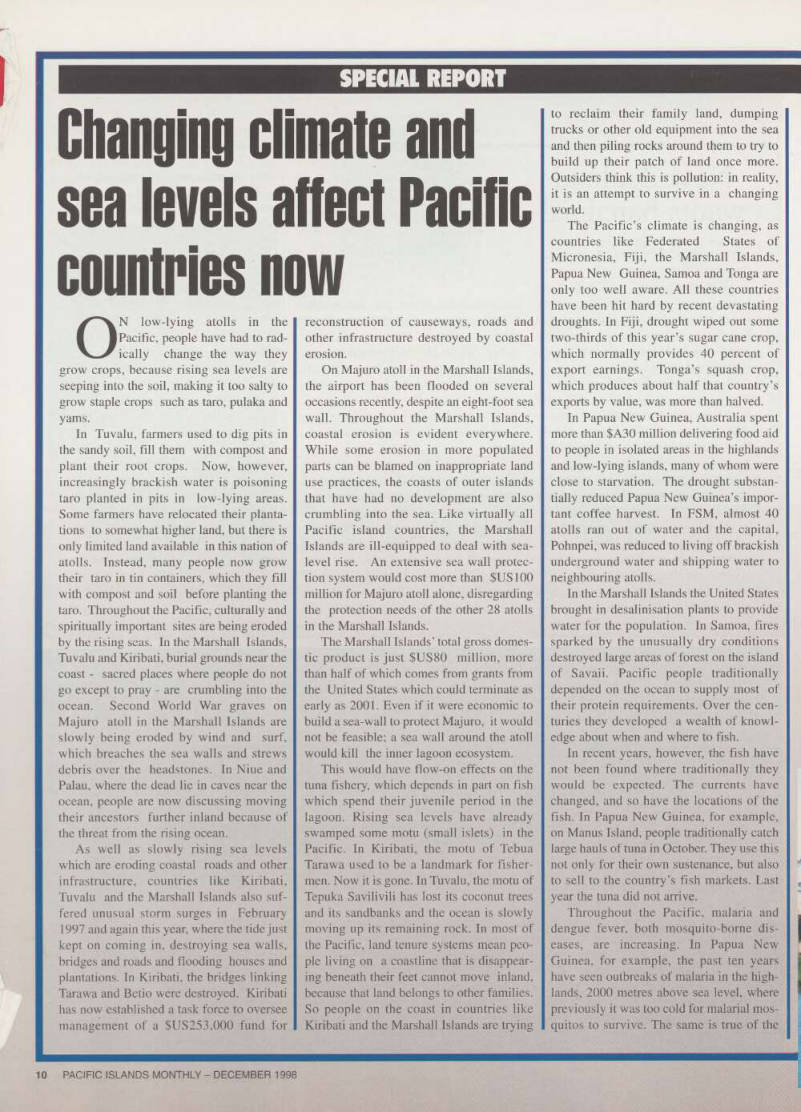
Rising sea-levels will affect this church on the banks of the Rewa River, Fiji
Co2 emitters
The world's biggest Co2 emitters
FOLLOWING is a list of the biggest emitters of carbon dioxide (CO2) held responsible for global warming, according to a list of 1996 statistics from the International Energy Agency issued at the Climate Change Conference held in mid-November.
Figures are in millions of tonnes of CO2. 1990 1995 1996 1. United States 4,873 5,228 5,324 2. China 2.398 3,006 3,179 3. Russia 2,000 1,574 1,516 4. Japan 1,061 1,150 1,177 5. Germany 981 884 904 6. India 600 803 863 7. Britain 585 565 582 8. Canada 428 471 469 9. Ukraine 600 430 387 10. Italy 408 424 420 11. France 378 362 384 12. Poland 349 335 365 13. Mexico 302 323 342 14. South Africa 296 319 317 15. Australia 263 286 303 Carbon dioxide is emitted by a variety of human activities involving fossil fuels (coal, oil and gas) and remains in the atmosphere for 120 years.
Total emission of CO2 from the combustion of fossil fuels totalled 22.7 bil lion tonnes in 1996, according to the Organisation for Economic Co-operation and Development, an increase of seven per cent compared with 1990.
Deforestation adds a fur ther estimated three bil lion to four billion tonnes of CO2 per year. Carbon dioxide, along with methane and nitrous oxide accounts for around 95 per cent of all green house gases.
Under last year’s Kyoto Protocol, devel oped nations have agreed to cut global warming gas emissions by an average of five per cent below 1990 levels between 2008 and 2012. ■
to "Buenos Aires
Mixed reviews to "Buenos Aires Inaction Plan”
Industry And
environmental groups had mixed reviews of the global warming action plan that emerged from the UN climate change conference that ended mid-November in Buenos Aires.
Greenpeace said it was dismayed that the plan - that calls on nations to resolve a host of difficult issues by 2000 - appeared to put national economic con
cerns above environmental ones. “This is turning into a trade and economic negotia tion,” said Bill Hare, climate policy direc tor for Greenpeace International.
“Climate is getting pushed further and further down the agenda,” Hare said.
“Science is being replaced by carbon trad ing markets as the driver for the talks”.
The environmental group Friends of the Earth International said the urgency of addressing global warming had been lost in the “Buenos Aires Inaction Plan”.
“Nations have failed to acknowledge that what they agreed to in Kyoto is nowhere near the deep cuts in carbon emissions * A .1
which we need to stop climate change,” the group said. “The meeting has been a trade fair, wrangling over how to keep the fossil fuel industry alive and burning”.
Last year in Kyoto, Japan, some 38 industrialised nations crafted what came to be known as the Kyoto Protocol.
The protocol required signatory nations to cut back greenhouse gas emissions mostly carbon dioxide from the burning of fossil fuels such as coal or oil - on an aver age five per cent from 1990 levels.
The World Wide Fund for Nature (WWF) said it welcomed the “slight”
progress made at the talks.
“It’s another small turn on the ruddei of the climate change supertanker,” said Lars Georg Jensen, leader of the WWF delegation. “But governments have much more to do to steer clear of mM the rocks”. The Environmental Defence Fund praised the “major strides” JH made at the end of the jßd&ro marathon talks, citing
progress on “flexi bility mechanisms” and rules for enforcement.
The decisions “bring the world one step closer to the reductions needed for a stable climate.
Already, a number of the world’s largest companies have responded positively with commitments to reduce (green house gas) emissions early”.
The Global Climate Coalition, an indus try group, said the meeting was ending with developing nations “still refusing to bring their bats, balls and gloves to the Kyoto playing field”.
“Until countries like China and India get into this game, the global climate treaty will be neither fair nor global,” said Connie Holmes, coalition chair.
The Pew Centre on Global Climate Change, a scientific organisation based in Washington, said the biggest hurdle to progress in the debate had been the “absence of leadership”.
“What was most striking about the
meeting was the emergence of leadership on climate change from both indus ■k try and the developing countries,” it said. ■
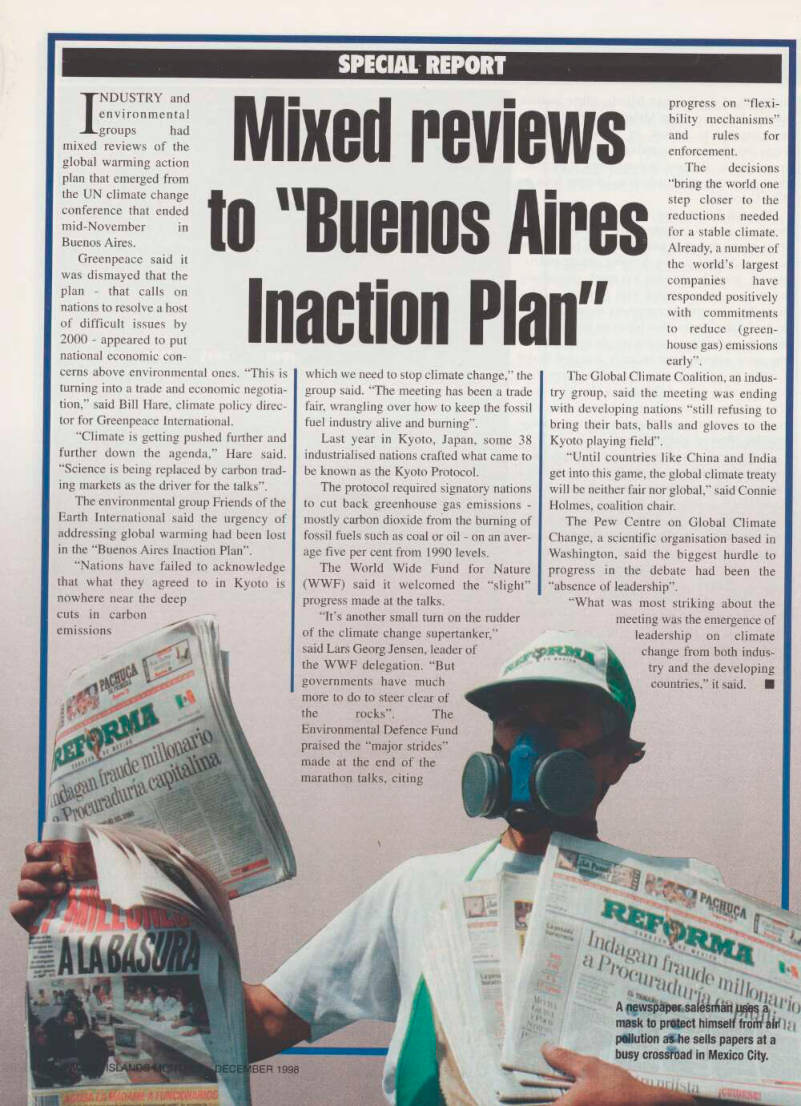
A newspaper salesman uses a mask to protect himself from air pollution as he sells papers at a busy crossroad in Mexico City.
Advertisements & other items, p. 12 (1 item)
Special Report
optimistic about Bougainville
Politics
Face to Face PMG outgoing commander optimistic about Bougainville
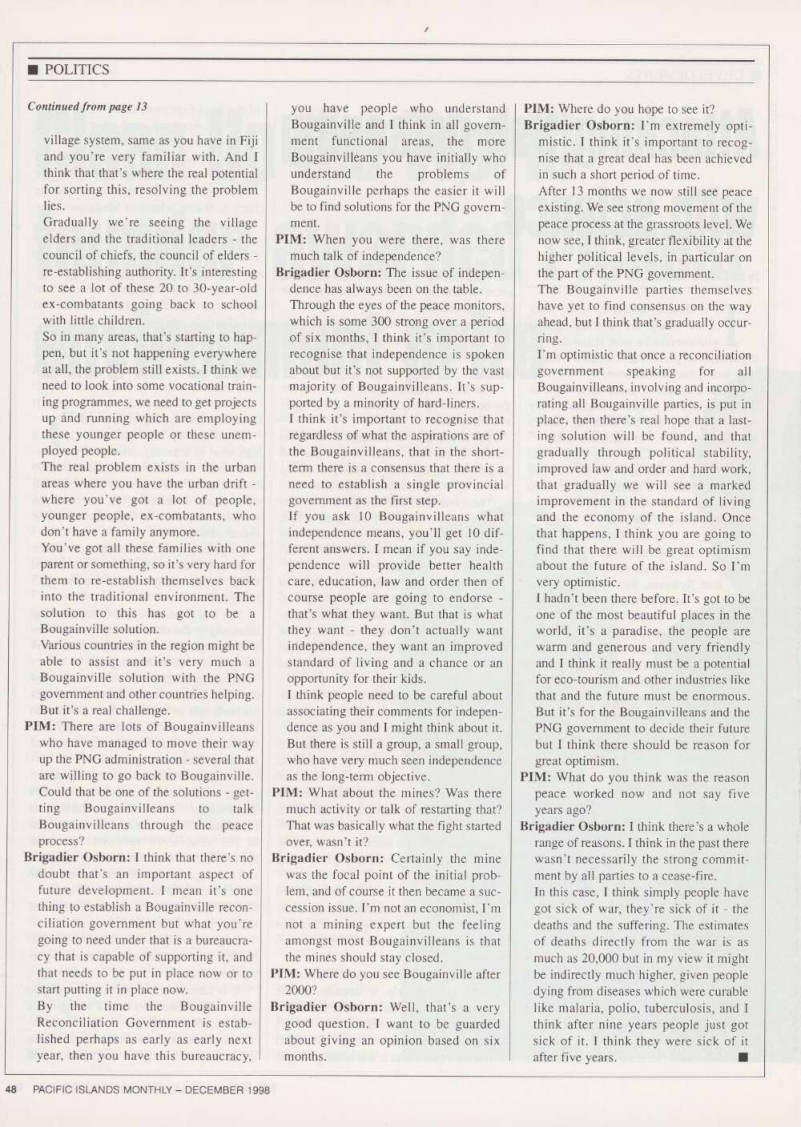
Maintaining peace on Bougainville has been one of the key issues in getting Papua New Guinea and the island back on the road to development.
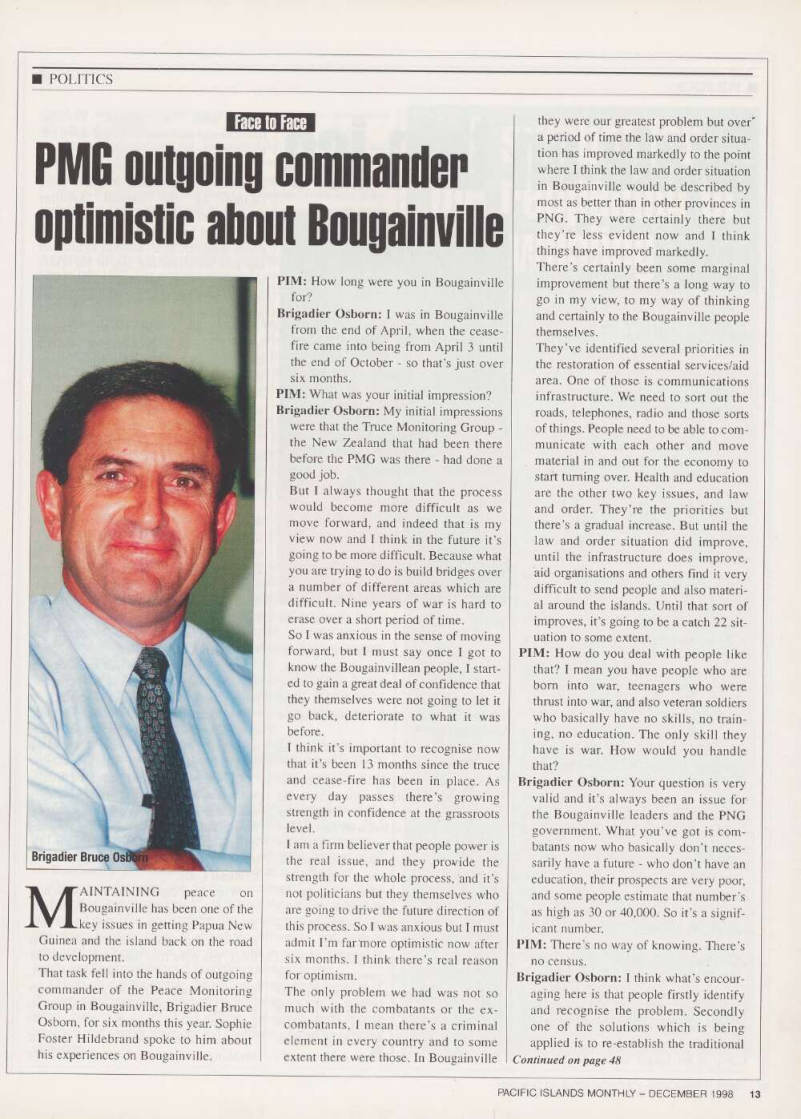
That task fell into the hands of outgoing commander of the Peace Monitoring Group in Bougainville, Brigadier Bruce Osbom, for six months this year. Sophie Foster Hildebrand spoke to him about his experiences on Bougainville.
PIM: How long were you in Bougainville for?
Brigadier Osborn: I was in Bougainville from the end of April, when the cease fire came into being from April 3 until the end of October - so that’s just over six months.
PIM: What was your initial impression?
Brigadier Osborn: My initial impressions were that the Truce Monitoring Group the New Zealand that had been there before the PMG was there - had done a good job.
But I always thought that the process would become more difficult as we move forward, and indeed that is my view now and I think in the future it’s going to be more difficult. Because what you are trying to do is build bridges over a number of different areas which are difficult. Nine years of war is hard to erase over a short period of time.
So I was anxious in the sense of moving forward, but I must say once I got to know the Bougainvillean people, I start ed to gain a great deal of confidence that they themselves were not going to let it go back, deteriorate to what it was before.
I think it’s important to recognise now that it’s been 13 months since the truce and cease-fire has been in place. As every day passes there’s growing strength in confidence at the grassroots level.
I am a firm believer that people power is the real issue, and they provide the strength for the whole process, and it’s not politicians but they themselves who are going to drive the future direction of this process. So I was anxious but I must admit I’m far more optimistic now after six months. I think there’s real reason for optimism.
The only problem we had was not so much with the combatants or the ex combatants, I mean there’s a criminal element in every country and to some extent there were those. In Bougainville
they were our greatest problem but over" a period of time the law and order situa tion has improved markedly to the point where I think the law and order situation in Bougainville would be described by most as better than in other provinces in PNG. They were certainly there but they’re less evident now and I think things have improved markedly.
There’s certainly been some marginal improvement but there’s a long way to go in my view, to my way of thinking and certainly to the Bougainville people themselves.
They’ve identified several priorities in the restoration of essential services/aid area. One of those is communications infrastructure. We need to sort out the roads, telephones, radio and those sorts of things. People need to be able to com municate with each other and move material in and out for the economy to start turning over. Health and education are the other two key issues, and law and order. They’re the priorities but there’s a gradual increase. But until the law and order situation did improve, until the infrastructure does improve, aid organisations and others find it very difficult to send people and also materi al around the islands. Until that sort of improves, it’s going to be a catch 22 sit uation to some extent.
PIM: How do you deal with people like that? I mean you have people who are born into war, teenagers who were thrust into war, and also veteran soldiers who basically have no skills, no train ing, no education. The only skill they have is war. How would you handle that?
Brigadier Osborn: Your question is very valid and it’s always been an issue for the Bougainville leaders and the PNG government. What you’ve got is com batants now who basically don’t neces sarily have a future - who don’t have an education, their prospects are very poor, and some people estimate that number's as high as 30 or 40,000. So it’s a signif icant number.
PIM: There’s no way of knowing. There’s no census.
Brigadier Osborn: I think what’s encour aging here is that people firstly identify and recognise the problem. Secondly one of the solutions which is being applied is to re-establish the traditional
Continued on page 48
Brigadier Bruce Osborn
Continued from page 13
village system, same as you have in Fiji and you’re very familiar with. And I think that that’s where the real potential for sorting this, resolving the problem lies.
Gradually we’re seeing the village elders and the traditional leaders - the council of chiefs, the council of elders re-establishing authority. It’s interesting to see a lot of these 20 to 30-year-old ex-combatants going back to school with little children.
So in many areas, that’s starting to hap pen, but it’s not happening everywhere at all, the problem still exists. I think we need to look into some vocational train ing programmes, we need to get projects up and running which are employing these younger people or these unem
ployed people.
The real problem exists in the urban areas where you have the urban drift where you’ve got a lot of people, younger people, ex-combatants, who don’t have a family anymore.
You’ve got all these families with one parent or something, so it’s very hard for them to re-establish themselves back into the traditional environment. The solution to th-is has got to be a Bougainville solution.
Various countries in the region might be able to assist and it’s very much a Bougainville solution with the PNG government and other countries helping.
But it’s a real challenge.
PIM: There are lots of Bougainvilleans who have managed to move their way up the PNG administration - several that are willing to go back to Bougainville.
Could that be one of the solutions - get ting Bougainvilleans to talk
Bougainvilleans through the peace
process?
Brigadier Osborn: I think that there’s no doubt that’s an important aspect of future development. I mean it’s one thing to establish a Bougainville recon ciliation government but what you’re going to need under that is a bureaucra cy that is capable of supporting it, and that needs to be put in place now or to start putting it in place now.
By the time the Bougainville Reconciliation Government is estab lished perhaps as early as early next year, then you have this bureaucracy,
you have people who understand Bougainville and I think in all govern ment functional areas, the more Bougainvilleans you have initially who understand the problems of Bougainville perhaps the easier it will be to find solutions for the PNG govern ment.
PIM: When you were there, was there much talk of independence?
Brigadier Osborn: The issue of indepen dence has always been on the table.
Through the eyes of the peace monitors, which is some 300 strong over a period of six months, I think it’s important to recognise that independence is spoken about but it’s not supported by the vast majority of Bougainvilleans. It’s sup ported by a minority of hard-liners.
I think it’s important to recognise that regardless of what the aspirations are of the Bougainvilleans, that in the short term there is a consensus that there is a need to establish a single provincial government as the first step.
If you ask 10 Bougainvilleans what independence means, you’ll get 10 dif ferent answers. I mean if you say inde pendence will provide better health care, education, law and order then of course people are going to endorse that’s what they want. But that is what they want - they don’t actually want independence, they want an improved standard of living and a chance or an opportunity for their kids.
I think people need to be careful about associating their comments for indepen dence as you and I might think about it.
But there is still a group, a small group, who have very much seen independence as the long-term objective.
PIM: What about the mines? Was there much activity or talk of restarting that?
That was basically what the fight started over, wasn’t it?
Brigadier Osborn: Certainly the mine was the focal point of the initial prob lem, and of course it then became a suc cession issue. I’m not an economist, I’m not a mining expert but the feeling amongst most Bougainvilleans is that the mines should stay closed.
PIM: Where do you see Bougainville after 2000?
Brigadier Osborn: Well, that’s a very good question. I want to be guarded about giving an opinion based on six months.
PIM: Where do you hope to see it?
Brigadier Osborn: I’m extremely opti mistic. I think it’s important to recog nise that a great deal has been achieved in such a short period of time.
After 13 months we now still see peace existing. We see strong movement of the peace process at the grassroots level. We now see, I think, greater flexibility at the higher political levels, in particular on the part of the PNG government.
The Bougainville parties themselves have yet to find consensus on the way ahead, but I think that’s gradually occur ring.
I’m optimistic that once a reconciliation government speaking for all Bougainvilleans, involving and incorpo rating all Bougainville parties, is put in place, then there’s real hope that a last ing solution will be found, and that gradually through political stability, improved law and order and hard work, that gradually we will see a marked improvement in the standard of living and the economy of the island. Once that happens, I think you are going to find that there will be great optimism about the future of the island. So I’m very optimistic.
I hadn’t been there before. It’s got to be one of the most beautiful places in the world, it’s a paradise, the people are warm and generous and very friendly and I think it really must be a potential for eco-tourism and other industries like that and the future must be enormous.
But it’s for the Bougainvilleans and the PNG government to decide their future but I think there should be reason for great optimism.
PIM: What do you think was the reason peace worked now and not say five years ago?
Brigadier Osborn: I think there’s a whole range of reasons. I think in the past there wasn’t necessarily the strong commit ment by all parties to a cease-fire.
In this case, I think simply people have got sick of war, they’re sick of it - the deaths and the suffering. The estimates of deaths directly from the war is as much as 20,000 but in my view it might be indirectly much higher, given people dying from diseases which were curable like malaria, polio, tuberculosis, and I think after nine years people just got sick of it. I think they were sick of it after five years. ■
Skate on thin ice
By Sam Vulum
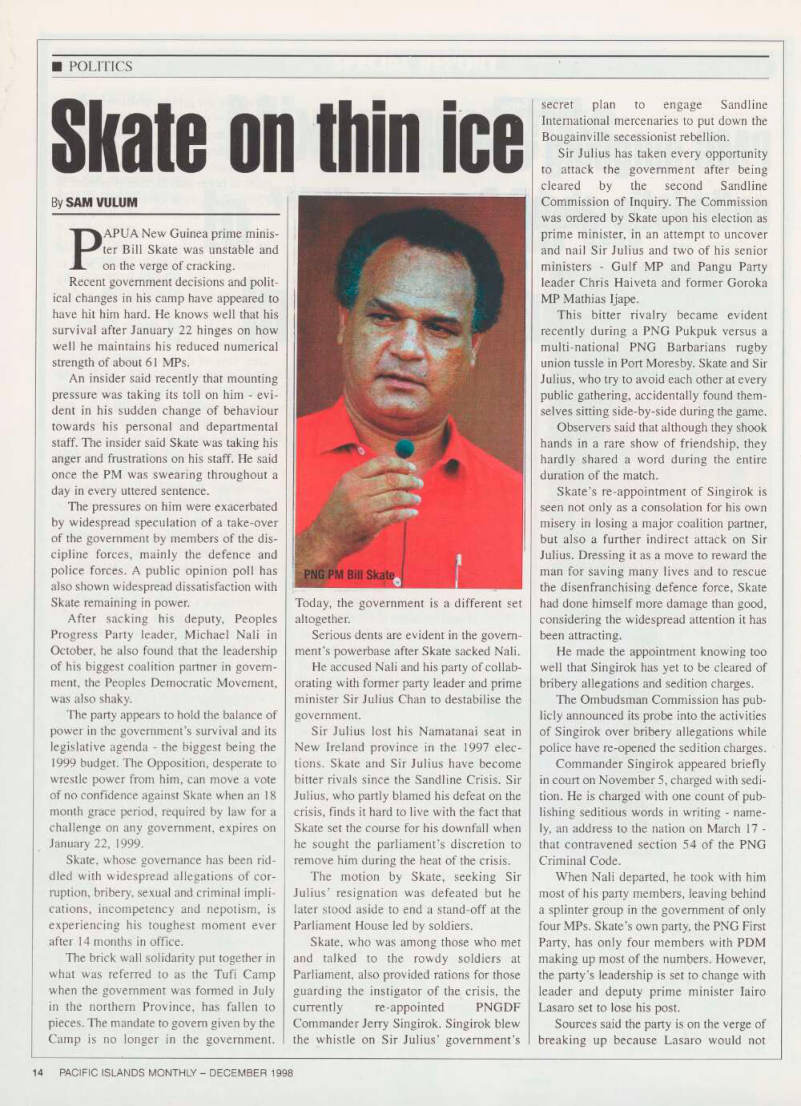
PAPUA New Guinea prime minis ter Bill Skate was unstable and on the verge of cracking.
Recent government decisions and polit ical changes in his camp have appeared to have hit him hard. He knows well that his survival after January 22 hinges on how well he maintains his reduced numerical strength of about 61 MPs.
An insider said recently that mounting pressure was taking its toll on him - evi dent in his sudden change of behaviour towards his personal and departmental staff. The insider said Skate was taking his anger and frustrations on his staff. He said once the PM was swearing throughout a day in every uttered sentence.
The pressures on him were exacerbated by widespread speculation of a take-over of the government by members of the dis cipline forces, mainly the defence and police forces. A public opinion poll has also shown widespread dissatisfaction with Skate remaining in power.
After sacking his deputy, Peoples Progress Party leader, Michael Nali in October, he also found that the leadership of his biggest coalition partner in govern ment, the Peoples Democratic Movement, was also shaky.
The party appears to hold the balance of power in the government’s survival and its legislative agenda - the biggest being the 1999 budget. The Opposition, desperate to wrestle power from him, can move a vote of no confidence against Skate when an 18 month grace period, required by law for a challenge on any government, expires on January 22, 1999.
Skate, whose governance has been rid dled with widespread allegations of cor ruption, bribery, sexual and criminal impli cations, incompetency and nepotism, is experiencing his toughest moment ever after 14 months in office.
The brick wall solidarity put together in what was referred to as the Tufi Camp when the government was formed in July in the northern Province, has fallen to pieces. The mandate to govern given by the Camp is no longer in the government.
Today, the government is a different set altogether.
Serious dents are evident in the govern ment’s powerbase after Skate sacked Nali.
He accused Nali and his party of collab orating with former party leader and prime minister Sir Julius Chan to destabilise the government.
Sir Julius lost his Namatanai seat in New Ireland province in the 1997 elec tions. Skate and Sir Julius have become bitter rivals since the Sandline Crisis. Sir Julius, who partly blamed his defeat on the crisis, finds it hard to live with the fact that Skate set the course for his downfall when he sought the parliament’s discretion to remove him during the heat of the crisis.
The motion by Skate, seeking Sir Julius’ resignation was defeated but he later stood aside to end a stand-off at the Parliament House led by soldiers.
Skate, who was among those who met and talked to the rowdy soldiers at Parliament, also provided rations for those guarding the instigator of the crisis, the currently re-appointed PNGDF Commander Jerry Singirok. Singirok blew the whistle on Sir Julius’ government’s
secret plan to engage Sandline International mercenaries to put down the Bougainville secessionist rebellion.
Sir Julius has taken every opportunity to attack the government after being cleared by the second Sandline Commission of Inquiry. The Commission was ordered by Skate upon his election as prime minister, in an attempt to uncover and nail Sir Julius and two of his senior ministers - Gulf MP and Pangu Party leader Chris Haiveta and former Goroka MP Mathias Ijape.
This bitter rivalry became evident recently during a PNG Pukpuk versus a multi-national PNG Barbarians rugby union tussle in Port Moresby. Skate and Sir Julius, who try to avoid each other at every public gathering, accidentally found them selves sitting side-by-side during the game.
Observers said that although they shook hands in a rare show of friendship, they hardly shared a word during the entire duration of the match.
Skate’s re-appointment of Singirok is seen not only as a consolation for his own misery in losing a major coalition partner, but also a further indirect attack on Sir Julius. Dressing it as a move to reward the man for saving many lives and to rescue the disenfranchising defence force, Skate had done himself more damage than good, considering the widespread attention it has been attracting.
He made the appointment knowing too well that Singirok has yet to be cleared of bribery allegations and sedition charges.
The Ombudsman Commission has pub licly announced its probe into the activities of Singirok over bribery allegations while police have re-opened the sedition charges.
Commander Singirok appeared briefly in court on November 5, charged with sedi tion. He is charged with one count of pub lishing seditious words in writing - name ly, an address to the nation on March 17 that contravened section 54 of the PNG Criminal Code.
When Nali departed, he took with him most of his party members, leaving behind a splinter group in the government of only four MPs. Skate’s own party, the PNG First Party, has only four members with PDM making up most of the numbers. However, the party’s leadership is set to change with leader and deputy prime minister lairo Lasaro set to lose his post.
Sources said the party is on the verge of breaking up because Lasaro would not
PNG PM Bill Skate
stand up and represent the party on major policies and issues affecting the country.
The private opinion poll, conducted by Meli Research and Marketing Consultants, says that the Government is not very pop ular among the citizens in the rural or village based sector.
The poll indicated that this may have resulted from less infor mation on the government and its activities getting through to the rural communities.
But the majority of the urban population interviewed do not appreciate the current government’s performance since its forma tion in July 1997. The majority of women and the rural sector pre fer Opposition Leader Bernard Narokobi as their choice for prime minister.
Former prime minister Sir Michael Somare was the men’s choice and ranked first as most preferred prime minister overall.
A cross-section of the population, totalling 20,000 persons, was interviewed - 14,000 men (representing 60 per cent) and 6000 families (representing 40 per cent) were interviewed between July, August and September this year.
About 60 per cent of these were from the formal sector or peo ple in urban centres, while the balance was from the rural areas.
A sample population of 9130 (representing 45.65 per cent) feels that the Skate government should be replaced after the 18month grace period is up, while 22.9 per cent prefers it remain in power.
The second highest sample of 32.45 per cent refused to make any comments because they did not know enough about the cur rent government and the opposition.
Most of the respondents who refused to comment are from the rural sector and do not have access to information.
While launching the study results, Meli Research principal Michael Meli said the opinion poll reflected the rural population lacked government information. It is felt that any government in PNG must have an effective network of communication between the government and its people in rural areas.
Misleading information results in opinions that really do not reflect the government’s performance, Mr Meli said. People blame the current government for economic chaos in the country, which resulted from past government’s mishandling.
“We therefore recommend that the Office of Information estab lished by the Somare Government be re-established to effectively disseminate government information to the people more effective ly,” Mr Meli said.
About 29 per cent of the people interviewed (both formal and informal sectors) appreciate the government’s performance, 36.5 per cent does not agree, while 34.5 per cent refused to comment.
The Skate government’s approach to solve the 10-year crisis on Bougainville is considered “very practical and effective”.
Other reasons why the Skate government is appreciated include it is “grassroots based” - displayed through its support to health and education programmes, the introduction of free educa tion policy (despite delays in school fee deliveries)- and Skate is perceived as a simple man who mixes with people, is involved in sports and breaks all protocol procedures to meet people.
Others do not appreciate the current government because of the worsening economic situation coupled with the hire of an eco nomic advisor at a cost of K 7 million, the appointment of vice ministers and a super secretary and confusion created by splitting ministries. ■
whaling
A symbol for the reopening of whaling
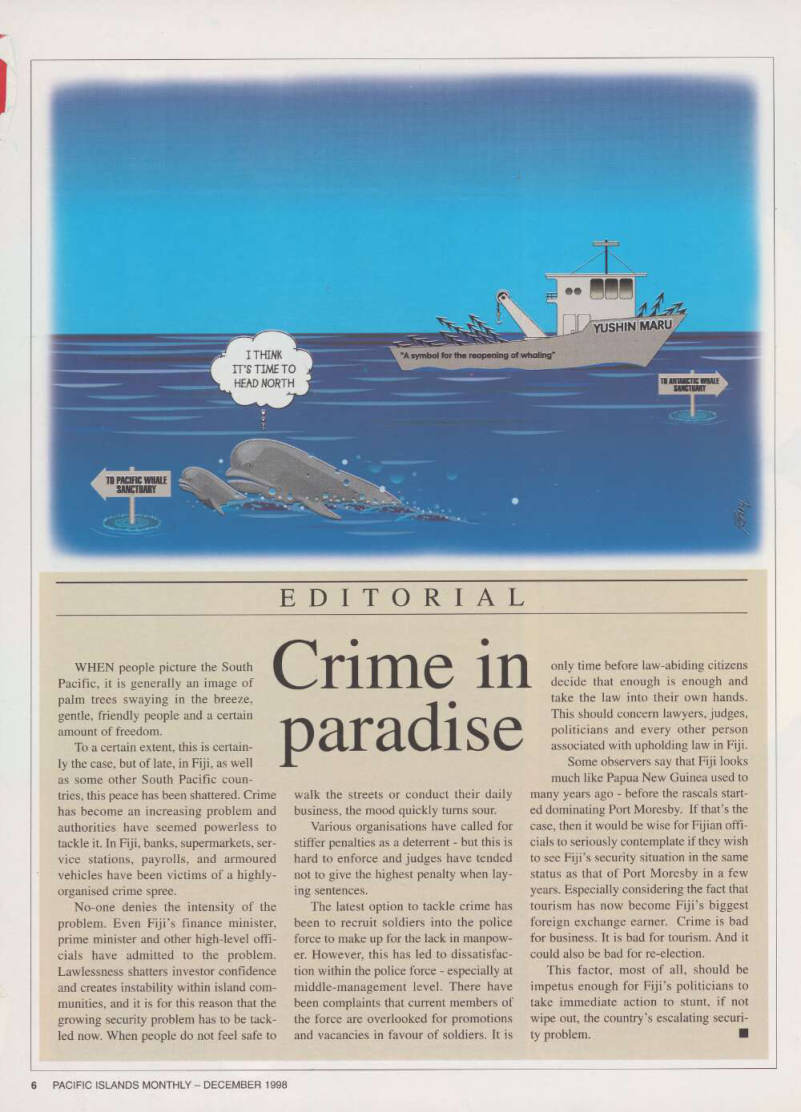
THE effectiveness of the Australian-led drive to cre ate a South Pacific Whale Sanctuary could come into question following a move by Japan mid- November to defy a ban on whale hunting.
Japan’s brand new whaling fleet left the country mid- November to hunt whales in the Antarctic whale sanctuary despite concerns raised by the International Whaling Commission (IWC).
The fleet includes the Yushin Maru, which is the first new whaler built by Japan in 26 years.
The Japanese move has been described by that country’s press as “a symbol for the reopening of whaling”.
Leaders at the last South Pacific Forum meeting had sup ported the proposal to establish a South Pacific Whale Sanctuary for great whales. However, during the meeting there was last-minute opposition to the sanctuary from Palau to the wording to the agreement.
Palau wanted the text to include the cultural considerations of island countries and “their partners”. Japan is a big sup porter of the Palau economy and funds many aid projects in that country.
The final text of the Sancutary recognised the need to con sult with Dialogue Partners, including Japan.
The Japanese government describes the Antarctic whale hunt as “scientific research”. However, the International Whaling Commission says the results of Japan’s Antarctic program are not required for management of whales.
The most recent meeting of the IWC, formally noted “the grave concerns of eminent members of the international sci entific community over the continuation of lethal whale research programs”.
Whale meat from the hunt is expected to sell for more than US$5O million on the open market when the fleet returns to Japan in the Spring of 1999.
“To describe this commercial whaling operation as scien tific research is an insult to science,” says John Frizell of Greenpeace International.
“Japan is catching whales in a whale sanctuary, intending to open that sanctuary for full scale commercial whaling,” says Frizell.
“Japanese industry is investing millions of dollars in new equipment to assist the whalers. This is commerce, not sci ence.”
Japan’s whaling fleet is owned by three large fishing com panies, who are thought to be the source of financing for the new catcher boat. ■
Advertisements & other items, pp. 16-17 (1 item)
Asian Development Bank-Japan Scholarship Program
(funded by the Government of Japan) Qualified citizens of developing member countries of the Asian Development Bank, who intend to pursue post graduate studies in selected disciplines are invited to apply for scholarships under the Asian Development Bank- Japan Scholarship Program. It is anticipated that upon successful completion of their graduate studies under the Program, the scholars will return to their countries and contribute to its socio-ecenomic development Scholarships are awarded for graduate studies at designated institutions in courses of study approved by ADB. The program especially welcomes women applicants who are qualified but have limited financial means to obtain university education.
ELIGIBILITY REQUIREMENTS
Prospective applicants must * be a citizen of an ADB developing member country * have at least two years work experience * have gained admission to an approved course in a designated institution * be in good health
THE SCHOLARSHIPS
* Level of Education: Post -graduate (Diploma, Masters and Doctorate degrees) * Duration: From one to three years * Coverage: Tuition fees, books and subsistence allowance, insurance and economy airfare
APPLICATION REQUIREMENTS
Applicants should; * obtain application forms from the designated institutions of their choice * submit the completed application form and required documentation to the institution * indicate on the application form that the applicant wishes to be considered for an Asian Development Bank- Japan Scholarship (From among those admitted by the institutions, ADB will select candidates for award of scholarships. A separate application to ADB is not necessary)
DESIGNATED INSTITUTIONS
1. ASIAN INSTITUTE OF MANAGEMENT
123 Paseo de Roxas, Makati City Metro Manila, Phillipines Attn: Admissions Director Telephone No: (632) 893-7631 / 892- 4011 to 25 Fax No: (632) 817-9240 URL: http://netserve.asim.edu.ph Email: [email protected] Business Management, Development Management, Management
2. ASIAN INSTITUTE OF TECHNOLOGY
P.0.80x 4, Klong Luang Pathumthani, Thailand 12120 Attn: Scholarship Program Coordinator Telephone No: (662) 516-0110 to 29 (662) 524-5031 to 33
FAX No: (662) 516-2126 / (662)524-
6326 URL: http://www.ait.ac.th Email: [email protected] Science and Technology, including Environmental Management and Engineering Management Of Technology International Business
3. EAST WEST CENTER I UNIVERSITY
OF HAWAII
1601 East-West Road, Honolulu Hawaii 96848, US.A Attn: ADB Scholarship Program Administrator Telephone No: (808) 944-7634
FAX No: (808) 944-7070
URL: http://www.ewc.hawaii.edu Email: [email protected] Japan- focused Executive MBA Business Administration Ocean & Earth Science & Technology Ocean Engineering & Oceanography Pacific Islands Studies Social Science, Economics, Geography, Public Administration, Sociology, Urban & Regional Planning Tropical Agriculture & Resource Economics Horticulture including Plant Pathology
4. INDIAN INSTITUTE OF
TECHNOLOGY, DHELI
New Dheli 110016, India Attn: The Registrar Telephone No: (9111) 666-979 Fax No: (9111) 686-2037 URL: http://www.iitd.ernet.in Email: [email protected] Science and Technology
5. INTERNATIONAL RICE RESEARCH
INSTITUTE I UNIVERSITY OF THE
PHILIPPINES IN LOS BANOS
P.0.80x 933, Manila, Philippines Attn: Director, Research and Training Telephone No: (632) 845-0563 / 845- 0569 / 845-05570 Fax No: (632) 845-0606 / 891-1292 URL: http://www.cgiar.org/irri Email: [email protected] Fields related to Rice and Rice-Based Farming
6. INTERNATIONAL UNIVERSITY OF
JAPAN
Graduate School Of Internationals Relations Yamato-machi, Minami
Uonuma-gun
Niigata 949-7277, Japan Attn: Office of GSIR Telephone No: (81257) 79-1200
FAX No: (81257) 79-1187
URL: http://www.iuj.ac.jp Email; [email protected] International Development International Relations Graduate School Of International Management
Yamato-machi, Minami Uonuma-gun Niigata 949-7277, Japan Attn: Office Of GSIM Telephone No: (81257) 79-1500
FAX N0.(81257) 79-4443
Email: [email protected] URL: http://www.iuj.ac.jp International Management
7. LAHORE UNIVERSITY OF
MANAGEMENT SCIENCES
103-0/2 Gulberg 111, Lahore, Pakistan Attn: The Registrar Telephone No: (9242) 572-2670 to 79
FAX No: (9242) 572-2591
URL: http://www.lums.edu.pk Email: [email protected] Business Administration
8. NATIONAL CENTER FOR
DEVELOPMENT STUDIES /
AUSTRALIAN NATIONAL
UNIVERSITY
GPO Box 4, Canberra ACT 0200, Australia Attn: Program Director Telephone No: (612) 6249-4705
FAX No: (612) 6257-2886
URL: http://www.ncdsnet.anu.edu.au Email: [email protected] Economics of Development, Development Administration, Demography, Environmental Management and Development Infrastructure Management
9. NATIONAL UNIVERSITY OF
SINGAPORE
10 Kent Ridge Crescent, Singapore 0511 Attn: Director, School of Postgraduate Management Studies Telephone No: (65) 772-2068 / 772- 6149
FAX No: (65) 778-2681
URL: http://www.fba.nus.edu.sg
Email: [email protected],sg
Business Administration, Management of Technology, Social Sciences (Economics)
10. SAITAMA UNIVERSITY
255 Shimo-Okubo Urawa City 338-8570, Japan Attn: The Registrar
Department Of Civil & Environmental Engineering Phone / Fax No: (81 -48) 858-3555 URL: http://www.dvil.saitamau.ac.jp/fso Email:fso@sun. civil, saitama-u.ac.jp Civil and Environmental Engineering and Related Subjects Attn: Dean, Graduate School of Policy Science Telephone No: (81-48) 858-3110-2 Fax No: (81 -48) 852-0499 URL: http://www.poli-sci.saitamau. ac.jp Email: [email protected] Development Studies, Public Analysis Public Policy
I I.THAMMASAT UNIVERSITY
2 Prachand Road, Bangkok 10200, Thailand Attn: Vice- Rector for Academic Affairs Telephone No: (662) 516 4537- 8/516 9003-5 Fax No: (662) 222 8872
URL: http://www.tu.ac.th/org/grad/
grad.htm Email: [email protected] Economics, Engineering
12. UNIVERSITY OF AUCKLAND
Private Bag 92019, Auckland, New Zealand Attn: International Student Officer, International Student Office Telephone No: (649) 373-7513 Fax No: (649) 373-7405 URL: http://www auckland.ac.nz Email: [email protected] International Business, Development Studies, Environmental Science and Management, Engineering, Public Health
13. UNIVERSITY OF HONG KONG
Pokfulam Road, Hong Kong, China Attn: Executive Officer, Research and Postgraduate Administration Telephone No: (852) 2859-2111 Fax No; (852) 2859-9459 / 2959- 2549 URL: http//www.hku.hk Email: [email protected]
Urban Planning, Urban Design
14. UNIVERSITY OF MELBOURNE
Parkville,, Victoria,3os2 Australia Attn: Melbourne Scholarships Office Telephone No;' (613) 9345 9562 Fax No: (613) 9349 1740 / 9349 2103 URL: http://www.cwis.unimelb.edu.au Email: prrad@scholarships .unimelb.edu.au Business Administration, Commerce, Commerce (specializing in Economics) Engineering, Internationals Business, Public Health, Agribusiness, Agricultural Science, Forest Science
15. UNIVERSITY OF SYDNEY
The International Office Sydney 2006, Australia Attn; International Scholarships Officer Telephone No: (612) 9351-2778 Fax No: (612) 9351-4013 URL: http://www.usyd.edu.au Email: [email protected] Business Administration, Economics, Commerce, Transport Management, Public Health
16. UNIVERSITY OF TOKYO
Hongo, Bunkyo-ku, Tokyo 113-8656, Japan Attn: Foreign Student Office Department Of Civil Engineering Telephone No: (813) 3812-2111 Fax No: (813) 3812-4977 / 3818 5692 URL: http://incede.iis.u-tokyo .ac.jp/civil Email: [email protected]. u-tokyo .ac.jp Civil Engineering and Infrastructure Development Hongo, Bunkyo-Ku, Tokyo US- -0033, Japan Attn: Director, School of International Health Telephone No: (813) 3812-2111 ext 3531 Fax No: (813) 5684-2739 Email: [email protected] .ac.jp Public Health (International Health)
Sip Geoffrey supports
Pokino amidst scandal
By Florence Syme-Buchanan
WHAT does a government do with a senior min ister who has brought much shame on his country, family and political party in a wide ly publicised sex scandal?
Nothing, if he’s a Cook Islands Cabinet minister.
Disgraced minister of Finance, Papamama Pokino did not return from New Zealand as scheduled on November 7 to face Cabinet colleagues, a shocked public and hurt fam ily members. Instead, prime minister Sir Geoffrey came forward with the excuse that his long time friend was remaining in New Zealand for “health reasons.”
At 62, Pokino who’s always favoured long hair and high heeled boots is healthy and fit, after years of working out on weights. So Sir Geoffrey’s excuse didn’t wash with the public now giving signs of being fed up with Cabinet’s ongoing excuses protecting their colleague.
The Opposition Democratic Alliance party is demand ing that Pokino either resign or be sacked for the public sex romp he had with Niuean woman, Dawn Vilila. The National Council of Women have written to the prime min ister wanting the minister stripped of the portfolio of Women, Youth and Sport. Spokeswoman Teresa Manarangi Trott says this most recent incident was the last straw as Pokino’s denigrating remarks and lewd behaviour towards women could not be tolerated anymore.
A Cook Islands citizen, Steve Boggs laid a formal com plaint with Police over Pokino’s public escapades. But Police still refused to investigate or lay charges, saying the matter was closed. Undeterred, Boggs went a step further and proposes to charge Commissioner of Police Tevai Matapo with obstruction of justice.
Pressure on Sir Geoffrey and Cabinet to do something over Papamama Pokino’s behaviour is mounting - but as usual in the Cooks, public opinion is being ignored by the eight ministers.
All have refused to respond to questions regarding “Pokinogate” the October sex-scandal that rocked the nation. On the other hand, some have been quick to the defend Agriculture minister Vaine Tairea - alleged to have been drunk and abusive at Auckland airport while leading the country’s Commonwealth Parliamentary Association conference.
Education minister Ngereteina Puna says he sat next to Vaine Tairea on the flight and claims the minister never drank. Tairea travelled to Auckland barefoot, embarrassing other Cook Islanders and consular general Bill Teariki who was at the airport to pick the delegation up.
There’s little public doubt that Pokino extended his stay hoping the matter would have blown over by his return.
That’s unlikely. ■
woman"
The "other woman" has her say
£ £ W ’M a good person,” says the Niue woman who does I not deny she had public sex with a married Cook -M-Islands Cabinet minister.
Dawn Vilila has said the first mistake she made was placing her trust in Finance minister Papamama Pokino - the man she had a public sex romp with. ‘‘A man who was supposed to be one of the leaders of your country and an old colleague of my father’s.”
The woman, Dawn Vilila faxed Cook Islands Press a letter expressing her feelings on the scandal.
Describing herself as an "honest and caring person” Vilila in a separate note to this writer, says her life was nearly ruined by the Cook Islands Press report on what had happened between her and Minister Pokino.
"But only because I had let it. From here on I am not going to let it happen,” she says.
"What your country does with your minister is your business, but please respect my privacy as I have been through a lot lately,” says Vilila in her note.
Vilila contradicts her wish for privacy by saying she has dis tributed her letter to "other people and the media.”
She wrote; "The media always claim to be fac tual and neutral. In this case I disagree as every one has had input except me. I am sick and tired of all the allegations evolving around the inci dence. I am writing to tell you that, that young woman does have a say.”
Dawn Vilila is married with children and works for the Niue department of Community Affairs.
What has become evident is that Pokino and Vilila's October encounter in Rarotonga was not the first. They were also photographed having dinner together in Tahiti in July this year. A pho tograph of the pair has been shown to PIM, but its owner refused to have it published. In it, Pokino has his arm around a smiling Dawn Vilila - a source who was at the dinner says both had been drinking heavily and left together that night.
News has filtered to Rarotonga of Pokino’s behaviour at the regional Youth conference in Tahiti. Allegations are that the minister drank excessively throughout the official visit demand ing to be taken to all Papeete bars one Sunday.
He’s also alleged to have sexually harassed a female liaison officer who laid an official com plaint with conference organisers. She was replaced by a male liaison officer. ■
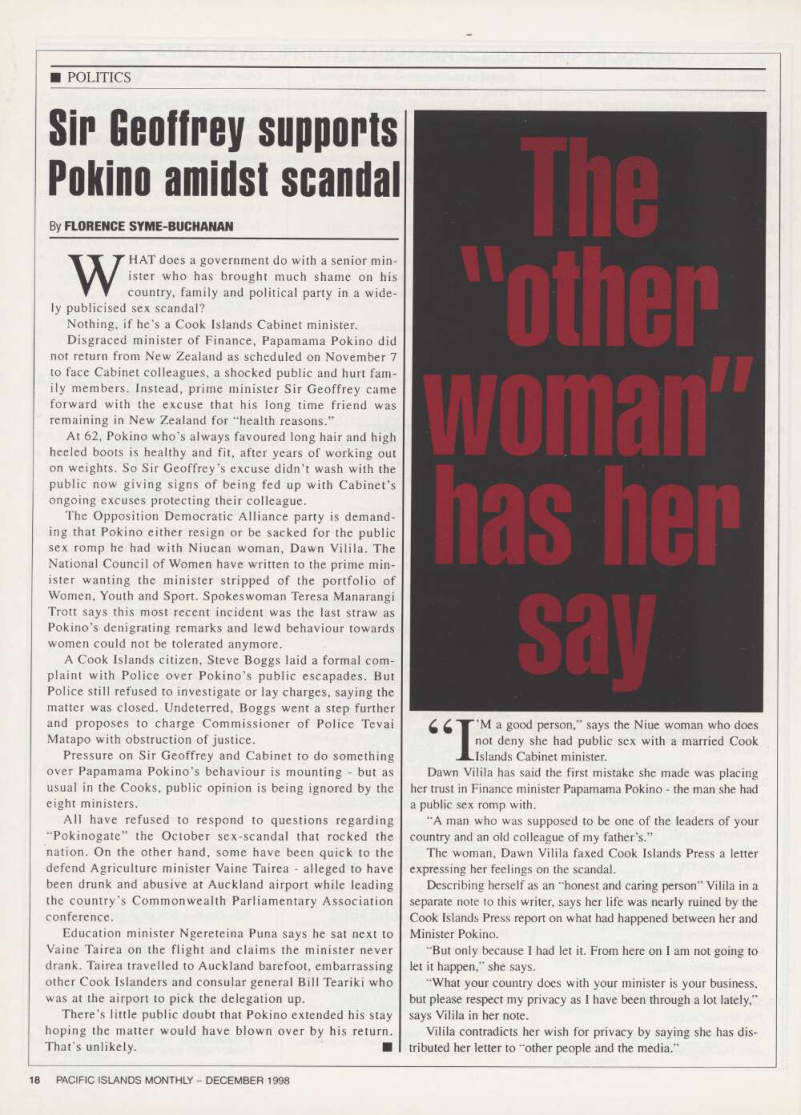
Cook Islands finance minister Papamama Pokini
Advertisements & other items, p. 19 (1 item)
: *
fcp
Box 16149, Suva, Fiji. Phone: 306100 Fax: 30 •A 33S »» i ■ We utilise leading edge technology to give you total versatility, uncompromising quality, high production speed in scanning, colour separation, image retouching, page assembly and design. $
New Caledonia prepares to turn accord into law
THE strong ‘yes’ vote in favour of a deal giving the Pacific territory of New Caledonia greater autono my from France has eased the threat of renewed social tension, analysts said. Official results released mid- November showed 71.86 per cent of New Caledonians voted for the accord, which paves the way for the creation of a new assembly and a new referendum in 15 to 20 years on a formal split with France. The official election body also announced that 74.23 per cent of the nearly 107,000 eligi ble voters cast ballots.
The vote significantly eased social ten sion of recent weeks that forced a heavy police presence around the capital Noumea. Businessmen were also looking to the future, after maintaining a low pro file during the referendum.
Chamber of Commerce and Industry president Michel Quintard said New Caledonians now had "20 years in front of them of considerable freedom and the financing (by Paris) for those freedoms”.
He predicted that despite the problems for the crucial nickel industry it could look
forward to a boost in tourism, New Caledonia’s number two earner.
An official committee was to meet to begin turning the accord with the French government approved in the referendum, into law. With representatives of pro and anti-independence parties taking part, it is to draft a legal document based on the accord that will then be voted into law.
The leading pro-independence party, the Kanak National Socialist Liberation Front (FLNKS) has said it will ensure the law reflects the substance and the “spirit” of the agreement.
Once it becomes law new elections will be held for the territory’s congress which in turn will be able to elect a new executive to replace the high commission. The accord was brokered in two years of nego tiations by French officials and is aimed at preventing a repeat of the 1980 s, when pro independence groups launched a campaign for independence and triggered bloody clashes between native Melanesians and European settlers. The FLNKS and the anti-independence Rally for Caledonia in the Republic both signed the Noumea accord with French Prime Minister Lionel
Jospin in May. Both parties then cam paigned for a ‘Yes’ vote.
The highest proportion of ‘Yes’ votes were in the two Kanak majority provinces, North province and the Loyalty Islands where 86.79 per cent and 95.47 per cent voted yes respectively.
In South province around Noumea, where most ethnic European groups live, turnout was a strong 80.71 per cent, but with fewer ‘Yes’ votes, only 62.99 per cent.
Since 1958, New Caledonia has had eight different statutes within the French republic, the present one being the fruit of the 1988 Matignon Accord, which ended several years of separatist violence.
Around 45 per cent of the population are native Melanesians and a third of European descent. Most of the others are from the tiny French Pacific territory of Wallis and Futuna, and Asian nations such as Indonesia and Vietnam.
The separatist groups are dominated by Melanesians, who say they have been dis criminated against in key appointments and do not get a fair share of the wealth generated by New Caledonia’s huge nickel reserves. (AFP) ■
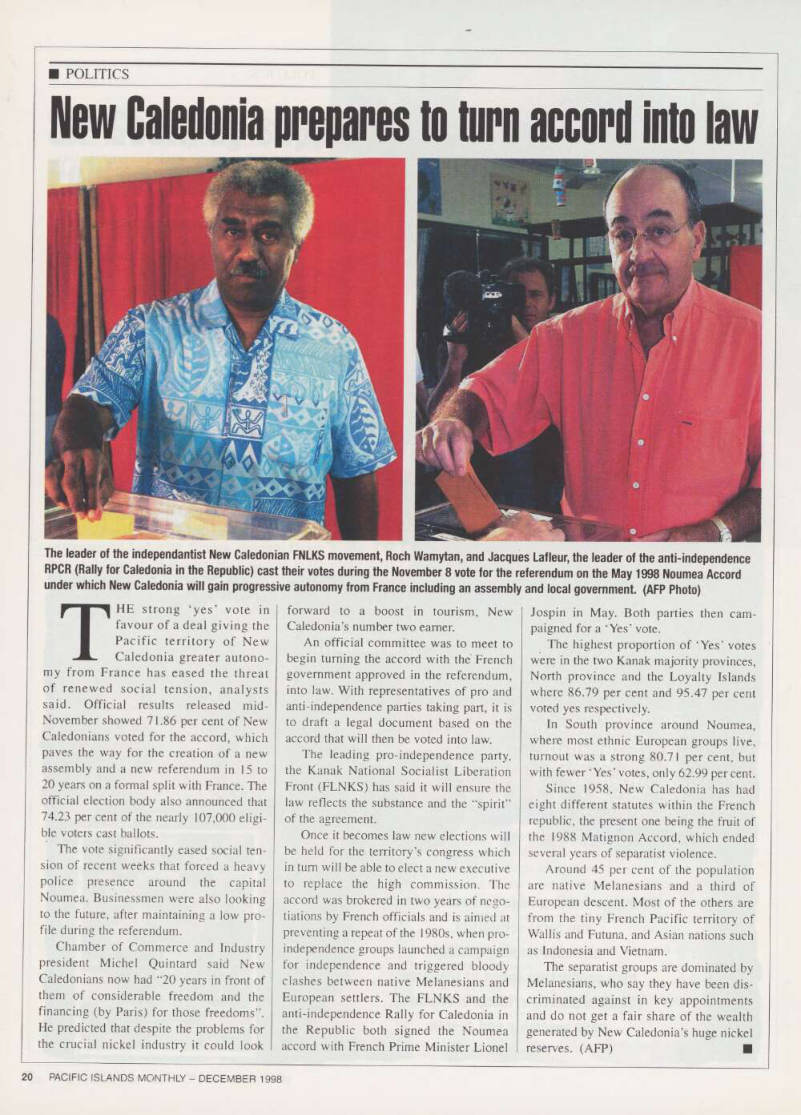
The leader of the independantist New Caledonian FNLKS movement, Roch Wamytan, and Jacques Lafleur, the leader of the anti-independence RPCR (Rally for Caledonia in the Republic) cast their votes during the November 8 vote for the referendum on the May 1998 Noumea Accord under which New Caledonia will gain progressive autonomy from France including an assembly and local government. (AFP Photo)
Copymasters Hawaii,

Advertising Feature - Products & Services
Copymasters promote education in office equipment technology
Inc. has been in business since 1994, and specialis es in Duplo Digital Duplicators that are the current gener ation of duplicator equipment. The company is also the dealer and service centre for various other office equip ment and supplies including paper and toner. The company’s territory covers the entire Pacific, stretching from the State of Hawaii, the entire South Pacific and Micronesia including Guam and the Northern Marianas.
“We first ventured into Micronesia because of many requests for ‘spirit or mimeo’ type duplicators and supplies that use very flammable fluids that were highly combustible and were being used in vari ous school systems where there were a lot
of children,” a company statement said Schools in Hawaii were already using the digital duplicators or safe type of duplica tors because of strict health regulations and the obsolete ‘spirit’ type equipment was being ‘dumped’ or sold to various Pacific- Rim countries. According to various com panies "they wouldn’t know the differ ence”. Copymasters Hawaii says "this prompted us to help educate people from various South Pacific and Micronesia countries in the knowledge and use in cur rent office equipment technology through participation in the Pacific Resources for Education and Learning (PREL) confer ences held each year at various locations in the Pacific”.
Today, Copymasters Hawaii serves clients like Pohnpei State, FSM; Education department, Kosrae State, FSM;
Department of Education, The Republic of Marshall Islands; Ministry of Education and many othpr education systems throughout the Pacific. “One of its proud est accomplishments was assisting Mr Damian Sold, Director of Education for Pohnpei State, FSM, who was instrumen tal in placing the same type of digital duplicators and copiers in each of some 30 public schools, setting up an internal print shop, and have two highly skilled service technicians who can repair and service their own equipment without incurring additional cost, thus a saving of hundreds of thousands of dollars in the coming years in repair cost alone,” the statement said.
Copymasters works directly with vari ous agencies of governments, including education, school to work programmes, head start and special education depart ments, by providing “free” service and repair training programmes that are spon sored by the company. “We strongly believe that by providing exceptional ser vice, our business will continue to grow and at the same time offer valuable career training,” the company says. ■
Advertisements & other items, pp. 21-22 (1 item)
ToFinish...
From Start...
|hh ■**•l Copymasters Hawaii can help you with all of your duplicating needs from start to finish. Featuring Duplo Digital Duplicators, Copiers, Shredders, Laminators, Poster Printers, Collators, & Folding Equipment. We also sell Stencil & Duplicator Supplies, Paper Supply, and all brands of Copier Supplies, & Computers.
Copymasters Hawaii
94-515 Ukee Street, Suite 201 • Waipahu, HI 96797 Phone (808) 678-2263 • Fax (808) 678-2013
E-Mail: [email protected]
ToFinish...
Serving:
STATE OF HAWAII
ENTIRE
SOUTH PACIFIC,
INCLUDING;
’ FIJI
■ SAMOA
TAHITI
TONGA
COOK ISLANDS
MICRONESIA:
FEDERATED STATES
OF MICRONESIA
GUAM
MARIANAS
MARSHALL
ISLANDS
PALAU
copymasters
hawaii
i==3j m a -—i—-* Shop 1,1-7 Rewa St., Flagstaff Suva Ph : (679) 300900 Fax : 300905 Shop 3 Grace Bros Bldg. 538 Main St. Nadi.
P.O Box 2922 Nadi. Fiji Ph : (679) 703966 Fax : (679) 703968 HE
National Panasonic^
Sarbari Electrical Co. Ltd Fiji
Goodman
Fielder
m.
SHOPPING CENTRE
AKttT XV" . «.ir, ; :,TT \JWt jAJCAJ/tt I ayjflYs video
PIC^PITH
■manscißEe
SHEELA'S IVAsm
HOT BREAD KITCHEN
IT SYSTEMS SOLUTIONS PTYLTO
SMITH PACIFIC AOVEHTUBi BVtlB
PUSHPAS TAKEAWAYS
Kings Neon Signs can

light up your business
SINCE December 1995, Kings Neon Signs has been lighting up business es. The company spe cialises in manufacturing neon lights, fluorescent illuminated signboards and advanced computerised signages, for example, cutting vinyl in various designs Car Body Decal, Reflective Road Signages, Fabricated Letters, Banners and many more.
With offices in Suva and Nadi, the company manages to service the needs of not just businesses in Fiji but Apia, Tonga, Kiribati, Vanuatu and Papua New Guinea.
According to Mr Sam Chan, the man aging director of Kings Neon Sign, some of the company’s clients in Fiji include Post Fiji, Telecom Fiji, ANZ Bank, Courts, and Prouds. Kings Neon Sign has captured over 70 per cent of the market
share of neon and light boxes in Fiji, and that is just the start. With increasing com petition amidst the current economic cli mate, businesses have to do what it takes to bring people into their stores. Many businesses have opted for promoting themselves through neon and fluorescent signboards, and these are very effective.
As well as an eye-catching piece of work, at Kings Neon Signs, you are pay ing for quality. Kings Neon Signs has fully experienced Hong Kong technicians and artists, with local experts at managing each processing from design to warranty.
So if you want to light up your busi ness, give Aman Vikash Chandra a call, at the Kings Neon Sign head office in Nadi, on telephone number (679) 703966.
You will not regret the difference that Kings Neon Sign can make for your busi ness. ■
digital image-making
Picture CD to revolutionise digital image-making
THE self-proclaimed har
binger of the next revolu tion arrived inauspi ciously late and in the back of a dark brown delivery truck.
Coddled in thick bubble wrap was a new piece of technology whose makers claim will revolutionise the way people take more than 80 billion photographs each year world-wide.
The new Picture CD - jointly launched by Kodak, Intel and Adobe systems promises to be one of the most useful bits of consumer technology announced.
Due to be released next year and cur rently on a trail run in the United States, the software aims to introduce ordinary photographers to the dramatic new possi bilities of digital image-making.
This is one of those high-tech sectors that no one ever dreamed of needing before they were invented. Digital cam eras, for all their high-tech features, have
hardly made a splash in the camera mar ket, accounting for only about one per cent of sales since the start of the year.
Their appeal has largely been more to "techies” than to serious photographers who find that bits and bytes cannot equal the picture quality of traditional film.
News photographers - professionals who need digital images to send to their papers - prefer to scan their traditional negatives for e-mail rather than taking digital photos to start with.
Retail outlets have also been largely unimpressed with the response to new ser vices allowing customers to get their pho tos developed both on print and a floppy disc.
But according to industry observers, the new picture disk will change the way most people feel about high-tech pictures and will mark an important step into mak ing digital imaging as übiquitous as com puters themselves. ■
Advertisements & other items, pp. 22-24 (2 items)
22
■ ADVERTISING FEATURE - PRODUCTS & SERVICES
PACIFIC ISLANDS MONTHLY - DECEMBER 1998
/
am
KIAORA! BULAVINAKA!
MAEVA! ALOHA!
HOWEVER WE SAY IT,
IT MEANS WELCOME!
Budaet
Fiji 722 636 Papua New Guinea 325 4111 Vanuatu 231/0 New Caledonia 262 009 Hawaii 838 1111 Western Samoa 20561 Australia 1300 362 848 New Zealand 0800 652 221
• : mWi . r m r-' : ” a p^pb
t irr«
ure g
®3l f# ini MS i • ._._.«§ 1 I H , ■
BMOn
i * ■: 4
rrs3
N DP <***, Maun! bjmt far it '- sB ©v Portion *m*& % % >r » I V# fS Only one airline can fly you to Sydney and on to more than 60 locations across Australia. Giving you direct access to all the major destinations and those small out of the way places. The majestic and vast OUtback. And all the excitement of Australia’s vibrant, friendly cities. It is the same airline that was voted Australia’s Airline of the Year five years in a row. The same airline that now flies you non-stop to Sydney from Fiji every Wednesday and Sunday. Be our guest. For bookings and further information call Ansett Australia on 679 313 100 (Suva) or 679 722 955 (Nadi), or your travel agent. ANSETTAUSTRALI A
YOUR AIRLINE TO AUSTRALIA
winning
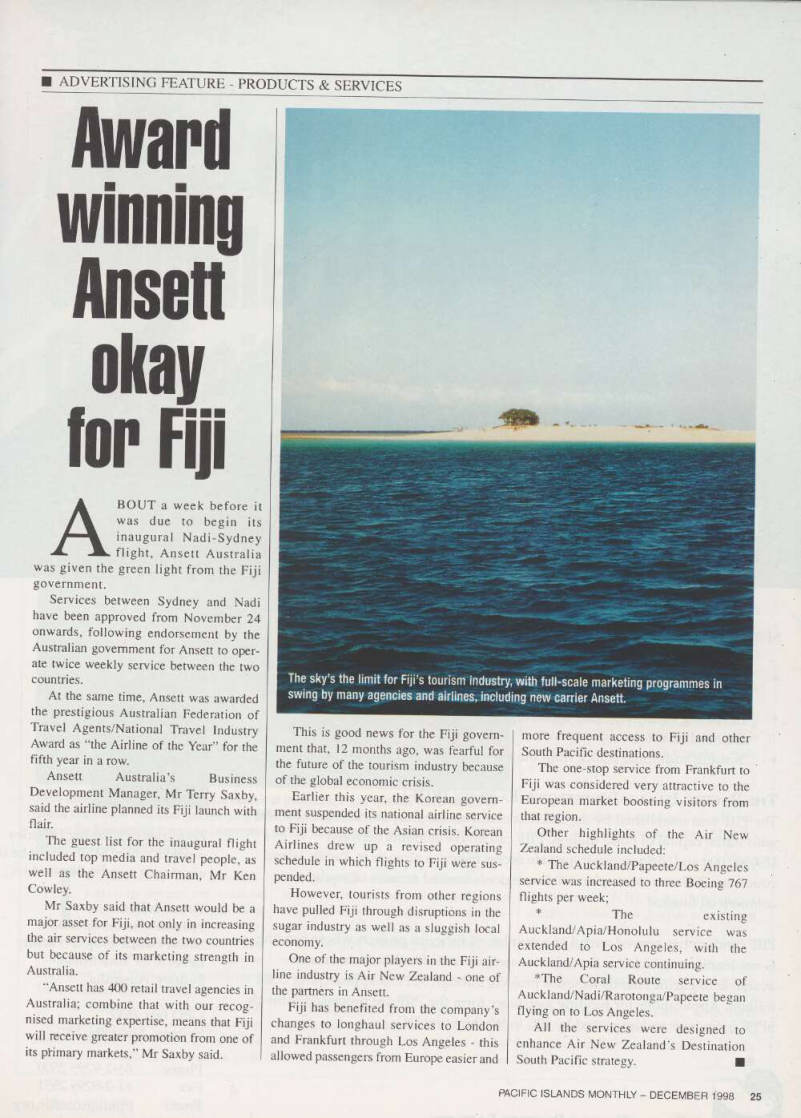
Award winning Ansett okay far Fiji
ABOUT a week before it was due to begin its
inaugural Nadi-Sydney
flight, Ansett Australia was given the green light from the Fiji government.
Services between Sydney and Nadi have been approved from November 24 onwards, following endorsement by the Australian government for Ansett to oper ate twice weekly service between the two countries.
At the same time, Ansett was awarded the prestigious Australian Federation of Travel Agents/National Travel Industry Award as “the Airline of the Year” for the fifth year in a row.
Ansett Australia’s Business Development Manager, Mr Terry Saxby, said the airline planned its Fiji launch with flair.
The guest list for the inaugural flight included top media and travel people, as well as the Ansett Chairman, Mr Ken
Cowley.
Mr Saxby said that Ansett would be a major asset for Fiji, not only in increasing the air services between the two countries but because of its marketing strength in Australia.
"Ansett has 400 retail travel agencies in Australia; combine that with our recog nised marketing expertise, means that Fiji will receive greater promotion from one of its primary markets,” Mr Saxby said.
This is good news for the Fiji govern ment that, 12 months ago, was fearful for the future of the tourism industry because of the global economic crisis.
Earlier this year, the Korean govern ment suspended its national airline service to Fiji because of the Asian crisis. Korean Airlines drew up a revised operating schedule in which flights to Fiji were sus pended.
However, tourists from other regions have pulled Fiji through disruptions in the sugar industry as well as a sluggish local economy.
One of the major players in the Fiji air line industry is Air New Zealand - one of the partners in Ansett.
Fiji has benefited from the company’s changes to longhaul services to London and Frankfurt through Los Angeles - this allowed passengers from Europe easier and
more frequent access to Fiji and other South Pacific destinations.
The one-stop service from Frankfurt to Fiji was considered very attractive to the European market boosting visitors from that region.
Other highlights of the Air New Zealand schedule included; * The Auckland/Papeete/Los Angeles service was increased to three Boeing 767 flights per week;
The existing
Auckland/Apia/Honolulu service was extended to Los Angeles, with the
Auckland/Apia service continuing.
*The Coral Route service of
Auckland/Nadi/Rarotonga/Papeete began
flying on to Los Angeles.
All the services were designed to enhance Air New Zealand's Destination South Pacific strategy. ■
The sky’s the limit for Fiji’s tourism industry, with full-scale marketing programmes in swing by many agencies and airlines, including new carrier Ansett.
Advertisements & other items, pp. 25-26 (2 items)
25
PACIFIC ISLANDS MONTHLY - DECEMBER 1998
■ ADVERTISING FEATURE - PRODUCTS & SERVICES
JliFlf
fipfe m .JsS m i HP i sS I H M *:- •-.
Ifc
■/ SPPF can fisheries project sponsors in three main areas: • Formulating, evaluating and promoting fisheries projects and providing consultancy services to develop and implement business plans; • Obtaining equity and loan financing on commercial terms from financial institutions; • Raising additional equity from the Pacific Island Investment Facility.
The Pacific Island Investment Facility (PIIF) The PIIF was established by the International Finance Corporation (IFC) in 1995 with initial capital of US$2 million. PIIF can invest amounts between US$lOO,OOO and USs7so,oooin private sector fisheries projects in Pacific island countries. PIIF acts to supplement the region's limited sources of equity and commercial finance.
PIIF funding has proved useful in a number of fisheries projects where funding is not readily available for the fisheries sector. Funds for this source made available to Pacific Islands fisheries projects through SPPF is approaching US$l million. Applications for funding assistance form the PIIF are processed through SPPF in Sydney and approved by IFC in Washington, DC.
Enquiries concerning fisheries projects where SPPF might be of assistance may be directed to:
Peter Philipson
Fisheries Sector Specialist
South Pacific Project Facility
Level 8, 89 York Street
Sydney, Australia
GPO Box 1612 Sydney, Australia 2001 South Pacific Project Facility Phone 61-2-9299 2500 Fax 61-2-9299 2551
Email [email protected]
APEC officials
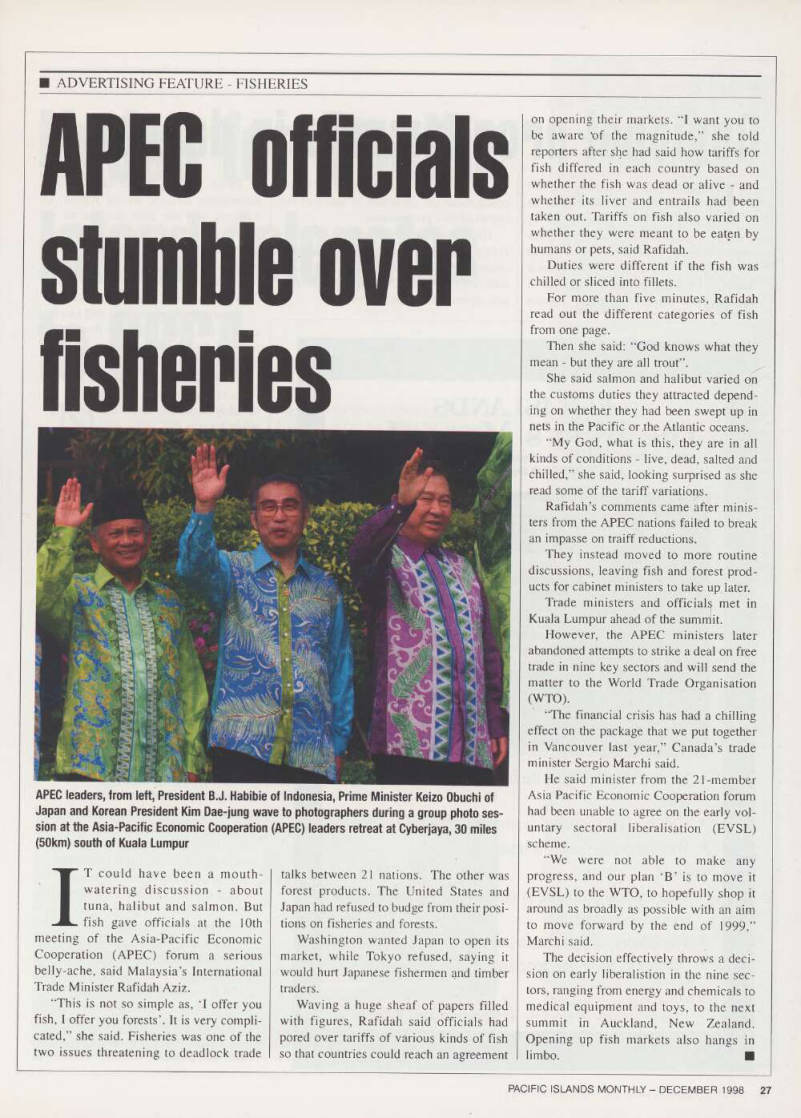
stumble over fisheries
IT could have been a mouth watering discussion - about tuna, halibut and salmon. But fish gave officials at the 10th meeting of the Asia-Pacific Economic Cooperation (APEC) forum a serious belly-ache, said Malaysia’s International Trade Minister Rafidah Aziz.
“This is not so simple as, ‘I offer you fish, I offer you forests’. It is very compli cated,” she said. Fisheries was one of the two issues threatening to deadlock trade
talks between 21 nations. The other was forest products. The United States and Japan had refused to budge from their posi tions on fisheries and forests.
Washington wanted Japan to open its market, while Tokyo refused, saying it would hurt Japanese fishermen and timber traders.
Waving a huge sheaf of papers filled with figures, Rafidah said officials had pored over tariffs of various kinds of fish so that countries could reach an agreement
on opening their markets. “I want you to be aware 'of the magnitude,” she told reporters after she had said how tariffs for fish differed in each country based on whether the fish was dead or alive - and whether its liver and entrails had been taken out. Tariffs on fish also varied on whether they were meant to be eaten by humans or pets, said Rafidah.
Duties were different if the fish was chilled or sliced into fillets.
For more than five minutes, Rafidah read out the different categories of fish from one page.
Then she said: “God knows what they mean - but they are all trout”.
She said salmon and halibut varied on the customs duties they attracted depend ing on whether they had been swept up in nets in the Pacific or the Atlantic oceans.
“My God, what is this, they are in all kinds of conditions - live, dead, salted and chilled,” she said, looking surprised as she read some of the tariff variations.
Rafidah’s comments came after minis ters from the APEC nations failed to break an impasse on traiff reductions.
They instead moved to more routine discussions, leaving fish and forest prod ucts for cabinet ministers to take up later.
Trade ministers and officials met in Kuala Lumpur ahead of the summit.
However, the APEC ministers later abandoned attempts to strike a deal on free trade in nine key sectors and will send the matter to the World Trade Organisation
(Wto).
“The financial crisis has had a chilling effect on the package that we put together in Vancouver last year,” Canada’s trade minister Sergio Marchi said.
He said minister from the 21-member Asia Pacific Economic Cooperation forum had been unable to agree on the early vol untary sectoral liberalisation (EVSL) scheme.
"We were not able to make any progress, and our plan B’ is to move it (EVSL) to the WTO, to hopefully shop it around as broadly as possible with an aim to move forward by the end of 1999,”
Marchi said.
The decision effectively throws a deci sion on early liberalistion in the nine sec tors, ranging from energy and chemicals to medical equipment and toys, to the next summit in Auckland, New Zealand.
Opening up fish markets also hangs in limbo. ■
APEC leaders, from left, President B.J. Habibie of Indonesia, Prime Minister Keizo Obuchi of Japan and Korean President Kim Dae-jung wave to photographers during a group photo ses sion at the Asia-Pacific Economic Cooperation (APEC) leaders retreat at Cyberjaya, 30 miles (50km) south of Kuala Lumpur
Regional programmes in danger
Focus
INCREASING competition for decreasing resources could mean the slashing of some programmes by regional organisations, according to the Deputy Director-General of the Secretariat of the Pacific Community (SPC) Jimmie Rodgers. Dr Rodgers said the realities of the Pacific’s current economic climate
would have implications on the SPC and could mean the reduction of some of the organisation’s programmes.
He highlighted areas such as environ mental and community health, aquaculture, quarantine, information technology and television in the SPC’s health, agriculture and regional media programmes.
These, he said, would have positive programme impacts on the region. Dr Rodgers told the 28th Session of the SPC's governing council, in Noumea, New Caledonia, the such competition had placed constraints on regional organisa tions that need to identify gaps in service delivery and better target assistance.
He also outlined internal and external constraints being faced by the SPC in terms of resource allocation and the SPC
donor/client relationship.
The organisation’s ability to continue to build capacity and transfer skills sus tainably at national level was also high lighted. ‘The eight regional organisations ser vicing the Pacific Islands are competing for the same resources and need to identi fy areas not being addressed by each other,” Dr Rodgers said.
Further, the current economic climate in the Pacific Islands meant any increase in assessed contributions (from SPC member states) “would not be welcome”, he said.
The representative of Tuvalu and High Commissioner to Fiji, His Excellency Enele Sopoaga also stressed the finiteness of the region’s resources, urging the SPC not lose sight of the important goals of capacity building and human resource development.
He said the lack of national commit ment was a constraint that needed to be addressed, as was absorption capacity at national level, particularly with imple mentation (of programmes).
The Forum Secretariat observer and director of its Development and Economic Policy Division, losefa Maiava called for regional organisations to be in tune with their changing environment.
He urged them to take the needs of the private sector into further consideration, particularly concerning the impact of eco nomic reforms on this sector.
Mr Maiava suggested that the propos al be tabled through the South Pacific Organisations Co-ordinating Committee (SPOCC) working group.
This, he said, was to avoid duplication by other regional organisations in this area. This is one of the strategies to help make scarce funding resources stretch. ■
Advertisements & other items, p. 28 (1 item)
prices Jm'umt's
FIJI ISLANDS
The West’s Motor Inn
Phone: (679) 720044 E-mail: [email protected] Fax: (679) 720071. P.0.80x 10097, Nadi Airport. mjMatrn Sip Jt I Ideally situated between the International Airport and Nadi Town 62 Rooms from standard to airconditoned deluxe Poolside dining, variety at reasonable
prices Jm'umt's
Entertainment performed by our very T T meter inn talented pianist/vocalist Free courtesy airport transfers on request 24-hour reception and porterage
Island delegates
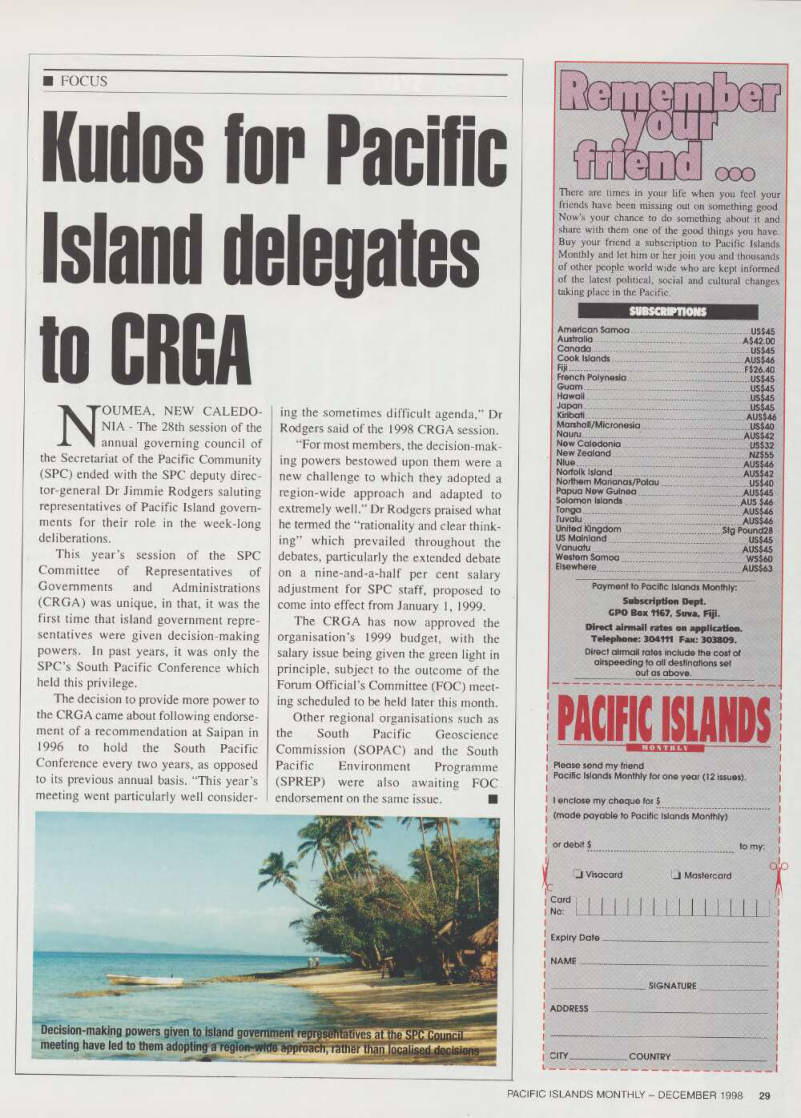
Kudos for Pacific Island delegates to CRGA
Noumea, new Caledo nia - The 28th session of the annual governing council of the Secretariat of the Pacific Community (SPC) ended with the SPC deputy direc tor-general Dr Jimmie Rodgers saluting representatives of Pacific Island govern ments for their role in the week-long deliberations.
This year’s session of the SPC Committee of Representatives of Governments and Administrations (CRGA) was unique, in that, it was the first time that island government repre sentatives were given decision-making powers. In past years, it was only the SPC’s South Pacific Conference which held this privilege.
The decision to provide more power to the CRGA came about following endorse ment of a recommendation at Saipan in 1996 to hold the South Pacific Conference every two years, as opposed to its previous annual basis. “This year’s meeting went particularly well consider
ing the sometimes difficult agenda,” Dr Rodgers said of the 1998 CRGA session.
“For most members, the decision-mak ing powers bestowed upon them were a new challenge to which they adopted a region-wide approach and adapted to extremely well.” Dr Rodgers praised what he termed the “rationality and clear think ing” which prevailed throughout the debates, particularly the extended debate on a nine-and-a-half per cent salary adjustment for SPC staff, proposed to come into effect from January 1, 1999.
The CRGA has now approved the organisation’s 1999 budget, with the salary issue being given the green light in principle, subject to the outcome of the Forum Official’s Committee (FOG) meet ing scheduled to be held later this month.
Other regional organisations such as the South Pacific Geoscience Commission (SOPAC) and the South Pacific Environment Programme (SPREP) were also awaiting FOG endorsement on the same issue. ■
Decision-making powers given to island government representatives at the SPC Conuncil meeting have led to them adopting a region wide approach, rethaer than localised decisions
Advertisements & other items, p. 29 (1 item)
Pacific Island!
OCX)
There are times in your life when you feci your friends have been missing out on something good, Now’s your chance to do something about it and share with them one of the good things you have.
Buy your friend a subscription to Pacific Islands Monthly and let him or her join you and thousands of other people world wide who are kept informed of the latest political, social and cultural changes taking place in the Pacific.
American Samoa US$45 Australia A 542.00 Canada US$45 Cook Islands AUSS46 F 'ji F 526.40 French Polynesia US$45 Guam US$45 Hawaii US$45 Japan US$45 Kiribati AUSS4S Marshall/Micronesia US$4O Nauru AUSS42 New Caledonia . US$32 New Zealand NZ$55 Niue AUSS46 Northern Marianas/Palau US$4O Papua New Guinea /US$45 Tonga . AUSS46 Tuvalu AUSS4S United Kingdom Stg Pound2B US Mainland US$45 Vanuatu AUSS4S Western Samoa. WS$6O Elsewhere . AUSS63 Payment to Pacific Islands Monthly: Subscription Dept.
GPO Box 1167, Suva, Fiji.
Direct airmail rates on application.
Telephone: 304111 Fax: 303809.
Direct airmail rates include the cost of airspeeding to all destinations set out as above.
PACIFIC ISLAND!
rmr I Please send my friend I Pacific Islands Monthly for one year (12 issues).
I I enclose my cheque for $ (made payable to Pacific Islands Monthly) I or debit $ to my: Ijj Visacard j Mastercard
Card I
No; L, 1 1.1 .
Expiry Date
NAME
ADDRESS
CITY
iiiJ
I I
SIGNATURE
.COUNTRY
disorder

Cover Story
Unlawful disorder Fiji’s growing security problem
By Sophie Foster Hildebrand
Business people throughout Fiji
are on edge - and this time it is not to do with the declining state of Fiji’s economy. The issue is security and the increasing deterioration of law and order in the country.
They have good reason to be worried. Of all armed robberies in Fiji, the majority are directed at businesses and business people.
In most cases, the day’s takings plus whatev er amount is not banked from previous days are taken - with force.
Even the banks have not been spared from the crime spree. But armed robbery is not the only problem. With increasing occur rences of native landowners taking over land, businesses such as hotels and even the country’s electricity provider have come under fire. The police have seemed power less to tackle the problem with low morale and even fewer resources hindering any progress on this front. In September this year, the Fiji Hotel Association, which repre sents about 80 per cent of the room capacity in Fiji, decided that enough was enough. In a letter to the Fiji Employers Federation, the FHA called for a meeting of all business organisations and associations to pressure the government into taking action.
“You will no doubt be aware of the spate of criminal activities, as reported in the media and the suspicion of the existence of an organised crime ring manifested by the
sophisticated manner in which recent crimi nal activities have been conducted. Farge supermarkets, service stations, business pay rolls and banks have been victims of such activities,” the letter said.
“The law and order situation with regard to landowners taking the law into their own hands has gathered momentum since the Monasavu crisis. In tourism this has extend ed to qoliqoli owners demanding money unlawfully for use of the water for activities such as diving and surfing.
“The Fiji Hotel Association’s concern pertains to the magnitude and increase of criminal activities in our country and the somewhat ineffective deterrents imposed by the Police Force and other relevant authori ties in retort to this unlawful disorder.
“These issues appear to affecting investor confidences, a decline which simply cannot be afforded in the current economic state and the impending ramifications that may arise if this problem is not addressed promptly,” it said. Already one investor in a multi-million dollar hotel project in Fiji has pulled out.
This time it was because of the volatile union situation in a particular hotel that had spilled over to the point where staff had walked out on management.
After an emergency cabinet meeting, dur ing which the Commissioner of Police briefed the prime minister on the crime situ ation, Fiji’s prime minister, Sitiveni Rabuka said a new approach to law and order was needed.
“The Commissioner of Police gave us a very clear situation report of what’s going on but at the end of which he said he was quoting from a report which was written 23 years ago,” the prime minister said.
“So the situation now is no different from what it was 23 years ago. The only dif ference now is that we are trying to do something about it. It may involve the injec tion of funds, it may involve the injection of expertise... it may also involve the injection of a whole new approach to the fight against crime,” he said. Fiji’s finance minister, Mr Jim Ah Koy, in presenting his 1999 budget to parliament, admitted that the country has a problem with law and order.
“We are all concerned about the rising lawlessness in this country. In recent weeks, we read in the newspapers the increasing instances of robberies and violence. This is a serious development that we must address immediately. This lawlessness damages our reputation and shatters investor confi dence,” he said.
The biggest concern, of course, is the impact such a situation will have on invest ment. Mr Ah Koy says “for many invest ment prospects, law and order has become the main cornerstone of investment attrac tion”. “There is a strong body of evidence around the world that asseverates that con cessions are rather low on the list of priori ties for investors. Many other factors pre cede concessions like stability, certainty, consistency, good governance, good pay ment system, law and order and so forth,” he said. To tackle the problem, the govern ment has allowed for an additional alloca tion to the Police Department of $5.8 mil lion from $36.4 million to $42.2 million for 1999. The Police Department would also have access to $2.2 million set aside in the Budget for Anti Corruption and an addition al provision of $450,000 annually was made for the operation of the Prisons Department for the next three years. But even Mr Ah Koy admitted that “the problem of law and order is not going to be solved by money alone”.
“It requires a multifaceted approach and some serious thinking and planning. To avert the breakdown of law and order we must ensure that the economy continues to grow to provide the economic safety net; strengthen our traditional ties and the fami ly support unit,” he said. The government solution also calls for an improvement of the education system with attitudinal train ing and developing laws to be supportive of
such a solution. The relevant departments in Government must build up their capacities and their management to ensure that the funds provided are used effectively and the
programmes are implemented properly.
“I would like to call on each and every one of us to stand up and band together against crime. We must have zero tolerance against people who are involved in criminal activities. And we must send out a strong message that crime does not pay as we will safeguard our communities from this destructive force,” he said. The chief execu tive of the Fiji Hotel Association, Ms Olivia Pareti, says “what’s worrying is not only the increase in the number of crimes that are reported such as robberies or burglaries or whatever, but it seems also to be a very pro fessional crime ring that’s operating around the country and the targets for this, apart from the households, are businesses”.
“That’s very worrying for us and we have to take some drastic steps. We are inviting our members to be very, very care ful now, and not to be complacent”. For Fiji’s booming tourism industry, the issue is one that it cannot take lightly. Image is what counts. “It’s bad enough from where we see it, as Fijians living in the country, so can you imagine what our visitors think of it when they come in and see the dark side of Fiji,” Ms Pareti says, “once if they stayed here for two weeks, they might see such incidents once or twice in the paper, but now there’s just pages and pages of it every day”. “We want to project this image of a safe and secure destination to come to. You don’t want to have your hotels with lots of security guards patrolling like a few years ago. A few years ago we were saying why do we need all these security guards when the first person you see greeting you as you come into a resort is a security guard. Now it’s a necessity to have that and it’s not cre ating a good image for us,” Ms Pareti says.
With tales of harassment of tourists and lately, reports of the banned drug, marijua na, being made available for tourists, the FHA has made the security situation a pri ority for the industry.
“What we have done is that within our own organisation we discuss this on a regu lar basis and also with government through the high-level consultative forum which the minister of tourism puts together, and also through the Fiji Visitors Bureau. I can tell you that every meeting we discuss the law and order situation,” Ms Pareti says. The solution, as far as businesses see it now, is
to band together. “We should have a collec tive effort to try and work against this because it is not only our industry but the livelihoods of everybody and we should be concerned about it. It could be you next, nobody knows these days. Nobody is safe.
“There’s a lot more people that are law abiding citizens in this country and we are letting a minority over-rule this. I think if the law-abiding citizens get together and say enough is enough is enough, then we will probably be getting uphill. But at the moment we don’t seem to have the
willpower or maybe not enough willpower
to tackle the crime,” she says.
Because of police problems with fund ing and other issues, businesses got togeth er last year to pay for extra police to patrol the streets of Nadi because there was harassment of tourists. This was one exam ple of where an industry-led solution worked, and the problem has been con trolled, Ms Pareti says.
Control and common-sense also the key words when it comes to protecting busi nesses, says the chief executive of the Fiji Employers Federation, Mr Ken Roberts.
“The most important thing, if you are thinking about it from a planning point of view, is exercise your common-sense. Look at your buildings, look at your compound, see how you store your cash, how you carry your cash, the staff you entrust with cash.
Are you able to get police checks on your staff?” he says.
Mr Roberts adds that quite often staff unwittingly give away information that gives other people the idea for a robbery.
“The old expression that the Americans dreamed up in the last war, loose lips sink ships, is so true because that’s exactly the problem. Here we are a very free society and people talk about anything and every thing - around the grog bowl, over a few beers or whatever - and there are so few secrets. Only let those people know in your business who need to know,” he says. Mr Roberts says that while the increase in armed robberies was concerning, “by the same token it is not something that we wish to talk up”. He said in most cases, people were aware that it exists and what steps they could take to try and negate the increase in crime. There is no doubt that crime is bad for business. However, what the govern ment must remember is that, with the national general elections looming next year, crime could also be bad for re-election. ■
Advertisements & other items, p. 30 (1 item)
.Islands Monthly - December 1998
for business security

What professionals recommend for business security
1. Compound
Ensure there is a well constructed and maintained fence around the entire com pound.
Adequate lighting should be provided around the compound especially in areas where staff are required to walk at night such as to their cars.
A security guard stationed at the main gate to a factory with clear visibility of the compound will minimise risks.
Keep large bush areas trimmed so peo ple cannot hide in them and observe your activities undetected.
2. Buildings
Constructed of solid material and all holes etc. should be repaired immediately.
Exterior doors should be constructed from steel or solid timber with a deadlock.
A roller shutter should protect glass front doors on offices or factories.
Glass doors in houses ideally should have some sort of steel burglar proofing.
Windows should be locked at all times when there is no one in the building and preferably have some form of burglar
proofing.
All burglar proofing should be built into the building structure and not bolted to the exterior, which will be easy to remove.
Access to the building should be con trolled by a security guard or some means of electronic access control.
3. Cash Storage
If a business collects large sums of cash it should be stored in a good quality safe or a well constructed vault room in a secured area of the building.
Only the staff who need to know should be aware of this location and have access to this area. Access can be controlled by electronic access control systems.
All cash tills etc. should be cleared on a regular basis with the cash being stored in the safe until it is needed for banking. Tills are not designed for safe storage of cash.
When the safe or vault if opened to remove or store cash the door to this area should be locked. This should apply when the banking is being made up.
Overnight no cash should be kept in drawers or tills but should be stored in the safe or vault. The size and quality or the safe or vault would depend on the amount of cash being held in the building.
The area in which the vault or safe is kept should be alarmed and monitored so that any unauthorised entrance will be transmitted to an independent location and assistance can be summoned. It is pointless having a good safe area if burglars can spend all weekend breaking in. Eventually even the best quality safes can be broken into given time and resources. An alarm will give time to get assistance to your premises before the cash can be accessed.
A closed circuit television (CCTV) sys tem should be installed to observe and record any activity around the building especially areas that have cash. This will help detect any thefts and can be used to catch the offenders.
4. Cash Transfer or Banking
If a company is paid in cheques then the banking can be carried out by anyone.
If cash is banked then companies need to consider the following: Use a company such as
Armourguard
Vary times, routes and banks used.
Do not advertise the fact even amongst company staff.
The fewer people that know about this activity the better. Numerous robberies are a result of some sort of inside information.
5. Stuff
All employees that deal with cash or have some involvement should be Police cleared and a background check made of their character.
Limit the number of staff who have dealings with cash. This should possibly include the Accountant, Manager, Cashier and Accounts Clerk. Do not even let staff see where the cash is stored unless they need to do know.
Staff should be trained in what to do should there be a Robbery at the site.
Trained staff who have some idea of what action to take are more likely to foil a
Robbery than those who are completely taken by surprise.
Staff who deal with cash should be in an office that is well secured and not a gen eral thoroughfare for all other staff.
Casual employees should have Police clearance if this can be done. They should not have any dealings with cash or know where it is stored and how it is transferred to the bank.
Casual employees can present the most risk as they have the least to lose.
All staff should be told not to discuss the financial dealings of operations to any one outside the organisation. Sometimes the most innocent conversation can be overheard by those who wish to use it for criminal purposes.
Staff should be trained to be on the lookout for any suspicious activity or peo ple who may be watching the activities. All robbers must at some time have observed the activities of the staff to know when to rob the company.
Staff are a company’s greatest asset and have the greatest knowledge of a company and its activities.
6. Procedures
When dealing with cash a company should have clear procedures in place.
These must be explained to staff and mon itored to ensure they are being followed.
Procedures should be such that there is minimum risk to robbery while still getting the job done.
Certain procedures, while good for security, may not be practical and these have to be weighed up by Management.
Regular checks should be made to ensure that the procedures are being fol lowed. These are pointless if the staff do as they wish.
1. Neighbourhood Watch
(Nhw)
Small businesses and homes should be included in neighbourhood watch schemes.
If there are none in the area then consider ation should be given to starting one.
People should get involved in the com munity and their neighbours and only then will we see crime come back under con trol.
- The recommendations are taken from a security checklist that is provided to clients of Guardforce Fiji Ltd.
Advertisements & other items, pp. 33-34 (1 item)
Notebook,
To Win an
IBM Pentium
Get the latest on political, business and social issues happening throughout the region every month, as well as the chance to win an IBM Pentium Notebook! Every 12issue subscription received before March 31st, 1999 will go into the draw. Subscribe to Pacific Islands Monthly today by calling (679) 304 111 or tax (679) 303 809/(679) 307 460.
Subscribe to The Source.
Pacific Islands Monthly
Conditions ot Entry I.To enter, subscription must be made betore March 31st, 1 999 which automatically enters the subscriber into the draw tor the Pentium Notebook Computer > Entry is open to all subsenhers except employees of The Fiji Times Ltd, Pacific Islands Monthly and Wilson Addison Ltd. need to subscribe for at least 12 months to qualify 4 The winner of the Pentium Notebook will be published in the Pacific Islands Monthly Magazine. May Issue, 1999 and will be notified by registered mail, 3.The winner will receive their prize within one month of the draw. 6.The prize must be taken as offered and is not redeemable. 7.1 n the event of any dispute the decision of the promoter is final and no correspondence will be entered into
For almost 70 years, Pacific Islands Monthly has been and still is the authority on political, business and social issues within the Pacific. And now, every 12 month subscription received before the 31st of March, 1999, goes into a draw to win an IBM Pentium Notebook*. You could even give a gift subscription to enter but it must be before the closing date. As well as the entry into the draw, you will also receive the latest news from the region. Fill in the subscription form below and send it along with payment to Pacific Islands Monthly, Subscription Department, PO Box 1167, Suva, Fiji. Or call PIM on (679) 304 111 or fax us on (679) 303 809/(679) 307 460.
Subscribe to The Source.
Pacific Islands Monthly
*Rates include Airspeeding to all destinations Conditions of Entry 1. To enter, subscriptions must be made before March 31st, 1999 which automatically enters the subscriber into the draw for the Pentium Notebook Computer. 2 Entry is open to all subscribers except employees of The Fiji Times Ltd, Pacific Islands Monthly, and Wilson Addison Ltd. 3. Subscribers need to subscribe for 12 months to qualify. 4 The winner of the Pentium Notebook will be published in Pacific Islands Monthly Magazine, May Issue, 1999»and will be notified by registered mail. 5. The winner will receive their pri2e within one month of the draw. 6. The prize must be taken as offered and is not redeemable. 7. In the event of any dispute the decision of the promoter is final and no correspondence will be entered into.
YES! I wish to subscribe to The Source and receive a chance to win an IBM Pentium Notebook Computer! □ Cheque/Bank Draft/Money Order made payable to Pacific Islands Monthly □ Please charge my credit card: (VISA / AMEX / MASTERCARD)
12 ISSUE
SUBSCRIPTION
I Rate A Rate B I I Rate C I I Rate D Rate E This is a
□ Renewal
Signature: Mr/Mrs/Ms; Expiry date: Delivery Address: Postal Address: □ New Subscription Country: Fax:
106 promise to
Business
106 promise to help re-build a nation
By Florence Syme-Buchanan
THESE days, Linda Wichman only goes to New Zealand for short holidays, mostly to shop and catch up with family.
In the Auckland airport departure lounge after an exhausting weekend trip, Wichman recently confided she couldn’t wait to get “home.”
Until five years ago, the softly spoken, attractive New Zealander had hopes of returning permanently to her homeland no longer. "I realised there was nowhere else in the world I’d rather live, this is my home now”. With that realisation, Wichman, along with over a hundred other expatriates, applied for and got the right to live permanently in her adopted home.
Married to leading businessman John Wichman with two Rarotonga bom teenage children, Linda Wichman was one of 106 people given permanent residency in the Cooks last month. The biggest group of flower-laden expatriates ever to be welcomed into the nation by a line-up of the country’s political and traditional leaders. All received simple white PR cer tificates from Immigration minister Inatio Akaruru in a colourful ceremony in their honour. Like the much smaller 1996 PR ceremony, Prime minister Sir Geoffrey Henry again scolded the new Cook Islanders about their inability to speak Cook Islands Maori.
He said there may be a time when per manent residency laws will require a non- Cook Islander to speak Maori fluently first.
Sir Geoffrey urged all 106 to “begin by learning the national anthem in Maori,
that’s your anthem as of today, the anthem you used to sing as a child is now no longer”.
“It needs to be remembered that the sta tus of permanent residence is conveyed on you because of the belief that you too have something to offer the nation that now embraces you,” said President of the House of Ariki, Pa Upokotini Ariki. While some had already made a “substantial con tribution” over many years to the Cooks, others were given permanent residency in the expectation that they would do the same, said the traditional paramount chief.
“Great societies have been built on the energy, drive and initiative of immigrant populations”.
When first recipient David Gragg was given his permanent residency certificate by Inatio Akaruru, it ended years of a very public legal battle between the American businessman and the immigration minister.
Gragg’s applications spanning 15 years were repeatedly turned down. Gragg is married to Cook Islands, businesswoman and artist, Joan Rolls.
It was a gathering of people from all four corners of the earth that were wel comed into the family of the Cook Islands - Filipinos, Samoans, New Zealanders, Australians and Britons made up some of the nationalities. Malcolm Laxton- Blinkhom was chosen by the others for his eloquence to give the speech in reply. But with emotions running high on the day, the Englishman fluffed greetings of Kia Orana in his well-rehearsed vote of thanks on behalf of 105 others. When Laxton- Blinkhom said he felt “absolutely proud to be part of a unique and beautiful country...
now I have a feeling of really belonging,” he echoed the thoughts of all other new permanent residents.
Moments later, he was congratulated by long time resident Jim Ditchbum who said, "You didn’t do too badly for a pommy”.
Laxton-Blinkhom’s quick “Thanks very much you Scottish git,” was evidence that he was over a bad case of nerves. Later over drinks at Trader Jacks, pilot and new permanent recipient Tim Boyd stressed the “absolute privilege” it was for any expatri ate to be given the right to live in such a “special place”. It is not like New Zealand or Australia, where many new immigrants can be taken on every year, said Boyd.
Permanent residency isn’t free and can sometimes take years. Brad Fraser waited 18 years and the October 7 ceremony was especially meaningful - it was Fraser’s birthday. Expatriates married to Cook Islanders had to fork out $5OO each, others a $lOOO fee. On the eve of the ceremony, Immigration workers were phoning around to remind recipients not to forget their fees.
For the cash-starved government, the PR exercise earned a welcome NZ575,000 or so. The local business community did well too with sales of black pearls and locally made island-style clothes. Bar sales at the town waterfront Trader Jack’s, for the after-ceremony celebration, were a historic high for a Wednesday.
The Cooks has a ceiling of 500 perma nent residents. Places were freed up by Immigration taking away that right from over a 100 who had shown they no longer wished to make the country their home by remaining overseas for three years or more. One of those to lose the right to live in the Cook Islands was notorious cancer therapist Milan Brych. He came to the Cooks in the 1970 s - at the invitation of a former health minister. Brych set up a can cer clinic in a wing of the national hospital.
A number of graves in a cemetery dubbed "the Brych yard” is testimony that his ther apy wasn’t always successful.
Milan Brych has not been back to the Cooks since getting booted out by former prime minister Sir Thomas Davis about 1978.
Just how many of the 106 remain per manently in the Cooks and help see the country out of its financial crisis remains to be seen. All have taken an oath to "con sciously fulfill” duties as a Cook Islander if they all do, those small white certificates will be well deserved. ■
Fiji milk goes regional
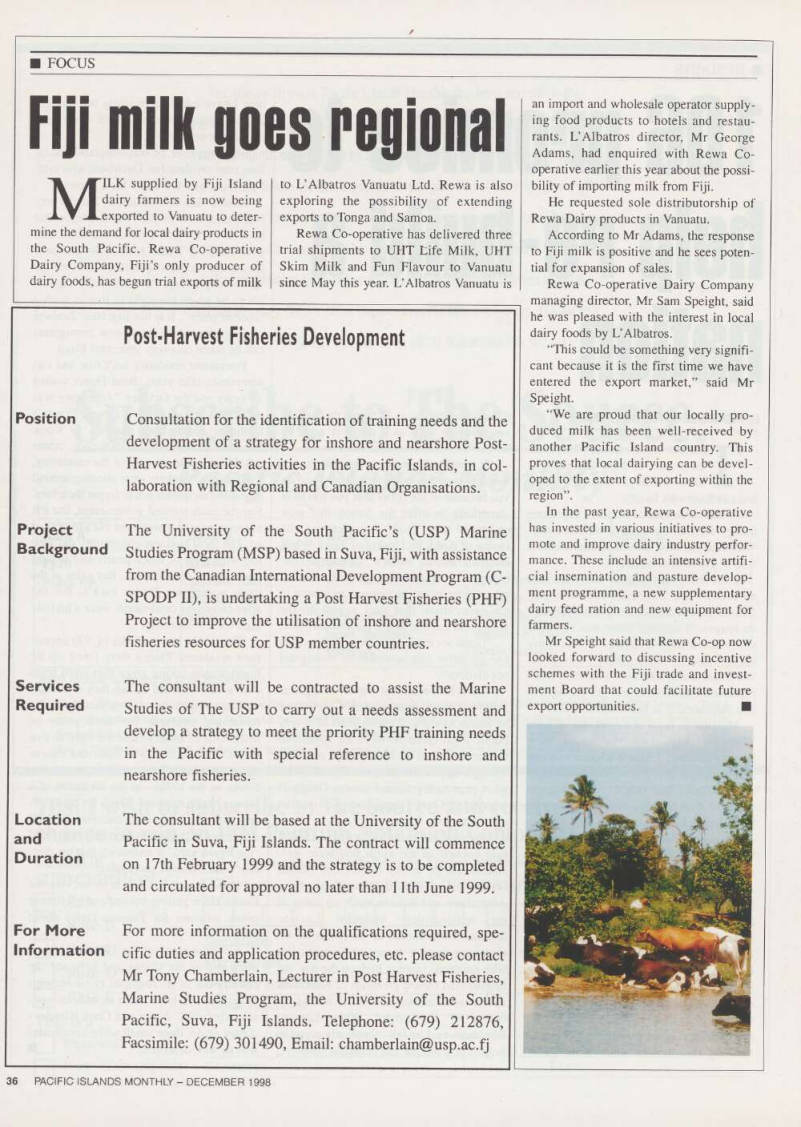
MILK supplied by Fiji Island dairy farmers is now being exported to Vanuatu to deter mine the demand for local dairy products in the South Pacific. Rewa Co-operative Dairy Company, Fiji’s only producer of dairy foods, has begun trial exports of milk
to L’Albatros Vanuatu Ltd. Rewa is also exploring the possibility of extending exports to Tonga and Samoa.
Rewa Co-operative has delivered three trial shipments to UHT Life Milk, UHT Skim Milk and Fun Flavour to Vanuatu since May this year. L’Albatros Vanuatu is
an import and wholesale operator supply ing food products to hotels and restau rants. L’Albatros director, Mr George Adams, had enquired with Rewa Co operative earlier this year about the possi
bility of importing milk from Fiji.
He requested sole distributorship of Rewa Dairy products in Vanuatu.
According to Mr Adams, the response to Fiji milk is positive and he sees poten tial for expansion of sales.
Rewa Co-operative Dairy Company
managing director, Mr Sam Speight, said he was pleased with the interest in local dairy foods by L’Albatros.
“This could be something very signifi cant because it is the first time we have entered the export market,” said Mr Speight.
“We are proud that our locally pro duced milk has been well-received by another Pacific Island country. This proves that local dairying can be devel oped to the extent of exporting within the region”.
In the past year, Rewa Co-operative has invested in various initiatives to pro mote and improve dairy industry perfor mance. These include an intensive artifi cial insemination and pasture develop ment programme, a new supplementary dairy feed ration and new equipment for farmers.
Mr Speight said that Rewa Co-op now looked forward to discussing incentive schemes with the Fiji trade and invest ment Board that could facilitate future export opportunities. ■
Advertisements & other items, p. 36 (1 item)
Post-Harvest Fisheries Development
Position Project Background Services Required Location and Duration For More Information Consultation for the identification of training needs and the development of a strategy for inshore and nearshore Post- Harvest Fisheries activities in the Pacific Islands, in collaboration with Regional and Canadian Organisations.
The University of the South Pacific’s (USP) Marine Studies Program (MSP) based in Suva, Fiji, with assistance from the Canadian International Development Program (C- -SPODP II), is undertaking a Post Harvest Fisheries (PHF) Project to improve the utilisation of inshore and nearshore fisheries resources for USP member countries.
The consultant will be contracted to assist the Marine Studies of The USP to carry out a needs assessment and develop a strategy to meet the priority PHF training needs in the Pacific with special reference to inshore and nearshore fisheries.
The consultant will be based at the University of the South Pacific in Suva, Fiji Islands. The contract will commence on 17th February 1999 and the strategy is to be completed and circulated for approval no later than 11th June 1999.
For more information on the qualifications required, specific duties and application procedures, etc. please contact Mr Tony Chamberlain, Lecturer in Post Harvest Fisheries, Marine Studies Program, the University of the South Pacific, Suva, Fiji Islands. Telephone: (679) 212876, Facsimile; (679) 301490, Email: [email protected]
new $81m
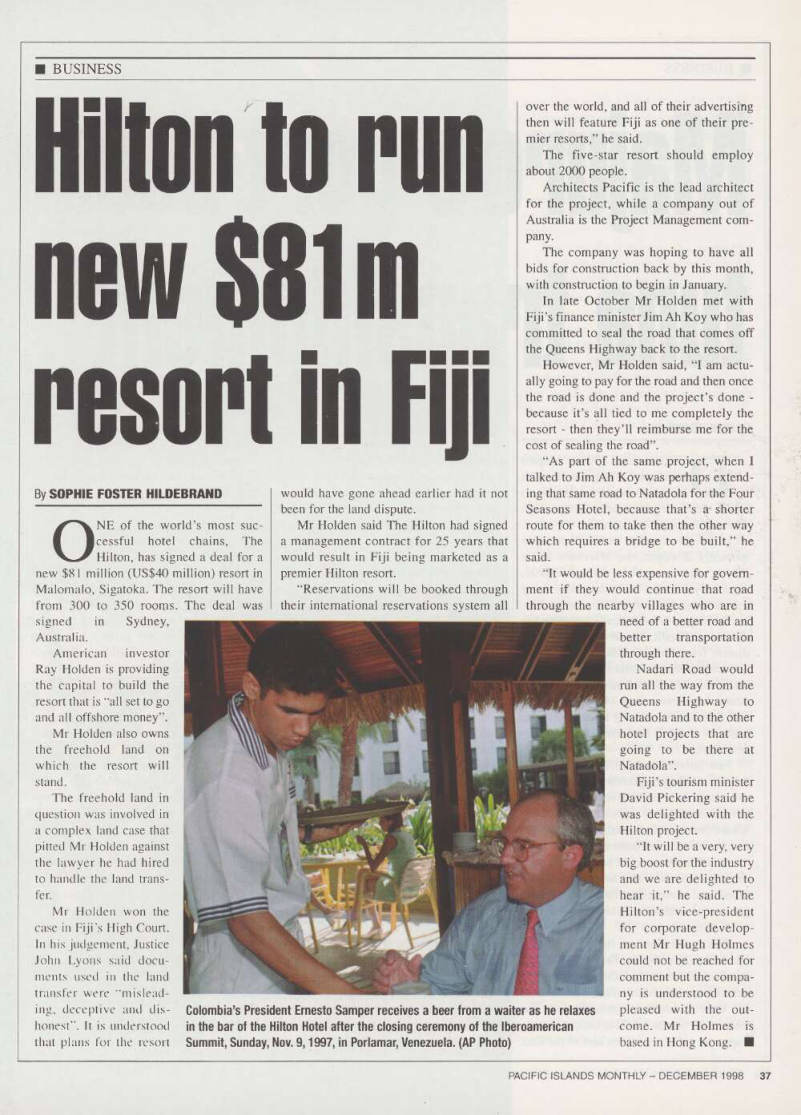
Business
Hilton to nun new $81m resort in Fiji
By Sophie Foster Hildebrand
ONE of the world’s most suc cessful hotel chains, The Hilton, has signed a deal for a new $8 1 million (US$4O million) resort in Malomalo, Sigatoka. The resort will have from 300 to 350 rooms. The deal was
signed in Sydney, Australia.
American investor Ray Holden is providing the capital to build the resort that is "all set to go and all offshore money”.
Mr Holden also owns the freehold land on which the resort will stand.
The freehold land in question was involved in a complex land case that pitted Mr Holden against the lawyer he had hired to handle the land trans fer.
Mr Holden won the case in Fiji’s High Court.
In his judgement, Justice John Lyons said docu ments used in the land transfer were "mislead ing, deceptive and dis honest”. It is understood that plans for the resort
would have gone ahead earlier had it not been for the land dispute.
Mr Holden said The Hilton had signed a management contract for 25 years that would result in Fiji being marketed as a premier Hilton resort.
“Reservations will be booked through their international reservations system all
over the world, and all of their advertising then will feature Fiji as one of their pre mier resorts,” he said.
The five-star resort should employ about 2000 people.
Architects Pacific is the lead architect for the project, while a company out of Australia is the Project Management com pany.
The company was hoping to have all bids for construction back by this month, with construction to begin in January.
In late October Mr Holden met with Fiji’s finance minister Jim Ah Koy who has committed to seal the road that comes off the Queens Highway back to the resort.
However, Mr Holden said, “I am actu ally going to pay for the road and then once the road is done and the project’s done because it’s all tied to me completely the resort - then they’ll reimburse me for the cost of sealing the road”.
“As part of the same project, when I talked to Jim Ah Koy was perhaps extend ing that same road to Natadola for the Four Seasons Hotel, because that’s a- shorter route for them to take then the other way which requires a bridge to be built,” he said.
“It would be less expensive for govern ment if they would continue that road through the nearby villages who are in
need of a better road and better transportation through there.
Nadari Road would run all the way from the Queens Highway to Natadola and to the other hotel projects that are going to be there at Natadola”.
Fiji’s tourism minister David Pickering said he was delighted with the
Hilton project.
“It will be a very, very big boost for the industry and we are delighted to hear it,” he said. The Hilton’s vice-president for corporate develop ment Mr Hugh Holmes could not be reached for comment but the compa ny is understood to be pleased with the out come. Mr Holmes is based in Hong Kong. ■
Colombia’s President Ernesto Samper receives a beer from a waiter as he relaxes in the bar of the Hilton Hotel after the closing ceremony of the lberoamerican Summit, Sunday, Nov. 9,1997, in Porlamar, Venezuela. (AP Photo)
tuna transhipment
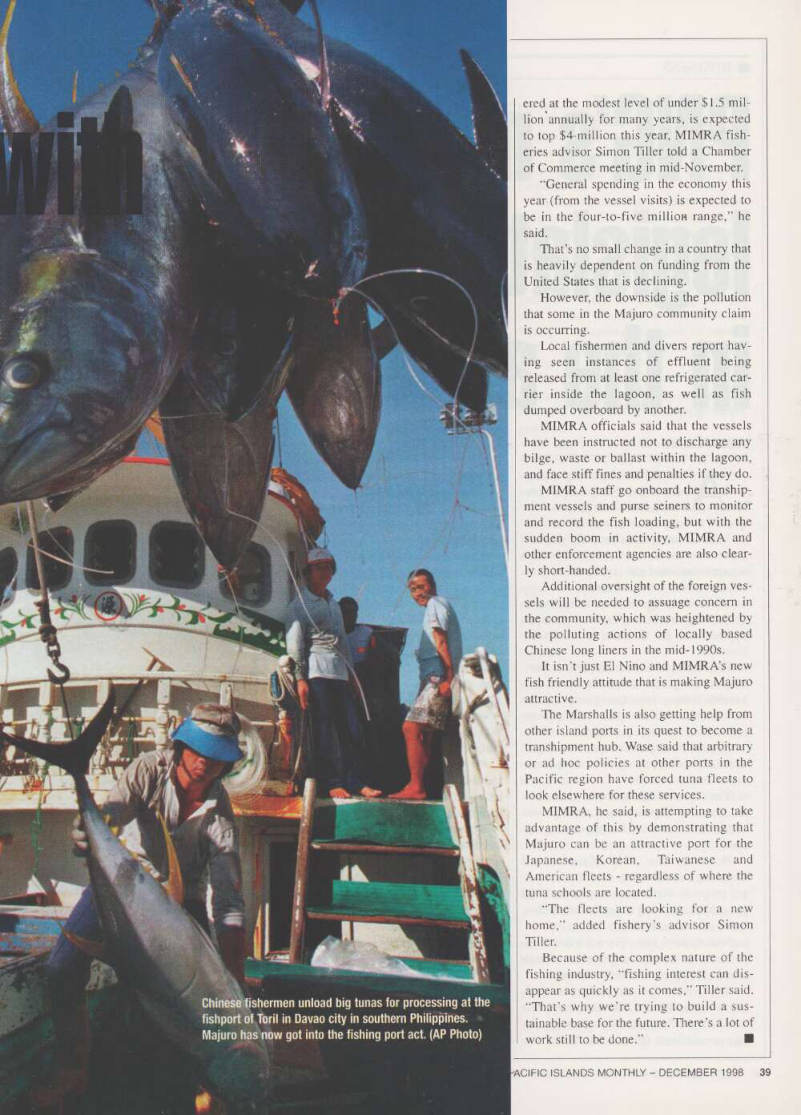
Majuro s port booms with tuna transhipment
By Giff Johnson
DURING the 19905, Majuro developed a reputation with foreign fishermen as a port to avoid: too much government red tape, high fees, and lethargic bureaucrats.
In the government “reform” parlance currently in vogue, the Marshalls had a lousy “environment” for doing business, especially for tuna boats that view every minute wasted in port as lost revenue.
Yet Majuro is strategically positioned in the central Pacific, not in - but not too far distant from - major fishing grounds, is serviced by international flights from Fiji, Asia and the US, and has excellent con tainer ship service from Matson, PM & O and Kyowa line, among others. But the logistics couldn’t overcome the anti-busi ness climate.
Fast-forward to late 1998. In just two months, during September and October, nine large refrigerated vessels had been parked in Majuro’s lagoon. Tuna was off loaded from nearly 30 Asian purse seiners and transhipped to canneries in Asia.
At the same time, the Marshalls signed deals with Taiwan and Korea for a com bined total of more than 70 purse seiners to get licenses and for transhipment activities
in Majuro.
This sudden rush of fishery’s activity has been aided by the fact that El Nino weather, which changes the temperature of ocean water, forced the schools of tuna out of their traditional grounds in the Federated States of Micronesia-Nauru- Papua New Guinea region and to the East
of the Marshalls and Kiribati.
Having the fish here helps, but Marshalls fisheries’ officials are working hard to cement relations with the Asian fishing industry to use Majuro as an ongo ing transhipment port, regardless of fish migration, because of the potential wind fall to local businesses for refuelling, maintenance, supplies and the hotel, restaurant and bar trade.
“The Taiwanese have always been here but they’ve never bought licenses before,”
Marshall Islands Marine Resources Authority (MIMRA) Director Danny Wase said of the response to the Marshalls’ new welcoming attitude toward the distant water fishing nations.
Last year, MIMRA officials, with the help of Asian Development Bank consul tants, wrote a new national fishery’s policy aimed at making Majuro a transhipment hub for the central Pacific. That was approved by the cabinet in late 1997, and the results are showing already.
“It’s all happening (purse seiner interest in the Marshalls) because the cabinet approved changes in our national fisheries policy,” Wase said. “It’s not even one year later and look what’s happening.”
MIMRA has cut government fees that are charged to visiting boats. For the min imal payment of a $3OO license and $6OO for each transhipment visit, these mother ships can use Majuro to tranship millions of pounds of fish.
In contrast, other ports in the region charge fees per ton of fish transhipped.
This could translate into a cost of thou sands of dollars per visit - depending on
the volume of fish handled. MIMRA has also streamlined its clearance procedures, making it relatively quick for the visiting ships to clear the various inspections on their arrival.
Meanwhile, firms such as the Marshalls Energy Company have hooked the fishing boats with good prices for bulk fuel pur chases, Wase said.
“Fuel sales are right up,” said Marshalls Energy Company’s Bill Roberts. One US purse seiner wanted 50,000 gallons of fuel but “the price was attractive so he went from wanting 50,000 gallons to buying 90,000,” Roberts said, adding that he’s being bombarded with requests for fuel prices from shipping agents and compa nies.
“The good thing is that the crews of these boats have money and they spend it in Majuro,” Roberts said.
“Increasing transhipment activity is a major factor in our agreements (with Taiwan and Korea) because it brings crew changes, visits by families (of crew mem bers) and use of other services,” Wase said.
This is providing business to the air lines, hotels, restaurants and bars besides direct services to the ships.
Spin-off benefits aside, as a direct result of the Korean fishing deal signed three months ago, the Marshalls has netted more than $500,000 for fish caught in its 200 mile exclusive economic zone during September and October - above and beyond the license fees collected for indi vidual purse seiners, Wase said.
Marshall Islands revenue from licens ing foreign fishing vessels, which has hov-
ered at the modest level of under $1.5 mil lion annually for many years, is expected to top $4-million this year, MIMRA fish eries advisor Simon Tiller told a Chamber of Commerce meeting in mid-November.
“General spending in the economy this year (from the vessel visits) is expected to be in the four-to-five million range,” he said.
That’s no small change in a country that is heavily dependent on funding from the United States that is declining.
However, the downside is the pollution that some in the Majuro community claim is occurring.
Local fishermen and divers report hav ing seen instances of effluent being released from at least one refrigerated car rier inside the lagoon, as well as fish dumped overboard by another.
MIMRA officials said that the vessels have been instructed not to discharge any bilge, waste or ballast within the lagoon, and face stiff fines and penalties if they do.
MIMRA staff go onboard the tranship ment vessels and purse seiners to monitor and record the fish loading, but with the sudden boom in activity, MIMRA and other enforcement agencies are also clear ly short-handed.
Additional oversight of the foreign ves sels will be needed to assuage concern in the community, which was heightened by the polluting actions of locally based Chinese long liners in the mid-19905.
It isn’t just El Nino and MIMRA’s new fish friendly attitude that is making Majuro attractive.
The Marshalls is also getting help from other island ports in its quest to become a transhipment hub. Wase said that arbitrary or ad hoc policies at other ports in the Pacific region have forced tuna fleets to look elsewhere for these services.
MIMRA, he said, is attempting to take advantage of this by demonstrating that Majuro can be an attractive port for the Japanese, Korean, Taiwanese and American fleets - regardless of where the tuna schools are located.
“The fleets are looking for a new home,” added fishery’s advisor Simon Tiller.
Because of the complex nature of the fishing industry, "fishing interest can dis appear as quickly as it comes,” Tiller said.
"That’s why we're trying to build a sus tainable base for the future. There’s a lot of work still to be done.” ■
Chinese fishermen unload big tunas for processing at the fishport of Toril in Davao city in southern Philippines.
Majuro has now got into the fishing port act. (AP Photo)
legislation up
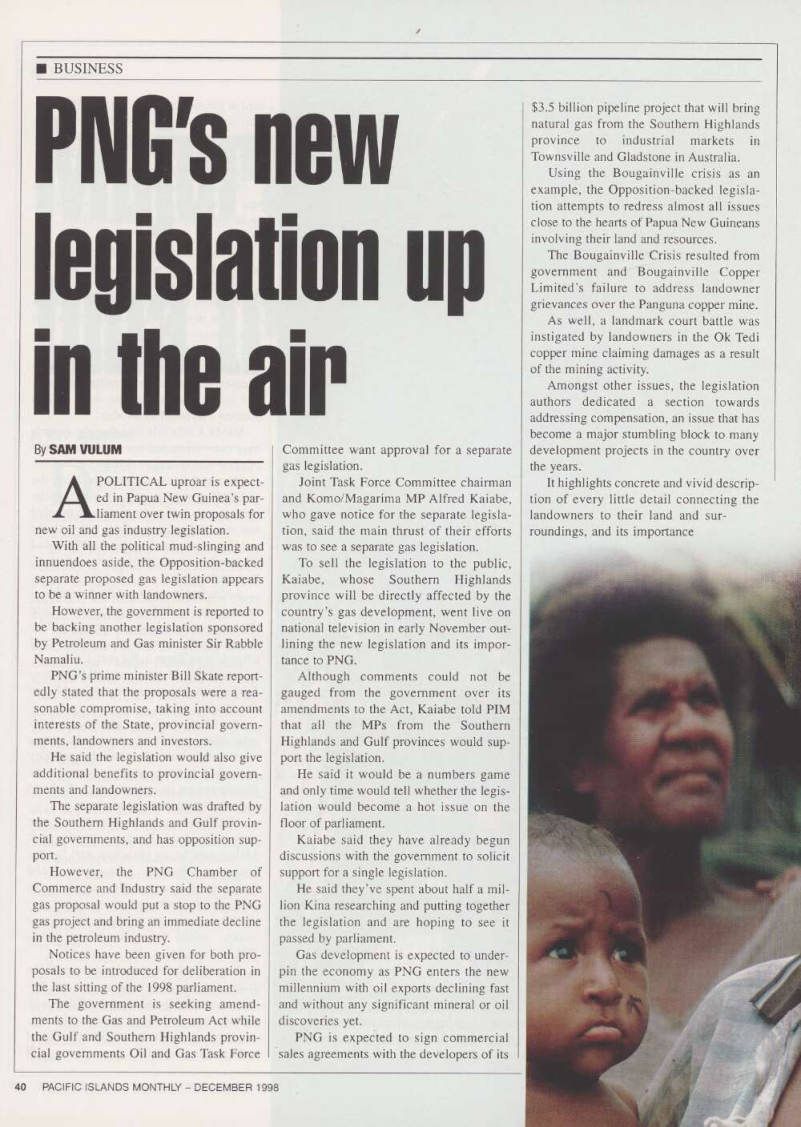
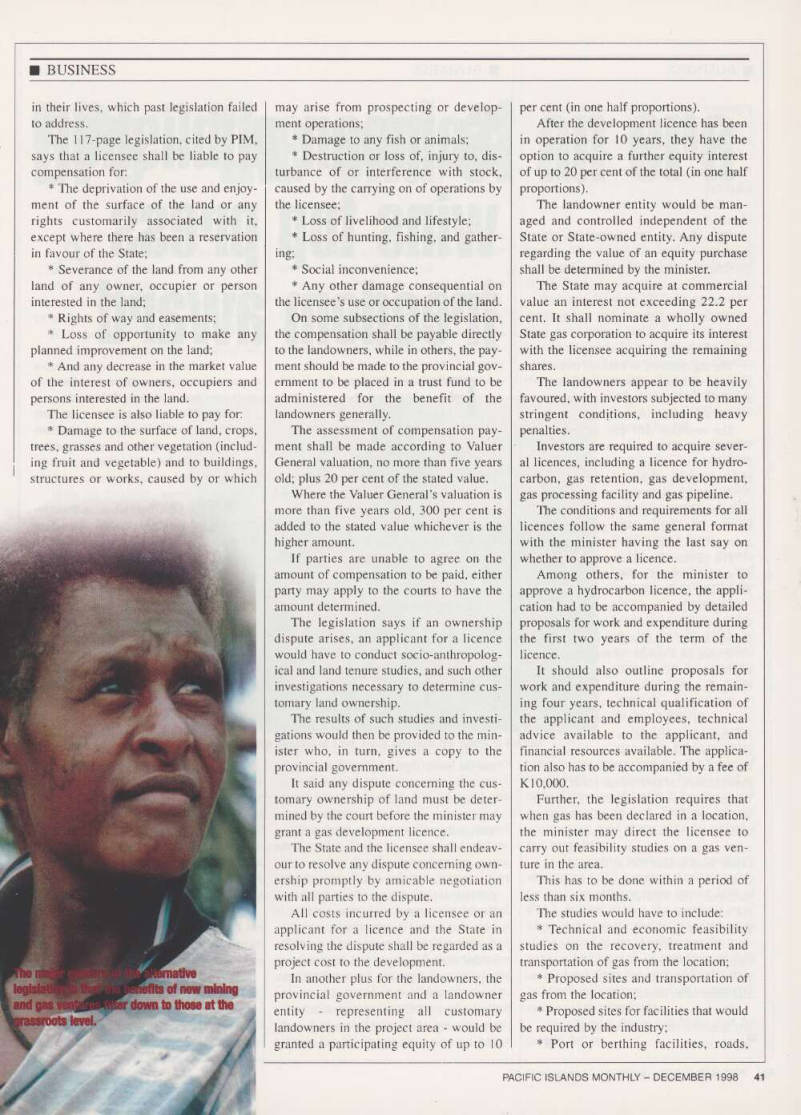
PNG's new legislation up in the air
By Sam Vulum
APOLITICAL uproar is expect ed in Papua New Guinea’s par liament over twin proposals for new oil and gas industry legislation.
With all the political mud-slinging and innuendoes aside, the Opposition-backed separate proposed gas legislation appears to be a winner with landowners.
However, the government is reported to be backing another legislation sponsored by Petroleum and Gas minister Sir Rabble Namaliu.
PNG’s prime minister Bill Skate report edly stated that the proposals were a rea sonable compromise, taking into account interests of the State, provincial govern ments, landowners and investors.
He said the legislation would also give additional benefits to provincial govern ments and landowners.
The separate legislation was drafted by the Southern Highlands and Gulf provin cial governments, and has opposition sup port.
However, the PNG Chamber of Commerce and Industry said the separate gas proposal would put a stop to the PNG gas project and bring an immediate decline in the petroleum industry.
Notices have been given for both pro posals to be introduced for deliberation in the last sitting of the 1998 parliament.
The government is seeking amend ments to the Gas and Petroleum Act while the Gulf and Southern Highlands provin cial governments Oil and Gas Task Force
Committee want approval for a separate
gas legislation.
Joint Task Force Committee chairman and Komo/Magarima MP Alfred Kaiabe, who gave notice for the separate legisla tion, said the main thrust of their efforts was to see a separate gas legislation.
To sell the legislation to the public, Kaiabe, whose Southern Highlands province will be directly affected by the country’s gas development, went live on national television in early November out lining the new legislation and its impor tance to PNG.
Although comments could not be gauged from the government over its amendments to the Act, Kaiabe told PIM that all the MPs from the Southern Highlands and Gulf provinces would sup port the legislation.
He said it would be a numbers game and only time would tell whether the legis lation would become a hot issue on the floor of parliament.
Kaiabe said they have already begun discussions with the government to solicit support for a single legislation.
He said they’ve spent about half a mil lion Kina researching and putting together the legislation and are hoping to see it
passed by parliament.
Gas development is expected to under pin the economy as PNG enters the new millennium with oil exports declining fast and without any significant mineral or oil discoveries yet.
PNG is expected to sign commercial sales agreements with the developers of its
$3.5 billion pipeline project that will bring natural gas from the Southern Highlands province to industrial markets in Townsville and Gladstone in Australia.
Using the Bougainville crisis as an example, the Opposition-backed legisla tion attempts to redress almost all issues close to the hearts of Papua New Guineans involving their land and resources.
The Bougainville Crisis resulted from government and Bougainville Copper Limited’s failure to address landowner grievances over the Panguna copper mine.
As well, a landmark court battle was instigated by landowners in the Ok Tedi copper mine claiming damages as a result of the mining activity.
Amongst other issues, the legislation authors dedicated a section towards addressing compensation, an issue that has become a major stumbling block to many development projects in the country over the years.
It highlights concrete and vivid descrip tion of every little detail connecting the landowners to their land and sur roundings, and its importance
in their lives, which past legislation failed to address.
The 117-page legislation, cited by PIM, says that a licensee shall be liable to pay compensation for; * The deprivation of the use and enjoy ment of the surface of the land or any rights customarily associated with it, except where there has been a reservation in favour of the State; * Severance of the land from any other land of any owner, occupier or person interested in the land; * Rights of way and easements; * Loss of opportunity to make any planned improvement on the land; * And any decrease in the market value of the interest of owners, occupiers and persons interested in the land.
The licensee is also liable to pay for: * Damage to the surface of land, crops, trees, grasses and other vegetation (includ ing fruit and vegetable) and to buildings, structures or works, caused by or which
may arise from prospecting or develop ment operations; * Damage to any fish or animals; * Destruction or loss of, injury to, dis turbance of or interference with stock, caused by the carrying on of operations by the licensee; * Loss of livelihood and lifestyle; * Loss of hunting, fishing, and gather ing; * Social inconvenience; * Any other damage consequential on the licensee’s use or occupation of the land.
On some subsections of the legislation, the compensation shall be payable directly to the landowners, while in others, the pay ment should be made to the provincial gov ernment to be placed in a trust fund to be administered for the benefit of the landowners generally.
The assessment of compensation pay ment shall be made according to Valuer General valuation, no more than five years old; plus 20 per cent of the stated value.
Where the Valuer General’s valuation is more than five years old, 300 per cent is added to the stated value whichever is the
higher amount.
If parties are unable to agree on the amount of compensation to be paid, either party may apply to the courts to have the amount determined.
The legislation says if an ownership dispute arises, an applicant for a licence would have to conduct socio-anthropolog ical and land tenure studies, and such other investigations necessary to determine cus tomary land ownership.
The results of such studies and investi gations would then be provided to the min ister who, in turn, gives a copy to the provincial government.
It said any dispute concerning the cus tomary ownership of land must be deter mined by the court before the minister may grant a gas development licence.
The State and the licensee shall endeav our to resolve any dispute concerning own
ership promptly by amicable negotiation
with all parties to the dispute.
All costs incurred by a licensee or an applicant for a licence and the State in resolving the dispute shall be regarded as a project cost to the development.
In another plus for the landowners, the provincial government and a landowner entity - representing all customary landowners in the project area - would be granted a participating equity of up to 10
per cent (in one half proportions).
After the development licence has been in operation for 10 years, they have the option to acquire a further equity interest of up to 20 per cent of the total (in one half
proportions).
The landowner entity would be man aged and controlled independent of the State or State-owned entity. Any dispute regarding the value of an equity purchase shall be determined by the minister.
The State may acquire at commercial value an interest not exceeding 22.2 per cent. It shall nominate a wholly owned State gas corporation to acquire its interest with the licensee acquiring the remaining shares.
The landowners appear to be heavily favoured, with investors subjected to many stringent conditions, including heavy penalties.
Investors are required to acquire sever al licences, including a licence for hydro carbon, gas retention, gas development, gas processing facility and gas pipeline.
The conditions and requirements for all licences follow the same general format with the minister having the last say on whether to approve a licence.
Among others, for the minister to approve a hydrocarbon licence, the appli cation had to be accompanied by detailed proposals for work and expenditure during the first two years of the term of the licence.
It should also outline proposals for work and expenditure during the remain ing four years, technical qualification of the applicant and employees, technical advice available to the applicant, and financial resources available. The applica tion also has to be accompanied by a fee of K 10,000.
Further, the legislation requires that when gas has been declared in a location, the minister may direct the licensee to carry out feasibility studies on a gas ven ture in the area.
This has to be done within a period of less than six months.
The studies would have to include: * Technical and economic feasibility studies on the recovery, treatment and transportation of gas from the location; * Proposed sites and transportation of gas from the location; * Proposed sites for facilities that would be required by the industry; * Port or berthing facilities, roads,
The malor [?] of the attermative legisation is that the bonefits of new mining and gas ventures filter down to those at the greassroots level.
pipelines or other transportation facili ties, water facilities for industrial and town purposes, the location and design of a suitable airstrip and associated landing and terminal facilities if
required;
* Generation and-transmission of electricity; * Development of a suitable town if required; * Design of housing and associated civic, social and cultural facilities; * Future labour requirements; * Possible impact on the environ ment; * Land tenure and ownership.
The legislation also outlines that an investor will face a fine not exceeding K 200,000 if he is caught exploring or recovering gas without a licence.
The investor will pay a fine of K 1,000,000 or has its licence cancelled if it fails to supply all information required by the minister.
Another section requires that when an investor fails to pay an amount due on time, the investor will pay interest calculated at 10 per cent per annum.
The licensee is also required to pay an amount not exceeding K 2,000,000 as security to the minister.
Royalty payment of gas recovered during a royalty period is payable by the last day of the next period.
In case of a failure by the licensee, eight per cent interest per day is charged on the due amount.
Each fiscal year of the term of the licence of a gas development, the licensee shall pay out its own costs to the provincial governments, develop ment levies for the construction and maintenance of provincial roads and bridges, wharves and airports, schools and hospitals, and any other levies determined by national law or agree ment. A provincial government legis lation shall ensure that at least 30 per cent of levies shall be spent in the pro ject area. The legislation also requires the establishment of a Gas Advisory Board to be appointed by the minister.
It should comprise five members, comprising a director who shall be the chairman, the Governor of a province and three other members.
The board advises the minister on any question on matters relating to the legislation. ■
Samoan publisher
wins top press freedom award
FOR years of fighting the govern ment over controls on press free dom, Samoan Savea Sano Malifa, editor-publisher of the Samoa Observer, has won the 1998 Astor Award.
The award is the highest given for press freedom in the Commonwealth. It was presented to Savea at the Astor Award dinner during the Commonwealth Press Union conference in Kuala Lumpur in late October. It is the first time anyone from the Pacific Islands has won a top interna tional media freedom award, and followed his strong and constant defence of the public’s right to know despite all sorts of pressures.
According to the Pacific Islands News Association (PINA) “Savea and his wife Jean have kept on fighting for freedom of information and expression despite the Samoa Observer’s printing plant being burnt down, death threats and an assault on Savea, the Samoan Government pulling out all Government advertising, and the heavy legal cost for them of fight ing criminal and civil libel actions”.
Savea and the Observer have fought legal battles with Samoan prime minister Tofilau Eti Alesana and his ministers who now get their legal costs paid by the Samoan Government.
Savea has also been invited to France this month to be a speaker in the “Human Rights Defenders Summit” to be held in Paris. According the the PINA secretariat, one of the things that helped publicise Savea's story and get him international support was membership of IFEX, the International Freedom of Expression Exchange. IFEX was created in 1992 when many of the world’s leading media freedom and freedom of expression
organisations came together in Montreal to discuss how best to work together.
Today IFEX is comprised of more than 30 different media freedom and freedom of expression groups who work together to promote freedom of information and expression, and media freedom, and help those under threat.
The IFEX Clearing House, in Toronto, Canada, is managed by the Canadian Committee to Protect Journalists. One of CCPJ’s main activities is to look after the IFEX Action Alert Network.
Member organisations report abuses to the IFEX Clearing House which then cir culates this information to other members and interested organisations all over the world.
PINa says this process '‘allows for a rapid, world-wide and coordinated response to media freedom and freedom of expression violations”.
PINA was accepted into IFEX as a full member last year. Through the PINA Pacific Freedom of Information Network, almost 20 alerts and updates about the Samoa Observer had been put out.
This led to some financial help for Savea in his court battles. Through protests from around the world, PINA says the Samoan Government now knows it is ‘‘under the international spotlight whenever it tries to do anything to Savea and the Observer”.
"We mounted a very big campaign when Prime Minister Tofilau threatened to introduce compulsory newspaper licensing so newspapers he said stirred up trouble could be closed.” "Our PINA alerts have publicised Savea and Jean's brave struggle. The Samoa Observer has not been alone”. ■
Advertisements & other items, p. 42 (1 item)
42
■ BUSINESS
PACIFIC ISLANDS MONTHLY - DECEMBER 1998
■ BUSINESS
BPs - the end of an era
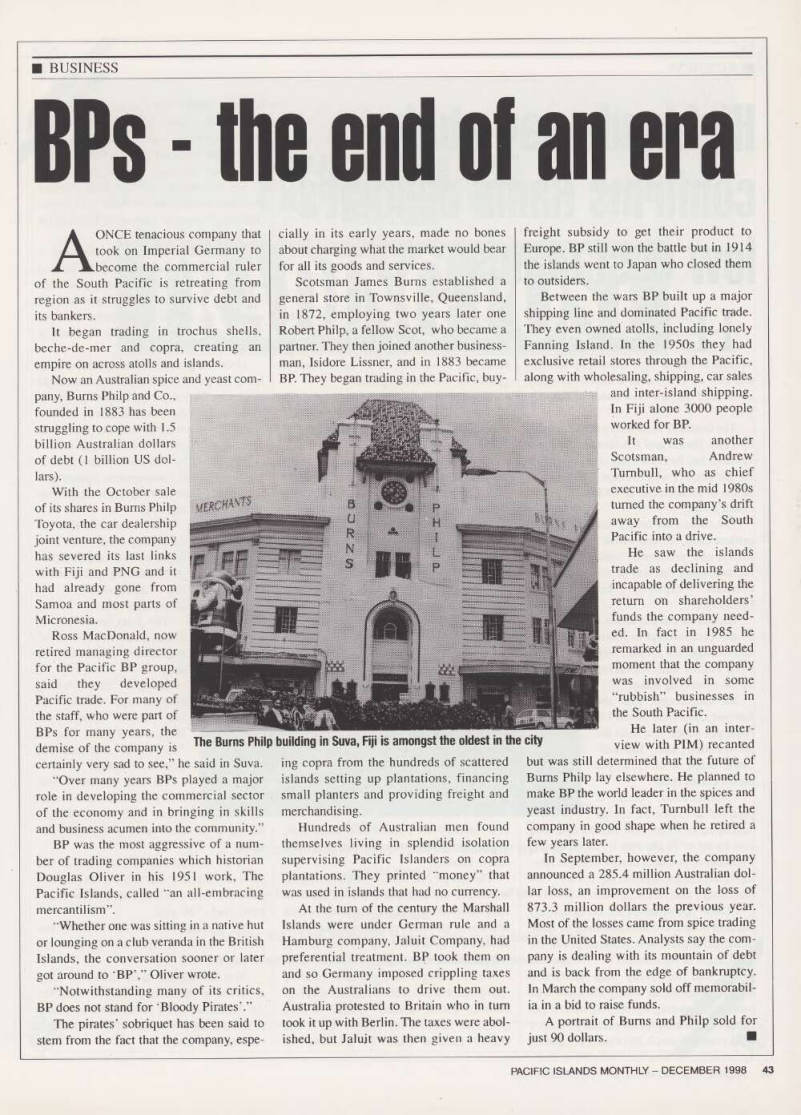
A ONCE tenacious company that took on Imperial Germany to become the commercial ruler of the South Pacific is retreating from region as it struggles to survive debt and its bankers.
It began trading in trochus shells, beche-de-mer and copra, creating an empire on acrosis atolls and islands.
Now an Australian spice and yeast com
pany, Bums Philp and Co., founded in 1883 has been struggling to cope with 1.5 billion Australian dollars of debt (1 billion US dol lars).
With the October sale of its shares in Bums Philp Toyota, the car dealership joint venture, the company has severed its last links with Fiji and PNG and it had already gone from Samoa and most parts of Micronesia.
Ross MacDonald, now retired managing director for the Pacific BP group, said they developed Pacific trade. For many of the staff, who were part of BPs for many years, the demise of the company is
certainly very sad to see,” he said in Suva.
“Over many years BPs played a major role in developing the commercial sector of the economy and in bringing in skills and business acumen into the community.”
BP was the most aggressive of a num ber of trading companies which historian Douglas Oliver in his 1951 work, The Pacific Islands, called “an all-embracing mercantilism”.
"Whether one was sitting in a native hut or lounging on a club veranda in the British Islands, the conversation sooner or later got around to ‘BP’,” Oliver wrote.
"Notwithstanding many of its critics, BP does not stand for ’Bloody Pirates'.”
The pirates’ sobriquet has been said to stem from the fact that the company, espe
dally in its early years, made no bones about charging what the market would bear for all its goods and services.
Scotsman James Burns established a general store in Townsville, Queensland, in 1872, employing two years later one Robert Philp, a fellow Scot, who became a partner. They then joined another business man, Isidore Lissner, and in 1883 became BP. They began trading in the Pacific, buy-
ing copra from the hundreds of scattered islands setting up plantations, financing small planters and providing freight and merchandising.
Hundreds of Australian men found themselves living in splendid isolation supervising Pacific Islanders on copra plantations. They printed “money” that was used in islands that had no currency.
At the turn of the century the Marshall Islands were under German rule and a Hamburg company, Jaluit Company, had preferential treatment. BP took them on and so Germany imposed crippling taxes on the Australians to drive them out.
Australia protested to Britain who in turn took it up with Berlin. The taxes were abol ished, but Jaluit was then given a heavy
freight subsidy to get their product to Europe. BP still won the battle but in 1914 the islands went to Japan who closed them to outsiders.
Between the wars BP built up a major shipping line and dominated Pacific trade.
They even owned atolls, including lonely Fanning Island. In the 1950 s they had exclusive retail stores through the Pacific, along with wholesaling, shipping, car sales
and inter-island shipping.
In Fiji alone 3000 people worked for BP.
It was another Scotsman, Andrew Turnbull, who as chief executive in the mid 1980 s turned the company’s drift away from the South Pacific into a drive.
He saw the islands trade as declining and incapable of delivering the return on shareholders’ funds the company need ed. In fact in 1985 he remarked in an unguarded moment that the company was involved in some “rubbish” businesses in the South Pacific.
He later (in an inter view with PIM) recanted
but was still determined that the future of Burns Philp lay elsewhere. He planned to make BP the world leader in the spices and yeast industry. In fact, Turnbull left the company in good shape when he retired a few years later.
In September, however, the company announced a 285.4 million Australian dol lar loss, an improvement on the loss of 873.3 million dollars the previous year.
Most of the losses came from spice trading in the United States. Analysts say the com pany is dealing with its mountain of debt and is back from the edge of bankruptcy.
In March the company sold off memorabil ia in a bid to raise funds.
A portrait of Burns and Philp sold for just 90 dollars. ■
The Burns Philp building in Suva, Fiji is amongst the oldest in the city
Highlands say study
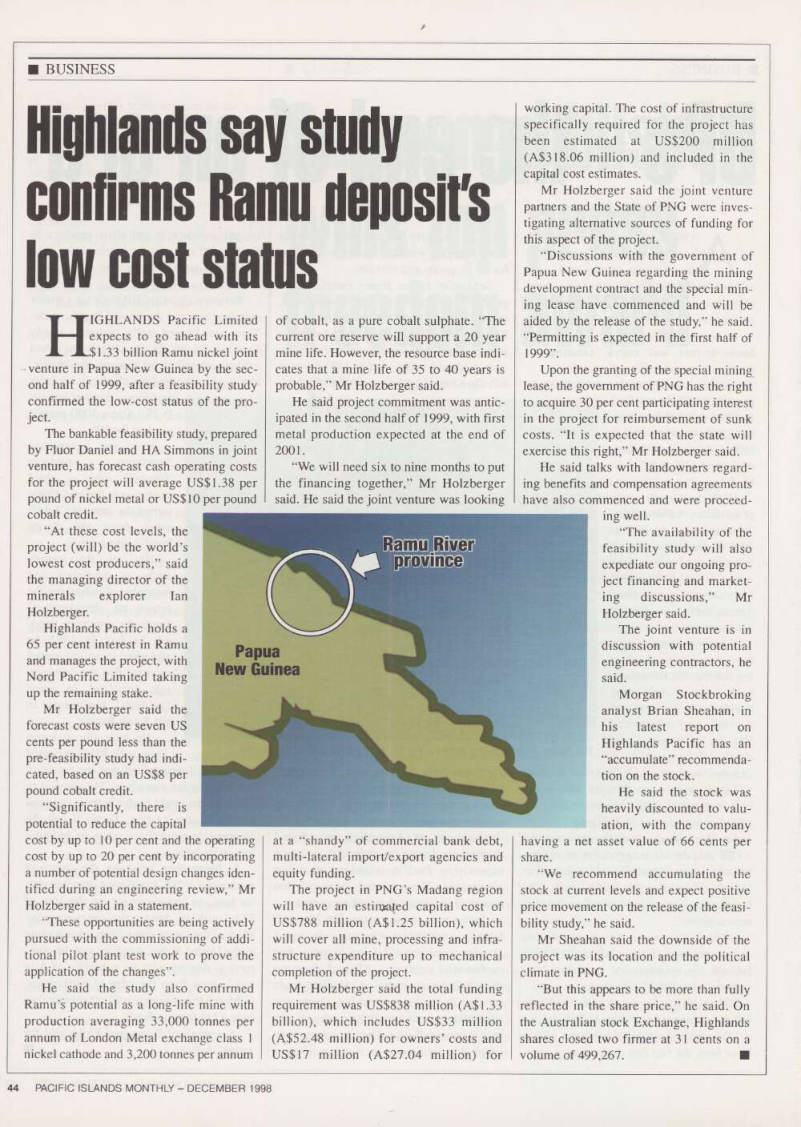
confirms Raimi deposit's low cost status
HIGHLANDS Pacific Limited expects to go ahead with its $1.33 billion Ramu nickel joint venture in Papua New Guinea by the sec ond half of 1999, after a feasibility study confirmed the low-cost status of the pro ject.
The bankable feasibility study, prepared by Fluor Daniel and HA Simmons in joint venture, has forecast cash operating costs for the project will average US$l.3B per pound of nickel metal or US$lO per pound cobalt credit.
“At these cost levels, the project (will) be the world’s lowest cost producers,” said the managing director of the minerals explorer lan Holzberger.
Highlands Pacific holds a 65 per cent interest in Ramu and manages the project, with Nord Pacific Limited taking up the remaining stake.
Mr Holzberger said the forecast costs were seven US cents per pound less than the pre-feasibility study had indi cated, based on an US$B per pound cobalt credit.
“Significantly, there is potential to reduce the capital
cost by up to 10 per cent and the operating cost by up to 20 per cent by incorporating a number of potential design changes iden tified during an engineering review,” Mr Holzberger said in a statement.
“These opportunities are being actively pursued with the commissioning of addi tional pilot plant test work to prove the application of the changes”.
He said the study also confirmed Ramu’s potential as a long-life mine with production averaging 33,000 tonnes per annum of London Metal exchange class 1 nickel cathode and 3,200 tonnes per annum
of cobalt, as a pure cobalt sulphate. “The current ore reserve will support a 20 year mine life. However, the resource base indi cates that a mine life of 35 to 40 years is probable,” Mr Holzberger said.
He said project commitment was antic ipated in the second half of 1999, with first metal production expected at the end of 2001.
“We will need six to nine months to put the financing together,” Mr Holzberger said. He said the joint venture was looking
at a “shandy” of commercial bank debt, multi-lateral import/export agencies and equity funding.
The project in PNG’s Madang region will have an estimated capital cost of US$7BB million (A 51.25 billion), which will cover all mine, processing and infra structure expenditure up to mechanical completion of the project.
Mr Holzberger said the total funding requirement was US$B3B million (A$ 1.33 billion), which includes US$33 million (A 552.48 million) for owners’ costs and US$l7 million (A 527.04 million) for
working capital. The cost of infrastructure specifically required for the project has been estimated at US$2OO million (A 5318.06 million) and included in the capital cost estimates.
Mr Holzberger said the joint venture partners and the State of PNG were inves tigating alternative sources of funding for this aspect of the project.
“Discussions with the government of Papua New Guinea regarding the mining development contract and the special min ing lease have commenced and will be aided by the release of the study,” he said.
“Permitting is expected in the first half of 1999”.
Upon the granting of the special mining lease, the government of PNG has the right to acquire 30 per cent participating interest in the project for reimbursement of sunk costs. “It is expected that the state will exercise this right,” Mr Holzberger said.
He said talks with landowners regard ing benefits and compensation agreements have also commenced and were proceed
ing well.
“The availability of the feasibility study will also expediate our ongoing pro ject financing and market ing discussions,” Mr Holzberger said.
The joint venture is in discussion with potential engineering contractors, he said.
Morgan Stockbroking analyst Brian Sheahan, in his latest report on Highlands Pacific has an “accumulate” recommenda tion on the stock.
He said the stock was heavily discounted to valu ation, with the company
having a net asset value of 66 cents per share.
“We recommend accumulating the stock at current levels and expect positive price movement on the release of the feasi bility study,” he said.
Mr Sheahan said the downside of the project was its location and the political climate in PNG.
“But this appears to be more than fully reflected in the share price,” he said. On the Australian stock Exchange, Highlands shares closed two firmer at 31 cents on a volume of 499,267. ■
Advertisements & other items, p. 45 (1 item)
Trading Post
PACIFIC ISLANDS
Mill! !!■
TRADING POST CAN WORK
WONDERS FOR YOU...
Promote your business, or service, sell your household items, cars or heavy machinery etc.
ONLY AUSSI PER WORD.
NO COMPANY LOGO. NO DISPLAY.
NO BOLD TYPE.
Just forward your Advertisement together with payment to: PACIFIC ISLANDS MONTHLY trading Post", PO Box 1167, Suva, Fiji.
Conditions: 1. All Advertisements are subject to acceptance and approval of publisher. 2. Advertisements are published as space permits; we cannot guarantee date of insertion. 3. All advertisements must be prepaid and should be typed or printed clearly 4. Deadline for receipt of advertisements is the 10th of the month prior to issue. 5. PACIFIC ISLANDS MONTHLY assumes no responsibility for any service other than publishing paid advertisements in this section.
environment prize

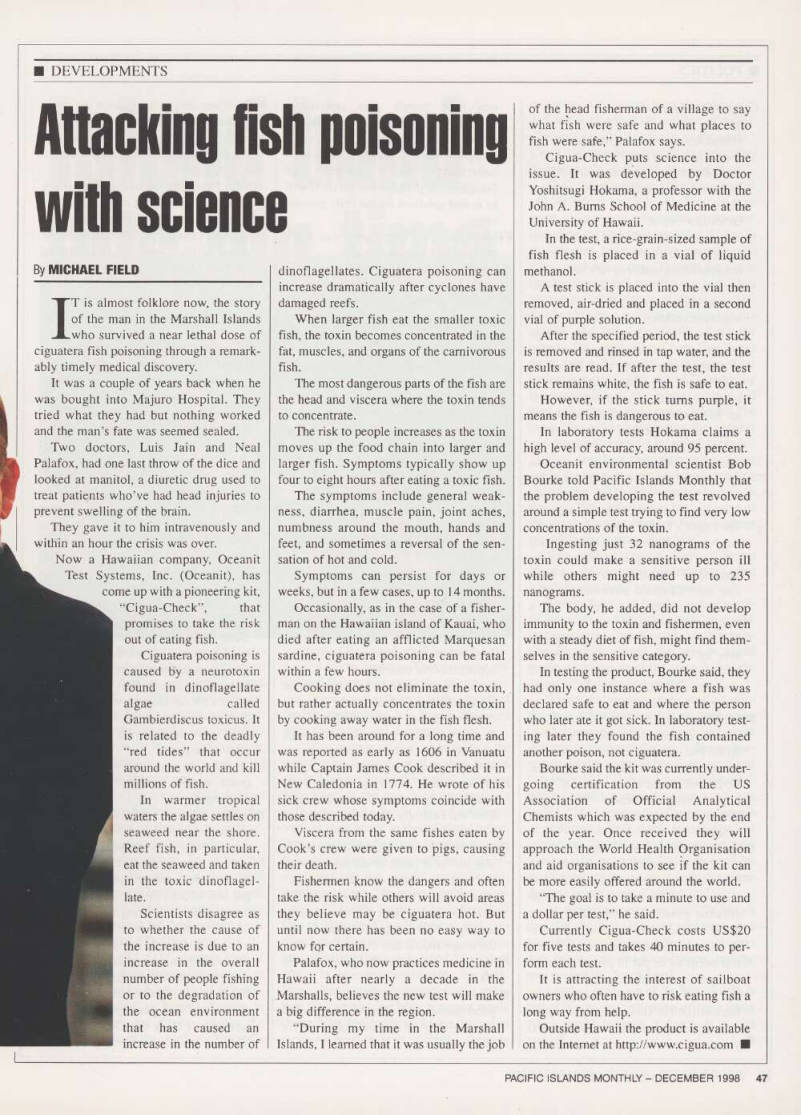
Clean Up the World founder awarded richest environment prize
CLEAN Up the World campaign founder lan Kieman has been awarded the world’s richest environmental prize by the United Nations in New York. Kieman, whose annual clean up initiative started in Sydney in 1989, with Clean Up Australia, and now mobilis es more than 40 million people in 120 countries, received the US$2OO,OOO (A 5321,000) 1998 Sasakawa Environment Prize. The United Nations Environment Programme (UNEP) prize was presented at a dinner mid-November.
“The prize has been awarded to Mr Kieman for communicating in the most visible way and to the world at large, the need to protect the environment,” Lord Stanley Clinton-Davis, the UNEP selection committee’s acting chairman said. Kieman decided to organise a mass clean up of Sydney Harbour in 1989 after being horri fied by the amount of pollution he saw while representing Australia in the 1986/87 solo around-the-world yacht race.
Australians quickly embraced the concept with more than half a million turning out every year on Australia Day to clean up thousands of waterways and pollution trou bled spots around the nation.
The concept was expanded in 1993 with a Clean Up the World campaign attracting tens of thousands of volunteers over three days in September. Kieman, now 58, was declared Australian of the Year in 1994 and awarded the Order of Australia medal in 1995. “Who would have thought that in the six short years since he launched the Clean Up the World that he would have captured the imagination of so many and single-handedly done so much to arrest
environmental degradation,” Lord Clinton- Davis said in a statement released in New York. The Sasakawa Prize, awarded since 1984, is amongst the world’s most presti gious international environmental hon ours with past winners including Brazilian rainforest cam
paigner Chico Mendes and World Watch Institute director Lester Brown whose writ ing alerted the world to threats to the biosphere.
An international panel met in September to decide the recipient of this year’s prize.
“Clean Up the World is a remark able achievement in which significant contributions have been made to the health of our planet by communities working together simple but effec tive,” UNEP’s executive director Klaus Toepfer said.
“The results of the campaign in terms of direct improvement to the living standards and behaviour of partic ipating communi
ties are immeasurable. “It is a concrete example of how environmental issues are most effectively handled with the involvement of individuals at the local level”.
Aap ■
Attacking fish poisoning
Developments
Attacking fish poisoning with science
By Michael Field
IT is almost folklore now, the story of the man in the Marshall Islands who survived a near lethal dose of ciguatera fish poisoning through a remark ably timely medical discovery.
It was a couple of years back when he was bought into Majuro Hospital. They tried what they had but nothing worked and the man’s fate was seemed sealed.
Two doctors, Luis Jain and Neal Palafox, had one last throw of the dice and looked at manitol, a diuretic drug used to treat patients who’ve had head injuries to prevent swelling of the brain.
They gave it to him intravenously and within an hour the crisis was over.
Now a Hawaiian company, Oceanit Test Systems, Inc. (Oceanit), has come up with a pioneering kit,
“Cigua-Check”, that promises to take the risk out of eating fish.
Ciguatera poisoning is caused by a neurotoxin found in dinoflagellate algae called Gambierdiscus toxicus. It is related to the deadly “red tides” that occur around the world and kill millions of fish.
In warmer tropical waters the algae settles on seaweed near the shore.
Reef fish, in particular, eat the seaweed and taken in the toxic dinoflagel late.
Scientists disagree as to whether the cause of the increase is due to an increase in the overall number of people fishing or to the degradation of the ocean environment that has caused an increase in the number of
dinoflagellates. Ciguatera poisoning can
increase dramatically after cyclones have damaged reefs.
When larger fish eat the smaller toxic fish, the toxin becomes concentrated in the fat, muscles, and organs of the carnivorous fish.
The most dangerous parts of the fish are the head and viscera where the toxin tends to concentrate.
The risk to people increases as the toxin moves up the food chain into larger and larger fish. Symptoms typically show up four to eight hours after eating a toxic fish.
The symptoms include general weak ness, diarrhea, muscle pain, joint aches, numbness around the mouth, hands and feet, and sometimes a reversal of the sen sation of hot and cold.
Symptoms can persist for days or weeks, but in a few cases, up to 14 months.
Occasionally, as in the case of a fisher man on the Hawaiian island of Kauai, who died after eating an afflicted Marquesan sardine, ciguatera poisoning can be fatal within a few hours.
Cooking does not eliminate the toxin, but rather actually concentrates the toxin by cooking away water in the fish flesh.
It has been around for a long time and was reported as early as 1606 in Vanuatu while Captain James Cook described it in New Caledonia in 1774. He wrote of his sick crew whose symptoms coincide with those described today.
Viscera from the same fishes eaten by Cook’s crew were given to pigs, causing their death.
Fishermen know the dangers and often take the risk while others will avoid areas they believe may be ciguatera hot. But until now there has been no easy way to know for certain.
Palafox, who now practices medicine in Hawaii after nearly a decade in the Marshalls, believes the new test will make a big difference in the region.
“During my time in the Marshall Islands, I learned that it was usually the job
of the head fisherman of a village to say what fish were safe and what places to fish were safe,” Palafox says.
Cigua-Check puts science into the issue. It was developed by Doctor Yoshitsugi Hokama, a professor with the John A. Bums School of Medicine at the University of Hawaii.
In the test, a rice-grain-sized sample of fish flesh is placed in a vial of liquid methanol.
A test stick is placed into the vial then removed, air-dried and placed in a second vial of purple solution.
After the specified period, the test stick is removed and rinsed in tap water, and the results are read. If after the test, the test stick remains white, the fish is safe to eat.
However, if the stick turns purple, it means the fish is dangerous to eat.
In laboratory tests Hokama claims a high level of accuracy, around 95 percent.
Oceanit environmental scientist Bob Bourke told Pacific Islands Monthly that the problem developing the test revolved around a simple test trying to find very low concentrations of the toxin.
Ingesting just 32 nanograms of the toxin could make a sensitive person ill while others might need up to 235 nanograms.
The body, he added, did not develop immunity to the toxin and fishermen, even with a steady diet of fish, might find them selves in the sensitive category.
In testing the product, Bourke said, they had only one instance where a fish was declared safe to eat and where the person who later ate it got sick. In laboratory test ing later they found the fish contained another poison, not ciguatera.
Bourke said the kit was currently under going certification from the US Association of Official Analytical Chemists which was expected by the end of the year. Once received they will approach the World Health Organisation and aid organisations to see if the kit can be more easily offered around the world.
“The goal is to take a minute to use and a dollar per test,” he said.
Currently Cigua-Check costs US$2O
for five tests and takes 40 minutes to per form each test.
It is attracting the interest of sailboat owners who often have to risk eating fish a
long way from help.
Outside Hawaii the product is available on the Internet at http://www.cigua.com ■
Island band
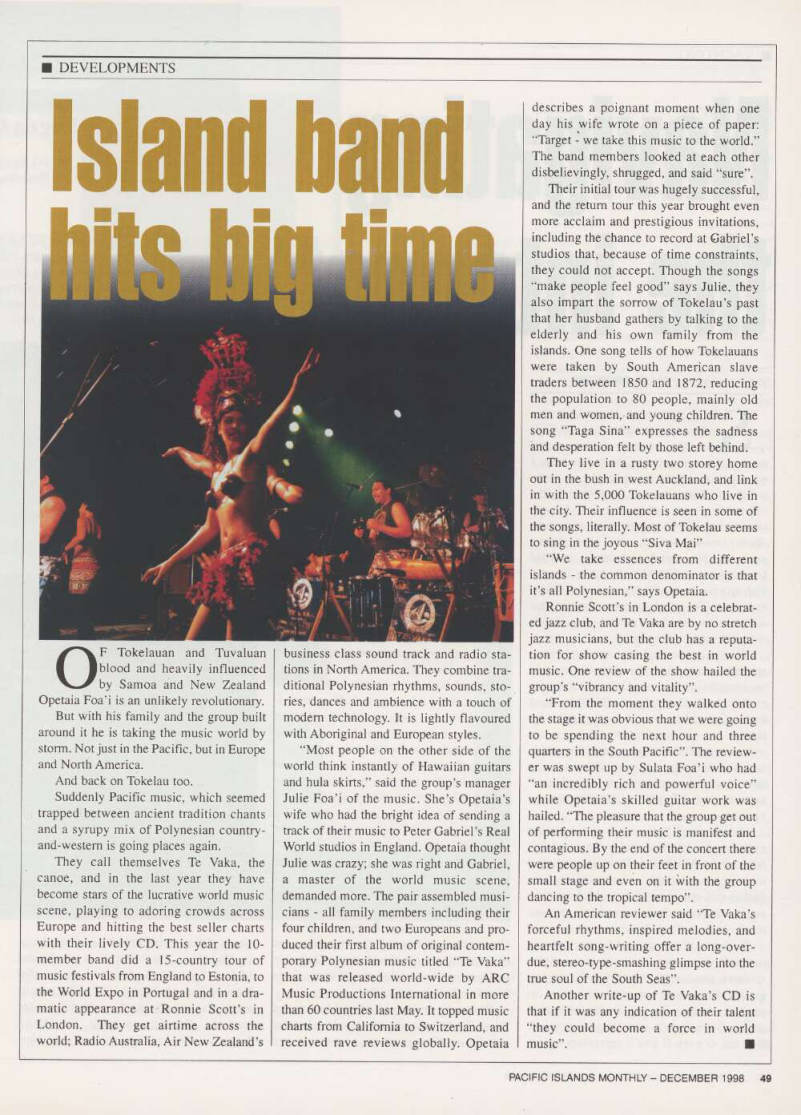
hits big time
OF Tokelauan and Tuvaluan blood and heavily influenced by Samoa and New Zealand Opetaia Foa’i is an unlikely revolutionary.
But with his family and the group built around it he is taking the music world by storm. Not just in the Pacific, but in Europe and North America.
And back on Tokelau too.
Suddenly Pacific music, which seemed trapped between ancient tradition chants and a syrupy mix of Polynesian country and-westem is going places again.
They call themselves Te Vaka, the canoe, and in the last year they have become stars of the lucrative world music scene, playing to adoring crowds across Europe and hitting the best seller charts with their lively CD. This year the 10member band did a 15-country tour of music festivals from England to Estonia, to the World Expo in Portugal and in a dra matic appearance at Ronnie Scott’s in London. They get airtime across the world; Radio Australia, Air New Zealand’s
business class sound track and radio sta tions in North America. They combine tra ditional Polynesian rhythms, sounds, sto ries, dances and ambience with a touch of modem technology. It is lightly flavoured with Aboriginal and European styles.
“Most people on the other side of the world think instantly of Hawaiian guitars and hula skirts,” said the group’s manager Julie Foa’i of the music. She’s Opetaia’s wife who had the bright idea of sending a track of their music to Peter Gabriel’s Real
World studios in England. Opetaia thought
Julie was crazy; she was right and Gabriel, a master of the world music scene, demanded more. The pair assembled musi cians - all family members including their four children, and two Europeans and pro duced their first album of original contem porary Polynesian music titled “Te Vaka” that was released world-wide by ARC Music Productions International in more than 60 countries last May. It topped music charts from California to Switzerland, and received rave reviews globally. Opetaia
describes a poignant moment when one day his wife wrote on a piece of paper: "Target - we take this music to the world.”
The band members looked at each other disbelievingly, shrugged, and said “sure”.
Their initial tour Was hugely successful, and the return tour this year brought even more acclaim and prestigious invitations, including the chance to record at Gabriel’s studios that, because of time constraints, they could not accept. Though the songs “make people feel good” says Julie, they also impart the sorrow of Tokelau’s past that her husband gathers by talking to the elderly and his own family from the islands. One song tells of how Tokelauans were taken by South American slave traders between 1850 and 1872, reducing the population to 80 people, mainly old men and women, and young children. The song “Taga Sina” expresses the sadness and desperation felt by those left behind.
They live in a rusty two storey home out in the bush in west Auckland, and link in with the 5,000 Tokelauans who live in the city. Their influence is seen in some of the songs, literally. Most of Tokelau seems to sing in the joyous “Siva Mai”
“We take essences from different islands - the common denominator is that it’s all Polynesian,” says Opetaia.
Ronnie Scott’s in London is a celebrat ed jazz club, and Te Vaka are by no stretch jazz musicians, but the club has a reputa tion for show casing the best in world music. One review of the show hailed the group’s “vibrancy and vitality”.
“From the moment they walked onto the stage it was obvious that we were going to be spending the next hour and three quarters in the South Pacific”. The review er was swept up by Sulata Foa’i who had “an incredibly rich and powerful voice” while Opetaia’s skilled guitar work was hailed. “The pleasure that the group get out of performing their music is manifest and contagious. By the end of the concert there were people up on their feet in front of the small stage and even on it with the group dancing to the tropical tempo”.
An American reviewer said “Te Vaka’s forceful rhythms, inspired melodies, and heartfelt song-writing offer a long-over due, stereo-type-smashing glimpse into the true soul of the South Seas”.
Another write-up of Te Vaka’s CD is that if it was any indication of their talent “they could become a force in world music”. ■
Navigating
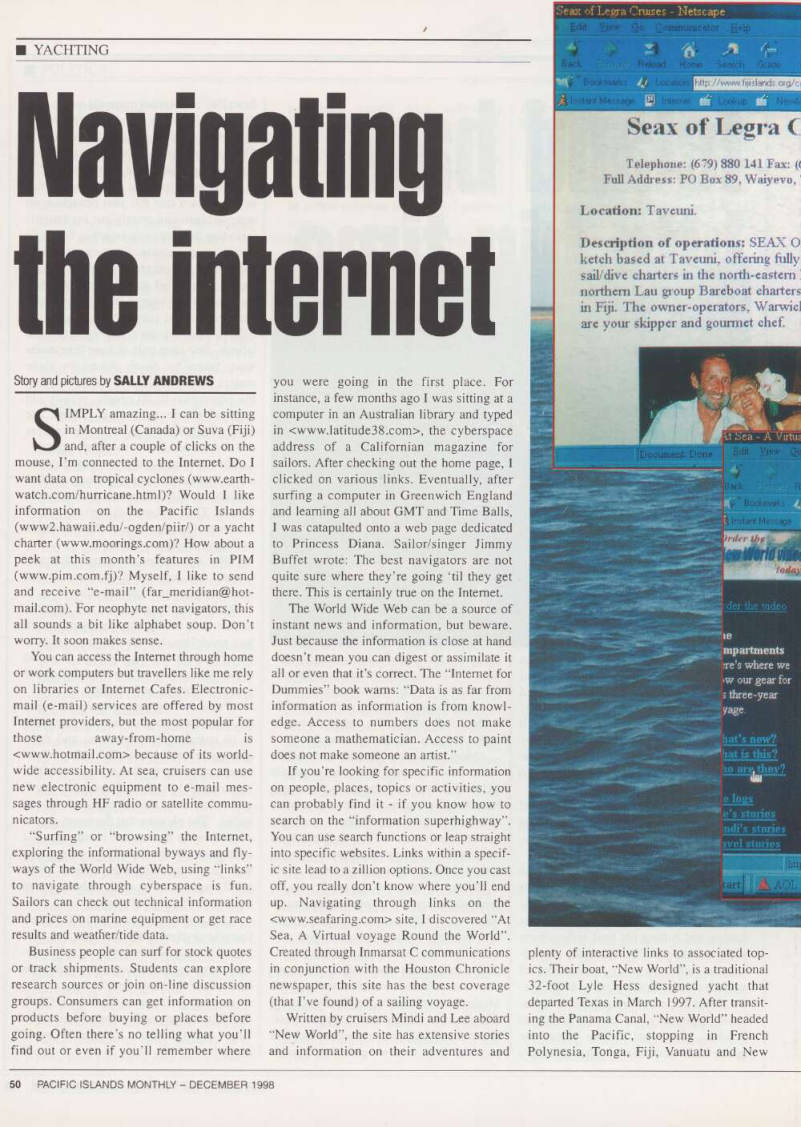
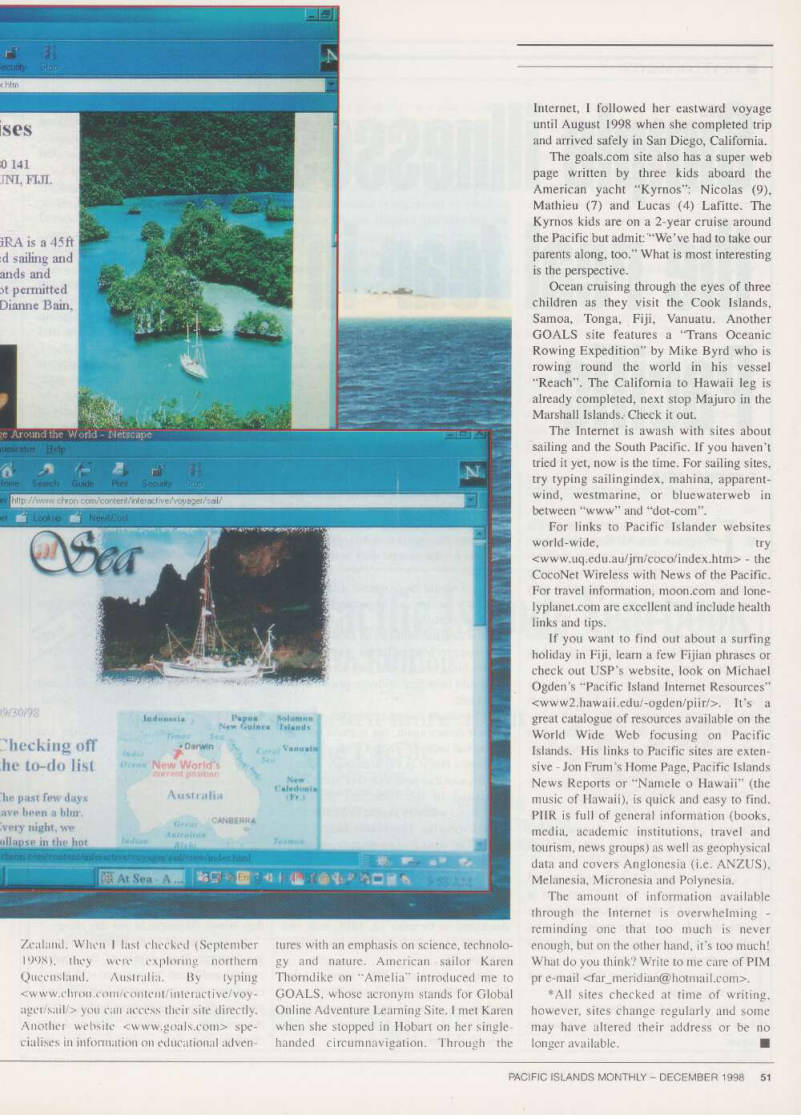
the internet
Story and pictures by SALLY ANDREWS
SIMPLY amazing... I can be sitting in Montreal (Canada) or Suva (Fiji) and, after a couple of clicks on the mouse, I’m connected to the Internet. Do I want data on tropical cyclones (www.earth watch.com/hurricane.html)? Would I like information on the Pacific Islands (www2.hawaii.edu/-ogden/piir/) or a yacht charter (www.moorings.com)? How about a peek at this month’s features in PIM (www.pim.com.fj)? Myself, I like to send and receive “e-mail” (far_meridian@hot mail.com). For neophyte net navigators, this all sounds a bit like alphabet soup. Don’t worry. It soon makes sense.
You can access the Internet through home or work computers but travellers like me rely on libraries or Internet Cafes. Electronic mail (e-mail) services are offered by most Internet providers, but the most popular for those away-from-home is <www.hotmail.com> because of its world wide accessibility. At sea, cruisers can use new electronic equipment to e-mail mes sages through HF radio or satellite commu nicators.
“Surfing” or “browsing” the Internet, exploring the informational byways and fly ways of the World Wide Web, using “links” to navigate through cyberspace is fun.
Sailors can check out technical information and prices on marine equipment or get race results and weather/tide data.
Business people can surf for stock quotes or track shipments. Students can explore research sources or join on-line discussion groups. Consumers can get information on
products before buying or places before
going. Often there’s no telling what you’ll find out or even if you’ll remember where
you were going in the first place. For instance, a few months ago I was sitting at a computer in an Australian library and typed in <www.latitude3B.com>, the cyberspace address of a Californian magazine for sailors. After checking out the home page, I clicked on various links. Eventually, after surfing a computer in Greenwich England and learning all about GMT and Time Balls, I was catapulted onto a web page dedicated to Princess Diana. Sailor/singer Jimmy Buffet wrote: The best navigators are not quite sure where they’re going ‘til they get there. This is certainly true on the Internet.
The World Wide Web can be a source of instant news and information, but beware.
Just because the information is close at hand doesn’t mean you can digest or assimilate it all or even that it’s correct. The “Internet for Dummies” book warns: “Data is as far from information as information is from knowl edge. Access to numbers does not make someone a mathematician. Access to paint does not make someone an artist.”
If you’re looking for specific information on people, places, topics or activities, you can probably find it - if you know how to search on the “information superhighway”.
You can use search functions or leap straight into specific websites. Links within a specif ic site lead to a zillion options. Once you cast off, you really don’t know where you’ll end up. Navigating through links on the <www.seafaring.com> site, I discovered “At Sea, A Virtual voyage Round the World”.
Created through Inmarsat C communications in conjunction with the Houston Chronicle newspaper, this site has the best coverage (that I’ve found) of a sailing voyage.
Written by cruisers Mindi and Lee aboard “New World”, the site has extensive stories and information on their adventures and
plenty of interactive links to associated top ics. Their boat, "New World”, is a traditional 32-foot Lyle Hess designed yacht that departed Texas in March 1997. After transit ing the Panama Canal, “New World” headed into the Pacific, stopping in French Polynesia, Tonga, Fiji, Vanuatu and New
Zealand. When I last checked (September 1998), they were exploring northern Queensland, Australia. By typing
<www.chron.com/content/interactive/voy-
ager/sail/> you can access their site directly.
Another website <www.goals.com> specialises in information on educational adven-
tures with an emphasis on science, technolo gy and nature. American ■ sailor Karen Thorndike on ■'Amelia” introduced me to GOALS, whose acronym stands for Global Online Adventure Learning Site. I met Karen when she stopped in Hobart on her single handed circumnavigation. Through the
Internet, I followed her eastward voyage until August 1998 when she completed trip and arrived safely in San Diego, California.
The goals.com site also has a super web page written by three kids aboard the American yacht “Kyrnos”: Nicolas (9), Mathieu (7) and Lucas (4) Lafitte. The Kyrnos kids are on a 2-year cruise around the Pacific but admit: “We’ve had to take our parents along, too.” What is most interesting is the perspective.
Ocean cruising through the eyes of three children as they visit the Cook Islands, Samoa, Tonga, Fiji, Vanuatu. Another GOALS site features a “Trans Oceanic Rowing Expedition” by Mike Byrd who is rowing round the world in his vessel “Reach”. The California to Hawaii leg is already completed, next stop Majuro in the Marshall Islands.- Check it out.
The Internet is awash with sites about sailing and the South Pacific. If you haven’t tried it yet, now is the time. For sailing sites, try typing sailingindex, mahina, apparent wind, westmarine, or bluewaterweb in between “www” and “dot-com”.
For links to Pacific Islander websites world-wide, try <www.uq.edu.au/jm/coco/index.htm> - the Coco Net Wireless with News of the Pacific.
For travel information, moon.com and lone lyplanet.com are excellent and include health links and tips.
If you want to find out about a surfing holiday in Fiji, learn a few Fijian phrases or check out USP’s website, look on Michael Ogden’s “Pacific Island Internet Resources” <www2.hawaii.edu/-ogden/piir/>. It’s a great catalogue of resources available on the World Wide Web focusing on Pacific Islands. His links to Pacific sites are exten sive - Jon Frum’s Home Page, Pacific Islands News Reports or “Namele o Hawaii” (the music of Hawaii), is quick and easy to find.
PIIR is full of general information (books, media, academic institutions, travel and tourism, news groups) as well as geophysical data and covers Anglonesia (i.e. ANZUS), Melanesia, Micronesia and Polynesia.
The amount of information available through the Internet is overwhelming reminding one that too much is never enough, but on the other hand, it's too much!.
What do you think? Write to me care of PIM pr e-mail <[email protected]>. * All sites checked at time of writing, however, sites change regularly and some may have altered their address or be no longer available. ■
Simple illnesses
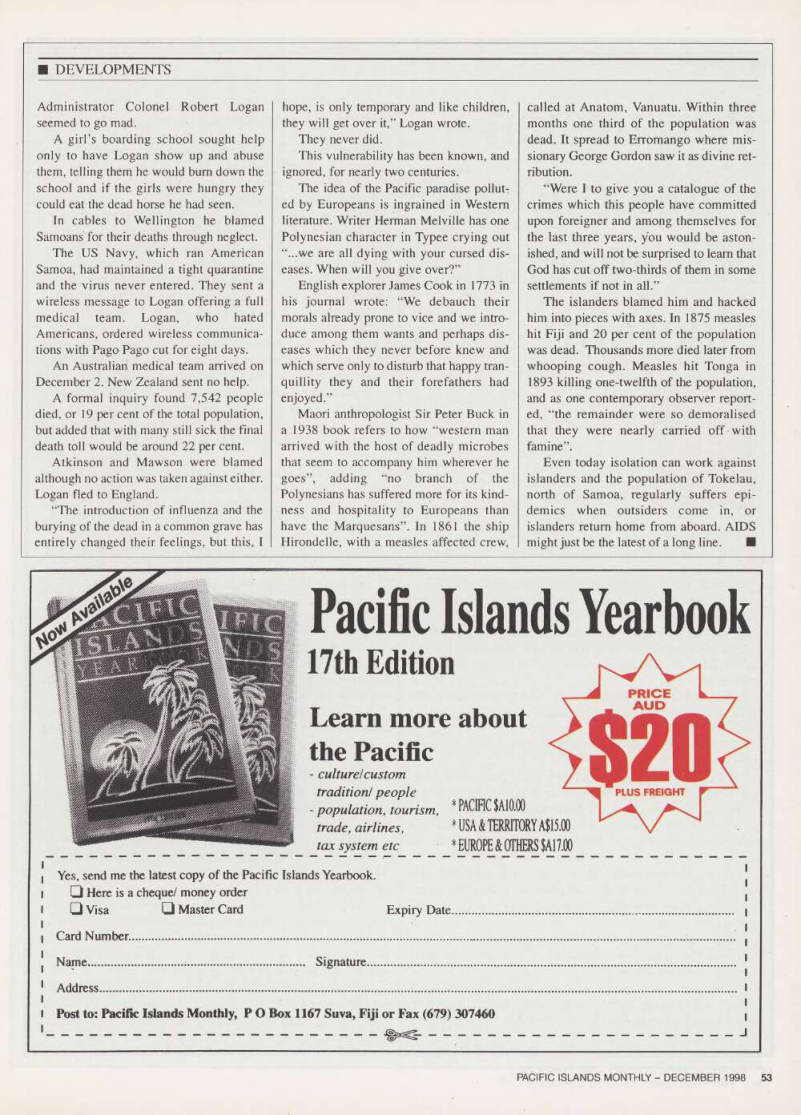
Or real fear in Pacific
By Michael Field
PEOPLE worry about an exotic disease like AIDS reaching into the Pacific but among medical experts the real fears are the seemingly simple illnesses that can slaughter vast populations in days.
And even today, with all the big advances, there is not a lot that can be done if something like influenza or measles hits a Pacific island.
Evidence of the power of such a tragedy can be seen behind an Apia churchyard where there is a mass grave which many believe is haunted - a result of some of its occupants still being alive when they were buried there.
November marked the 80th anniversary of the arrival of Spanish influenza.
In a remarkable blunder the New Zealand administrators of Samoa let the virus into Western Samoa - and then went on to spread it in Tonga and Fiji.
On November 7, 1918, the virus arrived in Apia and within a month 22 per cent of Samoans died in what the United Nations later termed “one of the most disastrous epidemics recorded anywhere in the world during the present century”.
Neighbouring American Samoa did not get a single case.
The warning for the Pacific is that the best medical advice suggests it will happen again.
Auckland public health official Dr.
Lester Calder said he had no doubt that another influenza pandemic was inevitable and with similar consequences.
“There are very limited medical inter ventions for the genetic shift in the virus,” he said.
There would be “extreme difficulties” to tailor a vaccine quickly enough and dis tribute it globally.
New Zealand Ministry of Health princi pal virologist Martin Tobias said a variety of anti-biotic drugs and anti-virdl agents that could help deal with the pneumonia’s that result.
“The death toll may not be as high when it occurs again, but it could be very substantial indeed,” Tobias said.
Proof - that it is the seemingly innocu ous diseases that pose a serious threat - was illustrated in the Federated States of Micronesia when 13 people in Chuuk State died of measles. There were nearly 1000 cases. The virus had come in from neigh bouring Guam.
What happened in Samoa in 1918 was a continuation of what had happened in New Zealand itself. A liner, Niagara, arrived in Auckland on October 12, 1918, with two dead and 131 sick. It had been quarantined in Suva, Fiji.
Prime Minister Bill Massey and Finance Minister Sir Joseph Ward were aboard so it was not quarantined in Auckland. Around 0.5 per cent or 5,471 New Zealanders died soon after.
The Union Steam Ship Company ship Talune left an epidemic stricken Auckland for the Pacific with one of its passengers, Reverend Paul Cane of the London Missionary Society, sick with the flu.
Talune arrived in Suva and was quaran tined, although somewhat casually, while 85 Fijian dock workers were taken aboard to help with cargo handling in later ports.
Fifteen were to die in the round trip voy age through Samoa and Tonga.
The ship arrived in Apia on November 7 and was greeted by port health officer Frank Atkinson who was told by Captain John Mawson there was nothing unusual aboard.
“We had sniffles, but nothing serious and we are all over it now,” Mawson said.
He knew of the Auckland epidemic - he carried newspapers with grim accounts of it - and Atkinson, would have known the disasters earlier measles and influenza epi demics had wrought on Pacific people.
Samoans in canoes around the ship knew something was wrong.
A man, Tuatagaloa, said one Falielo called out from the ship “there is sickness in this boat”. Tuatagaloa went aboard and among the first he saw was a girl, Ta’u, who was laying on the deck in a very weak condition.
“I saw there were many sick people on board,” Tuatagaloa said.
Atkinson saw Ta’u and sent her ashore saying she was “dangerously ill”. She died that night, Samoa’s first influenza death.
Cane went ashore, visited the bank and saw friends before being taken to hospital.
He survived.
Next day Talune sailed for Tonga and introduced influenza there. It killed 10 per cent of the population. It then returned to Suva and the virus arrived there.
On November 11 most of Apia turned out to mark the end of the war. The cele brations guaranteed a high kill rate from the virus.
A chief died in Apia and a fautasi or long boat came to get his body. The 17 men who rowed down all died in Apia.
At the Vaimea mass grave near Apia they buried 70 people in one day alone.
Some were still alive. Forced gravedig ger Newton Rowe wrote of the “putrid corpses and added “strong men with hearty constitutions and stomachs like iron had, after handling some of these bodies, sat on the roadside and vomited”. The epidemic crippled the new military rulers and
Administrator Colonel Robert Logan seemed to go mad.
A girl’s boarding school sought help only to have Logan show up and abuse them, telling them he would bum down the school and if the girls were hungry they could eat the dead horse he had seen.
In cables to Wellington he blamed Samoans for their deaths through neglect.
The US Navy, which ran American Samoa, had maintained a tight quarantine and the virus never entered. They sent a wireless message to Logan offering a full medical team. Logan, who hated Americans, ordered wireless communica tions with Pago Pago cut for eight days.
An Australian medical team arrived on December 2. New Zealand sent no help.
A formal inquiry found 7,542 people died, or 19 per cent of the total population, but added that with many still sick the final death toll would be around 22 per cent.
Atkinson and Mawson were blamed although no action was taken against either.
Logan fled to England.
“The introduction of influenza and the burying of the dead in a common grave has entirely changed their feelings, but this, I
hope, is only temporary and like children, they will get over it,” Logan wrote.
They never did.
This vulnerability has been known, and ignored, for nearly two centuries.
The idea of the Pacific paradise pollut ed by Europeans is ingrained in Western literature. Writer Herman Melville has one Polynesian character in Typee crying out “...we are all dying with your cursed dis eases. When will you give over?”
English explorer James Cook in 1773 in his journal wrote: “We debauch their morals already prone to vice and we intro duce among them wants and perhaps dis eases which they never before knew and which serve only to disturb that happy tran quillity they and their forefathers had enjoyed.”
Maori anthropologist Sir Peter Buck in a 1938 book refers to how “western man arrived with the host of deadly microbes that seem to accompany him wherever he goes”, adding “no branch of the Polynesians has suffered more for its kind ness and hospitality to Europeans than have the Marquesans”. In 1861 the ship Hirondelle, with a measles affected crew,
called at Anatom, Vanuatu. Within three months one third of the population was dead. It spread to Erromango where mis sionary George Gordon saw it as divine ret ribution.
“Were I to give you a catalogue of the crimes which this people have committed upon foreigner and among themselves for the last three years, you would be aston ished, and will not be surprised to learn that God has cut off two-thirds of them in some settlements if not in all.”
The islanders blamed him and hacked him into pieces with axes. In 1875 measles hit Fiji and 20 per cent of the population was dead. Thousands more died later from whooping cough. Measles hit Tonga in 1893 killing one-twelfth of the population, and as one contemporary observer report ed, “the remainder were so demoralised that they were nearly carried off with famine”.
Even today isolation can work against islanders and the population of Tokelau, north of Samoa, regularly suffers epi demics when outsiders come in, or islanders return home from aboard. AIDS might just be the latest of a long line. ■
Advertisements & other items, p. 53 (1 item)
Pacific Islands Yearbook
m a
17th Edition
Learn more about
the Pacific
- culture!custom tradition! people - population, tourism, trade, airlines, tax system etc
* PACIFIC SAIO.OO
* USA & TERRITORY A 515.00
PRICE
AUD
PLUS FREIGHT
Yes, send me the latest copy of the Pacific Islands Yearbook.
Q Here is a cheque/ money order □ Visa □ Master Card Expiry Date.
Card Number- Name Signature.
Address.
Post to: Pacific Islands Monthly, P O Box 1167 Suva, Fiji or Fax (679) 307460
Polynesian
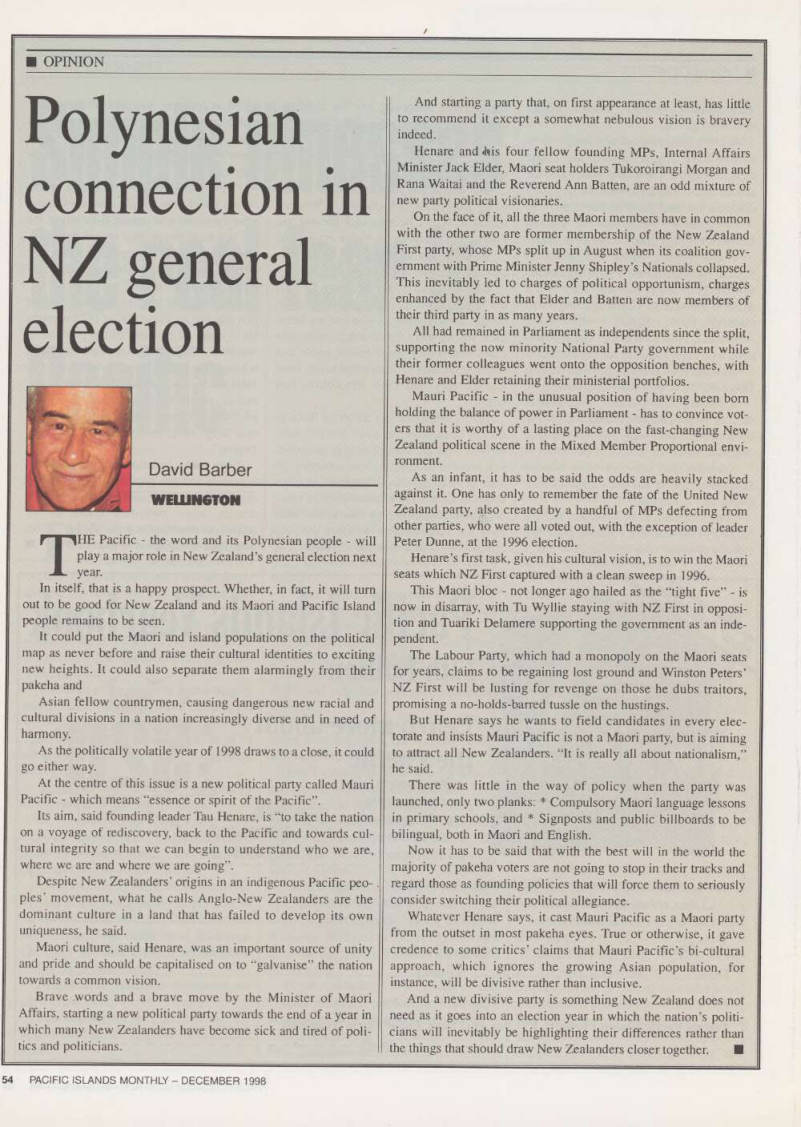
Opinion
Polynesian connection in NZ general election
David Barber
Wellington
THE Pacific - the word and its Polynesian people - will play a major role in New Zealand’s general election next year.
In itself, that is a happy prospect. Whether, in fact, it will turn out to be good for New Zealand and its Maori and Pacific Island people remains to be seen.
It could put the Maori and island populations on the political map as never before and raise their cultural identities to exciting new heights. It could also separate them alarmingly from their pakeha and Asian fellow countrymen, causing dangerous new racial and cultural divisions in a nation increasingly diverse and in need of harmony.
As the politically volatile year of 1998 draws to a close, it could go either way.
At the centre of this issue is a new political party called Mauri Pacific - which means “essence or spirit of the Pacific”.
Its aim, said founding leader Tau Henare, is “to take the nation on a voyage of rediscovery, back to the Pacific and towards cul tural integrity so that we can begin to understand who we are, where we are and where we are going”.
Despite New Zealanders’ origins in an indigenous Pacific peo ples’ movement, what he calls Anglo-New Zealanders are the dominant culture in a land that has failed to develop its own uniqueness, he said.
Maori culture, said Henare, was an important source of unity and pride and should be capitalised on to ’’galvanise” the nation towards a common vision.
Brave words and a brave move by the Minister of Maori Affairs, starting a new political party towards the end of a year in which many New Zealanders have become sick and tired of poli tics and politicians.
And starting a party that, on first appearance at least, has little to recommend it except a somewhat nebulous vision is bravery indeed.
Henare and <his four fellow founding MPs, Internal Affairs Minister Jack Elder, Maori seat holders Tukoroirangi Morgan and Rana Waitai and the Reverend Ann Batten, are an odd mixture of new party political visionaries.
On the face of it, all the three Maori members have in common with the other two are former membership of the New Zealand First party, whose MPs split up in August when its coalition gov ernment with Prime Minister Jenny Shipley’s Nationals collapsed.
This inevitably led to charges of political opportunism, charges enhanced by the fact that Elder and Batten are now members of their third party in as many years.
All had remained in Parliament as independents since the split, supporting the now minority National Party government while their former colleagues went onto the opposition benches, with Henare and Elder retaining their ministerial portfolios.
Mauri Pacific - in the unusual position of having been bom holding the balance of power in Parliament - has to convince vot ers that it is worthy of a lasting place on the fast-changing New Zealand political scene in the Mixed Member Proportional envi ronment.
As an infant, it has to be said the odds are heavily stacked against it. One has only to remember the fate of the United New Zealand party, also created by a handful of MPs defecting from other parties, who were all voted out, with the exception of leader Peter Dunne, at the 1996 election.
Henare’s first task, given his cultural vision, is to win the Maori seats which NZ First captured with a clean sweep in 1996.
This Maori bloc - not longer ago hailed as the “tight five” - is now in disarray, with Tu Wyllie staying with NZ First in opposi tion and Tuariki Delamere supporting the government as an inde pendent.
The Labour Party, which had a monopoly on the Maori seats for years, claims to be regaining lost ground and Winston Peters’
NZ First will be lusting for revenge on those he dubs traitors, promising a no-holds-barred tussle on the hustings.
But Henare says he wants to field candidates in every elec torate and insists Mauri Pacific is not a Maori party, but is aiming to attract all New Zealanders. “It is really all about nationalism,” he said.
There was little in the way of policy when the party was launched, only two planks: * Compulsory Maori language lessons in primary schools, and * Signposts and public billboards to be bilingual, both in Maori and English.
Now it has to be said that with the best will in the world the majority of pakeha voters are not going to stop in their tracks and regard those as founding policies that will force them to seriously consider switching their political allegiance.
Whatever Henare says, it cast Mauri Pacific as a Maori party from the outset in most pakeha eyes. True or otherwise, it gave credence to some critics’ claims that Mauri Pacific’s bi-cultural approach, which ignores the growing Asian population, for instance, will be divisive rather than inclusive.
And a new divisive party is something New Zealand does not need as it goes into an election year in which the nation’s politi cians will inevitably be highlighting their differences rather than the things that should draw New Zealanders closer together. ■
reform a
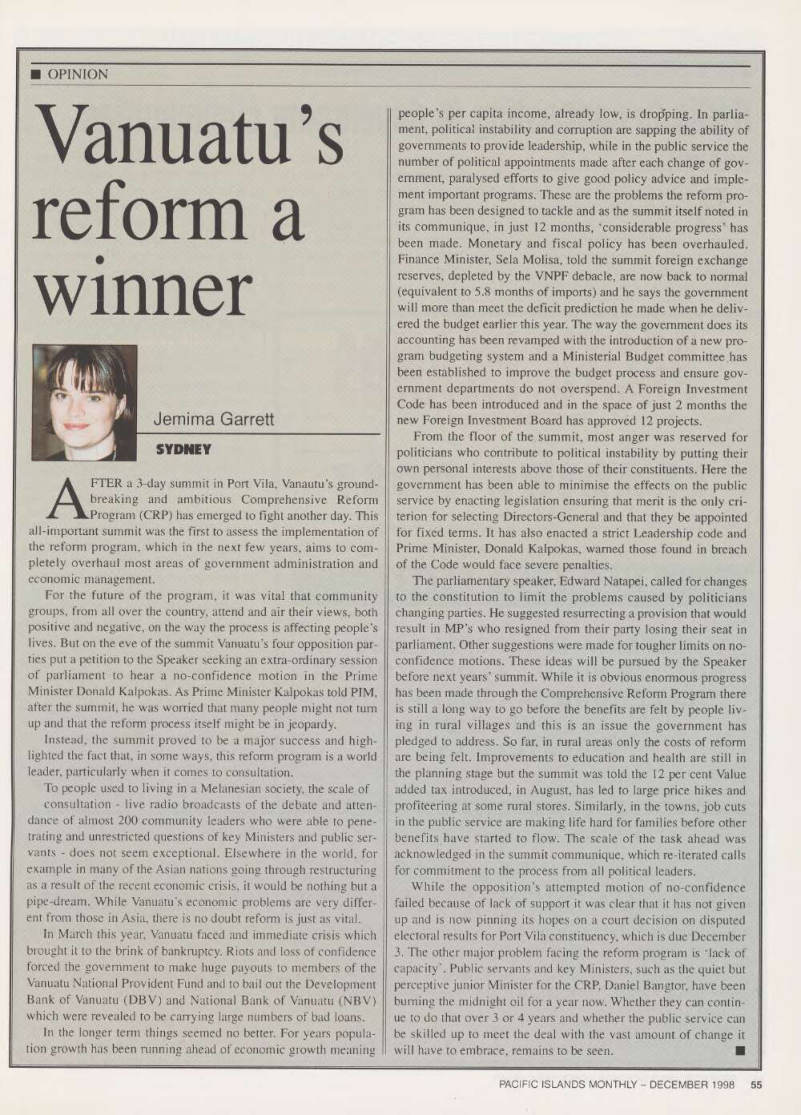
Vanuatu’s reform a winner
Jemima Garrett
Sydney
AFTER a 3-day summit in Port Vila, Vanautu’s ground breaking and ambitious Comprehensive Reform Program (CRP) has emerged to fight another day. This all-important summit was the first to assess the implementation of the reform program, which in the next few years, aims to com pletely overhaul most areas of government administration and economic management.
For the future of the program, it was vital that community groups, from all over the country, attend and air their views, both positive and negative, on the way the process is affecting people’s lives. But on the eve of the summit Vanuatu’s four opposition par ties put a petition to the Speaker seeking an extra-ordinary session of parliament to hear a no-confidence motion in the Prime Minister Donald Kalpokas. As Prime Minister Kalpokas told PIM, after the summit, he was worried that many people might not turn up and that the reform process itself might be in jeopardy.
Instead, the summit proved to be a major success and high lighted the fact that, in some ways, this reform program is a world leader, particularly when it comes to consultation.
To people used to living in a Melanesian society, the scale of consultation - live radio broadcasts of the debate and atten dance of almost 200 community leaders who were able to pene trating and unrestricted questions of key Ministers and public ser vants - does not seem exceptional. Elsewhere in the world, for example in many of the Asian nations going through restructuring as a result of the recent economic crisis, it would be nothing but a pipe-dream. While Vanuatu's economic problems are very differ ent from those in Asia, there is no doubt reform is just as vital.
In March this year. Vanuatu faced and immediate crisis which brought it to the brink of bankruptcy. Riots and loss of confidence forced the government to make huge payouts to members of the Vanuatu National Provident Fund and to bail out the Development Bank of Vanuatu (DBV) and National Bank of Vanuatu (NBV) which were revealed to be carrying large numbers of bad loans.
In the longer term things seemed no better. For years popula tion growth has been running ahead of economic growth meaning
people’s per capita income, already low, is dropping. In parlia ment, political instability and corruption are sapping the ability of governments to provide leadership, while in the public service the number of political appointments made after each change of gov ernment, paralysed efforts to give good policy advice and imple ment important programs. These are the problems the reform pro gram has been designed to tackle and as the summit itself noted in its communique, in just 12 months, ‘considerable progress’ has been made. Monetary and fiscal policy has been overhauled.
Finance Minister, Sela Molisa, told the summit foreign exchange reserves, depleted by the VNPF debacle, are now back to normal (equivalent to 5.8 months of imports) and he says the government will more than meet the deficit prediction he made when he deliv ered the budget earlier this year. The way the government does its accounting has been revamped with the introduction of a new pro gram budgeting system and a Ministerial Budget committee has been established to improve the budget process and ensure gov ernment departments do not overspend. A Foreign Investment Code has been introduced and in the space of just 2 months the new Foreign Investment Board has approved 12 projects.
From the floor of the summit, most anger was reserved for politicians who contribute to political instability by putting their own personal interests above those of their constituents. Here the government has been able to minimise the effects on the public service by enacting legislation ensuring that merit is the only cri terion for selecting Directors-General and that they be appointed for fixed terms. It has also enacted a strict Leadership code and Prime Minister, Donald Kalpokas, warned those found in breach of the Code would face severe penalties.
The parliamentary speaker, Edward Natapei, called for changes to the constitution to limit the problems caused by politicians changing parties. He suggested resurrecting a provision that would result in MP’s who resigned from their party losing their seat in parliament. Other suggestions were made for tougher limits on no confidence motions. These ideas will be pursued by the Speaker before next years’ summit. While it is obvious enormous progress has been made through the Comprehensive Reform Program there is still a long way to go before the benefits are felt by people liv ing in rural villages and this is an issue the government has pledged to address. So far, in rural areas only the costs of reform are being felt. Improvements to education and health are still in the planning stage but the summit was told the 12 per cent Value added tax introduced, in August, has led to large price hikes and profiteering at some rural stores. Similarly, in the towns, job cuts in the public service are making life hard for families before other benefits have started to flow. The scale of the task ahead was acknowledged in the summit communique, which re-iterated calls for commitment to the process from all political leaders.
While the opposition’s attempted motion of no-confidence failed because of lack of support it was clear that it has not given up and is now pinning its hopes on a court decision on disputed electoral results for Port Vila constituency, which is due December 3. The other major problem facing the reform program is Mack of capacity'. Public servants and key Ministers, such as the quiet but perceptive junior Minister for the CRP, Daniel Bangtor, have been burning the midnight oil for a year now. Whether they can contin ue to do that over 3 or 4 years and whether the public service can be skilled up to meet the deal with the vast amount of change it will have to embrace, remains to be seen. ■
Radio broadcasting in developing communities

By Ron Ehrke
BROADCAST stations and net works throughout the world are continuing to undergo massive
changes, mainly resulting from continuing
rapid changes in technologies now avail able to broadcasters. This continues to open up the world to the sharing of information
in ways that were not possible a decade or two ago. Technological developments pro vide the means to establish small low-cost radio stations so that information can be shared among people living in remote, and often poorer, communities. This should be of particular interest to Pacific Island coun tries. While it is important to build hospi tals and schools, high priority must also be
given to developing existing broadcasting
networks, or building new stations. These can be used to talk about basic develop ment issues such as clean water, nutrition, prenatal care and so on. This can be extended, for example, into agriculture, talking about development in basic tech niques of food production, land manage ment, the environment and so on.
Thus broadcasting provides support for social and economic development the practical application of fundamental resources. Broadcasters in developing countries need modem and up-to-date technology but there is a need to provide what is appropriate to the needs and skills of the local staff. This often requires low cost and simple technologies rather than sophisticated technologies.
The latter can bring with them a high price to buy and to maintain and a need for staff to have a high level of skill with new technologies to service the equip ment. Broadcasting developments can make a very significant and practical con tribution to the development of people living in remote communities. Often the poorer people, who do not have the many benefits available to people living in and around major cities, benefit substantially through being able to listen to education al programmes through local radio sta tions. There are benefits from establishing low-cost radio stations in remote commu nities. People in the communities are pro vided with programming that is informa tive, educational and entertaining. * Ron Ehrke is a broadcast consultant with more than 32 years experience in the field. ■
Advertisements & other items, p. 56 (1 item)
Pacific Blands
>i <» \ r ii l v
TRADING POST
TRADING POST CAN WORK WONDERS FOR YOU Promote your business, or service, sell your household iterms, cars or heavy machinery etc.
BUSINESS NOTICE
MATAIKA INVESTIGATIONS,
BOX 129 NUKU ‘ ALOFA, TONGA.
TELEPHONE/FAX 00676-24390.
ALL TYPES OF
INVESTIGATION
AUSTRALIAN INTERNATIONAL SHIPPING SERVICES PTY LTD
Providing Container Consolidated Services, Full Container Loads, Airfrieght Forwarding and Purchase Order Tracking Services to:- American Samoa, Cook Islands, Fiji, Guam, Kiribati, New Zealand, Niue, Norfolk Island, New Caledonia, Nauru, Papua New Guinea, Solomon Islands, Tahiti, The Federated States of Micronesia, Tonga, Vanuatu, and Western Samoa.
Offices in Melbourne and Sydney
TEL:- 61-3-93351477 FAX:-61-3-93380115 EMAIL:-A-I-S-S.COM
Australian International Shipping Services
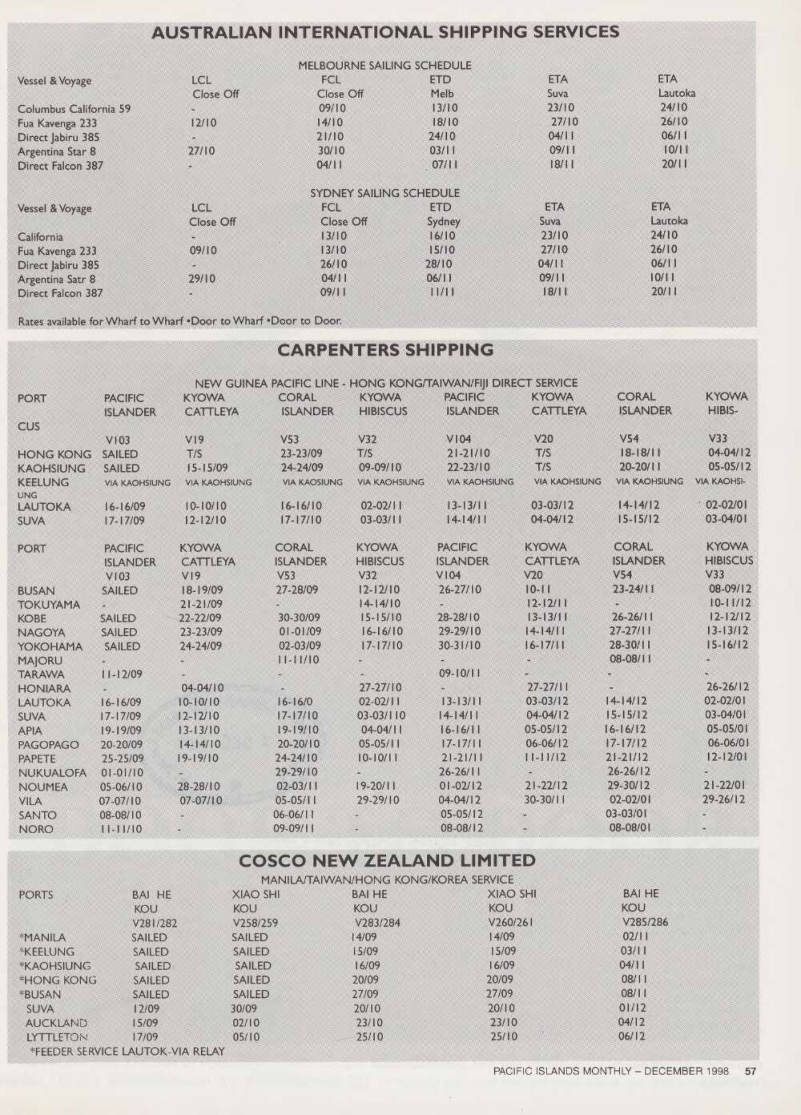
Melbourne Sailing Schedule
Vessel & Voyage
Lcl
Fcl
Etd
Eta
Eta
Close Off Close Off Melb Suva Lautoka Columbus California 59 - 09/10 13/10 23/10 24/10 Fua Kavenga 233 12/10 14/10 18/10 27/10 26/10 Direct Jabiru 385 - 21/10 24/10 04/11 06/1 I Argentina Star 8 27/10 30/10 03/1 1 09/11 10/1 1 Direct Falcon 387 - 04/11 07/11 18/11 20/11
Sydney Sailing Schedule
Vessel & Voyage
Lcl
Fcl
Etd
Eta
Eta
Close Off Close Off
Sydney
Suva Lautoka California - 13/10 16/10 23/10 24/10 Fua Kavenga 233 09/10 13/10 15/10 27/10 26/10 Direct Jabiru 385 - 26/10 28/10 04/1! 06/11 Argentina Satr 8 29/10 04/11 06/11 09/11 10/11 Direct Falcon 387 - 09/11 11/11 18/11 20/11 Rates available for Wharf to Wharf •Door to Wharf •Door to Door.
Carpenters Shipping
New Guinea Pacific Line -
Hong Kong/Taiwan/Fiji Direct Service
Port
Pacific
Kyowa
Coral
Kyowa
Pacific
Kyowa
Coral
Kyowa
Islander
Cattleya
Islander
Hibiscus
Islander
Cattleya
Islander
Hibis-
Cus
VI03 VI9 V53 V32 VI04 V20 V54 V33
Hong Kong
Sailed
T/S 23-23/09 T/S 21-21/10 T/S 18-18/11 04-04/12
Kaohsiung
Sailed
15-15/09 24-24/09 09-09/10 22-23/10 T/S 20-20/11 05-05/12
Keelung
Via Kaohsiung
Via Kaohsiung
Via Kaosiung
Via Kaohsiung
Via Kaohsiung
Via Kaohsiung
Via Kaohsiung
Via Kaohsi-
Ung
Lautoka
16-16/09 10-10/10 16-16/10 02-02/11 13-13/11 03-03/12 14-14/12 02-02/01
Suva
17-17/09 12-12/10 17-17/10 03-03/11 14-14/11 04-04/12 15-15/12 03-04/01
Port
Pacific
Kyowa
Coral
Kyowa
Pacific
Kyowa
Coral
Kyowa
Islander
Cattleya
Islander
Hibiscus
Islander
Cattleya
Islander
Hibiscus
VI03 VI9 VS3 V32 V104 V20 V54 V33
Busan
Sailed
18-19/09 27-28/09 12-12/10 26-27/10 10-11 23-24/II 08-09/12
Tokuyama
. 21-21/09 - 14-14/10 - (2-12/11 - 10-11/12
Kobe
Sailed
22-22/09 30-30/09 15-15/10 28-28/10 13-13/1 1 26-26/11 12-12/12
Nagoya
Sailed
23-23/09 01-01/09 16-16/10 29-29/10 14-14/11 27-27/11 13-13/12
Yokohama
Sailed
24-24/09 02-03/09 17-17/10 30-31/10 16-17/11 28-30/1 1 15-16/12
Majoru
- - 1 1-11/10 - - - 08-08/11 -
Tarawa
1 1-12/09 - - - 09-10/1 1 - - -
Honiara
. 04-04/10 - 27-27/10 - 27-27/1 1 - 26-26/12
Lautoka
16-16/09 10-10/10 16-16/0 02-02/11 13-13/11 03-03/12 14-14/12 02-02/01
Suva
17-17/09 12-12/10 17-17/10 03-03/1 10 14-14/11 04-04/12 15-15/12 03-04/01
Apia
19-19/09 13-13/10 19-19/10 04-04/11 16-16/11 05-05/12 16-16/12 05-05/01
Pagopago
20-20/09 14-14/10 20-20/10 05-05/11 17-17/11 06-06/12 17-17/12 06-06/01
Papete
25-25/09 19-19/10 24-24/10 10-10/1 1 21-21/11 11-11/12 21-21/12 12-12/01
Nukualofa
01-01/10 - 29-29/10 - 26-26/M - 26-26/12 -
Noumea
05-06/10 28-28/10 02-03/11 19-20/1 1 01-02/12 21-22/12 29-30/12 21-22/01
Vila
07-07/10 07-07/10 05-05/11 29-29/10 04-04/12 30-30/11 02-02/01 29-26/12
Santo
08-08/10 . 06-06/1 1 - 05-05/12 - 03-03/01 -
Noro
1 1-1 1/10 - 09-09/11 - 08-08/12 - 08-08/01 -
Cosco New Zealand Limited
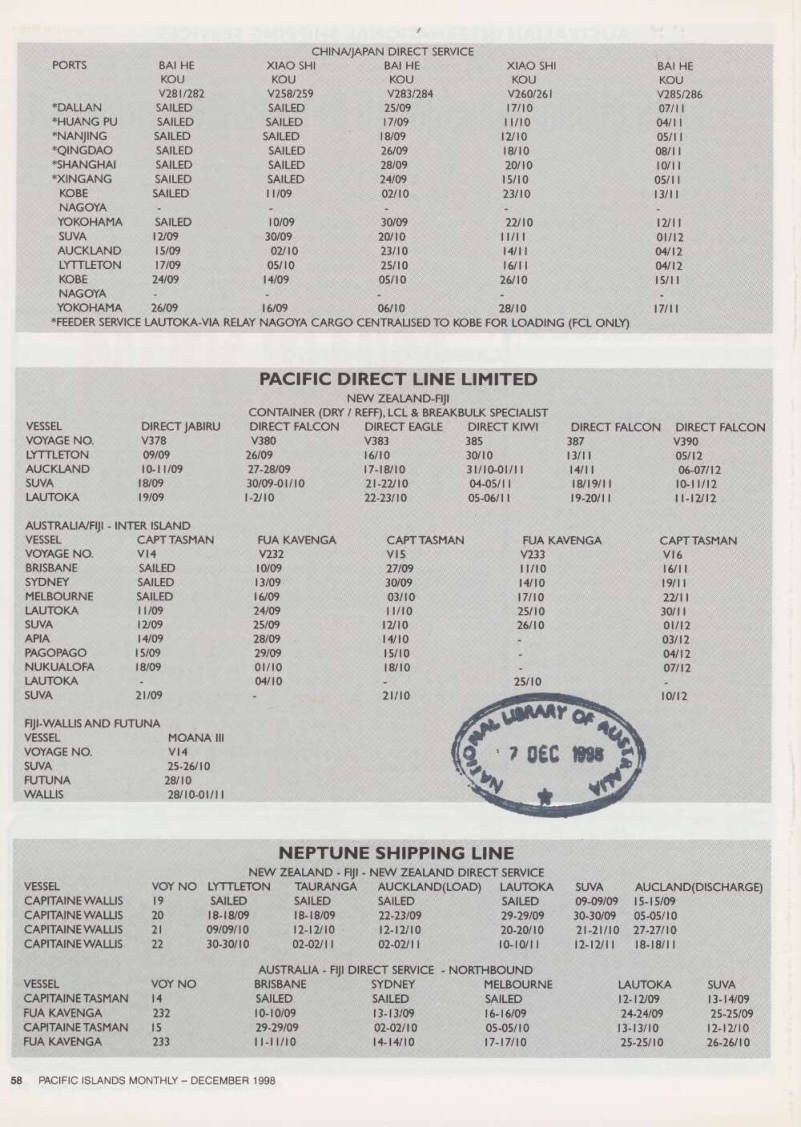
Manila/Taiwan/Hong Kong/Korea Service
Ports
Bai He
Xiao Shi
Bai He
Xiao Shi
Bai He
Kou
Kou
Kou
Kou
Kou
V281/282 V258/259 V283/284 V260/261 V285/286
♦Manila
Sailed
Sailed
14/09 14/09 02/11
♦Keelung
Sailed
Sailed
15/09 15/09 03/1 1
♦Kaohsiung
Sailed
Sailed
16/09 16/09 04/11
♦Hong Kong
Sailed
Sailed
20/09 20/09 08/11
♦Busan
Sailed
Sailed
27/09 27/09 08/11
Suva
12/09 30/09 20/10 20/10 01/12
Auckland
15/09 02/10 23/10 23/10 04/12
Lyttleton
17/09 05/10 25/10 25/10 06/12
♦Feeder Service Lautok-Via Relay
China/Japan Direct Service
Ports
Bai He
Xiao Shi
Bai He
Xiao Shi
Bai He
Kou
Kou
Kou
Kou
Kou
V281/282 V258/259 V283/284 V260/261 V285/286
*Dallan
Sailed
Sailed
25/09 17/10 07/1 1
♦Huang Pu
Sailed
Sailed
17/09 11/10 04/11
♦Nanjing
Sailed
Sailed
18/09 12/10 05/11
♦Qingdao
Sailed
Sailed
26/09 18/10 08/11
♦Shanghai
Sailed
Sailed
28/09 20/10 10/1 1
♦Xingang
Sailed
Sailed
24/09 15/10 05/1 1
Kobe
Sailed
11/09 02/10 23/10 13/1 1
Nagoya
Yokohama
Sailed
10/09 30/09 22/10 12/11
Suva
12/09 30/09 20/10 ll/ll 01/12
Auckland
15/09 02/10 23/10 14/1 1 04/12
Lyttleton
17/09 05/10 25/10 16/1 1 04/12
Kobe
24/09 14/09 05/10 26/10 15/11
Nagoya
Yokohama
26/09 16/09 06/10 28/10 17/11
♦Feeder Service Lautoka-Via
RELAY NAGOYA CARGO CENTRALISED TO KOBE FOR LOADING (FCL ONLY)
Advertisements & other items, p. 58 (1 item)
19 - 7 06C 1998 jgl
PACIFIC DIRECT LINE LIMITED
NEW ZEALAND-FIJI
CONTAINER (DRY / REFF), LCL & BREAKBULK SPECIALIST
VESSEL
DIRECT JABIRU
DIRECT FALCON
DIRECT EAGLE
DIRECT KIWI DIRECT FALCON DIRECT FALCON
VOYAGE NO.
V378 V380 V383 385 387 V390
LYTTLETON
09/09 26/09 16/10 30/10 13/11 05/12
AUCKLAND
10-11/09 27-28/09 17-18/10
3I/I0-0I/11 14/11
06-07/12
SUVA
18/09 30/09-01/10 21-22/10 04-05/11 18/19/11 10-11/12
LAUTOKA
19/09 1-2/10 22-23/10 05-06/11 19-20/11 11-12/12
AUSTRALIA/FIJI -
INTER ISLAND
VESSEL
C APT TASMAN
FUA KAVENGA
CAPT TASMAN FUA KAVENGA
CAPT TASMAN
VOYAGE NO.
VI4 V232
VIS
V233 VI6
BRISBANE
SAILED
10/09 27/09 11/10 16/11
SYDNEY
SAILED
13/09 30/09 14/10 19/11
MELBOURNE
SAILED
16/09 03/10 17/10 22/11
LAUTOKA
11/09 24/09 11/10 25/10 30/11
SUVA
12/09 25/09 12/10 26/10 01/12
APIA
14/09 28/09 14/10 - 03/12
PAGOPAGO
15/09 29/09 15/10 - 04/12
NUKUALOFA
18/09 01/10 18/10 - 07/12
LAUTOKA
SUVA
21/09 04/10 21/10 25/10 - - 10/12
FIJI-WALLIS AND FUTUNA
VESSEL MOANA III
19 - 7 06C 1998 jgl
Vv M
VOYAGE NO.
SUVA
VI4 25-26/10
FUTUNA
WALLIS
28/10 28/10-01/11
Neptune Shipping Line
New Zealand - Fiji -
New Zealand Direct Service
Vessel
Voy No
Lyttleton Tauranga
Auckland(Load) Lautoka
Suva Aucland(Discharge)
Cap1Taine Wallis
19
Sailed
Sailed
Sailed
Sailed
09-09/09 15-15/09
Capitaine Wallis
20 18-18/09 18-18/09 22-23/09 29-29/09 30-30/09 05-05/10
Capitaine Wallis
21 09/09/10 12-12/10 12-12/10 20-20/10 21-21/10 27-27/10
Capitaine Wallis
22 30-30/10 02-02/11 02-02/11 10-10/11 12-12/11 18-18/11
Australia - Fiji Direct Service
- Northbound
Vessel
Voy No
Brisbane
Sydney
Melbourne
Lautoka
Suva
Capitaine Tasman
14
Sailed
Sailed
Sailed
12-12/09 13-14/09
Fua Kavenga
232 10-10/09 13-13/09 16-16/09 24-24/09 25-25/09
Capitaine Tasman
15 29-29/09 02-02/10 05-05/10 13-13/10 12-12/10
Fua Kavenga
233 1 l-l 1/10 14-14/10 17-17/10 25-25/10 26-26/10
Advertisements & other items, pp. 59-60 (1 item)
Door To Door
International & Local Courier
Fiji’s own courier company goes further than Fiji 3 1508 00645486 7 o* V. 0* r\ i* r
For all your: I Courier needs fl Heavyweights Your choice of domestic messenger courier needs - / IHour / 3 Hour / Same day International & Local Courier SUVA: 218 388, 218 304 or TOLL FREE 0800 307 304 NADI AIRPORT: 724 434 NADI: 700 001 LAUTOKA: 665 161 IBASA: 816 022 SAVUSAVU: 850 001 SIGATOKA: 500 321 or simply call your nearest post office and ask for EMS Service.
KJ 9/9 2>, SHetMtS mmm m mmm- «!* 1 Some of the specs may vary according to market specifications.
Looks tough, feels comfortable - Toyota Hilux People all over the world prefer Toyota. Because it makes bestsellers like Hilux. It maintains that rugged reputation, and now it sports tough, durable body styles as well. It's ready for any terrain.
Hilux offers more. More power - with a choice of engines and precision transmissions and transfers. More effective power distribution to match the terrain, thanks to Toyota's advanced
technology.
And more passenger car-like comfort. With an ergonomic interior, all the conveniences you want, the fit and finish you'd expect from Toyota, and a ride that's smoothed out by precisionengineered suspension.
Hilux is built to take it. And to take you anywhere you want to go.
It's remarkably tough. And incredibly comfortable. With worldleading uncompromising quality. From the champion. Toyota.
® TOYOTA
DISTRIBUTORS/DEALERS
NORFOLK ISLAND BORRY’S PTY LTD. PH 22114
SOLOMON ISLANDS ELA MOTORS PH 30314
VANUATU ASCO MOTORS PH 22341
COOK ISLANDS PACIFIC MOTORS LTD. PH 20796
KIRIBATI TARAWA MOTORS PH 21090
PAPUA NEW GUINEA ELA MOTORS PH 3229400
TAHITI NIPPON AUTOMOTO PH 429819
WESTERN SAMOA. ASCO MOTORS PH 20800
FIJI ASCO MOTORS PH 384888
NEW CALEDONIA S.I.A.P. PH 275562
TONGA ASCO MOTORS PH 23500
AMERICAN SAMOA ASCO MOTORS* PH 633-4281
(*HILUX is not being handled.)