Advertisements & other items, pp. 1-4 (2 items)
Crisis
PACIFIC ISLANDS
MONTHLY
INSIDE: PUBLIC SEX ROMP IN COOKS EXPOSED
NOVEMBER 1998
Crisis
contagion Pushing the urgency for reform
Asco Motors
Mercedes-Benz C-Class
* ’ Ijp# t , •'! i' , •t# f
Aferi
i^cs-Ben;
* teMii Mercedes-Benz For your personal introduction to Mercedes-Benz please contact Riaz Reiman at A sco Motors Wain Bay. Ph 307656 or fax 307808.
This special offer is limited to existing stocks of Cl 80 Sedans.
There are many excellent reasons for you to choose a C-Class Mercedes-Benz, but the most important one can be easily overlooked.
Sheer pleasure. Quality abounds throughout.
It is a joy to drive and is exceptionally well finished. The new ClBo features EFI, power steering, ABS, central locking with remote immobiliser, and surely the most comfortable interior that you could imagine. Designed and built to perfection in Germany, this is one of Europe's grandest cars, and it can be yours today. Be the envy of your friends.
Asco Motors
Mercedes-Benz
Jy, K v/a £?
S' S. r S *. n Jk'ni i v is
Sißili
* H * l is® *; V 2 I si •' j ■'• V y We accept
VISA
Just quote your card number and expiry date and we will forward your requirements.
For further information please contact: Teiikom Phone Card Sales Pay Phone Business Unit PO Box 351 Waigani, NCD Papua New Guinea Telephone: (675) 300 5093 Facsimile: <675) 3005060
{!}}} TEIIKOM PNC
® * >' 7 AAIZtcJ oo&y&, rZs&Uy -haSlsuruff /
GOT MY FREEDOM JSr GOT MY FONE s * :
Now, there’s just one number to
call for every Vodafone service.
123. It couldn’t be easier.
Vodafone Customer Care operates 24 hours a day and Seven days a week.
Call 123 from your Vodafone or 902 123 from any Telecom Fiji phone.
O vodafone
Calls to 123 (Customer Care) are charged at the standard Vodafone rate.
Sansom de:
Pacific Islands
Monthly
Vol 68 No. Ii
The News Magazine
November 1998
PUBLISHER: Alan Robinson EDITOR: Sophie Foster Hildebrand
Correspondents:
Sally Andrew, Patrick Decloitre, Giff Johnson, Chris Peteru, Atama Raganivatu, Michael Field, Sam Vulum, Lisa Williams.
Columnists:
David Barber (Wellington), Jemima Garrett (Sydney), GRAPHIC ARTISTS: James Ranuku, Josefa Bola, Andrew Williams
Advertising Sales
Senior Regional Sales (South Pacific) Shabana Naaz Tel (679) 304111,303244, Fax (679) 303809.
Sydney, Canberra: Bob Hill Media Representation, Tel (61-2) 4164245, Fax (61-2)4165064.
Brisbane: Jane Fewings Media and Advertising Associates Tel (61-7) 3378 4522, Fax (61-7) 3878 1071.
Adelaide: Hastwell Williamsons Representatives, Tel (61-8) 3799522, Fax (61-8) 3799735.
Melbourne: Brown Orr Fletcher Burrows (Aust) Pty Ltd.
Tel (61-3) 98265188, Fax (61-3) 98265644.
Auckland: McKay & Bowman, International Media Representatives Limited, Tel (64-9)4190561, Fax (64-9) 4192243.
Japan: Universal Media Corporation, Tokyo, Tel (3) 3266626741, Cable: UNI-MEDIA Tokyo, Fax (3) 32626742.
Pacific Islands Monthly was founded in 1930
(Usps 9522480).
A Fiji Times Limited production.
Cover prices are recommended retail only. Registered by Australia Post, Publication No. NBPI2IO. © Copyright Fiji Times Limited, 177 Victoria Parade, Suva, Fiji.
Tel (679) 304111, fax (679) 303809.
Email: [email protected]
PIM Website: http://www.pim.com.fj Pacific Islands Monthly is published monthly by Fiji Times Limited, a division of Nationwide News, 2 Holt Street, Surry Hills, Sydney, NSW 2010.
Send Address Changes To:
Pacific Islands Monthly POBox 1167 Suva, Fiji.
Printed by Quality Print Limited, 16 Amra Street, Walu Bay, Suva, Fiji.
Layout and cover design by James Ranuku
Inside
Editorial 6 Letters/Briefs 7 What's happening? 9 Special Report: Minister's sex scandal rocks Rarotonga 10 Focus: Searching for peace in troubled East limor 12 Biak massacre grossly understated 13 Advertising Feature: Aviation 16 Soiomon Islands 21^ Business: Bringing Paringa Ou home 28 Forever at sea JM Developments: Gay Pacific Island men too shy for their own good 30 ILO urges govts to recognise sex industry 31 Pacific Island juveniles face their crimes 33 Cover Story: Crisis contagion 35 PNG's debts still accumulating 38 The Cooks and economic reform 41 Politics: Singirok skates back into power 45 Marshalls no-confidence motion loses 47 Global capitalism falling apart 50 Yachting: "Good as gold" in God's own 52 Opinion; David Barber/Jemima Garrett 54
Page 30
Page 32
Page 45
Cover Story: Crisis contagion
please stand?

Editorial
Can the “real men” please stand?
SOME Pacific Island leaders have a very nasty habit of behaving like naughty husbands - charm ing their way through cata strophes and meanwhile
screwing everyone over. Take Fiji for
example.
In order to jump-start the economy, the government has often stated that the size of the public sector needs to be reduced, freeing up the funds for other areas.
However, no progress seems to have been made towards this end.
The public sector is still monstrous, the government is virtually leading a hand-to-mouth existence, and any hopes of achieving a balanced budget have been thrown out the window.
How any minister can stand up in par liament and proclaim that they have done well for the country’s economy is beyond the realm of reasonable people.
Many reports, including those of the World Bank, the IMF, and the Bank of Hawaii, have stated that, during the 19905, the standard of living in Fiji has dropped.
Some may argue that this is based on figures which are averaged out for the entire population.
Yes, that is correct, and to give the government credit, there are some people who are now better off. Some of them can be seen driving into the Parliament com plex when Fiji’s highest body is sitting.
But just like the forgiving wife, the people of the country have believed the government’s promise to reform.
Many people have even wanted to believe the classic naughty husband line
of “it will never happen again”.
But happen again, it does. And again, and again, and again...
It seems that, like the
forgiving wife, the people of Fiji have somehow managed to turn a blind eye to the activities of government - the extra overseas trips, the lack of reform, the high telecommunication costs, the long waiting period to get services, the water cuts, the millions of pot-holes in Fiji’s roads.
But one thing that has to be remem bered is that the government-people rela tionship, just like conventional mar riages, has a breaking point. Every few years, the people of Fiji get to choose their new partner.
Which way will the forgiving wife will go this time - with the fat, over spending, naughty husband or a faithful, more efficient, trimmer husband? ■
Advertisements & other items, p. 6 (1 item)
When They Said
THEY WANTED CLOSER TIES
WITH OUR PACIFIC
NEIGHBOURS. I DONT
THINK THIS IS WHAT
THEY MEANT
r
Letters
Lifelong interest in Navosa
tragedy
My name is Kevin Phillips and I live at Darwin Australia. The letter refers to the Reverend Thomas Baker.
As a descendant of the Baker family, my interest in the Navosa Tragedy has been lifelong.
The Reverend Thomas Baker wisely kept a journal of his Fiji adventures, but sadly he was unable to record his last few days and hours on this Earth.
My family records of what occurred during and after the tragedy rely solely on reports from Church or Government insti tutions. Their conflicting reports lead me to believe that there might be some family who have kept an independent record of the event from way back then and by some chance the story they have to relate might be more believable.
I invite anyone with some previous unpublished incident about the life and death of the Minister of the Interior to con tact me please.
Kevin Phillips
6 Berrimah Road, Darwin, Australia 0828
Promoting sustainable
livelihoods
I was struck by an article in Pacific Islands Monthly entitled “Fiji company wins top award”. The article describes a highly successful family run business sell ing coconut soap logs and scented coconut oil. I noticed that Mrs Austin, the propri etor, is trying to get her son and daughter in law to market their products in America.
I work for Just World Trading, a branch of the non-govemment development organisation, UK Foundation for the South Pacific, which has sister organisations in Fiji, Vanuatu, Solomons and PNG. Just World Trading was founded in 1997 with the following aims.
1. To promote sustainable livelihoods for natural resource owning communities, through trade in eco timber and non-timber
products.
2. To ensure that primary producers receive prices which fairly reflect the value of their resources.
We noted that Sandollars place a strong emphasis on environmental responsibility and were interested in the enterprise as a cottage industry, allowing women to work from home.
It seems likely that Sandollars would meet the criteria we seek.
George Longman
Midlothian, Scotland
Letters to the Editor should be addressed to: The Editor Pacific islands Monthly PO Box 1167 Suva Fiji
Briefs
ANSETT to service Nadi/Sydney route ANSETT Airlines of Australia will commence flights between Sydney and Nadi in December. The airline will com pete directly with national airline Air Pacific and Australian airline Qantas, which operate a code share service on the route.
A tourism industry source said the introduction of Ansett flights would boost visitor arrivals from Australia.
The source said 40,000 Australian tourists visited Fiji annually but there was a huge potential to attract more visitors.
Ansett is owned by Air New Zealand and News Corporation Limited of Australia.
In March 1996, Ansett sent a three member executive team to look at the pos sibility of flying to Nadi. The visit was fol lowed by negotiations between the two governments on the air services agreement.
Sources said Ansett was likely to form an alliance with Fiji Airways Corporation which plans to operate a
Nadi/Singapore/Bombay/London route.
CONTINBITAL to cut Guam flights CONTINENTAL Micronesia has announced it will reduce the frequency of flights between Guam and Japan, and also use smaller aircraft.
The airline, hit by a sharp decline in Japanese tourism traffic, said that seat capacity in 1999 will be down about 23 per cent, according to the Marianas Variety. It will also replace the three existing Continental Micronesia 747 aircraft with lower capacity DCIO-30s.
Airline president Bill Meehan reassured a meeting of the Guam visitors Bureau that Continental Micronesia would be able to respond to any recovery in Japanese tourism with its plans to acquire Boeing 757 aircraft and also it has orders for the latest generation of the Boeing 737.
Tonga pumpkin export crop hit by
drought
PUMPKIN harvesting has begun in Tonga, but the long drought has left the country with a much smaller quantity than
planned. The Tonga Chronicle reported that it had originally been hoped that there would be 15,000 tonnes of pumpkin to export, but the country would be struggling to make up 7,000 tonnes.
The farmers on Tongatapu and Vava’u have been suffering from lack of rainfall, and on the latter island there are only a few tonnes of pumpkins which can be export ed.
The newspaper said one exporter, Island Produce Corporation, had wanted to ship 1500 tonnes but had trouble collecting 700 tonnes of the vegetable. Two other exporters have cancelled shipping due to the poor state of the crop.
BHP withdraws from pipeline study BHP Petroleum has withdrawn from providing further financial support to a fea sibility study into sending gas from Papua New Guinea to Queensland through a pro
posed pipeline.
A BHP spokesman stressed this did not have an impact on the company’s interest
in Kutubu, Gobe or South East Gobe gas fields which would potentially supply gas to the pipeline.
BHP has a nine per cent interest in the joint venture that is proceeding with the feasibility study. It will remain in the joint venture with Chevron Asiatic, Mitsubishi, Mobil Exploration, Orogen Minerals and Oil Search but it will not help fund the fea sibility study, AAP reported.
BHP had looked at the total portfolio of investment projects globally and, when combined with the low oil price and the company’s own restraints of capital expen diture, decided it would be better to spend the money elsewhere.
Burdekin to repay Mt Kasi debts, and
restructure gold operation
THE debt-stricken Mt Kasi gold mine in Fiji is to restructured by its new owners, Burdekin Resources. Company Director John Gow told The Fiji Times that Burdekin will repay about 95 per cent of the Fs3o million (U 5514,65 million) in debts which were amassed by the previous operator, Pacific Islands Gold NL.
The new operator will also change strat egy, moving from the soft ore areas to tar geting the hard rock resource.
Mr Gow said the company estimated the remaining resource at Mt Kasi was 176,000 ounces of gold. Burdekin expects the cost of recommissioning the mine will be in excess of $lB million.
Small Island States Development Fund
being reviewed
A SPECIAL development fund for six Pacific Island countries will be reviewed before year’s end to make it more respon sive to their changing needs.
The Smaller Island States Development Fund was established in 1987.
It is administered by the Forum Secretariat and has provided assistance to the Cook Islands, Kiribati, Nauru, Niue and Tuvalu.
From this year, the Republic of Marshall Islands has also been eli gible for assistance from the Fund.
Recent projects have included a workshop in the Cook Islands on the government’s reform programme in the outer islands; funding for computers and related equipment for Kiribati; a revolv ing fund for the purchase of bicycles to help a farming community in Tuvalu; office equipment for a vocational school in Tuvalu; the purchase of a bulldozer for Niue to help farmers clear land for planting, and policy assistance for Nauru on civil aviation.
Donors to the SIS Development Fund have included Australia, New Zealand and Taiwan.
Corporate structure changes at CMC MR Thomas Raju has been appointed chairman of the board of directors of Central Manufacturing Company (CMC), Fiji’s cigarette manufacturer. The appoint ment followed Mr Raju’s retirement as CMC General Manager, a position he held for 20 years.
He is succeeded by Mr John Nelson, who worked in a variety of senior positions with Rothmans of Pall Mall (Australia) Ltd before his transfer to Fiji. Mr Nelson has an MA degree from Macquarie University.
In 39 years of service to the tobacco industry in Fiji, Mr Raju had previously been CMC finance manager and company secretary. He said he had concentrated on improving training, staff development and productivity during his period as CMC general manager.
Mr Raju is a former president of the Fiji Employers’ Federation. He is board member of the Fiji National Training Council and the Pacific Fishing Company.
Mr Raju is a Trustee of the Bayly Trust and a member of the Complaints Committee of the Media council
New GM for Shangri-La's Fijian Resort SHANGRI-LA’S Fijian Resort has announced the appointment of Wolf-Dieter Flecker as General Manager. Previously the general manager of The Traders Hotel (a member of Shangri-La’s Hotels & Resorts) in Yangon, Myanmar (Burma), Mr Flecker officially took over the reins of Shangri-La’s Fijian Resort at the end of August. He has been with the Shangri-La Group of Hotels and Resorts for 15 years, managing a number of hotels in Asia including Shangri-La’s Mactan Island Resort in the Philippines, the Bali Dynasty Resort in Indonesia, and Shangri-La Hotel in Hangzhou, China.
He has some 34 years of experience in the tourism industry and replaces Desmond Hatton who has been appointed the gener al manager of The Traders Hotel, Yangon, Myanmar. ■
John Nelson
Thomas Raju
Wolf-Dieter Flecker
Advertisements & other items, p. 8 (1 item)
\ Engine
\WAREHOUSE
BMW\
Bedford Cummins Daihatsu Detroit Deutz Ford Gardner Hino Isuzu Iveco Komatsu Kubota
/ ★DIESELS ★PETROL \
/ TRANSMISSIONS \
★ New Parts ★Second Hand Parts
SPECIALS
•Tested Injector Pumps
for Diesels from -$290 •Engine Specials, Toyota 1C 4WD -$9OO •Bedford 330 -$3500 • Gearbox Special Brand New Allison MT653 5 Speed Auto-Reasonable Offer.
FREE FAX
0800-274-061 0800-252-477
NEW ZEALAND
Phone: 643-693-8122 Fax: 643-693-8120.
PO Box 14, Gera!din, New Zealand, email: [email protected] Subaru Leyland Mazda Mercedes Mitsubishi
MAN.
Nissan Perkins Suzuki Toyota Volvo Yanmar
Fijian
Archives-November 1944
Fijian soldier wins Victoria Cross
Posthumous award for sacrifice on Bougainville
TO a native of Fiji has gone the hon our of becoming the first non-European British soldier to win the VC in this war.
The award was made posthumously.
The soldier’s name was Corporal Sefanaia Sukanaivalu. He was a member
of a Fiji Infantry Battalion which fought on bougainville. He heroically sacrificed his life in order that his comrades should escape.
The full story of Sukanaivalu’s sacri fice was told in the September issue of the “PIM” by a New Zealand officer of the same battalion.
The Fijians, in battalion strength, were engaged in a coastal raid, and they ran into a wall of Jap machine-gun fire from prepared pill-boxes and positions.
As darkness drew on, it was decided
to evacuate the area by sea. “There were plenty of tales of gallantry to be sifted out,” records this officer. “Here is an out standing case. Corporal suka, from Cakaudrove, when bringing in the wounded, was shot in the groin and the thigh, at short range.
After a while he called out to his pla toon not to try and get him out, as he was too near the enemy and could not move.
“The Nadroga men called back to him to wait, and that they would never leave him, knowing that to be taken alive meant death, and probably torture.
“The issue was clear to Suka. His friends would not leave him unless he were dead and to get to him would be death for his friends. “Our men saw him raise himself up on his hands in front of the Jap machine-guns, and take a burst right in the chest.” ■
pacific Islands Monthly
Establishing 1930
November
What’S Happening?
1998
American Samoa - Election Day (3rd) - Thanksgiving (26th) Cook Islands - Yachting: National Champion Championships (1 st & 8th) - Cook Islands Music Composers Competition (13th) - International Food Festival (24th) - Tiare Festival of Flowers (24th-29th) - Miss Tiare Pageant (25th-28th) - Tiare Festival Floating Parade and Miss Tiare Crowning (29th) - Cook Islands Trust Company’s corporate triathlon (28th)
Fiji
- The rising of the Bulolo Worms
- Celebration of Oceans Dive Festival - The Fiji Primary Schools Athletics Championships New Caledonia - DREHU Cultural Week in Lifou - Music Festivity at Lifou Island (sports, music etc.) - International Triathlon - Dance Festival by Kanaks Group Niue - Philatelic Bureau AUPEX stamp exhibi tion (NZ) Niue first time participant (12th-16th) Papua New Guinea - Morobe Cultural Show Samoa - Week of prayers and fasting (lst-8th) - Arbour Day (6th) - Upolu Palolo rise (19th-20th)
Tahiti - All Saints day (1st) - Hawaiki Nui Outrigger Race (4th-7th) - Golf & Rugby at Moorea (14th-15th) - Special Austral Islands Festival (19th 22nd) - Day of the Tipanie flower - Tuvuka O Te Henua Enana Marquesas Arts and Craft Exhibition - Stonefishing
Tonga
- Constitution Day (4th) Tuvalu - Heir to the Throne’s Birthday (9th) Vanuatu - Youth Festival Source: South Pacific Calendar of Events 1998. TCSP
Minister's sek scandal rocks
Special Report
By Florence Syme-Buchanan
POLICE logs were blank, the gov ernment put up a wall of silence
and politicians were speechless
when the very public sex romp of the min ister of Women’s Affairs made headlines in the Cooks and New Zealand.
Days after the scandal was splashed in local newspapers, Cook Islanders were still to find out whether minister Papamama Pokino would lose his job or get rapped over the knuckles for his embarrassing behaviour. Although police assistance was called for during the incident that occurred in the early hours of Tuesday, October 6, logs at national headquarters were glaring ly devoid of Pokino’s name and involve ment. Police were called to the motel where the minister had a public sex romp to assist the heavily intoxicated Papamama Pokino in getting home and pacify the Niuean woman with whom he had sex.
Inspector Richard Browne says the inci dent at the downtown motel was no more than a "slight hiccup, a little domestic”. The police had responded to a call for assistance by manager Malcolm Laxton-Blinkhom at 3.19 am. Inspector Browne says it’s not unusual for names not to be recorded in the night shift’s occurrence file if the incidents are not of a serious nature and "we’ve only rendered assistance”.
But the blank log has raised questions about how much police cover up for senior politicians - and how long they have been doing it. From eyewitness accounts of what happened, it appears police are trying to play down the incident to keep minister of Women’s Affairs Pokino out of the media
spotlight.
A police source alleges the minister’s sexual encounters with the Niue woman first occurred on the waterfront on the out skirts of the Avarua township, before the
pair drove to the motel in his pick-up.
An eyewitness claims the minister had sex twice at the downtown Motel with the young woman in her mid-20s. The eyewit ness alleges he saw Pokino and the woman on the staircase and again later after strip ping naked in front of the motel’s Jacuzzi situated in the centre of the property.
He says the minister and the woman were in full view of some other guests who came outside after being awoken by cou ple’s noises. A day before news made local headlines, Papamama Pokino left for the Commonwealth Parliamentary Association conference in Wellington. The public sexu al escapades of the Cabinet minister have made him the talk of town bars and could jeopardise his political future.
Cabinet and political colleagues are hor rified by the incident, with one saying the actions of the minister were one of a "stu pid, stupid man.” Pokino’s behaviour
around women has become a subject of discussion.
One senior public servant claims he’s frequently made suggestive remarks to her. She claims to have warned the minister his behaviour was way out of line.
It is not just recent behaviour either. A female reporter on assignment in Mangaia says she was staying at the CAO residence when Papamama Pokino was chief administration officer on the island. She claims he came into her room naked, before she yelled at him to leave. Opposition DAP leader Terepai Maoate says prime minister Sir Geoffrey Henry should have dealt with the matter immediately. Dr Maoate says Pokino ’‘could possi bly lose his ministership” and there should be some sort of disciplinary action taken against the 62-year old married politician.
He says because intercourse took place in a public place it can’t be considered something pri vate in an individual’s life, and may be regarded as an indecent act. “What a shame,” says Dr Maoate.
The Niuean woman is said to be the daughter of a close friend of Papamama Pokino.
She has been identified as a welfare officer in the Niuean government’s ministry of Women, Youth and Sport. Police were called to the motel after she entered the room of other guests, made a lot noise and began trashing a room. A police source says when they arrived the woman, wrapped only in a motel towel, ran away and hid in the neighbouring Karika palace.
“We had to try and get her out of there without waking Karika Ariki (a paramount chief).” The Niue official was in Rarotonga attending a region al women’s conference with three other Niue dele gates. Conference organisers were trying to keep t the motel incident quiet and had asked an eyewitness not to speak to local media. A source says the Niuean government has been A I informed of what happened.
Foreign Affairs secretary Edwin Pittman says this may have been done by the other Niue delegates, "but there's been nothing on a government H to government basis". A spokesman from the small Niuean community here says the whole thing is very embarrassing for them. But not as embarrassing as it will be for Papamama Pokino. ■
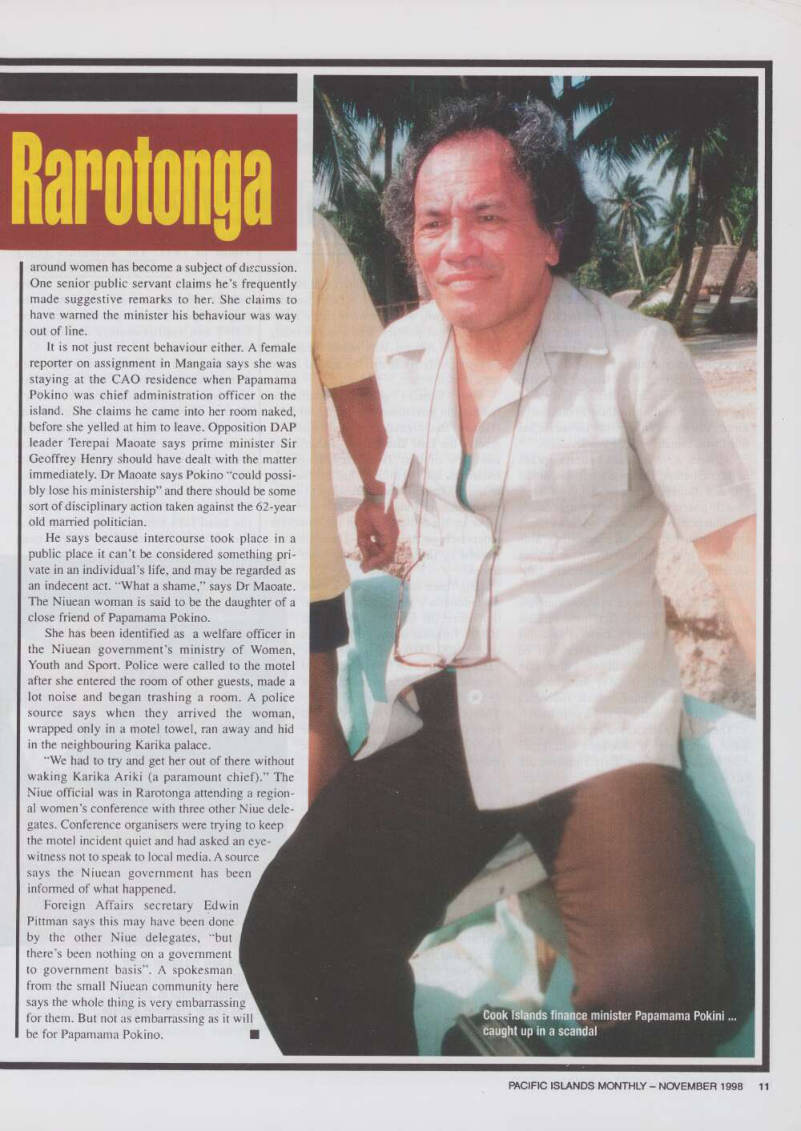
Cook Islands finance minister Papamama Pokini... caught up in a scandal
Advertisements & other items, pp. 10-11 (2 items)
Japanese Vehicles
iii i lii I wS&m i :«■ . ~t *>
DIRECT”
Cut out the middlemen
Where to buy, how to import, photos, specifications, prices, get the book that reveals all. For free information contact - Trust Company Ltd, Tel: 81-52-953- 5602, Fax: 81-52-953-5634/31, E-Mail: [email protected].
Homepage: http://trust-ltd.co.jp/ Address: Kobac Bid 3-2-26 Nishiki Nakaku Nagoya 460-0003 Japan Compiled by the Trust Company Limited, Japan, in association with japan Vehicle Export Limited (UK). Trade Aid Ltd. (UK) and Mobile Outreach Ministry (USA).
TXr
~tv
I Will
Searching for peace
Focus
Searching for peace in troubled East timer
By Jennifer Lin, Krt
DILI, East Timor, KRT - In the blush of dawn, the faithful file into the courtyard of the bishop’s house by the sea for Sunday Mass in trou bled East Timor. Standing in the shade of a broad mango tree, they listen as Roman Catholic Bishop Carlos Belo tells them of the need for healing in their homeland, a former Portugese colony that Indonesia has ruled with brutality for 23 years.
As Belo, a Nobel peace laureate, speaks of reconciliation, Timorese guerrillas, broth ers and fathers of some of these very church-goers, continue their jungle battle for independence. Armed with weapons stolen from Indonesian troops, they hide under a cloak of plants from the prying searchlights of Indonesian military heli copters.
The 23-year resistance to Indonesian rule continues. But for the first time in East Timor’s violent history, there is cautious hope that Belo’s call for peace will be answered. The downfall of Indonesian President Suharto in May has brought change to East Timor, which Indonesia invaded in 1975 and annexed a year later.
The military has eased repressive rule.
Some combat troops have been sent home.
And for the first time, East Timorese are talking forthrightly about independence, expressing views that would have gotten them jailed just a few months ago.
In the boldest protest to date, more than 200,000 people took to the streets of the provincial capital of Dili last June, demand ing that they should decide for themselves what is right for east Timor. ‘’This is a new era of peace and dialogue,” said Belo, who shared the 1996 Nobel Peace Prize with exiled resistance leader Jose Ramos-Horta.
It is an uneasy calm, however. At night, soldiers in black camouflage carrying semi automatic weapons still patrol the streets of Dili. In villages far from the capital, people still are nervous about talking to a Western reporter. In the past, such contact would
have brought immediate interrogation and possible punishment. "After Suharto stepped down, we were more brave about talking about politics. But it is not really open,” said Alberto, who would speak to a foreigner only while driving around in the back seat of a car.
With Suharto gone, however, the Indonesian government of President B. J.
Habibie has signalled that it wants to resolve the East Timor issue. Suharto had one view of East Timor; it belonged to Indonesia, and the military had his blessing to use whatever means necessary to stamp out resistance. Today, 200 to 400 guerrillas make up the armed wing of the Timorese independence movement. They are out
gunned by thousands of Indonesian troops.
East Timor has been a black mark on Indonesia’s international reputa tion since the invasion. More than 10,000 Timorese died in fighting and another 200,000 died in the first three years of occupation from disease and hunger. Critics accused Indonesia of genocide for allowing so many Timorese to starve to death. Portugal broke off diplomatic relations, and the United Nations refused to recognise Indonesia as the legitimate authority.
Anxious to improve world opin ion, Habibie wasted little time in rais ing the East Timor issue after he replaced Suharto last May. Since becoming president, he has freed 15 Timorese political prisoners, recon ciled with Portugal and offered to hammer out a plan for autonomy.
Habibie says Indonesia would retain only defence, foreign affairs and monetary responsibility for East Timor. But the Timorese want more.
They want to get rid of the military at once and they want a referendum to decide for themselves whether East Timor should be an autonomous region or independent nation. ■
IN July this year, 1998, a major massacre of unarmed protesters took place on the Indonesian island of Biak in Irian Jaya. The mas sacre was similar in both style and in terms of numbers of dead to that which is now commonly referred to as the Dilli Massacre which took place in East Timor in 1991. The difference being that the Biak massacre recieved almost no coverage in the Australian media except for a few brief articles in the major papers claiming that seven were killed and approximately one hundred were wounded.
This gross understatement has been left to dissolve into the history of simi lar such newspaper stories, which despite being briefly important recede as quickly as they arrived. In the days following the Biak massacre a tidal wave hit further down the coast in PNG killing a couple of thousand people, this recieved saturation coverage and effec tively swamped the small coverage of the Irian Jaya story despite the fact that the Indonesian military have been
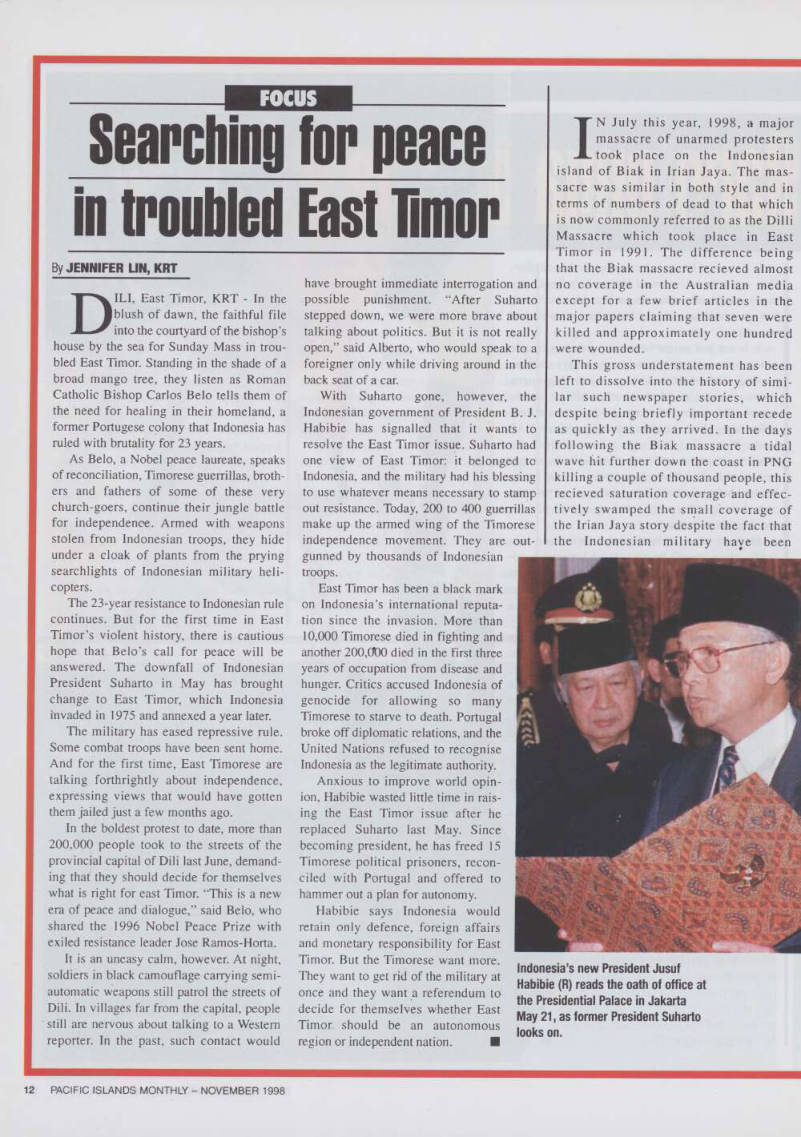
Indonesia’s new President Jusuf Habibie (R) reads the oath of office at the Presidential Palace in Jakarta May 21, as former President Suharto looks on.
grossly understated
Biak massacre grossly understated
By Andrew Kilvert
responsible for the deaths of over 300,000 Melanesian West Papuans in their 30 year occupation of the territo ry. The story of Biak was not widely reported because there was a discrep ancy in the reports of numbers of bod ies washed up on the beaches. An early report said 33, a later one was 53 and the last one said that 70 bodies had washed up or been caught in fishing nets. As Hamish McDonald the editor of the Foreign Editor of the Sydney Morning herald put it, “In these cir cumstances we are going to hold off on publication for the time being”.
Amongst those bodies was the remains of a woman still clutching her dead baby who washed up near Manokwari. There were also the remains of many children.
Because the investigations, which at times involved personal risk to those involved, did not correlate exact ly they were deemed non-news. This was despite the fact that these accounts supported each other in many ways. The difference in body count was because the three different human rights organisations which looked into it were there at different times during the recovery of bodies.
In July 1998 the community of Biak island joined in the independence demonstrations which were taking place around the Indonesian province of Irian Jaya in response to the noises about human rights coming out of the new president in Jakarta and spurred on by new dialog over East Timor.
This went on for six days as people camped out around a campfire next to the market place. On July 6 1998 at 5.30 am, after bringing in an extra battalion from Ambon Island, the army opened fire on the sleeping crowd. As everybody was lying down asleep on the ground when the shooting started,
they fired low and as the people stood up to run away they were shot in the legs. Many of the people there were school children who were expressing the long felt outrage at the Indonesian occupation of their Pacific Island. As they ran they were cut down and many crawled to the safety of nearby houses.
As the sun rose the army formed them selves into small units which went from door to door looking for wound ed people who had been at the rally.
These people were arrested and many others who were identified as being involved were also forced down to the docks. Others were simply gunned down in their houses in front of their families.
Survivors say 24 people were killed during the initial shooting. After this about 200 people were rounded up and taken down to the docks where they were made to lie face up in the tropical sun. As they lay, groups of soldiers marched over their faces and stom achs. In the afternoon they were forced to crawl down the street to the police cells where the 200 people were crammed into the tiny cells in the sear ing heat. For days they stood unable to sit because of the conditions forced to urinate and defecate whilst standing.
Many of these people were school children. When they began getting sick, several were released to act as spies for the military, to go out and track down the other ‘ringleaders’.
They reported every day and recieved beatings when their reports where not considered to be good enough.
Meanwhile outside the cells there were people dying in their houses from untreated wounds. They couldn’t go to the hospital because it was occupied by the army and was already over crowded with wounded who were kept under guard and who weren’t receiv ing medical treatment anyway. The chemist shops in town were guarded
by military intelligence spies. After
being imprisoned for several days, 139
of those arrested were taken down to the docks and loaded onto two frigates, .one of which had brought the army battalion from Ambon. These people were loaded aboard and the frigates set off in opposite directions, one dump ing the people in the ocean near Biak island the other dumping them off shore near Manokwari.
There has been no reports of people surviving the ordeal and so there is no accurate information as to their last hours although it is fairly certain, judging by the bodies which were recovered, that they were dumped alive. As the bodies began washing up on the beaches there was absolute silence among the Australian media, despite the fact that the information was readily available. So whilst the media faithfully reported on the with drawal of troops from East Timor and the ‘discovery’ of mass graves in Aceh, mass graves which were never lost in the first place, there remained total silence on the Biak story. As fam ilies met their relatives off the planes from Jayapura and wept together covertly under the scrutiny and suspi cion of the Indonesian military guards, the world and particularly Australians remained ignorant of what was going on so near to our shores.
When the first of the bodies began washing up on the beaches the military was quick to recover them, claiming they were the victims of the PNG tsunami which occurred nearly 1000 km down the coast. As others washed up this story became more ludicrous as many of them were bound at the wrists and ankles with ropes and one of them was wearing a Golkar T-shirt which is the shirt of the ruling Indonesian Government party. About two days after the initial killing and before the people had been dumped into the ocean, an Australian Army Captain arrived in Biak to carry out an ‘offi cial’ investigation in to the killings on behalf of the Australian department of Foreign affairs. Still now on Biak Island there are at least twenty people who are facing life imprisonment in Indonesian gaols if found guilty of the charges of Separatism and Rebellion.■
Advertisements & other items, p. 14 (1 item)
mm :
■C V*
Nf y
: > I s —.---a -"’S D O nn
'Lkj
m - VI Photos ; Marit ■ Pantz - Trompas New Caledonia is a developped, sophisticated island business base that offers outstanding opportunities for investors : stunning sites for new hotel developments, suitable climate for counterseason fruits, vegetables and tropical flowers, superb locations for fish and prawn aquaculture, and more. Authorities in New Caledonia are very supportive to business.
ADECAL, the Economic Development Agency of New Caledonia, is the one-stop shop where investors can get specific advice on doing business in New Caledonia.
As your free-of-charge partner, we shall assist you in identifying opportunities and putting together your project successfully.
Should you like to receive further information, please do not hesitate to contact either Vann PITOLLET or BenoTt RENGADE.
E-mail: [email protected] a r r* a i i v vl.
New Caledonia Economic Development Bureau 15, rue Guynemer - PO Box 2384 - 98846 Noumea Cedex - New Caledonia - Phone: {687) 249 077 - Fax: (687) 249 087 - E-mail: [email protected]
GQJBePT 1998 : (687) 275 566
Die out-dated Act of marriage
Legislation
By Florence Syme-Buchanan
A SIMPLE amendment to the Cook Islands marriage act had MP’s warning it would result in polygamy, same sex marriages and devil
worshippers getting licensed to perform
marriages in the country.
For once, every MP spoke on a Parliamentary bill - “probably because they’re all married and feel they can speak from experience,” said one listener of
September’s raging debate.
But the emotional debating and extent to which politicians went to oppose updat ing the country’s marriage act left the lis tening public wondering why so much energy was being poured into such a straightforward amendment. Those impas sioned and often ill-informed outbursts were enough to see the amendment substi tuting the words “officiating minister” with “marriage celebrant” thrown out of Parliament.
The bill was reintroduced to the House a second time by Justice minister Tiki Matapo - this time the words “officiating minister and others” were used. Again, dire warnings from the majority of MP’s that the words “others” left the act of solemnis ing a marriage too open to religious cults and immoral practices.
Many of the 25 MP’s wrongly believed that doing away with “officiating minister” meant church ministers would no longer perform marriages. They argued for eight and-a-half days over replacing those words that allowed some non- religious people to solemnise marriages after they get licensed by the Justice Department.
Minister of Justice, Tiki Matapo who introduced the amendment said he was merely trying to simplify and update the 1972 marriage act. His efforts were costly to taxpayers and mostly in vain as just one change went through - allowing Justices of the Peace to officiate at weddings.
“I really felt the MP’s who spoke against it were being hypocritical,” says minister Matapo. Matapo says at the begin ning he “saw the writing on the wall” but persisted with the amendments because he thought some MP’s might change their
mind and see the sense of the changes.
That didn’t happen and after the bill was thrown out twice - the same words “offici ating minister” still remain.
It’s understood the Justice Department contracted a private lawyer to draft the each of the three bills, as the Crown Law Office is already bogged down by other legal work. Live radio broadcast of the Parliamentary debate and other costs would have amounted to about NZ$2OOO a day. Printing the bills in English and Maori totalled almost NZ$6OO. The entire exer cise cost Cook Islands taxpayers over $20,000, an expensive price tag for a coun try limping through an economic crisis.
Asked if he thought it had been public money well spent, Tiki Matapo was can did.
“I think it wasn’t worth it.”
The Court registrars have been able to perform marriages for years in non-reli gious ceremonies. But staff cuts have meant they are often too busy to officiate at weddings after hours or on weekends when most couples prefer to exchange their vows.
Tiki Matapo said if the term marriage celebrants had been upheld, this would have allowed people of “good character who can do weddings for people who do not wish to be married in church.” He said it would have made things easier for peo ple who come to the Cook Islands espe cially to get married.
But that upset some deeply religious and conservative MP’s who said marriages are holy ceremonies and should be per formed by religious ministers in church.
Democratic Alliance party opposition leader Dr Terepai Maoate says the sanctity of church marriages should not be sacri ficed for tourist dollars. Some travel com panies are earnestly trying to market the Cooks as the ideal spot to get married. So far, up to 150 couples travel here each year to get married, usually choosing the white sandy beach of Muri over looking a blue lagoon and tiny islets in Rarotonga.
No comparison to the 6,000 or so peo ple who choose Fiji to get married, but the Cooks is gaining in popularity for couples who find cost of weddings at home too
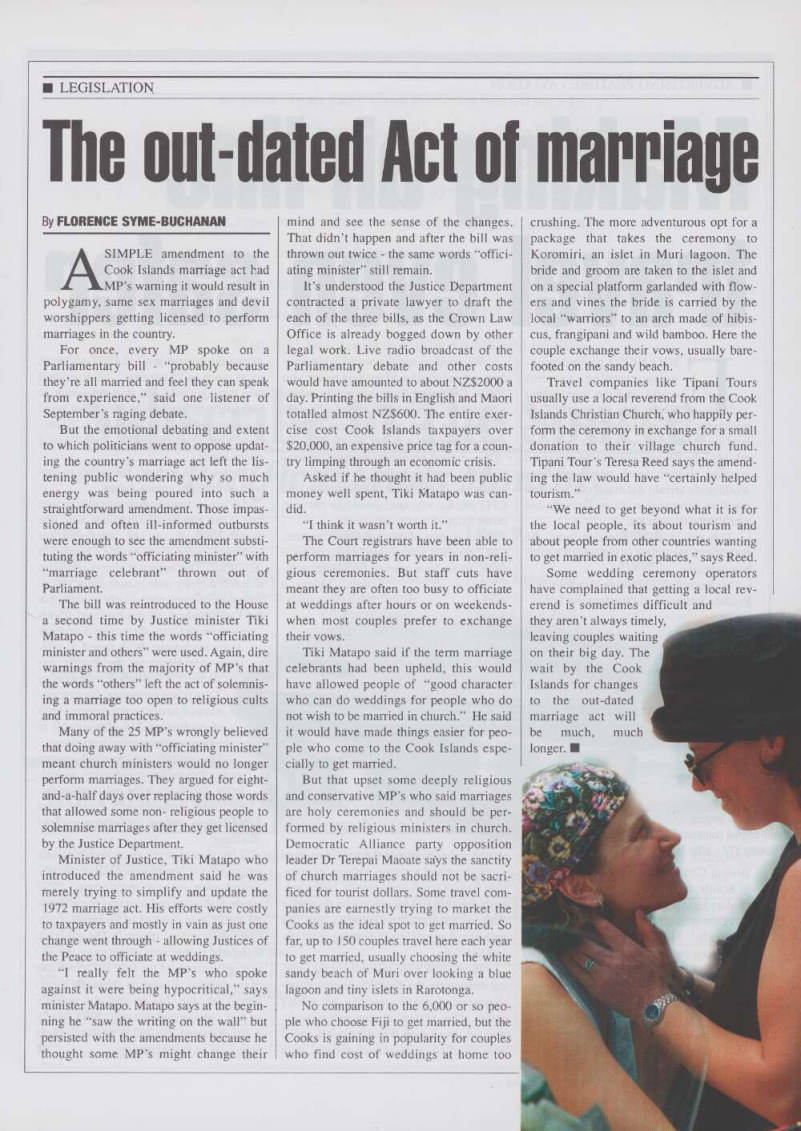
crushing. The more adventurous opt for a package that takes the ceremony to Koromiri, an islet in Muri lagoon. The bride and groom are taken to the islet and on a special platform garlanded with flow ers and vines the bride is carried by the local ’‘warriors” to an arch made of hibis cus, frangipani and wild bamboo. Here the couple exchange their vows, usually bare footed on the sandy beach.
Travel companies like Tipani Tours usually use a local reverend from the Cook Islands Christian Church, who happily per form the ceremony in exchange for a small donation to their village church fund.
Tipani Tour’s Teresa Reed says the amend ing the law would have “certainly helped tourism.”
“We need to get beyond what it is for the local people, its about tourism and about people from other countries wanting to get married in exotic places,” says Reed.
Some wedding ceremony operators have complained that getting a local rev erend is sometimes difficult and they aren’t always timely, leaving couples waiting on their big day. The wait by the Cook M Islands for changes ■ to the out-dated j marriage act will be much, much longer. ■ Jr
Making airline
Advertising Feature - Aviation
Making airline travel even safer
ENFIANCED ground prox
imity warning systems
could reduce controlled flight into terrain (CFIT) accidents by as much as 75 per cent, a leading Boeing executive has predict ed. Mr John P Roundhill said the enhanced warning system used newly-available world-wide terrain database and accurate position information from aircraft and satellite-based systems.
This would allow pilots to “see” the path ahead, regardless of lighting or weath er conditions.
Mr Roundhill, Executive Vice President Product Strategy and Development for
Boeing Commercial Airplane Group
in Seattle, made the comments in a paper “Safety Enhancements in Aircraft Design”.
"Commercial air travel today is safe, very safe,” Mr Roundhill said. "If you were bom and lived only on an aircraft, you would have to live about 2,000 years before you were in an accident, and even then, you would have a 50 per cent chance of surviving. “The accident rate is low; flight is safe but we at Boeing are seeking ways to make it even safer.
"We want to see the world-wide acci dent rate reduced by 50 per cent by the year 2007”. Controlled flight into terrain, where a perfectly serviceable airliner crashes because the crew was unaware of high ground, remains a major accident cause.
“Since ground proximity warning systems (GPWS) were installed in virtually all commercial jets from 1974 onwards, the CFIT rate has averaged about four per year, down from 16 a year previously.
"But in spite of this great improvement, CFIT remains a prominent cause of acci dents, so we have worked for a better solu tion. Using a newly
available world-wide terrain database and accurate position informa tion from aircraft and satellite based sys tems, the new Enhanced Ground Proximity Warning System allows pilots to “see” the path ahead, regardless of lighting or weath er conditions.
"What GPWS did primarily in the verti cal dimension, the EGPWS does in three dimensional space, warning of what’s ahead. This system is now being imple mented on all new Boeing models and if also installed on in-service aircraft, may
reduce the current level of CFIT accidents by as much as 75 per cent”. Mr Roundhill said Boeing would also start delivering on new aircraft this year a predictive wind shear system to given pilots up to 70 sec onds warning of dangerous down-flowing micro bursts,.
“Safety also includes the ability to deal with an in-flight engine failure.
“When a twin-engine aircraft proves that it can handle all situations with one engine out, it can be approved for Extended-range Twin-engine Operations (ETOPS)”. This approval allows operators to travel directly over remote areas and on over-water routes, particularly important in the Pacific where all international flights are over water and often quite a distance from any airport. With regard to safe ty, Air Nauru in the Pacific has secured Australian Operating Certificate following the comple tion of heavy maintenance check J|F of its Boeing 737-400 aircraft in fe the Qantas engineering workshops.
The aircraft has resumed service I under Australian registration as VH- P RON. Air Nauru is the only service fly ing direct to the Central Pacific from Australian ports, Melbourne and Brisbane.
After twenty-seven years operating safe jet travel, Air Nauru was excited that the airline, with its new registration, could assure Australian and overseas travellers of the future safe conduct of air travel to the Centra] Pacific region. The Boeing Company is this year celebrating the 30year anniversary of the first 747 to roll out of the factory. Known as the world's first jumbo jet, the 747 is still the world’s largest commercial aircraft. With nearly 1,200 delivered, the 747 is the best selling twin-aisle jet in the industry. ■
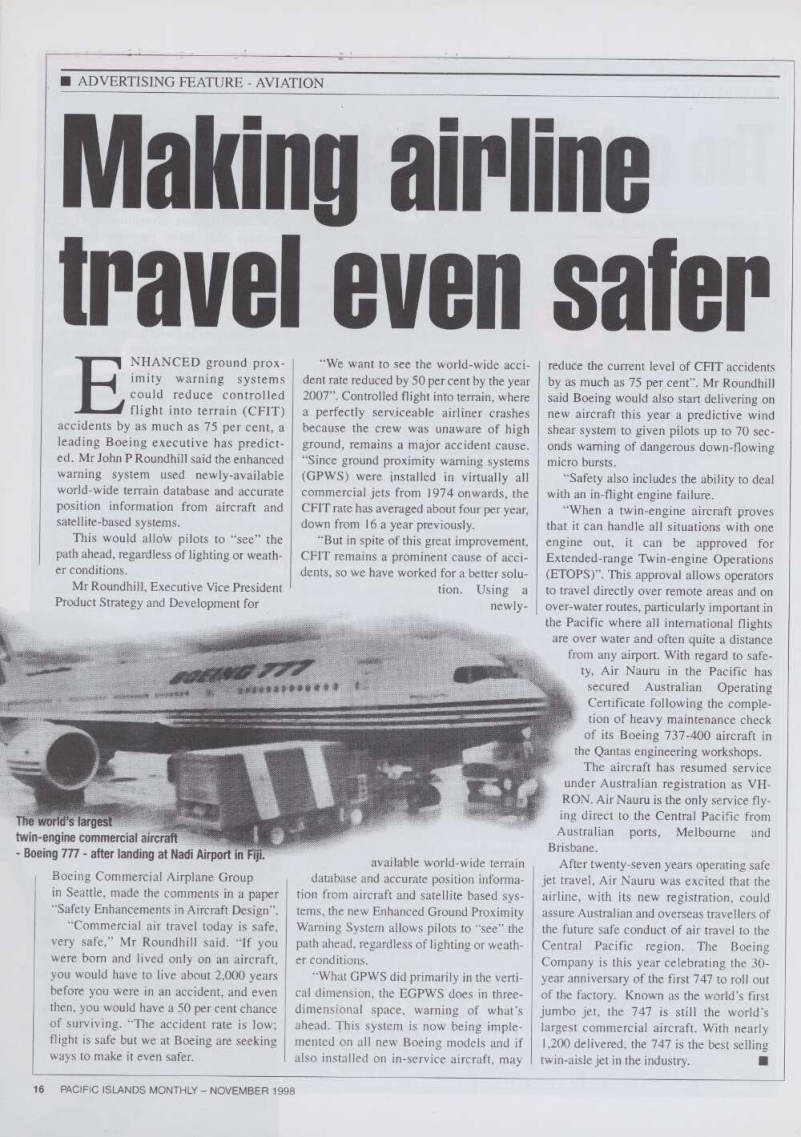
The world’s largest twm-engme commercial aircraft -Boeing 777 - after landing at Nadi Airport in Fiji.
Advertisements & other items, p. 17 (1 item)
Subscribe to The Source.
For almost 70 years, Pacific Islands Monthly has been and still is the authority on political, business and social issues within the Pacific. And now, every 12 month subscription received before the 31st of March, 1999, goes into a draw to win an IBM Pentium Notebook*. You could even give a gift subscription to enter but it must be before the closing date. As well as the entry into the draw, you will also receive the latest news from the region. Fill in the subscription form below and send it along with payment to Pacific Islands Monthly, Subscription Department, PO Box 1167, Suva, Fiji. Or call PIM on (679) 304 111 or fax us on (679) 303 809/(679) 307 460.
Pacific Islands Monthly
* Rates include Airspeeding to all destinations Conditions of Entry 1. To enter, subscriptions must be made before March 31st, 1999 which automatically enters the subscriber into the draw for the Pentium Notebook Computer. 2. Entry is open to all subscribers except employees of The Fiji Times Ltd. Pacific Islands Monthly, and Wilson Addison Ltd. 3- Subscriber need to subscribe for 12 months to qualify. 4. The winner of the Pentium Notebook will be published in Pacific Islands Monthly Magazine, May Issue, 1999 and will be notified by registered mail. 5. The winner will receive their prize within one month of the draw. 6. The prize must be taken as offered and is not redeemable. 7. In the event of any dispute the decision of the promoter is final and no correspondence will be entered'into.
YES! I wish to subscribe to The Source and receive a chance to win an IBM Pentium Notebook Computer!
Signature:
12 ISSUE
SUBSCRIPTION
Rate A I Rate B [~~l Rate C PI Rate D Rate E This is a
□ Renewal
□ New Subscription Country: □ Cheque/Bank Draft/Money Order made payable to Pacific Islands Monthly PI Please charge my credit card: (VISA / AMEX / MASTERCARD) Mr/Mrs/Ms: Expiry date; Delivery Address; Postal Address: Fax:
Amidst globalisation,
aviation flourishes
By Sophie Foster Hildebrand
ASK any businessman, or woman, and they will agree that in an area as vast as the Pacific, transportation links are vital to the survival of trade and investment. But with the arrival of globalisation, and a cli mate where documents skip through coun tries instantly through the Internet, avia tion has flourished.
Earlier this year, Forum Island minis ters met and resolved to support increased liberalisation of air services.
“This will lower costs in the aviation industry and enhance prospects for the tourism industries and exporters dependent on air services,” a forum paper said. In line with Pacific economic reform objectives, island countries have accepted the princi ples of encouraging private sector develop ment and enhancing the competitiveness of national carriers. In many cases, national carriers are moving in this direction because of the need to stay ahead of the increased competition from other carriers in their regions. But in most cases, it is to encourage the development of another essential sector, tourism.
One carrier that is making progress towards this end is Air Caledonie International (ACI or Aircalin). In order to keep pace with the upward trend of tourism in New Caledonia, the company last month announced an ambitious development plan that, among other things, provides for new air links with Japan by the end of 1999.
The plan involves the acquisition of an Airbus A-330 by French metropolitan investors, under the tax exemption provi sions of the Pons Law.
The operations schedule includes two flights a week to Tokyo and Osaka (con necting with Air France flights to and from
Paris), as well as increased services to Sydney, Auckland and Papeete. Operation of the new Airbus will result in daily air links between Japan and New Caledonia, which, according to Aircalin’s projections, could bring the country’s total number of Japanese visitors to 54,000 a year.
Island countries have agreed to support liberalisation of air services and to use the existing bilateral air service agreement sys tem to introduce more flexibility for carri ers. In Fiji, this has resulted in the inclu sion of Ansett as one of the many carriers crossing the island territory. Ansett is also set to begin flights to Fiji from next month in conjunction with a new domestic carrier.
The “bilateral” system is being used to introduce more flexibility in code sharing, ownership, control and leasing of planes, pricing, charter access, routing and other features of the aviation administration.
All of this is designed to improve the meeting of air transport services needs of Forum member countries.
Fiji’s national carrier, Air Pacific, has taken flexibility literally. On October 20, the company rescheduled its operations to allow for a charter service from Nadi to Los Angeles non-stop. This charter carried thirty-five tonnes of garments destined for the US market. The cargo needed to be in Los Angeles during that particular week in order to not prejudice Fiji’s garment quota export for the year 1999. This is one exam ple of where an airline can contribute towards the development of the overall economy. Air Pacific has also taken steps towards increasing its presence on the mar ket. The company has taken control of a new aircraft to fly the new route out of Suva to Australia.
The company is in the midst of upgrad ing all its equipment and aircraft with a new fleet to take it into the next millenni um. Indeed, all the national carriers of
Forum Island countries are gearing them selves for increased competition and shar ing in future. According to the Forum paper, while the FICs would implement the liberalisation of air services “in their own time and manner, this is an appropriate approach for members to pursue now, with the objective of allowing the maximum flexibility for air carriers”.
The Island countries are also reviewing all FIC air service agreements and related instruments in order to update them. This should allow for the freeing of economic regulation of air services and will examine implications of moving towards a single aviation market in the Pacific.
With discussions of a Pacific Free Trade Area, the possibility of a Free Trade Area in aviation has been welcomed by many carriers and organisations.
This new flexibility should be good news for carriers such as Solomon Airlines and Air Nauru which service several coun tries throughout the region. Amongst other routes, Solomon Airlines flies the New Caledonia, Fiji, Honiara triangle, while one of Nauru’s routes crosses the airspace of Tuvalu, Fiji, and Micronesia.
With technological advancement, there is more opportunity for greater efficiency in airline operations, which has flow-on effects for island economies.
Technological developments have allowed for a policy where the Pacific Airspace of the Forum region can be managed co-oper atively, efficiently and safely as a unified airspace. For the island countries this is a significant development and means that the barriers for increased participation in glob alisation can be lifted.
With the Forum countries acting together, with compatible technology and agreements, the region has a greater chance of making the most of its airspace, national carrier development, and air traffic potential. ■
Advertisements & other items, pp. 18-21 (2 items)
18
PACIFIC ISLANDS MONTHLY - NOVEMBER 1998
■ ADVERTISING FEATURE - AVIATION
Air Nauru^I
m m
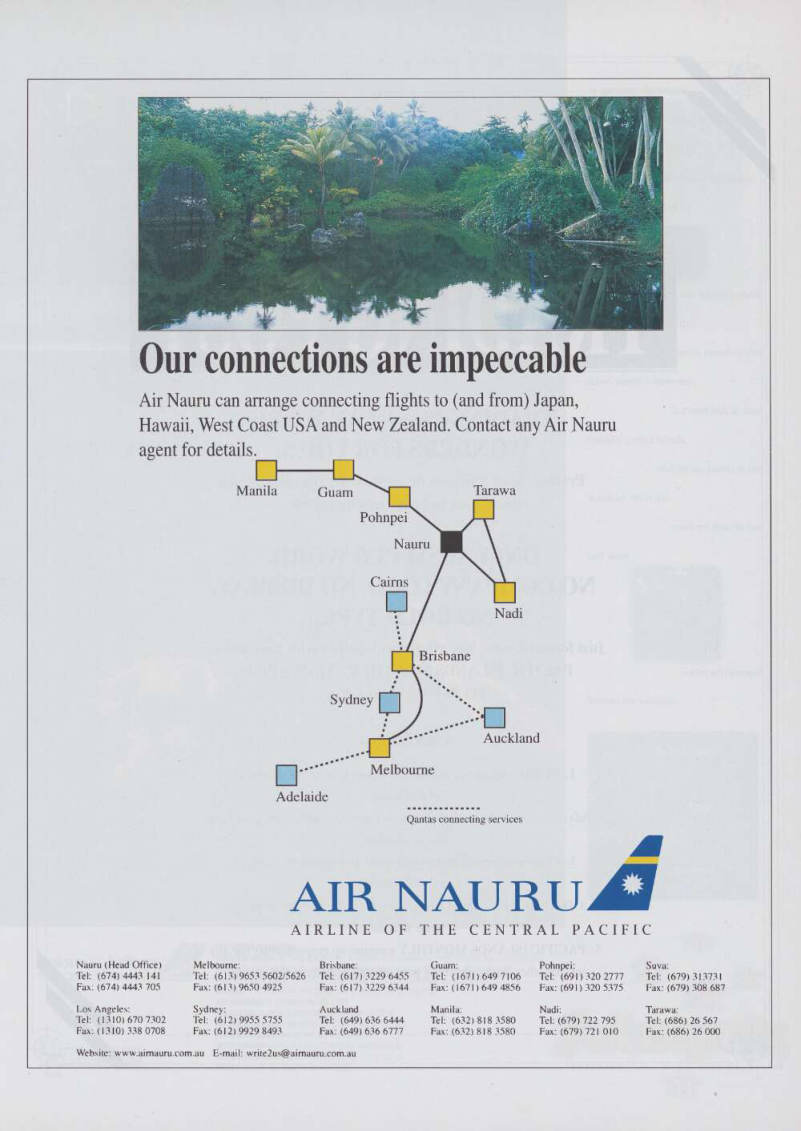
Our connections are impeccable
Air Nauru can arrange connecting flights to (and from) Japan, Hawaii, West Coast USA and New Zealand. Contact any Air Nauru
agent for details.
Manila Guam Tarawa
Pohnpei \
Nauru
Cairns
□ Brisbane
Nadi
Sydney
YJ •■D
Auc Auckland D Adelaide Melbourne Qantas connecting services
AIR NAURU^I
AIRLINE OF THE CENTRAL PACIFIC
Naum (Head Office) Tel: (674) 4443 141 Fax: (674) 4443 706 Los Angeles: Tel: (1310)670 7302 Fax: (1310) 338 0708 Melbourne: Tel: (613)9653 5602/5626 Fax: (613)9650 4925 Sydney: Tel: (612)9955 5755 Fax: (612)9929 8493 Brisbane: Tel: (617)3229 6455 Fax; (617) 3229 6344 Auckland Tel: (649)636 6444 Fax; (649) 636 6777 Guam: Tel: (1671)649 7106 Fax: (1671)649 4856 Manila: Tel; (632)818 3580 Fax: (632) 818 3580 Pohnpei: Tel: (691)320 2777 Fax: (691) 320 5375 Nadi: Tel: (679) 722 795 Fax: (679) 721 010 Suva: Tel: (679)313731 Fax: (679) 308 687 Tarawa: Tel: (686) 26 567 Fax; (686) 26 000 Website: www.aimauru.com.au E-mail: [email protected]
PACIFIC ISLANDS
MINIM—
TRADING POST
TRADING POST CAN WORK
WONDERS FOR YOU...
Promote your business, or service, sell your household items, cars or heavy machinery etc.
ONLY AUSSI PER WORD.
NO COMPANY LOGO. NO DISPLAY.
NO BOLD TYPE.
Just forward your Advertisement together with payment to:
PACIFIC ISLANDS MONTHLY ’’Trading Post”,
PO Box 1167, Suva, Fiji.
Conditions: 1. All Advertisements are subject to acceptance and approval of publisher. 2. Advertisements are published as space permits; we cannot guarantee date of insertion. 3. All advertisements must be prepaid and should be typed or printed clearly 4. Deadline for receipt of advertisements is the 10th of the month prior to issue. 5. PACIFIC ISLANDS MONTHLY assumes no responsibility for any service other than publishing paid advertisements in this section.
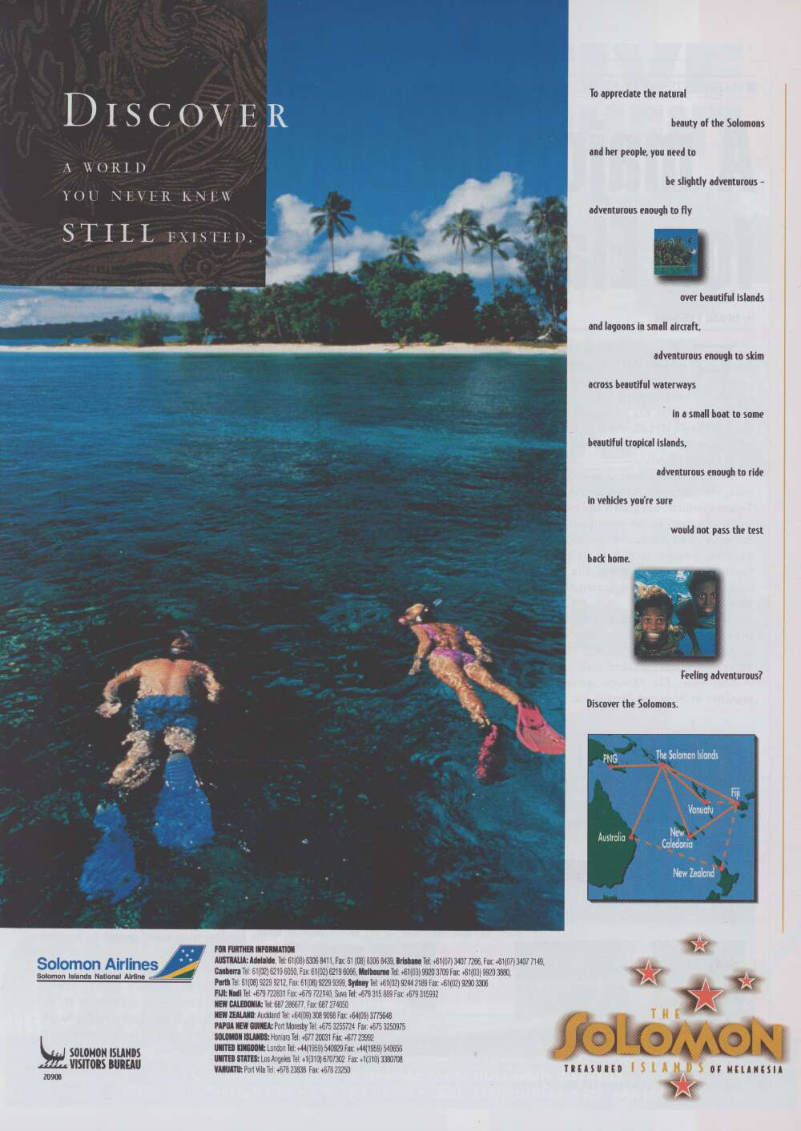
Discover
A WORLD
YOU NEVER KNEW
STILL exi
STE D .
Solomon Airlines
Solomon Islands National Airline w
J SOLOMON ISLANDS
VISITORS BUREAU
FOR FURTHER INFORMATION
AUSTRALIA; Adelaide, Tel: 61(08) 8306 8411, Fax: 61 (08) 8306 8439, Brisbane Tel: +61(07) 3407 7266, Fax: +61(07) 3407 7149, Canberra Tel: 61(02) 6219 6050, Fax: 61(02) 6219 6066, Melbourne Tel: +61(03) 9920 3709 Fax: +61(03) 9920 3880, Perth Tel: 61(08) 9229 9212, Fax: 61(08) 9229 9399, Sydney Tel: +61(02) 9244 2189 Fax: +61(02) 9290 3306 FIJI; Nadi Tel: +679 722831 Fax: +679 722140, Suva Tel: +679 315 889 Fax: +679 315992 NEW CALEDONIA; Tel: 687 286677, Fax: 687 274050 NEW ZEALAND: Auckland Tel: +64(09) 308 9098 Fax: +64(09) 3775648 PAPUA NEW GUINEA; Port Moresby Tel: +675 3255724 Fax; +675 3250975 SOLOMON ISLANDS: Honiara Tel: +677 20031 Fax: +677 23992 UNITED KINGDOM: London Tel: +44(1959) 540929 Fax: +44(1959) 540656 UNITED STATES: Los Angeles Tel: +1(310) 6707302 Fax: +1(310) 3380708 VANUATU: Port Vila Tel: +678 23838 Fax: +678 23250 To appreciate the natural beauty of the Solomons and her people, you need to be slightly adventurous adventurous enough to fly over beautiful islands and lagoons in small aircraft. adventurous enough to skim across beautiful waterways in a small boat to some beautiful tropical islands, adventurous enough to ride in vehicles you’re sure would not pass the test back home.
Feeling adventurous?
Discover the Solomons.
Die Solomon Islands
Fiji
Vanuatu Australia , .
Caledonia New Zealand m- Hr i« o r 3 A
TREASURED « 9 OF MELANESIA
A major facelift
Advertising Feature - Solomon Islands
A major facelift for Ela Motors
By Ofani Eremae
FOR any business entity to make itself accessible to its customers, it must grow and expand. This is exactly the principle that Ela Motors, a trading name for BPT (SI) Ltd, which is part of the BPT South Pacific Group, is advocating in the Solomon Islands.
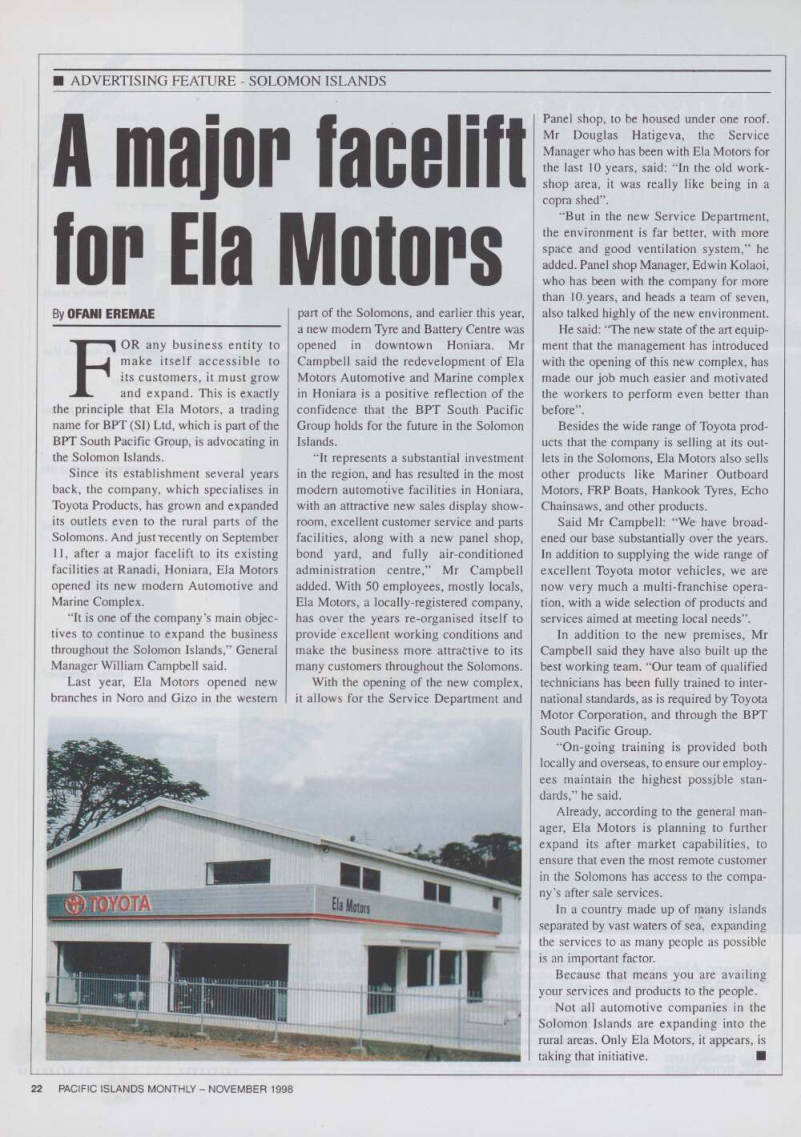
Since its establishment several years back, the company, which specialises in Toyota Products, has grown and expanded its outlets even to the rural parts of the Solomons. And just recently on September 11, after a major facelift to its existing facilities at Ranadi, Honiara, Ela Motors opened its new modern Automotive and Marine Complex.
“It is one of the company’s main objec tives to continue to expand the business throughout the Solomon Islands,” General Manager William Campbell said.
Last year, Ela Motors opened new branches in Noro and Gizo in the western
part of the Solomons, and earlier this year, a new modem Tyre and Battery Centre was opened in downtown Honiara. Mr Campbell said the redevelopment of Ela Motors Automotive and Marine complex in Honiara is a positive reflection of the confidence that the BPT South Pacific Group holds for the future in the Solomon Islands.
“It represents a substantial investment in the region, and has resulted in the most modem automotive facilities in Honiara, with an attractive new sales display show room, excellent customer service and parts facilities, along with a new panel shop, bond yard, and fully air-conditioned administration centre,” Mr Campbell added. With 50 employees, mostly locals, Ela Motors, a locally-registered company, has over the years re-organised itself to provide excellent working conditions and make the business more attractive to its many customers throughout the Solomons.
With the opening of the new complex, it allows for the Service Department and
Panel shop, to be housed under one roof.
Mr Douglas Hatigeva, the Service Manager who has been with Ela Motors for the last 10 years, said: “In the old work shop area, it was really like being in a copra shed”. ■‘But in the new Service Department, the environment is far better, with more space and good ventilation system,” he added. Panel shop Manager, Edwin Kolaoi, who has been with the company for more than 10. years, and heads a team of seven, also talked highly of the new environment.
He said: “The new state of the art equip ment that the management has introduced with the opening of this new complex, has made our job much easier and motivated the workers to perform even better than before”.
Besides the wide range of Toyota prod ucts that the company is selling at its out lets in the Solomons, Ela Motors also sells other products like Mariner Outboard Motors, FRP Boats, Hankook Tyres, Echo Chainsaws, and other products.
Said Mr Campbell: “We have broad ened our base substantially over the years.
In addition to supplying the wide range of excellent Toyota motor vehicles, we are now very much a multi-franchise opera tion, with a wide selection of products and services aimed at meeting local needs”.
In addition to the new premises, Mr Campbell said they have also built up the best working team. “Our team of qualified technicians has been fully trained to inter national standards, as is required by Toyota Motor Corporation, and through the BPT South Pacific Group.
“On-going training is provided both locally and overseas, to ensure our employ ees maintain the highest possible stan dards,” he said.
Already, according to the general man ager, Ela Motors is planning to further expand its after market capabilities, to ensure that even the most remote customer in the Solomons has access to the compa ny’s after sale services.
In a country made up of many islands separated by vast waters of sea, expanding the services to as many people as possible is an important factor.
Because that means you are availing your services and products to the people.
Not all automotive companies in the Solomon Islands are expanding into the rural areas. Only Ela Motors, it appears, is taking that initiative. ■
Advertisements & other items, p. 23 (1 item)
Automotivi
MARINE A EOUIPMENI
■M Ell Motors »»
BILL CAMPBELL
GENERAL MANAGER
DES GOSS
AFTER MARKET MANAGER
Ela Motors brings you the very best in Automotive, Marine and Equipment Sales, all fully supported by Quality Service, Genuine Parts & Panel requirements JOHNSON LUCAS ' right throughout the Solomon Islands. senior sales manager j eam U p yyjfl £| a Motors Nationwide. /r:W -vi' i
TOYOTA DAII6 TRUCK
PENAIA VEREBALAVU
FINANCE MANAGER
CP
MARINE DIESEL ENGINES • POWER GENERATORS
RENAULT CBH
Ela Motors
TJM BULLBARS & ACCESSORIES
Hirm
ECHO
CHAINSAWS
ELA POWER
DEPENDABLE BATTERIES
HANKOOKTYRES
ELA MOTORS TYRE & BATTERY CENTRE HIBISCUS AVE.
HINO SS TURBO
S
Ela Motors
<SB> TOYOTA
m
MARINGR
DBSI's catalytic role
Despite the ei Nino phenomenon which I adversely affected primary production, the
economic and fiscal turbulence which crippled government’s securities mar ket and subsequently induced credit restrain, and the South East Asian contagion which dampened their import demand for Solomon Island export, the Development Bank of the Solomon Islands (DBSI) recorded a
sustained performance in 1997 and continued on to execute its mandated role of development financing in Solomon Islands. During 1997, the Bank received a total of 766 project proposals, worth more than $2O mil lion, for funding consideration from potential entrepreneurs. Of these, 508 or 66 per cent of the total number,
worth more than $l3 million, were considered by the Bank for fund ing; 28 per cent were pending,
awaiting further deliberation; while the remainder were rejected because of absence of credit worthiness, eco nomic and technical viability.
Therefore, the Bank performed as expected against an unfavourable eco nomic environment and recorded a modest credit expansion in 1997. The total number of new loan approvals picked up by 1.2 per cent to 385 while the value of new loan approvals remained stable at $l3 million. The Bank’s sectoral distribution of loan approvals in 1997 was again dominat ed by the services sector in monetary terms and by the agriculture sector in numerical terms. Of the total value of loan approvals, 39 per cent was absorbed by services sector - down 13 per cent over the 1996 level to $4.85 million (ranked third in the number of loan approvals during 1997). The; agri culture sector accounted, for 176 loans, down by eight per cent over the 1996 level and ranked second in the value of loan approvals during 1997.
In numerical terms, the Bank’s com mercial loans grew by 12 per cent to 104, but fell by 36 per cent in mone tary terms over the 1996 level to settle at a trough of $2.98 million. While the number of approvals for industrial loans was only marginal during 1997, their value soared by 262 per cent to $1.52 million in 1997. With these opera tions, the Bank’s lending portfolio has now reached a record crest of $45.84 million at the end of 1997. The Bank’s arrears posi tion, however, worsened in 1997,t0 17 per cent of the total portfolio because of unfavourable economic environment inflicted by exogenous and endogenous economic factors which weakened the profitability and loan performances of DBSI funded projects. However, DBSI is optimistic the economy will recover and, in the long run, would again restore an environment conducive to business in the Solomon Islands. The Bank has recorded, for the seventh consecutive year, a net profit of $106,105 and will continue to play its catalytic role in development financing to fuel economic development in the Solomon Islands. The Bank is also con fident and stands enthusiastic to face the challenges of the future. ■
Advertisements & other items, pp. 24-27 (2 items)
24
PACIFIC ISLANDS MONTHLY - NOVEMBER 1998
■ ADVERTISING FEATURE - SOLOMON ISLANDS
Development Bank Of Solomon Islands
The Development Bank of Solomon Islands has 20 years professional experience in development financing in Solomon Islands. Not only that, it is also the leading development financiers in agriculture, commerce, service and industry sectors in Solomon Islands.
If you are thinking of investing in Solomon Islands and decides to raise capital domestically, DBSI can consider providing financial assistance for development projects that promotes rural development and stimulates processing and industrial activities of Solomon Islands. •Business Loans •Joint Venture Financing 'Equity Participation •Financial Gurantees 'First Time Business Entrant Credit Scheme •Women Credit Scheme 'Working Capital •Term Deposit Facility •Savings Facility 'Lease Facility •Consultancy Service •Client Training Products and Services DBSI Offices
BUALA
ruiKiA
LATA
KIRAKIRA
AUKI
CHOISUEL
GIZO
DBSI HEAD OFFICE: Mud Alley, POBox 911, Honiara, Solomon Islands PHONE: (677) 21595 or 21596 FAX: (677) 23715 E-MAIL: [email protected]
DBSI
SUPPORTING OUR NATION'S DEVELOPMENT ENDEAVOURS
f-f f r
IN G
o*fO iS'-
SOLOMON ISLANDS
COMMODITIES EXPORT MARKETING AUTHORITY
P.O. BOX 1087, HONIARA, SOLOMON ISLANDS
Cable: "COPRA" Tel: (677) 22528/9 Telex: HQ 66316 Fax: (677) 21262
SOLOMON ISLANDS LEADING EXPORTER OE
COPRA, COCOA BEANS , SPICES AND NGALI NUTS,
SOLOMON ISLANDS NGALI NUTS .
Fresh from the tropical rainforest comes the new taste sensation of Ngali Nuts. High in fibre and protein, the Ngali Nut is hand harvested from trees hundreds of years old which have never come in contact with chemicals. Can be eaten either raw or cooked. The taste is unique and delicious.
SOLOMON ISLANDS COCOA BEANS.
Organically cultured to give a natural flavour of the highest quality.
SOLOMON ISLANDS COPRA.
Exported in three grades. Sun dried & hot air dried and smoked grade. ■■ w if ■ m n 3
Very hot nepalese
akabare chillie and tumeric.
For more information on any of our products please write to the above address .
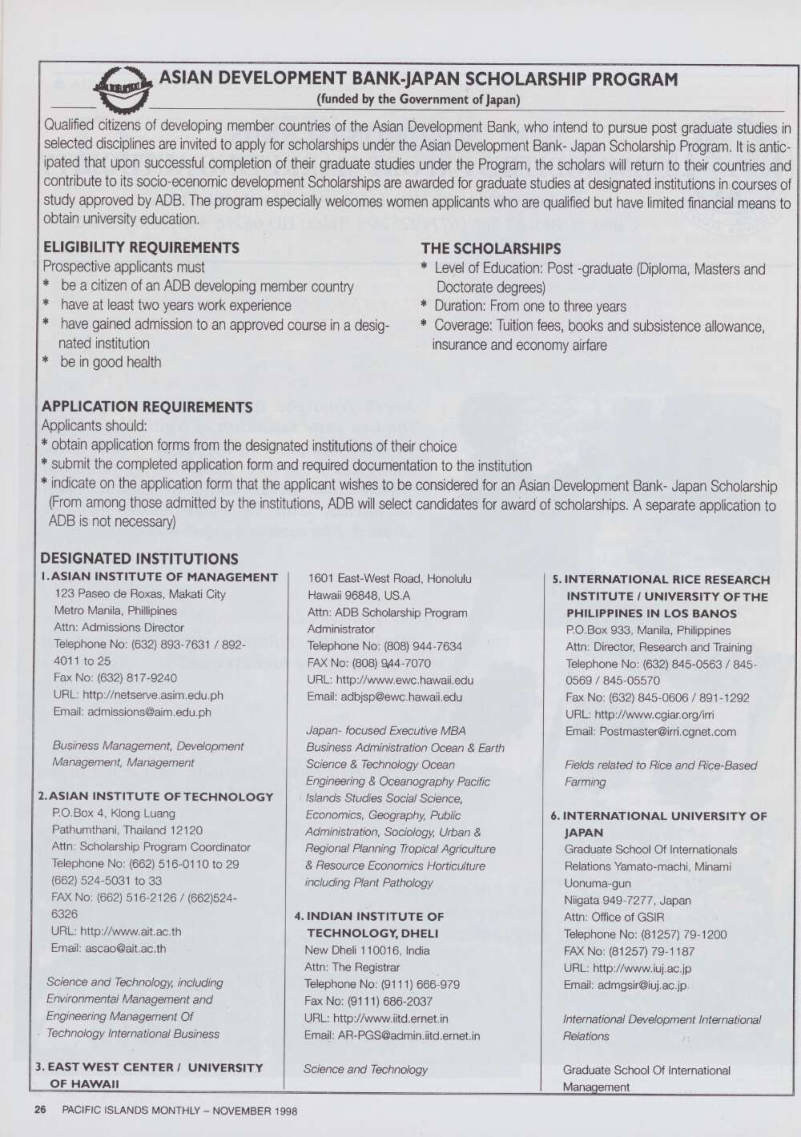
ASIAN DEVELOPMENT BANK-JAPAN SCHOLARSHIP PROGRAM
(funded by the Government of Japan) Qualified citizens of developing member countries of the Asian Development Bank, who intend to pursue post graduate studies in selected disciplines are invited to apply for scholarships under the Asian Development Bank- Japan Scholarship Program. It is anticipated that upon successful completion of their graduate studies under the Program, the scholars will return to their countries and contribute to its socio-ecenomic development Scholarships are awarded for graduate studies at designated institutions in courses of study approved by ADB. The program especially welcomes women applicants who are qualified but have limited financial means to obtain university education.
ELIGIBILITY REQUIREMENTS
Prospective applicants must * be a citizen of an ADB developing member country * have at least two years work experience * have gained admission to an approved course in a desig nated institution * be in good health
APPLICATION REQUIREMENTS
Applicants should: * obtain application forms from the designated institutions of their choice * submit the completed application form and required documentation to the institution * indicate on the application form that the applicant wishes to be considered for an Asian Development Bank- Japan Scholarship (From among those admitted by the institutions, ADB will select candidates for award of scholarships. A separate application to ADB is not necessary)
DESIGNATED INSTITUTIONS
THE SCHOLARSHIPS
* Level of Education: Post -graduate (Diploma, Masters and Doctorate degrees) * Duration: From one to three years * Coverage; Tuition fees, books and subsistence allowance, insurance and economy airfare
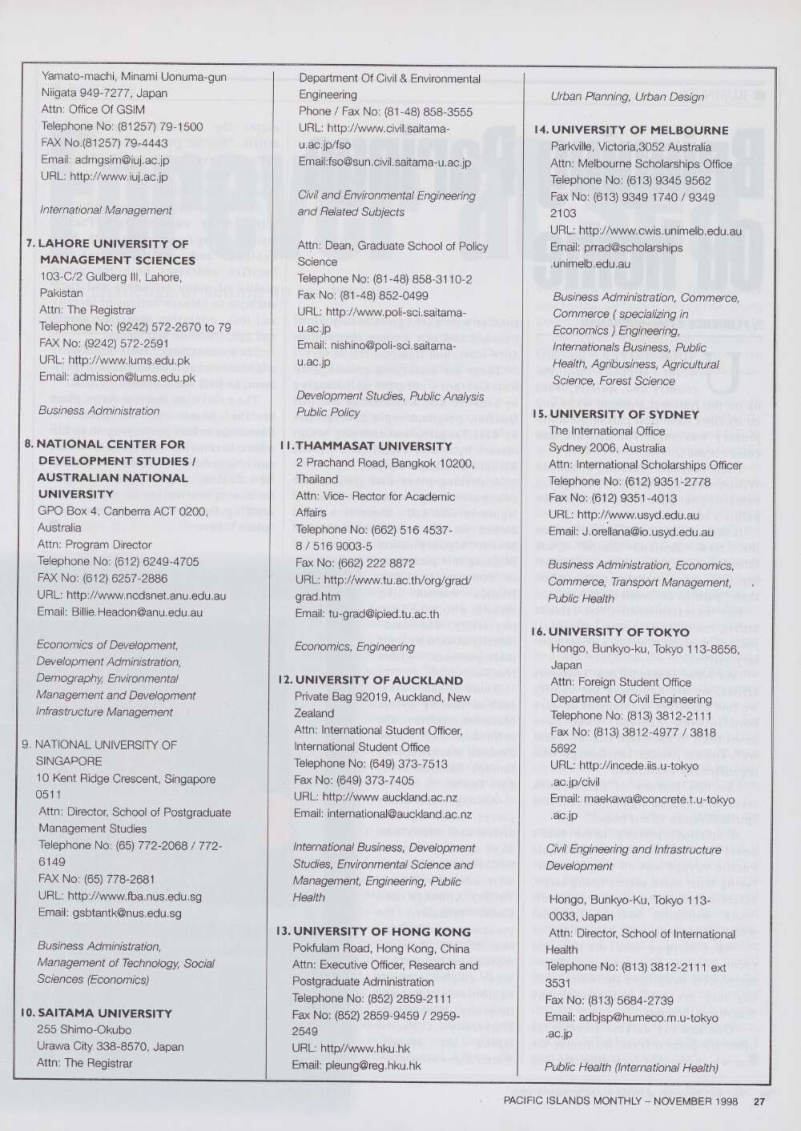
Yamato-machi, Minami Uonuma-gun Niigata 949-7277, Japan Attn: Office Of GSIM Telephone No: (81257) 79-1500
FAX N0. (81257) 79r4443
Email: [email protected] URL: http://www.iuj.ac.jp International Management
7. LAHORE UNIVERSITY OF
MANAGEMENT SCIENCES
103-0/2 Gulberg 111, Lahore, Pakistan Attn: The Registrar Telephone No: (9242) 572-2670 to 79
FAX No: (9242) 572-2591
URL: http://www.lums.edu.pk Email: [email protected] Business Administration
8. NATIONAL CENTER FOR
DEVELOPMENT STUDIES /
AUSTRALIAN NATIONAL
UNIVERSITY
GPO Box 4, Canberra ACT 0200, Australia Attn: Program Director Telephone No: (612) 6249-4705
FAX No: (612) 6257-2886
URL: http://www.ncdsnet.anu.edu.au Email: [email protected] Economics of Development, Development Administration, Demography, Environmental Management and Development Infrastructure Management
9. NATIONAL UNIVERSITY OF
SINGAPORE
10 Kent Ridge Crescent, Singapore 0511 Attn: Director, School of Postgraduate Management Studies Telephone No: (65) 772-2068 / 772- 6149
FAX No: (65) 778-2681
URL: http://www.fba.nus.edu.sg Email: [email protected] Business Administration, Management of Technology, Social Sciences (Economics)
10. SAITAMA UNIVERSITY
255 Shimo-Okubo Urawa City 338-8570, Japan Attn: The Registrar
Department Of Civil & Environmental Engineering Phone / Fax No: (81 -48) 858-3555 URL: http://www.civi!.saitamau.ac.jp/fso Email:fso@sun. civil, saitama-u.ac.jp Civil and Environmental Engineering and Related Subjects Attn: Dean, Graduate School of Policy Science Telephone No: (81-48) 858-3110-2 Fax No: (81 -48) 852-0499 URL: http://www,poli-sci.saitamau. ac.jp Email: [email protected] Development Studies, Public Analysis Public Policy
I I.THAMMASAT UNIVERSITY
2 Prachand Road, Bangkok 10200, Thailand Attn: Vice- Rector for Academic Affairs Telephone No: (662) 516 4537- 8/516 9003-5 Fax No: (662) 222 8872 URL: http://www.tu.ac.th/org/grad/ grad.htm Email: [email protected] Economics, Engineering
12. UNIVERSITY OF AUCKLAND
Private Bag 92019, Auckland, New Zealand Attn: International Student Officer, International Student Office Telephone No: (649) 373-7513 Fax No: (649) 373-7405 URL: http://www auckland.ac.nz Email: [email protected] International Business, Development Studies, Environmental Science and Management, Engineering, Public Health
13. UNIVERSITY OF HONG KONG
Pokfulam Road, Flong Kong, China Attn: Executive Officer, Research and Postgraduate Administration Telephone No: (852) 2859-2111 Fax No: (852) 2859-9459 / 2959- 2549 URL: http//www.hku.hk Email: [email protected]
Urban Planning, Urban Design
14. UNIVERSITY OF MELBOURNE
Parkvilte, Victoria,3os2 Australia Attn: Melbourne Scholarships Office Telephone No: (613) 9345 9562 Fax No: (613) 9349 1740 / 9349 2103 URL: http://www.cwis.unimelb.edu.au Email: prrad@scholarships .unimelb.edu.au Business Administration, Commerce, Commerce (specializing in Economics) Engineering, Internationals Business, Public Health, Agribusiness, Agricultural Science, Forest Science
I 5. UNIVERSITY OF SYDNEY
The International Office Sydney 2006, Australia Attn: International Scholarships Officer Telephone No; (612) 9351-2778 Fax No: (612) 9351-4013 URL: http://www.usyd.edu.au Email: [email protected] Business Administration, Economics, Commerce, Transport Management, Public Health
16. UNIVERSITY OF TOKYO
Flongo, Bunkyo-ku, Tokyo 113-8656, Japan Attn: Foreign Student Office Department Of Civil Engineering Telephone No: (813) 3812-2111 Fax No: (813) 3812-4977 / 3818 5692 URL: http://incede.iis.u-tokyo .ac.jp/civil Email: maekawa@concrete ,t. u -tokyo .ac.jp Civil Engineering and Infrastructure Development Hongo, Bunkyo-Ku, Tokyo 113- 0033, Japan Attn: Director, School of international Health Telephone No: (813) 3812-2111 ext 3531 Fax No: (813) 5684-2739 Email: [email protected] .ac.jp Public Health (International Health)
Bringing Paringa
Business
Bringing Paringa On home
By Florence Syme-Buchanan
UNDER COVER, the art works slipped into the country and, quietly, went up on the National museum walls and on its floor - the first part of a Pacific journey was over. The artwork had come “home”.
Then museum curator, Johannah Wilson who organised the Paringa Ou exhibition sat back and waited for the public’s reaction.
It came - and praise was heaped on the New Zealand based Cook Islanders for coming home and shar ing their works, their artistic gifts, their “paringa ou” with their people.
For the established Cook Islands artists, the exhibition was a “spiritual journey moving towards a contempo rary vision”.
“As New Zealand-Cook Islanders artists, we are exploring the duality we find ourselves in. Many of us were born in New Zealand, some have never been to the Cook Islands,” said well-known painter lan George who organised the exhibition.
“So this journey of our artwork takes on a special significance. It is a spiritual return to our home”.
A spiritual journey home that’s never been made before. And this Pacific voyage was no simple under taking with some pieces being large, others very delicate, all very precious.
As journalist Marcia Tetevano wrote after viewing the exhibition: “As I stepped into the emotion room, I was hit by a number of them the objects hung from the walls, star ing into my soul and sensing my
innermost thoughts.
One saw my darkest secrets, the other my deepest fears, then came the one which brought incredible joy and
another which lent great beauty. Until I turned and saw a piece that almost drew tears, and finally, I fell in love”.
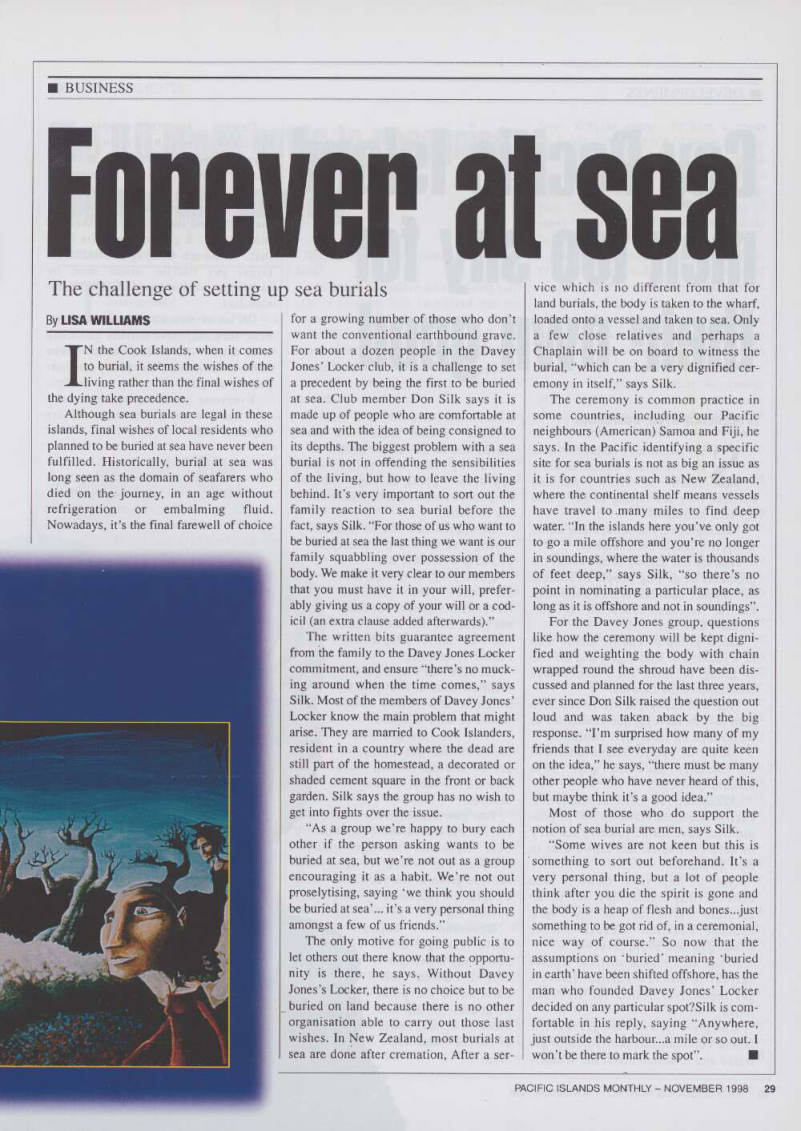
There are disturbing paintings by Rob George, a cheerful wall-hanging by creative duo Kay George and Mii Quarter, poignant sepia photographs by Riki Tangaroa and stunning sculp tures by well-established artist Richard Shortland-Cooper.
A striking piece that speaks with raw passion by newcomer Nia Val Ngaro is also sad - there is a poem etched on the work about broken hearts. “My inspiration
in doing this piece was in concern to Cook Islands women like myself, who have been physically and emo tionally abused by their male partners,” writes Nia Val Ngaro.
Some of the works, such as that by Sylvia Marsters, reflect the influence of New Zealand workshops by famous Samoan artist Fatu Feu’u.
Amongst the many pieces, some by new artists and others who have carved a reputa tion in New Zealand, were works by Michael Tuffery. Although not a Cook Islander, the presence of Tuffery, one of the Pacific’s most prominent artists, lends emphasis to the exhibition’s status and
diversity. Canterbury
University Pacific island art lecturer Karen Stevenson artic
ulates the inspiration behind the artists. “Pacific people, their arts and culture, have become Pasifika - a unique blend of island naivety and
urban sophistication.”
Stevenson said “it is from this world many contemporary Pacific artists emerge, asserting both New Zealand and Pacific identities.
Pacifika addresses both the urban reality of many islanders and their attempts to balance notions of identity and loss, migration and place, youth and age, tradition and change.
These contrasts create ambiguity and the need to challenge, to experi ment, to find one’s place”.
The exhibition found a warm place in the hearts of art-lovers in Rarotonga before journeying on to Fiji where it remains at the Fiji Museum until November 6. It then returns to New Zealand to give inspiration and, no doubt, motivation to many other aspiring Pacific artists to find their “place” there. ■
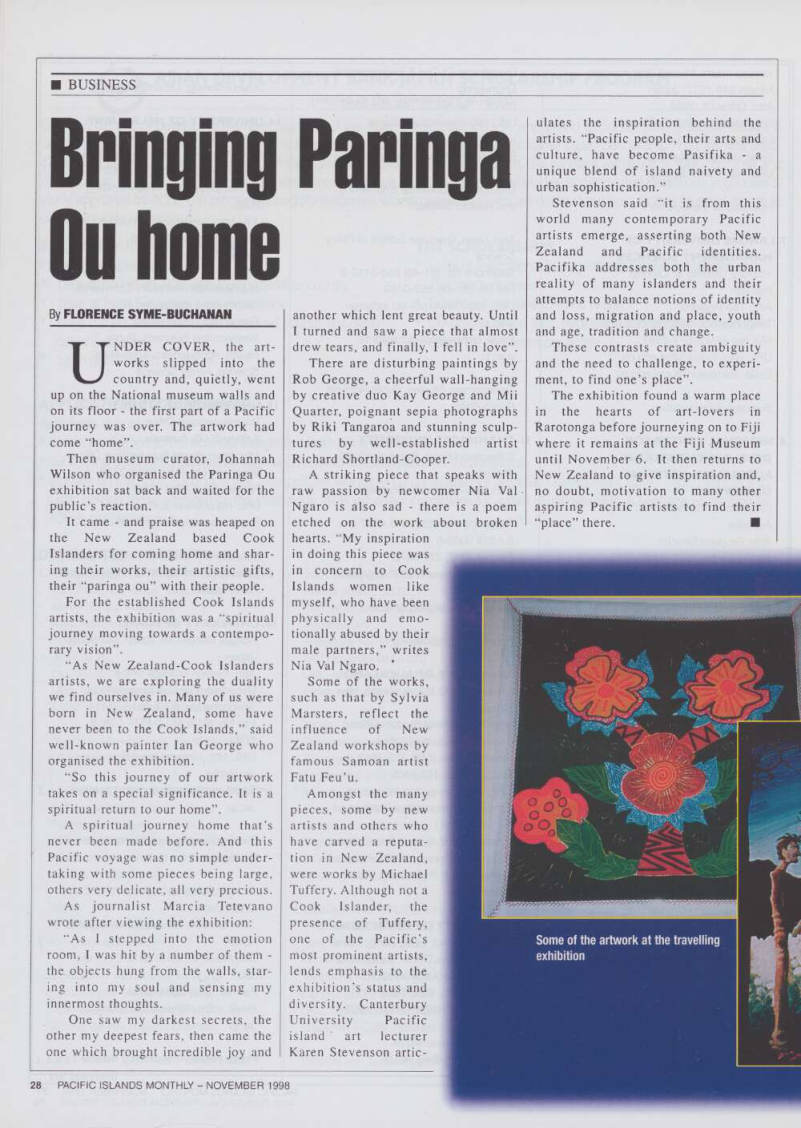
Some of the artwork at the travelling exhibition
Forever at sea
The challenge of setting up sea burials
By Usa Williams
IN the Cook Islands, when it comes to burial, it seems the wishes of the living rather than the final wishes of the dying take precedence.
Although sea burials are legal in these islands, final wishes of local residents who planned to be buried at sea have never been fulfilled. Historically, burial at sea was long seen as the domain of seafarers who died on the journey, in an age without refrigeration or embalming fluid.
Nowadays, it’s the final farewell of choice
for a growing number of those who don’t want the conventional earthbound grave.
For about a dozen people in the Davey Jones’ Locker club, it is a challenge to set a precedent by being the first to be buried at sea. Club member Don Silk says it is made up of people who are comfortable at sea and with the idea of being consigned to its depths. The biggest problem with a sea burial is not in offending the sensibilities of the living, but how to leave the living behind. It’s very important to sort out the family reaction to sea burial before the fact, says Silk. “For those of us who want to be buried at sea the last thing we want is our family squabbling over possession of the body. We make it very clear to our members that you must have it in your will, prefer ably giving us a copy of your will or a cod icil (an extra clause added afterwards).”
The written bits guarantee agreement from the family to the Davey Jones Locker commitment, and ensure “there’s no muck ing around when the time comes,” says Silk. Most of the members of Davey Jones’
Locker know the main problem that might arise. They are married to Cook Islanders, resident in a country where the dead are still part of the homestead, a decorated or shaded cement square in the front or back garden. Silk says the group has no wish to get into fights over the issue.
“As a group we’re happy to bury each other if the person asking wants to be buried at sea, but we’re not out as a group encouraging it as a habit. We’re not out proselytising, saying ‘we think you should be buried at sea’... it’s a very personal thing amongst a few of us friends.”
The only motive for going public is to let others out there know that the opportu nity is there, he says. Without Davey Jones’s Locker, there is no choice but to be buried on land because there is no other organisation able to carry out those last wishes. In New Zealand, most burials at sea are done after cremation, After a ser
vice which is no different from that for land burials, the body is taken to the wharf, loaded onto a vessel and taken to sea. Only a few close relatives and perhaps a Chaplain will be on board to witness the burial, ‘‘which can be a very dignified cer emony in itself,” says Silk.
The ceremony is common practice in some countries, including our Pacific neighbours (American) Samoa and Fiji, he says. In the Pacific identifying a specific site for sea burials is not as big an issue as it is for countries such as New Zealand, where the continental shelf means vessels have travel to .many miles to find deep water. “In the islands here you’ve only got to go a mile offshore and you’re no longer in soundings, where the water is thousands of feet deep,” says Silk, “so there’s no point in nominating a particular place, as long as it is offshore and not in soundings”.
For the Davey Jones group, questions like how the ceremony will be kept digni fied and weighting the body with chain wrapped round the shroud have been dis cussed and planned for the last three years, ever since Don Silk raised the question out loud and was taken aback by the big response. “I’m surprised how many of my friends that I see everyday are quite keen on the idea,” he says, “there must be many other people who have never heard of this, but maybe think it’s a good idea.”
Most of those who do support the notion of sea burial are men, says Silk.
“Some wives are not keen but this is something to sort out beforehand. It’s a very personal thing, but a lot of people think after you die the spirit is gone and the body is a heap of flesh and bones...just something to be got rid of, in a ceremonial, nice way of course.” So now that the assumptions on ‘buried’ meaning ‘buried in earth’ have been shifted offshore, has the man who founded Davey Jones’ Locker decided on any particular spot? Silk is com fortable in his reply, saying “Anywhere, just outside the harbour...a mile or so out. I won’t be there to mark the spot”. ■
Gay Pacific Island
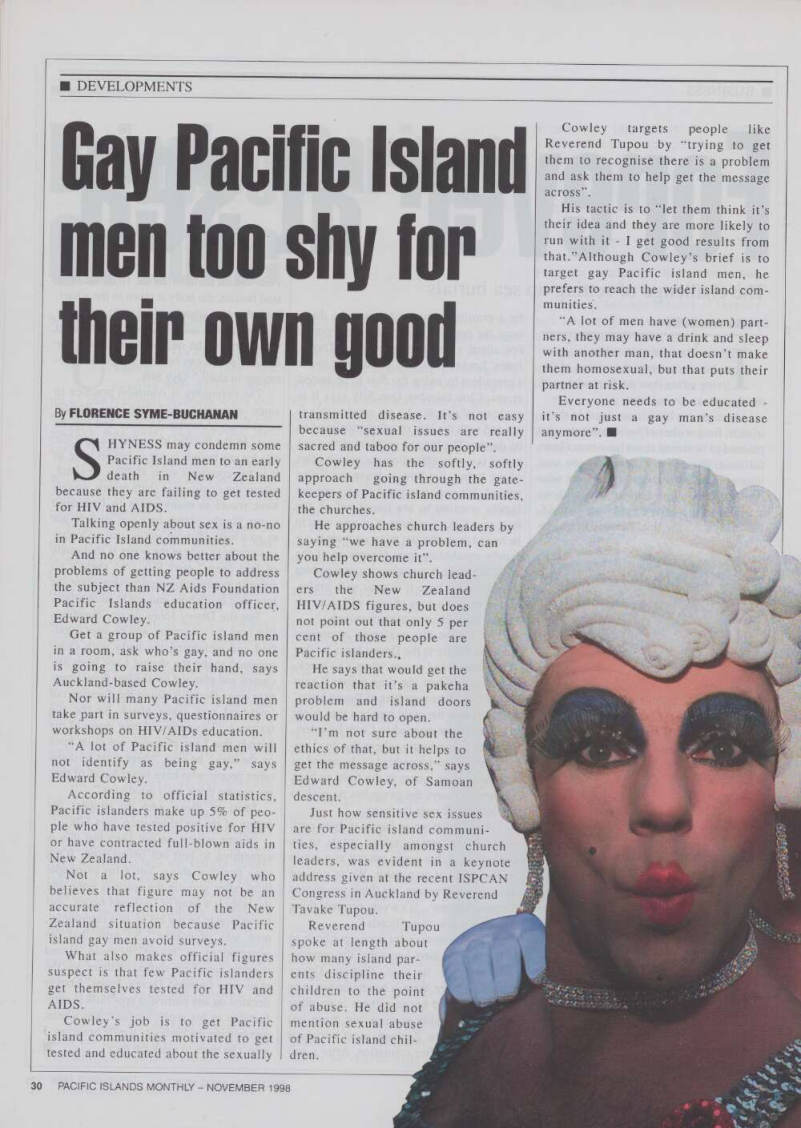
Developments
Gay Pacific Island men too shy for their own good
By Florence Syme-Buchanan
SHYNESS may condemn some Pacific Island men to an early death in New Zealand because they are failing to get tested for HIV and AIDS.
Talking openly about sex is a no-no in Pacific Island communities.
And no one knows better about the problems of getting people to address the subject than NZ Aids Foundation Pacific Islands education officer,
Edward Cowley.
Get a group of Pacific island men in a room, ask who’s gay, and no one is going to raise their hand, says
Auckland-based Cowley.
Nor will many Pacific island men take part in surveys, questionnaires or workshops on HIV/AIDs education.
“A lot of Pacific island men will not identify as being gay,” says Edward Cowley.
According to official statistics.
Pacific islanders make up 5% of peo ple who have tested positive for HIV or have contracted full-blown aids in New Zealand.
Not a lot, says Cowley who believes that figure may not be an accurate reflection of the New Zealand situation because Pacific island gay men avoid surveys.
What also makes official figures suspect is that few Pacific islanders get themselves tested for HIV and
Aids.
Cowley’s job is to get Pacific island communities motivated to get tested and educated about the sexually
transmitted disease. It’s not easy because “sexual issues are really sacred and taboo for our people”.
Cowley has the softly, softly approach going through the gate keepers of Pacific island communities, the churches.
He approaches church leaders by saying “we have a problem, can you help overcome it”.
Cowley shows church lead ers the New Zealand HIV/AIDS figures, but does ?■ not point out that only 5 per \ 'I cent of those people are I V \
Pacific islanders., \ V
He says that would get the VW reaction that it’s a pakeha problem and island doors would be hard to open. A I 1 “I’m not sure about the , I ethics of that, but it helps to 1 get the message across,” says V 1
Edward Cowley, of Samoan \ 1
descent. lyy •
Just how sensitive sex issues X are for Pacific island communities, especially amongst church leaders, was evident in a keynote address given at the recent ISPCAN
Congress in Auckland by Reverend J
Tavake Tupou.
Reverend Tupou spoke at length about how many island par- fr'
ents discipline their fe %
children to the point Jp? of abuse. He did not I mention sexual abuse of Pacific island chil- JB ./ : dren. MB:
Cowley targets people like Reverend Tupou by "trying to get them to recognise there is a problem and ask them to help get the message across”.
His tactic is to “let them think it’s their idea and they are more likely to run with it - I get good results from that.’’Although Cowley’s brief is to target gay Pacific island men, he prefers to reach the wider island com munities'.
“A lot of men have (women) part ners, they may have a drink and sleep with another man, that doesn’t make them homosexual, but that puts their partner at risk.
Everyone needs to be educated it’s not just a gay man’s disease anymore”. ■
booming sex industry
The ILO urges govts to recognise booming sex industry
By Brian Tobia
THE United Nation’s International Labour Organisation (of which PNG is a member) recently urged governments to officially recognise the booming sex indus try and treat it like any other business only stopping short of calling for prostitu tion to be legalised.
An ILO survey indicated that prostitu tion in South East Asia had grown so rapid ly that the sex business now accounts for about 14 per cent of GDP in regional economies with millions of people’s liveli hoods depending on it. The situation is no different in Papua New Guinea.
Commercial sex is also on the rise.
Police and health officials do • agree that commercial sex is I I J /• 1 “massive” and is on the rise 9c although they do not have I . * statistics to prove this. % \ Acting Police Commissioner * MS robert Korus said k prostitution is mas sive in PNG. Korus l -AY investigation and ’ more manpower to crack down on those actively involved in prostitution. PNG’s Health Wj!p Department Secretary Dr Ila Temu also agreed that prosti tution is on the rise, resulting in an W%k increase in HIV/AIDS diseases.
Brian Brian Tobia, a Post- Courier journalist, met with some of It those in the business. This is his :count of a night out with some of them, visiting hot spots in llbt Port Moresby. I
was chatting
with two new |Mjß| found friends B when sudden one
B exclaimed:
“That is the hottest and most wanted one in here”.
As I turned, a yellow-haired, fairly built lass of no more than 19 walked into the premises. I was in what is known as “Three Mile Guest House” - a three bedroom house which has been turned into a brothel by the landlord. I was told he was a promi nent Port Moresby businessman who denied any connections.
The girl (name known) was later fol lowed to another place in the city where, with others like herself, a network is in place. They are picked up and dropped off by men in tinted executive cars night and day. The guest house has been raided by police many times.
Being new to the brothel, I attracted two male and three female friends with whom I struck up a conversation over beer. The conversation began when I told them I was new and wanted to know more about the place. Cathy (not real name), a 20-year-old from Gulf Province, said she had two chil dren and her husband was unemployed, so she has to work to support her children.
She said there was very stiff conpetition from other women for men but being pret ty, she attracted a fair number each day and usually goes home with between K6O and KBO in good times.
Thanking me for a K 5 note that I slipped into her hand to buy cigarettes, she said it was no use looking for a good hus band because she made out all right.
Besides, she said, noone would want to marry her after leading a prostitute’s life.
Another woman, also from the Gulf, said life was just hopeless for her. Having dropped out of Grade 6 at home, she made her way to Port Moresby with very low qualifications and could not find a job.
I reminded them about the danger of catching HIV/AIDS. Cathy pointed out that they always tried to persuade their partners to use condoms. My friends told me that every day women of all ages go to the brothels to try and attract customers.
The clients are men from all walks of life, including professional people and even unemployed youth - as long as they
have K3O to spend. To hire a room equipped with a bed is KlO and K2O is for service. A visit to one of the rooms revealed that is was not only dirty but also littered with used condoms and other rub bish. The girls said this was just one of many brothels, and there were many places to go in the city.
I visited a number of such places, most of them filled with about 70 per cent women and 30 per cent men. a good num ber of friends told me that a few women go to night clubs to drink, dance and enjoy themselves, while many of them go there with the hope of getting involved with men. “Some of us drink outside before coming to dances because we cannot afford to buy inside... we ask men to take us out,” said another prostitute, adding that these men normally book rooms for later.
Some men interviewed said that they do it to satisfy their sexual needs, while the women said it was the only way they could earn money in these hard economic times.
“Just leave us alone, we are not doing anyone any harm,” one woman said, “we would like to survive like everybody else”.
I also visited a number of nightclubs to confirm information, from various sources, about highly organised prostitution with the aid of middlemen.
I learnt that, in many cases, women rent rooms in hotels and motels, and then attempt to entice men to have sex with them. The fee for that service could be no less than K6O and up to KlOO per person.
If the woman is lucky, she could have more than one partner per night and go home rich. I tried bargaining a fee with a pretty Highlands woman who looked about 20years-old. Syhe charged me KBO. A lower offer of K4O was made to her, with her Pidgin reply being, “skin bilong man ya, I no stone”, which in English means “human being’s skin, not a stone”.
Interviews with hotel executives con firmed such activities. One said, “it’s none of your business... they are adults and we don’t have to tell them what to do”.
The executives said they run businesses and only step in when someone does some thing wrong that could jeopardise their operation.
Several of PNG’s elite executives con fided that all one has to do is get intro duced to girls who charge very high fees.
Or have the right contact number and the “goods” would be delivered at an appoint ed place and time. ■
Carpet of culture blamed
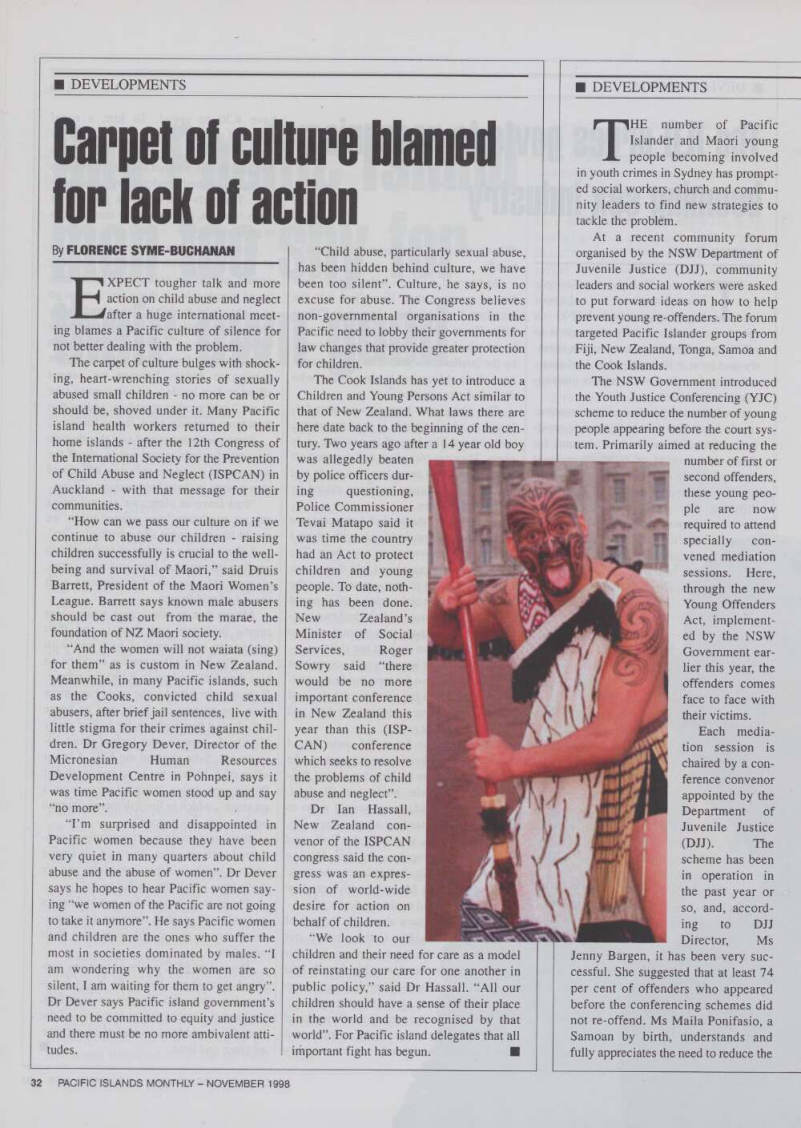
for lack of action
By Florence Syme-Buchanan
EXPECT tougher talk and more action on child abuse and neglect after a huge international meet ing blames a Pacific culture of silence for not better dealing with the problem.
The carpet of culture bulges with shock ing, heart-wrenching stories of sexually abused small children - no more can be or should be, shoved under it. Many Pacific island health workers returned to their home islands - after the 12th Congress of the International Society for the Prevention of Child Abuse and Neglect (ISPCAN) in Auckland - with that message for their communities.
“How can we pass our culture on if we continue to abuse our children - raising children successfully is crucial to the well being and survival of Maori,” said Druis Barrett, President of the Maori Women’s League. Barrett says known male abusers should be cast out from the marae, the foundation of NZ Maori society.
“And the women will not waiata (sing) for them” as is custom in New Zealand.
Meanwhile, in many Pacific islands, such as the Cooks, convicted child sexual abusers, after brief jail sentences, live with little stigma for their crimes against chil dren. Dr Gregory Dever, Director of the Micronesian Human Resources Development Centre in Pohnpei, says it was time Pacific women stood up and say “no more”.
“I’m surprised and disappointed in Pacific women because they have been very quiet in many quarters about child abuse and the abuse of women”. Dr Dever says he hopes to hear Pacific women say ing “we women of the Pacific are not going to take it anymore”. He says Pacific women and children are the ones who suffer the most in societies dominated by males. “I am wondering why the women are so silent, I am waiting for them to get angry”.
Dr Dever says Pacific island government’s need to be committed to equity and justice and there must be no more ambivalent atti tudes.
“Child abuse, particularly sexual abuse, has been hidden behind culture, we have been too silent”. Culture, he says, is no excuse for abuse. The Congress believes non-governmental organisations in the Pacific need to lobby their governments for law changes that provide greater protection for children.
The Cook Islands has yet to introduce a Children and Young Persons Act similar to that of New Zealand. What laws there are here date back to the beginning of the cen tury. Two years ago after al4 year old boy
was allegedly beaten by police officers dur
ing questioning,
Police Commissioner Tevai Matapo said it was time the country had an Act to protect children and young people. To date, noth ing has been done.
New Zealand’s Minister of Social Services, Roger Sowry said “there would be no more important conference in New Zealand this year than this (ISP CAN) conference which seeks to resolve the problems of child abuse and neglect”.
Dr lan Hassall, New Zealand con venor of the ISPCAN congress said the con gress was an expres sion of world-wide desire for action on behalf of children.
“We look to our
children and their need for care as a model of reinstating our care for one another in public policy,” said Dr Hassall. “All our children should have a sense of their place in the world and be recognised by that world”. For Pacific island delegates that all important fight has begun. ■
THE number of Pacific Islander and Maori young people becoming involved in youth crimes in Sydney has prompt ed social workers, church and commu nity leaders to find new strategies to tackle the problem.
At a recent community forum organised by the NSW Department of Juvenile Justice (DJJ), community leaders and social workers were asked to put forward ideas on how to help prevent young re-offenders. The forum targeted Pacific Islander groups from Fiji, New Zealand, Tonga, Samoa and the Cook Islands.
The NSW Government introduced the Youth Justice Conferencing (YJC) scheme to reduce the number of young people appearing before the court sys tem. Primarily aimed at reducing the
number of first or second offenders, these young peo ple are now required to attend specially con vened mediation sessions. Here, through the new Young Offenders Act, implement ed by the NSW Government ear lier this year, the offenders comes face to face with their victims.
Each media tion session is chaired by a con ference convenor appointed by the Department of Juvenile Justice (DJJ). The scheme has been in operation in the past year or so, and, accord ing to DJJ Director, Ms
Jenny Bargen, it has been very suc cessful. She suggested that at least 74 per cent of offenders who appeared before the conferencing schemes did not re-offend. Ms Maila Ponifasio, a Samoan by birth, understands and fully appreciates the need to reduce the
Advertisements & other items, p. 32 (1 item)
32
■ DEVELOPMENTS
PACIFIC ISLANDS MONTHLY - NOVEMBER 1998
■ DEVELOPMENTS
Pacific Island juveniles
face their crimes
By John Uri
number of Pacific Islander young people entering the justice system. As administra tor of the Youth Justice Conferencing scheme, Ms Ponifasio is too aware of the breakdown in relationships between parents and children.
She believes that young people’s views must be heard at community forums.
However she admitted that this is not always possible because the Pacific culture includes a tradition of respect for elders.
Through YJC, parents of offenders are expected to play a major role in the early phase of the mediation process. Because the YJC scheme is perceived as an important stepping stone for first or second-time offenders, it is vital that parents take control of the situation from the start.
The scheme works-on the understanding that if further crimes are committed, the end result could be costly with offenders likely to reappear before a magistrate. In NSW, the YJC scheme is unique because the processes involved, when mediation is established, closely resembles the way Pacific Island parents deal with conflicts particularly the way they discipline their children.
The involvement of the police and the court system is limited during the reconcili ation process between offender and victim.
Instead, the offender appears before a conference convenor, with a parent, friend or representative. At these sessions, offend ers come face to face with their victims.
The aim of the mediation is to allow the offender to seek compromise or an agree able punishment appropriate to the crimes committed. This may involve just declaring a simple apology to the victim or an under taking to do community work.
The scheme has enormous benefits for both the victims and the offenders, however the major beneficiary is the offender who avoids expensive legal litigation and processes. At a time when legal aid funds are being phased out by the Howard gov ernment, these conferencing schemes will
appeal mainly to families on low income or those who are uncomfortable with the harsh realities of the court system. It seems that gradually Maori and Pacific Islander par ents will come to endorse the merits of the scheme, however, only time will tell whether the scheme has any long-term influence on first and second-time offend ers.
Although the YJC scheme is still in its infancy, most Pacific Islander groups at the forum believe that, in addition, more educa tional programmes for parents ought to be initiated. However, they argue that if there was a likelihood of a co-ordinated effort to reduce the number of offenders entering, the system, the government must also find a solution to the social and economic prob lems facing Pacific Islander families.
In the outlying cities of Sydney, such as Blacktown, Mt. Druitt, Werrington, Macquarie Fields, Campbelltown and St Mary’s, where most Maori and Pacific Islander communities reside, unemploy ment seems to be an important factor - par ticularly for young school leavers.
Unemployment is therefore a key eco nomic issue for Pacific people.
There also seems to be a reluctance by the Australian government to initiate a com prehensive analysis of the economic conse quences of Pacific settlement and migration in Sydney.
Despite 25-30 years of Pacific migration in Australia, it is still incredible to find that official statistics continue to regard Pacific Islanders as minority groups or recent arrivals.lt is this distortion of the Pacific population that is making their economic position difficult to argue.
In a sense, they are minorities if the sta tistics are viewed empirically or compared to other migrant groups on a State-wide basis. But when the figures are viewed from a regional or local level, their numbers stand out.
In the long run, though, the dilemma fac ing Pacific Islander young people lies with whether major Pacific Islander groups can work co-operatively to enhance and
improve their socio-economic position.
Since 1996, welfare and community development funding to the Tongan and Fijian communities have been significantly reduced. This was despite repeated advice to the Federal Government that the popula tion of these and other islander groups had doubled in the past 10 years.
The scale of these funded schemes is minuscule and unable to cover the geo graphical spread of the community in Sydney.
The recent forum highlighted another side of the struggles and barriers con fronting Pacific Islanders. Strategically, Pacific Islanders have no single voice in Sydney so that any likelihood of a co-ordi nated effort - to pursue recommendations arising out of partnership consultations with government institutions - will more than likely fail.
An underlying problem is the tremen dous inability to speak openly on social and political issues. It is this reticence in the Pacific community that has frustrated many Islanders. In turn, they constantly blame their community leaders for failing to take an active role outside the realm of the com munity.
The result is that successive govern ments have become accustomed to issuing band-aid assistance to Pacific Islander com munities, thus ignoring the wider social and economic problems arising from migration and unemployment.
The real test for Pacific Islander commu nities is whether they can achieve stronger solidarity when confronted with the chang ing nature of government policies that seem to ignore their plight year to year.
Pacific Island communities cannot adopt a wait-and-see attitude forever. Many of the problems facing young people could have been avoided had the church and communi ty leaders spent more time developing structural programmes that included, rather than excluded, young people.
Service providers, the police, media and court system are not in the business of dis tinguishing whether a young offender is Fijian, Cook Islander or Samoan. In their eyes, these figures are all the same.
This is inevitably the way Pacific Islanders have been portrayed, written about and articulated in the media in the past three decades.
It is for these reasons that Pacific com munities in Australia must find a way to work together, now more than ever. ■
Advertisements & other items, p. 34 (1 item)
Budget
mm* s? Saff - : -v “ 1 i ; ; i- -■ ' Hi mmm . -■ -■ .
KIAORA! BULAVINAKA!
MAEVA! ALOHA!
HOWEVER WE SAY IT,
IT MEANS WELCOME!
Budget
Fiji 122 636 Papua New Guinea 325 4111 Vanuatu 23170 New Caledonia 262 009 Hawaii 838 1111 Western Samoa 20561 Australia 1300 362 848 New Zealand 0800 652 221 You, Me & Him BUDSSIPA
contagion
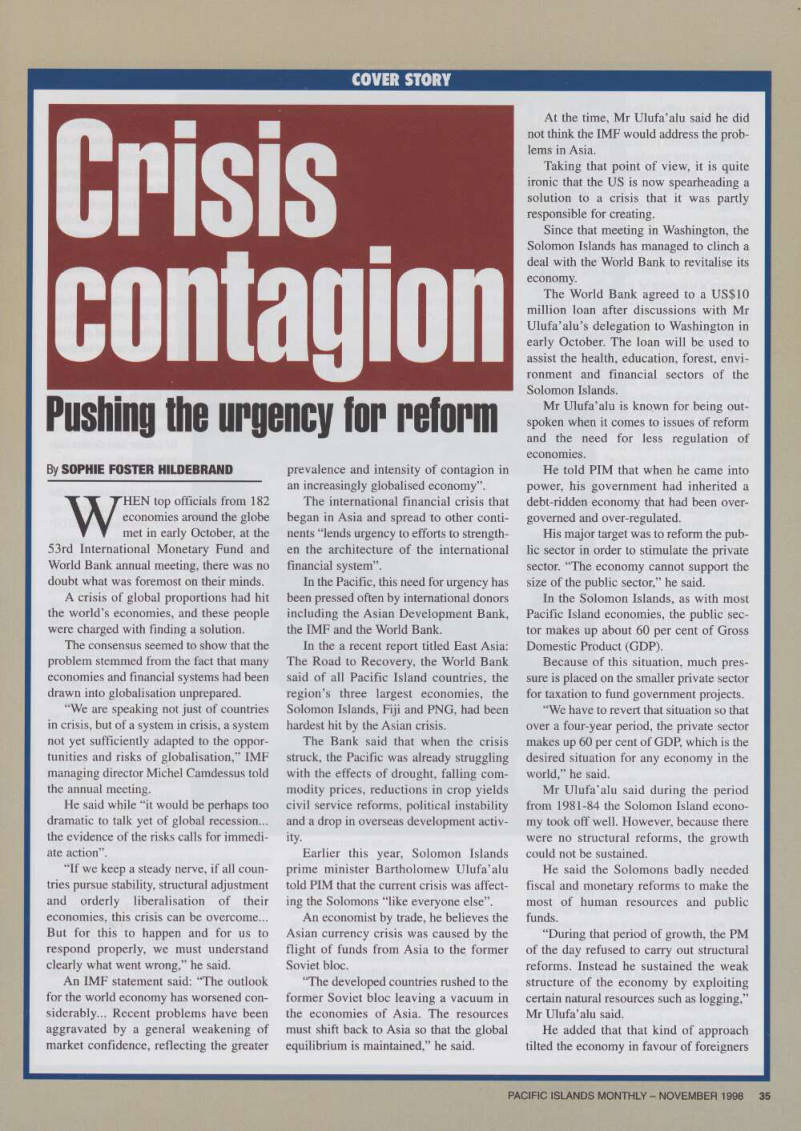
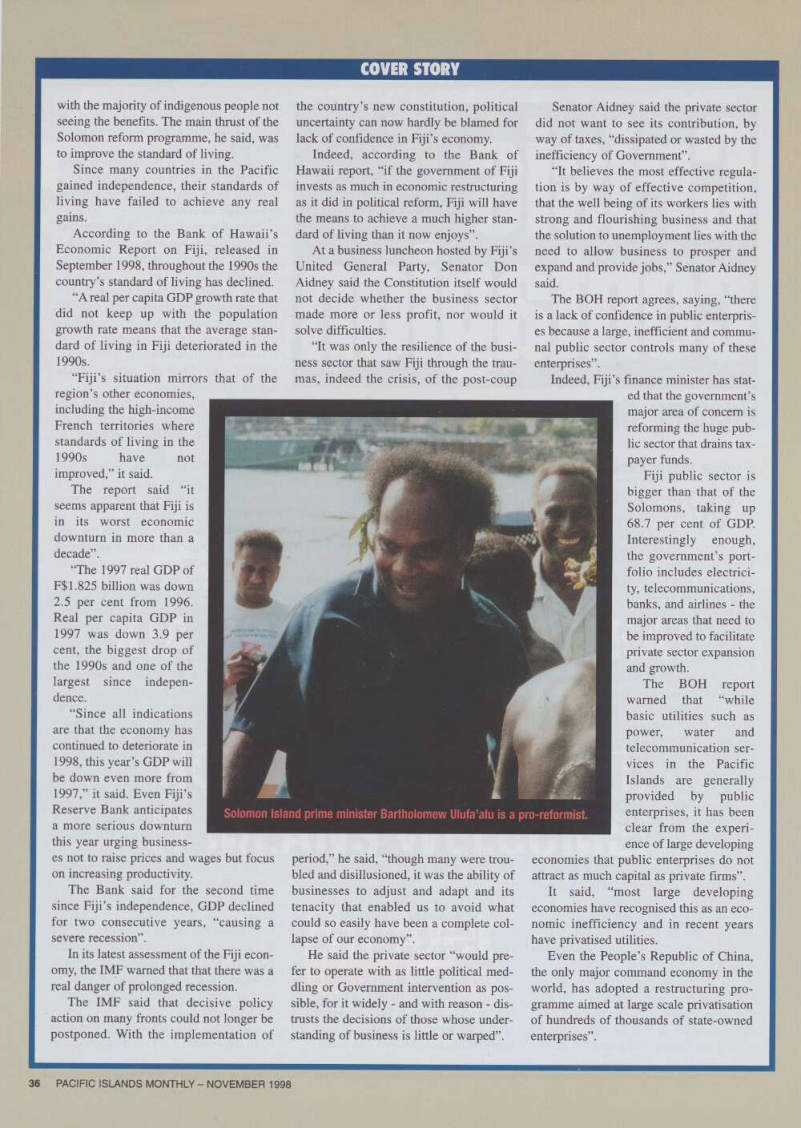
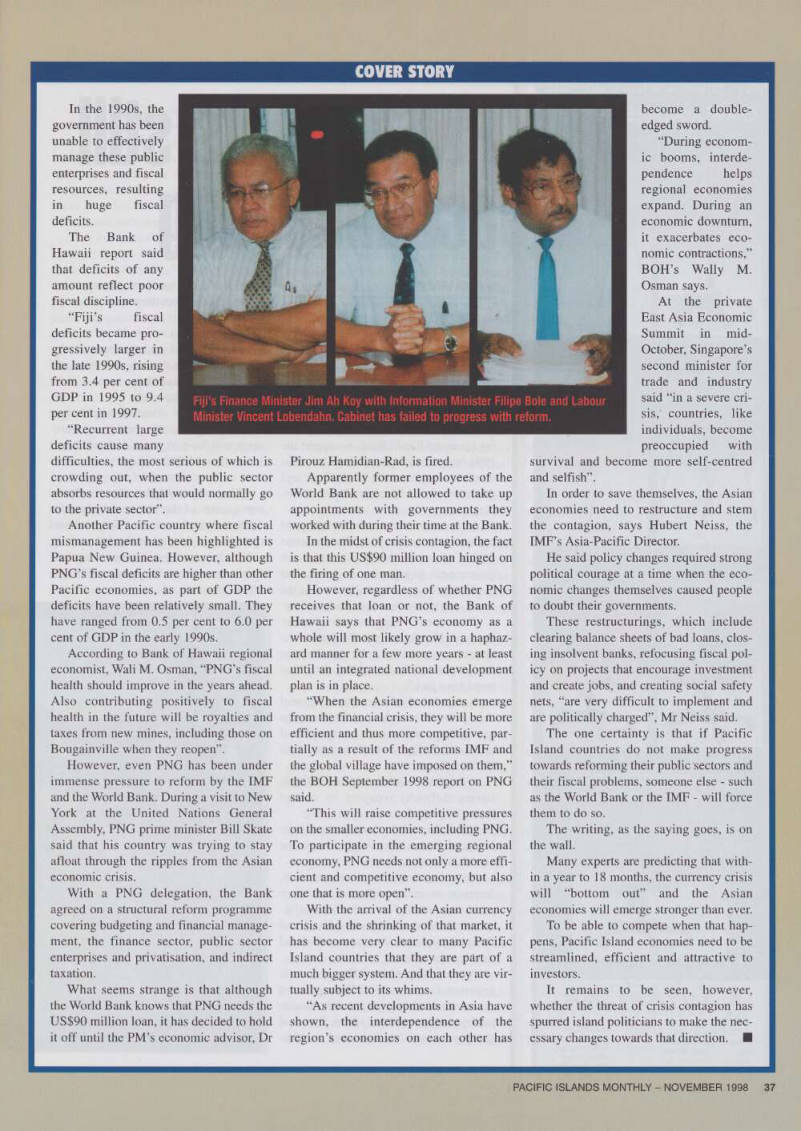
Cover Story
Crisis contagion
Pushing the urgency for reform
By Sophie Foster Hildebrand
WHEN top officials from 182 economies around the globe met in early October, at the 53rd International Monetary Fund and World Bank annual meeting, there was no doubt what was foremost on their minds.
A crisis of global proportions had hit the world’s economies, and these people were charged with finding a solution.
The consensus seemed to show that the problem stemmed from the fact that many economies and financial systems had been drawn into globalisation unprepared.
“We are speaking not just of countries in crisis, but of a system in crisis, a system not yet sufficiently adapted to the oppor tunities and risks of globalisation,” IMF managing director Michel Camdessus told the annual meeting.
He said while “it would be perhaps too dramatic to talk yet of global recession... the evidence of the risks calls for immedi ate action”.
“If we keep a steady nerve, if all coun tries pursue stability, structural adjustment and orderly liberalisation of their economies, this crisis can be overcome...
But for this to happen and for us to respond properly, we must understand clearly what went wrong,” he said.
An IMF statement said: “The outlook for the world economy has worsened con siderably... Recent problems have been aggravated by a general weakening of market confidence, reflecting the greater
prevalence and intensity of contagion in an increasingly globalised economy”.
The international financial crisis that began in Asia and spread to other conti nents “lends urgency to efforts to strength en the architecture of the international
financial system”.
In the Pacific, this need for urgency has been pressed often by international donors including the Asian Development Bank, the IMF and the World Bank.
In the a recent report titled East Asia: The Road to Recovery, the World Bank said of all Pacific Island countries, the region’s three largest economies, the Solomon Islands, Fiji and PNG, had been hardest hit by the Asian crisis.
The Bank said that when the crisis struck, the Pacific was already struggling with the effects of drought, falling com modity prices, reductions in crop yields civil service reforms, political instability and a drop in overseas development activ ity.
Earlier this year, Solomon Islands prime minister Bartholomew Ulufa’alu told PIM that the current crisis was affect ing the Solomons “like everyone else”.
An economist by trade, he believes the Asian currency crisis was caused by the flight of funds from Asia to the former Soviet bloc.
“The developed countries rushed to the former Soviet bloc leaving a vacuum in the economies of Asia. The resources must shift back to Asia so that the global equilibrium is maintained,” he said.
At the time, Mr Ulufa’alu said he did not think the IMF would address the prob lems in Asia.
Taking that point of view, it is quite ironic that the US is now spearheading a solution to a crisis that it was partly responsible for creating.
Since that meeting in Washington, the Solomon Islands has managed to clinch a deal with the World Bank to revitalise its economy.
The World Bank agreed to a US$lO million loan after discussions with Mr Ulufa’alu’s delegation to Washington in early October. The loan will be used to assist the health, education, forest, envi ronment and financial sectors of the Solomon Islands.
Mr Ulufa’alu is known for being out spoken when it comes to issues of reform and the need for less regulation of economies.
He told PIM that when he came into power, his government had inherited a debt-ridden economy that had been over governed and over-regulated.
His major target was to reform the pub lic sector in order to stimulate the private sector. “The economy cannot support the size of the public sector,” he said.
In the Solomon Islands, as with most Pacific Island economies, the public sec tor makes up about 60 per cent of Gross Domestic Product (GDP).
Because of this situation, much pres sure is placed on the smaller private sector for taxation to fund government projects.
“We have to revert that situation so that over a four-year period, the private sector makes up 60 per cent of GDP, which is the desired situation for any economy in the world,” he said.
Mr Ulufa’alu said during the period from 1981-84 the Solomon Island econo my took off well. However, because there were no structural reforms, the growth could not be sustained.
He said the Solomons badly needed fiscal and monetary reforms to make the most of human resources and public funds.
“During that period of growth, the PM of the day refused to carry out structural reforms. Instead he sustained the weak structure of the economy by exploiting certain natural resources such as logging,”
Mr Ulufa’alu said.
He added that that kind of approach tilted the economy in favour of foreigners
with the majority of indigenous people not seeing the benefits. The main thrust of the Solomon reform programme, he said, was to improve the standard of living.
Since many countries in the Pacific gained independence, their standards of living have failed to achieve any real gains.
According to the Bank of Hawaii’s Economic Report on Fiji, released in September 1998, throughout the 1990 s the country’s standard of living has declined.
“A real per capita GDP growth rate that did not keep up with the population growth rate means that the average stan dard of living in Fiji deteriorated in the 19905.
“Fiji’s situation mirrors that of the
region’s other economies,
including the high-income
French territories where standards of living in the 1990 s have not improved,” it said.
The report said “it seems apparent that Fiji is in its worst economic downturn in more than a decade”.
“The 1997 real GDP of F$ 1.825 billion was down 2.5 per cent from 1996.
Real per capita GDP in 1997 was down 3.9 per cent, the biggest drop of the 1990 s and one of the largest since indepen dence.
“Since all indications are that the economy has continued to deteriorate in 1998, this year’s GDP will be down even more from 1997,” it said. Even Fiji’s Reserve Bank anticipates a more serious downturn this year urging business
es not to raise prices and wages but focus on increasing productivity.
The Bank said for the second time since Fiji’s independence, GDP declined for two consecutive years, “causing a severe recession”.
In its latest assessment of the Fiji econ omy, the IMF warned that that there was a real danger of prolonged recession.
The IMF said that decisive policy action on many fronts could not longer be postponed. With the implementation of
the country’s new constitution, political uncertainty can now hardly be blamed for lack of confidence in Fiji’s economy.
Indeed, according to the Bank of Hawaii report, “if the government of Fiji invests as much in economic restructuring as it did in political reform, Fiji will have the means to achieve a much higher stan dard of living than it now enjoys”.
At a business luncheon hosted by Fiji’s United General Party, Senator Don Aidney said the Constitution itself would not decide whether the business sector made more or less profit, nor would it solve difficulties.
“It was only the resilience of the busi ness sector that saw Fiji through the trau mas, indeed the crisis, of the post-coup
period,” he said, “though many were trou bled and disillusioned, it was the ability of businesses to adjust and adapt and its tenacity that enabled us to avoid what could so easily have been a complete col lapse of our economy”.
He said the private sector “would pre fer to operate with as little political med dling or Government intervention as pos sible, for it widely - and with reason - dis trusts the decisions of those whose under standing of business is little or warped”.
Senator Aidney said the private sector did not want to see its contribution, by way of taxes, “dissipated or wasted by the inefficiency of Government”.
“It believes the most effective regula tion is by way of effective competition, that the well being of its workers lies with strong and flourishing business and that the solution to unemployment lies with the need to allow business to prosper and
expand and provide jobs,” Senator Aidney
said.
The BOH report agrees, saying, “there is a lack of confidence in public enterpris es because a large, inefficient and commu nal public sector controls many of these
enterprises”.
Indeed, Fiji’s finance minister has stat
ed that the government’s major area of concern is reforming the huge pub lic sector that drains tax payer funds.
Fiji public sector is bigger than that of the Solomons, taking up 68.7 per cent of GDP.
Interestingly enough,
the government’s port folio includes electrici ty, telecommunications, banks, and airlines - the major areas that need to be improved to facilitate private sector expansion and growth.
The BOH report warned that “while basic utilities such as power, water and telecommunication ser vices in the Pacific Islands are generally provided by public enterprises, it has been clear from the experi ence of large developing
economies that public enterprises do not attract as much capital as private firms”.
It said, “most large developing economies have recognised this as an eco nomic inefficiency and in recent years have privatised utilities.
Even the People’s Republic of China, the only major command economy in the world, has adopted a restructuring pro gramme aimed at large scale privatisation of hundreds of thousands of state-owned enterprises”.
Solomon lsland prime minister Bartholomew Ulufa'alu is pro-reformist.
In the 19905, the government has been unable to effectively manage these public enterprises and fiscal resources, resulting in huge fiscal deficits.
The Bank of Hawaii report said that deficits of any amount reflect poor fiscal discipline.
“Fiji’s fiscal
deficits became pro
gressively larger in
the late 19905, rising from 3.4 per cent of GDP in 1995 to 9.4 per cent in 1997.
“Recurrent large
deficits cause many
difficulties, the most serious of which is crowding out, when the public sector absorbs resources that would normally go to the private sector”.
Another Pacific country where fiscal mismanagement has been highlighted is Papua New Guinea. However, although PNG’s fiscal deficits are higher than other Pacific economies, as part of GDP the deficits have been relatively small. They have ranged from 0.5 per cent to 6.0 per cent of GDP in the early 19905.
According to Bank of Hawaii regional economist, Wali M. Osman, “PNG’s fiscal health should improve in the years ahead.
Also contributing positively to fiscal health in the future will be royalties and taxes from new mines, including those on Bougainville when they reopen”.
However, even PNG has been under immense pressure to reform by the IMF and the World Bank. During a visit to New York at the United Nations General Assembly, PNG prime minister Bill Skate said that his country was trying to stay afloat through the ripples from the Asian economic crisis.
With a PNG delegation, the Bank agreed on a structural reform programme covering budgeting and financial manage ment, the finance sector, public sector enterprises and privatisation, and indirect taxation.
What seems strange is that although the World Bank knows that PNG needs the US$9O million loan, it has decided to hold it off until the PM’s economic advisor, Dr
Pirouz Hamidian-Rad, is fired.
Apparently former employees of the World Bank are not allowed to take up appointments with governments they worked with during their time at the Bank.
In the midst of crisis contagion, the fact is that this US$9O million loan hinged on the firing of one man.
However, regardless of whether PNG receives that loan or not, the Bank of Hawaii says that PNG’s economy as a whole will most likely grow in a haphaz ard manner for a few more years - at least until an integrated national development plan is in place.
“When the Asian economies emerge from the financial crisis, they will be more efficient and thus more competitive, par tially as a result of the reforms IMF and the global village have imposed on them,” the BOH September 1998 report on PNG said.
“This will raise competitive pressures on the smaller economies, including PNG.
To participate in the emerging regional
economy, PNG needs not only a more effi cient and competitive economy, but also one that is more open”.
With the arrival of the Asian currency crisis and the shrinking of that market, it has become very clear to many Pacific Island countries that they are part of a much bigger system. And that they are vir tually subject to its whims.
“As recent developments in Asia have shown, the interdependence of the region’s economies on each other has
become a double edged sword.
“During econom ic booms, interde pendence helps regional economies expand. During an economic downturn, it exacerbates eco nomic contractions,”
BOH’s Wally M.
Osman says.
At the private East Asia Economic Summit in mid- October, Singapore’s second minister for trade and industry said “in a severe cri sis,’ countries, like individuals, become preoccupied with
survival and become more self-centred and selfish”.
In order to save themselves, the Asian economies need to restructure and stem the contagion, says Hubert Neiss, the IMF’s Asia-Pacific Director.
He said policy changes required strong
political courage at a time when the eco nomic changes themselves caused people to doubt their governments.
These restructurings, which include clearing balance sheets of bad loans, clos ing insolvent banks, refocusing fiscal pol icy on projects that encourage investment and create jobs, and creating social safety nets, “are very difficult to implement and are politically charged”, Mr Neiss said.
The one certainty is that if Pacific Island countries do not make progress towards reforming their public sectors and their fiscal problems, someone else - such as the World Bank or the IMF - will force them to do so.
The writing, as the saying goes, is on the wall.
Many experts are predicting that with in a year to 18 months, the currency crisis will “bottom out” and the Asian economies will emerge stronger than ever.
To be able to compete when that hap pens, Pacific Island economies need to be streamlined, efficient and attractive to investors.
It remains to be seen, however, whether the threat of crisis contagion has spurred island politicians to make the nec essary changes towards that direction. ■
fiji's Finance Minister jim Ah Koy with Information Minister Filipe Bole and Labour Minister Vincent Lobendahn. Cabinet has failed to progress with roform.
accumulating

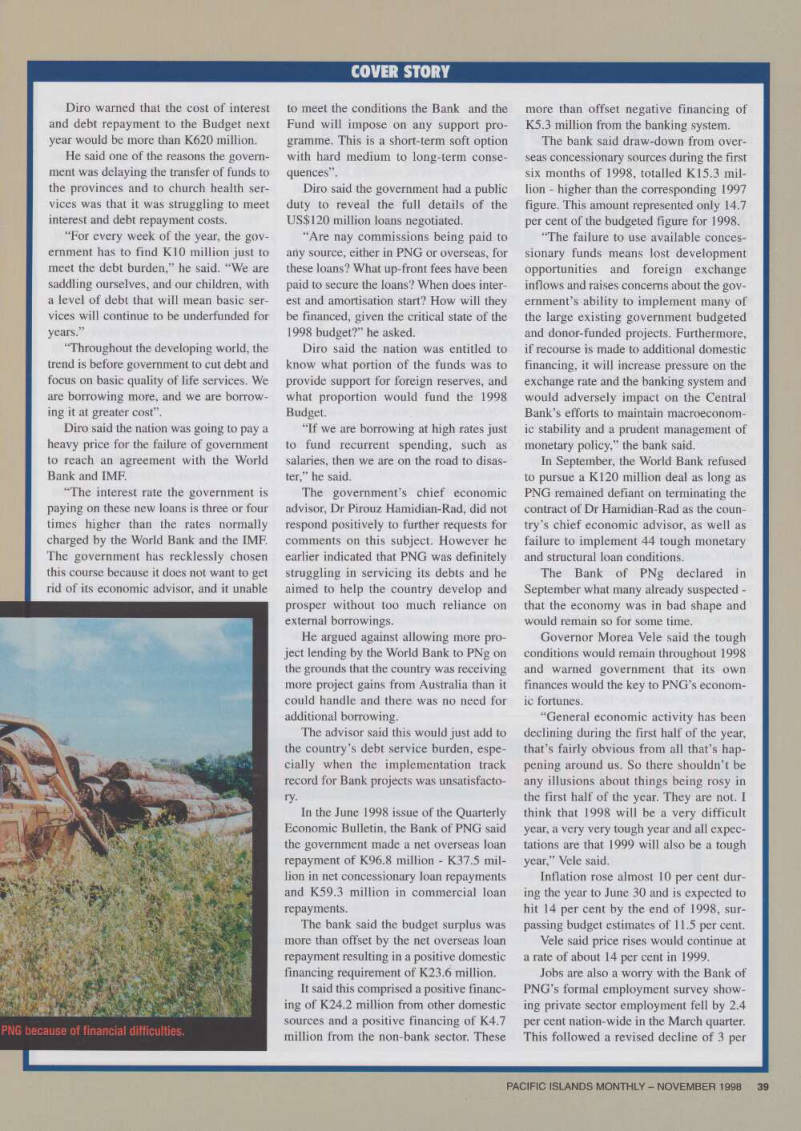

PNG's debts still accumulating
By Sam Vulum
THE economic recession is tak ing its toll in Papua New Guinea, with increasing spec ulation over whether the country or not
the country is being virtually mortgaged
to international financial institutions.
PNG has secured a Kl2O million commercial loan, from European bank ing syndicate Kredit Bank, to support the 1998 budget, with negotiations for addi tional funding from the World Bank and the International Monetary Fund contin uing. the country’s current external debt position is quite worrying. There is some degree of burden being placed on the government in repaying its loans. But most disturbing are speculations that the loans sought have not been budgeted for.
Concerned Opposition Leader Bernard Narokobi told PIM that the country was being sold to overseas financial institutions, adding that “this trend must stop”.
Narokobi said the country’s external debt position was about K 5 billion. On top of that, some sources say the official internal debt figure stands at more than K 750 million.
Whatever the official figure is, PNg is having difficulty repaying its current loans, let alone future ones.
Narokobi said the loans had not been budgeted for but were sought to meet the shortfalls in revenue.
“We must reduce recurrent costs, improve revenue collection and live within our means,” he said, “Maski (for get) International Monetary Fund and World Bank loans. Access concessional
developmental loans”.
A senior opposition MP and Central province Governor, Ted Diro, accused government of imposing a debt burden on Pry simply could not afford. Diro said the government had borrowed an addi
tional K 270 million from overseas com mercial banks over the period of a week in October.
“If the interest rate is 15 per cent, as has been claimed, and the loans are for seven years, then the annual interest and repayment costs of these loans will be K6O million,” Diro said.
“The Budget documents tabled in March show that this year the govern ment will have to pay K 365 million in interest, and K2OO million in amortisa tion, or repayment of debt.
“The total of K 565 million is almost one quarter of the National budget for 1998. It is much more than the combined spending on education, health, and the police. It is even greater than the whole Public Investment Programme (PIP) for 1998,” he said.
Logging equipment lies idle after investors pulled
Diro warned that the cost of interest and debt repayment to the Budget next year would be more than K 620 million.
He said one of the reasons the govern ment was delaying the transfer of funds to the provinces and to church health ser vices was that it was struggling to meet interest and debt repayment costs.
“For every week of the year, the gov ernment has to find KlO million just to meet the debt burden,” he said. “We are saddling ourselves, and our children, with a level of debt that will mean basic ser vices will continue to be underfunded for years.”
“Throughout the developing world, the trend is before government to cut debt and focus on basic quality of life services. We are borrowing more, and we are borrow ing it at greater cost”.
Diro said the nation was going to pay a heavy price for the failure of government to reach an agreement with the World Bank and IMF.
“The interest rate the government is paying on these new loans is three or four times higher than the rates normally charged by the World Bank and the IMF.
The government has recklessly chosen this course because it does not want to get rid of its economic advisor, and it unable
to meet the conditions the Bank and the Fund will impose on any support pro gramme. This is a short-term soft option with hard medium to long-term conse quences”.
Diro said the government had a public duty to reveal the full details of the US$l2O million loans negotiated.
“Are nay commissions being paid to any source, either in PNG or overseas, for these loans? What up-front fees have been paid to secure the loans? When does inter est and amortisation start? How will they be financed, given the critical state of the 1998 budget?” he asked.
Diro said the nation was entitled to know what portion of the funds was to provide support for foreign reserves, and what proportion would fund the 1998 Budget.
“If we are borrowing at high rates just to fund recurrent spending, such as salaries, then we are on the road to disas ter,” he said.
The government’s chief economic advisor, Dr Pirouz Hamidian-Rad, did not respond positively to further requests for comments on this subject. However he earlier indicated that PNG was definitely struggling in servicing its debts and he aimed to help the country develop and prosper without too much reliance on
external borrowings.
He argued against allowing more pro ject lending by the World Bank to PNg on the grounds that the country was receiving more project gains from Australia than it could handle and there was no need for additional borrowing.
The advisor said this would just add to the country’s debt service burden, espe cially when the implementation track record for Bank projects was unsatisfacto ry.
In the June 1998 issue of the Quarterly Economic Bulletin, the Bank of PNG said the government made a net overseas loan repayment of K 96.8 million - K 37.5 mil lion in net concessionary loan repayments and K 59.3 million in commercial loan repayments.
The bank said the budget surplus was more than offset by the net overseas loan repayment resulting in a positive domestic financing requirement of K 23.6 million.
It said this comprised a positive financ ing of K 24.2 million from other domestic sources and a positive financing of K 4.7 million from the non-bank sector. These
more than offset negative financing of K 5.3 million from the banking system.
The bank said draw-down from over seas concessionary sources during the first six months of 1998, totalled K 15.3 mil lion - higher than the corresponding 1997 figure. This amount represented only 14.7 per cent of the budgeted figure for 1998.
“The failure to use available conces sionary funds means lost development
opportunities and foreign exchange
inflows and raises concerns about the gov ernment’s ability to implement many of the large existing government budgeted and donor-funded projects. Furthermore, if recourse is made to additional domestic financing, it will increase pressure on the exchange rate and the banking system and would adversely impact on the Central Bank’s efforts to maintain macroeconom ic stability and a prudent management of monetary policy,” the bank said.
In September, the World Bank refused to pursue a Kl2O million deal as long as PNG remained defiant on terminating the contract of Dr Hamidian-Rad as the coun try’s chief economic advisor, as well as failure to implement 44 tough monetary and structural loan conditions.
The Bank of PNg declared in September what many already suspected that the economy was in bad shape and would remain so for some time.
Governor Morea Vele said the tough conditions would remain throughout 1998 and warned government that its own finances would the key to PNG’s econom ic fortunes.
“General economic activity has been declining during the first half of the year, that’s fairly obvious from all that’s hap pening around us. So there shouldn’t be any illusions about things being rosy in the first half of the year. They are not. I think that 1998 will be a very difficult year, a very very tough year and all expec tations are that 1999 will also be a tough year,” Vele said.
Inflation rose almost 10 per cent dur ing the year to June 30 and is expected to hit 14 per cent by the end of 1998, sur passing budget estimates of 11.5 per cent.
Vele said price rises would continue at a rate of about 14 per cent in 1999.
Jobs are also a worry with the Bank of PNG’s formal employment survey show ing private sector employment fell by 2.4 per cent nation-wide in the March quarter.
This followed a revised decline of 3 per
PNG because of financial difficulties.
cent in the December quarter of 1997. On the currency, the Central bank expected the Kina to stabilise at 44 US cents by the end of 1998 and maintain that level
throughout 1999.
While announcing the rescue loan in early October, Skate and treasurer lairo Lasaro said the commercial loan was to repaid in seven years at a interest rate of three per cent over LIBOR (London Interbank Rate).
Skate and Lasaro said the commercial loan is on terms similar to that offered by the World Bank and the IMF.
Lasaro told parliament that the com mercial loan from Europe was critical to funding the 1998 Budget because even if the World bank and the IMF eventually provided support, that money would not be available until next year.
Dr Hamidian-Rad offered to resign in September amid pressure from the bank and the PNG public backed by politicians and the local media.
However, he said he would only do so on the condition that the bank approves a US$9O million loan to PNG.
Dr Hamidian-Rad’s consultancy firm Ikub Consulting with a team of six, including himself, have secured a two year contract of well over K 7 million.
The controversial advisor made the offer to resign in a letter to Skate in Washington on September 21 - two days after the Bank refused to approve the loan unless his contract was terminated. he said he would submit his resigna tion on the same day that the Bank
approves the loan. The Bank maintains that the hiring of Dr Hamidian-Rad was not in its interest and was done against its rules.
“Any progress on structural adjustment financing rests on resolving the issue of the employment of Dr Hamidian-Rad, to the bank’s satisfaction,” a bank statement said.
“For obvious reasons of potential con flict of interest, the bank’s rules do not allow for a former staff to take up employ ment with any entity where he has been substantially involved in a programme or project on behalf of the bank for a period of two years after separation” .
PNG’s contract with Dr Hamidian-Rad was established within a week of his res ignation.
However, after the second visit of a PNG delegation to the US in early October led by treasurer lairo Lasaro, the Bank has reversed its call for the advisor’s termination.
The Bank said Dr hamidian-Rad can remain the country’s chief economic advi sor as long as he is not involved in matters related to the Social and Economic
Development loan.
While defending his advisor, Skate suggested that there appeared to be inter nal politics in the bank over the appoint ment of Hamidian-Rad.
“This is unfortunate as the World Bank is well aware that Dr Hamidian-Rad’s appointment with the government is no different than has happened in many other parts of the world where former bank
employees have taken work with their for mer host countries,” he said.
Dr Hamidian-Rad has supported Skate’s comments detailing in a letter what he termed an “individual’s personal agenda” as the “real reason” for the bank’s refusal to approve the loan.
He claimed that the World Bank had allowed its policies to be driven by the personal agenda of a senior bank official (named) with whom he had professional differences over lending to PNG.
“As I alerted the government at the time of my recruitment, (official named) would not stop at anything short of my disappearance from the PNg scene in order to satisfy his own agenda for the country - a supply-driven approach to push as much lending as possible to
Png”.
He said that in mid-January this year, when, as country team director, he pre sented his first draft of the Country Assistance Strategy for PNG, he was strongly criticised by that official for not having been aggressive enough and including more projects for lending.
“I argued that PNG was receiving more project grants from Australia than the country could handle and therefore, there was no need for additional borrowing for projects by the country,” Dr Hamidian- Rad said.
“I explained that this would just add to the country’s debt service burden, espe cially that the implementation record for bank projects was unsatisfactory. Instead of listening to my reasoning, (the official)
instructed me to redraft the document according to his instructions, to include projects in agriculture, health and educa tion.
I strongly refused, and said I was not going to be part his supply-driven strate gy because I did not believe that that was what the country needed and the ‘new’
World Bank under Mr Wolfensohn’s leadership was all about”.
Dr Hamidian-Rad said he was called into the official’s office the next day where he was told to put himself in that official’s position.
He claimed the official, who was new in the position, did not have any opera tion to take to the board for 1998 and his other clients were not borrowing. He asked Hamidian-Rad to cooperate and redraft the country assistance strategy the way that was suggested to him.
“My response was simple: the issue of small portfolio was his problem because I did not ask him to take the job,” Dr Hamidian-Rad said.
He said when Skate made a request to the Bank that he be seconded to PNG, that official made it clear he would stop him from taking the position. It is claimed that the official thought Hamidian-Rad would try to stop him from lending for projects to PNG.
Dr Hamidian-Rad said he did not see any problem with his employment with the PNG government because there were at least 31 other cases where former bank staff and managers, including vice-presi dents, worked for governments they had served with within two years of resign ing from the Bank.
He said the main mission of his com pany, Ikub Consulting Pty Ltd, was to help countries and governments in need for economic reforms to develop their own policy agendas rather than be dic tated to by external financiers.
“The government has managed the budget and the economy for the past 14 months without borrowing any funds from overseas or the domestic banking sector. In fact we have managed to reduce stock of foreign debt this period”.
The world Bank, meanwhile, has expressed concern over the lack of progress to date in the implementation of the 1998 budget, on which financial aid by the bank was conditioned, as well as the “extremely low development expenditures” ■
Advertisements & other items, p. 38 (1 item)
Interlink
PROFESSIONAL & COMFORTABLE
CHAIRS AVAILABLE FROM FIJ
sail 1 In t Assembled, Exported and Processed by:
INTERLINK
TRADING (FIJI ) LTD
G.P.O Box 16189, Suva , Fiji Islands. -Office Chairs Phone : (679) 311429 Equipments Fax ; (679) 311499 -Office Stationery Me* : (679) 938799
The world Bank's conditions for SEDP loan
THE World Bank withheld a loan to the PNG government because it was not satisfied with progress on the implementation of 44 points that had been agreed to as the basis on which the Social and Economic Development (SEDP) loan would be given. They included: - budget planning and implementationf which the reduc tion of tariffs and the introduction of the Value Added Tax (VAT) are an important part. - encourage private sector development by introducing a National Investment Policy that will aply to all investors and stop ministers from giving case by case approvals of projects with different incentives for each project. End pioneer status which gives tax holidays because there have been projects
that have been granted pioneer status that were not eligible.
Given greater emphasis to the promotion side of the Investment Promotion authotiy and reduce the number of reserved activities. Remove regulations regarding entry to agriculture marketing or give anybody a monopoly in trading. - financial sector reform including the publishing of a “green” (discussion) paper on financial reform. Establishment of a Securities Commission. Prepare the Papua New Guinea Banking Corporation for sale and carry out an external audit of the bank and its new subsidiaries, concentrating on how the bank is managed and the number of loans that can be expect ed to be repaid. - promoting sustainable forestry and fisheries industries in
Png. ■
The Cooks and economic reform
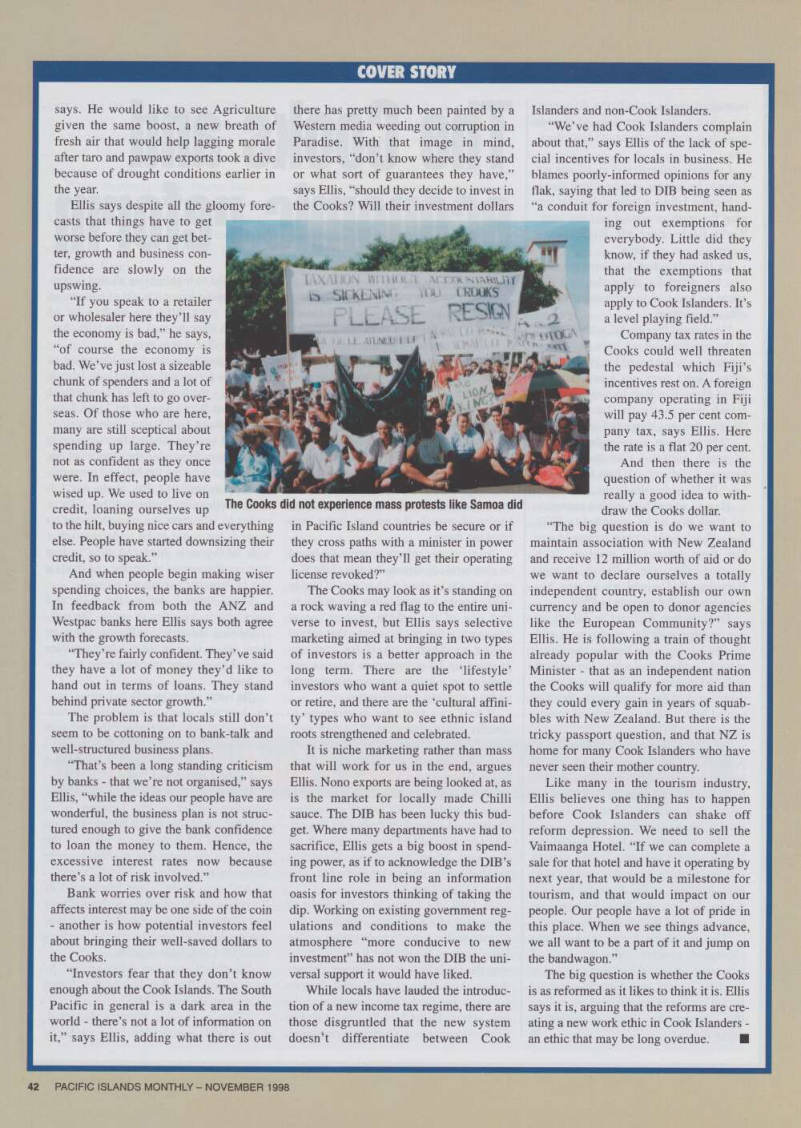
economic reform
By Lisa Williams
The year 1995 was a landmark one for the Cooks’ government.
It marked a turning point in pol icy, where leaders finally realised their backs and the national budget, were up against the wall. They gave in to pressure from outside aid donors, the Asian Development Bank, and the signs of an economy in crisis.
There had already been financial trou ble looming in the Cooks, with banks noticing millions of investment dollars moving out of the country - a sign that the engine of growth, the private sector, was
breaking down.
An economic reform programme based on structural adjustment models of the 80’s was brought in along with troops of highly paid experts to implement the policies.
Part one of the reform process meant downsizing the public sector that meant saying good-bye to the false economy propped up by government salaries and working on a balanced economy propped up by a vigorous private sector.
It took two years for government to actually admit what some of its own well paid economists had been touting for some time, albeit quietly; the country was living beyond its means.
Three thousand Cook Islanders were made redundant, with money from New Zealand aid poured into ensuring the pri vate sector would be ready to absorb the displaced. Many placed into Transition paid heed to the chance for a new life over seas and they took it.
In 1998, the Cooks is in the midst of Phase two of the reforms - implementing private sector growth and setting up the Development Investment Board to repre sent the fresh look to investment promo tion in this corner of the Pacific. It is no accident that fresh faces complement the new set-up. DIB Chief Executive Rohan Ellis comes from a Tourism background,
accustomed to highlighting all that is pos itive - making lemonade out of lemons, as the song goes. Ellis has made a lot of lemonade since he took on the DIB chal lenge less than a year ago.
“The private sector were identified as the engine for growth of the Cook Islands economy - that’s when the Development Investment Board was set up,” says Ellis, “we are about facilitating trade develop ment and new investment from overseas; increasing or improving the chances of our private sector taking the ball and running”.
“The downsizing has made our job more challenging,” admits Ellis. “We’re trying to stimulate the private sector to expand, but it has to be understood that
with 3000 people displaced, they’ve lost
their regular source of income and that’s a loss to domestic purchasing power.”
Small shops - dotting the main and outer islands, were first to notice. The mer
chandising industry is suffering, although
there was a time in there when retailers noticed locals were spending more money on food.
“In terms of our growth industries, any one here who wants to maintain their nor mal level of sales has realised that because we’ve got a shrinkage here, they have to go looking for new export markets and new export consumers,” says Ellis.
Best example of that surge for outside spending power at the moment is in Apparel, with award winning fashion house TAV’s taking resort wear to the Pacific in an aggressive marketing push driven by owner-director Ellena Tavioni.
And then there is the black gold of Polynesia - cultured pearls, with the Cooks end of the supply curve realising big pro motional dollars have to spent to make a name for Cook Islands pearls.
“Our black pearls are pretty secure,” he says of industry that has held a forum focused on the year 2000.
“They’re moving towards that goal, their wheels are turning quite well,” he
says. He would like to see Agriculture given the same boost, a new breath of fresh air that would help lagging morale after taro and pawpaw exports took a dive because of drought conditions earlier in the year.
Ellis says despite all the gloomy fore
casts that things have to get worse before they can get bet ter, growth and business con fidence are slowly on the
upswing.
“If you speak to a retailer or wholesaler here they’ll say the economy is bad,” he says, “of course the economy is bad. We’ve just lost a sizeable chunk of spenders and a lot of that chunk has left to go over seas. Of those who are here, many are still sceptical about
spending up large. They’re
not as confident as they once were. In effect, people have wised up. We used to live on credit, loaning ourselves up
to the hilt, buying nice cars and everything else. People have started downsizing their credit, so to speak.”
And when people begin making wiser spending choices, the banks are happier.
In feedback from both the ANZ and Westpac banks here Ellis says both agree with the growth forecasts.
“They’re fairly confident. They’ve said they have a lot of money they’d like to hand out in terms of loans. They stand behind private sector growth.”
The problem is that locals still don’t seem to be cottoning on to bank-talk and well-structured business plans.
“That’s been a long standing criticism by banks - that we’re not organised,” says Ellis, “while the ideas our people have are wonderful, the business plan is not struc tured enough to give the bank confidence to loan the money to them. Hence, the excessive interest rates now because there’s a lot of risk involved.”
Bank worries over risk and how that affects interest may be one side of the coin - another is how potential investors feel about bringing their well-saved dollars to the Cooks.
“Investors fear that they don’t know enough about the Cook Islands. The South Pacific in general is a dark area in the world - there’s not a lot of information on it,” says Ellis, adding what there is out
there has pretty much been painted by a Western media weeding out corruption in Paradise. With that image in mind, investors, “don’t know where they stand or what sort of guarantees they have,” says Ellis, “should they decide to invest in the Cooks? Will their investment dollars
in Pacific Island countries be secure or if they cross paths with a minister in power does that mean they’ll get their operating license revoked?”
The Cooks may look as it’s standing on a rock waving a red flag to the entire uni verse to invest, but Ellis says selective marketing aimed at bringing in two types of investors is a better approach in the long term. There are the ‘lifestyle’ investors who want a quiet spot to settle or retire, and there are the ‘cultural affini ty’ types who want to see ethnic island roots strengthened and celebrated.
It is niche marketing rather than mass that will work for us in the end, argues Ellis. Nono exports are being looked at, as is the market for locally made Chilli sauce. The DIB has been lucky this bud get. Where many departments have had to sacrifice, Ellis gets a big boost in spend ing power, as if to acknowledge the DlB’s front line role in being an information oasis for investors thinking of taking the
dip. Working on existing government reg
ulations and conditions to make the atmosphere “more conducive to new investment” has not won the DIB the uni versal support it would have liked.
While locals have lauded the introduc tion of a new income tax regime, there are those disgruntled that the new system doesn’t differentiate between Cook
Islanders and non-Cook Islanders.
“We’ve had Cook Islanders complain about that,” says Ellis of the lack of spe cial incentives for locals in business. He blames poorly-informed opinions for any flak, saying that led to DIB being seen as “a conduit for foreign investment, hand
ing out exemptions for
everybody. Little did they know, if they had asked us, that the exemptions that apply to foreigners also apply to Cook Islanders. It’s a level playing field.”
Company tax rates in the Cooks could well threaten the pedestal which Fiji’s incentives rest on. A foreign company operating in Fiji will pay 43.5 per cent com pany tax, says Ellis. Here the rate is a flat 20 per cent.
And then there is the question of whether it was really a good idea to with draw the Cooks dollar.
“The big question is do we want to maintain association with New Zealand and receive 12 million worth of aid or do we want to declare ourselves a totally independent country, establish our own currency and be open to donor agencies like the European Community?” says Ellis. He is following a train of thought already popular with the Cooks Prime Minister - that as an independent nation the Cooks will qualify for more aid than they could every gain in years of squab bles with New Zealand. But there is the tricky passport question, and that NZ is home for many Cook Islanders who have never seen their mother country.
Like many in the tourism industry, Ellis believes one thing has to happen before Cook Islanders can shake off reform depression. We need to sell the Yaimaanga Hotel. “If we can complete a sale for that hotel and have it operating by next year, that would be a milestone for tourism, and that would impact on our people. Our people have a lot of pride in this place. When we see things advance, we all want to be a part of it and jump on the bandwagon.”
The big question is whether the Cooks is as reformed as it likes to think it is. Ellis says it is, arguing that the reforms are cre ating a new work ethic in Cook Islanders an ethic that may be long overdue. ■
The Cooks did not experience mass protests like Samoa did
Advertisements & other items, pp. 43-44 (1 item)
Notebook,
To Win an
IBM Pentium
Get the latest on political, business and social issues
happening throughout the
region every month, as well as the chance to win an IBM Pentium Notebook! Every 12issue subscription received before March 31st, 1999 will go into the draw. Subscribe to Pacific Islands Monthly today by calling (679) 304 111 or fax (679) 303 809/(679) 307 460.
Subscribe to The Source.
Pacific Islands Monthly
Conditions of Entry I.To enter, subscription must be made before March 31st, 1999 which automatically enters the subscriber into the draw for the Pentium Notebook Computer. 2.Entry is open to all subscribers except employees of The Fiji Times Ltd, Pacific Islands Monthly and Wilson Addison Ltd. 3.Subscribers need to subscribe for at least 12 months to qualify. 4,The winner of the Pentium Notebook will be published in the Pacific Islands Monthly Magazine, May Issue, 1999 and will be notified by registered mail. 3,The winner will receive their prize within one month of the draw. 6.Thc prize must be taken as offered and is not redeemable. 7.1 n the event of any dispute the decision of the promoter is final and no correspondence will be entered into.
SOUTH PACIFIC FORUM SECRETARIAT SUVA, FIJI
VACANCY
The Forum Secretariat was established in 1972 by the South Pacific Forum to encourage economic and political co-operation between its member countries*, and between these states and other countries.
LAW ENFORCEMENT LIAISON OFFICER
The Secretariat is seeking a suitably qualified and experienced person to work as Law Enforcement Liaison Officer in its Political and International Affairs Division.
The Law Enforcement Liaison Officer will be accountable to the Director, Political and International Affairs Division for the
following:
• assisting in the implementation and co-ordination of programmes consistent with the Forum Declaration on Law Enforcement Co-operation; • preparing law enforcement programme activities and advising the Secretariat on resource and technical requirements for the implementation of the Secretariat’s law enforcement support programme: • providing advice, seeking technical and administrative assistance and support, within available means and resources, to enhance the administrative, technical and law enforcement capacity of FICs: • maintaining regular liaison and contact with international and regional inter-governmental bodies such as the Commonwealth Secretariat, Commission on Narcotics Drugs, Interpol, etc and specialist law enforcement agencies: • monitoring and reporting to the Secretariat and specialist regional law enforcement agencies on current trends relating to international criminal activities: • effective representation of the Forum Secretariat at meetings primarily concerned with law enforcement issues.
Applicants must be citizens of Forum member countries* and should have an advanced university degree in Law or a related field; at least seven years work experience on international or regional law enforcement issues preferably in the Pacific and proven analytical abilities. Extensive travel in the region and internationally will be required.
The appointment will carry a competitive remuneration package. For non-Fiji citizens remuneration should be tax free in Forum member countries.
There are generous establishment and education allowances together with medical and life insurance provisions. Appointments are normally for three years, with the option to renew for a further three years.
Applications should be addressed to: The Secretary General Forum Secretariat Private Mail Bag, Suva FIJI An information Package on the position is available from the Secretariat and applicants are urged to obtain one from Angela Ricketts, on (679) 312600 0r(679) 220207 or facsimile (679)301366 or via e-mail: [email protected] General information on the South Pacific Forum Secretariat is available at our Web site: http://www.forumsec.org.fj.
Applications close on November 25,1998 and should contain full information education and career background. Applicants must also provide the names, addresses (postal & e-mail), fax and telephone numbers of three employment referees. * Member States of the South Pacific Forum; Australia, Cook Islands, Federated States of Micronesia, Fiji Kiribati, Nauru. New Zealand, Niue, Palau, Papua New Guinea, Republic of the Marshall Islands, Samoa, Solomon Islands, Tonga, Tuvalu, Vanuatu .
Singirok skates
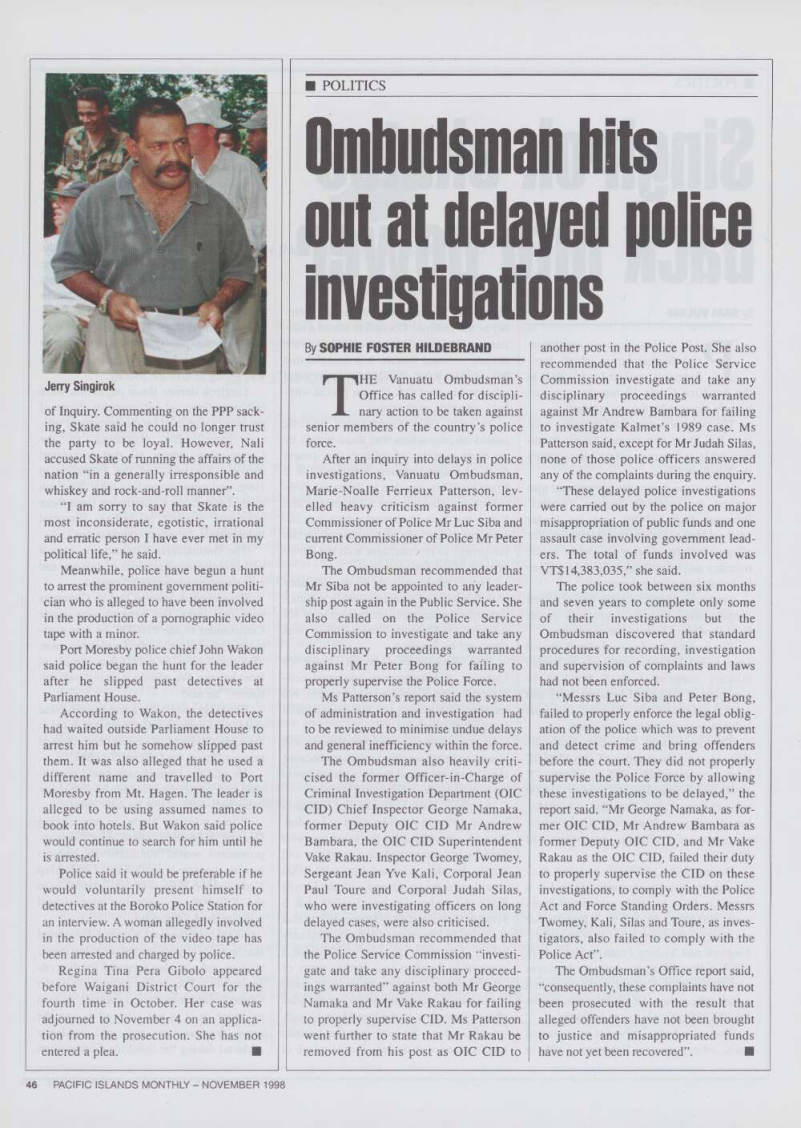
Politics
Singirok skates back into power
By Sam Vulum
PAPUA New Guinea’s controver sial former army chief Jerry Singirok, sacked for his part in the Sandline Crisis 19 months ago, has been re-instated by the government.
The move was described by prime min ister Bill Skate as a reward for his “com mendable and heroic action” in stopping the Sandline affair.
In the same move, the government also sacked its coalition partner Peoples’
Progress Party (PPP) and its leader Michael Nali as deputy prime minister - for alleged collaboration with former prime minister and party leader Sir Julius Chan in destabilising the government.
Singirok’s reappointment has occurred despite being heavily implicated in the final Sandline Commission of Inquiry.
The inquiry, headed by Judge Kubulan Loss, found that payments made by British military supplier J & S Franklin to Singirok, in the period between 1995 and 1997, amounted to bribes, financial inducements or secret commission.
The inquiry said: “Singirok during his time as the Commander of the PNGDF from November 16 1995 to March 17, 1997, had received a total sum of 31,000 pounds from J & S Franklin, a London based company. It was one of the major suppliers of military equipment to
Pngdf”.
During 1995, PNGDF had not pur chased any military equipment from J & S Franklin. Prior to 1995, substantial items were purchased from J & S Franklin or suppliers associated with that company.
Singirok and Sydney Franklin had met in 1987 in Port Moresby during a business visit by Franklin. Singirok was a major and a staff officer then. He made appointments for PNGDF officials to see Franklin.
The second time they met or contacted each other was in February 1996 in
Singapore. Singirok went there as a mem ber of the Defence Council to attend a mil itary exhibition. Singirok said they were already personal friends. It is doubtful that they could have maintained a personal relationship over that 10 year period with out contacting each other.
In early 1996, Commander Singirok issued an instruction that there would be no more supplies of military equipment from its major suppliers including J & S Franklin. This was due to financial diffi culties and also because a Defence White Paper was being prepared which specifi cally mentioned the acquisition of certain equipment to be consistent with the devel opment of the Defence force.
Shortly after renewing his acquaintance with Franklin in February 1996, a substan tial order for ammunition in excess of K 2 million to Unicorn International was approved by Singirok.
The Franklins were an agent of Unicorn, a Singaporean company con trolled by the Singapore government. No tenders were invited nor quotations taken from other suppliers.
A certificate of inexpediency was issued to purchase the equipment because the Commander had made a commitment by way of letter of intent to Unicom.
Singirok took a number of overseas trips in 1996. In April he went to London.
He was entertained by the Franklins who paid for his accommodation, transport and meals. Franklin assisted him with 1000 pounds to open an account with the Lloyds Bank in London. On July 5, 1996, J & S Franklin deposited 10,000 pounds into that account. In December 1996 and February 1997, Franklins paid into Singirok’s account in London two further sums of 10,000 pounds, these monies were spent on personal purposes, partly on the pur chase of property in the Port Moresby sub urb of Gordons. Singirok said that initially he discussed with Sydney Franklin lack of
finances for him to attend military exhibi tions.
This would mean that the Commander’s important overseas trips would be funded by an overseas company which is the sup plier or the agent of suppliers of military equipment to PNGDF, and not the PNG government.
As a Constitutional Office holder at the time, Singirok was subject to the Leadership Code. None of these payments were disclosed to the Ombudsman Commission in his 1996 returns. They were disclosed in 1997, but only after they had become public knowledge. At the inquiry, Singirok acknowledged that he was wrong to take the money.
Singirok denies these payments were bribes or financial inducements. None of the money was used for the purpose of offi cial travel. But according to the Commission, “from all that transpired between Singirok and the Franklins in 1996, and notwithstanding what Singirok might believe, the Commission finds these payments amount to bribes, financial inducements, or secret commissions”.
The Ombudsman Commission says it will investigate allegations of bribery and corrupt payments against Singirok.
Commission lawyer David Cannings
said that once the general was made Commander of the PNGDF, he was auto matically subjected to the Leadership code.
“We don’t have to wait for a complaint from anyone. We will do it on our own ini tiative,” he said.
Cannings said all leaders investigated under the Leadership Code are subjected to the same rules and procedures and it would be no different for General Singirok.
He said the Commission could investi gate and prosecute a leader in a position previously held or that he now holds.
Prime minister Skate, in announcing General Singirok’s return, said the reap pointment would automatically subject him to the provisions of the Leadership Code and the judicial system in relation to the K 70.000 payment by international arms dealer J S Franklin.
Skate said General Singirok has stated that he will fully cooperate with any inves tigation and was also prepared for the con sequences. The rules require that the Ombudsman Commission compile its own evidence as it is not allowed to use the same documentary and oral evidence adduced during the Sandline Commission
of Inquiry. Commenting on the PPP sack ing, Skate said he could no longer trust the party to be loyal. However, Nali accused Skate of running the affairs of the nation “in a generally irresponsible and whiskey and rock-and-roll manner”.
“I am sorry to say that Skate is the most inconsiderate, egotistic, irrational and erratic person I have ever met in my political life,” he said.
Meanwhile, police have begun a hunt to arrest the prominent government politi cian who is alleged to have been involved in the production of a pornographic video tape with a minor.
Port Moresby police chief John Wakon said police began the hunt for the leader after he slipped past detectives at Parliament House.
According to Wakon, the detectives had waited outside Parliament House to arrest him but he somehow slipped past them. It was also alleged that he used a different name and travelled to Port Moresby from Mt. Hagen. The leader is alleged to be using assumed names to book into hotels. But Wakon said police would continue to search for him until he is arrested.
Police said it would be preferable if he would voluntarily present himself to detectives at the Boroko Police Station for an interview. A woman allegedly involved in the production of the video tape has
been arrested and charged by police.
Regina Tina Pera Gibolo appeared before Waigani District Court for the fourth time in October. Her case was adjourned to November 4 on an applica tion from the prosecution. She has not entered a plea. ■
Jerry Singirok
out at delayed police
Ombudsman hits out at delayed police investigations
By Sophie Foster Hildebrand
THE Vanuatu Ombudsman’s Office has called for discipli nary action to be taken against senior members of the country’s police force.
After an inquiry into delays in police investigations, Vanuatu Ombudsman, Marie-Noalle Ferrieux Patterson, lev elled heavy criticism against former Commissioner of Police Mr Luc Siba and current Commissioner of Police Mr Peter Bong.
The Ombudsman recommended that Mr Siba not be appointed to any leader ship post again in the Public Service. She also called on the Police Service Commission to investigate and take any disciplinary proceedings warranted against Mr Peter Bong for failing to properly supervise the Police Force.
Ms Patterson’s report said the system of administration and investigation had to be reviewed to minimise undue delays and general inefficiency within the force.
The Ombudsman also heavily criti cised the former Officer-in-Charge of Criminal Investigation Department (OIC CID) Chief Inspector George Namaka, former Deputy OIC CID Mr Andrew Bambara, the OIC CID Superintendent Vake Rakau. Inspector George Twomey, Sergeant Jean Yve Kali, Corporal Jean Paul Toure and Corporal Judah Silas, who were investigating officers on long delayed cases, were also criticised.
The Ombudsman recommended that the Police Service Commission “investi gate and take any disciplinary proceed ings warranted” against both Mr George Namaka and Mr Vake Rakau for failing to properly supervise CID. Ms Patterson went further to state that Mr Rakau be removed from his post as OIC CID to
another post in the Police Post. She also recommended that the Police Service Commission investigate and take any disciplinary proceedings warranted against Mr Andrew Bambara for failing to investigate Kalmet’s 1989 case. Ms Patterson said, except for Mr Judah Silas, none of those police officers answered any of the complaints during the enquiry.
“These delayed police investigations were carried out by the police on major misappropriation of public funds and one assault case involving government lead ers. The total of funds involved was VT$ 14,383,035,” she said.
The police took between six months and seven years to complete only some of their investigations but the Ombudsman discovered that standard procedures for recording, investigation and supervision of complaints and laws had not been enforced.
“Messrs Luc Siba and Peter Bong, failed to properly enforce the legal oblig ation of the police which was to prevent and detect crime and bring offenders before the court. They did not properly supervise the Police Force by allowing these investigations to be delayed,” the report said. “Mr George Namaka, as for mer OIC CID, Mr Andrew Bambara as former Deputy OIC CID, and Mr Vake Rakau as the OIC CID, failed their duty to properly supervise the CID on these investigations, to comply with the Police Act and Force Standing Orders. Messrs Twomey, Kali, Silas and Toure, as inves tigators, also failed to comply with the Police Act”.
The Ombudsman’s Office report said, “consequently, these complaints have not been prosecuted with the result that alleged offenders have not been brought to justice and misappropriated funds have not yet been recovered”. ■
Marshalls no-confidence
motion loses by one vote
By Giff Johnson
FOR a month and a half, the Marshall Islands Nitijela (parlia ment) was stalemated over a motion of no confidence, unable to meet in a standoff that prevented legislators from passing the annual national budget before the expiration of the fiscal year on September 30.
The filing of a motion of no confidence by opposition senators in early September - an unprecedented move in the 19 years of constitutional government - led to more unexpected developments that halted the legislative process in the country for almost six weeks, as the government party demanded the vote be held on open roll call, while the opposition and Speaker said it must be done by secret ballot.
But on Friday October 16 - the third day of a re-extended session, following a court ruling that the vote had to be held before adjournment - a secret ballot vote was finally held, with the opposition falling one vote short of the 17 majority needed to oust the government of President Imata Kabua.
The final tally was 16 votes for the motion and 14 against (three government party members, including Kabua, were absent during the vote).
Both sides expressed relief that the bat tle was over and, though the opposition didn’t win, opposition Senator Brenson Wase, who was a cabinet minister until recently, said the narrow one-vote defeat of the motion showed the opposition was a force to be reckoned with and “sent a mes sage to the other side.”
Following the vote, the majority party was expected to call for a special session later in October to get the delayed national budget passed. The Marshalls legislative process had been bottlenecked for weeks as a result of the controversy. Just two weeks after President Imata Kabua had shuffled his cabinet in mid-August, drop ping three long-time government party members in favor of two opposition sena tors, the former ministers along with oppo sition forces introduced a motion of no
confidence. When the motion came for a vote on September 7, debate over the vot ing procedure broke out as opposition members asked for a secret ballot vote, while government ministers requested a vote by open roll call. Speaker Kessai Note - who last year unsuccessfully challenged Kabua for President and earlier this year moved legislation banning gambling through the parliament over the President’s objections - recognized the opposition’s request for a secret ballot, saying it was made first and therefore took precedence.
The chamber immediately erupted and, as the Speaker was handing out secret ballots for the vote, the President led a walkout that would delay the vote for almost six weeks.
The boycott continued through September 18, the last of the regular 50 sit ting days in the year, while the national budget and a number of other bills lan guished. During the extended stalemate each side accused the other of violating the constitution in radio and newspaper com ments.
Because the constitution says a motion of no confidence shall be voted on between five and 10 days after it is introduced, gov ernment party leaders maintained that once the 10 day period had expired, the motion had lapsed, and the parliament should get on with its other business.
But the Speaker and the opposition maintained otherwise, and Note kept the motion as the first item on the Nitijela’s agenda.
Even when the President extended the session by an additional four days in late September, and again in mid-October when the Speaker called the session back to order in response to the court ruling, the Speaker refused to bend and the impasse continued.
Meanwhile, on a couple of occasions, the majority party sent a handful of sena tors to the chamber for a session in hopes of meeting the necessary 17 for a quorum so a vote could be held with the minimum present, assuring defeat of the motion. But opposition senators played a cat and mouse
game on those occasions so until the entire government party returned for the session on October 16, the Nitijela couldn’t muster a quorum to hold the vote.
Finally, with the legislative process at a standstill, the government’s Attorney General filed a request with the High Court to intervene and end the constitutional cri sis. The AG’s request was followed imme diately by opposition Senator Litokwa Tomeing’s request for the High Court to step in and end the stalemate.
Chief Justice Daniel Cadra consolidat ed the two petitions, and ruled on September 29 that the motion of no confi dence must be voted on at the next session where there is a quorum, and that the Nitijela could not adjourn while a motion of no confidence was pending.
“To hold that the motion has ‘lapsed’ or is ‘rendered moot and ineffective’ because the vote did not occur within the 10 days would permit the evasion of mandatory Constitutional duty by unconstitutional means,” Cadra said in his ruling. “Such a holding would send the message that pub lic officials can ignore Constitutional imperatives, as well as the obligations, duties and responsibilities of their office.”
Within days, the President’s office issued an acerbic personal attack on the Chief Justice, saying his ruling showed that he wasn’t fit to be a judge. The gov ernment party’s statement ridiculed the Chief Justice’s opinion.
The government said that a “fair and democratic government cannot be achieved by denying the majority of the Nitijela, 18 Senators, their Constitutional right to a roll call vote and allowing the minority to have a secret ballot”.
Opposition senator and former High Court Chief Justice Witten Philippo responded that it was wrong for the gov ernment to launch a scathing personal attack on Cadra for issuing a ruling against the government’s position in the controver sy.
“It’s an embarrassment to the govern ment and the people of the Marshall Islands and the government had no busi ness issuing it,” he said.
The Attorney General, in early October, filed an appeal of the ruling with the Supreme Court and Minister deßrum indi cated that despite the outome of the vote, the government’s Supreme Court appeal would be pursued to get resolution of what could be a reoccuring dispute. ■
compensation increase
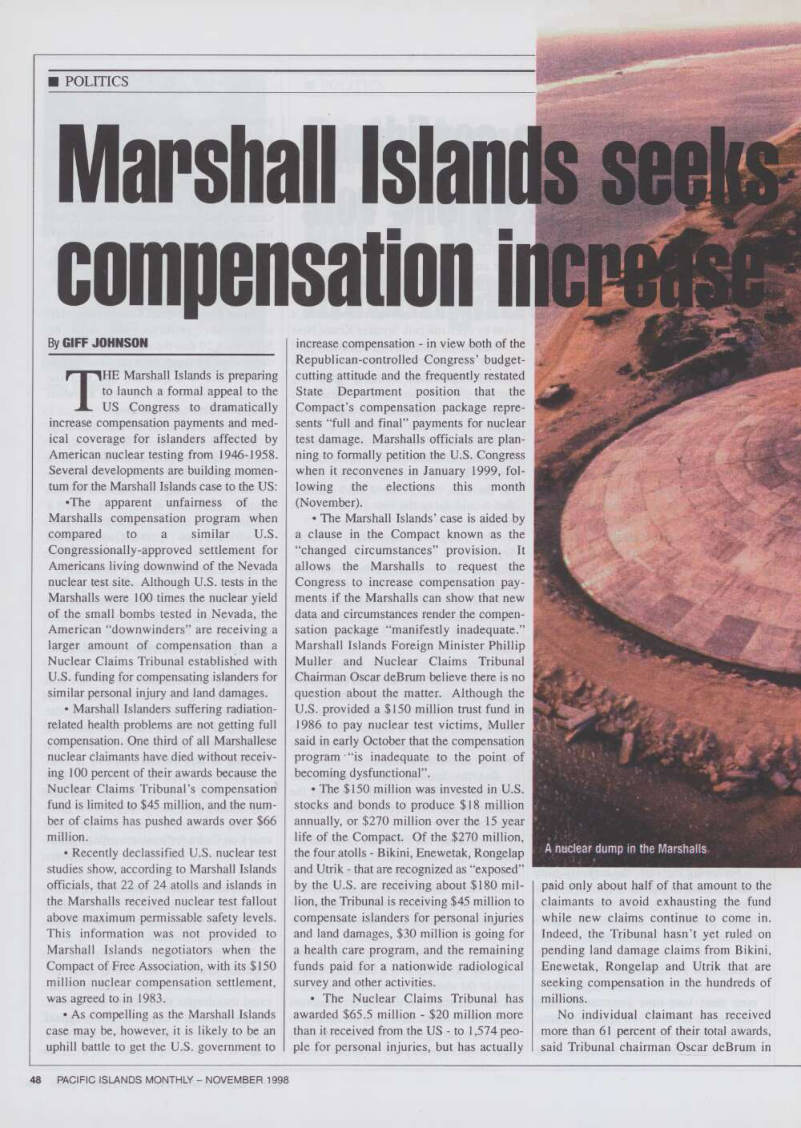
Marshall Islands seeks compensation increase
By Giff Johnson
THE Marshall Islands is preparing to launch a formal appeal to the US Congress to dramatically increase compensation payments and med ical coverage for islanders affected by American nuclear testing from 1946-1958.
Several developments are building momen tum for the Marshall Islands case to the US: •The apparent unfairness of the Marshalls compensation program when compared to a similar U.S.
Congressionally-approved settlement for Americans living downwind of the Nevada nuclear test site. Although U.S. tests in the Marshalls were 100 times the nuclear yield of the small bombs tested in Nevada, the American “downwinders” are receiving a larger amount of compensation than a Nuclear Claims Tribunal established with U.S. funding for compensating islanders for similar personal injury and land damages. • Marshall Islanders suffering radiation related health problems are not getting full compensation. One third of all Marshallese nuclear claimants have died without receiv ing 100 percent of their awards because the Nuclear Claims Tribunal’s compensation fund is limited to $45 million, and the num ber of claims has pushed awards over $66 million. • Recently declassified U.S. nuclear test studies show, according to Marshall Islands officials, that 22 of 24 atolls and islands in the Marshalls received nuclear test fallout above maximum permissable safety levels.
This information was not provided to Marshall Islands negotiators when the Compact of Free Association, with its $l5O million nuclear compensation settlement, was agreed to in 1983. • As compelling as the Marshall Islands case may be, however, it is likely to be an uphill battle to get the U.S. government to
increase compensation - in view both of the Republican-controlled Congress’ budget cutting attitude and the frequently restated State Department position that the
Compact’s compensation package repre
sents “full and final” payments for nuclear test damage. Marshalls officials are plan ning to formally petition the U.S. Congress when it reconvenes in January 1999, fol lowing the elections this month (November). • The Marshall Islands’ case is aided by a clause in the Compact known as the “changed circumstances” provision. It allows the Marshalls to request the Congress to increase compensation pay ments if the Marshalls can show that new data and circumstances render the compen sation package “manifestly inadequate.”
Marshall Islands Foreign Minister Phillip Muller and Nuclear Claims Tribunal Chairman Oscar deßrum believe there is no question about the matter. Although the U.S. provided a $l5O million trust fund in 1986 to pay nuclear test victims, Muller said in early October that the compensation program “is inadequate to the point of
becoming dysfunctional”.
• The $l5O million was invested in U.S. stocks and bonds to produce $lB million annually, or $270 million over the 15 year life of the Compact. Of the $270 million, the four atolls - Bikini, Enewetak, Rongelap and Utrik - that are recognized as “exposed” by the U.S. are receiving about $lBO mil lion, the Tribunal is receiving $45 million to compensate islanders for personal injuries and land damages, $3O million is going for a health care program, and the remaining funds paid for a nationwide radiological survey and other activities. • The Nuclear Claims Tribunal has awarded $65.5 million - $2O million more than it received from the US - to 1,574 peo ple for personal injuries, but has actually
paid only about half of that amount to the claimants to avoid exhausting the fund while new claims continue to come in.
Indeed, the Tribunal hasn’t yet ruled on pending land damage claims from Bikini, Enewetak, Rongelap and Utrik that are seeking compensation in the hundreds of millions.
No individual claimant has received more than 61 percent of their total awards, said Tribunal chairman Oscar deßrum in
A nuclear dump in the Marshalls
testimony to the U.S. Congress on October 1. “Of the 1,574 recipients of Tribunal awards, 525 are now deceased,” deßrum said. "The fact that one third of those who received awards for nuclear test related claims to date will never receive full com pensation speaks for itself’. • Both Muller and deßrum said that new evidence from recently declassified US test era documents shows that many more Marshall Islanders were exposed to danger
ous levels of fall out from the 67 American nuclear tests than U.S. negotiators admit ted when the $l5O million compensa tion package was negotiated in the mid-1980s. US
compensation in
the Compact is focused on Bikini, Enewetak,
Rongelap and
Utrik. But deßrum said that a U.S. Atomic Energy Commission report on a hydro gen bomb test series at Bikini Atoll in 1954 that remained classi fied until 1995 provides exposure data showing that 20 of 22 populated atolls surveyed received doses of nuclear test fallout exceeding International Commission on Radiological Protection limits for exposures.
“The U.S. had an obligation to disclose this infor mation (to Marshall Islands
negotiators) and
failed to do so,” deßrum said.
Because this data was not available
to negotiators of the nuclear test compensa tion package the U.S. contention that it pro vided its "best effort” to describe exposure conditions in the Marshall Islands "must be disregarded”, deßrum said.
"The fact that the exposure levels sus tained by people living on nearly every atoll in the Marshall Islands in 1954 exceeded US and international maximum permissible levels established shortly thereafter, cou pled with the failure of the US to disclose
such exposure levels, may well satisfy the requirements” of the agreement needed to get the Congress to consider additional compensation, deßrum added.
Financial compensation aside, because of an ‘‘extremely narrow” US definition of radiation exposure in the Marshall Islands, only 174 people in the nation are legally elgible to participate in a US provided radi ological health program, Muller said.
Two areas of contention are likely to arise as the Marshalls seeks Congressional action to increase compensation.
The US government has already ques tioned amendments by the Marshall Islands Nitijela (parliament) that expanded com pensation eligibility to include second gen eration islanders who were not alive during the test period.
But earlier this year, the Nitijela tight ened the regulations to require that the mother of any claimant born after 1958 must have been physically present during the 12 years of testing.
The debate centers on the lack of scien tific evidence confirming radiation health effects in children of islanders exposed to radiation.
But even so, the number of claims of these so-called second generation Marshallese account for just 11 percent of the total 1,574 claims and about eight per cent of the total payments, according to Tribunal officials.
The other point of contention is the large number of islanders eligible for a US fund ed, Marshall Islands Ministry of Health operated health care program for islanders from Bikini, Enewetak, Rongelap and Utrik. Eligibility has skyrocketed to more than 11,000 islanders from these atolls, but the $2 million annual funding has remained the same.
The Marshalls wants to expand both the funding for the program and the number of atolls covered by this health care program, in line with recently declassified data on fallout exposure to additional islands.
US officials, however, have said firmly that they “are not, and cannot be, responsi ble for the health care of all 58,000 Marshall Islanders,” and have criticized the Marshalls for allowing “an unsustainable ballooning of the subscriber base.” While requesting expansion of the medical pro gram, Marshall Islands officials have promised to trim the numbers of islanders eligible for the program by issuing tighter regulations. ■
Global capitalism
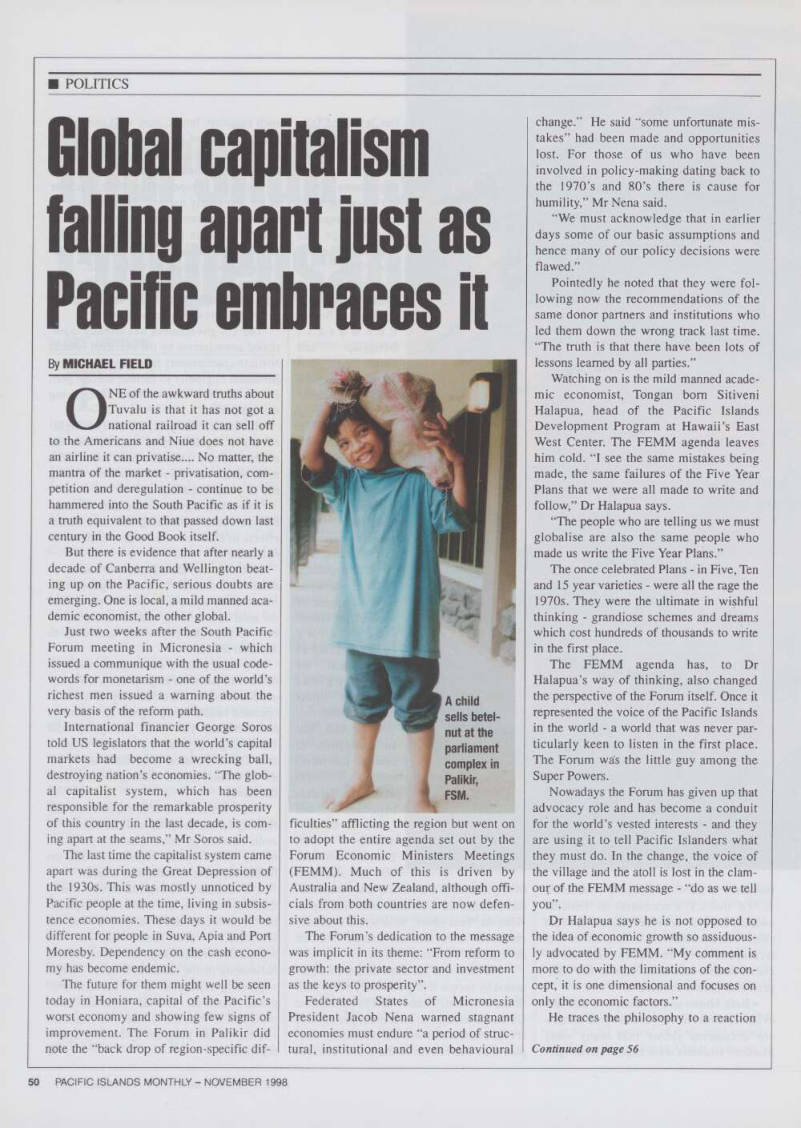
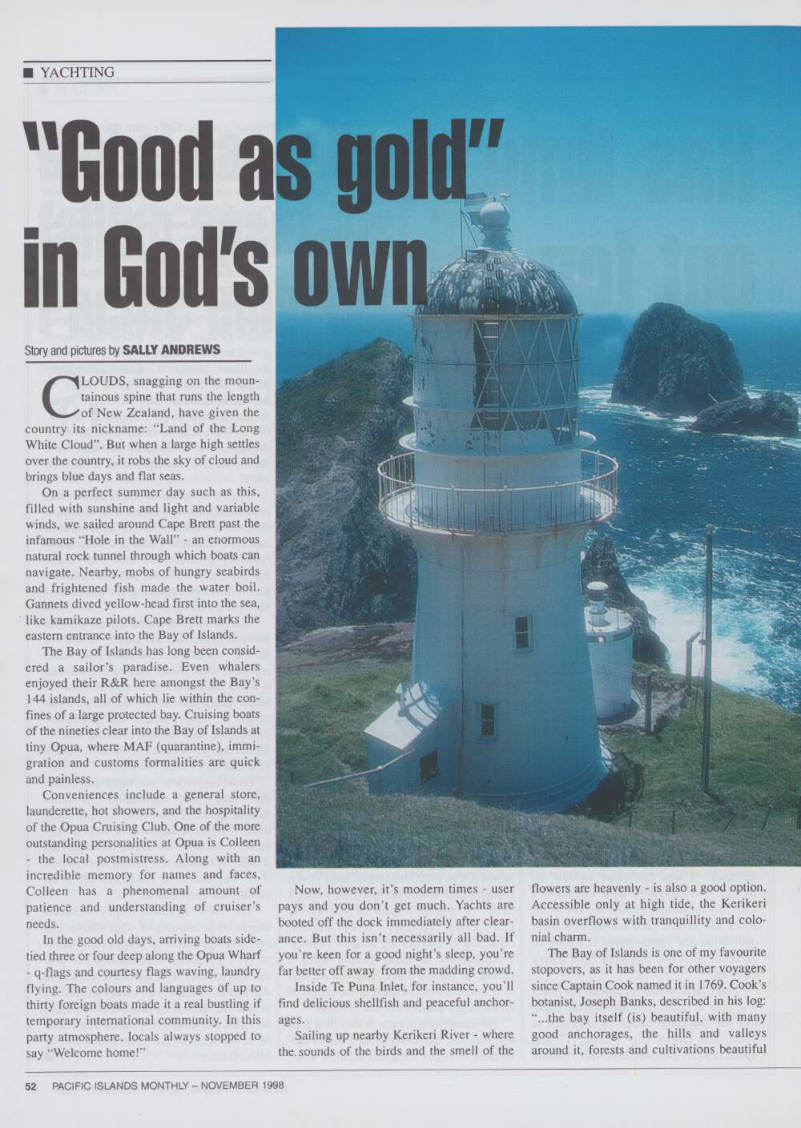
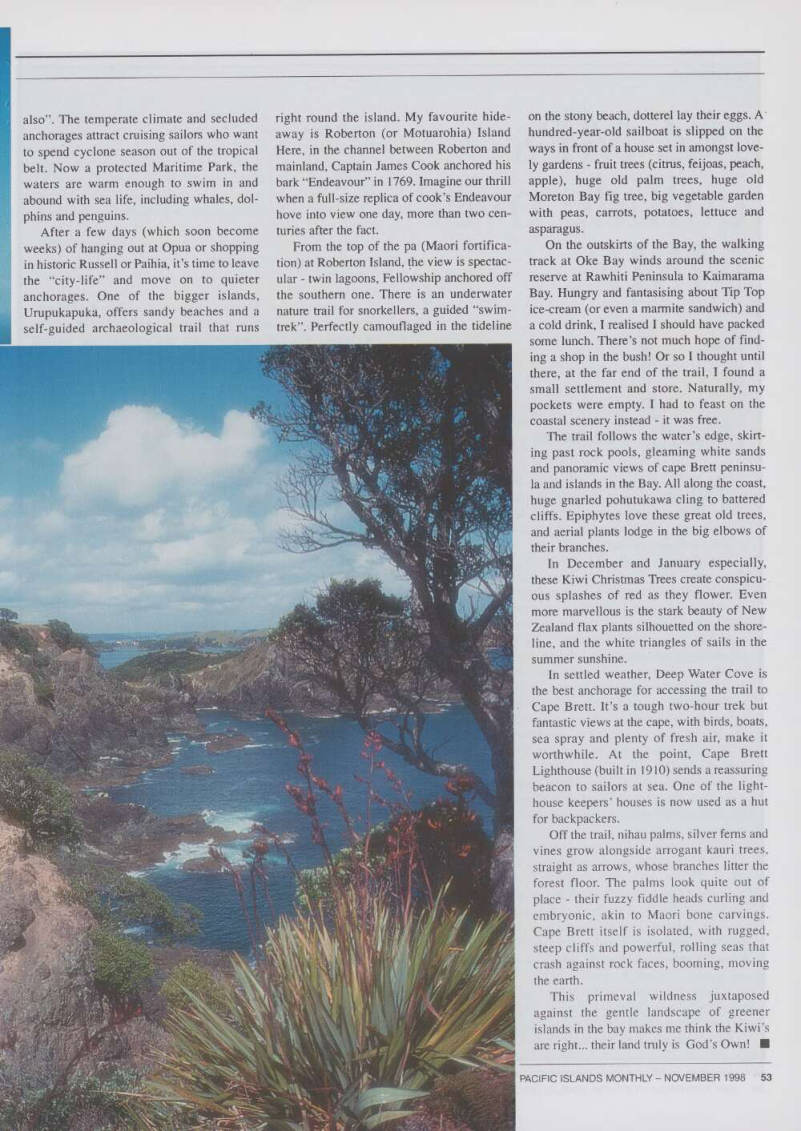
falfing apart just as Pacific embraces it
By Michael Field
ONE of the awkward truths about Tuvalu is that it has not got a national railroad it can sell off to the Americans and Niue does not have an airline it can privatise... No matter, the mantra of the market - privatisation, com petition and deregulation - continue to be hammered into the South Pacific as if it is a truth equivalent to that passed down last century in the Good Book itself.
But there is evidence that after nearly a decade of Canberra and Wellington beat ing up on the Pacific, serious doubts are emerging. One is local, a mild manned aca demic economist, the other global.
Just two weeks after the South Pacific Forum meeting in Micronesia - which issued a communique with the usual code words for monetarism - one of the world’s richest men issued a warning about the very basis of the reform path.
International financier George Soros told US legislators that the world’s capital markets had become a wrecking ball, destroying nation’s economies. “The glob al capitalist system, which has been responsible for the remarkable prosperity of this country in the last decade, is com ing apart at the seams,” Mr Soros said.
The last time the capitalist system came apart was during the Great Depression of the 19305. This was mostly unnoticed by Pacific people at the time, living in subsis tence economies. These days it would be different for people in Suva, Apia and Port Moresby. Dependency on the cash econo my has become endemic.
The future for them might well be seen today in Honiara, capital of the Pacific’s worst economy and showing few signs of improvement. The Forum in Palikir did note the “back drop of region-specific dif-
ficulties” afflicting the region but went on to adopt the entire agenda set out by the Forum Economic Ministers Meetings (FEMM). Much of this is driven by Australia and New Zealand, although offi cials from both countries are now defen sive about this.
The Forum’s dedication to the message was implicit in its theme: “From reform to growth: the private sector and investment as the keys to prosperity”.
Federated States of Micronesia President Jacob Nena warned stagnant economies must endure “a period of struc tural, institutional and even behavioural
change.” He said ”some unfortunate mis takes” had been made and opportunities lost. For those of us who have been involved in policy-making dating back to the 1970’s and 80’s there is cause for humility,” Mr Nena said.
“We must acknowledge that in earlier days some of our basic assumptions and hence many of our policy decisions were flawed.”
Pointedly he noted that they were fol lowing now the recommendations of the same donor partners and institutions who led them down the wrong track last time.
“The truth is that there have been lots of lessons learned by all parties.”
Watching on is the mild manned acade mic economist, Tongan bom Sitiveni Halapua, head of the Pacific Islands Development Program at Hawaii’s East West Center. The FEMM agenda leaves him cold. “I see the same mistakes being made, the same failures of the Five Year Plans that we were all made to write and follow,” Dr Halapua says.
“The people who are telling us we must globalise are also the same people who made us write the Five Year Plans.”
The once celebrated Plans - in Five, Ten and 15 year varieties - were all the rage the 19705. They were the ultimate in wishful thinking - grandiose schemes and dreams which cost hundreds of thousands to write in the first place.
The FEMM agenda has, to Dr Halapua’s way of thinking, also changed the perspective of the Forum itself. Once it represented the voice of the Pacific Islands in the world - a world that was never par ticularly keen to listen in the first place.
The Forum was the little guy among the Super Powers.
Nowadays the Forum has given up that advocacy role and has become a conduit for the world’s vested interests - and they are using it to tell Pacific Islanders what they must do. In the change, the voice of the village and the atoll is lost in the clam our of the FEMM message - “do as we tell you”.
Dr Halapua says he is not opposed to the idea of economic growth so assiduous ly advocated by FEMM. “My comment is more to do with the limitations of the con cept, it is one dimensional and focuses on only the economic factors.”
He traces the philosophy to a reaction
Continued on page 56
A child sells betel nut at the parliament complex in Palikir,
Fsm.
Continued from page 50
to a World Bank review of Pacific economies in the late 1980 s which high lighted the low or nil economic growth.
Public sector change has been a response to that, and the problem, says Dr Halapua, is that the message which comes with the restructuring is raising false expectations.
“What worries me is that this process will increase the gap between the haves and the have nots.”
He worries too at the way the FEMM agenda pumps up expectations in Pacific states but fails to take into account the capabilities of the communities in the region.
International agencies were being dis honest with their call for public sector reforms. They do not tell people it cannot be afforded; the public sector is simply cut while people try to think up what to do next.
“They push it to the level where they claim that if you have public reform today you will have economic growth tomor row.”
While old style aid has failed to lift liv ing standards countries and governments were continuing to make mistakes. “The quest for more foreign aid and investment continues, except that it’s under the new banner of private sector development and public sector reform,” Dr Halapua says.
The backers however were not consid ering ways in which people and communi ties could participate in the process. And consultation was only taking place once programmes were underway. “We should not decide what to do and then start the consultation. That’s like the capitalistic way of selling a product: you manufacture
something and then go and sell it.”
He has spent a decade conceiving an economic model based on Pacific values and aspirations: “Who you are and what you are capable 0f... The focus has to be on the people, not on resources.” And he added; “If we don’t have the right ques tion, we won’t get the right answers.”
Dr Halapua might just one day manage to become the Pacific’s first Nobel Laureate with his Pacific economic model.
One of its earliest public airings was at the Pacific Leaders Conference in Tahiti in 1991 when Dr Halapua produced a dense paper which included a complex graph and what he called a “7DD matrix” to show that current Pacific aid was going in the wrong direction. He laid out a mathemati cal formula to show how it should be done.
This bought an incredulous reaction from Sir Albert Kipalan, then Papua New Guinea Public Service Minister.
“If we followed what you are saying,” he told Dr Halapua, “we would be out of office very quickly.”
Fiji’s Prime Minister Sitiveni Rabuka agreed . “If we do what is right we may not be voted back in,” he said, “Perhaps there in lies the problem.”
These days Dr Halapua has the dubious pleasure of seeing his words come true.
There are many varied, local reasons why Pacific governments are often struggling to stay in power. But there is a common theme too - the governments of the Cook Islands, Fiji, Marshall Islands, the Solomons and Vanuatu are all pushing the FEMM message. And each government is in strife with its own voters over failure to deliver the goods.
Intriguingly .the most radicalised of the Pacific governments with the FEMM agen da is the one with the greatest instability - New Zealand. ■
A family travels home with their sakau (kava) harvest
Has time run
Sports
Has time run out for Eroni?
Byatama Raganivatu
Eroni Clarke could be forgiven for doubting, despite his stupendous form and consistency during the past couple of years, if he will ever again don the New Zealand national rugby union team’s famous black kit he wore in 1993.
If the international arena recalls Clarke, loud and wide applause will greet his return. He remains, in defiance of the frus trations of the recent times, amongst sport’s few genuine nice guys. The con stantly amiable, modest and approachable Clarke is a devoted family man and Christian.
Clarke insists that his ability to play rugby brilliantly is purely a blessing from God. Others may suggest that his genes played a role too.
Clarke comes from a gifted sporting clan. His father, lafeta, represented Western Samoa at rugby; his mother, Tueipi, was an accomplished netball play er; his only sister, Sheryl, is a New Zealand netball international and Egelagi, one of four brothers, currently plays American football for the University of Hawaii.
Apia-bom Eroni was two when moving to Auckland with his parents and six when he witnessed his first rugby test.
New Zealand beat Scotland 24-0 that day - Clarke remembers the occasion well.
He says: “I was fascinated by the All Blacks. I thought they were awesome. I asked my father how I could become an All Black and he told me I needed education, dedication and commitment if I were to succeed. So, I had that goal from a very early age!”
That Clarke would become an All Black was little in doubt from the time he broke into the Auckland under 16 selection in 1984. The Queen City’s under 17 and under 18 sides provided him with a natural
progression to the New Zealand national under 18 line-up.
Due to the rich seam of talent then on tap for the Auckland senior team selectors, Clarke had to wait until 1991 before win ning a place in that star-studded combina tion. He quickly made his presence felt.
Two tries on debut versus Nelson Bays followed by another electrifying pair of touchdowns as Queensland came under attack. The latter match on nation-wide television, immediately had fans the length and breadth of New Zealand clamouring for him to gain higher honours. They got their wish. The New Zealand XV (an unof ficial national B selection) chose him that year for fixtures opposing touring Rumanian and USSR outfits.
His devastation of Queensland proved to be a double edged sword. Clarke had played on the wing against “The Bananabenders” and he harboured grave reservations about playing there. Centre was the position he occupied for the entire ty of his school days and has always been his own preferred duty. He lacks confi dence when located elsewhere. Still, beg gars, he reasoned, can’t be choosers and, in view of the depth of talented and proven players available to both Auckland and New Zealand, he was happy to appear wherever requested.
To be named as an All Black to face a World XV in 1992, delighted Clarke - even though Frank Bunce occupied the centre’s berth. “It was an honour to pull on the black jersey,” he raves. “It was a dream come true to play for my adopted country.
I represented so many people when I played for the All Blacks and you are for ever mindful that the team is the cream of all the rugby players in New Zealand.”
He scored tries in each of his initial four test matches, but never looked truly com fortable at rugby’s highest echelon when
placed at second five eighth or on the wing.
Clarke appeared in the former position when a woeful New Zealand succumbed 9- 15 to England in 1993. It was his eighth and, to date, last test appearance. The next brace of domestic terms were arduous as Auckland continually moved Clarke along the backline. Although The Auks dominat ed the National Championship, his form suffered and he even briefly mulled over a possible switch to rugby league.
Thankfully, his days as a utility back ended in 1996 when Auckland Blues’ coach Graham Henry wisely decided to give Clarke a permanent spot as centre for the Blues’ inaugural Super Twelve cam paign. The Samoan rewarded Henry by becoming an immensely influential figure in that astonishingly successful tourna ment. With Clarke in devastating form throughout both seasons, the blues were Super Twelve champions in 1996 and 1997.
Yet, in defiance of Clarke’s obvious credentials, the All Black selectors have refused to restore him to international ranks. After almost a decade of reluctantly rejecting overtures to link with Manu Samoa, Clarke seriously pondered over the possibilities of appearing for the land of his birth a year ago.
Clarke, who has toured Britain with the Samoan Barbarians and happily turned out for the New Zealand Samoans unit, stated recently; “I am proud of being Samoan and it was a hard decision to choose between Manu Samoa and the All Blacks, yet I was raised in New Zealand and graduated through the New Zealand coaching system.
Therefore, I reckoned I owed it to the Kiwis to play for the All Blacks.”
However, it was not mere patriotism that made Clarke contemplate the Manu Samoa option. A prominent English rugby union club approached him with a very lucrative offer, before adding he might find it difficult to acquire a British work permit if he was unable to claim himself as an established international.
The New Zealand Rugby Football Union, upon learning of what Clarke was considering, made a proposition them selves - a reported NZ$6OO,OOO per year through to 2001 if he agreed to remain in Auckland. Clarke, a career’s advisor before the arrival of professional rugby, accepted and effectively ended any hopes of being seen in the blue and white of Manu Samoa. ■
"Good as gold"
Yachting
"Good as gold" in God's own
Story and pictures by SALLY ANDREWS
CLOUDS, snagging on the moun tainous spine that runs the length of New Zealand, have given the country its nickname: “Land of the Long White Cloud”. But when a large high settles over the country, it robs the sky of cloud and brings blue days and flat seas.
On a perfect summer day such as this, filled with sunshine and light and variable winds, we sailed around Cape Brett past the infamous “Hole in the Wall” - an enormous natural rock tunnel through which boats can navigate. Nearby, mobs of hungry seabirds and frightened fish made the water boil.
Gannets dived yellow-head first into the sea, like kamikaze pilots. Cape Brett marks the eastern entrance into the Bay of Islands.
The Bay of Islands has long been consid ered a sailor’s paradise. Even whalers enjoyed their R&R here amongst the Bay’s 144 islands, all of which lie within the con fines of a large protected bay. Cruising boats of the nineties clear into the Bay of Islands at tiny Opua, where MAP (quarantine), immi gration and customs formalities are quick
and painless.
Conveniences include a general store, launderette, hot showers, and the hospitality of the Opua Cruising Club. One of the more outstanding personalities at Opua is Colleen - the local postmistress. Along with an incredible memory for names and faces, Colleen has a phenomenal amount of patience and understanding of cruiser’s needs.
In the good old days, arriving boats side tied three or four deep along the Opua Wharf - q-flags and courtesy flags waving, laundry flying. The colours and languages of up to thirty foreign boats made it a real bustling if temporary international community. In this party atmosphere, locals always stopped to say “Welcome home!”
Now, however, it’s modem times - user pays and you don’t get much. Yachts are booted off the dock immediately after clear ance. But this isn’t necessarily all bad. If you’re keen for a good night’s sleep, you’re far better off away from the madding crowd.
Inside Te Puna Inlet, for instance, you’ll find delicious shellfish and peaceful anchor ages.
Sailing up nearby Kerikeri River - where the. sounds of the birds and the smell of the
flowers are heavenly - is also a good option.
Accessible only at high tide, the Kerikeri basin overflows with tranquillity and colo nial charm.
The Bay of Islands is one of my favourite stopovers, as it has been for other voyagers since Captain Cook named it in 1769. Cook’s botanist, Joseph Banks, described in his log: “...the bay itself (is) beautiful, with many good anchorages, the hills and valleys around it, forests and cultivations beautiful
also”. The temperate climate and secluded anchorages attract cruising sailors who want to spend cyclone season out of the tropical belt. Now a protected Maritime Park, the waters are warm enough to swim in and abound with sea life, including whales, dol phins and penguins.
After a few days (which soon become weeks) of hanging out at Opua or shopping in historic Russell or Paihia, it’s time to leave the “city-life” and move on to quieter anchorages. One of the bigger islands, Urupukapuka, offers sandy beaches and a self-guided archaeological trail that runs
right round the island. My favourite hide away is Roberton (or Motuarohia) Island Here, in the channel between Roberton and mainland, Captain James Cook anchored his bark “Endeavour” in 1769. Imagine our thrill when a full-size replica of cook’s Endeavour hove into view one day, more than two cen turies after the fact.
From the top of the pa (Maori fortifica tion) at Roberton Island, the view is spectac ular - twin lagoons, Fellowship anchored off the southern one. There is an underwater nature trail for snorkellers, a guided “swim trek”. Perfectly camouflaged in the tideline
on the stony beach, dotterel lay their eggs. A hundred-year-old sailboat is slipped on the ways in front of a house set in amongst love ly gardens - fruit trees (citrus, feijoas, peach, apple), huge old palm trees, huge old Moreton Bay fig tree, big vegetable garden with peas, carrots, potatoes, lettuce and asparagus.
On the outskirts of the Bay, the walking track at Oke Bay winds around the scenic reserve at Rawhiti Peninsula to Kaimarama Bay. Hungry and fantasising about Tip Top ice-cream (or even a marmite sandwich) and a cold drink, I realised I should have packed some lunch. There’s not much hope of find ing a shop in the bush! Or so 1 thought until there, at the far end of the trail, I found a small settlement and store. Naturally, my pockets were empty. I had to feast on the coastal scenery instead - it was free.
The trail follows the water’s edge, skirt ing past rock pools, gleaming white sands and panoramic views of cape Brett peninsu la and islands in the Bay. All along the coast, huge gnarled pohutukawa cling to battered cliffs. Epiphytes love these great old trees, and aerial plants lodge in the big elbows of their branches.
In December and January especially, these Kiwi Christmas Trees create conspicu ous splashes of red as they flower. Even more marvellous is the stark beauty of New Zealand flax plants silhouetted on the shore line, and the white triangles of sails in the summer sunshine.
In settled weather, Deep Water Cove is the best anchorage for accessing the trail to Cape Brett. It’s a tough two-hour trek but fantastic views at the cape, with birds, boats, sea spray and plenty of fresh air, make it worthwhile. At the point, Cape Brett Lighthouse (built in 1910) sends a reassuring beacon to sailors at sea. One of the light house keepers’ houses is now used as a hut
for backpackers.
Off the trail, nihau palms, silver ferns and vines grow alongside arrogant kauri trees, straight as arrows, whose branches litter the forest floor. The palms look quite out of place - their fuzzy fiddle heads curling and embryonic, akin to Maori bone carvings.
Cape Brett itself is isolated, with rugged, steep cliffs and powerful, rolling seas that crash against rock faces, booming, moving the earth.
This primeval wildness juxtaposed against the gentle landscape of greener islands in the bay makes me think the Kiwi’s are right... their land truly is God’s Own! ■
collide over
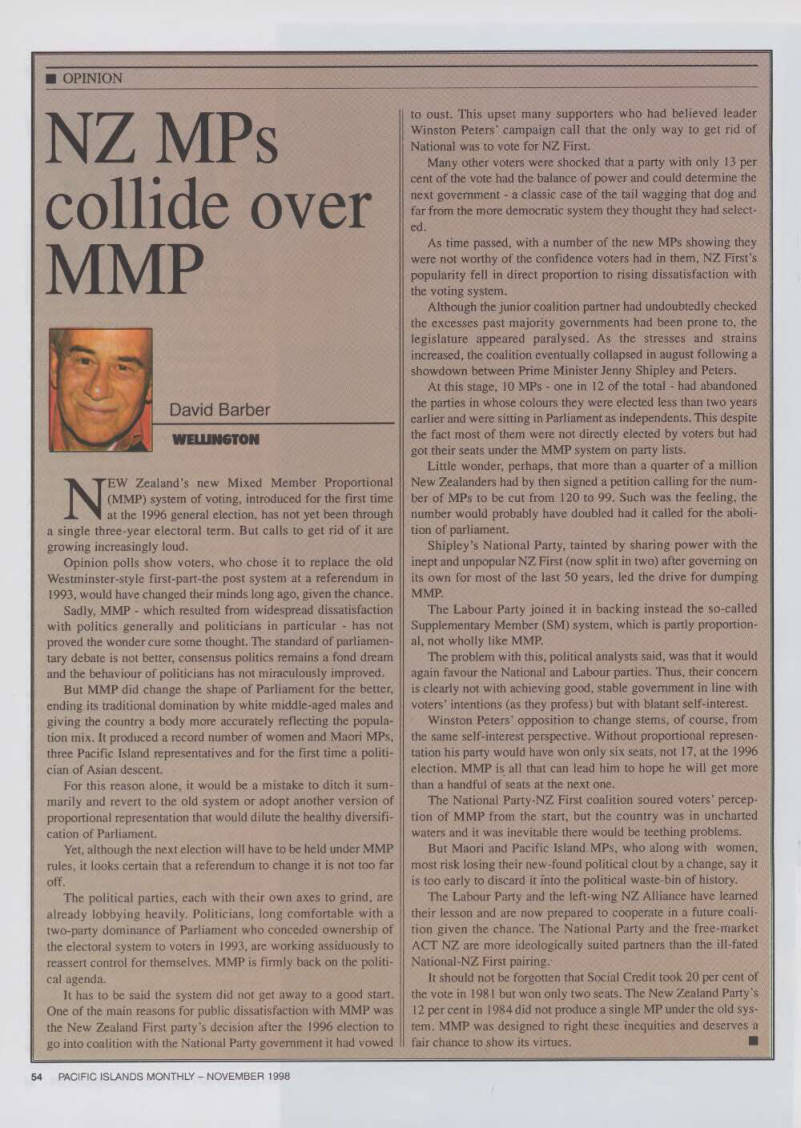
Opinion
Nzmps
Mmp
NEW Zealand’s new Mixed Member Proportional (MMP) system of voting, introduced for the first time at the 1996 general election, has not yet been through a single three-year electoral term. But calls to get rid of it are growing increasingly loud.
Opinion polls show voters, who chose it to replace the old Westminster-style first-part-the post system at a referendum in 1993, would have changed their minds long ago, given the chance.
Sadly, MMP - which resulted from widespread dissatisfaction with politics generally and politicians in particular - has not proved the wonder cure some thought. The standard of parliamen tary debate is not better, consensus politics remains a fond dream and the behaviour of politicians has not miraculously improved.
But MMP did change the shape of Parliament for the better, ending its traditional domination by white middle-aged males and giving the country a body more accurately reflecting the popula tion mix. It produced a record number of women and Maori MPs, three Pacific Island representatives and for the first time a politi cian of Asian descent.
For this reason alone, it would be a mistake to ditch it sum marily and revert to the old system or adopt another version of proportional representation that would dilute the healthy diversifi cation of Parliament.
Yet, although the next election will have to be held under MMP rules, it looks certain that a referendum to change it is not too far off.
The political parties, each with their own axes to grind, are already lobbying heavily. Politicians, long comfortable with a two-party dominance of Parliament who conceded ownership of the electoral system to voters in 1993, are working assiduously to reassert control for themselves. MMP is firmly back on the politi cal agenda.
It has to be said the system did not get away to a good start.
One of the main reasons for public dissatisfaction with MMP was the New Zealand First party’s decision after the 1996 election to go into coalition with the National Party government it had vowed
to oust. This upset many supporters who had believed leader Winston Peters’ campaign call that the only way to get rid of National was to vote for NZ First.
Many other voters were shocked that a party with only 13 per cent of the vote had the balance of power and could determine the next government - a classic case of the tail wagging that dog and far from the more democratic system they thought they had select ed.
As time passed, with a number of the new MPs showing they were not worthy of the confidence voters had in them, NZ First’s popularity fell in direct proportion to rising dissatisfaction with the voting system.
Although the junior coalition partner had undoubtedly checked the excesses past majority governments had been prone to, the legislature appeared paralysed. As the stresses and strains increased, the coalition eventually collapsed in august following a showdown between Prime Minister Jenny Shipley and Peters.
At this stage, 10 MPs - one in 12 of the total - had abandoned the parties in whose colours they were elected less than two years earlier and were sitting in Parliament as independents. This despite the fact most of them were not directly elected by voters but had got their seats under the MMP system on party lists.
Little wonder, perhaps, that more than a quarter of a million New Zealanders had by then signed a petition calling for the num ber of MPs to be cut from 120 to 99. Such was the feeling, the number would probably have doubled had it called for the aboli tion of parliament.
Shipley’s National Party, tainted by sharing power with the inept and unpopular NZ First (now split in two) after governing on its own for most of the last 50 years, led the drive for dumping
Mmp.
The Labour Party joined it in backing instead the so-called Supplementary Member (SM) system, which is partly proportion al, not wholly like MMP.
The problem with this, political analysts said, was that it would again favour the National and Labour parties. Thus, their concern is clearly not with achieving good, stable government in line with voters’ intentions (as they profess) but with blatant self-interest.
Winston Peters’ opposition to change stems, of course, from the same self-interest perspective. Without proportional represen tation his party would have won only six seats, not 17, at the 1996 election. MMP is all that can lead him to hope he will get more than a handful of seats at the next one.
The National Party-NZ First coalition soured voters’ percep tion of MMP from the start, but the country was in uncharted waters and it was inevitable there would be teething problems.
But Maori and Pacific Island MPs, who along with women, most risk losing their new-found political clout by a change, say it is too early to discard it Into the political waste-bin of history.
The Labour Party and the left-wing NZ Alliance have learned their lesson and are now prepared to cooperate in a future coali tion given the chance. The National Party and the free-market ACT NZ are more ideologically suited partners than the ill-fated National-NZ First pairing.
It should not be forgotten that Social Credit took 20 per cent of the vote in 1981 but won only two seats. The New Zealand Party’s 12 per cent in 1984 did not produce a single MP under the old sys tem. MMP was designed to right these inequities and deserves a fair chance to show its virtues. ■
David Barber
Weuingtoh
victory
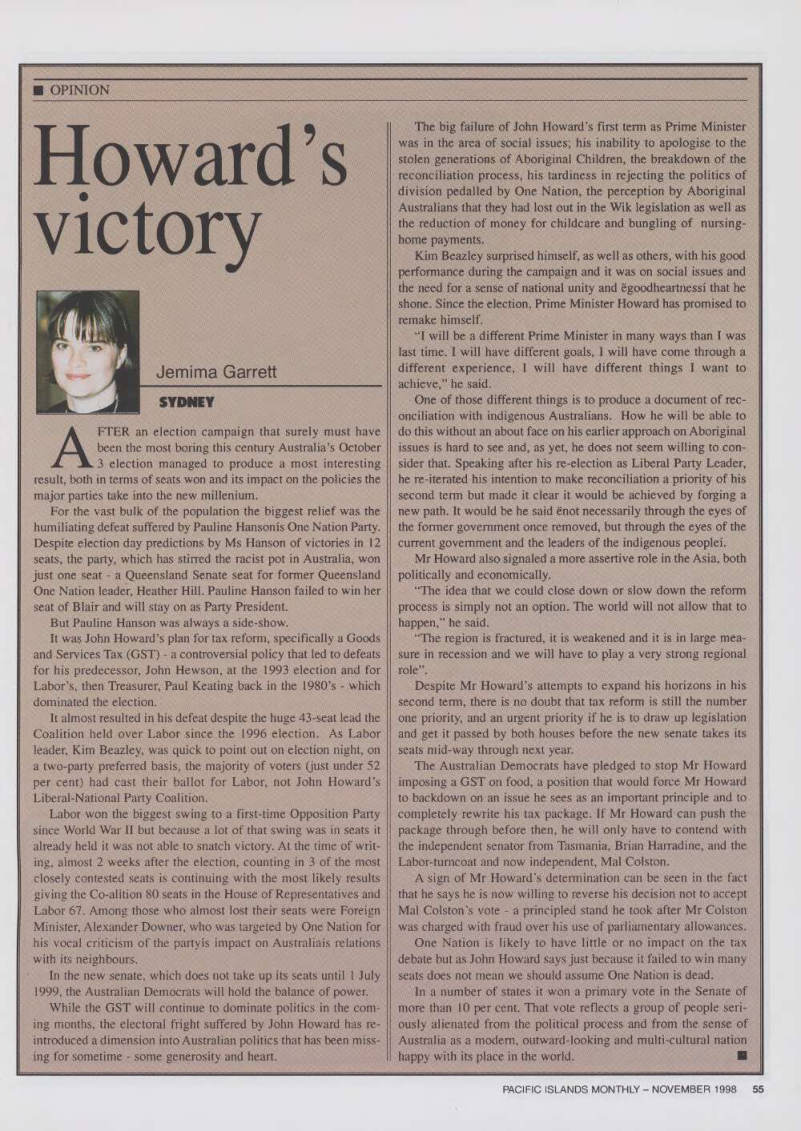
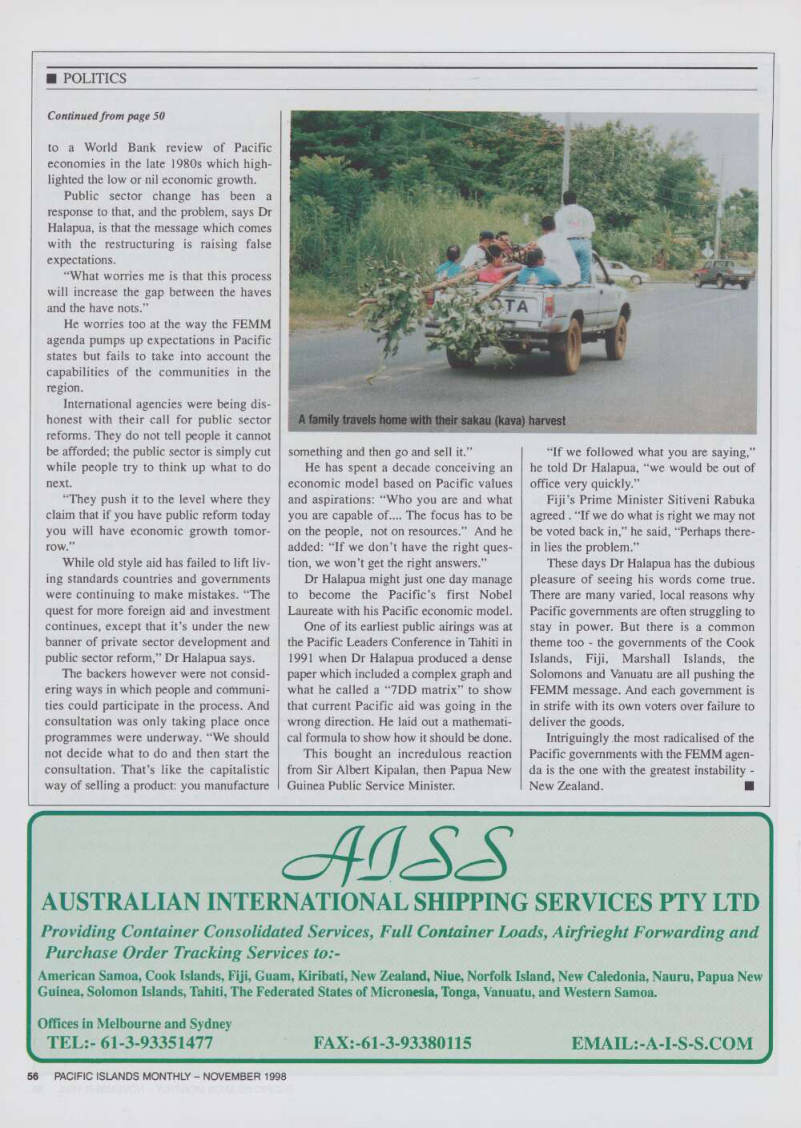
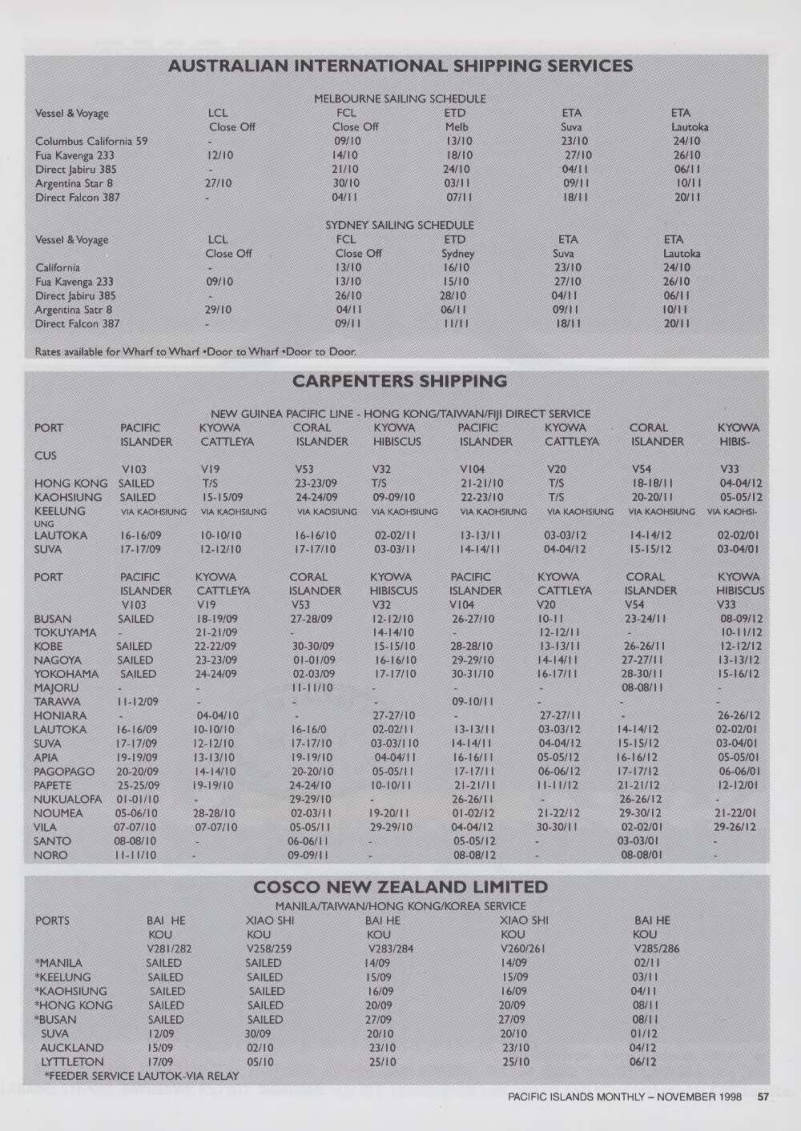
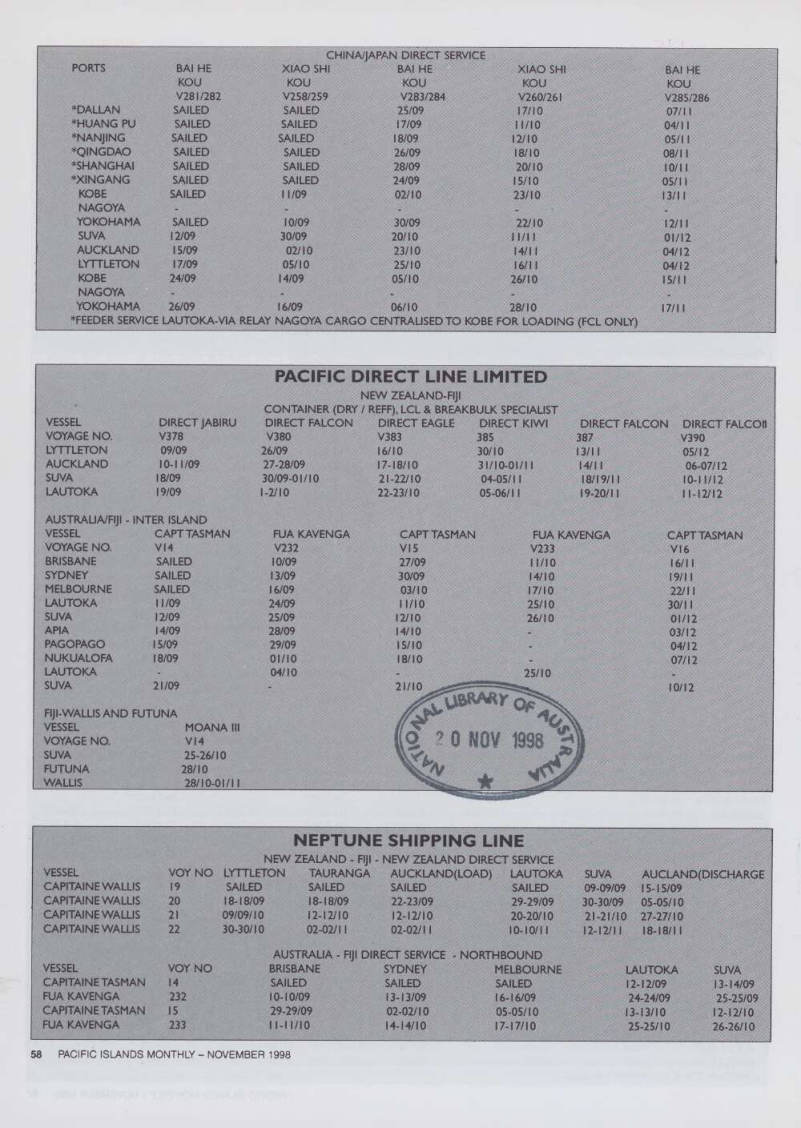
Howard’s victory
AFTER an election campaign that surely must have been the most boring this century Australia’s October 3 election managed to produce a most interesting result, both in terms of seats won and its impact on the policies the major parties take into the new millenium.
For the vast bulk of the population the biggest relief was the humiliating defeat suffered by Pauline Hansoms One Nation Party.
Despite election day predictions by Ms Hanson of victories in 12 seats, the party, which has stirred the racist pot in Australia, won just one seat - a Queensland Senate seat for former Queensland One Nation leader. Heather Hill. Pauline Hanson failed to win her seat of Blair and will stay on as Party President.
But Pauline Hanson was always a side-show.
It was John Howard’s plan for tax reform, specifically a Goods and Services Tax (GST) - a controversial policy that led to defeats for his predecessor, John Hewson, at the 1993 election and for Labor’s, then Treasurer, Paul Keating back in the 1980’s - which dominated the election.
It almost resulted in his defeat despite the huge 43-seat lead the Coalition held over Labor since the 1996 election. As Labor leader, Kim Beazley, was quick to point out on election night, on a two-party preferred basis, the majority of voters (just under 52 per cent) had cast their ballot for Labor, not John Howard’s Liberal-National Party Coalition.
Labor won the biggest swing to a first-time Opposition Party since World War II but because a lot of that swing was in seats it already held it was not able to snatch victory. At the time of writ ing, almost 2 weeks after the election, counting in 3 of the most closely contested seats is continuing with the most likely results giving the Co-alition 80 seats in the House of Representatives and Labor 67. Among those who almost lost their seats were Foreign Minister, Alexander Downer, who was targeted by One Nation for his vocal criticism of the partyis impact on Australiais relations with its neighbours.
In the new senate, which does not take up its seats until 1 July 1999, the Australian Democrats will hold the balance of power.
While the GST will continue to dominate politics in the com ing months, the electoral fright suffered by John Howard has re introduced a dimension into Australian politics that has been miss ing for sometime - some generosity and heart.
The big failure of John Howard’s first term as Prime Minister was in the area of social issues; his inability to apologise to the stolen generations of Aboriginal Children, the breakdown of the reconciliation process, his tardiness in rejecting the politics of division pedalled by One Nation, the perception by Aboriginal Australians that they had lost out in the Wik legislation as well as the reduction of money for childcare and bungling of nursing home payments.
Kim Beazley surprised himself, as well as others, with his good performance during the campaign and it was on social issues and the need for a sense of national unity and egoodheartnessi that he shone. Since the election, Prime Minister Howard has promised to remake himself.
“I will be a different Prime Minister in many ways than I was last time. I will have different goals, I will have come through a different experience, I will have different things I want to achieve,” he said.
One of those different things is to produce a document of rec onciliation with indigenous Australians. How he will be able to do this without an about face on his earlier approach on Aboriginal issues is hard to see and, as yet, he does not seem willing to con sider that. Speaking after his re-election as Liberal Party Leader, he re-iterated his intention to make reconciliation a priority of his second term but made it clear it would be achieved by forging a new path. It would be he said enot necessarily through the eyes of the former government once removed, but through the eyes of the current government and the leaders of the indigenous people!.
Mr Howard also signaled a more assertive role in the Asia, both politically and economically.
“The idea that we could close down or slow down the reform process is simply not an option. The world will not allow that to happen,” he said.
“The region is fractured, it is weakened and it is in large mea sure in recession and we will have to play a very strong regional role”.
Despite Mr Howard’s attempts to expand his horizons in his second term, there is no doubt that tax reform is still the number one priority, and an urgent priority if he is to draw up legislation and get it passed by both houses before the new senate takes its seats mid-way through next year.
The Australian Democrats have pledged to stop Mr Howard imposing a GST on food, a position that would force Mr Howard to backdown on an issue he sees as an important principle and to completely rewrite his tax package. If Mr Howard can push the package through before then, he will only have to contend with the independent senator from Tasmania, Brian Harradine, and the Labor-turncoat and now independent, Mai Colston.
A sign of Mr Howard’s determination can be seen in the fact that he says he is now willing to reverse his decision not to accept Mai Colston’s vote - a principled stand he took after Mr Colston was charged with fraud over his use of parliamentary allowances.
One Nation is likely to have little or no impact on the tax debate but as John Howard says just because it failed to win many seats does not mean we should assume One Nation is dead.
In a number of states it won a primary vote in the Senate of more than 10 per cent. That vote reflects a group of people seri ously alienated from the political process and from the sense of Australia as a modem, outward-looking and multi-cultural nation happy with its place in the world. ■
Jemima Garrett
Sydney
Australian International Shipping Services
Carpenters Shipping
Cosco New Zealand Limited
Melbourne Sailing Schedule
Vessel & Voyage
Lcl
Fcl
Etd
Eta
Eta
Close Off Close Off Melb Suva Lautoka Columbus California 59 - 09/10 13/10 23/10 24/10 Fua Kavenga 233 12/10 14/10 18/10 27/10 26/10 Direct Jabiru 385 - 21/10 24/10 04/11 06/11 Argentina Star 8 27/10 30/10 03/11 09/11 10/11 Direct Falcon 387 - 04/11 07/1! 18/11 20/11
Sydney Sailing Schedule
Vessel & Voyage
Lcl
Fcl
Etd
Eta
Eta
Close Off Close Off
Sydney
Suva Lautoka California - 13/10 16/10 23/10 24/10 Fua Kavenga 233 09/10 13/10 15/10 27/10 26/10 Direct jabiru 385 - 26/10 28/10 04/11 06/11 Argentina Satr 8 29/10 04/11 06/11 09/11 10/11 Direct Falcon 387 - 09/1 1 ll/ll 18/11 20/1!
Rates available for Wharf to Wharf •Door to Wharf •Door to Door.
New Guinea Pacific Line -
Hong Kong/Taiwan/Fij1 Direct Service
Port
Pacific
Kyowa
Coral
Kyowa
Pacific
Kyowa
Coral
Kyowa
Islander
Cattleya
Islander
Hibiscus
Islander
Cattleya
Islander
Hibis-
Cus
VI03 VI9 V53 V32 V104 V20 V54 V33
Hong Kong
Sailed
T/S 23-23/09 T/S 21-21/10 T/S 18-18/11 04-04/12
Kaohsiung
Sailed
15-15/09 24-24/09 09-09/10 22-23/10 T/S 20-20/11 05-05/12
Keelung
Via Kaohsiung
Via Kaohsiung
Via Kaosiung
Via Kaohsiung
Via Kaohsiung
Via Kaohsiung
Via Kaohsiung
Via Kaohsi-
Ung
Lautoka
16-16/09 10-10/10 16-16/10 02-02/1 ! 13-13/i I 03-03/12 14-14/12 02-02/01
Suva
17-17/09 12-12/10 17-17/10 03-03/11 14-14/11 04-04/12 15-15/12 03-04/01
Port
Pacific
Kyowa
Coral
Kyowa
Pacific
Kyowa
Coral
Kyowa
Islander
Cattleya
Islander
Hibiscus
Islander
Cattleya
Islander
Hibiscus
VI03 VI9 V53 V32 VI04 V20 V54 V33
Busan
Sailed
18-19/09 27-28/09 12-12/10 26-27/10 10-11 23-24/11 08-09/12
Tokuyama
- 21-21/09 - 14-14/10
lipilillllil
12-12/11 - 10-11/12
Kobe
Sailed
22-22/09 30-30/09 15-15/10 28-28/10 13-13/11 26-26/11 12-12/12
Nagoya
Sailed
23-23/09 01-01/09 16-16/10 29-29/10 14-14/11 27-27/11 13-13/12
Yokohama
Sailed
24-24/09 02-03/09 17-17/10 30-31/10 16-17/11 28-30/11 15-16/12
Majoru
- ll-ll/IO - - - 08-08/11 -
Tarawa
11-12/09 - - - 09-10/11 - - -
Honiara
- 04-04/10 - 27-27/10 - 27-27/11 - 26-26/12
Lautoka
16-16/09 10-10/10 16-16/0 02-02/11 13-13/11 03-03/12 14-14/12 02-02/01
Suva
17-17/09 12-12/10 17-17/10 03-03/1 10 14-14/11 04-04/12 15-15/12 03-04/01
Apia
19-19/09 13-13/10 19-19/10 04-04/11 16-16/11 05-05/12 16-16/12 05-05/01
Pagopago
20-20/09 14-14/10 20-20/10 05-05/11 17-17/11 06-06/12 17-17/12 06-06/01
Papete
25-25/09 19-19/10 24-24/10 10-10/1 1 21-21/1 1
Iii 1/12
21-21/12 12-12/01
Nukualofa
01-01/10 - 29-29/10 - 26-26/1 1 - 26-26/12 -
Noumea
05-06/10 28-28/10 02-03/11 19-20/11 01-02/12 21-22/12 29-30/12 21-22/01
Vila
07-07/10 07-07/10 05-05/11 29-29/10 04-04/12 30-30/11 02-02/01 29-26/12
Santo
08-08/10 - 06-06/1 1 - 05-05/12 - 03-03/01 -
Noro
1 l-l t/10 . 09-09/11 08-08/12 - 08-08/01 ilSIlBS
Manila/Taiwan/Hong Kong/Korea Service
Ports
Bai He
Xiao Shi
Bai He
Xiao Shi
Bai He
Kou
Kou
Kou
Kou
Kou
V281/282 V258/259 V283/284 V260/261 V285/286
♦Manila
Sailed
Sailed
14/09 14/09 02/11
♦Keelung
Sailed
Sailed
15/09 15/09 03/11
♦Kaohsiung
Sailed
Sailed
16/09 16/09 04/11
♦Hong Kong
Sailed
Sailed
20/09 20/09 08/11
♦Busan
Sailed
Sailed
27/09 27/09 08/11
Suva
12/09 30/09 20/10 20/10 01/12
Auckland
15/09 02/10 23/10 23/10 04/12
Lyttleton
17/09 05/10 25/10 25/10 06/12
♦Feeder Service Lautok-Via Relay
Pacific Direct Line Limited
Neptune Shipping Line
Ch1Na/Japan Direct Service
Ports
Bai He
Xiao Shi
Bai He
Xiao Shi
Bai He
Kou
Kou
Kou
Kou
Kou
V281/282 V258/259 V283/284 V260/261 V285/286
*Dallan
Sailed
Sailed
25/09 17/10 07/11
♦Huang Pu
Sailed
Sailed
17/09 11/10 04/11
♦Nanjing
Sailed
Sailed
18/09 12/10 05/1 1
♦Qingdao
Sailed
Sailed
26/09 18/10 08/1 1
♦Shanghai
Sailed
Sailed
28/09 20/10 10/11
♦Xingang
Sailed
Sailed
24/09 15/10 05/11
Kobe
Sailed
11/09 02/10 23/10 13/11
Nagoya
- - - - V : -
Yokohama
Sailed
10/09 30/09 22/10 12/11
Suva
12/09 30/09 20/10 ll/i 1 01/12
Auckland
15/09 02/10 23/10 14/1 1 04/12
Lyttleton
17/09 05/10 25/10 16/11 04/12
Kobe
24/09 14/09 05/10 26/10 15/11
Nagoya
Yokohama
26/09 16/09 06/10 28/10 17/11
♦Feeder Service Lautoka-Via
RELAY NAGOYA CARGO CENTRAUSED TO KOBE FOR LOADING (FCL ONLY)
New Zealand-Fiji
CONTAINER (DRY / REFF), LCL & BREAKBULK SPECIALIST
Vessel
Direct Jabiru
Direct Falcon
Direct Eagle
Direct Kiwi
Direct Falcon Direct Falcofl
Voyage No.
V378 V380 V383 385 387 V390
Lyttleton
09/09 26/09 16/10 30/10 13/11 05/12
Auckland
10-11/09 27-28/09 17-18/10 31/1 0-0 1 /11 14/11 06-07/12
Suva
18/09 30/09-01/10 21-22/10 04-05/11 18/19/11 10-11/12
Lautoka
19/09 1-2/10 22-23/10 05-06/1 1 19-20/11 11-12/12
Australia/Fiji -
Inter Island
Vessel
C Apt Tasman
Fua Kavenga
Capt Tasman Fua Kavenga
Capt Tasman
Voyage No.
Vi4 V232
Vis
V233 V16
Brisbane
Sailed
10/09 27/09 11/10 16/11
Sydney
Sailed
13/09 30/09 14/10 19/11
Melbourne
Sailed
16/09 03/10 17/10 22/11
Lautoka
11/09 24/09 1 1/10 25/10 30/11
Suva
12/09 25/09 12/10 26/10 01/12
Apia
14/09 28/09 14/10 . 03/12
Pagopago
15/09 29/09 15/10 - 04/12
Nukualofa
18/09 01/10 18/10 - 07/12
Lautoka
Suva
21/09 04/10 - 25/10 10/12 21/10
Fiji-Wallis And Futuna
Vessel
Moana Iii
■ ■■ 3
Voyage No.
VI4 I <2 7 0 NOV 1998 *
Suva
Futuna
25-26/10 28/10 * '£/
Wallis
28/10-01/11
New Zealand - Fiji -
New Zealand Direct Service
Vessel
Voyno
Lyttleton Tauranga
Auckland(Load) Lautoka
Suva Aucland(Discharge
Capitaine Wallis
19
Sailed Sailed
Sailed
Sailed
09-09/09 15-15/09
Capitaine Wallis
20 18-18/09 18-18/09 22-23/09 29-29/09 30-30/09 05-05/10
Capitaine Wallis
21 09/09/10 12-12/10 12-12/10 20-20/10 21-21/10 27-27/10
Capitaine Wallis
22 30-30/10 02-02/11 02-02/11 10-10/11 12-12/11 18-18/11
Australia - Fiji Direct Service
- Northbound
Vessel
Voyno
Brisbane
Sydney
Melbourne
Lautoka
Suva
Capitaine Tasman
14
Sailed
Sailed
Sailed
12-12/09 13-14/09
Fua Kavenga
232 10-10/09 13-13/09 16-16/09 24-24/09 25-25/09
Capitaine Tasman
15 29-29/09 02-02/10 05-05/10 13-13/10 12-12/10
Fua Kavenga
233 ll-ll/IO 14-14/10 17-17/10 25-25/10 26-26/10
Advertisements & other items, pp. 56-60 (1 item)
Australian International Shipping Services Pty Ltd
Providing Container Consolidated Services, Full Container Loads, Airfrieght Forwarding and Purchase Order Tracking Services to:- American Samoa, Cook Islands, Fiji, Guam, Kiribati, New Zealand, Niue, Norfolk Island, New Caledonia, Nauru, Papua New Guinea, Solomon Islands, Tahiti, The Federated States of Micronesia, Tonga, Vanuatu, and Western Samoa.
Offices in Melbourne and Sydney
TEL:-61-3-93351477 FAX:-61-3-93380115 EMAIL:-A-I-S-S.COM
International & Local Courier
Fiji’s own courier company goes further than Fiji 3 1508 00645345 «*WV
DOOR TO DOOR
For all your: Courier needs fl Heavyweights Your choice of domestic messenger courier needs - / IHour / 3 Hour / Same day International & Local Courier SUVA: 218 388,218 304 or TOLL FREE 0800 307 304 NADI AIRPORT: 724 434 NADI: 700 001 LAUTOKA: 665 161 LADASA; 816 022 SAVUSAVU: 850 001 SIGATOKA: 500 321 or simply call your nearest post office and ask for CMS Service.
Ni - 91S
PPio
I 3 . SV4EJUSTE.S
j ■ ■ mt m ' 4 ; V gjlfc m •■ ■ . m m Some of the specs may vary according to market specifications.
Looks tough, feels comfortable - Toyota Hilux People all over the world prefer Toyota. Because it makes bestsellers like Hilux. It maintains that rugged reputation, and now it sports tough, durable body styles as well. It's ready for any terrain.
Hilux offers more. More power - with a choice of engines and precision transmissions and transfers. More effective power distribution to match the terrain, thanks to Toyota's advanced
technology.
And more passenger car-like comfort. With an ergonomic interior, all the conveniences you want, the fit and finish you'd expect from Toyota, and a ride that's smoothed out by precision-
engineered suspension.
Hilux is built to take it. And to take you anywhere you want to go.
It's remarkably tough. And incredibly comfortable. With worldleading uncompromising quality. From the champion. Toyota.
DISTRIBUTORS/DEALERS
NORFOLK ISLAND BORRY’S PTY LTD, PH 22114
SOLOMON ISLANDS ELA MOTORS PH 30314
VANUATU ASCO MOTORS PH 22341
COOK ISLANDS PACIFIC MOTORS LTD. PH 20796
®TOYOTA
KIRIBATI TARAWA MOTORS PH 21090
PAPUA NEW GUINEA ELA MOTORS PH 3229400
TAHITI NIPPON AUTOMOTO PH 429819
WESTERN SAMOA ASCO MOTORS PH 20800
FIJI ASCO MOTORS PH 384888
NEW CALEDONIA S.I.A.P. PH 275562
TONGA ASCO MOTORS PH 23500
AMERICAN SAMOA ASCO MOTORS* PH 633-4281
(*HILUX is not being handled.)