to "Buenos Aires
p. 12 · Read in the full issue
Mixed reviews to "Buenos Aires Inaction Plan”
Industry And
environmental groups had mixed reviews of the global warming action plan that emerged from the UN climate change conference that ended mid-November in Buenos Aires.
Greenpeace said it was dismayed that the plan - that calls on nations to resolve a host of difficult issues by 2000 - appeared to put national economic con
cerns above environmental ones. “This is turning into a trade and economic negotia tion,” said Bill Hare, climate policy direc tor for Greenpeace International.
“Climate is getting pushed further and further down the agenda,” Hare said.
“Science is being replaced by carbon trad ing markets as the driver for the talks”.
The environmental group Friends of the Earth International said the urgency of addressing global warming had been lost in the “Buenos Aires Inaction Plan”.
“Nations have failed to acknowledge that what they agreed to in Kyoto is nowhere near the deep cuts in carbon emissions * A .1
which we need to stop climate change,” the group said. “The meeting has been a trade fair, wrangling over how to keep the fossil fuel industry alive and burning”.
Last year in Kyoto, Japan, some 38 industrialised nations crafted what came to be known as the Kyoto Protocol.
The protocol required signatory nations to cut back greenhouse gas emissions mostly carbon dioxide from the burning of fossil fuels such as coal or oil - on an aver age five per cent from 1990 levels.
The World Wide Fund for Nature (WWF) said it welcomed the “slight”
progress made at the talks.
“It’s another small turn on the ruddei of the climate change supertanker,” said Lars Georg Jensen, leader of the WWF delegation. “But governments have much more to do to steer clear of mM the rocks”. The Environmental Defence Fund praised the “major strides” JH made at the end of the jßd&ro marathon talks, citing
progress on “flexi bility mechanisms” and rules for enforcement.
The decisions “bring the world one step closer to the reductions needed for a stable climate.
Already, a number of the world’s largest companies have responded positively with commitments to reduce (green house gas) emissions early”.
The Global Climate Coalition, an indus try group, said the meeting was ending with developing nations “still refusing to bring their bats, balls and gloves to the Kyoto playing field”.
“Until countries like China and India get into this game, the global climate treaty will be neither fair nor global,” said Connie Holmes, coalition chair.
The Pew Centre on Global Climate Change, a scientific organisation based in Washington, said the biggest hurdle to progress in the debate had been the “absence of leadership”.
“What was most striking about the
meeting was the emergence of leadership on climate change from both indus ■k try and the developing countries,” it said. ■
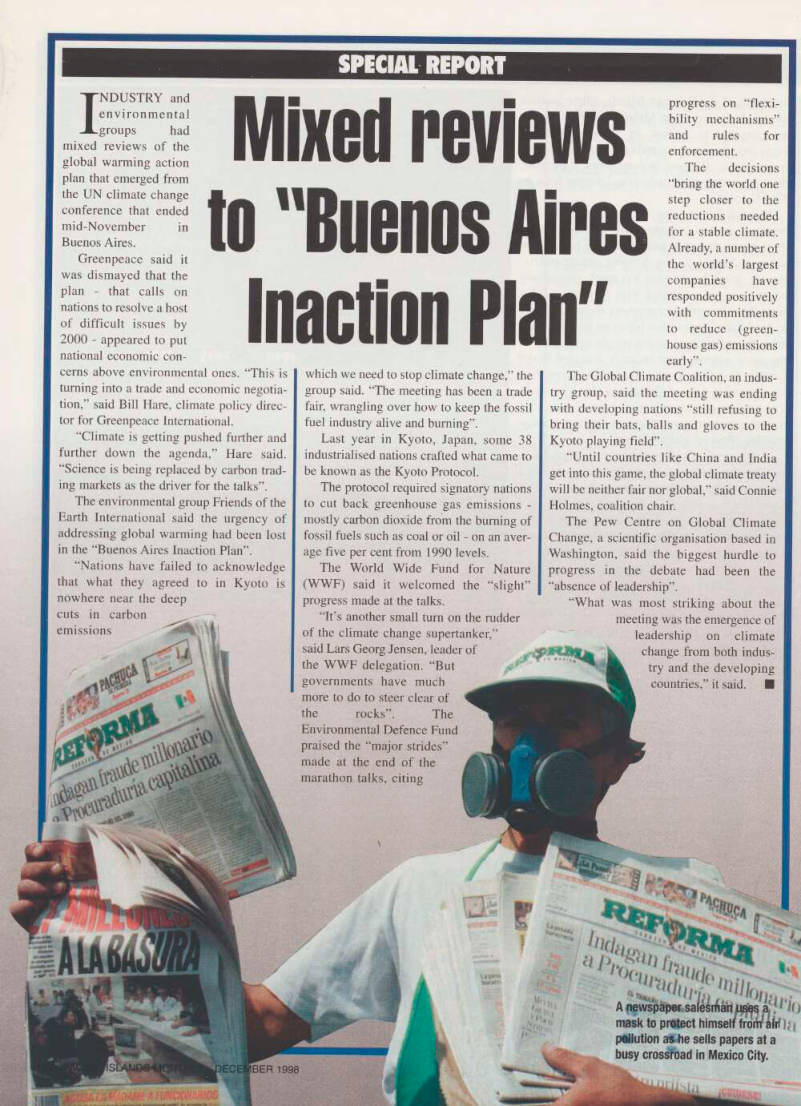
A newspaper salesman uses a mask to protect himself from air pollution as he sells papers at a busy crossroad in Mexico City.