Inside Neuma's reef
pp. 50-51 · Read in the full issue
Yatching
Story and pictures by SALLY ANDREWS
WITH our yellow flag
flying below the
starboard spreader,
we called “Port Moselle Marina” on VHP radio chan nel 67 and gave them the name and length of our boat as well as our esti mated time of arrival.
A friendly voice welcomed us back to New Caledonia and promised to have someone on the dock to take our mooring lines. Even better, our first night on the dock would be free! The professionalism of the staff at the marina was matched by the efficiency of the quarantine and cus toms officials. The marina monitors the VHP between 7am and 6pm and we were told that if we arrived at night, we could anchor in Baie de Moselle and arrange to come for clearance first thing in the morn ing. Take care while navigating Noumea Harbour, though, as many boats do not use
anchor lights at night.
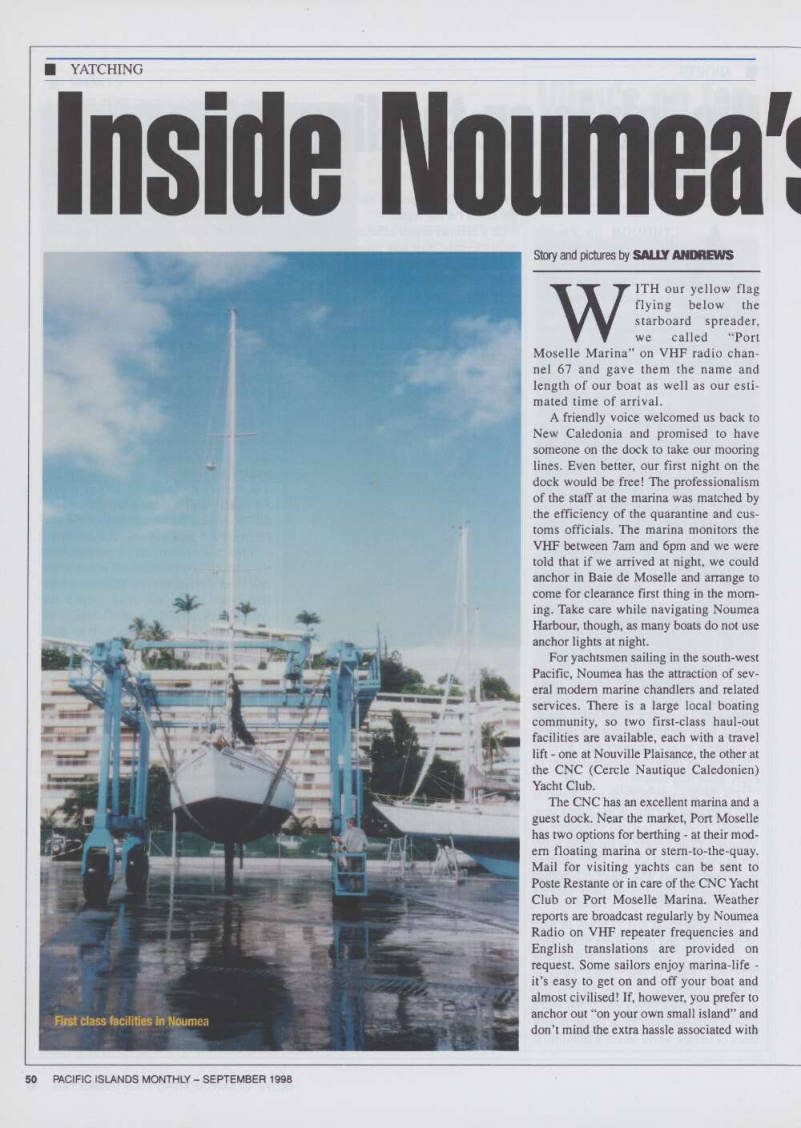
For yachtsmen sailing in the south-west Pacific, Noumea has the attraction of sev eral modem marine chandlers and related services. There is a large local boating community, so two first-class haul-out facilities are available, each with a travel lift - one at Nouville Plaisance, the other at the CNC (Cercle Nautique Caledonien) Yacht Club.
The CNC has an excellent marina and a guest dock. Near the market, Port Moselle has two options for berthing - at their mod em floating marina or stem-to-the-quay.
Mail for visiting yachts can be sent to Poste Restante or in care of the CNC Yacht Club or Port Moselle Marina. Weather reports are broadcast regularly by Noumea Radio on VHP repeater frequencies and English translations are provided on request. Some sailors enjoy marina-life it’s easy to get on and off your boat and almost civilised! If, however, you prefer to anchor out “on your own small island” and don’t mind the extra hassle associated with
First class facilities in Noumea
getting ashore, there are several options in and around Noumea. Baie de Moselle is convenient to downtown, but Baie de I’Orphelinat (shortened to ’‘Bay D’Orf” by tongue-tied Anglophone cruisers) is my favourite spot because paddling teams ply the waters of Bay D’Orf in big outrigger
canoes each day, adding a Polynesian
flavour. On the down side, the sound of all this healthy activity makes me feel rather indolent.
In Noumea, we hauled Fellowship out of the water to paint the bottom with anti fouling, replace zinc anodes on the prop shaft, clean and wax the top sides and other routine maintenance. Being members of a yacht club in Canada meant that the CNC Yacht Club kindly extended reciprocal privileges to us. Their facility was excel lent - clean, convenient, great showers and toilet facilities, friendly staff. Best of all, the travel lift operator drove like a little old lady, very gently, and we appreciated it.
After finishing all our odd jobs, we set off to explore the local offshore islands, several of which are within a few hours sail of Noumea, inside the reef. For Anglophone sailors, the best guide to the region is the English version of the Cruising Guide to New Caledonia (new edition published 1996), available in Noumea or world-wide through marine book stores. It includes tips on sailing and navigating around coral reefs and warnings on health hazards such as toxic fish, sea snakes and corals. The guide is edited by Noumea Yacht Charters who offer bare boat or crewed yacht charters out of Noumea.
The Guide warns that eating toxic fish is a major health risk in New Caledonia.
Known locally as la gratte, ciguatera poi soning is caused by microscopic toxic algae that is-passed along through the food chain; the algae are consumed by herbivo rous fish, which are consumed by carnivo rous fish, which are consumed by larger predatory fish, which are consumed by humans who get very sick.
The severity of symptoms is related to
the amount of fish eaten and the level of toxicity in the fish or accumulated in the consumer. Symptoms of la gratte include itching, low blood pressure, irregular heart beat. Often there is a reversal of the senses where hot feels cold and vice versa. The best advice is to avoid eating reef fish or predators of reef fish. Local advice is a help, but is not always infallible or reliable.
We decided reef fish look better swimming in the underwater seascape, not on our din ner plate.
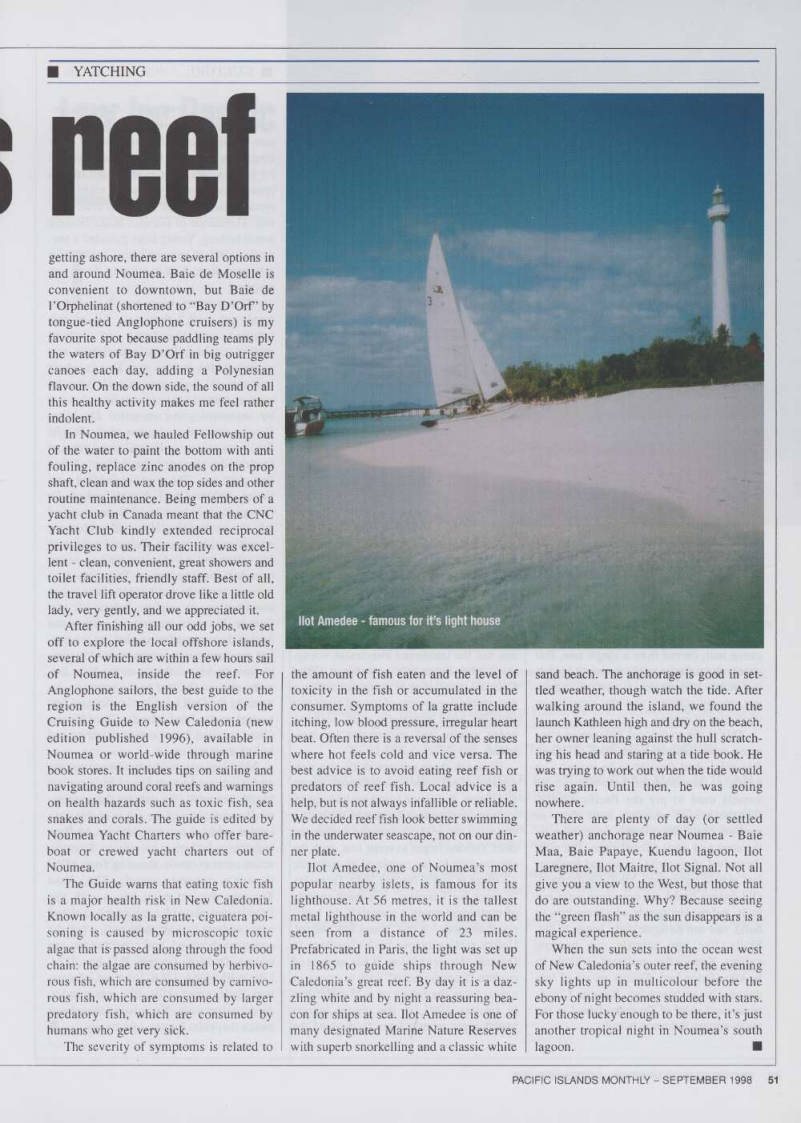
Hot Amedee, one of Noumea’s most popular nearby islets, is famous for its lighthouse. At 56 metres, it is the tallest metal lighthouse in the world and can be seen from a distance of 23 miles.
Prefabricated in Paris, the light was set up in 1865 to guide ships through New Caledonia’s great reef. By day it is a daz zling white and by night a reassuring bea con for ships at sea. Hot Amedee is one of many designated Marine Nature Reserves with superb snorkelling and a classic white
sand beach. The anchorage is good in set tled weather, though watch the tide. After walking around the island, we found the launch Kathleen high and dry on the beach, her owner leaning against the hull scratch ing his head and staring at a tide book. He was trying to work out when the tide would rise again. Until then, he was going nowhere.
There are plenty of day (or settled weather) anchorage near Noumea - Baie Maa, Baie Papaye, Kuendu lagoon, Hot Laregnere, Hot Maitre, Hot Signal. Not all give you a view to the West, but those that
do are outstanding. Why? Because seeing
the "green flash” as the sun disappears is a
magical experience.
When the sun sets into the ocean west of New Caledonia’s outer reef, the evening sky lights up in multicolour before the ebony of night becomes studded with stars.
For those lucky enough to be there, it’s just another tropical night in Noumea’s south lagoon. ■
llot Amedee - famous for it’s light house