His Job is on the line
p. 49 · Read in the full issue
By Atama Raganivatu
Although no Pacific Island teams qualified
for the recently complet
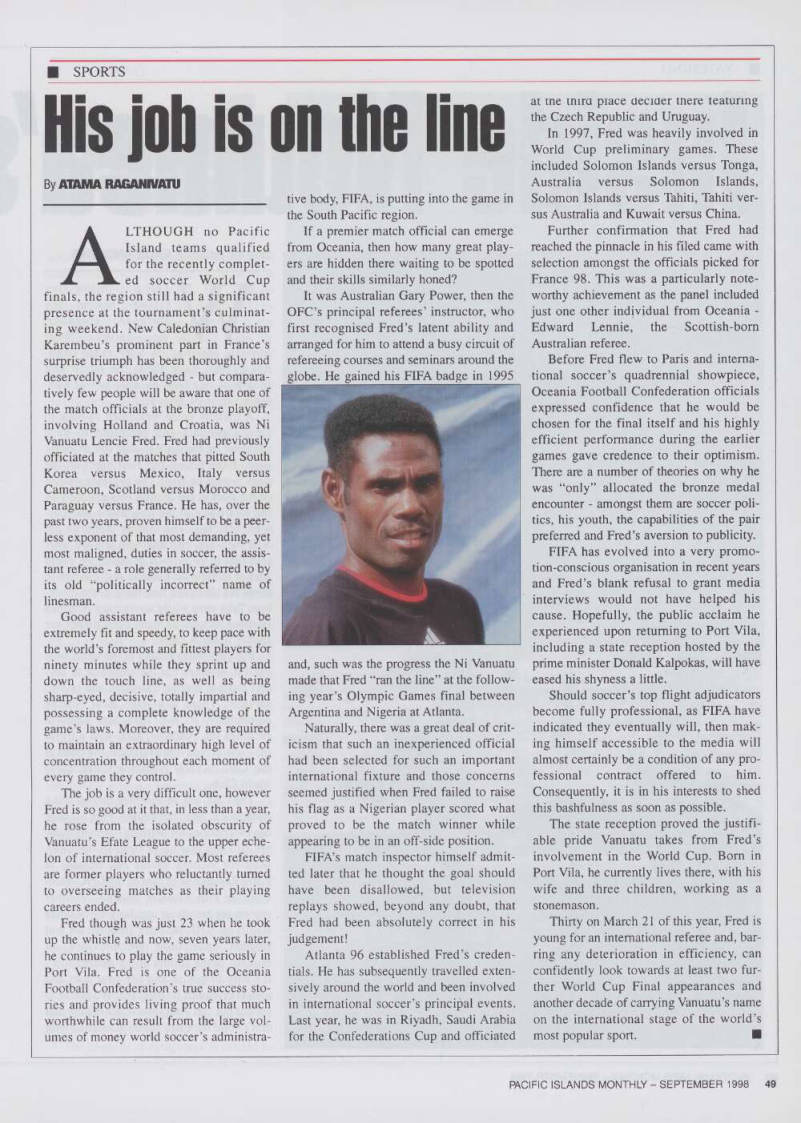
ed soccer World Cup finals, the region still had a significant presence at the tournament’s culminat ing weekend. New Caledonian Christian Karembeu’s prominent part in France’s surprise triumph has been thoroughly and deservedly acknowledged - but compara tively few people will be aware that one of the match officials at the bronze playoff, involving Holland and Croatia, was Ni Vanuatu Lencie Fred. Fred had previously officiated at the matches that pitted South Korea versus Mexico, Italy versus Cameroon, Scotland versus Morocco and Paraguay versus France. He has, over the past two years, proven himself to be a peer less exponent of that most demanding, yet most maligned, duties in soccer, the assis tant referee - a role generally referred to by its old “politically incorrect” name of linesman.
Good assistant referees have to be extremely fit and speedy, to keep pace with the world’s foremost and fittest players for ninety minutes while they sprint up and down the touch line, as well as being sharp-eyed, decisive, totally impartial and possessing a complete knowledge of the game’s laws. Moreover, they are required to maintain an extraordinary high level of concentration throughout each moment of every game they control.
The job is a very difficult one, however Fred is so good at it that, in less than a year, he rose from the isolated obscurity of Vanuatu’s Efate League to the upper eche lon of international soccer. Most referees are former players who reluctantly turned to overseeing matches as their playing careers ended.
Fred though was just 23 when he took up the whistle and now, seven years later, he continues to play the game seriously in Port Vila. Fred is one of the Oceania Football Confederation’s true success sto ries and provides living proof that much worthwhile can result from the large vol umes of money world soccer’s administra
live body, FIFA, is putting into the game in the South Pacific region.
If a premier match official can emerge from Oceania, then how many great play ers are hidden there waiting to be spotted and their skills similarly honed?
It was Australian Gary Power, then the OFC’s principal referees’ instructor, who first recognised Fred’s latent ability and arranged for him to attend a busy circuit of refereeing courses and seminars around the globe. He gained his FIFA badge in 1995
and, such was the progress the Ni Vanuatu made that Fred “ran the line” at the follow ing year’s Olympic Games final between Argentina and Nigeria at Atlanta.
Naturally, there was a great deal of crit icism that such an inexperienced official had been selected for such an important international fixture and those concerns seemed justified when Fred failed to raise his flag as a Nigerian player scored what proved to be the match winner while appearing to be in an off-side position.
FIFA’s match inspector himself admit ted later that he thought the goal should have been disallowed, but television replays showed, beyond any doubt, that Fred had been absolutely correct in his
judgement!
Atlanta 96 established Fred’s creden tials. He has subsequently travelled exten sively around the world and been involved in international soccer’s principal events.
Last year, he was in Riyadh, Saudi Arabia for the Confederations Cup and officiated
at me tmra place decider mere teaturmg the Czech Republic and Uruguay.
In 1997, Fred was heavily involved in World Cup preliminary games. These included Solomon Islands versus Tonga, Australia versus Solomon Islands, Solomon Islands versus Tahiti, Tahiti ver sus Australia and Kuwait versus China.
Further confirmation that Fred had reached the pinnacle in his filed came with selection amongst the officials picked for France 98. This was a particularly note worthy achievement as the panel included just one other individual from Oceania - Edward Lennie, the Scottish-born Australian referee.
Before Fred flew to Paris and interna
tional soccer’s quadrennial showpiece,
Oceania Football Confederation officials expressed confidence that he would be chosen for the final itself and his highly efficient performance during the earlier games gave credence to their optimism.
There are a number of theories on why he was “only” allocated the bronze medal encounter - amongst them are soccer poli tics, his youth, the capabilities of the pair preferred and Fred’s aversion to publicity.
FIFA has evolved into a very promo tion-conscious organisation in recent years and Fred’s blank refusal to grant media interviews would not have helped his cause. Hopefully, the public acclaim he experienced upon returning to Port Vila, including a state reception hosted by the prime minister Donald Kalpokas, will have eased his shyness a little.
Should soccer’s top flight adjudicators become fully professional, as FIFA have indicated they eventually will, then mak ing himself accessible to the media will almost certainly be a condition of any pro fessional contract offered to him.
Consequently, it is in his interests to shed this bashfulness as soon as possible.
The state reception proved the justifi
able pride Vanuatu takes from Fred’s involvement in the World Cup. Born in Port Vila, he currently lives there, with his wife and three children, working as a stonemason.
Thirty on March 21 of this year, Fred is young for an international referee and, bar ring any deterioration in efficiency, can confidently look towards at least two fur ther World Cup Final appearances and another decade of carrying Vanuatu’s name on the international stage of the world’s most popular sport. ■