Pacific Islands
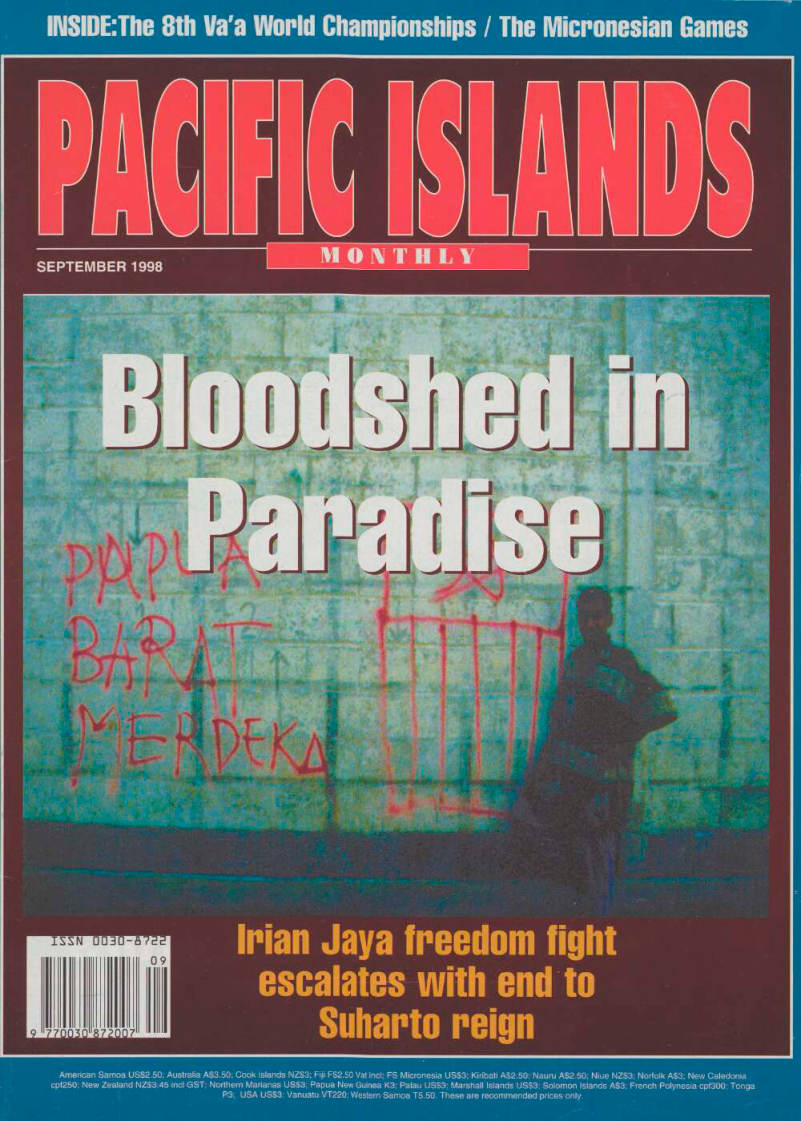
Monthly
lIMSIDE:The Bth Va'a World Championships I The Micronesian Games
September 1998
Inß I i B 1 H a ■■ HR HI HH HL3H HH BJI HH |H hI
Irian Jaya freedom fight escalates with end to Suharto reign
American Samoa USS2.SO; Australia A 53.50; Cook Islands NZ$3; Fiji F 52.50 Vat incl; FS Micronesia USS 3; Kiribati A 52.50; Nauru A 52.50; Niue NZS3; Norfolk As 3; New Caledonia cpf2so; New Zealand NZ53.45 incl GST; Northern Marianas US$3; Papua New Guinea K 3; Palau USS 3; Marshall Islands US$3; Solomon Islands As 3; French Polynesia cpfSOO; Tonga P 3; USA US$3; Vanuatu VT22O; Western Samoa T 5.50. These are recommended prices only.
Advertisements & other items, pp. 2-4 (1 item)
The Right iHick
for the Right Job
Nobody beats Isuzu when it comes
to medium duty trucks.
As the number one manufacturer in the world of commercial vehicles in the 6-16 ton GVM range, the new F-Series will further enhance our reputation for providing the right truck for the right job.
FIJI'S NUMBER ONE
' ' " rf- *■ pVP % •JF
NEW ISUZU FVR
II iijgiii n
ISUZU ™P
F=R(=J
NEW ISUZU FRR
COMFORT
The newly designed F-Series cab offers better access, superb seating support and more headroom.
TOP PERFORMANCE
New diesel engines have been designed resulting in a significant boost in horsepower and torque, while the overhead camshaft and advances in the direct-injection system give greater fuel economy and low emissions.
SAFETY
Improved brakes give unsurpassed stopping power even when fully loaded. Halogen headlamps, larger windscreens and expanded wiper coverage give the driver excellent visibility.
Asco Motors
BPT I SOUTH SEA I COMPANY LIMITED SUVA PH 384888 • SIGATOKA 500577 • NADI 721777 • LAUTOKA 662855 BA 674406 • TAVUA 680152 • LABASA 811688
- ■ V* > "i\. •- ,% " * *'• . > vV ?w»: V * *v., * Jr iK i r a jS •*; i * i ’‘ 7^NCV' * *9 J** ■■••■■*• ’ >, '. m •K L, .. srv a« ✓ a n
j;ll
V: (j * ~i ot, 1 ,3*y l Ki We accept
VISA
Just quote your card number and expiry date and we w» forward yaw reqwrewients.
For further information please contact: Teitkom Phone Card Sales Pay Phone Business Unit PO Box 381 Vfeigani, NCD Papua New Guinea Telephone: (675) 300 5093 Facsimile: (675) 3005060
{{}[» TELIKOM PNG
\i • • MSHO oo&fr&r rZz&tUf /
®(me toaits for no one.
I . (Jf m ? ‘m; W get left to the last minute or a deadline is bought forward and every thing is required urgently. Sound familiar? Deadlines have always been part of the print industry and at Quality Print we know that you sometimes need your printing “yesterday”. We rarely miss a realistic deadline and if you have a really urgent job we’ll keep the presses running all night if necessary.
It is this kind of service that makes us one of the best printers in the Pacific. And we now have three full colour printing presses which also makes us the largest in the region.
We offer a extensive range of printing services from multi colour printing, special packaging and binding to UV gloss finishing, laminating and die-cutting. Call us or visit our “Pride in Print” printshop for a free quote. m. ti
Quality Print
COMMERCIAL PRINTING & PACKAGING
ONE (679) 313 311 FAX (679) 301 133 EMAIL [email protected] WEBSITE WWW.INTERNETFIJI.COM/QUALITY Sansom design.
Pacific Islands
Vol 68 No. 9
The News Magazine
September 1998
Layout and cover design by Andrew Williams
PUBLISHER: Alan Robinson EDITOR: Sophie Foster Hildebrand
Correspondents;
Sally Andrew, Patrick Decloitre, Giff Johnson, Chris Peteru, Neville Choi, Atama Raganivatu, Michael Field, Liz Thompson, Lili Tuwai, Sam Vulum, Lisa Williams.
COLUMNISTS: David Barber (Wellington), Jemima Garrett (Sydney), GRAPHIC ARTISTS: James Ranuku, Josefa Bola, Andrew Williams
Advertising Sales
Senior Regional Sales (South Pacific) Shabana Naaz Kailesh Kumar Tel (679) 304111, 303244, Fax (679) 303809.
Sydney, Canberra: Bob Hill Media Representation, Tel (61-2) 4164245, Fax (61-2) 4165064.
Brisbane: Jane Fewings Media and Advertising Associates Tel (61-7) 3378 4522, Fax (61-7) 3878 1071.
Adelaide: Hastwell Williamsons Representatives, Tel (61-8) 3799522, Fax (61-8) 3799735.
Melbourne; Brown Orr Fletcher Burrows (Aust) Pty Ltd.
Tel (61-3) 98265188, Fax (61-3) 98265644.
Auckland: McKay & Bowman, International Media Representatives Limited, Tel (64-9)4190561, Fax (64-9) 4192243.
Japan: Universal Media Corporation, Tokyo, Tel (3) 3266626741, Cable: UNI-MEDIA Tokyo, Fax (3) 32626742.
Pacific Islands Monthly was founded in 1930
(Usps 9522480).
A Fiji Times Limited production.
Cover prices are recommended retail only. Registered by Australia Post, Publication No. NBPI2IO. © Copyright Fiji Times Limited, 177 Victoria Parade, Suva, Fiji.
Tel (679) 304111, fax (679) 303809.
Email: [email protected] PIM Website; http://www.pim.com.fj Pacific Islands Monthly is published monthly by Fiji Times Limited, a division of Nationwide News, 2 Holt Street, Surry Hills, Sydney, NSW 2010.
Send Address Changes To:
Pacific Islands Monthly POBox 1167 Suva, Fiji.
Typeset and printed by Quality Print Limited, 16 Amra Street, Walu Bay, Suva, Fiji.
Inside
Cover Story: The Killing Fields
Editorial 6 Briefs 7 Special Report: The Aitape Tidal Wave - a first hand account 10 Economy: Income tax prospects cause uneasiness 14 War of words over PNG's economic bailout 16 Bankers sceptical of PNG reform package 17 Business: Fiji company wins international award 18 Community television to debut in Fiji 19 Footballers and nuns raise AIDS awareness 20 Advertising Features: The Bth Va'a World Outrigger Championships 21 Fiji-made Products for Export 24 Vanuatu Independence 20 Focus on New Caledonia 32 Cover Story: The South Pacific Killing Fields - An Exclusive With pictures taken during the Irian Jaya riots 34 Politics: Say a prayer for Samoan politics 33 Where are the new leaders 40 Vanuatu ombudsman grinds to a halt 42 Sport: The Micronesian Games 46 Yachting: Inside Noumea's reef 50 : David Barber/Jemima Garrett 54
PagelO
PageZl
have some mere?
Editorials
Please sir, can we have some mere?
There
is a really simple way to tell when an election is looming the politicians start to clean up their acts.
In Fiji, this has
become almost painfully obvious.
The minister of finance, from whom it is almost impossible to get answers, is now regularly giving his two-cents-worth on any
subject in his portfolio.
He has even spoken out about why a hard line should be taken against people who abuse public posts.
The foreign minister, who is the former finance minister, has criticised the courts for being too soft on people charged in rela tion to the National Bank of Fiji fiasco.
This is the same person who called the NBF fiasco “water under the bridge” when details of abuse were leaked to the media several years ago.
There is a pattern to all this madness.
Politicians generally begin to talk about things like account ability and unity in the months preceding an election.
In fact, it is probably the only time that politicians start doing things they were supposed to be doing throughout their whole term.
During their term, they tend to shy away from their con stituencies and the media.
Then as the election looms, the people become, once more,
their biggest con cern.
Anyone who does not start to improve his or her public image in the year before an election is either very cocky or very stupid.
In Samoa though, those in power seem
to be both these things.
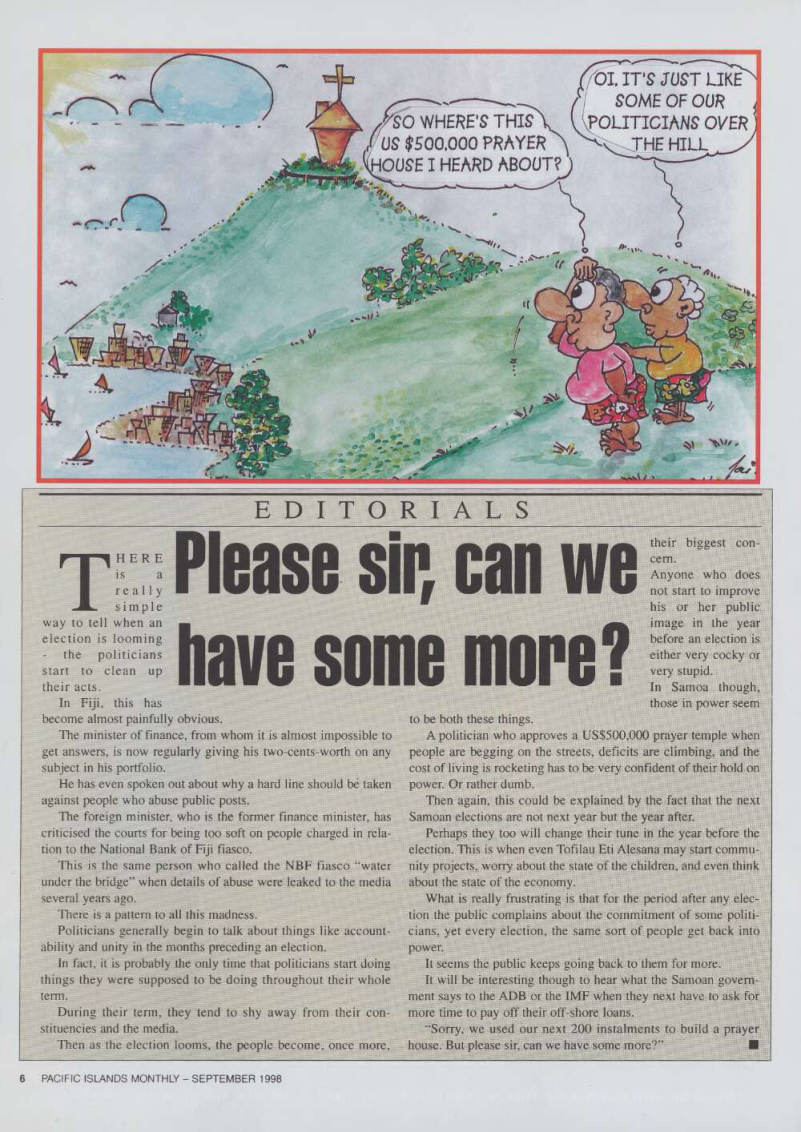
A politician who approves a USSSOO,OOO prayer temple when people are begging on the streets, deficits are climbing, and the cost of living is rocketing has to be very confident of their hold on power. Or rather dumb.
Then again, this could be explained by the fact that the next Samoan elections are not next year but the year after.
Perhaps they too will change their tune in the year before the election. This is when even Tofilau Eti Alesana may start commu nity projects, worry about the state of the children, and even think about the state of the economy.
What is really frustrating is that for the period after any elec tion the public complains about the commitment of some politi cians, yet every election, the same sort of people get back into power.
It seems the public keeps going back to them for more.
It will be interesting though to hear what the Samoan govern ment says to the ADB or the IMF when they next have to ask for more time to pay off their off-shore loans.
"Sorry, we used our next 200 instalments to build a prayer house. But please sir, can we have some more?” ■
Briefs

South Pacific Pageant to be staged in December 1998 SUVA, FIJI - THE Miss South Pacific Pageant 1998 will be staged in Suva, Fiji from December 1 to 6, to ensure greater participation by national pageant winners from around the region.
Announcing the new dates, Fiji Organising Committee chairperson, Mrs Anna Sweetman says, “The Miss South Pacific Pageant Board, based in Apia, and the Fiji Organising Committee concur that as a number of other Pacific Island coun tries do not stage their national pageant events until later in the year, deferring the event to December will ensure that The Miss South Pacific Pageant, “A Celebration of Women and culture” will be a regional event, the likes that Fiji has never witnessed!”
The reign of the current Miss South Pacific, Maryjane Moe-McKibben of Samoa will culminate at the Grand Final of the 1998 Pageant, an evening extrava ganza that will include traditional perfor mances, cultural costumes parades and entertainment, reflecting the theme for this year.
The Miss South Pacific Pageant was staged in Auckland last year, and this is the first time that Fiji will be hosting the event.
Fiji's General Bector Parties to unite SUVA, FIJI - With the national elec tions less than six months away, Fiji’s two main general elector political parties will finally unite at a special general meeting scheduled for September 19.
At a meeting in Suva last month, mem bers of the national executive of the General Electors Party (GEP) and the General Voters Party (GVP) unanimously endorsed proposals for the formation of a single, multi-racial party - the United General Party - to unite members and sup porters of the two parties.
This means that neither the GEP nor the GVP will contest the forthcoming general election as separate parties. In a joint statement, GVP and GEP party presidents, David Blakelock and David Pickering, hailed the unity proposals as a victory for reason, leading to the emergence of a strong, political entity.
"Unity has been reached after many months of patient negotiation,” the state ment said, “it was clearly understood that under the provision of the new
Constitution for multi-party government, the general electors would be seriously dis advantaged if they were divided”.
Australia takes tough stand against over stayers and illegal workers
Canberra, Australia - A Crack
down by Australian immigration authori ties on overstayers and illegal workers has resulted in more than 11,600 people being detained throughout Australia so far in 1997-98, according to Australian immigra tion minister Philip Ruddock. “During our first year in office, location of overstayers and illegal workers increased by 30 per cent - from 7,800 in 1995-96 to 10,138 in 1996-97.
Locations have further increased to more than 11,600 between July 1 1997 and May 31 1998 as the government continues to take a strong stand against people who flagrantly abuse immigration laws,” he said. “We often hear complaints from the tourism industry that our screening proce dures for tourists are too tough. However, it must be remembered that overstayers not only take jobs from people legally entitled to work, but they cost the Australian tax payer millions of dollars each year as immigration officers have to locate them.”
He said, “my department is making a con certed effort to ensure all visitors to Australia comply with the terms and con ditions of their visas”.
Solomon mining company denies it is nego tiating on new mine
Honiara, Solomon Islands -
The Gold Ridge Mining Company has dis missed rumours that it is negotiating with Central Guadalcanal landowners to mine new and bigger gold deposits in the area.
Premier of Guadalcanal Province Ezekiel Alebua has expressed concerns over the reports, saying both the national government and the mine owner, Ross mining must respect the province by informing it of any new developments.
Mr Alebua has also called on the landowners to seek advice before entering into any negotiations for prospecting and mining - and has demanded that the ■provincial government be involved in all
negotiations.
Meanwhile, general manager of Gold Ridge Mining lan Goudie says Ross Mining has the utmost respect for
Guadalcanal Province and provincial gov ernment and will not keep information from them.
He says the company is not negotiating any agreement with landowners in any area - and added that all deposits within the Gold ridge mining area are covered by the existing mining lease agreement.
Arms shipment still being sorted out
Honiara, Solomon Islands -
New Zealand is continuing to store a con tainer of arms owned by the Solomon Islands government while the Pacific Island nation figures out what to do with them, Solomons foreign minister Patterson Oti said. Oti said he had discussed the shipment in talks with NZ foreign minister Don McKinnon in the Solomon Islands capital, Honiara.
“They’re still in Auckland,” Oti said, “we are waiting for a number of things to be sorted out; first of all our storage capac ity and our need for them, that needs to be reassessed. Then thereafter we will have to look at other ways of disposing of those arms.” The shipment is part of a US$4 mil lion (A 56.7 million) deal ordered by for mer Solomons prime minister Solomon Mamaloni from United States arms dealer
Century Arms.
The Solomon Islands does not have an army and suspicions were raised in some quarters that the arms were destined for Bougainville, which lies at the eastern tip of Papua New guinea and neighbours the Solomons. New Zealand agreed to store the arms in January after receiving a request from the Solomon Islands govern ment that replaced Mamaloni’s adminis tration last September.
New shipping line to the Pacific
Pagopago, American Samoa -
Hamburg Sug, which recently purchased
the South Seas Steamship from a Norwegian company, A/S Thor Dahl, plans to continue providing marine transport ser vices between the US and the Pacific.
This was announced after a meeting between company subsidiary, Columbus Line, senior vice president Jurgen Pump and US Congressman Eni Faleomavaega.
Hamburg Sug, with assets of USsl.2 billion, has nearly 130 years of global marine transport and logistics experience.
It is Germany’s largest privately owned shipping company, and part of the Oetker
Group - a highly diversified organisation
with interests in shipping, hotels, food stuffs, beverage and tourism.
The company’s headquarters is located
in Germany.
PNG seeks support for ASEAN status
Port Moresby, Png - Papua New
Guinea’s Governor-General Sir Silas
Atopare has sought Filipino support for
an elevation in PNG’s status in the Association of East Asian Nations,
Asean.
Papua New guinea is seeking an eleva tion in ASEAN status from special observer to permanent observer. Sir Silas met recently in Manila, with Philippines outgoing President, Fidel Ramos, Cabinet members and the President-elect, Joseph Estrada.
The PNG govemor-General was in the Philippines to attend the country’s inde pendence centennial celebrations.
Tonga meltdown off the map I read with interest your Pacific Islands Monthly July 1998 magazine with the front page "The Pacific Meltdown". It had a professional meltdown design. There was a beautiful map of the South Pacific islands as well, with light blue colour for the Pacific Ocean. However, as far as I know the little island of Tonga should be on your map. I heard a rumour that the Island of Tonga already suffered a melt down many years ago. My request is, if it's true, please pick it up again and replace one Tahiti on your map.
'Aisea Filiha,
Melbourne, Australia
Letters
Information superhighway
I just wanted to send you a note to thank you for going on-line and making the news from the South Pacific available to those of us not able to stay there as much as they want!! I lived in Vanuatu for a year and miss it terribly. I use your site regularly. Thanks again.
Michael
Plain computing
Just an observation. All three planes illustrated on the reference pages are in
fact Air Marshall Islands aircraft. The Royal Tongan craft is V 7-8203 if you look at the registration numbers carefully.
The illustration for the Air Vanuatu and the Air Marshall Islands ads is the same image, same aircraft, same cloud banks only the graphics on the aircraft model have been modified by computer manipulation.
Michael N Trevor
Majuro
Looking for a friend
I have tried again and and again to arrange advertisement in your penfriend’s column without much success. I hope my request can be dealt with: Tim Westwood (21 yrs) would like to correspond with young men and women between the ages of 18 to 23yrs. His interests are reading, writ ing, music mixing, soccer. His address is: Tim Westwood, 102 Alric Avenue, New Malden, Surrey KT3 4JW, England UK.
Vimla Westwood
Advertisements & other items, p. 8 (1 item)
Health Professionals
Am
ACIL Australia Pty Ltd
General Registration for International Opportunities ACIL Australia Pty Ltd is privately owned Australia company, specialising in the management of international development assistance projects. We are currently implementing 20 multi-disciplinary projects throughout the Pacific, Asia and Africa. For future projects, we are looking to expand our portfolio of qualified and experienced health professionals with practical skills in the following areas; • Health Management • Health Financial Systems • Health Sector Reform • Epidemiology • Medical Supplies and Pharmaceuticals • Organisational and Institutional Development • Sexual and Reproductive Health • Health Information Systems • Primary Public Health Care • Women and Children’s Health • Community and Social Development • Health Training • Health Promotion • Health Legislation and Policy
Development
Experience as a Technical Adviser with donor programs is a developing country is desirable. To register your interest, a Curriculum Vitae (original hard copy with computer disk or Email with attached Word file) detailing specific work experience may be submitted to: Marian Boreland ACIL Australia Pty Ltd 854 Glenferrie Road Hawthorn Vic 3122 Australia ph 613 9819 2877 fax 613 9819 4216 [email protected]
From The Archives
September 1944
Civil administration in Papua
AFTER a delay of which there has been no explanation - except indifference of the Australian Government towards all Pacific Territories matters - the Cabinet Sub-com mittee set up to deal with Territories administration met in Canberra on Friday, September 8, with Mr Ward as chairman.
No official report was issued; but with in the next two days, various newspapers published the following, as news from Canberra: Civil administration will be restored in the Territory of Papua early in 1945.
The administration of the Mandated Territory of New Guinea will remain the
responsibility of the Army.
The Port Moresby branch of the Commonwealth Bank will soon be reopened.
The laws of the Territories will be con solidated and re-printed. Special steps will be taken to “meet the needs of 2,000 Chinese who have been liberated from the Japanese; and appropriate supplies, includ ing food and clothing, will be provided for them”.
Christmas appeal for Makogai
THE annual appeal for Christmas parcels for the lepers at Makogai and other
Pacific islands is ’being made by the secretary of the Leper’s Trust Board, Mr P J Twomey, of Christchurch, NZ.
As a result of repeated requests, the Board extend
ed its activities to other places in the Pacific this year, and for the first time 422 patients in New Caledonia, including 60 Europeans, will receive goodwill presents from NZ.
Pacific Frenchmen celebrate lib
eration of homeland
AUGUST 23, 1944, is likely to be an important date in the history of the South Pacific.
For that appears to be the accepted date of the liberation of Paris from the Germans - which really means the liberation of France. And, in the South Pacific, the free dom of their Mother Country means much to the people of New Caledonia, French Oceania and New Hebrides.
There have been joyous demonstrations in Noumea, Tahiti, Vila - wherever Frenchmen have gathered together. For four years the French territories have been
cut off from their homeland.
At first their administrative, financial and economic systems were in chaos; and, had it not been for the ready help of the British Pacific countries, and of the United States, their conditions would have been calamitous. ■
Pacific Islands Monthly
Advertisements & other items, p. 9 (1 item)
Japanese Vehicles
DIRECT”
Cut out the middlemen
Where to buy, how to import, photos, specifications, prices, get the book that reveals all. For free information contact - Trust Company Ltd, Tel; 81-52-953- 5602, Fax: 81-52-953-5634/31, E-Mail; [email protected].
Homepage:
http://trust-ltd.co.jp/ Address: Kobac Bid 3-2-26 Nishiki Nakaku Nagoya 460-0003 Japan Compiled by the Trust Company P Limited, Japan, in association with japan Vehicle Export Limited (UK). Trade Aid Ltd. (UK) and Mobile Outreach Ministry (USA),
A first-hand account of
Special Report
A first-hand account of four days after the tufa
By Brother Donius Ninen,
With Sam Vulum
ON the evening of Friday,
July 17 at about 7.30 pm, a series of tidal waves caused by an offshore earthquake struck the North west of Papua New Guinea in the Sandaun Province.
The waves swept through the coast line of low beaches severely affecting the lagoon area of Sissano about 30 kilometres west of Aitape. The following is a first hand account of the events that followed the tidal wave: “As we were sitting around the table having dinner at the St Didacus Friary, the disaster struck the whole Aitape town. We were unaware of what was happening because we live some kilometres away
from the shore. We only heard a loud noise similar to that of an F2B aircraft tak ing off. As I’ve leamt later on, people ran everywhere. Some took cover while oth ers unconsciously ran to the beach to see what was happening.
After dinner, we drove down from St Didacus to St Anna to watch the usual Australian National Rugby League Friday night footy on televised on EMTV. I noticed people from the Fatima Hill and the surrounding villages running towards the beach. A colleague commented that they are going for a dance. On arrival at the venue for the footy show, a Franciscan friar told us the news. We decided to drive around the Aitape township with all the Franciscan brothers to assess any damage that may have been caused.
I decided to call in at the Sisters con vent and use their phone to contact Port Moresby. The waves had affected all the lines except for the St Clares convent. I contacted by cousin, the assistant commis sioner of Correctional Institution Services and with his help, we got in touch with Ludwig Kembu, the director of the National Disaster and Emergency Services.
I also spoke with the administrator of the Aitape Catholic diocese. He asked me to organise a group to travel to Sissano to assess the situation because we received a radio call from the Presentation Sisters in Malol that the west coast of Aitape was completely destroyed by the waves. We did not know that the same waves had already destroyed three main villages and had taken with it thousands of lives until we got to Malol by sea. There were five of us on board, including a female teacher who decided to travel with us to check on school children who were there for holi days. On the way to the Sissano lagoon, we encountered rough seas that I believed then
were part of the tidal waves. We called in at Malol village that was wrecked to the ground and destroyed. The destruction was unbelievable. A quick look around turned up two dead bodies. I had a strong feeling
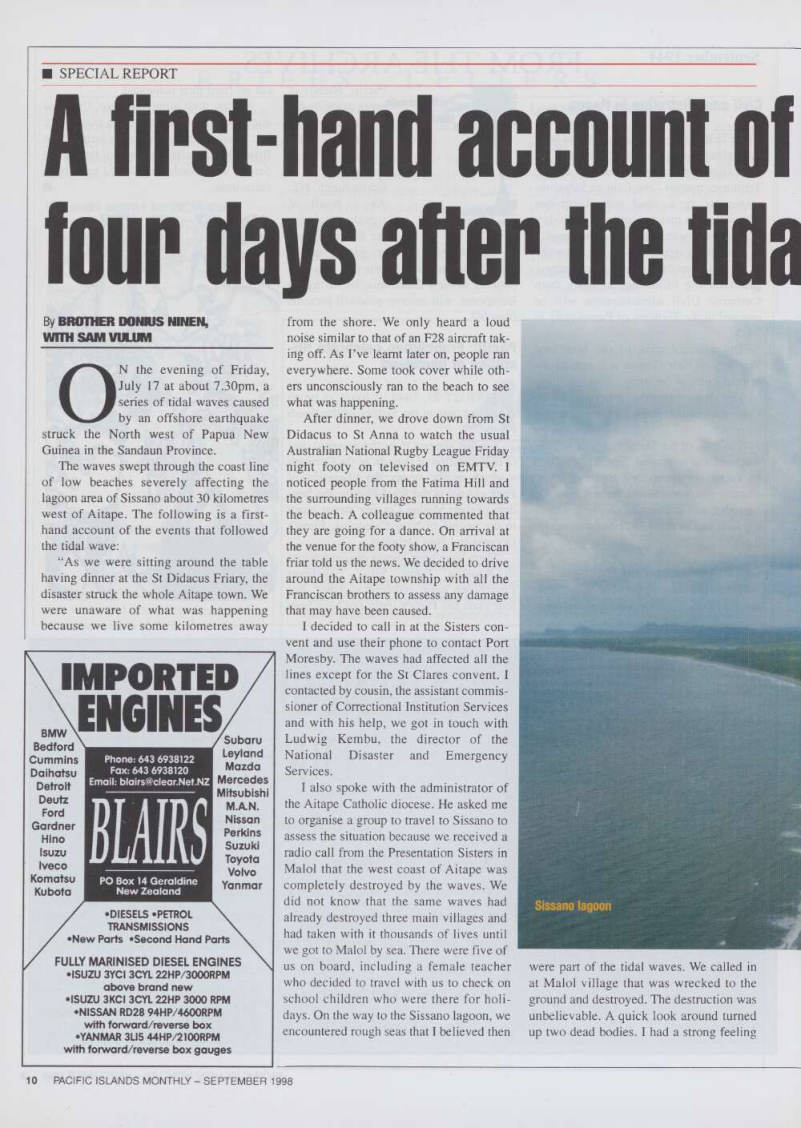
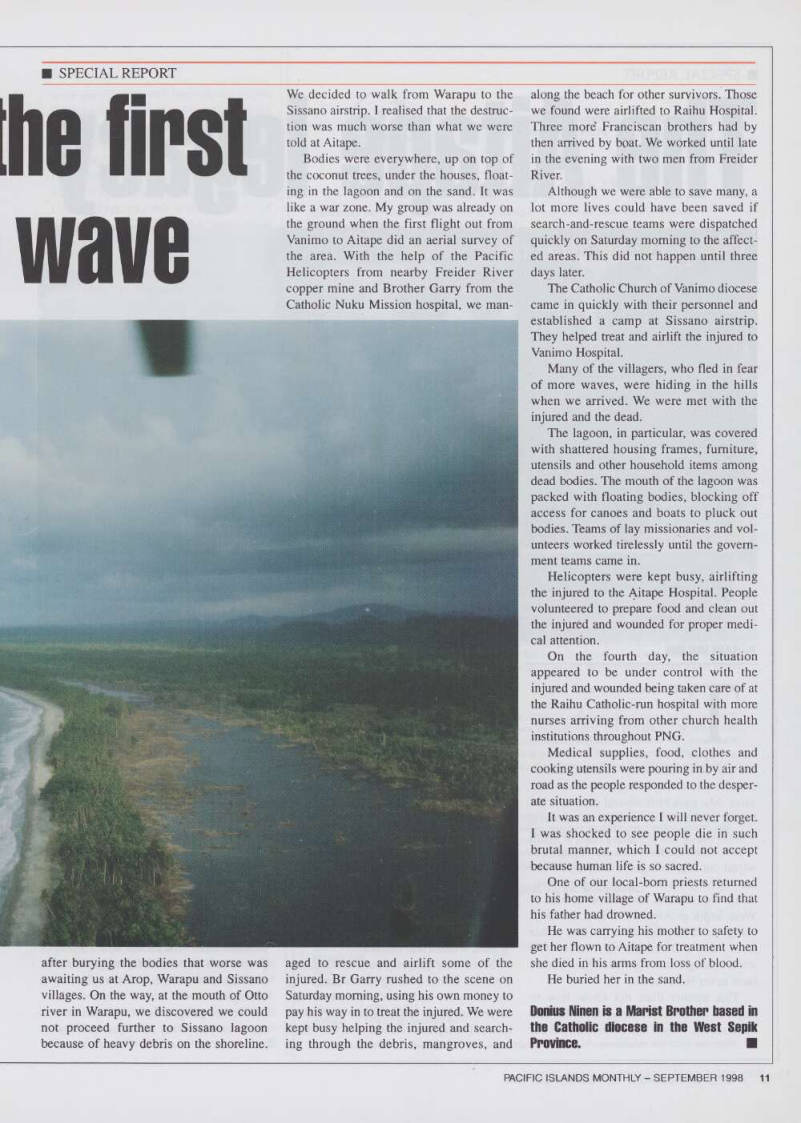
Sissano lagoon
after burying the bodies that worse was awaiting us at Arop, Warapu and Sissano villages. On the way, at the mouth of Otto river in Warapu, we discovered we could not proceed further to Sissano lagoon because of heavy debris on the shoreline.
We decided to walk from Warapu to the Sissano airstrip. I realised that the destruc tion was much worse than what we were told at Aitape.
Bodies were everywhere, up on top of the coconut trees, under the houses, float ing in the lagoon and on the sand. It was like a war zone. My group was already on the ground when the first flight out from Vanimo to Aitape did an aerial survey of the area. With the help of the Pacific Helicopters from nearby Freider River copper mine and Brother Garry from the Catholic Nuku Mission hospital, we man
aged to rescue and airlift some of the injured. Br Garry rushed to the scene on Saturday morning, using his own money to pay his way in to treat the injured. We were kept busy helping the injured and search ing through the debris, mangroves, and
along the beach for other survivors. Those we found were airlifted to Raihu Hospital.
Three more' Franciscan brothers had by then arrived by boat. We worked until late in the evening with two men from Freider River.
Although we were able to save many, a lot more lives could have been saved if search-and-rescue teams were dispatched quickly on Saturday morning to the affect ed areas. This did not happen until three days later.
The Catholic Church of Vanimo diocese came in quickly with their personnel and established a camp at Sissano airstrip.
They helped treat and airlift the injured to
Vanimo Hospital.
Many of the villagers, who fled in fear of more waves, were hiding in the hills when we arrived. We were met with the injured and the dead.
The lagoon, in particular, was covered with shattered housing frames, furniture, utensils and other household items among dead bodies. The mouth of the lagoon was packed with floating bodies, blocking off access for canoes and boats to pluck out bodies. Teams of lay missionaries and vol unteers worked tirelessly until the govern ment teams came in.
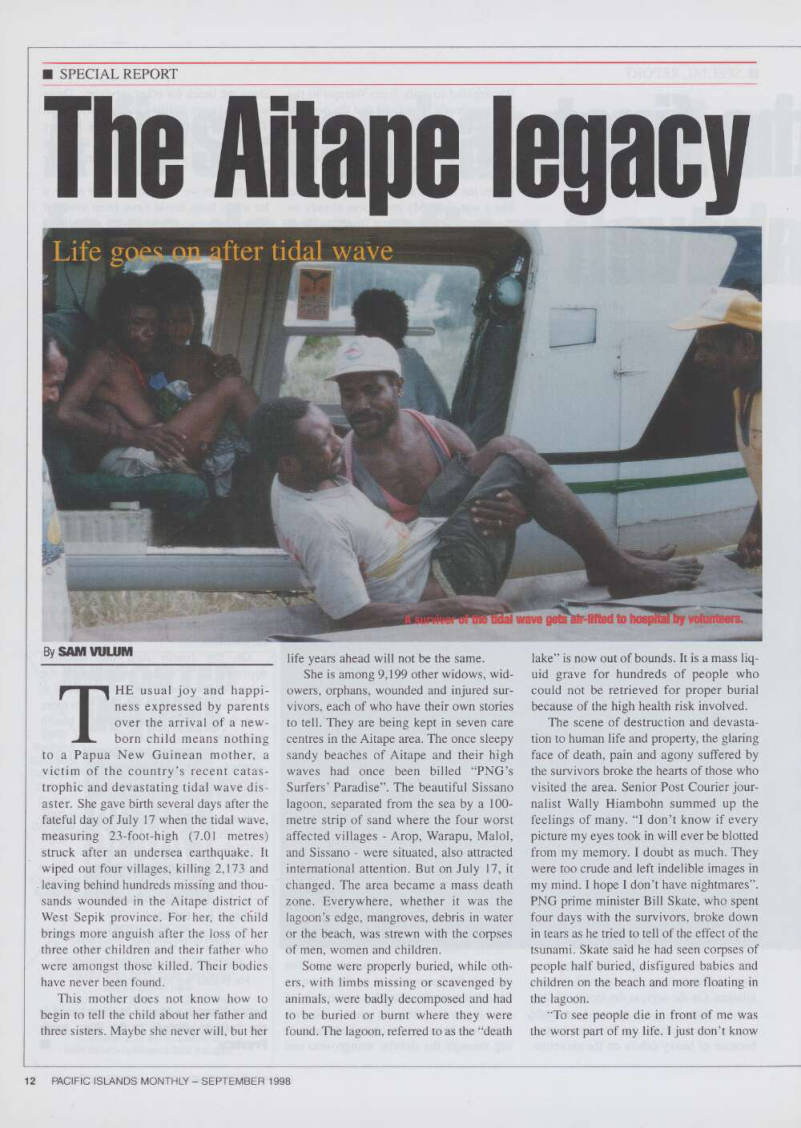
Helicopters were kept busy, airlifting the injured to the Aitape Hospital. People volunteered to prepare food and clean out the injured and wounded for proper medi cal attention.
On the fourth day, the situation appeared to be under control with the injured and wounded being taken care of at the Raihu Catholic-run hospital with more nurses arriving from other church health institutions throughout PNG.
Medical supplies, food, clothes and cooking utensils were pouring in by air and road as the people responded to the desper ate situation.
It was an experience I will never forget.
I was shocked to see people die in such brutal manner, which I could not accept because human life is so sacred.
One of our local-born priests returned to his home village of Warapu to find that his father had drowned.
He was carrying his mother to safety to get her flown to Aitape for treatment when she died in his arms from loss of blood.
He buried her in the sand.
Donius Ninen is a Manist Brother based in the Catholic diocese in the West Sepik Province. ■
Advertisements & other items, pp. 10-11 (2 items)
Imported
BMW
Bedford Cummins Daihatsu Detroit Deutz Ford Gardner Hino isuzu Iveco Komatsu Kubota Phone; 643 6938122 Fax: 643 6938120 Email: [email protected] PO Box 14 Geraldine New Zealand Subaru Leyland Mazda Mercedes Mitsubishi
MAN.
Nissan Perkins Suzuki Toyota Volvo Yanmar
•DIESELS •PETROL
TRANSMISSIONS
•New Parts ‘Second Hand Parts
FULLY MARINISED DIESEL ENGINES
•ISUZU 3YCI 3CYL 22HP/3000RPM
above brand new
•ISUZU 3KCI 3CYL 22HP 3000 RPM
•NISSAN RD2B 94HP/4600RPM
with forward/reverse box
•YANMAR 3L15 44HP/2100RPM
with forward/reverse box gauges
ihe first
PACIFIC ISLANDS MONTHLY - SEPTEMBER 1998
■ SPECIAL REPORT
ihe first wave
The Aitape legacy
By Sam Vulum
life years ahead will not be the same.
She is among 9,199 other widows, wid owers, orphans, wounded and injured sur vivors, each of who have their own stories to tell. They are being kept in seven care centres in the Aitape area. The once sleepy sandy beaches of Aitape and their high waves had once been billed “PNG’s Surfers’ Paradise”. The beautiful Sissano lagoon, separated from the sea by a 100metre strip of sand where the four worst affected villages - Arop, Warapu, Malol, and Sissano - were situated, also attracted international attention. But on July 17, it changed. The area became a mass death zone. Everywhere, whether it was the lagoon’s edge, mangroves, debris in water or the beach, was strewn with the corpses of men, women and children.
Some were properly buried, while oth ers, with limbs missing or scavenged by animals, were badly decomposed and had to be buried or burnt where they were found. The lagoon, referred to as the “death
THE usual joy and happi ness expressed by parents over the arrival of a new born child means nothing to a Papua New Guinean mother, a victim of the country’s recent catas trophic and devastating tidal wave dis aster. She gave birth several days after the fateful day of July 17 when the tidal wave,
measuring 23-foot-high (7.01 metres)
struck after an undersea earthquake. It wiped out four villages, killing 2,173 and leaving behind hundreds missing and thou sands wounded in the Aitape district of West Sepik province. For her, the child brings more anguish after the loss of her three other children and their father who were amongst those killed. Their bodies have never been found.
This mother does not know how to begin to tell the child about her father and three sisters. Maybe she never will, but her
lake” is now out of bounds. It is a mass liq uid grave for hundreds of people who could not be retrieved for proper burial because of the high health risk involved.
The scene of destruction and devasta tion to human life and property, the glaring face of death, pain and agony suffered by the survivors broke the hearts of those who visited the area. Senior Post Courier jour nalist Wally Hiambohn summed up the feelings of many. “I don’t know if every picture my eyes took in will ever be blotted from my memory. I doubt as much. They were too crude and left indelible images in my mind. I hope I don’t have nightmares”.
PNG prime minister Bill Skate, who spent four days with the survivors, broke down in tears as he tried to tell of the effect of the tsunami. Skate said he had seen corpses of people half buried, disfigured babies and children on the beach and more floating in
the lagoon.
"To see people die in front of me was the worst part of my life. I just don’t know
Life goes on after todal wave
A survivor of the tidal wave gets air-lifted to hospital by volunteers.
what the children will face and do within the next days, weeks, and months. I don’t know whether they can make it in life if there are no proper relatives.” Opposition leader Bernard Narokobi, who wept open ly in front of the survivors, said between sobs, “it’s too much for me to talk about.
I only bring you my tears”. A state of emergency declared by the government in the area on July 18 remains in force until this month. The reaction from the world community was overwhelming.
Australians, in particular, as always, were the first to respond with the deployment of its army medical team with medicine and other relief supplies. Then the New Zealanders and others followed suit. A search-and-rescue team even came from as far as the United States with their dogs to help search for survivors.
International organisations like the Red Cross and the European Union also responded with tremendous help.
Japan, France, United Kingdom, Malaysia, China, and South Korea sent help, as did Pacific neighbours, such as the Solomon Islands, Vanuatu, Samoa, and Fiji. Those who could not send cash or in kind, flooded the Internet with mov ing words of comfort and condolences to the victims. Skate kicked off the relief operations with a pledge of K 2 million, but millions of kina have been raised nationally and internationally towards relief efforts. The Catholic church, who broke the news to the world, has been and continues to be in the forefront of many relief efforts. A third-level airline, MBA, even supplied an aircraft free-of-charge for use in relief operations.
Donations continue to pour in but the biggest concern is how to settle the vic tims and help rebuild their lives, especial ly that of children who have lost their entire families.
Of those confirmed dead, 237 were
children attending three community
schools in the area. Seven teachers were confirmed dead while 50 others are still missing. Many of the survivors are suffer ing from mental and psychological depression. Trauma counselling sessions under the leadership of a Fijian Catholic priest and psychologist, Father Makario are being held in all the care centres. He is being assisted by students from the University of Papua New Guinea, semi narians and two Bougainvilleans. It is without a doubt, one of the darkest moments of PNG’s short history. ■
Advertisements & other items, p. 13 (1 item)
Programme (SPREP)
South Pacific Regional Environment
Vacancy: TRAINING OFFICER
Applications are invited for the position of Training Officer with the South Pacific Regional Environment Programme (SPREP) in Apia, Samoa.
Post Description The Training Officer will be responsible to the Director of SPREP. through the Head of the Environmental Education, Information and Capacity-buildings Division, for: • eveluating, monitoring and keeping under review SPREPS’s, role in training and associated capacity building in consultation with other SPREP officers, with SPREP’S member countries and with institutions in the region: • undertaking a member country Training Needs Assessments for Environmental Management, incorporating a wide range of environmental management issue areas: • identifying existing training programmes offered by a range of institutions in the region through an Institutional Capabilities Assessment to determine the most appropriate training packages that best suit member country needs and which will build national capacity to address a variety of environmental management issues: • investigating possible scholarships in a range of environmental management areas which will suit member country needs and seek associated funding to assist member countries with short- term and long-term training and professional development for environmental management; • co-ordinating training for SPREP’s member countries in a range of environmental management areas and, where appropriate, liaising with institutions to develop environmental training programmes; • organising meetings, workshops, training courses and seminars, in consultation with other SPREP staff and institutions in the region, on a range of environmental management issue areas; • working with SPREP staff and management to assist in internal SPREP training, as appropriate; • preparing draft papers and reports on Training for SPREP’s biennial Work Programme and Budget approval process; • where appropriate, attending meetings and conferences to present information on training activities; • preparing project proposals to secure additional finances from donor organisations/countries to assist with further training activities of benefit to member countries; • other duties as may be required from time to time as determined by the Director and Divisional Head.
Required Qualifications and Experience Candidates must have appropriate tertiary qualifications (preferably with post-graduate qualifications in a relevant field) from a recognised institution and at least 5 years work experience, preferably within the Pacific Islands region. Other essential requirements are proven experience in coordinating and undertaking training programmes in a range of environmental management issue areas; a good understanding of current training approaches; proven project management experience; a proven ability to work as part of an inter-disciplinary and/or multi-cultural team; the ability to meet deadlines, often under difficult circumstances; a proven ability to prepare proposals and reports; and the ability to live and work within Pacific Island communities.
Conditions Appointment will be at the Project Officer Level of SPREP’s authorised salary scales for contract staff, depending on the successful applicant’s qualifications and experience. The package will include annual return airfares for appointee and dependants, a housing subsidy and other benefits, SPREP remuneration may be tax-free depending upon circumstances. The appointment will be for two years initially, with renewal for a further term depending upon the officer’s performance during the first term and depending on the availability of funds.
Applications Applications should be accompanied by a detailed curriculum vitae containing full personal details, information on qualifications and experience for the position, previous appointments, current position and salary, names, addresses, telephone and fax contact numbers or E-mail addresses of three persons associated with the applicant professionally and who would be prepared to provide testimonials. An indication of how soon the applicant would be available should also be indicated.
Closing Date: 30 September, 1998. Late applications will not be considered.
Applications should be addressed to; The Director South Pacific Regional Environment Programme (SPREP) PO Box 240
Apia
Samoa Telephone: (685) 21 929 Fax: (685) 20 231 E-mail; SPREP @sprep.org.ws Further information, including a full post description and details of remuneration and terms and condi-
Income tax prospects

Economy
Income tax prospects cause uneasiness in Vanuatu's tax haven
By Patrick Declohre
As a Value Added Tax (VAT) has just been introduced in Vanuatu on August 1 for all goods and services, reference to the need one day to introduce yet another tax has caused last July further uneasi ness within the offshore industry of this tax haven. Father Walter Lini’s National United Party (NUP), the junior
partner in the new government, had to go to the extent of denying there was any plan to bring Vanuatu nationals and residents to pay tax on their revenues.
NUP spokesman Patrick Crowby said if the income tax was introduced next year, as Vanuaaku Pati (VP) finance minister Sela Molisa hinted in his budget speech, NUP would not support it, because it would "question Vanuatu’s tax haven sta tus” and ”deter foreign investors”. The
NUP-Vanuaaku Pati (VP) coalition com mittee in a statement finally rejected the income tax scheme, saying there was so far no policy to introduce it. Last June, the Vanuatu Parliament endorsed the introduc tion of a flat 12.5 per cent Value Added Tax (VAT). The VAT came into force on August 1. It replaces a government revenue system that was so far mainly relying on import tax. The VAT was a fiscal measure recom mended by an Asian Development Bank
(ADB)-sponsored Comprehensive
Reform Programme (CRP), on which Vanuatu has embarked last year to broaden its shrinking revenue base. The CRP, for which Vanuatu received some 20 million US dollars in soft loan from the ADB in July, promotes principles of transparency, good governance, accountability through a private sector-led economy growth. It was also to start axing "10 to 15” per cent of the 4,500-strong public service in August.
But the cause of the concerns within the tax haven industry here, namely offshore registers of trust companies incorporated in Vanuatu under the International
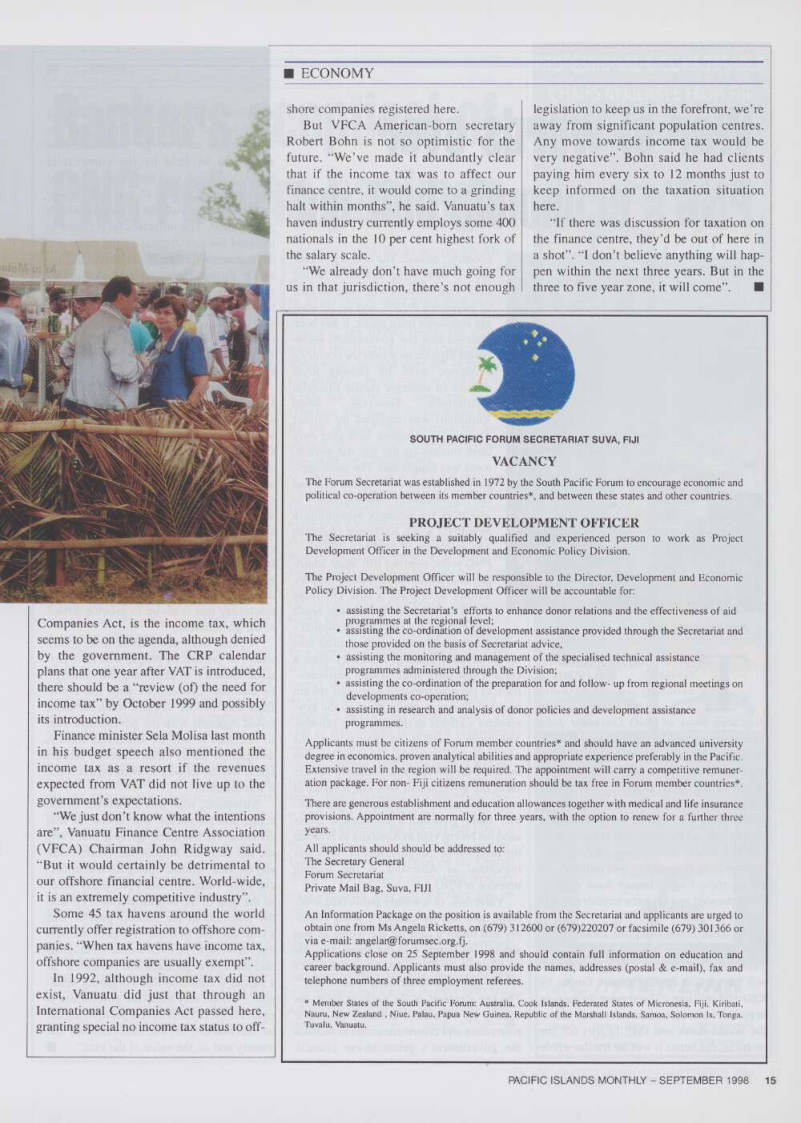
Vanuatu residents revelling during the annual horse races - before VAT and tali or income tax.
Main street - Port Vila, Vanuatu
Companies Act, is the income tax, which seems to be on the agenda, although denied by the government. The CRP calendar plans that one year after VAT is introduced, there should be a “review (of) the need for income tax” by October 1999 and possibly its introduction.
Finance minister Sela Molisa last month in his budget speech also mentioned the income tax as a resort if the revenues expected from VAT did not live up to the
government’s expectations.
“We just don’t know what the intentions are”, Vanuatu Finance Centre Association (VFCA) Chairman John Ridgway said.
“But it would certainly be detrimental to our offshore financial centre. World-wide, it is an extremely competitive industry”.
Some 45 tax havens around the world currently offer registration to offshore com panies. “When tax havens have income tax, offshore companies are usually exempt”.
In 1992, although income tax did not exist, Vanuatu did just that through an International Companies Act passed here, granting special no income tax status to off
shore companies registered here.
But VFCA American-bom secretary Robert Bohn is not so optimistic for the future. "We’ve made it abundantly clear that if the income tax was to affect our finance centre, it would come to a grinding halt within months”, he said. Vanuatu’s tax haven industry currently employs some 400 nationals in the 10 per cent highest fork of the salary scale.
“We already don’t have much going for us in that Jurisdiction, there’s not enough
legislation to keep us in the forefront, we’re away from significant population centres.
Any move towards income tax would be very negative”. Bohn said he had clients paying him every six to 12 months just to keep informed on the taxation situation here.
“If there was discussion for taxation on the finance centre, they’d be out of here in a shot”. “I don’t believe anything will hap pen within the next three years. But in the three to five year zone, it will come”. ■
Advertisements & other items, p. 15 (2 items)
15
RACIFIC ISLANDS MONTHLY - SEPTEMBER 1998
■ ECONOMY
South Pacific Forum Secretariat Suva, Fiji
VACANCY
The Forum Secretariat was established in 1972 by the South Pacific Forum to encourage economic and political co-operation between its member countries*, and between these states and other countries.
PROJECT DEVELOPMENT OFFICER
The Secretariat is seeking a suitably qualified and experienced person to work as Project Development Officer in the Development and Economic Policy Division.
The Project Development Officer will be responsible to the Director, Development and Economic Policy Division. The Project Development Officer will be accountable for: • assisting the Secretariat’s efforts to enhance donor relations and the effectiveness of aid programmes at the regional level; • assisting the co-ordination of development assistance provided through the Secretariat and those provided on the basis of Secretariat advice, • assisting the monitoring and management of the specialised technical assistance programmes administered through the Division; • assisting the co-ordination of the preparation for and follow- up from regional meetings on
developments co-operation;
• assisting in research and analysis of donor policies and development assistance programmes.
Applicants must be citizens of Forum member countries* and should have an advanced university degree in economics, proven analytical abilities and appropriate experience preferably in the Pacific.
Extensive travel in the region will be required. The appointment will carry a competitive remuneration package. For non- Fiji citizens remuneration should be tax free in Forum member countries*.
There are generous establishment and education allowances together with medical and life insurance provisions. Appointment are normally for three years, with the option to renew for a further three years.
All applicants should should be addressed to: The Secretary General Forum Secretariat Private Mail Bag, Suva, FIJI An Information Package on the position is available from the Secretariat and applicants are urged to obtain one from Ms Angela Ricketts, on (679) 312600 or (679)220207 or facsimile (679) 301366 or via e-mail: [email protected].
Applications close on 25 September 1998 and should contain full information on education and career background. Applicants must also provide the names, addresses (postal & e-mail), fax and telephone numbers of three employment referees. * Member States of the South Pacific Forum: Australia, Cook Islands, Federated States of Micronesia, Fiji, Kiribati, Nauru, New Zealand , Niue, Palau, Papua New Guinea, Republic of the Marshall Islands, Samoa, Solomon Is, Tonga, Tuvalu, Vanuatu.
War of words over PNG's economic bail-out
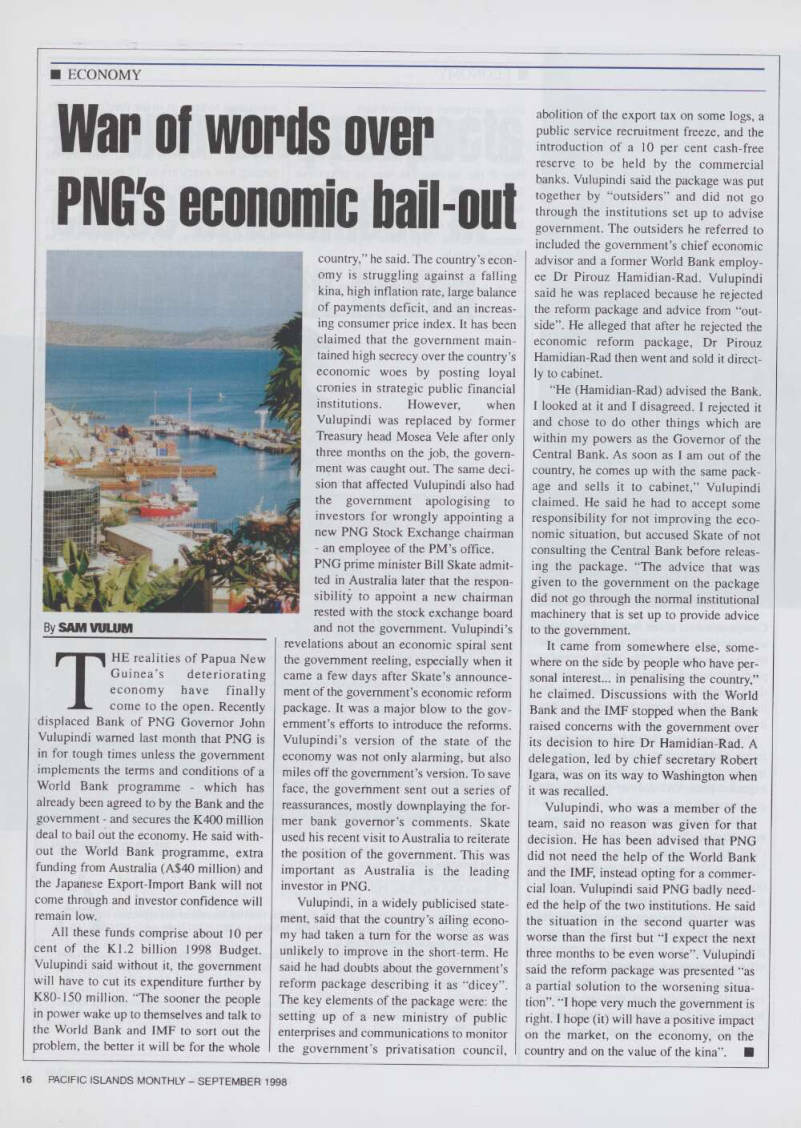
PNG's economic bail-out
By Sam Vuuim
THE realities of Papua New
Guinea’s deteriorating
economy have finally come to the open. Recently displaced Bank of PNG Governor John Vulupindi warned last month that PNG is in for tough times unless the government implements the terms and conditions of a World Bank programme - which has already been agreed to by the Bank and the government -and secures the K4OO million deal to bail out the economy. He said with out the World Bank programme, extra funding from Australia (As4o million) and the Japanese Export-Import Bank will not come through and investor confidence will remain low.
All these funds comprise about 10 per cent of the K 1.2 billion 1998 Budget.
Vulupindi said without it, the government will have to cut its expenditure further by KBO-150 million. “The sooner the people in power wake up to themselves and talk to the World Bank and IMF to sort out the problem, the better it will be for the whole
country,” he said. The country’s econ
omy is struggling against a falling
kina, high inflation rate, large balance of payments deficit, and an increas ing consumer price index. It has been claimed that the government main tained high secrecy over the country’s economic woes by posting loyal cronies in strategic public financial institutions. However, when Vulupindi was replaced by former Treasury head Mosea Vele after only three months on the job, the govern ment was caught out. The same deci sion that affected Vulupindi also had the government apologising to investors for wrongly appointing a new PNG Stock Exchange chairman - an employee of the PM’s office.
PNG prime minister Bill Skate admit ted in Australia later that the respon sibility to appoint a new chairman rested with the stock exchange board and not the government. Vulupindi’s
revelations about an economic spiral sent the government reeling, especially when it came a few days after Skate’s announce ment of the government’s economic reform package. It was a major blow to the gov ernment’s efforts to introduce the reforms.
Vulupindi’s version of the state of the economy was not only alarming, but also miles off the government’s version. To save face, the government sent out a series of reassurances, mostly downplaying the for mer bank governor’s comments. Skate used his recent visit to Australia to reiterate the position of the government. This was important as Australia is the leading investor in PNG.
Vulupindi, in a widely publicised state
ment, said that the country’s ailing econo my had taken a turn for the worse as was unlikely to improve in the short-term. He said he had doubts about the government’s
reform package describing it as "dicey”.
The key elements of the package were: the setting up of a new ministry of public enterprises and communications to monitor the government’s privatisation council.
abolition of the export tax on some logs, a public service recruitment freeze, and the introduction of a 10 per cent cash-free reserve to be held by the commercial banks. Vulupindi said the package was put together by “outsiders” and did not go through the institutions set up to advise government. The outsiders he referred to included the government’s chief economic advisor and a former World Bank employ ee Dr Pirouz Hamidian-Rad. Vulupindi said he was replaced because he rejected the reform package and advice from “out side”. He alleged that after he rejected the economic reform package, Dr Pirouz Hamidian-Rad then went and sold it direct ly to cabinet.
“He (Hamidian-Rad) advised the Bank.
I looked at it and I disagreed. I rejected it and chose to do other things which are within my powers as the Governor of the Central Bank. As soon as I am out of the country, he comes up with the same pack age and sells it to cabinet,” Vulupindi claimed. He said he had to accept some responsibility for not improving the eco nomic situation, but accused Skate of not consulting the Central Bank before releas ing the package. “The advice that was given to the government on the package did not go through the normal institutional machinery that is set up to provide advice to the government.
It came from somewhere else, some where on the side by people who have per sonal interest... in penalising the country,” he claimed. Discussions with the World Bank and the IMF stopped when the Bank raised concerns with the government over its decision to hire Dr Hamidian-Rad. A delegation, led by chief secretary Robert Igara, was on its way to Washington when it was recalled.
Vulupindi, who was a member of the team, said no reason was given for that decision. He has been advised that PNG did not need the help of the World Bank and the IMF, instead opting for a commer cial loan. Vulupindi said PNG badly need ed the help of the two institutions. He said the situation in the second quarter was worse than the first but “I expect the next three months to be even worse”. Vulupindi said the reform package was presented “as a partial solution to the worsening situa tion”. “I hope very much the government is right. I hope (it) will have a positive impact on the market, on the economy, on the country and on the value of the kina”. ■
Commercial bankers

Bankers sceptical of PNG reform package
By Sam Vulum
in PNG have cast doubt on the success of the government’s economic reform package. They said after a meet ing on August 10 that they supported the government’s overall objective of stabilis ing the Kina but were unsure whether the measures would be successful.
The bankers said while they were not criticising the quality of economic advice being offered to the government, they were not convinced that the changes to monetary policy would provide the neces sary benefits. The measures announced by prime minister Bill Skate also included a requirement for commercial banks to hold 10 per cent interest-free deposits with the Central Bank, widening the foreign exchange market by issuing licences to non-bankers as well, and shortening the period for exporters to keep their foreign currencies off-shore.
“There is some doubt as to the veracity of the assessed impacts on reserves and the value of the currency... The states foreign exchange inflows associated with logging, mining and petroleum may be overstated,” the bankers’joint statement said. They said mining and petroleum companies had con tractual agreements that permitted them to hold export earnings off-shore for three months. “Unless they agree to modify their contracts, export earnings will, most like ly, continue to remain off-shore”. The Bankers and the Central Bank had wanted a number of other measures to support the Kina including a proposal to raise the Minimum Liquid Assets Ration (MLAR) from 20 per cent to 30 per cent to dampen lending, and also for the Central Bank to set a maximum lending limit. However, these were not included in Skate’s eco nomic reform package. Instead they intro duced the CRR and reduced the MLAR to zero, with the government having the option to vary and further tighten mone
tary policy. "The Banks believe MLAR to be an effective monetary policy tool and the banks’ preference was to raise MLAR to 30 per cent in order to dampen lending.
We believe this was also the preferred option of the BPNG before the govern ment’s announcement,” the bankers’ said.
Meanwhile, interest rates are expected to rise sharply - by as much as five per cent when the economic measures become effective. The rise in rates is being fuelled by the demand that commercial banks deposit 10 per cent of their funds, interest free, with the Central Bank.
The introduction of the CRR represents a significant change to the structure of the banking system’s balance sheet, and is an extra tool for tightening monetary policy.
As a result of this, commercial banks will now be required to move about K 250 mil lion to K3OO million in treasury bills, earn ing high interest rates, to the CRR. To recover the loss of earnings, commercial banks said they would have to raise lend ing rates. “In effect, the CRR is, potential ly, a significant additional tax on the bank ing industry of around K5O million and means that 10 per cent of each bank’s deposits are unable to be invested to achieve a return,” the bankers said. “The cost of this change to deposit investment options available to the banks in their overall balance sheet management will ini tially be passed on to borrowers, and over time, shared between depositors and bor rowers,” the association said. The bankers said they expected the interest rate hikes to be “temporary”, possibly for three months, but the time would depend on the Central Bank’s future policy on making treasury bills available and the rate they pay on deposits.
“If the government, through the BPNG, do not make treasury bill investments available in which banks can invest, banks will have surplus liquidity un-invested and will quickly reduce the interest rates they are paying on deposits,” the bankers’ state ment said. ■
Advertisements & other items, p. 17 (1 item)
Interlink
UT 230 C
Executive Lowback
UT 280 C
Managerial Mediumback
UT 500 C
Presidential Highback Assembled, Exported and Processed by:
INTERLINK
ADING (FIJI ) LTD
G.P.O Box 16189, Suva .Fiji Islands. -Office Chairs Phone : (679) 3 I 1429 -Office Equipments Fax : (679) 311499 ■° fflce Stationer >' Mobile : (679) 938799 -Filing Cabinets v ’ *Poly Ehtene Bags
Business
FIJI company wins top award
By Sophie Foster Hildebrand
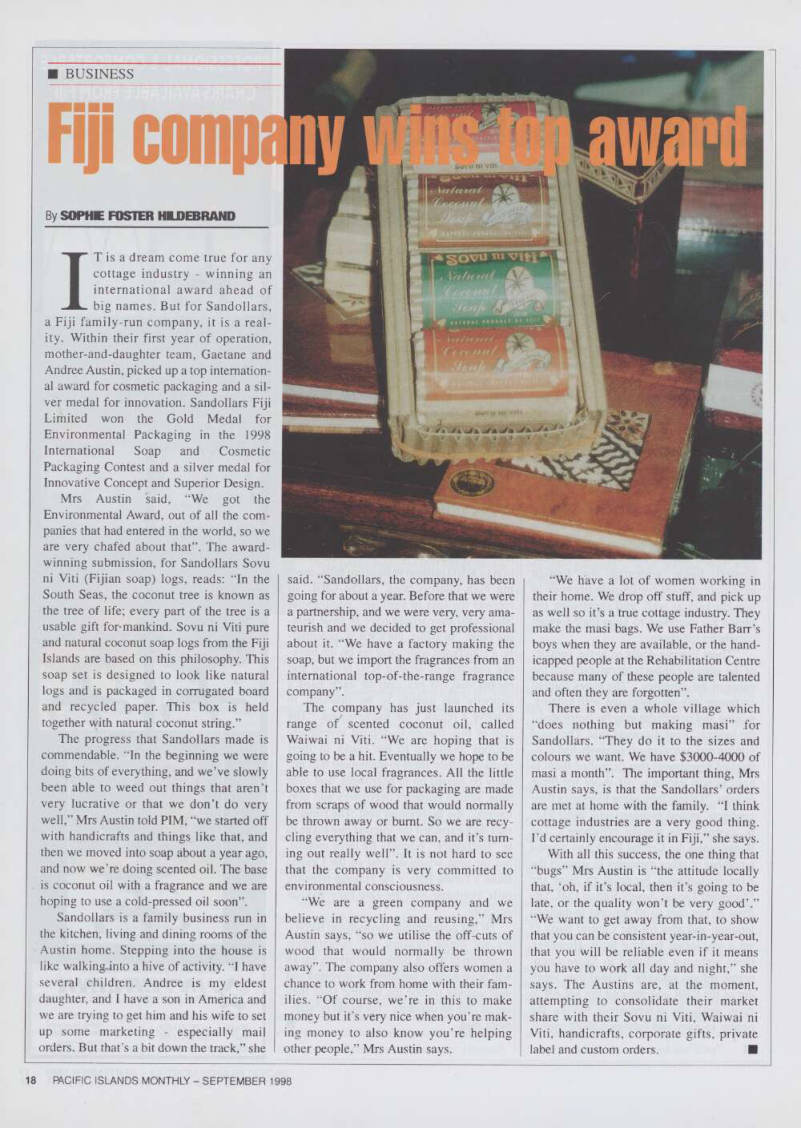
IT is a dream come true for any cottage industry - winning an international award ahead of big names. But for Sandollars, a Fiji family-run company, it is a real ity. Within their first year of operation, mother-and-daughter team, Gaetane and Andree Austin, picked up a top internation al award for cosmetic packaging and a sil ver medal for innovation. Sandollars Fiji Limited won the Gold Medal for Environmental Packaging in the 1998 International Soap and Cosmetic Packaging Contest and a silver medal for Innovative Concept and Superior Design.
Mrs Austin said, “We got the Environmental Award, out of all the com panies that had entered in the world, so we are very chafed about that”. The award winning submission, for Sandollars Sovu ni Viti (Fijian soap) logs, reads: “In the South Seas, the coconut tree is known as the tree of life; every part of the tree is a usable gift for-mankind. Sovu ni Viti pure and natural coconut soap logs from the Fiji Islands are based on this philosophy. This soap set is designed to look like natural logs and is packaged in corrugated board and recycled paper. This box is held together with natural coconut string.”
The progress that Sandollars made is commendable. “In the beginning we were doing bits of everything, and we’ve slowly been able to weed out things that aren’t very lucrative or that we don’t do very well,” Mrs Austin told PIM, “we started off with handicrafts and things like that, and then we moved into soap about a year ago, and now we’re doing scented oil. The base is coconut oil with a fragrance and we are hoping to use a cold-pressed oil soon”.
Sandollars is a family business run in the kitchen, living and dining rooms of the Austin home. Stepping into the house is like walkingdnto a hive of activity. “I have several children. Andree is my eldest daughter, and 1 have a son in America and we are trying to get him and his wife to set up some marketing - especially mail orders. But that’s a bit down the track,” she
said. “Sandollars, the company, has been going for about a year. Before that we were a partnership, and we were very, very ama teurish and we decided to get professional about it. “We have a factory making the soap, but we import the fragrances from an international top-of-the-range fragrance company”.
The company has just launched its range of scented coconut oil, called Waiwai ni Viti. “We are hoping that is going to be a hit. Eventually we hope to be able to use local fragrances. All the little boxes that we use for packaging are made from scraps of wood that would normally be thrown away or burnt. So we are recy cling everything that we can, and it’s turn ing out really well”. It is not hard to see that the company is very committed to environmental consciousness.
“We are a green company and we believe in recycling and reusing,” Mrs Austin says, “so we utilise the off-cuts of wood that would normally be thrown away”. The company also offers women a chance to work from home with their fam ilies. "Of course, we’re in this to make money but it’s very nice when you’re mak ing money to also know you’re helping other people,” Mrs Austin says.
“We have a lot of women working in their home. We drop off stuff, and pick up as well so it’s a true cottage industry. They make the masi bags. We use Father Barr’s boys when they are available, or the hand icapped people at the Rehabilitation Centre because many of these people are talented and often they are forgotten”.
There is even a whole village which “does nothing but making masi” for Sandollars. “They do it to the sizes and colours we want. We have $3OOO-4000 of masi a month”. The important thing, Mrs Austin says, is that the Sandollars’ orders are met at home with the family. “I think cottage industries are a very good thing.
I’d certainly encourage it in Fiji,” she says.
With all this success, the one thing that “bugs” Mrs Austin is “the attitude locally that, ‘oh, if it’s local, then it’s going to be late, or the quality won’t be very good’.”
"We want to get away from that, to show that you can be consistent year-in-year-out, that you will be reliable even if it means you have to work all day and night,” she says. The Austins are, at the moment, attempting to consolidate their market share with their Sovu ni Viti, Waiwai ni Viti, handicrafts, corporate gifts, private label and custom orders. ■
Community television to debut in Fiji
By Pauline Walker
IN a rambling building over flowing with enthusiasm, Nadi’s Community TV is gathering strength for its leap to the airwaves. The month of September should see CTV appearing on Fiji’s chan nel 5, bringing eagerly-awaited local pro gramming to the Nadi valley. “People want to see themselves and their own culture on television,” says Regina Yates, who with her husband, John, co-founded Community TV. This was evident from the “phenome nal” response - 7000 signatures - to the petition that was circulated three years ago, and from the widespread community sup port that CTV continues to receive.
“Everything here has been donated,”
Regina exclaims, waving a hand at the stu dio and control room that occupy one end of a long one-storey wooden building just outside Nadi. She happily rolls the credits, naming donors of carpeting, sound equip ment, the heavy timber for mounting stu dio lights, and much more. Over 150 indi viduals and organisations have given time, money and materials to CTV.
Much of the video equipment has been provided by the Yateses themselves, whose “day job” - they own Iconics, a film and television production company - keeps them in food and enables them to subsidise CTV. Local young people staff the station, a multi-ethnic crew of ardent volunteers from all walks of life.
Their free training by John and Regina Yates in all aspects of production, includ ing camera work, mixing, editing, lighting,
directing, presenting and interviewing,
would have cost thousands of dollars else where.
They have over 250 hours of program ming ready to air. Licensed for broadcast in 1997, Community TV lacked only the sophisticated gear for transmission. And early in June, CTV obtained funding for this from an overseas donor. Delivery and installation of the transmission equipment would still take time, but the goal was in sight. The old building outside Nadi, fresh ly facelifted, by volunteers with gallons of donated paint, rocked with excitement at the announcement. “Fun” programmes (such as a local “candid camera” show)
and children’s programmes will supple ment CTV’s basic menu of education and information. Among the topics to be aired are local events, music, sport, environmen tal awareness, street kids, women’s issues, health, herbal medicine, aerobics, tourism, dancing, cooking and fishing. Free-to-air and non-commercial, Community TV also offers free access, meaning that “any per son or group regardless of religion, race or age can approach CTV to produce a pro gramme on local issues”.
Without advertising, the new channel relies greatly on creative fundraising. And this has led to a fascinating and flourishing sideline: handmade paper.
A few months ago, CTV invited Sofia Tekela - an artist giving papermaking workshops in Suva under the auspices oL the UNDP and USP’s Oceania Centre for Arts and Culture - to come to Nadi. Sofia’s two-day workshop at CTV became a 25minute video on basic papermaking, which is soon to be dubbed in other languages for
distribution, at cost, throughout the region.
“People can watch it and learn,” says
Regina enthusiastically.
Meanwhile, with typical zeal, she attracted a group of volunteers - local youth, some working and some unem ployed - who have been turning recycled paper and all kinds of organic materials into stacks of beautiful handmade paper.
“Each sheet is unique, a little piece of art,”
Regina points out. Bursting with ideas, her little group has made greeting cards, merit awards, photo albums and many other items, even “disposable fashion” garments, of handmade paper, their sale raises funds for CTV and provides a little income for the paper-making crew. So Community TV in Nadi is fostering creativity as it raises money, raising community awareness as it solicits donations, and motivating and training young people as it produces local programming to educate and entertain.
“It’s all interwound,” says Regina Yates.
“It’s extraordinary”. ■
Advertisements & other items, p. 19 (2 items)
■ Business
Hook Up With The Leader!
Pacific Ocean Producers
is the leader in
monofilament longline
system technology.
We offer special service to the South Pacific Islands, Australia and New Zealand. • Lindgren-Pitman gear, complete hydraulic systems, design and installation or monofilament longline systems including operations training. • Extensive Tuna and Swordfish supplies, bottom fishing gear, fish handling supplies and bait. • Duralumes Lightstick - the latest in lightsticks technology, extended light output, often used two nights, 5-year shelf life, not affected by moisture, easy-to- handle shipping carton. All popular colors available - green, blue, pink, yellow, white, violet and ultra-violet tor best fishing results. • Wide selection of trolling equipment: over 180 different colors of trolling skirts and a large selection of lure heads. • Weekly shipments to the South Pacific Islands, Australia and New Zealand.
FREE CATALOG AVAILABLE ON REQUEST
Please direct all inquiries to the Export Department: Pacific 965-B North Nimitz Highway OCL4iV Honolulu, HI 96817, USA. nng\ nnrFDC Telephone: (808) 537-2905 MrMSXJMIV Facsimile: (808) 536-3225 Visit our new catalog on-line at: pop-hawaii.com Toll Free Number 1-800-144-488 tl A'-
)URALUMES
Singers, foot
ballers, and nans raise AIDS awareness
LAISA Vulakoro did it in Suva. So did Seru Serevi.
And some of the members of the USP football team did it too. In Samoa, Cindy, Samoa’s famous fa’afafine did it, as did netball player Rosie Ripley and the Reverend Falefatu Enari.
Tonga’s captain of the Rugby Union team, Fea’o Vunipola, Catholic nun Sister Senolita and -local DJ Tomasi from the Blue Pacific nightclub also did it.
And in the Solomons popular singer Eddie Fiti and the Catholic Church’s Archbishop Adrian Smith did it.
What did they do? They all spoke in support of the Force for Change: World AIDS Campaign with young people.
Launched during a series of workshops conducted by UNAIDS and PINA held in Fiji, Samoa, Tonga, Solomon Islands and Vanuatu, the campaign highlights the need to involve young people in the planning and implementation of STD/HIV/AIDS education and prevention programmes.
“One of the major lessons leamt from . over a decade of trying to prevent the spread of HIV/AIDS is that if you want to change the behaviour of a particular group, you have to listen to that group, to their problems, aspirations and hopes and for mulate programmes that will meet their needs rather than just preaching to them.”
UNAIDS Inter Country Programme Adviser Steven Vete said. Over sixty per cent of the Pacific Islands consists of youth (defined by the UN system as young peo
pie between the age of 15 to 24 years though some Pacific Islands define it as up to 35 years of age). Forty two percent of officially reported HIV/AIDS in the Pacific are between the ages of 20- 29. And most of the STD cases in the Pacific fall within this age group.
In Tahiti in June, delegates to a region al Pacific youth meeting considered a draft UNICEF report on the State of Pacific Youth (SOPY).
The report was put together by a United Nations Inter Agency Task force on Youth consisting of a wide variety of organisa tions involved or concerned about youth work. The increasing incidence of STDs and unplanned pregnancies is cited as one of the major problems facing Pacific Island youth.
“And” as SV points out, “it is the same behaviour which can lead to an STD or unplanned pregnancy which can also infect people with HIV/AIDS - unprotected sexu al intercourse with an HIV-positive per son” But yet many people in the Pacific do not see the link.
“There is an urgent need to talk with and listen to young people because they are the future, they can make a change not only in their own behaviour but also in attitudes towards people living with HIV/AIDS” SV said. “The hope lies with young people”.
Some of the needs of young people identified in the SOPY report include the
availability of a user friendly reproductive
health service that can provide factual non judgemnetal information. ■
World Sprint heiled as a success

Advertising Feature
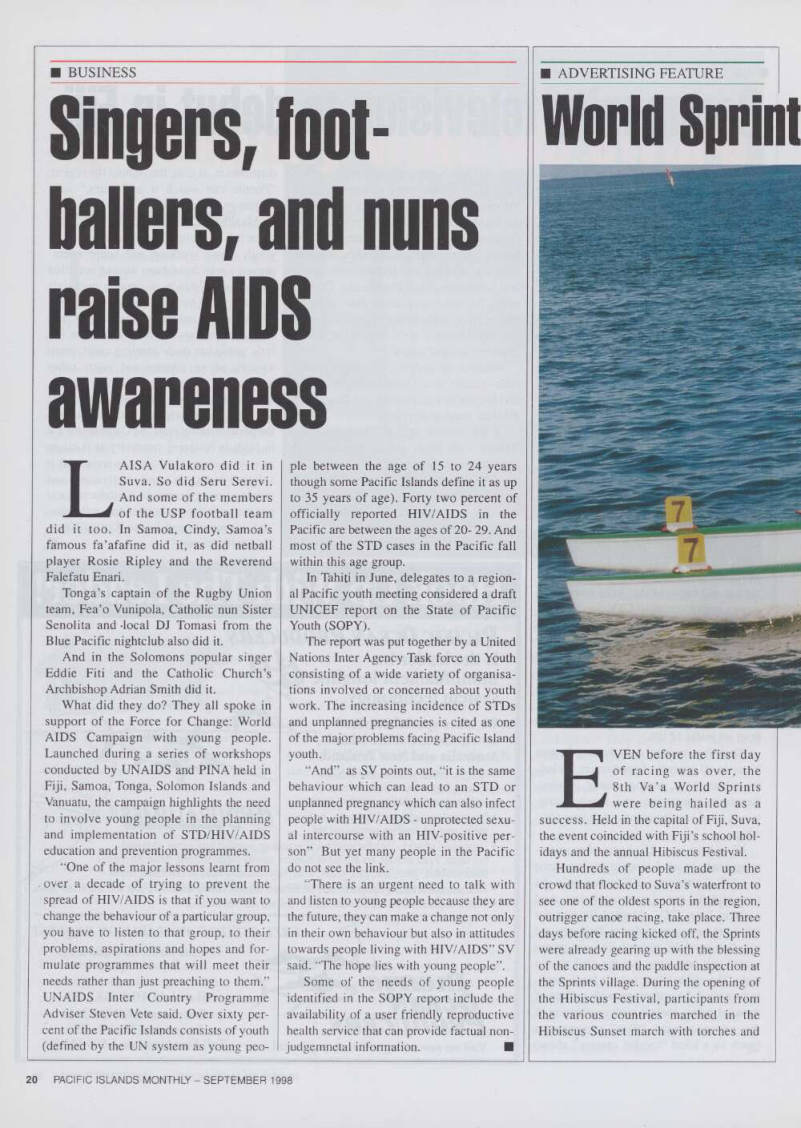
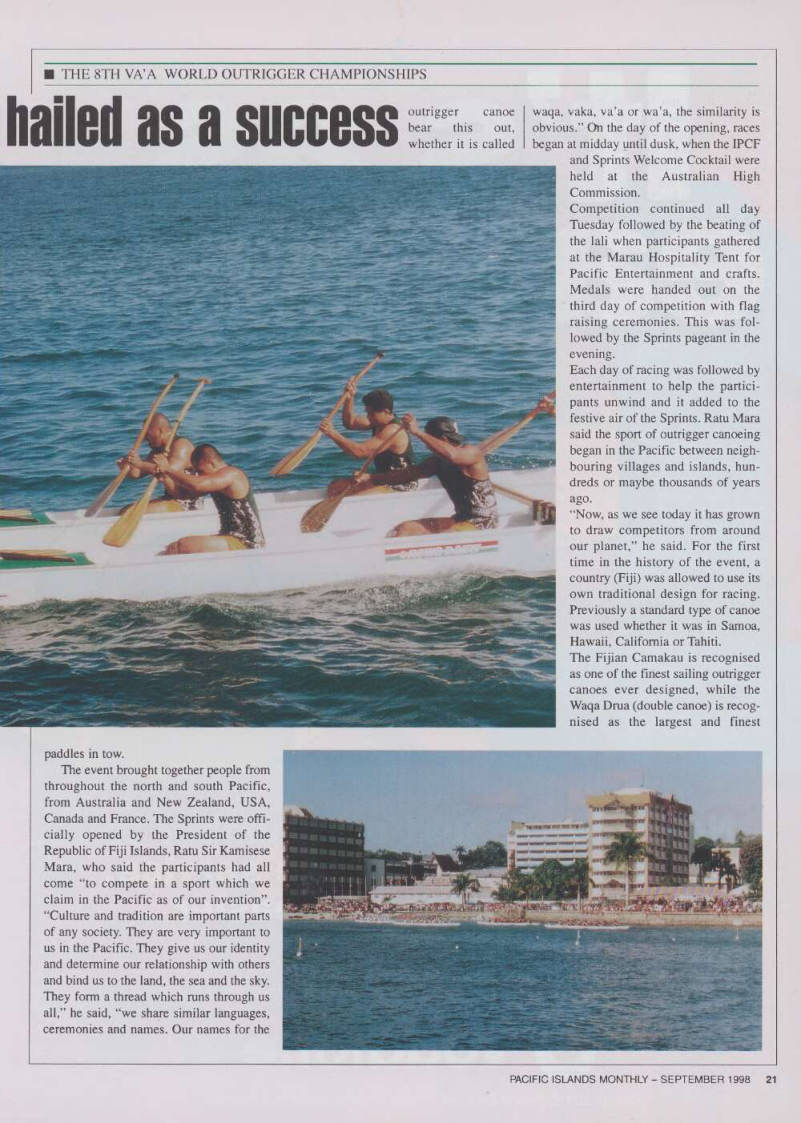
EVEN before the first day of racing was over, the Bth Va’a World Sprints were being hailed as a success. Held in the capital of Fiji, Suva, the event coincided with Fiji’s school hol idays and the annual Hibiscus Festival.
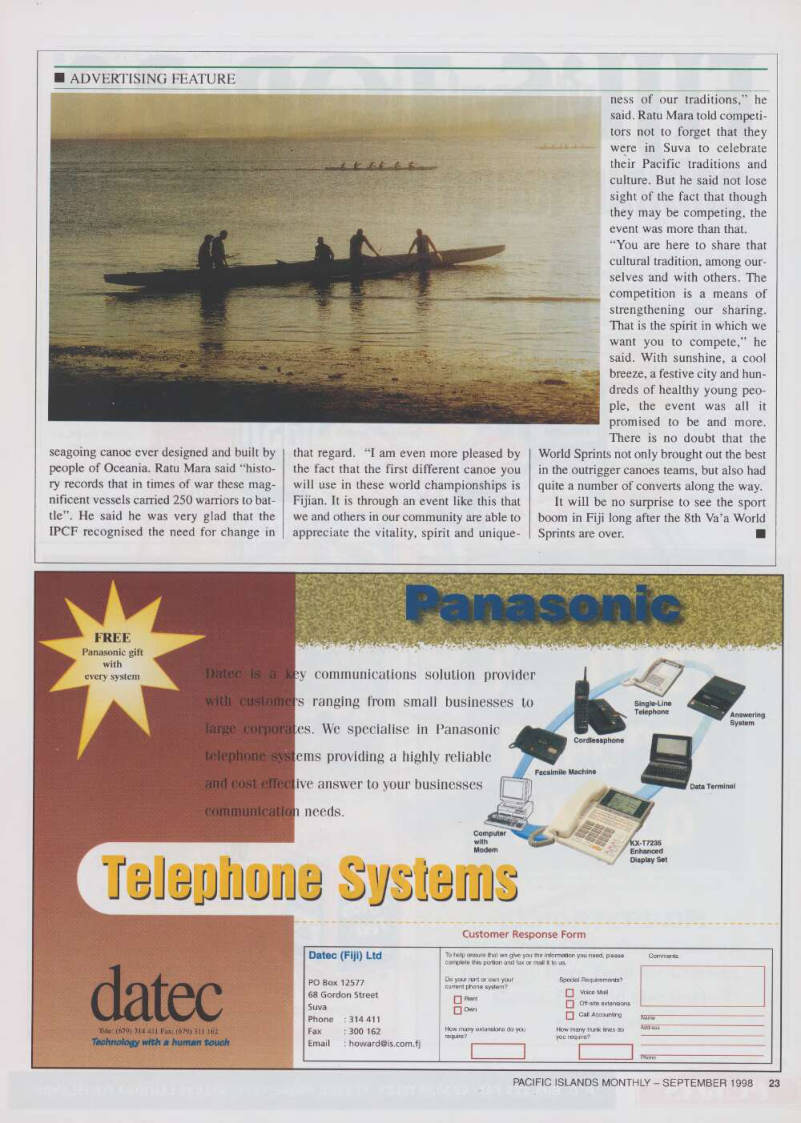
Hundreds of people made up the crowd that flocked to Suva’s waterfront to see one of the oldest sports in the region, outrigger canoe racing, take place. Three days before racing kicked off, the Sprints were already gearing up with the blessing of the canoes and the paddle inspection at the Sprints village. During the opening of the Hibiscus Festival, participants from the various countries marched in the Hibiscus Sunset march with torches and
The 8Th Va’A World Outrigger Championships
paddles in tow.
The event brought together people from
throughout the north and south Pacific, from Australia and New Zealand, USA, Canada and France. The Sprints were offi cially opened by the President of the Republic of Fiji Islands, Ratu Sir Kamisese Mara, who said the participants had all come “to compete in a sport which we claim in the Pacific as of our invention”.
“Culture and tradition are important parts of any society. They are very important to us in the Pacific. They give us our identity and determine our relationship with others and bind us to the land, the sea and the sky.
They form a thread which runs through us all,” he said, “we share similar languages, ceremonies and names. Our names for the
outrigger canoe bear this out, whether it is called
waqa, vaka, va’a or wa’a, the similarity is obvious.” On the day of the opening, races began at midday until dusk, when the IPCF
and Sprints Welcome Cocktail were held at the Australian High Commission.
Competition continued all day Tuesday followed by the beating of the lali when participants gathered at the Marau Hospitality Tent for Pacific Entertainment and crafts.
Medals were handed out on the third day of competition with flag raising ceremonies. This was fol lowed by the Sprints pageant in the evening.
Each day of racing was followed by entertainment to help the partici pants unwind and it added to the festive air of the Sprints. Ratu Mara said the sport of outrigger canoeing began in the Pacific between neigh bouring villages and islands, hun dreds or maybe thousands of years ago.
“Now, as we see today it has grown to draw competitors from around our planet,” he said. For the first time in the history of the event, a country (Fiji) was allowed to use its own traditional design for racing.
Previously a standard type of canoe was used whether it was in Samoa, Hawaii, California or Tahiti.
The Fijian Camakau is recognised as one of the finest sailing outrigger canoes ever designed, while the Waqa Drua (double canoe) is recog nised as the largest and finest
seagoing canoe ever designed and built by people of Oceania. Ratu Mara said “histo ry records that in times of war these mag nificent vessels carried 250 warriors to bat tle”. He said he was very glad that the IPCF recognised the need for change in
that regard. “I am even more pleased by the fact that the first different canoe you will use in these world championships is Fijian. It is through an event like this that we and others in our community are able to appreciate the vitality, spirit and unique
ness of our traditions,” he said. Ratu Mara told competi tors not to forget that they were in Suva to celebrate their Pacific traditions and culture. But he said not lose sight of the fact that though they may be competing, the event was more than that.
“You are here to share that cultural tradition, among our selves and with others. The competition is a means of strengthening our sharing.
That is the spirit in which we want you to compete,” he said. With sunshine, a cool breeze, a festive city and hun dreds of healthy young peo ple, the event was all it promised to be and more.
There is no doubt that the
World Sprints not only brought out the best in the outrigger canoes teams, but also had quite a number of converts along the way.
It will be no surprise to see the sport boom in Fiji long after the Bth Va’a World Sprints are over. ■
Advertisements & other items, pp. 21-24 (2 items)
21
PACIFIC ISLANDS MONTHLY - SEPTEMBER 1998
■ ■ w® ■ ■ M
O vodafone
Now, there’s just one number to call for every Vodafone service. 123. It couldn’t be easier.
Vodafone Customer Care operates 24 hours a day and Seven days a week.
Call 123 from your Vodafone or 902 123 from any Telecom Fiji phone.
O vodafone
Calls to 123 (Customer Care) are charged at the standard Vodafone rate.
FREE
Panasonic gift
with
every system
Am Daiec is a key communications solution provider
ranging from small businesses to
We specialise in Panasonic
ems providing a highly reliable
and cost effec ive answer to your businesses
■■■i needs.
I TBlßphonß Syslbnj
Single-Line Telephone Answering System Cordlessphone Facsimile Machine Data Terminal - , Computer with -T7235 Modem Enhanced Display Set :: ■■■ *:‘V; Customer Response Form Tele; <679)314411 Fax: (679) 311 162 Technology with a human touch
Datec (Fiji) Ltd
PO Box 12577 68 Gordon Street Suva To help ensure that we give you the information you need, please complete this portion and fax or mail it to us.
Phone Fax Email 314 411 300 162
Do your rent or own your current phone system? f~~| Rent
□ Own
Special Requirements? Voice Mail PI Off-site extensions Call Accounting Name Address
FIJI’S TOP 20
: 'ui ri
filLjtop
m
iisnerfl
mmmiP
MIU
■feu; .. S
\ky y
U/inototi
SUPER
BRIGHT
o Bfc. 77 I. 1 ; ' i s? £L 1 i
i w srm
s mm s»« «60 - «M3«~s dJ°?f 7
«»S»s£B*!SSS^^
* mis ■7 ’■S6 W '^„. *m r 7V- If -■■ ■ V • tpp? '■■■ / / V/ 2V: / ... w S/ »« w* ■ i IB ■
i : TSO«L V**
/i M.
W( TJ niff 4 j / /y
punjas
P. 0. BOX 125 FAX: 663039 TELEX: FJ 5282 PHONE: (679) 661633 LAUTOKA FIJI ISLANDS.
Fiji Meat Board already

targeting export opportunities
INSTEAD of concentrating on one market area, the key to business success these days, many managers say, is not putting your eggs in one basket.
It was with this in mind, that many companies started to take advantage of preferential arrangements such as SPARTECA and the development of regional trade. There is no doubt that export is the way to go to create jobs and to create profit.
The general manager of the Fiji Meat Board and the Fiji Tannery, Mr Viliame Cegumalua says the Board is developing two major areas as part of its future plans.
The first is to upgrade the existing abat toir to export standards and the second
to revamp the Fiji Tannery to export high quality leather. He says the Fiji Meat Board would like to take advantage of the benefits sprung out of high-level discus sions in the Melanesian Spearhead Group.
Through the MSG, regional trade could soon be flourishing between Pacific Island countries, and Mr Cegumalua says it is an ideal opportunity to upgrade export stan dards. Fiji companies are in a perfect posi tion to export to PNG and other South Pacific island countries.
The Fiji Meat Board’s major target is to export beef but the company is putting a lot of effort into the export of pork prod ucts. The upgrade programme will not only target export but also improve its local standards for the domestic market. Mr
Cegumalua says the tannery is also cur
rently undergoing a major upgrade project
of about $500,000. This will mainly involve the purchase of new machines,
plants, training, upgrading of skills and
consistent production of quality and con sistent tanned leather.
The main objective is to produce a high quality product so that it will be competi tive at world market prices. Despite the Asian Crisis and devaluation of the Fiji dollar and downturn in the Fiji economy, he says the board is still committed to revamping the tannery. This will also offer greater opportunities for the company. The tannery will be able to accommodate pro vision of tanning facilities for clients from New Zealand and Australia. ■
Advertisements & other items, pp. 25-26 (1 item)
Exports I
I QUALITY I
PRODUCT I
LIMITED I
Registered Office: Baddal Place. Makoi Stage 2, PO Box 2446, Govt. Bldg., Suva. Phone: 395544, 395241,395741. Branch: Wainadoi, Navua. Phone: Navua 362211. Fax; 340755
EXPORTERS OF:
Root Crops (Dalo,Yams, Coconut, Cassava), Eggs, Feed for Chicken, Cattle, Pigs and also fresh vegetables.
fH i a ft.
Ram Sami‘s head office, feed millers, Sales & Distribution centre Y y Eggs loaded automatically before Eggs being candled before final The final packing stage candling packing
RAM SAMI & SONS LIMITED
Registered Office: Baddal Place, Makoi Stage 2, PO Box 2446, Govt. Bldg., Suva. Phone: 395544, 395241,395741. Branch: Wainadoi, Navua. Phone: Navua 362211. Fax: 340755
The incredible edible with golden yolk
Poultry farmers and feed millers.
Fiji’s leading egg producers & distributors.
Suppliers of: Farm fresh eggs, Live chicken plus Livestock feed, Poultry manure.
Our supply vehicles drive around Viti Levu and alsoVanua Levu. •We welcome standing orders from:
*MOTELS
*SHIPS *SUPERMARKETS *NEIGH-
BOURING ISLAND COUNTRIES
DIRECT ALL TRADE INQUIRIES TO OUR SALES DEPARTMENT START THE DAY WITH REAL FRESH EGGS
(( LE ))
Ono company
boliovoo
providing
unbeatable
value is part of
the service
At Ba Industries we’re committed to provide reliable service to cutomers by offering quality hot dip galvanised nails and
fencing products.
Evidences of commitment to excellence. • Exporter of the Year Award (B&l) winner 1993, 1994 & 1996 • Winner of the Prime Minister’s Award 1995 • Only locally owned wire/fence product manufacturer to be ISO 9002 certified since 1995 • Only company to install Hot Dip Galvanising Plant and be awarded overseas membership of Galvanisers Association of Australia.
NY risoY 9002
SGS
1993, 1994 & 1996
BA INDUSTRIES LTD
P.0.80X 707, BA, FIJI ISLANDS
PHONE: (679) 674966, 674656, 676023
FAX: (679) 676700
E-MAIL: [email protected]
Export-led growth:

the way forward
WITH the opening up of the Pacific region to other island countries as part of creating a “Pacific trade zone”, the importance of gearing your business to competitive export standards cannot be underesti mated.
Creating a vibrant private sector has always been the goal of many successive governments in Fiji and many other Pacific Island countries. This helps create jobs, increase Gross Domestic Product, and increase standards of living.
But, the private sector has to be ready for
the changes that opening up markets will certainly cause.
One of the big concerns is the slow ero sion of privileges under agreements such as SPARTECA and the Lome Convention.
Fiji’s High Commissioner to Australia, Mr Isikeli Mataitoga says there are many options for when such changes come about.
Using the example of the future of the Fiji Textile, Clothing and Footwear indus try, he said Rules of Origin (ROO’s) under SPARTECA will soon be irrelevant.
“In discussing what the future may hold for ROO’s - let us not forget by year 2010, the tariff reductions in Australia in almost
■ Fiji-Made Products For Export
all tradable goods coming off-shore will be zero tariff.
“When that position materialises, the rate of ROO would be irrelevant because other similar TCP products would enter the Australian market cheaply from Asia.
“What Fiji TCP should be looking at is to see ROO’s relaxation now that is condi tional to achieving certain outcomes.
These outcomes, when delivered, will reposition Fiji TCP with a competitive edge in markets, other than Australia, on the global environment.
“The changes within Fiji TCP that needs to take place have started taking place in some of the TCP companies; what is needed is for the whole industry to move to implement the changes,” he said.
Clearly, Pacific Island countries, Fiji included, cannot keep holding out for spe cial treatment. If there was ever a time to gear companies for export in competitive markets, it is now.
With most of Fiji’s big markets, such as Australia and New Zealand, moving towards implementing their World Trade Organisation commitments, anything that looks like a subsidy will soon be ancient
history.
There is no doubt, that agreements such as SPARTECA have given Pacific Island companies a chance to improve their posi tion and to gear themselves towards effi cient and quality operations.
Even some Australian companies have benefited through the Import Credit Scheme that was part of a larger package of tariff and other reforms.
“In practice the ICS created an incen
tive to export, by effectively subsidising
overseas purchases of Australian TCP products. This was not the aim of the scheme, rather its aim was to achieve a closer integration with the global industry by making the industry more trade-orient ed and capable of taking advantage of overseas opportunities,” Mr Mataitoga says.
Australian Leather Holdings says the ICS had: “... allowed ALH to accelerate investment in state-of-the-art technology e.g. computer controlled drums, automated water and chemical dosing systems, high technology waste water treatment and laser cutting machines for auto components...”
By providing more viable access to
export markets, the ICS had enabled small er companies to achieve scale economies.
As Bradmill Undare stated: "our ability to export is contingent on the existence of the ICS... without a strong viable export com ponent, our business will decrease, leading to increased costs, leading to fewer orders...”
The Australian Chamber of Manufacturers stated; “Over 80 per cent of firms surveyed stated that they support the continuation of the scheme. These firms either anticipate using the scheme in the near future, see the relevance of it to their future priorities and benefit from trading in credits”.
Norman Richie agreed that: “The Import Credit Scheme is a success and it has created jobs and export earnings.
It achieved its aim in encouraging export of our TCP products. Our TCP industry is now more outward looking and export driven”.
Under the scheme, TCP companies were able to cover marketing costs for export markets, invest in new technology and in product development.
Mr Mataitoga says, “the interaction of
the ICS and SPARTECA schemes, along with investment incentives offered by the Fiji government, have encouraged the development of the TCF industry in Fiji as we see today”.
The Fiji government agrees, saying: “The import credit scheme enabled manu facturers in Fiji to use Australian fabrics and leather at internationally competitive prices.
This scheme combined with duty free access into Australia enabled Fiji TCF manufacturers a genuine preference into Australia”.
However, the boom in exports has been brought about, there is one reality for post 2000 - markets will be opening up and to survive, let alone compete, Pacific compa nies will have to gear themselves to global standards.
There are already many companies in Fiji that can confidently say that they will not have a problem post 2000.
If Fiji, or any other Pacific Island coun try, is to progress, then it is these compa nies that will certainly lead the way with their exports. ■
Advertisements & other items, pp. 26-27 (1 item)
-
■ is ? i.
Our export quality leathers are geared to meet any of your needs, whether for footwear, handbags, leather belts, accessories or craft.
Our tanning processes include vegetable cures, chrome and printed leathers. We support the local manufacturers and also export to Hong Kong, Australia, Tonga and Papua New Guinea.
FIJI MEAT INDUSTRY BOARD
For further details please contact The General Manager, Mr Viliame Cegumalua, Suva Abattoir Complex, Nasinu 91/2 miles. PO Box 8070, Nakasi, Fiji Islands.
Phone: (679) 410481. Fax: (679) 410024
- „ A ■’ '
WATER WE
anufacturer’s of Lyc
Wetsuits of anyfind
For Local and Export Enquiries - Contact P.0.80x 2154 Nadi, Fiji Islands Phone/Fax: (679) 724292 mmm
ear
n
Quality exports
to the Pacific
WITH over two years experience in exports, Quality Product Export Limited has made a marvellous impact on the export business in Fiji. The company, a subsidiary of Ram Sami and Sons, is located in Suva, Fiji. It exports its products throughout the Pacific and Pacific Rim from the Fiji base. Apart from Pacific Island countries, the company has also started exporting its products to Australia and New Zealand. The major products of Quality Product Export Ltd are root crops, fish produce, eggs, feed for chicken, cattle or pigs, and most recently, biscuits. The company is looking towards
expanding its regional market share and wants to achieve better business in the Pacific. Company director, Rajendra Sami says the company welcomes orders for any kind of product needed in the region.
Mr Sami says future prospects for the company lie in the United States market, where he wishes to export later. With approximately 60 contract workers and five management officers, the company promises to fulfil clients needs while maintaining quality of products too. As a major exporter of quality products from Fiji, Mr Sami says the company should have no difficulty in expanding its export orders and he looks forward to doing bet ter business in the export industry. ■
Advertisements & other items, p. 28 (1 item)
daivm
DAWN BRAND SPICES AND GRAINS
Full range of whole grains - Moong, Ghana Split Dhais of Peas, Moong, Urld, Ghana and many more
DAWN and MADRAS BRAND SPICES
Premium quality Indian Garam Masala Hot Pulau Masala, Curry Powder, Tea Masala Tumeric Powder (Haldi) and Chilli Powder POOJA ITEMS - Hanuman Flags & Pooja Packets Dawn has the experience of 30 years in Grains and Spices Manufactured, packed and exported by:
SPS HILLERS LTD
2 DANIVA ST, PO Box 182
Phone: (679) 660533 Fax: (679) 661543
LAUTOKA, FIJI ISLANDS.
ADDING SPICE TO YOUR LIFE
not to handle Independence
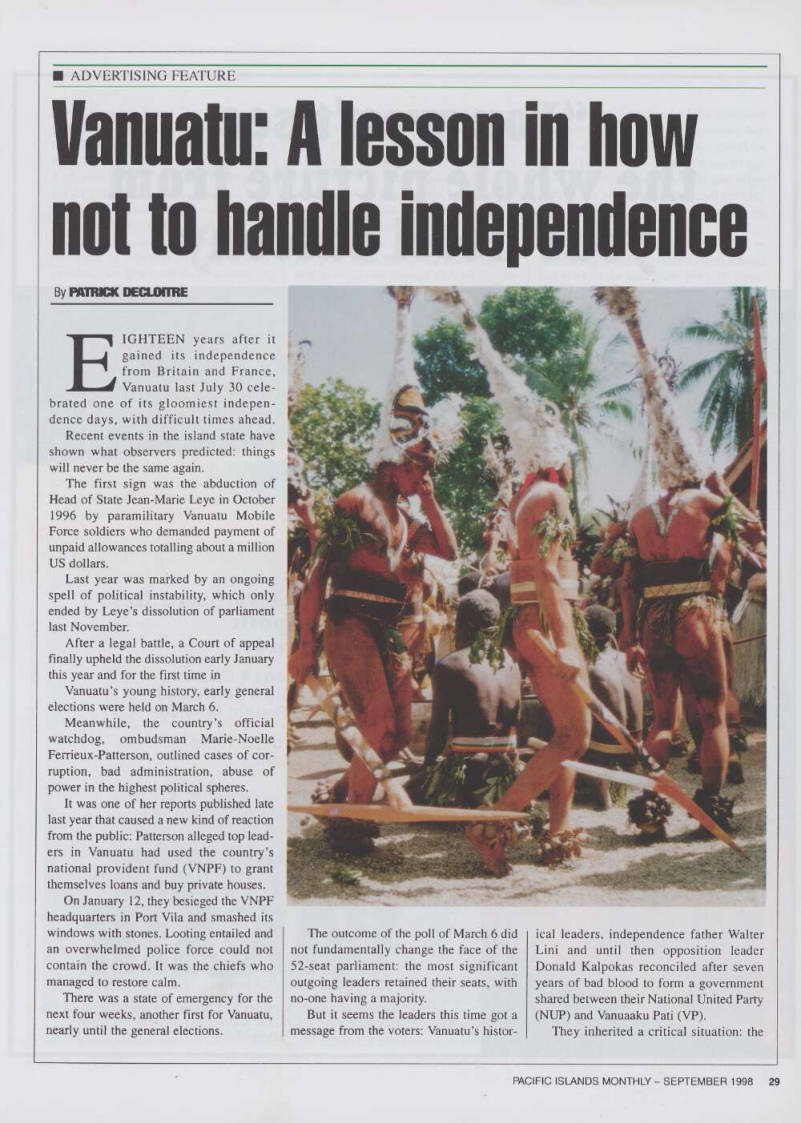
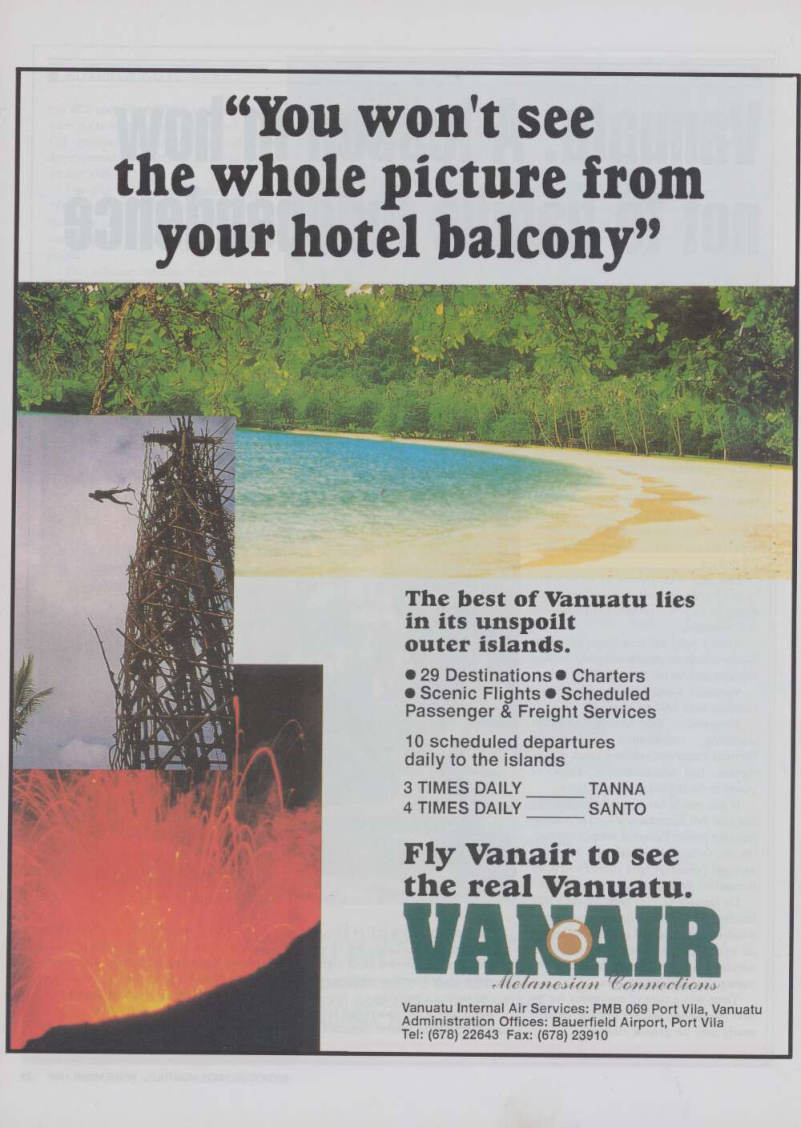
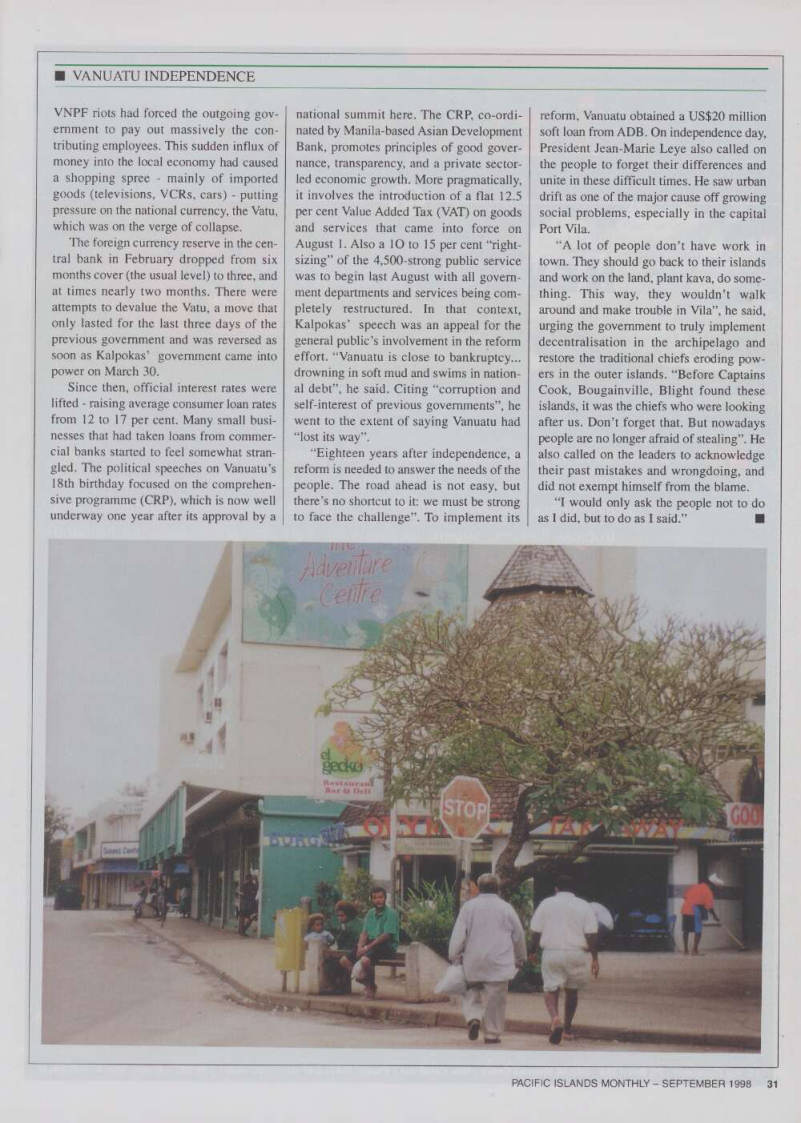
Vanuatu: A lessen in bow not to handle Independence
By Patrick Decloitre
EIGHTEEN years after it
gained its independence
from Britain and France, Vanuatu last July 30 cele brated one of its gloomiest indepen dence days, with difficult times ahead.
Recent events in the island state have shown what observers predicted: things will never be the same again.
The first sign was the abduction of Head of State Jean-Marie Leye in October 1996 by paramilitary Vanuatu Mobile Force soldiers who demanded payment of unpaid allowances totalling about a million US dollars.
Last year was marked by an ongoing
spell of political instability, which only
ended by Leye’s dissolution of parliament last November.
After a legal battle, a Court of appeal finally upheld the dissolution early January this year and for the first time in Vanuatu’s young history, early general elections were held on March 6.
Meanwhile, the country’s official watchdog, ombudsman Marie-Noelle Ferrieux-Patterson, outlined cases of cor ruption, bad administration, abuse of
power in the highest political spheres.
It was one of her reports published late last year that caused a new kind of reaction from the public; Patterson alleged top lead ers in Vanuatu had used the country’s national provident fund (VNPF) to grant themselves loans and buy private houses.
On January 12, they besieged the VNPF headquarters in Port Vila and smashed its windows with stones. Looting entailed and an overwhelmed police force could not contain the crowd. It was the chiefs who managed to restore calm.
There was a state of emergency for the next four weeks, another first for Vanuatu, nearly until the general elections.
The outcome of the poll of March 6 did not fundamentally change the face of the 52-seat parliament: the most significant outgoing leaders retained their seats, with no-one having a majority.
But it seems the leaders this time got a message from the voters: Vanuatu’s histor
ical leaders, independence father Walter Lini and until then opposition leader Donald Kalpokas reconciled after seven years of bad blood to form a government shared between their National United Party (NUP) and Vanuaaku Pati (VP).
They inherited a critical situation: the
VNPF riots had forced the outgoing gov ernment to pay out massively the con tributing employees. This sudden influx of money into the local economy had caused a shopping spree - mainly of imported goods (televisions, VCRs, cars) - putting pressure on the national currency, the Vatu, which was on the verge of collapse.
The foreign currency reserve in the cen tral bank in February dropped from six months cover (the usual level) to three, and at times nearly two months. There were attempts to devalue the Vatu, a move that only lasted for the last three days of the previous government and was reversed as soon as Kalpokas’ government came into power on March 30.
Since then, official interest rates were lifted - raising average consumer loan rates from 12 to 17 per cent. Many small busi nesses that had taken loans from commer cial banks started to feel somewhat stran gled. The political speeches on Vanuatu’s 18th birthday focused on the comprehen sive programme (CRP), which is now well underway one year after its approval by a
national summit here. The CRP, co-ordi nated by Manila-based Asian Development Bank, promotes principles of good gover nance, transparency, and a private sector led economic growth. More pragmatically, it involves the introduction of a flat 12.5 per cent Value Added Tax (VAT) on goods and services that came into force on August 1. Also a 10 to 15 per cent “right sizing” of the 4,500-strong public service was to begin last August with all govern ment departments and services being com pletely restructured. In that context, Kalpokas’ speech was an appeal for the general public’s involvement in the reform effort. “Vanuatu is close to bankruptcy... drowning in soft mud and swims in nation al debt”, he said. Citing “corruption and self-interest of previous governments”, he went to the extent of saying Vanuatu had “lost its way”.
“Eighteen years after independence, a reform is needed to answer the needs of the people. The road ahead is not easy, but there’s no shortcut to it: we must be strong to face the challenge”. To implement its
reform, Vanuatu obtained a US$2O million soft loan from ADB. On independence day, President Jean-Marie Leye also called on the people to forget their differences and unite in these difficult times. He saw urban drift as one of the major cause off growing
social problems, especially in the capital
Port Vila.
“A lot of people don’t have work in town. They should go back to their islands and work on the land, plant kava, do some thing. This way, they wouldn’t walk around and make trouble in Vila”, he said, urging the government to truly implement decentralisation in the archipelago and restore the traditional chiefs eroding pow ers in the outer islands. “Before Captains Cook, Bougainville, Blight found these islands, it was the chiefs who were looking after us. Don’t forget that. But nowadays people are no longer afraid of stealing”. He also called on the leaders to acknowledge their past mistakes and wrongdoing, and did not exempt himself from the blame.
“I would only ask the people not to do as I did, but to do as I said.” ■
Advertisements & other items, pp. 30-32 (1 item)
your hotel balcony”
“You won't see
the whole picture from
... y m Ja w. t'M & mm M* m m The best of Vanuatu lies In Its unspoilt outer islands. • 29 Destinations# Charters • Scenic Flights • Scheduled Passenger & Freight Services 10 scheduled departures daily to the islands
3 TIMES DAILY
4 TIMES DAILY
TANNA
SANTO
V km 1
Fly Vanair to see
the real Vanuatu.
ie muicatoite 9 Vanuatu Internal Air Services: PMB 069 Port Vila, Vanuatu Administration Offices: Bauerfield Airport, Port Vila Tel: (678) 22643 Fax: (678) 23910
OP Photos : Mant - Pantz - Trompas
4Sh-r—
-. „ ' ' •• *• ’ ' ... .V:-
©Ate®®™
r;--i >■■:■•©>■ :®®.. SsK«sa^ss^&A : •■■ ‘ • • "! 1 ’• - I '"’
New Caledonia is a developped, sophisticated island business base that offers outstanding opportunities for investors : stunning sites for new hotel developments, suitable climate for counterseason fruits, vegetables and tropical flowers, superb locations for fish and prawn aquaculture, and more. Authorities in New Caledonia are very supportive to business.
ADECAL, the Economic Development Agency of New Caledonia, is the one-stop shop where investors can get specific advice on doing business in New Caledonia.
As your free-of-charge partner, we shall assist you in identifying opportunities and putting together your project successfully.
Should you like to receive further information, please do not hesitate to contact either Yann PITOLLET or Benoft RENGADE.
E-mail: [email protected] a nrr a i
/ V L/ VL.
New Caledonia Economic Development Bureau 15, rue Guynemer • PO Box 2384 • 98846 Noumea Cedex - New Caledonia - Phone: (687) 249 077 - Fax: (6871 249 087 - E-mail: [email protected]
COjJgEPT 1998 ; (687) 275 566
New Caledonia update
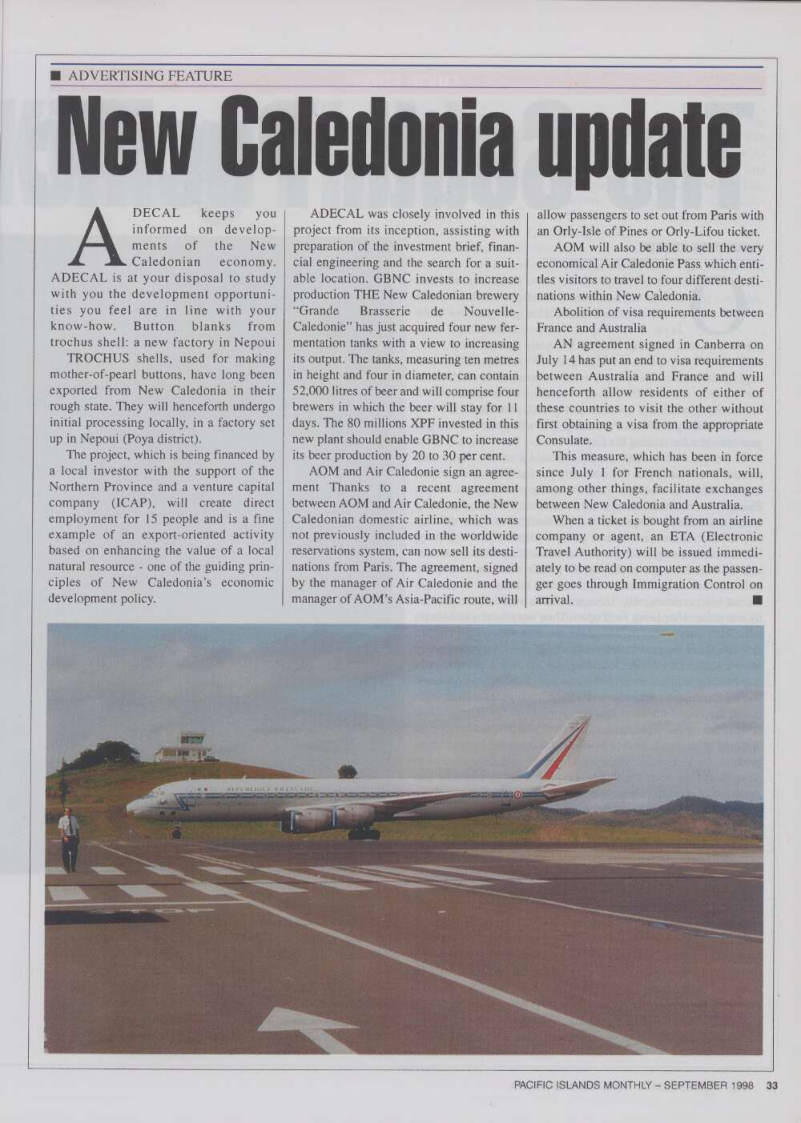
ADECAL keeps you informed on develop ments of the New Caledonian economy.
ADECAL is at your disposal to study with you the development opportuni ties you feel are in line with your know-how. Button blanks from trochus shell: a new factory in Nepoui TROCHUS shells, used for making mother-of-pearl buttons, have long been exported from New Caledonia in their rough state. They will henceforth undergo initial processing locally, in a factory set up in Nepoui (Poya district).
The project, which is being financed by a local investor with the support of the Northern Province and a venture capital company (ICAP), will create direct employment for 15 people and is a fine example of an export-oriented activity based on enhancing the value of a local natural resource - one of the guiding prin ciples of New Caledonia’s economic development policy.
ADECAL was closely involved in this project from its inception, assisting with preparation of the investment brief, finan cial engineering and the search for a suit able location. GBNC invests to increase production THE New Caledonian brewery “Grande Brasserie de Nouvelle- Caledonie” has just acquired four new fer mentation tanks with a view to increasing its output. The tanks, measuring ten metres in height and four in diameter, can contain 52,000 litres of beer and will comprise four brewers in which the beer will stay for 11 days. The 80 millions XPF invested in this new plant should enable GBNC to increase its beer production by 20 to 30 per cent.
AOM and Air Caledonie sign an agree ment Thanks to a recent agreement between AOM and Air Caledonie, the New Caledonian domestic airline, which was not previously included in the worldwide reservations system, can now sell its desti nations from Paris. The agreement, signed by the manager of Air Caledonie and the manager of AOM’s Asia-Pacific route, will
allow passengers to set out from Paris with an Orly-Isle of Pines or Orly-Lifou ticket.
AOM will also be able to sell the very economical Air Caledonie Pass which enti tles visitors to travel to four different desti nations within New Caledonia.
Abolition of visa requirements between France and Australia AN agreement signed in Canberra on July 14 has put an end to visa requirements between Australia and France and will henceforth allow residents of either of these countries to visit the other without first obtaining a visa from the appropriate Consulate.
This measure, which has been in force since July 1 for French nationals, will, among other things, facilitate exchanges between New Caledonia and Australia.
When a ticket is bought from an airline company or agent, an ETA (Electronic Travel Authority) will be issued immedi ately to be read on computer as the passen ger goes through Immigration Control on arrival. ■
The South Pacific
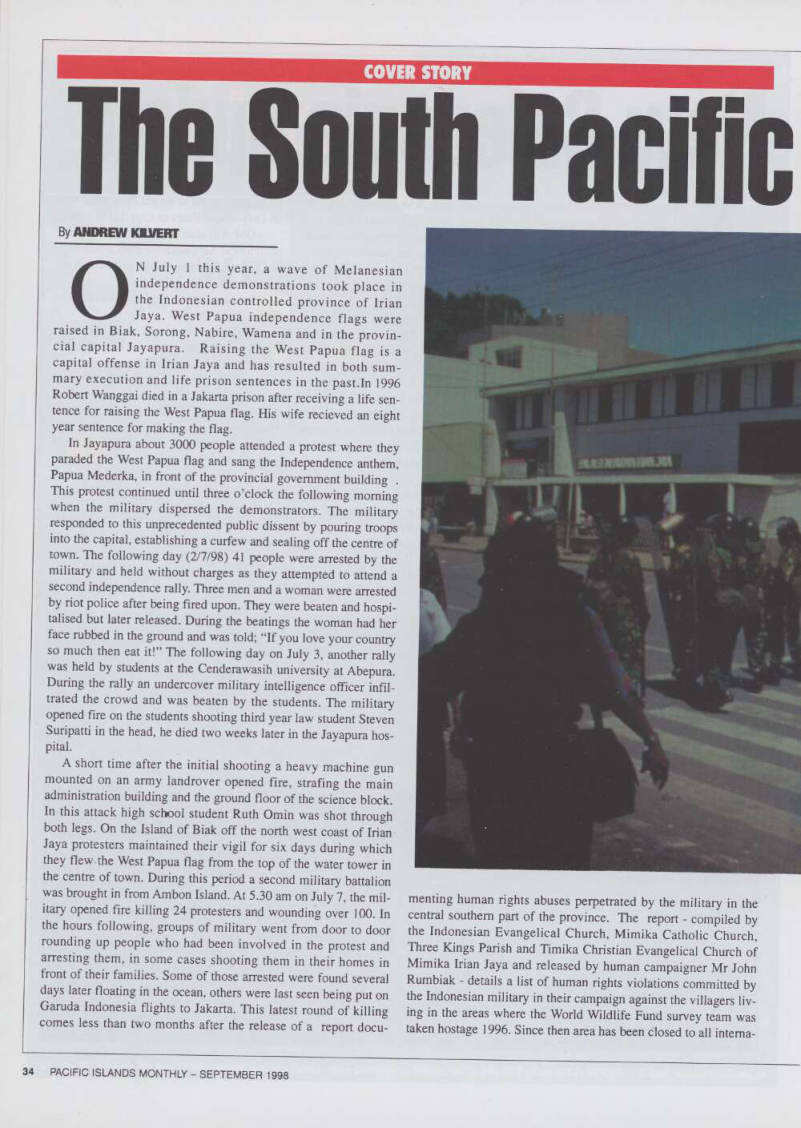
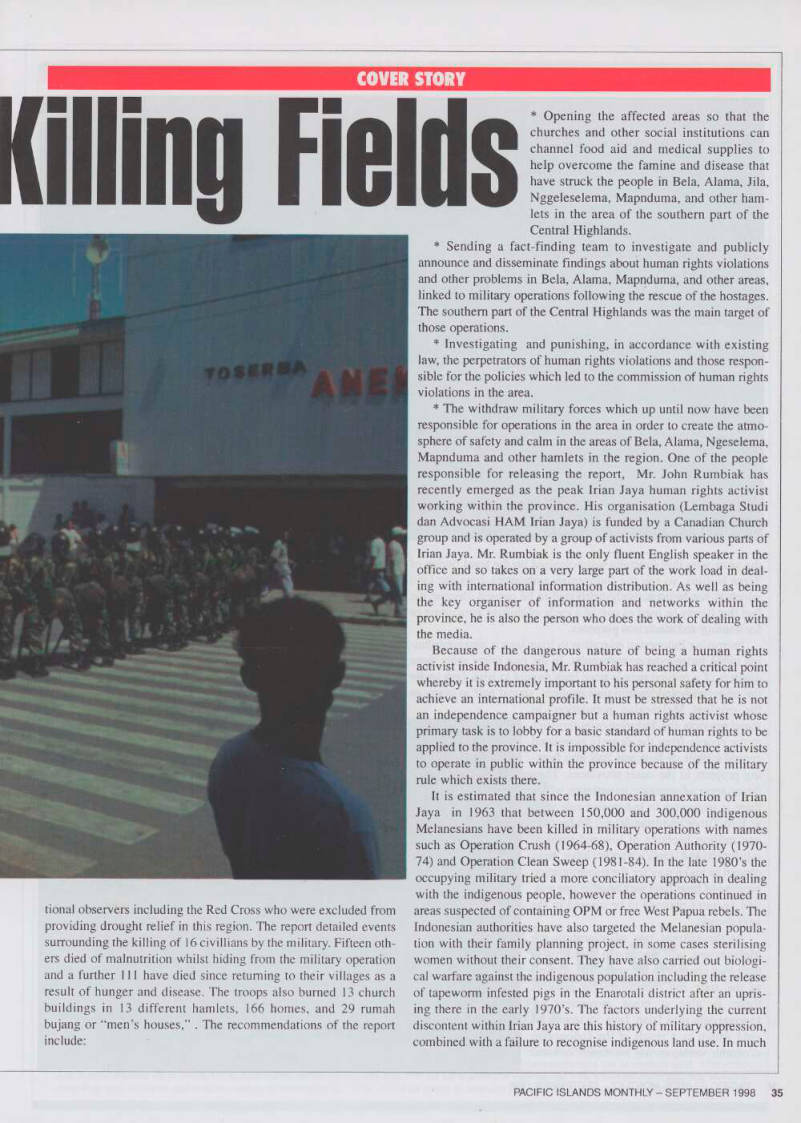
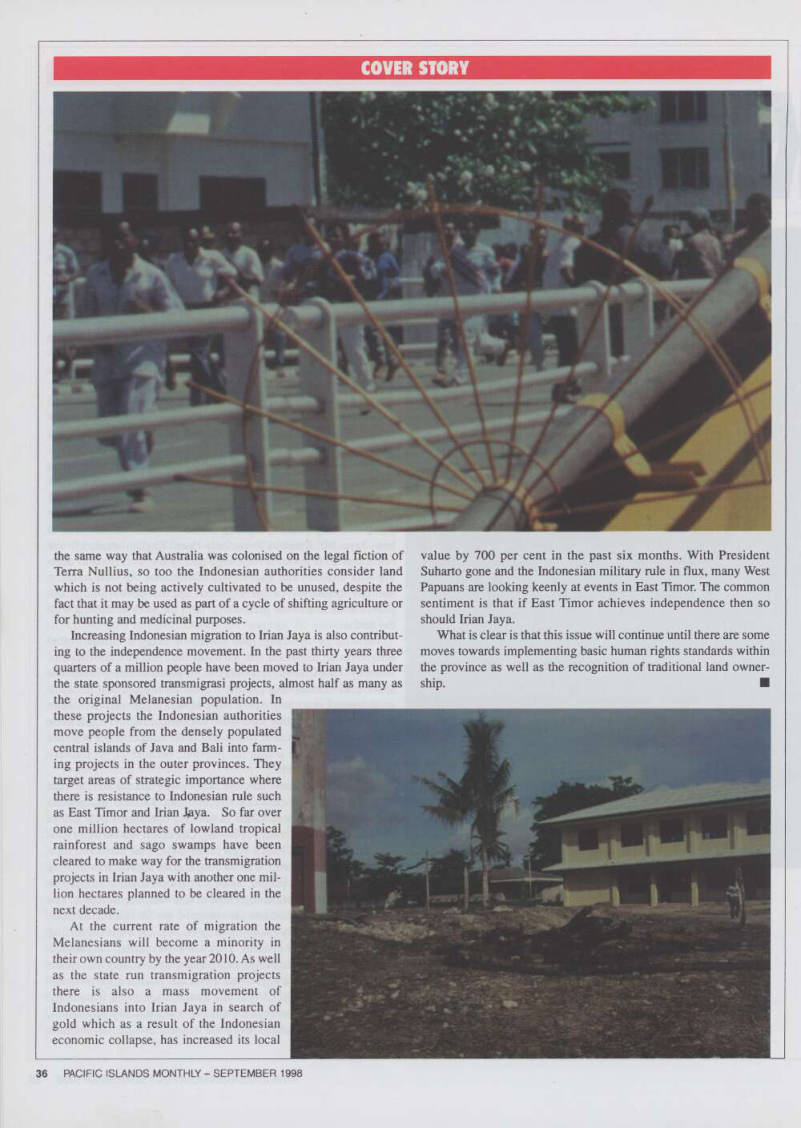
Cover Story
By Andrew Kilvert
ON July 1 this year, a wave of Melanesian independence demonstrations took place in the Indonesian controlled province of Irian Jaya. West Papua independence flags were raised in Biak, Sorong, Nabire, Wamena and in the provin cial capital Jayapura. Raising the West Papua flag is a capital offense in Irian Jaya and has resulted in both sum mary execution and life prison sentences in the past.ln 1996 Robert Wanggai died in a Jakarta prison after receiving a life sen tence for raising the West Papua flag. His wife recieved an eight year sentence for making the flag.
In Jayapura about 3000 people attended a protest where they paraded the West Papua flag and sang the Independence anthem, Papua Mederka, in front of the provincial government building This protest continued until three o’clock the following morning when the military dispersed the demonstrators. The military responded to this unprecedented public dissent by pouring troops into the capital, establishing a curfew and sealing off the centre of town. The following day (2/7/98) 41 people were arrested by the military and held without charges as they attempted to attend a second independence rally. Three men and a woman were arrested by riot police after being fired upon. They were beaten and hospi talised but later released. During the beatings the woman had her face rubbed in the ground and was told; “If you love your country so much then eat it!” The following day on July 3, another rally was held by students at the Cenderawasih university at Abepura.
During the rally an undercover military intelligence officer infil trated the crowd and was beaten by the students. The military opened fire on the students shooting third year law student Steven Suripatti in the head, he died two weeks later in the Jayapura hos pital.
A short time after the initial shooting a heavy machine gun mounted on an army landrover opened fire, strafing the main administration building and the ground floor of the science block.
In this attack high school student Ruth Omin was shot through both legs. On the Island of Biak off the north west coast of Irian Jaya protesters maintained their vigil for six days during which they flew the West Papua flag from the top of the water tower in the centre of town. During this period a second military battalion was brought in from Ambon Island. At 5.30 am on July 7, the mil itary opened fire killing 24 protesters and wounding over 100. In the hours following, groups of military went from door to door rounding up people who had been involved in the protest and arresting them, in some cases shooting them in their homes in front of their families. Some of those arrested were found several days later floating in the ocean, others were last seen being put on Garuda Indonesia flights to Jakarta. This latest round of killing comes less than two months after the release of a report docu-
menting human rights abuses perpetrated by the military in the central southern part of the province. The report - compiled by the Indonesian Evangelical Church, Mimika Catholic Church, Three Kings Parish and Timika Christian Evangelical Church of Mimika Irian Jaya and released by human campaigner Mr John Rumbiak - details a list of human rights violations committed by the Indonesian military in their campaign against the villagers liv ing in the areas where the World Wildlife Fund survey team was taken hostage 1996. Since then area has been closed to all intema
tional observers including the Red Cross who were excluded from providing drought relief in this region. The report detailed events surrounding the killing of 16 civillians by the military. Fifteen oth ers died of malnutrition whilst hiding from the military operation and a further 111 have died since returning to their villages as a result of hunger and disease. The troops also burned 13 church buildings in 13 different hamlets, 166 homes, and 29 rumah bujang or "men’s houses,” . The recommendations of the report include:
* Opening the affected areas so that the churches and other social institutions can channel food aid and medical supplies to help overcome the famine and disease that have struck the people in Bela, Alama, Jila, Nggeleselema, Mapnduma, and other ham lets in the area of the southern part of the
Central Highlands.
* Sending a fact-finding team to investigate and publicly announce and disseminate findings about human rights violations and other problems in Bela, Alama, Mapnduma, and other areas, linked to military operations following the rescue of the hostages.
The southern part of the Central Highlands was the main target of those operations. * Investigating and punishing, in accordance with existing law, the perpetrators of human rights violations and those respon sible for the policies which led to the commission of human rights violations in the area. * The withdraw military forces which up until now have been responsible for operations in the area in order to create the atmo sphere of safety and calm in the areas of Bela, Alama, Ngeselema, Mapnduma and other hamlets in the region. One of the people responsible for releasing the report, Mr. John Rumbiak has recently emerged as the peak Irian Jaya human rights activist working within the province. His organisation (Lembaga Studi dan Advocasi HAM Irian Jaya) is funded by a Canadian Church group and is operated by a group of activists from various parts of Irian Jaya. Mr. Rumbiak is the only fluent English speaker in the office and so takes on a very large part of the work load in deal ing with international information distribution. As well as being the key organiser of information and networks within the province, he is also the person who does the work of dealing with the media.
Because of the dangerous nature of being a human rights activist inside Indonesia, Mr. Rumbiak has reached a critical point whereby it is extremely important to his personal safety for him to achieve an international profile. It must be stressed that he is not an independence campaigner but a human rights activist whose primary task is to lobby for a basic standard of human rights to be applied to the province. It is impossible for independence activists to operate in public within the province because of the military rule which exists there.
It is estimated that since the Indonesian annexation of Irian Jaya in 1963 that between 150,000 and 300,000 indigenous Melanesians have been killed in military operations with names such as Operation Crush (1964-68), Operation Authority (1970- 74) and Operation Clean Sweep (1981-84). In the late 1980’s the occupying military tried a more conciliatory approach in dealing with the indigenous people, however the operations continued in areas suspected of containing OPM or free West Papua rebels. The Indonesian authorities have also targeted the Melanesian popula tion with their family planning project, in some cases sterilising women without their consent. They have also carried out biologi cal warfare against the indigenous population including the release of tapeworm infested pigs in the Enarotali district after an upris ing there in the early 1970’5. The factors underlying the current discontent within Irian Jaya are this history of military oppression, combined with a failure to recognise indigenous land use. In much
the same way that Australia was colonised on the legal fiction of Terra Nullius, so too the Indonesian authorities consider land which is not being actively cultivated to be unused, despite the fact that it may be used as part of a cycle of shifting agriculture or for hunting and medicinal purposes.
Increasing Indonesian migration to Irian Jaya is also contribut ing to the independence movement. In the past thirty years three quarters of a million people have been moved to Irian Jaya under the state sponsored transmigrasi projects, almost half as many as
the original Melanesian population. In these projects the Indonesian authorities
move people from the densely populated
central islands of Java and Bali into farm ing projects in the outer provinces. They target areas of strategic importance where there is resistance to Indonesian rule such as East Timor and Irian J#ya. So far over one million hectares of lowland tropical rainforest and sago swamps have been cleared to make way for the transmigration projects in Irian Jaya with another one mil lion hectares planned to be cleared in the next decade.
At the current rate of migration the Melanesians will become a minority in their own country by the year 2010. As well as the state run transmigration projects there is also a mass movement of Indonesians into Irian Jaya in search of gold which as a result of the Indonesian economic collapse, has increased its local
value by 700 per cent in the past six months. With President Suharto gone and the Indonesian military rule in flux, many West Papuans are looking keenly at events in East Timor. The common sentiment is that if East Timor achieves independence then so should Irian Jaya.
What is clear is that this issue will continue until there are some moves towards implementing basic human rights standards within the province as well as the recognition of traditional land owner
ship. ■
Advertisements & other items, pp. 36-38 (2 items)
Cover Story
Notebook,
To Win an
IBM Pentium
Get the latest on political, business and social issues happening throughout the region every month, as well as the chance to win an IBM Pentium Notebook! Every 12issue subscription received before March 31st, 1999 will go into the draw. Subscribe to Pacific Islands Monthly today by calling (679) 304 111 or fax (679) 303 809/(679) 307 460.
Subscribe to The Source.
Pacific Islands Monthly
Conditions of Entry I.To enter, subscription must be made before March 31st, 1999 which automatically enters the subscriber into the draw for the Pentium Notebook Computer. ’.Entry is open to all subscribers except employees of The Fiji Times Ltd, Pacific Islands Monthly and Wilson Addison Ltd. 3-Subscribcrs need to subscribe for at least 12 months to qualify. 4 The winner of the Pentium Notebook will be published in the Pacific Islands Monthly Magazine, May Issue, 1999 and will be notified by registered mail. S.The winner will receive their prize within one month of the draw. 6,The prize must be taken as offered and is not redeemable. 7.1 n the event of any dispute the decision of the promoter is final and no correspondence will be entered into.
For almost 70 years, Pacific Islands Monthly has been and still is the authority on political, business and social issues within the Pacific. And now, every-12 month subscription received before the 31st of March, 1999, goes » into a draw to win an IBM Pentium Notebook*. You could even give a gift subscription to enter but it must be before the closing date. As well as the entry into the draw, you will also receive the latest news from the region. Fill in the subscription form below and send it along with payment to Pacific Islands Monthly, Subscription Department, PO Box 1167, Suva, Fiji. Or call PIM on (679) 304 111 or fax us on (679) 303 809/(679) 307 460.
Subscribe to The Source.
Pacific Islands Monthly
*Rates include Airspeeding to all destinations Conditions of Entry 1. To enter, subscriptions must be made before March 31st, 1999 which automatically enters the subscriber into the draw for the Pentium Notebook Computer. 2. Entry is open to all subscribers except employees of The Fiji Times Ltd, Pacific Islands Monthly, and Wilson Addison Ltd. 3- Subscribers need to subscribe for 12 months to qualify. 4. The winner of the Pentium Notebook will be published in Pacific Islands Monthly Magazine, May Issue. 1999 and will be notified by registered mail. 5. The winner will receive their prize within one month of the draw. 6. The prize must be taken as offered and is not redeemable. 7. In the event of any dispute the decision of the promoter is final and no correspondence will be entered into.
YES! I wish to subscribe to The Source and receive a chance to win an IBM Pentium Notebook Computer!
12 ISSUE
SUBSCRIPTION
Rate A Rate B Rate C Rate D Rate E This is a
n Renewal
□ □ □ □ □ Cheque/Bank Draft/Money Order made payable to Pacific Islands Monthly ] Please charge my credit card: (VISA / AMEX / MASTERCARD) Signature: Expiry date: Mr/Mrs/Ms: Delivery Address: Postal Address: □ New Subscription Country; Fax:
Samoan politics
Politics
Say a prayer for Samoan politics
By Chris Peteru
GIVEN Samoans’ devo tion to Jesus Christ, who would have thought the opening of a Prayer House would raise questions over whether the country’s political leaders were satanic, homosexual or worth
taking seriously any longer.
Built like a traditional Samoan meeting house, the US$5OO,OOO complex with seat ing for up to three hundred worshippers, rests on a hillside overlooking the capital Apia. Consistent with the Christian senti ments 74-year-old Tofilau Eti Alesana never tires of sharing, the complex was named “Samoa is founded on God” after the national motto.
The question the public wants answered is why a Prayer House was built in the face of a never-ending shortage of jobs and money. The view that not everyone in gov ernment was keen on the project emerged when Public Works boss Isikuki Punivalu spoke at the opening.
Departing from the standard govern ment line of “we built it, and you love it”, Punivalu raised a few eyebrows by saying the structure was built at “great inconve nience” to his department. Opposition lead er Tupua Tamasese stood up in parliament days later to question the way the tendering process was handled, and how US$5OO,OOO could go on what looked to be a prime min isterial whim.
Now a senior citizen, Alesana wears a pacemaker, and travels overseas frequently for medical check-ups. Tamasese asked whether the Prayer House could be some kind of legacy as the sun begins to set on Alesana’s career and health. The prime minister responded that it was a lot more
sinister than a legacy. He claimed the oppo sition leader was trying to kill him. “I know he is trying to make my heart die,” he stat ed, “only women and homosexuals spread such things”. Not only that, it was clear Tamasese had colluded with the Attorney General over financial details relating to the Prayer House. Concerning the Attorney General, the prime minister said: “if she wants to resign - resign”. As far as he was concerned, people told him the opposition leader was gay. Now here, he claimed, was proof. “He thinks he is smart. He wants to wreck everything the government does.
Satan is not going to win,” said Alesana, who moved a motion that Tupua be sus pended from parliament for a month.
Deputy PM Tuilaepa Malielegaoi explained the tendering was policy, not a law. The contractors were given the job as they had recently finished a similar build ing, a lounge for members of parliament. It was clamed that even if the building had been tendered in the usual manner, the same company would have been chosen.
Interspersed with that explanation, Malielegaoi alleged Tupua had committed incest, was an adulterer, and had threatened to assault the speaker. Responding to the public slandering, Tupua told overseas media, “I am not queer. If you ask people in the queer community here in Apia who know which MPs are queer, they will tell you”.
Through the fracas, he was asked several times by the prime minister and the speak er to apologise. Aware that there was noth ing to apologise for, Tamasese refused to cave in to the level of vulgarity the current administration had patented. His response lead to even more insults. “He is laughing, look the devil is laughing, you are cursed,” complained Alesana before withdrawing
his suspension motion.
Not surprisingly, cabinet reflected the dictatorial stranglehold over them by their two leaders. They made no attempt to restore order to one of the blackest days in Samoan politics. Although finance minister Tuilaepa Malielegaoi tabled funding for the complex in a supplementary budget that was passed, privately a government official questioned the legitimacy of the whole pro cedure. “Everyone knows there are lots of ways to fast-track what the government wants. To keep our jobs, we keep our heads down and do it,” she said.
The lessons from the latest political uproar have become clear to the electorate.
Forget traditional courtesies, Samoa’s power brokers can do whatever they want, while taking odious political behaviour to new heights. There could hardly be another Westminster-style parliament where an opposition leader could be called Satan, a homosexual, a dope smoker, a drunkard, and an adulterer who has committed incest, only to be told to apologise for asking per fectly legitimate questions.
Tamasese has lost the last four general elections. His opposition Samoa National
Development Party sports just eight seats.
While history will mark him down as a political loser, he has shown real courage in facing a government that has singled him out for a nauseating level of personal abuse.
“It is not nice when Tofilau says he is a man of God, but calls people like Tupua those bad things. If he was Christian, he would treat everyone how he would like to be treated - with respect,” says college stu dent Salesa Tui. Perhaps the real symbol ism of the Prayer House is that Samoa’s political leadership needs a large dose of divine guidance urgently. ■
new leaders?
Where are the new leaders?
By Florence Syme-Buchanan
When it comes to vot ing, Cook Islanders are more inclined to elect someone who is good at village clean-ups, belongs to sporting groups and goes to church.
Commission of inquiry chair laveta Short says Cook Islanders have to decide - MP’s who are good at community projects, or MP’s who understand complex national issues. Short says it’s some MP’s are out of their depth when it comes to handling important national issues. But it is these community workers who are most likely to get voted in. And while “he may be a very good man in the community, he may not be the best man for national politics and issues.” He says there’s no doubt many current MP’s are overwhelmed when it comes to dealing with complex issues.
“You can see that from the level of debate (in Parliament), the important national issues are obviously lost on a lot of mem bers.” Short doesn’t blame these MP’s. “ They are obviously very good people in their communities, but when you are talk ing about complex legal issues, or eco nomic issues, or international issues, it’s a different type of person we should be look ing for.” He says after the Commission’s intense educational programme targeting Cook Islanders here and in New Zealand, people will be better prepared to make up their minds on “who they think is best to handle those jobs.”
Short says at present an MP is likely to get voted in because he’s often seen weed ing and cleaning in the village rather than on his ability to handle the complex issues that go with governing a country. “An MP’s time is better spent studying Parliamentary bills instead of weeding and cleaning up their communities, but they have to do that to be visible to the people, you’ve got to be out there with your chain
saw.” But in the Cooks, he admits that vis ibility in the community is a big thing when it comes to being elected into power.
“It’s a waste of resources, but we insist our MP’s do that, we’ve got our politicians doing menial things” rather than address ing issues that are really important to the nation. Some concerns have also been
expressed by political and non-political
locals that no younger people are entering politics. At a recent ruling Cook Islands Party conference chairman of the party’s youth wing, Tangee Kokaua says at the opening he counted only five people “who can be categorised as youth.”
“We haven’t been encouraged to join, there was a Cook Islands Party Youth from 1977, but it was more of a dress-up, when we have elections we have a CIP youth, but after that, we are not involved in decision making.” Kokaua says this must change.
“The issue is getting us recognised as part of the party, we are seen as something convenient during election time and for us to be taken seriously, we have to be part of the decision making process,” says Kokaua. Asked to speak on economic growth at the conference, leading business man Brett Porter said it was “clearly devoid of a generation of people who should be here.” Porter who doesn’t get involved in party politics said that over the last 20 years, “the age of our politicians has increased by 20 years, this says there has been a lack of invigoration.” The Cook Islands Party holds 18 seats in the 25 mem ber Parliament.
“If this party is not to perish, and if it is to succeed, then it has to look at itself and see there is a need for invigoration, a new to bring in a new generation, a new group of leaders,” advised Porter. But none of the old leaders have given any indication that they will stand down at the next elections to make way for a newer generation that’s so obviously lacking in the Cook Islands Parliament. ■
The flight of political
reform - will it soar?
By Florence Syme-Buchanan
Once upon a time there lived a wise old man on a tiny islet called Vaiara in Manihiki.
Across Manihiki’s vast lagoon at Omoka atoll, lived a young man, who con sidered himself very clever and wanted to everyone to know that he was just as smart as the old man on Vaiara.
So he thought he would put the old man’s legendary wisdom to the test. He caught a small tern, and sailed to Vaiara to test the sage. The young planned to clasp the bird in the palm of his hands and ask the old man what he held. If the old man correctly guessed it was a bird, then his reputation was well earned. The younger man would then ask, “Is the bird alive or dead?” If the old man said alive, he would crush the small bird in his palms, killing it and if the sage guessed it was dead, the young man would set the bird free. Either way, the younger man thought he would win the riddle and prove himself cleverer.
“What is it that I hold in my hands,” asked the young man when he reached the sage. “A bird,” replied the old man. The young man thought, “Yes, what people say about the wisdom of this old man must be true.” “Is the bird alive or dead,” asked the young man. “My son, replied the old man, the bird is in your hands.”
The fate of that fragile bird can be likened to the concept of political reform, soon to be in the hands of the Cook Islands public. The question is, will Cook Islanders crush it or set it free? They will have this choice in a national referendum Prime Minister Sir Geoffrey Henry wants held shortly after the findings of a Commission of Inquiry into political reform has made
public its findings.
The three-man Commission is headed by laveta Short, himself a former Cabinet minister and more recently Cook Islands high commissioner in Wellington -a post he held for close to a decade. Professor Ron Crocombe, a well-published Pacific academic and scholar John Herrmann.
Both men have made their personal views on present Cook Islands governance clear.
But “we’re not here to impose our will on the people. Our task is to find out what people want,” Short assures.
Recently Short made headlines in weekly Cook Islands Press with comments denouncing the country’s current political system as too costly. Short’s views on the calibre of Parliamentary representation expressed the feelings of the majority of the informed public. But after being slammed by the opposition Democratic Alliance party for going public when the commission chair should “remain neutral”, Short accused this writer of misrepresenta tion and distorting the facts.
In a published response to Short’s com ments, this writer invited the Commission chairman to listen to the taped interview because he may have forgotten what he’d said.
That startling line trip-up aside, Short and his colleagues have a huge task ahead of them. And there’s little money and even less time. Within three months and NZSIOO,OOO, the Commission of inquiry into political reform aims to every Cook Islander aware of political systems and able to make informed decisions about the country’s political future.
The Commission has to compile infor mation on comparable countries and their political systems, then get this out to all islands in the group, including New
Zealand-based Cook Islanders. laveta Short says this is to make sure people have a fair idea of what a political system is and what different types there are to make comparisons.
He says there’s a danger in not educat ing people first before asking for their views. But an awareness programme tar geting all Cook Islanders will be a huge and difficult undertaking. The northern group reception of the AM station is poor and usually the Rarotonga based radio AKTIV can only be heard at night, if the weather is calm. Northerners get no cur rent newspapers, television and aren’t hooked up to the Internet.
The situation is marginally better in the southern islands where they do receive AM radio but only a handful of the daily and weekly newspapers are flown in. Even fewer people have access to email. The radio station rarely covers complex issues in its news service.
Targeting the 60,000 New Zealand based Cook Islanders won’t be easy with such a tiny budget. In the Cooks the cost of the present political system to the nation is at the forefront because of the present eco nomic depression. Short says the Commission can’t ignore the fundamentals of democracy.
“Representation of the people often costs more than we realise because of the nature of our islands.” Despite the eco nomic depression, Short says the time is right to review the country’s political sys tem and “make sure it is designed to give the optimum benefits.”
“We are so small, mistakes can cost us enormously.” The present system he says is too costly, the elections too unnecessari ly expensive and "there’s a lot of room for improvement.” “We unfortunately inherit
ed the Westminster type system that may be suitable for England and New Zealand, but we adopted that system without look ing at the uniqueness of our country, the size of our population and the division that it brought into the country.” He says the Commission wants to come up with some thing that does away with the divisions caused by party politics. laveta Short is believes the interest of the nation has yield ed to party politics.
He’s “fairly confident” that the prime minister and government will accept the Commission’s recommendations because of the demands for change made by Cook
Islands people.
The Commission’s findings are expect ed out in December. The prime minister wants public discussion on this before the national referendum. Sir Geoffrey hasn’t said whether the referendum will be held at the same time as next year’s general elections, which have to be held before August.
He was reported saying no money has been budgeted for the referendum and the next eight months would be “interesting.”
Because of the isolation of the islands and the lack of access to the media, some Cook Islanders are saying that Sir Geoffrey’s ref erendum plans will create more confusion
amongst people.
They recall the last referendum when government made little effort to fully inform people on the issues they were asked to have their say on. Because of this, only 5,707 of the 11,780 eligible voters, or 48%, actually put their ticks to the multiple referendum questions. This effectively kept the status quo on the country’s name, five-year Parliamentary term, national flag and national anthem.
Complaints have also been made that the referendum would be unnecessary because of the widespread consultation the Commission will undertake before making its recommendations on political reform. laveta Short disagrees saying when a nation is faced with change in its political system people must have their say if they want it or not.
And in three months time, every Cook Islander is supposed to have an informed opinion on whether they want political reforms in full flight bringing new chal lenges to the island state. Or the concept crushed, retaining a familiar, but expensive system. ■
Advertisements & other items, p. 41 (1 item)
H of political
PACIFIC ISLANDS MONTHLY - SEPTEMBER 1998
■ POLITICS
H of political - will it soap?
a halt after Parliament repeal
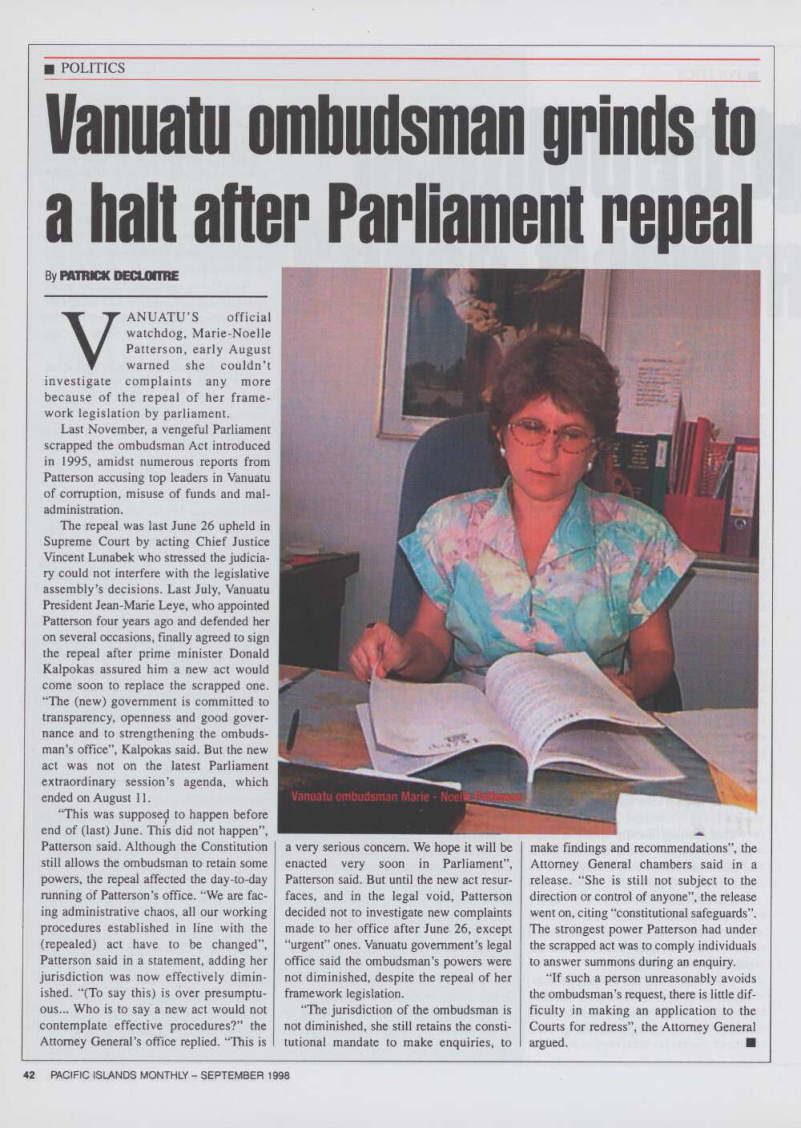
Vanuatu ombudsman grinds to a halt after Parliament repeal
By Patrick Decloitre
VANUATU’S official
watchdog, Marie-Noelle Patterson, early August warned she couldn’t investigate complaints any more because of the repeal of her frame work legislation by parliament.
Last November, a vengeful Parliament scrapped the ombudsman Act introduced in 1995, amidst numerous reports from Patterson accusing top leaders in Vanuatu of corruption, misuse of funds and mal administration.
The repeal was last June 26 upheld in Supreme Court by acting Chief Justice Vincent Lunabek who stressed the judicia ry could not interfere with the legislative assembly’s decisions. Last July, Vanuatu President Jean-Marie Leye, who appointed Patterson four years ago and defended her on several occasions, finally agreed to sign the repeal after prime minister Donald Kalpokas assured him a new act would come soon to replace the scrapped one.
“The (new) government is committed to transparency, openness and good gover nance and to strengthening the ombuds man’s office”, Kalpokas said. But the new act was not on the latest Parliament extraordinary session’s agenda, which ended on August 11.
“This was supposed to happen before end of (last) June. This did not happen”, Patterson said. Although the Constitution still allows the ombudsman to retain some powers, the repeal affected the day-to-day running of Patterson’s office. “We are fac ing administrative chaos, all our working procedures established in line with the (repealed) act have to be changed”, Patterson said in a statement, adding her jurisdiction was now effectively dimin ished. “(To say this) is over presumptu ous... Who is to say a new act would not contemplate effective procedures?” the Attorney General’s office replied. “This is
a very serious concern. We hope it will be enacted very soon in Parliament”, Patterson said. But until the new act resur faces, and in the legal void, Patterson decided not to investigate new complaints made to her office after June 26, except “urgent” ones. Vanuatu government’s legal office said the ombudsman’s powers were not diminished, despite the repeal of her
framework legislation.
“The jurisdiction of the ombudsman is not diminished, she still retains the consti tutional mandate to make enquiries, to
make findings and recommendations”, the Attorney General chambers said in a release. “She is still not subject to the direction or control of anyone”, the release went on, citing “constitutional safeguards”.
The strongest power Patterson had under the scrapped act was to comply individuals to answer summons during an enquiry.
“If such a person unreasonably avoids the ombudsman’s request, there is little dif ficulty in making an application to the Courts for redress”, the Attorney General argued. ■
Vauatu ombudsman Marie - Nolie Patterson
Advertisements & other items, p. 43 (1 item)
Trading Post
picnc us
Tf "f'li UN 1
TRADING POST CAN WORK
WONDERS FOR YOU...
Promote your business, or service, sell your household items, cars or heavy machinery etc.
ONLY AUS$2 (OR EQUIVALENT) PER WORD.
NO COMPANY LOGO. NO DISPLAY.
NO BOLD TYPE.
Just forward your Advertisement together with payment to:
PACIFIC ISLANDS MONTHLY "Trading Post",
PO Box 1167, Suva, Fiji.
Conditions: 1. All Advertisements are subject to acceptance and approval of publisher. 2. Advertisements are published as space permits; we cannot guarantee date of insertion. 3. All advertisements must be prepaid and should be typed or printed clearly 4. Deadline for receipt of advertisements is the 15th of the month prior to issue. 5. PACIFIC ISLANDS MONTHLY assumes no responsibility for any service other than publishing paid advertisements in this section.
Tasman "hijackers" capture Forum
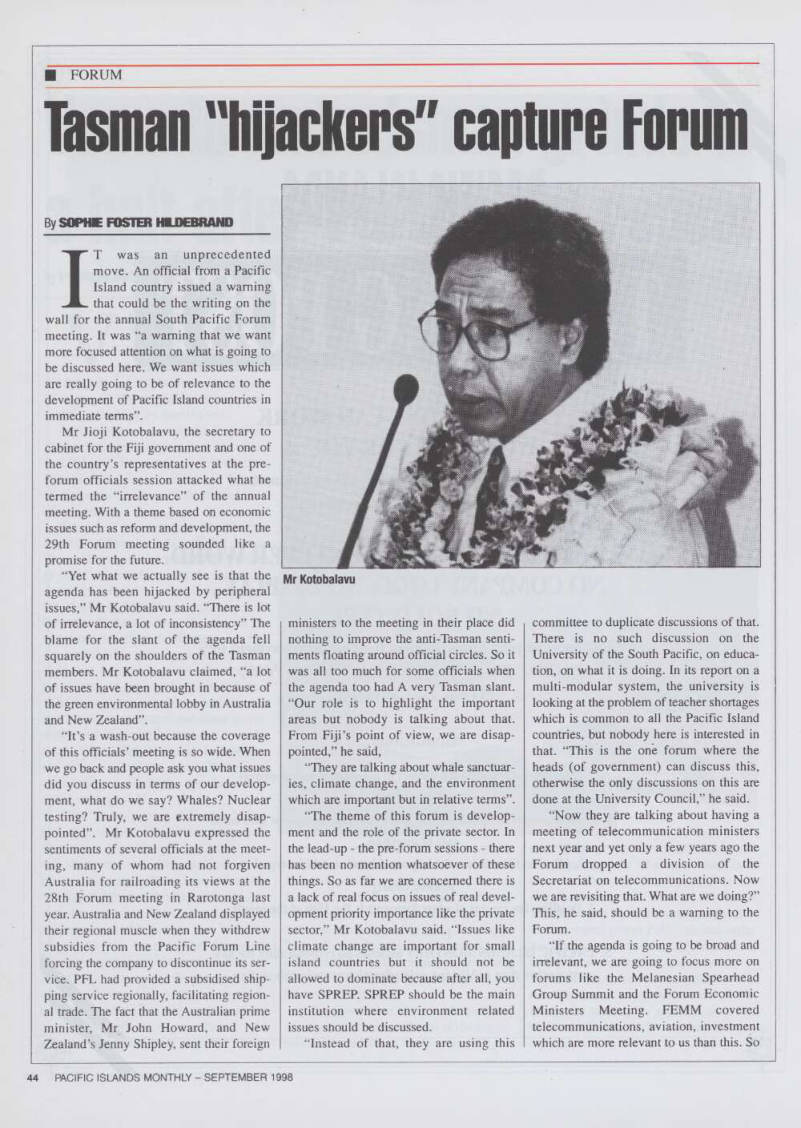
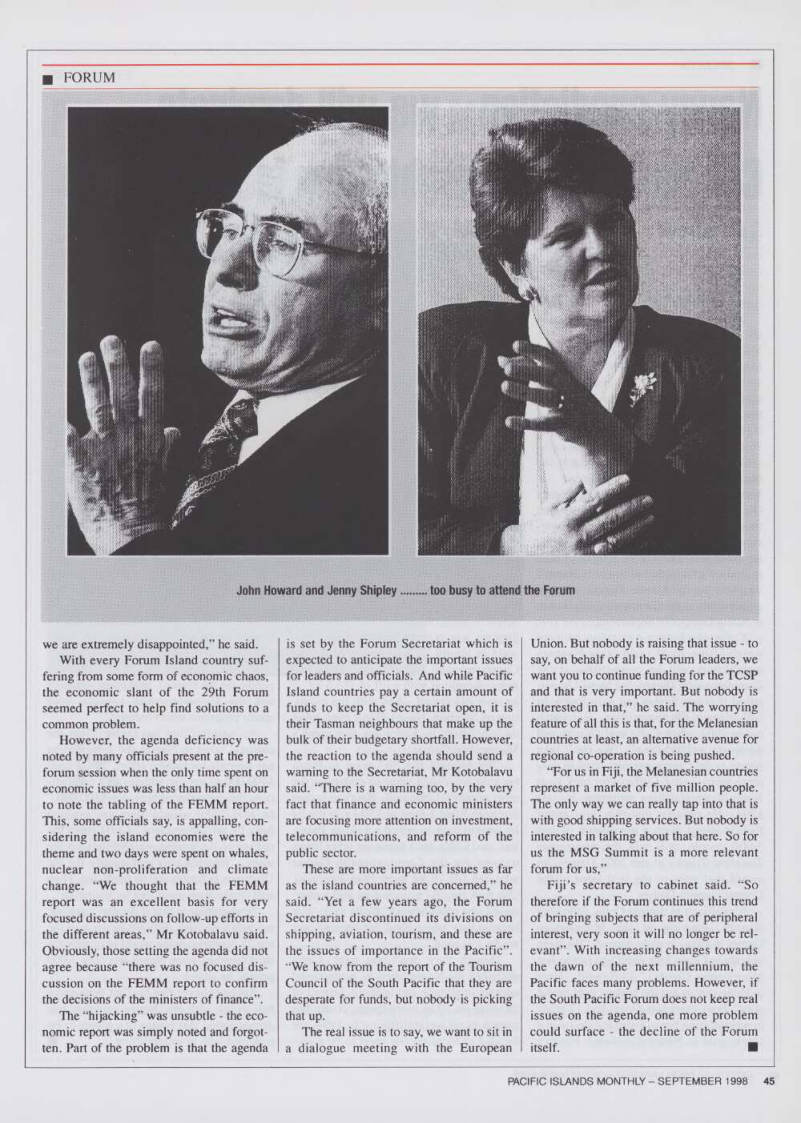
Forum
By Sophie Foster Hildebrand
IT was an unprecedented
move. An official from a Pacific Island country issued a warning that could be the writing on the wall for the annual South Pacific Forum meeting. It was “a warning that we want more focused attention on what is going to be discussed here. We want issues which are really going to be of relevance to the development of Pacific Island countries in immediate terms”.
Mr Jioji Kotobalavu, the secretary to cabinet for the Fiji government and one of the country’s representatives at the pre forum officials session attacked what he termed the “irrelevance” of the annual meeting. With a theme based on economic issues such as reform and development, the 29th Forum meeting sounded like a promise for the future.
“Yet what we actually see is that the agenda has been hijacked by peripheral issues,” Mr Kotobalavu said. “There is lot of irrelevance, a lot of inconsistency” The blame for the slant of the agenda fell squarely on the shoulders of the Tasman members. Mr Kotobalavu claimed, “a lot of issues have been brought in because of the green environmental lobby in Australia and New Zealand”.
“It’s a wash-out because the coverage of this officials’ meeting is so wide. When we go back and people ask you what issues did you discuss in terms of our develop ment, what do we say? Whales? Nuclear
testing? Truly, we are extremely disap
pointed”. Mr Kotobalavu expressed the sentiments of several officials at the meet ing, many of whom had not forgiven Australia for railroading its views at the 28th Forum meeting in Rarotonga last year. Australia and New Zealand displayed their regional muscle when they withdrew subsidies from the Pacific Forum Line forcing the company to discontinue its ser vice. PFL had provided a subsidised ship ping service regionally, facilitating region al trade. The fact that the Australian prime minister, Mr John Howard, and New Zealand’s Jenny Shipley, sent their foreign
ministers to the meeting in their place did nothing to improve the anti-Tasman senti ments floating around official circles. So it was all too much for some officials when the agenda too had A very Tasman slant.
“Our role is to highlight the important areas but nobody is talking about that.
From Fiji’s point of view, we are disap pointed,” he said, “They are talking about whale sanctuar ies, climate change, and the environment which are important but in relative terms”.
“The theme of this forum is develop ment and the role of the private sector. In the lead-up - the pre-forum sessions - there has been no mention whatsoever of these things. So as far we are concerned there is a lack of real focus on issues of real devel opment priority importance like the private sector,” Mr Kotobalavu said. “Issues like climate change are important for small island countries but it should not be allowed to dominate because after all, you have SPREP. SPREP should be the main institution where environment related issues should be discussed.
“Instead of that, they are using this
committee to duplicate discussions of that.
There is no such discussion on the University of the South Pacific, on educa tion, on what it is doing. In its report on a multi-modular system, the university is looking at the problem of teacher shortages which is common to all the Pacific Island countries, but nobody here is interested in that. “This is the one forum where the heads (of government) can discuss this, otherwise the only discussions on this are done at the University Council,” he said.
“Now they are talking about having a meeting of telecommunication ministers next year and yet only a few years ago the Forum dropped a division of the Secretariat on telecommunications. Now we are revisiting that. What are we doing?”
This, he said, should be a warning to the Forum.
“If the agenda is going to be broad and irrelevant, we are going to focus more on forums like the Melanesian Spearhead Group Summit and the Forum Economic Ministers Meeting. FEMM covered telecommunications, aviation, investment which are more relevant to us than this. So
Mr Kotobalavu
we are extremely disappointed,” he said.
With every Forum Island country suf fering from some form of economic chaos, the economic slant of the 29th Forum seemed perfect to help find solutions to a
common problem.
However, the agenda deficiency was noted by many officials present at the pre forum session when the only time spent on economic issues was less than half an hour to note the tabling of the FEMM report.
This, some officials say, is appalling, con sidering the island economies were the theme and two days were spent on whales, nuclear non-proliferation and climate change. “We thought that the FEMM report was an excellent basis for very focused discussions on follow-up efforts in the different areas,” Mr Kotobalavu said.
Obviously, those setting the agenda did not agree because “there was no focused dis cussion on the FEMM report to confirm the decisions of the ministers of finance”.
The “hijacking” was unsubtle - the eco nomic report was simply noted and forgot ten. Part of the problem is that the agenda
is set by the Forum Secretariat which is
expected to anticipate the important issues
for leaders and officials. And while Pacific Island countries pay a certain amount of funds to keep the Secretariat open, it is their Tasman neighbours that make up the bulk of their budgetary shortfall. However, the reaction to the agenda should send a warning to the Secretariat, Mr Kotobalavu said. “There is a warning too, by the very fact that finance and economic ministers are focusing more attention on investment, telecommunications, and reform of the public sector.
These are more important issues as far as the island countries are concerned,” he said. “Yet a few years ago, the Forum Secretariat discontinued its divisions on shipping, aviation, tourism, and these are the issues of importance in the Pacific”. ”We know from the report of the Tourism Council of the South Pacific that they are desperate for funds, but nobody is picking that up.
The real issue is to say, we want to sit in a dialogue meeting with the European
Union. But nobody is raising that issue - to say, on behalf of all the Forum leaders, we want you to continue funding for the TCSP and that is very important. But nobody is interested in that,” he said. The worrying feature of all this is that, for the Melanesian countries at least, an alternative avenue for regional co-operation is being pushed.
“For us in Fiji, the Melanesian countries represent a market of five million people.
The only way we can really tap into that is with good shipping services. But nobody is interested in talking about that here. So for us the MSG Summit is a more relevant forum for us,”
Fiji’s secretary to cabinet said. “So therefore if the Forum continues this trend of bringing subjects that are of peripheral interest, very soon it will no longer be rel evant”. With increasing changes towards the dawn of the next millennium, the Pacific faces many problems. However, if the South Pacific Forum does not keep real issues on the agenda, one more problem could surface - the decline of the Forum itself. ■
John Howard and Jenny Shipley too busy to attend the Forum
Gommonwealth weightlifting in four years
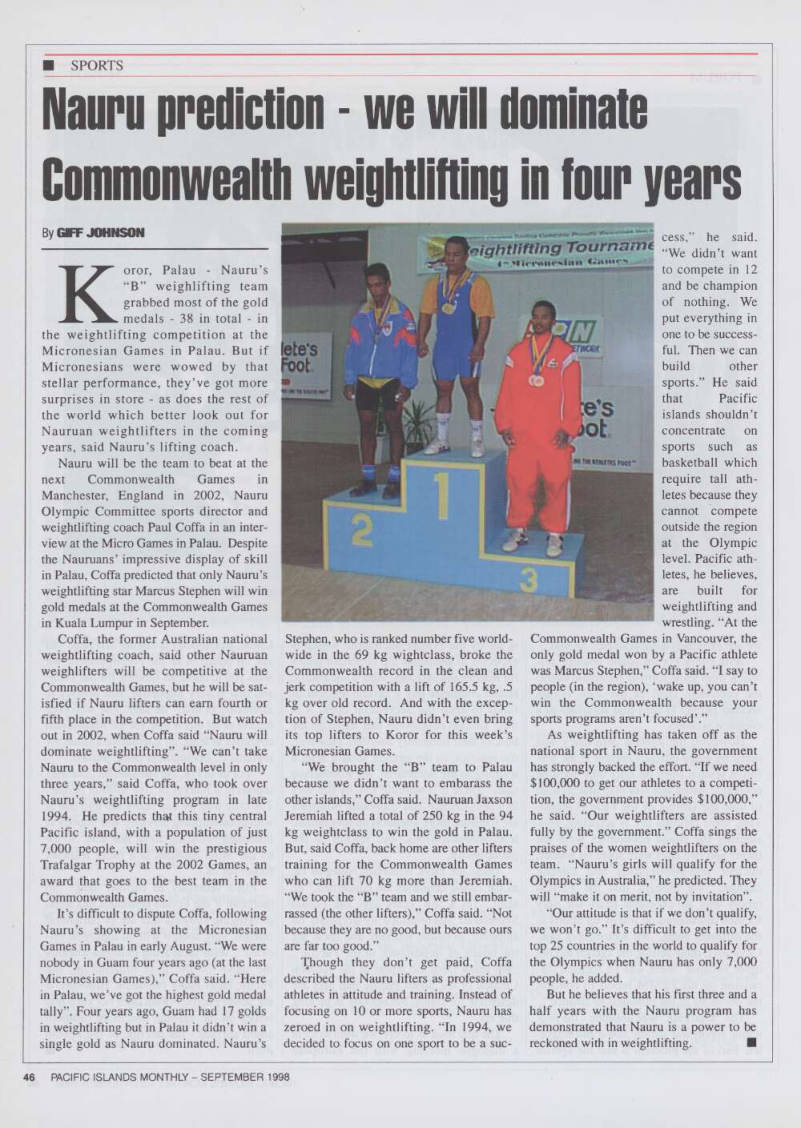
Sports
Nauru prediction - we will dominate Gommonwealth weightlifting in four years
By Giff Johnson
Koror, Palau - Nauru’s “B” weighlifting team grabbed most of the gold medals - 38 in total - in the weightlifting competition at the Micronesian Games in Palau. But if Micronesians were wowed by that stellar performance, they’ve got more surprises in store - as does the rest of the world which better look out for Nauruan weightlifters in the coming years, said Nauru’s lifting coach.
Nauru will be the team to beat at the next Commonwealth Games in Manchester, England in 2002, Nauru Olympic Committee sports director and weightlifting coach Paul Coffa in an inter view at the Micro Games in Palau. Despite the Nauruans’ impressive display of skill in Palau, Coffa predicted that only Nauru’s weightlifting star Marcus Stephen will win gold medals at the Commonwealth Games in Kuala Lumpur in September.
Coffa, the former Australian national weightlifting coach, said other Nauruan weighlifters will be competitive at the Commonwealth Games, but he will be sat isfied if Nauru lifters can earn fourth or fifth place in the competition. But watch out in 2002, when Coffa said “Nauru will dominate weightlifting”. “We can’t take Nauru to the Commonwealth level in only three years,” said Coffa, who took over Nauru’s weightlifting program in late 1994. He predicts that this tiny central Pacific island, with a population of just 7,000 people, will win the prestigious Trafalgar Trophy at the 2002 Games, an award that goes to the best team in the Commonwealth Games.
It’s difficult to dispute Coffa, following Nauru’s showing at the Micronesian Games in Palau in early August. “We were nobody in Guam four years ago (at the last Micronesian Games),” Coffa said. “Here in Palau, we’ve got the highest gold medal tally”. Four years ago, Guam had 17 golds in weightlifting but in Palau it didn’t win a single gold as Nauru dominated. Nauru’s
Stephen, who is ranked number five world wide in the 69 kg wightclass, broke the Commonwealth record in the clean and jerk competition with a lift of 165.5 kg, .5 kg over old record. And with the excep tion of Stephen, Nauru didn’t even bring its top lifters to Koror for this week’s Micronesian Games.
“We brought the “B” team to Palau because we didn’t want to embarass the other islands,” Coffa said. Nauruan Jaxson Jeremiah lifted a total of 250 kg in the 94 kg weightclass to win the gold in Palau.
But, said Coffa, back home are other lifters training for the Commonwealth Games who can lift 70 kg more than Jeremiah.
“We took the “B” team and we still embar rassed (the other lifters),” Coffa said. “Not because they are no good, but because ours are far too good.”
Tjhough they don’t get paid, Coffa described the Nauru lifters as professional athletes in attitude and training. Instead of focusing on 10 or more sports, Nauru has zeroed in on weightlifting. “In 1994, we decided to focus on one sport to be a suc
cess,” he said.
“We didn’t want to compete in 12 and be champion of nothing. We put everything in one to be success ful. Then we can build other sports.” He said that Pacific islands shouldn’t concentrate on sports such as basketball which require tall ath letes because they cannot compete outside the region at the Olympic level. Pacific ath letes, he believes, are built for
weightlifting and
wrestling. “At the
Commonwealth Games in Vancouver, the only gold medal won by a Pacific athlete was Marcus Stephen,” Coffa said. “I say to people (in the region), ‘wake up, you can’t win the Commonwealth because your sports programs aren’t focused’.”
As weightlifting has taken off as the national sport in Nauru, the government has strongly backed the effort. “If we need $lOO,OOO to get our athletes to a competi tion, the government provides $100,000,” he said. “Our weightlifters are assisted fully by the government.” Coffa sings the praises of the women weightlifters on the team. “Nauru’s girls will qualify for the
Olympics in Australia,” he predicted. They
will “make it on merit, not by invitation”.
“Our attitude is that if we don’t qualify, we won’t go.” It’s difficult to get into the top 25 countries in the world to qualify for the Olympics when Nauru has only 7,000 people, he added.
But he believes that his first three and a half years with the Nauru program has demonstrated that Nauru is a power to be reckoned with in weightlifting. ■
Koror, Palau
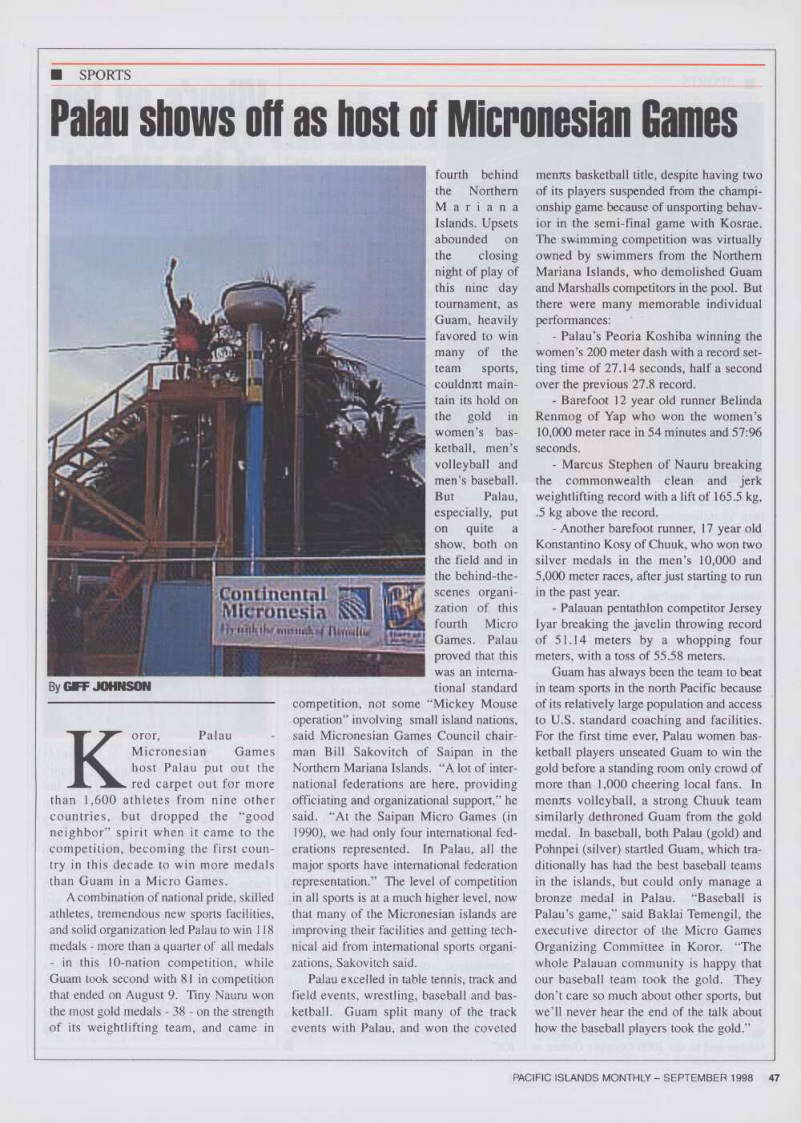
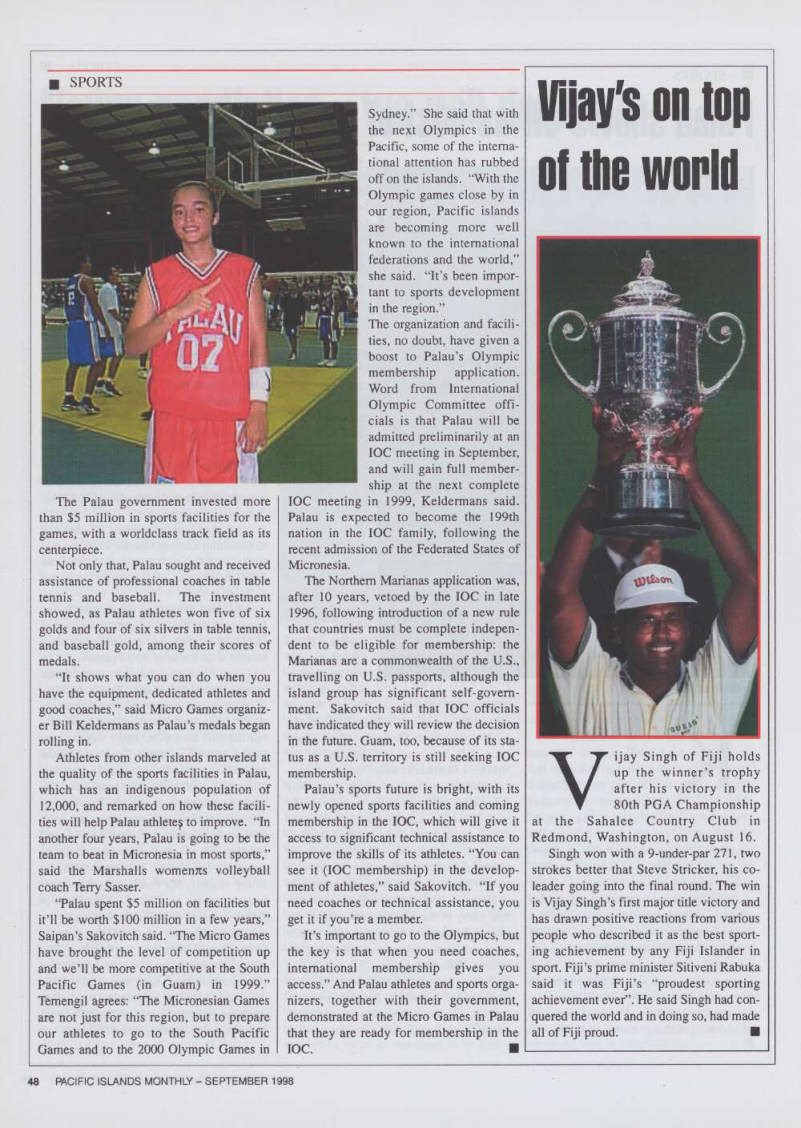
Palau shows off as host of Micrnesian Games
By Giff Johnson
Micronesian Games host Palau put out the red carpet out for more than 1,600 athletes from nine other countries, but dropped the “good neighbor” spirit when it came to the competition, becoming the first coun try in this decade to win more medals than Guam in a Micro Games.
A combination of national pride, skilled athletes, tremendous new sports facilities, and solid organization led Palau to win 118 medals - more than a quarter of all medals - in this 10-nation competition, while Guam took second with 81 in competition that ended on August 9. Tiny Nauru won the most gold medals - 38 - on the strength of its weightlifting team, and came in
fourth behind the Northern Mariana Islands. Upsets abounded on
the closing
night of play of this nine day tournament, as
Guam, heavily
favored to win many of the team sports, couldmit main tain its hold on the gold in women’s bas ketball, men’s
volleyball and
men’s baseball.
But Palau, especially, put on quite a show, both on the field and in the behind-the
scenes organi
zation of this fourth Micro Games. Palau proved that this was an interna tional standard
competition, not some “Mickey Mouse operation” involving small island nations, said Micronesian Games Council chair man Bill Sakovitch of Saipan in the Northern Mariana Islands. “A lot of inter national federations are here, providing
officiating and organizational support,” he
said. “At the Saipan Micro Games (in 1990), we had only four international fed erations represented. In Palau, all the major sports have international federation representation.” The level of competition in all sports is at a much higher level, now that many of the Micronesian islands are improving their facilities and getting tech nical aid from international sports organi zations, Sakovitch said.
Palau excelled in table tennis, track and field events, wrestling, baseball and bas ketball. Guam split many of the track events with Palau, and won the coveted
mentis basketball title, despite having two of its players suspended from the champi onship game because of unsporting behav ior in the semi-final game with Kosrae.
The swimming competition was virtually
owned by swimmers from the Northern Mariana Islands, who demolished Guam and Marshalls competitors in the pool. But there were many memorable individual
performances:
- Palau’s Peoria Koshiba winning the women’s 200 meter dash with a record set ting time of 27.14 seconds, half a second over the previous 27.8 record. - Barefoot 12 year old runner Belinda Renmog of Yap who won the women’s 10.000 meter race in 54 minutes and 57:96 seconds. - Marcus Stephen of Nauru breaking the commonwealth clean and jerk weightlifting record with a lift of 165.5 kg, .5 kg above the record. - Another barefoot runner, 17 year old Konstantino Kosy of Chuuk, who won two silver medals in the men’s 10,000 and 5.000 meter races, after just starting to run in the past year. - Palauan pentathlon competitor Jersey
lyar breaking the javelin throwing record
of 51.14 meters by a whopping four meters, with a toss of 55.58 meters.
Guam has always been the team to beat in team sports in the north Pacific because of its relatively large population and access to U.S. standard coaching and facilities.
For the first time ever, Palau women bas ketball players unseated Guam to win the gold before a standing room only crowd of more than 1,000 cheering local fans. In mentis volleyball, a strong Chuuk team similarly dethroned Guam from the gold medal. In baseball, both Palau (gold) and Pohnpei (silver) startled Guam, which tra ditionally has had the best baseball teams in the islands, but could only manage a bronze medal in Palau. “Baseball is Palau’s game,” said Baklai Temengil, the executive director of the Micro Games Organizing Committee in Koror. "The whole Palauan community is happy that our baseball team took the gold. They don’t care so much about other sports, but we’ll never hear the end of the talk about how the baseball players took the gold.”
The Palau government invested more than $5 million in sports facilities for the games, with a worldclass track field as its
centerpiece.
Not only that, Palau sought and received assistance of professional coaches in table tennis and baseball. The investment showed, as Palau athletes won five of six golds and four of six silvers in table tennis, and baseball gold, among their scores of medals.
“It shows what you can do when you have the equipment, dedicated athletes and good coaches,” said Micro Games organiz er Bill Keldermans as Palau’s medals began rolling in.
Athletes from other islands marveled at the quality of the sports facilities in Palau, which has an indigenous population of 12,000, and remarked on how these facili ties will help Palau to improve. “In another four years, Palau is going to be the team to beat in Micronesia in most sports,” said the Marshalls womenrcs volleyball coach Terry Sasser.
“Palau spent $5 million on facilities but it’ll be worth $lOO million in a few years,”
Saipan’s Sakovitch said. “The Micro Games have brought the level of competition up and we’ll be more competitive at the South Pacific Games (in Guam) in 1999.”
Temengil agrees: “The Micronesian Games are not just for this region, but to prepare our athletes to go to the South Pacific Games and to the 2000 Olympic Games in
Sydney.” She said that with the next Olympics in the Pacific, some of the interna tional attention has rubbed off on the islands. “With the Olympic games close by in our region, Pacific islands are becoming more well known to the international federations and the world,” she said. “It’s been impor tant to sports development in the region.”
The organization and facili ties, no doubt, have given a boost to Palau’s Olympic
membership application.
Word from International Olympic Committee offi cials is that Palau will be admitted preliminarily at an lOC meeting in September, and will gain full member ship at the next complete
lOC meeting in 1999, Keldermans said.
Palau is expected to become the 199th nation in the lOC family, following the recent admission of the Federated States of Micronesia.
The Northern Marianas application was, after 10 years, vetoed by the lOC in late 1996, following introduction of a new rule that countries must be complete indepen dent to be eligible for membership; the Marianas are a commonwealth of the U.S., travelling on U.S. passports, although the island group has significant self-govern ment. Sakovitch said that lOC officials have indicated they will review the decision in the future. Guam, too, because of its sta tus as a U.S. territory is still seeking lOC membership.
Palau’s sports future is bright, with its newly opened sports facilities and coming membership in the lOC, which will give it access to. significant technical assistance to improve the skills of its athletes. “You can see it (lOC membership) in the develop ment of athletes,” said Sakovitch. “If you need coaches or technical assistance, you get it if you’re a member.
It’s important to go to the Olympics, but the key is that when you need coaches, international membership gives you access.” And Palau athletes and sports orga nizers, together with their government, demonstrated at the Micro Games in Palau that they are ready for membership in the lOC. ■
Vijay's on top
of the world
Vijay Singh of Fiji holds up the winner’s trophy after his victory in the 80th PGA Championship at the Sahalee Country Club in Redmond, Washington, on August 16.
Singh won with a 9-under-par 271, two strokes better that Steve Strieker, his co leader going into the final round. The win is Vijay Singh’s first major title victory and has drawn positive reactions from various people who described it as the best sport ing achievement by any Fiji Islander in sport. Fiji’s prime minister Sitiveni Rabuka said it was Fiji’s “proudest sporting achievement ever”. He said Singh had con quered the world and in doing so, had made all of Fiji proud. ■
His Job is on the line
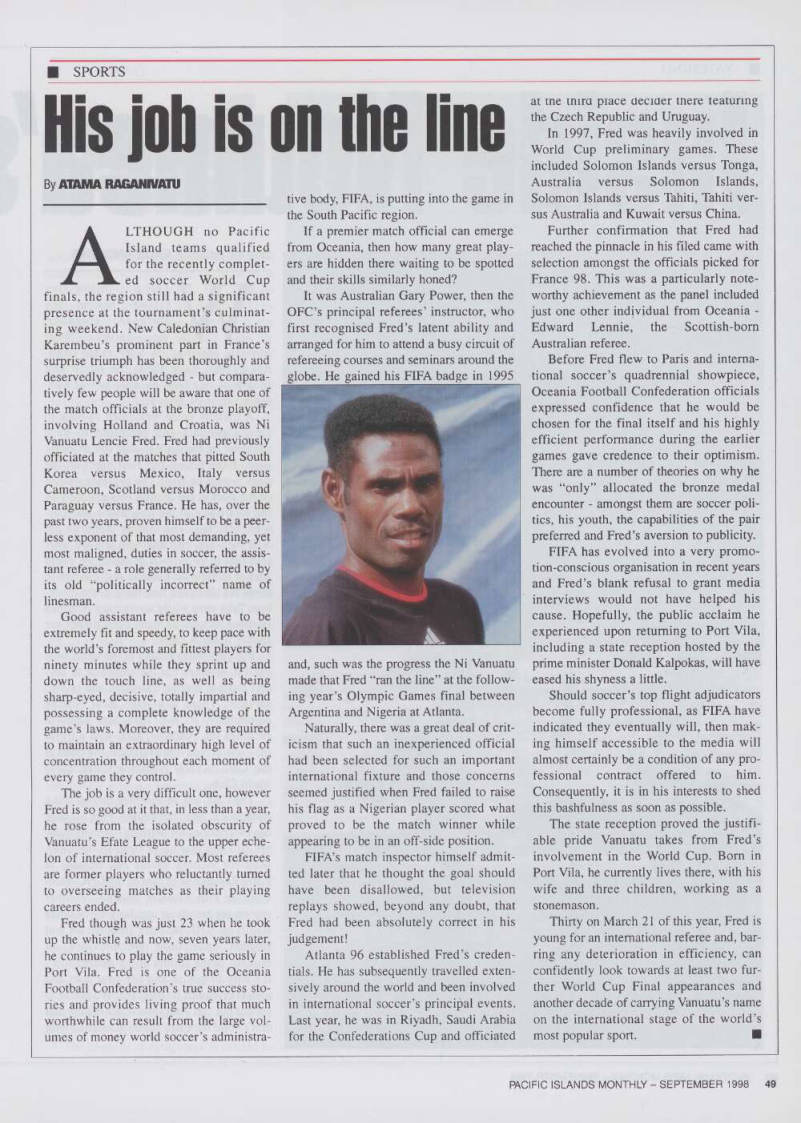
By Atama Raganivatu
Although no Pacific Island teams qualified
for the recently complet
ed soccer World Cup finals, the region still had a significant presence at the tournament’s culminat ing weekend. New Caledonian Christian Karembeu’s prominent part in France’s surprise triumph has been thoroughly and deservedly acknowledged - but compara tively few people will be aware that one of the match officials at the bronze playoff, involving Holland and Croatia, was Ni Vanuatu Lencie Fred. Fred had previously officiated at the matches that pitted South Korea versus Mexico, Italy versus Cameroon, Scotland versus Morocco and Paraguay versus France. He has, over the past two years, proven himself to be a peer less exponent of that most demanding, yet most maligned, duties in soccer, the assis tant referee - a role generally referred to by its old “politically incorrect” name of linesman.
Good assistant referees have to be extremely fit and speedy, to keep pace with the world’s foremost and fittest players for ninety minutes while they sprint up and down the touch line, as well as being sharp-eyed, decisive, totally impartial and possessing a complete knowledge of the game’s laws. Moreover, they are required to maintain an extraordinary high level of concentration throughout each moment of every game they control.
The job is a very difficult one, however Fred is so good at it that, in less than a year, he rose from the isolated obscurity of Vanuatu’s Efate League to the upper eche lon of international soccer. Most referees are former players who reluctantly turned to overseeing matches as their playing careers ended.
Fred though was just 23 when he took up the whistle and now, seven years later, he continues to play the game seriously in Port Vila. Fred is one of the Oceania Football Confederation’s true success sto ries and provides living proof that much worthwhile can result from the large vol umes of money world soccer’s administra
live body, FIFA, is putting into the game in the South Pacific region.
If a premier match official can emerge from Oceania, then how many great play ers are hidden there waiting to be spotted and their skills similarly honed?
It was Australian Gary Power, then the OFC’s principal referees’ instructor, who first recognised Fred’s latent ability and arranged for him to attend a busy circuit of refereeing courses and seminars around the globe. He gained his FIFA badge in 1995
and, such was the progress the Ni Vanuatu made that Fred “ran the line” at the follow ing year’s Olympic Games final between Argentina and Nigeria at Atlanta.
Naturally, there was a great deal of crit icism that such an inexperienced official had been selected for such an important international fixture and those concerns seemed justified when Fred failed to raise his flag as a Nigerian player scored what proved to be the match winner while appearing to be in an off-side position.
FIFA’s match inspector himself admit ted later that he thought the goal should have been disallowed, but television replays showed, beyond any doubt, that Fred had been absolutely correct in his
judgement!
Atlanta 96 established Fred’s creden tials. He has subsequently travelled exten sively around the world and been involved in international soccer’s principal events.
Last year, he was in Riyadh, Saudi Arabia for the Confederations Cup and officiated
at me tmra place decider mere teaturmg the Czech Republic and Uruguay.
In 1997, Fred was heavily involved in World Cup preliminary games. These included Solomon Islands versus Tonga, Australia versus Solomon Islands, Solomon Islands versus Tahiti, Tahiti ver sus Australia and Kuwait versus China.
Further confirmation that Fred had reached the pinnacle in his filed came with selection amongst the officials picked for France 98. This was a particularly note worthy achievement as the panel included just one other individual from Oceania - Edward Lennie, the Scottish-born Australian referee.
Before Fred flew to Paris and interna
tional soccer’s quadrennial showpiece,
Oceania Football Confederation officials expressed confidence that he would be chosen for the final itself and his highly efficient performance during the earlier games gave credence to their optimism.
There are a number of theories on why he was “only” allocated the bronze medal encounter - amongst them are soccer poli tics, his youth, the capabilities of the pair preferred and Fred’s aversion to publicity.
FIFA has evolved into a very promo tion-conscious organisation in recent years and Fred’s blank refusal to grant media interviews would not have helped his cause. Hopefully, the public acclaim he experienced upon returning to Port Vila, including a state reception hosted by the prime minister Donald Kalpokas, will have eased his shyness a little.
Should soccer’s top flight adjudicators become fully professional, as FIFA have indicated they eventually will, then mak ing himself accessible to the media will almost certainly be a condition of any pro fessional contract offered to him.
Consequently, it is in his interests to shed this bashfulness as soon as possible.
The state reception proved the justifi
able pride Vanuatu takes from Fred’s involvement in the World Cup. Born in Port Vila, he currently lives there, with his wife and three children, working as a stonemason.
Thirty on March 21 of this year, Fred is young for an international referee and, bar ring any deterioration in efficiency, can confidently look towards at least two fur ther World Cup Final appearances and another decade of carrying Vanuatu’s name on the international stage of the world’s most popular sport. ■
Inside Neuma's reef
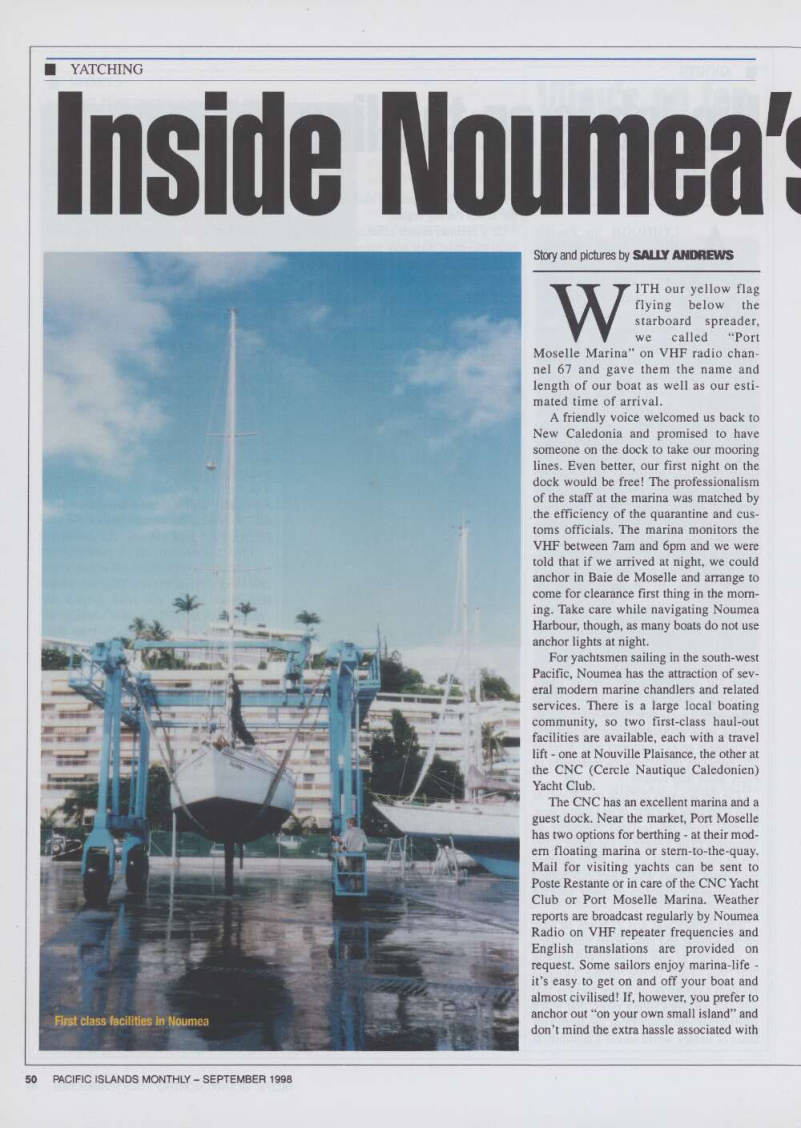
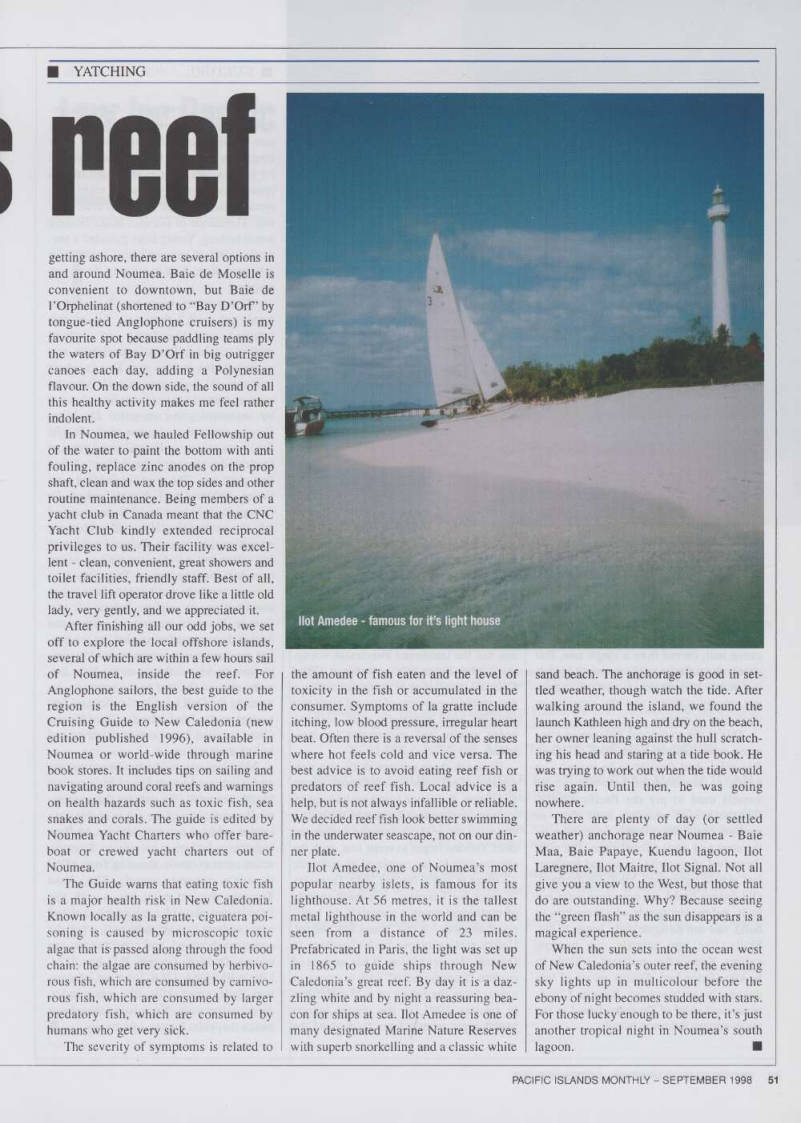
Yatching
Story and pictures by SALLY ANDREWS
WITH our yellow flag
flying below the
starboard spreader,
we called “Port Moselle Marina” on VHP radio chan nel 67 and gave them the name and length of our boat as well as our esti mated time of arrival.
A friendly voice welcomed us back to New Caledonia and promised to have someone on the dock to take our mooring lines. Even better, our first night on the dock would be free! The professionalism of the staff at the marina was matched by the efficiency of the quarantine and cus toms officials. The marina monitors the VHP between 7am and 6pm and we were told that if we arrived at night, we could anchor in Baie de Moselle and arrange to come for clearance first thing in the morn ing. Take care while navigating Noumea Harbour, though, as many boats do not use
anchor lights at night.
For yachtsmen sailing in the south-west Pacific, Noumea has the attraction of sev eral modem marine chandlers and related services. There is a large local boating community, so two first-class haul-out facilities are available, each with a travel lift - one at Nouville Plaisance, the other at the CNC (Cercle Nautique Caledonien) Yacht Club.
The CNC has an excellent marina and a guest dock. Near the market, Port Moselle has two options for berthing - at their mod em floating marina or stem-to-the-quay.
Mail for visiting yachts can be sent to Poste Restante or in care of the CNC Yacht Club or Port Moselle Marina. Weather reports are broadcast regularly by Noumea Radio on VHP repeater frequencies and English translations are provided on request. Some sailors enjoy marina-life it’s easy to get on and off your boat and almost civilised! If, however, you prefer to anchor out “on your own small island” and don’t mind the extra hassle associated with
First class facilities in Noumea
getting ashore, there are several options in and around Noumea. Baie de Moselle is convenient to downtown, but Baie de I’Orphelinat (shortened to ’‘Bay D’Orf” by tongue-tied Anglophone cruisers) is my favourite spot because paddling teams ply the waters of Bay D’Orf in big outrigger
canoes each day, adding a Polynesian
flavour. On the down side, the sound of all this healthy activity makes me feel rather indolent.
In Noumea, we hauled Fellowship out of the water to paint the bottom with anti fouling, replace zinc anodes on the prop shaft, clean and wax the top sides and other routine maintenance. Being members of a yacht club in Canada meant that the CNC Yacht Club kindly extended reciprocal privileges to us. Their facility was excel lent - clean, convenient, great showers and toilet facilities, friendly staff. Best of all, the travel lift operator drove like a little old lady, very gently, and we appreciated it.
After finishing all our odd jobs, we set off to explore the local offshore islands, several of which are within a few hours sail of Noumea, inside the reef. For Anglophone sailors, the best guide to the region is the English version of the Cruising Guide to New Caledonia (new edition published 1996), available in Noumea or world-wide through marine book stores. It includes tips on sailing and navigating around coral reefs and warnings on health hazards such as toxic fish, sea snakes and corals. The guide is edited by Noumea Yacht Charters who offer bare boat or crewed yacht charters out of Noumea.
The Guide warns that eating toxic fish is a major health risk in New Caledonia.
Known locally as la gratte, ciguatera poi soning is caused by microscopic toxic algae that is-passed along through the food chain; the algae are consumed by herbivo rous fish, which are consumed by carnivo rous fish, which are consumed by larger predatory fish, which are consumed by humans who get very sick.
The severity of symptoms is related to
the amount of fish eaten and the level of toxicity in the fish or accumulated in the consumer. Symptoms of la gratte include itching, low blood pressure, irregular heart beat. Often there is a reversal of the senses where hot feels cold and vice versa. The best advice is to avoid eating reef fish or predators of reef fish. Local advice is a help, but is not always infallible or reliable.
We decided reef fish look better swimming in the underwater seascape, not on our din ner plate.
Hot Amedee, one of Noumea’s most popular nearby islets, is famous for its lighthouse. At 56 metres, it is the tallest metal lighthouse in the world and can be seen from a distance of 23 miles.
Prefabricated in Paris, the light was set up in 1865 to guide ships through New Caledonia’s great reef. By day it is a daz zling white and by night a reassuring bea con for ships at sea. Hot Amedee is one of many designated Marine Nature Reserves with superb snorkelling and a classic white
sand beach. The anchorage is good in set tled weather, though watch the tide. After walking around the island, we found the launch Kathleen high and dry on the beach, her owner leaning against the hull scratch ing his head and staring at a tide book. He was trying to work out when the tide would rise again. Until then, he was going nowhere.
There are plenty of day (or settled weather) anchorage near Noumea - Baie Maa, Baie Papaye, Kuendu lagoon, Hot Laregnere, Hot Maitre, Hot Signal. Not all give you a view to the West, but those that
do are outstanding. Why? Because seeing
the "green flash” as the sun disappears is a
magical experience.
When the sun sets into the ocean west of New Caledonia’s outer reef, the evening sky lights up in multicolour before the ebony of night becomes studded with stars.
For those lucky enough to be there, it’s just another tropical night in Noumea’s south lagoon. ■
llot Amedee - famous for it’s light house
Vaka Taumako: Rescuing
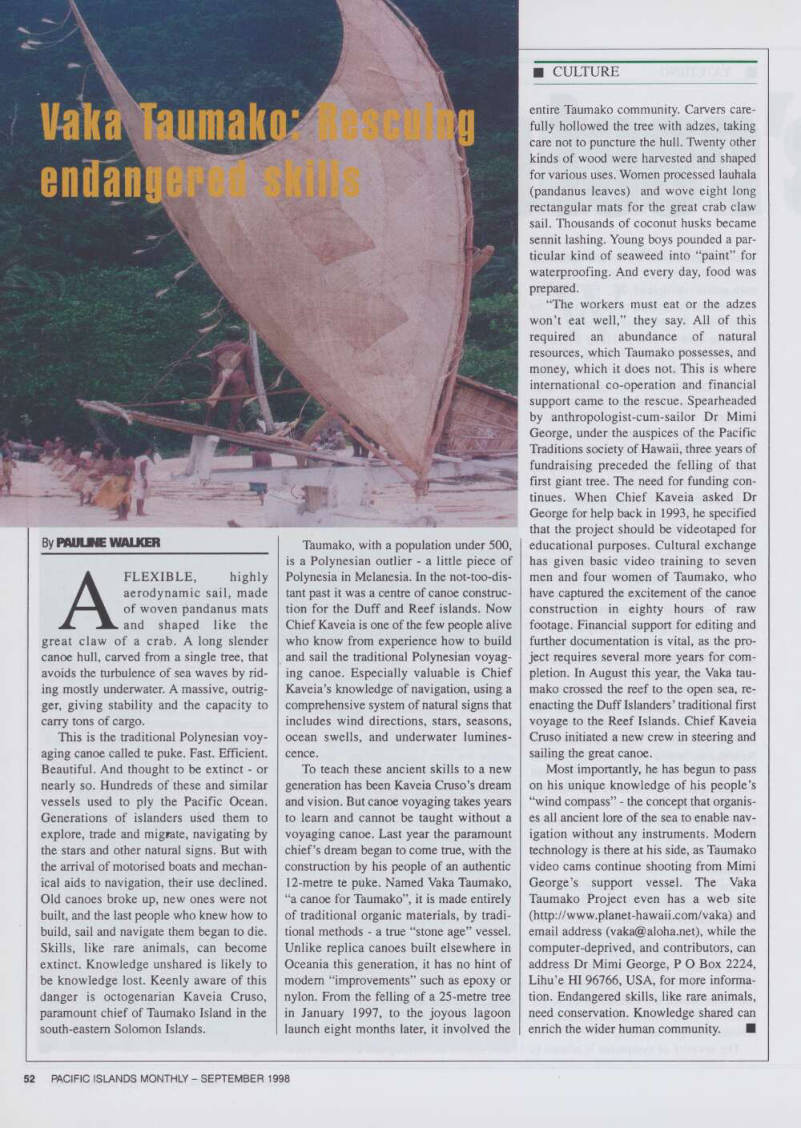
Culture
Vaka Taumako: Rescuing endangered skills
By Pauline Walker
A FLEXIBLE, highly
aerodynamic sail, made of woven pandanus mats and shaped like the great claw of a crab. A long slender canoe hull, carved from a single tree, that avoids the turbulence of sea waves by rid ing mostly underwater. A massive, outrig ger, giving stability and the capacity to carry tons of cargo.
This is the traditional Polynesian voy aging canoe called te puke. Fast. Efficient.
Beautiful. And thought to be extinct - or nearly so. Hundreds of these and similar vessels used to ply the Pacific Ocean.
Generations of islanders used them to
explore, trade and migrate, navigating by
the stars and other natural signs. But with the arrival of motorised boats and mechan ical aids to navigation, their use declined.
Old canoes broke up, new ones were not built, and the last people who knew how to build, sail and navigate them began to die.
Skills, like rare animals, can become extinct. Knowledge unshared is likely to be knowledge lost. Keenly aware of this danger is octogenarian Kaveia Cruso, paramount chief of Taumako Island in the south-eastern Solomon Islands.
Taumako, with a population under 500, is a Polynesian outlier - a little piece of Polynesia in Melanesia. In the not-too-dis tant past it was a centre of canoe construc tion for the Duff and Reef islands. Now Chief Kaveia is one of the few people alive who know from experience how to build and sail the traditional Polynesian voyag ing canoe. Especially valuable is Chief Kaveia’s knowledge of navigation, using a comprehensive system of natural signs that includes wind directions, stars, seasons, ocean swells, and underwater lumines cence.
To teach these ancient skills to a new generation has been Kaveia Cruso’s dream and vision. But canoe voyaging takes years to learn and cannot be taught without a voyaging canoe. Last year the paramount chief’s dream began to come true, with the construction by his people of an authentic 12-metre te puke. Named Vaka Taumako, “a canoe for Taumako”, it is made entirely of traditional organic materials, by tradi tional methods - a true “stone age” vessel.
Unlike replica canoes built elsewhere in Oceania this generation, it has no hint of modem “improvements” such as epoxy or nylon. From the felling of a 25-metre tree in January 1997, to the joyous lagoon launch eight months later, it involved the
entire Taumako community. Carvers care fully hollowed the tree with adzes, taking care not to puncture the hull. Twenty other kinds of wood were harvested and shaped for various uses. Women processed lauhala (pandanus leaves) and wove eight long rectangular mats for the great crab claw sail. Thousands of coconut husks became sennit lashing. Young boys pounded a par ticular kind of seaweed into “paint” for waterproofing. And every day, food was prepared.
“The workers must eat or the adzes won’t eat well,” they say. All of this required an abundance of natural resources, which Taumako possesses, and money, which it does not. This is where international co-operation and financial support came to the rescue. Spearheaded
by anthropologist-cum-sailor Dr Mimi
George, under the auspices of the Pacific Traditions society of Hawaii, three years of fundraising preceded the felling of that first giant tree. The need for funding con tinues. When Chief Kaveia asked Dr George for help back in 1993, he specified that the project should be videotaped for educational purposes. Cultural exchange has given basic video training to seven men and four women of Taumako, who have captured the excitement of the canoe construction in eighty hours of raw footage. Financial support for editing and further documentation is vital, as the pro ject requires several more years for com pletion. In August this year, the Vaka tau mako crossed the reef to the open sea, re enacting the Duff Islanders’ traditional first voyage to the Reef Islands. Chief Kaveia Cruso initiated a new crew in steering and sailing the great canoe.
Most importantly, he has begun to pass on his unique knowledge of his people’s “wind compass” - the concept that organis es all ancient lore of the sea to enable nav igation without any instruments. Modem technology is there at his side, as Taumako video cams continue shooting from Mimi George’s support vessel. The Vaka Taumako Project even has a web site
(http://www.planet-hawaii.com/vaka) and
email address ([email protected]), while the computer-deprived, and contributors, can address Dr Mimi George, P O Box 2224, Lihu’e HI 96766, USA, for more informa tion. Endangered skills, like rare animals, need conservation. Knowledge shared can enrich the wider human community. ■
Law for Pacific Women: A Lena! Rights Handbook

Book Review
Publisher: Fiji Women’s rights Movement, PO Box 14194, Suva, Fiji.
By Patricia Imrana Jalal
LAW for Pacific Women is the product of six years of study, research, training and writing. Its 700 pages document, in simple (non-legalese)
English, the legal and human rights
status of Pacific Island women in Fiji, Tonga, Samoa, Cook Islands, Solomon Islands, Vanuatu, Kiribati, Tuvalu and Nauru. It suggests ways in which gov ernments, courts, and NGOs in the region can cause substantive legal equality for women.
The book contains a wealth of informa tion including over 300 real life case reports and judgements from Pacific Island courts, extracts from legislation, and statis tical tables. Law for Pacific Women is the first full-length text specifically written on women and the law in the South Pacific.
Its assessment of conflicts between formal and customary laws is particularly interest ing. The book has been written chiefly as a source of information for human and legal rights teachers, students, community par alegals, community workers, activists and policy planners. It is accessible to anyone who want to look critically at the law, understand how it can be an instrument of women’s status, and to take some informed action. The book in draft form has already been extensively used by RRRT and FWRM as the basis for preparing training materials for local and regional training
and workshops. The Fiji Womens Rights
Movement also hopes it will be used by those lawyers who are interested in human rights, by lawyers and judicial officials whom are not familiar with family law or who see it as just another branch of the law, and by government policy planners and legislators engaged in law reform and putting affirmative action policies into
place.
The book has 15 chapters. Chapter one begins by asking, ’What is the law?’ Here it describes the nature and operations of the law and the basic concepts of legislation, jurisdiction, common law and precedent.
Next is how the law works in practice
before moving to the question, ‘How does the law affect women?’ Thus to the book’s basic theme: how and why the law dis criminates against women.
Chapters two and three deal with the constitution, customary law and land laws on women. Chapters four, five and six focus on criminal law: sexual offences and other criminal assaults on women and chil dren, and criminal offences committed by women. Chapters seven to 12 concern mar
riage, separation, divorce, maintenance,
matrimonial property, de facto rights, ille gitimate children and the custody and access of children. Then in chapter 13 and 14, it turns to women and work. In chapter 14, it looks at women who work as lawyers, and women who receive legal aid.
It ends with chapter 15 that deals with strategies for using the law to improve the status of women. This chapter suggests practical ways to cause legislative and common law changes using test cases, international UN Conventions, gender training for judicial and other officials and
the law reform process. The endnotes, glossary, bibliography and indexes are pro vided as aids to further research and study.
“Women of the South Pacific will wel come this reference book which in as sim ple a language as the subject will a110w... relates their own experiences in what will become a seminal work. It carefully dis cusses all aspects of the law as it affects the rights of women in both civil and crim inal jurisdictions. Therein lies its appeal” - Ratu Joni Madraiwiwi (from the fore word).
The academic stage preceding the research stage has been funded through scholarships from The Asia Foundation and the Australian Federation of University Women (Qld & National). The research and printing of the book has been funded by The Asia Foundation and British Aid (Dfid) through the Pacific Regional Human Rights Education Resource Team
(Rrrt).
The proceeds of the sale will go to the Fiji Women’s Rights Movement. ■
Advertisements & other items, p. 53 (1 item)
SeqmcL Vautt md
This recently published book by Professor Eric Carman is the result of his many years living and working in the West Sepik Province of Papua New Guinea.
He reveals the merciless realities of primitive life and uncovers the dark world where people live in terror of witchcraft and payback killings.
YOU WILL NOT BE ABLE TO PUT THIS BOOK DOWN SEND this COUPON or ORDER by PHONE/FAX/EMAIL to RYAN
PUBLISHING
24/20 Commercial Road (P O Box 7680) Melbourne, Victoria, 3004, Australia Tel: 61 3 9820 0988 Fax: 61 3 9866 5387 Email: [email protected] Or visit our website: www.ryanpub.com.au Rush me: ‘PtUrtt and 'pe4t6en& by Eric Carman My cheque for U 5529.95 (inc. p&p) is enclosed or debit my credit card.
Payment:! i cheque, I I B'card, O M'card, [ I Visa, I I Amex, I I Diners
card Nocmnnmnnnnnnn n n^p. —/.—
Name: Address: Country:
The New Zealand/Cooks Islands
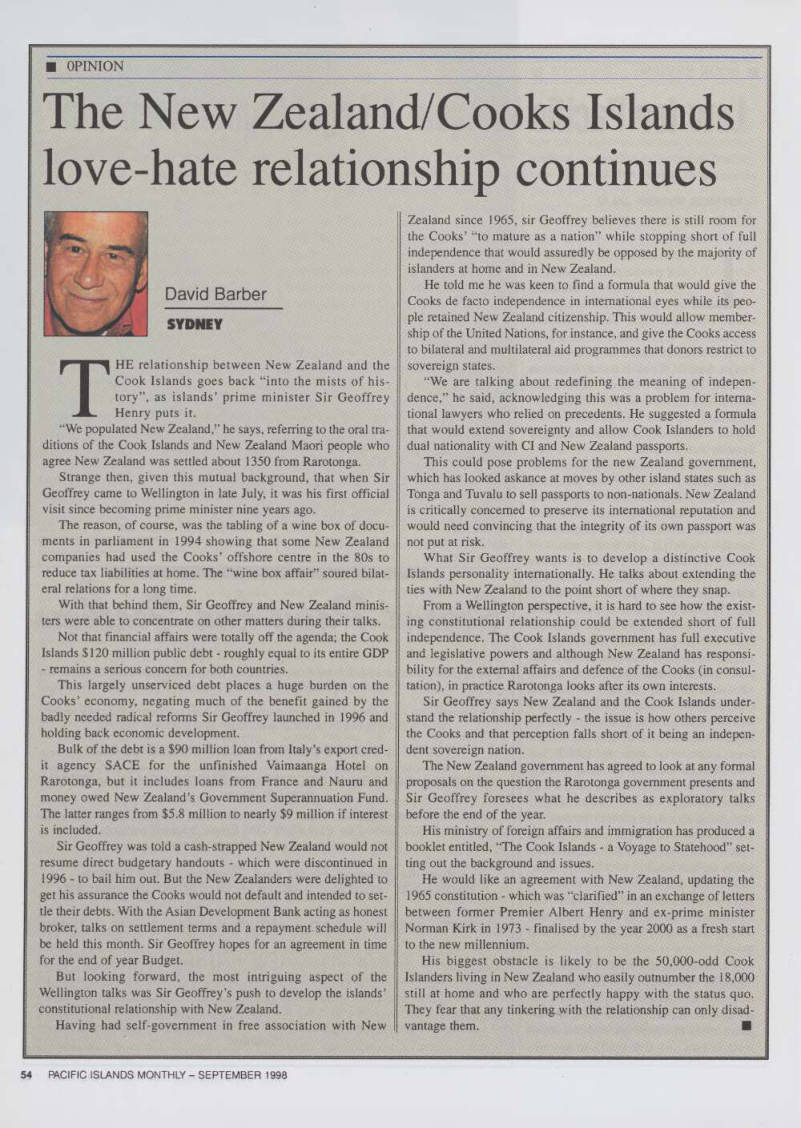
Opinion
The New Zealand/Cooks Islands love-hate relationship continues
THE relationship between New Zealand and the Cook Islands goes back “into the mists of his tory”, as islands’ prime minister Sir Geoffrey Henry puts it.
“We populated New Zealand,” he says, referring to the oral tra ditions of the Cook Islands and New Zealand Maori people who agree New Zealand was settled about 1350 from Rarotonga.
Strange then, given this mutual background, that when Sir Geoffrey came to Wellington in late July, it was his first official visit since becoming prime minister nine years ago.
The reason, of course, was the tabling of a wine box of docu ments in parliament in 1994 showing that some New Zealand companies had used the Cooks’ offshore centre in the 80s to reduce tax liabilities at home. The “wine box affair” soured bilat eral relations for a long time.
With that behind them. Sir Geoffrey and New Zealand minis ters were able to concentrate on other matters during their talks.
Not that financial affairs were totally off the agenda; the Cook Islands $l2O million public debt - roughly equal to its entire GDP - remains a serious concern for both countries.
This largely unserviced debt places a huge burden on the Cooks’ economy, negating much of the benefit gained by the badly needed radical reforms Sir Geoffrey launched in 1996 and
holding back economic development.
Bulk of the debt is a $9O million loan from Italy’s export cred it agency SACE for the unfinished Vaimaanga Hotel on Rarotonga, but it includes loans from France and Nauru and money owed New Zealand’s Government Superannuation Fund.
The latter ranges from $5.8 million to nearly $9 million if interest is included.
Sir Geoffrey was told a cash-strapped New Zealand would not resume direct budgetary handouts - which were discontinued in 1996 - to bail him out. But the New Zealanders were delighted to get his assurance the Cooks would not default and intended to set tle their debts. With the Asian Development Bank acting as honest broker, talks on settlement terms and a repayment schedule will be held this month. Sir Geoffrey hopes for an agreement in time for the end of year Budget.
But looking forward, the most intriguing aspect of the Wellington talks was Sir Geoffrey’s push to develop the islands’ constitutional relationship with New Zealand.
Having had self-government in free association with New
Zealand since 1965, sir Geoffrey believes there is still room for the Cooks’ “to mature as a nation” while stopping short of full independence that would assuredly be opposed by the majority of islanders at home and in New Zealand.
He told me he was keen to find a formula that would give the Cooks de facto independence in international eyes while its peo ple retained New Zealand citizenship. This would allow member ship of the United Nations, for instance, and give the Cooks access to bilateral and multilateral aid programmes that donors restrict to
sovereign states.
“We are talking about redefining the meaning of indepen dence,” he said, acknowledging this was a problem for interna tional lawyers who relied on precedents. He suggested a formula that would extend sovereignty and allow Cook Islanders to hold dual nationality with Cl and New Zealand passports.
This could pose problems for the new Zealand government, which has looked askance at moves by other island states such as Tonga and Tuvalu to sell passports to non-nationals. New Zealand is critically concerned to preserve its international reputation and would need convincing that the integrity of its own passport was not put at risk.
What Sir Geoffrey wants is to develop a distinctive Cook Islands personality internationally. He talks about extending the ties with New Zealand to the point short of where they snap.
From a Wellington perspective, it is hard to see how the exist ing constitutional relationship could be extended short of full independence. The Cook Islands government has full executive and legislative powers and although New Zealand has responsi bility for the external affairs and defence of the Cooks (in consul tation), in practice Rarotonga looks after its own interests.
Sir Geoffrey says New Zealand and the Cook Islands under stand the relationship perfectly - the issue is how others perceive the Cooks and that perception falls short of it being an indepen dent sovereign nation.
The New Zealand government has agreed to look at any formal proposals on the question the Rarotonga government presents and Sir Geoffrey foresees what he describes as exploratory talks before the end of the year.
His ministry of foreign affairs and immigration has produced a booklet entitled, “The Cook Islands - a Voyage to Statehood” set ting out the background and issues.
He would like an agreement with New Zealand, updating the 1965 constitution - which was “clarified” in an exchange of letters between former Premier Albert Henry and ex-prime minister Norman Kirk in 1973 - finalised by the year 2000 as a fresh start to the new millennium.
His biggest obstacle is likely to be the 50,000-odd Cook Islanders living in New Zealand who easily outnumber the 18,000 still at home and who are perfectly happy with the status quo.
They fear that any tinkering,with the relationship can only disad vantage them. ■
David Barber
Sydney
The Dirty Australian
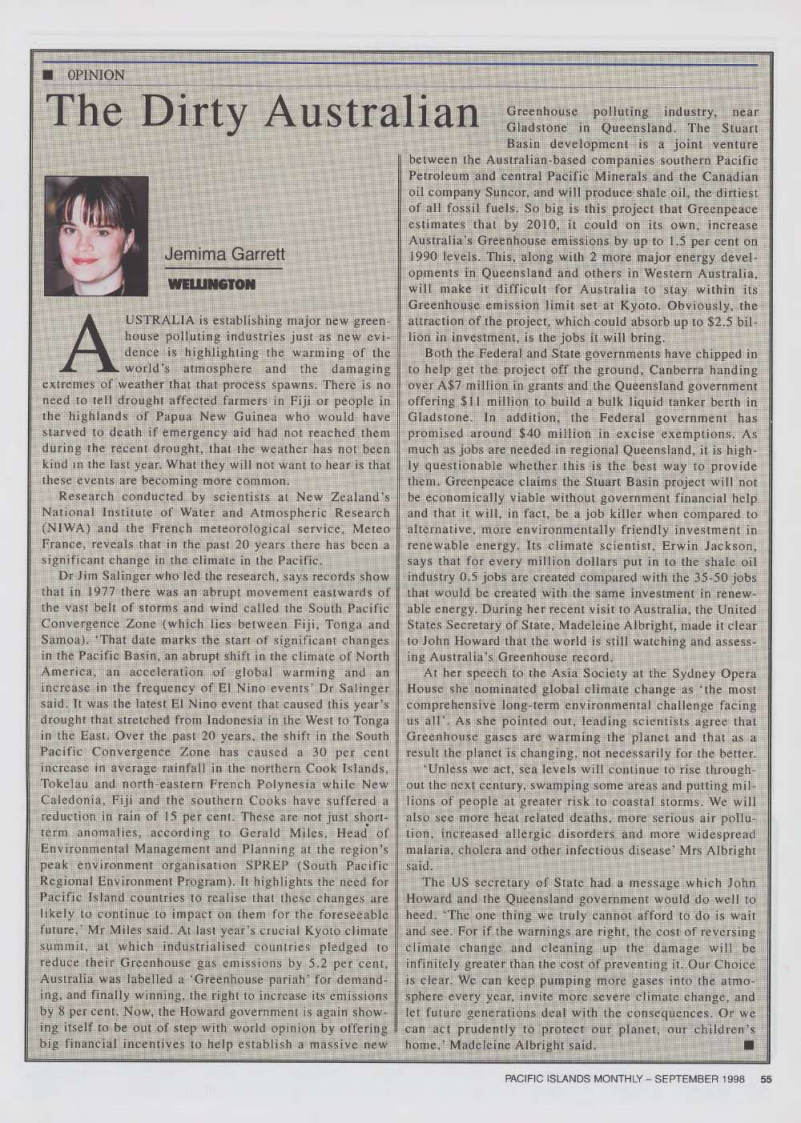
AUSTRALIA is establishing major new green
house polluting industries just as new evi dence is highlighting the warming of the world’s atmosphere and the damaging extremes of weather that that process spawns. There is no need to tell drought affected farmers in Fiji or people in the highlands of Papua New Guinea who would have starved to death if emergency aid had not reached them during the recent drought, that the weather has not been kind in the last year. What they will not want to hear is that these events are becoming more common.
Research conducted by scientists at New Zealand’s National Institute of Water and Atmospheric Research (NIWA) and the French meteorological service, Meteo France, reveals that in the past 20 years there has been a significant change in the climate in the Pacific.
Dr Jim Salinger who led the research, says records show that in 1977 there was an abrupt movement eastwards of the vast belt of storms and wind called the South Pacific Convergence Zone (which lies between Fiji, Tonga and Samoa). ‘That date marks the start of significant changes in the Pacific Basin, an abrupt shift in the climate of North America, an acceleration of global warming and an increase in the frequency of El Nino events’ Dr Salinger said. It was the latest El Nino event that caused this year’s drought that stretched from Indonesia in the West to Tonga in the East. Over the past 20 years, the shift in the South Pacific Convergence Zone has caused a 30 per cent increase in average rainfall in the northern Cook Islands, Tokelau and north-eastern French Polynesia while New Caledonia, Fiji and the southern Cooks have suffered a reduction in rain of 15 per cent. These are not just short term anomalies, according to Gerald Miles, Head of Environmental Management and Planning at the region’s peak environment organisation SPREP (South Pacific Regional Environment Program). It highlights the need for Pacific Island countries to realise that these changes are likely to continue to impact on them for the foreseeable future,' Mr Miles said. At last year’s crucial Kyoto climate summit, at which industrialised countries pledged to reduce their Greenhouse gas emissions by 5.2 per cent, Australia was labelled a ‘Greenhouse pariah’ for demand ing, and finally winning, the right to increase its emissions by 8 per cent. Now, the Howard government is again show ing itself to be out of step with world opinion by offering big financial incentives to help establish a massive new
Greenhouse polluting industry, near Gladstone in Queensland. The Stuart Basin development is a joint venture
between the Australian-based companies southern Pacific Petroleum and central Pacific Minerals and the Canadian oil company Suncor, and will produce shale oil, the dirtiest of all fossil fuels. So big is this project that Greenpeace estimates that by 2010, it could on its own, increase Australia’s Greenhouse emissions by up to 1.5 per cent on 1990 levels. This, along with 2 more major energy devel opments in Queensland and others in Western Australia, will make it difficult for Australia to stay within its Greenhouse emission limit set at Kyoto. Obviously, the attraction of the project, which could absorb up to $2.5 bil lion in investment, is the jobs it will bring.
Both the Federal and State governments have chipped in to help get the project off the ground, Canberra handing over As 7 million in grants and the Queensland government offering sll million to build a bulk liquid tanker berth in Gladstone. In addition, the Federal government has promised around S4O million in excise exemptions. As much as jobs are needed in regional Queensland, it is high ly questionable whether this is the best way to provide them. Greenpeace claims the Stuart Basin project will not be economically viable without government financial help and that it will, in fact, be a job killer when compared to alternative, more environmentally friendly investment in renewable energy. Its climate scientist, Erwin Jackson, says that for every million dollars put in to the shale oil industry 0.5 jobs are created compared with the 35-50 jobs that would be created with the same investment in renew able energy. During her recent visit to Australia, the United States Secretary of State, Madeleine Albright, made it clear to John Howard that the world is still watching and assess ing Australia’s Greenhouse record.
At her speech to the Asia Society at the Sydney Opera House she nominated global climate change as The most comprehensive long-term environmental challenge facing us all’. As she pointed out, leading scientists agree that Greenhouse gases are warming the planet and that as a result the planet is changing, not necessarily for the better. ‘Unless we act, sea levels will continue to rise through out the next century, swamping some areas and putting mil lions of people at greater risk to coastal storms. We will also see more heat related deaths, more serious air pollu tion, increased allergic disorders and more widespread malaria, cholera and other infectious disease’ Mrs Albright said.
The US secretary of State had a message which John Howard and the Queensland government would do well to heed. ’The one thing we truly cannot afford to do is wait and see. For if the warnings are right, the cost of reversing climate change and cleaning up the damage will be infinitely greater than the cost of preventing it. Our Choice is clear. We can keep pumping more gases into the atmo sphere every year, invite more severe climate change, and let future generations deal with the consequences. Or we can act prudently to protect our planet, our children’s home,’ Madeleine Albright said. ■
Jemima Garrett
Wellington
latest drugs

Health
Malaria: the latest drugs and vaccines
Scientists
in Oxford, southern
England,
have developed a new vaccine that, in tests on mice, has given total protec tion against malaria.
Although human trials have yet to take place,
this result is still causing excitement because it is the best to be obtained with any vaccine at this stage of the research involved. Meanwhile a separate research team at Imperial College in London has made a discovery that they believe may lead to a completely new way to prevent ing the spread of malaria, by preventing the parasite from undergoing sexual repro duction in malarial mosquitoes. The popu lations of more than 90 countries are at risk from malaria. The disease kills between one and two million people every year, mostly in sub-Saharan African countries.
Many believe malaria to be the world’s sin gle most serious health problem. In recent times health administrators have strongly criticised the relative lack of resources devoted to malaria compared to other dis eases, that affect fewer people. But now good news on the research front. First from a research team at the Oxford Institute for Molecular Medicine, led by Professor Adrian Hill, which is working to develop a vaccine to protect against malaria. Two vaccines are already being tested against malaria in humans. One has been produced by a United States army laboratory, the other by the pharmaceutical company, Smith Kline Beecham.
The first vaccine is composed simply of Deoxyribonucleic acid (DNA) material from the malarial parasite. The second is composed of a single parasite surface anti gen, produced on a large scale by genetic
engineering. Until quite recently all vac
cines were made from killed or weakened whole micro-organisms that, when inject ed, are able to stimulate immunity to the disease they normally cause, without caus ing it themselves. But this approach has proved ineffective and new experimental approaches have had to be devised. ■
Advertisements & other items, p. 56 (1 item)
Pacific Blands
HO\T H L V
TRADING POST
TRADING POST CAN WORK WONDERS FOR YOU Promote your business, or service, sell your household iterms, cars or heavy machinery etc.
BUSINESS NOTICE
MATAIKA INVESTIGATIONS,
BOX 129 NUKU ‘ ALOFA, TONGA.
TELEPHONE/FAX 00676-24390.
ALL TYPES OF
INVESTIGATION
czJ-fIJJbJb
AUSTRALIAN INTERNATIONAL SHIPPING SERVICES PTY LTD
Providing Container Consolidated Services , Full Container Loads , Airfrieght Forwarding and Purchase Order Tracking Services to:- American Samoa, Cook Islands, Fiji, Guam, Kiribati, New Zealand, Niue, Norfolk Island, New Caledonia, Nauru, Papua New Guinea, Solomon Islands, Tahiti, The Federated States of Micronesia, Tonga, Vanuatu, and Western Samoa.
Offices in Melbourne and Sydney
TEL:-61-3-93351477 FAX:-61-3-93380115 EMAIL:-A-I-S-S.COM
Carpenters Shipping
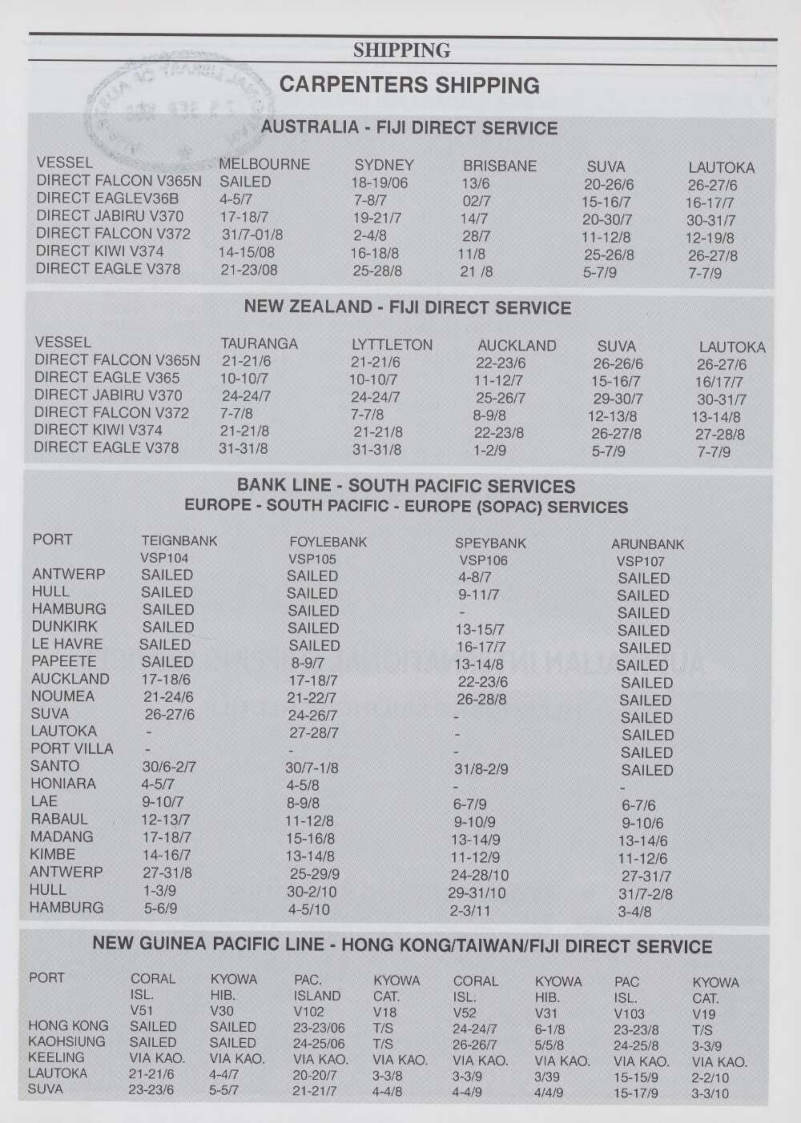
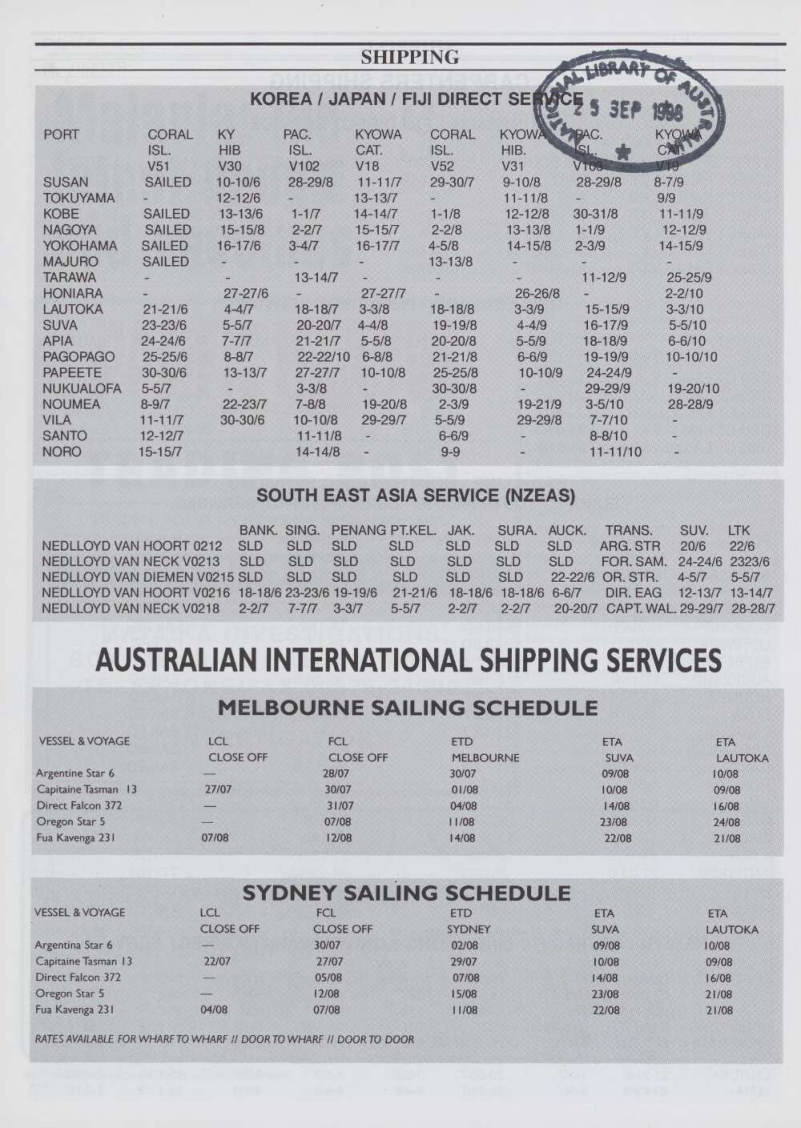
Shipping
Australia - Fiji Direct Service
New Zealand - Fiji Direct Service
Bank Line - South Pacific Services
EUROPE - SOUTH PACIFIC - EUROPE (SOPAC) SERVICES
NEW GUINEA PACIFIC LINE - HONG KONG/TAIWAN/FIJI DIRECT SERVICE
Vessel
Melbourne
Sydney
Brisbane
Suva
Lautoka
Direct Falcon V365N
Sailed
18-19/06 13/6 20-26/6 26-27/6
Direct Eaglev36B
4-5/7 7-8/7 02/7 15-16/7 16-17/7
Direct Jabiru V370
17-18/7 19-21/7 14/7 20-30/7 30-31/7
Direct Falcon V372
31/7-01/8 2-4/8 28/7 11-12/8 12-19/8
Direct Kiwi V374
14-15/08 16-18/8 11/8 25-26/8 26-27/8
Direct Eagle V378
21-23/08 25-28/8 21 /8 5-7/9 7-7/9
Vessel
Tauranga
Lyttleton
Auckland
Suva
Lautoka
Direct Falcon V365N
21-21/6 21-21/6 22-23/6 26-26/6 26-27/6
Direct Eagle V365
10-10/7 10-10/7 11-12/7 15-16/7 16/17/7
Direct Jabiru V370
24-24/7 24-24/7 25-26/7 29-30/7 30-31/7
Direct Falcon V372
7-7/8 7-7/8 8-9/8 12-13/8 13-14/8
Direct Kiwi V374
21-21/8 21-21/8 22-23/8 26-27/8 27-28/8
Direct Eagle V378
31-31/8 31-31/8 1-2/9 5-7/9 7-7/9
Port
Teignbank
Foylebank
Speybank
Arunbank
Vsp104
Vsp105
Vsp106
Vsp107
Antwerp
Sailed
Sailed
4-8/7
Sailed
Hull
Sailed
Sailed
9-11/7
Sailed
Hamburg
Sailed
Sailed
Sailed
Dunkirk
Sailed
Sailed
13-15/7
Sailed
Le Havre
Sailed
Sailed
16-17/7
Sailed
Papeete
Sailed
8-9/7 13-14/8
Sailed
Auckland
17-18/6 17-18/7 22-23/6
Sailed
Noumea
21-24/6 21-22/7 26-28/8
Sailed
Suva
26-27/6 24-26/7 -
Sailed
Lautoka
- 27-28/7 -
Sailed
Port Villa
Sailed
Santo
30/6-2/7 30/7-1/8 31/8-2/9
Sailed
Honiara
4-5/7 4-5/8
Lae
9-10/7 8-9/8 6-7/9 6-7/6
Rabaul
12-13/7 11-12/8 9-10/9 9-10/6
Madang
17-18/7 15-16/8 13-14/9 13-14/6
Kimbe
14-16/7 13-14/8 11-12/9 11-12/6
Antwerp
27-31/8 25-29/9 24-28/10 27-31/7
Hull
1-3/9 30-2/10 29-31/10 31/7-2/8
Hamburg
5-6/9 4-5/10 2-3/11 3-4/8
Port
Coral
Kyowa
Pag.
Kyowa
Coral
Kyowa
Pag
Kyowa
Isl
Hib.
Island
Cat.
Isl.
Hib.
Isl
Cat.
V51 V30 VI02 V18 V52 V31 V103 V19
Hong Kong
Sailed
Sailed
23-23/06 T/S 24-24/7 6-1/8 23-23/8 T/S
Kaohsiung
Sailed
Sailed
24-25/06 T/S 26-26/7 5/5/8 24-25/8 3-3/9
Keeling
Via Kao.
Via Kao.
Via Kao.
Via Kao.
Via Kao.
Via Kao.
Via Kao.
Via Kao.
Lautoka
21-21/6 4-4/7 20-20/7 3-3/8 3-3/9 3/39 15-15/9 2-2/10
Suva
23-23/6 5-5/7 21-21/7 4-4/8 4-4/9 4/4/9 15-17/9 3-3/10
KOREA / JAPAN / FIJI DIRECT SE(WC
5 Sep I&8
Port
Coral
KY
Pac.
Kyowa
Coral
Kyowal *
Jbac.
Ky 9#J
Isl
Hib
Isl
Cat.
Isl.
Hib.
cwSr
V51 V30 Vi02 V18 V52 V31
Susan
Sailed
10-10/6 28-29/8 11-11/7 29-30/7 9-10/8 28-29/8 8-7/9
Tokuyama
- 12-12/6 - 13-13/7 - 11-11/8 - 9/9
Kobe
Sailed
13-13/6 1-1/7 14-14/7 1-1/8 12-12/8 30-31/8 11-11/9
Nagoya
Sailed
15-15/8 2-2/7 15-15/7 2-2/8 13-13/8 1-1/9 12-12/9
Yokohama
Sailed
16-17/6 3-4/7 16-17/7 4-5/8 14-15/8 2-3/9 14-15/9
Majuro
Sailed
- - - 13-13/8 - - -
Tarawa
- - 13-14/7 - - - 11-12/9 25-25/9
Honiara
- 27-27/6 - 27-27/7 - 26-26/8 - 2-2/10
Lautoka
21-21/6 4-4/7 18-18/7 3-3/8 18-18/8 3-3/9 15-15/9 3-3/10
Suva
23-23/6 5-5/7 20-20/7 4-4/8 19-19/8 4-4/9 16-17/9 5-5/10
Apia
24-24/6 7-7/7 21-21/7 5-5/8 20-20/8 5-5/9 18-18/9 6-6/10
Pagopago
25-25/6 8-8/7 22-22/10 6-8/8 21-21/8 6-6/9 19-19/9 10-10/10
Papeete
30-30/6 13-13/7 27-27/7 10-10/8 25-25/8 10-10/9 24-24/9 -
Nukualofa
5-5/7 - 3-3/8 - 30-30/8 - 29-29/9 19-20/10
Noumea
8-9/7 22-23/7 7-8/8 19-20/8 2-3/9 19-21/9 3-5/10 28-28/9
Vila
11-11/7 30-30/6 10-10/8 29-29/7 5-5/9 29-29/8 7-7/10 -
Santo
12-12/7 11-11/8 - 6-6/9 - 8-8/10 -
Noro
15-15/7 14-14/8 - 9-9 - 11-11/10 -
South East Asia Service (Nzeas)
Bank.
Sing.
Penang Pt.Kel.
Jak.
Sura. Auck.
Trans.
Suv.
Ltk
Nedlloyd Van Hoort 0212
Sld
Sld
Sld
Sld
Sld
Sld Sld
Arg. Str
20/6 22/6
Nedlloyd Van Neck V0213
Sld
Sld
Sld
Sld
Sld
Sld Sld
For. Sam.
24-24/6 2323/6
Nedlloyd Van Diemen V0215 Sld
Sld
Sld
Sld
Sld
Sld 22-22/6
Or. Str.
4-5/7 5-5/7
Nedlloyd Van Hoort V0216
18-18/6 23-23/6 19-19/6 21-21/6 18-18/6 18-18/6 6-6/7
Dir. Eag
12-13/7 13-14/7
Nedlloyd Van Neck V0218
2-2/7 7-7/7 3-3/7 5-5/7 2-2/7 2-2/7 20-20/7
Capt. Wal. 29-29/7
28-28/7
Australian International Shipping Services
Melbourne Sailing Schedule
Vessel & Voyage
Lcl
Fcl
Etd Eta
Eta
Close Off
Close Off Melbourne Suva
Lautoka
Argentine Star 6 — 28/07 30/07 09/08 10/08
Capitaine Tasman 13
27/07 30/07 01/08 10/08 09/08 Direct Falcon 372 — 31/07 04/08 14/08 16/08 Oregon Star 5 — 07/08 11/08 23/08 24/08
Fua Kavenga 231
07/08 12/08 14/08 22/08 21/08
Sydney Sailing
Schedule
Vessel & Voyage
Lcl
Fcl
Etd
Eta
Eta
Close Off
Close Off
Sydney
Suva
Lautoka
Argentina Star 6 — 30/07 02/08 09/08 10/08
Capitaine Tasman 13
22/07 27/07 29/07 10/08 09/08 Direct Falcon 372 — 05/08 07/08 14/08 16/08 Oregon Star 5 — 12/08 15/08 23/08 21/08
Fua Kavenga 231
04/08 07/08 11/08 22/08 21/08 RATES AVAILABLE FOR WHARF TO WHARF II DOOR TO WHARF II DOOR TO DOOR
Advertisements & other items, pp. 58-60 (2 items)
Shipping
Local And International
mm
Local
d
International Courier
an O ... 3 1508 00645110 3
LOCAL AND INTERNATIONAL
DOOR TO DOOR
J For further enquiries call us toll free on quire at your ne st Office
3. SHELVES
mm.
N qi9 rf\ c n '^>:3
ADI'S
* ,\' I P m 3 mm m Some of the specs may vary according to market specifications.
Looks tough, feels comfortable - Toyota Hilux People all over the world prefer Toyota. Because it makes bestsellers like Hilux. It maintains that rugged reputation, and now it sports tough, durable body styles as well. It's ready for any terrain.
Hilux offers more. More power - with a choice of engines and precision transmissions and transfers. More effective power distribution to match the terrain, thanks to Toyota's advanced
technology.
And more passenger car-like comfort. With an ergonomic interior, all the conveniences you want, the fit and finish you’d expect from Toyota, and a ride that's smoothed out by precisionengineered suspension.
Hilux is built to take it. And to take you anywhere you want to go.
It’s remarkably tough. And incredibly comfortable. With worldleading uncompromising quality. From the champion. Toyota.
DISTRIBUTORS / DEALERS
NORFOLK ISLAND HORRY'S PTV LTD, PH 22114
SOLOMON ISLANDS ELA MOTORS PH 30314
VANUATU ASCO MOTORS PH 22341
COOK ISLANDS PACIFIC MOTORS LTD. PH 20796
® TOYOTA
KIRIBATI TARAWAMOTORS PH 21090
PAPUA NEW GUINEA ELA MOTORS PH 3229400
TAHITI NIPPON AUTOMOTO PH 429819
WESTERN SAMOA ASCO MOTORS PH 20800
FIJI ASCO MOTORS PH 384888
NEW CALEDONIA S.I.AP. PH 275562
TONGA ASCO MOTORS PH 23500
AMERICAN SAMOA ASCO MOTORS* PH 633-4281
(*HILUX is not being handled.)