Pacific Islands

Monthly
INSIDE: HUNDREDS QUEUE TO DE A KIWI • SIWATIDAU ON THE ENEMY WITHIN
August 1998
Business survival skills Your 2000 lifeline
American Samoa US$2,5O; Australia A 53.50; Cook Islands NZ$3; Fiji F 52.50 Vat incl; FS Micronesia US$3; Kiribati A 52.50; Nauru A 52.50; Niue NZ$3; Norfolk As 3; New Caledonia cpf2so; New Zealand NZ53.45 incl GST; Northern Marianas US$3; Papua New Guinea K 3; Palau US$3; Marshall Islands US$3; Solomon islands As 3; French Polynesia cpf3oo; Tonge P 3; USA US$3; Vanuatu VT22O; Western Samoa T 5.50. These are recommended prices only.
Advertisements & other items, pp. 2-4 (2 items)
Yamaha
PERFORMANCE PROVEN PACIFIC WIDE
Yamaha FRP Boats are available in a wide range of models from 10' up to 25'and are renowned for both dependability and durability. Yamaha outboard motors are available from 2hp through to 150 hp ex-stock, with larger motors up to 250 hp available on request. Supported by M the very best in Genuine Parts and Quality Service, insist on ■ ' ”s, Yamaha, from Asco Motors Nationwide. \ m I?. . , i s~r
DPI
y ugsmOSSmm saws ■m 40 Jt / ¥A**S* \ ; zl As^S i 'C* ***mL* mji 3 *pk se Ssi s*a 9M mm m s*
SBC
V-S'c
FOR TECHNICAL INFORMATION
QUOTATIONS AND BROCHURES
PLEASE CONTACT
BARRY LEE or MANASABALU
TELEPHONE 384888
Fax 370309 Nabua Suva Or Write: GPO Box 355 Suva Fiji Islands
Asco Motors
YAMAHA
NATIONWIDE
NABUA PH 384888
WALU BAY PH 307808
SIGATOKA PH 500577
NADI PH 721777
LAUTOKA PH 662855
BA PH 674406
TAVUA PH 680152
VATUKOULA PH 681377
LABASA PH 811688
1 ' B V K % r ; U-C JB - * ■ * Hr : ,’■ m 4 H > i "/’■ ■ ••: m i ®*%*S .5 We accept Ws4 Just quote your card number and expiry date and we will forward your requirements.
For further information please contact: Teltkom Phone Card Sales Pay Phone Business Unit PO Box 351 Waigani, NCD Papua New Guinea Telephone: (675) 300 5093 Facsimile: <675) 3005060
(fflft TELIKOM PNG
■ ' • AMUO UMZSreZ*
O vodafone
Now, there’s just one number to call for every Vodafone service. 123. It couldn’t be easier.
Vodafone Customer Care operates 24 hours a day and Seven days a week.
Call 123 from your Vodafone or 902 123 from any Telecom Fiji phone.
O vodafone
Calls to 123 (Customer Care) are charged at the standard Vodafone rate.
Pacific Islands
Monthly
Vol 68 No. 8
The News Magazine
August 1998
PUBLISHER: Alan Robinson EDITOR: Sophie Foster Hildebrand
Correspondents:
Sally Andrew, Patrick Decloitre, Giff Johnson, Chris Peteru, Neville Choi, Atama Raganivatu, Michael Field, Liz Thompson, Lili Tuwai, Sam Vulum, Lisa Williams.
COLUMNISTS: David Barber (Wellington), Jemima Garrett (Sydney), GRAPHIC ARTISTS: James Ranuku, Josefa Bola, Andrew Williams
Advertising Sales
Senior Regional Sales (South Pacific) Shabana Naaz Kailesh Kumar Tel (679) 304111, 303244, Fax (679) 303809.
Sydney, Canberra: Bob Hill Media Representation, Tel (61-2) 4164245, Fax (61-2)4165064.
Brisbane: Jane Fewings Media and Advertising Associates Tel (61-7) 3378 4522, Fax (61-7) 3878 1071.
Adelaide: Hastwell Williamsons Representatives, Tel (61-8) 3799522, Fax (61-8) 3799735.
Melbourne: Brown Orr Fletcher Burrows (Aust) Pty Ltd.
Tel (61-3) 98265188, Fax (61-3) 98265644.
Auckland: McKay & Bowman, International Media Representatives Limited, Tel (64-9)4190561, Fax (64-9) 4192243.
Japan: Universal Media Corporation, Tokyo, Tel (3) 3266626741, Cable: UNI-MEDIA Tokyo, Fax (3) 32626742.
Pacific Islands Monthly was founded in 1930
(Usps 9522480).
A Fiji Times Limited production.
Cover prices are recommended retail only. Registered by Australia Post, Publication No. NBPI2IO. © Copyright Fiji Times Limited, 177 Victoria Parade, Suva, Fiji.
Tel (679) 304111, fax (679) 303809.
Email: [email protected] PIM Website: http://www.pim.com.fj Pacific Islands Monthly is published monthly by Fiji Times Limited, a division of Nationwide News, 2 Holt Street, Surry Hills, Sydney, NSW 2010.
Send Address Changes To:
Pacific Islands Monthly PO Box 1167 Suva, Fiji.
Printed by Quality Print Limited, 16 Amra Street, Walu Bay, Suva, Fiji.
Layout and cover design by James Ranuku
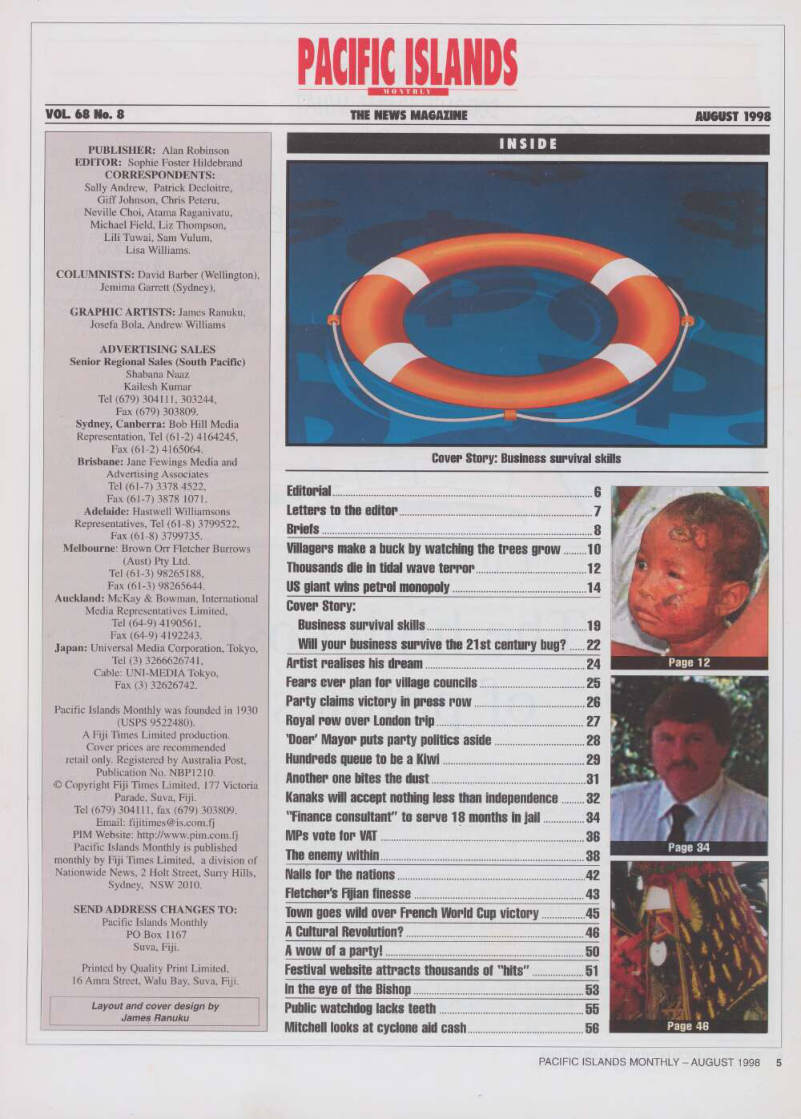
Inside
Editorial 6 Letters to the editor 7 Briefs 8 Villagers make a buck by watching the trees grow 10 Thousands die in tidal wave terror 12 US giant wins petrol monopoly 14 Cover Story: Business survival skills 19 Will your business survive the 21st century bug? 22 Artist realises his dream 24 Fears ever plan lor village councils 25 Party claims victory in press row 26 Boyal row over London trip 27 'Doer' Mayor puts party politics aside 28 Hundreds queue to be a Kiwi 29 Another one bites the dust 31 Kanaks will accept nothing less than independence 32 "Finance consultant" to serve 18 months in jail 34 MPs vote for VAT 36 The enemy within 38 Nails for the nations 42 Fletcher's Fijian finesse 43 Town goes wild over French World Cup victory 45 A Cultural Revolution? 46 A wow of a party! 50 Festival website attracts thousands of "hits" 51 In the eye of the Bishop 53 Public watchdog lacks teeth 55 Mitchell looks at cyclone aid cash 50
Page 12
Page 34
Page 46
Cover Story: Business survival skills
of politics

Editorial
The high cost of politics
THE warning issued by
Savenaca Siwatibau in this month’s issue should echo around the region.
The well-known regional economist and former gov ernor of the Reserve Bank of Fiji knows better than most
the cost of political inaction while whole economies go into meltdown. As he so rightly points out, there is very little that is rosy in the South Pacific economic gar den. As we look around the region, we see economies stagnating or in decline.
We see the gap between the rich and the poor becoming ever wider, thus stor ing up more trouble for the maybe not too distant - future. And we see leaders doing nothing about it.
The real enemy within is the unwill ingness of our political leaders to face the hard decisions. Despite the breast beat ing, the loud protests, the promises and the pledges they are, almost without
exception, incapable of grasping the
political nettle of reform. We hear much about reducing the cost of government, about offloading agencies that could be better handled by the private sector. But as soon as it comes to facing the harsh truth that some people are going to lose their jobs, most MPs either run for cover or pretend this can achieved without pain.
In the meantime, the world leaves us further behind. The financial scandals that are now almost commonplace in this region of the world could have been avoided if Mr Siwatibau’s advice had been followed. But without disciplined
policy-making and implementation we
will continue to have chaos.
For as long as there politi cians ready to put their political survival ahead of the national interest there will be fiscal distress in the South Pacific.
Of course trade between
Forum members and neighbours will help. If we can be seen in the worl i as a trading block rather than a group of micro-markets we’ll obviously have more clout at the various negotiating tables. But, it seems, the political will to achieve even that is lacking. The private sector could help here. But in order for that to happen the heavy burden of gov ernment regulation and bureaucratic interference will have to be removed.
That means fewer public servants and government agencies.
And that, in turn, means unpopular political decisions. Which is just about where we came in. ■
Briefs
Canberra Australia welcomed the outcome of the meeting of South Pacific Forum Economic ministers in Nadi, Fiji. Assistant treasurer, senator Rod Kemp, who represented Australia at the conference, said that despite economic difficulties, ministers recommitted themselves to further eco nomic reform as the key to improving the climate for private investment in the region.
He said this would foster greater competi tiveness and raise sustainable levels of growth within the Forum. Kemp said Australia continued to progress its own important reform agenda since last year’s ministerial meeting in Caims, introducing world class legislation in the areas of financial system regulation and fiscal reporting, and transparency.
Honiara The Solomon Islands government will more than double its revenue from fishing permits and licence fees from Taiwanese fishing boats. This follows the signing of a bilateral fishing agreement in Honiara between the Taiwanese Premier Vincent Siew and Solomon Islands Prime Minister Bartholomew Ulufa’alu.
Apia
Samoa’s opposition leader Tupua Tamasese Efi says Prime Minister Tofilau Eti Alesana should pay for a SUSSOO,OOO prayer temple he ordered built. Samoa National Development Party leader Tupua Tamasese says devoutly Christian Samoa was already full of churches to pray in and the money could have been used on the islands flagging health or education sys tems.
Nukualofa The government of Tonga and the Republic of China on Taiwan have vowed to further strengthen their mutual co-operation in a number of fields. They include agriculture, technology, fisheries, small business ven tures as well as cultural exchanges.
According to the Taiwanese premier, Vincent Siew, his country will further pro mote development projects for Tonga in these areas. Premier Siew and his wife, some cabinet ministers as well as reporters
from Taiwan were in Nuku'alofa for the 80th birthday celebrations of King Taufa’ahau Tupou IV.
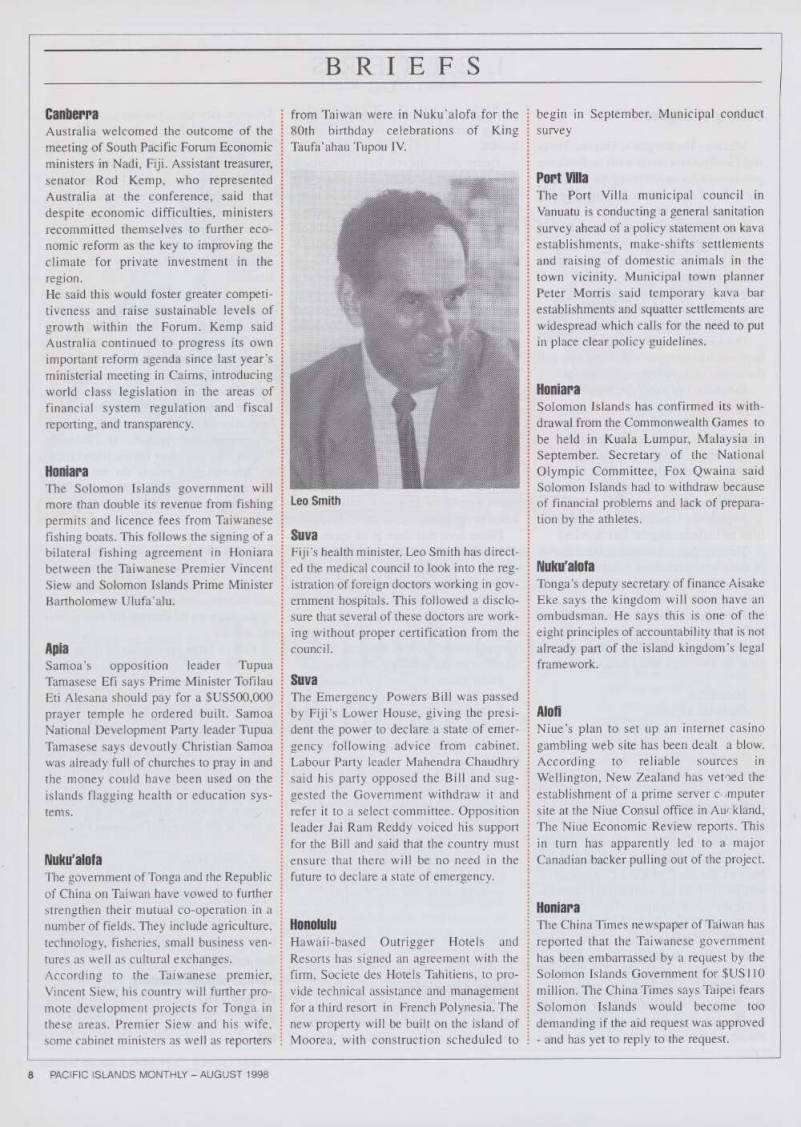
Suva Fiji’s health minister, Leo Smith has direct ed the medical council to look into the reg istration of foreign doctors working in gov ernment hospitals. This followed a disclo sure that several of these doctors are work ing without proper certification from the council.
Suva The Emergency Powers Bill was passed by Fiji’s Lower House, giving the presi dent the power to declare a state of emer gency following advice from cabinet.
Labour Party leader Mahendra Chaudhry said his party opposed the Bill and sug gested the Government withdraw it and refer it to a select committee. Opposition leader Jai Ram Reddy voiced his support for the Bill and said that the country must ensure that there will be no need in the future to declare a state of emergency.
Honolulu Hawaii-based Outrigger Hotels and Resorts has signed an agreement with the fiim, Societe des Hotels Tahitiens, to pro vide technical assistance and management for a third resort in French Polynesia. The new property will be built on the island of Moorea, with construction scheduled to
begin in September. Municipal conduct survey Port Villa The Port Villa municipal council in Vanuatu is conducting a general sanitation survey ahead of a policy statement on kava establishments, make-shifts settlements and raising of domestic animals in the town vicinity. Municipal town planner Peter Morris said temporary kava bar establishments and squatter settlements are widespread which calls for the need to put in place clear policy guidelines.
Honiara Solomon Islands has confirmed its with drawal from the Commonwealth Games to be held in Kuala Lumpur, Malaysia in September. Secretary of the National Olympic Committee, Fox Qwaina said Solomon Islands had to withdraw because of financial problems and lack of prepara tion by the athletes.
Nukualofa Tonga’s deputy secretary of finance Aisake Eke says the kingdom will soon have an ombudsman. He says this is one of the eight principles of accountability that is not already part of the island kingdom’s legal framework.
Alofi Niue’s plan to set up an internet casino gambling web site has been dealt a blow.
According to reliable sources in Wellington, New Zealand has vetoed the establishment of a prime server computer site at the Niue Consul office in Auckland, The Niue Economic Review reports. This in turn has apparently led to a major Canadian backer pulling out of the project.
Honiara The China Times newspaper of Taiwan has reported that the Taiwanese government has been embarrassed by a request by the Solomon Islands Government for SUSIIO million. The China Times says Taipei fears Solomon Islands would become too demanding if the aid request was approved - and has yet to reply to the request.
Leo Smith
Archives-January 1988
Aftermath of
the coups
“These are momentous times for Fiji” - Brigadier Rabuka announcing that a civilian government would take over from his council of ministers.
“Each person was beaten and made to sit in a pit filled with sewage while being questioned” - Fiji lawyer Muttu Krishna, alleging human rights abuses by the Royal Fiji Military Forces.
Paias Wingti: practical
visionary
WBL “I've tried to change our people’s thinking. I’ve let them see they N?Vhave good reason to be conabout themselves, to achieve for themselves and not depend on the Government to do everything for them.” This advocating of self-reliance dovetails with Mr Wingti’s masterplan to develop PNG’s rural sector and to create a viable agricultural base.
For him, the key to prosperity is agri cultural development. In PNG, 87 per cent of the people live in a rural area, many on arable land, but few have the knowledge or equipment to farm it.
The Government has allocated funds from the Budget and poured taxes imposed on foreign mining companies into an agricultural bank set up to lend to village people wishing to involve them selves in agriculture. “All we ask of the recipient is that he wants to work and shows that he is doing something for himself,” said the PM.
Kanaks
“incited revolution”
France’s public prosecutor ordered a judicial inquiry into speeches made in New Caledonia in November by two Kanak separatist leaders.
A statement from the prosecutor’s office described the speeches by Jean- Marie Tjibaou and Yeiwene Yeiwene as an incitement to commit offences.
Solomons PM
stirs media
Newspapers and broadcasting can
make or break South Pacific develop ment efforts, according to Solomon Islands PM Ezekiel Alebua. But, he says, media coverage of the region still leaves much to be desired.
“The freedom of the press should always carry with it the responsibility to inform, educate and entertain, but not to confront and confuse,” he said.
Kiribati airport hit
by vandals
Security measures at Kiribati’s Bonriki international airport have been threatened by acts of vandalism, accord ing to Secretary of Communications John Ikakeau.
“A large portion of the fence sur rounding the runway is missing,” he said.
“And a windsock has been cut to pieces.
The gaps in the fence would allow straying dogs and pigs to cross the run way at any time.”
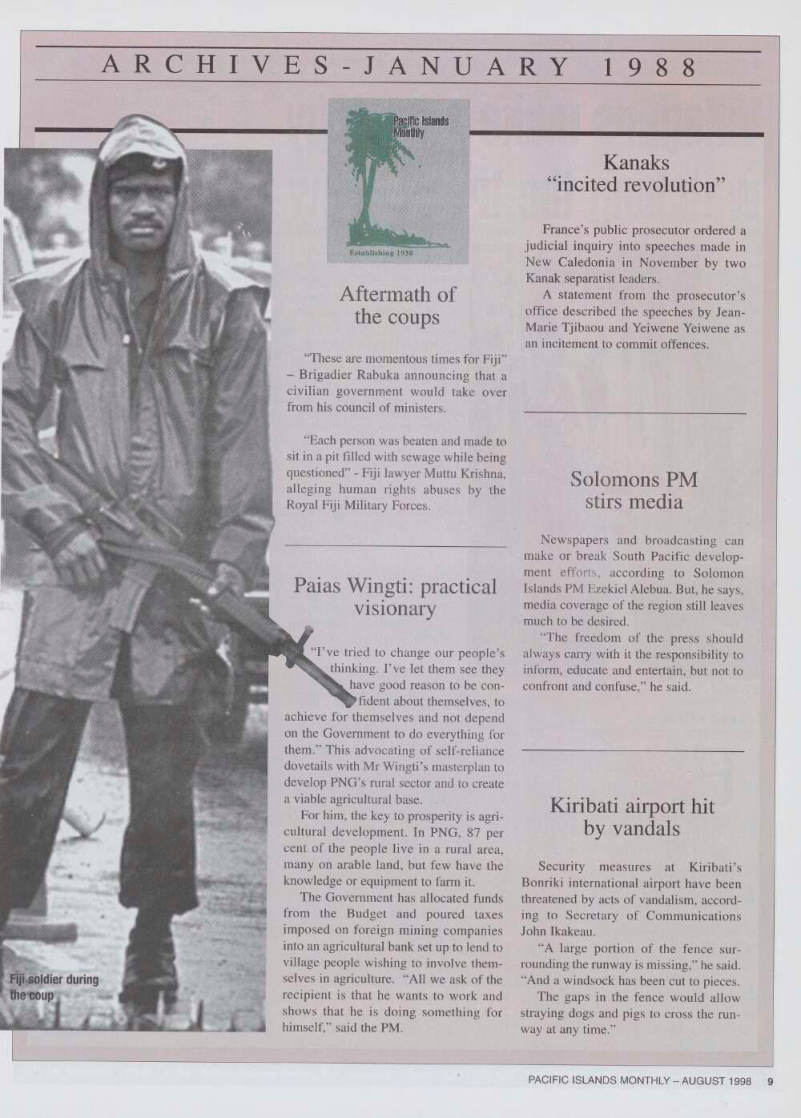
Fiji soldier during the coup
Letters
Society of Rogues
Madam - The Burglar’s, Thieves, Thugs and Fiends Association wish to thank the government for undermining the morale of the Police Force and making the lives of our members that much easier.
It is nice to know that we have friends in high places ( especially the Treasury Dept!) and wish to congratulate Prime Minister Jemmy, er Jenny and her col leagues for making New Zealand a safer place in which our members can carry out their activities without interference.
Our members always suspected that we have much in common with those who pull the strings of government, for example Extortion; (by excessive taxation espe cially GST) Stealing:(Privatisation - selling off assets that do not belong to them.) Murder : (Allowing people to die on economic grounds by not giving access to medical treatment that would have pro longed their life).
Negligence: (putting at risk people’s lives by undermining the Fire Service).
Treason: Not representing the interests of those who elect them. * Actually we are morally superior in this respect our mem bers interests!
Rest assured Jenny we (and the rogues and scoundrels society) pledge our support to ensure that you and your associates con tinue the fine work that you started.
Martin Leo Otahuhu, Auckland.
e-mail: [email protected]
Call for papers
Madam - The research group Transcultures (French University of the Pacific) and the C.O.R.A.I.L. Association will jointly hold an international multidis ciplinary colloquium in Noumea (University Centre of New Caledonia) from 26 - 28th November on the topic: Writing : at the crossroads of islands, at the crossroads of languages.
New Caledonian authors and other writ ers - from the West Indies, from the South Pacific and from the Indian Ocean - will attend the colloquium and develop their
own experiences of writing in the islands; among them, Subramani and Shakuntala Boolell.
These cross approaches to contacts between languages and human groups will make up the leading thread to varied inter rogations on yesterday’s and today’s speeches in the literary fields (political speeches, writing in the legal, administra tive and medical domains, etc).
Need we recall that 1998 stands as a symbolical date for the insular space: 150th anniversary of the repeal of slavery in the French West Indies, centenary of the end of Spanish colonisation?
All this justifies the new area of the 1998 colloquium, wide open to the winds of the global world.
All offers of papers - in French or in English - should include a detailed summa ry of 500 words that will be transmitted to a reading committee.
The papers accepted, along with a sum mary of 100 words (with a translation in either French or English), will be pub lished in the yearly Act of the Colloquium.
Please note that there is an upper limit of 25 minutes for all speeches at the collo quium.
The deadline for offers of papers with the 500-word summary is September 30, 1998. The 100-word summaries are expected for October 15, 1998 (diskette +printed article), so that they can be hand ed out to people attending the colloquium.
Participants in the colloquium are requested to bring their fully corrected text on a diskette ( 3 or 5 inches, PC or Apple) All mail should be sent to Dominique, President of C.0.R.A.1.L and Director of Transcultures: Dominique JOUVE 8, rue Leonard de Vinci 98800 Noumea. New Caledonia Tel/Fax: (687)25-95-27
e-mail: [email protected]
(for Mac, Word 2) [email protected] (for PC, Word 8)
Casino gamblers
Madam - Sophia Foster Hildebrand in her cover story "the lure of quick riches: of your June issue reported that "in the
Solomon Islands ... casinos ... were caus ing more social damage than benefits.”
While the name of the author and the content of the story sound familiar, I dis agree to a certain extent. For one thing, there has not been any empirical research carried out, published or anything for that matter in Solomon Islands which con cludes that casinos were causing more social damage than benefits to Solomon Islanders.
In fact the social damage linked to casi nos would be trivial for Solomon Islands because of the fact that majority of the 300,000 islanders live in one of the nine scattered provinces of Solomon Islands and not in Honiara where the casinos are.
In Honiara the social damage would also be trivial on the grounds that a large proportion of the Honiara populace consist of unemployed people. In Solomon Islands, like any other Pacific island coun try, unemployed people do not receive unemployment benefits. Therefore they may not have the money to gamble at casi nos.
It would be partially correct to say that only those Honiara people in the formal and non-formal sector employment are the ones likely to gamble. However, it would still be erroneous to conclude that casinos create more social damage for two princi pal reasons.
First, a large proportion of those who have the money to gamble do not enter casinos because they are devoted Christians.
Second, only a small proportion of the Honiara populace who are “lukewarm”
Christians gamble at casinos. Not the majority of Solomon Islanders as your story seemed to imply.
In this connection, to say that casinos create more social damage was not entire ly true in the context of Solomon Islands.
Raynold Moveni Honiara
Solomon Islands.
Letters to the Editor should be addressed to; The Editor Pacific Islands Monthly PO Box 1167 Suva Fiji
Villagers make a buck by
Business
Villagers make a buck by watching the trees grow
By Chris Peteru
FROM his simple home on the edge of the remote Falealupo rainforest, cus todian Seulaaia Fafaialii looks across the 30,000-acre preserve with satisfaction, at how the forest was saved and became his village's main revenue earner.
"This has been a blessing for our peo ple” he says simply.
Located at the westernmost point of Savaii island, a 20-minute plane trip from the capital, Apia, Falealupo "where the sun sets” is steeped in Samoan folklore.
"Up to 30 different species of plant and bird life, many not found in other parts of Samoa can be found here.” says Fafaialii "We could easily have lost it ail". "People visiting from Brazil have said we are lucky
to keep our forests intact. Over there its all been turned into houses.”
With over 80 per cent of the islands lowland forest hacked away in a flurry of logging dur ing the last 15 years, Falealupo’s preserve, that stretches 7 kilome tres inland to the sea was set up to go under the miller’s blade as we 11...
Few would have noticed. In the early 90s scores of families living on the coastline were forced to leave, following mas sive damage from two cyclones.
Ten years ago the Government asked the village to build and pay US$2l,OOO (W 5565,000) for a primary school, or face life with no teaching staff. Because paid employment is almost non exis tent and cash flow problems the norm, the village council was resigned to logging a large chunk of the forest to pay for the school. Always keen to help, a local logging company showed
up soon afterwards and offered the exact amount that was needed. Before that an American outfit had already milled the forests of the four surrounding villages.
"We were the only village that had not sold our timber to logging companies.” said chief Aeau Taulapo’o, now a judge in the lands and titles court.
"I advised we should not use the timber in this way because we need it to build our houses. The logging company would take all the good timber and just leave timber that could not be used to build houses.’
In the end, though, the decision to log was reluctantly made. But by chance a vis iting American botanist Professor Paul Cox, who was in Falealupo studying forest ecology offered to secure funding for the school if the council agreed not to turn its forest into a lumber yard. Back in the United States Cox gathered support from
his students at Brigham Young University and several businessmen. Within six weeks the funds had been raised, and a 50-year covenant to protect the forest signed. ‘‘Many didn't understand the meaning of the covenant, and thought the land was going to be taken away from them, so it took time to explain that the land was still ours we just had to be more prudent about the way we used it,” says Taulapo’o.
Twelve months ago Cox and a chief of the village were awarded one of several U 5575,000 prizes from the Goldman Environmental Foundation for “combining their efforts to stop logging in a lowland rainforest, establishing a preserve and building a new school for the village.”
Cox has since written a book describing the events and the medicinal and commer cial potential of local plants.
He also set up financially beneficial arrangements for the Government and Falealupo should tests on Samoan plants be approved and marketed by overseas institutes.
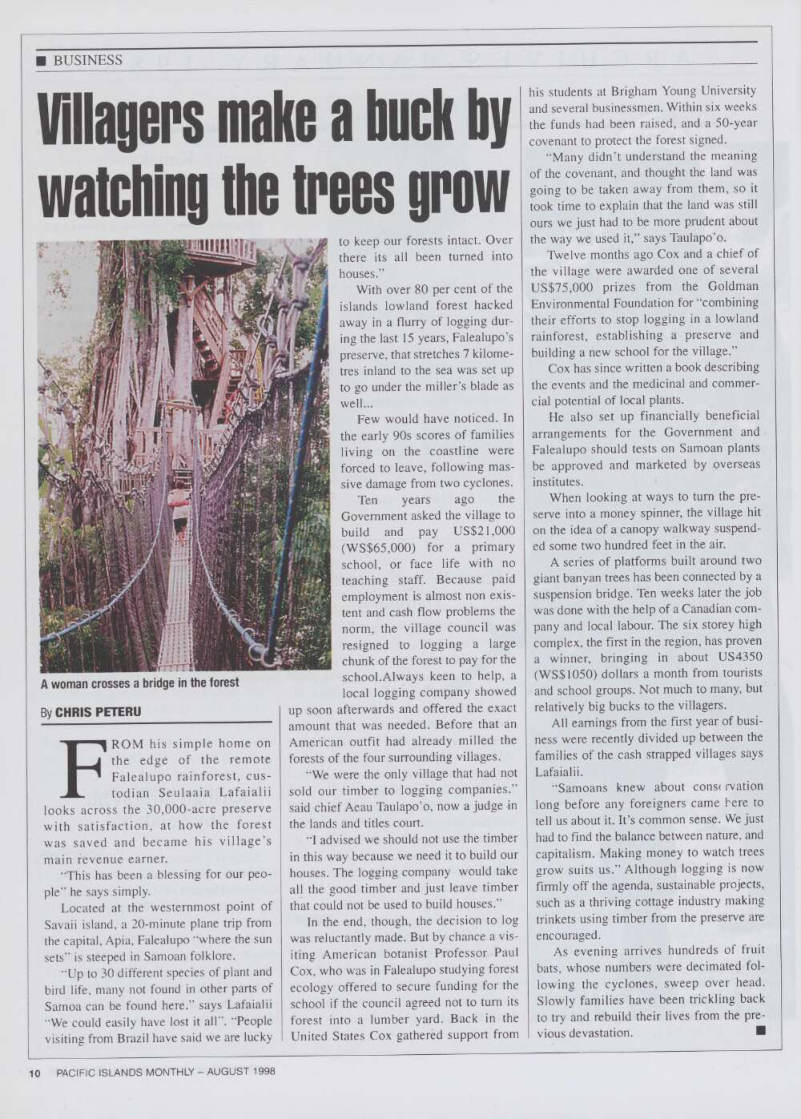
When looking at ways to turn the pre serve into a money spinner, the village hit on the idea of a canopy walkway suspend ed some two hundred feet in the air.
A series of platforms built around two giant banyan trees has been connected by a suspension bridge. Ten weeks later the job was done with the help of a Canadian com pany and local labour. The six storey high complex, the first in the region, has proven a winner, bringing in about U 54350 (WS$lO5O) dollars a month from tourists and school groups. Not much to many, but relatively big bucks to the villagers.
All earnings from the first year of busi ness were recently divided up between the families of the cash strapped villages says Fafaialii.
“Samoans knew about conss rvation long before any foreigners came here to tell us about it. It’s common sense. We just had to find the balance between nature, and capitalism. Making money to watch trees grow suits us.” Although logging is now firmly off the agenda, sustainable projects, such as a thriving cottage industry making trinkets using timber from the preserve are encouraged.
As evening arrives hundreds of fruit bats, whose numbers were decimated fol lowing the cyclones, sweep over head.
Slowly families have been trickling back to try and rebuild their lives from the pre vious devastation. B
A woman crosses a bridge in the forest
Advertisements & other items, p. 11 (1 item)
"V*
s-r v; s v y • . V v Photos : Want - Pantz - Trompas * m v—✓ » m j\j WM f New Caledonia is a developped, sophisticated island business base that offers outstanding opportunities for investors : stunning sites for new hotel developments, suitable climate for counterseason fruits, vegetables and tropical flowers, superb locations for fish and prawn aquaculture, and more. Authorities in New Caledonia are very supportive to business.
ADECAL, the Economic Development Agency of New Caledonia, is the one-stop shop where investors can get specific advice on doing business in New Caledonia.
As your free-of-charge partner, we shall assist you in identifying opportunities and putting together your project successfully.
Should you like to receive further information , please do not hesitate to contact either Vann PITOLLET or Benoit RENGADE.
E-mail: [email protected] a r r* a i
I V Imt V-r / VJL,
New 15, rue Guynemer - PO Box 2384 - 98846 Noumea Cedex - New Caledonia - Phone: (687) 249 077 - Fax: (687) 249 087 - E-mail: [email protected] CO 2B ept 1998 : < 687 ) 275 566
Thousands die in

Tragedy
Thousands die in tidal wave terror
WHEN villagers around the Sissano lagoon in Papua New Guinea’s West Sepik province on the night on July 17, life seemed normal. They could hear the sea lapping gently against the sand as it has done for generations. But, a few hours after dark they heard a new sound.
As one local businessman put it: “I woke up and thought ‘what the Hell’s that?' It was a noise louder than thunder over head and it heralded death for up to 2000 people, many of them children.
It was the worst tidal wave the South- West Pacific has seen since records began and it erased practically all traces of four villages in the region near Aitape on the West Sepik coastline.
Damage extended to 2 km inland.
The lagoon was turned into a scene from a disaster movie with bodies and debris jostling for space in the now quiet water.
Witnesses said the 10m tsunami made a noise like a jet engine as it surged towards a spit of beach between the ocean and the Sissano lagoon.
Catholic lay worker Murray Green of the Aitape mission witnessed the human tragedy of Sissano.
“I’ve actually seen mums and dads sit ting there nursing their dead children before committing them for burial.”
The earthquake that caused the giant wave was felt in Aitape. Edie Michael, a secretary with an Aitape forestry company, had begun preparing the evening meal for her family in central Aitape when the earth quake hit. “It sounded like warplanes were
coming,” she said. “When we looked out to sea we could see this big wave coming and it looked like a big mountain.”
None of her family was injured and their home survived. But we thought that would be the last of our lives,” she said. “We were very lucky.” Aitape businessman Robert Parer said most of the dead and injured were thrown into the lagoon with their flimsy bush material homes.
The lagoon was littered with bloated bodies. “There are bodies on the beach starting to decompose. There are bodies in the lagoon.” he told AFP.
Greene told the BBC that in one village “about a metre of sand now covers the whole area where the village was.”
“There was absolutely no warning,” he said. “They (the village people) did not associate the tidal wave with the earth quake.” Jerry Apuan, a fisherman from Aitape, said he had been unable to count all the bodies in the water.
Many of the dead were children and schools in some surrounding villages had to close due to a lack of students.
“They’re dead ... they’re all dead, said Dickson Dalle, an official co-ordinating the
relief operation.
Authorities said determining the exact death toll would be difficult as it was uncer tain just how many people were missing.
There are still people out there who are injured that we have not rescued,” said Dalle. “They are scattered all over the place.” Many survivors escaped to the bush after the tidal wave hit, said Parer. They were unlikely to return for several days.
I “People are living in the bush, scared that
there’s another one coming,” he said.
Officer in charge of the Raihu health centre in Aitape, Menno Swier, said the centre had been swamped with victims of the tsunami and that relief supplies were beginning to trickle in.
“We need a lot of medication,” he said.
“We’re running out of antibiotics. We’re running out of organic drip material. We need blood banks and we surgeons to oper ate on all these people.”
Swier said the health centre was already at its limit though he expected many more victims to arrive. “I think we only see the tip of the iceberg.” •
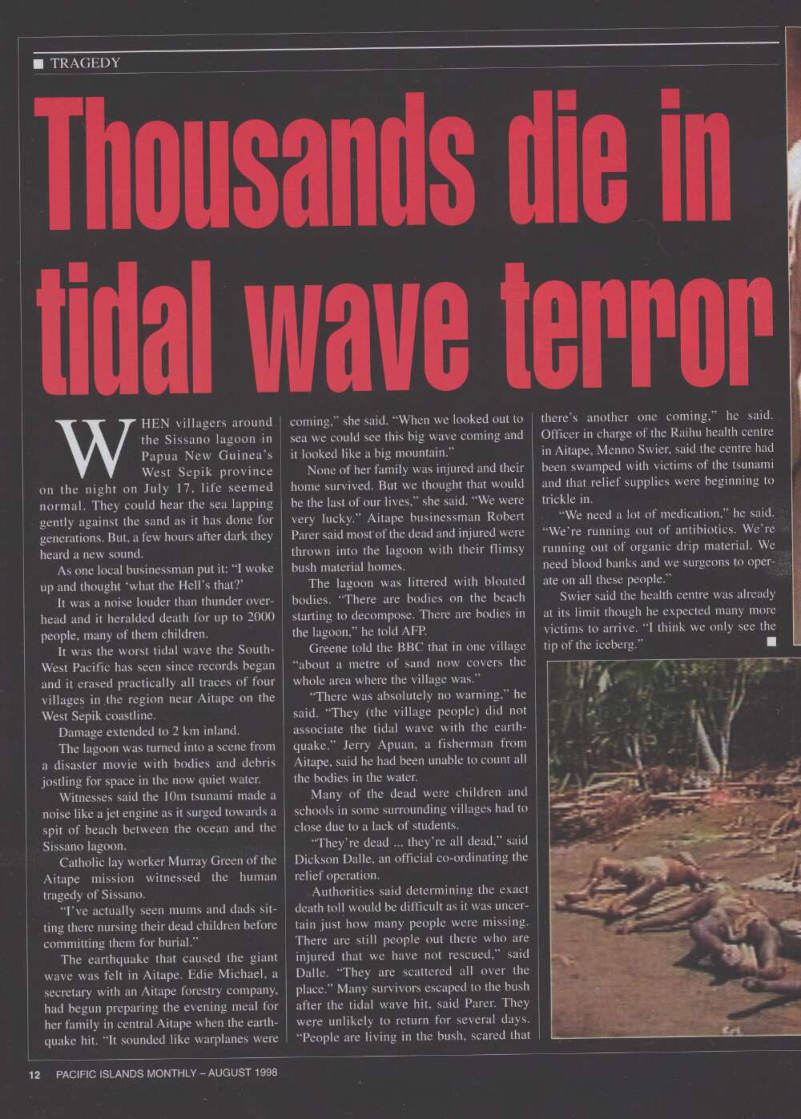
A grieving villager amid the ruins of his home
'It's not possible'
TWO of the villages wiped out by the 10m wave had been the site of the Chicago Field Museum’s research on
friendship, a museum anthropologist
said. “I’ve talked to people in Port Moresby,” said John Terrell. “Two of the places that we know well - one of them that we just love, Warapu - don’t exist any more.”
The villages of Arap and Warapu which Terrell estimat ed had a population of between 1000 and 2000 each, had been located on the devastated spit.
“If you ever wanted to put a village in a place where it was most vulnerable to this sort of thing, that’s where you would put it,” Terrell said. “I’m very upset by this. It’s the sort of thing that happens on such a scale that you can’t imagine. You think ‘Warapu, it must be there. It’s not pos sible. it’s not possible’.” ■
Coretta Yorenti, believed to be suffering a fractured skull
Bodies of drowned villagers
Aid effort launched
WITHIN hours of the disaster being reported, authorities in Papua New Guinea, Australia and New Zealand began a massive aid oper ation. Three RAAF and one New Zealand airforce Hercules aircraft loaded with relief and medical supplies were airborne within 24 hours and an Australian army field hospital was also sent to the stricken region.
“We’re aiming to get the aircraft into Vanimo (the provincial capital situated nearby) where there are now many hundreds of people who need urgent treatment,” said Australian Defence Force Spokesman Col Keith Jobson.
New Zealand's PNG High Commissioner, Nigel Moore told NZPA that PNG officials had asked for assistance.
Foreign Affairs minister Don McKinnon said: “It's clear that there is a tremendous number of people with injuries as a result of being knocked around - broken limbs, broken backs, that sort of thing.” Australia’s Foreign Affairs Minister Alexander Downer said no effort would be spared to help the villagers rebuild their homes and their lives.
“If there are villages to be rebuilt or people to be moved to other areas. I don’t doubt that we’ll have to provide some assistance with that.” ■
US giant wins petrol monopoly

Business
By Chris Peteru
THE battle for Samoa’s mil lion dollar petroleum mar ket is at an end, forcing one of the island’s two multinational suppliers out of the mar ket, crying foul.
British Petroleum is angry over a deci sion by the Government stopping them from importing fuel and related products for sup ply. They say the move to pull the plug on their 27 years operation, plus the way a fresh deal was cut with Mobil Oil, effec tively giving them a monopoly, was unfair ly done.
Finance Minister Tuipaela Malielegaoi maintains the new set up was not reached in a game played with loaded dice.
“As a result of a fair yet competitive ten dering process, an exclusive five-year con tract has been awarded to supply and dis tribute petroleum products in Samoa. This will eliminate duplication and increase effi ciency.” he told parliament.
General Manager of BP South West Pacific Craig Fullerton remains unim pressed.
“We are also very surprised that the Government has elected to make this deci sion and sign contracts without any discus sion regarding compensation for the sub stantial losses BP will incur as a result of their decision. We are extremely disappoint ed the Government is forcing us to leave the market.”
Fullerton called the legality of the Government’s actions "questionable” and said it was likely to have a detrimental effect on the administration’s credibility in the commercial world.
"In that environment we really have no choice but to close our doors. We still do not know what the Government intends to do about our assets but we hope they will sit down with us soon to agree on some com pensation”.
The company wants compensation, cit ing a broken contract to provide aviation fuel for national carrier Polynesian Airlines that was meant to have run to the end of
next year. Petroleum sup plies for six service station outlets in and around the capital have also been with drawn and a dozen jobs at the company’s tank farm and office will be lost.
Heavily dependent on petroleum products to run up to four diesel operated power stations and other services, Samoa imports around 52 million litres of fuel a year.
BP was providing 18 million litres of that amount, that both companies sold through the pumps at US 35 cents a litre. For the last financial year those miner als cost the country
US$ 17.72 m dollars, making
up 10 per cent of the total amount of overseas goods.
Ironically in an econom ic climate geared towards competition and consumer choice, Malielegaoi is adamant the move to monopolise the business is the right one. ‘The objective is to
obtain economies of scale in supply and dis tribution. Substantial foreign exchange earnings will be generated ... which will benefit the Government in terms of revenue ... and the public in terms of more competi tive prices and better service.” he said.
But how competitive prices and better service can be improved by giving Mobil zero opposition, and the public the same number of alternatives is difficult to under stand.
Within days of Malilegaoi's announce ment, the Government pushed for a 4 cent per litre levy on petrol to part-finance a soon as to be built city lease complex.
But the writing could have been on the wall for BP following an incident four years ago. For five days petrol rationing was forced on the country when BP refused to
dock a tanker, later indicating the Government was stalling on payments of a huge aviation fuel bill for Polynesian Airlines. At the time the airline was reeling from a self inflicted USs4sm financial dis aster.
Even so, insiders on the negotiations maintain Fullerton’s version of events does n’t tell the full picture.
"We all know BP, along with four other tenderers, knew of the situation as early as last year. They had plenty of time to put something on the table to counter Mobil's bid, but didn't.” says a Trade, Commerce and Industry official.
"The contract is for five years, then those who wish to may tender again,” added Malielegaoi. Talks between BP and the Government about settling any financial
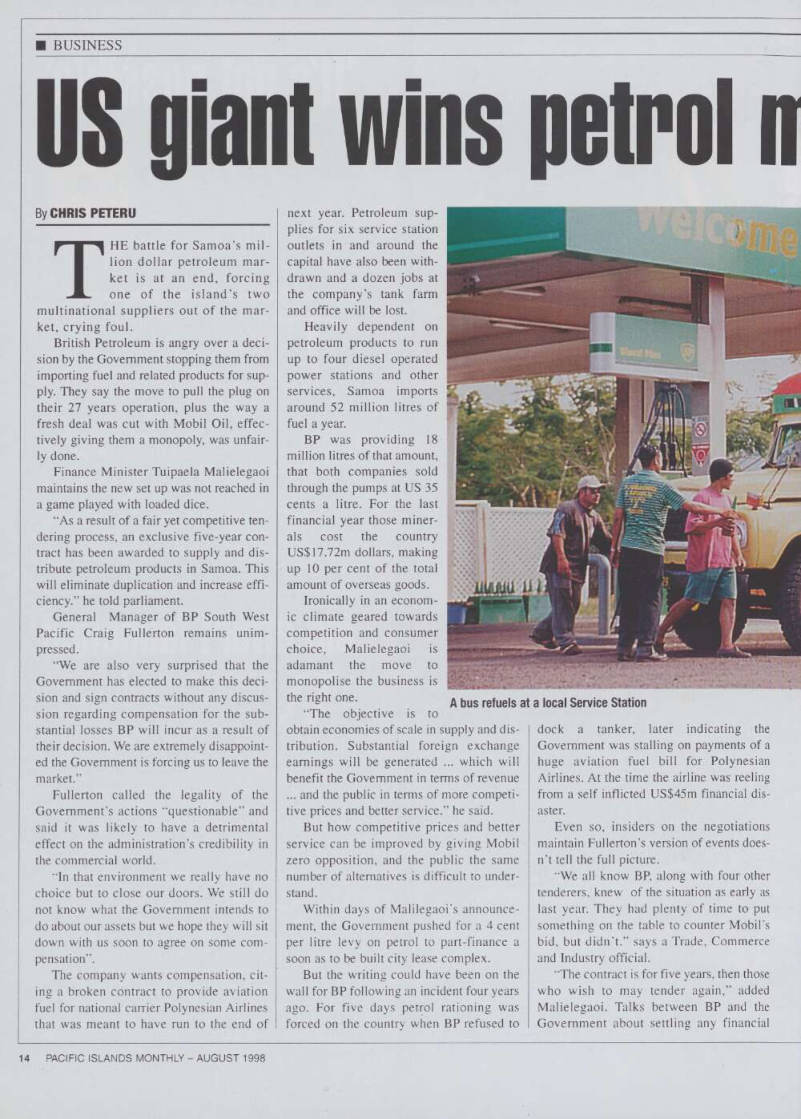
A bus refuels at a local Service Station
settlement have yet to be made public.
Meanwhile US based Mobil Oil, is predictably happy to have been given the keys to every petrol tank in the country.
General manager for the South West Pacific, David Robinson, says the Government has stressed the importance of security of supply. Its tank farm at Sogi will be upgraded and expanded.
Capital investments in several projects during the next few years have been promised.
"We look forward to working closely with the Samoan Government and BP to ensure a smooth transition for the people of Samoa.”
But as far as British Petroleum is con cerned there is still just a little unfinished business. ■
Advertisements & other items, pp. 15-18 (1 item)
f i£LL*
s N m
EXECUTIVE CHAIR
CONFERENCE CHAIR
MEDIUM BACK CHAIR
FILING CABINETS
f ill c Q q
la I
WHITE BOARD
f i£LL*
SCIENTIFIC OFFICE FURNITURE
GPU Box 607, Suva, Fiji. Phone: (679) 312249. Fax: (679) 308357 Reg. Office: Ist Floor, Narseys Building, Ellery St., Suva.
GENERAL MERCHANTS, EXPORTERS & IMPORTERS. FIJI’S LARGEST DISTRIBUTORS OF OFFICE FURNITURE
Nauru (Head office) Tel: (674) 4443 141 Fax: (674) 4443 705
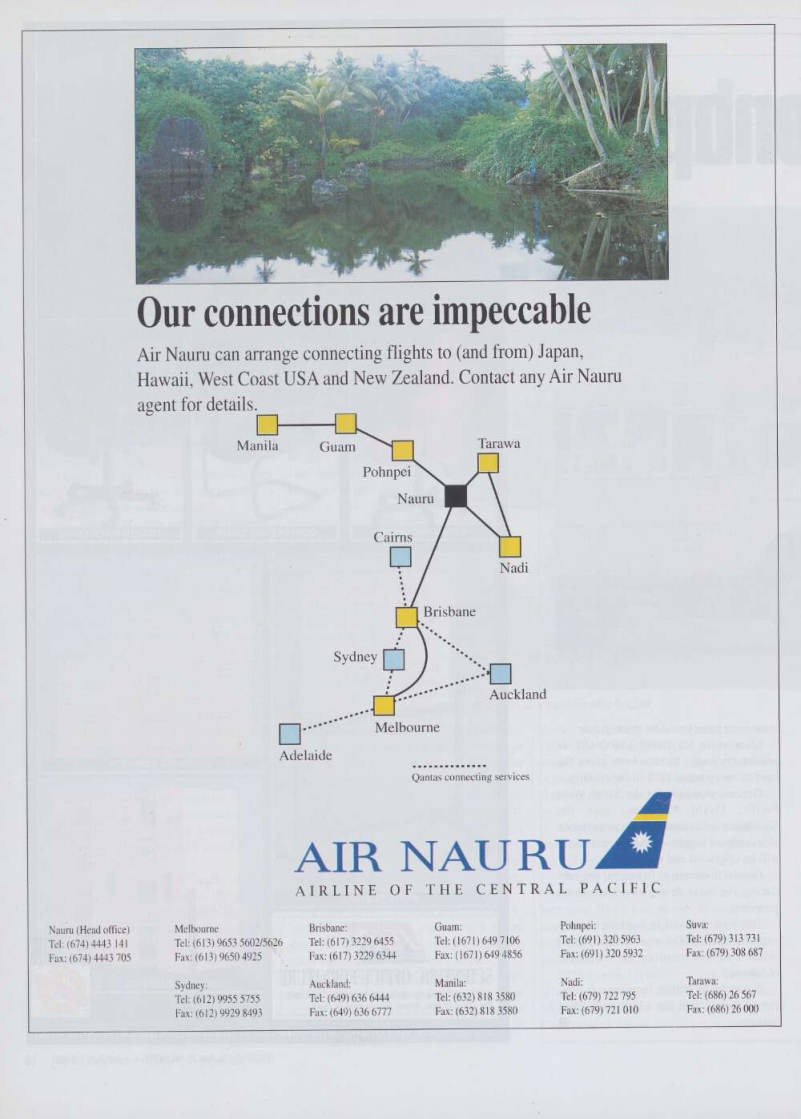
Our connections are impeccable
Air Naum can arrange connecting flights to (and from) Japan, Hawaii, West Coast USA and New Zealand. Contact any Air Nauru
agent for details.
Manila Guam Tarawa
Pohnpei n
Naum Cairns □ Brisbane
Sydney f
Nadi ..-•••a Auckland □ Adelaide Melbourne Qantas connecting services
AIR NAURU^I
AIRLINE OF THE CENTRAL PACIFIC
Melbourne Brisbane: Tel: (613) 9653 5602/5626 Tel: (617) 3229 6455 Fax: (613) 9650 4925 Fax: (617) 3229 6344 Guam: Tel: (1671) 649 7106 Fax: (1671) 649 4856 Pohnpei: Tel: (691)320 5963 Fax: (691) 320 5932 Suva: Tel: (679) 313 731 Fax; (679) 308 687 Sydney: Tel: (612) 9955 5755 Fax: (612) 9929 8493 Auckland: Tel: (649) 636 6444 Fax; (649) 636 6777 Manila: Tel: (632) 818 3580 Fax; (632) 818 3580 Nadi: Tel: (679) 722 795 Fax: (679) 721 010 Tarawa: Tel: (686) 26 567 Fax: (686) 26 000
To Win an
IBM Pentium
Notebook,
Get the latest on political, business and social issues happening throughout the region every month, as well as the chance to win an IBM Pentium Notebook! Every 12issue subscription received before March 31st, 1999 will go into the draw. Subscribe to Pacific Islands Monthly today by calling (679) 304 111 or fax (679) 303 809/(679) 307 460.
Subscribe to The Source.
Pacific Islands Monthly
Conditions of Entry I.To enter, subscription must be made before March 31st, 1999 which automatically enters the subscriber into the draw for the Pentium Notebook Computer. 2.Entry is open to all subscribers except employees of The Fiji Times Ltd, Pacific Islands Month!)' and Wilson Addison Ltd. 3.Subscribers need to subscribe for at least 12 months to qualify-. f.Thc winner of the Pentium Notebook will be published in the Pacific Islands Monthly Magazine, May Issue, 1999 and will be notified by registered mail, s.Thc winner will receive their prize within one month of the draw. 6.Thc prize must be taken as offered and is not redeemable. 7.1 n the event of any dispute the decision of the promoter is final and no correspondence will be entered into.
For almost 70 years, Pacific Islands Monthly has been and still is the authority on political, business and social issues within the Pacific. And now, every 12 month subscription received before the 31st of March, 1999, goes into a draw to win an IBM Pentium Notebook*. You could even give a gift subscription to enter but it must be before the closing date. As well as the entry into the draw, you will also receive the latest news from the region. Fill in the subscription form below and send it along with payment to Pacific Islands Monthly, Subscription Department, PO Box 1167, Suva, Fiji. Or call PIM on (679) 304 111 or fax us on (679) 303 809/(679) 307 460.
Subscribe to The Source.
Pacific Islands Monthly
*Rates include Airspeeding to all destinations Conditions of Entry 1. To enter, subscriptions must be made before March 31st, 1999 which automatically enters the subscriber into the draw for the Pentium Notebook Computer. 2. Entry is open to all subscribers except employees of The Fiji Times Ltd, Pacific Islands Monthly, and Wilson Addison Ltd. 3- Subscribers need to subscribe for 12 months to qualify. 4. The winner of the Pentium Notebook will be published in Pacific Islands Monthly Magazine, May Issue, 1999 and will be notified by registered mail. 5. The winner will receive their prize within one month of the draw. 6. The prize must be taken as offered and is not redeemable. 7. In the event of any dispute the decision of the promoter is final and no correspondence will be entered into.
YES! I wish to subscribe to The Source and receive a chance to win an IBM Pentium Notebook Computer! □ Cheque/Bank Draft/Money Order made payable to Pacific Islands Monthly [ Please charge my credit card: (VISA / AMEX / MASTERCARD)
12 ISSUE
SUBSCRIPTION
Rate A Rate B I Rate C Rate D Rate E Signature; Expiry date: Mr/Mrs/Ms: Delivery Address: Postal Address: This is a
□ Renewal
□ New Subscription Country; Fax:
Business

Cover Story
Business survival skills
By Sophie Foster Hildebrand
DURING a recession it is almost inevitable that some businesses will go down. However, profes sional business consultants say some of those businesses can be saved if certain important points are adhered to.
In a rapidly deteriorating business cli
mate, business survival skills are extremely neces sary. Professionals that PIM spoke to, including lawyers, bankers, and accountants say these skills are essential.
Adam Dickson, a partner in the firm formerly known as Coopers and Lybrand (now Price Waterhouse Coopers) says accountants are not the bad guys when it comes to business dealings.
Appointed along with Mr Don Aidney to look into the National Bank of Fiji virtual collapse several years ago, he says the role of an accountant in keeping a business afloat cannot be
underestimated. “It was said that in the good times we make money by setting up companies and in the bad times we make money by winding them up. But I don’t think they are really. A good accountant shouldn’t really be a bad guy. He’s got much inside knowledge, and if he uses it the right way, it should help the client more than anything else”.
Of all business issues, the ones that are crucial to ensuring business survival in a recession, he says, are credit control and
liquidity.
"Credit control is probably the biggest problem - to try and get your debt and debt-collecting on time. Everybody’s drag
ging, they’re all dragging the chain.
Sometimes you don’t get into the hat at all this month.
"But that’s what you’ve got to watch your credit. A sale is not a sale until such time as you get the money in - not when you sell the stuff. Anybody can give stuff away.” He says a good example of good business survival skills is the operation of
firms that have monopolies or are near monopolies. "They make you pay as you get. You try and buy beer or flour or ciga rettes, where they’ve basically got monop olies (in Fiji), and you pay right on the spot. You don’t get any time to pay and that’s why they don’t go bust”.
A 90-day credit rating is not wise dur ing a recessive period, according to experts, because cashflow has to be main tained. The time limit for credit s.hould be "the shortest possible”.
"Cash on delivery or cash sales are the way to go and then you know where you're standing,” Mr Dickson says. The average credit taken by businesses at the moment is
about 60 to 90 days, with hardly any busi nesses, it seems, paying on the “month
ending”.
A very important point, which many business people find hard to implement is putting a stop to bad credit.
"If you’ve given credit, you must make a calculated decision as to the day when you stop throwing good money after bad.
In other words, if you keep on lending to this chap, you’re giving him more, and more, he’s building up his debt. You’re hoping he’s going to come good. If he doesn’t come good, you're gone,” Mr
Dickson emphasises.
It is because of the recessive nature of doing business at the moment that compa nies should ensure they are not overex tending on borrowing. For some compa nies, the recession plus huge repayments to financiers have been the proverbial straw.
To counter this, Mr Dickson says, “Watch your borrowings. Don’t overbor row, don’t go more and more into borrow
ing to try and get yourself out, because all you do is dig a deeper and bigger hole for yourself’.
He says it is the accoun tant’s role to make certain that a person or business does not overextend too fast, too quickly.
“In other words, you mustn’t get involved in long term assets in short term funds. If you borrow for a building, you make certain you take as long as possible to pay it off. There’s no point trying to pay a building off in three years. You try and pay it off in ten years or as long as you can”. Most busi
nesses that fold have usually overextended themselves, he says. ‘They’ve taken on things they couldn't handle and then they come to a forced sale. When you come to a forced sale, this is when you just never get your price”.
In a dog-eat-dog world with increasing business competition, Mr Dickson says profit margins have to remain.
"You must maintain your margin. Again you can sell stuff or you can give it away.
So you’ve got to ensure these things,” he said.
However, the concentration, he says, should not be solely on profit on paper with nothing in the bank. In this climate
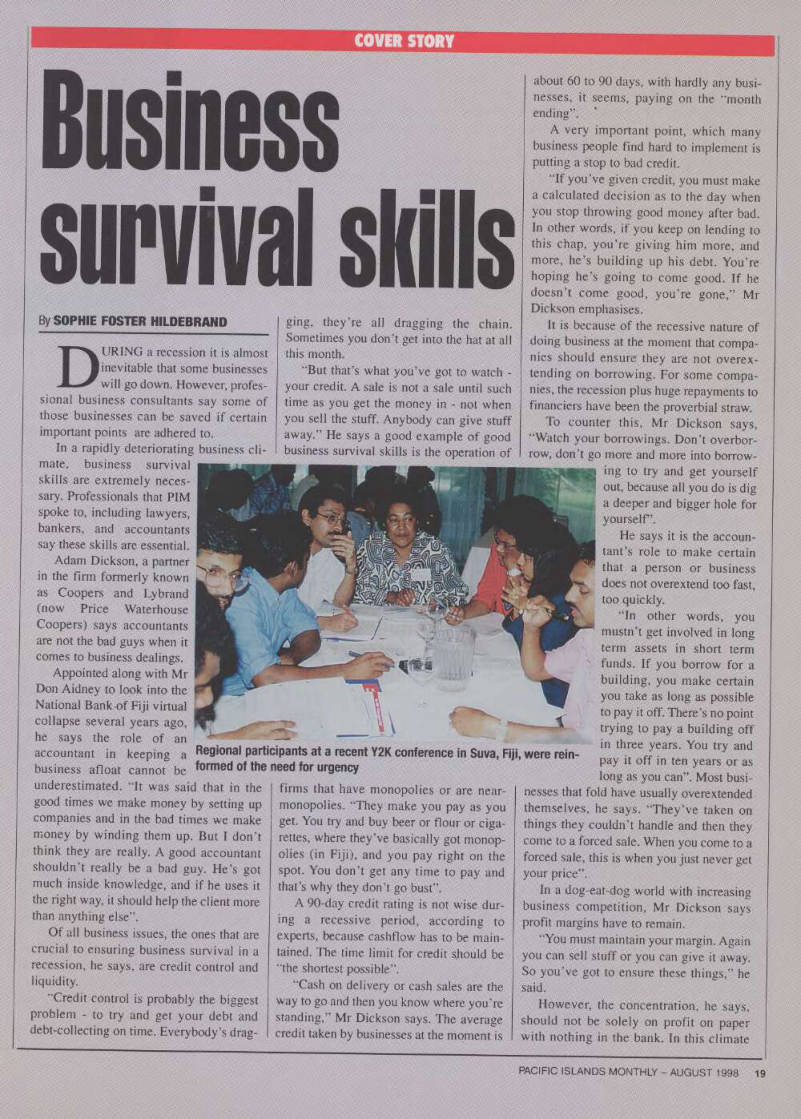
Regional participants at a recent Y2K conference in Suva, Fiji, were rein formed of the need for urgency
businesses have to work on cash flow.
"Keep yourself liquid as fast as you can, as much as you can. If you concentrate on profit, it won’t work. You work on cash flow. Make sure you’ve got a margin and so on, but watch your cash flow. When you’ve got insurance premiums to pay, for instance, you go to the insurance company and say look I want to pay that off over a period, not all in advance. These are the kind of things you’ve got to do,” he says.
One tip for survival in a recession is not to tie up your cash flow with too much stock.
"You mustn’t carry too much stock because if you have too much stock, you've got money tied up there. You’re not doing anything with it, you’re paying interest on it, you’re putting your costs up the whole time, and therefore you’re getting yourself into deep water,” Mr Dickson said.
An important facet which business peo ple should always remember is to keep their banker informed. Banks prefer to know what is happening always so they can help keep the business afloat. Bank of Hawaii regional manager, Mr Andy Jordanou, says banks always like to be assured of a client's standing.
“No-one wants to be surprised. So you do not want to see any surprises, especially with problem loans. In certain cases, it hap pens, like when you have devaluation, or you have a slow economy.
“If you’re a good banker and a good lender, you should be well-versed in all areas. You don’t have to be the brains in one industry, you have to have general knowl edge. What triggers lumber business? What triggers garment? What are the pitfalls?
Then when you have your client base, you ask those questions of them. You want to be ahead of the game,” he says.
Bank of Hawaii has branches throughout the Pacific, and as such their experience spans the region. Mr Jordanou says quite often the bank sees commonalties in busi nesses that collapse in the region.
"It is basically, they can't adopt to change. A lot of them can't adapt to change, or they don't want to change. The world changes every day, and you get into a busi ness rut and you can't see how the competi tors are moving faster than you are". This factor, he says, is common not only to the Pacific region but other regions that he has been to. Other common downfalls are liq uidity, capital resources, and diversification, or rather the lack of them. "You might not have the resources to sustain a business
because you don’t have a good strategic financial plan. And you are not diversified enough. For example, if you concentrate heavily in the garment industry and you are exporting to Australia and .New Zealand, then you have the SPARTECA issue to deal with. A solution would be to diversify to other market segments, maybe the US or some other market area.
"If you know how to diversify and have a good foreseeable three to five year vision plan, and stick by it, you can be successful.
The ones that collapse are the ones that don’t have a real plan,” he says. "If you live day-to-day, you don’t have the actual round ness in knowing how to change, how to move from one area to the other”.
Mr Jordanou says business people should also know how to use good resources like a solicitor, a banker, or an accountant. "Never be afraid to ask for information,” he says.
This is true at any time, but especially essential during a recession. If one of his bank’s clients was having trouble balancing the books, he says, the first action is being able to work with their accountants, solici tors and banker. This means that business people should be able to accept criticism from professionals. "When you accept criti
cism, you could be successful in some respects,” he says.
"Your banker would know pretty much what type of cashflow and
working funds
are required to make a success ful business.
That’s their job.
If they don’t, they aren’t good lenders.
You’ve got to work with professionals that know the business,” he says.
Mr Dickson says the accountant's role is crucial right from day one when you start a business. "You need somebody to hold your hand on the business side on the way through. You need somebody who can come back and be your sounding board. You say 1 want to do this, and he says well have you thought about that, that and that. He points out the pitfalls, and if you can get around them, fine”.
“Many people think they are good enough to do that on their own, and of course an accountant charges fees, and they wonder if it is really worth it,” he says. In the long run, however, Mr Dickson says the accountant has valuable insight into various areas of business.
"He sees what other businesses are doing and not doing, he knows what the pitfalls are, and what you’ve got to be up against.
So really an accountant should be like your doctor, you go to get your health checked every year and when you're feeling particu larly sick, you go back and get an antibiotic or something. It’s that sort of thing,” he says.
Richard Naidu, a lawyer at Munro, Leys and Co in Suva, Fiji, who specialises in cor porate law, says too often people drop their legal bill when trying to balance the books.
"During times like these many business people are too willing to cut comers when it comes to legal issues, or consulting a lawyer. It is now that you may need a lawyer most,” he says.
"I would advise not to cut corners on their lawyer's bill and this is not just because I am a lawyer but because you sim ply cannot afford to take that chance”. Some businesses, he says, do not get legal advice when it comes to handling debtors and that
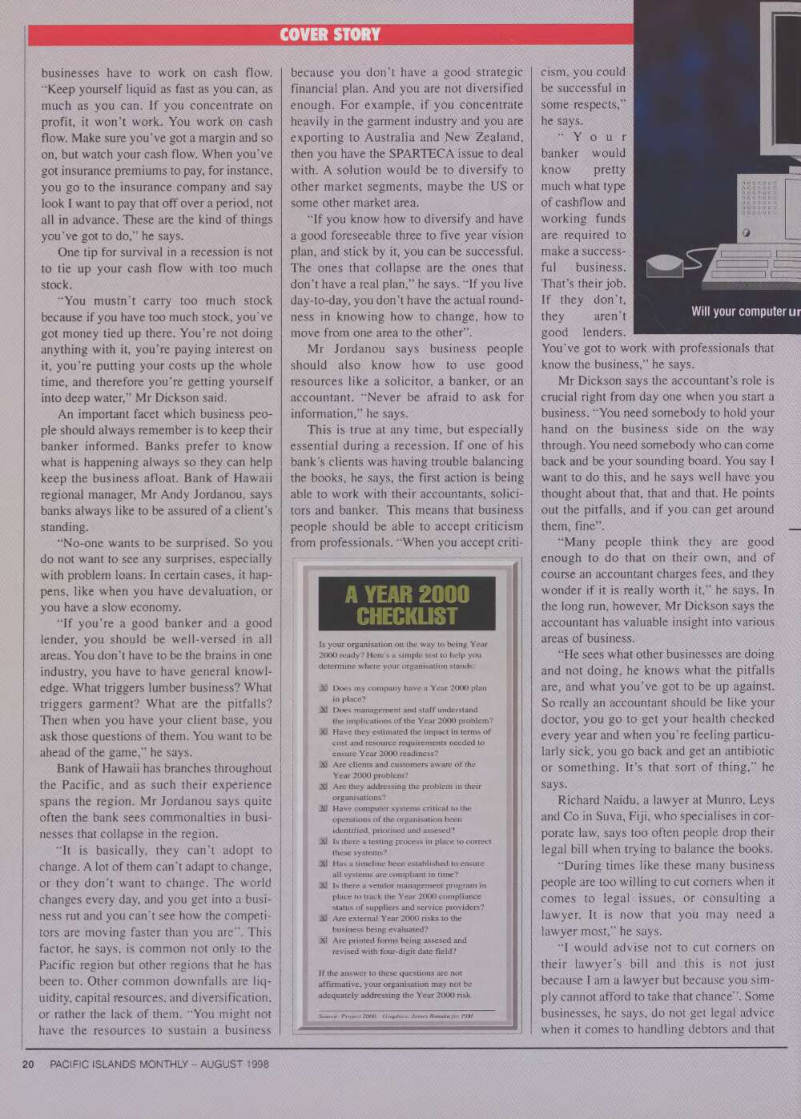
Will your computer u[?]
ends up cost ing them more in the long run.
One way to reduce your lawyer's bill, he says is to keep good records of everything that the com pany does. "It is very impor tant to leave a paper trail wherever you
go and whatever you do. This helps keep track of your business activities and gives your lawyer a good picture of where you are. It ends up costing more if you do not keep a paper trail and the lawyer has to take more time trying to get all your details together. Whatever decision you make with debtors or creditors or whatever, you should have it down on paper.
Do not accept verbal agreements,” he says. “This is really going back to basics but
it is something that I cannot emphasise enough. This applies regardless of whether the country is in a recession or not”. Mr Jordanou says consulting these profession als should help in the development of a recovery plan that shows how the business is going to get out of the problem. The most important point then, is that the business sticks to the recovery plan.
"The problem with a lot of people is that they don’t stick to the plan. They change plans mid-stream, and that's not really wise.
So you stick with the plan. If you’re suc cessful, fine,” he says. “You usually try to base it in a three-month mode. Every three months, you ask is it working? If not, what other things should I do?”
“We try to work with problem loans.
When you get into a problem mode, we have specialists that handle those. So what we try to do is to work out the safest and most expeditious game plan to move for ward to the next level. If we can succeed then it’s fine. If we can’t see the light at the end of the tunnel, we might as well call it quits now, cut your losses and move on. But we have to be the bad guys sometimes, we owe that to our depositors,” he says. Mr
Jordanou says eventually every business person has to know when to give up. "The worse thing'that people do is they don't know when to call it quits.
Okay I screwed up, I made a mistake, let's cut our losses and move on. If you pro crastinate longer and longer on it, not only do you create more credit exposure, but you have a moral and a personal problem too.
You have just got to know when to do it in,” he says.
Mr Dickson says, “Once you go to the wall, you’re gone. There’s nothing you can do, every time you take a step, it gets worse and worse”.
While this may seem like teaching the alphabet to an English professor, sadly some businesses are ignoring basic points of doing business, taking unnecessary risks and thus receivership or liquidation.
Ultimately, business success, Mr Dickson says boils down to hard work and watching the cash.
“It doesn’t come easy. If you know what you’re dealing with, then it makes it much easier to sell and collect and get the margin and turnover you’re looking for. But it real ly needs hard work,” he says. ■
[?]he turn of the century?
Advertisements & other items, pp. 20-21 (1 item)
Checklist
A YEAR 2000
Is your organisation on the way to being Year 2000 ready? Here's a simple test to help you determine where your organisation stands: id Does my company have a Year 2000 plan in place? xj Does management and staff understand the implications of the Year 2000 problem?
X| Have they estimated the impact in terms of cost and resource requirements needed to ensure Year 2000 readiness?
Xj Are clients and customers aware of the Year 2000 problem?
X{ Are they addressing the problem in their organisations? xj Have computer systems critical to the operations of the organisation been identified, priorised and assesed? xl Is there a testing process in place to correct these systems? id Has a timeline been established to ensure all systems are compliant in time? xj Is there a vendor management program in place to track the Year 2000 compliance status of suppliers and service providers? id Are external Year 2000 risks to the business being evaluated? id Are printed forms being assesed and revised with four-digit date field?
If the answer to these questions are not affirmative, your organisation may not be adequately addressing the Year 2000 risk Source: Project 2000. Graphics: James Ranuku for PIM
■I M ■ I "I
■i ■■ ■! ■! ■■ ■■ %■■. .■■■ .■■■ .■■.■ .■■■ v-v
mmmmmmmmmmmm
ms* ■■■ ■■■%
Rfa
■■■ ■„■■ •■■ ■■■ >■■ ■■■.■. ■■.■;.■;.■%■■.■;.■■■. ■ %-a lIU .■i '».■■. •■■
SvvvKSS^
■..■ l I .■■■ •TFi* ■■l
tftft
v.i 555555555555? s-% ■— Wl 51 o; 555555555555
the 21st century bu

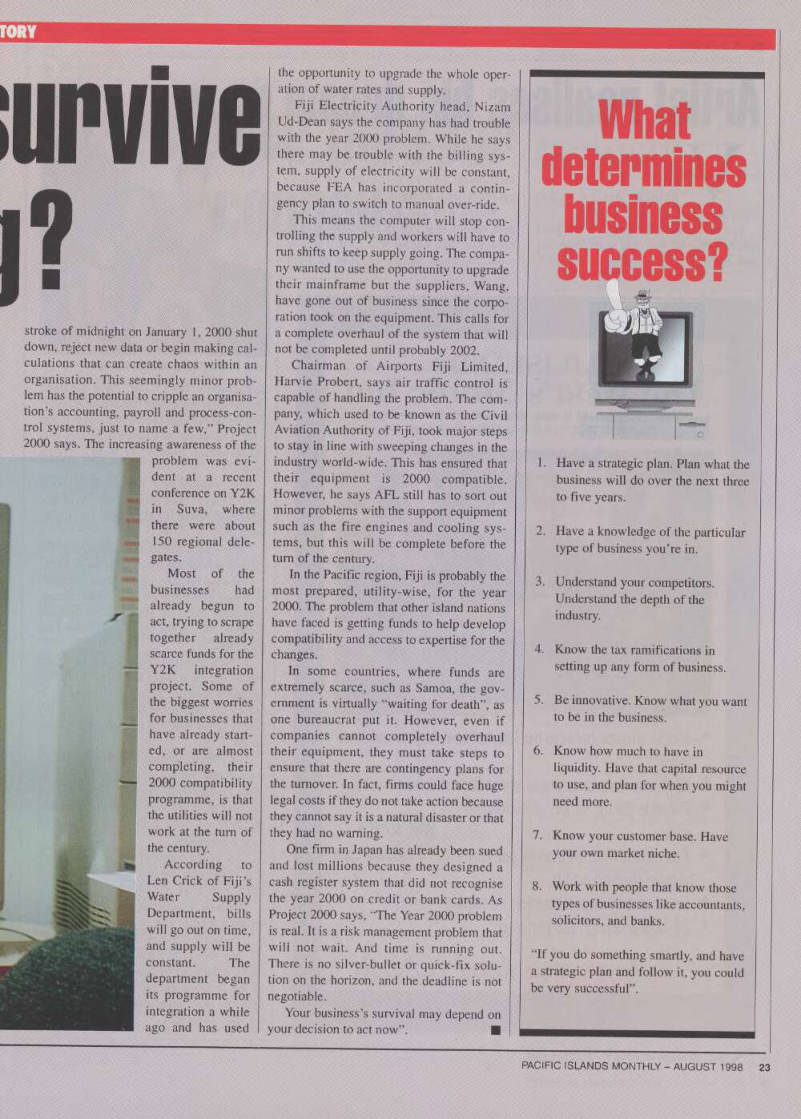
Will your business the 21st century bu
By Sophie Foster Hildebrand
WITH the turn of the century just 17 months away, many big businesses in the region are well on their way in adapting their oper ations to the Y2K issue.
Big organisations are spending millions of dollars upgrading their systems to ensure that their computers recognise the date 2000.
These include banks, publishing firms, utility providers, civil aviation authorities, and governments.
Bank of Hawaii regional manager Andy Jordanou says being able to respond to changes is a sign of a good company.
"A good financial institution or any bank for that matter knows how to adapt to changes, especially this Year 2000 issue. If you haven't done anything, time has virtu ally run out. If you haven’t heard of it, it is too late. And those are the things that we try to educate people in - to know when to look for another avenue to be successful in your business,” he says.
Part of the problem with Y2K is that although these big companies may be 2000 compatible, if their suppliers or customers are not, it could still have a huge negative impact on big business.
It is for this reason that most big compa nies have informed their suppliers and cus tomers about Y2K and why they must take steps to ensure that they are compatible.
The Bank of Hawaii and Pacific Century Financial Corporation have done this through a brochure, called Project 2000, which they distribute free-of-charge to clients.
For those who do not know what Y2K is, it is commonly known as the Millennium Bug, and has seen much bad publicity of late. Most of these stories start with things
like planes will fall out of the sky, or mass chaos, but in the Pacific, where computers are still a relatively new phenomenon, and police still control traffic (in most places), it will not be as bad.
However, Y2K must not be under-esti mated. Y2K is basically about the ability of the computer chip - in your elevators, com
puter network, security system, or air condi tioner - to recognise the change of date from 98 or 99 to 2000. Most chips have been ingrained with two digits for year and many experts say these chips will not be able to handle the change to 00. "Left unchecked, most computer systems, unable to bridge this gap in their internal logic, will at the
stroke of midnight on January 1, 2000 shut down, reject new data or begin making cal culations that can create chaos within an organisation. This seemingly minor prob lem has the potential to cripple an organisa tion’s accounting, payroll and process-con trol systems, just to name a few,” Project 2000 says. The increasing awareness of the
problem was evi dent at a recent conference on Y2K in Suva, where there were about 150 regional dele gates.
Most of the businesses had already begun to act, trying to scrape together already scarce funds for the
Y2K integration
project. Some of the biggest worries for businesses that have already start ed, or are almost
completing, their
2000 compatibility
programme, is that the utilities will not work at the turn of the century.
According to Len Crick of Fiji’s Water Supply Department, bills will go out on time, and supply will be constant. The department began its programme for integration a while ago and has used
the opportunity to upgrade the whole oper ation of water rates and supply.
Fiji Electricity Authority head, Nizam
Ud-Dean says the company has had trouble with the year 2000 problem. While he says there may be trouble with the billing sys tem, supply of electricity will be constant, because FEA has incoiporated a contin gency plan to switch to manual over-ride.
This means the computer will stop con trolling the supply and workers will have to run shifts to keep supply going. The compa ny wanted to use the opportunity to upgrade their mainframe but the suppliers, Wang, have gone out of business since the corpo ration took on the equipment. This calls for a complete overhaul of the system that will not be completed until probably 2002.
Chairman of Airports Fiji Limited, Harvie Probert, says air traffic control is capable of handling the problem. The com pany, which used to be known as the Civil Aviation Authority of Fiji, took major steps to stay in line with sweeping changes in the industry world-wide. This has ensured that their equipment is 2000 compatible.
However, he says AFL still has to sort out minor problems with the support equipment such as the fire engines and cooling sys tems, but this will be complete before the turn of the century.
In the Pacific region, Fiji is probably the most prepared, utility-wise, for the year 2000. The problem that other island nations have faced is getting funds to help develop compatibility and access to expertise for the changes.
In some countries, where funds are extremely scarce, such as Samoa, the gov ernment is virtually “waiting for death”, as one bureaucrat put it. However, even if companies cannot completely overhaul their equipment, they must take steps to ensure that there are contingency plans for the turnover. In fact, firms could face huge legal costs if they do not take action because they cannot say it is a natural disaster or that they had no warning.
One firm in Japan has already been sued and lost millions because they designed a cash register system that did not recognise the year 2000 on credit or bank cards. As Project 2000 says, "The Year 2000 problem is real. It is a risk management problem that will not wait. And time is running out.
There is no silver-bullet or quick-fix solu tion on the horizon, and the deadline is not
negotiable.
Your business’s survival may depend on your decision to act now”. ■
Advertisements & other items, pp. 22-23 (3 items)
cov
Tory
iurvive I?
determines
business
success?
1. Have a strategic plan. Plan what the business will do over the next three to five years. 2. Have a knowledge of the particular type of business you’re in. 3. Understand your competitors.
Understand the depth of the industry. 4. Know the tax ramifications in setting up any form of business. 5. Be innovative. Know what you want to be in the business. 6. Know how much to have in liquidity. Have that capital resource to use, and plan for when you might need more. 7. Know your customer base. Have your own market niche. 8. Work with people that know those types of businesses like accountants, solicitors, and banks.
“If you do something smartly, and have a strategic plan and follow it, you could be very successful”.
Artist realises his dream
Feature
VAKA Pole’o plans to be the first Tongan to take home a three-year graphic design degree from New Zealand this year.
But he has paid the price for the privi lege of being an overseas scholarship stu dent by selling everything he owned to
achieve his dream.
“I sold my truck, my fridge, all my instruments. Everything’s gone now just to get me to New Zealand,” says Vaka.
With a wife and five children to sup port, money is scarce in the Pole’o house hold. But Vaka and his wife cannot legally work for extra money because of tight
immigration laws. The New Zealand Overseas Development Assistance scholar ship set up through the Ministry of Foreign Affairs funds the 39-year-old’s tertiary fees and provides over $500 weekly living costs.
The weekly rent on his Papatoetoe home is $275 and after food, travel and other costs, there is little money for outside interests.
“If my kids want to do something like go on a school trip they can’t,” says Vaka.
Vaka ran his own sign-writing company in Tonga providing signs for local shops, billboards and taxis. He had a comfortable lifestyle, owning his home and growing his own food.
In New Zealand living costs are much higher and there is not the support from an extended family. "I have five brothers at home. It’s hard for me. If I need help my family is not here, so everything depends on me .”
His Tongan heritage is a common theme throughout Vaka’s design work and he often creates Tapa books. "Here in New Zealand there are very different materials, and before I came here I had never ever, used a computer.”
One of the terms of the scholarship is that Vaka must live and work in Tonga for three years after he graduates.
His wife, Fuanileva, and children have adapted well to life in New Zealand and will be sad to leave at the end of the year. ”My two oldest kids have been espe cially influenced by New Zealand life, like by the fashions and rap music. They like it here but they have accepted the fact that we have to go back.” ■
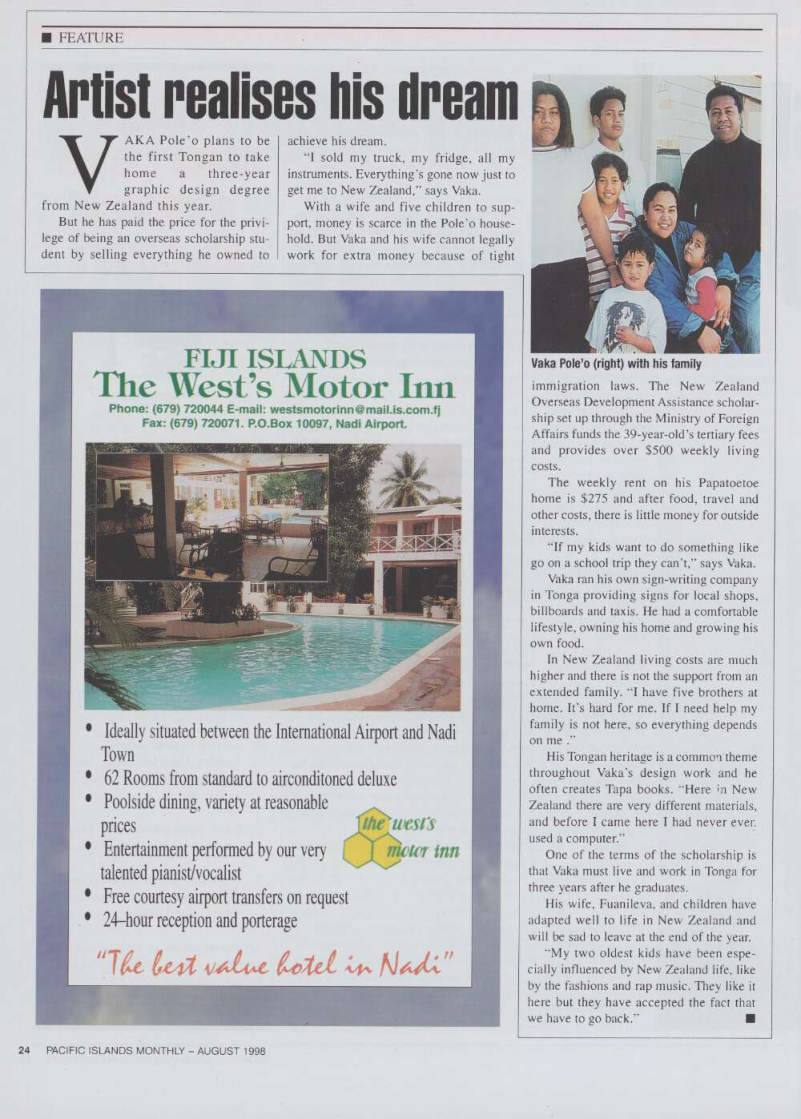
Vaka Pole’o (right) with his family
Advertisements & other items, p. 24 (1 item)
prices Jttuhmt’s
FIJI ISLANDS
The West’s Motor Inn
Phone: (679) 720044 E-mail: [email protected] Fax; (679) 720071. P.0.80x 10097, Nadi Airport. *: is mmm m ■ 1: Ideally situated between the International Airport and Nadi Town 62 Rooms from standard to airconditoned deluxe Poolside dining, variety at reasonable
prices Jttuhmt’s
Entertainment performed by our very [ ] rrwtcr inn
talented pianist/vocalist
Free courtesy airport transfers on request 24-hour reception and porterage n If
village councils
Fears over plan for village councils
THE Cook Islands govern ment’s plans to reintro duce village councils to Rarotonga has many peo ple worried over sweeping powers these bodies will have to introduce any bylaws they want.
Under the Rarotonga Local Government Act passed last year, three district councils can come up with any bylaw which can be enforced by Police.
Nor do the district councils have to first consult with their people to get support for any bylaw they feel is necessary for the “preservation of peace and order in the Vaka (district).” At worst, if councils are over strict, they could enforce old-fashioned bylaws similar to the incredibly rigid and archaic Blue Laws introduced by the mis sionaries.
There’s nothing to stop district councils from enforcing village curfews, totally ban
ning Sunday trading, imposing their own
taxes on alcohol sales, banning people from parties, fishing ... name it, and the district council can enforce it.
For breaking a bylaw there can be a monetary fine of up to $2OOO which the council puts in its kitty. Some say the idea behind the Rarotonga Local Government Act 997 is not so bad, just the wide powers they have been given.
Rarotonga’s vaka councils will be simi lar to the reform measures introduced by the government in the outer islands where much of the central administration’s responsibili ties have devolved to island councils. Even though state politicians will have less to do, once the councils are up and running, it’s doubtful that they will cut their numbers in Parliament.
The country is unlikely to see the politi cal reforms being demanded by the National Development Council, House of Ariki (body of paramount chiefs) and Chamber of Commerce. The Cooks has the distinction of having huge parliamentary representation per capita - about 700 people to every politi cian, one of the biggest in the world. The
National Development Council - a govern ment appointed budget advisory body - says the village councils will take $605,000 out of the public purse each year, a cost the cash strapped country can ill afford at this time.
With the national budget set at $2B million, it is $5.3 million less than the last financial year. The council village elections alone will cost $30,000.
While believing the concept to be good, the opposition Democratic Alliance Party says the time isn’t right for local govern ment bodies in Rarotonga because the coun try can’t afford it. “Why are we creating this bureaucracy today? Why are we going to spend money to pay administration of the Vaka Council on this island? Is this a prior ity for us today at this time of crisis?
“This Bill is going to create a position whereby money has to be allocated to pay the officers running this Council,” said DAP leader Dr Terepai Maoate during debate on the Act. More recently, Dr Maoate is con cerned that there is really nothing he’s aware of to stop a vaka council from re
introducing any old by-laws.
He says there appears to be a lack of constraint to “prevent over zealous mea sures being enacted by the vaka councils” and believes there wasn’t enough public consultation prior to the drafting of the Act.
Maoate’s party is also wary over the “extent of powers vested in the three vaka mayors.”
“But DAP supports the idea behind the Act to encourage some form of autonomous development, be it political, economic or social within each individual vaka on Rarotonga.”
New Alliance leader Norman George described the Act in Parliament as a "cha rade” and said it was being used to divert public attention from the "real issues” fac ing the nation.
With the general elections next year, there’s been speculation that the Vaka elec tion plans for September are really a cun ning election ploy by prime minister Sir Geoffrey Henry and his Cabinet. Some say the prime minister and his cabinet are push
ing for the elections to go ahead as soon as possible because the Government will gain favour (from the thousands that will be poured into local communities.
Under the Act, three Vaka Councils will be set up in Rarotonga and headed by a chairman. Council members will be elected by people in their respective districts.
All council members will be paid and their salaries will be increased to keep up with any raises given to public servants.
MP’s in each of the vaka will be ex-officio council members and will not receive any payment for sitting on the councils.
Jn Parliamentary statements, a number of government MP’s have abstractly expressed how they think the village coun cils can be expected to perform.
Education Minister Ngereteina Puna has said the Rarotonga Local Government Act can be used to “re-introduce the old ways, which included a (village night time) cur few.” Puna said in Parliament an 8.00 pm curfew on school nights would be good for children “who will be better prepared for an effective learning day in their schools.” MP Utia Matata said the councils could be used to “iron out problems” in relation to Sunday trading in Rarotonga. A number of church es, particularly the Cook Islands Christian Church, are opposed to any form of trading on the Sabbath. But some business people criticise this view saying it’s old fashioned and the country’s economic reforms need to be driven by the private sector.
Even more astonishing was Matata’s statement that “the large amount of liquor that is being imported into our country and being sold and transported into the many Vaka (districts), can be tapped into and taken advantage of to earn a few cents (for the vaka council) from the sales of each car ton.” Retailers, however, would most likely be opposed to putting up the price of car tons of beer and keeping track of sales would be extremely difficult for the coun cils. Matata also suggested councils take over the registration of dogs and earn
money. Similarly, Ngereteina Puna thought
it a good idea to impose fines on the owners of “stray animals that are found roaming around in our villages and on the roads.”
The final decision whether to go ahead with the Vaka council elections later this year rests with Cabinet. And if Cabinet's past performance is any indication of what it will do, that decision may not necessarily reflect the recommendations of its own advisory body. ■
Party claims victory
Politics
Party claims victory in press row
By Chris Peteru
EVEN before the result of a US$l5O,OOO civil suit between Samoan prime minister Tofilau Eti Alesana and the Samoa Observer newspaper was known, the Human Rights Protection Party government was claiming victory.
During the 15-day supreme court hear ing it quickly became clear that publisher Savea Sano Malifa was finding it difficult to prove a story he wrote for the paper in December 1996. There, he said, Alesana had confessed to using over U 5593,000 (W 55250,000) of allocated funds to reno vate a family hotel in his Gagaeomauga electorate.
In his testimony, Malifa said he honest ly believed he heard the PM say as much during a parliamentary broadcast on national radio. However, any notes he kept would have been destroyed in a fire at the company premises in 1994, two years ear lier. Acting for the PM, Marcus Jacobs QC asked how Malifa could have taken notes in 1994 about an event that had yet to occur. Malifa replied that he was “con fused”.
Jacobs later said it was strange that out of the entire Samoan population only Malifa, who in the last election ran as an opposition candidate, could recall the PM’s admission. Deputy Prime Minister and government spokesman Tuilaepa Malielegaoi had no problem recalling what he wanted to say.
Within hours of judge Sir Gordon Bisson saying he would make a reserved decision, Malielegaoi, who once described the Observer as "being run by a bunch of fools”, released a four-page statement say ing that in a "dramatic turn” Malifa had apologised to the PM - something observers at the hearing say they never heard. Despite the matter being subjudice, the statement went to air frequently for the next two days on national television and
radio. Privately, legal opinions around the capital Apia say the outcome may favour Alesana (the region’s longest-serving politician) over Malifa (the most influen tial publisher on the island).
As the public is left to ponder how the doyen of journalism could have made such an elementary blunder, the hearing high lighted some embarrassing deficiencies in
the way news-makers on the island oper ate. Although journalists overseas are often tertiary graduates, in Samoa just three of the 50 reporters working for newspapers, radio stations or national television have
tertiary qualifications.
Only a handful would have completed a secondary school education. With this cal ibre of employee common, and training almost non-existent, mixed results at dead line time are assured.
"We must be the only profession in the country where people can just walk in off the street and the next day be a reporter.
This has been a long-standing problem,” says veteran journalist Alan Ah Mu of Tala Nei News Agency. "I had been hoping reporters from overseas might turn up, but Eve been waiting five years. Eve had to train myself. Since 1989, the number of reporters has actually dropped drastically.”
The result is an industry full of inexperi enced individuals who have often taken up the job by default, with little knowledge or concern about the requirements. Small wonder then, the Observer once employed an editor who did not pass school certifi cate English, and a weekly columnist who was a convicted murderer who left the paper after being charged with rape.
Nor that the government-owned Savali newspaper fritters away thousands of tax payer dollars on a directionless newspaper, with non-existent sales and poorly trained reporters.
Fuelling all this is a tendency towards pettiness, ensuring divisiveness instead of co-operation, on a professional level, pre vails. Still the demand for local news by Samoans living overseas is such that in the last ten months, several Samoan language papers and radio stations in New Zealand and Australia have set up bureaus locally.
Moreover the likelihood of these new comers being dragged into court for not doing their job efficiently has been given backing at the highest level. In a final twist to the latest stand-off, Malielegaoi told a press conference that public funds would be made available to any government MP or department official who believed they had been defamed, but did not have the money to hire legal help.
Any damages awarded would be placed into a special fund to finance other law suits by public servants. “This policy has been long thought about by the govern ment as a way to solve the ease by which reporters write what is slanderous of lead ers of the country,” said Malielegaoi.
Given the timing of the announcement, shortly after the hearing ended, it seems the PM's own hefty legal bill (conservatively estimated at US$6O,OOO) may be the first beneficiary of the taxpayer-fundee legisla tion. "Basically this places the government at a huge advantage but with so many inex perienced reporters we are leaving our selves wide open to be sued in court for inaccuracies,” says Ah Mu. Journalists’
Association president Faumuina Lance Polu believes the policy marks a backward step for investigative journalism and another attempt to stifle freedom of expres sion. In effect a warning has been sounded to Samoan reporters that their definition of good journalism is still not good enough.
Even if Malifa is not convicted, news making in Samoa will never be the same again. ■
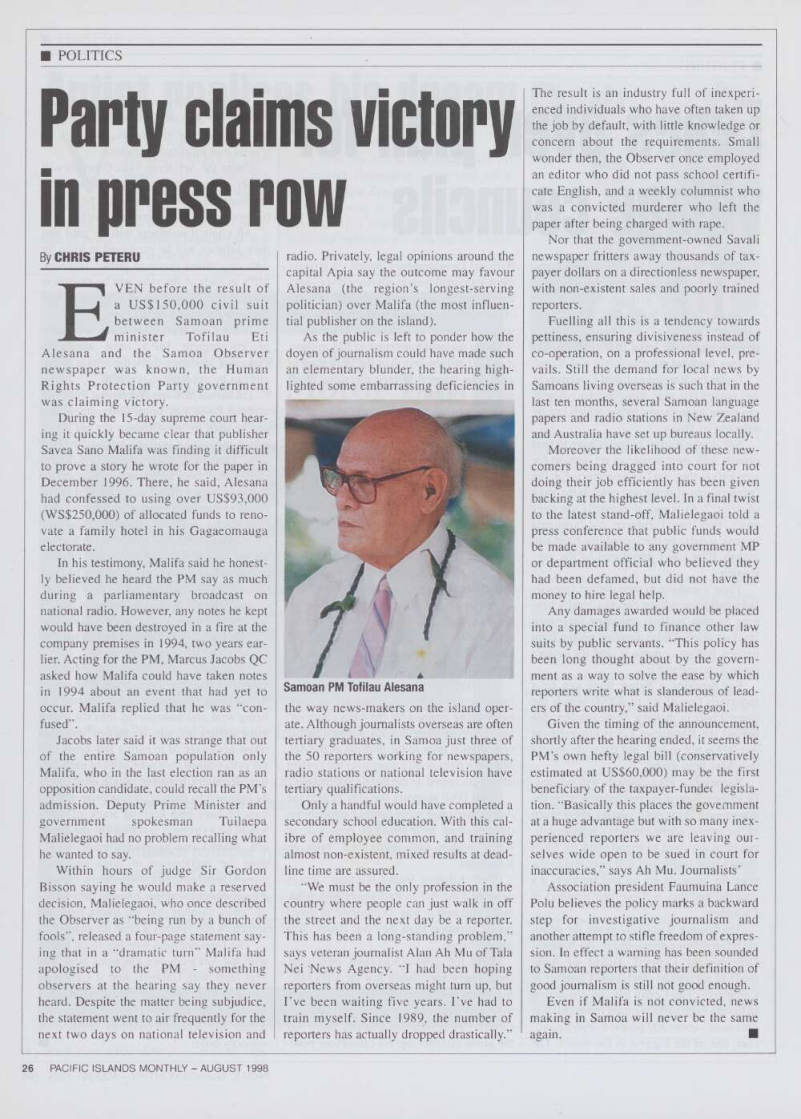
Samoan PM Tofilau Alesana
Royal row over London trip

Feature
COOK Islands Queen’s Representative, Sir Apenera Short, is quiet and dignified, adored by his grand and great-grand children.
But lately, Sir Apenera has risked being seen as a vain old man by a public which has held him in high esteem ever since he
was appointed to the post of Queen’s Representative over five years ago.
Despite the nation’s strug gle with a flat economy and a government acutely short of money, with Cabinet’s bless
ing, Sir Apenera took a publicly funded trip of a lifetime to England to visit the Queen.
The trip was best described as an expensive junket, said some opposition members. Originally to cost taxpayers $67,000, prime minister Sir Geoffrey Henry quickly reacted to the ensuing strong public disapproval, instructing staff to reorganise Sir Apenera’s itinerary to
make savings. Cutting out six days that were to be spent in stop-overs in Hawaii and New Zealand reduced the trip’s cost to $39,000.
The Cooks is spending this much on the eight-day trip so that Sir Apenera can receive his knighthood personally from Her Majesty. The Government’s response
While there was much griping about the trip before Sir Apenera and his entourage left in early June for England, by,the time they returned, public and media attention had turned to other issues.
to calls for the trip to be cancelled was that an appointment had been made with Her Majesty and couldn’t be broken and the Queen’s Representative was entitled to go.
Although Sir Apenera’s trip was widely criticised, there was surprisingly plenty of support for it. On the AM radio’s talkback, 14 of the 21 callers gave it a big okay.
A number of callers said irrespective of the country’s economic problems, Sir
Apenera deserved to go because he’d raised the dignity of the post and served it well.
Another said the Queen’s Representative should go, thus making it known to Her Majesty how much the Cook Islands people appreciate being her sub jects. A couple of callers wrongly believed
that the Queen’s Representative’s office is given a yearly allocation by the Queen and as such would not be using taxpayer’s dollars to pay for the $38,000 trip. Sir Apenera was accompanied by his wife, secre
tary Charlie Tetevano and lady-in-waiting, daughter Akaiti Daniel.
While there was much griping about the trip before Sir Apenera and his entourage left in early June for England, by the time they returned, public and media attention had turned to other issues.
No doubt his grandchildren will hear stories about when their much loved Papa went to visit the Queen. ■
Advertisements & other items, p. 27 (1 item)
Japanese Vehicles
, 430 S J-
DIRECT”
Cut out the middlemen
Where to buy, how to import, photos, specifications, prices, get the book that reveals all. For free information contact - Trust Company Ltd, Tel: 81-52-953- 5602, Fax; 81-52-953-5634/31, E-Mail: [email protected].
Homepage: http://trust-ltd.co.jp/ Address: Kobac Bid 3-2-26 Nishiki Nakaku Nagoya 460-0003 Japan Compiled by the Trust Company Limited, Japan, in association with japan Vehicle Export Limited (UK). Trade Aid Ltd. (UK) and Mobile Outreach Ministry (USA). in '■k/
'Doer' Mayor
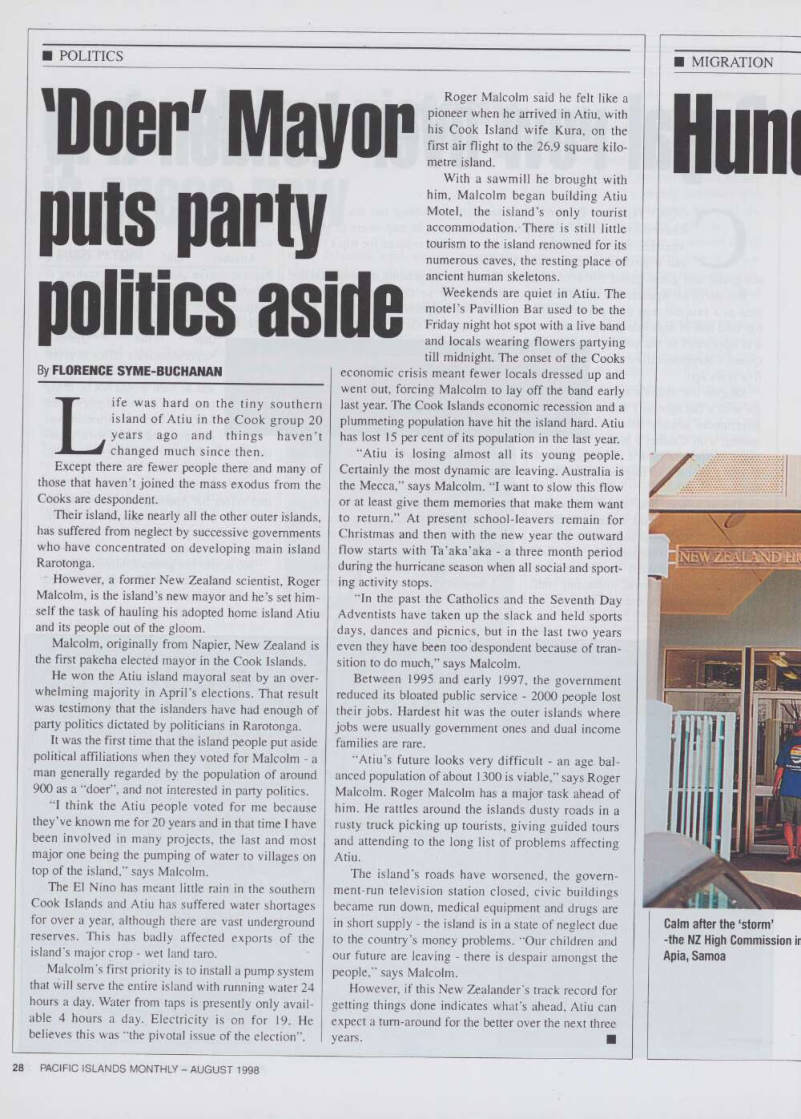
Politics
'Doer' Mayor puls party politics aside
By Florence Syme-Buchanan
Life was hard on the tiny southern island of Atiu in the Cook group 20 years ago and things haven’t changed much since then.
Except there are fewer people there and many of those that haven’t joined the mass exodus from the Cooks are despondent.
Their island, like nearly all the other outer islands, has suffered from neglect by successive governments who have concentrated on developing main island Rarotonga.
However, a former New Zealand scientist, Roger Malcolm, is the island’s new mayor and he’s set him self the task of hauling his adopted home island Atiu and its people out of the gloom.
Malcolm, originally from Napier, New Zealand is the first pakeha elected mayor in the Cook Islands.
He won the Atiu island mayoral seat by an over whelming majority in April’s elections. That result was testimony that the islanders have had enough of party politics dictated by politicians in Rarotonga.
It was the first time that the island people put aside political affiliations when they voted for Malcolm - a man generally regarded by the population of around 900 as a “doer”, and not interested in party politics.
"I think the Atiu people voted for me because they’ve known me for 20 years and in that time I have been involved in many projects, the last and most major one being the pumping of water to villages on top of the island,” says Malcolm.
The El Nino has meant little rain in the southern Cook Islands and Atiu has suffered water shortages for over a year, although there are vast underground reserves. This has badly affected exports of the island’s major crop - wet land taro.
Malcolm's first priority is to install a pump system that will serve the entire island with running water 24 hours a day. Water from taps is presently only avail able 4 hours a day. Electricity is on for 19. He believes this was "the pivotal issue of the election”.
Roger Malcolm said he felt like a pioneer when he arrived in Atiu, with his Cook Island wife Kura, on the first air flight to the 26.9 square kilo metre island.
With a sawmill he brought with him, Malcolm began building Atiu Motel, the island’s only tourist accommodation. There is still little tourism to the island renowned for its numerous caves, the resting place of ancient human skeletons.
Weekends are quiet in Atiu. The motel’s Pavillion Bar used to be the Friday night hot spot with a live band and locals wearing flowers partying till midnight. The onset of the Cooks
economic crisis meant fewer locals dressed up and went out, forcing Malcolm to lay off the band early last year. The Cook Islands economic recession and a plummeting population have hit the island hard. Atiu has lost 15 per cent of its population in the last year.
“Atiu is losing almost all its young people.
Certainly the most dynamic are leaving. Australia is the Mecca,” says Malcolm. “I want to slow this flow or at least give them memories that make them want to return.” At present school-leavers remain for Christmas and then with the new year the outward flow starts with Ta’aka’aka - a three month period during the hurricane season when all social and sport ing activity stops.
“In the past the Catholics and the Seventh Day Adventists have taken up the slack and held sports days, dances and picnics, but in the last two years even they have been too despondent because of tran sition to do much,” says Malcolm.
Between 1995 and early 1997, the government reduced its bloated public service - 2000 people lost their jobs. Hardest hit was the outer islands where jobs were usually government ones and dual income families are rare.
"Atiu’s future looks very difficult - an age bal anced population of about 1300 is viable,” says Roger Malcolm. Roger Malcolm has a major task ahead of him. He rattles around the islands dusty roads in a rusty truck picking up tourists, giving guided tours and attending to the long list of problems affecting Atiu.
The island’s roads have worsened, the govern ment-run television station closed, civic buildings became run down, medical equipment and drugs are in short supply - the island is in a state of neglect due to the country's money problems. "Our children and our future are leaving - there is despair amongst the people,” says Malcolm.
However, if this New Zealander's track record for getting things done indicates what's ahead, Atiu can expect a tum-around for the better over the next three years. ■
Hun[?]reds queue to be a Kiwi
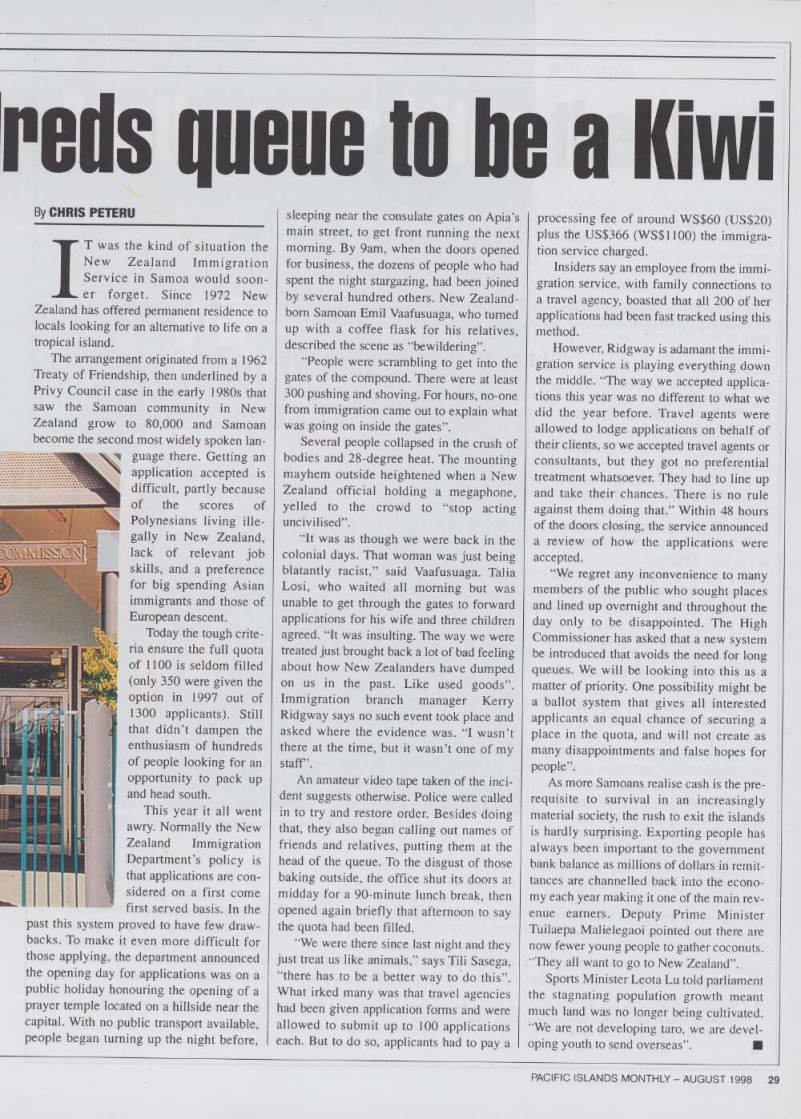
Migration
Calm after the ‘storm’ -the NZ High Commission in Apia, Samoa
By Chris Peteru
I T was the kind of situation the New Zealand Immigration Service in Samoa would soon er forget. Since 1972 New Zealand has offered permanent residence to locals looking for an alternative to life on a
tropical island.
The arrangement originated from a 1962 Treaty of Friendship, then underlined by a Privy Council case in the early 1980 s that saw the Samoan community in New Zealand grow to 80,000 and Samoan become the second most widely spoken lan
guage there. Getting an application accepted is difficult, partly because of the scores of Polynesians living ille gally in New Zealand, lack of relevant job skills, and a preference for big spending Asian immigrants and those of
European descent.
Today the tough crite ria ensure the full quota of 1100 is seldom filled (only 350 were given the option in 1997 out of 1300 applicants). Still that didn’t dampen the enthusiasm of hundreds of people looking for an opportunity to pack up and head south.
This year it all went awry. Normally the New
Zealand Immigration
Department’s policy is
that applications are con sidered on a first come first served basis. In the
past this system proved to have few draw backs. To make it even more difficult for those applying, the department announced the opening day for applications was on a public holiday honouring the opening of a prayer temple located on a hillside near the capital. With no public transport available, people began turning up the night before,
sleeping near the consulate gates on Apia’s main street, to get front running the next morning. By 9am, when the doors opened for business, the dozens of people who had spent the night stargazing, had been joined by several hundred others. New Zealand born Samoan Emil Vaafusuaga, who turned up with a coffee flask for his relatives, described the scene as “bewildering”.
“People were scrambling to get into the gates of the compound. There were at least 300 pushing and shoving. For hours, no-one from immigration came out to explain what was going on inside the gates”.
Several people collapsed in the crush of bodies and 28-degree heat. The mounting mayhem outside heightened when a New Zealand official holding a megaphone, yelled to the crowd to “stop acting uncivilised”.
“It was as though we were back in the colonial days. That woman was just being blatantly racist,” said Vaafusuaga. Talia Losi, who waited all morning but was unable to get through the gates to forward applications for his wife and three children agreed. “It was insulting. The way we were treated just brought back a lot of bad feeling about how New Zealanders have dumped on us in the past. Like used goods”.
Immigration branch manager Kerry Ridgway says no such event took place and asked where the evidence was. “I wasn’t there at the time, but it wasn’t one of my staff’.
An amateur video tape taken of the inci dent suggests otherwise. Police were called in to try and restore order. Besides doing that, they also began calling out names of friends and relatives, putting them at the head of the queue. To the disgust of those baking outside, the office shut its doors at midday for a 90-minute lunch break, then opened again briefly that afternoon to say the quota had been filled.
“We were there since last night and they just treat us like animals,” says Tili Sasega, "there has to be a better way to do this”.
What irked many was that travel agencies had been given application forms and were allowed to submit up to 100 applications each. But to do so, applicants had to pay a
processing fee of around WS$6O (US$2O) plus the US$366 (WS$1100) the immigra tion service charged.
Insiders say an employee from the immi gration service, with family connections to a travel agency, boasted that all 200 of her applications had been fast tracked using this method.
However, Ridgway is adamant the immi gration service is playing everything down the middle. “The way we accepted applica tions this year was no different to what we did the year before. Travel agents were allowed to lodge applications on behalf of their clients, so we accepted travel agents or consultants, but they got no preferential treatment whatsoever. They had to line up and take their chances. There is no rule against them doing that.” Within 48 hours of the doors closing, the service announced a review of how the applications were accepted.
“We regret any inconvenience to many members of the public who sought places and lined up overnight and throughout the day only to be disappointed. The High Commissioner has asked that a new system be introduced that avoids the need for long queues. We will be looking into this as a matter of priority. One possibility might be a ballot system that gives all interested applicants an equal chance of securing a place in the quota, and will not create as many disappointments and false hopes for people”.
As more Samoans realise cash is the pre requisite to survival in an increasingly material society, the rush to exit the islands is hardly surprising. Exporting people has always been important to the government bank balance as millions of dollars in remit tances are channelled back into the econo my each year making it one of the main rev enue earners. Deputy Prime Minister Tuilaepa Malielegaoi pointed out there are now fewer young people to gather coconuts.
“They all want to go to New Zealand”.
Sports Minister Leota Lu told parliament the stagnating population growth meant much land was no longer being cultivated.
"We are not developing taro, we are devel oping youth to send overseas”. ■
Advertisements & other items, pp. 29-30 (2 items)
reds queue to be a Kiwi
Vacancy
SOUTH PACIFIC FORUM SECRETARIAT SUVA, FIJI
The Forum Secretariat was established in 1972 by the South Pacific Forum to encourage economic and political cooperation between its member countries*, and between those states and other countries.
DEPUTY SECRETARY GENERAL
The Secretariat is seeking a suitably qualified and experienced person for the position of Deputy Secretary General of the Forum Secretariat. The Deputy Secretary General assists the Secretary General in all his functions, including the day to day operation of the Secretariat, providing advice and assistance on issues being considered within the Secretariat and deputising for the Secretary General, where necessary.
The position oversees the work of Divisional Directors in implementing the approved Annual Work Programme, reporting outcomes and providing advice to Forum members.
The Deputy Secretary General is accountable to the Secretary General as Chief Executive Officer for: • the successful management of the Forum Secretariat, providing leadership for, and overseeing, the work of all Divisions; • fostering effective working relationships with representatives of the Secretariat’s member Governments and with representatives of other national, international and regional organisations relevant to Forum members’ interests; • ensuring effective representation of the Secretariat at international and regional meetings, wherever necessary.
Applicants must be citizens of Forum member countries* and should have appropriate tertiary qualifications in economics, political science or a related field and at least 10 years experience in a relevant senior management role.
Extensive travel in the region will be required.
The appointment will carry an attractive remuneration package. For non Fiji citizens, remuneration should be tax free in Forum member countries.* There are generous establishment and expenses of office allowances together with medical and life insurance and superannuation provisions. Appointments are normally for three years, with the option to renew for a further three years.
All applications should be addressed to: The Secretary General Forum Secretariat Private Mail Bag Suva, FIJI An Information Package on the position is available from the Secretariat and applicants are urged to obtain one from Ms Angela Ricketts on (679) 312600 or (679) 220207 or fax (679) 301366 or via email: [email protected].
Applications close on 31st August, 1998 and should contain information on education and career background. Applicants must also provide the names, addresses (postal & email), fax and telephone numbers of three employment referees. * Member states of the South Pacifc Forum: Australia. Cook Islands. Federated States of Micronesia. Fiji. Kiribati. Nauru. New Zealand. Niue, Palau. Papua New Guinea.
Republic of Marshall Islands. Samoa. Solomon Islands. Tonga. Tuvalu and Vanuatu.
Another one bites the dust
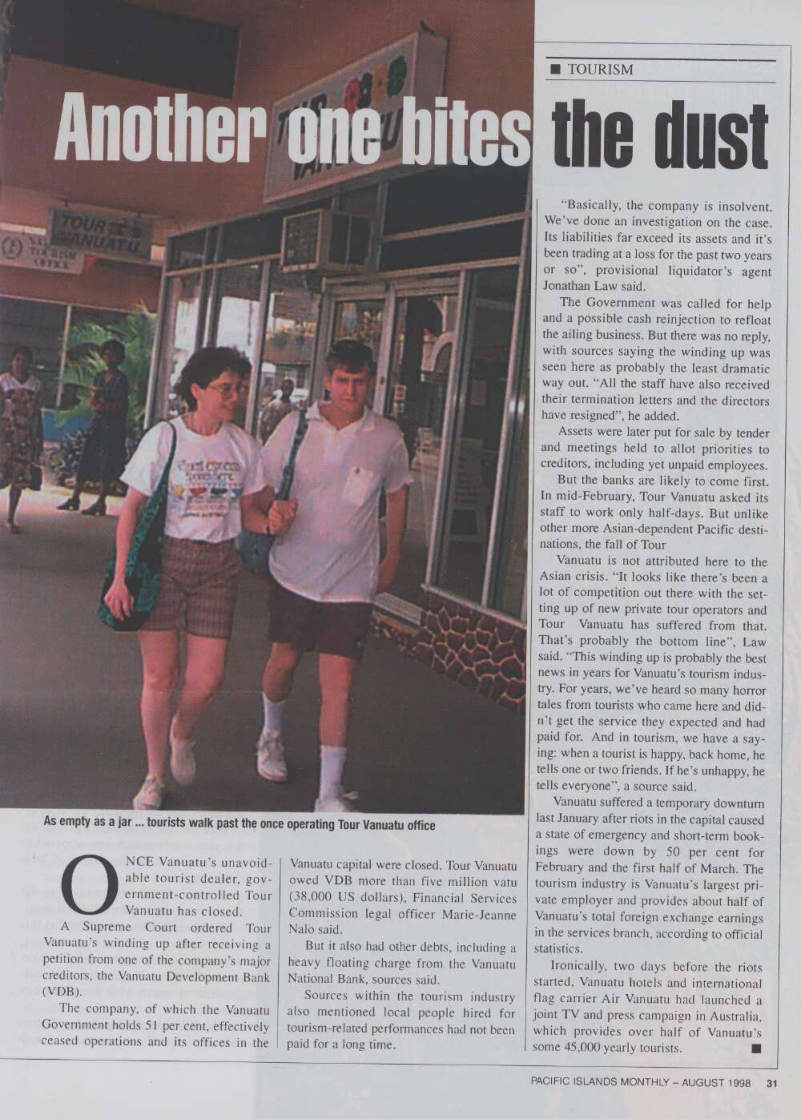
Tourism
ONCE Vanuatu’s unavoid able tourist dealer, gov ernment-controlled Tour Vanuatu has closed.
A Supreme Court ordered Tour Vanuatu's winding up after receiving a petition from one of the company’s major creditors, the Vanuatu Development Bank
(Vdb).
The company, of which the Vanuatu Government holds 5 I per cent, effectively ceased operations and its offices in the
Vanuatu capital were closed. Tour Vanuatu owed VDB more than five million vatu (38,000 US dollars), Financial Services Commission legal officer Marie-Jeanne Nalo said.
But it also had other debts, including a heavy floating charge from the Vanuatu National Bank, sources said.
Sources within the tourism industry also mentioned local people hired for tourism-related performances had not been paid for a long time.
I “Basically, the company is insolvent.
We’ve done an investigation on the case.
Its liabilities far exceed its assets and it’s been trading at a loss for the past two years or so”, provisional liquidator’s agent Jonathan Law said.
The Government was called for help and a possible cash reinjection to refloat the ailing business. But there was no reply, with sources saying the winding up was seen here as probably the least dramatic way out. “All the staff have also received their termination letters and the directors have resigned”, he added.
Assets were later put for sale by tender and meetings held to allot priorities to creditors, including yet unpaid employees.
But the banks are likely to come first.
In mid-February, Tour Vanuatu asked its staff to work only half-days. But unlike other more Asian-dependent Pacific desti nations, the fall of Tour Vanuatu is not attributed here to the Asian crisis. “It looks like there’s been a lot of competition out there with the set ting up of new private tour operators and Tour Vanuatu has suffered from that.
That’s probably the bottom line”, Law said. “This winding up is probably the best news in years for Vanuatu’s tourism indus try. For years, we’ve heard so many horror tales from tourists who came here and did n’t get the service they expected and had paid for. And in tourism, we have a say ing: when a tourist is happy, back home, he tells one or two friends. If he’s unhappy, he tells everyone”, a source said.
Vanuatu suffered a temporary downturn last January after riots in the capital caused a state of emergency and short-term book ings were down by 50 per cent for February and the first half of March. The tourism industry is Vanuatu’s largest pri vate employer and provides about half of Vanuatu’s total foreign exchange earnings in the services branch, according to official statistics.
Ironically, two days before the riots started, Vanuatu hotels and international flag carrier Air Vanuatu had launched a joint TV and press campaign in Australia, which provides over half of Vanuatu’s some 45,000 yearly tourists. ■
As empty as a jar... tourists walk past the once operating Tour Vanuatu office
Independence


Feature
Kanaks will accept nothing less than Independence
By Sophie Foster Hildebrand
/ / NLY when there m ■ are n o more M m Kanaks will there be no more movement for freedom, for independence - and there are plenty of Kanaks around”.
These are the words of Madame Marie-Claire Djibaou, widow of the assassinated head of the Kanak move ment, Jean-Marie Djibaou.
Herself the chairwoman of the Agency for the Development of Kanak Culture, Madame Djibaou has fought on many fronts for the recognition of her people and their cause for freedom.
With the end of the Matignon Accord this year, a referendum was supposed to have been held on the future of New Caledonia.
However, Kanak leaders said they did not want to have a referendum this year.
Madame Djibaou told PIM that this was “‘because whatever the outcome, whether it is for or against independence, we the Kanaks will still want to be inde pendent, no matter what the referendum shows”.
This led to the signing of a new Accord this year - the Noumea Accord - which
slowly takes control of the running of the country away from France.
Although the people of New Caledonia will vote on whether to accept this new accord in November this year, Madame Djibaou says the Kanaks will accept noth ing less than Independence.
If the vote is not in favour of the Noumea Accord, “’’they don’t know what’s going to happen, but things will happen”.
The Kanaks, she says, want to be inde pendent more than anything else. ‘The French say look at Vanuatu, Fiji, Solomons, they are poor after indepen dence. They do worse than they did before.
But the Kanaks say we don’t need all that the French think we need. We are happy to be poor. We have our own resources we can go back to, and even if we end up a poor country, we don’t care. We want to be independent,” she says.
The development of political awareness among Pacific island people has happened in many ways throughout the region. In New Caledonia, however, it has tied in very closely with culture.
It began in 1975 with the realisation of Jean-Marie Djibaou's vision of Melanesia 2000 - the first cultural festival that brought Kanaks from around New Caledonia together. It was the first time that all the cultures, languages and Kanak tribes
assembled in Noumea, which was then considered a white city.
“The festival, especially the Melanesia 2000, made people realise that they are not Kanaks. They have their own history, their own culture, and they are not French,” she says.
“From that day on they felt they had a rich culture and they could be proud of it.
“1975 was the starting point when they said they wanted to be recognised as a peo ple - as Kanaks and not French”.
It was for this reason that the recent Melanesian Arts and Cultural Festival was important to Kanaks, she says.
"The fact that this festival was in a Melanesian country that is independent, that it is organised by an independent coun try, and that the other participants are inde pendent Melanesian countries is very important to us,” Madame Djibaou says.
“It gives us strength and hope for our fight in New Caledonia”.
Because culture unites people, New Caledonia has managed to build its whole independence fight around it.
With the recent upsurge in interest in culture in Melanesia, it could be taken for granted that there will be an upsurge in interest in politics.
For New Caledonia, independence after 2000 may depend on it. ■
Advertisements & other items, p. 33 (2 items)
33
i will accept I less than ndence
PACIFIC ISLANDS MONTHLY - AUGUST 1998
Interlink
UT 280 C
Managerial Mediumback ft
UT 500 C
Presidential Highback Assembled, Exported and Processed by:
INTERLINK
(FIJI )
TRADING
LTD
G.P.O Box 16189, Suva , Fiji Islands. ‘Office Chairs Phone : (679) 3 I 1429 -Office Equipments Fax : (679) 311499 •° ffice Stationer >' Mobile : (679) 938799 ‘Filing Cabinets
in jail
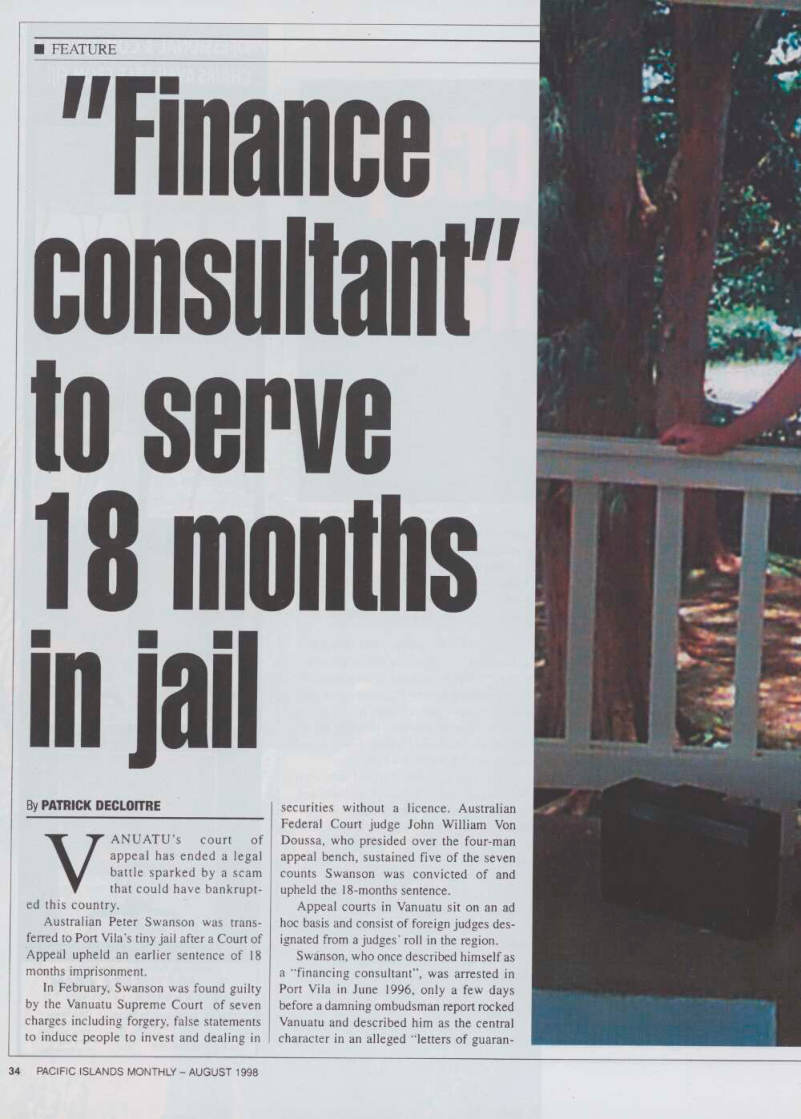
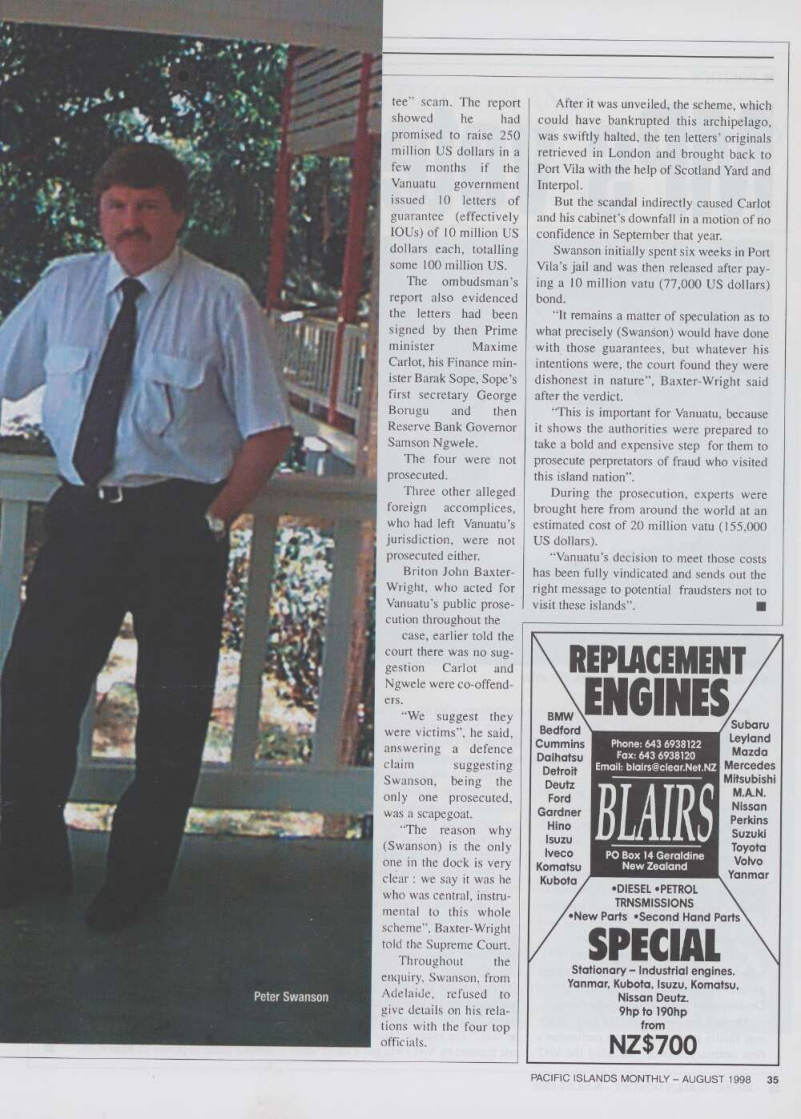
"Finance consultant" to serve 18 months in jail
By Patrick Decloitre
VANUATU’S court of appeal has ended a legal battle sparked by a scam that could have bankrupt ed this country.
Australian Peter Swanson was trans ferred to Port Vila’s tiny jail after a Court of Appeal upheld an earlier sentence of 18
months imprisonment.
In February, Swanson was found guilty by the Vanuatu Supreme Court of seven charges including forgery, false statements to induce people to invest and dealing in
securities without a licence. Australian Federal Court judge John William Von Doussa, who presided over the four-man appeal bench, sustained five of the seven counts Swanson was convicted of and upheld the 18-months sentence.
Appeal courts in Vanuatu sit on an ad hoc basis and consist of foreign judges des ignated from a judges' roll in the region.
Swanson, who once described himself as a "financing consultant”, was arrested in Port Vila in June 1996, only a few days before a damning ombudsman report rocked Vanuatu and described him as the central character in an alleged "letters of guaran-
H tee” scam. The report I showed he had ■ promised to raise 250 I million US dollars in a I few months if the I Vanuatu government I issued 10 letters of ■ guarantee (effectively I lOUs) of 10 million US I dollars each, totalling I some 100 million US.
The ombudsman’s I report also evidenced I the letters had been I signed by then Prime I minister Maxime I Carlot, his Finance min- I ister Barak Sope, Sope’s I first secretary George Borugu and then ■ Reserve Bank Governor I Samson Ngwele.
The four were not prosecuted.
Three other alleged I foreign accomplices, I who had left Vanuatu’s I jurisdiction, were not I prosecuted either.
Briton John Baxter Wright, who acted for I Vanuatu’s public prose ■ cution throughout the r case, earlier told the I court there was no sug- I gestion Carlot and I Ngwele were co-offend- I ers.
“We suggest they I were victims”, he said, I answering a defence I claim suggesting I Swanson, being the I only one prosecuted, I was a scapegoat. ’The reason why (Swanson) is the only one in the dock is very clear : we say it was he who was central, instru mental to this whole scheme”, Baxter-Wright told the Supreme Court.
Throughout the
enquiry, Swanson, from Adelaide, refused to give details on his. rela tions with the four top officials.
After it was unveiled, the scheme, which could have bankrupted this archipelago, was swiftly halted, the ten letters’ originals retrieved in London and brought back to Port Vila with the help of Scotland Yard and Interpol.
But the scandal indirectly caused Carlot and his cabinet’s downfall in a motion of no confidence in September that year.
Swanson initially spent six weeks in Port Vila’s jail and was then released after pay ing a 10 million vatu (77,000 US dollars) bond.
“It remains a matter of speculation as to what precisely (Swanson) would have done with those guarantees, but whatever his intentions were, the court found they were dishonest in nature”, Baxter-Wright said after the verdict.
“This is important for Vanuatu, because it shows the authorities were prepared to take a bold and expensive step for them to prosecute perpretators of fraud who visited this island nation”.
During the prosecution, experts were brought here from around the world at an estimated cost of 20 million vatu (155,000 US dollars).
“Vanuatu’s decision to meet those costs has been fully vindicated and sends out the right message to potential fraudsters not to visit these islands”. ■
peter Swanson
Advertisements & other items, p. 35 (1 item)
Special
REPLACEMENT
BMW
Bedford Cummins Daihatsu Detroit Deutz Ford Gardner Hino Isuzu Iveco Komatsu Kubota Phone: 643 6938122 Fax: 643 6938120 Email: [email protected] PO Box 14 Geraldine New Zealand Subaru Leyland Mazda Mercedes Mitsubishi
MAN.
Nissan Perkins Suzuki Toyota Volvo Yanmar
•DIESEL •PETROL
TRNSMISSIONS
•New Parts ‘Second Hand Parts'
SPECIAL
Stationary - Industrial engines.
Yanmar, Kubota, Isuzu, Komatsu, Nissan Deutz. 9hp to 190 hp from
NZ$7OO
MPs vote for VAT
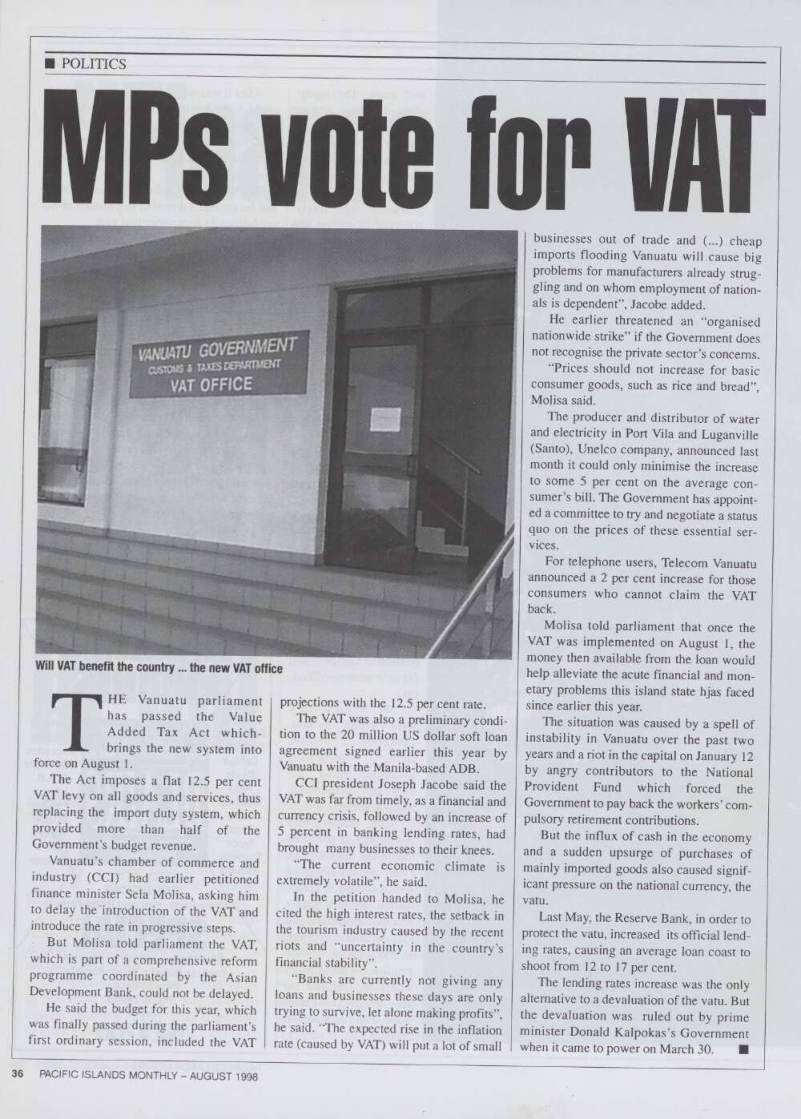
Politics
THE Vanuatu parliament has passed the Value Added Tax Act which brings the new system into force on August 1.
The Act imposes a flat 12.5 per cent VAT levy on all goods and services, thus replacing the import duty system, which provided more than half of the Government’s budget revenue.
Vanuatu’s chamber of commerce and industry (CCI) had earlier petitioned finance minister Sela Molisa, asking him to delay the introduction of the VAT and introduce the rate in progressive steps.
But Molisa told parliament the VAT, which is part of a comprehensive reform programme coordinated by the Asian Development Bank, could not be delayed.
He said the budget for this year, which was finally passed during the parliament’s first ordinary session, included the VAT
projections with the 12.5 per cent rate.
The VAT was also a preliminary condi tion to the 20 million US dollar soft loan agreement signed earlier this year by Vanuatu with the Manila-based ADB.
CCI president Joseph Jacobe said the VAT was far from timely, as a financial and currency crisis, followed by an increase of 5 percent in banking lending rates, had brought many businesses to their knees.
“The current economic climate is extremely volatile”, he said.
In the petition handed to Molisa, he cited the high interest rates, the setback in the tourism industry caused by the recent riots and "uncertainty in the country’s financial stability”.
"Banks are currently not giving any loans and businesses these days are only trying to survive, let alone making profits”, he said. "The expected rise in the inflation rate (caused by VAT) will put a lot of small
businesses out of trade and (...) cheap imports flooding Vanuatu will cause big problems for manufacturers already strug gling and on whom employment of nation als is dependent”, Jacobe added.
He earlier threatened an “organised nationwide strike” if the Government does not recognise the private sector’s concerns.
"Prices should not increase for basic consumer goods, such as rice and bread”, Molisa said.
The producer and distributor of water and electricity in Port Vila and Luganville (Santo), Unelco company, announced last month it could only minimise the increase to some 5 per cent on the average con sumer’s bill. The Government has appoint ed a committee to try and negotiate a status quo on the prices of these essential ser vices.
For telephone users, Telecom Vanuatu announced a 2 per cent increase for those consumers who cannot claim the VAT back.
Molisa told parliament that once the VAT was implemented on August 1, the money then available from the loan would help alleviate the acute financial and mon etary problems this island state hjas faced since earlier this year.
The situation was caused by a spell of instability in Vanuatu over the past two years and a riot in the capital on January 12 by angry contributors to the National Provident Fund which forced the Government to pay back the workers’ com pulsory retirement contributions.
But the influx of cash in the economy and a sudden upsurge of purchases of mainly imported goods also caused signif icant pressure on the national currency, the vatu.
Last May, the Reserve Bank, in order to protect the vatu, increased its official lend ing rates, causing an average loan coast to shoot from 12 to 17 per cent.
The lending rates increase was the only alternative to a devaluation of the vatu. But the devaluation was ruled out by prime minister Donald Kalpokas’s Government when it came to power on March 30. ■
Will VAT benefit the country...the new VAT office
Advertisements & other items, p. 37 (1 item)
Solomon Islands
\t&2 fjb (S'-
COMMODITIES EXPORT MARKETING AUTHORITY
P.O. BOX 1087, HONIARA, SOLOMON ISLANDS
Cable: "COPRA" Tel: (677) 22528/9 Telex: HQ 66316 Fax: (677) 21262
SOLOMON ISLANDS LEADING EXPORTER OF
COPRA, COCOA BEANS, SPICES AND NGALI NUTS. *>otv mm
SOLOMON ISLANDS NGALI NUTS.
Fresh from the tropical rainforest comes the new taste sensation of Ngali Nuts. High in fibre and protein, the Ngali Nut is hand harvested from trees hundreds of years old which have never come in contact with chemicals. Can be eaten either raw or cooked. The taste is unique and delicious. %FA i
SOLOMON ISLANDS COCOA £
Organically cultured to give a natural flavour of the highest quality. 1> A
SOLOMON ISLANDS C
Exported in three grades. Sun dried & hot air dried and smoked grade.
SOLOMON ISLANDS SPICES
Very hot nepalese akabare chillie and tumeric.
For more information on any of our products please write to the above address. m'
within
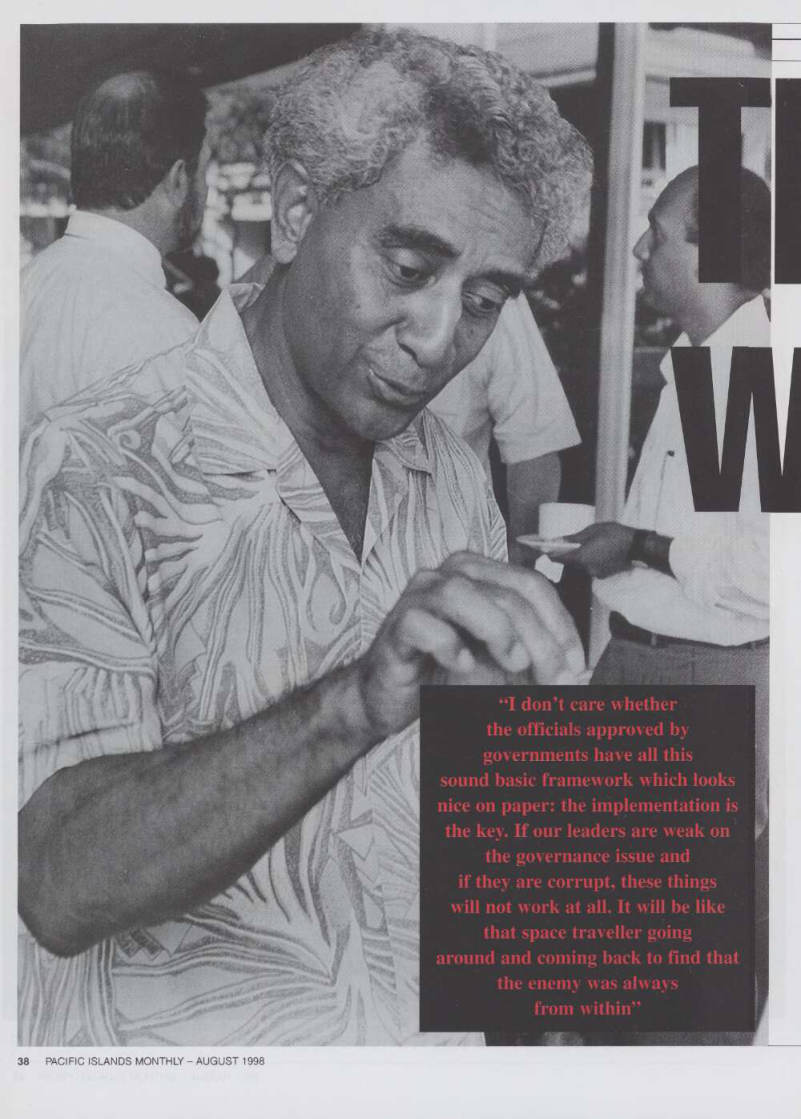

The enemy within
“I don’t care whether the officials approved by governments have all this sound basic framework which looks nice on paper: the implementation is the key. If our leaders are weak on the governance issue and if they are corrupt, these things will not work at all. It will be like that space traveller going around and coming back to find that the enemy was always from within"
Governance
By Sophie Foster Hildebrand
FISCAL mismanagement by officials and lax
implementation of crucial policies on the part of politicians will send the Pacific spiralling into social devastation.
This warning came from the head of the Pacific Operations Centre of the Economic and Social Commission for Asia and the Pacific (ESCAP), Mr Savenaca Siwatibau, in an exclusive interview with PIM. He warned Pacific nations have to wake from their aid induced slumber and discover the political will to make crucial eco
nomic decisions. “It’s quite sad actually. If you look over the last 20 years, in terms of economic performance, it’s been very poor - slow growth and in some of our countries, particularly in Micronesia and Melanesia, high population growth.
So if you look at the income per head, it’s quite static. In some countries it is actu
ally falling.”
He said no country in the Pacific was exempt from the greatest problem facing the region - budget deficits spiralling out of control. Fiji’s problem with the virtual col lapse of the National Bank of Fiji (NBF) showed there was no discipline in control ling these things, he said, and the problem was quite common in the region.
“Large budget deficits eating away the liquidity of the entire country - the banking system. So the private sector is
starved of funds.
They cannot have credit to expand so the process of develop ment and job creation has to come to
a halt. So we have to exercise a lot of dis cipline starting with the fiscal front,” he cautioned. A former governor of the Reserve Bank of Fiji, Mr Siwatibau says he can speak “with some experience” on these matters. He has also been with the interna tional Monetary Fund in Asia.
He says it is worrying that balance of payments problems, coming directly from budget deficits, are making foreign reserves unsustainable.
“Following the Asian crisis, they are running out of foreign reserves, so they cannot move now.
They have to cut back on government expenditure, they have to look at new tax revenues - all politically very unpopular and very difficult,” he said.
Mr Siwatibau hit out at the priorities of Pacific leaders saying “they have to put their resources where their mouth is”.
He warned, “they have to be disciplined about policy-making and about managing and allocating our resources. In this chang ing world of globalisation, if we cannot come to grips with all these problems, I see
things getting worse”.
The rules of the game, Mr Siwatibau says, have changed, and the Pacific needs to change with it.
"Following WTO and the levelling of the playing field, all the advantages that we enjoy under various trading arrangements, such as SPARTECA, are now being steadi ly eroded,” he said.
Using developments in the future of the Lome Convention as an example, Mr Siwatibau says ACP countries, including Fiji, should have been aware of what was happening. He said they are completely aware now that the reality is erosion of advantages under Lome over the next decade.
He said Fiji should already be thinking of what will happen to the sugar cane farm ers and if there are alternative crops that the country should now be talking about.
Fiji should also be thinking of what the prospects are in terms of markets and what kind of investments the country will have to undertake. “If not, then you can imagine what’s going to happen to the economy.
With sugar declining in terms of impor tance over the next ten years, we have to
“they have to put their resources where their mouth is”
substitute for that. We have an expanding population and we have to find economic activities to absorb them. If not, the situa tion will continue to worsen.”
Despite all these seemingly negative comments regarding the current economic status of the region, Mr Siwatibau is opti mistic about the future of the Pacific.
However, he says that political will to implement necessary policies will be cru cial. “First of all, we have to accept that we must grow. We must invest therefore what are the potential areas for investment.
“For most of our countries, tourism has a lot of prospects. We have natural resources. We have very good fishing grounds, particularly in Melanesia and Micronesia.
There is a lot of potential for develop ment but a lot of these developments have to be undertaken by the private sector.” Mr Siwatibau says it is the responsibility of governments to create the framework to encourage the private sector to thrive. He says the answers to these problems are “quite clear” to Pacific leaders already.
Sectors which could lead to a Pacific economic revival include forestry, process ing, manufacturing, mineral resources under the sea and an educated workforce.
He says in the age of technology, a high ly skilled labour force could hold some answers. “In this age of globalisation, con tracts are farmed out all over the world pro vided the atmosphere is right and you have
a skilled labour force”. Mr Siwatibau says governments have to do the thinking, along with the private sector, and learn from what other countries, such as Singapore, have done.
He stressed that island countries need to develop trading arrangements among themselves in order to grow.
The Melanesian Spearhead Group is quite advanced in this respect, however he says one model for the future would be for them to invite Micronesian and Polynesian countries to come into the trade grouping.
“In this globalised world, it gives them a degree of independence.
Collectively they are seen as a market whereas individually, we are small, includ ing Papua New Guinea. But if we are seen as a market, as a group, we could codec -
tively attract more investment from outside into our area. So in terms of bargaining capacity, it really enhances all these things”.
Mr Siwatibau says Pacific coun
tries should work out trading arrangements between themselves before inviting Australia and New Zealand to participate.
He was critical of sceptics of inter
island trading.
‘‘People are saying now ‘oh we are pro ducing the same things, how can we trade?’
But that is a very static way of thinking.
There are various things that we can do for ourselves using our imagination. I think if you look at it in a dynamic sense, look ing forward there are prospects for us to produce things and trade amongst our selves.
Not in the agriculture area - we are talk ing in the manufacturing, high technology area, processed goods”.
Mr Siwatibau says Pacific countries should try such trading arrangements on their own to improve their bargaining capacity in the international forum and with investors.
However, he says if overall action on the economic front is not taken immediate ly, it will all come to nought and the Pacific will be in a serious downspin for decades.
“We must wake up now and do the right things for ourselves and have the political will to act on them.
We should have started yesterday”.
He warned that the Pacific nations have no option but to implement their own solu tions to a self-inflicted problem. Only then, he says, will the enemy within be reformed, if not eradicated. ■
Advertisements & other items, pp. 39-41 (2 items)
T[?]e enemy
PACIFIC ISLANDS MONTHLY - AUGUST 1998
T[?]e enemy Within
Soprc
SOUTH PACIFIC APPLIED GEOSCIENCE COMMISSION
Applications are invited from nationals of SOPAC (South Pacific Applied Geoscience Commission) member countries for the following positions in the SOPAC Secretariat, located in Suva, Fiji.
SQPAC
SOPAC is an independent, inter-governmental regional organisation established by South Pacific nations in 1972 and dedicated to providing service to the island member countries of its Governing Council#. Currently, seventeen South Pacific countries are members with two associate members. Its Secretariat is located in Suva, Fiji and has about 40 professional and support staff. The primary objective of SOPAC is to assist each of its island member countries in :(1 )the identification and assessment of the non- living resource potential of their onshore and offshore Exclusive Economic Zone areas; (2) physical environment management, and (3) in the national capacity building in all relevant areas within the SOPAC Work Programme, SOPAC is an equal opportunity employer and further information about the organisation can be found on the Internet at wow. sopac.org.fj.
INFORMATION TECHNOLOGY MANAGER (1 POSITION)
The Information Technology Manager is responsible for the Information Technology Unit under the National Capacity Development Program. The unit has developed extensive data management systems and employs web-centric tools to deliver information to the Secretariat, member countries and other regional and international cooperating agencies.
The unit is responsible for the development, implementation and deployment of a wide range of peer- to-peer and server based networks; GIS and database solutions; remote sensing applications; Internet/intranet systems both within the secretariat and the member countries.
The unit provides training though in-country workshops and attachments in al aspects of Information Technology and in particular GIS and remote sensing applications.
MINERAL GEOLOGIST (1 POSITION)
The Mineral Geologist is responsible for the Mineral Resources Unit under the Resources Development Program. The goal of the unit is to obtain sustainable development and utilisation of mineral resources in member countries and its purpose is to develop resource policy, and advise on the management and development of onshore and offshore mineral resources.
The Mineral Resources Unit is responsible for assisting with the development of mineral policy and environmental management plans, regional onshore and offshore mineral databases, mineral resources assessment.
The unit provides training through regional and in country workshops, seminars and on the field training in all aspects of mineral and environment management.
Remuneration An attractive remuneration package will be offered in accordance with the SOPAC terms and conditions of employment depending on qualifications and experience.
Further information may be obtained from the Administrative Assistant on telephone (679) 381377, Fax: (679) 370040 or Email: [email protected].
Qualifications A post-graduate degree in the relevant field from a recognised university, between 10- 15 years professional experience, and proficiency in oral and written English.
Applications All applications should be fully documented and include relevant details of qualifications and experience, and the names and contact of three referees. Applications should be marked “Information Technology Manager position” or “Mineral Geologist position”, should be addressed to the Director, SOPAC Secretariat, Private Mail Bag, Suva, Fiji.
The deadline for applications is 15 September 1998 ' SOPAC member countries are: Australia, Cook Islands, Fiji, Federated States of Micronesia, Guam, Kiribati, New Zealand, Marshall Islands, Niue, Papua New Guinea, Samoa, Solomon Islands, Tonga, Tuvalu, Vanuatu. Associate members are: New Caledonia and French Polynesia.
Ik FLETCHER CONSTRUCTION
9002
Fletcher Construction Company (Fiji) Limited P O Box 3070 Lami, Wailada Estate Lami, Fiji Telephone (679) 361 511, Fax (679) 361 200 Email: [email protected]
Nails for the

Advertising Feature
Nails for the nations
NAILS are an important
ingredient that go into the construction activi ty. Ba Industries Ltd. (BIL), located on the riverside sugar town of Ba has been proudly making nails since 1974.
BIL not only manufactures nails but also galvanises them in Fiji’s only hot dip galvanising plant set up in 1997.
Apart from bright & hot dip galvanis ing, BIL, also manufactures barbed wires & chainlink fencing with not only knuck le but with twisted end for added security at no extra cost.
Since its inception BIL, has grown in terms of technology, quality and produc tion capacity to cater to the growing demands of the local and export markets.
BIL has the lion’s share of the local market for all its products. BIL exports to American Samoa, Western Samoa, Vanuatu, Tonga, Tahiti and the Solomon Islands amongst the Pacific Island coun tries. BIL also exports in a big way to Australia and New Zealand. Low manu facturing costs and proximity to the export markets have helped BIL to estab lish markets abroad. BIL is also exploring the possibility of developing newer mar kets.
BIL has successfully installed and commissioned a nail factory in Kiribati in 1993 and a rotary galvanising plant in 1997 and also trained their staff for the
operating of these plants.
BIL is the only wire and fencing prod ucts manufacturing company in the South Pacific to be accredited with ISO 9002 certification and has a thoroughly docu mented quality management system. BIL
is the only company in Fiji to have its own hot dip galvanising plant. This was com missioned in April 1997. The investment made in this project is well over F 5250,000.
This was made to ensure that all the company’s galvanised products including nails meet the stringent requirements of the Australian (AS 1650-1989) and New Zealand Standards.
BIL has been awarded overseas mem bership of the Galvanisers Association of Australia and thus has access to the latest developments in hot dip galvanising.
BIL also galvanises a lot of brackets, anchors, chains, and other similar prod ucts. As a result the company is undertak ing galvanising jobs for various industries such as the construction, marine, mining, hotel etc.
The effective size of its bath available for galvanising is 1.4 m (long) x o.Bm (wide) x o.sm(deep).
BIL plans to invest a lot more in new technology and equipment to increase productivity and efficiency and to diversi fy its product base.
The company has already installed and commissioned Fiji’s first thread rolling machine to manufacture different types of helical and annular threaded nails.
BIL has invested approximately F 5250,000 (in 1998) in installing the lat est technology weighing and packing machine to cater to the specific blister pack requirements of the Australian and New Zealand markets.
This has been done to fully satisfy the company’s export customer’s packing needs in BlL’s effort to achieve all round customer satisfaction. ■
Advertisements & other items, p. 42 (1 item)
the service
value is part of
At Ba Industries we’re committed to provide reliable service to cutomers by offering quality hot dip galvanised nails and fencing products.
Evidences of commitment to excellence. • Exporter of the Year Award (B&l) winner 1993, 1994 & 1996 • Winner of the Prime Minister’s Award 1995 • Only locally owned wire/fence product manufacturer to be ISO 9002 certified since 1995 • Only company to install Hot Dip Galvanising Plant and be awarded overseas membership of Galvanisers Association of Australia.
ISO
9002
BA INDUSTRIES LTD
P.0.80X 707, BA, FIJI ISLANDS
PHONE: (679) 674966, 674656, 676023
FAX: (679) 676700
E-MAIL: [email protected]
Fijian finesse

Fletcher's Fijian finesse
Fletcher Construction entered Fiji in 1970 when the con
struction industry was experi
encing a boom with the expansion of tourism. In the early years, Fletcher worked in a joint venture with local company Reedy Construction and commenced operations with a contract to build a brewery at Lautoka.
In the mid 19705, the industry experi enced a downturn. Reddy Fletcher however, secured a $F700,000 (U 55490,000) contract with the Fiji Sugar Corporation in 1975 to build a sugar conveyor tunnel at Lautoka, followed by further contracts with FSC for the SFS-million (SUS3.S-million) expansion to the Labasa mill.
By 1980 Reddy Fletcher was well estab lished in construction at a time when the indus try's share of Gross Domestic Product had risen to 8.8 per cent. Growth continued through the 1980 s and Fletcher was able to respond quickly and efficiently to rehabilitation work on hotels and island resorts following the cyclones in the mid 1980 s as well as offer upgrading to the higher building standards set by the insurance companies. Following Fiji’s military coups and the associated political uncertainty, Fletcher purchased the assets of the joint venture out right. To supplement the contracting hard tender market, Fletcher sought out new and innovative opportunities which led to suc
cessful partnering with Japanese companies
on aid projects and in the negotiation of sev eral new and significant projects. Prior to the coups in 1987 the business had a 23 per cent share of the building market.
Through new business strategy in the lean years following 1987, Fletcher experi enced growth and progressively increased its share to 40 per cent in 1988, when the industry share of GDP had fallen to a low point of 2.8 per cent.
The hard tender market continues to play an important role in Fletcher Construction's
Fiji business. However, quality, timely com
pletion and value for money are becoming increasingly important in the decision-mak ing process of contract awards and Fletcher Construction has attained ISO 9002 accred itation. with Project Quality Plans in place for all current works in Fiji. ■
Advertisements & other items, pp. 43-44 (1 item)
Designed for the professional
ACHIEVEMENTS
□ Partnering on Japanese aid projects included the Lautoka fishing wharf, the Colonial War Memorial Hospital in Suva and the Nadi Meteorological Office. □ Emphasis is placed on project development, design and building. Such projects included the Fiji Insurance Offices, Suva; Office/Warehouse and Apartments Complex, Suva; ANZ House (previously BNZ House) Suva; Beachcomber Resort - Main Facility, Naigani House, Suva. □ The SF6S-million ($U545.5 million) Denarau Golf Course and Marina complex, including the design and construction of the “Unfloat” Marina
Berths, was successfully negotiated.
□ Recent completion of the new Coca Cola bottling plant where construction works and project management services were provided, with followon negotiated works in mechanical and services installation. □ Successful negotiation of new Parliament House and the Civil Aviation Authority of Fiji, Nadi Airport terminal, upgrading. □ Awarded the Fiji Naval Headquarters from a tendered second placing, a project under Australian aid. With a Fletcher Quality Assurance strategy in place, the client removed the requirement for independent supervision. □ Contract with the Fiji government for the new Ba and Sigatoka bridges on a design and construction alternative to the confirming design, reflecting a saving of some SF4 million (SUS2.B million) □ Fletcher in association with Clark Vosaicake Architects and Brighouse Interiors, has successfully negotiated a design and construction contract for the provision of an additional executive floor to the offices of Air Pacific at the Nadi
Airport hangar.
□ Completed in a record time of six months was the Fs3-million (SUS2.I million) Village 6 Cinema Complex in Suva. □ Just completed the F 55.5 million (SUS3.BS- - Nadonumai Building in Suva incorporating precast, pre-stressed shell beams supporting interspan ribbed floors, another first in Fiji. □ Recently completed B.P Oil Service Station in Nabua Fso.6m. □ Recently completed Cost-U-Less Warehouse in Nadi Fs2.2m □ Completed McDonalds Restaurants in downtown Suva Fso.4m. □ Work has recently commenced on the construction of the Cost-U-Less Warehouse in Suva Fs2.6m. □ Work has commenced on the Sheraton Villas/Condominiums at Denarau, Nadi F$ 17.9 m. □ Just completed Japanese Aid Project - School of Maritime for the University of the South Pacific Fs6.om.
Belle Concrete Mixers
Designed for the professional
ss* m -
Performance, Safety and
Portability - The Perfect Mix
Available at:
(PACIFIC) LTD
31 Viria Road Vatuwaqa G.P.O. Box 1068, Suva, Fiji Phone: (679) 386000 Fax: (679) 370431 Lautoka Phone: (679) 663477 Fax: (679) 663153 Labasa Phone: (679) 811860 Fax: (679) 811844
SOUTH PACIFIC FORUM SECRETARIAT SUVA, FIJI
VACANCY
The Forum Secretariat was established in 1972 by the South Pacific Forum to encourage economic and political cooperation between its member countries*, and between these states and other countries.
ECONOMIC AND POLICY ANALYST
The Secretariat is seeking a suitably qualified and experienced person to work as Economic and Policy Analyst in its Development and Economic Policy Division.
The Economic and Policy Analyst reports to the Economic Adviser, and will assist the Adviser in providing economic research and policy advice to Forum members.
The Economic and Policy Analyst will; • monitor and report on developments and policy in member * economies; • monitor and report on international developments impacting on the region; • provide advice for member countries* on economic development issues; • monitor and disseminate information and analysis on economic development and policy research; • assist in the organisation and running of meetings organised by the Secretariat.
Applicants must be citizens of Forum member countries* and should have an advanced university degree in economics, proven analytical abilities and appropriate experience preferably in the Pacific. Extensive travel will be required.
The appointment will carry a competitive remuneration package. For non-Fiji citizens remuneration should be tax free in Forum member countries*.
There are generous establishment and education allowances together with medical and life insurance provisions.
Appointments are normally for three years, with the option to renew for a further three years.
All applications should be addressed to: The Secretary General Forum Secretariat Private Mail Bag Suva, FIJI An Information Package on the position is available from the Secretariat and applicants are urged to obtain one from Ms Angela Ricketts on (679) 312600 or (679) 220207 or fax (679) 301366 or via email: [email protected].
Applications close on 31st August, 1998 and should contain information on education and career background. Applicants must also provide the names, addresses (postal & email), fax and telephone numbers of three employment referees.
Member states of the South Pacifc Forum: Australia. Cook Islands. Federated States of Micronesia. Fiji, Kiribati, Naum,-New Zealand. Niue, Palau. Papua New Guinea, Republic of Marshall Islands. Samoa. Solomon Islands, Tonga. Tuvalu and Vanuatu.
Minutes after
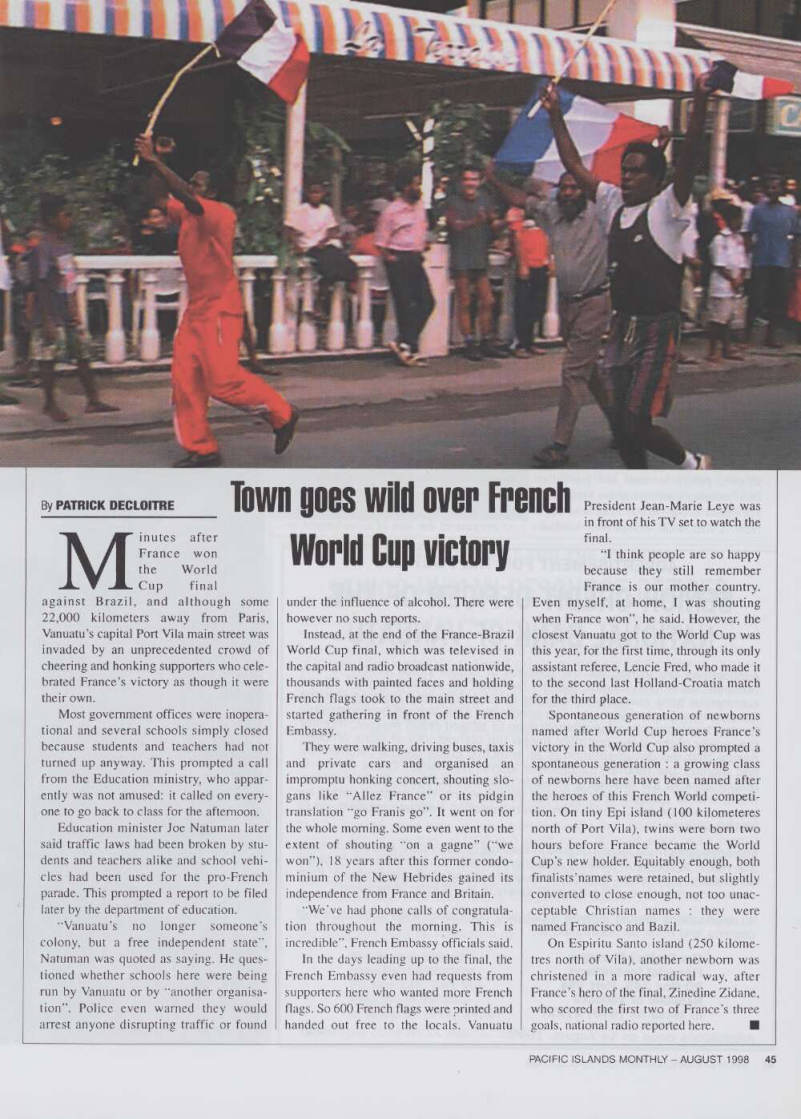
Town goes wild over French
World Cop victory
By Patrick Decloitre
Minutes after
France won the World Cup final against Brazil, and although some 22,000 kilometers away from Paris, Vanuatu’s capital Port Vila main street was invaded by an unprecedented crowd of cheering and honking supporters who cele brated France’s victory as though it were their own.
Most government offices were inopera tional and several schools simply closed because students and teachers had not turned up anyway. This prompted a call from the Education ministry, who appar ently was not amused: it called on every one to go back to class for the afternoon.
Education minister Joe Natuman later said traffic laws had been broken by stu dents and teachers alike and school vehi cles had been used for the pro-French parade. This prompted a report to be filed later by the department of education.
"Vanuatu’s no longer someone's colony, but a free independent state”, Natuman was quoted as saying. He ques tioned whether schools here were being run by Vanuatu or by "another organisa tion”. Police even warned they would arrest anyone disrupting traffic or found
under the influence of alcohol. There were however no such reports.
Instead, at the end of the France-Brazil World Cup final, which was televised in the capital and radio broadcast nationwide, thousands with painted faces and holding French flags took to the main street and started gathering in front of the French Embassy.
They were walking, driving buses, taxis and private cars and organised an impromptu honking concert, shouting slo gans like ‘‘Allez France” or its pidgin translation "go Franis go”. It went on for the whole morning. Some even went to the extent of shouting "on a gagne” ( -i we won”), 18 years after this former condo minium of the New Hebrides gained its independence from France and Britain.
"We've had phone calls of congratula tion throughout the morning. This is incredible”, French Embassy officials said.
In the days leading up to the final, the French Embassy even had requests from supporters here who wanted more French flags. So 600 French flags were printed and handed out free to the locals. Vanuatu
President Jean-Marie Leye was in front of his TV set to watch the final.
“I think people are so happy because they still remember France is our mother country.
Even myself, at home, I was shouting when France won”, he said. However, the closest Vanuatu got to the World Cup was this year, for the first time, through its only assistant referee, Lencie Fred, who made it to the second last Holland-Croatia match for the third place.
Spontaneous generation of newborns named after World Cup heroes France’s victory in the World Cup also prompted a spontaneous generation : a growing class of newborns here have been named after the heroes of this French World competi tion. On tiny Epi island (100 kilometeres north of Port Vila), twins were born two hours before France became the World Cup’s new holder. Equitably enough, both finalists’names were retained, but slightly converted to close enough, not too unac ceptable Christian names : they were named Francisco and Bazil.
On Espiritu Santo island (250 kilome tres north of Vila), another newborn was christened in a more radical way, after France's hero of the final, Zinedine Zidane, who scored the first two of France's three goals, national radio reported here. ■
A Cultural Revolution?
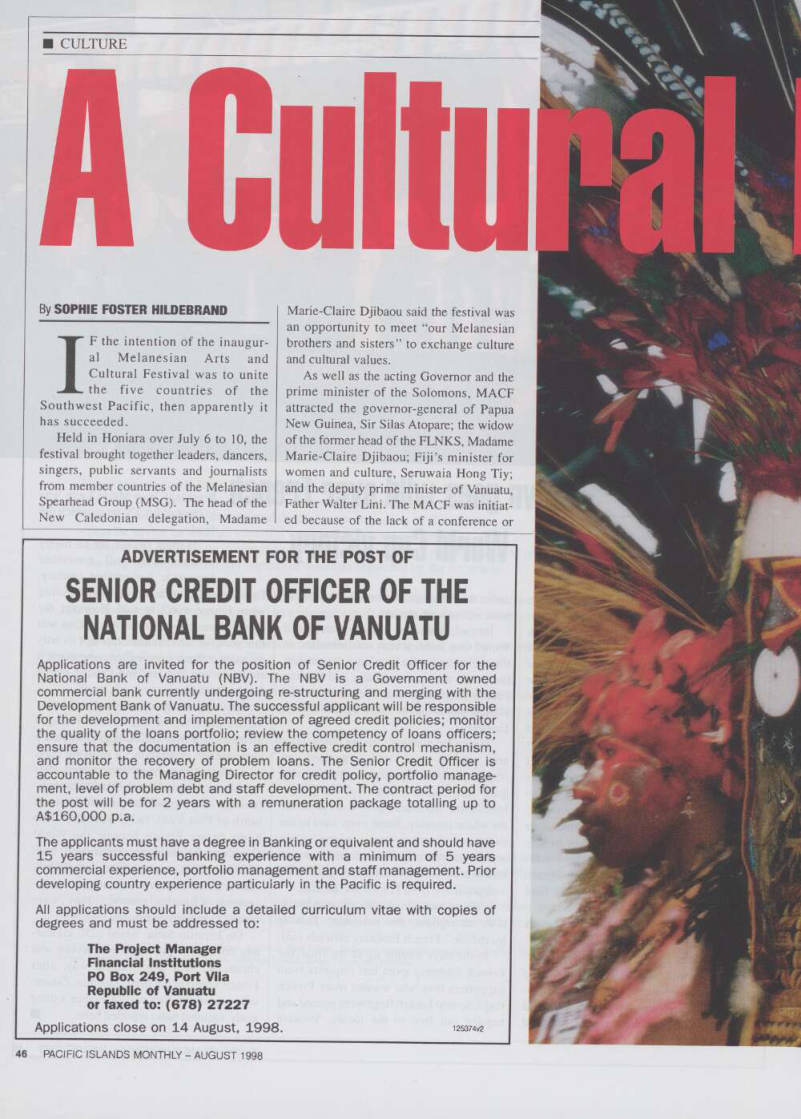
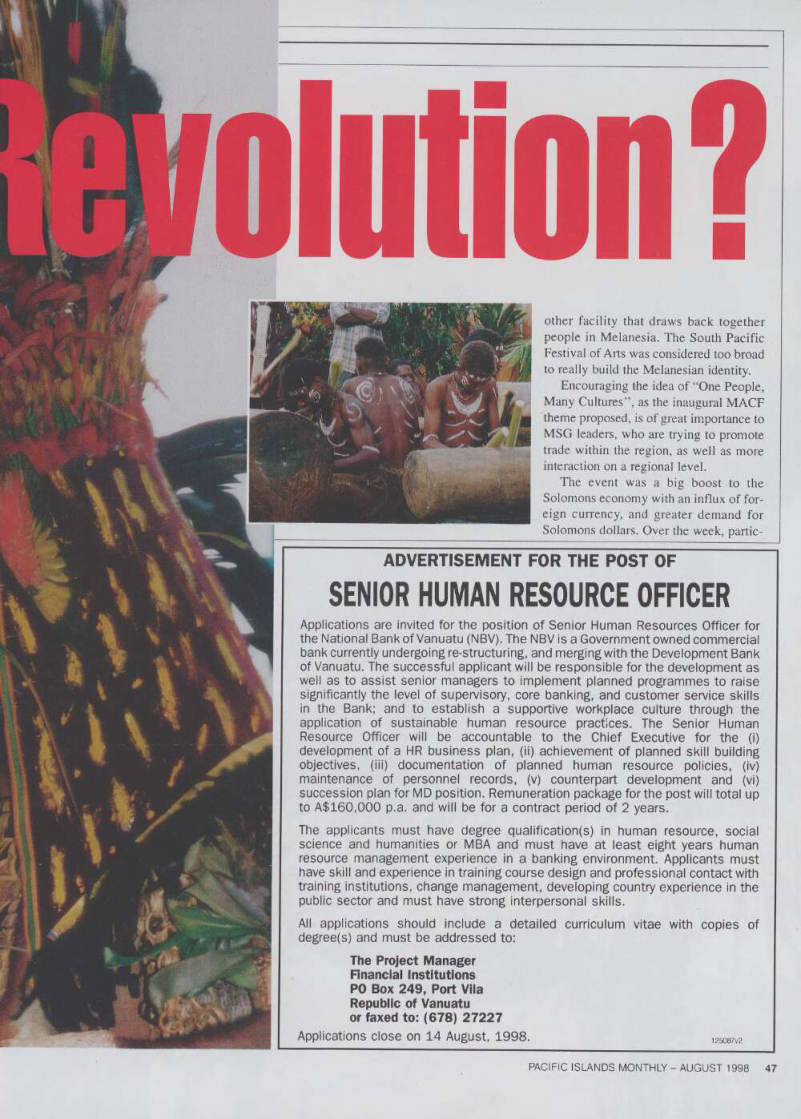


Culture
By Sophie Foster Hildebrand
IF the intention of the inaugur al Melanesian Arts and Cultural Festival was to unite the five countries of the Southwest Pacific, then apparently it has succeeded.
Held in Honiara over July 6 to 10, the festival brought together leaders, dancers, singers, public servants and journalists from member countries of the Melanesian Spearhead Group (MSG). The head of the New Caledonian delegation, Madame
Marie-Claire Djibaou said the festival was an opportunity to meet “our Melanesian brothers and sisters” to exchange culture and cultural values.
As well as the acting Governor and the prime minister of the Solomons, MACF attracted the governor-general of Papua New Guinea, Sir Silas Atopare; the widow of the former head of the FLNKS, Madame Marie-Claire Djibaou; Fiji’s minister for women and culture, Seruwaia Hong Tiy; and the deputy prime minister of Vanuatu, Father Walter Lini. The MACF was initiat ed because of the lack of a conference or
other facility that draws back together people in Melanesia. The South Pacific Festival of Arts was considered too broad to really build the Melanesian identity.
Encouraging the idea of “One People, Many Cultures”, as the inaugural MACE theme proposed, is of great importance to MSG leaders, who are trying to promote trade within the region, as well as more interaction on a regional level.
The event was a big boost to the Solomons economy with an influx of for eign currency, and greater demand for Solomons dollars. Over the week, partic-
ipants and supporters spent thousands on food, drinks and gifts, encouraging many small operators to sell their wares on the streets near the festival village.
The general consensus amongst leaders and participants was that the MACF should have been initiated long before now.
The week successfully allowed for the development of friendly ties between dele gates, dancers and other performers, and there were many tears as the delegations left Henderson Airport. Most of the activi ties during the week were held at the
MACF Village, which was specifically built for the festival.
It consisted of traditional houses from each country, a three-storey high stage, and a VIP pavilion. Various cultural perfor mances by the different groups were held at the Village and nine other venues on the fringe of Honiara.
Each performance was well attended by the Solomon Islanders, so well attended in fact, that the crush of the crowd almost took over the opening ceremony of the fes tival. During the MACF. all the overseas
participants were housed together at the Panatina Campus in various hostels.
The common language spoken to com municate was pidgin, although those from New Caledonia had a bit of trouble because of their French-speaking back ground .
The festival coincided with the Solomon Islands 20th Independence Anniversary Celebrations as well as the National Trade Show.
Vanuatu will host the next festival, in four years time. ■
Advertisements & other items, pp. 46-47 (1 item)
National Bank Of Vanuatu
ADVERTISEMENT FOR THE POST OF
SENIOR CREDIT OFFICER OF THE
Applications are invited for the position of Senior Credit Officer for the National Bank of Vanuatu (NBV). The NBV is a Government owned commercial bank currently undergoing re-structuring and merging with the Development Bank of Vanuatu. The successful applicant will be responsible for the development and implementation of agreed credit policies; monitor the quality of the loans portfolio; review the competency of loans officers: ensure that the documentation is an effective credit control mechanism, and monitor the recovery of problem loans. The Senior Credit Officer is accountable to the Managing Director for credit policy, portfolio management, level of problem debt and staff development. The contract period for the post will be for 2 years with a remuneration package totalling up to A 5160,000 p.a.
The applicants must have a degree in Banking or equivalent and should have 15 years successful banking experience with a minimum of 5 years commercial experience, portfolio management and staff management. Prior developing country experience particularly in the Pacific is required.
All applications should include a detailed curriculum vitae with copies of degrees and must be addressed to: The Project Manager Financial institutions PO Box 249, Port Vila Republic of Vanuatu or faxed to: (678) 27227 Applications close on 14 August, 1998. 125374V2
ADVERTISEMENT FOR THE POST OF
SENIOR HUMAN RESOURCE OFFICER
Applications are invited for the position of Senior Human Resources Officer for the National Bank of Vanuatu (NBV). The NBV is a Government owned commercial bank currently undergoing re-structuring, and merging with the Development Bank of Vanuatu. The successful applicant will be responsible for the development as well as to assist senior managers to implement planned programmes to raise significantly the level of supervisory, core banking, and customer service skills in the Bank; and to establish a supportive workplace culture through the application of sustainable human resource practices. The Senior Human Resource Officer will be accountable to the Chief Executive for the (i) development of a HR business plan, (ii) achievement of planned skill building objectives, (iii) documentation of planned human resource policies, (iv) maintenance of personnel records, (v) counterpart development and (vi) succession plan for MD position. Remuneration package for the post will total up to A 5160,000 p.a. and will be for a contract period of 2 years.
The applicants must have degree qualification(s) in human resource, social science and humanities or MBA and must have at least eight years human resource management experience in a banking environment. Applicants must have skill and experience in training course design and professional contact with training institutions, change management, developing country experience in the public sector and must have strong interpersonal skills.
All applications should include a detailed curriculum vitae with copies of degree(s) and must be addressed to: The Project Manager Financial Institutions PO Box 249, Port Vila Republic of Vanuatu or faxed to: (678) 27227 Applications close on 14 August, 1998. 125007*2
a party!
A wow of a party!
Jemima Garrett
Wellington
IN the central Queensland city of Rockhampton there’s a part of town the locals call “Kanakatown” and it was here recently that one of Australia’s old est communities got together for a party to end all parties.
Five hundred people from all over Australia flooded into north Rockhampton for 3 days of non-stop celebration. The party was a reunion of the descendents of Pacific islanders brought to Australia last century during the notorious blackbirding era.
The grandparents and great grandparents of the South Sea islanders - as they now call themselves to distinguish their com munity from more recent Pacific Island immigrants - came as indentured labourers, often under slave-like conditions, to work in the cane fields of Queensland or, in the case of women, as domes tic servants.
The idea for the party was conceived in the mind of longstand ing Kanakatown resident, Lloyd Willie, back in June 1995, when he went to Brisbane for his brother’s funeral. “It was the sadness of losing most of the old South Sea islanders,” said Willie who swore, that day, that the next event he attended at which hundreds of his family and friends were present would be a reunion of the community he grew up in.ln January this year, three of the most formidable women in the north Rockhampton community returned from a trip down to the beach determined to make sure Lloyd Willie’s dream become a reality ... and so the reunion began life. Willie, a rock musician by trade, wanted to celebrate the com munity spirit that he remembered so strongly from his growing up days, 50 years before.
Back then, the community was renowned for its music. In the evenings, sometimes far into the night, people would sit under two big Mango trees on "the flat” singing all manner of songs. The harmonies they leamt at church, a few guitars, a harmonica and an accordian, were put to work on anything from the latest popular songs they heard on the radio through to gospel, country and even the odd Pacific island song. 'Kanakatown’ was established around the turn of the century, when those South Sea Islanders NOT forced to return home by the imposition of the white Australia pol icy, formed tight-knit communities up and down the east coast of Australia. The 300 or so who gravitated to north Rockhamton used
their meagre savings to buy or lease land on one of the six streets which still make up 'Kanakatown’. Now members of those same families number 4000-5000. One of Willie’s first tasks as co-ordi nator of the reunion, was to begin work on a ‘Kanakatown’ book.
He put out the word that he wanted everyone to write up their own family’s story and it was as these stories began to roll in that some of the most profound consequences of the reunion started to become apparent.
One day a couple of months before the event itself, Willie was down at the beach after performing with his band, when he met a women called Linda Scott. After Willie had told her all about the reunion and asked her to come along, Linda Scott got on to the subject of her mother, whose name was Joycie Singdong.
“It’s funny you should say that” replied Willie, “because I know a Billy Singdong who is coming up for the reunion and I think his mother was Joycie Singdong too.” Linda Scott’s mother, like many South Sea islanders in those days, had had to travel long distances to get work on cattle stations or fruit picking and had not been able to take her older children with her. For Willie, too, the reunion brought new and surprising information about his family.
Work by his daughter Michelle in digging up birth, marriage and death certificates, revealed that the family who had lived next door to Willie all his life were in fact second cousins, all being the grandchildren or great-grandchildren of a Mary Roomus who arrived in Australia in 1887.
The party itself was held on the long weekend in June. Creek St, one of the main streets in ‘Kanakatown’, was closed to traffic and marquees erected at each end. Events began at 7.00 am on Saturday with breakfast and didn’t let up until late Monday evening. There was music and reminiscing about time spent down the creek where the kids would spend hours swimming and catch ing crayfish and freshwater perch, about church on Sunday and about the games they used to play. The South Sea islanders were joined by the representatives of the Aboriginal community, who officially welcomed them to their land, and by students from Vanuatu, Solomon Islands and Samoa, who took time off their studies at the Rockhampton campus of the Central Queensland University, to form an impromptu dance troop for the occasion.
A major victory was in convincing the Rockhampton City Council to officially hand over to the community, the vacant park land known as ‘the flat’ , which had been the centre of life in ‘Kanakatown’. For Willie, the most important dimension of the reunion was to create a cultural revival that would teach today’s children just what the community spirit of his young years was all about. During the three days, the kids of ‘Kanakatown’ got to do just about everything their predecessors had done and more. Willie had them playing games of all sorts, listening to stories, singing, dancing, laughing and crying with their eldest. He held a full scale Guy Fawkes night on ‘the flat’, complete with a circle of 1000 sparklers, a huge bonfire and a Guy Fawkes dummy with hungers in his buttonhole. Just to make sure the kids got the message that culture is neither static nor boring, he finished it off with a concert from his rock band.
The black American civil rights leader Martin Luther King, in one of his most famous speeches spoke those immortal words, "I have a dream”. In Sydney these days, a new T-shirt summing up the vision of that political scourge Pauline Hanson, is popular. On the front it features Martin Luther King and under his face , those words. On the back Pauline Hanson says “I have a fish shop”.
Advertisements & other items, p. 51 (1 item)
Entertainment
Festival
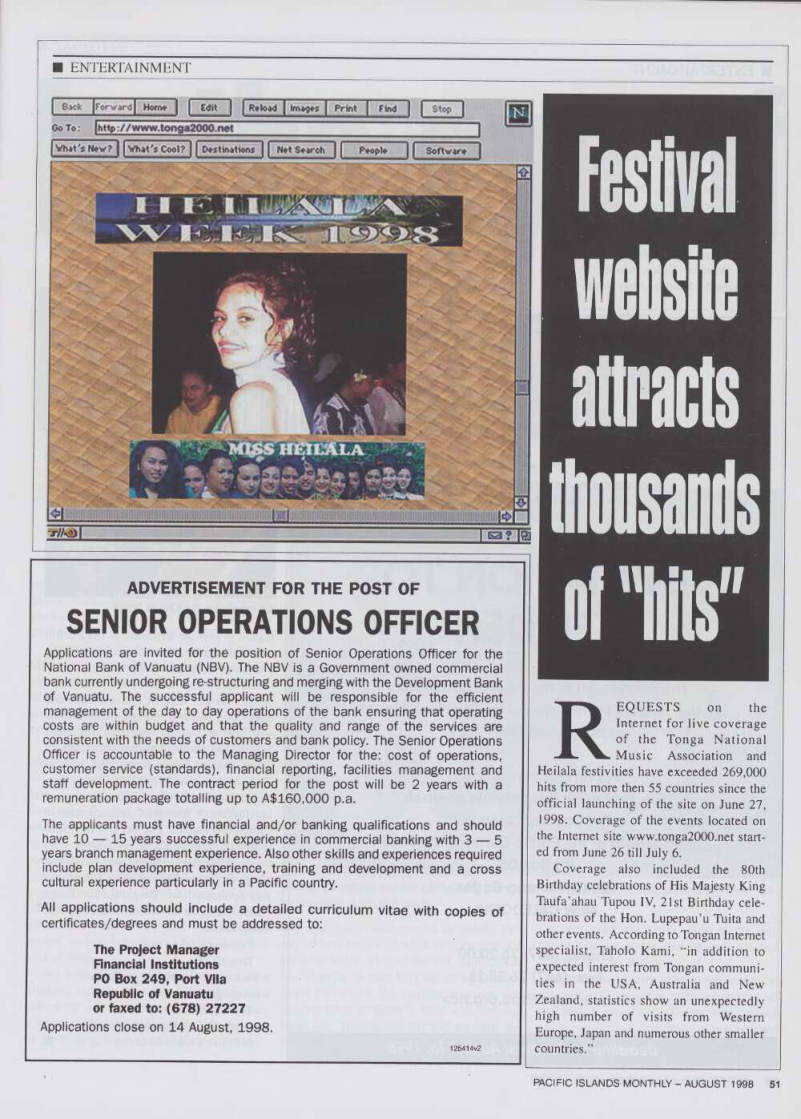
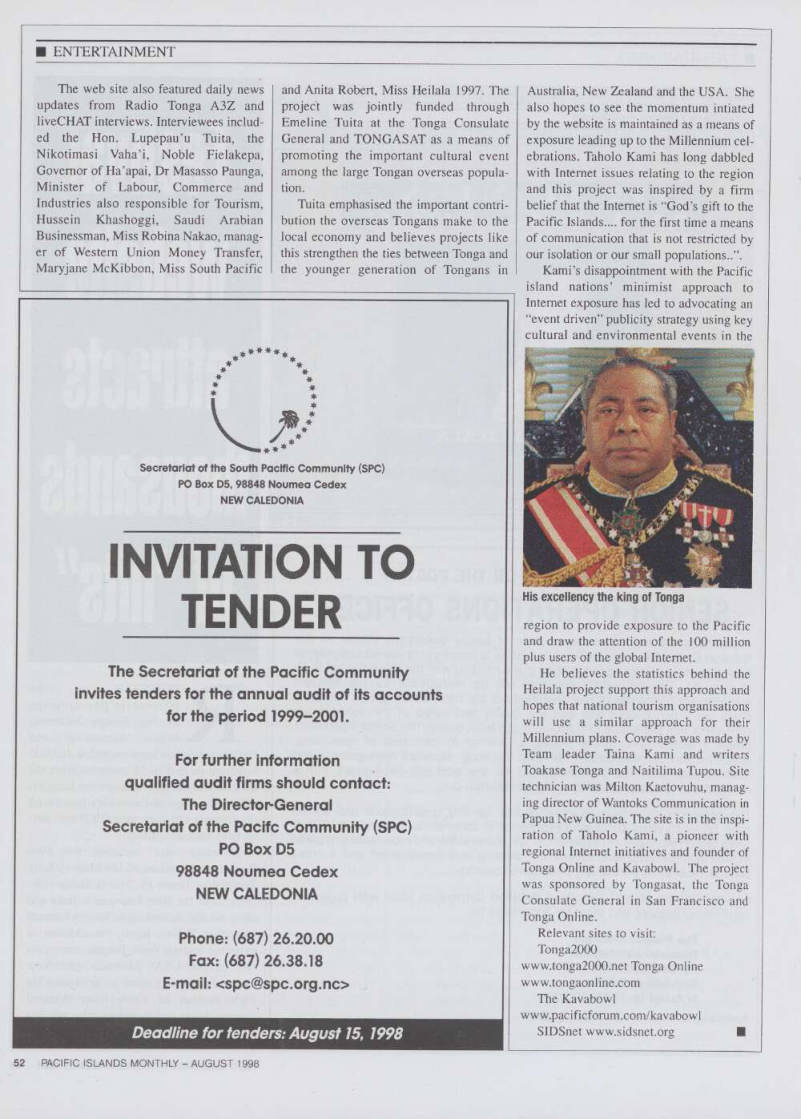
website attracts thousands of "hits"
Requests on the Internet for live coverage of the Tonga National Music Association and Heilala festivities have exceeded 269,000 hits from more then 55 countries since the official launching of the site on June 27, 1998. Coverage of the events located on the Internet site www.tonga2ooo.net start ed from June 26 till July 6.
Coverage also included the 80th Birthday celebrations of His Majesty King Taufa'ahau Tupou IV, 21st Birthday cele brations of the Hon. Lupepaum Tuita and other events. According to Tongan Internet specialist, Taholo Kami, "in addition to expected interest from Tongan communi ties in the USA, Australia and New Zealand, statistics show an unexpectedly high number of visits from Western Europe, Japan and numerous other smaller countries.”
The web site also featured daily news updates from Radio Tonga A3Z and IiveCHAT interviews. Interviewees includ ed the Hon. Lupepau’u Tuita, the Nikotimasi Vaha’i, Noble Fielakepa, Governor of Ha’apai, Dr Masasso Paunga, Minister of Labour, Commerce and Industries also responsible for Tourism, Hussein Khashoggi, Saudi Arabian Businessman, Miss Robina Nakao, manag er of Western Union Money Transfer, Maryjane McKibbon, Miss South Pacific
and Anita Robert, Miss Heilala 1997. The project was jointly funded through Emeline Tuita at the Tonga Consulate General and TONGASAT as a means of promoting the important cultural event among the large Tongan overseas popula tion.
Tuita emphasised the important contri bution the overseas Tongans make to the local economy and believes projects like this strengthen the ties between Tonga and the younger generation of Tongans in
Australia, New Zealand and the USA. She also hopes to see the momentum intiated by the website is maintained as a means of exposure leading up to the Millennium cel ebrations. Taholo Kami has long dabbled with Internet issues relating to the region and this project was inspired by a firm belief that the Internet is “God’s gift to the Pacific Islands... for the first time a means of communication that is not restricted by our isolation or our small populations..”.
Kami’s disappointment with the Pacific island nations’ minimist approach to Internet exposure has led to advocating an “event driven” publicity strategy using key cultural and environmental events in the
region to provide exposure to the Pacific and draw the attention of the 100 million plus users of the global Internet.
He believes the statistics behind the Heilala project support this approach and hopes that national tourism organisations will use a similar approach for their Millennium plans. Coverage was made by Team leader Taina Kami and writers Toakase Tonga and Naitilima Tupou. Site technician was Milton Kaetovuhu, manag ing director of Wantoks Communication in Papua New Guinea. The site is in the inspi ration of Taholo Kami, a pioneer with regional Internet initiatives and founder of Tonga Online and Kavabowl. The project was sponsored by Tongasat, the Tonga Consulate General in San Francisco and Tonga Online.
Relevant sites to visit; Tonga2ooo www.tonga2ooo.net Tonga Online
www.tongaonline.com
The Kavabowl www.pacificforum.com/kavabowl SlDSnet www.sidsnet.org ■
His excellency the king of Tonga
Advertisements & other items, pp. 51-52 (3 items)
Senior Operations Officer
ADVERTISEMENT FOR THE POST OF
Applications are invited for the position of Senior Operations Officer for the National Bank of Vanuatu (NBV). The NBV is a Government owned commercial bank currently undergoing re-structuring and merging with the Development Bank of Vanuatu. The successful applicant will be responsible for the efficient management of the day to day operations of the bank ensuring that operating costs are within budget and that the quality and range of the services are consistent with the needs of customers and bank policy. The Senior Operations Officer is accountable to the Managing Director for the: cost of operations, customer service (standards), financial reporting, facilities management and staff development. The contract period for the post will be 2 years with a remuneration package totalling up to A 5160,000 p.a.
The applicants must have financial and/or banking qualifications and should have 10 15 years successful experience in commercial banking with 3 5 years branch management experience. Also other skills and experiences required include plan development experience, training and development and a cross cultural experience particularly in a Pacific country.
All applications should include a detailed curriculum vitae with copies of certificates/degrees and must be addressed to: The Project Manager Financial Institutions PO Box 249, Port Vila Republic of Vanuatu or faxed to: (678) 27227 Applications close on 14 August, 1998. 125414v2
■ Entertainment
Invitation To
Secretariat of the South Pacific Community (SPC) PO Box D 5, 98848 Noumea Cedex
NEW CALEDONIA
TENDER
The Secretariat of the Pacific Community invites tenders for the annual audit of its accounts for the period 1999-2001.
For further information qualified audit firms should contact: The Director General Secretariat of the Pacifc Community (SPC) PO Box D 5 98848 Noumea Cedex
NEW CALEDONIA
Phone: (687) 26.20.00 Fax: (687) 26.38.18 E-mail: <[email protected]> Deadline for tenders: August 15, 1998
the Bishop

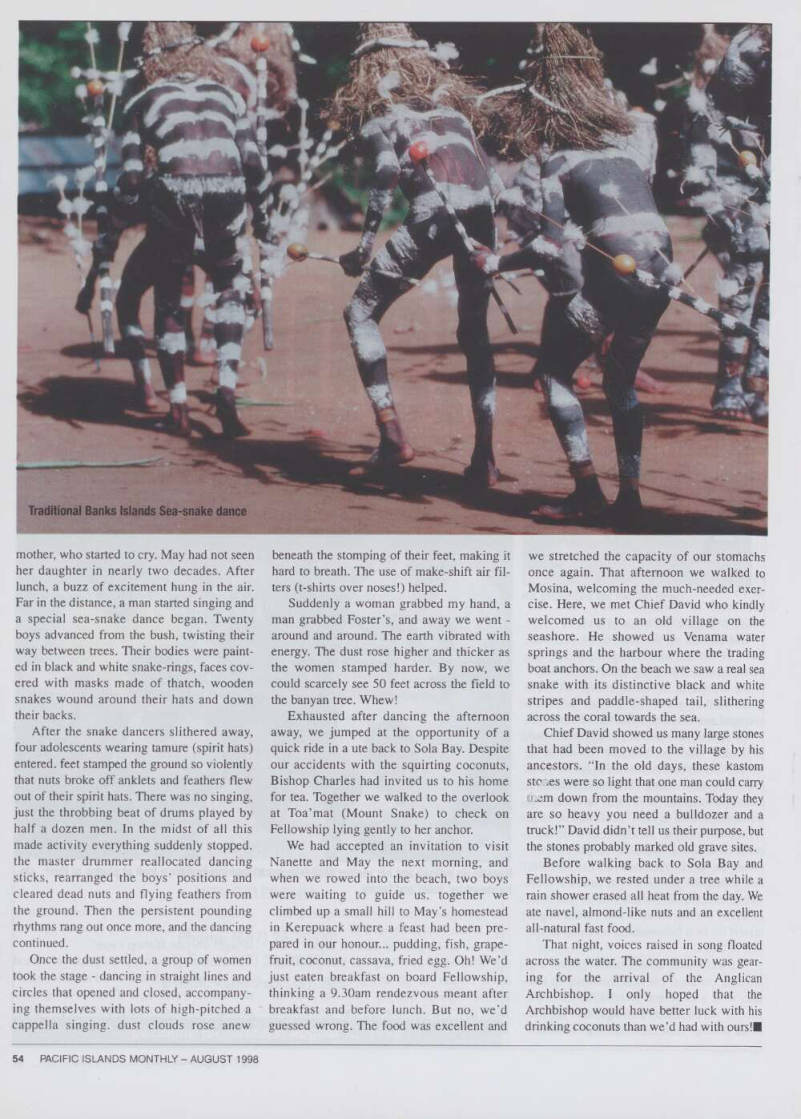
Yachting
In the eye of the Bishop
Story and photographs by SALLY ANDREWS
AFTER dropping our sails and quietly drifting to a stop, a dugong surfaced alongside Fellowship. She paused long enough to exhale and take a quick look, then vanished. We were anchored in Patteson Bay, off the TORBA provincial town of Sola.
Our daysail up the west coast of Santa Maria in Vanuatu’s northern group of islands, past Bushman’s Bay and across the channel to the big island of Vanua Lava, had been great. We’d caught no fish, but our speed had averaged nearly seven knots the whole way.
Using a double-bladed paddle, two small boys came out in an outrigger-less canoe to tell us of a celebration scheduled for the next day - "Lafet blong St Bartholomew”.
Consequently, the following morning we wandered down a dirt road and inland towards the village of Sisial. Even though our arrival was a surprise, everybody wel comed us. the Bishop invited us to eat with him, alongside his wife Mary and the local elders, chiefs and church and government officials. We sat on mats and I tried to put myself on best behaviour, a hardship at the best of times.
All went well until I tried to open my drinking coconut. I held it discreetly to one side, took a knife and pierced the nut - the juice of which squirted straight into the eye of the Bishop. How embarrassing! I blushed
and apologised, then carried on quietly eat ing. When Foster decided to open one, he took the knife, pierced the nut, squirt... Oh no! Wota he go stret long eye blong Bishop.
Sori! (Water he go straight into the eye belong Bishop. Sorry!) This was not our lucky day. The sun was hot, and naturally the Bishop got thirsty too. He picked up a
coconut, took the knife, pierced the nut.
Oops! You guessed it. The coconut squirted straight into the Bishop's eye!
I had brought some photographs of a local lady (Juliet) who had married and moved off the island years ago. These were passed around until finally the photo album reached Nanette and May, Juliet's sister and her
Nanette (in yellow) and her mother May (alongside) and family have a look at photos of their sis ter/daughter Juliet and family
mother, who started to cry. May had not seen her daughter in nearly two decades. After lunch, a buzz of excitement hung in the air.
Far in the distance, a man started singing and a special sea-snake dance began. Twenty boys advanced from the bush, twisting their way between trees. Their bodies were paint ed in black and white snake-rings, faces cov ered with masks made of thatch, wooden snakes wound around their hats and down their backs.
After the snake dancers slithered away, four adolescents wearing tamure (spirit hats) entered, feet stamped the ground so violently that nuts broke off anklets and feathers flew out of their spirit hats. There was no singing, just the throbbing beat of drums played by half a dozen men. In the midst of all this made activity everything suddenly stopped, the master drummer reallocated dancing sticks, rearranged the boys’ positions and cleared dead nuts and flying feathers from the ground. Then the persistent pounding rhythms rang out once more, and the dancing continued.
Once the dust settled, a group of women took the stage - dancing in straight lines and circles that opened and closed, accompany ing themselves with lots of high-pitched a cappella singing, dust clouds rose anew
beneath the stomping of their feet, making it hard to breath. The use of make-shift air fil ters (t-shirts over noses!) helped.
Suddenly a woman grabbed my hand, a man grabbed Foster’s, and away we went around and around. The earth vibrated with energy. The dust rose higher and thicker as the women stamped harder. By now, we could scarcely see 50 feet across the field to the banyan tree. Whew!
Exhausted after dancing the afternoon away, we jumped at the opportunity of a quick ride in a ute back to Sola Bay. Despite our accidents with the squirting coconuts, Bishop Charles had invited us to his home for tea. Together we walked to the overlook at Toa’mat (Mount Snake) to check on Fellowship lying gently to her anchor.
We had accepted an invitation to visit Nanette and May the next morning, and when we rowed into the beach, two boys were waiting to guide us. together we climbed up a small hill to May’s homestead in Kerepuack where a feast had been pre pared in our honour... pudding, fish, grape fruit, coconut, cassava, fried egg. Oh! We’d just eaten breakfast on board Fellowship, thinking a 9.30 am rendezvous meant after breakfast and before lunch. But no, we’d guessed wrong. The food was excellent and
we stretched the capacity of our stomachs once again. That afternoon we walked to Mosina, welcoming the much-needed exer cise. Here, we met Chief David who kindly welcomed us to an old village on the seashore. He showed us Venama water springs and the harbour where the trading boat anchors. On the beach we saw a real sea snake with its distinctive black and white stripes and paddle-shaped tail, slithering across the coral towards the sea.
Chief David showed us many large stones that had been moved to the village by his ancestors. “In the old days, these kastom ste .es were so light that one man could carry tr.em down from the mountains. Today they are so heavy you need a bulldozer and a truck!” David didn’t tell us their purpose, but the stones probably marked old grave sites.
Before walking back to Sola Bay and Fellowship, we rested under a tree while a rain shower erased all heat from the day. We ate navel, almond-like nuts and an excellent all-natural fast food.
That night, voices raised in song floated across the water. The community was gear ing for the arrival of the Anglican Archbishop. I only hoped that the Archbishop would have better luck with his drinking coconuts than we’d had with ours!B
Traditional Banks Islands Sea-snake dance
watchdog

News Extra
Public watchdog lacks teeth
THE establishment of the Public \ Expenditure Review Committee by the Cook Islands Government in 1996 set up a statuto ry body with the power to investigate any aspect of public expenditure that concerned people.
To date, PERC seems to be an effec tive watchdog of public monies. But what’s become apparent is that while to a large extent the committee is powerful, it lacks legislation to make the Government answerable to its recommendations fol lowing investigations into expenditure of public funds.
It’s too early to tell yet, says chairman Mike Mitchell whether PERC will fulfil public expectations and get “responsible reactions” from the Government on mat ters they’ve investigated involving tax payers’ dollars.
This after completing six extensive investigations on how public money has been spent, all of which have been tabled in Parliament, but none debated by the country’s politicians. PERC has 12 others on its agenda to complete. PERC legisla tion is unique in the Pacific, if not the world. But criticism that it lacks clout could be well founded.
There’s no way PERC can compel the Government to respond to its reports and recommendations. Mitchell admits this leaves them in danger of joining countless others which have never been actioned on dusty bureaucratic shelves.
Neither can the financial watchdog summon any Parliamentarian to supply information on any investigation involv ing public monies and expenditure.
Neither can it publicly release its reports without these first being tabled in Parliament. Until the first week of July, the Cook Islands Parliament had sat for only 20 days this year and this meant
delays in getting reports out to the public. An amendment to PERC legis lation would allow reports to be released once they’ve been handed to the Speaker of Parliament. But this was deferred by Cabinet some months ago and it’s understood Cabinet con tinues to ignore the submission.
Mitchell said this was “frustrating” for a number of reasons, “because we have to keep saying ‘no’ to the media and particularly when we want the public to know what we are doing.”
Denying the media and public access to reports is not in keeping with the Government’s transparency and
accountability policies, said Mitchell.
He related this to the Government’s budget process and the closed door meetings of the National Development Council, to which the media have been denied access.
“What harm would it do to have the deliberations of the council reported so that the public know what is hap pening?”
So, what’s the point of PERC?
“It’s one of the levers of the reform process because it brings to light mat ters which the committee feels are of public concern in matters of public expenditure and which they feel Parliament ought to know about, so we report to Parliament,” said Mitchell.
“Then it’s up to the Government to decide whether it’s going to react, if at all, to the report.” Mitchell says if the Government is seen to ignore PERC reports, “this would be a mat ter they would have to face up to at the next elections” adding that it’s “probably too early to say if the
Government is ignoring reports.” Two reports, one on the sale of the of the Rarotongan Hotel and the other on the Ombudsman Office have been tabled in Parliament - months later neither has been debated. In July four others were tabled.
These included investigations into the now defunct Housing Corporation, sale of surplus govern ment stores and equipment, the clo sure of the Ministry of Works, Physical Planning and Environment and custody of stores and equipment at an incomplete state hotel.
Even the Opposition did not oppose the Government’s motion to defer debate on the reports, missing an opportunity to earn their salaries as a watchdog of government and inform the public of the reports’ findings.
Does Mitchell think it a pointless exercise?
“Frankly,” he repeats, “it’s too early to say whether this mechanism is going to be effective in bringing about responsible reaction to any par ticular matter that the public might expect to see happen. Ask me that half way through the next year ... that would be a good time to stand back and ask what we are achieving.”
Mitchell cautions that one mustn’t lose sight of who is the Government - “it’s not PERC.”
“I don’t believe it’s our role, or within our power to insist that the government do anything about our reports.” While some see this as a weakness of the committee, others caution that it would be undemocratic to give PERC more power than Parliament. ■
Advertisements & other items, p. 55 (1 item)
Pacific Islands
TRADING POST
TRADING POST CAN WORK WONDERS FOR YOU...
Promote your business, or service, sell your household items, cars or heavy machinery etc.
FOR SALE
CONTAINER FORKLIFT
Taylor 850 L, 85000 LB, 37 Tonne, 20/40 spreader. Excellent cond.
Available for immediate delivery.
Contact Len Ph: Suva (679) 362 533, Fax: (679) 362 245; Paul NZ Ph: (649) 837 4126, Fax: (649) 837 4449.
ADVERTISEMENT FOR THE POST OF
MANAGING DIRECTOR OF THE
NATIONAL BANK OF VANUATU
Applications are invited for the position of Managing Director for the National Bank of Vanuatu (NBV). The NBV is a Government owned commercial bank currently undergoing re-structuring, and merging with the Development Bank of Vanuatu. The successful applicant will be responsible for the successful restructuring of the Bank, provide effective leadership to ensure that the Bank delivers commercial banking services which meet the needs of the Vanuatu people and provide a competitive return on shareholder’s funds, and to ensure that the bank’s strategic objectives are achieved. The contract period for the post will be for 2 years with a remuneration package totalling up to A 5250,000 pa.
The applicants must have degree qualification(s) in business management, economics and finance or equivalent and should have 15 years of commercial/general banking with at least 5 years at senior management level.
Applicants must have appropriate skills and experience in change management/organisation re-structuring as well as a proven leadership qualities and a prior banking experience in a developing country particularly in the Pacific region.
All applications should include a detailed curriculum vitae with copies of degree(s) and must be addressed to: The Project Manager Financial Institutions PO Box 249, Port Vila Republic of Vanuatu or faxed to: (678) 27227 Applications close on 14 August, 1998.
cyclone aid cash
Mitchell looks at cyclone aid cash
THE Cook Islands’ fiscal ombudsman, PERC, is to take a very close look at how officials have spent money intended for the reconstruction of four northern islands struck by Cyclone Martin in November.
Public Expenditure Review Committee chairman Mike Mitchell says “there’s been some concern expressed in some quarters that money has been
improperly deployed.”
At the last count, $1.2 million had been allo cated for the northern islands project this year.
That amount is made up of money loaned by the Government from ADB and grants from China, the United Nations and NZODA. It represents about a quarter of the total available that’s to be spread out over a number of years.
A source close to the reconstruction project says concerns have been raised over how much is being spent by the National Disaster Management Committee on “‘research’, ‘critical paths’ and meetings etcetera.”
“Problems emerging are: who is paying for the Disaster Management Committee and staff, what expertise do they have,” said the source who pointed out that once aid money hits Cook Islands shores it becomes public money. The four islands being reconstructed are Manihiki, which suffered the most damage, Rakahanga, Pukapuka and Nassau. PERC’s investigation won’t include the tens of thousands raised through a number of pub lic appeals in the Cooks and overseas. Despite concerns over the distribution of publicly raised funds, particularly in New Zealand, Mike Mitchell says he can’t see how this would fall into the responsibility of PERC. ■
Advertisements & other items, p. 56 (1 item)
c=4n^s
AUSTRALIAN INTERNATIONAL SHIPPING SERVICES PTY LTD
Providing Container Consolidated Services, Full Container Loads, Airfreight Forwarding and Purchase Order Tracking Services to: — American Samoa, Cook Islands, Fiji, Guam, Kiribati, New Zealand, Niue, Norfolk Island, New Caledonia, Nauru, Papua New Guinea, Solomon Islands, Tahiti, The Federated States of Micronesia, Tonga, Vanuatu and Western Samoa.
Offices in Melbourne and Sydney
TEL:— 61-3-93351477 FAX:— 61-3-93380115 EMAIL:— A-I-S-S.COM
Carpenters Shipping
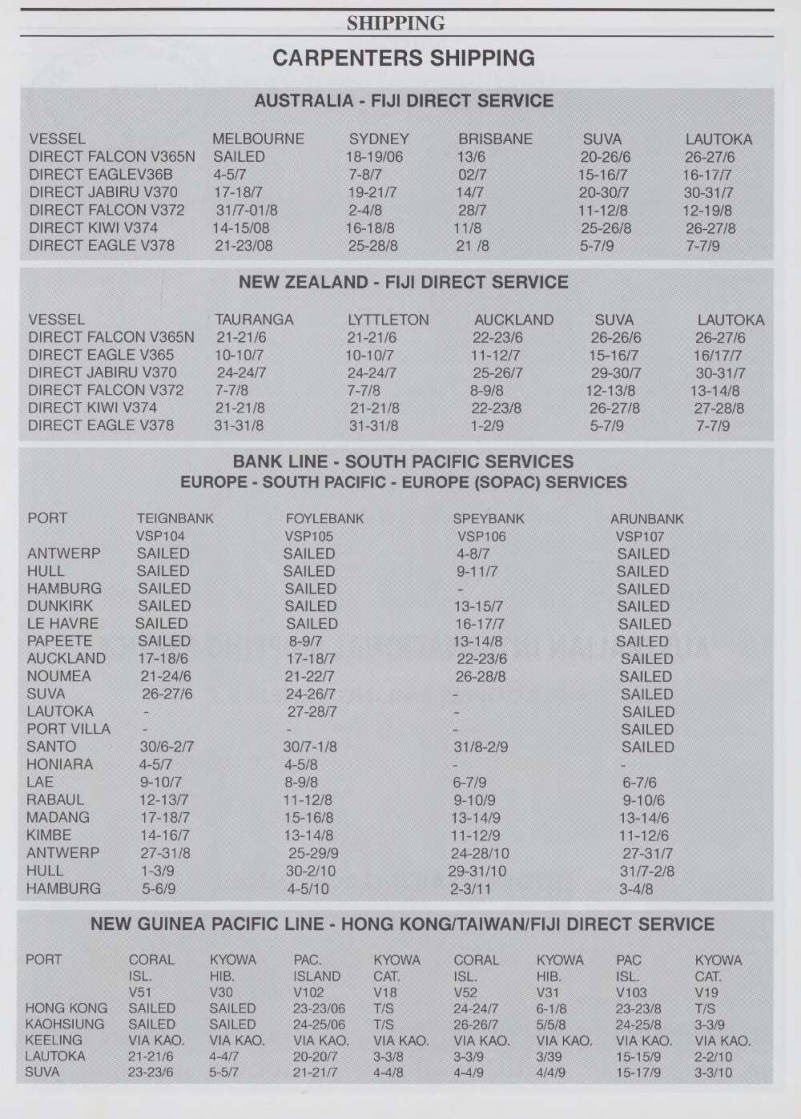
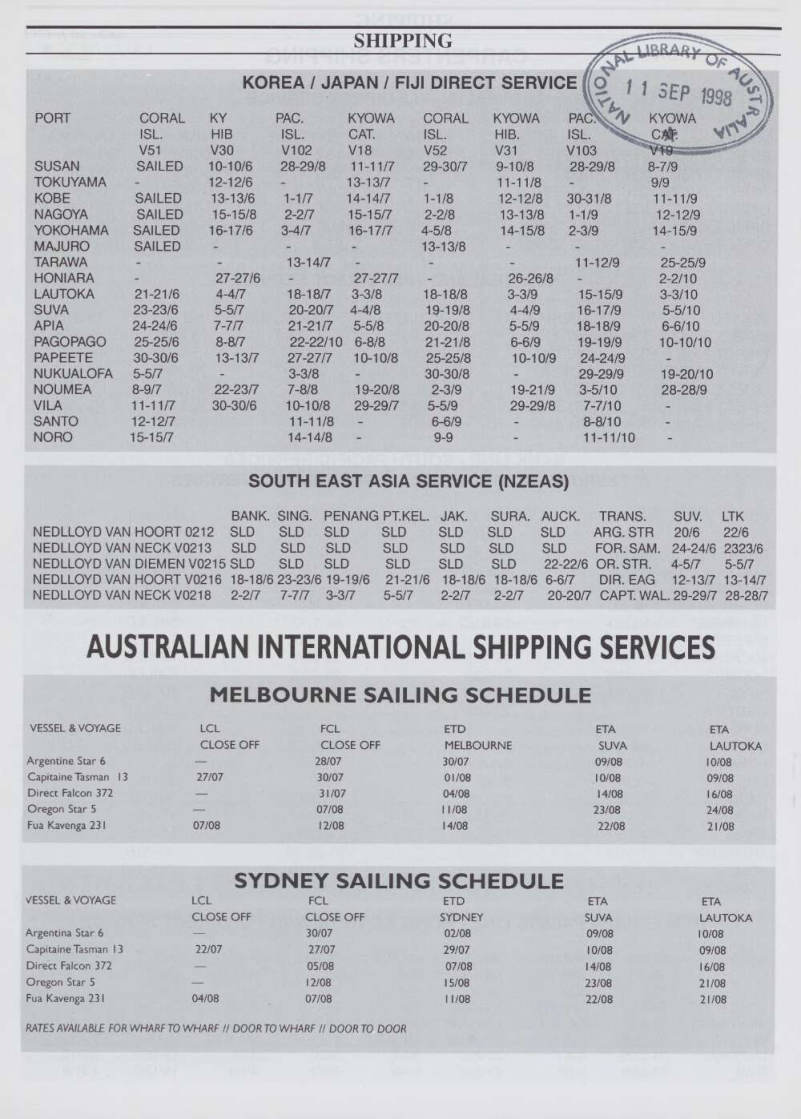
Shipping
Australia - Fiji Direct Service
New Zealand - Fiji Direct Service
Bank Line - South Pacific Services
EUROPE - SOUTH PACIFIC - EUROPE (SOPAC) SERVICES
NEW GUINEA PACIFIC LINE - HONG KONG/TAIWAN/FIJI DIRECT SERVICE
Vessel
Melbourne
Sydney
Brisbane
Suva
Lautoka
Direct Falcon V365N
Sailed
18-19/06 13/6 20-26/6 26-27/6
Direct Eaglev36B
4-5/7 7-8/7 02/7 15-16/7 16-17/7
Direct Jabiru V370
17-18/7 19-21/7 14/7 20-30/7 30-31/7
Direct Falcon V372
31/7-01/8 2-4/8 28/7 11-12/8 12-19/8
Direct Kiwi V374
14-15/08 16-18/8 11/8 25-26/8 26-27/8
Direct Eagle V378
21-23/08 25-28/8 21 /8 5-7/9 7-7/9
Vessel
Tauranga
Lyttleton
Auckland
Suva
Lautoka
Direct Falcon V365N
21-21/6 21-21/6 22-23/6 26-26/6 26-27/6
Direct Eagle V365
10-10/7 10-10/7 11-12/7 15-16/7 16/17/7
Direct Jabiru V370
24-24/7 24-24/7 25-26/7 29-30/7 30-31/7
Direct Falcon V372
7-7/8 7-7/8 8-9/8 12-13/8 13-14/8
Direct Kiwi V374
21-21/8 21-21/8 22-23/8 26-27/8 27-28/8
Direct Eagle V378
31-31/8 31-31/8 1-2/9 5-7/9 7-7/9
Port
Teignbank
Foylebank
Speybank
Arunbank
Vsp104
Vsp105
Vsp106
Vsp107
Antwerp
Sailed
Sailed
4-8/7
Sailed
Hull
Sailed
Sailed
9-11/7
Sailed
Hamburg
Sailed
Sailed
Sailed
Dunkirk
Sailed
Sailed
13-15/7
Sailed
Le Havre
Sailed
Sailed
16-17/7
Sailed
Papeete
Sailed
8-9/7 13-14/8
Sailed
Auckland
17-18/6 17-18/7 22-23/6
Sailed
Noumea
21-24/6 21-22/7 26-28/8
Sailed
Suva
26-27/6 24-26/7 -
Sailed
Lautoka
- 27-28/7 -
Sailed
Port Villa
Sailed
Santo
30/6-2/7 30/7-1/8 31/8-2/9
Sailed
Honiara
4-5/7 4-5/8 - -
Lae
9-10/7 8-9/8 6-7/9 6-7/6
Rabaul
12-13/7 11-12/8 9-10/9 9-10/6
Madang
17-18/7 15-16/8 13-14/9 13-14/6
Kimbe
14-16/7 13-14/8 11-12/9 11-12/6
Antwerp
27-31/8 25-29/9 24-28/10 27-31/7
Hull
1-3/9 30-2/10 29-31/10 31/7-2/8
Hamburg
5-6/9 4-5/10 2-3/11 3-4/8
Port
Coral
Kyowa
Pag.
Kyowa
Coral
Kyowa
Pac
Kyowa
Isl
Hib.
Island
Cat.
Isl.
Hib.
Isl.
Cat.
V51 V30 V102 VI8 V52 V31 V103 V19
Hong Kong
Sailed
Sailed
23-23/06 T/S 24-24/7 6-1/8 23-23/8 T/S
Kaohsiung
Sailed
Sailed
24-25/06 T/S 26-26/7 5/5/8 24-25/8 3-3/9
Keeling
Via Kao.
Via Kao.
Via Kao.
Via Kao.
Via Kao.
Via Kao.
Via Kao.
Via Kao.
Lautoka
21-21/6 4-4/7 20-20/7 3-3/8 3-3/9 3/39 15-15/9 2-2/10
Suva
23-23/6 5-5/7 21-21/7 4-4/8 4-4/9 4/4/9 15-17/9 3-3/10
KOREA / JAPAN / FIJI DIRECT SERVICE
South East Asia Service (Nzeas)
Australian International Shipping Services
Melbourne Sailing Schedule
Sydney Sailing Schedule
Port
Coral
KY
Pag.
Kyowa
Coral
Kyowa
Rad^V
Kyowa
Isl
Hib
Isl
Cat.
Isl.
Hib.
Isl.
. c*fc
V51 V30 VI02 V18 V52 V31 V103
Susan
Sailed
10-10/6 28-29/8 11-11/7 29-30/7 9-10/8 28-29/8 8-7/9
Tokuyama
- 12-12/6 - 13-13/7 - 11-11/8 - 9/9
Kobe
Sailed
13-13/6 1-1/7 14-14/7 1-1/8 12-12/8 30-31/8 11-11/9
Nagoya
Sailed
15-15/8 2-2/7 15-15/7 2-2/8 13-13/8 1-1/9 12-12/9
Yokohama
Sailed
16-17/6 3-4/7 16-17/7 4-5/8 14-15/8 2-3/9 14-15/9
Majuro
Sailed
- - - 13-13/8 - - -
Tarawa
- - 13-14/7 - - - 11-12/9 25-25/9
Honiara
- 27-27/6 - 27-27/7 - 26-26/8 - 2-2/10
Lautoka
21-21/6 4-4/7 18-18/7 3-3/8 18-18/8 3-3/9 15-15/9 3-3/10
Suva
23-23/6 5-5/7 20-20/7 4-4/8 19-19/8 4-4/9 16-17/9 5-5/10
Apia
24-24/6 7-7/7 21-21/7 5-5/8 20-20/8 5-5/9 18-18/9 6-6/10
Pagopago
25-25/6 8-8/7 22-22/10 6-8/8 21-21/8 6-6/9 19-19/9 10-10/10
Papeete
30-30/6 13-13/7 27-27/7 10-10/8 25-25/8 10-10/9 24-24/9 -
Nukualofa
5-5/7 - 3-3/8 - 30-30/8 - 29-29/9 19-20/10
Noumea
8-9/7 22-23/7 7-8/8 19-20/8 2-3/9 19-21/9 3-5/10 28-28/9
Vila
11-11/7 30-30/6 10-10/8 29-29/7 5-5/9 29-29/8 7-7/10 -
Santo
12-12/7 11-11/8 - 6-6/9 - 8-8/10 -
Noro
15-15/7 14-14/8 - 9-9 - 11-11/10 -
Bank.
Sing.
Penang Pt.Kel.
Jak.
Sura.
Auck.
Trans.
Suv.
Ltk
Nedlloyd Van Hoort 0212
Sld
Sld
Sld
Sld
Sld
Sld
Sld
Arg. Str
20/6 22/6
Nedlloyd Van Neck V0213
Sld
Sld
Sld
Sld
Sld
Sld
Sld
For. Sam.
24-24/6 2323/6
Nedlloyd Van Diemen V0215 Sld
Sld
Sld
Sld
Sld
Sld
22-22/6
Or. Str.
4-5/7 5-5/7
Nedlloyd Van Hoort V0216
18-18/6 23-23/6 19-19/6 21-21/6 18-18/6 18-18/6 6-6/7
Dir. Eag
12-13/7 13-14/7
Nedlloyd Van Neck V0218
2-2/7 7-7/7 3-3/7 5-5/7 2-2/7 2-2/7 20-20/7
Capt. Wal. 29-29/7
28-28/7
Vessels Voyage
Lcl
Fcl
Etd
Eta
Eta
Close Off
Close Off
Melbourne
Suva
Lautoka
Argentine Star 6 — 28/07 30/07 09/08 10/08
Capitaine Tasman 13
27/07 30/07 01/08 10/08 09/08 Direct Falcon 372 31/07 04/08 14/08 16/08 Oregon Star 5 07/08 11/08 23/08 24/08
Fua Kavenga 231
07/08 12/08 14/08 22/08 21/08
Vessel & Voyage
Lcl
Fcl
Etd
Eta
Eta
Close Off
Close Off
Sydney
Suva
Lautoka
Argentina Star 6 — 30/07 02/08 09/08 10/08 Capitaine Tasman 13 22/07 27/07 29/07 10/08 09/08 Direct Falcon 372 — 05/08 07/08 14/08 16/08 Oregon Star 5 — 12/08 15/08 23/08 21/08 Fua Kavenga 231 04/08 07/08 1 1/08 22/08 21/08 RATES AVAILABLE FOR WHARF TO WHARF H DOOR TO WHARF H DOOR TO DOOR
Advertisements & other items, pp. 58-60 (2 items)
Shipping
Local And International
Courier
3 1508 00645068 3
DOOR TO DOOR
'*** * * i IS®##*** _i.i. rir P m ■ Mm For further enquiries call us toll free on 0800 307; or enquire at your nearest Post Office
M 1 9iq
3. SHELM'ES
£ v J n &f. mm : ' : ■; --; V m »s*. ■ Some of the specs may vary according to market specifications.
Looks tough, feels comfortable - Toyota Hilux People all over the world prefer Toyota. Because it makes bestsellers like Hilux. It maintains that rugged reputation, and now it sports tough, durable body styles as well. It's ready for any terrain.
Hilux offers more. More power - with a choice of engines and precision transmissions and transfers. More effective power distribution to match the terrain, thanks to Toyota's advanced
technology.
And more passenger car-like comfort. With an ergonomic interior, all the conveniences you want, the fit and finish you'd expect from Toyota, and a ride that's smoothed out by precision-
engineered suspension.
Hilux is built to take it. And to take you anywhere you want to go.
It's remarkably tough. And incredibly comfortable. With worldleading uncompromising quality. From the champion. Toyota.
DISTRIBUTORS/DEALERS
NORFOLK ISLAND SORRY'S PTY LTD. PH 22114
SOLOMON ISLANDS ELA MOTORS PH 30314
VANUATU ASCO MOTORS PH 22341
COOK ISLANDS PACIFIC MOTORS LTD. PH 20796
® TOYOTA
FIJI ASCO MOTORS PH 384888
NEW CALEDONIA S.I.AP. PH 275562
TONGA ASCO MOTORS PH 23500
AMERICAN SAMOA ...ASCO MOTORS* PH 633-4281
(*HILUX is not being handled.)
KIRIBATI TARAWA MOTORS PH 21090
PAPUA NEW GUINEA...ELA MOTORS PH 3229400
TAHITI NIPPON AUTOMOTO PH 429819
WESTERN SAMOA ASCO MOTORS PH 20800