Advertisements & other items, pp. 2-4 (1 item)
Land Cruiser
ascends to a new, higher plain we*.
IHI
TOYOTA
YEARS
Building upon a tradition of distinction and pride the reigning King of 4 Wheel Drive attains an even greater pinnacle in 4x4 excellence. Renowned rough road performance and rugged dependability are further refined in the new Land Cruiser.
Available with turbo diesel power, at Asco Motors, right now.
The all-terrain conqueror
LAND CRUISER
SUVA 384888 WALU BAY 307808 SIGATOKA 500577 NADI 721777 LAUTOKA 662855 BA 674406 TAVUA 680152 LABASA 811688
Asco Motors
TOYOTA
, ? ?> it- ,* IF' >. ’ ,* • .
W v?*- v* v v / #A Pi i Y,t‘i ”« r '-^:v ¥//M ,*■ rf f 7*l mm S 3^ 1 ._>:. j PV -J * '♦ .AtfVfc j *W
til
;i;-J . ‘“t - •, • > *■ ../I ■v ! 1 Tfg, w ■m. 4k m iS \ -f# «■: .?• f y JMMs - " ' ‘‘l mb
SISPI
A-/ l « ■
te'd
: We accept For further information please contact
VISA
Telikom Phone Card Sates Pay Phone Business Unit PO Bo* 351 Waigani, NCD Papua New Guinea Just quote your card number and expiry date and we will forward your requirements. Telephone: (675) 300 5093 Facsimile: (675) 3005060 m
TELIKOM PNG
Mcuu ao&-Y&- ras&UO! J
Now, there’s just one number to call for every Vodafone service. 123. It couldn’t be easier.
Vodafone Customer Care operates 24 hours a day and Seven days a week.
Call 123 from your Vodafone or 902 123 from any Telecom Fiji phone.
O vodafone
Calls to 123 (Customer Care) are charged at the standard Vodafone rate.
Pacific Islands
Monthly
Vol 68 No. 7
The News Magazine
July 1998
PUBLISHER: Alan Robinson EDITOR: Sophie Foster Hildebrand
Correspondents:
Sally Andrew. Patrick Decloitre, Giff Johnson, Chris Peteru.
Neville Choi, Atarna Raganivatu.
Michael Field. Liz Thompson, Lili Tuwai, Sara Vulum, Lisa Williams.
COLUMNISTS: David Barber (Wellington).
Jemima Garrett (Sydney), GRAPHIC ARTISTS: James Ranuku, Josefa Bola, Andrew Williams
Advertising Sales
Senior Regional Sales (South Pacific) Shabana Naaz Kailesh Kumar Tel (679) 304111, 303244, Fax (679) 303809.
Sydney, Canberra: Bob Hill Media Representation, Tel (61-2) 4164245, Fax (61-2) 4165064.
Brisbane: Jane Fewings Media and Advertising Associates Tel 4522, Fax (61-7) 3878 1071.
Adelaide: Hastwell Williamsons Representatives, Tel (61-8) 3799522, Fax (61-8) 3799735.
Melbourne; Brown Orr Fletcher Burrows ( Aust) Pty Ltd.
Tel (61-3) 98265188.
Fax (61-3) 98265644. .
Auckland: McKay & Bowman. International Media Representatives Limited, Tel (64-9) 4190561, Fax (64-9) 4192243.
Japan: Universal Media Corporation. Tokyo, - Tel (3) 3266626741, .
Cable: UNI-MEDIA Tokyo, Fax (3) 32626742.
Pacific Islands Monthly was founded in 1930
(Usps 9522480).
A Fiji Times Limited production.
Cover prices are recommended retail only. Registered by Australia Post.
Publication No. NBP1210. © Copyright Fiji Times Limited, 177 Victoria Parade, Suva. Fiji.
Tel (679) 304111. fax (679) 303809.
Email: [email protected]
P1M Website: hltp;/Avww.pim.com.fj Pacific Islands Monthly is published monthly by Fiji Times Limited, a division of Nationwide News. 2 Holt Street. Surry Hills.
Sydney, NSW 2010.
Send Address Changes To:
Pacific Islands Monthly PC) Box 1167 Suva, Fiji.
Typeset and printed by Quality Print Limited, 16 Anna Street, Walu Bay, Suva, Fiji, Layout and cover design by Andrew Williams
Inside
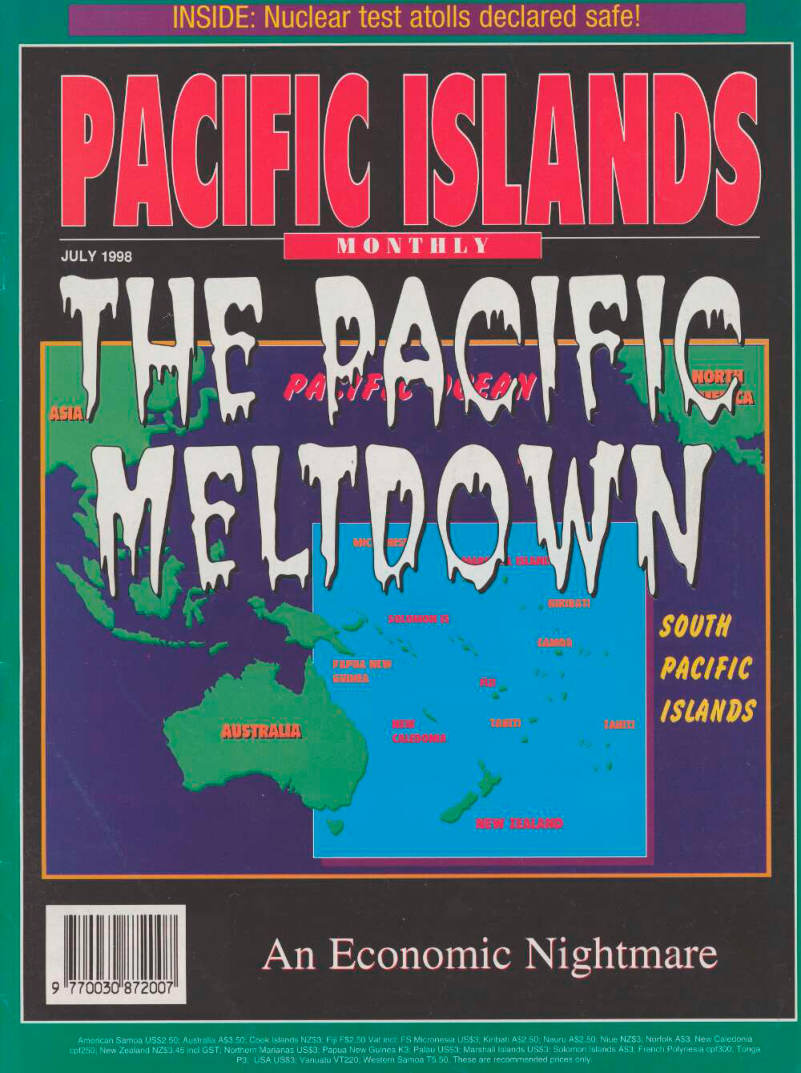
Cover Story: Pacific Meltdown
Letters to the editor. 6 Editorial 7 Briefs 9 Special Report: Nuclear test atolis declared safe! 10 Test-site worker worried 12 Industry: Black Gold fromGobe 13 Cementing the future 14 A gold mine of opportunity. 16 From China, with love, turns into Cooks nightmare 17 Cover Story: The Pacific Meltdown 18 Log industry in crisis 20 Marshalls Economy continues to slow. 22 Public servants face the axe 24 Interest rates increased to avoid devaluation 25 New government scrapping dubious schemes 26 Aviation feature 30 Solomon islands Independence feature 36 Insurance feature 42 Politics: Indigenous rights or Indonesia's rights? 44 PNG draws the line 46 Vanuatu parliament puts leaders under scrutiny. 47 Sport Alama's dream is still alive 48 Yachting: Summer Down Under. 52 : David Barber/Jemima Garrett... 54
PagelO
Page!4
Letters

Wireless local loop system
We take this opportunity to congratulate Fiji Telecom for intro ducing the wireless local loop system in Nasinu.
We hope that this system can also be easily used in other places with more dense populations.
This will alleviate the need for digging up trenches and the roads in the future. This system is easy to install and use.
With more effective use some localities can use systems such as this instead of the more expensive mobile phones.
Systems similar to this are in use in advanced countries like the UK. Hopefully the introduction of such systems will bring down the labour costs and the overheads.
This should bring down the local trunk call charges which are very high for a place like Fiji.
The Retailers would like to congratulate the Line Minister and Telecom for their vision in introducing such modem systems and keeping us all in touch with each other and the world.
Himmat Lodhia,
Fiji Retailers Association, Suva, Fiji
Stamp-lover
Hello there. I am a young stamp collector. I have not been able to find very many used stamps from Fiji or other nearby Pacific Island nations.
I would love to add some to my collection. Is it possible for somebody to set some aside for me?
Even if there might be some from other countries it would be great.
I realize this is no doubt an unusual request but I just thought I would ask with the hope that maybe I could get lucky.
Stamp collecting is a fun hobby and one of the things I enjoy in my spare time.
I thank you for your time and hope I might be fortunate enough to hear from you.
Alan Gorton.
8409 N.E. 140th Court.
Vancouver, Washington
98682 Usa.
Enough of seat-warmers
I am from Lau and no doubt proud to be one. However I would just like to respond to an article in The Fiji Times regarding alle gations against the Commissioner of Police by one of his inspec tors.
May I just say this; if Mr Savua were to go to Timbuktoo and recruit officers who will then go on to discharge their duties impartially and with zeal, then he will most certainly hear me cheering him on and wishing him all the best.
What Fiji needs now is people of courage and vision. Enough of seat-warmers and bum-kissers. And if Mr Savua were to get the people he needs, to fully discharge the marvellous deeds he is doing, from Ra then so be it.
Unorthodoxy, resourcefulness and meritocracy should be the order of the day.
After all, aren’t we all too familiar with the inertia and medi ocrity within the civil service.
In any case, the Lau-Vanua Levu alliance or the so called Tovata has not really acquitted itself majestically as we are so often asked to believe.
on page 7
*From page 6 In the last 28 years they have taken us 10 steps forward and 20 backwards.
So why not give the people from Ra or Kadavu for that matter, a chance to prove themselves; which is more than what the Labour-NFP Coalition had. They might just have a few surprises for us.
Jona Vuli,
Sydney, Australia.
Picture this I wish to advise you of my disappointment with how your mag azine use of photographs for the purposes of a story.
Especially when the photograph has no relevance to the story and the permission of the persons photographed was not sought.
I am referring to the story published in the May 1998 issue, written by Lisa Vainerere about gambling in the Cook Islands, “IN
The Name Of Charity”.
The photograph used pictures myself and my husband in the Banana Court some years back.
This picture being associated with a story about women prefer ring Housie Nights to Night clubbing upsets me indeed as I am in no way associated with any Housie events.
I do not go to housie. I am not a fan of gambling of any sort and would be more than happy if Housie and any form of gambling was banned altogether in the Cook Islands.
As well as the above it is just not right to use pictures of any
one for any story without their permission, you never know whom the person(s) photographed are, whai positions they hold in Government or in a Community.
My husband is the Head of a Government Ministry here in the Cook Islands, and he, as with myself, has no association with Housie or gambling.
I find your use of our picture for the above mentioned story and the caption used along with the photograph most unacceptable - “Women in the Cooks are increasingly attracted to Housie nights as an alternative to nightclubs such as this one in Rarotonga”.
Is this supposed to mean Women, “like this one”, are attracted to Housie nights as an alternative to nightclubs, or does “like this one” refer to the night-club? This sentence is misleading as it could be interpreted either way.
Jackie Tuara
Rarotonga Cook Islands
Human interest?
What happened to news about Tahiti and Hawaii. Are they no longer on the map?
Whatever happened to the great stories like the one they based the Academy winning movie “Mother Goose”, or the stories about Tom Neale on Suwarow. I miss these human interest tales.
Yours truly,
Michael H. Goldsen *More overleaf
A Pacific solution for a Pacific problem
Editorial
IF ever there was a need for Pacific Island people - indige nous or otherwise - to start taking charge of their future, it is now. Apart from when indigenous people would sell their land for a feather or for a piece of tin, at no other time was the Pacific so ignorant and helpless in the face of western culture and so-called civilisation. The experience with huge organisations, such as the World Bank, the International Monetary Fund and the Asian Development Bank, is proving to be too much for many island coun tries. In all truth, the Pacific is once again at the mercy of outside influ ences. Even if the governments of certain countries privately feel that imposing more taxes on their people will be detrimental, they are now forced to introduce more taxes such as VAT and import duties to col
lect enough revenue to pay back their huge overseas debts. In Fiji, Value-Added- Taxation was introduced because the gov ernment had to find another way of getting enough money to clear its growing deficit.
Implementing such a taxation scheme, however, has proved to be very hard.
Without the proper resources, trained per sonnel and expertise to combat the huge tax-dodgers, it is the ordinary person on the street that has ended up footing the VAT bills.
On top of that the people of Fiji still get their normal (pre-VAT) tax, called Pay As You Earn. So they are really taxed twice.
Additionally, this year a tax on interest earned through savings is directly deduct ed from Fiji bank accounts, water rates have increased, and devaluation has increased the price of food stuff on the shelves.
The Fiji government has repeatedly
said it is implementing certain taxes to get funds from the rich and leave the poor alone. Yet it refuses to introduce a capital gains tax, which would put several real estate mercantile parliamentarians on the taxpayer list.
Anyone who says people in the Pacific are better off today than ever, can’t have had to close their business because of increased taxes, or return to the village because of redundancy, or take children out of school because they cannot afford to keep them there. Indeed, the majority of people in the Pacific who live such lives are listened to only around election time.
Every other time, it is outside forces such as banks, or lenders, or multination als that are listened to. It is time that a Pacific solution was found for a Pacific problem. If not, the Pacific Meltdown will not be just an economic one, but cultural and social as well. ■
From The Archives
July 1945
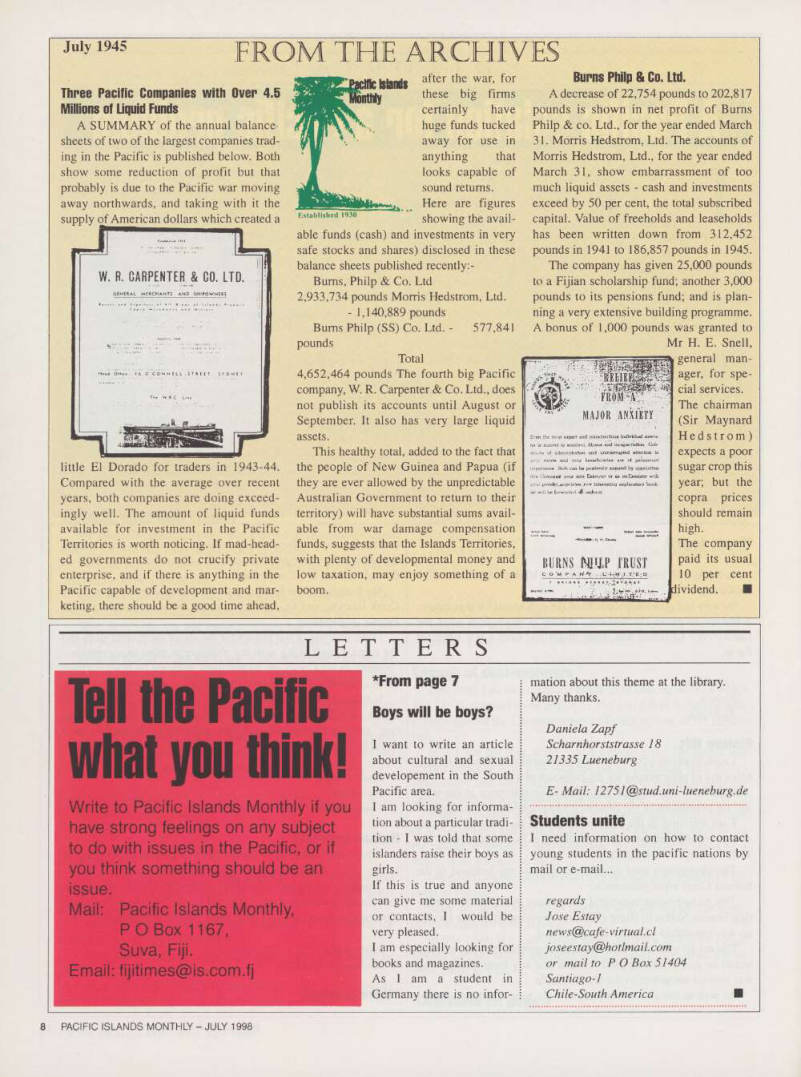
Three Pacific Companies with Over 4.5 Millions of Liquid Funds A SUMMARY of the annual balance sheets of two of the largest companies trad ing in the Pacific is published below. Both show some reduction of profit but that probably is due to the Pacific war moving away northwards, and taking with it the supply of American dollars which created a
little El Dorado for traders in 1943-44.
Compared with the average over recent years, both companies are doing exceed ingly well. The amount of liquid funds available for investment in the Pacific Territories is worth noticing. If mad-head ed governments do not crucify private enterprise, and if there is anything in the Pacific capable of development and mar keting, there should be a good time ahead,
Pacific Islands Untidy
after the war, for these big firms certainly have huge funds tucked away for use in anything that looks capable of sound returns.
Here are figures showing the avail
able funds (cash) and investments in very safe stocks and shares) disclosed in these balance sheets published recently;- Bums, Philp & Co. Ltd 2,933,734 pounds Morris Hedstrom, Ltd. - 1,140,889 pounds Bums Philp (SS) Co. Ltd. - 577,841 pounds Total 4,652,464 pounds The fourth big Pacific company, W. R. Carpenter & Co. Ltd., does not publish its accounts until August or September. It also has very large liquid assets.
This healthy total, added to the fact that the people of New Guinea and Papua (if they are ever allowed by the unpredictable Australian Government to return to their territory) will have substantial sums avail able from war damage compensation funds, suggests that the Islands Territories, with plenty of developmental money and low taxation, may enjoy something of a boom.
Burns Philp ft Co. Ltd.
A decrease of 22,754 pounds to 202,817 pounds is shown in net profit of Burns Philp & co. Ltd., for the year ended March 31. Morris Hedstrom, Ltd. The accounts of Morris Hedstrom, Ltd., for the year ended March 31, show embarrassment of too much liquid assets - cash and investments exceed by 50 per cent, the total subscribed capital. Value of freeholds and leaseholds has been written down from 312,452 pounds in 1941 to 186,857 pounds in 1945.
The company has given 25,000 pounds to a Fijian scholarship fund; another 3,000 pounds to its pensions fund; and is plan ning a very extensive building programme.
A bonus of 1,000 pounds was granted to Mr H. E. Snell,
general man ager, for spe cial services.
The chairman (Sir Maynard Hedstrom) expects a poor sugar crop this year; but the copra prices should remain high.
The company paid its usual 10 per cent lividend. ■
Established 1930
Advertisements & other items, p. 8 (1 item)
Tell the Pacific
LETTERS
what you think!
Write to Pacific Islands Monthly if you
have strong feelings on any subject
to do with issues in the Pacific, or if you think something should be an issue.
Mail: Pacific Islands Monthly, P O Box 1167,
Suva, Fiji.
Email: [email protected]
*From page 7 Boys will be boys?
I want to write an article about cultural and sexual developement in the South Pacific area.
I am looking for information about a particular tradition - I was told that some islanders raise their boys as girls.
If this is true and anyone can give me some material or contacts, I would be very pleased.
I am especially looking for books and magazines.
As I am a student in Germany there is no information about this theme at the library.
Many thanks.
Daniela Zapf Scharnhorststrasse 18 21335 Lueneburg E- Mail: [email protected] Students unite I need information on how to contact young students in the pacific nations by mail or e-mail... regards Jose Estay n e ws@cafe - vi rtua I. cl [email protected] or mail to P O Box 51404 Santiago-!
Chile-South America ■
Briefs
Washington rejects UN Bougainville pro
posal
UNITED Nations proposals for a five man UN political office in Papua New Guinea has apparently been rejected by
Washington.
The United States was reportedly seek ing further financial clarifications on the proposals.
UN Secretary General, Kofi Annan, planned to deploy the mission to support a peace agreement signed at the end of April between separatist leaders on the island of
Bougainville and Port Moresby.
AFP reported that during closed-door consultations at the UN Security Council, the American delegation wanted to ensure the 1.4 million dollars needed for the oper ation would not be added to the UN’s reg ular budget.
Washington, which owes more than one billion dollars in UN dues, has established tough criteria for supporting new UN oper ations.
AFP says that during the meeting, Britain’s Ambassador, Sir John Weston, expressed frustration with the US position.
Begional security an issue
DELEGATES from Forum member countries met in Suva, Fiji for three days in June to discuss the co-ordination of law enforcement and security co-operation in the region.
The Secretary General of the South Pacific Forum Secretariat, Mr Noel Levi, CBE, noted the lack of progress by Forum Island Countries in enacting the legislative priorities identified under the Honiara Declaration.
These cover issues such as extradition, mutual assistance in criminal matters, for feiture of the proceeds of crime and the United Nations Convention Against Illicit Trafficking in Narcotic Drugs and
Psychotropic Substances.
“Progress in this area will assist in
establishing a regional
legislative framework to combat transnational crime,” Mr Levi said. “I would therefore urge you all at this meet ing to have a frank and constructive dis cussion on the reasons for the lack of implementation, and consider ways of moving forward so that the deadline of the
year 2000 can be met,” he said.
The annual Forum Regional Security Committee meeting also includes represen tatives from specialist law enforcement agencies such as the South Pacific Chiefs of Police Conference (SPCPC); Customs Heads of Administration Regional Meeting (CHARM); Pacific Island Law Officers
Meeting (PILOM); Pacific Immigration
Directors Conference (PIDC) as well as a number of other regional organisations.
TCSP conducts tourism review THE Commercial manager of the Tourism Council of the South Pacific, Ilisoni Vuidreketi, is currently in the Solomon Islands capital, Honiara, conduct ing consultations on the new approach of tourism in the region.
Vuidreketi told a news conference that the consultations cover areas on regional private sector tourism development and UNDP Preparatory Phase for Sustainable Tourism component, SIBC reports.
He said the assessment is to substantiate the private sector tourism development activities, and his findings will be forward ed to the European Union that has shown interest in assisting the TCSP in its planned programmes.
Vuidreketi added the assessment will look at marketing, research, information and statistics, membership services and technical assistance requirements.
It will also be aimed at formulating activity proposals for sustainable tourism
that may bring employment opportunities,
as well as improving sustainable livelihood through proper use of natural resources.
Vuidreketi will also carry out similar assessments in Papua New Guinea.
Tongan Jetties to be completed this month THE construction of two jetties for Ha’ano and Ha’afeva Islands in Tonga’s Ha’apai Group, are expected to be com plete by this month. The two projects are
being managed by the Ha’apai
Development Committee, Radio Tonga
reports.
The committee’s secretary, Kalolo Fihaki says the Ha’ano jetty was funded by AusAID at an estimated cost of 35,000 pa’anga (US$2O,OOO) while the Asian Development Bank and the Tongan gov ernment funded the Ha’afeva jetty at the
cost of 800,000 pa’anga (U 55477,000).
Tuvaluans and Ni-KiPibati strengthen
friendship
A GROUP of 80 Tuvaluans from the northern island of Niutao is in the Kiribati capital Tarawa on a month-long visit to strengthen the friendly relationship the two countries once held.
Members of the group will see a changed Tarawa from 1976, the year in the colonial days when the two populations once lived together under British rule.
Tuvalu and Kiribati were then known as the Gilbert and Ellice Islands colony.
Nauru has new leader The honourable Bernard Dowiyogo MP, a former President, has returned to power with a comfortable majority after a June 17 no confidence vote in the Nauru parliament defeated Kinza Clodumar MP.
Bernard Dowiyogo is the longest con tinuous and most widely experienced member of parliament.
He was first elected to parliament in 1973 and has held his seat, ever since.
Regarded as a most capable administrator, he has always taken a major interest in questions relating to the environment.
This will be Bernard Dowiyogo’s fifth term as President.
The outgoing President, Kinza Clodumar, and the newly elected President have been friends since student days and are close colleagues in the parliament.
The President, under the Nauru consti tution, is elected by and from the members
of parliament.
Fiji's Nationalßank changes its credit card management Nationalßank in Fiji last month made management changes to its credit card business. Since 1992, National MBf Finance (Fiji) managed the credit card business of the Nationalßank, however the bank has now made a strategic decision to assume the managment function of this sig nificant part of the product range.
Nationalßank credit card customers can look forward to interest rate concessions of over 50 per cent and fee reductions of at least 30 per cent when the management transition is completed. ■
Special Report
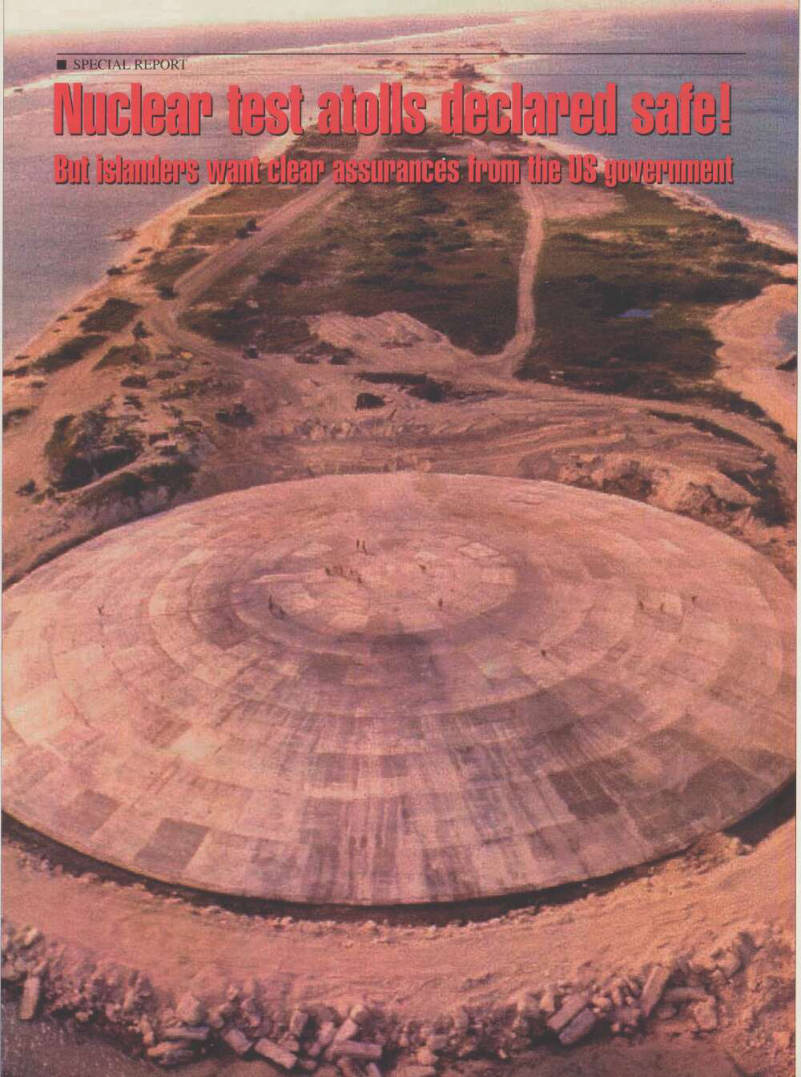
Nuclear test atolls declared safe!
But islanders want clear assurances from the US government
many Marshall Islanders is to completely scrape off the top 12-15 inches of top soil on residential islands, and remove the radioactive soil from the islands. But this is hugely expensive and will have severe environmental consequences by removing the islands’ best soil.
The combination method would scrape topsoil from the village areas, and replace it with crushed coral to minimise exposure in the portion of the island where people will spend the majority of their time. The rest of the island would be doused with fer tiliser, which Bikini experiments have shown will block the uptake of radioactive cesium by root crops. Robison has said that use of fertiliser prevents as much as 95 per cent of the radiation dose that would be received by a person eating local foods.
The final piece of the cleanup puzzle is imported food supplements to insure that islanders do not rely solely on locally grown coconuts, breadfruit and pandanus.
Part of the reason for aborting the Bikini resettlement in 1978 was heavy consump tion of local food (not treated with the fer tiliser method) by the 100 or so islanders
who had returned home following US assurances that the islands were safe.
Matayoshi said that Rongelap is fully aware that they don’t currently have enough funds for the cleanup they believe is necessary. However they are going ahead with phase one work to advance the resettlement process and show the US that they are making a good faith effort to cleanup Rongelap. This is in the hope the US government will ultimately provide the requirements for the safe resettlement of
Rongelap.
“We’ll make a trip to Rongelap in August to do a survey of the island,” he said. “We’ll look at property boundary lines and decide where to locate the dock, field station and other facilities (needed for the cleanup).” While getting the first phase
work moving, Matayoshi is also discussing
possible radiological assistance with the Department of Energy as well as indepen dent scientists.
Rongelap wants to have medical screening conducted before, during and after the cleanup and rehabilitation work so that both workers and future inhabitants
will have assurances that the island is safe, Matayoshi said. Meanwhile, Enewetak is preparing to file a claim seeking hundreds of millions of dollars for rehabilitating their former nuclear test site and for the
hardships experienced during 33 years of
forced exile.
Filing of the claim, with the Nuclear Claims Tribunal in Majuro, is expected before the end of August. Enewetak has already filed a claim, seeking $235 million, for “loss of use” of the atoll from 1947 to 1980. The Tribunal doesn’t have the money to pay for the cleanup. Most of its $45 million fund has gone into compensa tion payments for personal injury claims by Marshall Islanders.
The Tribunal is the agency created by the Compact of Free Association treaty between the US and Marshall Islands to judge all nuclear test claims. Enewetak is hopeful that once the Tribunal acts on its cleanup claim, it will provide a stronger foundation for the Marshall Islands gov ernment to return to the US government seeking aid to resolve the American nucle ar test legacy in the Marshall Islands. ■
No controversy over IAEA Marshalls' report
By Giff Johnson
IN contrast to strong objections in the region to a recent International Atomic Energy Agency study reporting no hazards from the French nuclear tests at Moruroa, an lAEA-sponsored study of Bikini Atoll isn’t even raising any eyebrows in the Marshall Islands.
A scientific panel, convened by the lAEA, gave a stamp of approval to an early June report containing data and analysis by the US Department of Energy at Bikini Atoll. US pronouncements about the safety of the former nuclear test site at Bikini have frequently come under fire from Bikini islanders seeking to understand the hazards of moving back after more than 50 years in exile. However, in this case, Bikini officials aren’t finding fault in a study that confirms DOE work and predictions about Bikini - including that with remedial work, Bikini can be safely re-inhabited.
“This report just confirms what every other scientist has told us for the last sever al years,” said Jack Niedenthal, the Bikini
Council’s trust liaison agent. After DOE scientists began issuing their findings a few years ago, the Bikinians’ independent sci entist reviewed the data and agreed with nearly all the findings. Panels, funded by the US Congress and National Academy of Science, have also essentially agreed with the recent DOE findings that conclude that a cleanup at Bikini is “very doable” and the atoll can be safely re-populated. Bikini leaders and the late President Amata Kabua had asked the lAEA to check DOE data to provide additional assurances to Bikini islanders considering moving back to the former nuclear test site. lAEA officials travelled to Bikini in May 1997 to take
independent samples for analysis. “No fur
ther independent corroboration of the mea surements and assessments of the radiolog ical conditions at Bikini Atoll is necessary,” the lAEA report released in June said.
The lAEA commented on the “excellent quality control of those (earlier) measure ments and assessments,” and the regular comparison of results among different sci entific groups doing investigations at Bikini. The reports repeat an earlier con
elusion that, “provided certain remedial measures are taken, Bikini Island could be permanently re-inhabited.” The lAEA said that the preferred rehabilitation approach is to periodically use potassium fertiliser in all areas of Bikini Island where edible crops can be grown. This is supported by removal of soil from around and beneath housing areas and its replacement by crushed coral. Studies show that the fer tiliser application works for four-to-five years and needs repeating.
The lAEA report recommends that reg ular testing of radioactivity in local food at Bikini be done to see how effective is the cleanup program undertaken. “A simple, local whole body monitor and training in its use should be provided as a further means of enabling potential inhabitants to satisfy themselves there is no significant uptake of cesium into their bodies,” the lAEA said.
The Bikinians have already established a radiation laboratory with the help of the lAEA on Bikini to provide on-site monitor ing of radiological conditions as the cleanup program gets into gear. ■
Forme r N-test site worker worried

about Rongelap nuclear cleanup
By Giff Johnson
A FORMER Bikini Atoll worker issued a warning in early June to Marshall Islanders who will be working on the US-funded nuclear cleanup and rehabilitation project at Rongelap Atoll, scheduled to start in August. Marshall Islander John M. Milne, who worked in a nuclear cleanup program at Bikini in the 1970 s and heads the Marshall Islands Radiation Victims Association, expressed concern for the people who may go to Rongelap and work.
“Many of the members of our group (who worked at Bikini and Enewetak atolls) have radiation-related problems,” he said. “Our aim is to make sure that Marshallese who go to Rongelap are aware of the situation, and that the company doing the work provides precautionary measures for the workers (to insure their safety).” Radioactive fallout from nuclear weapons tests at Bikini in the 1950 s dusted Rongelap. It has been uninhabited for 13 years since Rongelap islander evacuated their home fearing exposure to radiation in the environment.
In response to Milne’s comments, Rongelap Mayor James Matayoshi said that the safety of workers involved in the Rongelap cleanup program is extremely important. “We’re meeting with the Department of Energy to see what role it can play in providing radiation monitoring during the phase one work,” he said.
Matayoshi would like to see all future
workers have whole body counts and urine tests by the DOE before beginning work at Rongelap, and then have them monitored during their time on Rongelap to detect any changes quickly and act on them. Safety issues raised by Marshall Islands Radiation Victims Association president John Milne are “legitimate concerns,” Matayoshi said.
“We’re moving forward with safety mea sures (for workers). It’s one of our priori ties.” Considering the construction work and clearing of jungle overgrowth planned for Rongelap before resettlement, “they’ll have to be exposed to radiation,” Milne said. “Our concern is to see that they are provided the means to safeguard their health.” He said that this might be in the form of masks to prevent inhaling radioac tive material during construction work or dosimeters worn by individuals to measure radiation exposure.
Workers at Bikini, more than 20 years ago, did not receive safety precautions or information during cleanup efforts, Milne said. Bikini was the site of 23 nuclear tests. “We want this new (Rongelap) crew to have an idea about radiation, so they know what to do on Rongelap,” Milne said. He said that Marshallese and others who had worked on Bikini and Enewetak (ground zero for 43 nuclear weapons tests) have “fallen through the cracks” of US provided health and compensation pro grams that do not recognise them as “exposed” to radiation. Without access to adequate medical treatment, many of these workers have died of cancers that, if diag nosed early, might have been treatable, he said, adding he didn’t want to see the same pattern repeated with Rongelap workers. ■
Islanders evacuating the atolls before the ffrst tests decades ago.
Advertisements & other items, p. 12 (2 items)
Report
Interlink
PROFESSIONAL & COMFORTABLE
CHAIRS AVAILABLE FROM FIJI
UT DRAOOI
Drafting Chair
UT STUOOI
Student Chair
UT 280 C
Managerial Mediumback
UT 500 C
Presidential Highback * Assembled, Exported and Processed by:
INTERLINK
(FIJI )
TRADING
G.P.O Box 16189, Suva , Fiji Islands.
Phone ; (679) 311429 Fax ;(679) 31 1499 Mobile : (679) 938799
LTD
•Office Chairs •Office Equipments •Office Stationery •Filing Cabinets •Poly Ehtene Bags
Black Gold from Gobe
Industry
By Nevule Choi
FROM a once inaccessible location traversing the Gulf and Southern
Highlands provinces of
Papua New Guinea, 25km south-west of Mount Murray, 85km south-east of lagifu-Hedinia oil fields and 450 km north-west of Port Moresby, gold is flowing. Black gold, that is, from Papua New Guinea’s second full-scale oil project, Gobe. The Gobe complex is the second full-scale oil project developed in PNG by Chevron Niugini, currently the country’s sole oil producer. Gobe follows the suc cessful development of the Kutubu Project, which had held the reputation of being PNG’s first and only oil producing field.
For the people in the Gulf and Southern Highlands provinces, the promise of long awaited infrastructure development seems all the more tangible now. Production began in Gobe during the second week of March.
Landowner royalties and government revenues began accruing from the time first oil flowed from Gobe in the second week of March. In June, the royalties for March and April were forwarded to a trust account held by the Finance Department.
The total of landowner royalties paid out for March was K 106,795. For April it was K 202,511. The total now held in the trust account is K 309.206. Besides the roy alties, the national government has agreed to provide the landowners with a new road to Samberigi, which will, in time, provide previously isolated villages with access to Kikori in the South and to the highlands centre through Erave. The estimation for the cost of the road is over K5OO million.
The first stage is from Kaiam to Erave; the second from Kaiam to Paia Inlet; and the third from Paia Inlet to Kerema on the Papuan coast.
The section of the road from Kaiam to Erave will cost more than K 135 million.
The Kaiam-Samberigi extension will cost more than K4O million. Chevron Niugini has agreed to use Tax Credit funds to the tune of K 5 million to construct the initial 10 kilometres of the highway.
A spokesperson for Chevron said the company had already engaged surveyors to survey the initial phase of the road.
Representatives from the Department of Works and Transport travelled to the field to discuss the details of the road project with Chevron.
“As soon as surveying is completed we are planning to mobilise contractors to start work,” the spokesperson said.
Construction of the initial phase is understood to have been won by Curtain Bros-Barclay Bros JV. Funding for the rest of the road still has to be found, according to Gabriel Gabonen, Project Co-ordinator for the Gobe Petroleum Project.
Landowners will also participate in the construction of the road through sole con
tracting, sub-contracting and other joint
ventures. Other landowner benefits under the Memorandum of Agreement, which says the landowners will receive Kl 4 mil lion, include K 1 million as a grant for busi ness development and another K 200,000 allocated for training sponsorships.
Total funds being made available to the landowners will be more than K 260 mil lion. The Gobe project consists of two sep arate oil fields: South east Gobe and Gobe Main which are located 80 kilometres south-east of Lake Kutubu. The South East Gobe oil field was discovered in 1991 and Gobe Main, 1994.
South East Gobe is PNG’s first unitised oil field, in that its underground reservoir of oil extends across the boundaries of
adjoining exploration and development
licences. Known reserves from the com bined fields are estimated to be 100 mil lion barrels. Production levels as at June 3 were 36,351 barrels per day, and they are expected to peak at a production of 50,000 barrels per day by mid-year.
“Gobe is the second step in the long range plan to develop Papua New guinea’s oil reserves, and further demonstrates Chevron’s commitment to the develop ment of this country’s natural resources,” said Richard Matszke, a director of Chevron Corporation, and president of Chevron Overseas Petroleum Inc.
“As Gobe lies in relatively close prox imity to Kutubu, it is well situated to be
tied into the existing export pipeline,” said Larry Barthold, managing director of Chevron Niugini Pty Ltd, a unit of Chevron Overseas Petroleum Inc.
“The existing infrastructure can be used
to economically develop potential future
prospects,” Barthold said, pointing out that combining Gobe Main and South East Gobe into one integrated development pro ject enhances the economics of building additional infrastructure to bring these fields, and eventually more remote fields, into production. The Gobe project is based on the utilisation of the existing Kutubu export pipeline and marine terminal.
The project consists primarily of upstream facilities including a number of development wells and field production facilities. In addition, a crude oil export system is tied into the Kutubu pipeline.
Production from the two separate fields are separately measured, then collected and processed to export specification at the Gobe well sites and the Kutubu export pipeline. Oil from the GPF is exported through an export pipeline which connects to the Kutubu pipeline at a point between 70 and 90 kilometres from the Kutubu cen tral processing facility. The Gobe export pipeline is approximately Bkm in length.
The project operators, Chevron Niugini, originally budgeted an amount of US$32l million for the project, but the costs upon completion amounted to US$2BO million. Construction work on the project officially started on February 3, 1997. By March 2 of this year, all project facilities essential for the introduction of hydrocarbons were achieved.
The handover from construction to operations commenced on January 19 this year and was completed early this month.
Chevron Niugini announced during the first week of June that part of the MOA between the state and the landowners, which involves the building of health and education facilities in the surrounding dis tricts, under the tax credit scheme, had been approved by the government. The Gobe oil fields development project has been seen by many observers as being more than an oil field.
The development brings with it infras tructure, health and education assistance that had been denied the people of the Kikori and Erave areas in both the Gulf and Southern Highlands provinces since
independence. ■
Cementing the future

By Sophie Foster Huilebrand
their operation was safe. One former prominent resident was Max Ollson, who lived about two minutes away from the fac tory. He complained that his grapes were being affected and even had the media take pictures of the vines. Throughout the years that he complained FIL made no attempt to right the wrong, or even to admit that they were polluting the forest reserve. Mr Ollson went to his grave with smoke still filtering over the reserve, houses, children, and families in the area.
It was not until early June that FIL, a subsidiary of Fijian Holdings Limited, inaugurated the $1.3 million cement dust filter system. The cement factory received concessions by government to import equipment for the filtration system.
However, according to engineering
sources, that particular type of filtration system has been available on the market for about 10 years.
When asked why, if the technology had been around for a decade, the company had not taken this step before, operations man ager Stuart Ward said the use of the dust filtration system in a cement factory appli
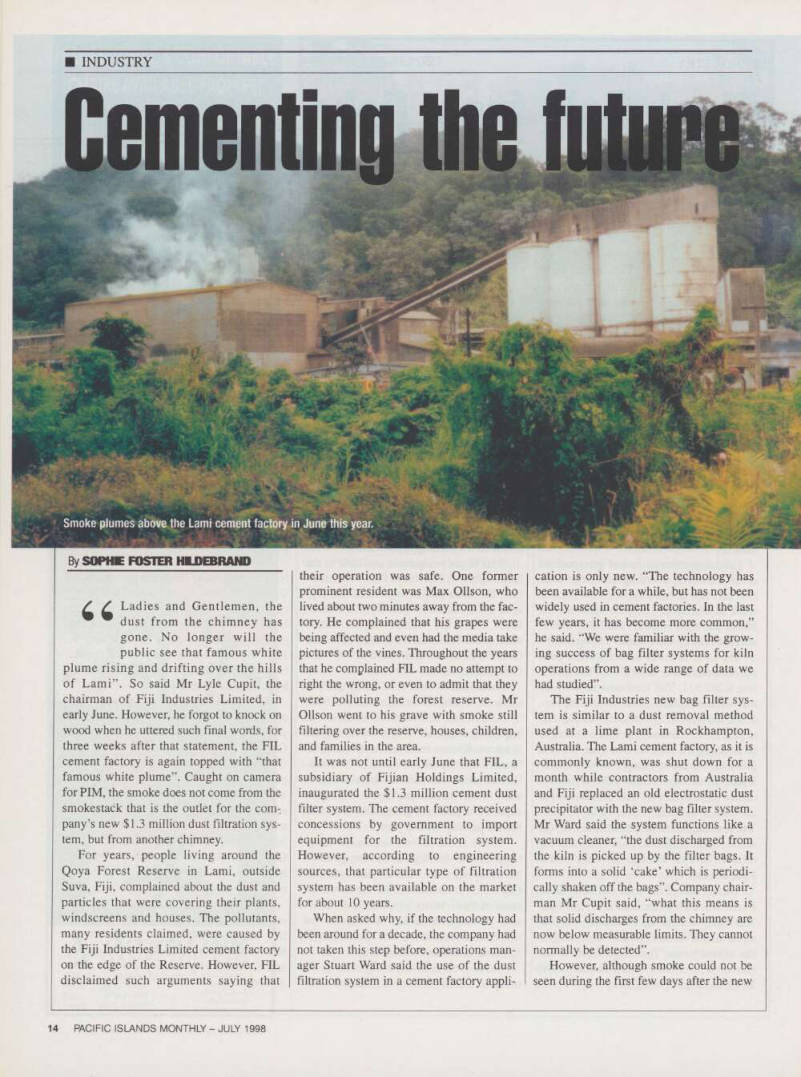
/ / Ladies and Gentlemen, the dust from the chimney has gone. No longer will the public see that famous white plume rising and drifting over the hills of Lami”. So said Mr Lyle Cupit, the chairman of Fiji Industries Limited, in early June. However, he forgot to knock on wood when he uttered such final words, for three weeks after that statement, the FIL cement factory is again topped with “that famous white plume”. Caught on camera for PIM, the smoke does not come from the smokestack that is the outlet for the com pany’s new $1.3 million dust filtration sys tem, but from another chimney.
For years, people living around the Qoya Forest Reserve in Lami, outside Suva, Fiji, complained about the dust and particles that were covering their plants, windscreens and houses. The pollutants, many residents claimed, were caused by the Fiji Industries Limited cement factory on the edge of the Reserve. However, FIL disclaimed such arguments saying that
cation is only new. “The technology has been available for a while, but has not been widely used in cement factories. In the last few years, it has become more common,” he said. “We were familiar with the grow ing success of bag filter systems for kiln operations from a wide range of data we had studied”.
The Fiji Industries new bag filter sys tem is similar to a dust removal method used at a lime plant in Rockhampton, Australia. The Lami cement factory, as it is commonly known, was shut down for a month while contractors from Australia and Fiji replaced an old electrostatic dust precipitator with the new bag filter system.
Mr Ward said the system functions like a vacuum cleaner, “the dust discharged from the kiln is picked up by the filter bags. It forms into a solid ‘cake’ which is periodi cally shaken off the bags”. Company chair man Mr Cupit said, “what this means is that solid discharges from the chimney are now below measurable limits. They cannot normally be detected”.
However, although smoke could not be seen during the first few days after the new
Smoke plumes above the Lami cement factory in June this year.
system was inaugurated, “that famous white plume” is now visible daily. Even today there is no talk about the effect that the factory has had on the reserve, or com pensating those people who had been affected by the dust all these years. In fact, no one even questions what a cement fac tory is doing in a highly sensitive forest reserve. The company, which holds a monopoly in Fiji and supplies the Pacific with cement, was established in 1962 with a plant commissioned at Lami.
In the 19705, the company installed a standard cement dust precipitator to lower the amount of dust from cement produc tion. This was later refurbished and FIL says it kept emissions below the limits established for countries such as Australia and New Zealand.
The company lowered discharge of car bon dioxide - one of the so-called green house gases - by up to 20,000 tonnes a year with production of a new blended cement, using imported iron blast furnace slag.
What slowly became clear to the environ ment department in Fiji was that the limits established for Australia and New Zealand could not just be adopted in Fiji. Local standards had to be drawn up to meet local needs.
All this is contained in new draft envi ronmental legislation that is due to go to
parliament this year.
In it, companies, like the cement factory, will be hit hard with penalties if they do not reach the local standards. Residents in Lami have seen first-hand that the Australian and NZ standards left plants covered with a layer of dust that hardened to form a plaster-like substance.
Passing cars had to scrape the cement dust off their wind screens. All this hap pened while families in the area lived and breathed that air every day. For this there has been no apology. There has been no compensa tion. There has been no clean-up cam paign. But there is still “that famous white plume” over the hills of Lami. ■
The new Dust Filtration System at Fiji Industries Limited was launched by Fiji’s Environment minister Vilisoni Cagimaivei.
Advertisements & other items, p. 15 (2 items)
■ Industry
Japanese Vehicles
u
DIRECT
ijj
Cut out the middlemen
Where to buy, how to import, Homepage: photos, specifications, prices, http://trust-ltd.co.jp/ Address: get the book that reveals all. For Kobac Bid 3-2-26 Nishiki free information contact - Trust Company Ltd, Tel: 81-52-953- 5602, Fax: 81-52-953-5634/31, E-Mail: [email protected].
Nakaku Nagoya 460-0003 Japan Compiled by the Trust Company Limited, Japan, in association with japan Vehicle Export Limited (UK). Trade Aid Ltd. (UK) and Mobile Outreach Ministry (USA).
A gold mine of opportunity
By Sam Vulum
ESPITE the threat of M Papua New Guinea’s
M ongoing tax hikes
■ against the mining
industry and the falling gold prices,
the country’s latest gold mine and one of the world’s largest undeveloped gold resources, Lihir is riding on the crest of success. Lihir Gold Limited chairman Ross Gamaut told shareholders in the company’s annual general meeting recently that despite the tax complaints by the mining industry, Lihir has exceeded production forecasts for its first year (1997) by almost 20 per cent, producing 212.000 ounces of gold. Gamaut said gold
production began, as forecasted, in May
1997 from oxide ore, with the first gold poured on May 25. The first of the three autoclaves, commissioned in August 1997, permitted production from the higher grade sulphide ore. All three autoclaves were operating by September 1997.
In 1998, .the plans for production of 625.000 ounces of gold should place the company amongst the top 15 gold mines in the world, according to the company’s 1997 annual report. The chairman, Gamaut also told shareholders that Lihir had posted an inaugural profit of US$ll.B million in its first year of gold production. Gamaut also said the excellent performance in con struction and start-up reflected well on the company’s management. It also reflected well on the employees - 85 per cent of who were Papua New Guineans, many from Lihir itself. “This has emerged as a great asset for the company, reflecting the quali ty of partnership with the people of Lihir, the quality of life on Lihir and the inherent strengths and challenges of the operation itself,” he said.
The chairman, however, warned that the increases in taxes imposed by the govern ment on the mining industry could threaten the country’s development of new and existing projects. He referred to the PNG budget that increased royalty and payroll taxes and introduced a 50 per cent tax on leave flights from mining sites. Gamaut said the latest taxes were part of continuing increases, which were making production less viable for the mining industry. PNG is
in a difficult economic position with a weak kina and a lack of foreign reserves caused mainly by the recent drought that stalled the operating of the Ok Tedi Copper and Porgera gold mine. Both mines have since re-opened following the return of wet weather. However, Lihir together with other members of the PNG Chamber of Mines and Petroleum have been urging the government to review these new taxes.
Chamber president Dr Moseley Moramoro said recently that the industry would collectively pay K9O million in extra taxes with the introduction of the measures. Dr Moramoro said these taxes will hinder new projects the government was planning to fast track. The Lihir chair man also told shareholders that despite beating production expectations and sched ules in just 19 months, the company had to
face highly unfavourable gold prices.
“Gold prices fell sharply in 1997 and in early 1998, and they remain historically low. This will take the edge off the compa ny’s financial performance. The low gold prices have underlined the critical impor tance of low costs and take every opportu nity to reduce costs to a minimum,” he said. Gamaut said the company’s relatively low cash costs put it in a good position in the current low gold price environment.
The chairman said the board had taken steps to ensure full utilisation of every opportunity to further reduce costs. He said the company’s extensive reserves and long mine life made it sensible to take a long term view of the gold price. “Consideration has been given to the average price over recent years as well as the existence of hedging mechanisms, whereby a higher price than the current spot price can be obtained. Accordingly, the board has con cluded that a gold price of $365 per ounce remains appropriate for valuation purpos es. The board will continue to assess the gold price prospects and review the effect of a lower gold price on reserves and other business parameters in 1998,” he said. In its annual report, the company highlighted that it believes its success to date has large ly been due to its relationship with its employees, the local community and the wider external environment. The report said a special committee within the board the environment and Lihir impact commit
lee - lakes particularly close interest in these matters and works closely with management to monitor the impact of the operation. Of the 1534 employees of the
company, approximately 43 per cent were Lihirians and a further 49 per cent were from other areas of PNG. The annual report said the company has sought to build on its relationship with the Lihirian community.
The goal remains to nurture a long-term association of mutual respect and trust.
There are committees to encourage the development of programmes to promote health, education, social awareness, law and order, community infrastructure, busi ness development and agriculture for the sustainable benefit of the people of Lihir Island. The second phase of village devel opments began in 1997. The Village Development Scheme will provide up to 40 modem permanent houses each year to Lihirian families throughout the Lihir group of islands. By the end of 1997, the company handed over 39 houses and a fur ther 11 were nearing completion.
Lihir continued to give support and assistance to relocated families moving from village dwelling to modem housing.
The annual report said projects funded by the village scheme included village water supplies, clinics, aid posts and nurs es’ houses, education facilities, and church and mission assistance. The report added that the company had acquired enough land in the pit and stockpile areas for 95 per cent of 1998 projected requirements.
During the year, the company paid gold and silver royalties to landowners through arrangements with the government. The development of a township near Londolovit, including the industrial and commercial areas, has begun.
A number of successful Lihirian busi ness groups have been formed, some in joint venture with nationally established companies. Established sporting facilities are well used by the township community.
A detailed investigation into truck disposal of soft waste from a platform constructed out into Luise Harbour, to complement barge disposal, is complete and the appro priate government licence obtained.
For the second consecutive year, ocean ic sedimentation was lower than forecast in the project environment plan.
An ongoing external environmental review by Dames & Moore found no major environmental problems arising from the operation. ■
into a Cooks nightmare
With love, from China, turns into a Cooks nightmare
By Usa Williams
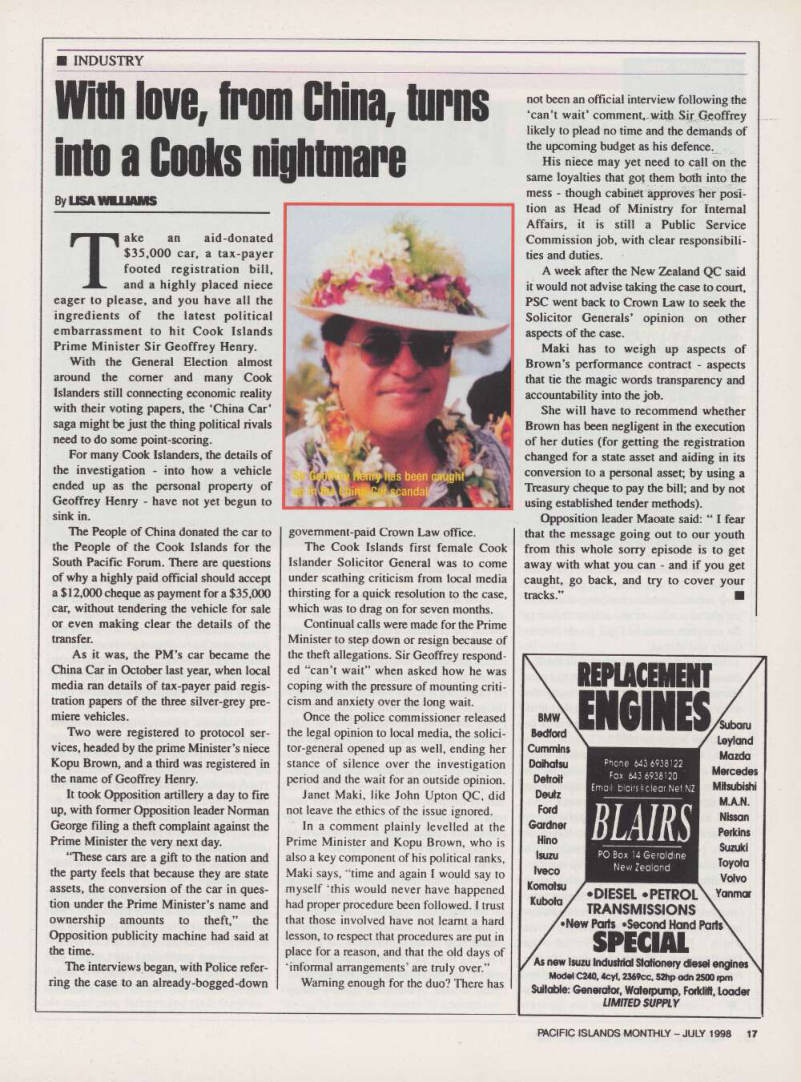
Take an aid-donated $35,000 car, a tax-payer footed registration bill, and a highly placed niece eager to please, and you have all the ingredients of the latest political embarrassment to hit Cook Islands Prime Minister Sir Geoffrey Henry.
With the General Election almost around the comer and many Cook Islanders still connecting economic reality with their voting papers, the ‘China Car’ saga might be just the thing political rivals need to do some point-scoring.
For many Cook Islanders, the details of the investigation - into how a vehicle ended up as the personal property of Geoffrey Henry - have not yet begun to sink in.
The People of China donated the car to the People of the Cook Islands for the South Pacific Forum. There are questions of why a highly paid official should accept a $ 12,000 cheque as payment for a $35,000 car, without tendering the vehicle for sale or even making clear the details of the transfer.
As it was, the PM’s car became the China Car in October last year, when local media ran details of tax-payer paid regis tration papers of the three silver-grey pre miere vehicles.
Two were registered to protocol ser vices, headed by the prime Minister’s niece Kopu Brown, and a third was registered in the name of Geoffrey Henry.
It took Opposition artillery a day to fire up, with former Opposition leader Norman George filing a theft complaint against the Prime Minister the very next day.
“These cars are a gift to the nation and the party feels that because they are state assets, the conversion of the car in ques tion under the Prime Minister’s name and ownership amounts to theft,” the Opposition publicity machine had said at the time.
The interviews began, with Police refer ring the case to an already-bogged-down
government-paid Crown Law office.
The Cook Islands first female Cook Islander Solicitor General was to come under scathing criticism from local media thirsting for a quick resolution to the case, which was to drag on for seven months.
Continual calls were made for the Prime Minister to step down or resign because of the theft allegations. Sir Geoffrey respond ed “can’t wait” when asked how he was coping with the pressure of mounting criti cism and anxiety over the long wait.
Once the police commissioner released the legal opinion to local media, the solici tor-general opened up as well, ending her stance of silence over the investigation period and the wait for an outside opinion.
Janet Maki, like John Upton QC, did not leave the ethics of the issue ignored.
In a comment plainly levelled at the Prime Minister and Kopu Brown, who is also a key component of his political ranks, Maki says, “time and again I would say to myself ‘this would never have happened had proper procedure been followed. I trust that those involved have not leamt a hard lesson, to respect that procedures are put in place for a reason, and that the old days of ‘informal arrangements’ are truly over.”
Warning enough for the duo? There has
not been an official interview following the ‘can’t wait’ comment, with Sir Geoffrey likely to plead no time and the demands of the upcoming budget as his defence.
His niece may yet need to call on the same loyalties that got them both into the mess - though cabinet approves her posi tion as Head of Ministry for Internal Affairs, it is still a Public Service Commission job, with clear responsibili ties and duties.
A week after the New Zealand QC said it would not advise taking the case to court, PSC went back to Crown Law to seek the Solicitor Generals’ opinion on other aspects of the case.
Maki has to weigh up aspects of Brown’s performance contract - aspects that tie the magic words transparency and
accountability into the job.
She will have to recommend whether Brown has been negligent in the execution of her duties (for getting the registration changed for a state asset and aiding in its conversion to a personal asset; by using a Treasury cheque to pay the bill; and by not using established tender methods).
Opposition leader Maoate said: “ I fear that the message going out to our youth from this whole sorry episode is to get away with what you can - and if you get caught, go back, and try to cover your tracks.” ■
Slr Geoffr[?]y Henry has been caught up in the Chins Car scandal.
Advertisements & other items, p. 17 (1 item)
Blairs
BMW
Bedford Cummins Daihatsu Detroit Deutz Ford Gardner Hino Isuzu Iveco Komatsu Kubota Phone 64 3 6938122 Fox 643 6938120 Email: blairs9dear.Net.NZ
PO Box 14 Geraldine New Zealand
•DIESEL •PETROL
TRANSMISSIONS
•New Parts *Second Hand Parts
SPECIAL
Subaru Leyland Mazda Mercedes Mitsubishi
M.A.N.
Nissan Perkins Suzuki Toyota Volvo Yanmar As new Isuzu Industrial Stationery diesei engines Model C240,4cy1. 2369 cc. 52hp adn 2500 rpm Suitable: Generator, Waterpump, Forklift, Loader
LIMITED SUPPLY
The Pacific Meltdown
Cover Story
By Sophe Foster Mildebrand
IT was a move that brought immediate panic to businesses and the people of Fiji. In the early hours of 20 January 1998, Fiji’s minister of finance, Jim Ah Koy, and the Reserve Bank of Fiji, implemented a 20 per cent devaluation of the Fiji Dollar.
Six months down the track, the devalu ation is still giving the government pain.
The loss of buying power through devalu ation is still sorely felt by consumers and retailers alike. There are constant com plaints about the increased cost of living with trade unions vehemently opposed to any sort of wage control - which the gov ernment says is necessary to maximise the benefits of devaluation. In a confidential paper titled Guidelines for Wage Negotiations and Arbitration following the 1998 Currency Devaluation, Mr Ah Koy said the decision to devalue the Fiji curren cy was “taken against a background of a very weak domestic economy, deteriorat ing global conditions and a deterioration in the competitiveness of Fiji’s goods domes tically and abroad.
In 1997 it was confirmed that the Fiji economy was in recession after it had con tracted by one per cent. Domestically, the economy “appeared to have stalled with partial indicators suggesting there was no growth in output in 1997”.
“At the time of the devaluation, there was considerable excess capacity in the economy with substantial unemployment and under-utilised capital. The weak econ omy meant that Fiji was particularly exposed to adverse economic develop ments, both domestically and abroad. Fiji’s high cost structure meant that Fiji was par ticularly exposed to shifts in relative prices of our exports through exchange rate changes,” he said. The problem is alarm ingly'dose to the Asian currency crisis which ESCAP’s Director of the
Development, Research and Policy
Analysis Division, Mr Azizul Islam, says had two prime causes. “These were the
sharp slowdown in export growth giving rise to a rapid deterioration in the current account and liberalisation of the capital account. These were the villains of the piece, the other elements were essentially accomplices,” he said.
“Some grgue that the most important cause of the crisis was the pegged or high ly stable exchange rate. This argument has some validity provided it is recognised that what was important was the combination
of pegged exchange rate with increasingly
liberal capital account regimes. Of the 116 currency crises (defined as 25 per cent or more of depreciation in a year) between 1975 and 1996 close to half were under
flexible regimes,”
Mr Islam said. Under such tremendous pressure, Fiji was left in quite a predica ment. However, that story can be applied to just about any Pacific Island country.
Contracting economies, decline in exports, virtually no growth, rampant unemploy ment and worsening overseas debt burdens are characteristic.
Even while the outlook for world eco nomic growth continues to deteriorate fol lowing the repercussions of the Asian cur rency crisis, the Pacific has entered an eco nomic meltdown. In discussing Thailand’s problems, at a high-level seminar in June on Managing Capital Flows: National and International Dimensions, the Deputy Prime Minister of Thailand, H.E. Mr.
Supachai Panitchpakdi, warned that the economic shock of the Asian currency cri sis may spill over globally “and menacing ly, more than anything the world has ever seen in the past 40 years, and for the first time, a financial crisis in developing economies could cause a deep impact on the capital markets in the industrialised world.”
He, said “the restoration of confidence shpuld be our top priority so that the influx of international capital can resume”.
However, while struggling to entice a greater share of the capital flow, the Pacific is reeling from the effects of the Asian cur rency crisis spill-over. If Pacific companies found it hard to compete against cheap
Asia exports before, the low exchange rates in Asia made those products all the more harder to compete against. Most Pacific economies have had to increase interest rates to stabilise their currencies or devalue currencies to stay in the race. On top of that, lenders, such as the World Bank, the IMF and the ADB, are cracking down on them hard and fast to ensure that they get their money. Never considered strong economies in the first place, the Pacific is now caught up in a mess that it cannot get out of alone.
Dependence on overseas funding is get ting heavier whether it is from the World Bank, the IMF, the ADB, or various aid packages from countries like Australia, France, USA and Japan. Along with these huge loans have come stricter and stricter requirements from the various Banks that have effectively given economic control of the Pacific to overseas lenders.
Today, these banks wax lyrical over measures that absolutely have to be imple mented in order for them to get their money back. It is this helplessness in the face of Bank demands that has come under heavy criticism of late. In PNG, where the government had to introduce more taxes to finance their debt burden, anti-Bank senti ments are high, the logging industry is in danger of being shut down because of such taxes imposed on them.
In Vanuatu, a Comprehensive Reform Programme is going ahead with the setting up of a new business unit to look into all the failed investments of the government.
The unit will also look at ways to revitalise the so-called failed investments that may be put on sale in future to help clear debts.
Amongst these is a plan to convert a 71 million vatu (U 55541,000) government ship “Prince II” into the country’s first sea man’s college.
The Fiji government introduced Value Added Tax to help finance its debt burden.
However, it is having trouble collecting all the VAT revenue because of lack of skilled personnel and insufficient mechanisms for control. The Vanuatu government is plan ning to implement VAT in August amidst
outcry from the country’s chamber of com merce and industries. The chamber says the new taxation system is a threat to local businesses and that many local industries would close down under it. The lifting of the import duties would encourage more imported goods into the country and con sumer expenditure is expected to escalate.
In the Solomon Islands, importers now have to pay an additional five per cent sur charge on all goods brought into the coun try. Solomons’ finance minister Manasseh Sogavare ordered that the five per cent sur charge, over and above all other existing duties, be imposed with effect from May 29. Senior Collector in the Customs Division Edmond Heau says the surcharge is to be applied across the board.
Fiji’s problems are exacerbated by a continuing drought in the country’s west ern division where it is estimated that more than 80,000 people will need some form of relief. Fiji’s west has had no substantial rain since last September and the drought will reduce this year’s sugar crop by more than 50 per cent. Preliminary surveys con ducted for the Fiji government have found most people who need financial assistance are sugar cane farmers and their families.
Some have indicated they would also need food and water.
The Fiji government has agreed to pro vide financial assistance by way of loans from a Sugar Industry Stabilisation Fund but the prospect of a 50 per cent reduction in sugar returns will break cripple Fiji.
To counter all these crises, Asian or otherwise, in almost every Pacific country, the public service, which is the biggest employer, will be chopped to reduce gov ernment expenditure and free up funds to repay debts.
In Vanuatu and the Marshall Islands, the public service is due to be chopped by at least 10 per cent. For Fiji, that figure could be higher because of a growth spurt in the public sector in the past decade. The Cook Islands has already undergone massive changes in the size of its civil service in the wake of their economic collapse. Mr.
Adrianus Mooy, Executive Secretary of ESCAP said that as economies pass through a painful process of readjustment, the lives of millions of ordinary people are being affected adversely.
“As we can see, so many of our fellow citizens in the worst-affected countries are having to face the distress of unemploy
ment and of heightened job insecurity.”
UN Secretary-General Kofi Annan said last month that: “We must remember that beyond this is the threat of social strife, breakdown of law and order and loss of self-esteem.
Macro aggregates do not capture the trauma that individuals and families must undergo as a result of crises of this nature.”
Cushioning the blow from redundancies and business failure in the Pacific is diffi cult because of the breakdown of the tradi tional extended family networks with increasing urbanisation, and a region-wide lack of a social welfare system.
Mr Annan said “We must look at the way in which risks and rewards are bal anced in the operation of the current inter national financial system.
The question to be addressed is whether we can find ways to preserve the benefits of open financial markets while reducing the risks of crises and designing tools to deal with them that will be less costly in human terms.”
In the lead-up to the 21 st century, there is only one sure thing. The economic melt down will be break the backs of many gov ernments, and many more businesses. ■
Log industry in crisis
Nationally owned businesses, dependent on the industry for cash income, to pay expenses and repay loans, are seeing their cash flow and business opportunities dry up as income from timber exports falls to pre-1992 levels,”
By Sam Vulum
CONTINUING depressed
log prices and stringent World Bank conditions have been proving disas trous for the future survival of the for est industry in Papua New guinea.
As if the falling log price - resulting from the Asian economic crisis - was not enough a burden, their industry is now also fighting to survive against the World Bank
conditions. Among others, the bank strong ly opposes any interim industry relief measures, including export tax rate reduc tions. This has forced most timber opera tions to shut down, as reported in the February issue of Pacific Islands Monthly.
However, the forecast is even worse to come, at least for the rest of 1998.
According to the PNG Forest Industry Association, the World bank conditions continue to erode the sustainability of the industry.
The association, which represents about 85 per cent of log producers in the country, said the bank’s conditions have directly contributed to losses in employment, landowners’ payments, export income, and foreign exchange earnings. The association said more than 5000 employees have lost their jobs in the industry and the service industries that support it. It said the contin uing falls in production volumes also resulted in lost cash payments, royalties and premiums to rural communities. Lost royalties alone in the first quarter of 1996 were K 2.5 million. The association said that the export volumes in the first three months of this year have also experienced a tremendous fall compared with the same period in 1997. The volume of 275,000 cubic metres in January 1997 fell to 222,000 in the same month this year. In February it fell from 284,000 cubic metres to 150,000 cubic metres. In March the fall was from 210,000 to 108,000.
It said market reports have indicated that the value of export, in the first quarter, has fallen from US$39 million in 1997 to US$32 million this year. This amounts to a loss of foreign exchange earnings for PNG of about US$4.7 million every week.
Meanwhile, executive members of the Association of Forest Resource Owners, representing timber landowners, meet in Port Moresby in June to seek urgent gov ernment help to save the industry.
They called on the government to come up with a new export duty calculation that was more realistic, fair and effective as this had forced developers to close down log ging activities throughout the country, affecting many resource owners. They said unless the Government took remedial action, more developers would leave the country and buyers turn top other countries for logs. The resource owners said logging activities nation-wide closed down eight months ago. The repercussions include developers abandoning the projects, spin off benefits at a standstill and many resource owners left in debt. The FIA has also reported that rural communication net works, health and education services sup-
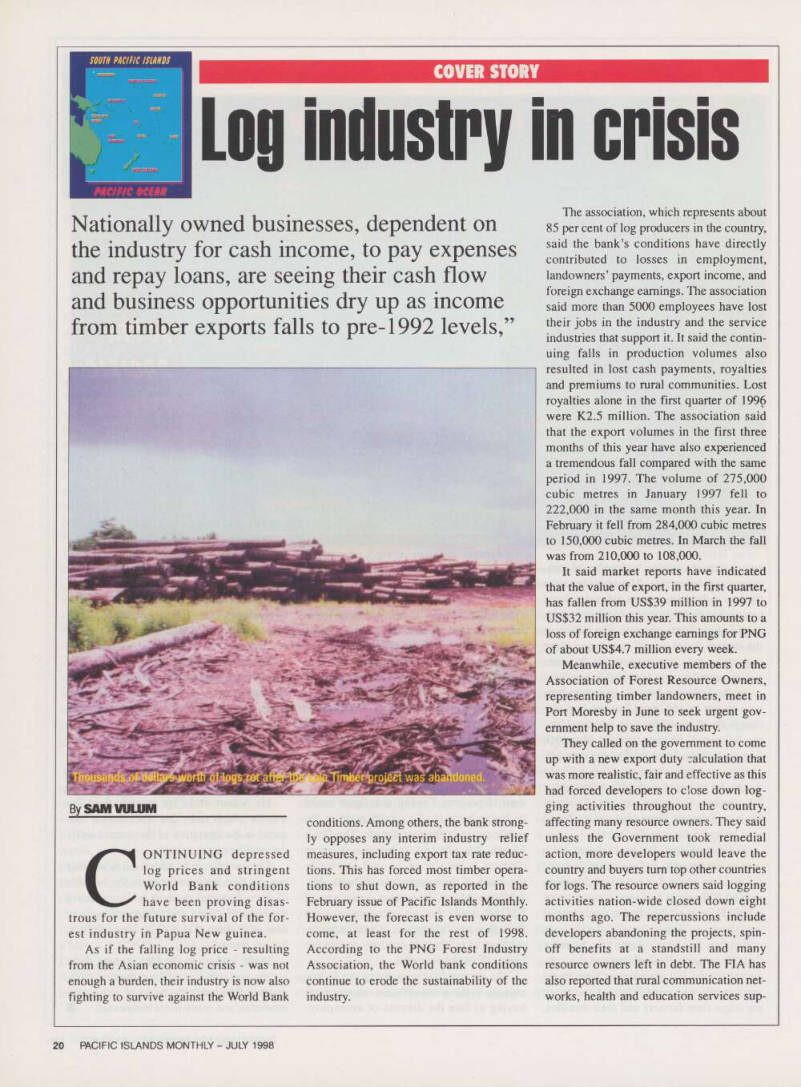
Thousands of dollars worth of logs rot Timber project was abandoned.
ported by the industry are also being closed as timer companies continue to suspend operations. It said shipping, and aircraft services are being withdrawn from areas where timber operations have ceased.
“New infrastructure developments, new schools, aid posts, roads and community centres have ground to a halt or been deferred as development funds dry up.
More than 200,000 people in rural areas are dependent on the industry for their livelihood; as the industry collapses their means of support are at risk. Nationally owned businesses, dependent on the indus try for cash income, to pay expenses and repay loans, are seeing their cash flow and business opportunities dry up as income from timber exports falls to pre-1992 lev els,” the association said. A typical exam
pie is the Lolo timber project in Cape Gloucester, West New Britain Province that Pacific Islands Monthly visited in late April. The landowner company is Lolo
Development Corporation.
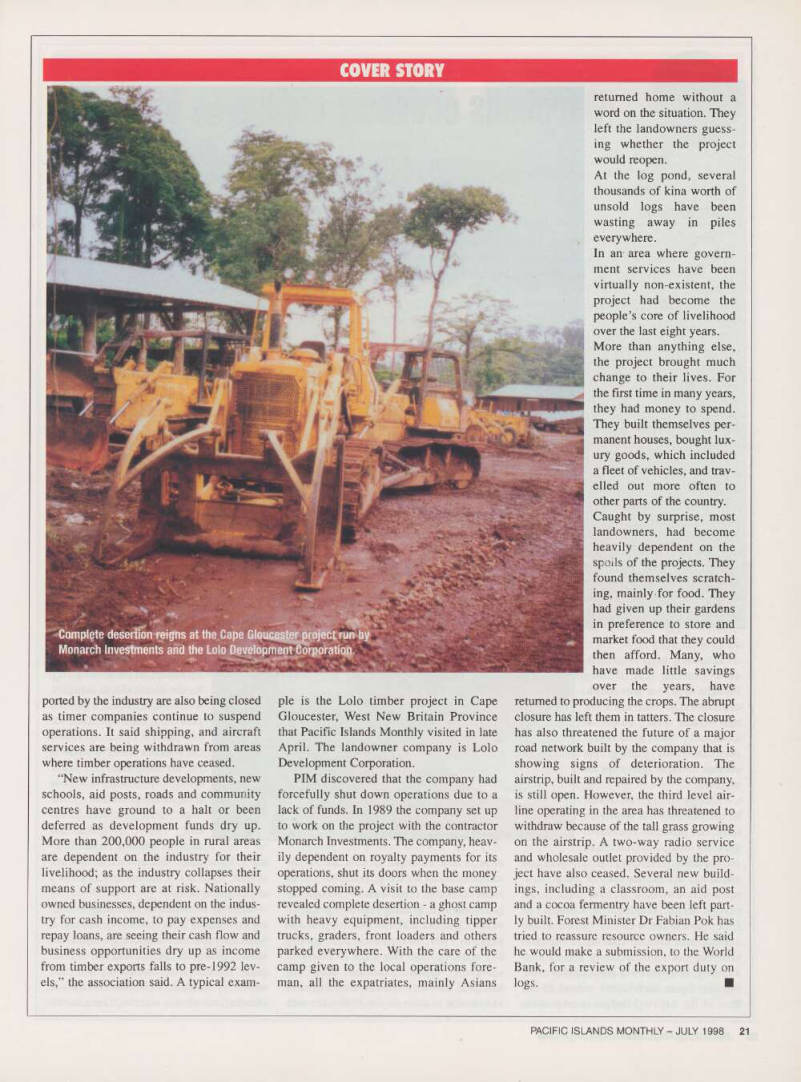
PIM discovered that the company had forcefully shut down operations due to a lack of funds. In 1989 the company set up to work on the project with the contractor Monarch Investments. The company, heav ily dependent on royalty payments for its operations, shut its doors when the money stopped coming. A visit to the base camp revealed complete desertion - a ghost camp with heavy equipment, including tipper trucks, graders, front loaders and others parked everywhere. With the care of the camp given to the local operations fore man, all the expatriates, mainly Asians
returned home without a word on the situation. They left the landowners guess ing whether the project would reopen.
At the log pond, several thousands of kina worth of unsold logs have been wasting away in piles everywhere.
In an area where govern ment services have been virtually non-existent, the project had become the people’s core of livelihood over the last eight years.
More than anything else, the project brought much change to their lives. For the first time in many years, they had money to spend.
They built themselves per manent houses, bought lux ury goods, which included a fleet of vehicles, and trav elled out more often to other parts of the country.
Caught by surprise, most
landowners, had become heavily dependent on the spoils of the projects. They found themselves scratch ing, mainly for food. They had given up their gardens in preference to store and market food that they could then afford. Many, who have made little savings over the years, have
returned to producing the crops. The abrupt closure has left them in tatters. The closure has also threatened the future of a major road network built by the company that is showing signs of deterioration. The airstrip, built and repaired by the company, is still open. However, the third level air line operating in the area has threatened to withdraw because of the tall grass growing on the airstrip. A two-way radio service and wholesale outlet provided by the pro ject have also ceased. Several new build ings, including a classroom, an aid post and a cocoa fermentry have been left part ly built. Forest Minister Dr Fabian Pok has tried to reassure resource owners. He said he would make a submission, to the World Bank, for a review of the export duty on logs. ■
Complete desertion reigns at the Cape Gloucester project run by Monarch Investments and the Lolo Development Corporation.
Marshalls economy continues to slow
Cover Story
By Giff Johnson
SIGNS of the times: The Marshall Islands cabinet announced on June 16 that effective July 1, the salaries of all government workers will be cut 12.5 percent. More than 100 Marshall Islands government workers are set for termination in July
as part of the government’s continuing reduction in force program. A govern ment memo in early June announced that no interna tional travel would be allowed for the rest of the fiscal year, through September 30. Many con tractors now demand pay ment in advance from the government before provid ing services. Delays in lay ing off workers scheduled to be terminated last October are pressuring the government’s ability to muster cash for its bi weekly payroll.
However, high level offi cials observe that if they thought this year was tough, economically, wait until the new fiscal year starts on October 1 - when government ministries are girding for another round of heavy spend
ing cuts.
Though the private sector in the Marshalls is relatively large, it is primarily oriented to services that survive from
recirculating government paycheques and spending. As the fortunes of the govern ment have dwindled, so have those in the
private sector. Although the Compact of
Free Association with the United States continues to provide funding to the gov ernment - of approximately $5O million annually, and other US programmes esca late that figure even higher - about 25 per cent of the national budget is now spent
paying off debts incurred during the free spending early days of the Compact. The Compact’s guarantee of US funding ends in 2001, a date that island leaders are eye
ing with increasing nervousness.
In case anyone needed proof of the eco nomic implosion that is observably evi dent, two recent reports by the Bank of Hawaii and the Pohnpei-based Micronesian Seminar confirm the econom ic problems and give little hope for short term optimism. A key element in the cur rent state of malaise in the Marshalls is that
there is little evidence of direction on the economic front by the government - even as an economic crisis looms. Though the government is gearing for re-negotiation of the Compact with the US, supposed to begin in 1999, an economic strategy is a key missing link. The Bank of Hawaii’s economic report exhorted both the Marshall Islands and Federated States of Micronesia to seize on the 1999 talks with
the US as an opportunity to improve their economic situation. To do so, these island countries need “to offer a credible business plan,” said Bank of Hawaii economist Wali Osman. “The plan must be realistic. The negotiations offer an opportunity to make a business plan work, to create a self-sus taining market economy within the resources that you have and need,” he told Majuro business and government leaders while presenting the updated report in late April. The Bank of Hawaii report empha sises reduced US interest in the Pacific
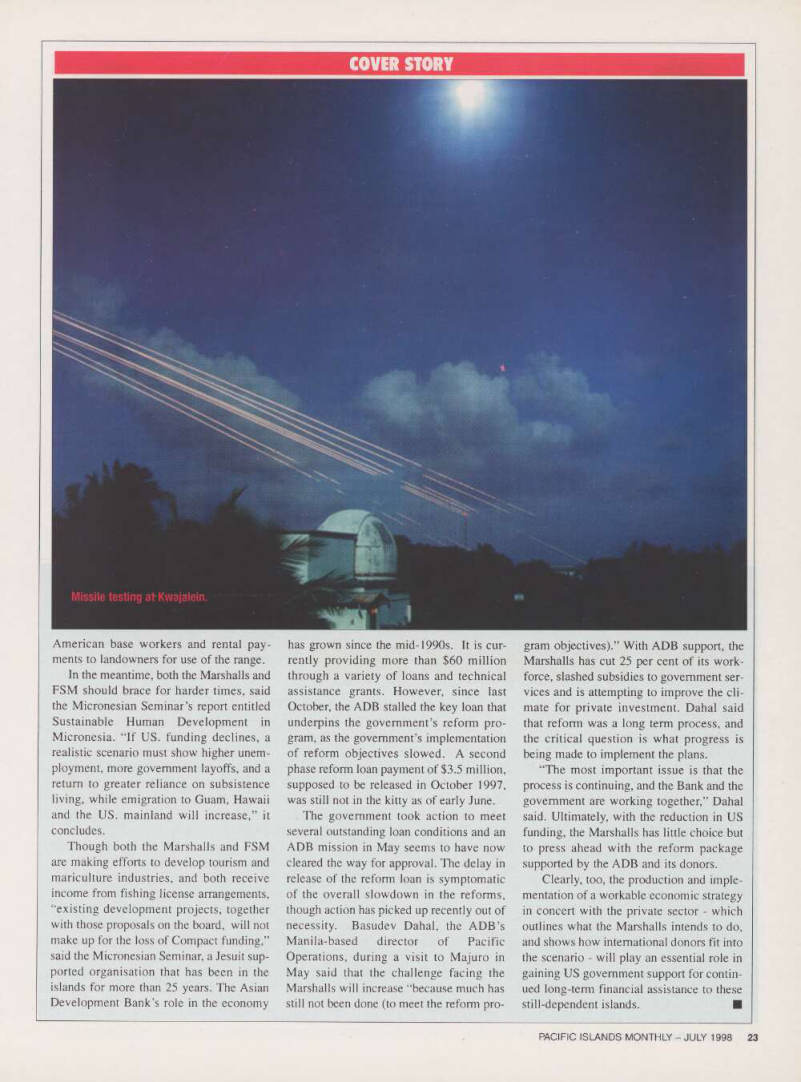
since the demise of the Cold War. However, the report said the US still has a substantial strategic interest in maintain ing long-term relations with the Marshall Islands, which play host of the US missile testing range at Kwajalein.
“It is highly unlikely that Washington would be as gen erous with its aid and rent payment as it was at the peak of the Cold War in the 1980 s.
However, it is also unlikely that the US will end its spe cial relationship with the Marshall Islands beyond 2001 and create a power vacuum in the area.” The Kwajalein mis sile range will continue to be
an important bargaining chip
for the Marshalls. In actuality,
while the Compact’s general
provisions expire in 2001, the US has the option to renew the lease for use of Kwajalein for an additional 15 years.
Since President Ronald
Reagan’s grandiose “Star
Wars” announcement in the early 1980 s, Kwajalein has focused heavily on develop
ing a deployable “theater missile defence system” to protect a limited area, such as a city or battle field.
Billions of dollars in US research fund ing continue to pour into Kwajalein and it is unlikely that the American government’s interest in missile defence will end in three years. The base itself contributes about $25 million to the Marshall Islands economy in Marshallese worker salaries, taxes on the
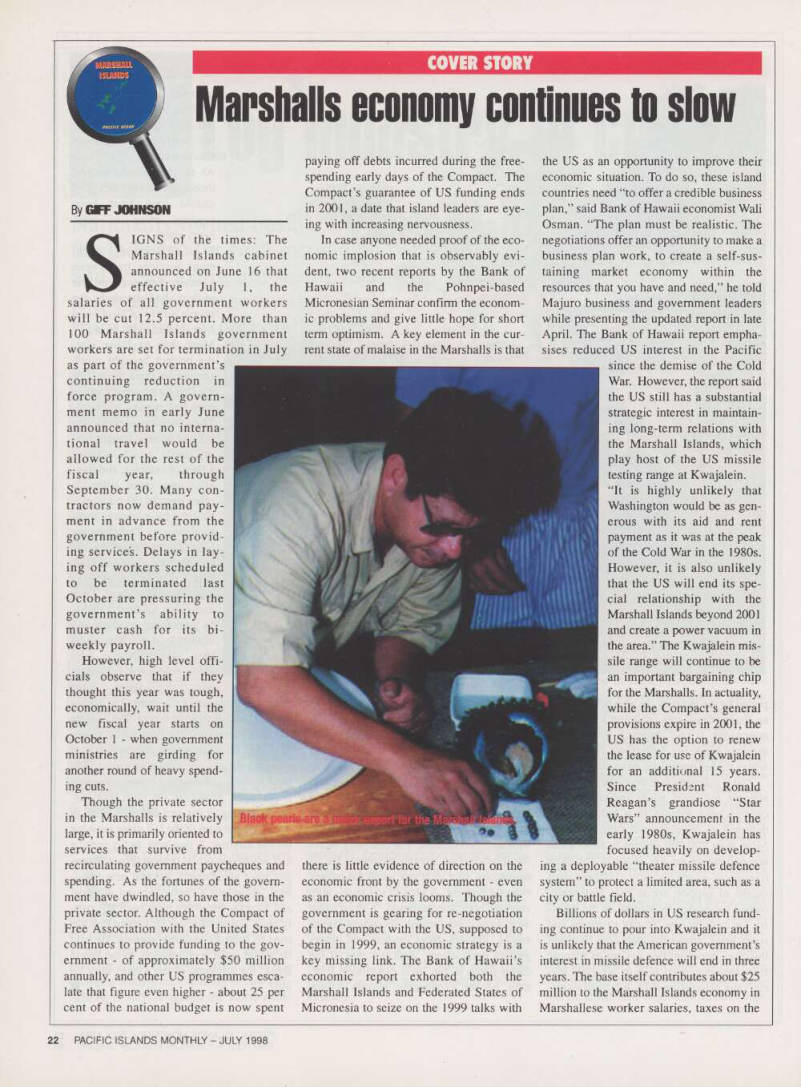
Black pearls are a major export for the Marshall Islands.
American base workers and rental pay ments to landowners for use of the range.
In the meantime, both the Marshalls and FSM should brace for harder times, said the Micronesian Seminar’s report entitled Sustainable Human Development in Micronesia. “If US. funding declines, a realistic scenario must show higher unem ployment, more government layoffs, and a return to greater reliance on subsistence living, while emigration to Guam, Hawaii and the US. mainland will increase,” it concludes.
Though both the Marshalls and FSM are making efforts to develop tourism and mariculture industries, and both receive income from fishing license arrangements,
“existing development projects, together
with those proposals on the board, will not make up for the loss of Compact funding,” said the Micronesian Seminar, a Jesuit sup ported organisation that has been in the islands for more than 25 years. The Asian Development Bank’s role in the economy
has grown since the mid-19905. It is cur rently providing more than $6O million through a variety of loans and technical assistance grants. However, since last October, the ADB stalled the key loan that underpins the government’s reform pro gram, as the government’s implementation of reform objectives slowed. A second phase reform loan payment of $3.5 million, supposed to be released in October 1997, was still not in the kitty as of early June.
The government took action to meet several outstanding loan conditions and an ADB mission in May seems to have now cleared the way for approval. The delay in release of the reform loan is symptomatic of the overall slowdown in the reforms, though action has picked up recently out of necessity. Basudev Dahal, the ADB’s Manila-based director of Pacific Operations, during a visit to Majuro in May said that the challenge facing the Marshalls will increase “because much has still not been done (to meet the reform pro
gram objectives).” With ADB support, the Marshalls has cut 25 per cent of its work force, slashed subsidies to government ser vices and is attempting to improve the cli mate for private investment. Dahal said that reform was a long term process, and the critical question is what progress is being made to implement the plans.
“The most important issue is that the process is continuing, and the Bank and the government are working together,” Dahal said. Ultimately, with the reduction in US funding, the Marshalls has little choice but to press ahead with the reform package supported by the ADB and its donors.
Clearly, too, the production and imple mentation of a workable economic strategy in concert with the private sector - which outlines what the Marshalls intends to do, and shows how international donors fit into the scenario - will play an essential role in gaining US government support for contin ued long-term financial assistance to these still-dependent islands. ■
Missile testing at Kwajalein.
Vanuatu public servants face
the axe under stringent reforms
By Patrick Decloitre
The Vanuatu government announced last May “10 to 15 per cent” of the 4,500-strong public ser vice are facing the axe under an Asian Development Bank (ADB)-co-ordi nated comprehensive reform pro gramme.
“This is to ensure staff employed in the public sector are both capable and are per
forming the right job”, prime minister
Donald Kalpokas’s press secretary Bob Makin said. Kalpokas took office on March 30 after early general elections on March 6. His Vanuaaku Pati formed a coalition with independence father Walter Lini. “We found the performance of the public sector was often poor due to politi cal interference (in the appointments). This
had led to a significant number of staff with low skill levels”, Kalpokas said, adding his cabinet had already approved the move. Officials here also revealed as a result of dubious appointments of public servants, about two hundred people still received salaries while not being officially on the pay-roll.
“This is not a situation any government wants to face when it comes into office.
But if we don’t take firm action, the eco nomic situation of the country will not
improve”.
“We promised to offer leadership and to be prepared to take the hard decisions that have been previously been avoided.
We must act now”, Kalpokas added. Last year, under a previous government, Vanuatu embarked in an ADB-sponsored comprehensive reform programme (GRP) aimed at boosting the economy through
private sector growth. The GRP also planned to “rightsize” the number of pub lic servants, in line with principles of good governance, accountability and trans parency. In April this year, Kalpokas signed a US$2O million soft loan from ADB to implement the reforms. The “rightsizing” would start in August “and then only a small minority (in the public service) will be affected by redundancy”, Kalpokas however assured.
Each department would first be expect ed to design a leaner structure, then reallo cate its staff members. Those who don’t fit in will be made redundant “either because there is no job, or no job that person has the capacity to perform at the required standard”. Those sacked would receive four weeks’ severance compensation for each year of service and up to three months’ pay in lieu of notice. ■
boost Melanesian trade
Tax-free list may soon boost Melanesian trade
By Patrick Decloitre
Vanuatu and Fiji trade officials late April agreed on a common list of products to be exchanged later this year under a zero rate tariff clause. The three-day bilat eral talks ended a series of meetings initiated sixteen months ago between the two countries to boost exchange within the South Pacific neighbours.
Citing new global trade rules imposed by the World Trade Organisation, it was important for private sectors in the region to “face the challenges fur ther liberalisation will impose on us”, the trade officials said in a joint release. For Fiji, it’s part of our policy to consolidate trade links with South Pacific
Forum countries. We believe this a priority to establish a viable South Pacific before we can attract foreign investors in this region”, Kesaia Tuisawau, Fiji’s foreign and trade ministry deputy permanent sec retary, said. Both countries agreed on a list of 21 products on each side to benefit from preferential conditions, including no tariff and facilitation of customs and quarantine formalities. Fiji signed similar arrange ments with Tonga and Papua New Guinea, Tuisawau, who headed the three-man Fiji delegation in Vanuatu, added.
“With Tonga, it’s almost all agricultural and fisheries products, with PNG it’s more manufactured goods from both sides”.
Under the agreement, which identifies 21 products for each country, Vanuatu would export beef, goat and pork meat, sweet corn, beans, ginger, copra, kava,
cocoa to Fiji. In return, Fiji would sell manufactured and processed goods, such as canned fish, cement, footwear, garments into Vanuatu.“lt’s a common list, compa nies in either country can trade on any of the 42 products,” Tuisawau said.
However, there are provisions for fine tuning if any of the selected products dam ages an existing growing industry on either side. “We’ve tried to avoid products where industries are being protected. Fiji had to eliminate corned beef, soap because this is an infant industry in Vanuatu.” “And if a country feels its local industry is being negatively impacted and affected, we can consult one another and say ‘hey, stop for a while’.”
The five-year agreement will be signed at the next Melanesian Spearhead Group (MSG) summit in Suva (Fiji) this month, and fully operational by September, Tuisawau predicts.
On a similar note, Fiji is currently nego tiating another list of products under an MSG preferential trade agreement, which includes Vanuatu, Solomon Islands, Fiji, Papua New Guinea and New Caledonia’s FLNKS party. ■
Advertisements & other items, p. 24 (1 item)
Cover Story
Interest rates increased to avoid devaluation

avoid devaluation of the vatu
By Patrick Decloitre
The Vanuatu Reserve Bank last mid-May announced a five per cent increase in the country’s interest rates to restore the country’s deplet ing foreign currency reserve, amidst fears this could strangle weakest com panies here. Reserve Bank governor Andrew Kausiama said the move aimed to restore confidence in the national curren cy, the vatu, which has been undergoing strong pressure in the past three months against foreign currencies.
A spell of political instability, followed
by loss of confidence by investors, who started to convert their savings into foreign currencies, pressured the vatu. After riots on January 12, a massive payout of contri butions to angry Vanuatu National Provident Fund (VNPF) members also caused a sudden influx of vatu in the local
economy and purchase of mainly imported
goods.
“The VNPF issue was one of the major things, the payouts contributed to increase in demand, a country like Vanuatu depends highly on imports. You look around (in Port Vila), there’s a lot of new cars, this contributes to the depletion of foreign reserves”, Kausiama said.
“The (VNPF payout) has considerably increased the consumer demand for the past three months. People bought cars, microwaves, VCRs, you name it. We’ve had the party, now we’re going to have the hangover”. Bank of Hawaii (Vanuatu) deputy general manager John McMillan said. Last March 27, former Reserve Bank governor tried to devalue the vatu by 20 per cent, saying the island state’s foreign exchange reserves had gone down from six months import cover to a mere three, about 20 million US dollars.
The reserve had now further dwindled to “2.5 to 2.7” months, Kausiama admit ted. “Although the trend is now stabilising, it’s not a very good situation”. Prime min ister Donald Kalpokas’s government reversed the devaluation as soon as it took office on March 30. Kalpokas said there was no need to devalue the vatu, citing the implication of adverse social effects.
“As for our foreign reserves, up until very recently, the trend continued to be in a downward direction. This prompted us to take this measure. Since we had ruled out the devaluation option, we didn’t have much choice”. “This is intended to increase the people’s confidence of hold ing vatu and bring them to convert their foreign currencies to vatu. However, it
might not happen as quickly as people may expect”, he added.
The decision, which brings the mini mum central bank interest rate from 5.97 to 10.97 per cent, follows recommenda tions from an International Monetary Fund (IMF) visiting team earlier this month. The IMF forecast for Vanuatu’s 1998 balance of payments was over the one billion vatu (7.9 million US dollars) mark, Kausiama said. “They concluded there was no evi dence to suggest it was necessary to deval ue the vatu, but that an interest rate increase was more appropriate. We’ve had advice from other experts who suggest the same thing”, Kausiama said.
“There’s been a loss a of confidence in the economy and the vatu, and the Reserve Bank has the duty to safeguard the value of the vatu. This is what we’re doing now.
Higher interest rates will increase the attractiveness of holding vatu”, Kausiama explained. “It will also increase the costs of overdrafts and other lines of credit, which some traders may be using as an
alternative to repatriating foreign
exchange receipts derived from exports”, he suspected. However, local commercial banks are not so sure. “In practise, Vanuatu’s going to go through a period of economic pressure”, McMillan said. “Our commercial clients and nearly everyone will certainly be affected. Many compa nies have not profited in the past three months and most of our loan contracts are on a floating rates basis. A five per cent increase means our lending rate will go up to 17 per cent. Some companies might simply go bankrupt or decide to leave”.
“Investors might be jumping on their foot saying it’s expensive to borrow, but we can always go back as soon as situation gets back to normal”, Kausiama said. “But if this increase proves insufficient to reduce speculative pressures on foreign exchange market, further increases in interest rates are not ruled out”.
“We’re a bit sceptical, but we want to give the Reserve Bank the benefit of the doubt”, McMillan said. ■
All in a day's work at the National Bank of Vanuatu.
New government busy
scrapping dubious schemes
State assets transfer to Mauritius aborted
By Patrick Decloitre
VANUATU’S new gov ernment is busy doing away with schemes undertaken by former leaders. Last May, it stopped a plan by a former Finance minister to transfer all of Vanuatu’s State assets to a secret trust fund in Mauritius.
Under a so-called “People of Vanuatu Trust Fund”, former Finance minister Vincent Boulekone had ordered last December that ownership of all 16 of Vanuatu’s statutory corporations and gov ernment companies be transferred from this tax haven to a Mauritius-based “CVDC Holdings SA” trust company, Vanuatu prime minister Donald Kalpokas said in a release.
The creation of the trust had been high ly irregular and was damaging to the repu tation of Vanuatu”, he added. The decision, endorsed by Vanuatu’s Council of minis ters, followed the Attorney General’s advice that the order was “unlawful” and “unenforceable”.
As well, a report published earlier this year by the Vanuatu ombudsman strongly condemned the scheme, stressing the irreg ularities it contained.
The actual transfer of assets couldn’t however take place: Boulekone left office when Kalpokas became prime minister last March 30 after general elections. In a sim ilar move, early June, Kalpokas’ govern ment cancelled the appointments of some 48 of its foreign representatives, mostly in Asia, saying the host countries’ did not give consent.
On top of its eleven “legitimate” con sulates around the world, previous govern ments since 1993 appointed 21 “honorary consuls”, 21 “trade commissioners and six “special advisors” in China, Malaysia, Macau, Canada, Thailand, Indonesia, South Korea and New Zealand.
The 48 appointments were without prior consultation with foreign affairs in Vanuatu, nor was consent obtained from the host countries, the government said.
The names of several of these “trade commissioners” appeared in reports from the ombudsman’s office, which denounced alleged scams. This included the illegal sale of Vanuatu passports to Asians under a previous government. People named in the reports included a Chinese citizen, Jian Peng Chen, appointed, in January last year
by then Prime minister Serge Vohor, Vanuatu’s honorary consul to Macau, where there is no record of Vanuatu citi zens. Chen had met Vohor one week earli er and made two payments of US$lOO,OOO and HK$5OO,OOO “for the good and well being of the people of Vanuatu”, Patterson alleged.
In June last year, the report goes on, Chen came back to Vanuatu with another Chinese, Larry Yu, who became Vanuatu Trade Commissioner in Cambodia, a coun try Vanuatu has no trade links with. She says Cambodian authorities never approved the appointment.
Chen later obtained ten Vanuatu pass ports for family and friends, all Chinese.
Vanuatu ombudsman Marie-Noelle Patterson issued her first report last December on an alleged passport scam purporting to sell Vanuatu diplomatic, offi cial and ordinary passports to Asians from China, Korea, Japan, Taiwan, Singapore, Malaysia, Indonesia, Vietnam, Cambodia and Hong Kong. The Vanuatu cabinet also scrapped 24 “trade commissioners” appointed since 1993 in Taiwan, China, Cambodia, Canada, Vietnam and South Korea. Cabinet kept only eight honorary consuls in Australia, Singapore, Philippines, Japan, Switzerland, France and the United States. ■
Advertisements & other items, pp. 26-28 (1 item)
With Pi You're A Whiner!
f'M.
Mrs Zubedha All receives her PIM prize for an IBM Pentium notebook. The next draw will take place at the end of March 1999
To Win an
IBM Pentium
Notebook,
Get the latest on political, business and social issues
happening throughout the
region every month, as well as the chance to win an IBM Pentium Notebook! Every 12issue subscription received before March 31st, 1999 will go into the draw. Subscribe to Pacific Islands Monthly today by calling (679) 304 111 or fax (679) 303 809/(679) 307 460.
Subscribe to The Source.
Pacific Islands Monthly
Conditions of Entry I.To enter, subscriptions must be made before March 31st, 1998 which automatically enters the subscriber into the draw for the Pentium Notebook Computer. 2, Entry is open to all subscribers except employees of The Fiji Times Ltd, Pacific Islands Monthly and Wilson Addison Ltd. 3. Subscribers need to subscribe for at least 12 months to qualify. 4.The winner of the Pentium Notebook will be published in the Pacific Islands Monthly Magazine, May Issue, 1998 and will be notified by registered mail. s.The winner will receive their prize within one month of the draw. 6. The prize,must me taken as offered and is not redeemable. 7. In the event of any dispute the decision of the promoter is final and no correspondence will be entered into.
For almost 70 years, Pacific Islands Monthly has been and still is the authority on political, business and social issues within the Pacific. And now, every 12 month subscription received before the 31st of March, 1999, goes into a draw to win an IBM Pentium Notebook*. You could even give a gift subscription to enter but it must be before the closing date. As well as the entry into the draw, you will also receive the latest news from the region. Fill in the subscription form below and send it along with payment to Pacific Islands Monthly, Subscription Department, PO Box 1167, Suva, Fiji. Or call PIM on (679) 304 111 or fax us on (679) 303 809/(679) 307 460.
Subscribe to The Source.
Pacific Islands Monthly
*Rates include Airspeeding to all destinations Conditions of Entry 1. To enter, subscriptions must be made before March 31st, 1999 .which automatically enters the subscriber into the draw for the Pentium Notebook Computer. 2. Entry is open to all subscribers except employees of The Fiji Times Ltd, Pacific Islands Monthly, and Wilson Addison Ltd. 3- Subscribers need to subscribe for 12 months to qualify. 4. The winner of the Pentium Notebook will be published in Pacific Islands Monthly Magazine, May Issue, 1999 and will be notified by registered mail. 5. The winner will receive their prize within one month of the draw. 6. The prize must be taken as offered and is not redeemable. 7. In the event of any dispute the decision of the promoter is final and no correspondence will be entered into.
YES! I wish to subscribe to The Source and receive a chance to win an IBM Pentium Notebook Computer!
12 ISSUE
SUBSCRIPTION
Rate A
Rate B
I Rate C
I Rate D
Rate E This is a
□ Renewal
□ Cheque/Bank Draft/Money Order made payable to Pacific Islands Monthly □ Please charge my credit card: (VISA / AMEX / MASTERCARD) Signature: Expiry date: Mr/Mrs/Ms: Delivery Address: Postal Address; □ New Subscription Country: Fax;
Big trouble in little Emalus
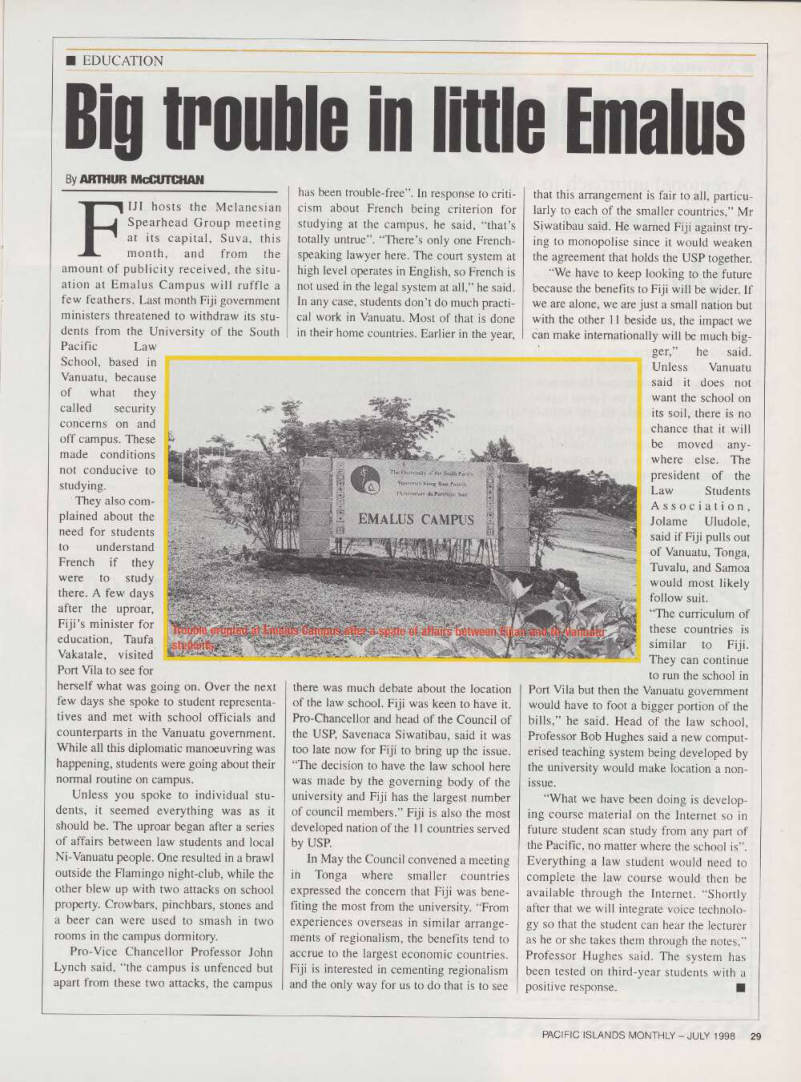
Education
By Arthur Mccutghan
FIJI hosts the Melanesian
Spearhead Group meeting
at its capital, Suva, this month, and from the amount of publicity received, the situ ation at Emalus Campus will ruffle a few feathers. Last month Fiji government ministers threatened to withdraw its stu dents from the University of the South Pacific Law
School, based in Vanuatu, because of what they called security concerns on and off campus. These made conditions not conducive to studying.
They also com plained about the need for students to understand French if they were to study there. A few days after the uproar, Fiji’s minister for education, Taufa Vakatale, visited Port Vila to see for
herself what was going on. Over the next few days she spoke to student representa tives and met with school officials and counterparts in the Vanuatu government.
While all this diplomatic manoeuvring was happening, students were going about their normal routine on campus.
Unless you spoke to individual stu dents, it seemed everything was as it should be. The uproar began after a series of affairs between law students and local Ni-Vanuatu people. One resulted in a brawl outside the Flamingo night-club, while the other blew up with two attacks on school property. Crowbars, pinchbars, stones and a beer can were used to smash in two rooms in the campus dormitory.
Pro-Vice Chancellor Professor John Lynch said, “the campus is unfenced but apart from these two attacks, the campus
has been trouble-free”. In response to criti cism about French being criterion for studying at the campus, he said, “that’s totally untrue”. “There’s only one French speaking lawyer here. The court system at high level operates in English, so French is not used in the legal system at all,” he said.
In any case, students don’t do much practi cal work in Vanuatu. Most of that is done in their home countries. Earlier in the year,
there was much debate about the location of the law school. Fiji was keen to have it.
Pro-Chancellor and head of the Council of the USP, Savenaca Siwatibau, said it was too late now for Fiji to bring up the issue.
“The decision to have the law school here was made by the governing body of the university and Fiji has the largest number of council members.” Fiji is also the most developed nation of the 11 countries served by USP.
In May the Council convened a meeting in Tonga where smaller countries expressed the concern that Fiji was bene fiting the most from the university. “From experiences overseas in similar arrange ments of regionalism, the benefits tend to accrue to the largest economic countries.
Fiji is interested in cementing regionalism and the only way for us to do that is to see
that this arrangement is fair to all, particu larly to each of the smaller countries,” Mr Siwatibau said. He warned Fiji against try ing to monopolise since it would weaken the agreement that holds the USP together.
"We have to keep looking to the future because the benefits to Fiji will be wider. If we are alone, we are just a small nation but with the other 11 beside us, the impact we can make internationally will be much big
ger,” he said.
Unless Vanuatu said it does not want the school on its soil, there is no chance that it will be moved any where else. The president of the Law Students Association, Jolame Uludole, said if Fiji pulls out of Vanuatu, Tonga, Tuvalu, and Samoa would most likely follow suit.
“The curriculum of these countries is similar to Fiji.
They can continue to run the school in
Port Vila but then the Vanuatu government would have to foot a bigger portion of the bills,” he said. Head of the law school, Professor Bob Hughes said a new comput
erised teaching system being developed by
the university would make location a non issue.
“What we have been doing is develop ing course material on the Internet so in future student scan study from any part of the Pacific, no matter where the school is”.
Everything a law student would need to complete the law course would then be available through the Internet. “Shortly after that we will integrate voice technolo gy so that the student can hear the lecturer as he or she takes them through the notes,”
Professor Hughes said. The system has been tested on third-year students with a positive response. ■
Trouble erupted at Emalus Campus after a spate of affairs between fijian and Ni-Vanuatu Studens.
Harmoaising Pacific aviation
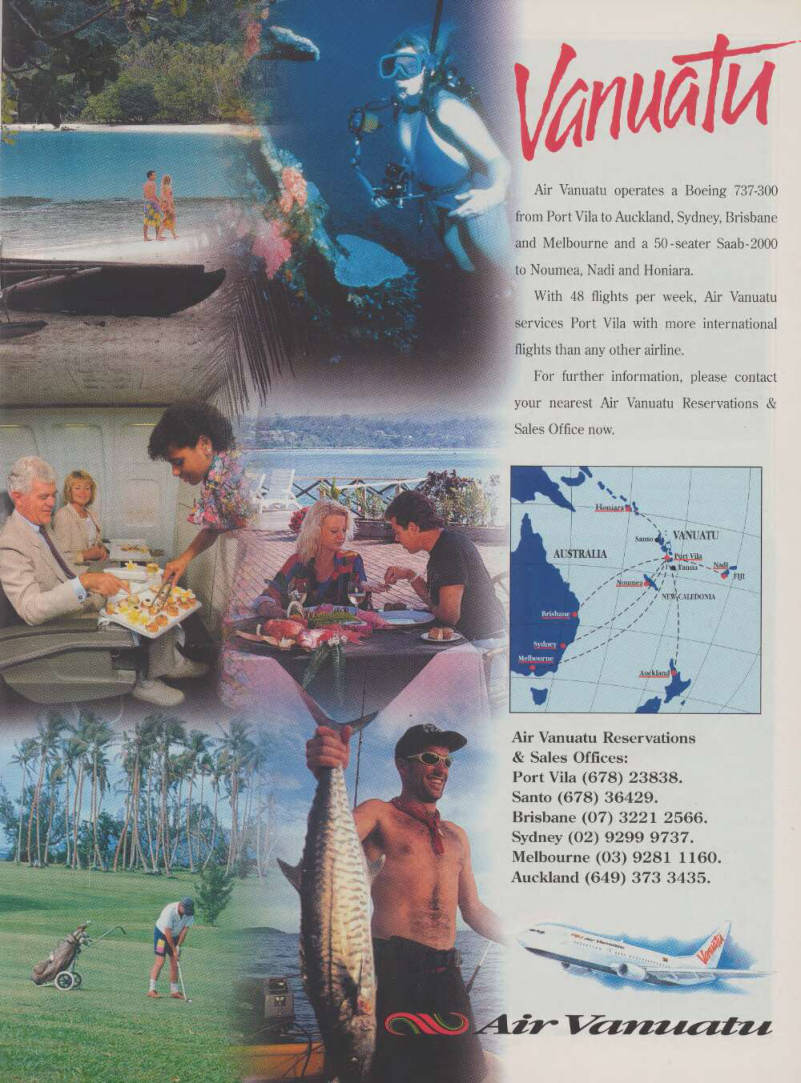
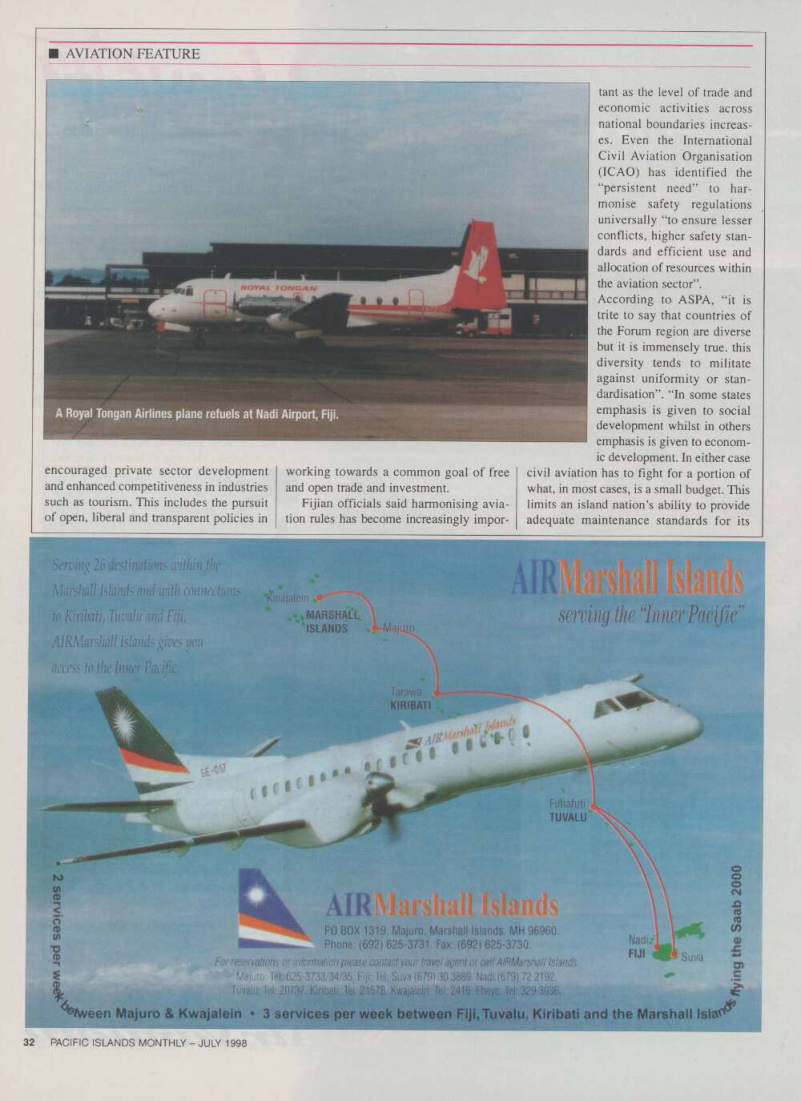
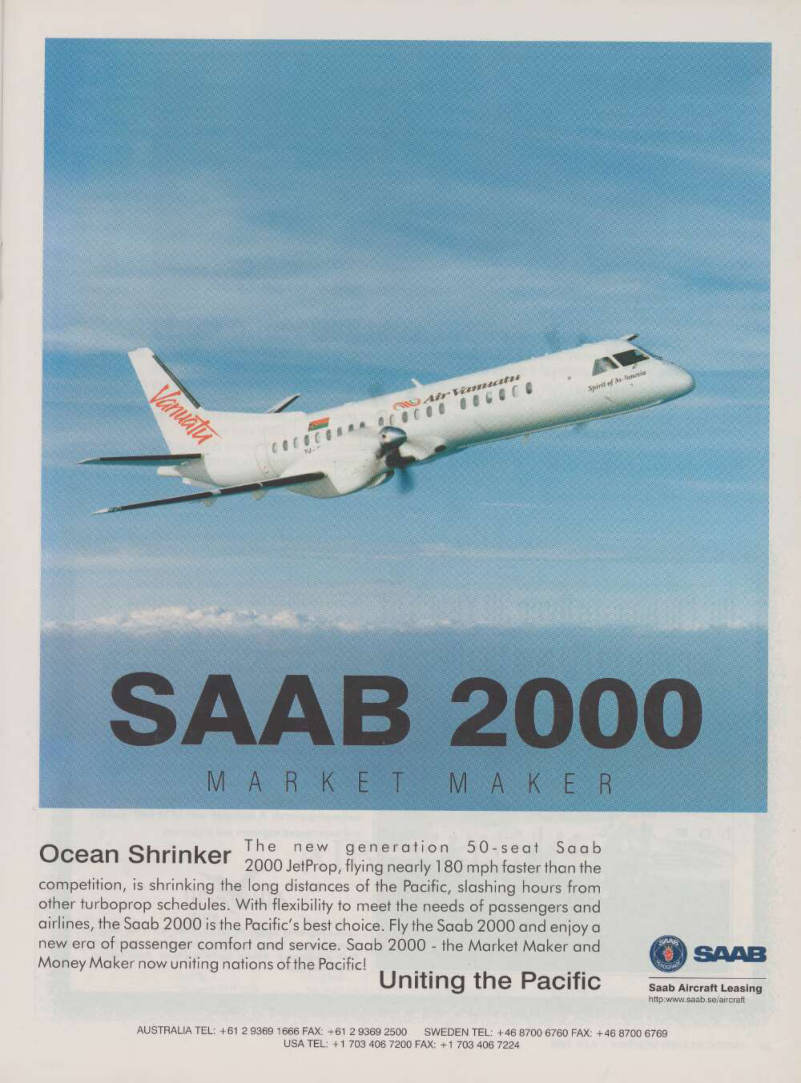
Aviation Feature
A regional approach to a national responsibility
By Sophie Foster Hldebrand
With the 21st century less than a year and a half away, the chal lenges for aviation are many. Always considered an industry at the forefront of development and high technology, now, more than ever, it needs to adopt a conciliatory attitude.
In putting forward the case for harmon isation of regulation in the Forum region, the Association of South Pacific Airlines (ASPA) says, “As the world’s airways sys tem become more and more crowded, an essential element in any safe operation is harmonisation. This requires not only man agement commitment but also legislation that is compatible between various avia tion states”. ASPA says, “the development
of high technology air navigation systems requires balanced international co-opera tion and co-ordination to prevent any par allel introduction of incompatible systems, which would not be conducive either to safely or to economy”.
“A harmonised regulatory structure would undoubtedly improve the safety and efficiency of air operations, would help to reduce costs and simplify international operations”.
The International Civil Aviation Organisation (ICAO) has identified the persistent need to harmonise safety regula tion universally. “This is to ensure lesser conflicts, higher safety standards and effi cient use and allocation of resources with in the aviation sector.”
Fiji says “A harmonised set of safety regulations takes a concerted effort to
arrive at, however, once this is achieved there will be a wider benefit to the region.
Hopefully, the application of wide discre tionary powers by the regulator will be reduced and a more simplified and work able set of rules put in place”.
Fiji believes that with the liberalised trading principles now regulating major activities between states, harmonisation has an important role to play in arriving at a regional approach to a national responsi
bility.
Although an aviation ministers’ meet ing in Suva has aimed at the adoption of aviation legislation and regulations that are compatible across the region, more politi cal will is necessary for this to become a reality.
The ministers committed themselves to using the “bilateral” system to encourage more flexibility in the way airlines and countries cooperate with each other. They also agree to adopt aviation policies that
encouraged private sector development and enhanced competitiveness in industries such as tourism. This includes the pursuit of open, liberal and transparent policies in
working towards a common goal of free and open trade and investment.
Fijian officials said harmonising avia tion rules has become increasingly impor
tant as the level of trade and economic activities across national boundaries increas es. Even the International Civil Aviation Organisation (ICAO) has identified the “persistent need’’ to har
monise safety regulations
universally “to ensure lesser
conflicts, higher safety stan
dards and efficient use and allocation of resources within the aviation sector”.
According to ASPA, “it is trite to say that countries of the Forum region are diverse but it is immensely true, this diversity tends to militate
against uniformity or stan
dardisation”. “In some states emphasis is given to social development whilst in others emphasis is given to econom ic development. In either case
civil aviation has to fight for a portion of what, in most cases, is a small budget. This limits an island nation’s ability to provide adequate maintenance standards for its
A Royal Tongan Airlines plane refuels at Nadi Airport, Fiji.
navigational aids, airports, or to hire tech nical staff or otherwise respond to its avia tion obligations”. ASPA says the necessity for civil aviation differs from island state to island state.
Comparing Kiribati and PNG, ASPA says in the former, its far-flung boundaries find civil aviation essential to maintain contact with and social support for the inhabitants of those outlying islands.
PNG is a “land of hills” that makes reading an engineering adventure of uneconomic proportions with a potentially detrimental aesthetic and environmental impact, “hence the need for an extensive
airport infrastructure”.
The level of aviation activity varies tremendously as does the quantity and quality of the aviation expertise available to each administration. ASPA says “the death of indigenous aviation personnel in the island states is a real obstacle to devel opment of aviation and to the maintenance of standards”.
Most Forum Island countries are not able to develop and maintain their own skills base for safety inspection and certifi
cation. Because of this a Regional Safety Oversight Programme was adopted in May to help deliver safety services. The govern ment of Australia agreed to provide AUDS 100,000 towards the establishment of this programme.
Aviation today is based on advanced technology requiring international co operation and co-ordination. However, the legal framework for international civil avi ation has not kept pace with the technical advances. Different national safety condi tions add unnecessary expense to air travel and inhibit international traffic and trade.
ASPA says “given that aviation is increasingly international in character, there is good sense in attempting to har monise the regulatory structures of avia tion countries within its own region, that is, the Forum region or the Asia-Pacific region”. Australia and New Zealand are in the process of harmonising their regulatory systems. Both conducted independent reviews of their regulations and concluded that these systems needed to be simplified and rationalised without compromising air safety.
Under the Aircraft Agreement of the General Agreement on Tariffs and Trade (GATT), governments agreed to make sure that civil aircraft certification requirements and specifications on operating and main tenance procedures were not unnecessary barriers on trade.
A harmonised regulatory system would allow for minimum restriction on transfer of aircraft and personnel between coun tries, minimum restrictions on operators operating between countries, and ease administrative detail between countries.
Moreover, components that have under gone maintenance, repair or overhaul in one country will be acceptable in another country, and a common database for defect reports could be instituted between coun tries.
Harmonised regulations will reduce costly incompatibility problems and facili tate more effective competition in interna tional civil aviation.
When all is said and done, creating har mony in air transport matters is essential for the development of an integrated avia tion market in the South Pacific region. ■
Advertisements & other items, pp. 30-36 (1 item)
Pacific Islands Yearbook
\6 X) & m ms mm ...sr: m
17th Edition
Learn more about
the Pacific
- culture!custom tradition! people - population, tourism, trade, airlines, tax system etc
PACIFIC $A 10.00
USA & TERRITORY A 515.00
EUROPE & OTHERS $A17,00
PRICE
AUD
PLUS FREIGHT
Yes, send me the latest copy of the Pacific Islands Yearbook.
Q Here is a cheque/ money order Q Visa Q Master Card Expiry Date.
Card Number..
Name Signature.
Address Post to: Pacific Islands Monthly, P O Box 1167 Suva, Fiji or Fax (679) 307460
][gUm
Air Vanuatu operates a Boeing 737-300 from Port Vila to Auckland, Sydney. Brisbane and Melbourne and a 50-seater Saab-2000 to Noumea, Nadi and Honiara.
With 48 flights per week, Air Vanuatu services Port Vila with more international flights than any other airline.
For further information, please contact your nearest Air Vanuatu Reservations & Sales Office now.
Air Vanuatu Reservations & Sales Offices: Port Vila (678) 23838.
Santo (678) 36429.
Brisbane (07) 3221 2566.
Sydney (02) 9299 9737.
Melbourne (03) 9281 1160.
Auckland (649) 373 3435.
Santo i
AUSTRALIA
/ MEWiCAIJEDO.NTA
Auckland*
Serving 26 destimtkm uithin the
Marshall Hands ami with commiom v * va i ejs . to Kiribati , Tuvalu and Fiji. *
AlßMarsliall Hands ym m
mess to the inner Padfk.
semm the 11
MARSHALL
ISLANDS
Tarawa- i
KIRIBATI
,d» • * ft 1 |C« Fu'naruti
TUVALU
K 5 A Nadi,'
FIJI %
Suva '4l . ", 11S13 1711 ml\ll ■ x PO BOX 1319. Majuro. Marshall Islands, MH 96960, Phone: (692) 625-3731. Fax: (692) 625-3730 Fjr resetvations or information pimp contact your f ra/el agent or can AlWmiia I islands Maw'-. let: 625 3733/34/35 Fiji lei Suva{679} 30 3481 Nad- (6/9] 72 2192 ** Tuvalu: lei: 20737, Kiribati; lei: 21578, Kwajalein; Tel: 2416. tbeye; lei; 329 3036. een Majuro & Kwajalein • 3 services per week between Fiji, Tuvalu, Kiribati and the Marshall
%ing the Saab 2000
HI ■ : .. » : |. M ' :y ; ,' ; f ■ :: Wm ■ >N I*** . . fV**' fI %- . f.£» r ip! *» * i* if* a , ■■:. ’> '.:■ -HHlt;:++T ;::'’;r;
MARKET MAKER
Ocean Shrinker ™ e T? w
2000 Jet Prop, flying nearly 1 80 mph raster than the competition, is shrinking the long distances of the Pacific, slashing hours from other turboprop schedules. With flexibility to meet the needs of passengers and airlines, the Saab 2000 is the Pacific's best choice. Fly the Saab 2000 and enjoy a new era of passenger comfort and service. Saab 2000 - the Market Maker and Money Maker now uniting nations of the Pacific!
Uniting the Pacific
Saab Aircraft Leasing http: www. saab .se/ai rcraft AUSTRALIA TEL: +6l 2 9369 1666 FAX: +6l 2 9369 2500 SWEDEN TEL: +46 8700 6760 FAX: +46 8700 6769 USA TEL: +1 703 406 7200 FAX: +1 703 406 7224
Rlr Fjji boasts Over 3D Years of
Service to Fiji and the Region
r o rj
Ik. • CHARTERS to most neighbouring South Pacific Nations utilising our fleet of 3 x 15 seater Embraer Bandeirantes • SHORT or long term Wet/Dr/ aircraft leases for our fleet of 3 x 17 seater Harbin YI2 STOL aircraft. Air Fiji are the world fleet leader with aircraft type. Spares and product back up provide by Air Fiji. • ENGINEERING services including - Repair station, consultancy to implement our P&WC approved ECMP, interior refits, corrosion treatment & painting for Twin Otters, Harbin Y I2's, Bandeirantes, Islanders, Barons and and various other single and twin engine piston & turbo prop aircraft. A dedicated term of 35 well qualified and experienced engineers and tradesmen.
AIRia^FIJI
Since 1967 Contact: Engineering Manager Ph: 478155 Mobile: 995722 Fax: 400222 Airline Operations Manager Ph: 478077 Mobile: 995735 Fax: 400437 Email: [email protected] Website: http://www.airfiji.net Postal Address: PO Box 1259, Suva
Nauru (Head office) Tel: (674) 4443 141 Fax: (674) 4443 705 ,
Our connections are impeccable
Air Nauru can arrange connecting flights to (and from) Japan, Hawaii, West Coast USA and New Zealand. Contact any Air Nauru
agent for details.
Manila Guam Tarawa
Pohnpei N,
Nauru Cairns □ Brisbane Nadi
Sydney I I
ry :-a
Auckland
Melbourne
Adelaide Qantas connecting services
AIR NAURU^I
AIRLINE OF THE CENTRAL PACIFIC
Melbourne Tel; (613) 9653 5602/5626 Fax: (613) 96504925
Sydney:
Tel: (612) 9955 5755 Fax: (612) 9929 8493 Brisbane: Tel: (617) 3229 6455 Fax; (617) 3229 6344 Auckland: Tel: (649) 636 6444 Fax: (649) 636 6777 Guam: Tel: (1671) 649 7106 Fax: (1671) 649 4856 Manila: Tel: (632) 818 3580 Fax: (632) 818 3580 Pohnpei: Tel: (691) 320 5963 Fax: (691)320 5932 Nadi: Tel: (679) 722 795 Fax: (679) 721 010 Suva: Tel: (679)313 731 Fax: (679) 308 687 Tarawa: Tel: (686) 26 567 Fax: (686) 26 000
Discover
A WORLD
YOU NEVER KNEV
rs '
STILL EXISTED.
- V* . ■
Solomon Airlines
Solomon Islands National Airline w
SOLOMON ISLANDS
VISITORS BUREAU
FOR FURTHER INFORMATION
AUSTRALIA: BRISBANE PHONE 61 (07) 3210 0576 FAX 61 (07) 3229 1399. MELBOURNE PHONE 61 (03) 9679 6860 FAX 61 (03) 9679 6880, SYDNEY PHONE 61 (02) 93219189
FAX 61 (02) 9290 3306
FIJI: NADI PHONE 679 722 831 FAX 679 722 140 SUVA PHONE 679 315 224 FAX 679 315 992 NEW ZEALAND: AUCKLAND PHONE 64 (09) 308 9098 FAX 64 (09) 377 5648 PAPUA NEW GUINEA: PORT MORESBY PHONE 675 325 5724 FAX 675 325 0975 SOLOMON ISLANDS: HONIARA PHONE 677 20031 FAX 677 23992 UNITED KINGDOM: LONDON PHONE 44 (01959) 540 737 FAX 44 (01959) 540 656 UNITED STATES: LOS ANGELES PHONE I (310) 670 7302 FAX I (310) 338 0708 VANUATU: PORT VILA PHONE 678 23878 FAX 678 23250 To appreciate the natural beauty of the Solomons and her people, you need to be slightly adventurous adventurous enough to fly over beautiful islands and lagoons in small aircraft, adventurous enough to skim across beautiful waterways in a small boat to some beautiful tropical islands, adventurous enough to ride in vehicles you're sure would not pass the test back home.
Feeling adventurous?
Discover the Solomons.
The Solomon
Islands
Australia Vanuatu
TREASURED Of MELANESIA
The Solomon Islands -
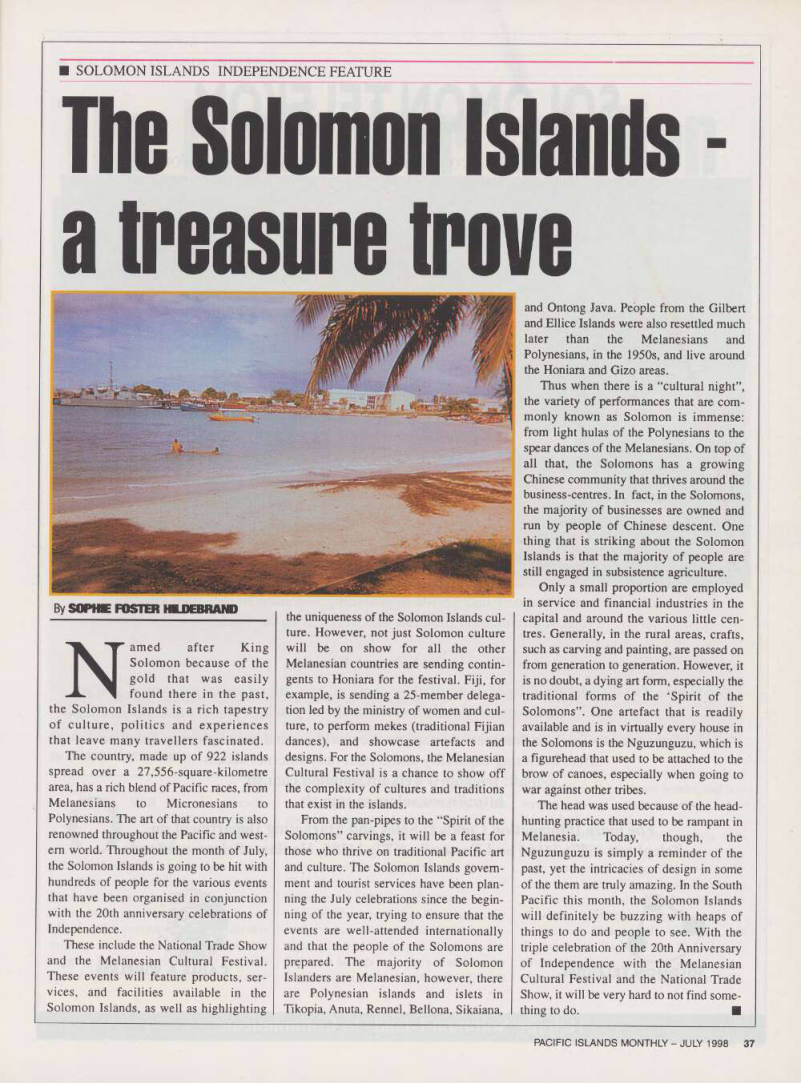
Solomon Islands Independence Feature
The Solomon Islands a treasure trove
By Sophie Foster Hildebrand
Named after King Solomon because of the gold that was easily found there in the past, the Solomon Islands is a rich tapestry of culture, politics and experiences that leave many travellers fascinated.
The country, made up of 922 islands spread over a 27,556-square-kilometre area, has a rich blend of Pacific races, from Melanesians to Micronesians to Polynesians. The art of that country is also renowned throughout the Pacific and west ern world. Throughout the month of July, the Solomon Islands is going to be hit with hundreds of people for the various events that have been organised in conjunction with the 20th anniversary celebrations of
Independence.
These include the National Trade Show and the Melanesian Cultural Festival.
These events will feature products, ser vices, and facilities available in the Solomon Islands, as well as highlighting
the uniqueness of the Solomon Islands cul ture. However, not just Solomon culture will be on show for all the other Melanesian countries are sending contin gents to Honiara for the festival. Fiji, for example, is sending a 25-member delega tion led by the ministry of women and cul ture, to perform mekes (traditional Fijian dances), and showcase artefacts and designs. For the Solomons, the Melanesian Cultural Festival is a chance to show off the complexity of cultures and traditions that exist in the islands.
From the pan-pipes to the “Spirit of the Solomons” carvings, it will be a feast for those who thrive on traditional Pacific art and culture. The Solomon Islands govern ment and tourist services have been plan ning the July celebrations since the begin ning of the year, trying to ensure that the events are well-attended internationally and that the people of the Solomons are prepared. The majority of Solomon Islanders are Melanesian, however, there are Polynesian islands and islets in Tikopia, Anuta, Rennel, Bellona, Sikaiana,
and Ontong Java. People from the Gilbert and Ellice Islands were also resettled much later than the Melanesians and Polynesians, in the 19505, and live around the Honiara and Gizo areas.
Thus when there is a “cultural night”, the variety of performances that are com monly known as Solomon is immense: from light hulas of the Polynesians to the spear dances of the Melanesians. On top of all that, the Solomons has a growing Chinese community that thrives around the business-centres. In fact, in the Solomons, the majority of businesses are owned and run by people of Chinese descent. One thing that is striking about the Solomon Islands is that the majority of people are still engaged in subsistence agriculture.
Only a small proportion are employed
in service and financial industries in the capital and around the various little cen tres. Generally, in the rural areas, crafts, such as carving and painting, are passed on from generation to generation. However, it is no doubt, a dying art form, especially the traditional forms of the ‘Spirit of the Solomons”. One artefact that is readily available and is in virtually every house in the Solomons is the Nguzunguzu, which is a figurehead that used to be attached to the brow of canoes, especially when going to war against other tribes.
The head was used because of the head hunting practice that used to be rampant in
Melanesia. Today, though, the
Nguzunguzu is simply a reminder of the past, yet the intricacies of design in some of the them are truly amazing. In the South Pacific this month, the Solomon Islands will definitely be buzzing with heaps of things to do and people to see. With the triple celebration of the 20th Anniversary of Independence with the Melanesian Cultural Festival and the National Trade Show, it will be very hard to not find some thing to do. ■
Advertisements & other items, p. 38 (1 item)
Solomon Telekom
Providing Quality Telecommunication Services to the World .
Solomon Telekom Company takes pride in providing Solomon Islands with Quality Telecommunication Products and Services to the World When in the Solomon Islands, (A) Connect to the Mobile Telephone network so that you can still be contacted even if you’re on the move. Available for rental and purchase (B) Subscribe to Telekom Internet and explore the world around you: Solomon Telekom offers browsing capability and e-mail only Internet access E-mail: telekom @ welkam.solomon.com.sb http ://www.solomon.com.sb For more Information Contact: Sales and Marketing Department on Telephone (677) 21164 and Facsimile (677) 24185, Honiara, Solomon Islands
SOLOMON TELEKOM
CABLE & WIRELESS
Helping Solomon Islands to Communicate
The Ecothnber solution

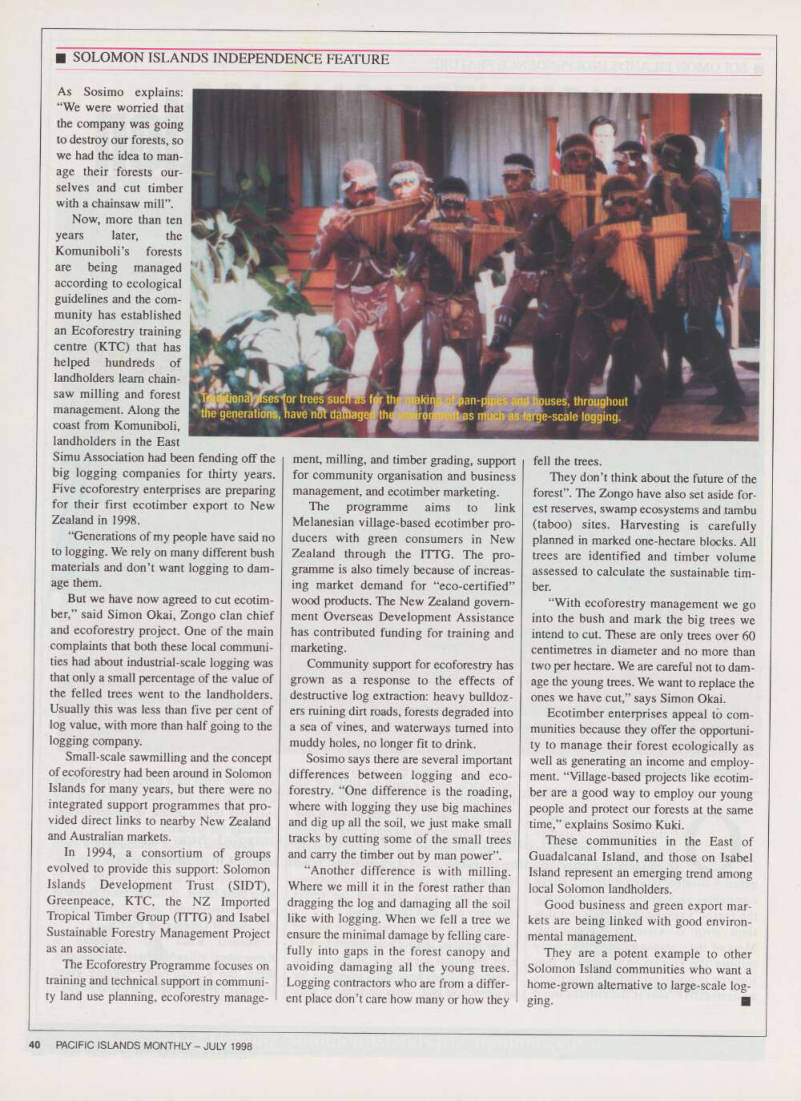
By Tamsin Vuetiovoni
OVER the past decade, transnational timber companies, particularly from Malaysia, have tar geted Solomon Island forests. These companies seek profit from exploiting the region’s remaining forests not that their own is virtually logged-out.
Most of the companies are effectively mining the forests. This means that logging is going so fast, with methods so destructive, that if the current trend
continues, there could be little or no merchantable forest left by 2005.
Perhaps even more damaging is the
social disintegration logging brings. Thrust
into an unfamiliar situation and wrought by disputes, local communities often become passive onlookers in the destruc tion of their own land and the forest resources on which they depend.
Ecotimber has emerged as one answer to the rampant destruction caused by for eign industrial logging. Villagers in the Solomon Islands have been searching for an alternative path - they desperately want
an income from their forests to pay school and health fees, build new houses, and buy everyday things people in western coun tries take for granted.
“Ecotimber gives landowners a cash return of 10 to 20 times greater than for eign company logging, and they get to keep their forest. It makes good business and environmental sense,” said Grant Rosoman of Greenpeace Pacific.
Sosimo Kuki and his clan at Komuniboli village, eastern Guadalcanal, threw the Korean-based logging giant, Hyundai, off their customary land in 1983.
Solomon Islanders, including landowners in Gizo, are increasingly looking for better alternatives for their natural resources.
As Sosimo explains: “We were worried that the company was going to destroy our forests, so we had the idea to man age their forests our selves and cut timber with a chainsaw mill”.
Now, more than ten years later, the Komuniboli’s forests are being managed according to ecological guidelines and the com munity has established
an Ecoforestry training
centre (KTC) that has helped hundreds of landholders learn chain saw milling and forest management. Along the coast from Komuniboli, landholders in the East
Simu Association had been fending off the
big logging companies for thirty years.
Five ecoforestry enterprises are preparing for their first ecotimber export to New Zealand in 1998.
“Generations of my people have said no to logging. We rely on many different bush materials and don’t want logging to dam age them.
But we have now agreed to cut ecotim ber,” said Simon Okai, Zongo clan chief and ecoforestry project. One of the main complaints that both these local communi ties had about industrial-scale logging was that only a small percentage of the value of the felled trees went to the landholders.
Usually this was less than five per cent of log value, with more than half going to the
logging company.
Small-scale sawmilling and the concept of ecoforestry had been around in Solomon Islands for many years, but there were no integrated support programmes that pro vided direct links to nearby New Zealand and Australian markets.
In 1994, a consortium of groups evolved to provide this support: Solomon
Islands Development Trust (SIDT),
Greenpeace, KTC, the NZ Imported Tropical Timber Group (ITTG) and Isabel
Sustainable Forestry Management Project
as an associate.
The Ecoforestry Programme focuses on training and technical support in communi ty land use planning, ecoforestry manage -
ment, milling, and timber grading, support for community organisation and business management, and ecotimber marketing.
The programme aims to link Melanesian village-based ecotimber pro ducers with green consumers in New Zealand through the ITTG. The pro gramme is also timely because of increas ing market demand for “eco-certified” wood products. The New Zealand govern ment Overseas Development Assistance has contributed funding for training and
marketing.
Community support for ecoforestry has grown as a response to the effects of destructive log extraction: heavy bulldoz ers ruining dirt roads, forests degraded into a sea of vines, and waterways turned into muddy holes, no longer fit to drink.
Sosimo says there are several important differences between logging and eco forestry. “One difference is the reading, where with logging they use big machines and dig up all the soil, we just make small tracks by cutting some of the small trees and carry the timber out by man power”.
“Another difference is with milling.
Where we mill it in the forest rather than dragging the log and damaging all the soil like with logging. When we fell a tree we ensure the minimal damage by felling care fully into gaps in the forest canopy and avoiding damaging all the young trees.
Logging contractors who are from a differ ent place don’t care how many or how they
fell the trees.
They don’t think about the future of the forest”. The Zongo have also set aside for est reserves, swamp ecosystems and tambu (taboo) sites. Harvesting is carefully planned in marked one-hectare blocks. All trees are identified and timber volume assessed to calculate the sustainable tim ber.
“With ecoforestry management we go into the bush and mark the big trees we intend to cut. These are only trees over 60 centimetres in diameter and no more than two per hectare. We are careful not to dam age the young trees. We want to replace the ones we have cut,” says Simon Okai.
Ecotimber enterprises appeal to com munities because they offer the opportuni ty to manage their forest ecologically as well as generating an income and employ ment. “Village-based projects like ecotim ber are a good way to employ our young people and protect our forests at the same time,” explains Sosimo Kuki.
These communities in the East of Guadalcanal Island, and those on Isabel Island represent an emerging trend among local Solomon landholders.
Good business and green export mar kets are being linked with good environ mental management.
They are a potent example to other Solomon Island communities who want a
home-grown alternative to large-scale log
ging. ■
Trad itio nal uses for trees such as for the making of pan-pipes and houses, throughout the generations, have not damaged environment as much as targe-scale logging.
Advertisements & other items, pp. 39-42 (2 items)
Pacific Islands Monthly - July 1998
■ SOLOMON ISLANDS INDEPENDENCE FEATURE
of Surprises
IIS; v.:
to the
Ocean
Marvel at the sounds of
drums, panpipes and
ancient harmonies.
Wonder at encounters with
rare birds and beasts. Take
a dive to historic under-
water battlegrounds or just
relax with some of the
nicest people in the world.
of Surprises
•K ** > ■t -utt'*
SOLOMON ISLANDS VISITORS BUREAU
P.0.80x 321, Honiara
SOLOMON ISLANDS
Phone: (677) 22442 Fax: (677) 23986
SOLOMON AIRLINES, P.O. Box 23, HONIARA
Auckland, (N.Z.) Tel: (649) 3089098 Fax: (649) 3775648 Brisbane, OLD,(AUST.) Tel: (617)38677188 Fax: (617) 32213048 Nadi (FUI) Te1:(679) 722831 Fax: (679) 722140 U.K. Tel: (44-1959) 540737 Fax: (44-1959) 54065 USA Tel: (1-310) 6707302 Fax: (1-310) 3380708
In decades of commitment, we’ve
gained your trust and built an
understanding that comes only
from sharing your life and working
with you side by side, as our local
agents have for generations.
So whether you’re thinking in terms
of today or generations to come,
Grand Pacific Life will be here in
the Pacific, fulfilling our promises
and continuing our commitment
begun decades ago.
Our
Commitment
Is A Powerful
m ■ ...
Grand Pacific Life Insurance, Ltd.
A member of the Finance Factors Family Serving The Pacific Islands For 30 Years American Samoa Mark Solofa Pacific Insurance & Finance, Inc, Mark Solofa, GA Phone: 684-699-5796 Samoa Mark Solofa Pacific Insurance & Finance, Inc.
Mark Solofa, GA Phone: 685-24059 Federated States of Micronesia Chuuk State Pacific Basin Insurance & General Services, Inc.
Kachutosy Paulus, GA Phone: 691-330-2606 Pohnpei Actouka Executive Insurance Underwriters Marcelino Actouka, GA Maridell Actouka, Life Manager Phone: 691-320-5331 Guam Great National Insurance Underwriters, Inc.
Domie Bumagat Jr., GA Phone: 571-646-5735 Pacific Financial Corporation Eduardo Camacho, GA Phone: 671-646-1990 Takagi & Associates George Takagi, GA Pamela Cruz, Life Manager Phone: 671-475-4373 Marshall Islands Marshalls Insurance Agency Jerry Kramer, GA Phone: 692-525-3355 Saipan Pacific Basin Insurance Underwriters, Inc, Mary Ann Milne, GA Phone: 670-234-7861 Pacifica Insurance Underwriters, Inc.
Norman Tenorio, GA Phone; 670-234-6267 Takagi & Associates George Takagi, GA Laurie Sturges, Branch Manager Phone: 670-322-8117 Tonga Peseti Ma'afu insurance & Finance, Ltd.
Peseti Ma'afu, GA Phone: 676-24-777
Insuring the future

Insurance Feature
Never under-estimate the need for insurance
As the 21st century draws nearer and nearer, the importance of insurance cannot be under-esti mated.
Especially with El Nino still hanging around and the prospect of the Millennium Bug, insurance must not be considered a luxury but a necessity.
Many families and businesses have planned for all sorts of contingencies that could occur.
These include the need to be able to retire in peace, the need to save for high er education and the need to ensure that should you die, your children will not have financial burdens hanging over them.
All of these must be planned for, and
that is where a good financial helper comes in.
One company that has been helping families and busi
nesses in Hawaii for over 40 years is Grand Pacific Life Insurance Limited.
Still run by family, the company pro vides life insurance and retirement, financial and estate planning for thou sands of people throughout the Pacific.
Locally owned and managed, Grand Pacific is dedicated to providing person alised service to the people of the Pacific.
“We live and work where our cus tomers are so we share the same beliefs and commitment to our communities,” according to a spokesperson for the com pany.
Because of the size of the Pacific, and to best serve their customers in the Pacific Region, Grand Pacific Life Insurance have knowledgeable agents
conveniently located throughout the North and South Pacific.
This includes agents in Pago Pago, American Samoa; Chuuk State and Pohnpei in the Federated States of Micronesia. There are also agents in Agana, Guam; Majuro, in the Marshall Islands; Saipan, in the Mariana Islands, Nuku’alofa, Tonga and Apia, Western Samoa.
These agents have the expertise to be available to answer any questions you may have about your life insurance and retirement, financial and estate planning needs.
Grand Pacific Life Insurance Limited is a member of the Finance Factors Family of Companies. This parent com pany includes Finance Factors Limited, a financial services company, with offices in Hawaii and Guam; as well as ISLA Financial, a joint venture, located in Saipan.
The executive management of the company includes Senator Hiram Fong ID, who is chairman of the board.
Emeritus; Daniel Lau who is chairman of the board, CEO; Russel Lau, who is vice chairman of the board; and John McHugh, who is executive vice presi dent, COO. ■
Advertisements & other items, p. 43 (1 item)
i'ijJilUiJUiJiJ SVSiiJiUi
— :v. ■ ffi-i m
FREE
Panasonic gift
with every system Dalec is a key communications solution provider
with ranging from small businesses to
We specialise in Panasonic
ems providing a highly reliable
■■■ive answer to your businesses
needs.
i'ijJilUiJUiJiJ SVSiiJiUi
Single-Line Telephone Answering System Cordlessphone Facsimile Machine Data Terminal Computer T 7235 Modem Enhanced Display Set Customer Response Form Tele; (679) 314 411 Fax; (679) 311 162 Technology with a human touch
Indigenous rights or Indonesia's rights?
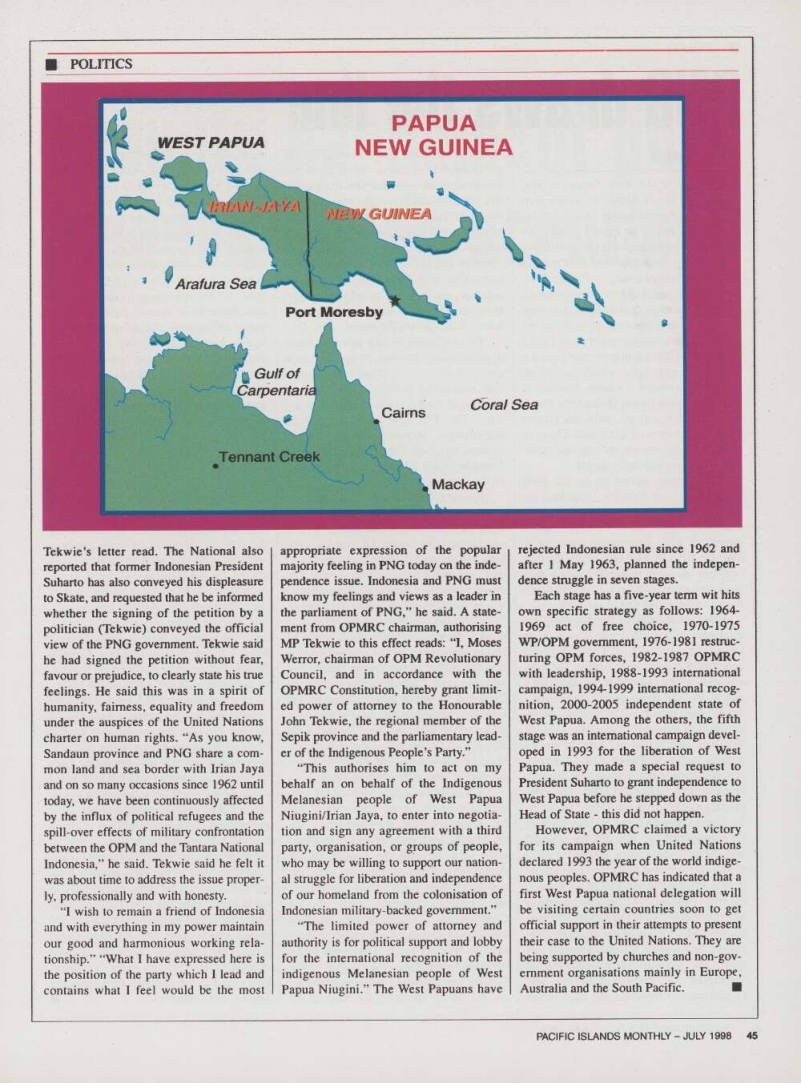
Politics
By Sam Vulum
WHILE the recent political events in Indonesia saw the downfall of Asia’s longest serving political head President Suharto, it also provided an opportunity for the country’s sepa ratist elements in East Timor and Irian Jaya (West Papua) to boost their inde
pendence struggle.
They wasted no time in driving home their agendas in every possible avenue available to them. While the East Timorese struggle appears to be winning internation al sympathy and support - resulting from publicity mainly in the Australian media for the West Papuans, it is a “lonely bat tle”. It is an old struggle for independence with 35 years under Indonesian rule and its “secret war” causing much suffering, sacri fice of lives, and displacing many West Papuans from their homeland, according to the chairman of the Organisasi Papua Merdeka Revolutionary Council (OPMRC) Moses Werror.
They have been fighting since 1962 after Indonesia took over control of Irian Jaya from the Netherlands. The Indonesians have met with strong popular opposition to their heavy-handed methods of government, resulting in deaths and imprisonment of West Papuans over the years. Some went bush and took up arms against the Indonesian government, giving birth to what is now the OPM freedom fighter’s movement. Many have fled to other countries, mainly in Europe and oth ers crossed the border to PNG, including the OPMRC chairman Werror, taking their struggle with them.
They have made countless representa tions to successive PNG governments.
However, PNG’s official stance is that Irian Jaya remains an integral part of Indonesia. During the height of the Indonesian crisis, two attempts by pro- West Papuan activists and sympathisers to develop official support for the West Papuan independence struggle - failed to have a favourable impact on officials.
Police dispersed the first march and, according to records, threatened to charge
the protesters for organising an illegal gathering. The Indonesian embassy author ities categorically denied the second, although The National recorded the event.
West Papuans supporters marched to the embassy calling for the recognition of Irian Jaya as an independent state. The National newspaper has reported that they were to have presented a petition to this effect signed by pro-independence leaders Michael Kareth and Francis Marino, PNG council of Churches general secretary Reverend Kila Pat and West Sepik Governor John Tekwie, who is parliamen tary leader of Indigenous Peoples Movement Party. The West Papuan sup porters passed on copies of the petition to PNG prime minister Bill Skate and Opposition Leader Bernard Narokobi.
The National also reported that the Indonesian embassy staff said there was no demonstration and denied receiving any petition from the protesters.
“There was no march, no demonstration and we have not received any petition,” an embassy spokesperson said. The petition called on world leaders to “accept, respect and recognise the rights of people of West Papua as an independent state of West Papua New Guinea”.
However, this incident, like many oth ers in PNG’s past, did not deter Werror, the OPMRC chairman and spokesperson for the Melanesian Trust of West Papua, from doing what he feels is right for the future freedom of what he claims to be 1.8 mil lion West Papuans. On the eve of Skate’s visit to Indonesia, Werror sent him a fax from his Madang headquarters in an attempt to win political support in present ing their case before the new president Habibi. The PM’s office did not wish to discuss receipt of the letter nor any action taken on it. However, the letter, given to PIM reads, in part: “I appeal to you to sup port the first United West Papua National Declarations endeavours to secure inde pendence and freedom from Indonesian colonisation.”
“The recent political situation in Indonesia, the first in 35 years, is a bless ing for the indigenous Melanesian people of West Papua as it provides an opportuni ty to pursue the case for independence.”
“I seek your assistance to establish a protocol between the responsible govern ments whose actions 35 years ago denied Melanesian people of West Papua (the) right to be independent.” “I believe the pre sent Indonesian people’s democratic move ment will be supportive towards indepen dence for West Papua.”
“Your support will be seen as a ‘living hope’ for the Melanesian people of West Papua.” The supporters sent copies of the letter and a media statement to all the media organisations in PNG. However, the media, like the government, does not want any blame or be seen helping the indepen dence movement. It is an unwritten approach maintained over the years.
However, the movement has successfully registered the support of outspoken West Sepik MP and Governor John Tekwie - a first ever moves involving a PNG politi cian since independence. West Sepik province shares the PNG/Indonesia border with Irian Jaya. Officially engaged by OPMRC as their spokesperson on 3 June 1995, Tekwie kept quiet until the eve of the recent turmoil in Indonesia. Tekwie’s deci sion to endorse and sign the petition deliv ered during the May 26 protest march, which recognised the independence of Irian Jaya, angered the Indonesian embassy in Port Moresby.
The National reported that the Indonesian Ambassador Major-General Benny Mandalika, wrote to Governor Tekwie protesting against his action. He pointed out that Papua New Guinea recog nises Irian Jaya as an integral part of Indonesia. Tekwie however, in his reply, explained that he had taken the initiative to sign the document as party leader of the
Indigenous People’s Movement.
“My support for the recognition of independence for Irian Jaya is purely a party matter and does not represent the official view of the Sandaun Provincial Government nor the government of the Independent State of Papua New Guinea.”
“I wish to reaffirm my assurance that the position I have taken must not in any way be seen or taken to be having an adverse effect on any official relations, nor is it aimed at creating animosity or hostile relations between PNG and Indonesia,”
Tekwie’s letter read. The National also reported that former Indonesian President Suharto has also conveyed his displeasure to Skate, and requested that he be informed whether the signing of the petition by a politician (Tekwie) conveyed the official view of the PNG government. Tekwie said he had signed the petition without fear, favour or prejudice, to clearly state his true feelings. He said this was in a spirit of humanity, fairness, equality and freedom under the auspices of the United Nations charter on human rights. “As you know, Sandaun province and PNG share a com mon land and sea border with Irian Jaya and on so many occasions since 1962 until today, we have been continuously affected by the influx of political refugees and the spill-over effects of military confrontation between the OPM and the Tantara National Indonesia,” he said. Tekwie said he felt it was about time to address the issue proper
ly, professionally and with honesty.
“I wish to remain a friend of Indonesia and with everything in my power maintain our good and harmonious working rela tionship.” “What I have expressed here is the position of the party which I lead and contains what I feel would be the most
appropriate expression of the popular majority feeling in PNG today on the inde pendence issue. Indonesia and PNG must know my feelings and views as a leader in the parliament of PNG,” he said. A state ment from OPMRC chairman, authorising MP Tekwie to this effect reads: “I, Moses Werror, chairman of OPM Revolutionary Council, and in accordance with the OPMRC Constitution, hereby grant limit ed power of attorney to the Honourable John Tekwie, the regional member of the Sepik province and the parliamentary lead er of the Indigenous People’s Party.”
“This authorises him to act on my behalf an on behalf of the Indigenous Melanesian people of West Papua Niugini/Irian Jaya, to enter into negotia tion and sign any agreement with a third party, organisation, or groups of people, who may be willing to support our nation al struggle for liberation and independence of our homeland from the colonisation of Indonesian military-backed government.”
“The limited power of attorney and authority is for political support and lobby for the international recognition of the indigenous Melanesian people of West Papua Niugini.” The West Papuans have
rejected Indonesian rule since 1962 and after 1 May 1963, planned the indepen dence struggle in seven stages.
Each stage has a five-year term wit hits own specific strategy as follows: 1964- 1969 act of free choice, 1970-1975 WP/OPM government, 1976-1981 restruc turing OPM forces, 1982-1987 OPMRC with leadership, 1988-1993 international campaign, 1994-1999 international recog nition, 2000-2005 independent state of West Papua. Among the others, the fifth stage was an international campaign devel oped in 1993 for the liberation of West Papua. They made a special request to President Suharto to grant independence to West Papua before he stepped down as the Head of State - this did not happen.
However, OPMRC claimed a victory for its campaign when United Nations declared 1993 the year of the world indige nous peoples. OPMRC has indicated that a first West Papua national delegation will be visiting certain countries soon to get official support in their attempts to present their case to the United Nations. They are being supported by churches and non-gov ernment organisations mainly in Europe, Australia and the South Pacific. ■
PNG draws the line
By Sam Vulum
PAPUA New Guinea’s infa mous Sandline crisis that brought the nation to its knees in March 1998 may be over, however, the legal battle has just begun. One year and two months after the crisis, the stage - for the PNG Government and Sandline International to settle a business deal that had gone very wrong, sets. At the time of writing, the PNG Government was preparing to fight a payment of US$lB million to Sandline, the UK-based mercenary company, in an Arbitration Tribunal in Caims, Australia in June. It is being fought because the state’s considers the contract, with the former PNG government of Sir Julius Chan, to crush the Bougainville secessionist rebel
lion, was constitutionally illegal.
The tribunal, agreed to by the PNG government and Sandline, will rule on whether to pay the remainder of the con tract. Although Sandline took legal action against the PNG government immediately after the crisis in a London court, the pro ceedings had never taken off in any signif icant way, especially since government felt it was on the losing end of the battle.
However, it suddenly became confident after receiving fresh legal advice in its favour in May - a new high-spirited approach that came with a bang. The gov ernment, which claimed being taken for a ride by its legal advisors over the constitu tionality and legality of the contract, uncer emoniously dumped its advisors. This led to a week-long heated media debate among a cross-section of Papua New Guineans, also attracting stinging attacks on the gov ernment from former PM Chan. The inde pendent advice, from an Australian barris ter Roger Gyles QC, and Sydney barrister OJ Hammerschlag, was that the contract was illegal under section 200 of the PNG Constitution. Prime Minister Skate imme diately stopped the services of the govern ment’s counsel, Australian barrister Marshal Cook QC, his assistant, Brisbane barrister Mai Varitimos and its chief legal advisor and former Attorney General Sao Gabi. He replaced them with Harold Werksman of Redlich Lawyers and Consultants to represent the state in the
arbitration tribunal. While announcing the government’s decision, Skate said the
independent advisors question the legality
and constitutionality of the hire. He said the Constitution prohibits the establish ment of another defence body other than the ones provided for by the Constitution.
“Section 200 (1) of the Constitution pro vides that it is forbidden to establish, organise, equip, train or take part in or associate with a military or para-military force,” Skate quotes the advice.
“Or to organise or take part in military or para-military training, except such as is provided for by the Constitution, or to plan, prepare for or assist in the raising or training of such a force or in such train ing.” The PM said the new Justice Department secretary and Attorney General Michael Gene, who took over from Gabi early this year, had briefed him on the status of the tribunal.
However Gabi, as the Chan govern ment’s chief legal advisor in the whole Sandline affair, firmly defended his advice - and those of the sacked QC and his assis tant. He described Skate’s comments as confused and misleading. He alleged that the termination of the State’s legal counsel will seriously affect its ability to effective ly defend the Sandline claim. With time quickly drawing in, Gabi said it would be almost impossible for any counsel coming into the matter to familiarise themselves with the case. “Stopping the retainer of Cook and Varitimos at this late stage will seriously prejudice the State’s ability to effectively defend the claim,” he said. Gabi also argued the Attorney General’s depart ment had questioned the illegality of the contract at least three times in 1998.
“It was the collective view of the offi cers of the department, after careful and full discussion with senior overseas coun sel, that the point was not legally tenable,”
Gabi said. He said the opinion of the Australian barrister, which Skate relied on, had overlooked the terms of the contract and misread section 200 of the Constitution. “At no time was Sandline intended to operate as a separate or inde pendent military force. They were under the direct command and control of the PNGDF - as provided for by the contract,” he said. When clarifying the facts on the
arbitration process, Gabi said: “When Sandline took proceedings against the state for the balance of SUSIB million plus expenses, the Attorney General’s depart ment advised the former and current gov ernments that they should not pay as the contract had been rendered impossible by the crisis and subsequent events over which the government had no control”.
“It is my advice that in those circum stances, Sandline was only entitled to be paid for actual expenses that they had incurred, not the balance of US$lB mil lion.” “If the expenses proved to be less than the million already paid, the State would be entitled to a refund,” he said.
Gabi’s comments sent the government reeling with rage, forcing Justice Minister Jacob Wama to take out full page adver tisements in three of the country’s newspa pers defending the government’s position.
Wama expressed great comfort with the level of professionalism the barrister and QC have displayed in preparing the defence for the state. He said the new bar rister and QC were fully versed with the facts and the documentation on the matters and issues for arbitration in Caims. Wama also refuted Gabi’s claims of considering the issue of illegality on three separate occasions. He said an investigation, con ducted by the Attorney General Gene, revealed no written advice on the issue of illegality from Gabi nor the senior coun sels. He said senior officers of the depart ment, including the State Solicitor Zachery Gelu and the former Solicitor General Francis Damen, have denied being consult ed nor expressing any views on the point.
However, former PM Chan has strongly condemned the government over Gabi’s sacking. He said that the decision by PM Skate to reject the advice of his (Chan’s) government last year and penalising Gabi
by ending his contract was unprecedented
action of the worst kind, crucifying public servants who gave their best services to the government of the day. “Gabi has rendered loyal and distinguished services to several former prime ministers on legal and consti tutional matters of the most intricate vari ety and on major reforms, particularly in the last two years,” he said. Three eminent Commonwealth judges make up the tri bunal: retired New Zealand High Court judge Sir Edward Somers; retired Australian High Court judge Sir Daryl Dawson; and Sir Michael Kerr from the Essex Court Chambers. ■
Vanuatu parliament puls
leaders under scrutiny
By Patrick Declovtre
For the first time, a contro versial leadership code, passed in early June by Vanuatu’s parliament, sets clear guidelines and punishes corrupt leaders.
The code defines the leaders’ duties and identifies breaches of a leadership code of conduct, such as corruption, conflict of interest, bribery.
It also compels persons defined as leaders under the Constitution (Head of State, prime ministers and cabinet ministers, MPs and other public ser vants) to file an annual declaration of assets and liabilities to Parliament.
It would enable the Vanuatu police, public prosecutor and ombudsman to prosecute.
Those found guilty could face fines of up to two million vatu (U 5515,600) or jail sentence of up to ten years.
The bill will effectively enhance the powers of controversial French born ombudsman Marie-Noelle Patterson who, for the past three years, has published numerous reports accusing Vanuatu’s top leaders of cor ruption. abuse of power or misman agement.
The alleged scams went from the issuing of US$lO million in “bank guarantees” to sale of Vanuatu pass ports to Asians or the recently aborted transfer of the state’s assets to a Mauritius-based trust company.
On January 12, riots broke out in Port Vila when angry contributors demanded their savings back from the Vanuatu National Provident Fund
(Vnpf).
They had read another ombudsman
report saying prominent politicians had used the VNPF's money to buy themselves houses.
“Fci' k the leadership code, but there was no consequences of the wrongdoing. If then ’ happened. Now it’s going to put more pressure on leaders”.
After a change of government last March, most of those targeted by Patterson are now in the opposition.
"I think this is 100 much because this can ruin the career of a leader.
The higher we are. the most damaging it is to our reputation. Only one day or even one hour of jail would be enough to deter anyone from doing wrong,” opposition MP Vincent Boulekone told Parliament. He labelled the bill a diktat.
Deputy opposition leader Barak Sope stressed, “ten years jaii is against human rights. And this can also affect our custom (traditional) chiefs, who are also leaders and whose titles are hereditary.”
"In Britain, they cannot prosecute the Queen or Prince Charles because it’s against their custom and tradi tion". he added during heated parlia ment debates.
As soon as three years ago, Patterson’s office drafted a leadership code with the help of Papua New Guinea’s ombudsman office. It was tabled four times in previous parlia ments. and always withdrawn from “Then former PM Serge Vohor last year ordered a new bill to be drafted.
Now it s quite different”, Patterson said.
The code, passed by 32 votes of the 52-seat House, is one of the corner
stones of a Comprehensive Reform Programme (CRP) launched last year and co-ordinated by Asian Development Bank.
The CRP promotes principles of good governance, transparency and
accountability in the leadership
while “rightsizing” the 4,500-strong public service and promoting a private sector-driven growth.
“No leader in the world likes that sort of checks and balances. They know very well it’s about transparen cy, answerability, behaving in accor dance with leadership code. This code is not new, it’s been in the constitution since Vanuatu’s independence in 1980. But like anywhere else, leaders don’t like to be answerable”, Patterson says.
The original bill, which was more hard-hitting with provisions for the setting up of a leadership tribunal, had to be watered down to allow for easi er passage.
The code is not retroactive: it will only be enforced on misdeeds to come, not those already denounced by Patterson.
“It's the only way MPs could accept this. All past breaches are not covered. So it gives them a chance to start anew. In some ways, it's like an amnesty, but only for leadership code breaches. For penal cases, they still can be prosecuted”.
“Biit most of the points are cov ered, I’m pretty happy with this new draft. We’ve been waiting for so long”.
“The ombudsman’s position was once referred to as “Mr Soon”, I’d say that project could be called a similar name”, Patterson said. ■
Alama's dream
Sport
Alama's dream is still alive
By Atama Raganiuatu
Despite his inability to establish himself in New Zealand’s test team, Samoan rugby player Alama leremia still has no regrets over discarding Manu Samoa in 1994 and seeking glory with the All Blacks.
Unlike numerous compatriots who have also switched loyalties, leremia is very much a product of New Zealand’s rugby development system.
Yet, this did not make the decision to turn his back on Samoa any easier. “The hardest thing was to tell my dad,” he recol lects. “I was in tears for several hours after informing him and I needed a week to get over it.” Lale leremia’s objections were more than patriotic considerations. He had seen his son play on relatively few occa sions and believed the Manu Samoa cap taincy, which Alama seemed destined for, to be the limit of his feasible aspirations.
The old proverb regarding a bird in the hand was, more than once, uttered.
Regardless of Lale’s own love for rugby (he had been a high profile loose forward in local club fare before coaching at col lege level), Alama displayed little interest in the sport when a schoolboy.
In New Zealand, he spent four of those early years. Lale enrolled at Christchurch’s Canterbury University in 1977 and the rest of his immediate family accompanied him to “The Garden City”. Alama was ten when his father graduated and the leremias returned to Western Samoa. Apart from watching his father run coaching sessions, and the odd match at Samoa College, where he was a pupil, an occasional impromptu match of touch rugby amongst friends was young Alama’s association
with rugby in Samoa. Rugby certainly
occupied no place amongst his thoughts when leremia leamt he had won a Western Samoa government sponsored scholarship
to study at Victoria University in Wellington. His plans then (late 1989) were simple. He intended to earn a Masters
degree in geography before
gaining a post in either resource management or town planning. He was at Victoria for a full year until newly found university friends per suaded him to try rugby as a
leisure activity. To say that leremia took to rugby as a duck to water would be to exag gerate the natural instincts of a duck.
In his initial season of serious rugby, he broke into the Wellington province’s under 21 selection. March 1992 saw leremia make his debut for the capital’s senior side, facing the Gold Coast at Surfers’ Paradise during a pre season Australian tour, and, merely a few months later, the Western Samoan selectors recruited him for interna tional duty. He donned Manu Samoa colours for the first time when Tonga visit ed his home town, Apia. leremia’s strong running and ferocious tackling quickly cemented him an automatic spot in the Manu Samoa line-up. He starred in the team’s surprise, but fully merited, triumph at the 1993 Hong Kong Sevens tournament and, appointed vice captain, as Western Samoa toured New Zealand, in the same year.
It was no secret that Western Samoan rugby officials were grooming their articu late and intelligent second five eighths to succeed the legendary Peter Fatialofa as Manu Samoa Captain. “Fats” had started his 35th year when the New Zealand expe dition finished with a creditable 13-35 loss to the All Blacks in Auckland and leremia was then the likeliest candidate to skipper the Samoans at the 1995 World Cup. leremia’s aims, at that stage, did not extend beyond the World Cup.
Undoubtedly, he had no thoughts of mak ing himself available to New Zealand before then, until world rugby’s adminis trative body, the International rugby Board, decreed that players would be ineligible to appear in test matches for three years should they decide to switch national alle giance subsequent to 1994.
It was Junior Tonu’u, his best friend and a team-mate with both Wellington and Western Samoa, who sowed the seeds for leremia’s change of heart by declaring him self available for the All Blacks. leremia
says: “It was an extremely difficult deci sion. There was enormous pressure as I realised I was being prepared to assume the Western Samoan captaincy. If it wasn’t for the three year stand-down rule, I would have remained with Manu Samoa.” Albeit initially annoyed at being interrupted in mid-sermon, to learn his son had gained one of rugby’s most revered distinctions delighted Lale. As well, he acknowledged, the vindication of Alama’s preference for the All Blacks.
His all Black career began inauspicious ly. During the first attacking move he fea tured in, leremia tried to catch a pass intended for a colleague and the ball struck him in the face! Things did improve and leremia has, unless injured, featured in every ensuing New Zealand squad. In spite of this, he failed to make an All Black berth his by right. While Pat Lam smoothly assumed the role of Western Samoa captain at the 1995 World Cup, leremia represent ed New Zealand just once during the tour nament and, after being the All Black selec tors’ preferred second five eighths for all of 1997’s previous tests, the Samoan found himself dropped against England for the year’s final encounter.
Nevertheless, most pundits believe that leremia will be on the international scene well into the next decade and the likeliest scenario is that he will eventually replace Frank Bunce (now 36) as the All Blacks’ centre. This suits leremia better than sec ond five eighths because it does not require long passes there anywhere near as often and long passes are his single obvious weakness.
Although not making the impact he would have wished since joining the All Blacks, leremia certainly benefited finan cially from his defection from Manu Samoa. His contract with the New Zealand Rugby Football Union is substantial enough to enable him to be a full time pro fessional rugby player. He curtailed his uni versity studies immediately after gaining a Bachelor of Arts degree.
Unless a serious injury or prolonged form loss curtails his All Black career, leremia should have no cash worries when he eventually retires.
Sadly, Manu Samoa is unable to offer its stars the same assurances. Until that changes, the majority of promising young Samoan players will prefer to chase All Black honours. ■
Advertisements & other items, p. 49 (1 item)
Trading Post
maxaaam
TRADING POST CAN WORK
WONDERS FOR YOU...
Promote your business, or service, sell your household items, cars or heavy machinery etc.
ONLY AUSS2 (OR EQUIVALENT) PER WORD.
NO COMPANY LOGO. NO DISPLAY.
NO BOLD TYPE.
Just forward your Advertisement together with payment to:
PACIFIC ISLANDS MONTHLY ’Trading Post”,
PO Box 1167, Suva, Fiji.
Conditions: 1. All Advertisements are subject to acceptance and approval of publisher. 2. Advertisements are published as space permits; we cannot guarantee date of insertion. 3. All advertisements must be prepaid and should be typed or printed clearly 4. Deadline for receipt of advertisements is the 15th of the month prior to issue. 5. PACIFIC ISLANDS MONTHLY assumes no responsibility for any service other than publishing paid advertisements in this section.
Fop sale: one moment in time
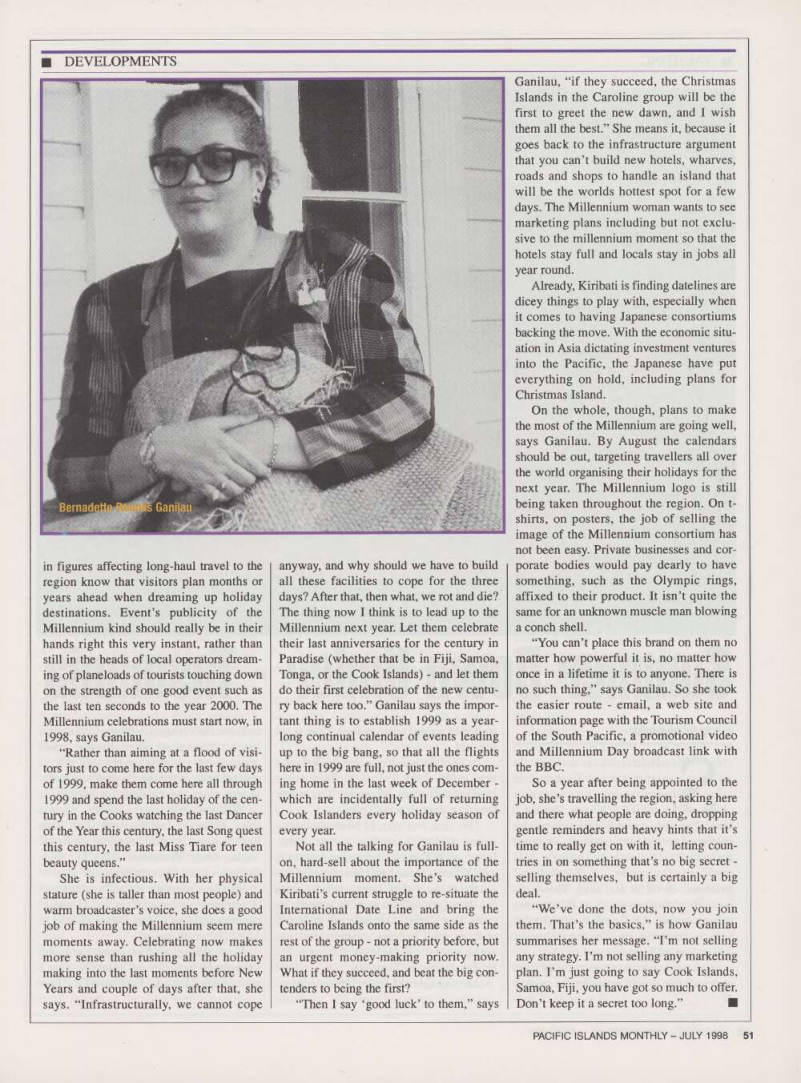
Developments
By Usa Williams
Making money out of the countdown to the year 2000 may not seem like everyone’s cup of tea, but for professional com municator Bernadette Rounds- Ganilau, it’s the dream job of the cen tury - literally. Ganilau is the Millennium Co-ordinator for the South Pacific Millennium Consortium, and she is out firing up the region on how to best position itself in market terms for that big moment when the Pacific steps into a new era. There is a major reason why the count down to midnight on New Years Eve, 1999 should be so very important: for travel des tinations all over the globe, selling your country as the place for travellers to usher in the next century, means big money.
Ganilau says the Pacific is already grab bing the attention of operators. “We have the unique position in this globe of strad dling the 118th meridian and having two time zones because pf the International date line. We are the first in the world to greet the new day,” she says. Make that Tonga and Fiji, but Ganilau does not want to split hairs. Part of the Millennium Consortium’s Memorandum of Understanding is that the region market itself without individual cat fights over strategic positions where and when.
“We won’t have this fight, this pulling of one to the other,” she says. Which does n’t stop the inevitable question over who will be first and who will be last. Fiji and Tonga have claim to the former but the honour of the latter goes to the Cooks, Ganilau told industry people during a May seminar on Events Marketing helped along by Tourism Cook Islands and Air New Zealand.
“The Cook Islands will be the last coun try in the world to say good-bye to the old century and the last country in the world to say hello to the new century. You should really cash in on that,” says Ganilau.
So why not let national tourism plans do the work of marketing the Millennium?
Because the Millennium Celebrations must start now, says Ganilau. She and tourism operators who are looking up and ahead rather than around at the depressing drop
in figures affecting long-haul travel to the region know that visitors plan months or years ahead when dreaming up holiday destinations. Event’s publicity of the Millennium kind should really be in their hands right this very instant, rather than still in the heads of local operators dream ing of planeloads of tourists touching down on the strength of one good event such as the last ten seconds to the year 2000. The Millennium celebrations must start now, in 1998, says Ganilau.
“Rather than aiming at a flood of visi tors just to come here for the last few days of 1999, make them come here all through 1999 and spend the last holiday of the cen tury in the Cooks watching the last Dancer of the Year this century, the last Song quest this century, the last Miss Tiare for teen
beauty queens.”
She is infectious. With her physical stature (she is taller than most people) and warm broadcaster’s voice, she does a good job of making the Millennium seem mere moments away. Celebrating now makes more sense than rushing all the holiday making into the last moments before New Years and couple of days after that, she says. “Infrastructurally, we cannot cope
anyway, and why should we have to build all these facilities to cope for the three days? After that, then what, we rot and die?
The thing now I think is to lead up to the Millennium next year. Let them celebrate their last anniversaries for the century in Paradise (whether that be in Fiji, Samoa, Tonga, or the Cook Islands) - and let them do their first celebration of the new centu ry back here too.” Ganilau says the impor tant thing is to establish 1999 as a year long continual calendar of events leading up to the big bang, so that all the flights here in 1999 are full, not just the ones com ing home in the last week of December which are incidentally full of returning Cook Islanders every holiday season of every year.
Not all the talking for Ganilau is full on, hard-sell about the importance of the Millennium moment. She’s watched Kiribati’s current struggle to re-situate the International Date Line and bring the Caroline Islands onto the same side as the rest of the group - not a priority before, but an urgent money-making priority now.
What if they succeed, and beat the big con tenders to being the first?
“Then I say ‘good luck’ to them,” says
Ganilau, “if they succeed, the Christmas Islands in the Caroline group will be the first to greet the new dawn, and I wish them all the best.” She means it, because it goes back to the infrastructure argument that you can’t build new hotels, wharves, roads and shops to handle an island that will be the worlds hottest spot for a few days. The Millennium woman wants to see
marketing plans including but not exclu
sive to the millennium moment so that the hotels stay full and locals stay in jobs all year round.
Already, Kiribati is finding datelines are dicey things to play with, especially when it comes to having Japanese consortiums backing the move. With the economic situ ation in Asia dictating investment ventures into the Pacific, the Japanese have put everything on hold, including plans for Christmas Island.
On the whole, though, plans to make the most of the Millennium are going well, says Ganilau. By August the calendars should be out, targeting travellers all over the world organising their holidays for the next year. The Millennium logo is still being taken throughout the region. On t shirts, on posters, the job of selling the image of the Millennium consortium has not been easy. Private businesses and cor porate bodies would pay dearly to have
something, such as the Olympic rings,
affixed to their product. It isn’t quite the same for an unknown muscle man blowing a conch shell.
“You can’t place this brand on them no matter how powerful it is, no matter how once in a lifetime it is to anyone. There is no such thing,” says Ganilau. So she took the easier route - email, a web site and information page with the Tourism Council of the South Pacific, a promotional video and Millennium Day broadcast link with the BBC.
So a year after being appointed to the job, she’s travelling the region, asking here and there what people are doing, dropping gentle reminders and heavy hints that it’s time to really get on with it, letting coun tries in on something that’s no big secret selling themselves, but is certainly a big deal.
“We’ve done the dots, now you join them. That’s the basics,” is how Ganilau summarises her message. “I’m not selling any strategy. I’m not selling any marketing plan. I’m just going to say Cook Islands, Samoa, Fiji, you have got so much to offer.
Don’t keep it a secret too long.” ■
Bernadette Rounds Ganilau
Advertisements & other items, p. 50 (1 item)
South Pacific Regional Environment Programme (Sprep)
Vacancy: ENVIRONMENTAL LEGAL OFFICER
Applications are invited for the position of ENVIRONMENTAL LEGAL OFFICER with the South Pacific Regional Environment Programme SPREP in Apia, Samoa.
Post Description The Legal officer will be part of a two-person team working together on the overall, co-ordination, management, and completion of legal activities. S/He' will be responsible to the Director of SPREP, through the Head, Environmental Education, Information and Capacity-building Division, for the following: • Assisi with duties required for SPREP to perform its role as Secretariat for three conventions: * Convention on Conservation of Nature in the South Pacific (Apia Convention); * Convention for the Protection of Natural Resources and Environment of the South Pacific region (SPREP Convention) and related protocols; and * Convention to ban the Importation into Forum Island Countries of Hazardous Wastes and Radioactive Wastes and to control the Transboundary' Movement and Management of Hazardous Wastes within the South Pacific Region (Waigani Convention). • Provide advice and assistance to member countries to elaborate, develop, implement and enforce appropriate environmental legislation in order to meet the requirements to achieve the goal of sustainable development.
In doing so, s/he will ensure that any proposed evolution to the existing legislation matches the capacity of the existing administrative structure, or will propose relevant adjustments. The duties include: * developing awareness and incentives for SPREP members to join relevant international or regional environmental agreements; * assisting with the drafting of domestic legislation and regulations; * assisting member countries to set priorities for the development of sound environment legislation; and * coordinating of implementation of international agreements for SPREP members with relevant secretariats of these agreements and perform any clearinghouse functions. • Provide legal expertise to SPREP Programme areas especially in relation to regional and international conventions.
Required Qualifications And Experience Candidates must have appropriate tertiary qualifications (preferably with post-graduate qualifications in a relevant field) from a recognised institution and at least 5 years work experience preferably within the Pacific islands region, in a field related to Environmental Law. Other essentia] requirements are; proven project management experience; the ability to manage the work of consultants; a proven ability to work as a part of an inter-disciplinary and /or multi-cultural team; the ability to meet project deadlines (often under difficult circumstances); a proven ability to prepare proposals and reports; a proven ability to live and work within Pacific island communities. Applicants with a demonstrated interest and involvement in environmental, economic and social issues affecting the region, particularly through environmental law, will be highly regarded.
Conditions Appointment will be at the Project Officer Level of SPREP's authorised salary scales for contract staff, depending on the successful applicant’s qualifications and experience. The package will include annual return airfares for appointee and dependents, a housing subsidy and other benefits. SPREP remuneration may be tax -free depending upon circumstances. The appointment will be for two and a half years initially, with renewal for a further term depending upon the officer’s performance during the first term and depending on the availability of funds.
Applications Applications should be accompanied by a detailed curriculum vitae containing full personal details, information on qualifications and experience for the position, previous appointments, current position and salary, names, addresses, telephone and fax contact numbers or E-mail addresses of three persons associated with the applicant professionally and who would be prepared to provide testimonials. An indication of how soon the applicant would be available should also be indicated.
Closing Date; 30 July 1998. Late applications will not be considered.
Applications should be addressed to: The Director South Pacific Regional Environment Programme (SPREP) PO Box 240 Telephone : (685)21 929 Apia Fax (685) 20 231 Samoa E-mail [email protected] Further information, including a full post description and details of remuneration and terms and conditions of appointment, is available from the SPREP Administration Officer.
Summer Down Under - Tasmania
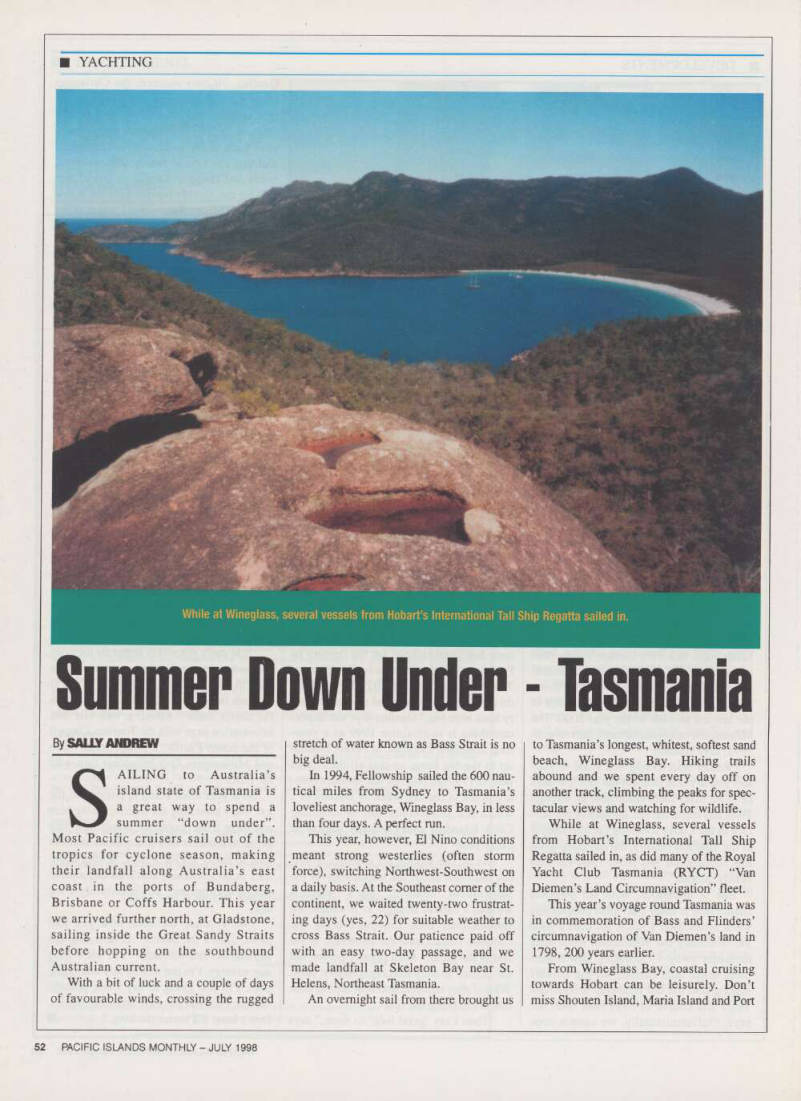
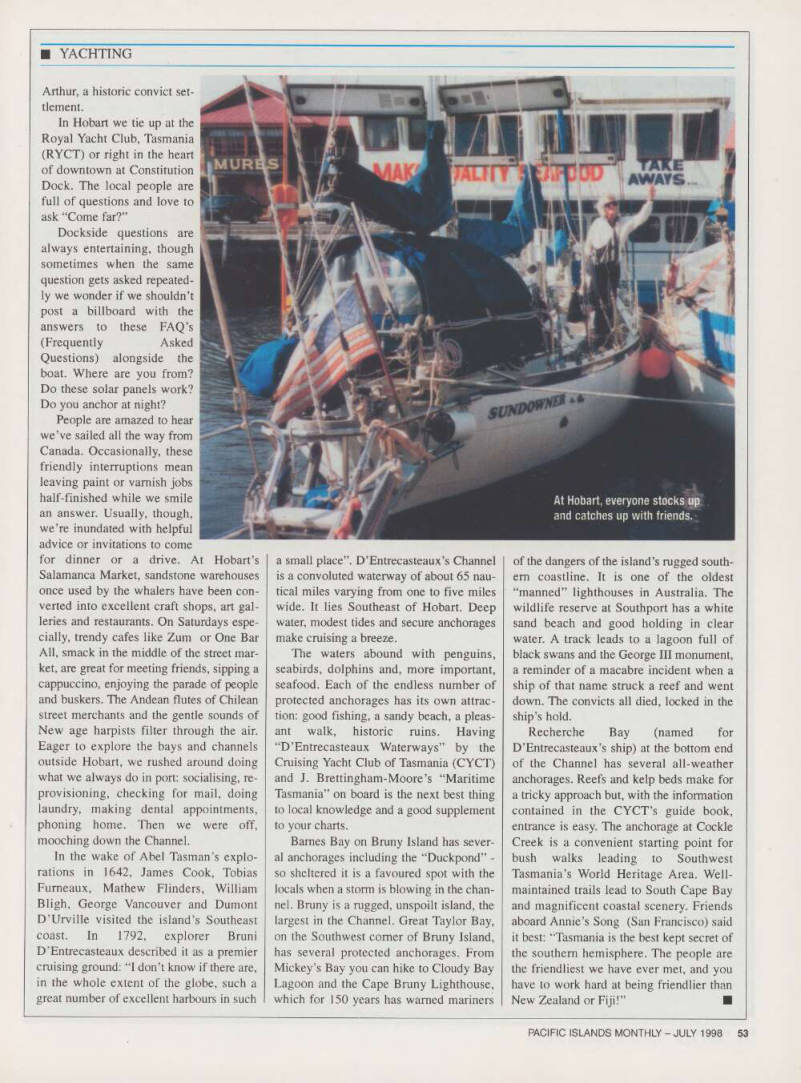
Yachting
By Sally Andrew
SAILING to Australia’s island state of Tasmania is a great way to spend a summer “down under”.
Most Pacific cruisers sail out of the tropics for cyclone season, making their landfall along Australia’s east coast in the ports of Bundaberg, Brisbane or Coffs Harbour. This year we arrived further north, at Gladstone, sailing inside the Great Sandy Straits before hopping on the southbound Australian current.
With a bit of luck and a couple of days of favourable winds, crossing the rugged
stretch of water known as Bass Strait is no big deal.
In 1994, Fellowship sailed the 600 nau tical miles from Sydney to Tasmania’s loveliest anchorage, Wineglass Bay, in less than four days. A perfect run.
This year, however, El Nino conditions meant strong westerlies (often storm force), switching Northwest-Southwest on a daily basis. At the Southeast comer of the continent, we waited twenty-two frustrat ing days (yes, 22) for suitable weather to cross Bass Strait. Our patience paid off with an easy two-day passage, and we made landfall at Skeleton Bay near St.
Helens, Northeast Tasmania.
An overnight sail from there brought us
to Tasmania’s longest, whitest, softest sand beach, Wineglass Bay. Hiking trails abound and we spent every day off on another track, climbing the peaks for spec tacular views and watching for wildlife.
While at Wineglass, several vessels from Hobart’s International Tall Ship Regatta sailed in, as did many of the Royal Yacht Club Tasmania (RYCT) “Van Diemen’s Land Circumnavigation” fleet.
This year’s voyage round Tasmania was in commemoration of Bass and Flinders’ circumnavigation of Van Diemen’s land in 1798, 200 years earlier.
From Wineglass Bay, coastal cruising towards Hobart can be leisurely. Don’t miss Shouten Island, Maria Island and Port
While at Wineglass, several vessels from Hobart’s International Tall Ship Regatta sailed in.
Arthur, a historic convict set tlement.
In Hobart we tie up at the Royal Yacht Club, Tasmania (RYCT) or right in the heart of downtown at Constitution Dock. The local people are full of questions and love to ask “Come far?”
Dockside questions are always entertaining, though sometimes when the same question gets asked repeated ly we wonder if we shouldn’t post a billboard with the answers to these FAQ’s
(Frequently Asked
Questions) alongside the boat. Where are you from?
Do these solar panels work?
Do you anchor at night?
People are amazed to hear we’ve sailed all the way from Canada. Occasionally, these friendly interruptions mean leaving paint or varnish jobs half-finished while we smile an answer. Usually, though, we’re inundated with helpful advice or invitations to come
for dinner or a drive. At Hobart’s Salamanca Market, sandstone warehouses once used by the whalers have been con verted into excellent craft shops, art gal leries and restaurants. On Saturdays espe cially, trendy cafes like Zum or One Bar All, smack in the middle of the street mar ket, are great for meeting friends, sipping a cappuccino, enjoying the parade of people and buskers. The Andean flutes of Chilean street merchants and the gentle sounds of New age harpists filter through the air.
Eager to explore the bays and channels outside Hobart, we rushed around doing what we always do in port: socialising, re
provisioning, checking for mail, doing
laundry, making dental appointments, phoning home. Then we were off, mooching down the Channel.
In the wake of Abel Tasman’s explo rations in 1642, James Cook, Tobias Furneaux, Mathew Flinders, William Bligh, George Vancouver and Dumont D’Urville visited the island’s Southeast coast. In 1792, explorer Bruni D’Entrecasteaux described it as a premier cruising ground: “I don’t know if there are, in the whole extent of the globe, such a great number of excellent harbours in such
a small place”. D’Entrecasteaux’s Channel is a convoluted waterway of about 65 nau tical miles varying from one to five miles wide. It lies Southeast of Hobart. Deep water, modest tides and secure anchorages make cruising a breeze.
The waters abound with penguins, seabirds, dolphins and, more important, seafood. Each of the endless number of protected anchorages has its own attrac tion; good fishing, a sandy beach, a pleas ant walk, historic ruins. Having “D’Entrecasteaux Waterways” by the Cruising Yacht Club of Tasmania (CYCT) and J. Brettingham-Moore’s “Maritime Tasmania” on board is the next best thing to local knowledge and a good supplement to your charts.
Bames Bay on Bruny Island has sever al anchorages including the “Duckpond” so sheltered it is a favoured spot with the locals when a storm is blowing in the chan nel. Bruny is a rugged, unspoilt island, the largest in the Channel. Great Taylor Bay, on the Southwest comer of Bruny Island, has several protected anchorages. From Mickey’s Bay you can hike to Cloudy Bay Lagoon and the Cape Bruny Lighthouse, which for 150 years has warned mariners
of the dangers of the island’s rugged south ern coastline. It is one of the oldest “manned” lighthouses in Australia. The wildlife reserve at Southport has a white sand beach and good holding in clear water. A track leads to a lagoon full of black swans and the George 111 monument, a reminder of a macabre incident when a ship of that name struck a reef and went down. The convicts all died, locked in the ship’s hold.
Recherche Bay (named for D’Entrecasteaux’s ship) at the bottom end of the Channel has several all-weather anchorages. Reefs and kelp beds make for a tricky approach but, with the information contained in the CYCT’s guide book, entrance is easy. The anchorage at Cockle Creek is a convenient starting point for bush walks leading to Southwest Tasmania’s World Heritage Area. Well maintained trails lead to South Cape Bay and magnificent coastal scenery. Friends aboard Annie’s Song (San Francisco) said it best: “Tasmania is the best kept secret of the southern hemisphere. The people are the friendliest we have ever met, and you have to work hard at being friendlier than New Zealand or Fiji!” ■
At Hobart, everyone stocks up and catches up with friends.
Unemployment statistics not
encouraging for the Pacific
In a developed society, there is nothing more dispir iting to any fit person of any age, race or colour than not being able to get a job. To wake up every morning with nothing to do is devastating to self-esteem.
It creates a sense of worthlessness that those in regular employ ment can scarcely comprehend.
It is bad enough for the individual. When whole communities in a society are in this situation it lays a very dangerous base for severe social and economic disruption.
That is the scary prospect for New Zealand as Maori and Pacific Island people continue to figure disproportionately in the unemployment statistics.
At the time of writing, 18.3 per cent of Maori of working age are jobless. The unemployment rate for Pacific Island people is 16.4 per cent.
These figures compare with a nation-wide rate of 7.1 per cent - the highest in nearly four years - and Pakeha unemployment of 5.5 per cent.
The picture is even worse when you look at long-term unem ployment. The number of Maori out of work for more than two years jumped 82 per cent last year and that of Pacific Island peo ple’s 63 per cent, against a 55 per cent increase for Europeans.
Even more alarming, four out of every 10 unemployed are 15 to 24 years old- giving little hope to the generation on which every country’s future depends.
Government ministers agree these figures are “unacceptable” but seem helpless to do anything to rectify a situation that is wors ening and shows little sign of radical improvement.
Economists predict the overall unemployment rate will rise to 8 per cent next year and there is no reason to suppose the Maori and Pacific Island rates will not grow with it.
At best, the government forecasts it will not dip below 6 per cent until after the turn of the century and that could be wishful
thinking.
Ministers boast that more jobs are being created but statistics show that while job numbers have increased by 8,000 since June 1996, the working age population has grown more than 59,000 at the same time.
The problem has its roots in the radical reform of New Zealand’s economy since the mid-1980s - a reform that had to take place but found Maori and Pacific Island people the most vulnerable.
They were over represented in the unskilled and semi-skilled occupations of a
manufacturing
sector that has
undergone a massive shake-up. They are under-represented in the highly skilled high growth industries that have replaced them - a one-time factory worker simply cannot become a computer pro grammer overnight.
Older workers are ill-equipped to find a place in the new econ omy. Youngsters - and there are many of them in the Maori and Pacific Island communities - have low levels of educational attain ment and do not figure highly in the ranks of those undergoing
formal occupational training.
Large numbers of them are growing up without having seen their parents go to work, families where a welfare benefit has become accepted as the only income.
With the social welfare budget now nudging towards $l4 bil lion a year, the government is well aware of the cost of such dependency and committed to doing something about it.
The question is will the scheme it has come up with do the trick? Will it get unemployed Maori and Pacific Island people into jobs? Well, the jury could be out on that one for some time.
The government’s idea is to scrap the dole from October 1, replacing it with a so-called community wage. This means that they expect everyone on unemployment benefits to work up to 20 hours a week - or undergo training - for their money.
The community wage will give them the current benefit of just under $l5O a week, plus an extra $2l travel allowance to get to and from their jobs. Failing to work risks losing their money.
Further, they intend to test people receiving sickness and invalids’ benefits for their ability to work, as will solo parents and widows, who will have to take jobs part-time or full-time depend ing on the age of their children. By September next year, this could force about 280,000 beneficiaries to work or take substan tial cuts to their benefits.
That, of course, is if the jobs are there. Treasurer Winston Peters says there are “tens of thousands” of jobs available, despite the 7.1 per cent unemployment rate. He talks about cutting gorse, helping in schools and rest homes, clearing rubbish and assisting charities and the elderly.
Now these are all praiseworthy tasks, but will they equip Maori and Pacific Island people to take up a meaningful long-term place in the workforce? Critics say no. They say depression-type work creation programmes will not solve New Zealand’s problems, but aggravate them. They say they will lock unskilled people like many of the Maori and island jobless into meaningless tasks that will have quite the opposite effect to the avowed aim of restoring dignity and self-esteem.
It certainly doesn’t look the type of work that reflects a fast changing New Zealand economy - one built on education and technology - with meaningful roles for every sector of a multi racial and multi-cultural community.
Unless New Zealand can achieve that, the future - for econom ic equality, and thereby racial peace and harmony - does not look very bright. ■
David Barber
Sydney
Tne Hanson pestilence
Opinion
THE Queensland election on June 13 saw Pauline Hanson’s ultra-nationalist One Nation Party rip through the Australian political land scape like a cyclone, decimating the conserva tive National and Liberal parties and threatening havoc in national politics as well. The fledgling party, just 14 months old, won 23 per cent of the vote and took more seats than Prime Minister, John Howard’s Liberal party.
Never before in Australia’s political history has a new party been able to reach dizzy heights. This stunning elec toral victory threatens more than just ten new One-Nation faces in the 89-seat Queensland parliament. It has the potential to divide Australia along racial lines, derail the process of reconciliation with the Aboriginal community and to make Australia a meaner, more inward-looking soci ety that has to struggle hard to win the respect of its neigh bours in Asia. It even has the potential to affect Australia’s balance of trade by frightening-off Asian tourists and slow ing the growth of students coming to study here.
The people who voted for Pauline Hanson are those liv ing in rural areas who feel the major parties have failed to heed their plight. They are, like Pauline Hanson, pro-gun and worried about the impact that globalisation is having on jobs for Australians. Where Pauline Hanson differs from the much more moderate Democrats, who are also critical of many of the economic rationalist policies adopt ed by both Labor and the Coalition, is in her willingness to provide scapegoats on which the disaffected can vent their frustration and conspiracy theories that feed their paranoia.
Pauline Hanson’s most obvious scapegoat is the Aboriginal community. She has made vitriolic comments about what she calls ‘the Aboriginal industry’, wants the abolition of native title and the axing of the Aboriginal and Torres Strait Islander Commission. She has tapped further into the ugly vein of racism, which has always been at its most virulent in rural Queensland, by warning that Australia risks being ‘swamped by Asians’. Her policy solutions are an end to immigration and all foreign aid.
Funding for the arts, she says, should be redirected into a People’s Bank that would provide low interest loans to farmers. There is no doubt Pauline Hanson presents both a frightening picture and a powerful new force in Australian politics but before we get too panic stricken it is important to remember that the vast majority of voters (77 per cent) chose NOT to vote for Mrs Hanson. As an editorial in The
National in Papua New Guinea pointed out, most countries have a party that plugs into public disaffection and no matter what nuisance it creates it is important to
remember that One Nation does not represent the broader face of Australia that is now irrevocably multi-cultural.
In fact, the decimation of the Liberal Party was not because its supporters left to vote for One Nation but because city dwellers were so angry that the Liberals had given Mrs Hanson succour, by passing their preferences to her, that they left in droves to vote Labor. This highlights a growing schism between country and city - one that is now an enormous headache for Prime Minister Howard and his Liberal. National Party coalition.
John Howard, says the preference issue is one for state branches of his party to decide. Mr Howard’s other prob lem is the implications that One Nation holds for his poli cy agenda. The sale of the government’s telecommunica tions giant, Telstra, the introduction of a Goods and Services Tax (GST) and his plan to go to a double dissolu tion election to push through his 10-point plan on Native title are all threatened by the One Nation victory. i' further alienate rural voters. The Native Title plan because, on cut may not be able to win enough seats at a double dissolution election (which gives parties a Senate seat with half the usual quota of votes) to make possible a victory at a joint sitting of par liament. a nation-wide surge in support for One Nation, which boosted its share of the vote from 7 per cent to 11 per cent.
So has Howard - who was much criticised in One Nation’s nature of the party (he went on record saying Mrs Hanson’s supporters ‘were no more racist that you or D - been hoist mere criticism of One Nation to cut much mustard with One Nation supporters, who have tasted power. In the weeks before the Queensland election Pauline Hanson made an extraordinary speech in parliament in which she accused Aboriginal leaders of being more interested in title was a ’scam’ that ’is the precursor to the establish ment of taxpayer-funded sovereign Aboriginal states’. John Howard, finally stung into action by polls that suggested a collapse of the Queensland Liberal ''National vote, retorted that this was ‘not only an inaccurate and dishonest speech, but it verges on the deranged’. It doesn’t seem to have had any impact on the election result in Queensland.
Having tasted power, the One Nation cat is well and give it parliamentary resources it has only dreamed of, until now. We can only hope that the increased scrutiny that comes with a place in parliament will take its toll on One Nation’s credibility before any federal election, and that voters see that, in a complex world, it takes more than One Nation’s wish for things, such as job creation, to make it happen. ■
Jemima Garrett
Wellington
Sydney Olympics torch

Year 2000
Sydney Olympics torch to highlight remote South Pacific flavour
By Patrick Decloitre
As a build-up to Sydney’s Olympics in 2000, the torch relay will high light 12 Pacific coun tries and bring them much-needed publicity in a once-in-a-century opportunity.
Australian organisers of the torch relay started a South Pacific tour last May to explain what they expect from countries hosting the torch, typically for about 24 hours. The Pacific countries involved are American Samoa, Cook islands, Federated States of Micronesia, Fiji, Guam, Nauru, New Zealand, Papua New Guinea, Samoa, Solomon islands, Tonga and Vanuatu.
In Vanuatu, Sydney 2000 torch relay general manager Di Henry explained the National Olympic Committee it will have to designate 100 torch bearers for a six hour run. The torch will come from Greece, spend 20 days in Oceania before touring Australia for the last 100 days’ build-up to the Olympics in Sydney.
Because of the global media coverage this will include, this will also be a unique opportunity for Vanuatu and other South Pacific islands to make an unprecedented
impact.
“We’re working with each of the national Olympic committees in Oceania and we’re relying on them to make it hap pen. We explain the gig, so that the world media will watch what a beautiful region it is”, Henry said. She is confident the torch relay will bring up this region’s contrasts.
“It’s incredible, within this time, the world will see a torch relay with the same consistent torch and uniforms, but going from the tropics to the Australian desert and New Zealand snow, this is an amazing part of the world and we want to showcase it”, Henry says.
The Pacific torch relay is part of Australia’s effort that, in its budget for this year, earmarked some AUDS3.6 million (US$2.3 million) for the exercise.
“We bring the organisational infrastruc ture, we also deliver the uniforms, the torches, the plane and all the advanced
people to triple check everything”. The host country provides vehi cles for the torch relay.
“It’s a voluntary situa tion and then it’s up to them how much fun they want to have.
We’re here to facili tate.” As usual, the relay organisers have to tack le a difficult problem: making sure the torch doesn’t go out.
“We’re working on it: every torch relay has
had problems with the flame going out. It’s a real problem, especially under these dif ferent conditions”, Henry admits.
“But what we have now will be better.
We have minor lamps with oxygen avail able along the convoy to backup the origi nal flame from Greece.”
“I’m overwhelmed. Being entrusted with the task of running with the Olympic flame is always big. I feel very proud to be part of that organisation”, Vanuatu National Olympic Committee (NOC) President Joe Carlo, now a parliamentari an, said.
“Of course, it’s going to put Vanuatu on the world map, you’re talking about major media coverage. So we’re getting everyone here involved, the national tourism office, the traditional chiefs, to display our tradi tions”.
To draw the world’s attention to their 80-island archipelago, Vanuatu officials are now working on some gimmicks to ensure the uniformed torch bearer’s picture will also include Vanuatu’s most colourful and attractive features. ■
Advertisements & other items, p. 56 (1 item)
c^fjJSS
AUSTRALIAN INTERNATIONAL SHIPPING SERVICES PTY LTD
Providing Container Consolidated Services , Full Container Loads , Airfreight Forwarding and Purchase Order Tracking Services to: — American Samoa, Cook Islands, Fiji, Guam, Kiribati, New Zealand, Niue, Norfolk Island, New Caledonia, Nauru, Papua New Guinea, Solomon Islands, Tahiti, The Federated States of Micronesia, Tonga, Vanuatu and Western Samoa.
Offices in Melbourne and Sydney
TEL:— 61-3-93351477 FAX:— 61-3-93380115 EMAIL:- A-I-S-S.COM
Carpenters Shipping
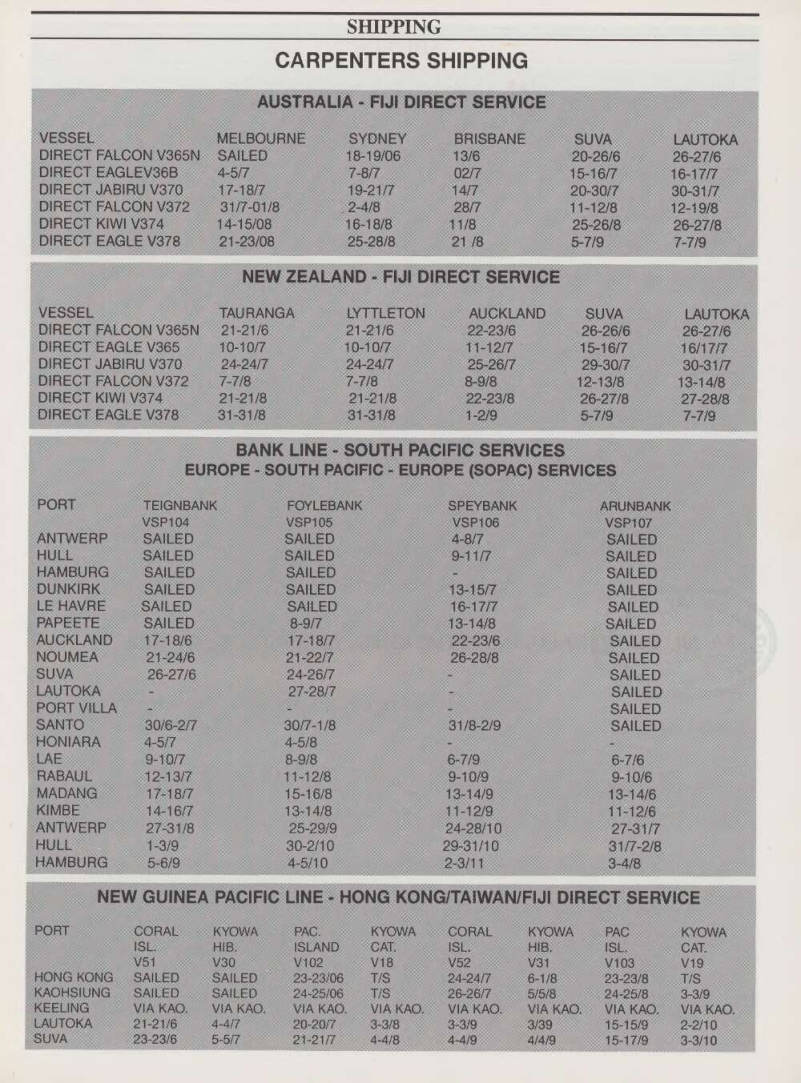
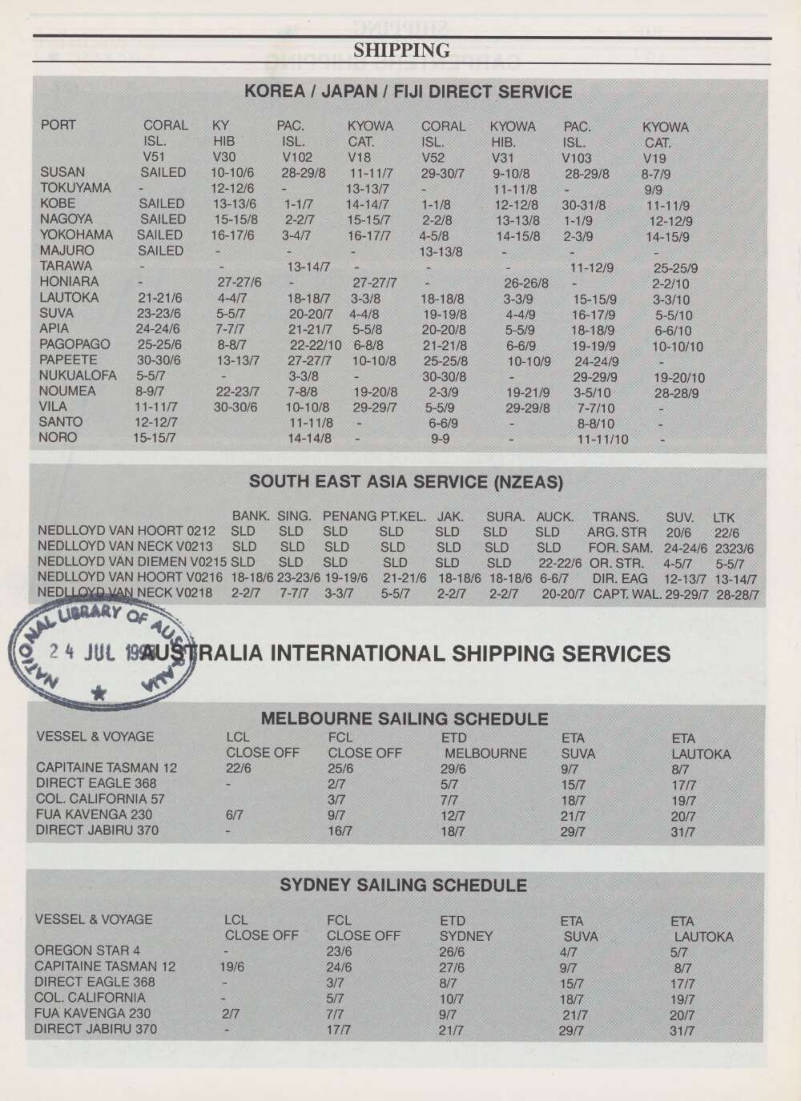
Shipping
Australia - Fiji Direct Service
New Zealand- Fiji Direct Service
Bank Line - South Pacific Services
EUROPE - SOUTH PACIFIC - EUROPE (SOPAC) SERVICES
NEW GUINEA PACIFIC LINE - HONG KONG/TAIWAN/FIJI DIRECT SERVICE
Vessel
Melbourne
Sydney
Brisbane
Suva
Lautoka
Direct Falcon V365N
Sailed
18-19/06 13/6 20-26/6 26-27/6
Direct Eaglev36B
4-5/7 7-8/7 02/7 15-16/7 16-17/7
Direct Jabiru V370
17-18/7 19-21/7 14/7 20-30/7 30-31/7
Direct Falcon V372
31/7-01/8 2-4/8 28/7 11-12/8 12-19/8
Direct Kiwi V374
14-15/08 16-18/8 11/8 25-26/8 26-27/8
Direct Eagle V378
21-23/08 25-28/8 21 /8 5-7/9 7-7/9
Vessel
Tauranga
Lyttleton
Auckland
Suva
Lautoka
Direct Falcon V365N
21-21/6 21-21/6 22-23/6 26-26/6 26-27/6
Direct Eagle V365
10-10/7 10-10/7 11-12/7 15-16/7 16/17/7
Direct Jabiru V370
24-24/7 24-24/7 25-26/7 29-30/7 30-31/7
Direct Falcon V372
7-7/8 7-7/8 8-9/8 12-13/8 13-14/8
Direct Kiwi V374
21-21/8 21-21/8 22-23/8 26-27/8 27-28/8
Direct Eagle V378
31-31/8 31-31/8 1-2/9 5-7/9 7-7/9
Port
Teignbank
Foylebank
Speybank
Arunbank
Vsp104
Vsp105
Vsp106
Vsp107
Antwerp
Sailed
Sailed
4-8/7
Sailed
Hull
Sailed
Sailed
9-11/7
Sailed
Hamburg
Sailed
Sailed
Sailed
Dunkirk
Sailed
Sailed
13-15/7
Sailed
Le Havre
Sailed
Sailed
16-17/7
Sailed
Papeete
Sailed
8-9/7 13-14/8
Sailed
Auckland
17-18/6 17-18/7 22-23/6
Sailed
Noumea
21-24/6 21-22/7 26-28/8
Sailed
Suva
26-27/6 24-26/7
Sailed
Lautoka
- 27-28/7 -
Sailed
Port Villa
Sailed
Santo
30/6-2/7 30/7-1/8 31/8-2/9
Sailed
Honiara
4-5/7 4-5/8 - -
Lae
9-10/7 8-9/8 6-7/9 6-7/6
Rabaul
12-13/7 11-12/8 9-10/9 9-10/6
Madang
17-18/7 15-16/8 13-14/9 13-14/6
Kimbe
14-16/7 13-14/8 11-12/9 11-12/6
Antwerp
27-31/8 25-29/9 24-28/10 27-31/7
Hull
1-3/9 30-2/10 29-31/10 31/7-2/8
Hamburg
5-6/9 4-5/10 2-3/11 3-4/8
Port
Coral
Kyowa
Pac.
Kyowa
Coral
Kyowa
Pac
Kyowa
Isl.
Hib.
Island
Cat.
Isl
Hib.
Isl
Cat.
V51 V30 VI02 V18 V52 V31 V103 V19
Hong Kong
Sailed
Sailed
23-23/06 T/S 24-24/7 6-1/8 23-23/8 T/S
Kaohsiung
Sailed
Sailed
24-25/06 T/S 26-26/7 5/5/8 24-25/8 3-3/9
Keeling
Via Kao.
Via Kao.
Via Kao.
Via Kao.
Via Kao.
Via Kao.
Via Kao.
Via Kao.
Lautoka
21-21/6 4-4/7 20-20/7 3-3/8 3-3/9 3/39 15-15/9 2-2/10
Suva
23-23/6 5-5/7 21-21/7 4-4/8 4-4/9 4/4/9 15-17/9 3-3/10
KOREA / JAPAN / FIJI DIRECT SERVICE
South East Asia Service (Nzeas)
Ralia International Shipping Services
Sydney Sailing Schedule
Port
Coral
KY
Pac.
Kyowa
Coral
Kyowa
Pac.
Kyowa
Isl
Hib
Isl
Cat.
Isl
Hib.
Isl
Cat.
V51 V30 V102 V18 V52 V31 VI03 V19
Susan
Sailed
10-10/6 28-29/8 11-11/7 29-30/7 9-10/8 28-29/8 8-7/9
Tokuyama
- 12-12/6 - 13-13/7 - 11-11/8 - 9/9
Kobe
Sailed
13-13/6 1-1/7 14-14/7 1-1/8 12-12/8 30-31/8 11-11/9
Nagoya
Sailed
15-15/8 2-2/7 15-15/7 2-2/8 13-13/8 1-1/9 12-12/9
Yokohama
Sailed
16-17/6 3-4/7 16-17/7 4-5/8 14-15/8 2-3/9 14-15/9
Majuro
Sailed
- - - 13-13/8 - -
Tarawa
- - 13-14/7 - - - 11-12/9 25-25/9
Honiara
- 27-27/6 - 27-27/7 - 26-26/8 - 2-2/10
Lautoka
21-21/6 4-4/7 18-18/7 3-3/8 18-18/8 3-3/9 15-15/9 3-3/10
Suva
23-23/6 5-5/7 20-20/7 4-4/8 19-19/8 4-4/9 16-17/9 5-5/10
Apia
24-24/6 7-7/7 21-21/7 5-5/8 20-20/8 5-5/9 18-18/9 6-6/10
Pagopago
25-25/6 8-8/7 22-22/10 6-8/8 21-21/8 6-6/9 19-19/9 10-10/10
Papeete
30-30/6 13-13/7 27-27/7 10-10/8 25-25/8 10-10/9 24-24/9
Nukualofa
5-5/7 - 3-3/8 - 30-30/8 - 29-29/9 19-20/10
Noumea
8-9/7 22-23/7 7-8/8 19-20/8 2-3/9 19-21/9 3-5/10 28-28/9
Vila
11-11/7 30-30/6 10-10/8 29-29/7 5-5/9 29-29/8 7-7/10
Santo
12-12/7 11-11/8 - 6-6/9 - 8-8/10
Noro
15-15/7 14-14/8 - 9-9 - 11-11/10
Bank.
Sing.
Penang Pt.Kel.
Jak.
Sura.
Auck.
Trans. Suv.
Ltk
Nedlloyd Van Hoort 0212
Sld
Sld
Sld
Sld
Sld
Sld
Sld
Arg. Str 20/6
22/6
Nedlloyd Van Neck V0213
Sld
Sld
Sld
Sld
Sld
Sld
Sld
For. Sam. 24-24/6
2323/6
Nedlloyd Van Diemen V0215 Sld
Sld
Sld
Sld
Sld
Sld
22-22/6
Or. Str. 4-5/7
5-5/7
Nedlloyd Van Hoort V0216
18-18/6 23-23/6 19-19/6 21-21/6 18-18/6 18-18/6 6-6/7
Dir. Eag 12-13/7
13-14/7
Neck V0218
2-2/7 7-7/7 3-3/7 5-5/7 2-2/7 2-2/7 20-20/7
Capt. Wal. 29-29/7
28-28/7
Melbourne Sailing Schedule
Vessel & Voyage
Lcl
Fcl
Etd
Eta
Eta
Close Off
Close Off Melbourne
Suva
Lautoka
Capitaine Tasman 12
22/6 25/6 29/6 9/7 8/7
Direct Eagle 368
- 2/7 5/7 15/7 17/7
Col California 57
3/7 7/7 18/7 19/7
Fua Kavenga 230
6/7 9/7 12/7 21/7 20/7
Direct Jabiru 370
- 16/7 18/7 29/7 31/7
Vessel & Voyage
Lcl
Fcl
Etd
Eta
Eta
Close Off
Close Off
Sydney
Suva
Lautoka
Oregon Star 4
- 23/6 26/6 4/7 5/7
Capitaine Tasman 12
19/6 24/6 27/6 9/7 8/7
Direct Eagle 368
- 3/7 8/7 15/7 17/7
Col California
- 5/7 10/7 18/7 19/7
Fua Kavenga 230
2/7 7/7 9/7 21/7 20/7
Direct Jabiru 370
- 17/7 21/7 29/7 31/7
Advertisements & other items, pp. 58-60 (2 items)
Shipping
Local And International
Courier
3 1508 00639220 8
DOOR TO DOOR
Hi * * « ■■■ t fS For further enquiries call us toll free on 0800 307304 or enquire at your nearest Post Office
N
ft.. pgi, m<-
siq
Pa cl
3. Shelves
1 K iiSKSi s feMaiiaii li*W»7 as*. : foo*>*' iOiij; ‘A - Hiilitf Some of the specs may vary according to market specifications.
Looks tough, feels comfortable - Toyota Hilux People all over the world prefer Toyota. Because it makes bestsellers like Hilux. It maintains that rugged reputation, and now it sports tough, durable body styles as well. It's ready for any terrain.
Hilux offers more. More power - with a choice of engines and precision transmissions and transfers. More effective power distribution to match the terrain, thanks to Toyota's advanced
technology.
And more passenger car-like comfort. With an ergonomic interior, all the conveniences you want, the fit and finish you'd expect from Toyota, and a ride that’s smoothed out by precision-
engineered suspension.
Hilux is built to take it. And to take you anywhere you want to go.
It's remarkably tough. And incredibly comfortable. With worldleading uncompromising quality. From the champion. Toyota.
® TOYOTA
DISTRIBUTORS / DEALERS
NORFOLK ISLAND BORRY’S PTY LTD. PH 22114
SOLOMON ISLANDS ELA MOTORS PH 30314
VANUATU ASCO MOTORS PH 22341
COOK ISLANDS..., PACIFIC MOTORS LTD. PH 20796
KIRIBATI TARAWA MOTORS PH 21090
PAPUA NEW GUINEA ELA MOTORS PH 3229400
TAHITI , NIPPON AUTOMOTO PH 429819
WESTERN SAMOA ASCO MOTORS PH 20800
FIJI ASCO MOTORS PH 384888
NEW CALEDONIA S.I.A.P. PH 275562
TONGA ASCO MOTORS PH 23500
AMERICAN SAMOA ASCO MOTORS* PH 633-4281
(*HILUX is not being handled.)