Advertisements & other items, pp. 1-2 (2 items)
Shbum
PACIFIC ISLANDS
MONTHLY
INSIDE: Revamping Aviation
JUNE 1998
SHBUm
The new Pacific drug
American Samoa US$2.5O; Australia A 53.50; Cook Islands NZ$3; Fiji F 52.50 Vat incl; FS Micronesia US$3; Kiribati A 52.50; Nauru A 52.50; Niue NZ$3; Norfolk ASS; New Caledonia cpf2so; New Zealand NZ53.45 incl GST; Northern Marianas US$3; Papua New Guinea K 3; Palau US$3; Marshall Islands US$3; Solomon Islands As 3; French Polynesia cpf3oo; Tonga P 3; USA US$3: Vanuatu VT22O; Western Samoa T 5.50. These are recommended prices only.
|Tt» Telikom Png
mi mM ■ S m S li '. . ■ * m L «£; ■$ Mi - We accept Just quote your card number and expiry date and we will forward your requirements.
For further information please contact: Tetikom Phone Card Sales Pay Phone Business Unit PO Box 351 Waigani, NCD Papua New Guinea Telephone; (675) 300 5093 Facsimile: (675) 3005060
Mo*o tueSnz,rfs&Uq -tzUteumj /
Pacific Islands
Monthly
Vol 68 No. 6
The News Magazine
June 1998
PUBLISHER: Alan Robinson EDITOR: Sophie Foster Hildebrand
Correspondents:
Sally Andrew, Patrick Decloitre, Giff Johnson, Chris Peteru,
Susan Prokop, Atama Raganivatu,
Michael Field, Liz Thompson, Lili Tuwai, Sam Vulum, lan Williams COLUMNISTS: David Barber (Wellington), Jemima Garrett (Sydney), Debbie Singh (South Pacific Commission).
GRAPHIC ARTISTS: James Ranuku, Josefa Bola, Andrew Williams
Advertising Sales
Senior Regional Sales (South Pacific) Shabana Naaz Kailesh Kumar Tel (679) 304111. 303244, Fax (679) 303809.
Sydney, Canberra: Bob Hill Media Representation, Tel (61-2) 4164245, Fax (61-2) 4165064.
Brisbane: Jane Fewings Media and Advertising Associates Tel (61-7) 3378 4522, Fax (61-7) 3878 1071.
Adelaide: Hastwell Williamsons Representatives, Tel (61-8) 3799522, Fax (61-8) 3799735.
Melbourne: Brown Orr Fletcher Burrows (Aust) Pty Ltd.
Tel (61-3) 98265188, Fax (61-3) 98265644, Auckland: McKay & Bowman, International Media Representatives Limited, Tel (64-9) 4190561.
Fax (64-9) 4192243.
Japan: Universal Media Corporation. Tokyo, Tel (3) 3266626741.
Cable: UNI-MEDIA Tokyo, Fax (3) 32626742.
Pacific Islands Monthly was founded in 1930
(Usps 9522480).
A Fiji Times Limited production.
Cover prices are recommended retail only. Registered by Australia Post.
Publication No. NBPI2IO. © Copyright Fiji Times Limited. 177 Victoria Parade. Suva. Fiji.
Tel (679) 304111, fax (679) 303809.
Email: [email protected]
PIM Website: http://www.pim.com.fj Pacific Islands Monthly is published monthly by Fiji Times Limited, a division of Nationwide News, 2 Holt Street. Surry Hills.
Sydney, NSW 2010.
Send Address Changes To:
Pacific Islands Monthly POBox 1167 Suva, Fiji.
Typeset and printed by Quality Print Limited. 16 Amra Street, Walu Bay, Suva, Fiji.
Layout and cover design by Andrew Williams
Inside
Letters to the Editor 4 Editorial 5 Special Report: Bougainville Peace Treaty Give peace a chance 8 ANZAC rivalry heats up 10 Pacific aviation vulnerable to attack 13 Sea Launch, we have lift off 16 Cover story The lure of quick riches 20 Profit or paupers? 22 A bitter pill to swallow 23 Net profit: cooking up a storm 24 Casino gives hope 26 Finance Sit back and take stock 34 The Princess and the pa'anga 35 Continental cutbacks worry Marshalls 29 Developments SPARTECA's last stand 37 PNG fights to stay afloat 39 Shortland Street's new man .41 Fishing feature 45 Clan squabbles over Ariki title 53 Opinion 05
Pagel4
Pagelß
Cover Story: Gambling: The new Pacific drug
Letters

TUvaluan struggle continues
I read with interest Michael Field’s article “Leadership Struggle On Tuvalu” (PIM February 1998) and congratulate him on giving a balanced perspective of the particular issues in Tuvalu.
An aspect which was mentioned and covered in other news media concerns Prime Minister Bikeni Paeniu’s reactions to allegations of sexual immoral behaviour on a male youth from his own con stituency. As a Tuvaluan, I find Paeniu’s passive reaction to these allegations noteworthy, especially the absence of a counter charge in court to clear his good name. It is shameful and unforgiving for a Tuvaluan to be accused of such allegations. It is more distaste ful and utterly unacceptable for society to accept such a leader.
A few months ago, a senior Tuvaluan civil servant resigned in protest from the public service, giving a litany of alleged nepo tism and corruption on Paeniu’s part. Throughout the letter which was openly and widely circulated, Paeniu was continually labelled as a person who is allegedly indulging in the very acts that he was previously alleged to have committed. So far Paeniu has remained
relatively quiet.
Recently a complaint was filed with the police in Tuvalu, alleg ing sexual wrong-doings between Paeniu and one of his former male security officers. Surely, it is about time for Paeniu to clear his name as the “consummate politician”. Efforts in the past to bring justice to the allegations of Paeniu’s sexual assault were not “political ploys”, but were genuine concerns for the status, digni ty and integrity of the high office held.
Tinitini Taulakoa
Cowrie Street, Suva, Fiji
Picturing a rain forest I read with interest your cover story on logging in the March issue of PIM but even at this late stage feel I should make some comment on it. My faith in the reliability of your reporting was shaken by your choice of illustration. Your story was about log ging in PNG and Solomon Islands in the indigenous rain forest, yet every picture clearly showed logging operations in pine plan tations in Fiji.
Surely you must have been able to get some more appropriate pictures. If you can’t get the pictures right, how much credence should we give to the text?
Andrew Tolfts
Regional Forestry Coordinator Port Vila, Vanuatu, SW. Pacific.
Sporting statistics lacking
For the past few years, I have been researching the different international sporting events held in the Pacific area including the South Pacific Games, Mini South Pacific Games, Pacific Ocean Games, and the Micronesian Games.
Living here in Las Vegas has made it difficult to find informa tion about this subject. This is the main reason why I subscribed to PIM. I hope your coverage of the Micronesian Games will be belter than the recently held and as you said poorly Mini South Pacific Games. ' J 1 would hope you could possibly mention in PIM that I am in need for information and statistics concerning all these games, especially statistics on Final Medal Counts for the 1989 Mini
Games held in Tonga and 1995 South Pacific Games held in Tahiti.
I have written several letters to many different contacts. I hope one of your readers just may have the information I need.
Mike Gregory
981 Whitney Ranch Dr. #1727 Henderson, NV 89014. USA
Jenny in Wonderland?
Believe it or not, Jenny Ripley, er Shipley, chief executive and captain of the National New Zealand Dream, er Steam Party, has come up with a brilliant concept - a code of social responsibility! Donation boxes have been placed in selected banks encour aging the populace to support their local police station and volunteers now answer the phones. (Now that’s Law and Order for you!) With the closing of Psychiatric and
other Public Hospitals and the suggestion that our defence forces be moved away from Devonport and transferred to Canberra, New Zealanders can be proud that the Good Ship New Zealand is firm ly on course. The elements of Earth, Air, Fire and Water are now being privatised and the people are indeed thrilled to be living in Jenny's Wonderland of Social Enlightenment!
The Fire Service Commission announced on May 7 that it was sacking its entire front-line workforce of 1575 firefighters. The Minister of Infernal, er Internal Affairs Jack Elder said the gov
emment backed the service and “all New Zealand families should welcome the changes”. Meanwhile firefighters have warned the public to make sure their garden hoses were connected.
Martin Leo,
Otahuhu, NZ
New hotel in the Cooks?
I am a student at Deakin University in Geelong and would be most grateful for any information on the drama concerning the building of a new hotel complex (possibly the Sheraton) in the Cook Islands. I believe this project has had a chequered history and the information would assist me greatly in completing a cur rent anthropological assignment. I am basically investigating whether tourism aids or hinders development of Pacific Island countries.
F. French,
Deakin University, Geelong, Australia.
Aggie’s heritage established
Thank you for publishing my earlier letter and I thank all those people who wrote to me. As a result I have been able to establish that Aggie Gray’s father William John Swann was bom at Corby (now Corby Glenn) in Lincolnshire and that her grandfather James Butler Swann was bom at Carlton le Moorland, which is also in Lincolnshire.
Dr John Ketteringham
Lincoln, England
Advertisements & other items, p. 4 (1 item)
w
Youare cinder arrest - for attempting to ■ s. pervert justice 1 lam sure that's not what they meant// j
'Jf o
X f \J> f (r K S'/ / /
PNG SETUP
•7b £ k ’Ms
A gamble that will never pay off
Editorial
Judging by experiences
throughout the Pacific, with regard to casinos, one-armed bandits, and other pokies, the gamble that some island states have taken on gaming has not paid off.
Throughout the region, one thing stands out, rising concern for the social impact of gambling - whether it is misuse of family funds or addiction.
In the region, the concern is justified because in most cases, casinos are in urban centres and locals who gamble do not have a safety net.
Indeed the extended family which used to be the safety net in the past is fast being eroded. Even in places where the law states that locals cannot gamble in casinos, such as the Marshall Islands, experience has shown that the lure of quick riches is too strong to keep them out.
As in Papua New Guinea, locals, and not tourists, end up being the mainstay of the industry at the expense of their liveli hood.
In Australia, various casinos have shown trends where casinos only make money for the first few years of operation when it is still a novelty to “card-sharks” and the curious.
After that, the locals who have become addicted to playing the pokies and “trying their luck” are the ones who end up paying for the wages and profits of the casino owners. Even in Australia where there is a Social Welfare scheme, experience has shown that indulging this habit can be at the expense of children and family stabili ty- The cases of children locked in cars outside casinos and gaming venues in Australia have been alarming over the
years. Parents have been prosecuted, chil dren have been traumatised and family life in these cases, has not been in any way “normal”.
Papua New Guinea has also had cases where children have been left in cars while their parents gamble. In the Cooks, chil dren have been left without supervision while their parents gamble. Some have had no food because their parents hard-earned wages have gone into indulging the habit.
Children, parents and family life in the Pacific are already under threat by increas ing modernisation and the challenges of living in the pre-millennium era. The last thing we all need is another addiction to further erode what little we have left.
The financial case for gambling in no way outweighs the social cost to families, countries and, indeed, the Pacific way of life. ■
From The Archives
June 1945
Trans-Pacific Air Services THERE are signs that steps are being taken to resume a Trans-Pacific mail and passenger air service between North America and the South Pacific; and already there are indications of keen competition between British and American air-lines.
The report was current in Sydney, in May, that Qantas, Ltd., the well-known Australian company, was about to send a
survey plane from Sydney to Suva.
Evidently, this report reached Pan- American Airways, which pio neered the service
between Hawaii and Auckland, and was
operating regularly, Honolulu-Canton
Island-Suva-Noumea-Auckland, when war caused the suspension of all civil flying at the end of 1941.
On June 3, the Sydney “Telegraph’s”
New York correspondent reported that PAA would resume the service on a weekly basis in June, and would run a twice-weekly ser vice as soon as planes were available.
This was welcome news to Australians.
Air-mails from USA come regularly to Australia, but there is no return air-mail only slow surface mail - and for this
Australians blame
their blundering
and inefficient Government.
Passenger traffic
between Australia and USA, and Pacific ports in between, is a mat ter of sheer luck
and wild adventure; and any airline which can get in quickly and remedy this state of affairs will be called blessed by the busi ness community.
New Caledonia Interested THE people of this important French Colony have learned with satisfaction that Noumea will be a regular stopping-place on at least one of the trans-Pacific services which Pan-American Airways are plan ning.
We hope to have ready access to both Australia and New Zealand.
A sojourn in one or other of those cool countries is needed occasionally by most people here, if health is to be maintained in an enervating climate, and most travellers are now air-minded.
Just before the Jap war caused the sus pension of the PAA service, PAA sent their hotel manager here, and plans were made for a large modem hotel on a site near Anne Vata beach, it is supposed that that plan, or something similar, will be proceeded with.
Australia's Request to Liberate Ocean Island and Nauru STRONG representations have been made by Australia to Great Britain with the object of having a military force of neces sary strength applied to the task of liberat ing Ocean Island and Nauru.
This was stated by Mr Chiefly, Acting Prime Minister, in answer to a question in the Australian House of Representatives on May 10.
Mr Chiefly said that the Prime Minister, Mr Curtain, had taken the matter up with Great Britain some time ago, and that, as well, the liberation of these islands had been discussed with Mr Churchill during Mr Curtain’s visit to London last year.
It is believed that the British
jovernment dis cussed the matter with the Chiefs of-Staff of the ! Allied Nations, but so far no
reply to
Australia’s request has been received.
(Editorial
NOTE; Nauru and Ocean Island, pre-war, supplied Australasia with virtually all of its superphosphate. Australian farmers at pre sent are receiving barely half of require ments, and food production is suffering accordingly.) ■
Briefs

Pago Pago
The Korean owner of a poker machine parlour in Pago Pago village, American Samoa, is expected to face charges of bribery after the village mayor filed a com plaint with police alleging that the busi nessman offered him more than SUSIOOO to allow him to reopen his business.
Pago Pago village mayor Vila Tufele said the owner of Gold Star Amusement Center, Huon Ho Min, allegedly offered him $lO2O in cash in return for the mayor’s approval to reopen the poker machine par lour. Ho Min’s business was closed after 12 new poker machines were discovered at the amusement centre in spite of a 1988 ban on the importation of the machines.
Port Moresby
Papua New Guinea Mining Minister Philemon Embel has criticised Deputy
Opposition Leader Peter Peipul for pub licly conducting discussions on Bougainville’s copper mine when the island’s peace process was still in the early stages. Embel said politicians and others with no land rights qualifications in respect of the abandoned Bougainville copper mine must refrain from commenting on the future status of the mine, The National reported. The minister was responding to Mr Peipul’s call for the mine, which is cen tral to the 10-year conflict that has just ended, to be owned 100 per cent by the
people of Bougainville.
Port Vila
Vanuatu’s Ombudsman, Marie Noelle Ferrieux-Patterson, has recommended that Deputy Director of the Cooperatives Department Hilton Tarileo be formally dis ciplined by the Public Service Commission
for slapping an expatriate female colleague during her employment. She also called on Tarileo to apologise to the woman by letter as she has left the country. Ms Patterson found that Tarileo’s behaviour was totally unacceptable and contrary to the Public Service Act and Staff Manual, and in con travention of the Penal Code.
Suva, Hji
Air Pacific Ltd and the Fiji Airline Pilots Association (FALPA) have reached an agreement on several significant issues relating to hours of work, crew composi tion and remuneration.
Both the Company and the Association were able to reach agreement in one day with the outcome being a win/win situa tion, an Air Pacific statement said.
Managing director and chief executive of Air Pacific, Michael McQuay was
pleased with the outcome.
“This demonstrates the
willingness of both parties
to work together for the benefit of employees and the Company,” he said. The hours of work now permits local pilots to operate the Nadi/Los Angeles route.
Nauru
For the first time, the President of the
International Olympic
Committee (IOC), Juan Antonio Samarach, visited the smallest, most recent member of the Olympic movement, Nauru, last
month. The Olympic President was greeted by a line of honour of school children. Since joining the Olympic movement four years ago, Nauru has vastly improved sports facilities and has become an enthusi astic sports nation. ■
Judy Tudor Born:1910 Died:1998
Obituary
By Stuart Inder
She charted the movement towards independence of the South Pacific’s far-flung island territories.
Her parents called her Ethel Ellen Macdonald but people throughout the South Pacific knew her as Judy Tudor. For more than 35 years after World War 11, she was an influential editor and publisher who charted the movement towards independence for the region’s far-flung island territories.
Tudor, who has died at Erina on the cen tral New South Wales coast at the age of 87, educated a generation on the significant political and social developments occurring in the Pacific. Born in Granity, New Zealand, she arrived in Canberra in 1927 and took a job as a statistics officer with the Commonwealth Public Service. There she met Len Tudor, whom she married in Melbourne in 1934. In 1936, they went gold prospecting in New Guinea, and she spent the next three years mostly in mountains of the Sepik district in arduous, even danger ous conditions.
“I never stopped congratulating myself,” she later recalled, “that I was where I was, seeing and doing strange things and not back in Melbourne being a suburban house wife.” She was in Rabaul working for an islands trading firm when the war forced her to return to Melbourne. The pair were divorced and in mid-1942, while awaiting a medical to join the AWAS, she received a job offer from the New Zealand-born Sydney publisher R W Robson to help bring out a new edition of the Pacific Islands Yearbook, needed urgently by the American Forces in Australia. The offer changed her
life. After they produced the edition in record time, Robson put her to work on the Pacific Islands Monthly (PIM), a news mag azine he had launched in 1930. They began a close personal and business relationship that ended only with Robson’s death in 1984 at the age of 99. An indefatigable worker to whom writing came easily, and with a good business head, Tudor was indispensable to the expansion of Pacific Publications Pty
Ltd, especially following the company’s
purchase of the Suva Fiji Times group in 1956. An executive director of the company and eventually a part-owner, she directed publishing activities in Sydney while Robson concentrated his energies on Fiji.
She continued to co-edit PIM, compile and edit new editions of the Year Book, var ious handbooks on the Pacific states, and a ground-breaking Pacific Who’s Who, and established a successful general book pub lishing division. Her staff admired the firm but even-handed management style of a boss who never for a moment believed that being a woman was a handicap in business, or in anything else she might choose to do.
Despite her executive responsibilities, she regarded herself foremost as a writer.
She travelled frequently and widely and her regular reports and commentaries on islands affairs in PIM were penetrating and fearless.
She could employ her sharp wit and a sense of irony to devastating effect, particu larly when aimed at the bureaucratic incom petencies of the colonial administrations of the time. Readers relished her entertaining travel articles and perceptive book reviews.
In earlier years she wrote successful fic tion and in 1966 she published her autobi ography, Many a Green Isle. ■
Advertisements & other items, p. 7 (1 item)
Profesional& Comfortable
CHAIRS AVAILABLE FROM FIJI
I .. .. mmm mm
Warn
***■' 'W.
Assembled, Exported and Processed by:
iSr
TRADING (FIJI ) LTD
G.P.O Box 16189, Suva , Fiji Islands. -Office Chairs Phone : (679) 311429 ,office Equipments Fax : (679) 31 1499 •° fflce Stationer >' Mobile : (679) 938799 •Filing Cabinets •Poly Ehtene Bags
Give peace a chance
Special Report
By Michael Field
A year back and the boys might have been carry ing rifles but these days, they thrill at the cheap Gameboy given to them by a New Zealand soldier.
A little girl shelters from the sun under a new umbrella and like the rest of Bougainville wonders what the future
might bring.
The decade-long war was bad enough; the imminent flood of money raises new questions about the role of development and investment in people who have noth
ing left.
It was Arawa on April 30, the official end of the war on Bougainville which pit ted the Bougainville Interim Government (BIG) and its military wing, the
Bougainville Revolutionary Army (BRA),
against the Papua New Guinea Defence Force (PNGDF).
For war’s end it was a strangely sub dued day. The 2000 or so Bougainvilleans who gathered looked like a people on the very edge of survival, relieved rather than happy to have survived to see even the fragile peace.
The toll of people killed directly by war, or indirectly from the effects of war, is around 15,000 which, for an island of just 160,000 people, is enormous.
The other cost was high too. Pacific for eign ministers and officials for the peace ceremony landed at Aropa airport which, two years before, had been the scene of one of the few set-piece battles between the BRA and the PNGDF.
Once an international airport, its run way is pock-marked and suitable only for
military aircraft. Every single building is
destroyed.
A helicopter ride along the coast to Awara shows virtually every building destroyed. Outside the gutted hospital five ruined ambulances stand. A ship wreck lies beside the wharf, the jungle is growing into former public buildings.
At the ceremony Australian Foreign Minister Alexander Downer pledged
Asloo million in aid for Bougainville, most of it likely to go into infrastructural investment.
The United Nations Development Programme is kicking in $4 million while the European Union is being urged to come up with money too.
One senses a new cargo cult growing with the treasures going to the mainly Australian companies likely to build the new schools, hospitals and infrastructure facilities.
New Zealand is a little more circum spect about it with their Foreign Minister Don McKinnon saying he would prefer the economy of the island would have to be labour intensive and based on agriculture, horticulture, fisheries and, some day, tourism - its wild beauty has big pulling power.
Instead of providing bulldozers, argues McKinnon, he wants to see local people employed with shovels rebuilding the roads.
“The people on Bougainville have abso lutely nothing, and it will be the little things that will make so much difference.”
He noted that mining was not on the agenda of the Bougainvilleans.
Downer said “Australia has no other agenda than the agenda for peace” and pointedly added “we have no mining agen da.”
Bougainvilleans have long wanted to separate from first, New Guinea, and then Papua New Guinea.
But it was Bougainville Copper Ltd’s (BCL) huge open caste mine at Panguna in the rugged highlands that brought this to war. Its future will determine whether min ing has any place in Bougainville’s eco nomic life.
McKinnon does not think so saying it would now cost around half a billion dol lars to re-open. “Some day the mine may open, it will probably be a decade away,”
McKinnon said.
In fact Anglo-Australian owned Rio Tinto, majority owners of BCL, have qui etly said they are not interested in re-open ing Panguna.
They’ve written off the millions lost and point out that the cost is not justified given the relatively low yields at the site now. A decade ago Panguna provided just over 40 percent of PNG’s export income.
Now it provides not a cent to anybody.
While BIG/BRA are seemingly locked into a conspiracy theory over the mine, the real pressure created by Panguna is differ ent. Bougainville, like the PNG mainland, Lihir, Guadalcanal and New Caledonia, is believed to offer other mineral deposits. No one is, however, seriously interested in exploring given the lack of a credible exploration and mining regime on the island.
There is a paradox though.
Former mine worker Francis Ona, founder of the BIG/BRA who refuses to join the peace process but does not active ly oppose it, heads the clan which owns the Panguna mine land.
BCL has continued to pay into the Ona family trust fund which is now estimated to be worth $lO million. BIG vice presi dent Joseph Kabui, on whose land the tail ings have been dumped, is worth about the same.
PNG peace negotiator Sir John Kaputin said because of the negative role of past development on the island the leadership had to be “sensitive to Bougainville’s needs”.
Bougainville MP John Momis said at the peace ceremony that the crisis had been the result of the island’s people being “mere spectators” in economic activities.
“It is now the role of the government and others who played the major role in terms of resource exploitation to see how best they should address this problem,” he said.
BRA military commander Sam Kauona made the point that the war had come after his people had been marginalised in the
development process.
Kabui reminded PNG Prime Minister Bill Skate that the issues behind the war had been political. “I must remind Mr Skate to address the cause of the crisis which is the issue of politics.” ■
The Bougainville Peace Treaty
By Michael Field
It is a five page document
signed with a cheap ball-point
pen taken from a Port Moresby hotel. And it is one of the more important statements in modem Pacific history. Part One, Cease-fire, opens with this: “ A permanent and irrevocable cease-fire will come into effect on Bougainville at 2400 hours on 30 April 1998.” From that time “all parties will continue to refrain from all hostile acts or the carriage or pos session and the use of arms, ammunition, explosives and other instruments of death, injury or destruction on Bougainville.
“No one will manufacture, trade or dis tribute weapons in Bougainville. “The par ties will co-operate in reporting and pre
venting use, manufacture, importation.
sale, trade and exchange of weapons and ammunition. People will be allowed to move freely without hindrance in Bougainville.” Part Two set up a regional peace monitoring group made up of Australia, Fiji, New Zealand and Vanuatu with the mandate to monitor and report on compliance with all aspects of the cease fire and to promote and instil confidence in the peace process. The United Nations Secretary-General was invited to send an observer mission.
Part Three set up a mechanism for con sultation and a committee made up of the UN and the states contributing to the peace monitors. Part Four dealt with a neutral zone in Arawa and the rescinding of PNG’s call-out or state of emergency order over
Bougainville.
The document was signed by PNG State
Negotiator Sir John Kaputin, Minister of Bougainville Affairs Sam Akoitai, Bougainville Transitional Government Premier Gerard Sinato, Bougainville Interim Government Vice President Joseph Kabui, Bougainville Resistance Force chairman Hilary Masiria, Bougainville Revolutionary Army commander General Sam Kauona and PNG MPs for Bougainville John Momis, Michael Ogio and Michael Laimo.
The document was witnessed by Solomon Islands Prime Minister Bartholomew Ulufa’alu, New Zealand Foreign Minister Don McKinnon, Australian Foreign Minister Alexander Downer, Fiji Foreign Minister Berenado Vunibobo, Vanuatu Acting Foreign Minister Clement Leon and United Nation’s Representative Frances Vendrell. ■
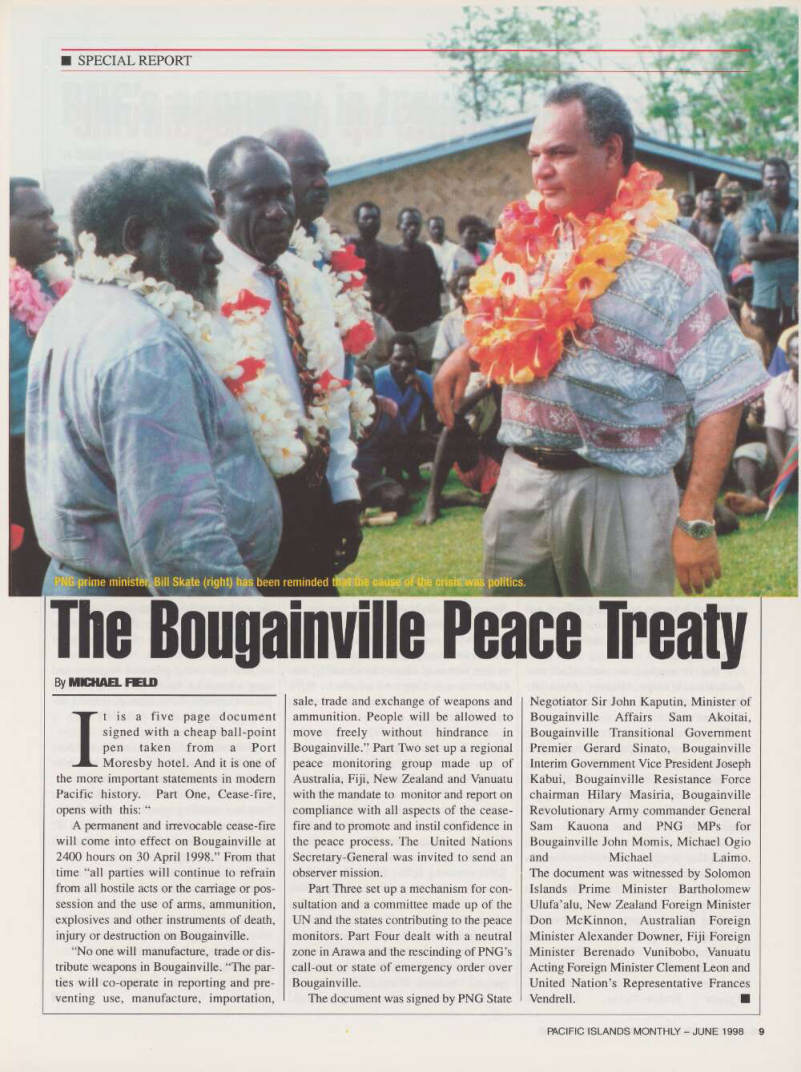
PNG prime minister, B ill Skate (right) has been reminded that the crisis was politics.
ANZAC rivalry heats up on Bougainville
By Michael Field
By even the celebrated standards of Pacific speech-making, the peace ceremony on Bougainville was an endurance event.
Twenty speeches, all of them saying much the same thing, were mostly in the melodious Tok Pisin (Pidgin). Fiji Foreign Minister Berenado Vunibobo was probably the day’s hero his speech was over in less than a minute.
Bougainville Transitional Government Premier Gerard Sinato needs some work on technique, and timing. He called for four minutes silence in honour of the 15,000 dead.
The silence, marked by the squealing of pigs under the stage that were soon to give their life at a peace banquet and the sound of a helicopter patrolling the hills, lasted less than a minute.
One of the more jarring tensions at the day was that between Australia and New Zealand.
Wellington broke most of the major diplomatic rules in engineering the war’s end and it is known now that Canberra and Port Moresby initially sent a barrage of angry cables protesting at the way things were being done.
But it worked so well that now Australian Foreign Minister Alexander Downer claims it was, surprisingly, Canberra’s initiative.
Peace Day on Bougainville began in Port Moresby with Anzac solidarity. Two RAAF Hercules and an RNZAF Hercules ferried ministers, officials and journalists on the two and a half hour flight to Aropa, Bougainville. For most it was the toughest flight of their lives.
On arrival an Australian officer insisted on briefing people on their behaviour. As the engines were still running and heli copters landed nobody trapped in the hot RAAF plane could hear a thing. A New Zealand Army officer took care of the media and immediately introduced a calm kiwi approach to life. The PNG media were represented in force but the interna tional media were thinly represented Agence France-Presse, Australian
Associated Press, Australian
Broadcasting
Commission, the
Australian, Fiji
Review, the Financial Times of London, Pacific Islands Monthly and Television New Zealand. And a crew from Korea
Broadcasting who
seemed not to know all day where they were or what it was all about, spent the
day filming every speech.
After an exciting low-level helicopter dash up the coast the VEPs were assembled; New Zealand Foreign Minister Don McKinnon in an All Black’s hat, Downer wore an orange floppy hat from the Truce Monitoring Group (TMG).
Vunibobo, with his stock of white hair, didn’t wear a hat in the pounding hot sun.
He seemed everybody’s friend that day.
The evening before he had been in a
remarkably casual diplomatic exchange
when, over champagne, Downer walked up to him and said, almost incidentally, that Canberra was happy to accede to Fiji’s request for a change in the rules of origin over textile exports.
It was a big deal for Fiji, yet it was just slipped into conversation apropos of noth ing in particular. Downer by Peace Day had dropped his line about his personal invention of peace on Bougainville but only in an almost dismissive way, acknowledged in his speech that New Zealand had done some of it.
Peace Day saw the command of the TMG switch from New Zealand to Australia. The Australian soldiers were tense and unhelpful; the kiwis were tired and homesick. The Fijians and the ni- Vanuatuans seemed content and unfazed by the tensions in the Anzac ranks.
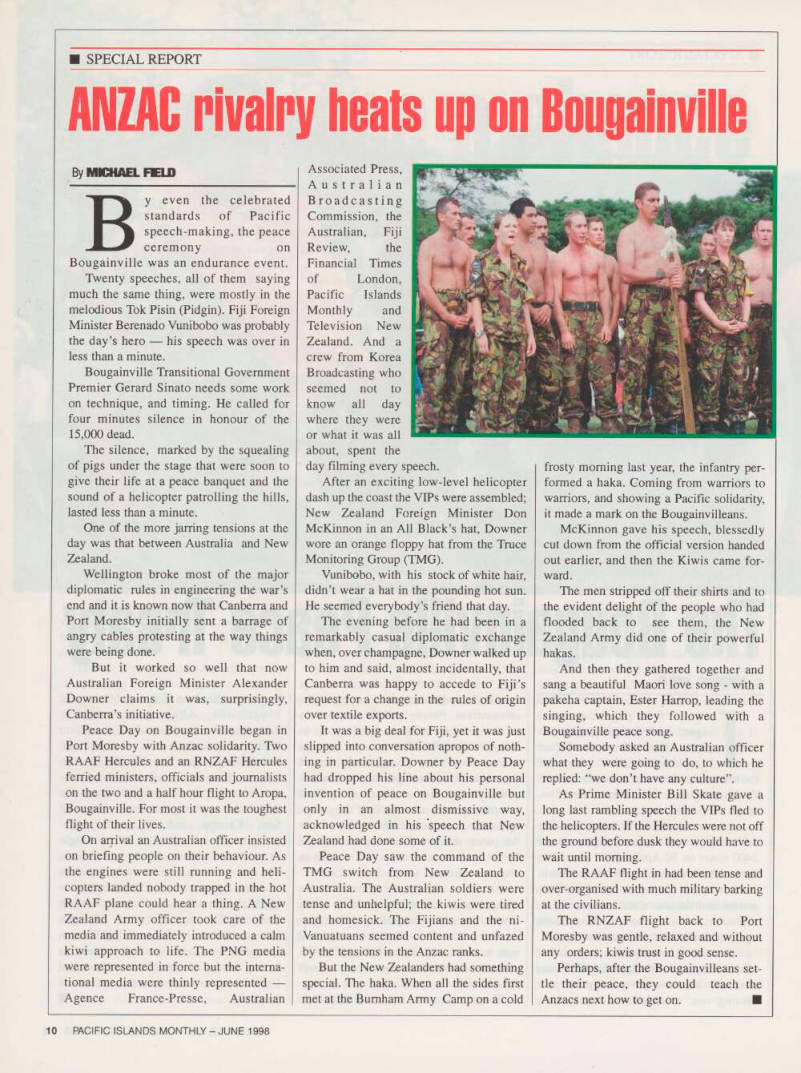
But the New Zealanders had something special. The haka. When all the sides first met at the Burnham Army Camp on a cold
frosty morning last year, the infantry per formed a haka. Coming from warriors to warriors, and showing a Pacific solidarity, it made a mark on the Bougainvilleans.
McKinnon gave his speech, blessedly cut down from the official version handed out earlier, and then the Kiwis came for ward.
The men stripped off their shirts and to the evident delight of the people who had flooded back to see them, the New Zealand Army did one of their powerful hakas.
And then they gathered together and sang a beautiful Maori love song - with a pakeha captain, Ester Harrop, leading the singing, which they followed with a Bougainville peace song.
Somebody asked an Australian officer what they were going to do, to which he replied: “we don’t have any culture”.
As Prime Minister Bill Skate gave a long last rambling speech the VIPs fled to the helicopters. If the Hercules were not off the ground before dusk they would have to wait until morning.
The RAAF flight in had been tense and
over-organised with much military barking
at the civilians.
The RNZAF flight back to Port Moresby was gentle, relaxed and without any orders; kiwis trust in good sense.
Perhaps, after the Bougainvilleans set tle their peace, they could teach the Anzacs next how to get on. ■
PNG's economy in trouble
Budget
By Sam Vulum
PAPUA New Guinea’s ail ing economy appears to have taken a downward slide in recent months although the Government says other wise.
A widely publicised economic state ment by Prime Minister Bill Skate on May 15, which downplayed the gloomy out look, strongly contradicts public percep tion and independent expert commentaries about the reality of the situation.
According to one observer, professor and head of the Economics Department at the University of Papua New Guinea, Dr H G Mannur, the economy is in “deep dis tress, if not in serious crisis”.
Dr Mannur said in a recent column in the university’s newspaper, the Uni Tavur, that the kina was sinking fast, foreign reserves were not enough to keep the cur rency stable, the inflation rate was rising, unemployment was defiant and there were chronic power and water shortages. He said that investor confidence was also declining on the face of the falling kina and
rising crime.
Skate’s statement announced there had been considerable improvement in the eco nomic outlook during the first three months of 1998 and the pace of improve ment should increase during the next few months. He said the budget was on target and fiscal disciplines were taking hold.
The PM said there had been improve ment in the prospects for mining and agri cultural exports following the breaking of the drought. He added that there had been
an improvement in commodity prices and
about $US150 million in investment has come into the country. Also a sale of $US50 million in overseas shares was being remitted to PNG over the next few weeks. Among other things, the PM touched very lightly on what has been the most worrying concern for many Papua New Guineans - inflation.
“I have recognised that the exchange rates have caused inflationary pressures which are hurting our urban dwellers who rely on imported food and we are moving to ease the problem,” the PM said. “At the
same time, the exchange rate has helped the rural population and began the neces sary processes of opening up urban areas for rural produce.”
Despite these assurances, economic developments in recent months portray a very gloomy future.
The cost of most imported goods in the major retail outlets has rocketed since April. Two major local manufacturers also plan to increase the price of their food stuff between eight and 35 per cent. Sugar Producer Ramu Sugar was expected to increase its prices by 10 per cent by the end of April and the price of James Barnes, the producer of canned meat, is expected to rise about 15 per cent by the beginning of July. International Food Corporation shut its doors in April after the Price Controller turned down three requests for a price reprieve.
In what appears to be direct response to the worrying economic trend, the govern ment has recalled a displaced former department of finance secretary, John Vulupindi, to the public service as Governor of the Bank of PNG. Vulupindi replaced a promising young career officer Koiari Tarata who, until his dumping, had performed extremely well. The govern ment had only just reappointed Tarata for a second term “in the interest of continuity and stability in the key financial institu tion”. The sacking quickly drew criticism from former finance minister Chris Haiveta who said the timing was inappro priate. Haiveta’s short tenure in office saw a significant increase in foreign exchange reserves to nearly KBOO million in September 1997. He said “this will lead to a total loss of confidence in the market place.” Haiveta was sacked from govern ment following controversy over the Mujo
Sefa videotapes.
By early 1998, the reserves suddenly
fell to K2OO million, putting downward pressure on the kina. The government ini tially appeared to be at a loss over what to do to safeguard the currency. Skate announced that government would let the market forces determine the value of the kina. “There will be no move by my gov ernment to peg the kina,” said Skate. “We are advised by the World Bank to allow the
kina to remain around 50 US cents. In fact, it remains around that rate without inter vention but guided by market forces. Our policy is to allow the market to continue determining the rates based on supply and demand.”
The government is also seeking about SUSI7S million in loan support from the World Bank and another SUS7S million from the IMF to bail out the economy.
Both institutions are understood to be still analysing the 1998 budget to see if govern ment has complied with loan conditions set
by them. Both imposed structural adjust
ment programmes four years ago geared towards restructuring certain institutions and apparatus of the PNG economy.
The sale of oil and gas exploration and production assets of a major investor, BP, to local company. Oil Search, in May is another indicator of the worrying econom ic trend. The transaction, worth SUS4OO million, is believed to be the biggest deal ever by a PNG company. The deal does not include BP’s other commercial activities in PNG - retail and wholesale businesses including petrol stations and other busi nesses.
Skate said “the transaction shows that investors and financiers have great confi dence in PNG in general and our oil and gas industry in particular”. Opposition leader Bernard Narokobi warned this may be the “beginning of an end” for PNG’s
mining and petroleum industry.
In a further attempt to explain the situa tion, Skate agreed the main concerns now are the rate of exchange, particularly with the Australian and United States dollars, and the high interest rates. He blamed the World Bank and IMF for contributing to the problems. “While the drought was a major factor in our problems, another fac tor was the failure by the World Bank and
the IMF to provide expected budgetary
support of SUSIBO million to the 1997 budget following the Sandline incidents.
Because this money was not forthcoming, we had to borrow K3OO million on the
domestic market, causing a liquidity prob
lem and pressures on both exchange and interest rates. Another factor is the nation al reliance on imported foods. For every kina which is spent, over 60 toea goes into purchasing imported goods. Thus the wealth of our mining industry, instead of circulating within our own economy, is
rapidly being spent on imports”. ■
Advertisements & other items, p. 12 (1 item)
Quality Print Limited
With the recent purchase of a second four colour printing press and a successful bid for the purchase of Printworld, Quality Print is now Fiji’s premier printing company.
Offering fast and reliable service to our customers for the past sixteen years is what really keeps us on top.
For all your commercial printing and packaging needs, give us a call today.
QUALITY PRINT LIMITED
COMMERCIAL PRINTING & PACKAGING
I 6 Amra Street, Walu Bay, Suva. Phone: 31331 1,313369, 3 13537. Fax: 301 133. E-mail: [email protected] SB
NOTICE TO ALL PRINTWORLD CUSTOMERS
For your on-going printing requirements, your enquiries will be met swiftly and efficiently if you call QUALITY PRINT, the new owners of PRINTWORLD.
Pacific aviation vulnerable to attack
Aviation
By Sophie Foster Hildebrand
Most Pacific Island countries are
extremely vulnerable
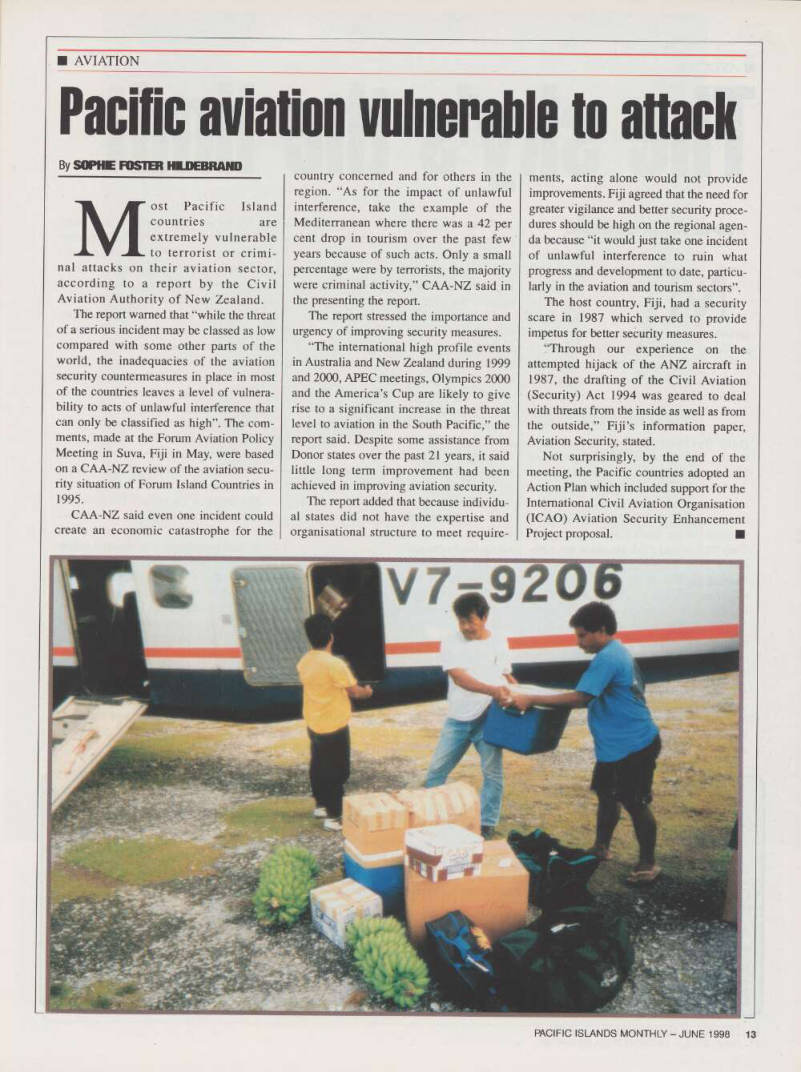
to terrorist or crimi nal attacks on their aviation sector, according to a report by the Civil Aviation Authority of New Zealand.
The report warned that “while the threat of a serious incident may be classed as low compared with some other parts of the world, the inadequacies of the aviation security countermeasures in place in most of the countries leaves a level of vulnera bility to acts of unlawful interference that can only be classified as high”. The com ments, made at the Forum Aviation Policy Meeting in Suva, Fiji in May, were based on a CAA-NZ review of the aviation secu rity situation of Forum Island Countries in 1995.
CAA-NZ said even one incident could create an economic catastrophe for the
country concerned and for others in the region. “As for the impact of unlawful interference, take the example of the Mediterranean where there was a 42 per cent drop in tourism over the past few years because of such acts. Only a small percentage were by terrorists, the majority were criminal activity,” CAA-NZ said in the presenting the report.
The report stressed the importance and urgency of improving security measures.
“The international high profile events in Australia and New Zealand during 1999 and 2000, APEC meetings, Olympics 2000 and the America’s Cup are likely to give rise to a significant increase in the threat level to aviation in the South Pacific,” the report said. Despite some assistance from Donor states over the past 21 years, it said little long term improvement had been achieved in improving aviation security.
The report added that because individu al states did not have the expertise and organisational structure to meet require -
ments, acting alone would not provide improvements. Fiji agreed that the need for greater vigilance and better security proce dures should be high on the regional agen da because “it would just take one incident of unlawful interference to ruin what progress and development to date, particu larly in the aviation and tourism sectors”.
The host country, Fiji, had a security scare in 1987 which served to provide impetus for better security measures.
“Through our experience on the attempted hijack of the ANZ aircraft in 1987, the drafting of the Civil Aviation (Security) Act 1994 was geared to deal with threats from the inside as well as from the outside,” Fiji’s information paper, Aviation Security, stated.
Not surprisingly, by the end of the meeting, the Pacific countries adopted an Action Plan which included support for the International Civil Aviation Organisation (ICAO) Aviation Security Enhancement Project proposal. ■
The sky's the limit

By Sophie Foster Hilderrand
Most people see the
Pacific as sun, sea, and surf... forgetting that a tremendous amount of activity takes place above sea-level - where, literally, the sky is the limit. For decades, the airspace above the Pacific has been divided on maps, and jurisdictions, with airlines having to seek approval from each country whose territo ry they were flying over. But all this is going to change. In fact, some people would say that the Pacific Aviation
Industry is going through a revolution.
“It is a momentous time, and the region is coming together in aviation in a way that we haven’t seen before,” Acting Secretary General for the South Pacific Forum, Mr Tony Slatyer told PIM. He made the com ments after the Forum Aviation Policy Meeting (FAPM) in Suva, Fiji in May, but said there was a lot of work to do in bring ing this revolution about.
The positive point was that the key political decisions about the direction of change, which are usually the hardest to settle, have been agreed upon at the meet ing. In particular the Forum Island aviation ministers adopted an Action Plan for avia tion and agreed to work towards combin ing the region’s airspace. This, Mr Slatyer said, “reflects the reality of the situation”.
“It is a single body of air through which planes fly but is currently divided in all sorts of ways by lines on maps and author ity for undertaking air communications responsibilities and the region is looking at rationalising all that,” he said.
At FAPM, Ministers laid the policy framework for the new developments including, in the liberalisation section of the Plan, ways that governments could set rules for aviation operations.
One of the biggest concerns at FAPM was that small countries got “a pretty rough deal” when it came to negotiating air service agreements with larger countries outside the region. Mr Slatyer says, “at the very least we want a level playing field in those dealings. Ideally we would want the difficult situations of small island countries to be recognised so that they get favourable treatment in those negotiations rather than
being disadvantaged”.
“The outcome of the ministers discus sions on liberalisation of services was that, as much as possible, we would be trying to remove impediments to services that exist within the region, so if that implies a level playing field within the region, then that’s one conclusion you can draw,” he said.
“Ministers are saying that they want to pursue in the aviation sector the kind of economic reforms that have been pursued in other economic sectors through the Forum Economic Ministers’ Meeting.
“Generally the objective is to make it
possible for airlines to operate with more flexibility so that they can serve people better,” he said. At FAPM, airline represen tatives were supportive of the develop ments which, they said, should add increased safety and efficiency to the Pacific aviation industry. “At the moment, the network of bilateral agreements tends to inhibit what airlines can do to serve the countries and people of the region. These bilaterals have developed over decades and each is putting on another layer of rules that need to be observed by air carriers.
“The policy direction that was set at the meeting is to rethink that whole system with a view that airlines should be able to operate with the most possible flexibility,”
Mr Slatyer said.
The decision on greater flexibility of operations within the region is not particu larly limited to inter-island services, but could also incorporate international airline operators. The main implication of these changes is that it should reduce costs to the airlines while, at the same time, maximis ing benefits to the Forum Island Countries, and providing a safer environment for air services. When asked why, if it is a win win-win situation, it hasn’t been imple mented before, Mr Slatyer said; “I think they’ve been other problems that had to be dealt with before. The region is now at the stage where it is ready, able and willing to do this one. It is being dealt with now, that’s the important thing”.
Whether or not the region is able to cap italise on the changes to the aviation policy will depend on how it is all structured and
brought about.
“We want a situation where better air services are assisting in the economic development of the region, which means that cost to travellers have to be as low as possible, it’s services have to be regular
and as frequent as possible and that ser vices are as safe as possible.
"The Plan itself indicates its broad objectives and that includes better service for the Pacific at the lowest possible cost and in the safest possible way.
“They may not be the ministers’ exact words but those objectives are woven all through this document,” Mr Slatyer said.
Regional aviation ministers have since been asked, by the Forum, to forward pro posals that will serve those three objec tives.
“What we hope to do is get away from every country managing its air service agreements in a box, and achieve a more co-operative relationship which will be in everyone’s interest,” Mr Slatyer said. ■
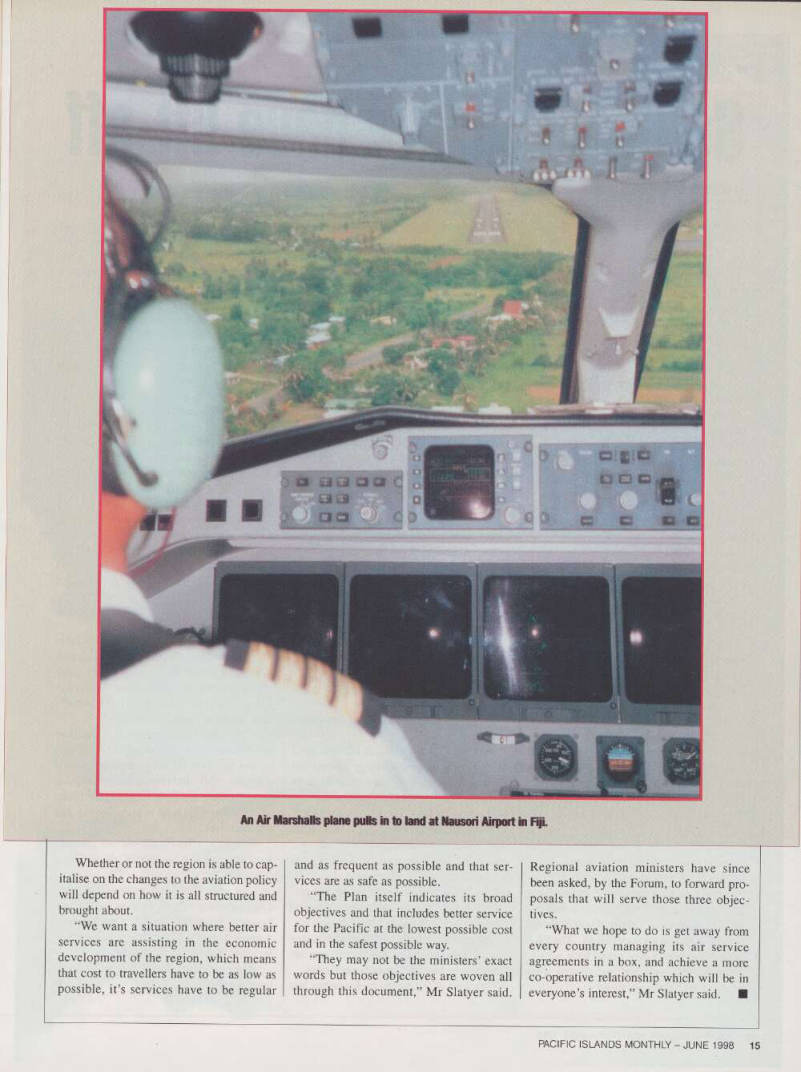
An Air Marshalls plane pulls in to land at Nausori Airport in Fiji.
Advertisements & other items, p. 14 (1 item)
ffi| Japanese Used Vehicles
Exporting around the Pacific
Fiji, Kiribati, Palau, Nauru Is, Norfolk Is, Solomon Is, Papua New Guinea, Niue, New Zealand, Tonga, Samoa.
All Shipping and Documentation arranged for YOU. Buy direct from Japan and save sss. Vehicles from USDSIOOO plus Freight.
Fax today for your Order form and List of Vehicles. Big Selection of used Japanese Motor vehicles.
Special P.I.M. Offer. $lOO off your purchase with this advertisement. r
Trust Company Ltd
Kobac Bldg 3F, 3-2-26 Nishiki Naka ku, Nagoya 460, JAPAN Phone (81) 52 953 5602 Fax (81) 52 953 5634/1
Sea Launch, we have lift-off
Aerospace
By Michael Field
The world’s biggest
aerospace company is on target for an ambitious mid-sea rocket launching programme which seems set to dump tonnes of space hardware and fuel right in the middle of the Pacific Ocean.
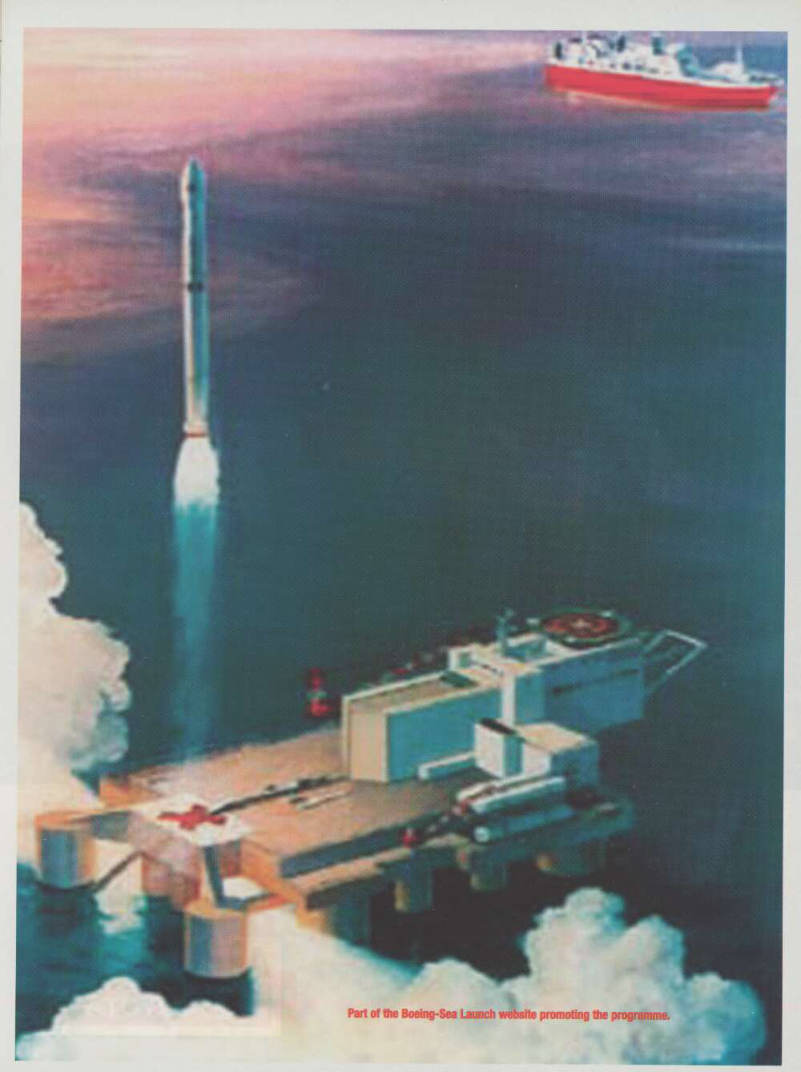
Sea Launch Ltd, a joint venture involv ing Boeing Commercial Space Company and companies from Russia, Ukraine and Norway and registered in the Cayman Islands, will use a modified North Sea oil drilling platform from the Equator at longi tude 154 West, 800 kilometres (500 miles) south-east of Kiritimati Atoll in Kiribati.
The company has a purpose built com mand ship and will use Ukrainian and Russian rockets to launch satellites into geostationary orbit for commercial cus tomers. The first of 18 firm launches sold to date, at SUS4O million apiece, will see a Galaxy XI satellite for PanAmSat launched in October.
The Equatorial launch site ensures a geostationary rocket needs little manoeu vring to reach the desired orbit.
By picking international waters it may also be that Boeing and Sea Launch are trying to escape close environmental
scrutiny.
In the late 1950 s Britain tested nuclear bombs at Kiritimati causing devastation to the wildlife and now the Apia based 22nation South Pacific Regional Environment Programme (SPREP) fears Sea Launch will harm migratory birds and turtles, dump tonnes of carbon monoxide (CO) in the troposphere and create kerosene slicks on the water.
SPREP is also worried at the human safety considerations with many small fishing boats in the area.
Sea Launch produced an Environmental Impact Assessment (EIA) which was last month submitted to the United States Federal Aviation Agency (FAA). The FAA believe the launchings would have no sig nificant environmental impact and were ready to give it the go-ahead.
SPREP had just two weeks between receiving the big EIA and May 22 when they could make a submission calling for an Environmental Impact Statement, a more complex process which would have delayed the launch and allowed for a more detailed look. Although Sea Launch has spent millions over three years on its pro gramme, it appears unusual that it man aged to squeeze its environmental consent process into little more than a month.
SPREP had no chance to consult all its member states.
The EIA says approximately 44,700 kilograms of liquid oxygen and 17,000 kilograms of kerosene would be burned below 2,000 metres. Approximately 36,100 kilograms of CO would be pro duced. Each launch will produce a kerosene slick several kilometres wide as about 4.5 tons of kerosene fall unbumt on the way down. The first and second stages of the rockets, containing residual fuels, would also fall into the Pacific.
A preliminary SPREP assessment noted the launch site is in the vicinity of a signif icant migratory fly-way associated with the enormous bird rookeries at Kiritimati Island. It is also home to marine turtles.
There is also the question of what the noise would do. Sea Launch said its rock ets would produce 150 decibels at 378 meters, and a predicted 75 decibels in the water at the same distance.
It is not known what effect this would have.
SPREP marine pollution adviser Steve Raaymakers in a preliminary assessment circulated to member states said the ElA’s description on the marine environment on the launch site was “entirely inadequate”.
“Significant inferences have been made from extremely limited data,” he said, and added full baseline studies of all trophic levels over a range of seasons should be conducted at the site to provide a true pic ture of the ecological value and biological productivity of the area.
He said when Boeing found an absence of data they concluded that the marine life values were low and impacts negligible.
The idea of letting the rocket stages just
sink into the Pacific was “contrary to best practice environmental management”.
“Regardless of real or perceived envi ronmental impacts caused or not caused by such activities, such a view of the Pacific Ocean as a dumping ground for industry’s waste is unacceptable to Pacific Island
peoples.
“Sea Launch should adopt a more responsible philosophy and ethical attitude to the international marine environment and other countries’ ‘back-yards’ than viewing it as a waste dump.”
Two months ago Boeing sent officials Marcus Nance and Viola Brady to Kiribati and Samoa to explain the programme.
Brady, a legal officer, told SPREP that if it was not for the “obvious environmen tal and safety and other issues we could launch right on the beach” near their
Californian headquarters.
Nance answered the question why they did not just rent an island.
“Launching from sea greatly reduces the close proximity of environmental effects you get on land. In Australia, for example, off Cape York, you get a lot of crocodiles. In the ocean you tend to have less of those life forms.”
He said that they wanted to launch from the equator, partly because there’s less pull from the earth at the equator so it’s more efficient, “and it’s away from land mass and peoples and away from environmen tally sensitive areas.”
“The launch area ecosystem is resilient and relatively low in biological productivi ty, and far removed from sensitive coastal margins. ...All the research we’ve done suggests there are not a lot of higher forms of life there. Fish tend to be in waters that are shallower.”
Boeing’s efforts appear to counter Kiribati’s own to develop Kiritimati as a spaceport.
Last year Kiribati President Teburoro Tito said a deal was about to be signed with
Japan’s National Space Development
Agency to use Kiritimati as a landing site for their Hope-X space shuttle.
Kiritimati currently hosts a Japanese tracking station. ■
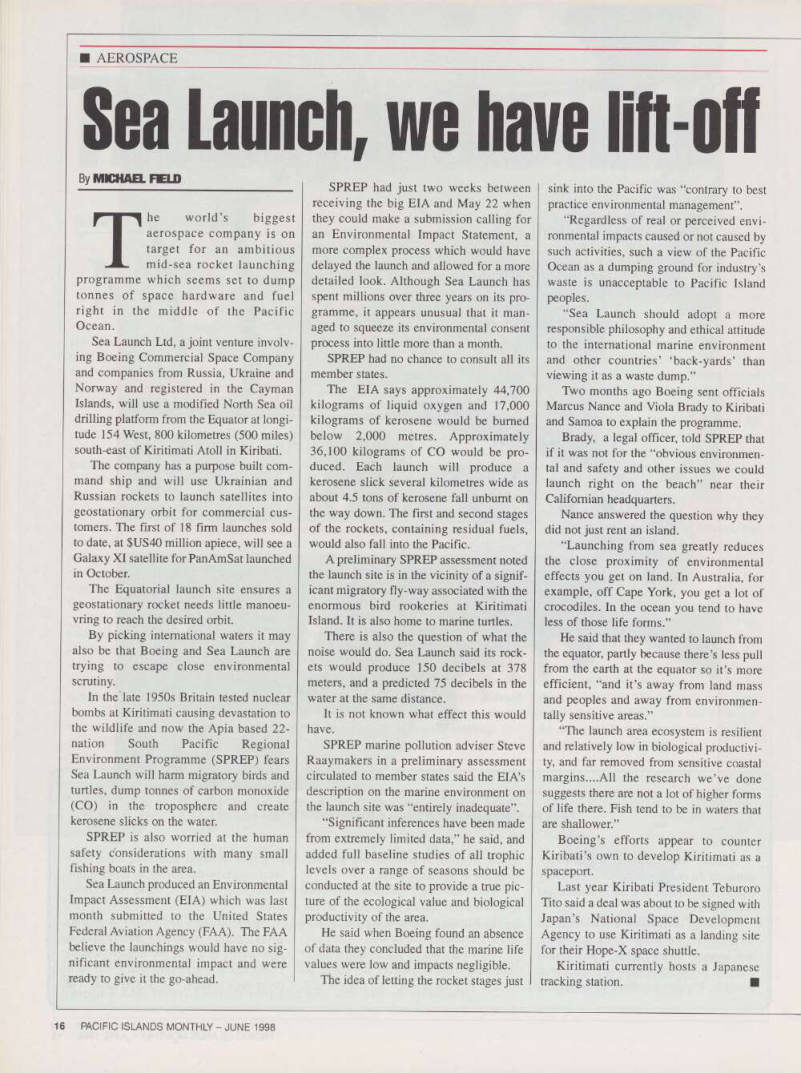
Part of the Boeing-Sea Launch website promoting the programme.
Advertisements & other items, p. 18 (1 item)
Land Cruiser
ascends to a new, higher plain. 1
SSK
w# mi
TOYOTA
□I
YEARS
Building upon a tradition of distinction and pride the reigning King of 4 Wheel Drive attains an even greater pinnacle in 4x4 excellence. Renowned rough road performance and rugged dependability are further refined in the new Land Cruiser.
Available with turbo diesel power, at Asco Motors, right now.
The all-terrain conqueror
LAND CRUISER
SUVA 384888 WALU BAY 307808 SI6ATOKA 500577 NADI 721777 LAUTOKA 662855 BA 674406 TAVUA 680152 LABASA 811688
Asco Motors
TOYOTA
An environmental breakthrough

Motoring Feature
Since its founding, Toyota
Motor Corporation has conducted its many diverse activities with the motto:
“enriching society through our auto
mobiles”.
Through its outlet, Asco Motors in Nabua, outside Suva, the company contin ues to provide attractive, timely products that meet customer needs and offer a luxu rious lifestyle to customers in Fiji.
Conducting fair, open business prac tices has always been an important part of their efforts to develop environmentally friendly, safe automobiles.
With this in mind, on May 15, Asco Motors launched the Land Cruiser 100 in Fiji - a vehicle with comprehensive eco logical considerations.
Two newly developed, high-efficiency engines provide improved fuel consump tion compared to previous models.
The improvement is about seven per cent for the gasoline engine and around nine per cent for the diesel turbo engine, contributing to the reduction in carbon dioxide emissions.
To provide a major decrease in the lev els of nitrogen-dioxide and particulate mat ter emissions, the Land Cruiser 100 is equipped with a high pressure fuel injector, highly efficient turbo-charger and improvements in the combustion chamber on the 4.2-litre direct-injection diesel turbo engine.
The company says “even under difficult conditions, such as at high altitude, the black smoke that is characteristic of diesel engines is kept to virtually imperceptible levels”.
The improvements in combustion also mean that the engine oil, which in older models had to be changed every 10,000 kilometres, now only needs changing every 20,000 kilometres.
In another move which has roughly halved the total lead content of the vehicle, thus halving environmental impact, the radiator, heater core, battery cable termi nals and wire harnessing materials - which previously contained lead - were replaced with new materials with no lead.
The highly recyclable Super Olefin Polymer is used both outside, for the
bumpers and cladding panels, and inside, for the instrument panel and garnish.
Since the Land Cruiser made its debut in 1951, its performance over rough roads and its overall mobility, durability, and reliability have won it a reputation as the 4WD sport utility vehicle of choice for a wide range of tasks.
In countries around the world, it is driv en by UN organisations and is used as a rescue and aid vehicle, as a satellite broad cast car, and for various patrol duties.
In the 100 series, the interior space has been enlarged by increasing the cabin length by 30mm and the width by 105 mm.
The second-row seat leg space has been increased by 70mm through this.
The Land Cruiser 100 TEMS is based on the “skyhook theory”. This theory is that when a vehicle is subjected to the shocks of surface irregularities input via virtual shock absorbers, the wheels are controlled to move up and down to main tain the body’s ‘mid-air’ position.
TEMS adjusts the shock absorber stiff ness to one of 16 settings according to vehicle speed and road conditions, helping to achieve the optimally comfortable ride.
In the pursuit of the dual crowns of “King of 4WDs” and the “Top of SUVs”, the Land Cruiser 100 represents a major
evolution of the traditional Land Cruiser’s performance qualities to the highest possi ble level, with further emphasis on safety and environmental considerations than ever before. ■
Advertisements & other items, p. 19 (1 item)
Blairs
REPLACEMENT
BMW
Bedford Cummins Daihatsu Detroit Deutz Ford Gardner Hino Isuzu Iveco Komatsu Kubota Phone: 643 6938122 Fax: 643 6938120 Email: [email protected]
BLAIRS
PO Box 14 Geraldine New Zealand Subaru Leyland Mazda Mercedes Mitsubishi
MAN.
Nissan Perkins Suzuki Toyota Volvo Yanmar
• DIESEL .PETROL
TRANSMISSIONS
New Parts •Second Hand Parts'
SPECIAL
As new Isuzu Industrial Stationery diesel engines Model C240,4cy1, 2369 cc, 52hp adn 2500 rpm Suitable: Generator, Waterpump, Forklift, Loader
LIMITED SUPPLY
The lure of quick riches
Cover Story
By Sophie Foster Hildebrand
According to the Oxford English dictio nary, to gamble is to “play games of chance for money; take great risks for the chance of winning something or mak ing a profit”. In the Pacific, where most people barely make enough money to stay above the poverty line, gambling, or gaming as some govern ments prefer to call it, has taken hold in a big way. The Pacific experience with gambling though is almost as wide as the ocean itself. While some Pacific countries have outlawed gaming after only a few years of running it, others have embraced it as the new saviour in the war to win the tourist dollar. In Micronesia, in the north ern Pacific, the Marianas island of Tinian,
off Saipan has only recently witnessed the opening of a casino while the neighbour ing Marshall Islands law-making body, the Nitijela, has outlawed such activities after two years of condoning it.
In Melanesia, the Solomon Islands has passed a law which will see casinos thrown out by 1999. Fiji, which had been serious ly contemplating its introduction, recently rejected a proposal for casinos in the coun try. In rejecting casinos, Prime Minister Sitiveni Rabuka said “in any case, our hotel industry has developed and is so far operating without any demands for licences”.
Of all the Pacific Island States to grap ple with the touchy issue of gambling though, the Papua New Guinea experience is one that is sobering. There, gambling, in the form of casinos and slot-machines, is seen by locals and visitors alike as almost a curse on the population. Professionals
often find themselves in debt because of it and most find it hard to kick the habit.
Indeed, gambling is an addictive activi ty. One Port Moresby local said, “I have only just managed to get off it. I don’t ever want to go into a casino again”.
The lure is quick riches. And through out the Pacific, gambling in all its forms can be seen: whether it is over the internet, with slot-machines, casinos, Black Jack, Spin The Wheel, “scratchies”, lotteries or Cards. The problem that most people who gamble face, in the Pacific especially, is that not all who do it can afford what often turns out to be an expensive habit.
This is the biggest concern of most Pacific church groups in countries where governments are considering the introduc tion of gambling. In Fiji, a government commissioned report stated that no new forms of gambling should be introduced to the country until adequate legislative con-
trols were in place and further research had been done. Mr Rabuka said however, “allowing casino operations would be detrimental to low income and other vul nerable groups, particularly if entry into casinos were not restricted”. President of the powerful Methodist Church, Reverend Doctor Ilaitia Tuwere, said gambling appeared to be a device used to evade, rather than face, national responsibilities.
“The Methodist Church hopes the gov ernment of the day will think carefully and responsibly before reaching a decision,” he said. It was in the face of all this that the Fiji Government late last month rejected the introduction of casino operations in the country. Even now, the relevant authorities in Fiji are powerless to control the spread of the illegal slot-machines, or one-armed bandits as they are commonly referred to.
One Suva club had the machines installed amid uproar from the Solicitor-General’s Office. At the time, the SG, Nainendra Nand, said “just because there is no legis lation covering it does not mean that peo ple are allowed to operate them. There has to be legislation in place for the industry to operate”. That was nine months ago, and
the bar is still running the machines, evad ing both police and Customs investigations into how the machines got through securi ty checks. The Customs Investigation died a quick death, with department officials accepting that the machines were for “amusement”. The company’s reason was that the one-armed bandits had been con verted so that only tokens could be used, and winnings are redeemable for food and drinks at the bar. The argument over the “gamble” that people were taking when using the machines was swept away amid bureaucratic red tape.
With most other Pacific countries like the Solomon Islands, the Marshalls Islands had said that gambling would be controlled so that locals could not just walk off the street and into a casino.
However, as both the Solomon and Marshallese experiences show, restrictions are not always enforceable, and most casi nos will not turn away potential customers.
It was that lack of enforcement which prompted church officials in the Marshalls and concerned locals to stage protests until the Nitijela eventually came to a majority decision to throw casinos out.
In the Solomons, it was the government that took the initiative to ban casinos which by their own admission were causing more social damage than benefits. Fiji Council of Churches general secreatary Sister Emi Frances said, “casinos have always been our concern, especially with our present economic climate. It would a risk to intro duce them at this time because poor people want to get rich quickly and put all their money in”. But in Fiji, as in other island countries, various forms of gambling to raise funds for “charitable organisations” still exist. Church organisations do it, sporting bodies do it, school committees do it, provincial councils do it. In Samoa and Fiji, a percentage of the profit made by the international Tattslotto has been used
to improve sporting facilities.
There is no doubt that the biggest lure for governments considering the introduc tion of gaming is that their revenue coffers will be filled through gaming licences, import duties and other taxes. But as some Pacific Island countries have bitterly found, sometimes the social cost is much more than the lure of quick riches can com pensate for. ■
Advertisements & other items, p. 21 (1 item)
Pacific Islands Yearbook
X) r Vi mm .
17th Edition
Learn more about
the Pacific
- culture!custom tradition! people - population, tourism, ' PACIFIC SAIO.OO trade, airlines, * USA & TERRITORY A 515.00 tax system etc * EUROPE & OTHERS $A17.00
PRICE
AUD
PLUS FREIGHT
Yes, send me the latest copy of the Pacific Islands Yearbook. □ Here is a cheque/ money order Q Visa Q Master Card Expiry Date.
Card Number.
Name Signature.
Address.
Post to: Pacific Islands Monthly, P O Box 1167 Suva, Fiji or Fax (679) 307460
Profit or paupers? The PNG dilemma
By Neville Choi
THE introduction of poker machines to Papua New Guinea caused an uproar throughout the nation and resulted in heated debates between those who foresaw its adverse social effects and those who saw the intro duction as the answer to their econom ic woes. The country’s waning economic situation at the time convinced many of the country’s 109 parliamentary members to vote for a parliamentary bill to introduce poker machines into the country.
In 1994, the gaming bill was passed by parliament with only five members voting against it. The mover of the bill was David Unagi, the sitting member of an electorate in the National Capital District. Mr Unagi, when he later became minister for Home, Youth and Religion, publicly apologised for moving the bill and admitted that gam ing machines were having an adverse
impact on society.
Following the introduction of gaming machines into the country, provincial gov ernments took advantage of the organic law which gave the power of gambling to them. To date only six of the 20 provinces in the country have not allowed poker machines to be introduced to their provinces. Now, some of the provinces which allowed gaming machines entry to their provinces are regretting their deci sion, and many more are proposing ways of eradicating the machines.
But despite their efforts, the gaming machine industry continues to prosper with more and more gaming sites being estab lished. As of March this year, a total of 110 gaming sites were recorded throughout the country. At present there are only three operators of gaming machines in the coun try. These are: Monian Group Pty Ltd, Pacific Corporation and Lord and Co.
Since being introduced, gaming
machines have contributed substantially to the economies of the 14 provinces which have them. For the first three months of 1997, gaming machine profits to the provinces totalled over K 1.7 million. The
profits, announced by then finance minister, Chris Haiveta, were described as being received by the 14 provinces “without any costs whatsoever” and he added that they were not to be used for “adminis trative overheads”.
Instead they were meant to develop the community in areas such as health services, youth train ing and development, and for “those who are less privileged and handicapped”. Since then, the gov ernment has increased taxes on gaming machine profits from 20 to 30 per cent. When announced in the 1998 budget, the three major opera tors and the PNG National Gaming Association expressed outrage at the tax increase.
They said the gaming industry was barely reaping in enough profit to keep the industry on its feet.
Their reasoning was that, with the
increase, the only people who would be directly affected were the operators them selves and not the punters, whose winnings would not be affected. The Gaming Association warned that further tax hikes would eventually “annihilate” the industry, predicting the closure of more gaming sites.
But this has not deterred the punters from “trying their luck” for some easy cash. Currently there is no particular law which governs the type of people who are allowed to play poker machines. Punters range from the ordinary betelnut seller to politicians and big businessmen - the latter group making up the majority of punters at
gaming venues. Only recently, the gover
nor of Madang Province, Jim Kas hinted that he would be allowing poker machines into the province. Madang was one of the provinces that totally condemned the intro duction of the machines when they were first brought into the country. Later, in 1995, they overwhelmingly voted against the introduction of gaming machines into the province. The base of some of the most vocal church, women’s and non-govem mental organisations in the country, Madang residents protested at the gover nor’s most recent decision. Last year, the Papua New Guinea Social Workers
Association (PNGSWA) called on the gov ernment to immediately consider the ban ning of poker machines in the country.
They said that some families were already approaching welfare offices in urban cen tres around the country where poker machines were located, complaining of fathers coming home with empty pay pack ets, leaving children and mothers hungry or ‘"to the charity of friends and relatives”.
The PNGSWA also stated cases where children were reported to be left in cars for many hours while parents were busy play ing poker machines.
The association carried out a poll in the Eastern Highlands Province and inter viewed 50 people. Forty-three of them called for the machines to be banned com
pletely in the province. Twenty-four of
those against were women.
Women’s groups throughout the coun try continue to fight against poker machines, even though close to 40 per cent of punters in the country tend to be women.
The churches in the country are also
continuing the “fight” against gaming
machines. But although these groups fight against this emerging social menace, gam ing machines have embedded themselves in PNG society and indications are they are here to stay. ■
A bitter pill to swallow
By Ofani Eremae
WHEN the new Solomon Islands Alliance for Change (SIAC) government came into power in August last year, one of its stated policies was to review the legislation governing gaming and lotteries, and all licences issued to casino operators.
Eight months later after surviving its first motion of no-confidence last month, the SIAC government announced the much-awaited news. It will not renew the licences issued to the three casinos current ly operating in the capital Honiara, when their licences expired on April 7, 1999. The announcement, though coming as a shock to the casino operators, was welcomed by many, particularly the Solomon Islands Christian Association (SICAj - a staunch opponent to the Casino Industry.
Announcing the government’s decision of the future of the Casino Industry, minister of home Affairs, Rev. Leslie Boseto said: “let me put it in no uncertain terms that no new licences will be issued as of April 7 next year”. Additionally, he is due to intro duce a bill to parliament later this year to review the Gaming and Lotteries Industry, with the view to reflect the SIAC govern ment’s policy whereby casinos will be
totally prohibited in the Solomon Islands.
“From then on, the full thrust of the SIAC government’s belief on gaming and lotteries will come into effect,” Rev.
Boseto, a retired Bishop of the United Church said. In its statement of policies, the SIAC government views the establish ment of casinos in the Solomon Islands as a misguided policy that breeds indolence and greed. “Casinos in the context of Solomon Islands can never be accepted as a genuine investment. Its approval as such is therefore deplorable. Genuine invest
ment must have as its basic objec tive the improvement of the wel fare of Solomon Islanders.
“Casinos do the opposite.
They create social prob lems, breed indolence, corruption and greed,” the SIAC
government says in its policy statement. It said Solomon Islanders are encouraged under successive governments’ develop ment programmes to actively participate in economic activities under the concept of entrepreneurship. "But this is watered down by the perception of quick money in casinos and Solomon Islanders are mould ed to become lazy and greedy. The escalat ing family problems and related social implications are clear evidence of a society that is systematically deteriorating by gov ernment initiated policy,” it said.
Rev. Boseto says that under the SIAC government’s policy, there will be no com mercial casinos operated either in public or private clubs and hotels. “The only excep tion will be state lotteries and games of chance for charitable purposes,” he said.
The first public casino came into operation in August 1994, when foreign-owned Honiara Casino was granted its casino
licence. Besides that, it was also given a five-year tax holiday and duty exemptions by the then Minister for Finance, Christopher Columbus Abe.
Before the first public casino came into operation, a Chinese-owned private club, the Super Club, had been operating a gam ing business, but only for members of the club. It was only after the introduction of the first public casino that the negative effects of casinos were felt in Honiara.
A couple of months later, the Gaming and Lotteries Board granted another casino licence to the owner of Super Club, Patrick Leong, a naturalised Solomon Islands citi zen, to operate the second public casino in Honiara. He named it Solomon Casino.
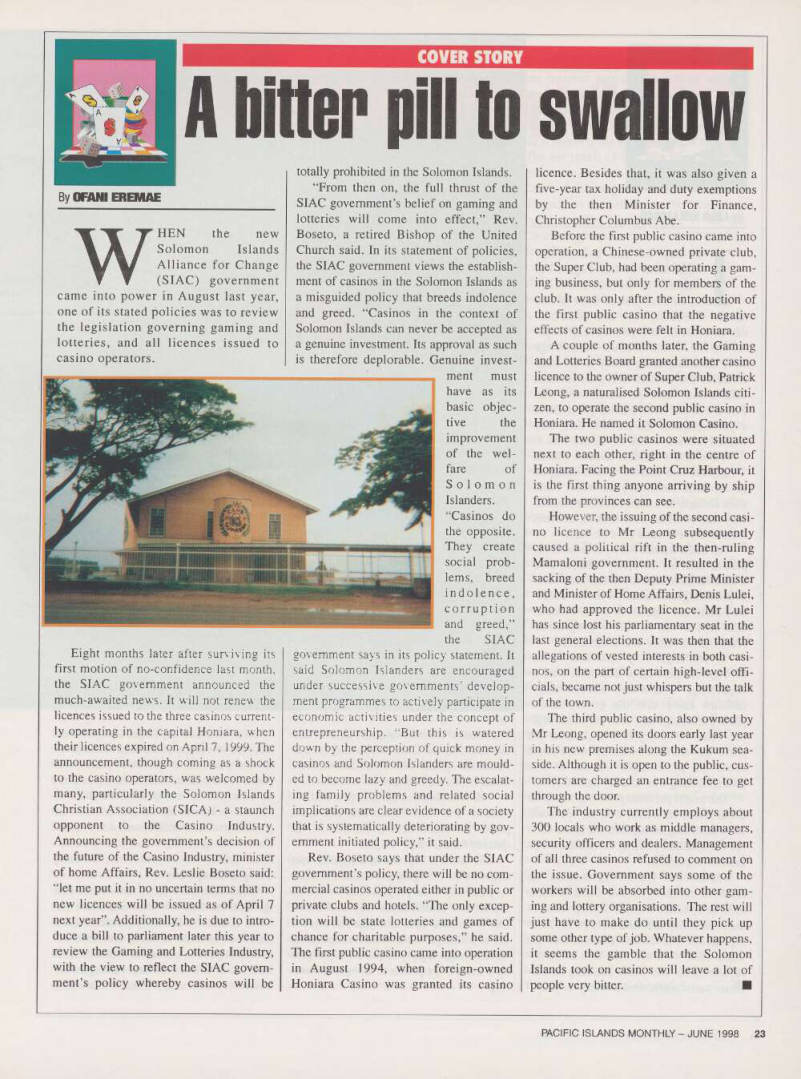
The two public casinos were situated next to each other, right in the centre of Honiara. Facing the Point Cruz Harbour, it is the first thing anyone arriving by ship from the provinces can see.
However, the issuing of the second casi no licence to Mr Leong subsequently caused a political rift in the then-ruling Mamaloni government. It resulted in the sacking of the then Deputy Prime Minister and Minister of Home Affairs, Denis Lulei, who had approved the licence. Mr Lulei has since lost his parliamentary seat in the last general elections. It was then that the allegations of vested interests in both casi nos, on the part of certain high-level offi cials, became not just whispers but the talk of the town.
The third public casino, also owned by Mr Leong, opened its doors early last year in his new premises along the Kukum sea side. Although it is open to the public, cus tomers are charged an entrance fee to get through the door.
The industry currently employs about 300 locals who work as middle managers, security officers and dealers. Management of all three casinos refused to comment on the issue. Government says some of the workers will be absorbed into other gam ing and lottery organisations. The rest will just have to make do until they pick up some other type of job. Whatever happens, it seems the gamble that the Solomon Islands took on casinos will leave a lot of people very bitter. ■
Net profit: cooking up a storm
By Lisa Williams
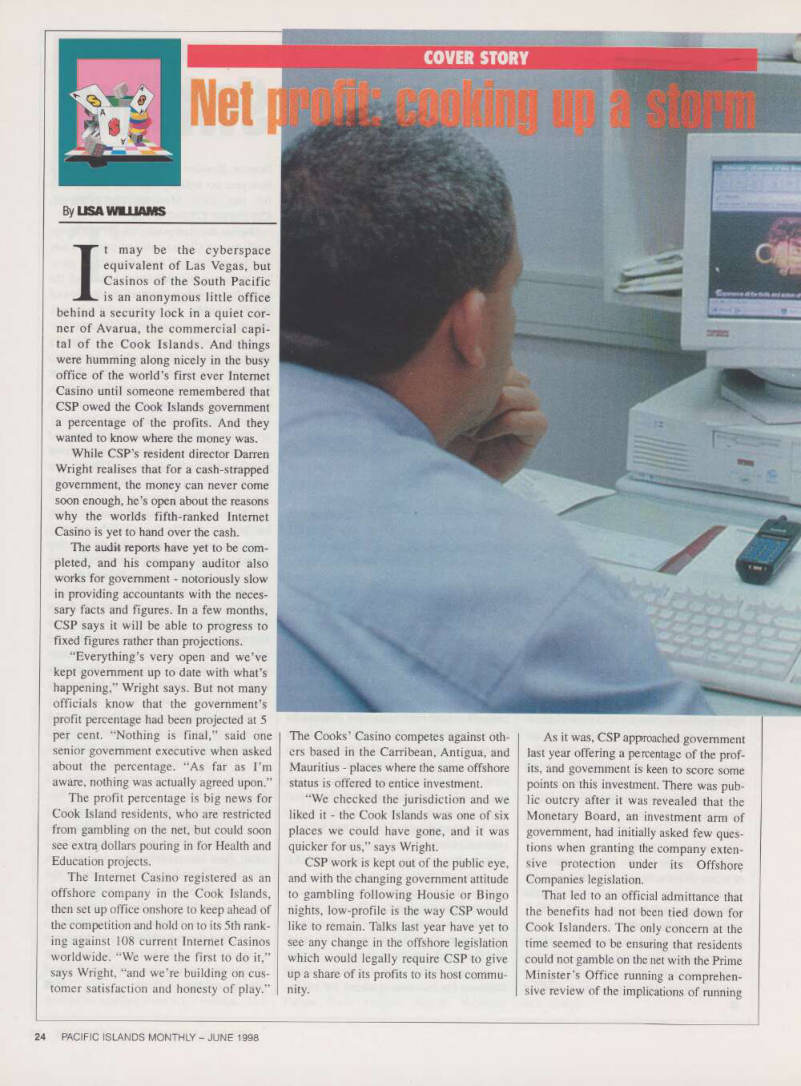
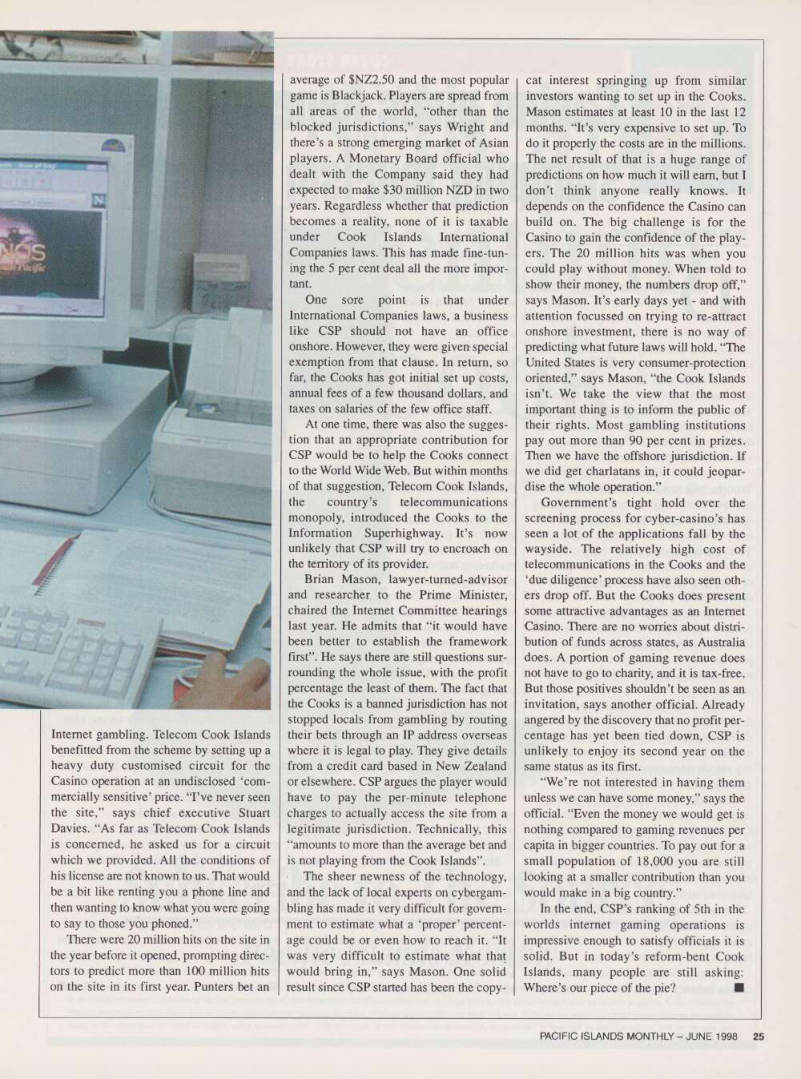
It may be the cyberspace equivalent of Las Vegas, but Casinos of the South Pacific is an anonymous little office behind a security lock in a quiet cor ner of Avarua, the commercial capi tal of the Cook Islands. And things were humming along nicely in the busy office of the world’s first ever Internet Casino until someone remembered that CSP owed the Cook Islands government a percentage of the profits. And they wanted to know where the money was.
While CSP’s resident director Darren Wright realises that for a cash-strapped government, the money can never come soon enough, he’s open about the reasons why the worlds fifth-ranked Internet Casino is yet to hand over the cash.
The audit reports have yet to be com pleted, and his company auditor also works for government - notoriously slow in providing accountants with the neces sary facts and figures. In a few months, CSP says it will be able to progress to fixed figures rather than projections.
“Everything’s very open and we’ve kept government up to date with what’s happening,” Wright says. But not many officials know that the government’s profit percentage had been projected at 5 per cent. “Nothing is final,” said one senior government executive when asked about the percentage. “As far as I’m aware, nothing was actually agreed upon.”
The profit percentage is big news for Cook Island residents, who are restricted from gambling on the net, but could soon see extra dollars pouring in for Health and
Education projects.
The Internet Casino registered as an offshore company in the Cook Islands, then set up office onshore to keep ahead of the competition and hold on to its sth rank ing against 108 current Internet Casinos worldwide. “We were the first to do it,” says Wright, “and we’re building on cus tomer satisfaction and honesty of play.”
The Cooks’ Casino competes against oth ers based in the Carribean, Antigua, and Mauritius - places where the same offshore status is offered to entice investment.
“We checked the jurisdiction and we liked it - the Cook Islands was one of six places we could have gone, and it was quicker for us,” says Wright.
CSP work is kept out of the public eye, and with the changing government attitude
to gambling following Housie or Bingo
nights, low-profile is the way CSP would like to remain. Talks last year have yet to see any change in the offshore legislation which would legally require CSP to give up a share of its profits to its host commu nity.
As it was, CSP approached government last year offering a percentage of the prof its, and government is keen to score some points on this investment. There was pub lic outcry after it was revealed that the Monetary Board, an investment arm of government, had initially asked few ques tions when granting the company exten sive protection under its Offshore
Companies legislation.
That led to an official admittance that the benefits had not been tied down for Cook Islanders. The only concern at the time seemed to be ensuring that residents could not gamble on the net with the Prime Minister’s Office running a comprehen sive review of the implications of running
internet gambling. Telecom Cook Islands benefitted from the scheme by setting up a heavy duty customised circuit for the Casino operation at an undisclosed ‘com mercially sensitive’ price. “I’ve never seen the site,” says chief executive Stuart Davies. “As far as Telecom Cook Islands is concerned, he asked us for a circuit which we provided. All the conditions of his license are not known to us. That would be a bit like renting you a phone line and then wanting to know what you were going to say to those you phoned.”
There were 20 million hits on the site in the year before it opened, prompting direc tors to predict more than 100 million hits on the site in its first year. Punters bet an
average of SNZ2.SO and the most popular game is Blackjack. Players are spread from all areas of the world, “other than the blocked jurisdictions,” says Wright and there’s a strong emerging market of Asian players. A Monetary Board official who dealt with the Company said they had expected to make $3O million NZD in two years. Regardless whether that prediction becomes a reality, none of it is taxable under Cook Islands International Companies laws. This has made fine-tun ing the 5 per cent deal all the more impor tant.
One sore point is that under International Companies laws, a business like CSP should not have an office onshore. However, they were given special exemption from that clause. In return, so far, the Cooks has got initial set up costs, annual fees of a few thousand dollars, and taxes on salaries of the few office staff.
At one time, there was also the sugges tion that an appropriate contribution for CSP would be to help the Cooks connect to the World Wide Web. But within months of that suggestion, Telecom Cook Islands, the country’s telecommunications monopoly, introduced the Cooks to the Information Superhighway. It’s now unlikely that CSP will try to encroach on the territory of its provider.
Brian Mason, lawyer-turned-advisor and researcher to the Prime Minister, chaired the Internet Committee hearings last year. He admits that “it would have been better to establish the framework first”. He says there are still questions sur rounding the whole issue, with the profit percentage the least of them. The fact that the Cooks is a banned jurisdiction has not stopped locals from gambling by routing their bets through an IP address overseas where it is legal to play. They give details from a credit card based in New Zealand or elsewhere. CSP argues the player would have to pay the per-minute telephone charges to actually access the site from a
legitimate jurisdiction. Technically, this
“amounts to more than the average bet and is not playing from the Cook Islands”.
The sheer newness of the technology, and the lack of local experts on cybergam bling has made it very difficult for govern ment to estimate what a ‘proper’ percent age could be or even how to reach it. “It was very difficult to estimate what that would bring in,” says Mason. One solid result since CSP started has been the copy
cat interest springing up from similar investors wanting to set up in the Cooks.
Mason estimates at least 10 in the last 12 months. “It’s very expensive to set up. To do it properly the costs are in the millions.
The net result of that is a huge range of predictions on how much it will earn, but I don’t think anyone really knows. It depends on the confidence the Casino can build on. The big challenge is for the Casino to gain the confidence of the play ers. The 20 million hits was when you could play without money. When told to show their money, the numbers drop off,” says Mason. It’s early days yet - and with attention focussed on trying to re-attract onshore investment, there is no way of predicting what future laws will hold. “The United States is very consumer-protection oriented,” says Mason, “the Cook Islands isn’t. We take the view that the most important thing is to inform the public of their rights. Most gambling institutions pay out more than 90 per cent in prizes.
Then we have the offshore jurisdiction. If we did get charlatans in, it could jeopar dise the whole operation.”
Government’s tight hold over the screening process for cyber-casino’s has seen a lot of the applications fall by the wayside. The relatively high cost of telecommunications in the Cooks and the ‘due diligence’ process have also seen oth ers drop off. But the Cooks does present some attractive advantages as an Internet Casino. There are no worries about distri bution of funds across states, as Australia does. A portion of gaming revenue does not have to go to charity, and it is tax-free.
But those positives shouldn’t be seen as an invitation, says another official. Already angered by the discovery that no profit per centage has yet been tied down, CSP is unlikely to enjoy its second year on the same status as its first.
“We’re not interested in having them unless we can have some money,” says the official. “Even the money we would get is
nothing compared to gaming revenues per
capita in bigger countries. To pay out for a small population of 18,000 you are still looking at a smaller contribution than you would make in a big country.”
In the end, CSP’s ranking of sth in the worlds internet gaming operations is impressive enough to satisfy officials it is solid. But in today’s reform-bent Cook Islands, many people are still asking: Where’s our piece of the pie? ■
slumping tourism industry
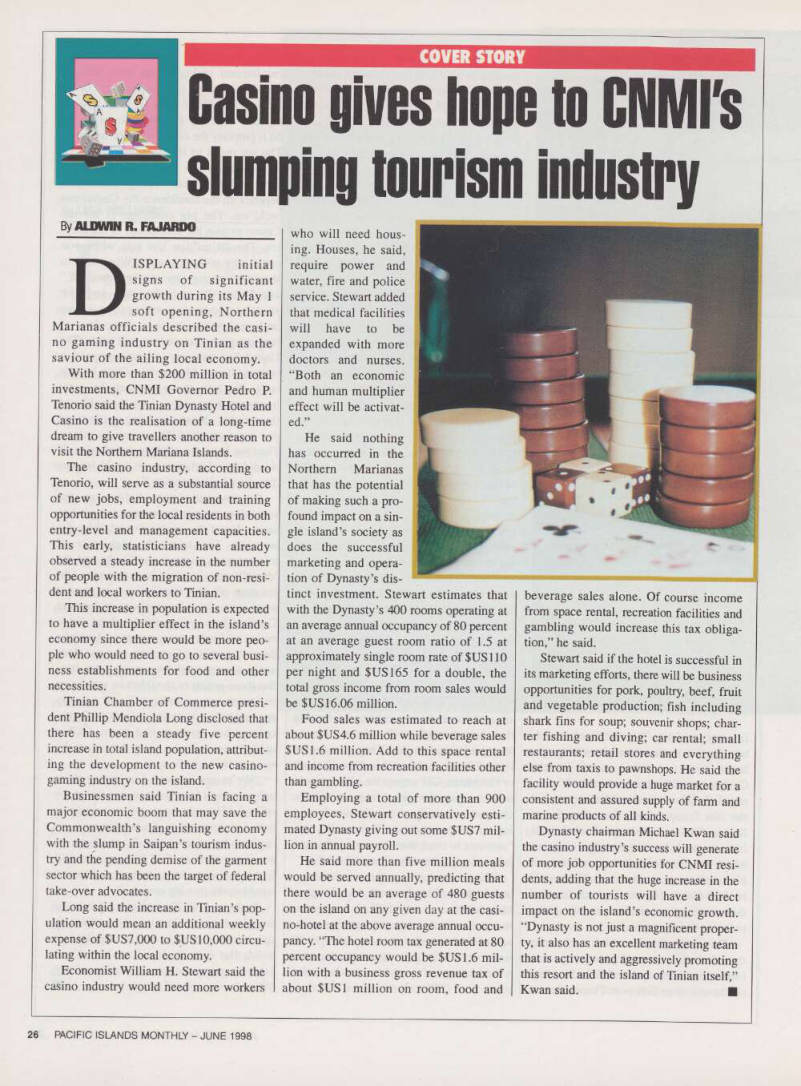
Casino gives hope to GNMI's slumping tourism industry
By Aldwin R. Fajardo
Displaying initial
signs of significant growth during its May 1 soft opening, Northern Marianas officials described the casi no gaming industry on Tinian as the saviour of the ailing local economy.
With more than $2OO million in total investments, CNMI Governor Pedro P.
Tenorio said the Tinian Dynasty Hotel and Casino is the realisation of a long-time dream to give travellers another reason to visit the Northern Mariana Islands.
The casino industry, according to Tenorio, will serve as a substantial source of new jobs, employment and training opportunities for the local residents in both entry-level and management capacities.
This early, statisticians have already observed a steady increase in the number of people with the migration of non-resi dent and local workers to Tinian.
This increase in population is expected to have a multiplier effect in the island’s economy since there would be more peo ple who would need to go to several busi ness establishments for food and other necessities.
Tinian Chamber of Commerce presi dent Phillip Mendiola Long disclosed that there has been a steady five percent increase in total island population, attribut ing the development to the new casino gaming industry on the island.
Businessmen said Tinian is facing a major economic boom that may save the Commonwealth’s languishing economy with the slump in Saipan’s tourism indus try and the pending demise of the garment sector which has been the target of federal take-over advocates.
Long said the increase in Tinian’s pop ulation would mean an additional weekly expense of SUS7,OOO to SUS 10,000 circu lating within the local economy.
Economist William H. Stewart said the casino industry would need more workers
who will need hous ing. Houses, he said, require power and water, fire and police service. Stewart added that medical facilities will have to be expanded with more doctors and nurses.
“Both an economic and human multiplier effect will be activat ed.”
He said nothing has occurred in the Northern Marianas that has the potential of making such a pro found impact on a sin gle island’s society as does the successful marketing and opera tion of Dynasty’s dis-
tinct investment. Stewart estimates that with the Dynasty’s 400 rooms operating at an average annual occupancy of 80 percent at an average guest room ratio of 1.5 at approximately single room rate of SUSIIO per night and SUSI6S for a double, the total gross income from room sales would be SUS 16.06 million.
Food sales was estimated to reach at about SUS 4.6 million while beverage sales SUSI. 6 million. Add to this space rental and income from recreation facilities other
than gambling.
Employing a total of more than 900
employees, Stewart conservatively esti
mated Dynasty giving out some SUS 7 mil lion in annual payroll.
He said more than five million meals would be served annually, predicting that there would be an average of 480 guests on the island on any given day at the casi no-hotel at the above average annual occu pancy. “The hotel room tax generated at 80 percent occupancy would be SUS 1.6 mil lion with a business gross revenue tax of about SUSI million on room, food and
beverage sales alone. Of course income from space rental, recreation facilities and gambling would increase this tax obliga tion,” he said.
Stewart said if the hotel is successful in its marketing efforts, there will be business opportunities for pork, poultry, beef, fruit and vegetable production; fish including shark fins for soup; souvenir shops; char ter fishing and diving; car rental; small restaurants; retail stores and everything else from taxis to pawnshops. He said the facility would provide a huge market for a consistent and assured supply of farm and marine products of all kinds.
Dynasty chairman Michael Kwan said the casino industry’s success will generate of more job opportunities for CNMI resi dents, adding that the huge increase in the number of tourists will have a direct impact on the island’s economic growth.
“Dynasty is not just a magnificent proper ty, it also has an excellent marketing team that is actively and aggressively promoting this resort and the island of Tinian itself,”
Kwan said. ■
Advertisements & other items, pp. 26-28 (2 items)
Cover Story
Notebook,
To Win an
IBM Pentium
Get the latest on political, business and social issues happening throughout the region every month, as well as the chance to win an IBM Pentium Notebook! Every 12issue subscription received before March 31st, 1998 will go into the draw. Subscribe to Pacific Islands Monthly today by calling (679) 304 111 or fax (679)303 809/(679)307 460.
Subscribe to The Source.
Pacific Islands Monthly
Conditions of Entry I.To enter, subscriptions must be made before March 315t,1998 which automatically enters the subscriber into the draw for the Pentium Notebook Computer. 2. Entry is open to all subscribers except employees of The Fiji Times Ltd, Pacific Islands Monthly and Wilson Addison Ltd. 3. Subscribers need to subscribe for at least 12 months to qualify. 4.The winner of the Pentium Notebook will be published in the Pacific Islands Monthly Magazine, May Issue, 1998 and will be notified by registered mail. s.The winner will receive their prize within one month of the draw. 6. The prize must me taken as offered and is not redeemable. 7. In the event of any dispute the decision of the promoter is final and no correspondence will be entered into.
For almost 70 years, Pacific Islands Monthly has been and still is the authority on political, business and social issues within the Pacific. And now, every 12 month subscription received before the 31st of March, 1999, goes into a draw to win an IBM Pentium Notebook*. You could even give a gift subscription to enter but it must be before the closing date. As well as the entry into the draw, you will also receive the latest news from the region. Fill in the subscription form below and send it along with payment to Pacific Islands Monthly, Subscription Department, PO Box 1167, Suva, Fiji. Or call PIM on (679) 304 111 or fax us on (679) 303 809/(679) 307 460.
Subscribe to The Source.
Pacific Islands Monthly
*Rates include Airspeeding to all destinations Conditions of Entry 1. To enter, subscriptions must be made before March 31st, 1999 which automatically enters the subscriber into the draw for the Pentium Notebook Computer. 2. Entry is open to all subscribers except employees of The Fiji Times Ltd, Pacific Islands Monthly, and Wilson Addison Ltd. 3- Subscribers need to subscribe for 12 months to qualify. 4. The winner of the Pentium Notebook will be published in Pacific Islands Monthly Magazine, May Issue, 1999 and will be notified by registered mail. 5. The winner will receive their prize within one month of the draw. 6. The prize must be taken as offered and is not redeemable. 7. In the event of any dispute the decision of the promoter is final and no correspondence will be entered into.
YES! I wish to subscribe to The Source and receive a chance to win an IBM Pentium Notebook Computer! □ Cheque/Bank Draft/Money Order made payable to Pacific Islands Monthly Please charge my credit card: (VISA / AMEX / MASTERCARD)
12 ISSUE
SUBSCRIPTION
I Rate A Rate B I I Rate C I Rate D Rate E Signature: Mr/Mrs/Ms: Expiry date; Delivery Address: Postal Address: This is a - □ Renewal ~— □ New Subscription Country; Fax;
Continental
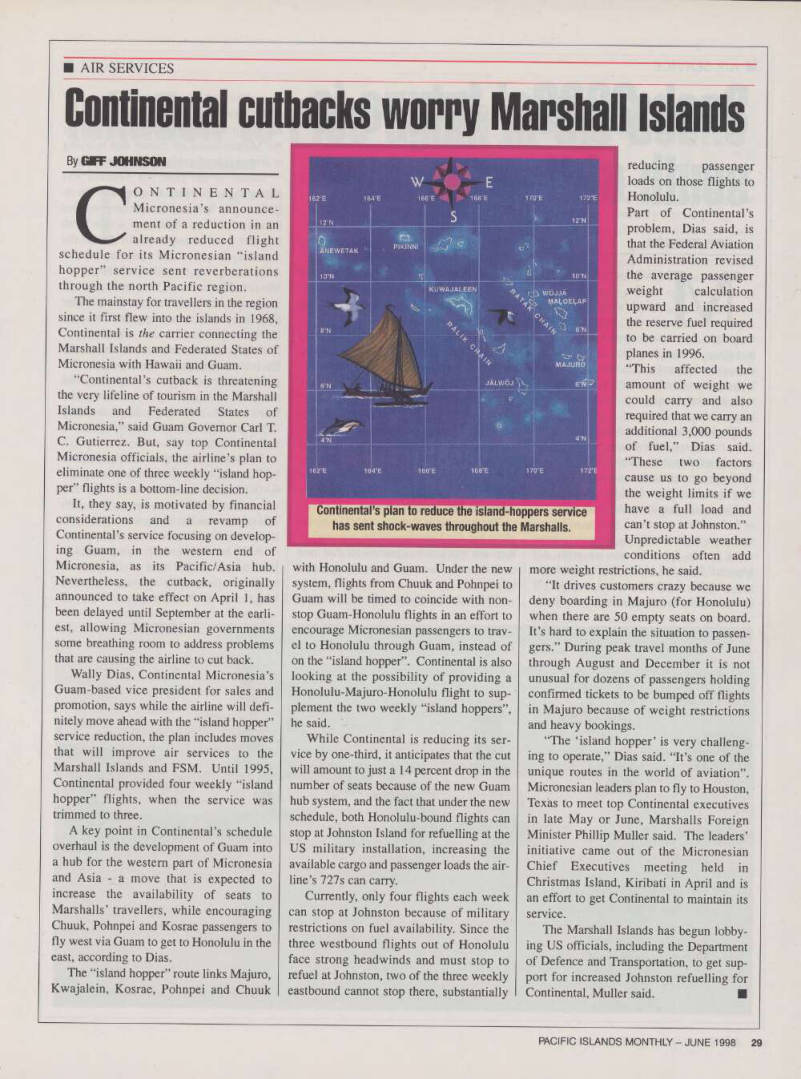
Air Services
Continental cutbacks worry Marshall Islands
By Giff Johnson
Continental
Micronesia’s announce ment of a reduction in an already reduced flight schedule for its Micronesian “island hopper” service sent reverberations through the north Pacific region.
The mainstay for travellers in the region since it first flew into the islands in 1968, Continental is the carrier connecting the Marshall Islands and Federated States of Micronesia with Hawaii and Guam.
“Continental’s cutback is threatening the very lifeline of tourism in the Marshall Islands and Federated States of Micronesia,” said Guam Governor Carl T.
C. Gutierrez. But, say top Continental Micronesia officials, the airline’s plan to eliminate one of three weekly “island hop per” flights is a bottom-line decision.
It, they say, is motivated by financial considerations and a revamp of Continental’s service focusing on develop ing Guam, in the western end of Micronesia, as its Pacific/Asia hub.
Nevertheless, the cutback, originally announced to take effect on April 1, has been delayed until September at the earli est, allowing Micronesian governments some breathing room to address problems that are causing the airline to cut back.
Wally Dias, Continental Micronesia’s Guam-based vice president for sales and promotion, says while the airline will defi nitely move ahead with the “island hopper” service reduction, the plan includes moves that will improve air services to the Marshall Islands and FSM. Until 1995, Continental provided four weekly “island hopper” flights, when the service was trimmed to three.
A key point in Continental’s schedule overhaul is the development of Guam into a hub for the western part of Micronesia and Asia - a move that is expected to increase the availability of seats to Marshalls’ travellers, while encouraging Chuuk, Pohnpei and Kosrae passengers to fly west via Guam to get to Honolulu in the east, according to Dias.
The “island hopper” route links Majuro, Kwajalein, Kosrae, Pohnpei and Chuuk
with Honolulu and Guam. Under the new system, flights from Chuuk and Pohnpei to Guam will be timed to coincide with non stop Guam-Honolulu flights in an effort to encourage Micronesian passengers to trav el to Honolulu through Guam, instead of on the “island hopper”. Continental is also looking at the possibility of providing a Honolulu-Majuro-Honolulu flight to sup plement the two weekly “island hoppers”, he said.
While Continental is reducing its ser vice by one-third, it anticipates that the cut will amount to just a 14 percent drop in the number of seats because of the new Guam hub system, and the fact that under the new schedule, both Honolulu-bound flights can stop at Johnston Island for refuelling at the US military installation, increasing the available cargo and passenger loads the air
line’s 727 s can carry.
Currently, only four flights each week can stop at Johnston because of military restrictions on fuel availability. Since the three westbound flights out of Honolulu face strong headwinds and must stop to refuel at Johnston, two of the three weekly eastbound cannot stop there, substantially
reducing passenger loads on those flights to Honolulu.
Part of Continental’s problem, Dias said, is that the Federal Aviation Administration revised the average passenger weight calculation upward and increased the reserve fuel required to be carried on board planes in 1996.
“This affected the amount of weight we could carry and also required that we carry an additional 3,000 pounds of fuel,” Dias said.
“These two factors cause us to go beyond the weight limits if we have a full load and can’t stop at Johnston.”
Unpredictable weather conditions often add
more weight restrictions, he said.
“It drives customers crazy because we deny boarding in Majuro (for Honolulu) when there are 50 empty seats on board.
It’s hard to explain the situation to passen gers.” During peak travel months of June through August and December it is not unusual for dozens of passengers holding confirmed tickets to be bumped off flights in Majuro because of weight restrictions and heavy bookings.
“The ‘island hopper’ is very challeng ing to operate,” Dias said. “It’s one of the unique routes in the world of aviation”.
Micronesian leaders plan to fly to Houston, Texas to meet top Continental executives in late May or June, Marshalls Foreign Minister Phillip Muller said. The leaders’ initiative came out of the Micronesian Chief Executives meeting held in Christmas Island, Kiribati in April and is an effort to get Continental to maintain its service.
The Marshall Islands has begun lobby ing US officials, including the Department of Defence and Transportation, to get sup port for increased Johnston refuelling for Continental, Muller said. ■
Continental’s plan to reduce the island-hoppers service has sent shock-waves throughout the Marshalls.
Saab 2000s' future is
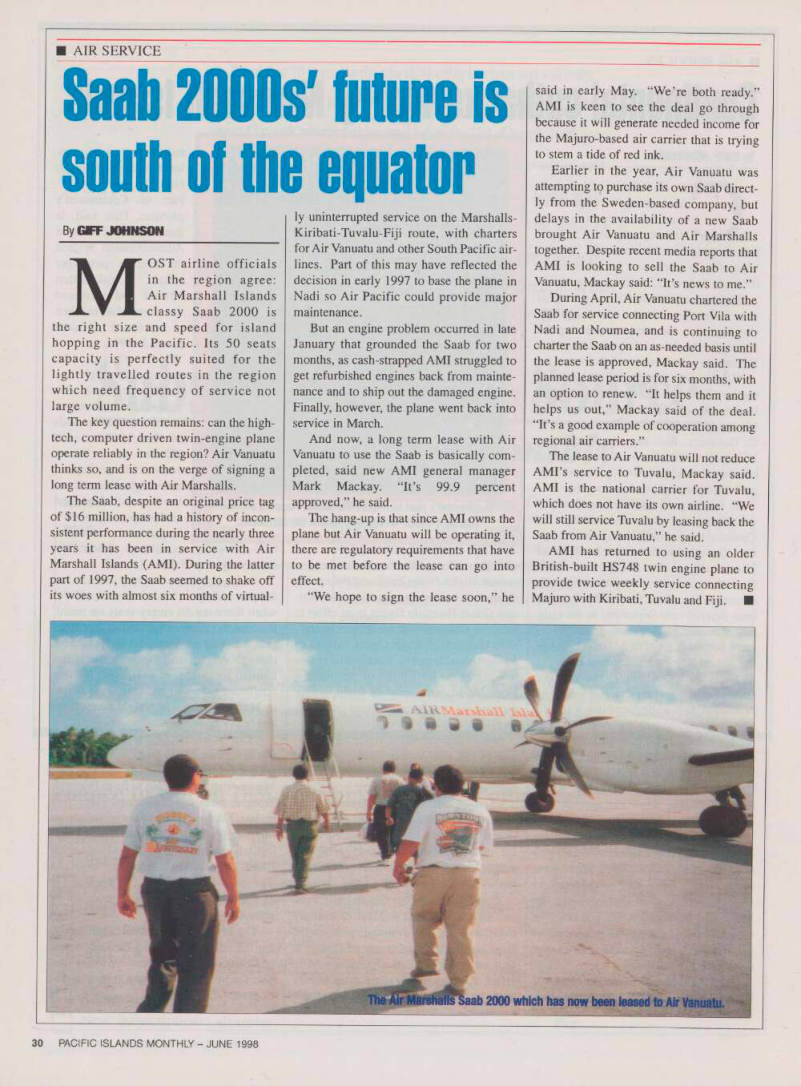
south of the equator
By Giff Johnson
MOST airline officials in the region agree: Air Marshall Islands classy Saab 2000 is the right size and speed for island hopping in the Pacific. Its 50 seats capacity is perfectly suited for the lightly travelled routes in the region which need frequency of service not
large volume.
The key question remains: can the high tech, computer driven twin-engine plane operate reliably in the region? Air Vanuatu thinks so, and is on the verge of signing a long term lease with Air Marshalls.
The Saab, despite an original price tag of $l6 million, has had a history of incon sistent performance during the nearly three years it has been in service with Air Marshall Islands (AMI). During the latter part of 1997, the Saab seemed to shake off its woes with almost six months of virtual
ly uninterrupted service on the Marshalls- Kiribati-Tuvalu-Fiji route, with charters for Air Vanuatu and other South Pacific air lines. Part of this may have reflected the decision in early 1997 to base the plane in Nadi so Air Pacific could provide major maintenance.
But an engine problem occurred in late January that grounded the Saab for two months, as cash-strapped AMI struggled to get refurbished engines back from mainte nance and to ship out the damaged engine.
Finally, however, the plane went back into service in March.
And now, a long term lease with Air Vanuatu to use the Saab is basically com pleted, said new AMI general manager Mark Mackay. “It’s 99.9 percent approved,” he said.
The hang-up is that since AMI owns the plane but Air Vanuatu will be operating it, there are regulatory requirements that have to be met before the lease can go into effect.
“We hope to sign the lease soon,” he
said in early May. “We’re both ready.”
AMI is keen to see the deal go through because it will generate needed income for the Majuro-based air carrier that is trying to stem a tide of red ink.
Earlier in the year, Air Vanuatu was attempting to purchase its own Saab direct ly from the Sweden-based company, but delays in the availability of a new Saab brought Air Vanuatu and Air Marshalls together. Despite recent media reports that AMI is looking to sell the Saab to Air Vanuatu, Mackay said: “It’s news to me.”
During April, Air Vanuatu chartered the Saab for service connecting Port Vila with Nadi and Noumea, and is continuing to charter the Saab on an as-needed basis until the lease is approved, Mackay said. The planned lease period is for six months, with an option to renew. “It helps them and it helps us out,” Mackay said of the deal.
“It’s a good example of cooperation among regional air carriers.”
The lease to Air Vanuatu will not reduce AMDs service to Tuvalu, Mackay said.
AMI is the national carrier for Tuvalu, which does not have its own airline. “We will still service Tuvalu by leasing back the Saab from Air Vanuatu,” he said.
AMI has returned to using an older British-built HS74B twin engine plane to provide twice weekly service connecting Majuro with Kiribati, Tuvalu and Fiji. ■
The Air Marshalls saab 2000 which has now been leased to Air Vanuatu.
Inflation to rise again in the Cooks
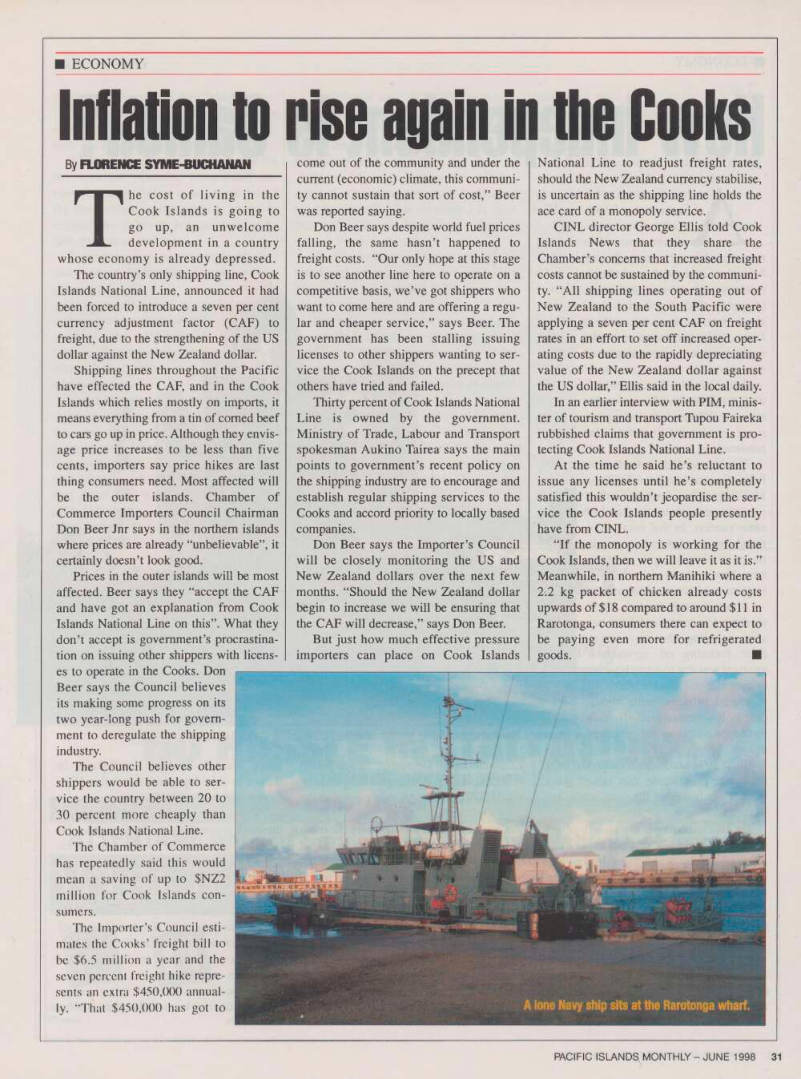
Economy
By Florence Syme-Buchanan
The cost of living in the Cook Islands is going to go up, an unwelcome development in a country whose economy is already depressed.
The country’s only shipping line. Cook Islands National Line, announced it had been forced to introduce a seven per cent currency adjustment factor (CAE) to freight, due to the strengthening of the US dollar against the New Zealand dollar.
Shipping lines throughout the Pacific have effected the CAE, and in the Cook Islands which relies mostly on imports, it means everything from a tin of corned beef to cars go up in price. Although they envis age price increases to be less than five cents, importers say price hikes are last thing consumers need. Most affected will be the outer islands. Chamber of Commerce Importers Council Chairman Don Beer Jnr says in the northern islands where prices are already “unbelievable”, it certainly doesn’t look good.
Prices in the outer islands will be most affected. Beer says they “accept the CAE and have got an explanation from Cook Islands National Line on this”. What they don’t accept is government’s procrastina tion on issuing other shippers with licens
es to operate in the Cooks. Don Beer says the Council believes its making some progress on its two year-long push for govern ment to deregulate the shipping industry.
The Council believes other shippers would be able to ser vice the country between 20 to 30 percent more cheaply than Cook Islands National Line.
The Chamber of Commerce has repeatedly said this would mean a saving of up to SNZ2 million for Cook Islands con sumers.
The Importer’s Council esti mates the Cooks’ freight bill to be $6.5 million a year and the seven percent freight hike repre sents an extra S4SO,(XX) annual ly. “That $450,000 has got to
come out of the community and under the current (economic) climate, this communi ty cannot sustain that sort of cost,” Beer
was reported saying.
Don Beer says despite world fuel prices falling, the same hasn’t happened to freight costs. “Our only hope at this stage is to see another line here to operate on a competitive basis, we’ve got shippers who want to come here and are offering a regu lar and cheaper service,” says Beer. The government has been stalling issuing licenses to other shippers wanting to ser vice the Cook Islands on the precept that others have tried and failed.
Thirty percent of Cook Islands National Line is owned by the government.
Ministry of Trade, Labour and Transport spokesman Aukino Tairea says the main
points to government’s recent policy on
the shipping industry are to encourage and establish regular shipping services to the Cooks and accord priority to locally based
companies.
Don Beer says the Importer’s Council will be closely monitoring the US and New Zealand dollars over the next few months. “Should the New Zealand dollar begin to increase we will be ensuring that the CAP will decrease,” says Don Beer.
But just how much effective pressure importers can place on Cook Islands
National Line to readjust freight rates, should the New Zealand currency stabilise, is uncertain as the shipping line holds the ace card of a monopoly service.
CINL director George Ellis told Cook Islands News that they share the Chamber’s concerns that increased freight costs cannot be sustained by the communi ty. “All shipping lines operating out of New Zealand to the South Pacific were applying a seven per cent CAP on freight rates in an effort to set off increased oper ating costs due to the rapidly depreciating value of the New Zealand dollar against the US dollar,” Ellis said in the local daily.
In an earlier interview with PIM, minis ter of tourism and transport Tupou Faireka rubbished claims that government is pro tecting Cook Islands National Line.
At the time he said he’s reluctant to issue any licenses until he’s completely satisfied this wouldn’t jeopardise the ser vice the Cook Islands people presently have from CINL.
“If the monopoly is working for the Cook Islands, then we will leave it as it is.”
Meanwhile, in northern Manihiki where a 2.2 kg packet of chicken already costs upwards of $lB compared to around $ll in Rarotonga, consumers there can expect to be paying even more for refrigerated goods. ■
A lone Navy ship sits at the Rarotonga wharf.
How independent is Samoa?
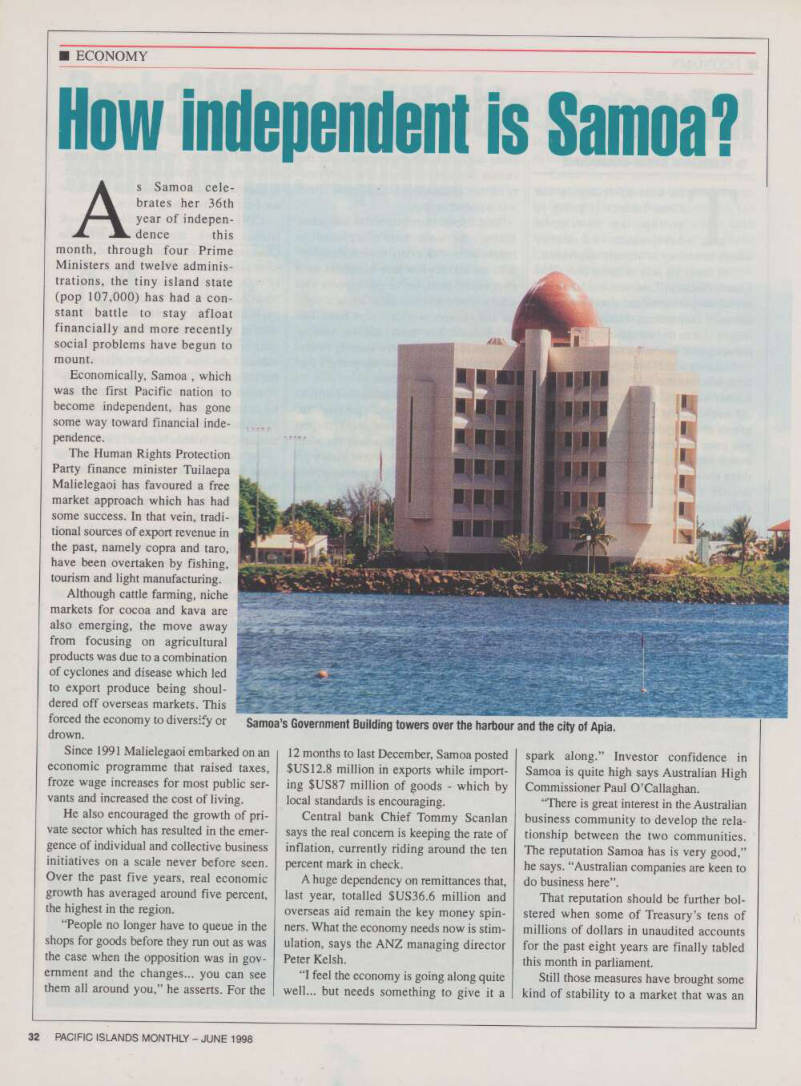

As Samoa cele brates her 36th year of indepen dence this month, through four Prime Ministers and twelve adminis trations, the tiny island state (pop 107,000) has had a con stant battle to stay afloat financially and more recently social problems have begun to mount.
Economically, Samoa , which was the first Pacific nation to become independent, has gone some way toward financial inde pendence.
The Human Rights Protection Party finance minister Tuilaepa Malielegaoi has favoured a free market approach which has had some success. In that vein, tradi tional sources of export revenue in the past, namely copra and taro, have been overtaken by fishing, tourism and light manufacturing.
Although cattle farming, niche
markets for cocoa and kava are also emerging, the move away from focusing on agricultural products was due to a combination of cyclones and disease which led to export produce being shoul dered off overseas markets. This forced the economy to diversify or drown.
Since 1991 Malielegaoi embarked on an economic programme that raised taxes, froze wage increases for most public ser vants and increased the cost of living.
He also encouraged the growth of pri vate sector which has resulted in the emer gence of individual and collective business initiatives on a scale never before seen.
Over the past five years, real economic growth has averaged around five percent, the highest in the region.
“People no longer have to queue in the shops for goods before they run out as was the case when the opposition was in gov ernment and the changes... you can see them all around you,” he asserts. For the
12 months to last December, Samoa posted SUSI2.B million in exports while import ing SUSB7 million of goods - which by local standards is encouraging.
Central bank Chief Tommy Scanlan says the real concern is keeping the rate of inflation, currently riding around the ten percent mark in check.
A huge dependency on remittances that, last year, totalled $U536.6 million and overseas aid remain the key money spin ners. What the economy needs now is stim ulation, says the ANZ managing director Peter Kelsh.
“I feel the economy is going along quite we 11... but needs something to give it a
spark along.” Investor confidence in Samoa is quite high says Australian High Commissioner Paul O’Callaghan.
“There is great interest in the Australian business community to develop the rela tionship between the two communities.
The reputation Samoa has is very good,” he says. “Australian companies are keen to do business here”.
That reputation should be further bol stered when some of Treasury’s tens of millions of dollars in unaudited accounts for the past eight years are finally tabled this month in parliament.
Still those measures have brought some kind of stability to a market that was an
Samoa’s Government Building towers over the harbour and the city of Apia.
accountant’s version of Elm Street.
However, thousands of Samoans are struggling to survive in the new fiscal cli mate the changes have produced.
Although happy to accept the kudos for the apparent financial turnaround, the emerging social fallout is being ignored by the government whose position seems to suggest that if they do not identify a prob lem, there is no problem.
Even four years ago the sight of chil dren and adults begging for money was unheard of.
Now people young and old scavenge rubbish bins for whatever they can find.
Once the domain of the large transvestite community, prostitution now increasingly involves teenage girls and adolescent boys.
Unemployment amongst young adults is rampant. Although no statistics are kept, the size of the problem was witnessed recently when officials from a fish cannery in American Samoa came to Apia looking for 50 factory workers and were alarmed to find more than a thousand people who promptly stormed their offices when the doors opened the next morning.
A minimum wage of SUS6B per month, high unemployment, and little hope for the future suggests the formula for a rise in crime involving theft and property has been established.
Prime Minister Tofilau Eti Alesana maintains there is no poverty in Samoa and his administration has responded in kind.
But this is a one-dimensional view of today’s Samoan society.
Election promises to improve run-down health and education systems have been a joke as they have largely fallen away to a user-pays system.
This has seen expensive private schools for privileged children, shocking failure rates for national examinations and a huge decline in the standards of public educa tion, guaranteeing a generation of under achievers.
A health insurance scheme casually announced this year means more bills for families flying their relatives overseas for treatment, and the spectre of forking out at home for a seriously malnourished health service.
It is not uncommon for a hundred or more patients to seek help from one spe
cialist in a day.
Meanwhile costs for medicines and ser vices have, like everything else, soared skywards.
A bottomless supply of crooked deals, scams and financial ineptness has marked past and present administrations since the independence flag was raised in 1962.
The national motto “Samoa was found ed on God” has become an oxymoron.
In reality Samoa is an island state where, sadly, the once spectacular indepen dence celebrations have for the past four years been given economy class treatment by the government in favour of their tourism festival in September.
That festival has proven a total flop.
Thirty-six years on, as many of her citizens struggle to make ends meet. Prime Minister Alesana ordered a SUSSOO,OOO prayer temple to be built on a hillside over looking the capital.
If prayers asking for strength to over come political deceit and greed are offered unconditionally, changes for the better could still come to pass.
In Samoa, as the locals say, anything is possible. ■
Advertisements & other items, p. 33 (1 item)
Internet/Intranet
ACCESS ROUTER
for instant Intemet/Intranet connectivity
COST COMPETITIVE
for small and medium = sized networks
HASSLE INSTALLATION
compact, easy to use
http://www.rad.com
ATTENTION: Internet Service Providers and Network Managers WEB RANger™ is a compact Process router that connects small or mediumsized offices to the internet or private IP networks over ISDN dial up links leased lines and digital. Designed for fast no fuss installation and setup, the WEB RANger's attractive price makes it the ideal internet access solution for ISPs and corporate network managers alike. For more information contact RAD Data Communications at http:/Avww.rad.com RAD/TEL & CLS PNG PO BOX 43 WAIGANI NOD PNG
PHONE (675) 325 2555
FAX (675) 325 0872
e-mail: [email protected] Z Compatible with 3rd party Easy installed and setup PPPdevices Firewall security feature Connection On Demand (COD) protects your network's data significally reduces WAN costs
Sit back and
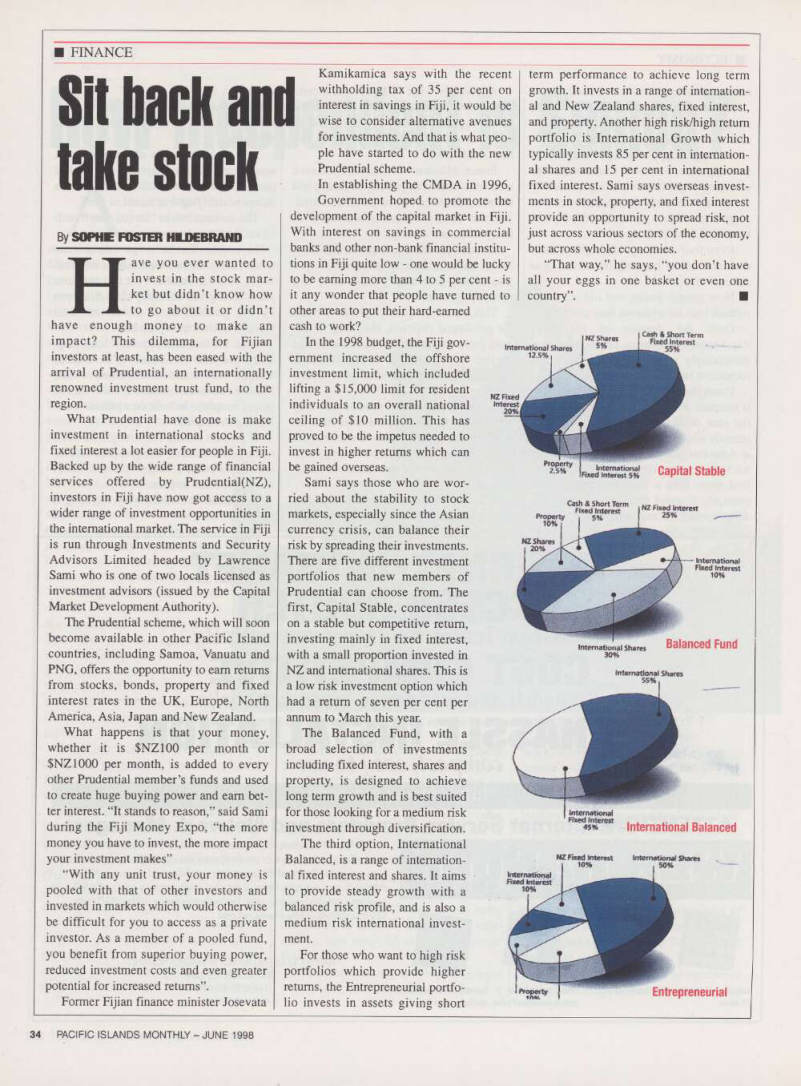
Finance
Sit back and take stock
By Sophie Foster Hildebrand
Have you ever wanted to invest in the stock mar ket but didn’t know how to go about it or didn’t have enough money to make an impact? This dilemma, for Fijian investors at least, has been eased with the arrival of Prudential, an internationally renowned investment trust fund, to the region.
What Prudential have done is make investment in international stocks and fixed interest a lot easier for people in Fiji.
Backed up by the wide range of financial services offered by Prudential(NZ), investors in Fiji have now got access to a wider range of investment opportunities in the international market. The service in Fiji is run through Investments and Security Advisors Limited headed by Lawrence Sami who is one of two locals licensed as investment advisors (issued by the Capital
Market Development Authority).
The Prudential scheme, which will soon become available in other Pacific Island countries, including Samoa, Vanuatu and PNG, offers the opportunity to earn returns from stocks, bonds, property and fixed interest rates in the UK, Europe, North America, Asia, Japan and New Zealand.
What happens is that your money, whether it is SNZIOO per month or SNZIOOO per month, is added to every other Prudential member’s funds and used to create huge buying power and earn bet ter interest. “It stands to reason,” said Sami during the Fiji Money Expo, “the more money you have to invest, the more impact your investment makes”
“With any unit trust, your money is pooled with that of other investors and invested in markets which would otherwise be difficult for you to access as a private investor. As a member of a pooled fund, you benefit from superior buying power, reduced investment costs and even greater potential for increased returns”.
Former Fijian finance minister Josevata
Kamikamica says with the recent withholding tax of 35 per cent on interest in savings in Fiji, it would be wise to consider alternative avenues for investments. And that is what peo ple have started to do with the new Prudential scheme.
In establishing the CMDA in 1996,
Government hoped to promote the development of the capital market in Fiji.
With interest on savings in commercial banks and other non-bank financial institu tions in Fiji quite low - one would be lucky to be earning more than 4 to 5 per cent - is it any wonder that people have turned to other areas to put their hard-earned
cash to work?
In the 1998 budget, the Fiji gov ernment increased the offshore investment limit, which included lifting a $15,000 limit for resident individuals to an overall national ceiling of $lO million. This has proved to be the impetus needed to invest in higher returns which can be gained overseas.
Sami says those who are wor ried about the stability to stock markets, especially since the Asian currency crisis, can balance their risk by spreading their investments.
There are five different investment portfolios that new members of Prudential can choose from. The first, Capital Stable, concentrates on a stable but competitive return, investing mainly in fixed interest, with a small proportion invested in NZ and international shares. This is a low risk investment option which had a return of seven per cent per annum to March this year.
The Balanced Fund, with a broad selection of investments including fixed interest, shares and property, is designed to achieve long term growth and is best suited for those looking for a medium risk investment through diversification.
The third option, International Balanced, is a range of internation al fixed interest and shares. It aims to provide steady growth with a balanced risk profile, and is also a medium risk international invest ment.
For those who want to high risk
portfolios which provide higher
returns, the Entrepreneurial portfo
lio invests in assets giving short
term performance to achieve long term growth. It invests in a range of internation al and New Zealand shares, fixed interest, and property. Another high risk/high return portfolio is International Growth which typically invests 85 per cent in internation al shares and 15 per cent in international fixed interest. Sami says overseas invest ments in stock, property, and fixed interest provide an opportunity to spread risk, not just across various sectors of the economy, but across whole economies.
“That way,” he says, “you don’t have all your eggs in one basket or even one country”. ■
The Princess
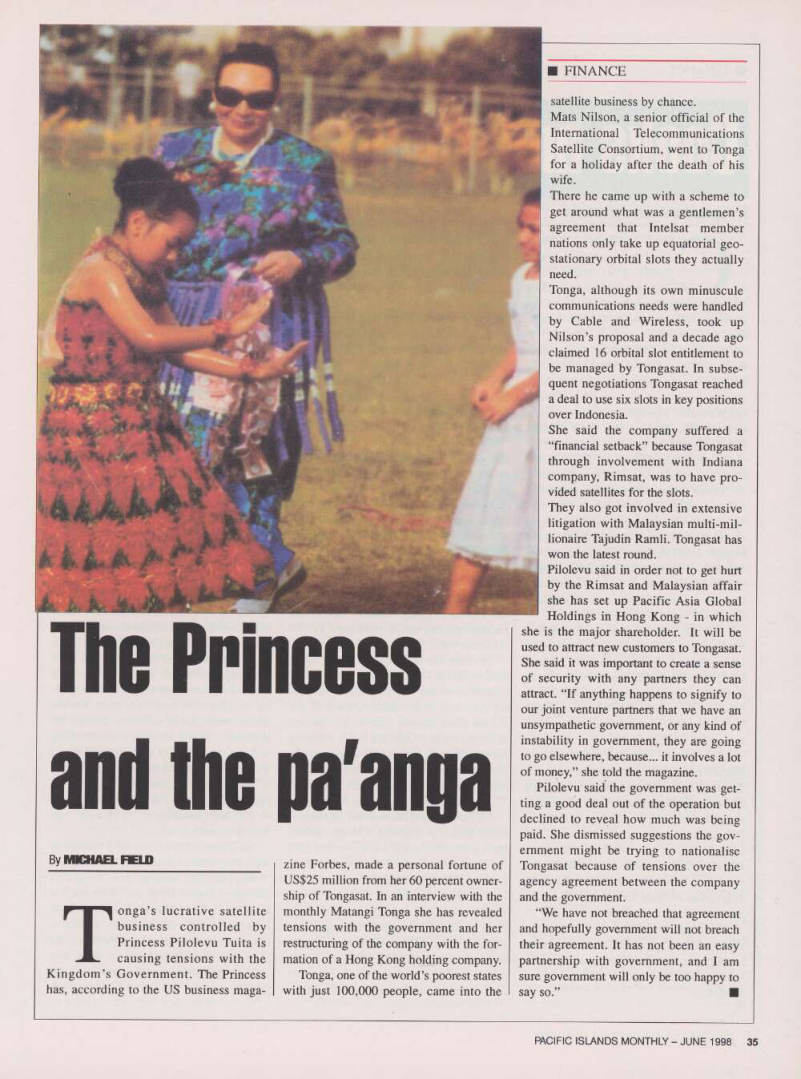
and the pa'anga
By Michael Field
Tonga’s lucrative satellite business controlled by Princess Pilolevu Tuita is causing tensions with the Kingdom’s Government. The Princess has, according to the US business maga
zine Forbes, made a personal fortune of US$25 million from her 60 percent owner ship of Tongasat. In an interview with the monthly Matangi Tonga she has revealed tensions with the government and her restructuring of the company with the for mation of a Hong Kong holding company.
Tonga, one of the world’s poorest states with just 100,000 people, came into the
satellite business by chance.
Mats Nilson, a senior official of the International Telecommunications Satellite Consortium, went to Tonga for a holiday after the death of his wife.
There he came up with a scheme to get around what was a gentlemen’s agreement that Intelsat member nations only take up equatorial geo stationary orbital slots they actually need.
Tonga, although its own minuscule communications needs were handled by Cable and Wireless, took up Nilson’s proposal and a decade ago claimed 16 orbital slot entitlement to be managed by Tongasat. In subse quent negotiations Tongasat reached a deal to use six slots in key positions over Indonesia.
She said the company suffered a “financial setback” because Tongasat through involvement with Indiana company, Rimsat, was to have pro vided satellites for the slots.
They also got involved in extensive
litigation with Malaysian multi-mil
lionaire Tajudin Ramli. Tongasat has won the latest round.
Pilolevu said in order not to get hurt by the Rimsat and Malaysian affair she has set up Pacific Asia Global Holdings in Hong Kong - in which
she is the major shareholder. It will be used to attract new customers to Tongasat.
She said it was important to create a sense of security with any partners they can attract. “If anything happens to signify to our joint venture partners that we have an unsympathetic government, or any kind of instability in government, they are going to go elsewhere, because... it involves a lot of money,” she told the magazine.
Pilolevu said the government was get ting a good deal out of the operation but declined to reveal how much was being paid. She dismissed suggestions the gov ernment might be trying to nationalise Tongasat because of tensions over the agency agreement between the company and the government.
“We have not breached that agreement and hopefully government will not breach their agreement. It has not been an easy partnership with government, and I am sure government will only be too happy to say so.” ■
Cooks and Samoa join forces
By Florence Syme-Buchanan
COOK Islands’ women wear their valuable black pearls everywhere and Samoan women may soon be doing the same if efforts to set up trade links between the two island states work out.
The Cook Islands, through the govern ment’s Development Investment Board, is going all out to set up trade links with Samoa, something that could see much needed dollars injected into the local econ omy. Rohan Ellis of the Cook Islands Development Investment Board conserva tively estimates that up to $NZ568,000 could be realised by exporters to Samoa.
“Given the proposed transport links to Samoa from the Cook Islands and the nat ural forces affecting supply and the output of products for export, 1998/99 could engage $NZ568,000.00 worth of export dollars to Samoa”. Ellis bases the estimat ed total export value to Samoa on products that are well established in the Cooks and demanded by the Samoan market.
“Naturally, these figures could improve if extraneous factors could be controlled and output of products increased,” says Ellis. The two Pacific countries are trying to realise a proposal made by a top aca demic in the region that Polynesian coun tries are better off freeing economic exchange.
In a formal proposal, former Cook Islands prime minister and scientist. Sir Thomas Davis told leaders of the region’s seven Polynesian nations that it’s time they stopped acting separately and united to a Polynesian Economic Community. The first step towards establishing Cook Islands - Samoa trade links will be the expected November start of Samoa’s Polynesian Airlines service to Rarotonga, the main island in the Cooks.
Shipping links between the northern islands of the Cooks and Samoa are also in the pipeline with local shipper Tapi Taio keen to expand on the current inter-island service.
The Cook Islands government’s Development Investment Board led a trade mission to Samoa in April to explore trade and investment possibilities.
“This is in line with the regional move towards a “Trade Free Pacific Area” and to pre-empt trade and investment between our two nations in lieu of anticipated ship ping links and airline linlqs”. Ellis believes the mission was a success. Like other Pacific nations, the root crop, taro, is a favourite in Samoa. But that country’s crops were wiped out when they became infected with leaf blight.
Now Samoa wants Cook Islands taro and just about everything else the country grows and protocols are being fast tracked to allow exporting to begin, says Ellis.
Both countries are to review import tar iffs to make inter-country trade easier and more economically viable. The export of Cook Islands black pearls, apparel by local fashion house TAV and other products also look to be definite possibilities for the Samoa market, says Ellis. He is keen to see the Cooks copying Samoa’s successful fishing industry which turns over SUS3O million a year.
In order for reciprocal trade between Samoa and the Cook Islands to begin, three requirements are paramount: this includes the reduction or complete removal of tar iffs on Cook Islands imports into Samoa and vice versa. “This is a major deciding factor for trade,” says Ellis. At present, Samoa’s tariff rates mean black pearls are taxed at around 239.5 per cent, oranges at 75 per cent, and raw coconuts 35 per cent.
“It must be emphasised that ‘reciprocal trade’ should be fostered to ensure smooth trade discussion and it is intended that both the Cook Islands and Samoa should trade commodities that each nation produces well and abundantly.” For the Cook Islands, this will include oranges, taro, black pearls, resort apparel and vegetables to name a few. Commodities from Samoa will include coconut oil, coconut cream, cocoa products, tuna and other fish prod ucts, coconut jewellery and Vailima beer.
Transport and linkages are also high on the must-have list. At present, Cook Islands National Line provides a monthly Samoa-Rarotonga service. Proposals are for the Taio Shipping Line to connect Rarotonga and the northern Cook group with Samoa providing more frequent links.
Further down the track, Ellis envisages that perishable goods will be transported on Polynesian Airlines’ proposed direct flight to Apia.
He says the Cook Islands and Samoan Departments of Agriculture will come to an agreed method of product treatment for all produce into and out of Samoa and the Cook Islands. Ellis agrees with Sir Thomas that the idea of a Polynesian Economic Community has merit saying “it is timely that Pacific Island nations sit down and establish bilateral trade agreements”.
He says a major thrust of bilaterals should include identifying each Pacific nation and their products of specialisation which could be exported to a partner coun try that lacks the product in question.
“Up to now, most Pacific island states have looked to New Zealand and Australia for product supplies, however some of the larger Pacific island states like Fiji have developed resources and technology to produce similar substitutes of similar qual ity. “Successful trade between Pacific Island States can be achieved through the removal of tariffs on agreed commodities and the streamline of dialogue and paper work to officiate arrangements,” says Ellis.
And the secret to making all this work, says Sir Thomas, is the willingness to do it in the best interests of “our need and Samoa’s need to survive”.
Sir Thomas Davis has long wanted to see a Polynesian Economic Community.
He said each country has “fought its economic battles alone and often not too successfully”. Sir Thomas believes that as long as Polynesian countries continue to compete against each other, there will be little real growth and “the region will remain the same way for another 100 years”. ■
SPARTECA's last stand
Developments
By Paula Yavala
IT was inevitable that Fiji will
pick up the cudgels and fight
an almost lone battle to improve SPARTECA, the South Pacific Regional Trade and Economic Cooperation Agreement.
SPARTECA was signed by most Forum member countries at the Forum’s 11th meeting in Kiribati on July 14, 1981.
Under the agreement, the Forum’s two developed member countries - Australia and New Zealand - offer duty free and unrestricted or concessional access for vir
tually all products originating from Forum
Island Countries (FIC).
However, to qualify for the duty free and unrestricted access benefits, goods exported to Australia and New Zealand must meet the rules of origin set out in SPARTECA. This determines whether or not the products are genuinely of FIC ori gin. Effectively, nearly everything is going in duty free provided the products have met the rules of origin requirement.
It was around this issue of rules of ori gin that the agreement struck its first major snag in the early 19905.
It followed an audit of FIC exports to Australia and New Zealand by customs officers from the two countries. Of all the other FIC countries, Fiji was the major beneficiary of SPARTECA and found itself fighting a lone battle to improve the terms of the regional agreement.
In this regard, the Fiji garment industry found the interpretation of the customs officers severe and uncompromising.
Specifically, the industry considered that the interpretation of allowed and non allowed local content was very restrictive.
They argued that the officers rejected outright what the industry put up as local content. For example, while the industry maintained that telephone bills should be considered local content, the officers said only 25 per cent would qualify.
Against strong arguments put forward by the industry, the customs officers ruled that administrative costs were not allowed as local content. Nor was overseas travel.
So change the rules of SPARTECA, the industry argued. First, the regional coun tries pushed for a lowering of the 50 per cent rule of origin as a possible solution.
But Australia and New Zealand flatly rejected such a move.
Instead they told the FICs to adopt a rule that not only will be widely applied in future, but is also WTO acceptable. What the industry then suggested was a rule of origin that basically converts a piece of cloth into a finished garment. In short, total transformation.
The suggestion closely followed a model pushed by the WTO in its search for new rules of origin to cover various world trade agreements. Discussions on the issue have started in Geneva and in one of the meetings, Fiji was represented by the country’s High Commissioner to Australia, Isikeli Mataitoga.
Some industry sources privately feel he should attend more such meetings in Geneva before a decision on the issue is made in the latter part of 1998.
What Fiji wants is a rule of origin that allows for total transformation but, at the same time, gives the member countries of SPARTECA preferential treatment.
In other words, total transformation without reciprocity. In this it differs from the WTO’s known stand which favours reciprocity in the application of such rules.
Does it matter? The industry says it does. For one thing, the existing Australian TCF industry plan will reduce the present 34 per cent tariff, on clothing and textile imports to Australia, to 25 per cent by the year 2000.
This would amount to a nine per cent erosion in Fiji’s margin of preference under SPARTECA within the next three years. By 2005, the tariff on imports would reduce to 17.5 per cent - meaning a 16.5 per cent erosion in margin of preference from existing levels.
Second, agreement on total transforma tion is crucial to an industry that is current ly providing the engine of growth in the Fiji economy. Fiji’s TCF industry account ed for 23 per cent of domestic exports in 1996. Since 1993, total estimated invest
ment for implemented projects in textile and clothing factories approved by the Fiji Trade and Investment Board is $F15.9 mil lion.
Moreover, the industry continues to provide a significant number of jobs for over 14,500 people. In essence, with total transformation, the Fiji garment industry will expand further, increase investment and double employment. “Everything that the Government wants,” says Mark Halabe, a major player in the Fiji garment
industry.
The key question now is whether Australia and New Zealand will agree to changes in the rules of origin that allows for total transformation but which is non reciprocal. The industry believes there are signs that Australia and New Zealand may be adopting a more accommodating stance.
As a pointer to a thawing of attitude on the part of the Forum’s metropolitan neigh bours, they referred to Australia’s decision last month to agree to a request to reduce the local content rule from 50 per cent to 44 per cent.
The agreement followed submissions that the recent devaluation of the Fiji dol lar made it difficult for many operators to qualify under SPARTECA.
The new rule, which applies for certain items only, will be reviewed after 12 months. Fiji is banking on Australia and New Zealand adopting a similar stance on the issue of substantial transformation.
This is based on the fact that Fiji has not been successful in attracting large and new investments in other sectors of the economy in recent years. A united voice on the issue by the rest of the FICs can only help matters along.
For this reason, Fiji will keenly study the outcome of a meeting of the Forum economic ministers in July this year, which, among other things, will deliberate
On Sparteca.
This will be followed by a review of SPARTECA in August by the Forum Secretariat.
No doubt, Fiji will be making its lone voice heard at both the meeting and the review. ■
Drop-outs worry Cooks
By Florence Syme-Buchanan
The Cook Islands popula
tion has plunged and edu cators are alarmed at falling school roles which they say will affect the quality of edu cation available in the country. Last year more than 2500 people left the country. The Cooks population now hovers at 16,500 compared to 22,400 at the end of 1995. The Statistics Department says the population is continuing to decline.
For the first time in a decade, the total number of school children in the Cooks has dropped to less than 5000 with the Ministry of Education forced to combine classes and amalgamate some outer island schools. There are 4917 school children in the Cook Islands this year, a decrease of 12 per cent and consultants have predicted the trend will continue until at least 2000. The biggest decline of 25 per cent has occurred in the northern group of islands.
Director of Planning and Finance Ken Matheson says at the height of the coun try’s economic crisis, when 2000 people lost their government jobs between 1995- 96, there was an immediate impact on senior classes. “Seventeen, 18 and 19-
year-olds were dropping out in large num bers. We speculate that parents were pulling the kids out to help support the
family in agriculture or fishing,” says
Matheson.
Falling roles are “alarming in the outer islands and one solution is to integrate some schools, ” he says. “But the quality of education really suffers when you have a combined class of grades one to six in one classroom.”
Matheson says other strategies taken by the Ministry to cope with the problem include enhanced distance education using electronic media, part-time teachers and multi-level teaching techniques.
The Ministry is trying the use of elec tronic media at Mauke College, but because this is so expensive, it could be some time before the concept is in use at other outer island schools. Because there are so few senior students attending outer island colleges, the Ministry of Education is finding that it is not “economically fea sible” to provide teachers for all subjects, particularly technical subjects, says Matheson.
Many senior students in the outer islands are completing their high school education by correspondence. A big drop in academic achievement at primary school level is also causing concern in the
Ministry of Education. Annual STACI tests sat by primary students in grades five to form one showed a dramatic drop in achievement during 1995 to 1996.
Although results were better last year they are still nowhere near those prior to 1995.
The morale of teachers in the Cooks was at its lowest when the country’s econ omy hit rock bottom and their desponden cy is probably the reason why academic achievement also plummeted, says Director of Audit and Quality Assurance Peter Etches.
Teachers were the hardest hit by the government’s economic reforms. Their salaries were cut by 85 per cent and not reinstated for almost a year. Many left the profession and the country, others sought voluntary retirement. This has created another problem which the Ministry has ‘band-aid’ by bringing back retired teach ers, says Etches. Of the 300 teachers in the country, over 100 are over the age of 50.
The Cook Islands Teachers Training College, which closed last year, reopens in 1999. However, no graduates will be avail able to the system until 2001, says Etches.
He says they’re also worried about the number of children dropping out of school who are under school leaving age.
Etches says this trend is most prevalent in the northern islands with some schools struggling to get children into Form 1.
Many are leaving after grade 6. Another worrying trend is the tiny number of stu dents who continue schooling until Form 7. Of the 442 students in Form 3, only 24 made it to bursary level last year. ■
New Caledonia on track for sovereignty vote
By Sophie Foster Hildebrand
Many people thought they would never see the day... but France has finally set a date for a referendum that will concern, amongst other things, the transfer of sovereignty rights to New Caledonia.
The date set is 20 years from April, but French Prime Minister Lionel Jospin says “the referendum could take place in 15 years if the legislature decides to anticipate it”.
Apart from sovereignty, the referendum
will concern “access to international status of full responsibility, and organisation of cit izenship”. Since the recent signing of the Noumea Accord, on April 29, discussions have been ongoing to revamp the political, customary, economic, and social organisa tion of Island State. After the signing, Mr Jospin said “ten years after the Matignon Accords, a new era of peace and develop ment is beginning for New Caledonia”.
Amongst its many congratulatory mes sages was one from Chairman of the South Pacific Forum and Cook Islands Prime
Minister, Sir Geoffrey Henry, who wel comed the signing which provided for greater autonomy for New Caledonia and an eventual vote on self-determination.
The historic agreement means that the RPCR, the FLNKS, and the government have finally seen eye-to-eye on the future of New Caledonia. Jospin says the document concretes “the accord they have reached for implementing a “consensual solution” to continue and extend the measures taken under the Matignon Accords of 1988”.
It also means that stability may finally be
on the cards for the state which has had a tur bulent, if not altogether violent, history. The Noumea Accord includes a preamble which describes the consequences of colonisation on the Kanak identity and affirms the commit ment, following the tenth anniversary of the Matignon Accords, “to begin a new stage in the process, characterised by full recognition of the identity of the Kanak people”.
It also prepares for the “founding of a social contract among all the communities living in New Caledonia”, and shares “sovereignty with France, as a stage in the progression towards
full sovereignty”.
The government will now begin drafting the legislation that is necessary for the imple mentation of the accord, and will submit a bill
for a new constitutional law to the President of the Republic.
Specific accords, to be submitted for refer endum by the end of the year, are being looked into, with measures to encourage the economic and social development of New Caledonia. In particular, these will concern training. The French PM said an orientation document out lined the process by which the Kanak identity will be taken into consideration in the political organisation of New Caledonia.
This, he says, includes “improvement of status and customary law, fuller recognition of the role of customary authorities, notably through the creation of a customary senate, protection and valorisation of the cultural her itage, measures concerning land rights, and the
adoption of identifying signs”. Among the
moves for greater autonomy, the institutions of New Caledonia will be modified, and a gov ernment will be designated by the legislature on a proportional basis.
He says the voting rolls for elections to the provincial assemblies will be restricted, as
provided in the Matignon Accords. “Major
transfers of responsibility from the French State to New Caledonian institutions will take place, in certain cases as soon as the new insti tutions are implemented, and in other cases in a second stage,” Jospin says.
At the end of 1998, France will only retain sovereignty rights in New Caledonia.
Everything else will be controlled within the Pacific Island State itself.
PNG fights to stay afloat
in a sea of corruption
By Sam Vulum
PAPUA New Guinea, like some of its Pacific neigh bours, is trapped and sink ing fast in a sea of corrup tion. The government of Prime Minister Bill Skate, which has itself been the subject of widespread public outrage and condem nation over graft allegations, is determined to steer clear and keep PNG afloat at every possible cost.
It has swiftly moved to formulate and draft a bill for the establishment of an anti corruption body to be known as the
Independent Commission Against
Corruption (ICAC). The commission, prob ably the first of its kind in the South Pacific region, is aimed at fighting “white collar” crime. Corruption, the most corrosive of all PNG’s ills, is compounded with PNG’s other worrying strappings of development.
These include a deep economic crisis, rising urban crime, widespread poverty, a high unemployment rate and faltering
infrastructure. It blew up in the form of the Sandline mercenary crisis. The subsequent impact, on the demise of former Prime Minister Sir Julius Chan and several key members of his former regime in the July 1998 elections, led to strong vigour and determination from the new PM, Skate, to eradicate the rot and invigorate public trust and confidence in the government. He won his current seat on an anti-corruption plat form.
However, after only months in office, his efforts were seriously tainted by the infamous Mujo Sefa video tapes and relat ed allegations. Although the public outrage and wrangling over the tapes have waned with time, many disturbing questions have remained unanswered.
Skate, who maintained that the allega tions were the work of politically-motivat ed moves aimed at destabilising and dis crediting his government, wanted to put this behind him and move with the ICAC legislation and other anti-corruption drives.
A government task force, headed by
prominent PNG lawyer Peter Donigi, draft ed the legislation and a select parliamen tary committee toured the country collect ing views on the role of the commission.
The committee was to assess the views and prepare a report for parliament to deliberate on this month.
ICAC, which has wide ranging powers, from searching and investigating suspects, to arresting and prosecuting them, will work alongside the Police Force, Ombudsman Commission and other law enforcing agencies. The commission will investigate and prosecute the following offences: bribery of MPs, disclosure of official secrets, corruption and abuse of office, illegal and corrupt practices at elec tions, attempting to pervert justice, stealing and obtaining property by false pretences, cheating, fraud by trustees and officers of corporations and false accounting.
Although the proposal got stiff criticism from the beginning, especially from the opposition, it has been received with popu lar support from the general public. ■
Advertisements & other items, p. 40 (1 item)
Trading Post
PACIFIC ISLANDS
— I 11 ill I M
TRADING POST CAN WORK
WONDERS FOR YOU...
Promote your business, or service, sell your household items, cars or heavy machinery etc.
ONLY AUSS2 (OR EQUIVALENT) PER WORD.
NO COMPANY LOGO. NO DISPLAY.
NO BOLD TYPE.
Just forward your Advertisement together with payment to:
PACIFIC ISLANDS MONTHLY ’’Trading Post”,
PO Box 1167, Suva, Fiji.
Conditions: 1. All Advertisements are subject to acceptance and approval of publisher. 2. Advertisements are published as space permits; we cannot guarantee date of insertion. 3. All advertisements must be prepaid and should be typed or printed clearly 4. Deadline for receipt of advertisements is the 15th of the month prior to issue. 5. PACIFIC ISLANDS MONTHLY assumes no responsibility for any service other than publishing paid advertisements in this section.
Stan-Shortland
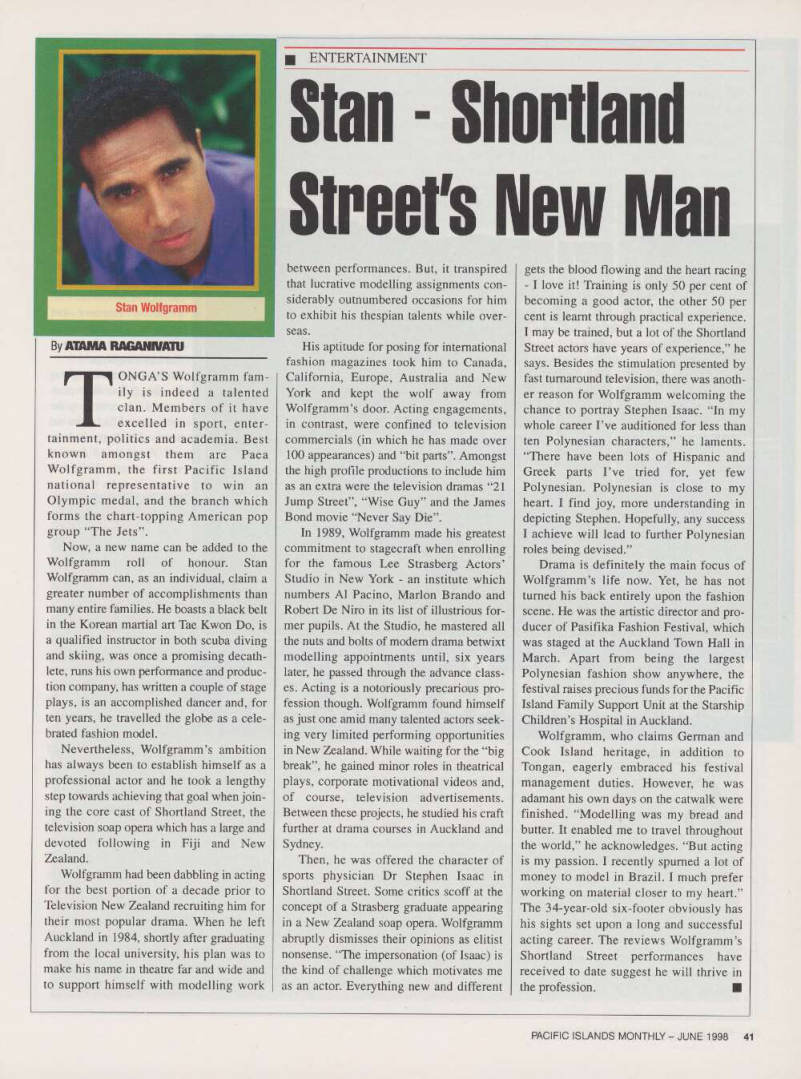
Entertainment
Stan-Shortland Street's New Man
By Atama Raganivatu
TONGA’S Wolfgramm fam ily is indeed a talented clan. Members of it have excelled in sport, enter tainment, politics and academia. Best known amongst them are Paea Wolfgramm, the first Pacific Island national representative to win an Olympic medal, and the branch which forms the chart-topping American pop group “The Jets”.
Now, a new name can be added to the Wolfgramm roll of honour. Stan Wolfgramm can, as an individual, claim a greater number of accomplishments than many entire families. He boasts a black belt in the Korean martial art Tae Kwon Do, is a qualified instructor in both scuba diving and skiing, was once a promising decath lete, runs his own performance and produc tion company, has written a couple of stage plays, is an accomplished dancer and, for ten years, he travelled the globe as a cele brated fashion model.
Nevertheless, Wolfgramm’s ambition has always been to establish himself as a professional actor and he took a lengthy step towards achieving that goal when join ing the core cast of Shortland Street, the television soap opera which has a large and devoted following in Fiji and New Zealand.
Wolfgramm had been dabbling in acting for the best portion of a decade prior to Television New Zealand recruiting him for their most popular drama. When he left Auckland in 1984, shortly after graduating from the local university, his plan was to make his name in theatre far and wide and to support himself with modelling work
between performances. But, it transpired that lucrative modelling assignments con siderably outnumbered occasions for him to exhibit his thespian talents while over seas.
His aptitude for posing for international fashion magazines took him to Canada, California, Europe, Australia and New York and kept the wolf away from Wolfgramm’s door. Acting engagements, in contrast, were confined to television commercials (in which he has made over 100 appearances) and “bit parts”. Amongst the high profile productions to include him as an extra were the television dramas “21 Jump Street”, “Wise Guy” and the James Bond movie “Never Say Die”.
In 1989, Wolfgramm made his greatest commitment to stagecraft when enrolling for the famous Lee Strasberg Actors’
Studio in New York - an institute which numbers A 1 Pacino, Marlon Brando and Robert De Niro in its list of illustrious for mer pupils. At the Studio, he mastered all the nuts and bolts of modem drama betwixt modelling appointments until, six years later, he passed through the advance class es. Acting is a notoriously precarious pro fession though. Wolfgramm found himself as just one amid many talented actors seek ing very limited performing opportunities in New Zealand. While waiting for the “big break”, he gained minor roles in theatrical plays, corporate motivational videos and, of course, television advertisements.
Between these projects, he studied his craft further at drama courses in Auckland and Sydney.
Then, he was offered the character of sports physician Dr Stephen Isaac in Shortland Street. Some critics scoff at the concept of a Strasberg graduate appearing in a New Zealand soap opera. Wolfgramm abruptly dismisses their opinions as elitist nonsense. “The impersonation (of Isaac) is the kind of challenge which motivates me as an actor. Everything new and different
gets the blood flowing and the heart racing - I love it! Training is only 50 per cent of becoming a good actor, the other 50 per cent is learnt through practical experience.
I may be trained, but a lot of the Shortland Street actors have years of experience,” he says. Besides the stimulation presented by fast turnaround television, there was anoth er reason for Wolfgramm welcoming the chance to portray Stephen Isaac. “In my whole career I’ve auditioned for less than ten Polynesian characters,” he laments.
“There have been lots of Hispanic and Greek parts I’ve tried for, yet few Polynesian. Polynesian is close to my heart. I find joy, more understanding in depicting Stephen. Hopefully, any success I achieve will lead to further Polynesian roles being devised.”
Drama is definitely the main focus of Wolfgramm’s life now. Yet, he has not turned his back entirely upon the fashion scene. He was the artistic director and pro ducer of Pasifika Fashion Festival, which was staged at the Auckland Town Hall in March. Apart from being the largest Polynesian fashion show anywhere, the festival raises precious funds for the Pacific Island Family Support Unit at the Starship Children’s Hospital in Auckland.
Wolfgramm, who claims German and Cook Island heritage, in addition to Tongan, eagerly embraced his festival management duties. However, he was adamant his own days on the catwalk were finished. “Modelling was my bread and butter. It enabled me to travel throughout the world,” he acknowledges. “But acting is my passion. I recently spumed a lot of money to model in Brazil. I much prefer working on material closer to my heart.”
The 34-year-old six-footer obviously has his sights set upon a long and successful acting career. The reviews Wolfgramm’s Shortland Street performances have received to date suggest he will thrive in the profession. ■
Stan Wolfgramm
New Zealand's wild side
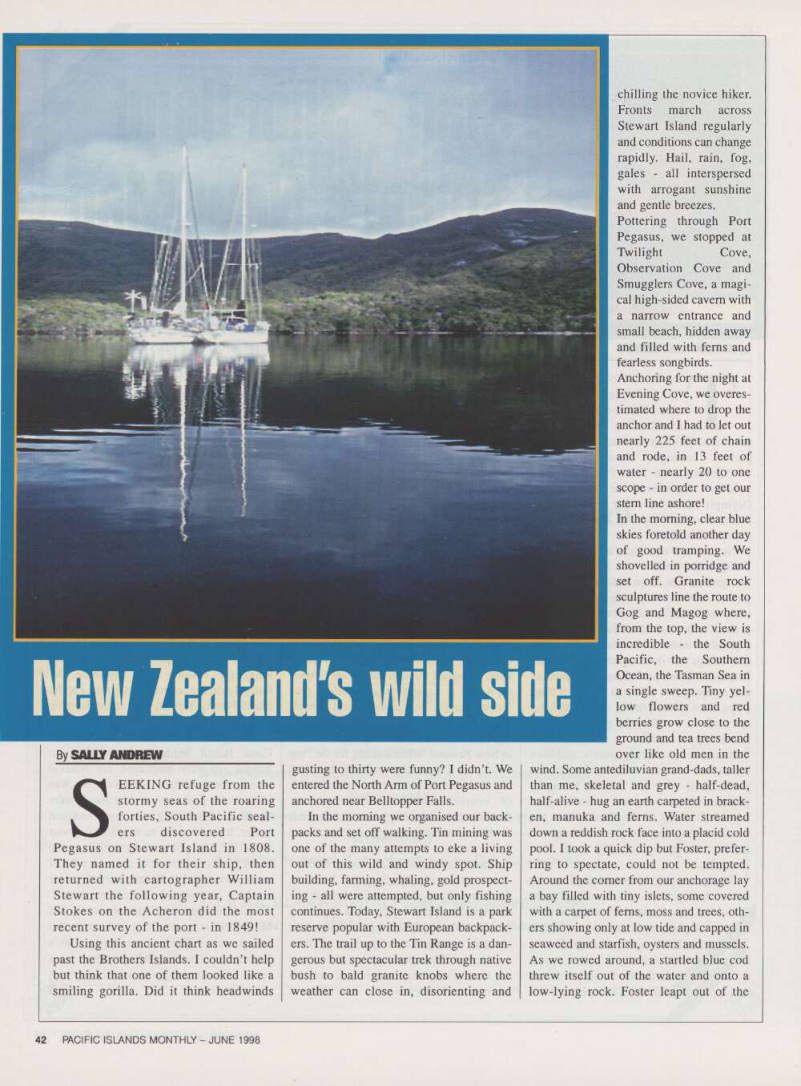
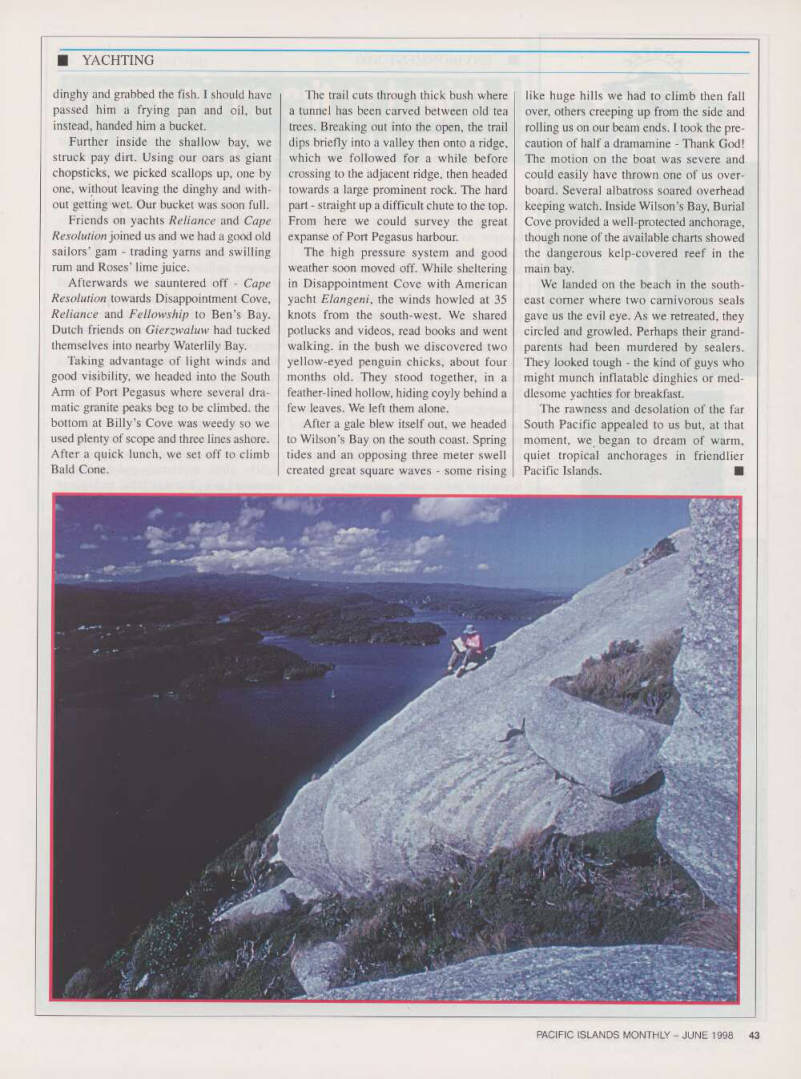
By Sally Andrew
SEEKING refuge from the
stormy seas of the roaring forties. South Pacific seal ers discovered Port Pegasus on Stewart Island in 1808.
They named it for their ship, then returned with cartographer William Stewart the following year, Captain Stokes on the Acheron did the most recent survey of the port - in 1849!
Using this ancient chart as we sailed past the Brothers Islands. I couldn’t help but think that one of them looked like a smiling gorilla. Did it think headwinds
gusting to thirty were funny? I didn’t. We entered the North Arm of Port Pegasus and anchored near Belltopper Falls.
In the morning we organised our back packs and set off walking. Tin mining was one of the many attempts to eke a living out of this wild and windy spot. Ship
building, farming, whaling, gold prospect
ing - all were attempted, but only fishing continues. Today, Stewart Island is a park reserve popular with European backpack ers. The trail up to the Tin Range is a dan gerous but spectacular trek through native bush to bald granite knobs where the weather can close in, disorienting and
chilling the novice hiker.
Fronts march across Stewart Island regularly and conditions can change rapidly. Hail, rain, fog,
gales - all interspersed
with arrogant sunshine and gentle breezes.
Pottering through Port
Pegasus, we stopped at
Twilight Cove,
Observation Cove and Smugglers Cove, a magi cal high-sided cavern with a narrow entrance and small beach, hidden away and filled with ferns and fearless songbirds.
Anchoring for the night at Evening Cove, we overes timated where to drop the anchor and I had to let out nearly 225 feet of chain and rode, in 13 feet of water - nearly 20 to one scope - in order to get our stem line ashore!
In the morning, clear blue skies foretold another day of good tramping. We shovelled in porridge and set off. Granite rock sculptures line the route to Gog and Magog where, from the top, the view is incredible - the South Pacific, the Southern Ocean, the Tasman Sea in a single sweep. Tiny yel low flowers and red berries grow close to the ground and tea trees bend over like old men in the
wind. Some antediluvian grand-dads, taller than me, skeletal and grey - half-dead, half-alive - hug an earth carpeted in brack en, manuka and ferns. Water streamed down a reddish rock face into a placid cold pool. I took a quick dip but Foster, prefer ring to spectate, could not be tempted.
Around the comer from our anchorage lay a bay filled with tiny islets, some covered with a carpet of ferns, moss and trees, oth ers showing only at low tide and capped in seaweed and starfish, oysters and mussels.
As we rowed around, a startled blue cod threw itself out of the water and onto a low-lying rock. Foster leapt out of the
■ Yachting
dinghy and grabbed the fish. I should have passed him a frying pan and oil, but instead, handed him a bucket.
Further inside the shallow bay, we struck pay dirt. Using our oars as giant chopsticks, we picked scallops up, one by one, without leaving the dinghy and with out getting wet. Our bucket was soon full.
Friends on yachts Reliance and Cape Resolution joined us and we had a good old sailors’ gam - trading yarns and swilling rum and Roses’ lime juice.
Afterwards we sauntered off - Cape Resolution towards Disappointment Cove, Reliance and Fellowship to Ben’s Bay.
Dutch friends on Gierzwaluw had tucked themselves into nearby Waterlily Bay.
Taking advantage of light winds and good visibility, we headed into the South Arm of Port Pegasus where several dra matic granite peaks beg to be climbed, the bottom at Billy’s Cove was weedy so we used plenty of scope and three lines ashore.
After a quick lunch, we set off to climb Bald Cone.
The trail cuts through thick bush where a tunnel has been carved between old tea trees. Breaking out into the open, the trail dips briefly into a valley then onto a ridge, which we followed for a while before crossing to the adjacent ridge, then headed towards a large prominent rock. The hard part - straight up a difficult chute to the top.
From here we could survey the great expanse of Port Pegasus harbour.
The high pressure system and good weather soon moved off. While sheltering in Disappointment Cove with American yacht Elangeni, the winds howled at 35 knots from the south-west. We shared potlucks and videos, read books and went walking, in the bush we discovered two yellow-eyed penguin chicks, about four months old. They stood together, in a feather-lined hollow, hiding coyly behind a few leaves. We left them alone.
After a gale blew itself out, we headed to Wilson’s Bay on the south coast. Spring tides and an opposing three meter swell created great square waves - some rising
like huge hills we had to climb then fall over, others creeping up from the side and rolling us on our beam ends. I took the pre caution of half a dramamine - Thank God!
The motion on the boat was severe and could easily have thrown one of us over board. Several albatross soared overhead keeping watch. Inside Wilson’s Bay, Burial Cove provided a well-protected anchorage, though none of the available charts showed the dangerous kelp-covered reef in the
main bay.
We landed on the beach in the south east comer where two carnivorous seals gave us the evil eye. As we retreated, they circled and growled. Perhaps their grand parents had been murdered by sealers.
They looked tough - the kind of guys who might munch inflatable dinghies or med dlesome yachties for breakfast.
The rawness and desolation of the far South Pacific appealed to us but, at that moment, we began to dream of warm, quiet tropical anchorages in friendlier Pacific Islands. ■
A friend to the environment

Environment 2000
In the fight to introduce “politi
cally correct” and environmen tally-friendly products to the Pacific, the biggest stumbling block has always been education.
Many consumers in the region have become so accustomed to using harsh chemicals that re-education about health and safety is needed. One company that has begun developing the market for environ
mentally-friendly products, especially con
cerning cleansing and odour control, is ANOTEC. Based in Lautoka, on the west ern side of Viti Levu in Fiji, ANOTEC is the shortened version of Anosmia Technologies - which relates to smell.
Rather than use harsh chemicals for hard cleaning and odour-control jobs, the com pany introduced natural, non-toxic and safe products made from plant oils. The compa ny says it’s most important role is to “main tain an awareness for the environment, par ticularly in public health and safety”.
The company focuses seriously on cam paigns in schools “because they are respon sible for teaching our children - our leaders of the future - about environmental aware ness”. In March this year, ANOTEC creat ed an economy school pack of detergent and odour management products for schools.
Needless to say the company is very excit ed with the positive response from the school principals and staff saying it was “very encouraging to note that the schools are very supportive of ANOTEC’s role in environment awareness”. The School Pack includes Fresh And Clean, a multi-purpose
non-soap cleaner that has its own odour neutraliser built in; Bin Fresh, which is suit able for cleaning up toilets and other areas where there may be heavy smells; and New Fresh, a mild odour neutraliser suitable for areas such as classrooms, libraries, offices, and halls. As well as focusing on schools, ANOTEC service areas such as sewage treatment facilities, pumping stations, meat processing plants, and the transport and hospitality industries. Recently, the compa ny installed the first Computerised Water Conditioner at the Lautoka Hospital in western Fiji. ANOTEC says the Calclear Water Conditioner eliminates the problems of limescale from the plumbing system and will save the hospital thousands of dollars in chemicals annually. It is the latest addi tion to their range of environmentally friendly products, which not only softens water supply but progressively de-scales all boilers, pipes, appliances and equipment connected to it. The ANOTEC technology is Australian but more than 50 per cent of the bottling and packaging is done in Fiji.
The liquid concentrate is imported to Fiji in bulk where it is mixed, bottled and labelled. The labels and two-litre bottles are produced in Fiji.
The company is a firm supporter of the Clean Air Society of Australia and New Zealand. Introduced to Fiji at the end of 1995, the company believes ANOTEC Environmental Products will play an impor tant part in Fiji and the region, particularly in public health and safety, as we move towards the 21 st century. ■
Advertisements & other items, p. 44 (1 item)
Calclear
...making a difference to our world... m
s* JWI
*AO Fresh & Clear
CALCLEAR
Computerised Water Conditioner in Business & Agriculture Available from
ANOTEC
ENVIRONMENTAL PRODUCTS
P.O. Box 5842 Lautoka Fiji Telephone: (679) 660009 Facsimile: (679) 650900 Email: [email protected]
Tackling the elements

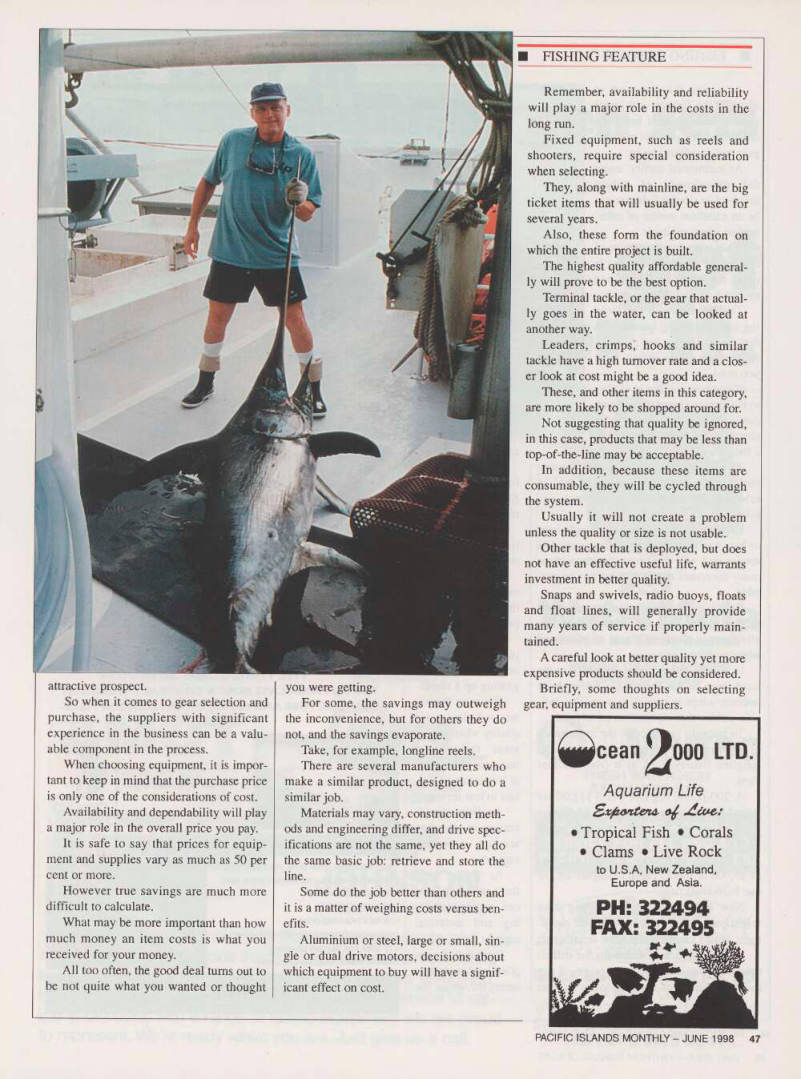
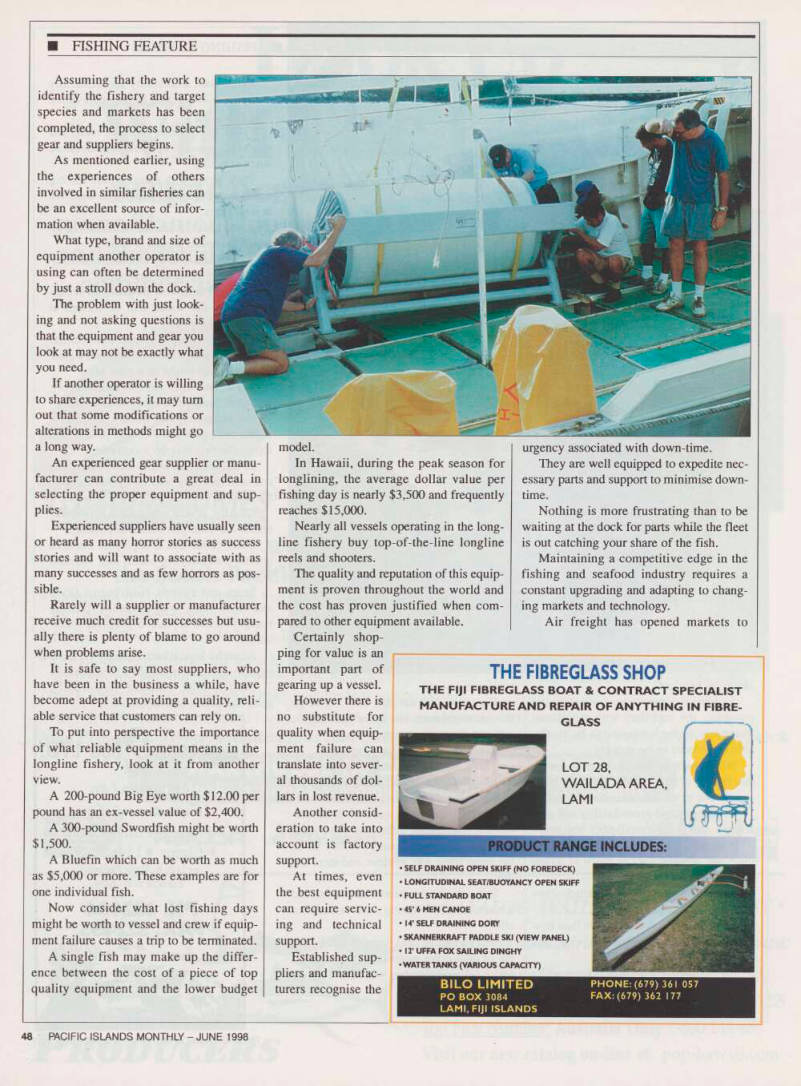
Fishing Feature
THE subject of what gear to buy and from whom is certainly one for debate, and would make for a lively discussion in a room full of fishermen and managers.
You can seldom get two fishermen to agree on anything and this subject is no
exception.
There are as many opinions on the sub ject as there are fishermen.
So do not look to find any definitive answers as to what equipment to buy or how it should be used.
With that in mind, here are some thoughts on a few things to think about when it comes to choosing a supplier or buying fishing gear.
Keep in mind that fishermen tend to experiment and regularly find ways of
doing a particular task that may not always seem the most logical or efficient but gets the job done.
And that is what matters in the end.
A topic of discussion in any fishery, this focus is specifically on monofilament
longlining for pelagics.
In Hawaii, the largest fishery in both number of vessels (100 active) and ex-ves sel value (SUS7O million) is pelagic longlining tuna and swordfish.
Having grown from 38 boats in 1984 to 165 permitted vessels today, the Hawaii based longline fleet is one of the largest monofilament fleets in the world.
Significant developments in monofila
ment longlining are attributed to it.
In business, the goal most strive for is to become profitable.
In the fishing business, many variables
contribute to profitability such as the ves sel, captain and crew, location, gear and, to some extent, luck.
Assuming the vessel, captain and loca tion have been researched and selected properly, the selection and purchase of gear becomes one of the major issues
remaining.
When it comes to selecting what gear to buy, gaining as much information from local sources, other fishermen and research organisations is the obvious place to start.
However, keep in mind that fishermen, being independent souls, are not always excited about sharing information they have learned, or developed, on what does or does not catch fish.
Much of the experience comes at a high price, in both time and investment, and assisting the competition is not always an
attractive prospect.
So when it comes to gear selection and purchase, the suppliers with significant experience in the business can be a valu able component in the process.
When choosing equipment, it is impor tant to keep in mind that the purchase price is only one of the considerations of cost.
Availability and dependability will play a major role in the overall price you pay.
It is safe to say that prices for equip ment and supplies vary as much as 50 per cent or more.
However true savings are much more difficult to calculate.
What may be more important than how much money an item costs is what you received for your money.
All too often, the good deal turns out to be not quite what you wanted or thought
you were getting.
For some, the savings may outweigh the inconvenience, but for others they do not, and the savings evaporate.
Take, for example, longline reels.
There are several manufacturers who make a similar product, designed to do a
similar job.
Materials may vary, construction meth ods and engineering differ, and drive spec ifications are not the same, yet they all do the same basic job: retrieve and store the line.
Some do the job better than others and it is a matter of weighing costs versus ben efits.
Aluminium or steel, large or small, sin gle or dual drive motors, decisions about which equipment to buy will have a signif icant effect on cost.
Remember, availability and reliability
will play a major role in the costs in the
long run.
Fixed equipment, such as reels and shooters, require special consideration
when selecting.
They, along with mainline, are the big ticket items that will usually be used for several years.
Also, these form the foundation on which the entire project is built.
The highest quality affordable general ly will prove to be the best option.
Terminal tackle, or the gear that actual ly goes in the water, can be looked at another way.
Leaders, crimps, hooks and similar tackle have a high turnover rate and a clos er look at cost might be a good idea.
These, and other items in this category, are more likely to be shopped around for.
Not suggesting that quality be ignored, in this case, products that may be less than top-of-the-line may be acceptable.
In addition, because these items are consumable, they will be cycled through the system.
Usually it will not create a problem unless the quality or size is not usable.
Other tackle that is deployed, but does not have an effective useful life, warrants investment in better quality.
Snaps and swivels, radio buoys, floats and float lines, will generally provide many years of service if properly main tained.
A careful look at better quality yet more expensive products should be considered.
Briefly, some thoughts on selecting gear, equipment and suppliers.
Assuming that the work to identify the fishery and target species and markets has been completed, the process to select
gear and suppliers begins.
As mentioned earlier, using the experiences of others involved in similar fisheries can be an excellent source of infor mation when available.
What type, brand and size of equipment another operator is using can often be determined by just a stroll down the dock.
The problem with just look ing and not asking questions is that the equipment and gear you look at may not be exactly what you need.
If another operator is willing to share experiences, it may turn out that some modifications or alterations in methods might go
a long way.
An experienced gear supplier or manu facturer can contribute a great deal in selecting the proper equipment and sup plies.
Experienced suppliers have usually seen or heard as many horror stories as success stories and will want to associate with as many successes and as few horrors as pos sible.
Rarely will a supplier or manufacturer receive much credit for successes but usu ally there is plenty of blame to go around when problems arise.
It is safe to say most suppliers, who have been in the business a while, have become adept at providing a quality, reli able service that customers can rely on.
To put into perspective the importance of what reliable equipment means in the longline fishery, look at it from another view.
A 200-pound Big Eye worth $12.00 per pound has an ex-vessel value of $2,400.
A 300-pound Swordfish might be worth $1,500.
A Bluefin which can be worth as much as $5,000 or more. These examples are for one individual fish.
Now consider what lost fishing days might be worth to vessel and crew if equip ment failure causes a trip to be terminated.
A single fish may make up the differ ence between the cost of a piece of top quality equipment and the lower budget
model.
In Hawaii, during the peak season for longlining, the average dollar value per fishing day is nearly $3,500 and frequently reaches $15,000.
Nearly all vessels operating in the long line fishery buy top-of-the-line longline reels and shooters.
The quality and reputation of this equip ment is proven throughout the world and the cost has proven justified when com pared to other equipment available.
Certainly shop ping for value is an important part of gearing up a vessel.
However there is no substitute for quality when equip ment failure can translate into sever al thousands of dol lars in lost revenue.
Another consid eration to take into account is factory support.
At times, even the best equipment can require servic ing and technical support.
Established sup pliers and manufac turers recognise the
urgency associated with down-time.
They are well equipped to expedite nec essary parts and support to minimise down time.
Nothing is more frustrating than to be waiting at the dock for parts while the fleet is out catching your share of the fish.
Maintaining a competitive edge in the fishing and seafood industry requires a constant upgrading and adapting to chang ing markets and technology.
Air freight has opened markets to
developing countries around the world.
Locations that were once considered remote and nearly isolated now have daily jet service connecting them to world mar kets within hours.
Equipment and supplies ordered today are delivered tomorrow from a source thou sands of miles away.
Swordfish landed today in Australia are served in restaurants in Boston tomorrow.
The industry continues to expand into more of a world market.
As this happens, shore-side supplies and
services will play a more important role in keeping fishermen efficient and competi tive.
One thing to keep in mind is that relia bility, availability and support services, after the sale, will continue to play an important role after the initial purchase.
An experienced supplier, with the prop er support facilities, will prove to be a valu able asset for any fisherman.
Now, and in the long run, this will allow fishermen to do what they do best - catch fish. ■
Advertisements & other items, pp. 45-50 (1 item)
grotto
a?
tta
n (I
JD VO
3 a Rf- II "I <&v a< • b m .
F.O. Box 178 Suva Phone: (679) 314 819 Fax: (679) 314 973 Email? solandfeftfnsxom.il
Hook Up
With The Leader!
PACIFIC OCEAN PRODUCERS is the leader in monofilament longline system technology. We have Asia and the Pacific Basin’s largest and most complete line of
commercial fishing equipment and marine supplies.
URALUMES
A
BHHH■
We offer special service to the South Pacific Islands, Australia, and New Zealand. • Lindgren-Pitman gear, complete hydraulic systems, design and installation of monofilament longline systems including operations training. • Extensive Tuna and Swordfish supplies, bottom fishing gear, fish handling supplies and bait. • Duralumes® Lightstick - the latest in lightsticks technology, extended light output, often used two nights, 5-year - shelf life, not affected by moisture, easy-to- handle shipping carton. All popular colors available - green, blue, pink, yellow, white, violet and ultra-violet for best fishing results. • Weekly shipments to the South Pacific Islands, Australia and New Zealand.
New Products: Dyno Insulated Bins and Custom Sea Gear bottom fishing reels are now in stock.
JABSCO
a
WAREHOUSE IN SAMOA NOW OPEN!
* Hooks • Snaps • Mainline • Leaderline • Dyno Bins Racop H MUSTAO eme^ccaw
DEXTER (RUSSELL
Pacific
Ocean
Producers
• CATALOG AVAILABLE ON REQUEST •
Please direct all inquiries to the Export Department: 965-B N. Nimitz Hwy., Honolulu, HI 96817, USA.
Telephone: (808) 537-2905 Facsimile: (808) 536-3225 Toll Free Number: Australia Only 1-800-144-488 Visit our new catalog on-line at: pop-hawaii.com
LTD.
Aquarium Life Sxfuyit&M' -dCtAc: • Tropical Fish • Corals • Clams • Live Rock to U.S.A, New Zealand, Europe and Asia.
PH; 322494
FAX; 322495
* nr
THE FIBREGLASS SHOP
THE FIJI FIBREGLASS BOAT & CONTRACT SPECIALIST MANUFACTURE AND REPAIR OF ANYTHING IN FIBRE- *
GLASS
LOT 28,
WAI LADA AREA,
LAM I
PRODUCT RANGE INCLUDES:
• SELF DRAINING OPEN SKIFF (NO FOREDECK)
• LONGITUDINAL SEAT/BUOYANCY OPEN SKIFF
• FULL STANDARD BOAT
• 45’ 6 MEN CANOE
• 14’SELF DRAINING DORY
• SKANNERKRAFT PADDLE SKI (VIEW PANEL)
• 12’ UFFA FOX SAILING DINGHY
•WATERTANKS (VARIOUS CAPACITY)
BILO LIMITED
PO BOX 3084
LAMI, FIJI ISLANDS
PHONE; (679) 361 057
FAX; (679) 362 177
The best in
marine engines, gen sets
ana equipment.
We've got
Hie name for it.
MARINE DIESEL ENGINES
28 bhp to 420 bhp H
isten
LISTER
PEITER
MARINE DIESEL ENGINES
AND GEN SETS
/SA.
WaterMota
Built in the British tradition
MARINE DIESEL ENGINES
20 bhp to 260 bhp
AMOT
ENGINE SAFETY
EQUIPMENT
TO
THERMOWRAP AND
SILENCERS
dryfit
LONG LIFE
MAINTENANCE FREE GEL
BATTERIES
JOHNSON
SWEDISH MARINE PUMPS
You won’t beat this combination. Top engine products and the hands-on experience the R.A.L.F. Marine team can bring to their selection and installation. With our 45 years’ combined background in the industry we offer a seamless service to satisfy your needs with a range of quality equipment we are proud to represent. We’re ready when you are. Just give us a call.
O Martec
FRESH WATER HEAT
EXCHANGER KITS
FAX NOW FOR HOTLINE
SERVICE FOR ALL PNG AND
PACIFIC ISLANDS ENQUIRIES.
KK
SERVICES
R.A.LF. MARINE SERVICES PTY. LTD.
4 Tengah Cres., (PO Box 419) Mona Vale N.S.W. 2103 Sydney, Australia Tel: 61 2 9979 6644
FAX : 61 2 9979 6647
MARINE PLANT FOR SALE SURPLUS
TO CURRENT REQUIREMENTS
■ PILE RIG SMALLER UNIT, ROAD TRANSPORTABLE WILL FIT ON $10,500 FLAT, RACK 22’ TOWER, 1.25 TONNE MONKEY, NEW WIRE, EASY TO OPERATE, SUIT SMALL JETTY AND WHARFS ■ WINCHES VARIOUS DIESEL MANUAL HYDRAULIC ECT RING FOR pQA
DETAILS
PHONE MR ROBERTSON SALES SYDNEY 61 2 95240044
of change
A decade of change
The Asian currency crisis has, no doubt, had vast global effect, but in the fishing industry, it is being most felt in the air.
That is, the air cargo space, by which all seafood products are rushed to their various markets, has recently been drasti cally reduced.
“This,” says David Lucas, general manager of Solander Pacific, “could seri ously affect the industry’s ability to export all their catch in the coming busy months”.
And Mr Lucas has been in Fiji long enough to know what he is talking about.
Having reached its tenth year of opera tions in the country, Solander (Pacific) Limited can be considered a success.
Registered in Fiji in June 1988, the company specialises in catching pelagic fish by means of surface long-lining.
Ninety-seven per cent of their catch is exported mainly to Japan, USA, American Samoa and Australia.
But with the reduction in flights around the Pacific Rim, the industry is gearing up to adapt to a tight squeeze in terms of refrigerated cargo space.
The Asian currency crisis caused Korean Airlines to stop its flights to Fiji, and who knows how it will affect flights to Japan where the economy is going through a low that has not been felt since the post-war era.
Employing 50 people and another 10 on a casual basis, Solander Pacific, like others in the fishing industry, will hang on and make the most of circumstances.
“We will continue doing that which we know best,” says Mr Lucas.
So while the industry gets set for change towards 2000, and any other cri sis, there is no doubt that the five Solander vessels will be out again tomorrow to cap italise on the biggest season to come.
Asian currency crisis or not. ■
Advertisements & other items, p. 51 (1 item)
«
*5 1 ?r 4.- 7 * ?>■ S, r *>v W -.. ..■■ Hf •-. v Iw Srfe’s SPPF can fisheries project sponsors in three main areas; • Formulating, evaluating and promoting fisheries projects and providing consultancy services to develop and implement business plans; • Obtaining equity and loan financing on commercial terms from financial institutions; • Raising additional equity from the Pacific Island Investment Facility.
The Pacific Island Investment Facility (PIIF) The PIIF was established by the International Finance Corporation (IFC) in 1995 with initial capital of US$2 million. PIIF can invest amounts between US$lOO,OOO and U 55350,000 in private sector fisheries projects in Pacific island countries. PIIF acts to supplement the region's limited sources of equity and commercial finance.
PIIF funding has proved useful in a number of fisheries projects where funding is not readily available for the fisheries sector. Funds for this source made available to Pacific Islands fisheries projects through SPPF is approaching US$l million. Applications for funding assistance form the PIIF are processed through SPPF in Sydney and approved by IFC in Washington, DC.
Enquiries concerning fisheries projects where SPPF might be of assistance may be directed to:
Peter Philipson
Fisheries Sector Specialist
South Pacific Project Facility
Level 8, 89 York Street
Sydney, Australia
GPO Box 1612 Sydney, Australia 2001 ■£333 South Pacific Project Facility Phone 61-2-9299 2500 Fax 61-2-9299 2551
Email [email protected]
Theatre brings sex into schools

Art & Heritage
By Patrick Decloitre
Vanuatu’s very own Wan Smol Bag Theatre has broken new ground in
community education.
In a short play, it introduces sex educa tion, a subject seen as “taboo” in this island state’s primary school system.
It is certainly one of its boldest chal lenges since it was created in the early 90s - teaching schoolchildren about sex educa tion in a society where they don’t learn about the facts of life until late.
The shows take place in the capital’s primary schools, where children watch child actors tell them about their own body.
The 20-minute act is very graphic.
The actors use their bodies to reproduce the female reproductive system, and clear ly show a woman’s womb and inside organs drawn on a bed sheet.
Vanuatu’s education authorities wanted to introduce the subject in schools, but they didn’t quite know how to go about it.
“They were scared that churches or tra ditional chiefs or parents might not approve.
“But some people were brave enough to support a reproductive health awareness scheme and they asked us to come up with a play,” WSB founder and playwright Jo Dorras said.
“So we produced a script trying to avoid upsetting sexual reference.
“It’s quite direct, but it looks mainly at how the body functions, something most young girls don’t have a clue about, because at home, even if they ask, no one tells them.
“Some kids even told us they were beat en because they asked about that,” she adds.
The play depicts a teenage schoolgirl getting a note from a boy asking to meet her in the evening.
“We decided to start with a situation in primary school, a girl chased by a school boy. And the girl wonders what this boy wants,” Dorras explains.
“So the kids make the shape of fallopi an tubes and other female reproductive organs.
“They explain in simple terms what the menstruation cycle is, how it works, how a baby is formed, how it’s bom.
“Kids don’t know about pregnancy.
“We had an incredible amount of ques tions, some audiences laugh all the way through, but at other times, the kids just listen.
“Even when they laugh, they still ask questions at the end.”
The main message is “you’re too young to have sex” and “this is dangerous for your body”.
At first, Pango English primary school headmaster Eric Taso was not comfortable with the idea of having a theatre group coming to his school to talk about sex.
But after the performance, he seemed to feel better.
“First, I was a bit nervous. At the same time, I think I’m glad the kids know, this can help them.
“Teachers don’t touch that subject in classes. This is the first time it’s brought up here”, Taso said.
“So far, we’re trying to introduce books, but this is only about sex lives of animals.
“Maybe in near future, they’ll do the same with humans,” he said. ■
Wan Smol Bag:
a success story
Wwas created in the early 90s.
It is mainly funded by Britain and has covered a wide spectrum of topics ranging from proper use of toilets to coral reefs and turtle protection. On top of the regular adult professionals, it now enrols unschooled children, mainly from Port Vila’s shanty town of Blacksands.
The plays are usually commissioned by various organisations, governmental or not, who want to get their message across. Once written, plays are performed in Vanuatu’s rural islands, in a typical village environ ment. The actors, all of whom are ni- Vanuatu, only need a few props to perform, and can carry them in a small bag. hence
Advertisements & other items, p. 52 (1 item)
c^fjJSS
AUSTRALIAN INTERNATIONAL SHIPPING SERVICES PTY LTD
Providing Container Consolidated Services, Full Container Loads , Airfreight Forwarding and Purchase Order Tracking Services to: — American Samoa, Cook Islands, Fiji, Guam, Kiribati, New Zealand, Niue, Norfolk Island, New Caledonia, Nauru, Papua New Guinea, Solomon Islands, Tahiti, The Federated States of Micronesia, Tonga, Vanuatu and Western Samoa.
Offices in Melbourne and Sydney
TEL:— 61-3-93351477 FAX:— 61-3-93380115 EMAIL:— A-I-S-S.COM
Canada 3000
comes to the Cooks
When the very rich Richard Branson of Virgin Records want ed to branch out into air travel, he asked Angus Kinnear how to go about it. Kinnear, founding President of Canada 3000, got Branson across the table and their informal talk led to the start of Virgin Airlines.
At least that’s the story behind the beginnings of Virgin Airlines as told by Canada 3000 Product Vice President Yehudi Altman. Canada 3000 is expanding its South Pacific destinations and November will see flights into Rarotonga in the Cook Islands for an initial five months. The first flight by the airline char ter company to Rarotonga is scheduled for November 5 running until April, the begin ning of Canada’s summer when “its extremely hard to get Canadians to travel,” says Altman. But the long-term intent is to fly to Rarotonga all year around.
The prospect of more visitors will have the Cooks government and the tourism industry rubbing their hands in glee at the thought of an anticipated $2.5 million Canada 3000 passengers will inject into the
local community during its first five months of operations there. Tourism Cook Islands Chief Executive To Tuakeu- Lindsay says this would be “really good for the Cooks if it can be maintained” pro viding easier links with North America, where the biggest number of visitors to the Cooks come from. Canada 3000 will fly into Rarotonga every Thursday, going on to New Zealand and turning around the same day back to Rarotonga. The commer cial sector can expect around 120 “middle to upper bracket” visitors getting off in Rarotonga weekly for an average 11 days stay in Rarotonga and Aitutaki. Because of government’s current agreement with Air New Zealand, locals won’t be able to take advantage of Canada 3000 flights to
Auckland and vice versa, says Altman.
Canada 3000 will be spending “upwards of $CD250,000 for advertising the Cook Islands destination in Canada,” says Altman. The company will be looking to Tourism Cook Islands for “minor sup port, about NZ$4O,OOO - $50,000” to assist with the campaign.
Canada 3000 is in its third year of fly ing charters to Fiji, an arrangement that former head of the Cook Islands Tourist Authority Chris Wong was “instrumental in setting up”. Wong has recently been re appointed to Tourism Cook Islands as director of marketing. Canada 3000 has been operating for ten years and carries over 2.5 million passengers from 22 coun tries around the world. It has 15 aircraft and boasts the “most modem aircraft fleet in Canada”. The Cook Islands was chosen as an additional Pacific destination follow ing a visit to Rarotonga by Canada 3000 Holiday Division President David Hardouin and his wife over a year ago.
“They fell in love with the place and people,” says Yehudi Altman. And if things work according to plan, this place and peo ple can expect a much welcome lift in the
economy. I
Clan squabbles over Ariki title
By Florence Syme-Buchanan
In a country whose people
pride themselves on being
able to recite their Cook Islands lineage, to call some one “puti”- bastard child - is the worst insult.
And puti insults have recently been thrown in the face of some members of one Rarotonga’s most noble families - the Makea clan.
All this because of a squabble over the clan’s title of Ariki - paramount chief.
The latest Makea controversy sees the family line disputed because of illegitimate children whose apparent descendants have laid claim to the Ariki title.
Local historian, former prime minister Sir Thomas Davis wrote in Cook Islands News that the majority of Makea descen dants reacted strongly to the illegitimacy issue. “Presumably because none of past
traditional titleholders were blessed with a Christian marriage” he says. “The Makea titleholder at European contact had three wives. The Makea Ariki title has under gone some changes under the influence of European contact, especially as it involves the missionaries,” wrote Sir Thomas.
There are currently at least four claimants to the title of Makea Ariki. Being an Ariki in the Cooks gives mana and is lucrative. It means ownership of lands and
collecting rentals.
A series of meetings this month failed to resolve the matter. The conflict could last for years tying up tenancy of the Makea palace, Para O Tane on the fringe of capital Avarua. Vast (by Cook Islands stan dards) quantities of land belonging to the clan will also be tied up. This includes most of the lands in Avarua. Land and title disputes are not unusual in the Cooks.
Especially in Rarotonga - an island of just
67.2 square kilometres there are bitter fights over family land as less becomes available to share. Land claims are settled more amicably in the outer islands as some retain the traditional ways of distribution instead of through the land court.
Land and titles are inherited in the Cook Islands. The Cook Islands land tenure sys tem is unique in that no lands can be sold on a freehold basis. Leases for a maximum of 60 years are often sold with the consent of the majority of landowners. Upon expi ration of leases, the land reverts back to the family. Some families have failed to agree to a majority vote over the fate of a large number of family homes built in the 1800’s and early 1900’s. Sadly, this has seen these once beautiful homes fall into disrepair. All that remains of many of these houses are the limestone walls, built from scratch by the hands of the forefathers of today’s squabbling descendants. ■
Advertisements & other items, p. 53 (1 item)
53
■ ART & HERITAGE
PACIFIC ISLANDS MONTHLY - JUNE 1998
Handmade paper comes to Fiji
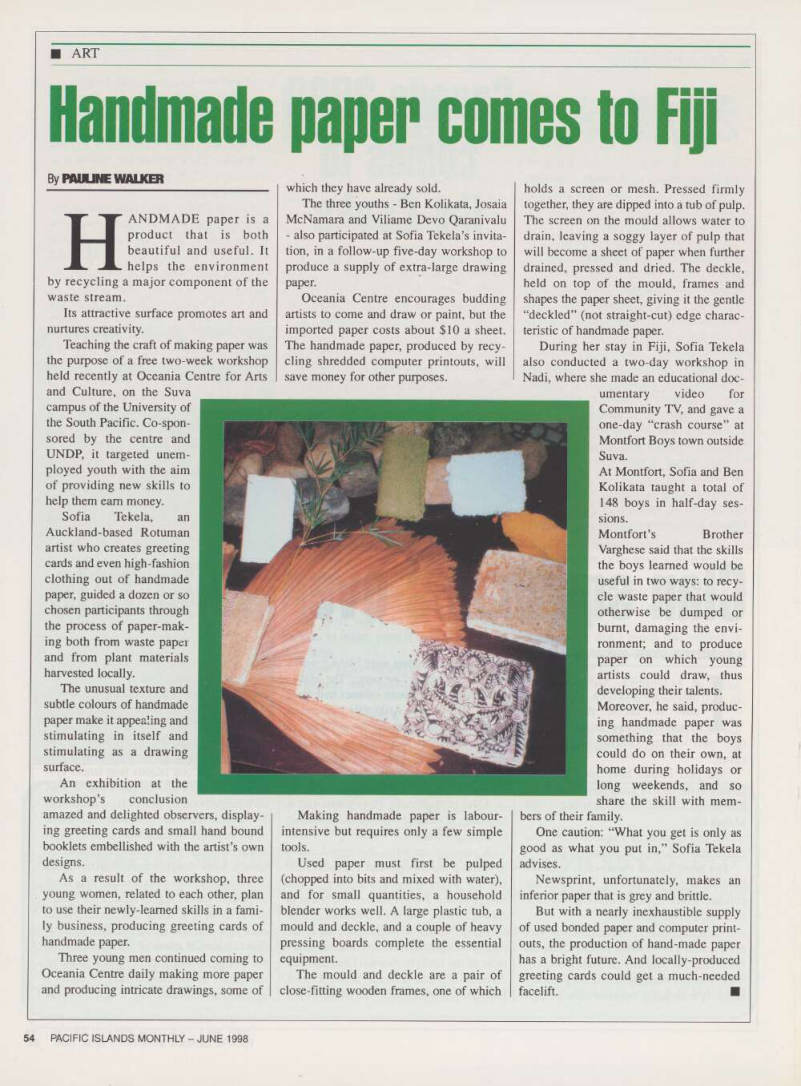
Art
By Pauline Walker
Handmade paper is a product that is both beautiful and useful. It helps the environment by recycling a major component of the waste stream.
Its attractive surface promotes art and nurtures creativity.
Teaching the craft of making paper was the purpose of a free two-week workshop held recently at Oceania Centre for Arts and Culture, on the Suva
campus of the University of the South Pacific. Co-spon sored by the centre and UNDP, it targeted unem ployed youth with the aim of providing new skills to help them earn money.
Sofia Tekela, an Auckland-based Rotuman artist who creates greeting cards and even high-fashion clothing out of handmade paper, guided a dozen or so chosen participants through the process of paper-mak ing both from waste paper and from plant materials harvested locally.
The unusual texture and subtle colours of handmade paper make it appealing and stimulating in itself and stimulating as a drawing surface.
An exhibition at the workshop’s conclusion
amazed and delighted observers, display ing greeting cards and small hand bound booklets embellished with the artist’s own designs.
As a result of the workshop, three young women, related to each other, plan to use their newly-leamed skills in a fami ly business, producing greeting cards of handmade paper.
Three young men continued coming to Oceania Centre daily making more paper and producing intricate drawings, some of
which they have already sold.
The three youths - Ben Kolikata, Josaia McNamara and Viliame Devo Qaranivalu - also participated at Sofia Tekela’s invita tion, in a follow-up five-day workshop to produce a supply of extra-large drawing paper.
Oceania Centre encourages budding artists to come and draw or paint, but the imported paper costs about $lO a sheet.
The handmade paper, produced by recy cling shredded computer printouts, will save money for other purposes.
Making handmade paper is labour intensive but requires only a few simple tools.
Used paper must first be pulped (chopped into bits and mixed with water), and for small quantities, a household blender works well. A large plastic tub, a mould and deckle, and a couple of heavy pressing boards complete the essential equipment.
The mould and deckle are a pair of close-fitting wooden frames, one of which
holds a screen or mesh. Pressed firmly together, they are dipped into a tub of pulp.
The screen on the mould allows water to drain, leaving a soggy layer of pulp that will become a sheet of paper when further drained, pressed and dried. The deckle, held on top of the mould, frames and shapes the paper sheet, giving it the gentle “deckled” (not straight-cut) edge charac teristic of handmade paper.
During her stay in Fiji, Sofia Tekela also conducted a two-day workshop in Nadi, where she made an educational doc
umentary video for Community TV, and gave a one-day “crash course” at Montfort Boys town outside Suva.
At Montfort, Sofia and Ben Kolikata taught a total of 148 boys in half-day ses sions.
Montfort’s Brother Varghese said that the skills the boys learned would be useful in two ways: to recy cle waste paper that would otherwise be dumped or burnt, damaging the envi ronment; and to produce paper on which young artists could draw, thus developing their talents.
Moreover, he said, produc ing handmade paper was something that the boys could do on their own, at
home during holidays or
long weekends, and so
share the skill with mem bers of their family.
One caution: “What you get is only as good as what you put in,” Sofia Tekela advises.
Newsprint, unfortunately, makes an inferior paper that is grey and brittle.
But with a nearly inexhaustible supply of used bonded paper and computer print outs, the production of hand-made paper has a bright future. And locally-produced greeting cards could get a much-needed facelift. ■
Structural reform-a prickly
Opinion
Structural reform-a prickly nettle for Pacific countries
David Barber
Wellington
There would never, of course, have been a right time for Asia’s financial and economic crisis to occur. For Pacific Island countries, strug gling to come to terms with the need for radi cal reform of their fragile economies, the timing was cer tainly awry.
Asia, including Japan, takes up to 80 per cent of some of the island states’ exports. It was the fastest-growing source region for tourists. If you exclude Australia’s massive assistance to Papua New Guinea, Japan is the Pacific’s biggest aid donor. Korea has already cut back its aid projects in Fiji and closed its International Cooperation Agency’s Port Moresby office.
Asian firms have substantial investments in logging, fisheries, agriculture, tourism, banking and property developments in sever al Pacific Island countries - investments that could be jeopardised as money gets tighter and they look for greater security closer to home.
Depending how the situation, particularly in Japan, settles down - and at the time of writing this is far from clear - the poten tial impact on the island economies is enormous.
It will certainly be well to the fore in the minds of South Pacific Forum Economic Ministers when they meet in Nadi next month and their leaders when they gather in Pohnpei later in the year.
The Asian crisis occurred at a time the island states, who left eco nomic reform in the “too hard” basket for far too long, had begun to grasp what is for them a particularly prickly nettle. Structural reform can never be achieved without pain and social dislocation, as New Zealand well knows.
It is to the credit of the Forum leaders that they had embarked on a process of change that while politically and socially difficult, is crucial to their countries’ survival in an increasingly complex and tough global economy. They recognised that the days of high tariffs, import protection, feather-bedded public services and other anachronistic practices were over and they had to take their peo ples into the real, if cruelly competitive, world if they were to give them a 21st Century quality of life and standard of living.
But to achieve this they need time and understanding. New Zealand and Australia, acutely aware that sustainable economic growth in the Pacific and regional security are in their interests, were prepared to give them these while encouraging change.
No one, least of all the Australasian nations who themselves had become increasingly dependent on Asian markets, tourists and investment, bargained on the regional financial domino col lapse which began with the Thai baht last July. The more vulner able island states already had enough to deal with. The Solomon Islands certainly could not afford to lose its log exports which accounted for more than a third of government revenue and half of foreign exchange - nor could Papua New Guinea, already suf fering a prolonged drought and falling gold and copper prices.
Fiji could ill afford the 90 per cent fall in Korean tourism and 20 per cent drop in Japanese tourist numbers which hit early this year or the increased threat from cheaper Asian goods to its cloth ing sector which represented 23 per cent of exports. Vanuatu cer tainly didn’t need the impact on its already limited exports of beef and timber. The island economies were already struggling. As the recent United Nations Economic and Social Survey of Asia and the Pacific noted, only Samoa and the Solomons exceeded 3 per cent growth in 1996 and 1997 and most were well below that.
New Zealand statistics highlight their problem. Total exports to New Zealand from 25 Pacific states and territories slumped nearly 40 per cent last year, only Fiji (up 14 per cent) and the Solomons (up 23 per cent) showing any increase on 1996, apart from minor sales by New Caledonia, the Northern Mariana Islands and Pitcairn. Sales to New Zealand from the entire region came to only SNZ9I.S million, the lowest figure in more than a decade. Reasons for the collapse are varied, but the pattern demonstrated the difficulties the islands have in developing viable and sustainable economies, able to compete in international com merce as New Zealand and Australia drop their tariffs against imports from the rest of the world.
Forum Economic Ministers, who drew up a framework for change and an ambitious action plan when they met in Cairns last year, will have a number of reports to contemplate in Nadi. They include a wide-ranging one by the Forum Secretariat on the prospects of a free trade agreement, one looking at intra-regional trade among the Forum Island Countries themselves and another at trading arrangements with the French Pacific territories.
They will consider studies on tariff reduction and changes in tax systems. They recognise they have to move away from a high tariff system - e.g. Tonga still has import duties of 45 to 60 per cent- and will have to move, like Samoa, towards other means of raising revenue, such as a GST. As far as trade with New Zealand and Australia is concerned, SPARTECA has probably gone about as far as it can go.
Looking further afield, the Lome agreement with the European Union is up for re-negotiation and Fiji, in particular, wants con tinued access for its sugar. But if the ministers want to lift their exports they could start by looking closer to home. Only 2 per cent of their total exports go to other Pacific island countries and some of their highest tariff barriers are against each other. ■
Molotov Cocktail.
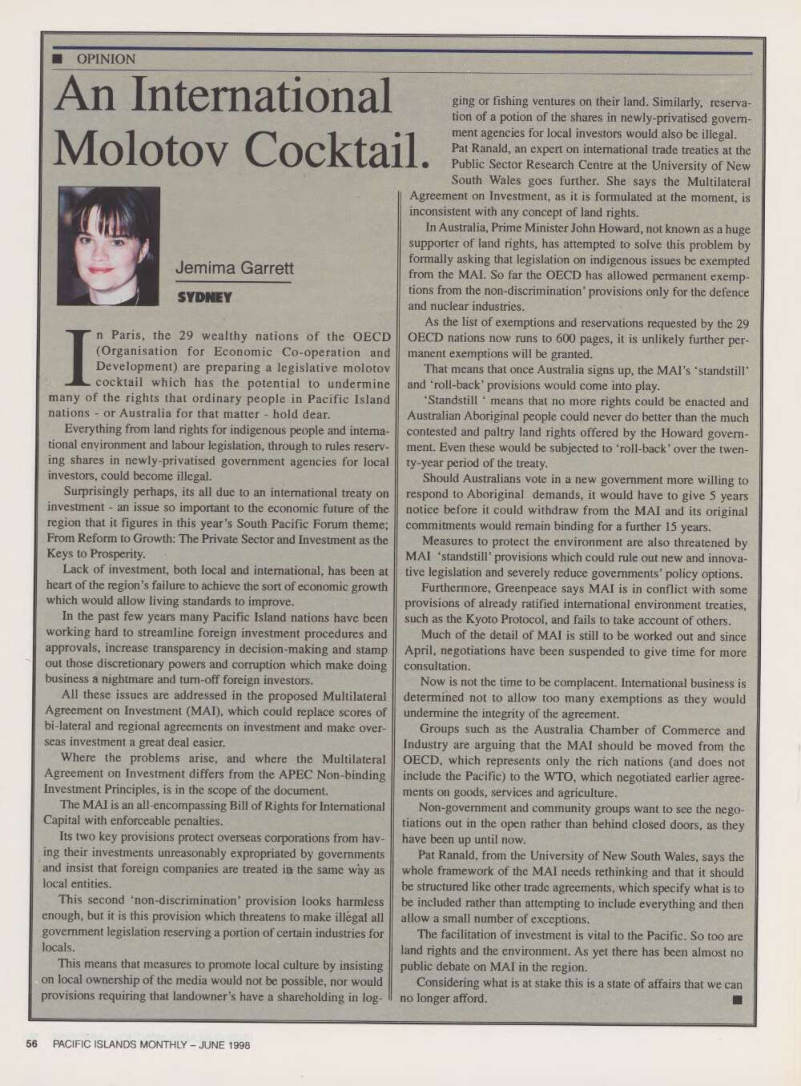
An International Molotov Cocktail.
In Paris, the 29 wealthy nations of the OECD (Organisation for Economic Co-operation and Development) are preparing a legislative molotov cocktail which has the potential to undermine many of the rights that ordinary people in Pacific Island nations - or Australia for that matter - hold dear.
Everything from land rights for indigenous people and interna tional environment and labour legislation, through to rules reserv ing shares in newly-privatised government agencies for local investors, could become illegal.
Surprisingly perhaps, its all due to an international treaty on investment - an issue so important to the economic future of the region that it figures in this year’s South Pacific Forum theme; From Reform to Growth: The Private Sector and Investment as the Keys to Prosperity.
Lack of investment, both local and international, has been at heart of the region’s failure to achieve the sort of economic growth which would allow living standards to improve.
In the past few years many Pacific Island nations have been working hard to streamline foreign investment procedures and approvals, increase transparency in decision-making and stamp out those discretionary powers and corruption which make doing business a nightmare and turn-off foreign investors.
All these issues are addressed in the proposed Multilateral Agreement on Investment (MAI), which could replace scores of bi-lateral and regional agreements on investment and make over seas investment a great deal easier.
Where the problems arise, and where the Multilateral Agreement on Investment differs from the APEC Non-binding Investment Principles, is in the scope of the document.
The MAI is an all-encompassing Bill of Rights for International Capital with enforceable penalties.
Its two key provisions protect overseas corporations from hav ing their investments unreasonably expropriated by governments and insist that foreign companies are treated in the same way as local entities.
This second ‘non-discrimination’ provision looks harmless enough, but it is this provision which threatens to make illegal all government legislation reserving a portion of certain industries for locals.
This means that measures to promote local culture by insisting on local ownership of the media would not be possible, nor would provisions requiring that landowner’s have a shareholding in log
ging or fishing ventures on their land. Similarly, reserva tion of a potion of the shares in newly-privatised govern ment agencies for local investors would also be illegal.
Pat Ranald, an expert on international trade treaties at the Public Sector Research Centre at the University of New
South Wales goes further. She says the Multilateral Agreement on Investment, as it is formulated at the moment, is inconsistent with any concept of land rights.
In Australia, Prime Minister John Howard, not known as a huge supporter of land rights, has attempted to solve this problem by formally asking that legislation on indigenous issues be exempted from the MAI. So far the OECD has allowed permanent exemp tions from the non-discrimination’ provisions only for the defence and nuclear industries.
As the list of exemptions and reservations requested by the 29 OECD nations now runs to 600 pages, it is unlikely further per manent exemptions will be granted.
That means that once Australia signs up, the MAPs ‘standstill’ and ‘roll-back’ provisions would come into play. ‘Standstill ‘ means that no more rights could be enacted and Australian Aboriginal people could never do better than the much contested and paltry land rights offered by the Howard govern ment. Even these would be subjected to ‘roll-back’ over the twen ty-year period of the treaty.
Should Australians vote in a new government more willing to respond to Aboriginal demands, it would have to give 5 years notice before it could withdraw from the MAI and its original commitments would remain binding for a further 15 years.
Measures to protect the environment are also threatened by MAI ‘standstill’ provisions which could rule out new and innova tive legislation and severely reduce governments’ policy options.
Furthermore, Greenpeace says MAI is in conflict with some provisions of already ratified international environment treaties, such as the Kyoto Protocol, and fails to take account of others.
Much of the detail of MAI is still to be worked out and since April, negotiations have been suspended to give time for more consultation.
Now is not the time to be complacent. International business is determined not to allow too many exemptions as they would undermine the integrity of the agreement.
Groups such as the Australia Chamber of Commerce and Industry are arguing that the MAI should be moved from the OECD, which represents only the rich nations (and does not include the Pacific) to the WTO, which negotiated earlier agree ments on goods, services and agriculture.
Non-govemment and community groups want to see the nego tiations out in the open rather than behind closed doors, as they have been up until now.
Pat Ranald, from the University of New South Wales, says the whole framework of the MAI needs rethinking and that it should be structured like other trade agreements, which specify what is to be included rather than attempting to include everything and then allow a small number of exceptions.
The facilitation of investment is vital to the Pacific. So too are land rights and the environment. As yet there has been almost no public debate on MAI in the region.
Considering what is at stake this is a state of affairs that we can no longer afford. ■
Jemima Garrett
Sydney
Shipping
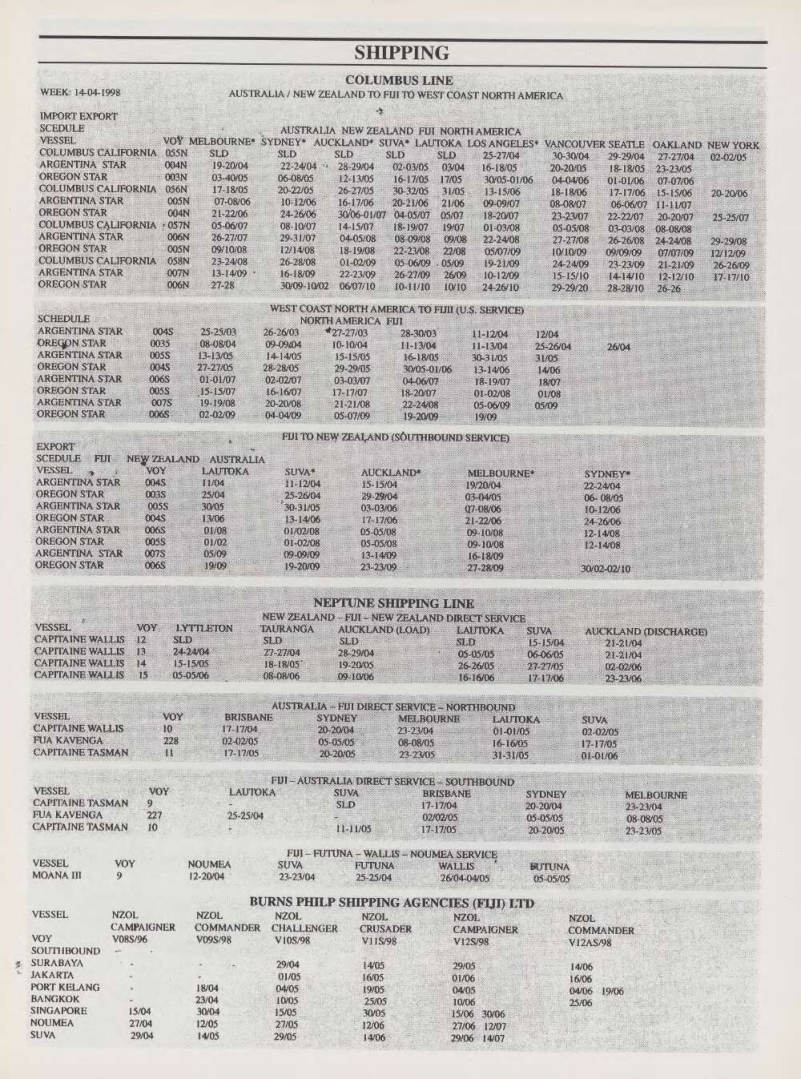
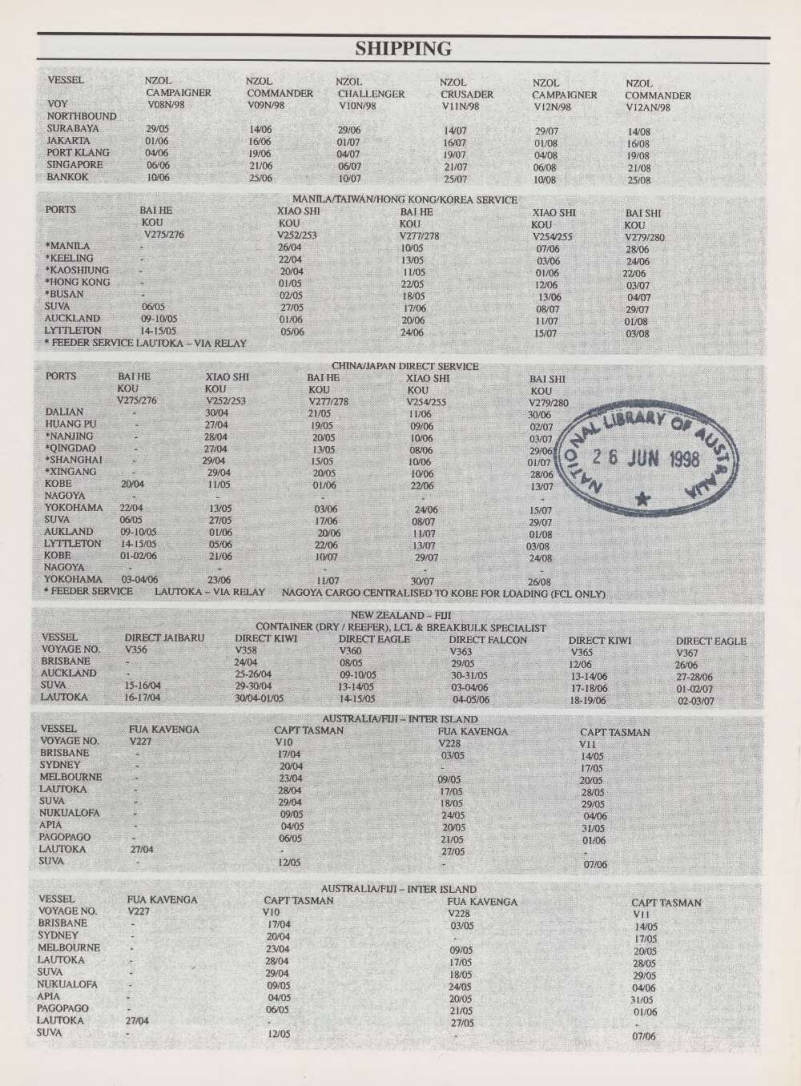
Columbus Line
Neptune Shipping Line
Burns Philp Shipping Agencies (Fiji) I/Fi)
Week: 14-04-1998
AUS TRALIA / NEW ZEALAND TO FUI TO WEST COAST NORTH AMERICA
Import Export
.K
Scedule
Australia New Zealand Fui North America
Vessel
Vor Melbourne*
Sydney* Auckland*
Suva* Lautoka Los Angeles* Vancouver Seatle
Oakland New York
Columbus California
055N
Sld
Sld
Sld
Sld
Sld
25-27/04 30-30/04 29-29/04 27-27/04 02-02/05
Argentina Star
004N 19-20/04 22-24/04 •' 28-29/04 02-03/05 03/04 16-18/05 20-20/05 18-18/05 23-23/05
Oregon Star
003N 03-40/05 06-08/05 12-13/05 16-17/05 17/05 30/05-01/06 04-04/06 01-01/06 07-07/06
Columbus California
056N 17-18/05 20-22/05 26-27/05 30-32/05 31/05 13-15/06 18-18/06 17-17/06 15-15/06 20-20/06
Argentina Star
005N 07-08/06 10-12/06 16-17/06 20-21/06 21/06 09-09/07 08-08/07 06-06/07 11-11/07
Oregon Star
004N 21-22/06 24-26/06 30/06-01/07 04-05/07 05/07 18-20/07 23-23/07 22-22/07 20-20/07 25-25/07
Columbus California
' 057N 05-06/07 08-10/07 14-15/07 18-19/07 19/07 01-03/08 05-05/08 03-03/08 08-08/08
Argentina Star
006N 26-27/07 29-31/07 04-05/08 08-09/08 09/08 22-24/08 27-27/08 26-26/08 24-24/08 29-29/08
Oregon Star
005N 09/10/08 12/14/08 18-19/08 22-23/08 22/08 05/07/09 10/10/09 09/09/09 07/07/09 12/12/09
Columbus California
058N 23-24/08 26-28/08 01-02/09 05-06/09 05/09 19-21/09 24-24/09 23-23/09 21-21/09 26-26/09
Argentina Star
007N 13-14/09 • 16-18/09 22-23/09 26-27/09 26/09 10-12/09 15-15/10 14-14/10 12-12/10 17-17/10
Oregon Star
006N 27-28 30/09-10/02 06/07/10 10-11/10 10/10 24-26/10 29-29/20 28-28/10 26-26
Schedule
Argentina Star
004$ 25-25/03, WEST COAST NORTH AMERICA TO FU1I (U.S. SERVICE)
North America Fui
26-26/03 *27-27/03 28-30/03 11-12/04 . -12/04
Orecjpn Star
0035 08-08/04 09-09/04 10-10/04 11-13/04 11-13/04 25-26/04 26/04
Argentina Star
005S 13-13/05 14-14/05 15-15/05 16-18/05 30-31/05 31/05
Oregon Star
004S 27-27/05 28-28/05 29-29/05 30/05-01/06 13-14/06 14/06
Argentina Star
006S 01-01/07 02-02/07 03-03/07 04-06/07 18-19/07 18/07
Oregon Star
005S ,15-15/07 16-16/07 17-17/07 18-20/07 01-02/08 01/08
Argentina Star
007S 19-19/08 20-20/08 21-21/08 22-24/08 05-06/09 ' 05/09
Oregon Star
006S 02-02/09 04-04/09 05-07/09 19-20/09 19/09
Export
Fui To Nev/ Zealand {S6Uthbound Service)
Scedule Ful
Nejj/ Zealand
Australia
Vessel .* ;
Voy
Lautoka
Suva*
Auckland*
Melbourne*
Sydney*
Argentina Star
004S 11/04 11-12/04 15-15/04 19/20/04 : 22-24/04
Oregon Star
003S 25/04 25-2604 29-29/04 03-04/05 06-08/05
Argentina Star
005S 30/05 30-31/05 03-03/06 07-08/06 10-12/06
Oregon Star
004S 13/06 13-14/06 17-17/06 21-22/06 24-26/06
Argentina Star
006S 01/08 01/02/08 05-05/08 09-10/08 12-14/08
Oregon Star
005S 01/02 01-02/08 05-05/08 09-10/08 12-14/08
Argentina Star
007S 05/09 09-09/09 13-14/09 16-18/09
Oregon Star
006S 19/09 19-20/09 23-23/09 27-28/09 M ' Y' H; Vc H 30/02-02/10
New Zealand
- FUl - NEW ZEALAND DIRECT SERVICE
Vessel
Voy
Lyttlbton
Tauranga
Auckland (Load)
Lautoka
Suva
Auckland (Discharge)
Cafftaine Wallis
12
Sld
Sld
Sld
Sld
15-15/04 21-21/04
Cafitaine Wallis
13 24-24/04 27-27/04 28-29/04 05-05/05 06-06/05 21-21/04
Cafftaine Wallis
14 15-15/05 18-18/05’ 19-20/05 f 26-26/05 ■ 27-27/05 02-02/06
Cafftaine Wallis
15 05-05/06 08-08/06 09-10/06 16-16/06 17-17/06 23-23/06
Vessel
Voy
AUSTRALIA - FUI DIRECT SERVICE - NORTHBOUND
Brisbane Sydney Melbourne Lautoka
Suva
Cap1Taine Wallis
10 17-17/04 20-20/04 23-23/04 01-01/05 „ 02-02/05
Fua Kavenga
228 02-02/05 05-05/05 08-08/05 16-16/05 17-17/05
Capita The Tasman
11 17-17/05 20-20/05 23-23/05 31-31/05 01-01/06
VESSEL VOY LAUTOkI 01 AUSTR ™ ECT 8001^0 SYDNEY MELBOURNE CAPITAINE TASMAN 9 SLD 17-17/04 20-20/04 23-23/04 FUA KAVENGA 227 25-25/04 - 02/02/05 05-05/05 08-08/05 CAPITAINE TASMAN 10 IW1/05 17-17/05 20-20/05 23-23/05
VESSEL VOY NOUMEA SUVA FUTUNA N0Ufv^ i S ERVJ c E BunjNA MOANAIII 9 12-20/04 23-23/04 25-25/04 26/04-04/05 05-05/05
Vessel
Nzol
Nzol
Nzol
Nzol
Nzol
Nzol
Campaigner
Commander
Challenger
Crusader Campaigner
Commander
Voy
Southbound
V08S/96 V09S/98 V10S/98
Viis/98
V12S/98
V12As/98
Surabaya
■ - * 29/04 14/05 29/05 14/06
Jakarta
- - 01/05 16/05 01/06 16/06
Port Kelang
- 18/04 04/05 19/05 04/05 04/06 19/06
Bangkok
- 23/04 10/05 25/05 10/06 25/06
Singapore
15/04 30/04 15/05 30/05 15/06 30/06 27/06 12/07
Noumea
27/04 12/05 27/05 12/06 ■ - - fv
Suva
29/04 14/05 29/05 14/06 29/06 14/07 <■
Vessel
Nzol
Nzol
Nzol
Nzol
Nzol
Nzol
Campaigner
Commander
Challenger
Crusader
Campaigner
Commander
Voy
Northbound
V08N/98 V09N/98 V10N/98 V11N/98 V12N/98
V12An/98
Surabaya
29/05 14/06 29/06 14/07 29/07 14/08
Jakar1A
01/06 16/06 01/07 16/07 01/08 16/08
Port Klang
04/06 19/06 04/07 19/07 04/08 19/08
Singapore
06/06 21/06 06/07 21/07 06/08 21/08
Bankok
10/06 25/06 10/07 25/07 10/08 25/08
Manfla/Taiwan/Hong Kong/Kgrea Service
Ports
Baihe
Xiao Shi
Ba I He
Xiao Shi
Ba! Shi
Kou
Kou
Kou
Kou
Kou
V275/276 V252/253 V277/278 V254/255 V279/280
♦Manila
26/04 10/05 07/06 28/06
♦Keeling
' 22/04 13/05 03/06 24/06
♦Kaoshfung
- 20/04 11/05 01/06 ; 22/05
♦Hong Kong
- 01/05 22/05 12/06 03/07
♦Busan
02/05 18/05 13/06 04/07
Suva
06/05 27/05 17/06 08/07 29/07
Auckland
09-10/05 01/06 20/06 11/07 01/08
Lyttleton
14-15/05 05/06 24/06 15/07 03/08 ♦ FEEDER SERVICE LAUTOKA - VIA RELAY
China/Japan Direct Service
Ports
Bai He
Xiao Shi
Bai He
Xiao Shi
Bai Shi
Kou
Kou
Kou
Kou
Kou
V275/276 V252/253 V277/278 V254/255 V279/280 A,
Dalian
Sillllillillig;
30/04 21/05 11/06 30/06
Huang Pu
- 27/04 19/05 09/06 02/07
♦Nanjing
- 28/04 20/05 10/06 03/07
♦Qingdao : !
27/04 13/05 08/06 29/06 ffri ?
♦Shanghai
- 29/04 15/05 10/06 01/07 i\ 6
♦Xingang
- i' si
29/04 20/05 10/06 28/06
Kobe
, 20/04 11/05 01/06 22/06 13/07
Nagoya
V .
Yokohama
22/04 13/05 03/06 24/06 15/07
Suva
06/05 27/05 17/06 08/07 29/07
Aukland
09-10/05 01/06 20/06 11/07 01/08 lyttleton 14-15/05 05/06 22/06 13/07 03/08
Kobe
01-02/06 21/06 10/07 29/07 24/08
Nagoya
Yokohama
03-04/06 23/06 11/07 30/07 26/08 ♦ FEEDER SERVICE LAUTOKA * VIA RELAY NAGOYA CARGO CENTRALISED TO KOBE FOR LOADING (FCL ONLY)
New Zealand
- Fui
CONTAINER (DRY / REEFER), LCL & BREAKBULK SPECIALIST
Vessel
Direct Ja1Baru
Direct Kiwi
Direct Eagle
Direct Falcon
Direct Kiwi
Direct Eagle
Voyage No
V356 V358 V360 V363 V365 V367
Brisbane
- 24/04 08/05 29/05 12/06 26/06
Auckland
- 25-26/04 09-10/05 30-31/05 13-14/06 27-28/06
Suva
15-16/04 29-30/04 13-14/05 03-04/06 17-18/06 01-02/07
Lautoka
16-17/04 30/04-01/05 14-15/05 04-05/06 18-19/06 02-03/07
Australla/F1Ii — Inter Island
Vessel
Fua Kavenga
Capt Tasman
Fua Kavenga Capt Tasman
Voyage No.
Brisbane
V227 V10 17/04
V228 Vj1
03/05 14/05
Sydney
- 20/04 / : . : ■' ■ - 17/05
Melbourne
- 23/04 09/05 20/05 17/05 28/05
Lautoka
- 28/04
Suva
- 29/04 . 18/05 29/05
Nukualofa
$ 09/05 ... ■ • 24/05 04/06
Apia
- 04/05 ■ ' 20/05 31/05
Pagopago
- 06/05 21/05 01/06
Lautoka
27/04 * ' 27/05
Suva
- 12/05 07/06
Vessel
Fua Kavenga
Australla/Fui - Inter Island
Capt Tasman Fua Kavenga
Capt Tasman
Voyage No.
V227 V10 V22B Vll
Brisbane
- 17/04 03/05 14/05
Sydney
- 20/04 . 17/05
Melbourne
- 23/04 09/05 20/05
Lautoka
- 28/04 17/05 28/05
Suva
V 29/04 18/05 29/05
Nukualofa
- 09/05 24/05 04/06
Apia
r 04/05 20/05 31/05
Pagopago
- 06/05 21/05 01/06
Lautoka
27/04 . 27/05
Suva
- 12/05 07/06
Advertisements & other items, pp. 58-60 (2 items)
Shipping
Local And International
Courier
3 1508 00635443 0 i-$x ;4vl 4
DOOR TO DOOR
iMMI
aSB sm * f * r* For further enquiries call us toll free on 0800 307304 or enquire at your nearest Post Office
Some of the specs may vary according to market specifications.
Looks tough, feels comfortable - Toyota Hilux People all over the world prefer Toyota. Because it makes bestsellers like Hilux. It maintains that rugged reputation, and now it sports tough, durable body styles as well. It's ready for any terrain.
Hilux offers more. More power - with a choice of engines and precision transmissions and transfers. More effective power distribution to match the terrain, thanks to Toyota's advanced
technology.
And more passenger car-like comfort. With an ergonomic interior, all the conveniences you want, the fit and finish you'd expect from Toyota, and a ride that's smoothed out by precision-
engineered suspension.
Hilux is built to take it. And to take you anywhere you want to go.
It's remarkably tough. And incredibly comfortable. With worldleading uncompromising quality. From the champion. Toyota.
® TOYOTA
DISTRIBUTORS / DEALERS
NORFOLK ISLAND BORRY’S PTY LTD. PH 22114
SOLOMON ISLANDS ELA MOTORS PH 30314
VANUATU ASCO MOTORS PH 22341
COOK ISLANDS PACIFIC MOTORS LTD. PH 20796
KIRIBATI TARAWA MOTORS PH 21090
PAPUA NEW GUINEA ELA MOTORS PH 3229400
TAHITI NIPPON AUTOMOTO PH 429819
WESTERN SAMOA ASCO MOTORS PH 20800
FIJI ASCO MOTORS PH 384888
NEW CALEDONIA S.I.A.P. PH 275562
TONGA ASCO MOTORS PH 23500
AMERICAN SAMOA ASCO MOTORS* PH 633-4281
(*HILUX is not being handled.)