Advertisements & other items, pp. 1-2 (2 items)
Fes Hi
PACIFIC ISLANDS
MONTHLY
INSIDE: A REGIONAL WATER CRISIS
MAY 19S!a
FES HI
'' PadficWgby >
h j
Telikom Png
VT- V 1 m Wa u y 9 Hi m r 46 >' /5 a : 5.V a II m • i-i ■ j. . . - • i r: . a iSW Wp! > ■ is a ■\ v ■V: We accept WS4 Just quote your card number and expiry date and we wi forward your requirements.
For further information please contact: Tetikom Phone Card Sales Pay Phone Business Unit PO Box 351 Waigani, NCD Papua New Guinea Telephone: (675) 300 5093 Facsimile: <675) 3005060 m
AAB*J> £o<e->-K- rZS&Utf -fcz4ts**t4f /
Pacific Islands
Monthly
Vol 68 No. 5
The News Magazine
May 1998
PUBLISHER: Alan Robinson EDITOR: Sophie Foster Hildebrand
Correspondents:
Sally Andrew, Patrick Decloitre, Giff Johnson, Chris Peteru, Susan Prokop, Atama Raganivatu, Michael Field, Liz Thompson, Lili Tuwai, Sam Vulum, lan Williams COLUMNISTS: David Barber (Wellington).
Jemima Garrett (Sydney), Debbie Singh (South Pacific Commission).
GRAPHIC ARTISTS: James Ranuku, Josefa Bola, Andrew Williams
Advertising Sales
Senior Regional Sales (South Pacific) Shabana Naaz Kailesh Kumar Tel (679) 304111,303244, Fax (679) 303809.
Sydney, Canberra: Bob Hill Media Representation, Tel (61-2) 4164245, Fax (61-2)4165064.
Brisbane; Jane Fewings Media and Advertising Associates Tel (61-7) 3378 4522, Fax (61-7) 3878 1071.
Adelaide: Hastwell Williamsons Representatives, Tel (61-8) 3799522, Fax (61-8) 3799735.
Melbourne: Brown Orr Fletcher Burrows (Aust) Pty Ltd.
Tel (61-3) 98265188, Fax (61-3) 98265644.
Auckland: McKay & Bowman, International Media Representatives Limited, Tel (64-9)4190561, Fax (64-9)4192243.
Japan: Universal Media Corporation, Tokyo, Tel (3) 3266626741, Cable; UNI-MEDIA Tokyo, Fax (3) 32626742.
Pacific Islands Monthly was founded in 1930
(Usps 9522480).
A Fiji Times Limited production.
Cover prices are recommended retail only. Registered by Australia Post, Publication No. NBPI2IO. © Copyright Fiji Times Limited, 177 Victoria Parade, Suva, Fiji.
Tel (679) 304111, fax (679) 303809.
Email; [email protected] PIM Website: http://www.pim.com.fj Pacific Islands Monthly is published monthly by Fiji Times Limited, a division of Nationwide News, 2 Holt Street, Surry Hills, Sydney, NSW 2010.
Send Address Changes To:
Pacific Islands Monthly POBox 1167 Suva, Fiji.
Typeset and printed by Quality Print Limited, 16 Amra Street, Walu Bay, Suva, Fiji.
Layout and cover design by Andrew Williams
Inside
Cover Story: Professionalism: The future for Pacific Rugby
Briefs 4 Editorial 5 From the Archives 6 Fine-tuning Samoa's fishing industry 12 Weather Relief efforts continue in PNG 14 The Marshalls' drought of the century 17 Rumours of Yazaki pull-out worries Samoa 19 Millennium's first child 20 Advertising features 22 Currency Ups and downs of the vatu 28 Politics New hopes of stability in Vanuatu 30 Cover story: Rugby becomes big business 32 Has Bari burned his bridges? 36 Making SSEx internationally compliant 38 Construction Art centre with a difference 39 Weed money: Pacifica's underground industry 48 Gambling Outlawed in the Marshalls 44 In the name of charity 48 Yachting 52 Opinion 55
Page 12
Page 39
Briefs

Apia-
Businesses in Samoa with $52,000 (SUS 17,726) gross or less in sales each year will not be eligible to pay the Value Added Goods and Services Tax any more.
Government is prompting the change because Inland Revenue is collecting too little VAGST from small businesses. In making the announcement in mid-April, government spokesperson, Tuilaepa Sailele Malielegaoi said focusing on big ger companies and businesses is better use of Inland Revenue time. He said the law will be changed to bring this into effect when parliament assembles in late May.
Honiara -
Solomon Islands will no longer have to spend millions of dollars on trade and investment promotions overseas.
Permanent Secretary for Commerce and Tourism Moses Mose said this as Solomon Islands launched a Web site on the Internet for the promotion of business opportuni ties available in the country to the world.
Mose says not only is the internet promo tion project more cost-effective but it also increases accessibility to the millions of internet viewers world-wide. The several hundred thousand dollars spent by the
Solomon Islands government each year on trade promotions is now expected to be reduced drastically with only about SUS 17,000 expenses for the internet pro motion costs.
Nuku'alofa -
Tonga’s major wholesaler, the Tonga Cooperative Federation (TCFO) is under going a major supermarket and general merchandise project in downtown Nuku’alofa, worth more than $1 million pa’anga ($U5658,000). The first phase involves a supermarket outlet and rental business offices on the ground and first floor respectively, worth about 250,000 pa’anga (SUS 165,000), Radio Tonga reported. Another project involving the general merchandise shop, which would cost the Cooperative Federation 700,000 pa’anga ($U5461,000), will begin upon completion of the first phase in June.
Nuku'alofa -
Two squash pumpkin exporters in Tonga have named a price level for the current season. Squash Export Company Limited and Touliki Trading Enterprises Limited have announced a two-tier price tag while efforts are still being made for a
higher price. Radio Tonga reported. This is the first time ever that any exporter has been able to guarantee a price before the planting period begins. Spokesperson for the two companies, Dr Feleti Sevele says 50 per cent of the growers squash will be fixed at 55 seniti (US 36 cents) a kilogram or 550 pa’anga (SUS 363) a tonne.
The price for the remaining half will range from a guaranteed minimum of 35 seniti (US 23 cents) or 350 pa’anga(sUS23o) a tonne to a maximum of 85 seniti (US 56 cents) or 850 pa’anga (SUSSS9) a tonne. The final price will be dependent on the market conditions at the time of shipment.
Pago Pago -
A plane load of millennium celebrators from Austria will witness the first light of day in the Year 2000 in Fiji and then cross the dateline to repeat the experience in Samoa. According to Austria’s ambassador to the United States, Dr Helmet Tuark, the Millennium South Pacific tour was being organised by Austrian companies and about 300 tourists have been booked.
Dr Tuark who was in American Samoa in April says the South Pacific is a new choice for Austrian holiday-makers who
usually travel to the Caribbean states.
American Samoa is not on the itinerary but during Dr Tuark’s visit there’s been some
arm twisting to get the territory on it.
Lieutenant governor Togiola Tulafono is urging that the Austrian tourists make a stopover in Pago Pago after Samoa. Dr Tuark has assured that they will try to con vince the tour organisers that a visit to American Samoa will be worth their while.
Port Moresry -
The United Nations will despatch a five-member observer mission to Bougainville to monitor, supervise and oversee the current peace process on the island. The observer mission is being sent at the request of the Papua New guinea government, the National reported.
It will become part of the Peace Monitoring Group PMG, but with a differ ent role. The PMG will replace the current Truce Monitoring Group TMG, whose term expired on April 30 after the perma nent cease-fire took effect.
PNG Foreign Minister Roy Yaki said the UN general secretary’s acceptance of
PNG’s request to send the observer mis sion was an endorsement of the Lincoln Agreement.
Tarawa -
An evaluation and problem analysis report on Kiribati’s telecommunication upgrading on the outer islands, funded by the European Union from 1980-1996 has been presented to the government.
National Authorising Officer Kianteata Teabo says the 15-year project prepared by Tele Denmark, covered the Lome 1 to 3 fundings which amounted to SAIS million
(SUS 9 million), Radio Kiribati reported.
Teabo says the government will scruti nise the report before commenting on it.
Meanwhile Kiribati has also prepared another five year national indicative pro gram involving the second financial proto col of Lome 4 fundings that commence from 1996 to 2000.
The programme is again focused on telecommunication. ■
Water, water everywhere
Editorial
One might be forgiven for
thinking that infrastruc tural development and
technological advance
ment - when it comes to water supply in the Pacific - is more early 20th cen tury than anything else.
The biggest problem, it seems, is not the El Nino phenomenon, although that has made it a bit difficult, but the lack of plan ning and foresight on the part of govern ments throughout the region. Take Fiji, for example, where in the western division there is abundant water in the reservoir, but, because the pipes carrying them to people’s homes are small, water supply is unreliable. Even in the capital Suva, the increases in population and the need for better infrastructure have not been planned or budgeted for. In the Marshalls, where a constant water supply is considered a luxu ry, the lack of water because of the El Nino phenomenon is understandable. One won ders, though, how people have managed to survive in Micronesia all these centuries without the help of President Clinton. Even there, it seems that officials have not allowed for the huge increases in popula tion that have placed severe pressure on water tables, community water tanks and wells.
One of the fears in the Marshalls is that the water shortage may have adversely affected the physiology of the islands and atolls themselves. In Papua New Guinea, the drought seems to be easing but the effect that the lack of water has had on the vegetation and animal patterns is yet to be seen. In most cases, officials have been left scrambling when faced with water short ages, and many Pacific citizens have been left wondering how such occurrences could happen in the age of internet, computer driven development and increasing pros perity. Even in places such as Samoa and the Solomons, where economies are said to be growing, water supply is unreliable - not in terms of supply, but in terms of health.
Tourists are advised not to drink the water in such countries, and the image that this portrays to the outside world is not favourable. The water problems in some Pacific countries have left many lessons for others. Foremost amongst these is the need for planning and foresight when it comes to population growth and pressure on aquifers, maintenance of current equip ment, emergencies and disasters such as hurricanes, and budgeting for the future.
The quality of life, and indeed the survival, of tomorrow’s Pacific island citizens depends on it. ■
Advertisements & other items, p. 5 (1 item)
Rural woman wins
J 000 There are times in your life when you feel your friends have been missing out on something good.
Now's your chance to do something about it and share with them one of the good things you have.
Buy your friend a subscription to Pacific Islands Monthly and let him or her join you and thousands of other people world wide whorare kept informed of the latest political, social and cultural changes taking place in the Pacific.
SUBSCRIPTIONS
American Samoa Australia Canada Cook Islands Fiji French Polynesia Guam Hawaii Japan Kiribati Marshall/Micronesia Naum New Caledonia New Zealand Niue Norfolk Island Northern Marianas/Palau Papua Now Guinea Solomon Islands Tonga Tuvalu United Kingdom US Mainland Vanuatu Western Samoa Elsewhere
USS4S
A542.00
USS4S
AUSS46
F526.40
USS4S
USS4S
USS4S
USS4S
AUSS46
USS4O
AUSS42
USS32
NZSSS
AUSS46
AUSS42
USS4O
AUSS4S
. .AUS $46
~AUSS46
AUSS46
Stg Pound2B
USS4S
AUSS4S
WS$6O
AUSS63
Payment to Pacific Islands Monthly: Subscription Dept.
CPO Box 1167, Suva. Fiji.
Direct airmail rates on application.
Telephone: 304111 Fax: 303809.
Direct airmail rates include the cost of airspeeding to all destinations set out as above.
PACIFIC ISLANDS
Please send my friend Pacific Islands Monthly for one year (12 issues).
I I I enclose my cheque for $ I (made payable to Pacific Islands Monthly) or debit $ to my: ° I Card I No: L Visacard □ Mastercard t Expiry Date.
NAME
SIGNATURE.
I
I ADDRESS,
I I
CITY.
L
.COUNTRY.
Rural woman wins
IBM Pentium Notebook
Mrs ZubedaAli of Rakiraki in Western Viti Levu, Fiji, has won the Pacific Islands Monthly Subscribe to The Source campaign this month.
Her name was drawn by the PIM Editor
Sophie Foster.
From The Archives
May 1945
Victopy in Europe - and now what?
THE German capitulation of May 7, 1945, bore out two forecasts made often in the 5 and a half years of the European war - namely that Germany would be broken by air-power, and that “the Jerries will col lapse quickly as soon as Germany is invad ed”. The last five years will be described, in centuries to come, as the most dramatic
in human history.
Mankind came so very close to enslave ment; we were saved from another Dark Age which might have extend
ed over hundreds of years - by a series of what seem like miracles; and then, when the United Nations at last were able to gather their strength, we witnessed a series of military victories and mass surrenders without parallel in the records of war.
Five years ago, all the nations literally cowered before a terrifying triumvirate - Germany, Italy and Japan. The “Axis” was opposed only by an isolated and unpre-
Pacific Islands Monthly
pared Britain and a faltering France.
Today, two of those three Powers are utterly destroyed; the third is on the way out; and the world is dominated by the might and
genius of Great Britain, United States and Russia.
"Trusteeship" - Australia gets off on the wrong foot at UNCIO THERE has been much very confusing talk at UNCIO (United Nations Conference on International Organisation) about a “trusteeship” system which may follow the liquidation of the Mandates system (under which certain nations, under League of Nations supervision, administer some ten Territories).
The territories originally were: A Class Mandates - Mesopotamia, Palestine, Syria.
B Class - Togoland, Cameroons, German East Africa. C Class - New Guinea and Bismarck Archipelago (Australia); Western Samoa (New Zealand); Caroline, Marshall and Mariana Islands (Japan); and Nauru (Britain, Australia and NZ).
Here in the Pacific, we are interested
only in the C Class Mandates. There is lit tle doubt that, in the final wash-up, those C Class Territories will remain with their pre sent “protectors,” except that the Japanese held islands will pass into the charge of the United States.
However, Australian delegate Dr Evatt has caused disturbance by demanding a system of trusteeship, not only for territo ries left unprotected by the post-war re adjustments, but also for all colonies gen erally, wherein sovereign nations rule over subject peoples. His argument is that such colonies and territories are being held in trust for their native peoples; and that the nations which hold them should be obliged to report regularly, to some international authority, concerning the discharge of their
obligations to the ? natives. The Australian apparently has ft been encouraged 5 in this revolu -9 tionary plan by I Russia; but I America is not '/ well disposed "towards it and nat
urally Britain and France, who hold scores of colonies of all kinds, would not agree to any such perfectionist idea. ■
Advertisements & other items, p. 6 (1 item)
Pacific
and Southeast Asia Free catalogue of rare and secondhand books now available.
BIBLIOPHILE
24A. Glenmore Road, Paddington, Sydney, Australia Tel: (02) 9331 1411 Fax: (02) 9361 3371
Slow-down hits Pacific economies
Economy
By Sophe Foster Hildebrand
The short-term growth prospects for the Pacific remained “generally
unpromising” according to
the Economic and Social Survey of Asia and the Pacific. However, the ESCAP report, released in mid-April, said that long-term improvements were possible because of structural reforms that many Pacific Island countries had committed themselves to. “Other than Samoa and Solomon Islands, which showed 7 and 4 per cent, these economies generally achieved less than 3 per cent growth in 1996. “Economic growth rates remained low in 1997 also, reflecting in part the softening of the prices of agricultural com modities and primary materials.”
The prospect for 1998, the report says, is that the negative impact of the financial crisis in Asia may affect some exports adversely. While Samoa and the Solomon Islands recorded relatively high growth
rates, their rates of inflation have also been high over a number of years. The report says the inflation rate of the Solomon Islands has been “traditionally high” rang ing from 9 to 15 per cent since 1991.
Samoa’s inflation rate has ranged from 1 to 18.4 per cent in the 1990 s because of its vulnerability to natural disasters and short age of staple crops.
Papua New Guinea recorded a double digit inflation rate in 1995-96 because of the devaluation of their dollar. Flotation of the local currency as a result of an eco nomic crisis in late 1994 also affected that country’s inflation rate. The report says that Pacific Other Pacific island countries have recorded inflation rates below 6 per cent since 1993. ■
The prospects tor 1998 Is that the negative Impact of the financial crisis in Asia may affect some exports adversely'
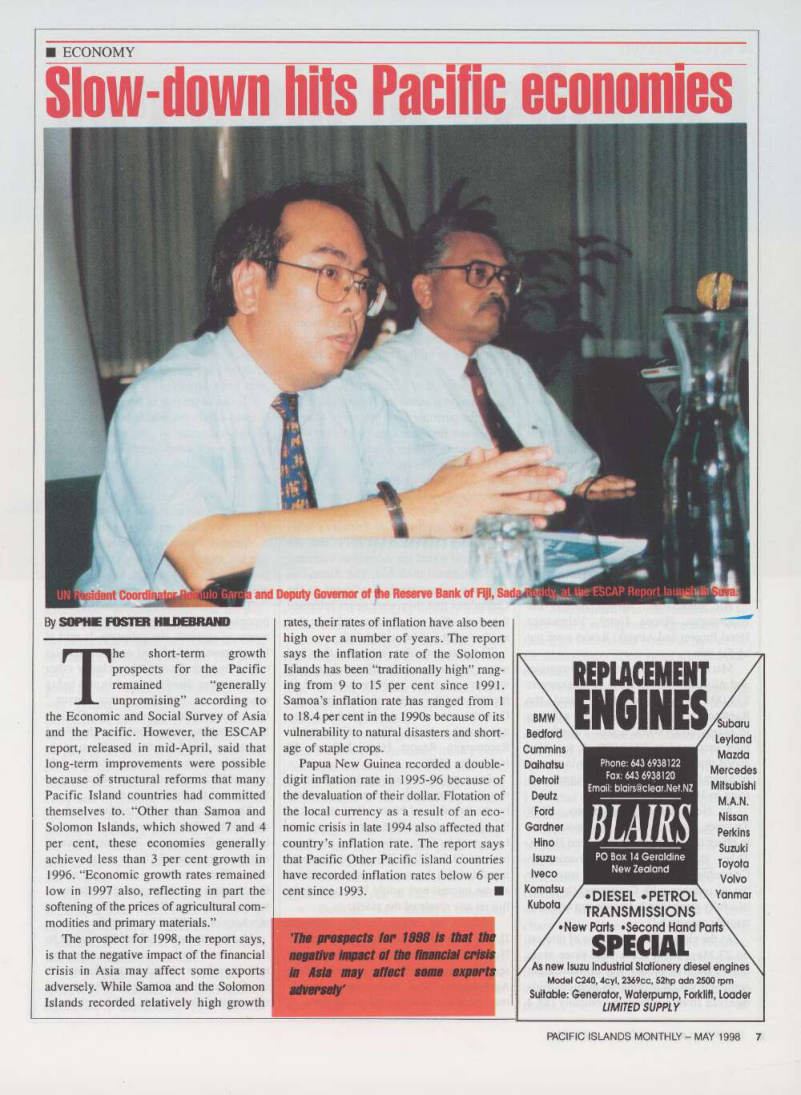
UN Residen Coordinator Romulo Garcia and Deputy Governor of the Reserve Bank of Fiji, Sade Reddy, at the ESCAP Report launch in Suva.
Advertisements & other items, p. 7 (1 item)
Blairs
REPLACEMENT
BMW
Bedford Cummins Daihatsu Detroit Deutz Ford Gardner Hino Isuzu Iveco Komatsu Kubota Phone: 643 6938122 Fax; 643 6938120 Email: [email protected]
BLAIRS
PO Box 14 Geraldine New Zealand Subaru Leyland Mazda Mercedes Mitsubishi
MAN.
Nissan Perkins Suzuki Toyota Volvo Yanmar
• DIESEL • PETROL
TRANSMISSIONS
New Parts •Second Hand Parts
SPECIAL
As new Isuzu Industrial Stationery diesel engines Model C240,4cy1, 2369 cc, 52hp adn 2500 rpm Suitable: Generator, Waterpump, Forklift, Loader
LIMITED SUPPLY
Paradise in disarray
Special Report
Inquiry slams Rarotogan Hotel deal
By Florence Syme-Buchanan
The Public Expenditure and
Review Committee report on the government sale of the Rarotongan Hotel pointed to blatant irregularities saying the deal failed to be of any advantage to the Cook Islands.
The report concluded that Government could not claim that the transaction was carried out in a “fully arms-length, trans parent and contestable manner.”
It examined how the Hotel sale was handled by government, rather than how the purchaser Tata Crocombe of Rarotongan Resort Hotel Ltd (RRHL) negotiated what appears to be the deal of a lifetime. In 1995, when Government’s near bankruptcy became public, Prime Minister Sir Geoffrey Henry announced a Five Point Recovery Plan. The main thrust of the plan was the sale of state owned assets to repay some of the country’s $203 million debt.
All government owned hotels, the Rarotongan, Rapae Hotel, Vaimaanga Hotel Project and Aitutaki Resort were put up for sale.
Marketing the sale of the Rarotongan and Aitutaki Resorts alone cost taxpayers $35,000. The Government stated the Rarotongan Hotel’s trading losses as being in excess of $500,000 a year - this figure later increased to $750,000. It was also stated that Government had lost in excess of $lO million since the Hotel began oper ating in 1977.
A New Zealand company, JLW Transact, was contracted by Government to effect the sale of the state owned Hotels.
This, the Government Privatisation Committee told JLW Transact, was to be “in accordance with Government’s policy of a fully arms-length, transparent and con
testable approach.”
At the closure of expressions of interest on 23 May, 1996, there were three main bids. Preferred bidder was an Australian company which offered $6 million. Bids received from a Hawaiian company ($8.4
million) and a Seattle entity for $3.5 mil lion were not recommended by JLW Transact.
The report states that support for the Australian company was based on the fact that the offer was ‘significantly cleaner’ than that offered by the Hawaiian company and at a pricing level that the sales agent considered to be far more realistic for the property.
Despite JLW Transact’s advice.
Government selected the Hawaiian compa ny as the purchaser and proceeded to draft a sales and purchase agreement. However, the company withdrew from the sale pro cess. PERCA was unable to establish why JLW Transact’s preferred buyer - the Australian company - was not pursued fur ther.
PERCA noted in JLW Transact’s letter supporting Crocombe and Co’s bid, the sales agent stated the Australian company had withdrawn their bid. The Australian company subsequently confirmed to the Committee that they were never informed that their offer was not acceptable or that another offer had been accepted.
The company also states that they had never withdrawn their offer and are still unaware of what actually happened in regard to the sale of the property.
Government signed a sales and purchase agreement with Tata Crocombe’s Rarotongan Resort Hotel Ltd on 14 November 1996.
But a major obstacle to the transaction was the mortgage held over the property by the Republic of Nauru. Key aspects of the agreement were that a promissory note be signed by Crocombe for the purchase price of $3.5 million. The promissory note stipulated that the purchase price would not accrue interest and would be repayable in full on any resale of the assets.
PERCA has established that although JLW Transact had endorsed the sale of the Hotel to RRHL, the company had never seen Crocombe’s offer nor the terms of the Agreement. “The sales agent simply responded and commented to the terms of
the proposed sale to the purchaser, as advised to them by the vendor (Government),” reads the PERCA report.
And despite RRHL being identified by Government as preferred buyer and not by the sales agent, JEW Transact was paid a commission of $81,250.
Government justified the Hotel sale to RRHL because Tata Crocombe was the only potential purchaser to put forward a “serious deposit” of $lOO,OOO. The PERCA report contested this as the $lOO,OOO was repaid to the purchaser and “was not a deposit per se.”
“It was never part of the purchase price, but was a fully refundable sum irrespective of the outcome of the sale process.”
Neither was it a requirement of the bidding process for a deposit to be made - other than $2OOO to enter the bidding process.
Potential bidders were only asked to iden tify the minimum deposit they would make should their bid eventually be successful.
Another factor in Crocombe’s favour was the expression to invest further in the property - $3 million on its upgrade and $ 1 million in equity.
The report states the original bidding process didn’t require specific commit ments to upgrade the property. It said if Government had placed undue emphasis on the upgrade factor, “then clearly other bidders were disadvantaged in not being required to address this issue.”
Government press releases and Cabinet Memorandums suggested that the Hotel was being sold for a $6.25 million pack age. This was misleading in that the sale price of $3.25 million was on paper only in the form of the promissory note.
The remaining $3 million was to upgrade the Hotel and was of no monetary benefit to Government. The entire benefit of the upgrade would be to the purchaser only. The resulting deal, in which Government ended up paying for the reno vations rather than RRHL, makes a further mockery of the “$6.25 package”.
No “equity payment” has been made to the vendor. The non-payment of equity may have been caused by problems with the Government of Nauru mortgage and title to the Hotel could not be given to
Crocombe. “A consequence was the pur chaser could not raise money on the secu rity of the Hotel which he still did not own, he couldn’t refurbish what wasn’t his prop erty.” The Hotel was the venue for the South Pacific Forum, the opening of which was getting uncomfortably close for Government. In August 1997 Government was able to clear the mortgage with Nauru by paying $3 million obtained from the sale of 20 percent of Telecom Cls shares to Telecom NZ. With the Forum just a month away and Crocombe unable to refurbish the Hotel, Government elected to pay for job itself, spending a total of $2,075 mil lion for the facelift. Of this, $lOO,OOO was paid to landowners to settle rental arrears and reviews.
The money came from a public account at the ANZ Bank which was earmarked for the repayment of an Asian Development Bank loan to Telecom. Of this, $700,000 was unauthorised expenditure.
An 11 -page Deed of Variation was approved by Cabinet and subsequently signed on 3 September 1997. Reliable
sources say it was highly unlikely that any of the Cabinet Ministers, apart from Sir Geoffrey who strongly favoured selling the Rarotongan Hotel to a Cook Islander, fully understood the terms of the original 27page Sale and Purchase Agreement. None was apparently given sufficient time to examine the Agreement.
Neither were they given enough time to study the Deed of Variation, itself a com plex legal document that took one local lawyer “two hours to go through.” The main changes to the original agreement were: • A cap of ten years placed on repay ment of the $3.5 purchase price - there originally was no time limit. • Government’s renovation costs to be repaid after one year at 13.25% interest. • Deletion of RRHL’s required $lOO,OOO share capital. • Condition of obtaining $2 million bank financing deleted as was the $lOO,OOO refundable ‘deposit.’ The ‘deposit’ had already been refunded in April 1997.
• Also deleted was the requirement to enter into a management agreement with Outrigger Resorts and Hotels of Hawaii for the management of the Hotel after comple tion date.
This was replaced by a clause requiring management by an international operator not later than 12 weeks after completion date of the Agreement. It’s understood that this final requirement still has to be ful filled by Tata Crocombe. Of significance too is that no other potential purchasers knew that the Hotel could be acquired on the basis of a promissory note.
Criticism has also been levelled, at the National Development Council and Chamber of Commerce, that Tata Crocombe, who had headed ' the Government’s assets sales programme, had an unfair advantage in negotiating the pur chase of the Hotel. But the most glaring irony is that Government failed to make any money from the sale that was supposed to help reduce national debt; instead the deal has left the country millions of dollars poorer. ■
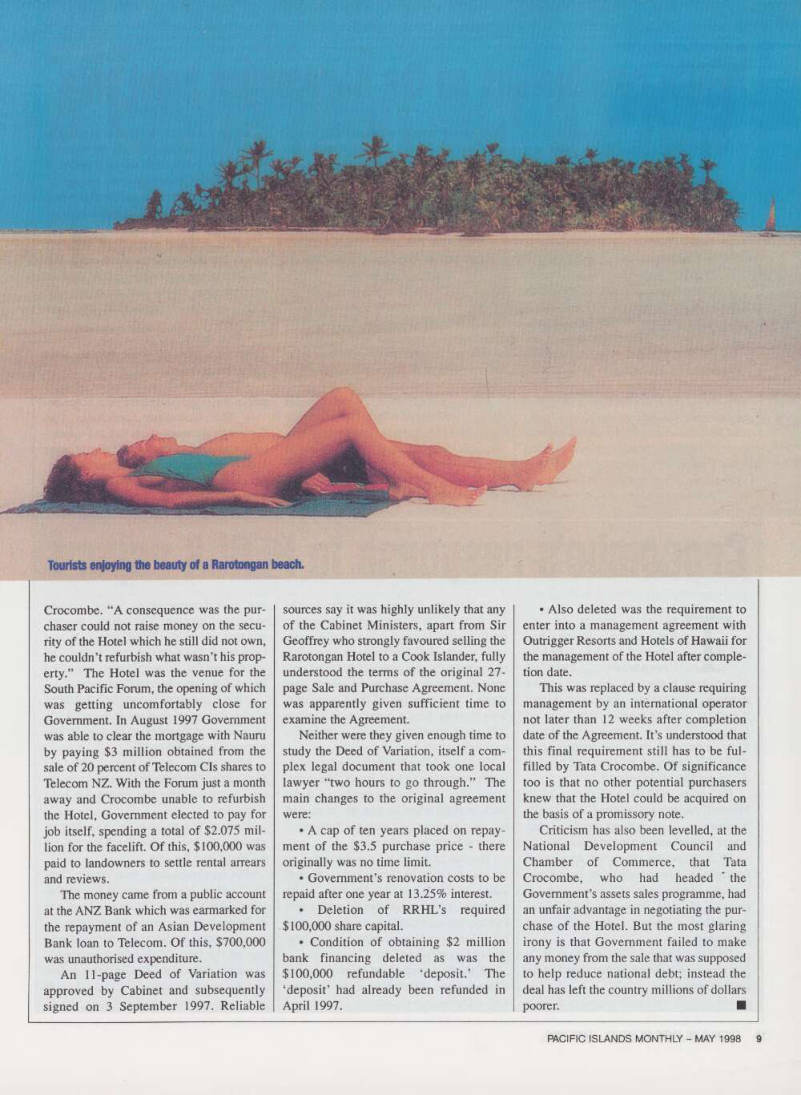
Tourists enjoying the beauty of a Rarotongan beach.
PERGA conclusions on the Rarotongan hotel sale
That the Hotel was put up for sale without sufficient
attention being given to
the Republic of Nauru mortgage. • That the Hotel should not have been advertised with the prospect of a 60 year lease without that having been negotiated with the landowners. • That the impending South Pacific Forum meeting and the inability to quickly dispose of the Nauru security both had a detrimental effect on the sale process. • That because of the long delay in set tling the terms of the mortgage and the interest shown by the Asian businessman, consideration could have been given to re advertising the Hotel for sale with partial or complete upgrade in place. The finan cial circumstances of original bidders and potential bidders may well have altered more than some 16 months after original expressions of interest were called. • That any re-advertising should have
included reference to internationally recog nised management requirements if this was regarded as an important criterion. • That terms of the sale to RRHL were such that the possibility arises there may
'Economic recovery objectives set out in the Five-Point Plan have not been met'
have been other applicants or consortiums interested in a purchase option, the final contractual arrangements of which were far removed from the original advertised marketing. • That economic recovery objectives set out in the ‘Five Point Plan’ have not been met. Instead Government has incurred con siderable expense, and waived potential revenue in agreeing to the sale in the form it did. No money was received at the time the Hotel was sold.
• That securities in place in relation to the sale give small comfort to taxpayers of the country, particularly over the period of financing - 10 years. • That adequate accounting advice was not sought particularly in regard to the ‘net distributable reserves’ question. • That unlawful expenditure of public money has been incurred to the extent that the limit of one and half percent of the total appropriation for the year ended 30 June 1997, and the current year, has been exceeded. • That the details of the sale were well advanced before endorsements of the sales agent was received. • That a better financial return from the sale of the Hotel could have been achieved. • The Committee concludes that Government cannot claim that the transac tion was carried out in a ‘fully at arms length, transparent and contestable man ner’ in accordance with its stated objec tives. ■
Crocombe's response to PERCA report
The new owner of the Rarotongan Hotel has rebutted the Public Expenditure Review Committee report on the sale of the
property, accusing key committee
members of “extensive conflicts of interest.” In a press statement Crocombe said he’s not surprised at PERCA’s criticism of the deal he was given by the Government.
He points to PERCA Chairman Mike Mitchell having represented the Hotel’s landowners, “a competing purchaser and others with an interest in the transaction.”
“It just goes to prove that in a small community it is unrealistic to expect any sort of objectivity in reviewing an emo tionally charged issue which threatens entrenched interest groups,” said Crocombe.
He described the PERCA report as “a “clumsy manipulation of the facts to fit a clear agenda.”
But in an explanatory letter to the Speaker of Parliament, the Committee itself admits that in a “small community such as ours, it is inevitable that conflicts of interest will arise particularly where pro gessionals are involved in the sale of state assets.” One member of the Committee, Tina Browne who is a partner in the law firm which represented Tata Crocombe dis qualified herself from the inquiry.
Chairman Mike Mitchell took no part in inquiries relating to land leases. His repre sentation of a “competing purchaser” dated back to 1993 when he had an “unrelated business connection” with the Australian bidder referred to in the report.
The sale of the Hotel was discussed on the telephone on two occasions. Mitchell stated in the letter that he was “never briefed to represent that Bidder in his nego tiations, had no knowledge of the nature of his bid, his funding arrangements or how his bid was received.”
“A third member of the Committee was a Director and shareholder of the company
that was contracted to carry out the upgrade of the hotel. The contract was ter minated before the Hotel’s upgrade was completed. The terms of that contract and the reason for its termination were not issues that concerned the Committee.”
“The Committee is satisfied that none of the foregoing matters influenced the preparation of the report or the conclusions reached,” wrote Mitchell.
Meanwhile, speculation that ’ the Rarotongan Beach Resort was sold to over seas concerns early last month has been discounted.
Contrary to popular belief, a spokesper son from the Rarotongan Beach Resort said the Hotel isn’t for sale.
The spokesperson said owner Tata Crocombe’s “dearest wish is to see this resort, which has lost millions and millions of the taxpayers money over the years, be turned around so that it becomes a strong part of the new Cook Islands economy, providing stable jobs and bringing in for eign exchange earnings.” ■
A cattle thief for a PM?
Politics
By Chris Peteru
Forgetting today what you
said yesterday has always been important for surviv
ing in politics.
But finding out that Samoa’s Prime Minister Tofilau Eti Alesana was convicted of cattle theft following months of govern ment denials is alarmingly unforgettable.
Nine months ago MPs from the islands 49 seat parliament were reaching for the tissues as angry words were hurled between the ruling Human Rights Protection Party and the Samoa National Development Party.
The reason was SNDP leader Tupua Tamasese had tabled a police file stating that in 1966 a 41-year-old high chief, Vaaelua Eti a.k.a. Alesana was convicted of cattle theft.
“Samoa, I have never stolen anything in my life, because I am the son of a church minister,” he responded to the allegation.
The government claimed that the oppo sition was trying to destabilise the country by making outrageous statements that could not be justified.
Speaker of the House Toleafoa Faafisi refused to accept the police file saying it was not authentic.
Taking the floor Deputy PM Tuilaepa Malielegaoi added, “this cannot be an offi cial police card, the government coat of arms is missing... and there is no signature from any police officer.”
As government diatribe turned misty eyed condemning Tamasese, Tuilaepa moved for him to be suspended from the House for the rest of the parliamentary term. The mood turned soggier still as MP Fuimaono Mimio begged for Tamasese to
be forgiven.
An emotional Prime Minister accepted the apology. However, Tamasese refused to withdraw his statement.
To clear the good name of the Prime Minister, Police Commissioner Asi Blakelock and Justice Secretary Pierre Meredith were requested by the govern ment to confirm whether Alesana had a criminal record. “I wish to inform you that there are no documents or other records to
show that the leader of government was ever charged with theft,” wrote Meredith to parliament days later.
“I refer to your request and indicate that I have no knowledge of the existence of any records,” said the police commission er.
Just lately the picture changed dramati cally, when a subdued Malielegaoi announced during a weekly press confer ence that police had found Alesana’s file confirming the theft convictions. For his part, he was fined along with 27 other men from Lalomalava village over the slaughter of several cattle.
“The Prime Minister has agreed to these charges, but remember these things he was accused of made it appear that the PM him self went and stole something. No, now it is very clear, it was a decision done by the village.”
He said there was a big difference between what the PM was accused of and what was now known. If the file had not been found, he said, the PM too would not have understood because the decision was so old. The PM, Malielegaoi said, just for got.
Even if his memory lapsed, what gov
emment found out wasn’t exactly a revela tion. They were probably the last people in the world to suspect their leader may have, indeed, misunderstood something.
In a small community of 167,400 peo ple, in the end there are no secrets. And now everyone knows that the PM has a colourful past.
Opposition leader Tamasese believes the discovery of the file was connected to a defamatory libel court case between Alesana and the national Samoa Observer newspaper.
“One assumes that the police would not have discovered the Prime Minister’s crim inal file if it wasn’t for the fact that the file was cited and produced in the Observers defence statement in the pending court case,” he claimed.
For its part, the Observer said in an edi torial that the whole affair “smelt of a cover-up”.
Under the constitution, any member of parliament with a criminal record has to give up his seat and a by-election held. A Supreme Court challenge by the Opposition against Tofilau could now be on the cards and would have huge ramifi cations if upheld. ■
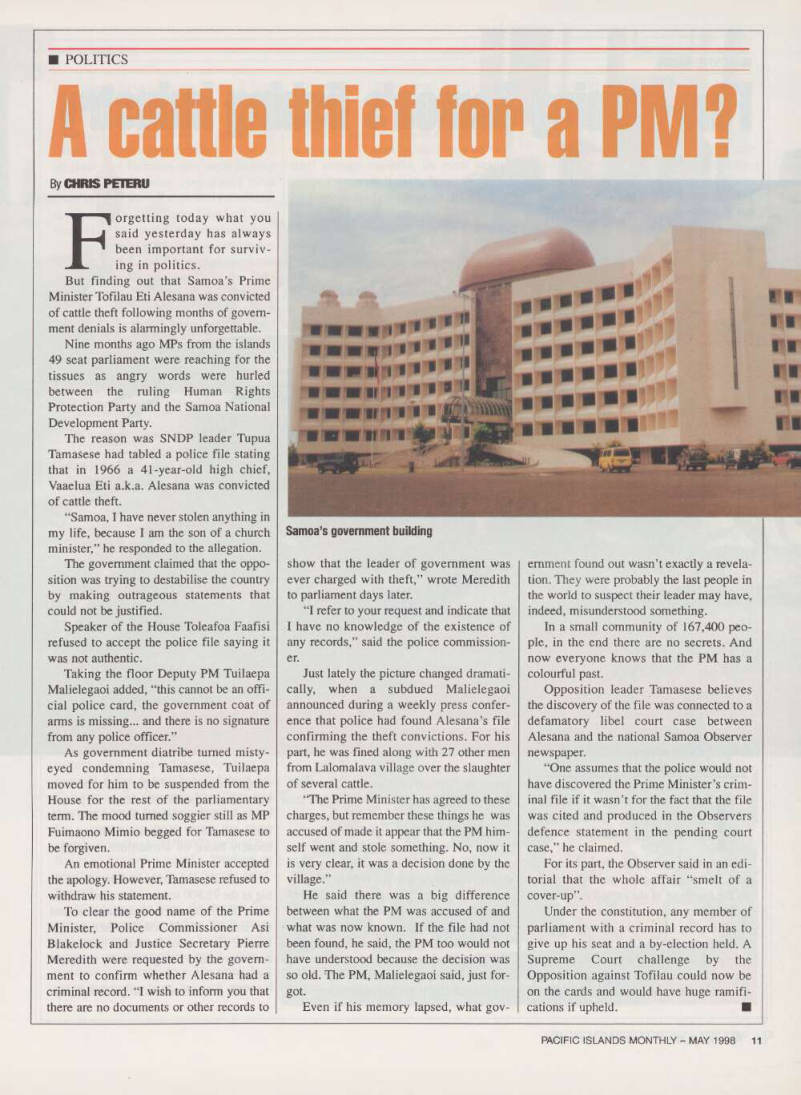
Samoa’s government building
Fine-tunin g Samoa's fisti ng industry
Fisheries
By Chris Peieru
again in November. Earnings for 1997 topped SUS7.S million, over half of the island state’s entire export revenues. In 1995 the Central Bank figure for fish sales abroad was zero.
Small wonder then why Samoans with no previous interest in the fishing industry are falling over each other to hook some of the action out on the waves.
Boat builders have struggled to keep up with demand. From just a handful of boats plying the shallow harbour reef 18 months ago, the Fisheries Department has issued licences to 135 boats moored two abreast
along a now jammed Apia jetty. The huge increase testified to the score of people who splashed out about SUS 13,000 each for a ten meter aluminium fishing boat broadly based on a traditional outrigger design.
Potentially the financial rewards are as big as the 95,800 square kilometres of blue water that marks out the boundaries around the islands. Compared to other Pacific islands, that amount of ocean is quite small but still remains a huge virtually untapped resource.
“This is the business to get into,” says
IN Samoa commercial tuna fishing is now the country’s number one export earner.
From three years ago, the industry has gone from supplying one small fish market on the foreshore of the capital Apia, into a multi-million dollar operation.
Following a lull at the start of the year, in part due to El Nino that sparked an early spawning season, fishing crews are gear ing up for the biggest season on record when their boats are finally hauled ashore
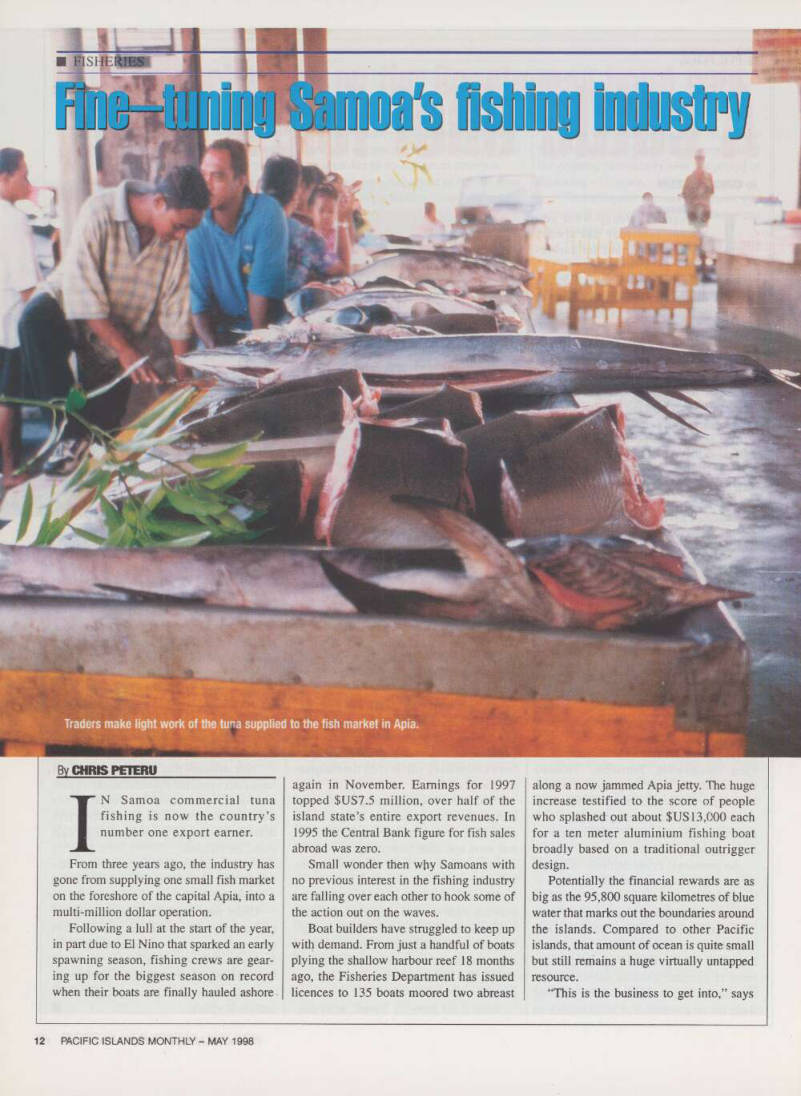
Traders make light work of the tuna supplied to the fish market in Apia.
boat owner Steve Niumata. “Even if there are plenty of boats out there we are still in the biggest ocean in the world.”
Crucial to the success of the reborn industry are the export companies who set up their own facilities then went looking for overseas markets, they found them close by. “We were always fairly confident that it could be done,” says John Luff, who started one of the first export companies.
Ninety per cent of the tuna catches are albacore (thunnus alalunga). Exporters pay around SUSI.3O per kilogram before ship ping the stock to either of the two huge canneries on neighbouring American Samoa. The remainder are sent to emerg ing markets in Australia and Hawaii.
Harder to find yellow fin (thunnus albacares) caught in big numbers near Florida and Rhode Island on the US main land fetch about SUS2.OO a kilogram local ly- “If you bring in say ten Albacore a night basically you break even for that week.
That means everything including wages,” says Niumata. “A good boat will average between twenty to thirty. When that hap pens you are on top.”
Anything left over is snapped up by restaurants , bars and cheap al fresco eateries ensuring close to one hundred per cent volume sales. All manner of fish dishes now adorn menus where not so long ago, the fish - in fish and chips, was tinned tuna from Thailand drowned in bat ter.
“It’s been great for business because customers enjoy it, and we are quaranteed a good supply of fish whenever we need it,” says a waterfront bar owner.
Out on the water the large numbers of boats long-line fishing is causing a few snags. Powered by small 45 horsepower motors, their range is limited to about 30 nautical miles before heading back in.
This means the nine mile long lines laid down can easily become entangled or cut by a competing boat using the same stretch of water. At SUS3OOO each, a lost line is an expensive mistake. Working on small vessels at sea is not for the faint hearted.
After laying the lines, the three or four man crews regularly endure the furnace like conditions for the day huddled under a low-slung plywood shelter the size of your average garage door. The small deck space means few boats have ice on board
to protect the catches from spoiling or to chill the drinks. Having such light dis placement means even moderate size swells can cause the vessel to pitch and roll alarmingly. If battling the elements isn’t hard enough on land, an even headier recipe for danger is surfacing.
Fishermen often complain about greedy owners and poor wages. But with no union or industrial mediators, they have increas ingly let their feet do the talking, leaving “sick” boats looking for new and often inexperienced crew almost every week.
Following the death of 25 fishermen in the last 15 months, and calls for more respon sibility, owners unwilling to spend on basic gear have angered police.
“It appears there are a number of own ers who don’t care despite the warnings about safety,” says Deputy Police Commissioner Tapau Kirisome after four more fishermen recently became the first casualties of the year. The owner of the boat only knew the surname of one crew member, a relative.
Spare engines, and on board radios (featuring two totally incompatible fre quencies, one run by the fisheries division.
the other by a taxi stand several miles inland) are part of new licensing regula tions that understaffed fisheries officers are struggling to enforce.
Encouraging boats to go further is one reason behind a government announce ment offering tax incentives to locals to import larger 15 meter plus boats to work beyond the 50 mile zone. Several of the trawler-type craft are already being built in New Zealand at a cost of SUSBS,OOO each.
The first is due to arrive in July. With refrigeration units already installed and the ability to stay out for weeks, the prospect of full nets seems likely.
“What has happened is that fishing emerged as an economic player almost by chance, because the Samoan Government initiatives are in tourism - which is strug gling, manufacturing and beef,” says Pacific economist Stanson Browyn.
“The best is still to come and it is going to make people money if done properly”.
Unlike so many half-cocked ideas to boost the country’s economy, this time there might even be a happy ending, with Samoans humming the tune “Gone fish ing” all the way to the bank manager. ■
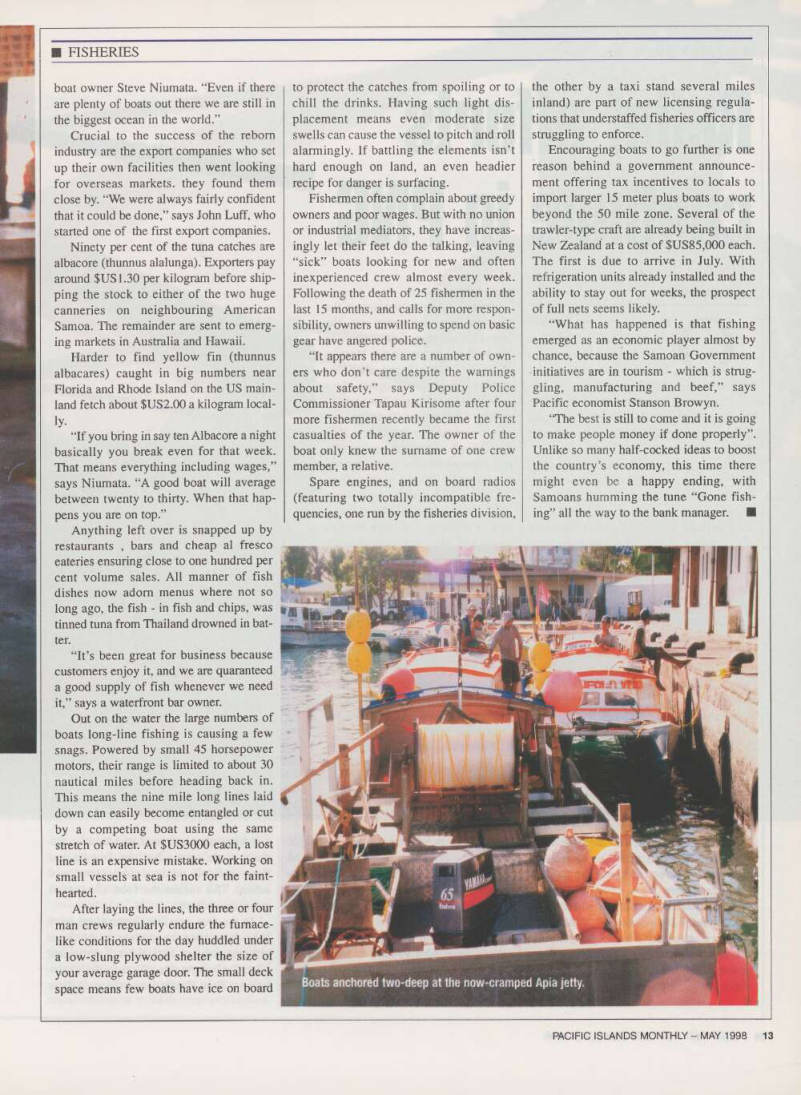
Boats anchored two-deep at the now-cramped Apia jetty.
Relief efforts

Weather
Relief efforts continue in PNG
By Sam Vulum
Old Puso forced herself out of bed to make sure the local nurse returned from town with bags of rice from her daughter.
This would support the family while waiting for the gardens to produce again following the recent devastation of the El Nino drought.
The nurse, from the village aid post, had to set out early on foot from the moun tain village to be in time to catch a coastal ship several kilometres down the coast.
The nurse was visiting town for medi cal supplies to cater for the increasing number of people suffering from diseases in the aftermath of the drought. In normal circumstances she would collect the sup plies from the district health centre.
However that, too, ran out of stock.
Puso received her supply but there are thousands of others in her area and in other parts of the country who are not so fortu nate. Some are still living off wild foods while others are heavily dependent on
relief supplies.
The Australian aid agency AusAID which is leading the relief efforts, placed the figure at about 54,000 down from 60,000 at the height of the crisis.
Although gardens have started produc ing since the first rain in December last year, it will be May before they can start living off them. AusAID head in PNG Annmaree O’Keeffe said the concern now was to supply food aid until the gardens were sustainable.
But Kiriwina drought committee chair man Anthony Douwa, from the Milne Bay province, reported affected people were not receiving supplies. He called on the provincial authorities and disaster commit tees to physically assess the drought situa
tion in the province.
Douwa said the situation in the districts was worsening yet the teams had not been visiting them. In the Kaiapit district in the Morobe Province, 10 villages had not received any relief supplies since relief operations began last year.
The Churches of Christ disaster relief coordinator Dr Tobey Huff said people there did not receive any supplies because most of it had been used by villages in the valley.
When approached by village elders, authorities said there was a lack of funds. Dr Huff said. He then contacted the national disaster office which put him to the provin cial disaster office, which promised to supply food. But, in the end,
nothing happened.
“They assured me the supplies were going out that week to the whole area... They lied,” he said. Dr Huff said while the church had organised to fly in tonnes of rice to the area, their work was hindered after the only airstrip in the area was closed due to heavy rainfall.
In another worrying report from the Western Highlands province, the increased fertility of the soil and the heavy rains in recent months, affected the formation of kaukau tubers.
Kaukau, or sweet potato, is the staple diet of the people in the Highlands. The vines, shoots and leaves of kaukau plants in new gardens were growing very fast and that this was retarding the development of tubers.
Provincial authorities fear the drought relief operations may have to be extended in the region because of this development.
Reports from Southern Highlands, Chimbu
and Enga also indicated that kaukau gar dens, made soon after the drought and frost, yielded none or underdeveloped tubers. This means the food shortage is going to continue.
In the Oro province, caterpillars have been destroying the gardens in the worst affected areas of Tufi, Safia, Asimba and Kira. Oro’s executive officer to the admin istrator Titus Hatagen said some of these
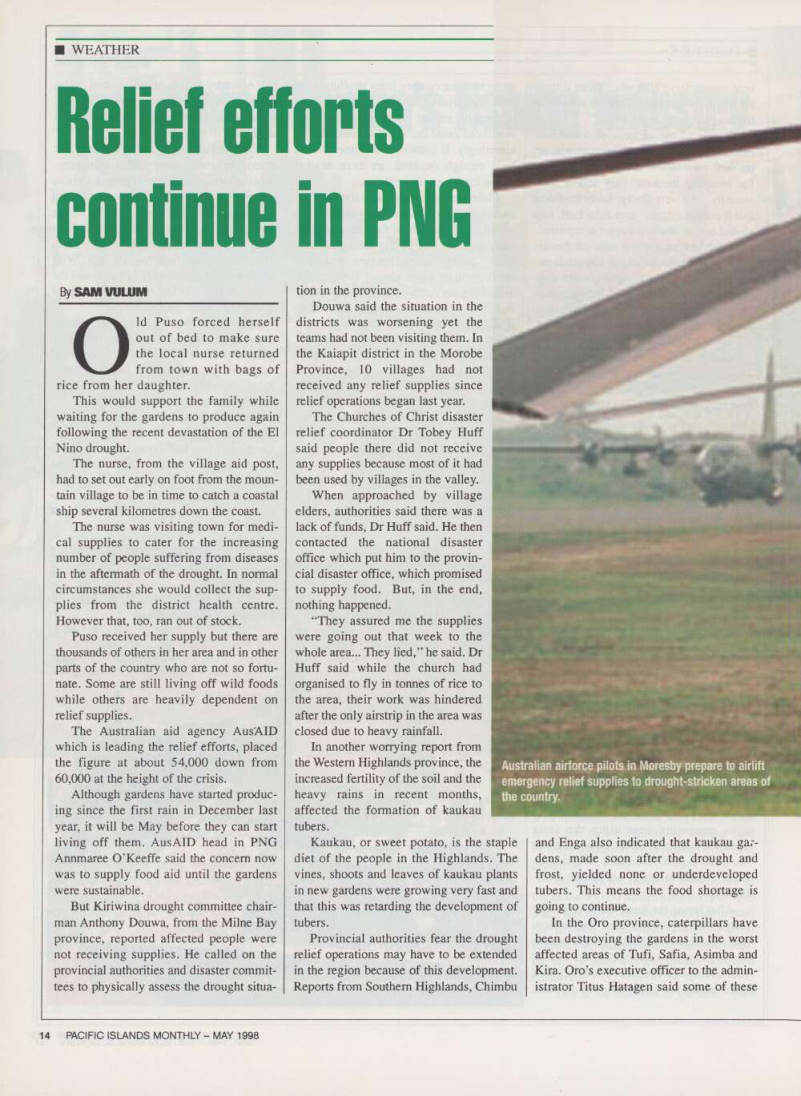
Australian airforce pilots in Moresby prepare to airlift emergency relief supplies to drought-stricken areas of the country.
areas had not improved as expected and it will take longer for the situation to return to normal. Meanwhile 45 of the 400 tonnes of seeds in AusAlD’s $ 1.2 million “rehabilitation” phase arrived in PNG and have being distributed.
Forty-two tonnes of potato seedlings arrived in Port Moresby and 3.5 tonnes in Lae and 14 tonnes to areas in central province. The next phase of AusAlD’s relief efforts is to help crop production.
With the Department of Agriculture and Livestock, it has distributed seeds of quick-growing crops throughout the coun try.
This is for diet supplements until main crops such as sweet potatoes can yield.
Since October last year, the Australian government has committed some $3O mil lion to the drought relief effort.
These funds are in addition to the $3OO million which Australia contributed this
financial year under the PNG-Australia Development Co-operation Treaty. The $3O million has gone towards purchasing food in PNG, the Australian Defence Force air operation, technical assistance and sup port of other relief activities by Australian non-govemment aid organisations.
With the on-going delivery of vegetable seeds and quick growing crops to revitalise gardens quickly, an end may yet be in sight to the aftermath of drought in PNG. ■
Disaster relief promises improve
Majuro’s weather sta tion reports that the capital city received slightly over two inches of rain from January to March, or just eight percent of the norm.
But, as lines at three Japanese-donated water-making units grow and people wait half a day or more just to get five gallons of fresh water, even these rain figures seem exaggerated.
More than four months into the El Nino-caused drought, Marshall Islanders will tell you that when weather officials said this would be the worst El Nino drought ever, they weren’t kidding.
In early March, the Marshall Islands government declared the country a disaster area, appealing to the United States for emergency aid. President Clinton respond ed quickly with a disaster declaration, paving the way for Federal Emergency Management Agency aid.
Huge water makers arrived in April for Majuro and Ebeye, the two main urban centres, and smaller ones that can be car
ried on ships to provide fresh water to the outer islands most desperate for water.
While the emergency U.S. water aid will relieve some of the drought problem, by any account it has been a rough four months for many islanders.
It isn’t expected to improve significant ly until June and beyond, when the rains are predicted to return to about 70 percent of normal. As residents focus on the imme diate need to find a few gallons of water every day, no-one is talking about the long term consequences to crops and lens wells from the drought.
On April 3 in Majuro, it rained for sev eral minutes at a time throughout the after noon. Though this wasn’t what one would in normal times call a ‘real rain’, it prompt ed one local resident to exclaim exuberant ly: “It’s a miracle.” That’s how it felt, and that’s how long it’d been.
“We haven’t caught any rain since December 17,” said Majuro Water and Sewer Company general manager Bill Roberts. The water cuts which used to last for hours are now almost two weeks long
because there is no water in the govern ment reservoir. Majuro depends on rain for 90 percent of its fresh water, though a fresh lens on the atoll provides close to a million gallons of water each week.
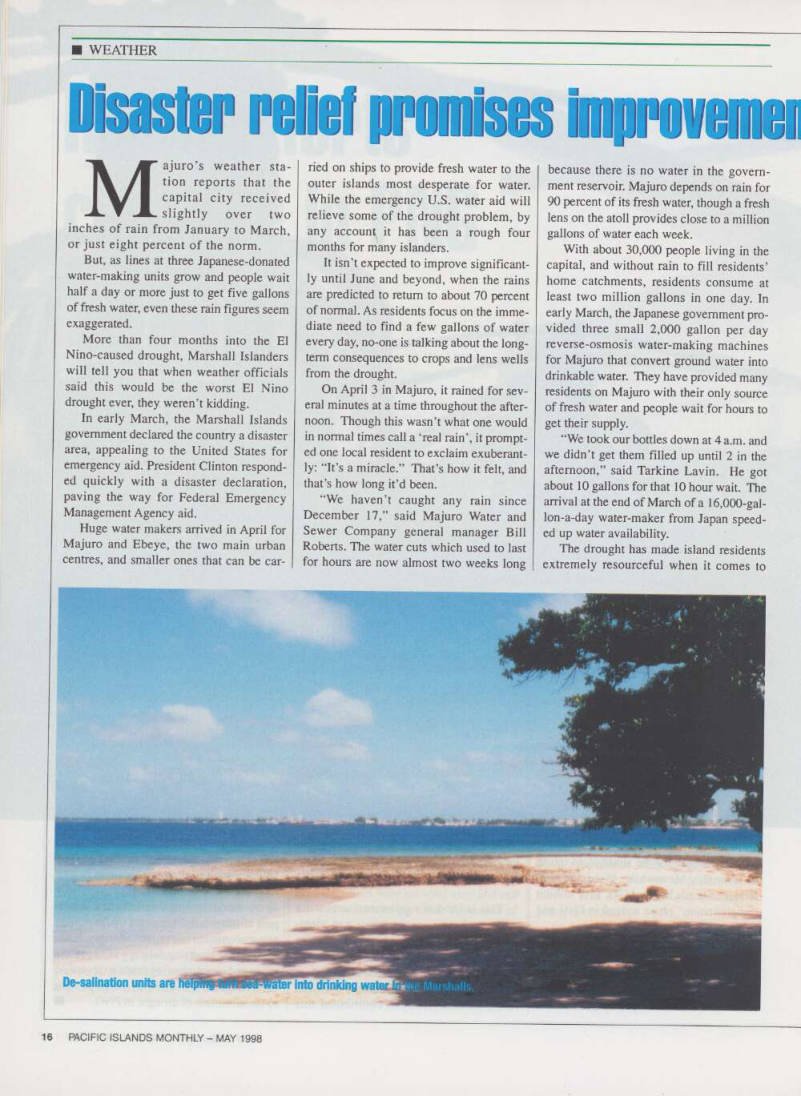
With about 30,000 people living in the capital, and without rain to fill residents’ home catchments, residents consume at least two million gallons in one day. In early March, the Japanese government pro vided three small 2,000 gallon per day reverse-osmosis water-making machines for Majuro that convert ground water into drinkable water. They have provided many residents on Majuro with their only source of fresh water and people wait for hours to get their supply.
“We took our bottles down at 4 a.m. and we didn’t get them filled up until 2 in the afternoon,” said Tarkine Lavin. He got about 10 gallons for that 10 hour wait. The arrival at the end of March of a 16,000-gal lon-a-day water-maker from Japan speed ed up water availability.
The drought has made island residents extremely resourceful when it comes to
De-salination units are hilping wurn sea-water into drinking water in the Marshalls.
finding water. Air conditioners produce several gallons of clean run-off water a day. “It’s good for washing dishes or tak ing a bath,” said local resident Jeffrey Wase, adding that his family carefully col lects every drop from their household air conditioner.
A lot of people have dug their own ground wells, bucketing water by hand to get water for bathing and cooking. For the most part, though, everyone takes fewer showers.
As problematic as finding water is in Majuro, home to half the country’s 60,000 people, it’s nothing like Ebeye, the urban centre next to the U.S. Army’s Kwajalein missile testing range. At least Majuro has a massive underground lens that provides water, even though the amount is small.
Ebeye, on the other hand, has no fresh water resources.
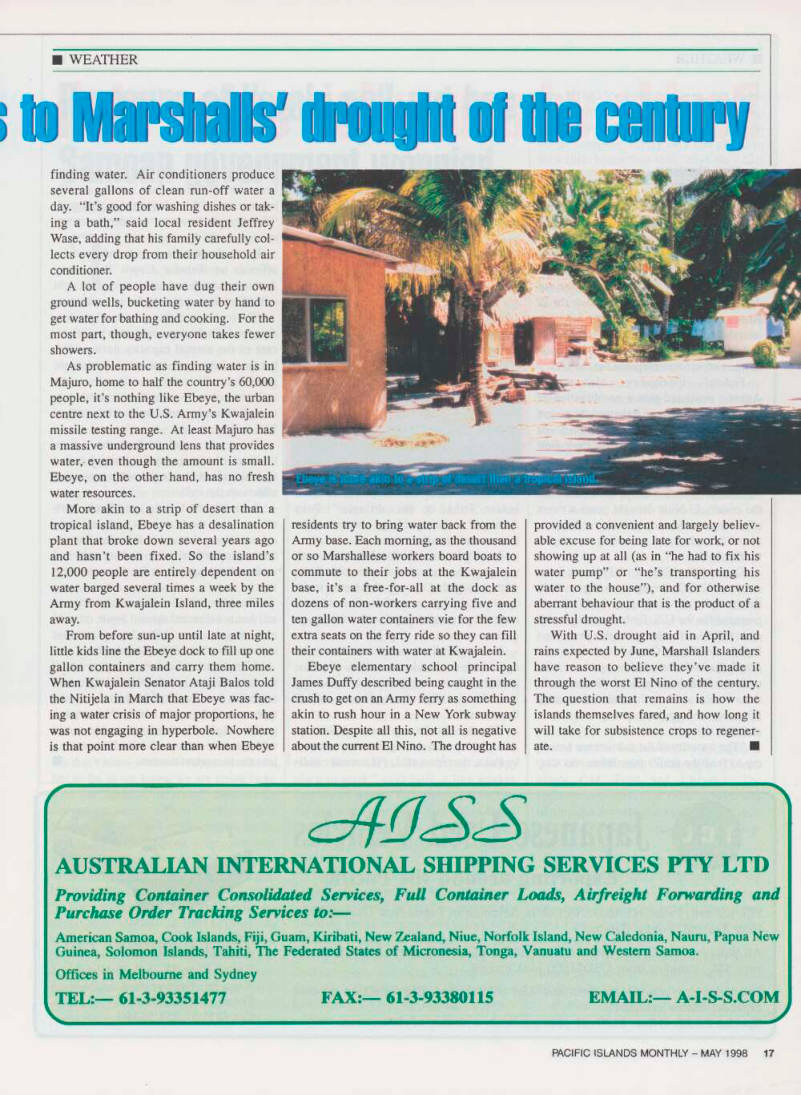
More akin to a strip of desert than a tropical island, Ebeye has a desalination plant that broke down several years ago and hasn’t been fixed. So the island’s
12,000 people are entirely dependent on
water barged several times a week by the Army from Kwajalein Island, three miles away.
From before sun-up until late at night, little kids line the Ebeye dock to fill up one gallon containers and carry them home.
When Kwajalein Senator Ataji Balos told the Nitijela in March that Ebeye was fac ing a water crisis of major proportions, he was not engaging in hyperbole. Nowhere is that point more clear than when Ebeye
residents try to bring water back from the Army base. Each morning, as the thousand or so Marshallese workers board boats to commute to their jobs at the Kwajalein base, it’s a free-for-all at the dock as dozens of non-workers carrying five and ten gallon water containers vie for the few extra seats on the ferry ride so they can fill their containers with water at Kwajalein.
Ebeye elementary school principal James Duffy described being caught in the crush to get on an Army ferry as something akin to rush hour in a New York subway station. Despite all this, not all is negative about the current El Nino. The drought has
provided a convenient and largely believ able excuse for being late for work, or not showing up at all (as in “he had to fix his water pump” or “he’s transporting his water to the house”), and for otherwise aberrant behaviour that is the product of a
stressful drought.
With U.S. drought aid in April, and rains expected by June, Marshall Islanders have reason to believe they’ve made it through the worst El Nino of the century.
The question that remains is how the islands themselves fared, and how long it will take for subsistence crops to regener ate. ■
Ebeye is more akin to a st[?]p of desert than a tropical Island.
Advertisements & other items, p. 17 (2 items)
i to Marshals' frNghl «f fli mrtvy
17
PACIFIC ISLANDS MONTHLY - MAY 1998
■ WEATHER
i to Marshals' frNghl «f fli mrtvy
Australian International Shipping Services Pty Ltd
Providing Container Consolidated Services , Full Container Loads , Airfreight Forwarding and Purchase Order Tracking Services to: — American Samoa, Cook Islands, Fiji, Guam, Kiribati, New Zealand, Niue, Norfolk Island, New Caledonia, Nauru, Papua New Guinea, Solomon Islands, Tahiti, The Federated States of Micronesia, Tonga, Vanuatu and Western Samoa.
Offices in Melbourne and Sydney
TEL:— 61-3-93351477 FAX:— 61-3-93380115 EMAIL:— A-I-S-S.COM
Double whammy for outer atoll
By Giff Johnson
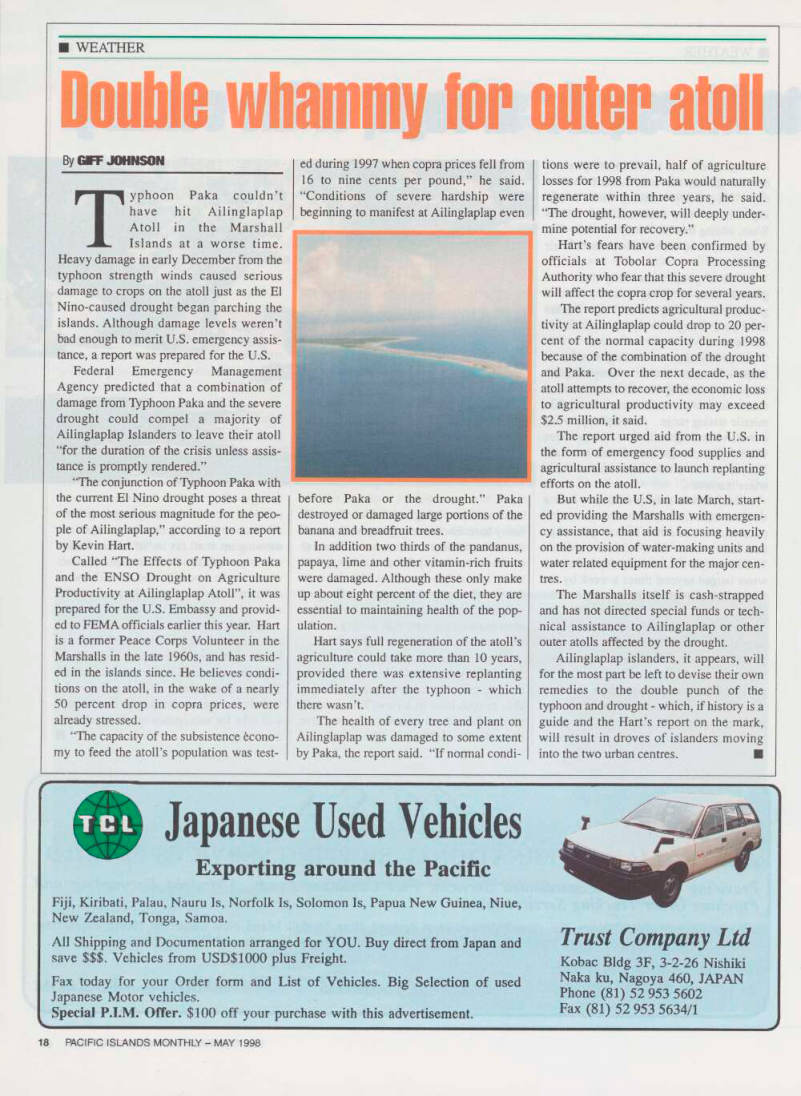
Typhoon Paka couldn’t have hit Ailinglaplap Atoll in the Marshall Islands at a worse time.
Heavy damage in early December from the typhoon strength winds caused serious damage to crops on the atoll just as the El Nino-caused drought began parching the islands. Although damage levels weren’t bad enough to merit U.S. emergency assis tance, a report was prepared for the U.S.
Federal Emergency Management Agency predicted that a combination of damage from Typhoon Paka and the severe drought could compel a majority of Ailinglaplap Islanders to leave their atoll “for the duration of the crisis unless assis tance is promptly rendered.”
“The conjunction of Typhoon Paka with the current El Nino drought poses a threat of the most serious magnitude for the peo ple of Ailinglaplap,” according to a report by Kevin Hart.
Called “The Effects of Typhoon Paka and the ENSO Drought on Agriculture Productivity at Ailinglaplap Atoll”, it was prepared for the U.S. Embassy and provid ed to FEMA officials earlier this year. Hart is a former Peace Corps Volunteer in the Marshalls in the late 19605, and has resid ed in the islands since. He believes condi tions on the atoll, in the wake of a nearly 50 percent drop in copra prices, were already stressed.
“The capacity of the subsistence econo my to feed the atoll’s population was test
ed during 1997 when copra prices fell from 16 to nine cents per pound,” he said, “Conditions of severe hardship were beginning to manifest at Ailinglaplap even
before Paka or the drought.” Paka destroyed or damaged large portions of the banana and breadfruit trees.
In addition two thirds of the pandanus, papaya, lime and other vitamin-rich fruits were damaged. Although these only make up about eight percent of the diet, they are essential to maintaining health of the pop ulation.
Hart says full regeneration of the atoll’s agriculture could take more than 10 years, provided there was extensive replanting immediately after the typhoon - which there wasn’t.
The health of every tree and plant on Ailinglaplap was damaged to some extent by Paka, the report said. “If normal condi
tions were to prevail, half of agriculture losses for 1998 from Paka would naturally regenerate within three years, he said.
“The drought, however, will deeply under mine potential for recovery.”
Hart’s fears have been confirmed by officials at Tobolar Copra Processing Authority who fear that this severe drought will affect the copra crop for several years.
The report predicts agricultural produc tivity at Ailinglaplap could drop to 20 per cent of the normal capacity during 1998 because of the combination of the drought and Paka. Over the next decade, as the atoll attempts to recover, the economic loss to agricultural productivity may exceed $2.5 million, it said.
The report urged aid from the U.S. in the form of emergency food supplies and agricultural assistance to launch replanting efforts on the atoll.
But while the U.S, in late March, start ed providing the Marshalls with emergen cy assistance, that aid is focusing heavily on the provision of water-making units and water related equipment for the major cen tres.
The Marshalls itself is cash-strapped and has not directed special funds or tech nical assistance to Ailinglaplap or other outer atolls affected by the drought.
Ailinglaplap islanders, it appears, will for the most part be left to devise their own remedies to the double punch of the typhoon and drought - which, if history is a guide and the Hart’s report on the mark, will result in droves of islanders moving into the two urban centres. ■
Advertisements & other items, p. 18 (1 item)
Japanese Used Vehicles
Exporting around the Pacific
Fiji, Kiribati, Palau, Nauru Is, Norfolk Is, Solomon Is, Papua New Guinea, Niue, New Zealand, Tonga, Samoa.
All Shipping and Documentation arranged for YOU. Buy direct from Japan and save sss. Vehicles from USDSIOOO plus Freight.
Fax today for your Order form and List of Vehicles. Big Selection of used Japanese Motor vehicles.
Special P.I.M. Offer. $lOO off your purchase with this advertisement. r
Trust Company Ltd
Kobac Bldg 3F, 3-2-26 Nishiki Naka ku, Nagoya 460, JAPAN Phone (81) 52 953 5602 Fax (81) 52 953 5634/1
Rumours of Yazaki pull-out has
Business
Rumours of Yazaki pull-out has Samoan government worried
By Chris Peteru
THE sign on the sides of the yellow and pink buses, contracted to carry hundreds of Samoan fac tory workers daily, is pointed: “Serve your Yazaki Samoa”.
Hailed by government as the country’s economic saviour and biggest private sec tor employer, Yazaki may now be looking to take its automotive wire harnessing
operation elsewhere.
This follows problems at its Vitele fac tory, minutes from the capital Apia, and the Asian currency crisis. News the Japanese based multi-national, which landed in Samoa six years ago, was having second thoughts, took the public by surprise when Trade secretary Chan Tung made the announcement.
“It is much cheaper to produce wire harnesses in Indonesia, the Philippines and Thailand compared to having the harnesses (made) in Samoa. That is a concern,” Chan Tung said. “So there is still a possibility Yazaki might decide to scale down its operations or shut down altogether in Samoa and that is a threat to us.”
Recently appointed chief executive Mr Yasuo Oishi declined to comment, but the company, which has dozens of factories scattered around the planet, moved to allay fears - at least for the time being.
“It’s difficult with the downturn in Asia.
We don’t know what will happen in future, but as far as we know, we are going to be here for quite some time,” says senior administration officer Muligatele Kelemete. “So while it’s important for us to look after this company, at the same time we’ve got to look at other factors, like the economic downturn in Asia,” he said.
“This company is Japanese owned.”
For a government which spent millions of taxpayer dollars to entice Yazaki to locate here, the possibility of a withdrawal is scary. Such has been the success of the company in boosting Samoa’s economic fortunes that it is commonly accepted that several more companies the size of Yazaki could flatten the estimated SUS 140 million
foreign debt in no time. Attracted by low labour costs, non-unionised labour and political stability, the light manufacturer was also given a 30-acre block of land, a factory, and later an extension built by government. Along with the usual tax breaks, they were allowed to occupy the premises rent-free. The estimated cost for those incentives is about SUSB million but government has been reluctant to divulge accurate figures.
Despite criticism of the expense to the taxpayer, authorities still believe it is a good deal. They point to the creation of 1500 jobs (mainly for women) plus 300 more in administration. Every month SUS 190,000 is paid out for salaries and local credit. Over the years Yazaki has earned more than all of Samoa’s other exports.
But unlike other societies, where the mention of redundancies is enough to send people into depression, the feeling on the factory floor is largely of indifference. The workforce has had a poor relationship with management from the beginning. Within months of starting up, a strike involving hundreds took place. Although it was resolved with a minimum amount of dis ruption, the rumblings over conditions have continued to reverberate.
“No-one really cares about this compa ny. Management treat us like slaves, so they can go to those countries in Asia and make them slaves. This is not a happy place to work,” says Silia, a line worker.
Employees stay on their feet, crimping and cutting wire during two eight-hour shifts.
Breaks are minimal, and a numbing three hour slog at day’s-end has increased com plaints.
Those with thoughts of climbing the career ladder saw their hopes plummet when most of the 100 section leaders, the first rung on the management ladder, were suddenly demoted to the line with pay cuts. Earlier plans to shut down the New Zealand plant and hire hundreds more Samoan workers have since been replaced by a sinking lid type employment policy.
Cuts on overtime mean most workers
earn SUS 22 for a 40-hour week, just above the minimum wage but not enough to keep up with inflation. “This is a multi-million dollar company, surely they can afford to do a little better than that,” says Su’a Sio, secretary of the National Union of Workers.
“Morale is low,” a supervisor at the firm said, “it’s affected the quality of the prod uct.” The government has sided with man agement to the point where Prime Minister Tofilau Eti Alesana and his cabinet have descended on the premises to encourage staff to work more industriously. Indeed, the Prime Minister has asserted there is no poverty in Samoa because of the jobs pro vided by the corporation.
There are vested interests in the form of lucrative contracts held by some govern ment MPs including labour minister Polataivao Schmidt, who has the only on site catering facility, and House speaker Toleafoa Faafisi who runs a fleet of buses transporting workers to the plant.
The company supplies harnesses for three major car makers: Toyota, Mitsubishi and General Motors. Between 30 to 40 containers are transported by sea every month. At one time or another, all three manufacturers have returned shipments of harnesses from the Australian assembly lines complaining they were sub-standard.
Kelemete says there were problems training villagers to adapt to an industrial culture. “In the beginning it was difficult, but now most of the supervisors know what the requirements are. Working with locals who have never worked in their lives made it difficult.”
Despite hiccups, production standards have improved. In November, the business picked up the internationally recognised QS9OOO certification designed by US auto giants GM, Ford and Chrysler. The approval seal meant the manufacturer was turning out a world class product, the only branch in Oceania to have the classifica tion.
Kelemete says, “Other big companies overseas are probably looking at how we would fare. If Yazaki is successful here, they can see potential, but if it goes down then I guess it gives a message to other companies as well”.
The real picture is that Samoa’s hard earned economic gains will quickly sour if the Japanese decide they have had enough.
If that happens, a financial disaster awaits. ■
Millennium's first child a
Millennium
Millennium's first child a Pacific island celebrity?
By Michael F[?]Eld
While everybody
argues about where the Millennium’s first rays will strike, the really intriguing question is: Who will be the first citizen of the new age? And will she be a Pacific Islander? Or maybe he, although the odds slightly favour a girl, bom into the world soon after midnight on First of January, 2000.
Conceived in the autumn and bom into the height of the summer, a life-time of celebrity awaits the child - provided the birth has not been too contrived. Maybe she will arrive at Nukualofa’s Vaiola Hospital, or Suva’s Colonial War
Memorial Hospital, although the smart money will be Auckland’s National Women’s Hospital, New Zealand’s busiest birthing centre. Or perhaps, poetically, in a bure on Taveuni, in Fiji where the 180 degree line runs across dry land.
It is a fair chance that, for the Pacific millennium, the child will be a Pacific Islander. The day’s first light always falls first across Fiji (with its hour of daylight savings added), Tonga and New Zealand two to three hours before Australia even departs the old century.
On average New Zealand produces six infants an hour, Fiji two and Tonga one child every three hours.
Of New Zealand’s newborns, one every hour is indigenous Maori while a new
Pacific Island New Zealander arrives every two hours. The lonely Chatham Islands, 860 kilometres east of New Zealand will first greet the Millennium, which is 45 minutes ahead of Fiji with dayligh t savings and one hour 45 minutes ahead of Tonga.
The Chatham’s hospital handles four births a year. None of them are first boms and any threat of complications sees the pregnant mother put on a plane for New Zealand. Not so in Taveuni where they have around 30 births a month and could easily produce the first child.
Although a French television network was recently in Taveuni, the problem for the first child there is that it is likely to be an obscure event, uncovered by the world’s media.
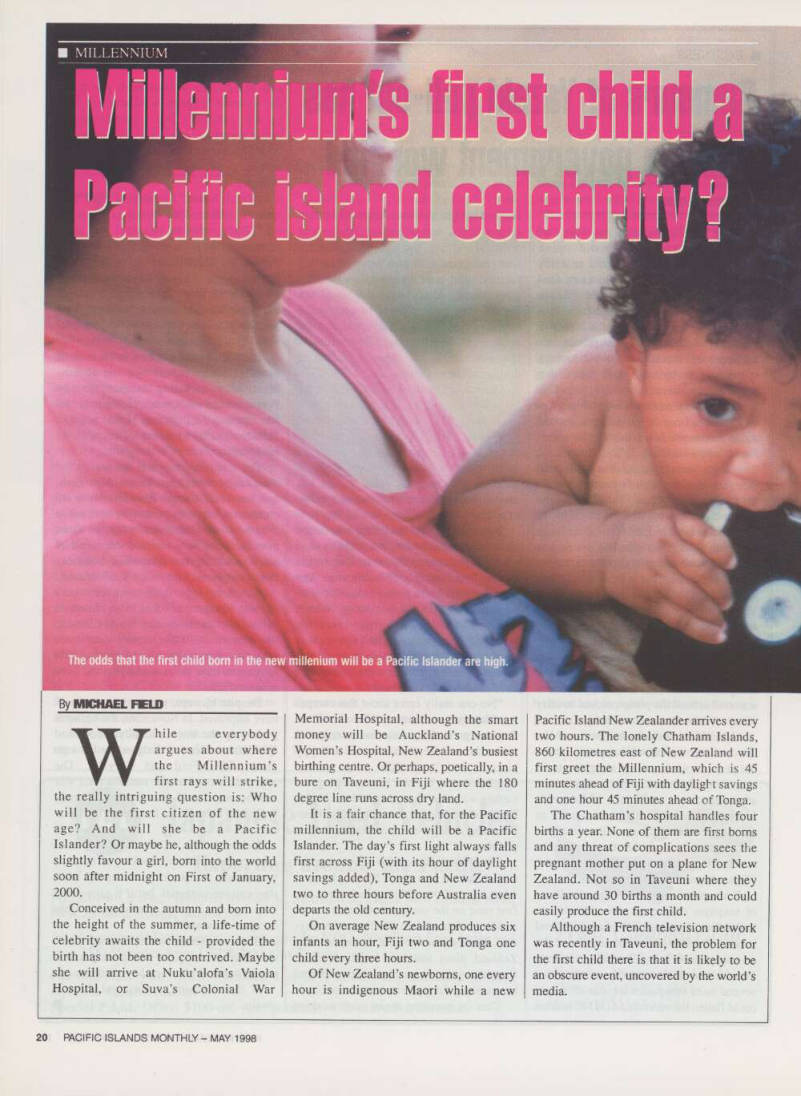
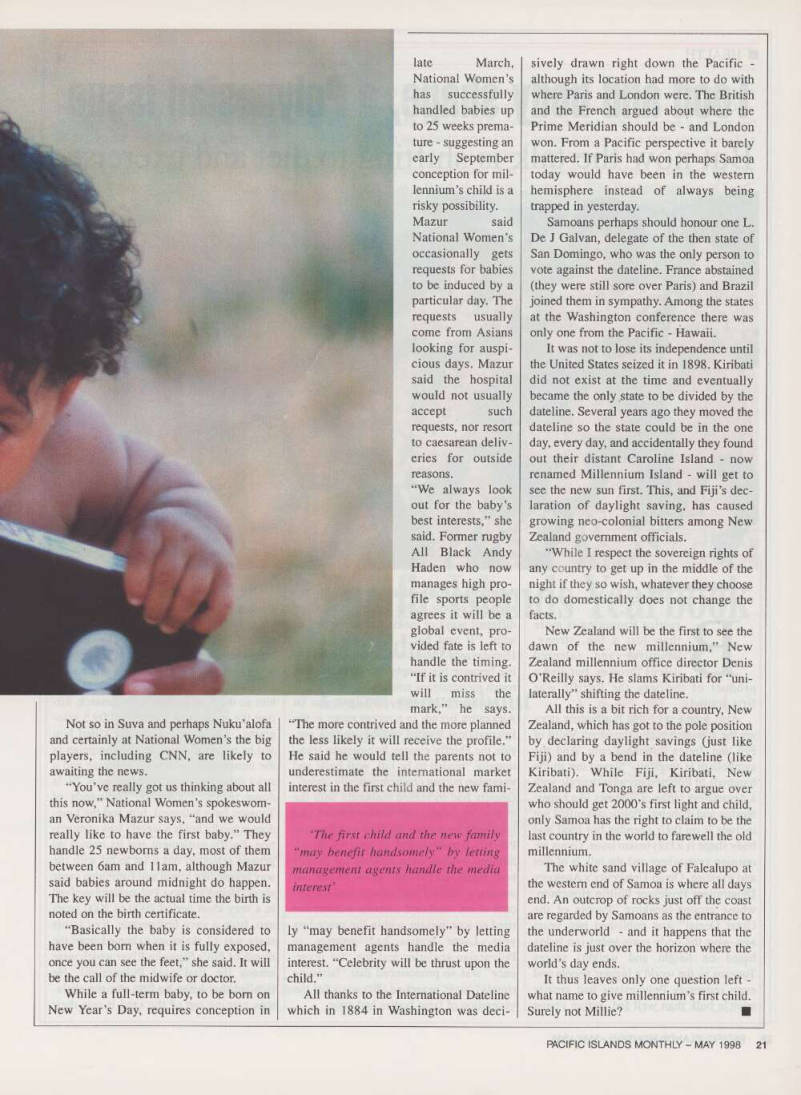
The odds that the first child bom in the new millenium will be a Pacific Islander are high.
Not so in Suva and perhaps Nuku’alofa and certainly at National Women’s the big players, including CNN, are likely to awaiting the news.
“You’ve really got us thinking about all this now,” National Women’s spokeswom an Veronika Mazur says, “and we would really like to have the first baby.” They handle 25 newborns a day, most of them between 6am and 11am, although Mazur said babies around midnight do happen.
The key will be the actual time the birth is noted on the birth certificate.
“Basically the baby is considered to have been bom when it is fully exposed, once you can see the feet,” she said. It will be the call of the midwife or doctor.
While a full-term baby, to be bom on New Year’s Day, requires conception in
late March, National Women’s has successfully handled babies up to 25 weeks prema ture - suggesting an early September conception for mil lennium’s child is a
risky possibility.
Mazur said National Women’s
occasionally gets
requests for babies to be induced by a particular day. The
requests usually
come from Asians looking for auspi cious days. Mazur said the hospital would not usually accept such requests, nor resort to caesarean deliv eries for outside reasons.
“We always look out for the baby’s best interests,” she said. Former rugby All Black Andy Haden who now manages high pro file sports people agrees it will be a global event, pro vided fate is left to handle the timing.
“If it is contrived it will miss the mark,” he says.
“The more contrived and the more planned the less likely it will receive the profile.”
He said he would tell the parents not to underestimate the international market interest in the first child and the new fami
‘The first child and the new family “may benefit handsomely” by letting management agents handle the media interest’
ly “may benefit handsomely” by letting management agents handle the media interest. “Celebrity will be thrust upon the child.”
All thanks to the International Dateline which in 1884 in Washington was deci
sively drawn right down the Pacific although its location had more to do with where Paris and London were. The British and the French argued about where the Prime Meridian should be - and London won. From a Pacific perspective it barely mattered. If Paris had won perhaps Samoa today would have been in the western hemisphere instead of always being trapped in yesterday.
Samoans perhaps should honour one L.
De J Galvan, delegate of the then state of San Domingo, who was the only person to vote against the dateline. France abstained (they were still sore over Paris) and Brazil joined them in sympathy. Among the states at the Washington conference there was only one from the Pacific - Hawaii.
It was not to lose its independence until the United States seized it in 1898. Kiribati did not exist at the time and eventually became the only state to be divided by the dateline. Several years ago they moved the dateline so the state could be in the one day, every day, and accidentally they found out their distant Caroline Island - now renamed Millennium Island - will get to see the new sun first. This, and Fiji’s dec laration of daylight saving, has caused growing neo-colonial bitters among New Zealand government officials.
“While I respect the sovereign rights of any country to get up in the middle of the night if they so wish, whatever they choose to do domestically does not change the facts.
New Zealand will be the first to see the dawn of the new millennium,” New Zealand millennium office director Denis O’Reilly says. He slams Kiribati for “uni laterally” shifting the dateline.
All this is a bit rich for a country, New Zealand, which has got to the pole position
by declaring daylight savings (just like
Fiji) and by a bend in the dateline (like Kiribati). While Fiji, Kiribati, New Zealand and Tonga are left to argue over who should get 2000’s first light and child, only Samoa has the right to claim to be the last country in the world to farewell the old millennium.
The white sand village of Falealupo at the western end of Samoa is where all days end. An outcrop of rocks just off the coast are regarded by Samoans as the entrance to the underworld - and it happens that the dateline is just over the horizon where the world’s day ends.
It thus leaves only one question left what name to give millennium’s first child.
Surely not Millie? ■
Food and body shape, a Polynesian issue
Health
Food and body shape, a Polynesian issue But now the talk is shifting to diet and exercise
By Michael F[?]Eld
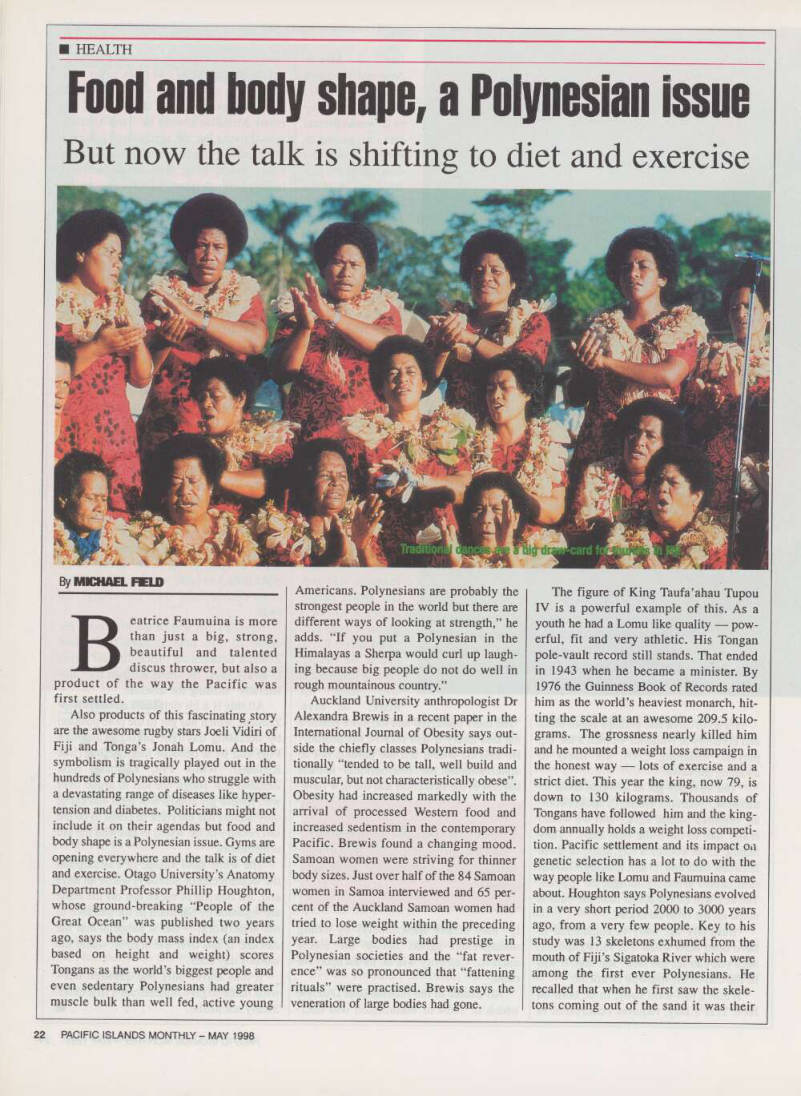
Beatrice Faumuina is more than just a big, strong, beautiful and talented discus thrower, but also a product of the way the Pacific was first settled.
Also products of this fascinating story are the awesome rugby stars Joeli Vidiri of Fiji and Tonga’s Jonah Lomu. And the symbolism is tragically played out in the hundreds of Polynesians who struggle with a devastating range of diseases like hyper tension and diabetes. Politicians might not include it on their agendas but food and body shape is a Polynesian issue. Gyms are opening everywhere and the talk is of diet and exercise. Otago University’s Anatomy Department Professor Phillip Houghton, whose ground-breaking “People of the Great Ocean” was published two years ago, says the body mass index (an index based on height and weight) scores Tongans as the world’s biggest people and even sedentary Polynesians had greater muscle bulk than well fed, active young
Americans. Polynesians are probably the strongest people in the world but there are different ways of looking at strength,” he adds. “If you put a Polynesian in the Himalayas a Sherpa would curl up laugh ing because big people do not do well in rough mountainous country.”
Auckland University anthropologist Dr Alexandra Brewis in a recent paper in the International Journal of Obesity says out side the chiefly classes Polynesians tradi tionally “tended to be tall, well build and muscular, but not characteristically obese”.
Obesity had increased markedly with the arrival of processed Western food and increased sedentism in the contemporary Pacific. Brewis found a changing mood.
Samoan women were striving for thinner body sizes. Just over half of the 84 Samoan women in Samoa interviewed and 65 per cent of the Auckland Samoan women had tried to lose weight within the preceding year. Large bodies had prestige in Polynesian societies and the “fat rever ence” was so pronounced that “fattening rituals” were practised. Brewis says the veneration of large bodies had gone.
The figure of King Taufa’ahau Tupou
IV is a powerful example of this. As a youth he had a Lomu like quality pow erful, fit and very athletic. His Tongan pole-vault record still stands. That ended in 1943 when he became a minister. By 1976 the Guinness Book of Records rated him as the world’s heaviest monarch, hit ting the scale at an awesome 209.5 kilo grams. The grossness nearly killed him and he mounted a weight loss campaign in the honest way lots of exercise and a strict diet. This year the king, now 79, is down to 130 kilograms. Thousands of Tongans have followed him and the king dom annually holds a weight loss competi tion. Pacific settlement and its impact on genetic selection has a lot to do with the way people like Lomu and Faumuina came about. Houghton says Polynesians evolved in a very short period 2000 to 3000 years ago, from a very few people. Key to his study was 13 skeletons exhumed from the mouth of Fiji’s Sigatoka River which were among the first ever Polynesians. He recalled that when he first saw the skele tons coming out of the sand it was their
bigness that made him realise Polynesians had been subjected to a ruthless maritime selection process. It was the cold that did it. The Pacific can actually be a very cold place, especially for people who were exploring it at sea with Neolithic technolo gy and little protection from the cold winds and wet weather,” Houghton says.
Polynesians survived by evolving quickly
into big muscular people; the bigger you are the more muscle you have, the more heat you can generate.
“What you see is the selection process of evolution... You can show quite neatly that if you are big and muscular you can survive a few nights of cold at sea in a small boat, but if you are thin and light
you’ll die of exposure quite quickly.”
Houghton’s work is controversial but an associated explanation for Polynesian shape is because of the way droughts and hurricanes affected the food supply.
Auckland Institute of Technology anatomy and physiology lecturer Elaine Rush stud ied metabolic rates and found in Polynesian women it was lower than that of the Caucasian and therefore they were
using less energy. Certain races had evolved to store fat. In times of famine those are the ones who survive and that’s how it used to be in the islands, when hur ricanes came through and wiped out the food supply,” Rush says. Nowadays food is less of a worry as a flood of western foods arrived and some of the worst, in terms of fat, assumed a cultural status, as Samoa’s High Commissioner to New Zealand, Feesago Fepule’ai, noted at a recent Pacific medical conference. The ultimate prize on the acceptance and inte gration of these foods into our way of life must surely go to my own Samoa where for many years now our young and the not so young lovers have serenaded their sweethearts with the sweet refrain that praises that most desirable of cuisine the Hellaby corned beef.” Quoting from the United Nations Children’s Fund he noted “these foods are killing or disabling
our people...
“There is a very clear moral dimension here; many of these foods are simply dumped on our people by the food proces sors of developed countries,” Feesago said.
“We all pay a price in obesity, high blood pressure, diabetes and other life style diseases which impose a greater and longer burden on us than something like AIDS has or will.”
Auckland’s Metro magazine recently noted the “The Polynesianisation of Sport” in New Zealand and quoted then All Black trainer Jim Blair explaining that the
Polynesian is basically mesomorphic,
tending to be big-boned, muscular, of aver age height, wide shoulders, thin waist.
“They have a higher proportion of fast twitch muscle fibre which is the source of their explosive style and the reason they are fast over short distances and the reason you don’t see Polynesian marathon run ners.” And the point is that with a good diet, good coaching and money for resources, Polynesians could take over some world sports easily. That’s why somebody like Beatrice Faumuina, who won gold at this year’s world athletics championships in Athens, is both an inspi rational role model and awesome warning to other sports people that the Polynesians are coming. ■
Advertisements & other items, pp. 23-24 (1 item)
Pacific Islands Yearbook
V K
17th Edition
Learn more about
the Pacific
- culture!custom tradition! people - population, tourism, trade, airlines, tax system etc
* PACIFIC SAIO,OO
* USA & TERRITORY A 515.00
* EUROPE & OTHERS $A17.00
Price
AUD
00
PLUS
POSTAGE
Yes, send me the latest copy of the Pacific Islands Yearbook. □ Here is a cheque/ money order Q Visa Q Master Card Expiry Date.
Card Number..
Name ; Signature.
Address.
Post to: Pacific Islands Monthly, P O Box 1167 Suva, Fiji or Fax (679) 307460
H’ ■ Hk X ( m r » * v ; New Caledonia’s tourist industry & fairly new but has been consistently growing oyer the past few yearsrMajor chains have'already set up operations, like Accor Asia; Pacific, Club Med, Le Meridien Hotels anASPHC Parkroyal.
In view of the good resulfs dchieved, this is the ideal time to launch further developments A. y' in Noumea as well as on remote seaside locations.
ADECAL, the Economic Development Agency of New Caledonia, is the one-stop shop where investors can get specific advice on doing business in New Caledonia.
As your free-of-charge partner, we shall assist you in identifying site opportunities and putting together your project successfully.
Should you like to receive further information on hotel investment opportunities in New Caledonia, please do not hesitate to contact Mr Yam Pitollet or Mr Benoit Rengade. 120000 100000 80000 601000 1992 1993 1994 1996 1997, m m A I I 1 V 15, rue Guynemer •PO Box 2384 • 98846 Noumea Cedex New Caledonia Ph: (687) 249 077 • Fax: (687) 249 087 • E-mail: [email protected]
ALPA Consultants • Noumea
Tel. (687) 27 66 33 • Fax (687) 27 40 08
The lure of the

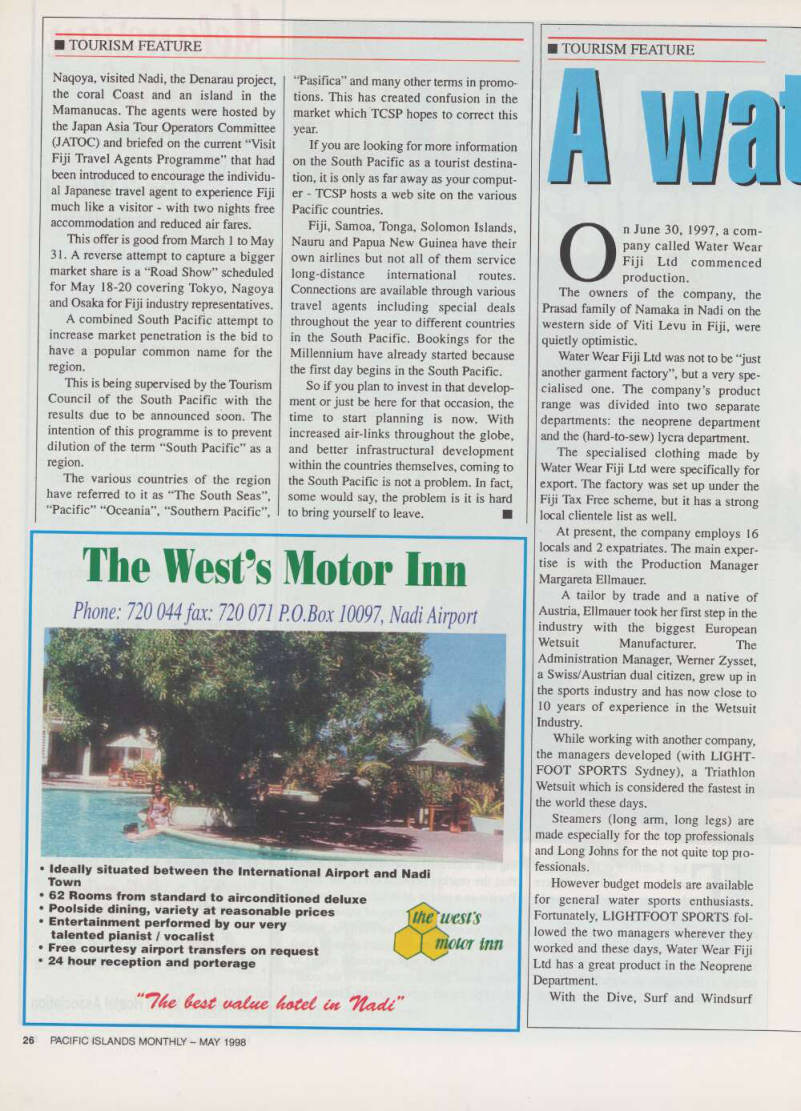
Tourism
The lure of the mystical south
The South Pacific. Three words which conjure images of white sandy beaches, exotic food and drink, palm trees... in fact, it can mean just about anything you want it to. It is this mysticism that has drawn millions of people to the region throughout the years, and will continue to do so. Better market
ing and increased code-sharing has meant that the market penetration of the South Pacific as a tourist destination is growing.
And the market savvy of these nations is also increasing. Fiji, for example, hosted ninety Japanese travel agents in early April as part of a major promotional effort to bring more Japanese tourists to the coun try. The travel agents, from Osaka and
Naqoya, visited Nadi, the Denarau project, the coral Coast and an island in the Mamanucas. The agents were hosted by the Japan Asia Tour Operators Committee (JATOC) and briefed on the current “Visit Fiji Travel Agents Programme” that had been introduced to encourage the individu al Japanese travel agent to experience Fiji much like a visitor - with two nights free accommodation and reduced air fares.
This offer is good from March 1 to May 31. A reverse attempt to capture a bigger market share is a “Road Show” scheduled for May 18-20 covering Tokyo, Nagoya and Osaka for Fiji industry representatives.
A combined South Pacific attempt to increase market penetration is the bid to have a popular common name for the region.
This is being supervised by the Tourism Council of the South Pacific with the results due to be announced soon. The intention of this programme is to prevent dilution of the term “South Pacific” as a region.
The various countries of the region have referred to it as “The South Seas”, “Pacific” “Oceania”, “Southern Pacific”,
“Pasifica” and many other terms in promo tions. This has created confusion in the market which TCSP hopes to correct this year.
If you are looking for more information on the South Pacific as a tourist destina tion, it is only as far away as your comput er - TCSP hosts a web site on the various Pacific countries.
Fiji, Samoa, Tonga, Solomon Islands, Nauru and Papua New Guinea have their own airlines but not all of them service long-distance international routes.
Connections are available through various travel agents including special deals throughout the year to different countries in the South Pacific. Bookings for the Millennium have already started because the first day begins in the South Pacific.
So if you plan to invest in that develop ment or just be here for that occasion, the time to start planning is now. With increased air-links throughout the globe, and better infrastructural development within the countries themselves, coming to the South Pacific is not a problem. In fact, some would say, the problem is it is hard to bring yourself to leave. ■
Advertisements & other items, pp. 25-26 (1 item)
Anywhere?
Haven’t Booked
ym D Aal#A#l
Don’t Worry!
Call the Melanesian Hotel
• 2 Mins from international airport terminal • Licensed lounge & public bars and restaurant • All rooms have private facilities & telephones • Bus stop at front entrance to Nadi, Suva, Lautoka • Air conditioned rooms available • International Youth Hostel Associate • Tours and cruises arranged • Filtered swimming pool • Courtesy bus meets all International Flights • Bus service available for Beachcomber, Treasure, Castaway & Plantation Islands P.0.80x 9242, Nadi Airport, Fiji.
Phone: (679) 722 438. Fax: (679) 720 425 International Youth Hostel Association
ROOM RATES
For reservations
The West’s Motor Inn
Phone: 720 044 fax: 720 071 P.0.80x 10097, Nadi Airport IS • Ideally situated between the International Airport and Nadi Town • 62 Rooms from standard to airconditioned deluxe • Poolside dining, variety at reasonable prices ■ Entertainment performed by our very talented pianist / vocalist • Free courtesy airport transfers on request • 24 hour reception and porterage
thr west's
mwr inn
*76# (uUcce &otel 'TtacU ”
A watery success

On June 30, 1997, a com pany called Water Wear Fiji Ltd commenced production.
The owners of the company, the Prasad family of Namaka in Nadi on the western side of Viti Levu in Fiji, were quietly optimistic.
Water Wear Fiji Ltd was not to be “just another garment factory”, but a very spe cialised one. The company’s product range was divided into two separate departments: the neoprene department and the (hard-to-sew) lycra department.
The specialised clothing made by Water Wear Fiji Ltd were specifically for export. The factory was set up under the Fiji Tax Free scheme, but it has a strong local clientele list as well.
At present, the company employs 16 locals and 2 expatriates. The main exper tise is with the Production Manager Margareta Ellmauer.
A tailor by trade and a native of Austria, Ellmauer took her first step in the industry with the biggest European Wetsuit Manufacturer. The Administration Manager, Werner Zysset, a Swiss/Austrian dual citizen, grew up in the sports industry and has now close to 10 years of experience in the Wetsuit Industry.
While working with another company, the managers developed (with LIGHT FOOT SPORTS Sydney), a Triathlon Wetsuit which is considered the fastest in the world these days.
Steamers (long arm, long legs) are made especially for the top professionals and Long Johns for the not quite top pro fessionals.
However budget models are available for general water sports enthusiasts.
Fortunately, LIGHTFOOT SPORTS fol lowed the two managers wherever they worked and these days. Water Wear Fiji Ltd has a great product in the Neoprene Department.
With the Dive, Surf and Windsurf
Wetsuits, it is a different story.
The market share for these products world-wide is controlled by a lot of big companies. It is this market share that Water Wear is working very hard to break into.
The company intends to penetrate the world market to the extent of its market share in the local Fijian market.
Around the same time as the triathlon suit was bom, a totally different product took its first steps - the STINGRAY SUN PROTECTION CLOTHING. At that time (about eight years ago), people in Australia started to be aware of the danger of the sun’s ultraviolet rays and its links to skin cancer.
An ideal protective fabric was found, but it took the marketing company STINGRAY AUSTRALIA many years of hard work to inform and convince the peo ple of Australia of its protective value.
The LYCRA suits with its protective factor 50-plus help to prevent skin cancer, which can break out many years after the damage has been done (up to 30 years later). The biggest damage is normally done to small and very small children.
That’s why the protection of children these days is so important, regardless of the colour of their skin. Today, the STINGRAY range is sold in Australia, USA, Canada, Japan, Singapore, Dubai, England, Jersey, Spain and Germany and has a very high market share.
Very soon, these STINGRAY products will also be available in Switzerland, China, Greece, Norway, Sweden, Finland and Denmark.
The secret of the success of the STINGRAY range is variety. From top to bottom, from cap to T-shirt and short to one-piece suits, from pram cover to big man shirt (called “Real Man”) - everything is available. Unfortunately (or fortunately for Water Wear), the cutting and sewing of Lycra is very difficult. However, the staff are very well trained and are doing an excellent job, balanced between speed and top quality. ■
Water Wear products ready for export.
Advertisements & other items, pp. 26-27 (3 items)
26
■ TOURISM FEATURE
PACIFIC ISLANDS MONTHLY - MAY 1998
■ TOURISM FEATURE
27
■ TOURISM FEATURE
PACIFIC ISLANDS MONTHLY - MAY 1998
m 3U
Water Wear (Fiji) Ltd
i.
Manufacturer's of Lycra Sun Protection Wear
Wetsuits of any kind and Surf Accessories J For Local and Export Enquiries - Contac P.0.80x 2154 Isla w
Die ups and downs of the vatu
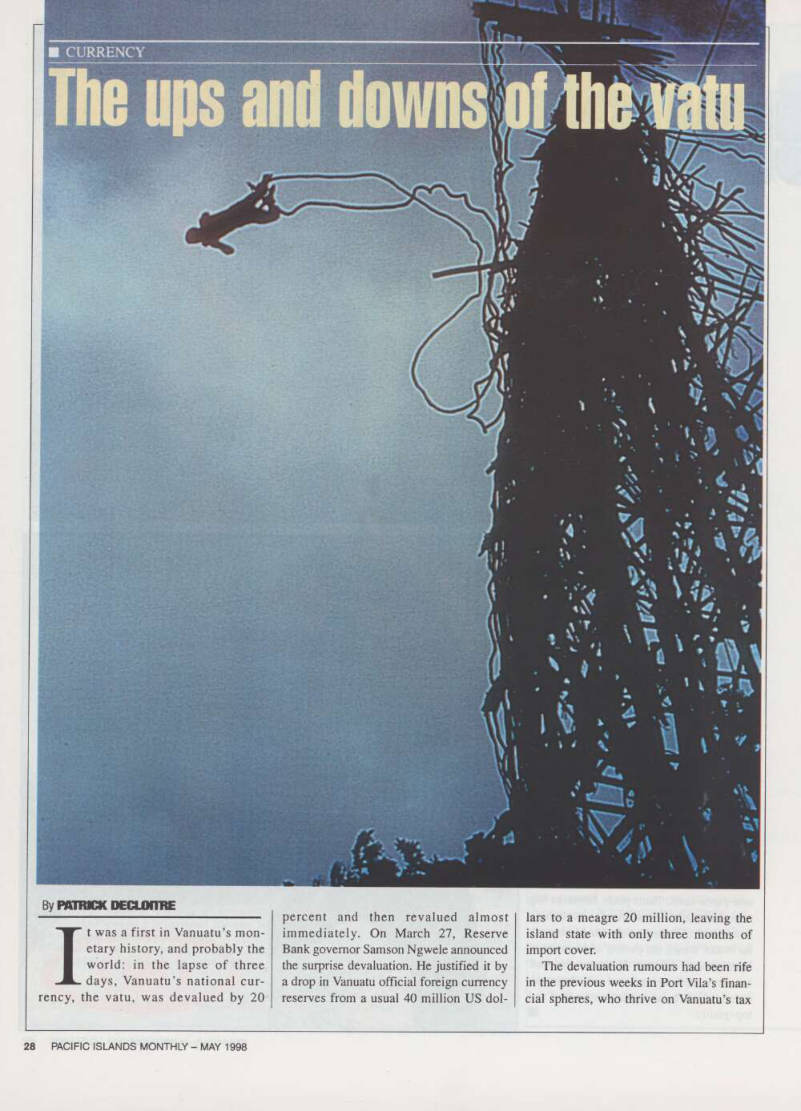
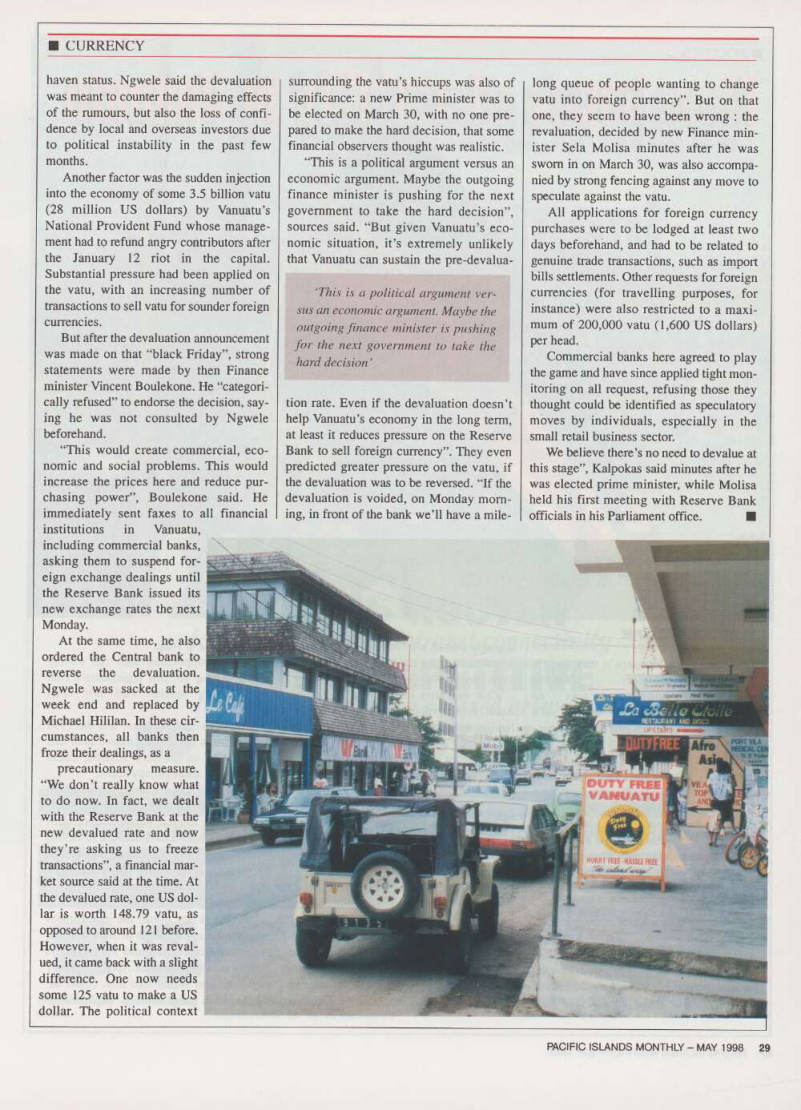
Currency
By Patrick Declo[?]Re
It was a first in Vanuatu’s mon etary history, and probably the world: in the lapse of three days, Vanuatu’s national cur rency, the vatu, was devalued by 20
percent and then revalued almost immediately. On March 27, Reserve Bank governor Samson Ngwele announced the surprise devaluation. He justified it by a drop in Vanuatu official foreign currency reserves from a usual 40 million US dol
lars to a meagre 20 million, leaving the island state with only three months of import cover.
The devaluation rumours had been rife in the previous weeks in Port Vila’s finan cial spheres, who thrive on Vanuatu’s tax
haven status. Ngwele said the devaluation was meant to counter the damaging effects of the rumours, but also the loss of confi dence by local and overseas investors due to political instability in the past few months.
Another factor was the sudden injection into the economy of some 3.5 billion vatu (28 million US dollars) by Vanuatu’s National Provident Fund whose manage ment had to refund angry contributors after the January 12 riot in the capital.
Substantial pressure had been applied on the vatu, with an increasing number of transactions to sell vatu for sounder foreign currencies.
But after the devaluation announcement was made on that “black Friday”, strong statements were made by then Finance minister Vincent Boulekone. He “categori cally refused” to endorse the decision, say ing he was not consulted by Ngwele beforehand.
“This would create commercial, eco nomic and social problems. This would increase the prices here and reduce pur chasing power”, Boulekone said. He immediately sent faxes to all financial
institutions in Vanuatu, including commercial banks, asking them to suspend for eign exchange dealings until the Reserve Bank issued its new exchange rates the next Monday.
At the same time, he also ordered the Central bank to reverse the devaluation.
Ngwele was sacked at the week end and replaced by Michael Hililan. In these cir cumstances, all banks then froze their dealings, as a
precautionary measure.
“We don’t really know what to do now. In fact, we dealt with the Reserve Bank at the new devalued rate and now they’re asking us to freeze transactions”, a financial mar ket source said at the time. At the devalued rate, one US dol lar is worth 148.79 vatu, as opposed to around 121 before.
However, when it was reval ued, it came back with a slight difference. One now needs some 125 vatu to make a US dollar. The political context
surrounding the vatu’s hiccups was also of significance: a new Prime minister was to be elected on March 30, with no one pre pared to make the hard decision, that some financial observers thought was realistic.
“This is a political argument versus an economic argument. Maybe the outgoing finance minister is pushing for the next government to take the hard decision”, sources said. “But given Vanuatu’s eco nomic situation, it’s extremely unlikely that Vanuatu can sustain the pre-devalua
‘This is a political argument ver sus an economic argument. Maybe the outgoing finance minister is pushing for the next government to take the hard decision ’
tion rate. Even if the devaluation doesn’t help Vanuatu’s economy in the long term, at least it reduces pressure on the Reserve Bank to sell foreign currency”. They even predicted greater pressure on the vatu, if the devaluation was to be reversed. “If the devaluation is voided, on Monday morn ing, in front of the bank we’ll have a mile
long queue of people wanting to change vatu into foreign currency”. But on that one, they seem to have been wrong : the revaluation, decided by new Finance min ister Sela Molisa minutes after he was sworn in on March 30, was also accompa nied by strong fencing against any move to speculate against the vatu.
All applications for foreign currency purchases were to be lodged at least two days beforehand, and had to be related to genuine trade transactions, such as import bills settlements. Other requests for foreign currencies (for travelling purposes, for instance) were also restricted to a maxi mum of 200,000 vatu (1,600 US dollars) per head.
Commercial banks here agreed to play the game and have since applied tight mon itoring on all request, refusing those they thought could be identified as speculatory moves by individuals, especially in the small retail business sector.
We believe there’s no need to devalue at this stage”, Kalpokas said minutes after he was elected prime minister, while Molisa held his first meeting with Reserve Bank officials in his Parliament office. ■
Advertisements & other items, p. 29 (1 item)
■ Currency
New hopes of stability in Vanuatu
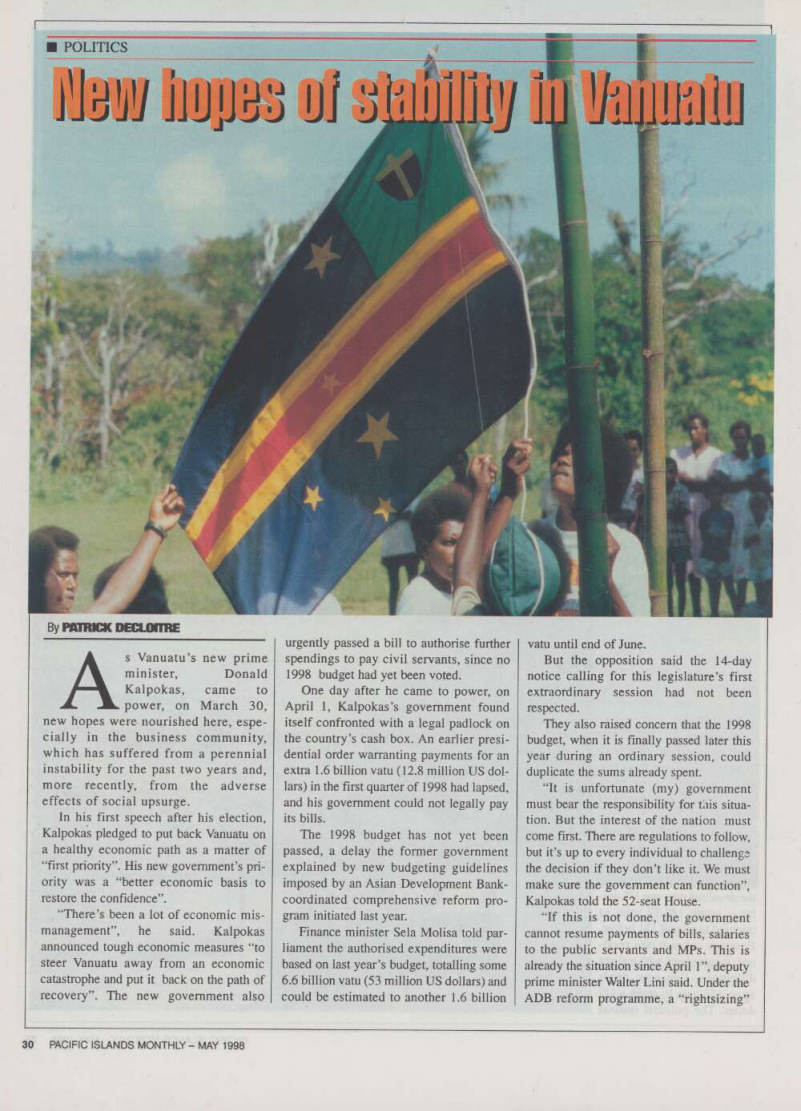

Politics
By Patrick Decloitre
As Vanuatu’s new prime minister, Donald Kalpokas, came to power, on March 30, new hopes were nourished here, espe cially in the business community, which has suffered from a perennial instability for the past two years and, more recently, from the adverse effects of social upsurge.
In his first speech after his election, Kalpokas pledged to put back Vanuatu on a healthy economic path as a matter of “first priority”. His new government’s pri ority was a “better economic basis to restore the confidence”.
“There’s been a lot of economic mis management”, he said. Kalpokas announced tough economic measures “to steer Vanuatu away from an economic catastrophe and put it back on the path of recovery”. The new government also
urgently passed a bill to authorise further spendings to pay civil servants, since no 1998 budget had yet been voted.
One day after he came to power, on April 1, Kalpokas’s government found itself confronted with a legal padlock on the country’s cash box. An earlier presi dential order warranting payments for an extra 1.6 billion vatu (12.8 million US dol lars) in the first quarter of 1998 had lapsed, and his government could not legally pay its bills.
The 1998 budget has not yet been passed, a delay the former government explained by new budgeting guidelines imposed by an Asian Development Bank coordinated comprehensive reform pro gram initiated last year.
Finance minister Sela Molisa told par liament the authorised expenditures were based on last year’s budget, totalling some 6.6 billion vatu (53 million US dollars) and could be estimated to another 1.6 billion
vatu until end of June.
But the opposition said the 14-day notice calling for this legislature’s first extraordinary session had not been respected.
They also raised concern that the 1998 budget, when it is finally passed later this year during an ordinary session, could duplicate the sums already spent.
“It is unfortunate (my) government must bear the responsibility for this situa tion. But the interest of the nation must come first. There are regulations to follow, but it’s up to every individual to challenge the decision if they don’t like it. We must make sure the government can function”, Kalpokas told the 52-seat House.
“If this is not done, the government cannot resume payments of bills, salaries to the public servants and MPs. This is already the situation since April 1”, deputy prime minister Walter Lini said. Under the ADB reform programme, a “rightsizing”
of the public service, including sackings
and payment of redundancy allowances, is also to be included in the 1998 budget.
The bill, which was supported by 33 MPs, authorises the finance minister to “make funds available” to allow the government services to function for three months after March 31 or until the 98 budget is voted, “whichever of these events comes first”.
To top off, two cyclones, Yali and
Zuman, destructively accompanied the
change of government in Vanuatu, on both sides of the island state : Yali struck southern Tanna, Erromango and Anatom islands on March 22 with winds gusting to 70 knots (125 kilometres per hour).
A Royal New Zealand Air Force Orion reconnaissance flight later found these islands could face serious food shortage in the coming months. One week later, Zuman went for Vanuatu’ northern Santo and caused crop and structural damage to the east side of the island, Vanuatu’s biggest.
There, it is the copra industry, a major revenue earner, that could be seriously affected in future: hundreds of coconut trees were blown down. ■
government
Vanuatu's new government
By Patrick Decloitro
Vanuatu’s new prime min ister, who was elected last month by 35 of the 52 members of parlia ment, announced his coalition cabinet as follows: Prime minister : Donald Kalpokas (Vanuaaku Pati -VP-); Deputy Prime minis ter, minister for internal affairs, also respon sible for police, labour, immigration, judi ciary : Walter Lini (National United Party - NUP); Education, youth and sports : Joe Natuman (VP); Finance : Sela Molisa (VP);
Infrastructure, public utilities : Stanley Reginald (NUP); Lands, geology, mines : Silas Hakwa (VP); Agriculture, Forestry, Fisheries : John Morrison Willy (VP); Trade, business development: James Buie (NUP); Health : John Robert Alick (NUP).' Assisting prime minister on economic reforms : Daniel Bangtor (VP); Assisting prime minister on foreign affairs : Clement Leo (VP).
Assisting the minister of education: Willie Ollie Varasmaite (VP); Assisting the minister on economic development: Steven latika (Independent). ■
Advertisements & other items, p. 31 (2 items)
31
PACIFIC ISLANDS MONTHLY - MAY 1998
■ POLITICS
■ POLITICS
Internet/Intranet
ACCESS ROUTER
for instant Intemet/Intranet connectivity
COST COMPETITIVE
for small and medium = sized networks
HASSLE INSTALLATION
compact, easy to use
http://www.rad.com
ATTENTION; Internet Service Providers and Network Managers WEB RANger™ is a compact Process router that connects small or mediumsized offices to the internet or private IP networks over ISDN dial up links leased lines and digital. Designed for fast no fuss installation and setup, the WEB RANger's attractive price makes it the ideal internet access solution for ISPs and' corporate network managers alike. For more information contact RAD Data Communications at http://www.rad.com
Ihil
Compatible with 3rd party Easy installed end setup PPP devices Firewall security future Connection On Demand (COD) protects your network's data signifkilly reduces WAN costs RAD/TEL & CIS PNG PO BOX 43 WAIGANINCD PNG
PHONE (675) 325 2555
FAX (675) 325 0872
e-mail: [email protected]
Rugby becomes big business
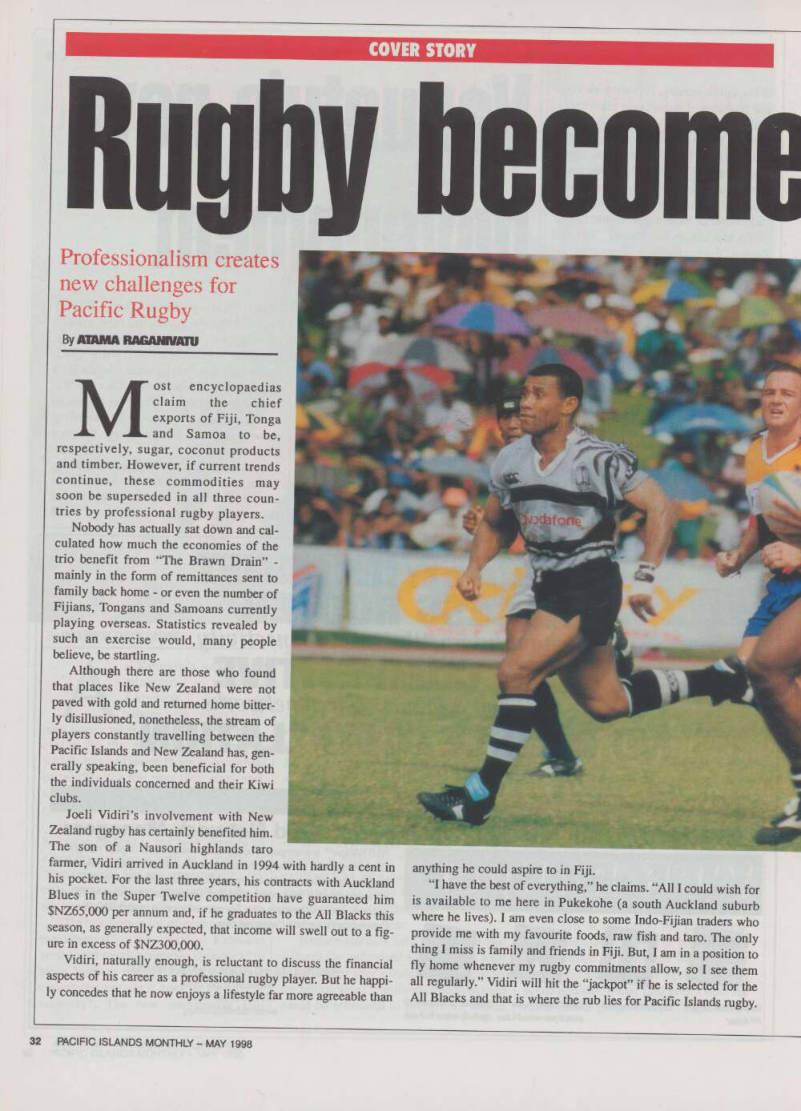
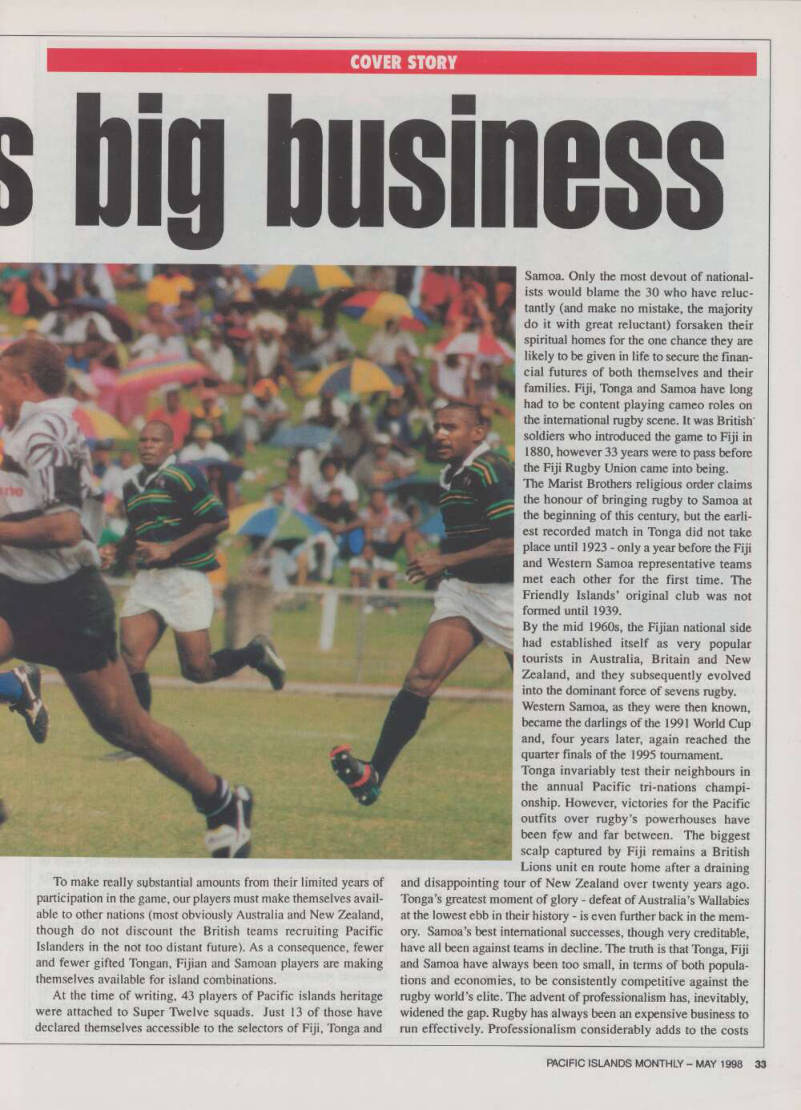
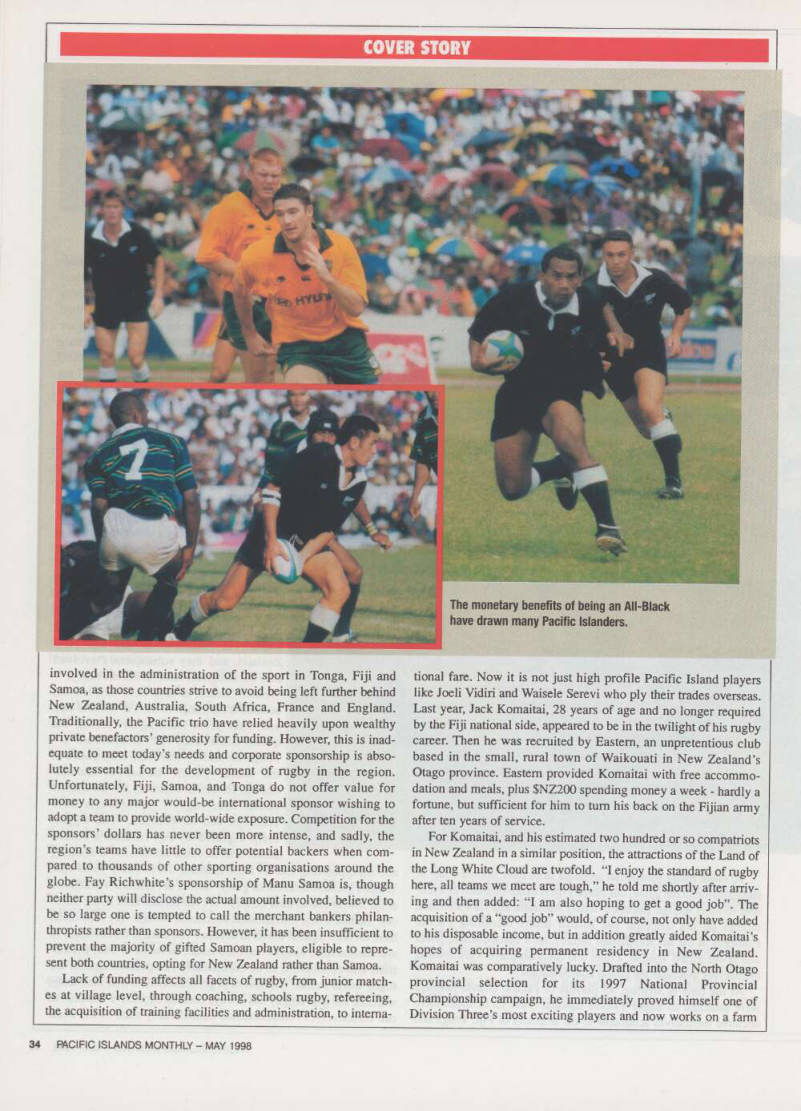
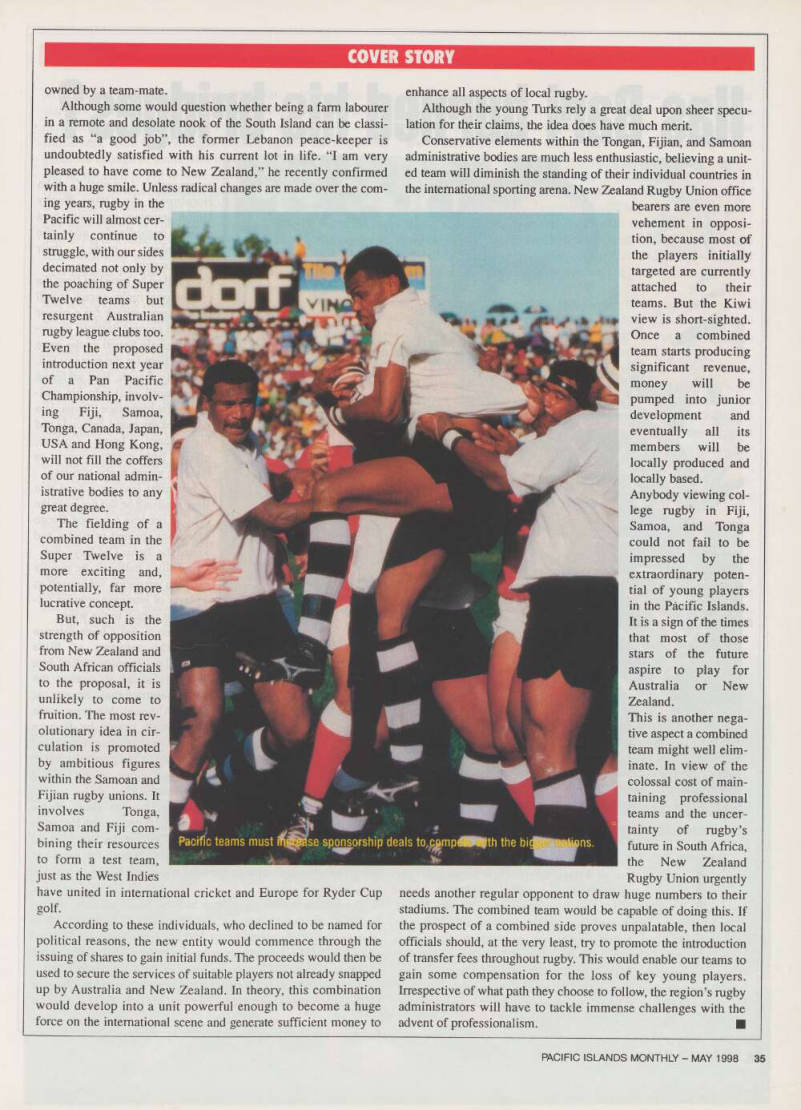
Cover Story
Professionalism creates new challenges for Pacific Rugby
By Atama Raganivatu
Most encyclopaedias
claim the chief exports of Fiji, Tonga and Samoa to be, respectively, sugar, coconut products and timber. However, if current trends continue, these commodities may soon be superseded in all three coun tries by professional rugby players.
Nobody has actually sat down and cal culated how much the economies of the trio benefit from “The Brawn Drain” mainly in the form of remittances sent to family back home - or even the number of Fijians, Tongans and Samoans currently playing overseas. Statistics revealed by such an exercise would, many people believe, be startling.
Although there are those who found that places like New Zealand were not paved with gold and returned home bitter ly disillusioned, nonetheless, the stream of players constantly travelling between the Pacific Islands and New Zealand has, gen erally speaking, been beneficial for both the individuals concerned and their Kiwi clubs.
Joeli Vidiri’s involvement with New Zealand rugby has certainly benefited him.
The son of a Nausori highlands taro
farmer, Vidiri arrived in Auckland in 1994 with hardly a cent in his pocket. For the last three years, his contracts with Auckland Blues in the Super Twelve competition have guaranteed him $NZ65,000 per annum and, if he graduates to the All Blacks this season, as generally expected, that income will swell out to a fig ure in excess of SNZ3OO,OOO.
Vidiri, naturally enough, is reluctant to discuss the financial aspects of his career as a professional rugby player. But he happi ly concedes that he now enjoys a lifestyle far more agreeable than
anything he could aspire to in Fiji.
“I have the best of everything,” he claims. “All I could wish for is available to me here in Pukekohe (a south Auckland suburb where he lives). I am even close to some Indo-Fijian traders who provide me with my favourite foods, raw fish and taro. The only thing I miss is family and friends in Fiji. But, I am in a position to fly home whenever my rugby commitments allow, so I see them all regularly.” Vidiri will hit the “jackpot” if he is selected for the All Blacks and that is where the rub lies for Pacific Islands rugby.
To make really substantial amounts from their limited years of participation in the game, our players must make themselves avail able to other nations (most obviously Australia and New Zealand, though do not discount the British teams recruiting Pacific Islanders in the not too distant future). As a consequence, fewer and fewer gifted Tongan, Fijian and Samoan players are making themselves available for island combinations.
At the time of writing, 43 players of Pacific islands heritage were attached to Super Twelve squads. Just 13 of those have declared themselves accessible to the selectors of Fiji, Tonga and
Samoa. Only the most devout of national ists would blame the 30 who have reluc tantly (and make no mistake, the majority do it with great reluctant) forsaken their spiritual homes for the one chance they are likely to be given in life to secure the finan cial futures of both themselves and their families. Fiji, Tonga and Samoa have long had to be content playing cameo roles on the international rugby scene. It was British' soldiers who introduced the game to Fiji in 1880, however 33 years were to pass before the Fiji Rugby Union came into being.
The Marist Brothers religious order claims the honour of bringing rugby to Samoa at the beginning of this century, but the earli est recorded match in Tonga did not take place until 1923 - only a year before the Fiji and Western Samoa representative teams met each other for the first time. The Friendly Islands’ original club was not formed until 1939.
By the mid 19605, the Fijian national side had established itself as very popular tourists in Australia, Britain and New Zealand, and they subsequently evolved into the dominant force of sevens rugby.
Western Samoa, as they were then known, became the darlings of the 1991 World Cup and, four years later, again reached the quarter finals of the 1995 tournament.
Tonga invariably test their neighbours in the annual Pacific tri-nations champi onship. However, victories for the Pacific outfits over rugby’s powerhouses have been few and far between. The biggest scalp captured by Fiji remains a British Lions unit en route home after a draining
and disappointing tour of New Zealand over twenty years ago.
Tonga’s greatest moment of glory - defeat of Australia’s Wallabies at the lowest ebb in their history - is even further back in the mem ory. Samoa’s best international successes, though very creditable, have all been against teams in decline. The truth is that Tonga, Fiji and Samoa have always been too small, in terms of both popula tions and economies, to be consistently competitive against the rugby world’s elite. The advent of professionalism has, inevitably, widened the gap. Rugby has always been an expensive business to run effectively. Professionalism considerably adds to the costs
involved in the administration of the sport in Tonga, Fiji and Samoa, as those countries strive to avoid being left further behind New Zealand, Australia, South Africa, France and England.
Traditionally, the Pacific trio have relied heavily upon wealthy private benefactors’ generosity for funding. However, this is inad equate to meet today’s needs and corporate sponsorship is abso lutely essential for the development of rugby in the region.
Unfortunately, Fiji, Samoa, and Tonga do not offer value for money to any major would-be international sponsor wishing to adopt a team to provide world-wide exposure. Competition for the sponsors’ dollars has never been more intense, and sadly, the region’s teams have little to offer potential backers when com pared to thousands of other sporting organisations around the globe. Fay Richwhite’s sponsorship of Manu Samoa is, though neither party will disclose the actual amount involved, believed to be so large one is tempted to call the merchant bankers philan thropists rather than sponsors. However, it has been insufficient to prevent the majority of gifted Samoan players, eligible to repre sent both countries, opting for New Zealand rather than Samoa.
Lack of funding affects all facets of rugby, from junior match es at village level, through coaching, schools rugby, refereeing, the acquisition of training facilities and administration, to interna
tional fare. Now it is not just high profile Pacific Island players like Joeli Vidiri and Waisele Serevi who ply their trades overseas.
Last year. Jack Komaitai, 28 years of age and no longer required by the Fiji national side, appeared to be in the twilight of his rugby career. Then he was recruited by Eastern, an unpretentious club based in the small, rural town of Waikouati in New Zealand’s Otago province. Eastern provided Komaitai with free accommo dation and meals, plus SNZ2OO spending money a week - hardly a fortune, but sufficient for him to turn his back on the Fijian army after ten years of service.
For Komaitai, and his estimated two hundred or so compatriots in New Zealand in a similar position, the attractions of the Land of the Long White Cloud are twofold. “I enjoy the standard of rugby here, all teams we meet are tough,” he told me shortly after arriv ing and then added: “I am also hoping to get a good job”. The acquisition of a “good job” would, of course, not only have added to his disposable income, but in addition greatly aided Komaitai’s hopes of acquiring permanent residency in New Zealand.
Komaitai was comparatively lucky. Drafted into the North Otago provincial selection for its 1997 National Provincial Championship campaign, he immediately proved himself one of Division Three’s most exciting players and now works on a farm
The monetary benefits of being an All-Black have drawn many Pacific Islanders.
owned by a team-mate.
Although some would question whether being a farm labourer in a remote and desolate nook of the South Island can be classi fied as “a good job”, the former Lebanon peace-keeper is undoubtedly satisfied with his current lot in life. “I am very pleased to have come to New Zealand,” he recently confirmed with a huge smile. Unless radical changes are made over the com
ing years, rugby in the Pacific will almost cer tainly continue to struggle, with our sides decimated not only by the poaching of Super Twelve teams but resurgent Australian rugby league clubs too.
Even the proposed introduction next year of a Pan Pacific
Championship, involv
ing Fiji, Samoa, Tonga, Canada, Japan, USA and Hong Kong, will not fill the coffers of our national admin istrative bodies to any great degree.
The fielding of a combined team in the Super Twelve is a more exciting and, potentially, far more lucrative concept.
But, such is the strength of opposition from New Zealand and South African officials to the proposal, it is unlikely to come to fruition. The most rev olutionary idea in cir culation is promoted by ambitious figures within the Samoan and Fijian rugby unions. It involves Tonga, Samoa and Fiji com bining their resources to form a test team, just as the West Indie's
have united in international cricket and Europe for Ryder Cup golf.
According to these individuals, who declined to be named for political reasons, the new entity would commence through the issuing of shares to gain initial funds. The proceeds would then be used to secure the services of suitable players not already snapped up by Australia and New Zealand. In theory, this combination would develop into a unit powerful enough to become a huge force on the international scene and generate sufficient money to
enhance all aspects of local rugby.
Although the young Turks rely a great deal upon sheer specu lation for their claims, the idea does have much merit.
Conservative elements within the Tongan, Fijian, and Samoan administrative bodies are much less enthusiastic, believing a unit ed team will diminish the standing of their individual countries in the international sporting arena. New Zealand Rugby Union office
bearers are even more vehement in opposi tion, because most of the players initially targeted are currently attached to their teams. But the Kiwi view is short-sighted.
Once a combined team starts producing significant revenue, money will be pumped into junior development and eventually all its members will be locally produced and locally based.
Anybody viewing col lege rugby in Fiji, Samoa, and Tonga could not fail to be impressed by the extraordinary poten tial of young players in the Pacific Islands.
It is a sign of the times that most of those stars of the future aspire to play for Australia or New Zealand.
This is another nega tive aspect a combined team might well elim inate. In view of the colossal cost of main taining professional teams and the uncer tainty of rugby’s future in South Africa, the New Zealand Rugby Union urgently
needs another regular opponent to draw huge numbers to their stadiums. The combined team would be capable of doing this. If the prospect of a combined side proves unpalatable, then local officials should, at the very least, try to promote the introduction of transfer fees throughout rugby. This would enable our teams to gain some compensation for the loss of key young players.
Irrespective of what path they choose to follow, the region’s rugby administrators will have to tackle immense challenges with the advent of professionalism. ■
Pacific teams must increase sponsorship deals to compe[?]e with the biger nations.
Advertisements & other items, p. 33 (1 item)
i big business
COVER STORY
PACIFIC ISLANDS MONTHLY - MAY 1998
Has Bari burned his bridges?
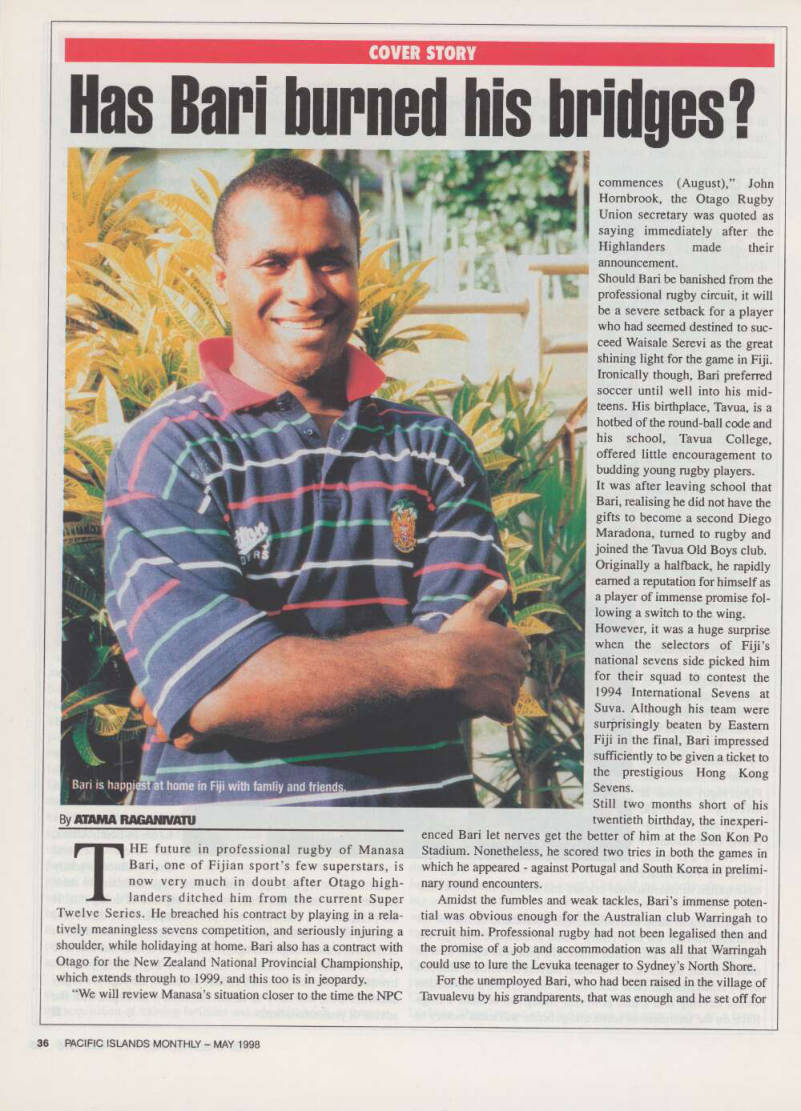
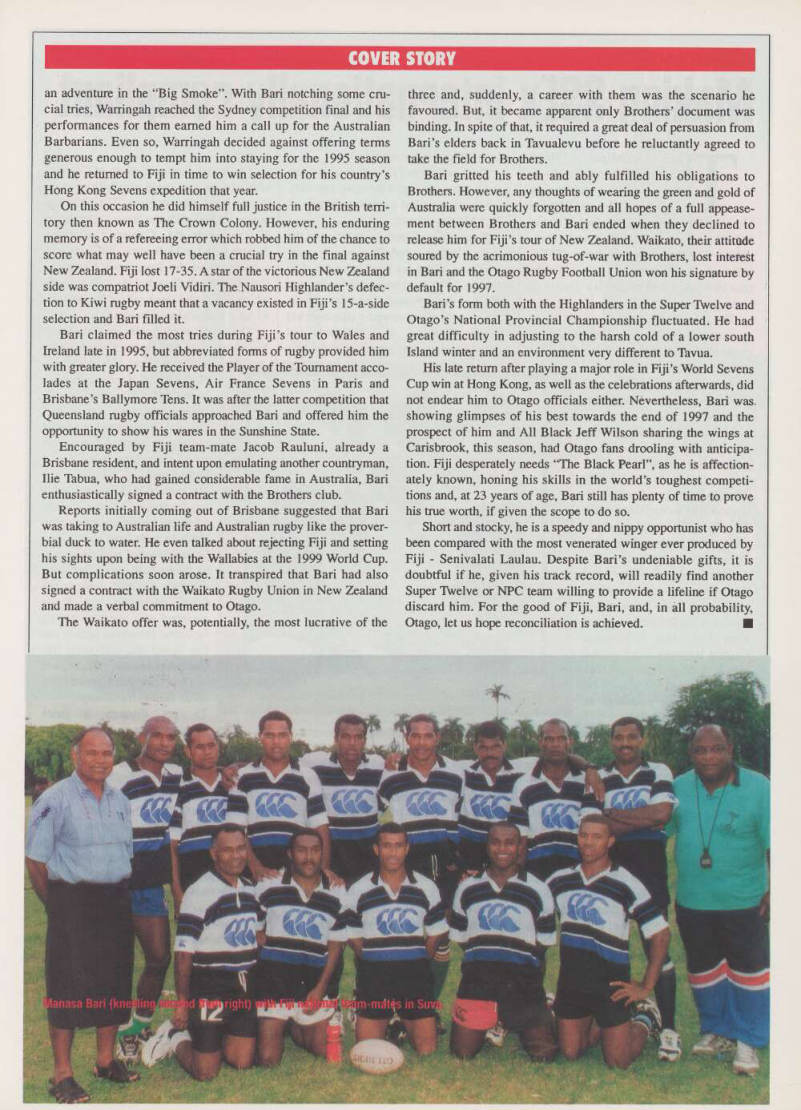
By Atama Ragan Ivatu
THE future in professional rugby of Manasa Bari, one of Fijian sport’s few superstars, is now very much in doubt after Otago high landers ditched him from the current Super Twelve Series. He breached his contract by playing in a rela tively meaningless sevens competition, and seriously injuring a shoulder, while holidaying at home. Bari also has a contract with Otago for the New Zealand National Provincial Championship, which extends through to 1999, and this too is in jeopardy.
“We will review Manasa’s situation closer to the time the NPC
commences (August),” John Hombrook, the Otago Rugby Union secretary was quoted as saying immediately after the Highlanders made their announcement.
Should Bari be banished from the professional rugby circuit, it will be a severe setback for a player who had seemed destined to suc ceed Waisale Serevi as the great shining light for the game in Fiji.
Ironically though, Bari preferred soccer until well into his mid teens. His birthplace, Tavua, is a hptbed of the round-ball code and his school, Tavua College, offered little encouragement to budding young rugby players.
It was after leaving school that Bari, realising he did not have the gifts to become a second Diego Maradona, turned to rugby and joined the Tavua Old Boys club.
Originally a halfback, he rapidly earned a reputation for himself as a player of immense promise fol lowing a switch to the wing.
However, it was a huge surprise when the selectors of Fiji’s national sevens side picked him for their squad to contest the 1994 International Sevens at Suva. Although his team were surprisingly beaten by Eastern Fiji in the final, Bari impressed sufficiently to be given a ticket to the prestigious Hong Kong Sevens.
Still two months short of his
twentieth birthday, the inexperi
enced Bari let nerves get the better of him at the Son Kon Po Stadium. Nonetheless, he scored two tries in both the games in which he appeared - against Portugal and South Korea in prelimi nary round encounters.
Amidst the fumbles and weak tackles, Bari’s immense poten tial was obvious enough for the Australian club Warringah to recruit him. Professional rugby had not been legalised then and the promise of a job and accommodation was all that Warringah could use to lure the Levuka teenager to Sydney’s North Shore.
For the unemployed Bari, who had been raised in the village of Tavualevu by his grandparents, that was enough and he set off for
Bari is happiest at home In Fiji with family and friends.
an adventure in the “Big Smoke”. With Bari notching some cru cial tries, Warringah reached the Sydney competition final and his performances for them earned him a call up for the Australian Barbarians. Even so, Warringah decided against offering terms generous enough to tempt him into staying for the 1995 season and he returned to Fiji in time to win selection for his country’s Hong Kong Sevens expedition that year.
On this occasion he did himself full justice in the British terri tory then known as The Crown Colony. However, his enduring memory is of a refereeing error which robbed him of the chance to score what may well have been a crucial try in the final against New Zealand. Fiji lost 17-35. A star of the victorious New Zealand side was compatriot Joeli Vidiri. The Nausori Highlander’s defec tion to Kiwi rugby meant that a vacancy existed in Fiji’s 15-a-side selection and Bari filled it.
Bari claimed the most tries during Fiji’s tour to Wales and Ireland late in 1995, but abbreviated forms of rugby provided him with greater glory. He received the Player of the Tournament acco lades at the Japan Sevens, Air France Sevens in Paris and Brisbane’s Ballymore Tens. It was after the latter competition that Queensland rugby officials approached Bari and offered him the opportunity to show his wares in the Sunshine State.
Encouraged by Fiji team-mate Jacob Rauluni, already a Brisbane resident, and intent upon emulating another countryman.
Hie Tabua, who had gained considerable fame in Australia, Bari enthusiastically signed a contract with the Brothers club.
Reports initially coming out of Brisbane suggested that Bari was taking to Australian life and Australian rugby like the prover bial duck to water. He even talked about rejecting Fiji and setting his sights upon being with the Wallabies at the 1999 World Cup.
But complications soon arose. It transpired that Bari had also signed a contract with the Waikato Rugby Union in New Zealand and made a verbal commitment to Otago.
The Waikato offer was, potentially, the most lucrative of the
three and, suddenly, a career with them was the scenario he favoured. But, it became apparent only Brothers’ document was binding. In spite of that, it required a great deal of persuasion from Bari’s elders back in Tavualevu before he reluctantly agreed to take the field for Brothers.
Bari gritted his teeth and ably fulfilled his obligations to Brothers. However, any thoughts of wearing the green and gold of Australia were quickly forgotten and all hopes of a full appease ment between Brothers and Bari ended when they declined to release him for Fiji’s tour of New Zealand. Waikato, their attitude soured by the acrimonious tug-of-war with Brothers, lost interest in Bari and the Otago Rugby Football Union won his signature by default for 1997.
Bari’s form both with the Highlanders in the Super Twelve and Otago’s National Provincial Championship fluctuated. He had great difficulty in adjusting to the harsh cold of a lower south Island winter and an environment very different to Tavua.
His late return after playing a major role in Fiji’s World Sevens Cup win at Hong Kong, as well as the celebrations afterwards, did not endear him to Otago officials either. Nevertheless, Bari was, showing glimpses of his best towards the end of 1997 and the prospect of him and All Black Jeff Wilson sharing the wings at Carisbrook, this season, had Otago fans drooling with anticipa tion. Fiji desperately needs “The Black Pearl”, as he is affection ately known, honing his skills in the world’s toughest competi tions and, at 23 years of age, Bari still has plenty of time to prove his true worth, if given the scope to do so.
Short and stocky, he is a speedy and nippy opportunist who has been compared with the most venerated winger ever produced by Fiji - Senivalati Laulau. Despite Bari’s undeniable gifts, it is doubtful if he, given his track record, will readily find another Super Twelve or NPC team willing to provide a lifeline if Otago discard him. For the good of Fiji, Bari, and, in all probability, Otago, let us hope reconciliation is achieved. ■
Manasa Bari (knecling second from right) with Fiji national team-mates in Suva.
Advertisements & other items, p. 37 (1 item)
Cover Story
Making SSEX internationally compliant
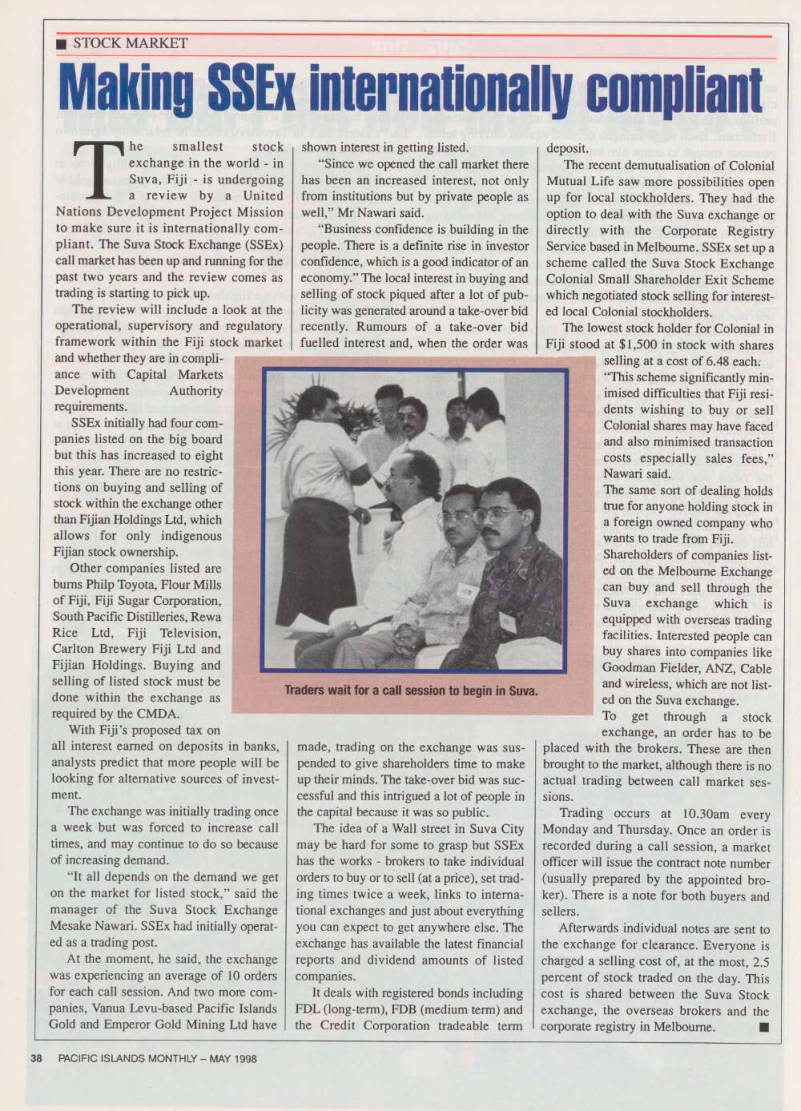
Stock Market
The smallest stock exchange in the world - in Suva, Fiji - is undergoing a review by a United Nations Development Project Mission to make sure it is internationally com pliant. The Suva Stock Exchange (SSEx) call market has been up and running for the past two years and the review comes as trading is starting to pick up.
The review will include a look at the operational, supervisory and regulatory framework within the Fiji stock market
and whether they are in compli ance with Capital Markets Development Authority requirements.
SSEx initially had four com panies listed on the big board but this has increased to eight this year. There are no restric tions on buying and selling of stock within the exchange other than Fijian Holdings Ltd, which allows for only indigenous Fijian stock ownership.
Other companies listed are bums Philp Toyota, Flour Mills of Fiji, Fiji Sugar Corporation, South Pacific Distilleries, Rewa Rice Ltd, Fiji Television, Carlton Brewery Fiji Ltd and Fijian Holdings. Buying and selling of listed stock must be done within the exchange as required by the CMDA.
With Fiji’s proposed tax on
all interest earned on deposits in banks, analysts predict that more people will be looking for alternative sources of invest ment.
The exchange was initially trading once a week but was forced to increase call times, and may continue to do so because of increasing demand.
“It all depends on the demand we get on the market for listed stock,” said the manager of the Suva Stock Exchange Mesake Nawari. SSEx had initially operat ed as a trading post.
At the moment, he said, the exchange was experiencing an average of 10 orders for each call session. And two more com panies, Vanua Levu-based Pacific Islands Gold and Emperor Gold Mining Ltd have
shown interest in getting listed.
“Since we opened the call market there has been an increased interest, not only from institutions but by private people as well,” Mr Nawari said.
“Business confidence is building in the people. There is a definite rise in investor confidence, which is a good indicator of an economy.” The local interest in buying and selling of stock piqued after a lot of pub licity was generated around a take-over bid recently. Rumours of a take-over bid fuelled interest and, when the order was
made, trading on the exchange was sus pended to give shareholders time to make up their minds. The take-over bid was suc cessful and this intrigued a lot of people in the capital because it was so public.
The idea of a Wall street in Suva City may be hard for some to grasp but SSEx has the works - brokers to take individual orders to buy or to sell (at a price), set trad ing times twice a week, links to interna
tional exchanges and just about everything
you can expect to get anywhere else. The exchange has available the latest financial reports and dividend amounts of listed
companies.
It deals with registered bonds including FDL (long-term), FDB (medium term) and the Credit Corporation tradeable term
deposit.
The recent demutualisation of Colonial Mutual Life saw more possibilities open up for local stockholders. They had the option to deal with the Suva exchange or directly with the Corporate Registry Service based in Melbourne. SSEx set up a scheme called the Suva Stock Exchange Colonial Small Shareholder Exit Scheme which negotiated stock selling for interest ed local Colonial stockholders.
The lowest stock holder for Colonial in Fiji stood at $1,500 in stock with shares
selling at a cost of 6.48 each.
“This scheme significantly min imised difficulties that Fiji resi dents wishing to buy or sell Colonial shares may have faced and also minimised transaction costs especially sales fees,”
Nawari said.
The same sort of dealing holds true for anyone holding stock in a foreign owned company who wants to trade from Fiji.
Shareholders of companies list ed on the Melbourne Exchange can buy and sell through the Suva exchange which is
equipped with overseas trading
facilities. Interested people can buy shares into companies like Goodman Fielder, ANZ, Cable and wireless, which are not list ed on the Suva exchange.
To get through a stock exchange, an order has to be
placed with the brokers. These are then brought to the market, although there is no actual trading between call market ses sions.
Trading occurs at 10.30 am every Monday and Thursday. Once an order is recorded during a call session, a market officer will issue the contract note number
(usually prepared by the appointed bro
ker). There is a note for both buyers and sellers.
Afterwards individual notes are sent to the exchange for clearance. Everyone is charged a selling cost of, at the most, 2.5 percent of stock traded on the day. This cost is shared between the Suva Stock exchange, the overseas brokers and the corporate registry in Melbourne. ■
Traders wait for a call session to begin in Suva.
A cultural centre with a difference
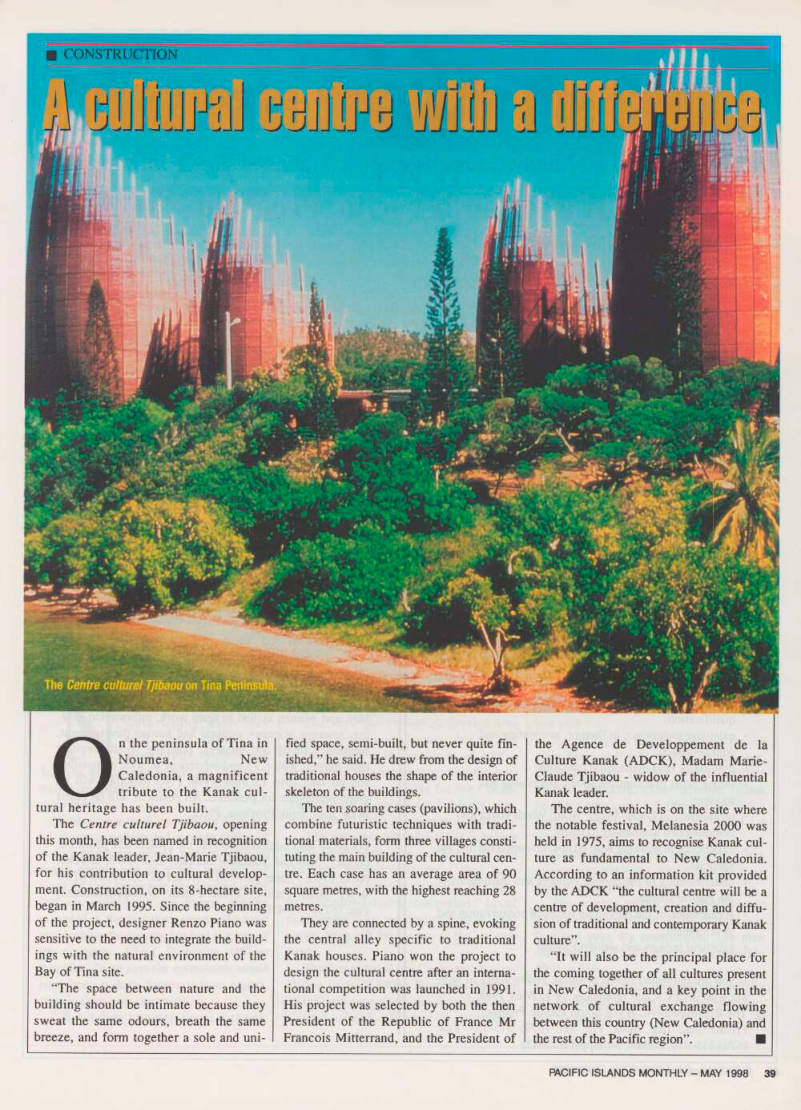
Construction
On the peninsula of Tina in Noumea, New Caledonia, a magnificent tribute to the Kanak cul tural heritage has been built.
The Centre culturel Tjibaou, opening this month, has been named in recognition of the Kanak leader, Jean-Marie Tjibaou, for his contribution to cultural develop ment. Construction, on its 8-hectare site, began in March 1995. Since the beginning of the project, designer Renzo Piano was sensitive to the need to integrate the build ings with the natural environment of the Bay of Tina site.
“The space between nature and the building should be intimate because they sweat the same odours, breath the same breeze, and form together a sole and uni
fied space, semi-built, but never quite fin ished,” he said. He drew from the design of traditional houses the shape of the interior skeleton of the buildings.
The ten cases (pavilions), which combine futuristic techniques with tradi tional materials, form three villages consti tuting the main building of the cultural cen tre. Each case has an average area of 90 square metres, with the highest reaching 28 metres.
They are connected by a spine, evoking the central alley specific to traditional Kanak houses. Piano won the project to design the cultural centre after an interna tional competition was launched in 1991.
His project was selected by both the then President of the Republic of France Mr Francois Mitterrand, and the President of
the Agence de Developpement de la Culture Kanak (ADCK), Madam Marie- Claude Tjibaou - widow of the influential Kanak leader.
The centre, which is on the site where the notable festival, Melanesia 2000 was held in 1975, aims to recognise Kanak cul ture as fundamental to New Caledonia.
According to an information kit provided by the ADCK “the cultural centre will be a centre of development, creation and diffu sion of traditional and contemporary Kanak culture”.
“It will also be the principal place for the coming together of all cultures present in New Caledonia, and a key point in the network of cultural exchange flowing between this country (New Caledonia) and the rest of the Pacific region”. ■
The Centre culturel Tjibaou on Tina Peninsula.
Advertisements & other items, p. 40 (1 item)
WWF South Pacific Program
WWF
WWF (World Wide Fund for Nature) is an independent conservation organisation with a network of offices in over 50 countries. WWF works closely with governments, NGOs and regional institutions to support initiatives in natural resource management and sustainable development.
In the South Pacific, WWF focuses on local community action, awareness raising, capacity building and sustainable use of forests, wetland, coasts and near shore resources.
Manager of Finance & Administration
Suva, Fiji
WWF is seeking an experienced Manager of Finance & Administration to support and extend its South Pacific Program. This is a senior position in a small dynamic team responsible for organising all aspects of WWF’s conservation work in the South Pacific. The position is based in Suva, Fiji and will involve travel in the region and beyond.
Responsibilities include:
• financial & administration planning, management and reporting for the Program; • project administration; management of program and project offices, staff, information and record systems; • support for fundraising; relations with government and aid organisations; • member of a senior management team
Requirements are:
• advanced qualifications in accounting, finance or business studies and/or a professional accountancy
qualification;
• extensive experience in finance, accounting and administration • previously held managerial positions; • strong skills in communications, organising and training; • proficiency in Lotus, Excel, Word, Word Perfect and computerised accounting systems; • experience in working with NGOs, governments and aid
agencies;
• understanding of the people, cultures and institutions of the Pacific Islands; • appreciation of the prevailing issues of conservation and
development;
• excellent spoken and written English If you are interested in this position, please apply in writing with your CV and references by 15 May 1998, to The Representative, WWF South Pacific Program, Private Mail Bag, Suva, Fiji. Tel: (679) 315-533, Fax: (679) 315-410, e-mail: [email protected]
Sepik Community Land Care
East Sepik Province, PNG
WWF - World Wide Fund for Nature is establishing a major new program of support to local communities and government, for conservation and development of natural resources in the East Sepik Province, Papua New Guinea.
This challenging, long-term initiative will combine community development activities with management of forests and wetlands and broad bio-regional planning.
Senior positions are available for mature motivated people with a commitment to conservation, community development, participatory planning and local capacity-building:
Project Coordinator
Finance & Operations Manager
Technical Advisor - Planning & Policy
Senior Field Coordinator
Community Business Adviser
Men and women skilled in team work, information sharing, resource sciences, cultural and human development, business training and strategic planning should register their interest with CVs and references as soon as possible and no later than 15 May 1998. PNG nationals will be given preference for positions. All positions will be based in the East Sepik Province, PNG.
For more information on WWF, the project and positions, contact: National Volunteer Service, Box 4073, Boroko, NCD, PNG. Phone: (675) 325-3100. Fax: (675) 325-6764.
WWF South Pacific Office: e-mail: [email protected] Fax: (679) 315-410.
Crime rate drops in the Cooks
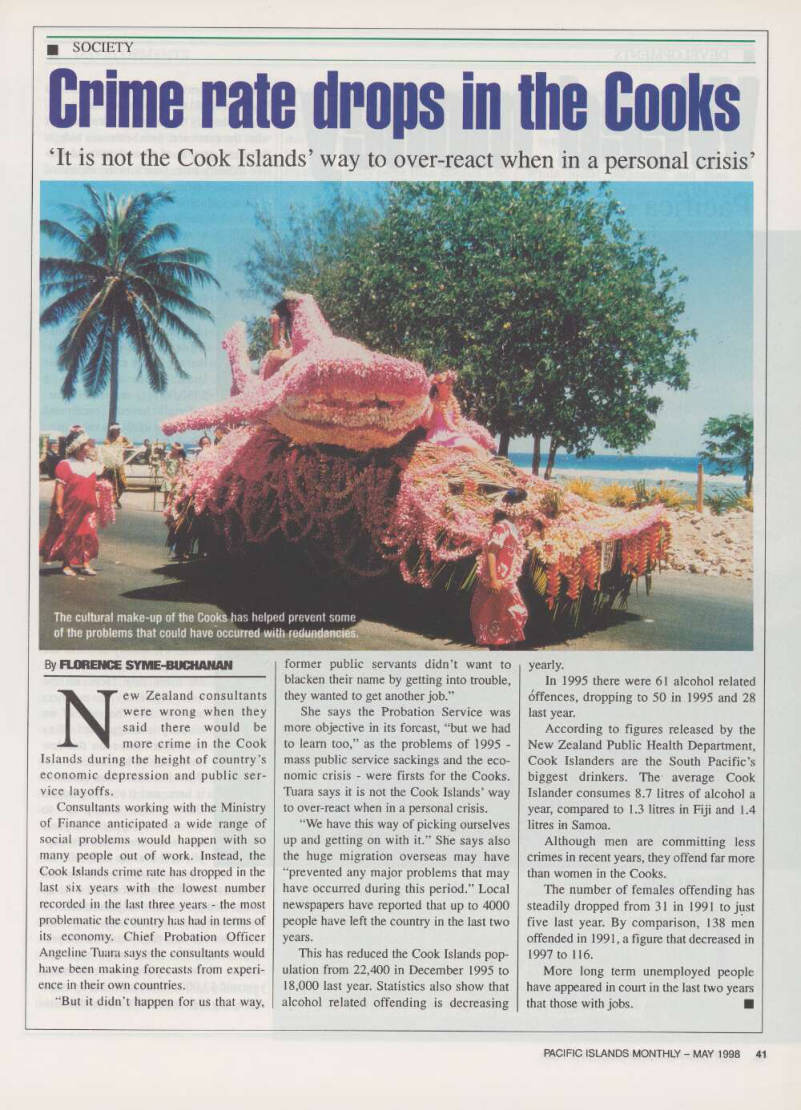
Society
Crime rate drops in the Cooks ‘It is not the Cook Islands’ way to over-react when in a personal crisis’
By Florence Syme-Buchanan
former public servants didn’t want to blacken their name by getting into trouble, they wanted to get another job.”
She says the Probation Service was more objective in its forcast, “but we had to leam too,” as the problems of 1995 mass public service sackings and the eco nomic crisis - were firsts for the Cooks.
Tuara says it is not the Cook Islands’ way to over-react when in a personal crisis.
“We have this way of picking ourselves up and getting on with it.” She says also the huge migration overseas may have “prevented any major problems that may have occurred during this period.” Local newspapers have reported that up to 4000 people have left the country in the last two years.
This has reduced the Cook Islands pop ulation from 22,400 in December 1995 to 18,000 last year. Statistics also show that alcohol related offending is decreasing
New Zealand consultants were wrong when they said there would be more crime in the Cook Islands during the height of country’s economic depression and public ser vice layoffs.
Consultants working with the Ministry of Finance anticipated a wide range of social problems would happen with so many people out of work. Instead, the Cook Islands crime rate has dropped in the last six years with the lowest number recorded in the last three years - the most problematic the country has had in terms of its economy. Chief Probation Officer Angeline Tuara says the consultants would have been making forecasts from experi ence in their own countries.
“But it didn't happen for us that way,
yearly.
In 1995 there were 61 alcohol related offences, dropping to 50 in 1995 and 28 last year.
According to figures released by the New Zealand Public Health Department, Cook Islanders are the South Pacific’s biggest drinkers. The average Cook Islander consumes 8.7 litres of alcohol a year, compared to 1.3 litres in Fiji and 1.4 litres in Samoa.
Although men are committing less crimes in recent years, they offend far more than women in the Cooks.
The number of females offending has steadily dropped from 31 in 1991 to just five last year. By comparison, 138 men offended in 1991, a figure that decreased in 1997 to 116.
More long term unemployed people have appeared in court in the last two years that those with jobs. ■
The cultural make-up of the Cooks has helped prevent some of the problems that could have occurred with redundancies.
Weed money
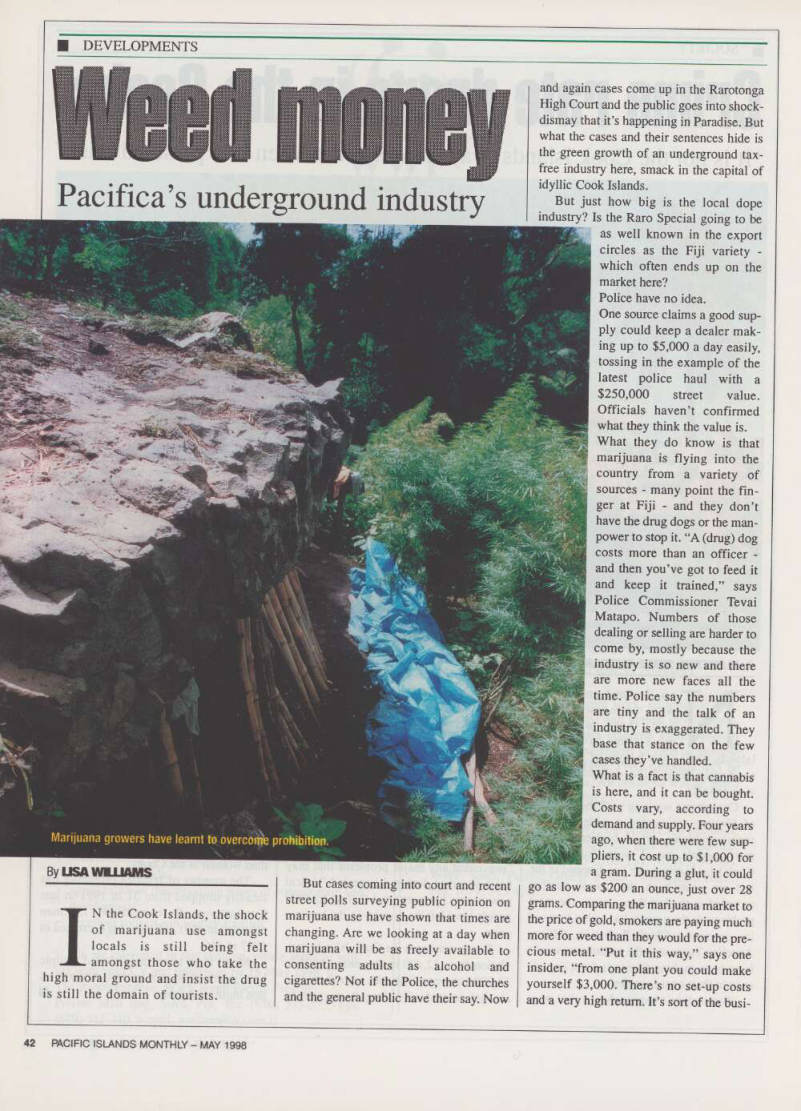
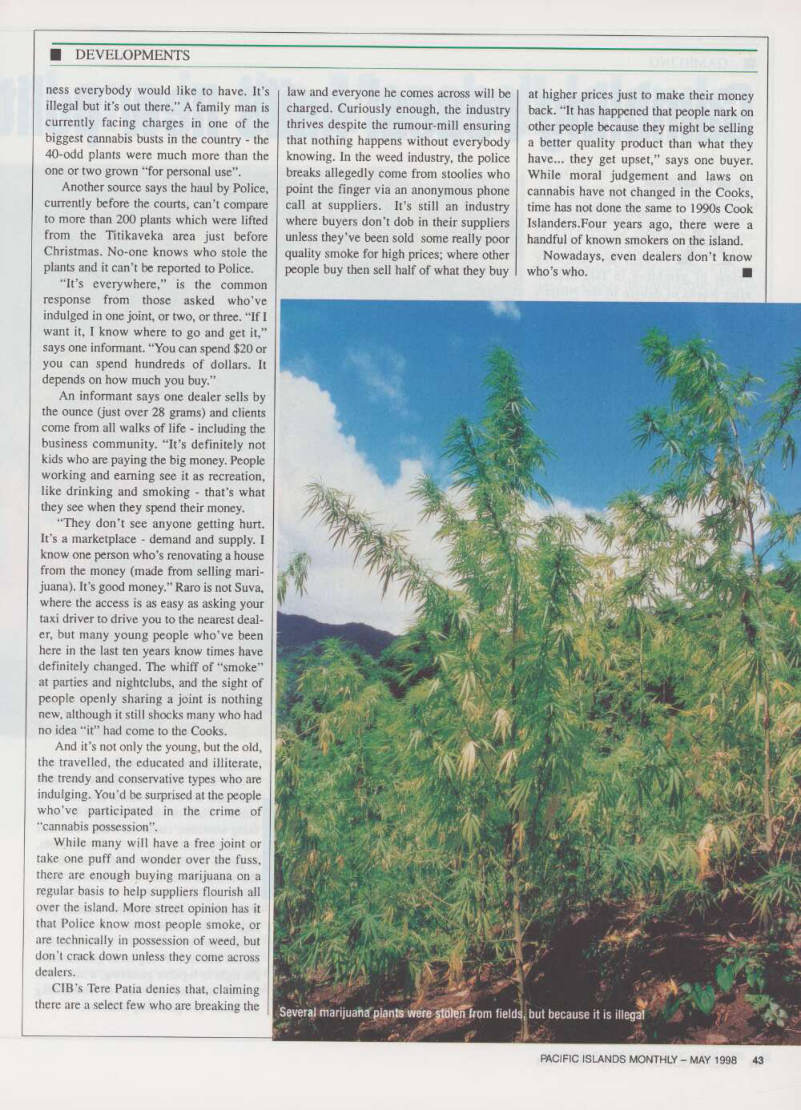
Developments
Weed money Pacifica’s underground industry
By Usa Wiliams
IN the Cook Islands, the shock of marijuana use amongst locals is still being felt amongst those who take the high moral ground and insist the drug is still the domain of tourists.
But cases coming into court and recent street polls surveying public opinion on marijuana use have shown that times are changing. Are we looking at a day when marijuana will be as freely available to consenting adults as alcohol and cigarettes? Not if the Police, the churches and the general public have their say. Now
and again cases come up in the Rarotonga High Court and the public goes into shock dismay that it’s happening in Paradise. But what the cases and their sentences hide is the green growth of an underground tax free industry here, smack in the capital of idyllic Cook Islands.
But just how big is the local dope industry? Is the Raro Special going to be
as well known in the export circles as the Fiji variety which often ends up on the market here?
Police have no idea.
One source claims a good sup ply could keep a dealer mak ing up to $5,000 a day easily, tossing in the example of the latest police haul with a $250,000 street value.
Officials haven’t confirmed what they think the value is.
What they do know is that marijuana is flying into the country from a variety of sources - many point the fin ger at Fiji - and they don’t have the drug dogs or the man power to stop it. “A (drug) dog costs more than an officer and then you’ve got to feed it and keep it trained,” says Police Commissioner Tevai Matapo. Numbers of those dealing or selling are harder to come by, mostly because the industry is so new and there are more new faces all the time. Police say the numbers are tiny and the talk of an industry is exaggerated. They base that stance on the few cases they’ve handled.
What is a fact is that cannabis is here, and it can be bought.
Costs vary, according to demand and supply. Four years ago, when there were few sup pliers, it cost up to $l,OOO for a gram. During a glut, it could
go as low as $2OO an ounce, just over 28 grams. Comparing the marijuana market to the price of gold, smokers are paying much more for weed than they would for the pre cious metal. “Put it this way,” says one insider, “from one plant you could make yourself $3,000. There’s no set-up costs and a very high return. It’s sort of the busi
Marijuana growers have learnt to overcome prohibition.
ness everybody would like to have. It’s illegal but it’s out there.” A family man is currently facing charges in one of the biggest cannabis busts in the country - the 40-odd plants were much more than the one or two grown “for personal use”.
Another source says the haul by Police, currently before the courts, can’t compare to more than 200 plants which were lifted from the Titikaveka area just before Christmas. No-one knows who stole the plants and it can’t be reported to Police.
“It’s everywhere,” is the common response from those asked who’ve indulged in one joint, or two, or three. “If I want it, I know where to go and get it,” says one informant. “You can spend $2O or you can spend hundreds of dollars. It depends on how much you buy.”
An informant says one dealer sells by the ounce (just over 28 grams) and clients come from all walks of life - including the business community. “It’s definitely not kids who are paying the big money. People working and earning see it as recreation, like drinking and smoking - that’s what they see when they spend their money.
“They don’t see anyone getting hurt.
It’s a marketplace - demand and supply. I know one person who’s renovating a house from the money (made from selling mari juana). It’s good money.” Raro is not Suva, where the access is as easy as asking your taxi driver to drive you to the nearest deal er, but many young people who’ve been here in the last ten years know times have definitely changed. The whiff of “smoke” at parties and nightclubs, and the sight of people openly sharing a joint is nothing new, although it still shocks many who had no idea “it” had come to the Cooks.
And it’s not only the young, but the old, the travelled, the educated and illiterate, the trendy and conservative types who are indulging. You’d be surprised at the people who’ve participated in the crime of “cannabis possession”.
While many will have a free joint or take one puff and wonder over the fuss, there are enough buying marijuana on a regular basis to help suppliers flourish all over the island. More street opinion has it that Police know most people smoke, or are technically in possession of weed, but don't crack down unless they come across dealers.
ClB’s Tere Patia denies that, claiming there are a select few who are breaking the
law and everyone he comes across will be charged. Curiously enough, the industry thrives despite the rumour-mill ensuring that nothing happens without everybody knowing. In the weed industry, the police breaks allegedly come from stoolies who point the finger via an anonymous phone call at suppliers. It’s still an industry where buyers don’t dob in their suppliers unless they’ve been sold some really poor quality smoke for high prices; where other people buy then sell half of what they buy
at higher prices just to make their money back. “It has happened that people nark on other people because they might be selling a better quality product than what they have... they get upset,” says one buyer.
While moral judgement and laws on cannabis have not changed in the Cooks, time has not done the same to 1990 s Cook Islanders. Four years ago, there were a handful of known smokers on the island.
Nowadays, even dealers don’t know who’s who. ■
Several marijuana plants were stolen from fields, but because it is illegal
Gambling repeal hale new peli[?]cal era in the Marshall Islands
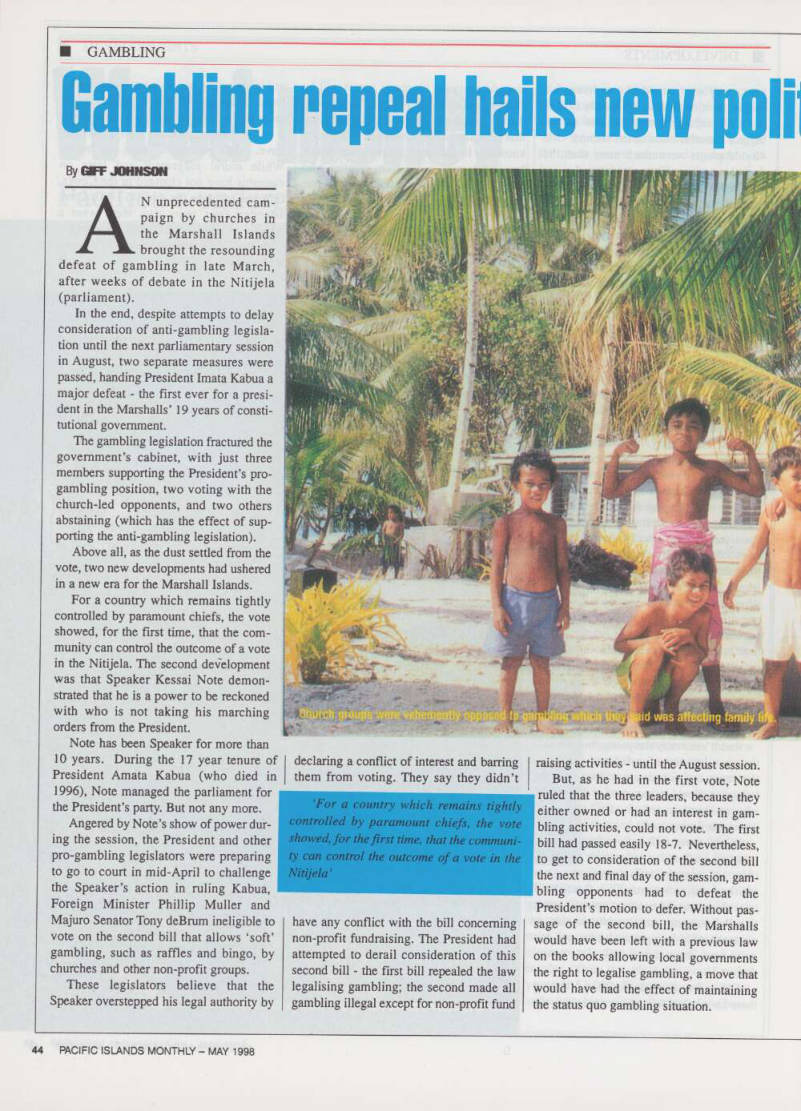
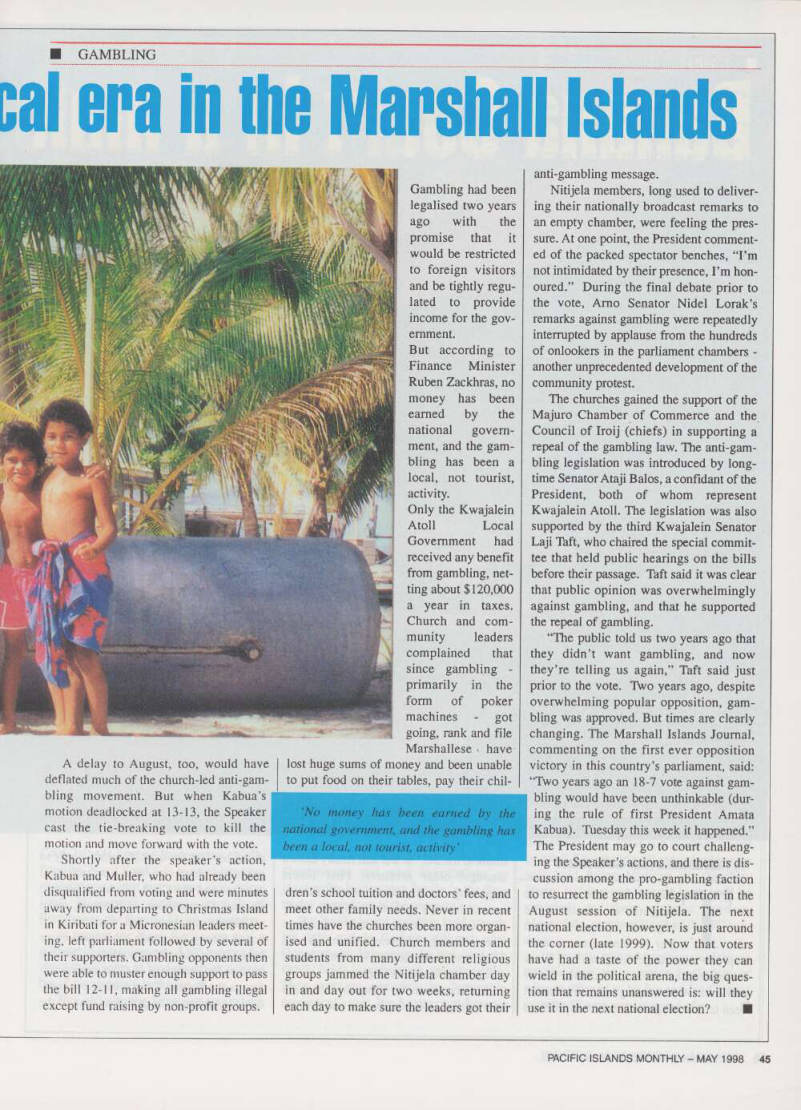
Gambling
By G[?]Ff Johnson
AN unprecedented cam paign by churches in the Marshall Islands brought the resounding defeat of gambling in late March, after weeks of debate in the Nitijela
(parliament).
In the end, despite attempts to delay consideration of anti-gambling legisla tion until the next parliamentary session in August, two separate measures were passed, handing President Imata Kabua a major defeat - the first ever for a presi dent in the Marshalls’ 19 years of consti tutional government.
The gambling legislation fractured the government’s cabinet, with just three members supporting the President’s pro gambling position, two voting with the church-led opponents, and two others abstaining (which has the effect of sup porting the anti-gambling legislation).
Above all, as the dust settled from the vote, two new developments had ushered in a new era for the Marshall Islands.
For a country which remains tightly controlled by paramount chiefs, the vote showed, for the first time, that the com munity can control the outcome of a vote in the Nitijela. The second development was that Speaker Kessai Note demon strated that he is a power to be reckoned with who is not taking his marching orders from the President.
Note has been Speaker for more than 10 years. During the 17 year tenure of President Amata Kabua (who died in 1996), Note managed the parliament for the President’s party. But not any more.
Angered by Note’s show of power dur ing the session, the President and other
pro-gambling legislators were preparing
to go to court in mid-April to challenge the Speaker’s action in ruling Kabua, I Foreign Minister Phillip Muller and Majuro Senator Tony deßrum ineligible to vote on the second bill that allows ‘soft’ gambling, such as raffles and bingo, by churches and other non-profit groups.
These legislators believe that the
Speaker overstepped his legal authority by
declaring a conflict of interest and barring them from voting. They say they didn’t
‘For a country which remains tightly controlled by paramount chiefs, the vote showed, for the first time, that the communi ty can control the outcome of a vote in the Nitijela ’
have any conflict with the bill concerning non-profit fundraising. The President had attempted to derail consideration of this second bill - the first bill repealed the law legalising gambling; the second made all gambling illegal except for non-profit fund
raising activities - until the August session.
But, as he had in the first vote, Note ruled that the three leaders, because they either owned or had an interest in gam bling activities, could not vote. The first bill had passed easily 18-7. Nevertheless, to get to consideration of the second bill the next and final day of the session, gam ; bling opponents had to defeat the President’s motion to defer. Without pas sage of the second bill, the Marshalls would have been left with a previous law on the books allowing local governments the right to legalise gambling, a move that would have had the effect of maintaining the status quo gambling situation.
Church groups were vehemently opposed to gambling which they said was affecting family life.
A delay to August, too, would have deflated much of the church-led anti-gam bling movement. But when Kabua’s motion deadlocked at 13-13, the Speaker cast the tie-breaking vote to kill the motion and move forward with the vote.
Shortly after the speaker's action, Kabua and Muller, who had already been disqualified from voting and were minutes away from departing to Christmas Island in Kiribati fora Micronesian leaders meet ing, left parliament followed by several of their supporters. Gambling opponents then were able to muster enough support to pass the bill 12-11, making all gambling illegal except fund raising by non-profit groups.
Gambling had been legalised two years ago with the promise that it would be restricted to foreign visitors and be tightly regu lated to provide income for the gov ernment.
But according to Finance Minister Ruben Zackhras, no money has been earned by the national govern ment, and the gam bling has been a local, not tourist, activity.
Only the Kwajalein Atoll Local Government had received any benefit from gambling, net ting about $120,000 a year in taxes.
Church and com munity leaders complained that since gambling primarily in the form of poker machines - got going, rank and file Marshallese . have
lost huge sums of money and been unable to put food on their tables, pay their chil
‘No money has been earned by the national government, and the gambling has been a local, not tourist, activity’
dren’s school tuition and doctors’ fees, and meet other family needs. Never in recent times have the churches been more organ ised and unified. Church members and students from many different religious groups jammed the Nitijela chamber day in and day out for two weeks, returning each day to make sure the leaders got their
anti-gambling message.
Nitijela members, long used to deliver ing their nationally broadcast remarks to an empty chamber, were feeling the pres sure. At one point, the President comment ed of the packed spectator benches, “I’m not intimidated by their presence. I’m hon oured.” During the final debate prior to the vote, Amo Senator Nidel Lorak’s remarks against gambling were repeatedly interrupted by applause from the hundreds of onlookers in the parliament chambers another unprecedented development of the community protest.
The churches gained the support of the Majuro Chamber of Commerce and the Council of Iroij (chiefs) in supporting a repeal of the gambling law. The anti-gam bling legislation was introduced by long time Senator Ataji Balos, a confidant of the President, both of whom represent Kwajalein Atoll. The legislation was also supported by the third Kwajalein Senator Laji Taft, who chaired the special commit tee that held public hearings on the bills before their passage. Taft said it was clear that public opinion was overwhelmingly against gambling, and thaf he supported the repeal of gambling.
“The public told us two years ago that they didn’t want gambling, and now they’re telling us again,” Taft said just prior to the vote. Two years ago, despite overwhelming popular opposition, gam bling was approved. But times are clearly changing. The Marshall Islands Journal, commenting on the first ever opposition victory in this country’s parliament, said: “Two years ago an 18-7 vote against gam bling would have been unthinkable (dur ing the rule of first President Amata Kabua). Tuesday this week it happened.”
The President may go to court challeng ing the Speaker’s actions, and there is dis cussion among the pro-gambling faction to resurrect the gambling legislation in the August session of Nitijela. The next national election, however, is just around the corner (late 1999). Now that voters have had a taste of the power they can wield in the political arena, the big ques tion that remains unanswered is: will they use it in the next national election? ■
Advertisements & other items, p. 45 (1 item)
cal era Hi the Marshal Islands
PACIFIC ISLANDS MONTHLY - MAY 1998
■ GAMBLING
Banana Court in a majo land battle
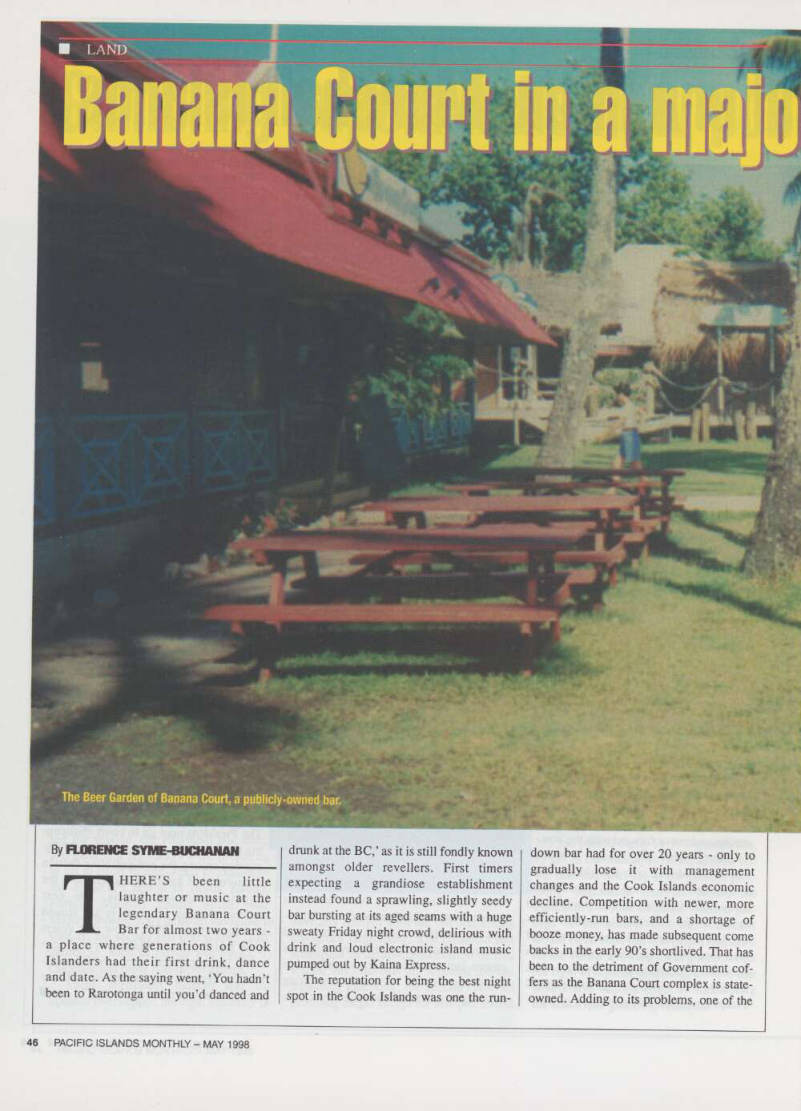
Land
By Florence Syme-Buchanan
T HERE’S been little laughter or music at the legendary Banana Court Bar for almost two years a place where generations of Cook Islanders had their first drink, dance and date. As the saying went, ‘You hadn’t been to Rarotonga until you’d danced and
drunk at the BC,’ as it is still fondly known amongst older revellers. First timers expecting a grandiose establishment instead found a sprawling, slightly seedy bar bursting at its aged seams with a huge sweaty Friday night crowd, delirious with drink and loud electronic island music pumped out by Kaina Express.
The reputation for being the best night spot in the Cook Islands was one the run
down bar had for over 20 years - only to gradually lose it with management changes and the Cook Islands economic decline. Competition with newer, more efficiently-run bars, and a shortage of booze money, has made subsequent come backs in the early 90’s shortlived. That has been to the detriment of Government cof fers as the Banana Court complex is state owned. Adding to its problems, one of the
The Beer Garden of Banana Court, a publicly-owned bar.
Cook Islands biggest landowning chiefly families, Ngati Karika, is to enter into new negotiations with Government over prime land in central Avarua, capital of Rarotonga - the Banana Court included.
At present the Ngati Karika are paid a pittance in ground rental - $ 105 a year - for about three acres of land on which a num ber of Government buildings sit.
This includes the foreshore area where
the BC stands.
The rental dates back to 1905 when the land was origi nally given to gov ernment to build a hospital.
A sanatorium oper ated up until 1922, then Otera Rarotonga was built accommodat ing expatriat New Zealand Government work ers. Otera Rarotonga was later converted into the still famous but now silent South Pacific bar.
The Banana Court complex has a number of tenants operating a travel agency, cafe, jew ellery shop and a private medical practice. All rentals are paid to the Government, but some tenants want to pay their rental directly to the landowners instead.
Expectations are that the Banana Court will eventu ally be sold and as the landowners, the Karika family say they’ve got first option. The price just has to be right, says lan Karika who is Chairman of the Banana Court
Company - a position he holds thanks to Government and past negotiations to involve the landowning family in the day to-day operations of the property.
But Karika board members hold no vot ing rights and the final say still rests with Government. However, the ace card the family holds is undisputed landownership.
They want to negotiate an “amicable agreement” says lan Karika, but haven’t
ruled out taking the matter to court if disat isfied with future bargaining.
“Eighteen months ago the Prime Minister said they wanted to return all Crown land to the landowners, but any buildings would belong to them.” Several other landowning families in Rarotonga are now actively seeking the return of lands given to government in the early 1900’s for public use such as schools, but no longer used for the purposes they were originally intended. Early March saw the first forced occupation ever in the Cook Islands of Government buildings by anoth er landowning family, who were demand ing their land back. First given to Government by Willie and David Isaiah to build a school in 1914, houses for expatri at teachers and part of the Ministry of Works was built on about seven acres. Because teachers no longer live in the houses and part-closure of the Ministry of Works, the family believe they are justified in seeking the return of the land in the district of Arorangi on Rarotonga.
It was the first matter involving state assets that the recently established Cook Island Investment Corporation had to set tle. A few days after the occupation, an “amicable agreement” was reached, according to Investment Corporation Chair John Tierney. This saw the occupiers vacate the premises and “return the proper ty in its original condition respecting the Crown’s titleship and ownership of proper ty and chattels. The occupiers believe they made their point and are happy to leave,” said Tierney in a press statement. Before talks with the Investment Corporation a descedent of the Isaiahs, Mariia Maurangi, told Cook Islands News that, “we have to take back what is rightfully ours. There’s no school there and there haven’t been any teachers on the land for a long time.”
“We need to claim what is rightfully ours,” Maurangi had said. And as another descendent said, “this is a message to our people”. This could well mean landowners will hold Prime Minister Sir Geoffrey Henry to his word that all lands will be returned to their rightful owners.
Meanwhile, people still talk of the BC hey days.
Its brightly painted frontage and famous banana sign are constant reminders of when it all used to be fun and land battles with the Crown were unheard of. ■
Advertisements & other items, p. 47 (1 item)
47
m ■ r Bib W> r J
PACIFIC ISLANDS MONTHLY - MAY 1998
In the name of charity

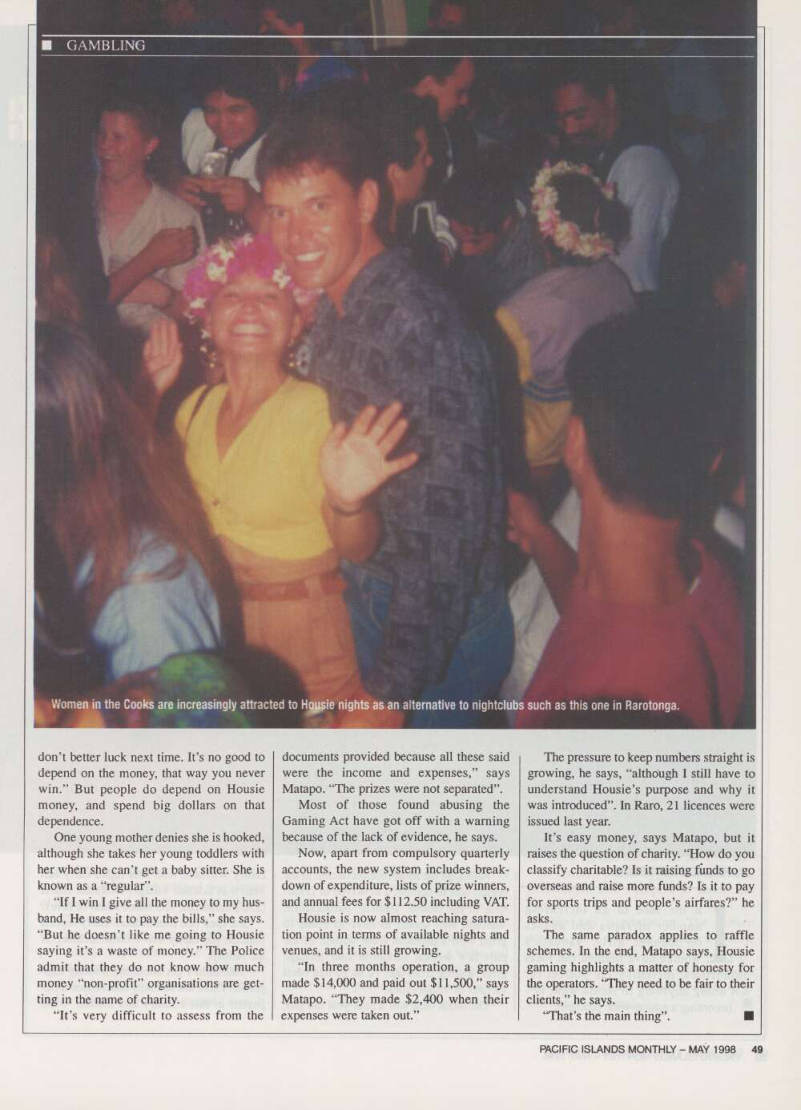
Gambling
By Usa Vainerere
Police are cracking down on the Cook Islands biggest gambling craze this centu ry.
Housie nights have caught on in a big way, and the rush for licences by non-prof it organisations has prompted local Police to tighten up on restrictions.
Cook Islands Commissioner of Police Tevai Matapo says complaints began last year over abuse of the system by operators.
The Gaming Laws stipulate that 80 per cent of the proceeds have to go back into prizes. Some say the prizes have been unre alistically low for the crowds they receive.
Matapo admits that Police had not been keeping an eye on Housie nights - “mainly because we entrusted licencees to play by the rules. But bits of information dribbled in that perhaps some of them were abusing
their licences.”
The abuse ranges from organisers spending a few thousand on home improvements or vehicles, to saving more for the kitty by cutting down on player
prizes.
“That abuse of licences made us decide to revamp the whole issue of Housie per mits and tighten up on issuance,” he says.
Part of the new rules ensure that operators prepare quarterly accounts clearly showing the 80-20 split between prizes and fundraising/operating expenses. One oper ator has already lost their licence. But on an island where there is Housie six days a week in numerous villages, closing one down does not dent the gambling sport which is providing fierce competition for Tattslotto. It’s easier than selling raffle tick ets, and for players, it’s perceived as easy money. The new trend offers a whole new perspective on why people gamble in the
islands.
Housie addiction stems from legit imised gambling, Matapo says. “Provided the public wants it and there’s a public demand for it, who am I to pass judgement others,” he says.
“What does concern me is the money that’s being spent on housie means some one’s missing out at home. “I’ve also noticed, on some housie nights, young chil dren just wandering around outside.
They’re waiting for their parents until late, and that’s uncivilised if those parents are there for three or four hours leaving their kids unsupervised because they’re so absorbed in the game.” Most of the housie players are women and the enjoyment, most say, goes beyond filling in a few cards and calling ‘House’.
“I can get out of the house, meet my friends and have a few drinks,” says one elderly woman. “If I win, that’s good, if I
don’t better luck next time. It’s no good to depend on the money, that way you never win.” But people do depend on Housie money, and spend big dollars on that
dependence.
One young mother denies she is hooked, although she takes her young toddlers with her when she can’t get a baby sitter. She is known as a “regular”.
“If I win I give all the money to my hus band, He uses it to pay the bills,” she says.
“But he doesn’t like me going to Housie saying it’s a waste of money.” The Police admit that they do not know how much money “non-profit” organisations are get ting in the name of charity.
“It’s very difficult to assess from the
documents provided because all these said were the income and expenses,” says Matapo. “The prizes were not separated”.
Most of those found abusing the Gaming Act have got off with a warning because of the lack of evidence, he says.
Now, apart from compulsory quarterly accounts, the new system includes break down of expenditure, lists of prize winners, and annual fees for $ 112.50 including VAT.
Housie is now almost reaching satura tion point in terms of available nights and venues, and it is still growing.
“In three months operation, a group made $14,000 and paid out $11,500,” says Matapo. “They made $2,400 when their expenses were taken out.”
The pressure to keep numbers straight is growing, he says, “although I still have to understand Housie’s purpose and why it was introduced”. In Raro, 21 licences were issued last year.
It’s easy money, says Matapo, but it raises the question of charity. “How do you classify charitable? Is it raising funds to go overseas and raise more funds? Is it to pay for sports trips and people’s airfares?” he asks.
The same paradox applies to raffle schemes. In the end, Matapo says, Housie gaming highlights a matter of honesty for the operators. “They need to be fair to their clients,” he says.
“That’s the main thing”. ■
Women in the Cooks are increasingly attracted to Housie nights as an alternative to nightclubs such as this one in Rarotonga.
Advertisements & other items, pp. 48-49 (2 items)
Soprc
SOUTH PACIFIC APPLIED GEOSCIENCE COMMISSION
MARINE GEOPHYSICIST
Applications are invited from nationals of SOPAC member countries for the above position in the SOPAC (South Pacific Applied Geoscience Commission) Secretariat, located in Suva, Fiji.
SOPAC
SOPAC is an inter-governmental organisation comprising seventeen South Pacific countries as members* with two associate members. The primary objective of SOPAC is to assist its member countries in the identification and assessment of the marine mineral and other non-living resource potential of their offshore areas within their respective national Exclusive Economic Zones, in the planning and management of development in their coastal areas, and in the training of their nationals in all relevant areas within the SOPAC Work Program.
The Position The Marine Geophysicist is responsible for assessment of detrital minerals and construction material potential in coastal and nearshore areas, collection and interpretation of geophysical and geological data, including seabed mapping, for coastal development projects, and for training activities in these fields.
Remuneration An attractive remuneration package will be offered in accordance with the SOPAC terms and conditions of employment depending on qualifications and experience.
Further information may be obtained from the Administrative Assistant on telephone (679) 381 377, Fax; (679) 370 040 or
Email:[email protected].
Qualifications A post graduate degree in the relevant field from a recognised university, between 5-10 years professional experience, and proficiency in oral and written English.
Applications All applications should be fully documented and include relevant details of qualifications and experience, and the names and contact of three referees. Applications to be marked “Marine Geophysicist Application", should be addressed to the Director, SOPAC Secretariat, Private Mail Bag, Suva, Fiji.
The deadline for applications is Friday, 29 ,h May 1998.
SOPAC member countries are Australia, Cook Islands, Fiji, Federated States of Micronesia, Guam, Kiribati, New Zealand, Marshall Islands, Niue, Papua New Guinea, Samoa, Solomon Islands, Tonga, Tuvalu, Vanuatu, Associate members - New Caledonia and French Polynesia.
■ Gambling
Violence against women on the icrease in Vanuatu

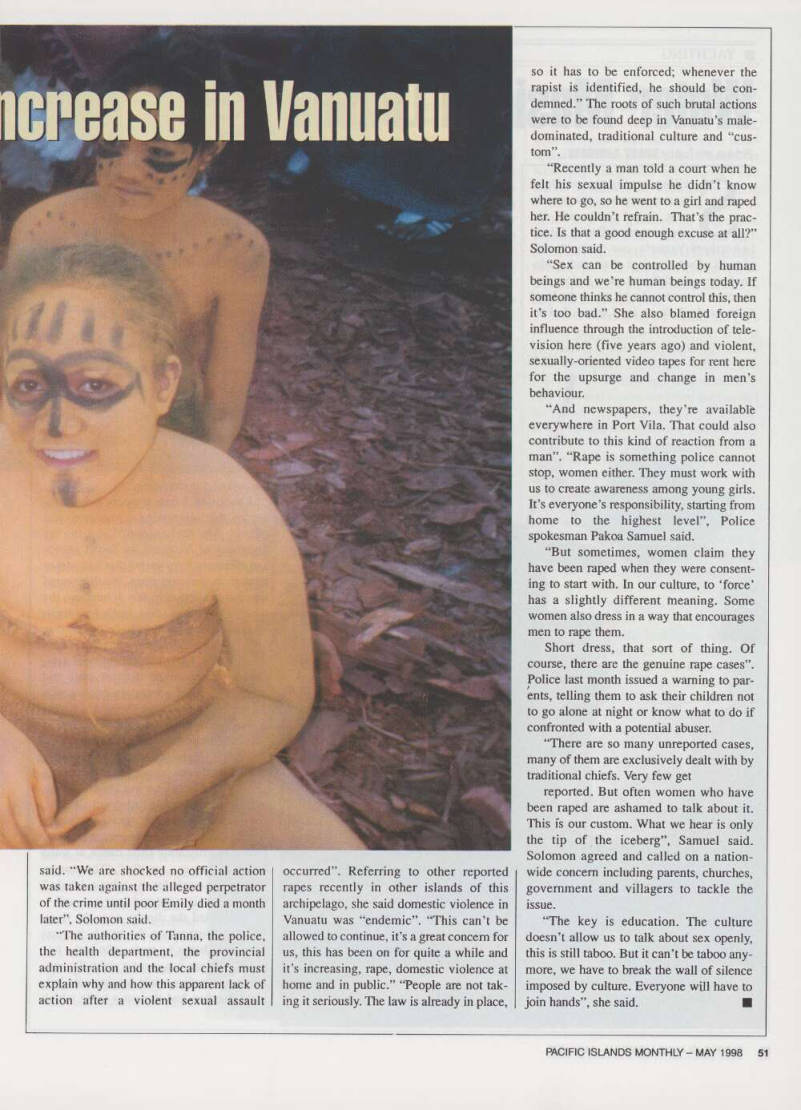
News
By Patrick Decloitre
In the face of an increasing number of rapes and abuses on teenage girls, Vanuatu’s women have blamed the local authorities, including the police, for not doing anything to tackle what is becoming a nation-wide problem.
Although the most recent concern in the region was to combat a new type of crimi nals in the South Pacific, paedophiles, Vanuatu still seems to have to come to grips with a problem from within: in the past few weeks, Solomon said teenage girls ranging from age 12 to 16 had been victims of brutal rapes.
The worst case was a nine-year old girl,
Emily William, who was raped early last March in Lokaim village, on Tanna island (250 kilometres, 138 miles south of here).
She died one month later. Early reports indicate the rapist was a close member of the family.
“She didn’t get attention, nothing hap pened. There are so many other cases unre ported in this country and hidden ”, she
said. "We are shocked no official action was taken against the alleged perpetrator of the crime until poor Emily died a month later”, Solomon said.
"The authorities of Tanna, the police, the health department, the provincial administration and the local chiefs must explain why and how this apparent lack of action after a violent sexual assault
occurred”. Referring to other reported rapes recently in other islands of this archipelago, she said domestic violence in Vanuatu was “endemic”. “This can’t be allowed to continue, it’s a great concern for us, this has been on for quite a while and it’s increasing, rape, domestic violence at home and in public.” “People are not tak ing it seriously. The law is already in place.
so it has to be enforced; whenever the rapist is identified, he should be con demned.” The roots of such brutal actions were to be found deep in Vanuatu’s male dominated, traditional culture and “cus tom”.
“Recently a man told a court when he felt his sexual impulse he didn’t know where to go, so he went to a girl and raped her. He couldn’t refrain. That’s the prac tice. Is that a good enough excuse at all?”
Solomon said.
“Sex can be controlled by human beings and we’re human beings today. If someone thinks he cannot control this, then it’s too bad.” She also blamed foreign influence through the introduction of tele vision here (five years ago) and violent, sexually-oriented video tapes for rent here for the upsurge and change in men’s behaviour.
“And newspapers, they’re available everywhere in Port Vila. That could also contribute to this kind of reaction from a man”. “Rape is something police cannot stop, women either. They must work with us to create awareness among young girls.
It’s everyone’s responsibility, starting from home to the highest level”, Police spokesman Pakoa Samuel said.
“But sometimes, women claim they have been raped when they were consent ing to start with. In our culture, to ‘force’ has a slightly different meaning. Some women also dress in a way that encourages men to rape them.
Short dress, that sort of thing. Of course, there are the genuine rape cases”.
Police last month issued a warning to par ents, telling them to ask their children not to go alone at night or know what to do if confronted with a potential abuser.
“There are so many unreported cases, many of them are exclusively dealt with by traditional chiefs. Very few get reported. But often women who have been raped are ashamed to talk about it.
This is our custom. What we hear is only the tip of the iceberg”, Samuel said.
Solomon agreed and called on a nation wide concern including parents, churches, government and villagers to tackle the issue.
“The key is education. The culture doesn’t allow us to talk about sex openly, this is still taboo. But it can’t be taboo any more, we have to break the wall of silence imposed by culture. Everyone will have to join hands”, she said. ■
Water Music of Lokona
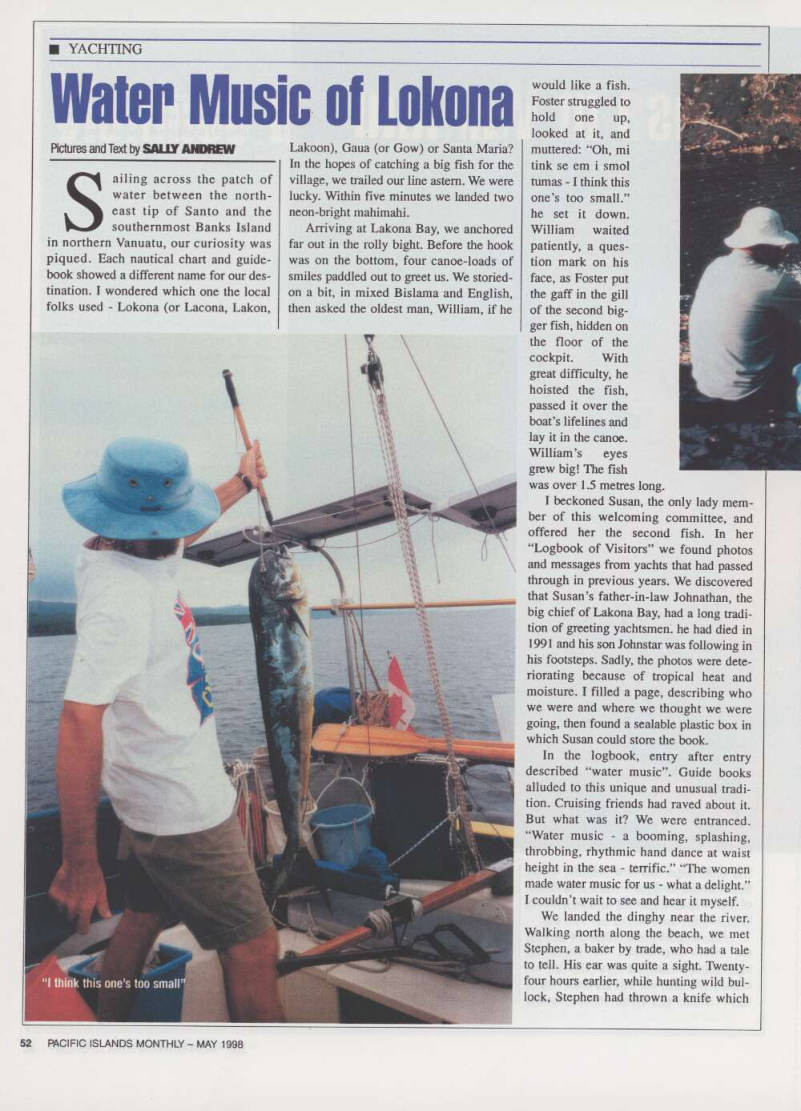
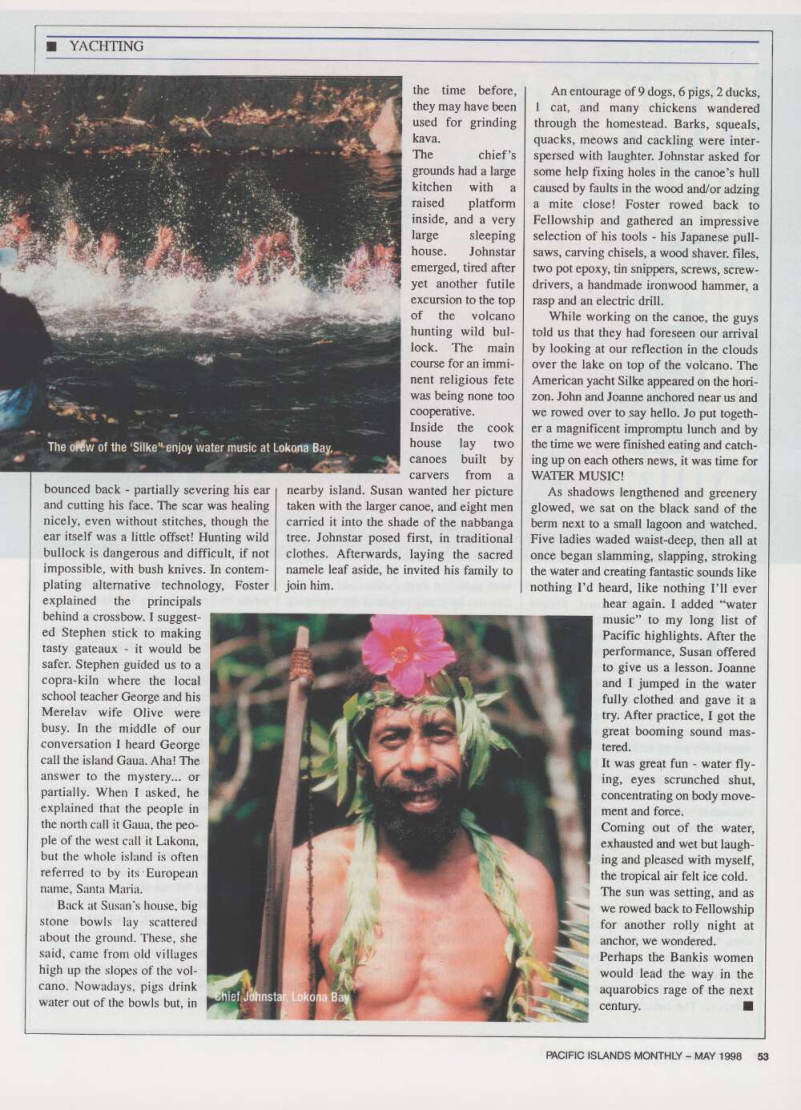
Yachting
Pictures and Text by SALLY ANDREW
Sailing across the patch of water between the north east tip of Santo and the southernmost Banks Island in northern Vanuatu, our curiosity was piqued. Each nautical chart and guide book showed a different name for our des tination. I wondered which one the local folks used - Lokona (or Lacona, Lakon,
Lakoon), Gaua (or Gow) or Santa Maria?
In the hopes of catching a big fish for the village, we trailed our line astern. We were lucky. Within five minutes we landed two neon-bright mahimahi.
Arriving at Lakona Bay, we anchored far out in the roily bight. Before the hook was on the bottom, four canoe-loads of smiles paddled out to greet us. We storied on a bit, in mixed Bislama and English, then asked the oldest man, William, if he
would like a fish.
Foster struggled to hold one up, looked at it, and muttered; “Oh, mi tink se em i smol tumas -1 think this one’s too small.” he set it down.
William waited patiently, a ques tion mark on his face, as Foster put the gaff in the gill of the second big ger fish, hidden on the floor of the cockpit. With great difficulty, he hoisted the fish, passed it over the boat’s lifelines and lay it in the canoe.
William’s eyes grew big! The fish
was over 1.5 metres long.
I beckoned Susan, the only lady mem ber of this welcoming committee, and offered her the second fish. In her “Logbook of Visitors” we found photos and messages from yachts that had passed through in previous years. We discovered that Susan’s father-in-law Johnathan, the big chief of Lakona Bay, had a long tradi tion of greeting yachtsmen, he had died in 1991 and his son Johnstar was following in his footsteps. Sadly, the photos were dete riorating because of tropical heat and moisture. I filled a page, describing who we were and where we thought we were going, then found a sealable plastic box in which Susan could store the book.
In the logbook, entry after entry described “water music”. Guide books alluded to this unique and unusual tradi tion. Cruising friends had raved about it.
But what was it? We were entranced.
“Water music - a booming, splashing, throbbing, rhythmic hand dance at waist height in the sea - terrific.” “The women made water music for us - what a delight.”
I couldn’t wait to see and hear it myself.
We landed the dinghy near the river.
Walking north along the beach, we met Stephen, a baker by trade, who had a tale to tell. His ear was quite a sight. Twenty four hours earlier, while hunting wild bul lock, Stephen had thrown a knife which
"I think this one's too small"
bounced back - partially severing his ear and cutting his face. The scar was healing nicely, even without stitches, though the ear itself was a little offset! Hunting wild bullock is dangerous and difficult, if not impossible, with bush knives. In contem
plating alternative technology, Foster
explained the principals behind a crossbow. I suggest ed Stephen stick to making tasty gateaux - it would be safer. Stephen guided us to a copra-kiln where the local school teacher George and his Merelav wife Olive were busy. In the middle of our conversation I heard George call the island Gaua. Aha! The answer to the mystery... or partially. When I asked, he explained that the people in the north call it Gaua, the peo ple of the west call it Lakona, but the whole island is often referred to by its European name, Santa Maria.
Back at Susan’s house, big stone bowls lay scattered about the ground. These, she said, came from old villages high up the slopes of the vol cano. Nowadays, pigs drink water out of the bowls but, in
the time before, they may have been used for grinding kava.
The chief’s grounds had a large kitchen with a raised platform inside, and a very large sleeping house. Johnstar emerged, tired after yet another futile excursion to the top of the volcano hunting wild bul lock. The main course for an immi nent religious fete was being none too cooperative.
Inside the cook house lay two canoes built by carvers from a
nearby island. Susan wanted her picture taken with the larger canoe, and eight men carried it into the shade of the nabbanga tree. Johnstar posed first, in traditional clothes. Afterwards, laying the sacred namele leaf aside, he invited his family to
join him.
An entourage of 9 dogs, 6 pigs, 2 ducks, 1 cat, and many chickens wandered through the homestead. Barks, squeals, quacks, meows and cackling were inter spersed with laughter. Johnstar asked for some help fixing holes in the canoe’s hull caused by faults in the wood and/or adzing a mite close! Foster rowed back to Fellowship and gathered an impressive selection of his tools - his Japanese pull saws, carving chisels, a wood shaver, files, two pot epoxy, tin snippers, screws, screw drivers, a handmade ironwood hammer, a rasp and an electric drill.
While working on the canoe, the guys told us that they had foreseen our arrival by looking at our reflection in the clouds over the lake on top of the volcano. The American yacht Silke appeared on the hori zon. John and Joanne anchored near us and we rowed over to say hello. Jo put togeth er a magnificent impromptu lunch and by the time we were finished eating and catch ing up on each others news, it was time for
Water Music!
As shadows lengthened and greenery glowed, we sat on the black sand of the berm next to a small lagoon and watched.
Five ladies waded waist-deep, then all at once began slamming, slapping, stroking the water and creating fantastic sounds like nothing I’d heard, like nothing I’ll ever
hear again. I added “water music” to my long list of Pacific highlights. After the performance, Susan offered to give us a lesson. Joanne and I jumped in the water fully clothed and gave it a try. After practice, I got the great booming sound mas tered.
It was great fun - water fly ing, eyes scrunched shut, concentrating on body move ment and force.
Coming out of the water, exhausted and wet but laugh ing and pleased with myself, the tropical air felt ice cold.
The sun was setting, and as we rowed back to Fellowship for another roily night at anchor, we wondered.
Perhaps the Bankis women would lead the way in the aquarobics rage of the next century. ■
The orew of the 'Kilke" enjoy water music at Lokona Bay.
John star, Lokona Bay
Wave of
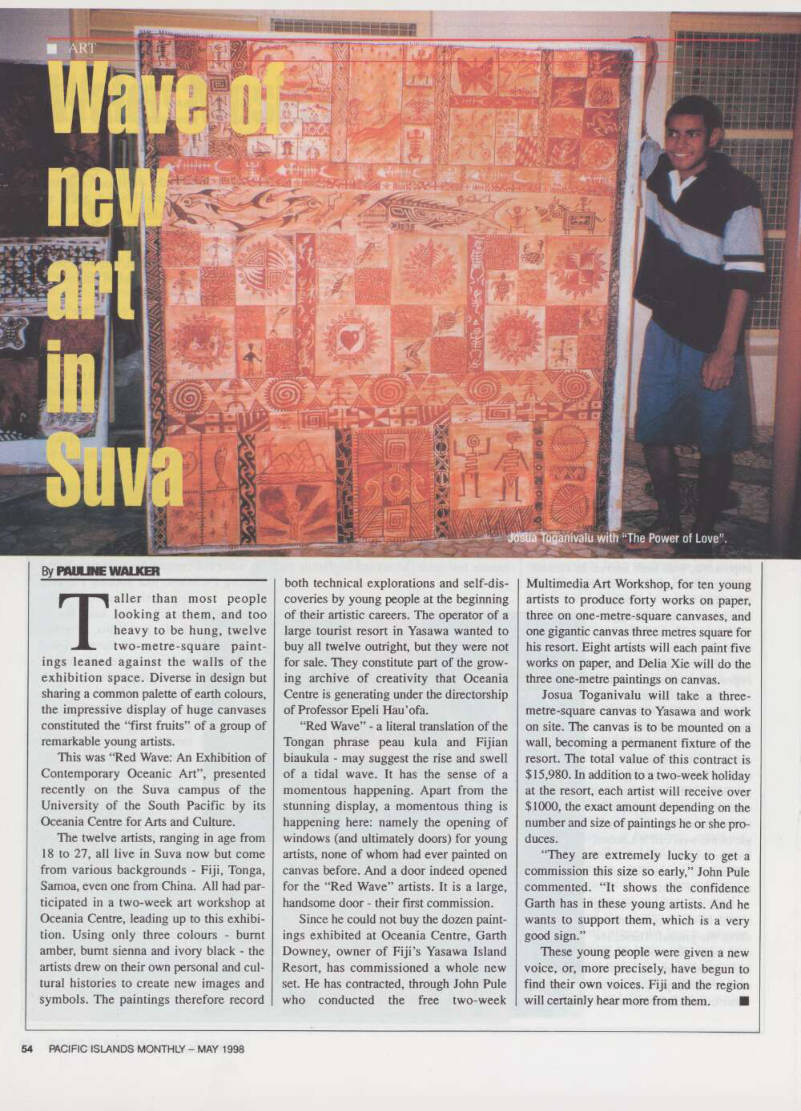
Art
new
art in Suva
By Pauline Walker
both technical explorations and self-dis coveries by young people at the beginning of their artistic careers. The operator of a large tourist resort in Yasawa wanted to buy all twelve outright, but they were not for sale. They constitute part of the grow ing archive of creativity that Oceania Centre is generating under the directorship of Professor Epeli Hau’ofa.
“Red Wave” - a literal translation of the Tongan phrase peau kula and Fijian biaukula - may suggest the rise and swell of a tidal wave. It has the sense of a momentous happening. Apart from the stunning display, a momentous thing is
happening here: namely the opening of
windows (and ultimately doors) for young artists, none of whom had ever painted on canvas before. And a door indeed opened for the “Red Wave” artists. It is a large, handsome door - their first commission.
Since he could not buy the dozen paint ings exhibited at Oceania Centre, Garth Downey, owner of Fiji’s Yasawa Island Resort, has commissioned a whole new set. He has contracted, through John Pule who conducted the free two-week
Multimedia Art Workshop, for ten young artists to produce forty works on paper, three on one-metre-square canvases, and one gigantic canvas three metres square for his resort. Eight artists will each paint five works on paper, and Delia Xie will do the three one-metre paintings on canvas.
Josua Toganivalu will take a three metre-square canvas to Yasawa and work on site. The canvas is to be mounted on a wall, becoming a permanent fixture of the resort. The total value of this contract is $15,980. In addition to a two-week holiday at the resort, each artist will receive over $lOOO, the exact amount depending on the number and size of paintings he or she pro duces.
“They are extremely lucky to get a commission this size so early,” John Pule commented. “It shows the confidence Garth has in these young artists. And he wants to support them, which is a very
good sign.”
These young people were given a new voice, or, more precisely, have begun to find their own voices. Fiji and the region will certainly hear more from them. ■
Taller than most people
looking at them, and too heavy to be hung, twelve two-metre-square paint ings leaned against the walls of the exhibition space. Diverse in design but sharing a common palette of earth colours, the impressive display of huge canvases constituted the “first fruits” of a group of remarkable young artists.
This was “Red Wave: An Exhibition of Contemporary Oceanic Art”, presented recently on the Suva campus of the University of the South Pacific by its Oceania Centre for Arts and Culture.
The twelve artists, ranging in age from 18 to 27, all live in Suva now but come from various backgrounds - Fiji, Tonga, Samoa, even one from China. All had par ticipated in a two-week art workshop at Oceania Centre, leading up to this exhibi tion. Using only three colours - burnt amber, burnt sienna and ivory black - the artists drew on their own personal and cul tural histories to create new images and symbols. The paintings therefore record
Jusua Toganivalu with “The Power of Love”.
Island affairs
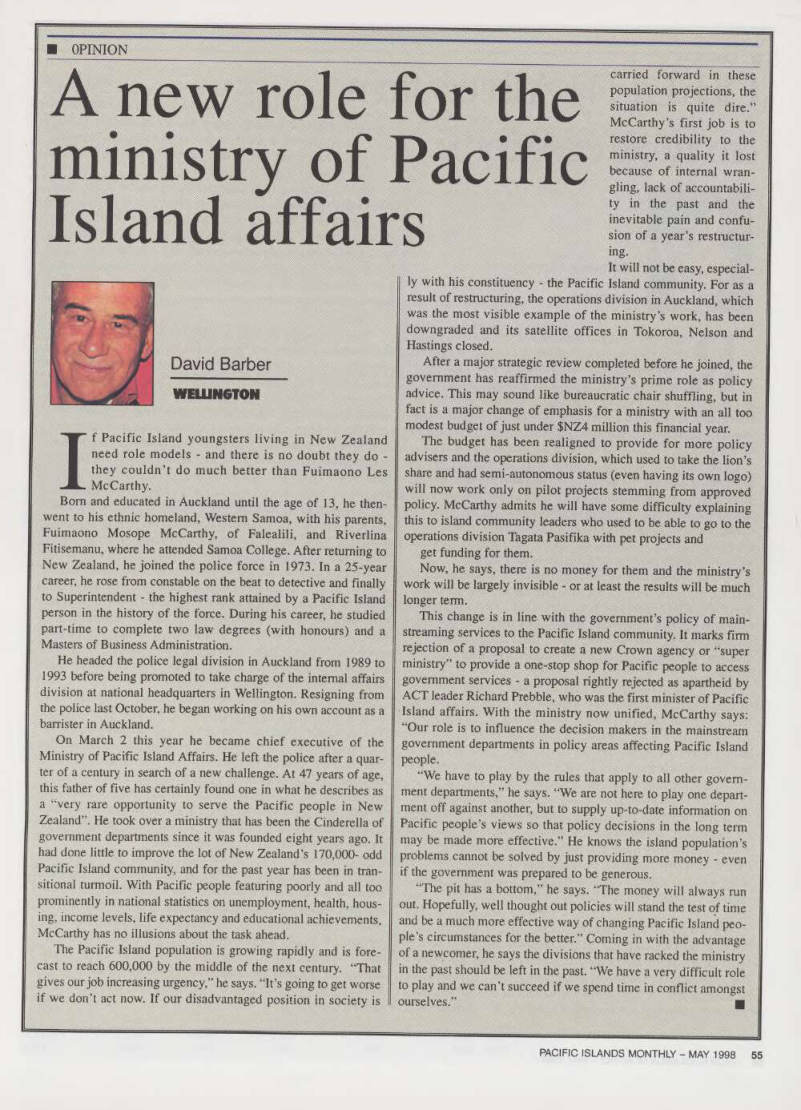
Opinion
A new role for the ministry of Pacific Island affairs
If Pacific Island youngsters living in New Zealand need role models - and there is no doubt they do they couldn’t do much better than Fuimaono Les McCarthy.
Bom and educated in Auckland until the age of 13, he then went to his ethnic homeland, Western Samoa, with his parents, Fuimaono Mosope McCarthy, of Falealili, and Riverlina Fitisemanu, where he attended Samoa College. After returning to New Zealand, he joined the police force in 1973. In a 25-year career, he rose from constable on the beat to detective and finally to Superintendent - the highest rank attained by a Pacific Island person in the history of the force. During his career, he studied part-time to complete two law degrees (with honours) and a Masters of Business Administration.
He headed the police legal division in Auckland from 1989 to 1993 before being promoted to take charge of the internal affairs division at national headquarters in Wellington. Resigning from the police last October, he began working on his own account as a barrister in Auckland.
On March 2 this year he became chief executive of the Ministry of Pacific Island Affairs. He left the police after a quar ter of a century in search of a new challenge. At 47 years of age, this father of five has certainly found one in what he describes as a “very rare opportunity to serve the Pacific people in New Zealand”. He took over a ministry that has been the Cinderella of government departments since it was founded eight years ago. It had done little to improve the lot of New Zealand’s 170,000- odd Pacific Island community, and for the past year has been in tran sitional turmoil. With Pacific people featuring poorly and all too prominently in national statistics on unemployment, health, hous ing, income levels, life expectancy and educational achievements, McCarthy has no illusions about the task ahead.
The Pacific Island population is growing rapidly and is fore cast to reach 600,000 by the middle of the next century. “That gives our job increasing urgency,” he says. “It’s going to get worse if we don’t act now. If our disadvantaged position in society is
carried forward in these population projections, the situation is quite dire.”
McCarthy’s first job is to restore credibility to the ministry, a quality it lost because of internal wran gling, lack of accountabili ty in the past and the inevitable pain and confu sion of a year’s restructur ing.
It will not be easy, especial
ly with his constituency - the Pacific Island community. For as a result of restructuring, the operations division in Auckland, which was the most visible example of the ministry’s work, has been downgraded and its satellite offices in Tokoroa, Nelson and Hastings closed.
After a major strategic review completed before he joined, the government has reaffirmed the ministry’s prime role as policy advice. This may sound like bureaucratic chair shuffling, but in fact is a major change of emphasis for a ministry with an all too modest budget of just under SNZ4 million this financial year.
The budget has been realigned to provide for more policy advisers and the operations division, which used to take the lion’s share and had semi-autonomous status (even having its own logo) will now work only on pilot projects stemming from approved policy. McCarthy admits he will have some difficulty explaining this to island community leaders who used to be able to go to the operations division Tagata Pasifika with pet projects and get funding for them.
Now, he says, there is no money for them and the ministry’s work will be largely invisible - or at least the results will be much longer term.
This change is in line with the government’s policy of main streaming services to the Pacific Island community. It marks firm rejection of a proposal to create a new Crown agency or “super ministry” to provide a one-stop shop for Pacific people to access government services - a proposal rightly rejected as apartheid by ACT leader Richard Prebble, who was the first minister of Pacific Island affairs. With the ministry now unified, McCarthy says; “Our role is to influence the decision makers in the mainstream government departments in policy areas affecting Pacific Island people.
“We have to play by the rules that apply to all other govern ment departments,” he says. “We are not here to play one depart ment off against another, but to supply up-to-date information on Pacific people’s views so that policy decisions in the long term may be made more effective.” He knows the island population’s problems cannot be solved by just providing more money - even if the government was prepared to be generous.
“The pit has a bottom,” he says. “The money will always run out. Hopefully, well thought out policies will stand the test of time and be a much more effective way of changing Pacific Island peo ple’s circumstances for the better.” Coming in with the advantage of a newcomer, he says the divisions that have racked the ministry in the past should be left in the past. “We have a very difficult role to play and we can’t succeed if we spend time in conflict amongst ourselves.” g
David Barber
Wellington
dub Ed, Fiji: Afar cry from dreary old classrooms
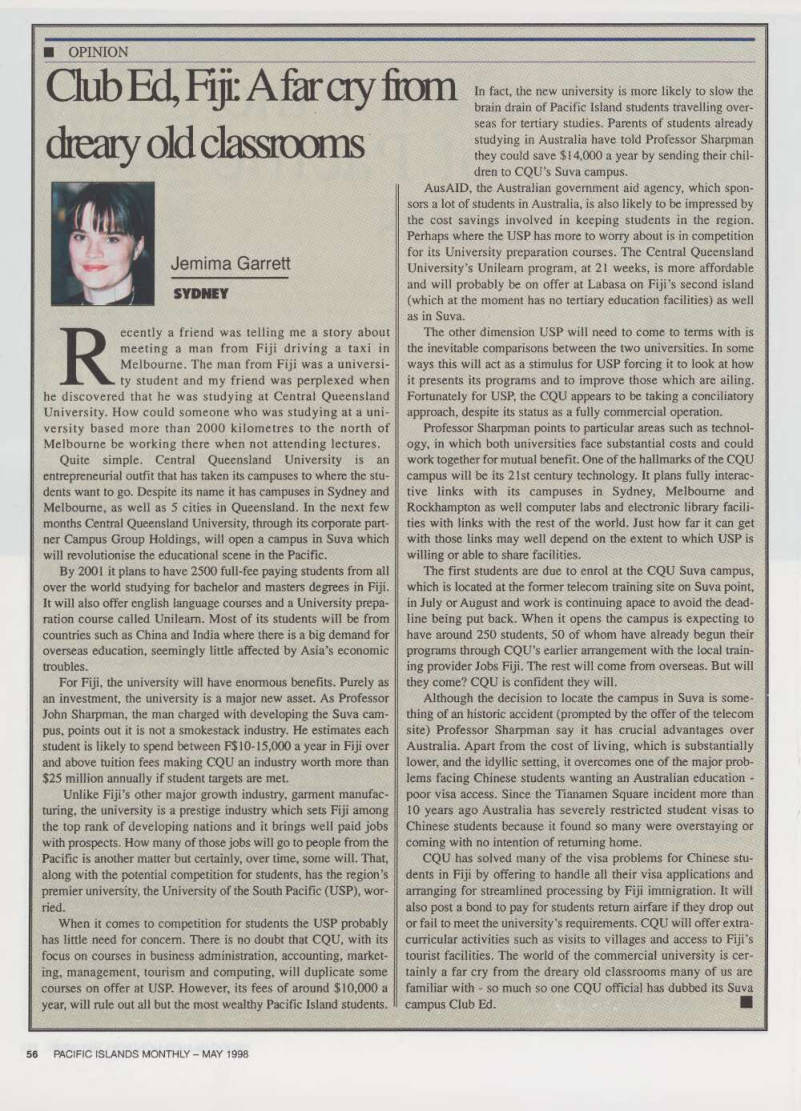
dreary old classrooms
Recently a friend was telling me a story about meeting a man from Fiji driving a taxi in Melbourne. The man from Fiji was a universi ty student and my friend was perplexed when he discovered that he was studying at Central Queensland University. How could someone who was studying at a uni versity based more than 2000 kilometres to the north of Melbourne be working there when not attending lectures.
Quite simple. Central Queensland University is an entrepreneurial outfit that has taken its campuses to where the stu dents want to go. Despite its name it has campuses in Sydney and Melbourne, as well as 5 cities in Queensland. In the next few months Central Queensland University, through its corporate part ner Campus Group Holdings, will open a campus in Suva which will revolutionise the educational scene in the Pacific.
By 2001 it plans to have 2500 full-fee paying students from all over the world studying for bachelor and masters degrees in Fiji.
It will also offer english language courses and a University prepa ration course called Unileam. Most of its students will be from countries such as China and India where there is a big demand for overseas education, seemingly little affected by Asia’s economic troubles.
For Fiji, the university will have enormous benefits. Purely as an investment, the university is a major new asset. As Professor John Sharpman, the man charged with developing the Suva cam pus, points out it is not a smokestack industry. He estimates each student is likely to spend between Fslo-15,000 a year in Fiji over and above tuition fees making CQU an industry worth more than $25 million annually if student targets are met.
Unlike Fiji’s other major growth industry, garment manufac turing, the university is a prestige industry which sets Fiji among the top rank of developing nations and it brings well paid jobs with prospects. How many of those jobs will go to people from the Pacific is another matter but certainly, over time, some will. That, along with the potential competition for students, has the region’s premier university, the University of the South Pacific (USP), wor ried.
When it comes to competition for students the USP probably has little need for concern. There is no doubt that CQU, with its focus on courses in business administration, accounting, market ing, management, tourism and computing, will duplicate some courses on offer at USP. However, its fees of around $lO,OOO a year, will rule out all but the most wealthy Pacific Island students.
In fact, the new university is more likely to slow the brain drain of Pacific Island students travelling over seas for tertiary studies. Parents of students already studying in Australia have told Professor Sharpman they could save $ 14,000 a year by sending their chil dren to CQU’s Suva campus.
AusAID, the Australian government aid agency, which spon sors a lot of students in Australia, is also likely to be impressed by the cost savings involved in keeping students in the region.
Perhaps where the USP has more to worry about is in competition for its University preparation courses. The Central Queensland University’s Unileam program, at 21 weeks, is more affordable and will probably be on offer at Labasa on Fiji’s second island (which at the moment has no tertiary education facilities) as well as in Suva.
The other dimension USP will need to come to terms with is the inevitable comparisons between the two universities. In some ways this will act as a stimulus for USP forcing it to look at how it presents its programs and to improve those which are ailing.
Fortunately for USP, the CQU appears to be taking a conciliatory approach, despite its status as a fully commercial operation.
Professor Sharpman points to particular areas such as technol ogy, in which both universities face substantial costs and could work together for mutual benefit. One of the hallmarks of the CQU campus will be its 21st century technology. It plans fully interac tive links with its campuses in Sydney, Melbourne and Rockhampton as well computer labs and electronic library facili ties with links with the rest of the world. Just how far it can get with those links may well depend on the extent to which USP is willing or able to share facilities.
The first students are due to enrol at the CQU Suva campus, which is located at the former telecom training site on Suva point, in July or August and work is continuing apace to avoid the dead line being put back. When it opens the campus is expecting to have around 250 students, 50 of whom have already begun their programs through CQU’s earlier arrangement with the local train ing provider Jobs Fiji. The rest will come from overseas. But will they come? CQU is confident they will.
Although the decision to locate the campus in Suva is some thing of an historic accident (prompted by the offer of the telecom site) Professor Sharpman say it has crucial advantages over Australia. Apart from the cost of living, which is substantially lower, and the idyllic setting, it overcomes one of the major prob lems facing Chinese students wanting an Australian education poor visa access. Since the Tianamen Square incident more than 10 years ago Australia has severely restricted student visas to Chinese students because it found so many were overstaying or coming with no intention of returning home.
CQU has solved many of the visa problems for Chinese stu dents in Fiji by offering to handle all their visa applications and arranging for streamlined processing by Fiji immigration. It will also post a bond to pay for students return airfare if they drop out or fail to meet the university’s requirements. CQU will offer extra curricular activities such as visits to villages and access to Fiji’s tourist facilities. The world of the commercial university is cer tainly a far cry from the dreary old classrooms many of us are familiar with - so much so one CQU official has dubbed its Suva campus Club Ed.
Jemima Garrett
Sydney
Shipping
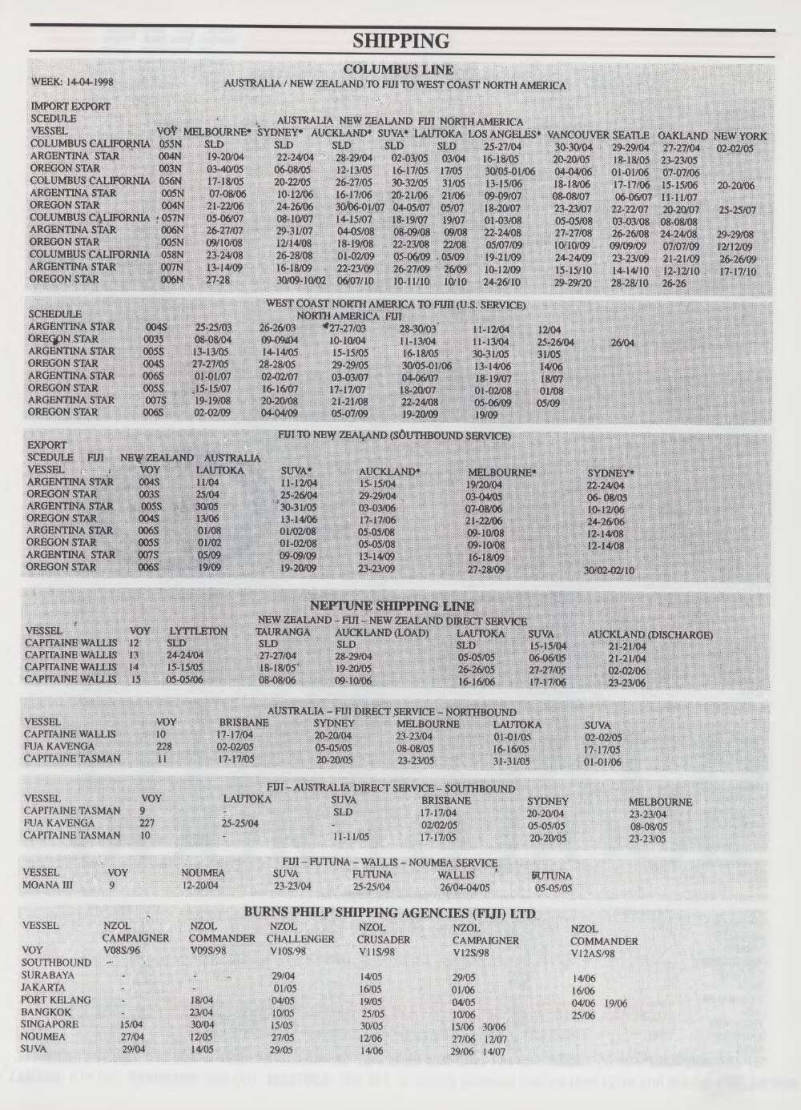
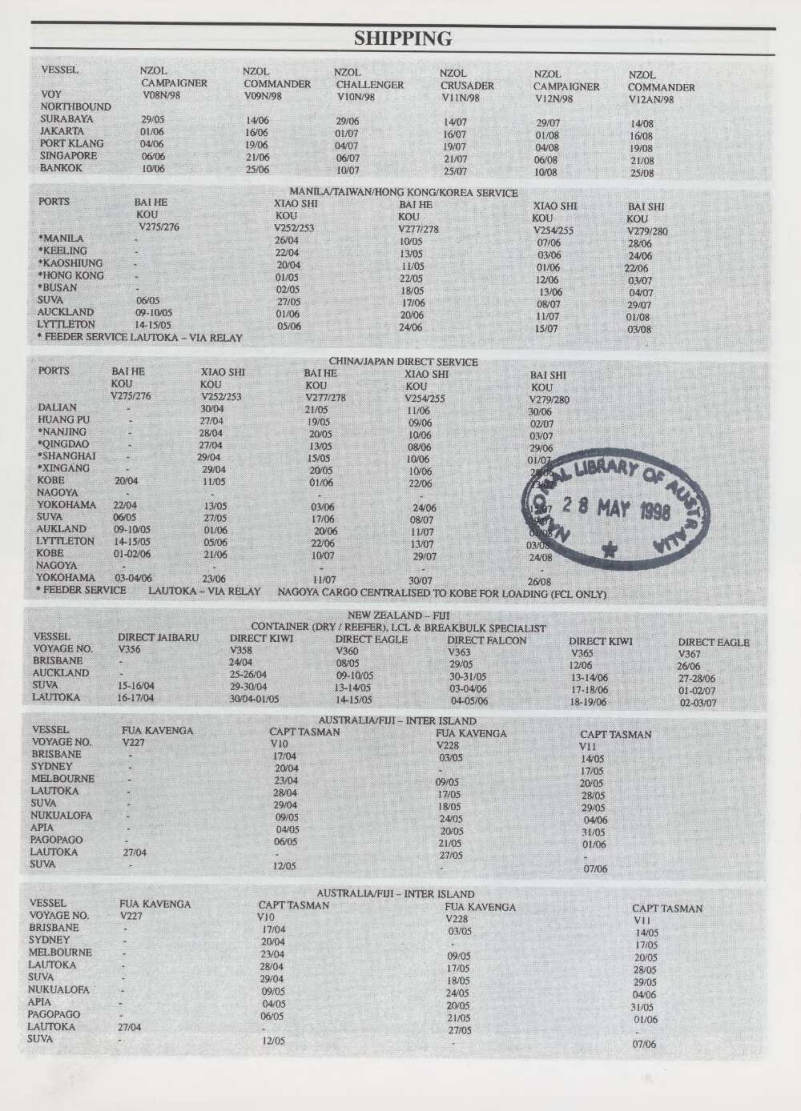
Week: 14-04-1998
Import Export
Scedulb
Vessel
Columbus Line
AUSTRALIA t NEW ZEALAND TO FIJI TO WEST COAST NORTH AMERICA
Australia New Zealand Fut North America
VOV MELBOURNE* SYDNEY* AUCKLAND* SUVA* LAUTOKA LOS ANGELES* VANCOUVER SEATLE
Oakland New York
Columbus California
055N
Sld
Sld
Sld
Sld
Sld
25-27/04 30-30/04 29-29/04 27-27/04 02-02/05
Argentina Star
004N 19-20/04 22-24/04 28-29/04 02-03/05 03/04 16-18/05 20-20/05 18-18/05 23-23/05
Oregon Star
003N 03-40/05 06-08/05 12-13/05 16-17/05 17/05 30/05-01/06 04-04/06 01-01/06 07-07/06
Columbus California
056N 17-18/05 20-22/05 26-27/05 30-32/05 31/05 13-15/06 18-18/06 17-17/06 15-15/06 20-20/06
Argentina Star
005N 07-08/06 10-12/06 16-17/06 20-21/06 21/06 09-09/07 08-08/07 06-06/07 11-11/07
Oregon Star
004N 21-22/06 24-26/06 30/06-01/07 04-05/07 05/07 18-20/07 23-23/07 22-22/07 20-20/07 25-25/07
Columbus California
* 057N 05-06/07 08-10/07 14-15/07 18-19/07 19/07 01-03/08 05-05/08 03-03/08 08-08/08
Argentina Star
006N 26-27/07 29-31/07 04-05/08 08-09/08 09/08 22-24/08 27-27/08 26-26/08 24-24/08 29-29/08
Oregon Star
005N 09/10/08 12/14/08 18-19/08 22-23/08 22/08 05/07/09 10/10/09 09/09/09 07/07/09 12/12/09
Columbus California
058N 23-24/08 26-28/08 01-02/09 05-06/09 • 05/09 19-21/09 24-24/09 23-23/09 21-21/09 26-26/09
Argentina Star
007N 13-14/09 16-18/09 22-23/09 26-27/09 26/09 10-12/09 15-15/10 14-14/10 12-12/10 17-17/10
Oregon Star
006N 27-28 30/09-10/02 06/07/10 10-11/10 10/10 24-26/10 29-29/20 28-28/10 26-26
Schedule
Argentina Star
004S 25-25/03 WEST COAST NORTH AMERICA TO FITH (U.S. SERVICE)
North America Fui
26-26/03 *27-27/03 28-30/03' 11-12/04 12/04
Oreqpn Star
003$ 08-08/04 09-09/04 10-10/04 11-13/04 11-13/04 25-26/04 26/04
Argentina Star
005S 13-13/05 14-14/05 15-15/05 16-18/05 30-3 i/05 31/05
Oregon Star
0Q4S 27-27/05 28-28/05 29-29/05 30/05-01/06 13-14/06 14/06
Argentina Star
006S 01-01/07 02-02/07 03-03/07 04-06/07 18-19/07 18/0?
Oregon Star
005S 15-15/07 16-16/07 17-17/07 18-20/07 01-02/08 01/08
Argentina Star
007S 19-19/08 20-20/08 21-21/08 22-24/08 05-06/09 05/09
Oregon Star
006S 02-02/09 04-04/09 05-07/09 19-20/09 19/09
Export
Fiji To Ne\Y Zealand {S6Uthbound Service)
Scedule Ful
Nev Zealand
Australia
Vessel :
Voy
Lautoka
Suva*
Auckland*
Melbourne*
Sydney*
Argentina Star
004S 11/04 11*12/04 15*15/04 19/20/04 22-24/04
Oregon Star
003S 25/04 25*26/04 29-29/04 , 03-04/05 06-08/05
Argentina Star
005S 30/05 "30*31/05 03-03/06 07-08/06 10-12/06
Oregon Star
004S 13/06 13*14/06 17*17/06 21-22/06 24-26/06
Argentina Star
006S 01/08 01/02/08 05-05/08 09-10/08 12-14/08
Oregon Star
005S Qi/02 01-02/08 05-05/08 09-10/08 12-14/08
Argentina Star
007S 05/09 09*09/09 13*14/09 16-18/09
Oregon Star
006S 19/09 19-20/09 23-23/09 27-28/09 30/02-02/10
Neptune Shipping Line
i
New Zealand
-Fill - New Zealand Direct Service
Vessel
Voy
Lyttleton
Tauranga
Auckland (Load)
Lautoka
Suva
Auckland (Discharge)
Capitaine Wallis
it
Sld
Sld
Sld
Sld
15-15/04 21-21/04
Capitaine Wallis
13 24-24/04 27-27/04 28-29/04 05-05/03 06-06/05 21-21/04
Capitaine Wallis
14 15-15/05 18-18/05“ 19-20/05 26-26/05 27-27/05 02-02/06
Capitaine Wallis
" is ;i 05-05/06 08-08/06 09-10/06 16-16/06 17-17/06 23-23/06
Vessel
Voy
AUSTRALIA - FUI DIRECT SERVICE - NORTHBOUND
Brisbane Sydney Melbourne Lautdka
Suva
Capita1Ne Wallis
10 17-17/04 20-20/04 23-23/04 01-01/05 02-02/05
Fua Kavenga
228 02-02/05 05-05/05 08-08/05 16-16/05 17-17/05
Capffaine Tasman
11 17-17/05 20-20/05 23-23/05 31-31/05 01-01/06
Vessel
Voy
FBI - AUSTRALIA DIRECT SERVICE - SOUTHBOUND
Lautoka Suva Brisbane
Sydney
Melbourne
Capitainb Tasman
9
Sld
17-17/04 20-20/04 23-23/04
Fua Kavenga
227 25-25/04 02/02/05 05-05/05 08-08/05 23-23/05
Capitainb Tasman
10 - 1M1/05 17-17/05 20-20/05
Fu1-Futuna-Wallis -
- Noumea Service
Vessel
Vgy
Noumea
Suva Futuna
Wallis
Butuna
Moana In
9 12-20/04 23-23/04 25-25/04 26/04-04/05 05-05/05
Vessel
Burns Piiilp Shipping Agencies (Fiji) Ltd
Nzol Nzol Nzol Nzol Nzol
Nzol
Voy
Campaigner Commander Challenger
V08S/96 V09S/98 Vj0S/98
Crusader
V1Is/98
Campaigner
V12S/98
Commander
V12As/98
Southbound
Surabaya
- -r 29/04 14/05 29/05 14/06
Jakarta
01/05 16/05 01/06 16/06
Portkelang
18/04 04/05 19/05 is 04/06 19/06
Bangkok
23/04 10/05 15/04 30/04 15/05 27/04 12/05 27/05 25/05 25/06
Singapore
30/05 15/06 30/06
Noumea
12/06 27/06 12/07
Suva
29/04 14/05 29/05 14/06 29/06 14/07
Vessel
Nzol
Nzol
Nzol
Nzol
Nzol
Nzol
Voy
Northbound
Campaigner
Commander
Challenger
Crusader
Campaigner
Commander
V08N/98 V09N/98 V10N/98
Vhn/98
V12N/98
V12An/98
Surabaya
29/05 14/06 29/06 14/07 29/07 14/08
Jakarta
01/06 16/06 01/07 16/07 01/08 16/08
Port Klang
04/06 19/06 04/07 19/07 04/08 19/08
Singapore
06/06 21/06 06/07 21/07 06/08 21/08
Bankok
10/06 25/06 10/07 25/07 10/08 25/08
Manila/Taiwan/Hong Kong/Korea Service
Ports
Ba I He
Xiao Shi
Ba! He
Xiao Shi
Bai Shi
Kou
Kou
Kou
Kou
Kou
V275/276 V252/253 V277/278 V254/255 V279/280
♦Manila
- 26/04 10/05 07/06 28/06
♦Keeling
: 22/04 13/05 03/06 24/06
♦Kaoshiung
|?l 20/04 11/05 01/06 22/06
♦Hong Kong
01/05 22/05 12/06 03/07
♦Busan
02/05 18/05 13/06 04/07
Suva
06/05 27/05 17/06 08/07 29/07
Auckland
09-10/05 01/06 20/06 11/07 01/08
Lyttleton
14-15/05 05/06 24/06 15/07 03/08 ♦ FEEDER SERVICE LAUTOKA - VIA RELAY
China/Japan Direct Service
Ports
Bai He
Xiao Shi
Bai He
Xiao Shi
Bai Shi
Kou
Kou
Kou
Kou
Kou
V275/276 V252/253 V277/278 V254/255 V279/280
Dalian
30/04 21/05 11/06 30/06
Huang Pu
, 3^ 27/04 19/05 09/06 02/07
‘Nanjing
- 28/04 20/05 10/06 03/07
‘Qingdao
ill ; A 27/04 13/05 08/06 29/06
♦Shanghai
29/04 15/05 10/06
o| /Q|fi
‘Xingang
- 29/04 20/05 10/06
Kobe
20/04 11/05 01/06 22/06
Nagoya
. . mf
Yokohama
22/04 13/05 03/06 24/06 |& 2 8 HA
Suva
06/05 27/05 17/06 08/07
Aukland
09-10/05 01/06 20/06 11/07
Lythleton
14-15/05 05/06 22/06 13/07 «jL.
Kobe
01-02/06 21/06 10W 29/07 24/08^||^J8
Nagoya
Yokohama
03-04/06 23/06 11/07 30/07 26/08 ♦ FEEDER SERVICE LAUTOKA - VIA RELAY NAGOYA CARGO CENTRALISED TO KOBE FOR LOADING (FCL ONLY)
New Zealand
- Fill CONTAINER (DRV / REEFER). LCL & BREAKBULK SPECIALIST
Vessel
Direct Jaibaru
Direct Kiwi
Direct Eagle
Direct Falcon
Direct Kiwi
Direct Eagle
Voyage No.
V356 V358 V360 V363 V365 V367
Brisbane
- 24/04 08/05 29/05 12/06 26/06
Auckland
* 25-26/04 09-10/05 30-31/05 13-14/06 27-28/06
Suva
15-16/04 29-30/04 13-14/05 03-04/06 17-18/06 01-02/07
Lautoka
16-17/04 30/04-01/05 14-15/05 04-05/06 18-19/06 02-03/07
Australia/Fui -
Inter Island
Vessel
Fua Kavenga
Capt Tasman
Fua Kavenga
Capt Tasman
Voyage No.
V227 V10 V228 Vi1
Brisbane
- 17/04 03/05 14/05
Sydney
20/04 17/05
Melbourne
- 23/04 09/05 20/05
Lautoka
- 28/04 17/05 28/05
Suva
liiPlpSi Bfft iS'fii®'"
29/04 18/05 29/05
Nukualofa
09/05 24/05 04/06
Apia
; ;r--f : . 04/05 20/05 31/05
Pagopago
- 06/05 21/05 01/06
Lautoka
27/04 - 27/05
Suva
- 12/05 07/06
Vessel
Fua Kavenga
Australia/Fui - Inter Island
Capt Tasman Fua Kavenga
Capt Tasman
Voyage No.
V227 vto V228 Vll
Brisbane
J7/04 03/05 14/05
Sydney
- 20/04 17/05
Melbourne
- 23/04 09/05 20/05
Lautoka
- 28/04 17/05 28/05
Suva
- 29/04 18/05 29/05
Nukualofa
- 09/05 24/05 04/06
Apia
- 04/05 20/05 31/05
Pagopago
* 06/05 21/05 01/06
Lautoka
27/04 - 27/05
Suva
- 12/05 07/06
Advertisements & other items, pp. 58-60 (2 items)
Shipping
Door
international & Local Courier
Fiji’s own courier company goes further than Fiji 3 1508 00635343 2 WT \ XX r f % m m. -4 ' h M mi \ \ IS & ye* i* ;
For all your:
Courier needs Heavy weights
Your choice of domestic messenger courier needs - / IHour / 3 Hour / Same day
if 3®f "=
Tyis ”,
International & Local Courier
SUVA: 218 388,218 304 or TOLL FREE 0800 307 304 NADI AIRPORT: 724 434 NADI: 700 001 LAUTOKA: 665 161 LABASA: 816 022 SAVUSAVU: 850 001 SIGATOKA: 500 321 or simply call your nearest post office and ask for CMS Service.
" s ®- ! v ' N q\9 PRc. ■ ■ll
KIAORA! BULAVINAKA!
MAEVA! ALOHA!
HOWEVER WE SAY IT,
IT MEANS WELCOME!
Budget
3 Fiji 122 636 Papuo New Guinea 325 4111 Vanuatu 23170 New Caledonia 262 009 Hawaii 838 1111 Western Samoa 20561 Australia 1300 362 848 New Zealand 0800 652 221 You, Me & Him BUDSSIPA