Vaka Taumako: Rescuing
p. 52 · Read in the full issue
Culture
Vaka Taumako: Rescuing endangered skills
By Pauline Walker
A FLEXIBLE, highly
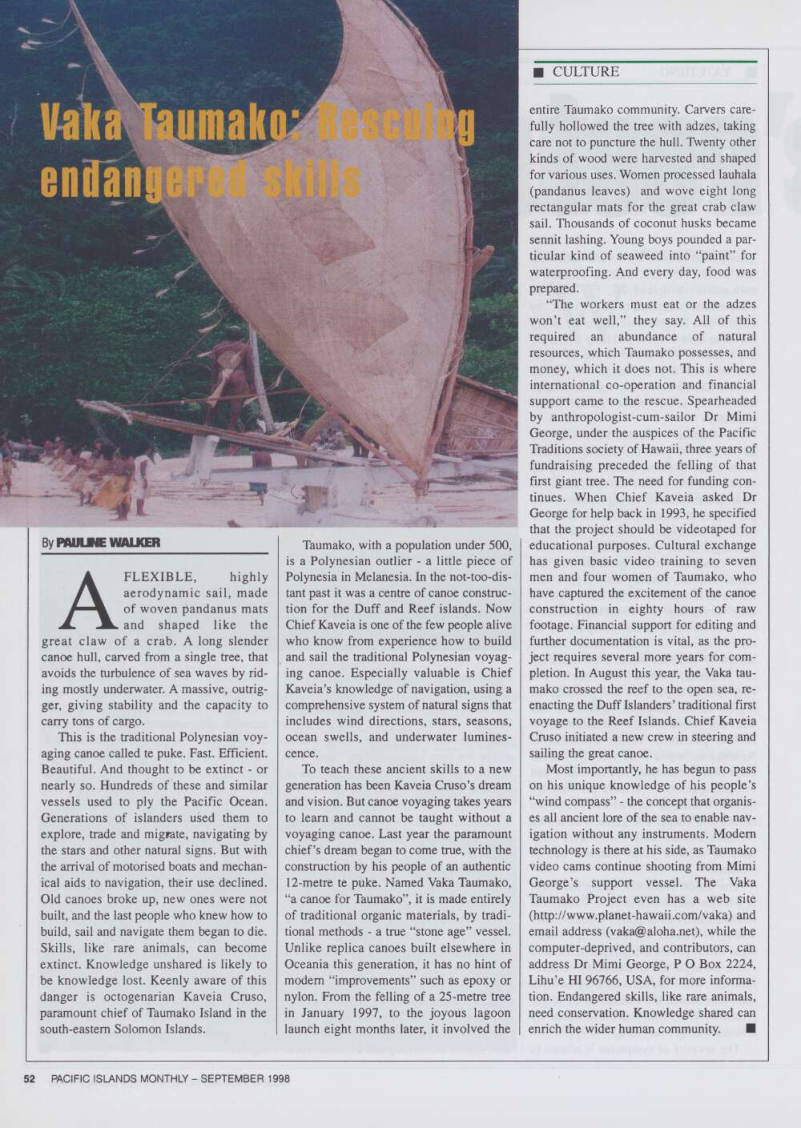
aerodynamic sail, made of woven pandanus mats and shaped like the great claw of a crab. A long slender canoe hull, carved from a single tree, that avoids the turbulence of sea waves by rid ing mostly underwater. A massive, outrig ger, giving stability and the capacity to carry tons of cargo.
This is the traditional Polynesian voy aging canoe called te puke. Fast. Efficient.
Beautiful. And thought to be extinct - or nearly so. Hundreds of these and similar vessels used to ply the Pacific Ocean.
Generations of islanders used them to
explore, trade and migrate, navigating by
the stars and other natural signs. But with the arrival of motorised boats and mechan ical aids to navigation, their use declined.
Old canoes broke up, new ones were not built, and the last people who knew how to build, sail and navigate them began to die.
Skills, like rare animals, can become extinct. Knowledge unshared is likely to be knowledge lost. Keenly aware of this danger is octogenarian Kaveia Cruso, paramount chief of Taumako Island in the south-eastern Solomon Islands.
Taumako, with a population under 500, is a Polynesian outlier - a little piece of Polynesia in Melanesia. In the not-too-dis tant past it was a centre of canoe construc tion for the Duff and Reef islands. Now Chief Kaveia is one of the few people alive who know from experience how to build and sail the traditional Polynesian voyag ing canoe. Especially valuable is Chief Kaveia’s knowledge of navigation, using a comprehensive system of natural signs that includes wind directions, stars, seasons, ocean swells, and underwater lumines cence.
To teach these ancient skills to a new generation has been Kaveia Cruso’s dream and vision. But canoe voyaging takes years to learn and cannot be taught without a voyaging canoe. Last year the paramount chief’s dream began to come true, with the construction by his people of an authentic 12-metre te puke. Named Vaka Taumako, “a canoe for Taumako”, it is made entirely of traditional organic materials, by tradi tional methods - a true “stone age” vessel.
Unlike replica canoes built elsewhere in Oceania this generation, it has no hint of modem “improvements” such as epoxy or nylon. From the felling of a 25-metre tree in January 1997, to the joyous lagoon launch eight months later, it involved the
entire Taumako community. Carvers care fully hollowed the tree with adzes, taking care not to puncture the hull. Twenty other kinds of wood were harvested and shaped for various uses. Women processed lauhala (pandanus leaves) and wove eight long rectangular mats for the great crab claw sail. Thousands of coconut husks became sennit lashing. Young boys pounded a par ticular kind of seaweed into “paint” for waterproofing. And every day, food was prepared.
“The workers must eat or the adzes won’t eat well,” they say. All of this required an abundance of natural resources, which Taumako possesses, and money, which it does not. This is where international co-operation and financial support came to the rescue. Spearheaded
by anthropologist-cum-sailor Dr Mimi
George, under the auspices of the Pacific Traditions society of Hawaii, three years of fundraising preceded the felling of that first giant tree. The need for funding con tinues. When Chief Kaveia asked Dr George for help back in 1993, he specified that the project should be videotaped for educational purposes. Cultural exchange has given basic video training to seven men and four women of Taumako, who have captured the excitement of the canoe construction in eighty hours of raw footage. Financial support for editing and further documentation is vital, as the pro ject requires several more years for com pletion. In August this year, the Vaka tau mako crossed the reef to the open sea, re enacting the Duff Islanders’ traditional first voyage to the Reef Islands. Chief Kaveia Cruso initiated a new crew in steering and sailing the great canoe.
Most importantly, he has begun to pass on his unique knowledge of his people’s “wind compass” - the concept that organis es all ancient lore of the sea to enable nav igation without any instruments. Modem technology is there at his side, as Taumako video cams continue shooting from Mimi George’s support vessel. The Vaka Taumako Project even has a web site
(http://www.planet-hawaii.com/vaka) and
email address ([email protected]), while the computer-deprived, and contributors, can address Dr Mimi George, P O Box 2224, Lihu’e HI 96766, USA, for more informa tion. Endangered skills, like rare animals, need conservation. Knowledge shared can enrich the wider human community. ■