Income tax prospects
pp. 14-15 · Read in the full issue

Economy
Income tax prospects cause uneasiness in Vanuatu's tax haven
By Patrick Declohre
As a Value Added Tax (VAT) has just been introduced in Vanuatu on August 1 for all goods and services, reference to the need one day to introduce yet another tax has caused last July further uneasi ness within the offshore industry of this tax haven. Father Walter Lini’s National United Party (NUP), the junior
partner in the new government, had to go to the extent of denying there was any plan to bring Vanuatu nationals and residents to pay tax on their revenues.
NUP spokesman Patrick Crowby said if the income tax was introduced next year, as Vanuaaku Pati (VP) finance minister Sela Molisa hinted in his budget speech, NUP would not support it, because it would "question Vanuatu’s tax haven sta tus” and ”deter foreign investors”. The
NUP-Vanuaaku Pati (VP) coalition com mittee in a statement finally rejected the income tax scheme, saying there was so far no policy to introduce it. Last June, the Vanuatu Parliament endorsed the introduc tion of a flat 12.5 per cent Value Added Tax (VAT). The VAT came into force on August 1. It replaces a government revenue system that was so far mainly relying on import tax. The VAT was a fiscal measure recom mended by an Asian Development Bank
(ADB)-sponsored Comprehensive
Reform Programme (CRP), on which Vanuatu has embarked last year to broaden its shrinking revenue base. The CRP, for which Vanuatu received some 20 million US dollars in soft loan from the ADB in July, promotes principles of transparency, good governance, accountability through a private sector-led economy growth. It was also to start axing "10 to 15” per cent of the 4,500-strong public service in August.
But the cause of the concerns within the tax haven industry here, namely offshore registers of trust companies incorporated in Vanuatu under the International
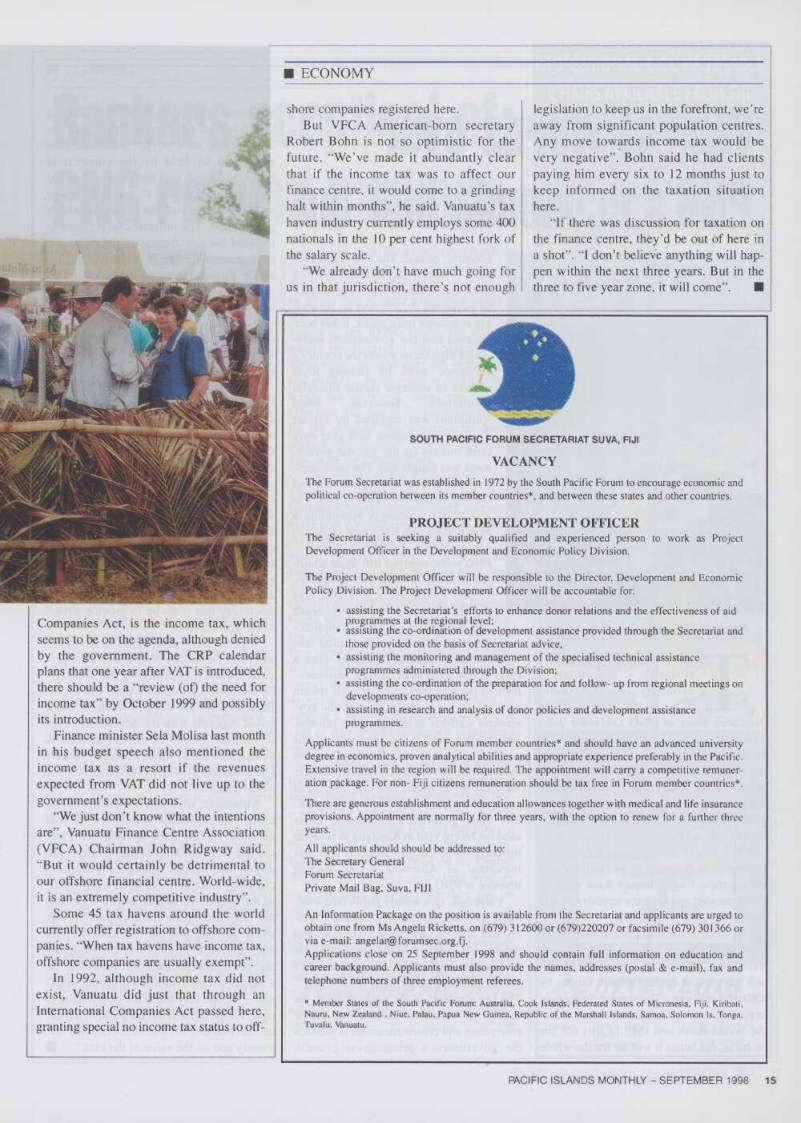
Vanuatu residents revelling during the annual horse races - before VAT and tali or income tax.
Main street - Port Vila, Vanuatu
Companies Act, is the income tax, which seems to be on the agenda, although denied by the government. The CRP calendar plans that one year after VAT is introduced, there should be a “review (of) the need for income tax” by October 1999 and possibly its introduction.
Finance minister Sela Molisa last month in his budget speech also mentioned the income tax as a resort if the revenues expected from VAT did not live up to the
government’s expectations.
“We just don’t know what the intentions are”, Vanuatu Finance Centre Association (VFCA) Chairman John Ridgway said.
“But it would certainly be detrimental to our offshore financial centre. World-wide, it is an extremely competitive industry”.
Some 45 tax havens around the world currently offer registration to offshore com panies. “When tax havens have income tax, offshore companies are usually exempt”.
In 1992, although income tax did not exist, Vanuatu did just that through an International Companies Act passed here, granting special no income tax status to off
shore companies registered here.
But VFCA American-bom secretary Robert Bohn is not so optimistic for the future. "We’ve made it abundantly clear that if the income tax was to affect our finance centre, it would come to a grinding halt within months”, he said. Vanuatu’s tax haven industry currently employs some 400 nationals in the 10 per cent highest fork of the salary scale.
“We already don’t have much going for us in that Jurisdiction, there’s not enough
legislation to keep us in the forefront, we’re away from significant population centres.
Any move towards income tax would be very negative”. Bohn said he had clients paying him every six to 12 months just to keep informed on the taxation situation here.
“If there was discussion for taxation on the finance centre, they’d be out of here in a shot”. “I don’t believe anything will hap pen within the next three years. But in the three to five year zone, it will come”. ■