War of words over PNG's economic bail-out
p. 16 · Read in the full issue
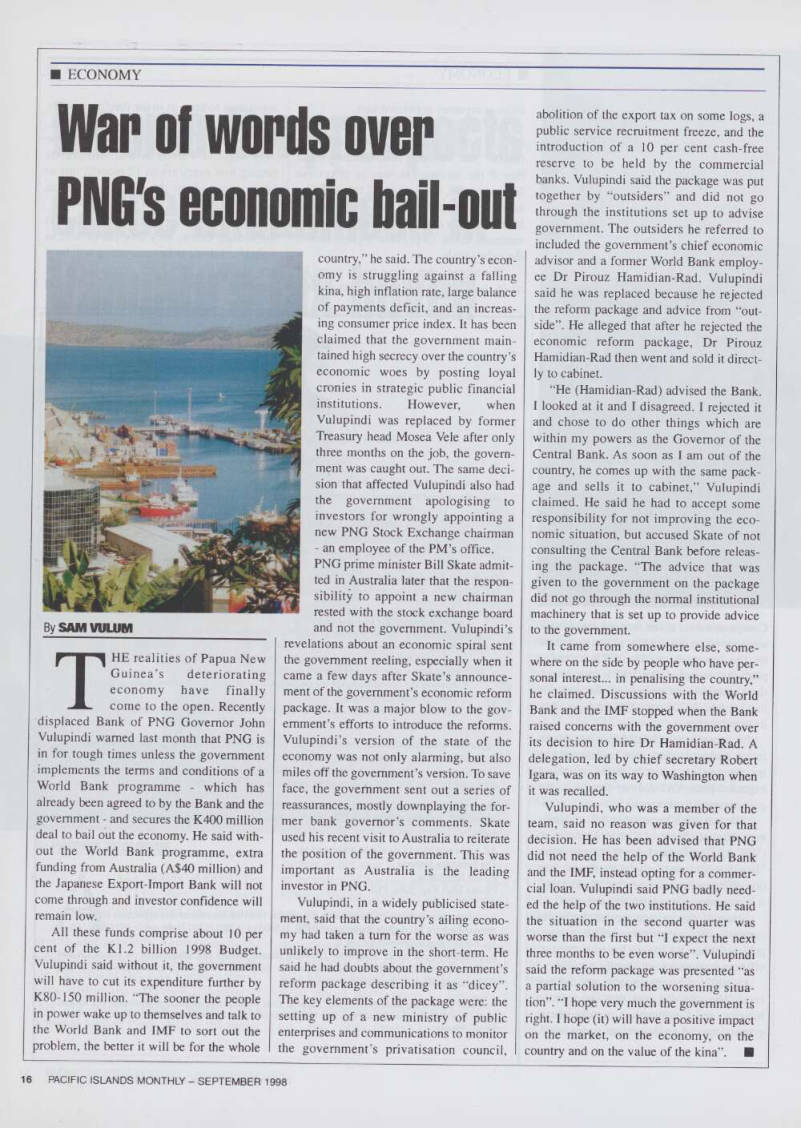
PNG's economic bail-out
By Sam Vuuim
THE realities of Papua New
Guinea’s deteriorating
economy have finally come to the open. Recently displaced Bank of PNG Governor John Vulupindi warned last month that PNG is in for tough times unless the government implements the terms and conditions of a World Bank programme - which has already been agreed to by the Bank and the government -and secures the K4OO million deal to bail out the economy. He said with out the World Bank programme, extra funding from Australia (As4o million) and the Japanese Export-Import Bank will not come through and investor confidence will remain low.
All these funds comprise about 10 per cent of the K 1.2 billion 1998 Budget.
Vulupindi said without it, the government will have to cut its expenditure further by KBO-150 million. “The sooner the people in power wake up to themselves and talk to the World Bank and IMF to sort out the problem, the better it will be for the whole
country,” he said. The country’s econ
omy is struggling against a falling
kina, high inflation rate, large balance of payments deficit, and an increas ing consumer price index. It has been claimed that the government main tained high secrecy over the country’s economic woes by posting loyal cronies in strategic public financial institutions. However, when Vulupindi was replaced by former Treasury head Mosea Vele after only three months on the job, the govern ment was caught out. The same deci sion that affected Vulupindi also had the government apologising to investors for wrongly appointing a new PNG Stock Exchange chairman - an employee of the PM’s office.
PNG prime minister Bill Skate admit ted in Australia later that the respon sibility to appoint a new chairman rested with the stock exchange board and not the government. Vulupindi’s
revelations about an economic spiral sent the government reeling, especially when it came a few days after Skate’s announce ment of the government’s economic reform package. It was a major blow to the gov ernment’s efforts to introduce the reforms.
Vulupindi’s version of the state of the economy was not only alarming, but also miles off the government’s version. To save face, the government sent out a series of reassurances, mostly downplaying the for mer bank governor’s comments. Skate used his recent visit to Australia to reiterate the position of the government. This was important as Australia is the leading investor in PNG.
Vulupindi, in a widely publicised state
ment, said that the country’s ailing econo my had taken a turn for the worse as was unlikely to improve in the short-term. He said he had doubts about the government’s
reform package describing it as "dicey”.
The key elements of the package were: the setting up of a new ministry of public enterprises and communications to monitor the government’s privatisation council.
abolition of the export tax on some logs, a public service recruitment freeze, and the introduction of a 10 per cent cash-free reserve to be held by the commercial banks. Vulupindi said the package was put together by “outsiders” and did not go through the institutions set up to advise government. The outsiders he referred to included the government’s chief economic advisor and a former World Bank employ ee Dr Pirouz Hamidian-Rad. Vulupindi said he was replaced because he rejected the reform package and advice from “out side”. He alleged that after he rejected the economic reform package, Dr Pirouz Hamidian-Rad then went and sold it direct ly to cabinet.
“He (Hamidian-Rad) advised the Bank.
I looked at it and I disagreed. I rejected it and chose to do other things which are within my powers as the Governor of the Central Bank. As soon as I am out of the country, he comes up with the same pack age and sells it to cabinet,” Vulupindi claimed. He said he had to accept some responsibility for not improving the eco nomic situation, but accused Skate of not consulting the Central Bank before releas ing the package. “The advice that was given to the government on the package did not go through the normal institutional machinery that is set up to provide advice to the government.
It came from somewhere else, some where on the side by people who have per sonal interest... in penalising the country,” he claimed. Discussions with the World Bank and the IMF stopped when the Bank raised concerns with the government over its decision to hire Dr Hamidian-Rad. A delegation, led by chief secretary Robert Igara, was on its way to Washington when it was recalled.
Vulupindi, who was a member of the team, said no reason was given for that decision. He has been advised that PNG did not need the help of the World Bank and the IMF, instead opting for a commer cial loan. Vulupindi said PNG badly need ed the help of the two institutions. He said the situation in the second quarter was worse than the first but “I expect the next three months to be even worse”. Vulupindi said the reform package was presented “as a partial solution to the worsening situa tion”. “I hope very much the government is right. I hope (it) will have a positive impact on the market, on the economy, on the country and on the value of the kina”. ■