The Aitape legacy
pp. 12-13 · Read in the full issue
By Sam Vulum
life years ahead will not be the same.
She is among 9,199 other widows, wid owers, orphans, wounded and injured sur vivors, each of who have their own stories to tell. They are being kept in seven care centres in the Aitape area. The once sleepy sandy beaches of Aitape and their high waves had once been billed “PNG’s Surfers’ Paradise”. The beautiful Sissano lagoon, separated from the sea by a 100metre strip of sand where the four worst affected villages - Arop, Warapu, Malol, and Sissano - were situated, also attracted international attention. But on July 17, it changed. The area became a mass death zone. Everywhere, whether it was the lagoon’s edge, mangroves, debris in water or the beach, was strewn with the corpses of men, women and children.
Some were properly buried, while oth ers, with limbs missing or scavenged by animals, were badly decomposed and had to be buried or burnt where they were found. The lagoon, referred to as the “death
THE usual joy and happi ness expressed by parents over the arrival of a new born child means nothing to a Papua New Guinean mother, a victim of the country’s recent catas trophic and devastating tidal wave dis aster. She gave birth several days after the fateful day of July 17 when the tidal wave,
measuring 23-foot-high (7.01 metres)
struck after an undersea earthquake. It wiped out four villages, killing 2,173 and leaving behind hundreds missing and thou sands wounded in the Aitape district of West Sepik province. For her, the child brings more anguish after the loss of her three other children and their father who were amongst those killed. Their bodies have never been found.
This mother does not know how to begin to tell the child about her father and three sisters. Maybe she never will, but her
lake” is now out of bounds. It is a mass liq uid grave for hundreds of people who could not be retrieved for proper burial because of the high health risk involved.
The scene of destruction and devasta tion to human life and property, the glaring face of death, pain and agony suffered by the survivors broke the hearts of those who visited the area. Senior Post Courier jour nalist Wally Hiambohn summed up the feelings of many. “I don’t know if every picture my eyes took in will ever be blotted from my memory. I doubt as much. They were too crude and left indelible images in my mind. I hope I don’t have nightmares”.
PNG prime minister Bill Skate, who spent four days with the survivors, broke down in tears as he tried to tell of the effect of the tsunami. Skate said he had seen corpses of people half buried, disfigured babies and children on the beach and more floating in
the lagoon.
"To see people die in front of me was the worst part of my life. I just don’t know
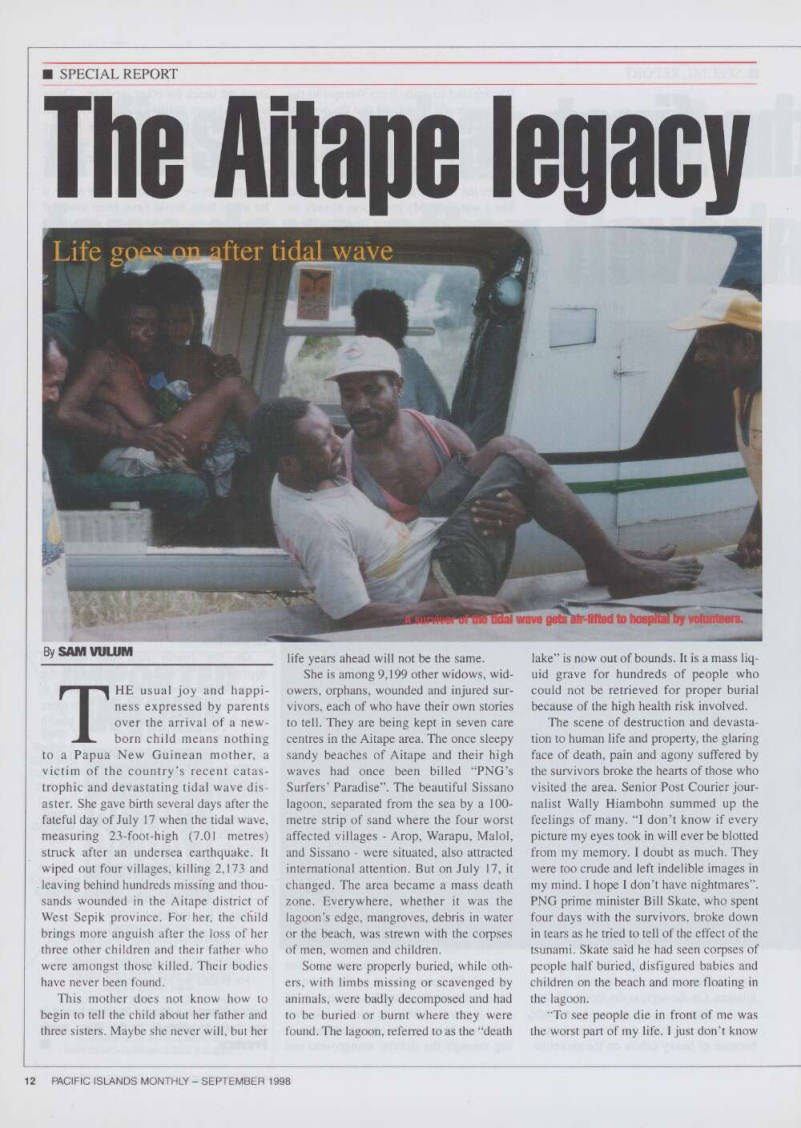
Life goes on after todal wave
A survivor of the tidal wave gets air-lifted to hospital by volunteers.
what the children will face and do within the next days, weeks, and months. I don’t know whether they can make it in life if there are no proper relatives.” Opposition leader Bernard Narokobi, who wept open ly in front of the survivors, said between sobs, “it’s too much for me to talk about.
I only bring you my tears”. A state of emergency declared by the government in the area on July 18 remains in force until this month. The reaction from the world community was overwhelming.
Australians, in particular, as always, were the first to respond with the deployment of its army medical team with medicine and other relief supplies. Then the New Zealanders and others followed suit. A search-and-rescue team even came from as far as the United States with their dogs to help search for survivors.
International organisations like the Red Cross and the European Union also responded with tremendous help.
Japan, France, United Kingdom, Malaysia, China, and South Korea sent help, as did Pacific neighbours, such as the Solomon Islands, Vanuatu, Samoa, and Fiji. Those who could not send cash or in kind, flooded the Internet with mov ing words of comfort and condolences to the victims. Skate kicked off the relief operations with a pledge of K 2 million, but millions of kina have been raised nationally and internationally towards relief efforts. The Catholic church, who broke the news to the world, has been and continues to be in the forefront of many relief efforts. A third-level airline, MBA, even supplied an aircraft free-of-charge for use in relief operations.
Donations continue to pour in but the biggest concern is how to settle the vic tims and help rebuild their lives, especial ly that of children who have lost their entire families.
Of those confirmed dead, 237 were
children attending three community
schools in the area. Seven teachers were confirmed dead while 50 others are still missing. Many of the survivors are suffer ing from mental and psychological depression. Trauma counselling sessions under the leadership of a Fijian Catholic priest and psychologist, Father Makario are being held in all the care centres. He is being assisted by students from the University of Papua New Guinea, semi narians and two Bougainvilleans. It is without a doubt, one of the darkest moments of PNG’s short history. ■