A first-hand account of
pp. 10-11 · Read in the full issue
Special Report
A first-hand account of four days after the tufa
By Brother Donius Ninen,
With Sam Vulum
ON the evening of Friday,
July 17 at about 7.30 pm, a series of tidal waves caused by an offshore earthquake struck the North west of Papua New Guinea in the Sandaun Province.
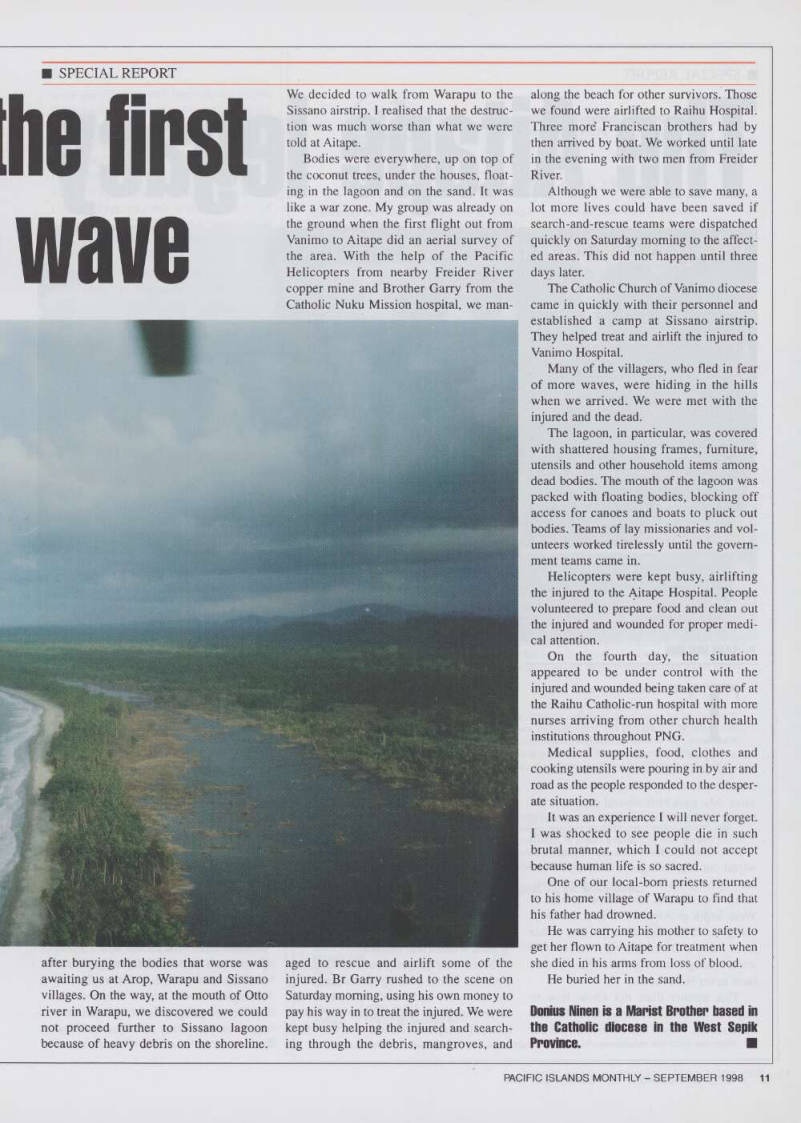
The waves swept through the coast line of low beaches severely affecting the lagoon area of Sissano about 30 kilometres west of Aitape. The following is a first hand account of the events that followed the tidal wave: “As we were sitting around the table having dinner at the St Didacus Friary, the disaster struck the whole Aitape town. We were unaware of what was happening because we live some kilometres away
from the shore. We only heard a loud noise similar to that of an F2B aircraft tak ing off. As I’ve leamt later on, people ran everywhere. Some took cover while oth ers unconsciously ran to the beach to see what was happening.
After dinner, we drove down from St Didacus to St Anna to watch the usual Australian National Rugby League Friday night footy on televised on EMTV. I noticed people from the Fatima Hill and the surrounding villages running towards the beach. A colleague commented that they are going for a dance. On arrival at the venue for the footy show, a Franciscan friar told us the news. We decided to drive around the Aitape township with all the Franciscan brothers to assess any damage that may have been caused.
I decided to call in at the Sisters con vent and use their phone to contact Port Moresby. The waves had affected all the lines except for the St Clares convent. I contacted by cousin, the assistant commis sioner of Correctional Institution Services and with his help, we got in touch with Ludwig Kembu, the director of the National Disaster and Emergency Services.
I also spoke with the administrator of the Aitape Catholic diocese. He asked me to organise a group to travel to Sissano to assess the situation because we received a radio call from the Presentation Sisters in Malol that the west coast of Aitape was completely destroyed by the waves. We did not know that the same waves had already destroyed three main villages and had taken with it thousands of lives until we got to Malol by sea. There were five of us on board, including a female teacher who decided to travel with us to check on school children who were there for holi days. On the way to the Sissano lagoon, we encountered rough seas that I believed then
were part of the tidal waves. We called in at Malol village that was wrecked to the ground and destroyed. The destruction was unbelievable. A quick look around turned up two dead bodies. I had a strong feeling
Sissano lagoon
after burying the bodies that worse was awaiting us at Arop, Warapu and Sissano villages. On the way, at the mouth of Otto river in Warapu, we discovered we could not proceed further to Sissano lagoon because of heavy debris on the shoreline.
We decided to walk from Warapu to the Sissano airstrip. I realised that the destruc tion was much worse than what we were told at Aitape.
Bodies were everywhere, up on top of the coconut trees, under the houses, float ing in the lagoon and on the sand. It was like a war zone. My group was already on the ground when the first flight out from Vanimo to Aitape did an aerial survey of the area. With the help of the Pacific Helicopters from nearby Freider River copper mine and Brother Garry from the Catholic Nuku Mission hospital, we man
aged to rescue and airlift some of the injured. Br Garry rushed to the scene on Saturday morning, using his own money to pay his way in to treat the injured. We were kept busy helping the injured and search ing through the debris, mangroves, and
along the beach for other survivors. Those we found were airlifted to Raihu Hospital.
Three more' Franciscan brothers had by then arrived by boat. We worked until late in the evening with two men from Freider River.
Although we were able to save many, a lot more lives could have been saved if search-and-rescue teams were dispatched quickly on Saturday morning to the affect ed areas. This did not happen until three days later.
The Catholic Church of Vanimo diocese came in quickly with their personnel and established a camp at Sissano airstrip.
They helped treat and airlift the injured to
Vanimo Hospital.
Many of the villagers, who fled in fear of more waves, were hiding in the hills when we arrived. We were met with the injured and the dead.
The lagoon, in particular, was covered with shattered housing frames, furniture, utensils and other household items among dead bodies. The mouth of the lagoon was packed with floating bodies, blocking off access for canoes and boats to pluck out bodies. Teams of lay missionaries and vol unteers worked tirelessly until the govern ment teams came in.
Helicopters were kept busy, airlifting the injured to the Aitape Hospital. People volunteered to prepare food and clean out the injured and wounded for proper medi cal attention.
On the fourth day, the situation appeared to be under control with the injured and wounded being taken care of at the Raihu Catholic-run hospital with more nurses arriving from other church health institutions throughout PNG.
Medical supplies, food, clothes and cooking utensils were pouring in by air and road as the people responded to the desper ate situation.
It was an experience I will never forget.
I was shocked to see people die in such brutal manner, which I could not accept because human life is so sacred.
One of our local-born priests returned to his home village of Warapu to find that his father had drowned.
He was carrying his mother to safety to get her flown to Aitape for treatment when she died in his arms from loss of blood.
He buried her in the sand.
Donius Ninen is a Manist Brother based in the Catholic diocese in the West Sepik Province. ■