Business
pp. 19-21 · Read in the full issue

Cover Story
Business survival skills
By Sophie Foster Hildebrand
DURING a recession it is almost inevitable that some businesses will go down. However, profes sional business consultants say some of those businesses can be saved if certain important points are adhered to.
In a rapidly deteriorating business cli
mate, business survival skills are extremely neces sary. Professionals that PIM spoke to, including lawyers, bankers, and accountants say these skills are essential.
Adam Dickson, a partner in the firm formerly known as Coopers and Lybrand (now Price Waterhouse Coopers) says accountants are not the bad guys when it comes to business dealings.
Appointed along with Mr Don Aidney to look into the National Bank of Fiji virtual collapse several years ago, he says the role of an accountant in keeping a business afloat cannot be
underestimated. “It was said that in the good times we make money by setting up companies and in the bad times we make money by winding them up. But I don’t think they are really. A good accountant shouldn’t really be a bad guy. He’s got much inside knowledge, and if he uses it the right way, it should help the client more than anything else”.
Of all business issues, the ones that are crucial to ensuring business survival in a recession, he says, are credit control and
liquidity.
"Credit control is probably the biggest problem - to try and get your debt and debt-collecting on time. Everybody’s drag
ging, they’re all dragging the chain.
Sometimes you don’t get into the hat at all this month.
"But that’s what you’ve got to watch your credit. A sale is not a sale until such time as you get the money in - not when you sell the stuff. Anybody can give stuff away.” He says a good example of good business survival skills is the operation of
firms that have monopolies or are near monopolies. "They make you pay as you get. You try and buy beer or flour or ciga rettes, where they’ve basically got monop olies (in Fiji), and you pay right on the spot. You don’t get any time to pay and that’s why they don’t go bust”.
A 90-day credit rating is not wise dur ing a recessive period, according to experts, because cashflow has to be main tained. The time limit for credit s.hould be "the shortest possible”.
"Cash on delivery or cash sales are the way to go and then you know where you're standing,” Mr Dickson says. The average credit taken by businesses at the moment is
about 60 to 90 days, with hardly any busi nesses, it seems, paying on the “month
ending”.
A very important point, which many business people find hard to implement is putting a stop to bad credit.
"If you’ve given credit, you must make a calculated decision as to the day when you stop throwing good money after bad.
In other words, if you keep on lending to this chap, you’re giving him more, and more, he’s building up his debt. You’re hoping he’s going to come good. If he doesn’t come good, you're gone,” Mr
Dickson emphasises.
It is because of the recessive nature of doing business at the moment that compa nies should ensure they are not overex tending on borrowing. For some compa nies, the recession plus huge repayments to financiers have been the proverbial straw.
To counter this, Mr Dickson says, “Watch your borrowings. Don’t overbor row, don’t go more and more into borrow
ing to try and get yourself out, because all you do is dig a deeper and bigger hole for yourself’.
He says it is the accoun tant’s role to make certain that a person or business does not overextend too fast, too quickly.
“In other words, you mustn’t get involved in long term assets in short term funds. If you borrow for a building, you make certain you take as long as possible to pay it off. There’s no point trying to pay a building off in three years. You try and pay it off in ten years or as long as you can”. Most busi
nesses that fold have usually overextended themselves, he says. ‘They’ve taken on things they couldn't handle and then they come to a forced sale. When you come to a forced sale, this is when you just never get your price”.
In a dog-eat-dog world with increasing business competition, Mr Dickson says profit margins have to remain.
"You must maintain your margin. Again you can sell stuff or you can give it away.
So you’ve got to ensure these things,” he said.
However, the concentration, he says, should not be solely on profit on paper with nothing in the bank. In this climate
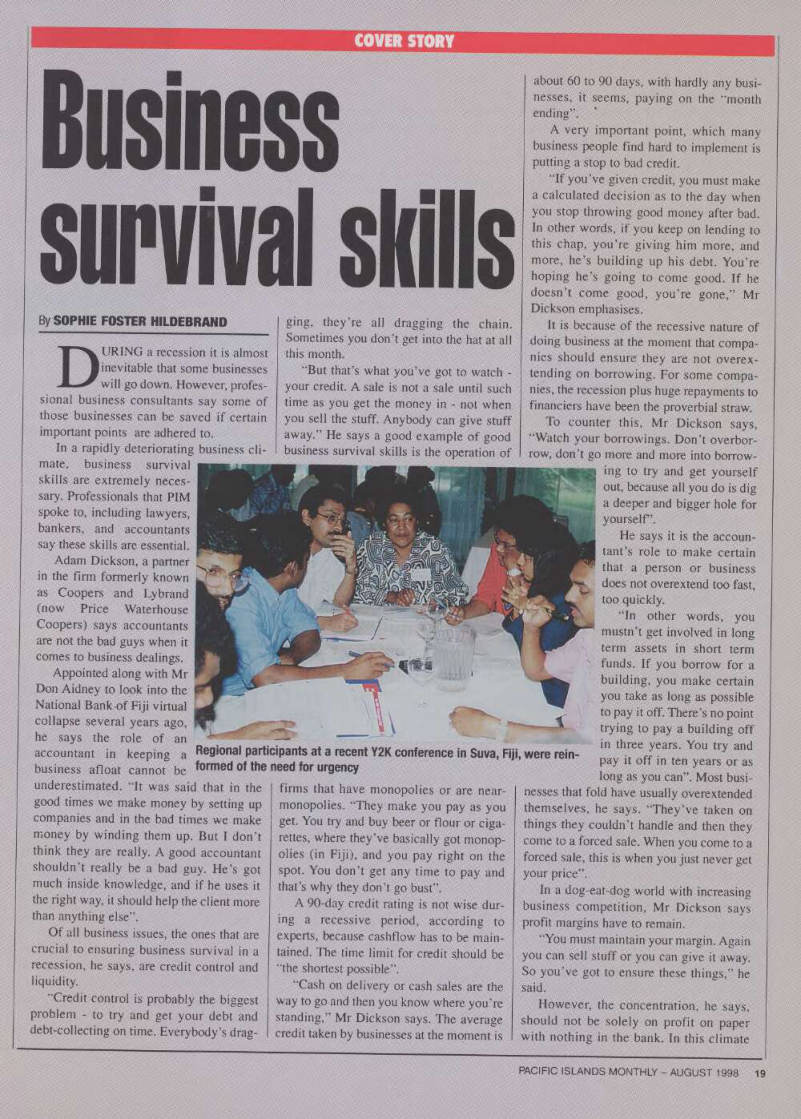
Regional participants at a recent Y2K conference in Suva, Fiji, were rein formed of the need for urgency
businesses have to work on cash flow.
"Keep yourself liquid as fast as you can, as much as you can. If you concentrate on profit, it won’t work. You work on cash flow. Make sure you’ve got a margin and so on, but watch your cash flow. When you’ve got insurance premiums to pay, for instance, you go to the insurance company and say look I want to pay that off over a period, not all in advance. These are the kind of things you’ve got to do,” he says.
One tip for survival in a recession is not to tie up your cash flow with too much stock.
"You mustn’t carry too much stock because if you have too much stock, you've got money tied up there. You’re not doing anything with it, you’re paying interest on it, you’re putting your costs up the whole time, and therefore you’re getting yourself into deep water,” Mr Dickson said.
An important facet which business peo ple should always remember is to keep their banker informed. Banks prefer to know what is happening always so they can help keep the business afloat. Bank of Hawaii regional manager, Mr Andy Jordanou, says banks always like to be assured of a client's standing.
“No-one wants to be surprised. So you do not want to see any surprises, especially with problem loans. In certain cases, it hap pens, like when you have devaluation, or you have a slow economy.
“If you’re a good banker and a good lender, you should be well-versed in all areas. You don’t have to be the brains in one industry, you have to have general knowl edge. What triggers lumber business? What triggers garment? What are the pitfalls?
Then when you have your client base, you ask those questions of them. You want to be ahead of the game,” he says.
Bank of Hawaii has branches throughout the Pacific, and as such their experience spans the region. Mr Jordanou says quite often the bank sees commonalties in busi nesses that collapse in the region.
"It is basically, they can't adopt to change. A lot of them can't adapt to change, or they don't want to change. The world changes every day, and you get into a busi ness rut and you can't see how the competi tors are moving faster than you are". This factor, he says, is common not only to the Pacific region but other regions that he has been to. Other common downfalls are liq uidity, capital resources, and diversification, or rather the lack of them. "You might not have the resources to sustain a business
because you don’t have a good strategic financial plan. And you are not diversified enough. For example, if you concentrate heavily in the garment industry and you are exporting to Australia and .New Zealand, then you have the SPARTECA issue to deal with. A solution would be to diversify to other market segments, maybe the US or some other market area.
"If you know how to diversify and have a good foreseeable three to five year vision plan, and stick by it, you can be successful.
The ones that collapse are the ones that don’t have a real plan,” he says. "If you live day-to-day, you don’t have the actual round ness in knowing how to change, how to move from one area to the other”.
Mr Jordanou says business people should also know how to use good resources like a solicitor, a banker, or an accountant. "Never be afraid to ask for information,” he says.
This is true at any time, but especially essential during a recession. If one of his bank’s clients was having trouble balancing the books, he says, the first action is being able to work with their accountants, solici tors and banker. This means that business people should be able to accept criticism from professionals. "When you accept criti
cism, you could be successful in some respects,” he says.
"Your banker would know pretty much what type of cashflow and
working funds
are required to make a success ful business.
That’s their job.
If they don’t, they aren’t good lenders.
You’ve got to work with professionals that know the business,” he says.
Mr Dickson says the accountant's role is crucial right from day one when you start a business. "You need somebody to hold your hand on the business side on the way through. You need somebody who can come back and be your sounding board. You say 1 want to do this, and he says well have you thought about that, that and that. He points out the pitfalls, and if you can get around them, fine”.
“Many people think they are good enough to do that on their own, and of course an accountant charges fees, and they wonder if it is really worth it,” he says. In the long run, however, Mr Dickson says the accountant has valuable insight into various areas of business.
"He sees what other businesses are doing and not doing, he knows what the pitfalls are, and what you’ve got to be up against.
So really an accountant should be like your doctor, you go to get your health checked every year and when you're feeling particu larly sick, you go back and get an antibiotic or something. It’s that sort of thing,” he says.
Richard Naidu, a lawyer at Munro, Leys and Co in Suva, Fiji, who specialises in cor porate law, says too often people drop their legal bill when trying to balance the books.
"During times like these many business people are too willing to cut comers when it comes to legal issues, or consulting a lawyer. It is now that you may need a lawyer most,” he says.
"I would advise not to cut corners on their lawyer's bill and this is not just because I am a lawyer but because you sim ply cannot afford to take that chance”. Some businesses, he says, do not get legal advice when it comes to handling debtors and that
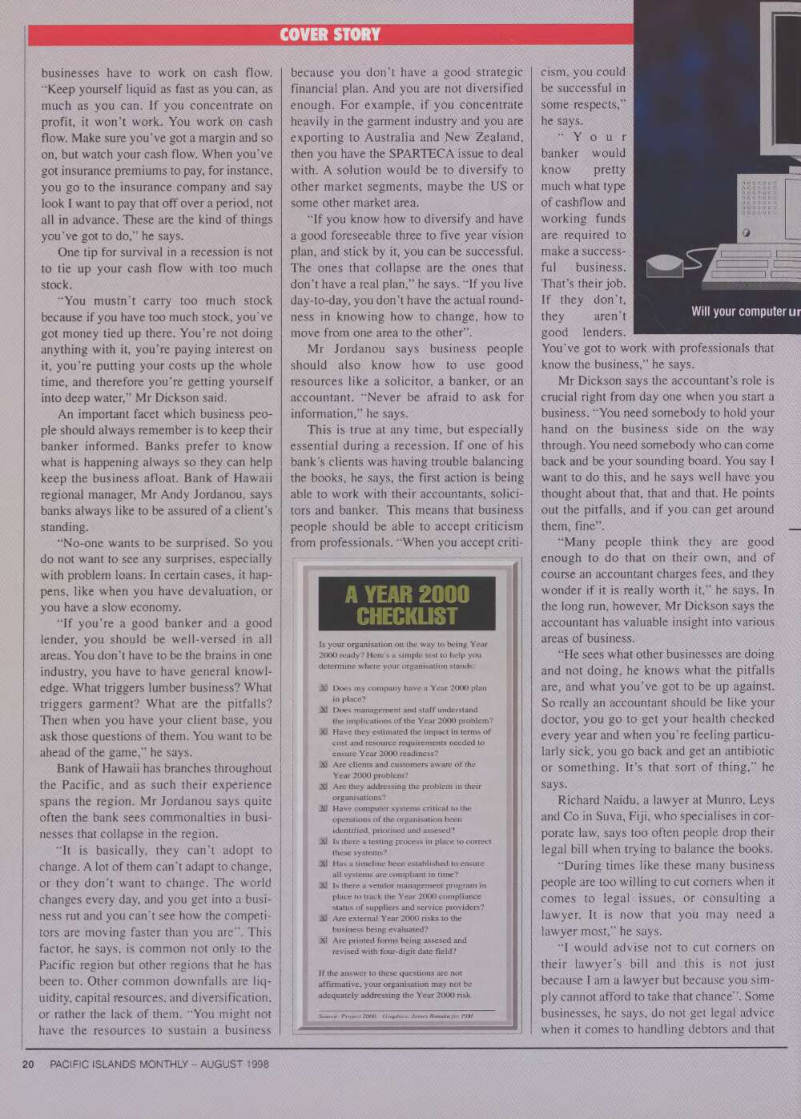
Will your computer u[?]
ends up cost ing them more in the long run.
One way to reduce your lawyer's bill, he says is to keep good records of everything that the com pany does. "It is very impor tant to leave a paper trail wherever you
go and whatever you do. This helps keep track of your business activities and gives your lawyer a good picture of where you are. It ends up costing more if you do not keep a paper trail and the lawyer has to take more time trying to get all your details together. Whatever decision you make with debtors or creditors or whatever, you should have it down on paper.
Do not accept verbal agreements,” he says. “This is really going back to basics but
it is something that I cannot emphasise enough. This applies regardless of whether the country is in a recession or not”. Mr Jordanou says consulting these profession als should help in the development of a recovery plan that shows how the business is going to get out of the problem. The most important point then, is that the business sticks to the recovery plan.
"The problem with a lot of people is that they don’t stick to the plan. They change plans mid-stream, and that's not really wise.
So you stick with the plan. If you’re suc cessful, fine,” he says. “You usually try to base it in a three-month mode. Every three months, you ask is it working? If not, what other things should I do?”
“We try to work with problem loans.
When you get into a problem mode, we have specialists that handle those. So what we try to do is to work out the safest and most expeditious game plan to move for ward to the next level. If we can succeed then it’s fine. If we can’t see the light at the end of the tunnel, we might as well call it quits now, cut your losses and move on. But we have to be the bad guys sometimes, we owe that to our depositors,” he says. Mr
Jordanou says eventually every business person has to know when to give up. "The worse thing'that people do is they don't know when to call it quits.
Okay I screwed up, I made a mistake, let's cut our losses and move on. If you pro crastinate longer and longer on it, not only do you create more credit exposure, but you have a moral and a personal problem too.
You have just got to know when to do it in,” he says.
Mr Dickson says, “Once you go to the wall, you’re gone. There’s nothing you can do, every time you take a step, it gets worse and worse”.
While this may seem like teaching the alphabet to an English professor, sadly some businesses are ignoring basic points of doing business, taking unnecessary risks and thus receivership or liquidation.
Ultimately, business success, Mr Dickson says boils down to hard work and watching the cash.
“It doesn’t come easy. If you know what you’re dealing with, then it makes it much easier to sell and collect and get the margin and turnover you’re looking for. But it real ly needs hard work,” he says. ■
[?]he turn of the century?