the 21st century bu
pp. 22-23 · Read in the full issue
Will your business the 21st century bu
By Sophie Foster Hildebrand
WITH the turn of the century just 17 months away, many big businesses in the region are well on their way in adapting their oper ations to the Y2K issue.
Big organisations are spending millions of dollars upgrading their systems to ensure that their computers recognise the date 2000.
These include banks, publishing firms, utility providers, civil aviation authorities, and governments.
Bank of Hawaii regional manager Andy Jordanou says being able to respond to changes is a sign of a good company.
"A good financial institution or any bank for that matter knows how to adapt to changes, especially this Year 2000 issue. If you haven't done anything, time has virtu ally run out. If you haven’t heard of it, it is too late. And those are the things that we try to educate people in - to know when to look for another avenue to be successful in your business,” he says.
Part of the problem with Y2K is that although these big companies may be 2000 compatible, if their suppliers or customers are not, it could still have a huge negative impact on big business.
It is for this reason that most big compa nies have informed their suppliers and cus tomers about Y2K and why they must take steps to ensure that they are compatible.
The Bank of Hawaii and Pacific Century Financial Corporation have done this through a brochure, called Project 2000, which they distribute free-of-charge to clients.
For those who do not know what Y2K is, it is commonly known as the Millennium Bug, and has seen much bad publicity of late. Most of these stories start with things
like planes will fall out of the sky, or mass chaos, but in the Pacific, where computers are still a relatively new phenomenon, and police still control traffic (in most places), it will not be as bad.
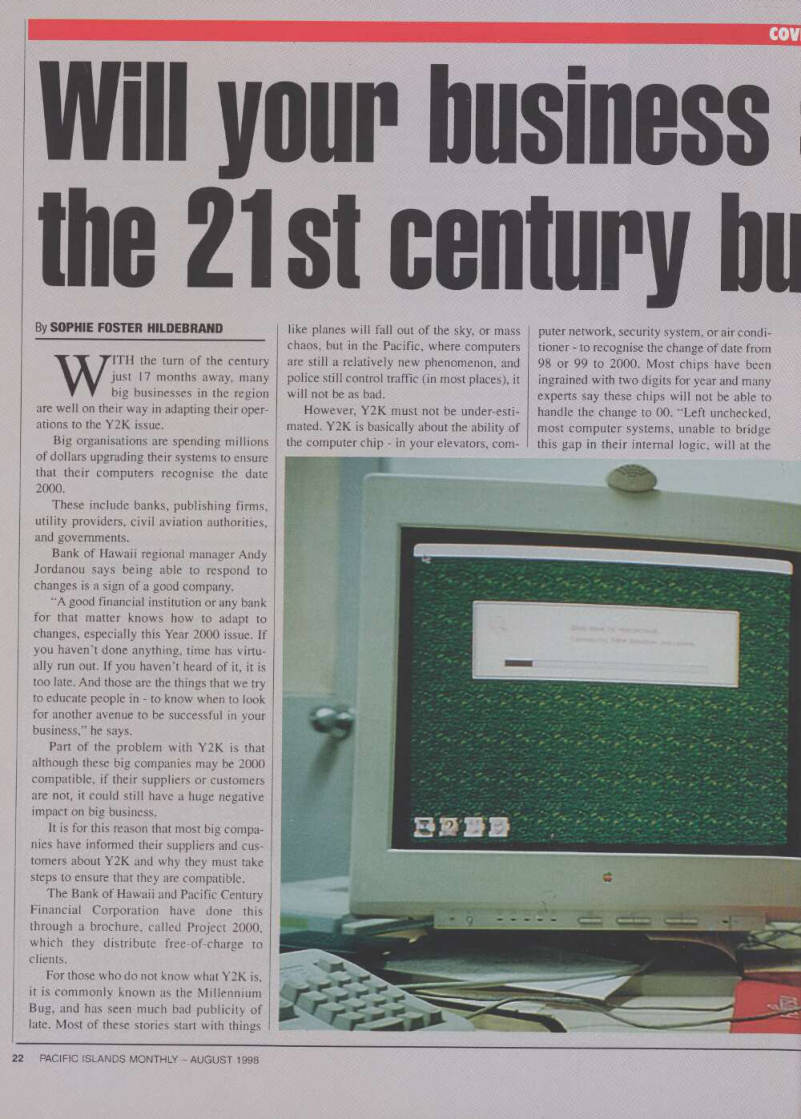
However, Y2K must not be under-esti mated. Y2K is basically about the ability of the computer chip - in your elevators, com
puter network, security system, or air condi tioner - to recognise the change of date from 98 or 99 to 2000. Most chips have been ingrained with two digits for year and many experts say these chips will not be able to handle the change to 00. "Left unchecked, most computer systems, unable to bridge this gap in their internal logic, will at the
stroke of midnight on January 1, 2000 shut down, reject new data or begin making cal culations that can create chaos within an organisation. This seemingly minor prob lem has the potential to cripple an organisa tion’s accounting, payroll and process-con trol systems, just to name a few,” Project 2000 says. The increasing awareness of the
problem was evi dent at a recent conference on Y2K in Suva, where there were about 150 regional dele gates.
Most of the businesses had already begun to act, trying to scrape together already scarce funds for the
Y2K integration
project. Some of the biggest worries for businesses that have already start ed, or are almost
completing, their
2000 compatibility
programme, is that the utilities will not work at the turn of the century.
According to Len Crick of Fiji’s Water Supply Department, bills will go out on time, and supply will be constant. The department began its programme for integration a while ago and has used
the opportunity to upgrade the whole oper ation of water rates and supply.
Fiji Electricity Authority head, Nizam
Ud-Dean says the company has had trouble with the year 2000 problem. While he says there may be trouble with the billing sys tem, supply of electricity will be constant, because FEA has incoiporated a contin gency plan to switch to manual over-ride.
This means the computer will stop con trolling the supply and workers will have to run shifts to keep supply going. The compa ny wanted to use the opportunity to upgrade their mainframe but the suppliers, Wang, have gone out of business since the corpo ration took on the equipment. This calls for a complete overhaul of the system that will not be completed until probably 2002.
Chairman of Airports Fiji Limited, Harvie Probert, says air traffic control is capable of handling the problem. The com pany, which used to be known as the Civil Aviation Authority of Fiji, took major steps to stay in line with sweeping changes in the industry world-wide. This has ensured that their equipment is 2000 compatible.
However, he says AFL still has to sort out minor problems with the support equipment such as the fire engines and cooling sys tems, but this will be complete before the turn of the century.
In the Pacific region, Fiji is probably the most prepared, utility-wise, for the year 2000. The problem that other island nations have faced is getting funds to help develop compatibility and access to expertise for the changes.
In some countries, where funds are extremely scarce, such as Samoa, the gov ernment is virtually “waiting for death”, as one bureaucrat put it. However, even if companies cannot completely overhaul their equipment, they must take steps to ensure that there are contingency plans for the turnover. In fact, firms could face huge legal costs if they do not take action because they cannot say it is a natural disaster or that they had no warning.
One firm in Japan has already been sued and lost millions because they designed a cash register system that did not recognise the year 2000 on credit or bank cards. As Project 2000 says, "The Year 2000 problem is real. It is a risk management problem that will not wait. And time is running out.
There is no silver-bullet or quick-fix solu tion on the horizon, and the deadline is not
negotiable.
Your business’s survival may depend on your decision to act now”. ■