US giant wins petrol monopoly
pp. 14-15 · Read in the full issue
Business
By Chris Peteru
THE battle for Samoa’s mil lion dollar petroleum mar ket is at an end, forcing one of the island’s two multinational suppliers out of the mar ket, crying foul.
British Petroleum is angry over a deci sion by the Government stopping them from importing fuel and related products for sup ply. They say the move to pull the plug on their 27 years operation, plus the way a fresh deal was cut with Mobil Oil, effec tively giving them a monopoly, was unfair ly done.
Finance Minister Tuipaela Malielegaoi maintains the new set up was not reached in a game played with loaded dice.
“As a result of a fair yet competitive ten dering process, an exclusive five-year con tract has been awarded to supply and dis tribute petroleum products in Samoa. This will eliminate duplication and increase effi ciency.” he told parliament.
General Manager of BP South West Pacific Craig Fullerton remains unim pressed.
“We are also very surprised that the Government has elected to make this deci sion and sign contracts without any discus sion regarding compensation for the sub stantial losses BP will incur as a result of their decision. We are extremely disappoint ed the Government is forcing us to leave the market.”
Fullerton called the legality of the Government’s actions "questionable” and said it was likely to have a detrimental effect on the administration’s credibility in the commercial world.
"In that environment we really have no choice but to close our doors. We still do not know what the Government intends to do about our assets but we hope they will sit down with us soon to agree on some com pensation”.
The company wants compensation, cit ing a broken contract to provide aviation fuel for national carrier Polynesian Airlines that was meant to have run to the end of
next year. Petroleum sup plies for six service station outlets in and around the capital have also been with drawn and a dozen jobs at the company’s tank farm and office will be lost.
Heavily dependent on petroleum products to run up to four diesel operated power stations and other services, Samoa imports around 52 million litres of fuel a year.
BP was providing 18 million litres of that amount, that both companies sold through the pumps at US 35 cents a litre. For the last financial year those miner als cost the country
US$ 17.72 m dollars, making
up 10 per cent of the total amount of overseas goods.
Ironically in an econom ic climate geared towards competition and consumer choice, Malielegaoi is adamant the move to monopolise the business is the right one. ‘The objective is to
obtain economies of scale in supply and dis tribution. Substantial foreign exchange earnings will be generated ... which will benefit the Government in terms of revenue ... and the public in terms of more competi tive prices and better service.” he said.
But how competitive prices and better service can be improved by giving Mobil zero opposition, and the public the same number of alternatives is difficult to under stand.
Within days of Malilegaoi's announce ment, the Government pushed for a 4 cent per litre levy on petrol to part-finance a soon as to be built city lease complex.
But the writing could have been on the wall for BP following an incident four years ago. For five days petrol rationing was forced on the country when BP refused to
dock a tanker, later indicating the Government was stalling on payments of a huge aviation fuel bill for Polynesian Airlines. At the time the airline was reeling from a self inflicted USs4sm financial dis aster.
Even so, insiders on the negotiations maintain Fullerton’s version of events does n’t tell the full picture.
"We all know BP, along with four other tenderers, knew of the situation as early as last year. They had plenty of time to put something on the table to counter Mobil's bid, but didn't.” says a Trade, Commerce and Industry official.
"The contract is for five years, then those who wish to may tender again,” added Malielegaoi. Talks between BP and the Government about settling any financial
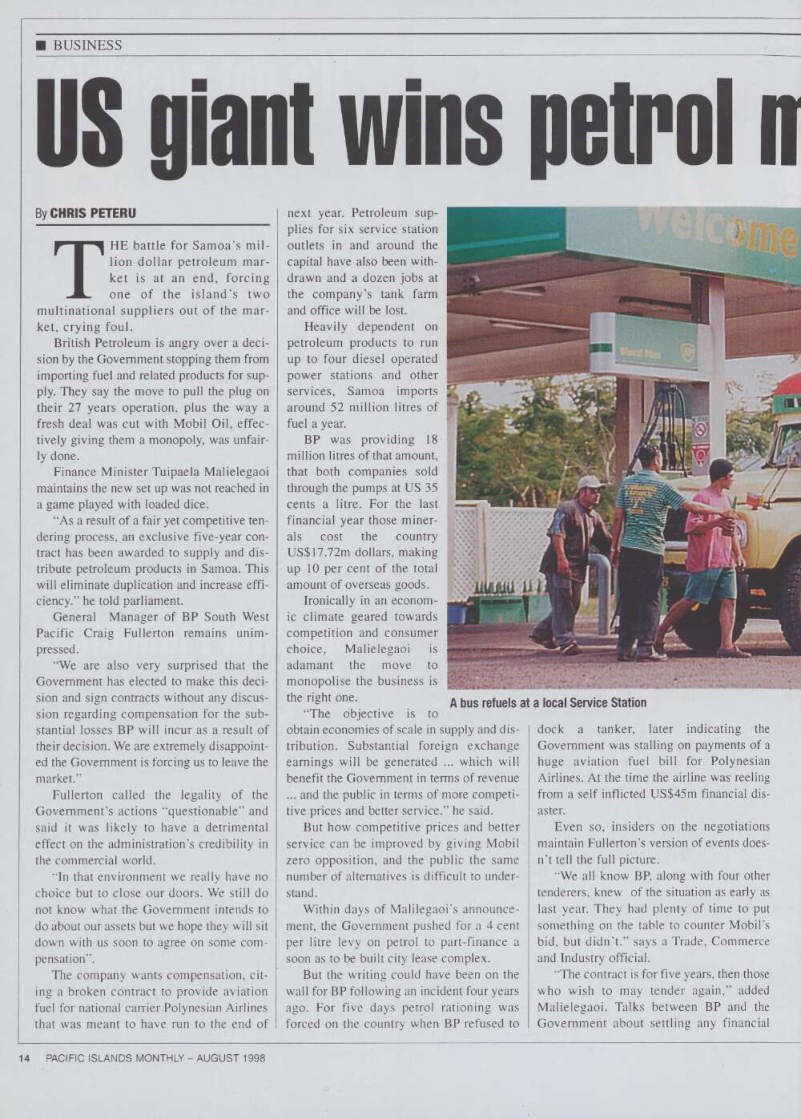
A bus refuels at a local Service Station
settlement have yet to be made public.
Meanwhile US based Mobil Oil, is predictably happy to have been given the keys to every petrol tank in the country.
General manager for the South West Pacific, David Robinson, says the Government has stressed the importance of security of supply. Its tank farm at Sogi will be upgraded and expanded.
Capital investments in several projects during the next few years have been promised.
"We look forward to working closely with the Samoan Government and BP to ensure a smooth transition for the people of Samoa.”
But as far as British Petroleum is con cerned there is still just a little unfinished business. ■