A bitter pill to swallow
p. 23 · Read in the full issue
By Ofani Eremae
WHEN the new Solomon Islands Alliance for Change (SIAC) government came into power in August last year, one of its stated policies was to review the legislation governing gaming and lotteries, and all licences issued to casino operators.
Eight months later after surviving its first motion of no-confidence last month, the SIAC government announced the much-awaited news. It will not renew the licences issued to the three casinos current ly operating in the capital Honiara, when their licences expired on April 7, 1999. The announcement, though coming as a shock to the casino operators, was welcomed by many, particularly the Solomon Islands Christian Association (SICAj - a staunch opponent to the Casino Industry.
Announcing the government’s decision of the future of the Casino Industry, minister of home Affairs, Rev. Leslie Boseto said: “let me put it in no uncertain terms that no new licences will be issued as of April 7 next year”. Additionally, he is due to intro duce a bill to parliament later this year to review the Gaming and Lotteries Industry, with the view to reflect the SIAC govern ment’s policy whereby casinos will be
totally prohibited in the Solomon Islands.
“From then on, the full thrust of the SIAC government’s belief on gaming and lotteries will come into effect,” Rev.
Boseto, a retired Bishop of the United Church said. In its statement of policies, the SIAC government views the establish ment of casinos in the Solomon Islands as a misguided policy that breeds indolence and greed. “Casinos in the context of Solomon Islands can never be accepted as a genuine investment. Its approval as such is therefore deplorable. Genuine invest
ment must have as its basic objec tive the improvement of the wel fare of Solomon Islanders.
“Casinos do the opposite.
They create social prob lems, breed indolence, corruption and greed,” the SIAC
government says in its policy statement. It said Solomon Islanders are encouraged under successive governments’ develop ment programmes to actively participate in economic activities under the concept of entrepreneurship. "But this is watered down by the perception of quick money in casinos and Solomon Islanders are mould ed to become lazy and greedy. The escalat ing family problems and related social implications are clear evidence of a society that is systematically deteriorating by gov ernment initiated policy,” it said.
Rev. Boseto says that under the SIAC government’s policy, there will be no com mercial casinos operated either in public or private clubs and hotels. “The only excep tion will be state lotteries and games of chance for charitable purposes,” he said.
The first public casino came into operation in August 1994, when foreign-owned Honiara Casino was granted its casino
licence. Besides that, it was also given a five-year tax holiday and duty exemptions by the then Minister for Finance, Christopher Columbus Abe.
Before the first public casino came into operation, a Chinese-owned private club, the Super Club, had been operating a gam ing business, but only for members of the club. It was only after the introduction of the first public casino that the negative effects of casinos were felt in Honiara.
A couple of months later, the Gaming and Lotteries Board granted another casino licence to the owner of Super Club, Patrick Leong, a naturalised Solomon Islands citi zen, to operate the second public casino in Honiara. He named it Solomon Casino.
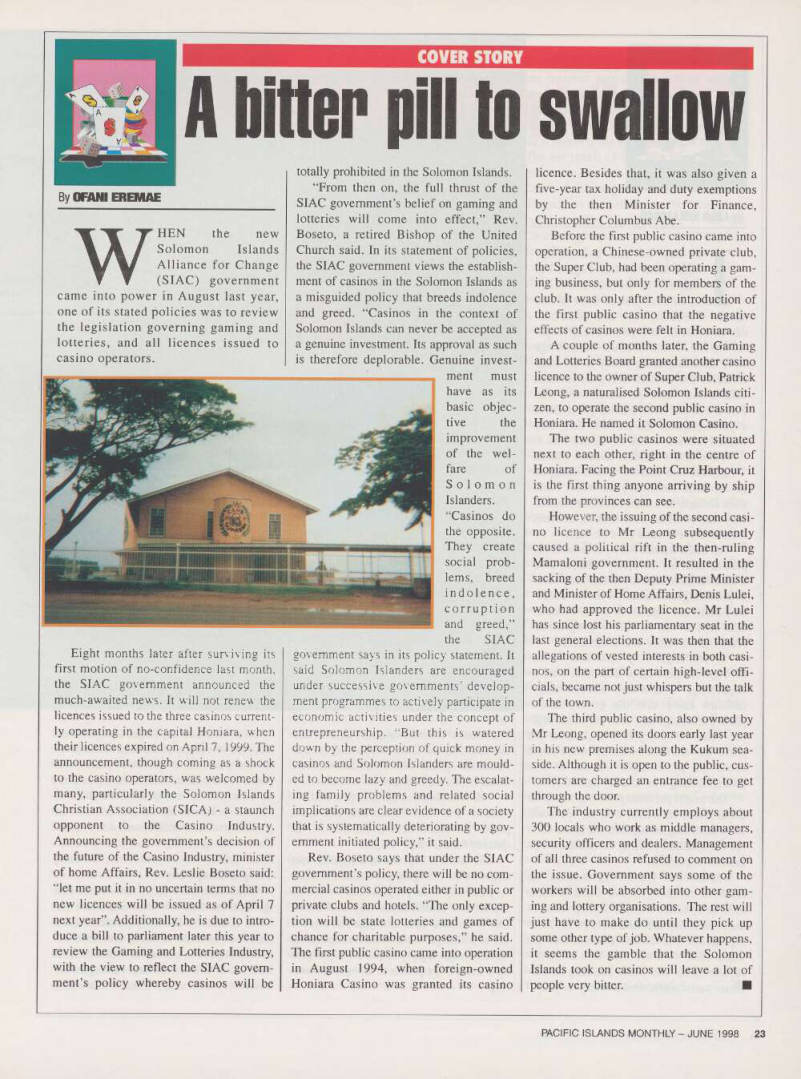
The two public casinos were situated next to each other, right in the centre of Honiara. Facing the Point Cruz Harbour, it is the first thing anyone arriving by ship from the provinces can see.
However, the issuing of the second casi no licence to Mr Leong subsequently caused a political rift in the then-ruling Mamaloni government. It resulted in the sacking of the then Deputy Prime Minister and Minister of Home Affairs, Denis Lulei, who had approved the licence. Mr Lulei has since lost his parliamentary seat in the last general elections. It was then that the allegations of vested interests in both casi nos, on the part of certain high-level offi cials, became not just whispers but the talk of the town.
The third public casino, also owned by Mr Leong, opened its doors early last year in his new premises along the Kukum sea side. Although it is open to the public, cus tomers are charged an entrance fee to get through the door.
The industry currently employs about 300 locals who work as middle managers, security officers and dealers. Management of all three casinos refused to comment on the issue. Government says some of the workers will be absorbed into other gam ing and lottery organisations. The rest will just have to make do until they pick up some other type of job. Whatever happens, it seems the gamble that the Solomon Islands took on casinos will leave a lot of people very bitter. ■