Net profit: cooking up a storm
pp. 24-25 · Read in the full issue
By Lisa Williams
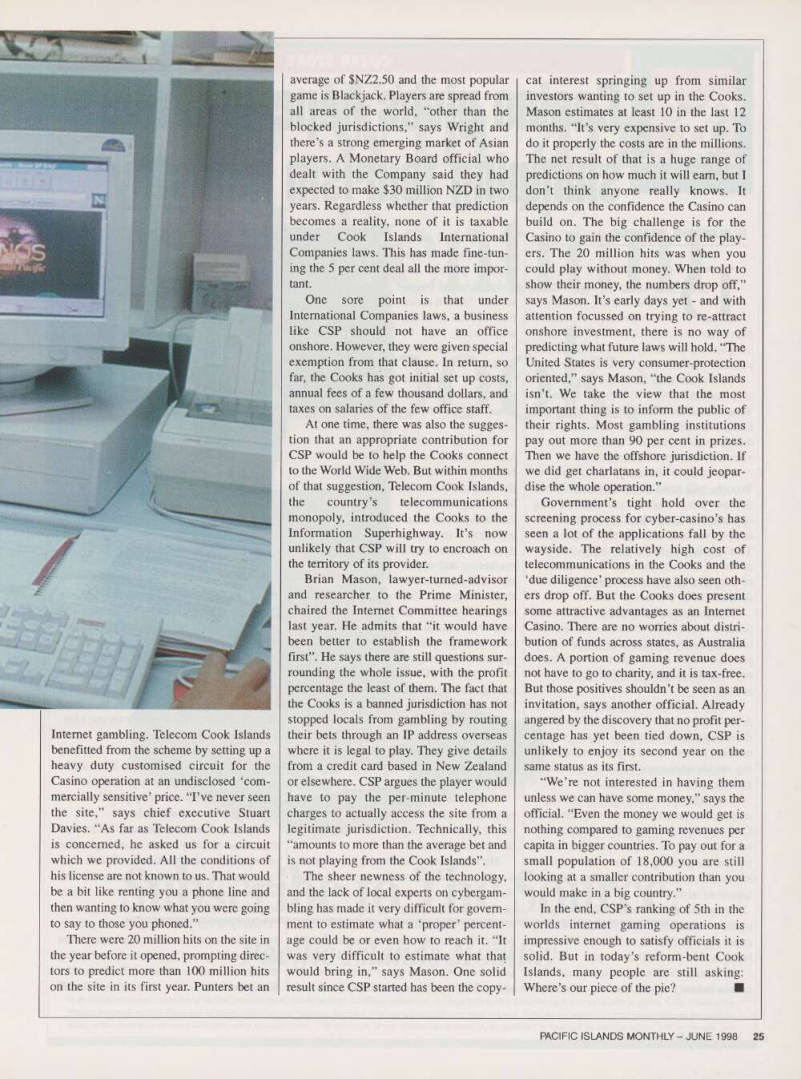
It may be the cyberspace equivalent of Las Vegas, but Casinos of the South Pacific is an anonymous little office behind a security lock in a quiet cor ner of Avarua, the commercial capi tal of the Cook Islands. And things were humming along nicely in the busy office of the world’s first ever Internet Casino until someone remembered that CSP owed the Cook Islands government a percentage of the profits. And they wanted to know where the money was.
While CSP’s resident director Darren Wright realises that for a cash-strapped government, the money can never come soon enough, he’s open about the reasons why the worlds fifth-ranked Internet Casino is yet to hand over the cash.
The audit reports have yet to be com pleted, and his company auditor also works for government - notoriously slow in providing accountants with the neces sary facts and figures. In a few months, CSP says it will be able to progress to fixed figures rather than projections.
“Everything’s very open and we’ve kept government up to date with what’s happening,” Wright says. But not many officials know that the government’s profit percentage had been projected at 5 per cent. “Nothing is final,” said one senior government executive when asked about the percentage. “As far as I’m aware, nothing was actually agreed upon.”
The profit percentage is big news for Cook Island residents, who are restricted from gambling on the net, but could soon see extra dollars pouring in for Health and
Education projects.
The Internet Casino registered as an offshore company in the Cook Islands, then set up office onshore to keep ahead of the competition and hold on to its sth rank ing against 108 current Internet Casinos worldwide. “We were the first to do it,” says Wright, “and we’re building on cus tomer satisfaction and honesty of play.”
The Cooks’ Casino competes against oth ers based in the Carribean, Antigua, and Mauritius - places where the same offshore status is offered to entice investment.
“We checked the jurisdiction and we liked it - the Cook Islands was one of six places we could have gone, and it was quicker for us,” says Wright.
CSP work is kept out of the public eye, and with the changing government attitude
to gambling following Housie or Bingo
nights, low-profile is the way CSP would like to remain. Talks last year have yet to see any change in the offshore legislation which would legally require CSP to give up a share of its profits to its host commu nity.
As it was, CSP approached government last year offering a percentage of the prof its, and government is keen to score some points on this investment. There was pub lic outcry after it was revealed that the Monetary Board, an investment arm of government, had initially asked few ques tions when granting the company exten sive protection under its Offshore
Companies legislation.
That led to an official admittance that the benefits had not been tied down for Cook Islanders. The only concern at the time seemed to be ensuring that residents could not gamble on the net with the Prime Minister’s Office running a comprehen sive review of the implications of running
internet gambling. Telecom Cook Islands benefitted from the scheme by setting up a heavy duty customised circuit for the Casino operation at an undisclosed ‘com mercially sensitive’ price. “I’ve never seen the site,” says chief executive Stuart Davies. “As far as Telecom Cook Islands is concerned, he asked us for a circuit which we provided. All the conditions of his license are not known to us. That would be a bit like renting you a phone line and then wanting to know what you were going to say to those you phoned.”
There were 20 million hits on the site in the year before it opened, prompting direc tors to predict more than 100 million hits on the site in its first year. Punters bet an
average of SNZ2.SO and the most popular game is Blackjack. Players are spread from all areas of the world, “other than the blocked jurisdictions,” says Wright and there’s a strong emerging market of Asian players. A Monetary Board official who dealt with the Company said they had expected to make $3O million NZD in two years. Regardless whether that prediction becomes a reality, none of it is taxable under Cook Islands International Companies laws. This has made fine-tun ing the 5 per cent deal all the more impor tant.
One sore point is that under International Companies laws, a business like CSP should not have an office onshore. However, they were given special exemption from that clause. In return, so far, the Cooks has got initial set up costs, annual fees of a few thousand dollars, and taxes on salaries of the few office staff.
At one time, there was also the sugges tion that an appropriate contribution for CSP would be to help the Cooks connect to the World Wide Web. But within months of that suggestion, Telecom Cook Islands, the country’s telecommunications monopoly, introduced the Cooks to the Information Superhighway. It’s now unlikely that CSP will try to encroach on the territory of its provider.
Brian Mason, lawyer-turned-advisor and researcher to the Prime Minister, chaired the Internet Committee hearings last year. He admits that “it would have been better to establish the framework first”. He says there are still questions sur rounding the whole issue, with the profit percentage the least of them. The fact that the Cooks is a banned jurisdiction has not stopped locals from gambling by routing their bets through an IP address overseas where it is legal to play. They give details from a credit card based in New Zealand or elsewhere. CSP argues the player would have to pay the per-minute telephone charges to actually access the site from a
legitimate jurisdiction. Technically, this
“amounts to more than the average bet and is not playing from the Cook Islands”.
The sheer newness of the technology, and the lack of local experts on cybergam bling has made it very difficult for govern ment to estimate what a ‘proper’ percent age could be or even how to reach it. “It was very difficult to estimate what that would bring in,” says Mason. One solid result since CSP started has been the copy
cat interest springing up from similar investors wanting to set up in the Cooks.
Mason estimates at least 10 in the last 12 months. “It’s very expensive to set up. To do it properly the costs are in the millions.
The net result of that is a huge range of predictions on how much it will earn, but I don’t think anyone really knows. It depends on the confidence the Casino can build on. The big challenge is for the Casino to gain the confidence of the play ers. The 20 million hits was when you could play without money. When told to show their money, the numbers drop off,” says Mason. It’s early days yet - and with attention focussed on trying to re-attract onshore investment, there is no way of predicting what future laws will hold. “The United States is very consumer-protection oriented,” says Mason, “the Cook Islands isn’t. We take the view that the most important thing is to inform the public of their rights. Most gambling institutions pay out more than 90 per cent in prizes.
Then we have the offshore jurisdiction. If we did get charlatans in, it could jeopar dise the whole operation.”
Government’s tight hold over the screening process for cyber-casino’s has seen a lot of the applications fall by the wayside. The relatively high cost of telecommunications in the Cooks and the ‘due diligence’ process have also seen oth ers drop off. But the Cooks does present some attractive advantages as an Internet Casino. There are no worries about distri bution of funds across states, as Australia does. A portion of gaming revenue does not have to go to charity, and it is tax-free.
But those positives shouldn’t be seen as an invitation, says another official. Already angered by the discovery that no profit per centage has yet been tied down, CSP is unlikely to enjoy its second year on the same status as its first.
“We’re not interested in having them unless we can have some money,” says the official. “Even the money we would get is
nothing compared to gaming revenues per
capita in bigger countries. To pay out for a small population of 18,000 you are still looking at a smaller contribution than you would make in a big country.”
In the end, CSP’s ranking of sth in the worlds internet gaming operations is impressive enough to satisfy officials it is solid. But in today’s reform-bent Cook Islands, many people are still asking: Where’s our piece of the pie? ■