Profit or paupers? The PNG dilemma
p. 22 · Read in the full issue
By Neville Choi
THE introduction of poker machines to Papua New Guinea caused an uproar throughout the nation and resulted in heated debates between those who foresaw its adverse social effects and those who saw the intro duction as the answer to their econom ic woes. The country’s waning economic situation at the time convinced many of the country’s 109 parliamentary members to vote for a parliamentary bill to introduce poker machines into the country.
In 1994, the gaming bill was passed by parliament with only five members voting against it. The mover of the bill was David Unagi, the sitting member of an electorate in the National Capital District. Mr Unagi, when he later became minister for Home, Youth and Religion, publicly apologised for moving the bill and admitted that gam ing machines were having an adverse
impact on society.
Following the introduction of gaming machines into the country, provincial gov ernments took advantage of the organic law which gave the power of gambling to them. To date only six of the 20 provinces in the country have not allowed poker machines to be introduced to their provinces. Now, some of the provinces which allowed gaming machines entry to their provinces are regretting their deci sion, and many more are proposing ways of eradicating the machines.
But despite their efforts, the gaming machine industry continues to prosper with more and more gaming sites being estab lished. As of March this year, a total of 110 gaming sites were recorded throughout the country. At present there are only three operators of gaming machines in the coun try. These are: Monian Group Pty Ltd, Pacific Corporation and Lord and Co.
Since being introduced, gaming
machines have contributed substantially to the economies of the 14 provinces which have them. For the first three months of 1997, gaming machine profits to the provinces totalled over K 1.7 million. The
profits, announced by then finance minister, Chris Haiveta, were described as being received by the 14 provinces “without any costs whatsoever” and he added that they were not to be used for “adminis trative overheads”.
Instead they were meant to develop the community in areas such as health services, youth train ing and development, and for “those who are less privileged and handicapped”. Since then, the gov ernment has increased taxes on gaming machine profits from 20 to 30 per cent. When announced in the 1998 budget, the three major opera tors and the PNG National Gaming Association expressed outrage at the tax increase.
They said the gaming industry was barely reaping in enough profit to keep the industry on its feet.
Their reasoning was that, with the
increase, the only people who would be directly affected were the operators them selves and not the punters, whose winnings would not be affected. The Gaming Association warned that further tax hikes would eventually “annihilate” the industry, predicting the closure of more gaming sites.
But this has not deterred the punters from “trying their luck” for some easy cash. Currently there is no particular law which governs the type of people who are allowed to play poker machines. Punters range from the ordinary betelnut seller to politicians and big businessmen - the latter group making up the majority of punters at
gaming venues. Only recently, the gover
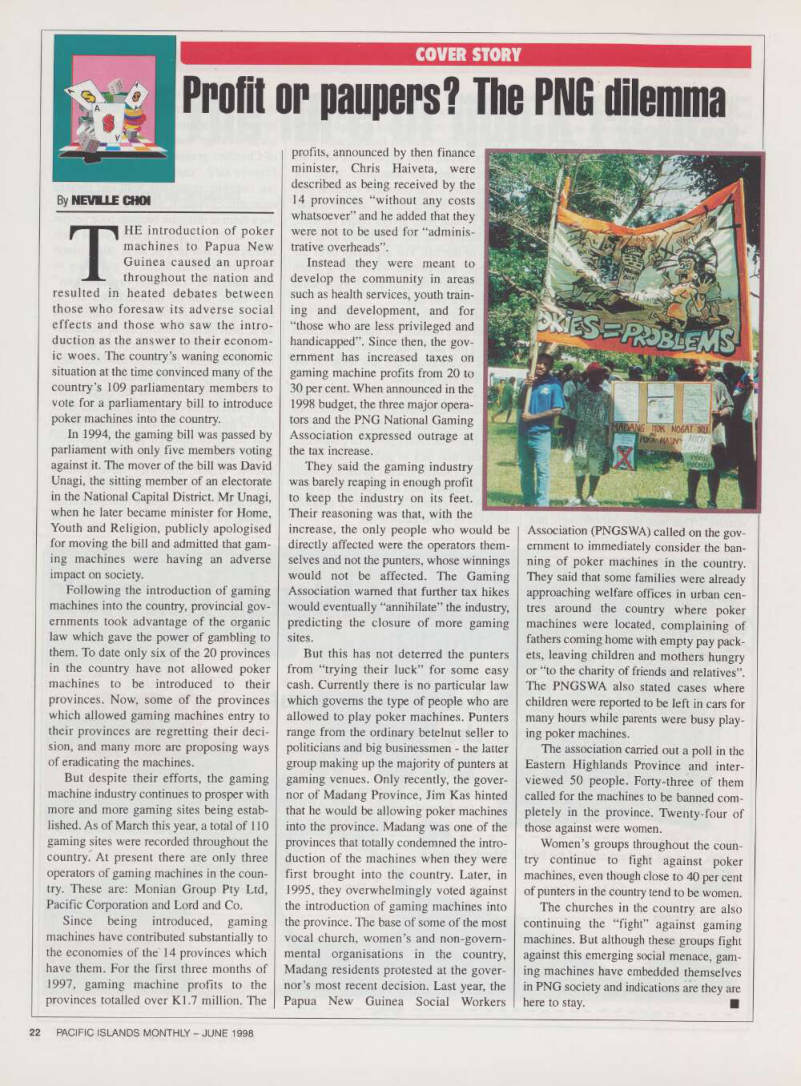
nor of Madang Province, Jim Kas hinted that he would be allowing poker machines into the province. Madang was one of the provinces that totally condemned the intro duction of the machines when they were first brought into the country. Later, in 1995, they overwhelmingly voted against the introduction of gaming machines into the province. The base of some of the most vocal church, women’s and non-govem mental organisations in the country, Madang residents protested at the gover nor’s most recent decision. Last year, the Papua New Guinea Social Workers
Association (PNGSWA) called on the gov ernment to immediately consider the ban ning of poker machines in the country.
They said that some families were already approaching welfare offices in urban cen tres around the country where poker machines were located, complaining of fathers coming home with empty pay pack ets, leaving children and mothers hungry or ‘"to the charity of friends and relatives”.
The PNGSWA also stated cases where children were reported to be left in cars for many hours while parents were busy play ing poker machines.
The association carried out a poll in the Eastern Highlands Province and inter viewed 50 people. Forty-three of them called for the machines to be banned com
pletely in the province. Twenty-four of
those against were women.
Women’s groups throughout the coun try continue to fight against poker machines, even though close to 40 per cent of punters in the country tend to be women.
The churches in the country are also
continuing the “fight” against gaming
machines. But although these groups fight against this emerging social menace, gam ing machines have embedded themselves in PNG society and indications are they are here to stay. ■