The lure of quick riches
pp. 20-21 · Read in the full issue
Cover Story
By Sophie Foster Hildebrand
According to the Oxford English dictio nary, to gamble is to “play games of chance for money; take great risks for the chance of winning something or mak ing a profit”. In the Pacific, where most people barely make enough money to stay above the poverty line, gambling, or gaming as some govern ments prefer to call it, has taken hold in a big way. The Pacific experience with gambling though is almost as wide as the ocean itself. While some Pacific countries have outlawed gaming after only a few years of running it, others have embraced it as the new saviour in the war to win the tourist dollar. In Micronesia, in the north ern Pacific, the Marianas island of Tinian,
off Saipan has only recently witnessed the opening of a casino while the neighbour ing Marshall Islands law-making body, the Nitijela, has outlawed such activities after two years of condoning it.
In Melanesia, the Solomon Islands has passed a law which will see casinos thrown out by 1999. Fiji, which had been serious ly contemplating its introduction, recently rejected a proposal for casinos in the coun try. In rejecting casinos, Prime Minister Sitiveni Rabuka said “in any case, our hotel industry has developed and is so far operating without any demands for licences”.
Of all the Pacific Island States to grap ple with the touchy issue of gambling though, the Papua New Guinea experience is one that is sobering. There, gambling, in the form of casinos and slot-machines, is seen by locals and visitors alike as almost a curse on the population. Professionals
often find themselves in debt because of it and most find it hard to kick the habit.
Indeed, gambling is an addictive activi ty. One Port Moresby local said, “I have only just managed to get off it. I don’t ever want to go into a casino again”.
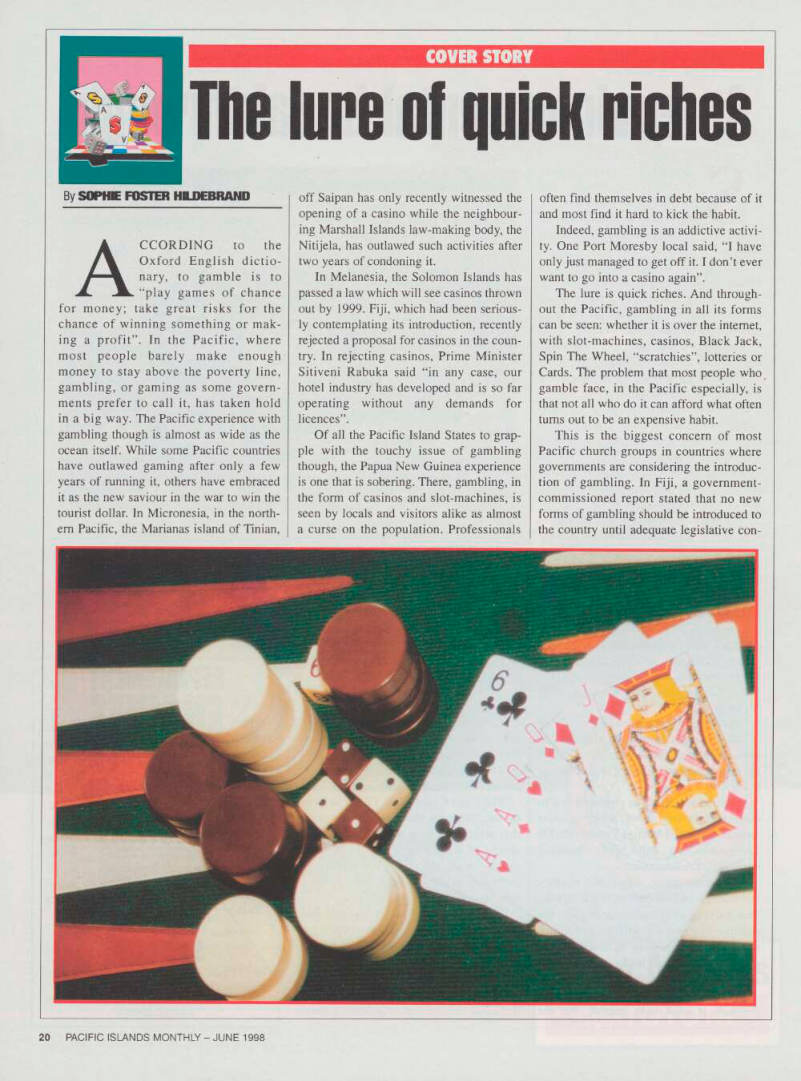
The lure is quick riches. And through out the Pacific, gambling in all its forms can be seen: whether it is over the internet, with slot-machines, casinos, Black Jack, Spin The Wheel, “scratchies”, lotteries or Cards. The problem that most people who gamble face, in the Pacific especially, is that not all who do it can afford what often turns out to be an expensive habit.
This is the biggest concern of most Pacific church groups in countries where governments are considering the introduc tion of gambling. In Fiji, a government commissioned report stated that no new forms of gambling should be introduced to the country until adequate legislative con-
trols were in place and further research had been done. Mr Rabuka said however, “allowing casino operations would be detrimental to low income and other vul nerable groups, particularly if entry into casinos were not restricted”. President of the powerful Methodist Church, Reverend Doctor Ilaitia Tuwere, said gambling appeared to be a device used to evade, rather than face, national responsibilities.
“The Methodist Church hopes the gov ernment of the day will think carefully and responsibly before reaching a decision,” he said. It was in the face of all this that the Fiji Government late last month rejected the introduction of casino operations in the country. Even now, the relevant authorities in Fiji are powerless to control the spread of the illegal slot-machines, or one-armed bandits as they are commonly referred to.
One Suva club had the machines installed amid uproar from the Solicitor-General’s Office. At the time, the SG, Nainendra Nand, said “just because there is no legis lation covering it does not mean that peo ple are allowed to operate them. There has to be legislation in place for the industry to operate”. That was nine months ago, and
the bar is still running the machines, evad ing both police and Customs investigations into how the machines got through securi ty checks. The Customs Investigation died a quick death, with department officials accepting that the machines were for “amusement”. The company’s reason was that the one-armed bandits had been con verted so that only tokens could be used, and winnings are redeemable for food and drinks at the bar. The argument over the “gamble” that people were taking when using the machines was swept away amid bureaucratic red tape.
With most other Pacific countries like the Solomon Islands, the Marshalls Islands had said that gambling would be controlled so that locals could not just walk off the street and into a casino.
However, as both the Solomon and Marshallese experiences show, restrictions are not always enforceable, and most casi nos will not turn away potential customers.
It was that lack of enforcement which prompted church officials in the Marshalls and concerned locals to stage protests until the Nitijela eventually came to a majority decision to throw casinos out.
In the Solomons, it was the government that took the initiative to ban casinos which by their own admission were causing more social damage than benefits. Fiji Council of Churches general secreatary Sister Emi Frances said, “casinos have always been our concern, especially with our present economic climate. It would a risk to intro duce them at this time because poor people want to get rich quickly and put all their money in”. But in Fiji, as in other island countries, various forms of gambling to raise funds for “charitable organisations” still exist. Church organisations do it, sporting bodies do it, school committees do it, provincial councils do it. In Samoa and Fiji, a percentage of the profit made by the international Tattslotto has been used
to improve sporting facilities.
There is no doubt that the biggest lure for governments considering the introduc tion of gaming is that their revenue coffers will be filled through gaming licences, import duties and other taxes. But as some Pacific Island countries have bitterly found, sometimes the social cost is much more than the lure of quick riches can com pensate for. ■