An environmental breakthrough
p. 19 · Read in the full issue
Motoring Feature
Since its founding, Toyota
Motor Corporation has conducted its many diverse activities with the motto:
“enriching society through our auto
mobiles”.
Through its outlet, Asco Motors in Nabua, outside Suva, the company contin ues to provide attractive, timely products that meet customer needs and offer a luxu rious lifestyle to customers in Fiji.
Conducting fair, open business prac tices has always been an important part of their efforts to develop environmentally friendly, safe automobiles.
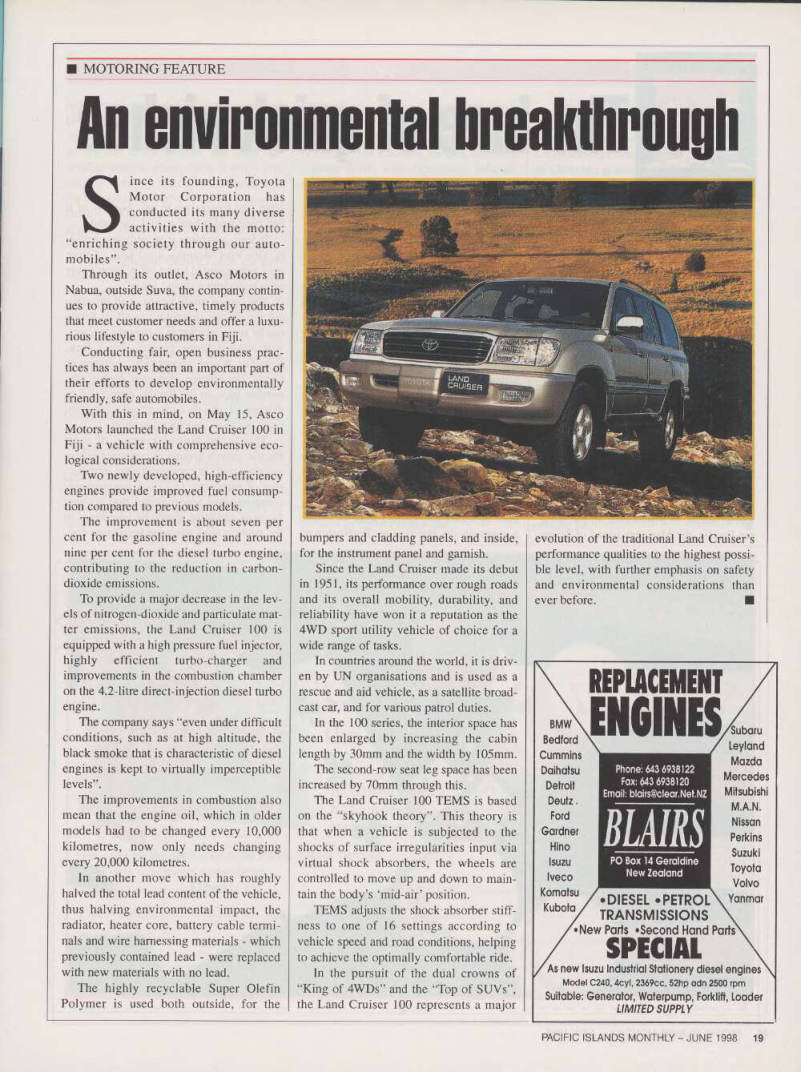
With this in mind, on May 15, Asco Motors launched the Land Cruiser 100 in Fiji - a vehicle with comprehensive eco logical considerations.
Two newly developed, high-efficiency engines provide improved fuel consump tion compared to previous models.
The improvement is about seven per cent for the gasoline engine and around nine per cent for the diesel turbo engine, contributing to the reduction in carbon dioxide emissions.
To provide a major decrease in the lev els of nitrogen-dioxide and particulate mat ter emissions, the Land Cruiser 100 is equipped with a high pressure fuel injector, highly efficient turbo-charger and improvements in the combustion chamber on the 4.2-litre direct-injection diesel turbo engine.
The company says “even under difficult conditions, such as at high altitude, the black smoke that is characteristic of diesel engines is kept to virtually imperceptible levels”.
The improvements in combustion also mean that the engine oil, which in older models had to be changed every 10,000 kilometres, now only needs changing every 20,000 kilometres.
In another move which has roughly halved the total lead content of the vehicle, thus halving environmental impact, the radiator, heater core, battery cable termi nals and wire harnessing materials - which previously contained lead - were replaced with new materials with no lead.
The highly recyclable Super Olefin Polymer is used both outside, for the
bumpers and cladding panels, and inside, for the instrument panel and garnish.
Since the Land Cruiser made its debut in 1951, its performance over rough roads and its overall mobility, durability, and reliability have won it a reputation as the 4WD sport utility vehicle of choice for a wide range of tasks.
In countries around the world, it is driv en by UN organisations and is used as a rescue and aid vehicle, as a satellite broad cast car, and for various patrol duties.
In the 100 series, the interior space has been enlarged by increasing the cabin length by 30mm and the width by 105 mm.
The second-row seat leg space has been increased by 70mm through this.
The Land Cruiser 100 TEMS is based on the “skyhook theory”. This theory is that when a vehicle is subjected to the shocks of surface irregularities input via virtual shock absorbers, the wheels are controlled to move up and down to main tain the body’s ‘mid-air’ position.
TEMS adjusts the shock absorber stiff ness to one of 16 settings according to vehicle speed and road conditions, helping to achieve the optimally comfortable ride.
In the pursuit of the dual crowns of “King of 4WDs” and the “Top of SUVs”, the Land Cruiser 100 represents a major
evolution of the traditional Land Cruiser’s performance qualities to the highest possi ble level, with further emphasis on safety and environmental considerations than ever before. ■