Sea Launch, we have lift-off
pp. 16-17 · Read in the full issue
Aerospace
By Michael Field
The world’s biggest
aerospace company is on target for an ambitious mid-sea rocket launching programme which seems set to dump tonnes of space hardware and fuel right in the middle of the Pacific Ocean.
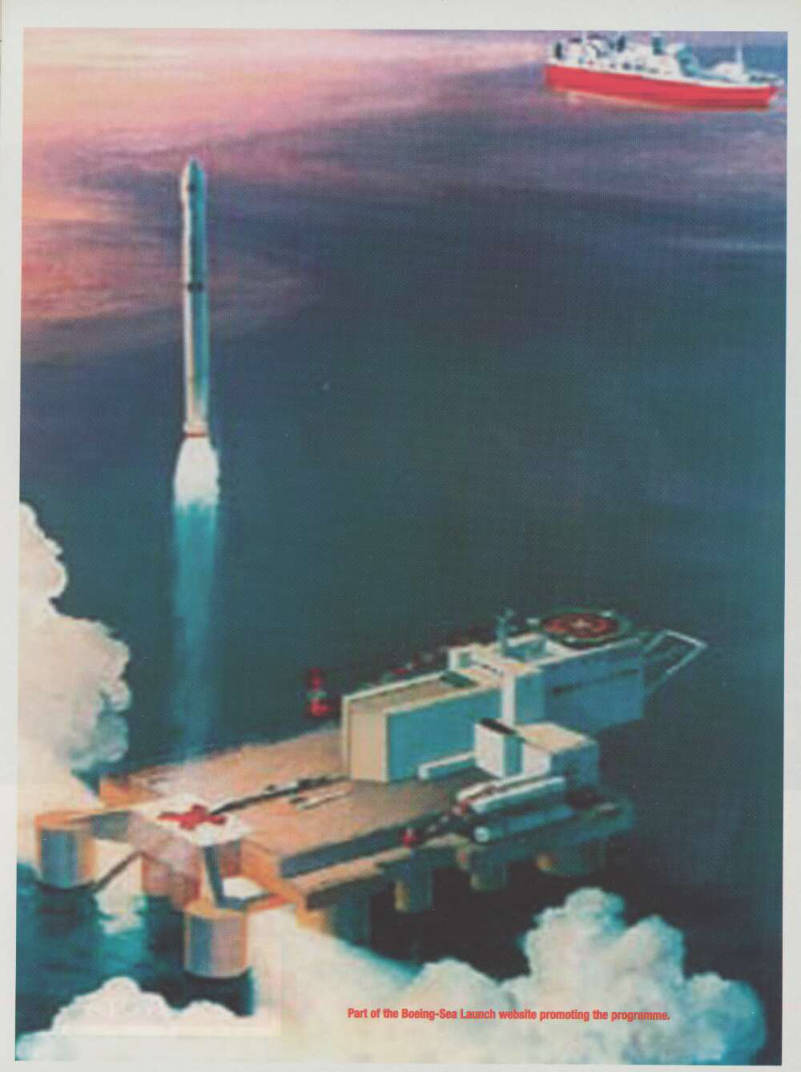
Sea Launch Ltd, a joint venture involv ing Boeing Commercial Space Company and companies from Russia, Ukraine and Norway and registered in the Cayman Islands, will use a modified North Sea oil drilling platform from the Equator at longi tude 154 West, 800 kilometres (500 miles) south-east of Kiritimati Atoll in Kiribati.
The company has a purpose built com mand ship and will use Ukrainian and Russian rockets to launch satellites into geostationary orbit for commercial cus tomers. The first of 18 firm launches sold to date, at SUS4O million apiece, will see a Galaxy XI satellite for PanAmSat launched in October.
The Equatorial launch site ensures a geostationary rocket needs little manoeu vring to reach the desired orbit.
By picking international waters it may also be that Boeing and Sea Launch are trying to escape close environmental
scrutiny.
In the late 1950 s Britain tested nuclear bombs at Kiritimati causing devastation to the wildlife and now the Apia based 22nation South Pacific Regional Environment Programme (SPREP) fears Sea Launch will harm migratory birds and turtles, dump tonnes of carbon monoxide (CO) in the troposphere and create kerosene slicks on the water.
SPREP is also worried at the human safety considerations with many small fishing boats in the area.
Sea Launch produced an Environmental Impact Assessment (EIA) which was last month submitted to the United States Federal Aviation Agency (FAA). The FAA believe the launchings would have no sig nificant environmental impact and were ready to give it the go-ahead.
SPREP had just two weeks between receiving the big EIA and May 22 when they could make a submission calling for an Environmental Impact Statement, a more complex process which would have delayed the launch and allowed for a more detailed look. Although Sea Launch has spent millions over three years on its pro gramme, it appears unusual that it man aged to squeeze its environmental consent process into little more than a month.
SPREP had no chance to consult all its member states.
The EIA says approximately 44,700 kilograms of liquid oxygen and 17,000 kilograms of kerosene would be burned below 2,000 metres. Approximately 36,100 kilograms of CO would be pro duced. Each launch will produce a kerosene slick several kilometres wide as about 4.5 tons of kerosene fall unbumt on the way down. The first and second stages of the rockets, containing residual fuels, would also fall into the Pacific.
A preliminary SPREP assessment noted the launch site is in the vicinity of a signif icant migratory fly-way associated with the enormous bird rookeries at Kiritimati Island. It is also home to marine turtles.
There is also the question of what the noise would do. Sea Launch said its rock ets would produce 150 decibels at 378 meters, and a predicted 75 decibels in the water at the same distance.
It is not known what effect this would have.
SPREP marine pollution adviser Steve Raaymakers in a preliminary assessment circulated to member states said the ElA’s description on the marine environment on the launch site was “entirely inadequate”.
“Significant inferences have been made from extremely limited data,” he said, and added full baseline studies of all trophic levels over a range of seasons should be conducted at the site to provide a true pic ture of the ecological value and biological productivity of the area.
He said when Boeing found an absence of data they concluded that the marine life values were low and impacts negligible.
The idea of letting the rocket stages just
sink into the Pacific was “contrary to best practice environmental management”.
“Regardless of real or perceived envi ronmental impacts caused or not caused by such activities, such a view of the Pacific Ocean as a dumping ground for industry’s waste is unacceptable to Pacific Island
peoples.
“Sea Launch should adopt a more responsible philosophy and ethical attitude to the international marine environment and other countries’ ‘back-yards’ than viewing it as a waste dump.”
Two months ago Boeing sent officials Marcus Nance and Viola Brady to Kiribati and Samoa to explain the programme.
Brady, a legal officer, told SPREP that if it was not for the “obvious environmen tal and safety and other issues we could launch right on the beach” near their
Californian headquarters.
Nance answered the question why they did not just rent an island.
“Launching from sea greatly reduces the close proximity of environmental effects you get on land. In Australia, for example, off Cape York, you get a lot of crocodiles. In the ocean you tend to have less of those life forms.”
He said that they wanted to launch from the equator, partly because there’s less pull from the earth at the equator so it’s more efficient, “and it’s away from land mass and peoples and away from environmen tally sensitive areas.”
“The launch area ecosystem is resilient and relatively low in biological productivi ty, and far removed from sensitive coastal margins. ...All the research we’ve done suggests there are not a lot of higher forms of life there. Fish tend to be in waters that are shallower.”
Boeing’s efforts appear to counter Kiribati’s own to develop Kiritimati as a spaceport.
Last year Kiribati President Teburoro Tito said a deal was about to be signed with
Japan’s National Space Development
Agency to use Kiritimati as a landing site for their Hope-X space shuttle.
Kiritimati currently hosts a Japanese tracking station. ■
Part of the Boeing-Sea Launch website promoting the programme.