The sky's the limit
pp. 14-15 · Read in the full issue
By Sophie Foster Hilderrand
Most people see the
Pacific as sun, sea, and surf... forgetting that a tremendous amount of activity takes place above sea-level - where, literally, the sky is the limit. For decades, the airspace above the Pacific has been divided on maps, and jurisdictions, with airlines having to seek approval from each country whose territo ry they were flying over. But all this is going to change. In fact, some people would say that the Pacific Aviation
Industry is going through a revolution.
“It is a momentous time, and the region is coming together in aviation in a way that we haven’t seen before,” Acting Secretary General for the South Pacific Forum, Mr Tony Slatyer told PIM. He made the com ments after the Forum Aviation Policy Meeting (FAPM) in Suva, Fiji in May, but said there was a lot of work to do in bring ing this revolution about.
The positive point was that the key political decisions about the direction of change, which are usually the hardest to settle, have been agreed upon at the meet ing. In particular the Forum Island aviation ministers adopted an Action Plan for avia tion and agreed to work towards combin ing the region’s airspace. This, Mr Slatyer said, “reflects the reality of the situation”.
“It is a single body of air through which planes fly but is currently divided in all sorts of ways by lines on maps and author ity for undertaking air communications responsibilities and the region is looking at rationalising all that,” he said.
At FAPM, Ministers laid the policy framework for the new developments including, in the liberalisation section of the Plan, ways that governments could set rules for aviation operations.
One of the biggest concerns at FAPM was that small countries got “a pretty rough deal” when it came to negotiating air service agreements with larger countries outside the region. Mr Slatyer says, “at the very least we want a level playing field in those dealings. Ideally we would want the difficult situations of small island countries to be recognised so that they get favourable treatment in those negotiations rather than
being disadvantaged”.
“The outcome of the ministers discus sions on liberalisation of services was that, as much as possible, we would be trying to remove impediments to services that exist within the region, so if that implies a level playing field within the region, then that’s one conclusion you can draw,” he said.
“Ministers are saying that they want to pursue in the aviation sector the kind of economic reforms that have been pursued in other economic sectors through the Forum Economic Ministers’ Meeting.
“Generally the objective is to make it
possible for airlines to operate with more flexibility so that they can serve people better,” he said. At FAPM, airline represen tatives were supportive of the develop ments which, they said, should add increased safety and efficiency to the Pacific aviation industry. “At the moment, the network of bilateral agreements tends to inhibit what airlines can do to serve the countries and people of the region. These bilaterals have developed over decades and each is putting on another layer of rules that need to be observed by air carriers.
“The policy direction that was set at the meeting is to rethink that whole system with a view that airlines should be able to operate with the most possible flexibility,”
Mr Slatyer said.
The decision on greater flexibility of operations within the region is not particu larly limited to inter-island services, but could also incorporate international airline operators. The main implication of these changes is that it should reduce costs to the airlines while, at the same time, maximis ing benefits to the Forum Island Countries, and providing a safer environment for air services. When asked why, if it is a win win-win situation, it hasn’t been imple mented before, Mr Slatyer said; “I think they’ve been other problems that had to be dealt with before. The region is now at the stage where it is ready, able and willing to do this one. It is being dealt with now, that’s the important thing”.
Whether or not the region is able to cap italise on the changes to the aviation policy will depend on how it is all structured and
brought about.
“We want a situation where better air services are assisting in the economic development of the region, which means that cost to travellers have to be as low as possible, it’s services have to be regular
and as frequent as possible and that ser vices are as safe as possible.
"The Plan itself indicates its broad objectives and that includes better service for the Pacific at the lowest possible cost and in the safest possible way.
“They may not be the ministers’ exact words but those objectives are woven all through this document,” Mr Slatyer said.
Regional aviation ministers have since been asked, by the Forum, to forward pro posals that will serve those three objec tives.
“What we hope to do is get away from every country managing its air service agreements in a box, and achieve a more co-operative relationship which will be in everyone’s interest,” Mr Slatyer said. ■
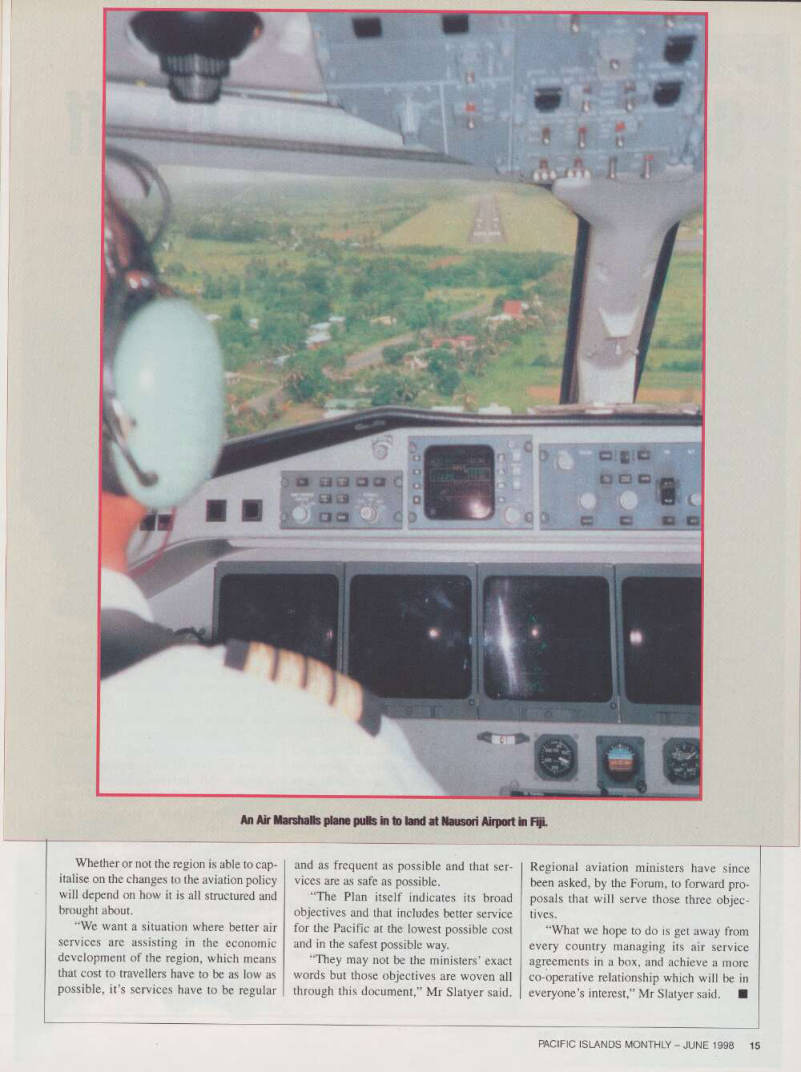
An Air Marshalls plane pulls in to land at Nausori Airport in Fiji.