Banana Court in a majo land battle
pp. 46-47 · Read in the full issue
Land
By Florence Syme-Buchanan
T HERE’S been little laughter or music at the legendary Banana Court Bar for almost two years a place where generations of Cook Islanders had their first drink, dance and date. As the saying went, ‘You hadn’t been to Rarotonga until you’d danced and
drunk at the BC,’ as it is still fondly known amongst older revellers. First timers expecting a grandiose establishment instead found a sprawling, slightly seedy bar bursting at its aged seams with a huge sweaty Friday night crowd, delirious with drink and loud electronic island music pumped out by Kaina Express.
The reputation for being the best night spot in the Cook Islands was one the run
down bar had for over 20 years - only to gradually lose it with management changes and the Cook Islands economic decline. Competition with newer, more efficiently-run bars, and a shortage of booze money, has made subsequent come backs in the early 90’s shortlived. That has been to the detriment of Government cof fers as the Banana Court complex is state owned. Adding to its problems, one of the
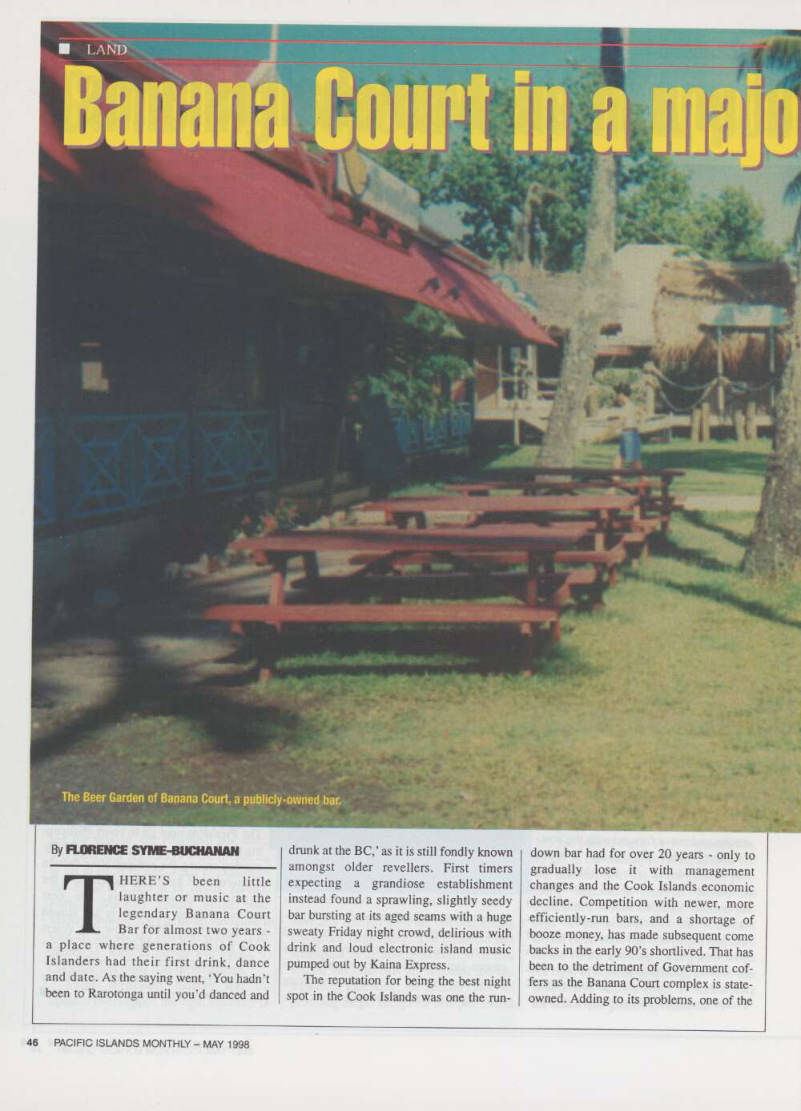
The Beer Garden of Banana Court, a publicly-owned bar.
Cook Islands biggest landowning chiefly families, Ngati Karika, is to enter into new negotiations with Government over prime land in central Avarua, capital of Rarotonga - the Banana Court included.
At present the Ngati Karika are paid a pittance in ground rental - $ 105 a year - for about three acres of land on which a num ber of Government buildings sit.
This includes the foreshore area where
the BC stands.
The rental dates back to 1905 when the land was origi nally given to gov ernment to build a hospital.
A sanatorium oper ated up until 1922, then Otera Rarotonga was built accommodat ing expatriat New Zealand Government work ers. Otera Rarotonga was later converted into the still famous but now silent South Pacific bar.
The Banana Court complex has a number of tenants operating a travel agency, cafe, jew ellery shop and a private medical practice. All rentals are paid to the Government, but some tenants want to pay their rental directly to the landowners instead.
Expectations are that the Banana Court will eventu ally be sold and as the landowners, the Karika family say they’ve got first option. The price just has to be right, says lan Karika who is Chairman of the Banana Court
Company - a position he holds thanks to Government and past negotiations to involve the landowning family in the day to-day operations of the property.
But Karika board members hold no vot ing rights and the final say still rests with Government. However, the ace card the family holds is undisputed landownership.
They want to negotiate an “amicable agreement” says lan Karika, but haven’t
ruled out taking the matter to court if disat isfied with future bargaining.
“Eighteen months ago the Prime Minister said they wanted to return all Crown land to the landowners, but any buildings would belong to them.” Several other landowning families in Rarotonga are now actively seeking the return of lands given to government in the early 1900’s for public use such as schools, but no longer used for the purposes they were originally intended. Early March saw the first forced occupation ever in the Cook Islands of Government buildings by anoth er landowning family, who were demand ing their land back. First given to Government by Willie and David Isaiah to build a school in 1914, houses for expatri at teachers and part of the Ministry of Works was built on about seven acres. Because teachers no longer live in the houses and part-closure of the Ministry of Works, the family believe they are justified in seeking the return of the land in the district of Arorangi on Rarotonga.
It was the first matter involving state assets that the recently established Cook Island Investment Corporation had to set tle. A few days after the occupation, an “amicable agreement” was reached, according to Investment Corporation Chair John Tierney. This saw the occupiers vacate the premises and “return the proper ty in its original condition respecting the Crown’s titleship and ownership of proper ty and chattels. The occupiers believe they made their point and are happy to leave,” said Tierney in a press statement. Before talks with the Investment Corporation a descedent of the Isaiahs, Mariia Maurangi, told Cook Islands News that, “we have to take back what is rightfully ours. There’s no school there and there haven’t been any teachers on the land for a long time.”
“We need to claim what is rightfully ours,” Maurangi had said. And as another descendent said, “this is a message to our people”. This could well mean landowners will hold Prime Minister Sir Geoffrey Henry to his word that all lands will be returned to their rightful owners.
Meanwhile, people still talk of the BC hey days.
Its brightly painted frontage and famous banana sign are constant reminders of when it all used to be fun and land battles with the Crown were unheard of. ■