In the name of charity
pp. 48-49 · Read in the full issue
Gambling
By Usa Vainerere
Police are cracking down on the Cook Islands biggest gambling craze this centu ry.
Housie nights have caught on in a big way, and the rush for licences by non-prof it organisations has prompted local Police to tighten up on restrictions.
Cook Islands Commissioner of Police Tevai Matapo says complaints began last year over abuse of the system by operators.
The Gaming Laws stipulate that 80 per cent of the proceeds have to go back into prizes. Some say the prizes have been unre alistically low for the crowds they receive.
Matapo admits that Police had not been keeping an eye on Housie nights - “mainly because we entrusted licencees to play by the rules. But bits of information dribbled in that perhaps some of them were abusing
their licences.”
The abuse ranges from organisers spending a few thousand on home improvements or vehicles, to saving more for the kitty by cutting down on player
prizes.
“That abuse of licences made us decide to revamp the whole issue of Housie per mits and tighten up on issuance,” he says.
Part of the new rules ensure that operators prepare quarterly accounts clearly showing the 80-20 split between prizes and fundraising/operating expenses. One oper ator has already lost their licence. But on an island where there is Housie six days a week in numerous villages, closing one down does not dent the gambling sport which is providing fierce competition for Tattslotto. It’s easier than selling raffle tick ets, and for players, it’s perceived as easy money. The new trend offers a whole new perspective on why people gamble in the
islands.
Housie addiction stems from legit imised gambling, Matapo says. “Provided the public wants it and there’s a public demand for it, who am I to pass judgement others,” he says.
“What does concern me is the money that’s being spent on housie means some one’s missing out at home. “I’ve also noticed, on some housie nights, young chil dren just wandering around outside.
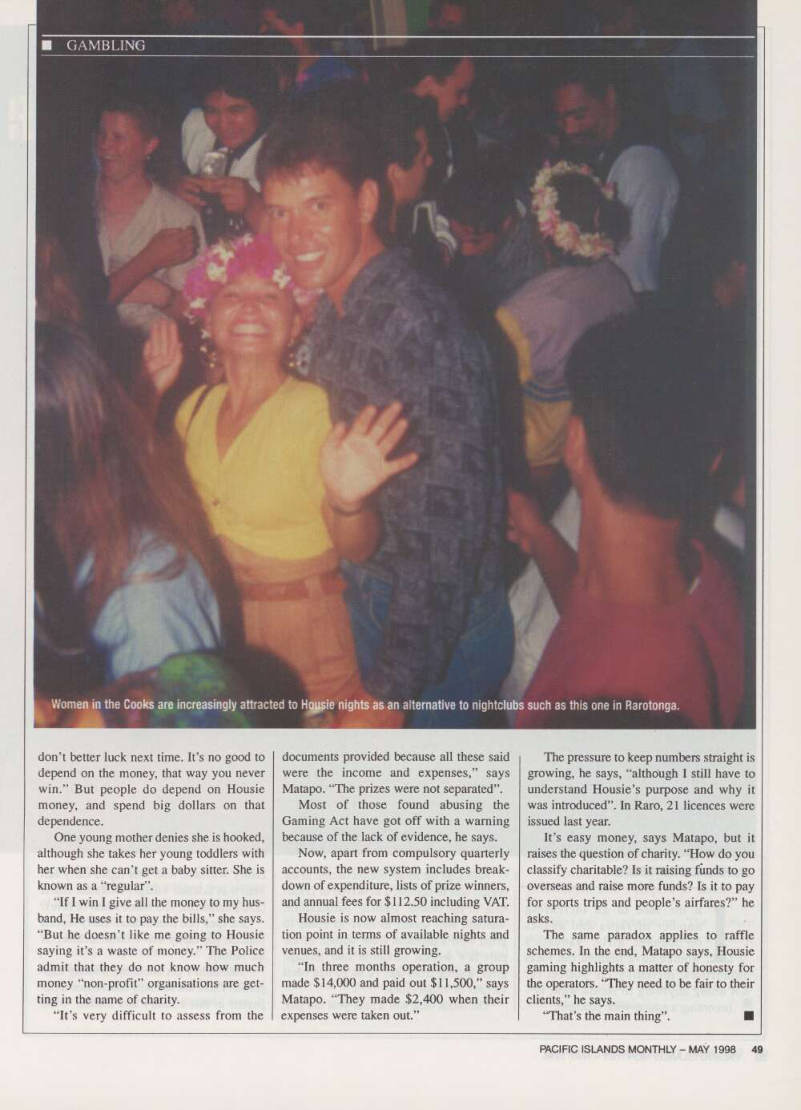
They’re waiting for their parents until late, and that’s uncivilised if those parents are there for three or four hours leaving their kids unsupervised because they’re so absorbed in the game.” Most of the housie players are women and the enjoyment, most say, goes beyond filling in a few cards and calling ‘House’.
“I can get out of the house, meet my friends and have a few drinks,” says one elderly woman. “If I win, that’s good, if I
don’t better luck next time. It’s no good to depend on the money, that way you never win.” But people do depend on Housie money, and spend big dollars on that
dependence.
One young mother denies she is hooked, although she takes her young toddlers with her when she can’t get a baby sitter. She is known as a “regular”.
“If I win I give all the money to my hus band, He uses it to pay the bills,” she says.
“But he doesn’t like me going to Housie saying it’s a waste of money.” The Police admit that they do not know how much money “non-profit” organisations are get ting in the name of charity.
“It’s very difficult to assess from the
documents provided because all these said were the income and expenses,” says Matapo. “The prizes were not separated”.
Most of those found abusing the Gaming Act have got off with a warning because of the lack of evidence, he says.
Now, apart from compulsory quarterly accounts, the new system includes break down of expenditure, lists of prize winners, and annual fees for $ 112.50 including VAT.
Housie is now almost reaching satura tion point in terms of available nights and venues, and it is still growing.
“In three months operation, a group made $14,000 and paid out $11,500,” says Matapo. “They made $2,400 when their expenses were taken out.”
The pressure to keep numbers straight is growing, he says, “although I still have to understand Housie’s purpose and why it was introduced”. In Raro, 21 licences were issued last year.
It’s easy money, says Matapo, but it raises the question of charity. “How do you classify charitable? Is it raising funds to go overseas and raise more funds? Is it to pay for sports trips and people’s airfares?” he asks.
The same paradox applies to raffle schemes. In the end, Matapo says, Housie gaming highlights a matter of honesty for the operators. “They need to be fair to their clients,” he says.
“That’s the main thing”. ■
Women in the Cooks are increasingly attracted to Housie nights as an alternative to nightclubs such as this one in Rarotonga.