Gambling repeal hale new peli[?]cal era in the Marshall Islands
pp. 44-45 · Read in the full issue
Gambling
By G[?]Ff Johnson
AN unprecedented cam paign by churches in the Marshall Islands brought the resounding defeat of gambling in late March, after weeks of debate in the Nitijela
(parliament).
In the end, despite attempts to delay consideration of anti-gambling legisla tion until the next parliamentary session in August, two separate measures were passed, handing President Imata Kabua a major defeat - the first ever for a presi dent in the Marshalls’ 19 years of consti tutional government.
The gambling legislation fractured the government’s cabinet, with just three members supporting the President’s pro gambling position, two voting with the church-led opponents, and two others abstaining (which has the effect of sup porting the anti-gambling legislation).
Above all, as the dust settled from the vote, two new developments had ushered in a new era for the Marshall Islands.
For a country which remains tightly controlled by paramount chiefs, the vote showed, for the first time, that the com munity can control the outcome of a vote in the Nitijela. The second development was that Speaker Kessai Note demon strated that he is a power to be reckoned with who is not taking his marching orders from the President.
Note has been Speaker for more than 10 years. During the 17 year tenure of President Amata Kabua (who died in 1996), Note managed the parliament for the President’s party. But not any more.
Angered by Note’s show of power dur ing the session, the President and other
pro-gambling legislators were preparing
to go to court in mid-April to challenge the Speaker’s action in ruling Kabua, I Foreign Minister Phillip Muller and Majuro Senator Tony deßrum ineligible to vote on the second bill that allows ‘soft’ gambling, such as raffles and bingo, by churches and other non-profit groups.
These legislators believe that the
Speaker overstepped his legal authority by
declaring a conflict of interest and barring them from voting. They say they didn’t
‘For a country which remains tightly controlled by paramount chiefs, the vote showed, for the first time, that the communi ty can control the outcome of a vote in the Nitijela ’
have any conflict with the bill concerning non-profit fundraising. The President had attempted to derail consideration of this second bill - the first bill repealed the law legalising gambling; the second made all gambling illegal except for non-profit fund
raising activities - until the August session.
But, as he had in the first vote, Note ruled that the three leaders, because they either owned or had an interest in gam bling activities, could not vote. The first bill had passed easily 18-7. Nevertheless, to get to consideration of the second bill the next and final day of the session, gam ; bling opponents had to defeat the President’s motion to defer. Without pas sage of the second bill, the Marshalls would have been left with a previous law on the books allowing local governments the right to legalise gambling, a move that would have had the effect of maintaining the status quo gambling situation.
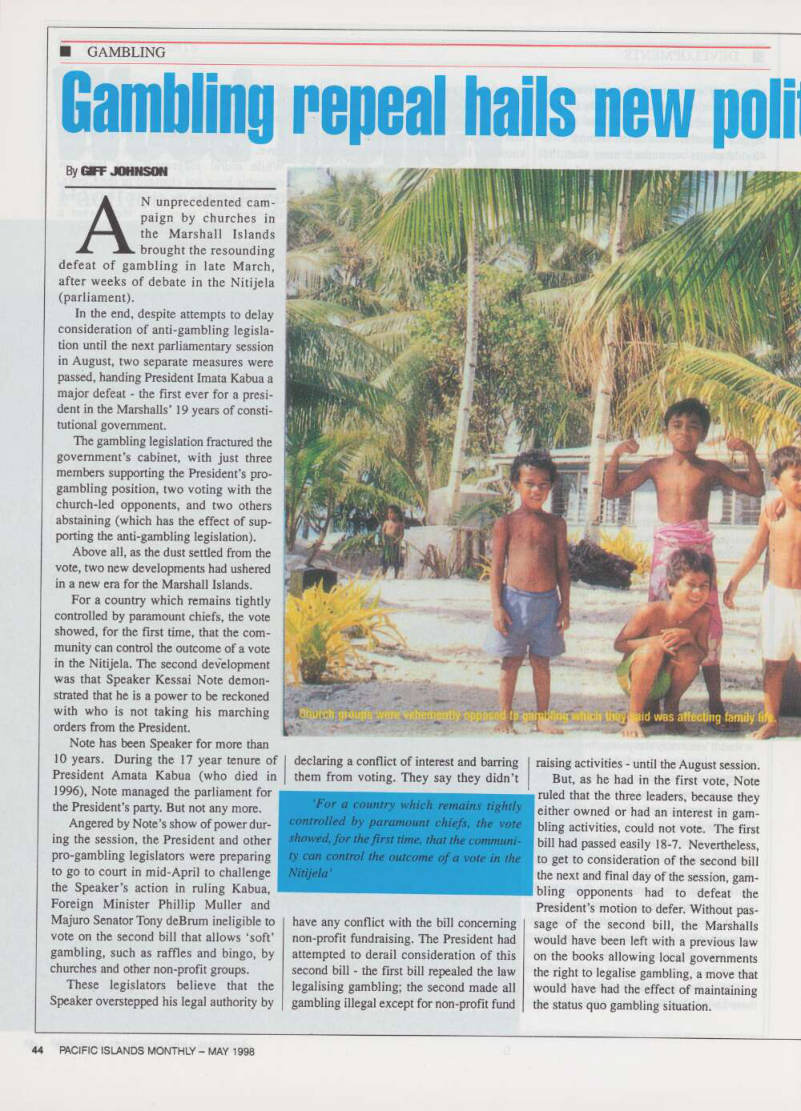
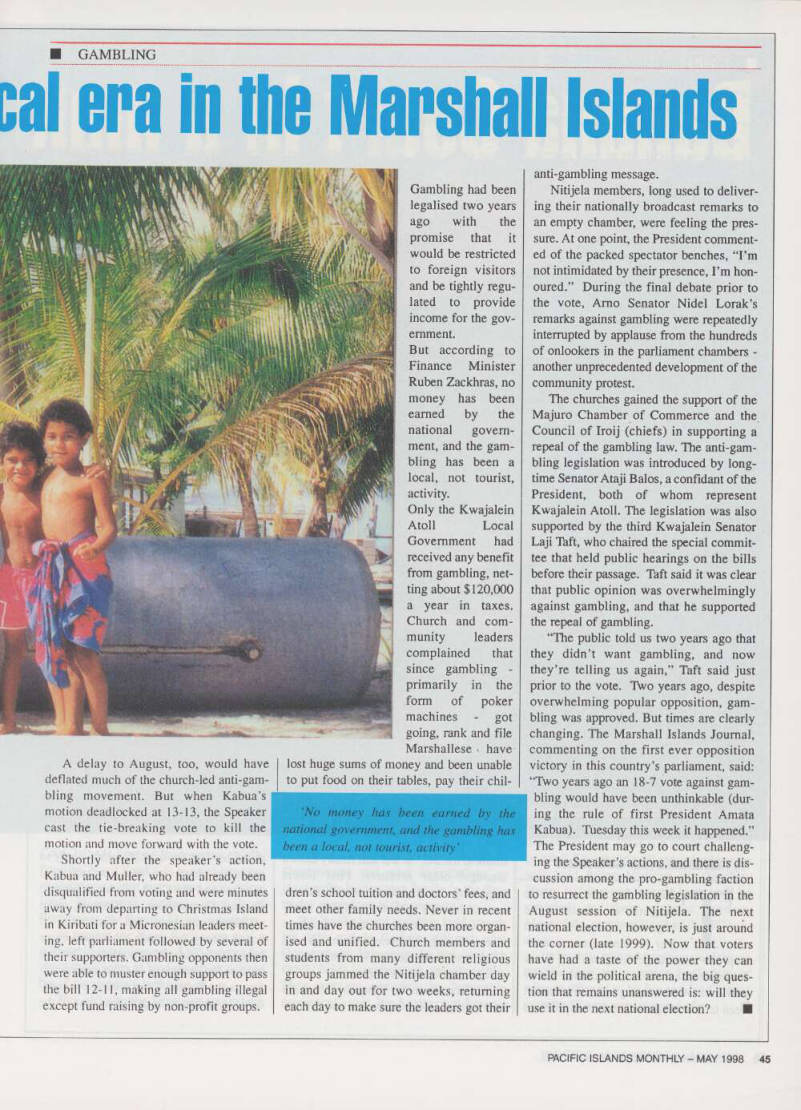
Church groups were vehemently opposed to gambling which they said was affecting family life.
A delay to August, too, would have deflated much of the church-led anti-gam bling movement. But when Kabua’s motion deadlocked at 13-13, the Speaker cast the tie-breaking vote to kill the motion and move forward with the vote.
Shortly after the speaker's action, Kabua and Muller, who had already been disqualified from voting and were minutes away from departing to Christmas Island in Kiribati fora Micronesian leaders meet ing, left parliament followed by several of their supporters. Gambling opponents then were able to muster enough support to pass the bill 12-11, making all gambling illegal except fund raising by non-profit groups.
Gambling had been legalised two years ago with the promise that it would be restricted to foreign visitors and be tightly regu lated to provide income for the gov ernment.
But according to Finance Minister Ruben Zackhras, no money has been earned by the national govern ment, and the gam bling has been a local, not tourist, activity.
Only the Kwajalein Atoll Local Government had received any benefit from gambling, net ting about $120,000 a year in taxes.
Church and com munity leaders complained that since gambling primarily in the form of poker machines - got going, rank and file Marshallese . have
lost huge sums of money and been unable to put food on their tables, pay their chil
‘No money has been earned by the national government, and the gambling has been a local, not tourist, activity’
dren’s school tuition and doctors’ fees, and meet other family needs. Never in recent times have the churches been more organ ised and unified. Church members and students from many different religious groups jammed the Nitijela chamber day in and day out for two weeks, returning each day to make sure the leaders got their
anti-gambling message.
Nitijela members, long used to deliver ing their nationally broadcast remarks to an empty chamber, were feeling the pres sure. At one point, the President comment ed of the packed spectator benches, “I’m not intimidated by their presence. I’m hon oured.” During the final debate prior to the vote, Amo Senator Nidel Lorak’s remarks against gambling were repeatedly interrupted by applause from the hundreds of onlookers in the parliament chambers another unprecedented development of the community protest.
The churches gained the support of the Majuro Chamber of Commerce and the Council of Iroij (chiefs) in supporting a repeal of the gambling law. The anti-gam bling legislation was introduced by long time Senator Ataji Balos, a confidant of the President, both of whom represent Kwajalein Atoll. The legislation was also supported by the third Kwajalein Senator Laji Taft, who chaired the special commit tee that held public hearings on the bills before their passage. Taft said it was clear that public opinion was overwhelmingly against gambling, and thaf he supported the repeal of gambling.
“The public told us two years ago that they didn’t want gambling, and now they’re telling us again,” Taft said just prior to the vote. Two years ago, despite overwhelming popular opposition, gam bling was approved. But times are clearly changing. The Marshall Islands Journal, commenting on the first ever opposition victory in this country’s parliament, said: “Two years ago an 18-7 vote against gam bling would have been unthinkable (dur ing the rule of first President Amata Kabua). Tuesday this week it happened.”
The President may go to court challeng ing the Speaker’s actions, and there is dis cussion among the pro-gambling faction to resurrect the gambling legislation in the August session of Nitijela. The next national election, however, is just around the corner (late 1999). Now that voters have had a taste of the power they can wield in the political arena, the big ques tion that remains unanswered is: will they use it in the next national election? ■